

Submitted:
05 June 2023
Posted:
09 June 2023
You are already at the latest version
Preprints on COVID-19 and SARS-CoV-2
Abstract
The Covid-19 pandemic that hit the world in early 2020 has had a major impact on social and economic life in every country, including Malaysia. Many socio-economic activities have been disrupted globally, leading to the closure of companies and the suspension of work activities, which have drastically increased the unemployment rate and narrowed employment opportunities. This study uses a qualitative method to explore the initiatives taken by Malaysia Ministry of Higher Education and university in improving the sustainability graduates’ employability at the post pandemic Covid-19 phase. The total sample of the study involved is ten officers who are experienced and responsible in organizing initiatives for university graduates’ employability programs and ten participant students who attended the programme were purposively selected. The study showed that Short -term training & placement programmes (MyStep), Career Advancement Programmes (Penjana CAP), Professional certification programmes (Penjana PACE), Career Advancement Programmes at State (Penjana KPT CAP@ State) were the major initiatives taken by Malaysia Ministry of Higher Education in improving graduate employability at the post Covid-19 phase. The findings also revealed upskilling and reskilling, gig economy, entrepreneur, finishing school programmes and online career fair were the important initiatives taken by university in improving graduate employability rate at the post Covid-19 phase. Interviews with student respondents showed that the initiative taken by the government and university to increase the marketability of graduates in the post-covid-19 era has given them the opportunity to learn and improve new skills that are very necessary to get new job opportunities in the post-covid 19 eras. The main contribution of this study is that upskilling and reskilling programs are essential to improve the sustainability of graduates’ employability in the post-covid 19 era.
Keywords:
Sustainability
; Graduates
; Employability
; Initiatives.
; Ministry of Higher Education
1. Introduction
The World Health Organization (WHO) proclaimed COVID-19 a pandemic on March 14, 2020, after the disease spread to hundreds of thousands of people globally and caused more than 12,000 deaths [1]. In a short amount of time, the sickness spread to every corner of the globe, affecting and transforming human life everywhere. In order to break the chain of COVID-19 infection, the majority of countries in the world were forced to establish curfews and engage in social isolation. According to information given by the World Health Organization (WHO), the physical and social distance required to prevent the spread of this virus will not be completed in one or two years but will instead span several months and possibly even years. The installation of curfews and social isolation led to the loss of employment chances. This is evident by the substantial decline in labour demand that has begun to occur [2]. In March, for instance, roughly 10 million Americans lost their employment [3]. In Malaysia, the curfew and the practise of social distance have a significant impact on the economy, resulting in a decrease in the number of available workers and a rapid loss of employment [4]. The Malaysian Research Institute (MIER) estimates that 2,4 million individuals will lose their jobs post-Covid-19 as a result of the closure or reduced operation of businesses, including some small and medium companies (SMEs), and the recession of the Malaysian and global economies. The issue would worsen if hundreds of graduates from students and public and private higher education institutions who wish to continue working graduate this year [5]. The Central Bank of Malaysia also recently announced an increase in the unemployment rate projection for 2020 to 4% [5]. In the post pandemic Covid-19, this is a challenge and a new norm for graduates graduating in 2020-2022. Therefore, the Malaysian Ministry of Higher Education has entrusted specific IPTAs with Career Centres in each IPTA with the responsibility of implementing early initiatives to assist in preparing students who will graduate in 2020 with mental preparedness, skills, knowledge, experience, and competitiveness necessary to pursue employment opportunities in the post pandemic Covid-19. Therefore, this study was conducted to identify UMS institutions in an effort to boost the marketability of graduates in the post Covid-19 era, and to determine the extent to which this strategy was successful. In addition, this study develops a programme model that can be utilised to boost the marketability of UMS graduates in the post pandemic Covid-19.
2. Literature Review
2.1. The impact of COVID-19 on graduate employability
Job loss was one of the repercussions of pandemic Covid-19 at that time. In Malaysia, between 191,000 and 413,500 workers lost their jobs in 2019 and 2020, respectively [6]. Covid-19 has repercussions in other nations. For instance, the United States has 22 million, the United Kingdom has 2.6 million, Australia has 600,000, and India has 120 million. Loss of employment as a result of the diminution of economic activity brought on by the reduction of operations and the job market. This highlights the issue of the marketability of the increasing number of graduates each year. In addition, the proliferation of Covid-19 resulted in the creation of additional jobs. This creates a skills mismatch between the available positions and increases the likelihood of unemployment for graduates who are still in school or have recently graduated. For instance, [7] conducted a survey to determine the impact of the Covid-19 outbreak on the lives of working students in Japan revealed that 37% of students were concerned about their health as well as the cost of living, tuition fees, and financial concerns.
In this regard, [8] indicated that a person’s education degree is a predictor of employment. During the Covid-19 pandemic, young people with a primary or secondary education struggle the most to find and maintain employment. Because of the COVID-19 epidemic, the majority of graduates from public colleges do not feel secure about finding employment in their respective disciplines after completing their studies [9,10]. Accordingly, [11] argued that the Covid-19 epidemic necessitates that the government enhance its techniques for increasing the employability of graduates by incorporating various modern platforms and partnering with public universities and significant companies. Hence, this study was conducted to investigate and comprehend the issue of graduate employability in Malaysia, focussing on how the government and the University of Borneo respond to this issue by enabling graduates to maintain their employability in the post pandemic Covid-19.
2.2. Ministry of Higher Education initiatives to increase graduates’ Employability.
When Covid-19 struck, many people were not only impacted in terms of health, but also their lives. Many were laid off and lost their employment. This impacts the employment prospects of both current graduates and those who graduate during the pandemic. Numerous nations around the world are concerned about this issue. In the era of the pandemic, countries have developed a variety of programmes to increase the employability of graduates. Countries such as Australia, China, India, the Eurozone, and Spain take note and develop measures to enhance graduates’ skills and competencies in order to increase their employability [12]. In India, for instance, initiatives in the fields of corporate communication and English, logical and numerical abilities, analytical & problem solving, and coding have been implemented [13]. Higher Education in Japan has highlighted a need for hard and soft talents, including customer psychology, business strategy, marketing, networking skills, passion, and hard work, particularly in the sports industry [14]. In Thailand, skills are also cultivated through ‘social enterprise’ programmes for upskilling, reskilling, career counselling, and entrepreneurial education [15]. Malaysia did not miss an opportunity to boost the marketability of its graduates. The Ministry of Higher Education has entrusted IPTA, particularly the Career Center in each institution, with the responsibility of implementing initiatives to ensure that 2020 graduates have the mental preparedness, skills, knowledge, experience, and competitiveness to seize post-Covid-19 opportunities. The KPT-CAP or ‘career advancement planned’ generator and the KPT-PACE or ‘professional certificate’ generator [16]. The target participants for both programmes are graduating seniors and IPTA students in 2019 and 2020. It guarantees job placement for those who complete the training and meet the established conditions.
In addition, the Malaysia Ministry of Higher Education continuously enhances the collaboration between industry and academia in IPT and the industry-driven curriculum. As advised by the Ministry of Higher Education, institutions play a role in addressing graduate employability. UTM, for instance, provides career development talks, resume and interview preparation guides, registration, and professional qualifications with the ‘Board of Engineering Malaysia’ (BEM) & ‘Malaysian Board of Technology’ (MBOT), Malaysia Automotive robotic and IOT institute (MARii) together with Malaysia-Japan international institute of Technologies (MJIT) Alumni as one of the success stories of the graduate programme [17]. Additionally, the institution attempts to establish a network with other institutions both domestically and internationally to obtain more extensive information regarding other skills and employment opportunities compatible with the graduates’ skills and knowledge [18]. Given the number of initiatives that have been implemented, very little is published about the effectiveness of initiatives. Therefore, the purpose of this article is to explain the efficiency of the programme implemented among Borneo Region graduates.
2.3. University Initiatives
According to [10], the university is viewed as a tool for establishing a dynamic and progressive society in conformity with contemporary trends. This indicates that universities play a crucial role in providing students with specialised information and abilities in their respective disciplines. However, the global spread of the Covid-19 pandemic since the beginning of 2020 has resulted in a significant change that can be observed when universities restore their functions and roles in terms of assisting students to prepare for work and ensure their employability after completing their studies [19]. Graduate employability refers to a graduate’s capacity to obtain and maintain employment and to adapt to the industry’s needs. Covid-19 has affected the lives of everyone on Earth, even college students. For instance, [9] who conducted a study on 644 university students in seven countries (the United States, the Netherlands, Ireland, South Korea, China, Malaysia, and Taiwan), found that covid-19 caused uncertainty regarding the marketability of work and the financial situation of students. Lastly, the pandemic generated economic turbulence in a nation, which increased the likelihood of unemployment.
[20] found that most students in all nations suffer a high level of anxiety during the curfew period due to concerns about their future work prospects. Consequently, most colleges must take proactive measures to aid and enhance the employability of university students from the beginning of the epidemic to the present. For instance, institutions can implement a variety of programmes that allow students to continue to exist after completing their studies. By involving students and business on a frequent basis, structured programmes and seminars that give information and skills and alleviate student anxiety around their marketability issues can be developed [9,20,21].
In the same perspective, [10] did a qualitative study focusing on the role of career advisors and graduate recruiters in giving employment chances in the financial, banking, and accounting industries. The findings of their analysis demonstrate the need of implementing new approaches by stressing university cooperation in order to measure graduates’ marketability more systematically. At the same time, this demonstrates that the function of each institution is more significant in terms of bridging the employment gap after graduation, considering the level of education and the field of the students [8].
Educational institutions, notably universities in Malaysia, are likewise very concerned about the employability of graduates. For instance, [22] conducted a study to determine the impact of the post-covid-19 epidemic on the relationship between alumni perception and marketability (PMBS). Their research demonstrates that there is no association between marketability perception and marketability rate, but they demand that higher education institutions and the industry redesign their education programmes to meet the needs of the post-covid-19 market. Therefore, public colleges must examine the most effective technique for applying values that can alter the thinking and viewpoint of graduates so that they are more motivated to seek employment during the Covid-19 pandemic crisis [23]. Consequently, most colleges, particularly student career centres, have implemented several efforts to assist and improve graduates’ employment prospects in post Covid-19 pandemic. For instance, University Sains Islam Malaysia (USIM) takes a proactive stance by offering a variety of graduate employability programmes [24]. In this context, universities in Borneo have also attempted several comparable efforts, but the impact of all these projects remains uncertain. Consequently, this study was done to analyse and comprehend the efficacy of the programmes designed to assist graduates in bridging the gap between their employability demands and industry expectations.
3. Method
The data of this study were obtained using qualitative research methods. This is because the method qualitative can help researchers understand research problems in depth.
3.1. Research Design
This study was conducted utilising qualitative phenomenological approaches, including the collection of data from study participants via interviews and the analysis of official and informal documentation. Interviews are one of the primary strategies used to collect in-depth data on research participants. This is consistent with the philosophy of qualitative research, which is to acquire information and investigate the context of a phenomenon perceived by the study’s respondents through communication [25]. Through in-depth interviews, it is also intended to investigate the actual experiences of the study’s participants. A study that employs phenomenological methodology is stated to be a qualitative study that describes an existing experience that its respondents have had [26].
Phenomenology is the research philosophy and methodology. Phenomenology, as a branch of philosophy, refers to the study of the structure of experience and consciousness. It refers to a study aimed to comprehend the subjectivity, life experiences, and perspectives of participants. Phenomenology is predicated on the premise that a single experience can be understood in multiple ways, and each participant’s interpretation of that experience constitutes the statement. Thus, phenomenology provides information regarding unique individual experiences, providing a rich and comprehensive picture and understanding of humans.
3.2. Participants
The technique of purposeful sampling was used to select ten officers at the University Malaysia Sabah, Center for Career and Student Entrepreneurship Development (CCSED) who have planned and implemented programmes related to the employability of graduates in order to examine an initiative undertaken by the university to enhance the employability of graduates. The approach of purposive sampling was also utilised to select ten students who had participated in the employability programme.
3.3. Officer Data Collection
Ten officers at the University Malaysia Sabah, CCSED who had organised and implemented graduate employability-related programmes participated in an in-depth, one-on-one interview. An in-depth interviews are the most effective method for gaining insight into the responder and gaining a deeper understanding of their experiences, feelings, and attitudes [27]. The interview was conducted in the Career Center’s meeting room to ensure that no outside meddling occurred. There were four different types of questions. It consisted of (1) opening questions, (2) questions pertaining to the initiative made by the government and institution, (3) questions centred on the impact of the programme, and (4) concluding questions. Prior to the actual data collection, the interview questions were reviewed and approved by two subject-matter specialists in order to preserve their reliability and validity. Depending on each participant’s responses, the total number of interviews varied. Each interview session lasted 45 to 60 min with two interviewers present. All of the interview sessions were taped.
3.4. Student Data Collections
After three months of participants participation in the graduate employability programme, one-on-one interviews were performed via google meet. There were ten interviews conducted in all. Each interview session began with a brief explanation of the interview’s format and concluded with the researcher thanking the student for their participation and assuring them that their responses would be kept strictly confidential. A protocol for the interview has been prepared and additional questions are also asked based on the participant’s response. Also, the researcher informed students that their comments will remain anonymous. Every interview lasted between 50 and 60 min and was audio recorded.
3.5. Data Analysis
In this study, qualitative data were analysed using a thematic analysis method based on Braun and Clarke’s six phases of thematic analysis [28]. First, the audiotapes of the participants were transcribed verbatim, and then the correctness of the transcriptions was verified. The transcriptions were then imported into NVivo version 10 for further analysis.
During the second phase, categories or correlated codes were constructed from the initial data points identified during the data familiarisation approach using an open coding method. Coding centred on the initiative taken by the minister of higher education and universities to implement the graduate employability programme and its impact on the employment of student participants. During the coding procedure, the researcher gave each piece of data equal importance. By labelling and identifying text within each data item, the open coding function of NVivo enabled the researcher to generate a large number of initial codes for likely themes and patterns. In the third phase, the basic codes derived from open coding are refined. The revised codes were then rearranged and collated into prospective themes using analytic techniques. In the fourth step, revisions were made to the basic ideas in order to refine, integrate, or separate them into the primary topics. The emphasis of this phase was on internal homogeneity (the data inside each topic should cohere meaningfully) and external heterogeneity (the data should be precise and apparent between the themes). Moving between data extracts and themes, the fifth phase investigated the validity of the themes, specifically the data set. The researcher ensured that the themes accurately represented the dataset by recognising and resolving similarities and conflicts between them. The final collection of themes was double-checked by the researcher to ensure that they effectively addressed the study topic. The sixth phase produced findings based on themes and direct quotations from the data collection.
4. Result
4.1. The initiatives by Ministry of Higher Education to improve the marketability of graduates’ post Covid- 19 Pandemic Era
In the era of the pandemic, the Malaysian Ministry of Higher Education has adopted several initiatives to enhance the employability of graduates. The interviews with CCSED officers and students revealed four major themes: My STEP Programme (Short -term training & placement programs), Penjana KPT CAP (Career Advancement Program), Penjana KPT PACE (Professional certification programs) and Penjana KPT CAP@ State (Career Advancement Programs at State
According to the analysis of officers’ and students’ interview data presented in Table 1, nearly 75 percent concur that My STEP Program (Short-term training & placement programs) is a major initiative undertaken by the Ministry of Higher Education to improve the marketability of graduates in the post-Covid-19 pandemic era. The interviews also revealed that Penjana KPT CAP (Career Advancement Programs) is the second most prominent project, followed by Penjana KPT PACE (Professional certification programs). The analysis of interview data with officers’ and students’ participants reveals that Penjana KPT CAP@ State (Career Advancement Programs at State) is a very uncommon action implemented by the Malaysia Ministry of Higher Education to enhance the marketability of graduates in the post-Covid-19 Epidemic Period. The Findings suggested that the Malaysia Ministry of Higher Education has taken proactive measures to promote the marketability of graduates in the period of Pandemic to assure the sustainability of graduates’ marketability in the era of pandemic Covid-19.
4.2. The initiatives by university to improve the marketability of graduates’ post Covid-19 Pandemic Era
The analysis of the interview data with officers has resulted in four main themes of initiatives taken by university to improve the marketability of graduates.
4.2.1. Upskilling dan reskilling programs
Analysis of interviews with officers at the career center reveals that the primary measure taken by the university to inhance the marketability of graduates is to provide students with upskilling and reskilling programs. This is because most of the job opportunities that exist in this pandemic era require additional skills and are not relevant to the student’s field of study. For example, CCSED Officer 1 stated:
Reskilling and upskilling programs are very necessary to be held to enhance students’ skills because most of the job opportunities that exist during the pandemic era require new skills to ensure sustainability of marketability of graduates. According to him, the university has planned three categories of upskilling and reskilling programs, one of which is the Training and Placement program. This program is implemented in collaboration with industry to train students in the disciplines required by the industry, so that they may be hired by the industry.
This statement is also supported by the second CCSED officer who states that the University has taken drastic steps to design various upskilling and reskilling programs in three main area namely in pure science, social science, and technology to guarantee the sustainability of graduates’ marketability by improving students’ skills so that they are marketable.
However, the cost of implementing this program is very high. Therefore, the university implements a policy of collaborating with local industry to apply for upskilling and reskilling funding provided by Malaysia Ministry of Higher Education. According to the 3rd CCSED officer, UMS managed to obtain funds of almost Ringgit Malaysia 6 million as shown in Table 2 b to implement this program.
The analysis of student interviews also demonstrates that the university actively implements various upskilling and reskilling programs to ensure the sustainability of student employment. For instance, student respondent 1 with a major in social science, stated:
“The new job opportunities that exist in the pandemic era require new working skills, which makes it difficult for literary students to obtain employment. Therefore, the university implements online upskilling programs aggressively so that students can obtain employment.”
This statement was also supported by student respondent 8 from the Department of Technology, who explained that the university is extremely proactive in instituting upskilling and reskilling programs to ensure that students majoring in pure science and technology can be marketable.
The triangulation of interview data of CCSED officer and student respondents concluded that the university has taken proactive steps by holding various upskilling and reskilling programs to enhance and sustain the marketability of graduates. This program is implemented with various funding obtained from the Ministry of Higher Education.
4.2.2. GIG Economy Program
One of the most important job opportunities during the Covid era is the GIG economy which is a concept of creating income by working temporarily or short-term. An interview with CCSED officer 1 shows that GIG economy which is an exploding job opportunity during the Covid 19 pandemic is starting to become the main focus and choice of students. Therefore, the university started to introduce the GIG economic programs to all university graduates, according to the CCSED officer 1 in 2021 UMS successfully introduced 25 GIG Economic programs to graduates and the number increased to 45 programs in 2022. CCSED officer 2 and 3 also explained that among the GIG economy programs that highly received response from students were Panda Bite, Siswa Mall, Runner Man and MYSITI. In addition, the analysis of the meeting minutes document and the student career and entrepreneurship development center’s annual reports for 2021 and 2022 reveals that the GIG economy program is introduced to students in two phases, namely phase 1 in month of June and phase 2 in November. An interview with the CCSED officer 3 revealed that the GIG program is conducted in two phases because approximately 70 percent of students will graduate in July and the remaining 30 percent will graduate in December. The implementation of the GIG economy program in June and November will therefore provide students with exposure and career opportunities.
Interviews with student respondents also show that the university is aware that it is quite difficult for students to venture into various new fields of work that exist after the pandemic without working experience. Therefore, the university regularly gives exposure to job opportunities in the field of GIG economy as an alternative to conventional job opportunities. This statement is supported by student respondents 4 and 7:
“It can be said that as many as four to six economic GIG economy programs will be conducted by the university every week to give exposure and opportunities to students to get involved in the field of GIG economics. I have attended six programs and the one I chose to participate actively is siswa mal”.
Based on the analysis of interview data, meeting minutes and annual reports, the researcher concludes that the university has taken a drastic initiative to introduce economic GIG as a job of choice for graduates. This is because graduates can generate income productively, flexibly, and sustainably in the gig economy that offers a variety of services to participate in such as education, transportation, food and goods delivery and some involving financial products.
4.2.3. Entrepreneurship Program
The entrepreneurship program that began to be emphasized in the Ministry of Higher Education’s Entrepreneurship Action Plan 2021-2025 has also been used as a guide for universities to implement various programs to encourage graduates to enter the field of entrepreneurship as one of the job opportunities. According to SSCED officer 2
“The Student Career and Entrepreneurship Development Center also helps and encourages graduates to choose entrepreneurship as one of the career fields in the pandemic era. For example, through Bank Rakyat’s entrepreneur program, students are given business assistance of RM 5000 to RM 7000 to start a business. In addition to that, the Career Program with the Ministry of Entrepreneur was held to give exposure to students on how to register a business and obtain business start-up funds”.
SSCED officer 3 a explained further,
“Through 2021, the Entrepreneurship Unit implemented 32 entrepreneurial programs and activities. The programs consist of education, training, and exposure to the world of entrepreneurship. The students will be exposed to entrepreneurial abilities and knowledge. In fact, our objective is to increase the number of students who become entrepreneurs, as employment opportunities in the industry have decreased since the Covid-19 pandemic.”
To further strengthen the analysis of the findings of this study, the researcher has reviewed the annual report and minutes file of the meeting of entrepreneurial activities carried out by the Center for Career and Student Entrepreneurship Development (CCSED). Data analysis shows that the number of entrepreneurship programs implemented by CCSED increased during 2021 and 2022, as shown in the Figure 1 below:
As shown in the Figure 1, the number of entrepreneurship programs implemented by CCSED increased from 32 programs in 2021 to 52 programs in 2022
In addition, interviews with student respondents indicate that the university, via the Centre for Career and Student Entrepreneurship Development (CCSED), promotes and encourages students to engage in entrepreneurship as one of the alternative job opportunities in this pandemic era. For instance, Student respondents 7 and 8 explained,
“The university always plans and implements numerous entrepreneurship programs to encourage students to pursue entrepreneurship as a career.” Both of us from the Food Science Faculty participated in the Bank Rakyat Siswa Entrepreneur program. This program exposed me to numerous business opportunities and provided me with funding to launch a cake business.”
Triangulation of interviews and document analysis indicate that the university plans and implements various entrepreneurship activities to expose and encourage students to choose entrepreneurship as one of their career options in the endemic era. This is due to the university’s dedication to producing graduates who can establish employment opportunities for themselves and the surrounding community. This ambition is consistent with the primary objective of the Ministry of Higher Education’s Entrepreneurship Action Plan 2021-2025.
4.2.4. Finishing School Program
The university has designed a finishing school program to ensure that graduates are prepared for the job application. Interviews with CCSED officers 4 reveal that the finishing school programs are planned and implemented at two phases: Namely first phase at the faculty level and second at CCSED level. According to CCSED officer 6 and 8 the main tasks of the finishing school program include writing e-resumes, interview preparation, mock interviews, effective communication, LinkedIn registration, My future Job, Personal Branding and Planning for Job Application. As a further explanation, Officer 9 explained that the Finishing School Program in 2021 implemented via online and in 2022 face-to-face. According to him, finishing school programs are very important to ensure that graduates are fully prepared to enter the job market.
The analysis of the annual report document shows that the finishing school at the faculty level was held from February to September and at the university level held in October. The findings of this analysis also show that the finishing school program is implemented in collaboration with local industry, Ministry of Youth and Sports, Social Security Organization (Ministry of Human Resource)
Analysis of interviews with student participants also explained that the faculty carried out various activities during the Finishing School program. Among the programs that are the main choice of students are writing e-resumes and My future Job training. For example, student participant 10 states
“The main activities awaited by most students to attend during the Finishing School Program are My-Resume writing workshop and My Future Job training.
Student Participant 3 and 6 also explained,
“I am looking forward to attending Finishing School Programs at my because I gaing extra knowledge on how to find my dream Job with good salary.
Annual report document analysis and interviews with CCSED officers and students indicate that the university also implements a finishing school program to ensure that graduates are prepared to enter the workforce. Retirement various programs throughout the implementation of finishing school program have received a warm welcome from the students.
4.2.5. Online Career Fair
The Career Fair is one of the annual activities organized by the CCSED as an initiative to give prospective graduate students the opportunity to choose jobs that match their qualifications.
The Career Fair was held in collaboration with the Ministry of Higher Education, Perkeso, and domestic and international industries. However, during the pandemic, the university was unable to hold this career fair physically. Therefore, the career fair was conducted online. Interviews with officers at the CCCED and annual report document analysis reveal that Career Fair program at the faculty level was held from February to September and at the university level held in October. The CCSED and faculty will organize a schedule for the entire year and contact industries that are interested in participating. The implementation method is online and takes between three and five hours to complete. This career fair begins with an industry preview session and proceeds with an interview. However, in 2022 the career fair were held face to face.
The findings of analysis also show that at the university level the Career Fair is implemented in collaboration with the Ministry of Higher Education, the Ministry of Youth and Sports, Social Security Organization (Ministry of Human Resource) and is held 3 times a year in June, September, and November every year. The total number of career fair held by CCSED, and total number of job opportunities shown in Table 3
Data analysis of Table 3 shows that the number of career fair and total job opportunities offer by industry have drastically increased in 2021 and 2022.
Interviews with students who attended the online career fair and physically were also conducted to explore the effectiveness of the career fair organized by CCSED in helping graduates get job opportunities. Interview analysis shows that CCSED is very active in organizing career fairs online throughout 2021 and physically in 2022. This career fair is very helpful for graduates in getting job opportunities that suit their fields. For example, student respondent 1 stated,
“I often receive career fair posters from CCSED via email and WhatsApp. I have attended the online career fair four times and managed to secure a job that suit to my field. Therefore, I would like to thank CCSED for helping me get my dream job.”
Students respondents 5 and 9 also explained,
“The Career Fair organized by CCSED to help graduates get a job is very good and effective. This is because every month there is a career fair and various industries participated. The job provided are diverse and allow student to work from home. In addition, graduates are also given the opportunity to work online with companies in Singapore and Thailand.”
Triangulation of interviews with CCSED officers, graduates, and document analysis show that throughout the year 2021 to 2022 CCSED actively organizes a career fair. This Career Fair has provided various job opportunities for graduates which in turn increases the marketability rate of Malaysian Sabah university graduates in the era of the Covid 19 pandemic.
5. Discussion
In the post-Covid 19 era, the Malaysian Ministry of Higher Education has taken numerous steps to enhance the employability of graduates. Graduates have shown interest in the Malaysian Short-Term Employment Program (MySTEP). Graduates who are selected to participate this program will be given training for 1 month and will be placed to work in various Ministries, Government Agencies, Government Linked Companies (GLCs), Government Linked Investment Companies (GLICs) and Strategic Partners with a monthly salary of RM 2000.00. The initiative greatly helps to increase the marketability of graduates who graduate in 2021 and 2022 by providing a transitional job opportunity planform for six months before the graduate gets a job equivalent to their qualification. This program has effectively created 20,000 employment opportunities in 2021, 35,000 in 2022, and 50,000 in 2023 [29]. Overall, the finding is difficult to compare with previous research due to the paucity of reports on temporary job placement initiatives undertaken by governments in other nations to better the employability of graduates in the post-Covid 19 era.
In addition, this study’s findings indicate that the Malaysian Ministry of Higher Education, has implemented Career Advancement Programs (KPT-CAP) and KPT Professional certification programs (KPT PACE). The Malaysia Ministry of Higher Education has allocated RM 1000 billion to implement this program. Students who embarked on this program are given free upskilling and reskilling training for two to four weeks. Students who complete this training will be placed to work in private companies and industries that are relevant for the received training they have taken. This program greatly helps the university to enhance the marketability of graduates in 2020, 2021 and 2023 because it successfully created 30,000 job opportunities in the fields of manufacturing, banking, information technology and communication (ICT) [30]. The findings of this study are similar to several studies carried out abroad which show that the government of each country takes various initiatives to increase the marketability of graduates in the Post Pandemic 19 era, however the names of these programs and initiatives are different according to the country [13,14].
The university has also taken proactive measures to enhance graduates’ marketability in the post-Pandemic covid 19 eras. Providing graduates with information about employment opportunities in the GIG economy, organizing a career carnival, enhancing entrepreneurial skills considering the emergence of new opportunities for entrepreneurs, and implementing finishing school programs are a few examples. This program also contributes significantly to the marketability of graduates in the post-Covid-19 era, as students are equipped with all the new skills and abilities required for the new employment opportunities that exist in the post-Covid-19 era.
In addition, the organized of online career fair provides a variety of online job opportunities for the graduates. These new job opportunities encourage graduates to apply and at the same time reduce the waiting period to find a job among graduates. This finding is difficult to compare to previous studies due to the paucity of research literature on university initiatives to increase graduates’ marketability. However, according to a study by [23] and [24], every public and private university in Malaysia has played a significant role in enhancing the skills of graduates in the post-Covid-19 era so that graduates of 2020, 2021, and 2022 can be marketed and the unemployment rate can be reduced.
6. Implications of the Study
The Malaysian Ministry of Higher Education has allocated RM 1000 billion to enhance the employability of graduates in the post-Covid-19 era. Consequently, the findings of this research will provide a clear picture of the efficacy of the program implemented to increase the marketability of graduates and can be utilized by the government in the development of intervention plans to enhance the marketability of graduates. In addition, the findings of this study can serve as a guide for the development of modules that can be utilized in future to enhance graduate employability.
This study’s findings can also be used by upper management to evaluate the efficacy of initiatives designed programs to enhance the marketability of university graduates in the post-CoVD19 era. In addition, the findings of this study can be used as a guide for planning and implementing various graduate marketability programs to sustain graduate marketability.
This study also demonstrates that the new job opportunities that arise in the pandemic era require a variety of new skills that are incompatible with the knowledge and expertise of university graduates born in 2020, 2021, and 2022. Therefore, the university and the government must plan to develop various upskilling and reskilling programs that are in accordance with the requirements of job openings that exist post-Covid-19 era.
7. Conclusions
The findings of this study indicate that the Malaysia Ministry of Higher Education and universities play an essential role in Post Pandemic Covid-19 by planning various programs to enhance the employability of graduates. The graduates who participated in this program concurred and thanked the Malaysia Ministry of Higher Education and the university for their perseverance in enhancing graduates’ marketability. Therefore, the study’s findings can be used as a guide for formulating policies and developing programs to increase the marketability of Malaysian university graduates.
Author Contributions
For research articles with several authors, a short paragraph specifying their individual contributions must be provided. The following statements should be used “Conceptualization, Soo Singh Bikar. and Rosy Talin.; methodology, Balan Rathakrishnan.; software, ZulfikarRabe; validation, Sabariah Sarif..; investigation, Soon Sing Bikar.; resources, Rosy Talin.; data curation, Rosy Talin.; writing—original draft preparation, Soon Singh Bikar.; writing—review and editing, Zulfikar Rabe.; visualization, Balan Rathakrishnan.; supervision, Soon Singh Bikar.; project administration, Rosy Talin.; funding acquisition, Sabariah Sharif
Funding
This research received funding from University Malaysia Sabah (SDK0212-2020)
Informed Consent Statement
Informed consent was obtained from all subjects involved in the study.
Acknowledgments
The authors appreciate Research Management Center, University Malaysia Sabah for providing the funding, Ministry of Higher Education, the officers, and students who participated in this research.
Conflicts of Interest
The authors declare no conflict of interest.
References
- McKibbin, W.; Fernando, R. The Global Macroeconomic Impacts of COVID-19: Seven Scenarios. Asian Econ. Papers 2021, 20, 1–30. [Google Scholar] [CrossRef]
- Muratoğlu, G. D. Covid-19 Global Economic Crisis, Policy and an Assessment on Turkey, Challenges in Economics and Business Studies from Research to Practices, IJOPEC Publication: London, UK, 2020, pp. 1-125.
- Baker, S.; Bloom, N.; Davis, S.J.; Terry, S. COVID-induced economic uncertainty: Technical Report. National Bureau of Economic Research: Cambridge, U.S.A, 2020; pp. 1-17.
- Mawani, F.N.; Gunn, V.; O’campo, P.; Anagnostou, M.; Muntaner, C.; Wanigaratne, S.; Perri, M.; Ziegler, C.; An, A. COVID-19 Economic Response and Recovery: A Rapid Scoping Review. Int. J. Heal. Serv. 2021, 51, 247–260. [Google Scholar] [CrossRef]
- Kamaruddin, M.I.H.; Ahmad, A.; Husain, M.A.; Hamid, S.N.A. Graduate employability post-COVID-19: the case of a Malaysian public university. High. Educ. Ski. Work. Learn. 2020, 11, 710–724. [Google Scholar] [CrossRef]
- Prospek dan dasar tahun 2021- Bank Negara Malaysia. Available online: https://www.bnm.gov.my (accessed on 14 January 2023).
- Tsurugano, S.; Nishikitani, M.; Inoue, M.; Yano, E. Impact of the COVID-19 pandemic on working students: Results from the Labour Force Survey and the student lifestyle survey. J. Occup. Heal. 2021, 63, e12209. [Google Scholar] [CrossRef]
- Gavriluță, N.; Grecu, S.-P.; Chiriac, H.C. Sustainability and Employability in the Time of COVID-19. Youth, Education and Entrepreneurship in EU Countries. Sustainability 2022, 14, 1589. [Google Scholar] [CrossRef]
- Hawley, S.R.; Thrivikraman, J.K.; Noveck, N.; St. Romain, T.; Ludy, M.-J.; Barnhart, L.; Chee, W.S.S.; Cho, M.J.; Chong, M.H.Z.; Du, C.; et al. Concerns of College Students during the COVID-19 Pandemic: Thematic Perspectives from the United States, Asia, and Europe. J. Appl. Learn. Teach. 2021, 4. [Google Scholar] [CrossRef]
- Donald, W.E.; Ashleigh, M.J.; Baruch, Y. The university-to-work transition: responses of universities and organizations to the COVID-19 pandemic. Pers. Rev. 2021, 51, 2201–2221. [Google Scholar] [CrossRef]
- Chen, T.; Rong, J.; Peng, L.; Yang, J.; Cong, G.; Fang, J. Analysis of Social Effects on Employment Promotion Policies for College Graduates Based on Data Mining for Online Use Review in China during the COVID-19 Pandemic. Healthcare 2021, 9, 846. [Google Scholar] [CrossRef] [PubMed]
- Abd Hair, A.; Ishak, Y.; Arawati, A.; Zafir, M. M. Kebolehpasaran Graduan IPT Tempatan: Penilaian Dari Perspektif Majikan. Malaysian Journal of Youth Studies 2012, 7, 77–92. [Google Scholar]
- Nair, P.R. Increasing Employability of Indian Engineering Graduates through Experiential Learning Programs and Competitive Programming: Case Study. Procedia Comput. Sci. 2020, 172, 831–837. [Google Scholar] [CrossRef]
- Shintaro, S.; Taehn, K.; Ebe, D.; Hirotaka, M. Graduate employability and higher education’s contributions to human resources development in sport business before and after COVID-19. The Journal of Hospitality, Leisure Sport, and Tourism 2021, 28, 100301. [Google Scholar]
- Youth Employability Scoping Study. Available online: https://www.unicef.org (accessed on 7 February 2023).
- Great Initiatives to Match Jobless Grads with Potential Employers. Available online: https://www.kkmm.gov.my (accessed on 2 January 2023).
- Move Forward 2021- A graduate Employability Programme. Available online: https://news.utm.my (accessed on 15 January 2023).
- Ma’Dan, M.; Ismail, M.T.; Daud, S. STRATEGIES TO ENHANCE GRADUATE EMPLOYABILITY: INSIGHTS FROM MALAYSIAN PUBLIC UNIVERSITY POLICY-MAKERS. Malays. J. Learn. Instr. (MJLI) Vol. 17, No.1 Jan. 2020 2020, 17, 137–165. [Google Scholar] [CrossRef]
- Noman, M.; Kaur, A.; Nafees, N. Covid-19 fallout: Interplay between stressors and support on academic functioning of Malaysian university students. Child. Youth Serv. Rev. 2021, 125, 106001–106001. [Google Scholar] [CrossRef] [PubMed]
- Sundarasen, S.; Chinna, K.; Kamaludin, K.; Nurunnabi, M.; Baloch, G.M.; Khoshaim, H.B.; Hossain, S.F.A.; Sukayt, A. Psychological Impact of COVID-19 and Lockdown among University Students in Malaysia: Implications and Policy Recommendations. Int. J. Environ. Res. Public Health 2020, 17, 6206. [Google Scholar] [CrossRef]
- Soria, K.M.; Horgos, B.; Shenouda, J.D. Disparities in College Students’ Financial Hardships during the COVID-19 Pandemic. J. Stud. Aff. Res. Pr. 2022, 60, 31–48. [Google Scholar] [CrossRef]
- Syaripuddin, B.; Rehat, C. A. Post Covid-19 Outbreak, Perception and Employability Rate: The Case Study of Alumni of Politeknik METrO Betong Sarawak. Borneo Engineering & Advanced Multidisciplinary International Journal 2022, 1, 1–12. [Google Scholar]
- Abd Rahman, N. H.; Ismail, S.; Ridzuan, A. R.; Abd Samad, K. The issue of graduate unemployment in Malaysia: Post Covid-19. International Journal of Academic Research in Business and Social Sciences 2020, 10, 834–841. [Google Scholar] [CrossRef] [PubMed]
- Kamaruddin, M.I.H.; Ahmad, A.; Husain, M.A.; Hamid, S.N.A. Graduate employability post-COVID-19: the case of a Malaysian public university. High. Educ. Ski. Work. Learn. 2020, 11, 710–724. [Google Scholar] [CrossRef]
- Creswell, J. W. Research Design: Qualitative, Quantitative and Mixed Methods Approaches, 5th ed.; SAGE Publication: Thousand Oaks, California 2018; pp. 1–388. [Google Scholar]
- Hafifi, H. H.; Musirin, M. Kaedah Humor dalam Pengajaran oleh Guru Bahasa Melayu di Sekolah Rendah: Satu Kajian Fenomenologi. Malaysian Journal of Social Sciences and Humanities (MJSSH) 2021, 6, 63–70. [Google Scholar]
- Guest, G.; Bunce, A.; Johnson, L. How many interviews are enough? An experiment with data saturation and variability. Field methods 2006, 18, 59–82. [Google Scholar] [CrossRef]
- Braun, V.; Clarke, V. Using thematic analysis in psychology. Qualitative research in psychology 2006, 3, 77–101. [Google Scholar] [CrossRef]
- Zulkarnain, S.H.; Nawi, A.S. The relationship between macroeconomic variables on residential property price: case study in Malaysia before and during COVID-19. Int. J. Hous. Mark. Anal. [CrossRef]
- Kenyataan Media Penjana Kpt-Cap: Peruntukan Rm100 Juta Bagi Menangani Isu Kebolehpasaran Graduan. Available online: https://www.Mohe.Gov.My/?Option=Com_Content&View=Article&Id=58&Itemid=60 (accessed on 24 February 2023).
Figure 1.
Total of Entrepreneurship program held by CCSED in 2021 and 2022.
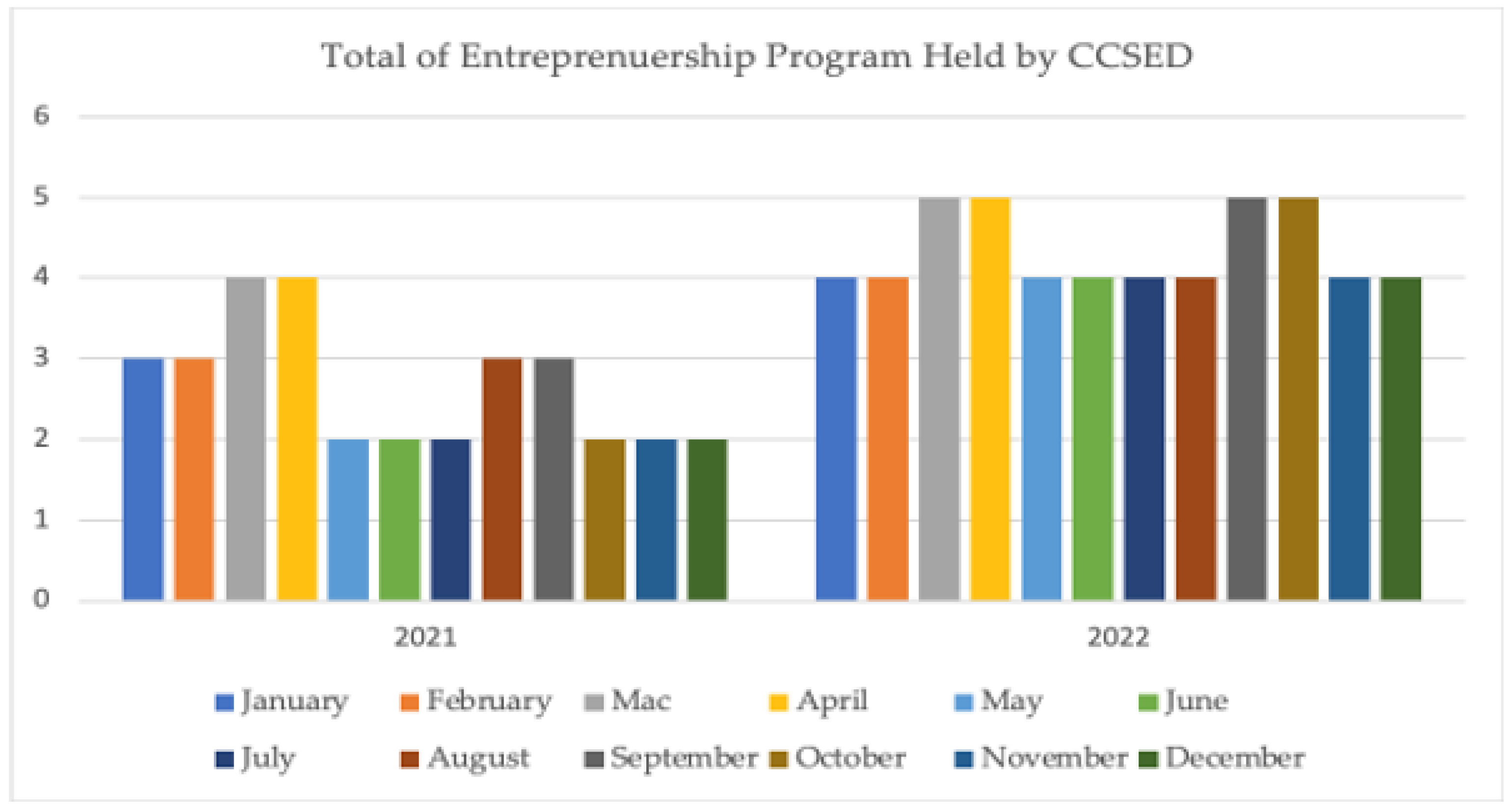

Table 1.
Categories of theme in terms of officer Views Government Initiatives to improve the Marketability of Graduates at Post Covid-19 Pandemic Era.
Table 1.
Categories of theme in terms of officer Views Government Initiatives to improve the Marketability of Graduates at Post Covid-19 Pandemic Era.
| Officer Responses | ||
|---|---|---|
| Themes | Frequent | Example |
| My STEP Program (Short -term training & placement programs) | 72% | The My Step program is the main program implemented by the government to increase the marketability of graduates |
| Penjana KPT CAP (Career Advancement Programs) | 20% | It is the second most popular program among graduates because students will be trained for one week and placed to work in a selected company for a year. |
| Penjana KPT PACE (Professional certification programs), | 7% | This program is quite important because the graduates are trained to obtain professional certificates in various fields to increase the marketability of the graduates |
| Penjana KPT CAP@ State (Career Advancement Programs at State level) | 3% | Malaysia Ministry of Higher Education also collaborate with the state government to implements the CAP@ State Sponsorship Program to increase the marketability of graduates from their respective states. But the opportunities provided are few and limited |
| Student Responses | ||
| Themes | Frequent | Example |
| My STEP Program (Short -term training & placement programs) | 75% | This is one of the best programs organize by Ministry of Higher Education to enhance the graduate employability in Malaysia. |
| Penjana KPT CAP (Career Advancement Programs) | 15% | This program has enhanced my career by getting me my dream job. I attended one month training at university as an aircraft maintenance and been offer a job as an engineer at Air Asia. |
| Penjana KPT PACE (Professional certification programs) | 5% | Thank you to the Ministry of Higher Education for offering me a professional certification program. I attended power BI course and secured a job at IT company in Sabah and getting the salary I wish for. |
| Penjana KPT CAP@ State (Career Advancement Programmed at State level) | 5% | State Government of Sabah and Malaysia Higher Ministry of Education collaborated to organize very good program to enhance Sabah state students’ employability. The students are given a choice to embark on train and place courses or place and train courses to secure a job in endemic era. I have attended place and train courses and secured a job in bank. |
Table 2.
Total funding obtained by university from Malaysia Ministry of Higher Education.
| No | Program name | Total Funds | Number of students | Types of Upskilling |
|---|---|---|---|---|
| 01. | Internet of Thing Industrial Skills Certificate Course | RM 53,806.89 | 50 | KPT-CAP |
| 02. | Certified Drone Precision Agricul-ture Proficient | RM 49,328.61 | 50 | KPT-CAP |
| 03. | Aircraft Manufacturing Technology | RM 41,259.46 | 35 | KPT-CAP |
| 04. | Carnival Event Management and Sales | RM 58,518.13 | 50 | KPT-CAP |
| 05. | Management and Business in Music | RM 56,724.47 | 50 | KPT-CAP |
| 06. | Trust Unit Consultant | RM 45,625.64 | 100 | KPT-CAP |
| 07. | Halal Executive Certificate | RM 26,904.55 | 40 | |
| 08. | Food Safety Management Executive Program | RM 53,808.14 | 80 | KPT-PACE |
| 09. | CSWIP 3.0 Visual Welding Inspector Certification Course | RM 9,416.42 | 14 | KPT-PACE |
| 10. | NDT Liquid Penetrant Testing (PT) Inspector | RM 9,416.42 | 14 | KPT-PACE |
| 11. | NDT Magnetic Particles Testing (MT) Inspector | RM 9,416.42 | 14 | KPT-PACE |
| 12. | Certificate of Competence—Occupational Health Nursing (Occupational Health Nurse-OHN) | RM 77,348.18 | 115 | KPT-PACE |
| 13. | Workshop on Banana Tissue Culture Techniques and Commercial Banana Plantation | RM 33,632.91 | 50 | KPT-PACE |
| 14. | Certified Environmental Professional in Schedule Waste Management | RM 4,708.60 | 7 | KPT-PACE |
| 15. | Radiation Protection and Safety Training | RM 25,561.01 | 38 | KPT-PACE |
| 16. | Certified Team Leader | RM 23,057.13 | 25 | KPT CAP-STATE |
| 17. | Certified Team Leader Phase 2 | RM 40,590.22 | 35 | KPT CAP-STATE |
| 18. | Certified Digital Marketer | RM 45,229.06 | 43 | KPT CAP-STATE |
| 19. | Entrepreneurship Pioneer Course | RM 59,187.53 | 50 | KPT CAP-STATE |
| 20. | Mystep Management Program Course | RM 320,150.76 | 100 | My Step’s |
Table 3.
Number of industry and job opportunity offer in career fain in 2021 and 2022.
| Month | 2021 | 2022 | ||
|---|---|---|---|---|
| Number of Career Fair | Job Opportunities | Number of Career Fair | Job Opportunities | |
| January | 1 | 10 | 4 | 100 |
| February | 1 | 15 | 4 | 120 |
| Mac | 2 | 50 | 5 | 200 |
| May | 2 | 80 | 6 | 150 |
| June | 3 | 40 | 6 | 180 |
| July | 3 | 40 | 4 | 110 |
| August | 2 | 50 | 6 | 200 |
| September | 4 | 80 | 5 | 180 |
| November | 4 | 150 | 4 | 160 |
| December | 10 | 550 | 16 | 1500 |
| Total | 32 | 1065 | 52 | 2900 |
Disclaimer/Publisher’s Note: The statements, opinions and data contained in all publications are solely those of the individual author(s) and contributor(s) and not of MDPI and/or the editor(s). MDPI and/or the editor(s) disclaim responsibility for any injury to people or property resulting from any ideas, methods, instructions or products referred to in the content. |
© 2024 by the authors. Licensee MDPI, Basel, Switzerland. This article is an open access article distributed under the terms and conditions of the Creative Commons Attribution (CC BY) license (https://creativecommons.org/licenses/by/4.0/).
Copyright: This open access article is published under a Creative Commons CC BY 4.0 license, which permit the free download, distribution, and reuse, provided that the author and preprint are cited in any reuse.


