

Submitted:
01 July 2024
Posted:
02 July 2024
You are already at the latest version
Abstract
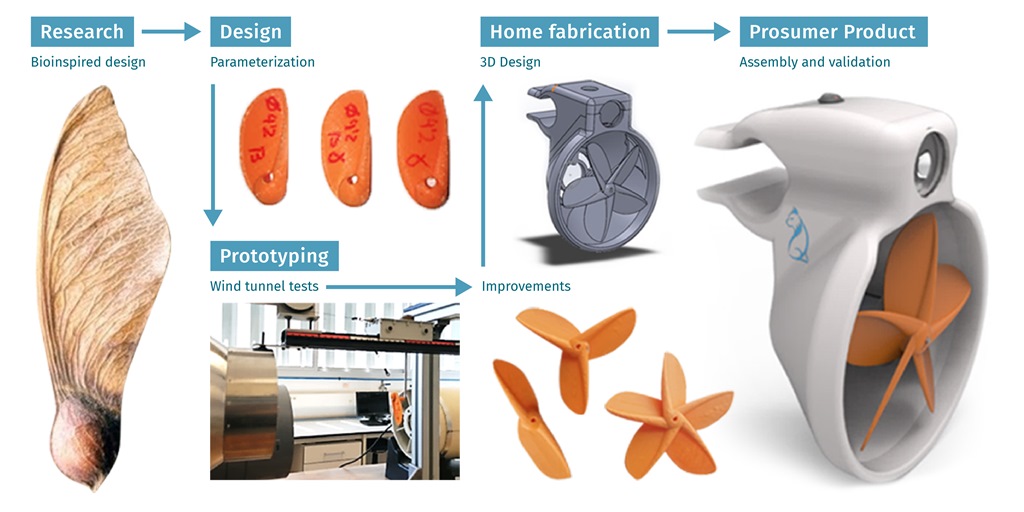
The emergence of prosumers, who actively participate in designing and producing goods, has generated interest in domestically manufactured products. Factors such as innovation, design methods, component reuse, prototyping, and digital fabrication empower prosumer designers to realize their ideas and enhance products to meet their specific design requirements. This article presents a case that combines bioinspired design methods with prosumer characteristics from the perspective of a designer who uses biological research results acting as a prosumer. By analyzing prosumer needs, bioinspired design, and domestic fabrication requirements, designers define the methods that best suit their possibilities. As a result of using biological information, the geometry of Samara seeds, propeller sizing, wind tunnel tests, and subsequent improvements, the custom design of a bioinspired microgenerator has been refined to the final design of a bicycle flashlight. The aim is to popularize a working approach that facilitates the interaction of design methods and reinforces domestic manufacturing processes. Implementing bioinspired design methods within the prosumer context offers a methodological alternative to transform the current economic model, promoting systemic sustainability and the development of proprietary technologies.
Keywords:
Bioinspired Design
; Design methods interaction
; Prosumer
; Maker movement
; Prototyping
; Domestic fabrication
1. Introduction
Bioinspiration uses biological phenomena to stimulate research in non-biological sciences and technology [1]. In particular, bioinspired design uses analogy-making in design, allowing to identify useful functions or patterns in nature and utilize them in the design of products [2]. Applying bioinspired design by non-biological experts, designers or not, expands the design space with new methods and processes looking at nature, they can be amateurs in the construction of objects but with special sensitivity towards nature and environment. Through the use of freely available knowledge, tools and methods, the interdisciplinarity of the bioinspired process is enhanced, as individuals from diverse disciplines will access to these tools and share their own knowledge and resources, which optimizes the process by involving a variety of experts [3].
Prosumer homemade products are those that are designed, developed and manufactured by the individual consumer usually for his own consumption [4]. This vision blurs the traditional boundaries between consumers and producers, allowing end-users to take control of the creative process to satisfy their needs and wants [5]. It is worth highlighting the lack of design methods by and for the prosumer, where intuition and trial and error prevail. Although there are a large number of tools such as digital fabrication, do-it-yourself or learning activities [6], the integration of novel methodologies that empower prosumers to apply them in their projects is imperative, alongside the critical task of assessing the ultimate outcomes [7].
Tailored design addresses unmet requirements, serving as a means to surmount existing limitations by incorporating essential features or functionalities. Occasionally, prosumer products introduce novelty through their design, even if they do not ultimately penetrate the market [8]. The prosumer and maker movements recycle products by separating their components and materials as a means of sustainability and economic savings [9], integrating aspects of sustainability and circular economy, and increases attachment to the product.
Domestic fabrication serves as a crucial tool enabling prosumers to design objects, advancing them to the prototyping stage with a robust level of development [10]. These objects function as proof of concept for design validation, fine-tuning functionality, and addressing manufacturing and maintenance aspects [11]. Consequently, this approach enhances product refinement by incorporating details that iteratively improve and update the object throughout its lifespan. This level of control empowers prosumers to manage the entire production process. For designers, it facilitates rapid and streamlined design refinements, independent of external manufacturers.
Design research explores innovative alternatives applicable to design processes, techniques, and models. By combining methods, we can enhance the model for prosumers. Insights from biological systems have uncovered evolutionary strategies that optimize resource efficiency [12,13]. These principles find relevance in prosumer product design, aiming to minimize environmental impact while maximizing utility. Key aspects of bioinspired design, including functionality, structures, materials, systems, and forms, can be tailored to prosumer characteristics such as personalization, user participation, and sustainability, leading to effective and viable solutions prosumer characteristics [14].
In many cases, industrial designers lack detailed knowledge of bioinspired design methods or biomimetics, which prevents them from utilizing or even experimenting with these techniques, and flexibility in the mixed methods is a way to improve its use [15]. Prosumers are typically self-taught and do not use structured design methods [16]. Based on these two premises, it may be useful to define a design method that incorporates prosumer behavior, providing an opportunity to combine self-taught creativity [17] advanced bioinspired design techniques to create an innovative and efficient product [7].
The objective of this article is to demonstrate an effective design approach that facilitates learning through interaction with various methods, leveraging their strengths in the most suitable project phases, proposing deliberate articulation of interdisciplinary epistemological perspectives, adopting a gradual orientation towards sustainability, and fostering research to develop novel epistemological approaches for bioinspired innovation [18]. Additionally, it highlights how novice designers can tailor and personalize the process to address the unique requirements of individual users and the specific products they intend to create similar to the practices of prosumers. Employing a methodology that integrates bioinspired design research, prototyping techniques, and domestic manufacturing, the study outlines a comprehensive design, development, and production process for prosumer products.
The combination of bioinspired design methods in the prosumer scope is presented as a methodological alternative in transforming the economic model, supporting systemic sustainability and the generation of proprietary technologies [19]. The work complies with the Sustainable Development Goals SDO 07 Affordable and Clean Energy, SDO 09 Industry Innovation and Infrastructure, SDO 11 Sustainable Cities and Communities and SDO 13 Climate Action.
2. Materials and Methods
This section outlines the proposed design process, where a novice designer adopts the role of a prosumer and utilizes biological knowledge to make the process bioinspired. Each part of the process is described, explaining the rationale behind each decision.
The biomimetic prosumer design process followed is similar to classical product design and development processes, taking as a reference the linear models with iterations between phases [20]. Alternative methods are added, such as bioinspired design [3,21,22], sustainability and circular economy tools and strategies [23], laboratory experimentation and validation practices through prototypes [11,24] and finally fine-tuning by optimization of prototypes and completion as finished products [25]. The entire design process is conducted from a consumer standpoint, since the designer will be the one who builds and enjoys the final product.
Figure 1 illustrates the roles that the bioinspired prosumer designer must adopt in the proposed process. The designer acts as a user/consumer, an industrial designer, and a prosumer utilizing bioinspired design resources. The consumer recognizes a need or want, explores market options, and, once informed, starts making decisions based on their initial requirements. After locating the preferred product, they complete the purchase and get satisfaction from it. From the industrial’s standpoint, a comparison can be drawn with Bobbe’s research [20] which summarizes the diverse design processes into five phases. (1) Research, the project begins with an analysis of consumer needs and market dynamics. (2) Design definition, design requirements are specified, and the solution principles and concepts are developed. (3) Design, design work and concept refinement take place. (4) Finalization and manufacturing, detailed design is completed, including prototype validation. (5) Implementation involves creating documentation for industrial production and subsequent marketing.
Prosumer designers can choose from a variety of processes encompassing product design, manufacture and assembly [26,27]. The prosumer designer, having a primarily self-taught profile, does not seek deep knowledge. Their objective is to understand the concepts related to the knowledge they will apply and to know how to use the specific data required for their design. For this reason, this type of user does not use traditional design methods. Its objective is to solve a problem and, when it does not have the specific knowledge to do so, it informs itself about the necessary subject matter, in this case about bioinspired design. Therefore, it does not employ a specific bioinspired design method. Instead, it utilizes the search for bioinspired knowledge to inform its own design, without extensive exploration of the field. This approach allows for the acquisition of only the relevant data necessary for the design, prototyping, and improvement of the product.
Research involves analyzing prosumer’s own needs and defining the product to be built. At this point, the design space is determined in accordance with bioinspired design and home fabrication requirements. Customized design is the phase in which the initial research findings are obtained, necessary parameters and dimensions for construction are determined, preliminary tests are conducted, and improvements are implemented. During the home fabrication phase, digital manufacturing techniques are employed, and the ultimate blueprint is constructed by combining all of the elements that will culminate in the final design and production of the prosumer product [28]. Among the design, prototyping, and home manufacturing phases, iterations occur to refine the design based on experimentation and adjustments to the initial requirements.
Table 1 shows the detailed design process carried out from the prosumer designer’s point of view. The selection of a bicycle flashlight is due to the low power generated by a microturbine and the limited air flow speed. The bioinspired flashlight incorporates a small wind generator inspired by the rotating seeds of the samara. The prototypes and final design underwent laboratory validation through wind tunnel testing and was subsequently constructed via rapid prototyping. The electrical circuit was meticulously engineered to ensure optimal performance and compliance with relevant regulations. Furthermore, the design process embraced circular economy and sustainability principles, including component recycling, reuse, life extension, and repairability.
2.1. Research
Initially, customers and creators, as well as prosumers, must recognize the offerings available in the market, existing solutions, technology, materials, and implemented manufacturing methods. This research focuses on flashlights, specifically a bicycle flashlight that transforms mechanical energy produced by wind into electrical energy, as well as domestic wind turbines.
Websites dedicated to makers [29] compile projects and display the results, some of which classify by project and others offer knowledge and experience. These websites and Web of Science (WoS) have been searched with the search terms ((“bicycle” OR “bike”) AND (“flashlight” OR “head light” OR “torch” OR “lantern”)).
Regarding the design process, a search in WoS database is performed with the terms ((“bioinspired” OR “biomimetic” OR “biomimicry”) AND (“design method” OR “design model”)) to determine design models that apply bioinspired design. Also searched with the terms ((“bioinspired design” OR “biomimetic” OR “biomimicry”) AND ((prosumer) OR (maker movement) OR (maker community)) to determine what work has been done in the prosumer field with inspiration from nature. Additionally, papers about “Seed dissemination strategies”, “rotary seeds” and “Seed flight” that provide knowledge of nature strategies to bioinspired design concept created by the prosumer.
A literature review of microturbines is carried out, with web searches for micro wind turbines analysing their dimensions, functional and technical characteristics. Also, a WoS search is carried out with the terms ((“micro” OR “home” OR “domestic”) AND (“wind turbine”) AND (review)).
With regard to the study of sustainability, methods that are easy to apply for a prosumer designer are sought, such as the principles of circular economy [23,24]. Examples and cases such as separation and recovery of components, design for interchangeability of components, testing and bioinspiration are sought [25].
2.2. Customized Design
The preliminary design of the blades by a detailed analysis of efficient natural structures, exemplified by the different flying seeds, is carried out [26]. We engage in parameterization and three-dimensional modeling based on initial outcomes. Through iterations, we emulate aerodynamic patterns and shapes within these structures [26,27] optimizing the shape and angle of the blades, as well as the air force acting on the propeller.
2.3. Prototyping
The initial tests involve manual construction and 3D printing, allowing for adjustments to validate blade shape, size, and functionality. Subsequently, experiments occur within a controlled environment, utilizing an open-circuit wind tunnel. These tests assess design performance and power generation capabilities across varying airflow speeds.
Regarding the electrical circuit, an initial design can be formulated by measuring energy efficiency. Various electrical load combinations, including LEDs and resistors, are tested. The validation process encompasses individual component testing and assessment of their interactions within the entire system. The collected data serves as a robust foundation for optimizing and refining blade design and electrical circuitry.
2.4. Manufacturing
The final geometric design entails visual representation and modeling of component shapes and dimensions. Using Computer-Aided Design (CAD) tools, we precisely integrate the validated prototypes into detailed, accurately dimensioned 3D models. Accurate geometry is paramount to ensure proper component fit and efficient functionality. Employing advanced manufacturing techniques, they create housings and enclosures that not only meet aesthetic criteria but also provide essential protection and functionality.
2.5. Validation
The assembly, fitting, and testing phase represents the culmination of the construction process. During this stage, all components are assembled, mounted onto the bicycle, and fine-tuned to ensure seamless operation. Tests are then conducted under real-world conditions to assess the prototype’s performance, energy efficiency, and alignment with the stated objectives. This comprehensive testing validates both the functional operation and practical feasibility of the product.
3. Results
We summarize in this section the most important results of each design phase for the proposed design, prototype and manufacture of an autonomous and rechargeable energy flashlight for bicycles.
3.1. Research
Market research, design, scientific literature review, and the creation of a design brief are not common practices among members of the maker community, who typically turn to community websites to see examples and cases similar to their project of interest. The website Instructables [30]features over 100 examples and cases of turbines, both vertical and horizontal axis, constructed domestically using recycled materials and generators or digital fabrication. However, none of these examples are bioinspired.
3.1.1. The Bicycle Flashlight Market
Forty-eight results have been obtained in WoS and, once filtered, five of them are useful. One refers to a patent study of LED flashlights for bicycles and indicates that there are patents for micro turbines as a power source [31]. The other four results serve for the definition of the design requirements and they refer to the optics used, the type of emitter used and to a flashlight designed for a 1-Watt power LED. Given the existence of related patents, a search was made in WoS and Google Patents with forty-two results, but only 4 related patents were found, two active CN-109955945-A and CN-106500029-A. There is similarity of design and functionality but no examples of commercialization have been found.
During the market research process, examples have been identified that are similar to the product to be designed (Figure 2) but some have not yet reached the prototyping or commercial phase. The first example, called Vento, has a bioinspired working principle and incorporates aspects of energy sustainability (see Figure 2a). The other is only a sketch and 3D representation of a pinwheel as shown in Figure 2b. The windmill generator cycle is an example of prosumer manufacturing using recycled materials to build the propeller and the chassis (Figure 2c). Another example, in Figure 2d, uses a computer fan to power a flashlight in a very artisanal way.
In Japan, the flashlight marketed by Thanko (Figure 2e) starts generating energy at 15 km/h. In the United States, the HYmini personal wind turbine is a portable power supply that can be topped up with wind energy (Figure 2f). Finally, the Mini Wind Generator Wind Turbine and Portable Phone Charger, a mountable kit that can adapt (Figure 2g).
We have selected seven examples from the results obtained, based on three criteria: whether the product is conceptual or already produced, whether it has bioinspired characteristics, or whether its production is domestic (Figure 2). Two concepts have not reached the prototyping phase (a and b), one of them bioinspired (a). Two with artisanal construction coincide with the concept of prosumer design (c and d). Two have been marketed and have a series of characteristics similar to the requirements set by the brief (e and f). And a kit that could be copied and created by a prosumer designer from recycled parts (g).
3.1.2. Understanding Microturbines Operation and Performance
Numerous micro wind turbine variants exist, and abundant online and scientific resources facilitate an understanding of the factors influencing their design [32,33]. Noteworthy projects encompass both horizontal turbines employing computer fans and vertical turbines featuring curved or cup-shaped blades. Additionally, tutorials elucidate diverse electrical circuits for energy generation and storage. From an environmental perspective, wind turbines yield energy without pollution. Their performance hinges on blade geometry, quantity, diameter, angle of attack, generator resistance, and Reynolds number [34].
Microturbines with a smaller diameter increase torque, thereby maintaining revolutions and increasing power. However, it is essential to ensure a minimum torque to overcome the initial friction of the generator, even at low speeds, to prevent the load from stopping the rotor’s rotation [32].
According to the classification of horizontal axis wind turbines (HAWT) [33], micro-scale turbines can reach about 0.250 to 1.4 kW with diameters ranging from 0.5 to 1.2 meters, although they are dedicated to electricity production for domestic consumption. Microturbines dedicated to bicycles require only 1 to 3 watts, allowing for a drastic reduction in diameters and swept area.
The theoretical power P that a HAWT can generate is calculated using the formula 1, where r is the rotor radius (m) and V is the wind speed (Km/h). And the power coefficient Cp (formula 2) is the generator power relative to the theoretical power, where Pt is the real power generated by the turbine, the product of the voltage and the current produced. For micro wind turbines power coefficients are about 0.25 or greater compared to large turbines, which have values around 0.45 [35]. Once the data from wind tunnel generation tests are obtained, performance and power coefficients can be compared.
P = 0.04143 · r2 · V3
Cp= Pt / P
Despite the existence of multiple methods for designing horizontal axis wind turbine (HAWT) blades, most rely on mathematical models and finite element analysis. However, there is no single methodology documented in the scientific literature; rather, each researcher adopts the design methods they are most familiar with [36].
3.1.3. Bioinspired Design
In the realm of industrial design, there is a burgeoning interest in adopting a bioinspired approach [37,38,39,40], leveraging principles and strategies from nature to foster innovation and sustainable solutions [12]. However, its specific application within the prosumer domain remains unestablished. Biological analogies are commonly selected, they significantly increase the novelty of designs compared to other analogies but there is no significant difference between biological analogies and those spanning different domains [41].
The WoS search yielded 135 results which, once filtered, found one review article on bioinspired design methods and 6 articles explaining different types of design models. These results show two approaches: the first, starting from a problem and solving it thanks to inspiration from nature and, the second, using a solution in nature to apply it to the design of a new product [13]. Only one article was found that connects Bioinspired Design with the Maker movement through a STEAM (Science, Technology, Engineering, Arts and Mathematics) program for the professionalization of students [42], focuses on the bioinspired design process towards the materialization of ideas through prototyping and construction of physical models.
Regarding the seed dissemination strategies, Samara seeds are an example used by certain trees to send seeds far from their origin [43], designed to glide efficiently through the air using wind energy. There is proven information on their geometry and weight that allows the design of the turbine blades. They are composed by the wing and the seed, presenting the ideal characteristics for displacement: low descent speed, high turning speed and low pitch angle [44,45]. There are samaras with one or two seeds and with one or more wings. Those with more than one wing glide with a slower descent rate but sometimes do not rotate [46]. The flight behavior of samaras can be analyzed in a vertical wind tunnel through tests using both real samaras and simulated models, determining autorotation and descent speed that depend on the center of gravity location, influenced by various geometric and loading factors [47].
Based on the information found the search for information was focused on maple seeds. Its geometry consists of an elongated, thin wing with a reinforced edge, which at one end has the heaviest part where the seed is located [34,48,49]. All measurements are based in relation to the width of the seed (value c in Figure 3). It is assumed that the seed has a constant density and that the wing is completely flat. Its thickness is also related to the measurement c. The accessibility and cost-effectiveness of 3D printing technology enable studies and facilitate experimental testing. Previous research has employed artificial samaras [50], but utilizing 3D printing to replicate seeds and study their aerodynamics can expedite these investigations.
The study by Zakaria [43] compares the data for the same type of seeds with shape variations and establishes the importance between the weight of the seed and its aerodynamic properties, although it raises doubts about the application in a 3D printed blade due to the change in density. Several studies apply this type of design to drone blades to test their efficiency by varying the radius and pitch angle with respect to the axis of rotation [48] and optimising stability in constant wind for three-bladed rotors [51].
Some cases of rotating samaras with more than one wing have been found [52], suggesting the potential for bioinspired rotors with 2, 3, or 5 blades, considering their dependence on the centre of gravity.
One case found is inspired by bird wings to achieve greater robustness, although in this instance, flexible wings with a profile adaptable to movement are necessary. This approach offers intriguing elements but proves challenging to implement in prosumer design, particularly for novice designers [53]. In pursuit of flexible materials and adaptable geometries, an example involves textured and flexible blades. These modifications include corrugated blades inspired by the wing structure of dragonflies, and flexible blades inspired by the wing adaptations of birds and insects to varying air conditions [54].
The utility of small wind turbines has spurred research into bioinspired blade designs aimed at exploring unconventional solutions [55], such as the three bladed rotor inspired by the seed of a tree known as Triplaris Americana [56], or adaptations of blades featuring tubercles inspired by the humpback whale [57].
Regarding theoretical yields, the power coefficient Cp of the maple seed was observed to be 0.59, comparable to the range of 0.45 to 0.48 for many wind turbines and close to the Betz limit of 0.593 [58].
3.1.4. Design Brief
The pillars of the design for the bioinspired bicycle flashlight are microturbines, natural analogies for blade design, and digital fabrication. Therefore, the prosumer designer needs to satisfy the requirements for knowledge and data utilization. Prosumer design briefs define the needs and wants of their own as a final user as well as the product design specifications (Table 2). In this type of project, the brief can be defined as a self-commissioning [17].
3.2. Custom-Made Design
Figure 3 presents the dimensions for the construction and tests of the first blades and the artificial seeds made of plastic sheets. The study by Arranz [34] provides the data to build a replica of the seed, the tests carried out confirm that it is necessary to design a 3D replica of the seed in various dimensions. Finding the center of gravity in manual construction can be challenging, and several characteristics depend on its accurate determination [45]. For the first tests, we looked for old toy motors, computer fans, hair dryers, etc.; flashlight for bicycles and spotlights to take out the LED and convergent lenses; rechargeable batteries and battery holders or cables to connect the set.
Based on the model of Arranz [34] a modification of Zakaria’s study is included [43]. At the upper edge, a rib is included to reinforce its structure and balance the center of masses. For the thickness, the measure given by the value of c was not adopted because it was too thin and to avoid problems of durability. The shape of the seed simulation was modelled with SolidWorks (image 2 in Table 3) and the center of mass was used as the axis reference.
Once the propeller 3D model is fully defined, the angles of inclination must have been included. In the Zakaria’s study [43] the angles are provided with respect to the vertical axis passing through the center of mass of the seed, pitch angle (θ=24′77º, horizontal plane) and draft angle (β=15′72º, vertical plane). Three different types of blades were designed to determine whether the angle affects the rotor speed, the output voltage and the electrical power (Figure 3): model A1 (angles θ and β), model A2 (only angle θ) and model A3 (only angle β).
3.3. Prototyping
The model was 3D printed for subsequent testing. Tests were conducted using a homemade open-type wind tunnel with 10 speed settings ranging from 1 m/s to 13.33 m/s, generating a linear airflow towards a movable support. As the maximum speed a bicycle in the city is 30 km/h [59], the seventh (35,3 km/h, 8,33 m/s) and tenth (48,2 km/h, 13,33 m/s) position will be used for the tests to evaluate the maximum flow.
3.3.1. Conceptual Design Review
After the initial tests, it was concluded that the blade with only the θ angle of 24.77º in model C20A2 performed the best. Previous experiments with the design of experimental horizontal axis wind turbines have utilized smaller angles of 15º, 18º, and 20º, yielding better power coefficients [33]. The angle β does not generate enough torque to start the rotor’s rotation and is therefore discarded. The recycled motor is not able to generate enough power to light the 1W LED.
Changes are proposed for the following tests, such as testing the generator used and other similar generators on a test bench to check the power, current and voltage they can generate, reducing the impedance of the circuit, increasing the diameter of the blade so that the motor has more torque and adding more blades, creating a set of propellers, going from 1 and 2 blades to 3 and 5 blades.
3.4. Experimentation and Final Validation
For the final experimentation, the C25 model is manufactured with 2, 3 and 5 blades and the single angle θ. A universal brushed motor is obtained from a recycled dryer of which only the voltage (36v) and speed (19,000 rpm) are known. A test is carried out to test the characteristics of the generator by connecting it to a reference motor that will be responsible for moving the rotor. According to results, with a 25 Ω resistor, 1 watt of power is achieved at 3,871 rpm, 5.1 V and 208 mA. Observing the results of the previous tests, this motor with the 3H -C2′5 model reached 3,500 rpm and 6.4 V, for this reason it was decided to carry out more tests in the wind tunnel to verify that the generator is valid. In the last test the propeller models C25A2H2, C30A2H2 C25A2H3, C30A2H3, C25A2H5 and C30A2H5 are used (see Figure 4). In addition, a drone propeller has been printed, from the website cults3D, with a radius of 25mm.
The optimal outcomes were achieved using the H5C30 rotor coupled with a 5W LED, where the resistor’s influence on power output was negligible. Additionally, the H2C25 rotor exhibited a superior power coefficient, aligning closely with findings reported in comparable studies [33] that evaluated larger wind turbines ranging in diameter from 0.5 to 2.2 meters. that evaluated larger wind turbines ranging in diameter from 0.5 to 2.2 meters. The optimal efficiency range for Horizontal Axis Wind Turbines (HAWT) typically falls between 50% and 60% [33]. However, the performance of the bioinspired rotor in this study falls significantly short of these benchmarks. This disparity underscores the ongoing challenge and potential for further enhancement in bioinspired wind turbine technology.
3.5. Manufacturing and Home Fabrication
To manufacture the prototype, the same printer used in the propellers is used. As it is necessary to have a space inside in which to place the circuit, it will be divided into two parts that can later be fixed (see Figure 5). With this first complete prototype, manufacturing improvements can be seen in the fitting of the parts, the fixing of the generator, the screwed connection and the fastening to the handlebars. And of assembly to pass the cables, avoid breakage and pulling.
3.5.1. Final Assembly. Adjustment and Validation
The 3D design undergoes updates to incorporate proposed enhancements, resulting in improved aesthetics characterized by organic and fluid shapes. Adjustments are made to the anchorages for seamless bicycle mounting, and initial real-world tests are conducted. These tests validate both battery charging and night lighting functionality. Figure 6 visually presents the final 3D design alongside the fully assembled prototype affixed to the bicycle.
Notably, meticulous attention ensures the absence of assembly or adjustment errors. Multiple prototypes were printed, allowing necessary modifications to accommodate all components. To safeguard the electrical elements from rain or condensation, an airtight enclosure is introduced. Additionally, the LED is isolated using a silicone bead. Enhancing user comfort, an elastomeric material band is incorporated to absorb vibrations and prevent rotational movement.
For future iterations, a specification will be developed to optimize volume and dimensions, aiming for greater compactness. Furthermore, potential impact scenarios, such as drops, prompt strategic placement of the generator behind and under the handlebars, reinforced with thicker casings to mitigate damage.
4. Discussion and Conclusions
Despite widespread use in various fields, the integration of bioinspired design into prosumer contexts poses unique challenges, necessitating a multidisciplinary approach. This underscores that the differences between a genuine prosumer and an academically trained novice designer primarily stem from their approach and preparation. The initial lack of knowledge regarding research and interpretation of scientific literature on bioinspired design necessitates additional effort. Other prosumers might opt for a conventional propeller rather, as seen in the examples found, than exploring optimization and improvement through bioinspired design. However, the prosumer designer’s familiarity with prototyping and validation tests simplifies laboratory experimentation.
In the context of a bicycle flashlight, a novel product concept emerges with a degree of innovation. Harnessing wind to generate electrical energy, rather than relying on conventional dynamos, not only reduces the cyclist’s effort but also proves to be a more cost-effective alternative [32]. This approach highlights the efficiency gains and economic advantages associated with wind power utilization over traditional methods. Other prosumer designers can easily replicate and enhance this concept. The primary limitation lies in wind tunnel usage, but alternative tests can be conducted using different instrumentation. Prosumers often rely on trial-and-error techniques, allowing real-world testing to identify errors and facilitate improvements. Unlike purchased products, prosumer creations remain dynamic and adaptive. Furthermore, prosumer products can continually evolve to meet specific or future needs.
The development of prosumer goods and iterative testing yields knowledge that can be shared among designers and prosumers for design modification, adaptation, and personalization. The designer’s market exploration phase finds robust support from both academia and industry. However, a critical question arises: Do prosumers need guidance or assistance during the design research phase to fully grasp their needs and explore viable alternatives before embarking on the design process?
In general, academically trained designers have a wealth of options when they draw from diverse design methodologies, selecting the most effective elements from each. For prosumers who embrace trial-and-error approaches, integrating novel design methods becomes an intriguing learning journey. Yet, this pursuit relies on voluntary exploration, often facilitated through community-based information exchange, which may have its limitations.
Based on the results meeting initial expectations and satisfying the objectives of lighting, electrical performance, and application of bioinspired processes, future efforts should focus on adjusting the rotor pitch angle and testing other generators for improved efficiency. Additionally, exploring the design potential of vertically oriented bioinspired turbines, which offer higher performance, is an intriguing prospect.
Supplementary Materials
The following supporting information can be downloaded at the website of this paper posted on Preprints.org.
Author Contributions
Conceptualization, L-F.I. and S-B.A.; methodology, L-F.I. and A-S.L.; validation, L-F.I. and S-B.A.; investigation, L-F.I. A-S.L. and S-B.A.; data curation, S-B.A.; writing—original draft preparation, L-F.I. and S-B.A.; writing—review and editing, L-F.I. and A-S.L.; visualization, A-S.L.; supervision, L-F.I.; All authors have read and agreed to the published version of the manuscript.
Funding
No funding.
Institutional Review Board Statement
Not applicable.
Acknowledgments
Not applicable.
Conflicts of Interest
The authors declare no conflicts of interest.
References
- Whitesides, G.M. Bioinspiration: Something for Everyone. Interface Focus 2015, 5, 20150031. [Google Scholar] [CrossRef] [PubMed]
- Fu, K.; Moreno, D.; Yang, M.; Wood, K.L. Bio-Inspired Design: An Overview Investigating Open Questions From the Broader Field of Design-by-Analogy. Journal of Mechanical Design 2014, 136, 111102. [Google Scholar] [CrossRef]
- Wanieck, K.; Fayemi, P.E.; Maranzana, N.; Zollfrank, C.; Jacobs, S. Biomimetics and Its Tools. Bioinspired, Biomimetic and Nanobiomaterials 2016, 6. [Google Scholar] [CrossRef]
- Ritzer, G.; Dean, P.; Jurgenson, N. The Coming of Age of the Prosumer. American Behavioral Scientist 2012, 56, 379–398. [Google Scholar] [CrossRef]
- Fiş Erümit, S.; Karakuş Yılmaz, T. Gamification Design in Education: What Might Give a Sense of Play and Learning? Technology, Knowledge and Learning 2022, 27. [Google Scholar] [CrossRef]
- Millard, J.; Sorivelle, M.N.; Katsikis, O.K.; Unterfrauner, E.; Voigt, C. The Maker Movement in Europe: Empirical and Theoretical Insights into Sustainability. In Proceedings of the EPiC Series in Computing. ICT4S2018. 5th International Conference on Information and Communication Technology for Sustainability; Penzenstadler, B., Easterbrook, S., Venters, C., Ahmed, S.I., Eds.; Epic Computing: Toronto, May 14, 2018; pp. 227–210. [Google Scholar]
- López-Forniés, I.; Asión-Suñer, L. Analysing the Prosumer Opportunity. Prosumer Products’ Success or Failure. Journal of Engineering Design 2024, 35, 1–21. [Google Scholar] [CrossRef]
- Lang, B.; Botha, E.; Robertson, J.; Kemper, J.A.; Dolan, R.; Kietzmann, J. How to Grow the Sharing Economy? Create Prosumers! Australasian Marketing Journal 2020, 28, 58–66. [Google Scholar] [CrossRef]
- Metta, J.; Bachus, K. Mapping the Circular Maker Movement: From a Literature Review to a Circular Maker Passport. Deliverable 2020, 2, 68. [Google Scholar]
- Jorquera Ortega, A. Fabricación Digital: Introducción al Modelado e Impresión 3D. Serie diseño y autoedición, Jorquera O. 2017. [Google Scholar]
- López-Forniés, I. Concept Assessment Using Objective-Based Metrics on Functional Models. In Design Tools and Methods in Industrial Engineering II; Rizzi, C., Campana, F., Bici, M., Gherardini, F., Ingrassia, T., Cicconi, P., Eds.; Springer International Publishing: Cham, 2022; pp. 320–327. [Google Scholar]
- Benyus, J.M. Biomimicry: Innovation Inspired by Nature; Perennial: New York, 2000; ISBN 0060533226. [Google Scholar]
- Speck, O.; Speck, D.; Horn, R.; Gantner, J.; Sedlbauer, K.P. Biomimetic Bio-Inspired Biomorph Sustainable? An Attempt to Classify and Clarify Biology-Derived Technical Developments. Bioinspir Biomim 2017, 12, 011004. [Google Scholar] [CrossRef]
- Asión Suñer, L.; López Forniés, I. El Diseño Modular En La Creación de Productos Para Prosumer, Universidad de Zaragoza: Zaragoza, 2022.
- Pentelovitch, N.; Nagel, J.K. Understanding the Use of Bio-Inspired Design Tools by Industry Professionals. Biomimetics 2022, 7. [Google Scholar] [CrossRef]
- López-Forniés, I.; Asión-Suñer, L. PROSUMER CONCEPT: CURRENT STATUS AND POSSIBLE FUTURE DEVELOPMENTS. Dyna (Spain) 2023, 98. [Google Scholar] [CrossRef] [PubMed]
- López-Forniés, I.; Asión-Suñer, L. Self-Commissioning, Intuition and Prosumer. Proyecta56, an Industrial Design Journal 2023, 109–137. [Google Scholar] [CrossRef]
- Mead, T.; Coley, D.; Borden, D.S. Navigating the Tower of Babel: The Epistemological Shift of Bioinspired Innovation. Biomimetics 2020, 5, 60. [Google Scholar] [CrossRef] [PubMed]
- Barbosa, J.; Arruda, A.; Laila, T.; Moura, E. Biomimicry as Metodological Tool for Technical Emancipation of Peripheral Countries. In Advances in Ergonomics in Design; Rebelo, F., Soares, M., Eds.; Springer International Publishing: Cham, 2018; pp. 349–356. [Google Scholar]
- Bobbe, T.; Krzywinski, J.; Woelfel, C. A Comparison of Design Process Models from Academic Theory and Professional Practice. In Proceedings of the Proceedings of International Design Conference, DESIGN; 2016; Vol. DS 84.
- Fayemi, P.E.; Wanieck, K.; Zollfrank, C.; Maranzana, N.; Aoussat, A. Biomimetics: Process, Tools and Practice. Bioinspir Biomim 2017, 12, 011002. [Google Scholar] [CrossRef] [PubMed]
- Salgueiredo, C.F.; Hatchuel, A. Beyond Analogy: A Model of Bioinspiration for Creative Design. Artificial Intelligence for Engineering Design, Analysis and Manufacturing 2016, 30, 159–170. [Google Scholar] [CrossRef]
- Nielsen, K.R. Policymakers’ Views on Sustainable End-User Innovation: Implications for Sustainable Innovation. J Clean Prod 2020, 254. [Google Scholar] [CrossRef]
- BenMahmoud-Jouini, S.; Midler, C. Unpacking the Notion of Prototype Archetypes in the Early Phase of an Innovation Process. Creativity and Innovation Management 2020, 29, 49–71. [Google Scholar] [CrossRef]
- Hodges, S.; Fraser, M. Citizen Manufacturing: Unlocking a New Era of Digital Innovation. IEEE Pervasive Computing, Pervasive Computing, IEEE, IEEE Pervasive Comput. 2022, 21, 42–51. [Google Scholar] [CrossRef]
- Asión-Suñer, L.; López-Forniés, I. Review of Product Design and Manufacturing Methods for Prosumers. In International Joint Conference on Mechanics, Design Engineering & Advanced Manufacturing; Springer, 2021; pp. 128–134.
- Asión-Suñer, L.; López-Forniés, I. Adoption of Modular Design by Makers and Prosumers. A Survey. In Proceedings of the Proceedings of the Design Society. 2021; Vol. 1, 355–364. [Google Scholar]
- Asión-Suñer, L.; López-Forniés, I.; Rostomyan, G. CONCEPTUALIZATION OF MODULAR PRODUCTS FOR THE PROSUMER. A DESIGN WORKSHOP. Dyna (Spain) 2023, 98. [Google Scholar] [CrossRef]
- Autodesk, Inc. Instructables.
- Autodesk Instructables Wind Turbine Available online:. Available online: https://www.instructables.com/search/?q=wind%20turbine&projects=all (accessed on 27 June 2024).
- Lin, Z.C.; Hong, G.E.; Cheng, P.F. A Study of Patent Analysis of LED Bicycle Light by Using Modified DEMATEL and Life Span. ADVANCED ENGINEERING INFORMATICS 2017, 34, 136–151. [Google Scholar] [CrossRef]
- Surya, S. Development of Wind Torch for Bicycles. In Proceedings of the 2014 IEEE Region 10 Humanitarian Technology Conference (R10 HTC); IEEE, August 28 2014; Vol. 2015-January; pp. 1–4. [Google Scholar]
- Tummala, A.; Velamati, R.K.; Sinha, D.K.; Indraja, V.; Krishna, V.H. A Review on Small Scale Wind Turbines. Renewable and Sustainable Energy Reviews 2016, 56, 1351–1371. [Google Scholar] [CrossRef]
- Arranz, G.; Moriche, M.; Uhlmann, M.; Flores, O.; García-Villalba, M. Kinematics and Dynamics of the Auto-Rotation of a Model Winged Seed. Bioinspir Biomim 2018, 13, 036011. [Google Scholar] [CrossRef]
- Singh, R.K.; Ahmed, M.R. Blade Design and Performance Testing of a Small Wind Turbine Rotor for Low Wind Speed Applications. Renew Energy 2013, 50. [Google Scholar] [CrossRef]
- Okda, Y.M. El Design Methods of Horizontal Axis Wind Turbine Rotor Blades. International Journal of Industrial Electronics and Drives 2015, 2. [Google Scholar] [CrossRef]
- Bar-Cohen, Y. Biomimetics—Using Nature to Inspire Human Innovation. Bioinspir Biomim 2006, 1, P1–P12. [Google Scholar] [CrossRef]
- Bar-Cohen, Y. Biomimetics: Biologically Inspired Technologies; Bar-Cohen, Y., Ed.; CRC/Taylor & Francis: Boca Raton, FL, 2006; ISBN 0849331633. [Google Scholar]
- Vincent, J.F.V.; Bogatyreva, O.A.; Bogatyrev, N.R.; Bowyer, A.; Pahl, A.-K. Biomimetics: Its Practice and Theory. J R Soc Interface 2006, 3, 471–482. [Google Scholar] [CrossRef] [PubMed]
- Cohen, E.A.; Vogel, S. Cat’s Paws and Catapults: Mechanical Worlds of Nature and People. Foreign Affairs 2010. [Google Scholar] [CrossRef]
- Keshwani, S.; Casakin, H. Comparing Analogy-Based Methods—Bio-Inspiration and Engineering-Domain Inspiration for Domain Selection and Novelty. Biomimetics 2024, 9, 344. [Google Scholar] [CrossRef]
- Full, R.J.; Bhatti, H.A.; Jennings, P.; Ruopp, R.; Jafar, T.; Matsui, J.; Flores, L.A.; Estrada, M. Eyes Toward Tomorrow Program Enhancing Collaboration, Connections, and Community Using Bioinspired Design. Integr Comp Biol 2021, 61, 1966–1980. [Google Scholar] [CrossRef] [PubMed]
- Zakaria, M.Y.; dos Santos, C.R.; Dayhoum, A.; Marques, F.D.; Hajj, M.R. Modeling and Prediction of Aerodynamic Characteristics of Free Fall Rotating Wing Based on Experiments. IOP Conf Ser Mater Sci Eng 2019, 610, 012098. [Google Scholar] [CrossRef]
- Azuma, A.; Yasuda, K. Flight Performance of Rotary Seeds. J Theor Biol 1989, 138, 23–53. [Google Scholar] [CrossRef]
- Yasuda, K.; Azuma, A. The Autorotation Boundary in the Flight of Samaras. J Theor Biol 1997, 185, 313–320. [Google Scholar] [CrossRef]
- Azuma, A.; Okuno, Y. Flight of a Samara, Alsomitra Macrocarpa. J Theor Biol 1987, 129, 263–274. [Google Scholar] [CrossRef]
- Yasuda, K.; Azuma, A. The Autorotation Boundary in the Flight of Samaras. J Theor Biol 1997, 185, 313–320. [Google Scholar] [CrossRef]
- Ulrich, E.R.; Pines, D.J.; Humbert, J.S. From Falling to Flying: The Path to Powered Flight of a Robotic Samara Nano Air Vehicle. Bioinspir Biomim 2010, 5, 045009. [Google Scholar] [CrossRef] [PubMed]
- Nave, G.K.; Hall, N.; Somers, K.; Davis, B.; Gruszewski, H.; Powers, C.; Collver, M.; Schmale, D.G.; Ross, S.D. Wind Dispersal of Natural and Biomimetic Maple Samaras. Biomimetics 2021, 6. [Google Scholar] [CrossRef] [PubMed]
- Nave, G.K.; Hall, N.; Somers, K.; Davis, B.; Gruszewski, H.; Powers, C.; Collver, M.; Schmale, D.G.; Ross, S.D. Wind Dispersal of Natural and Biomimetic Maple Samaras. Biomimetics 2021, 6, 23. [Google Scholar] [CrossRef] [PubMed]
- El Makdah, A.M.; Sanders, L.; Zhang, K.; Rival, D.E. The Stability of Leading-Edge Vortices to Perturbations on Samara-Inspired Rotors: A Novel Solution for Gust Resistance. Bioinspir Biomim 2020, 15. [Google Scholar] [CrossRef] [PubMed]
- Gaitan-Aroca, J.; Sierra, F.; Contreras, J.U.C. Bio-Inspired Rotor Design Characterization of a Horizontal Axis Wind Turbine. Energies (Basel) 2020, 13. [Google Scholar] [CrossRef]
- Ikeda, T.; Tanaka, H.; Yoshimura, R.; Noda, R.; Fujii, T.; Liu, H. A Robust Biomimetic Blade Design for Micro Wind Turbines. Renew Energy 2018, 125. [Google Scholar] [CrossRef]
- Mulligan, R. Bio-Inspired Aerofoils for Small Wind Turbines. Renewable Energy and Power Quality Journal 2020, 18, 753–758. [Google Scholar] [CrossRef]
- Siram, O.; Saha, U.K.; Sahoo, N. Blade Design Considerations of Small Wind Turbines: From Classical to Emerging Bio-Inspired Profiles/Shapes. Journal of Renewable and Sustainable Energy 2022, 14. [Google Scholar] [CrossRef]
- Herrera, C.; Correa, M.; Villada, V.; Vanegas, J.D.; García, J.G.; Nieto-Londoño, C.; Sierra-Pérez, J. Structural Design and Manufacturing Process of a Low Scale Bio-Inspired Wind Turbine Blades. Compos Struct 2019, 208, 1–12. [Google Scholar] [CrossRef]
- McKegney, J.M.; Shen, X.; Zhu, C.; Xu, B.; Yang, L.; Dala, L. Bio-Inspired Design of Leading-Edge Tubercles on Wind Turbine Blades. In Proceedings of the 2022 7th International Conference on Environment Friendly Energies and Applications: Renewable and Sustainable Energy Systems, Hybrid Transportation Systems, Energy Transition, and Energy Security, EFEA 2022 - Proceedings; Institute of Electrical and Electronics Engineers Inc., 2022.
- Omidvarnia, F.; Sarhadi, A. Nature-Inspired Designs in Wind Energy: A Review. Biomimetics 2024, 9, 90. [Google Scholar] [CrossRef]
- European Commission. Directorate-General for Mobility and Transport Traffic Rules and Regulations for Cyclists Available online:. Available online: https://road-safety.transport.ec.europa.eu/eu-road-safety-policy/priorities/safe-road-use/cyclists/traffic-rules-and-regulations-cyclists-and-their-vehicles_en (accessed on 22 November 2023).
Figure 1.
Visions of the design process according to each perspective.
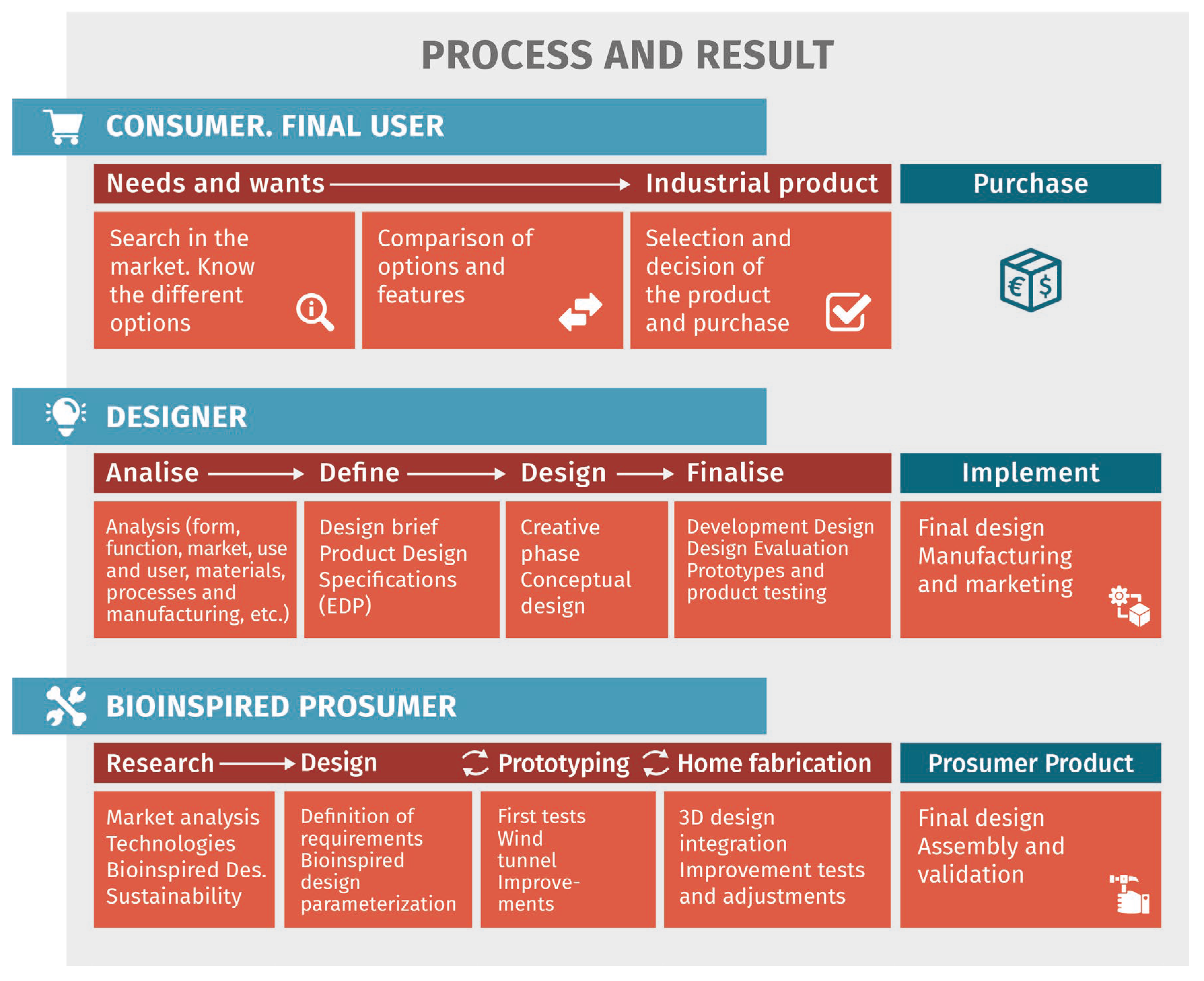
Figure 2.
Analysis of bicycle flashlights on the market.
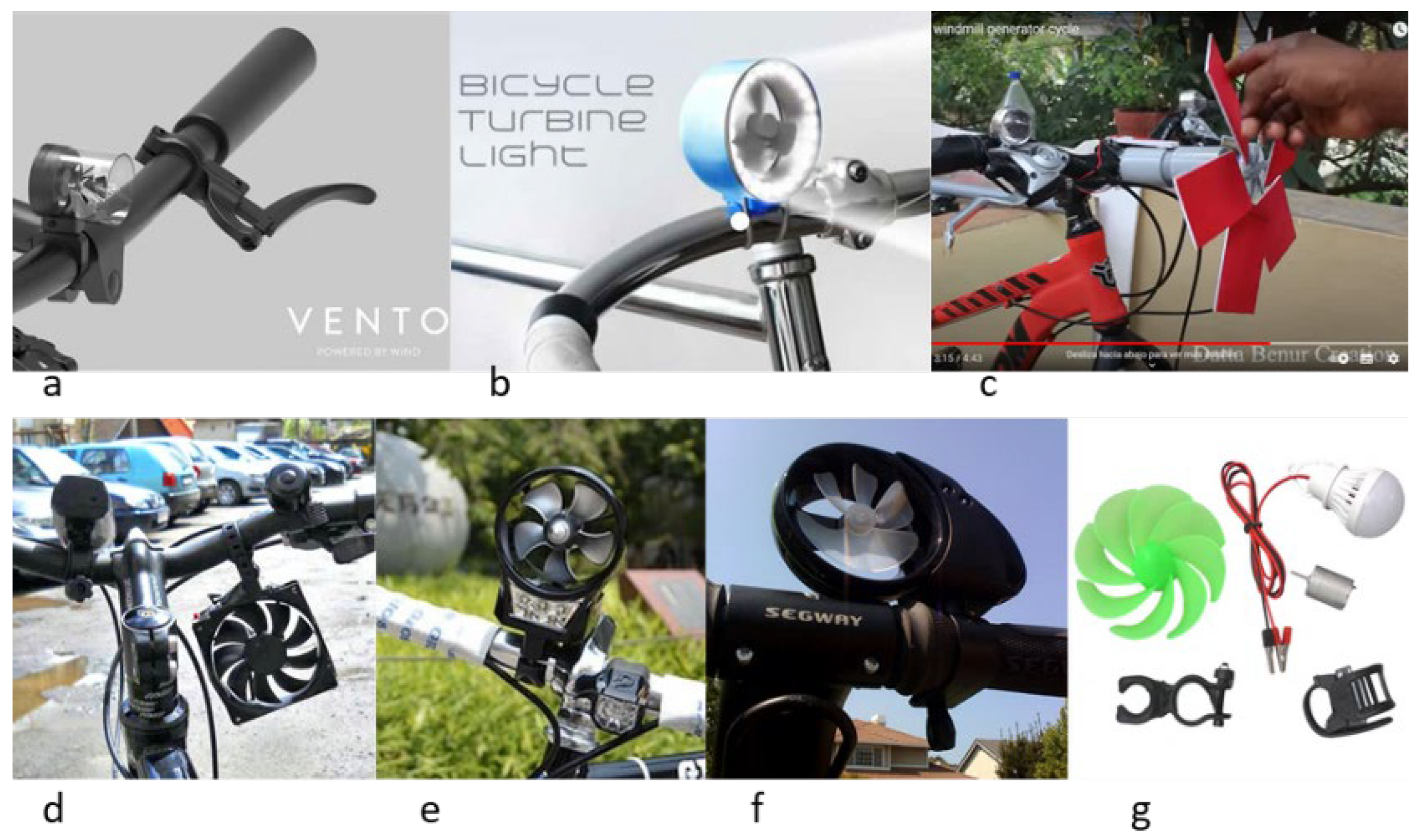
Figure 3.
Prototyping and testing process for propellers based on Samara blades.
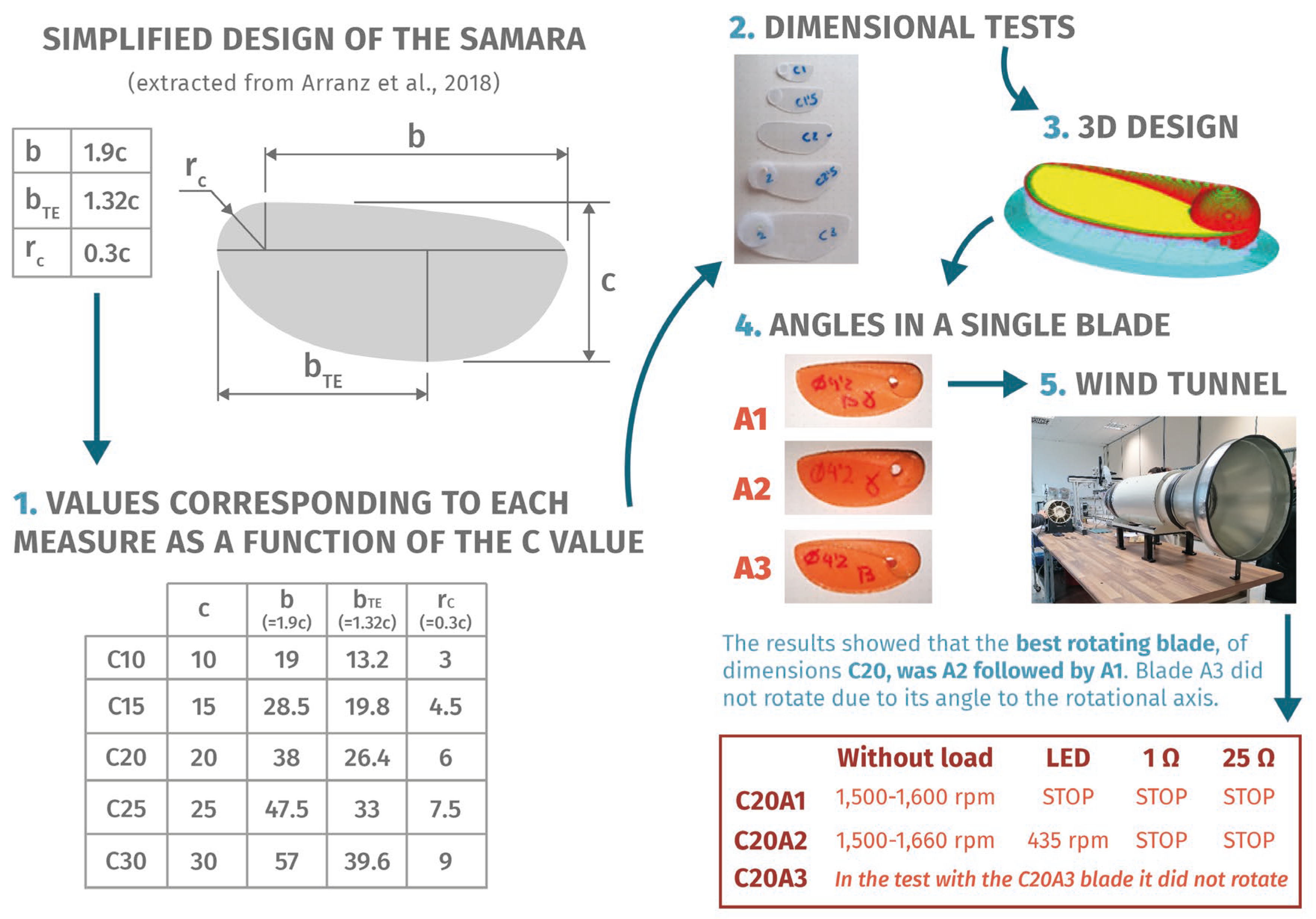
Figure 4.
Electrical circuit test for final validation.
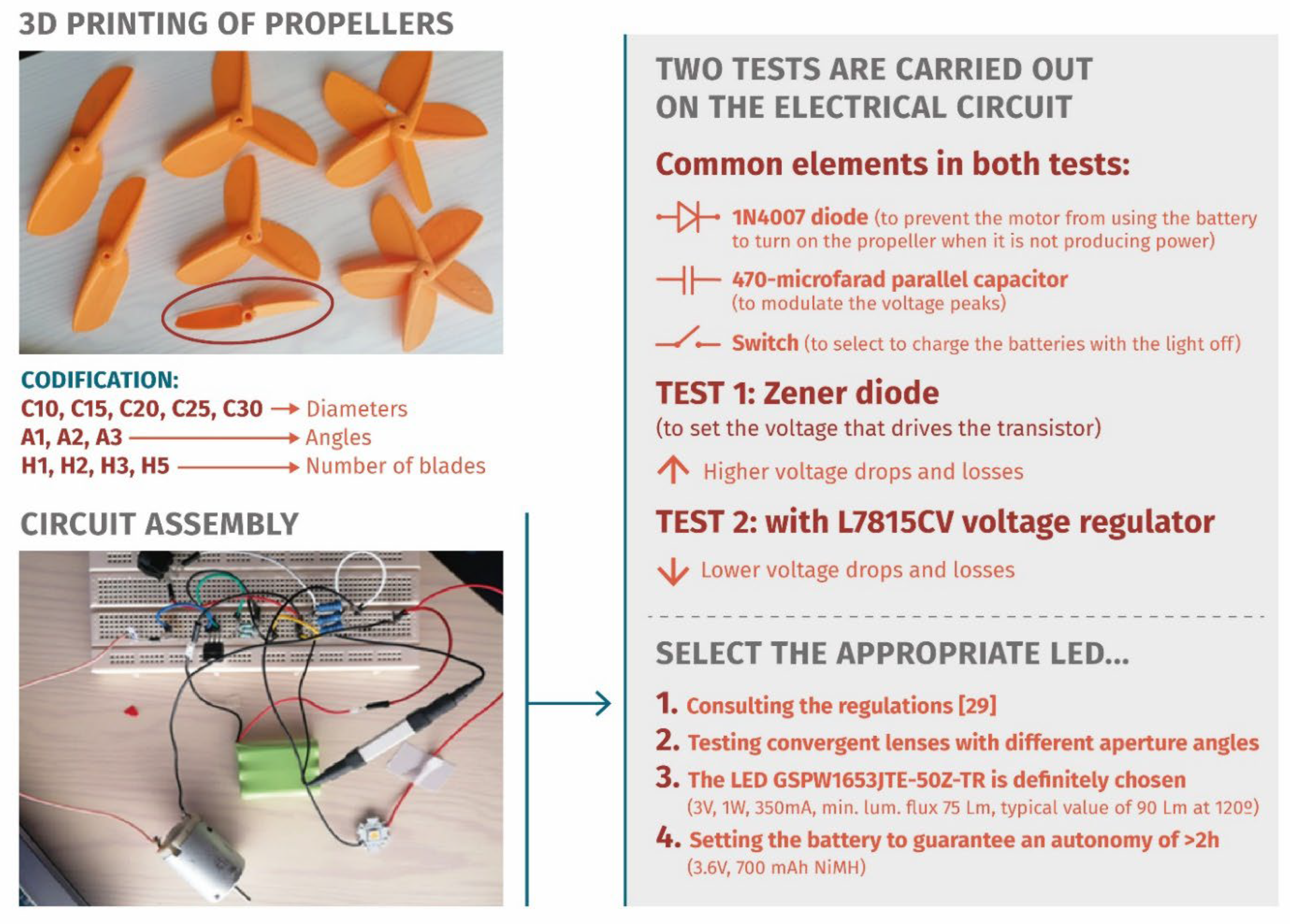
Figure 5.
Design of the first complete prototype and 3D printing.
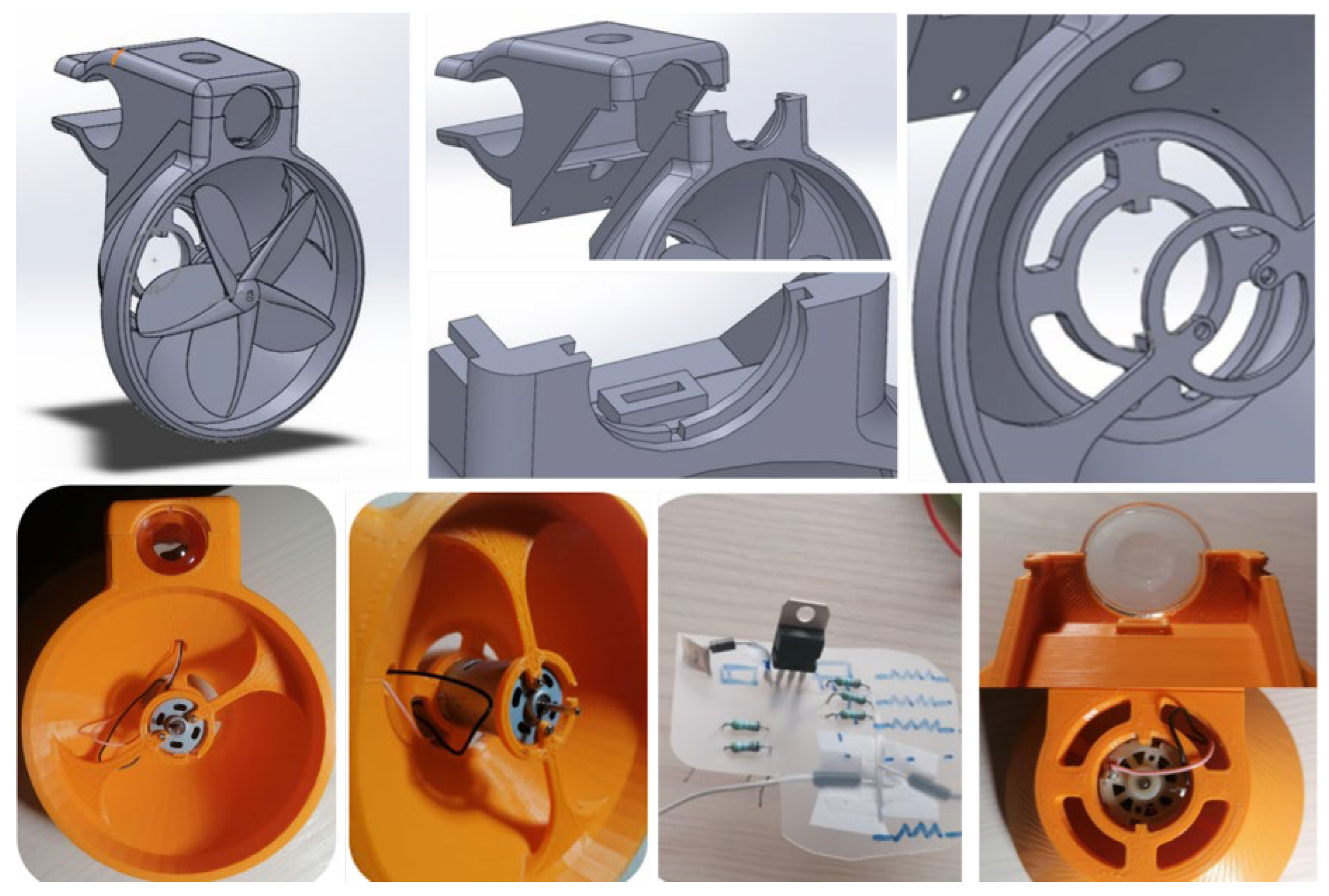
Figure 6.
Final 3D design.
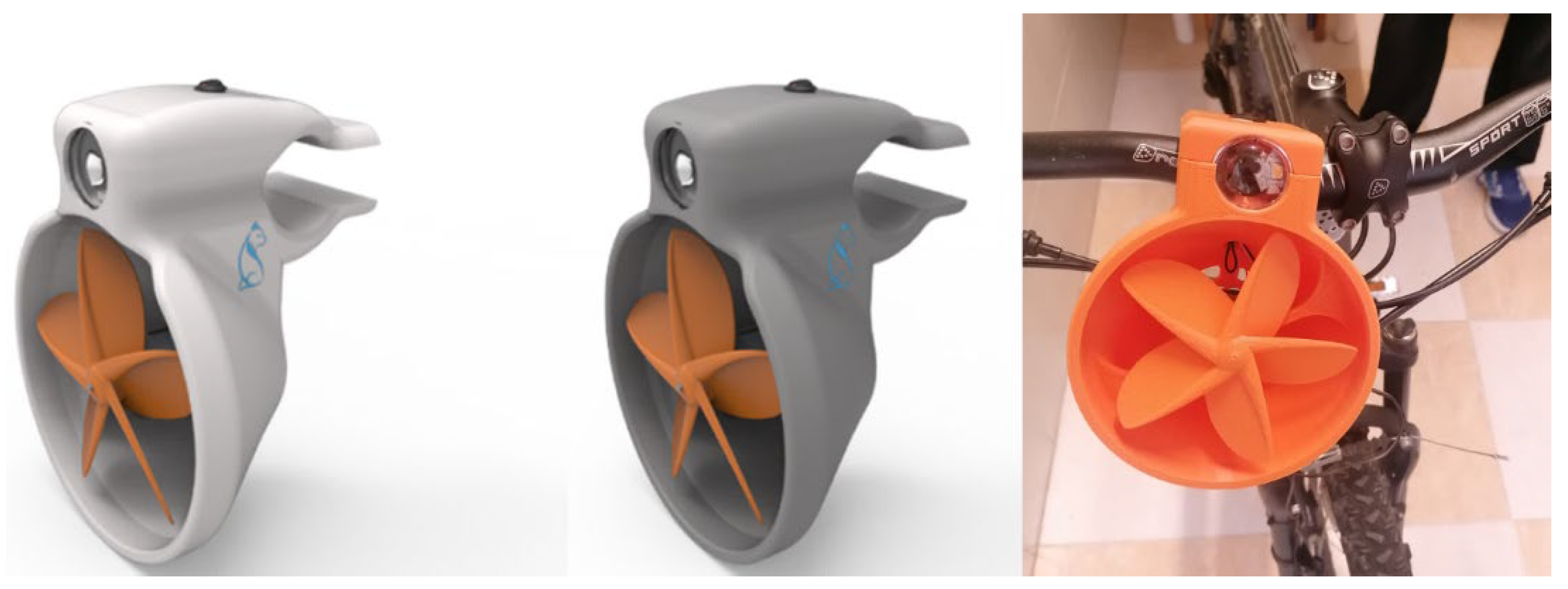

Table 1.
Design process for the bioinspired prosumer.
| Phases | Objectives | Actions and methods |
| Research | Understanding the market for flashlights and microturbines Search for bioinspired references. Know the biological principle of the seeds. Understanding sustainability and Circular Economy issues Defining needs |
Market analysis, similar features/functionality. Microturbine analysis Bioinspired case studies Sustainable design rules integration Writing the brief |
| Customized Design | Conceptual design. Custom-made design Establish the dimensions of the blades for the first tests. Know how the wind tunnel works |
Conceptual design. Preliminary design of blades and schematic or grid of component blocks. Recover old motors, LED and lenses for testing. |
| Prototyping | Experimentation and Validation Tests with recovered generators and various LED Final tests Calculation of electrical components |
3D printing, first tests Wind tunnel laboratory experimentation Electrical circuit design and optimization |
| Manufacturing | Carrying out the geometric design Integrating all components 3D printing final aesthetic design |
3D printing aesthetic design Adjustment of anchorages on bicycles |
| Validation | Actual assembly, adjustment and testing | First real tests of the prosumer product |
Table 2.
Product design main specifications for the bioinspired bicycle flashlight.
| Component | Specifications |
| Light | One 1 to 3 W LED; Focusing/converging lens |
| Legal | A white light source that must reach at least 150m with an illumination of 4 to 60 candelas (12.6 Lm to 188.5 Lm at 120°) and facing forward in the direction of the axis of motion [59] |
| Power | Autonomous charging by bicycle movement. Micro-wind turbine. Use of rechargeable batteries type AA or AAA |
| Circuit | Electronic circuit board for battery charging and illumination; Selector for charging or charging with illumination |
| Generator | Recycled motors from old appliances |
| Fabrication | 3D printing; Recycled and recyclable materials |
| Sustainability | Introduce sustainability rules through the recovery and reuse of materials and components |
Table 3.
Data and results in the wind tunnel.
| b = c ·1,9 (m) |
Swept area (m2) |
Theoretical power P (W) |
Resistor (Ω) |
Voltage (V) | Current (mA) | Speed (r.p.m) |
Turbine Power Pt (W) |
Cp= Pt/P | |
| H5C30 (led 5w) | 0,057 | 0,0102 | 5,91 | 25 | 7,8 | 160 | 5762 | 1,248 | 0,211 |
| H5C30 (led 5w) | 0,057 | 0,0102 | 5,91 | 56 | 9,4 | 120 | 6153 | 1,128 | 0,191 |
| H2C25 (led 5w) | 0,048 | 0,0071 | 4,10 | 25 | 7,24 | 142 | 5075 | 1,028 | 0,250 |
| H2C30 (led 1w) | 0,057 | 0,0102 | 5,91 | 25 | 8,2 | 120 | 5870 | 0,984 | 0,166 |
| H5C30 (led 1w) | 0,057 | 0,0102 | 5,91 | 25 | 7,7 | 125 | 7000 | 0,963 | 0,163 |
| Dron (led 5w) | 0,025 | 0,0020 | 1,14 | 39 | 4,87 | 50 | 2860-2900 | 0,2435 | 0,214 |
Disclaimer/Publisher’s Note: The statements, opinions and data contained in all publications are solely those of the individual author(s) and contributor(s) and not of MDPI and/or the editor(s). MDPI and/or the editor(s) disclaim responsibility for any injury to people or property resulting from any ideas, methods, instructions or products referred to in the content. |
© 2024 by the authors. Licensee MDPI, Basel, Switzerland. This article is an open access article distributed under the terms and conditions of the Creative Commons Attribution (CC BY) license (http://creativecommons.org/licenses/by/4.0/).
Copyright: This open access article is published under a Creative Commons CC BY 4.0 license, which permit the free download, distribution, and reuse, provided that the author and preprint are cited in any reuse.


