
Submitted:
06 August 2024
Posted:
07 August 2024
You are already at the latest version
Abstract
The cognitive and affective impacts of video games are subjects of ongoing debate, with recent research recognizing their potential benefits. This study employs the Gaming Skill Questionnaire (GSQ) to evaluate participants' gaming skills across six genres and overall proficiency. Eighty-eight individuals aged 20-40 participated, completed assessments of empathy and six cognitive abilities: verbal short-term memory, verbal working memory, visuospatial short-term memory, visuospatial working memory, psychomotor speed (hand-eye coordination), and attention. Cognitive abilities were examined using the Digit Span Test, Corsi Block Test, and Deary-Liewald Reaction Time Task, while empathy was assessed using the Empathy Quotient Questionnaire. Findings indicate that high video game skill levels correlate with improvements in visuospatial short-term and working memory, psychomotor speed, and attention. Different genres enhanced specific skills: RPGs positively influenced verbal working and visuospatial short-term memory but negatively affected empathy; action games improved psychomotor speed and attention; and puzzle games benefited visuospatial working memory. These promising results contribute positively to ongoing research on the cognitive and affective effects of video games, highlighting the potential for video games to enhance certain cognitive functions while also underscoring the complexity of their impact on empathy. Future research should further investigate genre-specific effects and long-term outcomes.
Keywords:
videogames
; early adulthood
; cognition
; empathy
; short-term memory
; working memory
; visuospatial memory
; verbal memory
; hand-eye coordination
; attentional processing speed
1. Introduction
Video games have become a significant form of entertainment, comparable to the film industry in profitability. In the United States, expenditure on game-related items has increased over 7 times, from $7.4 billion in 2006 to $57.2 billion in 2023 (Entertainment Software Association, 2024; Williams et al., 2008). This expansive industry encompasses both hardware—such as video game consoles, personal computers, smartphones and virtual reality (VR) devices—and software- the games themselves. The development of gaming culture has led to the creation of a gamer identity, characterized by choices in gaming platforms, genres, specific games, and play styles. (Braun et al., 2016; Granic et al., 2014; Lopez-Fernandez et al., 2019). Additionally, electronic sports have emerged (eSports), where top players compete for substantial cash prizes, with audiences viewing these events similarly to traditional sports (Chan et al., 2022; Monteiro Pereira et al., 2022). This trend emphasizes the importance of understanding the effects of video games on cognitive and affective aspects in early adulthood.
Video games are designed in various genres to cater to different preferences and demands including adventure, action, sports, role-playing (RPG), racing, strategy, puzzles, martial arts, and first-person shooters (FPS). (Qaffas, 2020). Each genre requires different skill sets and levels of engagement, being attractive to a wide audience. The difficulty levels of these games are carefully balanced to maintain player interest and satisfaction without overwhelming them. (Fraser et al., 2014). It is also important to note that many games now are designed to combine features from multiple genres, challenging traditional classifications (Apperley, 2006; Dale & Green, 2017; Gentile, 2011).
Initially perceived as a predominantly male form of entertainment, gaming has seen a shift towards a more balanced representation of sexes, with an increased number of women identifying as gamers (Bavelier et al., 2012). Furthermore, gaming is no longer perceived as a child’s or adolescent’s activity, a view which also changed with more and more adults playing videogames as a pastime. Studies indicate that 61% of U.S adults are playing videogames, with the average age of a gamers being 36 (Entertainment Software Association, 2024). This is attributed to the fact that teenage gamers grow into videogame-playing adults. Early adulthood, defined as the period between 20 to 40 years of age, , is described as a period of cognitive stabilization and peak performance, making this age range critical for research on video game effects (Lövdén et al., 2020; Smith et al., 2020).
1.1. The Effects of Videogames on Cognitive and Affective Elements
The increased popularity and immersive nature of videogames have made them a significant topic in neuropsychological research. However, findings are not often inconclusive (Bernik et al., 2023; Boot et al., 2011; C. S. Green et al., 2017) and are often mediated by the game genre in question (Choi et al., 2020; Oei & Patterson, 2015), independent from the platforms used (V. Huang et al., 2017).
A particular focus lies on the potential negative effects of violent video games on aggression, antisocial and externalized behavior, prosocial behavior, empathy, and desensitization to violence (C. A. Anderson et al., 2010; Bushman & Anderson, 2009; Coyne et al., 2023; Engelhardt et al., 2011; Greitemeyer, 2018), with these effects being more prevalent in men (Coyne et al., 2020). However, this perspective is challenged by studies arguing that the deleterious effects of violent videogames are overstated, and result from less robust methodologies (Adachi & Willoughby, 2011; Elson & Ferguson, 2014; Ferguson & Wang, 2019; Hilgard et al., 2017; Kühn et al., 2019; Tear & Nielsen, 2014). Additionally, some studies suggest that certain types of videogames, such as RPGs, social games, and cooperative games can enhance empathy (Bachen et al., 2012; Greitemeyer et al., 2010; Greitemeyer & Osswald, 2010; Wulansari et al., 2020), whereas cooperative violent videogames mitigate the empathy-reducing effects of violent content. (Devilly et al., 2017; Happ et al., 2011, 2015; Harrington & O’Connell, 2016; Prot et al., 2014). (Ducheneaut et al., 2007; Garcia et al., 2022; Greitemeyer, 2013; Greitemeyer & Cox, 2013; Jerabeck & Ferguson, 2013). There’s an interesting finding regarding the age of the players and empathy, appearing to impact adolescents’ empathy more than (Shin & Ahn, 2013). Finally, it should be noted that there are special videogames being developed for training empathy (Kral et al., 2018).
There has also been extensive research on the effects of videogames on cognitive domains, including their potential for rehabilitating cognitive deficits. These cognitive domains commonly engaged during playing include visuospatial skills, short-term and working memory, attention, and psychomotor speed, which is also reported as hand-eye coordination.
Most studies indicate that videogames have positive effects on the visuospatial skills of players (Castel et al., 2005; Donohue et al., 2010; H. Huang & Cheng, 2022; Oei & Patterson, 2013; Waris et al., 2019). Action video games, in particular, require players to track and identify multiple moving objects simultaneously, potentially enhancing visuospatial skills. This genre, along with FPS games, have shown improvements in visuospatial short-term and working memory. However, some studies suggest that videogames do not affect visuospatial memory, suggesting a need for further investigation (Ruiz-Marquez et al., 2019). Evidence also suggests a “dose-related” effect, with more videogame play leading to greater improvements in visuospatial skills(Gorbet & Sergio, 2018).
Attention is another domain frequently investigated in the context of videogames. Videogames offer an interactive experience that often demands constant player attention and engagement, depending on the specific type of videogame. (Baniqued et al., 2014; Cardoso-Leite & Bavelier, 2014; Mishra et al., 2012). Action videogames, in particular, seems to benefit attention, with a plethora of studies demonstrating a positive relationship (Alho et al., 2022; Bavelier & Green, 2019; Bediou et al., 2018, 2023; C. S. Green & Bavelier, 2012; Hubert-Wallander et al., 2011; Sampalo et al., 2023). Action video games exhibit an interesting, sex-related effect on attention, with women benefiting more from playing such games, than men (Feng et al., 2007). Action games aren’t the only genre that improves the attention of their players, RPGs appear to exhibit the same level of beneficial effects on player’s attention as action videogames (Dale et al., 2020). Furthermore, the advent of virtual reality (VR) games significantly improve the visuospatial skills compared to conventional ones (Glueck & Han, 2020). However, some studies report no interaction between action games and attention (Gentile et al., 2012; Irons et al., 2011), highlighting the need for more research.
Videogames not only require attention and visuospatial skills, but they also demand fast player reactions to on-screen stimuli and psychomotor speed (hand-eye coordination). Both of these skills are reflected in the player’s reaction time, an important metric, both for gamers and researchers alike. Research suggests that video games can improve psychomotor speed and reaction times, with FPS games exhibiting particular promise in psychomotor speed (Ahn & Won, 2023; Boot et al., 2008; Chaarani et al., 2022; Deleuze et al., 2017; Horoszkiewicz et al., 2022; Ou et al., 2013; Reynaldo et al., 2021).
Verbal memory, both short-term and working, has not been extensively studied, with inconclusive results. Some research supports the notion that videogames provide benefits for one’s verbal memory (Murphy et al., 2012; Oei & Patterson, 2013), while other studies indicate either a negative relation, with games being detrimental to one’s verbal memory (Özçetin et al., 2019), or no relation at all (Sattar et al., 2021). Further investigation is needed to examine the effects of videogames on verbal skills.
Another significant area of research involves the impact of video games on cognitive functions and their potential use in neuropsychological rehabilitation to battle cognitive decline (Lucatelli et al., 2022). Various studies explored using videogames as a way to help older adults to reduce cognitive decline and retain cognitive levels (Anguera & Gazzaley, 2015; Boot et al., 2013; Charchat-Fichman et al., 2014; Laganà, 2018; Whitbourne et al., 2013). Furthermore, there have been attempts to use videogames as training devices to bolster cognitive abilities of older people, including memory (Anguera et al., 2013; Franceschini et al., 2022; Toril et al., 2014, 2016). Real-Time Strategy games (RTS) and Puzzle games have been identified to improve both their short-term and working memory in older adults (Basak et al., 2008) (Cutting et al., 2023). Interestingly older adults seem to benefit cognitively more than younger ones from playing videogames (S. Kim et al., 2022). The general consensus is that more research is needed (Blumberg & Fisch, 2013; Latham et al., 2013).
1.2. Aims of This Study
This study aims to contribute to the growing and mixed-result literature regarding the effects of videogames on various cognitive and affective domains. Specifically, the Gaming Skill Questionnaire (GSQ) was used to assess the skills of the adults in 6 different videogame genres as well as in gaming in general. The effects of these skills were then assessed on six cognitive and one affective domain. Cognitive domains included Verbal Short-term Memory and Verbal Working Memory, assessed by the Digit Span Test; Visuospatial Short-term Memory and Visuospatial Working Memory, assessed by the Corsi Block Test; Psychomotor skills and Attentional Processing Speed assessed by the Deary-Liewald Simple and Choice Reaction Time Tests, while the affective domain was investigated with Empathy using the EQ Questionnaire.
The research hypothesis posits that experience with video games will significantly affect the cognitive skills investigated, as well as empathy, either positively or negatively. Furthermore, this study aims to elucidate whether these forms of digital engagement can predict performance in cognitive assessments and empathy measures to better understand of the potential benefits and drawbacks of video game engagement. By integrating these findings, this research hopes to inform future studies and practical applications in cognitive training and mental health interventions.
2. Materials and Methods
2.1. Participants
The present study’s sample consisted of 88 adults, aged 20 to 40, 45 female and 43 male participants. Apart from age and sex, demographic data also included the education level of the participants, measured in years, ranging from 12 to 25 years. Their recruitment was conducted using a convenience sampling method. Participation was voluntary and each participant signed a consent form before taking part in the study. Inclusion criteria required the absence of neurological and psychiatric diseases/disorders, any form of addiction, drug/alcohol abuse, and learning difficulties.
2.2. Materials
Demographic data for this study were collected using a custom questionnaire that incorporated questions relating to the participants’ age, sex, years of education, and exclusion criteria as described above.
2.2.1. Gaming Skill Questionnaire (GSQ)
This questionnaire was used to quantify the skills of the participants in six different gaming genres and overall gaming skills (Zioga et al., 2024). GSQ includes sections, for each of the six gaming genre: Sports Games, First Person Shooter (FPS) Games, Role Playing Games (RPG), Action-Adventure Games, Strategy Games, and Puzzle Games. Each section is comprised of two questions, one on the frequency of play, ranging from 1 (Never) to 6 (Everyday), and one on the self-perceived expertise on said genre, ranging from 1 (No skill) to 6 (Expert). Scoring on each genre’s gaming skills consists of the sum of the scores of the two questions. Total Gaming Skill score is the sum of the gaming skills of each of the six sections. Thus, the test provides seven scores, Sports Games Skill (SpGS), FPS Games Skill (FPSGS), Role-Playing Games Skill (RPGS), Action-Adventure Games Skill (AGS), Strategy Games Skill (StGS), Puzzle Games Skill (PGS), and Total Gaming Skill (TGS) (Zioga et al., 2024).
GSQ has high reliability and validity, with a high Cronbach’s alpha (varying from .8 to .91 in the different sections) , strong convergent validity (with item loadings at .69 at minimum and 1 at maximum) and excellent divergent validity (with low associations between the sections, ranging from .092 to just .002), thus proving its inclusion in the present experiment (Zioga et al., 2024). The GSQ (English version) can be accessed here: http://dx.doi.org/10.13140/RG.2.2.27257.24160.
2.2.2. Digit Span Test (DST)
The Digit Span Test measures verbal memory by presenting sequences of digits for participants to verbal recall (Jones & Macken, 2015). The sequences of digits progressively increase in length. There are two iterations of DST, DST Forward and DST Backward. In DST Forward the participants recall the sequences of digits in the same order that they were presented, while in the DST Backward, the participant has to recall them in the inverse order. Performance is calculated based on the longest correctly recalled sequence and the number of correct trials. DST Forward specifically is used to assess one’s verbal short-term memory, while DST Backward is used to assess one’s verbal working memory (Woods et al., 2011). This difference warrants the inclusion of both iterations of DST in this experiment.
2.2.3. Corsi Block Test (CBT)
The Corsi Block Test assesses visuospatial memory (Corsi, 1973a). Participants are shown blocks on the screen, which sequentially light up, and must recall the sequence. The sequence of blocks lighting up progressively increases in length. There are two iterations, CBT Forward, and CBT Backward. In CBT Forward the participants have to recall the sequence in the same order and in the CBT Backward the participant has to recall it in the inverse order (Kessels et al., 2000). Performance is calculated based on the longest sequence successfully recalled and the number of correct trials. CBT Forward assesses visuospatial short-term memory, while CBT Backward assesses visuospatial working memory (Isaacs & Vargha-Khadem, 1989; Kessels, Van Den Berg, et al., 2008; Vandierendonck et al., 2004).
2.2.4. Deary-Liewald Reaction Time Task (DLRTT)
This task is implemented in order to assess the reaction time and the information processing speed of the participants. There were two iterations of DLRTT implemented in the present study. the Deary-Liewald Simple Reaction Time Task (DLSRTT) where participants press a key as fast as possible when a visual stimulus (a cross is presented(Deary et al., 2011a) and the Deary-Liewald Choice Reaction Time Task (DLCRTT), where participants press one of two buttons, depending on whether a left or right arrow appears on the screen (Deary et al., 2011a). Reaction time measured in milliseconds is the score for each task. DLSRTT measures psychomotor skill, while DLCRTT measures attentional speed (Deary et al., 2011a).
2.2.5. Empathy Quotient Questionnaire (EQ)
The EQ questionnaire is a tool designed to evaluate the empathy of adults. It includes 60 questions, 40 of which are designed to assess the perception of and the influence of the emotions of others, and 20 are filler items (Lawrence et al., 2004). The participant is presented with each question and has to choose the best-suited reply from four available, ranging from totally agree, somewhat agree, somewhat disagree, and totally disagree. It is designed to be completed within 5 to 10 minutes, with scores ranging from 0 to 80 (Baron-Cohen & Wheelwright, 2004).
2.3. Procedure
The study was conducted in a controlled laboratory setting. Each participant was alone with the researcher during data collection. Participants received a detailed briefing on the procedure, tests, type of data collected, and the confidentiality as well as the adherence to GDPR laws. Informed consent was obtained prior to participation.
Initially, participants had to fill in the demographic questionnaire, followed by the completion of the GSQ. Extra care was taken to ensure that the participants provided accurate information.
Subsequently, the three tasks were administered, namely DST, CBT, and DLRTT, as they were described in the Materials section. In each type of test, the sequence was maintained as proposed in the literature, with the Forward iteration being administered first, followed by the Backward one, in the cases of DST and CBT, while for DLRTT, the Simple iteration was administered first, followed by the Choice one(Corsi, 1973b; Deary et al., 2011a; Jones & Macken, 2015). The order of the three tests was randomized using a Latin square design to avoid primacy effects.
After the administration of all three tests, the participants completed the EQ questionnaire, striving to capture thoughtful and accurate answers, by reminding them the importance of truthfully replying. Finally, the participants were debriefed, reminded of their rights regarding their participation in the study and their personal data.
2.4. Statistical Analyses
Statistical analyses for this study were performed using the R programming language (version 4.3.3) (R Core Team, 2022a) within the RStudio environment (version AGPL v3)(RStudio Team, 2022). Essential R packages were utilized, including psych (Revelle, 2022) for correlation, regression, ANOVA, and post hoc comparison analyses, and ggplot2 (Wickham, 2016) for generating visual plots. The analysis began with descriptive statistics to provide a comprehensive overview of the sample demographics and test scores. Pearson’s correlations were performed to identify potential correlations between variables.
2.4.1. Regression Analysis Process
Linear Simple regressions were performed with the goal to uncover the predictive values of all individual predictor variables on the criterion variables. For the Linear Multiple Regression models, the variables considered included demographic data (namely Age, Sex, and years of education), gaming skill levels (namely Sports Gaming Skills, First Person Shooter Gaming Skills, Role Playing Gaming Skills, Action-Adventure Gaming Skills, Strategy Gaming Skills, Puzzle Gaming Skills, and Total Gaming Skills), cognitive test scores (DST Forward, DST Backward, CBT Forward, CBT Backward, DLSRTT, and DLCRTT), as well as the EQ questionnaire score. The incremental approach was chosen, which consisted of initial Single-Predictor models, one for each predictor, being created. These allowed the identification of the most effective variable. These were followed by Dyadic Predictor Models, including two predictors, with the inclusion of the most effective variables from the Single-Predictor Models. The performances of Dyadic Predictor Models and of the Single Predictor Models were compared to identify the most effective combinations. Finally, an Incremental Model Development process was conducted, whereby predictors were added in each phase, with the resulting model being compared to the previous one. This leads to progressively more complex models, with the process being halted when the addition of a new predictor lead to no significant improvement in the model’s performance. The optimal model was chosen as the simplest possible model with superior performance compared to more complex ones. This allowed the selection of a robust and accurate representation of the most influential variables in the chosen models.
The regression analysis commenced with verifying data normality using the Shapiro-Wilk Normality test (shapiro.test function from the stats package (R Core Team, 2022a)) and confirming homoscedasticity with the Non-Constant Error Variance test (ncvTest function from the car package (Fox & Weisberg, 2019)). Multicollinearity was assessed by calculating the variance inflation factor (VIF) for each predictor within the models using the vif function from the car package(Fox & Weisberg, 2019). Linear regression analyses were employed to explore various predictors of cognitive functions and behaviors, utilizing the lm function from the stats package(R Core Team, 2022a). Models were compared using the Akaike Information Criterion (AIC), Bayesian Information Criterion (BIC), F statistic significance level, and the proportion of explained variance (R²).For the multiple linear regression analyses, variables considered included demographic factors (age, sex, years of education), gaming skill levels (Sports Gaming Skills, First Person Shooter Gaming Skills, Role Playing Gaming Skills, Action-Adventure Gaming Skills, Strategy Gaming Skills, Puzzle Gaming Skills, and Total Gaming Skills), cognitive test scores (DST Forward, DST Backward, CBT Forward, CBT Backward, DLSRTT, and DLCRTT), and the EQ questionnaire score. An incremental approach was adopted for the analytical process:
Single-Predictor Models: Initially, separate models were developed for each predictor to identify the most effective variable based on performance.
Dyadic Predictor Models: Subsequently, models incorporating two predictors were constructed, consistently including the most effective variable from the single-predictor models. The performance of these dyadic models was then evaluated and compared to the single-predictor models to ascertain the most effective combination.
Incremental Model Development: This iterative approach involved adding a predictor in each phase and comparing the performance of increasingly complex models. The process continued until the inclusion of new variables no longer significantly improved the models' performance. The optimal model was determined when a simpler model from an earlier phase demonstrated superior performance compared to a more complex model from a later phase. This ensured the final model was robust and accurately reflected the most influential variables identified in the study.
2.4.2. One-Way ANOVA Analyses
One-way ANOVA analyses were performed on the data set using the aov function from the stats package (R Core Team, 2022a), with participants divided into Low, Medium, and High Gaming Skill Levels based on their GSQ scores. This division was used to examine differences in cognitive performance on the three tests and empathy across different levels of gaming skills in individual genres and overall gaming proficiency. Post-hoc Bonferroni corrected comparisons were conducted using the pairwise.t.test function to uncover specific differences between gaming skill levels. This comprehensive approach ensured a detailed understanding of how different gaming skill levels impact cognitive and affective functions.
3. Results
The sample (N =88) included 45 female and 43 male adults, aged 20 to 40. Table 1 presents the descriptive statistics, which include the demographics, namely age and years of education, their gaming skills in all 6 genres inquired in the GSQ, as well as the total gaming skill. Furthermore, it also includes the descriptive statistics of the 3 cognitive tests, specifically the DST Forward and Backward, the CBT Forward and Backward, and the DLRTT Simple and Choice, as well as for the EQ questionnaire. Table 1 includes the total values but also the values based on the gaming skills of the participants, when divided into Low, Medium, and High based on their Gaming Skills Score.
Comparing the three levels of gaming skill, namely Low, Medium, and High, it is evident that higher gaming skill individuals tend to be older, with the mean age of the participants increasing along with the increase in gaming skill. Regarding education level, those with medium gaming skills exhibited the highest, followed by those with low and finally those with high gaming skills. In all genres of games, specific skills increased together with the general gaming skill level increase. In both Forward and Backward iterations in both DST and CBT, the higher the gaming skill level, the better the score. In DLSRT, the reaction time was the lowest in the high gaming level group but worst in the medium gaming level group. In DLCRT, the higher the gaming level, the lower the reaction time. Finally, in the EQ, the higher the gaming level, the lower the EQ score.
3.1. Correlations
Pearson’s correlations are reported in Table 2. Starting with the demographic factors, Age seems to be significantly but weakly positively correlated with the scores in both CBT forward and backward as well as significantly weakly negatively correlated with the EQ score. Education on the other hand, resulted in no significant correlations with any of the 7 tests.
Regarding Gaming Skills, the Sports one was significantly weakly positively correlated only with the DST Backward. FPS gaming skill was significantly weakly positively correlated with both CBT forward and backward, and significantly weakly negatively correlated with both Simple and Choice iterations of the DLRTT. RPGS too was significantly weakly positively correlated with both Forward and Backward iterations of the CBT, but also significantly weakly negatively correlated with the scores of the EQ Questionnaire. AGS was significantly weakly positively correlated with the scores of DLSRT and DLCRT tasks. StGS only resulted in a significantly weak positive correlation with the Forward variant of the CBT. PGS was significantly weakly positively correlated only with the two iterations of the CBT, forward and backward. Finally, TGS was significantly weakly positively correlated with almost all of the tests, specifically DST Forward, CBT Forward and Backward, DLSRT, and DLCRT, with only the Forward variant of DST and the EQ Questionnaire not achieving significance.
3.2. Regressions
Table 3 depicts the Best Regression Models for each of the 7 tests that were performed. Digit Span Test Forward has a null model indicated as best, ergo no factor was predictive of the DST Forward performance.
The best regression model for Digit Span Test Backward had an R2 of .12, indicating a weak relationship between the Verbal Working Memory of the participants and the sole predictor of the model, namely RPGS. Specifically, the latter has a beta coefficient of .35, postulating that an increase in RPGS leads to a moderate improvement of Verbal Working Memory.
Corsi Blocks Test Forward’s model achieved an R2 of .20, indicating a moderate relation of Visuospatial Short-Term Memory and the predictors of the model, which are Age and RPGS. RPGS was the strongest predictor with a beta coefficient of .32, which indicates that an increase in RPGS leads to a moderate improvement in Visuospatial Short-Term Memory. Age had a beta coefficient of .24, and thus increased age leads to moderately better results in CBT Forward.
The best regression model of CBT Backward achieved an R2 of .19, which means that Visuospatial Working Memory is weakly related to the Age and PGS, the predictors of the model. PGS is the strongest predictive factor of the two, with a beta coefficient of .25, indicating that an increase in PGS leads to a moderately better CBT Backward score. Age resulted in a beta coefficient of .23, pointing to the fact that older age leads to moderately better visuospatial working memory. DLSRT’s best regression model had an R2 of .16, indicating that Psychomotor speed and AGS, the predictor, are weakly related. The sole predictor of the model, AGS, had a beta coefficient of -.39. Keeping in mind that the Deary-Liewald test scores are in the form of reaction times, and thus a lower score is deemed better, an increase in AGS leads to a moderate decrease of the DLSRT.
The best regression model for the DLCRT, like the one of DLSRT, had AGS as its sole predictor. Its R2 equaled .10 and thus indicates that DLCRT and AGS are weakly related. The beta coefficient of AGS in this regression model was -.32, which indicates that an increase in AGS leads to a moderate decrease of the DLCRT, and thus a moderate increase in attention speed.
EQ’s best regression model achieved an R2 of .07, postulating a weak relationship between Empathy and RPGS, the sole predictor of the model. The beta coefficient of RPGS was -.26, which indicates that an increase in RPGS leads to a moderate decrease in Empathy.
3.3. ANOVA
The ANOVA analyses were performed to examine the differences among the levels of gaming skills in terms of cognitive performance in 6 different domains and empathy. For this reason, participants were divided into three groups, based on their gaming skills. The low group included 30 participants, the middle group and the high group included 29 participants each. The descriptive statistics are presented in Table 1.
The ANOVA uncovered no significant small sized effect of gaming skill level on the verbal short-term memory of the participants [F(2,85) = 0.69, p = .507, η2p = .02], as well as on their verbal working memory [F(2,85) = 2.04, p = .136, η2p = .05], as they were measured by DST Forward and Backward respectively. These findings are visualized in Figure 1, and they indicate that gaming skill level does not significantly impact either the verbal short-term memory or the verbal working memory of adults.
Conversely, Visuospatial Memory performance was significantly affected by Gaming Skill Level. Specifically for Visuospatial Short-term Memory, as measured by CBT-Forward, the effect of Gaming skill level was significant and medium-sized [F(2,85) = 4.99, p = .009, η2p = .10]. Visuospatial Working Memory, measured by CBT Backward, was affected accordingly by Gaming Skill Level, with a significant medium-sized effect [F(2,85) = 4.08, p = .020, η2p = .09]. The post-hoc comparisons, which are visually presented in Figure 2, reveal that there is a medium effect size when comparing High Gaming Skill Level individuals to Low Gaming Skill Level ones, with the former having substantially better visuospatial short-term memory than the latter ones [d = .78, p = .009]. The same finding was uncovered in the case of visuospatial working memory [d = .73, p = .017]. Of interest was the fact that there was a marginally insignificant medium-sized effect between Medium and High gaming skills’ level on the performance in the visuospatial short-term memory task [d = .57, p = .070].
Psychomotor skills seem to also be significantly affected by the gaming skills’ level of individuals. Specifically for Motor speed, measured by DLSRTT, the effect of gaming skills level was significant and medium sized [F(2,85) = 4.36, p = .016, η2p = .09], and the same held true for the case of Attentional Speed, as measured by DLCRTT [F(2,85) = 3.10, p = .049, η2p = .07]. The post-hoc comparisons, visualized in Figure 3, unveil that, for the case of motor speed, individuals with high gaming skill are faster than those with medium gaming skills, a moderately sized significant effect [d = .62, p = .048] as well as than those with low gaming skills, an effect that is also significant and moderately sized [d = .73, p = .028]. Furthermore, the attentional processing speed of the participants with high gaming skill level was faster than those with low gaming skill level, this effect also being significant and medium sized [d = .47, p = .047].
Finally, regarding Empathy, ANOVA analysis did not uncover any significant effect of gaming skill level on it [F(2,85) = 0.92, p = .404, η2p = .02]. It has to be noted that there was a decreasing trend, inversely related to gaming skill level, hinted in Figure 4, but not reaching significance.
4. Discussion
This study aimed to investigate the impact of video game engagement on cognitive functions and empathy. Specifically, it focused on investigating the effects of gaming skills across six different gaming genres and gaming generally on six cognitive abilities and on empathy. These cognitive abilities included verbal short-term memory, verbal working memory, visuospatial short-term memory, visuospatial working memory, psychomotor skill, and attentional speed. These were assessed, in order, by the Digit Span Test Forward, Digit Span Test Backward, Corsi Block Test Forward, Corsi Block Test Backward, Deary-Liewald Simple Reaction Time Task, and Deary-Liewald Choice Reaction Time Task. Empathy was quantified using the Empathy Quotient Questionnaire, while gaming skills were identified using the Gaming Skills Questionnaire. Key findings from this study indicate that High Gaming Skills were consistently associated with better visuospatial memory, both short – term and working, and faster psychomotor and attentional speed. Especially for psychomotor speed, High Gaming Skill resulted in faster response times than both Low and Medium Gaming Skill levels.
4.1. The Effect of Gaming Skill Level on Cognitive Functions and Empathy
4.1.1. Verbal Short-Term Memory
Verbal Short-Term Memory measured by the Forward variant of the Digit Span Test, was examined. The ANOVA results were non-significant suggesting that verbal short-term memory is not affected by gaming skill levels. At the same time, the best regression model for the DST Forward was the null. Combined, these two results show that none of the predictive factors included in our study had any effect on the Verbal Short-Term Memory of individuals. There is a lack of consensus on how videogame play affects verbal short-term memory in literature, with some studies claiming it is beneficial (Murphy et al., 2012; Oei & Patterson, 2013) while others claim it is detrimental (Özçetin et al., 2019). In addition, some found no effect of videogame play on Verbal Short-Term Memory (Sattar et al., 2021). The above stated outcomes of ANOVA and regression analysis are accompanied by the results of correlation analysis, where no factors reached any significance for the DST Forward.
4.1.2. Verbal Working Memory
Similar to verbal short memory, the ANOVA performed on the scores of DST Backward revealed no significant difference between the 3 different levels of gaming skill, low, medium, and high. This outcome is in-line with the results of the ANOVA on the DST Forward, as well as with the lack of consensus in literature, with different studies reaching different conclusions (Murphy et al., 2012; Oei & Patterson, 2013; Özçetin et al., 2019; Sattar et al., 2021). In contrast with the DST Forward, the best regression model produced for the DST Backward wasn’t the null but had RPGS as its sole predictor. In support of this finding, prior research suggests a positive relationship between increased videogame play and improved verbal working memory. It is also in line with literature on RPGs which supports the same results for this specific gaming genre (Dale et al., 2020; Oei & Patterson, 2013). Finally, the only correlations regarding DST Backward that reached significance were those with SpGS, RPGS, and TGS, suggesting a potential link between these specific gaming genres and verbal working memory.
4.1.3. Visuospatial Short-Term Memory
This study measured the Visuospatial Short-Term Memory using the Corsi Block Test – Forward. The ANOVA analysis revealed that there was a significant difference between high and low gaming skill levels, with high skill gamers performing better. This finding is consistent with the relevant literature which claims that visuospatial short-term memory benefits from videogame play (Basak et al., 2008; Blacker & Curby, 2013; C. Green & Bavelier, 2006; Murphy et al., 2012; Wilms et al., 2013). Furthermore, this finding is reinforced by the best regression model with Age and RPGS as the two predictors. RPGs are one of the genres which seem to improve one’s visuospatial memory skills, as well as perception skills in general, and thus the inclusion of RPGS as a predictor of CBT Forward is warranted (Cunningham & Green, 2023; Dale et al., 2020). Age and visuospatial short-term memory seem to have an inverse relationship after one’s mid-20s (Boot et al., 2013; Thompson et al., 2014). Finally, the CBT Forward was significantly correlated with Age, FPSGS, RPGS, StGS, and TGS suggesting that a wide array of videogame gernes, along with age, significantly influence one’s visuospatial short-term memory.
4.1.4. Visuospatial Working Memory
The ANOVA conducted on CBT Backward, which was used to measure Visuospatial Working Memory, revealed that high-level gaming skills result in significantly better Visuospatial Working Memory than low-level gaming skills. This is in line with most of the literature, which claims that visuospatial working memory benefits from regular videogame play (Donohue et al., 2010; Kefalis et al., 2020; Oei & Patterson, 2013; Shute et al., 2015; Sungur & Boduroglu, 2012; West et al., 2020). The ANOVA findings are further reinforced by the best regression model produced, the two predictors of which were PGS and Age. Puzzle games seem to contribute to one’s Visuospatial Working Memory, which is possibly due to the nature of these games, which are taxing on the visuospatial domain (Cunningham & Green, 2023; Cutting et al., 2023; Dale et al., 2020). Increasing age seems to improve the Visuospatial Working Memory, something that is in contrast with literature that claims that cognitive decline begins at around the age of 24 (Boot et al., 2013; Thompson et al., 2014). Finally, the CBT Backward was significantly correlated with age and a variety of videogame skills which included FPSGS, RPGS PGS, and TGS suggesting that playing these genres, along with gaming skills in general, significantly influence one’s visuospatial working memory. All three of these genres, namely FPS games, Role-Playing games, and puzzle games have been correlated with improvements in one’s visuospatial working memory (Cunningham & Green, 2023; Cutting et al., 2023).
4.1.5. Psychomotor Speed
The Deary-Liewald Simple Reaction Time Task was employed in this study to measure one’s Psychomotor Speed. The results of the ANOVA on DLSRTT were of interest, as high gaming skill level individuals showed better psychomotor speed than both medium-level and low-level participants. As psychomotor speed is essentially hand-eye coordination, there is a plethora of studies advocating that gaming is leading to improvements in that area of cognition (Boot et al., 2008; Castel et al., 2005; Chaarani et al., 2022; Chen & Tsai, 2015; Reynaldo et al., 2021). Furthermore, the best regression model identified AGS as a predictor, reinforcing the role of action games in enhancing psychomotor skills (Dye et al., 2009a, 2009b; Reynaldo et al., 2021). Finally, the correlation analysis revealed that FPSGS, AGS, and TGS are significantly correlated with psychomotor speed, further supporting the ANOVA and regression analysis’ outcomes.
4.1.6. Attentional Speed
Attentional Speed was quantified using the Deary-Liewald Choice Reaction Time Task. The ANOVA revealed that participants with high gaming skill level had a significantly faster attentional speed than those with how gaming skill level, consistent with literature. (Bediou et al., 2018; Boot et al., 2008; Chisholm et al., 2010; Dye et al., 2009b; Mishra et al., 2011; Palaus et al., 2017; Singh & Molloy, 2021). This finding is partially supported by the best regression model of the DLCRT, whereby AGS is the sole predictor, influencing the attentional speed positively. This is further supported by the notion that Action video games in particular have benefits for the players’ attentional speed (Bediou et al., 2023; Campbell et al., 2023; Hubert-Wallander et al., 2011; Hwang & Lu, 2018; Kowal et al., 2018). Finally, FPSGS, AGS, and TGS were significantly correlated with DLCRT, further supporting the findings of both ANOVA and the best regression model for Attentional Speed.
4.1.7. Empathy
The ANOVA of Empathy, as measured by the EQ Questionnaire, has revealed no significant association with the level of gaming skills of the participants. Our findings align with previous studies that report no significant association between gaming skill and empathy (Devilly et al., 2017; Garcia et al., 2022; Kühn et al., 2019; Prot et al., 2014). Despite that, it has to be noted that there was a, non-significant, decreasing trend when the level of videogame skill increased, hinting to a possibility that increases in gaming skill leads to less empathy, supporting a part of the literature that supports the notion that videogames have a negative effect on empathy (C. A. Anderson et al., 2010; C. A. Anderson & Bushman, 2001; C. A. Anderson & Dill, 2000; C. Anderson & Warburton, 2012; Brockmyer, 2015; Calvert et al., 2017).
The best regression model produced for empathy included only RPGS as a predictor, further supporting the notion that an increase in gaming skill, which includes experience and frequency of play, results in decreased empathy (C. A. Anderson et al., 2010; C. A. Anderson & Bushman, 2001; C. A. Anderson & Dill, 2000; C. Anderson & Warburton, 2012; Brockmyer, 2015; Calvert et al., 2017). However, the type of game, in this case RPGs, disagrees with the body of literature which supports that role-playing games tend to increase the empathy of their players (Ducheneaut et al., 2007; Greitemeyer, 2013; Harrington & O’Connell, 2016; Mahood & Hanus, 2017). Finally, Empathy was significantly correlated with RPGS and Age, with an inverse relationship in both.
4.2. Limitations & Future Studies
The present study had a few limitations. The sample included 88 participants of diverse ages and educational backgrounds, which facilitated adequate statistical power for the analyses. However, a larger sample size might have allowed for the detection of significant correlations of weak to moderate strength. Additionally, while the gaming background of the participants was substantially diverse, further diversification based on experience in various gaming genres could lead to a sample more representative of the broader gaming population. Future research on the subject could benefit from larger and more diverse samples, providing a broader representation of gaming experiences and leading to more generalized results. Longitudinal studies could offer insights into the long-term effects of gaming on cognitive and affective domains and investigate fluctuations in gaming skill levels over time. Comparing different game types, both in genres and content, could yield interesting results regarding their effects on cognition. Furthermore, both the scientific community and the public could benefit from further research on the use of video games as a cognitive training tool, aimed at enhancing specific cognitive domains of players. Finally, experimental designs that implement video games in controlled interventions could provide valuable data on the causality of the interactions uncovered.
5. Conclusions
The aim of the present study was to identify the effects of engagement in video game play, a widespread source of entertainment, on cognitive domains and empathy. The study found that some cognitive functions, such as Verbal Short-Term Memory and Verbal Working Memory, as well as Empathy, were not affected by different levels of gaming skills. However, other cognitive tasks, namely Visuospatial Short-Term and Working Memory, Psychomotor Speed, and Attentional Speed, showed significant improvement in individuals with high gaming skills compared to those with low gaming skills. Specifically, High-level gaming skill participants outperformed those with low and medium gaming skills in Psychomotor Speed. Different genres of games appeared to influence distinct cognitive domains. RPGs positively influenced Verbal Working Memory and Visuospatial Short-Term Memory but negatively impacted empathy. Action-adventure games were beneficial for psychomotor speed (hand-eye coordination) and attentional speed, while puzzle games improved Visuospatial Working Memory. These findings contribute to the growing body of literature on the effects of video games on various cognitive domains and the differential influence of various game genres. Further research is needed to continue exploring the complex relationship between video games and brain function.
Supplementary Materials
The GSQ (English version) can be accessed here: http://dx.doi.org/10.13140/RG.2.2.27257.24160 accessed on 10 January 2024.
Author Contributions
Conceptualization, A.F. and P.K.; methodology, A.F. and P.K.; software, P.K.; validation, T.Z., A.F., E.K., C.N., and P.K.; formal analysis, P.K.; investigation, A.F.; resources T.Z., A.F., E.K., C.N., and P.K.; data curation, T.Z., A.F., E.K., C.N., and P.K.; writing—original draft preparation, T.Z. and A.F.; writing—review and editing, T.Z., A.F., E.K., C.N., and P.K.; visualization, P.K.; supervision, P.K.; project administration, E.K., C.N., and P.K.;. All authors have read and agreed to the published version of the manuscript.
Funding
This research received no external funding.
Institutional Review Board Statement
The study was conducted in accordance with the Declaration of Helsinki and approved by the PPLS Research Ethics Committee of the University of Edinburgh (318-2223/8).
Informed Consent Statement
Informed consent was obtained from all subjects involved in the study.
Data Availability Statement
The data presented in this study are available on request from the corresponding author. The data are not publicly available due to ethical approval requirements.
Conflicts of Interest
The authors declare no conflict of interest.
References
- Adachi, P. J. C., & Willoughby, T. (2011). The effect of violent video games on aggression: Is it more than just the violence? Aggression and Violent Behavior, 16(1), 55–62. [CrossRef]
- Ahn, H., & Won, J. (2023). The Effects of Adolescents’ Participation in Video Games on Cognitive Function and Motor Control Skills. Healthcare, 11(20), 2740. [CrossRef]
- Alho, K., Moisala, M., & Salmela-Aro, K. (2022). Effects of Media Multitasking and Video Gaming on Cognitive Functions and Their Neural Bases in Adolescents and Young Adults. European Psychologist, 27(2), 131–140. [CrossRef]
- Anderson, C. A., & Bushman, B. J. (2001). Effects of Violent Video Games on Aggressive Behavior, Aggressive Cognition, Aggressive Affect, Physiological Arousal, and Prosocial Behavior: A Meta-Analytic Review of the Scientific Literature. Psychological Science, 12(5), 353–359. [CrossRef]
- Anderson, C. A., & Dill, K. E. (2000). Video games and aggressive thoughts, feelings, and behavior in the laboratory and in life. Journal of Personality and Social Psychology, 78(4), 772–790. [CrossRef]
- Anderson, C. A., Shibuya, A., Ihori, N., Swing, E. L., Bushman, B. J., Sakamoto, A., Rothstein, H. R., & Saleem, M. (2010). Violent video game effects on aggression, empathy, and prosocial behavior in Eastern and Western countries: A meta-analytic review. Psychological Bulletin, 136(2), 151–173. [CrossRef]
- Anderson, C., & Warburton, W. (2012). The impact of violent video games: An overview (pp. 56–84).
- Anguera, J. A., Boccanfuso, J., Rintoul, J. L., Al-Hashimi, O., Faraji, F., Janowich, J., Kong, E., Larraburo, Y., Rolle, C., Johnston, E., & Gazzaley, A. (2013). Video game training enhances cognitive control in older adults. Nature, 501(7465), 97–101. [CrossRef]
- Anguera, J. A., & Gazzaley, A. (2015). Video games, cognitive exercises, and the enhancement of cognitive abilities. Current Opinion in Behavioral Sciences, 4, 160–165. [CrossRef]
- Apperley, T. H. (2006). Genre and game studies: Toward a critical approach to video game genres. Simulation & Gaming, 37(1), 6–23. [CrossRef]
- Bachen, C. M., Hernández-Ramos, P. F., & Raphael, C. (2012). Simulating REAL LIVES: Promoting Global Empathy and Interest in Learning Through Simulation Games. Simulation & Gaming, 43(4), 437–460. [CrossRef]
- Baniqued, P. L., Kranz, M. B., Voss, M. W., Lee, H., Cosman, J. D., Severson, J., & Kramer, A. F. (2014). Cognitive training with casual video games: Points to consider. Frontiers in Psychology, 4. [CrossRef]
- Baron-Cohen, S., & Wheelwright, S. (2004). The Empathy Quotient: An Investigation of Adults with Asperger Syndrome or High Functioning Autism, and Normal Sex Differences. Journal of Autism and Developmental Disorders, 34(2), 163–175. [CrossRef]
- Basak, C., Boot, W. R., Voss, M. W., & Kramer, A. F. (2008). Can training in a real-time strategy video game attenuate cognitive decline in older adults? Psychology and Aging, 23(4), 765–777. [CrossRef]
- Bavelier, D., Achtman, R. L., Mani, M., & Föcker, J. (2012). Neural bases of selective attention in action video game players. Perceptual Learning - Mechanisms and Manifestations, 61, 132–143. [CrossRef]
- Bavelier, D., & Green, C. S. (2019). Enhancing Attentional Control: Lessons from Action Video Games. Neuron, 104(1), 147–163. [CrossRef]
- Bediou, B., Adams, D. M., Mayer, R. E., Tipton, E., Green, C. S., & Bavelier, D. (2018). Meta-analysis of action video game impact on perceptual, attentional, and cognitive skills. Psychological Bulletin, 144(1), 77–110. [CrossRef]
- Bediou, B., Rodgers, M. A., Tipton, E., Mayer, R. E., Green, C. S., & Bavelier, D. (2023). Effects of action video game play on cognitive skills: A meta-analysis. Technology, Mind, and Behavior, 4(1). [CrossRef]
- Bernik, A., Tomičić, I., & Hatlak, D. (2023). Influence of Video Games on Cognitive Abilities andIntelligence. Tehnički Glasnik, 17(4), 572–580. [CrossRef]
- Blacker, K. J., & Curby, K. M. (2013). Enhanced visual short-term memory in action video game players. Attention, Perception, & Psychophysics, 75(6), 1128–1136. [CrossRef]
- Blumberg, F. C., & Fisch, S. M. (2013). Introduction: Digital Games as a Context for Cognitive Development, Learning, and Developmental Research. New Directions for Child and Adolescent Development, 2013(139), 1–9. [CrossRef]
- Boot, W. R., Blakely, D. P., & Simons, D. J. (2011). Do Action Video Games Improve Perception and Cognition? Frontiers in Psychology, 2. [CrossRef]
- Boot, W. R., Champion, M., Blakely, D. P., Wright, T., Souders, D. J., & Charness, N. (2013). Video Games as a Means to Reduce Age-Related Cognitive Decline: Attitudes, Compliance, and Effectiveness. Frontiers in Psychology, 4. [CrossRef]
- Boot, W. R., Kramer, A. F., Simons, D. J., Fabiani, M., & Gratton, G. (2008). The effects of video game playing on attention, memory, and executive control. Acta Psychologica, 129(3), 387–398. [CrossRef]
- Braun, B., Stopfer, J. M., Müller, K. W., Beutel, M. E., & Egloff, B. (2016). Personality and video gaming: Comparing regular gamers, non-gamers, and gaming addicts and differentiating between game genres. Computers in Human Behavior, 55, 406–412. [CrossRef]
- Brockmyer, J. F. (2015). Playing Violent Video Games and Desensitization to Violence. Child and Adolescent Psychiatric Clinics of North America, 24(1), 65–77. [CrossRef]
- Bushman, B. J., & Anderson, C. A. (2009). Comfortably Numb: Desensitizing Effects of Violent Media on Helping Others. Psychological Science, 20(3), 273–277. [CrossRef]
- Calvert, S. L., Appelbaum, M., Dodge, K. A., Graham, S., Nagayama Hall, G. C., Hamby, S., Fasig-Caldwell, L. G., Citkowicz, M., Galloway, D. P., & Hedges, L. V. (2017). The American Psychological Association Task Force assessment of violent video games: Science in the service of public interest. American Psychologist, 72(2), 126–143. [CrossRef]
- Campbell, M. J., Cregan, S. C., Joyce, J. M., Kowal, M., & Toth, A. J. (2023). Comparing the cognitive performance of action video game players and age-matched controls following a cognitively fatiguing task: A stage 2 registered report. British Journal of Psychology, bjop.12692. [CrossRef]
- Cardoso-Leite, P., & Bavelier, D. (2014). Video game play, attention, and learning: How to shape the development of attention and influence learning? Current Opinion in Neurology, 27(2), 185–191. [CrossRef]
- Castel, A. D., Pratt, J., & Drummond, E. (2005). The effects of action video game experience on the time course of inhibition of return and the efficiency of visual search. Acta Psychologica, 119(2), 217–230. [CrossRef]
- Chaarani, B., Ortigara, J., Yuan, D., Loso, H., Potter, A., & Garavan, H. P. (2022). Association of Video Gaming With Cognitive Performance Among Children. JAMA Network Open, 5(10), e2235721. [CrossRef]
- Chan, G., Huo, Y., Kelly, S., Leung, J., Tisdale, C., & Gullo, M. (2022). The impact of eSports and online video gaming on lifestyle behaviours in youth: A systematic review. Computers in Human Behavior, 126, 106974. [CrossRef]
- Charchat-Fichman, H., Uehara, E., & Santos, C. F. (2014). New Technologies in Assessment and Neuropsychological Rehabilitation. Temas Em Psicologia, 22(3), 539–553. [CrossRef]
- Chen, Y., & Tsai, M.-J. (2015). Eye-hand coordination strategies during active video game playing: An eye-tracking study. Computers in Human Behavior, 51, 8–14. [CrossRef]
- Chisholm, J. D., Hickey, C., Theeuwes, J., & Kingstone, A. (2010). Reduced attentional capture in action video game players. Attention, Perception, & Psychophysics, 72(3), 667–671. [CrossRef]
- Choi, E., Shin, S.-H., Ryu, J.-K., Jung, K.-I., Kim, S.-Y., & Park, M.-H. (2020). Commercial video games and cognitive functions: Video game genres and modulating factors of cognitive enhancement. Behavioral and Brain Functions, 16(1), 2. [CrossRef]
- Corsi, P. M. (1973a). Human memory and the medial temporal region of the brain. (Vol. 34, Issues 2-B, p. 891). ProQuest Information & Learning.
- Corsi, P. M. (1973b). Human memory and the medial temporal region of the brain. (Vol. 34, Issues 2-B, p. 891). ProQuest Information & Learning.
- Coyne, S. M., Stockdale, L. A., Warburton, W., Gentile, D. A., Yang, C., & Merrill, B. M. (2020). Pathological video game symptoms from adolescence to emerging adulthood: A 6-year longitudinal study of trajectories, predictors, and outcomes. Developmental Psychology, 56(7), 1385–1396. [CrossRef]
- Coyne, S. M., Warburton, W., Swit, C., Stockdale, L., & Dyer, W. J. (2023). Who is Most at Risk for Developing Physical Aggression After Playing Violent Video Games? An Individual Differences Perspective From Early Adolescence to Emerging Adulthood. Journal of Youth and Adolescence, 52(4), 719–733. [CrossRef]
- Cunningham, E. G., & Green, C. S. (2023). Cognitive Skills Acquired From Video Games. In E. G. Cunningham & C. S. Green, Oxford Research Encyclopedia of Communication. Oxford University Press. [CrossRef]
- Cutting, J., Copeland, B., & McNab, F. (2023). Higher working memory capacity and distraction-resistance associated with strategy (not action) game playing in younger adults, but puzzle game playing in older adults. Heliyon, 9(8), e19098. [CrossRef]
- Dale, G., & Green, S. (2017). The Changing Face of Video Games and Video Gamers: Future Directions in the Scientific Study of Video Game Play and Cognitive Performance. Journal of Cognitive Enhancement, 1(3), 280–294. [CrossRef]
- Dale, G., Kattner, F., Bavelier, D., & Green, C. S. (2020). Cognitive abilities of action video game and role-playing video game players: Data from a massive open online course. Psychology of Popular Media, 9(3), 347–358. [CrossRef]
- Deary, I. J., Liewald, D., & Nissan, J. (2011). A free, easy-to-use, computer-based simple and four-choice reaction time programme: The Deary-Liewald reaction time task. Behavior Research Methods, 43(1), 258–268. [CrossRef]
- Deleuze, J., Christiaens, M., Nuyens, F., & Billieux, J. (2017). Shoot at first sight! First person shooter players display reduced reaction time and compromised inhibitory control in comparison to other video game players. Computers in Human Behavior, 72, 570–576. [CrossRef]
- Devilly, G. J., Brown, K., Pickert, I., & O’Donohue, R. (2017). An evolutionary perspective on cooperative behavior in gamers. Psychology of Popular Media Culture, 6(3), 208–221. [CrossRef]
- Donohue, S. E., Woldorff, M. G., & Mitroff, S. R. (2010). Video game players show more precise multisensory temporal processing abilities. Attention, Perception, & Psychophysics, 72(4), 1120–1129. [CrossRef]
- Ducheneaut, N., Moore, R. J., & Nickell, E. (2007). Virtual “Third Places”: A Case Study of Sociability in Massively Multiplayer Games. Computer Supported Cooperative Work (CSCW), 16(1–2), 129–166. [CrossRef]
- Dye, M. W. G., Green, C. S., & Bavelier, D. (2009a). Increasing Speed of Processing With Action Video Games. Current Directions in Psychological Science, 18(6), 321–326. [CrossRef]
- Dye, M. W. G., Green, C. S., & Bavelier, D. (2009b). The development of attention skills in action video game players. Neuropsychologia, 47(8–9), 1780–1789. [CrossRef]
- Elson, M., & Ferguson, C. J. (2014). Twenty-Five Years of Research on Violence in Digital Games and Aggression: Empirical Evidence, Perspectives, and a Debate Gone Astray. European Psychologist, 19(1), 33–46. [CrossRef]
- Engelhardt, C. R., Bartholow, B. D., Kerr, G. T., & Bushman, B. J. (2011). This is your brain on violent video games: Neural desensitization to violence predicts increased aggression following violent video game exposure. Journal of Experimental Social Psychology, 47(5), 1033–1036. [CrossRef]
- Entertainment Software Association. (2024). 2024 Essential Facts About the U.S. Video Game Industry. 2024 Essential Facts About the U.S. Video Game Industry. https://www.theesa.com/resources/essential-facts-about-the-us-video-game-industry/2024-data/.
- Feng, J., Spence, I., & Pratt, J. (2007). Playing an Action Video Game Reduces Gender Differences in Spatial Cognition. Psychological Science, 18(10), 850–855. [CrossRef]
- Ferguson, C. J., & Wang, J. C. K. (2019). Aggressive Video Games are Not a Risk Factor for Future Aggression in Youth: A Longitudinal Study. Journal of Youth and Adolescence, 48(8), 1439–1451. [CrossRef]
- Fox, J., & Weisberg, S. (2019). An R Companion to Applied Regression (Third). Sage. https://socialsciences.mcmaster.ca/jfox/Books/Companion/.
- Franceschini, S., Bertoni, S., Lulli, M., Pievani, T., & Facoetti, A. (2022). Short-Term Effects of Video-Games on Cognitive Enhancement: The Role of Positive Emotions. Journal of Cognitive Enhancement, 6(1), 29–46. [CrossRef]
- Fraser, J., Katchabaw, M., & Mercer, R. E. (2014). A methodological approach to identifying and quantifying video game difficulty factors. Entertainment Computing, 5(4), 441–449. [CrossRef]
- Garcia, S., Ferguson, C. J., & John Wang, C. K. (2022). Prosocial Video Game Content, Empathy and Cognitive Ability in a Large Sample of Youth. Journal of Youth and Adolescence, 51(1), 62–73. [CrossRef]
- Gentile, D. A. (2011). The Multiple Dimensions of Video Game Effects: Video Game Effects. Child Development Perspectives, 5(2), 75–81. [CrossRef]
- Gentile, D. A., Swing, E. L., Lim, C. G., & Khoo, A. (2012). Video game playing, attention problems, and impulsiveness: Evidence of bidirectional causality. Psychology of Popular Media Culture, 1(1), 62–70. [CrossRef]
- Glueck, A. C., & Han, D. Y. (2020). Improvement potentials in balance and visuo-motor reaction time after mixed reality action game play: A pilot study. Virtual Reality, 24(2), 223–229. [CrossRef]
- Gorbet, D. J., & Sergio, L. E. (2018). Move faster, think later: Women who play action video games have quicker visually-guided responses with later onset visuomotor-related brain activity. PLOS ONE, 13(1), e0189110. [CrossRef]
- Granic, I., Lobel, A., & Engels, R. C. M. E. (2014). The benefits of playing video games. American Psychologist, 69(1), 66–78. [CrossRef]
- Green, C., & Bavelier, D. (2006). Enumeration versus multiple object tracking: The case of action video game players. Cognition, 101(1), 217–245. [CrossRef]
- Green, C. S., & Bavelier, D. (2012). Learning, Attentional Control, and Action Video Games. Current Biology, 22(6), R197–R206. [CrossRef]
- Green, C. S., Kattner, F., Eichenbaum, A., Bediou, B., Adams, D. M., Mayer, R. E., & Bavelier, D. (2017). Playing Some Video Games but Not Others Is Related to Cognitive Abilities: A Critique of Unsworth et al. (2015). Psychological Science, 28(5), 679–682. [CrossRef]
- Greitemeyer, T. (2013). Playing Video Games Cooperatively Increases Empathic Concern. Social Psychology, 44(6), 408–413. [CrossRef]
- Greitemeyer, T. (2018). The spreading impact of playing violent video games on aggression. Computers in Human Behavior, 80, 216–219. [CrossRef]
- Greitemeyer, T., & Cox, C. (2013). There’s no “I” in team: Effects of cooperative video games on cooperative behavior. European Journal of Social Psychology, 43(3), 224–228. [CrossRef]
- Greitemeyer, T., & Osswald, S. (2010). Effects of prosocial video games on prosocial behavior. Journal of Personality and Social Psychology, 98(2), 211–221. [CrossRef]
- Greitemeyer, T., Osswald, S., & Brauer, M. (2010). Playing prosocial video games increases empathy and decreases schadenfreude. Emotion, 10(6), 796–802. [CrossRef]
- Happ, C., Melzer, A., & Steffgen, G. (2011). Bringing Empathy into Play: On the Effects of Empathy in Violent and Nonviolent Video Games. In J. C. Anacleto, S. Fels, N. Graham, B. Kapralos, M. Saif El-Nasr, & K. Stanley (Eds.), Entertainment Computing – ICEC 2011 (Vol. 6972, pp. 371–374). Springer Berlin Heidelberg. [CrossRef]
- Happ, C., Melzer, A., & Steffgen, G. (2015). Like the good or bad guy—Empathy in antisocial and prosocial games. Psychology of Popular Media Culture, 4(2), 80–96. [CrossRef]
- Harrington, B., & O’Connell, M. (2016). Video games as virtual teachers: Prosocial video game use by children and adolescents from different socioeconomic groups is associated with increased empathy and prosocial behaviour. Computers in Human Behavior, 63, 650–658. [CrossRef]
- Hilgard, J., Engelhardt, C. R., & Rouder, J. N. (2017). Overstated evidence for short-term effects of violent games on affect and behavior: A reanalysis of Anderson et al. (2010). Psychological Bulletin, 143(7), 757–774. [CrossRef]
- Horoszkiewicz, K., Horoszkiewicz, B., & Załęski, G. (2022). Psychomotor performance in video games. Journal of Education, Health and Sport, 12(7), 667–682. [CrossRef]
- Huang, H., & Cheng, C. (2022). The Benefits of Video Games on Brain Cognitive Function: A Systematic Review of Functional Magnetic Resonance Imaging Studies. Applied Sciences, 12(11), 5561. [CrossRef]
- Huang, V., Young, M., & Fiocco, A. J. (2017). The Association Between Video Game Play and Cognitive Function: Does Gaming Platform Matter? Cyberpsychology, Behavior, and Social Networking, 20(11), 689–694. [CrossRef]
- Hubert-Wallander, B., Green, C. S., & Bavelier, D. (2011). Stretching the limits of visual attention: The case of action video games. WIREs Cognitive Science, 2(2), 222–230. [CrossRef]
- Hwang, J., & Lu, A. S. (2018). Narrative and active video game in separate and additive effects of physical activity and cognitive function among young adults. Scientific Reports, 8(1), 11020. [CrossRef]
- Irons, J. L., Remington, R. W., & Mclean, J. P. (2011). Not so fast: Rethinking the effects of action video games on attentional capacity. Australian Journal of Psychology, 63(4), 224–231. [CrossRef]
- Isaacs, E. B., & Vargha-Khadem, F. (1989). Differential course of development of spatial and verbal memory span: A normative study. British Journal of Developmental Psychology, 7(4), 377–380. [CrossRef]
- Jerabeck, J. M., & Ferguson, C. J. (2013). The influence of solitary and cooperative violent video game play on aggressive and prosocial behavior. Computers in Human Behavior, 29(6), 2573–2578. [CrossRef]
- Jones, G., & Macken, B. (2015). Questioning short-term memory and its measurement: Why digit span measures long-term associative learning. Cognition, 144, 1–13. [CrossRef]
- Kefalis, C., Kontostavlou, E. Z., & Drigas, A. (2020). The Effects of Video Games in Memory and Attention. International Journal of Engineering Pedagogy (iJEP), 10(1), 51. [CrossRef]
- Kessels, R. P. C., Van Den Berg, E., Ruis, C., & Brands, A. M. A. (2008). The Backward Span of the Corsi Block-Tapping Task and Its Association With the WAIS-III Digit Span. Assessment, 15(4), 426–434. [CrossRef]
- Kessels, R. P. C., Van Zandvoort, M. J. E., Postma, A., Kappelle, L. J., & De Haan, E. H. F. (2000). The Corsi Block-Tapping Task: Standardization and Normative Data. Applied Neuropsychology, 7(4), 252–258. [CrossRef]
- Kim, S., Koo, M., & Nam, K. (2022). Game experience leads to improvement in cognitive functioning of the early middle-aged adults in contrast with the young-aged adults. Computers in Human Behavior, 129, 107153. [CrossRef]
- Kowal, M., Toth, A. J., Exton, C., & Campbell, M. J. (2018). Different cognitive abilities displayed by action video gamers and non-gamers. Computers in Human Behavior, 88, 255–262. [CrossRef]
- Kral, T. R. A., Stodola, D. E., Birn, R. M., Mumford, J. A., Solis, E., Flook, L., Patsenko, E. G., Anderson, C. G., Steinkuehler, C., & Davidson, R. J. (2018). Neural correlates of video game empathy training in adolescents: A randomized trial. Npj Science of Learning, 3(1), 13. [CrossRef]
- Kühn, S., Kugler, D. T., Schmalen, K., Weichenberger, M., Witt, C., & Gallinat, J. (2019). Does playing violent video games cause aggression? A longitudinal intervention study. Molecular Psychiatry, 24(8), 1220–1234. [CrossRef]
- Laganà, L. (2018). Cognitive gains from video game use in older age: A review of the literature corroborating them. International Journal of Family & Community Medicine, 2(1). [CrossRef]
- Latham, A. J., Patston, L. L. M., & Tippett, L. J. (2013). The virtual brain: 30 years of video-game play and cognitive abilities. Frontiers in Psychology, 4. [CrossRef]
- Lawrence, E. J., Shaw, P., Baker, D., Baron-Cohen, S., & David, A. S. (2004). Measuring empathy: Reliability and validity of the Empathy Quotient. Psychological Medicine, 34(5), 911–920. [CrossRef]
- Lopez-Fernandez, O., Williams, A. J., Griffiths, M. D., & Kuss, D. J. (2019). Female Gaming, Gaming Addiction, and the Role of Women Within Gaming Culture: A Narrative Literature Review. Frontiers in Psychiatry, 10, 454. [CrossRef]
- Lövdén, M., Fratiglioni, L., Glymour, M. M., Lindenberger, U., & Tucker-Drob, E. M. (2020). Education and Cognitive Functioning Across the Life Span. Psychological Science in the Public Interest, 21(1), 6–41. [CrossRef]
- Lucatelli, A., Goulart, A. A., Silveira, P. S. P., Siqueira, J. D. O., Carmona, M. J. C., Pereira, V. F. A., Valentin, L. S. S., & Vieira, J. E. (2022). Assessment of a digital game as a neuropsychological test for postoperative cognitive dysfunction. Brazilian Journal of Anesthesiology (English Edition), 72(1), 7–12. [CrossRef]
- Mahood, C., & Hanus, M. (2017). Role-playing video games and emotion: How transportation into the narrative mediates the relationship between immoral actions and feelings of guilt. Psychology of Popular Media Culture, 6(1), 61–73. [CrossRef]
- Mishra, J., Bavelier, D., & Gazzaley, A. (2012). How to Assess Gaming-Induced Benefits on Attention and Working Memory. Games for Health Journal, 1(3), 192–198. [CrossRef]
- Mishra, J., Zinni, M., Bavelier, D., & Hillyard, S. A. (2011). Neural Basis of Superior Performance of Action Videogame Players in an Attention-Demanding Task. The Journal of Neuroscience, 31(3), 992–998. [CrossRef]
- Monteiro Pereira, A., Costa, J. A., Verhagen, E., Figueiredo, P., & Brito, J. (2022). Associations Between Esports Participation and Health: A Scoping Review. Sports Medicine, 52(9), 2039–2060. [CrossRef]
- Murphy, K., Andrews, G., & Williams, K. (2012). Does video game playing impact on short-term memory task performance? Beyond the Lab: Applications of Cognitive Research in Memory and Learning, 1–24.
- Oei, A. C., & Patterson, M. D. (2013). Enhancing Cognition with Video Games: A Multiple Game Training Study. PLoS ONE, 8(3), e58546. [CrossRef]
- Oei, A. C., & Patterson, M. D. (2015). Enhancing perceptual and attentional skills requires common demands between the action video games and transfer tasks. Frontiers in Psychology, 6. [CrossRef]
- Ou, Y., McGlone, E. R., Camm, C. F., & Khan, O. A. (2013). Does playing video games improve laparoscopic skills? International Journal of Surgery, 11(5), 365–369. [CrossRef]
- Özçetin, M., Gümüştaş, F., Çağ, Y., Gökbay, İ. Z., & Özmel, A. (2019). The relationships between video game experience and cognitive abilities in adolescents. Neuropsychiatric Disease and Treatment, Volume 15, 1171–1180. [CrossRef]
- Palaus, M., Marron, E. M., Viejo-Sobera, R., & Redolar-Ripoll, D. (2017). Neural Basis of Video Gaming: A Systematic Review. Frontiers in Human Neuroscience, 11. https://www.frontiersin.org/articles/10.3389/fnhum.2017.00248.
- Prot, S., Gentile, D. A., Anderson, C. A., Suzuki, K., Swing, E., Lim, K. M., Horiuchi, Y., Jelic, M., Krahé, B., Liuqing, W., Liau, A. K., Khoo, A., Petrescu, P. D., Sakamoto, A., Tajima, S., Toma, R. A., Warburton, W., Zhang, X., & Lam, B. C. P. (2014). Long-Term Relations Among Prosocial-Media Use, Empathy, and Prosocial Behavior. Psychological Science, 25(2), 358–368. [CrossRef]
- Qaffas, A. A. (2020). An Operational Study of Video Games’ Genres. International Journal of Interactive Mobile Technologies (iJIM), 14(15), 175. [CrossRef]
- R Core Team. (2022). R: A Language and Environment for Statistical Computing. R Foundation for Statistical Computing. https://www.R-project.org/.
- Revelle, W. (2022). psych: Procedures for Psychological, Psychometric, and Personality Research. Northwestern University. https://CRAN.R-project.org/package=psych.
- Reynaldo, C., Christian, R., Hosea, H., & Gunawan, A. A. S. (2021). Using Video Games to Improve Capabilities in Decision Making and Cognitive Skill: A Literature Review. Procedia Computer Science, 179, 211–221. [CrossRef]
- RStudio Team. (2022). RStudio: Integrated Development Environment for R. RStudio, PBC. http://www.rstudio.com/.
- Ruiz-Marquez, E., Prieto, A., Mayas, J., Toril, P., Reales, J. M., & Ballesteros, S. (2019). Effects of Nonaction Videogames on Attention and Memory in Young Adults. Games for Health Journal, 8(6), 414–422. [CrossRef]
- Sampalo, M., Lázaro, E., & Luna, P.-M. (2023). Action Video Gaming and Attention in Young Adults: A Systematic Review. Journal of Attention Disorders, 27(5), 530–538. [CrossRef]
- Sattar, S., Khan, D. S., & Yousaf, R. (2021). IMPACT OF PLAYING VIDEO GAMES ON COGNITIVE FUNCTIONING AND LEARNING STYLES. Sukkur IBA Journal of Computing and Mathematical Sciences, 5(2), 49–59. [CrossRef]
- Shin, D.-H., & Ahn, D. (2013). Associations Between Game Use and Cognitive Empathy: A Cross-Generational Study. Cyberpsychology, Behavior, and Social Networking, 16(8), 599–603. [CrossRef]
- Shute, V. J., Ventura, M., & Ke, F. (2015). The power of play: The effects of Portal 2 and Lumosity on cognitive and noncognitive skills. Computers & Education, 80, 58–67. [CrossRef]
- Singh, K., & Molloy, K. (2021). The Changes of Cognition in Teenagers after Playing Video Games. Journal of Student Research, 10(2). [CrossRef]
- Smith, E. T., Bhaskar, B., Hinerman, A., & Basak, C. (2020). Past Gaming Experience and Cognition as Selective Predictors of Novel Game Learning Across Different Gaming Genres. Frontiers in Psychology, 11, 786. [CrossRef]
- Sungur, H., & Boduroglu, A. (2012). Action video game players form more detailed representation of objects. Acta Psychologica, 139(2), 327–334. [CrossRef]
- Tear, M. J., & Nielsen, M. (2014). Video games and prosocial behavior: A study of the effects of non-violent, violent and ultra-violent gameplay. Computers in Human Behavior, 41, 8–13. [CrossRef]
- Thompson, J. J., Blair, M. R., & Henrey, A. J. (2014). Over the Hill at 24: Persistent Age-Related Cognitive-Motor Decline in Reaction Times in an Ecologically Valid Video Game Task Begins in Early Adulthood. PLoS ONE, 9(4), e94215. [CrossRef]
- Toril, P., Reales, J. M., & Ballesteros, S. (2014). Video game training enhances cognition of older adults: A meta-analytic study. Psychology and Aging, 29(3), 706–716. [CrossRef]
- Toril, P., Reales, J. M., Mayas, J., & Ballesteros, S. (2016). Video Game Training Enhances Visuospatial Working Memory and Episodic Memory in Older Adults. Frontiers in Human Neuroscience, 10. [CrossRef]
- Vandierendonck, A., Kemps, E., Fastame, M. C., & Szmalec, A. (2004). Working memory components of the Corsi blocks task. British Journal of Psychology, 95(1), 57–79. [CrossRef]
- Waris, O., Jaeggi, S. M., Seitz, A. R., Lehtonen, M., Soveri, A., Lukasik, K. M., Söderström, U., Hoffing, R. A. C., & Laine, M. (2019). Video gaming and working memory: A large-scale cross-sectional correlative study. Computers in Human Behavior, 97, 94–103. [CrossRef]
- West, R., Swing, E. L., Anderson, C. A., & Prot, S. (2020). The Contrasting Effects of an Action Video Game on Visuo-Spatial Processing and Proactive Cognitive Control. International Journal of Environmental Research and Public Health, 17(14), 5160. [CrossRef]
- Whitbourne, S. K., Ellenberg, S., & Akimoto, K. (2013). Reasons for Playing Casual Video Games and Perceived Benefits Among Adults 18 to 80 Years Old. Cyberpsychology, Behavior, and Social Networking, 16(12), 892–897. [CrossRef]
- Wickham, H. (2016). ggplot2: Elegant Graphics for Data Analysis. Springer-Verlag New York. https://ggplot2.tidyverse.org.
- Williams, D., Yee, N., & Caplan, S. E. (2008). Who plays, how much, and why? Debunking the stereotypical gamer profile. Journal of Computer-Mediated Communication, 13(4), 993–1018. [CrossRef]
- Wilms, I. L., Petersen, A., & Vangkilde, S. (2013). Intensive video gaming improves encoding speed to visual short-term memory in young male adults. Acta Psychologica, 142(1), 108–118. [CrossRef]
- Woods, D. L., Kishiyama, M. M., Yund, E. W., Herron, T. J., Edwards, B., Poliva, O., Hink, R. F., & Reed, B. (2011). Improving digit span assessment of short-term verbal memory. Journal of Clinical and Experimental Neuropsychology, 33(1), 101–111. [CrossRef]
- Wulansari, O. D. E., Pirker, J., Kopf, J., & Guetl, C. (2020). Video Games and Their Correlation to Empathy: How to Teach and Experience Empathic Emotion. In M. E. Auer, H. Hortsch, & P. Sethakul (Eds.), The Impact of the 4th Industrial Revolution on Engineering Education (Vol. 1134, pp. 151–163). Springer International Publishing. [CrossRef]
- Zioga, T., Nega, C., Roussos, P., & Kourtesis, P. (2024). Validation of the Gaming Skills Questionnaire in Adolescence: Effects of Gaming Skills on Cognitive and Affective Functioning. European Journal of Investigation in Health, Psychology and Education, 14(3), 722–752. [CrossRef]
Figure 1.
Post-Hoc Comparisons: Performance on Digit Span Tasks per Gaming Level.
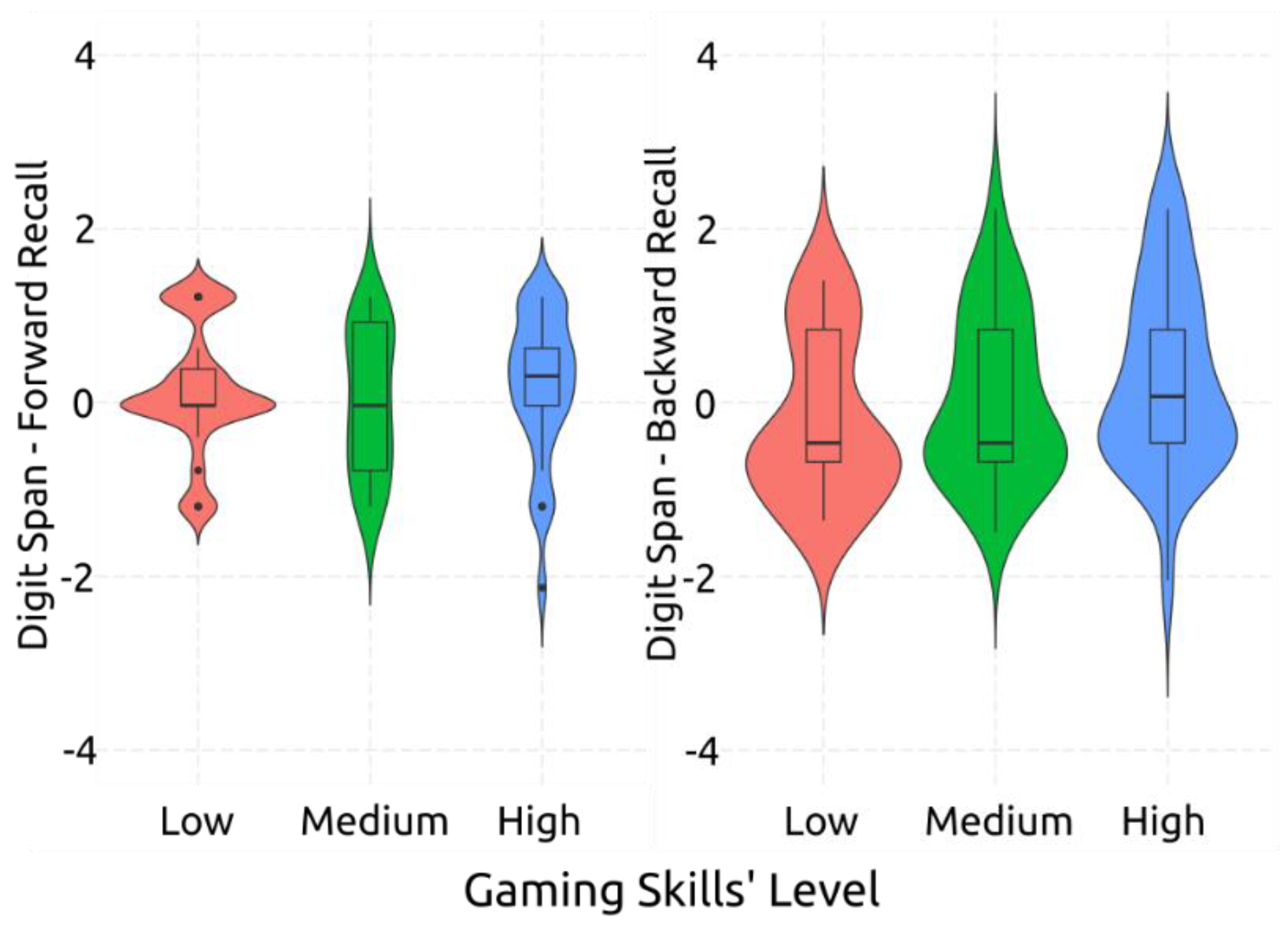
Figure 2.
Post-Hoc Comparisons: Performance on Corsi Block Tasks per Gaming Level.
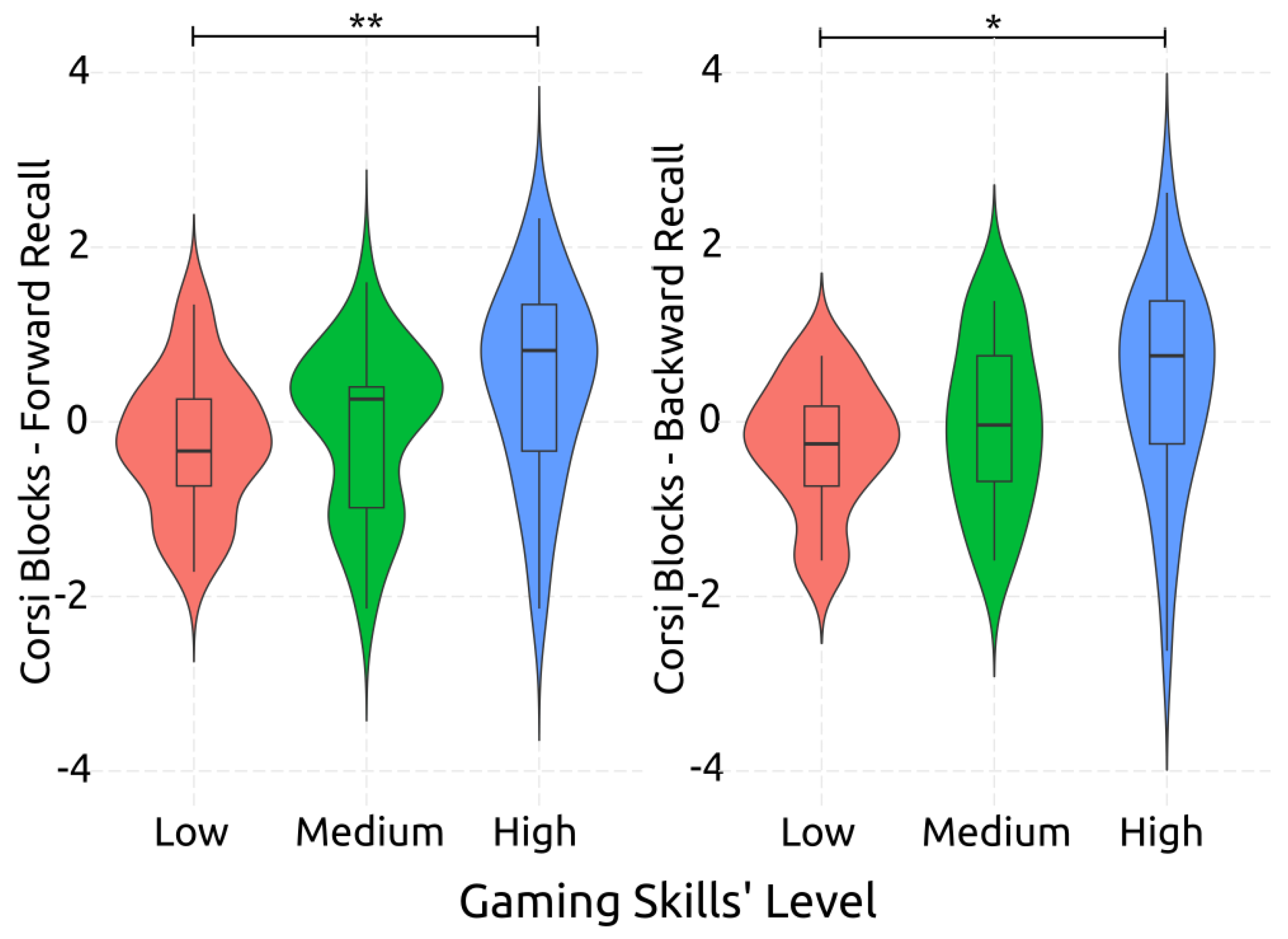
Figure 3.
Post-Hoc Comparisons: Performance on Deary Liewald Reaction Time Tasks per Gaming Level.
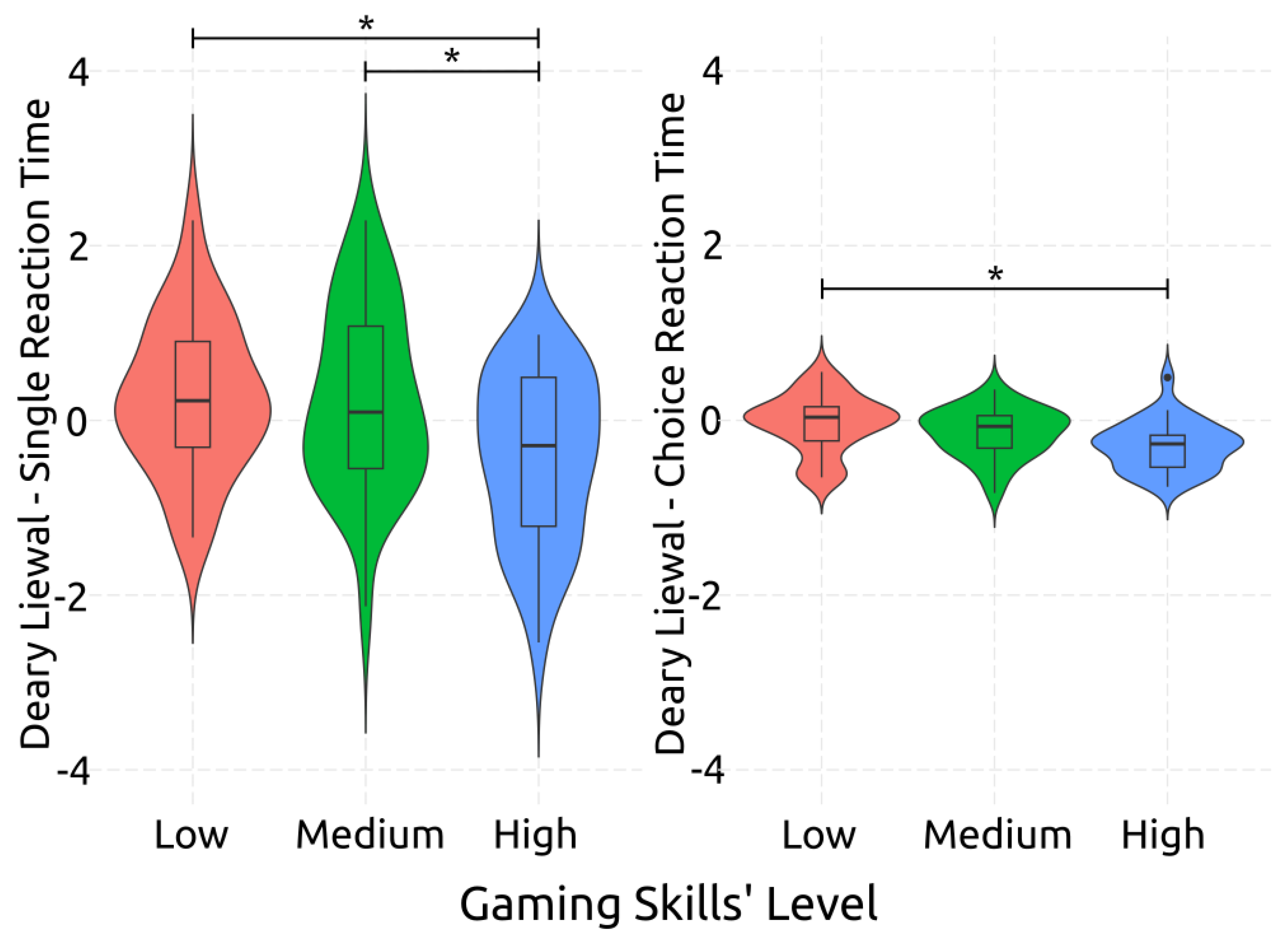
Figure 4.
Post-Hoc Comparisons: Performance on Empathy Quotient Questionnaire per Gaming Level.
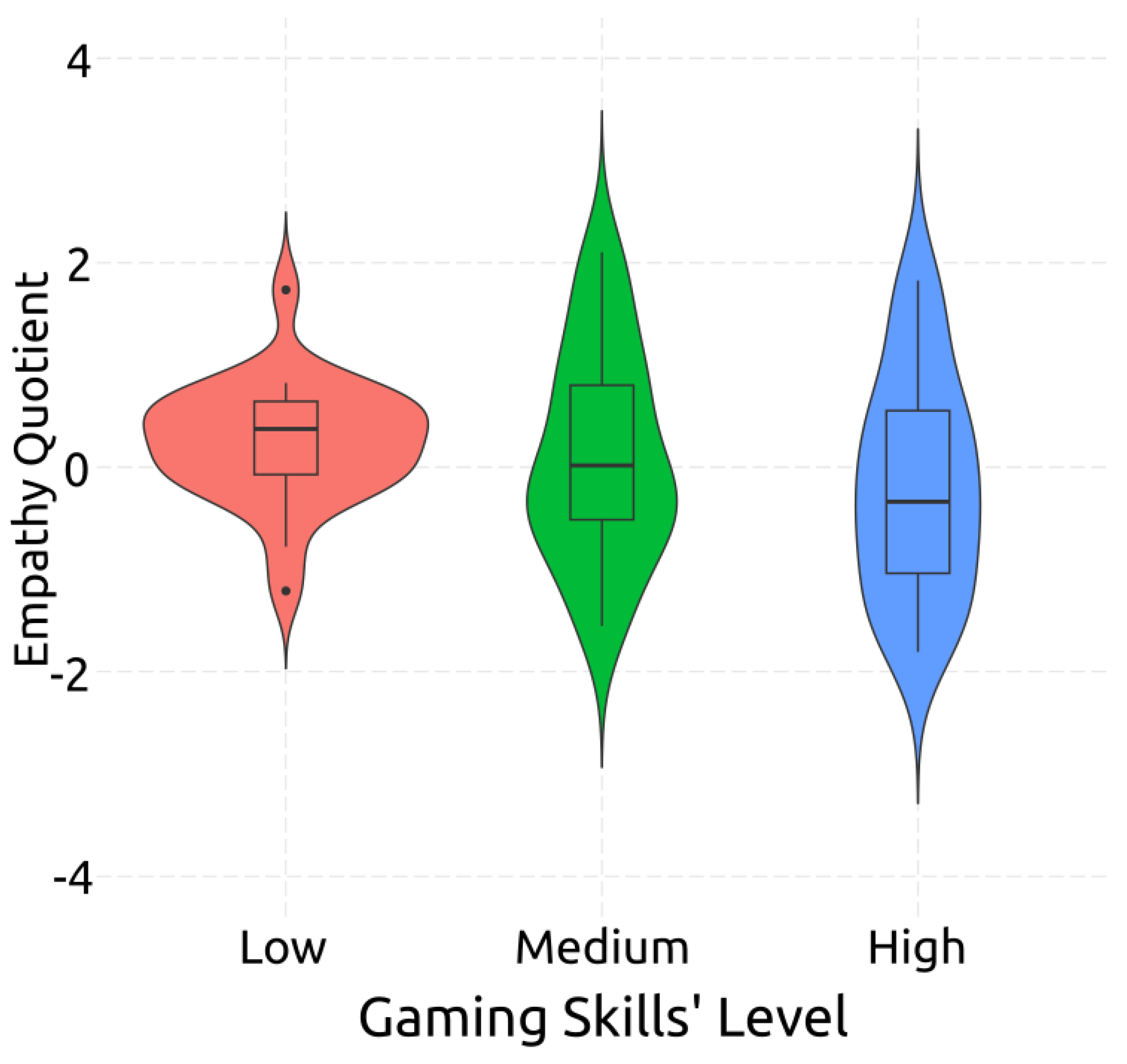

Table 1.
Descriptive Statistics of Demographics, Gaming Skills per Genre and Total, Cognitive Performance, and Empathy per Gaming Skill Level and Overall.
Table 1.
Descriptive Statistics of Demographics, Gaming Skills per Genre and Total, Cognitive Performance, and Empathy per Gaming Skill Level and Overall.
| Gaming Skill | Mean | SD | Range | |
|---|---|---|---|---|
| Age | Low | 26.93 | 4.274 | 20-38 |
| Medium | 29.00 | 5.359 | 21-40 | |
| High | 29.28 | 4.122 | 21-38 | |
| Total | 28.39 | 4.680 | 20-40 | |
| Education | Low | 16.40 | 2.343 | 12-21 |
| Medium | 17.24 | 3.055 | 12-25 | |
| High | 15.93 | 2.298 | 12-20 | |
| Total | 16.52 | 2.610 | 12-25 | |
| Sport Games Skill | Low | 2.27 | 0.450 | 2-3 |
| Medium | 3.17 | 0.928 | 2-6 | |
| High | 3.69 | 1.228 | 2-6 | |
| Total | 3.03 | 1.090 | 2-6 | |
| FPS Games Skill | Low | 2.13 | 0.346 | 2-3 |
| Medium | 2.72 | 0.797 | 2-5 | |
| High | 4.41 | 1.615 | 2-9 | |
| Total | 3.08 | 1.420 | 2-9 | |
| RPG Games Skill | Low | 2.10 | 0.305 | 2-3 |
| Medium | 3.03 | 1.239 | 2-7 | |
| High | 6.86 | 2.656 | 2-11 | |
| Total | 3.98 | 2.660 | 2-11 | |
| Action Games Skill | Low | 2.27 | 0.640 | 2-4 |
| Medium | 3.62 | 1.898 | 2-10 | |
| High | 6.31 | 2.140 | 2-11 | |
| Total | 4.05 | 2.370 | 2-11 | |
| Strategy Games Skill | Low | 2.07 | 0.365 | 2-4 |
| Medium | 2.76 | 0.988 | 2-5 | |
| High | 4.86 | 2.532 | 2-12 | |
| Total | 3.22 | 1.960 | 2-12 | |
| Puzzle Games Skill | Low | 2.43 | 0.626 | 2-4 |
| Medium | 3.52 | 1.326 | 2-6 | |
| High | 5.52 | 2.309 | 2-11 | |
| Total | 3.81 | 2.02 | 2-11 | |
| Total Gaming Skill | Low | 13.27 | 1.143 | 12-15 |
| Medium | 18.83 | 2.633 | 16-24 | |
| High | 31.66 | 5.627 | 25-43 | |
| Total | 21.16 | 8.540 | 12-43 | |
| Digit Span Forward Recall | Low | 16.13 | 2.849 | 8-20 |
| Medium | 16.07 | 2.685 | 9-20 | |
| High | 16.79 | 2.411 | 11-20 | |
| Total | 16.33 | 2.650 | 8-20 | |
| Digit Span Backward Recall | Low | 13.97 | 3.429 | 9-19 |
| Medium | 15.00 | 3.082 | 8-20 | |
| High | 15.69 | 3.486 | 3-20 | |
| Total | 14.88 | 3.380 | 3-20 | |
| Corsi Block Forward Recall | Low | 7.23 | 2.687 | 3-13 |
| Medium | 7.86 | 3.020 | 2-14 | |
| High | 9.90 | 3.745 | 2-17 | |
| Total | 8.32 | 3.340 | 2-17 | |
| Corsi Block Backward Recall | Low | 6.97 | 2.632 | 3-11 |
| Medium | 7.90 | 3.457 | 3-13 | |
| High | 9.55 | 3.709 | 2-16 | |
| Total | 8.13 | 3.430 | 2-16 | |
| Deary-Liewald Single Reaction Time | Low | 282.60 | 46.154 | 231-462 |
| Medium | 286.07 | 57.681 | 207-462 | |
| High | 255.59 | 27.800 | 195-303 | |
| Total | 274.84 | 47.070 | 195-462 | |
| Deary-Liewald Choice Reaction Time | Low | 470.03 | 119.097 | 331-804 |
| Medium | 433.55 | 69.300 | 296-641 | |
| High | 395.21 | 48.565 | 310-521 | |
| Total | 433.35 | 89.340 | 296-804 | |
| Empathy Quotient | Low | 44.57 | 9.134 | 18-62 |
| Medium | 42.86 | 12.397 | 18-66 | |
| High | 40.55 | 12.126 | 22-63 | |
| Total | 42.68 | 11.280 | 18-66 |
FPS = First-Person Shooting; RPG = Role Playing Games.
Table 2.
Pearson’s r Correlations: Cognitive Performance, Empathy, Demographics, and Gaming Skills.
| DST-FR | DST-BR | CBT-FR | CBT-BR | DLSRT | DLCRT | EQ | |
|---|---|---|---|---|---|---|---|
| Age | .08 | .20 | .30** | -.27* | .14 | .13 | -.24* |
| Education | -.06 | -.03 | -.18 | -.14 | .09 | .16 | -.07 |
| SpGS | .04 | .25* | .13 | .18 | -.17 | -.18 | -.08 |
| FPSGS | -.02 | .11 | .25* | .23* | -.27* | -.23* | -.21 |
| RPGS | .17 | .35* | .35* | .27* | -.10 | -.16 | -.26* |
| AGS | .07 | .13 | .10 | .12 | -.39*** | -.32** | -.12 |
| StGS | .03 | -.01 | .34* | .18 | -.12 | -.03 | -.21 |
| PGS | .20 | .10 | .25* | .28** | -.18 | -.21 | -.08 |
| TGS | .13 | .22* | .29** | .27* | -.26* | -.24* | -.20 |
DST = Digit Span Test; CBT = Corsi Blocks Test; FR = Forward Recall; BR = Backward Recall; DL = Deary-Liewald; SRT = Single Reaction Time; CRT = Choice Reaction Time; EQ = Empathy Quotient; SpGS = Sport Games Skill; FPSGS = First-Person Shooting Games Skill; RPGS = Role Playing Games Skill; AGS = Action-Adventure Games Skill; StGS = Strategy Games Skill; PGS = Puzzle Games Skill; TGS = Total Gaming Skills * p ≤ .05, ** p ≤ .01, *** p ≤ .001.
Table 3.
Best Regression Models for Predicting Cognitive Performance and Empathy.
| Predicted | Predictors | β coefficient | p-value(β) | R2 |
|---|---|---|---|---|
| Digit Span Forward Recall | Null Model | - | - | - |
| Digit Span Backward Recall | Role-Playing Games Skills | .35 | .004* | .12 |
| Corsi Blocks Forward Recall | Age | .24 | .022* | .20 |
| Role-Playing Games Skills | .32 | .003** | ||
| Corsi Blocks Backward Recall | Age | .23 | .028* | .19 |
| Puzzle Games Skills | .25 | .018* | ||
| Deary-Liewald Single Reaction Time | Action Games Skills | -.39 | .001*** | .16 |
| Deary-Liewald Choice Reaction Time | Action Games Skills | -.32 | .008** | .10 |
| Empathy Quotient | Role-Playing Games Skills | -.26 | .014* | .07 |
* p ≤ .05, ** p ≤ .01, *** p ≤ .001.
Disclaimer/Publisher’s Note: The statements, opinions and data contained in all publications are solely those of the individual author(s) and contributor(s) and not of MDPI and/or the editor(s). MDPI and/or the editor(s) disclaim responsibility for any injury to people or property resulting from any ideas, methods, instructions or products referred to in the content. |
© 2024 by the authors. Licensee MDPI, Basel, Switzerland. This article is an open access article distributed under the terms and conditions of the Creative Commons Attribution (CC BY) license (http://creativecommons.org/licenses/by/4.0/).
Copyright: This open access article is published under a Creative Commons CC BY 4.0 license, which permit the free download, distribution, and reuse, provided that the author and preprint are cited in any reuse.


