

Submitted:
29 July 2024
Posted:
30 July 2024
Read the latest preprint version here
Abstract
In the bar of our Milky Way, there should be another supermassive black hole B which is with the mass almost 10−2~10−5 the Sgr A* and with a distance almost 10,000 lightyears from the Sgr A*. The bar is formed by the stars that are orbiting around the two black holes Sgr A* and B. And, in the bar, a lots of stars orbit around B while another lots of stars around Sgr A*. The two orbits form the peanut shape with “x-shaped structure” in the bar, while the boxy core is formed with all of the three orbits. And, the orbits of the stars out of the bar could be repulsed to a distant place by the black hole B to form the galactic spiral arms.
Keywords:
galactic bar
; galactic spiral arms
; Sgr A*
; supermassive black hole
; Newtonian theory of orbit
1. Introduction
The Milky Way is with a super gigantic scale. It only can be well observed with modern technology. Therefore, the outline of the galaxy only can have been known in recent time and a long time was spent in knowing the whole image of it. First, in 1958, it was observed by Oort et al. [1] that the hydrogen clouds are in pure circular rotation about the galactic center. Second, in 1976, it was observed by Georgelin & Georgelin[2] that the galaxy is with four spiral arms. Third, it was known a line about the galactic bar by Oort & Rougoor[3,4] in 1959 and in 1960; and the bar was further confirmed by de Vaucouleurs[5] in 1964; and, it was observed that there are two red clumps in the bar, and, the bar is with peanut shape and a boxy core or “x-shaped structure”.[6,7,8,9,10] Fourth, it was observed[11] that a supermassive black hole, the Sgr A*, is at the center of the galaxy. Firth, it is currently thought that the radius of the Milky Way is almost 105 lightyears, the thickness at the center of the galaxy is almost 104 lightyears; the mass of the Milky Way is almost 5.8×10¹¹ Msun. The observed image of the Milky Way is known as that in the Figure 1. The shape and structure of the Milky Way was generally known while the reason for the galactic bar and spiral arms is unknown.[12]
On another line, for detecting gravitational waves, the supermassive black hole binaries was generally observed and studied. [13,14,15,16,17,18,19,20,21,22,23] It was presented that there is a pair of supermassive black holes with a separation less than 1 pc at the active galactic nuclei in a single galaxy or less than 30 kpc in an interacting system. Therefore, it is not impossible that there are two supermassive black holes in one single galaxy. (We think, only a little fraction of the supermassive black hole binaries can merge.) And, abundance of “x-shaped radio” galaxies were observed.[14,15] It was pointed out that the “x-shaped radio” may be a signposts of the supermassive black hole binaries.[13]
2. The Peanut Shape with the “x-Shaped Structure” or Boxy Core of the Bar: the Possible Another Supermassive Black Hole in the Bar of the Milky Way
2.1. The Possible Structure of the Bar of the Milky Way
As shown in Figure 2, if there should be two supermassive black holes Sgr A* and B, there should be a lots of stars orbit around Sgr A* while another lots of stars around the B. The peanut shape with “x-shaped structure” or boxy core is formed by the two orbits. And, other a lots of stars orbit around both A* and B which formed the bar. The orbits around a pair of supermassive black holes is analogous to the orbits of the planets around the triple stars in [24]. And, from [24] we know, the black hole B should be orbiting around A*. The shape and structure of the bar cannot be changed by the orbit of B.
The boxy core or “x-shaped structure”. The boxy core in the bar was discussed.[7,25,26,27,28] But, as shown in Figure 2, a box could be formed from the three orbits in green and red. In the box, there is no other orbit. The observed image of the boxy core is determined with the direction of observation and the distance between the two black holes. Vertical to the line A*B, the observed image is a box; while along an angle from A*B, the two green orbits appear a “x-shaped structure”, as it is noted that the orbits of stars around one black hole forms a sphere. And, the box can be longer as the distance between two black holes is longer and the “x-shaped structure” disappears.
The complicated orbits in the bar. Figure 2 shows, because of the two black holes, the orbits of the stars in the bar is very complicated. It is accordant with current observations. Now, in the bar, it was observed: 1) the pure cylindrical rotation,[32,33] 2) the orbits in different components in the bar correspondent to different distinct orbital families,[9,10] and 3) the circular velocity curve in the bar is very complicated.[29,30,31] Maybe, there is neither a single bar pattern speed, nor a single circular velocity curve in the bar, just as the orbits of the planets around the triple stars in [24].
The possible two inner bars. From that the bar is with a thickness of almost 10,000 ly, it could be concluded that the orbits around A* or B form a sphere and around both A* and B form a spheroid, rather than a disk or a plane. It is analogous to the orbits of the moons around the Jupiter or to the orbits of the S-stars around the Sgr A*.[34,35,36,37,38,39] Therefore, the stars orbiting one of the black hole could form an inner bar in the primary bar, it is noted that one inner bar was observed in [40]. Under the condition of Figure 2, there should be two inner bars in the primary bar of our galaxy, which could be correspondent with the two red clumps.[6,7,8,9,10] Therefore, the orbits in the bar is very complicated. It is very difficult to observe the speed of the orbit around one of or both of the two black holes. And, the boxy core is factually a cylinder space. But, from [24] we know, the speed of the orbit of the black hole B around the Sgr A* could be observed. And, the mass of Sgr A* can be accurately and precisely known from this speed.
Strong and weak bar. It is observed that 44% of the spiral galaxies are with a bar which is with different strength. [41] Here, we present, the strength of a bar is determined with these factors: 1) the ratio of , where and are the mass of the black hole A* and B, . As is larger, the bar is stronger; as is less, the bar is weaker; as is very little, B shall become a satellite of A*, the bar is vanished. 2) The distance d between B and A*. As d is very large, no star can orbit both A* and B. Therefore, the necessary condition to form a bar is that the orbit of the stars is affected by both of the two black holes in the same way. 3) As d is very little, no star can orbit around B while many stars orbit around both A* and B. It is a strong bar.
Multi black holes of a bar. There should be more than two supermassive black holes in a bar and a lots of stars have the orbits around all of the black holes, just as the orbits of the planets around three stars in [24].
There were many observations and different discussions about the galactic bar.[12,41,42,43,44,45] However, we think, as 44% of the observed 4378 disc galaxies are with a bar,[41] these bars should be formed by dynamics or kinematics, rather than by accidental event, such as a collision of two galaxies (galaxy-galaxy interaction or cluster-cluster interaction).
2.2. The Galactic Spiral Arms and Hill Sphere
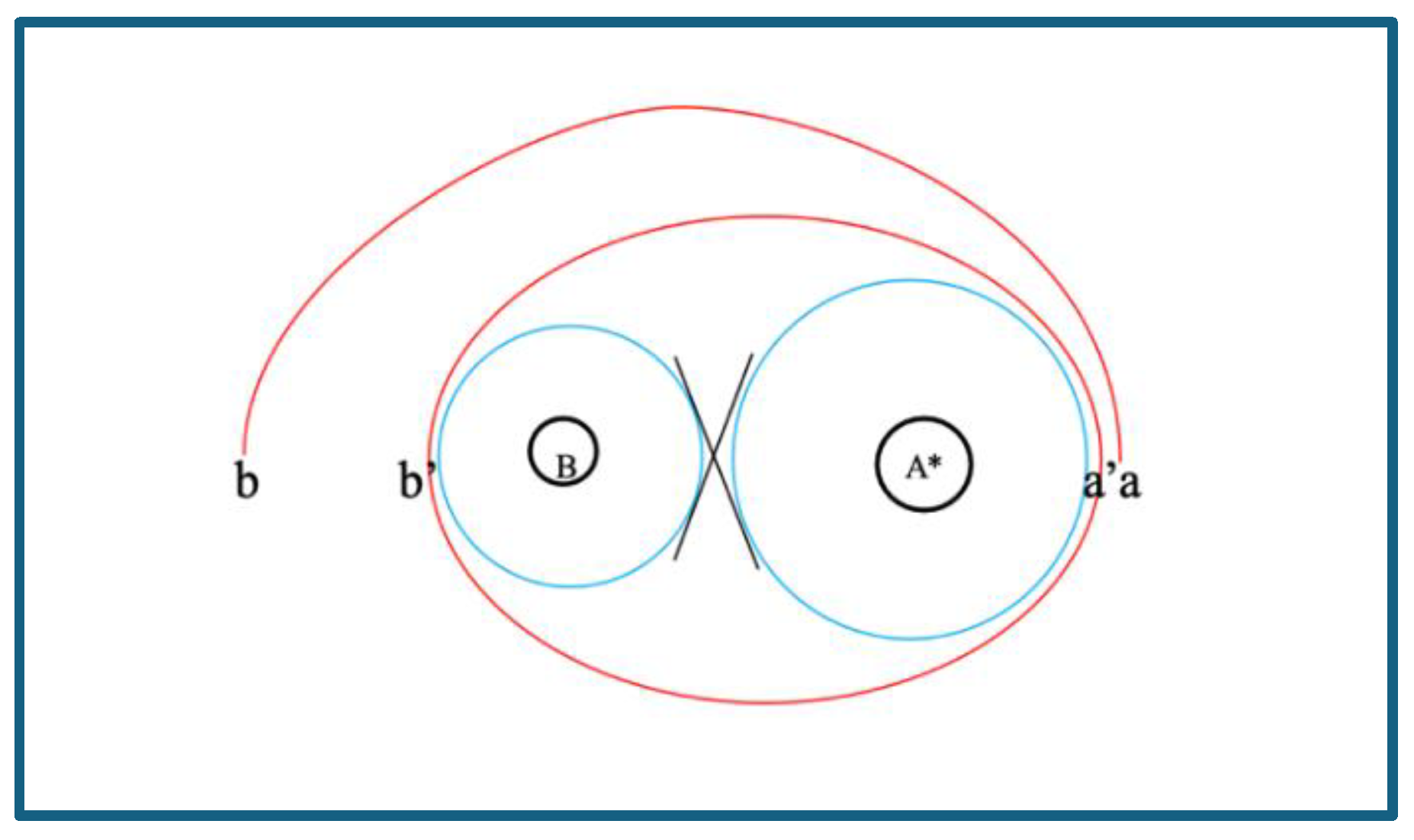
The galactic spiral arms could be understood with the Hill sphere. For two celestial bodies, as the body with less mass is in the Hill radius of the larger one, it can have a stable orbit around the larger one. Or, the less one can move away from the larger one. Therefore, as two stars are orbiting around the Sgr A* with orbit ab and a’b’ as shown in Figure 3, if the distance between ab and a’b’ is less than the Hill radius of the two stars, the two orbits shall merge into one single orbit. Therefore, the condition for the two orbits ab and a’b’ is that the distance between two orbits is larger than the Hill radius of the two stars.
From we know, for one same stars, the Hill radius of a star is determined with the distance d between the star and the center mass which the star is orbiting around. In the Figure 3, because the distance d for the star at point b is larger than that at a, the Hill radius of the same star at point b is larger than that at point a. As the Hill radius of the star at point b is , then, only the orbit with the distance L ≥ bb′ can be remained. It makes the spiral arm produced.
There were different understandings about the reason for the galactic spiral arms.[12,41,42,43,44,45,46] Here, we presented that the reason need be accordant with celestial dynamics or kinematics. As the reason is not accordant with dynamics or kinematics, the orbit should be broken off.
It is noted that, in the solar system, although the distance between the orbits of two neighboring planets is affected by the Hill sphere, the factual distance is much larger than the Hill radius of the planets. And, the factual distance of the neighboring orbits can be described with the Titius-Bode law. So, it could be concluded that the distance between two neighboring arms in a galaxy is much larger than that obtained from the Hill sphere.
2.3. The Mass and Position of the Black Hole B
From [24] we know, the black hole B is orbiting around Sgr A*. The Hill radius of B is . It is known that the length of the bar of our Milky Way is almost 20,000 lightyears and the largest thickness is almost 10,000 lightyears. It is noted that the thickness is determined with the orbits around both the black holes Sgr A* and B. Therefore, it is a ratio, k, to the radius of the orbits of the stars around the Sgr A* or B. In Figure 3, it could be known that the distance between Sgr A* and a’ is almost 5,000 lightyears. For the same reason, the distance between B and b’ can be approximately known. Here, for convenience, first, for the possible maximum mass of B, assuming Bb’=2,500 ly, then, the distance between B and Sgr A* should be almost d~20,000 − 5,000 − 2,500 =12,500 ly. Under the assumption k=0.6, the radius of the orbits of the stars around the black hole B should be 2500k=1500 ly, it could be concluded that . Second, for the possible minimum mass of B, assuming Bb’=250ly, it could be concluded that . From these assumptions, according to Figure 1 and the observation about the distance between two red clumps,[6] it could be concluded that the distance between the two black holes is almost 10,000 ly and the mass of B should be in the range of 10−2~10−5MSgrA∗. This is only a concluding based on the assumed condition. To accurately know the mass and position of B, the radius of the orbits around B or Sgr A* need be accurately measured. Of course, the position and mass of black hole B could be directly measured if the B had been observed.
3. Discussions
3.1. The Complicated Orbits in the Bar: The Strong Evidence for the Possible Another Supermassive Black Hole
It is generally agreed that the boxy core of the bar was observed while it is questioned whether there is the “x-shaped structure”,[7,25,26,27], even the two red clumps;[27] while several observations [6,8,9,10,25,26] think they was observed. However, it is clear, the boxy core certainly showed that the Srg A* is not at the center of the bar, under the condition that the boxy core is the core of the bar.[6,7,8,9,10,25,26,27] Therefore, as shown in Figure 2, there are two stellar clumps positioned in the different side of the boxy core, no matter what are the kinds of the stars that form the stellar clumps. So, the two red clumps [6,7,8,9,10,25,26,27] is fundamental to the structure of the bar. The “x-shaped structure” or boxy core is only formed by the orbits in the two red (stellar) clumps (or possible inner bars). And, if the Sgr A* is in one side of the boxy core, systematically, there should be another correspondent black hole in the opposite side.
As the orbits in the red clumps is noted, it shall be clearly known that the boxy core or two red clumps [6,7,8,9,10] shows the very complicated orbits in the bar. It is emphasized that the complicated orbits in the bar [9,10,29,30,31,32,33] could be the strong evidences for the possible two supermassive black holes with the two inner bars. If there is only one black hole, the orbits in the bar should be much simpler. Now, besides the assumption of two black holes with two inner bars, the complicated orbits in the bar cannot be explained with other condition.
Now, the position of the Sgr A* in the galaxy [11] and the orbits of the S-stars around it were observed.[34,35,36,37,38,39] Here, it is emphasized that, from the orbits around the Sgr A*, the structure of the bar can be certainly known. The orbits in the bar were observed from different aspects.[9,10,25,26,27,28,29,30,31,32,33,45] However, all of the orbits in the bar have not been completely known. And, it is too early to have a conclusion about the structure of the bar before the orbits in the bar have been completely known. To observe the orbits that is different from the orbits around the Sgr A*, such as the pure cylindrical rotation [6,32,33] and the orbits in different components in the bar correspondent to different orbital families,[9,10] is important to know whether there is another supermassive black hole. If the numbers of the orbits that are not around the Sgr A* is a large ratio to that around Sgr A*, it could be concluded that there is another black hole with a very large mass.
On another hand, the possible another black hole can be certainly observed from the orbits around it. It is clear that the stars in the different sides of the boxy core cannot have the same orbits around the Sgr A*. Thus, it is a problem that what is the center mass that the stars in opposite side of the boxy core orbit around? So, the boxy core strongly implies that another supermassive black hole is needed for the orbits of the stars (red clumps) in opposite side. It means that a pair of supermassive black holes is needed to make the stars in both of the sides of the boxy core can have stable orbits.
It is very important, as we select these observations: two red clumps,[6] “x-shaped structure”,[6,7,8,9,10] boxy core [7,8,9,10,22,23,24] and inner bar,[38] we can arrive at Figure 2. And, if Figure 2 should be valid, the orbits around the Sgr A* in the inner bar can appear as pure cylindrical rotation.[32,33] So, our conclusion that there should be two supermassive black holes in the bar is supported by observations.
3.2. The Supermassive Black Holes Binaries in a Galaxy
Currently, only the supermassive black hole binaries that should merge was focused on.[13,14,15,16,17,18,19,20,21,22,23] The orbits about the pair of black holes are varying. While, in our work, it is assumed that the orbits in a galaxy are stable. We think, in a galaxy, only a little fraction of the black hole binaries can merge. Therefore, the numbers of the exist pair of black holes is much larger than the observed merged ones and cannot be estimated with the merged ones.
3.3. The Newtonian Theory of Orbit and the Galactic Dynamics
It is emphasized that, in the Newtonian theory of orbit, only the black hole with the larger mass is the center of the galaxy. The black hole with the less mass is orbiting around the larger one while the larger one can be treated as that it is at rest, just analogous to the orbits in [24]. If the two black holes were orbiting around the center of mass of them as usually thought, it should result in that, relative to the stars orbiting around them, the distribution and the center of the mass of the two black holes are varying. It should further result in that the orbits of the stars around the two black holes is unstable. This case can be known as soon as a real orbit is considered. Therefore, only the larger one is at the center. It can be called the center black hole. Any other celestial bodies, including other supermassive black holes, are orbiting around the center black hole. And, the Circular Velocity Curve of the Milky Way is only determined with the mass of the center black hole.[29,30,31]
If the mass of B is larger than that of Sgr A* which is with the mass of ~4.3 × 10⁶ MSun,[11] from the Hill sphere, it could be concluded that B is the center black hole with the mass of ~1 × 10¹¹ MSun. And, the distance between the two black holes is ~10,000 ly.
In the stellar system, the stability of the orbit can be described with the Hill sphere, such as the orbits in the triple stars system in [24]. The orbit in the Hill radius is stable. We clearly know, the orbit in a galaxy is stable. The observation for the galaxy rotation curve and the recent observation about Circular Velocity Curve of the Milky Way showed that the orbits in a galaxy are stable and obey the theory of orbit, such as the Keplerian law.[29,30,31] Therefore, the Hill sphere is valid to describe the stability of the orbit in a galaxy. While, the Hill sphere is little used to study the orbit in a galaxy, although no evidence shows that the Hill sphere is invalid to the orbit in a galaxy. In this work, the Hill sphere is directly used to understand the orbits of stars around the supermassive black hole and to predict the possible supermassive black hole. It should be a necessary way to make galactic dynamics more completed.
4. Conclusion
The peanut shape with the “x-shaped structure” or boxy core of the bar very strongly implies that there should be a pair of supermassive black holes in the bar of our Milky Way. The complicated orbits in the bar [9,10,29,30,31,32,33] should be strong evidence for the implication. It is emphasized that the boxy core or “x-shaped structure” can be well understood as there should be a pair of supermassive black holes in the bar.
The two red (stellar) clumps [6,7,8,9,10,25,26,27] should be another evidence for the two possible supermassive black holes. And, it is an important line to detect the possible black hole: at the center of one of the stellar clumps, there should be a supermassive black hole. It is well known that one black hole can be certainly detected through the orbits of the stars around it; which can be distinguished from the orbits around another black hole under the condition that there are two black holes. In addition, the pair of supermassive black holes could be more easily detected in the weak bar with a large distance between the two black holes.
If there should be a pair of supermassive black holes in the bar, the origin and orbital motion of the bar and the arms, even the structure and motion of the whole galaxy, can be well understood. Therefore, to test the possible another supermassive black hole is significant to well understand our Milky Way.
References
- Oort, J.H.; Kerr, F.J.; Westerhout, G. The galactic system as a spiral nebula (Council Note). MNRAS 1958, 118, 379. [Google Scholar]
- Georgelin, Y.M.; Georgelin, Y.P. The spiral structure of our Galaxy determined from H II regions. A&A 1976, 49, 57. [Google Scholar]
- Oort, J.H.; Rougoor, G.W. The interstellar gas in the central part of the galaxy. AJ 1959, 64, 130. [Google Scholar] [CrossRef]
- Rougoor, G.W.; Oort, J.H. Distribution and Motion of Interstellar Hydrogen in the Galactic System with Particular Reference to the Region Within 3 Kiloparsecs of the Center. Proceedings of the National Academy of Science 1960, 46, 1. [Google Scholar]
- de Vaucouleurs, G. 1964, in IAU Symposium, Vol. 20, The Galaxy and the Magellanic Clouds, ed. F. J. Kerr, 195.
- McWilliam, A.; Zoccali, M. Two Red Clumps and the X-shaped Milky Way Bulge. ApJ 2010, 724, 149. [Google Scholar] [CrossRef]
- Li, Z.-Y.; Shen, J. Mapping the Three-Dimensional “X-Shaped Structure” in Models of the Galactic Bulg. ApJL 2015, 815, L20. [Google Scholar] [CrossRef]
- Wegg, C.; Gerhard, O. Mapping the three-dimensional density of the Galactic bulge with VVV red clump stars. Monthly Notices of the Royal Astronomical Society 2013, 435, 1874–1887. [Google Scholar] [CrossRef]
- Mattia, M.C.; Gerhard, O.; Portail, M.; Vasiliev, E.; Clarke, J. The stellar mass distribution of the Milky Way’s bar: an analytical model. Monthly Notices of the Royal Astronomical Society: Letters 2022, 514, L1–L5. [Google Scholar]
- Skokos, C.; Patsis, P.A.; Athanassoula, E. Orbital dynamics of three-dimensional bars – I. The backbone of three-dimensional bars. A fiducial case. Monthly Notices of the Royal Astronomical Society 2002, 333, 847. [Google Scholar] [CrossRef]
- Genzel, R.; Eisenhauer, F.; Gillessen, S. The Galactic Center Massive Black Hole and Nuclear Star Cluster. Reviews of Modern Physics 2010, 82.4, 3121–3195. [Google Scholar]
- Shen, J.; Zheng, X. The bar and spiral arms in the Milky Way: structure and kinematics. RAA 2020, 20, 159. [Google Scholar] [CrossRef]
- Merritt, D.; Ekers, R.D. Tracing Black Hole Mergers Through Radio Lobe Morphology. Science 2002, 297, 1310. [Google Scholar] [CrossRef]
- David, H. R.; et al. The Abundance of X-Shaped Radio Sources: Implications for the Gravitational Wave Background. ApJ 2015, 810, L6. [Google Scholar]
- David, H. R.; et al. The Abundance of X-Shaped Radio Sources I. VLA Survey of 52 Sources With Off-Axis Distortions. ApJS 2015, 220, 7. [Google Scholar]
- Bansal, K.; et al. Constraining the Orbit of the Supermassive Black Hole Binary 0402+379. ApJ 2017, 843, 14. [Google Scholar] [CrossRef]
- Wang, J.; Li, Y. Observational signatures of close binaries of supermassive black holes in active galactic nuclei. Res. Astron. Astrophys. 2020, 20, 160. [Google Scholar] [CrossRef]
- Komossa, S.; et al. Supermassive Binary Black Holes and the Case of OJ 287. arXiv 2021, arXiv:2104.12901. [Google Scholar]
- O’Neill, S.; et al. The Unanticipated Phenomenology of the Blazar PKS 2131–021: A Unique Supermassive Black Hole Binary Candidate. ApJL 2022, 926, L35. [Google Scholar] [CrossRef]
- Gómez, J.L.; Traianou, E.; et al. Probing the innermost regions of AGN jets their magnetic fields with Radio Astron, V. Space and ground millimeter-VLBI imaging of OJ 287. APJ 2022, 924, 122. [Google Scholar]
- Jiang, W.; et al. Observational Evidence of a Centi-parsec Supermassive Black Hole Binary Existing in the Nearby Galaxy M81. ApJ 2023, 959, 11. [Google Scholar] [CrossRef]
- Magallanes-Guijón, G.; Mendoza, S. A Supermassive Binary Black Hole Candidate in Mrk 501. Galaxies 2024, 2, 30. [Google Scholar] [CrossRef]
- Foord, A.; Cappelluti, N.; Liu, T.; Volonteri, M.; et al. Tracking Supermassive Black Hole Mergers from kpc to sub-pc Scales with AXIS. Universe 2024, 10, 237. [Google Scholar] [CrossRef]
- Busetti, F.; Beust, H.; Harley, C. Stability of planets in triple star systems. A&A 2018, 619, A91. [Google Scholar]
- Lee, Y.; et al. Assembling the Milky Way Bulge from Globular Clusters: Evidence from the Double Red Clump. ApJL 2018, 862, L8. [Google Scholar] [CrossRef]
- Iwanek, P.; et al. A Three-dimensional Map of the Milky Way Using 66,000 Mira Variable Stars. ApJS 2023, 264, 20. [Google Scholar] [CrossRef]
- López-Corredoira, M. Absence of an X-shaped Structure in the Milky Way Bulge Using Mira Variable Stars. ApJ 2017, 836, 218. [Google Scholar] [CrossRef]
- Ferro, A. A.; Guillen, L. J. Z.; Yepez, M. A.; Fierro, I. H. B.; et al. The variable stars in the field of the bulge cluster NGC 6558. Monthly Notices of the Royal Astronomical Society 2024, 532, 2159–2173. [Google Scholar] [CrossRef]
- Zhou, Y.; et al. The Circular Velocity Curve of the Milky Way from 5–25 kpc Using Luminous Red Giant Branch Stars. ApJ 2023, 946, 73. [Google Scholar] [CrossRef]
- Jiao, Y.; Hammer, F.; Wang, H.; Wang, J.; et al. Detection of the Keplerian decline in the Milky Way rotation curve. A&A 2023, 678, A208. [Google Scholar]
- Eilers, A.; Hogg, D.W.; Rix, H.; Ness, M.K. The Circular Velocity Curve of the Milky Way from 5 to 25 kpc. ApJ 2019, 871, 120. [Google Scholar] [CrossRef]
- Howard, D.; et al. The Bulge Radial Velocity Assay (BRAVA). I. Sample Selection and a Rotation Curve. ApJ 2008, 688, 1060. [Google Scholar] [CrossRef]
- Kunder, A.; et al. The bulge radial velocity assay (BRAVA). II. Complete sample and data release. AJ 2012, 143, 57. [Google Scholar] [CrossRef]
- Peißker, F.; Eckart, A.; Parsa, M. S62 on a 9.9 yr Orbit around SgrA*. ApJ 2020, 889, 61. [Google Scholar] [CrossRef]
- Peißker, F.; Eckart, A.; Zajaček, M.; Britzen, S. Observation of S4716- A star with a 4 year orbit around Sgr A*. ApJ 2022, 933, 49. [Google Scholar] [CrossRef]
- Peißker, F.; Eckart, A.; Zajaček, M.; Britzen, S.; Ali, B.; Parsa, M. S62 and S4711: Indications of a Population of Faint Fast-moving Stars inside the S2 Orbit—S4711 on a 7.6yr Orbit around Sgr A*. ApJ 2020, 899, 50. [Google Scholar] [CrossRef]
- Peißker, F.; Eckart, A.; Ali, B. Observation of the Apoapsis of S62 in 2019 with NIRC2 and SINFONI. APJ 2021, 918, 25. [Google Scholar] [CrossRef]
- GRAVITY Collaboration; et al. Deep images of the Galactic center with GRAVITY. A&A 2022, 657, A82. [Google Scholar]
- GRAVITY Collaboration; et al. Mass distribution in the Galactic Center based on interferometric astrometry of multiple stellar orbits. A&A 2022, 657, L12. [Google Scholar]
- Nishiyama, S.; et al. A Distinct Structure inside the Galactic Bar. ApJ 2005, 621, L105. [Google Scholar]
- Yu, S.; Ho, L.C. The Statistical Properties of Spiral Arms in Nearby Disk Galaxies. ApJ 2020, 900, 150. [Google Scholar] [CrossRef]
- Mondal, D.; Chattopadhyay, T. Role of galactic bars in the formation of spiral arms: a study through orbital and escape dynamics—I. Celest Mech Dyn Astr 2021, 133, 43. [Google Scholar] [CrossRef]
- Lindblad, P.A. B.; Kristen, H. Hydrodynamical simulations of the barred spiral galaxy NGC 1300. Dynamical interpretation of observations. Astronomy and Astrophysics 1996, 313, 733–749. [Google Scholar]
- Yoon, Y.; Lee, M. I.; et al. Observational evidence for bar formation in disk galaxies via cluster–cluster interaction. Nat Astron 2019, 3, 844–850. [Google Scholar] [CrossRef]
- Roshan, M.; Ghafourian, N.; Kashfi, T.; Banik, I.; Haslbauer, M.; et al. Fast galaxy bars continue to challenge standard cosmology. Monthly Notices of the Royal Astronomical Society 2021, 508, 926–939. [Google Scholar] [CrossRef]
- Mondal, D.; Chattopadhyay, T. Role of galactic bars in the formation of spiral arms: a study through orbital and escape dynamics—I. Celest Mech Dyn Astr 2021, 133, 43. [Google Scholar] [CrossRef]
Figure 1.
The observed image of our Milky Way.
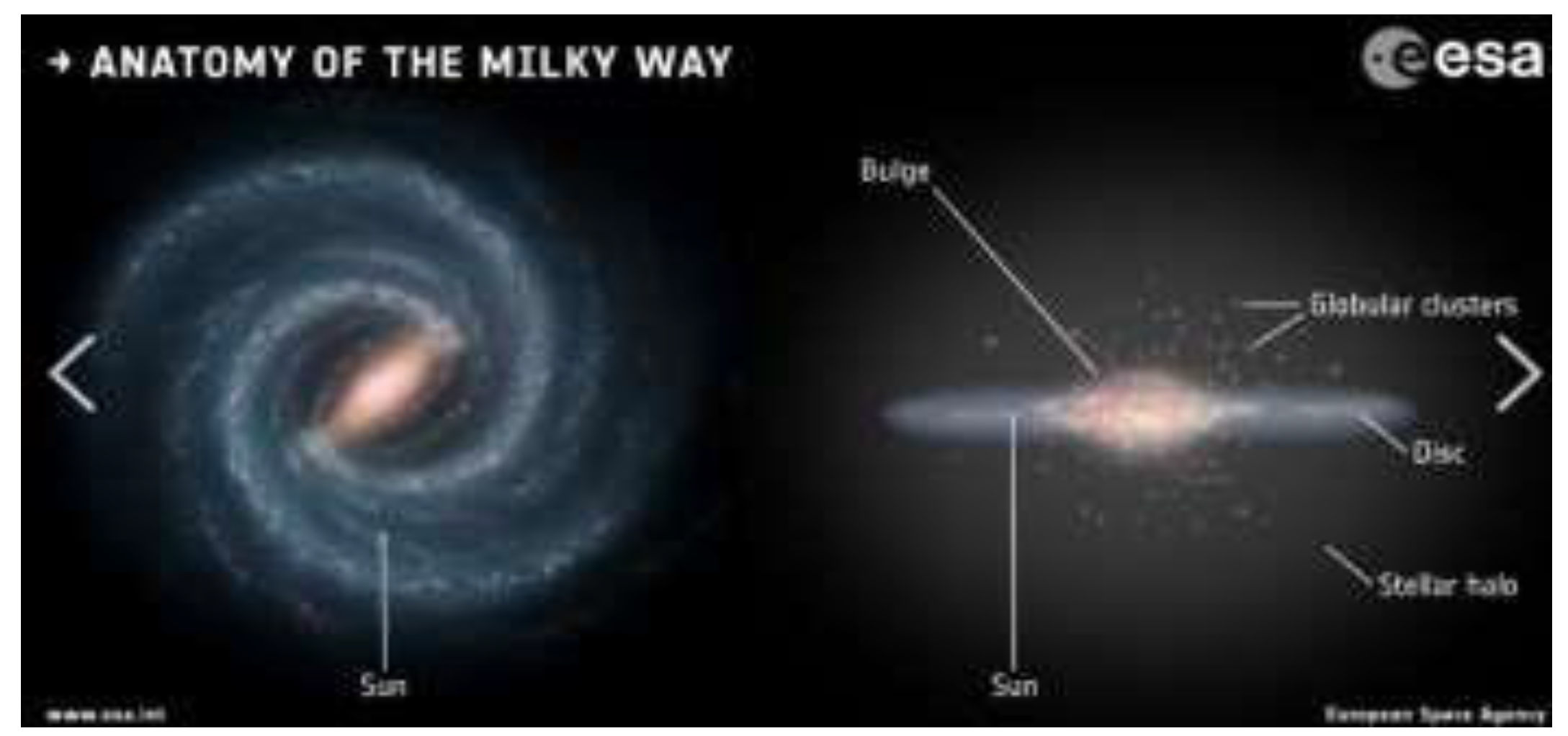
Figure 2.
The bar with two black holes Sgr A* and B. The green circles are the orbits of stars around A* or B. The two obits appear a peanut. And, the “x-shaped structure” or a boxy core is between the two orbits. The orbits of the stars around both the two black holes is in red. The Figure 1 is inspired by the Figure 1 in [24].
Figure 2.
The bar with two black holes Sgr A* and B. The green circles are the orbits of stars around A* or B. The two obits appear a peanut. And, the “x-shaped structure” or a boxy core is between the two orbits. The orbits of the stars around both the two black holes is in red. The Figure 1 is inspired by the Figure 1 in [24].
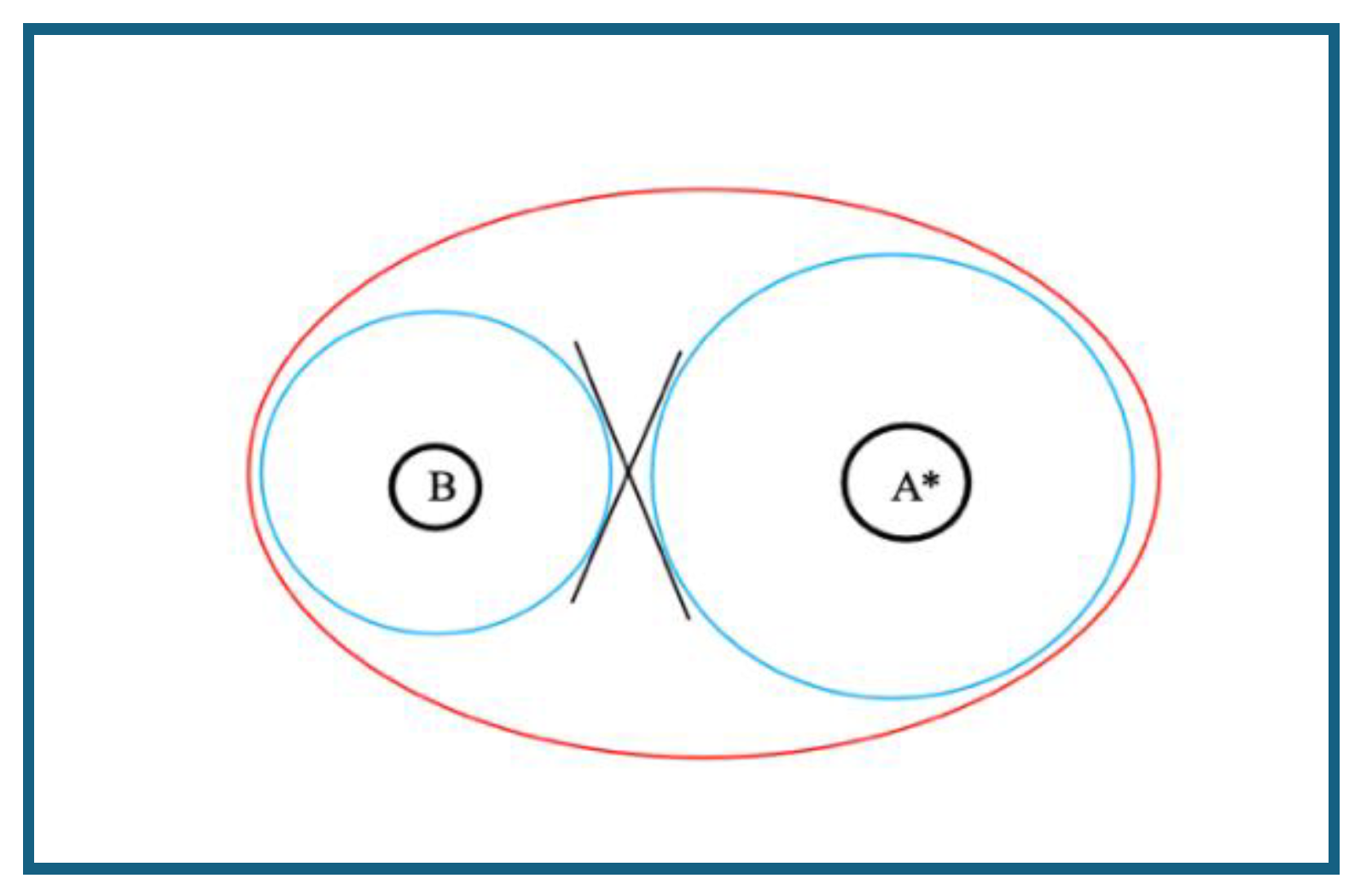
Figure 3.
The galactic spiral arm produced by the orbit perturbation. The orbit ab is being perturbed by the star orbiting around both the black holes A* and B. From Hill sphere , we know, for a same star, the Hill radius of this star at point b’ is larger than that at a’ for that db′ = b′A∗ > a′A∗ = da′, where point a’ and b’ are at the orbit around both the two black holes. It results in that the distance bb′ > a′a.
Figure 3.
The galactic spiral arm produced by the orbit perturbation. The orbit ab is being perturbed by the star orbiting around both the black holes A* and B. From Hill sphere , we know, for a same star, the Hill radius of this star at point b’ is larger than that at a’ for that db′ = b′A∗ > a′A∗ = da′, where point a’ and b’ are at the orbit around both the two black holes. It results in that the distance bb′ > a′a.
Disclaimer/Publisher’s Note: The statements, opinions and data contained in all publications are solely those of the individual author(s) and contributor(s) and not of MDPI and/or the editor(s). MDPI and/or the editor(s) disclaim responsibility for any injury to people or property resulting from any ideas, methods, instructions or products referred to in the content. |
© 2024 by the authors. Licensee MDPI, Basel, Switzerland. This article is an open access article distributed under the terms and conditions of the Creative Commons Attribution (CC BY) license (http://creativecommons.org/licenses/by/4.0/).
Copyright: This open access article is published under a Creative Commons CC BY 4.0 license, which permit the free download, distribution, and reuse, provided that the author and preprint are cited in any reuse.