

Submitted:
24 June 2024
Posted:
24 June 2024
You are already at the latest version
Abstract
Copper-containing materials are attracting attention as self-desinfecting surfaces, suitable for helping healthcare settings in reducing healthcare associated infections. However, the impact of repeated exposure to disinfectants frequently used in biocleaning protocols on their antibacterial activity remains insufficiently characterized. This study aimed at evaluating the antibacterial effi-ciency of copper (positive control), a brass alloy (AB+®) and stainless steel (negative control) after repeated exposure to a quaternary ammonium compound and/or a mix of peracetic acid/hydrogen peroxide routinely used in healthcare settings. A panel of 6 antibiotic-resistant strains (clinical isolates) was selected for this assessment. After a short (5 min) exposure time, the copper and brass materials retained significantly better antibacterial efficiencies than stainless steel, whatever the bacterial strain or disinfectant treatment considered. Moreover, post-treatment with both disinfectant products, copper-containing materials still reached similar levels of antibacterial efficiency as those obtained before treatment. Antibiotic resistance mechanisms such as efflux pump overexpression did not impair the antibacterial efficiency of copper-containing materials, neither did the presence of one or several genes related to copper homeostasis/resistance. In light of those results, surfaces made out of copper and brass remain interesting tools in the fight against dissemination of antibiotic-resistant strains that might cause healthcare associated infections.
Keywords:
Keywords: brass
; copper
; stainless steel
; antibacterial activity
; peracetic acid
; hydrogen peroxide
; quaternary ammonium
; disinfectant
; hospital acquired infection.
1. Introduction
Hospital acquired infections (HAIs), also known as healthcare associated infections, have become a major concern for healthcare facilities over the last few decades. This is especially true for HAIs caused by multi-drug resistant (MDR) pathogens, which are common [1]. Amongst the preventative measures proposed to mitigate the risk of HAIs, frequent biocleaning of surfaces to achieve the lowest possible bioburden and avoid persistence/transmission of antibiotic resistant pathogenic organisms through this route is recommended [2,3,4]. More recently, the use of self-sanitizing surfaces such as wood or copper alloys has also been proposed as a complementary measure to limit the bioburden on surfaces and, consequently, pathogen transmission induced thereby [5,6].
The antimicrobial effect of copper and derived alloys such as brass has long been acknowledged through different sources, be they historical empirical reports or more recent scientific works [6,7]. It has even lead the US Environmental Protection Agency (EPA) to reference a wide range of copper alloys containing a minimum amount of 58% copper as antimicrobial surfaces in 2008 [8]. The biocidal effect of copper and copper alloys is also referred to as contact killing. In this mechanism, the metallic surface releases cuprous and cupric ions that act on bacteria, viruses and/or fungi, causing damages on various cellular targets such as membranes, proteins and nucleic acids [6,9]. The amount of copper contained in copper alloys is a crucial point for their antimicrobial efficiency but is not the only contributing factor. Actually, several other parameters affect the antimicrobial effect such as alloy components other than copper, surface tension, environmental conditions (hygrometry and temperature), exposure time, inoculum composition and/or deposition volume [10,11,12]. Multiple studies have worked on these parameters to demonstrate the usefulness of brass and other copper alloys in limiting surface contamination in healthcare settings as well as in reducing HAIs [6]. However, just like every other surface, these self-sanitizing surfaces made out of copper alloys can be subjected to biocleaning protocols recommended in infection prevention and control (IPC) measures. As the antimicrobial effect of copper materials depends on the release of ions from their surface, questions have been raised regarding the interference of the repeated use of biocleaning agents on said surfaces and on their antibacterial efficacy. Desinfecting chemical compounds used in IPC protocols for biocleaning but also terminal decontamination of rooms can be composed of various chemicals such as alcohols, glutaraldehyde, quaternary ammonium compounds (QA), chlorinated derivatives, peracetic acid (PA) and/or hydrogen peroxide (HP) [2]. Few studies have so far reported on their impact on the antimicrobial activity of brass and other copper alloys. The earlier ones report on the effect of a limited number of disinfectants (sodium hypochlorite and ethanol) applied for one to five times on surfaces, which does not reflect the possible wear caused to the surface material by a frequent and long-term use of these chemicals, as is the case in healthcare settings [13,14,15]. More recent studies have focused on the residual antibacterial activity of several copper materials following a longer/more frequent application of commercially available disinfectants such as a 0.5% HP solution, a 8% QA solution or a 5% sodium hypochlorite solution [16,17]. Although these studies give a better understanding of the durability of copper materials and their antibacterial activity, they did not explore the combined use of disinfectants on self-sanitizing surfaces, which is likely to occur in real life. Moreover, in all these studies, the antibacterial efficacy was assessed on bacterial strains from culture collections, which are not antibiotic-resistant and/or MDR microorganisms.
The aim of this work was therefore to assess the impact of both individual and combined uses of two commercially available products used in French healthcare settings for biocleaning purposes (a QA product and a mix of PA/HP) on a copper alloy. A one-year frequency of their use in hospital was simulated (which will henceforth be called ageing process) and the residual antibacterial efficacy assessed on clinical antibiotic-resistant strains to provide a more realistic estimation. To assess a possible role in survival on copper-containing surfaces, these strains were also genetically characterized for the presence of some of the main determinants of copper homeostasis and/or resistance in bacteria [18].
2. Materials and Methods
Each experiment was performed at least three times on a minimum of three samples.
2.1. Metal Specimens
Three types of metals were used in this study: 304 L stainless steel (negative control for antimicrobial activity), AB+® brass (62.5% of copper) (FAVI SA, Hallencourt, France) and copper (>90%) (positive control for antimicrobial activity) (FAVI SA). Each metal sample measured 18.05 x 19.93 mm. Brass samples were produced using a die-casting foundry process while copper and stainless-steel samples were obtained from sheets by laser cutting. All samples underwent the same surface treatment prior to the ageing process using disinfectants.
2.2. Ageing Process with Disinfectants Routinely Used in Healthcare Settings
To simulate a long term exposure to frequently used disinfectants and its potential detrimental effect on the antibacterial efficacy of copper and brass, metal specimens were subjected to the repeated application of (i) a QA derivative (Surfa’safe premium®, Laboratoires Anios, Lezennes, France), (ii) a mix of PA and HP (Aseptanios AD®, Laboratoires Anios), or (iii) a combination of both treatments (QA followed by the PA/HP mix).
The QA derivative (Didecyldimethylammonium chloride, CAS No. 7173-51) was sprayed on non-woven wipes (WypAll®, Kimberly-Clark, Nanterre, France), applied on both sides of the metal samples and left to act for 5 min according to the supplier’s recommendations for an optimal antibacterial efficacy [19]. This treatment was applied 365 times to simulate a one-year daily use of the product on surfaces, as is frequently the case in healthcare settings. Similarly, the mix consisting in PA (CAS No. 79-21-0) and HP was selected to simulate a no-touch automated room disinfection (NTD). Placed in airtight plastic boxes (volume 11 L), metal samples were exposed to an atmosphere saturated with the mix for 90 min, longer than the exposure time recommended by the manufacturer for all bacteria but Bacillus subtilis spores [20]. As this method is used in healthcare settings for the disinfection of surfaces less frequently than wiping with QA compounds, it was only applied 30 times to simulate a two-to-three times a month frequency over a year. As mentioned above, a combination of exposures to both products was also implemented.
Finally, all samples were subjected to a final cleaning step with acetone in an ultrasound waterbath at 230 V-50 Hz (USC300 T ultrasound waterbath, VWR, Fontenay-sous-Bois, France) for 5 min and rinsed with distilled water. Then, samples were disinfected with 70° ethanol, once more rinsed with sterile distilled water and set to dry under a class 2 biosafety cabinet in sterile Petri dishes prior to seeding with bacterial strains for the antibacterial efficacy assay.
2.3. Bacterial Strains
A selection of six clinical and healthcare environmental strains representative of the main bacterial species encountered in HAIs and of various antibiotic-resistance mechanisms was drafted (Table 1). This panel included strains displaying overexpression of efflux pumps, a mechanism known for its versatile role in resistance to antibiotics as well as other antimicrobial molecules such as biocides and copper [10,21]. Strains were kept at -20°C on cryobeads (VWR, France) until use.
2.3. Detection of Genes Involved in Bacterial Copper Homeostasis and Resistance
The six strains included in the panel were grown for 18 to 24h in Luria Bertani broth (VWR Chemicals, Solon, United states) at 37°C. Genomic and plasmidic DNAs were extracted from these cultures using the GeneJET Genomic DNA and GeneJET Plasmid Miniprep kits (Thermo Scientific, Takkebijsters, The Netherlands) according to the manufacturer’s instructions. The amount of DNA in each extract was measured using a NanoVue PlusTM spectrophotometer (Biochrom, Thermo Fisher Scientific Inc., Illkirch, France). DNA extracts were amplified using the DreamTaq PCR Master Mix (Thermo Scientific) using primers described in Table S1. Each reaction consisted in 12.5 µL DreamTaq mix, 5 µL forward and reverse primers at 5 pmol/µL, 5 µL of DNA extract and 5 µL of PCR grade water. Amplifications were carried out in a VeritiTM thermal cycler (Applied Biossytems, Les Ullis, France) and consisted in one denaturation cycle at 95°C for 5 min followed by 35 amplification cycles (30 s at 95°C followed by 30 s at hybridization temperature and 1 min at 72°C for elongation) and a final elongation cycle at 72°C for 10 min. Amplified products were run on a 1.5% agarose gel (Eurogentec, Seraing, Belgique) containing fluorescent SYBR® Safe stain (VWR, France) and visualized using an IBright 1500 reader (Thermo Fisher, France).
2.4. Antimicrobial Efficacy Testing
The testing was carried out using a previously described worst-case scenario (WCS) method [12] derived from ISO guidelines [22]. Briefly, inocula were prepared with a strain subcultured twice for 24 h and adjusted to MacFarland 4 in sterile saline. An organic soil load was prepared with 30 g/L bovine serum albumin (Merck, Fontenay-sous-Bois, France) and Triton X-100 (Merck, France) at 0.01%. This organic soil load was added to the inocula (6%, V/V) to mimic the organic contamination found in droplets of saliva or on the skin surface, for example. Inocula were then seeded on metal samples using a non-spread deposit of 1 µL. Contact time between the inoculum and the metal sample (exposure time) was kept to a minimum, corresponding to the drying time of the inoculum which typically occurred within 5 min (henceforth referred to as a 5-min exposure time). The recovery of viable bacteria was undertaken using 10 mL of Letheen broth (VWR, France) and ultrasonication for 5 min. To enumerate residual viable bacteria, decimal dilutions of the Letheen broth were carried out in sterile saline from 10-1 to 10-3 and 250 µL were spread in duplicate on Tryptic Soy Agar (TSA)(VWR, France). All plates were then incubated for 48 h at 37°C prior to enumeration. To lower the detection limit, a filtration step of the residual volume of Letheen broth on a 0.45 µm mixed cellulose esters membrane (Merck Millipore, Darmstadt, Germany) was added. The membrane was placed on TSA and similarly incubated for 48 h at 37°C.
The results of bacterial enumerations are expressed as log Colony Forming Unit (CFU)/metal sample and calculated using Equation (1).
Log CFU/metallic sample =
log10(((CFU count × dilution factor)/0.25)×10)
The reduction in surviving bacteria between stainless steel 304L (negative control) and the antimicrobial surfaces (brass and copper) was calculated with Equation (2).
Reduction (%) =
100 – ((Σ brass or copper enumerations/Σ stainless steel enumerations)×100)
Unless otherwise stated, results are reported as mean ± standard deviation (SD).
2.5. Statistical Analysis
Differences between enumerations for stainless steel, brass and copper were computed using Mann-Whitney test for unpaired samples, Wilcoxon and Friedman tests for paired samples. R software version 3.4.2 (https://www.r-project.org) and vassarstats online calculator were used for the calculations. A p-value < 0.05 was considered as significant.
2.6. Data Availability
The raw data used to prepare this paper can be accessed online through the following link: https://osf.io/8p2ye/?view_only=4dbd8a3e8e7c48bda47a1d0dd0ede7cc
3. Results
3.1. Detection of Genes Involved in Copper Homeostasis and Resistance in Antibiotic-Resistant strains
Positive amplification results were obtained for all genomic extracts using 16SrDNA primers, validating the conditions in which extractions and amplifications took place. The panel strain in which the highest number of copper-related genes was detected was KPNAM2 with 4 detected genes out of 8 (Table 2). On the contrary, EFUMAM2 only harbored the czcA gene, which is related to copper homeostasis through its regulation mechanism [23]. Surprisingly, cueO was not detected in any of the six panel strains (Table 2).
3.2. Visual Aspect of Metal Surfaces Post-Ageing Treatment
The various ageing processes did not induce any visible changes on stainless steel macroscopic aspect. However, both QA, PA/HP and their combination generated macroscopic variations in the aspect of copper while for AB+® brass, it only differed following a combined treatment with QA and PA/HP (Figure 1).
3.3. Antibacterial Efficacy Post-Ageing with a Single Disinfectant
Recovery of each of the antibiotic-resistant strains tested in this study was significantly lower on both copper and AB+® brass untreated surfaces than on the stainless steel one (Table 3). Moreover, the antibacterial efficiency on copper was slightly but significantly better than that on AB+® brass for Enterobacter cloacae ECLOAM1 and Staphylococcus aureus SAAM33 while AB+brass was significantly more efficient than copper on Enterococcus faecium EFUMAM2 (Table 3).
The effect of the ageing process with QA compounds on the antibacterial activity of metal surfaces was assessed on the whole panel of selected bacteria (Table 3). Both copper and AB+® brass retained a greater antibacterial efficiency than stainless steel post- QA ageing process (Table 3). Copper antibacterial activity was slightly but significantly higher than that of AB+® brass for three of the four Gram negative strains tested but for not for Gram positive strains (Table 3).
The antibacterial efficacy of metal surfaces treated with the sole combination PA/HP was only evaluated for one Gram negative and one Gram positive strain: Acinetobacter baumannii ABAM41 and Staphylococcus aureus SAAM33. The reduction percentages obtained for these two strains on the copper positive control were of 100±0 and 99.94±0.084, respectively. They were significantly higher than those registered for AB+® brass (97.13±1.021 and 98.85±0.550, respectively)(p<0.001, Mann-Whitney test) but both copper containing materials still displayed a greater antibacterial efficiency than stainless steel post-treatment with PA/HP (p<0.001, Mann-Whitney test).
3.4. Antibacterial Efficacy Post-Ageing with a Combination of Quaternary Ammonium Compound and Peraceticacid/Hydrogen Peroxide Mix
The effect of the ageing process with the QA and PA/HP combination on the antibacterial activity of metal surfaces was also assessed on the whole panel of selected bacteria (Table 3). Similarly to what was described for both untreated surfaces and QA or PA/HP-treated ones, the recovery of bacteria on both copper and AB+® was significantly lower than that on stainless steel. As for significant differences in antibacterial efficiency between the two copper-containing surfaces, copper was once more slightly more efficient than AB+® brass on all Gram negative strains while no significant variations were found for both Gram positive strains (Table 3).
3.5. Comparison of Antibacterial Efficacies Following the Different Ageing Processes
The trends in antibacterial efficiency following the various ageing processes for a single material were also compared and significant differences uncovered for all strains on all surfaces, with the single exception of Enterococcus faecium EFUMAM2 on copper (Table S2). Pairwise comparisons using Wilcoxon test highlighted that ageing with QA induced a significantly higher recovery of all strains on both stainless steel and AB+® brass as well as of Pseudomonas aeruginosa AM85 and Klebsiella pneumoniae KPNAM2 on copper (Tables S2 and S3). However, as mentioned above, bacterial reduction rates remained above 99% for all strains on copper as well as for all strains but Enterococcus faecium EFUMAM2 for AB+® brass for QA-treated surfaces.
Ageing with the PA/HP mix also induced a significant increase in the recovery of both strains tested (ABAM41 and SAAM33) on stainless steel and AB+® brass but only of Staphylococcus aureus SAAM 33 on copper (Tables S2 and S3).
Lastly, the combination of QA and PA/HP treatments allowed for recovery rates similar to those of the untreated surfaces for most of the strains on both copper containning surfaces (Tables S2 and S3). The best reduction rates for AB+® brass were obtained on QA and PA/HP-treated surfaces, with bacterial reduction rates above 99% for all strains, while only Klebsiella pneumoniae KPNAM2 and Enterococcus faecium EFUMAM2 failed to reach this mark for on QA and PA/HP-treated copper (Table 3).
It is also noteworthy that, after only 5 minutes of exposure to the surface and whatever the copper-related genes detected or the type of antibiotic resistance, bacterial reduction rates remained above 95% in all but two of the forty combinations tested in this work.
4. Discussion
To reduce cross-transmission of potential pathogens to patients through surfaces, iterative disinfection of these surfaces using chemicals is nowadays the standard procedure. However, it represents a time-consuming and fastidious task. It is also challenging for geometrically complex surfaces such as those of beds or wheelchairs, for example. Indeed, notwithstanding the geometrical complexity of the surface, several studies have demonstrated that the majority of surfaces in healthcare rooms are not being properly disinfected [24,25,26]. Alternatives such as copper-containing materials enabling continuous self-sanitizing of surfaces without the application of cleaning procedures using disinfectants are thus drawing attention. However, even though a no disinfectant cleaning policy on these self-sanitizing surfaces would present economic (reduced costs in manpower and chemicals) and ecologic (reduction in environmental and occupational chemical exposure) advantages, it is not yet sufficiently substantiated to be advocated.
Consequently, this work focused on the impact of some widely used disinfectants on such surfaces to evaluate whether they would either decrease or increase their antibacterial activity, either when used alone or in combination. Actually, although reports on the antibacterial efficiency of copper-containing surfaces abound in the scientific literature [6], only a few studies can be found that deal with the impact of disinfectant/cleaning products on this feature [14,15,16,17]. And to our knowledge, no work has yet been published on the combined use of these products on surfaces, as might be the case in real life.
The antimicrobial effect of copper is thought to rely on copper ions released from the surface through oxidation [27]. Disinfectants applied on copper-containing materials might either decrease or increase the liberation of copper ions from the treated surface, depending on their mode of action. We chose to explore QA and PA/HP disinfectants because they have dissimilar modes of action and so might differently impact the antibacterial efficiency of copper-containing surfaces. Oxidizing agents such as PA or HP would increase the release of copper ions depending on the copper content of the surface [28] while QA compounds would be less likely to do so because they act by destabilizing biological membranes [29]. As regards brass alloys, dezincification is the most common sort of corrosion encountered, generating modifications in the layers of CuO, Cu2O, ZnO, Zn2O on brass surfaces [30]. This process could have been amplified by the combined treatment with QA and PA/HP disinfectants and explain the macroscopic changes in the appearance of the copper alloy under these conditions. The changes in oxides layers could in turn have modified the availability of Cu+ and Cu2+ released from AB+® brass surface. However, despite the slightly altered macroscopic aspect in AB+® brass, no major differences in antibacterial efficacy were demonstrated whether or not samples were treated with QA and/or PA/HP.
Indeed, our results show that a maintained antibacterial efficacy, in accordance with the 99% reduction standard issued by the ISO [22], was obtained for all and 5 out of the 6 MDR strains tested for QA-treated copper and AB+® brass, respectively. The same level of efficacy was retained following the combined ageing process (QA followed by PA/HP) for 4 strains out of 6 on copper and all strains on AB+® brass. However, treatment with the PA/HP combination alone resulted in an antimicrobial efficacy on the two tested strains (ABAM41 and SAAM33) below the 99% threshold for AB+® brass while the copper surface easily reached this cut-off. As for the 99.9% antibacterial efficacy cut-off chosen by the EPA antimicrobial stewardship [8], it was retained for 4 strains on copper and 1 strain on AB+® brass post-QA ageing. Meanwhile, post-QA and PA/HP ageing, this value was achieved for 3 strains on each of the copper-containing surfaces. However, it should be kept in mind that the exposure time to the copper-containing surface in this work was only of 5 minutes when the 99.9% value was set based on a 2-hour exposure time, which might explain the relative lack of performance witnessed in our work against this cut-off.
A previous study used bleach (a chlorinated derivative), activated HP or a QA compound on surfaces made of (i) integral copper (solid Cu-Ni alloy), (ii) spray-on copper coating: a chemical free solid metal alloy coating of 80% Cu–20% Ni applied onto hospital-grade stainless steel and (iii) a Cu-impregnated surface (CIS) [16]. The antimicrobial activity of the solid cupro-nickel alloy against a P. aeruginosa and a S. aureus strain was the least impacted by the presence of all disinfectants, which led us to work on solid brass rather than other types of brass to ensure a better durability. This previous study also pointed out that HP slightly reduced the antibacterial efficiency of integral copper on P. aeruginosa while QA appeared to synergize with released copper ions from non-integral copper [16]. This synergy between copper ions and QA compounds was also hypothesized in another study on P. aeruginosa biofilms [31]. A further study concluded that no significant modification to the antistaphylococcal and antipseudomonal efficiency of copper containing materials was induced by a prolonged (200 times) treatment with either QA or accelerated HP [17], which is more in accordance with the results obtained here on a different type of integral alloy.
To better simulate what would happen in real healthcare settings/hospital life, we not only chose to use commercially available disinfectants for this study but also clinical antibiotic-resistant strains. Most, if not all, studies on the antibacterial efficiency of copper containing materials previously mentioned make use of collection strains, recommended in standardized protocols. However, these strains do not display antibiotic resistance features which are quite common in strains found in the environment of healthcare settings. It must also be underlined that some of the antibiotic resistance mechanisms found in antibiotic-resistant bacteria have been linked to a cross-resistance with copper and/or other metals. Efflux pump (EP) systems are one example. They have been described as participating in copper homeostasis and resistance in P. aeruginosa [32]. This is why the ciprofloxacin-resistant P. aeruginosa AM85 strain, previously described as overexpressing several Resistance-Nodulation-Division EPs [33], was chosen in this study. The gene encoding another EP, copA was also detected here in this strain along with czcA. This latter gene encodes an EP more specific of Zn2+ but has been shown to be regulated by a system that can be activated by copper [34]. Moreover, it has been linked with carbapenem resistance [23,34]. Vancomycin-Resistant Enterococci (VRE) are another example of association of metal and antibiotic resistances with the concomitant presence of glycopeptide resistance genes and tcrB encoding an ATPase efflux pump [35]. However, this concomitant presence was not witnessed in the VRE strain chosen in our panel (EFUMAM2). Despite the various mechanims of antibiotic resistance and copper-related genes harbored by the selected strains, AB+® brass and copper retained a good antibacterial efficiency, whatever the disinfectant treatment applied. This is an encouraging point for advising the use of such copper-containing materials in healthcare settings. In addition, from an aesthetic point of view, AB+® brass might be more easily accepted by hospital staff and patients, as its macroscopic aspect is less impacted than that of pure copper by the repeated applications of disinfectants. Also, from an economic point of view, surfaces made of copper alloys would be less costly to implement than surfaces made of pure copper (as estimated from reclaimed metal costs in June 2024 for pure copper: US$ 3.75 and brass: US$ 2.25).
Some limitations found in this work should nevertheless be taken into account before drawing definitive conclusions. The first is that we only focused on a couple of disinfectants and their combination. It might be interesting to expand this work using other widely used disinfectants such as alcohols, chlorinated derivatives and their combinations. This would help in broadening the assumption that solid integral copper-containing surfaces such as brass can withstand the chemical and mechanical wear induced by IPC biocleaning protocols and retain their antibacterial properties. Speaking of mechanical wear, we made the choice of applying the commercially available disinfectants as it is done in real life, i.e. by hand for QA and aerosolization for PA/HP. We did not use a crockmeter or another especially designed apparatus, which was proposed in previous studies [14,15,16,17] and would have allowed for a standardized repetitive application of QA wipes, for example. Finally, to better define relationships between the determinants in antibiotic and copper resistances, it might have been interesting to select a panel of strains first on their ability to resist copper and afterwards see if they displayed antibiotic resistance mechanisms and not the other way around, as was done in this study.
5. Conclusions
Copper-containing materials retained a good antibacterial efficiency post-ageing with either a QA disinfectant or a combination of QA and PA/HP disinfectants against a panel of both Gram-negative and Gram-positive antibiotic-resistant bacteria. The recovery of bacteria after a short (5 min) exposure time to solid copper and AB+® brass was consistently lower than on stainless steel before and after ageing with disinfectants. The presence of various mechanisms of antibiotic resistance and genes related to copper homeostasis/resistance did not markedly impact the antibacterial efficiency of the tested copper-containing materials.
Supplementary Materials
The following supporting information can be downloaded at website of this paper posted on Preprints.org, Table S1: Genes involved in bacterial copper homeostasis and/or resistance and primers used for their amplification. Table S2: Colony forming units recovered on untreated and disinfectant-treated metallic surfaces (QA: quaternary ammonnium treatment; PA/HP: peracetic acid/hydrogen peroxide treatment; QA & PA/HP = quaternary ammonium combined with peracetic acid/hydrogen peroxide treatment); Table S3: p-values of pairwise comparisons calculated by Wilcoxon test (QA: quaternary ammonnium treatment; PA/HP: peracetic acid/hydrogen peroxide treatment; QA & PA/HP = quaternary ammonium combined with peracetic acid/hydrogen peroxide treatment).
Author Contributions
Conceptualization, C.M. and C.L.; methodology, E.D. and C.M.; data acquisition, E.D. and C.M.; formal analysis E.D. and C.M.; writing—original draft preparation, E.D. and C.M.; writing—review and editing, E.D., C.L. and C.M.; supervision, C.L. and C.M. All authors have read and agreed to the published version of the manuscript.
Funding
This research was co-funded by the Agence Nationale de la Recherche et de la Technologie (ANRT)/FAVI SA (grant number 2018/0659) and the University of Picardie Jules Verne.
Data Availability Statement
The original data presented in the study are openly available in the Open Science Framework (OSF) repository at https://osf.io/8p2ye/?view_only=4dbd8a3e8e7c48bda47a1d0dd0ede7cc.
Acknowledgments
E.D. and C.M. thank Jean-François Raimbert for his unfailing technical and administrative support.
Conflicts of Interest
E.D. was the recipient of a PhD grant funded by ANRT and FAVI SA at the time of this work and C.L. is employed by FAVI SA. The funders had no role in the design of the study; in the collection, analyses, or interpretation of data; in the writing of the manuscript, or in the decision to publish the results.
References
- Lewnard, J.A.; Charani, E.; Gleason, A.; Hsu, L.Y.; Khan, W.A.; Karkey, A.; Chandler, C.I.R.; Mashe, T.; Khan, E.A.; Bulabula, A.N.H.; Donado-Godoy, P.; Laxminarayan, R. Burden of bacterial antimicrobial resistance in low-income and middle-income countries avertible by existing interventions: an evidence review and modelling analysis. Lancet, 2024. [Google Scholar] [CrossRef]
- Carling, P.C. Healthcare environmental hygiene: new insights and centers for disease control and prevention guidance. Infect Dis Clin North Am 2021, 35, 609–629. [Google Scholar] [CrossRef] [PubMed]
- Woźniak, A.; Janc, J.; Łysenko, L.; Leśnik, P.; Słabisz, N.; Oleksy-Wawrzyniak, M.; Uchmanowicz, I. How to defeat multidrug-resistant bacteria in intensive care units. A lesson from the COVID-19 pandemic. Prevention, reservoirs, and implications for clinical practice. Int J Med Sci 2024, 21, 530–539. [Google Scholar] [CrossRef] [PubMed]
- Kanamori, H.; Rutala, W.A.; Sickbert-Bennett, E.E.; Weber, D.J. Role of the contaminated environment in transmission of multidrug-resistant organisms in nursing homes and infection prevention. Am J Infect Control 2023, 51, A151–A157. [Google Scholar] [CrossRef] [PubMed]
- Munir, M.T.; Pailhoriès, H.; Aviat, F.; Lepelletier, D.; Le Pape, P.; Dubreil, L.; Irle, M.; Buchner, J.; Eveillard, M.; Federighi, M.; Belloncle, C. Hygienic perspectives of wood in healthcare buildings. Hygiene 2021, 1, 12–23. [Google Scholar] [CrossRef]
- Dauvergne, E.; Mullié, C. Brass alloys: Copper-bottomed solutions against hospital-acquired infections? Antibiotics 2021, 10, 286. [Google Scholar] [CrossRef]
- Dawson, W.R. The Egyptian medical papyri. In Diseases in Antiquity; Brothwell, D., Sandison, A.T., Eds.; Thomas, C.C.: Springfield, IL, USA, 1967; pp. 98–114. [Google Scholar]
- EPA Registration Copper Stewardship Site. Available online: https://www.copperalloystewardship.com/ (accessed on 8 April 2024).
- Vincent, M.; Duval, R.E.; Hartemann, P.; Engels-Deutsch, M. Contact killing and antimicrobial properties of copper. J Appl Microbiol 2018, 124, 1032–1046. [Google Scholar] [CrossRef] [PubMed]
- Russel, A.D. Mechanisms of bacterial resistance to antibiotics and biocides. In Progress in medicinal chemistry, vol. 35; Ellis, G.P., Luscombe, D.K., Oxford, A.W., Eds.; Elsevier Science: Amsterdam, The Netherlands, 1998; pp. 133–197. [Google Scholar] [CrossRef]
- McDonald, M.; Wesgate, R.; Rubiano, M.; Holah, J.; Denyer, S.P.; Jermann, C.; Maillard, J.Y. Impact of a dry inoculum deposition on the efficacy of copper-based antimicrobial surfaces. J Hosp Infect 2020, 106, 465–472. [Google Scholar] [CrossRef] [PubMed]
- Dauvergne, E.; Lacquemant, C.; Adjidé, C.; Mullié, C. Validation of a worst-case scenario method adapted to the healthcare environment for testing the antibacterial effect of brass surfaces and implementation on hospital antibiotic-resistant strains. Antibiotics 2020, 9, 245. [Google Scholar] [CrossRef]
- Airey, P.; Verran, J. Potential use of copper as a hygienic surface; problems associated with cumulative soiling and cleaning. J Hosp Infect 2007, 67, 271–277. [Google Scholar] [CrossRef]
- Kawakami, H.; Hayashi, T.; Nishikubo, H.; Morikawa, A.; Suzuki, S.; Sato, Y.; Kikuchi, Y. Effects of surface contamination and cleaning with hypochlorite wipes on the antibacterial activity of copper-alloyed antibacterial stainless steel. Biocontrol Sci 2014, 19, 73–78. [Google Scholar] [CrossRef]
- Kawakami, H.; Nishikubo, H.; Hirayama, K.; Suzuki, S.; Sato, Y.; Kikuchi, Y. Effects of NaOCl aqueous solutions and ethyl alcohol solutions on removing protein surface contaminants and re-establishing antibacterial activities of copper-alloyed stainless steel. Biocontrol Sci 2015, 20, 193–198. [Google Scholar] [CrossRef] [PubMed]
- Bryce, E.A.; Velapatino, B.; Akbari Khorami, H.; Donnelly-Pierce, T.; Wong, T.; Dixon, R.; Asselin, E. In vitro evaluation of antimicrobial efficacy and durability of three copper surfaces used in healthcare. Biointerphases 2020, 15, 011005. [Google Scholar] [CrossRef] [PubMed]
- Charles, M.K.; Williams, T.C.; Nakhaie, D.; Woznow, T.; Velapatino, B.; Lorenzo-Leal, A.C.; Bach, H.; Bryce, E.A.; Asselin, E. In vitro assessment of antibacterial and antiviral activity of three copper products after 200 rounds of simulated use. Biometals 2023. [Google Scholar] [CrossRef] [PubMed]
- Andrei, A.; Öztürk, Y.; Khalfaoui-Hassani, B.; Rauch, J.; Marckmann, D.; Trasnea, P.I.; Daldal, F.; Koch, H.G. Cu homeostasis in bacteria: the ins and outs. Membranes (Basel) 2020, 10, 242. [Google Scholar] [CrossRef] [PubMed]
- Fiche technique Surfa’safe Premium Anios. Available online: https://www.robe-materiel-medical.com/fiches-techniques/-Surfa-safe-Premium-Anios-Spray-750-ml--SURFA.pdf (accessed on 8 April 2024).
- Aseptanios, A.D. Available online: https://www.robe-materiel-medical.com/images/files/ft_aseptanios_ad_fr.pdf (accessed on 8 April 2024).
- Hood, M.I.; Skaar, E.P. Nutritional immunity: transition metals at the pathogen-host interface. Nat Rev Microbiol 2012, 10, 525–537. [Google Scholar] [CrossRef] [PubMed]
- International Standard Organization. Évaluation de l’activité bactéricide d’une surface antimicrobienne non poreuse utilisée dans un environnement sec. NF ISO 7581. 2023. Available online: https://norminfo.afnor.org/consultation/nf-iso-7581/evaluation-de-lactivite-bactericide-dune-surface-antimicrobienne-non-poreuse-utilisee-dans-un-environnement-sec/332102 (accessed on 11 April 2024).
- Perron, K.; Caille, O.; Rossier, C.; Van Delden, C.; Dumas, J.L.; Köhler, T. CzcR-CzcS, a two-component system involved in heavy metal and carbapenem resistance in Pseudomonas aeruginosa. J. Biol. Chem. 2004, 279, 8761–8768. [Google Scholar] [CrossRef]
- Goodman, E.R.; Piatt, R.; Bass, R.; Onderdonk, A.B.; Yokoe, D.S.; Huang, S.S. Impact of an environmental cleaning intervention on the presence of methicillin-resistant Staphylococcus aureus and vancomycin-resistant enterococci on surfaces in intensive care unit rooms. Infect. Control Hosp. Epidemiol. 2008, 29, 593–599. [Google Scholar] [CrossRef]
- Boyce, J.M.; Havill, N.L.; Havill, H.L.; Mangione, E.; Dumigan, D.G.; Moore, B.A. Comparison of fluorescent marker systems with 2 quantitative methods of assessing terminal cleaning practices. Infect. Control Hosp. Epidemiol. 2011, 32, 1187–1193. [Google Scholar] [CrossRef]
- Huang, Y.-S.; Chen, Y.-C.; Chen, M.-L.; Cheng, A.; Hung, I.-C.; Wang, J.-T.; Sheng, W.-H.; Chang, S.-C. Comparing visual inspection, aerobic colony counts, and adenosine triphosphate bioluminescence assay for evaluating surface cleanliness at a medical center. Am. J. Infect. Control 2015, 43, 882–886. [Google Scholar] [CrossRef]
- Grass, G.; Rensing, C.; Solioz, M. Metallic copper as an antimicrobial surface. Appl. Environ. Microbiol. 2011, 77, 1541–1547. [Google Scholar] [CrossRef]
- Hans, M.; Mathews, S.; Mücklich, F.; Solioz, M. Physicochemical properties of copper important for its antibacterial activity and development of a unified model. Biointerphases. 2015, 11, 018902. [Google Scholar] [CrossRef] [PubMed]
- Alkhalifa, S.; Jennings, M.C.; Granata, D.; Klein, M.; Wuest, W.M.; Minbiole, K.P.C.; Carnevale, V. Analysis of the destabilization of bacterial membranes by quaternary ammonium compounds: a combined experimental and computational study. ChemBioChem 2020, 21, 1510–1516. [Google Scholar] [CrossRef] [PubMed]
- Zhou, P.; Ogle, K. 2018. The corrosion of copper and copper alloy. In Encyclopedia of Interfacial Chemistry: Surface Science and Electrochemistry; Wandelt, K., Ed.; Elsevier: Amsterdam, The Netherlands, 2018; Volume 6, pp. 478–489. [Google Scholar] [CrossRef]
- Harrison, J.J.; Turner, R.J.; Joo, D.A.; Stan, M.A.; Chan, C.S.; Allan, N.D.; Vrionis, H.A.; Olson, M.E.; Ceri, H. Copper and quaternary ammonium cations exert synergistic bactericidal and antibiofilm activity against Pseudomonas aeruginosa. Antimicrob. Agents Chemother. 2008, 52, 2870–2881. [Google Scholar] [CrossRef]
- Bondarczuk, K.; Piotrowska-Seget, Z. Molecular basis of active copper resistance mechanisms in Gram-negative bacteria. Cell. Biol. Toxicol. 2013, 29, 397–405. [Google Scholar] [CrossRef]
- Serra, C.; Bouharkat, B.; Tir Touil-Meddah, A.; Guénin, S.; Mullié, C. MexXY multidrug efflux system is more frequently overexpressed in ciprofloxacin resistant French clinical isolates compared to hospital environment ones. Front. Microbiol. 2019, 10, 366. [Google Scholar] [CrossRef] [PubMed]
- Caille, O.; Rossier, C.; Perron, K. A copper-activated two-component system interacts with zinc and imipenem resistance in Pseudomonas aeruginosa. J. Bacteriol. 2007, 189, 4561–4568. [Google Scholar] [CrossRef]
- Pal, C.; Asiani, K.; Arya, S.; Rensing, C.; Stekel, D.J.; Larsson, D.G.J.; Hobman, J.L. Metal resistance and its association with antibiotic resistance. Adv. Microb. Physiol. 2017, 70, 261–313. [Google Scholar] [CrossRef]
Figure 1.
Macroscopic aspect of metal samples: (a) untreated; (b) post-treatment with a quaternary ammonium compound (365 times); (c) post-treatment with a quaternary ammonium compound (365 times) followed by peracetic acid/hydrogen peroxide (30 times); (d) post-treatment with peracetic acid/hydrogen peroxide (30 times).
Figure 1.
Macroscopic aspect of metal samples: (a) untreated; (b) post-treatment with a quaternary ammonium compound (365 times); (c) post-treatment with a quaternary ammonium compound (365 times) followed by peracetic acid/hydrogen peroxide (30 times); (d) post-treatment with peracetic acid/hydrogen peroxide (30 times).
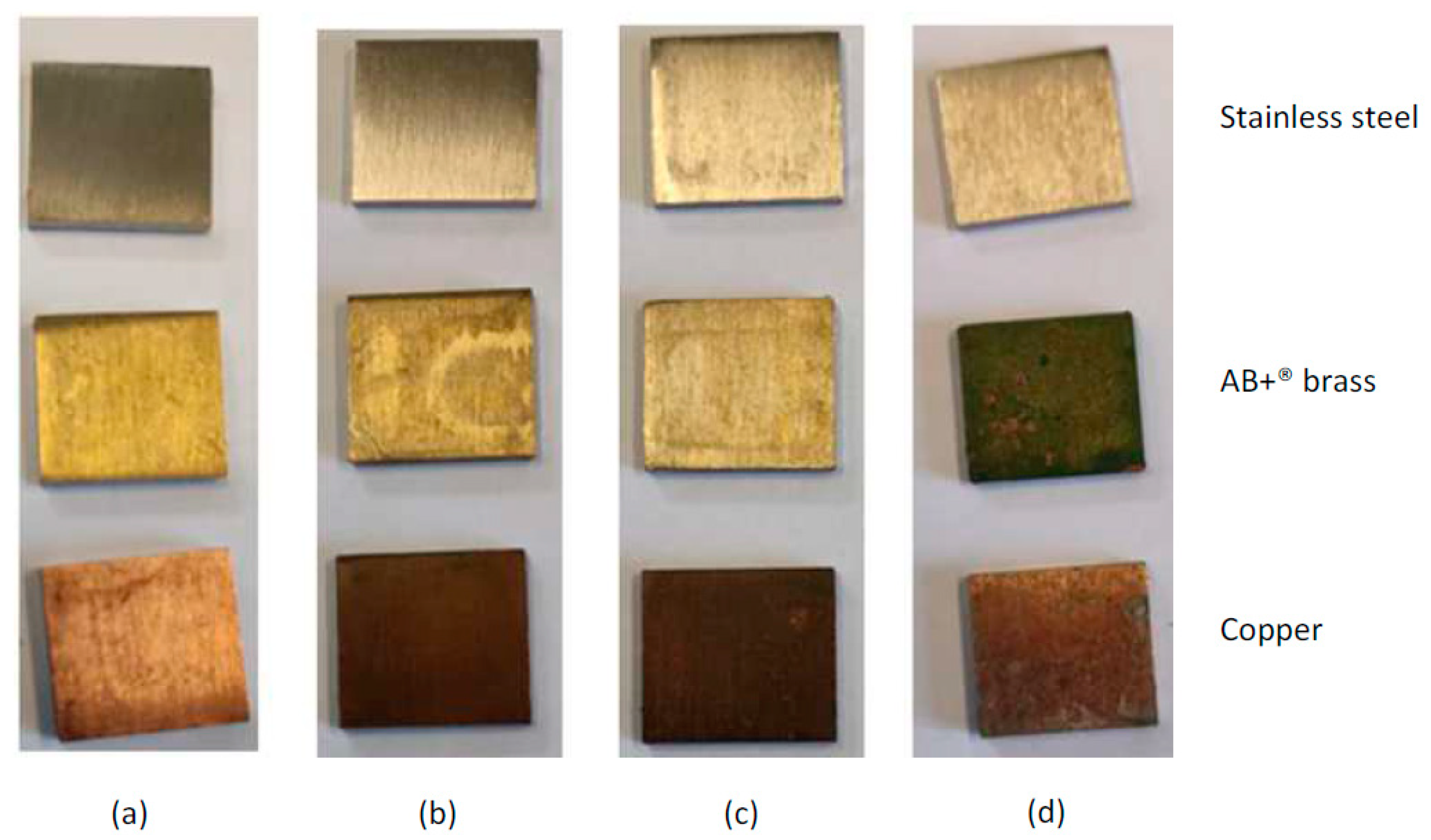

Table 1.
Characteristics of the clinical strains included in the antimicrobial efficacy testing.
|
Strain reference |
Bacterial species | Antibiotic resistance profile1 |
Sample origin (isolation year) |
| ABAM41 | Acinetobacter baumannii | Oxa-23, AmpC, ArmA | Environment (2017) |
| AM85 | Pseudomonas aeruginosa | EPO | Rectal swab (2009) |
| ECLOAM1 | Enterobacter cloacae | Oxa-48, ESBL | External quality control (2019) |
| EFUMAM2 | Enterococcus faecium | vanA | Sputum (2008) |
| KPNAM2 | Klebsiella pneumoniae | KPC | Rectal swab (2017) |
| SAAM33 | Staphylococcus aureus | mecA, EPO | Tracheal (2012) |
1 AmpC: cephalosporinase; ArmA: aminoglycoside resistance methylase; EPO: efflux pump overexpression; ESBL: extended-spectrum beta-lactamase; KPC: Klebsiella pneumoniae carbapenemase; mecA: gene encoding the Penicillin Binding Protein 2A, displaying a reduced affinity for β-lactams; Oxa-23 and Oxa-48: carbapenemases; vanA: gene cluster conferring resistance to glycopeptides.
Table 2.
Characteristics of the clinical strains included in the antimicrobial efficacy testing.
| Gene | Function | ABAM41 | AM85 | ECLOAM1 | KPNAM2 | EFUMAM2 | SAAM33 |
|---|---|---|---|---|---|---|---|
| copA | ATPase pump | -/+a | +/+ | -/- | -/- | -/- | -/- |
| tcrB | ATPase pump | +/+ | -/- | -/- | -/- | -/- | +/- |
| cusA | RND1 pump | -/- | -/- | -/- | +/+ | -/- | -/- |
| pcoD | Inner membrane pump | -/- | -/- | +/+ | +/+ | -/- | -/- |
| czcA | Zn2+ pump | +/+ | +/+ | -/- | +/+ | +/- | +/- |
| cueO | Multicopper oxidase | -/- | -/- | -/- | -/- | -/- | -/- |
| pcoE | Chaperone | -/- | -/- | +/+ | +/+ | -/- | -/- |
| copZ | Chaperone | -/- | -/- | -/- | -/- | -/- | +/- |
1: Resistance-Nodulation-Division efflux pump; a: genomic/plasmidic detection (-: negative; +: positive).
Table 3.
Antibacterial efficacy of copper and AB+® brass expressed as reduction percentages compared to stainless steel before (Untreated) and after ageing with a quaternary ammonium compound (QA) or a combination of a quaternary ammonium compound with a mix of peracetic acid and hydrogen peroxide (QA & PA/HP) (n=3, Exposure time= 5 minutes).
Table 3.
Antibacterial efficacy of copper and AB+® brass expressed as reduction percentages compared to stainless steel before (Untreated) and after ageing with a quaternary ammonium compound (QA) or a combination of a quaternary ammonium compound with a mix of peracetic acid and hydrogen peroxide (QA & PA/HP) (n=3, Exposure time= 5 minutes).
| Bacterial strain | Copper | AB+® Brass | ||||||
|---|---|---|---|---|---|---|---|---|
| Untreated | QA | QA & PA/HP | Untreated | QA | QA & PA/HP | |||
| ABAM 41 | 93.15±11.517* | 99.99±0.019* | 100±0* | 99.95±0.051* | 99.27±0.420*$ | 99.91±0.137*† | ||
| AM85 | 99.95±0.068* | 99.99±0.008* | 100±0* | 100±0* | 99.86±0.087* | 99.99±0.017*† | ||
| ECLOAM1 | 99.73±0.342* | 99.93±0.059* | 100±0* | 99.44±0.913* | 99.63±0.072*$ | 99.99±0.001*† | ||
| KPNAM2 | 98.03±2.343* | 99.54±0.200* | 96.75±5.622* | 99.16±0.582* | 99.20±0.255*$ | 99.77±0.398*† | ||
| EFUMAM2 | 76.15±27.228** | 99.03±0.587* | 96.45±3.133* | 99.94±0.050* | 97.96±0.046* | 99.38±0.936* | ||
| SAAM33 | 99.97±0.053* | 100±0* | 99.89±0.175* | 99.85±0.129* | 100±0* | 99.81±0.090* | ||
1 Results expressed as mean ± standard deviation. Significant difference in the numbers of recovered colony forming units on the negative control surface (stainless steel) and on the other metallic surface (Copper or AB+® brass)(Mann-Whitney test) at *:p<0.001 and **:p<0.01. £: Significant difference in the numbers of recovered colony forming units on untreated copper and AB+® brass (p<0.05, Mann-Whitney test). $: Significant difference in the reductions on copper and on AB+® brass surfaces post QA treatment (p<0.001, Mann-Whitney test). †: Significant difference in the reductions on copper and on AB+® brass post QA and PA/HP treatment (p<0.001, Mann-Whitney test).
Disclaimer/Publisher’s Note: The statements, opinions and data contained in all publications are solely those of the individual author(s) and contributor(s) and not of MDPI and/or the editor(s). MDPI and/or the editor(s) disclaim responsibility for any injury to people or property resulting from any ideas, methods, instructions or products referred to in the content. |
© 2024 by the authors. Licensee MDPI, Basel, Switzerland. This article is an open access article distributed under the terms and conditions of the Creative Commons Attribution (CC BY) license (http://creativecommons.org/licenses/by/4.0/).
Copyright: This open access article is published under a Creative Commons CC BY 4.0 license, which permit the free download, distribution, and reuse, provided that the author and preprint are cited in any reuse.


