

Submitted:
23 June 2024
Posted:
24 June 2024
You are already at the latest version
Abstract
Energy poverty in the Global South generally focuses on the lack of basic access to modern fuels and energy carriers. Impoverished people rely primarily on traditional biomass as a source of energy. This situation of basic resource deprivation, in which almost one third of the world's population lives, masks other relevant features of the problem. Current assessments of energy poverty in impoverished areas and the mitigation strategies being implemented derive from the development agenda and, with variations in detail and scope, highlight electricity connections and access to clean cooking fuels as guarantors of progress. However, a comprehensive understanding of energy poverty requires going beyond basic access, building on the interactions between the supply of energy sources and carriers, the provision of energy services and its impact on decent living conditions. Several studies in the last decade have attempted to construct an assessment framework centered on energy services to deal with these interactions. This work discusses the relevant dimensions in the framework (supply, services and impact in wellbeing), reviews the multidisciplinary work available in each aspect, presents a range of proposed taxonomies, and discusses the different issues. A detailed framework is proposed for the integrated assessment of the supply of energy carriers and energy equipment, the provision of relevant energy services, and the improvements obtained in living conditions.
Keywords:
energy poverty
; energy services
; energy equipment
; Global South
; basic needs
; wellbeing.
1. Introduction
The Energy poverty literature has grown exponentially in the last decade [1,2,3] with a focus on developed countries -and Europe in particular-, but also producing a branch of works that deals with the aspects of the problem in the Global South [4,5,6,7]. Some works have tried to establish a global perspective of energy deprivation [8,9], and others have focused on particular-local cases [10,11], but in general the approaches fall into two divergent types defined for developed and developing regions [12]. In developed countries the emphasis is mostly on the affordability of domestic energy services, primarily space heating [13,14,15], while in the Global South attention is generally centered on the lack of access to the energy supply of ‘modern’ sources of energy such as electricity, natural gas, or LPGs [16,17,18]. In both cases the focus is on supply of energy sources and carriers, either for its costs or its availability.
EU indicators of energy poverty [15] deal with household energy expenses (in 3 parallel ways: whether expenses are too small, whether they represent a large share of the family budget, or whether utility bills rest unpaid) and the capability of dwellers to keep their household adequately warm. Global South indicators deal with access to electricity or to modern cooking fuels, and although large differences can be observed, for example, between simple binary indicators such as those of the Sustainable Development Goal 7 [19,20,21] and the complex array of indicators developed by the World Bank [22] or the intermediate indicators of the IEA [23,24], most efforts remain centered on the supply of energy sources and carriers.
Nevertheless, beyond the availability of energy carriers, the objective is on the specific energy services that are thus obtained, and ultimately on the concrete achievement of wellbeing involved. Examples of energy sources and carriers include LPG and electricity, but also wood, while examples of services include (among others) lighting, space heating, cooking or transportation. Achievements of wellbeing are more subtle and difficult to assess, e.g., been able to cook permits to satisfy a basic physiological need of food but also may help shaping household values of respect, protection and affection, while lighting enhances the possibilities of daily activities, and can help gaining education, providing entertainment or facilitating social contact. But the interactions between these (or others) carriers, services and achievements depend on a large variety of aspects that interlink in a complex way. Weather conditions (e.g., highlighting the need for space heating or cooling, or both, or none), together with cultural patterns and/or socio-economic household characteristics (e.g., ways of cooking, need for transportation, for energy for labor at home…) may influence the metabolic pattern in which a society uses energy to develop or access to decent living conditions.
To have a broader view on the effect of energy services on living conditions, their interactions with general poverty indicators can be addressed. The poverty indicators used for the Global South by the World Bank, UN, or the 2030 Agenda, and those implemented in the EU such as the AROPE index (At Risk of Poverty and/or Exclusion) will be analyzed in terms of their relation to energy poverty aspects. Some indicators of general poverty can be identified as energy-linked (i.e., they have clear dependencies with the availability of one energy service or another), whereas some of them straightly use energy access parameters as indicators (like the access to electricity or the ownership of a fridge). These interaction between energy aspects and the broad definitions of poverty can be used to establish the mechanisms linking energy use to wellbeing.
The complex relation between energy services and decent living conditions (or wellbeing) has been studied in the recent past by several authors to establish a general framework of energy vulnerability. Bouzarovski and Petrova [8] assessed the relevance of different energy services for domestic energy deprivation, producing a typology of energy vulnerability factors and their constituent elements. Kalt and co-workers [25] discussed the different approaches to identify energy services and their effects in societies. Day and co-workers [9] presented an analysis of energy services in view of Sen’s capability approach. Brand-Correa and co-workers [26] identified links between energy services and wellbeing using Max Neef’s taxonomy of needs [27]. This approach is also used by García-Ochoa [28] for the definition of an energy poverty index for CEPAL (United Nations Economic Commission for Latin America and the Caribbean). Ruiz-Rivas and co-workers [6] presented a critical review of the multidisciplinary work that leads to the construction of energy poverty alleviation strategies in the Global South, from the definition of basic energy needs and services to the indicators of assessment, the global or local action plans, or the design and development of standard or alternative technology to fight the problem.
On this work, a review of the different approaches for energy poverty assessment is performed, and a methodology is proposed to: a) establish a framework that links energy services with social benefits (individual and communal); and b) identify indicators of performance for energy supply projects that go beyond characterizing energy access and seek assessing the concrete impacts in living conditions.
2. The Interactions between Poverty and Energy Poverty
An important part of the population in the Global South lacks access to electricity or depends on traditional biomass for cooking and heating. Current figures, provided by the IEA [29], state that 760 million do not have access to electricity and 2.3 billion to clean cooking fuels. Building from this key feature in the development agenda, the most relevant indicators on energy poverty focus on those two figures. Therefore, the operating indicators of SDG 7 concerning directly with the Global South are the proportion of population with access to electricity (with a target of 98% of the global population in 2030) and the proportion of population with primary reliance on clean fuels and technology (with a 2030 target of 85%). The world population is projected to reach 8.5 billion in 2030 (UN data), so target figures of SDG7 are to reduce the population without access to electricity to 170 million and those without access to clean cooking fuels to 1.3 billion by 2030.
Even though it is evident that not having access to electricity and/or relying on “dirty” fuels (wood, dung, waste…) are clear indicators of poverty, the approach has often been considered too narrow. The Oxford Poverty and Human Development Initiative (OPHI) added considerations on indoor pollution and appliance ownership in its Multidimensional Energy Poverty Index [30], while the World Bank defined its “beyond connections” strategy [22] in opposition (and as a next step) to the binary indicators of the UN. The World Bank (WB) strategy enhanced the view by identifying a multi-tier framework that considered various levels of access to energy sources and carriers and included aspects like quality, reliability, legality, or security (risks, pollution…) of the supply. It also distinguished among fuels for cooking or heating (this last one often neglected for Global South indicators although being the focus service of Global North indicators). These efforts have broadened the view, but still, there is plenty of issues left for characterizing energy vulnerability “beyond carrier supply”, both in developed countries and in the Global South.
Before engaging in such views, it is relevant to discuss the relationship between poverty and energy poverty. How does one affect the other, and vice versa. This is the fundamental question of how energy use interacts with a society and its progress. To understand this relation, the ways of characterizing poverty, both in developed countries and in the Global South, must be assessed. Income indicators are the norm for poverty assessment with a variety of approaches based on averages, fixed or variable limits, inequalities, etc. Income approaches criticism generally state that they provide an indirect view of poverty, as income identifies possibilities rather than achievements in poverty issues. A completely different approach was proposed and tried in Latin America in the 1980s, with the Unsatisfied Basic Needs approach (UBN). It was a direct approach identifying 6 possible household deficiencies classified in four dimensions (access to housing, health and education services, and economic capacity). One deficiency identifies a household as poor. A similar approach has been adopted in the last decade by the UN with the Multidimensional Poverty Index (MPI), which identifies 10 possible household deficiencies organized in three dimensions (access to health and education services and living conditions). Here the three dimensions are equally valued and a sum of deficiencies larger than 1/3 (all adding to 1) identifies a household as poor (while a sum larger than 0,5 identifies a severely poor household). The EU also uses a similar criterion to evaluate Severe Material Deprivation, together with income, with the At Risk of Poverty and/or Exclusion (AROPE) index. Here, a household is under severe material deprivation when it cannot afford at least 4 of a list of 9 basic items (including eating meat or fish twice a week, having a car, or being able to take a one-week vacation per year).
Focusing on these direct approaches to characterize poverty, Table 1 shows the diverse criteria used by the different approaches. Some criteria are plain energy yardsticks (from energy carrier access to thermal appliance ownership), and some show direct interaction with energy criteria (an energy supply is customary to use a car or a TV set), while others show a rather indirect relation or no link at all (although being aware that energy plays a leading role in modern societies and that there are always indirect relationships). The last column in the table suggests these relations.
A quick glimpse to Table 1 suggests that an evaluation of energy poverty might look beyond access to energy carriers, and thus establish the way in which availability of energy and its uses change the living conditions of vulnerable population.
With these approaches on poverty in view, a general framework for assessment of energy poverty will now be presented. The purpose is not (or not only) for completeness. The framework should serve to establish associations between lack of energy carriers and services and household deficiencies, and subsequently identify the impact of energy poverty alleviation strategies on the wider effort to fight poverty.
In search of an all-inclusive model, first a revision of previous attempts in the literature is performed, and the different dimensions are discussed. Then, an analysis of works devoted to each dimension is done (considering the available space), and comparison and discussion of the principal methodologies and approaches within each dimension is produced. This will modulate the landscape: from particularly technical contributions focused on the energy chain and energy supply, through more formal work on the concept and variety of energy services, and finally towards conceptual proposals on basic needs and wellbeing that, in most cases, are not particularly focused on energy. From the revision of proposals and taxonomies, some general agreements will be identified, discussing variants and differences, taking into consideration the different points of view identified by the various authors in their works.
3. Framework to Assess Energy Poverty and Actions of Energy Poverty Alleviation
Several authors have attempted to build a general framework of the energy-society metabolic nexus, linking energy services with energy-associated wellbeing (or in opposition, the lack of it: energy poverty). The proposals of Bouzarovski and Petrova [8] and Kalt and coworkers [25] are depicted in Figure 1. The Kalt cascade model is, in turn, adapted and expanded from a proposal by Haines-Young and Potschin [31].
Bouzarovski and Petrova [8] focus on the link between carriers (obtained through the energy chain) and energy services (considered the actual benefit of energy use) and provide a classification of both carriers and services. They identify two relevant vulnerability factors in the demand side: possible mismatches between requirements and available services (referenced as a needs factor) and social practices for energy use. Kalt and co-workers [25] consider a benefit dimension beyond services, which conforms the objective or reason of the process. They expand it in two parts: contributions to wellbeing and the valuation of such contributions. It is also interesting to note that access to energy equipment, although a factual necessity in the transitions between carriers from the energy chain and services, is not considered in the same level as carriers and services in both cases.
In view of these and other related proposals that will later be discussed in detail (e.g., [9,28]), a general framework to assess energy poverty is depicted in Figure 2. The main difference here is the inclusion of energy equipment as a fundamental dimension, together with a certain rearrangement and renaming of aspects. The arrangement is organized in three dimensions: supply, service, and wellbeing:
- The supply dimension includes sources and carriers (the specific source or carrier to which access is granted and its access parameters: maximum energy, maximum power, hourly availability, quality, costs, etc.) and supply of energy equipment (availability, output, quality, performance and efficiency, costs, etc.). As stated above, most of the energy poverty indicators available are focused on energy carrier supply, although varying a lot in the procedure and detail.
- The service dimension identifies the energy services provided by such a supply. Energy services is, quite surprisingly, a loosely defined term in the bibliography [32] and taxonomies vary. Also, environmental characteristics may affect such taxonomies, minimizing or even eliminating some services and highlighting others (space heating and space cooling are evident examples).
- The wellbeing dimension focuses on the identification of benefits or improvements in living conditions obtained from such services. There are several approaches to understanding such improvements. One possibility is the assessment of a change in the poverty indicators presented in the previous section. Conceptual approaches for the identification of human development goes from Sen and Nussbaum’s capability theory to the variety of wellbeing approaches, or the basic human needs approach.
Figure 2 provides a framework to analyse the different approaches proposed to characterize energy poverty. Each approach generally focuses on a certain dimension (supply, service, or wellbeing). Most emphasize the supply of carriers, while few analyse services or effects on wellbeing. This general framework permits to identify connections between different approaches and problems encountered in the quest for providing a broader view. In this sense, the analysis can be two-fold, mixing a direct approach, to identify indicators for assessing energy poverty through shortfalls in living conditions, and indirect approaches, focusing on services or carriers as necessary pre-requisites for the satisfaction of needs. Indirect approaches are subjected to a certain efficiency based on the fulfilment of the inherent assumptions. An analysis of available services is subjected to a certain “benefit” efficiency established a priori: having a certain service (e.g., lighting) is considered as an indicator of certain improvement in living conditions, but the efficiency of the transition can vary (e.g., number of people using it and variety of purposes, including leisure, education or production). An analysis of availability of energy sources, which is the most common currently, is indirect in two ways as it is based in the fulfilment of two necessary implications: since having a connection or even an appropriate supply of an energy carrier is not a straightforward guarantee of having the proper energy services (e.g., depending on time availability, or intensity -for moving around the house, for reading, etc.), which in turn is connected to benefits on living conditions in an indirect way, as stated previously. In short: while a general aprioristic thought can consider that having an appropriate supply will produce adequate energy services and in turn will provide benefits in living conditions, such reasoning involves general hypothesis and is subjected to certain restrictions (e.g., availability and affordability of appliances, appropriation by the community, interaction between what is offered and what is considered a need by the community, etc.) and thus to the effect of different efficiencies, as suggested in Figure 2.
In the following subsections, a discussion of the different approaches for each dimension found in the literature is provided. Then, the efficiencies of the transformations (from carriers and equipment to services and benefits) will be analysed.
3.1. Access to Energy Sources And Carriers
The main approach to energy vulnerability in the Global South is to prioritize access to modern energy carriers. Both UN and the World Bank focus their strategies on such accesses, although the scope and concreteness vary enormously between proposals. As mentioned above, the operating indicators of SDG 7 identify targets concerning the proportion of population with access to electricity and with primary reliance on clean fuels and technology. Dependence on non-commercial forms of energy such as human power [33] and/or traditional biomass (wood, dung, etc.) is associated with the conventional view of energy poverty. The transition scenarios identify energy access with electricity connections and access to clean fuels for cooking (natural gas, LPG, etc.). Some indices also consider a proper energy transition the introduction and use of improved cookstoves as these technologies, while still relying on dirty” fuels, increase efficiency and provide a certain control of indoor air pollution. It is seldom mentioned that reliance in traditional biomass is often a question of affordability and not lack of supply. Tang and Liao [34] observed that over 75% of rural households in China use biomass for cooking because they are constrained by the price of modern energy services and not by insufficient supply of them.
The Oxford Poverty and Human Development Initiative, linked with the UN, presented in 2012 the Multidimensional Energy Poverty Index (MEPI, [35]). It is a composite index allegedly “designed to shed light on energy poverty by assessing the services that modern energy provides”. It includes information on 5 dimensions (cooking, lighting, services via household appliances, entertainment/education, and communication), each defined by their corresponding variables and weighted indicators. The lighting dimension (weight 0.2) is fulfilled with the electricity access variable, cooking (0.4) with two variables: availability of a modern cooking fuel (0.2) and indoor pollution (0.2). The other three dimensions are equally weighted (0.13 each) and are fulfilled with ownership of a fridge, a radio or TV, and a phone (either mobile or land line), respectively. The sum of the weighted indicators for a household provides a number between 0 and 1 (a value different than 0 identifies a lack) and the household is energy poor if the value is larger than 0.3. The MEPI index of a community is then calculated as the proportion of the population that is energy poor multiplied by the average of the sum of indicators of those that are energy poor. The MEPI index has been widely used in the last years ([35,36,37,38,39,40,41,42]), as it provides a simple approach that gives substantial information. Still, MEPI relies mainly on electricity and clean fuels (0.6 out of 1) and the other services are established for a minimum need (fridge, radio, phone, together 0.4 out of 1). The threshold value implies that one household is considered energy poor either if it does not use clean fuels, if it has no electricity (so it will also be deprived of the appliances) or, having both electricity and clean cooking fuels, if it is deprived of both fridge, radio, and phone. This third case, and the assessment of the extension and intensity of deprivations is the main difference with the SDG indicators. Cedano and co-workers [43] proposed later a modification of MEPI that includes an extra dimension of thermal comfort. For other relevant proposals of indicators, see references [44,45,46,47,48].
In 2010 and 2012, Practical Action, and NGO connected with the Appropriate Technology movement, presented a different approach with two indices: the Energy Supply Index and the Total Energy Access index [49]. The TEA is an energy services index that will be addressed later in this section. The ESI is a multi-level index based on 3 dimensions: cooking fuels, electricity, and mechanical power. This last inclusion that establishes a basic need of mechanical work for household tasks is a clear difference from previous indices. A major change is also its not-binary condition. Each dimension is identified by six levels of access (e.g., from accessing only to a third-party battery charging to using a reliable AC connection available for all uses, with intermediate steps of access defined by the possession of a stand-alone electrical appliance, of a limited power access for multiple home applications, or of an intermittent AC connection). This index has not been widely used, but it is a precursor of the Multi-Tier index promoted later by the World Bank.
In 2015, the World Bank presented its “beyond connections” strategy [22] as a step away from the binary indicators of the UN. It identifies a multi-tier framework that considered various levels of access to different services. The World Bank approach is the broader one to this date, but for this same reason has been seldom used, except in projects specifically financed by WB. Being such an ambitious framework, it has followed some changes in every implementation [50,51], but the general scope remains and is summarized in Figure 3.
The multi-tier framework is the ultimate effort to be comprehensive following the approach that focus on the access to energy carriers. It thus transcends the narrow borders of the approach introducing some equipment characteristics (e.g., cookstove efficiency) and identifying as main dimensions of its indicators some relevant energy services. When only electricity and cooking solutions are implemented, it is merely an expansion of the simple UN binary indicators following the multi-level approach of the ESI. Of course, its main advantage in any case is its non-binary nature, which serves to identify a wide range of actions for the progress towards energy wellbeing. This aspect is of paramount importance for development actions, as the narrow approach of the binary SDG indicators only expose changes for leaving extreme energy poverty, but do not reflect actions intended to promote further progress.
Parallel to the definition of access and supply indicators, a significant effort has been made to assess those indicators around the world. Table 2 presents a necessarily incomplete compilation of countries and regions where the different indicators presented in this section have been characterized.
3.2. Access to Energy Equipment
It is somehow curious that indicators seldom deal with the access to efficient energy equipment, while most of them stating that a minimum access to energy carriers is compulsory. Nonetheless, energy equipment is mentioned in a variety of indicators, notably in general poverty indicators: ownership of a fridge, a TV/radio or a phone are considered as criteria by both the Multidimensional Poverty Index (MPI) and the Multidimensional Energy Poverty Index (MEPI). The MPI adds the ownership of a computer and of any means of transportation, from an animal cart or a bike to a van. Regarding general poverty indicators, AROPE includes the ownership of TV/radio, computer, and car, and adds the ownership of a washing machine as a primary need. But not much attention is gathered in the main indicators to the efficiency of available energy equipment, except for the identification of cooking efficiency in the Multi-tier framework. The range of efficiencies of available fridges, cookstoves, TVs, phones or cars can vary on a narrow range, say a 20%, but they can also double, triple or even vary by an order of magnitude (as in lighting with the advent of LEDs). Therefore, the aprioristic statement that a certain amount of energy and power (e.g., electricity) will ensure a service (e.g., 24h functioning of a fridge) assumes of availability not only of equipment (a fact that includes both supply and affordability), but of efficient equipment (at least to a certain level).
One exception of an index detailing energy equipment is the Meeting of Absolute Energy Needs method [28], which establishes energy poverty as inability to satisfy basic human needs. To do so, the method defines a range of economic goods that are linked to the satisfaction of those needs. The proposed list of relevant economic goods included refrigerators, computers (PC or Laptop) with Internet access, gas or electric water heaters, space heaters, fans or air conditioners, fluorescent lamps of bulbs, televisions, and gas or electric cookstoves. Following a similar line of thought, a classification of relevant energy equipment is now presented.
A taxonomy of energy equipment that is relevant for energy welfare is not evident. Different classifications in terms of the energy carrier used (electricity, gas, LPG, etc.) or the service given are possible. A distinction can also be made between energy equipment with an energy use (thermal uses, generators, pumps, etc.) and those with non-energy use (but with an energy consumption, such as electronics, cleaning, devices etc.). The following organization based on uses is proposed and depicted in Figure 4.
A category of basic installations has been included to state the need of basic infrastructure, such as sockets, switches, electrical protections, gas connections, exhaust, etc., which are often forgotten. The rest of the categories are self-explanatory. Table 3. elaborates on the categories and the different equipment involved. Information obtained from various sources is compared. A product list is taken from the EU Energy efficient products webpage [52], which lists all products (energy equipment) covered by Directive 2009/125/EC. The products are divided into separate categories that generally match those on Figure 4. The EU product list is compared with the product groups in the Collaborative Labelling and Appliance Standards Program [53], an international nonprofit organization that provides a comprehensive comparison of energy standards labels (covering nine major economies and more than 100 products) and also with Japan’s Top Runner programme on energy equipment efficiency [54]. Of course, the comparison from various sources is only meant for completeness of the whole view rather than to highlight differences among sources (which are attributed to the diverse scopes of the different programs). A quick glimpse at Table 3. shows a general agreement in most categories, with minute differences based on locally relevant equipment (e.g., electric toilet seats). The entertainment category shows low coherence, as it is not generally addressed.
Although the categories and types in Figure 4 and Table 3. may remain adequate for different locations, the actual equipment may vary a lot (e.g., the types of cooking devices available may differ between Vietnam and Ecuador, China, or Cuba).
The taxonomy on Table 3 is an attempt to establish a classification of relevant energy equipment that use energy carriers and are the key feature for delivering energy services. They are thus the link between carriers supplied and services provided. Two mayor features are relevant for the inclusion of energy equipment indicators in an energy poverty assessment: availability and efficiency. As above mentioned, the efficiency of an available equipment may produce a relevant change in the ratio energy service/energy carrier. This effect is labelled “Service efficiency” in Figure 2. Furthermore, in acute energy poverty circumstances, the actual availability of an equipment, or its affordability by part of the population, may render the service inaccessible independently of the carrier energy/power supplied. For example, a rural electrification project might claim that the service of food refrigeration and preservation is available to the target population thanks to the completion of the project. Nonetheless, carrier availability in sufficient capacity (both power and energy) may not assure such service if the available equipment is too dear, has a very low efficiency (lower than that used by the project engineers to identify energy needs when planning their action), or do not convey with the necessities (e.g., there is some availability of small fridges in the region, but no freezers are available).
Therefore, a primary need when assessing energy poverty in a certain location should be to identify a list of available energy equipment, with costs and efficiencies. One may argue that globalization has expanded and unified the market globally, so that main characteristics and availability of equipment are similar worldwide. Still, cultural differences, transport costs and taxes on imported goods, foreign affair issues (e.g., Cuba blockade, landlocked countries like Armenia frontier problems), or the partial inaccessibility to remote communities can alter the global picture.
3.3. Provision of Energy Services
Not much attention has been directed to the definition and characterization of energy services until recently. This is probably linked to the long-term definition of energy as a commodity, so that the uses cannot be defined, let alone limited, as they respond to consumer interests or needs: in short to consumer choice. Increased focus on a just energy transition and, as a relevant part of it, on the aspects of energy conservation and energy poverty alleviation, has raised interest in the definition of energy services and the discussion of their breadth and relative legitimacy.
Fell [32] studied the previous bibliography on the term and presented a definition and taxonomy of energy services. The definition states that “energy services are those functions performed using energy which are means to obtain or facilitate desired end services or states”. The taxonomy is based on 9 general themes or categories in which the author was able to accommodate any service mentioned in the literature reviewed (including a category of “other”). Table recreates the taxonomy of energy services according to this literature revision. First column shows the 9 general terms or categories in which the author organized his findings. A second column shows a compressed view of the information given by the author about the terms involved in the definition of each energy category, and the related aspects. A third column is not derived from this work and shows the links between the different services and the categories of energy equipment defined in the previous subsection.
The analysis of Table 4 shows that the “other” category is overcrowded. Of course, the analysis done by Fell [32] only tried to establish representativeness of each service in the literature available at that moment. Therefore, one can state that thermal comfort (space heating and cooling), cooking, water heating, refrigeration, lighting, and transport were generally addressed in the studies on energy services, while the commercial/industrial category was somehow vaguely defined and energy services like those given through ICT or with household appliances were not considered as categories by Fell [32], although they were mentioned in the literature. On the contrary, entertainment was very rarely mentioned as a relevant energy service.
To broaden the debate on energy services and its taxonomy, a comparison of [32] list of categories with other relevant previous lists and with some published afterwards is presented in ¡Error! La autoreferencia al marcador no es válida. A certain coherence can be observed in the more assessed services (heating, cooling, cooking, refrigeration, lighting, transport) although some curious groupings exist. Grouping of heating and cooling into the category of thermal comfort is irrelevant, and it is a consequence of considering that the objective is common: to maintain indoor temperature within restricted limits. Grouping of cooking and refrigeration into terms like sustenance or merely food is again a question of scope. On the other hand, the regrouping of cooking and water heating is probably due to technological reasons: the target population may use one single facility for both purposes. Entertainment is still seldom considered, while concepts like structure (i.e., materials used to provide structural support, commercial/industrial, or production issues are irregularly defined and may have a variety of points in common.
As a working conclusion on the taxonomy of energy services, a list of 13 categories could be proposed, with the aim of being comprehensive in services, and choosing to separate grouped categories that show relevant differences. Such categories are space heating and cooling, refrigeration, cooking, water heating, appliance services (mostly cleaning appliances), lighting, transport (passenger and freight), production services (process heat, mechanical work), ICT, entertainment, and structure. Community services might be included or excluded depending on the scope.
Not all categories might be relevant for all, and the number of legitimate and relevant energy services for a certain society that should be included in each category may vary a lot, together with the amount of energy carrier capacity (both energy and power) required, and the energy equipment needed. Cultural issues may affect (cooking issues are generally the most affected, but not the only ones). Of course, environmental characteristics will affect the identification of essential services, minimizing or even eliminating some energy services and highlighting others (space heating and space cooling are evident examples). This is considered, for example, in the definition of the Meeting of Absolute Energy Needs method [28], in which the index is made up of different essential needs for populations living in different climate regions.
3.4. Improvements in Living Conditions
Having filled the gap between access to energy carriers and equipment and provision of energy services, the next step concerns actual improvement in living conditions obtained by using such services. Kalt and co-workers [25] provided an interesting discussion on what they call benefits and values as descriptors of wellbeing. Day and co-workers [9] presented relevant insight on the nature of benefits, following the capability approach of Sen and Nussbaum. Brand-Correa and co-workers [26] and García-Ochoa [28] identified such benefits using the basic needs approach of Max-Neef. Also, there is a relevant line in development studies that focus on wellbeing and measurements on happiness [59]. Finally, the approaches on poverty in general, as detailed in the second section of this work, may provide a direct approach to identify improvements in living conditions in the sense that an action to reduce energy poverty should have an impact on poverty reduction in general.
3.4.1. Benefits in Terms of Satisfied Needs
The basic needs approach was established with the works of Doyal and Gough [60,61]and Max-Neef and collaborators [27]. They discuss and propose taxonomies of basic human needs. The common precedent is the pyramid of Maslow [62], a hierarchical organization of basic needs that defines 5 levels in which the lower ones represent priority needs. The authors of these works consider, on the contrary, that basic needs are not hierarchical. They also define two interacting concepts: actual needs, which should be objective and universal and are finite and few, and satisfactors, which may change through time and across cultures, can be enormously varied and numerous, and define the ways a society proposes to meet their own needs. This dichotomy is an argument in the long discussion on universality and cross-culturalism of human needs maintained with advocates of relativism. In this sense, [60] define basic needs as universalizable preconditions for both social participation and the pursuit of personal goals. For such goals they identify two basic human needs: physical health and personal autonomy (capacity for action). From those they derive 11 categories of intermediate needs, that they also considered universal and cross-cultural. In [27], in turn, an array of categories based on two orthogonal vectors is proposed: existential categories and axiological categories. Max-Neef and coauthors claim that the values defined in their 9 axiological categories (which can relate, with some differences and discussion, to the categories of Maslow and the intermediate needs of Doyal and Gough), are defined differently in four existential ways, those of being, having, doing and interacting (a similar issue as the “functionings” of the capability theory that will be addressed in the next section). This conform a matrix where the cultural satisfactors could be integrated. The categories for Max-Neef are again universal and cross-cultural but might vary in time, as world society does. In this sense, they discuss the relevance of identity and freedom as quite “modern” needs in comparison with the rest, which are considered by them as grounded in the beginnings of humanity. They also raise the subject of introducing transcendence needs but conclude that it is still an immature need in most societies around the world.
A comparison of the taxonomies of Maslow [62], Doyal and Gough [61] and Max-Neef and co-workers [27] is addressed in Figure 5, including the listing of their different categories.
These frameworks provide a useful approach for the characterization of the change in living conditions experienced by a change on the energy supply chain and/or on the provision of energy services. García-Ochoa and collaborators [28,56] proposed an organization of energy equipment (economic goods in their saying), energy services, satisfactors and absolute needs following Max-Neef taxonomy. An outline of their organization is depicted in Figure 6. Brand-Correa and Steinberger [58] also proposed an organization of human needs and energy services using the axiological categories of Max-Neef in their Human Scale Energy Services analysis. They linked energy services and human needs in two Colombian communities using a community-level participatory approach.
These contributions show the possibilities of the basic needs approach to characterize the benefits obtained by the community and closing a general framework to assess energy poverty and energy poverty alleviation strategies encompassing energy supply (carriers and equipment), energy services and their effect on living conditions.
3.4.2. Benefits in Terms of Capabilities
Sen and Nussbaum’s capability theory is also a well-established methodology to identify benefits of the energy cascade. Sovacool and co-workers [63] and Day and co-workers [9] have applied the capability approach to energy poverty.
The capability approach tries to maximize opportunities by highlighting freedom of choice and focusing on what people can achieve and do. The methodology uses two linked concepts: functionings and capabilities. Functionings are defined as “beings and doings” to incorporate both states and activities, while capabilities are viewed as opportunities to develop functionings (states or activities) and are divided into primary and secondary capabilities. Primary capabilities are general concepts like being respected (a state) or acquiring skills and knowledge (an activity) and secondary capabilities are intermediate concepts (and in such, nearer to energy services) that built on primary capabilities such as maintaining hygiene standards. Some parallelism can be observed with the taxonomy of needs of Max-Neef, but relevant differences are also present: the capability approach is a methodology that do not define normative capabilities. They are the result of a participatory process of each community. The categories presented by Nussbaum [64], although quite broad, were the subject of a strong debate and they were even branded of ethnocentric (i.e., Life, Bodily health, Bodily integrity, Senses, Imagination and thought, Emotions and practical reason, Affiliation, Relating to other species, Play, Control over one’s political and material environment).
Following Nussbaum’s statement that energy is a material pre-requisite to achieving valued capabilities, Day and co-workers [9] proposed a definition of energy poverty in terms of the deprivation of such capabilities. They conceptualised the relationship between energy, services and outcomes and identified fields of action (interventions for energy poverty alleviation) in the linkages. Figure 7 is adapted from their work.
Of special interest is the shaping of interventions for energy poverty alleviation. Improving energy access and efficiency have been discussed previously. In the transition between secondary and basic capabilities, Day and coworkers [9] identify the need of modifying the way the society imagine such links, which is of course a satisfactory solution and a problem in its own. This is more a domain for capability theorist than for the analysis of energy benefits. The focus might point to the transition from services to secondary capabilities. The authors suggest that some capabilities should be obtained with community services and other might be obtained with non-energy services. This is a sound statement. Community services could be included in the energy services stage (as stated previously), as the problem is, in fact, an issue on the organization of the provision of energy services more than an issue on the interaction between services and benefits. On the other hand, non-energy services are considered fundamental, and the way some traditionally non-energy services have been displaced by energy-consuming services is a characteristic feature of modern societies. Both aspects are relevant, but little attention is drawn to the way some energy services can fulfil secondary capacities better than others (a certain service-benefit efficiency). This is, a key issue, as services that use adequate equipment and carriers, and have the acquired experience of users, may be more efficient than others. This might encompass issues related to: a) the access to the form of energy service provision appropriate to household needs; b) the mismatch between requirements and available energy services; and c) acquiring knowledge about using energy or asking for support, three key aspects of energy poverty highlighted by [8] in their typology of energy vulnerability factors and their constituent elements.
3.4.3. Benefits in View of Wellbeing and Happiness
There is a large variety of wellbeing approaches. Loveridge and co-workers [59] analysed 111 different available indicators for a field test. Boarini et al. [65] identified three distinct dimensions of wellbeing studies: objective (focusing on material conditions), subjective (based on self-assessment of personal circumstances) and relational wellbeing (evolving from Sen’s capability approach). Finally, Brand-Correa and co-workers [26] confronted ‘eudaimonic’ (need-centred) and ‘hedonic’ (pleasure-centred) understandings of wellbeing in their aim of establishing priorities for achieving wellbeing within environmental limits.
Objective wellbeing may appear as more adequate to assess improvements in living conditions from energy services, as it focuses on material prerequisites for human wellbeing. Rao and Min [66] identified a series of decent living standard dimensions that were linked with material requirements often related to energy. Their dimensions are listed in Figure 8.
On the other hand, subjective well-being indicators are used to correlate with development indicators. UN presents every year a World Happiness Report linked to the activities of SDG 3 (good health and wellbeing). The report presents results for the Cantril life ladder, a simple indicator that is based on a single survey question, asking the respondent on which step of a ladder of ten steps, where the highest one represents the best possible life and the lowest the worst, he/she thinks he/she is now. Of course, this is based on the philosophical concept that people’s self-asserted happiness should be the ultimate goal of policy. But the use of such subjective indicators to assess benefits derived from energy services seems rather crude and obscure.
The main argument in favour of subjective wellbeing analyses is their bottom-up nature. Nonetheless, the variety of approaches and variants are the subject of much debate and criticism because they claim to be or appear natural while sometimes being strongly ideologically charged.
3.4.4. Benefits Identified by Reduction of Poverty Indices
The effect of the provision of energy services on the reduction of poverty indices is another possibility to identify clear improvements in living conditions. It might even be an implicit and direct result of energy provision, as some poverty indicators include aspects directly linked to energy poverty, as stated in Table 1 in the second section of this work. An action modifying the lack of access to electricity or clean fuels in a household, or a community will directly modify the results for the multidimensional poverty index of the household or community. Such a change might make the household reach an indicator value that no longer establish it as poor or extremely poor household. Also, as energy aspects are lightweighted and only affect partially the indicator value, the household may not leave its condition, but at least will certainly reduce the intensity of its deprivation as measured by the index.
Other outcomes can be obtained less directly from aspects that indicate poverty and that may change because of an action to address energy poverty, such as having a computer, a television or access to drinking water.
Overall, the assessment of the efficiency in alleviating poverty conditions of the provision of energy services can be a sound identification of mayor improvements derived from energy projects.
4. Discussion
Energy poverty is a global problem. In recent decades there have been significant advances in understanding and responding to the problem, both academically and politically. Studies have often focused on the problems of the Global North, but those of the Global South have also received attention, interacting with traditional international development aid efforts and expanding them. Still, the perspectives on addressing the problem of energy poverty in the Global South (an access to supply issue) and North (an affordability issue) differ greatly.
Several authors ([8,9,25,56,58] etc.) have addressed this problem in the last decades. Most have focused on the issue of energy services in their efforts to establish a global perspective on domestic energy poverty. Services are a midway point between carrier and equipment supply on one side and improvements-benefits-progress obtained by society on the other. Its indefiniteness as a term [32] allows it to encompass all the relevant aspects of the problem, as the different approaches of the mentioned authors show. A similar debate has been established in the past around the concept of ecosystem services, with parallels that make close reading fruitful [31,67,68].
The aims behind the various attempts to identify a broad and (as far as possible) global perspective on the problem of energy poverty are also varied. From a direct amelioration of energy deprivation in the home [8], to a broader aim of establishing priorities for achieving wellbeing within environmental limits in an ecological crisis scenario, and thus decoupling satisfaction of human needs from energy use [26,58], or the previously mentioned search for a coherence between Global North and South attempts [9]. Kalt and co-workers [25] focussed on systematising terminology to promote interaction between exclusionary discourses, in a more epistemological aim. García Ochoa and collaborators [28] sought a specific definition of indicators that would be appropriate for the varied conditions of the Latin American context. Moreover, most authors highlight the importance of such a global perspective for the definition of a variety of ways of intervention to tackle the problem of energy poverty. The sum of those purposes generates extremely ambitious goals. In this work, while primarily focussing on the Global South issues, all those aims have been at least considered in the systematization analysis.
Figure 9 presents a compressed view of the general framework outlined in Figure 2 and characterized in detail throughout the previous section. Supply is defined by the availability of both energy sources and carriers and energy equipment, with a variety of pair combinations. Sources and carriers include electricity and modern fuels together with primary (direct use of) renewables, mechanical power, and secondary heat. Non-commercial forms of energy like firewood or human power are also considered. Equipment categories are those presented in Figure 4 and Table. Services are accomplished when supply is granted, and coverage and quality of services can be defined, together with an efficiency (η) between supply and service. Service categories in the Figure 9 are extracted from the comparison in To broaden the debate on energy services and its taxonomy, a comparison of [32] list of categories with other relevant previous lists and with some published afterwards is presented in ¡Error! La autoreferencia al marcador no es válida. A certain coherence can be observed in the more assessed services (heating, cooling, cooking, refrigeration, lighting, transport) although some curious groupings exist. Grouping of heating and cooling into the category of thermal comfort is irrelevant, and it is a consequence of considering that the objective is common: to maintain indoor temperature within restricted limits. Grouping of cooking and refrigeration into terms like sustenance or merely food is again a question of scope. On the other hand, the regrouping of cooking and water heating is probably due to technological reasons: the target population may use one single facility for both purposes. Entertainment is still seldom considered, while concepts like structure (i.e., materials used to provide structural support, commercial/industrial, or production issues are irregularly defined and may have a variety of points in common.
Table, trying to be as comprehensive as possible. Finally, the benefit section defines the different options or approaches for identifying a positive assessment of service, either by individuals or communities, as have been analysed in Section 3.4. Those options can be used independently or overlapped or merged in an assessment.
Comparing Figure 9 with the previous attempts summarized in the preceding sections may provide some insights. The two proposals in Figure 2 are somewhat complementary. One considered services as the final benefit [8], thus contracting the framework on the right-hand side. The other broadened benefits to differentiate individual and societal issues [25], thus expanding the framework to that right-hand side. The basic needs proposal of [28,56], depicted in Figure 6 has a similar layout to that of Figure 9 (energy carriers are not present because they are identified as a pre-established necessity). Notably, it includes equipment defined as economic goods. Looking at the taxonomies, García-Ochoa proposes a rather sharp reduction of relevant equipment and services, in his quest for bare necessities. Brand-Correa and Steinberger [58, their Figure 4] proposed a similar scheme (Energy supply chain-Services-Need satisfactors-Wellbeing), but disregarding energy equipment. Finally, Day and coworkers [9] used the capability approach to wellbeing and (trying to provide some insight on the energy chain itself) separated the energy chain in energy sources and domestic energy carriers, as shown in Figure 7. Considering all these approaches, the framework in Figure 9 expands or compresses their findings, encompassing all dimensions.
Focusing on services as the pivotal point of a global perspective means also taking sides in the dilemma between direct and indirect approaches for poverty assessment. Standardized approaches on poverty and energy poverty focus on income and expenditure indicators, which are an indirect measure of poverty. This means addressing material problems through some a priori consensus. In energy poverty studies in the Global North, Boardman’s categorization of the determinants of fuel poverty is widely accepted: household income, cost of fuel, and the energy efficiency of the dwelling. In the Global South, the focus of most of energy poverty studies is still in the severe cases of extreme energy poverty (following development aid scenarios), and thus the emphasis is on carrier access indicators (as stated in Section 3.1). It is again an indirect approach to material problems (e.g., having access to electricity do not directly imply enjoying the possibilities of food preservation provided by a refrigerator: it is only a prerequisite for this). The use of a global perspective requires implicitly a shift to direct indicators centred in material problems, as the metabolic pattern of energy vary among world societies. The focus on energy services or even on the effects of these services on the living standards of the population shows that shift.
The fact that energy poverty studies in the Global South are often restricted to development aid scenarios, views, and agreements is of substantial relevance. First, because it focusses on extreme cases, as stated in the previous paragraph. Often such cases involve most of the target population, but other situations of energy poverty may be shadowed, like the impact of cold homes in the Global South [43]. Using a framework with energy services at its core can broaden the view and integrate concepts of dignity and justice [8] to assess the problem. A second feature is inherited from the debate between humanitarian, relief, and development actions, traditionally embedded in the development aid ecosystem. This is a discussion on community appropriation and leadership of development processes. It is essential that action against energy poverty explores its capacity for change, a question central in the capabilities and basic needs approaches for development but sometimes neglected in other approaches and assessment indices. A third step confronts ‘eudaimonic’ (need-centred) and ‘hedonic’ (pleasure-centred) understandings of progress and wellbeing [58]. These approaches see the fight against (energy) poverty as an opportunity for human flourishing. This obviously takes sides with a certain concept of human well-being, which can lead to a debate on the prioritisation of some energy services over others.
Coming back to the framework of Figure 9 and comparing it to previous proposals analysed in Section 3, the major contribution of this framework is the inclusion of energy equipment as a fundamental dimension. One of the 3 determinants of fuel poverty of Boardman [13], energy efficiency of the dwelling, involves two energy efficiencies: the efficiency of the building and the efficiency of the energy equipment used to provide services within the household. Building efficiency is a question of insulation, as well as including aspects such as ventilation, orientation to the sun or bioclimatic design issues. If included, its place should be in the energy equipment dimension, but it seemed awkward to mix both concepts. An effort to integrate this relevant aspect should be undertaken. Concerning energy equipment, its placement as a fundamental dimension in the framework puts into focus not only the efficiency of any equipment, but its availability, affordability, and the range and capacity of what it can provide. The different analysis with a global perspective on domestic energy poverty seldom identify energy equipment issues. Apart for the analysis of García-Ochoa [28], consisting of 7 basic equipment, there is only an occasional mention of the efficiency of some equipment in the rest of proposals. Nevertheless, Bouzarovski and Petrova [8] consider of paramount importance the aspects of efficiency and flexibility that links carrier supply to service, obviously referring to energy equipment.
No single approach has been identified in the proposed framework as preferential to identify a positive human assessment. The dimension encompasses personal, social, and political valuation of energy services. Even naming this dimension may be a subject of discussion. We have opted at times for benefits (a word with accounting resonances) and others for improvements in living conditions. Opting between the capabilities approach, the basic human needs approach or the different wellbeing-happiness approaches, all with their varieties, is outside the scope of this work. Some indicators of poverty are also included, as a parallel approach to identify the effects of energy services on development.
A word about efficiencies in the interspaces between dimensions. They identify the performance of carriers and equipment to provide adequate services, as well as the performance of services to achieve valuable improvements in living conditions. Therefore, they are the key aspects of the framework, as an adequate supply of all the necessary items might end up in a poor service and, in a second step, in a lousy improvement, or even in the opposite effect: a deterioration of living conditions.
In a sense, these efficiencies define possibilities to deviate from the general assumptions embedded in the conceptual core of indirect measures (that A implies B), through mechanisms that might alter the expected outcomes of adequate supply. Or, conversely, multiplicative effects, synergies, or synchronicities that may amplify the impact of simple actions on wellbeing. These efficiencies depend on unforeseen, unidentified, or unaccounted for parameters in the logic of action, on parallel, incidental processes, or on the appropriation and modification that societies make of new possibilities.
Finally, the definition of alleviation strategies, ways of intervention to tackle the problem of energy poverty, is a key feature of any assessment methodology. An indicator defines a level and characterizes with it the magnitude of a problem, but it also identifies changes, better or worse, for the available increments of such level. In this sense, the presented framework provides a rich environment for identifying energy supply development actions intended to promote progress. Traditional energy poverty indicators for the Global South are binary and centred on extreme precariousness (SDG7 targets, MEPI) and as such can only define progress in a binary (has/has not) logic. Non-binary indicators like the World Bank multi-tier framework provide a much larger catalogue of actions, for example following a change of installed power capacity. The proposed framework uses such indicators but include other performance indicators for energy supply projects that go beyond characterizing energy access to assess provision of services and the concrete impacts in living conditions. Therefore, indicators of provided energy services (binary indicators or tier indicators with levels of service in terms of hours, capacity, or features) or improvements in living conditions (exploring changes in capabilities, subjective or objective wellbeing, satisfaction of basic needs, alleviation of poverty by a change of its current assessment indices, etc.) are available to identify the variety of impacts of an energy supply in a society or household energy metabolism.
5. Conclusions
This paper presents a review of attempts to construct indicators to characterise energy poverty in the Global South, together with the proposal and discussion of a broad conceptual framework that allows for a multi-faceted assessment.
Current mitigation strategies and the very concept of energy poverty in developing regions follow the agreements of the development agenda (Sustainable Development Goal 7, World Bank “beyond connections” strategy), focusing on electricity connections and clean cooking fuels.
But addressing the lack of basic access to modern fuels and energy carriers and the dependence on traditional biomass with simple (binary) access indicators masks other features of the problem. Following this line of thought, some attempts, like those of the Oxford Poverty and Human Development Initiative and the World Bank, deal with the concept of energy services. But these approaches still focus on access to carriers. Services are considered to be covered through indirect and specific aspects incorporated to the carrier assessment, such as the possession of basic equipment (fridge) or its performance (cookstove) or, in the World Bank’s more ambitious attempt, with the definition of a wide range of indicators that identify in detail the conditions of access to energy carriers, characterising their capacity, availability or affordability and thus indicating their potential to provide energy services.
Broader approaches centre explicitly on energy services, identifying their taxonomy. In these proposals, services are a) the result of the establishment of an energy chain that provides a reasonable supply, and b) the prerequisite for the improvement of human wellbeing. This vision allows energy poverty to be understood as a lack of services that undermines the maintenance of decent living conditions. In this way, it allows a much more detailed view of the problems caused by the dependence on biomass, and the lack of or inadequate access to electricity and modern fuels, while making visible other parallel issues identified by the absence of services and generally not addressed in access-based strategies, such as space heating and cooling, productive tasks, communication, entertainment, or transportation.
While the supply side of the framework has been the subject of interest of most assessments and mitigation strategies, the wellbeing side has centred the debate in development and policy studies in the last half century. Assessments of the improvement of living conditions caused by the provision of energy services may rely on several well-established or emerging approaches, from Sen and Nussbaum capability theory to the basic human needs approach (involved and competing in the definition of the UN strategy of the Millennium Development Goals), and the variety of wellbeing approaches (including the one used to produce the World Happiness Report, a key feature of the SDG 3 devoted to good health and well-being). The identification of synergies between poverty and energy poverty indicators and mitigation strategies may also provide a simple parallel approach to state the benefits and values of energy services.
This work highlights the relevance of energy equipment as an often neglected but key item in the energy chain. Availability and affordability of adequate energy equipment, together with a certain flexibility of choice among items, are basic issues to make an energy service feasible. Nonetheless, the characteristics of locally available equipment are seldom addressed in energy poverty assessments. A taxonomy of energy equipment is presented, derived from several surveys on energy efficiency standards throughout the world.
The discussion section analyses the applications of the assessment framework, its advantages and disadvantages. Applications have been described and attempted by several authors in the past. This perspective allows for a more detailed characterization of energy poverty in the Global South and can thus help to mitigate it. In a broader view, it could serve to improve coherence between Global North and South schemes on energy poverty. While normative indicators in developed countries centre on thermal comfort as the key service that the energy poor lack, this perspective provides a tool to extend the view to the lack of other services or other problems, deficiencies or inadequacies in the supply-service-wellbeing chain that might identify cases of extreme energy poverty in the Global North. Looking even further, the framework may serve to identify strategies for decoupling satisfaction of human needs from energy use in an ecological crisis scenario.
If this methodology (or similar ones) were widely applied, in parallel with the current analysis of access to the energy chain, some benefits could be achieved. This type of assessments provides a generalized view of energy poverty: one could compare, in terms of service provision (and need for services) the incidence of energy poverty in the Global North and South and between rural or urban areas or climate zones. Access is a relevant aspect, but it creates a separation between two worlds (with/without), which prevents a broader view that the observation of services could provide. The effect of climate change on energy poverty, for example, can be further studied by analyzing the changes it causes, both in the services needed in each area (e.g., the need for heating or cooling to achieve thermal comfort for households) and in the availability of services in each area (e.g., less or different availability of energy resources -fuel scarcity- to provide services). Energy has been a commodity for more than a century. A global cutback in its consumption while maintaining an ideal of justice and equity requires the identification of energy services that are indispensable and those that can be considered as ancillary or even superfluous. This extremely complex analysis would be much more complicated if the indispensable/superfluous concept is applied to energy carriers.
Energy is one of the fundamental requirements and guarantors of a dignified and healthy life. But it is a finite, costly resource with side effects. In a scenario of control (and reduction) of energy consumption and climate change, the identification of priorities in energy consumption and the global assurance of their satisfaction is a determining aspect. In this paper we present a critical review of works to establish the basis for such priorities or minimum criteria, focused on the mitigation and elimination of energy poverty. In the Global South, traditional approaches derived from the development agenda highlight supply from the energy chain. But supply is a necessary but insufficient goal. It cannot by itself assure a proper energy service, and, in turn, services availability may not assure a clear impact in living conditions. While keeping in mind that the discussion on what conforms wellbeing might be an eternal dilemma, academia and policy makers shall focus on the energy chain but also beyond it, to the interactions and efficiencies in the provision of services and the fulfilment of achievements that may assure the decent living conditions for all.
Author Contributions
U.R-R.: conceptualization, research design, writing—original draft preparation and final validation; J.M-C.: result visualization, review, editing, and supervision; M.C-S.: result visualization and review. All authors have read and agreed to the published version of the manuscript.
Funding
This research received no external funding.
Institutional Review Board Statement
Not applicable.
Informed Consent Statement
Not applicable.
Data Availability Statement
Not applicable.
Conflicts of Interest
The authors declare no conflicts of interest.
References
- Primc, K.; Dominko, M.; Slabe-Erker, R. 30 years of energy and fuel poverty research: A retrospective analysis and future trends. Journal of Cleaner Production 2021, 301, 127003. [Google Scholar] [CrossRef]
- Xiao, Y.; Wu, H.; Wang, G.; Mei, H. Mapping the worldwide trends on energy poverty research: a bibliometric analysis (1999–2019). Int. J. Environ. Res. Public Health 2021, 18, 1764. [Google Scholar] [CrossRef] [PubMed]
- Guevara, Z.; Mendoza-Tinoco, D.; Silva, D. The theoretical peculiarities of energy poverty research: A systematic literature review. Energy Res. Soc. Sci. 2023, 105, 103274. [Google Scholar] [CrossRef]
- Thomson, H.; Day, R.; Ricalde, K.; Brand-Correa, L.I.; Cedano, K.; Martinez, M.; Santillán, O.; Delgado Triana, Y.; Luis Cordova, J.G.; Milian Gómez, J.F.; Garcia Torres, D.; Mercado, C.; Castelao Caruana, M.E.; Pereira, M.G. Understanding, recognizing, and sharing energy poverty knowledge and gaps in Latin America and the Caribbean – because conocer es resolver. Energy Res. Soc. Sci. 2022, 87, 102475. [Google Scholar] [CrossRef]
- Chan, C.; Delina, L.L. Energy poverty and beyond: The state, contexts, and trajectories of energy poverty studies in Asia. Energy Res. Soc. Sci. 2023, 102, 103168. [Google Scholar] [CrossRef]
- Ruiz-Rivas, U.; Tahri, Y.; Arjona, M.M.; Chinchilla, M.; Castaño-Rosa, R.; Martínez-Crespo, J. Energy poverty in developing regions: strategies, indicators, needs, and technological solutions. In: Rubio-Bellido, C., Solis-Guzman, J. (eds) Energy Poverty Alleviation. Springer, Cham. 2022, pp. 17-39. [CrossRef]
- Pelz, S.; Pachauri, S.; Groh, S. A critical review of modern approaches for multidimensional energy poverty measurement. WIREs Energy Environ. 2018, 7. [Google Scholar] [CrossRef]
- Bouzarovski, S.; Petrova, S. A global perspective on domestic energy deprivation: overcoming the energy poverty–fuel poverty binary. Energy Res. Soc. Sci. 2015, 10, 31–40. [Google Scholar] [CrossRef]
- Day, R.; Walker, G.; Simcock, N. Conceptualising energy use and energy poverty using a capabilities framework. Energy Policy 2016, 93, 255–264. [Google Scholar] [CrossRef]
- Tirado Herrero, S.; Ürge-Vorsatz, D. Trapped in the heat: A post-communist type of fuel poverty. Energy Policy 2012, 49, 60–68. [Google Scholar] [CrossRef]
- Ruiz-Rivas, U.; Tirado-Herrero, S.; Castaño-Rosa, R.; Martínez-Crespo, J. Disconnected, yet in the spotlight: Emergency research on extreme energy poverty in the Cañada Real informal settlement, Spain. Energy Res. Soc. Sci. 2023, 102, 103182. [Google Scholar] [CrossRef]
- Siksnelyte-Butkiene, I.; Streimikiene, D.; Lekavicius, V.; Balezentis, T. Energy poverty indicators: A systematic literature review and comprehensive analysis of integrity. Sustainable Cities and Society 2021, 67, 102756. [Google Scholar] [CrossRef]
- Boardman, B. Fuel poverty: from cold homes to affordable warmth, Belhaven Press, London; New York, 1991.
- Thomson, H.; Bouzarovski, S.; Snell, C. Rethinking the measurement of energy poverty in Europe: A critical analysis of indicators and data. Indoor and Built Environment 2017, 26, 879–901. [Google Scholar] [CrossRef] [PubMed]
- Tirado-Herrero, S. Energy poverty indicators: a critical review of methods. Indoor and Built Environment 2017, 26, 1018–1031. [Google Scholar] [CrossRef]
- Birol, F. Energy Economics: A Place for Energy Poverty in the Agenda? The Energy Journal 2007, 28, 3. [Google Scholar] [CrossRef]
- González-Eguino, M. Energy poverty: An overview. Ren. and Sust. Energy Reviews 2015, 47, 377–385. [Google Scholar] [CrossRef]
- Samarakoon, S. A justice and wellbeing centered framework for analysing energy poverty in the Global South. Ecological Economics 2019, 165, 106385. [Google Scholar] [CrossRef]
- Sachs, J.; Schmidt-Traub, G.; Kroll, C.; Durand-Delacre, D.; Teksoz, K. An SDG Index and Dashboards – Global Report. New York: Bertelsmann Stiftung and Sustainable Development Solutions Network (SDSN), 2016. Available online: https://www.bertelsmann-stiftung.de/en/publications/publication/did/sdg-index-dashboards (last accessed June 6, 2024).
- UN, 2017. General Assembly, 71st session. Work of the Statistical Commission pertaining to the 2030 Agenda for Sustainable Development. UN.
- UN, 2019. Sustainable Development Report 2019 — Transformations to Achieve the SDGs. United Nations Sustainable Development Solutions Network. Available online: https://www.sdgindex.org/reports/sustainable-development-report-2019/ (last accessed June 6, 2024).
- Bhatia, M.; Angelou, N. Beyond connections - energy access redefined. ESMAP Technical Report 008/15, The World Bank, Washington, D.C., 2015. Available online: https://openknowledge.worldbank.org/entities/publication/a896ab51-e042-5b7d-8ffd-59d36461059e.
- IEA. World Energy Outlook 2010. Organisation for Economic Co-operation and Development, Paris. Available online: https://www.iea.org/reports/world-energy-outlook-2010 (last accessed June 6, 2024).
- Malla, S. Household energy consumption patterns and its environmental implications: Assessment of energy access and poverty in Nepal. Energy Policy 2013, 61, 990–1002. [Google Scholar] [CrossRef]
- Kalt, G.; Wiedenhofer, D.; Görg, C.; Haberl, H. Conceptualizing energy services: A review of energy and well-being along the Energy Service Cascade. Energy Res. Soc. Sci. 2019, 53, 47–58. [Google Scholar] [CrossRef]
- Brand-Correa, L.I.; Martin-Ortega, J.; Steinberger, J.K. Human scale energy services: untangling a ‘golden thread’. Energy Res. Soc. Sci. 2018, 38, 178–187. [Google Scholar] [CrossRef]
- Max-Neef, M.; Elizalde, A.; Hopenhayn, M. Human scale development. Conception, Application and Further Reflections. The Apex Press, New York and London, 1991.
- García-Ochoa, R. Pobreza energética en América Latina. 2014. Available online (in Spanish): https://repositorio.cepal.org/handle/11362/36661 (last accessed May 20th, 2024).
- IEA. World Energy Outlook 2023. Available online: https://www.iea.org/reports/world-energy-outlook-2023 (last accessed June 6, 2024).
- Nussbaumer, P.; Bazilian, M.; Modi, V. Measuring energy poverty: Focusing on what matters. Renewable and Sustainable Energy Reviews 2012, 16(1), 231–243. [Google Scholar] [CrossRef]
- Haines-Young, R.; Potschin, M. The links between biodiversity, ecosystem services and human well-being. D.G.; Raffaelli, C.L.J. Frid (Eds.), Ecosyst. Ecol., Cambridge University Press, Cambridge, 2010. pp. 110-139. [CrossRef]
- Fell, M.J. Energy services: a conceptual review. Energy Res. Soc. Sci. 2017, 27, 129–140. [Google Scholar] [CrossRef]
- Fuller, R.J.; Lu Aye. Human and animal power – The forgotten renewables. Renewable Energy 2012, 48, 326-332. [CrossRef]
- Tang, X.; Liao, H. Energy poverty and solid fuels use in rural China: Analysis based on national population census. Energy Sustain. Dev. 2014, 23, 122–129. [Google Scholar] [CrossRef]
- Nussbaumer, P.; Nerini, F.F.; Onyeji, I.; Howells, M. Global Insights Based on the Multidimensional Energy Poverty Index (MEPI). Sustainability 2013, 5, 2060–2076. [Google Scholar] [CrossRef]
- Mendoza Jr., C.B.; Cayonte, D.D.D.; Leabres, M.S.; Manaligod, L.R.A. Understanding multidimensional energy poverty in the Philippines. Energy Policy 2019, 133, 110886. [CrossRef]
- Santillán, O.S.; Cedano, K.G.; Martínez, M. Analysis of energy poverty in 7 Latin American countries using multidimensional energy poverty index. Energies 2020, 13(7), 1608. [Google Scholar] [CrossRef]
- Ahmed, A.; Gasparatos, A. Multi-dimensional energy poverty patterns around industrial crop projects in Ghana: Enhancing the energy poverty alleviation potential of rural development strategies. Energy Policy 2010, 137, 111123. [Google Scholar] [CrossRef]
- Crentsil, A.O.; Asuman, D.; Fenny, A.P. Assessing the determinants and drivers of multidimensional energy poverty in Ghana. Energy Policy 2019, 133, 110884. [Google Scholar] [CrossRef]
- Israel-Akinbo, S.O.; Snowball, J.; Fraser, G. An Investigation of Multidimensional Energy Poverty among South African Low-income Households. South African Journal of Economics 2018, 86, 468–487. [Google Scholar] [CrossRef]
- Olang, T.A.; Esteban, M.; Gasparatos, A. Lighting and cooking fuel choices of households in Kisumu City, Kenya: A multidimensional energy poverty perspective. Energy for Sustainable Development 2018, 42, 1–13. [Google Scholar] [CrossRef]
- Sadath, A.C.; Acharya, R.H. Assessing the extent and intensity of energy poverty using Multidimensional Energy Poverty Index: Empirical evidence from households in India. Energy Policy 2017, 102, 540–550. [Google Scholar] [CrossRef]
- Cedano, K.G.; Robles-Bonilla, T.; Santillán, O.S.; Martínez, M. Assessing Energy Poverty in Urban Regions of Mexico: The Role of Thermal Comfort and Bioclimatic Context. Sustainability 2021, 13, 10646. [Google Scholar] [CrossRef]
- Khanna, R.A.; Li, Y.; Mhaisalkar, S.; Kumar, M.; Liang, L.J. Comprehensive energy poverty index: Measuring energy poverty and identifying micro-level solutions in South and Southeast Asia. Energy Policy 2019, 132, 379–391. [Google Scholar] [CrossRef]
- Bonatz, N.; Guo, R.; Wu, W.; Liu, L. A comparative study of the interlinkages between energy poverty and low carbon development in China and Germany by developing an energy poverty index. Energy and Buildings 2019, 183, 817–831. [Google Scholar] [CrossRef]
- Gatto, A.; Busato, F. Energy vulnerability around the world: The global energy vulnerability index (GEVI). Journal of Cleaner Production 2020, 253, 118691. [Google Scholar] [CrossRef]
- Tait, L. Towards a multidimensional framework for measuring household energy access: Application to South Africa. Energy for Sustainable Development 2017, 38, 1–9. [Google Scholar] [CrossRef]
- Wang, K.; Wang, Y.-X.; Li, K.; Wei, Y.-M. Energy poverty in China: An index based comprehensive evaluation. Renewable and Sustainable Energy Reviews 2015, 47, 308–323. [Google Scholar] [CrossRef]
- Practical Action. Poor people’s energy outlook 2012: Energy for earning a living, Practical Action Publishing, Rugby, UK, 2012. Available online: https://practicalaction.org/knowledge-centre/resources/poor-peoples-energy-outlook-2012/ (last accessed April 18th, 2024).
- Jain, A.; Urpelainen, J.; Stevens, L. Measuring Energy Access in India. Poor People energy briefing. Practical Action Publishing Ltd., The Schumacher Centre, Bourton on Dunsmore, Rugby, Warwickshire CV23 9QZ, UK. Available online: https://www.ceew.in/sites/default/files/ceew-research-energy-poverty-measuring-energy-access-india.pdf (last accessed June 6, 2024).
- Samad, H.A.; Koo, B.; Rysankova, D.; Portale, E. Bangladesh - Beyond connections: energy access diagnostic report based on the Multi-Tier Framework. Washington, D.C.: World Bank Group. Available online: http://documents.worldbank.org/curated/en/834811614614329912/Energy-Access-Diagnostic-Report-Based-on-the-Multi-Tier-Framework (last accessed June 6, 2024).
- EU 2024 Product list. Available online: https://energy-efficient-products.ec.europa.eu/ecodesign-and-energy-label/product-list_en (last accessed April 18th, 2024).
- Klinckenberg, F.; Forbes-Pirie, M.; McAndrew, L. Improving Global Comparability of Appliance Energy Efficiency Standards and Labels. CLASP-The policy partners, 2014. Available online: https://www.clasp.ngo/wp-content/uploads/2021/01/Improving-Global-Comparability-of-Appliance-Energy-Efficiency-Standards-and-Labels.pdf (last accessed April 18th, 2024).
- Nordqvist, J. Evaluation of Japan’s Top Runner Programme, AID-EE Project Working Paper, 2006. [CrossRef]
- Cullen, J.M.; Allwood, J.M. The efficient use of energy: tracing the global flow of energy from fuel to service. Energy Policy 2010, 38, 75–81. [Google Scholar] [CrossRef]
- García-Ochoa, R.; Graizbord, B. Privation of energy services in Mexican households: An alternative measure of energy poverty. Energy Res. Soc. Sci. 2016, 18, 36–49. [Google Scholar] [CrossRef]
- UNDP, 2018. Pobreza energética-análisis de experiencias internacionales y aprendizajes para Chile. Available online (in Spanish): https://www.undp.org/es/chile/publicaciones/pobreza-energetica-analisis-de-experiencias-internacionales-y-aprendizajes-para-chile (last accessed May 20th, 2024).
- Brand-Correa, L.I.; Steinberger, J.K. A Framework for Decoupling Human Need Satisfaction from Energy Use. Ecological Economics 2017, 141, 43–52. [Google Scholar] [CrossRef]
- Loveridge, R.; Sallu, S.M.; Pesha, I.J.; Marshall, A.R. Measuring human wellbeing: A protocol for selecting local indicators. Environmental Science and Policy 2020, 114, 461–469. [Google Scholar] [CrossRef]
- Doyal, L.; Gough, I. Theory of human needs. Critical Social Policy 1984, 4, 6–38. [Google Scholar] [CrossRef]
- Doyal, L.; Gough, I. A Theory of Human Need. The Macmillan Press, London, 1991.
- Maslow, A.H. “Higher” and “lower” needs. The Journal of Psychology: Interdisciplinary and Applied 1948, 25, 433–436. [Google Scholar] [CrossRef] [PubMed]
- Sovacool, B.K.; Sidortsov, R.V.; Jones, B.R. Deciphering energy justice and injustice. Energy Security, Equality and Justice, Routledge, Abingdon and New York, 2014.
- Nussbaum, M. Women and Human Development: A Study in Human Capabilities. Cambridge University Press, Cambridge, 2000.
- Boarini, R.; Kolev, A.; McGregor, A. Measuring well-being and progress in countries at different stages of development: towards a more universal conceptual framework. OECD Dev. Cent. Work. Pap. 2014, 325, 1–59. [Google Scholar] [CrossRef]
- Rao, N.D.; Min, J. Decent Living Standards: Material Prerequisites for Human Wellbeing. Soc. Indic. Res. 2018, 138, 225–244. [Google Scholar] [CrossRef]
- Costanza, R.; d’Arge, R.; De Groot, R.S.; Farber, S.; Grasso, M.; Hannon, B.; Limburg, K.; Naeem, S.; O’Neill, R.V.; Paruelo, J.; Raskin, R.G.; Sutton, P.; Van den Belt, M. The value of world’s ecosystem services and natural capital. Nature 1997, 387, 253–260. [Google Scholar] [CrossRef]
- Díaz, S.; Pascual, U.; Stenseke, M.; Martín-López, B. et al. Assessing nature’s contribution to people, Science 2018, 359(6373), 270-272. https://www.science.org/doi/10.1126/science.aap8826.
Figure 1.
Dimensions influencing energy services and domestic energy deprivation, adapted from [8](a) and [25](b).
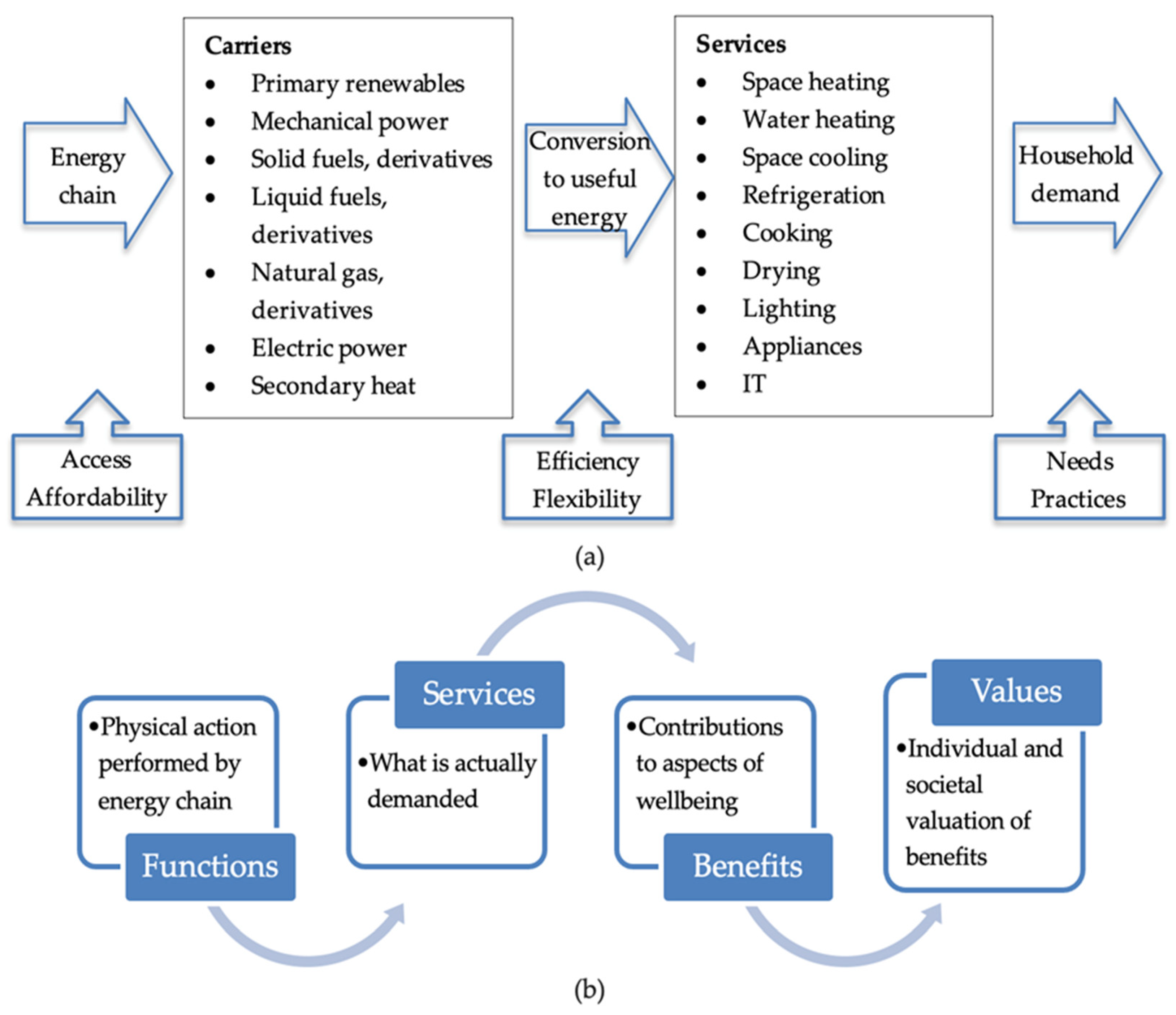
Figure 2.
Outline of a general framework to assess energy poverty.
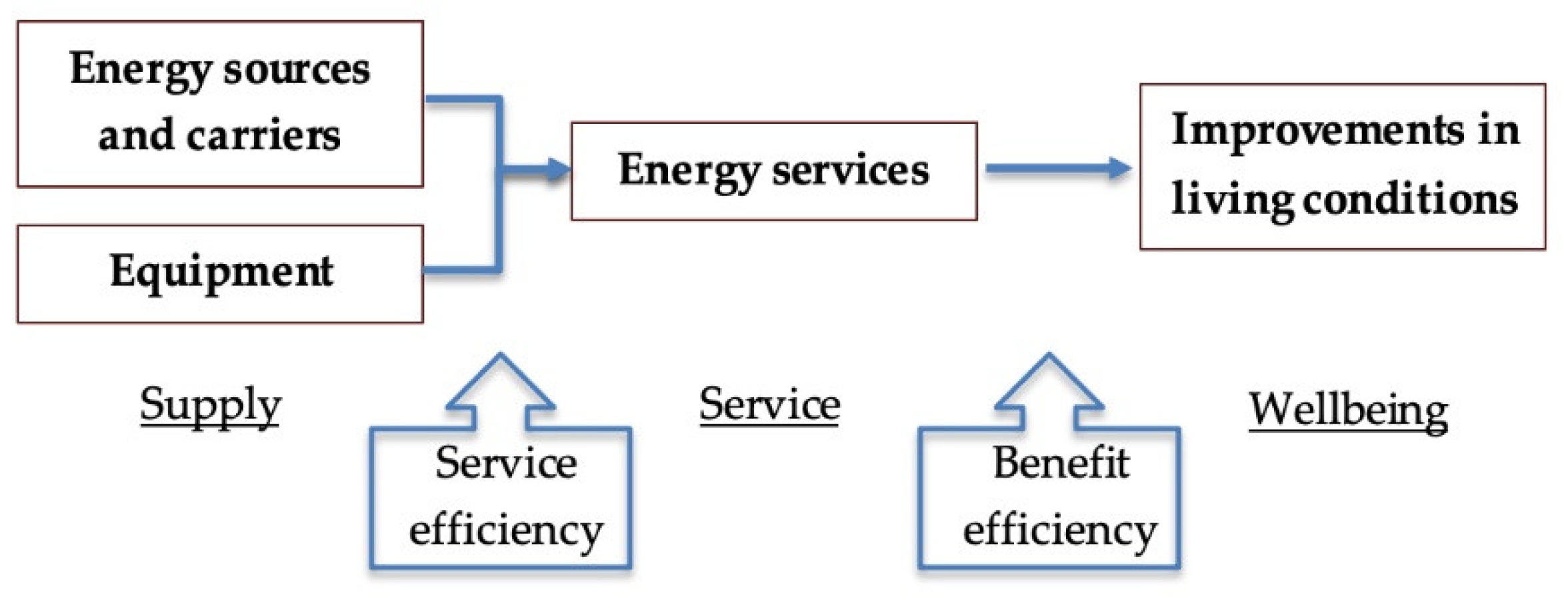
Figure 3.
Dimensions of the Multi-Tier framework and their attributes. Adapted from [22].
Figure 3.
Dimensions of the Multi-Tier framework and their attributes. Adapted from [22].
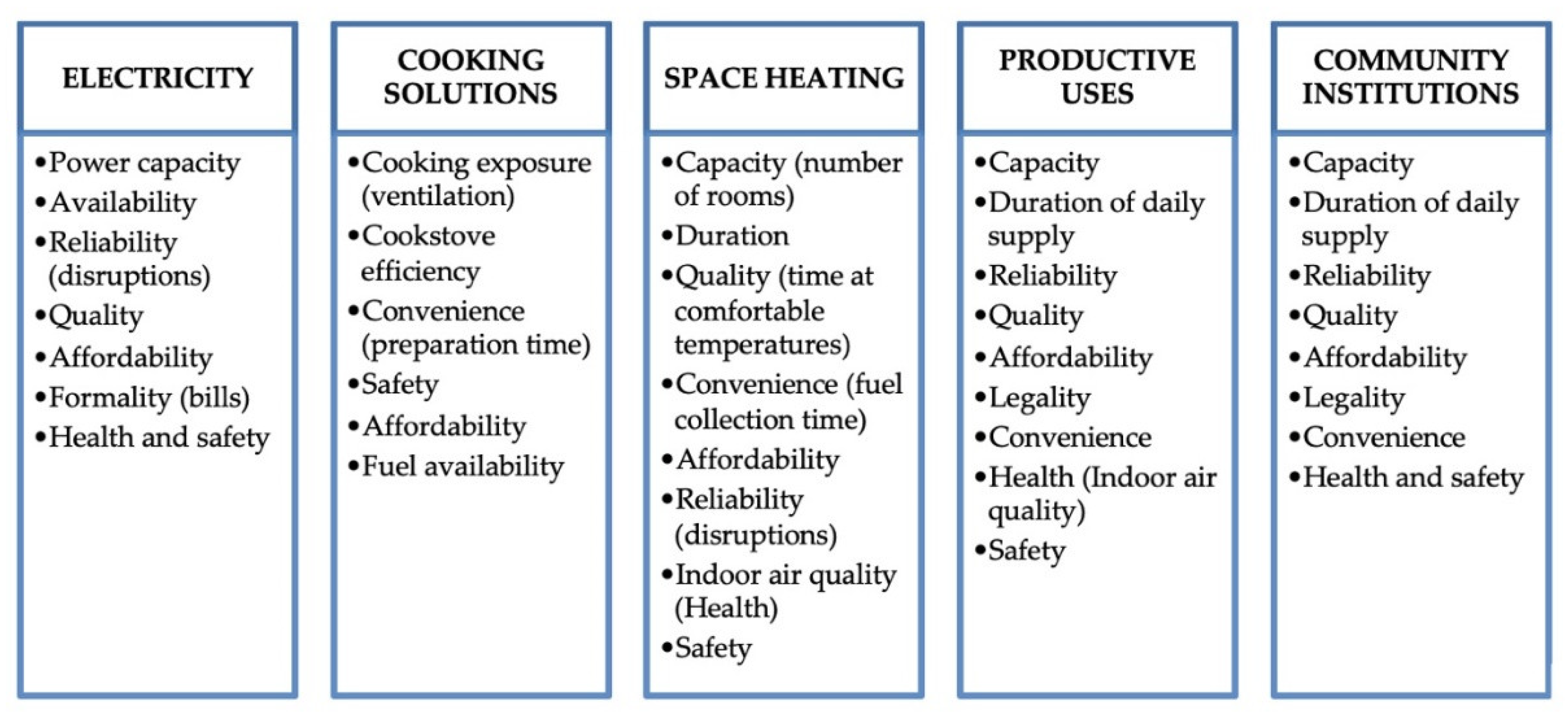
Figure 4.
Categories of energy equipment.
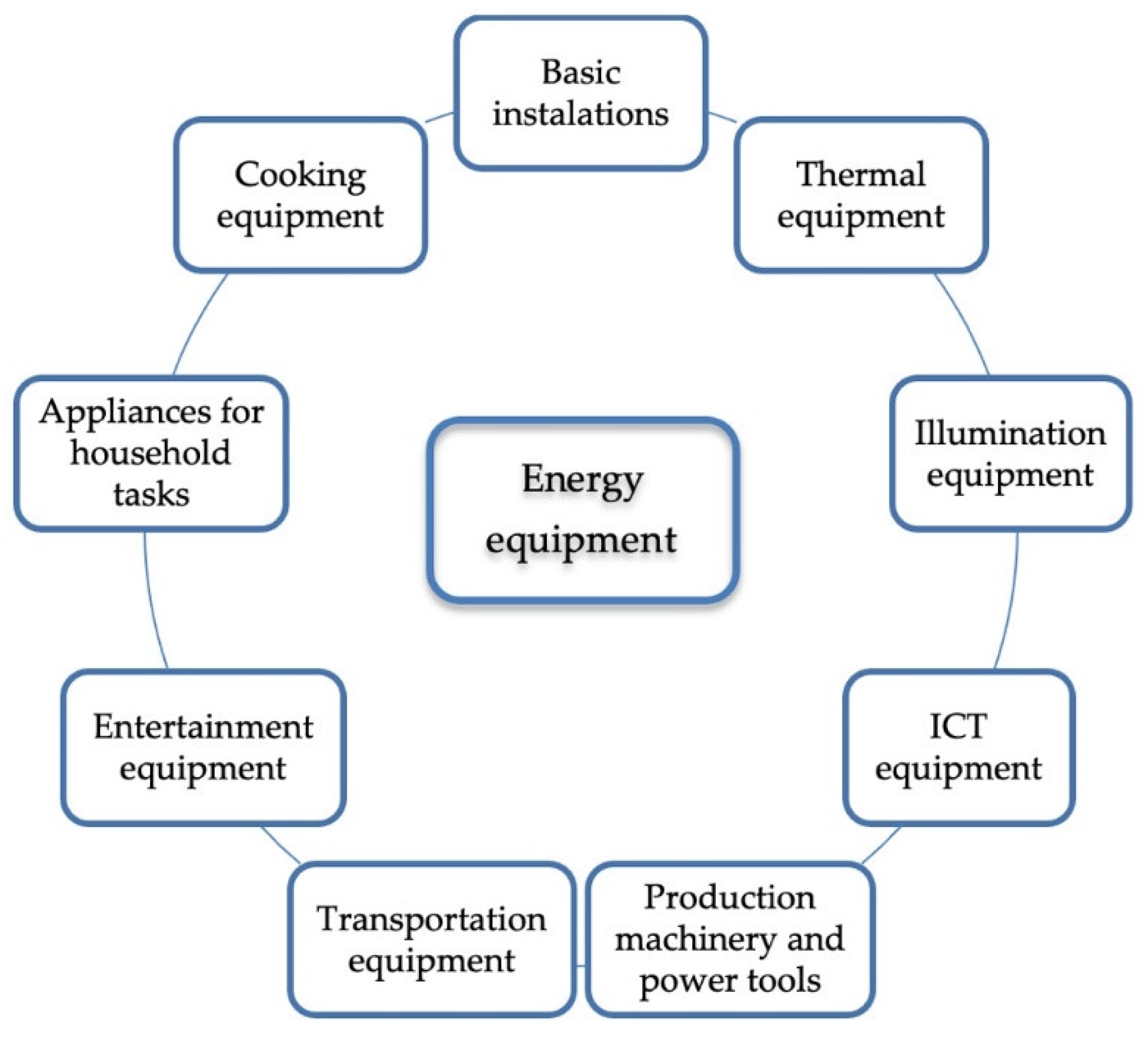
Figure 5.
Three relevant taxonomies of basic human needs.
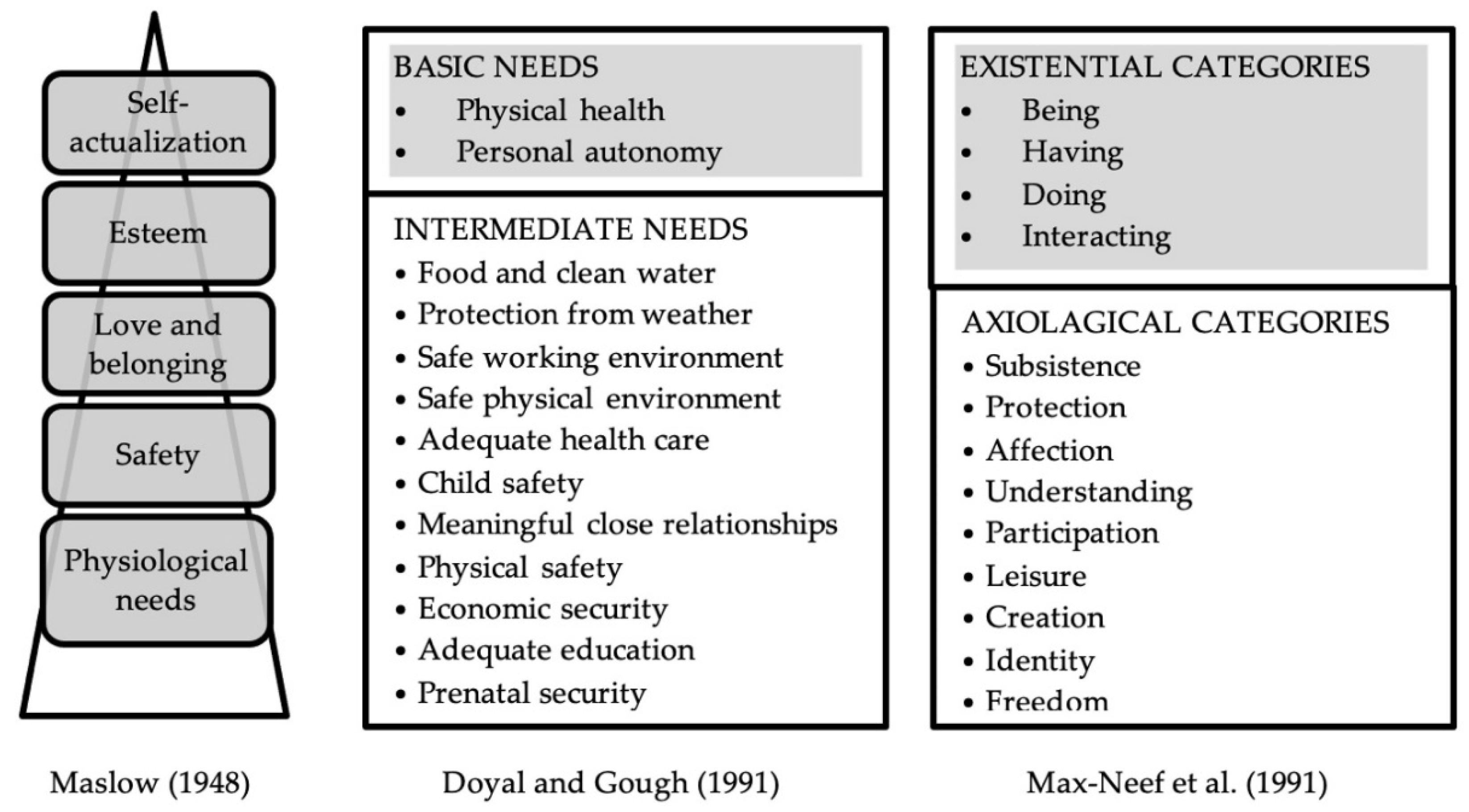
Figure 6.
Outline of a cascade of energy equipment, energy services, satisfiers and absolute needs following [28,56].
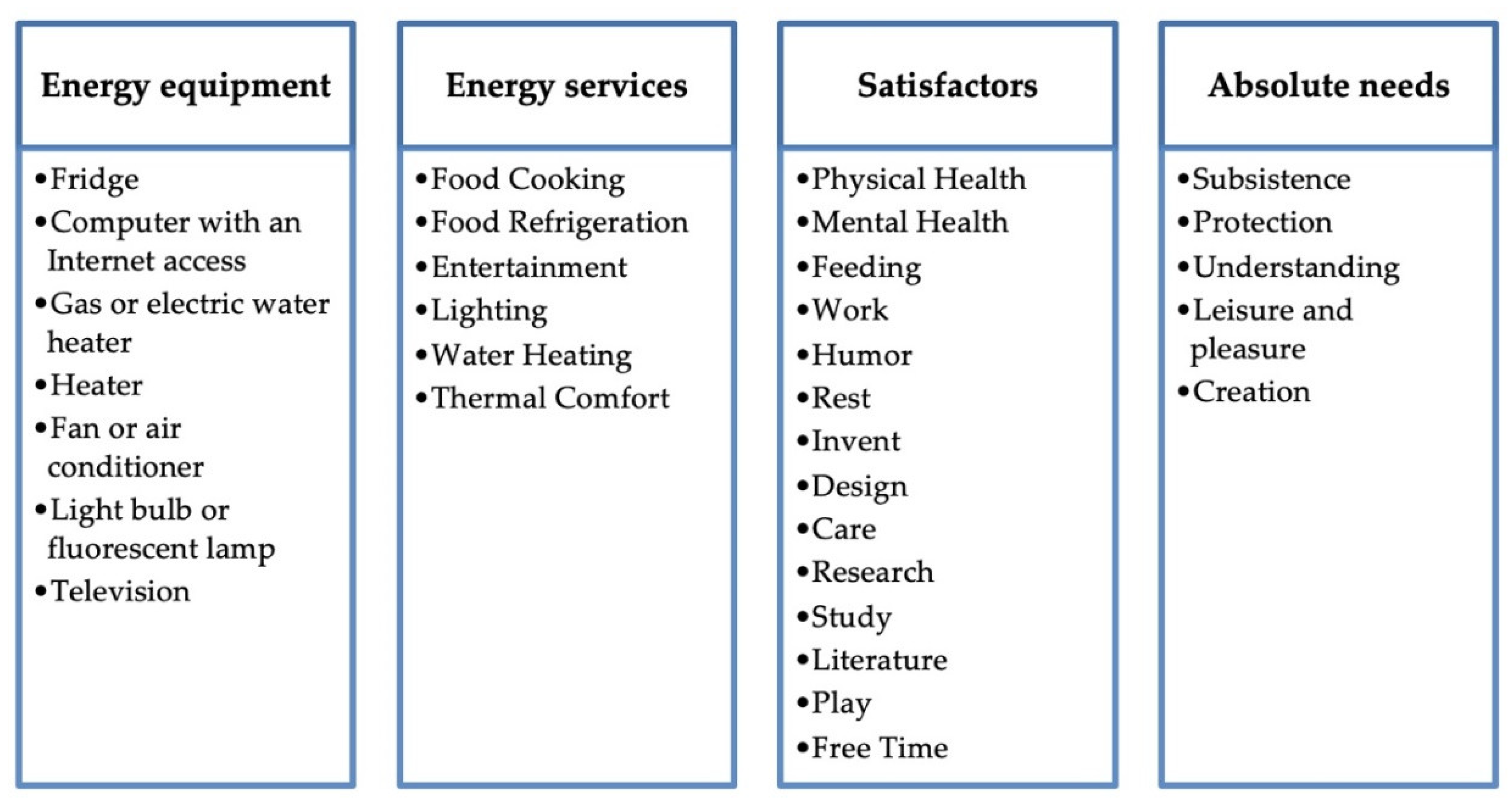
Figure 7.
Relationship between energy, services, and outcomes, with related interventions for energy poverty alleviation, adapted from [9].
Figure 7.
Relationship between energy, services, and outcomes, with related interventions for energy poverty alleviation, adapted from [9].
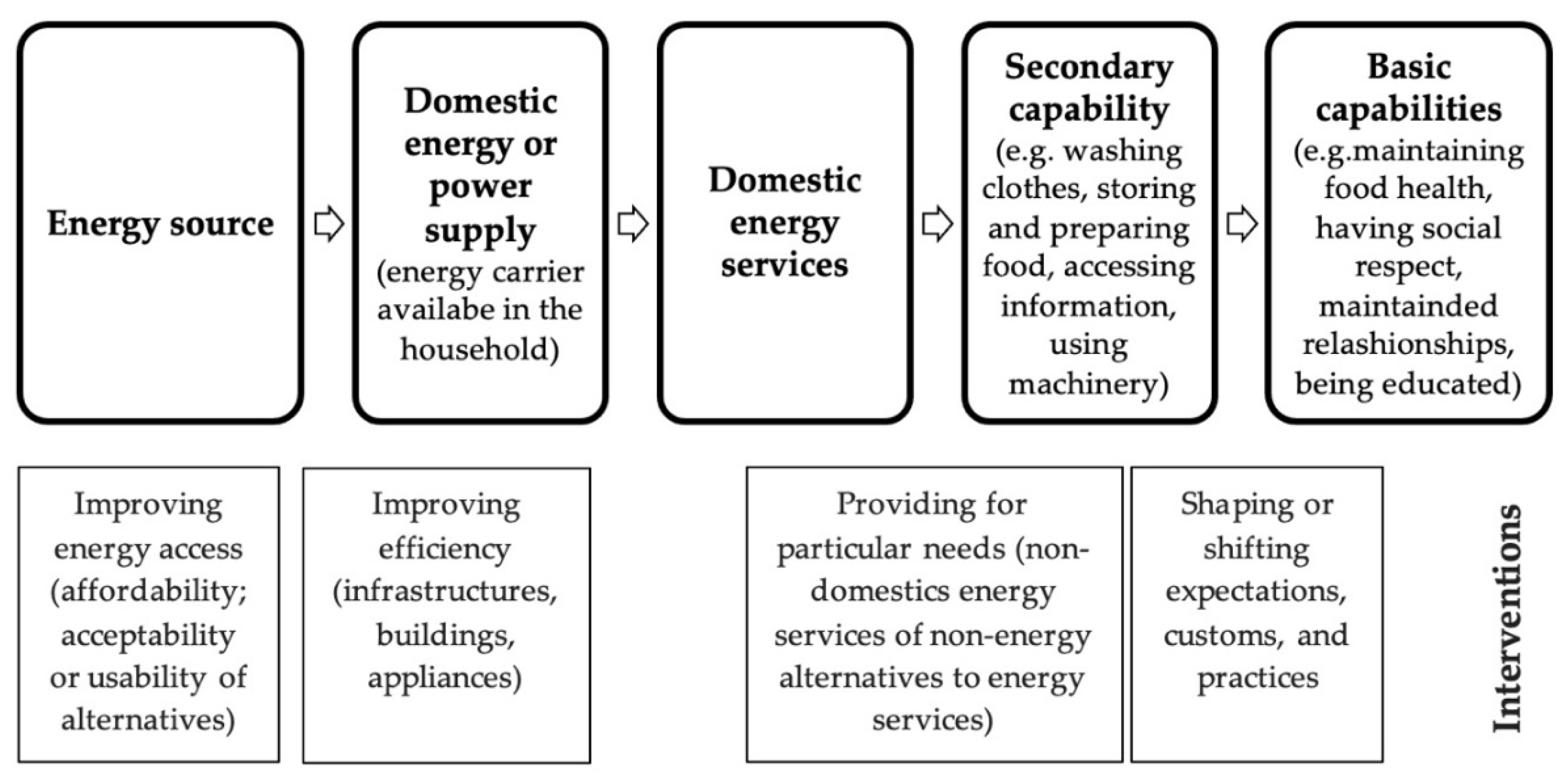
Figure 8.
Decent living standard dimensions for objective wellbeing according to [66].
Figure 8.
Decent living standard dimensions for objective wellbeing according to [66].
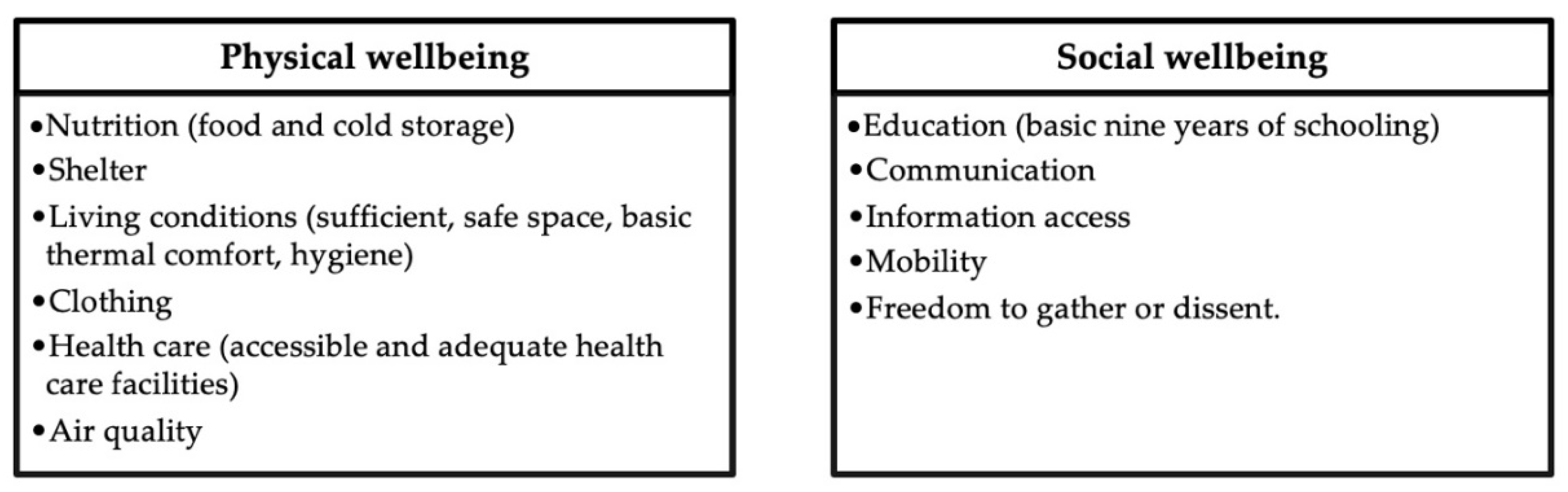
Figure 9.
Framework for evaluation of energy poverty.
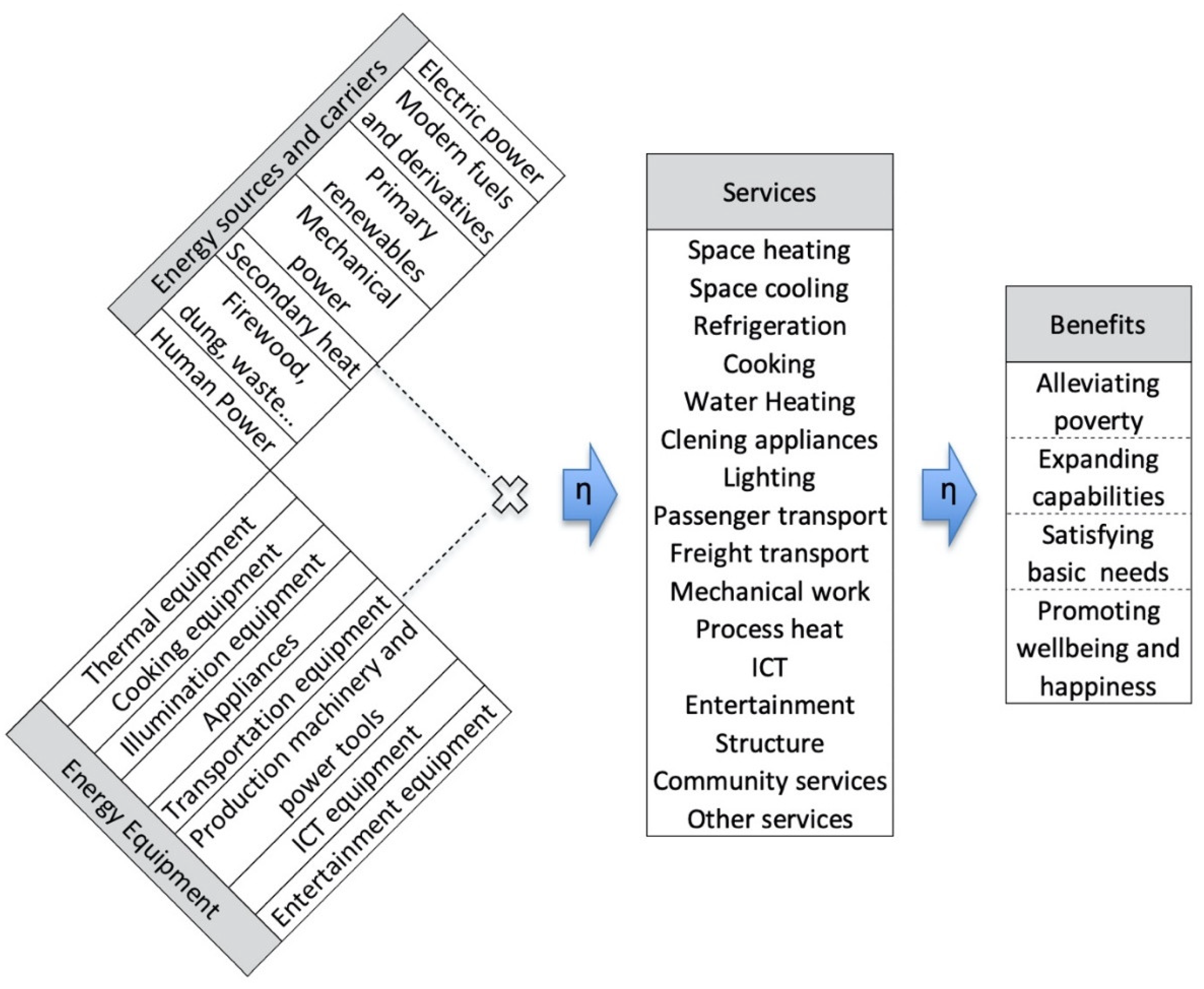

Table 1.
Material deprivation criteria used for assessment of poverty and its relationship with energy issues.
Table 1.
Material deprivation criteria used for assessment of poverty and its relationship with energy issues.
| Material Deprivation criteria | Poverty Index | Link to Energy |
|---|---|---|
| No child aged 10 has completed 6 years of schooling | MPI | Indirect or no relation |
| At least one school-aged child is not attending school | MPI, UBN | Indirect or no relation |
| At least one child is stunted or underweight | MPI | Indirect or no relation |
| One or more children have died in the family | MPI | Indirect or no relation |
| No access to electricity | MPI | Energy criterion |
| Household uses “dirty” cooking fuel | MPI | Energy criterion |
| No access to improved drinking water | MPI, UBN | Energy-linked |
| No access to improved sanitation | MPI, UBN | Indirect or no relation |
| Floor, roof, or walls are of rudimentary materials | MPI, UBN | Indirect or no relation |
| No computer | MPI | Partially energy-linked |
| No animal cart, bicycle, motorbike | MPI | Energy criterion |
| No refrigerator | MPI | Energy criterion |
| No television set (or radio) | MPI, EU-AROPE | Energy-linked |
| No car or truck/van | MPI, EU-AROPE | Energy criterion |
| No telephone | MPI, EU-AROPE | Partially energy-linked |
| Overcrowding (> 2,5 -5 persons per bedroom) | UBN | Indirect or no relation |
| Low economic capacity | UBN | Indirect or no relation |
| Unable to pay rent, mortgage, or utility bills | EU-AROPE | Partially energy-linked |
| Unable to keep home adequately warm | EU-AROPE | Energy criterion |
| Unable to face unexpected expenses | EU-AROPE | Indirect or no relation |
| Unable to eat meat or proteins regularly | EU-AROPE | Indirect or no relation |
| Unable to go on holiday (one week) | EU-AROPE | Indirect or no relation |
| No washing machine | EU-AROPE | Energy-linked |
| No internet connection | EU-AROPE | Partially energy-linked |
| Unable to replace worn out furniture | EU-AROPE | Indirect or no relation |
| Unable to replace worn out clothes | EU-AROPE | Indirect or no relation |
| Do not have two pair of shoes | EU-AROPE | Indirect or no relation |
| Unable to spend a small amount of money on one-self | EU-AROPE | Indirect or no relation |
| Do not have regular leisure activities | EU-AROPE | Partially energy-linked |
| Do not get together with friends/family for a meal | EU-AROPE | Partially energy-linked |
Table 2.
Energy supply indices and places where they have been assessed, adapted from [6].
Table 2.
Energy supply indices and places where they have been assessed, adapted from [6].
| Indices | Region or country to which it has been applied |
|---|---|
| SDG7 indicators | 193 UN countries |
| Energy Development Index | Algeria, Angola, Argentina, Bangladesh, Benin, Bolivia, Botswana, Brazil, Cambodia, Cameroon, China, Colombia, Congo, Costa Rica, Côte d’Ivoire, Cuba, Dem. Rep. of Congo, Dominican Republic, Ecuador, Egypt, El Salvador, Eritrea, Ethiopia, Gabon, Ghana, Guatemala, Haiti, Honduras, India, Indonesia, Iran, Jamaica, Jordan, Kenya, Lebanon, Libya, Malaysia, Mongolia, Morocco, Mozambique, Myanmar, Nepal, Nicaragua, Nigeria, Pakistan, Panama, Paraguay, Peru, Philippines, Senegal, South Africa, Sri Lanka, Sudan, Syria, Tanzania, Thailand, Togo, Tunisia, Uruguay, Venezuela, Vietnam, Yemen, Zambia, Zimbabwe, |
| Multidimensional Energy Poverty Index |
Albania, Angola, Armenia, Azerbaijan, Bangladesh, Benin, Bolivia, Burkina Faso, Burundi, Cambodia, Cameroon, Colombia, Congo Brazzaville, Congo Democratic Republic, Dominican Republic, Egypt, Ethiopia, Ghana, Guatemala, Guinea, Guyana, Haiti, Honduras, India, Indonesia, Jordan, Kenya, Lesotho, Liberia, Madagascar, Malawi, Maldives, Mali, Mexico, Moldova, Morocco, Mozambique, Namibia, Nepal, Nicaragua, Niger, Nigeria, Pakistan, Peru, Philippines, Rwanda, Sao Tome & Principe, Senegal, Sierra Leone, South Africa, Swaziland, Tanzania, Timor-Leste, Uganda, Ukraine, Vietnam, Zambia, Zimbabwe, |
| Energy Supply Index | Kenya, Nepal, Peru |
| Total Energy Access | Kenya, Nepal, Peru |
| Multi-Tier Framework | Bangladesh, Cambodia, Ethiopia, Honduras, India, Kenya, Myanmar, Nepal, Niger, Rwanda, Sao Tomé and Príncipe, Zambia. |
| Composite Energy Poverty index | ASEAN Region and India |
| Global energy vulnerability index | worldwide OECD and non-OECD countries, regions, and territories (265 countries) |
| Energy Poverty Index | China and Germany |
| Energy Access Indicators | South Africa |
| Comprehensive Energy Poverty Index | China |
| Meeting of Absolute Energy Needs | Mexico |
Table 3.
Taxonomy of energy equipment.
| Categories | EU groups | CLASP groups | Japan Top runner groups |
|---|---|---|---|
| Thermal equipment | Local space heaters Space heaters Solid fuel boilers |
Central heating boilers Central heating furnaces Other space heating units |
Space heaters |
| Water heaters | Water heating appliances | Water heaters | |
| Air conditioners and comfort fans | Non-ducted AC Central AC Chillers |
Air conditioners | |
| Ventilation units | Ventilation fans | ||
| Cooking equipment | Domestic ovens Range hoods Hobs |
Residential cooking equipment | Electric rice cookers Gas cookers Microwave ovens |
| Illumination equipment | Light sources | General purpose lighting Directional lighting |
Fluorescent lights |
| Appliances | Fridges and freezers | Refrigeration appliances | Refrigerators/freezers |
| Dishwashers | Dishwashers | ||
| Washing machines | Clothes washing machines | ||
| Tumble driers | Clothes dryers | ||
| Vacuum cleaners | Electric toilet seats | ||
| Transportation equipment | Passenger vehicles | ||
| Production machinery and power tools | Water pumps circulators |
Pumps and circulators | |
| Power transformers | Transformers | Transformers | |
| Electric motors | Electric motors | ||
| Welding equipment | |||
| ICT equipment | TV and Electronic displays | Televisions Displays Digital television decoders |
Televisions |
| Smart phones and tablets | |||
| Computers | PCs and servers | Computers | |
| Servers and data storage | Storage units | ||
| Imaging equipment | Copying machines | ||
| External power supplies | External power supplies and battery chargers | ||
| Entertainment equipment | Game consoles | Audio equipment | VCRs |
Table 4.
Taxonomy of energy services, derived from [32].
Table 4.
Taxonomy of energy services, derived from [32].
| Categories | Aspects, related terms, synonymy | Equipment categories (from Figure 4) |
|---|---|---|
| Heating | Space heating, comfort, room temperature | Thermal equipment |
| Water Heating | Hot water | |
| Cooling | Space cooling and conditioning | |
| Cooking | Food preparation | Cooking equipment |
| Refrigeration | Freezing. Storage and preservation |
Appliances for household tasks |
| Lighting | Illumination | Illumination equipment |
| Transport | Mobility. Personal and freight transport. Travel | Transportation equipment |
| Commercial/Industrial | Process heat. Processing. Compressed air. Welding. Milling | Production machinery and power tools |
| Other | Motive power, Mechanical power | |
| Drilling | ||
| Sawing | ||
| Water pumping | ||
| Irrigation | ||
| Appliances | Appliances for household tasks | |
| Clothes washing | ||
| Clothes drying | ||
| Dish washing | ||
| Heated toilets | ||
| Ironing | ||
| Sewing | ||
| ICT | ICT equipment | |
| Television | ||
| Communications | ||
| Computing | ||
| Education | ||
| Electronics | ||
| Phone charging | ||
| Radio | ||
| Entertainment | Entertainment equipment | |
| Ventilation | Thermal equipment | |
| Food processing | Cooking equipment | |
| Water treatment | Not included | |
| Health | ||
| Community services |
Table 5.
Grouping of energy services by several authors.
| Cullen and Allwood (2010) [55] |
Practical Action* (2012) [49] |
Bouzarovski and Petrova (2015) [8] | García-Ochoa and Graizbord (2016) [56] | Fell (2017) [32] |
Brand-Correa et al. (2018) [26] |
UNDP-Chile (2018) [57] |
||
|---|---|---|---|---|---|---|---|---|
| Thermal comfort | Space heating | Space heating | Thermal comfort | Heating | Heating | Heating | ||
| Cooling | Space cooling | Cooling | Cooling | Ventilation, cooling | ||||
| Sustenance | Refrigeration | Food refrigeration | Refrigeration | Food | Food refrigeration | |||
| Cooking and water heating | Cooking | Food cooking | Cooking | Cooking | ||||
| Hygiene | Water Heating | Water Heating | Water Heating | Domestic hot water | ||||
| Appliances (washing) | ||||||||
| Illumination | Lighting | Lighting | Lighting | Lighting | Illumination | Lighting | ||
| Passenger transport | Transport | Mobility | Mobility, transport | |||||
| Freight transport | ||||||||
| Commercial / Industrial |
Mechanical work | Mechanical power (water pumping) | ||||||
| Process heat | ||||||||
| Communication | ICT | Information | Other (ICT, entertainment production, appliances, water treatment, health service community services) | ICT | Communication | |||
| Entertainment | Entertainment | |||||||
| Structure | Structure | |||||||
| Drying | ||||||||
* Services with minimum standards for the Total Energy Access Index.
Disclaimer/Publisher’s Note: The statements, opinions and data contained in all publications are solely those of the individual author(s) and contributor(s) and not of MDPI and/or the editor(s). MDPI and/or the editor(s) disclaim responsibility for any injury to people or property resulting from any ideas, methods, instructions or products referred to in the content. |
© 2024 by the authors. Licensee MDPI, Basel, Switzerland. This article is an open access article distributed under the terms and conditions of the Creative Commons Attribution (CC BY) license (http://creativecommons.org/licenses/by/4.0/).
Copyright: This open access article is published under a Creative Commons CC BY 4.0 license, which permit the free download, distribution, and reuse, provided that the author and preprint are cited in any reuse.


