

Submitted:
16 June 2024
Posted:
17 June 2024
Read the latest preprint version here
Abstract
Most astrophysicists today believe that the present universe was produced in a big bang. This article explores the big cycle of matter and energy in the universe, with the big bang as an important part of the cycle.The authors approve of the idea that the universe is gravitationally closed. That is, its average density is higher than the critical value. All the matter and radiation cannot fly out the closed universe.The 3k background radiation is a vast heat ocean in the closed universe, stable and eternal. It is not the afterglow of the thermal radiation of the decoupled fire ball, 380,000 years after the big bang, as many people believed so far. The big bang and the following big expansion drove the matter of more than 2×10¹² galaxies to the remote space. Their potential energies become higher and higher, while their huge kinetic energies that they derived from the big bang become smaller and smaller until drop down to zero. The galaxies will then return back one after another, passing the central region of the universe with tremendously great kinetic energies. They of course cannot all return back directly to their start point of the big bang and restore to the state of the original cosmic core. They will rush to pass the central region and fly to the other sides of the universe, and shuttle around the central part ceaselessly. From the big bang to the following expansion, to the numerous galaxies, to the more than 2×10²³ stars, and to the stars releasing huge nuclear energy due to their internal nuclear fusion each for about 1010 years, all these enormous processes are irreversible, resulting in enormous increase in entropy. These processes produce large amount of light and other radiations and pour them into the extremely vast heat ocean. These light and other radiations will also be shuttling ceaselessly in the vast heat ocean until, by their interaction with the rare dusts in the galaxies, they mingle into the 3K thermal radiation of the heat ocean. In all the galaxies, there are various black holes. Every black hole, since its birth, ceaselessly extracts the matter and radiation that approach it, and gets larger. In the above mentioned shuttling of all the galaxies, numerous stars and black holes in these galaxies have many chances to approach even meet each other. A black hole can annex other celestial bodies that it meets, including annex other black holes. All these processes carry on and on ceaselessly, resulting in the matter of these celestial bodies to concentrate again and again. The number of all the celestial bodies including the black holes reduces ceaselessly, and the mass of the survived black holes become larger, and their shuttling amplitudes become shorter. The larger black holes and the shorter amplitudes result in the rate of concentration of mass to be faster. Eventually, all the matter in the universe will be concentrated to form a tremendously large central black hole. The central black hole has an astonishingly large Schwarzschild sphere, absorbing the thermal radiation from the vast heat ocean very rapidly and ceaselessly until some threshold value of its internal energy is exceeded, and a new big bang breaks out. The black holes provide a way in the Universe to re-concentrate matter and energy again. Black holes are Maxwell’s demons in the Nature.
Keywords:
closed universe
; an eternal heat ocean at a temperature of 3K
; the big cycle of matter and energy
; matter shuttling and radiation shuttling
; black holes are demons in the Nature
; cosmos thermodynamics
1. The Re-Concentration of All the Matter that Have Scattered into the Space by the Big Band
Most of today’s astrophysicists approve of the theory of the Big Bang. The future fate of the universe depends on its average density: If the average density is less than 1, the universe is open; if the average density is equal to 1, the universe is flat; if the average density is greater than 1, the universe is closed.
The authors of this article approve of the idea that the universe is closed, that is, its average density is greater than 1. The cause of its close is of course the extraordinary huge mass within it. All the galaxies, the dark matter, even the mass of the heat ocean, and so on, may all be the contributors of the gravitational close of the universe.
Billions over billions of galaxies produced in the big bang are now flying outward with various fierce speeds, with their individual potential energy increasing ceaselessly. (1) (2) After reaching their individual far-most sites, they return back one after another, passing the central part of the heat ocean with huge kinetic energies, and fly on to the opposite far most sites, then they turn back again, and in such a way, shuttle ceaselessly.
The ceaseless shuttles offer many opportunities for the numerous various celestial bodies in all these galaxies to approach even meet each other. There are also many black holes among these celestial bodies. Annexation occurs when a black hole meets another celestial body or another black hole. After an extremely long shuttling process, the total number of the black holes and other celestial bodies will gradually reduce. The mass of each survived black hole will become larger, and their shuttling amplitudes become smaller. As the black holes become larger and their shuttling amplitudes become smaller, the general annexations processes will become faster and faster. Eventually, all the matter within the closed universe should concentrate together to form an extremely large central black hole.
At that time, the picture of the universe becomes very simple: The whole universe is an extraordinary immense and very dilute heat ocean at a temperature of about 3K, and at the center of the heat ocean, there is an extremely massive central black hole, containing all the genuine matter of the universe. The whole geometric pattern is similar to the one of a hydrogen atom.
The formation of the central black hole accomplishes the first preparation for the next big bang: the re-concentration of matter.
Black holes contribute an adhesion mechanism in the re-concentration of matter.
Black holes also have another important re-concentration function: to collect an extraordinary immense amount of energy from the 3K heat ocean for the next big bang.
2. In the Closed Universe There Is a Stable and Eternal Immense Heat Ocean at a Temperature of about 3K
In 1965, Penzias and Wilson unexpectedly discovered the 3K microwave background radiation coming from remote space.(3) The background radiation shows three fundamental characteristics: (1) long term stability, (2) perfect isotropy, (3) its spectrum coincides with Planck’s formula for equilibrium thermal radiation at a temperature of 3K (i.e., black body radiation). They are exactly the same fundamental characteristics of the equilibrium radiation in a cavity within a solid at a constant temperature. Accordingly, what Penzias and Wilson discovered is an extremely immense and stable ocean of 3K equilibrium thermal radiation within the closed universe.
In any direction in the solid angle, all the observations inform us that the uniform and stable 3K background thermal radiation comes from extremely remote space.
People are curious, how deep is the heat ocean? How large is its volume?
The background radiation is an equilibrium thermal radiation. It is impossible to measure its depth directly by whatever an astronomic observation.
The heat ocean at the temperature of 3K is impossible to be infinitively large, its volume must be limited. Otherwise, according to the discussions by many scholars in the history since Newton, it would have been instable and collapse down.
The 3K heat ocean must be closed, that coincides with the close of the universe. Otherwise, the thermal radiation within the heat ocean would fly off and go far away, never return back. If so, the amount of the thermal radiation in the heat ocean would decrease ceaselessly, a stable heat ocean would be impossible to exit as we see it now. (2) (3) (4)
Many scholars regard that the 3K background radiation is the afterglow of the thermal radiation of the decoupled fire ball 380,000 years after the big bang when the temperature of the fire ball felt down to 3000K. The electrons and protons in the plasma in the fire ball combined to become hydrogen atoms. The fire ball decoupled. The particle matter in the fire ball become transparent, it no longer interact with the thermal radiation. They regarded further that the thermal radiation got free, flied out to the vast cosmic space and expanded adiabatically until it converted to a 3K thermal radiation, and its spectrum also changed to a Planck’s spectrum of the temperature of 3K.
What is the meaning by their “adiabatic expansion”? It is of course impossible to be a quasi static expansion occurred in a piston-cylinder like device. It should be a free ejection of radiation, similar to the free ejection of light and heat of the sun or any other star. The radiation of the light and other radiations of a star 10 million light years away from our earth are free ejection, when they reach our earth, the volume intensity of the radiation is already extremely weak, but its spectrum is still the same one as it just left from its mother star. The same thing happened to the decoupled thermal radiation. The decoupled 3000K radiation was then a free ejection, just like the light and other radiations of the sun or other stars. It would not convert to a 3K equilibrium radiation through an “adiabatic expansion”.
Let us go on.
The big bang and many of its follow up processes are all immense irreversible processes. All of these processes produce entropy, and according to the second law of thermodynamics, entropy can only be produced, never be reduced. Actually all these processes emit tremendous amount of light, heat and other radiations into the heat ocean.
First, the big band is a big explosion, and which, together with the following expansion of the primitive fire ball, are certainly huge irreversible processes. They scatter a great amount of light, heat and other radiations into the surrounding space, i.e., into the vast 3K heat ocean.
About 380 000 years after the big bang, the temperature of the expanding primitive fire ball dropped to about 3000K, the electrons and protons in the plasma in the fireball combined to become hydrogen atom. The matter in the fire ball became transparent. The thermal radiation and the matter in the fire ball no longer exchange heat each other, they decoupled. All the remnant thermal radiations in the fire ball got free, ejected out in all the directions, and entered the vast heat ocean (for more details, please read our new article in the appendix. (8) )
In the big expansion, numerous galaxies were formed, these processes were also irreversible. And, in all the galaxies, numerous nebulae developed into even more numerous stars, these processes were also irreversible. Then in a long period, there formed more than 2×10²³ stars in the whole universe, like the sun, each star has a lifetime of about 1010 years, ejecting ceaselessly light and heat and so on due to the energy produced in their internal nuclear fusions. And so on.
All these irreversible processes in the various stages of the universe have a common point: they all finally release huge amount of energy in the forms of light, heat and other radiations, pouring into the 3K heat ocean. After entering the heat ocean, all these light, heat and other radiations, also shuttered around the central part of the universe ceaselessly in various directions, and gradually (with a very long relaxation time) mingled into the 3K thermal radiation of the heat ocean .
From another point of view, all the above processes are sending energy ceaselessly into the heat ocean. Although the 3 K heat ocean is very dilute, its volume and total mass are both extraordinary large. Hence, all the above mentioned large amount of input energy of light and heat, might only raise the temperature of the heat ocean very slightly. The temperature of the heat ocean is fundamentally stable.
Now, let us surmises briefly the structure of the 3K heat ocean itself.
First, let us calculate the mass density of the 3K heat ocean.
From the Stefan-Boltzmann’s law, the radiation intensity of the surface of a black body at T = 2.73K is
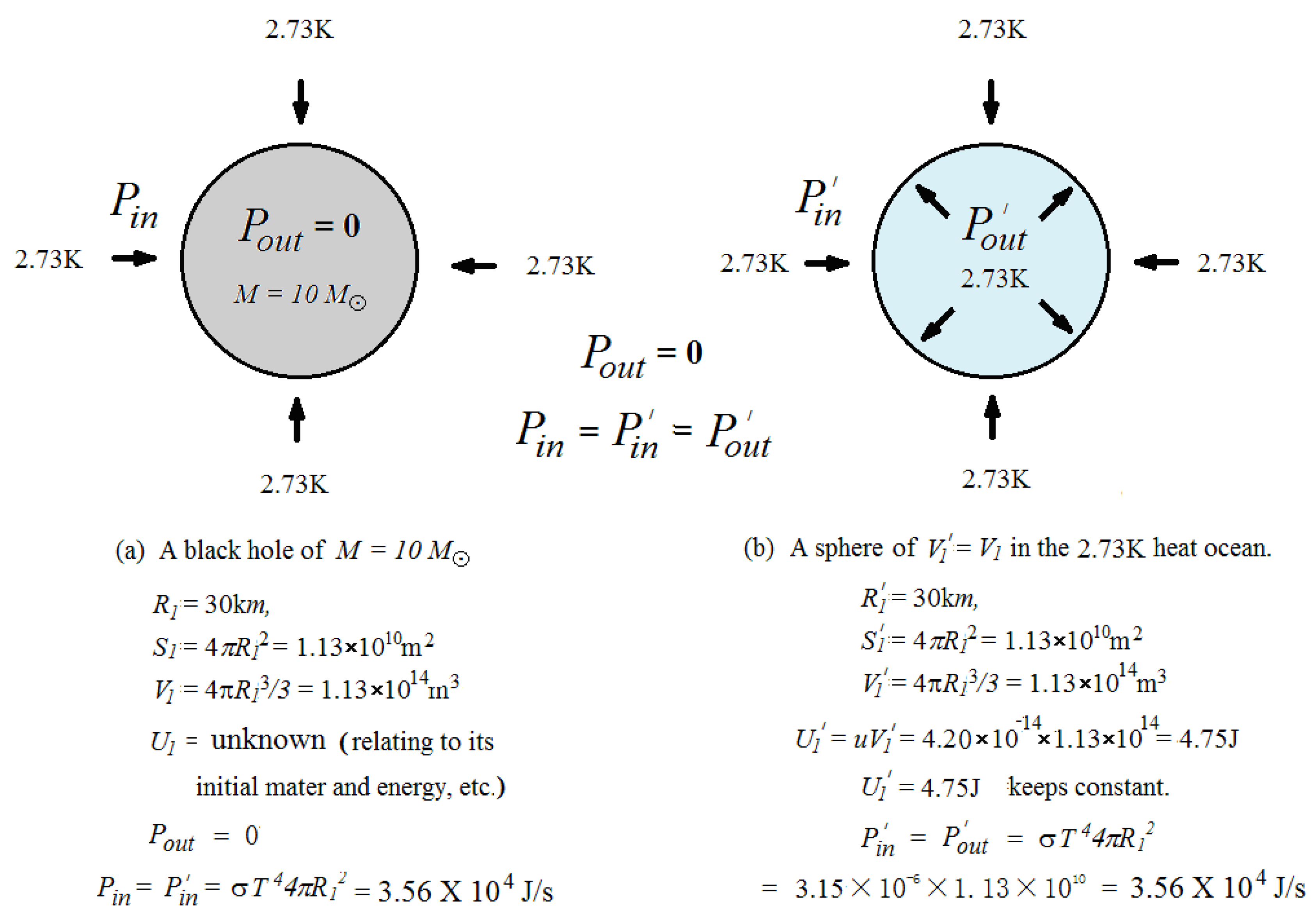
As is well known, the relation between the radiation intensity of the surface of a black body j and the energy density of the equilibrium thermal radiation in a solid cavity at the same temperature u isdensity of the thermal radiation decreases to zero. Beyond R2, is the infinitively vast empty space.
Hence, we have, at T = 2.73K
Then, the mass density of the 2.73K thermal radiation in the heat ocean is,
Now, in our imagination, the central part of the heat ocean is the galaxy region, represented by a very small circle in Figure 1. Next, containing the galaxy region and within the radius of R1, is the T = 2.73K region, as shown by the blue part in Figure 1 and Figure 2. Then, from R1 to R2 is the thermal radiation decaying region, as shown by the light blue part in Figure 1 and Figure 2, with the temperature falls down gradually from 2.73K to 0K, and with a mass decaying distribution function
as shown in Figure 2. Finally, out of R2, is the infinitively vast space, the cosmic vacuum.
In the 2.73K region, and, also in the thermal radiation decaying region, all the outward flying photons undergo red shift. Strictly to say, an outward flying photon is almost impossible (or very scarcely to be) precisely along the radius of the black hole. So, guided by their tangential kinetic energy, the photons will eventually turn back and fly towards the central part of the heat ocean, undergoing blue shift. All the photons in the heat ocean will keep shuttling ceaselessly in such a way, with the whole closed heat ocean keeps fundamentally stable and equilibrium.
As the heat ocean is extremely large, its total mass may also have some contribution to the gravitational close of the universe.
The authors allege, the tremendously vast 3K background radiation is a stable and eternal heat ocean. It exited before the Big Bang. It exits now. It will exist in the future. It is not the afterglow of the thermal radiation of the decoupled fire ball
3. Re-Concentration of Energy from the Heat Ocean
Within the immense heat ocean, in the galaxy region, the 2.73K thermal radiation ceaselessly travels everywhere. For any black hole, the surrounding 2.73K thermal radiation pours into it from all the directions at the speed of light. Every black hole absorbs ceaselessly the 2.73K thermal radiation from the heat ocean since its birth, throughout its extremely long lifetime.
Let us see 3 examples of 3 different grades.
- (1)
- A black hole with a mass of 10 times of the sun, as shown in Figure 3 (a). The value of its mass isM1 = 10 M⊙ = 10×(2×1030 )= 2×1031 kg.
Its Schwarzschild radius is
When the M1 = 10 M⊙ black hole was formed, most of the matter and energy of
its original star were collapsed into the central region of the new born black hole. The huge amount of the potential energy of all the matter of the original star first converted to kinetic energy in the collapsing process, and finally concentrated into the central region of the new born black hole. With the radius R1 = 30km, the volume of the black hole is much smaller than the original M1 = 10 M⊙ star. So, the internal energy of the black hole is extremely great and highly concentrated, that may be considered corresponds to some extremely high temperature.
The M1 = 10 M⊙ black hole is immersed in the immense ocean of 2.73K thermal radiation. So, it extracts the thermal radiation from the heat ocean ceaselessly in all the direction at the light speed.
The volume and surface area of this black hole are
respectively.
V1 = (4π/3)R13 = 1.13×10¹⁴m3.
S1 = 4πR12 = 1.13×10¹⁰m2.
Now, imagine a same volume in the heat ocean,
V1′= V1 = 1.13×10¹⁴m3 .
Its temperature is 2.73K. The energy of the 2.73K thermal radiation in V1′is
U1′=u V1′= 4.20×10-14×1.13×1014 = 4.75J.
The M1 = 10 M⊙ black hole swallows in energy from the heat ocean with a power
P1 = σΤ44πR12 = 3.15×10-6×1.13×1010 = 3.56×10⁴J/s.
In each second,the M1 = 10 M⊙ black hole swallows in many 2.73K thermal radiation of V1′ from the heat ocean, the corresponding number N1 is
N1 = P1 / U1′ = 3.56×10⁴ ÷4.75 = 7494 ≈ 7500,
In one day, the corresponding number is
Nday = 86400×7500 =6.5×10⁸.
In one year, the corresponding number is
Nyear =365×6.5×108 = 2.37×10¹¹.
In one million years, it is
N 106 years = 2.37×1011×106 = 2.37×10¹⁷.
One million years is a twinkle of an eye in the long lifetime of any black hole.
Hence, we see, compared to the 2.73K thermal radiation in the very cold heat ocean, the interior of a black hole is in a state at an extremely high temperature, and the temperature is rising ceaselessly.
We conclude that, the 2.73K thermal radiation pouring ceaselessly into a black hole
at the light speed is a process of spontaneous heat transfer from a very low temperature region to an extremely high temperature region.
Such a process is obviously in contradiction to the Clausius statement of the second law of thermodynamics (4).
It results in the decrease of entropy.
The event horizon of a black hole permits thermal radiation to pass from its low temperature exterior to its extremely high temperature interior, never the reverse. So, it is an ideal single-way membrane for the radiations, a Maxwell’s demon in the Nature. (5) (6) (7)
Numerous and various black holes in all the billions over billions of galaxies ceaselessly absorb great amount of heat from the vast heat ocean throughout their individual extremely long lifetimes. That is obviously an great energy concentration process.
- (2)
- A black hole of a mass of a galaxy, for an example, the central black hole of a galaxy
Such a black hole often has approximately a mass of 1010 times as M1, M2 ≈ 1010×10 M⊙ , and its spherical surface S2 is about 1020 times of S1. It absorbs the 2.73K thermal radiation from the heat ocean at a rate
P2 = σΤ44πR22= 3.15×10-6×1.13×1010 ×1020 = 3.56×1024s.
And the number N2 is
N2 = P2/ U1′ = 3.56×1024÷4.75 = 7494×1020 ≈ 7500×1020.
The rate of absorption of the thermal radiation from the heat ocean by the M2 = 1010×10 M⊙ black hole is extremely higher compared to the M1 = 10 M⊙ black hole.
The total rate of absorption of energy by all the black holes with a mass of the magnitude of a galaxy in the universe from the heat ocean is even more tremendously great.
As all these two kinds of black holes unite step by step to form eventually a central black hole, they will carry all the energy that was collected by them from the heat ocean in their individual long lifetimes together to enter the central black hole.
- (3)
- The central black hole of the universe, containing a larger mass than the mass of 2×10¹² galaxies.
It also absorbs the 2.73K thermal radiation ceaselessly at the light speed from the immense heat ocean. It has an extraordinarily large Schwarzschild spherical surface. Hence, its rate of absorption of energy of the thermal radiation from the heat ocean is astonishingly high. The internal energy of the central black hole rises extremely fast, and monotonically. Notice please, now, all the real matter has already been concentrated into the central black hole, there is no longer any new matter falls into it. So, the average energy possessed by per unit mass in the central black hole just rises and rises ceaselessly. The interior matter should undergo a series of endothermic reactions. By the end of all these endothermic reactions, the energy possessed by per unit mass of the interior matter reaches an extremely high level. The authors regard that the matter in such a state is closely identical to the “initial matter” or “ylem” described by Gamow et al in their theory of the thermal big bang.
The central black hole continues to absorb energy extraordinarily rapidly from the heat ocean. Its total internal energy continues to increase. That means, its internal repulsive factor continues to increase. Such a unidirectional process should not go on without an end. When a threshold value is reached and exceeded, a new big bang breaks out.
So far, we have accomplished the description of an extraordinarily big cycle of matter and energy in the universe. The explosion of the big bang is a special turning point in the big cycle.
The big bang and the big re-concentration of the matter and energy in the universe, is a big cycle. Such an idea leads to the birth of a new branch in astrophysics: cosmos thermodynamics.
5. Some Further Questions
How large is the heat ocean? How much is the total mass of the thermal radiation in the heat ocean? Is this mass also an important contributor to the gravitational close of the universe?
How much real matter (all the galaxies and so on) is there in the whole universe? How does the mass of all the real matter contribute to the gravitational close of the universe?
What is dark matter? How much is it altogether? How does it contribute to the gravitational close of the universe?
What is “ylem”? What a totally new and unknown matter state is the “ylem” in?
All these questions wait the future physics and astrophysics to answer.
Appendix
The 3K background radiation is not the afterglow of the remnant thermal radiation of the decoupled fire ball Xinyong Fu and Zitao Fu April 30, 2024
Many researchers regarded that 380,000 years after the big bang, the temperature of the expanding fire ball dropped down to about 3000K, the electrons and protons and so on in the plasma within the fire ball combined to become neutral atoms. The thermal radiation and the particle matter no longer exchange heat each other. That means, the particle matter in the fire ball became transparent for the thermal radiation. The thermal radiation got free and flied away at the speed of light in all the directions into the vast space.
They regard further that the 3000K thermal radiation then expanded adiabatically for an extremely long time to become finally the 3K background radiation of today.
The process of such an adiabatic expansion, from the initial 3000K equilibrium thermal radiation to the final 3K equilibrium thermal radiation, is very difficult to be conceived. How about the numerous intermediate states? Are they all in thermal equilibrium states, always have a spectrum coincide with the Planck’s formula? Is it really a quasi static adiabatic expansion? Such a process is out of imagination.
Actually, once the primitive fire ball was decoupled and changed to be transparent, all the thermal radiation within the decoupled fire ball began to fly away at the speed of light into the vast cosmic space in all the directions.
Their ejection is very similar to the free light ejection of the sun and other stars. All of them are free radiation at the speed of light, without any obstacle. In such a free ejection, with the distance get farther, the intensity of the radiation should become weaker. However, the spectrum of the radiation kept the same as it had been when it left its mother source, the decoupled fire ball.
The intensity of the light ejected from a star one million ly (light years) away from our Earth become extremely weak when it reaches us, but its spectrum is unchanged. It is still the same spectrum as it left its mother star, and coincides with Planck’s formula.
The authors of this article think that the so called “adiabatic expansion” is actually nonsense.
Let us have a watch on the actual process of how the remnant 3000K thermal radiation of the decoupled fire ball flied out freely, entered the vast space farther and farther. Because the universe is closed, the thermal radiation will afterwards also keep shuttling in the closed space, and finally mingled into the heat ocean.
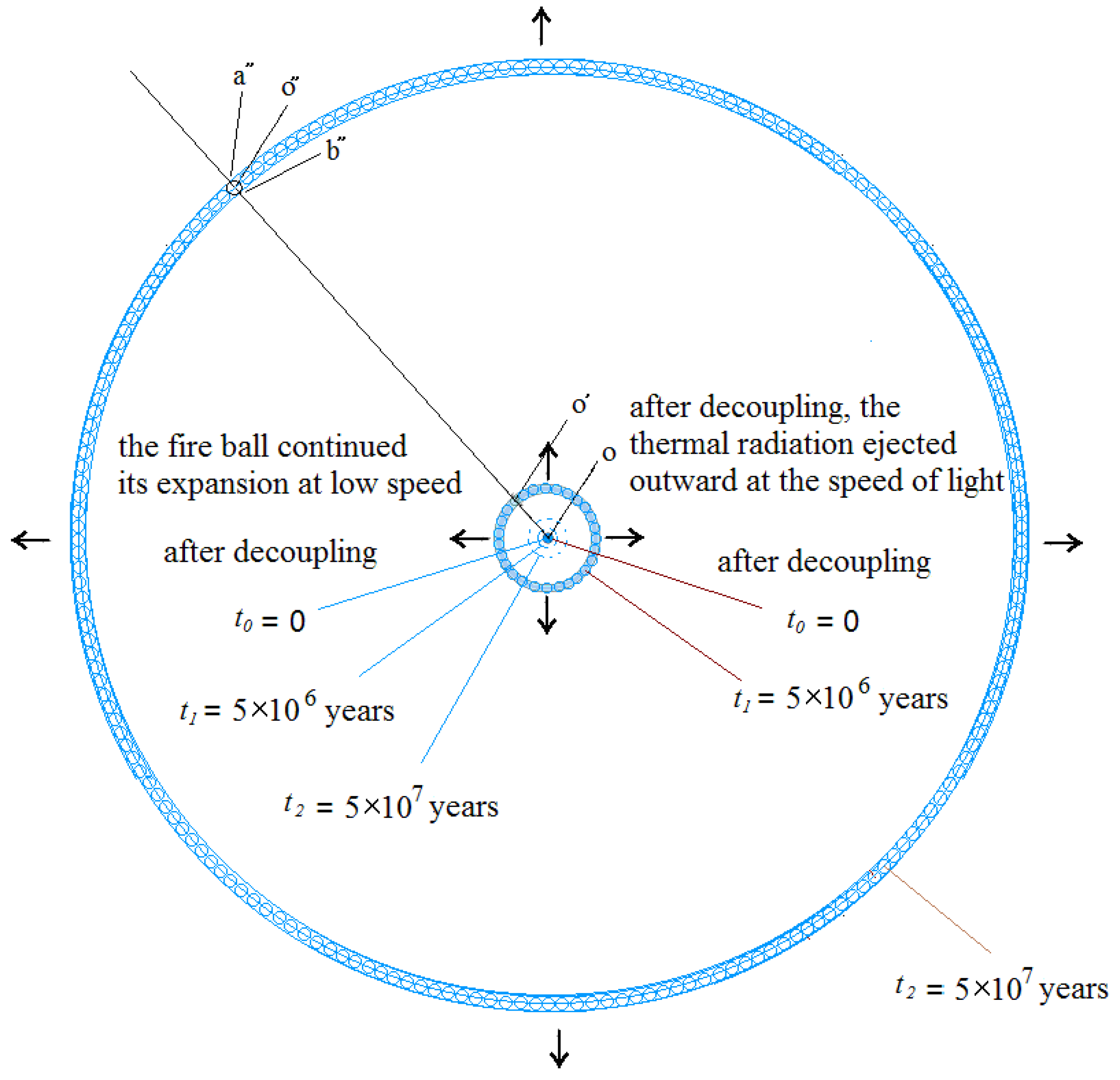
First, as shown in Figure 1(a), the small blue ball with the diameter ab in the central part of the figure represents the decoupled fireball, 380,000 years after the big bang. The diameter ab is about ab = 2 ×10 22 m = 2 ×500, 000 ly (light years) ,and the radius is about oa = ob ≈ 10 22 m ≈ 500, 000 ly (light years).
Figure 1.
The radius of the decoupled fire ball (sphere) was ao = ob ≈ 500,000 ly, 380,000 years after the big bang, and the thermal radiation within it began to eject freely to leave the fire ball in all the directions. 500,000 years later, in the direction of oo′, the thermal radiation from o reached o′, the radiations from the whole sphere aob reached a new place of the sphere a′o′b′. And all the thermal radiation in the other directions within the 4π silid angle from all the points of the sphere aob reached the spherical layer a′b′. .
Figure 1.
The radius of the decoupled fire ball (sphere) was ao = ob ≈ 500,000 ly, 380,000 years after the big bang, and the thermal radiation within it began to eject freely to leave the fire ball in all the directions. 500,000 years later, in the direction of oo′, the thermal radiation from o reached o′, the radiations from the whole sphere aob reached a new place of the sphere a′o′b′. And all the thermal radiation in the other directions within the 4π silid angle from all the points of the sphere aob reached the spherical layer a′b′. .

As the decoupling happened, the fire ball became transparent, so all the thermal radiation in the fireball got free, and began to fly off in all the directions at the speed of light into the vast cosmic space.
5,000,000 years after the decoupling, the thermal radiation from point o in the direction of oo′ arrived at the point o′, on a spherical surface of the radius of oo′ = 5000,000ly (10 times of oa = ob) , also as shown in Fig.1. The thermal radiation from point a reached a′, the thermal radiation from point b reached b′, all the thermal radiations from the different points of the original small ball aob now all reached the corresponding points of a small ball a′o′b′, witch lay in the spherical layer a′b′.
a′b′ = 2 ×500,000 ly = 1,000,000 ly (light years).
And all the radiations ejected in different directions from all the different points of the original small ball aob all reached points in the spherical layer a′b′.
50,000,000 years after the decoupling, the thermal radiation from point o in the direction of o o〞arrived at point o〞, on the spherical surface of the radius of oo〞= 50,000,000 ly, as shown in Figure 2. The thermal radiation from point a reached point a〞, the thermal radiation from point b reached b〞, all the radiations in the direction oo〞from the other different points on the small ball aob now all reached the corresponding points of a small ball a〞o〞b〞,witch lay in spherical layer a〞b〞. And, all the radiations in other different directions from all the points of the small ball aob now all reached the spherical layer a〞b〞.
Figure 2.
5 ×10⁶ years after the decoupling, in the direction of oo〞,the radiation from o reached point o〞,and the radiation from a reached a〞, the radiation from b reached b〞. The radiation from all the points of the ball aob reached the corresponding points of ball a〞o〞b〞. And, the radiation from all the points of ball aob in all the directions in the 4π solid angle reached the spherical layer a〞b〞. .
Figure 2.
5 ×10⁶ years after the decoupling, in the direction of oo〞,the radiation from o reached point o〞,and the radiation from a reached a〞, the radiation from b reached b〞. The radiation from all the points of the ball aob reached the corresponding points of ball a〞o〞b〞. And, the radiation from all the points of ball aob in all the directions in the 4π solid angle reached the spherical layer a〞b〞. .
Obviously,
a〞b〞= a′b′ = 1,000,000 ly.
And, 500,000,000 years later,5,000,000,000 years later, and so on, as the thermal radiation of the decoupled fireball flied continuously at the speed of light, it always kept within the spherical layer with a width of 1,000,000 ly.
The expanding of the 1,000,000 layer of the decoupled thermal radiation, a′b′, a〞b〞, and so on, should not go on and on without an end. The space of the universe is closed, when some utmost site is reached, the 1,000,000 layer of the thermal radiation will no longer fly away further. It will return back to the central region of the universe again, and then shuttle ceaselessly, getting more and more dispersive. Finally, after a very long relaxation time, by interactions (exchange heat) with the rare dusts in the galaxy region, it will mingle into the 3K heat ocean.
So, the authors allege, the 3K background radiation discovered by Penzias and Wilson is not the afterglow of the decoupled fire ball. It itself is just an eternal 3K vast heat ocean in the closed universe. It is an essential and eternal part of the universe. It had existed before the big bang. It exists during the big bang. And it will exist in future, forever. It is always a stable and eternal extraordinary immense heat ocean in the universe.
The heat ocean might have an extraordinary great mass, also contributes to the close of the universe.
References
- E. Hubble, Distance and radial velocity among extra-galactic nebulae. Proc. Nat. Acad. Sci. 15, 168 – 173 (1929).
- G. Gamow,The Creation of the Universe. New York Viking Press (1952).
- A. Penzias and R. Wilson, A Measurement of Excess Antenna Temperature. Astrophysics J. 142, 419 – 421 (1965).
- X. Y. Fu, and Z. T. Fu, The 3K background radiation is not the afterglow of the.
- remnant thermal radiation of the decoupled fire ball, (2024).
- X. Y. Fu, and Z. T. Fu, The Origin of Energy for the Big Bang. arxiv.org/ ast-ph/0311472 (2003).
- R. Clausius, Uber den zweiten Hauptsatz der mechanischen Warmetheorie (1867).
- J. C. Maxwell, Theory of Heat 328 (1871).
- X. Y. Fu and Z. T. Fu, 2003, The Realization of Maxwell’s Hypothesis. arXiv /physics /0311104v1-v3; preprints201607.0028v1-v5.
Figure 1.
A self-closed heat ocean model. The central spot is the region of all the galaxies. And the blue bigger circle is the 2.73 K region, with R1 = 400ⅹ109 light years. Then the thermal radiation density decaying region from R1 to R2, with R2 = 4000ⅹ109 light years. Out of R2, is the infinitively vast cosmic space, u ≡ 0.
Figure 1.
A self-closed heat ocean model. The central spot is the region of all the galaxies. And the blue bigger circle is the 2.73 K region, with R1 = 400ⅹ109 light years. Then the thermal radiation density decaying region from R1 to R2, with R2 = 4000ⅹ109 light years. Out of R2, is the infinitively vast cosmic space, u ≡ 0.
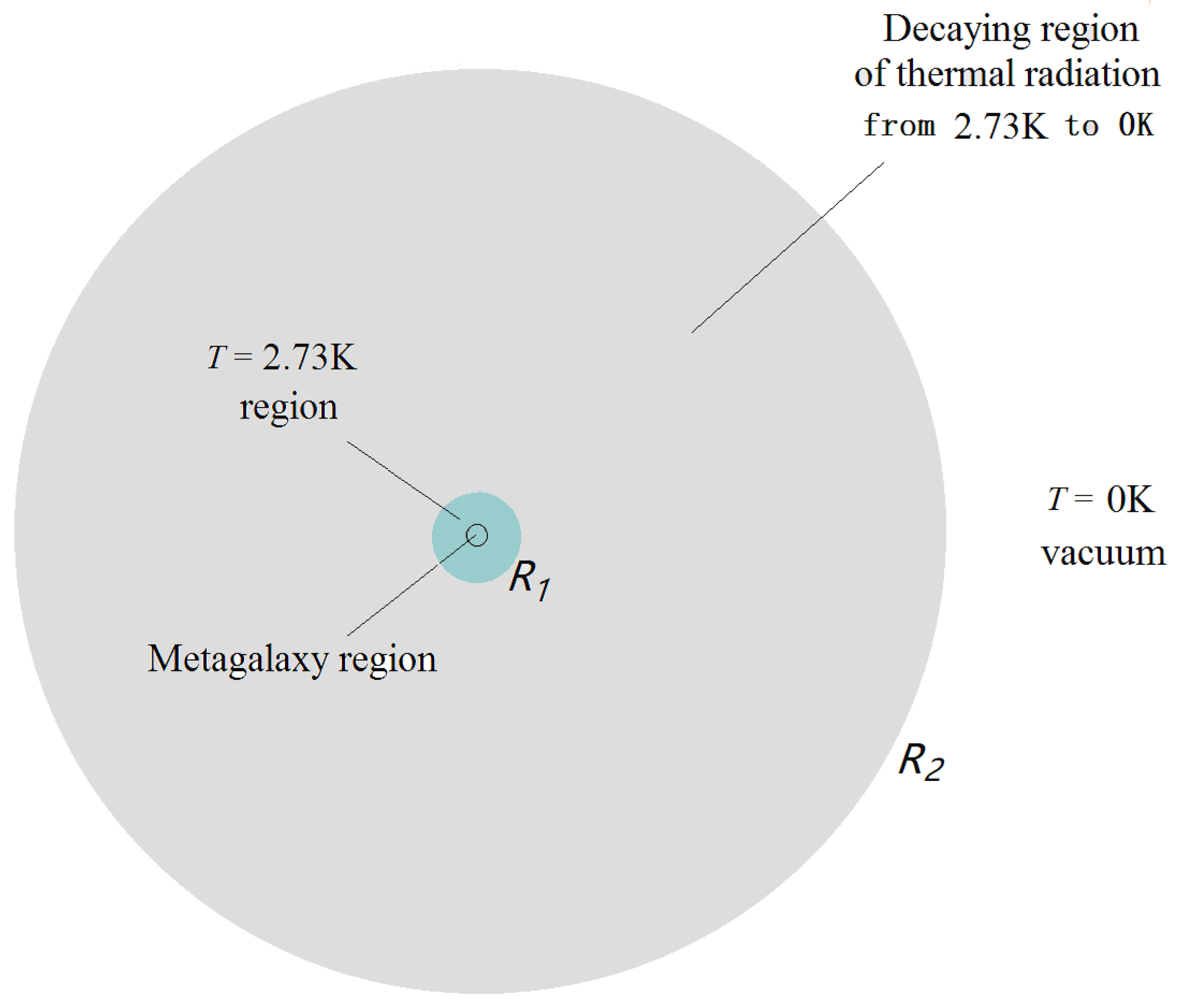
Figure 2.
Suppose the central part of the heat ocean is a spherical region of a radius R1 = 400ⅹ109 light years, filled up with 2.73K thermal radiation. Stretched outward from R1, the density (and “temperature” ) of the thermal radiation decreases gradually. At R2 = 4000ⅹ109 light years, the.
Figure 2.
Suppose the central part of the heat ocean is a spherical region of a radius R1 = 400ⅹ109 light years, filled up with 2.73K thermal radiation. Stretched outward from R1, the density (and “temperature” ) of the thermal radiation decreases gradually. At R2 = 4000ⅹ109 light years, the.
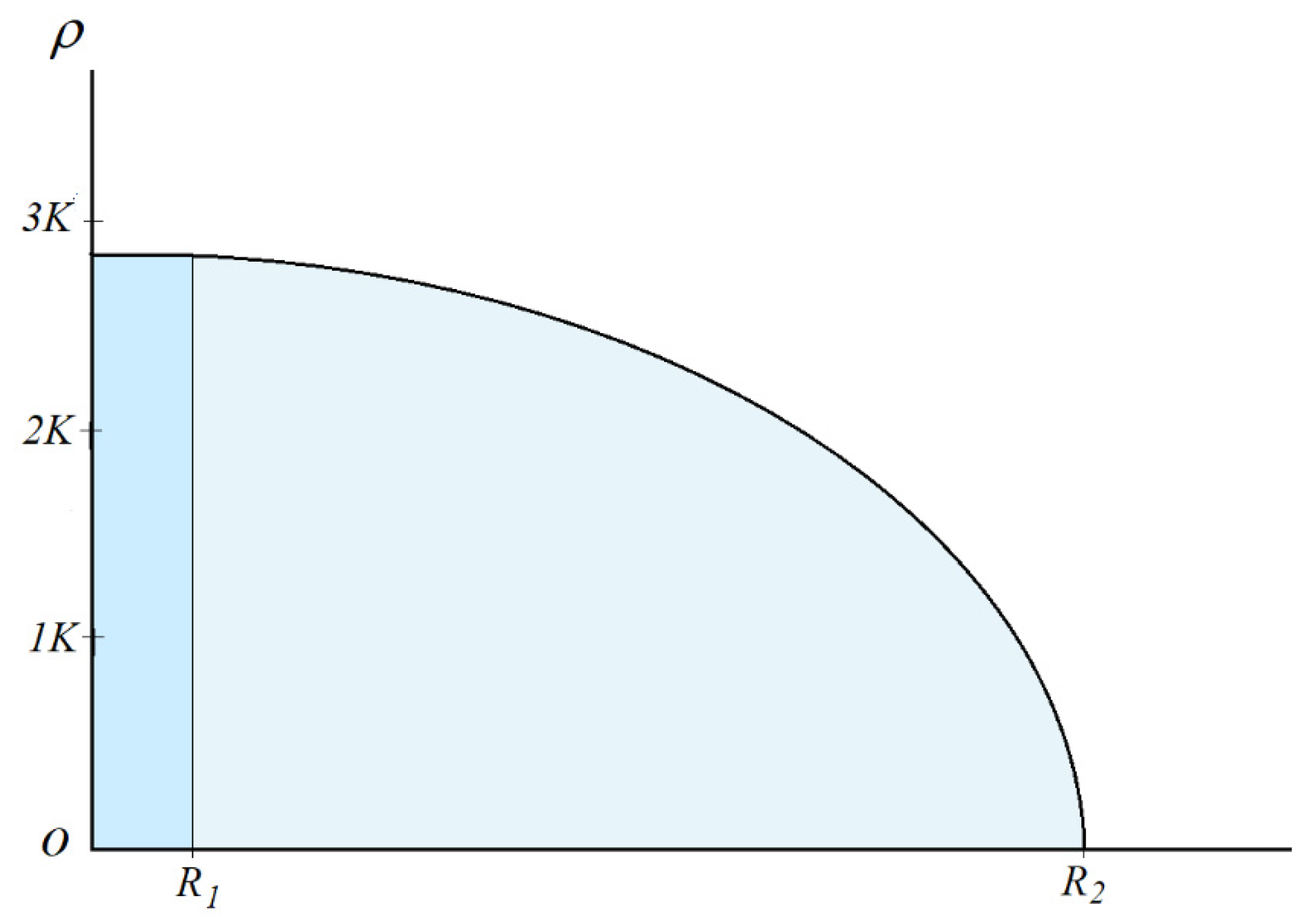
Figure 3.
(a) A black hole of M = 10M⊙, R1 = 30km, V1 = 1.13×10¹⁰m3; (b) In the heat ocean, in a same volume V1′= 1.13×10¹⁴m3 , the energy of the 2.73K thermal radiation is U1′= 4.75J.
Figure 3.
(a) A black hole of M = 10M⊙, R1 = 30km, V1 = 1.13×10¹⁰m3; (b) In the heat ocean, in a same volume V1′= 1.13×10¹⁴m3 , the energy of the 2.73K thermal radiation is U1′= 4.75J.
Disclaimer/Publisher’s Note: The statements, opinions and data contained in all publications are solely those of the individual author(s) and contributor(s) and not of MDPI and/or the editor(s). MDPI and/or the editor(s) disclaim responsibility for any injury to people or property resulting from any ideas, methods, instructions or products referred to in the content. |
© 2024 by the authors. Licensee MDPI, Basel, Switzerland. This article is an open access article distributed under the terms and conditions of the Creative Commons Attribution (CC BY) license (http://creativecommons.org/licenses/by/4.0/).
Copyright: This open access article is published under a Creative Commons CC BY 4.0 license, which permit the free download, distribution, and reuse, provided that the author and preprint are cited in any reuse.


