
Submitted:
14 June 2024
Posted:
19 June 2024
You are already at the latest version
Abstract
The Metaverse of Things (MoT) is an advanced technology that has the potential to revolutionise urban living in the present era. This article explores the advantages, uses, and transformative outcomes of MoT in smart cities. The covered subjects encompass sustainability, urban planning, citizen participation, infrastructure management, and various more. MoT integrates the Internet of Things (IoT) with metaverse technologies. The ultimate objective is to develop virtual environments that are highly interactive, interconnected, and immersive while maintaining a high level of fidelity to reality. The IoT utilises virtual reality (VR), augmented reality (AR), and other digital technologies to gather data, facilitate communication, and automate certain processes, thereby enhancing several elements of urban living. It is all a component of the metaverse. The IoT will bring about a profound transformation in the way cities gather and utilise data to enhance services and optimise efficiency. Cities that can efficiently distribute this data can enhance public safety, optimise energy usage, regulate traffic, and manage waste properly. MoT apps that utilise immersive technologies and the IoT can be used to generate more intelligent and captivating cityscapes. The implementation of MoT can greatly enhance the quality of life for residents of smart cities through improvements in transportation, healthcare, education, and community engagement. The study's author examined how smart cities utilise the IoT to enhance the daily experiences of their inhabitants. This study examines the technical structure, possible advantages, and difficulties of implementing MoT in urban settings, aiming to enhance the resilience, responsiveness, and adaptability of cities. The findings emphasise the importance of robust legislative frameworks, stringent security requirements, and well-developed infrastructure to facilitate the extensive use of MoT technology. These factors are crucial for establishing a highly interconnected and efficient urban environment.
Keywords:
Metaverse of Things (MoT)
; smart cities
; internet of things
; virtual reality
; augmented reality
; urban living
1. Introduction
Smart cities have emerged as the ultimate solution to address the challenges presented by ever-growing city populations [1]. Nevertheless, advanced technologies like the MoT and Extended Reality (XR) collaborate to fully actualise smart cities’ potential [2]. The MoT facilitates a virtual linkage between the tangible and digital realms through the integration of digital replicas, IoT devices, and immersive interfaces. VR and AR are forms of XR technologies that allow for immersive and interactive experiences. The efficacy of MoT applications relies on the seamless integration of technology, robust data security measures, and universal accessibility for all local inhabitants. By 2024, the Metaverse market is expected to be worth US$74.4 billion. By 2030, this market is predicted to have grown to a projected volume of US$507.8 billion at a compound annual growth rate (CAGR) of 37.73% [3]. The MoT not only enhances the quality of life for residents but also enhances urban management and sets a new standard for smart cities [4].
Figure 1.
MoT Applications.
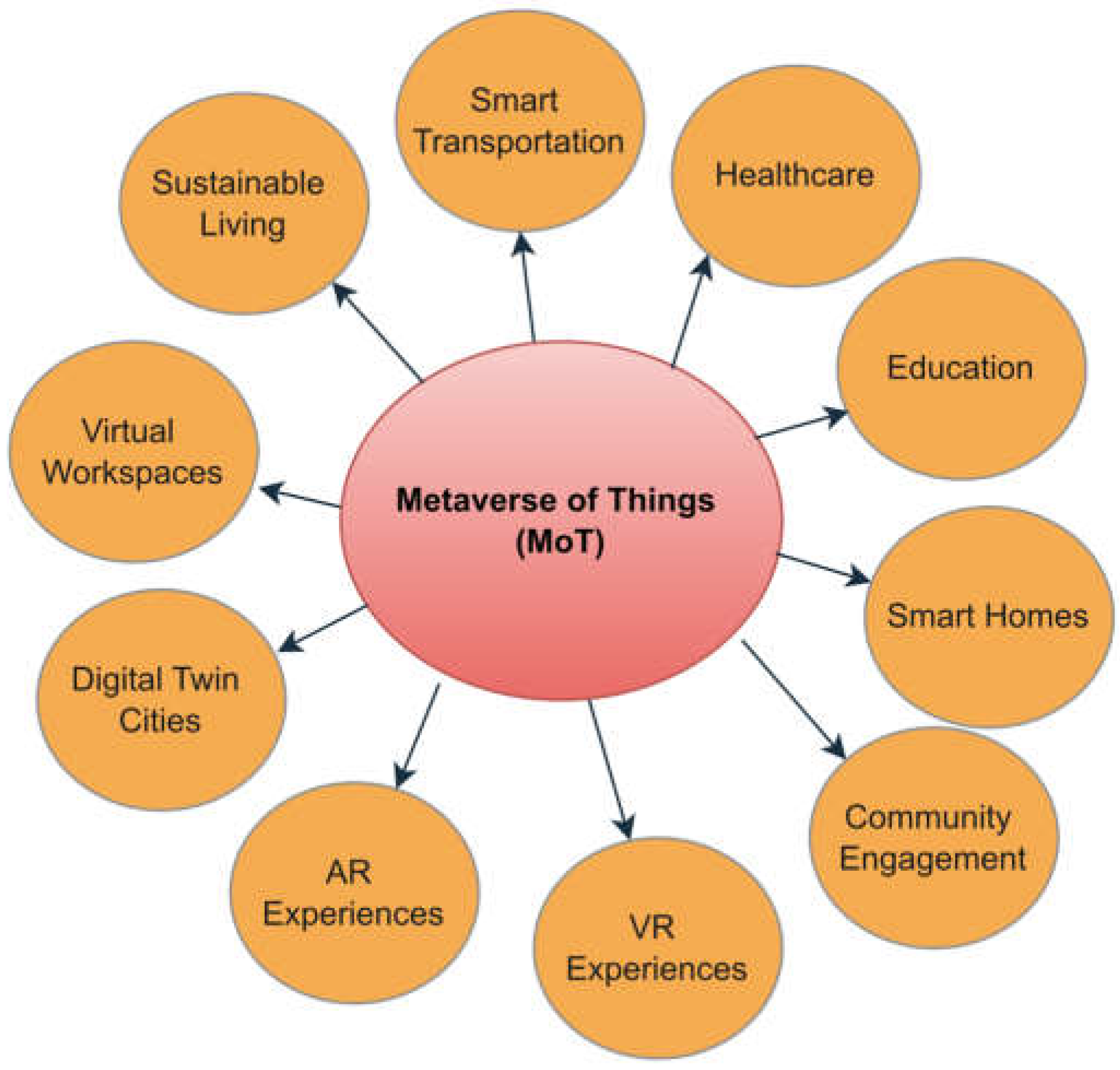
The IoT enhances urban environments by employing real-time data analytics, traffic control, utility optimisation, and public interaction, resulting in a dynamic, adaptive, and sustainable urban landscape [5]. If individuals embrace this groundbreaking idea, smart cities will set new standards for effectiveness and ingenuity in contemporary society, thereby revolutionising urban living. Undoubtedly, MoT ushers in a new epoch of urban living and implies promising prospects for our cities. Digital twins are virtual replicas of physical assets that offer real-time information on the performance and behaviour of the asset. The metaverse is revolutionising smart cities by enhancing citizen experiences through the modernisation of government services, improving accessibility, fostering economic growth, and advancing sustainability. This essay explores the capacity of smart cities propelled by the metaverse to foster substantial innovation. We analyse the fundamental technologies that facilitate the metaverse, the benefits of their use, and their potential applications in smart city initiatives. The utilisation of metaverse technology can benefit various industries, as demonstrated by ongoing projects and documented instances. Moreover, we thoroughly examine and categorise significant research issues that currently hinder the complete realisation of the metaverse’s potential. Ultimately, we suggest potential areas of research to facilitate the continued expansion of the metaverse and smart city integration. The convergence of the Metaverse and the IoT has given rise to a novel concept called the MoT, which represents a new framework for smart city living. This theoretical framework advocates for enhanced experiences, increased efficiency, and long-term viability in urban environments by illustrating a highly interconnected digital ecosystem where physical and virtual realities seamlessly merge. The IoT allows urban infrastructure to become more intelligent and responsive by utilising interconnected sensors, gadgets, and digital models. AR navigation allows individuals to access customised and immersive experiences, along with real-time information overlays. The MoT is dismantling conventional obstacles in various sectors, such as healthcare, entertainment, energy management, and transportation, to revolutionise urban functionality and redefine human engagement with their surroundings. The IoT encompasses tailored services driven by artificial intelligence and robust data analytics, proactive maintenance of critical infrastructure, and enhanced mobility through augmented navigation systems. The Ministry of Transport (MoT) empowers individuals to engage in decision-making processes and collaboratively shape the future of their cities. It also facilitates inclusive and participatory urban governance. The MoT employs state-of-the-art technology to enhance the responsiveness, efficiency, and interconnection of urban areas. The implementation of MoT has the potential to significantly enhance living standards in smart cities by improving urban infrastructure, transit, healthcare, and education. To achieve success, the system must possess seamless integration, robust security measures, and universal accessibility for all urban inhabitants.
After Facebook rebranded as “Meta” in October 2021, interest in the metaverse increased dramatically on a global scale [6]. The term MoT refers to a new and innovative concept that merges the characteristics of the IoT with the Metaverse. The VR environment demonstrates the seamless interaction of digital, hardware, and physical components. Due to the integration of the digital and physical realms, MoT enables users to seamlessly navigate, customise, and engage with virtual and tangible objects simultaneously and instantaneously. Individuals within a metaverse interact with virtual representations of themselves, known as avatars, within a highly authentic three-dimensional setting in order to carry out mundane tasks. This presents new opportunities for worldwide involvement, commerce, and learning. The MoT holds numerous potential applications across various fields. It has the potential to facilitate healthcare progressions such as telemedicine, surgical simulators, and remote patient monitoring. It possesses the capability to enhance the efficiency of industrial processes, including remote maintenance, virtual prototyping, and real-time production line monitoring. Possible applications of smart cities encompass enhanced traffic control, public security, and urban development. Industries such as retail, education, and entertainment will greatly benefit from the increased availability of opportunities.
VR gaming platforms and headsets have generated curiosity about the idea of online communities and worlds [7]. At the same time, IoT and artificial intelligence (AI) are being employed to address business challenges in various industries, such as construction, food manufacturing, and agriculture. The metaverse is defined as the convergence of the physical and digital realms into a three-dimensional virtual environment. In this area, individuals can inhabit, work, and engage in commerce using avatars that can navigate various experiences, utilising their personal identities and currency seamlessly.
The motivation behind exploring MoT applications for revolutionising urban living in smart cities stems from the pressing need to address the complex challenges facing modern urban environments. Rapid urbanisation, resource constraints, environmental degradation, and socio-economic disparities necessitate innovative solutions that can enhance efficiency, sustainability, and quality of life in cities. MoT offers a compelling paradigm by seamlessly integrating virtual and physical worlds, leveraging the power of IoT, AR, and VR technologies. By harnessing real-time data, immersive experiences, and interconnected ecosystems, MoT applications hold the promise of optimising urban planning, resource management, personalised services, collaboration, entertainment, and cultural enrichment. The transformative potential of MoT lies in its ability to reimagine urban spaces as dynamic, interactive environments that adapt to the needs and preferences of residents, businesses, and communities, ultimately fostering inclusive, resilient, and vibrant cities for future generations.
The contribution of MoT applications to revolutionising urban living in smart cities is profound and multifaceted. By seamlessly blending the digital and physical realms, MoT offers transformative solutions to some of the most pressing challenges facing modern urban environments. Through real-time data analytics, MoT enables optimised resource management, enhancing energy efficiency, waste reduction, and transportation systems. Additionally, MoT facilitates personalised urban experiences, tailoring services and interactions to individual preferences, thereby fostering inclusivity and enhancing quality of life. Furthermore, MoT applications promote collaboration and communication among stakeholders, breaking down geographical barriers and enabling more efficient decision-making processes. By leveraging immersive technologies, MoT also enriches urban entertainment and cultural experiences, enhancing the vibrancy and cultural richness of smart cities. Ultimately, the contribution of MoT to urban living lies in its ability to create more sustainable, efficient, and livable cities that prioritise the well-being and prosperity of their residents.
The rest of the paper is organised into several sections to provide a comprehensive exploration of this emerging field. The introduction section sets the stage by defining MoT and highlighting its potential to transform urban environments. The related work section reviews the existing research on MoT, smart cities, and related topics to establish a theoretical framework and identify gaps in the literature. Section 3 highlights the roles of MoT in Smart Cities. Section 4 represents the challenges, and section 5 shows the opportunities. The practical applications of the metaverse in real-life scenarios are discussed in section 6. The discussion section interprets the findings in relation to theoretical frameworks, practical implications, and future research directions. Finally, the conclusion synthesises key findings and discusses future research. Through this structured organisation, the paper aims to contribute to advancing knowledge, informing policy and practice, and fostering innovation in the field of MoT applications for smart cities.
2. Related Works
Metaverse is a comprehensive virtual world in which people may meet virtually, play games, do business, attend virtual events, interact in real-time via avatars, and much more. One possible use of AR in the Metaverse is to supplement the real world with digital data. Web3 modules also enable the creation of transactions and convert digital assets into monetary ones, such as digital money or cryptocurrencies. The Metaverse can also be accessed via a regular computer screen or laptop without the need for any other wearable equipment. The Related works on MoTapplications for revolutionising urban living in smart cities encompass a broad spectrum of research endeavours, ranging from theoretical explorations to empirical studies and practical implementations. These works delve into various aspects of MoT, including its integration into urban infrastructure, impact on mobility and transportation systems, social implications, environmental sustainability, governance frameworks, economic impacts, and applications in public safety, health, education, culture, accessibility, tourism, community engagement, resilience, equity, and ethics. Employing diverse methodologies such as literature reviews, case studies, surveys, simulations, modeling, experiments, policy analysis, stakeholder consultations, and participatory design, these studies offer valuable insights into the opportunities, challenges, and implications of deploying MoT applications in urban environments. By synthesising and building upon existing knowledge, these related works contribute to advancing understanding, informing policy and practice, and shaping the future trajectory of MoT for revolutionising urban living in smart cities.

Table 1.
Related Works.
| Reference | Authors | Year | Focus | Methodology |
|---|---|---|---|---|
| [8] | Li et al., | 2022 | The integration of the IoT and the metaverse erases the clear separation between the physical and digital domains. | IoT, Metaverse |
| [9] | Wang et al., | 2024 | Utilising the Virtual IoT, urban sensing is conducted in the Metaverse. | IoT, Metaverse |
| [10] | Wang et al., | 2022 | A comprehensive examination of the metaverse, encompassing fundamental aspects such as security and privacy. | IoT, Metaverse, security and privacy |
| [11] | Park and Kim | 2022 | The essential elements, potential uses, unresolved issues, and categorisation of a metaverse. | Metaverse |
| [12] | Ball, | 2020 | Definition of Metaverse. The topics of discussion are the construction, location, and the video game Fortnite. | Metaverse, Gaming |
| [13] | Vishkaei, | 2022 | The Metaverse is a novel platform that circular, smart cities can utilise. | Smart Cities, Metaverse |
| [14] | Ali et al., | 2023 | This text discusses research topics pertaining to metaverse communications, networking, security, and applications. It also covers existing best practices and potential future advancements in these areas. | Metaverse |
| [15] | Hadi et al., | 2024 | The Metaverse represents a novel digital frontier in relation to consumer behaviour. | Metaverse |
| [16] | Wang et al., | 2023 | Metamobility establishes a connection between upcoming modes of transport and the metaverse. | Mobility, Metaverse |
| [17] | Bibri, | 2022 | The investigation of the metaverse’s social development is being conducted using the perspectives of science, technology, and society rather than the principles of data-driven smart cities. | Smart Cities, Metaverse |
| [18] | Zawish et al., | 2024 | Exploring the basics, challenges, and future research of Metaverse artificial intelligence in the context of 6G technology. | AI, Metaverse |
| [19] | Kusuma and Supangkat, | 2022 | An analysis of the use of metaverse-based technologies in the development of smart city infrastructure. | Smart Cities, Metaverse |
| [20] | Han et al., | 2023 | Metaverse Services is utilising the capabilities of the IoT. | IoT, Metaverse |
| [21] | To et al., | 2024 | The metaverse encompasses novel ideas, trends, and perspectives regarding the future. | Metaverse |
| [22] | Yaqoob et al., | 2023 | Exploring the potential of Metaverse-driven smart city applications: analysing prospects, challenges, the technology that makes it possible, and potential future developments. | Smart Cities, Metaverse |
| [23] | Chaudhuri and Anand, | 2023 | Develop durable and dependable objects to facilitate the advancement of the intelligent society and metaverse. | Smart Society, Metaverse |
| [24] | Ning et al., | 2023 | A comprehensive examination of the Metaverse: Present comprehension, tools, applications, and obstacles. | Metaverse |
| [25] | Venugopal et al., | 2023 | An investigation of a domain within the metaverse. | Metaverse |
| [26] | Gupta and Jindal | . 2023 | The Metaverse: Applications and Interdependent Design. | Metaverse |
| [27] | Zhao et al., | 2024 | A survey was conducted on metaverses that are powered by sophisticated wireless sensing. | Metaverse |
| [28] | Shi et al., | 2023 | An analysis of the Metaverse, focusing on its fundamental aspects, environment, and obstacles from the perspective of state-of-the-art technology. | Metaverse |
| [29] | Jim et al., | 2023 | Establishing a Reliable Metaverse: Progress and Obstacles. | Metaverse |
| [30] | Aslam et al., | 2023 | The metaverse, in the context of 6G and beyond, signifies the forthcoming revolution and implementation of cognitive obstacles. | Metaverse |
| [31] | Gaber et al., | 2023 | Metaverse-IDS is an intrusion detection system that utilises deep learning techniques and is specifically built to operate within Metaverse-IoT networks. | Metaverse, Deep Learning, IoT |
| [32] | Jamshidi et al., | 2023 | Exploration of the conceptual framework and potential future paths for the meta-metaverse. | Metaverse |
| [33] | Ismail and Buyya, | 2023 | The Metaverse presents a comprehensive plan encompassing architectural elements for creating virtual worlds that can operate in real-time and can be easily expanded. | Metaverse |
| [34] | De Giovanni, | 2023 | Implementing Industry 5.0 concepts will guarantee the Metaverse’s sustainability in the long run. | Metaverse |
| [35] | Carrión, | 2023 | Areas of study and unresolved issues in the field of Metaverse research. | Metaverse |
| [36] | Hudson-Smith and Batty, | 2023 | The utilisation of visual analytics in urban planning: constructing the metaverse of the city. | Metaverse |
| [37] | Xu et al., | 2023 | Future prospects of metaverse services. | Metaverse |
| [38] | Chen, | 2023 | It is evaluating a prospective idea for a metaverse-based workplace that enables employees to work from a distance. | Metaverse |
| [39] | Aljanabi and Mohammed, | 2023 | The metaverse offers numerous opportunities. | Metaverse |
| [40] | Kang et al., | 2023 | What are the essential elements for ensuring safety and privacy in the Metaverse? This review examines the topic from the viewpoint of Metaverse applications. | Metaverse |
| [41] | Ramalingam et al., | 2023 | GPT in the metaverse refers to the ability to sense and understand the physical properties and phenomena within the virtual environment of smart housing. | GPT, Metaverse |
The research gap in the field of MoTapplications for revolutionising urban living in smart cities lies in the need for a comprehensive understanding and exploration of the practical implications, challenges, and opportunities presented by this emerging paradigm. While there is growing interest in leveraging MoT technologies to address urban challenges, there remains a dearth of empirical research that systematically examines the implementation, impact, and socio-technical dynamics of MoT applications in real-world urban settings. Consequently, there is a need to bridge this gap by conducting empirical studies that investigate the effectiveness, scalability, and sustainability of MoT solutions in addressing specific urban challenges such as resource management, mobility, public services, and community engagement. Key research questions in this area include: How can MoT technologies be effectively integrated into existing urban infrastructure and governance frameworks? What are the social, economic, and environmental implications of deploying MoT applications in smart cities? How can MoT solutions be designed and implemented to ensure equitable access, inclusivity, and sustainability in urban environments? Addressing these research questions is essential for advancing knowledge, informing policy and practice, and realising the full potential of MoT for revolutionising urban living in smart cities.
3. Roles of MoT in Smart Cities
The Materials and Methods should be described with sufficient details to allow others to replicate and build on the published results.
Figure 2.
Roles of MoT in smart cities.
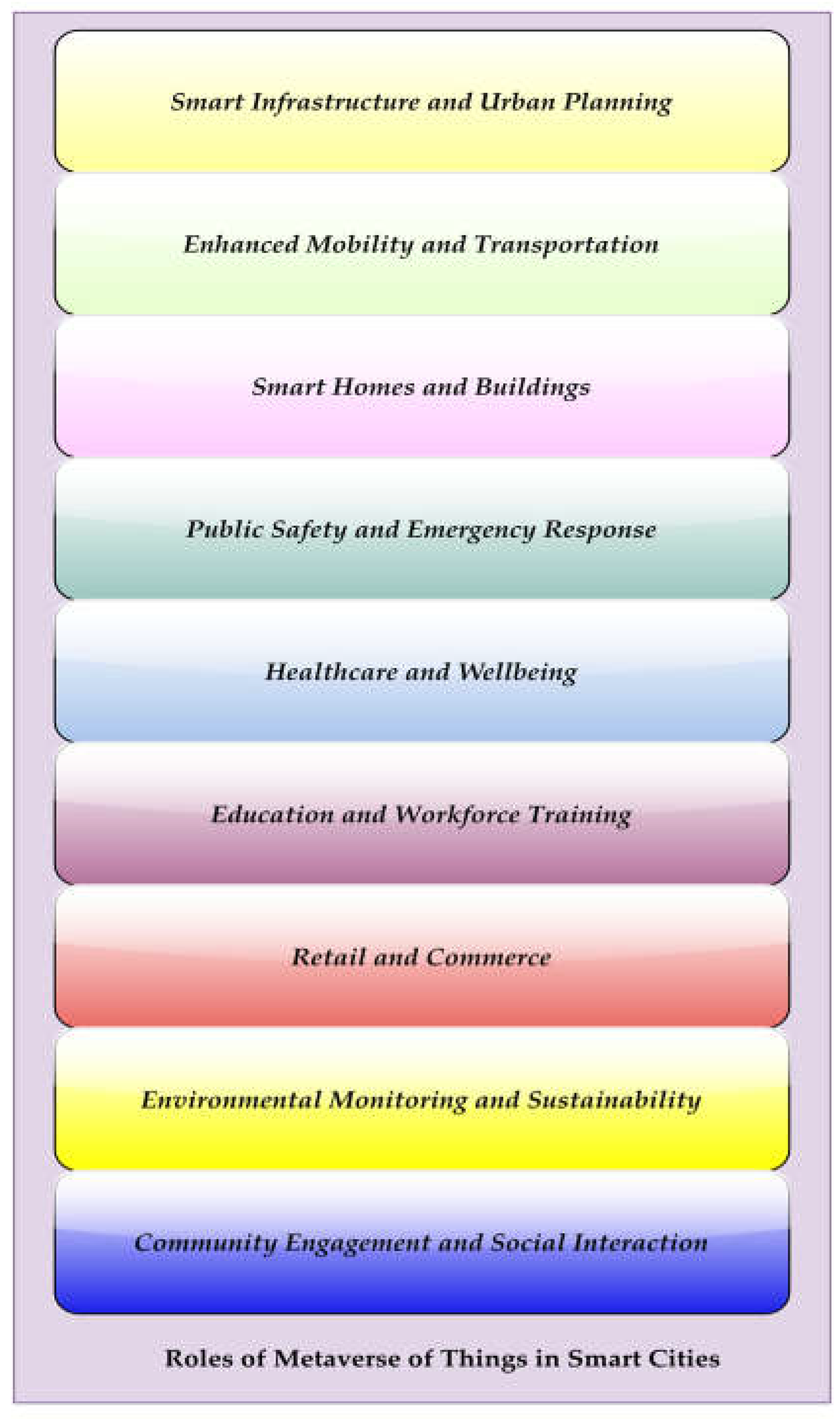
3.1. Smart Infrastructure and Urban Planning
The metaverse, a digital reality combining aspects of social media, online gaming, AR, VR, and cryptocurrencies to enable users to interact virtually, has significant potential in the fields of smart infrastructure and urban planning [42,43,44,45]. Here’s a detailed exploration of how the metaverse can be integrated and its benefits:
1. Virtual Urban Planning and Design
The metaverse allows urban planners to create and visualise 3D models of cities, offering a detailed, immersive experience of proposed changes. This can help understand the impact of new infrastructure projects on the existing environment. Stakeholders, including residents, businesses, and government officials, can explore proposed developments, provide feedback, and make more informed decisions.
2. Smart Infrastructure Management
The concept of digital twins, which involves creating a virtual replica of physical assets, can be extended in the metaverse. This can be used to monitor and manage infrastructure such as buildings, bridges, and utilities in real-time, leading to more efficient maintenance and operation. By integrating IoT data with the metaverse, cities can use predictive analytics to foresee potential infrastructure failures and plan proactive maintenance, thereby reducing downtime and costs. The integration of the metaverse in smart infrastructure and urban planning holds transformative potential. It offers innovative solutions for design, management, and public engagement, contributing to more efficient, sustainable, and inclusive urban environments. However, addressing the technical, security, and regulatory challenges will be crucial for its successful implementation.
3. Enhanced Data Integration and Analysis
The metaverse can aggregate and visualise large datasets from various urban systems, such as traffic flows, energy consumption, and environmental monitoring. This provides a holistic view of city operations and enables better decision-making. Incorporating AI and machine learning within the metaverse can enhance urban planning processes by identifying patterns and optimising resource allocation based on predictive models.
4. Public Participation and Inclusivity
The metaverse can host virtual town hall meetings, allowing a broader range of citizens to participate in urban planning discussions, thus democratising the planning process. By providing virtual access to urban environments, people with mobility issues or those living far from city centres can contribute to and benefit from urban planning initiatives.
5. Education and Training
Urban planners, architects, and engineers can use the metaverse for training and simulation exercises, improving their skills in a risk-free virtual environment. The metaverse can serve as a platform to educate the public about urban planning processes, sustainability practices, and the impact of proposed projects.
6. Economic and Environmental Benefits
Virtual simulations can reduce the costs associated with physical models and prototypes. They also help identify cost-effective solutions early in the planning stages. The metaverse can help create more sustainable and eco-friendly urban areas by simulating the environmental impact of various urban designs.
7. Safety and Emergency Planning
The metaverse can be used to simulate natural disasters and other emergencies, allowing cities to plan and test response strategies in a controlled virtual environment. VR can be used to train emergency responders, improving their preparedness for real-life scenarios. Current VR/AR technologies and internet infrastructures need significant improvements to support the seamless integration of the metaverse into urban planning. Handling large amounts of sensitive urban data in the metaverse raises concerns about privacy and security [46,47,48,49,50]. Developing standards and regulations for using the metaverse in urban planning is crucial to ensuring ethical practices and equitable access.
3.1.1. Digital Twins
The metaverse, a burgeoning digital ecosystem, significantly enhances the concept of digital twins by creating immersive, interactive, and real-time virtual replicas of physical assets and systems. In the context of smart infrastructure and urban planning, digital twins in the metaverse provide a dynamic and comprehensive visualisation of buildings, transportation networks, utilities, and entire cities. This integration allows for real-time monitoring, predictive maintenance, and scenario simulation, offering unprecedented insights into the operational efficiency and potential vulnerabilities of urban environments. By leveraging the metaverse, stakeholders can collaboratively explore and manipulate digital twins, facilitating informed decision-making, optimising resource allocation, and enhancing the sustainability and resilience of urban infrastructure. This convergence of digital twins and the metaverse not only revolutionises the management of physical spaces but also democratises access to planning processes, fostering a more inclusive and participatory approach to urban development.
3.1.2. AR for Urban Navigation
The metaverse, when integrated with AR, revolutionises urban navigation by offering a seamless, interactive, and intuitive way for people to navigate cities. AR applications within the metaverse overlay digital information onto the physical world, enhancing the urban experience by providing real-time directions, points of interest, and contextual information through smartphones, AR glasses, or other wearable devices. This technology transforms traditional navigation methods, making it easier for residents and visitors to find their way, explore local amenities, and discover hidden gems within the city. Additionally, AR in the metaverse can offer accessibility features, such as visual or auditory guidance for individuals with disabilities, ensuring that urban navigation is more inclusive. By merging the digital and physical realms, the metaverse with AR elevates urban exploration, supports local businesses, and enhances overall city living, creating a smarter, more connected urban environment.
3.1.3. Predictive Maintenance
The metaverse, when harnessed for predictive maintenance, offers a groundbreaking approach to managing and preserving urban infrastructure. By creating immersive digital twins of physical assets, such as buildings, bridges, and utilities, the metaverse allows for real-time monitoring and data integration from various sensors and IoT devices. This continuous stream of data, analysed using advanced algorithms and machine learning within the metaverse, enables the early detection of potential issues and wear-and-tear, predicting failures before they occur. Maintenance teams can virtually inspect and interact with these digital twins, planning and executing maintenance activities with unprecedented precision and efficiency. This proactive approach not only reduces downtime and maintenance costs but also extends the lifespan of critical infrastructure [51,52,53,54]. Furthermore, the immersive nature of the metaverse facilitates training and preparation for maintenance tasks, ensuring that technicians are well-prepared to address issues promptly and effectively. By integrating predictive maintenance within the metaverse, cities can achieve higher operational efficiency, enhanced safety, and greater resilience.
3.2. Enhanced Mobility and Transportation
The metaverse significantly enhances mobility and transportation by creating a digital layer over physical transportation networks, leading to smarter, more efficient urban mobility solutions. By integrating real-time data from traffic sensors, public transit systems, and user-generated inputs, the metaverse provides a comprehensive and dynamic view of urban transportation. This allows for optimised route planning, reducing congestion and improving travel times. AR applications within the metaverse can offer commuters real-time navigation assistance, live updates on transit schedules, and information about delays or alternative routes, all accessible through smartphones or AR glasses. Additionally, the metaverse can simulate and test new transportation infrastructures, such as autonomous vehicles and smart traffic management systems, in a virtual environment before actual deployment. This not only enhances planning and development but also ensures safety and efficiency. By merging digital innovation with physical mobility, the metaverse fosters a more connected, efficient, and user-friendly transportation ecosystem, ultimately enhancing the urban travel experience.
3.2.1. Real-Time Traffic Management
The metaverse, when applied to real-time traffic management, revolutionises how cities handle traffic flow and congestion. By integrating real-time data from traffic cameras, sensors, and connected vehicles into a comprehensive virtual environment, the metaverse provides an unparalleled level of situational awareness and control. Traffic managers can visualise and interact with a live, 3D model of the city’s traffic, enabling them to identify bottlenecks, accidents, and other disruptions instantaneously. Advanced analytics and machine learning within the metaverse can predict traffic patterns and suggest proactive measures to alleviate congestion, such as adjusting traffic signal timings, implementing dynamic lane usage, or providing real-time rerouting recommendations to drivers. This interactive and immersive approach not only enhances the efficiency of traffic management but also improves response times to incidents, reducing overall travel time and emissions [56,57,58]. By leveraging the capabilities of the metaverse, cities can achieve a smarter, more adaptive, and responsive traffic management system, significantly enhancing urban mobility and quality of life for residents.
3.2.2. Autonomous Vehicles
The metaverse presents a transformative opportunity for the development and integration of autonomous vehicles (AVs) into urban environments. By creating a virtual ecosystem that mirrors the physical world, the metaverse provides a simulated environment for testing and refining AV technologies, allowing manufacturers and developers to conduct extensive trials in a controlled and realistic setting. Within this virtual realm, AVs can interact with virtual pedestrians, other vehicles, and infrastructure, enabling comprehensive validation of their navigation, perception, and decision-making capabilities. Furthermore, the metaverse facilitates collaboration among stakeholders, including AV developers, city planners, and regulators, fostering the development of standardised protocols and regulations for AV deployment [59,60,61]. Additionally, AR applications within the metaverse can enhance the user experience by providing real-time information and safety alerts to passengers and pedestrians interacting with AVs. As AV technology advances and gains acceptance, the metaverse will play a crucial role in accelerating its adoption, ensuring safe, efficient, and seamless integration of autonomous vehicles into the fabric of urban transportation systems.
3.2.3. AR Navigation Aids
The metaverse offers a revolutionary platform for AR navigation aids, transforming how individuals navigate and interact with urban environments. By seamlessly integrating digital information into the physical world, AR applications within the metaverse provide users with real-time, context-aware guidance and information. Whether exploring a new city or navigating familiar streets, users can access interactive AR overlays through smartphones or wearable devices, offering directions, points of interest, and relevant contextual information. These AR navigation aids enhance situational awareness, making it easier for users to find their way and discover local attractions, businesses, and amenities. Furthermore, the metaverse facilitates collaborative mapping efforts, allowing users to contribute and share location-based data, enriching the AR navigation experience for everyone. As AR technology continues to advance and become more ubiquitous, the metaverse will play a pivotal role in revolutionising urban navigation, offering immersive, personalised, and intuitive guidance to users wherever they go.
3.3. Smart Homes and Buildings
The metaverse introduces a paradigm shift in the concept of smart homes and buildings, offering unprecedented opportunities for connectivity, automation, and personalised experiences. By integrating IoT devices, sensors, and AI algorithms into a virtual environment, the metaverse creates immersive digital twins of homes and buildings, enabling real-time monitoring, control, and optimisation of various systems and functionalities. Residents can interact with these digital twins through AR interfaces, smartphones, or voice-activated assistants, adjusting lighting, temperature, security settings, and more with simple gestures or voice commands. Furthermore, the metaverse facilitates the seamless integration of smart home devices and services, allowing interoperability and centralised management through a unified interface. This interconnected ecosystem enhances convenience, comfort, and energy efficiency while providing insights into usage patterns and predictive maintenance needs. Moreover, the metaverse enables remote monitoring and control, empowering homeowners and facility managers to access and manage their properties from anywhere in the world. As the metaverse continues to evolve, it promises to redefine the concept of smart homes and buildings, creating more intelligent, responsive, and personalised living and working environments for occupants.
3.3.1. Integrated Home Management Systems
The metaverse is poised to revolutionise integrated home management systems by offering a unified digital platform that seamlessly connects and orchestrates various smart devices and services within a home. By creating immersive digital twins of homes and integrating IoT devices, sensors, and AI algorithms, the metaverse enables comprehensive monitoring, control, and automation of home functionalities. Residents can interact with their homes through intuitive interfaces, such as AR overlays or voice-activated assistants, to adjust lighting, temperature, security settings, entertainment systems, and more, all from a single interface. Furthermore, the metaverse facilitates intelligent automation and predictive analytics, optimising energy usage, enhancing security, and providing personalised experiences tailored to individual preferences and routines. This integrated approach streamlines home management tasks, simplifies user interactions, and enhances overall convenience and comfort for residents. Additionally, the metaverse enables remote access and monitoring, empowering homeowners to stay connected and in control of their homes from anywhere in the world. As the metaverse continues to evolve, it promises to redefine the way we interact with and manage our living spaces, creating smarter, more connected, and responsive homes for the future.
3.3.2. Virtual Real Estate Tours
The metaverse revolutionises the experience of virtual real estate tours by offering immersive and interactive environments that closely mimic physical spaces. Through the integration of AR and VR technologies, prospective buyers can explore properties in rich detail, experiencing the layout, ambience, and amenities as if they were physically present. Within the metaverse, users can navigate through virtual homes, apartments, or commercial spaces, interact with virtual objects, and visualise potential modifications or renovations in real-time. This not only saves time and resources for both buyers and sellers but also expands the reach of real estate marketing to a global audience. Moreover, the metaverse enables collaborative exploration, allowing multiple users to tour properties together and engage in real-time discussions or negotiations. By providing a more immersive and engaging experience, the metaverse enhances the effectiveness of virtual real estate tours, facilitating informed decision-making and accelerating the buying process in an increasingly digital world.
3.4. Public Safety and Emergency Response
The metaverse presents a transformative opportunity in the realm of public safety and emergency response by offering immersive and dynamic platforms for training, simulation, and coordination. Through the integration of AR and VR technologies, emergency responders can immerse themselves in realistic scenarios, honing their skills and decision-making abilities in a safe and controlled environment. Additionally, the metaverse facilitates collaborative training exercises, enabling multiple agencies to train together and improve interoperability. During actual emergencies, the metaverse serves as a centralised hub for real-time data visualisation, communication, and coordination, allowing responders to access critical information, coordinate resources, and make informed decisions more effectively. Furthermore, AR overlays provide situational awareness and guidance to responders on the ground, enhancing their ability to navigate complex environments and respond swiftly to changing circumstances. By leveraging the capabilities of the metaverse, public safety agencies can enhance preparedness, response, and recovery efforts, ultimately saving lives and minimising the impact of disasters and emergencies.
3.4.1. Virtual Training Simulations
The metaverse offers unparalleled potential for virtual training simulations across a wide range of industries and disciplines. By leveraging immersive technologies such as VR and AR, the metaverse provides realistic and interactive training environments that closely mimic real-world scenarios. From medical simulations to military exercises, virtual training in the metaverse allows learners to practice skills, make decisions, and experience consequences in a risk-free and controlled setting. Moreover, the metaverse enables collaborative training experiences, allowing participants from diverse locations to engage in joint exercises, share knowledge, and learn from each other in real-time. Additionally, advanced analytics and machine learning within the metaverse can provide personalised feedback and performance metrics, helping learners track their progress and identify areas for improvement. As the metaverse continues to evolve, it promises to revolutionise training methodologies, making learning more engaging, accessible, and effective across industries.
3.4.2. Enhanced Surveillance and Monitoring
The metaverse introduces a new frontier in surveillance and monitoring, offering advanced capabilities for data collection, analysis, and visualisation. By integrating sensor networks, IoT devices, and AI algorithms into a virtual environment, the metaverse enables comprehensive and real-time surveillance of physical spaces, assets, and activities. This includes monitoring urban areas for security threats, tracking environmental conditions for disaster preparedness, and overseeing critical infrastructure for maintenance and optimisation. The immersive nature of the metaverse allows operators to visualise and interact with surveillance data in unprecedented ways, enhancing situational awareness and decision-making. Furthermore, the metaverse facilitates collaborative monitoring efforts, enabling multiple stakeholders to access and share information in a centralised platform. However, the use of metaverse-based surveillance raises important ethical and privacy concerns, requiring careful consideration of regulations and safeguards to protect individual rights and liberties. As the technology continues to evolve, the metaverse promises to redefine the landscape of surveillance and monitoring, offering new opportunities for security, safety, and efficiency in a rapidly changing world.
3.5. Healthcare and Wellbeing
The metaverse holds immense potential for revolutionising healthcare and well-being, offering innovative solutions that improve access to care, enhance patient outcomes, and promote overall wellness. Through the integration of VR, AR, and AI, the metaverse enables immersive telemedicine experiences, allowing patients to consult with healthcare providers remotely and access medical services from the comfort of their homes. Additionally, VR simulations within the metaverse facilitate medical training and education, providing healthcare professionals with realistic scenarios to hone their skills and knowledge. Moreover, the metaverse offers personalised wellness experiences, including virtual fitness classes, mindfulness meditation sessions, and personalised health coaching tailored to individual needs and preferences. Furthermore, the metaverse supports collaborative research efforts, enabling scientists and clinicians to analyse large datasets, simulate complex biological processes, and develop innovative treatments for various medical conditions. However, the integration of the metaverse in healthcare raises important considerations regarding data privacy, security, and equitable access, requiring careful regulation and ethical oversight. Overall, the metaverse presents exciting opportunities for transforming healthcare delivery and improving the well-being of individuals and communities worldwide.
3.5.1. Telemedicine and Remote Monitoring
The metaverse is poised to revolutionise telemedicine and remote monitoring, offering transformative solutions that bridge geographical distances and enhance access to healthcare services. Through the integration of VR, AR, and AI, the metaverse enables immersive and interactive telemedicine experiences, allowing patients to consult with healthcare providers remotely in a more lifelike setting. Additionally, remote monitoring technologies within the metaverse facilitate continuous tracking of vital signs, medication adherence, and other health metrics, empowering patients to manage chronic conditions and receive timely interventions. Moreover, the metaverse supports collaborative care models, enabling multidisciplinary teams to coordinate and deliver comprehensive healthcare services across different locations. However, the widespread adoption of metaverse-based telemedicine and remote monitoring raises important considerations regarding data privacy, security, and regulatory compliance, necessitating robust safeguards and standards to protect patient information and ensure ethical practices. Overall, the metaverse holds tremendous promise for transforming the delivery of healthcare, improving patient outcomes, and enhancing the accessibility and affordability of medical services worldwide.
3.5.2. VR Rehabilitation and Therapy
The metaverse presents an exciting frontier for VR rehabilitation and therapy, offering immersive and interactive environments that facilitate recovery and promote well-being. By integrating VR technology with therapeutic interventions, the metaverse provides engaging and customisable experiences that cater to the unique needs of each patient. From physical rehabilitation exercises to cognitive therapy sessions, virtual environments within the metaverse offer a safe and controlled space for patients to practice skills, build confidence, and achieve therapeutic goals. Additionally, the metaverse enables remote access to rehabilitation and therapy services, allowing patients to participate in sessions from the comfort of their homes while receiving real-time feedback and guidance from healthcare professionals. Furthermore, the metaverse supports gamified experiences and social interactions, making therapy sessions more enjoyable and motivating for patients. As technology continues to evolve, the metaverse promises to revolutionise rehabilitation and therapy, improving outcomes and quality of life for individuals recovering from injuries, illnesses, or mental health conditions.
3.6. Education and Workforce Training
The metaverse is poised to revolutionise education and workforce training by offering immersive, interactive, and personalised learning experiences that transcend traditional classroom settings. Through the integration of VR, AR, and AI, the metaverse provides learners with dynamic environments to explore, experiment, and collaborate. From virtual field trips to interactive simulations, the metaverse enables educators to engage students in hands-on learning activities that cater to diverse learning styles and preferences. Additionally, the metaverse supports remote learning and distance education, allowing learners to access educational resources and participate in interactive lessons from anywhere in the world. Moreover, the metaverse facilitates workforce training and professional development, offering realistic simulations and scenarios to help employees acquire new skills, practice problem-solving, and enhance job performance. As the metaverse continues to evolve, it promises to democratise access to education and training, empower learners of all ages and backgrounds, and revolutionise the way we learn and work in the digital age.
3.6.1. Immersive Virtual Classrooms
The metaverse introduces a transformative approach to immersive virtual classrooms, offering dynamic and interactive learning environments that transcend the limitations of traditional education. By integrating VR, AR, and AI, the metaverse creates lifelike virtual classrooms where students and educators can engage in real-time collaboration, exploration, and experiential learning. Within these immersive environments, students can interact with digital content, participate in hands-on activities, and engage in discussions with classmates and instructors from around the globe. Moreover, the metaverse enables personalised learning experiences, allowing educators to tailor instruction to individual student needs and preferences, thereby maximising learning outcomes. Additionally, the metaverse supports remote learning and distance education, providing flexible and accessible options for students to access educational resources and participate in interactive lessons from anywhere in the world. As the metaverse continues to evolve, it holds the promise of revolutionising education by making learning more engaging, inclusive, and effective for learners of all ages and backgrounds.
3.6.2. Simulation-Based Job Training
The metaverse offers unparalleled opportunities for simulation-based job training, providing immersive and realistic environments for learners to acquire and refine job-specific skills. Through the integration of VR, AR, and AI, the metaverse enables learners to engage in hands-on simulations that closely mimic real-world scenarios and tasks. From technical skills training in industries such as healthcare, manufacturing, and aviation to soft skills development in areas like customer service and leadership, the metaverse offers customisable training experiences tailored to the needs of individual learners and industries. Moreover, the metaverse supports collaborative training exercises, allowing teams to work together in virtual environments to solve problems, make decisions, and improve teamwork. Additionally, the metaverse facilitates remote access to training materials and resources, providing flexible and accessible options for learners to develop new skills and competencies from anywhere in the world. As the metaverse continues to evolve, it promises to revolutionise job training by offering engaging, interactive, and effective learning experiences that prepare individuals for success in their chosen careers.
3.7. Retail and Commerce
The metaverse is poised to redefine the landscape of retail and commerce, offering innovative solutions that blend physical and digital experiences to create immersive and personalised shopping environments. By integrating AR, VR, and AI, the metaverse enables retailers to engage customers in interactive shopping experiences that transcend traditional brick-and-mortar stores and e-commerce platforms. Through virtual storefronts and digital showrooms, customers can browse products, visualise items in their own space using AR, and make purchases with just a few clicks or gestures. Moreover, the metaverse facilitates personalised recommendations and targeted marketing campaigns based on individual preferences, purchase history, and browsing behaviour, enhancing the customer experience and driving sales. Additionally, the metaverse supports social shopping experiences, allowing shoppers to interact with friends, influencers, and brand ambassadors in virtual environments, sharing product recommendations, styling tips, and reviews in real-time. As the metaverse continues to evolve, it holds the promise of revolutionising retail and commerce by offering immersive, interactive, and convenient shopping experiences that cater to the needs and preferences of modern consumers.
3.7.1. Virtual Shopping Experiences
The metaverse is redefining the concept of virtual shopping experiences, offering immersive and interactive environments that replicate the physical retail experience in digital form. Through the integration of AR and VR technologies, the metaverse allows shoppers to explore virtual storefronts, browse products, and make purchases from the comfort of their own homes. From clothing and accessories to furniture and electronics, virtual shopping experiences within the metaverse offer realistic product visualisation, allowing customers to interact with items in 3D space and make informed purchase decisions. Moreover, the metaverse facilitates personalised shopping experiences, with AI algorithms analysing shopper preferences and behaviour to provide tailored product recommendations and styling advice. Additionally, the metaverse supports social shopping experiences, enabling shoppers to interact with friends, family, and influencers in virtual environments, sharing opinions, recommendations, and styling tips in real-time. As the metaverse continues to evolve, it promises to revolutionise the way we shop, offering immersive, interactive, and convenient experiences that cater to the needs and preferences of modern consumers.
3.7.2. Supply Chain Optimization
The metaverse holds great potential for supply chain optimisation by providing a comprehensive digital platform that enables real-time monitoring, analysis, and optimisation of the entire supply chain ecosystem. Through the integration of blockchain technology, IoT devices, and AI, the metaverse facilitates seamless tracking and traceability of goods throughout their journey from production to delivery. This enhanced visibility enables supply chain managers to identify inefficiencies, anticipate disruptions, and optimise processes to improve efficiency and reduce costs. Moreover, the metaverse supports predictive analytics, allowing businesses to forecast demand, optimise inventory levels, and streamline logistics operations. Additionally, the metaverse facilitates collaboration and information sharing among supply chain partners, enabling them to work together to address challenges and drive continuous improvement. As the metaverse continues to evolve, it promises to revolutionise supply chain management by offering unprecedented transparency, agility, and efficiency in a rapidly changing global marketplace.
3.8. Environmental Monitoring and Sustainability
The metaverse holds significant promise for environmental monitoring and sustainability efforts by providing advanced tools and technologies for data collection, analysis, and visualisation. Through the integration of IoT devices, remote sensing technologies, and AI, the metaverse enables real-time monitoring of environmental parameters such as air quality, water quality, and biodiversity. This enhanced visibility allows environmental scientists and policymakers to track changes in ecosystems, identify pollution hotspots, and assess the impact of human activities on the environment. Moreover, the metaverse supports predictive analytics, allowing stakeholders to forecast environmental trends, model the potential effects of climate change, and develop strategies for mitigating risks and preserving natural resources. Additionally, the metaverse facilitates collaboration and knowledge sharing among scientists, policymakers, and communities, enabling them to work together to address environmental challenges and promote sustainable development. As the metaverse continues to evolve, it promises to revolutionise environmental monitoring and sustainability efforts by offering innovative solutions that help protect the planet for future generations.
3.8.1. Real-Time Environmental Data Visualization
The metaverse represents a groundbreaking opportunity for real-time environmental data visualisation, offering dynamic and interactive platforms for understanding and addressing pressing environmental challenges. By integrating IoT sensors, satellite imagery, and AI, the metaverse enables stakeholders to access and visualise a wealth of environmental data in immersive and intuitive formats. From air quality measurements to climate patterns and biodiversity indicators, the metaverse provides comprehensive and real-time insights into the state of the environment. This enhanced visibility empowers policymakers, scientists, and communities to make informed decisions, identify trends, and monitor the effectiveness of environmental interventions. Moreover, the metaverse supports collaborative data sharing and analysis, enabling stakeholders to work together to address complex environmental issues and drive positive change. As the metaverse continues to evolve, it promises to revolutionise the way we understand and interact with the environment, fostering greater awareness, stewardship, and sustainability for our planet.
3.8.2. Sustainable Urban Planning
The metaverse offers transformative capabilities for sustainable urban planning by providing comprehensive tools and immersive platforms for data visualisation, analysis, and collaboration. By integrating various data sources such as satellite imagery, IoT sensors, and demographic data into virtual environments, the metaverse enables urban planners to create detailed digital twins of cities and simulate the impacts of different planning scenarios on the environment, infrastructure, and communities. This allows for more Informed decision-making and the development of sustainable solutions that optimise resources, reduce carbon emissions and enhance livability. Moreover, the metaverse facilitates stakeholder engagement and participation in the planning process through immersive virtual meetings and collaborative design workshops, enabling diverse voices to contribute to the development of more inclusive and resilient cities. As the metaverse continues to evolve, it holds the promise of revolutionising urban planning practices, fostering innovation, and driving positive change towards more sustainable and equitable urban environments.
3.9. Community Engagement and Social Interaction
The metaverse presents an exciting opportunity for community engagement and social interaction by offering immersive and interactive platforms for people to connect, collaborate, and create together. Through VR, AR, and social media integrations, the metaverse enables individuals to engage in shared experiences, participate in virtual events, and interact with others in dynamic digital environments. From virtual community gatherings to collaborative projects and creative endeavours, the metaverse fosters meaningful connections and facilitates dialogue among people from diverse backgrounds and locations. Moreover, the metaverse supports inclusive and accessible social interactions, allowing individuals to express themselves and engage with others in ways that transcend physical limitations and geographical boundaries. As the metaverse continues to evolve, it promises to revolutionise the way we connect and interact with each other, fostering a sense of belonging, empathy, and community in an increasingly digital world.
3.9.1. Virtual Public Spaces
The metaverse offers a transformative vision for virtual public spaces, providing dynamic and immersive environments where individuals can gather, collaborate, and engage in shared experiences. By leveraging VR, AR, and social networking technologies, the metaverse enables the creation of virtual public spaces that transcend physical limitations and geographical boundaries. These digital environments can serve as hubs for community events, cultural celebrations, and interactive exhibitions, fostering connections and dialogue among people from diverse backgrounds and locations. Moreover, the metaverse supports inclusive and accessible experiences, allowing individuals to participate in virtual public spaces regardless of physical mobility or geographic location. As the metaverse continues to evolve, it holds the promise of redefining the concept of public space, offering new opportunities for creativity, expression, and collaboration in a digital-first world.
3.9.2. Participatory Governance
The metaverse holds tremendous potential for participatory governance by providing inclusive and accessible platforms for citizen engagement, collaboration, and decision-making. Through VR, AR, and social networking technologies, the metaverse enables governments and communities to create digital spaces where citizens can participate in public debates, share feedback, and contribute to the policymaking process. These virtual platforms can host virtual town hall meetings, collaborative workshops, and interactive forums, allowing individuals to voice their opinions, propose ideas, and co-create solutions to pressing societal challenges. Moreover, the metaverse supports transparent and accountable governance practices by providing real-time access to information, decision-making processes, and public records. By fostering greater civic engagement and collaboration, the metaverse has the potential to empower citizens, strengthen democratic institutions, and create more responsive and inclusive governance systems that better reflect the needs and aspirations of the communities they serve.
4. Challenges
Implementing MoT applications to revolutionise urban living in smart cities poses several significant challenges:
- MoT applications rely heavily on collecting and analysing vast amounts of data from IoT devices and sensors embedded throughout the urban environment. Ensuring the privacy and security of this data is paramount to protect individuals’ personal information and prevent unauthorised access or misuse.
- The diverse array of IoT devices, platforms, and protocols used in smart cities can hinder the interoperability and seamless integration of MoT applications. Establishing common standards and protocols is essential to facilitate data exchange, interoperability, and collaboration among different systems and stakeholders.
- There is a risk that MoT applications may exacerbate digital divides and exclude segments of the population who lack access to or are unfamiliar with digital technologies. Ensuring equitable access, affordability, and usability of MoT applications is crucial to prevent widening socioeconomic disparities and promote inclusivity in smart cities.
- Deploying MoT applications requires robust infrastructure and reliable connectivity to support real-time data transmission, processing, and communication. However, inadequate infrastructure and connectivity in certain urban areas may limit the scalability and effectiveness of MoT solutions, particularly in developing regions or underserved communities.
- The immersive nature of MoT applications raises ethical concerns related to privacy, consent, autonomy, and societal impact. For instance, AR experiences in public spaces may raise questions about surveillance, consent, and intrusion into individuals’ personal lives. Addressing these ethical considerations requires careful deliberation, stakeholder engagement, and transparent governance frameworks.
- Smart cities are vulnerable to cybersecurity threats, including hacking, data breaches, and ransomware attacks, which can disrupt critical infrastructure and compromise public safety. MoT applications introduce additional attack vectors and cybersecurity risks, necessitating robust cybersecurity measures, incident response plans, and resilience strategies to safeguard urban infrastructure and services.
- The rapid pace of technological innovation in MoT applications outpaces the development of regulatory and legal frameworks to govern their deployment and use. Establishing clear regulations, standards, and policies is essential to address liability, accountability, intellectual property rights, and other legal issues associated with MoT applications in smart cities.
- While MoT applications offer opportunities to enhance resource efficiency and sustainability in smart cities, they also consume energy and require material resources for manufacturing and operation. To mitigate adverse environmental consequences, it is essential to ensure that MoT solutions are designed with environmental sustainability in mind, minimising their carbon footprint and ecological impact.
Addressing these challenges requires collaborative efforts from government agencies, technology companies, urban planners, community organisations, and other stakeholders to develop holistic, inclusive, and sustainable approaches to deploying MoT applications for revolutionising urban living in smart cities.
5. Opportunities
This section may be divided into subheadings. It should provide a concise and precise description of the experimental results, their interpretation, and the experimental conclusions that can be drawn.
- Improved traffic flow and reduced congestion through real-time traffic management and dynamic routing. The impacts are shorter travel times, lower emissions, and increased convenience for commuters.
- Optimization of energy consumption in smart buildings and public infrastructure through IoT and, A.I. The impacts are reduced energy costs, lower carbon footprint, and enhanced sustainability in urban areas.
- Enhanced surveillance and quicker emergency response through smart cameras and IoT-based alert systems. The impacts are increased safety, faster response times in emergencies, and reduced crime rates.
- Remote patient monitoring and telehealth services enable continuous care and early detection of health issues. The impacts are improved health outcomes, reduced healthcare costs, and increased access to medical services.
- Development of new industries and job roles focused on MoT technology, infrastructure, and services. The impacts are economic diversification, new employment opportunities, and the growth of tech-driven urban economies.
- Interactive platforms and AR applications that facilitate greater citizen participation in urban planning and services. The impacts are more responsive and inclusive governance, better public services, and increased civic engagement.
- Personalized shopping experiences and efficient inventory management through AR and IoT will enhance customer satisfaction, reduce operational costs, and increase retail revenue.
- AR/VR classrooms and remote learning platforms that provide immersive and interactive educational experiences. The impacts are improved learning outcomes, wider access to education, and the ability to tailor learning to individual needs.
- AR-enhanced tours and VR experiences make cultural sites and historical information more accessible and engaging. The impacts are increased tourism, better preservation of cultural heritage, and enriched visitor experiences.
- Digital twins and real-time data analytics that support efficient urban planning and infrastructure development. The impacts are more effective use of resources, reduced planning errors, and enhanced urban livability.
- Real-time tracking of environmental conditions through IoT sensors for air, water, and soil quality. The impacts are better environmental protection, informed policy-making, and improved public health.
- IoT-enabled urban farming and precision agriculture that maximise yield and resource efficiency. The impacts are increased local food production, reduced transportation costs, and enhanced food security.
- Smart water management, waste management, and public transportation systems enhance service delivery. The impacts are higher efficiency, lower operational costs, and better quality of public services.
6. Applications of the Metaverse in Real-Life Scenarios
The concept of the metaverse has been eagerly waited for a considerable period, albeit it is still in its early stages of development. Smart glasses and artificial intelligence, which are two crucial technologies for the metaverse, are now undergoing development, bringing them closer to being a reality and eventually being widely adopted.
The advent of universal access to VR, like the internet, will revolutionise our lives by enabling us to update all aspects of our existence and immerse ourselves in virtual experiences at our convenience. Although the metaverse vision is still a prospect, some uses for this enhanced internet have already emerged. The metaverse is currently demonstrating its practicality through immersive education, unique retail experiences, virtual conferences, and collaborative workspaces.
1. Digital amusement.
Gaming platforms have the highest metaverse adoption rates due to many factors. The population of gamers with the capacity to engage with the metaverse is expanding, along with their inclination to participate in it. In addition, gaming companies have surpassed other metaverse platforms in their ability to produce captivating content and provide engaging experiences. The overwhelming success of games such as Minecraft, Roblox, and Second Life serves as validation of this fact.
2. Online gathering
In addition, large audiences are being attracted to events, particularly concerts and other live performances, where individuals can experience a subtle feeling of presence and togetherness, even if they are not physically in the same location, as described by Wolfe. Ariana Grande and Travis Scott, among other prominent musicians and entertainers, have collaborated with Fortnight to present their live concerts in the metaverse. Football games and other immersive pastimes are expected to experience a growing prevalence in the future, according to experts.
3. Entertainment that is centred around active involvement and interaction.
The metaverse facilitates novel forms of leisure activities through its innovative methods of interaction and collaboration. Several observers have cited the release of the AR smartphone game Pokemon Go in 2016 as proof that the metaverse has the potential to offer similar enjoyment in the future. There is a belief that the metaverse will facilitate the development of immersive 3D storytelling, which may be seen as a logical progression from the current practice of transmedia storytelling. Transmedia storytelling now employs text, video, and games to convey stories in two dimensions.
4. Enhanced instructional sessions
The metaverse has significant utility in the realm of training. According to Allan Cook, the managing director of Deloitte Digital, numerous organisations presently utilise it for employee training. The efficacy of training in the metaverse surpasses that of training through text, lectures, or films due to its ability to replicate experiential learning. In addition, employees have the option to revisit their training whenever they require more support or practice. Trainees can also repeatedly practice jobs until they achieve perfection without incurring any unnecessary time or resource wastage. Surgeons often employ the metaverse to practise complex procedures prior to conducting them on actual patients. The metaverse is capable of creating precise replicas of actual workplaces, such as a construction site, in order to effectively train personnel on how to manage dangerous circumstances safely. In addition, the metaverse allows personnel to prepare for unforeseen occurrences, such as a fire outbreak on an offshore oil rig. Individuals can practise and grow proficient in handling unusual situations in a secure and efficient setting until it becomes instinctive.
5. Educating both current and future generations.
The adoption of metaverse learning will yield advantages for all individuals, including employees. The metaverse is likely to be used in the future to educate students of different age groups. Cook asserts that the metaverse has the potential to integrate gaming with educational content, leading to more captivating and efficient “edutainment” experiences that aid in the retention of information. “The most effective method of acquiring knowledge is by engaging in activities that bring pleasure,” he declared.
6. Immediate assistance provided by virtual specialists
The metaverse will facilitate rapid access to specialised help across a range of topics. Several firms have begun implementing augmented and VR technologies to aid their staff in critical areas by overlaying written or video instructions into their line of sight. Furthermore, several enterprises employ metaverse-like technologies to establish connections between faraway experts and field personnel. This enables remote specialists to watch the activities and observations of field workers in real-time, thereby offering them more guidance while they fulfil their duties. According to Wolfe, citizens will have regular access to specialists in the future to help with routine tasks like replacing a car tyre.
7. An improved existence
In addition, the metaverse will enhance productivity through multiple means. Tibor Mérey, the Managing Director and Partner at BCG X, a division of the Boston Consulting Group, believes that the metaverse will have advantageous effects on humans’ everyday lives. He envisioned a situation where intelligent eyewear could identify fellow attendees as you engage with them, obviating the necessity of requesting friends and acquaintances to reiterate their statements.
8. A world without borders where travel is done virtually.
According to experts from diverse industries, one highly promising application is the establishment of a worldwide ecosystem. The application of technology in tourism is highly advantageous as it enables individuals to acquire knowledge about both local and distant attractions, even in situations where they are unable to visit them physically. The metaverse possesses the capacity to transcend geographical boundaries, enabling individuals who are unable to physically attend significant occasions such as weddings, graduations, and celebrations to engage in them virtually. Platt asserts that the metaverse will enable spectators to experience these events with a sense of physical presence digitally.
9. An unfamiliar social environment.
Individuals promptly recognised the constraints of the two-dimensional space for social interaction during the pandemic despite the widespread use of videoconferencing technologies for communication. Wolfe suggests that avatars can explore the metaverse and interact with different communities and individuals, potentially leading to the development of a more authentic social environment. Platforms such as Second Life presently offer a range of these experiences, and experts predict that individuals who are not avid gamers will feel increasingly at ease engaging in these virtual environments as metaverse-enabling technology progresses.
10. Encouraging and fostering innovative and imaginative thought processes.
Platt suggests that the metaverse can transform intangible concepts into actual reality. Reflect on the conventional practice of architects and builders showcasing their new projects through the utilisation of scale models. Another option is to explore how the metaverse can be used to transport visitors to an immersive environment, allowing them to view the finished construction at the intended site. The facility staff can provide guided tours to tourists, allowing them to observe the utilities and drawings from behind.
11. Investigating inaccessible regions.
According to Platt, this use case goes beyond travel. In contrast, he asserted that the metaverse enables the revelation and investigation of concealed sites. “The metaverse excels at uncovering concealed data, such as information that is difficult to interact with in real life due to its size or scale, like being inside a cell,” Platt asserted. He asserted that he and a healthcare institution partnered to create a metaverse training programme that fully immersed doctors in simulated patient rooms. Thanks to technological advancements, this room allegedly exhibits every infectious agent commonly present in it in order to expose the invisible yet significant elements that demand our attention.
12. Enhanced collaboration
Despite the prevalence of videoconferencing and remote work, Platt emphasised the difficulty of perceiving body language cues or interacting with physical things in a two-dimensional space, thus underscoring the drawbacks of this trend. Nevertheless, the metaverse can potentially transcend these limitations by enabling users to engage with digital objects using haptic technology.
13. Enhanced productivity by the utilisation of design, research, and prototyping.
Experts assert that companies of various scales are currently utilising digital twins for purposes such as research and development, testing, prototyping, and design. Various industries, such as aircraft and automobile manufacturers, employ virtual environments to evaluate functionalities and create innovative designs. Due to the significant time and cost benefits, it offers in comparison to real-world research, development, design, and testing, experts anticipate that as the metaverse evolves, an increasing number of organisations from many industries will adopt it for comparable objectives—pros and cons of the virtual realm.
14. Real estate
Real estate salespeople often use the metaverse to give potential buyers virtual tours of properties. Potential customers can test-drive automobiles from several manufacturers and explore a wide range of trim levels and colour combinations.
15. Emerging market prospects.
Video game developers offer players virtual currency in the form of skins and other cosmetic items. Cook asserts that pre-existing metaverse experiences encompass digital garments and accessories as well. However, this might also herald the initiation of a multitude of fresh market opportunities. Cook and other experts suggest that companies and entrepreneurs should actively seek out new prospects within the expanding user population and technology advancements of the metaverse.
16. Future Development opportunities.
Although there are varying opinions on the concept of the metaverse and debates on whether current technology can be considered part of it, scientists unanimously acknowledge that current technology is still in its nascent phase. Consequently, they reached a consensus that the metaverse possesses boundless possibilities for various applications. While we are not now aware of all the potential applications, the most exciting aspects lie in the future development of use cases.
5. Discussion
MoT stands at the intersection of VR, AR, and the IoT, offering a rich tapestry of possibilities for transforming urban living in smart cities. This discussion delves into the potential applications of MoT and their impact on revolutionising urban life. MoT can revolutionise urban planning and design by offering immersive simulations and visualisations. Urban planners can use MoT to create 3D models of cities, allowing stakeholders to experience proposed developments before implementation. This facilitates informed decision-making, promotes community engagement, and ensures that urban spaces are designed with both functionality and aesthetics in mind. MoT enables the integration of IoT devices and sensors into the urban environment, providing real-time data on energy consumption, waste management, transportation patterns, and more. This data can be used to optimise resource allocation, reduce energy consumption, minimise traffic congestion, and enhance overall sustainability in smart cities. MoT applications can personalise urban experiences based on individual preferences and needs. For example, AR navigation systems can provide personalised directions, taking into account factors such as accessibility requirements, mobility preferences, and real-time traffic conditions. Similarly, immersive shopping experiences in virtual stores can tailor product recommendations and promotions to match consumers’ preferences and past behaviour. MoT facilitates virtual collaboration and communication, breaking down geographical barriers and enabling seamless interactions between individuals, businesses, and government agencies. Virtual meetings, conferences, and workshops can be conducted in immersive environments, fostering creativity, innovation, and cross-disciplinary collaboration. Additionally, MoT-powered social platforms can connect residents with shared interests, hobbies, and causes, strengthening social bonds and fostering a sense of community in smart cities. MoT offers new opportunities for urban entertainment and cultural experiences, blurring the lines between physical and virtual spaces. Immersive art installations, interactive museum exhibits, and virtual concerts can enrich the cultural fabric of smart cities, attracting tourists and residents alike. Furthermore, AR storytelling experiences can bring history to life, allowing people to explore the past in the context of present-day urban environments. While the potential applications of MoT in smart cities are promising, several challenges and considerations must be addressed. These include concerns about data privacy and security, digital inclusion and accessibility, interoperability of diverse technologies, and ethical implications related to virtual experiences and augmented realities. Additionally, the deployment of MoT applications requires significant investment in infrastructure, technology, and talent development, necessitating collaboration between public and private sectors to ensure equitable access and sustainable development. MoT holds immense potential for revolutionising urban living in smart cities. By leveraging immersive technologies, real-time data, and interconnected ecosystems, MoT applications can enhance urban planning, resource management, personalised experiences, collaboration, entertainment, and cultural enrichment. However, realising this potential requires proactive efforts to address challenges, foster innovation, and promote inclusive, sustainable development in smart cities of the future.
6. Conclusions
In conclusion, the MoT presents an exciting frontier for revolutionising urban living in smart cities. Through its seamless integration of the physical and digital worlds, MoT offers boundless opportunities to enhance efficiency, sustainability, and quality of life in urban environments. From optimised resource management to personalised services and immersive experiences, MoT applications hold the potential to transform how we interact with our surroundings, connect, and experience urban life. Embracing the possibilities of MoT requires collaboration among stakeholders, innovative thinking, and a commitment to harnessing technology for the collective benefit of communities. As we continue to explore and develop MoT applications, let us envision and build inclusive, resilient, and vibrant cities that truly embody the promise of a connected future.
Table 2.
List of Acronyms used in this manuscript.
| Acronyms | Definition |
|---|---|
| IoT | Internet of Things |
| ML | Machine learning |
| MoT | Metaverse of Things |
| VR | Virtual Reality |
| AR | Augmented Reality |
| XR | Extended Reality |
| CAGR | Compound Annual Growth Rate |
| AI | Artificial Intelligence |
| AV | Autonomous Vehicles |
Author Contributions
Conceptualization, T.A.; methodology, T.A.; software, T.A.; validation, T.A.; formal analysis, T.A.; investigation, T.A.; resources, T.A.; data curation, T.A.; writing—original draft preparation, T.A.; writing—review and editing, T.A.; visualisation, T.A.; supervision, T.A.; project administration, T.A.; funding acquisition, T.A. All authors have read and agreed to the published version of the manuscript.
Funding
This research received no external funding.
Data Availability Statement
No data is available.
Conflicts of Interest
The authors declare no conflicts of interest.
References
- Colding, J.; Nilsson, C.; Sjöberg, S. Smart Cities for All? Bridging Digital Divides for Socially Sustainable and Inclusive Cities. Smart Cities 2024, 7, 1044–1059. [Google Scholar] [CrossRef]
- Rostami, S. 2022. Experimental Investigation of Advanced Metaverse Realms of Experience (Doctoral dissertation, Institut National de la Recherche Scientifique (Canada)).
- Metaverse: Worldwide, Statista Market Forecast Report. https://www.statista.com/outlook/amo/metaverse/worldwide June 7, 2024.
- Chen, Z.; Gan, W.; Wu, J.; Lin, H.; Chen, C.M. Metaverse for smart cities: A surveys. Internet of Things and Cyber-Physical Systems. 2024 Jan 10.
- Zeng, F.; Pang, C.; Tang, H. Sensors on Internet of Things Systems for the Sustainable Development of Smart Cities: A Systematic Literature Review. Sensors 2024, 24, 2074. [Google Scholar] [CrossRef] [PubMed]
- Ditlhokwa, G.; Cann, V.E. Postcolonial Analysis of Transcultural News Frames: A Case Study of Facebook Rebranding. Journal of Transcultural Communication. 2024 Feb 29(0).
- Zhong, Z. The Impact of Virtual Reality on Gaming. Highlights in Science. Engineering and Technology 2024, 93, 179–184. [Google Scholar]
- Li, K.; Cui, Y.; Li, W.; Lv, T.; Yuan, X.; Li, S.; Ni, W.; Simsek, M.; Dressler, F. When internet of things meets metaverse: Convergence of physical and cyber worlds. IEEE Internet of Things Journal 2022, 10, 4148–4173. [Google Scholar] [CrossRef]
- Wang, J.; Hao, Y.; Hu, L.; Fortino, G.; Alqahtani, S.A.; Chen, M. Urban Sensing of Virtual Internet of Things for Metaverse. IEEE Sensors Journal 2024. [CrossRef]
- Wang, Y.; Su, Z.; Zhang, N.; Xing, R.; Liu, D.; Luan, T.H.; Shen, X. A survey on metaverse: Fundamentals, security, and privacy. 2022. [Google Scholar] [CrossRef]
- Park, S.M.; Kim, Y.G. A metaverse: Taxonomy, components, applications, and open challenges. IEEE access 2022, 10, 4209–4251. [Google Scholar] [CrossRef]
- Ball, M. The Metaverse: What It Is. Where to Find It, Who Will Build It, and Fortnite 2020, 13.
- Vishkaei, B.M. Metaverse: A new platform for circular smart cities. In Cases on Circular Economy in Practice (pp. 51-69). IGI Global. 2022. [Google Scholar]
- Ali, M.; Naeem, F.; Kaddoum, G.; Hossain, E. Metaverse communications, networking, security, and applications: Research issues, state-of-the-art, and future directions. IEEE Communications Surveys & Tutorials 2023. [CrossRef]
- Hadi, R.; Melumad, S.; Park, E.S. The Metaverse: A new digital frontier for consumer behavior. Journal of Consumer Psychology 2024, 34, 142–166. [Google Scholar] [CrossRef]
- Wang, H.; Wang, Z.; Chen, D.; Liu, Q.; Ke, H.; Han, K.K. Metamobility: Connecting Future Mobility With the Metaverse. IEEE Vehicular Technology Magazine 2023. [CrossRef]
- Bibri, S.E. The social shaping of the metaverse as an alternative to the imaginaries of data-driven smart Cities: A study in science, technology, and society. Smart Cities 2022, 5, 832–874. [Google Scholar] [CrossRef]
- Zawish, M.; Dharejo, F.A.; Khowaja, S.A.; Raza, S.; Davy, S.; Dev, K.; Bellavista, P. AI and 6G into the metaverse: Fundamentals, challenges and future research trends. IEEE Open Journal of the Communications Society 2024, 5, 730–778. [Google Scholar] [CrossRef]
- Kusuma, A.T.; Supangkat, S.H. Metaverse fundamental technologies for smart city: A literature review. In 2022 International Conference on ICT for Smart Society (ICISS) (pp. 1-7). IEEE. 2022. [Google Scholar]
- Han, Y.; Leung, C.; In Kim, D., 2023. IoT-Assisted Metaverse Services. Metaverse Communication and Computing Networks: Applications, Technologies, and Approaches 2023 241-265. [CrossRef]
- To, W.M., Yu, B.T., Chung, A.W. and Chung, D.W., 2024. Metaverse: Trend, emerging themes, and future directions. Transactions on Emerging Telecommunications Technologies, e4912. [CrossRef]
- Yaqoob, I., Salah, K., Jayaraman, R. and Omar, M., 2023. Metaverse applications in smart cities: Enabling technologies, opportunities, challenges, and future directions. Internet of Things, 100884. [CrossRef]
- Chaudhuri, A.; Anand, A. Enable the metaverse and smart society with trustworthy and sustainable ‘things’. Journal of Data Protection & Privacy 2023, 5, 363–373. [Google Scholar]
- Ning, H., Wang, H., Lin, Y., Wang, W., Dhelim, S., Farha, F., Ding, J. and Daneshmand, M., 2023. A Survey on the Metaverse: The State-of-the-Art, Technologies, Applications, and Challenges. IEEE Internet of Things Journal. [CrossRef]
- Venugopal, J.P., Subramanian, A.A.V. and Peatchimuthu, J., 2023. The realm of metaverse: A survey. Computer Animation and Virtual Worlds, e2150. [CrossRef]
- Gupta, Richa, and Vinita Jindal. “Metaverse: Interdependent Architecture and Applications.” In Applications of Artificial Intelligence in Wireless Communication Systems, pp. 64–91. IGI Global, 2023.
- Zhao, L.; Yang, Q.; Huang, H.; Guo, L.; Jiang, S. Intelligent wireless sensing driven metaverse: A survey. Computer Communications 2024, 214, 46–56. [Google Scholar] [CrossRef]
- Shi, F., Ning, H., Zhang, X., Li, R., Tian, Q., Zhang, S., Zheng, Y., Guo, Y. and Daneshmand, M., 2023. A new technology perspective of the Metaverse: Its essence, framework and challenges. Digital Communications and Networks. [CrossRef]
- Jim, J.R., Hosain, M.T., Mridha, M.F., Kabir, M.M. and Shin, J., 2023. Towards Trustworthy Metaverse: Advancements and Challenges. IEEE Access. [CrossRef]
- Aslam, A.M.; Chaudhary, R.; Bhardwaj, A.; Budhiraja, I.; Kumar, N.; Zeadally, S. Metaverse for 6G and Beyond: the next revolution and deployMent ChallenGes. IEEE Internet of Things Magazine 2023, 6, 32–39. [Google Scholar] [CrossRef]
- Gaber, T.; Awotunde, J.B.; Torky, M.; Ajagbe, S.A.; Hammoudeh, M.; Li, W. Metaverse-IDS: Deep learning-based intrusion detection system for Metaverse-IoT networks. Internet of Things 2023, 24, 100977. [Google Scholar] [CrossRef]
- Jamshidi, M.; Dehghaniyan Serej, A.; Jamshidi, A.; Moztarzadeh, O. The meta-metaverse: ideation and future directions. Future Internet 2023, 15, 252. [Google Scholar] [CrossRef]
- Ismail, L. and Buyya, R., 2023. Metaverse: A Vision, Architectural Elements, and Future Directions for Scalable and Realtime Virtual Worlds. arXiv preprint arXiv:2308.10559.
- De Giovanni, P. Sustainability of the Metaverse: A transition to Industry 5.0. Sustainability 2023, 15, 6079. [Google Scholar] [CrossRef]
- Carrión, C., 2023. Research streams and open challenges in the metaverse. The Journal of Supercomputing, 1-42. [CrossRef]
- Hudson-Smith, A. and Batty, M., 2023. Designing the urban metaverse: Visual analytics for urban design. In The Routledge Handbook of Urban Design Research Methods (pp. 427-438). Routledge.
- Xu, X. , Sheng, Q.Z., Benatallah, B., Chen, Z., Gazda, R., Saddik, A.E. and Singh, M.P., 2023, July. Metaverse services: The way of services towards the future. In 2023 IEEE International Conference on Web Services (ICWS) (pp. 179-185). IEEE.
- Chen, Z., 2023. Metaverse office: exploring future teleworking model. Kybernetes.
- Aljanabi, M.; Mohammed, S.Y. Metaverse: open possibilities. Iraqi Journal For Computer Science and Mathematics 2023, 4, 79–86. [Google Scholar] [CrossRef]
- Kang, G., Koo, J. and Kim, Y.G., 2023. Security and Privacy Requirements for the Metaverse: A Metaverse Applications Perspective. IEEE Communications Magazine. [CrossRef]
- Ramalingam, M., Yenduri, G., Baza, M., Srivastava, G. and Gadekallu, T.R., 2023, November. GPT for the Metaverse in Smart Cities. In 2023 26th International Symposium on Wireless Personal Multimedia Communications (WPMC) (pp. 1-6). IEEE.
- Lytras, M.D., 2023. Future Smart Cities Research: Identifying the Next Generation Challenges. In Smart Cities and Digital Transformation: Empowering Communities, Limitless Innovation, Sustainable Development and the Next Generation (pp. 1-11). Emerald Publishing Limited.
- Karthikeyan, M.P., Nidhya, M.S., Radhamani, E. and Ananthi, S., 2023. A Smart City Metaverse Using the Internet of Things with Cloud Security. In AI-Aided IoT Technologies and Applications for Smart Business and Production (pp. 271-287). CRC Press.
- Xu, H., Berres, A., Shao, Y., Wang, C.R., New, J.R. and Omitaomu, O.A., 2023. 13 Toward a Smart Metaverse City. Advances in Scalable and Intelligent Geospatial Analytics: Challenges and Applications, 245.
- Bibri, S.E. The Metaverse as a Virtual Model of Platform Urbanism: Its Converging AIoT, XReality, Neurotech, and Nanobiotech and Their Applications, Challenges, and Risks. Smart Cities 2023, 6, 1345–1384. [Google Scholar] [CrossRef]
- Doherty, P., 2023. Smart Cities: Reimagining the Urban Experience. Quality Press.
- Huynh-The, T.; Pham, Q.V.; Pham, X.Q.; Nguyen, T.T.; Han, Z.; Kim, D.S. Artificial intelligence for the metaverse: A survey. Engineering Applications of Artificial Intelligence 2023, 117, 105581. [Google Scholar] [CrossRef]
- Yoo, S.C.; Piscarac, D.; Kang, S. Digital outdoor advertising tecoration for the metaverse smart city. International Journal of Advanced Culture Technology 2022, 10, 196–203. [Google Scholar]
- Wang, J. and Medvegy, G., 2022. Exploration the future of the metaverse and smart cities.
- Lv, Z.; Shang, W.L.; Guizani, M. Impact of Digital Twins and Metaverse on Cities: History, Current Situation, and Application Perspectives. Applied Sciences 2022, 12, 12820. [Google Scholar] [CrossRef]
- Suanpang, P.; Niamsorn, C.; Pothipassa, P.; Chunhapataragul, T.; Netwong, T.; Jermsittiparsert, K. Extensible metaverse implication for a smart tourism city. Sustainability 2022, 14, 14027. [Google Scholar] [CrossRef]
- Pamungkas, B., 2022. The Future of Cities in the Metaverse Era: Are Indonesian Cities Ready?. Megafury Apriandhini, SH, MH Chair of 4th OSC, 401.
- Ud Din, I.; Awan, K.A.; Almogren, A.; Rodrigues, J.J. Integration of IoT and blockchain for decentralized management and ownership in the metaverse. International Journal of Communication Systems 2023, 36, e5612. [Google Scholar] [CrossRef]
- Mukherjee, S., 2023. Application of Metaverse and Its Underlying Challenges in the 21st Century. In How the Metaverse Will Reshape Business and Sustainability (pp. 195-205). Singapore: Springer Nature Singapore.
- Veeraiah, V. , Gangavathi, P., Ahamad, S., Talukdar, S.B., Gupta, A. and Talukdar, V., 2022, April. Enhancement of meta verse capabilities by IoT integration. In 2022 2nd International Conference on Advance Computing and Innovative Technologies in Engineering (ICACITE) (pp. 1493-1498). IEEE.
- Kumar, S., 2022. Virtual power plants: Metaverse for the power sector.
- Di Pietro, R. and Cresci, S., 2021, December. Metaverse: security and privacy issues. In 2021 Third IEEE International Conference on Trust, Privacy and Security in Intelligent Systems and Applications (TPS-ISA) (pp. 281-288). IEEE.
- Richter, S.; Richter, A. What is novel about the Metaverse? International Journal of Information Management 2023, 73, 102684. [Google Scholar] [CrossRef]
- Ball, M., 2022. The metaverse: and how it will revolutionize everything. Liveright Publishing.
- Diana Ambolis, What Is Metaverse Of Things(MoT) And How It Is Different From IoT, Blockchain magazine, 2023. https://blockchainmagazine.net/what-is-metaverse-of-thingsmot-and-how-it-is-different-from-internet-of-things-iot/.
- Grijpink, F., Kutcher, E., Menard, A., Ramaswamy, S., Schiavotto, D., Manyika, J., Chui, M., Hamill, R. and Okan, E., 2020. Connected World. An evolution in connectivity beyond the 5G revolution/McKinsey Global Institute.
Disclaimer/Publisher’s Note: The statements, opinions and data contained in all publications are solely those of the individual author(s) and contributor(s) and not of MDPI and/or the editor(s). MDPI and/or the editor(s) disclaim responsibility for any injury to people or property resulting from any ideas, methods, instructions or products referred to in the content. |
© 2024 by the authors. Licensee MDPI, Basel, Switzerland. This article is an open access article distributed under the terms and conditions of the Creative Commons Attribution (CC BY) license (http://creativecommons.org/licenses/by/4.0/).
Copyright: This open access article is published under a Creative Commons CC BY 4.0 license, which permit the free download, distribution, and reuse, provided that the author and preprint are cited in any reuse.


