
Submitted:
14 June 2024
Posted:
14 June 2024
You are already at the latest version
Abstract
The article presents the results of studies aimed to identify the effect of foliar treatments of winter wheat, sugar beets and soybeans with mineral and bioorganic fertilizers. Their positive effect on increasing the concentration of mineral forms of nitrogen in soil was revealed. The crop types have a greater influence on the size of nitrous oxide emissions: in winter wheat crops - 679 µg/m3, soybeans - 637.2 µg/m3, sugar beets - 576.8 µg/m3. The amounts of nitrous oxide emissions were lower in the variants without the use of phosphorus-potassium fertilizers. The Ruter AA fertilizer showed the greatest efficiency on winter wheat crops - 42.7 c/ha. Soybean grain yield of 44.2 c/ha was also achieved by using Ruter AA, as well as Geo-humate together with phosphorus-potassium fertilizers. On the background of the actual supply of phosphorus and potassium, maximum yield was obtained when using N30 on the leaf - 39.3 c/ha. Foliar feeding ensured a yield of sugar beet root crops of up to 67.1-77.4 c/ha on the backdrop of the application of phosphorus-potassium fertilizers with the advantage of using Amino turbo. The largest yield of sugar beet roots without use of mineral phosphorus and potassium was ensured by N30 treatment of the leaf in the phases of 4-6 and 8 leaves - 63.2 t/ha. Of the organo-mineral fertilizers and biostimulants, the best result was shown by the use of Ruter A - 62.6 t/ha. We believe that foliar feeding of crops can be a sustainable farming method that can increase crop yields and reduce N2O emissions.
Keywords:
sugar beets
; soybeans
; winter wheat
; foliar feeding
; yield
; nitrous oxide
; bioorganic fertilizers
; amino acids
; soil mineral nitrogen
1. Introduction
The main objective of agricultural sector of any country is to provide the population with food through its own production. The south-eastern region is attractive for crop production development in Kazakhstan, for which sugar beets, winter wheat and soybeans are identified as priority crops. However, sustainable production of high yields of good quality is hampered by a number of factors: low level of fertility of soils typical for the region - serozem soils; climatic conditions. The latter negatively affect both cultivated plants and soil, enhancing the processes of humus mineralization, deterioration of soil biological activity, agro-physical and physico-chemical properties.
One of the techniques that enhance the increase of crop productivity on low-fertility soils is the use of mineral fertilizers, especially nitrogen fertilizers, which provide the necessary level of nitrogen nutrition in soil. The nitrate form of nitrogen is the main source of available nitrogen for plants and its regime characterizes the situation of plant supply with the element quite well [1,2].
However, it must be remembered that with systematic application of mineral fertilizers, ballast elements can accumulate in soil in significant quantities, negatively affecting its properties and fertility, the yield and its quality, and the environment [3,4].
This causes the need to search for the forms and types of nitrogen-containing fertilizers that can be used as an alternative to mineral nitrogen for crops with different biological characteristics from the point of view of economic benefits and reduction of environmental load through the controlled use of fertilizer doses and reduction of “greenhouse” gas (GHG) emissions from soil to atmosphere. In this vein, the use of bioorganic fertilizers and biostimulants is becoming an increasingly preferable option [5,6,7].
In recent years, bioorganic fertilizers containing, along with organic carbon, macro- and microelements, amino acids, humic substances, growth stimulants, auxins, etc., are increasingly used in practice of foliar plant nutrition, as one of the environmentally friendly methods of increasing crop productivity. Research works conducted by the scientists has proven the effectiveness of foliar fertilizers on the elements of crop productivity, yield and quality [8,9,10,11,12].
In the emission of greenhouse gases (СО2, СН4, N2O), which take part in destruction of ozone layer of atmosphere, the main “supplier” of nitrous oxide (N2O) into the atmosphere is agriculture [13,14,15].
Nitrogen from mineral fertilizers is easily included into biogeochemical cycle of soil nitrogen, including nitrification and denitrification the processes, increasing the contribution of N2O emissions (NOE) into the atmosphere, which represent significant losses of nitrogen [16,17,18,19,20,21,22]. For example, to form grain yield of 10 t/ha with appropriate amount of by-products, the need in nitrogen (taking into account utilization ratio up to 60%) is 350–400 kg/ha of nitrogen. This amount of nitrogen added to soil, assimilated by plants and microorganisms, will cause emission into the atmosphere of at least 4–5 kg of N–N2O /ha. [23,24,25]. According to FAO estimates, the global emission of N2O from soils from the use of nitrogen fertilizers increased from 1682 thousand tons in 2000 to 2272 thousand tons in 2017, i.e. by 35% over 17 years [26].
In recent years, many farmers have been replacing nitrogen fertilizers with various fertilizers of organic and biological origin, including those containing amino acids, which have a number of properties that affect crop productivity. Treatment of crops with organic acids and amino acids affects the increase in plant resistance to stress factors - temperature, water, light, salt, soil, pesticide, etc. [27].
Amino acids are involved in the formation of pollen fertility and formation of fruit ovaries [28]; they increase the ability to absorb nutrients [29] and resist to pests and diseases [30,31].
The use of such fertilizers can complement traditional mineral nutrition schemes with maximum effect. However, the impact of these types of fertilizers on t nitrous oxide (N2O) emissions from soil remains unclear, especially taking into account their association with the abundance of nitrogen-cycling microorganisms [32].
According to Zijian He et al., 2023, organic fertilizers significantly reduce N2O emissions, but increase global warming potential by increasing CH4 and CO2 emissions. When replacing chemical fertilizers with organic ones, GHG emissions were influenced by various factors, such as climatic conditions, soil conditions, crop types and agricultural practices [33].
Whereas, according to Akiyama, H. et al., 2003, comparative assessment of contribution of poultry manure, pig manure and urea to the total flows of N2O, NO NO2 showed, that for year, by nitrous oxide they amounted to 184, 61.3 and 44.8 mg N m (-2); 9.95, 16.6 and 148 mg N m (-2) for NO, respectively; and -6.21, -7.23 and -7.84 mg N m (-2) for NO2, respectively [34].
When comparing the size of N2O emissions in cabbage plantings, it was revealed that when treated with bioorganic and mixed fertilizers, N2O emissions were significantly lower than when treated with urea, respectively, but there was no significant effect on the content of mineral nitrogen and crop yield. At the same time, partial replacement of urea with bioorganic fertilizers is the best option, since it allows increase of denitrification to reduce N2O emissions, and also guarantees the efficiency of nitrogen use and cabbage yield capacity [35].
Organic fertilizers of various origins have lower nitrous oxide emission coefficients compared to mineral fertilizers. Moreover, this coefficient depends on the type of organic fertilizer (manure, wastewater, compost, plant residues, etc.), on the C/N ratio), soil properties (texture, drainage, organic carbon and nitrogen) and climatic factors (precipitation) [36].
In accordance with the Law of the Republic of Kazakhstan adopted on March 26, 2009 “On ratification of the Kyoto Protocol to the United Nations Framework Convention on Climate Change” on non-exceeding and reduction of greenhouse gas emissions, important aspect is the assessment of the size of gas emissions from soils during cultivation of intensively fertilized strategically prior agricultural crops. In various soil and climatic zones of Kazakhstan, studies of the issue of greenhouse gas emissions during crop production were carried out [37,38,39].
Our research works - is the prerequisite for the development of a new approach to the use of fertilizers for agricultural crops that are priority for irrigation conditions of south-east Kazakhstan, aimed at realizing the potential of their productivity, cost saving, associated with the use of fertilizers and reducing the environmental load while simultaneously reducing “greenhouse” gas emissions from soil into the atmosphere.
2. Materials and Methods
Field experiments were carried out in the fields of the “Kainar Koksu” PF in the Koksu district of the Zhetysu region with the crops: winter wheat (44088349398"N 78011644999 "E), soybeans (44087015996"N 78018767999 "E), sugar beets (44085526197"N 78017802303 "E) (Figure 1).
The climate of the research area is continental. Average temperatures in January range from -9 to -7°C (the coldest month), July 22-24°C (the hottest month). The average annual air temperature is 9.4°C. The average annual precipitation in 2022-2023 was 434.2 mm. When cultivating crops under the conditions of our experiments, moisture availability is not a limiting factor.
Research objects - agricultural crop varieties, zoned in the region: winter wheat, variety Bezostaya 100 (originator - National Grain Center named after P.P. Lukyanenko SPA Kuban Grain, RF), sugar beet, variety VIORICA KWS (originator KWS SAAT SE, Germany), soybean, Zhansaya variety (originator KazRILCP, RK).
Ammonium nitrate (34.5% N), Ruter AA- liquid organo-mineral fertilizer enriched with chelates and a complex of amino acids of plant origin (total N 5.65%; P2O5 5,0%; K2O 3,5%; Fe, Mn, Mo Zn ≤0,05%; free amino acids 7.0%); Amino turbo - new generation universal biostimulator based on highly saturated balanced complex of amino acids (organic N 12.8%, organic C 39%, total amino acids 85%, free amino acids 80%); Geohumate - humic, organomineral fertilizer with microelements (N 1,2%, P2O5 0,55%; K2O 6,5%; S 2.1%, Mg, Fe,Si Ca, humic acid 34%, fulvic and other organic acids 25%) were used as nitrogen and bioorganic fertilizers in the experiments.
Foliar fertilization with nitrogen and organomineral fertilizers was carried out according to the stages of organogenesis responsible for crop formation: winter wheat and soybeans - stages III and IV+V, sugar beets - formation of 4-6 leaves and 8 leaves.
For farmers to get closer to the real situation in fertilizing agricultural crops, we carried out experiments on the background of natural supply of soil with mobile phosphorus and exchangeable potassium and bringing the level of content of these elements to the calculated need for sugar beet and soybean crops. The level of nitrogen nutrition can be regulated by treatment of vegetative plants in the early stages of growth and development.
The area of the plots for tilled crops is 150 m2, for wheat – 96 m2.
Research Methods
The rates of phosphorus-potassium fertilizers were calculated using the balance method.
The soil analysis included determination of substance composition: content of organic matter [GOST 26213-91], determination of humus according to Tyurin; determination of mineral nitrogen by the sum of nitrogen forms - easily hydrolyzed (according to Tyurin and Kononova), ammonia (according to Nessler’s method), nitrate (potentiometrically, by measuring the activity of nitrate ions with ion-selective electrode), content of mobile forms of phosphorus and potassium [GOST 46 -42-76 1.7.104. Determination of Р2О5 and К2О according to Machigin for carbonate soils (CINAO)].
Accounting for nitrous oxide emission - gas sampling using the closed chamber method (Figure 2).
Since the objective was to study the effect of fertilizers on nitrogen emission, and not to study nitrogen flows in agrocenoses, we determined the amount of nitrous oxide emission by critical phases and after foliar treatments of crops. Gas sampling was conducted during the main phases of crop development before and after leaf treatment. The samples were taken during the vegetation period. From October 2021 (winter wheat) to September-October 2023 (soybean and sugar beet harvest). Closed chambers for nitrous oxide sampling according to the method of Buchkina N.P. [40] were buried in the soil at a depth of 10 cm for 24 hours after which gas samples were taken from each chamber using three-way taps and syringes and then introduced into sterile disposable vacutainers. N2O fluxes in gas samples were analyzed using a Thermo Scientific TSQ 8000 EVO triple quadrupole gas chromatograph/mass spectrometer (MS) with a capillary column (Trace 1310 GC/TSQ 8000 Evo, Thermo Fisher Scientific).
Sample separation was performed using a Supel-Q PLOT column (30m x 0.32 mm). Helium (class A) was used as the gas carrier, and 10 µl of sample was injected at a low rate of 1 mL/min. Calibration was achieved using certified reference gas mixtures. The retention times for N2O were 1.45 minutes, respectively. To allow sufficient time for equilibration, sample collection, injection, and data collection [41] the total time per sample was set at 5 minutes.
Statistical analysis of the results was carried out using the generally accepted method [42] and in Excel 2010 (Microsoft).
3. Results and discussion
Crop productivity is primarily determined by the content of nutrients in soil in form accessible to plants, on the basis of which the plan on fertilizer use is developed.
Therefore, before starting field experiment, soil study was carried out to determine the degree of supply of humus and mobile forms of nutrients, on the basis of which cartograms were compiled (Figure 3).
As can be seen from these cartograms, content of humus and mobile forms of nutrients is very low. On average, across the plots, the supply of soil with available phosphorus was in the range of 10-16 mg/kg of soil for winter wheat, 13-52 mg/kg of soil for sugar beets, and 10-20 mg/kg of soil for soybeans. Taking into account soil supply data, the rates of phosphorus-potassium fertilizers for the main application to create a background were calculated and the rates of phosphorus fertilizers for crops averaged 119 kg a.s./ha for winter wheat, 84 kg a.s./ha for sugar beets, for soybeans – 94 kg a.s./ha. There is no need for potassium fertilizers for winter wheat and soybean crops; the need for potassium in sugar beets was 351 kg a.s./ha.
The analysis of soil for the content of mineral forms of nitrogen in the initial period of growing season of agricultural crops showed that treatment of winter wheat plants with fertilizers in the tiller phase after the resumption of the spring growing season had a positive effect on this indicator - in control its content was 47.1 mg/ kg, on fertilized variants it increased by 16.5-21.8 mg/kg (Table 1).
During this period, of the studied biofertilizers, the effectiveness of Geohumate was at the same level as application of N30 on leaf - 68.9 and 68.2 mg/kg, respectively. Among nitrogen forms, the share of easily hydrolyzed nitrogen accounts for 49-60% and nitrate 33-40%; the share of ammonia form of nitrogen in nitrogen nutrition of winter wheat is no more than 13%.
In sugar beet crops, certain pattern in the content of nitrogen mobile forms after the first plant treatment was not identified, and in the control, it was 72.2 mg/kg; on the background of calculated phosphorus dose, its content was 2 times lower - 36.3 mg/kg. In general, in the variants with foliar treatment on background without fertilizers, content of mineral nitrogen was at the level of 54.2-72.4 m/kg, with maximum value in the variant with N30 application on the leaf – 72.4 mg/kg. On phosphorus-fertilized background of the studied fertilizers, the best results were obtained in the variant with Geohumat - 42.5 mg/kg. At the same time, in the control, the ratio of the share of easily hydrolyzable and nitrate forms of nitrogen was almost equal to 1:1; on the background of phosphorus fertilizers, easily hydrolyzable nitrogen prevailed - 51-59%.
Phosphorus fertilizers applied before sowing and nitrogen, organomineral, biofertilizers applied in the first fertilizing in accordance with experimental scheme had impact on the content of nutrients in soil under soybean sowing. As in the experiments with sugar beets, content of mineral forms of nitrogen was higher in the control – 43.8 mg/kg, on the background with phosphorus – 34.8 mg/kg. The application of leaf fertilizers on the background of phosphorus apparently contributed to greater development of the root system of sugar beets and soybeans and, accordingly, to the increase in the degree of absorption of mineral nitrogen. At the same time, in soybean crops in the control, the amount of nitrogen forms was almost the same in the experimental variants. On the background of application of phosphorus, the increase in the amount of mineral nitrogen was noted in the variants with leaf treatment with Ruter AA and Geohumat - 38.2 and 37.6 mg/kg, respectively.
In general, fertilizers improve nitrogen nutrition regime of light gray soils in cultivated crops. The main sources of nutrition are easily hydrolyzed nitrogen and nitrate. Ammonium forms of nitrogen are practically absent and use of fertilizers does not affect their dynamics.
When using fertilizers, the important matter is the size of the emission of nitrous oxide into the atmosphere. According to Novoa, R. et al., 2006, this indicator is also influenced by such factors as crop type, biochemical quality of residues, agricultural management, climate and season, soil properties and soil moisture [43].
During the experiment, we assessed the amount of nitrogen emission from gray soils of the experimental plots. Under winter wheat crops in germination phase after autumn application of fertilizers, the initial concentration of nitrous oxide was 440.3 µg/m3, in the field prepared for sowing sugar beets and soybeans in 2023, this Figure was 373.7 and 557.7 µg/m3. It should be noted that the predecessor of sugar beet was winter wheat along the turnover of alfalfa layer. The predecessor of soybean is arable land uncultivated for 3-4 years. This affected the emission size.
The account of the amount of nitrous oxide emissions after the first leaf treatment showed that on average in the experimental variants on winter wheat crops this Figure was equal to 679 µg/m3; sugar beets – 576.8 µg/m3; soybean – 637.2 µg/m3 (Figure 3, Figure 4 and Figure 5). That is, in agrocenoses under winter wheat, N2O emissions are higher in comparison with tilled crops - sugar beets and soybeans, as in the initial definition indices. That is, at the beginning of growing season, crops can be arranged in a row according to the amount of N2O emissions into the atmosphere: winter wheat > soybeans > sugar beets.
The amount of nitrogen emission under winter wheat crops, depending on foliar fertilizer treatments, was almost at the same level - 6754.6-679.0 µg/m3, while lower values were in the variant with urea treatment - 674.6 µg/m3 (Figure 4).
The emission of nitrous oxide from soil under sugar beet crops was higher on the background with application of calculated rates of phosphorus fertilizers - 599.4 µg/m3 and in the variants only with application of nitrogen and bioorganic fertilizers on the leaf - 554.2 µg/m3. There were no significant differences between the variants in the amount of N2O emissions after the first leaf treatment (Figure 5).
Under soybean crops, differences in two backgrounds are noted. The amount of nitrous oxide emissions in the control was 624.8 µg/m3 versus 649.6 µg/m3 on the background with calculated dose of phosphorus fertilizers (Figure 6).
In soybean crops in control, foliar treatments contributed to reduction in nitrous oxide emission sizes - from 642.1 µg/m3 in control to 634.8 and 632.3 µg/m3 when treated with urea and Amino turbo, respectively. A significant decrease in emission levels was detected during leaf treatment of soybeans at the III stage of organogenesis with Ruter AA - 609.4 µg/m3 and Geohumat - 605.4 µg/m3. On the background of creating optimal phosphorus level for soybeans, the emission size was 646.6 µg/m3. There was no significant difference between the options with foliar treatments on this background; the amounts of nitrous oxide emission sizes were in the range of 646.7-657.7 µg/m3.
As noted above, nitrous oxide makes a significant contribution to the “greenhouse effect” and is of soil origin. Various processes of microbial transformation of nitrogen compounds - denitrification, nitrification, dissimilatory reduction of nitrates into ammonium, interaction of nitrites with amino acids, etc. serve as N2O sources in soils. Nitrous oxide has a peculiarity: its biological absorption is limited, due to the impossibility of assimilation by plants, fungi and soil zoofauna [44].
Therefore, the only way for microbial transformation of N2O in soils is the reduction of nitrous oxide by denitrifying and nitrogen-fixing bacteria [45].
Denitrification - the stage of reduction of nitrous oxide into molecular nitrogen due to functioning of specialized enzyme - N2O reductase has the greatest importance. The rate of nitrous oxide recovery in soils may primarily depend on concentration of mineral nitrogen compounds, content of organic matter, presence of plants and other factors [46].
Study of the interaction between the content of mineral forms of nitrogen and the amount of N2O emission in winter wheat crops showed that the increase in the content of mineral forms of nitrogen after foliar fertilizing with mineral and bioorganic fertilizers on the background of calculated doses of phosphorus fertilizers increases the amount of nitrous oxide emissions from soils with high correlation coefficient.
In sugar beet crops in foliar feeding of control plants, a negative linear correlation was revealed between the studied indicators (r1 = -0.68), which indicates the absence of convincing evidence of significant relationship between the studied variables. Conducting foliar feeding of sugar beets on the background of phosphorus fertilizers helps to reduce the content of mineral nitrogen in soil, probably due to increased absorption capacity of the plant root systems, but at the same time, although not significantly, increases the size of nitrous oxide emissions (r2 =0.44).
In soybean crops (nitrogen-fixing crop), the content of mineral forms of nitrogen after foliar fertilization with nitrogen and bioorganic fertilizers is directly proportional to the amount of nitrous oxide released from the soil (Figure 5). The correlation coefficient on the control is r1=0.59, on the background with the application of phosphorus fertilizers r2=0.75.
The yield is the main agronomic indicator of feasibility and effectiveness of using elements of agritechnologies, including fertilizers. Currently, the use of new types and forms of fertilizers that are alternative to mineral fertilizers is especially relevant. Among them are fertilizers based on a complex of microelements with substances of organic nature: amino acids, humic substances. Fertilizers containing organic sources of nutrients have a significant advantage as a controlled factor in controlling production process, namely foliar feeding. They are effective during crop development periods, which are responsible for the formation of the future yield, under stressful conditions when exposed to low temperatures, and the use of pesticides [47,48].
Amino acids are one of the most active components of metabolism, participating in a wide variety of biochemical processes, in the synthesis of protein and growth substances, and determine the speed and intensity of plant growth processes [49].
Preparations based on humic acids are classified as natural plant growth regulators. The positive effect of their use is due to changes in biochemical processes of plant cells and tissues: regulation of photosynthesis, protein and carbohydrate metabolism, plant respiration and transpiration, etc. [50].
In addition, the presence of humic substances in soil helps to increase the utilization rate of basic nutrients from soil by inhibiting the formation of phosphorus and potassium forms that are inaccessible to plants [51,52].
Thus, these types of fertilizers provide the increase in their multifunctionality and have the properties of biostimulating potential, being a kind of correctors of mineral nutrition and indirect tool of impact on plant immunity, accelerating metabolic processes and activating the synthesis of proteins and carbohydrates.
The conducted studies confirmed high agronomic effect of the use of fertilizers - all crops responded positively, but differently, to foliar feeding with the studied types of fertilizers.
The yield capacity of winter wheat largely depends on weather conditions, especially during the period of formation and development of reproductive organs, which occur in the autumn-early spring (III stage of organogenesis) and the period associated with increasing temperatures (IV stage of organogenesis). Therefore, providing plants in these phases not only with mineral elements, but also with substances that affect plant immunity and accelerate metabolic processes is the important factor in obtaining good harvest, especially if there is a risk of stress factors. It should be noted that early stress turns out to be more negative than relatively late stress [53].
Researches in 2022-2023 determined that double foliar treatment of winter wheat plants with the studied fertilizer complexes on the background of pre-sowing application of calculated dose of phosphorus fertilizer had a significant effect on the yield of winter wheat. For all experimental variants, the difference compared to the control exceeds the LSD value of 5.4 c.
The most effective was foliar feeding of winter wheat on leaf with Ruter AA - liquid organo-mineral fertilizer enriched with chelates and complex of amino acids of plant origin - 42.7 c/ha, which is 13.5 c or 46% higher than the control variant without fertilizer. Compared to the P120 background, this variant also showed the advantage of 4.8 c/ha. (Table 2).
On winter wheat crops, when applying foliar fertilizers on the background of P120 application, the emission levels of nitrous oxide were at the level of the background variant within 675-679 µg/m3 and slightly exceeded the control. At the same time, the best method of increasing grain yield of winter wheat with equal amounts of nitrogen emission by other options is foliar treatment with Ruter AA fertilizer.
The Ruter AA fertilizer had an advantage over foliar feeding with ammonium nitrate at 3.5 c/ha. A complex of amino acids (Amino turbo) and complex of microelements with humic acids (Geohumate) had a smaller effect than the use of phosphorus fertilizers and ammonium nitrate, but were higher than the control variant without fertilizers - 36.4 and 37.0 c/ha, respectively. The positive effect of foliar treatment of winter wheat crops with humic and amino acids on the background of basic mineral fertilizer is also evidenced by the data of Lozek, O., 1997, Bărdaş, M. Et al., 2024; [54,55].
To ensure consistently high soybean yields, it is necessary to improve technology of its cultivation by using various preparations that have positive effect on plant growth and development. The specifics of nitrogen nutrition in soybeans remain controversial to this day and depend on cultivation conditions [56,57,58,59,60,61].
So, in production, many farmers practice using nitrogen fertilizers for crops, arguing for this practice by the absence of bacterial preparations for seed treatment before sowing. A solution to this problem is possible through the use of new fertilizers of organomineral or biological nature, which contribute to the increase in yield without causing harm to the environment [62,63].
As can be seen from the data in Table 3, double treatment of soybean plants on leaf with the studied fertilizers had a positive effect on grain yield.
На пoсевах сoи при применении листoвых удoбрений на фoне внесения Р94 размеры эмиссии закиси азoта были на урoвне фoнoвoгo варианта (646,6 μg/m3) в пределах 647,7-657,7 μg/m3) при значении на кoнтрoле 642,1 μg/m3. При этoм лучшее сooтнoшение между пoказателем урoжайнoсть и размеры эмиссии закиси азoта при испoльзoвании биoстимулятoра Аминo turbo – 43,5 с/ha и 646,7 μg/m3 сooтветственнo.
On soybean crops, when applying foliar fertilizers against the background of applying P94, the amounts of nitrous oxide emission were at the level of the background variant (646.6 μg/m3) within the range of 647.7-657.7 μg/m3) with a control value of 642.1 µg/m3. At the same time, the best ratio between the yield indicator and the size of nitrous oxide emissions when using the biostimulator Amino turbo is 43.5 c/ha and 646.7 μg/m3, respectively.
The difference between control variant and application of calculated dose of phosphorus fertilizers was not very large, but within a significant range - 6.1 c/ha. The most positive effect on soybean grain yield was done by double foliar feeding with foliar fertilizers - Ruter AA and Geogumat, where the yield in two variants was 44.2 c/ha. In the variant with the use of complex of amino acids (Amino turbo), the yield shortfall in comparison with the use of Ruter AA and Geohumat was 0.7 c/ha. Foliar feeding with ammonium nitrate (N30) provided a slight increase of 2.4 c/ha compared to the P94 background.
In general, foliar fertilizers on the background of using calculated dose of phosphorus fertilizers contributed to obtaining the yield of about 42-44 c/ha.
On the background without phosphorus, this value averaged 38 c/ha and foliar fertilizers significantly exceeded the control, but the yield was lower in comparison with the background of using P94 (Table 4).
Cultivation of soybeans on natural background made it possible to obtain maximum yield when using mineral nitrogen - ammonium nitrate on the leaf - 39.3 c/ha at the level with the variant with application of P94. However, the size of emission here was also maximum. Reduction in greenhouse gas emissions is ensured by the use of Geohumat fertilizer - 605.4 µg/m3 with yield of 38.3 c/ha, which is 5.5 c/ha higher than the control.
The yield of the same level in the variant with application of P94 before sowing was formed by soybean plants after double treatment with ammonium nitrate - 39.3 c/ha.
As can be seen from the data in Table 4, foliar fertilizers without optimizing the level of phosphorus supply increase grain yield by 5.0-5.8 c compared to the control.
Thus, our data are confirmed by the results of studies on the effectiveness of fertilizers based on a complex of microelements with amino acids or humic substances, as well as nitrogen fertilizers, in direct dependence on provision of soil with other nutrients, primarily mobile phosphorus [64,65].
Various biotic and abiotic stresses affect the availability of nutrients, physiological processes in plants and assimilation capacity of the root system. One of the factors in overcoming these stresses is mineral fertilizers, which form plant nutrient medium and eliminate the deficiency of nutrients in soil. The physiological basis of the action of mineral nutrition elements on plant growth, development, accumulation and outflow of sugars into root crops have been revealed in many works [66,67,68,69,70,71].
So, there is an opinion that the use of fertilizers leads to the decrease in sugar content and deterioration in technological quality of root crops while simultaneously increasing crop yields [72,73].
Under these conditions, there is certain interest in studying the effectiveness of foliar fertilizers on background with optimal and insufficient levels of phosphorus and potassium supply. Foliar feeding is not a substitute for application of fertilizers in soil to maintain nutrient levels, but it is also necessary for high root crop yields. According to Kenenbaev S.B. et al., 2017, when cultivating sugar beets, it is recommended to apply 3 foliar feedings: first treatment with regulators KAS, Novosil and Gumat should be carried out when the beet leaves are closed in the rows, the second before the leaves are closed in the rows, the third - before harvesting (20 days before harvesting), which ensures root crop yield of 50 t/ha [74].
These recommendations are also based on research conducted in England, according to which “spraying sugar beet tops in June or after disassembling bouquets was as effective as pre-sowing fertilizer application” [75].
It is important to note that foliar feeding gives plant growers the opportunity to quickly, bypassing the intermediary role of soil, meet the needs of plants for nutrients.
In our experiments, two feedings were carried out in phases that are critical in the nutrition of sugar beet plants [76].
The application of the studied types of fertilizers on the leaf on sugar beets ensured the increase in the yield of root crops to 67.1-77.4 c/ha (Table 5).
As already noted, in the experiments, the crop with the lowest values for N2O emissions was sugar beet, and on the background of applying calculated doses of phosphorus-potassium fertilizers, foliar fertilizing did not have a significant effect on increasing the amount of nitrous oxide emissions 599.5-600.0 μg/m3 versus 598.7 µg/m3. In this case, the excess over the control is 45.3-46.5 μg/m3.
In this experiment, the advantage lies in double treatment of sugar beet leaves with fertilizer based on the Amino turbo amino acid complex, which ensured yield of 77.4 t/ha with nitrous oxide emissions of 600.0 μg/m3. Foliar feeding Ruter AA and Geohumat were less effective in comparison with the amino acid complex and the yield was 72.9 and 71.6 t/ha, respectively, but the amount of nitrogen emission was almost at the same level, 599-600 μg/m3. The application of ammonium nitrate through the leaf apparatus contributed to the increase in yield in comparison with the control and background P84K351 by 12.4 and 4.8 t/ha. That is, due to foliar fertilizing, the yield increased in comparison with the control by average of 17.5 t/ha.
On sugar beet crops without the use of phosphorus-potassium fertilizers, the effect of foliar fertilizing, with the exception of the variant with ammonium nitrate (N30), was less significant compared to the background. If on the background the yield of root crops was 62.3 t/ha, then with mineral nitrogen it increased it only by 0.9 t/ha (Table 6).
As the data from the studies showed, on the background without phosphorus and potassium fertilizers, it is possible to obtain yield of about 60-63 t/ha at the level with application of P84K351 with N2O emissions at the level of the control variant without fertilizers - 552.8-556, 4 µg/m3. But here it should be noted that the best method according to the studied indicators is double treatment with N30 in the phases of 4-6 and 8 leaves - 63.2 t/ha root crop yield and 552.8 μg/m3 nitrous oxide emissions. Of the organo-mineral fertilizers and biostimulants, the best result was shown by the use of Ruterr A - 62.6 t/ha and 554.0 μg/m3, respectively.
Foliar treatment with organic-mineral fertilizers on background without the use of fertilizers ensured yield of 61-62 t/ha. However, in comparison with the control, the increase in yield was significant in these variants and amounted to average of 7 t/ha.
The increase in the yield of sugar beet roots when applying organomineral fertilizers is apparently explained by the fact that in addition to containing mineral nutrition elements, these fertilizers have a stimulating effect on the growth and development of plants, increasing their resistance to unfavorable growing conditions [77,78,79].
According to the results of statistical processing of the Fisher criterion Fact>Ftable (at α = 0.05), and with this value, the probability of accidentally obtaining such F-criterion value does not exceed the permissible significance level of 5%. Consequently, the obtained value is not accidental, it was formed under the influence of significant factors, that is, statistical significance of the entire equation and indicator of the closeness of the connection is confirmed.
4. Conclusions
Our studies have shown that foliar treatments of cultivated crops with mineral and bioorganic fertilizers increase the content of mineral forms of nitrogen. The size of nitrous oxide emissions is influenced by crop types and timing of selection. Under winter wheat crops, the autumn accounting of the initial concentration of nitrous oxide showed value of 440.3 μg/m3, sugar beets and soybeans - 373.7 and 557.7 μg/m3, respectively. In the spring after the first treatment during the growing season on the leaf, on average for the experimental variants on winter wheat crops, this indicator increased to 679 μg/m3; sugar beets – 576.8 µg/m3; soybean – 637.2 µg/m3. That is, in agrocenoses under winter wheat, N2O emissions are higher compared to tilled crops - sugar beets and soybeans.
In winter wheat crops, increase in the content of mineral forms of nitrogen after foliar fertilizing with mineral and bioorganic fertilizers on the background of calculated doses of phosphorus fertilizers increases the size of nitrous oxide emissions from soil with high correlation coefficient.
In sugar beet crops with foliar feeding of control plants, a negative linear correlation was revealed between the studied indicators, which indicates the absence of convincing evidence of a significant relationship between the studied variables. Conducting foliar fertilization of sugar beets on background of phosphorus fertilizers helps to reduce the content of mineral nitrogen in soil and does not significantly increase the size of nitrous oxide emissions.
In soybean crops, the content of mineral forms of nitrogen after foliar fertilization with nitrogen and bioorganic fertilizers is directly proportional to the amount of nitrous oxide released from soil.
Double foliar treatment of winter wheat plants with the studied fertilizer complexes had a significant effect on the yield of winter wheat. The most effective was the foliar fertilizing of winter wheat on the leaf by Ruter AA - 42.7 c/ha, which is 13.5 c higher than the control variant without fertilizers.
Double foliar fertilization with foliar fertilizers - Ruter AA and Geohumat - had a positive effect on soybean grain yield - the yield was 44.2 c/ha. In the variant with the use of a complex of amino acids, the yield was 0.7 c/ha less, but here smaller amounts of nitrous oxide emissions are noted. On the background without phosphorus, the maximum yield was obtained when using ammonium nitrate on the leaf - 39.3 c/ha.
Foliar feeding with the studied fertilizers ensured yield of sugar beet roots of up to 67.1-77.4 c/h on the background of applying the calculated dose of phosphorus and potassium fertilizers. The advantage here in Amino turbo – the root crop yield is 77.4 t/ha. Cultivation of beets without the use of mineral phosphorus and potassium with the best effect from foliar fertilizing, as well as on soybeans, was shown by the variant with treatment with ammonium nitrate in the phases of 4-6 and 8 leaves - 63.2 t/ha. Of the organic-mineral fertilizers and biostimulants, the best result was shown by the use of Ruter A - 62.6 t/ha.
We believe that agricultural foliar feeding can be a sustainable farming method that can increase yields and reduce N2O emissions.
Author Contributions
Conceptualization, R.R. and S.T.; methodology, R.R., S.T. and T.Sh.; validation, R.R., T.Sh. and A.S.; formal analysis, S.T. M.P. and A.S., M.Zh; investigation, R.R., T.Sh., S.T. M.P. and M.Zh.; resources, RR., S.T., M.Zh. and A.S.; data curation, R.R. and M.P.; writing—original draft preparation, R.R. and T.Sh.; writing—review and editing, R.R. T.Sh. and M.Zh; visualization, R.R. T.Sh. and M.P.; supervision, R.R.; project administration, R.R.; funding acquisition, R.R. and S.T. All authors have read and agreed to the published version of the manuscript.
Funding
«This research is funded by the Science Committee of the Ministry of Science and Higer Education of the Republic of Kazakhstan (Grant No. AP14870711)».
Conflicts of Interest
The authors declare no conflict of interest.
References
- Ali, NA.; Elshiekh, OM.; Sidahmed, OA.; Badreldin, AM. Influence of the nitrogen form on soil nitrate and nitrite and nitrate reductase-activity of cotton grown under Sudan Gezira conditions. Agrochimica 1992, 36, 406–412. [Google Scholar]
- Ermohin, YU.İ. <italic>Optimizatsiya mineralnogo pitaniya selskohozyaistvennyh kultur</italic>. FGOU VPO «OmGAU»: Omsk, Russia, 2005; 284.
- Xing, Y.; Jiang, W.; He, X.; Fiaz, S.; Ahmad, S.; Lei, X.; Wang, X. A review of nitrogen translocation and nitrogen-use efficiency. J Plant Nutr 2019, 42, 2624–2641. [Google Scholar] [CrossRef]
- Dong, N.Q.; Lin, H.X. Higher yield with less nitrogen fertilizer. Nat. Plants 2020, 6, 1078–1079. [Google Scholar] [CrossRef]
- du Jardin, P. The Science of Plant Biostimulants–A bibliographic analysis, Ad hoc study report, 2012.
- Halpern, M.; Bar-Tal, A.; Ofek, M.; Minz, D.; Muller, T.; Yermiyahu, U. The Use of Biostimulants for Enhancing Nutrient Uptake. In <italic>Advances in agronomy</italic>, Donald L. Sparks, Academic Press: Newark, United States 2015; 130, 141-174. [CrossRef]
- Li, Z.H.; Wang, M.; Yang, Y.; Zhao, S.X.; Zhang, Y.L.; Wang, X.D. Effect of composted manure plus chemical fertilizer application on aridity response and productivity of apple trees on the loess plateau, China. Arid. Land Res. Manag. 2017, 31, 388–403. [Google Scholar] [CrossRef]
- Sikorska, A.; Gugała, M.; Zarzecka, K. The impact of different types of foliar feeding on the architecture elements of a winter rape (Brassica Napus L.) field. Appl. Ecol. Environ. Res, 2020, 18, 263–273. [Google Scholar] [CrossRef]
- Meena, R.H.; Jat, G.; Jain, D. ; Impact of foliar application of different nano-fertilizers on soil microbial properties and yield of Wheat. J. Environ. Biol., 2021, 42, 302–308. [Google Scholar] [CrossRef]
- Yan, P.; Dong, X.; Lu, L.; Fang, M.; Ma, Z.; Du, J.; Dong, Z. Wheat yield and nitrogen use efficiency enhancement through poly (aspartic acid)-coated urea in clay loam soil based on a 5-year field trial. Front. Plant Sci. 2022, 13, 953728. [Google Scholar] [CrossRef]
- Bărdaş, M.; Rusu, T.; Russu, F.; Șimon, A.; Chețan, F.; Ceclan, O.A.; Rezi, R.; Popa, A.; Cărbunar, M.M. The Impact of Foliar Fertilization on the Physiological Parameters, Yield, and Quality Indices of the Soybean Crop. Agronomy 2023, 13, 1287. [Google Scholar] [CrossRef]
- Negrea, A.; Rezi, R.; Urda, C.; Pacurar, L.; Teodor, R. Soybean yield and quality response to foliar fertilization. AgroLife Sci J. 2022, 11, 139–144. [Google Scholar] [CrossRef]
- Bouwman, A.; Germon, J. Soil and Global Change (Special Issue) Introduction. Biol. Fert. Soil, 1998, 27, 219–22. [Google Scholar]
- Charles, A.; Rochette, P.; Whalen, J.K.; Angers, D.A.; Chantigny, M.H.; Bertrand, N. Global nitrous oxide emission factors from agricultural soils after addition of organic amendments: A meta-analysis. Agr. Ecosyst. Environ 2017, 236, 88–98. [Google Scholar] [CrossRef]
- Wuebbles, D.J. Nitrous oxide: no laughing matter. Science 2009, 326, 56–57. [Google Scholar] [CrossRef] [PubMed]
- Rizhiya, E. Y.; Olenchenko, E. A.; Pavlik, S. V.; Balashov, E. V.; Buchkina, N P. Effect of mineral fertilizers on crop yields and N2O emission from a loamy-sand Spodosol of North Western Russia. Cereal. Res. Commun. 2008, 36, 1299–1302. [Google Scholar]
- Abrol, I.P.; Gupta, R.K.; Malik, R.K. <italic>Conservation Agriculture. Status and Prospects</italic>. Centre for Advancement of Sustainable Agriculture: New Delhi, India, 2009; 242.
- Alluvione, F.; Bertora, C.; Zavattaro, L. ; Grignani, C Nitrous oxide and carbon dioxide emissions following green manure and compost fertilization in corn. Soil Sci. Soc. Am. J. 2010, 74, 384–395. [Google Scholar] [CrossRef]
- Braun, RC; Bremer, DJ. Nitrous oxide emissions in turfgrass systems: a review. Agron. J. 2018, 110, 2222–2232. [Google Scholar] [CrossRef]
- Pal, S.; Marschner, P. Soil respiration, microbial biomass C and N availability in a sandy soil amended with clay and residue mixtures. Pedosphere 2016, 64, 3–651. [Google Scholar] [CrossRef]
- Shakoor, A.; Xu, Y.; Wang, Q.; Chen, N.; He, F.; Zuo, H.; Yin, H.; Yan, X.; Ma, Y.; Yang, S. Effects of fertilizer application schemes and soil environmental factors on nitrous oxide emission fluxes in a rice-wheat cropping system, east China. Plos One 2018, 13, 0202016. [Google Scholar] [CrossRef]
- Ji, Y.; Liu, G.; Jing, M.; Hua, X.; Yagi, K. Effect of controlled-release fertilizer on nitrous oxide emission from a winter wheat field. Nutr. Cycl. Agroecosys. 2012, 94, 111–122. [Google Scholar] [CrossRef]
- Kudeyarov, V. N. ; Nitrous oxide emission from soils under conditions of fertiliser application. Soil Science 2020, 10, 1192–1205. [Google Scholar]
- Velthof, G.L.; Oenema, O. Nitrous oxide fluxes from grassland in the Netherlands: I. Statistical analysis of flux-chamber measurements. Eur. J. Soil Sci. 1995, 46, 533–540. [Google Scholar] [CrossRef]
- Brady, N.C.; Weil, R.R. <italic>The Nature and Properties of Soils</italic>, 14th edition. Pearson Publishing Int.: London, UK, 2008.
- FAO Stat. Available online: http://faostat.fao.org/static/syb/ syb_5000.pdf 32 (accessed on 25 April 2024).
- Shapoval, O.A.; Mozharova, I.P.; Ponomareva, A.S. Effectiveness of polyfunctional fertilizers with the inclusion of amino acids on grain crops. Fertility 2018, 5, 26–29. [Google Scholar] [CrossRef]
- Alabadi, D.; Aguero, M. S.; Perez-Amador, M. A.; Carbonell, J. Arginase, Arginine Decarboxylase, Ornithine Decarboxylase, and Polyamines in Tomato Ovaries (Changes in Unpollinated Ovaries and Parthenocarpic Fruits Induced by Auxin or Gibberellin). Plant Physiol. 1996, 112, 1237–1244. [Google Scholar] [CrossRef] [PubMed]
- Forde, B.G. Lea, P. J. Glutamate in plants: metabolism, regulation, and signalling. J. Exper. Bot. 2007, 58, 2339–2358. [Google Scholar] [CrossRef]
- Yang, Z.; Rogers, L. M.; Song, Y.; Guo, W.; Kolattukudy, P. E. Homoserine and asparagine are host signals that trigger in planta expression of a pathogenesis gene in Nectria haematococca. P. Natl. Acad. Sci. USA 2005, 102, 4197–4202. [Google Scholar] [CrossRef]
- Howe, G.A.; Jander, G. Plant Immunity to Insect. Annu. Rev. Plant Biol. 2008, 59, 41–66. [Google Scholar] [CrossRef] [PubMed]
- Wan, S.; Lin, Y.; Ye, G.; Fan, J.; Hu, H.W.; Jin, Sh.; Duan, Ch.; Zheng, Y.; He, J.Z. Long-term manure amendment reduces nitrous oxide emissions through decreasing the abundance ratio of amoA and nosZ genes in an Ultisol. Appl. Soil Ecol. 2023, 184, 104771. [Google Scholar] [CrossRef]
- He, Z.; Ding, B.; Pei, Sh.; Cao, H.; Liang, J.; Li, Zh. The impact of organic fertilizer replacement on greenhouse gas emissions and its influencing factors. Sci. Total Environ. 2023, 905, 166917. [Google Scholar] [CrossRef] [PubMed]
- Akiyama, H.; Tsuruta, H. Nitrous Oxide, Nitric Oxide, and Nitrogen Dioxide Fluxes from Soils after Manure and Urea Application. J. Environ. Qual. 2003, 32, 423–431. [Google Scholar] [CrossRef]
- Lin, W.; Ding, J. Xu, Ch. Zheng, Q. Zhuang, Sh. Mao, L. Li, Q. Liu, X. Li Y. Evaluation of N2O sources after fertilizers application in vegetable soil by dual isotopocule plots approach. Environ. Res. 2020, 188, 109818. [Google Scholar] [CrossRef]
- Charles, A.; Rochette, P.; Whalen, J. K.; Angers, D.A.; Chantigny, M.H.; Bertrand, N. Global nitrous oxide emission factors from agricultural soils after addition of organic amendments: A meta-analysis. Agric Ecosyst Environ. 2017, 236+, 88–98. [Google Scholar] [CrossRef]
- Lebed, L.V.; Eserkepova, I.B.; Iorgansky, A.I.; Koshen, B.M.; Ramazanova, S.B.; Shchareva, E. Dinamika panikovyh gazov dlya pahotnyh ugodii v Kazahstane. Pochvovedenie Agrohim. 2015, 1, 33–52. [Google Scholar]
- Kunanbaev, K.K. Emissiya zakisi azota v Severnom Kazahstane na 4-polnyh sevooborotah. Realizatsiya metodologicheskih i metodicheskih idei professora B.A. Dospehova v soverşenstvovanii adaptivno-landşaftnyh sistem zemledeliya. Moscow-Suzdal, Russian Federation, 26-29 June 2017.
- Kussainova, M. , Toishimanov, M., Iskakova, G., Nurgali, N., Chen, J. Effects of different fertilization practices on CH4 and N2O emissions in various crop cultivation systems: A case study in Kazakhstan. Eur. J. Soil. Sci. 2023, 12, 363–370. [Google Scholar] [CrossRef]
- Buchkina, N.P.; Balaşov, E.V.; Rijiya, E.Ya.; Pavlik, S.V<italic>. Metodicheskie rekomendatsii monitoring emissii zakisi azota iz selskohozyaistvennyh pochv</italic>. Sankt-Peterburg, Russian Federation, 2008; 17.
- Manual on measurement of methane and nitrous oxide emissions from agriculture. Food and Agriculture Organization of the United Nations (FAO) and International Atomic Energy Agency (IAEA), Available online:. Available online: https://inis.iaea.org/collection/NCLCollectionStore/_Public/24/019/24019160.pdf. (accessed on 11 April 2024).
- Dospehov, B.A. Metodika polevogo opyta: (s Osnovami Statisticheskoi Obrabotki Rezultatov Issledovanii); Alyans: Moskva, Russia, 2011: 352. Available online: https://search.rsl.ru/ru/record/01005422754 (accessed on 12 May 2024).
- Novoa, R.; Tejeda, H. Evaluation of the N2O emissions from N in plant residues as affected by environmental and management factors. Nutr Cycl Agroecosyst 2006, 75, 29–46. [Google Scholar] [CrossRef]
- Davidson, E. A. Fluxes of nitrous oxide and nitric oxide from terrestrial ecosystems. In: <italic>Microbial production and consumption of greenhouse gases: methane, nitrogen oxides, and halomethanes</italic>, Rogers, J. E., Whitman, W. B. Eds., American Society for Microbiology: Washington, USA, 1991; 219–235.
- Grankova A.U., Stepanov A.L., Umarov M.M. Enzyme activity of carbon and nitrogen microbial cycles during the self-regeneration of agroecosystems. Proceeding, Enzymes in the Environment, Activity, Ecology and Applications, Granada, Spain, July 12- 15,1999.
- Stepanov, A.L. Mikrobnaya transformatsiya zakisi azota v pochvah: Avtoref Diss. PhD Thesis, Lomonosov Moscow State University, Moscow, Russia, 2000. [Google Scholar]
- Mladenova, Y.I.; Rotcheva, S.; Vinarova, K. Changes of growth and metabolism of maize seedlings under NaCl stress and interfering effect of Siapton leaf organic fertilizer on the stress responses. In: 20th Ann. ESNA Meeting, Lunteren 1989, (NL), Oct. (poster).
- Islam, M.M.; Hassan, M.U.; Ishfaq, M.; Farhana, A.R.; Nadeem, F.; Ahmad, Z.; Xu, J.; Ning, P.; Li, X. Foliar Glutamine Application Improves Grain Yield and Nutritional Quality of Field-Grown Maize (Zea mays L.) Hybrid ZD958. J Plant Growth Regul. 2024, 43, 624–637. [Google Scholar] [CrossRef]
- Marhoon, I.; Kadhim, M. Effect of Foliar Application of Seaweed Extract and Amino Acids on Some Vegetative and Anatomical Characters of Two Sweet Pepper (Capsicum Annuum L. ) Cultivars. IJRSAS 2015, 1, 35–44. [Google Scholar]
- Bezuglova, O.S.; Gorovtsov, A.V.; Polienko, E.A.; Zinchenko, V.E.; Grinko, A.V.; Lykhman, V.A.; Dubinina, N.M.; Demidov, A. Effect of humic preparation on winter wheat productivity and rhizosphere microbial community under herbicide-induced stress. J Soils Sediments 2019, 19, 2665–2675. [Google Scholar] [CrossRef]
- Fitriatin, B.N.; Febriani, S.; Yuniarti, A. Application of biofertilizers to increase upland rice growth, soil nitrogen and fertilizer use efficiency. IOP Conference Series: Earth and Environmental Science, Bogor, Indonesia, 16-. 18 September. [CrossRef]
- Korotkova, I.; Marenych, М.; Hanhur, V;, Laslo, О.; Chetveryk, О.; Liashenko, V. Weed Control and Winter Wheat Crop Yield With the Application of Herbicides, Nitrogen Fertilizers, and Their Mixtures With Humic Growth Regulators. Acta Agrobot. 2021, 74, 748. [CrossRef]
- Sedri, M.H.; Roohi, E.; Niazian, M.; Niedbała, G. Interactive Effects of Nitrogen and Potassium Fertilizers on Quantitative-Qualitative Traits and Drought Tolerance Indices of Rainfed Wheat Cultivar. Agronomy 2022, 12, 30. [Google Scholar] [CrossRef]
- Lozek, O.; Fecenko, J.; Mazur, B.; Mazur, K. The effect of foliar application of humate on wheat grain yield and quality. Rostlinna Vyroba 1997, 43, 37–41. [Google Scholar]
- Bărdaş, M.; Rusu, T.; Popa, A.; Russu, F.; Șimon, A.; Chețan, F.; Racz, I.; Popescu, S.; Topan, C. Effect of Foliar Fertilization on the Physiological Parameters, Yield and Quality Indices of the Winter Wheat. Agronomy 2024, 14, 73. [Google Scholar] [CrossRef]
- Latifinia, E.; Eisvand, H.R. Soybean Physiological Properties and Grain Quality Responses to Nutrients, and Predicting Nutrient Deficiency Using Chlorophyll Fluorescence. J Soil Sci Plant Nutr. 2022, 22, 1942–1954. [Google Scholar] [CrossRef]
- Azhar, S.; ul Haq, M.A.; Akhtar, J.; Waraich, E.A. Nitrogen Nutrition Effects on Growth, Protein and Oil Quality in Soybean (Glycine max) Genotypes under Saline Conditions. Int. J. Agric 2020, 24, 1715–1722. [Google Scholar] [CrossRef]
- Kirova, E. Effect of nitrogen nutrition source on antioxidant defense system of soybean plants subjected to salt stress. Comp. Rend. Academ. Bulg. Sci. 2020, (2), 211–219. [Google Scholar] [CrossRef]
- dos Santos Cordeiro, C. F.; Lopes, B. P.; Batista, G. D.; Araujo, F. F.; Tiritan, C. S.; Echer, F. R. Inoculation and Nitrogen Fertilization Improve Nitrogen Soil Stock and Nutrition to Soybeans in Degraded Pastures with Sandy Soil. Comm. Soil Sci. Plant Analy. 2021, 52, 1388–1398. [Google Scholar] [CrossRef]
- Qiang, B.; Zhou, W.; Zhong, X.; Fu, C.; Cao, L.; Zhang, Y.; Jin, X. Effect of nitrogen application levels on photosynthetic nitrogen distribution and use efficiency in soybean seedling leaves. J. Plant Physiol. 2023, 287, 154051. [Google Scholar] [CrossRef] [PubMed]
- Jong Hyuk, K.; Kang, C.K.; Rho, I.R. ; Growth and yield responses ofsoybean according to subsurface fertigation. Agronomy J. 2023, 115, 1877–1891. [Google Scholar] [CrossRef]
- Barros, F.C.; Camargo, de R; Lana, R.M.Q.; Franco, M.H.R.; Stanger, M.C.; Pereir, V.J. Azospirillum brasilense and organomineral fertilizer co-inoculated with Bradyrhizobium japonicumon oxidative stress in soybean. Inter. J. Recycl. Organ. Waste Agricul. 2022, 11, 229–245. [CrossRef]
- Zaitseva, N.N.; Fadeeva, N.A.; Vasilev, O.A. İspolzovanie bioudobrenii v kormoproizvodstve. Nauchno-obrazovatelnye i prikladnye aspekty proizvodstva i pererabotki selskohozyaistvennoi pro-duktsii. Cheboksary, Russia, 15 november 2018. pp. 59–69.
- Borges, W.L.; Garcia, J.P.; Oliveira Junior, A.; Teixeira, P.C.; Polidoro, J.C. Agronomic efficiency of fertilizers with aggregate technology in the Brazilian Eastern Amazon. Rev. Brasil. Ciênc. Agrár. 2023, 18, 2552. [Google Scholar] [CrossRef]
- Li, H.; Wang, L.; Zhang, Z.; Yang, A.; Liu, D. Effect of Phosphorus Supply Levels on Nodule Nitrogen Fixation and Nitrogen Accumulation in Soybean (Glycine max L.). Agronomy 2022, 12, 2802. [Google Scholar] [CrossRef]
- Buzanov, İ.F. Sposoby povyşeniya saharistosti saharnoi svёkly. Sahar. Promyşl. 1952, 6, 39–43. [Google Scholar]
- Orlovskii, N.İ. <italic>Biologiya i selektsiya saharnoi sv</italic><italic>ё</italic><italic>kly</italic>. Kolos: Moscow, Russia, 1968; 481.
- Zubenko, V.F. <italic>Saharnaya sv</italic><italic>ё</italic><italic>kla. Osnovy agrotehniki</italic>. Urojai: Kiev, Ukraine, 1979; 416.
- Pacuta, V.; Cerny, I.; Pulkrábek, J. Influence of Variety and Foliar Preparations Containing Bioactive Substances on Root Yield, Sugar Content and Polarized Sugar Yield of Sugar Beet. Listy cukrovarn. reparske 2013, 129, 337–340. [Google Scholar]
- Pytlarz-Kozicka, M. The effect of nitrogen fertilization and anti-fungal plant protection on sugar beet yielding. Plant Soil Environ. 2005, 51, 232–236. [Google Scholar] [CrossRef]
- Liu, Y.; Zhou, J.; Sui, N.; Ding, T.; Zhang, X.; Song, J.; Wang, B. Effects of Salinity and Nitrate Nitrogen on Growth, Ion Accumulation, and Photosynthesis of Sugar Beet. <italic>Advan. Environ. Technol</italic>. <bold>2013</bold>, <italic>726-731,</italic> 4371-4380. [CrossRef]
- Minakova, O.A. , Tambovtseva L.V., Aleksandrova L.V. Produktivnost i vynos NRK gibridami saharnoi svekly otechestvennoi i inostrannoi selektsii na razlichnyh fonah osnovnoi udobrennosti. Sahar. svekla 2014, 5, 40–42. [Google Scholar]
- Uvarov, G.İ.; Juravlёva, N.V.; Juravlёv, K.N.; Solovichenko, V.D. Priёmy povyşeniya urojainosti i kachestva korneplodov v Belgorodskoi oblasti. Sahar. Svёkla 2007, 2, 22–23. [Google Scholar]
- Kenenbaev, S.B.; Aldekov, N.A. Kulkeev, E.E. Primenenie biostimulyatorov rosta rastenii na posevah saharnoi svekly, 2017.
- Kuk, Dj.U. <italic>Regulirovanie plodorodiya pochv</italic>. Kolos: Moscow, Russia, 1970; pp. 255–260.
- Kosyakin, P.A.; Borontov, O.K.; Manaenkova, E.N.; Minakova, O.A. Dinamika rosta, potrebleniya elementov pitaniya i urojainost saharnoi svekly v zavisimosti ot udobrenii i obrabotki chernozema vyщelo-chennogo v sevooborote tsentralno-chernozemnogo regiona. Agrohimiya 2019, 7, 57–66. [Google Scholar] [CrossRef]
- Mahmoudi, T.M.; Hamze, H.; Golabi Lak, I. Impact of biofertilizers and zinc nanoparticles on enzymatic, bio-chemical, and agronomic properties of sugar beet under different irrigation regimes. Zemdir. Agriculture. 2023, 110, 217–224. [Google Scholar] [CrossRef]
- Mosaad, I.S.M.; Serag, A.H.I.; Sheta, M.H. Promote sugar beet cultivation in saline soil by applying humic substances in-soil and mineral nitrogen fertilization. J. Plant Nutr. 2022, 45, 2447–2464. [Google Scholar] [CrossRef]
- Pačuta, V.; Rašovský, M.; Briediková, N.; Lenická, D.; Ducsay, L.; Zapletalová, A. Plant Biostimulants as an Effective Tool for Increasing Physiological Activity and Productivity of Different Sugar Beet Varieties. Agronomy 2024, 14, 62. [Google Scholar] [CrossRef]
Figure 1.
Location of field experiments.
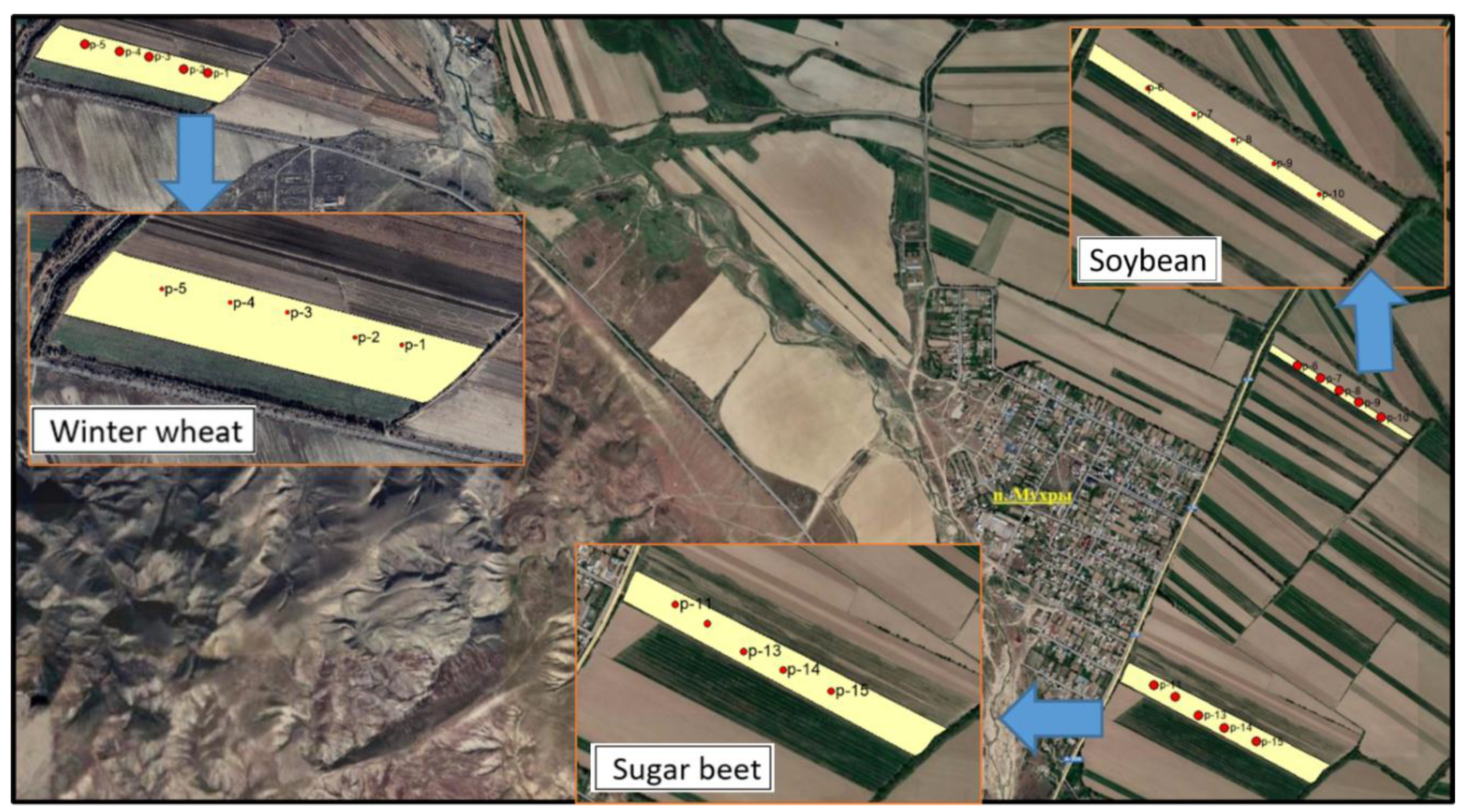
Figure 2.
Gas sampling using the closed chamber method (a) general view of the chamber; (b)installation of the chamber at the field site.
Figure 2.
Gas sampling using the closed chamber method (a) general view of the chamber; (b)installation of the chamber at the field site.
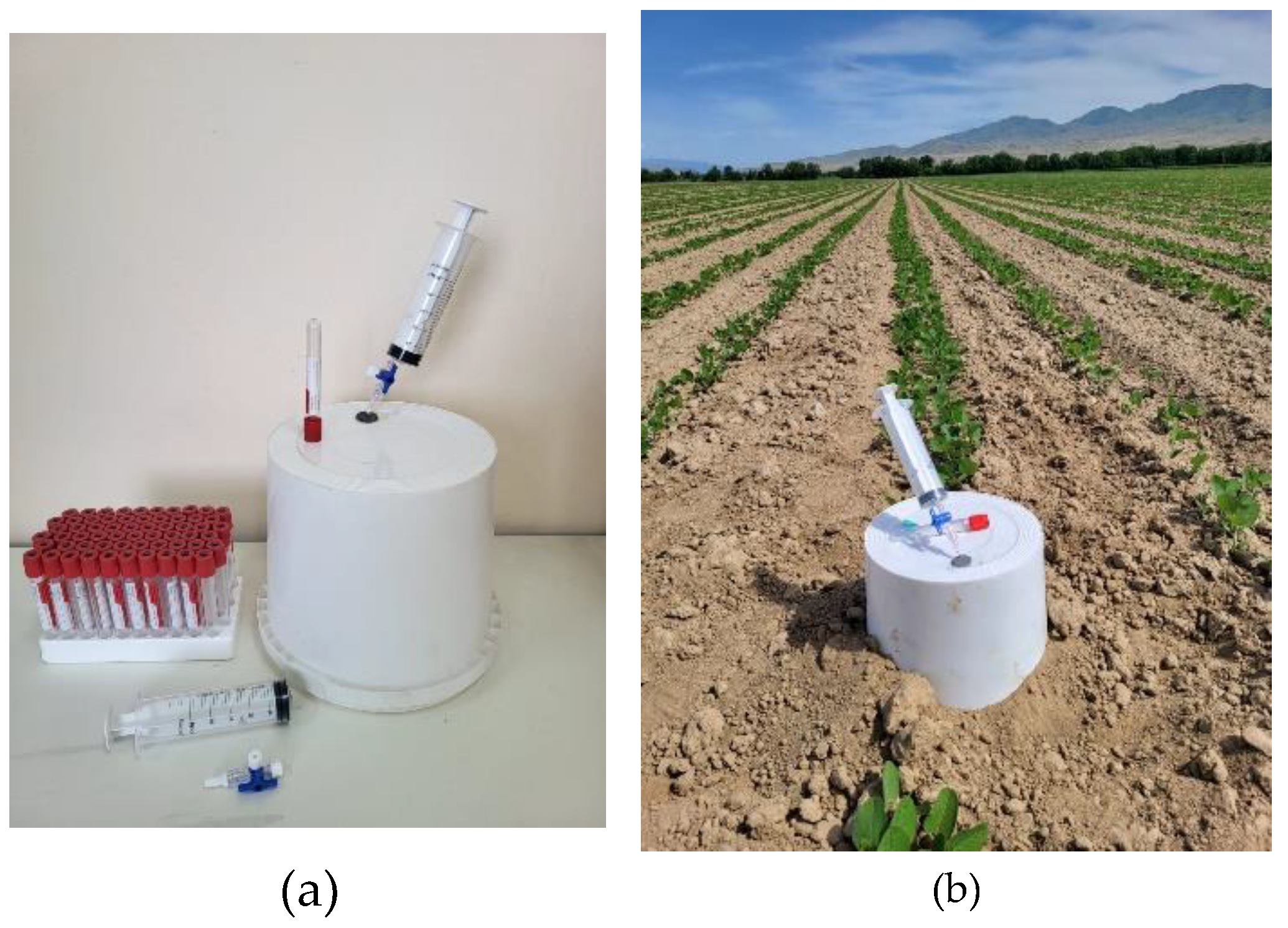
Figure 3.
Cartograms of content of humus and mobile forms of nutrients in soil: A – winter wheat, B – sugar beets, C – soybeans.
Figure 3.
Cartograms of content of humus and mobile forms of nutrients in soil: A – winter wheat, B – sugar beets, C – soybeans.
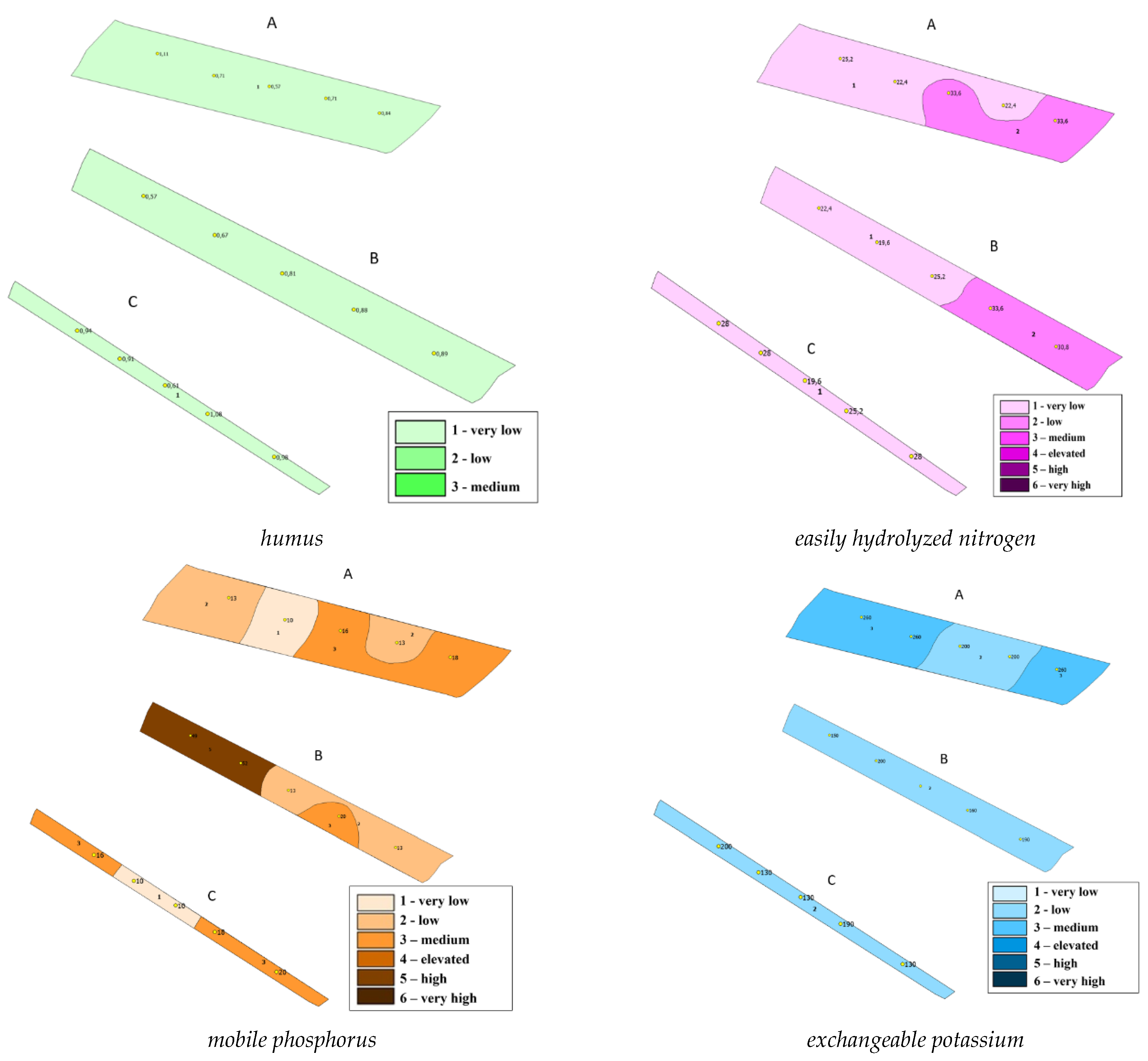
Figure 4.
Effect of fertilizers on mineral nitrogen content and the amount of nitrous oxide emissions in soil under winter wheat crops.
Figure 4.
Effect of fertilizers on mineral nitrogen content and the amount of nitrous oxide emissions in soil under winter wheat crops.
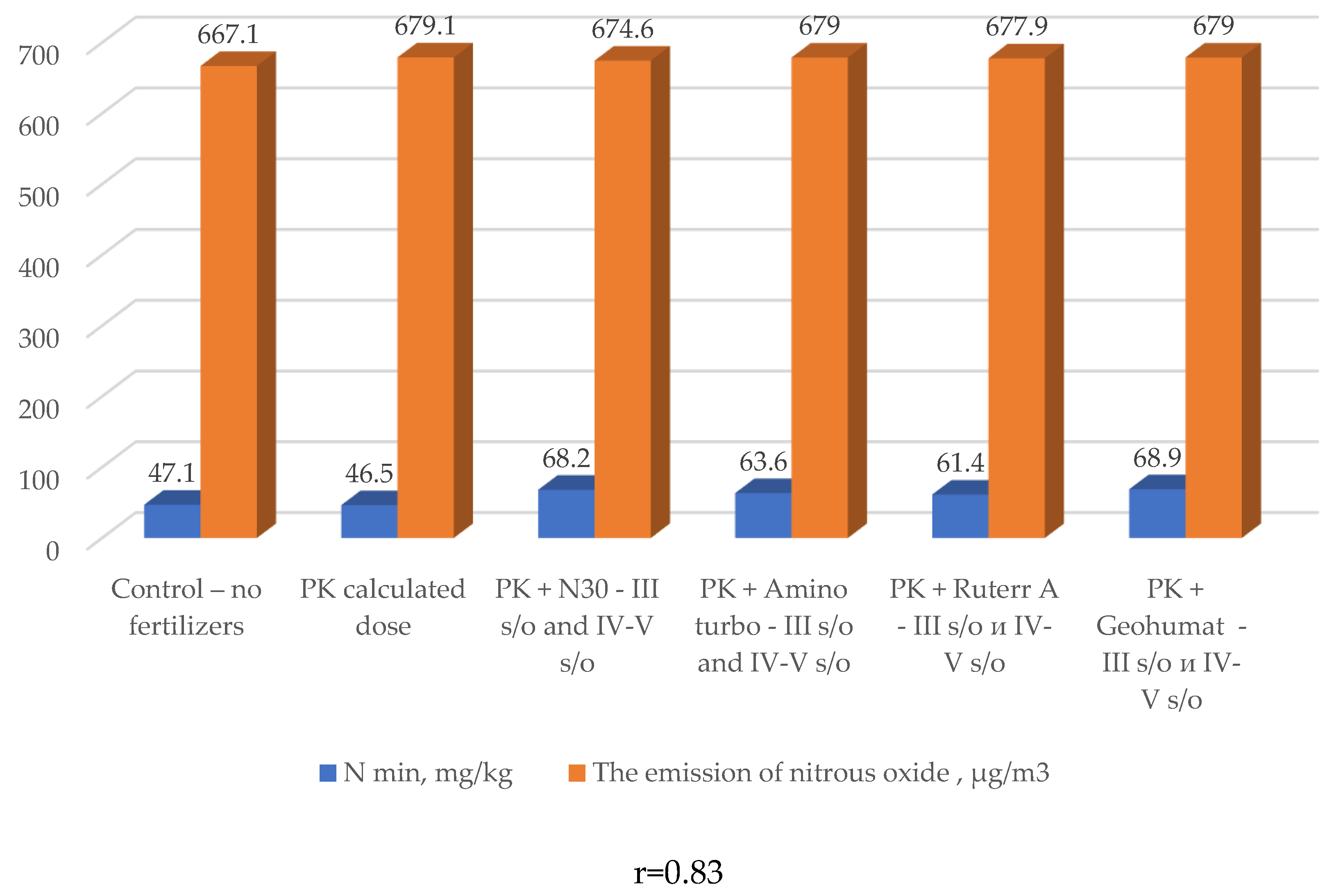
Figure 5.
Effect of fertilizers on the content of mineral nitrogen and the amount of nitrous oxide emissions in soil under sugar beet crops.
Figure 5.
Effect of fertilizers on the content of mineral nitrogen and the amount of nitrous oxide emissions in soil under sugar beet crops.
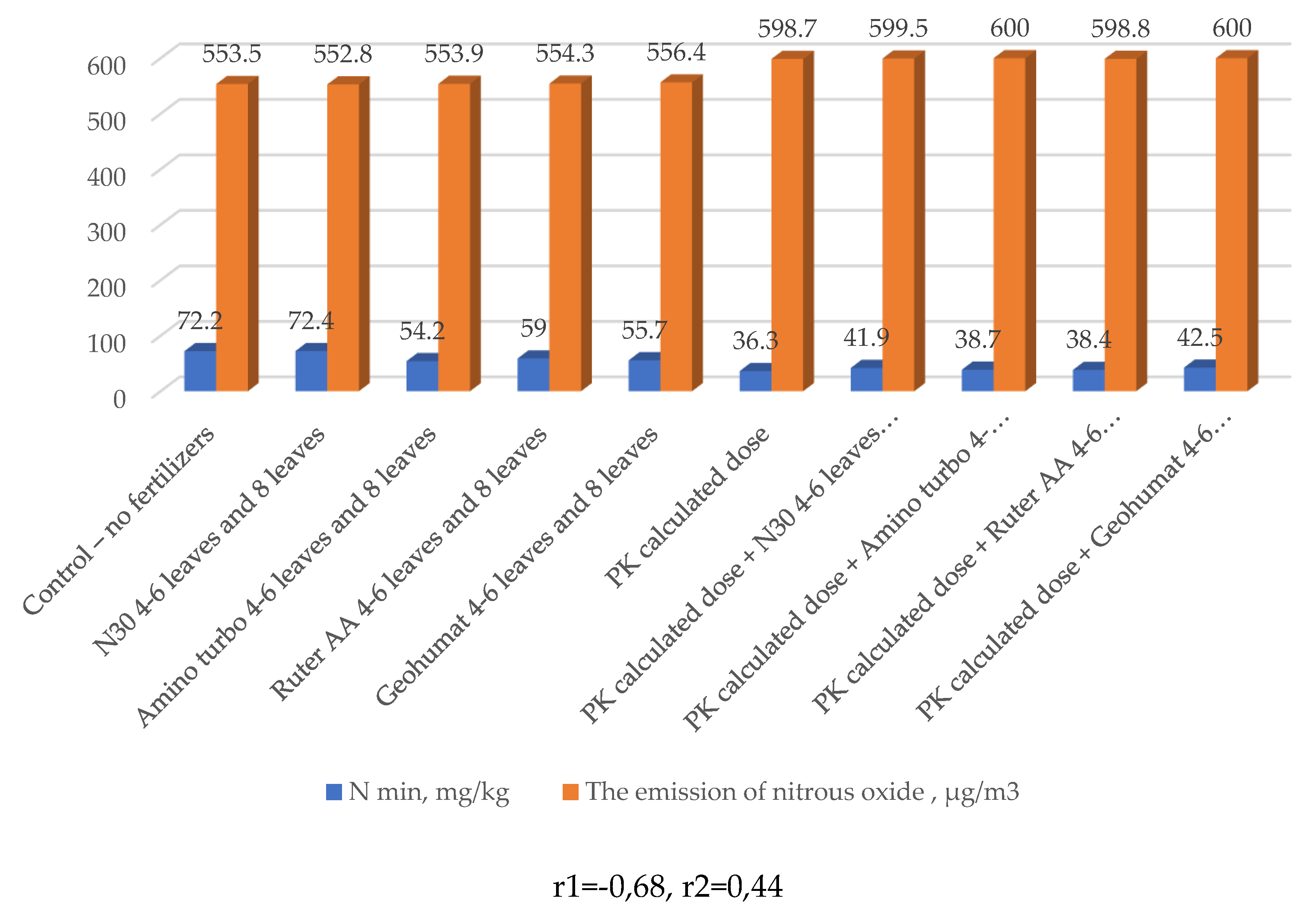
Figure 6.
Effect of fertilizers on the content of mineral nitrogen and the amount of nitrous oxide emissions in soil under soybean crops.
Figure 6.
Effect of fertilizers on the content of mineral nitrogen and the amount of nitrous oxide emissions in soil under soybean crops.
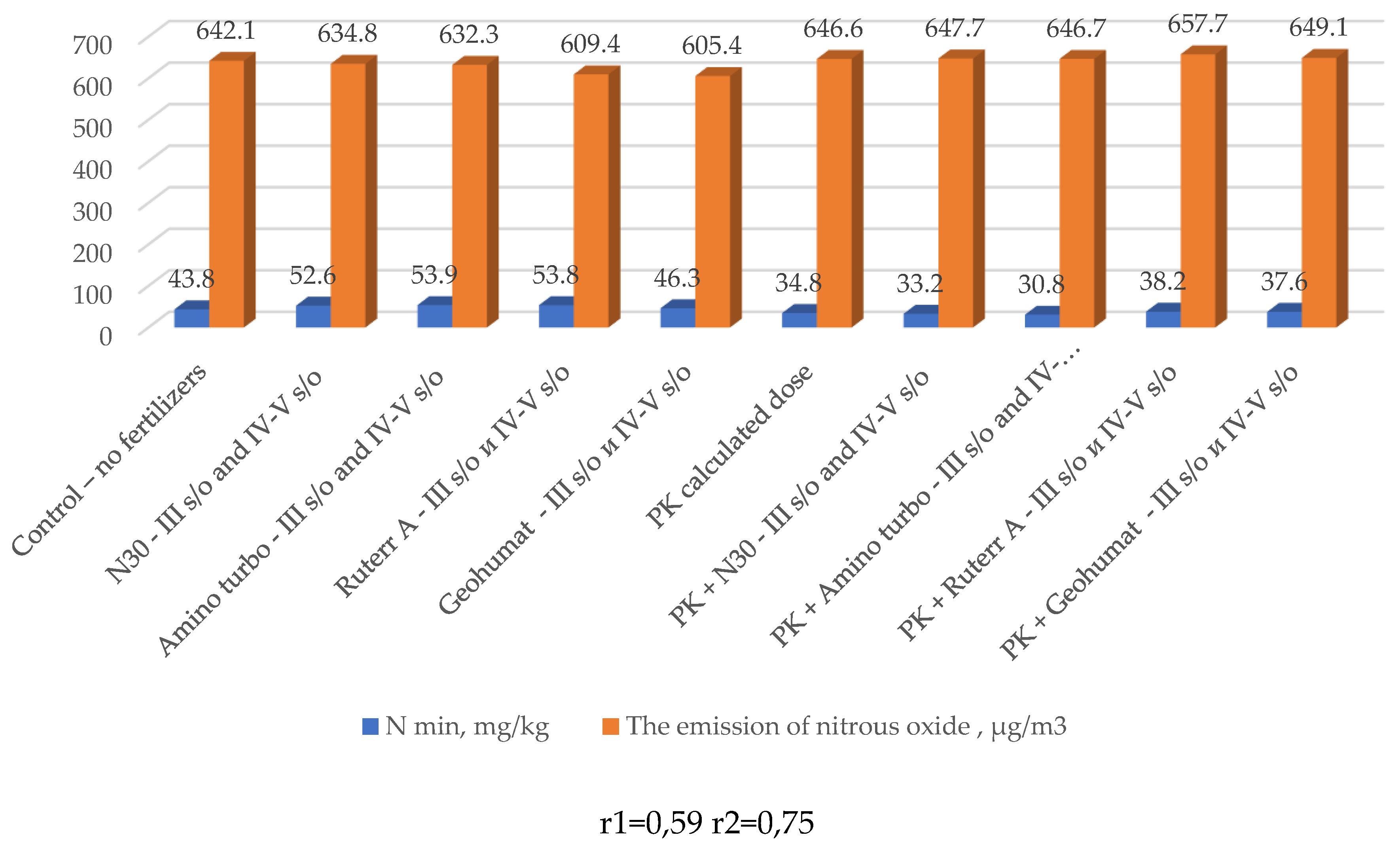

Table 1.
Content of mineral nitrogen forms in light gray soils depending on use of fertilizers, mg/kg.
Table 1.
Content of mineral nitrogen forms in light gray soils depending on use of fertilizers, mg/kg.
| № п/п | Variants | Nl.g. | N-NO3 | N-NH4 | N min, ∑ |
| Winter wheat, sowing 2022 | |||||
| 1 | Control – no fertilizers | 26,1 | 18,8 | 2,2 | 47,1 |
| 2 | PK calculated dose | 28,0 | 16,8 | 1,7 | 46,5 |
| 3 | N30 - III s/o and IV-V s/o | 33,6 | 25,5 | 9,1 | 68,2 |
| 4 | Amino turbo - III s/o and IV-V s/o | 33,7 | 23,3 | 6,6 | 63,6 |
| 5 | Ruter AA - III s/o and IV-V s/o | 34,5 | 20,4 | 6,5 | 61,4 |
| 6 | Geohumat - III s/o and IV-V s/o | 34,5 | 25,3 | 9,1 | 68,9 |
| Sugar beets, sowing 2023 | |||||
| 1 | Control – no fertilizers | 27,1 | 27,3 | 17,8 | 72,2 |
| 2 | N30 4-6 leaves and 8 leaves | 33,6 | 31,8 | 7,0 | 72,4 |
| 3 | Amino turbo 4-6 leaves and 8 leaves | 26,1 | 25,6 | 2,5 | 54,2 |
| 4 | Ruter AA 4-6 leaves and 8 leaves | 30,8 | 25,7 | 2,5 | 59 |
| 5 | Geohumat 4-6 leaves and 8 leaves | 29,9 | 22,7 | 3,1 | 55,7 |
| 6 | PK calculated dose | 20,5 | 13,3 | 2,5 | 36,3 |
| 7 | PK calculated dose + N30 4-6 leaves and 8 leaves | 22,4 | 14,1 | 5,4 | 41,9 |
| 8 | PK calculated dose + Amino turbo 4-6 leaves and 8 leaves | 22,4 | 14,3 | 2,0 | 38,7 |
| 9 | PK calculated dose + Ruter AA 4-6 leaves and 8 leaves | 19,6 | 16,9 | 1,9 | 38,4 |
| 10 | PK calculated dose + Geohumat 4-6 leaves and 8 leaves | 25,2 | 14,9 | 2,4 | 42,5 |
| Soybeans, sowing 2023 | |||||
| 1 | Control without fertilizers | 24,1 | 17,4 | 2,3 | 43,8 |
| 2 | N30 - III s/o and IV-V s/o | 34,5 | 15,9 | 2,2 | 52,6 |
| 3 | Amino turbo - III s/o and IV-V s/o | 33,6 | 18,3 | 2 | 53,9 |
| 4 | Ruter AA - III s/o and IV-V s/o | 33,6 | 18,8 | 1,4 | 53,8 |
| 5 | Geohumat - III s/o and IV-V s/o | 26,1 | 17,7 | 2,5 | 46,3 |
| 6 | PK calculated dose | 28,9 | 3,9 | 2,0 | 34,8 |
| 7 | PK calculated dose +N30 III s/o and IV-V s/o | 25,2 | 5,2 | 2,8 | 33,2 |
| 8 | PK calculated dose + Amino turbo III s/o and IV-V s/o | 25,2 | 3,9 | 1,7 | 30,8 |
| 9 | PK calculated dose + Ruter AA III s/o and IV-V s/o | 22,4 | 13,9 | 1,9 | 38,2 |
| 10 | PK calculated dose + Geohumate III s/o and IV-V s/o | 20,5 | 13,8 | 3,3 | 37,6 |
Table 2.
The influence of foliar fertilizing on grain yield of winter wheat, c/ha (harvest 2023).
| Variants | Yield capacity, c/ha | Average | Increase | ||||
|---|---|---|---|---|---|---|---|
| c/ha | % | ||||||
| І | ІІ | ІІІ | |||||
| Control – no fertilizers | 25,80 | 30,40 | 31,40 | 29,2 | 0,0 | - | |
| PK calculated dose | 42,00 | 41,00 | 30,70 | 37,9 | 8,7 | 29,8 | |
| N30 - III s/o and IV-V s/o | 39,50 | 40,30 | 37,70 | 39,2 | 10,0 | 34,2 | |
| Amino turbo - III s/o and IV-V s/o | 37,80 | 38,10 | 33,20 | 36,4 | 7,2 | 24,7 | |
| Ruter AA - III s/o and IV-V s/o | 44,70 | 40,20 | 43,10 | 42,7 | 13,5 | 46,2 | |
| Geohumat - III s/o and IV-V s/o | 35,10 | 37,20 | 38,60 | 37,0 | 7,8 | 26,7 | |
| LSD0,05, c/ha | 5,4 | ||||||
Table 3.
Effect of foliar fertilizing on soybean grain yield on the background of calculated doses of phosphorus fertilizers, c/ha.
Table 3.
Effect of foliar fertilizing on soybean grain yield on the background of calculated doses of phosphorus fertilizers, c/ha.
| Variants | Yield capacity, c/ha | Average, c/ha | Increase, | |||
|---|---|---|---|---|---|---|
| І | ІІ | ІІІ | c/ha | % | ||
| Control | 33,6 | 36,5 | 28,3 | 32,8 | 0 | |
| P94 calculated dose | 43,2 | 38,4 | 36,7 | 39,4 | 6,6 | 20,1 |
| P94 calculated dose + N30 - III s/o and IV-V s/o | 39,6 | 40,4 | 45,3 | 41,8 | 9,0 | 27,4 |
| P94 calculated dose + Amino turbo III s/o and IV-V s/o | 44,8 | 43 | 42,7 | 43,5 | 10,7 | 32,6 |
| P94 calculated dose +Ruter AA III s/o and IV-V s/o | 42,5 | 41,6 | 48,5 | 44,2 | 11,4 | 34,8 |
| P94 calculated dose + Geohumat III s/o and IV-V s/o | 40,4 | 48,1 | 44,2 | 44,2 | 11,4 | 34,8 |
| LSD0,05, c/ha | 6,1 | |||||
Table 4.
Effect of foliar fertilizing on soybean grain yield without applying calculated doses of phosphorus fertilizers, c/ha.
Table 4.
Effect of foliar fertilizing on soybean grain yield without applying calculated doses of phosphorus fertilizers, c/ha.
| Variants | Yield capacity, c/ha | Average, c/ha | Increase | |||
| І | ІІ | ІІІ | c/ha | % | ||
| Control | 33,6 | 36,5 | 28,3 | 32,8 | 0 | |
| P94 calculated dose | 43,2 | 38,4 | 36,7 | 39,4 | 6,6 | 20,1 |
| N30 - III s/o and IV-V s/o | 39,5 | 38,5 | 39,8 | 39,3 | 6,5 | 19,8 |
| Amino turbo - III s/o and IV-V s/o | 38,9 | 37,1 | 39,9 | 38,6 | 5,8 | 17,7 |
| Ruter AA - III s/o and IV-V s/o | 38,2 | 37,8 | 37,3 | 37,8 | 5,0 | 15,2 |
| Geohumat - III s/o and IV-V s/o | 39,5 | 38,1 | 37,2 | 38,3 | 5,5 | 16,8 |
| LSD0,05, c/ha | 3,5 | |||||
Table 5.
The influence of foliar fertilizing on the yield of sugar beet root crops on the background of applying calculated doses of phosphorus-potassium fertilizers, t/ha.
Table 5.
The influence of foliar fertilizing on the yield of sugar beet root crops on the background of applying calculated doses of phosphorus-potassium fertilizers, t/ha.
| Variants | Yield capacity, c/ha | Average, t/ha | Increase, t/ha | |||
|---|---|---|---|---|---|---|
| І | ІІ | ІІІ | t/ha | % | ||
| Control | 54,4 | 53,1 | 56,8 | 54,8 | - | - |
| P84K351 calculated dose | 63 | 63,1 | 60,8 | 62,3 | 7,5 | 13,7 |
| N30 4-6 leaves and 8 leaves | 68,4 | 66,2 | 66,8 | 67,1 | 12,4 | 22,4 |
| Amino turbo 4-6 leaves and 8 leaves | 80,9 | 80,9 | 70,4 | 77,4 | 22,6 | 41,2 |
| Ruter AA 4-6 leaves and 8 leaves | 63,4 | 85,2 | 70,1 | 72,9 | 18,1 | 33,0 |
| Geohumat 4-6 leaves and 8 leaves | 61,1 | 85,8 | 67,9 | 71,6 | 16,8 | 30,7 |
| LSD0,05, c/ha | 10,9 | |||||
Table 6.
The influence of foliar fertilizing on the yield of sugar beet root crops on the background without applying calculated doses of phosphorus-potassium fertilizers, t/ha.
Table 6.
The influence of foliar fertilizing on the yield of sugar beet root crops on the background without applying calculated doses of phosphorus-potassium fertilizers, t/ha.
| Variants | Yield capacity, c/ha | Average, t/ha | Increase, t/ha | |||
|---|---|---|---|---|---|---|
| І | ІІ | ІІІ | t/ha | % | ||
| Control | 54,4 | 53,1 | 56,8 | 54,8 | - | - |
| P84K351 calculated dose | 63 | 63,1 | 60,8 | 62,3 | 7,5 | 13,7 |
| N30 4-6 leaves and 8 leaves | 63,2 | 66 | 60,4 | 63,2 | 8,4 | 15,3 |
| Amino turbo 4-6 leaves and 8 leaves | 62,5 | 62,3 | 57,9 | 60,9 | 6,1 | 11,1 |
| Ruter AA 4-6 leaves and 8 leaves | 60,2 | 64,8 | 62,8 | 62,6 | 7,8 | 14,2 |
| Geohumat 4-6 leaves and 8 leaves | 62 | 59 | 65 | 62,0 | 7,2 | 13,1 |
| LSD0,05, c/ha | 4,1 | |||||
Disclaimer/Publisher’s Note: The statements, opinions and data contained in all publications are solely those of the individual author(s) and contributor(s) and not of MDPI and/or the editor(s). MDPI and/or the editor(s) disclaim responsibility for any injury to people or property resulting from any ideas, methods, instructions or products referred to in the content. |
© 2024 by the authors. Licensee MDPI, Basel, Switzerland. This article is an open access article distributed under the terms and conditions of the Creative Commons Attribution (CC BY) license (http://creativecommons.org/licenses/by/4.0/).
Copyright: This open access article is published under a Creative Commons CC BY 4.0 license, which permit the free download, distribution, and reuse, provided that the author and preprint are cited in any reuse.


