

Submitted:
11 June 2024
Posted:
12 June 2024
You are already at the latest version
Abstract
The present study provided a comprehensive overview of the current state of research on the Urban Metaverse, focusing on its integration into urban planning and design, as well as the ethical, social, and economic implications in urban settings. This study aims to evaluate the present standing and scope of the metaverse in the context of urban planning and city design; investigate the obstacles and remedies in integrating metaverse components into urban spaces; and explore the ethical, social, and economic ramifications of the metaverse in urban settings. The methodology involved a qualitative investigation of the relevant literature using academic databases and a review of thirty-two selected studies published between 2022 and 2024. The findings emphasise the changing nature of interpersonal relationships, potential alienation from physical spaces, and ethical implications of technology-driven urban changes. The study also highlights the potential opportunities and challenges associated with incorporating the metaverse into urban environments and offers strategies to address these challenges, including the formulation of data protection regulations, expansion of infrastructure, and ensuring equal access for all residents. The implications of the findings underscore the necessity of regulatory frameworks, technological investments, ethical considerations, and inclusive governance structures to ensure inclusive and sustainable urban development in the emerging era of the metaverse.
Keywords:
urban metaverse
; smart cities
; ethical concerns
; virtual cities
Introduction
The primary goal of the metaverse is to bridge the divide between digital and physical realms (Maier and Weinberger, 2024). Urban metaverse, also known as the “metaverse for cities”, is emerging as a significant application area (Kuru, 2023; Allam et al., 2022). It is anticipated that nearly 700 cities will incorporate some form of metaverse infrastructure by 2030 (Dzyuba 2023). Incorporating the metaverse into urban environments offers several advantages, including cost savings in the design, operation, and maintenance of city infrastructure, as well as increased engagement from the urban population. For instance, the city of Seoul, South Korea, has developed a metaverse app for urban use that residents can utilise for activities such as playing games and submitting civil complaints (Choi, 2022). Moreover, Dubai ranks among the top ten metaverse economies and has become a global hub for the metaverse community (Nesaif & Shagufta, 2023). Apart from that, Helsinki (Verdict,2024), Catalonia (Cureton,2024), Barbados (Thurman, 2024), London (VUCity,2024), New York (Reid,2022), Santa Monica (Bautista, 2022), Shanghai (Gong,2024), Singapore (Haas and Vats,2022), and Benidorm (Pérez,2022) are some other cities that have started to deploy urban metaverse.
Figure 1.
Advancement of technology incorporation in urban planning.
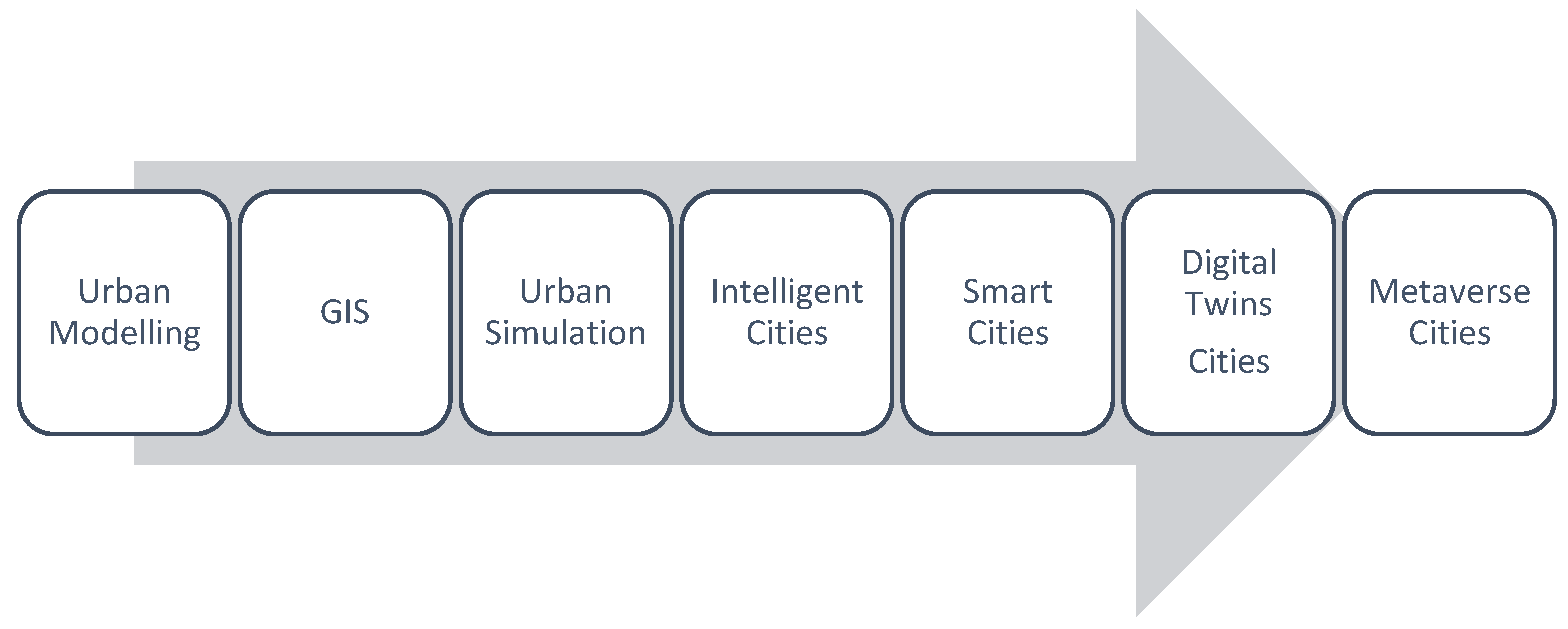

Table 1.
Urban Metaverse in global cities.
| City | Country | Metaverse Application | Details of Application | References |
|---|---|---|---|---|
| Seoul | Republic of Korea | Metaverse Seoul | Part of the comprehensive plan called “Seoul Vision 2030”; residents are offered various services in a specially developed metaverse in addition to virtual exploration of the city. | Sung-Eun,2023 |
| Helsinki | Finland | Virtual Helsinki | A digital replica of Helsinki’s city center, launched in 2018. Developed initially as a digital twin, the application allows users to experience the city’s famous sights virtually. | Verdict,2024. |
| Catalonia | Spain | CatVers | A virtual platform with free access that was launched with the support of the regional government and the Barcelona Chamber of Commerce. | Cureton,2024. |
| Barbados | - | Decentraland | The Caribbean Island state of Barbados, located northeast of Venezuela, signed contracts with Decentraland to open the first embassy in the metaverse. | Thurman,2024. |
| London | Great Britain | Greater London Authority’s London Plan | Provides an urban planning framework and regulations for new construction projects. | VUCity,2024 |
| New York | USA | Columbia University Project | A three-year project to develop a digital twin of significant intersections and locations in New York City. | Reid,2022. |
| Santa Monica | USA | Pokémon Go-like AR App | A virtual AR application is combined with the physical world on the cell phone’s screen via the smartphone’s camera. | Bautista,2022. |
| Shanghai | China | Shanghai Government Plan | Plans to use the metaverse for administration and regulation. | Gong,2024. |
| Singapore | Singapore | Virtual Singapore | A digital twin that has been available since 2014 and accesses data from various sources. | Haas and Vats,2022. |
| Dubai | UAE | Dubai’s Road and Transport Authority Project | Uses augmented reality to visualize a digital twin of the Dubai Metro rail network. | Nesaif & Shagufta, 2023. |
| Benidorm | Spain | Benidorm Land | A platform to help promote tourism. It is based on a metaverse platform that depicts Benidorm virtually and supplements it with objects and avatars. | Pérez,2022. |
Urban metaverse represents a significant trend towards incorporating advanced technologies in urban planning, a progression that began with urban modelling (Yeh, 2024). This development, initiated by the emergence of urban modelling (Tobler, 1959) and Geographic Information Systems (GIS) in the 1960s (Tomlinson, 1962), has led to increasingly sophisticated tools capable of managing the growing complexity of urban environments. The transition towards data-driven decision-making is evident, as advancements such as simulations, Intelligent Cities (Komninos, 2006), and Smart Cities (Aljoufie & Tiwari, 2022) enable more informed and effective planning processes. Moreover, these technologies democratise urban planning by facilitating citizen engagement. The emphasis on sustainability and efficiency is apparent in the development of Digital Twin Cities (Lehner & Dorffner, 2020), which utilise AI to optimise urban planning. The latest concept, Metaverse City (Allam et al., 2022), signals the proactive approach of the field to future challenges, including the integration of virtual and physical spaces. These trends highlight the dynamic nature of urban and regional planning, and its readiness to harness technology to address complex urban challenges. They also underscored the importance of continuous learning and adaptability among urban planning professionals.
The metaverse has the potential to fundamentally change how we operate daily and may alter the purpose and feel of cities. As more daily activities move online, it is crucial to consider how this shift may impact urban amenities and the ultimate role that cities will play. Urban metaverse technologies involve the creation of immersive 3D experiences through a combination of digital twins, augmented reality (AR), virtual reality (VR), extended reality (XR), avatars, artificial intelligence (AI), cloud computing, and mobile devices. The metaverse combines several techno-utopian digital visions (Dickel & Schrape, 2017) such as “Mirror Worlds” (Gautam et al., 2018), pollution-free living, and free-form designs of “Liquid Architectures.” However, it is essential to consider social implications, including the potential of private interests to control virtual urban environments. Economic activity in the metaverse is growing, and cities, such as Dubai, aim to attract companies from the blockchain and metaverse space, supporting over 40,000 jobs by 2030 (Dzyuba, 2023). Furthermore, Saudi Arabia is building a futuristic city, NEOM, where the metaverse will be integrated from the ground (Banaeian & Imani, 2023).
An extensive qualitative investigation of relevant literature was conducted to identify studies pertinent to this research. Four academic databases were used, namely Web of Science, Google Scholar, Scopus, and ResearchGate. The search queries included keywords such as “Smart City Metaverse,” “Urban Metaverse,” “Municipal Metaverse,” “Urban Infrastructure and Metaverse,” “Metaverse City Applications,” “Metaverse Ethical, Social, and Economic Risks and Challenges,” and “Future Trends of Urban Metaverse.” The results obtained were carefully scrutinised, and thirty-two studies were selected for their specific focus on the applications and challenges of integrating the metaverse with cities. These studies, published between 2022 and 2024, span various disciplines including urban informatics, urban science, and data-driven smart cities. The aim of this review is to provide a comprehensive overview of the current state of research on urban metaverse areas with the following objectives:
- to evaluate the present standing and scope of the metaverse in the context of urban planning and city design.
- to investigate obstacles and remedies for integrating metaverse components into urban spaces.
- to explore the ethical, social, and economic ramifications of the metaverse in urban settings.
In accordance with these objectives, this study endeavoured to address the following research questions, which served as the framework for this review.
- 1)
- What are the current prospects for the metaverse in city planning and design?
- 2)
- What are the notable advantages and opportunities associated with incorporating metaverse components into an urban infrastructure?
- 3)
- What difficulties and limitations have the cities encountered when integrating metaverse elements?
- 4)
- How have these difficulties been tackled, and what remedies have been suggested or applied?
- 5)
- What are the ethical, social, and economic repercussions of the metaverse in urban settings?
- 6)
- What future trends and advancements can be expected for urban metaverses?
The subsequent text provides a formal and comprehensive overview of the structure and content of this study. The sections include a review of metaverse applications in city planning and design; an examination of the relationship between metaverse and urban infrastructure; a discussion of the challenges associated with the integration of metaverse technology in cities; potential solutions to these challenges; a consideration of the ethical, social, and economic implications of urban metaverse use; an exploration of future trends; and finally, conclusions and discussions.
Metaverse for City Planning and Design
Metaverse, a digital environment where users interact with computer-generated settings and other users, is expected to have a significant impact on city planning and design. This literature review provides a comprehensive overview of current research and expert opinions on the potential implications of the metaverse for urban development. It is anticipated that the metaverse will replace certain physical spaces in urban areas with their digital counterparts and create digital twins for policy testing and vision implementation, offering innovative solutions to urban challenges and improving living conditions in developing cities (Faliagka et al., 2024; Ulubaş Hamurcu, 2022; Dorostkar & Najarsadeghi, 2023). However, the metaverse also poses challenges akin to those in urban planning, such as the need for stakeholder coordination and technical standards for interoperability (Clough and Wu, 2024).
The metaverse presents significant advantages for city planning and design by allowing the creation of digital twin cities, facilitating smart city applications, and providing accurate data collection for urban mobility, as indicated by research conducted by Deveci et al. (2022a). It also offers opportunities for virtual workplaces and schools, which can reduce transportation needs and enhance sustainability in urban planning (Deveci et al., 2022b). Furthermore, metaverse has the potential to redefine city design and municipal services by providing immersive experiences and collaborative capabilities for interacting with digital replicas of cities, as suggested by Shahbaz Badr and De Amicis (2023).
Metaverse constitutes a promising prospect for urban planning and design, enabling exploration and innovation in alternative virtual environments (de Almeida, 2023). Moreover, this technology supports urban development by enhancing destination tourism, digital exhibitions, and promoting sustainable socioeconomic advantages (Wan et al., 2023). Metaverse provides immersive visualisation and analysis for smart city development, optimising energy consumption, traffic flow, and waste management (Sarwatt et al., 2024). Additionally, the integration of the metaverse into city planning and design facilitates the creation of immersive urban cyberspaces (Parvez et al., 2024). It fosters innovative and creative experiences that shape smart city visions and urbanisation, thereby presenting new prospects for urban development (Koshnicharova, 2023).
In brief, the integration of the metaverse into city planning and design has created new opportunities and challenges for urban development. This technology is anticipated to exert a substantial impact on a range of aspects of urban planning and design, furnishing innovative solutions and engaging experiences for both stakeholders and citizens. As metaverse progresses, it is envisaged to play a crucial role in the formation of the future of city planning and design (Table-1).
Table 1.
Key metaverse application areas for urban planning and design.
| Key application area | Mechanisms/Examples | References |
|---|---|---|
| Improve interactions with citizens | Immersive urban experiences, virtual city tours, interactive urban planning simulations | Lnenicka et al. 2024; Chen, 2024 |
| Manage urban spaces | Real-time IoT data streams, 3D modeling for informed decision-making in city design | Chen et al., 2024 |
| Restructure urban planning models | Immersive city planning simulations, cost savings, improved engagement, enhanced governance | Lv, et al. 2022 |
| Address urban challenges and improve living conditions | Digital twin cities, smart city applications, accurate data collection for urban mobility | Deveci et al., 2022a; Dorostkar & Najarsadeghi 2023 |
| Redefine city design and municipal services | Immersive experiences, collaborative capabilities for interacting with digital replicas of cities | Shahbaz Badr & De Amicis 2023 |
| Enhance decision-making environments for city planning | Immersive visualization and assessment of potential impacts on cities and societies | Qin et al., 2024 |
| Create virtual cities that elude established urban dynamics | Shared virtual experiences, allowing users to interact and collaborate in 3D virtual worlds | Hagge, 2024 |
| Enhance destination tourism and digital exhibitions | Immersive visualization and analysis for smart city development, optimizing energy consumption | Wan et al. 2023 |
| Influence smart city visions and urbanization | Innovative and creative experiences, impacting city planning and design | Koshnicharova, 2023 |
| Address urban challenges such as healthcare delivery | New ways for digital transition in cities, providing intelligent services and immersive interactions | Allam et al., 2022 |
Metaverse and Urban Infrastructure
Incorporating metaverse components into urban infrastructure presents several advantages, including enhanced crowd management, real-time data analysis, and an improved user experience (Koshnicharova, 2023). This integration has the potential to transform urban spaces into vibrant hubs for commerce, socialisation, and entertainment, fostering positive network effects and facilitating unanticipated interactions (Clough & Wu, 2024). A key benefit is the enhancement of library services through technologies such as 3D printing, VR/AR experience, and IoT-based self-checkout machines, which offer more interactive and engaging experiences for library patrons (Guo et al. 2023).
In addition, the integration of metaverse components can revolutionise urban infrastructure by improving payment methods, increasing data-collection capabilities, and creating more efficient urban mobility systems (Deveci et al., 2022a). Enhanced traffic prediction, resource optimisation, and user feedback mechanisms can significantly improve urban transportation networks (Deveci et al., 2024). This technology supports sustainable urban development, reduces poverty, improves public health, and mitigates the effects of climate change (Dorostkar and Najarsadeghi, 2023).
Furthermore, it can enhance citizen engagement, optimise operational efficiency, and improve emergency response systems (Faliagka et al., 2024). It facilitates virtual simulations, early-stage collaboration, and rapid decision-making processes, providing a dynamic platform for urban planning and development (Hamurcu, 2022). Additionally, the metaverse can reduce transportation demand, improve data collection, optimise urban services, and offer new opportunities for sustainable urban infrastructure (Deveci et al., 2022b).
Metaverse provides various advantages such as improved social interactions, reduced resource consumption, and improved urban governance (Allam et al., 2022). It encourages inventive approaches to urban planning, promotes public participation, and fosters community resilience (Hudson-Smith and Shakeri, 2022). Moreover, it democratises urban design; broadens place marketing; and offers engaging experiences for planning, education, and research (Hajrasouliha, 2023).
The metaverse presents a multitude of benefits and opportunities for the urban infrastructure sector, including enhanced citizen services, sustainable urban development, improved urban governance, and immersive experiences (Table-2). This technology has the potential to significantly enhance the quality of urban living and revolutionise the way cities are designed, managed, and experienced.
Table 2.
Key metaverse application areas for urban infrastructure.
| Key application area | Mechanisms/Examples | References |
|---|---|---|
| Enhanced user experiences of urban infrastructure and services | VR/AR experiences, immersive learning experiences, interactive urban infrastructure planning , and management | Koshnicharova 2023. Qin et al.,2024. Parvez et al.,2024 |
| Improved crowd management | Real-time data analysis, traffic prediction, resource optimization | Deveci et al.,2024 |
| Fostering positive network effects | Focal destinations for commerce, socializing, and entertainment, immersive visualization | Clough & Wu 2024 |
| Sustainable urban infrastructure | Optimizing energy consumption, traffic flow, waste management, sustainable urban development | Deveci et al., 2022 b, Allam et al.,2022, Sarwatt et al.,2024 |
| Enhanced citizen engagement | Personalized public services, virtual urban design collaboration, improved social interactions | Shahbaz Badr & De Amicis 2023, Faliagka et al.,2024, Kshetri et al., 2024 |
| Innovative city design | 3D printing, IoT-based self-checkout machines, innovative urban infrastructure visualization | Guo et al.,2023, Hajrasouliha 2023 |
| Improved urban resource management | Improved data collection, efficient resource use, enhanced urban governance | Deveci et al.,2022a, Hudson-Smith & Shakeri 2022 |
| Virtual simulations and predictive models | Immersive visualization, simulations, predictive models for smart city infrastructure operations | Ulubaş Hamurcu 2022, Merlo & Lavoratti,2024, Dorostkar & Najarsadeghi 2023, Wan et al. 2023 |
| Inclusive and immersive virtual experiences | Immersive and engaging experiences for planning education and research, digital exhibitions | Hagge ,2024, de Almeida 2023, Bibri et al.,2022 |
Challenges of Metaverse in Cities
The introduction of metaverse components into urban environments presents a multitude of obstacles and constraints, as revealed by extensive academic research (Kshetri et al., 2024; Chen et al., 2024; Clough & Wu, 2024; Lnenicka et al., 2024; Guo et al., 2023; Parvez et al., 2024). These challenges include high development and maintenance expenses, potential privacy and security risks, unequal access owing to varying device availability, and increased government visibility and control (Kshetri et al., 2024). Cities must also grapple with establishing a harmonious relationship between the real world and the metaverse, ensuring safety and security, and determining suitable urban aesthetics and styles (Chen et al. 2024). Achieving a consensus on spatial and temporal design, interoperability, and governance structures for metaverse integration is another significant challenge (Clough & Wu, 2024).
Furthermore, the necessity for specialised cloud environments, robust infrastructure, and comprehensive government frameworks to effectively employ the metaverse in city planning and design has been identified as a critical hurdle (Lnenicka et al. 2024). Cities must invest substantially in technology while addressing potential privacy concerns and ensuring equitable access to advanced technologies for all citizens (Guo et al., 2023). The integration of metaverse elements also raises significant issues related to cybersecurity, data privacy, the accurate translation of human emotions, and limitations in personalisation options (Parvez et al., 2024).
Moreover, cities must navigate through various challenges when striving to offer smooth and user-friendly interactions within the metaverse. The exploration of extensive virtual environments and the incorporation of immersive technologies into urban planning demands considerable technological advancement and user adaptability (Shahbaz Badr & De Amicis, 2023). The intricacy of the technology, the substantial costs associated with representation and experimentation, and the existence of multiple representations and platforms pose significant barriers (Hudson-Smith, 2022). Moreover, cities confront constraints such as technical and functional limitations during the initial stages of metaverse exhibition development as well as the necessity for comprehensive user experience assessments and sustainable use evaluations (Wan et al., 2023).
To conclude, while the integration of metaverse components into urban environments holds immense potential, it is fraught with challenges that require careful consideration and strategic planning. High costs, privacy and security risks, unequal access, and the need for robust governance frameworks are merely a few obstacles that must be overcome (Table-3). Ensuring interoperability, achieving consensus on design and governance, and addressing the technological complexity of metaverse integration are essential for the successful integration of this transformative technology into the urban infrastructure.
Table 3.
urban metaverse: significant challenges.
| Challenge | Description |
|---|---|
| High costs for development and maintenance | Cities integrating metaverse elements have faced challenges such as high costs for development and maintenance, potential privacy and security risks, unequal access due to varying device availability, and concerns about government visibility and control. Additionally, the lack of readiness of key metaverse technologies and the potential negative impact on mental health have been significant limitations. |
| Potential privacy and security risks | Difficulties and limitations encountered when integrating metaverse elements in cities may include the need for significant investment in technology, potential privacy concerns, and the challenge of ensuring equitable access to these technologies for all library patrons. Cities have also faced challenges such as digital exclusion, technological dependence, and security concerns when integrating metaverse elements. |
| Unequal access due to varying device availability | Challenges include lack of agreed standards, high-power computing requirements, inefficiency of blockchain technologies, and antisocial behaviours in the metaverse ecosystem. Cities face challenges of technological accessibility stratification, economic gaps, and potential risks of urban sprawl when integrating metaverse elements. |
| Concerns about government visibility and control | Cities have faced challenges in establishing a harmonious relationship between the real world and the metaverse, ensuring safety and security, and determining suitable city styles. Difficulties and limitations in integrating metaverse elements include high development costs, interoperability challenges, and lack of regulatory frameworks. |
| Lack of readiness of key metaverse technologies | Cities have encountered difficulties such as privacy concerns, security issues, and the need for high-security means when integrating Metaverse elements. Difficulties and limitations in integrating metaverse elements include high development costs, interoperability challenges, and lack of regulatory frameworks. |
| Potential negative impact on mental health | Cities have encountered difficulties in evaluating the usefulness and outcome of designed games and balancing the meaningful and playful elements of the metaverse. Difficulties include social exclusion, reduction of complexity, and lack of consideration for everyday life experiences. |
| Need for specialized cloud environments, infrastructure, and government frameworks | Difficulties include the need for specialized cloud environments, infrastructure, and government frameworks for utilizing the metaverse in city planning and design. Cities have faced challenges with data security, interoperability, and privacy when integrating metaverse elements. |
| Concerns about privacy and representation in the virtual space | Challenges include technical limitations, accessibility issues, and concerns about privacy and representation in the virtual space. Cities have encountered difficulties such as privacy concerns, security issues, and the need for high-security means when integrating Metaverse elements. |
| Technical limitations and functional imperfections | Limitations include technical and functional imperfections in the early stage of metaverse exhibition development, and the need for broader user experience and sustainable use comparisons. Challenges include technical limitations, accessibility issues, and concerns about privacy and representation in the virtual space. |
| Cybersecurity, data privacy, and security concerns | Cities have encountered challenges in cybersecurity, data privacy, and security when integrating metaverse elements. Cities have faced challenges in data privacy, energy consumption, and infrastructure integration when incorporating metaverse elements into urban settings. |
Solutions to Urban Metaverse Challenges
Researchers have identified several potential strategies to address the challenges associated with integrating the Metaverse into urban environments, including the formulation of data protection regulations, expansion of infrastructure, and ensuring equal access for all residents (Maier & Weinberger, 2024). Efforts to overcome these hurdles encompass capacity building, policy formulation, and community participation (Sunindyo et al., 2024). Remedies for these difficulties comprise advanced encryption, secure access controls, and standardized protocols for seamless integration of Metaverse components (Faliagka et al., 2024). Proceedings regarding digital divide, digital literacy, privacy breaches, user diversity, and user addiction are ongoing, with additional regulations and customs proposed to ensure privacy and security (Ulubaş Hamurcu, 2022). Strategies to tackle these issues encompass harnessing the Metaverse’s potential to improve urban environments and influence urban planning decisions (Dorostkar & Najarsadeghi, 2023). Furthermore, multilateral agreements for interoperability, unified standards, and governance frameworks are being explored, drawing on lessons from urban planning and technological management (Clough & Wu, 2024).
The establishment of MetaCities and MetaSocieties has been instrumental in addressing the challenges posed by the integration of virtual reality and augmented reality into city information modeling (Qin et al., 2024; Merlo & Lavoratti, 2024). These entities provide virtual decision-making scenarios and closed-loop feedback mechanisms to guide actual city operations. To ensure inclusivity, transparency, and accountability in the use of virtual resources, strategies for governance, citizen participation, and equitable access have been implemented (de Almeida, 2023). Future studies could expand the scope of these initiatives by comparing user experiences and sustainable use between different countries, as well as conducting in-depth studies as technology evolves (Wan et al., 2023). To ensure the benefits of the Metaverse are accessible to all citizens, governance structures are urged to prevent the misuse of the Metaverse, with inclusivity and accessibility being highlighted as essential (Allam et al., 2022). Remedies proposed to address these concerns include reorienting user conception, recognizing human characteristics, and considering moral values and principles (Bibri and Allam, 2022). To shape virtual worlds with unique forms, rules, and regulations, it is suggested that developments in the Metaverse be closely observed for their applications to real-world planning (Hajrasouliha, 2023). By doing so, the benefits of the Metaverse can be maximized while minimizing potential risks and negative impacts.
Attempts to tackle these challenges involve policy implications related to data privacy, the establishment of energy-efficient infrastructure, and the development of sustainable transportation systems, aiming to lessen the negative consequences (Deveci et al., 2022 b). Research is also concentrated on devising efficient navigation techniques and improving teleportation capabilities to enhance navigation performance in extensive urban virtual environments (Shahbaz Badr & De Amicis 2023). This study underlines the necessity of adopting a multifaceted approach to address the challenges of incorporating the Metaverse into urban settings, stressing the importance of regulatory frameworks, technological investments, ethical considerations, and inclusive governance structures (Table-4).
Table 4.
Solutions to Urban Metaverse challenges.
| Key Solution | Details of Solution | References |
|---|---|---|
| Data Protection Measures | Advanced encryption, secure access controls, and open standards for seamless integration of metaverse components | Faliagka et al.,2024 |
| Infrastructure Development | Investment in technology, promoting digital inclusion, and implementing robust data protection measures | Chen,2024 |
| Equal Access for All Citizens | Financial aid for small cities, collaboration between governments and private companies, and the development of human-centric interoperability standards | Lv, et al. 2022 |
| Policy Regulations | Development of regulations to address privacy and security risks, the promotion of citizen interactions and decision-making processes, and the implementation of mechanisms to ensure equal access to the Metaverse | Kshetri et al., 2024 |
| Community Involvement | Efforts to address these challenges include the development of responsive models and the integration of virtual reality and augmented reality into city information modeling | Merlo & Lavoratti,2024 |
| Governance Structures | Inclusivity and accessibility need to be escalated to ensure benefits for all citizens. Governance structures must ensure the metaverse is not misused | Allam et al.,2022 |
| Iterative Design Processes | These difficulties are being tackled through iterative design processes and co-designing approaches, aiming to promote holistic system understanding among stakeholders | Hudson-Smith & Shakeri 2022 |
| Ethical Principles | Remedies include the need for new socio-humanitarian rationality, regulation, and ethical principles to mitigate the negative implications of the Metaverse | Bibri et al.,2022 |
| Emotional Intelligence Integration | Incorporating emotional intelligence into the metaverse, creating emotionally intelligent metaverse (EIM) to foster meaningful human interactions | Parvez et al.,2024 |
| AI/ML Utilization | The use of AI/ML for crowd monitoring, privacy assurance, and data validation. Solutions include GDPR-compliant sensors and AI capabilities | Koshnicharova 2023 |
Ethical, Social and Economic Concerns
The metaverse presents a multitude of ethical, social, and economic implications in urban contexts that necessitate extensive deliberation and management. These implications encompass a broad array of concerns, such as data privacy, digital equity, intellectual property rights, privacy violations, and economic discrepancies. It is essential for stakeholders to collaborate and build consensus to address the challenges and opportunities posed by the metaverse (Clough & Wu, 2024; Guo et al., 2023; Deveci et al., 2022a; Kuru, 2023). From an ethical standpoint, the metaverse in urban environments raises issues concerning privacy, surveillance capitalism, the potential replication of prejudices, and the exacerbation of urban inequality. Socially, it may impact communication channels, social ties, and cognitive capabilities. Economically, it demands considerable investment and resources, which could reinforce big tech dominance and widen economic disparities (Allam et al., 2022; Hudson-Smith & Shakeri, 2022; Bibri and Allam, 2022). Furthermore, the metaverse raises issues about privacy violations, data surveillance, predictive privacy harms, and economic implications for industries and businesses. It also engenders ethical and social considerations in city planning and design, affecting societal values and governance (Koshnicharova, 2023; Deveci et al., 2022b; Bibri et al., 2022). The metaverse in urban settings also raises ethical, social, and economic concerns pertaining to privacy, data security, digital inclusion, and economic disparities, necessitating careful regulation and transparency in decision-making processes. Additionally, it presents prospects for improved urban mobility, economic growth, and enhanced mental well-being, while also requiring compliance with regulations and safeguarding citizens’ privacy (Shahbaz Badr & De Amicis, 2023; Hajrasouliha, 2023; Sarwatt et al., 2024; Wan et al., 2023).
So, urban environments metaverse brings forth a multifaceted set of ethical, social, and economic issues (Table-5) that require careful consideration. On one hand, it has the potential to provide immersive and interactive experiences that foster community engagement and citizen participation. On the other hand, it raises concerns such as privacy, security, digital divide, and economic disparities that require addressing. It is imperative for policymakers, urban planners, and stakeholders to collaborate to ensure that the implementation of the metaverse aligns with ethical principles and promotes inclusive, sustainable urban development.
Table 5.
Key Ethical and Socioeconomic concerns on Urban metaverse.
| Key concerns | Explanation | References |
|---|---|---|
| Privacy, Security, & Digital Addiction | Concerns about privacy, security, potential for undesirable behaviours, digital addiction, mental health issues, resource demands, and unequal access | Kshetri et al., 2024; Ulubaş Hamurcu, 2022; Lv et al., 2022; Chen, 2024; Deveci et al., 2022b. |
| Data Security, Privacy, & Environmental Impact | Data security, privacy protection, energy supply, environmental impact, regulatory compliance, and citizen privacy protection. | Chen et al., 2024; Deveci et al., 2022a; Hudson-Smith, 2022; Deveci et al., 2022b |
| Digital Divide, Economic Inequality & Inclusiveness | Digital divide, economic inequalities, social exclusion, and inclusiveness challenges. | Chen, 2024; Maier & Weinberger, 2024; Sunindyo et al., 2024; Deveci et al., 2024; Hagge, 2024 |
| Cybersecurity & Intellectual Property | Cybersecurity, privacy, intellectual property rights, need for skilled labour, and economic development opportunities. | Deveci et al., 2022a; Faliagka et al., 2024 |
| Virtual-Physical Interactions & Economic Impact | Ethical considerations of virtual and physical interactions, job creation, poverty reduction, and impact on traditional urban development processes. | Dorostkar & Najarsadeghi, 2023; Hagge, 2024 |
| Data Privacy & Digital Equity | Data privacy, digital equity, impact on traditional library services, and responsible management. | Guo et al., 2023 |
| Surveillance Capitalism & Prejudices | Privacy, surveillance capitalism, potential replication of prejudices, urban inequality, and substantial investment requirements. | Allam et al., 2022; Koshnicharova, 2023 |
| Behavioural Manipulation & Big Tech Dominance | Privacy encroachments, security breaches, behavioural manipulation, personal data exploitation, and reinforcing big tech dominance. | Bibri & Allam, 2022 |
| XR Misuses & Bias | Data privacy, digital divide, bias, control, and potential misuses of XR technologies. | Hajrasouliha, 2023 |
| Privacy Erosion & Democratic Backsliding | Privacy erosion, surveillance, control, democratic backsliding, and dystopianism. | Bibri et al., 2022 |
| Interpersonal Relationships & Physical Alienation | Changing nature of interpersonal relationships, potential alienation from physical spaces, and ethical implications of technology-driven urban changes. | Merlo & Lavoratti, 2024 |
| Ethical Development & Economic Implications | Ethical development, social interaction, economic implications, and reshaping human interactions. | de Almeida, 2023 |
| Mental Health & User Intention | Enhancing mental health, expanding visual depth, promoting exhibition sharing, and studying user intention from a psychological level. | Wan et al., 2023 |
| Ethical Use of Technologies & Infrastructure | Data privacy, security, ethical use of immersive technologies, and economic implications for infrastructure development. | Sarwatt et al., 2024. Parvez et al., 2024. |
Future Trends
The future of the urban metaverse is expected to bring significant advancements and trends, as evidenced by a multitude of scholarly works (Clough & Wu, 2024). The convergence of proto-metaverses, the establishment of shared standards for interoperability, and the emergence of a consensus metaverse in urban settings are anticipated (Guo et al., 2023). Furthermore, the integration of AI technologies, expansion of VR/AR experiences, and the development of new applications for metaverse-related technologies in library services are expected to shape the urban metaverse (Deveci et al., 2022a). Additionally, advancements in blockchain technology, smart city applications, and the development of efficient and secure urban mobility systems within the metaverse are also anticipated (Allam et al., 2022). Future trends may include reduced urban population density, changes in urban infrastructure, and reconfigured relationships between work and urban residential areas (Hudson-Smith & Shakeri, 2022). The development of digital mirrors for urban planning, real-time data, and the Internet of Things are also expected to play a crucial role in shaping the urban metaverse (Bibri and Allam, 2022). Furthermore, future trends in the urban metaverse may encompass advancements in virtual experiences, immersive technologies, and their potential transformative impacts on urban society (Hajrasouliha, 2023). The development of limitless immersive reality content, the use of blockchain for added security, and the combination of AI and blockchain for personal information security are also anticipated (Bibri et al., 2022). Additionally, the integration of immersive analytics, human-computer interaction, and the emergence of virtual and augmented urban spaces in city planning and design are expected to shape the urban metaverse (Hudson-Smith & Shakeri, 2022).
The potential future trends in the urban metaverse include anticipated advancements in virtual workplaces, sustainable transportation systems, and smart, green cities, aiming towards greater sustainability and efficiency (Deveci et al., 2022b). Additionally, further integration of virtual and augmented reality, advancements in city information modelling, and the continued evolution of the metaverse’s impact on urban environments are expected (Merlo & Lavoratti, 2024). Furthermore, the future trends in the urban metaverse may also encompass the development of educational experiences, economic sustainability of the exhibition industry, and the application of metaverse technology to urban development planning (de Almeida, 2023). Intelligent routing, real-time data analytics, and virtual collaboration for cooperative behaviour in transportation are also anticipated to drive more efficient and sustainable transportation systems (Wan et al., 2023). In addition, evolving network architectures, IoT over 5G/6G networks, immersive technology advancements, and AI/ML-enabled intelligent avatars and digital twins are expected to shape the future of the urban metaverse (Koshnicharova, 2023). This study also highlighted the potential impact on urban society, including reduced urban population density, changes in urban infrastructure, and reconfigured relationships between work and urban residential areas (Allam et al., 2022).
In summary, the potential for the urban metaverse to impact various fields, including technology, sustainability, urban planning, and user experience, is extensive (Table-6). The themes discussed highlight the potential for the metaverse to significantly influence the future of urban environments, with the aim of promoting sustainability, efficiency, and inclusivity. Additionally, the need for ethical considerations and user-centric approaches in the development and governance of the metaverse is crucial.
Table 6.
Urban Metaverse: Future Trends.
| Future Trends | References |
|---|---|
| Amalgamation of proto-metaverses, consensus on shared standards for interoperability, and emergence of a single, consensus metaverse in urban settings | Clough & Wu 2024 |
| Further integration of AI technologies, expansion of VR/AR experiences, and development of new applications for metaverse-related technologies in library services | Guo et al., 2023 |
| Advancements in decision-making models, improved integration of metaverse technology into urban transportation, and enhanced user experiences | Deveci et al., 2024 |
| Development of immersive urban metaverse worlds, advancements in cybernetics technologies, and acceleration of building and adopting immersive urban metaverse worlds | Kuru, 2023 |
| Further integration of virtual and augmented reality, advancements in city information modeling, and the continued evolution of the metaverse’s impact on urban environments | Merlo & Lavoratti, 2024 |
| Development of educational experiences, economic sustainability of the exhibition industry, and application of metaverse technology to urban development planning | de Almeida 2023 |
| Intelligent routing, real-time data analytics, and virtual collaboration for cooperative behaviour in transportation, driving more efficient and sustainable transportation systems | Wan et al. 2023 |
| Advancements in infrastructure connectivity technologies, human interfaces, and decentralization through blockchain technology | Hudson-Smith, 2022 |
| Convergence of multiple metaverses, integration of Web 3 technologies, and development of virtual geographic environments for urban planning and design | Hudson-Smith & Batty 2022 |
| Advancements in immersive technologies, increased integration of metaverse elements in urban planning, and development of inclusive and equitable virtual urban spaces | Hagge, 2024 |
| Advancements in virtual-real interaction, predictive modeling, and integration of AI and blockchain technologies for sustainable urban development | Qin et al., 2024 |
| Improved user-friendly devices, enhanced content creation through generative AI, and development of comprehensive regulatory frameworks | Kshetri et al., 2024 |
| Accessibility, compatibility, interoperability, and usability of interfaces, involving users in the design and development of metaverse-based services, and promoting collaboration and standardization efforts across sectors | Lnenicka et al. 2024 |
| Development of clean and renewable energy sources, improved energy consumption efficiency, and sustainable energy supply chains | Chen et al., 2024 |
| Enhanced cybersecurity protocols, improved interoperability, and development of human-centric standards to ensure user and company protection | Lv, et al. 2022 |
| Expanded virtual citizen services, improved infrastructure, and increased social inclusion in the metaverse | Maier & Weinberger 2024 |
| Enhanced virtual interactions, improved urban security, and sustainable resource utilization | Sunindyo et al. 2024 |
| Advancements in AI, machine learning, and augmented reality, further enhancing the metaverse’s impact on urban development | Faliagka et al., 2024 |
| Increased use for work, shopping, education, social, and entertainment reasons, as well as the development of sustainable content and social meaning | Ulubaş Hamurcu 2022 |
| Further exploration of the metaverse’s role in urban planning, advancements in virtual world technology, and its impact on urban sustainability and climate change mitigation | Dorostkar & Najarsadeghi 2023 |
| Reduced urban population density, changes in urban infrastructure, and reconfigured relationships between work and urban residential areas | Allam et al., 2022 |
| Development of digital mirrors for urban planning, real-time data, and the Internet of Things | Hudson-Smith & Shakeri 2022 |
| Increased virtual experiences, immersive technologies, and potential transformative impacts on urban society | Bibri and Allam, 2022 |
| Development of limitless immersive reality content, use of blockchain for added security, and combination of AI and blockchain for personal information security | Hajrasouliha 2023 |
| Integration of immersive analytics, human-computer interaction, and the emergence of virtual and augmented urban spaces in city planning and design | Bibri et al., 2022 |
| Advancements in virtual workplaces, sustainable transportation systems, and smart, green cities, shaping the urban metaverse towards greater sustainability and efficiency | Deveci et al., 2022 b |
| Evolving network architectures, IoT over 5G/6G networks, immersive technology advancements, and AI/ML-enabled intelligent avatars and digital twins | Koshnicharova 2023 |
| Advancements in emotional intelligence integration, innovation in urban planning, and ethical considerations for metaverse governance | Parvez et al., 2024 |
Discussions
First, this review reveals that the potential for metaverse urban planning and design is wide-ranging, with the capacity to transform city development through immersive visualisation, enhanced interactions with residents, and inventive experiences that shape smart city aspirations and urbanisation. The metaverse offers opportunities for virtual city tours, interactive urban planning simulations, and simulation and testing of policies, plans, and projects, ultimately shaping alternative intelligent cities. Furthermore, it holds the potential for intelligent services, immersive human-machine interactions, and influencing urban society through virtual habitable cities (Faliagka et al., 2024; Ulubaş Hamurcu, 2022; Dorostkar & Najarsadeghi, 2023).
Second, incorporating metaverse components into urban infrastructure offers notable advantages including cost savings, improved engagement, enhanced governance, and opportunities in education, healthcare, gaming, and social interactions. It also provides opportunities for immersive and creative experiences, influences smart city vision and urbanisation, and manages urban spaces while restructuring urban planning models. Furthermore, it presents opportunities for innovative and creative experiences, influences smart city vision and urbanisation, and manages urban spaces while restructuring urban planning models (Koshnicharova, 2023; Clough & Wu, 2024).
Third, cities have encountered difficulties and limitations when integrating metaverse elements, including high development costs, interoperability challenges, privacy concerns, security issues, and unequal access owing to varying device availability. Additionally, cities face challenges, such as digital exclusion, technological dependence, and concerns about government visibility and control.
Fourth, efforts to tackle these difficulties include the formulation of data protection regulations, expansion of infrastructure, ensuring equal access for all residents, and building capacity. Strategies such as data protection regulations, infrastructure expansion, and policy formulation have been suggested to address these challenges (Maier & Weinberger, 2024).
Fifth, the ethical, social, and economic repercussions of the metaverse in urban settings are extensive and require careful consideration. Key concerns include data privacy, digital equity, intellectual property rights, privacy violations, economic discrepancies, privacy, surveillance capitalism, potential replication of prejudices, and the exacerbation of urban inequalities. It is essential for stakeholders to collaborate and build a consensus to address these challenges and ensure that the implementation of the metaverse aligns with ethical principles and promotes inclusive, sustainable urban development (Clough & Wu, 2024; Guo et al., 2023; Deveci et al., 2022a; Kuru, 2023).
Finally, future trends and advancements in urban metaverse are expected to include advancements in virtual experiences, immersive technologies, and transformative impacts on urban society. Anticipated trends encompass the convergence of proto-metaverses, integration of AI technologies, advancements in blockchain technology, and development of virtual and augmented urban spaces in city planning and design. It is crucial to adopt a multifaceted approach to address the challenges of incorporating the metaverse into urban settings, emphasising the importance of regulatory frameworks, technological investments, ethical considerations, and inclusive governance structures.
In essense, the metaverse presents both opportunities and challenges for urban environments with the potential to significantly influence the future of urban development. It is imperative to address ethical considerations and user-centric approaches in the development and governance of the metaverse to ensure inclusive and sustainable urban development.
Conclusions
This review offers a comprehensive examination of the current state of research on Urban Metaverse, concentrating on the integration of metaverse components in urban planning and design, as well as the ethical, social, and economic implications of the metaverse in urban settings. The investigation was conducted by reviewing thirty-two selected studies published between 2022 and 2024, indexed in the various academic databases, that specifically addressed the applications and challenges of integrating the metaverse with cities.
The findings of the study emphasised the changing nature of interpersonal relationships, potential alienation from physical spaces, and the ethical implications of technology-driven urban changes (Bibri & Allam, 2022). This highlighted the potential impact on urban society, including reduced urban population density, changes in urban infrastructure, and reconfigured relationships between work and urban residential areas (Allam et al., 2022). The report also underscored the need for a multi-layered approach to address the challenges of incorporating metaverse into urban settings, stressing the importance of regulatory frameworks, technological investments, ethical considerations, and inclusive governance structures (Shahbaz Badr & De Amicis, 2023).
The implications of these findings are crucial for researchers and practical applications, as they highlighted the need for regulatory frameworks, technological investments, ethical considerations, and inclusive governance structures to address the challenges of incorporating the metaverse into urban settings. Moreover, this study fetured the importance of addressing ethical considerations and user-centric approaches in the development and governance of the metaverse to ensure inclusive and sustainable urban development (Koshnicharova, 2023).
The constraints of this study include the inchoate condition of the urban metaverse, which is continually evolving daily. Future research can build upon this work by addressing unanswered questions, such as the long-term impacts of the metaverse on urban environments and the development of strategies to mitigate the ethical, social, and economic repercussions identified in this report.
In summary, this research offers a thorough examination of the metaverse’s potential consequences on urban areas, as well as an identification of the challenges and opportunities that come with its integration. This study highlights the necessity for a diverse methodology to tackle these challenges and underlines the significance of fostering inclusive and sustainable urban growth in the emerging era of the metaverse.
References
- Aljoufie, M., & Tiwari, A. (2022). Citizen sensors for smart city planning and traffic management: crowdsourcing geospatial data through smartphones in Jeddah, Saudi Arabia. GeoJournal, 87(4), 3149-3168. [CrossRef]
- Allam, Z., Sharifi, A., Bibri, S. E., Jones, D. S., & Krogstie, J. (2022). The metaverse as a virtual form of smart cities: Opportunities and challenges for environmental, economic, and social sustainability in urban futures. Smart Cities, 5(3), 771-801. [CrossRef]
- Banaeian Far, S., & Imani Rad, A. (2023). What are the benefits and opportunities of launching a Metaverse for NEOM city? Security and Privacy, 6(3), e282. [CrossRef]
- Bautista, P. S. (2022). City Branding and Place Branding in the Metaverse: How Real Cities Build their Virtual Image and How Virtual Cities Do It. Fuori Luogo. Rivista di Sociologia del Territorio, Turismo, Tecnologia, 13(3), 16-32. [CrossRef]
- Bibri, S. E., & Allam, Z. (2022). The Metaverse as a virtual form of data-driven smart cities: The ethics of the hyper-connectivity, datafication, algorithmization, and platformization of urban society. Computational Urban Science, 2(1), 22. [CrossRef]
- Bibri, S. E., Allam, Z., & Krogstie, J. (2022). The Metaverse as a virtual form of data-driven smart urbanism: platformization and its underlying processes, institutional dimensions, and disruptive impacts. Computational Urban Science, 2(1), 24. [CrossRef]
- Chen, Z. (2024). Beyond boundaries: exploring the Metaverse in tourism. International Journal of Contemporary Hospitality Management.
- Chen, Z., Gan, W., Wu, J., Lin, H., & Chen, C. M. (2024). Metaverse for smart cities: A surveys. Internet of Things and Cyber-Physical Systems.
- Clough, D. R., & Wu, A. (2024). Metaverse Management as Urban Planning: Lessons from Paradise (Nevada). California Management Review, 00081256241247067. [CrossRef]
- Cureton, D. (2024). Catalonia Launches CatVers Metaverse Project. Retrieved May 24, 2024, from https://www.xrtoday.com/mixed-reality/catalonia-launches-catvers-metaverse-project/.
- de Almeida, G. G. F. (2023). Cities and Territorial Brand in The Metaverse: The Metaverse SEOUL Case. Sustainability, 15(13), 10116. [CrossRef]
- Deveci, M., Gokasar, I., & Cali, U. (2022, November). Evaluation of urban mobility alternatives for blockchain use in metaverse. In 2022 IEEE 1st Global Emerging Technology Blockchain Forum: Blockchain & Beyond (iGETblockchain) (pp. 1-4). IEEE.
- Deveci, M., Mishra, A. R., Gokasar, I., Rani, P., Pamucar, D., & Özcan, E. (2022b). A decision support system for assessing and prioritizing sustainable urban transportation in metaverse. IEEE Transactions on Fuzzy Systems, 31(2), 475-484. [CrossRef]
- Deveci, M., Pamucar, D., Gokasar, I., Martinez, L., Köppen, M., & Pedrycz, W. (2024). Accelerating the integration of the metaverse into urban transportation using fuzzy trigonometric based decision making. Engineering Applications of Artificial Intelligence, 127, 107242. [CrossRef]
- Dickel, S., & Schrape, J. F. (2017). The renaissance of techno-utopianism as a challenge for responsible innovation. Journal of responsible Innovation, 4(2), 289-294. [CrossRef]
- Dorostkar, E., & Najarsadeghi, M. (2023). Sustainability and urban climate: How Metaverse can influence urban planning? Environment and Planning B: Urban Analytics and City Science, 50(7), 1711-1717. [CrossRef]
- Dzyuba, Alex (2023). Top 7 Metaverse Challenges, Issues and Solutions, Available at https://lucidrealitylabs.com/blog/7-challenges-of-the-metaverse accessed 23 May 2024.
- emergent Metaverse. Transactions in GIS, 26(3), 1147-1157.
- Faliagka, E., Christopoulou, E., Ringas, D., Politi, T., Kostis, N., Leonardos, D., ... & Voros, N. (2024). Trends in digital twin framework architectures for smart cities: A case study in smart mobility. Sensors, 24(5), 1665. [CrossRef]
- Gautam, A., Williams, D., Terry, K., Robinson, K., & Newbill, P. (2018). Mirror worlds: Examining the affordances of a next generation immersive learning environment. TechTrends, 62, 119-125. [CrossRef]
- Gong, X. (2024). Turning the Virtual into Reality: China’s Role in the Metaverse. Asia Policy, 19(1), 8-20. [CrossRef]
- Guo, Y., Yuan, Y., Li, S., Guo, Y., Fu, Y., & Jin, Z. (2023). Applications of metaverse-related technologies in the services of US urban libraries. Library Hi Tech. [CrossRef]
- Haas, Elizabeth and Vats, Punit (2022). Singapore: An Early Model in How Best to Learn and Lead in the Metaverse Retrieved May 24, 2024, from https://www.sps.nyu.edu/homepage/metaverse/metaverse-blog/singapore-an-early-model-how-best-to-learn-and-lead-in-the-metaverse.html.
- Hagge, P. D. (2024). Metaverse in in the geography lecture classroom? Evaluating ‘group VR’possibilities using the multiplayer ‘Wooorld’VR app. Journal of Geography in Higher Education, 1-9.
- Hajrasouliha, A. H. (2023). Applications, Approaches, and Ethics of the Extended Reality in Urban Design and Planning. Journal of the American Planning Association, 1-17. [CrossRef]
- Hudson-Smith, A. (2022). Incoming metaverses: Digital mirrors for urban planning. Urban planning, 7(2), 343-354. [CrossRef]
- Hudson-Smith, A., & Batty, M. (2022). Ubiquitous geographic information in the.
- Hudson-Smith, A., & Shakeri, M. (2022). The future’s not what it used to be: urban wormholes, simulation, participation, and planning in the metaverse. Urban Planning, 7(2), 214-217.
- Komninos, N. (2006). The architecture of intelligent cities: integrating human, collective and artificial intelligence to enhance knowledge and innovation. In: 2nd IET international conference on intelligent environments (IE 06), 2006, v1-13-v1-13.
- Koshnicharova, D., Mihovska, A., Koleva, P., & Poulkov, V. (2022, October). Data-driven interactive crowd management systems for Metaverse scenarios. In 2022 25th International Symposium on Wireless Personal Multimedia Communications (WPMC) (pp. 549-554). IEEE.
- Kshetri, N., Dwivedi, Y. K., & Janssen, M. (2024). Metaverse for advancing government: Prospects, challenges and a research agenda. Government Information Quarterly, 41(2), 101931. [CrossRef]
- Kuru, K. (2023). MetaOmniCity: Towards immersive urban metaverse cyberspaces using smart city digital twins. IEEE Access. [CrossRef]
- Lehner, H., & Dorffner, L. (2020). Digital geoTwin Vienna: Towards a digital twin city as geodata hub. [CrossRef]
- Lnenicka, M., Rizun, N., Alexopoulos, C., & Janssen, M. (2024). Government in the metaverse: Requirements and suitability for providing digital public services. Technological Forecasting and Social Change, 203, 123346. [CrossRef]
- Lv, Z., Shang, W. L., & Guizani, M. (2022). Impact of digital twins and metaverse on cities: history, current situation, and application perspectives. Applied Sciences, 12(24), 12820. [CrossRef]
- Maier, F., & Weinberger, M. (2024). Metaverse Meets Smart Cities—Applications, Benefits, and Challenges. Future Internet, 16(4), 126.
- Merlo, A., & Lavoratti, G. (2024). Documenting Urban Morphology: From 2D Representations to Metaverse. Land, 13(2), 136. [CrossRef]
- Nesaif, B. M. R. B., & Shagufta, S. (2023). The Impact of Metaverse Business on the Real Estate Industry. International Journal for Innovative Research in Science & Technoology (IJIRST), 8(7).
- Pérez, Toni (2022). Benidorm analyzes the metaverse as an innovative opportunity for the tourism sector Retrieved May 24, 2024, from https://benidorm.org/en/filmoffice/news/benidorm-analyzes-metaverse-innovative-opportunity-tourism-sector.
- Pervez, F., Shoukat, M., Usama, M., Sandhu, M., Latif, S., & Qadir, J. (2024). Affective Computing and the Road to an Emotionally Intelligent Metaverse. IEEE Open Journal of the Computer Society. [CrossRef]
- Qin, R., Li, J., & Wang, F. Y. (2024). MetaEconomics and MetaManagement for MetaCities and MetaSocieties in Metaverse. IEEE Transactions on Systems, Man, and Cybernetics: Systems. [CrossRef]
- Reid, Robert L. (2022). In NYC, digital twin project tackles traffic. Retrieved May 24, 2024, from https://www.asce.org/publications-and-news/civil-engineering-source/civil-engineering-magazine/article/2022/09/in-nyc-digital-twin-project-tackles-traffic.
- Sarwatt, D. S., Lin, Y., Ding, J., Sun, Y., & Ning, H. (2024). Metaverse for Intelligent Transportation Systems (ITS): A Comprehensive Review of Technologies, Applications, Implications, Challenges and Future Directions. IEEE Transactions on Intelligent Transportation Systems. [CrossRef]
- Shahbaz Badr, A., & De Amicis, R. (2023). An empirical evaluation of enhanced teleportation for navigating large urban immersive virtual environments. Frontiers in Virtual Reality, 3, 1075811. [CrossRef]
- Sung-Eun, L. (2023). City of Seoul starts Metaverse platform for residents, tourists, 30 Jan https://koreajoongangdaily.joins.com/2023/01/16/national/socialAffairs/korea-seoul-Metaverse/20230116174400236.html.
- Sunindyo, W. D., Septian, D., Rachmawati, R., & Sensuse, D. I. (2024). Should we build a metaverse for the new capital of Indonesia? Heliyon, 10(7).
- Thurman, A. (2024) Barbados to Become First Sovereign Nation with an Embassy in the Metaverse. Retrieved May 24, 2024, from https://www.coindesk.com/business/2021/11/15/barbados-to-become-first-sovereign-nation-with-an-embassy-in-the-metaverse/.
- Tobler, W.R. (1959). Automation and Cartography, Geographical Review, Vol. 49(4), pp.526-534. [CrossRef]
- Tomlinson, R. F. (1962). An introduction to the use of electronic computers in the storage, compilation and assessment of natural and economic data for the evaluation of marginal lands. In National Land Capability Inventory Seminar. Agricultural Rehabilitation and Development Administration of the Canada Department of Agriculture, Ottawa.
- Ulubaş Hamurcu, A. (2022). The metaverse, online communities and (real) urban space. Urbani Izziv, 33 (2), 73-81.
- Verdict. (2024). Virtual Helsinki: The metaverse in the real world. Retrieved April 15, 2024, from https://www.verdict.co.uk/virtual-helsinki-metaverse/.
- VUCity (2024). London Retrieved May 24, 2024, from https://www.vu.city/cities/london.
- Wang, M., Liu, S., Hu, L., & Lee, J. Y. (2023). A study of metaverse exhibition sustainability on the perspective of the experience economy. Sustainability, 15(12), 9153. [CrossRef]
- Yeh, A. G. (2024). From urban modelling, GIS, the digital, intelligent, and the smart city to the digital twin city with AI. Environment and Planning B: Urban Analytics and City Science, 51(5), 1085-1088. [CrossRef]
- Zhang, J., & Quoquab, F. (2023). Metaverse in the urban destinations in China: some insights for the tourism players. International Journal of Tourism Cities, 9(4), 1016-1024. [CrossRef]
Disclaimer/Publisher’s Note: The statements, opinions and data contained in all publications are solely those of the individual author(s) and contributor(s) and not of MDPI and/or the editor(s). MDPI and/or the editor(s) disclaim responsibility for any injury to people or property resulting from any ideas, methods, instructions or products referred to in the content. |
© 2024 by the authors. Licensee MDPI, Basel, Switzerland. This article is an open access article distributed under the terms and conditions of the Creative Commons Attribution (CC BY) license (http://creativecommons.org/licenses/by/4.0/).
Copyright: This open access article is published under a Creative Commons CC BY 4.0 license, which permit the free download, distribution, and reuse, provided that the author and preprint are cited in any reuse.


