
Submitted:
09 June 2024
Posted:
11 June 2024
Read the latest preprint version here
Abstract
Experiments to measure a single molecule/particle, i.e. an individual molecule/particle, at room temperature or under physiological conditions without immobilization, for example on a surface, or without significant hydrodynamic flow have so far failed. This failure has given impetus to the underlying theory of Brownian molecular motion towards its stochastic due to diffusion. Quantifying the thermodynamic jitter of molecules/particles inspires many and forms the theoretical basis of single-molecule/single-particle biophysics and biochemistry. For the first time, our simulation results for a live cell (cytoplasm) show that the tracks of individual single molecules are localized in Brownian motion, while there is fanning out in fractal diffusion (anomalous diffusion).
Keywords:
individual molecule tracking
; individual molecule
; single molecule
; diffusion
; thermodynamic jitter
; live cell
; cytoplasm
; liquids
; room temperature
; continuous-time random walk (CTRW)
; Brownian motion
; anomalous motion
; computer simulation
1. Introduction
Transport and binding of individual molecules Transport and binding of individual molecules to specific targets appear to be involved in the assembly and function of supramolecular structures in living cells. There is broad consensus that the analysis of these processes in vitro and vivo is of central importance in life sciences. In cellular compartments transport is often driven by diffusion, which tends to equalize local concentration gradients. Diffusion behavior has been studied over the last decades using various experimental technologies, mainly based on fluorescence techniques using confocal or far-field optics including nanoscopy [1]. Time-resolved protein mobility data are related with images of cellular structures from fluorescence laser scanning microscopy to identify localization-specific dynamics and interactions of a fluorescently labeled species [2]. The spatial resolution of the mobility and interaction in microscopy is no longer limited by the diffraction-limited size of the excitation volume (observation/detection volume) in a confocal fluorescence microscopy/spectroscopy setup. For many of these approaches, green fluorescent protein (GFP) and its spectral relatives are particularly well suited due to their high fluorescence yield and photobleaching properties in the intracellular environment [3]. And they can be fused to proteins in vivo [4,5]. As a result of these technological and biotechnological developments, single-molecule studies in liquids and live cells have emerged. Such studies refer to measurements of individual molecules (individual particles), but cannot be equated with them [6]. Fortunately, for ree diffusion-controlled reactions or systems, there are physical criteria to make a clear decision, as summarized in Table 1.
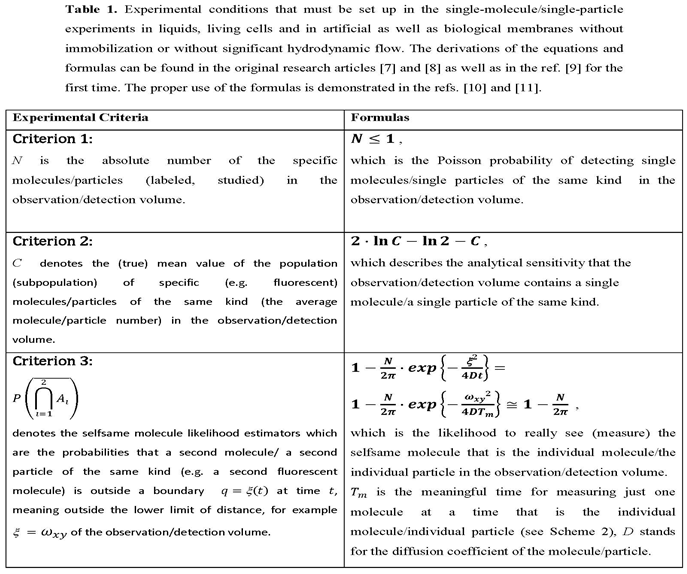
Molecule number fluctuations are currently of interest. The fundamental results are due to Markov processes which are the gateway to dynamical systems whose number of molecules fluctuates. The probability of separating two individual molecules or two individual particles as independent molecular entities during the measurement time is criterion 3 as exemplified in ref. [11] (see Table 1 contained therein for various experimental conditions) and Table 1 of this research article.
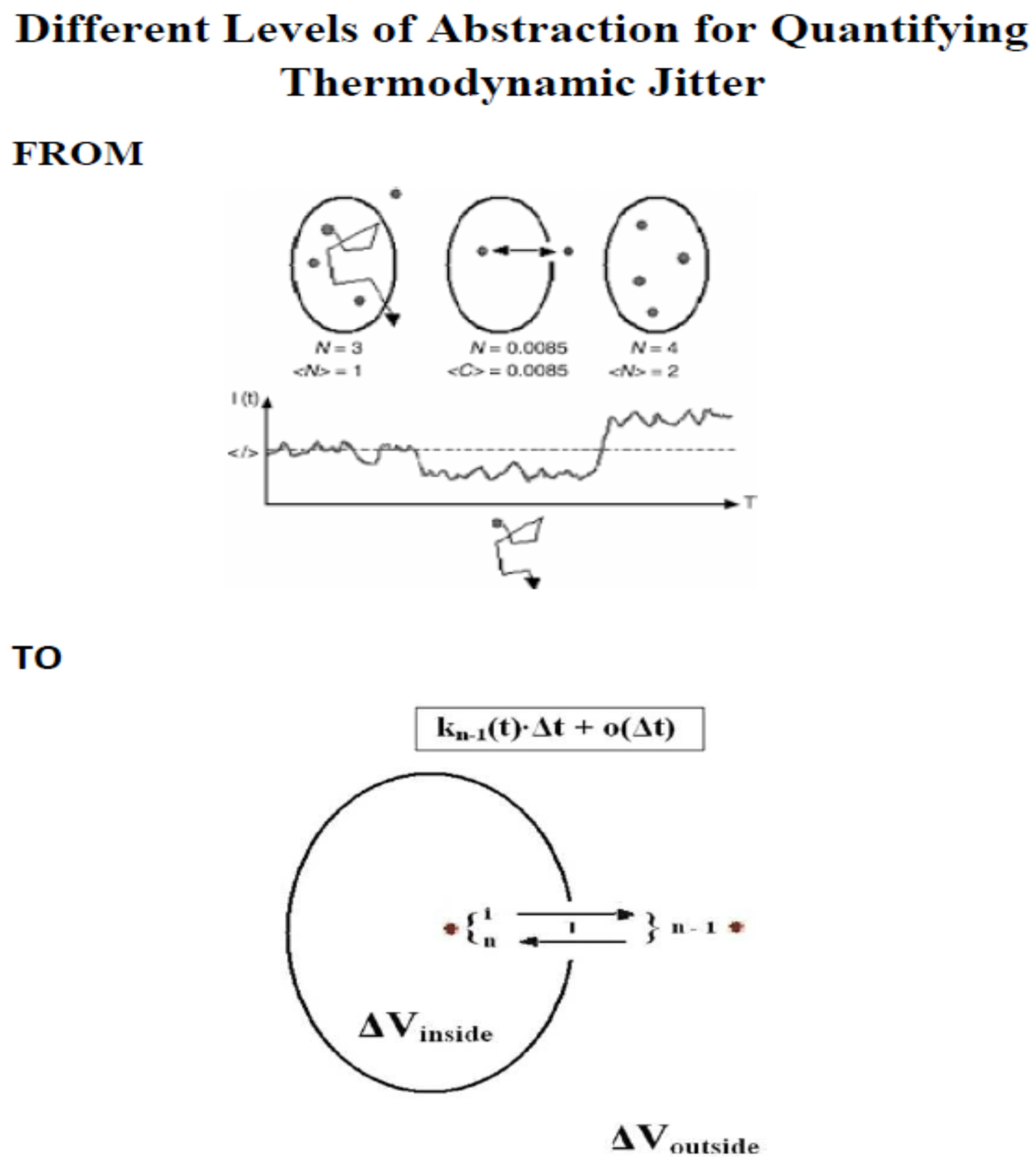
The Scheme 1 and Scheme 2 are summarizing important theoretical results for the measurement of just one molecule at a time, e.g., in liquids at room temperature or in living cells under physiological conditions, without immobilization or without significant hydrodynamic flow. We have already gained extensive experience with single-molecule detection in liquids and living cells (see subSection 3.1. Evaluation of single-molecule detection: A brief Narrative on the motivation of the simulation experiments and their design as experimetnal starting point for the obtained results). Here, we want to make a contribution in the field of ‘single-molecule tracking’ for the benefit of researchers, for example in molecular sciences such as biophysics, physical chemistry and biochemistry.
2. Methods
Our simulations presented in this research article are based on the generator g24 from ref. [15], which simulates the fractal structure in a biological cell, e. g. in its cytoplasm [15]. A limited continuous time random walk (LCTRW) is then performed on this structure (generalized 3D Sierpinski carpet) to assess the statistical properties of the diffusion process. The continuous time random walk (on this 3D geometric structure) is based on a distribution function that is freely configurable. Theoretical considerations for simulation and analyzing mobility data in this way for live cells and their compartments such as the cytoplasm are given in detail in ref. [15]. To highlight the disparities in the distribution function on the fractal structure, we investigated in this original research article two scenarios, each consisting of typical tracks. All pathways have one thing in common: they are placed in the coordinate origin that we have chosen for utilization, which is within the femtoliter measurement volume (detection/observation volume, ’chamber’) that is the focus of a laser used for excitation and detection of fluorescent molecules (for theoretical and simulation details see ref. [15]).
3. Results
3.1. Evaluation of Single-Molecule Detection: A Brief Narrative on the Motivation of the Simulation Experiments and Their Design as Experimetnal Starting Point for the Obtained Results
The basic idea of single-molecule/single-particle detection without immobilization on a surface or without significant hydrodynamic flow in liquids at room temperature or in live cells under physiological conditions is simple. A single-molecule/single-particle experiment is strictly speaking an experiment that investigates the properties of an individual molecule/an individual particle. Two means are of great importance. First, only one probe molecule/particle should diffuse in the excited detection volume, and second, the light emitted from this single molecule/single particle, that is the individual molecule/individual particle also called the selfsame molecule/selfsame particle, should be distinguishable from the experimental noise. So far so simple, but it becomes much more difficult when such a scenario is quantified in terms of the temporal motion (time resolution) of individual molecules/individual particles. The thermodynamic concept of diffusion fluctuations (thermodynamic jitter) due to the same molecule/same particle (selfsame molecule, selfsame particle), that is the individual molecule/individual particle, was developed in refs. [7,8,9,10,12]. The way from the mathematical core to the physical Theory of Single-Molecule/Single-Particle Biophysics & Biochemistry based on the stochastic nature of diffusion is exemplified in refs. [11,16,17]. Particle means physically each molecule. The conceptual and theoretical basis of thermodynamic jitter has been established in these series of publications and it was considered pioneering work [18].
Physical criteria are required to decide whether there is a single molecule/a single particle (an individual molecule/an individual particle) or not, as we illustrate in Scheme 1.These criteria (criteria 1 to 3) then result in the time-resolution of an individual molecule/individual particle in optical microsopy/nanoscopy and spectroscopy (that is the criterion 4) shown in Scheme 2, which covers the most important families of dynamic systems with randomness. Looking deeper into this Theory of Single-Molecule/Single-Particle Detection of one and the same molecule/particle (the individual molecule/individual particle) that is the Theory of Single Molecule/Single Particle Biophysics and Biochemistry based on the stochastic nature of diffusion in liquids and live cells without immobilization an artificial or biological surfaces/membranes or without significant hydrodynamic flow (hydrodynamics) is merely the way to understand what occurs during diffusion of an individual molecule/individual particle in the observation/detection volume embedded into a bulk phase [15,19]. Next, let us now shed some light on this in tracking of single molecules (individual molecules) for live cells by simulations. In live cells or their compartments such as the cytoplasm or membranes as well as the nucleus, the movements of molecules are complicated due to the large crowding and expected heterogeneity of the intracellular environment compared to liquids. The simulation approaches that we use are continuous time random walks (CTRW) on a fractal support of a generalized 3D Sierpinski carpet representing a live cell, e. g. its cytoplasm (see section 2. Methods).
3.2. Single-Molecule Tracking
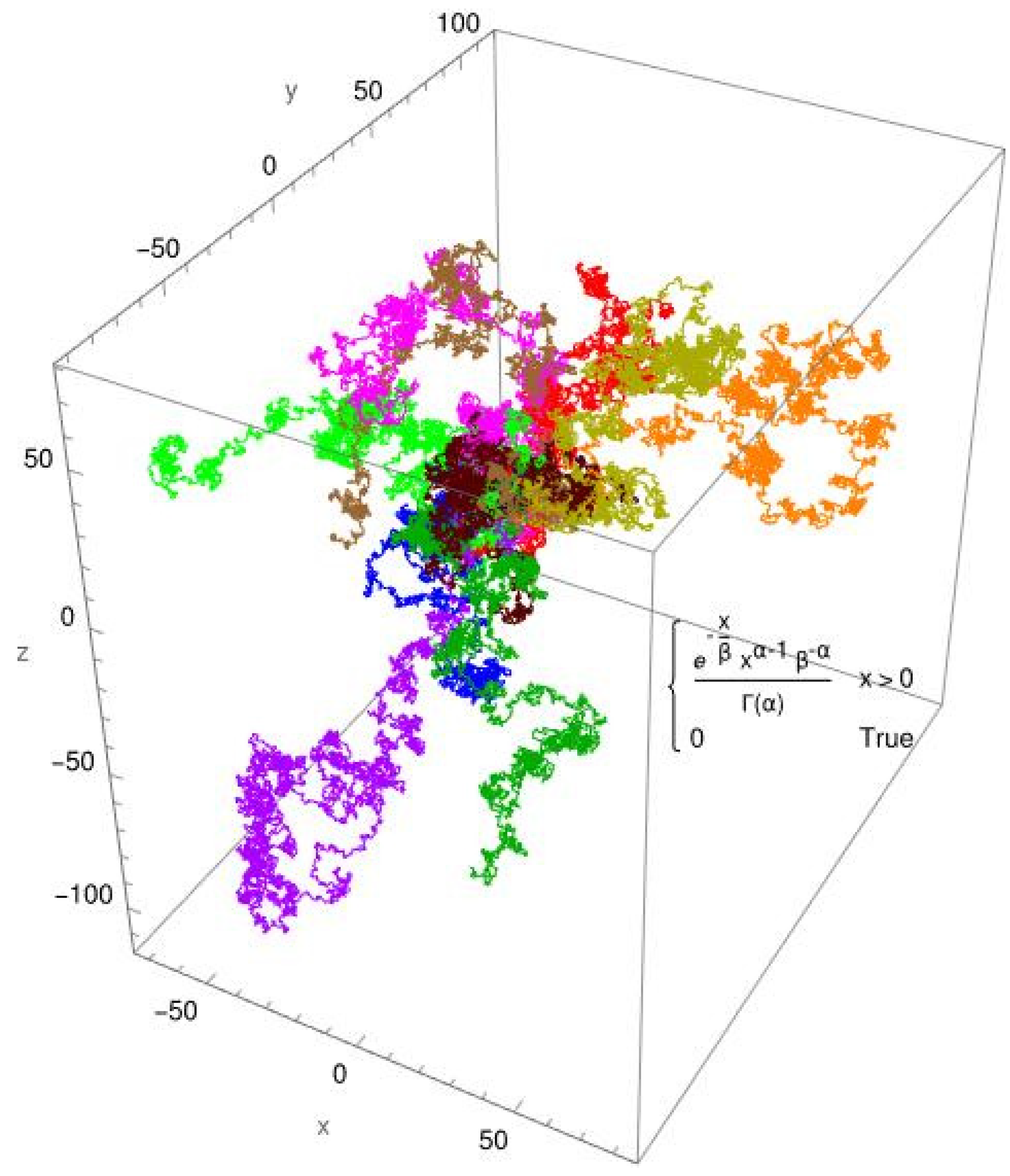
Let us say, we have diffused to about 1 nanometer from another protein. Our encounter has begun, and in roughly a nanosecond we will either touch the surface of the other protein, or be repelled by i In Figure 1, the simulated diffusion of a protein is shown for a Brownian motion. In Figure 2, the simulated diffusion of a protein is shown for an anomalous diffusion. The colors indicate 10 different tracks for individual molecules/individual particles. The CTRW step (continuous-time random walk step) employs two distribution functions: the standard Gaussian distribution for Brownian diffusion (Figure 1) and, as an example, the gamma distribution for anomalous diffusion processes (Figure 2). The created pathways look similar, yet they differ in significant aspects which are depicted in Figure 1 and Figure 2. It is evident that the Gaussian distribution yields pathways that are quite similar to each other. The gamma function, which produces a fractional diffusion, provides pathways that are quite diverse from one another and diverge significantly from those of the Gaussian distribution. However, the most remarkable feature is that the Gaussian distribution generates pathways that are close to the measurement origin and concentrated around it. The situation with the gamma distribution is fundamentally different; here, paths emerge that have a certain localization around the measurement origin but are also delocalized in more than 60%. In other words, the pathways become looser and have large leaps, which are typical of fractional diffusion. This form of unwinding is typical of fractional diffusion.
4. Discussion
What theoretically happens occupied several publications. We got into the ergodic hypothesis where it was clear ‘single molecule’/’single particle’ behavior should not be extrapolated to all molecule/particle behavior [19]. By simulation experiments we previously found the minimal variation if the number of randomly selected single molecule tracks is Nℓmax = 32. All other values of Nℓ deliver only a local minimum of a global minimum. The graphs also showed (see Figure 1 in ref. [19]) that the variation approaches a stable value if Nℓ approache large values, i.e., only a small subpopulation of single molecules delivers the minimal variation. In other words, the most striking feature of performing ensemble averaging in sparse subpopulations of single molecule is the same mean value obtained in an ergodic system that is a many molecule system, if the number of randomly selected single-molecule tracks is Nℓmax = 32 [19]. Hence, broken ergodicity and unbroken ergodicity are not anymore distinguishable. In addition, when averaging procedures are carried out without knowing whether the underlying molecular system behaves in ergodic or non-ergodic ways, each measurement can be related to an ergodic or a non-ergodic behavior unless one is able to show the single-molecule/single-particle fingerprint of non-ergodicity [19].
The single-molecule/single-particle fingerprint of non-ergodicity is the thermodynamic fingerprint (signature, thermodynamic jitter) of an individual molecule/individual particle in liquids or live cells without immobilization or without hydrodynamic flow [14]. The novel physical theory presented offers a new way to understand the molecular behavior when single biomacromolecules/molecules are trapped in interactions with their neighboring ligands and reaction partner(s), respectively, in a crowded environment at room temperature or at physiological conditions in live cells and their cellular compartments [13]. Therefore, single-molecule/single-particle studies may be contrasted with measurements on an ensemble or bulk collection of molecules, where the individual behavior of molecules cannot be distinguished and only average characteristics can be measured. It clearly follows from these results that the biggest breakthrough in microscopy/nanoscopy and spectroscopy would be a breakthrough in sensitivity for measuring an individual single molecule/an individual single particle (one and the same molecule/one and the same particle) over several milliseconds to seconds and even minutes (and up to hour) without immobilization an artificial surfaces or biological structures (membranes) as well as without significant hydrodynamics.
The measurement time for measuring just one single molecule (individual molecule, selfsame molecule) or one single particle (individual particle, selfsame particle) is a meaningful time in contrast to the measurement times for the many-molecule measurements. From the inspection of the mathematically derived and well experimentally founded physical relationships on the basis of stochastic translational diffusion [13], we can finally distinguish three types of meaningful points in time (meaningful times):
- (i)
- the meaningful time as single molecule/single particle time resolution is discussed here (for mathematical details see: ref. [12]),
- (ii)
- the meaningful times as limits of measurement time that should not be exceeded to follow the same single molecule/the same single particle with high probability in one, two or three dimensions (for mathematical details see: the Table 1 in ref. [11]) and
- (iii)
The dimensions of the meaningful times are the dimensions of the diffusion times of the molecule/particle in liquids and live cells without immobilization or without significant hydrodynamic flows.
The measurement of the individual molecule or the individual particle is considered one of the most demanding research trends in spectroscopy, microscopy and nanoscopy, also because individual molecules (oligonucleotides and single-stranded DNA sequences) were theoretically described in chemical oligonucleotide syntheses on solid supports after release from the solid phase as early as 1994 for the first time [20]. A head start is the mathematically proven theory that turns knowledge into strength, even at odds with the mediocre mainstream, for example ref. [21] and examples can also be found in ref. [11]. What new insights can be gained from the foundation of the theory on ‘Single-Molecule/Single Particle Biophysics & Biochemistry Based On the Stochastic Nature of Diffusion’, that is the new physical theory for the quantifying the thermodynamic jitter of molecules/particles without immobilization on an artificial surface or on a biological structure or without significant hydrodynamic flow? For example, the thermodynamic signatures of single molecules and single particles in liquids and live cells (cytoplasm, membranes, nucleus) without immobilization or without hydrodynamic flow were found in ref. [14] and shown by simulations in Figure 1 and Figure 2. There may be too much thermodynamic jitter in the experiments with live cells and in dilute liquids without immobilization or without significant hydrodynamic flow under physiological conditions or at room temperature [22].
5. Conclusions
The formulas and relationships specified in this article apply. They are simple and safe for determining how many molecules are averaged during measurement times. The biggest breakthrough would be to further increase the sensitivity in the time domain of measurements in liquids at room temperature and living cells, including membranes, at physiological conditions without immobilization or without significant hydrodynamics.
6. Addendum
Due to plagiarism and illegal publications of an earlier manuscript draft by the open access journal ‘Systematic Reviews in Pharmacy’, which contained wrongly typeset, incorrect mathematical-physical formulas and relationships as well as a fake author (as the main author), we changed the content and made linguistic changes and improvements in this original research article. Now, all formulas and physical relationships are correct and confirmed by both authors. We are very grateful for the support and help by the US Prepint.org team in this very unpleasant situation caused by the open access journal ‘Systematic Reviews in Pharmacy’. Preprint.org supported us by uncovering this copyright scandal from an ethical perspective and Preprint.org was very helpful in dealing with it correctly (email correspondences and https://www.preprints.org/manuscript/202405.0395/v1).
Funding
This research received no external funding.
Data Availability Statement
All data generated and analyzed in this study that supports the findings are included in this published article were not published before.
Conflicts of Interest
The authors declare no conflicts of interest.
References
- DʼEste, E.; Lukinavičius, G.; Lincoln, R.; Opazo, F.; Fornasiero, E.F. Advancing cell biology with nanoscale fluorescence imaging: essential practical considerations. Trends Cell Biol. 2024, Jan 5, S0962-8924(23)00239-8. Epub ahead of print. [CrossRef] [PubMed]
- Loidolt-Krueger, M. New Confocal Microscope for quantitative fluorescence lifetime imaging with improved reproducibility. Microscopy Today. 2023, 31, 24–31. [Google Scholar] [CrossRef]
- Harms, G.S.; Cognet, l..; Lommerse, P.H.; Blab, G.A;, Schmidt, T. Autofluorescent proteins in single-molecule research: applications to live cell imaging microscopy. Biophys. J. 2001, 80, 2396–2408. .
- White, J.; Stelzer, E. Photobleaching GFP reveals protein dynamics inside live cells. Trends Cell Biol. 1999, 9, 61–65. [Google Scholar] [CrossRef] [PubMed]
- Lin, Y.; Exell, J.; Lin, H.; Zhang, C.; Welsher, K.D. Hour-long, kilohertz sampling Rate three-dimensional single-virus tracking in live cells enabled by StayGold fluorescent protein fusions. J. Phys. Chem. B 2024, online publication date May 29. [CrossRef]
- Foote, A.K.; Ishii, K.; Cullinane, B.; Tahara, T.; Goldsmith, R.H. Quantifying microsecond solution-phase conformational dynamics of a DNA hairpin at the single-molecule level. ACS Phys. Chem. 2024, online publication date May 29. [CrossRef]
- Földes-Papp, Z. Fluorescence fluctuation spectroscopic approaches to the study of a single molecule diffusing in solution and a live cell without systemic drift or convection: a theoretical study. Curr. Pharm. Biotechnol. 2007, 8, 261–273. [Google Scholar] [CrossRef] [PubMed]
- Földes-Papp, Z. ‘True’ single-molecule molecule observations by fluorescence correlation spectroscopy and two-color fluorescence cross-correlation spectroscopy. Exp. Mol. Pathol. 2007, 82, 147–155. [Google Scholar] [CrossRef] [PubMed]
- Földes-Papp, Z.; Baumann, G.; Kinjo, M.; Tamura, M. Single-Phase Single-Molecule Fluorescence Correlation Spectroscopy (SPSM-FCS). In Encyclopedia of Medical Genomics & Proteomics; Fuchs, J., Podda, M., Eds.; Taylor & Francis: New York, USA, 2005; pp. 1-7.
- Földes-Papp, Z. What it means to measure a single molecule in a solution by fluorescence fluctuation spectroscopy. Exp. Mol. Pathol. 2006, 80, 209–218. [Google Scholar] [CrossRef] [PubMed]
- Földes-Papp, Z. Single-molecule time resolution in dilute liquids and live cells at the molecular scale: Constraints on the measurement time. Am. J. Transl. Med. 2021, 5, 154–165. [Google Scholar]
- Földes-Papp, Z. Measurements of Single Molecules in Solution and Live Cells Over Longer Observation Times Than Those Currently Possible: The Meaningful Time. Curr. Pharm Biotechnol. 2013, 14, 441–444. [Google Scholar] [CrossRef] [PubMed]
- Baumann, G.; Földes-Papp, Z. Study on Single-Molecule Biophysics and Biochemistry in dilute liquids and live cells without immobilization or significant hydrodynamic flow: The thermodynamic Single-Molecule DEMON. Curr. Pharm. Biotechnol. 2022, 23, 1750–1757. [Google Scholar] [PubMed]
- Földes-Papp, Z. The thermodynamic signature of a single molecule or a single particle in dilute liquids and live cells: Single-Molecule Biophysics & Biochemistry based on the stochastic nature of diffusion. Am. J. Transl. Med. 2023, 7, 74–77. [Google Scholar]
- Baumann, G.; Place, R.F.; Földes-Papp, Z. Meaningful interpretation of subdiffusive measurements in living cells (crowded environment) by fluorescence fluctuation microscopy. Curr. Pharm. Biotechnol. 2010, 11, 527–543. [Google Scholar] [CrossRef] [PubMed]
- Földes-Papp, Z. Individual macromolecule motion in a crowded living cell. Curr. Pharm. Biotechnol. 2015, 16, 1–2. [Google Scholar] [CrossRef] [PubMed]
- Földes-Papp, Z.; Baumann, G.; Li, L.-C. Visualization of subdiffusive sites in a live single cell. J. Biol. Methods 2021, 8, e142. [Google Scholar] [CrossRef] [PubMed]
- Digman, M.A.; Gratton, E. Lessons in fluctuation correlation spectroscopy Annu. Rev. Phys. Chem. 2011, 62, 645–668. [Google Scholar] [CrossRef] [PubMed]
- Földes-Papp, Z.; Baumann, G. Fluorescence molecule counting for single-molecule studies in crowded environment of living.
- cells without and with broken ergodicity. Curr. Pharm. Biotechnol. 2011, 12, 824–833.
- Földes-Papp, Z.; Herold, A.; Seliger, H.; Kleinschmid,t A.K. Error propagation theory of chemically solid phase synthesized.
- oligonucleotides and DNA sequences for biomedical application. In <i>Fractals in Biology and, Medicine</i>; Nonnenmacher, T.F. oligonucleotides and DNA sequences for biomedical application. In Fractals in Biology and Medicine; Nonnenmacher, T.F.
- Losa, G.A., Weibel, E.R., Eds.; Springer: Boston, USA,1994; Volume 1, pp. 165-173.
- Gaire, S.K.; Daneshkhah, A.; Flowerday, E.; Gong, R.; Frederick, J; Backman, V. Deep learning-based spectroscopic.
- single-molecule localization microscopy. J. Biomedical Optics, 2024, 29, 1-19.
- Xu, X.; Gao, C.; Emusani, R.; Jia, C.; Xiang, D. Toward Practical Single-Molecule/Atom Switches. Adv. Sci. (Weinh.), 2024, online publication day May 29, e2400877. [CrossRef]
Scheme 1.
Upper Panel: Three different molecular scenarios in diluted liquid are schematically shown for an observation/detection volume in the x-y plane (upper part) and for observed intensity fluctuations (lower part). N denotes the molecule number in the probe region and <N> is the average molecule number. If the observed N value becomes 1, then N stands for the Poisson probability of finding a single molecule/single particle in the observation/detection volume (‘arrival’ probability of single molecules/single particles in the observation/detection volume, criterion 1). Under the condition N 1, <C> = C is the average frequency that the observation/detection volume contains single molecules/single particles. For C << e-C, C equals N. I(t) is the fluorescence intensity, <I> stands for a mean intensity, and T is the measurement time for data collection. Completeness includes the criterion 2, which is the sensitivity for measuring single molecules/single particlse, i.e., the ‘departure’ probability of a single molecule/single particle in the observation/detection volume. For details see the original research articles [8] and [9] as well as the reference [10]. Lower Panel: An example of meaningful reentries is depicted. The selfsame molecule is inside the observation/detection volume ΔV and diffuses out from its motional state, i.e., the thermodynamic state i, to another motional state, i.e., the thermodynamic state n − 1 outside the probe region. Then, it diffuses in from its motional state, i.e., the thermodynamic state n − 1 to n. Hence, the random variable X(t) makes the transition from X(s) = i to X(t) = n − 1 during the time interval [s, t) and afterwards the transition from X(t) = n − 1 to X(t + Δt) = n during the time interval [t, t + Δt). These reentries (transitions) contribute to the fluorescence intensity fluctuations in the experiments. They are the number of reentries that result in a useful burst size. For details see the original research article [7].
Scheme 1.
Upper Panel: Three different molecular scenarios in diluted liquid are schematically shown for an observation/detection volume in the x-y plane (upper part) and for observed intensity fluctuations (lower part). N denotes the molecule number in the probe region and <N> is the average molecule number. If the observed N value becomes 1, then N stands for the Poisson probability of finding a single molecule/single particle in the observation/detection volume (‘arrival’ probability of single molecules/single particles in the observation/detection volume, criterion 1). Under the condition N 1, <C> = C is the average frequency that the observation/detection volume contains single molecules/single particles. For C << e-C, C equals N. I(t) is the fluorescence intensity, <I> stands for a mean intensity, and T is the measurement time for data collection. Completeness includes the criterion 2, which is the sensitivity for measuring single molecules/single particlse, i.e., the ‘departure’ probability of a single molecule/single particle in the observation/detection volume. For details see the original research articles [8] and [9] as well as the reference [10]. Lower Panel: An example of meaningful reentries is depicted. The selfsame molecule is inside the observation/detection volume ΔV and diffuses out from its motional state, i.e., the thermodynamic state i, to another motional state, i.e., the thermodynamic state n − 1 outside the probe region. Then, it diffuses in from its motional state, i.e., the thermodynamic state n − 1 to n. Hence, the random variable X(t) makes the transition from X(s) = i to X(t) = n − 1 during the time interval [s, t) and afterwards the transition from X(t) = n − 1 to X(t + Δt) = n during the time interval [t, t + Δt). These reentries (transitions) contribute to the fluorescence intensity fluctuations in the experiments. They are the number of reentries that result in a useful burst size. For details see the original research article [7].
Scheme 2.
The scheme summarizes main theoretical results for measuring just one molecule/particle at a time in liquids or live cells without immobilization or without hydrodynamic flow, for example with Nℓmax ≥ 1. A head start is the proven theory, e.g., proven mathematically, that turns knowledge into strength, even at odds with mediocre mainstream (see also [11,12,13,14]).
Scheme 2.
The scheme summarizes main theoretical results for measuring just one molecule/particle at a time in liquids or live cells without immobilization or without hydrodynamic flow, for example with Nℓmax ≥ 1. A head start is the proven theory, e.g., proven mathematically, that turns knowledge into strength, even at odds with mediocre mainstream (see also [11,12,13,14]).
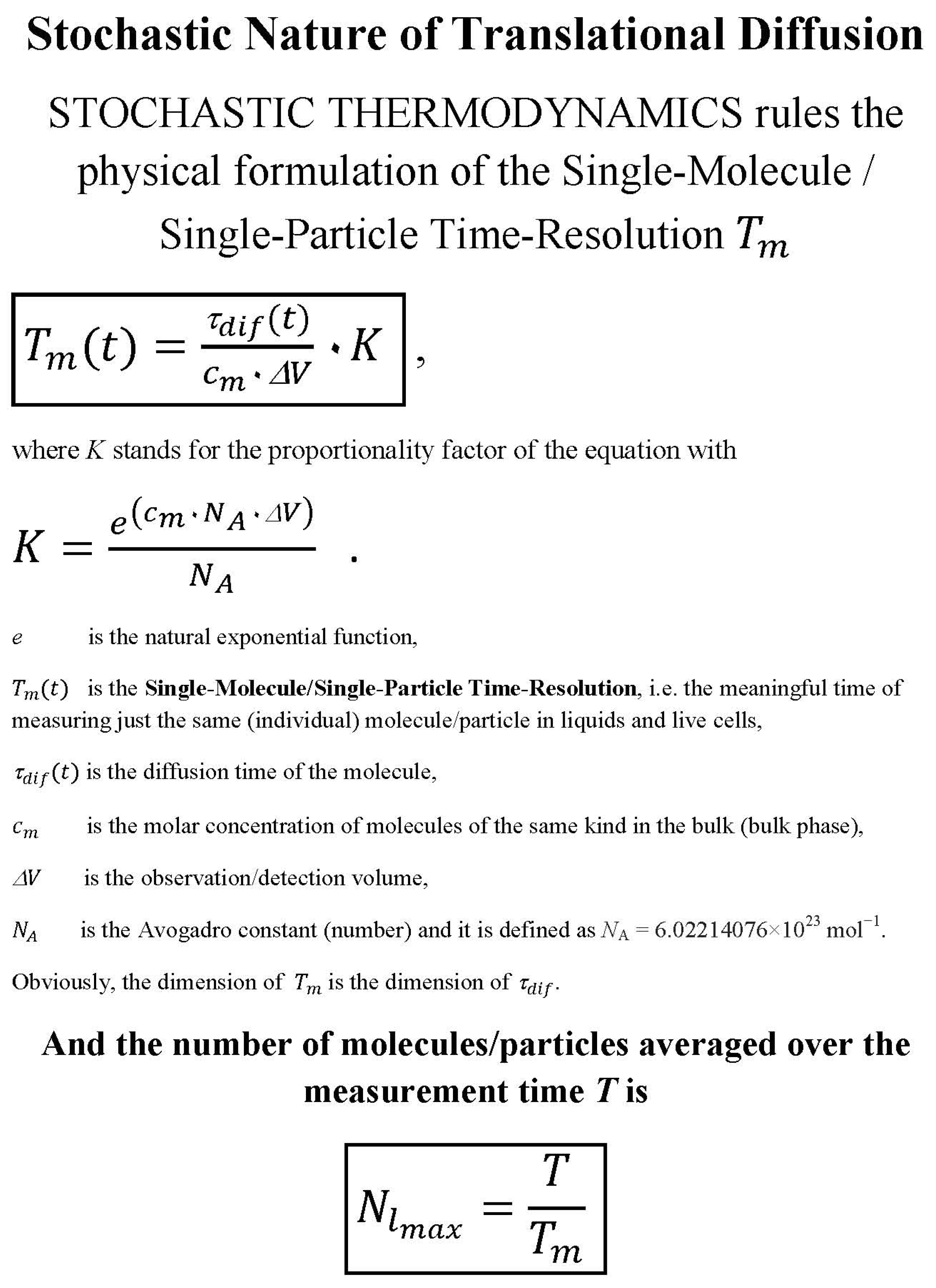
Figure 1.
The CTRW simulation uses a normal distribution with mu = 0 and sigma = 1. The 10 pathways are arranged around the origin.
Figure 1.
The CTRW simulation uses a normal distribution with mu = 0 and sigma = 1. The 10 pathways are arranged around the origin.
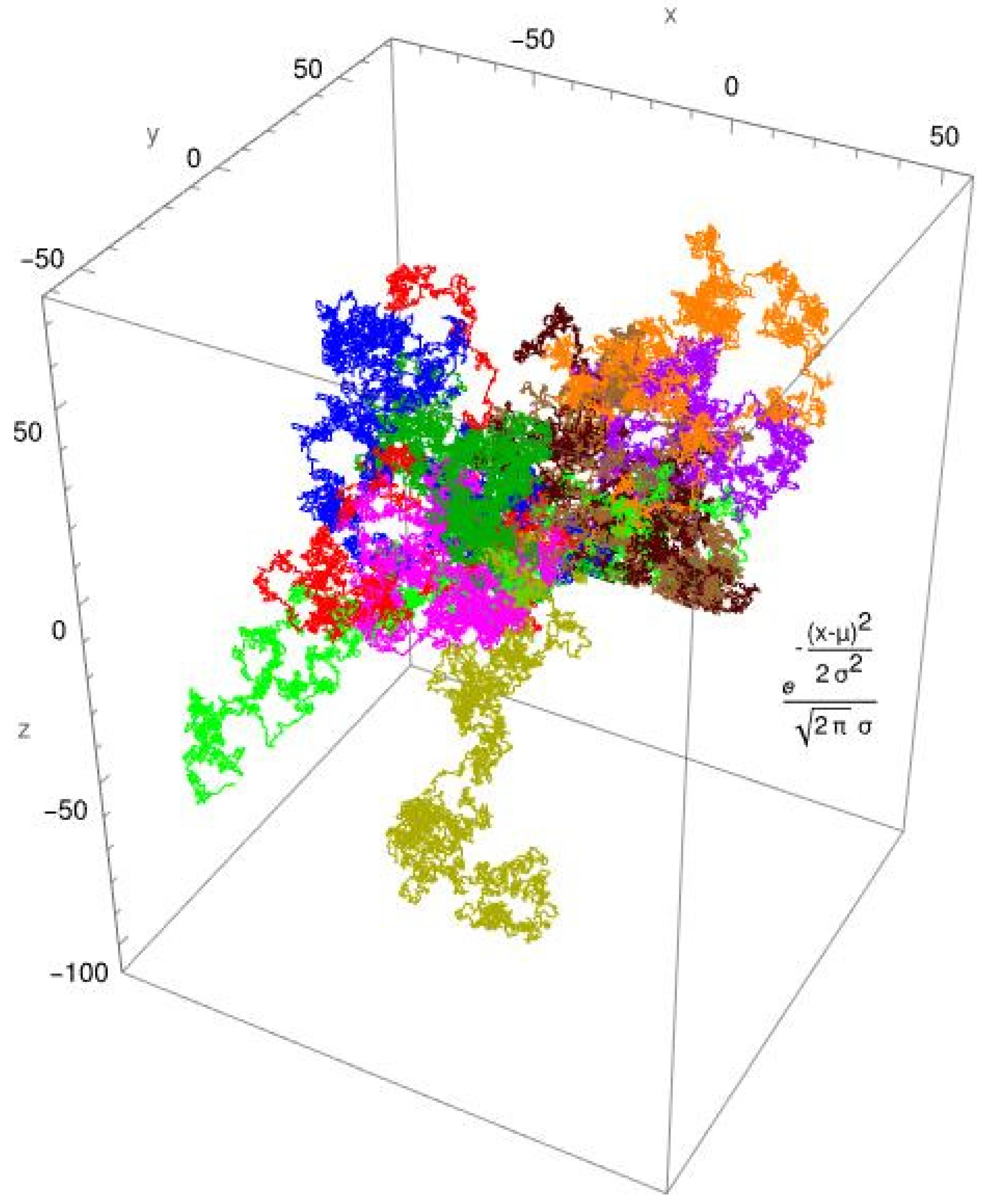
Figure 2.
The CTRW simulation employs a gamma distribution with parameters alpha = 3/4 and beta = 1. The fractal’s 10 routes are all presented around the origin.
Figure 2.
The CTRW simulation employs a gamma distribution with parameters alpha = 3/4 and beta = 1. The fractal’s 10 routes are all presented around the origin.
Disclaimer/Publisher’s Note: The statements, opinions and data contained in all publications are solely those of the individual author(s) and contributor(s) and not of MDPI and/or the editor(s). MDPI and/or the editor(s) disclaim responsibility for any injury to people or property resulting from any ideas, methods, instructions or products referred to in the content. |
© 2024 by the authors. Licensee MDPI, Basel, Switzerland. This article is an open access article distributed under the terms and conditions of the Creative Commons Attribution (CC BY) license (http://creativecommons.org/licenses/by/4.0/).
Copyright: This open access article is published under a Creative Commons CC BY 4.0 license, which permit the free download, distribution, and reuse, provided that the author and preprint are cited in any reuse.


