

Submitted:
29 May 2024
Posted:
29 May 2024
You are already at the latest version
Abstract
Nowadays circular economy trend drives researchers in the recovery of various bioactive compounds from agri-food by-products. Enzyme-assisted extraction (EAE) is shown as an innovative green technology for the effective extraction of various phytochemicals from agri-food section by-products, therefore this study aimed to evaluate the application of EAE as green technology to obtain extracts from olive leaves (Olea europaea) for potential industrial production. EAE was conducted under various enzyme dose combinations, and incubation time (120 min). Obtained extracts were characterized in terms of total polyphenols (TP) and Total Antioxidant Activity (AA). Firstly, the enzyme synergistic effect in enzymatic extraction of polyphenols was evaluated. TP optimal extraction conditions (468.19 mg GAE/L) were achieved after EAE (50-50%) and for AA (69.85 AA%). According to the above results, a second experimental part occurred for the incubation time (min.) and enzyme dose (mL) of optimal extraction conditions of olive leaves. Results indicated EAE as an excellent choice for green extraction of polyphenols from the olive leaves.
Keywords:
plant by-product
; antioxidants
; green technology
; enzyme preparation
; polyphenols
1. Introduction
One of the most widely produced crops is the cultivation of olives, with 65%, 16%, and 15% of the world’s output occurring in Europe, Asia, and Africa, respectively [1]. Moreover, Proietti et al., [2] estimated that an olive tree produces approximately 11,777 leaves, most of which are thrown away as waste. However, the leaves can be used as a profitable raw material for continuous large-scale industrial production for a considerable amount of time [3]. Furthermore, since their import is probably going to include waste management services for olive oil producers, the business that processes stand a very high opportunity of increasing its profit margin.
Along with macronutrients and micronutrients, a typical diet also includes specific chemical compounds, mostly found in fruits and vegetables, which have been shown in several studies to have a significant biological impact. These substances are referred to as bioactive substances and have a variety of functions for human health. Bioactive chemicals are regarded as secondary metabolites of plants and are crucial for pest and disease resistance as well as species preservation. Each year’s action and promotion of health advantages pique their attention [4]. The olive (Olea Europe L.), one of the most significant fruit plants in the Mediterranean region, is prized for its nutritional and health benefits all over the world. Olive oil is made from the fruits of the olive by mechanical methods. The phenolic compounds’ antioxidant activity is responsible for the health-promoting properties, and their pharmacological actions have been documented in the literature [5]. Because of their potent antioxidant activity, by-products from the olive oil industry provide a prospective source of phenolic compounds [4]. An increasing number of people have been interested in giving these goods more value in the recent past, for both nutritional and environmental reasons. Numerous investigations have been conducted in this context to comprehend the function of the numerous natural chemicals found in these products. Based only on the quantity of phenol subunits present, phenols can be divided into simple phenols and polyphenols. Therefore, simple phenols, phenolic acids, coumarins, flavonoids, and stilbenes, as well as hydrolyzed and condensed tannins, lignans, and lignins, are all included in the phrase "plant phenolics." In vitro biological actions of phenols include the scavenging of free radicals, the regulation of enzyme activity, and the prevention of cell proliferation. According to Cherng et al., [6], they have anti-inflammatory, anti-ulcer, anti-allergic, and antibiotic properties. They also show antibacterial action.
The biological cycle of the olive affects significant variations in phenolic chemicals, both quantitatively and qualitatively [7]. Phenolic compounds are present in both fruits and leaves in substantial amounts, and they are transported from the fruit to the olive oil during processing. These compounds determine the taste and antioxidant activity of the olive oil, which is why they are crucial to its quality. The class of molecules known as phenolics includes over 8000 naturally occurring substances. These compounds always have an aromatic ring with at least one hydroxyl substituent, or a phenol [4]. According to Abaza et al., [8], olive leaves contain flavonoid and phenolic compounds that exhibit a range of biological activities. These chemicals may also be accountable for the pharmacological effects of olive leaves, or at the very least, for the synergistic increase of these effects.
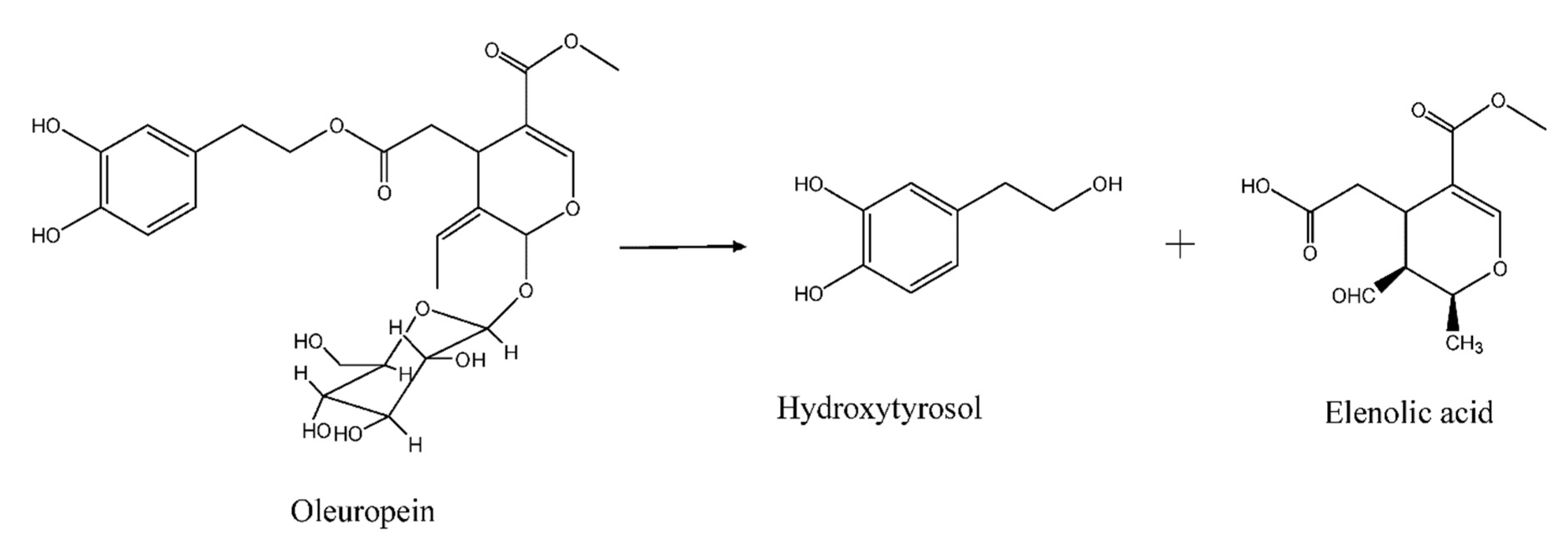
Oleuropein and its derivatives are the principal constituents of olive leaves. hydroxytyrosol, additional polyphenols, and triterpenes, which comprise flavonoids (rutin and diosmin) and oleanolic acid. These elements give the tree, as well as its fruits and foliage, resilience against disease and insect damage [4]. Oleuropein, which was initially discovered in 1908, is thought to be the cause of many of the medicinal benefits of extracts from olive leaves and causes for the bitter flavour of olive oil and olives as well [9]. Strong antioxidant and free radical scavenging properties, as well as antimicrobial, hypoglycemic, anti-toxoplasmosis, antiviral, antifungal, anti-aggregation, and platelet hypolipidemic properties have all been reported for oleuropein [10].
Figure 1.
Shows the degradation process [11].
Figure 1.
Shows the degradation process [11].
The amount found in the leaf is significantly higher than in other parts of the tree, while being present in the olive fruit and oil [12]. The chemical composition of olive leaves is influenced by several elements, including olive variety, temperature, extraction methods, wood ratio, tree age, genetics, and cultivation methods [13]. Since the concentration of phenolic components varies among plant materials, it is essential to determine the best extraction conditions and characterize the extract’s antioxidant activity and composition. Tomato pastes, sauces, and other functional foods such as spreads can all include leaf extracts. Moreover, according to Baiano et al. [14] and Čukelj et al., [15], they can be added to breads or bakeries/snacks that have a good market potential and the ability to contribute key nutrients to the consumer’s daily diet. Furthermore, leaf extracts can be marketed as special medicinal supplements or added to refined oils to replace some of the bioactive chemicals lost during processing. Another potential use of the olive leaves application is the usage on the food packaging materials [16]. Thus, it is advised to use whole leaf extracts rather than only their individual components, such as oleuropein, when making nutraceuticals, functional foods, and food additives [17]. Evaluating various (new) technologies that support polyphenolic stability during extractions is crucial. At the same time should be more effective, efficient, and environmentally friendly [18].
The aims of the study were: (i) to develop a green enzymatic extraction process for the recovery of polyphenols from the olive leaves, (ii) to evaluate the synergistic effects of three (3) commercial enzymes in the enzymatic extraction process recovery of polyphenols from the olive leaves and (iii) by using the optimal enzyme mixture found in step (ii) the optimal extraction conditions for the recovery of polyphenols from the olive leaves were evaluated.
To the best of our knowledge step (ii) and step (iii) of the current study are for first time reported and are the innovative points of this study.
2. Materials and Methods
Plant Material
Olive (Olea Europaea) leaves, Koroneiki variety harvested year 2023, were obtained from a producer in the region of Agrinio, Greece. The leaves were dried at 50 °C for 5 h [32]. Dried olive leaves were stored in a metal container at room temperature until used.
Chemicals and Reagents
For analytical purposes, the following reagents were used: 2,2-Diphenyl-1-picrylhydrazyl (DPPH·) (Sigma-Aldrich, Germany). Absolute methanol (CH3OH), sodium carbonate (Na2CO3), and acetate buffer (CH3COONa × 3H2O) (Merck Darmstadt, Germany). Folin Ciocalteu reagent from Sigma-Aldrich. Gallic acid (3,4,5-trihydrobenzoic acid) 99% isolated from Rhus chinensis Mill. (JNK Tech. Co., Republic of Korea). All the other reagents and solvents used were of analytical grade.
Enzyme Preparations
The following commercial enzyme preparations were used: pectinolytic preparation Pectinex XXL, cellulolytic preparation Celluclast and Viscozyme L. (Cellulase, Hemicellulase, Xylanase), (all from Novozymes A/S, Bagsvaerd, Denmark).
Enzyme-Assisted Extraction
Finely grounded (particle size < 700 μm) olive leaves were mixed with water (10:1, v/w), acidified (pH 4.0) with HCl, and left for 1 h for rehydration at 25 °C. After pH adjustment (pH 4.0), the suspension (100.0 g) was placed in a 50 °C water bath (Memmert Schutzart DIN 40050 – IP 20, Germany) for 20 min before enzymes were added. After incubation at 50 °C, the sample was placed in a boiling water bath for 10 min to inactivate the enzymes, then immediately cooled and finally filtered through a paper filter under vacuum and weighed to determine the extract yield [20].
Phytochemical Analyses
All measurements were performed with a SHIMADJU UV/VIS spectrophotometer (UV-1900, Kyoto, Japan) using 1 cm pathlength cuvettes. The content of total polyphenols (TPP) was determined using the method of Karabagias et al [19] with the following modifications: in a 5 mL volumetric flask, 0.20 mL of the ethanolic extracts of grape origin followed by 2.50 mL of distilled water and 0.25 mL Folin-Ciocalteu reagent were added. After 3 min, 0.50 mL of saturated sodium carbonate (Na2CO3, 30% w/v) was also added into the mixture. Finally, the obtained solution was brought to 5 mL with distilled water. This solution was left for 2 h in the dark at room temperature and the absorbance was measured at λ = 760 nm. The results were presented as equivalents of gallic acid (GAE). Each sample was analyzed in triplicate (n = 3).
The total antioxidant capacity was determined using the DPPH (free radical scavenging activity). DPPH assay was based on the method of Karabagias et al [19] with small modifications as follows: 1.9 mL of absolute ethanol solution of DPPH·(1.34 × 10⁻⁴ mol/L) and 1 mL of acetate buffer 100 mmol/L (100 Mm) (pH = 7.10 ± 0.01) were placed in a cuvette, and the absorbance of the DPPH· was measured at t = 0 (A0). Subsequently, 0.1 mL of each extract studied, was added to the above medium and the absorbance was measured at regular time periods, until the absorbance value reached a plateau (steady state, At). The reaction in all cases was completed in 15 min and the absorbance was measured at λmax = 517 nm. Each sample was measured in triplicate (n = 3). For this antioxidant test ethanol and acetate buffer (2:1, v/v) were used as the blank sample.
Experimental Design
According to a recent publication [20], a simplex-centroid design for a mixture with three components was applied (Figure 2). Enzyme preparations (single or mix) were used as 1.2% (v/v) solution and the incubation time was 120 min.
This section may be divided by subheadings. It should provide a concise and precise description of the experimental results, their interpretation, as well as the experimental conclusions that can be drawn.
An optimal central composite design (OCCD) of type 2n + 2n + n0 was applied. The influence of the independent variables was determined by means of the response surface methodology [20]. Table 1 shows the levels of the two independent variables – enzyme dose (0.02–0.18%) and reaction time (30–210 min). The enzyme used was a 1:1 mixture of the Viscozyme L. and pectinolytic (Pectinex XXL) preparations. The experimental data were fitted to a second-degree regression equation:
 (1)
where:
(1)
where:
(1)
y – the dependent variable (response),
b0 – the model intercept,
bi, bii, bij – the linear, quadratic, and interaction regression coefficients, respectively,
xi, xj – the independent variables,
n – equal to the number of the tested factors (n = 2 in this study).

Table 1.
Independent variable values and corresponding levels.
| Factor | Minima | Centre point | Maxima | Axial point. a |
|---|---|---|---|---|
| Enzyme dose (%E/Sa) – Х1 |
0.02 | 0.1 | 0.18 | -a = -1 +a = +1 |
| Time (min.) – X2 | 30 | 120 | 210 | -a + = -1 +a = +1 |
a mL enzyme preparation per 100g substrate.
Statistical Analysis
The results reported in the present study are the mean values of at least three analytical determinations and the coefficients of variation expressed as the percentage ratios between the standard deviations and the mean values were found to be < 5% in all cases. The means were compared using one-way ANOVA and Tukey’s test at a 95% confidence level.
3. Results
Selection of the Mixture of Enzyme Preparations
Table 2 shows the results after the extractions, evaluating the synergy of the enzymes in order to find the most effective enzyme combination for polyphenol extraction from the olive leaves.
Significant increases in the recovery rates of total polyphenols and antioxidants were observed due to the enzymatic treatments (see Table 2, Figure 3a and 3b). The binary combination containing Viscozyme and pectinolytic preparations (Χ2:Χ3 = 1:1) resulted in the highest yield of total polyphenols, reaching a 5.9% higher value as compared to the control sample (without enzymatic treatment).
This value (468.19 mg GAE/L) is higher than microwave-assisted enzymatic extraction (34.53 mg GAE/g) [29] but lower than that (54.92 mg GAE/g) reported for 80% ethanolic extract [24]. However, possible differences in the polyphenolic content of the raw materials should be taken into account.
Interestingly, similar effects concerning the total polyphenols and antioxidants were observed for the Viscozyme and cellulolytic preparations mixture (Χ1:Χ3 = 1:1), and for all enzyme mixtures (X1:X2:X3 = 1:1:1) which is probably due to the secondary xylanase activity of commercial pectinase [21].
Optimization of the Process Parameters
Table 3 shows the total polyphenols and the antioxidant capacity of olive leaves after extraction with the most effective combination of enzymes as shown in Table 2, modifying the dose and the incubation time to evaluate the most optimum extraction conditions using enzymes.
Significant variations in the yields of total polyphenols and antioxidants were observed in response to the different enzymatic treatments (see Table 3).
In contrast with other researchers [20,22] an increase in the enzyme dose does not affect the recovery rate of total polyphenols, against that in some cases the increase of enzyme dose decreases the total polyphenols content. The negative effects of the higher enzyme dose indicate that the pectinase greatly decreased total phenolics due to the loss of rutin [23] one of the most abundant flavonoids in olive leaves [24] but not the antioxidant activity which remains stable.
The same results were obtained for the incubation time on the total polyphenol yield, an increasing incubation time decreases the total polyphenol yield due to thermal degradation, same results with other researchers [25,26].
The experimental data in table 3 were used to determine the coefficient of two second-order polynomial equations as follows:
where:
Y1 =553,87+9028,4.X1 - 6.27.X2 -100211,1*X12+0,06.X22-8,44.X1.X2 +278661,1.X13-0.00015.X23-0,075.X1.X22+137,2.X12.X2, (mg GAE/L)
R2=0.99
Y2 = 53,999 + 40,0077.X1 + 0,021.X2 – 125,25.X12 - 0.079.X1.X2 - 0.00000636777.X22, (AA%)
R2 = 0.97
Y1, Y2 – the predicted responses for TPP and DPPH, respectively,
X1 – the enzyme dose,
X2 – the incubation time.
After the optimization process of enzyme dose and extraction time (Table 3) the final result of the optimal conditions (605.55 mL GAE/L) are still higher than the results as mentioned above and also higher than the total polyphenols content that obtained using cyclodextrins and glycerin as co-solvents (54.33 mg GAE/g) [27] but lower than the microwave and ultrasound extractions (104.22 mg GAE/g and 80.52 mg GAE/g) respectively [28].
All of the R2 (coefficient of determination) values were greater than 0.95, implying that the models accurately represent the experimental data [29].
Both the incubation time and enzyme dose produced positive linear and negative quadratic effects on total polyphenols. This means that the yield of total polyphenols (Figure 4a) increases when the incubation time or enzyme dose increases up to a certain point, after which they begin to decrease. Positive linear and negative quadratic effects of incubation time were also reported for total polyphenols in extracts from rose petals and saffron tepals [30,31].
Positive linear effects of incubation time and negative quadratic effects of enzyme dose were obtained for the total antioxidant capacity values (Figure 4b), suggesting similar changes to those observed for the total polyphenols.
A graphical optimization of the extraction conditions was carried out in order to maximize the yields of total polyphenols and antioxidants. Figure 5 shows the overlapping region, defining the intervals of variation of the enzyme mixture dose (0.06–0.15%) and treatment time (30–120 min) that satisfy the optimization criterion.
4. Discussion
This work presents a novel method for more effectively extracting polyphenols from olive leaves, leading to environmentally friendly extracts and procedures. The results show that by using green extraction techniques, it is possible to limit the usage of organic solvents by developing easy and cheap methods for extracting bioactive plant polyphenols. Table 4 summarizes the results of other studies on extracting polyphenols from olive leaves in comparison with the current method. As you can see after using the optimal combination of enzymes and incubation time, the total polyphenols obtained using enzymatic-assisted extraction are higher than all other methods except extraction with microwave-assisted extraction and ultrasound-assisted extraction which are higher.
The results of this study indicate the recovery of polyphenolic antioxidants from olive leaves is improved by enzyme-assisted extraction, particularly when a binary enzyme combination consisting of Viscozyme L. and pectinase preparations (1:1) is used. The optimum range to obtain extracts with a high concentration of total polyphenols and antioxidants is defined by the variable intervals of the enzyme mixture dose (0.06–0.15%) and incubation time (30–120 min). This novel method provides an environmentally friendly replacement for conventional extraction methods, rendering it a green technology.
5. Conclusions
The obtained results of this study clearly show that the recovery of polyphenols from olive leaves is enhanced by enzyme-assisted extraction, particularly when ternary enzyme combinations, including pectinolytic and Viscozyme preparation, are used. This enzymatic and organic solvent free extraction method has an environmentally friendly substitute. The innovative and very promising results of this work motivate us in further research which should be done based on the polyphenolic profile of the olive leaves and the olive tree varieties to achieve the maximum quantity and the highest quality of polyphenolic yields.
Author Contributions
Conceptualization, A.V., A.K. and A.G.; methodology, A.V.; software, N.P.; validation, A.V., N.P. and A.G.; formal analysis, A.E.G.; investigation, A.V.; resources, A.K.; data curation, A.V., N.P.; writing—original draft preparation, A.V.; writing—review and editing, A.E.G.; visualization, A.V.; supervision, A.E.G.; project administration, A.E. G. All authors have read and agreed to the published version of the manuscript.
Funding
This research received no external funding.
Institutional Review Board Statement
Not applicable.
Informed Consent Statement
Not applicable.
Data Availability Statement
The original contributions presented in the study are included in the article, further inquiries can be directed to the corresponding authors.
Acknowledgments
We are grateful to Novozymes A/S company (Bagsvaerd, Denmark) for providing the enzyme samples and especially to the company’s Sales Support Assistant in Greece Mr. David Theodorou for his support.
Conflicts of Interest
The authors declare no conflicts of interest.
References
- FAOSTAT-FAO, 2016. Statistical database. Accessed on December 2. <bold>2016</bold>. http://www.fao.org.
- Proietti, P., Nasini, L., Reale, L., Caruso, T., Ferranti, F. Productive and vegetative behavior of olive cultivars in super high-density olive grove. Scientia Agricola, <bold>2015</bold>, 72, 20-27. [CrossRef]
- Rosello-Soto, E., Barba, F.J., Parniakov, O., Galanakis, C.M., Lebovka, N., Grimi, N., Vorobiev, E. High voltage electrical discharges, pulsed electric field, and ultrasound-assisted extraction of protein and phenolic compounds from olive kernel. Food Bioprocess Tech, <bold>2015</bold>, 8, 885- 894. [CrossRef]
- Rui M.S. Cruz, Romilson Brito, Petros Smirniotis, Zoe Nikolaidou, Margarida C. Vieira. Extraction of Bioactive Compounds from Olive Leaves Using Emerging Technologies. Ingredients Extraction by Physicochemical Methods in Food, <bold>2017</bold>, 441- 461. [CrossRef]
- Bilgin, M., Şahin, S. Effects of geographical origin and extraction methods on total phenolic yield of olive tree (Olea europaea) leaves. J. Taiwan Inst. Chem. Eng., <bold>2013</bold>, 44, 8–12. [CrossRef]
- Cherng, J.M., Shieh, D.E., Chiang, W., Chang, M.Y., Chiang, L.C. Chemopreventive effects of minor dietary constituents in common foods on human cancer cells. Biosci. Biotechnol. Biochem., <bold>2007</bold>, 71, 1500–1504. [CrossRef]
- Brahmi, F., Mechri, B., Dabbou, S., Dhibi, M., Hammami, M. The efficacy of phenolics compounds with different polarities as antioxidants from olive leaves depending on seasonal variations. Ind. Crops Prod., <bold>2012</bold>, 38, 146–152. [CrossRef]
- Abaza, L., Youssef, N.B., Manai, H., Haddada, F.M., Methenni, K., Zarrouk, M. Chétoui olive leaf extracts: influence of the solvent type on phenolics and antioxidant activities. Grasas Aceites, <bold>2011</bold>, 62, 96–104. [CrossRef]
- Omar, S.H. Cardioprotective and neuroprotective roles of oleuropein in olive. Saudi Pharm. J., <bold>2010</bold>, 18, 111–121. [CrossRef]
- Zhao, G., Yin, Z., Dong, J. Antiviral efficacy against hepatitis B virus replication of oleuropein isolated from <italic>Jasminum officinale L. var. grandiflorum</italic>. J. Ethnopharmacol., <bold>2009</bold>, 125, 265–268. [CrossRef]
- Briante, R.; Cara, F.L.; Tonziello, M.P.; Febbraio, F.; Nucci, R. Antioxidant Activity of the Main Bioactive Derivatives from Oleuropein Hydrolysis by Hyperthermophilic β-Glycosidase. J. Agric. Food Chem., <bold>2001</bold>, 49, 3198–3203. [CrossRef]
- Odiatou, E.M., Skaltsounis, A.L., Constantinou, A.I. Identification of the factors responsible for the in vitro pro-oxidant and cytotoxic activities of the olive polyphenols oleuropein and hydroxytyrosol. Cancer Lett., <bold>2013</bold>, 330, 113–121. [CrossRef]
- Fares, R., Bazzi, S., Baydoun, S.E., Abdel-Massih, R.M. The antioxidant and anti-proliferative activity of the Lebanese <italic>Olea europaea</italic> extract. Plant Foods Hum. Nutr., <bold>2011</bold>, 66, 58–63. [CrossRef]
- Baiano, A., Viggiani, I., Terracone, C., Romaniello, R., Del Nobile, M.A. Physical and sensory properties of bread enriched with phenolic aqueous extracts from vegetable wastes. Czech J. Food Sci., <bold>2016</bold>, 33, 247-253. https://econpapers.repec.org/scripts/redir.pf?u=https%3A%2F%2Fdoi.org%2F10.17221%252F528%252F2014-CJFS;h=repec:caa:jnlcjf:v:33:y:2015:i:3:id:528-2014-cjfs.
- Čukelj, N., Putnik, P., Novotni, D., Ajredini, S., Voučko, B., Duška, Ć. Market potential of lignans and omega-3 functional cookies. Brit Food J., <bold>2016</bold>, 118, 2420 - 2433. [CrossRef]
- Predrag Putnik, Francisco J. Barba, Ivana Španić, Zoran Zorić, Verica Dragović-Uzelac, Danijela Bursać Kovačević. Green Extraction Approach for the Recovery of Polyphenols from Croatian Olive leaves (Olea europea). Food and Bioproducts Processing, 2017, 106, 19-28. [CrossRef]
- Ahmed, A.M., Rabii, N.S., Garbaj, A.M., Abolghait, S.K. Antibacterial effect of olive (Olea europaea L.) leaves extract in raw peeled undeveined shrimp (<italic>Penaeus semisulcatus</italic>). International Journal of Veterinary Science and Medicine, <bold>2014</bold>, 2, 53-56. [CrossRef]
- Ahmed, A.M., Rabii, N.S., Garbaj, A.M., Abolghait, S.K. Antibacterial effect of olive (Olea europaea L.) leaves extract in raw peeled undeveined shrimp (<italic>Penaeus semisulcatus</italic>). International Journal of Veterinary Science and Medicine, <bold>2014</bold>, 2, 53-56. [CrossRef]
- Karabagias IK, Dimitriou E, Kontakos S, Kontominas MG. Phenolic profile, colour intensity, and radical scavenging activity of Greek unifloral honeys. Eur Food Res Technol., 2016, 242:1201–1210. https:// doi. org/ 10. 1007/ s00217- 015- 2624-6. [CrossRef]
- Vardakas A., Shikov V., Dinkova R., Mihalev K. Valorization of the enzyme-assisted extraction of polyphenols from saffron (<italic>Crocus sativus L.</italic>) tepals. Acta Sci. Pol. Technol. Aliment, <bold>2021</bold>, 20(3) 2021, 359–367. [CrossRef]
- Kalcheva-Karadzhova, K., Shikov, V., Mihalev, K., Dobrev, G., Ludneva, D., Penov, N. Enzyme-assisted extraction of polyphenols from rose (<italic>Rosa damascene</italic> Mill.) petals. Acta Univ. Cibin. Ser. E: Food Technol., <bold>2014</bold>, 18, 65‒72. [CrossRef]
- Lotfi, L., Kalbasi-Ashtari, A., Hamedi, M., Ghorbani, F. Effects of enzymatic extraction on anthocyanins yield of saffron tepals (Crocos sativus) along with its color properties and structural stability. J. Food Drug Anal., <bold>2015</bold>, 23, 210‒218. [CrossRef]
- Sun T., Tang J., Powers J. Effect of Pectolytic Enzyme Preparations on the Phenolic Composition and Antioxidant Activity of Asparagus Juice. J. Agric. Food Chem., <bold>2005</bold>, 53, 42-48. [CrossRef]
- Markhali F., Teixeira J., Rocha C. Olive Tree Leaves—A Source of Valuable Active Compounds. Processes, <bold>2020</bold>, 8, 1177. [CrossRef]
- Deng J., Yang H., Capanoglu E., Cao H., Xiao J. Technological aspects and stability of polyphenols. Polyphenols: Properties, Recovery, and Applications, <bold>2018</bold>, Pages 295-323. [CrossRef]
- Volf I., Ignat I., Neamtu M., Popa V. Thermal stability, antioxidant activity, and photo-oxidation of natural polyphenols. Chemical Papers, <bold>2014</bold>, 68(1), 121-129. [CrossRef]
- Mourtzinos I., Anastasopoulou E., Petrou A., Grigorakis S., Makris D., Biliaderis C. Optimization of a green extraction method for the recovery of polyphenols from olive leaf using cyclodextrins and glycerin as co-solvents. J Food Sci Technol (<bold>2016</bold>) 53(11):3939–3947. [CrossRef]
- Silveira da Rosa G., Vanga S., Gariepy Y., Raghavan V. Comparison of microwave, ultrasonic and conventional techniques for extraction of bioactive compounds from olive leaves (<italic>Olea europaea</italic> L.). Innovative Food Science and Emerging Technologies, (2019) 58:102234. [CrossRef]
- Iglesias-Carres, L., Mas-Capdevila, A., Sancho-Pardo, L., Bravo, F. I., Mulero, M., Muguerza, B., Arola-Arnal, A. Optimized extraction by response surface methodology used for the characterization and quantification of phenolic compounds in whole red grapes (<italic>Vitis vinifera</italic>). Nutrients, <bold>2018</bold>, 10(12), 1931. [CrossRef]
- Kalcheva-Karadzhova, K. D., Mihalev, K. M., Ludneva, D. P., Shikov, V. T., Dinkova, R. H., Penov, N. D. Optimizing enzymatic extraction from rose petals (<italic>Rosa damascena</italic> Mill.). Bulg. Chem. Comm., <bold>2016</bold>, 48, 459‒463.
- Chanioti, S., Siamandoura, P. & Tzia, C. Evaluation of Extracts Prepared from Olive Oil By-Products Using Microwave-Assisted Enzymatic Extraction: Effect of Encapsulation on the Stability of Final Products. Waste Biomass Valor., <bold>2016</bold>, 7, 831–842. [CrossRef]
- Erbay Z. and Icier F. Optimization of Drying of Olive Leaves in a Pilot-Scale Heat Pump Dryer. Drying Technology, <bold>2009</bold>, 27:3,416. [CrossRef]
Figure 2.
Ternary diagram for the simplex-centroid design: 1 – 100% Celluclast (X1), 2 – 100% Pectinex XXL (X2), 3 – 100% Viscozyme L (X3), mix 1 – X1:X2 = 1:1; mix 2 – X1:X3 = 1:1; mix 3 – X2:X3 = 1:1; mix 4, 5, 6 – X1:X2:X3 = 1:1:1.
Figure 2.
Ternary diagram for the simplex-centroid design: 1 – 100% Celluclast (X1), 2 – 100% Pectinex XXL (X2), 3 – 100% Viscozyme L (X3), mix 1 – X1:X2 = 1:1; mix 2 – X1:X3 = 1:1; mix 3 – X2:X3 = 1:1; mix 4, 5, 6 – X1:X2:X3 = 1:1:1.

Figure 3.
Simplex contour plots for: a – TPP, b – DPPH.

Figure 4.
Response surfaces showing the effects of enzyme mixture dose, %E/Sa – grams of enzyme mixture per 100 g substrate, and incubation time, min, on: a – TPP, b – DPPH.
Figure 4.
Response surfaces showing the effects of enzyme mixture dose, %E/Sa – grams of enzyme mixture per 100 g substrate, and incubation time, min, on: a – TPP, b – DPPH.

Figure 5.
Graphical optimisation of the extraction conditions ‒ enzyme mixture dose, %E/Sa – grams of enzyme mixture per 100 g substrate, and incubation time, min.
Figure 5.
Graphical optimisation of the extraction conditions ‒ enzyme mixture dose, %E/Sa – grams of enzyme mixture per 100 g substrate, and incubation time, min.

Table 2.
Treatment variants and resultsa for the experimental design.
| Yield (%) |
TPPb (mg GAE / L) |
DPPHc (AA %) |
|
| Control (no enzyme) | 64.00 ± 3.20a | 442.13 ± 22.11a | 64.76 ± 3.24a |
| 1 | 62.36 ± 3.12ab | 434.90 ± 21.74a | 66.51 ± 3.33a |
| 2 | 63.18 ± 3.16ac | 387.53 ± 19.38b | 68.36 ± 3.42a |
| 3 | 66.82 ± 3.34a | 377.63 ± 18.88b | 70.48 ± 3.52a |
| Mix 1 | 64.17 ± 3.21a | 447.64 ± 22.38a | 69.05 ± 3.45a |
| Mix 2 | 56.90 ± 2.84b | 465.91 ± 23.30a | 70.32 ± 3.52a |
| Mix 3 | 61.68 ± 3.08ab | 468.19 ± 23.41a | 69.85 ± 3.49a |
| Mix 4,5,6 | 58.19 ± 2.91bc | 464.64 ± 23.23a | 70.08 ± 3.50a |
a Means ± standard deviation (n=3). Different letters within a column indicate significant differences (Tukey’s test, P < 0.05). b Results are expressed as milligram gallic acid equivalents (GAE) per 1 L. c Results are expressed as Antioxidant Activity (%).
Table 3.
Experimental design matrix and results for the optimal central composite design.
| No | Coded values | Enzyme dose (%E/Sa) | Time (min) | TPPb (mg GAE/L) | DPPHc (AA%) | Yieldd, (%) | |
| X1 | X2 | Y1 | Y2 | Y3 | |||
| 1 | - | - | 0.02 | 30 | 553.99a | 55.23a | 57.13ad |
| 2 | + | - | 0.18 | 30 | 495.11b | 57.22a | 64.98bcg |
| 3 | - | + | 0.02 | 210 | 602.88cd | 58.61a | 57.73ad |
| 4 | + | + | 0.18 | 210 | 572.06ac | 58.33a | 55.54ad |
| 5 | - | 0 | 0.02 | 120 | 530.78ab | 56.85a | 61.05dce |
| 6 | + | 0 | 0.18 | 120 | 582.61ac | 57.78a | 58.22adf |
| 7 | 0 | - | 0.1 | 30 | 605.55c | 57.31a | 70.14g |
| 8 | 0 | + | 0.1 | 210 | 510.42ab | 58.82a | 62.42bef |
| 9 | 0 | 0 | 0.1 | 120 | 556.85ad | 58.21a | 65.49bef |
| 10 | 0 | 0 | 0.1 | 120 | 557.44ad | 58.22a | 65.72bef |
| 11 | 0 | 0 | 0.1 | 120 | 556.95ad | 57.98a | 66.12bef |
a mL enzyme preparation per 100g substrate. b Results are presented as mg gallic acid equivalents (GAE) per L. c Results are presented as Antioxidant Activity (%). d Results are presented as % per 100 g.
Table 4.
Total phenolic content of olive leaves in different extraction methods.
| Extraction Method | Total Polyphenol Content | Reference |
|---|---|---|
| Enzyme Assisted Extraction | 605.55 mg GAE / L | current |
| Microwave - Assisted Enzymatic Extraction | 34.53 mg GAE / g | 29 |
| Ethanol 80% | 54.92 mg GAE / g | 24 |
| Cyclodextrins and Glycerin co-solvents | 54.33 mg GAE / g | 27 |
| Microwave- Assisted Extraction | 104.22 mg GAE / g | 28 |
| Ultrasound-Assisted Extraction | 80.52 mg GAE / g | 28 |
Disclaimer/Publisher’s Note: The statements, opinions and data contained in all publications are solely those of the individual author(s) and contributor(s) and not of MDPI and/or the editor(s). MDPI and/or the editor(s) disclaim responsibility for any injury to people or property resulting from any ideas, methods, instructions or products referred to in the content. |
© 2024 by the authors. Licensee MDPI, Basel, Switzerland. This article is an open access article distributed under the terms and conditions of the Creative Commons Attribution (CC BY) license (http://creativecommons.org/licenses/by/4.0/).
Copyright: This open access article is published under a Creative Commons CC BY 4.0 license, which permit the free download, distribution, and reuse, provided that the author and preprint are cited in any reuse.


