

Submitted:
22 May 2024
Posted:
23 May 2024
Read the latest preprint version here
Abstract
Studies and opinion articles present unequal conclusions concerning empathy and morality, mainly because a somewhat heterogeneous and foggy conceptual approach prevails. This scoping review aims to analyse the relationship between empathy and morality and to present a novel conceptual model of empathy applied to moral decisions.A search in PsycINFO, Scopus and PubMed identified articles addressing the relationship between empathy and morality.Thirty-two articles were included. We find an absence of a consensual definition of empathy. It is commonly defined as a predominant emotional process and a factor of bias and prejudice in moral decisions.According to our conceptual model, empathy is a distinct, complex human neuropsychological capacity that mobilises and is dependent on the proper functioning of several brain areas and balances the scales on which are Emotion and Reason, enabling the most thoughtful moral decisions possible in diverse circumstances and contexts.
Keywords:
empathy
; morality
; cognition
; emotion
1. Introduction
The term empathy comes from Edward Titchener’s (1904) translation of the German word “Einfühlung” (Ganczarek et al. 2018). The concept of “Einfühlung” emerged in the late 19th/early 20th century in German philosophical aesthetics to refer to the act of an individual projecting himself onto another body or environment (including inanimate objects) to understand what is like to be in the outer space of the Self (Ganczarek et al. 2018). In the artistic world, considering that works of art are human artefacts and, therefore, translate thoughts, emotions and ideologies of humankind, there is a parallel between the “aesthetic” and interpersonal empathy. Both present the fundamental role of the ability to take perspective, incorporate an alien situation, and integrate the resulting affective effects. There is an important dimension of understanding, which, as Jaspers (2000) said, “is the way to access the mental states of others”. We use what is subjectively available to us and spontaneously reinterpret it, realising what it is like to be in someone else’s shoes. According to Jaspers (2000), this so-called “phenomenological observation” is not provided by the senses or by logical reasoning but comes from a direct and immediate understanding of what the other presents to us. Thus, we can affirm that considering its origin, empathy might be conceptually broader than it is commonly defined in several articles, where, often, it is limited to an exclusively emotional and interpersonal dimension (Churcher 2016; Cuff et al. 2014; Isern-Mas and Gomila 2019; Kauppinen 2017; Pascal 2017) or divided into several subtypes (Decety and Cowell 2014; Decety 2010; Decety and Cowell 2014b; Schoeps et al. 2020; Simmons 2013). This creates conceptual and methodological difficulties for an adequate clarification of its meaning and importance for general human behaviour and morality.
On the other hand, it is important to present our understanding of morality to clarify the relation that we intend to approach and defend in this work. Derived from the Latin “moràlia”, which means habits, customs or traditions, we will refer to morality as an expression of the judgments that classify decisions and the resulting behaviours as good/correct or bad/wrong (Ugazio et al. 2014). Normative and descriptive ethics seek to establish the best way to reach the most morally correct decision and untie the knot of several difficult-to-resolve dilemmas (Beauchamp and Childress 2019). Here, we will not detail any theories that try to answer this Herculean mission. Assuming that it is impossible on several occasions to attain a morally aseptic response, that is, a decision deprived of any doubt or moral and existential anguish, we will propose that empathy, as we conceptualise it, is undoubtedly the core of morality.
The role of empathy in morality has been quite debated. The absence of a consensus (Coplan 2011; Engelen and Röttger-Rössler 2012; De Vignemont and Singer 2006) on this relation has been due to several factors. First, the definition of empathy is disparate, which leads to different interpretations and conclusions about its importance for morality, in the distinction between good and evil or between the most and the least admissible when one faces ethical dilemmas. Second, the widespread understanding of empathy as an emotion or a predominantly emotional process alludes to subjectivity and the inability to determine what is morally acceptable. Third, the vagueness of its definition makes it difficult to accept that it is an exclusively human capacity. Fourth, the central role of empathy is often overshadowed by a dominant Kantian conception of morality as an absolute and objective value derived solely from Reason.
The complexity of humans’ affective phenomena does not result exclusively from a brain area associated explicitly with emotions but from an intricate and harmonious relation of neuronal networks responsible for the most diverse emotional, behavioural, sensory, motor and cognitive functions (Sporns 2013). Each person has a specific behavioural and emotional pattern resulting from the inter-influence between biology and the environment (Allen 2015). These different patterns are part of the human affective spectrum, which can be more or less dynamic over time and whose intensity derives from the balance between Reason and Emotion.
Based on a literature analysis of the relationship between empathy and morality, we will present our conceptual model of empathy to justify its indispensability for moral judgments and decisions.
To simplify concepts, we will refer to emotions, feelings, and affects as Emotion or affective phenomena and to higher cognitive functions as Reason.
2. Objective
This scoping review aims to analyse the relationship between empathy and morality and propose a conceptual model of empathy to respond appropriately to the most diverse circumstances in which a moral decision is pending.
3. Methodology
Based on the PRISMA guidelines, a scoping review was performed (Liberati et al. 2009; Shamseer et al. 2015).

Table 1.
Search strategy.
| Date | Databases | Search strategy | Number of results |
|---|---|---|---|
| 17th June 2023 | APA PsycINFO | Search terms: empathy and morality Search options Expanders - Apply equivalent subjects Restrict by Subject: - empathy Restrict by Subject: - morality Search Modes - Boolean/Phrase |
65 |
| SCOPUS | ALL (“empathy and morality”) AND (LIMIT-TO (EXACT KEYWORD, “Empathy”) OR LIMIT-TO (EXACT KEYWORD, “Morality”)) | 119 | |
| PUBMED | “empathy” and “morality” | 210 | |
| Total | 394 | ||
a) Selection Criteria
Articles published in any language addressing the relationship between empathy and morality were included. Clinical cases, editorials, guidelines and news were excluded. No articles were excluded based on publication date.
b) Data Collection and Analysis
Eight researchers participated in the search and analysis of the quality and eligibility of the articles. The results were subjected to a joint critical review. Differing opinions were solved through a consensus among the investigators. The evaluation of the quality and level of evidence of the articles included were also discussed and decided by consensus.
After excluding duplicate articles and carefully reading the titles and abstracts, 56 works were included. Of these, 39 were eliminated. Considering the conceptual and philosophical dimension of the topic addressed, 15 articles selected from other sources were also considered in this selection.
4. Results
Table 2.
Selected articles [*- articles included (Figure 1); ** - articles selected from other sources (Figure 1)].
| Article | Article type | Conclusions |
|---|---|---|
| Altuna, B. (2018b). Empatía y moralidad. Dimensiones psicológicas y filosóficas de una relación compleja. Revista De Filosofia, 43(2). https://doi.org/10.5209/resf.62029 * |
Narrative review |
“From empathy do not derive ethical principles related to impartiality or equity.” |
| Babcock, S. E., Li, Y., Sinclair, V. M., Thomson, C., & Campbell, L. (2017c). Two replications of an investigation on empathy and utilitarian judgement across socioeconomic status. Scientific Data, 4(1). https://doi.org/10.1038/sdata.2016.129 ** |
Study replication + Meta-analysis |
“Individuals with high socioeconomic status tend to make utilitarian decisions partly due to a lack of empathy.” |
| Bloom, P. (2017c). Empathy and its discontents. Trends in Cognitive Sciences, 21(1), 24–31. https://doi.org/10.1016/j.tics.2016.11.004 * |
Opinion article |
Describes empathy as an “experience of feeling what we think others are feeling” and states that (1) “individuals with low empathy are more rational and less biased moral decision-makers”; (2) “there are reasons to believe that when it comes to making the world better, we are better off without empathy.” |
| Cameron, C. D., Conway, P., & Scheffer, J. A. (2022b). Empathy regulation, prosociality, and moral judgment. Current Opinion in Psychology, 44, 188–195. https://doi.org/10.1016/j.copsyc.2021.09.011 * |
Comprehensive review |
Elements other than empathy are necessary for a moral decision. Focus on motivation and inter-relational empathic subjectivity as modulating mechanisms of moral judgment. |
| Churcher, M. (2016c). Can empathy be a moral resource? A Smithean reply to Jesse Prinz. Dialogue, 55(3), 429–447. https://doi.org/10.1017/s0012217316000688 * |
Opinion article |
It defends Adam Smith’s concept of the impartial spectator to argue for the importance of empathy in morality. |
| Cuff, B. M. P., Brown, S., Taylor, L. K., & Howat, D. (2014d). Empathy: A review of the concept. Emotion Review, 8(2), 144–153. https://doi.org/10.1177/1754073914558466 ** |
Narrative revision |
It defines empathy as an emotional (affective) response dependent on the interaction between trait capabilities and state influences. The resulting emotion derives from the perception of the other’s state and its understanding, with the recognition that the origin of the emotion is outside the Self. |
| Decety, J., & Cowell, J. M. (2015c). Empathy, justice, and moral behaviour. Ajob Neuroscience, 6(3), 3–14. https://doi.org/10.1080/21507740.2015.1047055 * |
Narrative revision |
“Empathy produces social preferences that may conflict with justice and equity.” |
| Decety, J., & Cowell, J. M. (2014c). The complex relation between morality and empathy. Trends in Cognitive Sciences, 18(7), 337–339. https://doi.org/10.1016/j.tics.2014.04.008 * |
Opinion article |
It alludes to the need to “abandon the term empathy” and use more “precise” concepts, such as “emotional sharing, empathic concern and taking an affective perspective,” to better characterise the relation with morality. |
| Decety, J. (2010c). The neurodevelopment of empathy in humans. Developmental Neuroscience, 32(4), 257–267. https://doi.org/10.1159/000317771 * |
Revision article |
Defends the need to decompose the concept of empathy into sub-components and relate them to specific brain areas for a better understanding of human development |
| Decety, J., & Cowell, J. M. (2018b). The Social Neuroscience of Empathy and its Relationship to Moral Behavior. The Wiley Blackwell Handbook of Forensic Neuroscience, 145–169. https://doi.org/10.1002/9781118650868.ch7 * |
Book article |
It argues that empathy can lead to bias in moral judgments and decisions. In evolutionary terms, it claims that empathy is vital in caring for offspring and facilitating group life. |
| Decety, J., & Cowell, J. M. (2014f). Friends or Foes. Perspectives on Psychological Science, 9(5), 525–537. https://doi.org/10.1177/1745691614545130 * |
Opinion article |
“While there is a relation between empathy and morality, it is not as linear as it might seem. In addition, distinguishing between the different facets of empathy is of the utmost importance, as each uniquely influences moral cognition, predicting differential moral behaviour. |
| Duan, C., & Sager, K. (2018c). Understanding Empathy. Oxford University Press. https://doi.org/10.1093/oxfordhb/9780199396511.013.62 * |
Book article |
Addresses the multidisciplinary of empathy and the difficulties of its conceptual definition and alludes to the concept of positive empathy |
| Ferrari, P. F. (2014b). The neuroscience of social relations. A comparative-based approach to empathy and the capacity to evaluate others’ action value. Behaviour, 151(2–3), 297–313. https://doi.org/10.1163/1568539x-00003152 * |
Research article |
It recognises the importance of multiple cognitive and emotional brain networks for empathy and decision-making. |
| Fowler, Z., Law, K. W., & Gaesser, B. (2021). Against empathy bias: the moral value of equitable empathy. Psychological Science, 32(5), 766–779. https://doi.org/10.1177/0956797620979965 * |
Research article |
“Participants in two studies thought it was morally correct to empathise with people who were socially closer, although they felt it was morally more appropriate to show similar empathy and independent of social distance.” |
| Isern-Mas, C., & Sureda, A. (2019b). Why does empathy matter for morality? Análisis filosófico. https://doi.org/10.36446/af.2019.310 * |
Opinion article |
“Morality is not reduced to rational judgment, but necessarily presupposes prosocial preferences, motivation, and sensitivity to intersubjective demands.” |
| Johanson, M., Vaurio, O., Tiihonen, J., & Batalla, A. (2020). A systematic literature review of neuroimaging of psychopathic traits. Frontiers in Psychiatry, 10. https://doi.org/10.3389/fpsyt.2019.01027 ** |
Systematic revision |
“Psychopathy has been associated with a dysfunction of the default mode network that has been linked to poor moral judgments”; “empathy-related brain regions were active in psychopaths when imagining themselves in pain, but inactive when imagining others in pain.” |
| Kauppinen, A. (2017b). Empathy as the moral sense? Philosophia. https://doi.org/10.1007/s11406-017-9816-1 * |
Opinion article |
Holds that a comprehensive, empathic process is a potential source of moral knowledge |
| Lambe, L. J., Della Cioppa, V., Hong, I. K., & Craig, W. M. (2019). Standing up to bullying: a social-ecological review of peer defending in offline and online contexts. Aggression and Violent Behavior, 45, 51–74. https://doi.org/10.1016/j.avb.2018.05.007 ** |
Systematic revision |
In the context of bullying, “defenders tend to have more empathy and less moral detachment.” |
| Lenzen, L. M., Donges, M. R., Eickhoff, S. B., & Poeppl, T. B. (2021). Exploring the neural correlates of (altered) moral cognition in psychopaths. Behavioral Sciences & the Law, 39(6), 731–740. https://doi.org/10.1002/bsl.2539 ** |
Meta-analysis |
“The antisocial behaviour of psychopaths is due, at least in part, to structural brain dysfunctions of regions associated with moral cognition and emotion”; “Psychopaths have reduced activity in the dorsomedial prefrontal cortex (dmPFC) that has been implicated in social cognitions, which include empathy, morality, and theory of mind.” |
| Markowitz, A. J., Ryan, R., & Marsh, A. A. (2014). Neighbourhood income and the expression of callous–unemotional traits. European Child & Adolescent Psychiatry, 24(9), 1103–1118. https://doi.org/10.1007/s00787-014-0663-3 ** |
Cohort study |
The environment and experience shape behaviour and reward-seeking, leading to the development of more or less adaptive traits and strategies. Insensitive non-emotional traits, including poor empathy, represent a robust hereditary pattern of socio-emotional response associated with an increased risk of persistent delinquent behaviour. |
| Masto, M. (2015). Empathy and Its Role in Morality. The Southern Journal of Philosophy, 53(1), 74–96. https://doi.org/10.1111/sjp.12097 ** |
Opinion article |
“Empathy is indispensable to our moral lives.” |
| Maxwell, B., & Racine, E. (2010). Should empathic development be a priority in biomedical ethics teaching? A critical perspective. Cambridge Quarterly of Healthcare Ethics. https://doi.org/10.1017/s0963180110000320 ** |
Narrative revision |
Compassionate empathy is a strong motivator of ethical behaviour, but empathic reactions often fall short of appropriate standards of moral judgment because they are so susceptible to familiarity bias |
| Pascal, E. A. (2017b). Being similar while judging right and wrong: The effects of personal and situational similarity on moral judgements. International Journal of Psychology. https://doi.org/10.1002/ijop.12448 ** |
Cohort study |
Moral judgment depends on perceived personal and situational familiarity due to two mechanisms: motivational (where the goal is to avoid blame and harm) and non-motivational (through Empathy and Sympathy). |
| Passos-Ferreira, C. (2015). In defence of empathy: A response to Prinz. Abstracta, 8(2), 31–51. ** |
Opinion article |
“Empathy is a crucial element in morality and, in certain circumstances, is our best guide.” |
| Persson, I., & Savulescu, J. (2017b). The moral importance of reflective empathy. Neuroethics, 11(2), 183–193. https://doi.org/10.1007/s12152-017-9350-7 * |
Opinion article |
“Empathy can play an essential role in moral motivation, but it needs to be severely disciplined by other factors – in particular, Reason.” |
| Prinz, J. J. (2011). Is Empathy Necessary for Morality? Oxford University Press eBooks, 211–229. https://doi.org/10.1093/acprof:oso/9780199539956.003.0014 ** |
Opinion article |
“Empathy is not necessary for the capabilities that are part of basic moral competence.” |
| Redford, L., & Ratliff, K. A. (2017). Empathy and humanitarianism predict preferential moral responsiveness to in-groups and out-groups. Journal of Social Psychology. https://doi.org/10.1080/00224545.2017.1412933 * |
Research article |
Claims that empathy favours a preferential morality |
| Schoeps, K., Mónaco, E., Cotolí, A., & Montoya-Castilla, I. (2020b). The impact of peer attachment on prosocial behaviour, emotional difficulties and conduct problems in adolescence: The mediating role of empathy. PLOS ONE, 15(1), e0227627. https://doi.org/10.1371/journal.pone.0227627 ** |
Cohort study |
It distinguishes emotional and cognitive empathy. It suggests that greater empathic capacity is associated with prosocial and altruistic behaviour and healthy socio-emotional functioning. |
| Simmons, A. T. (2013b). In defense of the moral significance of empathy. Ethical Theory and Moral Practice, 17(1), 97–111. https://doi.org/10.1007/s10677-013-9417-4 ** |
Opinion article |
“Empathy is necessary and sufficient for morality as long as the individual possesses it in its two dimensions, cognitive and affective.” |
| Slote, M. (2010). The mandate of empathy. Dao-a Journal of Comparative Philosophy, 9(3), 303–307. https://doi.org/10.1007/s11712-010-9170-5 ** |
Opinion article |
“Empathy is central to the moral life.” |
| Slote, M. (2016). The many faces of empathy. Philosophia, 45(3), 843–855. https://doi.org/10.1007/s11406-016-9703-1 ** |
Opinion article |
“Empathy is a way of perceiving the moral virtues and vices of the people around us.” |
| Zucchelli, M. M., & Ugazio, G. (2019). Cognitive-emotional and inhibitory deficits as a window to moral decision-making difficulties related to exposure to violence. Frontiers in Psychology, 10. https://doi.org/10.3389/fpsyg.2019.01427 * |
Narrative revision |
“Empathic ability plays a vital role in the development of morality”; “Exposure to violence substantially increases the dysfunction of necessary mechanisms (such as empathy) for morally sound decision making.” |
a) Summary of the Results
- 1)
- Empathy is commonly presented as an exclusively or predominantly emotional process;
- 2)
- Empathy is frequently divided into subtypes;
- 3)
- Empathy is associated with certain specific brain areas;
- 4)
- Empathy is referred to as a source of bias in moral decisions;
- 5)
- It is stated that to be empathetic, one must feel what the other is feeling;
- 6)
- The partiality of empathy is presented as an evolutionary advantage.
5. Discussion
a) We Are Brain
The Homo Sapiens Sapiens brain allows complex and exclusive functions, including abstract, reflective and philosophical thinking, as well as the potential for the development of a unique personality in close and continuous relation with the external environment (Sherwood et al. 2008; Tost et al. 2015). However, due to Cartesian dualism (Thibaut 2018), which still significantly hovers over civil and medical-scientific societies, there continues to be a resistance to attributing an organic substrate to personality, behaviours and emotions.
Deep down, there is a generalised misunderstanding and refusal to tacitly assume that human beings are (in the sense of Being, of Existing) brains. Our personality and, therefore, the way we act, react and get emotional is the result of the functioning of this organ. This does not mean that external factors do not influence us. What makes the brain idiosyncratically complex and distinct is that its development is affected by social experiences (Riccelli et al. 2017). For example, a hepatocyte will not be directly compromised if children experience frequent and violent arguments between their parents throughout their growth. However, depending on the individual’s greater or lesser genetic resilience, neuronal development may be more or less affected and condition the development of a personality with greater or lesser weaknesses (Fairchild et al. 2016). That is why a healthy social and family environment is so crucial for the balanced growth of a human being, minimising the probability of suffering from a psychiatric illness (Wille et al. 2008). We die when the brain dies precisely because our personality (our Self) disappears forever. This misunderstanding of the brain as the substrate of our Being and of our ability to, through reflective thinking, extrapolate the most diverse theories and ethical-philosophical, esoteric and mystical considerations can make it difficult to understand that there is no appreciation of what is morally acceptable outside the inner space of the person. Morality is an internal ethical judgment that stems from the individual’s relation with everything and everyone around him/her and seeks to guide human action towards harmony within diversity. Empathy, in turn, according to the conceptual model that we will present next, is an essential process for determining this morality.
b) Conceptual Model of Empathy and Its Relation with Morality
The core problem in approaching empathy is often understanding it as an exclusively or predominantly emotional process, subjective and unable, at least in some circumstances, to contribute to the best possible moral decision. In the clinical context of the therapeutic alliance between a doctor and a patient, Jaspers (2000) alludes to empathy as putting ourselves in others’ shoes and understanding their experiences through a comparison process with ours. According to this notion, empathy is a process that simultaneously uses emotional and cognitive competencies in the relational context. Thus, the potential uniqueness of relational empathy arises from a parallel, synchronous and harmonious interaction between superior cognitive aptitudes and a unique and complex affective ability. A dog, for example, may feel and react to the owner’s sadness (sympathy ≠ empathy), but he will not be able to put himself in the owner’s shoes, understand the reasons for his sadness and conclude that if it were going through the same, it would feel the same way. A psychopath with total affective coldness, on the other hand, may retain the ability to put himself in someone else’s shoes, but he will not feel or value the other emotional state.
Given the integrative and networked functioning of the human brain, the classic division between Reason and Emotion is artificial, particularly when we consider the concept of empathy, where the presence and integrity of both (and the systems that regulate them) seem necessary. Emotion without Reason is a primary and potentially instinctive affective expression. Reason without Emotion is a superior cognitive aptitude devoid of the ability to feel and value other people’s emotional states. In these two situations, it may not be possible to establish a balanced moral judgment, such as determining whether killing an innocent person to satisfy a basic need such as hunger (in the circumstances of a total absence of other food resources) will be morally acceptable. Without the ability of Reason, food deprivation will induce discomfort and despair of such intensity that it will inevitably incite to kill. On the other hand, without the affective-emotional capacity, Reason will prevail over Emotion, and logic will determine that one kills the other to survive.
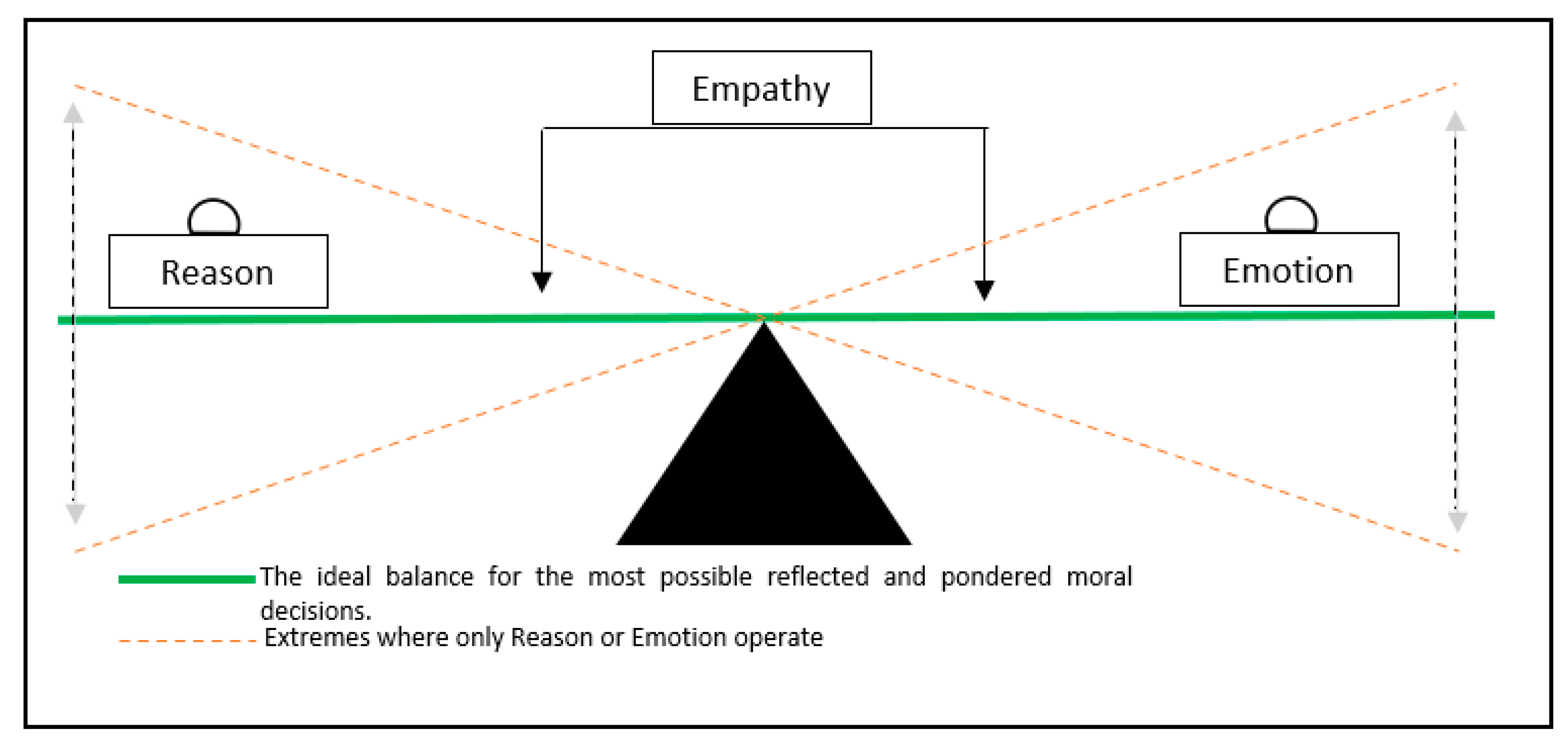
Therefore, we understand empathy has been wrongly defined as an exclusively or predominantly emotional mechanism or artificially divided into subtypes (e.g., emotional, cognitive). These conceptualisations have generated great confusion about determining its relevance to morality. Hence, we propose a concept of empathy that will clarify its importance for moral decisions. We affirm that empathy is neither an emotion nor a cognition solely, nor is it divided into subtypes. There is no support in the brain studies analysed for this subdivision, nor can it be said that a brain area is related explicitly to empathy (Decety 2010; Yoder and Decety 2017; Ferrari 2014). Consequently, we define empathy as a unique and distinct human neuropsychological capacity dependent on the proper functioning of several brain areas, which balances the scales of Emotion and Reason, allowing moral decisions to be as reflected and pondered as possible in the most diverse circumstances and contexts. (Figure 2).
There is an ideal stage where empathy promotes a perfect balance between Reason and Emotion, giving rise to the most thoughtful and pondered moral decision possible (green line in Figure 2) and the extremes (red dashed in Figure 2) where no empathy occurs. A dramatic oscillation between Reason and Emotion instigates an absolute domination of one over the other and a volatile and uncertain moral judgment and decision. In these extremes, the individual’s specific situation and personality determine the predominance of one dimension (Reason or Emotion) over the other. Thereby, for example, a psychopath completely lacking in empathy makes overly rational or emotional moral decisions depending on the circumstance. He may have the brutal coldness of premeditated and planned murder of a group of individuals for his financial gain or the impulsiveness of being suddenly violent with someone in his personal relationships sphere that insults his “honour”. Between the ideal (green line in Figure 2) and the extremes (dashed red lines in Figure 2), there is a whole empathic spectrum (dashed blue arrows in Figure 2) that contributes to more or less thoughtful moral decisions. It is important to emphasise that the ideal does not mean immaculate moral answers that do not leave doubts or ethical anxiety, but the empathic ability to balance Reason and Emotion as best as possible to reach a moral solution to the concrete problem with which one is faced. There are many potentially irresolvable ethical dilemmas, that is, without unquestionable and universal moral answers. Therefore, any decision in these circumstances can also include morally acceptable and unacceptable aspects, depending on the individual’s perspective.
This individual’s perspective is influenced by temperament (the biological basis of personality), sociocultural environment (e.g., education, culture) and personal experiences. In one of the final scenes of the 1993 film “The Good Son”, a mother (Susan) is faced with the dilemma of having to choose between saving the life of her 12-year-old firstborn son Henry (who she knows has been responsible for the death of her youngest son) and that of her nephew Mark of the same age. Susan chooses to save her nephew. This situation perfectly illustrates how an answer to a dilemma can leave residual ethical anguish and permanent questioning from then on about its lawfulness. Would the mother make the same decision if she could go back? Here, we argue that Susan’s decision (despite being far from perfect and unquestionable) resulted from a process of balance between Reason and Emotion promoted by empathy. Under the domination of the extremes of Figure 2, it would be expected that Reason would lead her to choose her nephew (an innocent man of good character) and Emotion her son (a merciless murderer). This film also raises another important issue. Although more and more, especially in the Western world, a primacy of the beautiful over the ugly is being nurtured (hiding aversive realities such as cruelty), the truth is that human nature is dichotomous. That is, it oscillates between innate evil and goodness. Without disregarding the noticeable positive and negative effects that the environment can have on the development of our character, the truth is that genetics can overcome the environment. In this film, the tender, suitably affectionate, and no-nonsense environment that Henry has consistently had failed to model his mischievous temper. Mark, on the other hand, despite dealing with difficult times (like the death of his mother), reveals a docile and harmonious personality with excellent coping resources. Evil is not a psychiatric condition. It is part of our dichotomous core.
Our model responds to moral judgments in interpersonal relationships and includes a solution to the dimension of the concept of “Einfühlung”, from which the word empathy emerged (Ganczarek et al. 2018). In other words, empathy is also essential for moral decisions where non-humans are involved. Before a lost inanimate object (e.g., a painting, a watch) or pet, if endowed with empathy, an individual will be able, to a greater or lesser degree, to assess whether stealing is morally lawful. Empathy’s induced balance between Reason and Emotion will allow assessing whether the action is morally wrong (1) in itself (e.g., even if no negative consequences are apparent, perhaps it would be better, in such a circumstance, to take the watch to a lost and found and only keep it if no one claims it) or (2) because it will damage (emotionally or financially) someone else. At the extremes (without empathy), once again, the decision will be volatile (and may, therefore, not be the most appropriate - we are entirely left to the chance of the moment) because it will be based on excessive rationality or emotionality.
In summary, our model sees empathy as a distinct human neuropsychological capacity that seeks to balance Reason and Emotion to allow the most thoughtful and pondered moral decisions possible, recognising, at the same time, that, in many circumstances, immaculate moral judgments do not exist. As with any other domain, we are born with an empathic potential that can then be more or less developed in a close and continuous inter-influence between genetics and the environment (in the limit, it may be the case that genetics prevail, for better or worse, over environmental influences). Furthermore, in the clinical context (e.g., palliative care), empathy allows us to calibrate our judgements and decisions, turning them as secular as possible, scientifically centred and adapted to the patient’s needs. It promotes respect for others’ beliefs and choices. Before a dying patient, for example, a doctor with high empathic skills can put personal beliefs aside and act according to the patient and family’s wishes and autonomy.
c) Critical Reflection
Analysing the articles selected for this scoping review allowed us to verify that our proposed model of empathy is original. There have been several limitations in the approach to the relation between empathy and morality to which our model responds.
First, there is always a significant variability of the concept, which undermines, from the outset, the clairvoyance of the discussion between the defenders and opponents of empathy as a fundamental element of morality. One side’s arguments are debated and refuted by the other side with personal notions, often with overlapping ideas or poor differential delimitation. This kind of debate could be helpful for an eventual progressive refinement of the concept. However, the discussion is already secular, so it would be expected that a consensus on what empathy is already exists. Different positions have been justified with nebulous definitions, perpetuating an important bias in the scientific validity of the debate. When we decide to test whether a variable exerts a relevant influence on another, it is convenient that, from the outset, there is a clear conceptualisation of the variables. Even those endowed with subjectivity are often conceptually well-defined. For example, no one doubts what sadness is, although we can interpret its intensity and, ultimately, its putative presence in another person with variable degrees. Thus, when we seek to determine whether or not empathy is relevant to morality and to compare arguments and studies, it would be helpful to have a consensus on its definition first.
Second, although several selected studies and opinion articles consider empathy a vital element of morality, none assumes it is necessary in all circumstances. In addition, they approach it from a relational perspective between human beings, not considering objects, animals or nature.
Third, the allusion that empathy does not serve morality because it biases moral decisions based on personal proximity (Pascal 2017; Martineau et al. 2019; Decety and Cowell 2015; Fowler et al. 2021; Redford and Ratliff 2017) is fallacious and results from its improper definition and confusion with the concept of sympathy. Understandably, we are more sympathetic to the people with whom we share our personal lives. However, this does not mean that, despite the possible latent pressure to favour these people when making moral decisions, we will do so. As we presented, empathy will precisely seek to mitigate or eliminate this bias, promoting a balance between Reason and Emotion to allow the most thoughtful and pondered moral judgment possible. We sympathise more with our peers, but we can morally consider, through empathy, strangers and loved ones alike.
Fourth, despite the topographical conceptualisation that helps us clinically and allows us to understand which areas are most associated with specific functions, the human brain works in an integrated and networked way. Unlike other cells in the body, neurons that perform a specific function can replace neighbouring neurons destroyed, for example, by ischemia that perform different functions (Wang et al. 2021). Furthermore, the impairment of a particular activity generally attributed to a specific brain area may result from a dysfunction or injury in another brain area (Young 2014). Therefore, the identification of a specific brain area (such as the ventromedial prefrontal cortex or the dorsomedial prefrontal cortex) as the centre of morality or empathy (Ferrari 2014b) is reductive, even more so when we consider functions whose complexity necessarily requires the involvement of other areas, such as the limbic, sensory and motor systems. Thus, studies that seek to relate certain brain regions to morality and empathy, mainly using functional neuroimaging assessment of psychopaths, have several conceptual, methodological and phenomenological limitations (Lenzen et al. 2021; Blair 2007).
6. Conclusion
Empathy is a secular topic whose definition and procedural conceptualisation have yet to reach a clear-cut consensus. Thus, studying its importance to morality has been challenging, giving rise to various divergent and confused opinions and conclusions. The results of this scoping review revealed that empathy is (1) commonly presented as an exclusively or predominantly emotional process; (2) often conceptually divided into subtypes; (3) associated with certain specific brain areas; and (4) referred to as a source of bias in moral decisions. These are artificial findings with poor argumentative and scientific support.
Our operational model of empathy responds to several of these limitations, giving a plastic constancy to the dynamism of morality that goes hand in hand with a world in permanent mutation. That is, constancy because it does not need to change to respond to different demands arising from the evolution of times and plasticity as it adapts to these changes and allows responses in the most diverse circumstances. It also assumes the impossibility of achieving an immaculate morality (perfect, unanimous and universal) being realistic and congruent with human nature. Thus, empathy is the cross-cultural mainstay of morality. We recognise, for example, that empathy is evolutionarily advantageous for the human species, but not because it allows for partiality in the defense of specific groups or individuals with whom we have closer relations (confusion with sympathy, love, attachment).
On the contrary, it contributes to the most impartial and fairly moral decisions possible between various groups and individuals, whether they are more or less close. Empathy’s benefit is its dimension of understanding what the other is feeling. It is not mandatory to feel what the other feels to be empathetic.
Research Limitations
Considering the scope and complexity of the subject addressed, some relevant papers may still need to be identified and included. However, we tried to significantly minimise this potential bias with the number of participants in the research, the criteria used, the careful analysis of the texts and the reading of the complementary bibliography.
References
- Allen, L. (2015, 23rd July). The interaction of biology and environment. Transforming the Workforce for Children Birth Through Age 8 - NCBI Bookshelf. https://www.ncbi.nlm.nih.gov/books/NBK310546/.
- Blair, R. E. (2007). The amygdala and ventromedial prefrontal cortex in morality and psychopathy. Trends in Cognitive Sciences, 11(9), 387–392. [CrossRef]
- Beauchamp, T. L., & Childress, J. F. (2019). Principles of Biomedical ethics. Oxford University Press, USA.
- Churcher, M. (2016). Can empathy be a moral resource? A Smithean reply to Jesse Prinz. Dialogue, 55(3), 429–447. [CrossRef]
- Coplan, A. (2011). WILL THE REAL EMPATHY PLEASE STAND UP? A CASE FOR A NARROW CONCEPTUALISATION. Southern Journal of Philosophy, 49, 40–65. [CrossRef]
- Cuff, B. M. P., Brown, S., Taylor, L. K., & Howat, D. (2014). Empathy: A review of the concept. Emotion Review, 8(2), 144–153. [CrossRef]
- Decety, J. (2010). The neurodevelopment of empathy in humans. Developmental Neuroscience, 32(4), 257–267. [CrossRef]
- Decety, J., & Cowell, J. M. (2014). The complex relation between morality and empathy. Trends in Cognitive Sciences, 18(7), 337–339. [CrossRef]
- Decety, J., & Cowell, J. M. (2014b). Friends or foes. Perspectives on Psychological Science, 9(5), 525–537. [CrossRef]
- Decety, J., & Cowell, J. M. (2015). Empathy, justice, and moral behavior. Ajob Neuroscience, 6(3), 3–14. [CrossRef]
- De Vignemont, F., & Singer, T. (2006). The empathic brain: how, when and why? Trends in Cognitive Sciences, 10(10), 435–441. [CrossRef]
- Engelen, E., & Röttger-Rössler, B. (2012). Current disciplinary and interdisciplinary debates on empathy. Emotion Review, 4(1), 3–8. [CrossRef]
- Ferrari, P. F. (2014). The neuroscience of social relations. A comparative-based approach to empathy and to the capacity of evaluating others’ action value. Behaviour, 151(2–3), 297–313. [CrossRef]
- Fairchild, G., Toschi, N., Sully, K., Sonuga-Barke, E. J., Hagan, C. C., Diciotti, S., Goodyer, I. M., Calder, A. J., & Passamonti, L. (2016). Mapping the structural organisation of the brain in conduct disorder: replication of findings in two independent samples. Journal of Child Psychology and Psychiatry, 57(9), 1018–1026. [CrossRef]
- Fowler, Z., Law, K. W., & Gaesser, B. (2021b). Against Empathy Bias: The Moral value of Equitable empathy. Psychological Science, 32(5), 766–779. [CrossRef]
- Ganczarek, J., Hünefeldt, T., & Belardinelli, M. O. (2018). From “Einfühlung” to empathy: exploring the relationship between aesthetic and interpersonal experience. Cognitive Processing, 19(2), 141–145. [CrossRef]
- Isern-Mas, C., & Sureda, A. (2019). Why does empathy matter for morality? Análisis Filosófico. [CrossRef]
- Jaspers, K. (2000). Psicopatologia Geral (8th ed.). Atheneu Editora.
- Kauppinen, A. (2017). Empathy as the moral sense? Philosophia. [CrossRef]
- Lenzen, L. M., Donges, M. R., Eickhoff, S. B., & Poeppl, T. B. (2021). Exploring the neural correlates of (altered) moral cognition in psychopaths. Behavioral sciences & the law, 39(6), 731–740. [CrossRef]
- Liberati, Alessandro, Douglas G. Altman, Jennifer Tetzlaff, Cynthia D. Mulrow, Peter C Gøtzsche, John P. A. Ioannidis, Mike Clarke, P. J. Devereaux, Jos Kleijnen, and David Moher. 2009. “The PRISMA Statement for Reporting Systematic Reviews and Meta-Analyses of Studies That Evaluate Health Care Interventions: Explanation and Elaboration.” PLOS Medicine 6 (7): e1000100. [CrossRef]
- Martineau, J. T., Decety, J., & Racine, E. (2019). The Social Neuroscience of Empathy and Its Implication for Business Ethics. Advances in Neuroethics, 167–189. [CrossRef] [PubMed]
- Pascal, E. A. (2017). Being similar while judging right and wrong: The effects of personal and situational similarity on moral judgements. International Journal of Psychology. [CrossRef]
- Redford, L., & Ratliff, K. A. (2017). Empathy and humanitarianism predict preferential moral responsiveness to in-groups and out-groups. Journal of Social Psychology. [CrossRef]
- Riccelli, R., Toschi, N., Nigro, S., Terracciano, A., & Passamonti, L. (2017). Surface-based morphometry reveals the neuroanatomical basis of the five-factor model of personality. Social Cognitive and Affective Neuroscience, nsw175. [CrossRef] [PubMed]
- Shamseer, Larissa, David Moher, Mike Clarke, Davina Ghersi, Alessandro Liberati, Mark Petticrew, Paul G Shekelle, and Lesley Stewart. 2015. “Preferred Reporting Items for Systematic Review and Meta-Analysis Protocols (PRISMA-P) 2015: Elaboration and Explanation.” BMJ 349 (jan02 1): g7647. [CrossRef]
- Schoeps, K., Mónaco, E., Cotolí, A., & Montoya-Castilla, I. (2020). The impact of peer attachment on prosocial behavior, emotional difficulties and conduct problems in adolescence: The mediating role of empathy. PLOS ONE, 15(1), e0227627. [CrossRef]
- Sherwood, C. C., Subiaul, F., & Zawidzki, T. W. (2008). A natural history of the human mind: tracing evolutionary changes in brain and cognition. Journal of Anatomy, 212(4), 426–454. [CrossRef]
- Simmons, A. T. (2013). In defense of the moral significance of empathy. Ethical Theory and Moral Practice, 17(1), 97–111. [CrossRef]
- Sporns, O. (2013). Structure and function of complex brain networks. Dialogues in Clinical Neuroscience, 15(3), 247–262. [CrossRef]
- Thibaut, F. (2018). The mind-body Cartesian dualism and psychiatry. Dialogues in Clinical Neuroscience, 20(1), 3. [CrossRef]
- Tost, H., Champagne, F. A., & Meyer-Lindenberg, A. (2015). Environmental influence in the brain, human welfare and mental health. Nature Neuroscience, 18(10), 1421–1431. [CrossRef]
- Ugazio, G., Majdandzić, J., Lamm, C., & Maibom, H. L. (2014). Are empathy and morality linked? In Oxford University Press eBooks (pp. 155–171). [CrossRef]
- Wang, Y., Lobb-Rabe, M., Ashley, J. A., Anand, V., & Carrillo, R. A. (2021). Structural and Functional Synaptic Plasticity Induced by Convergent Synapse Loss in the DrosophilaNeuromuscular Circuit. The Journal of Neuroscience, 41(7), 1401–1417. [CrossRef]
- Wille, N., Bettge, S., & Ravens-Sieberer, U. (2008). Risk and protective factors for children’s and adolescents’ mental health: results of the BELLA study. Eur Child Adolesc Psychiatry, 17(S1), 133–147. [CrossRef]
- Yoder, K. S., & Decety, J. (2017). The neuroscience of morality and social decision-making. Psychology Crime & Law, 24(3), 279–295. [CrossRef]
- Young, G. B. (2014). Diaschisis. In Elsevier eBooks (p. 995). [CrossRef]
Figure 1.
PRISMA flow diagram.
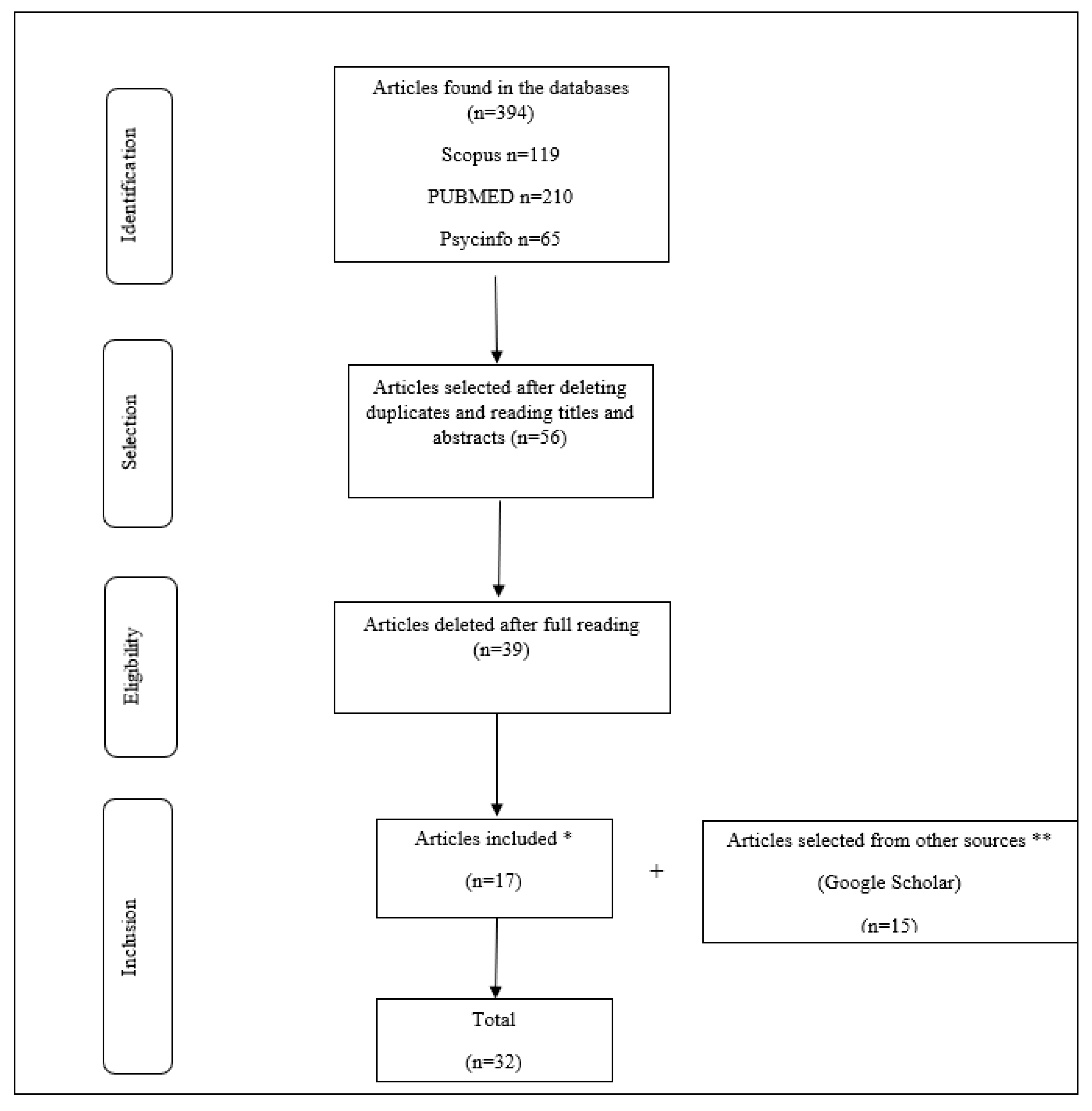
Figure 2.
Conceptual model of empathy.
Disclaimer/Publisher’s Note: The statements, opinions and data contained in all publications are solely those of the individual author(s) and contributor(s) and not of MDPI and/or the editor(s). MDPI and/or the editor(s) disclaim responsibility for any injury to people or property resulting from any ideas, methods, instructions or products referred to in the content. |
© 2024 by the authors. Licensee MDPI, Basel, Switzerland. This article is an open access article distributed under the terms and conditions of the Creative Commons Attribution (CC BY) license (http://creativecommons.org/licenses/by/4.0/).
Copyright: This open access article is published under a Creative Commons CC BY 4.0 license, which permit the free download, distribution, and reuse, provided that the author and preprint are cited in any reuse.


