
Submitted:
16 May 2024
Posted:
21 May 2024
You are already at the latest version
Abstract
This research review explores the synthesis of graphene quantum dots (GQDs) from biowaste for supercapacitor applications, driven by the need for sustainable and efficient energy storage technologies. GQDs, with their unique properties like high surface area and excellent conductivity, hold promise for enhancing supercapacitor performance. Various synthesis methods, including hydrothermal/solvothermal processes, chemical exfoliation, carbonization/pyrolysis, and microwave-assisted synthesis, are discussed alongside characterization techniques to evaluate GQD properties. Biowaste-derived GQDs demonstrate significant potential by improving specific capacitance and cycling stability in supercapacitor electrodes. Challenges such as scalability and material purity are identified, with future directions focusing on enhancing energy density, cycle life, and cost-effectiveness to propel the adoption of biowaste-derived GQDs in commercial energy storage applications.
Keywords:
Graphene Quantum Dots (GQD)
; Supercapacitor
; Energy Storage
; Power Storage
; Zero Dimensions Materials
1. Introduction
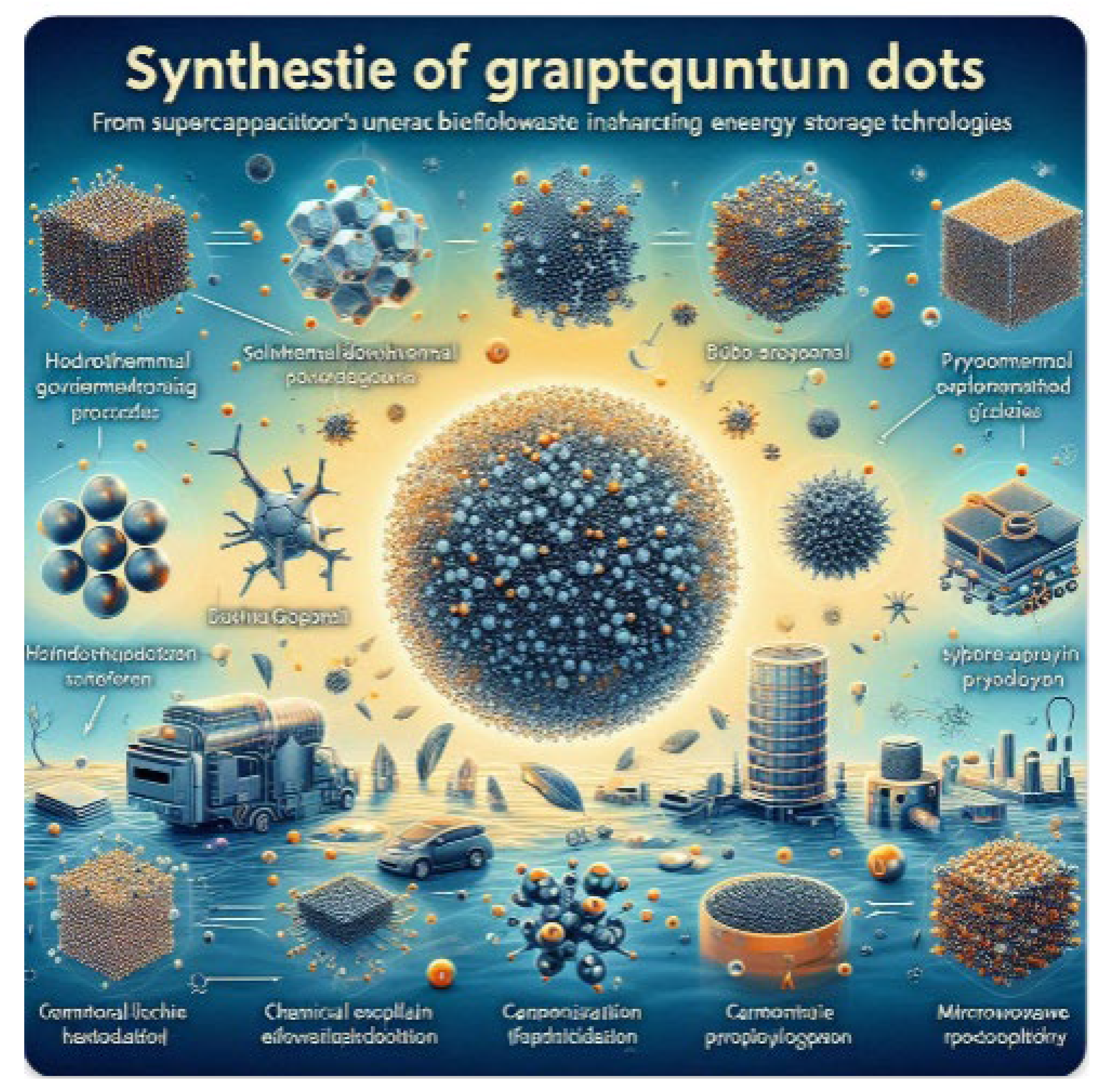
Figure 1.
Graphical abstract of Graphene Quantum Dots for Supercapacitor Applications.
The rapid advancement of technology and increasing energy demands have spurred significant interest in developing efficient and sustainable energy storage devices [1]. Supercapacitors have emerged as promising candidates due to their high power density, fast charge-discharge rates, and long cycle life[2]. However, to fully harness their potential, innovative materials with exceptional electrical properties are required[3].
Graphene quantum dots (GQDs) have garnered considerable attention for their unique attributes, including high surface area, excellent electrical conductivity, and tunable electronic properties[4]. These nanoscale fragments of graphene combine the advantageous characteristics of both graphene and quantum dots, making them ideal for a variety of applications, including energy storage, sensing, and optoelectronics[5].
Traditionally, the synthesis of GQDs involves complex and costly methods that often rely on hazardous chemicals[6]. In response to environmental and economic concerns, researchers have explored the use of biowaste as a precursor for GQD production. This approach not only provides a sustainable and cost-effective alternative but also addresses the pressing issue of biowaste management.
Biowaste, which includes agricultural residues, fruit peels, leaves, and other organic waste, is abundant and renewable[7]. Utilizing these materials for the synthesis of GQDs aligns with the principles of green chemistry and circular economy, promoting the conversion of waste into valuable products[8]. The process of converting biowaste into GQDs typically involves methods such as hydrothermal treatment, chemical exfoliation, carbonization, and microwave-assisted synthesis[9].
The biowaste-derived GQDs exhibit properties that are highly beneficial for supercapacitor applications[10]. They offer numerous active sites for charge storage, enhance electrical conductivity, and contribute to the structural stability of the electrodes[11]. As a result, supercapacitors incorporating GQDs demonstrate improved energy and power densities, as well as excellent cycling stability[12].
This review aims to provide a comprehensive overview of the synthesis of GQDs from biowaste and their application in supercapacitors. It will cover the various synthesis methods, the characterization of GQDs, and their performance in supercapacitor devices. Additionally, the review will address the challenges and future prospects in this burgeoning field, highlighting the potential of biowaste-derived GQDs to revolutionize energy storage technologies.
2. Synthesis Methods
The synthesis of GQDs from biowaste involves several methods, primarily categorized into top-down and bottom-up approaches. The selection of biowaste material and the synthesis method significantly influence the properties of the resultant GQDs[13].
2.1. Top-Down Methods

Table 1.
Top-Down Methods.
| Method | Process | Examples | Advantages | Challenges |
|---|---|---|---|---|
| Hydrothermal and Solvothermal Processes | Biowaste is dispersed in water or an organic solvent and heated in a sealed vessel (autoclave) under high-pressure and high-temperature conditions. | Orange peels, citric acid from fruit peels, spinach leaves. | Simple setup, environmentally friendly, controlled size and functional groups. | Requires precise control of reaction conditions, limited scalability due to autoclave capacity. |
| Chemical Exfoliation | Carbon-rich biowaste is treated with strong acids or bases to exfoliate it into graphene layers, which are then broken down into GQDs. | Cow manure, soybean waste, sugarcane bagasse. | High yield, straightforward process. | Use of hazardous chemicals, potential impurities or defects in GQDs. |
2.2. Bottom-Up Methods
Table 2.
Bottom-Up Methods.
| Method | Process | Examples | Advantages | Challenges |
|---|---|---|---|---|
| Carbonization and Pyrolysis | Thermal decomposition of biowaste at high temperatures in an inert atmosphere (nitrogen or argon) to form carbon structures, further processed into GQDs. | Chicken feathers, peanut shells, coconut shells. | Inexpensive, abundant materials, good electrical conductivity. | High energy consumption, potential non-uniform GQDs. |
| Microwave-Assisted Synthesis | Microwave radiation rapidly heats and decomposes biowaste into GQDs, involving mixing the biowaste with a solvent and irradiating with microwaves. | Banana peels, sugarcane bagasse, coffee grounds. | Fast, energy-efficient, scalable, desirable size and surface properties. | Requires precise control of microwave parameters to avoid over-heating or incomplete decomposition. |
3. Properties and Characterization
Table 3.
Properties and Characterization.
| Property | Description | Characterization Technique | Details |
|---|---|---|---|
| Size and Morphology | The dimensions and shape of the GQDs. | Transmission Electron Microscopy (TEM) | TEM provides detailed images, allowing for precise measurement of GQD size and observation of their morphological characteristics. |
| Crystalline Structure | The arrangement of atoms in the GQDs. | X-ray Diffraction (XRD) | XRD is used to assess the crystalline structure, determining the presence of graphitic layers and crystalline phases. |
| Degree of Graphitization | The extent to which the GQDs are composed of graphitic carbon. | Raman Spectroscopy | Raman spectroscopy evaluates the degree of graphitization by analyzing the D and G bands, which indicate defects and graphitic structure respectively. |
| Surface Functional Groups | Chemical groups present on the surface of the GQDs. | Fourier Transform Infrared Spectroscopy (FTIR) | FTIR identifies functional groups on the GQD surface, providing information on chemical bonding and surface chemistry. |
| Optical Properties | The behavior of GQDs in response to light. | Photoluminescence (PL) Spectroscopy | PL spectroscopy analyzes the emission of light from GQDs, which is crucial for applications in optoelectronics and bioimaging, by studying their luminescent properties. |
4. Supercapacitor Applications
A supercapacitor, also known as an ultracapacitor or electrochemical capacitor, is an energy storage device that combines the properties of traditional capacitors and batteries[14]. Unlike conventional capacitors, which store energy through electrostatic charge separation, supercapacitors store energy through both electrostatic and electrochemical processes[14]. This dual mechanism allows them to have much higher energy storage capacity than traditional capacitors, while also offering faster charge and discharge rates compared to batteries.
4.1. Key Characteristics of Supercapacitors
Table 4.
Key Characteristics of Supercapacitors.
| Characteristic | Description | Benefits |
|---|---|---|
| High Power Density | Ability to deliver and accept charge quickly. | Ideal for applications requiring rapid energy bursts, such as power tools and regenerative braking systems. |
| Long Cycle Life | Can withstand millions of charge-discharge cycles without significant degradation. | Offers much longer lifespans compared to batteries, reducing the need for frequent replacements. |
| Fast Charge and Discharge | Low internal resistance allows rapid charging and discharging. | Enables quick energy availability, useful in applications like emergency power backup and peak load leveling. |
| Wide Operating Temperature Range | Effective operation over a broad range of temperatures. | Suitable for use in extreme environments, from cold climates to hot industrial settings. |
| Environmentally Friendly | Often use less harmful materials and have simpler recycling processes compared to batteries. | Reduces environmental impact and aligns with sustainable and green technology goals. |
4.2. Applications
Table 5.
Applications.
| Application | Description | Examples |
|---|---|---|
| Energy Storage | Supplementing batteries in hybrid and electric vehicles, renewable energy systems, and grid storage. | - Hybrid and electric vehicles for regenerative braking and acceleration. - Solar and wind energy systems for smoothing out power fluctuations. - Grid storage for load balancing and peak shaving. |
| Consumer Electronics | Providing quick bursts of energy in various electronic devices. | - Cameras for flash systems. - Laptops for quick boot operations. - Portable speakers for high-power sound bursts. |
| Industrial Uses | Used in heavy machinery to provide quick energy for lifting and moving. | - Cranes and forklifts for lifting heavy loads. - Uninterruptible power supplies (UPS) for industrial systems. |
| Backup Power | Offering reliable power in case of short-term outages. | - Computers to prevent data loss during power interruptions. -Medical devices to ensure continuous operation. -Telecommunications equipment to maintain service during power failures. |
| Transportation | Enhancing performance and energy efficiency in various transport systems. | - Electric buses for energy recovery and acceleration. <br>- Trains for auxiliary power systems. <br>- Aerospace for fast-acting power needs. |
| Military and Defense | Providing robust and reliable power in critical defense applications. | - Powering communication devices. <br>- Energy systems in drones and other unmanned vehicles. <br>- Rapid-deployment power supplies for field operations. |
4.3. Importance of Biowaste-Derived GQDs in Supercapacitors
The integration of graphene quantum dots (GQDs) derived from biowaste into supercapacitors offers numerous advantages, including enhanced performance, cost-effectiveness, and environmental sustainability[15]. These GQDs provide a high surface area, excellent electrical conductivity, and good structural stability, which are crucial for improving the overall efficiency and capacity of supercapacitors[16]. By utilizing biowaste as a source material, this approach also promotes recycling and reduces waste, aligning with green chemistry principles and supporting the development of eco-friendly energy storage solutions[17].
4.4. Types of Supercapacitors
Supercapacitors are classified into various types based on their electrode materials and mechanisms of energy storage[18]. The main types include electric double-layer capacitors (EDLCs), pseudocapacitors, and hybrid capacitors[19]. Each type has distinct characteristics and advantages, making them suitable for different applications.
Table 6.
Types of Supercapacitors.
| Type | Description | Key Characteristics | Applications |
|---|---|---|---|
| Electric Double-Layer Capacitors (EDLCs) | Store energy through electrostatic charge separation at the electrode-electrolyte interface. | - High power density - Long cycle life - Fast charge and discharge - No chemical reactions involved |
- Energy storage - Consumer electronics - Power backup - Electric vehicles |
| Pseudocapacitors | Store energy through fast and reversible redox reactions at the surface of the electrodes. | - Higher energy density than EDLCs - Involves Faradaic (redox) reactions - Moderate power density - Shorter cycle life compared to EDLCs |
- Renewable energy systems - Portable electronics - Power tools - Sensors |
| Hybrid Capacitors | Combine the properties of EDLCs and pseudocapacitors, typically using different materials for each electrode. | - Balanced energy and power density - Improved performance - Combination of electrostatic and Faradaic mechanisms |
- Electric vehicles - Grid storage - Industrial |
4.4.1. Electric Double-Layer Capacitors (EDLCs)
- Mechanism: EDLCs store energy by forming an electric double layer at the interface between the electrode and the electrolyte. This electrostatic separation of charges does not involve any chemical reactions[20].
- Materials: Commonly used materials include activated carbon, carbon nanotubes, and graphene.
- Advantages: High power density, long cycle life, and rapid charge-discharge capability.
- Disadvantages: Lower energy density compared to pseudocapacitors and batteries.
4.4.2. Pseudocapacitors
- Mechanism: Pseudocapacitors store energy through fast and reversible redox (Faradaic) reactions at the electrode surface. These reactions involve electron transfer and result in higher energy storage capacity[21].
- Materials: Typically use transition metal oxides (such as RuO2, MnO2) and conducting polymers (such as polyaniline, polypyrrole).
- Advantages: Higher energy density compared to EDLCs.
- Disadvantages: Lower cycle life and power density compared to EDLCs.
4.4.3. Hybrid Capacitors
- Mechanism: Hybrid capacitors combine the mechanisms of EDLCs and pseudocapacitors, using different electrode materials to optimize both energy and power density. They often use a carbon-based material for one electrode and a pseudocapacitive material for the other[22].
- Materials: Can include a combination of activated carbon and transition metal oxides or conducting polymers.
- Advantages: Balanced performance, offering a compromise between the high power density of EDLCs and the high energy density of pseudocapacitors.
- Disadvantages: Complexity in design and potentially higher costs.
5. Challenges and Future Perspectives
Supercapacitors have made significant strides in energy storage technology, but several challenges remain to be addressed for their widespread adoption and further advancement. Future research and development efforts are focusing on overcoming these challenges and unlocking the full potential of supercapacitors in various applications.
Table 7.
Challenges and Future Perspectives.
| Challenge | Description | Potential Solutions |
|---|---|---|
| Energy Density | Supercapacitors have lower energy density compared to batteries, limiting their use in long-duration energy storage. | - Development of advanced electrode materials - Innovations in electrode design and architecture |
| Cycle Life and Durability | Supercapacitors can degrade over time, especially under high cycling conditions, impacting their long-term reliability. | - Improved electrode materials and electrolyte formulations - Enhanced cell design for durability and stability |
| Cost-Effectiveness | High material and manufacturing costs hinder widespread adoption of supercapacitors in commercial applications. | - Scalable synthesis methods for cost-effective production - Recycling strategies for electrode materials |
| Temperature Range | Supercapacitor performance can be limited by extreme temperatures, affecting their applicability in harsh environments. | - Development of electrolytes and materials with wide temperature tolerance - Thermal management strategies |
| Integration into Systems | Efficient integration of supercapacitors into existing energy storage systems and electronic devices requires tailored designs. | - Collaborative efforts between material scientists, engineers, and system integrators - Standardized interfaces and protocols |
| Advancements in Nanomaterials | Continued research on advanced nanomaterials to enhance energy and power density while maintaining stability. | - Exploration of graphene, carbon nanotubes, and metal oxides for improved performance - Nanomaterial synthesis innovations |
| Hybrid Energy Storage Systems | Integration of supercapacitors with batteries for hybrid systems combining benefits of both technologies. | - Development of hybrid architectures for optimized performance - Control algorithms for seamless integration |
| Smart and Flexible Devices | Design of flexible and lightweight supercapacitors for wearable electronics and IoT applications. | - Development of flexible electrode materials and packaging - Integration with flexible electronics and sensors |
| Environmental Sustainability | Emphasis on sustainable manufacturing processes and recycling strategies to minimize environmental impact. | - Use of renewable materials and green synthesis methods - Recycling programs for spent electrode materials |
| Standardization and Commercialization | Establishment of industry standards and regulations to facilitate wider adoption and integration of supercapacitors. | - Collaborative efforts among stakeholders to define performance metrics and safety standards - Market-driven policies for incentivizing adoption and investment |
Future research should focus on optimizing synthesis methods, exploring new biowaste sources, and enhancing the understanding of the relationship between GQD properties and supercapacitor performance. Interdisciplinary approaches combining materials science, chemistry, and engineering will be crucial in overcoming these challenges.
6. Conclusion
The synthesis of graphene quantum dots from biowaste represents a sustainable and economically viable approach to producing high-performance materials for supercapacitor applications. By leveraging abundant and renewable biowaste resources, this strategy not only addresses environmental concerns but also advances the development of next-generation energy storage devices. Further research and technological advancements are needed to fully realize the potential of biowaste-derived GQDs in commercial supercapacitors.
References
- Yang, Z. et al., Electrochemical energy storage for green grid. Chemical reviews, 2011. 111(5): p. 3577-3613. [CrossRef]
- Yan, J., et al., Recent advances in design and fabrication of electrochemical supercapacitors with high energy densities. Advanced Energy Materials, 2014. 4(4): p. 1300816.
- Whittingham, M.S., Materials challenges facing electrical energy storage. Mrs Bulletin, 2008. 33(4): p. 411-419.
- Sheikh Mohd Ghazali, S.A.I., et al., Graphene quantum dots: A comprehensive overview. Open Chemistry, 2023. 21(1): p. 20220285. [CrossRef]
- Ghosh, D., et al., Current and future perspectives of carbon and graphene quantum dots: From synthesis to strategy for building optoelectronic and energy devices. Renewable and Sustainable Energy Reviews, 2021. 135: p. 110391.
- Kadyan, P., et al., Comprehensive review on synthesis, applications, and challenges of graphene quantum dots (GQDs). Journal of Nanomaterials, 2023. 2023: p. 1-26.
- Karić, N., et al., Bio-waste valorisation: Agricultural wastes as biosorbents for removal of (in) organic pollutants in wastewater treatment. Chemical Engineering Journal Advances, 2022. 9: p. 100239.
- Sharma, S., et al., Sustainable applications of biowaste-derived carbon dots in eco-friendly technological advancements: A review. Materials Science and Engineering: B, 2024. 305: p. 117414. [CrossRef]
- Gupta, G.K., et al., Excellent supercapacitive performance of graphene quantum dots derived from a bio-waste marigold flower (Tagetes erecta). International Journal of Hydrogen Energy, 2021. 46(77): p. 38416-38424.
- Gupta, G.K., et al., In situ fabrication of activated carbon from a bio-waste desmostachya bipinnata for the improved supercapacitor performance. Nanoscale research letters, 2021. 16(1): p. 85.
- Sagar, P., et al., Tagetes erecta as an organic precursor: synthesis of highly fluorescent CQDs for the micromolar tracing of ferric ions in human blood serum. RSC advances, 2021. 11(32): p. 19924-19934.
- Gupta, G.K., et al., Hydrothermally synthesized nickel ferrite nanoparticles integrated reduced graphene oxide nanosheets as an electrode material for supercapacitors. Journal of Materials Science: Materials in Electronics, 2024. 35(3): p. 255. [CrossRef]
- Abbas, A.T. Mariana, and A.N. Phan, Biomass-waste derived graphene quantum dots and their applications. Carbon, 2018. 140: p. 77-99.
- Olabi, A.G., et al., Supercapacitors as next generation energy storage devices: Properties and applications. Energy, 2022. 248: p. 123617.
- Jindal, S., et al., Sustainable approach for developing graphene-based materials from natural resources and biowastes for electronic applications. ACS Applied Electronic Materials, 2022. 4(5): p. 2146-2174.
- Zhang, S., et al., High-performance supercapacitor of graphene quantum dots with uniform sizes. ACS applied materials & interfaces, 2018. 10(15): p. 12983-12991.
- Mensah-Darkwa, K., et al., Supercapacitor energy storage device using biowastes: A sustainable approach to green energy. Sustainability, 2019. 11(2): p. 414.
- Miller, E.E.Hua, and F.H. Tezel, Materials for energy storage: Review of electrode materials and methods of increasing capacitance for supercapacitors. Journal of Energy Storage, 2018. 20: p. 30-40.
- Lim, E. Jo, and J. Lee, A mini review of designed mesoporous materials for energy-storage applications: from electric double-layer capacitors to hybrid supercapacitors. Nanoscale, 2016. 8(15): p. 7827-7833.
- Wu, J., Understanding the electric double-layer structure, capacitance, and charging dynamics. Chemical Reviews, 2022. 122(12): p. 10821-10859.
- Jiang, Y.and J. Liu, Definitions of pseudocapacitive materials: a brief review. Energy & Environmental Materials, 2019. 2(1): p. 30-37. [CrossRef]
- Yao, F. T. Pham, and Y.H. Lee, Carbon-based materials for lithium-ion batteries, electrochemical capacitors, and their hybrid devices. ChemSusChem, 2015. 8(14): p. 2284-2311.
Disclaimer/Publisher’s Note: The statements, opinions and data contained in all publications are solely those of the individual author(s) and contributor(s) and not of MDPI and/or the editor(s). MDPI and/or the editor(s) disclaim responsibility for any injury to people or property resulting from any ideas, methods, instructions or products referred to in the content. |
© 2024 by the authors. Licensee MDPI, Basel, Switzerland. This article is an open access article distributed under the terms and conditions of the Creative Commons Attribution (CC BY) license (http://creativecommons.org/licenses/by/4.0/).
Copyright: This open access article is published under a Creative Commons CC BY 4.0 license, which permit the free download, distribution, and reuse, provided that the author and preprint are cited in any reuse.


