
Submitted:
20 May 2024
Posted:
20 May 2024
You are already at the latest version
Abstract
Businesses use technological and social media marketing to respond to the Covid-19 pandemic. This study aims to understand better the factors that impact the spread of new technologies, the effectiveness of social media advertising, and the longevity of businesses. The study used a quantitative strategy based on partial least squares structural equation modeling to learn about the phenomenon of interest as much as possible. Dhaka, Bangladesh, small and medium-sized businesses participated in the survey. According to the findings, the popularity of internet and e-business technologies may be attributed to their apparent usefulness and ease of use. It is connecting internet/e-business technology, social media marketing, and the long-term success of small and medium-sized enterprises. Still, the expense factor was insufficient to prove that SMEs engage in social media advertising. Mediating effects between components may be better understood via internet/e-business technology and social media marketing, as shown by this study. This study is the first of its kind in Bangladesh and sheds light on the resilience of SMEs in the face of the Covivirus-19 pandemic, notwithstanding its focus on the capital city of Dhaka.
Keywords:
SMEs
; Social Media Marketing
; Sustainability
; E-business technology
1. Introduction
Many of the world’s top firms depend substantially on small and medium-sized enterprises (SMEs) for crucial resources. Their success substantially impacts the economies of countries where SMEs grow (Anees-ur-Rehman & Johnston, 2019; Casidy et al., 2020; Seifzadeh et al., 2020). Historically, SMEs have focused on established markets, although this tendency has started to alter in recent years (Muoz-Pascual et al., 2019; Valaei et al., 2017a). Despite their multiple benefits, small and medium-sized enterprises (SMEs) around the globe, and especially those operating (or wishing to operate) in developing nations (Malik & Jasiska-Biliczak, 2018), often face resource constraints and a dearth of technology applications.
Despite the rising significance of globalization, the success of small and medium-sized businesses (SMEs) is dependent on cutting-edge technology (Vrontis et al., 2020; Widya-Hasuti et al., 2018). Small and medium-sized firms’ long-term expansion and success (SMEs) may be facilitated by using improved, widely known, cost-effective marketing strategies (AL-Kwifi et al., 2020; Pandey et al., 2020). Information and communication technology (ICT) should be viewed as an essential and potentially fruitful tool for promoting products and services and fostering further sustainable business growth by small and medium-sized enterprises (SMEs), given the need to integrate new technologies into established processes (Bessant et al., 2001). Small and medium-sized enterprises (SMEs) must rely heavily on social media to engage with their clients. Therefore, it may pertain to anything associated with “a new generation of web development and design that aims to improve communication, sourcing, information sharing, interoperability, and collaboration on the World Wide Web.” SMM adoption is more probable among SMBs if proponents see the technology as beneficial and secure (Consoli, 2012; Ilavarasan & Levy, 2010; Kapoor et al., 2018; Paris et al., 2010). Before committing to SMM, small and medium-sized businesses (SMEs) must assess the advantages and downsides of the approach carefully. Theoretically, these concerns are supported by the technology acceptance model (TAM), but how TAM presents itself in the context of small and medium-sized businesses (SMEs) in developing countries that employ social media marketing (SMM) has received little research (Chung et al., 2017; Crammond et al., 2018; Davis, 1989; Koronios et al., 2020; Azhari et al., 2023).
There is some evidence that SMM may assist SMEs in adopting new technologies; however, the vast majority of research in this area is conducted from the perspective of Western economies and their particular needs, goals, and viewpoints (Johnstone, 1999). For developing nations such as Bangladesh, small and medium-sized enterprises (SMEs) are essential to economic progress (Adla et al., 2020). Despite this, many lack the technical know-how and suffer financially (Shareef et al., 2019). Despite this, there is universal consensus that the practicality of ICT is crucial to their continued success in this field (Alam & Mohammad Noor, 2009; Totskaya, 2015; Ying et al., 2023). For small and medium-sized companies (SMBs) in developing countries to grow sustainably, social media marketing (SMM) is an effective strategy (Aral et al., 2013; Aswani et al., 2018). A combination of circumstances led to this result. Access to timely, relevant information via social media platforms and apps may stimulate customer engagement with companies and their products and services (Filieri et al., 2021). Even though small and medium-sized businesses (SMEs) can achieve sustainable business growth through the effective and efficient use of SMMs, few studies discuss how SMEs in emerging economies achieve positive outcomes through the use of SMM applications and how highlighted mechanisms, such as appropriate leadership support, can assist them in obtaining additional benefits from SMM applications (Chowdhury et al., 2023).
This investigation seeks to understand the elements that influence the broad adoption of social media marketing methods. This study is essential because it gives insight into how ICT may help the long-term development of Bangladesh’s SME sector (Senathirajah et al., 2024). In addition, we offered a complete assessment of the elements that may impact the long-term survival of SMEs and the growth-promoting measures. We recognize that there are still significant gaps in the study on the degree to which e-commerce is embraced in developing nations (Makiwa & Steyn, 2020). Several significant factors influence them in Bangladesh, including the availability of educational opportunities, public awareness, the availability of information, and maybe the sophistication of the country’s e-commerce infrastructure (Makiwa & Steyn, 2020; Almuhatresh et al., 2022).
1.1. Research Objective
The aim of this study is to identify the following relationships-
a. To identify the influences of Perceived Usefulness, Perceived ease of use, The adoption of e-business technologies, social media marketing on SMEs’ sustainability (Bin et al., 2022).
b. To what extent the adoption of e-business mediates the relationship of Perceived Usefulness, Perceived ease of use technologies on SMEs’ sustainability (Jye et al., 2022).
c. To what extent social media marketing mediates the relationship of Perceived Usefulness, Perceived ease of use technologies on SMEs’ sustainability (Khalil et al., 2022).
2. Theoretical review and hypotheses
2.1. Perceived Usefulness
Davis (1989) created the Technology Adoption Model (TAM) to forecast how rapidly people will adopt new types of technology. (PEU). If properly adopted and executed, a quality management system can benefit SMEs in achieving PEU criteria (Davis, 1989). Small and medium-sized businesses (SMEs) would likely adopt SMM if they knew its potential financial benefits. According to studies by Chatterjee and Kumar Kar (2020) and Qalati et al. (2021), SMEs may increase their production using SMM. Numerous studies have shown a link between PEU and customers’ enthusiasm to test cutting-edge technology (Qalati et al., 2021). A recent study demonstrates that the rising usage of smartphones by the PEU is closely proportional to their greater engagement in social networking sites. The following are some of the proposed hypotheses:
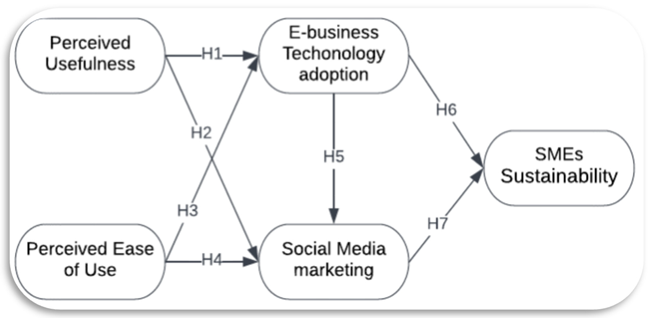
H1:
There is a positive relationship between Perceived Usefulness and e-business technology.
H2:
There is a positive relationship between Perceived Usefulness and social media marketing.
2.2. Perceived Ease of Use
The Davis et al. (1989) notion of perceived ease of use (PEOU) has been extensively used to examine the proliferation of new technologies in business and other settings. Multiple studies indicate that the adoption of Internet and e-business technologies is impacted by their perceived simplicity of use (Chong & Pervan, 2007; Hair et al., 2013). This is because novices are hesitant to use cutting-edge technologies due to their perceived complexity, even though they stand to benefit much from doing so (Wangyanwen et al., 2023). When it comes to expanding their businesses, entrepreneurs are more open to adopting cutting-edge technology if it is easy to use (Chung et al., 2020; Shareef et al., 2018). Businesses may boost their productivity and revenue by maximizing their use of social media tools.
Consequently, many SMBs are incorporating social media into their strategic planning. As a result of this improvement in usability, there will be a larger adoption of cutting-edge technology. PEOU’s future performance is influenced by its cutting-edge technologies (Barbosa et al., 2020; Shareef et al., 2019). According to the findings of their respective studies, Chatterjee and Kumar Kar (2020) and Kraus et al. (2019). For this debate, the following hypotheses will be accepted:
H3:
There is a positive relationship between Perceived ease of use and e-business technology.
H4:
There is a positive relationship between Perceived ease of use and social media marketing.
2.3. The Adoption of e-Business Technologies
The rate at which SMEs embrace new ideas is influenced by various variables, including organizational structure, environment, and accessible technology (Chatterjee & Kumar Kar, 2020). The notion of technology-organization-environment (TOE) blending offers an integrative framework for coupling technical elements, contextual organizational characteristics, and broad environmental concerns. Innovation amplifies the benefits of existing processes and technologies, and SMEs are aware of this (Chatterjee & Kumar Kar, 2020; Dwivedi et al., 2021). As a result, it is projected that e-commerce and Internet technologies would stimulate increasing output. Adopting EBT may influence profitability immediately and in the long term due to its capacity to maximize resource use. Earlier studies by scholars such as Abd Rahman et al. (2015) demonstrate that similar benefit is a significant predictor of IEBT and associated technologies among SMEs. Specifically, our perspective on adopting IEBT by SMBs is modified (Müller & Voigt, 2018; Francis et al., 2023).
H5:
There is a positive relationship between adopting e-business technologies and social media marketing.
H6:
There is a positive relationship between adopting e-business technologies and SMEs sustainability.
2.4. Social Media Marketing and SMEs’ Sustainability
Social presence theory refers to research that studies the consequences of a single social encounter on future encounters. Social media marketing (SMM) is the relatively new activity of advertising one’s company, causes, or ideas using social networking sites and other online communities (Akpan et al., 2022; Amoah & Jibril, 2021). Consumers and group members use a smartphone and web-based technology on online marketing platforms to share, co-create, discuss, and alter content, promoting the dissemination of information and developing interpersonal ties among the persons involved (Ifedi et al., 2024). User-generated material has helped increase the popularity of brand posts (Mason et al., 2021; Odoom et al., 2017), attract new customers, increase brand exposure and revenue, build customer loyalty, and even predict users’ future purchase be saviors. Despite constituting the vast majority of businesses globally, it is believed that SMEs are accountable for more than 70 percent of all global pollution (Jacobson et al., 2020; Marshall et al., 2015).
Due to the emphasis on big, multinational businesses, the sustainability detour made by small and medium-sized enterprises (SMEs) is not often acknowledged or documented in the literature on sustainable development and corporate innovation. Compared to major organizations, small and medium-sized businesses (SMEs) have a lower green incentive endowment (Kim & Ko, 2012), which causes problems in the form of financial limits, personnel and resource management issues, and other obstacles. According to preliminary research conducted by Barbosa et al. (2020), small businesses struggle with conceptual knowledge and equipment to measure and organize environmental outcomes due to the misconception that sustainability increases costs. However, sustainable practices may improve ecosystem health, community vitality, and economic prosperity (Kervin et al., 2012; Jing et al., 2023).
Implementing sustainable strategies may be beneficial for businesses and other groups. The researchers in this study (Raut et al., 2017) also found that adopting SOM boosted business performance and decreased the company’s negative consequences on society and the environment (Ojo et al., 2019; Shibin et al., 2018). According to Ahmed et al. (2022) a strong relationship exists between a corporation’s internal corporate activities and its long-term economic, environmental, and social performance and benefit. Companies would do well to see the green challenge as a competitive advantage in today’s market, as environmentally conscious customers increasingly choose eco-friendly goods (Ahmed et al., 2024). It is conceivable for a company’s community standing to improve due to its efforts to promote social responsibility (Osman et al., 2024). Therefore, it is reasonable to assume that the SOM approach enhances longevity, a characteristic essential to the success of business operations (Senathirajah et al., 2023).
H7:
There is a positive relationship between social media marketing and SMEs sustainability.
3. Research Methodology
To understand more about the function of EBT and Social Media Marketing as a mediator of the relationship between perceived utility and ease of use and SME sustainability, we used a quantitative method based on partial least squares structural equation modeling (PLS-SEM) (Hair et al., 2020).
There was a survey of small and medium-sized company owners in Dhaka, Bangladesh. We suggested 195 Google Forms questions, which would be sent using WhatsApp’s instant messaging platform. Seven completed surveys included inadequate or erroneous data for analysis (Valaei et al., 2017). In September and October of 2022, we did our study. The identity of persons who participated in this research cannot be disclosed for ethical reasons (Sirajuddin et al., 2023).
We resorted to a survey approach to better comprehend the social media marketing and long-term success of Bangladesh’s small and medium-sized enterprises. The questionnaires and interviews used in this study were refined versions of those employed in previous research (Ramalingam et al., 2024). Respondents were given a five-point Likert scale to rate their degree of agreement with each statement (strongly agree). This study evaluated data using a PLS-SEM model, with Smart PLS employed for data cleaning and preprocessing (version 4.0). In order to complete this study, the researcher selected a quantitative data collection method commonly used in many studies (Wider, 2023; Jiang et al., 2023).
4. Data Analysis
4.1. Reliability Analysis
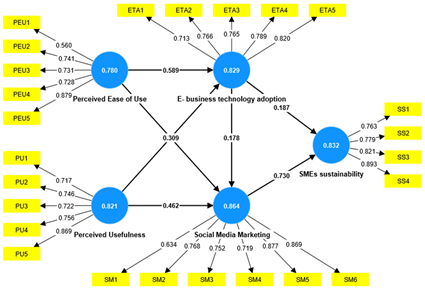
The unwavering quality investigation evaluates the questionnaire’s content for internal consistency. Cronbach’s Alpha values over 0.5 are dependable (Amoah & Jibril, 2020; Khalil et al., 2023). Calculating Cronbach’s Alpha boosts the dependability of the development estimation factors. If, however, Cronbach’s Alpha is less than 0.50, the variables are deemed unreliable.
Indicator reliability is synonymous with the outside loading dimension. We estimated loadings, cross-loadings, composite reliability, and AVE for the indicators using the SmartPLS 3.0 default PLS approach. According to conventional procedure, each item’s loading must exceed 0.70. (Taherdoost, 2017; Wai et al., 2024).
A scale’s dependability may be determined by its internal consistency, which is “the degree to which all items on a single subscale evaluate the same concept.”
Cronbach’s alpha is often used to determine the dependability of internal consistency (Sim et al., 2018; Taherdoost, 2017; Fei et al., 2024). This section’s estimate method uses indicators of manifest variable intercorrelations; all indicators have identical outer loadings.
| VIF | Cronbach’s alpha | Composite reliability | Average variance extracted | ||
| E- business technology adoption | ETA1 | 1.493 | 0.829 | 0.830 | 0.595 |
| ETA2 | 1.679 | ||||
| ETA3 | 1.640 | ||||
| ETA4 | 1.752 | ||||
| ETA5 | 1.933 | ||||
| Perceived Ease of Use | PEU1 | 1.223 | 0.780 | 0.808 | 0.540 |
| PEU2 | 1.533 | ||||
| PEU3 | 1.494 | ||||
| PEU4 | 1.568 | ||||
| PEU5 | 2.268 | ||||
| Perceived Usefulness | PU1 | 1.499 | 0.821 | 0.836 | 0.584 |
| PU2 | 1.607 | ||||
| PU3 | 1.493 | ||||
| PU4 | 1.648 | ||||
| PU5 | 2.258 | ||||
| SMEs sustainability | SM1 | 1.380 | 0.832 | 0.845 | 0.666 |
| SM2 | 1.825 | ||||
| SM3 | 1.700 | ||||
| SM4 | 1.649 | ||||
| SM5 | 3.107 | ||||
| SM6 | 2.987 | ||||
| Social Media Marketing | SS1 | 1.581 | 0.864 | 0.882 | 0.600 |
| SS2 | 1.660 | ||||
| SS3 | 1.962 | ||||
| SS4 | 2.483 | ||||
4.2. Collinearity Test
The Variance Inflation Factor-based collinearity test determines the degree of correlation between a given collection of variables (VIF). Therefore, these criteria may assess whether the VIF is collinear with the dependent variable (Hair et al., 2014). The broad range of VIF coefficient values (1.138 to 3.664, or 5.00) indicates no collinearity among the construct variables, indicating that the assessment is legitimate.
4.3. Hypothesis Testing
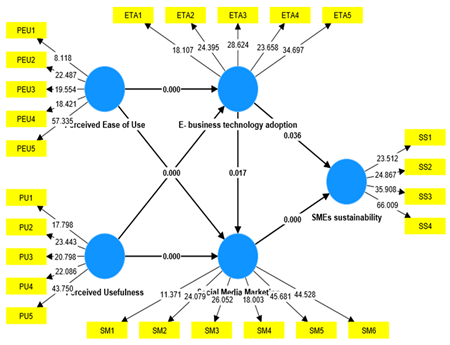
We used structural equation modeling to examine the underlying assumptions of the model. We provided information from a random sample of 5000 persons and advised utilizing the t-test. The t-values for each association in Table 4 are all larger than or equal to 1.96, suggesting that all seven hypotheses formulated for this investigation are accurate.
| Original sample | Sample mean | Standard deviation | T statistics | P values | |
| E- business technology adoption -> SMEs sustainability | 0.317 | 0.315 | 0.085 | 3.710 | 0.000 |
| E- business technology adoption -> Social Media Marketing | 0.178 | 0.180 | 0.074 | 2.393 | 0.017 |
| Perceived Ease of Use -> E- business technology adoption | 0.589 | 0.586 | 0.084 | 7.045 | 0.000 |
| Perceived Ease of Use -> Social Media Marketing | 0.440 | 0.444 | 0.058 | 7.578 | 0.000 |
| Perceived Usefulness -> E- business technology adoption | 0.309 | 0.312 | 0.084 | 3.694 | 0.000 |
| Perceived Usefulness -> Social Media Marketing | 0.517 | 0.514 | 0.055 | 9.344 | 0.000 |
| Social Media Marketing -> SMEs sustainability | 0.730 | 0.737 | 0.084 | 8.727 | 0.000 |
4.4. Model Fit
4.4.1. R-Square
R-squared (R2) is a statistic used by statisticians to determine how well a model can predict an event (Hair et al., 2020). R2 levels of 0.75 or above are considered significant, and values between 0.50 and 0.25 are considered moderate (Hair et al., 2014). PEU, PEOU, and COST have been demonstrated to collectively account for 49.6% of the IEBT variance, which is not unexpected. To a lesser degree, PEU, PEOU, COST, and IEBT explained further variation in SMM (61.9 percent). PEU, PEOU, COST, IEBT, and SMM all partially explained differences in SMM.
| R-square | R-square adjusted | |
| E- business technology adoption | 0.763 | 0.761 |
| SMEs sustainability | 0.801 | 0.799 |
| Social Media Marketing | 0.870 | 0.868 |
4.4.2. f-Square
Similarly, the f 2 test was conducted to determine if the introduction of foreign structures substantially affected the operation of endogenous ones. The f 2 values of 0.02, 0.15, and 0.35 indicate that external constructions may have a minor, moderate, or significant impact on endogenous constructions, respectively (Hair et al., 2014). Furthermore, PU and PEOU substantially impacted EBT (f 2 value was 0.978). In addition, PEU, PEOU, and EBT have all had substantial effects on SMM (f 2 value was 0.381). We conclude that the EBT and SMM sizes on SS are modest as this section concludes (f 2 value 0.321)
| E- business technology adoption | SMEs sustainability | Social Media Marketing | |
| E- business technology adoption | 0.049 | 0.058 | |
| Perceived Ease of Use | 0.321 | 0.144 | |
| Perceived Usefulness | 0.089 | 0.332 | |
| Social Media Marketing | 0.744 |
5. Discussion
| Hypothesis | T statistics | P values | Support |
| H1: There is a positive relationship between Perceived Usefulness and e-business technology. | 3.694 | 0.000 | Supported |
| H2: There is a positive relationship between Perceived Usefulness and social media marketing. | 9.344 | 0.000 | Supported |
| H3: There is a positive relationship between Perceived ease of use and e-business technology. | 7.045 | 0.000 | Supported |
| H4: There is a positive relationship between Perceived ease of use and social media marketing. | 7.578 | 0.000 | Supported |
| H5: There is a positive relationship between adopting e-business technologies and social media marketing. | 2.393 | 0.017 | Supported |
| H6: There is a positive relationship between adopting e-business technologies and SMEs sustainability. | 3.710 | 0.000 | Supported |
| H7: There is a positive relationship between social media marketing and SMEs sustainability. | 8.727 | 0.000 | Supported |
The findings validated each of the seven hypotheses that were explored. Initially, it was shown that the link between PU and EBT adoption had a p-value of 0.000, which is quite insignificant. Consequently, PU also has a very significant influence on SMM (p=0.000). Many small and medium-sized businesses (SMEs) see social media as an effective marketing tool. Utilizing social media properly may provide organizations various benefits, including increased productivity, enhanced question management, and delighted customers. Our results concur with those of Elbanna et al. (2019), Chatterjee and Kumar (2019), and Chung et al. (2020). Online sales and payments have become the principal mode of EBT acceptance for several SMBs (Chatterjee & Kumar, 2020; Elbanna et al., 2019). Internal networks have been well-received by SMBs, particularly those who conduct mission-critical operations or other business activities needing a high EBT (Yu et al., 2023). The results of this research confirm those of Chong and Pervan (2007) and Khalil et al. (2022), who discovered that SMM boosted SME product marketing and service delivery. SMBs may greatly benefit from SMM methods.
According to the results, PEOU had a statistically significant effect on both the scatterplots of EBT and SMM (p0.0001 and p0.001, respectively), disproving the first and second hypotheses. The premise of SMM is that the instructional content and menu are simple to navigate. Small and medium-sized enterprises (SMEs) that are active on social media have an advantage over their competitors regarding gaining new customers via this channel (Azhari et al., 2023). Using social media to promote a company sounds simple and may lead to access to important customer data (Dwivedi et al., 2021; Kapoor et al., 2018; Rana et al., 2019; Shareef et al., 2019). The fifth hypothesis asserts a causal link between pricing and the widespread adoption of IEBTs. The data estimate has a p-value of 0.00, which indicates that pricing is a significant factor in determining whether or not consumers utilize EBT. The results make sense, given that SMM is believed to have reduced the cost of responding to consumer inquiries by SME owners. Quality management services have decreased the costs involved with obtaining new consumers (Haibao & Haque, 2023). Due to the effective management services supplied, we reduced our expenditure on marketing and training new staff (Lee et al., 2023). The price of public relations and advertising has decreased due to the efforts of a qualified management team. Utilizing quality management services has a comparable impact on the cost of resolving customer concerns for small and medium-sized enterprises (SMEs). Previous research by Chung et al. (2020), Zhang et al. (2019), and Chatterjee and Kumar (1998) yielded similar findings (2020).
The p-value of 0.000 suggests that IEBT’s implementation impacts SMM. The implementation of EBT increased the long-term success of SMEs, according to this research. If SMEs include EBT in their SMM strategy, the outcomes of this research imply they stand to gain a great deal. SMBs have swiftly adopted the EBT for use in advertising, consumer spending, and other commercial endeavors. They might employ EBT for a variety of treatments. This suggests that the initial research conducted by Chong and Pervan (2007) and Ifinedo (2011) should be safely rejected as Kotler & Mantrala (1985). In recent years, the use of social media marketing to enhance income by small and medium-sized enterprises has gained appeal (SMM). Finally, the data revealed that SMM affects the long-term sustainability of SMEs. Increased social media usage has been associated with higher performance among SMEs, which might explain these results. Even when compared to other small and medium-sized businesses whose advertising strategies do not include social media, the average daily sales volume is above average. Social media users are more likely to receive promotional communications and offer feedback on their purchases as personal remarks.
The faster examination of client needs has been made possible by quality management services. Due to SMM’s constant desire for unique product marketing techniques, employees have grown more imaginative. Elbanna et al. (2019) and Chatterjee and Kumar (2019) both discovered comparable results.
6. Conclusion
Perceived utility and usability influence the adoption rate of e-businesses, the efficacy of social media marketing, and the long-term profitability of small and medium-sized enterprises (SMEs). The results of this research indicate that user feedback on the utility and simplicity of a new piece of corporate technology does not affect the performance of social media marketing, but it may alter the rate of technology adoption. This article contains valuable information for Bangladesh’s SMEs on long-term success, e-business adoption, and social media marketing (SMEs). Both theory and practice may be affected by these findings. Firstly, if the results of this study are accurate, they might assist SMEs in both emerging and developed nations in strengthening their digital marketing strategy (Almonawer et al., 2023). This shows the importance of social media advertising in the fast-paced business environment of the present day. Institutions and SMEs may collaborate effectively via a community service program in which universities provide social media marketing courses, and small and medium-sized enterprises get social media marketing instruction (Wickneswary et al., 2024). There may be further measures the federal government may take to assist small and medium-sized businesses, such as making it easier for them to get financing. Thirdly, SME marketing needs a data exchange and digital marketplace tailored precisely to their requirements. The agency may get direct assistance from the Department of Industry and Trade, particularly in the marketing field, to help develop its clientele via the intelligent use of social media (Wan et al., 2023). This research supports the notion that social media marketing is better than more traditional forms of advertising if it wants to reach a target audience. Small and medium-sized businesses must be schooled in social media marketing to increase their revenue. In certain instances, the government may play a role in providing this training and highlighting the infrastructure that supports social media marketing strategies. Combining the two approaches will provide information that may be used during the Covid-19 outbreak and in international athletic competitions. This study analyzed 195 small businesses (SMBs) in Dhaka, Bangladesh. Consequently, a more in-depth examination of the SME ecosystem in Bangladesh will show a complete collection of characteristics and factors that contribute to long-term sustainability (Annathurai et al., 2023). This research on the success of small and medium-sized enterprises (SMEs) has a wealth of information that applies to the Bangladeshi environment.
Author Contributions
Md. Ibrahim Khalil: Conceptualization, Formal Analysis, Methodology, Project Administration, Resources, Validation, Writing – Original Draft, Writing – Review & Editing. Rasheedul Haque: Formal Analysis, Investigation. Abdul Rahman Bin S Senathirajah: Project Administration, Resources, Software Supervision. Sayeeduz Zafar Qazi: Project Administration, Resources, Software Supervision. Saif Ahmad: Formal analysis, Investigation, Software supervision, editing & revision. All authors have read and agreed to the published version of the manuscript.
Institutional Review Board Statement
Ethical review and approval were waived for the study, due to the fact that there is no institutional review board or committee in Bangladesh. In addition, the study was conducted as per the guidelines of the Declaration of respective country. The research questionnaire was anonymous, and no personal information was gathered.
Informed Consent Statement
Oral consent was obtained from all individuals involved in this study.
Data Availability Statement
The data that support the finding s of this study are available from the correspondence authors upon reasonable request.
Acknowledgments
The authors would like to thank MAHSA University Malaysia, Inti International University Malaysia & University of Busi-ness and Technology, Jeddah, Saudi Arabia for their support.
Conflicts of Interest
The authors declare that they have no known competing financial interests or personal relationships that could have ap-peared to influence the work reported in this paper.
References
- Adla, L., Gallego-Roquelaure, V., & Calamel, L. (2020). Human resource management and innovation in SMEs. Personnel Review, 49(8), 1519–1535. [CrossRef]
- Abd Rahman, Azmawani & Asrarhaghighi, Ebrahim & Ab Rahman, Suhaimi. (2015). Consumers and Halal cosmetic products: knowledge, religiosity, attitude and intention. Journal of Islamic Marketing. 6. 148-163. [CrossRef]
- Ahmed, M.N., Haque, R., Senathirajah, ARS., Khalil, M.I., Ahmed, S., Devasia, S.N., Yong, S.C.S.C., & Isa, A. (2024). Library Services Provision During the Covid-19 Pandemic: A Comparative Study Between Developing Countries. International Journal of Religion, 5(5), 816-831, . [CrossRef]
- Ahmed, S., Chawdhury, B., Khalil, M.A., Haque, R., & Senathirajah, A.R.S. (2022). Analyzing Key Factors Affecting Sales Performance Amongst Malaysian SMEs: A Structural Path Modeling Approach. International Journal of e-Business and e-Government Studies, 14(3), 560-577. [CrossRef]
- Akpan, I. J., Udoh, E. A. P., & Adebisi, B. (2022). Small business awareness and adoption of state-of-the-art technologies in emerging and developing markets, and lessons from the COVID-19 pandemic. Journal of Small Business and Entrepreneurship, 34(2), 123–140. [CrossRef]
- Alam, S. S., & Mohammad Noor, Mohd. K. (2009). ICT Adoption in Small and Medium Enterprises: an Empirical Evidence of Service Sectors in Malaysia. International Journal of Business and Management, 4(2). [CrossRef]
- AL-Kwifi, O. S., Ongsakul, V., Abu Farha, A. K., Zafar, A. U., & Karasneh, M. (2020). Impact of product innovativeness on technology switching in global market. EuroMed Journal of Business, 16(1), 25–38. [CrossRef]
- Almonawer, N., Althonayan, A., Al-Ainati, S., Al-Hammad, F., Haque, R., Senathirajah, A.R.B.S. (2023). Transformational Leadership In Secondary Schools: Kuwait Case Study. International Journal of Operations and Quantitative Management, 29(1), 51-67. [CrossRef]
- Almuhatresh, O.A., Senathirajah, A.R.S. & Haque, R. (2022). Factors Influencing Online Purchase Intention Of Smartphones In Bahrain. International Journal of Operations and Quantitative Management, 28(2), 617-629. [CrossRef]
- Amoah, J., & Jibril, A. B. (2020). Inhibitors of social media as an innovative tool for advertising and MARKETING communication: Evidence from SMEs in a developing country. Innovative Marketing, 16(4), 164–179. [CrossRef]
- Amoah, J., & Jibril, A. B. (2021). Social Media as a Promotional Tool Towards SME’s Development: Evidence from the Financial Industry in a Developing Economy. Cogent Business and Management, 8(1). [CrossRef]
- Anees-ur-Rehman, M., & Johnston, W. J. (2019). How multiple strategic orientations impact brand equity of B2B SMEs. Journal of Strategic Marketing, 27(8), 730–750. [CrossRef]
- Annathurai, Y., Senathirajah, ARS., Haque, R., & Devasia, S.N. (2023). The Impact Of Operation Revitalisation Strategies In Power Generation Plants On Customer Satisfaction. International Journal of Professional Business Review, 8(5), 1-21 (e01500). [CrossRef]
- Aral, S., Dellarocas, C., & Godes, D. (2013). Social media and business transformation: A Framework for research. Information Systems Research, 24(1), 3–13. [CrossRef]
- Aswani, R., Kar, A. K., Ilavarasan, P. V., & Dwivedi, Y. K. (2018). Search engine marketing is not all gold: Insights from Twitter and SEOClerks. International Journal of Information Management, 38(1), 107–116. [CrossRef]
- Azhari, N.F.B., Senathirajah, A.R.S. & Haque, R. (2023). The Role Of Customer Satisfaction, Trust, Word Of Mouth, And Service Quality In Enhancing Customers’ Loyalty Toward E-Commerce. Transnational, Marketing Journal, 10(3), 780-792. [CrossRef]
- Azhari, N.F.B., Senathirajah, A.R.S. & Haque, R. (2023). The Role Of Customer Satisfaction, Trust, Word Of Mouth, And Service Quality In Enhancing Customers’ Loyalty Toward E-Commerce. Transnational, Marketing Journal, 10(3), 780-792. [CrossRef]
- Barbosa, M., Castañeda -Ayarza, J. A., & Lombardo Ferreira, D. H. (2020). Sustainable Strategic Management (GES): Sustainability in small business. Journal of Cleaner Production, 258. [CrossRef]
- Bessant, J., Caffyn, S., & Gallagher, M. (2001). An evolutionary model of continuous improvement behaviour. Technovation, 21(2), 67–77. [CrossRef]
- Bin, Q., Senathirajah, A.R.S. & Haque, R. (2022). Predictors Of Patients’ Satisfaction Based On Service Quality Dimensions. Journal of Pharmaceutical Negative Results, 13(9), 10336-10343, . [CrossRef]
- Casidy, R., Nyadzayo, M., & Mohan, M. (2020). Service innovation and adoption in industrial markets: An SME perspective. Industrial Marketing Management, 89, 157–170. [CrossRef]
- Chatterjee, S., & Kumar Kar, A. (2020). Why do small and medium enterprises use social media marketing and what is the impact: Empirical insights from India. International Journal of Information Management, 53, 102103. [CrossRef]
- Chong, S., & Pervan, G. (2007). Factors influencing the extent of deployment of electronic commerce for small-and medium-sized enterprises. Journal of Electronic Commerce in Organizations, 5(1), 1–29. [CrossRef]
- Chowdhury, B., Haque, R., Senathirajah, ARS., Khalil, M.I., Ahmed, S., Krishnasamy, H.N., & Ramasamy, G. (2023). Mediation of Customer Satisfaction and Customer Loyalty in Fast-Food Restaurants Aimed at Sustainable Growth. International Journal of Operations and Quantitative Management, 9(3), 114-128. [CrossRef]
- Chung, A. Q. H., Andreev, P., Benyoucef, M., Duane, A., & O’Reilly, P. (2017). Managing an organisation’s social media presence: An empirical stages of growth model. International Journal of Information Management, 37(1), 1405–1417. [CrossRef]
- Chung, S., Animesh, A., Han, K., & Pinsonneault, A. (2020). Financial returns to firms’ communication actions on firm-initiated social media: Evidence from Facebook business pages. Information Systems Research, 31(1), 258–285. [CrossRef]
- Consoli, D. (2012). Literature Analysis on Determinant Factors and the Impact of ICT in SMEs. Procedia - Social and Behavioral Sciences, 62, 93–97. [CrossRef]
- Crammond, R., Omeihe, K. O., Murray, A., & Ledger, K. (2018). Managing knowledge through social media. Baltic Journal of Management, 13(3), 303–328. [CrossRef]
- Davis, F. D. (1989). Perceived Usefulness, perceived ease of use, and user acceptance of information technology. MIS Quarterly: Management Information Systems, 13(3), 319–339. [CrossRef]
- Dwivedi, Y. K., Ismagilova, E., Hughes, D. L., Carlson, J., Filieri, R., Jacobson, J., Jain, V., Karjaluoto, H., Kefi, H., Krishen, A. S., Kumar, V., Rahman, M. M., Raman, R., Rauschnabel, P. A., Rowley, J., Salo, J., Tran, G. A., & Wang, Y. (2021). Setting the future of digital and social media marketing research: Perspectives and research propositions. International Journal of Information Management, 59. [CrossRef]
- Dwivedi, Y. K., Ismagilova, E., Rana, N. P., & Raman, R. (2021). Social Media Adoption, Usage And Impact In Business-To-Business (B2B) Context: A State-Of-The-Art Literature Review. Information Systems Frontiers. [CrossRef]
- Elbanna, A., Bunker, D., Levine, L., & Sleigh, A. (2019). Emergency management in the changing world of social media: Framing the research agenda with the stakeholders through engaged scholarship. International Journal of Information Management, 47, 112–120. [CrossRef]
- Fei, L.K., Isa, A.M.M., Sigdel, B., Senathirajah, ARBS., Al-Ainati, S., Haque, R., & Devasia, S.N. (2024). Factors Affecting Talent Retention to Ensure Sustainable Growth in the Automation Industry in Penang Free Industrial Zone. Kurdish Studies, 12(1), 3122-3143. [CrossRef]
- Filieri, R., Galati, F., & Raguseo, E. (2021). The impact of service attributes and category on eWOM helpfulness: An investigation of extremely negative and positive ratings using latent semantic analytics and regression analysis. Computers in Human Behavior, 114. [CrossRef]
- Francis, U.O., Haque, R., Senathirajah, ARS., Al-Hunaiyyan,A., Al-Ainati, S., Farha ZafiraAgos Lokman, FZL., & Isa, M.M. (2023). The Impact of Digital Marketing on Consumer Purchasing Behaviour. International Journal of Operations and Quantitative Management, 29(2), 378-405. [CrossRef]
- Haibao, W., & Haque, R. (2023). Digital Transformation And Sustainable Development Of Automobile Insurance Claims Departments. MAHSA International Journal of Business and Social Sciences, 3(1), 42-47. https://mahsaacademy.com.my/conference/Ejournal/#/view.
- Hair, J. F., Howard, M. C., & Nitzl, C. (2020). Assessing measurement model quality in PLS-SEM using confirmatory composite analysis. Journal of Business Research, 109, 101–110. [CrossRef]
- Hair, J. F., Ringle, C. M., & Sarstedt, M. (2013). Partial Least Squares Structural Equation Modeling: Rigorous Applications, Better Results and Higher Acceptance. Long Range Planning, 46(1–2), 1–12. [CrossRef]
- Hair, J. F., Sarstedt, M., Hopkins, L., & Kuppelwieser, V. G. (2014). Partial least squares structural equation modeling (PLS-SEM): An emerging tool in business research. European Business Review, 26(2), 106–121. [CrossRef]
- Ifedi, C., Haque, R., Senathirajah, ARS., & Qazi, S.Z. (2024). Service Quality Influence On Consumer Satisfaction In The Banking Sector Aimed At Sustainable Growth. Environmental and Social Management Journal (Revista de Gestão Social e Ambiental), 18(7), 1-30 (e06025). [CrossRef]
- Ifinedo, P. (2011). An Empirical Analysis of Factors Influencing Internet/E-Business Technologies Adoption by SMEs in Canada. International Journal of Information Technology and Decision Making. 10. 731-766. [CrossRef]
- Ilavarasan, P. V., & Levy, M. R. (2010). ICTs and Urban Microenterprises: Identifying and Maximizing Opportunities for Economic Development Final Report. Human Communication Research.
- Jacobson, J., Gruzd, A., & Hernández-García, Á. (2020). Social media marketing: Who is watching the watchers? Journal of Retailing and Consumer Services, 53. [CrossRef]
- Jiang, Y., Abdullah, SINW., Lim, BJH., Wang, R. and Phuah, KT. (2023). The Role of Marketing Stimuli And Attitude In Determining Post-COVID Buying Decisions Toward Organic Food Products: Evidence From Retail Consumers In Beijing, China. Front. Sustain. Food Syst. 7. [CrossRef]
- Jing, L., Senathirajah, ARS., Haque, R., Devasia, S.N., Krishnasamy, H.N., Isa, AMM., & Ramasam, G. (2023). The Influence Of E-Service Quality Dimensions On Customer Satisfaction Aimed At Improving Economic Growth In China’s Online Apparel Emarketplace. International Journal of Operations and Quantitative Management, 29(3). 83-103. [CrossRef]
- Johnstone, P. (1999). Financial Crime: Prevention and Regulation in the Intangible Environment. Journal of Money Laundering Control, 2(3), 253–263. [CrossRef]
- Jye, A.K.R., Lokman, F.Z.A., Haque, R., Senathirajah, A.R.S. & Din, F.M.B.O. (2022). Lean Healthcare: Factors Influencing Sustainability Of Sarawak General Hospital. Journal of Pharmaceutical Negative Results. 13(9), 10344-10356. [CrossRef]
- Kapoor, K. K., Tamilmani, K., Rana, N. P., Patil, P., Dwivedi, Y. K., & Nerur, S. (2018). Advances in Social Media Research: Past, Present and Future. Information Systems Frontiers, 20(3), 531–558. [CrossRef]
- Kervin, L., Jones, S. C., & Mantei, J. (2012). Online advertising: Examining the content and messages within websites targeted at children. E-Learning and Digital Media, 9(1), 69–82. [CrossRef]
- Khalil, M.A., Haque, R., Senathirajah, A.R.S., Chawdhury, B. & Ahmed, S. (2022). Factors Affecting The Growth Of Smes In Bangladesh: A Structured Equation Modeling Approach. International Journal of e-Business and e-Government Studies, 14(3), 578-593. [CrossRef]
- Khalil, M.A., Haque, R., Senathirajah, A.R.S., Connie, G., Chowdhury, B. (2022). Impact Of Leadership Style On Sme’s Performance In Malaysia. Res Militaris, European Journal of Military Studies, 12(1), 1584-1599. https://resmilitaris.net/menu-script/index.php/resmilitaris/article/view/236/160.
- Khalil, M.I., Haque, R., Senathirajah, ARS.,Al-Ainati, S., Alkhatib, H., Ahmed, S., & Chowdhury, B. (2023). An Analysis of Structural Path Modeling of CSR Dimensions With The Mediation Effect of Customer Demand & Satisfaction On Revisit Intention. International Journal of Operations and Quantitative Management, 29(2), 406-430. [CrossRef]
- Kim, A. J., & Ko, E. (2012). Do social media marketing activities enhance customer equity? An empirical study of luxury fashion brand. Journal of Business Research, 65(10), 1480–1486. [CrossRef]
- Koronios, K., Travlos, A., Douvis, J., & Papadopoulos, A. (2020). Sport, media and actual consumption behavior: an examination of spectator motives and constraints for sport media consumption. EuroMed Journal of Business, 15(2), 151–166. [CrossRef]
- Kotler, P. & Mantrala, M. (1985). Flawed products: Consumer responses and marketer strategies. Journal of Consumer Marketing, 2(3), 27-36. [CrossRef]
- Kraus, Sascha & Roig-Tierno, Norat & Bouncken, Ricarda. (2019). Digital innovation and venturing: An introduction into the digitalization of entrepreneurship. Review of Managerial Science. 13(1). [CrossRef]
- Lee, P.X., Senathirajah, ARS., Al-Ainati, S., Isa, A.M.M., Haque, R., Krishnasamy, H.N., Parameswaran, S., & Devasia, S.N. (2023). Factors Influencing Job Hopping Behaviour Amongst Finance Professionals: Towards Improving Employment Policy. International Journal of Operations and Quantitative Management, 29(2), 360-377. [CrossRef]
- Makiwa, P., & Steyn, A. A. (2020). A framework for stimulating adoption of ICT in SMEs in developing countries: The case of Zimbabwe. African Journal of Gender, Society and Development (Formerly Journal of Gender, Information and Development in Africa), 9(3), 137–158. [CrossRef]
- Malik, K., & Jasińska-Biliczak, A. (2018). Innovations and Other Processes as Identifiers of Contemporary Trends in the Sustainable Development of SMEs: The Case of Emerging Regional Economies. Sustainability, 10(5), 1361. [CrossRef]
- Marshall, D., McCarthy, L., Heavey, C., & McGrath, P. (2015). Environmental and social supply chain management sustainability practices: Construct development and measurement. Production Planning and Control, 26(8), 673–690. [CrossRef]
- Mason, A. N., Brown, M., Mason, K., & Narcum, J. (2021). Pandemic effects on social media marketing behaviors in India. Cogent Business and Management, 8(1). [CrossRef]
- Müller, J. M., & Voigt, K. I. (2018). Sustainable Industrial Value Creation in SMEs: A Comparison between Industry 4.0 and Made in China 2025. International Journal of Precision Engineering and Manufacturing - Green Technology, 5(5), 659–670. [CrossRef]
- Muñoz-Pascual, L., Curado, C., & Galende, J. (2019). The Triple Bottom Line on Sustainable Product Innovation Performance in SMEs: A Mixed Methods Approach. Sustainability, 11(6), 1689. [CrossRef]
- Odoom, R., Anning-Dorson, T., & Acheampong, G. (2017). Antecedents of social media usage and performance benefits in small- and medium-sized enterprises (SMEs). Journal of Enterprise Information Management, 30(3), 383–399. [CrossRef]
- Ojo, A. O., Raman, M., & Downe, A. G. (2019). Toward green computing practices: A Malaysian study of green belief and attitude among Information Technology professionals. Journal of Cleaner Production, 224, 246–255. [CrossRef]
- Osman, Z., Senathirajah, ARS., Rasheedul Haque, R., & Khalil, M.I. (2024). A Structural Equation Modelling Approach on Determinants of Working Adults’ Choice to Further Study in Malaysian Online Distance Learning Higher Education Institution. Educational Administration: Theory and Practice, 30(1), 20-31. [CrossRef]
- Pandey, N., Tripathi, A., Jain, D., & Roy, S. (2020). Does price tolerance depend upon the type of product in e-retailing? Role of customer satisfaction, trust, loyalty, and perceived value. Journal of Strategic Marketing, 28(6), 522–541. [CrossRef]
- Paris, C. M., Lee, W., & Seery, P. (2010). The Role of Social Media in Promoting Special Events: Acceptance of Facebook’ Events.’ In Information and Communication Technologies in Tourism 2010 (pp. 531–541). Springer Vienna. [CrossRef]
- Qalati, S. A., Yuan, L. W., Khan, M. A. S., & Anwar, F. (2021). A mediated model on the adoption of social media and SMEs’ performance in developing countries. Technology in Society, 64. [CrossRef]
- Ramalingam, C.L., Haque, R., Jumbulingam, K., Salehhudin, N., Manickam, L., & Devasia, S.N. (2024). Gender Impeded: The Lived Experiences of Transgenders at The Workplace. International Journal of Religion, 5(4), 150-162. [CrossRef]
- Rana, N. P., Barnard, D. J., Baabdullah, A. M. A., Rees, D., & Roderick, S. (2019). Exploring barriers of m-commerce adoption in SMEs in the UK: Developing a framework using ISM. International Journal of Information Management, 44, 141–153. [CrossRef]
- Raut, Rakesh & Narkhede, Balkrishna & Gardas, Bhaskar. (2017). To identify the critical success factors of sustainable supply chain management practices in the context of oil and gas industries: ISM approach. Renewable and Sustainable Energy Reviews. 68. 33-47. [CrossRef]
- Seifzadeh, M., Salehi, M., Abedini, B., & Ranjbar, M. H. (2020). The relationship between management characteristics and financial statement readability. EuroMed Journal of Business, 16(1), 108–126. [CrossRef]
- Senathirajah, ARS., Al-Ainati, S., Haque, R., Ahmed, S., Khalil, M.I., Chowdhury, B. (2024). Antecedents and Consequence of Trust - Commitment Towards Artificial Based Customer Experience. UCJC Business and Society Review, 21(80), 696-777. [CrossRef]
- Senathirajah, ARS., Haque, R., Abbas, S., Isa, AMM., Udang, L.N., Ramasamy, G., & Krishnasamy, H.N. (2023). A Quantitative Analysisof Global Scientific Literature On Tourism And Digital Economy- Moving Towards Sustainable Tourism. International Journal of Operations and Quantitative Management, 29(3), 129-142. [CrossRef]
- Shareef, M. A., Mukerji, B., Alryalat, M. A. A., Wright, A., & Dwivedi, Y. K. (2018). Advertisements on Facebook: Identifying the persuasive elements in the development of positive attitudes in consumers. Journal of Retailing and Consumer Services, 43, 258–268. [CrossRef]
- Shareef, M. A., Mukerji, B., Dwivedi, Y. K., Rana, N. P., & Islam, R. (2019). Social media marketing: Comparative effect of advertisement sources. Journal of Retailing and Consumer Services, 46, 58–69. [CrossRef]
- Shibin, K. T., Dubey, R., Gunasekaran, A., Luo, Z., Papadopoulos, T., & Roubaud, D. (2018). Frugal innovation for supply chain sustainability in SMEs: multi-method research design. Production Planning and Control, 29(11), 908–927. [CrossRef]
- Sim, J., Saunders, B., Waterfield, J., & Kingstone, T. (2018). Can sample size in qualitative research be determined a priori? In International Journal of Social Research Methodology (Vol. 21, Issue 5, pp. 619–634). [CrossRef]
- Sirajuddin, R.S.B., Senathirajah, ARBS., Haque, R., & Isa, A.M.M. (2023). Marketing Mix Influence On Consumer Buying Behavior: A Case Study On The Cosmetics Industry. International Journal of Professional Business Review, 8(5), 1-21 (e01499). [CrossRef]
- Taherdoost, H. (2017). Determining sample size; How to calculate survey sample size. International Journal of Economics and Management Systems, 2(2), 237–239.
- Totskaya, N. (2015). Relational ties in emerging markets: What is their contribution to SME growth? New England Journal of Entrepreneurship, 18(2), 47–60. [CrossRef]
- Valaei, N., Rezaei, S., & Ismail, W. K. W. (2017). Examining learning strategies, creativity, and innovation at SMEs using fuzzy set Qualitative Comparative Analysis and PLS path modeling. Journal of Business Research, 70, 224–233. [CrossRef]
- Vrontis, D., Basile, G., Simona Andreano, M., Mazzitelli, A., & Papasolomou, I. (2020). The profile of innovation driven Italian SMEs and the relationship between the firms’ networking abilities and dynamic capabilities. Journal of Business Research, 114, 313–324. [CrossRef]
- Wai, L.C., Isa, A.M.M., Bhandari, P., Senathirajah, ARBS., Haque, R., Devasia, S.N., Ramasamy, G., Krishnasamy, H.N., Al-Hunaiyyan, A. (2024). Factors Influencing Job Satisfaction to Ensure Sustainable Growth amongst Family-Owned Organizations in Malaysia. Kurdish Studies, 12(1), pp. 3144-3173. [CrossRef]
- Wan, T.S., Senathirajah, ARS., Haque,R., & Connie, G. (2023). A Structured Equation Modelling Study On Factors Influencing Students’ Choices Of Private Institutions Of Higher Education. International Journal of Professional Business Review, 8(5), 1-17 (e01501). [CrossRef]
- Wangyanwen, L., Senathirajah, A.R.S. & Haque, R. (2023). Influence Of Enterprise Risk Management (Erm) On Perceived Organizational Performance: Evidence From Chinese-Based Organizations. International Journal of Operations and Quantitative Management, 28(4), 68-82. [CrossRef]
- Wickneswary, N., Senathirajah, ARS., Haque, R., Udang, L.N., Osman, Z., Al-Ainati, S., Al-Hunaiyyan, A., Isa, AMM., Ramasamy, G. (2024). Factors Influencing College Students’ Educational Enrolment Choice in Private Higher Education Institution in Klang Valley, Malaysia. Kurdish Studies, 12(2), 3674-3693, . [CrossRef]
- Wider,W. (2023). Effects of Metacognitive Skills On Physics Problem - Solving Skills Among Form Four Secondary School Students. Journal of Baltic Science Education, 22(2), 357-369.
- Widya-Hasuti, A., Mardani, A., Streimikiene, D., Sharifara, A., & Cavallaro, F. (2018). The Role of Process Innovation between Firm-Specific Capabilities and Sustainable Innovation in SMEs: Empirical Evidence from Indonesia. Sustainability, 10(7), 2244. [CrossRef]
- Ying, L.Q., Senathirajah, ARS., Al-Ainati, S., Haque, H., Devasia, S.N., & Parameswaran, S. (2023). Strategic Human Resource Management Factors Influencing Job Satisfaction Inmalaysian Audit Firms: Towards Improving Employment Policy. International Journal of Operations and Quantitative Management, 29(2), 319-339. [CrossRef]
- Yu, L.J., Senathirajah, A.R.S. & Haque, R. (2023). Food Delivery Industry: Determinants Of Factors Affecting Customer Satisfaction. Journal of Survey in Fisheries Sciences, 10(2S), 81-92. [CrossRef]
- Zhang, S., Hyde, K., Liu, J.K., Jones, E. & Abdel-Wahab, M. (2019). Additions to the genus Savoryella (Savoryellaceae). Phytotaxa. 408. 195-207. [CrossRef]
Disclaimer/Publisher’s Note: The statements, opinions and data contained in all publications are solely those of the individual author(s) and contributor(s) and not of MDPI and/or the editor(s). MDPI and/or the editor(s) disclaim responsibility for any injury to people or property resulting from any ideas, methods, instructions or products referred to in the content. |
© 2024 by the authors. Licensee MDPI, Basel, Switzerland. This article is an open access article distributed under the terms and conditions of the Creative Commons Attribution (CC BY) license (http://creativecommons.org/licenses/by/4.0/).
Copyright: This open access article is published under a Creative Commons CC BY 4.0 license, which permit the free download, distribution, and reuse, provided that the author and preprint are cited in any reuse.