

Submitted:
15 May 2024
Posted:
15 May 2024
You are already at the latest version
Abstract
Thioethers are critical in the fields of pharmaceuticals and organic synthesis, but most of the methods for synthesizing alkyl thioethers employ foul-smelling thiols as starting materials or generate them as by-products. Additionally, most thiols are air-sensitive and are easily oxidized to produce disulfides under atmospheric conditions; thus, a novel method for synthesizing thioethers is necessary. This paper reports a simple, effective, green method for synthesizing dialkyl or alkyl aryl thioether derivatives using odorless, stable, low-cost ROCS2K as a thiol surrogate. This transformation offers a broad substrate scope and good functional group tolerance with excellent selectivity. The reaction likely proceeds via xanthate intermediates, which can be readily generated via the nucleophilic substitution of alkyl halides or aryl halides with ROCS2K under transition-metal-free and base-free conditions.

Keywords:
Thioethers
; xanthate
; sulfidation
; odorless
1. Introduction
The development of efficient, sustainable methods for synthesising thioethers has attracted increasing attention due to the importance of these compounds in the fields of fine chemicals, pharmaceuticals, functional materials, and organic synthesis. Among the most studied S-containing compounds, alkyl thioether derivatives have attracted considerable interest owing to their biological potential, and have been exploited in developing drugs, such as Griseoviridin [1], Viracept [2], Montelukast sodium [3], and Cilastatin [4]. Therefore, the direct synthesis of alkyl thioethers is an active area of research. Most of the strategies used in synthesising alkyl thioethers employ thiols as starting materials or involve the addition of an organometallic reagent to a disulfide [5,6]. The disadvantage of these methods is the use of malodorous thiols as starting materials or the production of thiols as by-products. Most thiols are air-sensitive and readily oxidized to produce disulfides under aerobic atmospheric conditions. To overcome these limitations, the attractive alternative methods for the sulfuration of alkyl halides and aryl halides involve the use of other sulfurizing agents, e.g., S powder [7,8,9,10], bunte salts [11,12,13], dimethyl sulfoxide (DMSO) [14,15], carenesulfonyl Cyanides[16], S-methylisothiourea [17], N-substituted sulfanylsuccinimides [18,19], disulfides [20,21,22], sulfonyl chlorides [23,24], sodium sulfinates [25,26,27], and sulfonyl hydrazides [28,29], because these off-the-shelf thiol-free sulfurizing agents generally release little to no odors.
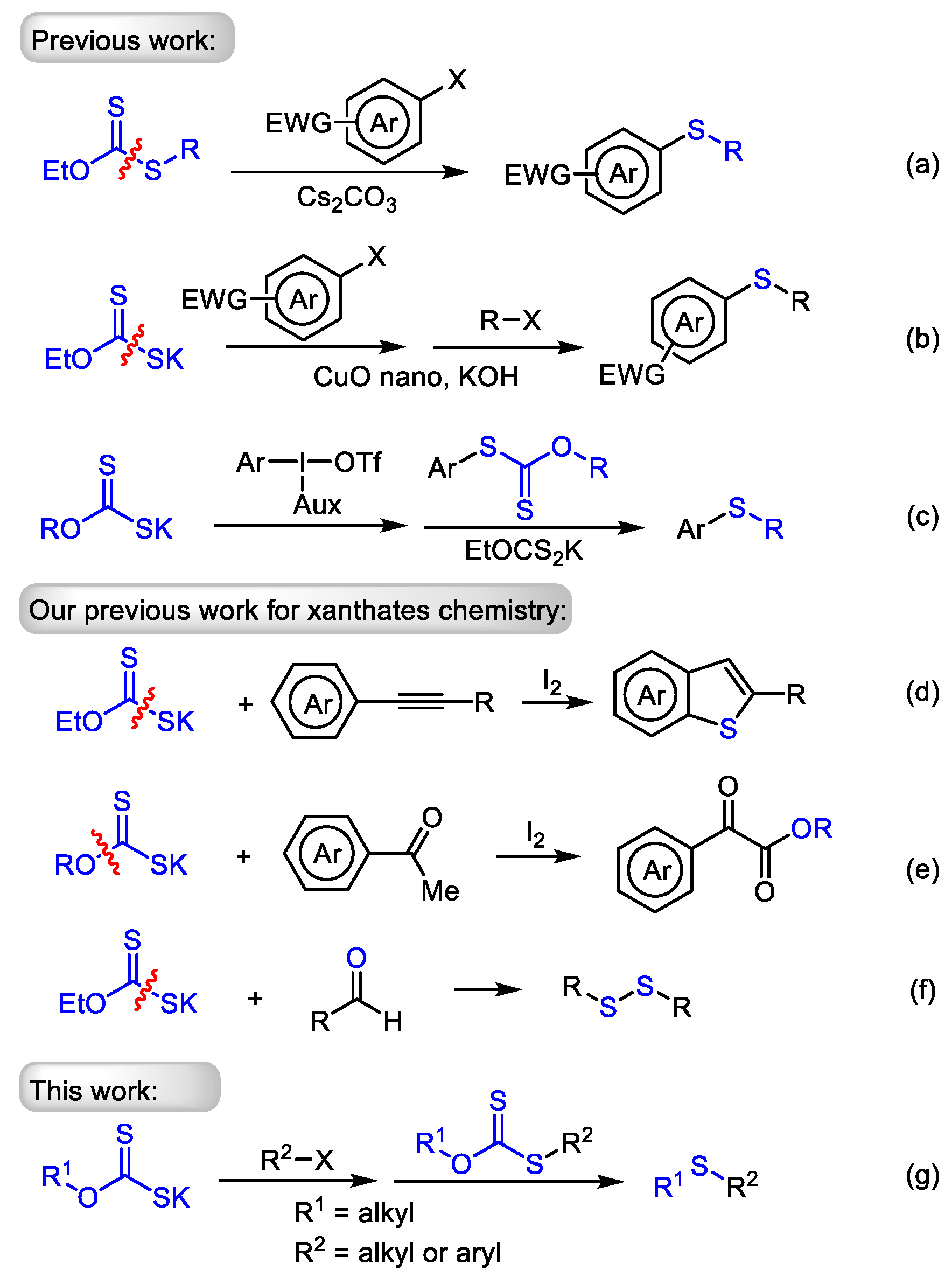
Xanthates are attractive sulfurizing agents used in both transition-metal-catalyzed and transition-metal-free transformations because they are odorless and have low toxicities, and can be readily prepared on large scales using low-cost alcohols and CS2 [30,31,32,33]. The addition of alkyl halides and aryl halides to xanthates may provide a general route for preparing thioethers without using odorous thiol starting materials. Baranov [34] and Kakulapati [35] reported the use of xanthates as thiol surrogates in nucleophilic substitution or cross-coupling with aryl halides in synthesising aryl thioethers (Scheme 1a–b). Karchava et al. described the visible-light-driven S-arylation of EtOCS2K (Et = ethyl) using aryl halides in synthesising aryl thioethers [36], followed by the reaction of diaryliodonium salts with xanthate salts to prepare the corresponding alkyl aryl thioether compounds (Scheme 1c) [37]. Nevertheless, xanthates, which are generally used as thiol surrogates, react with aryl halides to generate aryl thioethers, but the synthesis of dialkyl thioethers using xanthates has rarely been reported. To the best of our knowledge, the sole attempt to directly transform xanthates into dialkyl thioethers was reported by Degani et al. They obtained only small amounts of the desired dialkyl thioethers via the sulfurization of alkyl halides using EtOCS2K as a sulfurizing agent [38]. Based on our research on the development of xanthate chemistry (Scheme 1d–f) [39,40,41], we herein report a facile approach for use in generating various dialkyl thioethers and aryl thioethers. This approach involves the sulfuration of alkyl halides and aryl halides using ROCS2K as a thiol-free sulfurizing and alkylating reagent (Scheme 1g).
2. Results and Discussion
To evaluate this synthesis of dialkyl thioethers hypothesis, we screened the reaction conditions using 4-(chloromethyl)biphenyl (1a), EtOCS2K (2a), and dimethylformamide (DMF) as a model reaction. Gratifyingly, sulfidation proceeds at a reaction temperature of 150 °C to afford the dialkyl thioether 3a in 77% yield (Table 1, entry 1). The screening of various solvents reveals that the solvent is critical in the sulfidation reaction (Table 1, entries 1–5), and a trace amount of the thioether 3a is obtained when non-polar solvent o-xylene is used (Table 1, entry 2). The optimal results are obtained when the reaction is conducted in DMSO at 150 °C (Table 1, entry 3), whereas unsatisfactory results are obtained using dimethylacetamide (DMAc) or N-methyl-2-pyrrolidone (NMP) as the solvent (Table 1, entries 4–5). The yield of the thioether 3a does not change significantly when the amount of DMSO is decreased (Table 1, entry 6). Notably, the yield decreases significantly when the dosage of 2a is decreased (Table 1, entry 7). Further studies indicate that decreasing the reaction temperature does not decrease the yield of sulfidation (Table 1, entries 8 and 9). However, when the reaction temperature is further decreased to 80 °C, the yield of the sulfidation product 3a decreases slightly (89%; Table 1, entry 10). Subsequently, we investigated the reaction time, and thus, the yield of sulfidation is unaffected when the reaction time is shortened to 1 h, but shortening the time further to 0.5 h affords significant decrease in yield (Table 1, entries 11–13). Based on these results, the optimized reaction conditions are 1a (0.5 mmol) and 2a (1.0 mmol) in 1.0 mL DMSO at 100 °C for 1 h (Table 1, entry 12).
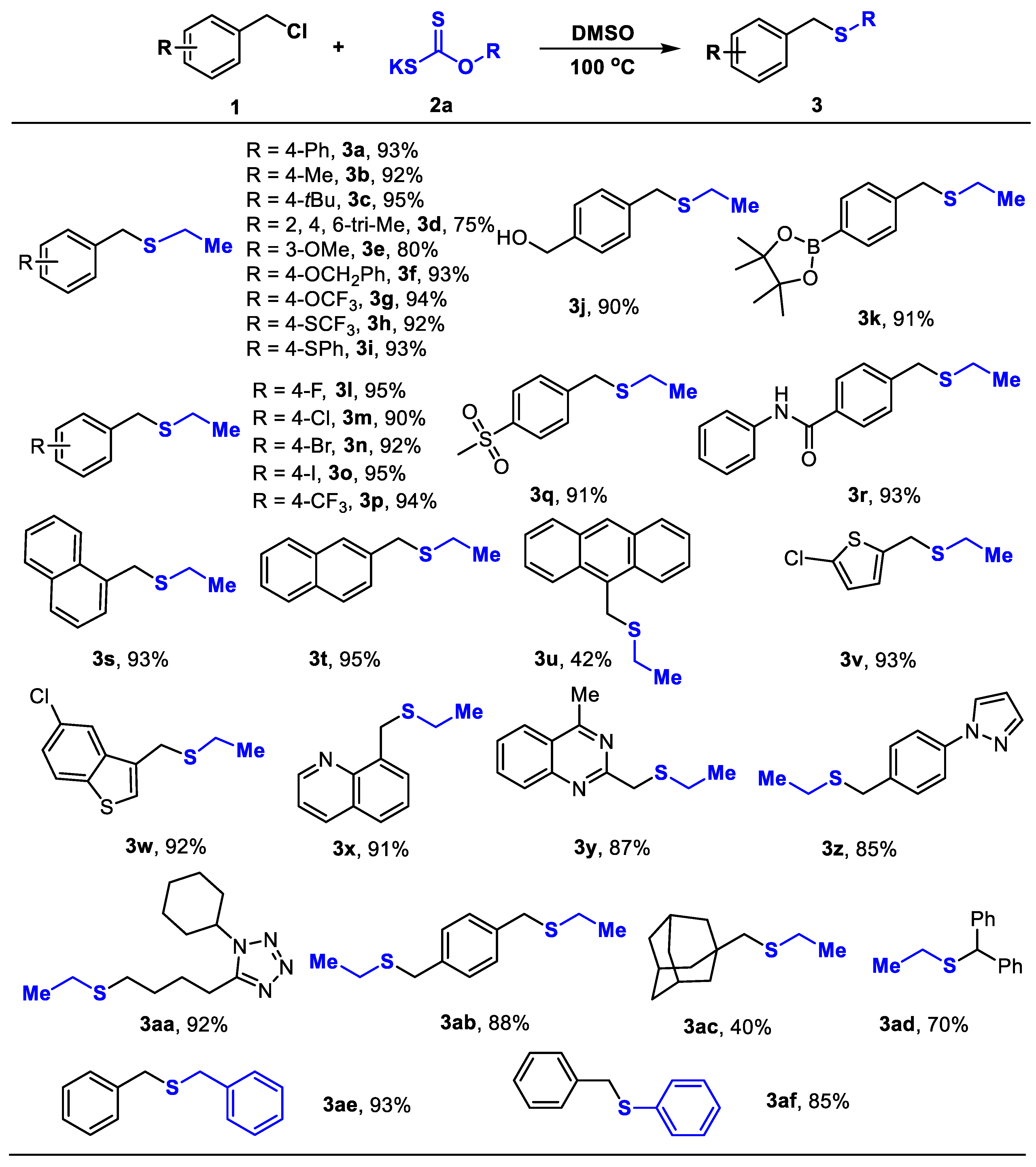
With the optimized conditions for use in synthesising dialkyl thioethers established, the alkyl halides applicable in the sulfuration reaction were investigated (Scheme 2). Firstly, various substituted benzyl chlorides are compatible under the optimized conditions. Aromatic rings with electron-donating and electron-withdrawing substituents are compatible under the standard conditions. Electron-donating groups, such as –Me, –tBu, –TMS, –OMe, –OCH2Ph, –OCF3, –SCF3, –SPh, –CH2OH, and –BPin2 (Me = methyl, tBu = tert-butyl, TMS = trimethylsilyl, Ph = phenyl, Pin = pinacol), are successfully sulfated to produce dialkyl thioethers in good yields (Scheme 2, 3a–3k). Hindered 2-(chloromethyl)-1,3,5-trimethylbenzene, in particular, successfully undergoes the reaction, affording ethyl(2,4,6-trimethylbenzyl)sulfane 3d in 75% yield. Remarkably, the –BPin2 group remains intact on the aromatic ring in 91% yield, and is very useful in transition-metal-catalyzed cross-coupling reactions (Scheme 2, 3k). A crucial feature of this reaction is its tolerance of various halides, including –F, –Cl, –Br, –I, and –CF3, with no dehalogenated by-products observed (Scheme 2, 3l–3p). Additionally, benzyl chlorides substituted with strong electron-withdrawing groups, such as sulfone and amide, successfully undergo the reaction, furnishing thioethers 3q and 3r in yields of 91% and 93%, respectively. Moreover, fused-ring and heterocyclic-substituted alkyl halides, such as naphthalene (3s–3t), anthracene (3u), thiophene (3v), benzothiophene (3w), quinolone (3x), quinazoline (3y), pyrazole (3z), and tetrazole (3aa), can undergo the reaction to produce the desired products in moderate-to-good yields. Next, 1,4-bis(chloromethyl)benzene, 1-(chloromethyl)adamantane, and (chloromethylene)dibenzene successfully undergo the reaction, indicating that the sulfuration reaction is characterized by a good functional group tolerance (Scheme 2, 3ab–3ad). Finally, the use of aromatic xanthates as substituents was investigated. Gratifyingly, benzyl and phenyl substituent xanthates were well tolerated under the optimized conditions, affording the corresponding thioethers in good yields (Scheme 2, 3ae-3af).
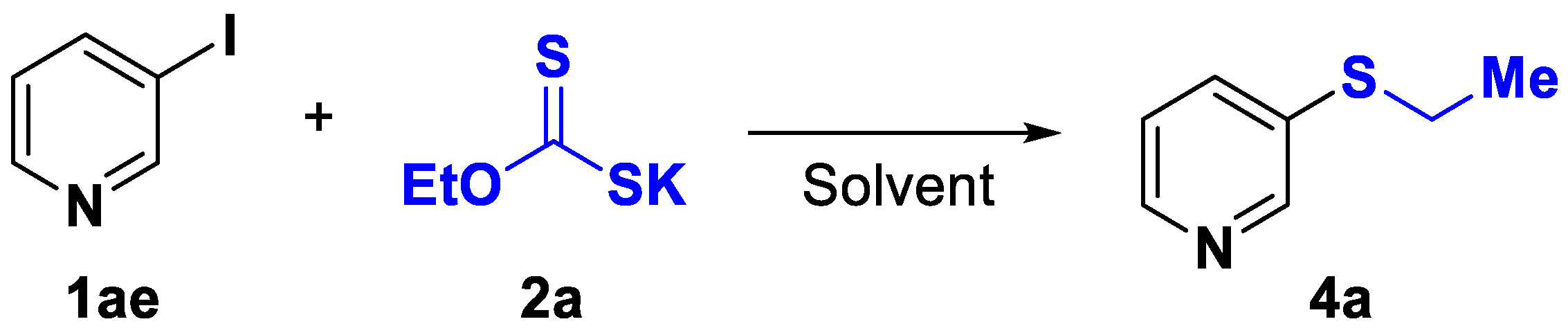
To evaluate this synthesis of aryl alkyl thioethers hypothesis, we screened the reaction conditions using 3-iodopyridine (1ae), EtOCS2K (2a), additive, and DMF as a model reaction. Initially, sulfidation proceeds at a reaction temperature of 150 °C for 24 h to afford the 3-(ethylthio)pyridine 4a in 37% yield (Table 2, entry 1). The screening of various reaction time reveals that the reaction time is critical in the sulfidation reaction, and excellent results is obtained when the sulfidation reaction was carry out in 36 h (Table 2, entries 1–3). Notably, the yield decreases significantly when the dosage of EtOCS2K (2a) or I2 is decreased (Table 2, entries 4-5). With EtOCS2K (2a) as sulphur source, the examination of different additive showed that NH4I and HI was inefficient (Table 2, entries 6-7). Further optimum solvents showed that DMF was the best choice; the other solvents—DMSO, NMP and DMAc—all decreased the yield of 4a (Table 2, entries 8–10). Furthermore, decreasing the reaction temperature led to a decrease in yield (Table 2, entry 11). Without the use of an iodine reagent, only a trace of the sulfidation reaction product was obtained; mostly the starting material was recovered (Table 2, entry 12). Based on these results, the optimized reaction conditions are halopyridine (0.5 mmol) and EtOCS2K (1.2 mmol) and I2 (1.5 mmol) in 3.0 mL DMF at 150 °C for 36 h (Table 1, entry 3).
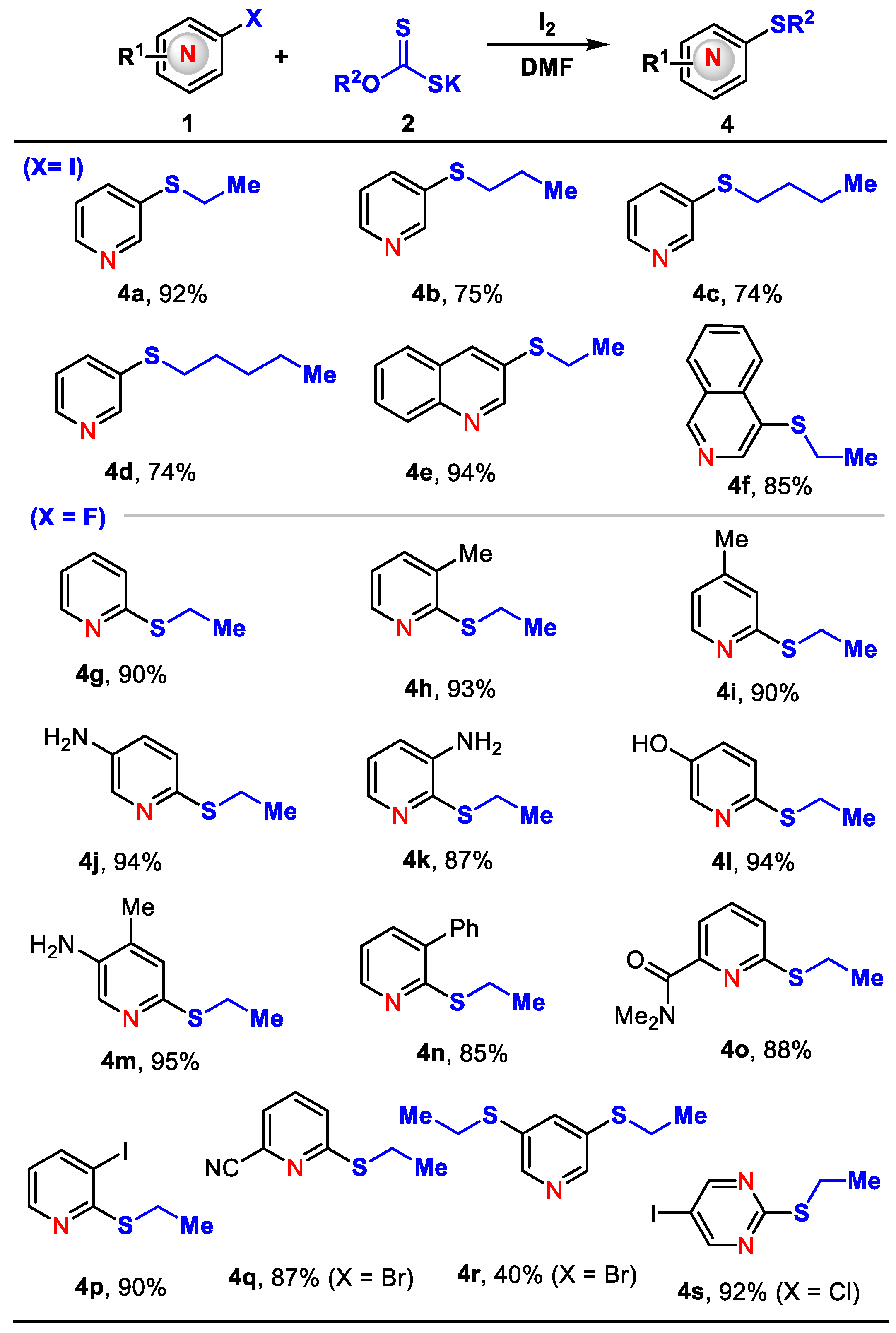
The iodopyridine reactions with various substituted potassium xanthates also proceed with smooth conversions under the optimized conditions, furnishing the corresponding thioethers in moderate-to-good yields. Notably, substituted potassium xanthates with ethyl (4a), n-propyl (4b), n-butyl (4c), and n-pentyl groups (4d) are tolerated well under mild reaction conditions. When sulfuration is conducted using 3-iodoquinoline and 4-iodoisoquinoline, the thioether products 4e–4f are obtained in yields of 94% and 85%, respectively. 2-Fluoropyridines bearing various functional groups are completely converted in the presence of 2a to furnish the corresponding sulfides in good yields. 2-Fluoropyridines, substituted with both electron-donating and electron-withdrawing groups, react with 2a to generate the corresponding sulfuration products 4g–4o in good yields. The reaction tolerates various substituents, including –Me, –Ph, –NH2, –OH, –I, –OCNMe2, and –CN groups, and whether the substituent is at the 3-, 4-, 5-, or 6-position of the pyridine ring does not affect the yield of the reaction. When 2-fluoro-3-iodopyridine is used as the starting material, the F atom at the 2-position of the pyridine ring exhibits a higher reactivity, and the reaction affords the 2-(ethylthio)-3-iodopyridine product (4p) in 90% yield. Remarkably, when 3,5-dibromopyridine is used, the disulfuration product 4r is obtained in 40% yield. The activities of the halogen atoms depend more on their positions when 2-chloro-5-iodopyrimidine is used as the starting material, affording product 4s in 92% yield.
Scheme 3.
Substrate scope of the sulfuration reaction a,b. a Reaction conditions: pyridyl halide 1 (0.5 mmol), ROCS2K 2 (1.2 mmol), and I2 (1.5 mmol) in DMF (3.0 mL) at 150 °C for 36 h in a sealed tube in an air atmosphere. b Isolated yields.
Scheme 3.
Substrate scope of the sulfuration reaction a,b. a Reaction conditions: pyridyl halide 1 (0.5 mmol), ROCS2K 2 (1.2 mmol), and I2 (1.5 mmol) in DMF (3.0 mL) at 150 °C for 36 h in a sealed tube in an air atmosphere. b Isolated yields.
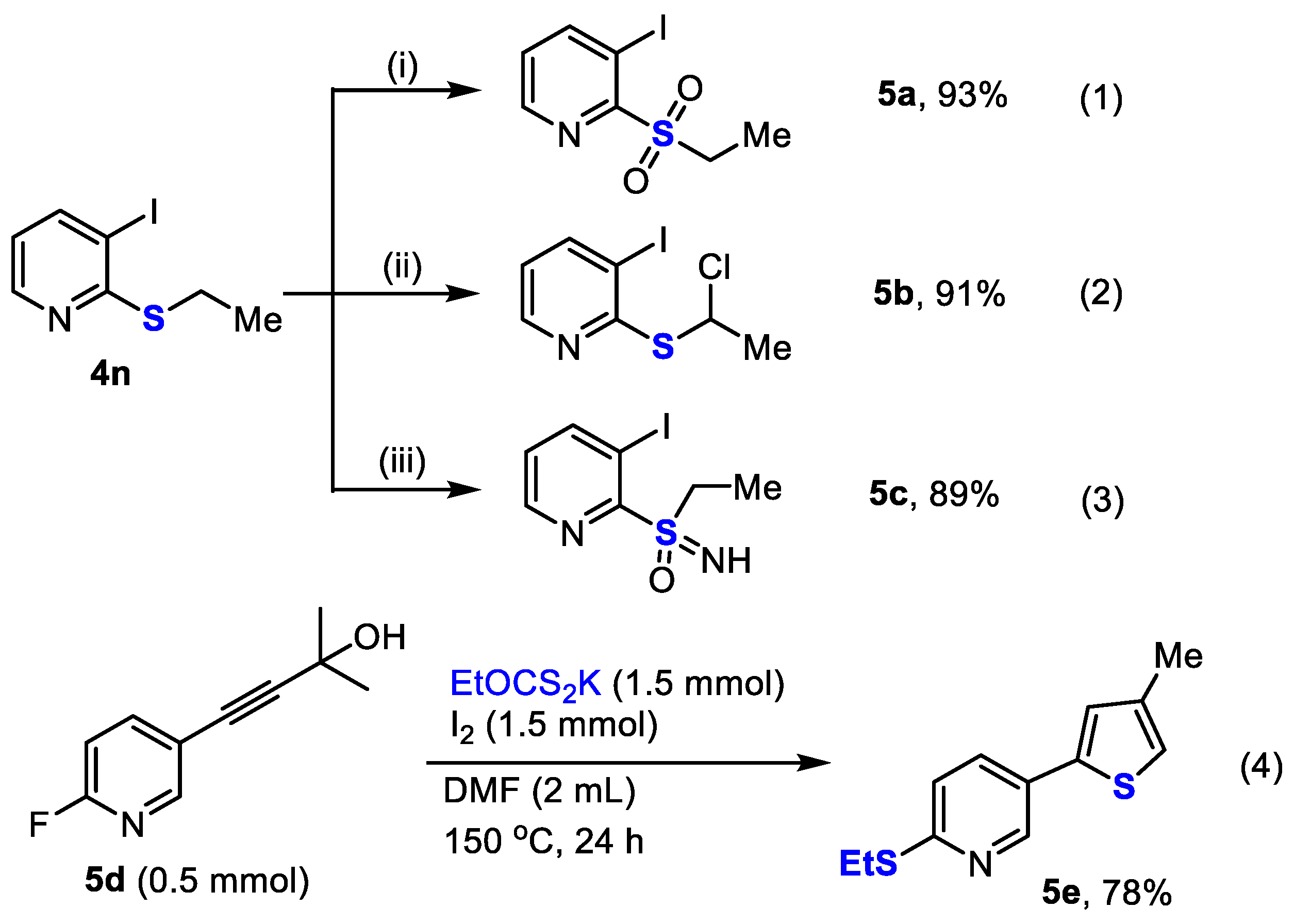
To explore the synthetic applicability of the sulfuration reaction, the newly formed thioethers were utilized in various synthetic transformations (Scheme 5). First, 2-(ethylsulfonyl)-3-iodopyridine (5a) may be generated in 93% yield via m-chloroperoxybenzoic acid (m-CPBA) oxidation (Eq. 1). Furthermore, 4n may be smoothly converted via NCS-promoted chlorination to 2-((1-chloroethyl)thio)-3-iodopyridine (5b) in 91% yield (Eq. 2) [42]. Remarkably, the thioether 4n reacts successfully with (diacetoxyiodo)benzene (PIDA) and (NH4)2CO3 to produce sulfoximine 5c, which has gained considerable attention owing to its unique structure and applications in medicinal chemistry, in 89% yield (Eq. 3) [43]. Finally, in the presence of I2 and 2a, a novel, efficient protocol affords the substituted thiophene 5e in 78% yield via the sulfidation and sulfur cyclization of 4-(6-fluoropyridin-3-yl)-2-methylbut-3-yn-2-ol 5d with 2a (Eq. 4) [44].
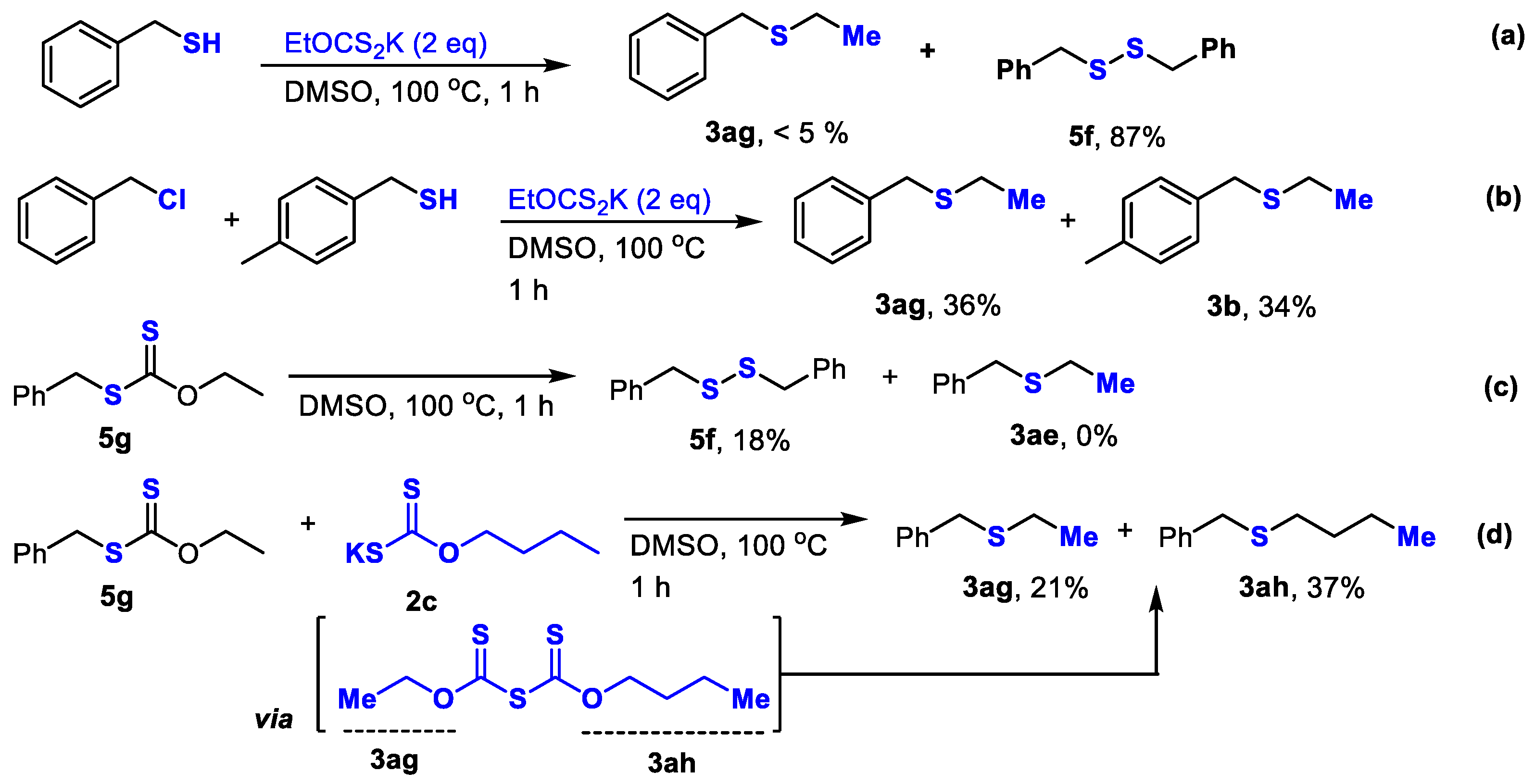
To enhance our understanding of the reaction mechanism, we designed control experiments, as shown in Scheme 6. First, the reaction of phenylmethanethiol with 2a furnishes thioether 3ag in trace amounts and 1,2-dibenzyldisulfane 5f in 87% yield, suggesting that thiol alone cannot undergo the sulfation reaction with 2a (Scheme 6a). When benzyl chloride and p-tolylmethanethiol are mixed as substrates, the results of gas chromatography–mass spectrometry reveal that the thioether products 3ag and 3b are obtained in yields of 36% and 33%, respectively. This suggests that xanthate 5g generated via the nucleophilic substitution of benzyl chloride with 2a may be the reaction intermediate (Scheme 6b–d). However, when directly using S-benzyl O-ethyl carbonodithioate 5g to complete the reaction in the absence of 2a, the expected thioether 3ae is not produced, and a small amount of the 1,2-dibenzyldisulfane 5f is generated instead (Scheme 6c). Unexpectedly, when 5g and nBuOCS2K (nBu = n-butyl) are used concurrently, sulfation proceeds smoothly to produce a mixture of thioethers 3ag and 3ah, indicating that ROCS2K is indispensable in the reaction (Scheme 6d).
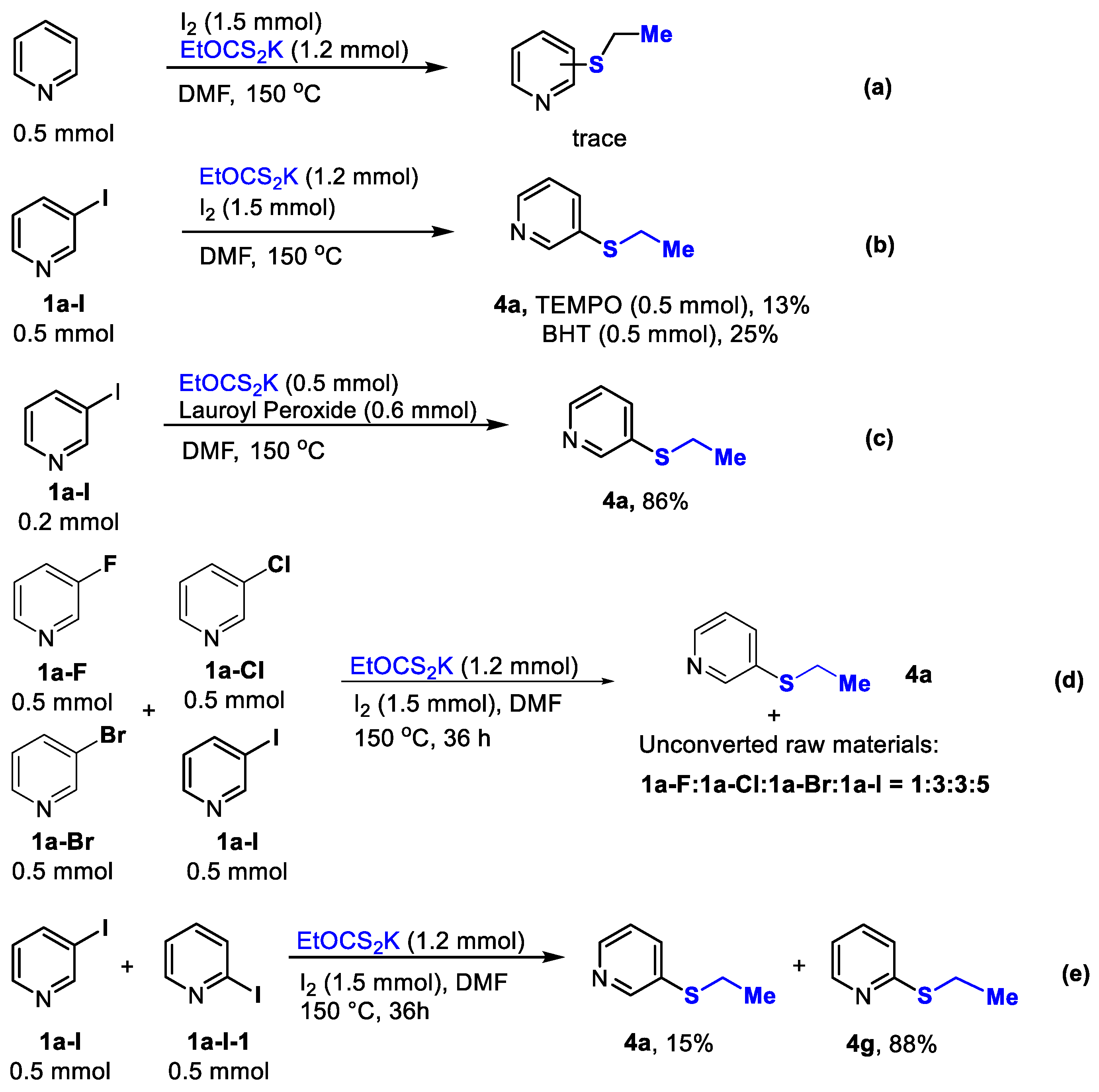
The reaction mechanism of the synthesis of pyridine thioether was then explored. First, pyridine molecules without halogen substituents do not undergo sulfation under the standard reaction conditions, indicating the necessity of halogen substituents or suitable leaving groups (Scheme 7a). When 2,2,6,6-tetramethyl-1-piperidinyloxy (TEMPO) or butylated hydroxytoluene (BHT) is added as a radical scavenger, the sulfuration of 3-iodopyridine is heavily inhibited (Scheme 7b), and thus, the sulfuration reaction may proceed via a radical pathway. When radical initiator lauroyl peroxide was used instead of I2, we were pleased to find that the sulfation reaction could still be completed and give 4a in 86% yields (Scheme 7c). When using 3-fluoropyridine, 3-chloropyridine, 3-bromopyridine, and 3-iodopyridine mixed with 2a (1.2 mmol), the reactivities of the halogens follow the order F > Cl ≈ Br > I (Scheme 7d) [45]. When 3-iodopyridine and 2-iodopyridine are involved in the reaction, the halogen at the 2-position of pyridine exhibits a higher reactivity (Scheme 7e).
Based on these results, a plausible mechanism for the sulfuration reaction is proposed, as shown in Scheme 8. Initially, I2 liberates an iodine radical (I•), which activates 2a to afford EtOCSS•, with the concomitant release of electrons [46,47]. The addition of the EtOCSS• radical to 3-iodopyridine then produces radical cation A [48,49], which then releases iodine radicals to generate the intermediate xanthate C. Subsequently, xanthate C undergoes a hydrolysis reaction to produce pyridine-3-thiolate D. Moreover, xanthate C releases O-ethyl ethoxycarbothioylsulfanylmethanethioate E, which decomposes to generate ethyl(thioxomethylidene)oxonium F and xanthate anions. Finally, the nucleophilic substitution reaction of the pyridine-3-thiolate D with oxonium F furnishes 3-(ethylthio)pyridine 4a and releases COS. Alternative, the intermediate xanthate C may be formed through a further single-electron oxidation of intermediate A by DMSO or O2 to afford the intermediate xanthate carbocation B and then releases iodine positive ions [50,51].
As shown in Scheme 8b, the sulfidation reaction of benzyl halides with 2a proceeds via a similar process. The difference is that benzyl halides reacts more easily with 2a via nucleophilic substitution to afford a similar intermediate, i.e., xanthate G, without free radical process. The reaction under a nucleophilic attack of EtOCS2K on the thiocarbonyl group form xanthate intermediate G and subsequent undergoes an intramolecular elimination reaction formed intermediate thiol anion I and O-ethyl ethoxycarbothioylsulfanylmethanethioate E. Finally, the nucleophilic substitution reaction of the thiol anion I with oxonium F furnishes dialkyl thioether 3 and releases COS.
3. Materials and Methods
General Methods (Chemistry)
General methods are described in the Supplementary Material.
General Procedures for the Preparation of Compounds 3a–3af.
A mixture of 4-(chloromethyl)-1,1'-biphenyl 1a (101 mg, 0.5 mmol), EtOCS2K (160 mg, 1.0 mmol) and DMSO (1 mL) was added successively in a 15 mL Schlenk tube. The Schlenk tube was then immersed in an oil bath at 100 ℃ in a sealed tube in an air atmosphere stirring for 1 h. After cooling down to room temperature, the solution was filtered through a small amount of silica gel. Then the residue was concentrated in vacuo and the crude was purified by flash chromatography with n-hexane/ethyl acetate (50/1, v/v).
([1,1'-biphenyl]-4-ylmethyl)(ethyl)sulfane (3a)
Yellow liquid (106 mg, 93% yield); Rf = 0.6 (Hexane/EtOAc = 50:1); 1H NMR (400 MHz, CDCl3) δ 7.63 – 7.55 (m, 4H), 7.49 – 7.39 (m, 4H), 7.39 – 7.33 (m, 1H), 3.79 (s, 2H), 2.51 (d, J = 7.4 Hz, 2H), 1.29 (t, J = 7.4 Hz, 3H); 13C NMR (100 MHz, CDCl3) δ 140.8, 139.8, 137.7, 129.2 (2C), 128.7 (2C), 127.2, 127.2 (2C), 127.0 (2C), 35.5, 25.2, 14.4; HRMS (ESI-TOF) (m/z): [M+H]+ calcd for C15H17S+, 229.1045; found, 229.1042.
Ethyl(4-methylbenzyl)sulfane (3b)
Yellow liquid (76 mg, 92% yield); Rf = 0.6 (Hexane/EtOAc = 50:1); 1H NMR (400 MHz, CDCl3) δ 7.25 – 7.19 (m, 2H), 7.15 – 7.10 (m, 2H), 3.87 (s, 2H), 2.48 (q, J = 7.3 Hz, 2H), 2.34 (s, 3H), 1.24 (t, J = 7.4 Hz, 3H); 13C NMR (100 MHz, CDCl3) δ 137.1, 134.4, 129.2 (2C), 129.1 (2C), 43.5, 32.4, 21.1, 14.3; HRMS (ESI-TOF) (m/z): [M+K]+ calcd for C10H14KS+, 205.0448; found, 205.0445.
(4-(tert-butyl)benzyl)(ethyl)sulfane (3c)
Yellow liquid (99 mg, 95% yield); Rf = 0.6 (Hexane/EtOAc = 50:1); 1H NMR (400 MHz, CDCl3) δ 7.37 – 7.32 (m, 2H), 7.28 – 7.23 (m, 2H), 3.71 (s, 2H), 2.47 (q, J = 7.4 Hz, 2H), 1.33 (s, 9H), 1.26 (t, J = 7.4 Hz, 3H); 13C NMR (100 MHz, CDCl3) δ 149.7, 135.5, 128.4 (2C), 125.3 (2C), 35.4, 34.4, 31.3, 25.3, 14.3; HRMS (ESI-TOF) (m/z): [M+K]+ calcd for C13H20KS+, 247.0917; found, 247.0914.
Ethyl(2,4,6-trimethylbenzyl)sulfane (3d)
Yellow liquid (73 mg, 75% yield); Rf = 0.6 (Hexane/EtOAc = 50:1); 1H NMR (400 MHz, CDCl3) δ 6.85 (s, 2H), 3.78 (s, 2H), 2.61 (q, J = 7.4 Hz, 2H), 2.40 (s, 6H), 2.27 (s, 3H), 1.33 (t, J = 7.4 Hz, 3H); 13C NMR (100 MHz, CDCl3) δ 136.8 (2C), 136.3, 131.4, 129.0 (2C), 30.5, 26.8, 20.9, 19.6 (2C), 14.8; HRMS (ESI-TOF) (m/z): [M+H]+ calcd for C12H19S+, 195.1202; found, 195.1207.
Ethyl(3-methoxybenzyl)sulfane (3e)
Yellow liquid (73 mg, 80% yield); Rf = 0.4 (Hexane/EtOAc = 10:1); 1H NMR (400 MHz, CDCl3) δ 7.22 (t, J = 7.8 Hz, 1H), 6.94 – 6.85 (m, 2H), 6.82 – 6.76 (m, 1H), 3.81 (s, 3H), 3.70 (s, 2H), 2.45 (q, J = 7.4 Hz, 2H), 1.24 (t, J = 7.4 Hz, 3H); 13C NMR (100 MHz, CDCl3) δ 159.7, 140.2, 129.4, 121.2, 114.3, 112.4, 55.2, 35.9, 25.3, 14.3; HRMS (ESI-TOF) (m/z): [M+K]+ calcd for C10H14KOS+, 221.0397; found, 221.0395.
(4-(benzyloxy)benzyl)(ethyl)sulfane (3f)
Yellow solid (120 mg, 93% yield), MP: 61-62 oC; Rf = 0.4 (Hexane/EtOAc = 20:1); 1H NMR (400 MHz, CDCl3) δ 7.46 – 7.37 (m, 4H), 7.36 – 7.30 (m, 1H), 7.26 – 7.21 (m, 2H), 6.95 – 6.90 (m, 2H), 5.06 (s, 2H), 3.69 (s, 2H), 2.44 (q, J = 7.2 Hz, 2H), 1.24 (t, J = 7.4 Hz, 3H); 13C NMR (100 MHz, CDCl3) δ 157.7, 137.0, 130.9, 129.8 (2C), 128.6 (2C), 127.9, 127.4 (2C), 114.8 (2C), 79.7 – 74.5 (m), 70.0, 35.2, 25.1, 14.4; HRMS (ESI-TOF) (m/z): [M+H]+ calcd for C16H19OS+, 259.1151; found, 259.1149.
Ethyl(4-(trifluoromethoxy)benzyl)sulfane (3g)
Yellow liquid (111 mg, 94% yield); Rf = 0.5 (Hexane/EtOAc = 50:1); 1H NMR (400 MHz, CDCl3) δ 7.34 (d, J = 8.3 Hz, 2H), 7.15 (d, J = 8.2 Hz, 2H), 3.71 (s, 2H), 2.44 (q, J = 7.4 Hz, 2H), 1.23 (t, J = 7.4 Hz, 3H); 13C NMR (100 MHz, CDCl3) δ 148.1 (q, J = 1.8 Hz), 137.4, 130.1 (2C), 121.0 (2C), 120.5 (q, J = 204.2 Hz), 35.1, 25.3, 14.3; HRMS (ESI-TOF) (m/z): [M+Na]+ calcd for C10H11F3NaOS+, 259.0375; found, 259.0371.
Ethyl(4-((trifluoromethyl)thio)benzyl)sulfane (3h)
Yellow liquid (166 mg, 92% yield); Rf = 0.6 (Hexane/EtOAc = 50:1); 1H NMR (400 MHz, CDCl3) δ 7.63 – 7.56 (m, 2H), 7.40 – 7.34 (m, 2H), 3.73 (s, 2H), 2.44 (q, J = 7.4 Hz, 2H), 1.23 (t, J = 7.4 Hz, 3H); 13C NMR (100 MHz, CDCl3) δ 142.0, 136.4 (2C), 129.9 (2C), 129.5 (q, J = 306.1 Hz), 122.6 (q, J = 2.3 Hz), 35.4, 25.4, 14.3; HRMS (ESI-TOF) (m/z): [M+H]+ calcd for C10H12F3S2+, 253.0327; found, 253.0320.
Ethyl(4-(phenylthio)benzyl)sulfane (3i)
Yellow liquid (121 mg, 93% yield); Rf = 0.5 (Hexane/EtOAc = 50:1); 1H NMR (400 MHz, CDCl3) δ 7.37 – 7.21 (m, 9H), 3.70 (s, 2H), 2.45 (q, J = 7.4 Hz, 2H), 1.24 (t, J = 7.4 Hz, 3H); 13C NMR (100 MHz, CDCl3) δ 137.7, 135.8, 134.0, 131.2 (4C), 130.8 (4C), 129.6 (4C), 129.1 (4C), 126.9, 35.4, 25.3, 14.3; HRMS (ESI-TOF) (m/z): [M+Na]+ calcd for C15H16NaS2+, 283.0586; found, 283.0593.
(4-((ethylthio)methyl)phenyl)methanol (3j)
Yellow liquid (82 mg, 90% yield); Rf = 0.5 (Hexane/EtOAc = 2:1); 1H NMR (400 MHz, CDCl3) δ 7.33 – 7.27 (m, 4H), 4.65 (s, 2H), 3.71 (s, 2H), 2.42 (q, J = 7.3 Hz, 2H), 1.91 (s, 1H), 1.22 (t, J = 7.4 Hz, 3H); 13C NMR (100 MHz, CDCl3) δ 139.5, 138.0, 128.9 (2C), 127.1 (2C), 65.0, 35.5, 25.2, 14.3; HRMS (ESI-TOF) (m/z): [M+K]+ calcd for C10H14KOS+, 221.0397; found, 221.0395.
2-(4-((ethylthio)methyl)phenyl)-4,4,5,5-tetramethyl-1,3,2-dioxaborolane (3k)
Yellow liquid (127 mg, 91% yield); Rf = 0.5 (Hexane/EtOAc = 20:1); 1H NMR (400 MHz, CDCl3) δ 7.78 – 7.73 (m, 2H), 7.36 – 7.30 (m, 2H), 3.72 (s, 2H), 2.41 (q, J = 7.4 Hz, 2H), 1.34 (s, 12H), 1.21 (t, J = 7.4 Hz, 3H); 13C NMR (100 MHz, CDCl3) δ 141.9, 141.8, 134.9 (2C), 128.2 (2C), 83.7 (2C), 35.9, 25.1, 24.8 (4C), 14.3; HRMS (ESI-TOF) (m/z): [M+H]+ calcd for C15H24BO2S+, 278.1621; found, 278.1624.
Ethyl(4-fluorobenzyl)sulfane (3l)
Yellow liquid (81 mg, 95% yield); Rf = 0.6 (Hexane/EtOAc = 50:1); 1H NMR (400 MHz, CDCl3) δ 7.31 – 7.25 (m, 2H), 7.03 – 6.95 (m, 2H), 3.69 (s, 2H), 2.43 (q, J = 7.3 Hz, 2H), 1.23 (t, J = 7.4 Hz, 3H); 13C NMR (100 MHz, CDCl3) δ 161.8 (d, J = 245.2 Hz), 134.3 (d, J = 3.0 Hz), 130.3 (d, J = 8.0 Hz, 2C), 115.3 (d, J = 21.4 Hz, 2C), 35.1, 25.2, 14.3; HRMS (ESI-TOF) (m/z): [M+Na]+ calcd for C9H11FNaS+, 193.0458; found, 193.0466.
(4-chlorobenzyl)(ethyl)sulfane (3m)
Yellow liquid (84 mg, 90% yield); Rf = 0.6 (Hexane/EtOAc = 50:1); 1H NMR (400 MHz, CDCl3) δ 7.30 – 7.26 (m, 2H), 7.24 (d, J = 8.7 Hz, 2H), 3.68 (s, 2H), 2.42 (q, J = 7.4 Hz, 2H), 1.22 (t, J = 7.4 Hz, 3H); 13C NMR (100 MHz, CDCl3) δ 137.1, 132.6, 130.1 (2C), 128.6 (2C), 35.2, 25.2, 14.3; HRMS (ESI-TOF) (m/z): [M+Na]+ calcd for C9H11ClNaS+, 209.0162; found, 209.0152.
(4-bromobenzyl)(ethyl)sulfane (3n)
Yellow liquid (106 mg, 92% yield); Rf = 0.6 (Hexane/EtOAc = 50:1); 1H NMR (400 MHz, CDCl3) δ 7.47 – 7.39 (m, 2H), 7.22 – 7.16 (m, 2H), 3.66 (s, 2H), 2.42 (q, J = 7.4 Hz, 2H), 1.22 (t, J = 7.4 Hz, 3H); 13C NMR (100 MHz, CDCl3) δ 137.7, 131.5 (2C), 130.5 (2C), 120.6, 35.2, 25.2, 14.3; HRMS (ESI-TOF) (m/z): [M+H]+ calcd for C9H12BrS+, 230.9838; found, 230.9828.
Ethyl(4-Iodobenzyl)sulfane (3o)
Yellow liquid (132 mg, 95% yield); Rf = 0.6 (Hexane/EtOAc = 50:1); 1H NMR (400 MHz, CDCl3) δ 7.67 – 7.58 (m, 2H), 7.10 – 7.03 (m, 2H), 3.65 (s, 2H), 2.41 (q, J = 7.4 Hz, 2H), 1.22 (t, J = 7.4 Hz, 3H); 13C NMR (100 MHz, CDCl3) δ 138.3, 137.5 (2C), 130.8 (2C), 92.1, 35.3, 25.2, 14.3; HRMS (ESI-TOF) (m/z): [M+H]+ calcd for C9H12IS+, 278.9699; found, 278.9693.
Ethyl(4-(trifluoromethyl)benzyl)sulfane (3p)
Yellow liquid (103 mg, 94% yield); Rf = 0.6 (Hexane/EtOAc = 50:1); 1H NMR (400 MHz, CDCl3) δ 7.57 (d, J = 8.0 Hz, 2H), 7.43 (d, J = 8.0 Hz, 2H), 3.75 (s, 2H), 2.43 (q, J = 7.4 Hz, 2H), 1.24 (t, J = 7.4 Hz, 3H); 13C NMR (100 MHz, CDCl3) δ 142.9, 129.1 (2C), 129.1 (q, J = 31.7 Hz), 125.4 (q, J = 3.8 Hz, 2C), 124.2 (q, J = 269.9 Hz), 35.4, 25.3, 14.2; HRMS (ESI-TOF) (m/z): [M+Na]+ calcd for C10H11F3NaOS+, 259.0375; found, 259.0371.
Ethyl(4-(methylsulfonyl)benzyl)sulfane (3q)
Yellow liquid (105 mg, 91% yield); Rf = 0.4 (Hexane/EtOAc = 1:1); 1H NMR (400 MHz, CDCl3) δ 7.91 – 7.82 (m, 2H), 7.54 – 7.46 (m, 2H), 3.75 (s, 2H), 3.03 (s, 3H), 2.42 (q, J = 7.4 Hz, 2H), 1.21 (t, J = 7.4 Hz, 3H); 13C NMR (100 MHz, CDCl3) δ 145.3, 138.9, 129.6 (2C), 127.5 (2C), 44.4, 35.4, 25.4, 14.2; HRMS (ESI-TOF) (m/z): [M+H]+ calcd for C10H15O2S2+, 231.0508; found, 231.0503.
4-((ethylthio)methyl)-N-phenylbenzamide (3r)
White solid (126 mg, 93% yield), MP: 118-120 oC; Rf = 0.4 (Hexane/EtOAc = 3:1); 1H NMR (400 MHz, CDCl3) δ 8.08 (s, 1H), 7.83 – 7.76 (m, 2H), 7.66 – 7.61 (m, 2H), 7.40 – 7.30 (m, 4H), 7.16 – 7.10 (m, 1H), 3.74 (s, 2H), 2.50 – 2.36 (m, 2H), 1.23 (t, J = 7.4 Hz, 3H); 13C NMR (100 MHz, CDCl3) δ 165.6, 142.8, 137.9, 133.5, 129.1 (2C), 129.0 (2C), 127.3 (2C), 124.5, 120.3 (2C), 35.5, 25.3, 14.3; HRMS (ESI-TOF) (m/z): [M+H]+ calcd for C16H18NOS+, 272.1104; found, 272.1098.
Ethyl(naphthalen-1-ylmethyl)sulfane (3s)
Yellow liquid (94 mg, 93% yield); Rf = 0.6 (Hexane/EtOAc = 50:1); 1H NMR (400 MHz, CDCl3) δ 8.16 (d, J = 8.3 Hz, 1H), 7.89 – 7.84 (m, 1H), 7.81 – 7.73 (m, 1H), 7.59 – 7.53 (m, 1H), 7.52 – 7.47 (m, 1H), 7.44 – 7.35 (m, 2H), 4.19 (s, 2H), 2.51 (q, J = 7.3 Hz, 2H), 1.28 (t, J = 7.4 Hz, 3H); 13C NMR (100 MHz, CDCl3) δ 134.1, 133.9, 131.4, 128.8, 128.0, 126.9, 126.1, 125.8, 125.1, 124.1, 33.7, 26.0, 14.4; HRMS (ESI-TOF) (m/z): [M]+ calcd for C13H14S+, 202.0811; found, 202.0816.
Ethyl(naphthalen-2-ylmethyl)sulfane (3t)
Yellow liquid (96 mg, 95% yield); Rf = 0.6 (Hexane/EtOAc = 50:1); 1H NMR (400 MHz, CDCl3) δ 7.87 – 7.79 (m, 3H), 7.72 (s, 1H), 7.55 – 7.44 (m, 3H), 3.90 (s, 2H), 2.46 (q, J = 7.4 Hz, 2H), 1.26 (t, J = 7.4 Hz, 3H); 13C NMR (100 MHz, CDCl3) δ 135.9, 133.2, 132.5, 128.3, 127.6, 127.6, 127.1, 126.1, 125.6, 36.1, 25.1, 14.3; HRMS (ESI-TOF) (m/z): [M]+ calcd for C13H14S+, 202.0811; found, 202.0818.
(Anthracen-9-ylmethyl)(ethyl)sulfane (3u)
Yellow solid (53 mg, 42% yield), MP: 68-70 oC; Rf = 0.6 (Hexane/EtOAc = 50:1); 1H NMR (400 MHz, CDCl3) δ 8.39 (s, 1H), 8.35 (d, J = 8.9 Hz, 2H), 8.01 (d, J = 8.4 Hz, 2H), 7.61 – 7.53 (m, 2H), 7.52 – 7.44 (m, 2H), 4.75 (s, 2H), 2.70 (q, J = 7.4 Hz, 2H), 1.37 (t, J = 7.4 Hz, 3H); 13C NMR (100 MHz, CDCl3) δ 131.5 (2C), 129.9 (2C), 129.5, 129.2 (2C), 127.2, 126.0 (2C), 125.0 (2C), 124.2 (2C), 28.7, 27.1, 14.8; HRMS (ESI-TOF) (m/z): [M+H]+ calcd for C17H17S+, 253.1045; found, 253.1045.
2-chloro-5-((ethylthio)methyl)thiophene (3v)
Yellow liquid (89 mg, 93% yield); Rf = 0.6 (Hexane/EtOAc = 50:1); 1H NMR (400 MHz, CDCl3) δ 6.73 – 6.66 (m, 2H), 3.82 (s, 2H), 2.51 (q, J = 7.4 Hz, 2H), 1.24 (t, J = 7.4 Hz, 3H); 13C NMR (100 MHz, CDCl3) δ 141.4, 128.8, 125.5, 125.0, 30.4, 25.4, 14.2; HRMS (ESI-TOF) (m/z): [M+H]+ calcd for C7H10ClS2+, 192.9907; found, 192.9902.
5-chloro-3-((ethylthio)methyl)benzo[b]thiophene (3w)
Yellow liquid (111 mg, 92% yield); Rf = 0.6 (Hexane/EtOAc = 50:1); 1H NMR (400 MHz, CDCl3) δ 7.88 – 7.84 (m, 1H), 7.74 (d, J = 8.6 Hz, 1H), 7.35 – 7.29 (m, 2H), 3.92 (s, 3H), 2.48 (q, J = 7.4 Hz, 2H), 1.26 (t, J = 7.4 Hz, 3H); 13C NMR (100 MHz, CDCl3) δ 139.1, 138.7, 131.9, 130.4, 125.4, 124.9, 123.8, 121.9, 28.9, 25.7, 14.2; HRMS (ESI-TOF) (m/z): [M+Na]+ calcd for C11H11ClNaS2+, 264.9883; found, 264.9884.
8-((ethylthio)methyl)quinoline (3x)
Yellow liquid (92 mg, 91% yield); Rf = 0.4 (Hexane/EtOAc = 10:1); 1H NMR (400 MHz, CDCl3) δ 8.97 – 8.93 (m, 1H), 8.16 – 8.09 (m, 1H), 7.71 (d, J = 7.7 Hz, 2H), 7.52 – 7.45 (m, 1H), 7.42 – 7.37 (m, 1H), 4.44 (s, 2H), 2.56 (q, J = 7.4 Hz, 2H), 1.28 (t, J = 7.4 Hz, 3H); 13C NMR (100 MHz, CDCl3) δ 149.6, 146.3, 137.3, 136.3, 129.3, 128.5, 127.0, 126.1, 121.1, 31.1, 26.1, 14.5; HRMS (ESI-TOF) (m/z): [M+H]+ calcd for C12H14NS+, 204.0842; found, 204.0843.
2-((ethylthio)methyl)-4-methylquinazoline (3y)
Yellow solid (95 mg, 87% yield), MP: 52-54 oC; Rf = 0.6 (Hexane/EtOAc = 50:1); 1H NMR (400 MHz, CDCl3) δ 8.03 – 7.98 (m, 1H), 7.95 – 7.89 (m, 1H), 7.82 – 7.76 (m, 1H), 7.56 – 7.50 (m, 1H), 4.01 (s, 2H), 2.89 (s, 3H), 2.62 (q, J = 7.4 Hz, 2H), 1.24 (t, J = 7.4 Hz, 3H); 13C NMR (100 MHz, CDCl3) δ 168.8, 163.6, 149.6, 133.5, 128.5, 126.9, 124.8, 122.5, 39.1, 25.9, 21.7, 14.4; HRMS (ESI-TOF) (m/z): [M+H]+ calcd for C12H15N2S+, 219.0950; found, 219.0942.
1-(4-((ethylthio)methyl)phenyl)-1H-pyrazole (3z)
Yellow liquid (93 mg, 85% yield); Rf = 0.5 (Hexane/EtOAc = 10:1); 1H NMR (400 MHz, CDCl3) δ 7.95 – 7.88 (m, 1H), 7.74 – 7.70 (m, 1H), 7.64 (d, J = 8.3 Hz, 2H), 7.45 – 7.37 (m, 2H), 3.75 (s, 2H), 2.45 (q, J = 7.3, 6.8 Hz, 2H), 1.24 (t, J = 7.3 Hz, 3H); 13C NMR (100 MHz, CDCl3) δ 141.0, 139.0, 136.9, 129.8 (2C), 126.7, 119.3 (2C), 107.6, 35.3, 25.2, 14.4; HRMS (ESI-TOF) (m/z): [M+H]+ calcd for C12H15N2S+, 219.0950; found, 219.0946.
1-cyclohexyl-5-(4-(ethylthio)butyl)-1H-tetrazole (3aa)
Yellow liquid (123 mg, 92% yield); Rf = 0.4 (Hexane/EtOAc = 2:1); 1H NMR (400 MHz, CDCl3) δ 4.21 – 4.04 (m, 1H), 2.85 (t, 2H), 2.61 – 2.48 (m, 3H), 2.09 – 1.87 (m, 8H), 1.82 – 1.66 (m, 4H), 1.48 – 1.30 (m, 3H), 1.24 (t, J = 7.4 Hz, 3H); 13C NMR (100 MHz, CDCl3) δ 153.5, 57.6, 32.9 (2C), 30.9, 28.6, 26.2, 25.9, 25.3 (2C), 24.8, 22.9, 14.8; HRMS (ESI-TOF) (m/z): [M+H]+ calcd for C13H25N4S+, 269.1794; found, 269.1790.
1,4-bis((ethylthio)methyl)benzene (3ab)
Yellow liquid (99 mg, 88% yield); Rf = 0.5 (Hexane/EtOAc = 50:1); 1H NMR (400 MHz, CDCl3) δ 7.25 (s, 4H), 3.70 (s, 4H), 2.43 (q, J = 7.4 Hz, 4H), 1.23 (t, J = 7.4 Hz, 6H); 13C NMR (100 MHz, CDCl3) δ 137.2 (2C), 128.9 (4C), 35.5, 25.2, 14.4; HRMS (ESI-TOF) (m/z): [M]+ calcd for C12H18S2+, 226.0845; found, 226.0836.
(((1s,3s)-adamantan-1-yl)methyl)(ethyl)sulfane (3ac)
Yellow liquid (42 mg, 40% yield); Rf = 0.6 (Hexane/EtOAc = 50:1); 1H NMR (400 MHz, CDCl3) δ 2.51 (q, J = 7.4 Hz, 2H), 2.32 (s, 2H), 1.97 (s, 3H), 1.73 – 1.66 (m, 3H), 1.65 – 1.59 (m, 3H), 1.58 – 1.54 (m, 6H), 1.24 (t, J = 7.4 Hz, 3H); 13C NMR (100 MHz, CDCl3) δ 47.3, 41.9 (3C), 36.9 (3C), 33.9, 28.6 (3C), 28.2, 15.0; HRMS (ESI-TOF) (m/z): [M+K]+ calcd for C13H22KS+, 249.1074; found, 249.1075.
Benzhydryl(ethyl)sulfane (3ad)
Yellow liquid (80 mg, 70% yield); Rf = 0.6 (Hexane/EtOAc = 50:1); 1H NMR (400 MHz, CDCl3) δ 7.50 – 7.44 (m, 4H), 7.38 – 7.31 (m, 4H), 7.30 – 7.21 (m, 2H), 5.22 (s, 1H), 2.44 (q, J = 7.4 Hz, 2H), 1.25 (t, J = 7.4 Hz, 3H); 13C NMR (100 MHz, CDCl3) δ 141.5 (2C), 128.5 (4C), 128.2 (4C), 127.0 (2C), 53.7, 26.2, 14.2; HRMS (ESI-TOF) (m/z): [M+H]+ calcd for C15H17S+, 229.1045; found, 229.1046.
Dibenzylsulfane (3ae)[52]
White solid (100 mg, 93% yield), MP: 61-62 oC; Rf = 0.6 (Hexane/EtOAc = 50:1); 1H NMR (400 MHz, CDCl3) δ 7.36 – 7.22 (m, 10H), 3.61 (s, 4H); 13C NMR (100 MHz, CDCl3) δ 138.1 (2C), 129.0 (4C), 128.5 (4C), 127.0 (2C), 35.6 (2C).
benzyl(phenyl)sulfane(3af) [53]
White solid (90 mg, 90% yield), MP: 39-40 oC; Rf = 0.6 (Hexane/EtOAc = 50:1); 1H NMR (400 MHz, CDCl3) δ 7.34 – 7.22 (m, 9H), 7.21 – 7.15 (m, 1H), 4.13 (s, 2H); 13C NMR (100 MHz, CDCl3) δ 137.4, 136.3, 129.8 (2C), 128.8 (2C), 128.8 (2C), 128.5 (2C), 127.2, 126.3, 39.0.
Benzyl(ethyl)sulfane (3ag)
Yellow liquid (27 mg, 36% yield); Rf = 0.6 (Hexane/EtOAc = 50:1); 1H NMR (500 MHz, CDCl3) δ 7.35 – 7.28 (m, 4H), 7.26 – 7.21 (m, 1H), 3.73 (s, 2H), 2.44 (q, J = 7.4 Hz, 2H), 1.23 (t, J = 7.4 Hz, 3H); 13C NMR (125 MHz, CDCl3) δ 138.6, 128.8 (2C), 128.4 (2C), 126.8, 35.8, 25.2, 14.3; HRMS (ESI-TOF) (m/z): [M+H]+ calcd for C9H13S+, 153.0732; found, 153.0735.
Benzyl(butyl)sulfane (3ah)
Yellow liquid (33 mg, 37% yield); Rf = 0.6 (Hexane/EtOAc = 50:1); 1H NMR (400 MHz, CDCl3) δ 7.35 – 7.25 (m, 4H), 7.28 – 7.19 (m, 1H), 3.71 (s, 2H), 2.49 – 2.35 (m, 2H), 1.60 – 1.49 (m, 2H), 1.38 (dt, J = 8.1, 7.0 Hz, 2H), 0.89 (t, J = 7.3 Hz, 3H); 13C NMR (100 MHz, CDCl3) 138.7, 128.8 (2C), 128.4 (2C), 126.8, 36.2, 31.3, 31.0, 22.0, 13.7; HRMS (ESI-TOF) (m/z): [M+H]+ calcd for C11H17S+, 181.1045; found, 181.1050.
General Procedures for the Preparation of Compounds 4a–4s.
A mixture of 3-Iodine pyridine (103 mg, 0.5 mmol), EtOCS2K (192 mg, 1.2 mmol), I2 (381 mg, 1.5 mmol), and DMF (3 mL) was added successively in a 15 mL Schlenk tube. The Schlenk tube was then immersed in an oil bath at 150 ℃ in a sealed tube in an air atmosphere stirring for 36 h. After cooling down to room temperature, the solution was filtered through a small amount of silica gel. Then the residue was concentrated in vacuo and the crude was purified by flash chromatography with n-hexane/ethyl acetate (3/1, v/v).
3-(Ethylthio)pyridine (4a) [54]
Yellow liquid (64 mg, 92 % yield); Rf = 0.5 (Hexane/EtOAc = 3:1); 1H NMR (500 MHz, CDCl3) δ 8.56 (s, 1H), 8.41 (d, J = 4.8 Hz, 1H), 7.66 (ddd, J = 8.0, 2.4, 1.5 Hz, 1H), 7.23 (dd, J = 8.0, 4.8 Hz, 1H), 2.96 (q, J = 7.4 Hz, 2H), 1.32 (t, J = 7.4 Hz, 3H);13C NMR (125 MHz, CDCl3) δ 149.6, 146.5, 137.1, 134.0, 123.7, 27.7, 14.3.
3-(Propylthio)pyridine (4b) [55]
Yellow liquid (58 mg, 75%); Rf = 0.5 (Hexane/EtOAc = 3:1); 1H NMR (500 MHz, CDCl3) δ 8.56 (d, J = 1.8 Hz, 1H), 8.48 – 8.35 (m, 1H), 7.69 – 7.60 (m, 1H), 7.21 (dd, J = 7.9, 4.8 Hz, 1H), 2.96 – 2.74 (m, 2H), 1.67 (h, J = 7.3 Hz, 2H), 1.03 (t, J = 7.4 Hz, 3H); 13C NMR (125 MHz, CDCl3) δ 149.9, 146.7, 136.8, 134.1, 123.6, 35.7, 22.4, 13.3.
3-(Butylthio)pyridine (4c) [56]
Yellow liquid (62 mg, 74%); Rf = 0.5 (Hexane/EtOAc = 3:1); 1H NMR (500 MHz, CDCl3) δ 8.55 (s, 1H), 8.41 (d, J = 4.2 Hz, 1H), 7.66 (dt, J = 8.0, 1.8 Hz, 1H), 7.24 (dd, J = 7.9, 4.8 Hz, 1H), 2.97 – 2.90 (m, 2H), 1.63 (p, J = 7.4 Hz, 2H), 1.45 (dq, J = 14.6, 7.3 Hz, 2H), 0.92 (t, J = 7.3 Hz, 3H); 13C NMR (125 MHz, CDCl3) δ 149.2, 146.2, 137.0, 134.6, 123.7, 33.3, 31.1, 21.8, 13.6.
3-(Pentylthio)pyridine (4d)
Yellow liquid (67 mg, 74%); Rf = 0.5 (Hexane/EtOAc = 3:1); 1H NMR (500 MHz, CDCl3) δ 8.55 (s, 1H), 8.41 (s, 1H), 7.66 (d, J = 7.9 Hz, 1H), 7.24 – 7.21 (m, 1H), 2.92 (t, J = 7.4 Hz, 2H), 1.64 (p, J = 7.4 Hz, 2H), 1.40 (dt, J = 14.3, 6.9 Hz, 2H), 1.32 (dq, J = 14.3, 6.9 Hz, 2H), 0.89 (t, J = 7.2 Hz, 3H); 13C NMR (125 MHz, CDCl3) δ 149.4, 146.4, 136.9, 134.4, 123.6, 33.6, 30.8, 28.7, 22.2, 13.9. HRMS (ESI-TOF) (m/z): [M+H]+ calcd for C10H16NS+, 182.0998; found, 182.0995.
3-(Ethylthio)quinoline (4e) [57]
Yellow liquid (89 mg, 94 % yield); Rf = 0.4 (Hexane/EtOAc = 5:1); 1H NMR (500 MHz, CDCl3) δ 8.84 (d, J = 2.3 Hz, 1H), 8.10 (d, J = 8.4 Hz, 1H), 8.07 (d, J = 2.3 Hz, 1H), 7.75 (dd, J = 8.2, 1.4 Hz, 1H), 7.68 (ddd, J = 8.4, 6.9, 1.4 Hz, 1H), 7.56 (ddd, J = 8.2, 6.9, 1.2 Hz, 1H), 3.06 (q, J = 7.4 Hz, 2H), 1.37 (t, J = 7.4 Hz, 3H);13C NMR (125 MHz, CDCl3) δ 151.6, 146.2, 134.8, 130.6, 129.3, 129.0, 128.2, 127.2, 126.9, 27.9, 14.3.
4-(Ethylthio)isoquinoline (4f) [57]
Yellow liquid (80 mg, 85 % yield); Rf = 0.4 (Hexane/EtOAc = 5:1); 1H NMR (500 MHz, CDCl3) δ 9.12 (s, 1H), 8.55 (s, 1H), 8.31 (d, J = 8.4 Hz, 1H), 7.98 (d, J = 8.1 Hz, 1H), 7.77 (ddd, J = 8.3, 6.8, 1.3 Hz, 1H), 7.64 (ddd, J = 8.1, 6.8, 1.1 Hz, 1H), 3.01 (q, J = 7.3 Hz, 2H), 1.32 (t, J = 7.4 Hz, 3H); 13C NMR (125 MHz, CDCl3) δ 151.0, 143.7, 135.9, 130.9, 128.7, 128.4, 128.2, 127.67, 124.1, 28.3, 14.5.
2-(Ethylthio)pyridine (4g) [58]
Yellow liquid (63 mg, 90% yield); Rf = 0.4 (Hexane/EtOAc = 5:1); 1H NMR (500 MHz, CDCl3) δ 8.41 (ddd, J = 5.0, 1.9, 1.0 Hz, 1H), 7.50 – 7.41 (m, 1H), 7.15 (dt, J = 8.1, 1.1 Hz, 1H), 6.95 (ddd, J = 7.3, 4.9, 1.1 Hz, 1H), 3.16 (q, J = 7.4 Hz, 2H), 1.36 (t, J = 7.4 Hz, 3H); 13C NMR (125 MHz, CDCl3) δ 159.3, 149.3, 135.8, 122.1, 119.2, 24.4, 14.5.
2-(Ethylthio)-3-methylpyridine (4h)
Yellow liquid (71 mg, 93% yield); Rf = 0.4 (Hexane/EtOAc = 5:1); 1H NMR (500 MHz, CDCl3) δ 8.29 (dd, J = 4.9, 1.7 Hz, 1H), 7.30 (ddd, J = 7.4, 1.8, 0.9 Hz, 1H), 6.90 (dd, J = 7.4, 4.9 Hz, 1H), 3.22 (q, J = 7.4 Hz, 2H), 2.24 (s, 3H), 1.38 (t, J = 7.4 Hz, 3H); 13C NMR (125 MHz, CDCl3) δ 158.2, 146.4, 136.2, 130.9, 118.8, 24.0, 18.6, 14.6. HRMS (ESI-TOF) (m/z): [M+H]+ calcd for C8H12NS+, 154.0685; found, 154.0685.
4-2-(Ethylthio)-4-methylpyridine (4i)
Yellow liquid (69 mg, 90% yield); Rf = 0.4 (Hexane/EtOAc = 5:1); 1H NMR (500 MHz, CDCl3) δ 8.28 (d, J = 5.1 Hz, 1H), 6.99 (s, 1H), 6.79 (dd, J = 5.2, 1.5 Hz, 1H), 3.15 (q, J = 7.4 Hz, 2H), 2.26 (s, 3H), 1.36 (t, J = 7.4 Hz, 3H); 13C NMR (125 MHz, CDCl3) δ 158.9, 148.9, 147.2, 122.7, 120.7, 24.4, 20.8, 14.6. HRMS (ESI-TOF) (m/z): [M+H]+ calcd for C8H12NS+, 154.0685; found, 154.0685.
6-(Ethylthio)pyridin-3-amine (4j) [59]
Brown liquid (72 mg, 94% yield); Rf = 0.4 (Hexane/EtOAc = 3:1); 1H NMR (500 MHz, CDCl3) δ 8.02 (d, J = 2.9 Hz, 1H), 7.04 (dd, J = 8.4, 0.7 Hz, 1H), 6.91 (dd, J = 8.4, 2.9 Hz, 1H), 3.51 (s, 2H), 3.07 (q, J = 7.3 Hz, 2H), 1.31 (t, J = 7.4 Hz, 3H); 13C NMR (125 MHz, CDCl3) δ 146.5, 139.9, 136.9, 123.9, 123.4, 25.9, 14.7.
2-(Ethylthio)pyridin-3-amine (4k) [60]
Brown liquid (67 mg, 87% yield); Rf = 0.4 (Hexane/EtOAc = 3:1); 1H NMR (500 MHz, CDCl3) δ 7.97 (dd, J = 4.2, 2.0 Hz, 1H), 6.93 – 6.83 (m, 2H), 3.23 (q, J = 7.4 Hz, 2H), 1.35 (t, J = 7.4 Hz, 3H); 13C NMR (125 MHz, CDCl3) δ 143.0, 140.9, 139.4, 120.6, 120.4, 25.2, 14.9.
6-(Ethylthio)pyridin-3-ol (4l)
Pale-yellow solid (73 mg, 94% yield); Rf = 0.4 (Hexane/EtOAc = 5:1); 1H NMR (500 MHz, CDCl3) δ 8.12 (dd, J = 2.8, 0.8 Hz, 1H), 7.22 (dd, J = 8.6, 2.8 Hz, 1H), 7.18 (dd, J = 8.7, 0.7 Hz, 1H), 3.02 (q, J = 7.3 Hz, 2H), 1.29 (t, J = 7.3 Hz, 3H); 13C NMR (125 MHz, CDCl3) δ 152.0, 148.1, 137.0, 125.8, 125.1, 26.9, 14.5. HRMS (ESI-TOF) (m/z): [M+H]+ calcd for C7H10NOS+, 156.0478; found, 156.0476.
6-(Ethylthio)-4-methylpyridin-3-amine (4m)
Red liquid (80 mg, 95% yield); Rf = 0.5 (Hexane/EtOAc = 2:1); 1H NMR (500 MHz, CDCl3) δ 7.93 (s, 1H), 6.95 (t, J = 0.7 Hz, 1H), 3.07 (q, J = 7.4 Hz, 2H), 2.13 (d, J = 0.8 Hz, 3H), 1.31 (t, J = 7.3 Hz, 3H); 13C NMR (125 MHz, CDCl3) δ 146.7, 138.8, 136.5, 132.2, 124.9, 25.8, 16.8, 14.8. HRMS (ESI-TOF) (m/z): [M+H]+ calcd for C8H13N2S+, 169.0794; found, 169.0792.
2-(Ethylthio)-3-phenylpyridine (4n)
Yellow liquid (91 mg, 85% yield); Rf = 0.5 (Hexane/EtOAc = 10:1); 1H NMR (500 MHz, CDCl3) δ 8.46 (dd, J = 4.9, 1.7 Hz, 1H), 7.50 – 7.42 (m, 5H), 7.41 (dd, J = 7.4, 1.8 Hz, 1H), 7.06 (dd, J = 7.5, 4.9 Hz, 1H), 3.19 (q, J = 7.3 Hz, 2H), 1.35 (t, J = 7.4 Hz, 3H);13C NMR (125 MHz, CDCl3) δ 157.5, 147.9, 138.2, 136.3, 136.0, 129.1, 128.3, 128.0, 118.8, 24.6, 14.3. HRMS (ESI-TOF) (m/z): [M+H]+ calcd for C13H14NS+, 216.0841; found, 216.0839.
6-(Ethylthio)-N,N-dimethylpicolinamide (4o)
Yellow liquid (92 mg, 88% yield); Rf = 0.4 (Hexane/EtOAc = 2:1); 1H NMR (500 MHz, CDCl3) δ 7.54 (t, J = 7.8 Hz, 1H), 7.29 (d, J = 7.5 Hz, 1H), 7.16 (d, J = 8.1 Hz, 1H), 3.15 (q, J = 7.4 Hz, 2H), 3.10 (d, J = 17.2 Hz, 6H), 1.34 (t, J = 7.4 Hz, 3H); 13C NMR (125 MHz, CDCl3) δ 168.5, 158.1, 154.0, 136.6, 122.7, 119.1, 39.0, 35.8, 24.2, 14.6. HRMS (ESI-TOF) (m/z): [M+Na]+ calcd for C10H14N2NaOS+, 233.0719; found, 233.0715.
2-(Ethylthio)-3-iodopyridine (4p)
Brown liquid (119 mg, 90% yield); Rf = 0.4 (Hexane/EtOAc = 5:1); 1H NMR (500 MHz, CDCl3) δ 8.39 (dd, J = 4.7, 1.6 Hz, 1H), 7.90 (dd, J = 7.7, 1.6 Hz, 1H), 6.70 (dd, J = 7.7, 4.7 Hz, 1H), 3.13 (q, J = 7.4 Hz, 2H), 1.37 (t, J = 7.4 Hz, 3H); 13C NMR (125 MHz, CDCl3) δ 161.8, 148.1, 145.7, 119.9, 93.7, 26.9, 14.0. HRMS (ESI-TOF) (m/z): [M+H]+ calcd for C7H9INS+, 265.9500; found, 265.9504.
6-(Ethylthio)picolinonitrile (4q)
Brown solid (71 mg, 87% yield); MP: 50-52 oC, Rf = 0.4 (Hexane/EtOAc = 3:1); 1H NMR (500 MHz, CDCl3) δ 8.64 (d, J = 2.5 Hz), 7.63 (dd, J = 8.4, 2.2 Hz), 7.21 (dd, J = 8.4, 0.9 Hz), 3.19 (q, J = 7.4 Hz, 2H), 1.37 (t, J = 7.4 Hz, 3H); 13C NMR (125 MHz, CDCl3) δ 165.6, 152.1, 137.6, 121.7, 117.1, 104.3, 24.5, 14.2. HRMS (ESI-TOF) (m/z): [M+H]+ calcd for C8H9N2S+, 165.0481; found, 165.0481.
3,5-Bis(ethylthio)pyridine (4r)
Brown liquid (40 mg, 40% yield); Rf = 0.4 (Hexane/EtOAc = 5:1); 1H NMR (500 MHz, CDCl3) δ 8.32 (s, 2H), 7.55 (s, 1H), 2.95 (q, J = 7.4 Hz, 4H), 1.31 (t, J = 7.4 Hz, 6H); 13C NMR (125 MHz, CDCl3) δ 146.5 (2C), 136.6 (2C), 134.0, 27.6 (2C), 14.2 (2C). HRMS (ESI-TOF) (m/z): [M+H]+ calcd for C9H14NS2+, 200.0562; found, 200.0559.
2-(Ethylthio)-5-iodopyrimidine (4s)
Brown solid (122 mg, 92% yield); MP: 64-65 oC, Rf = 0.5 (Hexane/EtOAc = 3:1); 1H NMR (500 MHz, CDCl3) δ 8.64 (s, 2H), 3.09 (q, J = 7.4 Hz, 2H), 1.36 (t, J = 7.4 Hz, 3H); 13C NMR (125 MHz, CDCl3) δ 171.1, 162.2 (2C), 86.2, 25.4, 14.2. HRMS (ESI-TOF) (m/z): [M+H]+ calcd for C6H8IN2S+, 266.9447; found, 266.9450.
4-(Ethylsulfonyl)aniline (5a)
Yellow liquid (138 mg, 93% yield); Rf = 0.5 (Hexane/EtOAc = 3:1); 1H NMR (500 MHz, CDCl3) δ 8.58 (dd, J = 4.6, 1.5 Hz, 1H), 8.40 (dd, J = 8.0, 1.5 Hz, 1H), 7.20 (dd, J = 8.0, 4.5 Hz, 1H), 3.67 (q, J = 7.4 Hz, 2H), 1.46 (t, J = 7.4 Hz, 3H); 13C NMR (125 MHz, CDCl3) δ 157.3, 150.9, 147.2, 127.3, 86.1, 46.0, 7.2. HRMS (ESI-TOF) (m/z): [M]+ calcd for C7H8INO2S+, 296.9553; found, 296.9551.
2-((1-Chloroethyl)thio)-3-iodopyridine (5b)
Yellow liquid (136 mg, 91% yield); Rf = 0.5 (Hexane/EtOAc = 5:1); 1H NMR (500 MHz, CDCl3) δ 8.50 (dt, J = 4.7, 1.2 Hz, 1H), 7.98 (dt, J = 7.7, 1.2 Hz, 1H), 6.82 (ddd, J = 7.8, 4.7, 0.8 Hz, 1H), 6.19 (q, J = 6.9 Hz, 1H), 2.01 (d, J = 6.9 Hz, 3H); 13C NMR (125 MHz, CDCl3) δ 158.8, 148.4, 146.2, 121.1, 93.2, 61.9, 25.7. HRMS (ESI-TOF) (m/z): [M+Na]+ calcd for C7H7ClINNaS+, 321.8925; found, 321.8917.
Ethyl(imino)(3-iodopyridin-2-yl)-λ6-sulfanone (5c)
Yellow liquid (132 mg, 89% yield); Rf = 0.5 (Hexane/EtOAc = 3:1); 1H NMR (500 MHz, CDCl3) δ 8.51 (dd, J = 4.6, 1.5 Hz, 1H), 8.32 (dd, J = 7.9, 1.5 Hz, 1H), 7.11 (dd, J = 7.9, 4.6 Hz, 1H), 3.71 (ddt, J = 70.8, 14.2, 7.2 Hz, 2H), 1.43 (t, J = 7.4 Hz, 3H); 13C NMR (125 MHz, CDCl3) δ 159.3, 150.4, 147.1, 126.4, 85.1, 46.5, 7.7. HRMS (ESI-TOF) (m/z): [M+H]+ calcd for C7H10IN2OS+, 296.9553; found, 296.9551.
2-(Ethylthio)-5-(4-methylthiophen-2-yl)pyridine (5e)
Yellow liquid (92 mg, 78% yield); Rf = 0.4 (Hexane/EtOAc = 5:1); 1H NMR (500 MHz, CDCl3) δ 8.88 (s, 1H), 8.58 (d, J = 4.5 Hz, 1H), 8.06 (dt, J = 7.9, 2.0 Hz, 1H), 7.39 (dd, J = 7.9, 4.9 Hz, 1H), 7.08 (d, J = 1.2 Hz, 1H), 2.52 (q, J = 7.4 Hz, 3H), 2.36 (d, J = 1.0 Hz, 2H), 1.01 (t, J = 7.4 Hz, 3H); 13C NMR (125 MHz, CDCl3) δ 149.3, 147.9, 142.2, 141.9, 137.4, 131.1, 128.9, 123.3, 120.7, 29.9, 16.0, 14.5. HRMS (ESI-TOF) (m/z): [M+H]+ calcd for C12H14NS2+, 236.0557; found, 236.0562.
Benzyl(ethyl)sulfane (3ae)
Yellow liquid (27 mg, 36% yield); Rf = 0.6 (Hexane /EtOAc = 50:1); 1H NMR (500 MHz, CDCl3) δ 7.35 – 7.28 (m, 4H), 7.26 – 7.21 (m, 1H), 3.73 (s, 2H), 2.44 (q, J = 7.4 Hz, 2H), 1.23 (t, J = 7.4 Hz, 3H); 13C NMR (125 MHz, CDCl3) δ 138.6, 128.8 (2C), 128.4 (2C), 126.8, 35.8, 25.2, 14.3; HRMS (ESI-TOF) (m/z): [M+H]+ calcd for C9H13S+, 153.0732; found, 153.0735.
Benzyl(butyl)sulfane (3af)
Yellow liquid (33 mg, 37% yield); Rf = 0.6 (Hexane /EtOAc = 50:1); 1H NMR (400 MHz, CDCl3) δ 7.35 – 7.25 (m, 4H), 7.28 – 7.19 (m, 1H), 3.71 (s, 2H), 2.49 – 2.35 (m, 2H), 1.60 – 1.49 (m, 2H), 1.38 (dt, J = 8.1, 7.0 Hz, 2H), 0.89 (t, J = 7.3 Hz, 3H); 13C NMR (100 MHz, CDCl3) 138.7, 128.8 (2C), 128.4 (2C), 126.8, 36.2, 31.3, 31.0, 22.0, 13.7; HRMS (ESI-TOF) (m/z): [M+H]+ calcd for C11H17S+, 181.1045; found, 181.1050.
1,2-dibenzyldisulfane (5f) [61]
White solid (107 mg, 87% yield), MP: 71-72 oC; Rf = 0.5 (Hexane/EtOAc = 20:1); 1H NMR (400 MHz, CDCl3) δ 7.36 – 7.29 (m, 5H), 7.29 – 7.23 (m, 5H), 3.62 (s, 4H); 13C NMR (100 MHz, CDCl3) δ 137.4 (2C), 129.4 (4C), 128.5 (4C), 127.4 (2C), 43.4 (2C).
4. Conclusions
Thus, in this study, a practical, efficient, metal-free protocol was successfully developed for use in synthesising dialkyl thioethers and alkyl aryl thioether derivatives involving the nucleophilic sulfuration of alkyl halides and aryl halides in the presence of ROCS2K, which is a thiol-free sulfur reagent. This efficient, odorless sulfuration reaction provides straightforward access to thioethers, which are biologically relevant in the fields of pharmaceutical chemistry and materials science.
Supplementary Materials
The following supporting information can be downloaded at the website of this paper posted on Preprints.org, NMR spectra of compounds 3a–3af, 4a–4s and 5a–5c, 5f. HRMS for compounds3a–3af, and 5a–5c, 5f.
Author Contributions
Y. Li conceived the synthesis of alkyl and aryl thioethers using xanthates as thiol-free reagents idea. J. Nie, Z. He, S. Xie and R. He,performed the experiments, collected and analyzed the data. L. Chen, X. Luo, and Y. Li revised the manuscript and discussed the mechanistic details. All the authors have read the manuscript and agree with its content.
Funding
We gratefully acknowledge the Foundation of the Department of Education of Guangdong Province (2019KZDXM052 and 2021KTSCX140), the Natural Science Foundation of Hunan Province (2023JJ40465), the Scientific Research Fund of Hunan Provincial Education Department (21A0613) and College Students Innovation and Entrepreneurship Training Program (2020cx26, and 2022cx24) for financial support.
Institutional Review Board Statement
Not applicable.
Informed Consent Statement
Not applicable.
Data Availability Statement
All data are available from the authors.
Conflicts of Interest
The authors declare no conflict of interest.
Sample Availability
Not applicable.
References
- Dvoral, C. A.; Schmitz, W. D.; Poon, D. J.; Pryde, D. C.; Lawson, J. P.; Amos, R. A.; Meyers, A. I. The Synthesis of Streptogramin Antibiotics: (−)-Griseoviridin and Its C-8 Epimer. Angew. Chem. Int. Ed. 2000, 39, 1664–1666. [Google Scholar] [CrossRef]
- Kaldor, S. W. , Kalish, V. J., Davies, J. F., Shetty, B. V., Fritz, J. E., Appelt, K., Burgess, J. A.; Campanale K. M.; Chirgadze, N. Y.; Clawson D. K.; Dressman B. A.; Hatch S. D.; Khalil D. A.; Kosa M. B.; Lubbehusen P. P.; Muesing M. A.; Patick A. K.; Reich, S. H.; Su, K. S.; Tatlock, J. H. Viracept (Nelfinavir Mesylate, AG1343): a Potent, Orally Bioavailable Inhibitor of HIV-1 Protease. J. Med. Chem. 1997, 40, 3979–3985. [Google Scholar] [CrossRef] [PubMed]
- Zhao, J. J; Rogers, J. D.; Holland, S. D.; Larson, P.; Amin, R. D.; Haesen, R.; Freeman, A.; Seiberling, M.; Merz, M.; Cheng, H. Pharmacokinetics and Bioavailability of Montelukast Sodium (MK-0476) in Healthy Young and Elderly Volunteers, Pharm Research, 1996, 13, 445-448. [CrossRef]
- Kahan, F. M.; Kropp, H.; Sumdelof, J. G.; Bormbaum, J. Thienamycin: Development of Imipenem-Cilastatin. J. Antimicrob. Chemoth 1983, 12, 1–35. [Google Scholar] [CrossRef] [PubMed]
- Kondo, T.; Mitsudo, T. Metal-Catalyzed Carbon−Sulfur Bond Formation. Chem. Rev. 2000, 100, 3205–3220. [Google Scholar] [CrossRef] [PubMed]
- Li, L.; Ding, Y. Recent Advances in the Synthesis of Thioether, Mini-Reviews in Organic Chemistry, 2017, 14, 407-431. [CrossRef]
- Xiao, F.; Chen, S.; Li, C.; Huang, H.; Deng, G. Copper-Catalyzed Three-Component One-Pot Synthesis of Aryl Sulfides with Sulfur Powder under Aqueous Conditions. Adv. Syn. Catal. 2016, 358, 3881–3883. [Google Scholar] [CrossRef]
- Huang, H.; Qu, Z.; Ji, X.; Deng, G. J. Three-component Bs-heterocycliation for Synthesis of 2-Aminobenzo[4,5]thieno[3,2-d]thiazoles. Org. Chem. Front. 2019, 6, 1146–1150. [Google Scholar] [CrossRef]
- Li, J.; Li, C.; Yang, S.; An, Y.; Wu, W.; Jiang, H. Assembly of 3-Sulfenylbenzofurans and 3-Sulfenylindoles by Palladium-Catalyzed Cascade Annulation/Arylthiolation Reaction. J. Org. Chem. 2016, 81, 2875–2887. [Google Scholar] [CrossRef] [PubMed]
- Nguyen, T. B. Recent Advances in Organic Reactions Involving Elemental Sulfur. Adv. Syn. Catal. 2017, 359, 1066–1130. [Google Scholar] [CrossRef]
- Qiao, Z.; Wei, J.; Jiang, X. Direct Cross-Coupling Access to Diverse Aromatic Sulfide: Palladium-Catalyzed Double C–S Bond Construction Using Na2S2O3 as a Sulfurating Reagent. Org Lett. 2014, 16, 1212–1215. [Google Scholar] [CrossRef]
- Reeves, J. T.; Camara, K.; Han, Z. S.; Xu, Y.; Lee, H.; Busacca, C. A.; Senanayake, C. H. The Reaction of Grignard Reagents with Bunte Salts: A Thiol-Free Synthesis of Sulfides. Org. Lett. 2014, 16, 1196–1199. [Google Scholar] [CrossRef]
- Li, Y.; Wang, M.; Jiang, X. Controllable Sulfoxidation and Sulfenylation with Organic Thiosulfate Salts via Dual Electron- and Energy-Transfer Photocatalysis, ACS Catal. 2017, 7, 7587–7592. [CrossRef]
- Luo, F.; Pan, C.; Li, L.; Chen, F.; Cheng, J. Copper-Mediated Methylthiolation of Aryl Halides with DMSO. Chem. Commun 2011, 47, 5304–5036. [Google Scholar] [CrossRef]
- Cao, L.; Luo, S. H.; Wu, H. Q.; Chen, L. Q.; Jiang, K.; Hao Z., F.; Wang, Z. Y. ; Copper(I)-Catalyzed Alkyl- and Arylsulfenylation of 3,4-Dihalo-2(5H)-Furanones (X=Br, Cl) with Sulfoxides under Mild Conditions. Adv. Synth. Catal. 2017, 359, 2961–2971. [Google Scholar] [CrossRef]
- Wang, F.; Rao, W.; Wang, S. Nickel-Catalyzed Reductive Thiolation of Unactivated Alkyl Bromides and Arenesulfonyl Cyanides. J. Org. Chem. 2021, 86, 8970–8979. [Google Scholar] [CrossRef]
- Zhang, C.; Zhou, Y.; Huang, J.; Tu, C.; Zhou, X.; Yin, G. Cesium Carbonate-Promoted Synthesis of Aryl Methyl Sulfides Using S-Methylisothiourea Sulfate under Transition-Metal-Free Conditions. Org. Biomol. Chem. 2018, 16, 6316–6321. [Google Scholar] [CrossRef]
- Saravanan, P.; Anbarasan, P. Palladium Catalyzed Aryl (Alkyl)Thiolation of Unactivated Arenes. Org. Lett. 2014, 16, 848–851. [Google Scholar] [CrossRef]
- Hostier, T.; Ferey, V.; Ricci, G.; Pardo, D. G.; Janine Cossy, J. Synthesis of Aryl Sulfides: Metal-Free C–H Sulfenylation of Electron-Rich Arenes. Org. Lett. 2015, 17, 3898–3901. [Google Scholar] [CrossRef]
- Arisawa M.; Yamagushi, M. Rhodium-Catalyzed Synthesis of Organosulfur Compounds Involving S-S Bond Cleavage of Disulfides and Sulfur, Molecules, 2020, 25, 3595. [CrossRef]
- Bao, Y.; Yang, X.; Dai, Z.; Ji, S.; Zhou, Q.; Yang, F. Iodine-Promoted Tunable Synthesis of 2-Naphthyl Thioethers and 1-Naphthyl Thioethers. Adv. Syn. Catal 2019, 361, 2154–2158. [Google Scholar] [CrossRef]
- Duan, Y.; Guo, Z.; Zheng, T.; Lu, Y.; XU, J.; Liu, J.; Yang, F. Iodine-Promoted Reductive Sulfenylation Using Ketones as Hydride Donors. J. Org. Chem. 2024, 89, 5851–5856. [Google Scholar] [CrossRef]
- Chen, P.; Tian, L.; Ji. X.; Deng, G. J.; Huang, H. Copper-Catalyzed 1,2-Sulfonyletherification of 1,3-Dienes. Org. Lett., 2024, 26, 2939–2944. [CrossRef]
- Wang, Y.; Zhang, X.; Liu, H.; Chen, H.; Huang, H. Nickel-catalyzed Direct Formation of the C–S Bonds of aryl Sulfides from Arylsulfonyl Chlorides and Aryl Iodides using Mn as a Reducing Agent. Org. Chem. Front. 2017, 4, 31–36. [Google Scholar] [CrossRef]
- Zhong, S.; Zhou, Z.; Zhao, F.; Mao, G.; Deng, G. J.; Huang, H. Deoxygenative C–S Bond Coupling with Sulfinates via Nickel/Photoredox Dual Catalysis, Org. Lett., 2022, 24, 9, 1865–1870. [CrossRef]
- Qiao, Z.; Ge, N.; Jiang, X. CO2-promoted Oxidative Cross-coupling Reaction for C–S bond Formation via Masked Strategy in an Odourless Way. Chem. Commun 2015, 51, 10295–10298. [Google Scholar] [CrossRef] [PubMed]
- Yan, Q.; Cui, W.; Song, X.; Xu, G.; Jiang, M.; Sun, K.; Lv, J.; Yang, D. Sulfonylation of Aryl Halides by Visible Light/Copper Catalysis. Org. Lett. 2021, 23, 3663–3668. [Google Scholar] [CrossRef] [PubMed]
- Yang, F.; Gui, Y.; Yu, B.; Jin, Y.; Tian, S. K. By-Product-Catalyzed Redox-Neutral Sulfenylation/Deiodination/Aromatization of Cyclic Alkenyl Iodides with Sulfonyl Hydrazides. Adv. Syn.Catal. 2016, 358, 3368–3372. [Google Scholar] [CrossRef]
- Saini, Y.; Khungar, B. Recyclable Imidazolium Ion-tagged Nickel Catalyst for Microwave-assisted C–S Cross-coupling in Water using Sulfonyl Hydrazide as the Sulfur Source. New J. Chem. 2018, 42, 12796–12801. [Google Scholar] [CrossRef]
- Bulmer, G.; Mann, F. G. The Chemistry of Xanthic Acid Derivatives. Part I. The Preparation and Comparative Properties of Isomeric Xanthates and Dithiocarbonates, J. Chem. Soc., 1945, 666-674. [CrossRef]
- Zard, S. Z. The Xanthate Route to Ketones: When the Radical Is Better than the Enolate. Acc. Chem. Res. 2018, 51, 1722–1733. [Google Scholar] [CrossRef]
- Debien, L.; Quiclet-Sire, B.; Zard, S. Z. Allylic Alcohols: Ideal Radical Allylating Agents? Acc. Chem. Res. 2015, 48, 1237–1253. [Google Scholar] [CrossRef] [PubMed]
- Soleiman-Beigi, M.; Arzehgar, Z. A Novel Method for the Direct Synthesis of Symmetrical and Unsymmetrical Sulfides and Disulfides from Aryl Halides and Ethyl Potassium Xanthogenate, Synlett 2018; 29, 986-992. [CrossRef]
- SoKolov, A. I.; Mikhaylov, A. A.; Baleeva,N. S.; Baranov, M. S. Xanthates as Thiol Surrogates for Nucleophilic Substitution with Aryl Halides. Eur J Org Chem. 2021, 30, 4350–4357. [CrossRef]
- Akkilagunta V., K.; Kakulapati, R. R. Synthesis of Unsymmetrical Sulfides Using Ethyl Potassium Xanthogenate and Recyclable Copper Catalyst under Ligand-Free Conditions. J. Org. Chem. 2011, 76, 6819–6824. [Google Scholar] [CrossRef]
- Volkov, A. A.; Bugaenko, D. I.; Bogdanov, A. V.; Karchava, A. V. Visible-Light-Driven Thioesterification of Aryl Halides with Potassium Thiocarboxylates: Transition-Metal Catalyst-Free Incorporation of Sulfur Functionalities into an Aromatic Ring. J. Org. Chem., 2022, 87, 8170–8182. [Google Scholar] [CrossRef]
- Bugaenko, D. T.; Volkov, A. A.; Karchava. A. V. A Thiol-Free Route to Alkyl Aryl Thioethers. J. Org. Chem. 2023, 88, 9968–9972. [CrossRef]
- Degani, I.; Fochi, R.; Regondi. Phase-Transfer Synthesis of Symmetrical S,S-dialkyl Dithiocarbonates via o-Methyl S-alkyl Dithiocarbonates. Synthesis 1980, 5, 375–378. [CrossRef]
- He, R.; Liu, Y.; Feng, Y.; Chen, L.; Huang, Y.; Xie, F.; Li, Y. Access to Thienopyridine and Thienoquinoline Derivatives via Site-selective C–H Bond Functionalization and Annulationm. Org. Lett. 2022, 24, 3167–3172. [Google Scholar] [CrossRef]
- Luo, X.; He, R.; Liu, Q.; Gao, Y.; Li, J.; Chen, X.; Zhu, Z.; Huang, Y.; Li, Y. Metal-free Oxidative Esterification of Ketones and Potassium Xanthates: Selective Synthesis of α-Ketoesters and Esters, J. Org. Chem., 2020, 85, 5220-5230. [CrossRef]
- Feng, Y.; Nie, J.; Sijie Xie, S.; He, Z.; Hong, H.; Li, J.; Huang, Y.; Chen, L; Li, Y. Potassium Xanthate–promoted Reductive Sulfuration Reaction: from Aldehydes to Thiol, Disulfide, and Thioester Derivatives. Chem. Commun. 2024, 59, 1140–1143. [CrossRef]
- Harada, T.; Karasawa, A.; Oku, A. A new Synthetic Route to Vinyl Sulfides Utilizing the Reaction of (Phenylthio)carbenes with Nitrile Anions. J. Org. Chem. 1986, 51, 842–846. [Google Scholar] [CrossRef]
- Hua, Y.; Zhang, W.; Wang, X.; Ge, Z.; Li, R. Synthesis of novel five-membered endocyclic sulfoximines-1-aryl-3-(arylimino)-3,5-dihydro-1,4,2-dithiazole 1-oxides, Tetrahedron, 2017, 73, 4387-4391. [CrossRef]
- Li, J.; Liu, Y.; Chen, Z.; Li, J.; Ji, X.; Chen, L.; Huang, Y.; Liu, Q.; Li, Y. Synthesis of Substituted Thiophenes through Dehydration and Heterocyclization of Alkynols. J. Org. Chem 2022, 87, 3555–3566. [Google Scholar] [CrossRef]
- Li, Y.; Cheng, L.; Liu, X.; Li, B.; Sun, N. Copper-promoted Hydration and Annulation of 2-Fluorophenylacetylene Derivatives: from Alkynes to Benzo[b]furans and benzo[b]thiophenes. Beilstein J. Org. Chem 2014, 10, 2886–2891. [Google Scholar] [CrossRef]
- Khan, M. Y.; Cho, M. S.; Kwark, Y. J. Dual Roles of a Xanthate as a Radical Source and Chain Transfer Agent in the Photoinitiated RAFT Polymerization of Vinyl Acetate, Macromolecules 2014, 47, 1929-1934. [CrossRef]
- Erian, A. W.; Reid, D. L.; Warkentin, J. Reactions of Dimethoxycarbene with Xanthates. J. Sulfur Chem 2005, 26, 203–209. [Google Scholar] [CrossRef]
- Liu, Q.; Ci, C.; Zhao, H.; Xie, R.; Jiang, H.; Zhang, M. Direct Access to Functional Phenazines via Oxidative Annulation of Anilines and o-Phenylenediamines with a Reusable cobalt Catalyst. Green Chem 2023, 25, 678–683. [Google Scholar] [CrossRef]
- Tan, Z.; Liang, Y.; Yang, L.; Cao, L.; Jiang, H. Tan, Z.; Liang, Y.; Yang, L.; Cao, L.; Jiang, H. Zhang, M. Site-Specific Oxidative C−H Chalcogenation of (Hetero)Aryl-Fused Cyclic Amines Enabled by Nanocobalt Oxides. Org. Lett. 2018, 20, 6554–6558. [Google Scholar] [CrossRef] [PubMed]
- Shen, W.; Wu, Q.; Gong, X.; Ao, G.; Liu, F. A Facile Method for Hydroxytrifluoromethylation of Alkenes with Langlois Reagent and DMSO. Green Chem 2019, 21, 2983–2987. [Google Scholar] [CrossRef]
- Cao, X. H.; Pan, X.; Zhou, P. J.; Asekun, O. T. Manganese(iii)-mediated direct Csp2–H Radical Trifluoromethylation of Coumarins with Sodium Trifluoromethanesulfinate. Chem. Commun. 2014, 50, 3359–3362. [Google Scholar] [CrossRef]
- Itoh, T.; Mase, T. A General Palladium-Catalyzed Coupling of Aryl Bromides/Triflates and Thiols. Org. Lett. 2004, 6, 4587–4590. [Google Scholar] [CrossRef]
- Chen, B.; Wang, J.; Sun, W.; Pan, Y.; Ding, A.; Liu, W.; Guo, H. Thioxanthone-TfOH Complex (9-HTXTF) Photoredox Enabled Reduction of Sulfoxides, Tetrahedron Letters, 2024, 139, 155007. [CrossRef]
- Liu, Y.; Kim, J.; Seo, H.; Park, S.; Chae, J. Copper(II)-Catalyzed Single-Step Synthesis of Aryl Thiols from Aryl Halides and 1,2-Ethanedithiol. Adv. Synth. Catal. 2015, 357, 2205–2212. [Google Scholar] [CrossRef]
- Ryota, I.; Miki, B.; Kei, M.; Junichiro, Y. Ni-Catalyzed Aryl Sulfide Synthesis through an Aryl Exchange Reaction. J. Am. Chem. Soc., 2021, 143, 10333–10340. [Google Scholar] [CrossRef]
- Zhang, H.; Cao, W.; Ma, D. L-Proline-Promoted CuI-Catalyzed C-S Bond Formation between Aryl Iodides and Thiols. Synth. Commun. 2007, 37, 25–35. [Google Scholar] [CrossRef]
- Anuradha, N.; Imran, K.; Somraj, G.; Govindasamy, S. Visible-Light-Driven Halogen-Bond-Assisted Direct Synthesis of Heteroaryl Thioethers Using Transition-Metal-Free One-Pot C–I Bond Formation/C–S Cross-Coupling Reaction, J. Org. Chem., 2021, 86, 2570−2581. [CrossRef]
- Benjamin, H.; Moritz, B.; Paul, K. Thiolation of Pyridine-2-sulfonamides using Magnesium Thiolates, Synthesis, 2019, 51, 4452-4462. [CrossRef]
- Forrest, H. S.; Walker, J. Chemotherapeutic agents of the Sulphone type. Part V. 2: 5-Disubstituted Derivatives of Pyridine, J. Chem. Soc., 1948, 1939-1945. [CrossRef]
- Beugelmansm, R.; Bois-Choussy, M.; Boudet, B. Etude des Reactions de srn1-partie 10: Action de Sulfanions sur les Halogenures d'aryle Fonctionnalises. Synthese Directe de Benzothiophenes et Thienopyridines, Tetrahedron, 1983, 39, 4153-4161. [CrossRef]
- M. Obe; K. Tanaka; K. Nishiyama; W. Ando. Aerobic Oxidation of Thiols to Disulfides Catalyzed by Diaryl Tellurides under Photosensitized Conditions, J. Org. Chem., 2011, 76, 4173-4177. [CrossRef]
Scheme 1.
Methods of sulfide synthesis using xanthates and xanthates chemistry in our laboratory. EWG, electron-withdrawing group; OTf, triflate.
Scheme 1.
Methods of sulfide synthesis using xanthates and xanthates chemistry in our laboratory. EWG, electron-withdrawing group; OTf, triflate.
Scheme 2.
Synthesis of thioethers using various alkyl chlorides a,b. a Reaction conditions: alkyl halide (0.5 mmol), ROCS2K (1.0 mmol) in DMSO (1.0 mL) at 100 °C in a sealed tube in an air atmosphere for 1 h b Isolated yields.
Scheme 2.
Synthesis of thioethers using various alkyl chlorides a,b. a Reaction conditions: alkyl halide (0.5 mmol), ROCS2K (1.0 mmol) in DMSO (1.0 mL) at 100 °C in a sealed tube in an air atmosphere for 1 h b Isolated yields.
Scheme 5.
Synthetic utilization. Reaction conditions: (i) 4n (0.5 mmol), m-CPBA (2.0 equiv.), dichloromethane (DCM, 3 mL), room temperature (r.t.), 8 h; (ii) 4n (0.5 mmol), NCS (1.2 equiv.), DCM (3 mL), r.t. 8 h; (iii) 4n (0.5 mmol), PIDA (2.3 equiv.), (NH4)2CO3 (1.5 equiv.), methanol (3 mL), r.t., 8 h.
Scheme 5.
Synthetic utilization. Reaction conditions: (i) 4n (0.5 mmol), m-CPBA (2.0 equiv.), dichloromethane (DCM, 3 mL), room temperature (r.t.), 8 h; (ii) 4n (0.5 mmol), NCS (1.2 equiv.), DCM (3 mL), r.t. 8 h; (iii) 4n (0.5 mmol), PIDA (2.3 equiv.), (NH4)2CO3 (1.5 equiv.), methanol (3 mL), r.t., 8 h.
Scheme 6.
Control experiments for synthesis of dialkyl thioethers.
Scheme 7.
Control experiments for synthesis of alkyl aryl thioethers.
Scheme 8.
Proposed reaction mechanism.
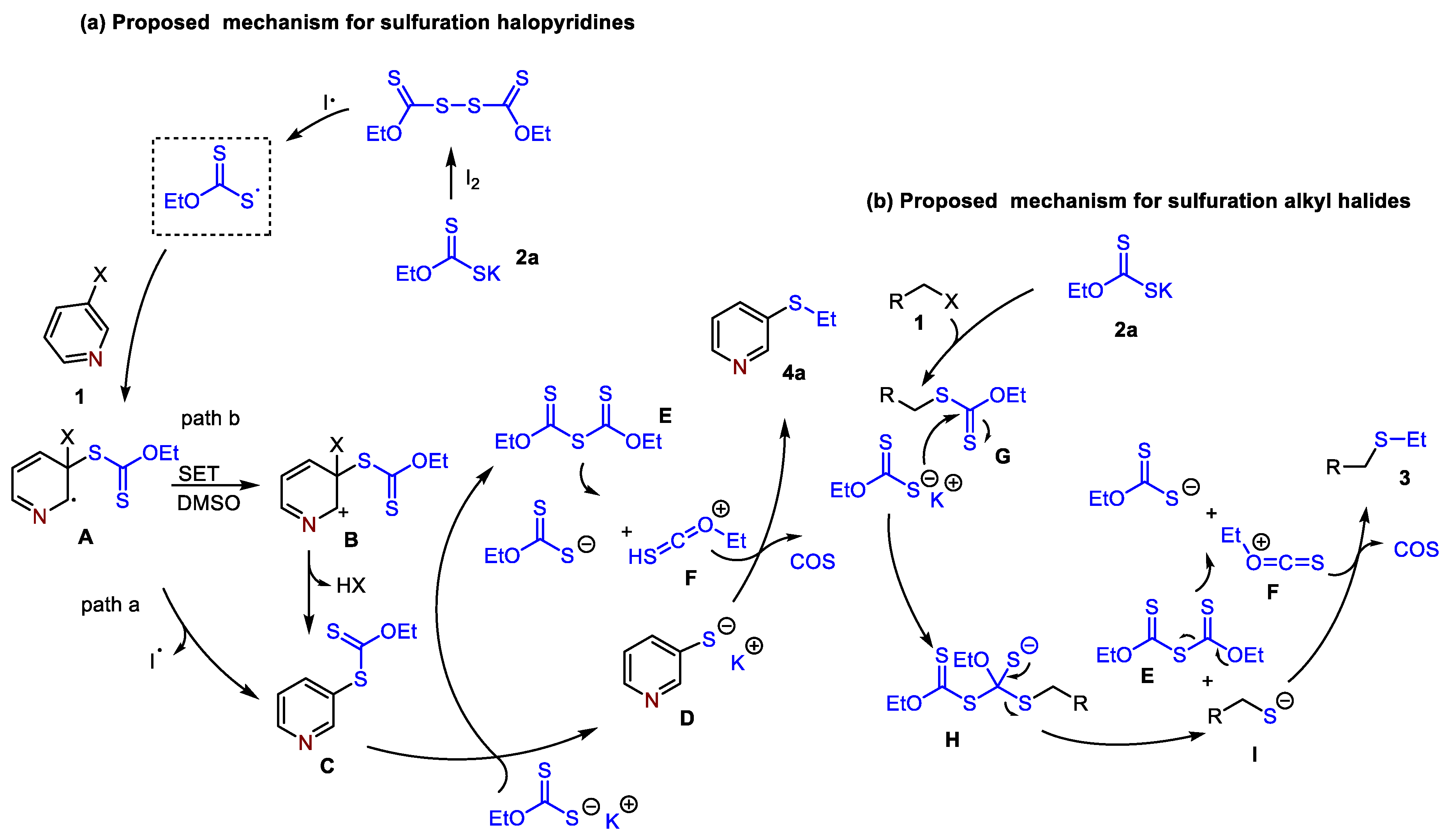

Table 1.
Optimization of the reaction conditions a,b.

| Entry | EtOCS2K (mmol) | Solvent (mL) | T (°C) | T (h) | Yield (%) |
| 1 | EtOCS2K (1) | DMF (2) | 150 | 6 | 77 |
| 2 | EtOCS2K (1) | o-xylene (2) | 150 | 6 | <5 |
| 3 | EtOCS2K (1) | DMSO (2) | 150 | 6 | 95 |
| 4 | EtOCS2K (1) | DMAc (2) | 150 | 6 | 57 |
| 5 | EtOCS2K (1) | NMP (2) | 150 | 6 | 45 |
| 6 | EtOCS2K (1) | DMSO (1) | 150 | 6 | 94 |
| 7 | EtOCS2K (0.8) | DMSO (1) | 150 | 6 | 78 |
| 8 | EtOCS2K (1) | DMSO (1) | 130 | 6 | 95 |
| 9 | EtOCS2K (1) | DMSO (1) | 100 | 6 | 94 |
| 10 | EtOCS2K (1) | DMSO (1) | 80 | 6 | 89 |
| 11 | EtOCS2K (1) | DMSO (1) | 100 | 3 | 94 |
| 12 | EtOCS2K (1) | DMSO (1) | 100 | 1 | 93 |
| 13 | EtOCS2K (1) | DMSO (1) | 100 | 0.5 | 87 |
a Reaction conditions: 4-(chloromethyl)biphenyl 1a (0.5 mmol), EtOCS2K 2a, and solvent in a sealed tube in an air atmosphere. b Isolated yields.
Table 2.
Optimization of reaction condition a,b.
| Entry | EtOCS2K (mmol) | Additive (mmol) | Solvent | Time (h) | Yield (%) |
| 1 | EtOCS2K (1.2) | I2 (1.5) | DMF | 24 | 37 |
| 2 | EtOCS2K (1.2) | I2 (1.5) | DMF | 30 | 45 |
| 3 | EtOCS2K (1.2) | I2 (1.5) | DMF | 36 | 92 |
| 4 | EtOCS2K (0.8) | I2 (1.5) | DMF | 48 | 69 |
| 5 | EtOCS2K (1.2) | I2 (0.7) | DMF | 36 | 10 |
| 6 | EtOCS2K (1.2) | NH4I (1.5) | DMF | 36 | <5 |
| 7 | EtOCS2K (1.2) | HI (1.5) | DMF | 36 | 15 |
| 8 | EtOCS2K (1.2) | I2 (1.5) | DMSO | 36 | <5 |
| 9 | EtOCS2K (1.2) | I2 (1.5) | NMP | 36 | <5 |
| 10 | EtOCS2K (1.2) | I2 (1.5) | DMAc | 36 | 43 |
| 11c | EtOCS2K (1.2) | I2 (1.5) | DMF | 36 | 39 |
| 12 | EtOCS2K (1.2) | - | DMF | 36 | <5 |
a Reaction conditions: 3-Iodine pyridine (0.5 mmol), EtOCS2K, and additive in solvent (3.0 mL) at 150 oC in a sealed tube in an air atmosphere. b Isolated yields. c 140 oC.
Disclaimer/Publisher’s Note: The statements, opinions and data contained in all publications are solely those of the individual author(s) and contributor(s) and not of MDPI and/or the editor(s). MDPI and/or the editor(s) disclaim responsibility for any injury to people or property resulting from any ideas, methods, instructions or products referred to in the content. |
© 2024 by the authors. Licensee MDPI, Basel, Switzerland. This article is an open access article distributed under the terms and conditions of the Creative Commons Attribution (CC BY) license (http://creativecommons.org/licenses/by/4.0/).
Copyright: This open access article is published under a Creative Commons CC BY 4.0 license, which permit the free download, distribution, and reuse, provided that the author and preprint are cited in any reuse.