

Submitted:
14 May 2024
Posted:
17 May 2024
You are already at the latest version
Abstract
The tourism economy plays an essential role in supporting and driving tourism development. Therefore, studying its resilience is crucial for promoting sustainable and high-quality tourism development. Based on the core essentials of economic toughness, this paper constructs the tourism economic toughness evaluation index system, uses the entropy weight TOPSIS method to measure the tourism economic toughness of 10 counties and cities in the Yili River Valley in 2010-2019, analyzes its spatio-temporal evolution characteristics through the standard deviation ellipse, the traditional Markov chain, and the spatial Markov chain, and uses the grey correlation analysis method to analyze the driving factors of the tourism economic toughness. The results show that: (1) the economic resilience of tourism in the Yili River Valley shows a "W"-shaped time-series dynamic development trend with an average index of 0.28394, in which it experienced a decline from 0.28 to 0.27 during 2012-2013 and 2015-2016; (2) Spatial Pattern: The Yili River Valley tourism economic resilience is characterized by a clear uneven spatial distribution. The city of Yining, representing the northwestern region, exhibits a high level of resilience, while the southwestern region, endowed with rich tourism resources, demonstrates a medium level of resilience. Conversely, the central to southeastern counties and cities, such as ChabuchaerXibo Autonomous County and other counties and cities, are characterized by a lack of developed tourism facilities, which has resulted in a lower level of resilience and a weak development situation; (3) In terms of spatial and temporal evolution, the standard deviation ellipse is stabilized year by year pointing to "northwest-southeast", the clustering tendency is gradually enhanced, and five tourism economic resilience convergence clubs are identified, whose internal transition probability is significantly affected by spatial location, and which show obvious stability and neighborhood effects; (4) Regarding the driving factors, the impact of each driving factor on the resilience of the tourism economy reaches the statistical significance threshold of 0.77 or above. Among them, the number of employees in the tertiary industry, especially the input of high-quality talents in the tourism industry, plays a key role in improving the quality of tourism services and strengthening the industry's ability to withstand risks and development potential.
Keywords:
tourism economic resilience
; spatio-temporal evolution
; driving factors
; Sustainability
; Yili River Valley
1. Introduction
Tourism is a comprehensive, cross-sectoral and cross-regional industry with wide radiation, strong interaction and great influence. Current research on the linkages between tourism and climate change, natural disasters, political instability, conflict, and terrorism [1,2,3,4] has further revealed the indirect vulnerability of tourism, as well as laying bare the high elasticity and low resilience of tourism. Tourism economy is a complex giant system, economic attributes are the essential attributes of tourism[5], but its own vulnerability and sensitivity is the root cause of instability of tourism economy. As a place rich in tourism resources in China, the Yili River Valley is accelerating the construction of a world-class tourist destination, and "resilience", as an important characteristic to express or describe how things cope with uncertainty, provides a good research perspective to understand and analyze how the tourism industry in the Yili River Valley copes with internal and external shocks [6].
2. Literature Review
Resilience was originally developed as a concept by Holling in the 1970s to understand and measure ecological capabilities and their ability to remain in their original state when disturbed or changed[7]. Whereas traditional approaches to resilience have come mainly from ecology, engineering and physics. In recent years, the theory of resilience has received attention from the economics community and has become a research hotspot in the fields of regional economics and economic geography[8]. Economic resilience is regarded as an inherent characteristic of a region that can enhance the key attributes of that economic system in a long-term and sustainable manner [9]. According to domestic and foreign researchers, there are two main methods to measure economic resilience: one is the key variable method[10], which uses a single indicator such as gross domestic product, unemployment rate, etc.; the other is the method of constructing a system of evaluation indicators [11], which measures regional economic resilience by selecting a number of indicators.
Tourism economic resilience, as the key to sustaining the stable development of the tourism system [12], refers to the resilience of the tourism economic system to external shocks and threats as well as structural changes and new developments [13]. Initially, domestic and international scholars conducted extensive research on the "vulnerability" of tourism, which refers to the degree or likelihood of damage caused by adverse factors such as disasters. Today, the vulnerability discourse has evolved into a basic scientific knowledge framework for analyzing global environmental change and regional responses, human-landscape interactions, and regional sustainable development. Against the backdrop of the transformation from an economic to a risk-based society and the continuous exploration of the concept of resilience, research on the economic resilience of the tourism industry has received extensive attention and discussion. For example, Cai et al. used resistance index, Thiel index, and spatial autocorrelation analysis to deepen the theory of tourism economic resilience and provide reference for the sustainable development of tourism[14]. Wang Qian et al. established a tourism economic resilience evaluation index system from the four dimensions of resilience, recovery, reconstruction, and renewal, and quantitatively analyzed the spatio-temporal development characteristics and influencing factors of the tourism economy in 31 provinces and cities in China[15]. Some researchers even studied the correlation between tourism sustainability and sustainable development of tourism economy and high-quality development of tourism economy, such as Zhang et al. evaluated the spatio-temporal evolution characteristics of China's tourism economic resilience in terms of resistance and influencing factors, and found that the type of tourism economic resilience in China presents a concentrated and continuous development trend, with obvious zonal distribution characteristics, and is dominated by the autonomous tourism economic resilience zones , but the tourism industry in most areas has not yet formed a stable economic resilience[16].
At present, many results and experiences have emerged from domestic and international research on the concept and measurement of tourism economic resilience as well as tourism economics, providing us with a broader perspective. However, in terms of research content, there are still some inconsistencies in the interpretation of the concept of tourism economic resilience in the existing studies, and there is a lack of a unified framework and standard for measuring the level of tourism economic resilience, and at the same time, the spatial heterogeneity of the indicator system makes it difficult for the existing framework to be effectively applied to the development of local tourism economic resilience in practice. On the other hand, in terms of research scales, most of the existing studies are quantitative studies at the macro scale such as national provinces and regions, and there are few studies at the river valley scale; in this area, tourism economic resilience is under-represented in the existing tourism disciplines, and the studies are still fragmented. How to quantify tourism economic resilience in the Valley region? How does tourism economic resilience evolve over time and space? All these issues need further research. Accordingly, this paper takes the toughness theory and sustainable development theory as a guide, constructs the tourism economic toughness evaluation index system, calculates the tourism economic toughness index of the counties in the Yili River Valley through the entropy weight TOPSIS model, and analyzes the spatial dynamic evolution of the tourism toughness level of the counties in the Yili River Valley by using the Markov chain model. Finally, gray correlation is used to explain the driving factors affecting the toughness level of the tourism economy in Yili River Valley, and countermeasure suggestions to improve the toughness level of the tourism economy are put forward from the perspective of sustainable development, so as to provide reference value for the promotion of high-quality and sustainable development of the tourism economy.
3. Overview of the Research Area
The Yili River Valley (80°09′~84°56′W, 42°14′~44°53′N) is located in the Yili Kazakh Autonomous Prefecture of the Xinjiang Uygur Autonomous Region, which is situated in the northern part of the Tianshan Mountains, and borders the Republic of Kazakhstan to the west, with an outstanding geographic advantage. The Yili River Valley is under the jurisdiction of Yining City, horgos City, Yining County, Nilek County, Xinyuan County, Gongliu County, Tekes County, Zhaosu County, ChabchuchaerXibo Autonomous County (hereafter referred to as Cha County), and Huocheng County,[17] eight counties and two cities, with a length of 360 km from east to west, a width of 275 km from north to south, and an area of 56,400 km2 , as Figure 1. Tourism, as an important strategic pillar industry in the Yili River Valley, has become an important engine for high-quality economic and social development in Yili. The region is rich in natural as well as historical and humanistic tourism resources, with 79 Class A scenic spots (2 Class 5A, 23 Class 4A, 33 Class 3A and 21 Class 2A) such as Nalati Scenic Spot and Kerala Scenic Spot. As of December 2022, the Yili River Valley received 38,293,700 tourists, with tourism revenue amounting to 20.12 billion yuan, accounting for 16.8% of regional GDP.
4. Methodology and Data Sources
4.1. Construction of the Indicator System
Based on the core essence of tourism economic resilience and referring to the existing relevant research results, this paper follows the principles of systematicity, scientificity and data availability, and constructs a tourism economic resilience level evaluation index system consisting of 22 indicators in four dimensions, namely, defense ability [18], recovery ability [18], remodeling ability [18], and transformation ability [19] (Table 1).
Defensive capacity refers to the degree of sensitivity and depth of reaction of the tourism economy in the face of internal and external risk perturbations, compared with the economy is a weaker region, the economic strength of the region with smaller losses [18], mainly including the tourism economic index [20] and tourism resources index[21]; recovery capacity to respond to the speed and degree of recovery of the tourism economy from the impact of risk fluctuations, this paper from the industrial economy and social economy considerations, the divided into tourism industry index and social economy index[22,23], reflecting the level of recovery of the tourism economy and the overall economy [24]; reshaping capacity refers to the degree of repositioning and adaptation of the tourism economy to cope with shocks, as reflected in the financial/capital index and the social consumption index [25,26,27]; transforming capacity represents the degree to which the tourism economy recovers its growth path or shifts to a new growth trend [28], the It mainly focuses on environmental improvement, tourism development potential, and tourism development dynamics [29,30,31], as shown in Figure 2.
4.2. The Entropy Weight TOPSIS
This paper applies the entropy weight TOPSIS method to measure the tourism economic toughness of the study area. The entropy weight TOPSIS method is an improvement of the traditional TOPSIS evaluation method, which determines the weights of the evaluation indexes through the entropy weight method, and then determines the ranking of the relative proximity of the evaluation objects through the TOPSIS method by using the technique of positive and negative ideal solutions [32]. The main steps are as follows:
(1) Matrix normalization, the purpose is to eliminate the influence of different indicator scale. Assuming that there are n evaluation objects and m evaluation indicators, the matrix X that has completed the normalization is:
For its normalized matrix Z, each element in Z is normalized by Eq:
(2) Calculate the value of the ith program under the jth indicator as a proportion of that indicator . The normalization matrix Z at this point is:
(3) Calculate the entropy value of the jth indicator , when ,
(4) Calculate the coefficient of variation and weight for the jth indicator:
(5) Determine the positive and negative ideal solutions. The positive ideal solution consists of the maximum value of each column element and the negative ideal solution consists of the minimum value of each column element. The normalized matrix Z at this point is:
(6) Use the Euclidean distance to calculate the distance of the evaluation object from the positive and negative ideal solutions and add the weights:
(7) Calculate the relative proximity of the evaluated object to the optimal solution using the negative ideal solution distance:
Unnormalized relative proximity:
The relative proximity of the normalization:
takes values between 0 and 1. The higher the score, the higher the level of tourism economic resilience.
4.3. Markov Chain
4.3.1. Traditional Markov chain
Markov chain mainly describes the probability distribution of a socio-economic phenomenon in the region that transfers from one state to another over time by constructing a state transfer probability matrix. It can effectively analyze the dynamic changes of tourism economic resilience in the Yili River Valley over the time continuum. The method discretizes continuous data into k types, the transfer between different types in different years constitutes a transfer probability matrix, and the type transfer probability is measured by the great likelihood estimation method [33].
where denotes the probability that a city that is type i in year t shifts to type j in year t+1 during the study period, denotes the sum of the number of counties and cities that have shifted their tourism economic resilience from type i in year t to class j in year t+1 during the study period, and denotes the sum of the number of cities that are in type i in all the years of the study period.
4.3.2. Spatial Markov Chain
In different periods of research, scholars have found that the spatial spillover due to geographic proximity plays an important role in the development and evolution of the region [34]. Considering the spatial characteristics of regional phenomena, based on the transfer probability matrix of the traditional Markov chain, the concept of "spatial lag" is introduced as a condition and divided into k types, and the k*k transfer probability matrix is decomposed into k k*k transfer conditional probability matrices.
where represents the attribute value of a regional unit, and represents the element of the jth column of the ith row of the spatial weight matrix W, i.e., the matrix of the proximity relationship between the region and the neighboring units.
4.4. Grey Relation Analysis
Grey Relation Analysis (GRA), is a multifactor statistical analysis method. Grey correlation analysis method makes up for the shortcomings caused by the use of mathematical statistical methods for system analysis[35]. It is equally applicable to the number of sample sizes and the presence or absence of patterns in the samples, and the calculation is small and very convenient, not to mention that there is no discrepancy between the quantitative results and the qualitative analysis results. The calculation steps are as follows:
(1) Construct reference sequence and comparison sequence:
The reference sequence, i.e., the data sequence that can reflect the characteristics of the system's behavior, similar to the dependent variable Y; the comparison sequence, i.e., the sequence composed of factors that affect the system's behavior, similar to the independent variable X, are denoted as:
(2) Data preprocessing: de-measurement tempering
(3) Calculate the correlation coefficient of each indicator in the subseries with the parent series, denoted:
a, b denote the two-level minimum and maximum differences, respectively;
Construct:
where is the resolution factor, generally taking the value 0.5;
(4) Calculation of correlation:
∈[0,1], the closer to 1, the stronger the influence.
4.5. Data Sources
The research period of this paper is 2010-2019, and the data sources mainly include statistical data and basic geographic information data. Among them, the socio-economic data mainly come from the statistical data published by the local government, which mainly includes the China Yili Kazakh Autonomous Prefecture Statistical Yearbook from 2010-2019, and some of the missing data come from the annual statistical bulletins of counties and cities as well as the China County Statistical Yearbook. The ecological and environmental protection data, in addition to the above statistics, are partially derived from the bulletin of environmental conditions of counties and cities. In addition, the nighttime lighting data in this study were obtained from the National Science and Technology Basic Condition Platform-National Earth System Science Data Center (https://www.geodata.cn/main/#/); the NVDI data were obtained from the Resource and Environment Science and Data Center of the Chinese Academy of Sciences (https://www.resdc. cn/Default.aspx). For some missing values, the linear interpolation method was uniformly used to fill in the missing values.
5. Results and Analysis
5.1. Characteristics of Spatio-Temporal Differentiation Of Tourism Economic Toughness Level in Yili River Valley
5.1.1. Time-Series Characteristics of Tourism Economic Resilience Level in the Yili River Valley
The tourism economic toughness of the Yili River Valley was measured by the entropy weight TOPSIS method, and the time-series change of tourism economic toughness level was plotted by Origin2022 (Figure 3), and finally combined with the distribution of the data using the ArcGIS10.8 natural breakpoint method to classify it into low level ( < 0.218567), lower level (0.21857 < < 0.234047), medium level (0.234047 < < 0.273514), higher level (0.273514 < < 0.413837), and high level (0.413837 < < 0.838269).
From an overall point of view, the average index of tourism economic resilience in 2010-2019 was 0.28394, showing a "W"-shaped development trend, and there was a trough in 2013-2014 and 2015-2016, and the average index of tourism economic resilience decreased from 0.28 to 0.27. The main reasons are as follows: On the one hand, the economic operation of the Yili River Valley is better, but the main tourism economic indicators have fallen, and the economic downward pressure has increased; on the other hand, new tourism consumption stimulus policies have not yet been introduced, new tourism consumption hotspots have not yet been formed, and the growth of the tourism consumption market is weak, and the role of the cultural and tourism consumption pulling is weakened. From the tourism economic toughness index of each county and city, firstly, Yining city, as the core city of Yili Kazakh Autonomous Prefecture, presents a breakaway lead, with a higher level of tourism economic toughness; secondly, Horgos city, as a port city, was set up as a county city in 2014, and the adjustment of its resource allocation, policy environment, investment decision, and regional competition and cooperation led to fluctuations in the tourism economic toughness in 2014, but because of its geographic advantages, the rapid development of inbound and outbound tourism, tourism economic resilience quickly rebounded to a higher level; Finally, the remaining counties tourism economic resilience level are showing "M" shaped development trend, in which Xinyuan County, Huocheng County, Zhaosu County due to its high endowment of tourism resources at a medium level, Yining County is at a lower level, while the Tekes County, Gongliu County, Nilek County, Cha County due to the lack of tourism core attraction, tourism economic development is relatively backward. Thus, they are at a low level of development.
5.1.2. Spatial Characteristics of Tourism Economic Resilience Level in the Yili River Valley
From the viewpoint of spatial distribution (Figure 4), the tourism economic resilience level of the Yili River Valley has basically formed a dynamic evolution of the spatial pattern of "high on both sides and low in the middle". Yining City, Horgos City, represented by the high level and higher level of cities in the northwestern part of the spatial distribution characteristics of agglomeration, there is a more obvious regional agglomeration effect; medium level of counties and cities are concentrated in the southwestern part of the region, which is mainly due to the higher endowment of tourism resources, contributing to the enhancement of the tourism economic resilience; the lower level of counties and cities and low level of counties and cities in the central region to the southeast of the trend of proliferation.
From a regional perspective, the tourism economic resilience level of Yining City is ahead of other cities, Horgos City and Huocheng County have reached the medium level or above, while Cha, Gongliu and Tekes Counties are in the stage of low level of development, and the development index continues to decline, and the distribution range of the low level of the cities shows the characteristic of expanding and then narrowing first. The above shows that the resilience level of tourism economy in Yili River Valley presents significant socio-economic and tourism resource preferences, and most of the counties and cities in the northwest of the study area have a good economic foundation and better accessibility, which can provide good capital, talent, market and other necessary conditions for the development of tourism and its related industries; while the central and southeastern counties and cities have a slower pace of economic development, insufficient tourism public service facilities, insufficient tourism core attracting factors, and a fragile tourism economy.
5.2. Characteristics of the Spatio-Temporal Evolution of Tourism Economic Resilience in the Ili River Valley
5.2.1. Center of Gravity Evolutionary Trajectory
Through the ArcGIS10.8 spatial statistical analysis tool, the standard deviation ellipse of the tourism economic resilience level and its center of gravity deviation trajectory of the Yili River Valley were plotted from 2010 to 2019 (Figure 5). From the perspective of spatial distribution, the standard deviation ellipse in each year shows the direction of "northwest-southeast", basically covering most of the counties and cities in the study area, and the contraction of the radius of the main axis and sub-axis is smaller, and the change of the rotation angle is smaller, which indicates that during the study period, the degree of agglomeration of the level of toughness of the tourism economy of the Yili River Valley has gradually increased, and the stable offset law is formed basically from the northwest to the southeast.
From the perspective of the center of gravity shift process, the center of gravity of tourism economic resilience is roughly located in the central west of the study area, and the center of gravity shift can be divided into four phases: from 2010 to 2014, the horizontal center of gravity shifted to the southeast; from 2014 to 2015, the horizontal center of gravity gradually shifted to the northwest; from 2015 to 2016, the horizontal center of gravity shifted to the southeast in a more substantial manner; and from 2016 to 2019, it gradually re-shifted to the northwest. This is due to the fact that in the early stage of development, the good tourism resources of the southeastern counties and cities in the study area pulled the development of the local tourism economy, and the defense ability and transformation ability were strengthened, but with the passage of time, the relative lagging of economic development could not provide a solid supply and guarantee for the development of its tourism economic resilience, while the northwestern cities have a higher level of economic and social development, and their defense, recovery, remodeling, and transformation abilities are stronger, and the level of tourism economic resilience gradually increases.
5.2.2. Characterization of the Evolution of Spatial Dynamics
In order to further reveal the dynamic evolution law of tourism economic resilience during the study period, this paper constructs the traditional Markov chain as well as the Markov chain considering spatiality, and analyzes its rank transfer probability. According to the five grades classified in the previous section, the Markov transfer probability matrix is calculated. Among them, the diagonal values indicate the probability of no rank transfer, and the non-diagonal values indicate the probability of transfer between different ranks.
(1) Traditional Markov chain analysis
On the one hand, according to the typology of tourism economic resilience, there are five convergence clubs of low, lower, medium, higher and high levels of tourism economic resilience (Table 2). The probability values on the diagonal are greater than those on the off-diagonal, indicating that all five convergence clubs have strong stability, i.e., the probability of the region maintaining its original type of development level in any one period is at least 0.7923. Among them, the higher level convergence club and the high level convergence club have the greatest stability, with the probability of maintaining their original state being 0.888 and 0.992, respectively. The stability of low and medium level converging clubs is relatively balanced, while the stability of lower level converging clubs is the worst, with a greater possibility of transformation to medium level type (0.189).
On the other hand, the probability of a shift occurring between the different types is small (non-diagonal probability values), with a maximum of 0.189 ; and the probability values that are not adjacent to the diagonal line are all less than 0.1, implying that the probability of a shift from a low level of county units of tourism economic resilience to a convergence club of more than a medium level of economic resilience is extremely low between the 2 consecutive years and the shift of a lower level of region to a higher and higher level of convergence club is difficult to achieve and vice versa. Similarly, it is virtually impossible for medium-level county cells to shift to the "ends of the spectrum". This result reflects the fact that the economic resilience of regional tourism is a continuous process, and that it is difficult to achieve a leap or a decline across levels in the short term.

Table 2.
Traditional Markov Chain Transfer Probability Matrix for Tourism Economic Resilience in the Yili River Valley, 2010-2019.
Table 2.
Traditional Markov Chain Transfer Probability Matrix for Tourism Economic Resilience in the Yili River Valley, 2010-2019.
| t/t+1 | Low level | Lower level | Medium level | Higher level | High level | n |
|---|---|---|---|---|---|---|
| Low level | 0.834184 | 0.159439 | 0.003827 | 0.002551 | 0 | 784 |
| Lower level | 0.01455 | 0.792328 | 0.189153 | 0.003968 | 0 | 756 |
| Medium level | 0 | 0.016173 | 0.809973 | 0.173854 | 0 | 742 |
| Higher level | 0.001403 | 0.001403 | 0.019635 | 0.887798 | 0.089762 | 713 |
| High level | 0 | 0 | 0 | 0.008451 | 0.991549 | 710 |
(2) Spatial Markov chain analysis
Further on the basis of Markov chain, the neighborhood environment condition is introduced to construct the spatial Markov chain probability matrix in order to quantitatively examine the influence of the neighborhood environment of the region on the probability of its shift to what kind of convergence club (Table 3). From the table, it can be found that different neighborhood environments result in different probabilities of the type of shift in the region, i.e., the spatial location has an important influence on the convergence club of the region: the higher the level of the neighborhood level, the more conducive to the shift of the county and city units to higher levels of the convergence club.
Among them, when the neighborhood level is a low level, the probability of medium level counties and cities to keep the original level is 0.57, and the probability of upward transfer is 0.43; when the neighborhood level is a lower level, the probability of tourism economic toughness of low level, lower level, medium level counties and cities to keep the original level is 0.837, 0.842, 0.9, respectively, and there is a probability of upward 0.14, 0.15, 0.1 transfer; when the neighborhood level is medium level, the probability of tourism economic toughness low level, lower level, medium level counties and cities to keep the original level is 0.917, 0.892, 0.9, and there is a probability of less than 0.1 to transfer upward and downward, respectively; when the neighboring level is higher level, the probability of tourism economic toughness higher level counties and cities to keep at the original level is 0.75, and the probability of transferring upward to the high level probability is as high as 0.25; when the neighborhood level is high level counties and cities, the probability of tourism economic toughness low level, lower level, medium level, higher level counties and cities to shift to the high level convergence club is 0.24, 0.2, 0.16 and 0.06 respectively, which indicates that the higher the level of neighborhood level grade, the more conducive to improve the economic toughness of the low level region, while at the same time, there will be lower probability of the economic toughness of low level regions due to the siphoning effect of economically developed regions, leading to downward shift and decline of tourism economic resilience.
5.3. Analysis of the Drivers of the Spatial and Temporal Evolutionary Characteristics of Tourism Economic Resilience in the Yili River Valley
In this study, the average value of the tourism economic resilience index of each county and city from 2010 to 2019 was used as the dependent variable, and the first two indicators with the highest weight values in the four dimensions of defensive capacity, recovery capacity, remodeling capacity, and transformation capacity were used as the independent variables (Table 4), and the Matlab2022 software was used to analyze the tourism economic resilience driving factors of counties and cities of the Yili River Valley through the grey correlation degree.
By calculating the gray correlation between each indicator and the tourism economic resilience index, the correlation r value of each indicator is obtained. The results show (Table 5) that the magnitude of the correlation of each driver on the tourism economic resilience of the Yili River Valley is in the following order: Number of employees in tertiary industry (X7) > Tourism Reception (X1) > Investment in Social Fixed Assets (X5) > Gross Tourism Income (X2) > Total Retail Sales of Consumer Goods (X6) > Night Lights (X4)>Ratio of tourists to permanent residents (X8) > Number of travel agencies (X3).
First of all, the growth and improvement of the number of employees in the tertiary industry, especially the input of high-quality labor into the tourism industry, helps to improve the quality of tourism services and the development potential of the industry, making the tourism economy more resistant and resilient. The growth in the number of tourists and the total income from tourism shows the scale effect and economic efficiency of the tourism market, which has a direct effect on improving the resistance and resilience of the tourism economy.
Second, higher levels of socio-economic development are usually accompanied by stronger tourism consumption demand and quality tourism infrastructure, which strongly support the resilience of the tourism economy. Societal investment in fixed assets, especially in tourism infrastructure and related services, is crucial for improving the tourism environment, attracting tourists, and maintaining and revitalizing the tourism industry during periods of economic volatility. The tourism consumption component of total retail sales of consumer goods reflects the strong demand for tourism and promotes the prosperity of regional consumer markets, thus enhancing the intrinsic dynamics and stability of the tourism economy.
In addition, reasonable regulation of the ratio of tourists to permanent residents to ensure a balance between tourism carrying capacity and social stability is the key to safeguarding the long-term healthy and resilient development of the tourism economy. Finally, a moderate increase in the number of travel agencies and high-quality services will help integrate resources, innovate products and optimize the tourism experience, thus reinforcing the adaptability and resilience of the tourism market. Overall, the above factors are intertwined and interactive, together determining the strength of the resilience of the tourism economy in the Yili River Valley, and providing diversified path choices for realizing the sustainable and sound development of the tourism industry.
6. Conclusion and Discussion
6.1. Conclusions
This paper effectively measures the level of tourism economic resilience of counties and cities in the Yili River Valley from 2010 to 2019, and analyzes its spatio-temporal evolution characteristics and influencing factors. The main conclusions are as follows:
(1) From the point of view of time series changes, the average index of tourism economic resilience was 0.28394 in 2010-2019, showing a "W"-shaped time series development trend, and there was a trough in 2013-2014 and 2015-2016, and the average index of tourism economic resilience decreased from 0.28 to 0.27.
(2) From the perspective of spatial distribution, the Yili River Valley tourism economic resilience is manifested as "high at both ends, low in the middle", in which the northwestern city of Yining, Horgos and other cities stand out by virtue of the agglomeration of advantages and the high level of tourism economic resilience, the southwestern counties and cities due to the rich tourism resources and maintain a medium level of resilience; On the contrary, the central to southeastern counties and cities have a low level of resilience and a weak development trend, such as Tsa, Gongliu, and Tekes counties, which have underdeveloped tourism facilities, limited core attraction, and a relatively fragile tourism economy, showing obvious regional differences and uneven development.
(3) From the point of view of spatial and temporal evolution characteristics, on the one hand, the drawn standard deviation ellipse is stable year by year, pointing to the "northwest-southeast", and the trend of agglomeration is strengthened. On the other hand, the tourism economic toughness exists in five convergence clubs of low level, lower level, medium level, higher level and high level, with strong stability, i.e., the probability of the region to maintain the original economic toughness level type is at least 0.7923, and different neighboring environments caused by the type of the region's shift in probability is different, i.e., the spatial location has an important impact on the convergence clubs of the region, manifested in the neighboring areas. The higher the level grade, the more favorable the county and city units to shift to a higher level of convergence club.
(4) Regarding the driving factors, all indicators have a significant impact on the resilience of the tourism economy, with an influence of 0.77 or more. Among them, the number of employees in the tertiary industry, especially the high-quality labor force invested in the tourism industry, helps to improve the quality of tourism services and the development potential of the industry, and becomes the dominant factor for the tourism economy to be more resilient and elastic.
6.2. Discussion
(1) The "W"-shaped time-series trend revealed in the paper, especially the decline in the resilience of the tourism economy between 2013-2014 and 2015-2016, may be related to multiple factors, such as global or regional economic fluctuations, unforeseen events and policy adjustments. This finding emphasizes the high sensitivity of the tourism economy to internal and external shocks. Therefore, policymakers need to build a dynamic monitoring system to identify risks in a timely manner, and at the same time strengthen resilience building, such as diversifying risks through diversified market strategies to enhance the flexibility and adaptability of the tourism industry. In the future, the Yili River Valley still needs to further improve marketization, enhance transportation accessibility, and strive to promote the transformation and upgrading of the industrial structure, so as to consolidate the infrastructure for tourism development. In addition, the macro policy should also strengthen the reasonable guidance to the tourism industry, and try to avoid the negative impact of "black swan", "gray rhino" and other events on the tourism economy.
(2) The spatial distribution pattern of "high on both sides and low in the middle" highlights the unevenness of regional development. The performance of northwestern cities and southwestern counties and cities illustrates the important contribution of infrastructure, industrial agglomeration and resource endowment to the resilience of the tourism economy. For the central to southeastern regions, the government should adopt differentiated support policies, increase investment in tourism infrastructure in these regions, and improve the quality of tourism services, as well as explore and build distinctive tourism brands to enhance their core attractiveness. Through regional cooperation, it should optimize the industrial layout, achieve resource sharing and market linkage, and promote the overall enhancement and balanced development of the tourism economy.
(3) Characterization of the spatio-temporal evolution shows that the economic resilience of tourism in the Yili River Valley is not only affected by time-series fluctuations, but also shows obvious spatial aggregation and convergence phenomena. The stable pointing of the standard deviation ellipse and the existence of convergence clubs require policy makers to consider spatial proximity and inter-regional interaction in planning. High-level resilient regions should be encouraged to play a radiation-driven role and help low-level resilient regions to upgrade through technology transfer and management experience sharing. At the same time, geographical location advantages should be utilized to promote the integration of economic activities within the region and to form a good ecology of synergistic development.
(4) The study found that the number of employees in the tertiary industry, especially the high-quality labor force, has a significant positive impact on the economic resilience of tourism, highlighting the central position of human resources in the tourism industry. This requires local governments to increase education and training efforts to enhance the professional skills and service level of tourism industry personnel. At the same time, optimize the talent introduction policy to attract more professionals to join the tourism industry, so as to enhance the quality of the tourism economy and innovation ability driven by talents. In addition, attention should be paid to the integrated development of tourism and other industries, especially the mutual promotion within the tertiary industry, in order to realize the optimization and upgrading of the structure of the tourism economy.
Tourism economic resilience is related to the healthy and stable development of regional tourism and is an important indicator of high-quality tourism development. Whether different choices of indicators and methods will produce different research results can be further expanded in the future. The findings of this paper are basically in line with the reality of tourism development, and the following studies can be further carried out in the future: ① The Yili River Valley, as a bridgehead for opening up to the west, there are obvious differences between inbound tourism revenue and domestic tourism revenue indicators in the regions, and what are the differences between the resilience measurement and the spatio-temporal evolution mechanism, and the comparative study can be strengthened in the future; ② This paper analyzes the relationship between the impacts of different factors on the resilience of the tourism economy by using gray correlation, and the relationship between various factors and the resilience of the tourism economy. In fact, the relationship between various factors and tourism economic resilience may be "non-linear", and this non-linear relationship can be studied in depth in the future.
Author Contributions
Conceptualization, P.Z., and H.S.; methodology, P.Z. and X.Z.; software,P.Z.; validation, P.Z.; formal analysis, P.Z.; resources, P.Z.; data curation, P.Z. and X.Z.; writing and editing, P.Z., X.Z. and C.S.; visualization, P.Z. and X.X.; supervision, H.S. and X.X.; project management, H.S.; funding acquisition, H.S. All authors have read and agreed to the published version of the manuscript.
Funding
The research was sponsored by the Social Science Foundation of Xinjiang Uygur Autonomous Region (No. 2023BYJ033).
Institutional Review Board Statement
Not applicable.
Informed Consent Statement
Not applicable.
Data Availability Statement
The data presented in the study are available in the article.
Acknowledgments
We thank the Statistics Bureau of Yili Kazakh Autonomous Prefecture, Xinjiang Department of Culture and Tourism Resource, and Environmental Science and Data Center of the Chinese Academy of Sciences for providing us with the basic data.
Conflicts of Interest
The authors declare no conflicts of interest.
References
- Lin, C.-H.; Wang, W.-C.; Ou, S.-J. Impact of Comparative Climate Change Perceptions on Antecedents of Tourists’ Adaptation Intentions for a Coastal Destination in Taiwan. Journal of Sustainable Tourism 2022, 30, 69–88. [CrossRef]
- Scott, D.; Hall, C.M.; Gössling, S. Global Tourism Vulnerability to Climate Change. Annals of Tourism Research 2019, 77, 49–61. [CrossRef]
- Liu, A.; Pratt, S.A. Tourism’s Vulnerability and Resilience to Terrorism. Tourism Management 2017, 60, 404–417. [CrossRef]
- Santana-Gallego, M.; Fourie, J. Tourism Falls Apart: How Insecurity Affects African Tourism. Tourism Economics 2022, 28, 995–1008. [CrossRef]
- Wang Z.; Zhang X. Spatio-temporal Differences and Influencing Factors of Resilience of Tourism Svstem in the Yelow River Basin. Geography and Geo-Information Science 2023, 39, 112–121.
- Sun Y.; Song Y. Sustainable tourism development from a resilience perspective. 旅游学刊 2021, 36, 8–10. [CrossRef]
- Holling, C.S. Resilience and Stability of Ecological Systems. Annual Review of Ecology, Evolution, and Systematics 1973, 4, 1–23. [CrossRef]
- Martin, R. Regional Economic Resilience, Hysteresis and Recessionary Shocks. Journal of Economic Geography 2012, 12, 1–32. [CrossRef]
- Sun J.; Sun X. Research Progress of Regional Economic Resilience and Exploration of Its Application in China. Economic Geography 2017, 37, 1–9. [CrossRef]
- Martin, R.; Sunley, P. On the Notion of Regional Economic Resilience: Conceptualization and Explanation. Journal of Economic Geography 2015, 15, 1–42.
- Briguglio, L.; Cordina, G.; Farrugia, N.; Vella, S. Economic Vulnerability and Resilience : Concepts and Measurements. Oxford Development Studies 2009, 37, 229–247. [CrossRef]
- Sheng Y.; Tan Z.; Li Q.; Xu L. Can the digital economy promote the resilience of the tourism economy in the Yellow River Basin? Arid Land Geography 2023, 46, 1704–1713.
- Wang Y.; Gao J. Shocks of 2019-nCoV,Economic Resilience and China’s High Quality Development. Business and Management Journal 2020, 42, 5–17. [CrossRef]
- Cai, X.; Xu, Y. Spatiotemporal Evolution and Influencing Factors of Tourism Economic Resilience under the Impact of COVID-19—A Case Study of Coastal Cities in China. Sustainability 2023, 15, 16668. [CrossRef]
- Wang Q.; Zhao L.; Yu W.; Jia J. Spatial-Temporal Evolution Characteristics and Influencing Factors of Resilience of Tourism Economic System in China. Geography and Geo-Information Science 2020, 36, 113–118.
- Zhang, P.; Huang, Y.; Pan, S.; Chen, W.; Zhong, H.; Xu, N.; Zhong, M. Does Resilience Exist in China’s Tourism Economy? From the Perspectives of Resistance and Recoverability. Sustainability 2022, 14, 10641–10641. [CrossRef]
- Sun H.; Wang Y. Integration research on tourism resources in Baicheng, Xinjiang-YiLi Valley as an exampale. Journal of Arid Land Resources and Environment 2009, 23, 195–200.
- Ding, C.; Gao, X.; Xie, Z. Analysing the Differential Impact of the COVID-19 Pandemic on the Resilience of the Tourism Economy: A Case Study of the Chengdu-Chongqing Urban Agglomeration in China. International Journal of Disaster Risk Reduction 2024, 102, 104255. [CrossRef]
- Zhang, P.; Yu, H.; Xu, L.; Guo, W.; Shen, M. Synergistic Relationship or Not? Understanding the Resilience and Efficiency of the Tourism Economy: Evidence from Hainan Province, China. Environ Dev Sustain 2024, 26, 3793–3817. [CrossRef]
- Wang, K.; Zhao, S.; Chen, X.; Lei, Z.; Zhou, X. Spatio-Temporal Evolution and Influencing Factors of the Resilience of Tourism Environmental Systems in the Yangtze River Economic Belt of China. Sustainability 2023, 15, 10527. [CrossRef]
- Xu, Q.; Zhu, G.; Qu, Z.; Ma, G. Earthquake and Tourism Destination Resilience from the Perspective of Regional Economic Resilience. Sustainability 2023, 15, 7766. [CrossRef]
- Hyun, K.; David W, M. Considering Disaster Vulnerability and Resiliency: The Case of Hurricane Effects on Tourism-Based Economies. The Annals of regional science 2015, 54, 945–971.
- Cutter, S.L.; Ash, K.D.; Emrich, C.T. The Geographies of Community Disaster Resilience. Global Environmental Change 2014, 29, 65–77.
- Berrouet, L.M.; Machado, J.; Villegas-Palacio, C. Vulnerability of Socio—Ecological Systems: A Conceptual Framework. Ecological Indicators 2018, C, 632–647. [CrossRef]
- Cheng, L.; Zhang, J. Is Tourism Development a Catalyst of Economic Recovery Following Natural Disaster? An Analysis of Economic Resilience and Spatial Variability. Current Issues in Tourism 2020, 23, 2602–2623. [CrossRef]
- Rai, S.S.; Rai, S.; Singh, N.K. Organizational Resilience and Social-Economic Sustainability: COVID-19 Perspective. Environ. Dev. Sustain. 2021, 23, 12006–12023. [CrossRef]
- Cai C.; Tang J.; He Q. Research on the Relationship Between Tourism Economic Resilience and Tourism Development Quality in China. Journal of Natural Science of Hunan Normal University 2024, 47, 42–53.
- Lounis, Z.; McAllister, T.P. Risk-Based Decision Making for Sustainable and Resilient Infrastructure Systems. J. Struct. Eng. 2016, 142, F4016005. [CrossRef]
- Mononen, L.; Auvinen, A.-P.; Ahokumpu, A.-L.; Ronka, M.; Aarras, N.; Tolvanen, H.; Kamppinen, M.; Viirret, E.; Kumpula, T.; Vihervaara, P. National Ecosystem Service Indicators: Measures of Social-Ecological Sustainability. Ecol. Indic. 2016, 61, 27–37. [CrossRef]
- Hong, W.; Jiang, R.; Yang, C.; Zhang, F.; Su, M.; Liao, Q. Establishing an Ecological Vulnerability Assessment Indicator System for Spatial Recognition and Management of Ecologically Vulnerable Areas in Highly Urbanized Regions: A Case Study of Shenzhen, China. Ecological Indicators 2016, C, 540–547. [CrossRef]
- He X.; Ren D.; XU H. The Impact of Regional Tourism Industry Agglomeration on Resilience of Tourism Economy and its Spatial Effect: A Case Study of the Yangtze River Economic Belt. Journal of Natural Science of Hunan Normal University 2024, 47, 54–64.
- Shi X.; Li L.; Tao Z.; Lai Z.; Li T. Spatio-temporal evolution and influencing factors of urban ecotourism development level in the Yangtze River Delta. Acta Ecologica Sinica 2024, 1–14. [CrossRef]
- Wang S.; Gao S.; Huang Y.; Shi C. Spatio-temporal evolution and trend prediction of urban carbon emission performance in China based on super-efficiency SBM model. Acta Geographica Sinica 2020, 75, 1316–1330.
- Zeng G.; Shang Y.; Si Y. The convergent evolution of China’s regional economic development models. 地理研究 2015, 34, 2005–2020.
- Wu, Y.; Xie, Q.; Mu, C. Sensitivity Analysis of Factors Influencing the Blast Resistance of Reinforced Concrete Columns Based on Grey Relation Degree. Sustainability 2023, 15, 12285. [CrossRef]
Figure 1.
Overview of the study area.
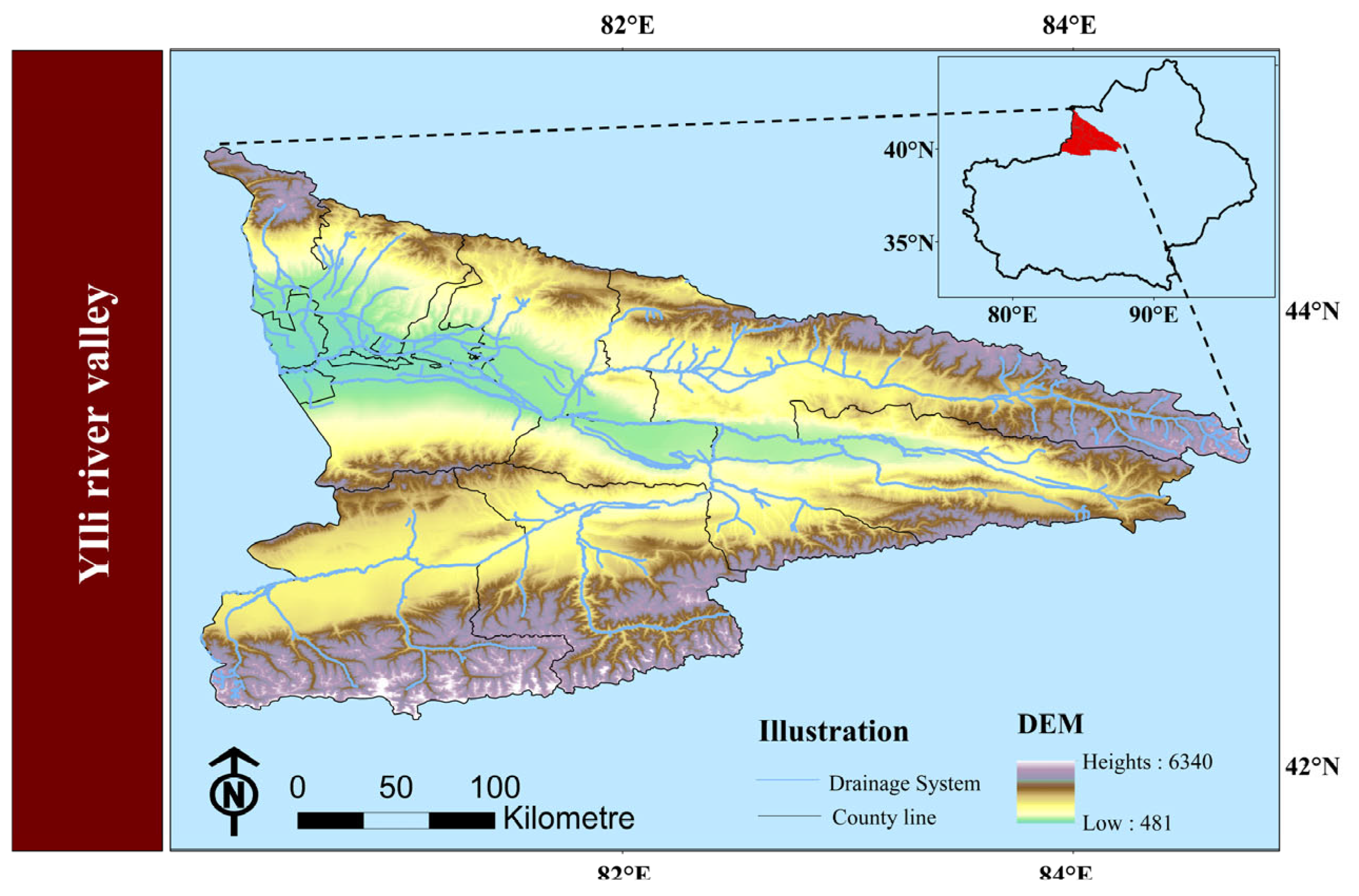
Figure 2.
Research framework diagram.
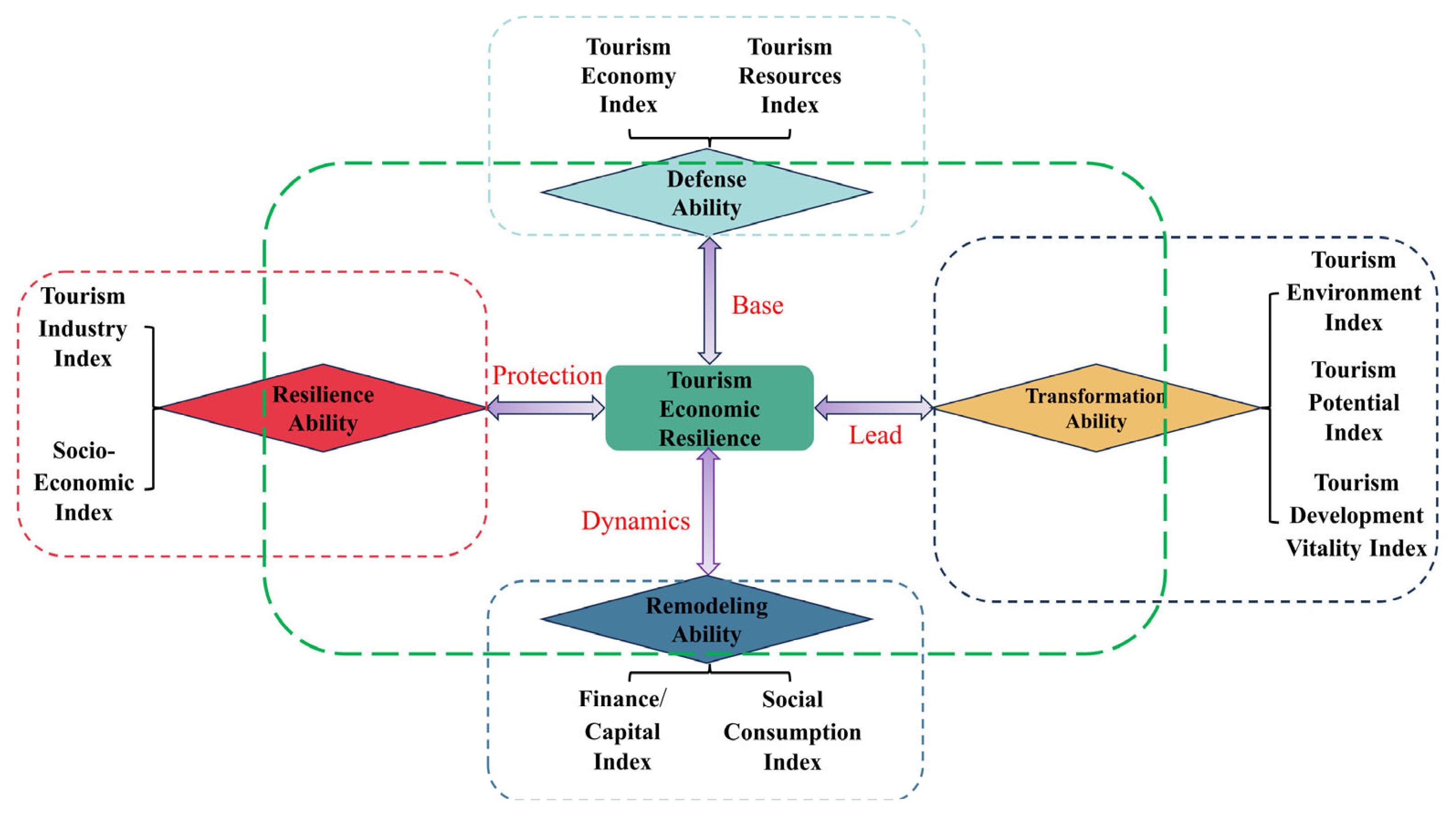
Figure 3.
Time-series of changes in the level of economic resilience of tourism in the Yili River Valley.
Figure 3.
Time-series of changes in the level of economic resilience of tourism in the Yili River Valley.
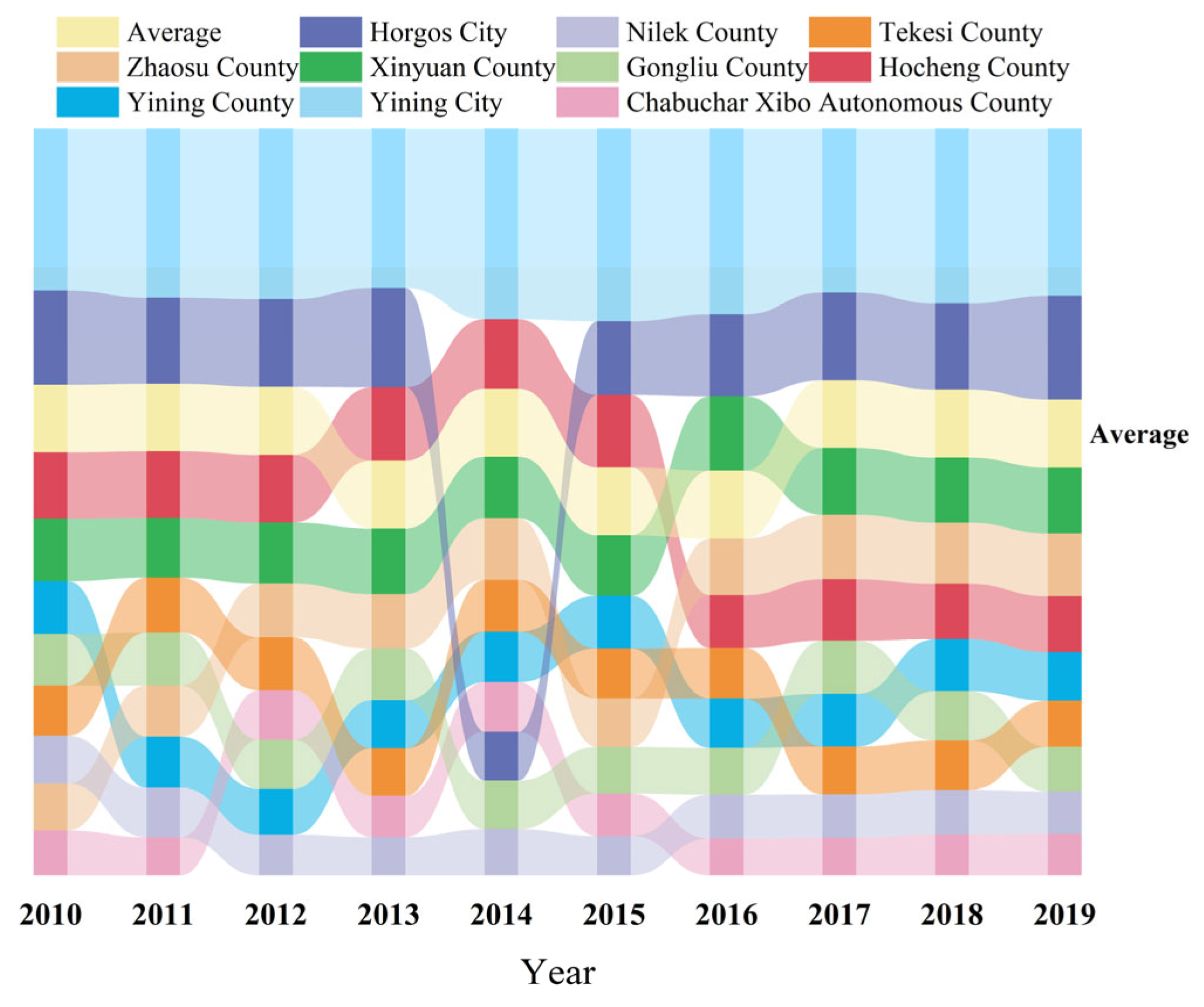
Figure 4.
Spatial Characteristics of Tourism Economic Resilience Levels in the Yili River Valley, 2010-2019.
Figure 4.
Spatial Characteristics of Tourism Economic Resilience Levels in the Yili River Valley, 2010-2019.
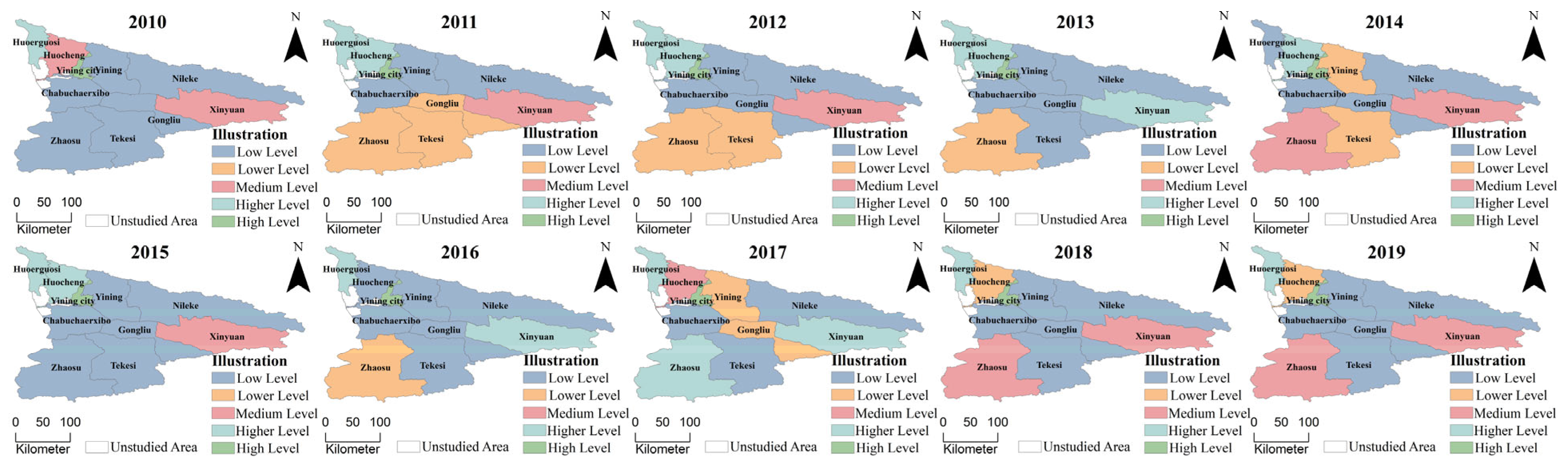
Figure 5.
Standard Deviation Ellipse of tourism economic resilience level and its center of gravity shift trajectory in Yili River Valley, 2010-2019.
Figure 5.
Standard Deviation Ellipse of tourism economic resilience level and its center of gravity shift trajectory in Yili River Valley, 2010-2019.
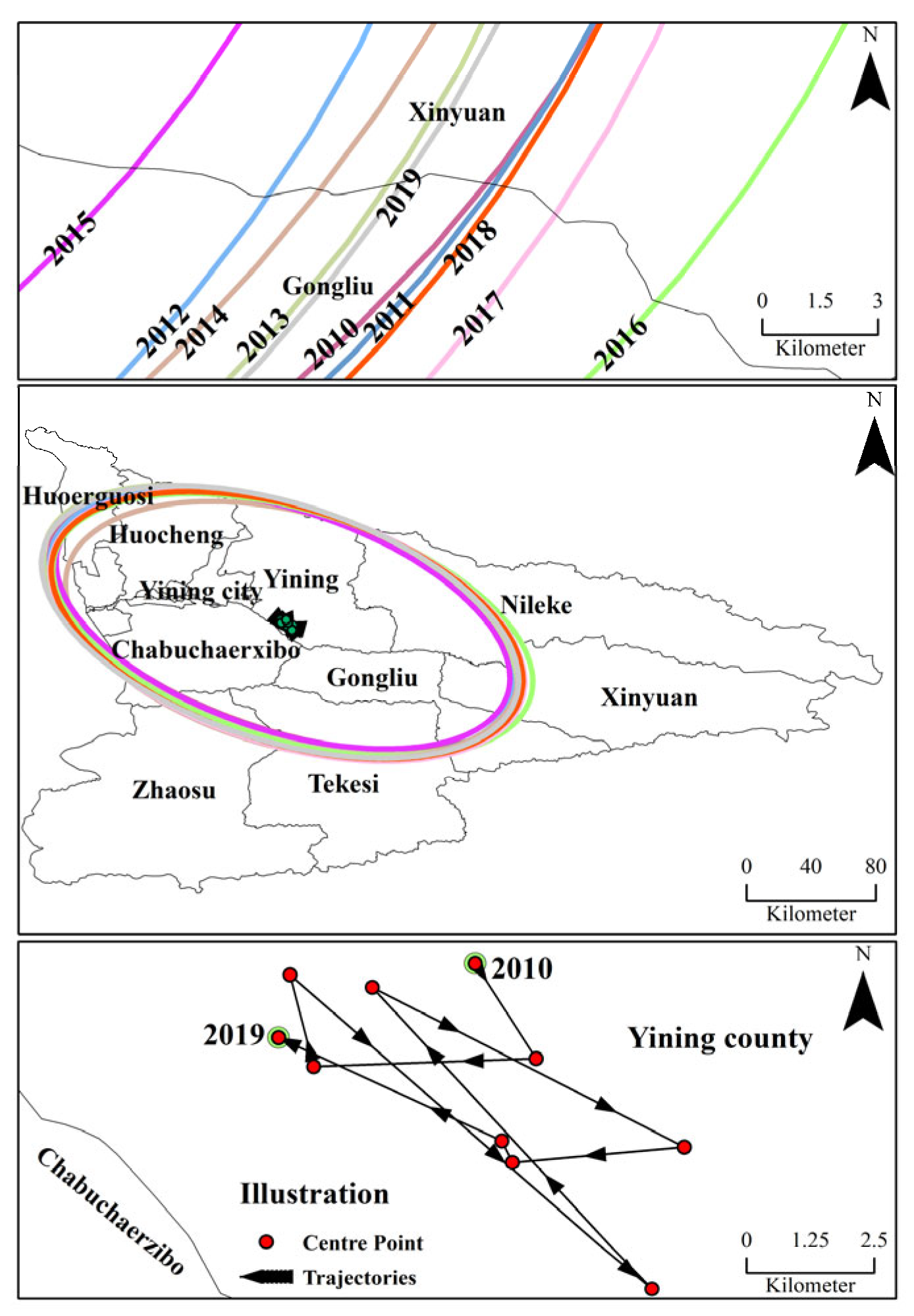
Table 1.
Evaluation index system of tourism economic resilience level.
| Primary Indicators | Secondary Indicators | Tertiary Indicators | Unit | Weights |
|---|---|---|---|---|
| Defense Ability | Tourism Economy Index |
Tourism Reception | ten thousand people |
0.048669 |
| Gross Tourism Income | 10K CNY | 0.057321 | ||
| GDP per capita | yuan | 0.04359 | ||
| Tourism Resources Index |
Number of A-grade scenic spots | pcs | 0.031395 | |
| Recovery Ability | Tourism Industry Index |
Number of travel agencies | pcs | 0.112212 |
| Number of rooms in star-rated hotels | pcs | 0.072538 | ||
| Socio-Economic Index | Night Lights | / | 0.119606 | |
| Value Added of Tertiary Industry |
billion | 0.07995 | ||
| Resident Population | ten thousand people | 0.022688 | ||
| Remodeling Ability | Finance/Capital Index | Investment in Social Fixed Assets |
10K CNY | 0.042493 |
| General Public Budget Expenditure |
10K CNY | 0.026415 | ||
| Social Consumption Index | Tertiary Industry Output Value as % of GDP | % | 0.03114 | |
| Total Retail Sales of Consumer Goods | 10K CNY | 0.057466 | ||
| Transformation Ability | Tourism Environment Index | NDVI | % | 0.017156 |
| Waste Gas Emission | Million Nm3 | 0.009544 | ||
| Wastewater Emission | ten thousand t | 0.012967 | ||
| Comprehensive utilisation rate of solid waste | % | 0.015342 | ||
| Tourism Potential Index | Number of students in secondary schools |
people | 0.027383 | |
| Number of employees in tertiary industry | ten thousand people |
0.050973 | ||
| Advanced industrial structure | % | 0.03508 | ||
| Urbanisation rate | % | 0.020962 | ||
| Tourism Development Vitality Index | Ratio of tourists to permanent residents | % | 0.06511 |
Note: The full name of NDVI is Normalized Difference Vegetation Index; the weights are calculated according to the entropy weighting method, and the average value of the weights from 2010-2019 is taken.
Table 3.
Spatial Markov Chain Transfer Probability Matrix for Tourism Economic Resilience in the Yili River Valley, 2010-2019.
Table 3.
Spatial Markov Chain Transfer Probability Matrix for Tourism Economic Resilience in the Yili River Valley, 2010-2019.
| Type of field | t/t+1 | Low level | Lower level | Medium level | Higher level | High level | n |
|---|---|---|---|---|---|---|---|
| Low level | 1 | 0 | 0 | 0 | 0 | 0 | 0 |
| 2 | 0 | 0 | 0 | 0 | 0 | 0 | |
| 3 | 0 | 0 | 0.571429 | 0.428571 | 0 | 28 | |
| 4 | 0 | 0 | 0.009901 | 0.80198 | 0.188119 | 101 | |
| 5 | 0 | 0 | 0 | 0.009501 | 0.990499 | 421 | |
| Lower level | 1 | 0.837209 | 0.139535 | 0 | 0.023256 | 0 | 43 |
| 2 | 0 | 0.842105 | 0.157895 | 0 | 0 | 38 | |
| 3 | 0 | 0 | 0.9 | 0.1 | 0 | 10 | |
| 4 | 0 | 0 | 0 | 0 | 0 | 0 | |
| 5 | 0 | 0 | 0 | 0 | 0 | 0 | |
| Medium level | 1 | 0.917404 | 0.079646 | 0.00295 | 0 | 0 | 339 |
| 2 | 0.021505 | 0.892473 | 0.086022 | 0 | 0 | 93 | |
| 3 | 0 | 0.1 | 0.9 | 0 | 0 | 10 | |
| 4 | 0 | 0 | 0 | 0 | 0 | 0 | |
| 5 | 0 | 0 | 0 | 0 | 0 | 0 | |
| Higher level | 1 | 0 | 0 | 0 | 0 | 0 | 0 |
| 2 | 0 | 0 | 0 | 0 | 0 | 0 | |
| 3 | 0 | 0 | 0 | 0 | 0 | 0 | |
| 4 | 0 | 0 | 0 | 0.75 | 0.25 | 24 | |
| 5 | 0 | 0 | 0 | 0 | 1 | 102 | |
| High level | 1 | 0.763682 | 0.228856 | 0.004975 | 0.002488 | 0 | 402 |
| 2 | 0.0144 | 0.7744 | 0.2064 | 0.0048 | 0 | 625 | |
| 3 | 0 | 0.015942 | 0.817391 | 0.166667 | 0 | 690 | |
| 4 | 0.001727 | 0.001727 | 0.022453 | 0.908463 | 0.06563 | 579 | |
| 5 | 0 | 0 | 0 | 0.010695 | 0.989305 | 187 |
Table 4.
Indicators of factors influencing the resilience of the tourism economy.
| Impact factors | Representative Indicators | Properties |
|---|---|---|
| Defense Ability | Tourism Reception (X1) | Forward |
| Gross Tourism Income (X2) | Forward | |
| Resilience Ability | Number of travel agencies (X3) | Forward |
| Night Lights (X4) | Forward | |
| Remodeling Ability | Investment in Social Fixed Assets (X5) | Forward |
| Total Retail Sales of Consumer Goods (X6) | Forward | |
| Transformation Ability | Number of employees in tertiary industry(X7) | Forward |
| Ratio of tourists to permanent residents(X8) | Forward |
Note: Night Lights represent socio-economic indices.
Table 5.
Grey Relation Analysis results.
| Implicit Variable | X1 | X2 | X3 | X4 | X5 | X6 | X7 | X8 |
|---|---|---|---|---|---|---|---|---|
| r | 0.9029 | 0.8604 | 0.7716 | 0.8189 | 0.8880 | 0.8563 | 0.9111 | 0.8146 |
| p | 0.0000 | 0.0000 | 0.0000 | 0.0000 | 0.0000 | 0.0000 | 0.0000 | 0.0000 |
Disclaimer/Publisher’s Note: The statements, opinions and data contained in all publications are solely those of the individual author(s) and contributor(s) and not of MDPI and/or the editor(s). MDPI and/or the editor(s) disclaim responsibility for any injury to people or property resulting from any ideas, methods, instructions or products referred to in the content. |
© 2024 by the authors. Licensee MDPI, Basel, Switzerland. This article is an open access article distributed under the terms and conditions of the Creative Commons Attribution (CC BY) license (http://creativecommons.org/licenses/by/4.0/).
Copyright: This open access article is published under a Creative Commons CC BY 4.0 license, which permit the free download, distribution, and reuse, provided that the author and preprint are cited in any reuse.


