
Submitted:
16 May 2023
Posted:
16 May 2023
You are already at the latest version
Abstract
Tourism sustainability is a significant approach to forming a synergistic model of industry and ecology in ecologically vulnerable areas. Scientifically detecting the effect mechanism of tourism development (TDI) on eco-environment resilience (ERI) is important in achieving regional social-ecological system sustainability. Empirical exploration is conducted on the levels of TDI and ERI in the Yangtze River Economic Belt (YREB) to study the spatiotemporal heterogeneity of TDI's effect on ERI. The results indicate a significant growth in TDI in the YREB, with the formation of tourist clusters around Shanghai and Chongqing as the core. Although ERI typically exhibits a declining trend, the rate of decline has notably slowed, forming a "high at the sides and low in the middle" spatial pattern. TDI and ERI are spatially dependent in the YREB, with predominantly high-high (HH) and low-high (LH) clusters in Shanghai, Zhejiang, and Jiangsu. Conversely, upstream regions with strong eco-environmental foundations exhibit low-low (LL) and high-low (HL) clusters. In general, TDI promotes ERI, but there is significant spatiotemporal heterogeneity in the YREB. Positive impact regions are expanding, while negative impact regions are shrinking. These results could provide scientific evidence for differentiated classification and control policies in the YREB.
Keywords:
tourism development
; eco-environment resilience
; spatiotemporal heterogeneity
; Yangtze River Economic Belt of China
1. Introduction
The eco-environment system is an artificial ecological system gradually formed by residents in the process of adaptation, production, and invention to the natural environment [1]. Under the impact of multiple external environments such as globalization, urbanization, industrialization, and natural disasters, urban ecosystems are facing a series of issues such as increasing environmental risks, frequent resource shortages, and ecological degradation [2,3,4,5]. Therefore, how to enhance the eco-environment resilience (ERI) in the face of external shocks becomes the focus of the sustainability of the cities [6]. Multiple perturbations from tourism activities continue to affect the ecosystem of tourist destinations [7], and economic growth of tourism based on the ERI enhancement is an approach that is vital to the sustainability in the tourism destinations [8]. Therefore, an exploration of the spatial relationship and influence mechanism between tourism development (TDI) and the ERI is not only beneficial to macro-regulation of regional tourism development direction, but also important to strategic significance for achieving synergistic development of tourism and ecosystem.
The concept of resilience first originated in systems ecology and has since been widely applied in the humanities and social sciences [9,10], and its development process gradually shifted from the engineering [11] and ecological resilience [12] of the equilibrium to evolutionary resilience [13]. of the evolutionary argument. Since the first mention of the “urban resilience” by the International Council for Sustainable Regional Development (ICLEI) in 2002 [14], the theory and practice of urban resilience is the focus of research in geography, ecology, and other disciplines, which has provided solutions to urban problems that are characterized by process regulation, active response, and comprehensive enhancement for sustainable urban development [15]. Although the definition of urban resilience is not yet agreed [16,17,18], there is generally recognized that urban resilience is a combination of resistance, adaptation, organizational learning, and recovery of urban systems in response to various disturbances and stresses, which can promote urban sustainable development [19,20].
The ERI has received wide attention from academics as an important dimension of urban resilience [9,15]. It focused mainly on the assessment and influencing factors of the ERI. The comprehensive assessment is an important part of the scientific cognition of the ERI. There is no unified assessment standard and research paradigm [16,21], and most of them start from the basic characteristics of the ERI and build a comprehensive assessment framework of the ERI in terms of resistance, adaptability, and resilience of urban ecosystems in response to disturbances or risks [22,23,24,25]. The influence factors of the ERI are diverse and the mechanism of action is complex. The urbanization process has promoted the concentration of the population in cities, and the increase in urban population density has had a more obvious negative effect on the carrying capacity of its eco-environment [2,26]. Industrial transformation, technological innovation, and environmental policies will continuously promote the quality of urban ecosystems and the urban ERI [3,27,28,29].
Tourism has been a hot topic of interest for scholars to research the impact it brings to the ecosystem as an important support for the industrial transformation of tourism destinations [30,31,32,33,34,35]. Scholars have explored the negative impacts of the TDI on ecosystems in three main ways. Firstly, the construction and operation of tourism transportation infrastructure such as airports, highways, and cruise ships depend on the use of energy resources. Some scholars believe that transportation is the main cause of environmental pollution [36,37]; Secondly, the irrational planning, development, and management of tourism destinations can also lead to the degradation of tourism destination ecosystems [30,38,39]; Thirdly, the most discussed issue among scholars is the impact brought by tourists. Tourist flows can exert ecological and environmental pressures on tourism sites [32]. Empirical studies have been made to explore the influence of tourist activities on specific eco-environmental elements such as soil, vegetation, energy consumption, biodiversity, and CO2 emissions, using national parks and seaside tourism sites as case study sites [40,41,42,43,44]. The concept of over-tourism is mentioned, where the influx of tourists to tourist destinations leads to overcrowding that surpasses the ecosystem of the destination’s capacity [36,45,46].
In contrast, some scholars have argued that the TDI has a clear positive role in ecology. The increase in tourism revenue can both improve infrastructure, create jobs [47,48], and finance the ecosystem upgrading of tourist destinations [49,50,51]. Meanwhile, tourism-led industrial structure optimization has a beneficial function in improving the ecosystem of tourism destinations. Alam and Paramati (2017) explored the correlation with the tourism investment and CO2 emissions, concluding that the tourism investment enhances the quality of the ecosystem by reducing CO2 emissions in tourism destination countries [52].
In addition, comprehensive ecological and environmental assessment of tourism sites has received much attention [45]. Some scholars have conducted studies on the environmental carrying capacity, eco-environmental quality [53], and eco-environmental system resilience [13] of tourism sites, and have extensively used models and methods such as ecological footprint [54], system dynamics [13], statistical analysis methods [55], network analysis (ANP)[56], OLS, vector autoregression(VAR)[57], co-integration analysis and Granger causality test [58] to comprehensively measure the changes in eco-environmental system caused by the TDI.
The above studies show that the research on the relations of the tourism and ecosystems has become a hot topic [32]. However, previous studies have found that tourism has had both beneficial and detrimental impacts on ecosystems. Our question is: Is the role of the TDI on the ERI of tourism destinations in an intact region facilitated or inhibited, or do both coexist? Do spatial factors play a role in this process? Therefore, this paper comprehensively evaluates the TDI and ERI based on constructing the assessment system, explores the spatiotemporal distribution and their relationships of the TDI and ERI, and reveals the impact and its heterogeneity of the TDI on the ERI (Figure 1).
2. Materials and Methods
2.1. Study Area
The YREB spanning eastern, central, and western China can be divided into three sections: downstream, midstream, and upstream, involving 11 provinces such as Shanghai, Zhejiang, Hubei, Chongqing, and Yunnan, with a land area of about 2.05 million km2, and is a pioneering demonstration belt for China’s economy and the ecological civilization (Figure 2). The issuance and implementation of the “Outline of YREB Development Plan” and other documents by the State Council marked that the YREB has been officially elevated to a national strategy.
The YREB is unique in the TDI, with a dense population in the region, a high degree of development of the urban cluster, and abundant and diversified tourism resources, making it an important tourist destination. However, while the tourism economy is increasing rapidly, the hidden dangers of the ecosystem have not been eliminated. The rapid urbanization process with high population concentration has put great stress on the regional eco-environment. Tourism is an essential support to the YREB for “ transferring mode and adjusting structure “, and it is especially important to coordinating the related of the TDI and ERI.
2.2. Data Sources
This paper takes 126 cities in the YREB as the objects. To ensure geospatial integrity, Tianmen, Xiantao, Qianjiang, and Shen Longjia Forest Area administered by Hubei Province are also included in the study, totaling 130 administrative units. The required data come from Statistical Yearbook or bulletins such as “China Regional Economic Statistical Yearbook”,” China City Statistical Yearbook”, “China Environmental Statistical Yearbook”.
Always, the YREB has taken the pursuit of economy speed as its primary goal, leading to prominent issues such as resource constraints, pollution intensification. In particular, the cyanobacterial pollution outbreak in Taihu Lake and Chaohu Lake in 2007 brought widespread attention to the protection of water resources in the YREB; China formally proposed the construction goals of the YREB as a “green ecological corridor” in 2014; At the end of 2018, China further established the direction of promoting regional socio-economic development with “green and ecological” as the core. Therefore, the years of 2007, 2013, and 2019 are selected as the timepoints in this paper.
2.3. Methods
2.3.1. Evaluation Indicator System for the TDI and ERI
Tourism, as a prototypical modern service industry, plays a vital role in promoting the sustainability of cities. A comprehensive and sustainable evaluation of Tourism Destination Infrastructure (TDI) is critical to achieving this objective [59,60,61,62]. The sustainability of TDI involves the gradual optimization and alignment of tourism supply and demand, as well as the interactive integration of tourists with the society and environment of the tourism destination that reflects Human-Land relations [63,64,65]. Therefore, this study develops a TDI assessment system from the perspective of the Human-Land relationship. Specifically, the “human” aspect centers on the tourist’s product experience and the destination’s market scale during tourism activities. In contrast, the “land” component captures the socio-economic impacts of TDI on the destination, measured by the tourism industry’s socioeconomic contributions.
The ERI signifies the diverse capacities of urban ecosystems to withstand (resistance), adjust to changes (adaptability), and recuperate (recovery) when faced with external disturbances and hazards [22,23,24,25]. Resistance demonstrates the active fight against external pressure by urban ecosystems, while adaptability denotes the ability of an ecosystem to modify itself and adjust under external threats or perturbations. On the other hand, recoverability refers to the flexibility and the eco-environmental system’s recuperation capacity to return to its original state in case of external disturbances. Considering the basic characteristics of ERI, this paper creates an ERI evaluation system based on three dimensions, namely, resistance and pressure, adjustment and adaptation, and flexibility and recovery.
Thus, adhering to the demands of scientific rigor, systematicity, and accessibility and considering prior research [22,25,66], this paper cherry-picked 26 indicators, including total tourism income, tourist attractions, land use intensity, greenery coverage, and population density, to construct an assessment system for TDI and ERI. Refer to Table 1 for the complete assessment system.
2.3.2. Comprehensive Assessment Model (CAM)
In this paper, the multi-objective linear weighting is applied to build a CAM of the TDI and ERI. The method consists of three steps:
Step1: Since the units of each indicator data are inconsistent, the data require being normalized initially [66]. If the indicator is positive,
If the indicator is negative,
where years and indexes are represented by i and j, respectively.
Step 2: Reasonable determination of index weights is the basic premise of the assessment. The weights are established using the entropy method [67]:
where is the entropy of the index j; is the weight of index j.
2.3.3. Bivariate Spatial Autocorrelation Analysis (BISA)
The BISA could usefully detect the spatial correlation characteristics of multiple geographic variables, which is divided into bivariate global and local spatial autocorrelation (BI-GMSA and BI-LISA) [71,72]. This paper uses BISA to reveal the spatial dependence of TDI and ERI from global and local perspectives.
where and are the Global and Local Moran Index of the TDI and ERI, respectively; and represent the values of TDI and ERI, respectively; and are the exponential variances and w is the weight.
2.3.4. Spatial Econometric Model
The Spatial Econometric Models are the incorporation of spatial factors into an econometric regression model that captures the spatial interactions of geographic phenomena [72,73], including SLM, SEM, SEMLD model, etc. The SLM model includes the spatial correlation of dependent variables; The SEM model incorporates the spatial relation into the error term and emphasizes the influence of error shock; The SEMLD model considers both the spatial relationship of the explained variable and the extrinsic association of the error term [74,75].
The equation of SLM model is:
The equation of SEM model is:
The equation of SEMLD model is:
where X and Y are the independent and dependent variables respectively; ρ and λ are the coefficients of the spatial lag and error, respectively. β is the estimation coefficient; ε is the error vector.
2.3.5. Geographically Weighted Regression (GWR)
The GWR can spatially estimate parameters for each geographic space, which can carry out local regression estimation based on geographical location changes, and better reflect spatial correlation and dependence of geographical units [76,77,78]. The equation is as follows:
where (ui,vi) is the lat/long coordinates; βk(ui,vi) is the coeff. of regression.
3. Results
3.1. Spatiotemporal Characteristics of the TDI and ERI
3.1.1. Spatiotemporal Characteristics of the TDI
The CAM has been utilized to derive the ERI value in the YREB for the years 2007, 2013, and 2019. The computed results are summarized in Table 2.
Based on chronological evolution, the TDI value in the YREB experienced a significant increase from 4.18 to 12.51 between 2007 and 2019, with a growth rate of 15.33% per annum. Across the regions, the average TDI of upstream, midstream, and downstream all exhibit a noticeable upward trend. Amongst them, the downstream experienced the most substantial growth with a growth rate of 25.52% yearly, while the growth rate of upstream and midstream was more moderate, at 16.86% and 12.61% per annum, respectively. Contrastingly, the downstream in the YREB has exhibited a sturdy economic foundation, well-developed transport network, and prime market location. Consequently, the downstream TDI witnessed a more rapid growth rate compared to the midstream and upstream regions.
Arc GIS10.2 was applied to visualize the TDI in 2007, 2013, and 2019 and classified into four levels to reveal the evolutionary characteristics of the TDI in the YREB (Figure 3).
Although the TDI in the YREB has increased significantly during the study period, the spatially differentiated characteristics of TDI are obvious. The TDI of regional central cities such as Shanghai, Chongqing, Hangzhou, Nanjing, Chengdu, Wuhan, and Changsha have been at a high level, and these cities are all tourism hotspots, with abundant tourism resources and solid economic foundations making the TDI generally high. In contrast, the TDI of regional peripheral cities such as northern Jiangsu, southern Hubei, northeastern Yunnan, and southern Sichuan are low, and the tourist attraction and tourism facilities construction are significantly different from those of the central cities.
Meanwhile, the clustering characteristics of the TDI in the YREB continue to be highlighted. During the study period, it initially formed the pattern of the tourist clusters with Shanghai as the core in the downstream and Chongqing as the core in the upstream. And the scope of the tourist clusters continues to expand, with the downstream tourist cluster expanding to Zhejiang and Jiangxi and the upstream tourist cluster expanding to Sichuan and Guizhou.
3.1.2. Spatiotemporal Characteristics of the ERI
The CAM is applied to obtain the value of the ERI in the YREB in 2007, 2013, and 2019. Table 3 shows the overall calculation results.
From the chronological evolution, the value of the ERI in the YREB declined during the study period, from 9.31 to 7.55, with a rate of decline of 1.45% per year, which implies an overall weakening trend in ERI. By stages, the value of the ERI slowed down significantly in 2013-2019 relative to the decline from 2007-2013, and its average annual decline decreased from 1.21% to 0.21%. In addition, the average ERI of the downstream began to show a significant upward trend. This indicates that the transformation of resource conservation in the YREB has slowed down the degradation of the urban eco-environment, especially in the downstream, where the shift to green and high-quality urban development has achieved initial results.
With the help of ArcGIS10.2, the ERI is classified into four levels, and the results are shown in Figure 4. From the spatial pattern, the cities of high level in the YREB are mainly Shanghai of the downstream and Ganzi Prefecture in Sichuan of the upstream; the cities of relatively high level such as Suzhou, Wuxi, Changzhou, Nanjing, Jiaxing, Aba Prefecture, and Liangshan Prefecture are distributed around the cities of high level, while the low and relatively low cities are primarily located in the midstream of the YREB. In general, the spatial pattern of “collapse in the middle” with “two high ends and low middle” is more obvious and has not changed substantially.
3.2. Spatial relationship between the TDI and ERI
The present paper employs the BISA method to uncover the global and local spatial correlation of TDI and ERI in the YREB region. BI-GMSA results reveal that the global Moran’s I of TDI and ERI in the YREB region, in 2007, 2013, and 2019, stand at 0.13, 0.14, and 0.11, respectively. All these findings are statistically significant and demonstrate the existence of significant positive spatial correlation between TDI and ERI. The results strongly suggest that TDI has enriched ERI levels in the YREB region. Meanwhile, BI-LISA findings reveal the presence of four types of spatial clustering relationships between TDI and ERI in the region, namely HH, HL, LH, and LL (Figure 5).
The HH-type represents neighborhoods where both TDI and ERI have high values, and symbiotically promote each other’s development. This type is primarily concentrated in Shanghai, Zhejiang, and southern Jiangsu regions. The LH-type, on the other hand, is majorly distributed around HH-type areas, spanning central Jiangsu, northern Jiangsu, and southern Anhui. Hence, the TDI and ERI of the LH-type area display a negative relationship in space. Compared with the HH-type areas, the TDI still has considerable room for improvement. The HL-type is predominantly found in Chongqing, eastern Guizhou, and western Hunan. This region has abundant tourism resources and rapid tourism economic growth but also places tremendous pressure on its eco-environment. The LL-type, scattered around the HL-type areas, is primarily mountainous and boasts of sound eco-environmental conditions. Therefore, a major challenge is to boost both ERI and TDI simultaneously. Overall, the HH-type and LH-type cities should focus on eco-environmental protection and promote the synergy of TDI and ERI through a shift towards high-quality tourism development. In contrast, the HL-type and LL-type cities should not jeopardize ERI in favor of tourism economic growth, even though they have a more robust eco-environmental foundation.
3.3. The effect of the TDI on the ERI
3.3.1. Model construction
This paper constructs a model of the effect of the TDI on the ERI from the classical STIRPAT environmental impact model, which has the following standard form [79,80,81]:
where I is the environmental variable, P, A, T are the demographic, economic, and technological variables respectively; b, c, and d are the variable index values.
By adding the TDI as a variable in the STIRPAT model and taking logarithms on both sides to eliminate the effect of heteroskedasticity, the model of the effect of the TDI on the ERI is obtained with the following equation:
where POP is the population density; GDP indicates the city affluence; OPEN is the external development level, expressed as the ratio of FDI to GDP.
3.3.2. Overall effect analysis
This study employed OLS for model estimation (Table 4). The results show that Moran’s I of the residuals is significantly positive in 2007, 2013, and 2019. Besides, its spatial error term and spatial lag term are also statistically significant. These findings suggest a noticeable spatial reliance of model residuals, leading to bias in the estimation results if spatial correlation attributes are disregarded. Remarkably, the R2 of the SEM, SLM, and SEMLD all experience a significant improvement after accounting for spatial correlation. This is a clear indication that spatial econometric models with spatial factors incorporated outshine those without. Notably, when comparing the SEM, SLM, and SEMLD test results, the SEMLD generates relatively smaller values of both Schwartz (SC) and Akaike information criterion (AIC) and relatively larger likelihood (LogL). These results demonstrate the SEMLD model’s superior capacity to model the TDI’s impact on ERI, making it the optimal model for this study.
As per the SEMLD findings, LnTDI’s regression coefficients are significantly positive, indicating that TDI generally bolsters ERI. This can be attributed to two key factors. Firstly, TDI can incentivize destination cities to focus on maintaining and enhancing eco-environmental standards while ensuring greater ecosystem recovery and capacity. Secondly, TDI can assist in optimizing the industrial structure of destinations and augmenting the adaptability of urban ecosystems. The regression coefficient of LnTDI, upon initial decrease, indicates that an exclusive focus on tourism industry’s economic functions has an insignificant impact on ERI performance. Hence, it is imperative to prioritize the value of multifaceted ecological and social functions of TDI.
Furthermore, it is worth noting that Spatial-lag is significantly positive, thereby confirming the presence of a spatial spillover effect on the ERI. The urban ERI is expected to expand by approximately 0.35% for every 1% increase in the ERI of neighboring cities. This, in turn, results in an ERI growth “gift” from the neighbors [82]. Several factors contribute to this phenomenon, including the ERI’s reflection of the intricate combination of ecosystem resistance, adaptability, and recovery. Moreover, a positive ERI development has a constructive impact on neighboring cities’ ecosystems through emulation and diffusion of technological innovations. Correspondingly, the Spatial-err of SEMLD models is also significantly positive, proving that ERI in the YREB region is not only influenced by the TDI but also other factors, such as population density and economic growth.
3.3.3. Heterogeneity analysis of the effect
SEMLD, a spatial econometric model, provides a global perspective for analyzing the impact of TDI on ERI, failing to capture spatial differences in impacts. To reveal hidden local differences behind overall regression results, this paper employs GWR to estimate the spatiotemporal heterogeneity of TDI’s impact on ERI. According to Table 5’s GWR test results, the R2 values range from 0.471 to 0.620, marking significant improvement over the OLS R2 values (0.118-0.165). Meanwhile, metrics such as AICc, AIC, and SSE demonstrate significant reductions when compared with OLS, suggesting that GWR has a superior explanatory power for spatiotemporal heterogeneity estimation.
This paper utilizes ArcGIS 10.2 and Jenks natural breakpoint method to visualize the geographically weighted regression estimation outcomes. This technique provides detailed information on the TDI’s effect intensity on the ERI, as well as its spatiotemporal variation in 2007, 2013, and 2019 (Figure 6). The estimated coefficients’ sign and magnitude indicate the direction and intensity of the TDI’s impact on ERI, respectively.
The estimation results indicate that the TDI has evident spatiotemporal heterogeneity on ERI in the YREB, exhibiting both positive facilitative and negative inhibitory effects. From the spatial pattern, regions with positive effects concentrate in Yunnan and Sichuan in the upstream and the YRD in the downstream. The range of regions with high-intensity positive effects is expanding continuously over time. Regions with negative inhibitory effects are concentrated in Jiangxi, Hubei, and Hunan in the midstream, and this region exhibits a more distinct narrowing trend. This suggests that cities in the YREB not only focus on the scale growth of tourism development but also emphasize tourism’s comprehensive benefits. Consequently, they strive to promote the capacity of urban ecosystems to withstand pressure from quality development of tourism and adjust their ability to recover.
4. Discussion
4.1. Spatiotemporal characteristics and spatial correlation of the TDI and ERI
According to the findings, from 2007 until 2019, the TDI in the YREB increased significantly with an annual growth rate of 15.33%. This growth can be attributed to factors such as tourism resource endowment and socio-economic development, which are supported by previous research [33,83,84]. The YREB is rich in tourism resources including a variety of distinctive features, accounting for more than 40% of China’s high-level tourism resources [85]. Additionally, socio-economic factors such as transportation, economy, and urbanization are the main drivers behind TDI growth [35,86]. The growth of TDI is fundamentally linked to the endowment of tourism resources in a region, as noted by Min (2015) and Xiao et al. (2022) [32,39]. Moreover, in line with prior research, the TDI and its growth exhibit a discernible spatial heterogeneity [87]. The central cities and their urban agglomerations manifest high TDI values due to favorable location, abundant tourism resources, and rapid socio-economic development, which fosters the formation of tourism industry agglomerations with central cities as the hub.
The YREB, a significant industrial agglomeration in China, has made a noteworthy contribution to the country’s economy. However, this economic growth comes at a cost, as the environmental quality suffers [87,88]. The results bear out this assertion, with the ERI in the YREB exhibiting an overall decline of 1.45% per year. Nevertheless, the declining trend of the ERI from 2013 to 2019 has decelerated significantly, particularly downstream, where the ERI has improved considerably. This outcome is attributable to the national policy prioritizing eco-environmental protection, particularly along the YRD. Since 2013, the State Council of China has released several policy documents pertaining to environmental conservation along the YREB. The implementation of these policies has curtailed the unabated deterioration of the ERI and stimulated the transition of the YRD to embrace a resource-saving and ecologically-friendly development approach.
Furthermore, prior research has established a correlation between the TDI and ERI [32,44]. However, limited attention has been given to studying the spatial correlation between the two indices. This study reveals that the global Moran’s I of the TDI and ERI in the YREB shows a significant positive correlation, with overall positive spatial autocorrelation being more pronounced. This indicates that, in general, areas with high TDI have a conducive impact on the ERI of neighboring regions, while areas with high ERI have a positive effect on the TDI of neighboring cities. Nevertheless, although local correlation results establish a significant positive correlation between TDI and ERI in certain areas, some regions exhibit negative or insignificant spatial correlation. Thus, how to drive or spread the ERI or TDI of surrounding regions via cities with high TDI or ERI assumes essential importance for the region in the future [44,61].
4.2. Heterogeneity in the effect of the TDI on ERI
Previous studies have extensively deliberated on the binary contradictory nature of the simultaneous positive and negative impacts [30,44]. However, relatively less attention has been given to exploring the spatiotemporal heterogeneity of the impact of the TDI on the ERI within a specific region. Consistent with prior research findings, the TDI has a more pronounced influence on the ERI, with both negative and positive impacts coexisting. This primarily stems from the approach adopted towards assessing the TDI [34,39]. Cities prioritizing the eco-environmental effects within the TDI, underpinned by a sustainable development concept, foster a positive impact on the ERI. Conversely, certain cities, solely emphasizing the expansion of the tourism economy, while disregarding eco-environmental conservation, promote the rapid growth of urban tourism while compromising eco-environmental protection [85,87].
Furthermore, it has been observed that over time, the areas where the TDI generates catalytic effects on the ERI are expanding, whereas the regions where it has an inhibitory effect are diminishing. This spatiotemporal heterogeneity implies that an increasing number of cities in the YREB are now prioritizing eco-environmental protection over merely industrial scale and economic growth while developing tourism [87]. This has inevitably fostered the coordinated development between TDI and ERI [86]. On one hand, by enhancing the eco-environment’s aesthetics and optimizing it to create a welcoming tourist destination [49,89]. On the other hand, by utilizing tourism to enhance the ecosystem’s resilience and adaptability to withstand internal and external pressures [32,50,54].
Furthermore, in line with existing research findings [6,13,27], this study also reveals the significant spatial spillover effect of the Ecosystem Risk Index (ERI). The spatial spillover intensity of the ERI stands at 0.35; hence, for every 1% growth in the ERI of its neighbors, the urban ERI experiences an increase of approximately 0.35% which is deemed a “gift” from neighboring regions [82]. The spatial effect of the ERI is attributable to the YREB’s environmental protection policy [90], technological innovations in environmental protection and its knowledge diffusion [82], and the demonstration effect of environmental protection performance [25,53].
4.3. Policy Implications
To commence, cities in the YREB must prioritize the high-quality promotion of the TDI. This shall be achieved by embracing the concept of high-quality development, promoting the transformation of TDI, implementing resource conservation and carbon emission reduction methods, building a modern urban tourism industry system, exploiting the eco-environmental effects of the TDI, and continuously improving the ERI.
Secondly, classified policies should be established to promote the positive effect of TDI on ERI. The region should focus on strengthening the promotion of TDI to the ERI in the YRD and Southwest China, continuing optimization of the industrial structure, improving the green development level of urban agglomerations in the midstream. Moreover, eco-environmental efficiency of urban tourism development should be enhanced to propel the transformation of the eco-environmental effect of TDI from inhibition to enhancement.
Lastly, it is imperative to jointly develop and upgrade the ERI of the YREB. This can be achieved by strengthening cross-city joint environmental governance, enhancing regions with low ERI to cope with risks, improving the adaptive and recovery capacity of ecosystems. The goal is to jointly build an ecological security pattern along the YREB in a sustainable manner.
4.4. Limitations
There are still certain limitations of this paper that require clarification. Firstly, concerning the selection of indicators for the TDI and ERI, the absence of statistical indicators in some cities has restricted the selection of indicators, potentially influencing the results. Secondly, this paper has only analyzed data from 2007, 2013, and 2019 due to the abundance of data, which may not accurately reflect the evolutionary trajectory and impact trajectory of the TDI and ERI. Therefore, it is crucial to comprehensively understand the evolutionary patterns of TDI and ERI from a procedural standpoint and divulge the spatiotemporal associations between TDI and ERI in greater depth. Both merit further inquiry.
5. Conclusions
This paper uses BISA, SEMLD, and GWR to empirically reveal the spatiotemporal heterogeneity of TDI’s impact on ERI in the YREB. It presents the following conclusions:
Firstly, during the study period, TDI in the YREB experienced significant growth, particularly in the YRD. Concerning spatial distribution, cities such as Shanghai, Chongqing, Hangzhou, Nanjing, Chengdu, Wuhan, and Changsha showed substantial TDI levels and formed tourism industry clusters in the downstream and upstream areas.
Secondly, while ERI showed a declining trend in the YREB, the decline slowed significantly. This trend generated a “central collapse” pattern of “high at both sides and low in the center,” with cities having high ERI levels primarily clustered downstream and in the upstream western Sichuan region.
Thirdly, a definite spatial dependence exists between TDI and ERI in the YREB, with HH and LH types primarily located in the YRD, while HL and LL types concentrated upstream.
Finally, the TDI generally promotes ERI, with its positive influence expanding and negative influence shrinking along spatiotemporal heterogeneity lines.
Author Contributions
Conceptualization, K W., and X Z.; Data curation, X. C., and Z. L.; Funding acquisition, K. W.; Investigation, S. Z.; Software, Z. L.; Visualization, X. C.; Writing—original draft, K. W.; Writing—review & editing, X. Z. All authors have read and agreed to the published version of the manuscript.
Funding
This research was funded by the National Natural Science Foundation of China (No. 41961025).
References
- Liao, L.; Ma, E.; Long, H.; Peng, X. Land Use Transition and Its Ecosystem Resilience Response in China during 1990–2020. Land 2023, 12, 141. [Google Scholar] [CrossRef]
- Liu, H. X.; Li, Y. P.; Yu, L. Urban agglomeration (Guangzhou-Foshan-Zhaoqing) ecosystem management under uncertainty: A factorial fuzzy chance-constrained programming method. Environ Res 2019, 173, 97–111. [Google Scholar] [CrossRef] [PubMed]
- Kattel, G. R.; Elkadi, H.; Meikle, H. Developing a complementary framework for urban ecology. Urban For. Urban Gree. 2013, 12, 498–508. [Google Scholar] [CrossRef]
- Kimberley, W.R.; Albert, K. Escalating trends in the urban metabolism of Hong Kong: 1971–1997. AMBIO: A J. Hum. Environ. 2001, 30, 429–438. [Google Scholar]
- Zhou, X.; Wu, D.; Li, J.; Liang, J.; Zhang, D.; Chen, W. Cultivated land use efficiency and its driving factors in the Yellow River Basin, China. Ecol. Indic. 2022, 144. [Google Scholar] [CrossRef]
- Shi, C.; Zhu, X.; Wu, H.; Li, Z. Assessment of urban ecological resilience and its influencing factors: A case study of the Beijing-Tianjin-Hebei Urban Agglomeration of China. Land 2022, 11, 921. [Google Scholar] [CrossRef]
- Jamaliah, M. M.; Powell, R. B. Ecotourism resilience to climate change in Dana Biosphere Reserve, Jordan. J. Sustain. Tour. 2017, 26, 519–536. [Google Scholar] [CrossRef]
- Marsiglio, S. Economic growth and environment: Tourism as a trigger for green growth. Tour. Econ. 2015, 21, 183–204. [Google Scholar] [CrossRef]
- Adger, W. N.; Hughes, T. P.; Folke, C.; Carpenter, S. R.; Rockström, J. Social-ecological resilience to coastal disasters. Science 2005, 309, 1036–1039. [Google Scholar] [CrossRef]
- Holling, C. S. Resilience and stability of ecological systems. Annu. Rev. Ecol. Syst. 1973, 4, 1–23. [Google Scholar] [CrossRef]
- Gunderson, L. H. Ecological resilience—in theory and application. Annu. Rev. Ecol. Syst. 2000, 31, 425–439. [Google Scholar] [CrossRef]
- Standish, R. J.; Hobbs, R. J.; Mayfield, M. M.; Bestelmeyer, B. T.; Suding, K. N.; Battaglia, L. L.; Eviner, V.; Hawkes, C. V.; Temperton, V. M.; Cramer, V. A.; Harris, J. A.; Funk, J. L.; Thomas, P. A. Resilience in ecology: Abstraction, distraction, or where the action is? Biol. Conserv. 2014, 177, 43–51. [Google Scholar] [CrossRef]
- Yang, X.; Zhang, D.; Liu, L.; Niu, J.; Zhang, X.; Wang, X. Development trajectory for the temporal and spatial evolution of the resilience of regional tourism environmental systems in 14 cities of Gansu Province, China. Environ. Sci. Pollut. Res. 2021, 28, 65094–65115. [Google Scholar] [CrossRef] [PubMed]
- Motesharrei, S.; Rivas, J.; Kalnay, E.; Asrar, G. R.; Busalacchi, A. J.; Cahalan, R. F.; Cane, M. A.; Colwell, R. R.; Feng, K.; Franklin, R. S.; Hubacek, K.; Miralles-Wilhelm, F.; Miyoshi, T.; Ruth, M.; Sagdeev, R.; Shirmohammadi, A.; Shukla, J.; Srebric, J.; Yakovenko, V. M.; Zeng, N. Modeling sustainability: population, inequality, consumption, and bidirectional coupling of the Earth and Human Systems. Natl. Sci. Rev. 2016, 3, 470–494. [Google Scholar] [CrossRef] [PubMed]
- Meerow, S.; Newell, J. P.; Stults, M. Defining urban resilience: A review. Landscape and Urban Plan. 2016, 147, 38–49. [Google Scholar] [CrossRef]
- Baho, D. L.; Allen, C. R.; Garmestani, A. S.; Fried-Petersen, H. B.; Renes, S. E.; Gunderson, L. H.; Angeler, D. G. A quantitative framework for assessing ecological resilience. Ecol. Soc. 2017, 22, 1–17. [Google Scholar] [CrossRef] [PubMed]
- Andersen, T.; Carstensen, J.; Hernandez-Garcia, E.; Duarte, C. M. Ecological thresholds and regime shifts: approaches to identification. Trends Ecol. Evol. 2009, 24, 49–57. [Google Scholar] [CrossRef] [PubMed]
- Pizzo, B. Problematizing resilience: Implications for planning theory and practice. Cities 2015, 43, 133–140. [Google Scholar] [CrossRef]
- Allen, C. R.; Angeler, D. G.; Garmestani, A. S.; Gunderson, L. H.; Holling, C. S. Panarchy: Theory and application. Ecosystems 2014, 17, 578–589. [Google Scholar] [CrossRef]
- Donohue, I.; Petchey, O. L.; Montoya, J. M.; Jackson, A. L.; McNally, L.; Viana, M.; Healy, K.; Lurgi, M.; O’Connor, N. E.; Emmerson, M. C. On the dimensionality of ecological stability. Ecol. Lett. 2013, 16, 421–429. [Google Scholar] [CrossRef]
- Angeler, D. G.; Allen, C. R. Quantifying resilience. J. Appl. Ecol. 2016, 53, 617–624. [Google Scholar] [CrossRef]
- Qin, J.; Hao, X.; Hua, D.; Hao, H. Assessment of ecosystem resilience in Central Asia. J. Arid Environ. 2021, 195, 104625. [Google Scholar] [CrossRef]
- Folke, C. Resilience: The emergence of a perspective for social–ecological systems analyses. Global Environ. Chang. 2006, 16, 253–267. [Google Scholar] [CrossRef]
- Suárez, M.; Gómez-Baggethun, E.; Benayas, J.; Tilbury, D. Towards an urban resilience index: A case study in 50 Spanish cities. Sustainability, 2016, 8, 774. [Google Scholar] [CrossRef]
- Zhao, R.; Fang, C.; Liu, H.; Liu, X. Evaluating urban ecosystem resilience using the DPSIR framework and the ENA model: A case study of 35 cities in China. Sustain. Cities Soc. 2021, 72, 102997. [Google Scholar] [CrossRef]
- Pu, W.; Zhang, A.; Wen, L. Can China’s resource-saving and environmentally friendly society really improve the efficiency of industrial land use? Land 2021, 10, 751. [Google Scholar] [CrossRef]
- Alberti, M.; Marzluff, J. M. Ecological resilience in urban ecosystems: Linking urban patterns to human and ecological functions. Urban Ecosyst. 2004, 7, 241–265. [Google Scholar] [CrossRef]
- Yuan, Y.; Bai, Z.; Zhang, J.; Xu, C. , Increasing urban ecological resilience based on ecological security pattern: A case study in a resource-based city. Ecol. Eng. 2022, 175, 106486. [Google Scholar] [CrossRef]
- Lloyd, M. G.; Peel, D.; Duck, R. W. Towards a social–ecological resilience framework for coastal planning. Land Use Pol. 2013, 30, 925–933. [Google Scholar] [CrossRef]
- Zhong, L.; Deng, J.; Song, Z.; Ding, P. Research on environmental impacts of tourism in China: progress and prospect. J. Environ. Manage. 2011, 92, 2972–2983. [Google Scholar] [CrossRef]
- Pickering, C. M.; Hill, W. Impacts of recreation and tourism on plant biodiversity and vegetation in protected areas in Australia. J. Environ. Manage. 2007, 85, 791–800. [Google Scholar] [CrossRef] [PubMed]
- Xiao, Y.; Tang, X.; Wang, J.; Huang, H.; Liu, L. Assessment of coordinated development between tourism development and resource environment carrying capacity: A case study of Yangtze River economic Belt in China. Ecol. Indic. 2022, 141, 109125. [Google Scholar] [CrossRef]
- Lee, J. W.; Brahmasrene, T. Investigating the influence of tourism on economic growth and carbon emissions: Evidence from panel analysis of the European Union. Tour. Manag. 2013, 38, 69–76. [Google Scholar] [CrossRef]
- Holden, A. The environment-tourism nexus: Influence of market ethics. Ann. Tour. Res. 2009, 36, 373–389. [Google Scholar] [CrossRef]
- Clavé, S. A.; Wilson, J. The evolution of coastal tourism destinations: a path plasticity perspective on tourism urbanisation. J. Sustain. Tour. 2017, 25, 96–112. [Google Scholar] [CrossRef]
- Gössling, S. Global environmental consequences of tourism. Global Environ. Chang. 2002, 12, 283–302. [Google Scholar] [CrossRef]
- Butler, R. W. Tourism and the environment: A geographical perspective. Tour. Geogr. 2000, 2, 337–358. [Google Scholar] [CrossRef]
- Beladi, H.; Chao, C.C.; Hazari, B. R.; Laffargue, J.P. Tourism and the environment. Energy Econ. 2009, 31, 39–49. [Google Scholar] [CrossRef]
- Min, W. How to construct system guarantee for economic development of eco-tourism resources based on value compensation. Anthropologist 2015, 22, 101–112. [Google Scholar] [CrossRef]
- Azam, M.; Mahmudul Alam, M.; Haroon Hafeez, M. Effect of tourism on environmental pollution: Further evidence from Malaysia, Singapore and Thailand. J. Clean. Prod. 2018, 190, 330–338. [Google Scholar] [CrossRef]
- Liu, Z.; Huang, X.; Xu, A. Green innovation for the ecological footprints of tourism in China. Fresh evidence from ARDL approach. Econ. Res-Ekon. Istraz. 2023, 36, 2172600. [Google Scholar] [CrossRef]
- Lenzen, M.; Sun, Y.Y.; Faturay, F.; Ting, Y.P.; Geschke, A.; Malik, A. The carbon footprint of global tourism. Nat. Clim. Chang. 2018, 8, 522–528. [Google Scholar] [CrossRef]
- Seraphin, H.; Sheeran, P.; Pilato, M. Over-tourism and the fall of Venice as a destination. J. Destin. Mark. Manage. 2018, 9, 374–376. [Google Scholar] [CrossRef]
- Movono, A.; Dahles, H.; Becken, S. Fijian culture and the environment: A focus on the ecological and social interconnectedness of tourism development. J. Sustain. Tour. 2018, 26, 451–469. [Google Scholar] [CrossRef]
- Kushi, E. Sustainable tourism and environment protection in Albania. J. Environ. Prot. Ecol. 2011, 12, 251–257. [Google Scholar]
- Sarah, P.; Zhevelev, H. M. Effect of visitors’ pressure on soil and vegetation in several different micro-environments in urban parks in Tel Aviv. Landscape Urban Plan. 2007, 83, 284–293. [Google Scholar] [CrossRef]
- Jalil, A.; Mahmood, T.; Idrees, M. Tourism–growth nexus in Pakistan: Evidence from ARDL bounds tests. Econ. Modell. 2013, 35, 185–191. [Google Scholar] [CrossRef]
- Tang, C. F.; Abosedra, S. Small sample evidence on the tourism-led growth hypothesis in Lebanon. Curr. Issues Tour. 2014, 17, 234–246. [Google Scholar] [CrossRef]
- Font, X.; Tribe, J. Promoting green tourism: the future of environmental awards. Int. J. Tour. Res. 2001, 3, 9–21. [Google Scholar] [CrossRef]
- Kongbuamai, N.; Bui, Q.; Yousaf, A. U.; Liu, Y. The impact of tourism and natural resources on the ecological footprint: a case study of ASEAN countries. Environ. Sci. Pollut. Res. 2020, 27, 19251–19264. [Google Scholar] [CrossRef]
- Zhao, J.; Li, S. The impact of tourism development on the environment in China. Acta Sci. Malay. 2018, 2, 1–4. [Google Scholar] [CrossRef]
- Alam, M. S.; Paramati, S. R. The dynamic role of tourism investment on tourism development and CO2 emissions. Ann. Tour. Res. 2017, 66, 213–215. [Google Scholar] [CrossRef]
- Ouattara, B.; Pérez-Barahona, A.; Strobl, E. Dynamic implications of tourism and environmental quality. J. Pub. Econ. Theory 2019, 21, 241–264. [Google Scholar] [CrossRef]
- Wall, G. Contemporary studies in environment and tourism. J. Ecotour. 2019, 18, 190–191. [Google Scholar] [CrossRef]
- Jurigová, Z. Tourism: New Destination of Global Business Environment. Int. Advan. Econ. Res. 2016, 22, 351–352. [Google Scholar] [CrossRef]
- Bramwell, B. Tourism Development and the Environment: Beyond Sustainability? Ann. Tour. Res. 2010, 37, 1194–1196. [Google Scholar] [CrossRef]
- Altinoz, B.; Aslan, A. New insight to tourism-environment nexus in Mediterranean countries: evidence from panel vector autoregression approach. Environ. Dev. Sustain. 2022, 24, 12263–12275. [Google Scholar] [CrossRef]
- Lee, H.; Baylon Verances, J.; Song, W. The tourism-environment causality. Int. J. Tour. Sci. 2009, 9, 39–48. [Google Scholar] [CrossRef]
- Rahmani, A.; Fakhraee, A.; Karami, S.; Kamari, Z. J. A quantitative approach to estimating carrying capacity in determining the ecological capability of urban tourism areas (Case study: Eram Boulevard of Hamadan city). Asia Pac. J. Tour. Res. 2015, 20, 1–15. [Google Scholar] [CrossRef]
- Wang, S. L.; Yun-Chao, L. I.; Zhang, C. P. Analysis of the effect of social support on sustainable competitive advantage in tourism industry-Based on the perspective of living-ecology-production integrated space. Rev. Cercet. Interv. So. 2020, 71, 250–263. [Google Scholar] [CrossRef]
- Lin, V. S.; Yang, Y.; Li, G. Where can tourism-led growth and economy-driven tourism growth occur? J. Travel Res. 2019, 58, 760–773. [Google Scholar] [CrossRef]
- Destek, M. A.; Aydın, S. An empirical note on tourism and sustainable development nexus. Environ. Sci. Pollut. Res. 2022, 29, 34515–34527. [Google Scholar] [CrossRef] [PubMed]
- Liang, Z. X.; Bao, J. G. Tourism gentrification in Shenzhen, China: causes and socio-spatial consequences. Tour. Geogr. 2015, 17, 461–481. [Google Scholar] [CrossRef]
- Ristic, D.; Vukoicic, D.; Milincic, M. J. Tourism and sustainable development of rural settlements in protected areas—Example NP Kopaonik (Serbia). Land Use Pol. 2019, 89, 104231. [Google Scholar] [CrossRef]
- Xu, F. A resource market and product analysis for marine tourism development. J. Coastal Res. 2020, 107, 93. [Google Scholar] [CrossRef]
- Chen, M.; Zheng, L.; Zhang, D.; Li, J. Spatio-temporal evolution and obstacle factors analysis of tourism ecological security in Huanggang Dabieshan UNESCO Global Geopark. Int. J. Env. Res. Pub He. 2022, 19, 8670. [Google Scholar] [CrossRef] [PubMed]
- Zhuo, L.; Guan, X.; Ye, S. Quantitative evaluation and prediction analysis of the healthy and sustainable development of China’s sports industry. Sustainability 2020, 12, 2184. [Google Scholar] [CrossRef]
- Ahmad, I.; Tang, D. S. Multi-objective linear programming for optimal water allocation based on satisfaction and economic criterion. Arab. J. Sci. Eng. 2016, 41, 1421–1433. [Google Scholar] [CrossRef]
- Xiao, W.; Lv, X.; Zhao, Y.; Sun, H.; Li, J. Ecological resilience assessment of an arid coal mining area using index of entropy and linear weighted analysis: A case study of Shendong Coalfield, China. Ecol. Indic. 2020, 109, 105843. [Google Scholar] [CrossRef]
- Zhou, X.; Yu, J.; Li, J.; Li, S.; Zhang, D.; Wu, D.; Pan, S.; Chen, W. Spatial correlation among cultivated land intensive use and carbon emission efficiency: A case study in the Yellow River Basin, China. Environ. Sci. Pollut. Res. 2022, 29, 43341–43360. [Google Scholar] [CrossRef]
- Wang; F. Quantitative methods and applications in GIS. Env. Plan. 2008, 35, 757–758. [Google Scholar] [CrossRef]
- Lobo, R. R. Advances in spatial econometrics: Methodology, tools and applications. Post-Print 2005, 45, 866–870. [Google Scholar]
- Fotheringham, A. S.; Brunsdon, M. C. The geography of parameter space: an investigation of spatial non-stationarity. Int. J. Geogr. Inf. Sys. 1996, 10, 605–627. [Google Scholar] [CrossRef]
- Lesage, J.; Pace, R. K. Introduction to Spatial Econometrics. Rev. Econ. Polit. 2008, 123, 19–44. [Google Scholar] [CrossRef]
- Yang, Y.; Fik, T. Spatial effects in regional tourism growth. Ann. Tour. Res. 2014, 46, 144–162. [Google Scholar] [CrossRef]
- Lagonigro, R.; Martori, J. C.; Apparicio, P. Understanding Airbnb spatial distribution in a southern European city: The case of Barcelona. Appl. Geogr. 2020, 115, 102136. [Google Scholar] [CrossRef]
- Nicholls, S.; Kim, J.W. Spatial is special: The need to consider spatial effects in leisure research. Leisure Sci. 2019, 44, 44,476–496. [Google Scholar] [CrossRef]
- Brunsdon, C.; Fotheringham, A. S.; Charlton, M. E. Geographically weighted regression: A method for exploring spatial nonstationarity. Geogr. Anal. 1996, 28, 281–298. [Google Scholar] [CrossRef]
- Li, W.; Du, L. Assessment framework of provincial carbon emission peak prediction in China: An empirical analysis of Hebei province. Pol. J. Environ. Stud. 2019, 28, 3753–3765. [Google Scholar] [CrossRef]
- Velez-Henao, J. A.; Vivanco, D. F.; Hernandez-Riveros, J. A. Technological change and the rebound effect in the STIRPAT model: A critical view. Energ. Policy 2019, 129, 1372–1381. [Google Scholar] [CrossRef]
- Dai, H. J.; Sun, T.; Zhang, K.; Guo, W. Research on rural nonpoint source pollution in the process of urban-rural integration in the economically-developed area in China based on the improved STIRPAT model. Sustainabilty 2015, 7, 782–793. [Google Scholar] [CrossRef]
- Li, S.; Lv, Z. , Do spatial spillovers matter? Estimating the impact of tourism development on CO(2) emissions. Environ. Sci. Pollut. Res. 2021, 28, 32777–32794. [Google Scholar] [CrossRef] [PubMed]
- Martins, L. F.; Gan, Y.; Ferreira-Lopes, A. An empirical analysis of the influence of macroeconomic determinants on World tourism demand. Tour. Manag. 2017, 61, 248–260. [Google Scholar] [CrossRef]
- Golovkova, L.; Yukhnovska, Y. Comprehensive analysis and evaluation of the influence of factors on the formation and development of the tourism industry in Ukraine. Bus. Inform 2020, 2, 179–186. [Google Scholar] [CrossRef]
- Xiaobin, M.; Biao, S.; Guolin, H.; Xing, Z.; Li, L. Evaluation and spatial effects of tourism ecological security in the Yangtze River Delta. Ecol. Indic. 2021, 131, 108190. [Google Scholar] [CrossRef]
- Zhang, F.; Tan, H.; Zhao, P.; Gao, L.; Ma, D.; Xiao, Y. What was the spatiotemporal evolution characteristics of high-quality development in China? A case study of the Yangtze River economic belt based on the ICGOS-SBM model. Ecol. Indic. 2022, 145, 109593. [Google Scholar] [CrossRef]
- Chen, Q.; Chen, W.; Wu, D.; Zheng, L.; Li, J. Spatiotemporal evolution and influencing factors of tourism development efficiency in the Yangtze River Economic Belt, China. J. Clean. Prod. 2022, 379, 134722. [Google Scholar] [CrossRef]
- Tang, C.; Zhong, L.; Ng, P. , Factors that Influence the Tourism Industry’s Carbon Emissions: a Tourism Area Life Cycle Model Perspective. Energ. Policy 2017, 109, 704–718. [Google Scholar] [CrossRef]
- Sun, Y.; Ding, W.; Yang, G. Green innovation efficiency of China’s tourism industry from the perspective of shared inputs: Dynamic evolution and combination improvement paths. Ecol. Indic. 2022, 138, 108824. [Google Scholar] [CrossRef]
- Hu, M.; Li, Z.; Hou, B. , The Influencing Effect of Tourism Economy on Green Development Efficiency in the Yangtze River Delta. Int. J. Environ. Res. Pub. He. 2023, 20, 1072. [Google Scholar] [CrossRef]
Figure 1.
The framework of the effect of the TDI on the ERI.
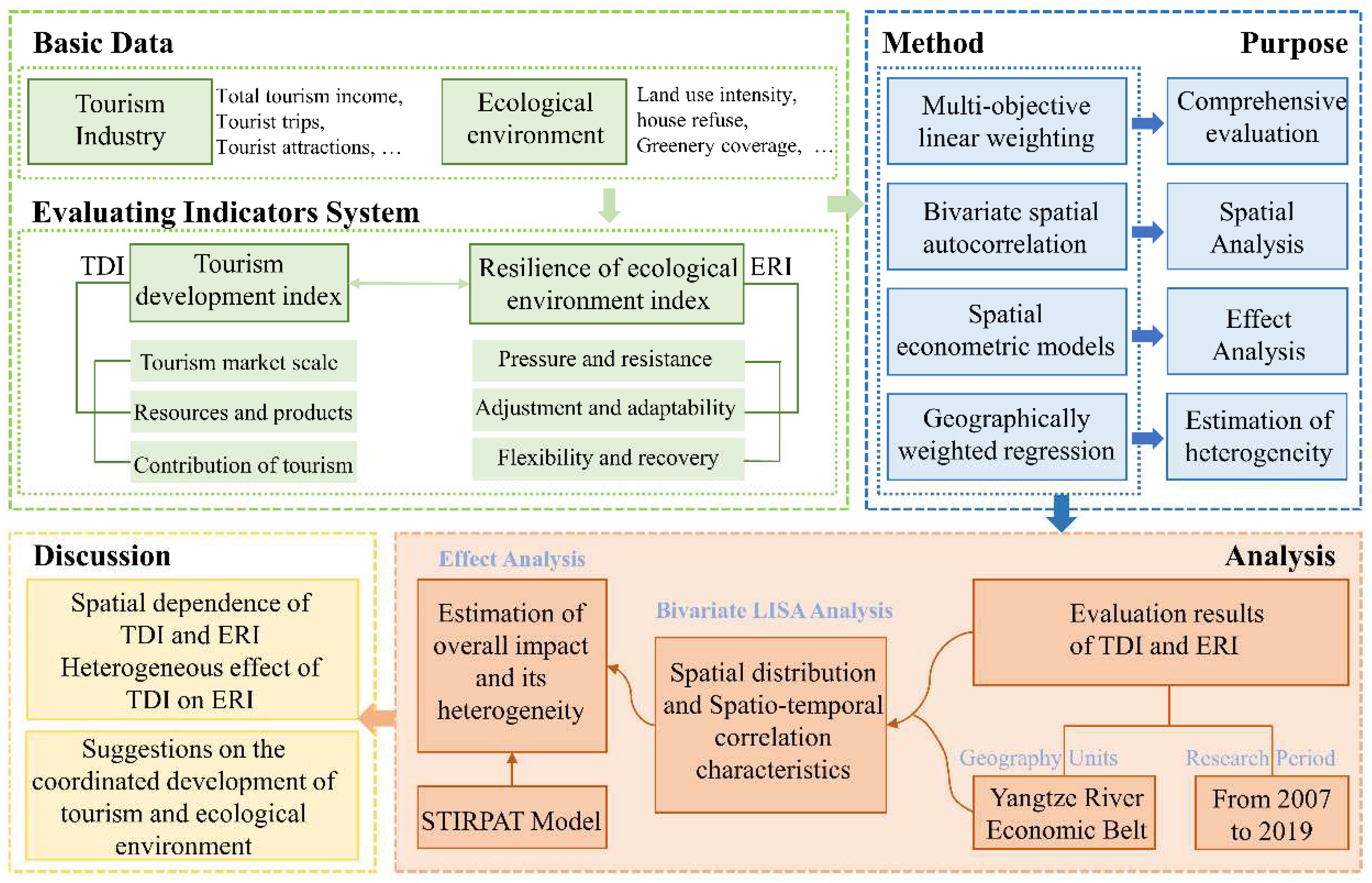
Figure 2.
A general overview of the YREB.
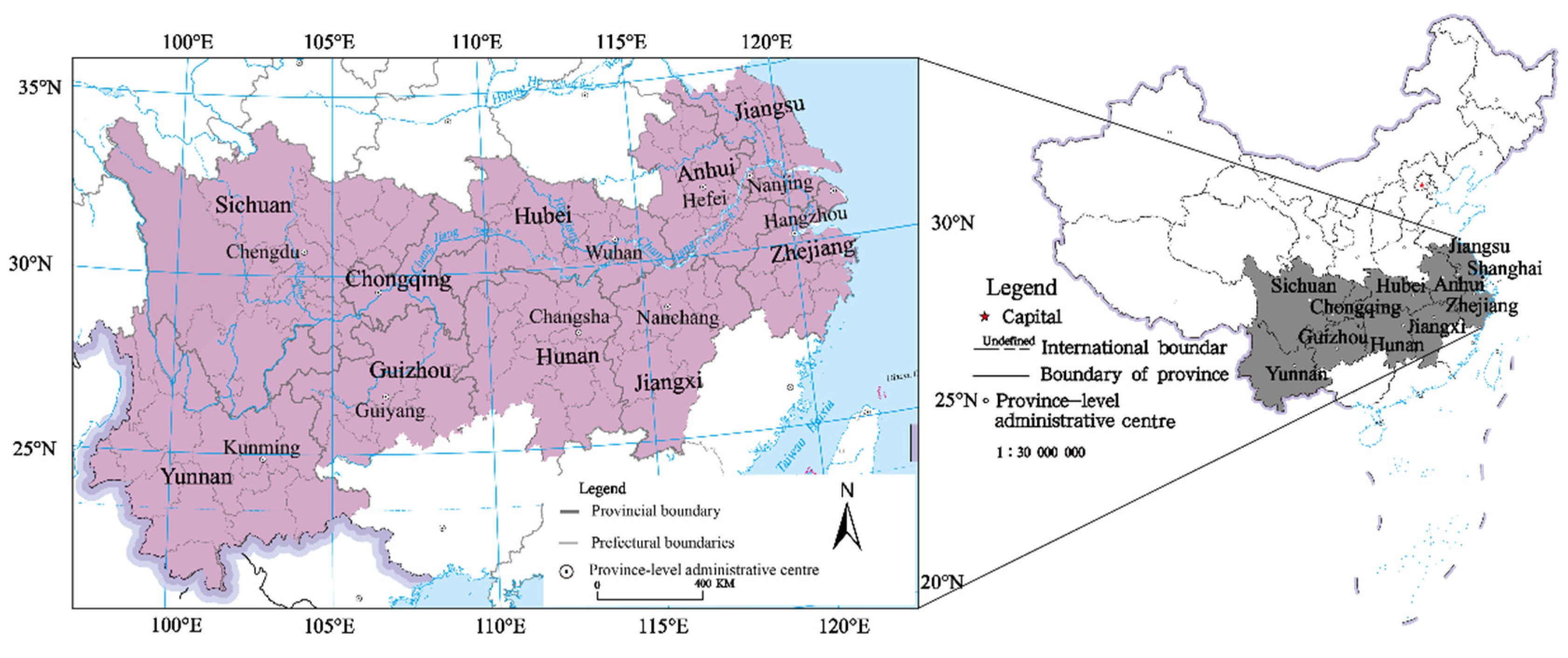
Figure 3.
Spatial pattern of the TDI in the YREB.
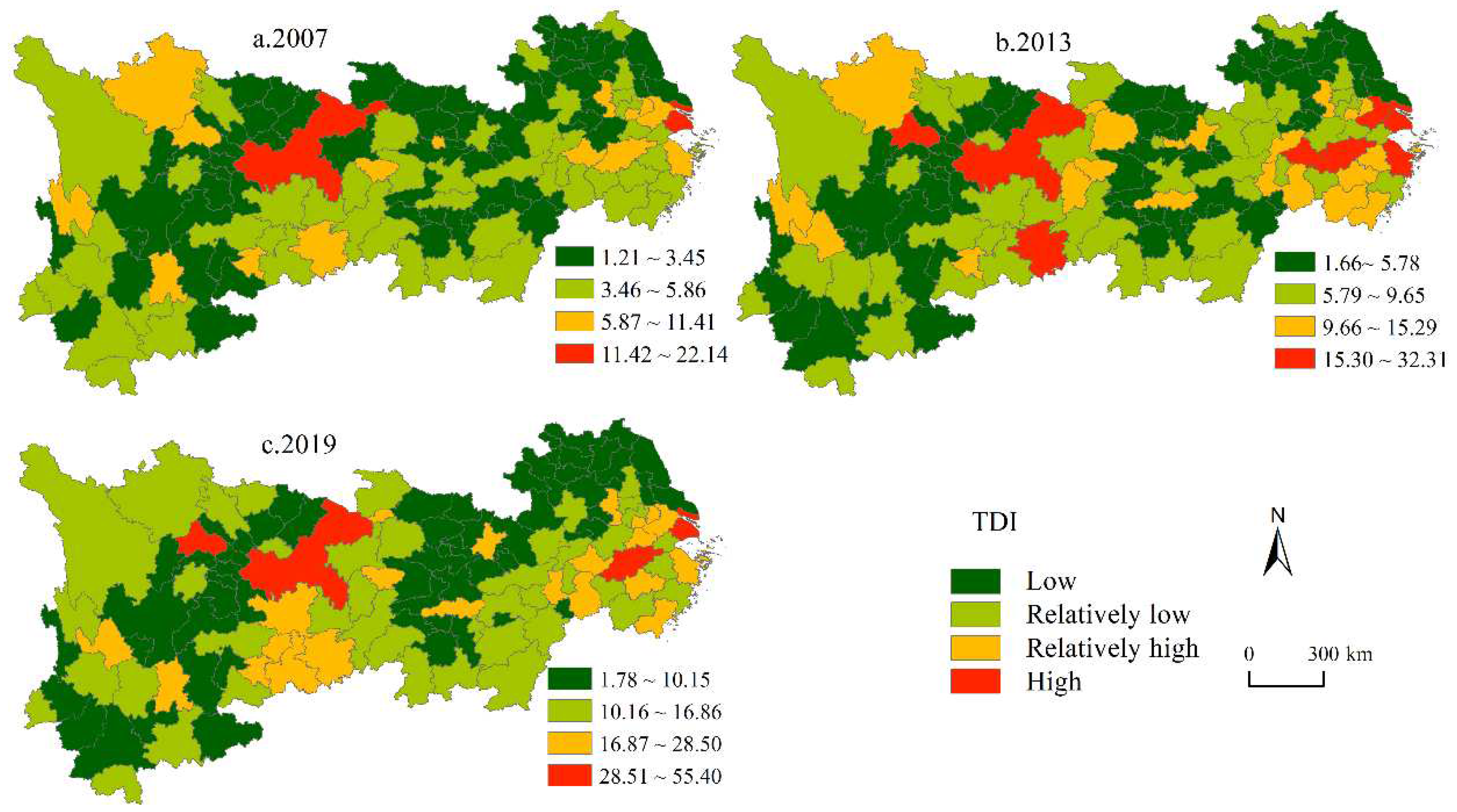
Figure 4.
Spatial pattern of the ERI in the YREB.
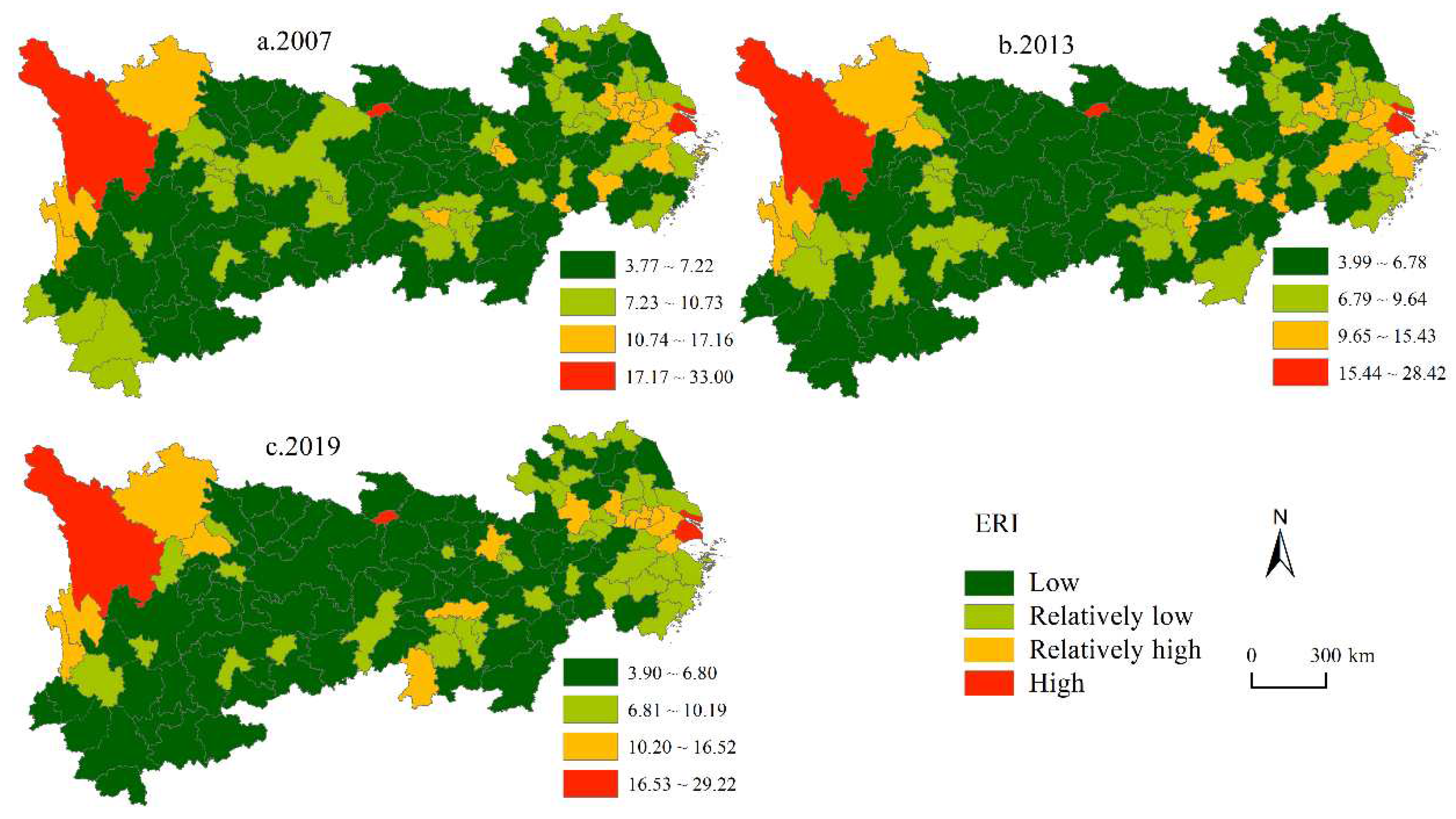
Figure 5.
Bi-LISA results of the TDI and ERI in the YREB.
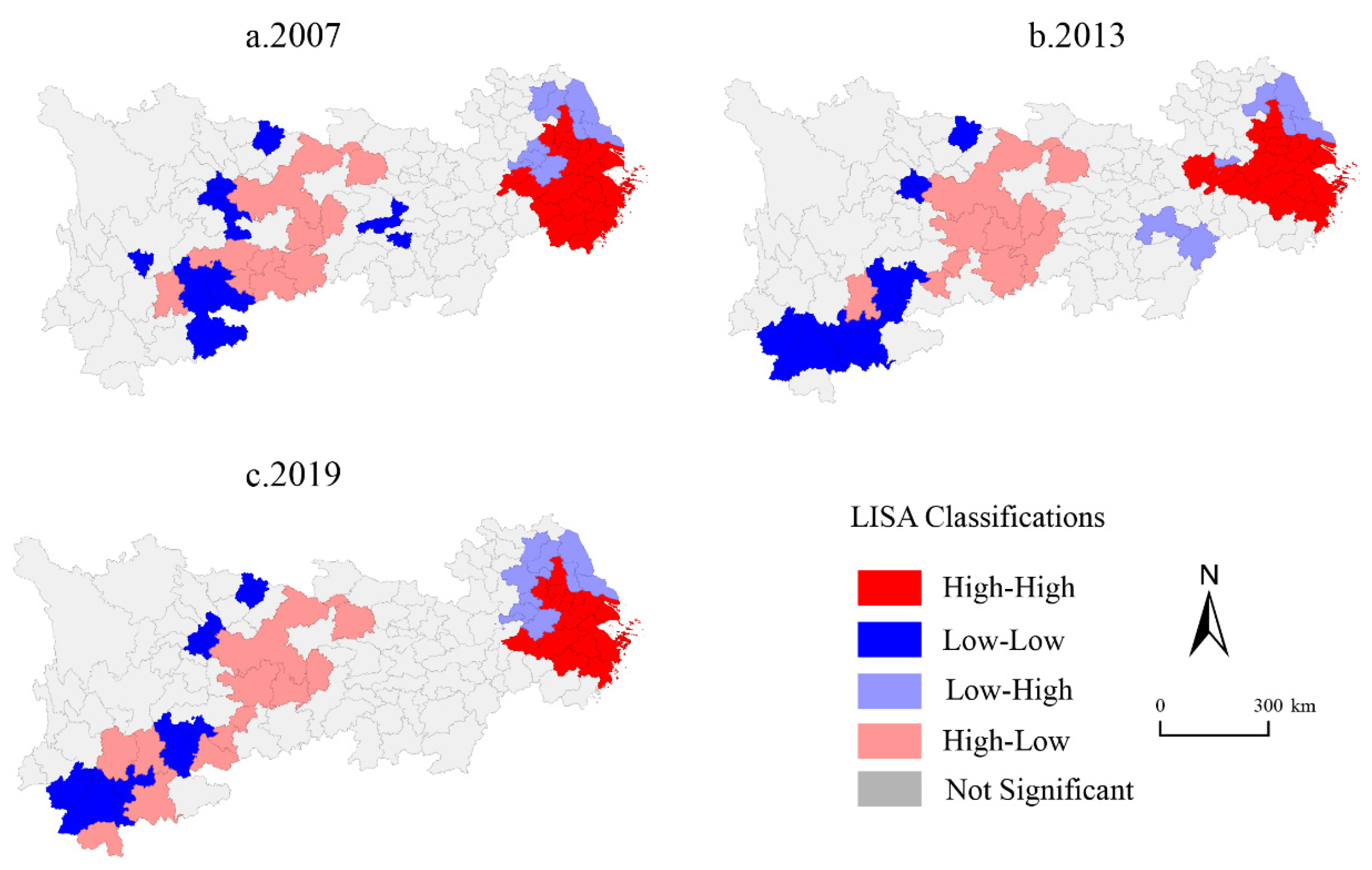
Figure 6.
The spatial pattern of regression coefficient of the TDI on the ERI.
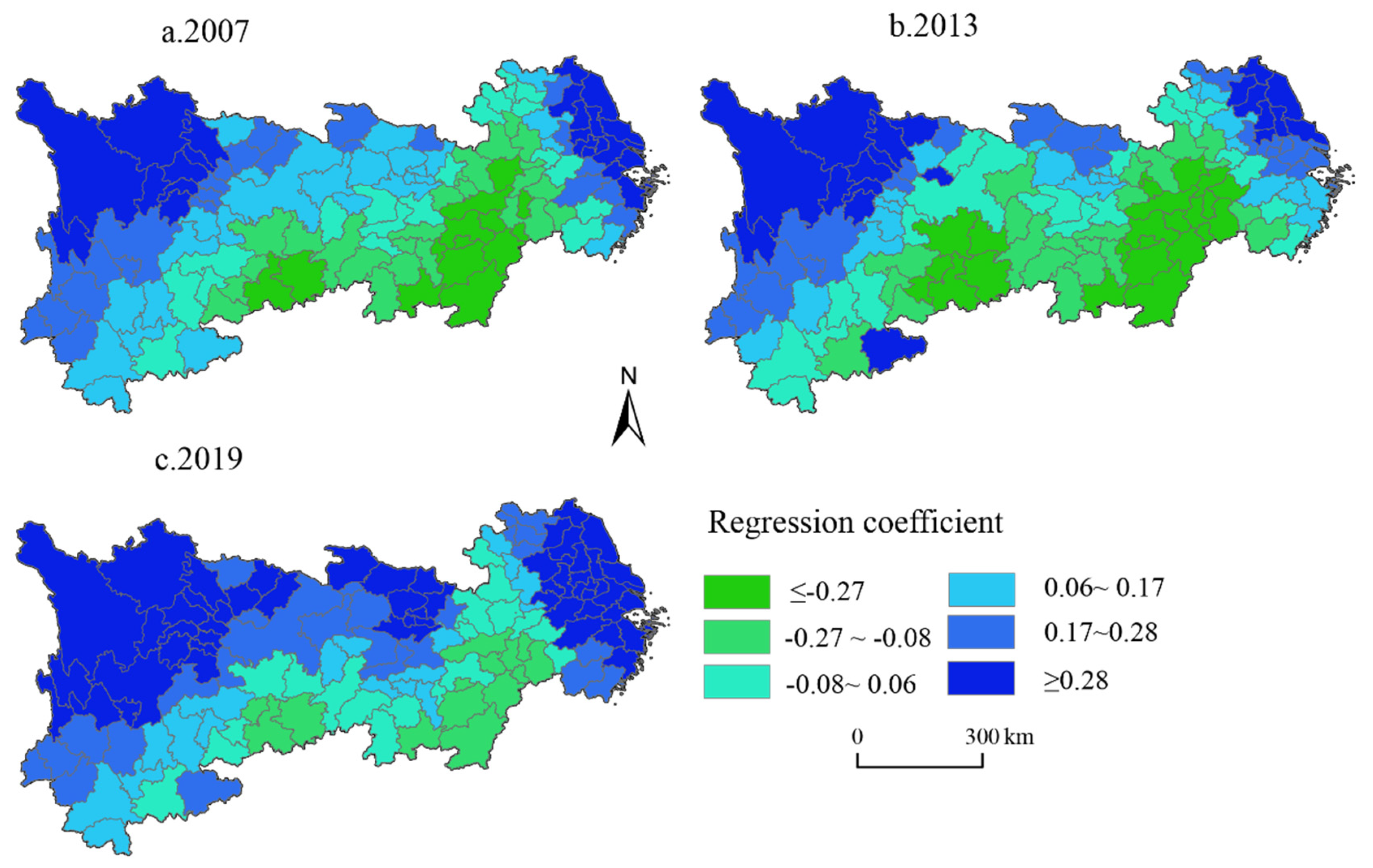

Table 1.
The assessment system of TDI and ERI.
| Target | Guideline (Weight) |
Indicator | Indicator description (Attribute) | Weight |
|---|---|---|---|---|
| Tourism development (TDI) |
Tourism Market scale (0.3093) |
X1 Total tourism income | Reflecting the economic condition of tourism (+) | 0.1511 |
| X2 Total tourist trips | Reflecting the scale of visitors (+) | 0.1139 | ||
| X3 Per capita tourist consumption | Per capita tourist consumption capacity (+) | 0.0443 | ||
| Resources and products of tourism (0.3971) |
X4 High-level tourist attraction | Expressed by the number of Grade 3A or above (+) | 0.1184 | |
| X5 state-level tourism resources | The sum of National Forest Park, National Geopark, National Scenic Spot, and World Heritage Site (+) | 0.0759 | ||
| X6 National intangible cultural heritage | Represents the integration of urban culture and tourism resources (+) | 0.1181 | ||
| X7 Number of museums for 10,000 people | 0.0846 | |||
| Contribution of tourism (0.2936) |
X8 Tourism Industry Dependency | Total tourism income/GDP (+) | 0.0947 | |
| X9 Elasticity of urban residents’ tourism income | Reflects the contributions that tourism makes to the revenues of urban and rural residents (+) | 0.0796 | ||
| X10 Elasticity of rural residents’ tourism income | 0.0210 | |||
| X11 Ratio of employees of tertiary industry | Tourism’s contribution to employment (+) | 0.0237 | ||
| X12The proportion of tourism income in tertiary sector income | Tourism’s contribution to the optimization of industrial structure (+) | 0.0746 | ||
| Resilience of eco-environment (ERI) | Pressure and resistance (0.5014) |
Y1 Population density | The pressure of population size on the ecosystem (-) | 0.0409 |
| Y2 Economy density | Ecosystem perturbation by economic growth (-) | 0.1514 | ||
| Y3 Land use intensity | Area of built-up/Urban land area (-) | 0.0811 | ||
| Y4 Wastewater discharge intensity | The pressure of wastewater on the ecosystem (-) | 0.1040 | ||
| Y5 Exhaust emission intensity | Exhaust pressure on ecosystems (-) | 0.1240 | ||
| Adjustment and adaptability (0.1945) |
Y6 Harmless disposal rate of domestic waste | Adaptation of cities to ecosystem pressures through solid waste, domestic wastewater treatment, and waste utilization (+) | 0.0029 | |
| Y7 Per capita domestic waste removal volume | 0.1778 | |||
| Y8 The rate of domestic wastewater treatment | 0.0064 | |||
| Y9 Usage rate of solid waste | 0.0074 | |||
| Flexibility and recovery (0.3041) |
Y10 Excellent air quality rate | Expressed by the number of days to reach level 2 (+) | 0.0076 | |
| Y11 The rate of greenery coverage in the built-up region | Indicates the greening of the city’s environment (+) | 0.0042 | ||
| Y12 Park area per capita | Indicates the green leisure space of the city (+) | 0.0136 | ||
| Y13 Water resources per capita | Indicates the water carrying capacity (+) | 0.1925 | ||
| Y14 Investment of the Environment Fund as a percentage of financial expenditure | Indicates the environmental management level (+) | 0.0862 |
Table 2.
The average TDI of the YREB from 2007 to 2019.
| Year/region | Global | Upstream | Midstream | Downstream |
|---|---|---|---|---|
| 2007 | 4.18 | 4.06 | 4.01 | 4.51 |
| 2013 | 7.59 | 7.18 | 6.84 | 8.82 |
| 2019 | 12.51 | 13.22 | 10.86 | 18.38 |
Table 3.
The average ERI of the YREB from 2007 to 2019.
| Year/region | Global | Upstream | Midstream | Downstream |
|---|---|---|---|---|
| 2007 | 8.31 | 7.63 | 7.71 | 9.72 |
| 2013 | 7.66 | 7.20 | 7.55 | 8.29 |
| 2019 | 7.55 | 6.76 | 7.28 | 8.74 |
Table 4.
Spatial regression of the TDI on the ERI in the YREB.
| Variable | 2007 | 2013 | 2019 | |||||||||
|---|---|---|---|---|---|---|---|---|---|---|---|---|
| OLS | SLM | SEM | SEMLD | OLS | SLM | SEM | SEMLD | OLS | SLM | SEM | SEMLD | |
| lnTDI | 0.20*** (0.00) |
0.18*** (0.00) |
0.17*** (0.00) |
0.19*** (0.00) |
0.13** (0.02) |
0.11** (0.04) |
0.10* (0.09) |
0.12** (0.05) |
0.20*** (0.00) |
0.19*** (0.00) |
0.24*** (0.00) |
0.20*** (0.00) |
| lnPOP | 0.03 (0.30) |
0.02 (0.40) |
0.02 (0.48) |
0.02 (0.43) |
0.03 (0.28) |
0.02 (0.31) |
0.02 (0.32) |
0.03 (0.33) |
0.03 (0.19) |
0.03 (0.23) |
0.02 (0.30) |
0.03 (0.25) |
| lnGDP | -0.01 (0.72) |
-0.03 (0.36) |
-0.04 (0.31) |
-0.03 (0.45) |
-0.05 (0.16) |
-0.05* (0.08) |
-0.06* (0.08) |
-0.05* (0.08) |
-0.01 (0.69) |
-0.02 (0.45) |
-0.04 (0.22) |
-0.02* (0.08) |
| lnOPEN | 0.05** (0.04) |
0.04* (0.09) |
0.03 (0.21) |
0.05* (0.06) |
0.10*** (0.00) |
0.09*** (0.00) |
0.10*** (0.00) |
0.10*** (0.00) |
0.04* (0.06) |
0.03 (0.14) |
0.02 (0.30) |
0.08** (0.03) |
| Spatial-lag | 0.36*** (0.00) |
0.35*** (0.00) |
0.34*** (0.00) |
0.35*** (0.00) |
0.36*** (0.00) |
0.37*** (0.00) |
||||||
| Spatial-err | 0.36*** (0.00) |
0.36*** (0.00) |
0.34*** (0.00) |
0.34*** (0.00) |
0.43*** (0.00) |
0.41*** (0.00) |
||||||
| Constant | 1.91*** (0.00) |
1.31*** (0.00) |
2.09*** (0.00) |
1.87*** (0.00) |
2.34*** (0.00) |
1.73*** (0.00) |
2.50*** (0.00) |
2.33*** (0.00) |
1.56*** (0.00) |
0.96*** (0.01) |
1.68*** (0.00) |
1.77*** (0.00) |
| Moran’s I | 2.89*** (0.00) |
3.37*** (0.00) |
4.14*** (0.00) |
|||||||||
| LM (lag) | 11.96*** (0.00) |
9.63*** (0.00) |
14.96*** (0.00) |
|||||||||
| Robust LM (lag) | 10.26*** (0.00) |
0.98 (0.32) |
1.52 (0.22) |
|||||||||
| LM(error) | 6.33*** (0.01) |
8.66*** (0.00) |
13.47*** (0.00) |
|||||||||
| Robust LM(error) | 4.62** (0.03) |
0.02 (0.89) |
0.02 (0.87) |
|||||||||
| LM(lag and error) | 16.58*** (0.00) |
9.65*** (0.00) |
14.99*** (0.00) |
|||||||||
| R2 | 0.13 | 0.23 | 0.22 | 0.22 | 0.15 | 0.22 | 0.22 | 0.23 | 0.16 | 0.26 | 0.27 | 0.27 |
| LogL | -55.45 | -50.02 | -50.64 | -52.32 | -38.04 | -33.48 | -33.89 | -33.56 | -38.97 | -32.87 | -32.41 | -32.33 |
| AIC | 120.90 | 112.03 | 115.29 | 118.94 | 86.08 | 78.95 | 77.78 | 76.57 | 87.94 | 77.75 | 74.81 | 73.81 |
| SC | 135.24 | 129.24 | 135.36 | 133.26 | 100.42 | 96.16 | 92.12 | 89.43 | 102.28 | 94.95 | 89.15 | 88.67 |
| Obs. | 130 | 130 | 130 | 130 | 130 | 130 | 130 | 130 | 130 | 130 | 130 | 130 |
Table 5.
Test results of the GWR and OLS.
| Test index | 2007 | 2013 | 2019 | |||
|---|---|---|---|---|---|---|
| GWR | OLS | GWR | OLS | GWR | OLS | |
| R2 | 0.471 | 0.118 | 0.544 | 0.141 | 0.620 | 0.165 |
| Log-L | -143.074 | -174.746 | -133.432 | -174.586 | -121.507 | -172.743 |
| AICc | 345.109 | 359.976 | 328.083 | 359.656 | 296.614 | 358.168 |
| AIC | 333.840 | 357.492 | 316.034 | 357.172 | 311.194 | 355.485 |
| SSE | 68.772 | 111.951 | 59.291 | 111.675 | 49.353 | 108.553 |
Disclaimer/Publisher’s Note: The statements, opinions and data contained in all publications are solely those of the individual author(s) and contributor(s) and not of MDPI and/or the editor(s). MDPI and/or the editor(s) disclaim responsibility for any injury to people or property resulting from any ideas, methods, instructions or products referred to in the content. |
© 2023 by the authors. Licensee MDPI, Basel, Switzerland. This article is an open access article distributed under the terms and conditions of the Creative Commons Attribution (CC BY) license (http://creativecommons.org/licenses/by/4.0/).
Copyright: This open access article is published under a Creative Commons CC BY 4.0 license, which permit the free download, distribution, and reuse, provided that the author and preprint are cited in any reuse.


