
Submitted:
11 May 2024
Posted:
13 May 2024
You are already at the latest version
Abstract
With the Sendai Framework (2015-2030) and the Paris Agreement (2015), the UN has been promoting at a global level, the priority objectives to protect the life and well-being of people, these documents of global consensus have scheduled in several countries, an extensive list of actions of responsibilities and commitments to the environment, to address natural disasters among those of greatest impact earthquakes and floods and among earthquakes (seismic activity). The materialization of the disaster is a natural or human-induced event, it manifests itself in permanent changes in society and by its origin it is classified as natural, anthropogenic (anthropogenic) and mixed, creating a worldwide problematic situation of immediate reaction. The attention and alert in the scientific community have been adding efforts, but in a disorganized way, with limited human and material resources and with globalized strategies still to be improved. The literature review of disaster risk management due to seismic activity, from 2008 to 2023, allows us to have updated information to identify the factors and deepen them, with the understanding, comprehension, and multidisciplinary knowledge. The selected researches that mention the factors (elements) that influence risk management of natural disasters due to seismic activity (RMNDDSA) allow us to know the advances and spaces to approach them, which constitutes the motivation to study the twenty-four (24) factors present in this type of disasters. The selected research articles indicate important advances that associate disaster risk management (DRM) and communication technology (ICTs). The technological means mentioned are well received and accepted by society, capable of detecting and communicating in real time seismic activity worldwide, with the help of social mobile networks, technological platforms, Twitter, Facebook, and others.
Keywords:
disaster risk management
; influencing factors
; seismic activity
; theories
1. Introduction
1.1. Context of Seismic Activity—Natural Disasters
Natural disasters due to seismic activity (NDDSA) are violent, sudden and destructive changes in the environment whose direct cause is not human activity, but natural phenomena (EEA, 2017), is part of the Earth’s evolutionary process, and whose frequency and drasticity have increased in the 21st century (Statista, 2017). NDDSA is a non-human-induced event that negatively affects life, resulting in mortality (Musacchio, 2015), damage and loss of housing (Arimura et al., 2020), health impairment (Mavrouli et al., 2021), disruption of livelihood sources (food, water, medicine), damage to infrastructure, interruption of economic activity, disruption of ecosystems, among others. Among the deadliest and most destructive recorded NDDSA are, first, the one that occurred in the People’s Republic of China, on July 28, 1976, with magnitude 7.50 on Richter scale, and with epicenter in Tangshan, where more than 255,000 people perished and more than 11 million people were left homeless (USGS, 2020). The second is recorded in the Republic of Indonesia with epicenter near the coast of the island of Sumatra, on December 26, 2004, with a magnitude of 9.00 on the Richter scale, with 240,000 people dead, in addition to 1.7 million people affected who were left without homes (Duputel, et al., 2012). Third, the one that occurred in the Republic of Haiti on January 12, 2010, with a magnitude of 7.00 on the Richter scale, and with its epicenter in the capital Port-au-Prince, where more than 222,570 people perished and more than 1.5 million people were left homeless (USGS, 2010), mainly due to the high vulnerability of their homes, the precariousness of transit and access roads, in a country considered the poorest in the Americas (Musacchio, 2015). The UN in coordination with the member countries has been promoting through the Sendai Framework (2015-2030) and the Paris Agreement (2015), several actions included in the priority objectives to protect the life and well-being of people, these global consensus documents have scheduled a long list of recommendations, responsibilities and commitments to the environment, to address natural disasters, with the greatest impact being earthquakes (seismic activity) and floods. The materialization of a disaster is a natural or human-induced event, it manifests itself in permanent changes in society and, due to its origin, it is classified as natural, anthropogenic (anthropogenic) and mixed, creating a worldwide problematic situation requiring immediate reaction. The attention and alert in the scientific community have been adding efforts, but still uncoordinated, with limited human and material resources and with globalized strategies still to be improved. The literature review of the RMNDDSA, from 2008 to 2023, the researches found in the database used, belong mainly to the Scopus and WoS journals, and there are five hundred and sixty-one (571) papers, which in the selection process were reduced to sixty-eight articles that will be used during the research and open the space and opportunity to deconstruct and deepen them, with the understanding, comprehension and knowledge, through the literature on the factors that influence the RMNDDSA, which constitutes the motivation to study the critical factors present in this type of disasters, in order to raise the questions:
- What are the factors that influence RMNDDSA?
- What are the theories used to support the factors of RMNDDSA?
- What methods have been applied to verify the study of these factors?
To answer these questions, we selected scientific articles with important advances and associated with DRM and information and communication technology (ICTs), the technological means mentioned, are well received, and accepted by society, capable of detecting and communicating in real time seismic activity worldwide, with the help of social mobile networks, technological platforms, Twitter, Facebook, and others. (Fernández et al., 2013) The research is organized in six (6) sections. Section 2 addresses NDDSA, their management and intervening aspects. In Section 3, the systematic review methodology, followed in this study and complemented with direct and selective search, is presented. The analysis of the factors and methods of DRM found in selected articles is presented in Section 4, and the discussion of the results in Section 5.
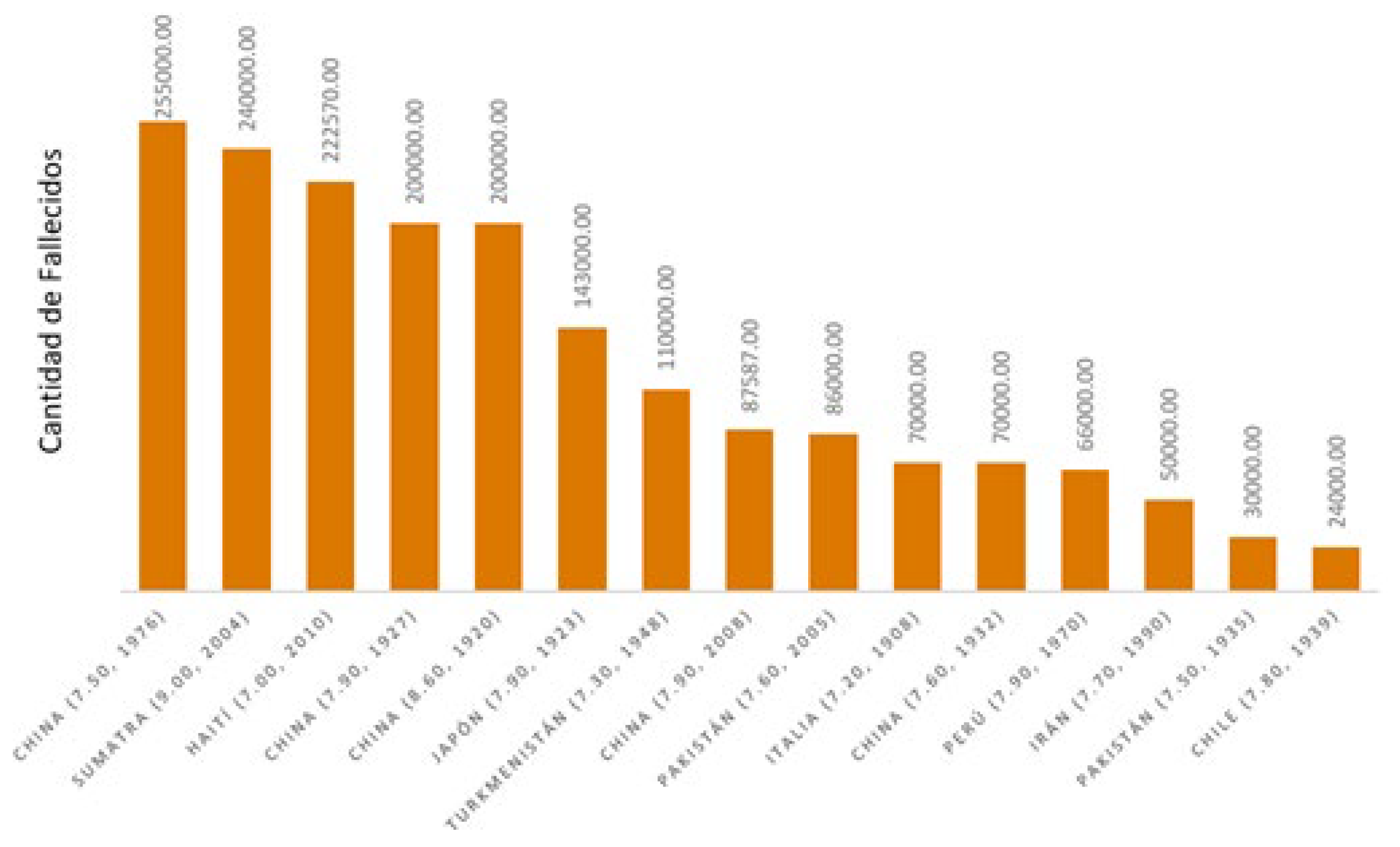
Figure 1.
Destructive earthquakes and fatalities. Source: National Geographic Institute - Spain, 2023.
Figure 1.
Destructive earthquakes and fatalities. Source: National Geographic Institute - Spain, 2023.
NDDSA have three stages, which are “before”, “during” and “after” seismic activity, and their consequences occur mainly in the during stage and have less impact afterwards, except for tsunamis generated by earthquakes, where the consequences may increase. However, the impact can be less if appropriate activities are carried out in each of these stages, with prevention activities (before) having the greatest impact on the consequences of NDDSA. For example, disaster risk management (DRM) models where preventive activities are included proposed in (Zhang et al., 2018) show per simulation a 50% mortality reduction. NDDSA risk prevention activities involve natural risk, which is defined as the probability that the geographical area and the society inhabiting it are affected by natural episodes of extraordinary range, and is given by the equation (Andrade et al. 2022):
The term hazard in the context of DRM refers to a situation or element that could potentially cause damage or negative impact on people, infrastructure, ecosystem, or any other asset. The term vulnerability is defined as the relationship that exists between a unit and some threat, this unit (individual, structure, community) is vulnerable when it is in a situation of material loss, economic damage, health impact, among others (Ruiz, 2011).
1.2. The Problem and Importance: Management of NDDSA Risks (RMNDDSA)
The management of natural disaster risks due to seismic activity (RMNDDSA) is a social process whose purpose is the prevention, reduction, and permanent control of NDDSA risks in society (Narvaez, at el., 2009), and consequently the reduction of the consequences of the disaster. On RMNDDSA, management models are being developed, such as the Pressure and Release Model (Wisner et al., 2004; Michellier et al., 2020), de facto standards such as the Sendai 2015-2030 framework of the United Nations (UN, 2015), regulations specific to each country such as Law No. 111 on NDDSA and tsunamis in Japan (Act on Special Measures for the Prevention of Seismic Disasters) which involves raising awareness and preparing the population on how to act in the face of a disaster (Pastrana-Huguet et al., 2022). Technological platforms such as early warning are also being developed and implemented (Meechang et al., 2020), among others. However, the consequences of NDDSA in the last 10 years show catastrophic results in the face of NDDSA, such as what happened in Turkey in February 2023, where nearly 60,000 deaths and more than 120,000 injured were recorded caused by two earthquakes of 7.80 and 7. 50 on the Richter scale (USGS, 2023), despite being a country that has emergency plans and a culture of prevention, i.e., there are elements that affect the success of the RMNDDSA, which are called critical success factors or simply RMNDDSA factors.
1.3. Study Aspects (Factors and Methods)
There are several studies that identify RMNDDSA factors. In (Tuladhar et al., 2015), the degree of perception by the population is identified as a factor affecting RMNDDSA and how people act in the face of imminent risk. Other factors of RMNDDSA are the effectiveness and acceptance of the media (Tuladhar et al., 2015), the socioeconomic and demographic situation (Dos Santos et al., 2019), the degree of awareness of the population (Bandecchi et al., 2019), among others. There are several studies that identify factors of RMNDDSA. In (Tuladhar et al., 2015) it is identified that the degree of perception by the population is a factor that affects the RMNDDSA because by being aware of their environment, better results are achieved in the RMNDDSA managing to reduce the impacts caused by the disaster in question. Other factors of DRMNAM are the effectiveness and acceptance of the media (Tuladhar et al., 2015), the socioeconomic and demographic situation (Dos Santos et al., 2019), the degree of awareness of the population (Bandecchi et al., 2019), among others.
1.4. Methods
On the other hand, to prove that a construct is a RMNDDSA factor, the authors have relied on various statistical methods in general. In (Dos Santos et al., 2019) they use the statistical method with multivariate analysis, to test how human factors such as age, education, income, among others, can be determinants when analyzing the risk to which humans are exposed in the face of possible earthquakes and floods, in order to then manage them conveniently. In (Tuladhar et al., 2015) we found a statistical and descriptive analysis based on questionnaires (surveys) of the key problems that exist in DRM, such as education, lack of knowledge, adaptability and weak perception and importance of risk by the population, as is the case of the study of results on perception, evidencing improvement in women because they prefer to be informed through richer media, such as national and international television, while men have opted to choose more traditional media such as FM radio with the incorporation of audio devices. In (Bandecchi et al., 2019) a statistical study and descriptive analysis was conducted based on surveys on the perception of earthquake risk that existed in schools in Italy, where relevant results are revealed that tell us that young children understand and perceive risk instinctively according to age, however, as people grow in age and assume greater responsibilities, a significant result expresses the lack of knowledge in 78% of people about the danger (threat) and the perception of risk that is evident in the responsible personnel (surveyed), where less than 50% of people have adequate perception regarding the danger generated in the area impacted by landslides.
In the process of finding information and data to answer these questions, we have searched for scientific information (Journal) in journals indexed in Scopus and Web of Science (WoS), in a period from 2008 to 2023. We highlight studies that identify some factors that influence the RMNDDSA, with emphasis on the technology used, the media and ICTs, all of them that support the research and can give us information on the NDDSA (earthquakes), as well as the explanation and the treatment used.
1.5. State of the Art Synthesis
The researches initially found in the database and used belong mainly to the Scopus and WoS journals and are approximately five hundred and sixty-one (571) papers, between the years 2008 and 2023, which through a selection process were reduced to sixty-eight articles (68) that will be used during the research.
1.6. Motivation
During the literature search and selection process, we have not found information that directly records the critical factors of NDDSAM. Likewise, there is little research that includes the process of planning, development, explanation, orderly execution, and concatenation in the scenarios of NDDSA, prioritizing the story through observation, description and details focused in a structural and non-structural way of the post-disaster consequences, such as material damage and loss of human lives. Relevant data such as magnitudes, scopes and repercussions of phenomenological events derived from seismic activity are complemented and can effectively support decisions on the achievement of success factors in the RMNDDSA. The need to update and find the factors of the RMNDDSA lead us to evaluate what is advanced in scientific research under the post-disaster criterion, as “after”, referring to the reactive disaster risk management (DRRM) approach. In the current context (“during”, “now”, “present”) we have identified gaps, opportunities, and spaces to address this topic, given that there is a lack of deconstructive and detailed analysis of the factors that influence NDDSA from the multidisciplinary scientific perspective (Takako Izumi, 2019). Gaps and approaches have been identified to deconstructively address RMNDDSA, considering the interaction between humans, disasters, and technology (Kaylin Rochford, 2019). Another important point detected in the research is the need to update the language and terminology in the description and explanation of RMNDDSA, considered in the textual presentation of scientific research, aspects of methodology, incorporation of technology, innovation, and entrepreneurship (Sendai Framework, 2015). The idea of having an orderly structure of influential factors in research addressing NDDSA is a valid reason to boost research and contribute effectively and systematically with information to manage disaster risks. Also, there is a consensus, expectation, and perspective from researchers in citizen science, social engineering, environment and other scientific areas to deepen human knowledge and understanding of DRM and the elements influencing NDDSA (Jacek Raka, 2021).
1.7. Objective/Purpose
The objective of the research is to systematically and selectively review the important aspects developed on the critical factors that influence the RMNDDSA, taking into account a time frame from 2008 to September 2023.
1.8. Main Contributions
The main contributions of the study are:
- To provide information in an organized manner on the factors influencing RMNDDSA, specifically its inventory and the methods used for its verification, from January 2008 to September 2023.
- To provide the reader with an important variety of bibliographic references that can be used to investigate the RMNDDSA factors.
1.9. Organization of the Article
The research is composed and organized in six (6) sections. Section 2 deals with NDDSA, their management and intervening aspects. Section 3 presents the systematic review methodology, followed in this study, and complemented with the direct and selective search. In section 4 we present the analysis of the critical factors and methods found in selected articles, and in section 5 we consider the discussion of the results. Finally in section 6 we have the conclusions, recommendations, and future research.
2. Background and Seismic Activity Disaster
2.1. Disaster Risk Management due to Seismic Activity
We can point out that the critical factors of DRM are contemplated in the “Set of administrative decisions, organization and operational knowledge developed by societies and communities to implement policies, strategies and strengthen their capacities to reduce the impact of natural hazards and consequent environmental and technological disasters” (ISDR, 2008). The UN has been promoting the reduction of the number of deaths caused by seismic activity and researchers are joining individual and collective efforts to deal with risk prevention and reduction, it is precisely the DRM issue that concerns us with the importance of information on risk factors and NDDSA to adequately address them. To date, we can find “tangible evidence in the area of planning and development that points to a lack of compliance in land use planning and environmental impact studies in the economic, social and environmental sectors”. Likewise, there are evident deficiencies in both road and pedestrian infrastructure, and as large cities grow and evolve, regulatory procedures are only partially followed in terms of adequate planning and urban studies. In this process of development and expansion, the need for a more integrated behavior on the part of the government administration and the participation of the private sector becomes visible. It is crucial to take into consideration that DRM, as it is currently defined, constitutes an integrated social process aimed at preventing, reducing and continuously controlling the factors that trigger disasters in society. This must be intrinsically intertwined with human, economic, and environmental development. However, to date, this approach has proven to be an insufficient effort in terms of territorial coverage, which has limited the effectiveness of vulnerability reduction.
2.2. Aspects of RMNDDSA Factors
What is a factor? In general terms, “a factor is an element that plays a determining role in an outcome, i.e., it is influential in some aspect of reality, and should therefore be taken into account when studying it” (Lavell, 2009).
What are factors? We will now explain what we understand by factors as “those elements that can condition a situation, becoming the cause of the evolution or transformation of the facts”. That is to say that they contribute to obtain certain results, after the occurrence.
2.3. Human-Disaster Interaction
The demonstration, manifestation and explanation of the human-disaster interaction dates back to primitive times (Villalibre, 2013), the human being since its first years of existence, in the interaction with the first disaster that can be documented throughout history, this dates back to more than 47000 years ago and corresponds to the eruption of the Sumatra volcano, which caused material and human damage, which caused the world population to decrease drastically and dramatically. In those times it is estimated that the human race went from being one million people, to an amount very close to 10000 inhabitants, the literature does not record and contains empirical evidence or know exactly what happened, but some researchers associate it with the fall of a meteorite, which impacted the earth and the release of energy, ended the lives of most of the living beings of the planet, including man and prehistoric animals.
2.4. Disaster
The disaster is a fact that has a consequence and result after the impact of phenomenological events in a natural way (known as natural disaster and comes from nature itself), also have been identified that by their origin, some are caused by man (human), to these two lines of origin, a third one is added, where, in addition to those of natural origin is added human intervention, known as anthropogenic or anthropic origin (it is a mixture of natural + human intervention) (Atta-Ur Rahman a, 2019). These events consummated by human interaction and participation, negatively affect lives, families, livelihoods, livelihoods, livelihoods for survival, service and industrial institutions and enterprises and often lead to permanent changes in human societies and the animals that inhabit that place, ecosystems, and the environment. It is also named as “catastrophe” and comes from the Latin “catastropha” and this, from the Greek “katastrophe”, which meant ‘convulsion, tumult’, and in the case of a dramatic situation, ‘denouement’, Katastrophe was formed with the prefix “kata” ‘down’ and the verb “strephein” ‘to turn’, it is indicated as the event that has disastrous consequences (wordreference.com, 2019). Disasters highlight the vulnerability of the balance necessary for survival, well-being, and prosperity.
3. Methodology
The Systematic Literature Review is a clear and reproducible procedure consisting of a series of phases that help researchers to define the research objective and plan how articles are retrieved and presented (Ardito et al., 2015). In the research phase, a methodology was followed to conduct the literature review around the critical factors and linked to natural disasters caused by seismic activity, especially earthquakes (Baytiyeh et al., 2016) and how they directly affect normal living conditions in the population. The process was divided into the following stages:
- Planning - The detailed search was performed in various sources of information, such as academic, scientific, and specialized databases in a coherent and cohesive manner with the keywords in systematized literature search.
- Development - Clear criteria were applied for the selection of studies and literature review, which are directly related to the factors affecting RMNDDSA.
- Results - The studies were selected for an in-depth and deconstructive review with the extraction of relevant data associated with the RMNDDSA factors, to which sixteen were added, duly justified by the importance of the content and the theories used and methods applied during the research.
3.1. Planning
To answer the research question, the following sub-questions are posed:
- RQ1 What are the factors that influence RMNDDSA?
- RQ2 What are the theories used to support the factors of RMNDDSA?
- RQ3 What methods have been applied to verify the study of these factors?
To answer these questions, we searched journals indexed in Scopus and Web of Science (WoS) in the period from January 2008 to September 2023, considering the following search string that was applied in title-abs-key for Scopus and topic for WoS:
(factor OR cause OR influence) AND (“risk management” OR “risk administration”) AND (“natural disaster” OR “natural catastrophe”) AND (seism* OR earthquake)
In addition, inclusion and exclusion criteria were considered and are shown in Table 1.
3.2. Desarrollo
Applying the search string, 316 and 239 documents were obtained in Scopus and WoS, respectively, which after applying the inclusion criteria were reduced to 69 and 70 articles, respectively. These were subjected to selection, eliminating duplicates, and using the exclusion criteria in the titles, abstracts, and content. Thus, 27 articles remained in Scopus and 25 in WoS, totaling 52. In addition, 16 articles from indexed journals presenting factors for RMNDDSA were incorporated. Finally, a total of 68 articles were selected, which are presented in the bibliography, and their ID will be used hereafter to identify them. Figure 2 shows the development process of the Systematic Review.
3.3. Results
3.3.1. Potential and Selected Studies
Table 2 shows the number of potential articles and the number of selected articles after applying the inclusion and exclusion criteria.
3.3.2. Publications Production
The selected items increase from 2015, this could be explained by the Paris Agreement (2015), as visualized in Figure 3.
3.3.3. Journals and Articles by Quartile
Table 3 shows 44 journals corresponding to the selected articles, of which 64 journals are of quartile Q1, 2 journals of Q2 and 2 belong to Q3. In addition, the total number of articles from Q1 quartile journals represents 94.12 % of the articles, being the International Journal of Disaster Risk Reduction the journal with the highest number of publications in RMNDDSA.
4. Analysis
4.1. RQ1 What Are the Factors Influencing RMNDDSA?
Twenty-four critical factors of the RMNDDSA have been identified (see Table 4), the most studied being knowledge, planning and understanding with 57, 52 and 47 studies, respectively.
Factors in the Literature Reviews
In addition, 15 factors were identified in the review of the selected articles (see Table 5).
4.2. RQ2 What Theories Are Used to Support the RMNDDSA Factors?
Eleven theories have been identified in 18 studies ([A01], [A06], [A09], [A10], [A11], [A15], [A15], [A19], [A20], [A25], [A26], [A32], [A41], [A44], [A47] [A51], [A53], [A63]) to support 24 factors (see Table 6).
4.3. RQ3 What Methods Have Been Applied to Verify the Study of These Factors?
When analyzing the selected literature, we identified interdisciplinary methods and approaches to verify the influential factors in RMNDDSA (see Table 7), among the most commonly used we can mention the following:
- [M01] Hypothesis testing (Arimura et al., 2020).
- [M02] Assessment and scoping of the degree of vulnerability of infrastructure and communities, using innovative technological tools.
- [M03] The analysis of the degree of exposure used in (Dos Santos, 2019), which maps the location of the population, the infrastructure of their homes, access to services, among other factors in relation to risk areas, to assess how exposed a community is to a disaster (floods and earthquakes).
- [M04] Data collection methods such as the use of surveys and structured interviews (Tuladhar et al., 2015).
- [M05] Also noteworthy are qualitative methods that not only provide valuable data on specific perceptions and needs, but also encourage active civilian participation in earthquake disaster risk management planning.
5. Discussion of Results
The systematic review of the literature allowed us to identify twenty-four (24) factors, which have been considered because of their importance in NDDSA. This academic work generates a special motivation, added to the experiential experience and empirical evidence, which are the available and updated inputs to be used for scientific discussion and to enrich disaster risk management, “that is, now, the present, the present moment”.
5.1. Question 1 What Are the Factors that Influence RMNDDSA?
The critical influencing factors detected and with the highest incidence are related to:
| N° | Proposed factor | N° | Proposed factor | N° | Proposed factor | ||
| F1 | Knowledge | F9 | Control | F17 | Monitoring | ||
| F2 | Planning | F10 | Evaluation | F18 | Response Capability | ||
| F3 | Understanding | F11 | Feedback | F19 | Information Technology | ||
| F4 | Perception | F12 | Execution | F20 | Resilience | ||
| F5 | Organization | F13 | Follow-Up | F21 | Mitigation | ||
| F6 | Monitoring | F14 | Reduction | F22 | Prevention | ||
| F7 | Management | F15 | Vulnerability | F23 | Awareness | ||
| F8 | Direction | F16 | Preparedness | F24 | Recovery |
The publications are in accordance with the Paris Agreement (2015), the Hyogo Framework for Action (2005-2015) and the Sendai Framework (2015-2030), until September 2023. This route opens an opportunity for individual and group research with multidisciplinary participation, allowing internationalization in a network and collaborative participation. Additionally, we found 15 factors of influence in RMNDDSA located in the state of the art of the selected articles, they are:
| N° | State of Art Factor | N° | State of Art Factor | N° | State of Art Factor | ||
| 1 | Structural damage | 6 | Health risk | 11 | Government Conditions | ||
| 2 | Temporary housing | 7 | Health response | 12 | Socioeconomic Conditions | ||
| 3 | Victims of debris | 8 | Security | 13 | Demographic Conditions | ||
| 4 | Economic impact | 9 | Hygiene | 14 | Sustainability | ||
| 5 | Social impact | 10 | Logistics | 15 | Degree of self-organization |
The publications are in accordance with the Paris Agreement (2015), the Hyogo Framework for Action (2005-2015) and the Sendai Framework (2015-2030), until September 2023. This route opens an opportunity for individual and group research with multidisciplinary participation, allowing internationalization in a network and collaborative participation. Additionally, we found 15 factors of influence in RMNDDSA located in the state of the art of the selected articles, they are:
5.2. Question 2 What Are the Theories Used to Support the Factors of RMNDDSA?
In the literature review process we found eleven theories that directly relate to the critical factors of RMNDDSA (see Table 6) these are: (T1) Diffusion of innovations theory, (T2)Media richness theory, (T3) Organizational information processing theory, (T4) Phenomenology theory, (T5) Prospect theory, (T6) Social learning theory, (T7) Vector theory, (T8) Cultural Theory, (T9) Protection Motivation Theory, (T10) Disaster System Theory and (T11) Social Exchange Theory.
5.3. Question 3 What Methods Have Been Applied to Verify the Study of these Factors?
The process of collecting information in situ from the affected places and that have been shown through empirical evidence and based on structured surveys, interviews with actors and questionnaires, have allowed the analysis of the degree of exposure, the evaluation of the degree of vulnerability and the use of qualitative methods and hypothesis testing to confirm acceptance or rejection. To strengthen the knowledge and importance of the critical factors of the RMNDDSA and help in the elaboration of procedures, which are based on methods related to the participation of the community and organized civil society, in this case the people affected and possibly exposed to future disaster risks. The experiential experience of the residents reflects the level of concern expressed in the voluntary participation in surveys, interviews and questionnaires. The content structure of these tools for collecting information is prepared by experts from different disciplines, including environmental engineering, geological engineering, civil engineering, industrial engineering, agricultural engineering, mining engineering, architecture, physicians, university educators, sociologists, psychologists, pedagogues, and others.
6. Conclusions and Recommendations
- The research was based on the selection and literature review of five hundred and seventy-one (571) scientific articles based on empirical and substantiated evidence of seismic disasters (earthquakes) and correspond to cases of post-disaster studies, “after”, and identify them as the model of studies that have occupied the most attention to the RMNDDSA in a reactive manner and still continue to be prioritized, from there the information and data platforms for future research are established.
- The scientific studies of NDDSA (earthquakes) and heavy rainfall (floods) are of universal priority and the identification and deconstruction of the factors of influence in disasters due to seismic activity constitutes a scientific challenge of global importance. In our case we have managed to identify twenty-four critical factors of importance in disasters due to seismic activity, they are: (F1) Knowledge, (F2) Perception, (F3) Comprehension (Understanding), (F4) Planning, (F5) Organizing, (F6) Directing (Leadership), (F7) Executing, (F8) Supervising, (F9) Follow-up, (F10) Monitoring, (F11) Controlling, (F12) Feedback, (F13) Management, (F14) Evaluation, (F15) Reduction, (F16) Vulnerability, (F17) Preparedness, (F18) Response Capacity, (F19) Information Technologies, (F20) Resilience, (F21) Mitigation, (F22) Prevention, (F23) Awareness, and (F24) Recovery.
- In the literature review and the state of the art of the selected articles we identified fifteen (15) factors related to RMNDDSA and they are: (1) Structural Damage, (2) Temporary Shelter, (3) Debris Victims, (4) Economic Impact, (5) Social Impact, (6) Health Risk, (7) Health Response, (8) Safety, (9) Hygiene, (10) Logistics, (11) Governance Conditions, (12) Socioeconomic Conditions, (13) Demographic Conditions, (14) Sustainability and (15) Degree of Self-Organization.
- In the selected literature we found the use of interdisciplinary methods and approaches to verify the factors influencing RMNDDSA such as structured surveys, stakeholder interviews and questionnaires, exposure analysis, vulnerability assessment, qualitative methods and hypothesis testing.
- Regarding the post-disaster scenario for the Covid 19 Coronavirus Pandemic disease, it is necessary to deepen and update knowledge in the present “during”, i.e., the current moment (now) related to corrective disaster risk management.
- The scientific research in which experts participate through the collaborative and multidisciplinary work group has been prioritizing in the present decade, highlighting technological communication and innovation tools that facilitate the deepening of scientific research in RMNDDSA.
7. Future Work
- The empirical and substantiated evidence after disasters caused by seismic activity constitute the elementary inputs of reactive management, the same that hold and have the information to work based on corrective management, i.e., prioritizing “the present, i.e., now”, therefore, it is necessary to include the studies of estimation, prevention, and reduction of disaster risk, with the materialization of vulnerability reduction in disasters caused by seismic activity.
- It is important to operationalize the evaluation of natural disaster risk associated with education in a transversal manner, both in the public and private spheres, considering the three approaches of moments and temporalities, such as:
| First Approach | Second Approach | Third Approach |
| Reactive Disaster Risk Management (RDRM) | Corrective Disaster Risk Management (CDRM) | Prospective Disaster Risk Management (PDRM) |
| Post-disaster “after” scenario | Current scenario “during, now, the present”. | Pre-disaster scenario “before, looking ahead”. |
The identification of factors influencing disasters due to seismic activity (earthquakes) does not point out the importance of participatory and collaborative work, and multidisciplinary research teams are required.
The integration with scientific institutions, universities, political and governmental authorities and the participation of the population in an organized manner, with mechanisms of information, communication and dissemination of clear, timely and understandable messages, have a fundamental role to play in incorporating the reduction of human vulnerability and livelihoods.
At this point, technology, usability, and user (human) interactivity will facilitate the creation of public and collective awareness, in the interest of being part of the processes to drastically reduce disaster risks and vulnerability reduction.
The components that have been proposed for the explanation of man-disaster-technology for seismic activity indicate that tracking and monitoring includes the following elements: (i) Social Networks, (ii) Artificial Intelligence (AI), (iii) The Twitter Application, (iv) The Facebook Page, (v) Technological Platforms, (vi) Fiber Optic Networks, (vii) The Global Seismic Platform and (viii) The GPS - Global Positioning System. At this point we must highlight the upward presence proposed by Asian (Indian) researchers.
Acknowledgments
The authors would like to thank the Universidad Nacional Mayor de San Marcos (UNMSM) for the partial support of this research. This study is part of the project to deepen disaster risk research studies under the approach of corrective disaster risk management, that is, “now” and “now”. The author would like to thank the reviewers for their important suggestions that have allowed a significant improvement of the present work.
References
- Ainuddin, S., Routray, J. K., & Ainuddin, S. (2014). People’s Risk Perception in Earthquake-Prone Quetta City of Baluchistan. [CrossRef]
- Alam, E. (2016). Earthquake and Tsunami Knowledge, Risk Perception, and Preparedness in Southeast Bangladesh. [CrossRef]
- Antonioni, G., Landucci, G., Necci, A., Gheorghiu, D., & Cozzani, V. (2015). Quantitative Assessment of Risk Due to Natech Scenarios Caused by Floods. [CrossRef]
- Arimura, M., Haa, T. V., Kimuraa, N., & A10sadaa, T. (2020). Evacuation awareness and behavior in the event of a tsunami in an aging society: An experience from the 2018 Hokkaido Eastern Iburi earthquake. Safety Science. [CrossRef]
- Aroquipa, H., & Hurtado, A. (2022). Seismic resilience assessment of buildings: A simplified methodological approach through conventional seismic risk assessment. International Journal of Disaster Risk Reduction. [CrossRef]
- Asad, R., Saleem, M. Q., Habib, M. S., Mufti, N. A., & Mayo, S. M. (2023). Seismic risk assessment and hotspots prioritization: a developing country perspective. Natural Hazards. [CrossRef]
- Avankhah, M., de Wit, R., Argyriou, A. V., Chliaoutakis, A., Revez, M. J., Birkmann, J., ... Sarris, A. T. (2019). Integrated Assessment of Natural Hazards, Including Climate Change’s Influences, for Cultural Heritage Sites: The Case of the Historic Centre of Rethymno in Greece. Natural Hazards. [CrossRef]
- Babaie, J., Pashaei Asl, Y., Naghipour, B., & Faridaalaee, G. (2021). Cardiovascular Diseases in Natural Disasters: A Systematic Review. Archives of Academic Emergency Medicine. [CrossRef]
- Bandecchi, A. E., Pazzi, V., Morelli, S., Valori, L., & Casagli, N. (2019). Geo-Hydrological and Seismic Risk Awareness at School: Emergency Preparedness and Risk Perception Evaluation. International Journal of Disaster Risk Reduction. [CrossRef]
- Baytiyeh, H., & Öcal, A. (2016). High School Students’ Perceptions of Earthquake Disasters: A Comparative Study of Lebanon and Turkey. [CrossRef]
- Boin, A., Ekengren, M., & Rhinard, M. (2021). Understanding the Creeping Crisis. Springer Nature Switzerland AG. [CrossRef]
- Boualem, S., & Benouis, A. (2023). Contribution of geographic information system to improve the insurance management of natural disasters in Algeria case study: the city of Batna. Natural Hazards. [CrossRef]
- Callaghan, C. W. (2016). Disaster Management, Crowdsourced R&D, and Probabilistic Innovation Theory: Toward Real-Time Disaster Response Capability. Elsevier. [CrossRef]
- Chan, E.Y.Y. (2019). Scientific Evidence on Natural Disasters and Health Emergency and Disaster Risk Management in Asian Rural-Based Area. British Medical Bulletin. [CrossRef]
- Chou, C.-Y., Lin, S.-Y., Yang, C.-T., & Hsu, Y.-T. (2023). Risk perception of earthquakes: Modeling conception of willingness to pay and prospect theory. Journal of Disaster Research. [CrossRef]
- Dos Santos, S., Peumi, J.-P., & Soura, A. (2019). Risk Factors of Becoming a Disaster Victim: The Flood of September 1st, 2009, in Ouagadougou (Burkina Faso). Habitat International. [CrossRef]
- Fan, J., Liu, B., Ming, X., Sun, Y., & Qin, L. (2022). The amplification effect of unreasonable human behaviors on natural disasters. Humanities and Social Sciences Communications. [CrossRef]
- Yildiz, A., Dickinson, J., Priego-Hernández, J., & Teeuw, R. (2022). Children’s disaster knowledge, risk perceptions, and preparedness: A cross-country comparison in Nepal and Turkey. Risk Analysis, 43(4), 747–761. doi:10.1111/risa.13937. [CrossRef]
- Goswami, S. (2019). A Review on Application of Data Mining Techniques to Combat Natural Disasters. Scopus - Engineering. [CrossRef]
- Heinkel, S.-B., Thiebes, B., Than, Z. M., Aung, T., Kyi, T. T., Mar, W. L., Oo, S. S., Miller, C., Willkomm, M., Maung, W., Myint, Z. N., Soe, K. K., Spohner, R., & Kraas, F. (2022). Disaster preparedness and resilience at household level in Yangon, Myanmar. Springer Natural Hazards. [CrossRef]
- Hosseini, S. M., Dirakvand, F., Safarian, O., & Ayoubian, A. (2019). Risk Assessment of Crisis Management in Response to Natural Disasters with an Emphasis on Earthquakes. Civil Engineering Journal. [CrossRef]
- Hussain, M. A., Shuai, Z., Moawwez, M. A., Umar, T., Iqbal, M. R., Kamran, M., & Muneer, M. (2022). A Review of Spatial Variations of Multiple Natural Hazards and Risk Management Strategies in Pakistan. Water. [CrossRef]
- Hussain, M. A., Zhang, S., Muneer, M., Moawwez, M. A., Kamran, M., & Ahmed, E. (2022). Assessing and Mapping Spatial Variation Characteristics of Natural Hazards in Pakistan. [CrossRef]
- Imamura, F., Takakura, H., Matsuzawa, T., & Ito, K. (2019). A Platform for Multidisciplinary Research in Disaster Science Through Experiences from the 2011 Tohoku Earthquake and Tsunami. Journal of Disaster Research. [CrossRef]
- Izquierdo Horna, L., & Kahhat, R. (2020). An interdisciplinary approach to identify zones vulnerable to earthquakes. International Journal of Disaster Risk Reduction. [CrossRef]
- Jiang, W., Wang, F., Zheng, X., Zheng, X., Qiao, X., Li, X., & Meng, Q. (2022). Toward Interoperable Multi-hazard Modeling: A Disaster Management System for Disaster Model Service Chain. Natural Hazards. [CrossRef]
- Johnson, B. B., & Nakayachi, K. (2017). Examining associations between citizens’ beliefs and attitudes about uncertainty and their earthquake risk judgments, preparedness intentions, and mitigation policy support in Japan and the United States. International Journal of Disaster Risk Reduction. [CrossRef]
- Kalantari, A., Abdi, D., & Feshki, B. A. (2020). Seismic fragility assessment of equipment and support structure in a unit of a petrochemical plant. Springer Nature Switzerland. [CrossRef]
- Karzen, M., & Demonja, D. (2020). Importance of Storytelling: How to Create More Resilient Cultural Heritage? Nova Prisutnost. [CrossRef]
- Kumasaki, M., Hara, T., Nakajima, N., Wada, Y., & Makino, R. (2017). The Classification of Physical Effects from Natural Hazards for Natech Risk Assessment Based on a Japanese Database. [CrossRef]
- Kung, Yi-Wen, & Chen, Sue-Huei. (2012). Perception of Earthquake Risk in Taiwan: Effects of Gender and Past Earthquake Experience. Risk Analysis: An Official Publication of the Society for Risk Analysis. [CrossRef]
- Li, L., Zhang, Q., Tian, J., & Wang, H. (2017). Characterizing information propagation patterns in emergencies: A case study with Yiliang Earthquake. International Journal of Information Management. [CrossRef]
- Li, W., Wu, Y., Gao, X., & Wang, W. (2022). Characteristics of Disaster Losses Distribution and Disaster Reduction Risk Investment in China from 2010 to 2020. Land. [CrossRef]
- Lin, B.-C., & Lee, C.-H. (2022). Conducting an adaptive evaluation framework of importance and performance for community-based earthquake disaster management. Natural Hazards. [CrossRef]
- Liu, C., Li, Y., Yin, H., Zhang, J., & Wang, W. (2020). A Stochastic Interpolation-Based Fractal Model for Vulnerability Diagnosis of Water Supply Networks Against Seismic Hazards. Sustainability. [CrossRef]
- Llorente-Marrón, M., Díaz-Fernández, M., Méndez-Rodríguez, P., & González Arias, R. (2020). Social Vulnerability, Gender and Disasters. The Case of Haiti in 2010. Sustainability. [CrossRef]
- Macciotta, R., & Alfasud, L. (2018). Framework for Developing Risk to Life Evaluation Criteria Associated with Landslides in Canada. Geoenvironmental Disasters. [CrossRef]
- Marulanda, M. C., de la Llera, J. C., & Cardona, O. D. (2022). A Macroeconomic Disaster Risk Analysis: The Case Study of Chile. [CrossRef]
- Mavrouli, M., Mavroulis, S., Lekkas, E., & Tsakris, A. (2021). Respiratory Infections Following Earthquake-Induced Tsunamis: Transmission Risk Factors and Lessons Learned for Disaster Risk Management. International Journal of Environmental Research and Public Health. [CrossRef]
- McKinnon, S., & Cook, M. (2020). Disasters in Australia and New Zealand. Springer Nature Singapore Pte Ltd. [CrossRef]
- Meechang, K., Leelawat, N., Tang, J., Kodaka, A., & Chintanapakdee, C. (2020). The Acceptance of Using Information Technology for Disaster Risk Management: A Systematic Review. Engineering Journal. [CrossRef]
- Merrilees, K. (2023). Natural disasters: an engineer’s perspective in Nepal. ICE Journal of Management, Procurement and Law. [CrossRef]
- Miao, Q., Chen, C., Lu, Y., & Abrigo, M. (2020). Natural Disasters and Financial Implications for Subnational Governments: Evidence from China. Public Finance Review. [CrossRef]
- Michellier, C., & P. P. (2020). The Challenging Place of Natural Hazards in Disaster Risk Reduction Conceptual Models: Insights from Central Africa and the European Alps. Springer. [CrossRef]
- Miki, Y., & Ito, K. (2022). Appropriate Health Management Considering the Vulnerability of Women during Disasters. Tohoku Journal of Experimental Medicine. [CrossRef]
- Mitchell, D., Grant, D., Roberge, D., Bhatta, G. P., & Caceres, C. (2017). An evaluation framework for earthquake-responsive land administration. Land Use Policy. [CrossRef]
- Nascimento, K. R. D. S., & Alencar, M. H. (2016). Management of Risks in Natural Disasters: A Systematic Review of the Literature on NATECH Events. [CrossRef]
- Omar, M. A. I., Matsuyuki, M., Das, S., & Ubaura, M. (2021). An assessment of physical aspects for seismic response capacity in Dhaka, Bangladesh. Procedia Engineering. [CrossRef]
- Orchard, S., Hughey, K. F. D., & Schiel, D. R. (2020). Risk factors for the conservation of saltmarsh vegetation and blue carbon revealed by earthquake-induced sea-level rise. Science of the Total Environment. [CrossRef]
- Oshiro, K., Tanioka, Y., Schweizer, J., Zafren, K., Brugger, H., & Paal, P. (2022). Prevention of Hypothermia in the Aftermath of Natural Disasters in Areas at Risk of Avalanches, Earthquakes, Tsunamis, and Floods. Disaster Medicine and Public Health Preparedness. [CrossRef]
- Ozdemir, Ozlem, & Yilmaz, Cengiz. (2011). Factors Affecting Risk Mitigation Revisited: The Case of Earthquake in Turkey. Journal of Risk Research. [CrossRef]
- Papagiannaki, K., Diakakis, M., Kotroni, V., Lagouvardos, K., & Andreadakis, E. (2019). Hydrogeological and Climatological Risks Perception in a Multi-Hazard Environment: The Case of Greece. Water. [CrossRef]
- Pastrana-Huguet, J., Casado-Claro, M., & Gavari-Starkie, E. (2022). Japan’s Culture of Prevention: How Bosai Culture Combines Cultural Heritage with State-of-the-Art Disaster Risk Management Systems. Sustainability. [CrossRef]
- Rahman, A.-u. (2019). Appraisal of Gaps and Challenges in Sendai Framework for Disaster Risk Reduction Priority Through the Lens of Science, Technology, and Innovation. Disaster Science. [CrossRef]
- Ramadhan, M. F., Handayani, H. H., & Nurwatik. (2021). Analysis of Tsunami Disaster Risk Level Using Grid-Based Method (Case Study: Coastal South Beach Blitar). IOP Publishing Earth and Environmental Science. [CrossRef]
- Righi, E., Lauriola, P., Ghinoi, A., & Giovannetti, E. (2021). Disaster risk reduction and interdisciplinary education and training. Procedia Engineering. [CrossRef]
- Ruiz Rivera, N. (2012). La Definición y Medición de la Vulnerabilidad Social: Un Enfoque Normativo. Investigaciones Geográficas. [CrossRef]
- Salluri, D. K., Bade, K., & Madala, G. (2020). Object Detection Using Convolutional Neural Networks for Natural Disaster Recovery. International Journal of Safety and Security Engineering. [CrossRef]
- Shafapourtehrany, M., Batur, M., Shabani, F., Pradhan, B., Kalantar, B., & Özener, H. (2023). A Comprehensive Review of Geospatial Technology Applications in Earthquake Preparedness, Emergency Management, and Damage Assessment. Remote Sensing. [CrossRef]
- Shukla, D., Azad, H. K., Abhishek, K., & Shitharth, S. (2023). Disaster Management Ontology: An Ontological Approach to Disaster Management Automation. Scientific Reports. [CrossRef]
- Sobhi, H., Rahimi, M., & Ravanshadnia, M. (2022). Application of Crisis Management Principles in Earthquake-Stricken Urban Areas. Shock and Vibration. [CrossRef]
- Taneja, P. K., & Taneja, S. (2020). Managing natural disaster risk with earthquake damage scenarios and shakeout exercises: Lessons from Mw = 8 Mandi multi-stakeholders scenario in India. International Journal of Population Studies. [CrossRef]
- Tuladhar, G., Yatabe, R., Dahal, R. K., & Bhandary, N. P. (2015). Disaster Risk Reduction Knowledge of Local People in Nepal. Geoenvironmental Disasters. [CrossRef]
- Yari, A., Zarezadeh, Y., & Ostadtaghizadeh, A. (2019). Prevalence of fatalistic attitudes toward earthquake disaster risk management in citizens of Tehran, Iran. International Journal of Disaster Risk Reduction, 38, 101181. [CrossRef]
- Yariyan, P., Mohammadtaghi, A., Soltani, F., Ghorbanzadeh, O., & Blaschke, T. (2020). Earthquake Vulnerability Mapping Using Different Hybrid Models. Symmetry. [CrossRef]
- Yum, S.-G., Kim, J.-M., & Son, K. (2020). Natural Hazard Influence Model of Maintenance and Repair Cost for Sustainable Accommodation Facilities. Sustainability. [CrossRef]
- Zhang, Y., Weng, W. G., & Huang, Z. L. (2018). A Scenario-Based Model for Earthquake Emergency Management Effectiveness Evaluation. [CrossRef]
- Zhao, J., Liu, K., & Wang, M. (2020). Exposure analysis of Chinese railways to multi hazards based on datasets from 2000 to 2016. Geomatics, Natural Hazards and Risk. [CrossRef]
Figure 2.
Systematic literature review process.
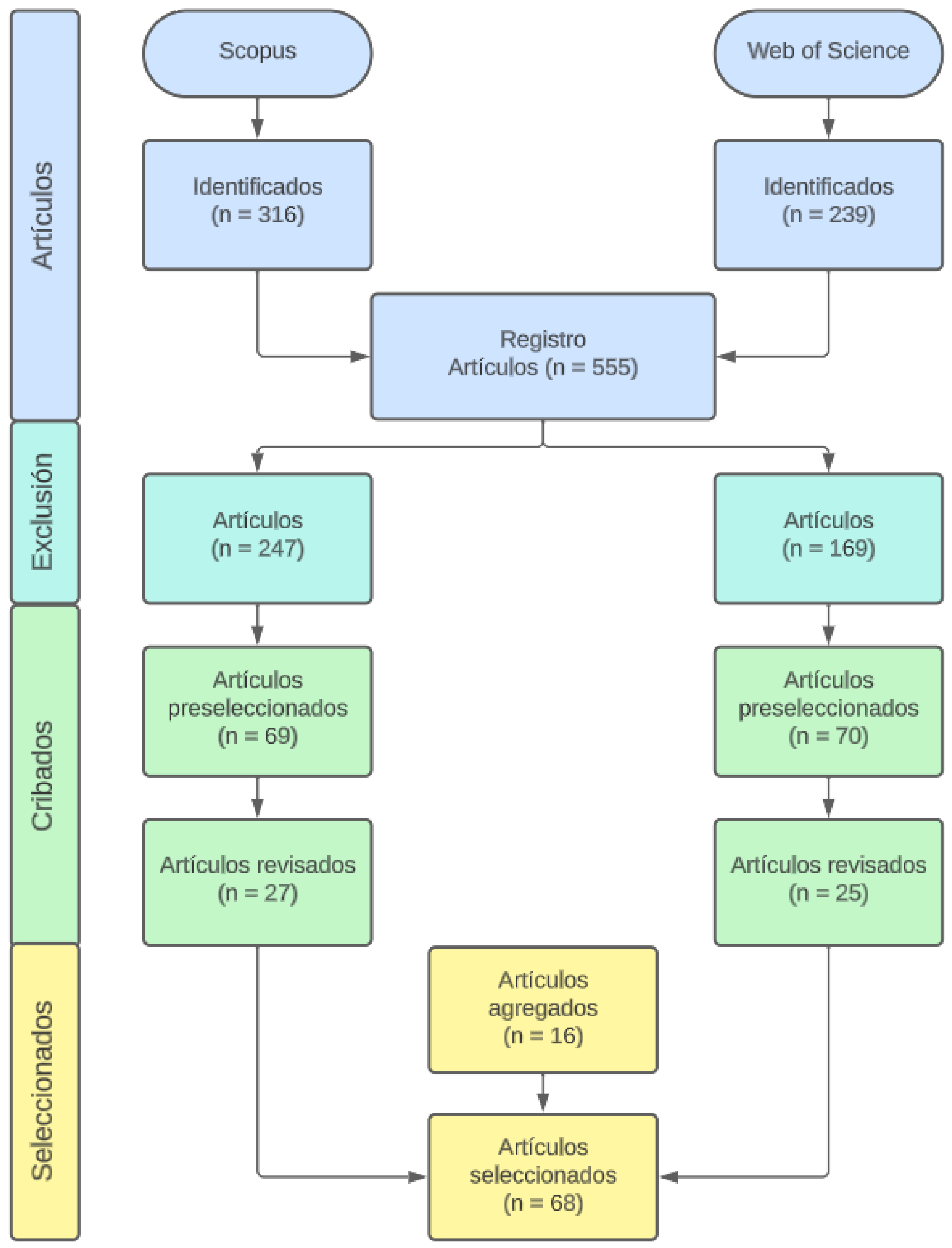
Figure 3.
Annual scientific production.
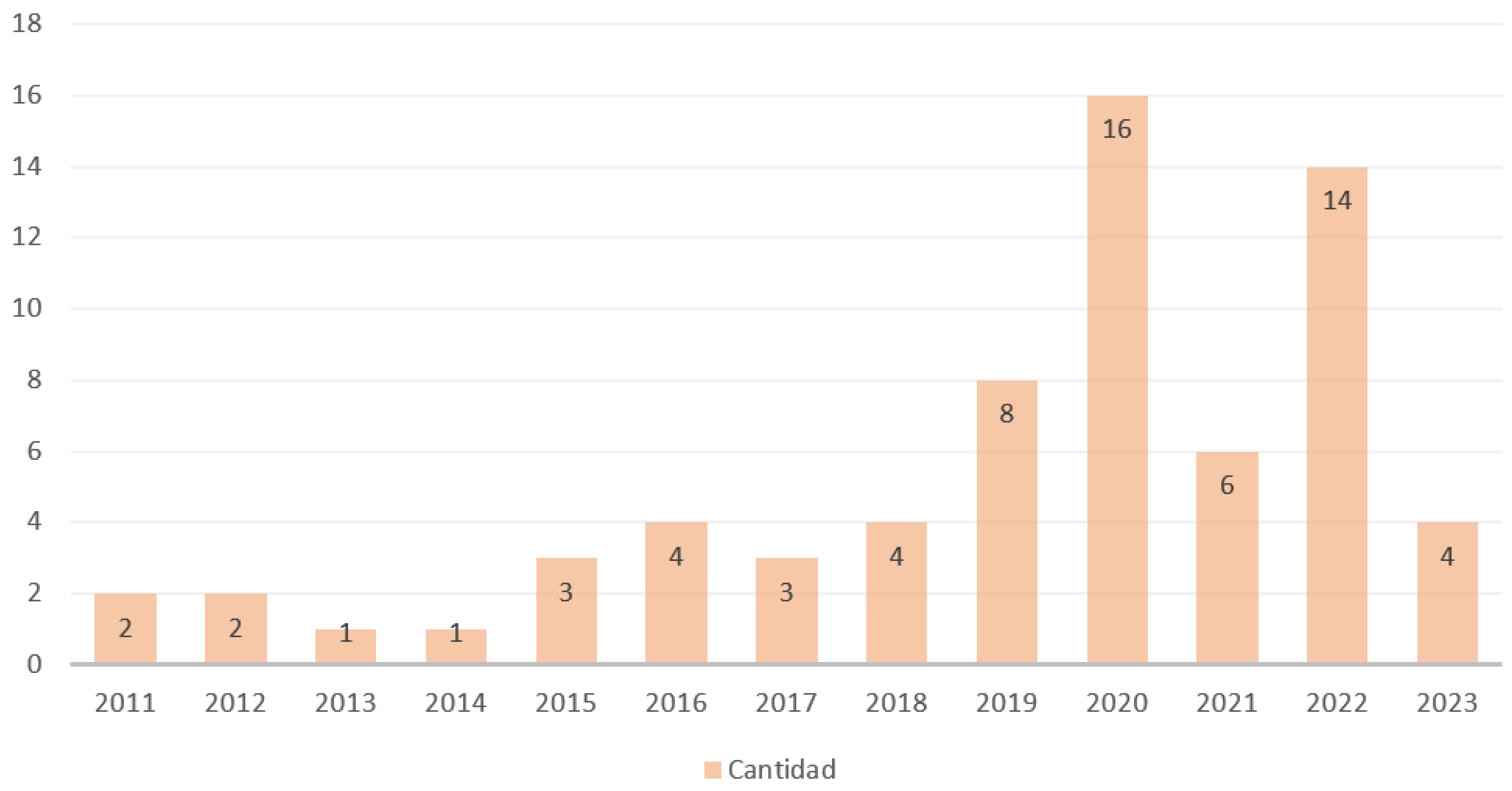

Table 1.
Inclusion and exclusion criteria.
| Inclusion criteria | Exclusion criteria |
|---|---|
| Document type: Article. Type of source: Journal. Language: English. Period: January 2008 - September 2023. Must answer at least one research question. |
No empirical evidence. Journals without quartile. They are oriented to other types of natural disasters such as hurricanes. They are oriented to other RMNDDSA type aspects such as prediction. |
Table 2.
Potentially important and selected articles found.
| Search engine | Articles found | Articles selected by title and content | Selected articles |
|---|---|---|---|
| Scopus | 316 | 69 | 27 |
| Web of Science | 239 | 70 | 25 |
| Others* | 16 | 16 | 16 |
| Total | 571 | 155 | 68 |
* Important articles added.
Table 3.
Selected journals indexed by quartile.
| Quartile | Journal | Articles | Total articles per Quartile |
|---|---|---|---|
| Q1 | International Journal of Disaster Risk Reduction | [A01], [A02], [A05], [A09], [A10], [A25], [A27], [A38], [A64] | 64 |
| Renewable and Sustainable Energy Reviews | [A03] | ||
| Safety Science | [A04] | ||
| Natural Hazards | [A06], [A07], [A12], [A20], [A26], [A34] | ||
| Archives of Academic Emergency Medicine | [A08] | ||
| Springer Nature Switzerland | [A11], [A28], [A44] | ||
| Elsevier | [A13] | ||
| British Medical Bulletin | [A14] | ||
| Journal of Disaster Research | [A15], [A24] | ||
| Habitat International | [A16] | ||
| Humanities and Social Sciences Communications | [A17] | ||
| Scopus - Engineering | [A19], [A41] | ||
| Civil Engineering Journal | [A21] | ||
| Water | [A22], [A52] | ||
| Nova Prisutnost | [A29] | ||
| Journal of Loss Prevention in the Process Industries | [A30] | ||
| Risk Analysis | [A18], [A31] | ||
| International Journal of Information Management | [A32] | ||
| Land | [A23], [A33] | ||
| Sustainability | [A35], [A36], [A53], [A66] | ||
| Geoenvironmental Disasters | [A37], [A63] | ||
| International Journal of Disaster International Journal of Environmental Research and Public Health | [A39] | ||
| Nature | [A40] | ||
| ICE Journal of Management, Procurement and Law | [A42] | ||
| Public Finance Review | [A43] | ||
| Land Use Policy | [A46] | ||
| Journal of Loss Prevention in the Process Industries | [A47] | ||
| Procedia Engineering | [A48], [A56] | ||
| Science of the Total Environment | [A49] | ||
| Disaster Medicine and Public Health Preparedness | [A50] | ||
| Journal of Risk Research | [A51] | ||
| Disaster Science | [A54] | ||
| IOP Publishing Earth and Environmental Science | [A55] | ||
| Remote Sensing | [A59] | ||
| Scientific Reports | [A60] | ||
| Shock and Vibration | [A61] | ||
| International Journal of Population Studies | [A62] | ||
| Technological Forecasting and Social Change | [A67] | ||
| Geomatics, Natural Hazards and Risk | [A68] | ||
| Q2 | Tohoku Journal of Experimental Medicine | [A45] | 2 |
| Symmetry | [A65] | ||
| Q3 | Investigaciones Geográficas | [A57] | 2 |
| International Journal of Safety and Security Engineering | [A58] |
Table 4.
Critical Success Factors of the RMNDDSA.
| ID | Factor | Description | Source |
|---|---|---|---|
| F1 | Knowledge | The knowledge of Quetta city residents about the city’s earthquake proneness inside in the high perception of composite seismic risk in both areas (Ainuddin et al., 2014). | [A01], [A02], [A03], [A04], [A05], [A06], [A07], [A08], [A09], [A10], [A11], [A12], [A13], [A14], [A15], [A16], [A17], [A19], [A20], [A21], [A22], [A23], [A24], [A25], [A27], [A28], [A29], [A30], [A31], [A32], [A33], [A34], [A36], [A37], [A38], [A40], [A41], [A42], [A43], [A44], [A45], [A46], [A47], [A48], [A49], [A51], [A52], [A53], [A54], [A56], [A59], [A60], [A61], [A62], [A63], [A65], [A67] |
| F2 | Planning | Recent devastating earthquakes have shown that destruction and loss of life can only be effectively reduced through national awareness, preparedness, and planned response action programs (Baytiyeh, H., Öcal, A., 2016). | [A01], [A02], [A03], [A04], [A06], [A07], [A09], [A11], [A13], [A14], [A15], [A16], [A17], [A19], [A20], [A21], [A22], [A23], [A25], [A26], [A28], [A29], [A30], [A31], [A34], [A35], [A36], [A37], [A38], [A39], [A41], [A42], [A45], [A46], [A47], [A48], [A49], [A50], [A52], [A53], [A54], [A56], [A58], [A59], [A60], [A61], [A62], [A63], [A65], [A66], [A67], [A68] |
| F3 | Understanding | Understanding how people perceive disasters is necessary to formulate better disaster management strategies and increase societal resilience (Chou, C.-Y., et al., 2023). | [A01], [A02], [A04], [A05], [A06], [A07], [A09], [A10], [A11], [A13], [A15], [A16], [A17], [A19], [A20], [A22], [A23], [A24], [A25], [A27], [A30], [A31], [A32], [A35], [A36], [A37], [A38], [A40], [A41], [A42], [A43], [A44], [A46], [A47], [A49], [A51], [A52], [A53], [A54], [A56], [A59], [A60], [A61], [A62], [A63], [A67], [A68] |
| F4 | Perception | Studies reveal that the level of individual preparedness is influenced by personal risk perception and individual circumstances (Heinkel, S.-B., et al., 2022). | [A01], [A02], [A04], [A07], [A09], [A10], [A11], [A14], [A15], [A16], [A17], [A20], [A21], [A22], [A23], [A25], [A27], [A29], [A30], [A31], [A33], [A34], [A37], [A38], [A41], [A42], [A44], [A48], [A51], [A52], [A53], [A54], [A58], [A59], [A63], [A66] |
| F4 | Organization | It is necessary for the community to establish community organization to improve community disaster response capacity and lay a solid foundation for community disaster management (Lin, B.-C., & Lee, C.-H., 2022). | [A01], [A03], [A06], [A11], [A12], [A14], [A15], [A20], [A21], [A24], [A26], [A29], [A32], [A34], [A37], [A41], [A44], [A47], [A51], [A53], [A54], [A56], [A59], [A60], [A61], [A62], [A63], [A67], [A68] |
| F6 | Monitoring | Natural hazards also play a role in assessing and preventing catastrophes due to earthquakes or volcanic eruptions. volcanic eruptions, which requires careful monitoring (Michellier et al., 2020). | [A07], [A08], [A11], [A12], [A13], [A14], [A19], [A22], [A23], [A24], [A26], [A29], [A32], [A34], [A38], [A41], [A44], [A48], [A51], [A53], [A54], [A56], [A59], [A60], [A62] |
| F7 | Management | There is an urgent need to build and deploy disaster-resilient systems, including digitizing medical information and establishing a networked system for its management (Miki et al., 2022). | [A12], [A13], [A14], [A18], [A21], [A22], [A26], [A34], [A39], [A41], [A45], [A46], [A47], [A53], [A59], [A60], [A61], [A62], [A67] |
| F8 | Direction | A key aspect of the response to both events was swift and strong leadership from the government (Mitchell et al., 2017). | [A02], [A04], [A11], [A21], [A25], [A34], [A41], [A43], [A44], [A45], [A46], [A50], [A53], [A60], [A61], [A62] [A63], [A67] |
| F9 | Control | Five main components of perceived risk in hazardous situations are identified: frequency of death, subjective estimate of mortality, potential for catastrophe, judged severity of death, and a few qualitative characteristics including control (Ozdemir et al., 2011). | [A08], [A10], [A17], [A21], [A23], [A33], [A38], [A43], [A50], [A51], [A60], [A65], [A67], [A68] |
| F10 | Evaluation | Seismic risk assessment of support structures and process piping elevated on support structures plays an important role in the prevention of accidents within process plants (Kalantari et al., 2020). | [A03], [A05], [A06], [A07], [A09], [A21], [A23], [A28], [A30], [A48], [A59], [A67] |
| F11 | Feedback | The decision to adopt the Hong Kong criterion was supported by consultant recommendations and informal feedback from the public (Macciotta et al., 2018). | [A06], [A11], [A13], [A29], [A37], [A44], [A49], [A56], [A65], [A67] |
| F12 | Execution | Pre-disaster management includes the preparedness and mitigation phase, while response and recovery correspond to the post-disaster phase. Different disaster management plans and activities are implemented in these phases (Shukla et al., 2023). | [A11], [A23], [A26], [A31], [A60], [A62] |
| F13 | Follow-Up | Pre- and post-disaster Digital Elevation Models were generated from satellite stereo-optical image tracking (Shafapourtehrany et al., 2023). | [A11], [A14], [A19], [A50], [A58], [A59] |
| F14 | Reduction | New and innovative approaches should be applied to disaster catastrophe risk reduction, merging knowledge, lessons learned and bringing together academics, practitioners, government officials to discuss common issues from different perspectives (Tuladhar et al., 2015). | [A33], [A44], [A54], [A56], [A63] |
| F15 | Vulnerability | What is meant by vulnerability has been defined in many ways, including risk, stress, susceptibility, adaptation, resilience, sensitivity or strategies to cope with stress (Ruiz Rivera, 2012). | [A35], [A36], [A45], [A57], [A65] |
| F16 | Preparedness | To mitigate the effects of natural hazards, it is essential to understand how people living in at-risk locations perceive hazards and risk and their knowledge and preparedness in relation to hazards (Alam et al., 2016). | [A02], [A09], [A20], [A27], [A59] |
| F17 | Monitoring | Overhead monitoring is key to prevent natural disasters using real-time object detection from drones with methods such as R-CNN and KCF (Salluri et al., 2020). | [A06], [A32], [A55], [A58] |
| F18 | Response Capability | Given the importance of disaster management globally, investments in global collaborative networks can make significant contributions and develop real-time response capabilities for research (Callaghan et al., 2016). | [A13], [A48] |
| F19 | Information Technology | Information technologies are used to store, process and distribute information and are useful in all phases of DRM (Meechang et al., 2020). | [A18], [A41] |
| F20 | Resilience | Individual resilience at the household level and community resilience contribute significantly to mitigation in the early stages of disasters (Heinkel et al., 2022). | [A20], [A29] |
| F21 | Mitigation | It is imperative to urgently understand the public’s perception of seismic risk, as well as to identify factors that are conducive to mitigation behaviors (Ozdemir et al., 2011). | [A27], [A51] |
| F22 | Prevention | A Culture of prevention manifests itself as a common behavior to respond assertively to hazard situations that may arise (Pastrana et al., 2020). | [A50], [A53] |
| F23 | Awareness | The experience of major disasters contributes to society’s awareness of the importance of preventive measures (Pastrana et al., 2020). | [A04], [A53] |
| F24 | Recovery | Within the context of natural disasters, when communities participate in data collection and information sharing, new opportunities arise to better understand urban vulnerabilities, capacities, and risks. Data-driven methods for damage assessment and recovery planning can also be created (Salluri et al., 2020). | [A58] |
Table 5.
Factors of the literature review and the state of the art of the selected papers.
| # | Factor | Primary Source | Reference |
|---|---|---|---|
| 1 | Structural damage | Asad, R., et al. (2023) | [A06] |
| 2 | Temporary housing | Asad, R., et al. (2023) | [A06] |
| 3 | Victims of debris | Asad, R., et al. (2023) | [A06] |
| 4 | Economic impact | Asad, R., et al. (2023) | [A06] |
| 5 | Social impact | Asad, R., et al. (2023) | [A06] |
| 6 | Health risk | Chan, E.Y.Y. (2019) | [A14] |
| 7 | Health response | Chan, E.Y.Y. (2019) | [A14] |
| 8 | Security | Hosseini et al. (2019) | [A21] |
| 9 | Hygiene | Hosseini et al. (2019) | [A21] |
| 10 | Logistics | Hosseini et al. (2019) | [A21] |
| 11 | Government Conditions | Imamura, F., et al. (2019) | [A25] |
| 12 | Socioeconomic Conditions | Imamura, F., et al. (2019) | [A25] |
| 13 | Demographic Conditions | Imamura, F., et al. (2019) | [A25] |
| 14 | Sustainability | Sobhi et al., (2022) | [A61] |
| 15 | Degree of self-organization | Sobhi et al., (2022) | [A61] |
Table 6.
Theories underlying influencing factors in RMNDDSA.
| ID | Theory | Description | Factor | Reference |
|---|---|---|---|---|
| T1 | Diffusion of innovations theory | It studies the propagation of new ideas in a social system, highlighting research on the duration of new idea distribution and adoption through communication of people (Meechang et al., 2020). | F18 F19 F21 F22 F23 |
[A41] [A41] [A41] [A41] [A41] |
| T2 | Media richness theory | It highlights the importance of information to influence and enhance understanding. Personal means of communication are most effective for publicizing problems, facilitating interactions, and making decisions in situations of risk, uncertainty, and disaster (Tuladhar et al., 2015). | F12 F19 F23 |
[A41] [A41] [A20], [A41], [A63] |
| T3 | Organizational information processing theory |
Organizations need quality information in the face of environmental uncertainty and improve decision making with the complexity of the environment and the dynamism, or frequency of changes in various environmental variables of the seismic disaster (Hussain et al., 2022). | F7 F8 F9 F10 F11 F13 F14 F19 |
[A13], [A19] [A19] [A13] [A13], [A19] [A13] [A13] [A13], [A19] [A13] |
| T4 | Phenomenology theory |
It is related to other disciplines, such as science, philosophy, such as ontology, epistemology, logic and ethics. People have a particular way of seeing the world and processing what they experience through experience and according to their own perceptions, beliefs, and values (Llorente-Marrón et al., 2020). |
F2 F3 F16 F20 F24 |
[A06], [A09], [A47] [A09] [A06], [A09], [A11] [A06], [A09], [A11] [A06], [A09], [A47] |
| T5 | Prospect theory | In the face of low earthquake probabilities, people may not perceive risk accurately and may adopt behaviors of ignoring or exaggerating the probabilities of occurrence (Chou et al., 2023). | F4 F14 F15 F16 F23 F24 |
[A15] [A15] [A15] [A15] [A15] [A15] |
| T6 | Social learning theory | It comprises social learning or TAS where people learn new behaviors, through reinforcement or punishment, or through observational learning from social factors in their environment. Sustaining life and survival instinct allows us to focus on risk management (Bandecchi et al., 2019). | F1 F7 F14 F15 F17 F20 |
[A09], [A32] [A09], [A32] [A09] [A09] [A32] [A09], [A32] |
| T7 | Vector theory | It presents physical and social dimensions as separate vectors with different magnitudes and allows us to calculate a combination with independent perspectives and have a common starting point in vulnerability (Izquierdo et al., 2020). | F1 F14 F15 F20 |
[A25] [A25] [A25] [A25] |
| T8 | Cultural Theory | It is based on social and cultural factors that influence how people perceive and accept risks. Research in these fields has revealed that risk perception and acceptance are rooted in cultural and social factors (Ainuddin et al., 2014). | F1 F6 F15 F16 F23 |
[A01], [A53] [A53] [A01], [A53] [A01], [A53] [A01], [A53] |
| T9 | Protection Motivation Theory | It divides the assessment into threat and coping. The former focuses on the perception of vulnerability and severity, while the latter focuses on response effectiveness and belief in personal ability to reduce the threat. Disaster preparedness varies according to the perception of vulnerability (Baytiyeh et al., 2016). | F14 F16 F20 |
[A10], [A41], [A51] [A10], [A41] [A10], [A41] |
| T10 | Disaster System Theory | Applying diverse disaster models is essential to manage disaster risk as a structural system that includes the hazard, geographical environment, and exposed units. This approach describes disaster chains as mathematical representations and states that the overall process of the disaster model management system is based on the interconnection of individual disaster models (Jiang et al., 2022). | F15 F16 |
[A44] [A26] |
| T11 | Social Exchange Theory | Decisions in society are based on the outcomes of social behaviors. This theory suggests that there are intrinsic and extrinsic motivations in social exchange behaviors by information propagation and interactions on social network platforms (Zhang et al., 2017). | F1 F23 |
[A32] [A32] |
Table 7.
Methods used in the verification of RMNDDSA factors.
| ID | Method | Factor | Reference |
|---|---|---|---|
| M01 | Hypothesis testing | F1 F4 F14 |
[A02], [A04], [A11], [A16], [A31], [A33], [A36], [A43], [A52], [A56], [A61] [A04], [A11], [A16], [A31], [A33], [A52] [A33], [A56] |
| M02 | Assessment of the degree of vulnerability | F15 F21 F23 |
[A35], [A36], [A65] [A27] [A04] |
| M03 | Exposure analysis | F2 F6 F14 |
[A03], [A16], [A22], [A23], [A68] [A22], [A23] [A33] |
| M04 | Structured surveys, stakeholder interviews and questionnaires | F1 F3 F4 F5 F17 F23 |
[A01], [A04], [A12], [A16], [A32], [A33], [A63] [A01], [A04], [A16], [A32], [A63] [A01], [A04], [A16], [A33], [A63] [A01], [A12], [A32], [A63] [A32], [A55] [A04] |
| M05 | Qualitative methods | F1 F3 F4 F11 F24 |
[A04], [A06], [A16], [A32], [A63] [A04], [A06], [A16], [A32], [A63] [A04], [A16], [A63] [A06] [A04] |
Disclaimer/Publisher’s Note: The statements, opinions and data contained in all publications are solely those of the individual author(s) and contributor(s) and not of MDPI and/or the editor(s). MDPI and/or the editor(s) disclaim responsibility for any injury to people or property resulting from any ideas, methods, instructions or products referred to in the content. |
© 2024 by the authors. Licensee MDPI, Basel, Switzerland. This article is an open access article distributed under the terms and conditions of the Creative Commons Attribution (CC BY) license (http://creativecommons.org/licenses/by/4.0/).
Copyright: This open access article is published under a Creative Commons CC BY 4.0 license, which permit the free download, distribution, and reuse, provided that the author and preprint are cited in any reuse.


