

Submitted:
01 May 2024
Posted:
02 May 2024
You are already at the latest version
Abstract
CRISPR/Cas9 has emerged as the predominant method for genome editing due to its cost-effectiveness and broad applicability, playing a crucial role in advancing sustainable practices across various sectors. This systematic review leverages the PRISMA methodology to explore CRISPR/Cas9's impact on environmental protection, thereby supporting the Sustainable Development Goals (SDGs). Analyzing data from the Web of Science, the review found significant growth in related publications, with a 30% increase since 2014, predominantly from the US, China, Germany, and the UK. The study categorizes the scientific developments into three trends: advancements in agriculture, gene editing techniques, and biofuel production. Key discussions include the use of CRISPR/Cas9 in developing fourth-generation biofuels and environmental biosensors, as well as its applications in enhancing genetic resilience and controlling invasive species. These innovations highlight CRISPR/Cas9's potential in promoting sustainable resource management and energy generation, marking a pivotal contribution to ecological conservation and sustainability efforts.
Keywords:
CRISPR/Cas9
; CiteSpace
; Environmental biotechnology
; Bibliometrics
; Biofuels
1. Introduction
Environmental degradation is one of the most urgent challenges, primarily driven by human activities due to technological and industrial progress [1]. These activities encompass extensive deforestation, which disrupts the water cycle and destroys habitats [2]. Simultaneously, the excessive use of fossil fuels escalates greenhouse gas (GHG) emissions, resulting in a variation of the average global surface temperature [1,2]. Human activities also contribute to water resource issues through oil pollution[3,4] and mining extractions [5], substantially impacting food and water supplies, infrastructure, public health, environmental conservation, and the economy [6]. Environmental degradation has further led to immigration and population growth, with adverse health and food security consequences [7]. According to the Food and Agriculture Organization (FAO), around 900 million people faced severe food insecurity in 2022 [8]. Consequently, these challenges compound the energy crisis by jeopardizing the reliability and sustainability of energy sources [9].
Most of the conventional approaches to address these issues have worsened environmental impacts rather than mitigating them [10]. In the quest for alternatives, environmental biotechnology has successfully contributed to the sustainable utilization of natural resources, bioenergy alternatives [11], urban solid waste management [12], sustainable construction [13], and pollution avoidance [14]. This branch of biotechnology relies on harnessing the biochemical potential of organisms and their molecular components for the preservation, restoration, and sustainable management of natural resources and addressing environmental degradation [14,15]. In recent years, various biotechnological tools have been employed with significant frequency. One of the outstanding techniques is Clustered Regularly Interspaced Short Palindromic Repeats (CRISPR/Cas), which is applied in medicine, environment, and agriculture[16,17,18]. CRISPR/Cas is now expanding into new realms of research to achieve a circular bioeconomy in alignment with the Sustainable Development Goals (SDG) through Environmental Biotechnology [10].
Among the different types of CRISPR/Cas, CRISPR/Cas9 is the most widely used system due to its simplicity, efficiency, and versatility in genome editing across various organisms. Its popularity stems from the ability to easily program the guide RNA to target specific DNA sequences for precise modifications. These characteristics have made it a powerful tool [19,20], based on the immune system mechanism found in archaea, a group of prokaryotic microorganisms known for their ability to thrive in non-sterile and often extreme environments and bacteria [21,22]. The Cas9 nuclease, associated with CRISPR, is a genomic editing technique employed to target and edit DNA sequences, following the principles of complementary base pairing [23]. In 1993, CRISPR was first observed for the first time in archaea, specifically in Haloferax mediterranei [24]. Starting in 2011, the analysis of evolutionary relationships between CRISPR sequences and Cas proteins marked the beginning of a steady expansion of its research. This led to the reprogramming and transfer of the CRISPR/Cas system between different organisms [16]. In the field of environmental biotechnology, CRISPR/Cas9 has emerged as a highly significant tool [25]. Environmental biotechnology utilizes techniques such as bioremediation of toxic substances, including organic compounds, metals, petroleum, hydrocarbons, dyes, detergents, and biosensors [14].
Bioremediation is one of the most efficient technologies, and its purpose is to reduce environmental pollution and restore ecosystems[26]. Different tools are used in bioremediation: phytoremediation, biostimulation, biofilm formation, chemotaxis, bioaugmentation, genetically modified microorganisms, and different omics techniques[27]. This way, phytoremediation is economical and environmentally friendly to clean up heavy metal soil pollution, using specific plants to absorb and remove these metals [28]. CRISPR technology is a vital tool in phytoremediation, focusing on enhancing a plant’s ability to synthesize metal ligands and excrete root exudates. Examples include genes like NAS1, which boosts tolerance to metals such as Cd, Cu, Fe, Mn, Ni, and Zn, and genes like metallothioneins (MTA1, MT1, MT2), which increase the plant’s capacity to withstand Cd, Cu, and Zn [29].
Additionally, biosensors, among the most powerful tools for detecting environmental contamination, play a crucial role by providing specific quantitative and semi-quantitative analytical information by recognizing the biological elements [30]. Moreover, CRISPR/Cas9 has been used in multiple applications. This biotechnological tool has been employed to counteract the presence of invasive fish species, which pose a significant risk to ecosystem biodiversity [25,31]. Simultaneously, this technology has been instrumental in the early detection of organisms, pathogens, and pollutants in environmental samples, playing a critical role in pollution prevention and the prevention of waterborne disease outbreaks and contributing to environmental health monitoring [25]. In the context of phytoremediation, CRISPR has revolutionized the identification of plants with the ability to accumulate metals through chelation, and its genomic editing has advanced phytostabilization, phytoextraction, phytomining, phyto-volatilization, and bioenergy generation [32].
CRISPR/Cas9 has been used to address specific environmental issues that have been a significant concern for many years. For example, the emergence of antibiotic resistance genes (ARGs) has had far-reaching consequences, affecting critical environmental processes like biological wastewater treatment. This issue was first identified by Korzeniewska et al. in 2013 [33]. In response, Li et al. (2023) [34] introduced VANDER, a synthetic biology system built on the CRISPR/Cas mechanism that enables ARG degradation. Another historical challenge has been the overreliance on pesticides in agriculture, despite their toxic effects on human and environmental health, which have been recognized since 1945 [35]. To combat this issue, Jose and Éva (2023) [36] propose that CRISPR/Cas could be employed to develop pest-resistant plants, reducing the need for chemical insecticides. Moreover, the enduring challenge of petroleum-related disasters has acquired increasing historical importance [37]. Biotechnological tools, among which CRISPR/Cas stands out, provide potential solutions, such as using genomic editing of Candida to enable petroleum metabolism, as demonstrated in the study by Uthayakumar et al. (2021) [37].
In the agricultural domain, CRISPR/Cas9 has contributed to enhancing crop resistance to drought and nutrient absorption and reducing pesticide dependence, aiming to promote more sustainable and environmentally friendly food production practices [10]. Primarily, CRISPR/Cas9 allows us to address food safety and sovereignty issues by modifying the plant genome, enabling the development of crops capable of resisting pests, diseases, and adverse environmental conditions, including wild species, thereby reducing agricultural losses [25]. Additionally, it can simplify food waste management processes by addressing lignin modification in plants, a critical structural component of agricultural residues. Incorporating these genes allows for an economical and practical approach to bioethanol production, one of the most common biofuels [10]. Biofuels are alternative fuels, such as Vegetable oils, animal oils, and ethanol. The most advanced biofuels are derived from lignocellulosic plant residues. These are attractive because they have a negative or neutral carbon footprint and are more economical than crops [38].
This study conducted a scientometric analysis: bibliometric tools focused on applying CRISPR-CAS9 in environmental biotechnology. Bibliometrics and scientometrics are considered quantitative tools commonly used in scientific research [39,40,41], applying mathematical and statistical methods to books and other research media. Scientometrics, a field examining bibliometric data, seeks patterns and causalities in science through numerical correlations [42]. The bibliometric study is a method of sadistic analysis that focuses on elucidating the influence and results of the literature investigations. Academic researchers use bibliometrics to find emergent trends in articles and journals, collaborations, patrons of research, and the intellectual structure of a specific literature subject [43]. Bibliometric analysis contributes to transparency in literary review and allows for examining a more significant number of publications than peer review [44]. Furthermore, bibliometrics shapes science as a network of knowledge that feeds back and legitimizes knowledge through production, collaboration, and acts of recognition, establishing a hierarchy in scientific selection. Both tools are intended to analyze the frontiers of a research topic or field from macro to micro perspectives, including elements such as countries, institutions, authors, keywords, and journals [42,45].
There are no reports on that research gap; therefore, this review is based on the need for a systematic and comprehensive study to analyze opportunities for environ-mental biotechnology through CRISPR/Cas9. In exploring this area, we pose several key questions: Which countries are leading this type of research? Which journals play a strategic role in this field? How do research networks develop, and how do they evolve? We aim to conduct a bibliometric study that examines institutions, journals, authors, and keywords. With this background, we delved into leading applications while linking the pillars of the SDGs. Finally, some suggestions were proposed for future studies to uncover the potential of emerging technologies to promote environmental biotechnology using CRISPR/Cas9.
2. Results
2.1. Dynamics Trends in the Number of Publications
We started from 406 publications obtained from January 2014 to September 8, 2023, according to the available data, as shown in Figure 1
Figure 1 shows the annual growth of publications in the literature related to CRISPR/Cas9 in Environmental Biotechnology. According to Figure 1, from 2014 to 2023, there were 406 publications. In 2014, there was a lower production of scientific research. However, it showed a sharp increase from 2019, reaching a peak in 2022. Xiao et al., (2022) mentioned that the quantity of citations is commonly acknowledged as a significant metric for assessing the impact of articles, and it also indicates the level of attention from researchers to a certain extent [46]. So, it can be said that the increase in this subject since 2019 reflects a growing interest and focus in the field, possibly due to technological advancements or a better understanding of the applicability of CRISPR/Cas9 in this context [47,48,49]. The reference to citations underscores the influence of these works in the research community [50].
2.2. Keyword Clusters Analysis
The co-occurrence of keywords in the study of CRISPR/Cas9 in Environmental Biotechnology, allowed us to obtain five clusters differentiated by topics in the articles. Figure 2 indicates the most relevant keywords, arranged in nodes by groups of colors, forming links between them, indicating the connection of some words with others. We can also see the difference between nodes, with a larger (CRISPR/Cas9), representing their relevance in the articles in this study.
Among the most prominent categories, we found “CRISPR/Cas9” with 111 citations, including words such as RNA, DNA, and Cas9 protein. And a subgroup “gene editing” with 63 citations, including words such as bacteria, Escherichia coli, and edition. The category “expression” obtained 59 citations, including words such as bioethanol, Saccharomyces cerevisiae, and three subgroups “gene,” “proteins,” and “growth.” The category “identification” showed 28 citations containing words such as dynamics, activation, and target. The category “resistance” showed 23 citations, including words and subgroups such as plants, gene expression, adaptation, “sustainability,” “rice,” and “biosensors.” Finally, the category “biosynthesis” obtained 12 citations, finding words such as biotechnological applications, stress, and mechanisms.
2.3. Co-Occurrence Analysis
2.3.1. Scientific Production by Country and Institutions
Figure 3 shows the analysis of scientific production by country (2014-2023), including a co-ocurrence map, where the main contributions of the countries related to CRISPR/Cas9 in environmental biotechnology are depicted. The most significant nodes, comprising the United States, the People’s Republic of China, Germany, and England, which are defined as the most relevant countries, can be observed. In addition, there are rings of different colors, which show each country’s scientific production years; the purple rings correspond to the oldest production, the rings degrade in color until the yellow ones, which represent the most current production.
The node analysis allows us to interpret the main contributor, namely the United States because it has the highest degree of centrality (Centr = 0.80), followed by England (Centr = 0.28), then Brazil (Centr = 0.13) and People’s Republic of China (Centr = 0.10). From these results, we can establish that these countries have the highest index of cooperative relations among themselves, in conjunction with other countries such as South Korea, Germany, Netherlands, and Israel.
On the other hand, based on the information obtained in CiteSpace (6.1.R6.), Table 1 was made, detailing the scientific production of the top 10 countries, where two North American countries (the United States and Canada), two Asian countries (People’s Republic of China and Japan), five European countries (Germany, England, Spain, France, and Switzerland) and one country representing Oceania (Australia) stand out.
2.3.2. Scientific Production by Institutions
Analyzing institutional production and cooperation allowed us to identify the institutions with the greatest influence in publications on CRISPR/Cas9 in Environmental Biotechnology and their cooperation networks. We found two hundred and thirty institutions, as seen in Figure 4, of which, as leaders in publications on CRISPR/Cas9 in Environmental Biotechnology, we have the University of California System with 31 citations, most of them in 2014. Chinese Academy of Sciences is in second place with 19 citations, most in 2017, and Harvard University is in third place with 13 citations, most in 2014.
In the analysis of collaborative networks based on the intermediate centrality of the nodes, the Chinese Academy of Sciences is the main node since it has the highest degree of centrality (Centr = 0.18). Followed by Howard Hughes Medical Institute (Centr = 0.15), then the University of California System (Centr = 0.13) and UDICE-French Research Universities (Centr = 0.13). These nodes represent the institutions with the highest index of cooperative relationships among themselves and in conjunction with other institutions, such as the Chinese Academy of Agricultural Sciences, Johns Hopkins University, Sorbonne University, and others mentioned above.
Based on the information obtained in CiteSpace (6.1.R6.), Table 2 was created, detailing the scientific production of the ten main countries. Five institutions from the United States (University of California System, Harvard University, Howard Hughes Medical Institute, University of California Berkeley, Massachusetts Institute of Technology (MIT)) were found. Three institutions from the People’s Republic of China (Chinese Academy of Sciences, Ministry of Agriculture & Rural Affairs, Chinese Academy of Agricultural Sciences). And two from France (Centre National de la Recherche Scientifique (CNRS), UDICE-French Research Universities).
2.4. Co-Citation Analysis
2.4.1. Journal Co-Citation Analysis
Figure 5 shows scientific production and cooperation networks analysis by journals with publications on CRISPR/Cas9 in Environmental Biotechnology. We obtained two hundred and ninety-four journals, of which more than 85% had at least two publications on the topic of study. The vast majority of these journals were from the United States (Proceedings of the National Academy of Sciences (PNAS), Science, PloS ONE) and the United Kingdom (Nature, Nucleic Acids Research, Nature Biotechnology).
Analyzing the intermediate centrality of the nodes to determine the collaboration network among the journals, it was found that eLife had the highest degree of centrality (Centr = 0.14). It was followed by Plant Journal (Centr = 0.14), then Molecular Cell (Centr = 0.13), and Angewandte Chemie-International Edition (Centr = 0.11). This indicates that these journals have the highest index of cooperative relationships among them and in conjunction with others, such as Science, PloS ONE, and Nature.
Table 3 ranks the ten journals with the most articles on CRISPR/Cas9 in Environmental Biotechnology. Proceedings of the National Academy of Sciences (PNAS) stand out in the top position, with 249 scientific contributions, four more compared to the following journal Nature, with 245 cited publications. This is followed by Science and PloS ONE journals, with 244 and 197 scientific contributions, respectively.
2.4.2. Scientific Production by Authors
In the evaluation of scientific production by authors, in Figure 6, a map of nodes illustrating the key contributions of CRISPR/Cas9 within Environmental Biotechnology was generated. The most prominent nodes represent the most influential authors of the last decade, and the different colored rings correspond to the annual scientific production. The purple ring corresponds to the oldest contributions, and the yellow ring corresponds to the most recent ones.
We found two hundred and ninety-two authors, of which about 70% have at least two publications related to the topic of study. Martin Jinek leads the group with his article published in 2012 entitled “A Programmable Dual-RNA-Guided DNA Endonuclease in Adaptive Bacterial Immunity,” which has the highest number of citations.
The analysis of node betweenness centrality determines the collaboration network among authors. We found that Ran F (2015) and Akcakaya P (2018) exhibit the highest centrality degree (Centr = 0.20), making them key contributors to the dynamics of the scientific research cooperation network. Following closely are Jinek M (2012) (Centr = 0.20), Chen JS (2018) (Centr = 0.19), and Cong L (2013) (Centr = 0.14). However, the collaboration network among authors is extensive, as several articles combine laboratory groups for joint studies, underscoring the indispensable nature of cooperation and collaboration among them.
On the other hand, using the obtained information, Table 4 was generated, presenting a top 10 list of highly cited articles related to CRISPR/Cas9 in Environmental Biotechnology. Jinek M, Cong L, and Zetsche B emerge as leaders on the list with the highest number of cited publications in journals from the United States.
2.5. Applications of CRISPR/Cas9 in Environmental Biotechnology
The urgency posed by environmental degradation alongside the imperative for sustainable solutions has spurred heightened interest in leveraging tools such as CRISPR/Cas9 within environmental biotechnology. Employing a bibliometric approach, the current research landscape concerning CRISPR/Cas9 applications within this realm has been systematically examined. This rigorous analysis delineates publications, citations, keywords, geographical distribution, institutional affiliations, journal outlets, and prolific authors shaping the scientific discourse. Drawing from these findings, we elucidate two overarching domains and six distinct applications that epitomize the potential of CRISPR/Cas9 within environmental biotechnology: Environmental Monitoring and Sustainable Energy (encompassing fourth-generation biofuels and biosensors) and Genetic Resilience and Biodiversity Conservation (encompassing conservation efforts, genetic resilience enhancement, combating invasive species, and fostering sustainable agriculture). Moreover, Table 5 visually represents how these identified applications correspond with the clusters derived from the bibliometric analysis, underscoring the invaluable contributions of such research endeavors toward advancing sustainable development objectives (SDG). These applications will be discussed in detail in the following sections.
2.5.1. Fourth-Generation Biofuels
The development of alternative renewable energies with a lower environmental impact is necessary, given the increase in GHG emissions that directly affect the global climate and generate environmental concern [61,62]. Biofuels have the potential to reduce and even eliminate carbon emissions by reducing the use of fossil fuels fuels [63,64]. Biofuels are classified according to various characteristics, for example, by the origin or type of biomass (aquatic, terrestrial, and microbial); primary according to the state of the biomass (liquid, solid, and gaseous); secondary according to the type of feedstock (first, second, third and fourth generation); and by the technological conversion route (thermochemical, biochemical, physical-chemical) [64,65,66,67,68].
The systematic evolution of secondary biofuels encompasses four generations; the first generation refers to energy production from edible crops. However, its main disadvantage is the use of plots of land on which food supply products could be grown [64,65,68]. The second generation considers non-food products as feedstock [69,70]. The negative side of these biofuels is the production cost that rises when applying the technologies produced at the laboratory level on a real scale [62]. The third generation includes microbial sources and algae [71]; its main advantage lies in using unproductive land to place production tanks or reactors [72,73,74]. Finally, fourth-generation biofuels originate from the bioconversion of organisms through the use of biotechnological tools (metabolic engineering) that make genetic modifications to improve tolerance to biofuels, elevated temperatures, and inhibitors or to increase the amount of lipids that can be used as feedstock for biodiesel production [62,75].
2.5.2. Environmental Monitoring through the Use of Biosensors
The contemporary world grapples with a significant challenge of environmental contamination, propelled by ongoing industrial expansion, rapid urbanization, and population growth, leading to the release of diverse harmful substances that severely impact ecosystems and human well-being in the air, soil, and water [76]. Scientists actively pursue lasting solutions through environmental monitoring, understanding the critical importance of effectively managing toxic substances; this involves essential data collection and analysis for comprehending and safeguarding the environment, covering air and water quality, soil conditions, biodiversity, and climate patterns [77].
Despite notable advancements over the past century, controlling toxins on-site remains a formidable challenge [78]. The increasing demand for early warning systems parallels the rise in pollution sources, emphasizing the need for immediate on-site monitoring to tackle environmental degradation effectively. Although conventional analytical techniques such as high-performance liquid chromatography, gas chromatography, and inductively coupled plasma-mass spectrometry have been conventionally employed for their sensitivity and precision in monitoring water or [39] soil samples, their efficacy is constrained in centralized laboratories due to cost and time constraints, requiring skilled personnel [79].
In contrast, biosensors exhibit cost-effectiveness, energy efficiency, and suitability for real-time, on-site monitoring [80,81]. In their design, it is crucial to consider factors such as user-friendly manipulation, safe operation, on-site detection without complex sample preparation, real-time monitoring capabilities, cost efficiency, and environmental sustainability [82]. However, biosensors face drawbacks such as high expenses and a restricted operational lifespan due to device degradation, sensor drift, and the need for component replacements [83]. Other unfavorable aspects include susceptibility to interference, sensitivity to environmental factors, the necessity for regular calibration, and substantial overall costs [84].
The need to utilize rapid, selective, sensitive, accurate, and capable real-time pollutant detection and screening has prompted the development of sophisticated biosensing devices [80]. A biosensor is an analytical approach for meticulously and dependably identifying pollutants using biotechnology while maintaining a low cost [81]. Additionally, biosensors utilizing biological sensors for detection have been innovated to enhance our understanding of the bioavailability of environmental pollutants [85].
A biosensor is a self-contained integrated device incorporating a biological recognition element (e.g., enzyme, antibody, or microorganism) that interacts with a chemical sensor, displaying a reversible and concentration-dependent response to a chemical species [86]. It comprises signal transducer components that generate detectable or quantifiable signals when pollutants are sensed [87]. These analytical devices, known as biosensors, integrate a biological sensing element to identify a specific analyte or molecule from complex samples [88]. The capability to generate recognition sites with high specificity makes biosensors a feasible replacement for techniques relying on traditional chromatography [89].
In recent decades, biosensors have significantly advanced in detecting various substances, from pollutants to pharmaceuticals [90,91]. The biosensor technology has recently undergone evaluation in diverse scenarios, including monitoring in agriculture, detection of groundwater, surveillance in oceans, and environmental monitoring [86], and fields including medicine, industry, environmental monitoring, agriculture, food and forensic chemistry [92].
Biosensors exhibit diverse forms, encompassing cell-free variations such as enzymatic biosensors (Enzyme-Based Biosensors), immunosensors (Antibody-Based Biosensors), genosensors/aptasensors (DNA/Aptamer-Based Biosensors), and Biomimetic Sensors. Whole-cell-based biosensors, like microbial biosensors, further expand biosensor types types [80,81]. These biosensors have been well-documented for their effectiveness in detecting and monitoring various environmental pollutants [80,81,93].
2.5.3. CRISPR/Cas9 for Conservation and Sustainability
CRISPR/Cas9 technology has marked a transformative era in conservation and sustainability, offering unparalleled precision and efficiency in genetic editing [94]. This technology has emerged as a cornerstone in addressing some of the most pressing environmental challenges, from preserving biodiversity [95,96]. CRISPR/Cas9 has been applied in various iconic cases for conservation and sustainability, including enhancing conservation, advancing fish aquaculture, and addressing extinction challenges through gene editing [97,98,99].
Moreover, CRISPR/Cas9 has been successfully applied to enhance microalgae-based water treatment, improving biomass productivity, tolerance to abiotic stressors, and increasing lipid content for environmental biofuels [100]. Additionally, the self-sustaining method based on the CRISPR/Cas9 system shows potential for pest management, which is crucial for sustainable agricultural practices [101]. Farmers’ attitudes toward CRISPR/Cas9, particularly in blast-resistant rice, indicate that new breeding techniques such as CRISPR/Cas9 could represent a valuable solution for achieving sustainable agricultural systems [102].
2.5.4. Enhancing Genetic Resilience
The remarkable capabilities of CRISPR/Cas technology, particularly its application in augmenting the resilience of genetically modified organisms, hold profound implications for species conservation. This is especially pertinent for organisms teetering on the brink of extinction, where the technology’s potential to foster enhanced genetic robustness could be a linchpin in their survival and recovery.
Several studies have demonstrated the potential of CRISPR/Cas9 for enhancing genetic resilience and species conservation. For instance, Fuchs et al. (2021) demonstrated resistance to a CRISPR-based gene drive at an evolutionarily conserved site, showcasing the complexities and potential of gene drives for species conservation and highlighting the importance of understanding resistance mechanisms when considering CRISPR for conservation efforts [103].
On the other hand, Monast (2019) discussed the governance of extinction in the era of gene editing, pointing towards the regulatory and ethical considerations of using CRISPR/Cas9 for species conservation [104]. The regulatory landscapes shaping the deployment of gene editing for extinction prevention are discussed, presenting a narrative that bridges the gap between cutting-edge science and the policy frameworks that must evolve in tandem to ensure ethical, ecological, and societal consonance [104]. This dialogue between technology and governance encapsulates the multifaceted considerations underpinning the application of CRISPR/Cas9 in conservation efforts, highlighting the imperative for a balanced approach that respects scientific innovation and precautionary principles.
2.5.5. Combating Invasive Species
Invasive species pose a significant threat to biodiversity, often outcompeting native species for resources and disrupting ecological balances [105]. CRISPR/Cas9 can be strategically employed to control invasive populations through gene drives, which promote the inheritance of a particular trait throughout a population at an accelerated rate. This could reduce the fertility rates of invasive species, thus limiting their spread [106,107]. The precision of CRISPR/Cas9 minimizes collateral damage to non-target species, a common issue with traditional eradication methods. The application of CRISPR/Cas9 technology in combating invasive species represents a relevant advancement in ecological management and biodiversity conservation [108,109].
This innovative approach presents a lifeline for endangered species and a strategic tool against invasive species that compromise biodiversity. The capability of CRISPR/Cas9 to edit genes with high precision facilitates the development of tailored interventions to enhance the resilience and adaptability of endangered species to environmental stressors and diseases, thereby bolstering efforts to prevent extinction [110,111,112]. This technology’s application extends beyond conservation to managing invasive species, offering a novel paradigm for ecological restoration. The employment of gene drives enabled by CRISPR/Cas9 can strategically reduce the reproductive capability of invasive species, thereby controlling their populations in a targeted manner. This method significantly advances traditional control strategies, often resulting in unintended harm to non-target species and ecological systems [113,114]. Moreover, CRISPR’s precision and versatility facilitate the design of species-specific biocontrol measures, minimizing ecological disruption and fostering a balance within ecosystems.
2.5.6. Sustainable Agriculture
The integration of CRISPR/Cas9 technology into sustainable agriculture represents a significant leap forward in addressing the twin challenges of global food security and environmental conservation. Several research studies have explored this revolutionary genetic editing tool extensively, underscoring its potential to revolutionize crop improvement strategies. For instance, Rodríguez-Leal et al. (2017) have demonstrated how CRISPR/Cas9 can engineer quantitative trait variation, a fundamental step in enhancing crop yields and resilience [115]. Similarly, Shahriar et al. (2021) highlighted its efficacy in controlling plant viral diseases, reducing crop losses, and improving food availability [116]. Prabhukarthikeyan et al. (2020) further elucidated the role of CRISPR/Cas9 in understanding plant-microbe interactions, a crucial aspect in developing crops that can withstand environmental stresses [117].
The scope of CRISPR/Cas9’s application extends to the development of improved fruit, vegetable, and ornamental crops, as illustrated by Erpen-Dalla et al. (2019) [118], and the conferment of enhanced resistance to rice root-knot nematode, a significant threat in rice agriculture [119]. Innovations in floricultural crops through genetic improvement [120], drought gene breeding in rice [121], and the enhancement of horticultural crops [122] further showcase the technology’s versatility.
The positive reception of CRISPR/Cas9 among farmers, especially in developing blast-resistant rice, reflects the agricultural community’s acknowledgment of its potential to foster sustainable agricultural systems [102]. The idea is similarly reflected in the examination of CRISPR/Cas9 for breeding maize and wheat and in developing resistance against Cotton leaf curl virus in model plants [96], highlighting its role in promoting sustainable agriculture.
3. Discussion
3.1. Dynamics Trends in the Number of Publications
Furthermore, the number of citations is equivalent to the annual scientific production. It is worth mentioning that for 2023, the definitive values still need to be evident because the present study collected data until September 2023. This biotechnological technology was first applied within the environmental field in 2014 [123]. After this, research gradually increased until 2016. On the other hand, between 2016 and 2019, the number of publications in this field fluctuated. The present study showed increasing publications on CRISPR/Cas9 in Environmental Biotechnology in the last decade. The steady increase in the number of publications has been correlated with the rise of biotechnology since the 2000s, especially CRISPR/Cas9-mediated gene editing. One of the relevant milestones was the meaningful recognition of CRISPR/Cas9 technology with the Nobel Prize in Chemistry in 2020 [124,125]. Three distinct phases can be identified concerning the number of citations over the years, as observed in Figure 2. In the early years of research on this topic (2014-2016), the number of citations per author ranged from 131 to 531, indicating an initial investigation stage. Between 2016 and 2019, a fluctuation stage is observed. Over time, the number of citations for publications gradually increased from 2020. They peaked in 2022, rising from 1603 to 3125 citations, suggesting that research on CRISPR/Cas9 applications in Environmental Biotechnology has accelerated steadily. This sustained increase in citations from 2020 may suggest a growing recognition and acceptance of CRISPR/Cas9 applications in Environmental Biotechnology [126]. The peak in 2022 could indicate that technological advances, significant discoveries, or an increasing awareness of the possibilities of CRISPR/Cas9 may have contributed to this positive trend [127,128,129], indicating a promising period for future research in this area.
3.2. Keyword Clusters Analysis
By examining keyword frequencies and co-occurrence patterns, this method enables a comprehensive analysis. Grouping high-frequency keywords into 5 clusters sharpens focus, revealing thematic trends and emerging areas of interest within the field. This structured approach facilitates a deeper understanding of current research dynamics and identifies potential future directions.
Cluster 1 (green), entitled “CRISPR/Cas9 editing”, focuses on the basis and qualities that make the CRISPR/Cas9 system stand out among gene-editing tools. The main one is that the system comprises the Cas9 enzyme that acts as “molecular scissors” that cut DNA at a specific site directed by the guide RNA [51]. Although CRISPR/Cas9 was discovered as an immune system in prokaryotes during the 20th and 21st centuries, its development and competence were only recognized in 2020. Less than a decade after discovering its main molecular components, the CRISPR/Cas9 gene editing system was awarded the Nobel Prize in Chemistry in 2020 [130]. It is now widely studied to increase biotechnological possibilities with genome editing in plants, fungi, microorganisms, and humans.
The expression “Enhancing Bioethanol Production” in cluster 2 (blue) discusses the genetic basis of bioethanol production, including genetic expression components of growth, proteins, and its use by S. cerevisiae. The forefront methodology of Crispr/Cas9 has been deployed in the advancement and refinement of crops instrumental in bioethanol production, notably sugar cane [131]. Furthermore, this genetic editing tool is employed to enhance microbial strains to optimize ethanol production processes. Emphasis has been placed on enhancing S. cerevisiae, a relevant yeast species in ethanolic fermentation, with efforts directed toward augmenting its activity, tolerance, yield, and efficiency. This pursuit facilitates time reduction and enhanced productivity and streamlines labor requirements, concurrently fostering a more profound comprehension of molecular genetics and metabolism [132,133].
Cluster 3 (red) explores “Biotechnological advancements for agriculture, environmental monitoring and conservation”. Biotechnology, particularly CRISPR/Cas9, is crucial in addressing agricultural challenges by enhancing crop adaptation and resilience [134]. New genetically modified plant varieties exemplify this development, increasing desirable trait yields and resistance to environmental stresses and diseases. Adopting these practices could result in lower agricultural production costs and more food and animal feed availability.
From the environmental monitoring perspective, integrating biotechnology, CRISPR/Cas9, and modern electronics resulted in biosensors, which are indispensable for detecting heavy metals and other pollutants [135], with wide-ranging applications spanning water, food, and health sectors. Besides, the application of biotechnology and molecular tools in conservation endeavors has introduced innovative approaches for endangered species, underscoring its role in biodiversity preservation [136]. These advancements underscore the crucial role of biotechnological alternatives in strengthening adaptive capacities, enhancing conservation efforts, and promoting sustainability across various ecosystems [137]. Nevertheless, it is imperative to proceed with caution due to ethical considerations. These include ensuring fairness in the distribution of risks and benefits and the necessity for ethical approaches [138], principled decision-making strategies, citizen-stakeholder participation, effective science communication, and bioethics education.
Cluster 4 (yellow) concludes with research on “Biosynthesis and biotechnological applications of organisms under stress”. CRISPR/Cas9 technology has emerged as a prominent tool in biotechnology, allowing plants to resist biotic and abiotic stress and improve their productivity and quality by modifying specific genes[139,140]. For example, Liu, et al. (2020) demonstrated that overexpression of the LBD40 gene increases susceptibility to drought, while deletion of this gene using CRISPR/Cas9 significantly improves drought tolerance in tomato plants [141]. Chen, et al. (2021) used the CRISPR/Cas9 system to enhance stress tolerance in Arabidopsis thaliana. Silencing of the AITR3 and AITR4 genes increased salt tolerance in the plant without compromising normal growth and development [142]. Yu, et al. (2019) conducted a study on heat stress response in tomato plants, where they observed that deletion of the SIMAPK3 gene, mediated by CRISPR/Cas9, led to reduced wilting and membrane damage compared to wild-type plants. Additionally, an increase in the expression of genes encoding heat stress transcription factors (HSFs) and heat shock proteins (HSPs) was observed [143]. Baeg, et al., (2021) demonstrated tolerance to sulfamethoxazole. This sulfonamide herbicide suppresses cell growth by inhibiting the folate biosynthesis pathway and cadmium when introducing indels via CRISPR/Cas9 into the ox1 gene of A. thaliana [144]. Wang, et al., (2017) revealed that deletion of the transcription factor OsARM1 in rice improves tolerance to As (III) while its overexpression increases sensitivity to As (III) [145].
3.3. Co-Occurrence Analysis
3.3.1. Scientific Production by Country and Institutions
Intermediate node centrality analysis is a measure used in network analysis, such as cooperation networks in scientific research [40]. The value provided by the intermediate centrality is interpreted as the total number of paths passing through the node [146]. This can be independent of the size of the network and the citations of the top-scoring nodes because it serves to find the “bridges” in a network [146].
In 2021, the European Commission, in a report by the Commission’s Joint Research Centre (JRC), noted that most New Genomic Techniques (NGT) applications have been developed in the United States and China. While within the European Union, Germany has produced the largest number of applications due to the flexibility and affordability of NGTs, especially when talking about CRISPR. In addition, it’s mentioned that the advancement of these NGTs should be expected to increase in the several biological kingdoms in the coming years, mainly in the agricultural area [147].
From these top 10 countries, the highest scientific production regarding CRISPR/Cas9 in Environmental Biotechnology focused on the United States, the People’s Republic of China, Germany, and England. Generating 160, 98, 36, and 20 articles, respectively, with predominance between the years 2014 and 2017.
In the report of the Organization for Economic Co-operation and Development (OECD) conference on “Genome editing: Applications in agriculture: implications for health, environment and regulation” held in 2018. Countries such as France and the United States stood out, expounding on the predictable benefits of genome editing techniques to agriculture. Similarly, the People’s Republic of China described genome editing techniques’ advantages and novel opportunities for crop improvement [148]. Undoubtedly, the OECD conference presentations show that cooperation between countries is crucial in achieving significant advances in CRISPR/Cas9-led gene editing.
3.3.2. Scientific Production by Institutions
A contribution of significant relevance and, above all, cooperation between institutions was the 2018 OECD conference on “Genome Editing: Applications in Agriculture: Implications for Health, environment, and Regulation.” Caixia Gao, a researcher at the Chinese Academy of Sciences, presented CRISPR/Cas9 as the most promising system to execute targeted modifications in the genome. She also pointed out that CRISPR/Cas9 should be considered a new, faster, cheaper assisted agriculture breeding method [149].
3.4. Co-Citation Analysis
3.4.1. Journal Co-Citation Analysis
It is important to mention that the journals listed in the top 10 belong to quartile Q1, which implies that they are in the top quartile regarding visibility and quality. This status validates the relevance of publications on CRISPR/Cas9 in Environmental Biotechnology in these journals and suggests that these contributions are being recognized and cited by the scientific community [150].
In addition, when evaluating the quality index in scientific publications of the journals, by reviewing citations in Scimago Journal & Country Rank. We identified that at least three of them (Cell, Nature Biotechnology, Nature) have an index of importance and visibility higher than 20. According to the Scimago Journal & Country Rank report, Cell, noted for its high impact, disseminates significant discoveries, especially in experimental biology, which encompasses cellular, molecular biology, and microbiology. This journal publishes articles that present relevant conceptual advances or raise innovative hypotheses on interesting and crucial biological questions [148].
On the other hand, the Proceedings of the National Academy of Sciences (PNAS) during the last decade (January 2013 to September 2023) published 430 scientific articles related to evolution and the environment. Of these contributions, the most outstanding topics are Biological Sciences 428, Physical Sciences 56, and Social Sciences 25 [53]. An example is the study Kitomi and his team conducted in 2020. This study applied the CRISPR/Cas9 system to modify a cloned rice quantitative trait locus associated with root growth angle (qSOR1). Significantly improving rice yield, especially in saline soils affected by climate change [151].
3.4.2. Scientific Production by Authors
In 2019, Wu and collaborators performed genetic modifications to silence resistance genes in the alga Shewanella, an emerging pathogen found in marine environments. They employed a plasmid containing CRISPR/Cas9 and recombinase recE/recT, which reverses antibiotic resistance phenotypes in S. algae. This discovery represents a potential validation strategy for functional genome annotation in S. algae. In addition, the method presented in this study reduces the time, cost, and labor required for precise genetic manipulation [152].
On the other hand, in the study conducted by Huang and colleagues in 2020, they demonstrated the feasibility of applying two gene editing systems (mesophilic and thermophilic Cas9 proteins) to edit one or two genes in Thermomyces dupontii. This thermophilic fungus is considered a model organism in the research of the adaptation mechanisms of these fungi to various environments. Following the combined editing using CRISPR/Cas9 systems, a biosynthetic gene was activated, producing additional metabolites that did not exist in the parental strains. This study significantly enhances the acquisition of unique natural products and marks a significant milestone in CRISPR/Cas9-mediated genetic editing in other thermophilic fungi [153].
3.5. Applications of CRISPR/Cas9 in Environmental Biotechnology
3.5.1. Fourth-Generation Biofuels
Fourth-generation biofuels can be classified into three groups: solar biofuels, which use photosynthetic microorganisms that, through synthetic biology, can convert solar energy into fuels, using CO2 and water as substrates to obtain ethanol, butanol, hydrogen, and lactic acid [63]; electrofuels are obtained through photovoltaic cells and bioelectrochemical systems where microorganisms take CO2 as a carbon source and electrons from electrodes as energy [63,64,154]; finally, synthetic biofuels, constitute the biological systems, new devices, and development of metabolic pathways for the synthesis of cost-effective biofuels using CO2 and excreting sugars [63,155]. Among the most promising organisms for the production of fourth-generation biofuels are algae, which naturally have an important lipid content, which, depending on each species, can vary from 2 to 63 % on a dry basis [156,157], which implies that its oil production is 15 to 300 times higher than traditional crops [158].
Genetic engineering made it possible to use CRISPR/Cas9 system through gene editing to improve the performance of certain species of algae [159], mainly in the increase of triacylglycerol (TAG) production and cell growth rates [160], is the case of Chlamydomonas reinhardtii, which through silencing of the phospholipase A2 gene increased its lipid portion up to 64.25% [161]; in addition, mutants of C. reinhardtii were created by inactivating fatty acid degrading genes, which allowed production of 28% of lipids on a dry basis [162]; on the other hand, in the case of the marine microalgae Tetraselmis sp. the action of ADP-glucose pyrophosphorylase (AGP), which is responsible for the synthesis of carbohydrates, was inhibited, since it is a metabolic pathway that competes with lipid biosynthesis; mutants with 2.7 to 3.1 times more lipid content than the wild type were obtained [163].
However, there are also environmental and health concerns, as there is insufficient evidence to ensure that gene transfers are safe [157,164]. Their development on an industrial scale has technical and economic obstacles, such as the high cost of photobioreactors, high initial investment, and early-stage research, among others. For this reason, to improve fuel efficiency in the short term, its study remains imperative [75,162].
Similarly, there are cases of success in which it has been possible to increase the lipid content in oilseeds; this is clear in tobacco (Nicotiana tabacum), where genetic restriction by CRISPR/Cas9 of the homologous genes of TT8 resulted in an increase of 15 to 18% of lipids [165]; on the other hand, the high content of polyunsaturated fatty acids is one of the main limitations of oilseeds to be used as raw material for biofuels generation [166]; in this regard, CRISPR/Cas9 gene editing was used in soybean [Glycine max (L.) Merr.] to increase the efficiency of monounsaturated oleic acid production (80%) and the reduction of polyunsaturated linoleic acid by knocking out the GmFAD2 genes[167]; likewise, Camelina (Camelina sativa) seeds were improved by silencing the FAD2 gene and its homologs, which allowed the increase of oleic acid from 16 to 50% and, in parallel, the decrease of the less desirable polyunsaturated fatty acids (linoleic acid and linolenic acid) [168]. In addition to the cases where the percentage of lipids in seeds is increased, there are studies where oil precursor genes are sought, as in the case of Brassica napus. This oilseed was genetically modified with the CRISPR/Cas9 system to identify the genes involved in lipid biosynthesis; thus, a total of 11 genes related to the generation of oil in the form of triacylglycerol were found, which demonstrates the effectiveness of CRISPR for editing homologous genes of seeds, and therefore, the possibility of improving lipid production [169].
3.5.2. Environmental Monitoring through the Use of Biosensors
In the realm of environmental monitoring, most biosensors have traditionally been categorized as immunosensors and enzymatic biosensors; however, there has been a recent rise in the development of aptasensors, driven by the favorable attributes of aptamers, including ease of modification, thermal stability, in vitro synthesis, and the capability to design their structure, allowing for the differentiation of targets with diverse functional groups and facilitating rehybridization [93,170,171,172,173]. The technology of biosensors is expected to serve as a potent tool for monitoring environmental pollutants, given its benefits in promoting sustainable development.
In recent times, the clustered, regularly interspaced short palindromic repeats (CRISPR) and CRISPR-associated protein system (Cas) have become favorable signal amplification tools for enhancing biosensor sensitivity [174]. CRISPR, endowed with customizable features, serves as a versatile gene-editing tool capable of accurately cleaving nucleic acids, while the CRISPR/Cas systems operate collaboratively to function as both a sensing and actuation apparatus [175,176]. This unique advantage enables engineers to create uncomplicated interfaces and molecular circuits, utilizing CRISPR’s programmability to identify diverse targets, including proteins and nucleic acids [128]. CRISPR/Cas9, a cutting-edge genome-editing technology, has proven its efficacy in creating novel biological markers for distinct environmental contaminants [177].
[178] employed CRISPR/Cas9 technology to develop a knock-in zebrafish transgenic line featuring enhanced green fluorescent protein (eGFP). This transgenic line utilizes the regulatory region upstream of vitellogenin 1 (vtg1) to indicate estrogenic exposure. The increase in EGFP-positive larvae and fluorescence expression significantly correlated with EGFP and vtg1 mRNA levels. Furthermore, the transgenic line exhibited potential in evaluating the estrogenic activity of endocrine-disrupting chemicals like bisphenol A. This zebrafish reporter introduces a distinctive approach for in vivo screening of estrogenic effects, providing endpoints applicable to laboratory testing to assess potential environmental risks.
[179] their investigation focuses on bryophytes, a group of plants commonly used as indicators of environmental metal and metalloid pollution. Employing the CRISPR/Cas9 system, the study generated variants of the model bryophyte Marchantia polymorpha with altered activity of the phytochelatin synthase (MpPCS) enzyme, essential for synthesizing metal chelators. The increased sensitivity to cadmium observed in MpPCS mutants suggests their potential utility as valuable bioindicators, particularly for detecting environmental cadmium contamination through direct visual assessments of plant growth and pigmentation. Therefore, CRISPR/Cas9 genome editing technology offers a simple approach to creating cost-effective and efficient biological markers.
3.5.3. CRISPR/Cas9 for Conservation and Sustainability.
CRISPR/Cas9 has been essential in conservation to combat the extinction of endangered species. For instance, the technology’s potential to edit the genomes of species to enhance their resilience against diseases and changing environmental conditions is a significant advancement [97,98,99]. Moreover, CRISPR/Cas9 can control invasive species that threaten native biodiversity, thus maintaining ecological balance. Given the enormous potential application of CRISPR/Cas technology for species conservation and environmental sustainability [100].
3.5.4. Enhancing Genetic Resilience
Amidst these discussions, Johnson et al. (2016) pondered the future of genome-editing technologies in conservation, highlighting the possibilities and challenges of CRISPR/Cas9 in enhancing species resilience, namely animal conservation [180]. Lastly, Novak, et al. (2018) discussed advancing a new toolkit for conservation from science to policy, showcasing the practical applications of CRISPR/Cas9 in real-world conservation scenarios [181]. These studies underline the transformative potential of CRISPR/Cas9 in promoting genetic diversity, enhancing species resilience, and contributing to the conservation of endangered species, all while navigating the ethical, legal, and ecological considerations inherent in such promising technology.
3.5.5. Combating Invasive Species
Recent studies have shown the path toward implementing CRISPR-based solutions for ecological management. The development of CRISPR-based diagnostics for the rapid and accurate identification of invasive pests paves the way for timely interventions, potentially preventing widespread ecological damage [182]. Additionally, genetic biocontrols utilizing CRISPR/Cas systems for the targeted eradication of invasive mammals underscore the technology’s capability for scalable and ecologically responsible interventions [183].
The innovative application of gene drives to counteract resistance mechanisms in invasive species populations highlights the adaptability and potential sustainability of CRISPR/Cas9-based biocontrol measures [184]. Furthermore, the modeling of CRISPR gene drives for suppressing invasive rodents demonstrates this technology’s targeted and environmentally considerate potential in ecological restoration efforts [185]. Lastly, assessing gene drive effectiveness in haplodiploid species emphasizes the careful application of CRISPR/Cas9 to control pest populations while preserving beneficial organisms and maintaining ecological integrity [186].
These advancements signify a relevant shift in ecological management and conservation strategies. By harnessing the power of CRISPR/Cas9 technology, researchers and conservationists can address two of the most pressing challenges in environmental science today: preserving endangered species and controlling invasive species. Thus, CRISPR/Cas9 represents not only a gene editing tool but also a beacon of hope for the sustainable preservation of global biodiversity and ecosystem health.
3.5.6. Sustainable Agriculture
The deployment of CRISPR/Cas9 technology emerges as a strategy in mitigating the global food security challenge, exacerbated by an escalating population and the depletion of natural resources [187]. This technology’s capacity to engineer crop varieties with improved yields, nutritional value, and resilience against pests and diseases notably diminishes dependence on chemical fertilizers and pesticides [188,189]. This assertion is fortified by the work of Jaganathan et al., who underscore the technology’s efficacy in countering biotic stress from pathogens that significantly reduce food production [190]. Similarly, El-Mounadi et al. spotlight the transformative potential of genome editing, including CRISPR/Cas9, as a critical contributor to augmenting the food supply for the burgeoning human populace. Haque et al. further accentuate the critical need for innovative solutions like CRISPR/Cas9 to satisfy the anticipated surge in food demand by 2050 [191,192].
The comprehensive review of CRISPR/Cas9’s potential in crop enhancement and its role in averting a global food crisis calls for swift, reliable methods to boost crop yield and environmental stress tolerance, crucial for ensuring global food security [193,194]. Moreover, the technology’s application in managing genetic and non-genetic plant traits underscores its capacity for genetically tailoring crops to meet the exigencies of food security challenges, showcasing the integral role of CRISPR/Cas9 in the future of agriculture [192].
3.6. Future Perspectives and Final Remarks
Future perspectives for environmental biotechnology with CRISPR/Cas9 are promising and are depicted in Figure 7, offering innovative solutions to address combat challenges such as climate change, environmental pollution, and resource management as shown in Table 6. Some key future perspectives for environmental biotechnology with CRISPR/Cas9 include:
- CRISPR/Cas9 technology offers novel ways to reduce biological sources of methane, a potent global warming contributor, by modifying genetically livestock microorganisms [192]. Other efforts that could be used include the combination of fourth-generation biofuels with carbon capture and utilization (CCU) technologies, potentially allowing the development of sustainable energy solutions. By integrating CCU technology, CO2 can be repurposed as a nutrient or substrate more efficiently, accomplishing circular economy goals by reducing the reliance on finite resources [63,64,154,155]. This principle is the basis of new biorefinery processes, which include aerobic and anaerobic microorganisms that currently are sequestrating CO2 [195], and CRISPR/Cas9 could enhance its metabolic pathway. Nevertheless, there are environmental and health concerns that must be addressed and warrant further investigation alongside these technologies [192,196]. These methodologies demonstrate the potential of CRISPR/Cas9 in mitigating GHGs emissions and advancing the carbon neutrality goals of several countries.
- The synergistic utilization of Building Information Modeling (BIM), Artificial Intelligence (AI), and machine learning (ML) with environmental practices has been reported [197,198]. These technologies offer unprecedented opportunities to design, monitor, and optimize genetic interventions for sustainability by CRISPR/Cas9 technology. Further research and development in these areas required a robust database. This information could be obtained from monitoring waste treatment plants or municipal solid waste facilities. Thus, the potential combination of these emerging technologies with biosensors would enable the prediction of harmful substances like pesticides or heavy metals [199]. Additionally, integrating nanotechnology might enhance the sensitivity and selectivity and improve efficiency in environmental monitoring [200]. This novel approach could revolutionize environmental applications. Therefore, integrating BIM, AI, ML, and nanotechnology with environmental practices holds a relevant potential to develop innovative alternatives for environmental monitoring, genetic modifications, and food safety towards to sustainable practices.
- The future of CRISPR/Cas9 technology in environmental and agricultural sciences is promising, representing a relevant shift in managing biodiversity, ecological balance, and food security [201]. Its applications in conserving endangered species, controlling invasive populations, and enhancing crop resilience are promising in addressing some of the most pressing global challenges. The potential to precisely edit genetic sequences allows for targeted interventions, reducing unintended ecological impacts and fostering sustainable practices. As research progresses, the integration of CRISPR/Cas9 into conservation and agricultural strategies promises to revolutionize these fields, balancing ecological integrity with the demands of a growing human population [202]. However, the ethical, regulatory, and ecological considerations surrounding its widespread adoption necessitate careful deliberation and adaptive governance to ensure that the benefits are maximized while minimizing potential risks [203]. The journey of CRISPR/Cas9 from a laboratory tool to a cornerstone of ecological and agricultural innovation underscores its transformative potential, necessitating continued research, dialogue, and responsible implementation to fully realize its benefits for a sustainable future.
Figure 7.
Future perspectives cutting-edge applications of CRISPR/Cas9 in Environmental Biotechnology. (A) Fourth generation biofuels combined with carbon capture and utilization. (B) Biosensors enhanced with building information modeling, artificial intelligence, and machine learning. (C) Improving agriculture for food security while keeping an ecological balance.
Figure 7.
Future perspectives cutting-edge applications of CRISPR/Cas9 in Environmental Biotechnology. (A) Fourth generation biofuels combined with carbon capture and utilization. (B) Biosensors enhanced with building information modeling, artificial intelligence, and machine learning. (C) Improving agriculture for food security while keeping an ecological balance.
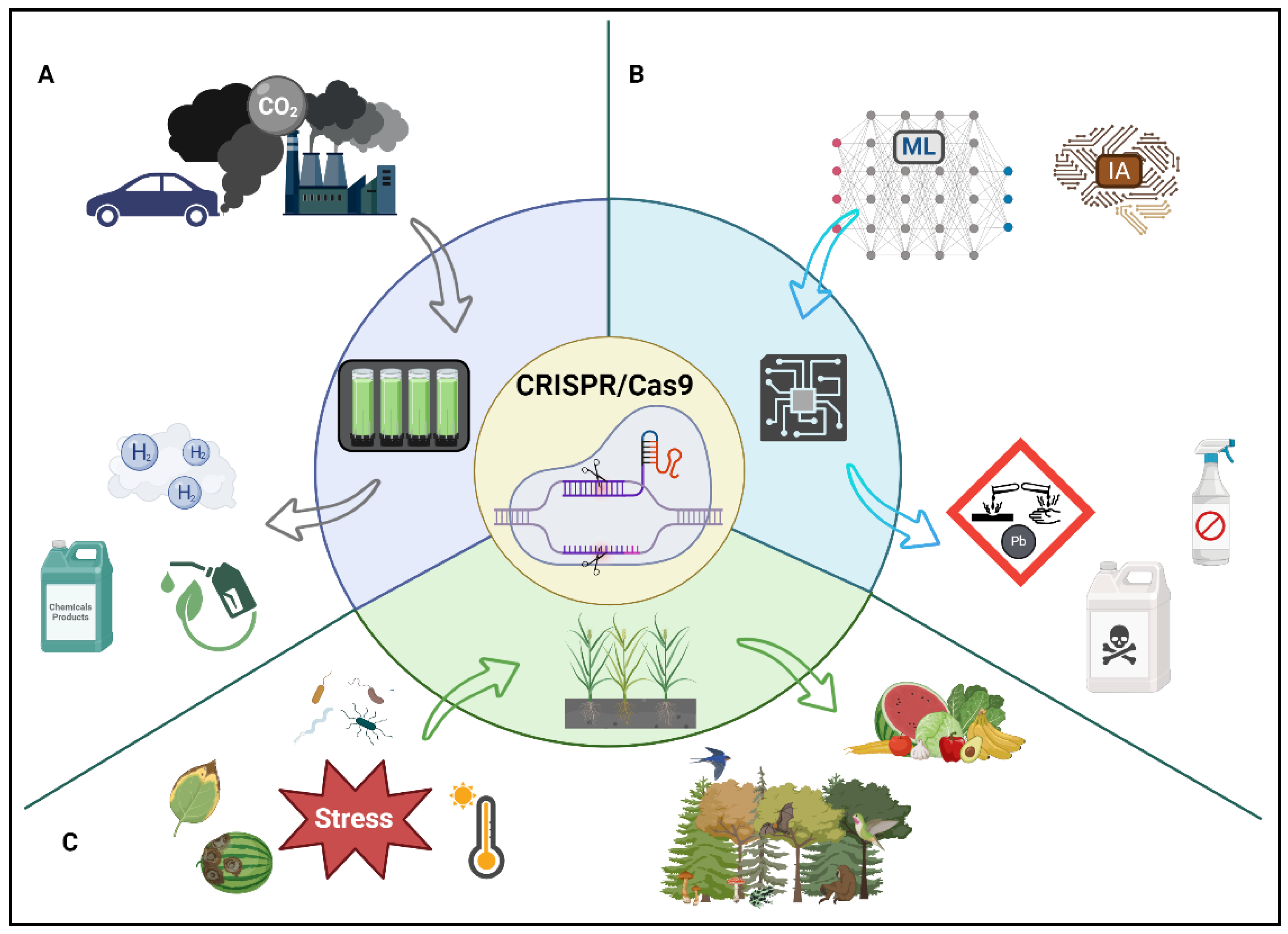

Table 6.
Potential areas of CRISPR/Cas9 research in environmental biotechnology.
| Topic | Application Area | Objective | Outcome | Year | Reference | |
|---|---|---|---|---|---|---|
| 1 | Sustainable Landscape Plants | Sustainability (Agriculture) | Explore CRISPR/Cas9 in sustainable landscape plant development | Discussed potential, no specific outcome detailed | 2020 | [204] |
| 2 | Food System Sustainability | Sustainability (Agriculture) | Assess sustainability of CRISPR food innovations | Methodology advancement, not a direct case study | 2021 | [205] |
| 3 | Gene Editing for Extinction Prevention | Conservation/Law | Governance around using gene editing for conservation | Discussion on regulatory and ethical considerations | 2019 | .[104] |
| 4 | Biodiversity Conservation through Technoscience | Conservation/Bioethics | Discuss the impact of technoscience, including CRISPR, on biodiversity | Philosophical and ethical analysis, no direct outcome | 2018 | [206] |
| 5 | CRISPR/Cas in Fish Aquaculture | Sustainability (Aquaculture) | Discuss the sustainable use of CRISPR/Cas9 in fish aquaculture from a biosafety perspective | Highlighted the need for responsible use, no specific fish case study outcomes | 2021 | [207] |
| 6 | Prospect of CRISPR/Cas9 technology in sustainable landscape plants | Bioethics | Demonstrates CRISPR’s potential in developing sustainable landscape plants, impacting conservation. | The use of CRISPR technology in landscape plants has demonstrated accurate and efficient gene editing | 2020 | [204] |
| 7 | Paths of least resilience: advancing a methodology to assess the sustainability of food system innovations - the case of CRISPR | Sustainability | Evaluates CRISPR’s role in sustainable food system innovations, showcasing its importance in agriculture | A methodology to assess the sustainability of CRISPR technology in the context of food systems innovations considering its potential benefits and risks across various dimensions | 2021 | [205] |
| 8 | Governing Extinction in the Era of Gene Editing | Bioethics | Discusses CRISPR’s impact on preventing extinction and enhancing biodiversity conservation | The paper argues that while current conservation laws may not directly address the specific questions raised by CRISPR, the ESA can provide guidance in governing the use of gene editing | 2019 | [104] |
| 9 | Sustainable use of CRISPR/Cas in fish aquaculture: the biosafety perspective | Sustainability | Highlights CRISPR’s application in sustainable fish aquaculture, emphasizing biosafety | Technical limitations, regulatory and risk assessment challenges of the use of CRISPR/Cas are presented. Strategies for regulatory decisions, risk assessments, and increased public awareness are also provided | 2022 | [207] |
| 10 | Is there a future for genome-editing technologies in conservation? | Animal conservation | Explores the potential and challenges of using CRISPR for conservation efforts | 2016 | [180] | |
| 11 | Can CRISPR gene drive work in pest and beneficial haplodiploid species? | Conservation | Analyzes mathematical models demonstrating that, CRISPR homing gene drive can work in haplodiploids | Altering traits to minimize damage caused by harmful haplodiploids, may be more likely to succeed than control efforts based on introducing traits that reduce pest fitness |
2020 | [186] |
| 12 | Modeling CRISPR gene drives for suppression of invasive rodents using a supervised machine learning framework | Artificial Intelligence, machine learning | Developes a computational model of the release of a suppression gene drive into an island rat population demonstrating it could indeed eradicate rat population within several years | 2021 | [185] |
4. Materials and Methods
4.1. Exploratory Description Analysis Supported by Databases
The bibliometric analysis was based on the Preferred Reporting Items for Systematic Reviews and Meta-Analyses (PRISMA) methodology, which allows concise, playful, and straightforward elucidation of the information obtained concerning the purpose of the research [208]. It was divided into two phases: data collection and data analysis.
i) Data collection
Articles related to gene editing with CRISPR/Cas9 and Environmental Biotechnology were searched in the scientific database Web of Science (WOS), considered one of the best sources of data collection [209,210]. Final press articles were selected, and review articles, early access, proceeding papers, book chapters, and editorial material were excluded. Using the following advanced search operator (((crispr/cas9) OR (crispr-cas9) OR (crispr cas9))) AND ((environment) OR (environmental biotechnology)) delimited with the chosen keywords. Also, the scientific articles in English and Spanish published in the last decade were selected between 2014 and 2023 to obtain 409 records of articles using data collected on 8 Sept 2023.
ii) Data analysis
First, we analyzed the development of research on CRISPR/Cas9 and environmental biotechnology using the Origin software. Where we presented the number of publications on the left Y-axis, the number of citations on the right Y-axis, and the number of publications per year on the X-axis. We then used the VOSviewer software tool to create maps from a database, obtaining visualization and exploring these maps [211]. To optimize the exploration, we draw up the visualization map by cluster (defined as the collection of data, items, and information that show similarity to each other) of the “keywords” [212].
Using CiteSpace (6.1.R6.), the base data for our study was imported since it is an open-access software and one of those recommended for bibliometric analysis by Dr. Chen Chaomei [40]. CiteSpace allowed us to obtain a visualization of scientific contributions, collaboration networks, and distribution among countries and institutions in developing research on CRISPR/Cas9 and Environmental Biotechnology [213,214]. For this purpose, the presentation of information was configured in the software using nodes for “country,” “institution,” “journals,” and “authors” with the respective correlation lines between each analyzed topic [40]. For the correlation with the years of publication, the program configuration was modified to incorporate the data into a timeline structure, thereby determining the highest scores.
Similar procedures were conducted for both “countries” and “institutions”. Given the extensive diversity of active institutions and countries in research, the configuration was adjusted to visualize nodes with correlation lines grouped into clusters based on their influence. A half-moon configuration was employed for grouping “journals,” revealing the leading journals where articles related to CRISPR/Cas9 and Environmental Biotechnology were published and their correlation among them. Finally, in the analysis of “authors,” the system was configured to represent nodes and correlation lines, grouping authors based on their frequent citations and the similarity in the works they carried out. The workflow established for the exploratory, descriptive analysis supported by databases can be observed in Figure 8.
4.2. Cutting-Edge Applications
The most relevant cutting-edge applications in environmental biotechnology were considered, i.e., Environmental Monitoring and Sustainable Energy (biosensors, fourth-generation biofuels), Genetic resilience, and biodiversity conservation (CRISPR/Cas9 for conservation, enhancing genetic resilience, combating invasive species, sustainable agriculture). The case studies discussed in Section 3.5 were complemented with bibliographic sources such as book chapters, reviews, and associated experimental research papers. This analysis allowed us to deepen the applications of CRISPR/Cas9 in environmental biotechnology and its potential uses in the following years.
5. Conclusions
CRISPR/Cas9 has been widely used in environmental biotechnology for several applications in the last decade. A progressive interest has been identified by the scientific community around the world (mainly in countries such as the United States, China, England and Canada) in its use within this area of research. One of these remarkable researches is the versatility of CRISPR/Cas9 as an essential tool that could ensure food security and play a crucial role in reducing agricultural losses. On the other hand, one study offers solutions focused on CRISPR/Cas9 based conservation technologies, while another study suggests using CRISPR to eradicate harmful invasive species that function as pesticides. This breakthrough might signal a noticeable contribution to the improvement of agricultural productivity.
Furthermore, its application in developing fourth-generation biofuels has enabled the successful genetic transformation of algae and oilseed species, significantly increasing their lipid content. This capability may lay the foundation for implementing large-scale systems that could provide cost-effective and environmentally friendly biofuels, marking a significant milestone toward reducing dependence on fossil fuels. The contribution of CRISPR/Cas9 extends beyond food security and sustainable energy into the environmental arena, with significant implications for achieving the Sustainable Development Goals. By applying this technology in the environmental context, a path to a more sustainable future is in sight, addressing fundamental problems on a global level
Finally, CRISPR/Cas systems and their gene editing capabilities stand out for their potential in biosensor applications, especially in environmental monitoring. The prospect of developing CRISPR/Cas9-based biosensors suggests an increasing role in diverse fields, enhancing detection and monitoring capabilities in the environmental domain. These findings underscore the positive and diversified impact of CRISPR/Cas9 technology in different sectors, fostering significant advances toward more sustainable solutions aligned with global development goals.
Supplementary Materials
The following supporting information can be downloaded at the website of this paper posted on Preprints.org, Table S1: Bibliometric search result in Web of Sciencie.
Author Contributions
Contributed substantially to conceptualization, Freire C and Chicaiza C; methodology, Verdezoto J, Mejia A and Viteri-Yánez M; software, Verdezoto J, Chicaiza C and Deng L; validation, Mejia A, Viteri-Yánez M, Barba-Ostria C, Guamán L; formal analysis, Verdezoto J, Mejia A, Viteri-Yánez M, Barba-Ostria C and Guamán L; research, Verdezoto J, Chicaiza C, Freire C, Mejia A, Viteri-Yánez M, Barba-Ostria C and Guamán L; resources: Chicaiza C, Barba-Ostria C and Guamán L; data curation, Guamán L, Chicaiza C, and Deng L; original draft preparation, writing, revising and editing, Verdezoto J, Chicaiza C and Freire C; visualization, Verdezoto J, Chicaiza C, Freire C and Deng L; supervision, Chicaiza C, Barba-Ostria C and Guamán L; Verdezoto J, is the first author of the article and Chicaiza C, is the co-first author of the article. Freire C, Mejia A, Viteri-Yánez M, Deng L, Barba-Ostria C and Guamán L, have participated equally in this work. All authors have read and accepted the published version of the manuscript.
Funding
This research received no external funding
Conflicts of Interest
The authors declare no conflicts of interest
References
- Al-Ghussain L. Global warming: review on driving forces and mitigation. Environ Prog Sustain Energy 2019;38:13–21. [CrossRef]
- Raharyanti F, Setyaningrum N. Global Warming and its Cause: Natural Science, Social, and Religious Perspective (Literature Study). KnE Soc Sci 2023:25–41. [CrossRef]
- Soares MO, Rabelo EF. Severe ecological impacts caused by one of the worst orphan oil spills worldwide. Mar Environ Res 2023;187:105936. [CrossRef]
- Singh H, Bhardwaj N, Arya SK, Khatri M. Environmental impacts of oil spills and their remediation by magnetic nanomaterials. Environ Nanotechnol Monit Manag 2020;14:100305. [CrossRef]
- Affandi FA, Ishak MY. Impacts of suspended sediment and metal pollution from mining activities on riverine fish population—a review. Environ Sci Pollut Res 2019;26:16939–51. [CrossRef]
- Ahima RS. Global warming threatens human thermoregulation and survival. J Clin Invest 2020;130:559–61. [CrossRef]
- Duchenne-Moutien RA, Neetoo H. Climate Change and Emerging Food Safety Issues: A Review. J Food Prot 2021;84:1884–97. [CrossRef]
- FAO. The state of Food Security and Nutrition in the World 2023 2023. [CrossRef]
- Halkos G, Zisiadou A. Energy Crisis Risk Mitigation through Nuclear Power and RES as Alternative Solutions towards Self-Sufficiency. J Risk Financ Manag 2023;16:45. [CrossRef]
- Hemalatha P, Abda EM, Shah S, Venkatesa Prabhu S, Jayakumar M, Karmegam N, et al. Multi-faceted CRISPR-Cas9 strategy to reduce plant based food loss and waste for sustainable bio-economy – A review. J Environ Manage 2023;332:117382. [CrossRef]
- Chicaiza-Ortiz C, Camacho C, Chicaiza-Ortiz Á, Beihan Z, Jiangyue D, Logroño W, et al. The effectiveness of iron-based additives in enhancing methane and hydrogen production: a systematic review 2023:734–44. [CrossRef]
- Chicaiza Ortiz CD, Navarrete Villa VP, Camacho López CO, Chicaiza Ortiz ÁF. Evaluation of municipal solid waste management system of Quito-Ecuador through life cycle assessment approach 2020.
- Chicaiza C, Bouzerma M, Diéguez-Santana K, Chicaiza Á, Navarrete V, Romero J. Carbon storage technologies applied to rethinking building construction and carbon emissions. IOP Conf. Ser. Earth Environ. Sci., vol. 784, IOP Publishing; 2021, p. 012021.
- Jain M. Environmental Biotechnology. DokumenPub 2014. https://dokumen.pub/environmental-biotechnology-1nbsped-9781783320516-9781842658147.html (accessed November 27, 2023).
- Buddolla V. Environmental Biotechnology: Basic Concepts and Applications 2017. https://www.iberlibro.com/9781783322602/Environmental-Biotechnology-Basic-Concepts-Applications-1783322608/plp (accessed November 27, 2023).
- Zhang D, Zhang Z, Unver T, Zhang B. CRISPR/Cas: A powerful tool for gene function study and crop improvement. J Adv Res 2021;29:207–21. [CrossRef]
- Nidhi S, Anand U, Oleksak P, Pooja T, Lal J, Thomas G, et al. Novel CRISPR–Cas Systems: An Updated Review of the Current Achievements, Applications, and Future Research Perspectives 2021. [CrossRef]
- Zaychikova MV, Danilenko VN, Maslov DA. CRISPR-Cas Systems: Prospects for Use in Medicine. Appl Sci 2020;10:9001. [CrossRef]
- Swarts DC, Jinek M. Cas9 versus Cas12a/Cpf1: Structure–function comparisons and implications for genome editing. WIREs RNA 2018;9:e1481. [CrossRef]
- Hatada I, Horii T. CRISPR/Cas9. In: Hatada I, editor. Genome Ed. Anim., vol. 1630, New York, NY: Springer New York; 2017, p. 37–42. [CrossRef]
- Pfeifer K, Ergal İ, Koller M, Basen M, Schuster B, Rittmann SK-MR. Archaea Biotechnology. Biotechnol Adv 2021;47:107668. [CrossRef]
- Ishino Y, Krupovic M, Forterre P. History of CRISPR-Cas from Encounter with a Mysterious Repeated Sequence to Genome Editing Technology. J Bacteriol 2018;200. [CrossRef]
- Liu W, Yang C, Liu Y, Jiang G. CRISPR/Cas9 System and its Research Progress in Gene Therapy. Anticancer Agents Med Chem 2020;19:1912–9. [CrossRef]
- Janik E, Niemcewicz M, Ceremuga M, Krzowski L, Saluk-Bijak J, Bijak M. Various Aspects of a Gene Editing System—CRISPR–Cas9. Int J Mol Sci 2020;21:9604. [CrossRef]
- Ansori ANm, Antonius Y, Susilo RJk, Hayaza S, Kharisma VD, Parikesit AA, et al. Application of CRISPR-Cas9 genome editing technology in various fields: A review. Narra J 2023;3:e184. [CrossRef]
- Wang C, Deng L, Zhang Y, Zhao M, Liang M, Lee L-C, et al. Farmland phytoremediation in bibliometric analysis. J Environ Manage 2024;351:119971. [CrossRef]
- Pande V, Pandey SC, Sati D, Pande V, Samant M. Bioremediation: an emerging effective approach towards environment restoration. Environ Sustain 2020;3:91–103. [CrossRef]
- Shah V, Daverey A. Phytoremediation: A multidisciplinary approach to clean up heavy metal contaminated soil. Environ Technol Innov 2020;18:100774. [CrossRef]
- Basharat Z, Novo L, Yasmin A. Genome Editing Weds CRISPR: What Is in It for Phytoremediation? Plants 2018;7:51. [CrossRef]
- Hashemi Goradel N, Mirzaei H, Sahebkar A, Poursadeghiyan M, Masoudifar A, Malekshahi ZV, et al. Biosensors for the Detection of Environmental and Urban Pollutions. J Cell Biochem 2018;119:207–12. [CrossRef]
- Lander N, Chiurillo MA. State-of-the-art CRISPR /Cas9 Technology for Genome Editing in Trypanosomatids. J Eukaryot Microbiol 2019;66:981–91. [CrossRef]
- Naz M, Benavides-Mendoza A, Tariq M, Zhou J, Wang J, Qi S, et al. CRISPR/Cas9 technology as an innovative approach to enhancing the phytoremediation: Concepts and implications. J Environ Manage 2022;323:116296. [CrossRef]
- Wang J, Chu L, Wojnárovits L, Takács E. Occurrence and fate of antibiotics, antibiotic resistant genes (ARGs) and antibiotic resistant bacteria (ARB) in municipal wastewater treatment plant: An overview. Sci Total Environ 2020;744:140997. [CrossRef]
- Li X, Bao N, Yan Z, Yuan X-Z, Wang S-G, Xia P-F. Degradation of Antibiotic Resistance Genes by VADER with CRISPR-Cas Immunity. Appl Environ Microbiol 2023;89:e00053-23. [CrossRef]
- Tudi M, Daniel Ruan H, Wang L, Lyu J, Sadler R, Connell D, et al. Agriculture Development, Pesticide Application and Its Impact on the Environment. Int J Environ Res Public Health 2021;18:1112. [CrossRef]
- Jose J, Éva C. Plant Biotechnology: Its Importance, Contribution to Agriculture and Environment, and Its Future Prospects. In: Singh J, Bajpai R, Gangwar RK, editors. Biotechnol. Environ. Remediat. 1st ed., Wiley; 2023, p. 9–30. [CrossRef]
- Uthayakumar D, Sharma J, Wensing L, Shapiro RS. CRISPR-Based Genetic Manipulation of Candida Species: Historical Perspectives and Current Approaches. Front Genome Ed 2021;2:606281. [CrossRef]
- Liu Y, Cruz-Morales P, Zargar A, Belcher MS, Pang B, Englund E, et al. Biofuels for a sustainable future. Cell 2021;184:1636–47. [CrossRef]
- Liu L, Supe Tulcan RX, He M, Ouyang W, Zhang Q, Huarez Yarleque CM, et al. Antimony pollution threatens soils and riverine habitats across China: An analysis of antimony concentrations, changes, and risks. Crit Rev Environ Sci Technol 2023:1–20. [CrossRef]
- Wang C, Zhang Y, Deng L, Zhao M, Liang M, Lee L-C, et al. Visualization Network Analysis of Studies on Agricultural Drainage Water Treatment. Processes 2023;11:2952. [CrossRef]
- Zhang Y, Zhao D, Liu H, Huang X, Deng J, Jia R, et al. Research hotspots and frontiers in agricultural multispectral technology: Bibliometrics and scientometrics analysis of the Web of Science. Front Plant Sci 2022;13:955340. [CrossRef]
- Marginson S. Global science and national comparisons: beyond bibliometrics and scientometrics. Comp Educ 2022;58:125–46. [CrossRef]
- Donthu N, Kumar S, Mukherjee D, Pandey N, Lim WM. How to conduct a bibliometric analysis: An overview and guidelines. J Bus Res 2021;133:285–96. [CrossRef]
- Umeokafor N, Umar T, Evangelinos K. Bibliometric and scientometric analysis-based review of construction safety and health research in developing countries from 1990 to 2021. Saf Sci 2022;156:105897. [CrossRef]
- Chicaiza-Ortiz CD, Rivadeneira-Arias VDC, Herrera-Feijoo RJ, Andrade JC. Biotecnología Ambiental, Aplicaciones y Tendencias. 1st ed. Editorial Grupo AEA; 2023. [CrossRef]
- Xiao J, Wei J, Wu M, Cao X. Bibliometric and Visual Analysis of Crop Water Footprint: A Widely Used Agricultural Water Resources Evaluation Method. Water 2022;14:2866. [CrossRef]
- Dangi AK, Sharma B, Hill RT, Shukla P. Bioremediation through microbes: systems biology and metabolic engineering approach. Crit Rev Biotechnol 2019;39:79–98. [CrossRef]
- Eş I, Gavahian M, Marti-Quijal FJ, Lorenzo JM, Mousavi Khaneghah A, Tsatsanis C, et al. The application of the CRISPR-Cas9 genome editing machinery in food and agricultural science: Current status, future perspectives, and associated challenges. Biotechnol Adv 2019;37:410–21. [CrossRef]
- Wang Q, Coleman JJ. Progress and Challenges: Development and Implementation of CRISPR/Cas9 Technology in Filamentous Fungi. Comput Struct Biotechnol J 2019;17:761–9. [CrossRef]
- Suominen A, Seppänen M, Dedehayir O. A bibliometric review on innovation systems and ecosystems: a research agenda. Eur J Innov Manag 2018;22:335–60. [CrossRef]
- Jinek M, Chylinski K, Fonfara I, Hauer M, Doudna JA, Charpentier E. A Programmable Dual-RNA–Guided DNA Endonuclease in Adaptive Bacterial Immunity. Science 2012;337:816–21. [CrossRef]
- Cong L, Ran FA, Cox D, Lin S, Barretto R, Habib N, et al. Multiplex Genome Engineering Using CRISPR/Cas Systems. Science 2013;339:819–23. [CrossRef]
- Zetsche B, Gootenberg JS, Abudayyeh OO, Slaymaker IM, Makarova KS, Essletzbichler P, et al. Cpf1 Is a Single RNA-Guided Endonuclease of a Class 2 CRISPR-Cas System. Cell 2015;163:759–71. [CrossRef]
- Doench JG, Fusi N, Sullender M, Hegde M, Vaimberg EW, Donovan KF, et al. Optimized sgRNA design to maximize activity and minimize off-target effects of CRISPR-Cas9. Nat Biotechnol 2016;34:184–91. [CrossRef]
- Hsu PD, Lander ES, Zhang F. Development and applications of CRISPR-Cas9 for genome engineering. Cell 2014;157:1262–78. [CrossRef]
- Sternberg SH, Redding S, Jinek M, Greene EC, Doudna JA. DNA interrogation by the CRISPR RNA-guided endonuclease Cas9. Nature 2014;507:62–7. [CrossRef]
- Anders C, Niewoehner O, Duerst A, Jinek M. Structural basis of PAM-dependent target DNA recognition by the Cas9 endonuclease. Nature 2014;513:569–73. [CrossRef]
- Doudna JA, Charpentier E. The new frontier of genome engineering with CRISPR-Cas9. Science 2014;346:1258096. [CrossRef]
- Anzalone AV, Koblan LW, Liu DR. Genome editing with CRISPR–Cas nucleases, base editors, transposases and prime editors. Nat Biotechnol 2020;38:824–44. [CrossRef]
- Makarova KS, Wolf YI, Alkhnbashi OS, Costa F, Shah SA, Saunders SJ, et al. An updated evolutionary classification of CRISPR–Cas systems. Nat Rev Microbiol 2015;13:722–36. [CrossRef]
- Gowen CM, Fong SS. Applications of systems biology towards microbial fuel production. Trends Microbiol 2011;19:516–24. [CrossRef]
- Torrentes G. Retrospectiva y prospectiva del Desarrollo de las generaciones de biocombustibles. Cienc Tecnol 2021:53–63. [CrossRef]
- Aro E-M. From first generation biofuels to advanced solar biofuels. Ambio 2015;45:24–31. [CrossRef]
- Escobedo MJ, Calderón AC, Escobedo MJ, Calderón AC. Biomasa microalgal con alto potencial para la producción de biocombustibles. Sci Agropecu 2021;12:265–82. [CrossRef]
- Dalena F, Senatore A, Basile M, Marino D, Basile A. Chapter 1 - From sugars to ethanol—from agricultural wastes to algal sources: An overview. In: Basile A, Dalena F, editors. Second Third Gener. Feedstock, Elsevier; 2019, p. 3–34. [CrossRef]
- Dutta K, Daverey A, Lin J-G. Evolution retrospective for alternative fuels: First to fourth generation. Renew Energy 2014;69:114–22. [CrossRef]
- Fan L, Zhang H, Li J, Wang Y, Leng L, Li J, et al. Algal biorefinery to value-added products by using combined processes based on thermochemical conversion: A review. Algal Res 2020;47:101819. [CrossRef]
- Guo M, Song W, Buhain J. Bioenergy and biofuels: History, status, and perspective. Renew Sustain Energy Rev 2015;42:712–25. [CrossRef]
- Diéguez Santana K, Chicaiza Ortiz CD, Logroño W. Anaerobic digestate: pollutants, ecotoxicology, and legislation, 2022.
- Zhang P, Zhang T, Zhang J, Liu H, Chicaiza-Ortiz C, Lee JTE, et al. A machine learning assisted prediction of potential biochar and its applications in anaerobic digestion for valuable chemicals and energy recovery from organic waste. Carbon Neutrality 2024;3:2. [CrossRef]
- Chicaiza Ortiz CD. Diseño y construcción de un prototipo de fotobiorreactor discontinuo a escala laboratorio para la producción de biomasa algal. B.S. thesis. Escuela Superior Politécnica de Chimborazo, 2017.
- Adeniyi OM, Azimov U, Burluka A. Algae biofuel: Current status and future applications. Renew Sustain Energy Rev 2018;90:316–35. [CrossRef]
- Bibi R, Ahmad Z, Imran M, Hussain S, Ditta A, Mahmood S, et al. Algal bioethanol production technology: A trend towards sustainable development. Renew Sustain Energy Rev 2017;71:976–85. [CrossRef]
- Enamala MK, Enamala S, Chavali M, Donepudi J, Yadavalli R, Kolapalli B, et al. Production of biofuels from microalgae - A review on cultivation, harvesting, lipid extraction, and numerous applications of microalgae. Renew Sustain Energy Rev 2018;94:49–68. [CrossRef]
- Javed MR, Noman M, Shahid M, Ahmed T, Khurshid M, Rashid MH, et al. Current situation of biofuel production and its enhancement by CRISPR/Cas9-mediated genome engineering of microbial cells. Microbiol Res 2019;219:1–11. [CrossRef]
- Xiong J, Sun Z, Yu J, Liu H, Wang X. Thermal self-regulatory smart biosensor based on horseradish peroxidase-immobilized phase-change microcapsules for enhancing detection of hazardous substances. Chem Eng J 2022;430:132982. [CrossRef]
- Ullo SL, Sinha GR. Advances in Smart Environment Monitoring Systems Using IoT and Sensors. Sensors 2020;20:3113. [CrossRef]
- Butt MA, Voronkov GS, Grakhova EP, Kutluyarov RV, Kazanskiy NL, Khonina SN. Environmental Monitoring: A Comprehensive Review on Optical Waveguide and Fiber-Based Sensors. Biosensors 2022;12:1038. [CrossRef]
- Zhang yi, Zhu Y, Zhuotong Z, Zeng G, Xiao R, Wang Y, et al. Sensors for the environmental pollutant detection: Are we already there? Coord Chem Rev 2020;431:213681. [CrossRef]
- Gavrilaș S, Ursachi C Ștefan, Perța-Crișan S, Munteanu F-D. Recent Trends in Biosensors for Environmental Quality Monitoring. Sensors 2022;22:1513. [CrossRef]
- Huang C-W, Lin C, Nguyen MK, Hussain A, Bui X-T, Ngo HH. A review of biosensor for environmental monitoring: principle, application, and corresponding achievement of sustainable development goals. Bioengineered 2023;14:58–80. [CrossRef]
- Badihi-Mossberg M, Buchner V, Rishpon J. Electrochemical Biosensors for Pollutants in the Environment. Electroanalysis 2007;19:2015–28. [CrossRef]
- Carpenter AC, Paulsen IT, Williams TC. Blueprints for Biosensors: Design, Limitations, and Applications. Genes 2018;9:375. [CrossRef]
- Otero F, Magner E. Biosensors—Recent Advances and Future Challenges in Electrode Materials. Sensors 2020;20:3561. [CrossRef]
- Kumar T, Naik S, Jujjavarappu SE. A critical review on early-warning electrochemical system on microbial fuel cell-based biosensor for on-site water quality monitoring. Chemosphere 2022;291:133098. [CrossRef]
- Rogers KR. Recent advances in biosensor techniques for environmental monitoring. Anal Chim Acta 2006;568:222–31. [CrossRef]
- Turner APF. Biosensors: sense and sensibility. Chem Soc Rev 2013;42:3184–96. [CrossRef]
- Hashemi Goradel N, Mirzaei H, Sahebkar A, Poursadeghiyan M, Masoudifar A, Malekshahi ZV, et al. Biosensors for the Detection of Environmental and Urban Pollutions. J Cell Biochem 2018;119:207–12. [CrossRef]
- Rodriguez-Mozaz S, Alda MJL de, Marco M-P, Barceló D. Biosensors for environmental monitoring A global perspective. Talanta 2005;65:291–7. [CrossRef]
- Kumar H, Kumari N, Sharma R. Nanocomposites (conducting polymer and nanoparticles) based electrochemical biosensor for the detection of environment pollutant: Its issues and challenges. Environ Impact Assess Rev 2020;85:106438. [CrossRef]
- Nigam VK, Shukla P. Enzyme Based Biosensors for Detection of Environmental Pollutants--A Review. J Microbiol Biotechnol 2015;25:1773–81. [CrossRef]
- Mehrotra P. Biosensors and their applications – A review. J Oral Biol Craniofacial Res 2016;6:153–9. [CrossRef]
- Justino CIL, Duarte AC, Rocha-Santos TAP. Recent Progress in Biosensors for Environmental Monitoring: A Review. Sensors 2017;17:2918. [CrossRef]
- Wada N, Ueta R, Osakabe Y, Osakabe K. Precision genome editing in plants: state-of-the-art in CRISPR/Cas9-based genome engineering. BMC Plant Biol 2020;20:234. [CrossRef]
- Mahmood T, Khalid S, Abdullah M, Ahmed Z, Shah MKN, Ghafoor A, et al. Insights into Drought Stress Signaling in Plants and the Molecular Genetic Basis of Cotton Drought Tolerance. Cells 2019;9:105. [CrossRef]
- Khan FS, Goher F, Zhang D, Shi P, Li Z, Htwe YM, et al. Is CRISPR/Cas9 a way forward to fast-track genetic improvement in commercial palms? Prospects and limits. Front Plant Sci 2022;13:1042828. [CrossRef]
- Abdul Aziz M, Brini F, Rouached H, Masmoudi K. Genetically engineered crops for sustainably enhanced food production systems. Front Plant Sci 2022;13:1027828. [CrossRef]
- Ali Q, Yu C, Hussain A, Ali M, Ahmar S, Sohail MA, et al. Genome Engineering Technology for Durable Disease Resistance: Recent Progress and Future Outlooks for Sustainable Agriculture. Front Plant Sci 2022;13:860281. [CrossRef]
- Mestanza-Ramón C, Herrera Feijoo RJ, Chicaiza-Ortiz C, Gaibor ID, Mateo RG. Estimation of Current and Future Suitable Areas for Tapirus pinchaque in Ecuador. Sustainability 2021;13:11486.
- Hassanien A, Saadaoui I, Schipper K, Al-Marri S, Dalgamouni T, Aouida M, et al. Genetic engineering to enhance microalgal-based produced water treatment with emphasis on CRISPR/Cas9: A review. Front Bioeng Biotechnol 2023;10:1104914. [CrossRef]
- Chen W, Yang F, Xu X, Kumar U, He W, You M. Genetic control of Plutella xylostella in omics era. Arch Insect Biochem Physiol 2019;102:e21621. [CrossRef]
- Ferrari L. Farmers’ attitude toward CRISPR/Cas9: The case of blast resistant rice. Agribusiness 2022;38:175–94. [CrossRef]
- Fuchs S, Garrood WT, Beber A, Hammond A, Galizi R, Gribble M, et al. Resistance to a CRISPR-based gene drive at an evolutionarily conserved site is revealed by mimicking genotype fixation. PLOS Genet 2021;17:e1009740. [CrossRef]
- Monast J. Governing Extinction in the Era of Gene Editing 2019.
- Tobin PC. Managing invasive species. F1000Research 2018;7:F1000 Faculty Rev-1686. [CrossRef]
- Hammond A, Galizi R, Kyrou K, Simoni A, Siniscalchi C, Katsanos D, et al. A CRISPR-Cas9 gene drive system targeting female reproduction in the malaria mosquito vector Anopheles gambiae. Nat Biotechnol 2016;34:78–83. [CrossRef]
- Neve P. Gene drive systems: do they have a place in agricultural weed management? Pest Manag Sci 2018;74:2671–9. [CrossRef]
- Asad M, Liu D, Li J, Chen J, Yang G. Development of CRISPR/Cas9-Mediated Gene-Drive Construct Targeting the Phenotypic Gene in Plutella xylostella. Front Physiol 2022;13. [CrossRef]
- Nateghi Rostami M. CRISPR/Cas9 gene drive technology to control transmission of vector-borne parasitic infections. Parasite Immunol 2020;42:e12762. [CrossRef]
- Rybicki EP. CRISPR–Cas9 strikes out in cassava. Nat Biotechnol 2019;37:727–8. [CrossRef]
- Chen W, Page-McCaw PS. CRISPR/Cas9 gene editing 2024. [CrossRef]
- Zhang B. CRISPR/Cas9: A Robust Genome-Editing Tool with Versatile Functions and Endless Application. Int J Mol Sci 2020;21:5111. [CrossRef]
- Burgess DJ. CRISPR screens beyond Cas9. Nat Rev Genet 2020;21:273–273. [CrossRef]
- Kozubek J. Crispr-Cas9 Is Impossible to Stop. JSTOR 2017;18:112–9.
- Rodríguez-Leal D, Lemmon ZH, Man J, Bartlett ME, Lippman ZB. Engineering Quantitative Trait Variation for Crop Improvement by Genome Editing. Cell 2017;171:470-480.e8. [CrossRef]
- Shahriar SA, Islam MN, Chun CNW, Rahim MdA, Paul NC, Uddain J, et al. Control of Plant Viral Diseases by CRISPR/Cas9: Resistance Mechanisms, Strategies and Challenges in Food Crops. Plants 2021;10:1264. [CrossRef]
- Prabhukarthikeyan SR, Parameswaran C, Keerthana U, Teli B, Jagannadham PTK, Cayalvizhi B, et al. Understanding the Plant-microbe Interactions in CRISPR/Cas9 Era: Indeed a Sprinting Start in Marathon. Curr Genomics 2020;21:429–43. [CrossRef]
- Erpen-Dalla Corte L, M. Mahmoud L, S. Moraes T, Mou Z, W. Grosser J, Dutt M. Development of Improved Fruit, Vegetable, and Ornamental Crops Using the CRISPR/Cas9 Genome Editing Technique. Plants 2019;8:601. [CrossRef]
- Huang W-P, Du Y-J, Yang Y, He J-N, Lei Q, Yang X-Y, et al. Two CRISPR/Cas9 Systems Developed in Thermomyces dupontii and Characterization of Key Gene Functions in Thermolide Biosynthesis and Fungal Adaptation. Appl Environ Microbiol 2020;86:e01486-20. [CrossRef]
- Fan Y, Xie J, Zhang F. Overexpression of miR5505 enhanced drought and salt resistance in rice (Orayza sativa) 2022:2022.01.13.476146. [CrossRef]
- Park J-R, Kim E-G, Jang Y-H, Jan R, Farooq M, Ubaidillah M, et al. Applications of CRISPR/Cas9 as New Strategies for Short Breeding to Drought Gene in Rice. Front Plant Sci 2022;13:850441. [CrossRef]
- Karkute SG, Singh AK, Gupta OP, Singh PM, Singh B. CRISPR/Cas9 Mediated Genome Engineering for Improvement of Horticultural Crops. Front Plant Sci 2017;8. [CrossRef]
- Piatek A, Ali Z, Baazim H, Li L, Abulfaraj A, Al-Shareef S, et al. RNA-guided transcriptional regulation in planta via synthetic dC as9-based transcription factors. Plant Biotechnol J 2015;13:578–89. [CrossRef]
- Ishino Y, Krupovic M, Forterre P. History of CRISPR-Cas from Encounter with a Mysterious Repeated Sequence to Genome Editing Technology. J Bacteriol 2018;200:e00580-17. [CrossRef]
- You L, Tong R, Li M, Liu Y, Xue J, Lu Y. Advancements and Obstacles of CRISPR-Cas9 Technology in Translational Research. Mol Ther Methods Clin Dev 2019;13:359–70. [CrossRef]
- Liu H, Lv Z, Zhang G, Wang X, Wang Y, Wang K. Knowledge mapping and current trends of global research on CRISPR in the field of cancer. Front Cell Dev Biol 2023;11:1178221. [CrossRef]
- Matinvafa MA, Makani S, Parsasharif N, Zahed MA, Movahed E, Ghiasvand S. CRISPR-Cas technology secures sustainability through its applications: a review in green biotechnology. 3 Biotech 2023;13:383. [CrossRef]
- Li Y, Li S, Wang J, Liu G. CRISPR/Cas Systems towards Next-Generation Biosensing. Trends Biotechnol 2019;37:730–43. [CrossRef]
- Chennakesavulu K, Singh H, Trivedi PK, Jain M, Yadav SR. State-of-the-Art in CRISPR Technology and Engineering Drought, Salinity, and Thermo-tolerant crop plants. Plant Cell Rep 2022;41:815–31. [CrossRef]
- Gostimskaya I. CRISPR–Cas9: A History of Its Discovery and Ethical Considerations of Its Use in Genome Editing. Biochem Biokhimiia 2022;87:777–88. [CrossRef]
- Mall AK, Manimekalai R, Misra V, Pandey H, Srivastava S, Sharma A. CRISPR/Cas-Mediated Genome Editing for Sugarcane Improvement. Sugar Tech 2024. [CrossRef]
- Vigentini I, Gebbia M, Belotti A, Foschino R, Roth FP. CRISPR/Cas9 System as a Valuable Genome Editing Tool for Wine Yeasts with Application to Decrease Urea Production. Front Microbiol 2017;8.
- de Mello F da SB, Maneira C, Suarez FUL, Nagamatsu S, Vargas B, Vieira C, et al. Rational engineering of industrial S. cerevisiae: towards xylitol production from sugarcane straw. J Genet Eng Biotechnol 2022;20:80. [CrossRef]
- Vasil IK. A history of plant biotechnology: from the Cell Theory of Schleiden and Schwann to biotech crops. Plant Cell Rep 2008;27:1423–40. [CrossRef]
- Verma N, Singh M. Biosensors for heavy metals. BioMetals 2005;18:121–9. [CrossRef]
- Rai MK. Biotechnological strategies for conservation of rare and endangered medicinal plants. Biodiversitas J Biol Divers 2010;11:157–66. [CrossRef]
- Dey R, Dube SP, Devi S, Raghuwanshi R. Biotechnological approaches in mitigating climate variability and anthropogenic factors. Conserv Halting Reinstating Degraded Nat Resour Dur UN Decade Ecosyst Restor, Nova Science Publishers, Inc.; 2023, p. 105–44.
- Bahmani F, Noroozi M, Kolahchi N, Ghanei M. Bioethics, Emerging Biotechnologies, and Society: Providing an Ethical Framework for Assessing Emerging Biotechnologies. Iran J Med Ethics Hist Med 2023;16.
- Li Y, Wu X, Zhang Y, Zhang Q. CRISPR/Cas genome editing improves abiotic and biotic stress tolerance of crops. Front Genome Ed 2022;4:987817. [CrossRef]
- Vu BN, Vu TV, Yoo JY, Nguyen NT, Ko KS, Kim J-Y, et al. CRISPR-Cas-mediated unfolded protein response control for enhancing plant stress resistance. Front Plant Sci 2023;14:1271368. [CrossRef]
- Liu L, Zhang J, Xu J, Li Y, Guo L, Wang Z, et al. CRISPR/Cas9 targeted mutagenesis of SlLBD40, a lateral organ boundaries domain transcription factor, enhances drought tolerance in tomato. Plant Sci 2020;301:110683. [CrossRef]
- Chen S, Zhang N, Zhou G, Hussain S, Ahmed S, Tian H, et al. Knockout of the entire family of AITR genes in Arabidopsis leads to enhanced drought and salinity tolerance without fitness costs. BMC Plant Biol 2021;21:137. [CrossRef]
- Yu W, Wang L, Zhao R, Sheng J, Zhang S, Li R, et al. Knockout of SlMAPK3 enhances tolerance to heat stress involving ROS homeostasis in tomato plants. BMC Plant Biol 2019;19:354. [CrossRef]
- Baeg G-J, Kim S-H, Choi D-M, Tripathi S, Han Y-J, Kim J-I. CRISPR/Cas9-mediated mutation of 5-oxoprolinase gene confers resistance to sulfonamide compounds in Arabidopsis. Plant Biotechnol Rep 2021;15:753–64. [CrossRef]
- Wang F-Z, Chen M-X, Yu L-J, Xie L-J, Yuan L-B, Qi H, et al. OsARM1, an R2R3 MYB Transcription Factor, Is Involved in Regulation of the Response to Arsenic Stress in Rice. Front Plant Sci 2017;8:1868. [CrossRef]
- Disney A. Social network analysis 101: centrality measures explained. Camb Intell 2020.
- Joint Research Centre (European Commission), Parisi C, Rodríguez-Cerezo E. Current and future market applications of new genomic techniques. LU: Publications Office of the European Union; 2021.
- Pranckutė R. Web of Science (WoS) and Scopus: The Titans of Bibliographic Information in Today’s Academic World. Publications 2021;9:12. [CrossRef]
- Gao C. Precision plant breeding using genome editing technologies. Transgenic Res 2019;28:53–5. [CrossRef]
- Rasetti L. How to Use Impact Metrics. MDPI Blog 2023. https://mdpiblog.wordpress.sciforum.net/2023/06/27/indexing-interview/ (accessed November 22, 2023).
- Kitomi Y, Hanzawa E, Kuya N, Inoue H, Hara N, Kawai S, et al. Root angle modifications by the DRO1 homolog improve rice yields in saline paddy fields. Proc Natl Acad Sci U S A 2020;117:21242–50. [CrossRef]
- Wu Z-Y, Huang Y-T, Chao W-C, Ho S-P, Cheng J-F, Liu P-Y. Reversal of carbapenem-resistance in Shewanella algae by CRISPR/Cas9 genome editing. J Adv Res 2019;18:61–9. [CrossRef]
- Huang W-P, Du Y-J, Yang Y, He J-N, Lei Q, Yang X-Y, et al. Two CRISPR/Cas9 Systems Developed in Thermomyces dupontii and Characterization of Key Gene Functions in Thermolide Biosynthesis and Fungal Adaptation. Appl Environ Microbiol 2020;86:e01486-20. [CrossRef]
- Patil SA, Gildemyn S, Pant D, Zengler K, Logan BE, Rabaey K. A logical data representation framework for electricity-driven bioproduction processes. Biotechnol Adv 2015;33:736–44. [CrossRef]
- Moravvej Z, Makarem MA, Rahimpour MR. Chapter 20 - The fourth generation of biofuel. In: Basile A, Dalena F, editors. Second Third Gener. Feedstock, Elsevier; 2019, p. 557–97. [CrossRef]
- Fazal T, Mushtaq A, Rehman F, Ullah Khan A, Rashid N, Farooq W, et al. Bioremediation of textile wastewater and successive biodiesel production using microalgae. Renew Sustain Energy Rev 2018;82:3107–26. [CrossRef]
- Wood DA. 19 - Biodiesel from microalgae. In: Jacob-Lopes E, Zepka LQ, Severo IA, Maroneze MM, editors. 3rd Gener. Biofuels, Woodhead Publishing; 2022, p. 417–38. [CrossRef]
- Sanchez L, Sanz Smachetti ME, Do Nascimento M, Salerno GL, Curatti L. Bioprospecting for native microalgae as an alternative source of sugars for the production of bioethanol. Algal Res 2017;22:140–7. [CrossRef]
- Work VH, D’Adamo S, Radakovits R, Jinkerson RE, Posewitz MC. Improving photosynthesis and metabolic networks for the competitive production of phototroph-derived biofuels. Curr Opin Biotechnol 2012;23:290–7. [CrossRef]
- Chen B, Wan C, Mehmood MA, Chang J-S, Bai F, Zhao X. Manipulating environmental stresses and stress tolerance of microalgae for enhanced production of lipids and value-added products–A review. Bioresour Technol 2017;244:1198–206. [CrossRef]
- Shin YS, Jeong J, Nguyen THT, Kim JYH, Jin E, Sim SJ. Targeted knockout of phospholipase A2 to increase lipid productivity in Chlamydomonas reinhardtii for biodiesel production. Bioresour Technol 2019;271:368–74. [CrossRef]
- Nguyen THT, Park S, Jeong J, Shin YS, Sim SJ, Jin E. Enhancing lipid productivity by modulating lipid catabolism using the CRISPR-Cas9 system in Chlamydomonas. J Appl Phycol 2020;32:2829–40. [CrossRef]
- Chang KS, Kim J, Park H, Hong S-J, Lee C-G, Jin E. Enhanced lipid productivity in AGP knockout marine microalga Tetraselmis sp. using a DNA-free CRISPR-Cas9 RNP method. Bioresour Technol 2020;303:122932. [CrossRef]
- Kurita T, Iwai M, Ohta H, Sakuma T, Yamamoto T. Genome editing for biodiesel production in oleaginous microalga, Nannochloropsis species. Gene Genome Ed 2023;6:100027. [CrossRef]
- Tian Y, Liu X, Fan C, Li T, Qin H, Li X, et al. Enhancement of Tobacco (Nicotiana tabacum L.) Seed Lipid Content for Biodiesel Production by CRISPR-Cas9-Mediated Knockout of NtAn1. Front Plant Sci 2021;11.
- Jiang WZ, Henry IM, Lynagh PG, Comai L, Cahoon EB, Weeks DP. Significant enhancement of fatty acid composition in seeds of the allohexaploid, Camelina sativa, using CRISPR/Cas9 gene editing. Plant Biotechnol J 2017;15:648–57. [CrossRef]
- Do PT, Nguyen CX, Bui HT, Tran LTN, Stacey G, Gillman JD, et al. Demonstration of highly efficient dual gRNA CRISPR/Cas9 editing of the homeologous GmFAD2–1A and GmFAD2–1B genes to yield a high oleic, low linoleic and α-linolenic acid phenotype in soybean. BMC Plant Biol 2019;19:311. [CrossRef]
- Lee K-R, Jeon I, Yu H, Kim S-G, Kim H-S, Ahn S-J, et al. Increasing Monounsaturated Fatty Acid Contents in Hexaploid Camelina sativa Seed Oil by FAD2 Gene Knockout Using CRISPR-Cas9. Front Plant Sci 2021;12:702930. [CrossRef]
- Zhang K, Nie L, Cheng Q, Yin Y, Chen K, Qi F, et al. Effective editing for lysophosphatidic acid acyltransferase 2/5 in allotetraploid rapeseed (Brassica napus L.) using CRISPR-Cas9 system. Biotechnol Biofuels 2019;12:225. [CrossRef]
- Kang Y, Su G, Yu Y, Cao J, Wang J, Yan B. CRISPR-Cas12a-Based Aptasensor for On-Site and Highly Sensitive Detection of Microcystin-LR in Freshwater. Environ Sci Technol 2022;56:4101–10. [CrossRef]
- Sheng A, Wang P, Yang J, Tang L, Chen F, Zhang J. MXene Coupled with CRISPR-Cas12a for Analysis of Endotoxin and Bacteria. Anal Chem 2021;93:4676–81. [CrossRef]
- Song J, Song Y, Jang H, Moon J, Kang H, Huh Y-M, et al. Elution-free DNA detection using CRISPR/Cas9-mediated light-up aptamer transcription: Toward all-in-one DNA purification and detection tube. Biosens Bioelectron 2023;225:115085. [CrossRef]
- Zhao Q, Li G, Li X. Aptamer Sensor Based on Hybrid Chain Reaction and CRISPR-Cas9 System for STX Detection. Chemosensors 2023;11:183. [CrossRef]
- Dronina J, Bubniene US, Ramanavicius A. The application of DNA polymerases and Cas9 as representative of DNA-modifying enzymes group in DNA sensor design (review). Biosens Bioelectron 2021;175:112867. [CrossRef]
- Dai Y, Wu Y, Liu G, Gooding JJ. CRISPR Mediated Biosensing Toward Understanding Cellular Biology and Point-of-Care Diagnosis. Angew Chem Int Ed 2020;59:20754–66. [CrossRef]
- Liu CC, Dai Y. Application of CRISPR Cas Systems for Biosensing. Biosensors 2023;13:672. [CrossRef]
- Zhao F, Ding X, Liu Z, Yan X, Chen Y, Jiang Y, et al. Application of CRISPR/Cas9-based genome editing in ecotoxicology. Environ Pollut Barking Essex 1987 2023;336:122458. [CrossRef]
- Abdelmoneim A, Clark CL, Mukai M. Fluorescent Reporter Zebrafish Line for Estrogenic Compound Screening Generated Using a CRISPR/Cas9-Mediated Knock-in System. Toxicol Sci 2020;173:336–46. [CrossRef]
- Li M, Leso M, Buti M, Bellini E, Bertoldi D, Saba A, et al. Phytochelatin synthase de-regulation in Marchantia polymorpha indicates cadmium detoxification as its primary ancestral function in land plants and provides a novel visual bioindicator for detection of this metal. J Hazard Mater 2022;440:129844. [CrossRef]
- Johnson JA, Altwegg R, Evans DM, Ewen JG, Gordon IJ, Pettorelli N, et al. Is there a future for genome-editing technologies in conservation? Anim Conserv 2016;19:97–101. [CrossRef]
- Novak BJ, Maloney T, Phelan R. Advancing a New Toolkit for Conservation: From Science to Policy. CRISPR J 2018;1:11–5. [CrossRef]
- Shashank PR, Parker BM, Rananaware SR, Plotkin D, Couch C, Yang LG, et al. CRISPR-based diagnostics detects invasive insect pests. Mol Ecol Resour 2024;24:e13881. [CrossRef]
- Birand A, Cassey P, Ross JV, Thomas PQ, Prowse TAA. Scalability of genetic biocontrols for eradicating invasive alien mammals. NeoBiota 2022;74:93–103. [CrossRef]
- Faber NR, McFarlane GR, Gaynor RC, Pocrnic I, Whitelaw CBA, Gorjanc G. Novel combination of CRISPR-based gene drives eliminates resistance and localises spread. Sci Rep 2021;11:3719. [CrossRef]
- Champer SE, Oakes N, Sharma R, García-Díaz P, Champer J, Messer PW. Modeling CRISPR gene drives for suppression of invasive rodents using a supervised machine learning framework. PLOS Comput Biol 2021;17:e1009660. [CrossRef]
- Li J, Aidlin Harari O, Doss A, Walling LL, Atkinson PW, Morin S, et al. Can CRISPR gene drive work in pest and beneficial haplodiploid species? Evol Appl 2020;13:2392–403. [CrossRef]
- Tiwari M, Kumar Trivedi P, Pandey A. Emerging tools and paradigm shift of gene editing in cereals, fruits, and horticultural crops for enhancing nutritional value and food security. Food Energy Secur 2021;10:e258. [CrossRef]
- Jaganathan D, Ramasamy K, Sellamuthu G, Jayabalan S, Venkataraman G. CRISPR for Crop Improvement: An Update Review. Front Plant Sci 2018;9. [CrossRef]
- Haque E, Taniguchi H, Hassan MM, Bhowmik P, Karim MR, Śmiech M, et al. Application of CRISPR/Cas9 Genome Editing Technology for the Improvement of Crops Cultivated in Tropical Climates: Recent Progress, Prospects, and Challenges. Front Plant Sci 2018;9. [CrossRef]
- Jaganathan D, Ramasamy K, Sellamuthu G, Jayabalan S, Venkataraman G. CRISPR for Crop Improvement: An Update Review. Front Plant Sci 2018;9:985. [CrossRef]
- El-Mounadi K, Morales-Floriano ML, Garcia-Ruiz H. Principles, Applications, and Biosafety of Plant Genome Editing Using CRISPR-Cas9. Front Plant Sci 2020;11:56. [CrossRef]
- Ahmad M. Plant breeding advancements with “CRISPR-Cas” genome editing technologies will assist future food security. Front Plant Sci 2023;14:1133036. [CrossRef]
- Chen K, Wang Y, Zhang R, Zhang H, Gao C. CRISPR/Cas Genome Editing and Precision Plant Breeding in Agriculture. Annu Rev Plant Biol 2019;70:667–97. [CrossRef]
- Zaidi SS-A, Mahas A, Vanderschuren H, Mahfouz MM. Engineering crops of the future: CRISPR approaches to develop climate-resilient and disease-resistant plants. Genome Biol 2020;21:289. [CrossRef]
- Subedi U, Kader K, Jayawardhane KN, Poudel H, Chen G, Acharya S, et al. The Potential of Novel Gene Editing-Based Approaches in Forages and Rumen Archaea for Reducing Livestock Methane Emissions. Agriculture 2022;12:1780. [CrossRef]
- Bajón Fernández Y, Soares A, Vale P, Koch K, Masse AL, Cartmell E. Enhancing the anaerobic digestion process through carbon dioxide enrichment: initial insights into mechanisms of utilization. Environ Technol 2019;40:1744–55. [CrossRef]
- Abdullah B, Syed Muhammad SAF, Shokravi Z, Ismail S, Kassim KA, Mahmood AN, et al. Fourth generation biofuel: A review on risks and mitigation strategies. Renew Sustain Energy Rev 2019;107:37–50. [CrossRef]
- Shivaprakash KN, Swami N, Mysorekar S, Arora R, Gangadharan A, Vohra K, et al. Potential for Artificial Intelligence (AI) and Machine Learning (ML) Applications in Biodiversity Conservation, Managing Forests, and Related Services in India. Sustainability 2022;14:7154. [CrossRef]
- Balakrishnan RM, Uddandarao P, Raval K, Raval R. Chapter 2 - A perspective of advanced biosensors for environmental monitoring. In: Kaur Brar S, Hegde K, Pachapur VL, editors. Tools Tech. Protoc. Monit. Environ. Contam., Elsevier; 2019, p. 19–51. [CrossRef]
- Kumaran A, Jude Serpes N, Gupta T, James A, Sharma A, Kumar D, et al. Advancements in CRISPR-Based Biosensing for Next-Gen Point of Care Diagnostic Application. Biosensors 2023;13:202. [CrossRef]
- Grunewald S. CRISPR’s Creatures: Protecting Wildlife in the Age of Genomic Editing. UCLA J Environ Law Policy 2019;37. [CrossRef]
- Schmidt H, Collier TC, Hanemaaijer MJ, Houston PD, Lee Y, Lanzaro GC. Abundance of conserved CRISPR-Cas9 target sites within the highly polymorphic genomes of Anopheles and Aedes mosquitoes. Nat Commun 2020;11:1425. [CrossRef]
- Kumar V, AlMomin S, Rahman MH, Shajan A. Use of CRISPR in Climate Smart/Resilient Agriculture. In: Bhattacharya A, Parkhi V, Char B, editors. CRISPRCas Genome Ed. Strateg. Potential Crop Improv., Cham: Springer International Publishing; 2020, p. 131–64. [CrossRef]
- Zhang X, Qiu J. Prospect of CRISPR/Cas9 technology in sustainable landscape plants. E3S Web Conf 2020;206:01025. [CrossRef]
- Clément C, Ajena F. Paths of least resilience: advancing a methodology to assess the sustainability of food system innovations - the case of CRISPR. Agroecol Sustain Food Syst 2021;45:637–53. [CrossRef]
- Boëte C. Technoscience and Biodiversity Conservation. Asian Bioeth Rev 2018;10:245–59. [CrossRef]
- Okoli AS, Blix T, Myhr AI, Xu W, Xu X. Sustainable use of CRISPR/Cas in fish aquaculture: the biosafety perspective. Transgenic Res 2022;31:1–21. [CrossRef]
- Page MJ, McKenzie JE, Bossuyt PM, Boutron I, Hoffmann TC, Mulrow CD, et al. The PRISMA 2020 statement: an updated guideline for reporting systematic reviews. Syst Rev 2021;10:89. [CrossRef]
- Falagas ME, Pitsouni EI, Malietzis GA, Pappas G. Comparison of PubMed, Scopus, Web of Science, and Google Scholar: strengths and weaknesses. FASEB J Off Publ Fed Am Soc Exp Biol 2008;22:338–42. [CrossRef]
- Wang Q, Waltman L. Large-scale analysis of the accuracy of the journal classification systems of Web of Science and Scopus. J Informetr 2016;10:347–64. [CrossRef]
- van Eck NJ, Waltman L. VOSviewer Manual 2022.
- Jaeger A, Banks D. Cluster analysis: A modern statistical review -. WIREs Comput Stat - Wiley Online Libr 2023:17. [CrossRef]
- Chen C. Searching for intellectual turning points: Progressive knowledge domain visualization. Proc Natl Acad Sci 2004;101:5303–10. [CrossRef]
- Chen C. CiteSpace: A Practical Guide for Mapping Scientific Literature. 2016.
Figure 1.
Number of publications and citations, according to CRISPR/Cas9 in Environmental Biotechnology, from 2014 to 2023.
Figure 1.
Number of publications and citations, according to CRISPR/Cas9 in Environmental Biotechnology, from 2014 to 2023.
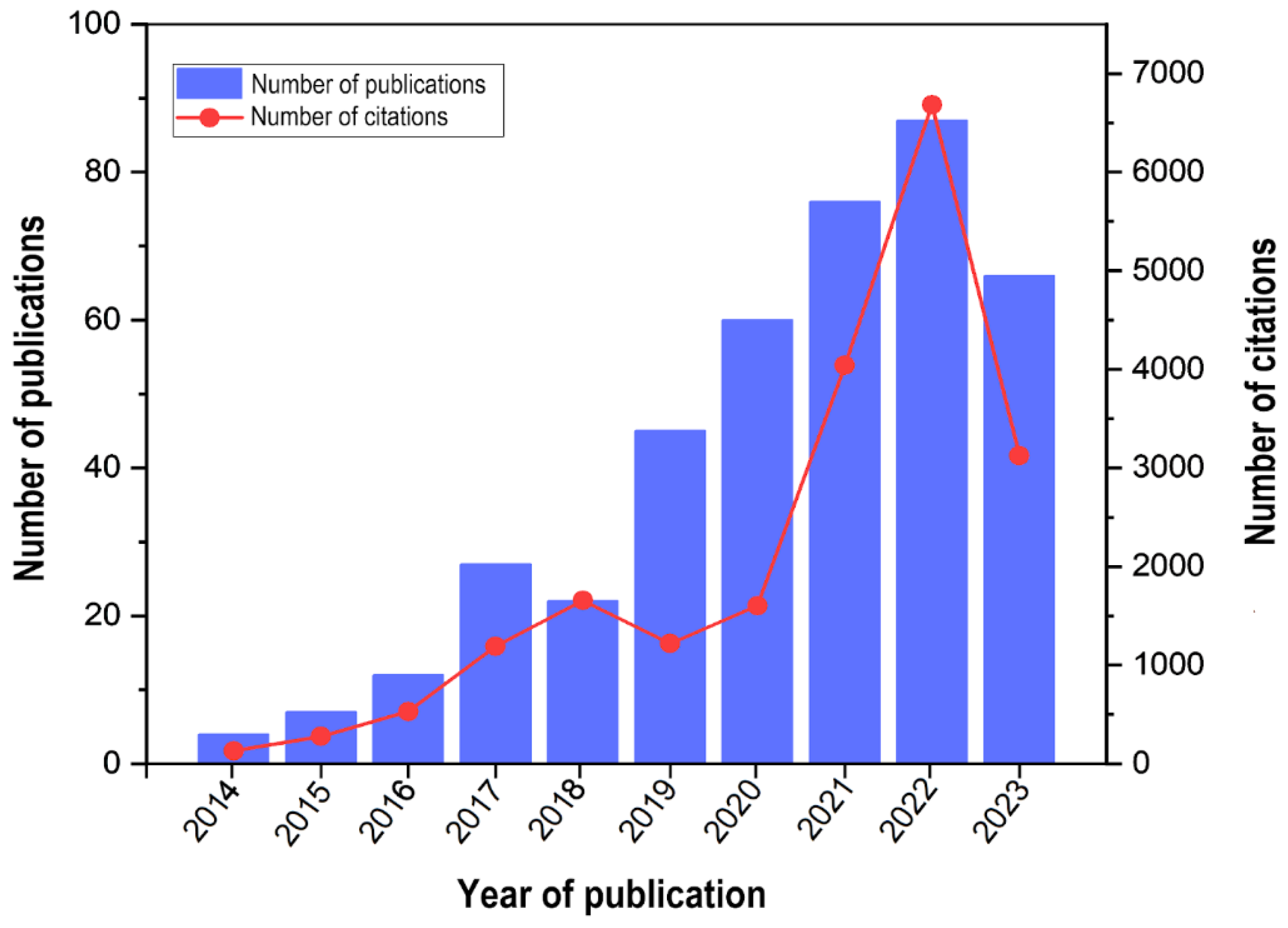
Figure 2.
The keywords’ visualization results for the last decade are represented in clusters by the colors green, blue, red, and yellow.
Figure 2.
The keywords’ visualization results for the last decade are represented in clusters by the colors green, blue, red, and yellow.
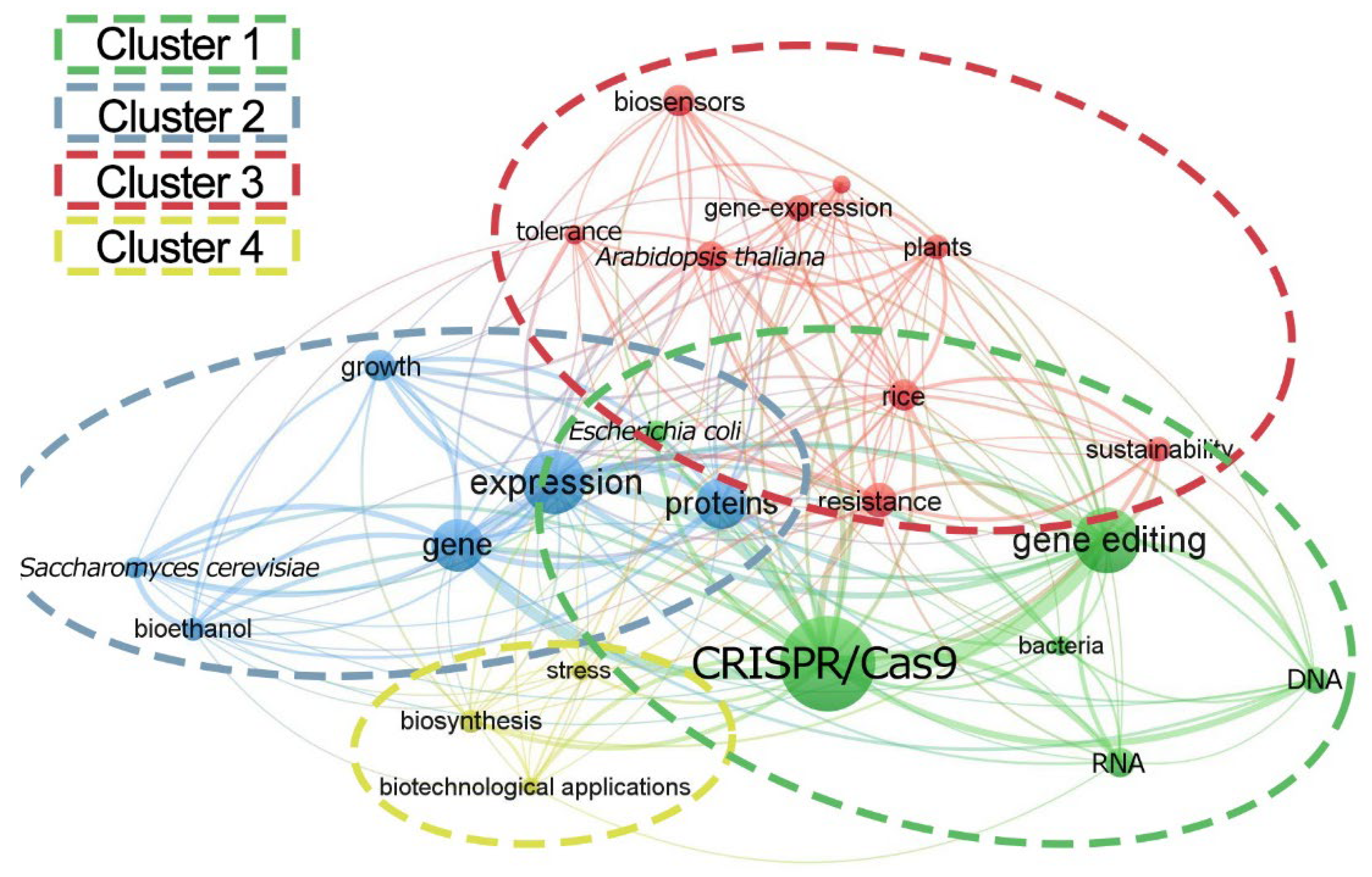
Figure 3.
Results of the visualization of production by country with their collaborative links over the last decade. The colors of the rings represent the years: yellow, the most current (2023), and purple, the oldest (2013).
Figure 3.
Results of the visualization of production by country with their collaborative links over the last decade. The colors of the rings represent the years: yellow, the most current (2023), and purple, the oldest (2013).
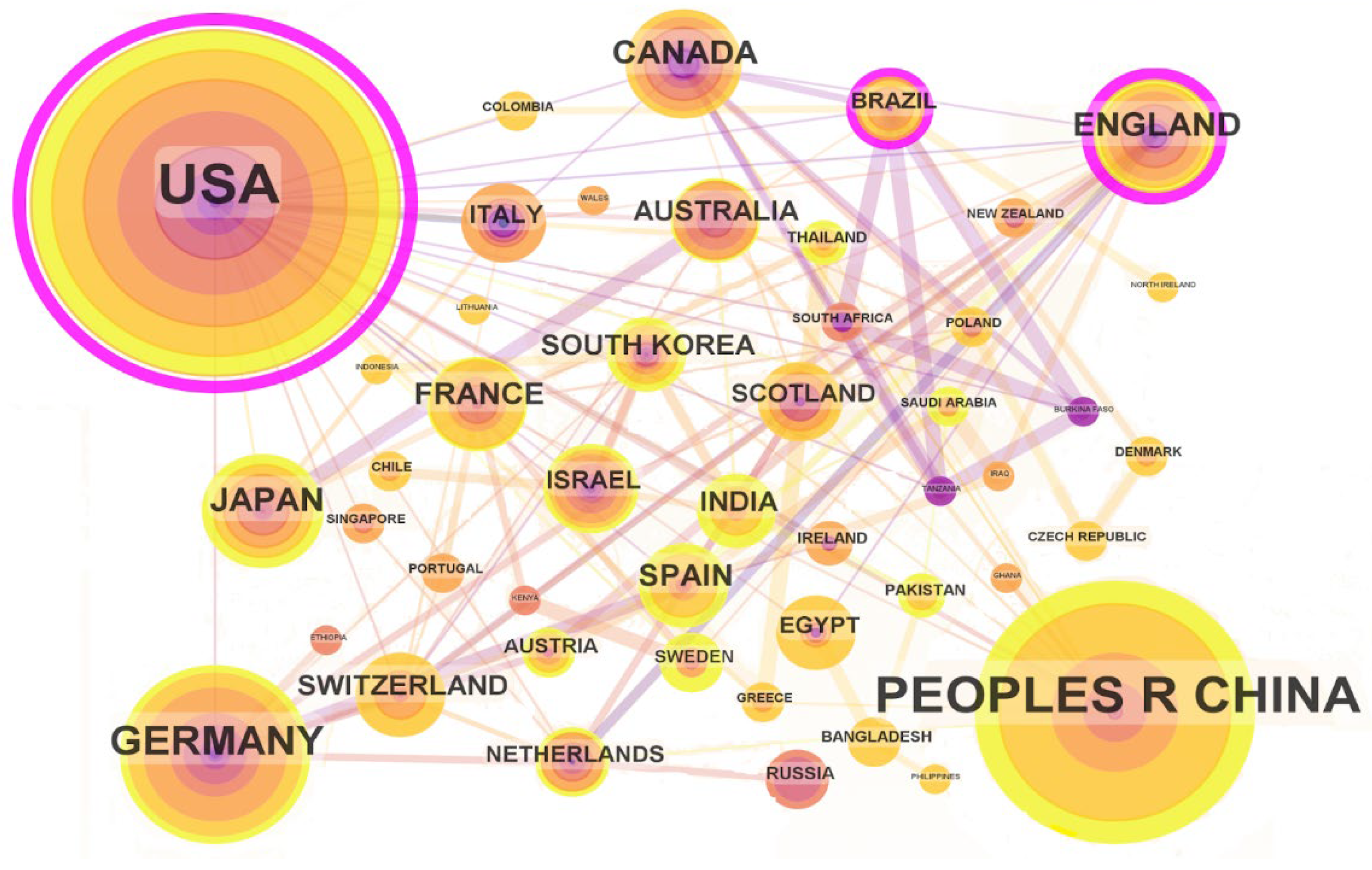
Figure 4.
Results of the visualization of the production by institutions with their collaborative links in the last decade. The red rings represent the closest production to 2023, and the yellow rings represent the oldest production, 2013.
Figure 4.
Results of the visualization of the production by institutions with their collaborative links in the last decade. The red rings represent the closest production to 2023, and the yellow rings represent the oldest production, 2013.
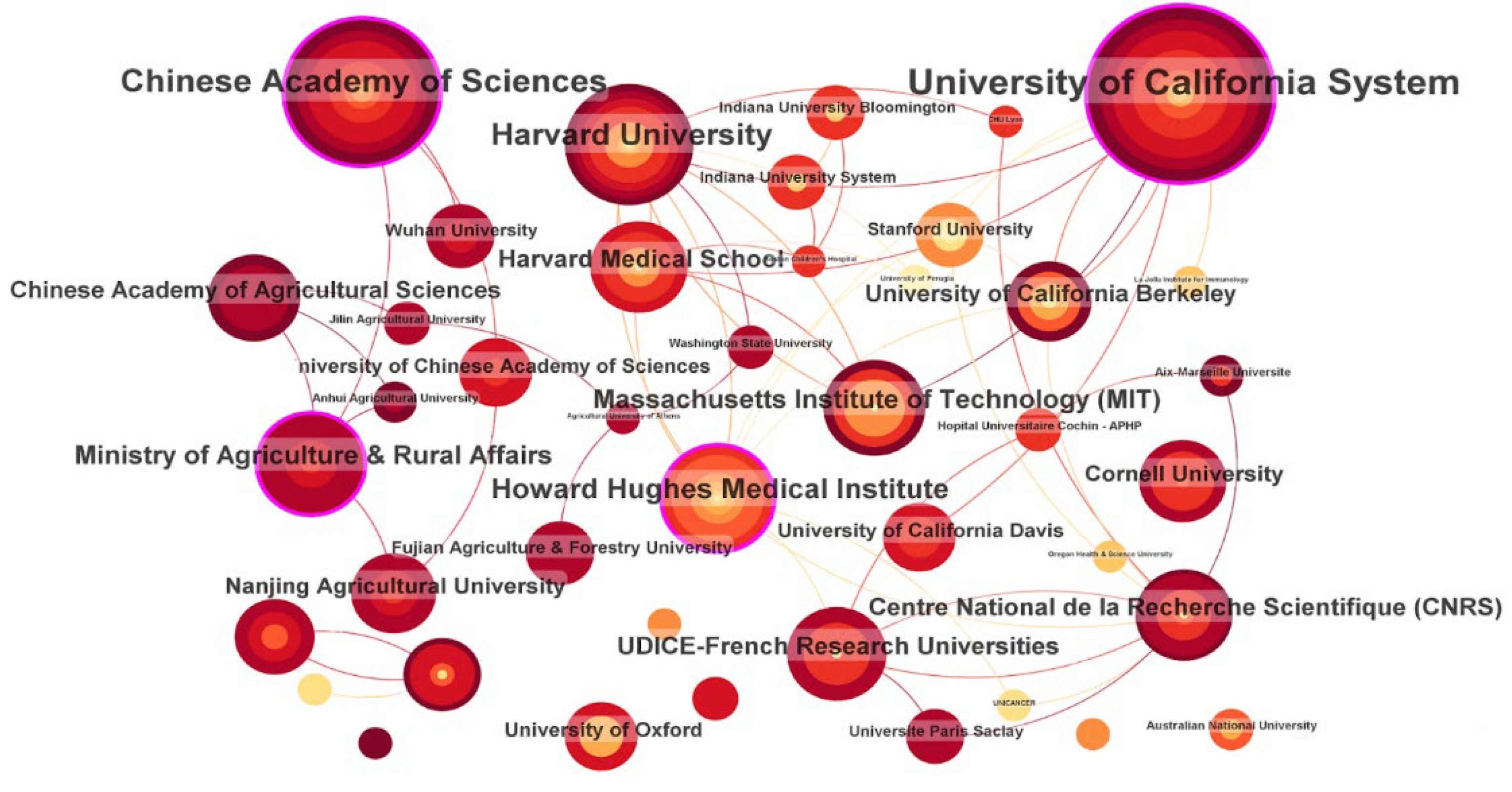
Figure 5.
Results of the visualization of the production by journals and their linkage to each other. The green rings represent the most current publications, and the blue rings are the oldest publications of the decade.
Figure 5.
Results of the visualization of the production by journals and their linkage to each other. The green rings represent the most current publications, and the blue rings are the oldest publications of the decade.
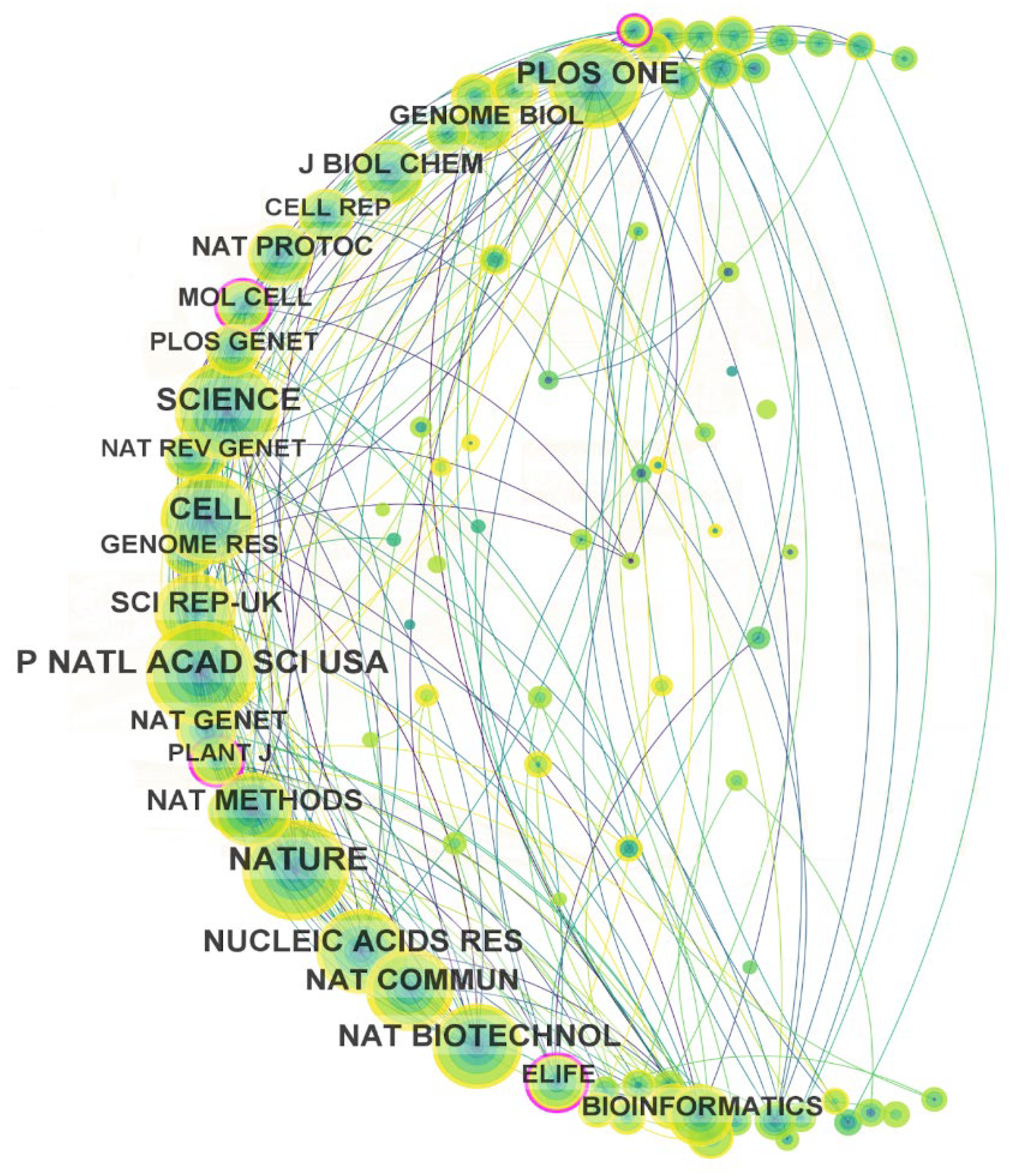
Figure 6.
Results of the visualization of scientific production by authors. The contrast between yellow and purple rings represents the most current and oldest publications cited in the last decade.
Figure 6.
Results of the visualization of scientific production by authors. The contrast between yellow and purple rings represents the most current and oldest publications cited in the last decade.
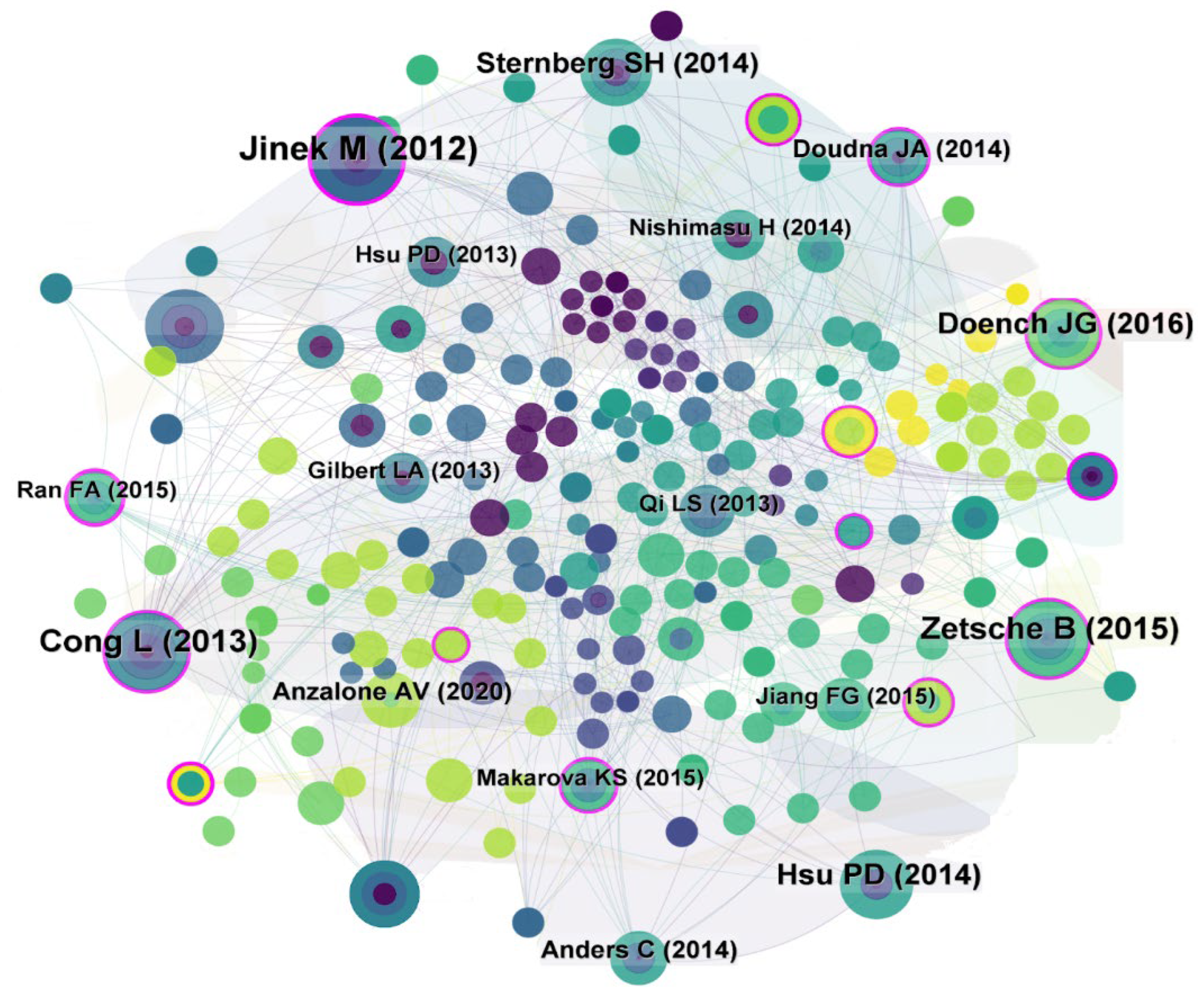
Figure 8.
Diagram for the descriptive analysis based on the PRISMA methodology and CiteSpace software (6.1.R6.).
Figure 8.
Diagram for the descriptive analysis based on the PRISMA methodology and CiteSpace software (6.1.R6.).
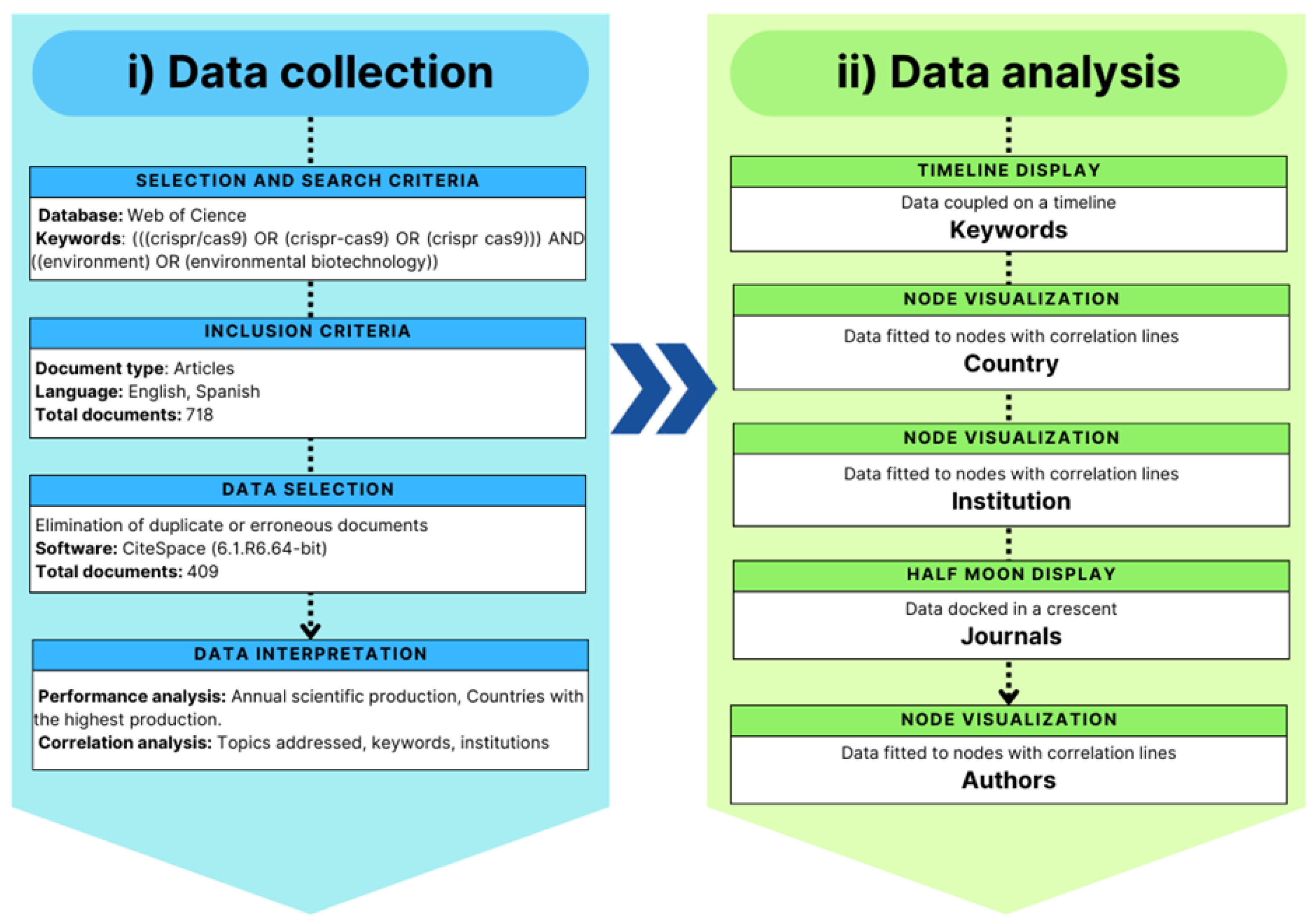
Table 1.
Top 10 of scientific production by countries related to CRISPR/Cas9 and Environmental Biotechnology.
Table 1.
Top 10 of scientific production by countries related to CRISPR/Cas9 and Environmental Biotechnology.
| Ranking | Count | Centrality | Year | Country |
|---|---|---|---|---|
| 1 | 160 | 0.80 | 2014 | United States |
| 2 | 93 | 0.10 | 2015 | People’s Republic of China |
| 3 | 36 | 0.08 | 2016 | Germany |
| 4 | 20 | 0.28 | 2015 | England |
| 5 | 19 | 0.00 | 2016 | Japan |
| 6 | 16 | 0.06 | 2016 | Canada |
| 7 | 14 | 0.06 | 2015 | France |
| 8 | 13 | 0.04 | 2017 | Spain |
| 9 | 11 | 0.06 | 2017 | Switzerland |
| 10 | 11 | 0.05 | 2017 | Australia |
Table 2.
Top 10 of scientific production by institutions regarding CRISPR/Cas9 and Environmental Biotechnology.
Table 2.
Top 10 of scientific production by institutions regarding CRISPR/Cas9 and Environmental Biotechnology.
| Ranking | Organizations | Country | Number of Documents | Year | Centrality |
|---|---|---|---|---|---|
| 1 | University of California System | United States | 31 | 2014 | 0.13 |
| 2 | Chinese Academy of Sciences | People’s Republic of China | 19 | 2017 | 0.18 |
| 3 | Harvard University | United States | 13 | 2014 | 0.10 |
| 4 | Howard Hughes Medical Institute | United States | 12 | 2014 | 0.15 |
| 5 | Ministry of Agriculture & Rural Affairs | People’s Republic of China | 11 | 2018 | 0.08 |
| 6 | University of California Berkeley | United States | 9 | 2014 | 0.00 |
| 7 | Chinese Academy of Agricultural Sciences | People’s Republic of China | 9 | 2021 | 0.07 |
| 8 | Centre National de la Recherche Scientifique (CNRS) | France | 8 | 2015 | 0.10 |
| 9 | UDICE-French Research Universities | France | 8 | 2015 | 0.13 |
| 10 | Massachusetts Institute of Technology (MIT) | United States | 8 | 2014 | 0.01 |
Table 3.
Top 10 journals by number of scientific productions related to CRISPR/Cas9 and Environmental Biotechnology.
Table 3.
Top 10 journals by number of scientific productions related to CRISPR/Cas9 and Environmental Biotechnology.
| Ranking | Journal | Country | Number of Documents | SJR 2022 |
Quartile |
|---|---|---|---|---|---|
| 1 | Proceedings of the National Academy of Sciences (PNAS) | United States | 249 | 4.03 | Q1 |
| 2 | Nature | United Kingdom | 245 | 20.96 | Q1 |
| 3 | Science | United States | 244 | 13.33 | Q1 |
| 4 | PloS ONE | United States | 197 | 0.89 | Q1 |
| 5 | Cell | United States | 194 | 26.49 | Q1 |
| 6 | Nucleic Acids Research | United Kingdom | 180 | 8.23 | Q1 |
| 7 | Nature Biotechnology | United Kingdom | 178 | 22.78 | Q1 |
| 8 | Nature Communications | United Kingdom | 161 | 5.12 | Q1 |
| 9 | Scientific Reports | United Kingdom | 147 | 0.97 | Q1 |
| 10 | Nature Methods | United Kingdom | 132 | 14.36 | Q1 |
Table 4.
Top 10 authors with the highest scientific production related to CRISPR/Cas9 and Environmental Biotechnology.
Table 4.
Top 10 authors with the highest scientific production related to CRISPR/Cas9 and Environmental Biotechnology.
| Ranking | Authors | Article | Journal | Citations |
|---|---|---|---|---|
| 1 | Jinek M et al. [51] | A Programmable Dual-RNA–Guided DNA Endonuclease in Adaptive Bacterial Immunity | Science | 16 |
| 2 | Cong L et al. [52] | Multiplex Genome Engineering Using CRISPR/Cas Systems | Science | 14 |
| 3 | Zetsche B et al. [53] | Cpf1 Is a Single RNA-Guided Endonuclease of a Class 2 CRISPR-Cas System | Cell | 13 |
| 4 | Doench J et al. [54] | Optimized sgRNA design to maximize activity and minimize off-target effects of CRISPR-Cas9 | Nature Biotechnology | 11 |
| 5 | Hsu P et al. [55] | Development and applications of CRISPR-Cas9 for genome engineering | Cell | 11 |
| 6 | Sternberg S et al. [56] | DNA interrogation by the CRISPR RNA-guided endonuclease Cas9 | Nature | 10 |
| 7 | Anders C et al. [57] | Structural basis of PAM-dependent target DNA recognition by the Cas9 endonuclease | Nature | 7 |
| 8 | Doudna J et al. [58] | The new frontier of genome engineering with CRISPR-Cas9 | Science | 7 |
| 9 | Anzalone A et al. [59] | Genome editing with CRISPR–Cas nucleases, base editors, transposases and prime editors | Nature Biotechnology | 7 |
| 10 | Makarova K et al. [60] | An updated evolutionary classification of CRISPR–Cas systems | Nature Reviews Microbiology | 6 |
Table 5.
Applications of CRISPR/Cas9 in Environmental Biotechnology and its contribution to the SDG.
Table 5.
Applications of CRISPR/Cas9 in Environmental Biotechnology and its contribution to the SDG.
| Applications | Cluster from bibliometric study | SDG |
|---|---|---|
| Fourth generation biofuels | 1, 2 |  |
| Biosensors | 1, 3 |  |
| Conservation | 1, 4 |  |
| Enhancing genetic resilience | 1, 2 |  |
| Combating invasive species | 1, 4 |  |
| Sustainable agriculture | 1, 3 |  |
SDG= Sustainable development goals.
Disclaimer/Publisher’s Note: The statements, opinions and data contained in all publications are solely those of the individual author(s) and contributor(s) and not of MDPI and/or the editor(s). MDPI and/or the editor(s) disclaim responsibility for any injury to people or property resulting from any ideas, methods, instructions or products referred to in the content. |
© 2024 by the authors. Licensee MDPI, Basel, Switzerland. This article is an open access article distributed under the terms and conditions of the Creative Commons Attribution (CC BY) license (http://creativecommons.org/licenses/by/4.0/).
Copyright: This open access article is published under a Creative Commons CC BY 4.0 license, which permit the free download, distribution, and reuse, provided that the author and preprint are cited in any reuse.


