

Submitted:
30 April 2024
Posted:
02 May 2024
You are already at the latest version
Preprints on COVID-19 and SARS-CoV-2
Abstract
The difficulties faced by the society in its goal of reducing mortality and improving the health status during the period of the COVID-19 pandemic showed that it is necessary to develop new approaches in the therapy of infectious diseases, leading to higher treatment efficiency and few side effects. The subject of the present study is the formation and characterization of the proper-ties of stable liposomes loaded with extracts from Bulgarian medicinal plants and monitoring their antiviral action against the human strain of coronavirus OC43 (HCoV-OC43) in vitro. The hydrodynamic diameter and -potential of the liposomes containing each type of payload were determined with DLS and electrokinetics. The encapsulated amount of extracts was evaluated against quercetin and gallic acid by using colourimetric methods. The BALB 3T3 Neutral Red Uptake (NRU) phototoxicity/cytotoxicity assay was used to estimate the safety of the compounds. For assessment of the antiviral activity against HCoV-OC43 of liposomes (Lip) containing medicinal plant extracts, the cytopathic effect inhibition test was used. Measurements of the virucidal activity and the effect on the virus adsorption stage was carried out using the endpoint dilution method, and ∆lgs were calculated by comparison with untreated controls. The estimated photo irritation factors (PIF) for the Lip containing extracts were < 2 which assigns them to the category of non-phototoxic substances. When the extracts were introduced into the liposomes as their carriers, the antiviral activity of the vesicles against the replication of HCoV-OC43 in vitro in-creased by several times compared to their individual activity described in our previous study. The determination of the effect of structures loaded with extracts on the extracellular virions and the stage of their adsorption to sensitive HCT-8 cells proved that the liposomes do not affect directly the viral surface or cell membrane, but only perform a function of carriers of the active substances and the observed result is due solely to the intracellular action of the extracts.
Keywords:
natural extracts
; chitosan
; liposomes
; encapsulation
; drug release
; coronavirus HCoV-0C43
; antiviral activity
; natural inhibitors of viral replication
; cytotoxicity
; phototoxicity
1. Introduction
Natural extracts of botanical origin were applied in the traditional medicine as a cure throughout the human history. Nowadays, it is well known that they consist of complex combination of bioactive compounds, such as flavonoids, saponins, terpenes, essential oils, alkaloids, etc. [1,2]. The modern herbal therapy gains interest all over the world as a valuable addition and/or alternative to the conventional synthesized drugs, with certain advantages over the standard treatment, such as relatively higher biocompatibility, minimizing the damaging side effects, prophylactic utilization, etc. Different medicinal plants have been found to possess antitumor [3,4], antibacterial [5,6], antiviral [7,8], immunomodulatory [9], antidiabetic [10], anticholesterolemic [11], antiulcerolitic [12], anti-inflammatory [13], antioxidant [13,14] activities, etc. Besides, the floral extracts are also widely incorporated in the food and cosmetic industries.
In recent years, with raising the need for the development of new approaches to address the severe acute respiratory syndrome coronavirus-2 (SARS-CoV-2), the significance of antiviral, anti-inflammatory, and antioxidant properties of the botanical products has become an attractive subject of the research focus [15,16,17]. In this regard, special attention deserves the herbs with higher polyphenol content and in particular quercetin-like flavonoids, which combine the mentioned desirable effects against the oxidative stress inflicted by SARS-CoV-2 in the invaded tissues [18]. The polyphenols hinder the viral replication and regulate the immune response by preventing the rise of cytokine storm, as well as inhibits the action of free radicals [17].
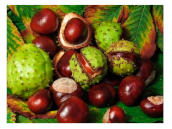
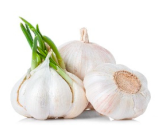
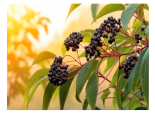
In the current work, several flavonoids-rich extracts from medicinal plants wide spread in the Bulgarian nature are used, namely Sambucus nigra (elderberry) [19,20,21,22], Potentilla reptans (creeping cinquefoil) [23,24], Allium sativum (garlic) [25,26], Aesculus hippocastanum (horse chestnut) [27,28] and Glycyrrhiza glabra L. (licorice) [29,30,31]. They are known to be effective against respiratory infections, for relieving cold, pain, cough, bronchitis, fever, etc. The reasons for their selection lay in the fact the herbal extracts mentioned were found promising as potential anti-coronavirus agents in several aspects, namely: (1) capability to protect healthy human cells (MRC-5) from extracellular virions of HCoV-229E strain, with leading virucidal activity of Allium sativum > Glycyrrhiza glabra L. > Potentilla reptans = Aesculus hippocastanum in the time range of 120 min.; (2) inhibition of the HCoV virions adsorption at the host cells, which follows the order Allium sativum > Glycyrrhiza glabra L. > Potentilla reptans > Aesculus hippocastanum for 120 min. exposure time, with a more pronounced effect of Allium sativum and Potentilla reptans for 15 min.; (3) avoiding repeating infection from HCoV in the activity sequence Aesculus hippocastanum > Sambucus nigra > Allium sativum > Potentilla reptans > Glycyrrhiza glabra L. An interesting case is Sambucus nigra which shows no effect in relation to (1) and (2), however, it has a large impact on (3) as an important prophylactic agent against secondary infection [17].
Along with all the advantages of plant extracts and of polyphenols as their important ingredient, several drawbacks have been reported, such as low stability against the environmental conditions (oxidation, temperature, pH, ionic strength, etc.), poor bioavailability (low intestinal adsorption), limited solubility in water, interaction to proteins resulting in aggregation and polyphenol losses, bad taste or smell, etc. [2,32]. In order to solve the downsides described, for medical, food and other applications, the herbal materials are preliminarily encapsulated into suitable carriers, for example, polymeric nanoparticles, cyclodextrins, micelles, vesicles, micro and nanoemulsions, etc. [1,2,33,34,35,36], and thus, preserving the active components, deliver them safely to the affected tissues to be released. The liposomes are a version of vesicles, where the bilayer(s) is/are constructed by phospholipids, which are commonly present in the natural biomembranes (non-toxic, biocompatible, non-immunogenic) and possess much better bioadhesive properties to the target cells compared to the loaded drugs/extracts alone. Among their content-protective functions stands the ability of the formulations to survive the stomach digestion and securely reach the intestinal tract to be sufficiently absorbed (enhanced bioavailability) [2,36]. In addition, liposomes in a size range of 70-200 nm can escape the phagocytosis [37]. Besides, this type of carrier is an appropriate vehicle for polyphenols/flavonoids also because of their amphiphility, in meaning they are capable of packing hydrophilic, hydrophobic and surfactant-like compounds either into the aquatic core or incorporating (partially or completely) into the different parts of the bilayer. Acidic conditions of pH 3.8 are recommendable for encapsulation of polyphenols into liposomes to avoid the oxidation of extracts [38,39].
However, a well-known insufficiency of simple (naked) liposomes is based on their kinetic instability, which leads to leakage of the loaded content over time. To fix the problem, their proper design requires additional coating by polymers, such as biocompatible polysaccharides [39,40]. In the current work, chitosan is selected to envelop the liposomal carriers because of its long-proven qualities in the field of drug delivery [41,42]. A big variety of chitosans with different molecular weights and degrees of acetylation is established, where the second parameter is strongly related to the electric charge possessed. The polymer interacts mainly with the lipids, governed predominantly by the electrostatic attraction of chitosan NH3+ to the negatively charged lipid heads, and to a lesser extent by H-linking between chitosan H2N and lipid OH, as well as hydrophobic forces, which could cause partial anchoring of polysaccharide’s hydrophobic portions into the acyl chain space of the bilayer [39].
Particularly interesting is the subject of lipid-polyphenol interactions, which is related to the polyphenol position with respect to the liposomal membrane. Although it depends on the concrete structure of the components, there are some general factors that deserve mentioning. Firstly, the forces that define the intermolecular behaviour include (1) for the most part H-bonding between the polyphenol OH groups and the lipid headgroups (-PO3, C=O), which hang strongly on the OH-number and the degree of polyphenol penetration into the bilayer, either incorporated into the hydrophilic lipid portion (favourable for H-linking), or deeper in the acyl chains (inhibits H-bonding for spatial reasons); the latter is attributed to (2) hydrophobic interactions between the corresponding aqua-repelling parts of both components; (3) van der Waals forces, when dipole-dipole or charge-dipole interactions play an important role since a number of flavonoids are characterized with significant dipole moments [43]. In general, H-linking and in particular the bigger number of polyphenol OH- groups, as well as the van der Waals forces, support the polyphenol anchoring at the hydrophilic part of the bilayer, while the polyphenol hydrophobicity is a precondition for sinking into the hydrocarbon portion of the lipid membrane [39,44]. Certain configurational features of polyphenols influence their behaviour in respect to lipids: when the structure is more flat-like shaped, for instance, by two coplanar aromatic rings (common for quercetin and quercetin-like flavonoids) or double bonds, it would cause deeper incorporation into the lipid layer; the presence of glucoside groups, on the contrary, would inhibit it [45]. Factors of electrostatic origin also can control the mutual position: for example, the electric charge of the lipids favours the polyphenol location at the level of the headgroups and enhanced environmental salt concentration promotes its greater infiltration into the liposome bilayer because of the shielding effect of the medium electrolyte over the lipid charge [46]. Almost always the polyphenol-induced rearrangement in the liposome membrane is concentration-dependent and reversible, which facilitates a successful release of the active component at a later stage of the extract delivery [45].
The purpose of the current study is to construct and characterize the physicochemical properties of chitosan-stabilized liposomal vehicles for several herbal extracts from polyphenol-containing Bulgarian medicinal plants Sambucus nigra, Potentilla reptans, Allium sativum, Aesculus hippocastanum, and Glycyrrhiza glabra L., found to be capable to protect healthy cells from extracellular virions of human coronavirus HCoV-229E, to prevent the virion adsorption and secondary infection, along with other health benefits. The combinations of phospholipid 1,2-dioleoyl-sn-glicero-3-phoshocholine (DOPC) and three types of chitosan with divergent molecular weight and degree of acetylation, adsorbed in different concentrations, are examined as possible versions of encapsulation coverage protecting the potential anti-coronavirus agents from the environmental conditions.
2. Materials and Methods
2.1. Materials
2.1.1. Plant Extracts
The dry water-ethanol extracts of five Bulgarian medicinal plants (Sambucus nigra, Allium sativum, Potentilla reptans, Aesculas hippocastanum and Glycyrriza glabra L. (Table 1)) were produced and provided by Extractpharma Ltd., Sofia, Bulgaria. The production of used dry extract was previously described [47]. Briefly, the extractant was a water-ethanol mixture (15% ethanol). The extraction was carried out at an atmospheric pressure and temperature of 40°C for 18 hours. The resulting plant essences were concentrated and dried in vacuum-drying or powder-drying depending on the type of herb, to obtain dry material.
The stock solutions of plant extract were prepared with a concentration of 10 mg/mL in double distilled water. The solutions were filtered through a 5 µm filter (filtraTECH, Saint Jean de Braye, France) to remove the insoluble components. The produced coloured and clear solutions were encapsulated into the liposomes.
2.1.2. Reference Substance
The stock solution of Veklury® (Gilead Science Inc. Ireland UC) with a concentration of 150 mg/mL was prepared in double distilled water and the concentration of remdesivir (REM) in the stock solution was estimated of 8.3×10⁻³ M.
2.1.3. Polysaccharides and Lipids
Chitosans, CS, (product numbers 448869, 448877, 523682) were purchased from Sigma Aldrich: CS-L (Mw 50-190 kDa, DA 75-58%), CS-H (Mw 190-310 kDa, DA 75-58%) and COS (Mw 5 kDa, DA < 10 %). The stock solutions were prepared with a concentration of 1 mg/mL in a solution of hydrochloric acid with pH 4. The solution of chitosan oligosaccharide, COS, was prepared in double distilled water. Before usage, the solutions were filtered through a 0.45 µm filter (Minisart®, Sartorius) to remove possible aggregates.
The phospholipid 1,2-dioleoyl-sn-glicero-3-phoshocholine (DOPC, chloroform solution, 25 mg/mL) product of Avanti Polar Lipids Inc. was used for the production of unilamellar liposomes.
2.1.4. Light Source
The light source used is a light-emitting diode matrix – an artificial solar light simulator Helios-iO, model LE-9ND55-H - 5500K (SERIC Ltd., Tokyo, Japan).
2.1.5. Chemicals
Cell culture reagents: Dulbecco’s modified Eagle’s medium with high (4.5 g/L) glucose (DMEM), Roswell Park Memorial Institute Medium (RPMI 1640) fetal bovine serum (FBS), horse serum (HS), antibiotics (penicillin and streptomycin), L-glutamine and Neutral Red was purchased from Sigma-Aldrich, Schnelldorf, Germany. The disposable consumables were supplied by Orange Scientific, Braine-l’Alleud, Belgium.
2.1.6. Cell Lines
The mouse embryonic fibroblasts (BALB/3T3 clone A31) and Human colon carcinoma (HCT-8) cell lines were obtained from American Type Cultures Collection (ATCC, Manassas, Virginia, USA).
The BALB/3T3 cells were cultured in 75 cm2 tissue culture flasks in DMEM, 10% FBS and antibiotics (penicillin 100 U/mL and streptomycin 100 µg/mL) at 37°C, 5% CO2 and 90% humidity.
Permanent HCT-8 cells were maintained at 37°C and 5% CO2 using sterile RPMI 1640 medium supplemented with 0.3 mg/mL L-glutamine, 10% horse serum, 100 UI penicillin and 0.1 mg streptomycin/mL.
2.1.7. Virus
Human Coronavirus OC-43 (HCoV-OC43, ATCC: VR-1558) strain was propagated in human colon carcinoma cell line HCT-8 in RPMI 1640 medium supplemented with 2% horse serum, 100 U/mL penicillin, and 100 μg/mL streptomycin. Cells were lysed 5 days after infection by 2 freeze and thaw cycles and the virus was titrated according to the Reed and Muench formula [57]. Virus and mock aliquots were stored at −80 °C.
2.2. Methods
2.2.1. Formation of the Liposomes
The liposomes were prepared using the thin-film hydration method. An appropriate volume (200 µL) from the solution of lipid in chloroform (25 mg/mL) was dried under a stream of nitrogen by rotating the flask to form a thin lipid film on its wall. To produce unloaded or extract-loaded liposomes (Figure 1), the lipid was re-hydrated in 2 mL double distilled water or a solution of extract (10 mg/mL) to a final lipid concentration of 2.5 mg/mL. The solution was frozen with liquid nitrogen and 4 freezing/heating cycles were performed. The stock solution of liposomes was sonicated in an ultrasonic ice bath for 15 min. In order to prevent a possible aggregation during the subsequent steps in the experimental procedure, the lipid concentration of the dispersion was adjusted to 0.02 mg/mL with solution of HCl pH 4 followed by extrusion through a 0.20 µm filter (Minisart®, Sartorius). (The estimated concentration of liposomes in the samples was 3.5×10¹⁴ liposomes/mL.)
In order to improve the stability of the loaded liposomes, a layer of chitosan was adsorbed on the surface. The stabilization of the liposomes was performed by adding a diluted dispersion of liposomes (2 mL) to the solution of positively charged chitosan (with the required concentration) and stirring for 20 minutes.
2.2.2. Determination of Encapsulated Amount of Extracts
Because of the multi-component composition of the extracts, the loaded amount is determined toward the total water-soluble flavonoid or polyphenol content. The procedure for determination of the encapsulated amount was implemented as follows.
The stock water dispersion of liposomes loaded with extract was centrifuged at 15 000 rpm (21 382 g, 15°C) for 90 min and the supernatant was extracted. The total flavonoid content (TFC) was determined using the colourimetric method proposed by Gouveia and Castiho [58]. A mixture of 0.30 mL methanol, 0.02 mL of 10 wt% solution of AlCl3 and 0.56 mL double distilled water was combined with 0.50 mL supernatant of dispersion of liposomes loaded with extract. The vials were incubated at 25°C in an ES-20 (Biosan SIA, Riga, Latvia). TFC was estimated as micrograms of quercetin by monitoring with a T60 UV-visible spectrophotometer (PG Instruments Limited, UK). The compound was detected at a wavelength of 415 nm corresponding to the maximum absorbance peak. For the determination of the loaded amount of TFC was used the calibration curve of quercetin. It was obtained by using the same procedure, but the mixture (from methanol, solution of AlCl3 and water) was combined with 0.50 mL of quercetin solution in methanol concentrations in the range of 10-4 – 2 mg/mL.
The total polyphenol content (TPC) was estimated by using the Folin-Ciocalteu assay [59]. To 0.15 mL supernatant of dispersion of liposomes loaded with extract in Eppendorf tube was added 0.75 mL Folin-Ciocalteu’s reagent (diluted 1:10 with double distilled water) and 0.6 mL Na2CO3 (7.5 wt %). The tubes were incubated in an incubator for 10 min at 50°C. TPC was estimated as micrograms of gallic acid. The absorbance was measured at 760 nm by monitoring with a spectrophotometer. The calibration curve of gallic acid was obtained by using the same procedure, but the supernatant was replaced with a solution of gallic acid of concentrations in the range of 10-4 – 3 mg/mL.
To evaluate the encapsulation efficiency, the concentraction of soluble TFC and TPC components in the initial filtered solution of the extracts were determined by using the same procedures, but the supernatant was replaced with pure water solutions of extracts (10 mg/mL).
The encapsulation efficiency (EE%) of TFC and TPC in the liposomes was calculated towards to quercetin or gallic acid by using the relation
where the Ctotal is the initial concentration of quercetin or galic acid in filtered extract solution which was added to the dispersion in µg/mL determined according to the colourimetric method of Gouveia and Castiho or Folin-Ciocalteu assay, and Cfree is the calculated concentration of the componets the supernatant after the encapsulation.
2.2.3. Determination of the Electrokinetic Charge and the Size of the Liposomes
The size (hydrodynamic diameter) of the produced liposomes was evaluated by using dynamic light scattering with non-invasive backscattering (DLS-NIBS, measuring angle 173°). The ζ-potential was determined by mixed-mode measurement of phase-analysis light scattering. Dynamic light scattering experiments were carried out using Zetasizer Pro (Malvern Panalytical Ltd., Malvern, UK) equipped with a He-Ne laser with a maximum power of 10 mW operating at a wavelength of 633 nm with a fixed scattering light angle of 173°. All measurements were performed at 24.0 ± 0.1°C. After five measurements, the average value was taken as the electrokinetic potential and size of the capsules.
2.2.4. Release of TFC or TPC from the Liposomes
The release of soluble compounds of TFC or TPC from the liposomes loaded with Glycyrriza glabra L. was done by using a dialysis method. The procedure was as follows: an aliquot (800 µL) from dispersion was added into a dialysis tube (D-Tube ™ Dialyser Midi, MWCO 3.5 kDa, Sigma Aldrich) and incubated with 20 mL physiological solution (B. Braun Melsungen AG, Melsungen, Germany) and incubated at 37°C and 110 rpm in a shaker-incubator. Aliquots (2 mL) were drawn at predetermined time points from the medium and the medium was immediately replenished with fresh physiological solution. The concentrations of free TFC or TPC in the samples were estimated by UV-vis spectroscopy by using appropriate calibration curves (according to the same procedure as in Section 2.2.2.)
2.2.5. Safety Test
Cytotoxicity/phototoxicity was assessed by BALB/3T3 Neutral Red Uptake Assay [60,61]. Cells were plated in a 96-well microtiter plate at a density of 1 × 10⁴ cells / 100 µL/ well and were incubated for 24 h. A concentration range of the test compounds was applied (from 0.04 to 10 mg /mL). In phototoxicity tests, 96-well plates were irradiated with a dose of 2.6 J/cm2 and the cells were incubated for an additional 24 h. After treatment with Neutral Red medium, washing and treatment with desorb solution (H2O / Ethanol / Acetic acid = 50 / 49 / 1), the absorption was measured on a TECAN microplate reader (TECAN, Grödig, Austria) at wavelength 540 nm.
Cytotoxicity/phototoxicity was expressed as CC50 values (concentrations required for 50% cytotoxicity/phototoxicity), calculated using non-linear regression analysis (GraphPad Software, San Diego, California, USA).
2.2.6. Cytotoxicity Assay
Confluent monolayer of HCT-8 cell culture in 96-well plates (Costar®, Corning Inc., Kennebunk, ME, USA) was treated with 0.1 mL/well-containing maintenance medium that did not sustain/or sustain decreasing concentrations of test substances. The cells were incubated at 37°C and 5% CO2 for 5 days. After microscopic evaluation, the medium with the test compound was removed, and the cells were washed and incubated with neutral red, at 37°C for 3 hours. After incubation, the neutral red dye was removed and the cells were washed with PBS and 0.15 mL/well desorbing solution was added. The optical density (OD) of each well was recorded at 540 nm in a microplate reader (Biotek Organon, West Chester, PA, USA). The 50% cytotoxic concentration (CC50) was defined as the concentration of the material that reduces cell viability by 50% compared to untreated controls. Each sample was tested in triplicate with four wells for cell culture on a test sample. The maximum tolerable concentration (MTC) is also determined, which is the concentration at which the compounds do not affect the cell monolayer in the sample, and it looks like the cells in the control (untreated with compounds).
2.2.7. Determination of Infectious Viral Titers
The HCT-8 cells are cultivated in 96-well plates. After the formation of a confluent monolayer, the cells are infected with 0.1 mL viral suspension in tenfold falling dilutions. After 1 hour of adsorption, the non-adsorbed virus is removed and to the cells is added 0.1 mL/well-supporting medium. The plates are incubated at 33º C and 5% CO2 in HERA cell 150 CO2 incubator (Radobio Scientific Co., Ltd., Shanghai, China) for 5 days. Unintended cells are used as control, cultivated under the same conditions as viral control (cells infected with the maximum concentration of the virus and demonstrate the maximum cytopathic effect). The infectious viral titer is determined by microscopic monitoring of the cellular monolayer and the determination of the cytopathic effect (CPE). Visually defined CPE is confirmed by colouring with the dye neutral red (NR) (Neutral Red Uptake Assay). The maintenance medium is removed, and the cells are washed with PBS and incubated with neutral red at 37º C / 5% in CO2 incubator for 3 hours. After incubation, the NR is removed and the cells are washed with PBS and adding 0.15 mL/well desorb solution to each well. The optical density (OD) of each well is reported at 540 nm in a microplate reader. The development of the CPE, as a percentage of controls is calculated for each dilution of the virus according to the following formula:
where: a - average optical density of a given dilution of the virus, b - average optical density control with maximum CPE, c - average optical density of cellular control. Viral titers are expressed as lg IU (infectious units) (CCID50) / 0.1mL.
2.2.8. Antiviral Activity Assay
Cytopathic effect (CPE) inhibition test was used for assessment of the antiviral activity of the tested samples. Confluent cell monolayer in 96-well plates was infected with 100 cell culture infectious dose 50% (CCID50) in 0.1 mL (coronavirus OC43 strain). After 120 min of virus adsorption, the tested sample was added in various concentrations and the cells were incubated for 5 days at 33°C and 5% CO2. The cytopathic effect was determined using a NRU assay and the percentage of CPE inhibition for each concentration of the sample was calculated using the following equation:
where ODtest sample is the mean value of the optical densities (ODs) of the wells inoculated with the virus and treated with the test sample in the respective concentration, ODvirus control is the mean value of the ODs of the virus control wells (with no compound in the medium) and ODtoxicity control is the mean value of the ODs of the wells not inoculated with a virus but treated with the corresponding concentration of the test compound. The 50 % inhibitory concentration (IC50) was evaluated as the concentration of the test substance that inhibited 50 % of the viral replication when compared to the virus control. The selectivity index (SI) was calculated from the ratio CC50/IC50.
2.2.9. Virucidal Assay
Samples of 1 mL containing HCoV-OC43 (CCID50), and samples in their maximal tolerable concentration (MTC) were contacted in a 1:1 ratio and subsequently stored at room temperature for different time intervals (15, 30, 60, 90 and 120 min). Then, the residual infectious virus content in each sample was determined by the end-point dilution method of Reed and Muench [57] and the reductions in viral titer Δlgs were evaluated as compared to the untreated controls.
2.2.10. Effect on the Viral Adsorption
Twenty-four-well plates containing HCT-8 cell monolayer were pre-cooled to 4°C and inoculated with CCID50 of HCoV-OC43. In parallel, they are treated with tested samples at their MTC and incubated at 4°C for the time of virus adsorption. At various time intervals in the different samples (15, 30, 60, 90 and 120 minutes), the cells were washed with PBS to remove both the compound and the unattached virus, and then the cells were covered with a support medium and incubated at 33°C and 5% CO2 for 48 hours. After freezing and thawing three times, the infectious viral titer of each sample was determined by the final dilution method. Δlgs were estimated compared to the viral control (untreated with the compounds). Each sample was prepared in four replicates.
2.2.11. Statistical Analysis
The values of CC50 and IC50 were calculated using non-linear regression analysis (GraphPad Software, San Diego, California, USA). The values were presented as means ± SD from three independent experiments.
3. Results
3.1. Characterization of the Physicochemical Properties of the Produced Liposomes
Table 2 shows the results for the size and ζ-potential of the unloaded and extract-loaded liposomes. The determined electrokinetic potential for the unloaded control is higher compared to the structures carrying extracts.
It is well known that the liposomes are thermodynamically unstable. To improve the stability of the produced structures, a chitosan layer is adsorbed on their surface. The overcompensation of the surface charge is registered as a result of the electrostatic interaction between the liposomes and the oppositely charged polymer. The positive value of the ζ-potential of the structures slightly increases with the increase of the chitosan concentration. Figure 2 presents the variation of the ζ-potential of the liposomes loaded with Glycyrrhiza glabra L. in the presence of different concentrations of chitosan. The electrokinetic behaviour of the vesicles loaded with the other plant extracts is similar. (The results are not shown.)
The addition of the polymer solution (dissolved in diluted HCl in order to ensure maximum charge of the polysaccharide) to the liposomal dispersion introduces a significant increase in the electrical conductivity of the mixed solution, especially at higher chitosan concentration (ionic strength is about 0.02 M). Therefore, for the microbiology studies the samples of liposomes stabilized with chitosans with a concentration of 0.1 mg/mL are chosen. According to the presented results, at this concentration of polymer, the dispersion is stable and the values of the conductivities are close to the ones for the initial dispersion of liposomes (ionic strength is about 10-4 M).
Table 3 presents the registered diameter of the loaded structures in stabilized dispersion (at 0.1 mg/mL chitosan). The data indicates that the size distribution of the chitosan-covered liposomes is not monodisperse and in some of the samples the standard deviation of the measured dimension is high. Moreover, no correlation between the liposomal size and the characteristics of chitosan (such as molecular weight) was observed. Further, raise in the chitosan concentration results in a slight increase in the size of the liposomes.
3.2. Determination of the Encapsulation Amount of Extracts
The total flavonoid content (TFC) and polyphenol content (TPC) are determined towards to quercetin and gallic acid respectively, using the colourimetric method proposed by Gouveia and Castiho or Folin-Ciocalteu assay respectively, by using an appropriate spectrophotometric analysis.
Previously has been reported that the solubility of quercetin in water is 0.00215 mg/mL (at 25°C) [60] whereas the solubility of gallic acid is significantly higher (11.9 mg/mL [61]). Taking into account the data, the encapsulated TFC is evaluated by using a calibration curve of the absorbance from the quercetin solutions in methanol with concentrations up to 2 mg/mL. The calibration curve of the aqueous solution of gallic acid was with concentrations up to 3 mg/mL.
The experimental results indicate that the encapsulation efficacy of both of the compounds is ca. 100 % for all of the investigated samples. The estimated EE% corespondning only to the soluble in water components of TFC and TPC. It was supposed a significant affinity of the polyphenolic substances to the lipid bilayer of the liposomes. However, a significantly lower encapsulation efficiency is registered for the liposomes loaded with Sambucus nigra.
Figure 3.
Colourimetric estimation of the encapsulated total flavonoid content (TFC) towards quercetin by using the colourimetric method proposed by Gouveia and Castiho [58] in a pure extract from (1) Glycyrriza glabra L., (2) Sambucus nigra, (3) Aesculas hippocastanum, (4) Potentilla reptans, (5) Allium sativum, (6) quercitin 1 mg/mL and liposomes loaded with plant extract: (7) LGGL, (8) LSN, (9) LAH, (10) LPR, (11) LAS.
Figure 3.
Colourimetric estimation of the encapsulated total flavonoid content (TFC) towards quercetin by using the colourimetric method proposed by Gouveia and Castiho [58] in a pure extract from (1) Glycyrriza glabra L., (2) Sambucus nigra, (3) Aesculas hippocastanum, (4) Potentilla reptans, (5) Allium sativum, (6) quercitin 1 mg/mL and liposomes loaded with plant extract: (7) LGGL, (8) LSN, (9) LAH, (10) LPR, (11) LAS.
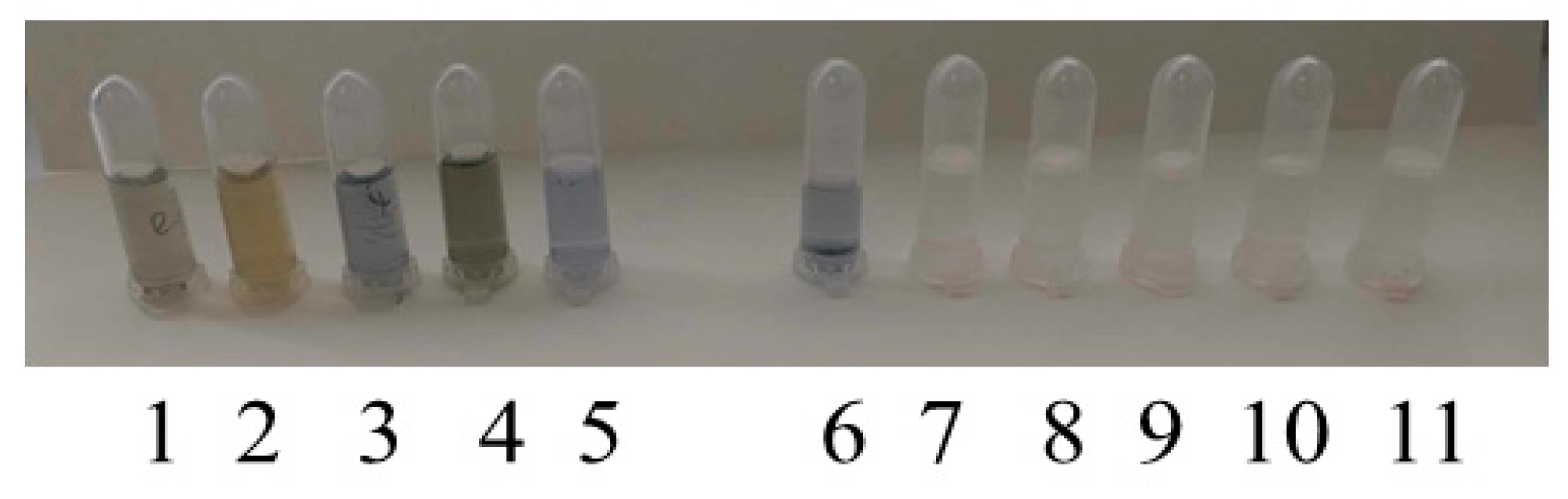
Figure 4.
Colourimetric estimation of the encapsulated total polyphenolic content (TPC) towards gallic acid by using Folin-Ciocalteu assay [59] in a pure extract from (1) Glycyrriza glabra L., (2) Sambucus nigra, (3) Aesculas hippocastanum, (4) Potentilla reptans, (5) Allium sativum, (6) quercitin 1 mg/mL and liposomes loaded with plant extract: (7) LGGL, (8) LSN, (9) LAH, (10) LPR, (11) LAS.
Figure 4.
Colourimetric estimation of the encapsulated total polyphenolic content (TPC) towards gallic acid by using Folin-Ciocalteu assay [59] in a pure extract from (1) Glycyrriza glabra L., (2) Sambucus nigra, (3) Aesculas hippocastanum, (4) Potentilla reptans, (5) Allium sativum, (6) quercitin 1 mg/mL and liposomes loaded with plant extract: (7) LGGL, (8) LSN, (9) LAH, (10) LPR, (11) LAS.
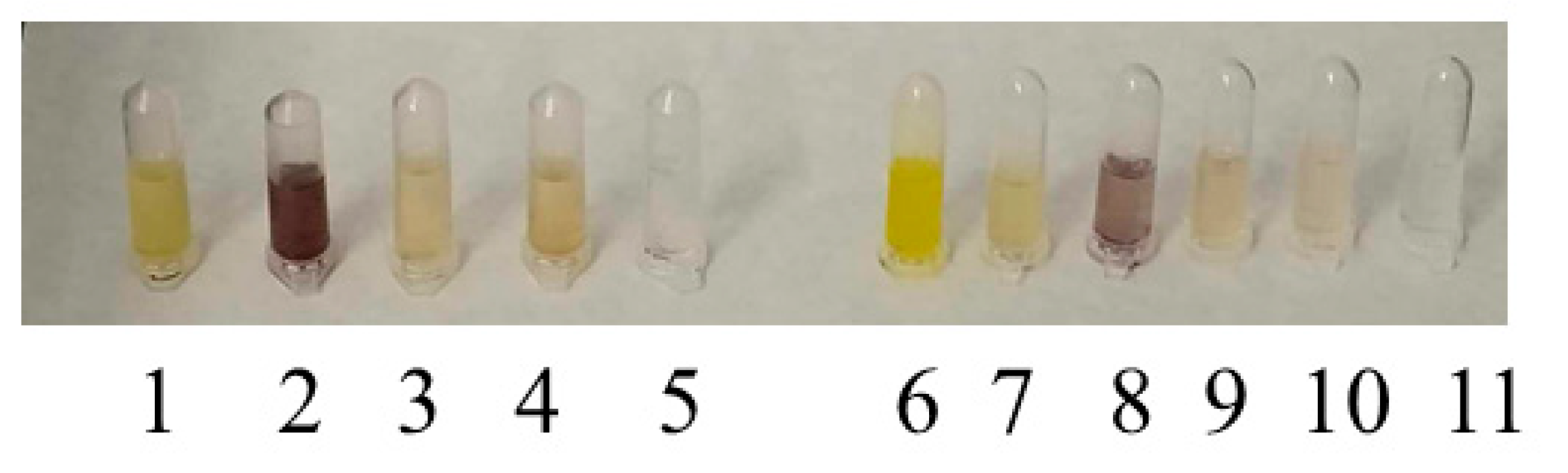

Table 4.
Determination of the encapsulation efficiency, EE%, of soluble flavonoids towards quercetin and gallic acid in the liposomes loaded with a plant extract: LSN (Sambucus nigra), LAS (Allium sativum), LPR (Potentilla reptans), LAH (Aesculas hippocastanum), LGGL (Glycyrriza glabra L.). The concentrations and correspond to the amounts of the compounds in the filtered water extracts.
Table 4.
Determination of the encapsulation efficiency, EE%, of soluble flavonoids towards quercetin and gallic acid in the liposomes loaded with a plant extract: LSN (Sambucus nigra), LAS (Allium sativum), LPR (Potentilla reptans), LAH (Aesculas hippocastanum), LGGL (Glycyrriza glabra L.). The concentrations and correspond to the amounts of the compounds in the filtered water extracts.
| Plant extract | µg/mL | EE (quercetin) % | EE (gallic acid) % | |
|---|---|---|---|---|
| LSN | 0.1700 | 99 | 1.53 | ≈ 100 |
| LAS | 0.0014 | 70 | 0.57 | 98 |
| LPR | 10.7959 | ≈ 100 | 2.54 | ≈ 100 |
| LAH | 14.7531 | ≈ 100 | 2.10 | ≈ 99.5 |
| LGGL. | 8.2132 | ≈ 100 | 3.40 | ≈ 100 |
3.3. Release of TFC and TPC from the Liposomes
The release of the compounds from the liposomes loaded by Glycyrriza glabra L. in a physiological solution at 37°C is done by using a dialysis method. The concentrations of free quercetin and gallic acid in the aliquots are estimated by UV-vis spectroscopy by using appropriate calibration curves (according to the same procedure as for the estimation of encapsulation efficiency). The liposomes loaded with this extract are chosen following the results from the microbiology experiments. According to the spectroscopy measurements, after 24 hours in the physiological solution, the free concentration of compounds corresponds to about 42 % (3.45 µg/mL) (quercetin) and 15 % (0.51 mg/mL) (gallic acid). The implementation of longer experiments in physiological solution at 37°C is hindered because of the occurrence of turbid sludge and spoilage of the sample.
3.4. Safety Testing
The compounds were studied for safety by an in vitro 3T3 NRU test. The cells were incubated with the test samples of extract-loaded liposomes at an extract concentration of 0.04 to 10 mg/mL for 24 h at 37 °C, 5% CO2 and 95% humidity. It is important to note, that these dilutions of the stock dispersion are obtained in accordance with the amount of extracts used for the formation of liposomes. The cytotoxicity/phototoxicity expressed in % relative to the negative control was determined. Dose-response dependence was observed for all extracts. In the phototoxicity experiments, we used the phototoxic compound Chlorpromazine as a positive control. The obtained results are shown in Figure 5. (The extracts are mixtures of many compounds not only quercetin and gallic acid. Therefore, the results for liposomes loaded with extracts are compared with a control sample of liposomes loaded with pure substance REM which antiviral and cytotoxicity properties are well-known. These results are presented in Figure 5 and Table 5, Table 6 and Table 7 are just for comparison.)
CC50 values (50% cytotoxic/phototoxic concentration) were calculated by nonlinear regression analysis (Table 5). The CC50 values can be used to calculate the Photo irritation Factor (PIF) for each test compound, according to the formula: PIF = CC50 -Irr/ CC50 +Irr. The PIF shows us the probability that the test substance may cause a phototoxic effect (PIF < 2 not phototoxic, PIF ≥ 2 < 5 probable phototoxicity and PIF ≥ 5 phototoxic). For unloaded liposomes the calculated PIF = 5.75, which shows a phototoxicity. Low phototoxicity is observed at LREM. No phototoxic effects were observed with liposomes containing plant extracts.
Before the determination of the antiviral activity of all the tested samples, their cytotoxicity against the cell line in which the replication of the virus strains takes place was estimated. The information obtained from cytotoxicity allows the antiviral experiments to be carried out at non-toxic concentrations of the products and the effect reported is not the result of toxicity.
After assessment of the individual cytotoxicity and antiviral activity of medicinal plant extracts in our previous study [47], the present research aimed to investigate their cytotoxicity and antiviral activity after their introduction into liposomes. The influence of the investigated liposomes containing medicinal plant extract on the viability of HCT-8 cells was determined. Comparing the cytotoxicity from the present and our previous results, lower cytotoxicity is observed for most of the extract liposomes compared to the individual cytotoxicity of the extracts. Of the five examined liposomes with extract, the lowest cytotoxicity was shown by LSN with CC50 = 2350.0 µg/mL, and the highest by LPR with CC50 = 1528.6 µg/mL (Table 6).
From the obtained results, it is noticed that the extracts included in the composition of liposomes increase their effectiveness several times in case of coronavirus infection. The effect of the A. hippocastani extract is increased nearly 16 times, of the P. reptans extract more than 15 times, that of the G. glabra root more than 8 times, the activity of the A. sativum extract more than 6 times, the S. nigra extract - more than 5 times. When Remdesivir was introduced into liposomes, its activity increased nearly threefold (Table 7).
After establishing the extent to which the replication of the HCoV-OC-43 coronavirus strain is inhibited by the liposomes containing natural extracts, we set out to verify whether the effect is observed only in the host cells for the viral infection or the liposomes also affect the extracellular virions. The virucidal influence of liposomes - empty and containing extracts - is determined at different time intervals - from 15 min to 120 min. The obtained results showed that none of the liposome samples affected the viability of HCoV-OC43 virions (Table 8).
In order to provide an additional check of the outcome statement that liposomes carrying natural extracts have an antiviral effect only intracellularly, we conducted the following experiment. We monitored whether the liposomes had any inhibitory effect on the viral adsorption step to the host cells. From the obtained data, it was established that this stage of viral reproduction is also not affected by the presence of liposomes - empty or containing extracts (Table 9), which once again proves that the anti-coronavirus effect occurs only intracellularly.
4. Discussion
4.1. Unloaded and Extract-Loaded Liposomes
According to the presented experimental results in Table 2, the determined electrokinetic potential for unloaded liposomes is higher compared to the extract-loaded structures. One possible explanation for the outcome is the incorporation of substances from the extracts in the head group part of the lipid bilayer due to the electrostatic interactions. Since the lipid used (DOPC) is known to be a zwitterion, both positive and negative components contained in the plant extracts could interconnect to the liposome. As a result, the overall electrokinetic potential of the liposomes will be decreased. This suggestion is also in line with the results for the size of the liposomes. The incorporation of the extracts causes a decrease in the liposomal size compared to the unloaded liposomes.
As previously mentioned, the polyphenols are incorporated predominantly in the lipid bilayer of the liposomes rather than in their inner core. That is why, in the general case the registered size of loaded liposomes is higher compared to the unloaded ones [38,39,40]. However, membranes formed from DOPC and loaded with quercitin have been reported to have a slight decrease in the bilayer thickness compared to the unloaded liposomes [45]. In the present study we registered a slight decrease in the hydrodynamic diameter of the extract-loaded liposomes compared to the unloaded ones. It also should be considered that the introduction of extract components into the hydrophobic part of the bilayer may reduce the fluidity common for pure DOPC (because of its unsaturated chains), and thus produce more tightly packed bilayer.
A significant decrease in size is observed for liposomes carrying Sambucus nigra and Allium sativum which probably correlates with the lower encapsulation amount of quercetin (section 3.2.).
Among the presented results in Table 2 and Table 4, the liposomes LAS loaded with Allium sativum (garlic) have different characteristics. The liposomes LAS possess significantly smaller dimensions compared to the other types of extract-loaded liposomes and the registered electrokinetic potentials are similar to the ones of the unloaded liposomes. Moreover, the encapsulation efficiency estimated against quercetin and gallic acid is lower compared to the other types of liposomes loaded with extract. The experimental results also indicate that the cyto- and phototoxicity of the extract-loaded liposomes are extremely low compared to the other type of liposomes (Figure 3).
To find an explanation for the obtained results, the chemical constituents of the extract were examined. Previously have been reported that the extract of Allium sativum contains predominantly sulphur-containing phytoconstituents (alliin, allicin, ajoenes) and flavonoids (quercetin) [64]. The sulphur-containing compounds are insoluble in water and the solubility of quercetin also is limited [60].
In the presented procedure for the formation of extract-loaded liposomes, water solutions of the dried extracts are used. Therefore, it is expected that the liposomes are loaded mainly (but not only) with the water-soluble components of the extracts. In the case of LAS the encapsulated amount will be very low because of the limitation of their solubility. That is why, it is supposed that the characteristics of the liposomes loaded with Allium sativum are similar to the unloaded ones due to the very low encapsulation efficiency of the components.
4.2. Antiviral Activity of Extract-Loaded Liposomes
The aim of using different types of drug delivery systems is to achieve controlled and sustained release of the active components, as well as to manage targeted delivery to specific cells and tissues and thus to reduce the side effects of drugs by widening the therapeutic range between the lowest effective and toxic concentrations [65]. Chitosan is a naturally occurring biopolymer with high biocompatibility and lack of toxicity, as both low and high molecular weight chitosan is easily metabolized in the body and easily removed by renal clearance [66]. Chitosan is preferred in the formulation of nanocarriers due to its cationic nature, allowing interaction with anionic drugs or compounds, as well as its mucoadhesive properties, which allow greater tissue penetration and delivery of a bigger amount of the therapeutic it carries [65,67]. Microparticles as well as nanoparticles (NPs) composed of chitosan cross-linked with tripolyphosphate were prepared for the delivery of acyclovir. The system demonstrated biocompatibility, bioadhesive properties and potential as a skin permeation enhancer. Furthermore, chitosan-based particles caused less tissue damage and only moderate irritation as assessed by the snail mucosal irritation (SMI) test [65,68]. Another system for the delivery of acyclovir through the skin was created, based on chitosan–tripolyphosphate NPs with good chemical stability. If the chitosan content of the NP is higher, more acyclovir penetrates through the pig skin. Skin diffusion is better with acyclovir particles, especially those with high chitosan content [69].
The results of an in vitro study showed that the chitosan/siRNA nanoparticles were efficiently taken up by Vero cells, resulting in the inhibition of influenza virus replication. In addition, nasal delivery of siRNA via a chitosan nanoparticle complex has antiviral effects and significantly reduces mortality in BALB/c mice [70]. Chitosan nanoparticles for delivery of foscarnet maintained the antiviral activity of the released drug when tested in vitro against lung fibroblast (HELF) cells infected with HCMV strain AD-169. Moreover, the nanoparticles showed no toxicity on uninfected HELF cells [71]. Statistically engineered mucoadhesive chitosan-alginate nanoparticles (MCS-ALG-NPs) as a novel carrier for Favipiravir (FVR) to the PEDV model, which acts as a surrogate virus for SARS-CoV-2, demonstrated superior mucoadhesion, higher penetration and deposition in nasal mucosa and a significant increase in inhibition of viral replication over 35-fold compared to free FVR [72].
Traditional medicine has been using natural products for the therapy of various infectious diseases for centuries. But due to the difficult penetration of a large part of the biologically active molecules through the cell membrane into the cell, their effect is manifested to a weak degree. The introduction of natural products into nanocarriers significantly increases their bioavailability and effectiveness. Curcumin-encapsulated chitosan nanoparticles exhibited lower toxicity in Crandell-Rees feline kidney (CrFK) cells and enhanced antiviral activity with a selective index (SI) value three times higher than that of curcumin against Feline infectious peritonitis virus (FIPV) [73].
Encapsulation of Nigella sativa extract in nanoparticles formed between chitosan and a water-soluble fraction of persian gum enhanced the antiviral activity of the extract against infectious bronchitis virus (IBV), known as avian coronavirus [74]. When examining chitosan nanoparticles prepared using a chemical cross-linking agent and containing bee venom (BV), results showed that crude BV had a mild anti-MERS-CoV with a selective index (SI = 4.6), followed by of chitosan NPs, which showed moderate anti-MERS-CoV with SI = 8.6. Meanwhile, the nanocomposite showed promising anti-MERS-CoV with SI = 12.1 [75]. Silymarin-chitosan nanoparticles were also investigated as an antiviral agent against SARS-CoV-2 and ADV-5, using in silico and in vitro approaches, which showed improvement in antiviral activity, bioavailability, and physicochemical properties. The increased antiviral activity may be by blocking the viral host receptor ACE2, thereby preventing the virus from attaching and entering cells [76].
Our results showed the opposite effect of this statement, proving that liposomes containing extracts did not affect the step of virus adsorption to the host cell. The action of the liposomes containing extracts of medicinal plants takes place after the vesicles deliver the substances carried by them to the cells, where their contents are released into the cells and exert their action only intracellularly.
The outcome presented by us demonstrate that the use of chitosan coated nanocarriers, transporting substances with anti-coronavirus action increases the activity of the given antiviral product to varying degrees, which also confirms the results obtained by other authors who studied different, but still close in structure to our nanocarriers.
5. Conclusions
This study reports an investigation of the properties of liposomes loaded with natural extracts from medical plants (Glycyrriza glabra L.; Sambucus nigra; Aesculas hippocastanum; Potentilla reptans; Allium sativum) possessing many biological properties (antioxidant, antidiabetic, antiviral, anticancerogenic antibacterial and many others). Aqueous solutions of the extracts were entrapped into the liposomes and the stability of the produced delivery systems was improved by predominantly electrostatic adsorption of chitosan. The effect of the polymer on the properties of the produced liposomes was evaluated by using chitosans with different molecular weights and charge densities.
According to the obtained results, the hydrodynamic size of the extract-loaded liposomes is smaller compared to the unloaded ones. The registered electrokinetic potential also decreases upon the incorporation of the extracts. The deposition of chitosan on the liposomal surface results in overcompensation of the surface charge and stabilization of the produced structures. The encapsulation efficiency of the extracts was evaluated against quercetin and gallic acid with the application of colourimetric methods. Among the different types of composite structures, liposomes loaded with Allium sativum have shown different characteristics. The outcome was explained with very low encapsulation efficiency of the extract components because of their limited solubility in water.
The results presented by us prove that the use of extract-loaded liposomes increases several times the anti-coronavirus activity of a given natural extract. The effect was demonstrated only on the stage of viral replication but not on the extracellular virions or the stage of their adsorption to the host cell, which proves that the extract-loaded liposomes act only as carriers of an active substance that acts mainly intracellularly after its delivery to the target cell.
Author Contributions
Conceptualization, V.M., I.I., N.V.-I.; methodology, V.M., N.V.-I., I.I., L.S., V.R.; validation, V.M.; formal analysis, V.M., A.G., I.I., N.V.-I., N.L.-Z.,; investigation, A.G., V.M., N.V.-I., I.I. V.R.; resources, N.V.-I., I.I.; data curation, V.M., A.G., N.V.-I., I.I.; writing—original draft preparation, V.M., A.G., N.V.-I., I.I.; writing—review and editing, A.G., V.M., N.V.-I.; visualization, V. M., I.I., N.V.-I.; software, I.I., N.V.-I.; project administration, N.V.-I.; funding acquisition, I.I., N.L.-Z., N.V.-I., L.S.; supervision, V.M., N.V.-I. All authors have read and agreed to the published version of the manuscript.
Funding
This research was funded by the Grant of European Union-Next Generation EU, through the Na-tional Recovery and Resilience Plan of the Republic of Bulgaria, project No. BG-RRP-2.004-0002, “BiOrgaMCT”.
Institutional Review Board Statement
Not applicable
Informed Consent Statement
Not applicable
Data Availability Statement
Not applicable
Acknowledgements
The authors thank Extractpharma Ltd. and its manager, Eng. Marin Penkov, for the provided extracts, which are part of a wide range of products of Extractpharma Ltd. and Mirta-Medicus Ltd. offered commercially.
Conflicts of Interest
The authors declare no conflicts of interest.
References
- Armendáriz-Barragán, B.; Zafar, N.; Badri, W.; Arturo, S.; Rodríguez, G.; Kabbaj, D.; Fessi, H.; Elaissari, A. Plant extracts: from encapsulation to application. Expert Opinion on Drug Delivery 2016, 13, 1165–1175. [Google Scholar] [CrossRef] [PubMed]
- Reddy, C.K., Agarwal, R.K., Shah, M.A., Suriya, M. Chapter 4 - Encapsulation techniques for plant extracts. In Plant Extracts: Applications in the Food Industry; Mir, S.A., Manickavasagan, A., Shah, M.A; Academic Press, UK, 2022, 75-88.
- Paul, S., Bhattacharyya. Anticancer Potentials of Root Extract of Polygala senega and Its PLGA Nanoparticles-Encapsulated Form. Evid. Based Complement Alternat. Med. 2011, 2011, 517204. [Google Scholar] [CrossRef] [PubMed]
- Niksic, H., Becic. Cytotoxicity screening of Thymus vulgaris L. essential oil in brine shrimp nauplii and cancer cell lines. Sci. Reports 2021, 11, 13178. [Google Scholar] [CrossRef] [PubMed]
- Aygül, A., Şerbetçi. The antibacterial and antivirulent potential of Hypericum lydium against Staphylococcus aureus: Inhibition of growth, biofilm formation, and hemolytic activity. European Journal of Integrative Medicine 2020, 35, 101061. [Google Scholar] [CrossRef]
- Khalil, A.T., Khan. Synergistic antibacterial effect of honey and Herba Ocimi Basilici against some bacterial pathogens. J. Tradit. Chin. Med. 2013, 33, 810–814. [Google Scholar] [CrossRef] [PubMed]
- Rouf, R., Uddin. Antiviral potential of garlic (Allium sativum) and its organosulfur compounds: A systematic update of pre-clinical and clinical data. Trends Food Sci Technol. 2020, 104, 219–234. [Google Scholar] [CrossRef] [PubMed]
- Torabian, G., Valtchev, P. Qayyum Adil, Fariba Dehghani, Anti-influenza activity of elderberry (Sambucus nigra). Journal of Functional Foods 2019, 54, 353-360.
- Yuandani, Y., Rohani. Immunomodulatory Effects and Mechanisms of Curcuma Species and Their Bioactive Compounds: A Review. Frontiers in Pharmacology 2021, 12, 643119. [Google Scholar] [CrossRef] [PubMed]
- Samadder, A., Das. Ameliorative effects of syzygium jambolanum extract and its poly (lactic-Co-Glycolic) acid nanoencapsulated form on arsenic-induced hyperglycemic stress: a multi-parametric evaluation. J. Acupunct. Meridian Stud. 2012, 5, 310–318. [Google Scholar] [CrossRef] [PubMed]
- Frigerio, J., Tedesco. Anticholesterolemic Activity of Three Vegetal Extracts (Artichoke, Caigua, and Fenugreek) and Their Unique Blend. Frontiers Pharmacol. 2021, 12, 726199. [Google Scholar] [CrossRef] [PubMed]
- Strasser, M.P.N. Antiulcerogenic potential activity of free and nanoencapsulated Passiflora serratodigitata L. extracts. BioMed Res Int. 2014, 2014, 434067. [Google Scholar] [CrossRef] [PubMed]
- Bonaterra, G.A., Bronischewski. Anti-inflammatory and Anti-oxidative Effects of Phytohustil® and Root Extract of Althaea officinalis L. on Macrophages in vitro. Front Pharmacol. 2020, 11, 290. [Google Scholar] [CrossRef] [PubMed]
- Al-Dabbagh, B., Elhaty. Antioxidant and anticancer activities of chamomile (Matricaria recutita L.). BMC Res Notes. 2019, 12, 3. [Google Scholar] [CrossRef] [PubMed]
- Nair, M.S., Huang. Artemisia annua L. extracts inhibit the in vitro replication of SARS-CoV-2 and two of its variants. Journal of Ethnopharmacology 2021, 274, 114016. [Google Scholar] [CrossRef] [PubMed]
- Das, S., Singh. Naturally occurring anthraquinones as potential inhibitors of SARS-CoV-2 main protease: an integrated computational study. Biologia (Bratisl) 2022, 77, 1121–1134. [Google Scholar] [CrossRef] [PubMed]
- Vilhelmova-Ilieva, N., Petrova. Anti-Coronavirus Efficiency and Redox-Modulating Capacity of Polyphenol-Rich Extracts from Traditional Bulgarian Medicinal Plants. Life 2022, 12, 1088. [Google Scholar] [CrossRef] [PubMed]
- Kumar, D.S., Hanumanram, G., Suthakaran, P.K., Mohanan, J., Nair, L.D.V., Rajendran, K. Extracellular Oxidative Stress Markers in COVID-19 Patients with Diabetes as Co-Morbidity. Clin Pract. 2022, 12, 168-176.
- Zakay-Rones, Z., Thom. Randomized Study of the Efficacy and Safety of Oral Elderberry Extract in the Treatment of Influenza A and B Virus Infections. Journal of International Medical Research 2024, 32, 132–140. [Google Scholar] [CrossRef] [PubMed]
- Wieland, L.S., Piechotta. Elderberry for prevention and treatment of viral respiratory illnesses: a systematic review. BMC Complement Med Ther 2021, 21, 112. [Google Scholar] [CrossRef]
- Mahboubi, M. Sambucus nigra (black elder) as alternative treatment for cold and flu. Adv Tradit Med (ADTM) 2021, 21, 405–414. [Google Scholar] [CrossRef]
- Chen, Ch., Zuckerman. Sambucus nigra extracts inhibit infectious bronchitis virus at an early point during replication. BMC Vet Res 2014, 10, 24. [Google Scholar] [CrossRef] [PubMed]
- Ahangar, N., Bakhshi Jouybari. Phytochemical Screening and Antinociceptive Activity of the Hydroalcoholic Extract of Potentilla reptans L. Pharm. Biomed. Res. 2021, 7, 271–278. [Google Scholar] [CrossRef]
- Uysal, S., Zengin. Chemical profile, antioxidant properties and enzyme inhibitory effects of the root extracts of selected Potentilla species. S. Afr. J. Bot. 2019, 120, 124–128. [Google Scholar] [CrossRef]
- El-Saber Batiha, G., Beshbishy. Chemical Constituents and Pharmacological Activities of Garlic (Allium sativum L.): A Review. Nutrients 2020, 12, 872. [Google Scholar] [CrossRef] [PubMed]
- Redondo, G.L.M., Loria. General aspects about Allium sativum – A review. Ars Pharm. 2021, 62, 471–481. [Google Scholar] [CrossRef]
- Ianovici, N., Latis. Foliar traits of Juglans regia, Aesculus hippocastanum and Tilia platyphyllos in urban habitat. Rom. Biotechnol. Lett. 2017, 22, 12400–12408. [Google Scholar]
- Dudek-Makuch, M., Studzińska-Sroka. Horse chestnut–efficacy and safety in chronic venous insufficiency: An overview. Rev. Bras. Farmacogn. 2015, 25, 533–541. [Google Scholar] [CrossRef]
- Parvaiz, M., Hussain. A review: Medicinal importance of Glycyrrhiza glabra L. (Fabaceae family). Glob. J. Pharm. 2014, 8, 8–13. [Google Scholar]
- Wahab, S., Ahmad. Pharmacological Efficacy and Safety of Glycyrrhiza glabra in the treatment of respiratory tract infections. Mini Rev. Med. Chem. 2021, 22, 1476–1494. [Google Scholar]
- Pandey, D.N., Rastogi. Influenza-like illness-related clinical trial on AYUSH-64 requires cautious interpretation. J. Ayurveda Integr. Med. 2022, 13, 100346. [Google Scholar] [CrossRef] [PubMed]
- Emami, S., Azadmard-Damirchi. Liposomes as carrier vehicles for functional compounds in food sector. Journal of Experimental Nanoscience 2016, 11, 737–759. [Google Scholar] [CrossRef]
- Bilia, A.R., Piazzini. Plants Extracts Loaded in Nanocarriers: an Emergent Formulating Approach. Natural Product Communications 2018, 13, 1157–1160. [Google Scholar] [CrossRef]
- Ðordevic, V., Balanc. Trends in Encapsulation Technologies for Delivery of Food Bioactive Compounds. Food Eng. Rev. 2015, 7, 452–490. [Google Scholar] [CrossRef]
- Fanga, Z., Bhandari. Encapsulation of polyphenols – a review. Trends in Food Science & Technology 2010, 21, 510–523. [Google Scholar]
- Tarone, A.G., Cazarin. Anthocyanins: New techniques and challenges in microencapsulation, review. Food Research International 2020, 133, 109092. [Google Scholar] [CrossRef] [PubMed]
- Hupfeld, S., Holsæter. Liposome Size Analysis by Dynamic/Static Light Scattering upon Size Exclusion-/Field Flow-Fractionation. Journal of Nanoscience and Nanotechnology 2006, 6, 3025–3031. [Google Scholar] [CrossRef] [PubMed]
- Rashidinejad, A., Birch, E.J., Sun-Waterhouse, D., Everett, D.W. Delivery of green tea catechin and epigallocatechin gallate in liposomes incorporated into low-fat hard cheese. Food Chemistry 2014, 156, 176–183.
- Gibis, M., Vogta. Encapsulation of polyphenolic grape seed extract in polymer-coated liposomes. Food & Function 2012, 3, 246–254. [Google Scholar]
- Akgün, D., Gültekin-Ozgüven. Stirred-type yoghurt incorporated with sour cherry extract in chitosan-coated liposomes. Food Hydrocolloids 2020, 101, 105532. [Google Scholar] [CrossRef]
- Aranaz, I., Alcántara. Chitosan: An Overview of Its Properties and Applications. Polymers 2021, 13, 3256. [Google Scholar] [CrossRef] [PubMed]
- Shoueir, K.R., El-Desouky. Chitosan based-nanoparticles and nanocapsules: Overview, physicochemical features, applications of a nanofibrous scaffold, and bioprinting. Int. J. Biol. Macromol. 2021, 167, 1176–1197. [Google Scholar] [CrossRef]
- Scheidt, H.A., Pampel. Investigation of the membrane localization and distribution of flavonoids by high-resolution magic angle spinning NMR spectroscopy. Biochim. Biophys. Acta 2004, 1663, 97–107. [Google Scholar] [CrossRef] [PubMed]
- Karonen, M. Insights into Polyphenol–Lipid Interactions: Chemical Methods, Molecular Aspects and Their Effects on Membrane Structures- review. Plants 2022, 11, 1809. [Google Scholar] [CrossRef] [PubMed]
- Sanver, D., Murray. Experimental Modelling of Flavonoid-Biomembrane Interactions. Langmuir 2016, 32, 13234–13243. [Google Scholar] [CrossRef] [PubMed]
- Kajiya, K., Kumazawa. Effects of external factors on the interaction of tea catechins with lipid bilayers. Biosci. Biotechnol. Biochem. 2002, 66, 2330–2335. [Google Scholar] [CrossRef] [PubMed]
- Nikolova, I., Paunova-Krasteva, T., Petrova, Z., Grozdanov, P., Nikolova, N., Tsonev, G., Triantafyllidis, A., Andreev, S., Trepechova, M., Milkova, V., Vilhelmova-Ilieva, N. Bulgarian Medicinal Extracts as Natural Inhibitors with Antiviral and Antibacterial Activity. Plants 2022, 11, 1666.
- Salinas, F., Vázquez. Aesculus hippocastanum L. seed extract shows virucidal and antiviral activities against respiratory syncytial virus (RSV) and reduces lung inflammation in vivo. Antivir. Res. 2019, 164, 1–11. [Google Scholar] [CrossRef] [PubMed]
- Owczarek, A., Kolodziejczykczepas. Potential activity mechanisms of aesculus hippocastanum bark: Antioxidant effects in chemical and biological in vitro models. Antioxidants 2021, 10, 995. [Google Scholar] [CrossRef] [PubMed]
- Rouf, R., Uddin. Anti-viral potential of garlic (Allium sativum) and it0 s organosulfur compounds: A systematic update of pre-clinical and clinical data. Trends Food Sci. Technol. 2020, 104, 219–234. [Google Scholar] [CrossRef]
- Chen, C., Zuckerman. Sambucus nigra extracts inhibit infectious bronchitis virus at an early point during replication. BMC Vet. Res. 2014, 10, 24. [Google Scholar] [CrossRef] [PubMed]
- Torabian, G., Valtchev. Anti-influenza activity of elderberry (Sambucus nigra). J. Funct. Foods 2019, 54, 353–360. [Google Scholar] [CrossRef]
- Kaur, R., Kaur. Glycyrrhiza glabra: A phytopharmacological review. Int. J. Pharm. Sci. Res. 2013, 4, 2470–2477. [Google Scholar]
- Wang, L., Yang. The antiviral and antimicrobial activities of licorice, a widely-used Chinese herb. Acta Pharm. Sin. B 2015, 5, 310–315. [Google Scholar] [CrossRef] [PubMed]
- Hamad, G., Elaziz. Chemical Composition, Antioxidant, Antimicrobial and Anticancer Activities of Licorice (Glycyrrhiza glabra L.) Root and Its Application in Functional Yoghurt. J. Food Nutr. Res. 2020, 8, 707–715. [Google Scholar] [CrossRef]
- Tomczyk, M., Latté. Potentilla-A review of its phytochemical and pharmacological profile. J. Ethnopharmacol. 2009, 122, 184–204. [Google Scholar] [CrossRef] [PubMed]
- Reed, L.J., Muench. A simple method of estimating fifty percent endpoints. Am. J. Hyg. 1938, 27, 493–497. [Google Scholar]
- Gouveia, S., Castilho. Characterization of phenolic acid derivates and flavonoids from different morphological parts of Helichrysum obconicum by RP-HPLC-DAD-(-)ESI-MSn method. Food Chem. 2011, 129, 333–344. [Google Scholar] [CrossRef]
- McDonald, S., Prenzeler. Phenolic content and antioxidant activity of olive extracts. Foods Chem. 2001, 73, 73–84. [Google Scholar] [CrossRef]
- Srinivas, K., King. Solubility and solution thermodynamic properties of quercetin and quercetin dihydrate in subcritical water. J. of Food Eng 2010, 100, 208–218. [Google Scholar] [CrossRef]
- Daneshfar, A., Ghaziaskar. Solubility of Gallic Acid in Methanol, Ethanol, Water, and Ethyl Acetate. Chem. Eng. Data 2008, 53, 776–778. [Google Scholar] [CrossRef]
- ESAC. Statement on the scientific validity of the 3T3 NRU PT test (an in vitro test for phototoxic potential), 9th meeting of ECVAM Scientific Advisory Committee 1998.
- Halle, W. The Registry of Cytotoxicity: toxicity testing in cell cultures to predict acute toxicity (LD50) and to reduce testing in animals. Altern Lab Anim 2003, 31, 89–198. [Google Scholar] [CrossRef] [PubMed]
- Milkova, V., Kamburova, K., Martinov, P., Vilhelmova-Ilieva, N., Rashev, V. Chitosan-Based Nanocarriers for Delivery of Remdesivir. Sci. Pharm 2023, 91, 3.
- Boroumand, H., Badie, F., Mazaheri, S., Seyedi, Z.S., Nahand, J.S., Nejati, M., Baghi, H.B., Abbasi-Kolli, M., Badehnoosh, B., Ghandali, M., Hamblin, M.R., Mirzaei, H. Chitosan-Based Nanoparticles Against Viral Infections. Front Cell Infect Microbiol. 2021, 17;11:643953.
- Funkhouser, J. D., Aronson, N. N. Chitinase family GH18: evolutionary insights from the genomic history of a diverse protein family. BMC Evol. Biol. 2007, 7, 96.
- Ngo, D.-H., Vo, T.-S., Ngo, D.-N., Kang, K.-H., Je, J.-Y., Pham, H. N.-D., Byun, H.-G., Kim, S.-K. Biological effects of chitosan and its derivatives. Food Hydrocolloids, 2015, 51, 200–216.
- Calderón, L., Harris, R., Cordoba-Diaz, M., Elorza, M., Elorza, B., Lenoir, J., Adriaens, E., Remon, J.P., Heras, A., Cordoba-Diaz, D. Nano and microparticulate chitosan-based systems for antiviral topical delivery. Eur. J. Pharm. Sci. 2013, 48, 216–222.
- Hasanovic, A., Zehl, M., Reznicek, G., Valenta, C. Chitosan-tripolyphosphate nanoparticles as a possible skin drug delivery system for aciclovir with enhanced stability. J. Pharm. Pharmacol. 2009, 61, 1609–1616.
- Jamali A, Mottaghitalab F, Abdoli A, Dinarvand M, Esmailie A, Kheiri MT, Atyabi F. Inhibiting influenza virus replication and inducing protection against lethal influenza virus challenge through chitosan nanoparticles loaded by siRNA. Drug Deliv Transl 2018, 8(1):12-20.
- Russo, E., Gaglianone, N., Baldassari, S., Parodi, B., Cafaggi, S., Zibana, C., Donalisio, M., Cagno, V., Lembo, D., Caviglioli, G. Preparation, characterization and in vitro antiviral activity evaluation of foscarnet-chitosan nanoparticles, Colloids and Surfaces B: Biointerfaces, 2014, 118, 117-125.
- Alcantara, K.P., Nalinratana, N., Chutiwitoonchai, N., Castillo, A.L., Banlunara, W., Vajragupta, O., Rojsitthisak, P., Rojsitthisak, P. Enhanced Nasal Deposition and Anti-Coronavirus Effect of Favipiravir-Loaded Mucoadhesive Chitosan–Alginate Nanoparticles. Pharmaceutics 2022, 14, 2680.
- Ng, S.W., Selvarajah, G.T., Hussein, M.Z., Yeap, S.K., Omar, A.R. In Vitro Evaluation of Curcumin-Encapsulated Chitosan Nanoparticles against Feline Infectious Peritonitis Virus and Pharmacokinetics Study in Cats. Biomed Res Int. 2020, 31;2020:3012198.
- Hadian, M., Fathi, M., Mohammadi, A., Eskandari, M.H., Asadsangabi, M., Pouraghajan, K., Shohrati, M., Mohammadpour, M., Samadi, M. Characterization of chitosan/Persian gum nanoparticles for encapsulation of Nigella sativa extract as an antiviral agent against avian coronavirus. Int J Biol Macromol. 2024, 11;265(Pt 1):130749.
- Elnosary, M.E., Aboelmagd, H.A., Habaka, M.A., Salem, S.R., El-Naggar, M.E. Synthesis of bee venom loaded chitosan nanoparticles for anti-MERS-COV and multi-drug resistance bacteria. Int J Biol Macromol. 2023, 1;224:871-880.
- Loutfy, S.A., Abdel-Salam, A.I., Moatasim, Y., Gomaa, M.R., Abdel Fattah, N.F., Emam, M.H., Ali, F., ElShehaby, H.A., Ragab, E.A., Alam El-Din, H.M., Mostafa, A., Ali, M.A., Kasry, A. Antiviral activity of chitosan nanoparticles encapsulating silymarin (Sil–CNPs) against SARSCoV-2 (in silico and in vitro study). : RSC Adv. 2022, 12, 15775.
Figure 1.
Preparation of chitosan-stabilized liposomes loaded with plant extracts: different colours of loaded components corresponding to the quercetin (orange), gallic acid (green) and the rest of soluble components of the different extracts (red). Note: the lipophilic components incorporated in the different parts of the lipid bilayer are not shown for simplification of the scheme.
Figure 1.
Preparation of chitosan-stabilized liposomes loaded with plant extracts: different colours of loaded components corresponding to the quercetin (orange), gallic acid (green) and the rest of soluble components of the different extracts (red). Note: the lipophilic components incorporated in the different parts of the lipid bilayer are not shown for simplification of the scheme.
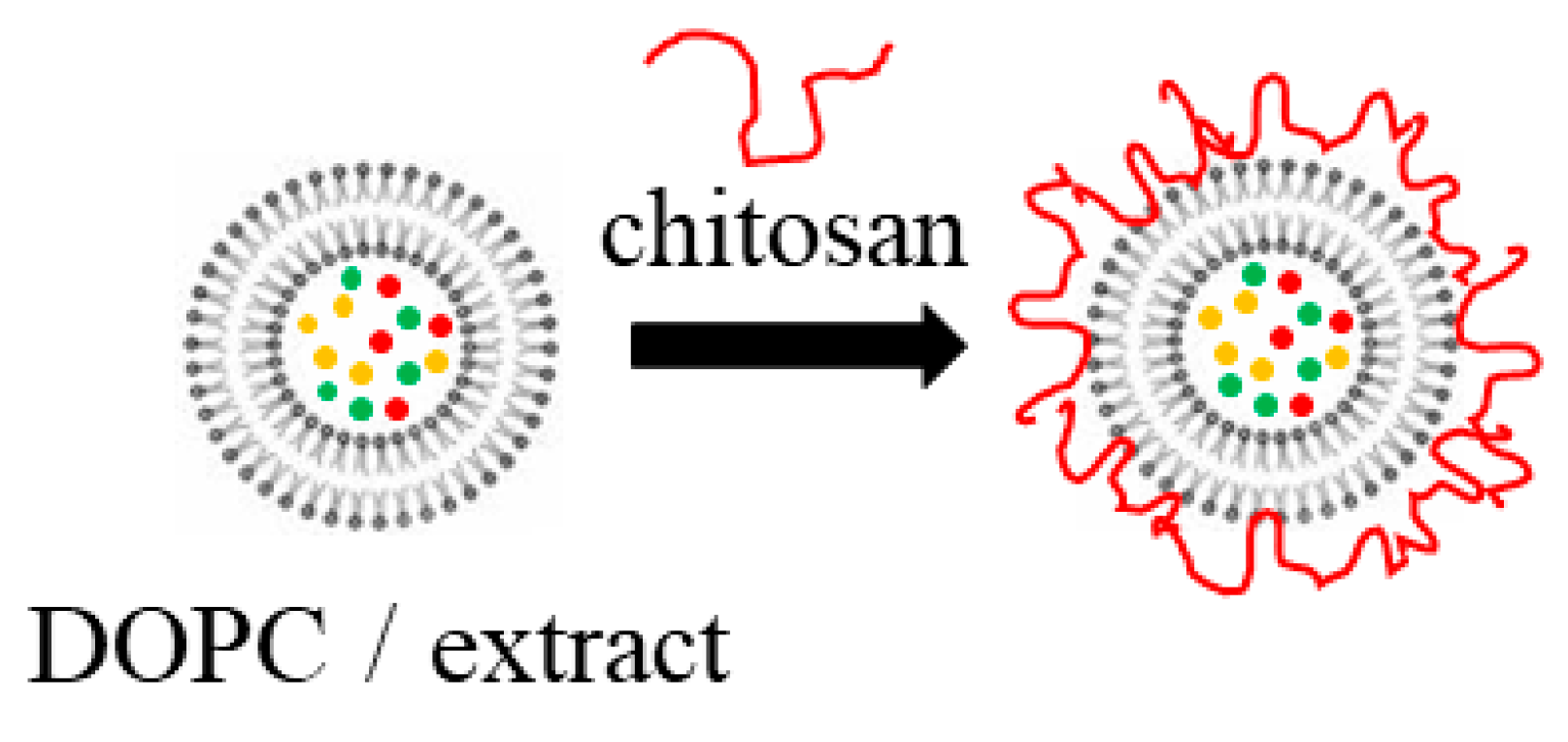
Figure 2.
The electrokinetic potential of the liposomes (LGGL) loaded with a plant extract from Glycyrriza glabra L. as a function of the concentration of three different chitosans (described in 2.1.3) added to the dispersion: (●) CS-L, (○) CS-H, and (▲) COS.
Figure 2.
The electrokinetic potential of the liposomes (LGGL) loaded with a plant extract from Glycyrriza glabra L. as a function of the concentration of three different chitosans (described in 2.1.3) added to the dispersion: (●) CS-L, (○) CS-H, and (▲) COS.
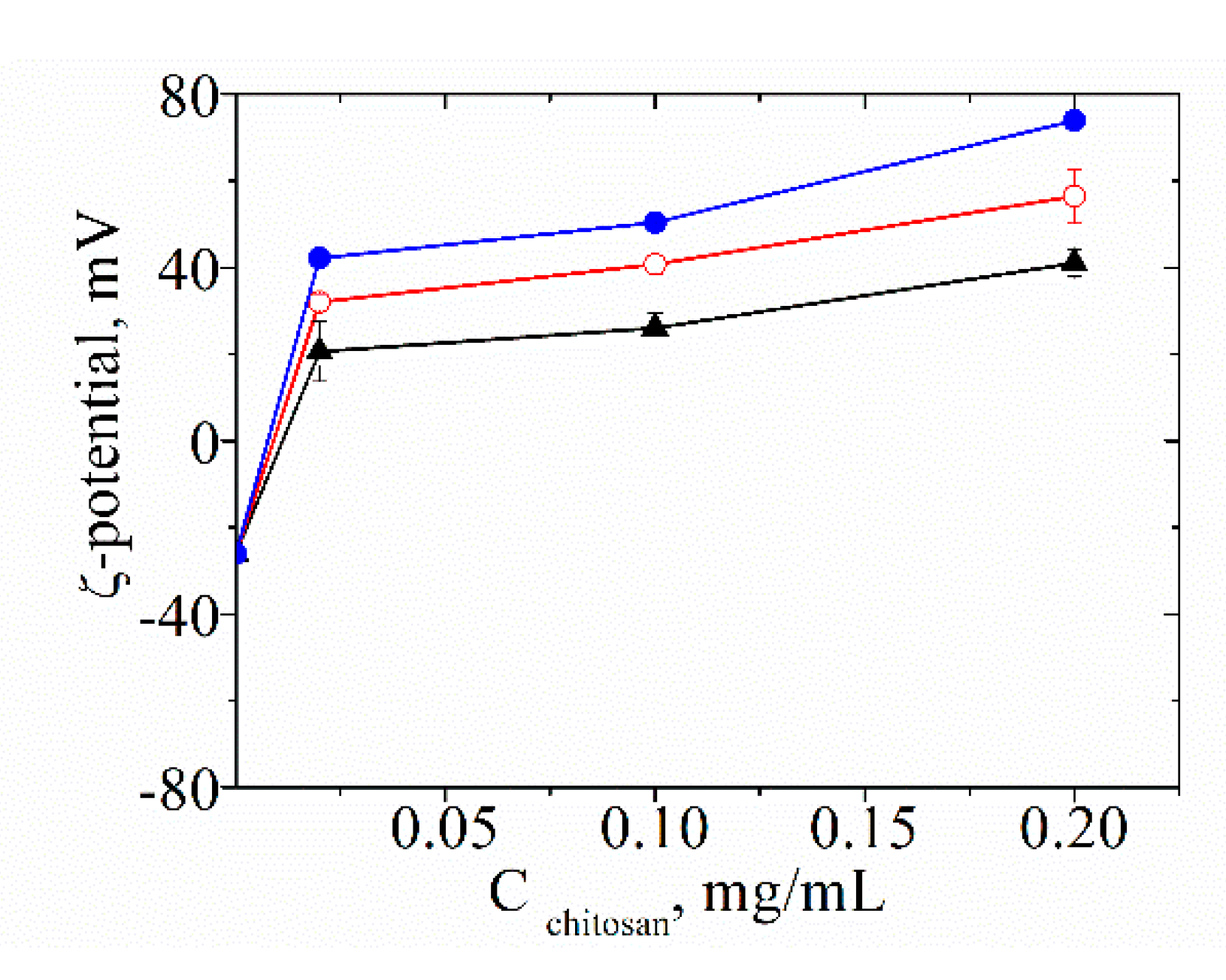
Figure 5.
Dose–response curves for Cyto- (○) and phototoxicity (●) of compounds determined in BALB/3T3 cells. Values are means ± standard deviation from three independent experiments, n = 6. The liposomes are stabilized with CS-L (0.1 mg/mL).
Figure 5.
Dose–response curves for Cyto- (○) and phototoxicity (●) of compounds determined in BALB/3T3 cells. Values are means ± standard deviation from three independent experiments, n = 6. The liposomes are stabilized with CS-L (0.1 mg/mL).
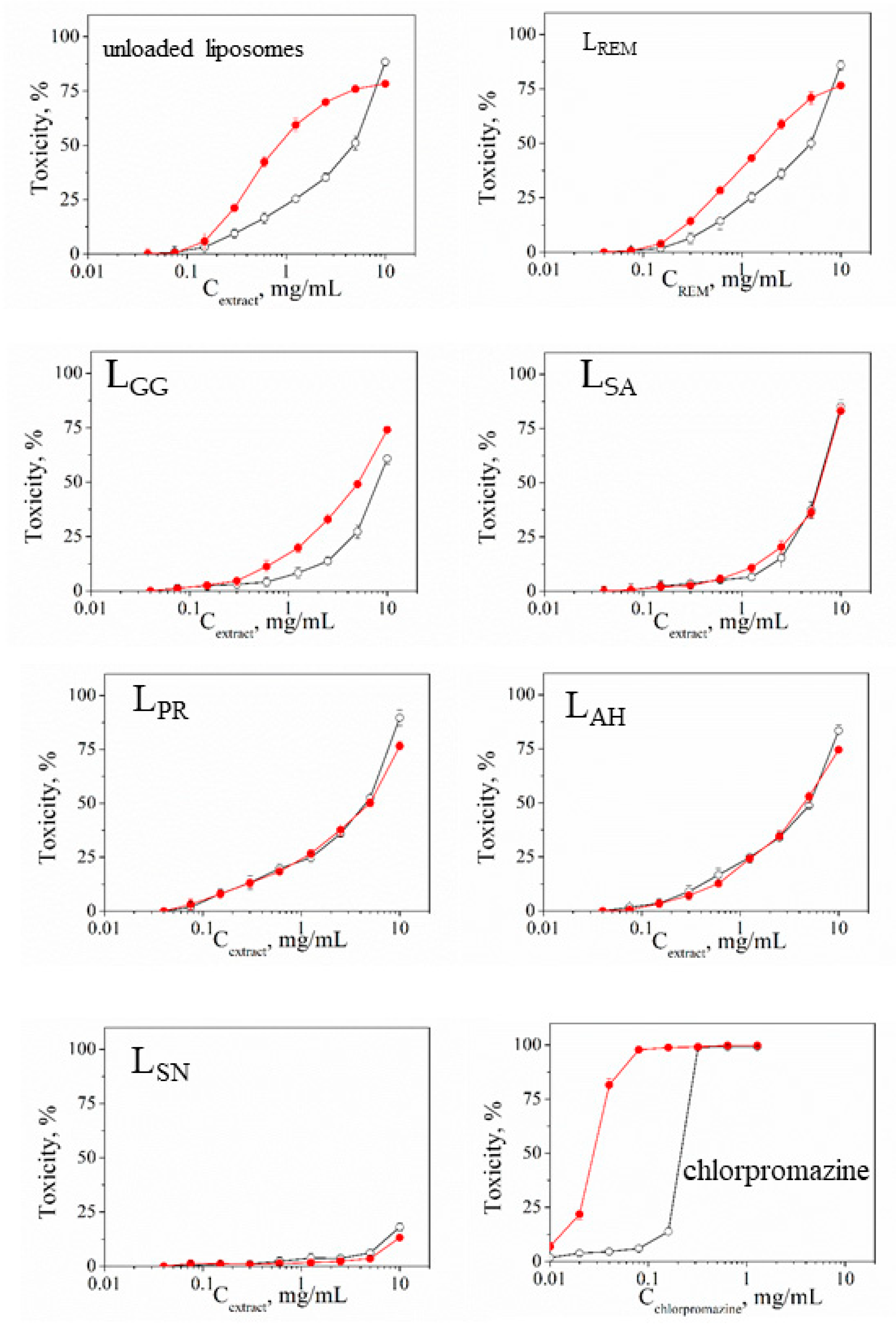
Table 1.
Plant extracts.
| Plant Species | Area of the Collected Material | Biological Activities | References | |
|---|---|---|---|---|
| Aesculus hippocastanum (horse chestnut) |
 |
Seed | Anti-inflammatory, vascular supporting, immunomodulatory, antioxidant, virucidal, antiviral (against RSV, HSV-1, VSV, RSV, Dengue virus) activity. | [48,49] |
| Allium sativum (garlic) |
 |
Bulb | Immunomodulatory activity; prevention of infectious diseases; pronounced antiviral activity through various mechanisms of action: inhibition of virus entry into the cell, inhibition of viral RNA polymerase, reverse transcriptase, DNA synthesis. | [50] |
| Sambucus nigra (elderberry) |
 |
Fruit | Anti-inflammatory, immunomodulatory, antiviral activity. | [51,52] |
| Glycyrrhiza glabra L. (licorice) |
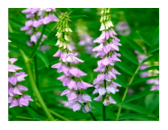 |
Root | Positive effect in gastrointestinal problems (gastritis, peptic ulcer), in respiratory infections, arthritis and tremors. Pronounced anti-inflammatory, antispasmodic, antioxidant, antidiabetic, antimalarial, antifungal, antibacterial, antiviral effect. | [53,54,55] |
| Potentilla reptans (creeping cinquefoil) |
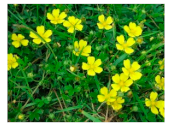 |
Stem | Well manifested antidiarrheal, antidiabetic, hepatoprotective, antioxidant, antispasmodic, anti-inflammatory, antitumor, antifungal, antibacterial, antiviral action. | [56] |
Table 2.
Hydrodynamic size (diameter) and electrokinetic potential of the liposomes loaded with a plant extract: LSN (Sambucus nigra), LAS (Allium sativum), LPR (Potentilla reptans), LAH (Aesculas hippocastanum), LGGL (Glycyrriza glabra L.).
Table 2.
Hydrodynamic size (diameter) and electrokinetic potential of the liposomes loaded with a plant extract: LSN (Sambucus nigra), LAS (Allium sativum), LPR (Potentilla reptans), LAH (Aesculas hippocastanum), LGGL (Glycyrriza glabra L.).
| Liposomes | D*, nm | ζ-potential, mV |
|---|---|---|
| LSN | 197.6 ± 85.1 | -44.2 ± 1.0 |
| LAS | 50.8 ± 22.9 | -49.1 ± 1.5 |
| LPR | 229.5 ± 14.6 | -36.5 ± 1.7 |
| LAH | 221.2 ± 15.2 | -27.9 ± 2.4 |
| LGGL. | 261.2 ± 9.8 | -26.1 ± 1.8 |
| L unloaded | 267.6 ± 16.2 | -50.2 ± 2.1 |
* sizes are determined by a mean intensity.
Table 3.
Hydrodynamic diameter of the liposomes loaded with a plant extract stabilized by adsorption of chitosan: LSN (Sambucus nigra), LAS (Allium sativum), LPR (Potentilla reptans), LAH (Aesculas hippocastanum), LGGL (Glycyrriza glabra L.). The chitosan concentration is 0.1 mg/mL.
Table 3.
Hydrodynamic diameter of the liposomes loaded with a plant extract stabilized by adsorption of chitosan: LSN (Sambucus nigra), LAS (Allium sativum), LPR (Potentilla reptans), LAH (Aesculas hippocastanum), LGGL (Glycyrriza glabra L.). The chitosan concentration is 0.1 mg/mL.
| Liposomes | D*, nm | ||
|---|---|---|---|
| COS | CS-L | CS-H | |
| LSN | 361.3 ± 110.5 | 568.3 ± 150.7 | 146.1 ± 78.7 |
| LAS | 229.8 ± 80.5 | 103.1 ± 32.4 | 488.7 ± 108. |
| LPR | 361.3 ± 86.5 | 229.8 ± 57.5 | 169.9 ± 50.1 |
| LAH | 187.5 ± 4.5 | 187.6 ± 2.3 | 222.8 ± 5.1 |
| LGGL. | 191.1 ± 6.6 | 187.5 ± 4.5 | 232.5 ± 22.2 |
* sizes are determined by a mean intensity.
Table 5.
CC50 values of mean and Photo irritation factor.
| Sample | Mean CC50 ± SD (mg/mL) | PIF* | |
|---|---|---|---|
| - Irr | + Irr | ||
| unloaded liposomes | 2.364 ± 0.2434 | 0.411 ± 4.03 | 5.75 |
| LREM ** | 2.419 ± 0.2306 | 0.831 ± 2.57 | 2.91 |
| LGG | 4.002 ± 0.2005 | 2.543 ± 16.76 | 1.57 |
| LAS | 2.993 ± 0.1001 | 3.071 ± 5.1 | 0.97 |
| LPT | 2.269 ± 0.2151 | 2.459 ± 13.8 | 0.92 |
| LAH | 2.562 ± 0.0513 | 2.245 ± 23.73 | 1.14 |
| LSN | > 10 | > 10 | - |
| Chlorpromazine*** | 0.022 ± 0.003 | 0.003 ± 0.0006 | 7.33 |
* PIF (Photo irritation factor), PIF < 2 not phototoxic, PIF ≥ 2 < 5 probable phototoxicity, PIF ≥ 5 phototoxic; ** control sample; *** Positive control.
Table 6.
Cytotoxicity of liposomes containing natural extracts stabilized with CS-L (0.1 mg/mL) against HCT-8 cell line.
Table 6.
Cytotoxicity of liposomes containing natural extracts stabilized with CS-L (0.1 mg/mL) against HCT-8 cell line.
| Sample | HCT-8 cell line | |
|---|---|---|
| CC50 * Mean ± SD ** [µg/mL] | MTC *** [µg/mL] | |
| unloaded liposomes | ≥ 1000 | ≥ 1000 |
| REM | 2500.00 ± 4.3# | 1000.0# |
| LREM | 2358.0 ± 25.2 | 1195.0 |
| Extract (A. hippocastani) | 1420.0 ± 46.2## | 800.0## |
| LAH | 1839.6 ± 28.7 | 900.0 |
| Extract (A. sativum) | 1880.0 ± 55.7## | 1200.0## |
| LAS | 2055.3 ± 37.2 | 1300.0 |
| Extract (S. nigra) | 1900.0 ± 48.3## | 1000.0## |
| LSN | 2350.0 ± 38.7 | 1150.0 |
| Extract (G. glabra) | 1820.0 ± 24.5## | 1000.0## |
| LGG | 1817.0 ± 27.3 | 1100.0 |
| Extract (P. reptans) | 1880.0 ± 37.1## | 200.0## |
| LRP | 1528.6 ± 26.8 | 350.0 |
Table 7.
Antiviral activity of liposomes containing natural extracts stabilized with CS-L (0.1 mg/mL) against the replicative cycle of the human coronavirus strain HCoV-OC43.
Table 7.
Antiviral activity of liposomes containing natural extracts stabilized with CS-L (0.1 mg/mL) against the replicative cycle of the human coronavirus strain HCoV-OC43.
| Compounds | HCoV-OC43 | |
|---|---|---|
| IC50 * Mean ± SD ** (µg/mL) | SI *** | |
| unloaded liposomes | - | - |
| REM | 12.5 ± 0.9# | 200.0# |
| LREM | 4.3 ± 0.8 | 548.3 |
| Extract (A. hippocastani) | 380.0 ± 9.5## | 3.7## |
| LAH | 31.2 ± 2.4 | 58.96 |
| Extract (A. sativum) | 900.0 ± 18.5## | 2.1## |
| LAS | 151.5 ± 8.2 | 13.56 |
| Extract (S. nigra) | 950.0 ± 32.7## | 2.0## |
| LSN | 215.0 ± 7.3 | 10.93 |
| Extract (G. glabra) | 400.0 ± 12.5## | 4.5## |
| LGG | 46.5 ± 3.9 | 39.1 |
| Extract (P. reptans) | 890.0 ± 17.3## | 2.1## |
| LPR | 47.5 ± 3.3 | 32.2 |
* IC50—inhibitory concentration 50%; ** SD—standard deviation; *** SI— selectivity index is calculated from the CC50/IC50 ratio.; # the result was presented in a previous study of ours 14]; ## the result was presented in a previous study of ours [63].
Table 8.
Virucidal activity of liposomes containing extracts of medicinal plants stabilized with CS-L (0.1 mg/mL) against coronavirus virions strain HCoV-OC43.
Table 8.
Virucidal activity of liposomes containing extracts of medicinal plants stabilized with CS-L (0.1 mg/mL) against coronavirus virions strain HCoV-OC43.
| Compounds | Δlg | |||||
|---|---|---|---|---|---|---|
| 15 min | 30 min | 60 min | 90 min | 120 min | ||
| unloaded liposomes | 0.25 | 0.25 | 0.25 | 0.25 | 0.25 | |
| LAH | 0.25 | 0.25 | 0.50 | 0.50 | 0.50 | |
| LAS | 0.25 | 0.25 | 0.25 | 0.25 | 0.25 | |
| LSN | 0.15 | 0.15 | 0.25 | 0.25 | 0.25 | |
| LGG | 0.25 | 0.25 | 0.25 | 0.25 | 0.25 | |
| LPR | 0.15 | 0.15 | 0.15 | 0.25 | 0.25 | |
| 70% etanol | 5.00 | 5.00 | 5.00 | 5.00 | 4.75 | |
Table 9.
Influence of liposomes containing extracts of medicinal plants and stabilized with CS-L (0.1 mg/mL) on the stage of adsorption of human coronavirus strain HCoV-OC43 to sensitive HCT-8 cells.
Table 9.
Influence of liposomes containing extracts of medicinal plants and stabilized with CS-L (0.1 mg/mL) on the stage of adsorption of human coronavirus strain HCoV-OC43 to sensitive HCT-8 cells.
| Compounds | Δlg | |||||
|---|---|---|---|---|---|---|
| 15 min | 30 min | 60 min | 90 min | 120 min | ||
| unloaded liposomes | 0.00 | 0.15 | 0.25 | 0.25 | 0.25 | |
| LAH | 0.00 | 0.00 | 0.25 | 0.25 | 0.25 | |
| LAS | 0.00 | 0.25 | 0.25 | 0.25 | 0.25 | |
| LSN | 0.00 | 0.15 | 0.15 | 0.15 | 0.15 | |
| LGG | 0.15 | 0.15 | 0.15 | 0.25 | 0.25 | |
| LPR | 0.00 | 0.15 | 0.15 | 0.15 | 0.15 | |
Disclaimer/Publisher’s Note: The statements, opinions and data contained in all publications are solely those of the individual author(s) and contributor(s) and not of MDPI and/or the editor(s). MDPI and/or the editor(s) disclaim responsibility for any injury to people or property resulting from any ideas, methods, instructions or products referred to in the content. |
© 2024 by the authors. Licensee MDPI, Basel, Switzerland. This article is an open access article distributed under the terms and conditions of the Creative Commons Attribution (CC BY) license (http://creativecommons.org/licenses/by/4.0/).
Copyright: This open access article is published under a Creative Commons CC BY 4.0 license, which permit the free download, distribution, and reuse, provided that the author and preprint are cited in any reuse.


