

Submitted:
30 April 2024
Posted:
30 April 2024
You are already at the latest version
Abstract
Residential segregation refers to the phenomenon where people of different socioeconomic backgrounds live in spatially separated areas. It is essential to ensure equitable access to urban amenities for all residents in pursuit of the normative values in urban planning. To achieve this planning goal, the disparity in accessibility to urban amenities needs to be appropriately diagnosed. Private apartments and public rental apartments are representative types of residences where residential segregation is likely to occur in the context of South Korea, since these two types show considerable differences in the education, income, and occupations. The objective of this study is to develop an analysis framework for diagnosing the difference in accessibility to urban amenities between the two residential types, and to empirically demonstrate their utility in the planning process. The empirical analysis conducted on Seoul revealed that not only were there significant local variations in accessibility between the two segregated residential areas, but the overall differences across the entire area were also pronounced. The proposed framework is useful in supporting decision-making processes for locating new public facilities or identifying regional priorities for guiding the placement of private amenities, with the aim of mitigating differences between segregated residential areas.
Keywords:
Residential segregation
; Urban Amenity Accessibility
; Segregation index
1. Introduction
Segregation refers to the phenomenon where specific groups or individuals live separated from other groups or individuals due to social, economic, legal, or cultural reasons.
This often occurs based on criteria such as race, religion, or socio-economic status, and can manifest in various forms such as spatial/social separation, differences in educational opportunities, and isolation in the job market [1]. Residential segregation is a term that emerged in the field of urban sociology, particularly during the 1960s, amid heightened racial tensions in the United States. It refers to the tendency for people of different races, ethnicities, and socioeconomic backgrounds to reside in spatially separated areas [2,3,4]. The phenomenon of residential segregation has been occurring from the past to the pre-sent and continues to receive sustained attention [5,6,7].
To delineate residential segregation spatially and socially, research has been con-ducted from various academic perspectives including urban planning, urban and social geography, and social sciences [3,8,9,10,11]. Particularly from an urban planning perspective, residential segregation not only implies spatial/social separation but can also lead to inequalities in the use of urban amenities. Urban amenities typically support the daily life needs of city dwellers, including transportation, commuting, commercial, leisure, and educational purposes, and thus should be equitably accessible to majority of city dwellers [12,13,14,15]. Furthermore, accessibility from residential areas to urban amenities is a key indicator in evaluating citizen`s quality of life and equity in urban planning [16]. Insufficient accessibility of urban amenities can exacerbate adverse socio-economic outcomes and inequalities [14]. Therefore, while it is important to delineate residential segregation spatially and socially, diagnosing disparities in access to urban amenities is necessary to pursue normative values in urban planning.
Residential segregation is generally determined by socio-economic factors, with in-come being a predominant socio-economic factor [2]. Income determines the housing costs that can be afforded, so it is an important factor in choosing a place to live [17,18]. Moreover, numerous studies have shown that housing costs determine the accessibility to living amenities [19,20,21,22]. A typical example is the residential area near the Central Business District (CBD). Most urban are-as with high housing costs are located near the CBD, which is advantageous for various urban activities [23,24]. Urban development begins in the CBD and spreads to surrounding areas [25], with housing and land prices decreasing with distance from the CBD [26,27]. Therefore, residential areas with high housing costs located near the CBD tend to have better access to amenities [28,29]. This phenomenon can be considered a general fact based on the concentric zone theory of urban growth [30]. Some argue that the differentiation of residential areas within the city is naturally defined as a phenomenon occurring due to the urban spatial structure [17].
However, in the field of urban planning, equitable access to urban amenities for citizens is required in order to pursue normative values [14,31,32,33,34,35]. Spatial and social inequalities are becoming increasingly important issues among urban planners [36]. Reduced accessibility from residential areas to urban amenities signifies the presence of inequality, leading to deprivation, social exclusion, and a decrease in quality of life [37,38]. Therefore, analyzing accessibility within the spatial context for urban residents is crucial for accurately identifying micro-level residential segregation [39,40,41]. Various studies have been conducted to measure the accessibility of urban amenities based on residential differentiation [41,42,43,44,45,46,47]. The results of these studies can be categorized into transportation characteristics, land use and building features, and leisure and cultural attributes. In terms of transportation characteristics, it has been found that areas with high housing costs have well-maintained road and pedestrian networks near the residences of the people living there. Regarding land use and building characteristics, it has been confirmed that groups with higher incomes have good accessibility from their residences to workplaces (for commuting), schools (for education), and commercial (for shopping) locations. Additionally, recreational and cultural facilities centered around parks also showed favorable accessibility for groups with higher incomes (or housing costs)
Several studies related to residential segregation and local public services (public sector amenities) holds significant meaning when inequalities among groups emerge [47]. However, inequalities encompass not only public amenities necessary for the daily lives of urban residents but also various amenities operated by the private sector. The roles and characteristics of urban amenities in the public and private sectors differ. Yet, it is the public's role to determine the zoning of the land where all urban amenities are located [48,49]. The location of different types of urban amenities is greatly influenced by the zoning of the land. One of the primary goals of urban planners is to pursue justice and equality in the distribution of various amenities within the city [50]. Therefore, it is important to measure residential differentiation based on access to urban amenities from a public perspective and contribute to the formulation and implementation of urban policies.
In the context of South Korea, residential segregation is expected to manifest in both public and private housing sectors. Public housing sectors are offered at low cost to support housing stability for low-income households and are widely distributed in Seoul, the capital of South Korea [51,52,53]. In contrast, private housing sectors demand high housing costs. Public housing in South Korea encompasses diverse architectural forms including apartments, single-family homes, multi-family residences, and multi-unit dwellings. These are classified by the government into categories for sale and for lease. Among these, apartments represent the highest proportion within these housing categories [54]. However, compared to their counterparts in the private sector, public apartments generally suffer from inferior construction quality and are often located at significant distances from urban employment centers and amenities [53]. It is observed that with increasing population density in urban areas, the variety of urban amenities also expands [55,56,57]. Considering prior research on urban amenity accessibility, which correlates with residential costs (income), it is feasible to assess micro-level residential segregation by analyzing the disparities in accessibility to urban amenities between public and private housing types. The objective of this study is to develop an analysis framework for diagnosing the difference in accessibility to urban amenities between the two residential types, and to empirically demonstrate their utility in the planning process. The proposed framework was applied to Seoul to derive insightful results and suggest relevant policy implications. The study is organized as follows: Chapter 2 outlines the methods used to measure residential segregation between two types of apartments and defines the indicators for estimating accessibility to urban amenities. Chapter 3 applies the framework to empirical data, presenting the analysis results and offering detailed interpretations. Chapter 4 discusses the specific policy implications that emerge from the interpretation of these results.
2. Methodology
2.1. Degree of Residential Segregation
In this study, we first measure the level of residential segregation between two types of apartments to confirm that these two types are spatially separated across the entire study area. Building upon this foundation, we propose a methodology designed to evaluate the disparities in access to urban amenities between the two types. A widely used measure for quantifying the degree of residential segregation is the Segregation Index (), of which mathematical properties were intensively discussed by Duncan and Duncan in 1955. The original segregation index is delineated in Equation 1.
In the equation above, and represent the numbers of white and non-white individuals, respectively, in spatial unit (e.g., census block group). and denote the total numbers in each of these population groups. Consequently, Equation 1 calculates the sum of proportional differences across all spatial units, which converges to either 0 or 1. This convergence indicates either a perfect mix of proportions or complete residential separation between the two distinct racial groups. That is, A value approaching 1 signifies pronounced spatial segregation within residential areas, indicating minimal overlap in the residential distribution of the two racial groups. Conversely, an value nearing 0 reflects a high degree of residential integration, suggesting substantial co-residence among the groups.
The original segregation index, as delineated in Equation 1, encounters the well-documented checkerboard problem, wherein identical values are produced irrespective of varying configurations of spatial units that maintain consistent demographic proportions. In response to this limitation, Wong (2003) proposed a spatial version of the , which is formally established in Equation 2. This adjustment enhances the measurement's sensitivity to the geographical distribution of population groups.
In Equation 2, the parameter functions to define the geographical extent of the neighborhood, determining how spatial proximity is calculated within the model. represents the total number of white individuals summed across all spatial units within the distance . Similarly, is calculated in the same manner, representing the total number of non-white individuals. As increases, the number of spatial units included in the sum also increases, thereby reducing the proportional differences between spatial units. As shown in the equation, and denote the totals of and , respectively (=) and ). Assuming the demographic ratios within each spatial unit remain the same across all units being considered, the presence of large proportional differences in geographically adjacent units leads to a higher cumulative sum of these differences compared to cases where such adjacency is absent. This methodology accounts for variations in the configuration of spatial units, effectively addressing the checkerboard problem, which arises when identical segregation indices result from different spatial arrangements. Consequently, this results in a proportional escalation of the segregation index.
By defining and in Equation 2 as the counts of public and private apartments respectively, it is possible to measure the degree of residential segregation between these two types of apartments. Furthermore, visualizing the difference in ratios contained in Equation 2 (=) on a choropleth map enables the identification of areas where the ratio of the total number of apartments to public (or private) apartments is relatively high in spatial unit . When the difference in ratios is positive in spatial unit , it indicates that the ratio of public apartments to private apartments is higher, suggesting that the localized residential segregation of public apartments is relatively more pronounced in that locality.
2.2. Level of Service ()
The utility received by an urban resident living in apartment when traveling to facility is defined as ) in Equation 3:
In the equation above, represents the distance from urban resident to facility . The parameters, and denote the threshold distance and threshold spatial weight, respectively. The utility function ) reaches its peak value of 1 when the distance is zero, and it declines to its lowest value at the designated threshold distance. In essence, Equation 1 encapsulates the distance-decay effect by defining the diminishing utility with increasing distance, reaching its minimal value at the designated threshold distance. As the distance increases, the utility gradually decreases, and the utility corresponding to the threshold distance is represented by the threshold spatial weight. Equation 3 implies that at the threshold distance, the utility is set to be almost negligible by defining the threshold spatial weight value as a number close to 0. If is, for example, 10, given and are 10 and 0.01, respectively, then ) is calculated to be 0.01 (). For the same parameters, the utility assigned to a resident located 5 away, which is half the distance of 10, is 0.1. This is 10 times higher than the utility for a resident who is 10 away ().
Given the prior explanation of the distance-decay effect based on and as fundamental parameters, it is crucial at this juncture to emphasize the importance of technically substantiating these parameters to establish a sound rationale. One possibility to this end is to premise that in areas with a higher concentration of facilities, each facility typically serves a smaller geographic area, whereas in areas with fewer facilities, each facility tends to cover a relatively larger expanse. This underscores the utility of converting the total area of the target region divided by the number of facilities into an equivalent circle radius for effective estimation of . In case of , 0.01 is conventionally considered a sufficiently small value. To draw an analogy, consider the context of the standard normal distribution: a significance level of 0.01 represents a criterion for assessing cases that are so unlikely to occur that they are seldom observed. Thus, setting at 0.01 for a given is considered sufficiently small, conforming to standard practice.
Once ) has been estimated using the method described above, the level of service provided to a resident in apartment is defined as Equation 4, indicating the cumulative utilities derived from all facilities within the study area.
Equation 4 shows that the proximity of more facilities to location contributes to increasing the value and a higher value signifies that resident in apartment have better access to the services provided by these facilities.
2.3. Local Disparity in Accessibility ()
The local disparity of apartment in accessibility to urban amenities is defined as in Equation 5. This measure highlights the ratio discrepancy between the proportion of and the proportion of the population in apartment .
indicates the count of households in apartment , and sums the households across apartments within the study area. The proportion refers to the share or segment of the total sum, as denoted by and , respectively. A value of greater than 1 indicates a lower level of service relative to the demand population. This signifies relatively poor accessibility to urban amenities. Visualizing on a map may shed light on identifying areas lacking in urban amenities and provide spatial insights that aid policy efforts to enhance amenities in localities suffering from under-provision.
2.4. Global Diagnostics of Disparity ()
While highlights the local discrepancies between the demand and supply of urban amenities, it is valuable to examine the overall tendency of disparities across the entire study area. By conducting a comparative analysis of accessibility disparities between two distinct, geographically segregated housing types across the entire target area on a global scale, it is possible to ascertain which type exhibits lower accessibility. For this purpose, the estimated values are statistically summarized as the average of local disparity values, denoted as , and termed Global Diagnostics of Disparity () in this paper. Monte Carlo randomization is then employed to construct the null statistical distribution of the summary statistic, . Should the estimated values for the two types of apartments exhibit a discernible difference, it could be inferred that the significant disparity in accessibility observed between the residents of public and private apartments is largely attributable to the residential segregation between these groups.
The initial step in constructing the statistical distribution of through Monte Carlo randomization is predicated on the assumption that there is no inherent statistical difference in the values across two apartment types. This assumption is fundamental as it establishes a neutral baseline for comparison. For illustrative purposes, let us consider a scenario involving 1,000 public apartments. It is feasible to randomly select 1,000 units from a comprehensive pool that includes both public and private apartments, to calculate the values. Repeating this selection and calculation process multiple times enables the construction of a statistical distribution for the values of 1,000 randomly chosen apartments. Given that the value aggregates values, the Central Limit Theorem suggests that with a sufficiently large sample size, this empirical distribution will approximate a normal distribution.
In the subsequent analytical phase, the mean and variance of these simulated values are computed, facilitating a comparative analysis with the values from the empirical dataset of, for example, public apartments. Within this framework, the use of z-values enables the assessment of statistical significance, potentially revealing any disparities or anomalies in the empirical values of public apartments. The statistical significance for private apartments can be evaluated using the same methodology. Equation 6 denotes how to convert the observed value into a z-value, utilizing the mean and variance from the simulated standard normal null distribution.
In Equation 6, denotes the observed value of . and correspond to the expected value and variance of simulated values, respectively. The converted -value is interpreted using the conventional critical value criteria of the standard normal distribution, as detailed in Table 1.
The critical -value establishes a threshold used to categorize levels of excess demand, facilitating analytical interpretation. For example, a value exceeding 2.57, such as 3.7, signifies an exceptionally high local disparity in accessibility throughout the study area. This observation underscores a pervasive shortfall in urban amenities, particularly in terms of service facility accessibility. Conversely, a -value less than -2.57, such as -2.8, reflects a substantial surplus of urban amenities. Moreover, values of 1.2 or -1.0 indicate an absence of sufficient statistical evidence to ascertain either an overall excess or deficiency in the demand for urban amenities. By analyzing the values for two distinct types of apartments, it is possible to statistically discern differences in accessibility to urban amenities that are attributable to residential segregation.
In this study, we perform an empirical analysis on various urban amenities, focusing on two apartment types utilizing the previously described analytical methodology. We initially estimate the level of residential segregation between these apartment types empirically. We then derive spatial insights to identify areas with relative shortages through the map visualization of LDA(i) values, which highlight local accessibility discrepancies. Furthermore, we statistically estimate GDD to assess the prevalence of supply shortages across the target area. This analysis allows us to explore how accessibility to urban amenities differs under the spatial structure of residential segregation between the two apartment types throughout the target area. Based on these findings, we evaluate the usefulness of the empirical results as decision-making support information, aiding in the development of policy measures aimed at reducing the disparities induced by the differentiation between the apartment types.
3. Results
3.1. Study Area and Data
This study estimates the accessibility to urban amenities for residents living in private apartments and public apartments. We conducted an empirical analysis focusing on the city of Seoul, South Korea. According to the Seoul Administrative District Statistics provided by the Seoul Open Data Plaza, the total area of Seoul is approximately 605.21 square kilometers. And, as reported by Statistics Korea, the population stands at 9,384,739, as of March 2024.
For the empirical analysis, the dataset was constructed as follows: The primary data, which includes the location information of public apartments, was sourced from the public rental housing panel data compiled by the Seoul Housing & Urban Corporation. The location information for private apartments was obtained through the Real Transaction Price Disclosure System, developed by the Ministry of Land, Infrastructure and Transport. Urban amenities were categorized into private and public amenities. Private amenities data were sourced from local administrative service information provided by the Ministry of the Interior and Safety. In contrast, public amenities were derived from building type shape information, also provided by the Ministry of the Interior and Safety, and from location information of educational institutions provided by the Seoul Metropolitan Office of Education.
According to the empirical data, Seoul encompasses a distribution of 24,214 private and 2,180 public apartment buildings. Figure 1 below visualizes the spatial distribution of private and public apartments in Seoul on a map.
Figure 1 clearly illustrates the spatial pattern of residential segregation between public and private apartments. Public apartments are supplied by the government primarily to provide affordable housing to those less privileged, rather than for profit. Consequently, although some are located within the inner areas of Seoul, due to the constraints of available public resources, most are predominantly situated in the outer regions of Seoul where land prices are relatively lower. For reference, the thick black line represents the boundaries of the 25 district-level administrative divisions (Gu) that make up the entire city of Seoul, while the thin gray line indicates the 426 geographically encompassed sub-district divisions (Dong) within these districts. An empirical analysis was conducted on 24 types of service facilities that provide urban amenities to the two previously introduced apartment types. Table 2 below presents the aggregated counts by type of 24 facilities located in Seoul.
As summarized in Table 2, the 24 facilities are classified into two primary categories: private and public. Private amenities are further divided into two secondary categories: neighborhood and area. Public amenities, on the other hand, are categorized into five secondary categories encompassing leisure, transportation, safety, administration, and education. Among others, general restaurants are the most numerous, totaling 124,061, followed by snack bars with 37,644. Beauty salons (29,134) and clinics (17,886) also rank high in terms of the number of establishments.
3.2. Analysis Results
3.1.1. Level of Residential Segregation
To calculate the value defined by Equation 2, the number of two types of apartments was aggregated at the Dong level. The spatial proximity, denoted as , was defined as the result of dividing the total area of Seoul by the number of Dong, and then converting this quotient into the radius of a circle. The spatial proximity value was calculated to be 1,345 meters. Utilizing this value to derive yields approximately 0.67, which is close to one, indicating that the two types of apartments exhibit a distinct residential segregation pattern throughout the entire area of Seoul. And this diagnostic result of residential segregation aligns quite well with the spatial distribution of the two types of apartments as visualized in Figure 1. For reference, not aggregating neighboring spatial units results in the value essentially equivalent to , which shows slightly higher level of residential segregation.
Mapping the differences in ratios (=) at the Dong level as defined in Equation 2 on a choropleth map is effective for visually assessing the spatial distribution patterns of local residential segregation. Figure 2 below is a choropleth map created using a five-level quantile classification of the differences in ratios.
On the map, the areas in blue represent Dongs where the difference in ratios is positive, indicating localities where the residential segregation of public apartments is relatively more severe. The map above clearly delineates spatial separation between the areas in blue and those in red tones. This visual representation aligns closely with the interpretation that the previously mentioned value of 0.67 in the target area, being close to 1, suggests a strong tendency towards residential segregation.
3.1.2. Local Disparity in Accessibility ()
By calculating the values as specified in Equation 5 for all public and private apartments, the results can be visualized using a choropleth map. This map enables the exploratory identification of areas within Seoul that exhibit discrepancies between the demand for and the supply of service facilities, thereby highlighting regions with reduced urban amenity accessibility.
For 24 urban amenity facilities, of 24,214 private and 2,180 public apartment buildings were calculated. As previously mentioned, the number of facilities in a given area of Seoul determines the service radius. A higher count of facilities corresponds to a smaller threshold distance in Equation 3, implying that the geographic area served by each facility is more restricted. The following Table 3 shows the empirically estimated threshold distances for each facility. This estimation was done by dividing the area of Seoul by the number of facilities and then converting these values into the radii of circles, as previously mentioned.
Higher-order services such as department stores, tertiary general hospitals, hypermarkets, fire stations, and universities display relatively large threshold distances of more than 1 km. In contrast, lower-order services that provide everyday necessities, such as general restaurants, snack bars, bakeries, laundry services, hospitals, clinics, subway stations, and bus stops, show service provision areas of less than 500 meters. Mid-order services like kindergartens, elementary schools, and middle schools are indicated to have threshold distances between 500 meters and 1 km.
Figure 3 and 4 below are choropleth maps illustrating the spatial distribution patterns of values for facilities with varying threshold distances: general restaurants, which have the smallest service extent, and department stores, which have the largest, as referenced in Table 3. In Figure 3, dark red indicates apartments with high values, which are predominantly located on the outskirts of Seoul. This pattern can be interpreted as being due to the fact that high-order goods such as department stores are located in densely populated and high-footfall areas, including central Seoul districts like Gangnam-gu. The Gangnam-gu District is recognized as one of the central business districts (CBDs) in Seoul, distinguished by its well-developed business and commercial functions. Furthermore, as highlighted in the Introduction, the high cost of living associated with proximity to or within CBDs presents challenges for the location of public apartments in these areas. Consequently, the outer areas of the city have a relatively smaller service supply ratio in the numerator of due to their greater distance from these centers. Figure 4 depicts the values for general restaurants. In contrast to department stores, general restaurants, which are lower-order goods necessary for everyday services, have a threshold distance of less than 40m as indicated in Table 3. As a result, the distribution pattern of dark red values for general restaurants does not form clusters around specific areas but is rather dispersed around large-scale residential zones.
It should be noted, in Figure 3 and Figure 4, that the pale blue areas on the outskirts of Seoul represent regions with high residential segregation, characterized by a relatively high proportion of public apartments as depicted in Figure 2. In Figure 3, it can be observed that areas with high residential segregation largely coincide with regions where department store service provision is relatively lacking. However, as can be seen in Figure 4, general restaurants do not appear to show a significant overlap pattern between areas of high residential segregation and regions with high values, unlike department stores. In essence, empirically examining the differences in urban amenity accessibility between public and private apartments within a spatially distinct residential segregation structure yields valuable decision-support information for devising strategies to mitigate the accessibility gap of urban amenities between these disparate housing types.
With these findings, by identifying regions with poor accessibility, this information can serve as foundational data for assigning priorities to private incentives or public interventions aimed at improving living conditions.
3.1.3. Global Diagnostics of Disparity ()
Under a spatial structure marked by significant residential segregation between the public and private apartments, it is possible to assess the overall level of difference in accessibility to urban amenities between the public and private apartments. By conducting a comparative analysis of accessibility disparities between two distinct, geographically segregated housing types across the entire target area on a global scale, it is possible to ascertain which type exhibits lower accessibility. To this end, as previously explained, the average values for public and private apartments, calculated across 24 facilities, were defined as . The corresponding z-scores, denoted as , were then estimated. This methodology facilitated an empirical examination of the overarching differences in urban amenity accessibility throughout the study area. Table 4 below provides a summary of the estimated values for 24 facilities, encompassing both public and private apartments.
As previously discussed, signifies the overall disparity between demand and supply. A value exceeding 2.57, as shown in Table 1, indicates a general lack of urban amenities provision. Facilities exceeding a value of 2.57 are marked with an asterisk (*) on the right side of the -value. These facilities indicate a statistically significant prevalence of apartments where demand outweighs the supply of urban amenities. In the case of public apartments, apart from major community facilities such as General Restaurants, Clinics, Pharmacies, Beauty Salons, Laundry Services, Bakeries, Subway Station Entrances, and Bus Stops, such supply shortages are prevalent. Conversely, a negative -value indicates an excess of supply relative to demand, and when it falls below -2.57, as denoted by an asterisk (*) on the right side of the -value, such a disparity is statistically highly significant. If the -value markedly exceeds 2.57 in public apartments, while significantly falling below -2.57 in private apartments, it indicates a pronounced disparity in urban amenities accessibility between the two types of apartments across the entire target area. This implies that residents of public apartments endure relatively greater inconvenience in accessing these urban amenities compared to residents of private apartments. According to Table 4, the urban amenities associated with this category encompass a range of services, spanning from lower order commodities such as hospitals, barber shops, neighborhood parks, high schools, and fire stations to higher order services, including department stores. Figure 5 shows a diagram comparing the -values of 24 urban amenities for the two types of apartments visually.
In Figure 5, the cases where the blue line extends outward, while the red line contracts inward indicate urban amenities where residents of public apartments experience relatively more pronounced inconvenience. In the figure above, it becomes apparent that in the case of private apartments, the z-values contract inward, while for public apartments, they predominantly expand outward, except for certain facilities. The larger the area between the red and blue solid lines in the figure, the greater the implication of disparity in urban amenity accessibility across the target area between public and private apartment types. Additionally, the orange dashed circle and the blue dashed circle represent the range of values corresponding to the critical values of -2.57 and +2.57 for the z-values, respectively. While most of the private apartments fall within the range of the orange line, public apartments extend well beyond the range of the blue line. This implies a significant disparity in the overall urban amenity accessibility between public and private apartments. Therefore, from the perspective of urban amenity accessibility, multifaceted policy efforts are needed to reduce the gap between residents of public and private apartments.
4. Discussion
Residential segregation generally manifests between two distinct groups based on income levels, as observed by Massey and Denton (1993). Furthermore, income determines housing costs, which consequently lead to spatial inequalities stemming from these disparities [17]. This study developed and conducted an empirical analysis of an analytical framework to assess the differences in urban amenity accessibility between public and private apartments. The essence of the research is to use this framework to measure the accessibility of urban amenities for these two types of apartments in Seoul and to derive micro residential segregation from these differences.
Empirical analysis reveals that residents of private apartments in urban areas typically enjoy superior access to urban amenities, whereas access for residents of public apartments is comparatively deficient. This disparity in facility access among these housing types may be viewed as an outcome of spatial segregation. The findings align with previous studies that quantified residential segregation by accessibility metrics [41,42,43,44,45,46,47]. A recurring theme in both this and prior research is the enhanced access to urban amenities for urban dwellers in high-cost housing areas, which perpetuates spatial inequalities
The spatial inequality between public and private apartments can be attributed to the urban spatial structure characteristics. In central Seoul, where private apartments predominate, the sharp rise in land values during the city's growth phases essentially excluded low-income groups from accessing housing. This exclusion has intensified with the city’s ongoing expansion and increasing density, necessitating that public apartments be primarily situated in the outskirts of Seoul, where land values are comparatively lower. This spatial distribution results in low-income groups being excluded from areas with excellent access to urban amenities, thus becoming a primary cause of residential conflict. The urban spatial structure is influenced by the location of the Central Business District (CBD), with previous studies indicating that areas closer to the CBD face higher housing costs and have superior access to urban amenities. The pronounced segregation between public and private apartments within the city's spatial structure not only contradicts the normative goals of urban planning, which aim to ensure equitable access to urban amenities for all residents, but also exacerbates urban residential conflicts.
The difference in urban amenity accessibility within the city's spatial structure, where public and private apartment segregation is pronounced, creates a reality that contradicts the normative goals of urban planning, which aspire to ensure that urban amenities are accessible to all city residents.
5. Conclusions
5.1. Summary of Key Findings
Residential segregation not only fosters spatial separation but also leads to disparities in access to amenities due to spatial inequalities. This undermines the fundamental urban planning principle that urban amenities should be equitably accessible to all residents. In response to this issue, this study developed and applied a micro–Residential Segregation analysis framework. It assessed the accessibility of urban amenities for public and private apartments in Seoul, a major city in South Korea, and quantified micro-level residential segregation based on these assessments. The findings indicated that access to urban amenities from public apartments is notably low. Despite these being public amenities, the limited accessibility highlights the necessity for better strategic placement of public apartments. Furthermore, enhancing the provision of amenities in areas with poor access could mitigate these disparities.
5.2. Practical Implications
To improve in access to urban amenities essential for daily life, three targeted policy efforts focused on location are necessary. Firstly, enhancing the supply of public apartments in downtown areas with robust accessibility can naturally promote greater access for low-income groups, thereby reducing disparities. In the context of South Korea, particularly Seoul's downtown, constructing new public apartments poses challenges due to high land costs and strict construction regulations. The Seoul Housing and Communities Corporation, responsible for managing public apartments in the city, has adopted a strategy of purchasing existing private apartments to convert them into public housing for low-income households. This approach of acquiring and converting private apartments in areas with optimal access to urban amenities is likely to mitigate accessibility disparities in public apartments.
Second, involves promoting the location of related facilities around public apartments with poor accessibility. While there are relatively few constraints in realizing the public interest values of urban planning through public facility planning, private facilities cannot be compelled in this regard. In this context, establishing public-private partnerships to encourage the location of private facilities can be seen as one alternative. Furthermore, a pivotal strategy to facilitate the effective placement of urban amenities involves the relaxation of land use regulations. In the private sector, the siting of urban amenities is predominantly governed by zoning laws; consequently, public policy interventions, including rezoning and the provision of incentives, are critical to ensuring that essential urban amenities are accessible in areas with limited accessibility.
Finally, the development of integrated urban amenities can significantly improve overall accessibility. Urban land is a limited resource, making it impractical to accommodate all demanded facilities. Suppliers usually opt for locations that maximize revenue (profit in the private sector and high user satisfaction in the public sector). However, areas with high demand often face elevated land prices and restricted zoning options for urban amenities. This proposal recommends relaxing zoning regulations to enable the establishment of integrated urban amenities on constrained land. Specifically, in Seoul, where development controls are more stringent than in other cities, including height restrictions and limited zoning, easing these rules could foster the placement of integrated urban amenities and thus mitigate disparities in accessibility.
5.3. Limitations and Future Research Avenues
This study has the following limitations. Urban amenities are facilities that city residents use in daily life, and as such, the measurement of accessibility to these amenities was made based solely on physical distance without considering more realistic factors like travel time by various transport modes or network distance. Additionally, the socioeconomic characteristics of individuals were not reflected in the measurement of accessibility to urban amenities. In other words, the demand for urban amenities, which varies according to individual factors such as age, gender, and income, was not considered. Therefore, future research should calculate accessibility to urban activities by socioeconomic strata based on network distance that accounts for accessibility by different modes of transportation, and measure Residential Segregation accordingly.
Author Contributions
Conceptualization, G.L. and S.G.; methodology, G.L.; formal analysis, G.L.; investigation, G.L. and S.G.; resources, G.L.; data curation, S.G. and B.J.; writing—original draft preparation, G.L.; writing—G.L. and S.G.; editing, S.G. and B.J.; project administration, G.L.; funding acquisition, G.L. All authors have read and agreed to the published version of the manuscript.
Funding
This work is supported by the Korea Agency for Infrastructure Technology Advancement (KAIA) grant funded by the Ministry of Land, Infrastructure and Transport (Grant RS-2022-00143336).
Data Availability Statement
The data presented in this paper are available upon request from the authors.
Conflicts of Interest
The authors declare no conflict of interest.
References
- Duncan, O.D.; Duncan, B. A Methodological Analysis of Segregation Indexes. American Sociological Review 1995, 20, 210–217. [CrossRef]
- Massey, D.S.; Denton, N.A. The Dimensions of Residential Segregation. Social Forces 1988, 67, 281–315. [CrossRef]
- Farley, R.; Frey, W.H. Changes in the Segregation of Whites from Blacks During the 1980s: Small Steps Toward a More Integrated Society. American Sociological Review 1994, 59, 23–45. [CrossRef]
- Massey, D. S.; Hajnal, Z.L. The Changing Geographic Structure of Black-White Segregation in the United States. Social Science Quarterly 1995, 76, 527–542.
- Musterd, S.; Marcińczak, S.; van Ham, M.; Tammaru, T. Socioeconomic segregation in European capital cities. Increasing separation between poor and rich. Urban geography 2017, 38, 1062-1083. [CrossRef]
- Ta, N. Toward multidimensional activity space-based segregation research. Transactions in Planning and Urban Research 2023, 2, 205-216. [CrossRef]
- Dadashpoor, H.; Keshavarzi, S. Defining urban segregation: A qualitative meta-synthesis. Cities 2024, 149, 104947. [CrossRef]
- Fischer, C.S.; Stockmayer, G.; Stiles, J.; Hout, M. Distinguishing the Geographic Levels and Social Dimensions of U.S. Metropolitan Segregation, 1960–2000. Demography 2004, 41, 37-59. [CrossRef]
- Agyei-Mensah, S.; Owusu, G. Segregated by neighbourhoods? A portrait of ethnic diversity in the neighbourhoods of the Accra Metropolitan Area, Ghana. Population, Space and Place 2010, 16, 499-516. [CrossRef]
- Li, X.; Huang, X.; Li, D.; Xu, Y. Aggravated social segregation during the COVID-19 pandemic: Evidence from crowdsourced mobility data in twelve most populated US metropolitan areas. Sustainable cities and society 2022, 81, 103869. [CrossRef]
- Li, Q.Q.; Yue, Y.; Gao, Q.L., Zhong, C.; Barros, J. Towards a new paradigm for segregation measurement in an age of big data. Urban Informatics 2022, 1, 5. [CrossRef]
- Tsou, K.W.; Hung, Y.T.; Chang, Y.L. An accessibility-based integrated measure of relative spatial equity in urban public facilities. Cities 2005, 22, 424–435. [CrossRef]
- Grubesic, T.H.; Durbin, K.M. Breastfeeding support : A geographic perspective on access and equity. Journal of Human Lactation 2017, 33, 770–780. [CrossRef]
- Ashik, F.R.; Mim, S.A.; Neema, M.N. Towards vertical spatial equity of urban facilities: An integration of spatial and aspatial accessibility. Journal of Urban Management 2020, 9, 77-92. [CrossRef]
- Li, Y.; Lin, Y.; Geertman, S.; Hooimeijer, P.; Xu, W. Accessibility-Based Equity of Public Facilities: A Case Study in Xiamen, China. Applied Spatial Analysis and Policy 2021, 14, 947–968. [CrossRef]
- Smoyer-Tomic, K.E.; Hewko, J.N.; Hodgson, M.J. Spatial accessibility and equity of playgrounds in Edmonton, Canada. Canadian Geographer 2004, 48, 287-302. [CrossRef]
- Kain, J.F. Housing Segregation, Negro Employment, and Metropolitan Decentralization. The Quarterly Journal of Economics 1968, 82, 175–197. [CrossRef]
- Schirmer, P.M.; Van Eggermond, M.A.; Axhausen, K.W. The role of location in residential location choice models: A review of literature. Journal of Transport and Land Use 2014, 7, 3-21. [CrossRef]
- Redfearn, C.L. How informative are average effects? Hedonic regression and amenity capitalization in complex urban housing markets. Regional Science and Urban Economics 2009, 39, 297–306. [CrossRef]
- Li, H.; Wei, Y.D.; Yu, Z.; Tian, G. Amenity, accessibility and housing values in metropolitan USA: A study of Salt Lake County, Utah. Cities 2016, 59, 113–125. [CrossRef]
- Li, H.; Wei, Y.D.; Wu, Y.; Tian, G. Analyzing housing prices in shanghai with open data: Amenity, accessibility and urban structure. Cities 2019, 91, 165–179. [CrossRef]
- Zhang, C.; Xiong, M.; Wei, X. Influence of accessibility to urban service amenities on housing prices: Evidence from Beijing. Journal of Urban Planning and Development 2022, 148, 05021063. [CrossRef]
- Brueckner, J.K. The structure of urban equilibria: A unified treatment of the Muth-Mills model. Handbook of Regional and Urban Economics 1987, 2, 821-845.
- Kulish, M.; Richards, A.; Gillitzer, C. Urban Structure and Housing Prices: Some Evidence from Australian Cities; Reserve Bank of Australia: Sydney, Australia, 2011.
- Alonso, W. The Historic and the Structural Theories of Urban Form: Their Implications for Urban Renewal. Land Economics 1964 40, 227-231. [CrossRef]
- Lewis, B.D. Revisiting the Price of Residential Land in Jakarta, Urban Studies 2007, 44, 2179-2194. [CrossRef]
- Rodrigue, J.P.; Comtois, C.; Slack, B. The Geography of Transport Systems, 2nd ed; Routledge: London, UK, 2009.
- Fujita, M. Urban economic theory: Land Use and City Size; Cambridge University Press: Cambridge, UK, 1989. [CrossRef]
- Wu, J. Economic fundamentals and urban–suburban disparities. Journal of Regional Science 2010, 50, 570-591. [CrossRef]
- Burgess, E.W. The Growth of the City: An Introduction to a Research Project; Springer: Boston, MA, USA, 2008. [CrossRef]
- Bingham, R.D.; Mier, R. Theories of local economic development: Perspectives from across the disciplines; Sage: Newbury park, CA, USA, 1993.
- Krumholz, N.; Clavel, P. Reinventing cities: Equity planners tell their stories; Temple University Press: Philadelphia, PA, USA, 1994.
- Thomas, J. M. Teaching planning history as a path to social justice. Journal of Planning History 2006, 5, 314-322. [CrossRef]
- Van Heerden, Q.; Karsten, C.; Holloway, J.; Petzer, E.; Burger, P.; Mans, G. Accessibility, affordability, and equity in long-term spatial planning: Perspectives from a developing country. Transport Policy 2022, 120, 104-119. [CrossRef]
- Ashik, F.R.; Islam, M.S.; Alam, M.S.; Tabassum, N.J.; Manaugh, K. Dynamic equity in urban amenities distribution: An accessibility-driven assessment. Applied Geography 2024, 164, 103199. [CrossRef]
- Hosseini, A.; Farhadi , E.; Hussaini, F.; Pourahmad, A.; Akbari, N.S. Analysis of spatial (in)equality of urban facilities in Tehran: An integration of spatial accessibility. Environ Dev Sustain 2022, 24, 6527–6555. [CrossRef]
- Barbieri, G.A.’ Benassi, F.; Mantuano, M.; Prisco, M.R. In search of spatial justice. Towards a conceptual and operative framework for the analysis of inter-and intra-urban inequalities using a geo-demographic approach. The case of Italy. Regional Science Policy & Practice 2019, 11, 109–121. [CrossRef]
- Sun, C.; Cheng, J.; Lin, A.; Peng, M. Gated university campus and its implications for socio-spatial inequality: Evidence from students’ accessibility to local public transport. Habitat International 2018, 80, 11–27. [CrossRef]
- Tivadar, M. Is it better to live in a US or a European city?. Regional Science and Urban Economics 2010, 40, 221-227. [CrossRef]
- Kwan, M.P. Beyond space (as we knew it): Toward temporally integrated geographies of segregation, health, and accessibility. Annals of the Association of American Geographers 2013, 103, 1078-1086. [CrossRef]
- Kolkowski, L.; Cats, O.; Dixit, M.; Verma, T.; Jenelius, E.; Cebecauer, M.; Rubensson, I.J. Measuring activity-based social segregation using public transport smart card data. Journal of Transport Geography 2023, 110, 103642. [CrossRef]
- Ellis, M.; Wright, R.; Parks, V. Work together, live apart? Geographies of racial and ethnic segregation at home and at work. Annals of the Association of American Geographers 2004, 94, 620-637. [CrossRef]
- Legeby, A. From housing segregation to integration in public space: A space syntax approach applied on the city of Södertälje. The Journal of Space Syntax 2010, 1, 92-107.
- Duncan, D.T.; Aldstadt, J.; Whalen, J.; White, K.; Castro, M.C.; Williams, D.R. Space, race, and poverty: Spatial inequalities in walkable neighborhood amenities?. Demographic research 2012, 26, 409-448. [CrossRef]
- Louf, R.; Barthelemy, M. Patterns of residential segregation. PLoS ONE 2016, 11, 1-20. [CrossRef]
- Rowe, E.E.; Lubienski, C. Shopping for schools or shopping for peers: Public schools and catchment area segregation. Journal of Education Policy 2017, 32, 340-356. [CrossRef]
- Cortés, Y. Spatial accessibility to local public services in an unequal place: An Analysis from patterns of residential segregation in the Metropolitan Area of Santiago, Chile. Sustainability 2021, 13, 442. [CrossRef]
- Ai, B.; Ma, S.; Wang, S. Land-use zoning in fast developing coastal area with ACO model for scenario decision-making. Geo-spatial Information Science 2015, 18, 43-55. [CrossRef]
- Hammad, A.W.; Akbarnezhad, A.; Haddad, A.; Vazquez, E.G. Sustainable zoning, land-use allocation and facility location optimisation in smart cities. Energies 2019, 12, 1318. [CrossRef]
- Dadashpoor, H.; Jahanzad, N.; Jalili, H. Analysis and forecasting of the integrated spatial structure in Mashhad metropolitan region in the period 1996-2041. Motaleate Shahri 2016, 5, 51-62.
- Ha, S.K. Housing Poverty and the Role of Urban Governance in Korea. Environment and Urbanization 2004, 16, 139-153. [CrossRef]
- Ha, S.K. Social housing estates and sustainable community development in South Korea. Habitat international 2008, 32, 349-363. [CrossRef]
- Chung, S.H.; Kim, S.J.; Park, S.Y.; Kim, J.H. Past, Present, and Future of Social Housing in Seoul: Where Is Social Housing Heading to?. Sustainability 2020, 12, 8165. [CrossRef]
- Maloutas, T.; Karadimitriou, N. (Eds.) Vertical Cities; Edward Elgar Publishing: Cheltenham, UK, 2022. [CrossRef]
- Rappaport, J. Consumption amenities and city population density. Regional science and urban economics 2008, 38, 533-552. [CrossRef]
- Allen, N. Understanding the importance of urban amenities: A case study from Auckland. Buildings 2015, 5, 85-99. [CrossRef]
- Hosseini, A.; Pourahmad, A.; Ayashi, A.; Tzeng, G.H.; Banaitis, A.; Pourahmad, A. Improving the urban heritage based on a tourism risk assessment using a hybrid fuzzy MADM method: The case study of Tehran's central district. Journal of Multi-Criteria Decision Analysis 2021, 28, 248-268. [CrossRef]
Figure 1.
Spatial distribution of Public and Private Apartments.
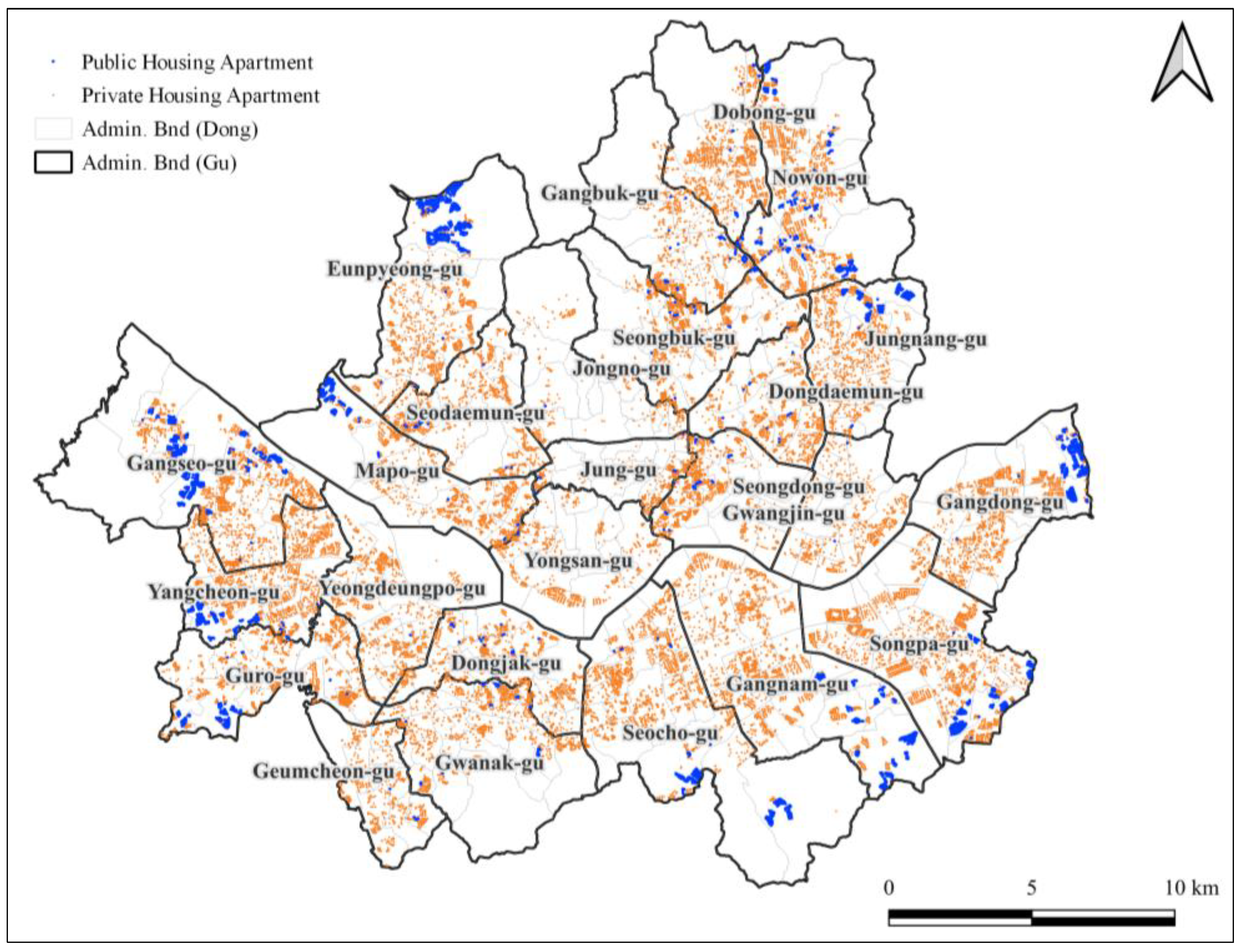
Figure 2.
Quantile Map Showing Local Residential Segregation by Dong.
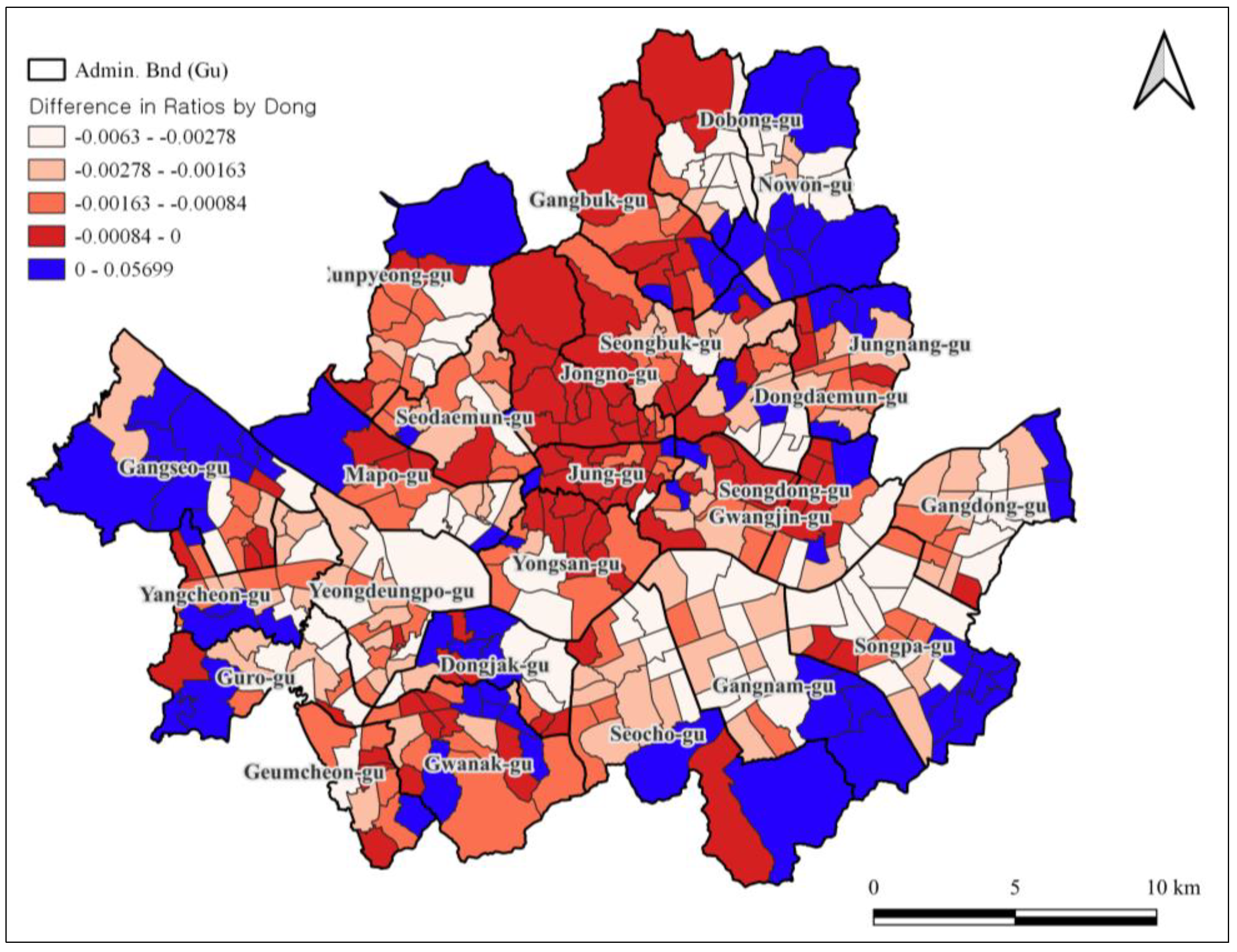
Figure 3.
Spatial Distribution of Values of Department Store.
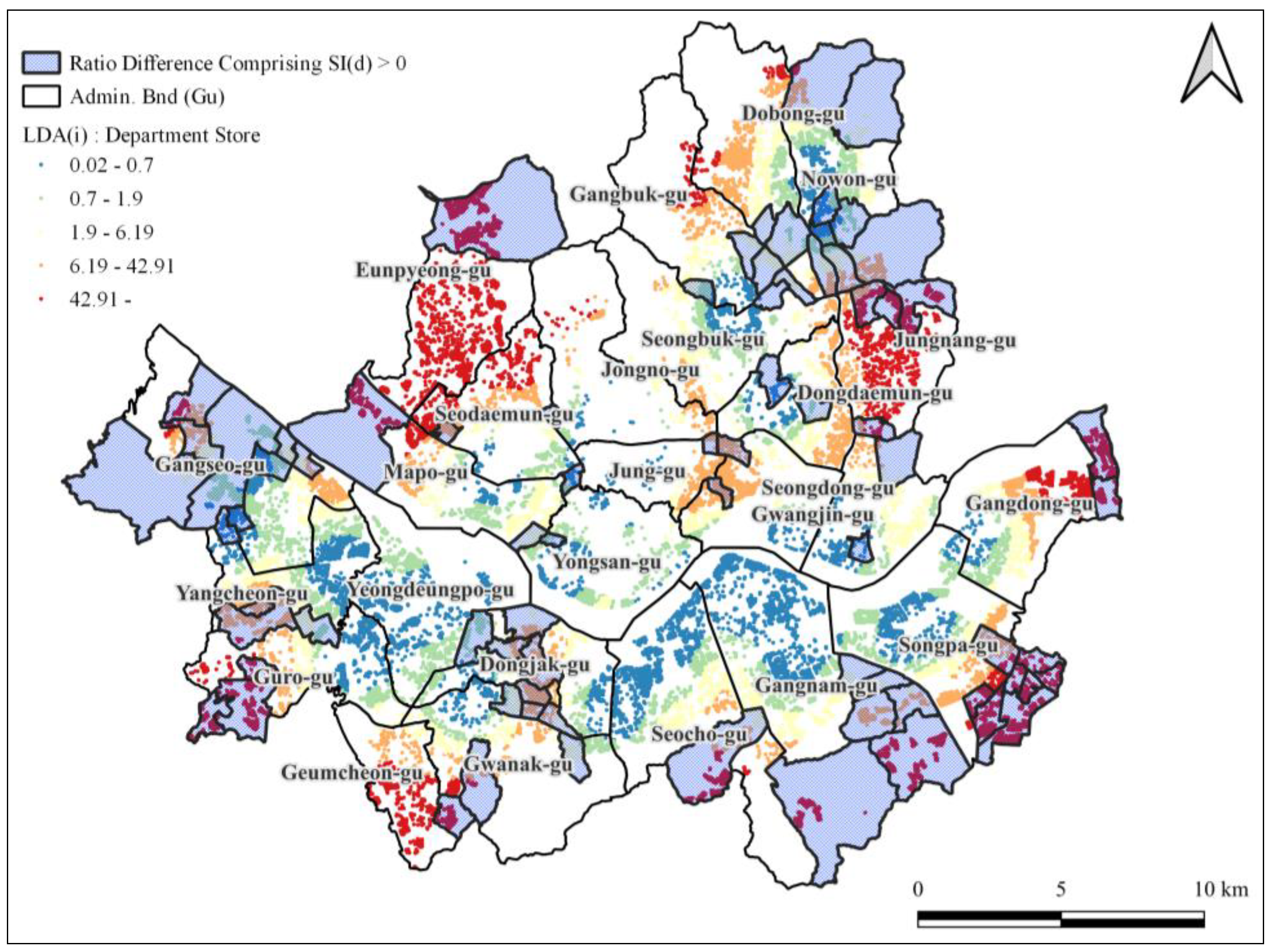
Figure 4.
Spatial Distribution of Values of General Restaurant.
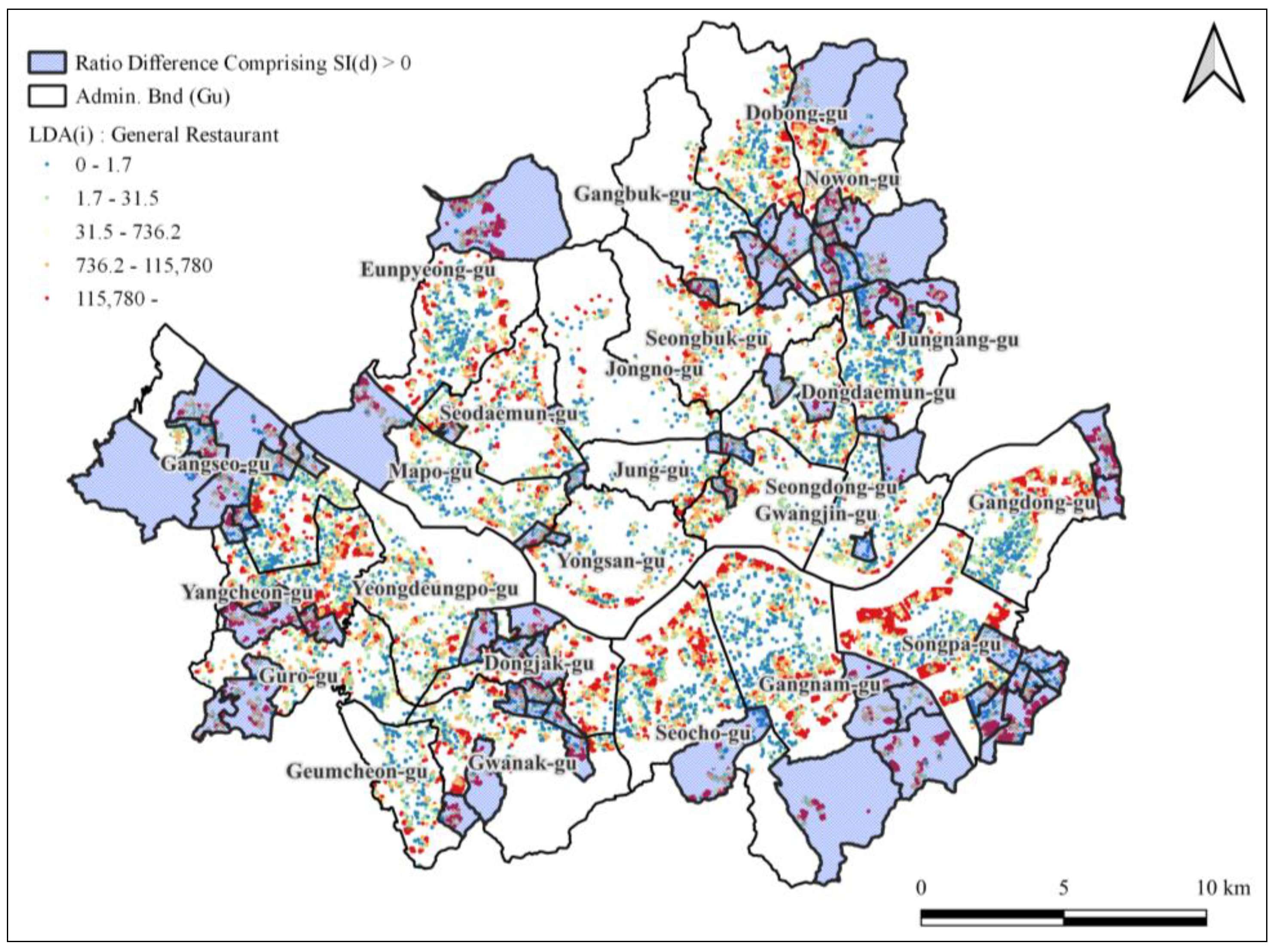
Figure 5.
Comparison of Values of 24 Facility (Urban Amenities) for the Two Types.


Table 1.
Criteria for interpreting
| Critical z-value | Overall Demand-Supply Disparity Level | |
|---|---|---|
| Less than -2.57 | Very Low | |
| -2.57 to -1.96 -1.96 to -1.64 -1.64 to 1.64 1.64 to 1.96 1.96 to 2.57 Greater than 2.57 |
Low Moderate Low Not Significant Moderate High High Very High |
Table 2.
Counts by Type of 24 Facility (Urban Amenities).
| Primary | Secondary | Facility | Counts |
|---|---|---|---|
| Private | Neighborhood Region |
General Restaurants Snack Bars Hospitals Clinics Pharmacies Beauty Salons Barber Shops Laundry Services Bakeries Tertiary General Hospitals Department Stores Hypermarkets |
124,061 37,644 553 17,886 5,433 29,134 2,560 4,151 4,008 59 36 93 |
| Public | Leisure Transportation Safety Administration Education |
Neighborhood Parks Theme Parks Subway Station Entrances Bus Stops Police Stations Fire Stations Community Service Centers Kindergartens Elementary Schools Middle Schools High Schools Universities |
1,209 419 2,014 11,250 243 177 426 905 608 394 301 62 |
Table 3.
Empirically Estimated Threshold Distance () of 24 Facility (Urban Amenities).
| Private Facility | Public Facility | |||
|---|---|---|---|---|
| General Restaurants Snack Bars Hospitals Clinics Pharmacies Beauty Salons Barber Shops Laundry Services Bakeries Tertiary General Hospitals Department Stores Hypermarkets |
39 72 590 104 188 81 274 215 219 1,807 2,313 1,439 |
Neighborhood Parks Theme Parks Subway Station Entrances Bus Stops Police Stations Fire Stations Community Service Centers Kindergartens Elementary Schools Middle Schools High Schools Universities |
376 628 309 131 890 1,043 672 461 563 699 800 1,763 |
Note: The unit of measurement for 'td' is meters.
Table 4.
z[GDD] Values of 24 Facility (Urban Amenities) for the Two Apartment Types.
| Facility | z[GDD] _ Public | z[GDD] _ Public | ||
|---|---|---|---|---|
| Private | General Restaurants Snack Bars Hospitals Clinics Pharmacies Beauty Salons Barber Shops Laundry Services Bakeries Tertiary General Hospitals Department Stores Hypermarkets |
-0.06 4.83* 14.60* 0.35 -0.29 -0.28 12.07* -0.29 -0.28 23.40* 36.19* 16.34* |
0.02 -1.46 *-4.36 -0.11 0.08 0.09 *-3.57 0.07 0.08 *-6.99 *-10.99 *-4.87 |
|
| Public | Neighborhood Parks Theme Parks Subway Station Entrances Bus Stops Police Stations Fire Stations Community Service Centers Kindergartens Elementary Schools Middle Schools High Schools Universities |
12.76* 17.91* -0.85 -0.38 1.85 26.12* 6.55* -0.90 -1.16 6.04* 22.12* 28.82* |
*-3.80 *-5.41 0.24 0.10 -0.57 *-7.87 -1.98 0.26 0.35 -1.78 *-6.70 *-8.68 |
Disclaimer/Publisher’s Note: The statements, opinions and data contained in all publications are solely those of the individual author(s) and contributor(s) and not of MDPI and/or the editor(s). MDPI and/or the editor(s) disclaim responsibility for any injury to people or property resulting from any ideas, methods, instructions or products referred to in the content. |
© 2024 by the authors. Licensee MDPI, Basel, Switzerland. This article is an open access article distributed under the terms and conditions of the Creative Commons Attribution (CC BY) license (http://creativecommons.org/licenses/by/4.0/).
Copyright: This open access article is published under a Creative Commons CC BY 4.0 license, which permit the free download, distribution, and reuse, provided that the author and preprint are cited in any reuse.


