

Submitted:
26 April 2024
Posted:
28 April 2024
You are already at the latest version
Abstract
In the era of rapid digitalisation, the widespread integration of digital technology into various aspects of daily life has sparked significant interest in understanding its impact on cognitive mental processes. While the emerging data suggests that its influence may be positive or negative, the depth of evidence regarding neurobiological mechanisms remains limited. This review aims to synthesise previously published studies and explore the implications of digital technology components, specifically those resembling mobile technology, internet search engines, and conversational artificial intelligence models, on cognitive functions embedded in the brain’s ability to reorganise itself, known as neuroplasticity. Despite acknowledged limitations, through an exhaustive approach, this paper intends to offer a dynamic perspective on the effects of digital media on the human brain, before the onset of addiction.
Keywords:
cognitive functions
; information processing
; digital technology
; neuroplasticity
; executive functions
; digital media
1. Introduction
Over the past two decades, a substantial body of studies ranging from the basis to the top of the evidence-based medicine pyramid has unravelled important effects on human cognitive processes related to the use of digital media, [1] especially in younger generations and middle-aged adults. Moreover, among the most prevailing human characteristics lies the flexibility to cope with environmental challenges through both biological and behavioural means.[2]
Connected to that, Maslow’s extended hierarchy of cognitive needs[3] features the essential human demand to call upon new technological inventions to facilitate daily tasks, which, through time, turns highly plastic cognitive systems vulnerable to significant alterations. For example, Cohen and Dehaene[4] suggested that the acquisition of a new tool, skill, or thought would gradually reshape precedent brain systems responsible for the same functions. These results were demonstrated by the acquisition of reading and arithmetic abilities that gave rise to specialised brain regions for orthographic processing and arithmetic functions. This line of thought establishes a relatively enduring idea that every human digital activity or task performed regularly, especially on smartphones, social networks, video games, or chatbots, might leave a watermark on the brain, whether good or bad, depending on the type of the activity, time of exposure and difficulty level [5].
Moreover, underlying this concept, neuroimaging studies with taxi drivers, pianists, and jugglers highlight the phenomenon of neuroplasticity known as the “use-it-or-lose-it” principle, which shows that processes of learning and memory can stimulate the growth of new synaptic connections (“use it”) while eliminating neuronal synaptic connections that are rarely used (“lose it”) [6,7,8,9]. In addition, one of the most influential ideas about how learning-related changes might occur in brains was first articulated around seventy years ago, Hebb’s postulate. This rule states that “neurons that fire together wire together”, suggesting that the connection between two neurons strengthens when they are activated simultaneously, leading to enhanced communication and potential for learning and memory formation.
Despite this rich amount of studies, several questions regarding the long-term effects of digital technology remain to be addressed [10]. Most of the studies referenced in the literature offer a limited analysis of specific digital media components, overlooking the effects of conversational artificial intelligence models or rapid information retrieval through search engines. Additionally, a closer look at the literature concerning the relationship between digital media, cognition, and predisposing factors, encounters several deficiencies, as seen in a study by Choudhury et al. [6,11]. Moreover, observational studies still correspond to the majority, demonstrating a notable scarcity of intervention studies. Furthermore, just like most studies in the same field, the focus primarily lies on delineating neurobiological mechanisms, elucidating what are the effects but failing to address the crucial question of how [12,13,14].
By addressing these gaps, this paper aims to develop an overarching framework to explore the potential cognitive impacts of digital media, whether positive or negative based on the brain’s ability to change itself in response to intrinsic or extrinsic stimuli. The contributions made in this research hold wide applicability, since they provide a dynamic perspective on these effects, not only exploring the mere usage of video games or social media but also encompassing the general implementation of digital media daily by average individuals, before the onset of addiction. Therefore, these advantages make this approach particularly valuable and relevant across various settings and populations.
2. Digital Media and Cognitive Functions
Several recent studies establish the idea that every human digital activity performed regularly, including the use of the internet, smartphones, and the emerging conversational artificial intelligence (AI) models, might leave a watermark on the brain due to neuroplasticity. Although it still lacks robust evidence to support its validity, the term “digital dementia” [15] is used to describe a set of cognitive impairments, such as memory loss, attention deficit, and impaired decision-making abilities, attributable to the excessive use of digital technology [16].
Smartphones
Concerning each digital media component, seminal contributions have been made by researchers, who with the use of electroencephalography (EEG) measured the cortical potentials in response to mechanical touch on the thumb, index, and middle fingertips of touchscreen phone users and nonusers, and reached the conclusion that even simple and repetitive interactions through the smartphone’s touchscreen reshaped sensory processing from the hand. Collectively, these results show that excessive touchscreen use can reorganise the somatosensory cortex, suggesting that cortical processing is continuously shaped via digital media use [5] Additionally, the variable ratio, i.e., partial schedule of reinforcement inherent to device checking, may perpetuate compulsive behaviours characterised by quick frequent inspections of the device for incoming information, e.g., from news, social media, or personal contacts [17]. Given this, such habits could potentially engage with the cortico-striatal dopaminergic system due to their readily available nature [18].
Internet
Notably, studies examining the acute effects of internet usage across modern society are mixed [11,17]. A great number of positive scenarios have been observed to induce long-term alterations in the neuronal architecture of the human brain, including second-language acquisition [19], learning new motor skills [20], and even formal education [21]. However, several authors have recognised that the extensive usage of internet search engines for factual information may unfavourably impact brain areas associated with memory through long-term storage and attention through sustained concentration [11] In addition, research has provided evidence for a decreased performance in memory recall for even simple tasks, which turns the process of remembering the information itself harder than using search engines [22].
Video Gaming
Nonetheless, studies of video gaming influence are well documented. It is also well acknowledged that the use of video game training programs besides the refinement of orientation abilities, may improve several different spatial skills such as mental rotation, cognitive mapping, and spatial memory [23], suggesting that the hippocampal formation, the entorhinal and parietal cortices might play a crucial role during these programs. Moreover, Green and Bavelier [24] after comparing two groups of gamers and non-gamers to ascertain if the attentional demands of modern video games enhance video gamers’ attentional abilities, found that video gamers showed superior attentional abilities on several standard cognitive tasks, such as ignoring distracting information. Despite this, upon comparing these findings with the same experiment conducted by Boot et al., [25] which encompassed a broader range of cognitive tasks than previously tested, it remains unclear to what extent attentional differences between gamers and non-gamers are due to pre-existing group disparities or video game play specifically.
Social Media
Regarding social media, Kross et al. [26] employed a cross-lagged analysis and revealed that online social networks, particularly Facebook and Instagram, significantly impact subjective well-being, being influenced by factors such as loneliness and harmful social comparisons. This research substantiates the idea that a state of perpetual partial attention can be created by the constant notifications, updates, or scrolling feeds from social media platforms, drawing the individual’s attention away from significant tasks [22].
Artificial Intelligence
Equally important, AI researchers have been developing and refining large language models (LLMs) that exhibit remarkable capabilities across a variety of domains and tasks including abstraction, comprehension, coding, mathematics, and much more [27]. This human intelligence simulation is progressively intertwined with human cognition, impacting how we think, learn, and perhaps, make decisions [22]. From an advantageous perspective, LLMs such as ChatGPT which is one of the largest and most powerful ones can help users explore different and new perspectives, supporting informed decision-making [28] Besides, AI-powered brain-computer interfaces and Virtual Reality (VR) environments that are being developed, can augment human cognition and provide immersive experiences that can improve cognitive responses to real-life scenarios [29]. In contrast, according to Ahmad et al., [30] it must be pointed out that AI’s impact on human decision-making abilities is significant, presenting findings that suggest the contribution to human laziness and undermining of autonomy. Also, AI-based GPS navigation systems such as Google Maps or Waze may affect brain areas related to spatial cognition and navigation skills [31].
Taking all of this into account, several brain imaging techniques are reported in the literature to address the link between internet-related cognitive impacts and structural changes in the brain [32]. For instance, these techniques demonstrate that apparently, technology affects visual perception, language, and cognition in general. As shown by Diffusion Tensor Imaging (DTI), premature extensive screen-based media use is significantly associated with lower microstructural integrity of white matter tracts that support language and literacy skills in preschoolers [33]. Overall, the emerging data suggest that constant technology usage impacts brain function in both positive and negative ways. To properly address the research question, this chapter will focus primarily on the most clearly implicated systems regarding the digital media components, including the basic cognitive processes such as attention and memory, executive functions, and higher cognitive functions including learning, social cognition, and novelty seeking.
2.1. Attention and Memory
Attention and memory are fundamental cognitive functions that support individuals’ ability to selectively focus on relevant stimuli, ensuring that important information is perceived, processed, and retained for future retrieval.
Concerning the attentional processes, a large number of existing studies in the broader literature have shown that beneath all the frameworks described above, attention is the major of all cognitive functions that are consistently featured as the primary place where technologies are having a negative impact [14] This influence was analysed by Hembrooke and Gay, [34] after studying the effects of multitasking in two groups of students that heard the same lecture and tested immediately after, yet with differences in the access to laptops during lectures. Results showed a significant decrement in performance for the group in the open laptop condition and attributed that unsatisfactory performance to the divided attention. These results tie well with studies wherein it was found that the groups of students who used some form of technology such as social media, texting, and email performed poorly compared to those engaged in notetaking or task-related activities. From this standpoint, the attendance to lectures associated with the use of digital technologies for off-task activities might have a detrimental impact on learning [35]. In addition, although video games have been associated with the improvement of certain aspects of attention like selective attention and visual-spatial processing, excessive use may lead to reduced sustained attention and high levels of distractibility, particularly in children [12].
Another challenge the digital environment poses for attention is the concept of “attentional overload”. This psychological condition results from excessive demands on attention related to the capacity of an individual’s attentional resources. One of the features of the multifaceted digital era is the constant demand to face a wide range of stimuli, including alerts, notifications, social media updates, emails, texts, and far more. In line with this thought, studies have shown that attentional overload associated with one of its most common symptoms — continuous partial attention — can have a negative impact on cognitive tests [17], academic achievement [36], and a substantial decrease in focus time to less than seven minutes [37], besides a lower performance on comprehension tests [38].
It is worth noting that, unless the ability to minimise all distractions when needed is present, the constant urge to stay connected driven perhaps by the “fear of missing out” despite having all the resources to retrieve information at any time and place, can create a vicious cycle (Figure 1) of continuously dividing and shifting attention across multiple tasks or stimuli without fully immersing in any one of them, leading to a superficial understanding of information besides reduced productivity.
Along with the impact of digital tools on memory, numerous researchers have recognised that increased usage of the Global Positioning System (GPS) is linked to a substantial decline in hippocampal-dependent spatial memory [39]. Also, the mere act of taking digital photographs seems to decrease recall accuracy for details of images, due to the required time and attention to get the best shot of the entire object, which dismisses the object from memory for trusting the camera to “remember” [40].
Regarding the usage of the internet, which seems to be the most explored digital technology component, researchers have pointed to multiple advantages and disadvantages of cognitive systems. In a series of pre-post intervention studies following a six-day internet search paradigm, young adults were given an hour per day of internet search tasks and undertook an array of cognitive and neuroimaging assessments before and after training. Results showed reduced regional homogeneity, functional connectivity, and synchronisation of associated brain regions involved in long-term memory formation and retrieval (e.g., temporal gyrus) [41]. A paradigmatic example that highlights the effect of online cloud storage and search engines on human memory performance was a study in which digital natives were made to believe that facts they had been asked to memorise would be stored in online cloud storage. Under this assumption, they performed more poorly than subjects who expected to have to rely on their brain memory function [5].
Despite that negative correlation, the six-day internet training increased white matter integrity of the fiber tracts connecting the frontal, occipital, parietal, and temporal lobes, significantly more than the non-search control condition. A similar pattern of results was shown by Storm and Stone [42], where cognitive offloading via digital devices improved people’s ability to focus on aspects that are not immediately retrievable, thus remembering these better in the future. This line of findings seems to support the emergent hypotheses that relying on the internet for factual memory storage may produce cognitive benefit in other areas, perhaps by “freeing up” cognitive resources [41]. In addition, several methods are reported in the literature to address the issue of “transactive memory”, a mechanism that involves the distribution of memory tasks among group members, where each member is responsible for remembering certain information while relying on others to remember different pieces. According to some researchers, the internet with its vast and accessible information might serve as an efficient form of external transactive memory, since rather than retain information internally, people remember where information can be accessed [43,44,45].
Overall, this increased reliance on external memory sources might not necessarily be dysfunctional, since the cyclical communication system is built on offloading information and computational processes to external tools (e.g. taking notes on paper, writing shopping lists, doing calculations in a spreadsheet) and reloading the same information back to the internal processes (e.g. reading notes, retrieving calculation results), has been used since the analogue-digital integration era, i.e., a very long time.
Regarding functional magnetic resonance imaging (fMRI) research, two large-scale cortical streams of visual processing, the ventral and dorsal streams, most known as the “what” and “where” streams due to their indicated roles in storing either the recognition of the specific content and external location of incoming information, respectively, have been well explored. Although there was no effect in activation of the dorsal stream, results showed that retrieving specific information through the internet instead of encyclopaedias was associated with the poorer recall of information due to the reduced activation of the ventral stream during information gathering [46]. However, a different pattern of results was obtained by a group of researchers that tracked neural activity during simulated internet searches and suggested that simply searching online may represent a form of mental exercise that can strengthen neural circuits [39].
2.2. Executive Functions
The brain has numerous systems for executing functions related to cognitive control, decision-making, and self-regulation abilities. These functions play a crucial role in planning, organising, and regulating thoughts to achieve goals, solve problems, and adapt to external circumstances. Although technological advancements have occupied a finite space in consumers’ lives, smartphones have been transcending these limitations, playing as constant companions and offering boundless worldwide interconnection. At this stage of understanding, prior research [47] to test the “smartphone-induced brain drain” hypothesis, a side effect of excessive smartphone use, has provided evidence that the mere presence of consumers’ smartphones may adversely affect inhibitory control even when consumers are not consciously attending to them, thereby leaving fewer resources available for other tasks. A series of recent studies have indicated that excessive digital use, especially social media, and gaming, can reduce levels of reward self-control [22].
Moreover, a cross-sectional study using fMRI to explore patterns of cerebral activation during information gathering from search engines or textbooks revealed that the extent of brain activation while reading text was similar in the net-naive (individuals with minimal internet search engine experience) and net-savvy (individuals with more extensive experience) groups. In contrast, during the internet search task, the net naive group showed a neural activation pattern similar to their text reading task, whereas the net savvy group demonstrated significant increases in neural circuits responsible for decision-making and complex reasoning, including the frontal pole, anterior cingulate, and hippocampus. These observations suggest that in middle-aged and older adults, prior experience with internet searching may alter the brain’s responsiveness in neural circuits controlling decision-making and complex reasoning [13].
For instance, in a recent randomised controlled trial (RCT), it was found that six weeks of participation in an online role-playing game led to significant reductions in grey matter volume within the orbitofrontal cortex, a brain region implicated in impulse control and decision-making processes [17]. Additionally, in one study, participants who spent more time on social networks showed a higher level of cognitive overload, leading to a decrease in their ability to make decisions [36]. Advancements in neurobiological research methods, including MRI and Positron Emission Tomography (PET), have linked the excessive use of the internet to structural and functional impairments in the orbitofrontal, dorsolateral prefrontal, and cingulate cortices, which are brain regions crucial for managing and controlling other cognitive functions.
2.3. Higher Cognitive Functions
Although not traditionally classified as an executive function, learning also relies on cognitive control functions. There are several possible mechanisms through which digital device use can impair learning function. One mechanism is through the effects of blue light emitted by digital screens, which has been found to disrupt the sleep-wake cycle and cognitive function by suppressing melatonin production. Nevertheless, there are potential benefits to be gained with AI. For example, some learning platforms (e.g., Carnegie Learning) provide personalised learning experiences tailored to individual needs. These smart platforms can identify a learner’s predominant learning style and provide content accordingly [22].
Furthermore, emotional regulation and social cognition are two interconnected aspects of cognitive functioning that are essential in navigating social interactions and relationships. Previous research has emphasised that the excessive use of social media can decrease grey matter volume in the amygdala, anterior and posterior cingulate cortices, insula, and lingual gyrus [48]. In addition, some consumers may also develop an emotional attachment to online friends and arousing content which can contribute to their addictive desire to maintain their online presence [49].
Simultaneously, although some of its features can provide cognitive-behavioural therapy-based interventions, interactions with social robots or chatbots can disrupt individuals’ perceptions, attitudes, and social interactions [50]. Also, the excessive use of social networks has been linked to decreased social skills and a difficult ability to recognise facial emotions [51]. Aimed at correlating offline and online networks, this issue has been investigated with MRI scans and found that both real-world social network size and number of Facebook friends were significantly associated with amygdala volume. However, it was also found that the number of Facebook friends was linked to structural changes in grey matter volume in other brain areas, particularly the posterior regions of the middle temporal gyrus, superior temporal sulcus, and the right entorhinal cortex, unlike the individuals’ real-world social networks [17].
Equally important, extreme internet users are more likely to present signs of impulsivity, suggesting that the instant feedback provided by the online environment might promote a need for instant gratification [52]. These findings support the notion that social media platforms act as altered perceptual filters, distorting perception and reinforcing biases [53]. This process seems to involve the mesolimbic system, suggesting that these types of highly rewarding activities may lead to desensitisation to reward and loss of ability to enjoy pleasure, most known as anhedonia.
As it has been shown, several authors have recognised that novelty seeking is a fundamental aspect of cognition associated with a tendency to explore new experiences. While some digital platforms provide an abundance of novel stimuli, fostering curiosity and broadening intellectual horizons, the virtually infinite availability of engaging content can lead to cognitive fatigue and a restricted perception of reality due to the selection and amplification of certain types of content (i.e. the algorithm), which filters and prioritises content, according to users’ pre-existing beliefs or preferences [54].
3. Discussion
This review examined the influence of digital technology in the context of cognitive functions, particularly the use of smartphones, internet search engines, video gaming, social media, and artificial intelligence. Breaking down the main points, the findings suggest that the effects are mixed, presenting a great number of both beneficial and detrimental effects depending on the extent and nature of usage.
Regarding the impact of each digital media component, it has been observed that the excessive touchscreen through smartphones can continuously reshape the somatosensory cortex. The internet besides serving as an efficient form of external transactive memory by “freeing up” other cognitive resources and strengthening neural circuits with some internet tasks like second-language acquisition, formal education, or information gathering, the excessive use, particularly the reliance on search engines may negatively affect memory and attention. Following this, although the use of video games may refine orientation and spatial abilities, uncontrolled use can lead to high levels of distractibility and reduce sustained attention. Social networks like Facebook can create a state of perpetual partial attention due to constant notifications or scrolling feeds, distracting individuals from significant external tasks. Finally, large language models like ChatGPT despite providing an abundance of diverse perspectives and supporting decision-making, may also contribute to cognitive laziness.
As for cognitive functions, digital media when associated with divided attention or off-task activities can lead to attentional overload and affect academic performance. The “smartphone-induced brain drain” hypothesis has proved that the mere presence of consumers’ smartphones may adversely affect inhibitory control even when consumers are not consciously attending to them. Prolonged exposure to social media and video gaming can reduce levels of reward self-control. Decision-making abilities disruption was associated with long exposure to social networks due to a high level of cognitive overload. In terms of emotional regulation, the abnormal emotional attachment developed by social network consumers was associated with emotional reactivity and delayed emotional recovery. Although various digital platforms provide a benefit for novelty seeking due to novel stimuli, fostering curiosity and broadening intellectual horizons, they might lead to cognitive fatigue and restricted perception of reality. Besides all that, despite AI-powered learning platforms offering personalised learning according to the individual’s learning style, interactions with social robots or chatbots might disrupt individuals’ perceptions, attitudes and social interactions.
Concerning brain imaging alterations, DTI shows that premature extensive screen-based media use is significantly associated with lower microstructural integrity of white matter tracts that support language and literacy skills. Advancements with fMRI research demonstrate reduced activation of the ventral stream during information gathering through the internet, unlike encyclopaedias. Also, PET studies have linked the excessive use of the internet to structural and functional impairments in brain regions crucial for managing and controlling other cognitive functions. Some representative studies exploring this relationship are summarized in Table 1.
Despite the broad literature, several questions and limitations remain to be addressed. Most of these studies are cross-sectional or involve a short temporal horizon, lacking longitudinal data to provide a more comprehensive understanding of the long-term effects of digital media on cognitive processes across the lifespan. As some authors noted earlier, individual factors like age, socioeconomic status, education level, and pre-existing cognitive habits may influence both digital media usage patterns and cognitive functioning. For this reason, future research should employ rigorous experimental designs and bias control to establish causality. Even though most of the neurobiological effects are well explored, it suffers from some limitations due to failing to address the question of how it happens. Additional studies and adapting methodologies to understand more completely the key tenets of emerging technologies, such as VR and AI, are required. Moreover, only a few works in the literature demonstrate an interdisciplinary approach across fields such as neuroscience, psychology, and computer science. Integrating insights from diverse disciplines can enrich research methodologies and enhance the interpretation of findings.
4. Conclusions and Future Directions
Despite offering a dynamic perspective on the effects of digital media on the human brain, this review suffered some challenges in terms of finding relevant and reliable sources and maintaining a coherent and logical structure. Regarding the acknowledged limitations, the objectivity of the study was most likely compromised due to inherent biases, with a great potential to influence the interpretation of findings. Looking forward, further research should aim to explore these aspects in greater depth, offering a more interventional perspective on the relationship between digital media and its effects on cognitive processes.
On this basis, this review has developed an overarching framework to explore the potential cognitive impacts of digital media, based on the brain’s ability to change itself in response to intrinsic or extrinsic stimuli. Although the findings concerning these effects were both beneficial and detrimental, several brain imaging techniques demonstrated that apparently, technology negatively affects crucial cognitive functions such as attention, memory and executive functions, depending on the extent and nature of digital media usage. Furthermore, a deeper exploration involving a longer temporal horizon and intervention studies of these complexities is required to provide a more comprehensive understanding of the long-term effects of digital media on cognitive processes across the lifespan, before addiction sets in
References
- Li, W. Brain structures and functional connectivity associated with individual differences in Internet tendency in healthy young adults. Neuropsychologia 2015, 70, 134–144. [Google Scholar] [CrossRef]
- Brown, D. Human adaptability to biological stressors. 2019, 354–386. [CrossRef]
- Maslow, A.H. A theory of human motivation. Psychol. Rev. 1943, 50, 370–396. [Google Scholar] [CrossRef]
- Dehaene, S.; Cohen, L. Cultural Recycling of Cortical Maps. Neuron 2007, 56, 384–398. [Google Scholar] [CrossRef]
- Korte, M. The impact of the digital revolution on human brain and behavior: where do we stand? Dialogues Clin. Neurosci. 2020, 22, 101–111. [Google Scholar] [CrossRef]
- Choudhury, S.; McKinney, K.A. Digital media, the developing brain and the interpretive plasticity of neuroplasticity. Transcult. Psychiatry 2013, 50, 192–215. [Google Scholar] [CrossRef]
- Maguire, E.A.; Gadian, D.G.; Johnsrude, I.S.; Good, C.D.; Ashburner, J.; Frackowiak, R.S.J.; Frith, C.D. Navigation-related structural change in the hippocampi of taxi drivers. Proc. Natl. Acad. Sci. 2000, 97, 4398–4403. [Google Scholar] [CrossRef]
- Pantev, C.; Oostenveld, R.; Engelien, A.; Ross, B.; Roberts, L.E.; Hoke, M. Increased auditory cortical representation in musicians. Nature 1998, 392, 811–814. [Google Scholar] [CrossRef]
- Pascual-Leone, A.; Nguyet, D.; Brasil-Neto, J.P.; Cammarota, A.; Seidel, O.; Carius, D.; Kenville, R.; Ragert, P.; Stöckel, T.; Carroll, T.J.; et al. Modulation of muscle responses evoked by transcranial magnetic stimulation during the acquisition of new fine motor skills. J. Neurophysiol. 1995, 74, 1037–1045. [Google Scholar] [CrossRef]
- General (OSG), O. of the S. Critical Questions Remain Unanswered. in Social Media and Youth Mental Health: The U.S. Surgeon General’s Advisory [Internet] (US Department of Health and Human Services, 2023).
- Firth, J. A. , Torous, J. & Firth, J. Exploring the Impact of Internet Use on Memory and Attention Processes. Int. J. Environ. Res. Public. Health 17, 9481 (2020).
- Bavelier, D., Green, C. S. & Dye, M. W. G. Children, wired – for better and for worse. Neuron 2010, 67, 692–701.
- Small, G.W.; Lee, J.; Kaufman, A.; Jalil, J.; Siddarth, P.; Gaddipati, H.; Moody, T.D.; Bookheimer, S.Y. Brain health consequences of digital technology use. Dialog- Clin. Neurosci. 2020, 22, 179–187. [Google Scholar] [CrossRef]
- Lodge, J.M.; Harrison, W.J. The Role of Attention in Learning in the Digital Age. Yale J. Biol. Med. 2019, 92, 21–28. [Google Scholar]
- Spitzer, M. Digital Dementia. Nervenheilkunde 2012, 31, 493–497. [Google Scholar]
- Manwell, L.A.; Tadros, M.; Ciccarelli, T.M.; Eikelboom, R. Digital dementia in the internet generation: excessive screen time during brain development will increase the risk of Alzheimer's disease and related dementias in adulthood. J. Integr. Neurosci. 2022, 21, 28. [Google Scholar] [CrossRef]
- Firth, J. The “online brain”: how the Internet may be changing our cognition. World Psychiatry 2019, 18, 119–129. [Google Scholar] [CrossRef]
- Wilcockson, T. D. W., Ellis, D. A. & Shaw, H. Determining Typical Smartphone Usage: What Data Do We Need? Cyberpsychology Behav. Soc. Netw. 2018, 21, 395–398.
- Osterhout, L.; Poliakov, A.; Inoue, K.; McLaughlin, J.; Valentine, G.; Pitkanen, I.; Frenck-Mestre, C.; Hirschensohn, J. Second-language learning and changes in the brain. J. Neurolinguistics 2008, 21, 509–521. [Google Scholar] [CrossRef]
- Scholz, J.; Klein, M.C.; Behrens, T.E.J.; Johansen-Berg, H. Training induces changes in white-matter architecture. Nat. Neurosci. 2009, 12, 1370–1371. [Google Scholar] [CrossRef]
- Draganski, B.; Gaser, C.; Kempermann, G.; Kuhn, H.G.; Winkler, J.; Büchel, C.; May, A. Temporal and Spatial Dynamics of Brain Structure Changes during Extensive Learning. J. Neurosci. 2006, 26, 6314–6317. [Google Scholar] [CrossRef]
- Shanmugasundaram, M.; Tamilarasu, A. The impact of digital technology, social media, and artificial intelligence on cognitive functions: a review. Front. Cogn. 2023, 2, 1203077. [Google Scholar] [CrossRef]
- McLaren-Gradinaru, M.; Burles, F.; Protzner, A.B.; Iaria, G. The cognitive effects of playing video games with a navigational component. Telematics Informatics Rep. 2023, 9. [Google Scholar] [CrossRef]
- Green, C.S.; Bavelier, D. Action video game modifies visual selective attention. Nature 2003, 423, 534–537. [Google Scholar] [CrossRef] [PubMed]
- Boot, W.R.; Kramer, A.F.; Simons, D.J.; Fabiani, M.; Gratton, G. The effects of video game playing on attention, memory, and executive control. Acta Psychol. 2008, 129, 387–398. [Google Scholar] [CrossRef]
- Kross, E.; Verduyn, P.; Demiralp, E.; Park, J.; Lee, D.S.; Lin, N.; Shablack, H.; Jonides, J.; Ybarra, O. Facebook Use Predicts Declines in Subjective Well-Being in Young Adults. PLOS ONE 2013, 8, e69841. [Google Scholar] [CrossRef]
- Bubeck, S. et al. Sparks of Artificial General Intelligence: Early experiments with GPT-4. 2023. [CrossRef]
- Matei, S.A. The Shallows: What the Internet Is Doing to Our Brains, by Nicholas Carr. New York, NY: W. W. Norton, 2010. 276 pp. $26.95. ISBN 0393072223 (hardcover). Inf. Soc. 2013, 29, 130–132. [Google Scholar] [CrossRef]
- Freeman, D.; Reeve, S.; Robinson, A.; Ehlers, A.; Clark, D.; Spanlang, B.; Slater, M. Virtual reality in the assessment, understanding, and treatment of mental health disorders. Psychol. Med. 2017, 47, 2393–2400. [Google Scholar] [CrossRef] [PubMed]
- Ahmad, S.F.; Han, H.; Alam, M.M.; Rehmat, M.K.; Irshad, M.; Arraño-Muñoz, M.; Ariza-Montes, A. Impact of artificial intelligence on human loss in decision making, laziness and safety in education. Humanit. Soc. Sci. Commun. 2023, 10, 1–14. [Google Scholar] [CrossRef]
- Iaria, G.; Palermo, L.; Committeri, G.; Barton, J.J. Age differences in the formation and use of cognitive maps. Behav. Brain Res. 2009, 196, 187–191. [Google Scholar] [CrossRef]
- Loh, K. K. & Kanai, R. How Has the Internet Reshaped Human Cognition? Neurosci. Rev. J. Bringing Neurobiol. Neurol. Psychiatry 2016, 22, 506–520.
- Hoehe, M.R.; Thibaut, F. Going digital: how technology use may influence human brains and behavior. Dialog- Clin. Neurosci. 2020, 22, 93–97. [Google Scholar] [CrossRef]
- Hembrooke, H.; Gay, G. The laptop and the lecture: The effects of multitasking in learning environments. J. Comput. High. Educ. 2003, 15, 46–64. [Google Scholar] [CrossRef]
- Wood, E.; Zivcakova, L.; Gentile, P.; Archer, K.; De Pasquale, D.; Nosko, A. Examining the impact of off-task multi-tasking with technology on real-time classroom learning. Comput. Educ. 2012, 58, 365–374. [Google Scholar] [CrossRef]
- Junco, R.; Cotten, S.R. No A 4 U: The relationship between multitasking and academic performance. Comput. Educ. 2012, 59, 505–514. [Google Scholar] [CrossRef]
- Rosen, L.D.; Carrier, L.M.; Cheever, N.A. Facebook and texting made me do it: Media-induced task-switching while studying. Comput. Hum. Behav. 2013, 29, 948–958. [Google Scholar] [CrossRef]
- Rosen, L. D., Lim, A. F., Carrier, L. M. & Cheever, N. A. An Empirical Examination of the Educational Impact of Text Message-Induced Task Switching in the Classroom: Educational Implications and Strategies to Enhance Learning. Educ. Psychol. 2011, 17, 163–177.
- Dahmani, L.; Bohbot, V.D. Habitual use of GPS negatively impacts spatial memory during self-guided navigation. Sci. Rep. 2020, 10, 1–14. [Google Scholar] [CrossRef] [PubMed]
- Henkel, L. Point-and-Shoot Memories: The Influence of Taking Photos on Memory for a Museum Tour. Psychol. Sci. 2013, 25. [Google Scholar] [CrossRef] [PubMed]
- Bell, V.; Bishop, D.V.M.; Przybylski, A.K. The debate over digital technology and young people. BMJ 2015, 351, h3064. [Google Scholar] [CrossRef] [PubMed]
- Storm, B. C. & Stone, S. M. Saving-enhanced memory: the benefits of saving on the learning and remembering of new information. Psychol. Sci. 2015, 26, 182–188.
- Sparrow, B.; Liu, J.; Wegner, D.M. Google Effects on Memory: Cognitive Consequences of Having Information at Our Fingertips. Science 2011, 333, 776–778. [Google Scholar] [CrossRef]
- Ward, A.F. Supernormal: How the Internet Is Changing Our Memories and Our Minds. Psychol. Inq. 2013, 24, 341–348. [Google Scholar] [CrossRef]
- Wegner, D. M. , Giuliano, T. & Hertel, P. G. Cognitive Interdependence in Close Relationships. in Compatible and Incompatible Relationships (ed. Ickes, W. J.) (Springer Verlag, 1985).
- Dong, G.; Potenza, M.N. Behavioural and brain responses related to Internet search and memory. Eur. J. Neurosci. 2015, 42, 2546–2554. [Google Scholar] [CrossRef] [PubMed]
- Ward, A.F.; Duke, K.; Gneezy, A.; Bos, M.W. Brain Drain: The Mere Presence of One’s Own Smartphone Reduces Available Cognitive Capacity. J. Assoc. Consum. Res. 2017, 2, 140–154. [Google Scholar] [CrossRef]
- Montag, C.; Markowetz, A.; Blaszkiewicz, K.; Andone, I.; Lachmann, B.; Sariyska, R.; Trendafilov, B.; Eibes, M.; Kolb, J.; Reuter, M.; et al. Facebook usage on smartphones and gray matter volume of the nucleus accumbens. Behav. Brain Res. 2017, 329, 221–228. [Google Scholar] [CrossRef] [PubMed]
- Zhou, Y.; Lin, F.-C.; Du, Y.-S.; Qin, L.-D.; Zhao, Z.-M.; Xu, J.-R.; Lei, H. Gray matter abnormalities in Internet addiction: A voxel-based morphometry study. Eur. J. Radiol. 2011, 79, 92–95. [Google Scholar] [CrossRef]
- Tao, R.; Huang, X.; Wang, J.; Zhang, H.; Zhang, Y.; Li, M. Proposed diagnostic criteria for internet addiction. Addiction 2010, 105, 556–564. [Google Scholar] [CrossRef]
- Błachnio, A.; Przepiorka, A.; Pantic, I. Association between Facebook addiction, self-esteem and life satisfaction: A cross-sectional study. Comput. Hum. Behav. 2016, 55, 701–705. [Google Scholar] [CrossRef]
- Eppler, M. J. & Mengis, J. The Concept of Information Overload - A Review of Literature from Organization Science, Accounting, Marketing, MIS, and Related Disciplines (2004). in Kommunikationsmanagement im Wandel: Beiträge aus 10 Jahren =mcminstitute (eds. Meckel, M. & Schmid, B. F.) 271–305 (Gabler, Wiesbaden, 2008). [CrossRef]
- Carr, N. The Shallows: What the Internet Is Doing to Our Brains. (W. W. Norton & Company, 2020).
- Pariser, E. The Filter Bubble: What The Internet Is Hiding From You. (Penguin UK, 2011).
Figure 1.
Divided Attention Cycle. This feedback loop starts with an initial effort to concentrate on tasks and maintain focus (focus attempt). Due to multiple distractions from the environment such as incoming notifications, or social media alerts (divided attention), the ability to understand a certain type of information will drastically decrease (superficial understanding), as well as productivity (reduced productivity).
Figure 1.
Divided Attention Cycle. This feedback loop starts with an initial effort to concentrate on tasks and maintain focus (focus attempt). Due to multiple distractions from the environment such as incoming notifications, or social media alerts (divided attention), the ability to understand a certain type of information will drastically decrease (superficial understanding), as well as productivity (reduced productivity).
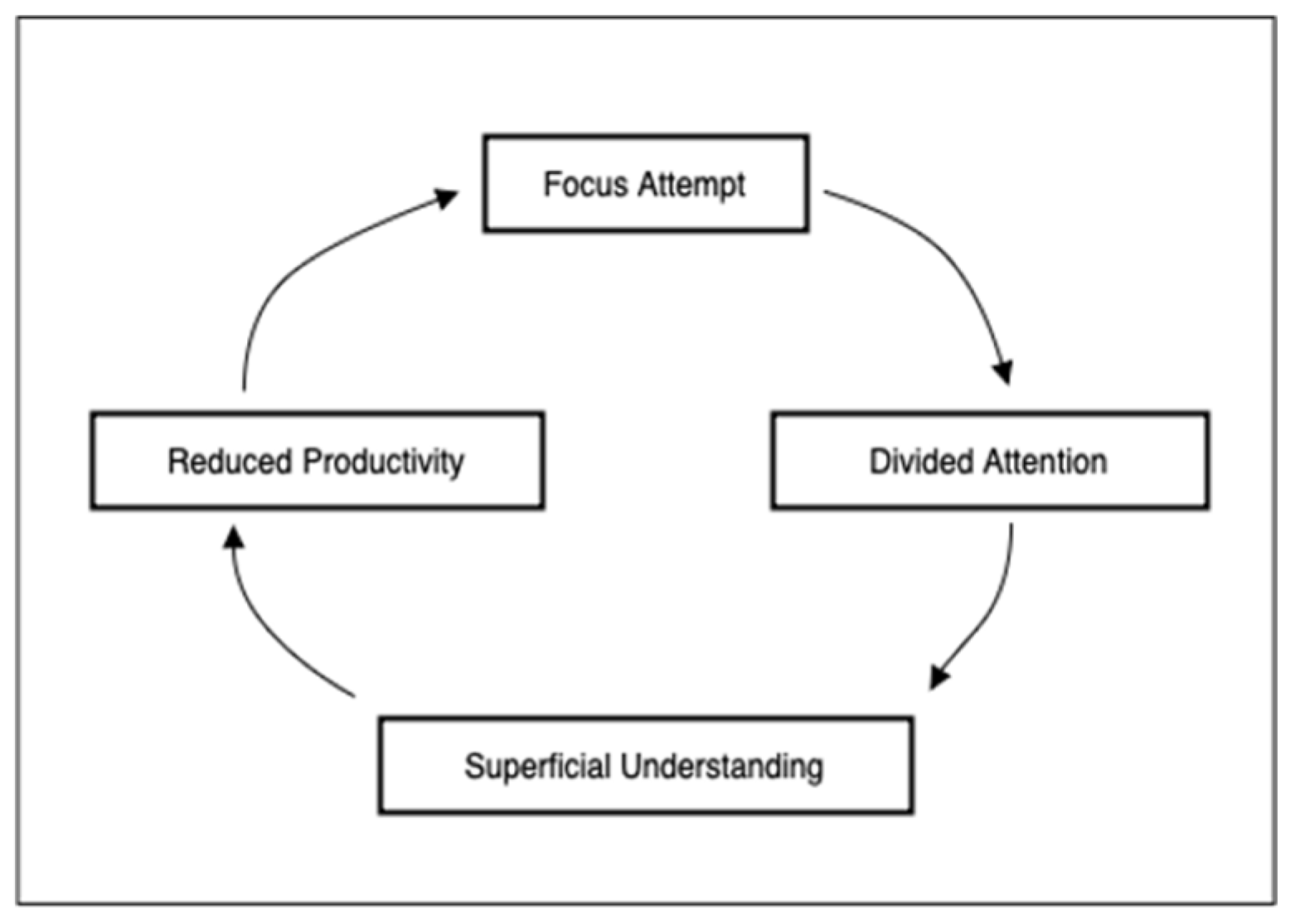

Table 1.
Representative publications exploring associations between digital technology usage and cognitive functions.
Table 1.
Representative publications exploring associations between digital technology usage and cognitive functions.
| Reference | Finding Summary |
|---|---|
| Attention | |
| Hembrooke, H. & Gay, G., 2003 | Attendance to lectures with divided attention might decrease academic performance |
| Bavelier, D. et al., 2010 | Excessive use of videogames might reduce sustained attention; videogames are associated with a high level of distractibility Video games are associated with the improvement of selective attention |
| Firth, J. et al., 2019 | Attentional overload might decrease cognitive tests |
| Junco, R. & Cotten, S. R., 2012 | Attentional overload might decrease academic achievement |
| Rosen, L. et al., 2013 | Attentional overload might decrease focus time |
| Alzahabi, R. & Becker, M. W., 2013 | Frequent media multitaskers are better at task switching |
| Memory | |
| Dahmani, L. & Bohbot, V.D., 2020 | GPS is linked to a decline in hippocampal-dependent spatial memory Searching online may represent a form of mental exercise that can strengthen neural circuits |
| Henkel, L., 2013 | Taking digital photographs might decrease accuracy recall for details of images |
| Bell, V. et al., 2015 | Internet search tasks is associated with reduce regional homogeneity, functional connectivity and synchronisation in brain regions associated with long-term memory (e.g., temporal gyrus) Internet search tasks increase white matter integrity of the fiber tracts connecting frontal, occipital, parietal and temporal lobes Relying on the internet for factual memory storage may produce cognitive benefits by “freeing up” cognitive resources |
| Korte, M., 2020 | Individuals who believe that the facts they had been asked to memorise would be stored in online cloud storage, perform more poorly than subjects who expect to rely on their brains |
| Pariser, E., 2011 | Cognitive offloading via digital devices improved people’s ability to focus on aspects that are not immediately retrievable, remembering these better in the future |
| Sparrow, B. et al., 2011 Ward, A. F., 2013 Wegner, D. et al., 1985 |
The internet might serve as an efficient form of external transactive memory (rather than retaining information internally, people remember where information can be accessed) |
| Executive functions and learning | |
| Ward, A. et al., 2017 | The mere presence of consumers’ smartphones may affect inhibitory control even when consumers are not consciously attending to them |
| Firth, J. et al., 2019 | Long days in an online role-playing game might lead to significant reductions in grey matter volume within the orbitofrontal cortex, impairing impulse control and decision-making process |
| Small, G. W. et al., 2020 | Prior experience with internet searching may alter brain’s responsiveness in neural circuits controlling decision making and complex reasoning |
| Junco, R. & Cotten, S. R., 2012 | Individuals who spend more time on social networks show a higher level of cognitive overload, decreasing their ability to make decisions |
| Emotional regulation, social cognition and novely seeking | |
| Montag, C. et al., 2017 | Excessive use of social media can decrease grey matter volume in the limbic system, increase emotional reactivity, and delay emotional recovery |
| Zhou, Y. et al., 2011 | Excessive use of social media might lead to an emotional attachment to online friends which might contribute to their addictive desire to maintain their online presence |
| Tao, R. et al., 2010 | Interactions with social robots or chatbots can disrupt individuals’ perceptions and social interactions |
| Błachnio, A. et al., 2016 | Excessive use of social networks might decrease social skills and impair the ability to recognise facial emotions |
| Firth, J. et al., 2019 | Online social networks were linked to structural changes in the posterior regions of the middle temporal gyrus, entorhinal cortex and superior temporal sulcus, unlike real-world social networks |
| Eppler, M. J. & Mengis, J., 2004 | Virtually infinite availability of engaging content can lead to cognitive fatigue and restricted perception of reality Digital platforms provide an abundance of novel stimuli, foster curiosity and broad intellectual horizons |
| Pariser, E., 2011 | Social media platforms might act as altered perceptual filters, distorting perception and reinforcing biases |
Disclaimer/Publisher’s Note: The statements, opinions and data contained in all publications are solely those of the individual author(s) and contributor(s) and not of MDPI and/or the editor(s). MDPI and/or the editor(s) disclaim responsibility for any injury to people or property resulting from any ideas, methods, instructions or products referred to in the content. |
© 2024 by the authors. Licensee MDPI, Basel, Switzerland. This article is an open access article distributed under the terms and conditions of the Creative Commons Attribution (CC BY) license (http://creativecommons.org/licenses/by/4.0/).
Copyright: This open access article is published under a Creative Commons CC BY 4.0 license, which permit the free download, distribution, and reuse, provided that the author and preprint are cited in any reuse.


