

Submitted:
24 April 2024
Posted:
28 April 2024
You are already at the latest version
Abstract
Variability is the predisposition of the elements in systems to assume different values over time and space. In biology, the variability is basic to explain differences and development in organisms but in the fields of scientific and technological information, the effects of variability on evolutionary dynamics of disciplines and technologies are unknown. In a broad analogy with the principles of biology, the variability within research fields can be a central argument to explain trajectories in scientific development and technological evolution. The purpose of the present study is to see whether statistical evidence supports the general hypothesis that the rate of growth in technologies can be explained by the level of variability in scientific fields and with this principal goal to analyze the relation between scientific variability and rate of growth in technologies. Proposed hypothesis of scientific variability here endeavors to explain basic sources of scientific development and technological evolution to lay the foundations for a general theory. The test here is based on emerging research fields of quantum technologies: Quantum Imaging, Quantum Meteorology, Quantum Sensing and Quantum Optics. A preliminary statistical evidence seems in general to support the hypothesis stated that the rate of growth in technological fields can be explained by the level of scientific variability in research fields, measured with relative entropy index. Nonparametric correlation based on Spearman’s rho shows a positive coefficient of 0.80 of these variables; linear model of the rate of technological growth = f(scientific variability) reveals a coefficient of regression equal to 1.63 (R2=0.60). Findings here suggest a general law that scientific variability positively drives scientific development and technological evolution. In particular, a higher variability within research fields can support scientific development and a high rate of growth in technological evolution (measured with scientific and technological information). Proposed hypothesis of scientific variability is especially relevant in environments of rapid change to explain determinants and dynamics of technological change within a general theoretical framework that supports technological management and forecasting of promising innovations.
Keywords:
Scientific Variability
; Scientific Development
; Entropy
; Technological Evolution
; Technological Change
; Technological Trajectories
; Quantum Technology
; Quantum Science
1. Introduction and Observations on Technological Evolution
Technological evolution and scientific development have a basic role in economic and social development of human society (Anastopoulos et al., 2023; Arthur, 2009; Basalla, 1988; Bryan et al., 2007; Coccia, 2011, 2014; 2019, 2019a, 2021, 2024; Coccia and Bontempi, 2023; Núñez-Delgado et al., 2023; Sun et al., 2013). Fleming and Sorenson (2004) maintain that invention is due to a combinatorial process of search. Arthur (2009, pp. 18-19) states that: “technologies somehow must come into being as fresh combinations of what already exists.” This combination of different elements is organized into systems to create new products/processes to some human purpose (Mazzolini et al., 2018; Pang and Maslov, 2013). In this context, Sahal (1981) points out that: “evolution…pertains to the very structure and function of the object (p. 64) …. involves a process of equilibrium governed by the internal dynamics of the object system (p. 69)”.
A main problem in social studies of science is how the dynamics of science, encompassing complex systems of scientific topics, methods, and research fields support the technological evolution (Coccia, 2020; Sun et al., 2013). This study confronts the problem here by developing a basic hypothesis to lay the foundation for a general theory of scientific variability, which endeavors to explain the effects of variability within research fields on the dynamics of the scientific information and technological evolution. In biology the role of variation on is well known (McEntire et al., 2021; Ziman, 2000) but in the study of scientific development and technological evolution, the effects of variability are unknown but its examination can clarify sources and effects in dynamics. In a broader analogy with biology, this study analyzes the effects of variability within scientific fields and related technologies to clarify effects for technological evolution. In general, differences of topics within scientific fields create variability that underlies evolutionary processes of technologies and allow adaptation in changing environments (Coccia, 2019, 2020). However, to date, no theoretical framework explains the basic endogenous processes of variability in research fields to clarify how they can affect the dynamics of scientific development and related technological evolution (Mulkay, 1975; Seidman, 1987).
General prediction of proposed theoretical framework is that the scientific variability in research topics within research fields can explain the evolution of different scientific trajectories and guide the evolution of technologies. Hence, the basic role of scientific variability can lay the foundation of a general theory of sources in technological evolution to clarify evolutionary properties that support best practices of innovation management and technological forecasting.
2. Critique of Current Theories in Technological Evolution: Incompleteness of Drivers
In order to position our theory in a manner that displays similarities and differences with existing approaches, a critical review of accepted frameworks in the evolution of science and technology is presented here. Quantitative work on emergence and evolution of disciplines are scarce, and this is in part due to the difficulty of detecting and measuring basic sources of scientific and technological change (Coccia, 2018, 2020; Coccia and Roshani 2024, 2024a; Coccia et al., 2021, 2022; Sun et al., 2013). Many theories of scientific development have been inspired by the notion of paradigm shifts associated with anomalies and contradictory results in science (Kuhn, 1996). Some studies explain the evolution of fields with processes of branching, caused by new discoveries (Coccia, 2022; Mulkay, 1975) or of specialization and fragmentation (Dogan and Pahre, 1990), such as in nanophysics, molecular biology, astrobiology, etc. (Coccia, 2018). Other approaches focus on the synthesis of elements in preexisting disciplines, such as in bioinformatics, quantum computing, plasma physics, etc. (Dowling and Milburn, 2003). These approaches point to the self-organizing development of science system (Noyons and van Raan, 1998; van Raan, 2000). However, how the scientific development affects the technological evolution is hardly known.
Moreover, theories of technological evolution have been criticized in literature because neglect many characteristics and factors that are strongly related to the evolution of science and technology (Coccia, 2018, 2019, 2020; Pistorius and Utterback, 1997). New studies suggest that technologies evolve with a relationship of mutualistic symbiosis between inter-related research fields and technologies (Coccia, 2019, 2019a). Utterback et al. (2019) maintain that the growth of technologies will often stimulate the growth of inter-related technologies, calling this interaction “symbiotic competition” (Utterback et al., 2019, p. 1). Pistorius and Utterback (1997, p. 67) also argue that approaches based on a multi-mode interaction between technologies provide a much richer and useful theoretical framework to explain scientific and technological change. These approaches are based on a broad analogy between scientific and technological evolution, and biological evolution (Arthur, 2009; Basalla, 1988; Coccia, 2019, 2019a; Wagner and Rosen, 2014). In fact, the similarities between biological and technological - scientific evolution have a considerable literature (see reviews in Coccia, 2019; Coccia and Watts, 2020; Erwin and Krakauer, 2004; Schuster, 2016; Solé et al., 2013). In general, technological and scientific evolution, alongside biological evolution, displays radiations, stasis, extinctions, and novelty (Valverde et al., 2007). Sandén and Hillman (2011, p. 407) show six typologies of technological interactions, using similarity with the interaction in biological species, i.e.: neutralism, commensalism, amensalism, symbiosis, competition and parasitism. Coccia (2019), in a broad analogy with evolutionary ecology of parasites, explains the interaction between technologies and related effects for the evolution of technology (cf., Coccia, 2019b; Coccia and Watts, 2020). Fleming and Sorenson (2004) maintain that the precise mechanism through which science accelerates the rate of invention remains an open question. Invention and science advances can be due to a combinatorial search process, in which science advances can alter inventors’ search processes by leading to useful combinations, eliminating failing paths of research, and triggering to continue even in the presence of negative feedback (cf., Coccia, 2023). These mechanisms seem to be useful when inventors attempt to combine highly coupled components; therefore, the value of scientific research to invention has a systematic variability across different fields and technological applications.
Nevertheless, in these topics there is an evident incompleteness because no consistent system of factors capable to explain complex structures and dynamics of science and technology in society. In fact, these theoretical frameworks do not explain how the variability within research fields can drive the dynamics of scientific development and technological change, as well as the diversity of pathways in technological evolution. The analysis of variability in scientific fields and related technologies can clarify sources of scientific and technological evolution that allow scientists, technology analysts, R&D managers and policymakers to make accurate analyses and predictions to improve technological forecasting and management of technology (Daim et al., 2006; Ghaffari et al., 2023; Jashari et al., 2022; Tiberius et al., 2022; Zamani et al., 2022). Hence, this study analyzes and discusses why studying variability is important for understanding the dynamics of scientific development and related technological evolution in order to detail challenges and opportunities in technological forecasting to improve innovation and technology management (Daim et al., 2006; Jashari et al., 2022). In short, looking at science and technology from within focusing on variability can lay the foundation for developing a theoretical framework of scientific variability to explain sources and effects for scientific and technological evolution.
3. Research Methodology
3.1. Research Philosophy of Proposed Hypothesis and Theory
Proposed hypothesis of scientific variability here is developed within a perspective of generalized or universal Darwinism to explain sources of scientific development and technological change (Dawkins, 1983; Mulkay, 1975; Nelson, 2006; Levit et al., 2011). Hodgson (2002, p. 260) maintains that: “Darwinism involves a general theory of all open, complex systems”. In this context, Hodgson and Knudsen (2006) suggest a generalization of the Darwinian concepts of selection, variation and retention to explain how a complex system evolves (cf., Hodgson, 2002; Stoelhorst, 2008). In the economics of technical change and in the fields of Science of Science (Sun et al., 2013), the generalization of Darwinian principles (“Generalized Darwinism”) can assist in explaining the multidisciplinary nature of scientific and technological development (cf., Hodgson and Knudsen, 2006; Levit et al., 2011; Nelson, 2006; Schubert, 2014; Wagner and Rosen, 2014). In fact, the heuristic principles of “Generalized Darwinism” can explain aspects of scientific and technological change considering analogies between evolution in the biological organisms and similar-looking processes of systems in science and technology (Oppenheimer, 1955). Arthur (2009) argues that Darwinism approach can explain technology and science development as it has been done for the development of species (cf., Schuster, 2016, p. 7; Solé et al., 2013). Kauffman and Macready (1995, p. 26) state that: “Technological evolution, like biological evolution, can be considered a search across a space of possibilities on complex, multipeaked ‘fitness,’ ‘efficiency,’ or ‘cost’ landscapes”. Schuster (2016, p. 8) shows aspects of similarity between technological and biological evolution, such as the principle of selection that works if there are significant differences between elements in population, such as research fields, technologies, etc.: i.e., if there is the necessary variability (Bowler, 2005). Variation, associated with selection, generates evolutionary processes through which (human or technological) species evolve and adapt to environmental changes. However, the role of variation within research fields for the evolution of science and technology is hardly known but it can be basic to explain important sources and effects on scientific and technological change. Hence, the theoretical background of “Generalized Darwinism” (Hodgson and Knudsen, 2006) can frame a broad analogy between science, technology and evolutionary ecology that provides a logical structure of scientific inquiry to analyze how the variability in science can drive different research fields and pathways of technologies in society (Coccia, 2019).
- The need for an extension of the postulate of the variability in science
Variability is the predisposition of the elements in systems to assume different values over time and space (Girone and Salvemini, 2000). In biological systems the role of variation is well known (Dobzhansky, 1959; Stebbins, 1950), whereas the variation in the study of scientific and technological information is unknown but its examination can explain sources of scientific development and technological evolution. In a broad analogy with principles of biology, in a context of Generalized Darwinism, the variability can play a central role to explain evolutionary processes in science and technology for determining general properties to support technological forecasting and innovation management (cf., Jashari et al., 2022).
The goal of this study is to clarify the concept of variability within and between research fields that may be one of the determinants in scientific and technological evolution that guides different trajectories. Proposed hypothesis of scientific variability within research fields endeavors to clarify one of the sources driving technological evolution (Coccia, 2017b). In fact, the understanding of the role of variability in science and technology domains can extend the theories of scientific development and technological evolution with a new conceptual element to improve technological forecasting and support management of technologies towards promising innovations for a fruitful economic and social impact. This study uses the concept “variability” interchangeably with terms of variation, difference, diversity, and disparity (e.g., Hopkins and Gerber 2017).
Extension of the Postulates of Variability in Science and Technology Domain
- a)
- Scientific topics in research fields have different variability
- b)
- Variability in research fields drives the evolution, Variability ⇒ evolution
- c)
- Variability in research fields is basic for evolution and adaptation to changing environments
Proposed Hypothesis of Scientific Variability for Technological Evolution
Scientific development and evolution of technologies can be explained by the variability in research fields
Figure 1 shows this logical relation.
Prediction of the Hypothesis of Scientific Variability for Technological Evolution
Variability in research fields drives scientific development and technological evolution
Figure 2 shows the causal relation of the prediction that scientific variability can drive scientific and technological evolution
The confirmation of prediction, just mentioned, with empirical evidence can support managerial and policy implications to improve technological forecasting and to direct R&D investments towards promising technologies and innovations for science, technology and socioeconomic progress (Coccia, 2010, 2018d; Coccia et al., 2015).
Some Testable Implications of the Prediction Based on Proposed Hypothesis of Scientific Variability for Technological Evolution Are:
- 1)
- Scientific variability changes within research fields of the same discipline
- 2)
- Pace of technological evolution can depend on scientific variability in research fields
- b.
- Research setting to test the predictions: research fields in quantum technologies
The predictions of proposed hypothesis of scientific variability for technological evolution will be verified empirically in some main quantum technologies by measuring the variation of scientific and technological information with entropy index (Fleming and Sorenson, 2004). Quantum science and technology are path-breaking systems having a high potential growth with manifold applications, such as in quantum machine learning (Pande and Mulay, 2020; Rao et al., 2020; Thew et al., 2020), drug discovery processes (Batra et al., 2021), cryptographic tasks (Chen et al., 2015), information processing of big data (cf., Coccia et al., 2024; Latifian, 2022), etc. (Coccia, 2017, 2017a, 2020a, 2022; Kozlowski and Wehner, 2019; Scheidsteger et al., 2021; Tolcheev, 2018). Many quantum technologies are at the initial stage of evolution, but they have continuous scientific and technological advances that can clarify how their endogenous variation can affect pathways of scientific development and technological evolution of different trajectories (Atik and Jeutner, 2021; Carberry et al., 2021; Gill et al., 2022; Coccia, 2022).
The study here focuses on emerging disciplines in quantum science having an independent topic of study, specific methodological approach and perspective (Small, 1999). This study analyzes four emerging specialties in quantum science (Quantum Meteorology, Quantum Sensing, Quantum Optics and Quantum Imaging). The emergence and related evolution of these fields can be due to social variables (i.e., competitive position of nations) but also to activities that occur in scientific development given by: a) intellectual factors, such as paradigm development, problem success, puzzle solving and b) social factor, such as communication, co-authorship colleagueship and apprenticeship (Mullins, 1972). Wray (2005) argues that sociological approaches focus on social and instrumental changes as the source of new specialties, but conceptual changes also play an important role in the creation and evolution of some scientific specialties and related technologies. Conceptual change in research fields can be detected with the variability of topics that can clarify relationships with the evolution of scientific specialization and new technological trajectories.
- c.
- Study design
- ▪
- Sources of data, sample and measures for the analysis of variation
In order to measure variability within research fields, the study analyzes scientific and technological information given by the number of occurrences concerning research topics (namely 160 keywords, max available number in the database of Scopus, 2023) in scientific documents of four research fields in quantum technologies (Glänzel and Thijs, 2012; Al-Betar et al., 2023; Zhang et al., 2023): Quantum Imaging, Quantum Meteorology, Quantum Sensing and Quantum Optics. Data are from Scopus (2023), downloaded on 24 April 2023. In particular, the study considers all available data in:
- -
- Quantum Meteorology: 2,028 scientific documents from 1972 to 2023
- -
- Quantum Sensing: 1,726 scientific documents from 2000 to 2023
- -
- Quantum Optics: 58,060 scientific documents from 1958 to 2023
- -
- Finally, Quantum Imaging: 753 scientific documents from 1996 to 2023
- ▪
- Sources of data, sample and measures for technology analysis of the rate of growth
The analysis of growth rate uses number of papers in the same four research fields of quantum technologies: i.e., Quantum Imaging, Quantum Meteorology, Quantum Sensing and Quantum Optics. Data, downloaded on 14 February 2024 from Scopus (2024), about one year later the data for variance analysis to logical assess the consequential effect of variability on scientific and technological growth, are:
- -
- Quantum Meteorology: 1,851 scientific documents, with 8,646 occurrences concerning the first 160 research topics (keywords) having high frequency (all data available from 1972 to 2023).
- -
- Quantum Sensing: 1,375 scientific documents, with 6,618 occurrences concerning the first 160 research topics having high frequency (data from 2000 to 2023).
- -
- Quantum Optics: 54,332 scientific documents, with 236,887 occurrences concerning the first 160 research topics with high frequency (data from 1958 to 2023).
- -
- Finally, Quantum Imaging: 673 scientific documents, with 3,407 occurrences concerning the first 160 research topics having high frequency (data from 1996 to 2023).
- d.
- Methods for statistical analyses of data
- ▪
- Analysis of scientific variability with entropy index and test prediction n. 1)
Variation is the quantitative or qualitative difference(s) between two or more entities (Girone and Salvemini, 1981). There is no universal approach to measuring variation across biological as well as technological and other systems. Variation can be classified with numerical or categorical aspects. Numerical variation can be continuous (e.g., differences) or discrete (e.g., number of mutations). Depending on data type and system complexity, different statistical approaches can be applied for quantifying properly variability in complex systems (Barton, 2014). The analysis of scientific variability in research topics of four homogeneous groups in quantum technologies above can clarify basic effects on scientific development and technological evolution. One of the potential unifying frameworks to analyze the variability within scientific fields is the information theory with measures based on information content or entropy index (Pierce 1980). These methods were originally developed to study telecommunications but they are also applied in many other fields, such as computer science, biology, economics, etc. (Mickiewicz et al., 2021).
Hence, entropy index is a vital measure of heterogeneity to assess variability within groups (Gini, 1912, Lin et al., 2021; Nunes et al., 2020, Rényi, 1961; Shannon, 1948; Simpson, 1949; cf., Takahashi et al., 2023). Given a population (here information data on a specific quantum technology) in which the research topics have a relative frequency Pi, Shannon suggested the degree of indeterminacy in predicting the modality of a unit chosen at random from population on the basis of the entropy. The entropy index H(X) is a decreasing function of the variability of relative frequencies (Grupp, 1990; Jost, 2006, Lin et al., 2021; Zidek and van Eeden, 2003). Hence, H(X) is the entropy of a single distribution (X), given by:
where Pi(x) =ni/N
s= distinct modes
H has a value of 0 when the whole frequency is concentrated in a single modality. H gradually increases the values as the heterogeneity of the modalities increases up to the maximum number of log s when there are s distinct modes all with the same absolute frequency N/s.
The relative entropy index is:
- ▪
- Analysis of the rate of scientific growth with linear model of regression analysis
The rate of scientific growth in four quantum technologies/research field under study here is estimated with following linear model of the relationship of number of publications (P) on time t
P (publications) i,t = a + b growth (time) i,t + ui,t
a = constant
b growth = coefficient of regression (rate of growth)
u = error term
The estimation of model (3) is done with Ordinary Least Squares (OLS) method that determines the unknown parameters in regression models.
- ▪
- Test of the prediction n. 2) that evolution of technology =f(variability)
Correlation analysis
Considering the four research fields under study having scientific and technological information, the association between scientific variability measured with relative entropy index and rate of growth, measured with coefficient of regression of the linear model (3) is done with Spearman correlation coefficient (Spearman’s correlation, for short): a nonparametric measure of the strength and direction of association that exists between two variables. Coefficient is denoted by the Greek letter ρ (rho). The test is used in this case for continuous data that has failed the assumptions necessary for conducting the Pearson's correlation, since only four observations are obtained from four research field under study.
Simple regression analysis: growth is a linear function of variability
The study analyzes a preliminary estimated relationship of the rate of technological growth (b growth = coefficient of regression in equation 3) as a linear function of entropy index h (proxy of variability) in research fields of quantum technologies:
b growth i,t = k + z (h)i,t + εi,t
b = rate of growth of research fields
k = constant
z=coefficient of regression
h = relative entropy index (variability in research fields)
ε= error term
The estimation of model (4) is also with Ordinary Least Squares (OLS) method that determines the unknown parameters in regression model.
Statistical analyses are performed with the IBM SPSS Statistics 26 ®.
4. Empirical Evidence
- ▪
- Test of the prediction that scientific variability changes within research fields
Table 1 shows that quantum optics has a higher concentration of occurrences in research topics (lower relative entropy), whereas Quantum sensing has higher heterogeneity of these occurrences between manifold research topics (higher relative entropy). This result can be due to the scientific age of quantum sensing that is shorter (23 years, in the year 2023) than quantum optics that has an evolutionary period of 65 years (in year 2023). Moreover, higher heterogeneity suggests that younger research field has to stabilize the scientific directions and technological trajectories in their evolutionary patterns (Dosi, 1988, 1988a).
Table 2 shows that quantum sensing has the highest rates of growth 0.27 (p-value 0.001), quantum metrology has also a significant high growth rate of 0.23, followed by quantum imaging 0.12 and finally by quantum optics (0.08). F-test of models is highly significant (p-value 0.001) and coefficient of determination shows a high goodness of fit in the range between 66% and 92%.
Figure 3 synthetizes the entropy indices and rates of growth in four research fields under study.
- ▪
- Test of the prediction that Evolution of technology =f(scientific variability)
Table 3 shows the association between the entropy indices and rates of growth in four research fields under study with Spearman’s Correlation (rho) that is ρ=0.80 (p-value 0.17), suggesting a positive association between relative variability (measured with entropy) and scientific and technological development. In short, results suggest that high variability is associated with higher scientific and technological change during evolutionary patterns of scientific and technological information.
Considering the results of correlation analysis in Table 3, Table 4 shows a preliminary estimated relationship of the rate of growth (b= coefficient of regression as specified in equation 3) on relative entropy index h (proxy of variability) in research fields of quantum technologies: a positive coefficient of regression z=1.63 suggests that scientific variability can explain and be a main driver of scientific and technological evolution (R-square of the goodness of fit is about 61%). Figure 3 visualizes the estimated relationship of the rate of growth (b) on relative entropy index h (proxy of variability) in research fields of quantum technologies.
Results suggest that higher variability can support higher rate of growth in the research fields under study. The statistical evidence of Table 4 and Figure 4 above seems in general to support the theoretical prediction of proposed hypothesis that the rate of scientific and technological growth can be explained by the level of scientific variability in research fields (of quantum technology).
Although we have only four observations associated with four research fields under study, nonparametric correlation coefficient is 0.80. This result is also confirmed, prima facie (accepted as correct until proved otherwise), by estimated relationship of linear model that with a positive estimated coefficient of regression that is higher than 1 (Table 4 and Figure 4).
Hence, this empirical evidence can suggest a general law of scientific variability for scientific and technological development given by:
rate of growth = −1.24 +1.63h(Entropy index, variability), R2=61%.
Overall then, statistical evidence seems in general to support the theoretical prediction that scientific variability drives technological evolution, in particular, a higher variability underlying scientific development can support high rate of growth in technological evolution.
5. Fundamental Considerations on the Hypothesis of Scientific Variability in Research Fields
- Explanation of results
Variation is a basic aspect for the process of evolution in biology (Stebbins 1950; Lewontin 1974). In analogy with biology, the variation can explain characteristics of scientific evolution and may confer adaptation of technologies to environmental changes (Brandon, 1978). In particular, in research fields, the analysis of variability can show main properties of the dynamics of scientific development and technological evolution (Coccia, 2024a, 2023). A main prediction of the proposed hypothesis here, supported by empirical evidence, is that scientific variability explains technological evolution, and a higher level of variability in research fields seems to increase scientific and technological development. Moreover, higher scientific variability, such as in the field of quantum sensing, suggests various underlying causes that affect in different ways the evolutionary patterns:
- -
- The accumulation of scientific knowledge (papers having scientific and technological information) is a factor determining variability because a lower accumulation of scientific products in younger research fields shows a higher variability, associated with a higher technological evolution and uncertainty in technological trajectories, whereas a higher accumulation of scientific outputs is associated with a lower variability in scientific and technological trajectories.
- -
- The specificity and nature of research fields and technologies affects variability and related evolutionary pathways. The endogenous variability within the complex system of research fields that are more oriented to support general purpose technologies (inter-related with other technologies), such as quantum sensing, tends to be high inducing a high rate of growth in scientific and technological evolution (Coccia, 2020).
Variability in a research field having scientific and technological information may not be independent of the variation in other scientific and technological systems (Wright 1932). This mutual influence is a challenge to the study of variability because an analysis of determinants of variability in a single research field can have main consequences for variation and evolution in other disciplines and related technologies (Coccia, 2024). Some scholars suggest the concept of “nested ecosystems” (McFall-Ngai et al., 2013) that can be also applied per analogy in our context, such that the changes in a research field and related technology has interdependencies with other research fields and technologies in a larger ecosystem (Coccia at al., 2023; Coccia and Watts, 2020; Fukumi et al. 2006). Thus, variability at one level might influence processes at other levels or in other scientific and technological systems.
Results here also suggest that the variation can be due to manifold sources. A mechanism determining the scientific variation is the change in scientific and technological eco-system in which scientific research and technologies develop (Coccia et al., 2023). Moreover, internal variation in research fields and technologies can be associated with external mechanisms of variability, such as interaction with different research fields and technologies during evolutionary pathways (cf., Ke, 2023; Coccia and Wang, 2015). Variability of quantum technologies, driven by interaction and convergence of different research fields, affects the behaviour and evolution of inter-related scientific fields and technologies (Coccia and Watts, 2020). This source of variability in research fields can be explained with the theorem of not independence of any technology (Coccia, 2018a): the long-run behavior and evolution of any technological innovation Ti is not independent from the behavior and evolution of the other technological innovations Tj, ∀i=1,…,n and j=1,…,m.
In general, hence, empirical evidence shows that variation guides scientific and technological evolution and it is due to systematic characteristics of the nature of scientific field and related technology, to random scientific and technological interaction with other technologies and research fields and to changes in surrounding innovation and socioeconomic ecosystems.
- Deductive implications of the hypothesis of scientific variability in research fields
General changes in the conditions of innovation ecosystem and scientific interactions trigger scientific and technological variation (Coccia, 2019; May, 1981). Research fields and technologies exposed to changes in the conditions of ecosystem and interactions with other research fields have variability and consequential coevolutionary pathways of growth (cf., Coccia, 2023, 2024a; Coccia and Watts, 2020; Winther, 2000). Conversely, if it were possible to expose all research fields and technologies over time to absolute uniform environmental conditions, without interactions, there would be no variability (cf., Coccia, 2019; Tolcheev, 2018; Jang et al., 2022; Winther, 2000).
Basic deductions of proposed hypothesis of scientific variability are:
- -
- scientific variability in research fields drives technological evolution
- -
- variability within research fields and technologies can be due to their specific nature, scientific and technological interactions and changes in surrounding innovation ecosystem that generate diversification and different evolutionary pathways.
6. Conclusions and Limitations
This study of the scientific variability is basic to explain the causes underlying technological evolution in relation to the nature of research fields and related technologies (Coccia, 2017c, 2020b, 2020c, 2022a, 2019d). The broad analogy between evolutionary ecology and technological evolution, within a framework of Generalized Darwinism, applied here keeps its validity in explaining the variability within and between research fields to clarify some aspects of technological evolution. This study also shows for the first time, to my knowledge, a main prediction of the suggested hypothesis: variability in research fields, verified with a preliminary empirical evidence, can support scientific development and technological evolution.
6.1. Managerial and Policy Implications
The scientific and technological information about variability in research fields can support decision making of policymakers, technology analysists and R&D managers: high variability supports a higher rate of technological evolution associated with a high uncertainty in technological and scientific trajectories (Fleming and Sorenson, 2004). Efficient decisions of R&D investments, considering variability, can support promising technological trajectories and reduce the risk of innovation failure (Coccia, 2010, 2019c; 2022, 2023; Roshani et al., 2021; Mosleh et al., 2022). Hence, proposed hypothesis, within a general theory of scientific variability, verified here by a preliminary statistical evidence, can guide innovation management with an ambidexterity strategy (March, 1991; Tushman and O'Reilly, 1991):
a) Exploration approaches in research fields and technological pathways when scientific variability within research fields is high to detect promising trajectories
b) Innovation strategy of exploitation when variability in research fields is low to support manifold applications in different industries.
6.3. Limitations and Future Research
To reiterate, this study provides some interesting but preliminary results in these complex fields of research concerning the relation between scientific variability and evolution of emerging technologies (Zamani et al., 2022). The idea presented in the study here is adequate in some cases but less in others because of the diversity of research fields and technologies, because of their intrinsic nature and propensity of research fields to interaction with different complex systems in socioeconomic environments (Coccia, 2018c; Wright, 1997). Current limitations for future challenges to the study of scientific variability for explaining technological evolution are: (1) improve the measurement of variability in science and technological domains, considering scientific and technological information; (2) discover manifold drivers of variability; (3) clarify differences of variability within or between research fields and technologies; (4) clarify confounding factors (e.g., level of public and private R&D investments, international collaboration in specific quantum technologies, etc.) that affect the scientific variability and technological evolution (Coccia, 2011, 2014, 2018b, 2019e; Coccia and Wang, 2016); (5) improve data gathering for new technological analyses and apply complementary analysis based on patents for improving results and managerial implications also for technological foresight (Ghaffari et al., 2023).
These findings suggest a basic hypothesis of scientific variability but the study here can encourage further theoretical exploration in the terra incognita of the variability in scientific fields to clarify sources and effects for technological evolution. In short, the preliminary results here suggest that there is need for much more detailed research into the investigation of the role of variability to clarify evolutionary patterns of research fields and technologies and support strong implications of innovation management and technological forecasting.
To conclude, hence, the proposed theoretical framework of variability here based on analogy of scientific and technological evolution with some evolutionary aspects present in ecology and biology may lay the foundation for the general theory of scientific variability for technological evolution having major implications for innovation management in turbulent markets.
Conflicts of Interest
The author declares no conflict of interest.
References
- Anastopoulos, I.; Bontempi, E.; Coccia, M.; Quina, M.; Shaaban, M. Sustainable strategic materials recovery, what’s next? . Next Sustain. 2023, 1. [Google Scholar] [CrossRef]
- Arthur B., W. 2009. The Nature of Technology. What it is and How it Evolves. Free Press, Simon & Schuster, London.
- Atik, J.; Jeutner, V. Quantum computing and computational law. Law, Innov. Technol. 2021, 13, 302–324. [CrossRef]
- Barton, C.M. Complexity, Social Complexity, and Modeling. J. Archaeol. Method Theory 2014, 21, 306–324. [Google Scholar] [CrossRef]
- Basalla, G. 1988. The History of Technology. Cambridge University Press, Cambridge.
- Batra, K. , Zorn, K.M., Foil, D.H., (...), Lane, T.R., Ekins, S. Quantum Machine Learning Algorithms for Drug Discovery Applications. Journal of Chemical Information and Modeling 2021, 2021, 2641–2647. [Google Scholar] [CrossRef]
- Bowler, P. (2005). Variation from Darwin to the Modern Synthesis. 10.1016/B978-012088777-4/50004-1.
- Brandon, R.N. Adaptation and evolutionary theory. Stud. Hist. Philos. Sci. Part A 1978, 9, 181–206. [Google Scholar] [CrossRef]
- Bryan, A.; Ko, J.; Hu, S.; Koren, Y. Co-Evolution of Product Families and Assembly Systems. CIRP Ann. 2007, 56, 41–44. [Google Scholar] [CrossRef]
- Carberry, D. , Nourbakhsh A., Karon, J., (...), Andersson, M.P., Mansouri, S.S.2021. Building Knowledge Capacity for Quantum Computing in Engineering Education. Computer Aided Chemical Engineering 2021, 50, 2065–2070. [Google Scholar]
- Chen, C.-Y.; Zeng, G.-J.; Lin, F.-J.; Chou, Y.-H.; Chao, H.-C. Quantum cryptography and its applications over the internet. IEEE Netw. 2015, 29, 64–69. [Google Scholar] [CrossRef]
- Coccia, M. Public and private R&D investments as complementary inputs for productivity growth. Int. J. Technol. Policy Manag. 2010, 10, 73. [Google Scholar] [CrossRef]
- Coccia, M. The interaction between public and private R&D expenditure and national productivity. Prometheus 2011, 29. [Google Scholar] [CrossRef]
- Coccia, M. Socio-cultural origins of the patterns of technological innovation: What is the likely interaction among religious culture, religious plurality and innovation? Towards a theory of socio-cultural drivers of the patterns of technological innovation. Technol. Soc. 2014, 36, 13–25. [Google Scholar] [CrossRef]
- Coccia, M. Technological paradigms and trajectories as determinants of the R&D corporate change in drug discovery industry. Int. J. Knowl. Learn. 2015, 10, 29. [Google Scholar] [CrossRef]
- Coccia, M. 2017. Sources of disruptive technologies for industrial change. L’industria –rivista di economia e politica industriale, vol. 38, n. 1, pp. 97-120. [CrossRef]
- Coccia, M. The Fishbone diagram to identify, systematize and analyze the sources of general purpose technologies. J. Soc. Adm. Sci. 2017, 4, 291–303. [Google Scholar] [CrossRef]
- Coccia, M. Sources of technological innovation: Radical and incremental innovation problem-driven to support competitive advantage of firms. Technol. Anal. Strat. Manag. 2016, 29, 1048–1061. [Google Scholar] [CrossRef]
- Coccia, M. Sources of disruptive technologies for industrial change. L’industria 2017, 1, 97–120. [Google Scholar] [CrossRef]
- Coccia, M. General properties of the evolution of research fields: a scientometric study of human microbiome, evolutionary robotics and astrobiology. Scientometrics 2018, 117, 1265–1283. [Google Scholar] [CrossRef]
- Coccia, M. Theorem of not independence of any technological innovation. J. Econ. Bibliogr. 2018, 5, 29–35. [Google Scholar] [CrossRef]
- Coccia, M. Optimization in R&D intensity and tax on corporate profits for supporting labor productivity of nations. J. Technol. Transf. 2018, 43, 792–814. [Google Scholar] [CrossRef]
- Coccia, M. 2018c. Classification of innovation considering technological interaction, J. Econ. Bib., vol. 5, n. 2, pp. 76-93. [CrossRef]
- Coccia, M. 2019. New Patterns of Technological Evolution: Theory and Practice, ©KSP Books, ISBN: 978-605-7602-88-6.
- Coccia, M. The theory of technological parasitism for the measurement of the evolution of technology and technological forecasting. Technol. Forecast. Soc. Chang. 2019, 141, 289–304. [Google Scholar] [CrossRef]
- Coccia, M. A theory of classification and evolution of technologies within a Generalised Darwinism. Technol. Anal. Strat. Manag. 2019, 31, 517–531. [Google Scholar] [CrossRef]
- Coccia, M. Why do nations produce science advances and new technology? . Technol. Soc. 2019, 59, 101124. [Google Scholar] [CrossRef]
- Coccia, M. What Is Technology and Technology Change? A New Conception with Systemic-Purposeful Perspective for Technology Analysis. J. Soc. Adm. Sci. 2019, 6, 145–169. [Google Scholar] [CrossRef]
- Coccia, M. 2019e. Comparative Institutional Changes. A. Farazmand (ed.), Global Encyclopedia of Public Administration, Public Policy, and Governance, Springer. [CrossRef]
- Coccia, M. The evolution of scientific disciplines in applied sciences: dynamics and empirical properties of experimental physics. Scientometrics 2020, 124, 451–487. [Google Scholar] [CrossRef]
- Coccia, M. Fishbone diagram for technological analysis and foresight. Int. J. Foresight Innov. Policy 2020, 14, 225. [Google Scholar] [CrossRef]
- Coccia, M. Asymmetry of the technological cycle of disruptive innovations. Technol. Anal. Strat. Manag. 2020, 32, 1462–1477. [Google Scholar] [CrossRef]
- Coccia, M. 2020c. Destructive Technologies for Industrial and Corporate Change” in Global Encyclopedia of Public Administration, Public Policy, and Governance, A. Farazmand, Ed., Cham: Springer International Publishing, 2020b, pp. 1–7. [CrossRef]
- Coccia, M. 2021. Technological Innovation,” in The Blackwell Encyclopedia of Sociology, 1st ed., G. Ritzer, Ed., Wiley, 2021, pp. 1–6. [CrossRef]
- Coccia, M. Probability of discoveries between research fields to explain scientific and technological change. Technol. Soc. 2022, 68, 101874. [Google Scholar] [CrossRef]
- Coccia, M. Technological trajectories in quantum computing to design a quantum ecosystem for industrial change. Technol. Anal. Strat. Manag. 2022, 1–16. [Google Scholar] [CrossRef]
- Coccia, M. New Perspectives in Innovation Failure Analysis: A taxonomy of general errors and strategic management for reducing risks. Technol. Soc. 2023, 75, 102384. [Google Scholar] [CrossRef]
- Coccia, M. 2024. New Technological Directions for a Sustainable Development and Sustainability. In: Núñez-Delgado, A. (eds) Planet Earth: Scientific Proposals to Solve Urgent Issues. Springer, Cham. [CrossRef]
- Coccia, M.; Bontempi, E. New trajectories of technologies for the removal of pollutants and emerging contaminants in the environment. Environ. Res. 2023, 229, 115938. [Google Scholar] [CrossRef] [PubMed]
- Coccia, M.; Falavigna, G.; Manello, A. The impact of hybrid public and market-oriented financing mechanisms on the scientific portfolio and performances of public research labs: a scientometric analysis. Scientometrics 2015, 102, 151–168. [Google Scholar] [CrossRef]
- Coccia, M. , Ghazinoori S., Roshani S. 2023. Evolutionary Pathways of Ecosystem Literature in Organization and Management Studies. Research Square. [CrossRef]
- Coccia, M.; Roshani, S.; Mosleh, M. Evolution of Quantum Computing: Theoretical and Innovation Management Implications for Emerging Quantum Industry. IEEE Trans. Eng. Manag. 2024, 71, 2270–2280. [Google Scholar] [CrossRef]
- Coccia, M.; Roshani, S. General laws of funding for scientific citations: how citations change in funded and unfunded research between basic and applied sciences. J. Data Inf. Sci. 2024. [Google Scholar] [CrossRef]
- Coccia, M.; Roshani, S.; Mosleh, M. Scientific Developments and New Technological Trajectories in Sensor Research. Sensors 2021, 21, 7803. [Google Scholar] [CrossRef] [PubMed]
- Coccia, M.; Watts, J. A theory of the evolution of technology: Technological parasitism and the implications for innovation magement. J. Eng. Technol. Manag. 2020, 55, 101552. [Google Scholar] [CrossRef]
- Coccia, M.; Roshani, S. Research funding and citations in papers of Nobel Laureates in Physics, Chemistry and Medicine, 2019-2020. J. Data Inf. Sci. 2024, 9, 1–25. [Google Scholar] [CrossRef]
- Coccia, M.; Roshani, S.; Mosleh, M. Evolution of Sensor Research for Clarifying the Dynamics and Properties of Future Directions. Sensors 2022, 22, 9419. [Google Scholar] [CrossRef] [PubMed]
- Daim, T.U.; Rueda, G.; Martin, H.; Gerdsri, P. Forecasting emerging technologies: Use of bibliometrics and patent analysis. Technol. Forecast. Soc. Chang. 2006, 73, 981–1012. [Google Scholar] [CrossRef]
- Dawkins, R. 1983. Universal Darwinism. In: Bendall, D.S. (ed.), Evolution from Molecules to Man. Cambridge University Press, Cambridge, pp. 403 - 425.
- Dobzhansky, T. Variation and Evolution. Proceedings of the American Philosophical Society 1959, 103, 252–263. Available online: http://www.jstor.org/stable/985152.
- Dogan, M. & Pahre, R. 1990 Creative marginality: Innovation at the intersections of social sciences (Westview Press, 1990).
- Dosi, G. 1988a. The Nature of the Innovation Process. In G. Dosi, C. Freeman, R. Nelson, G. Silverberg, & L. Soete (Eds.), Technical Change and Economic Theory (pp. 221-238). London: Pinter.
- Dosi, G. 1988. Sources, Procedures, and Microeconomic Effects of Innovation. Journal of Economic Literature, Vol. XXVI (88), pp. 1120-1171. September 1988. [Google Scholar]
- Dowling, J.P.; Milburn, G.J. Quantum technology: the second quantum revolution. Philos. Trans. R. Soc. A: Math. Phys. Eng. Sci. 2003, 361, 1655–1674. [CrossRef]
- Erwin D., H. , Krakauer D. C. 2004. Evolution. Insights into innovation. Science, 304 (5674), pp. 1117-9.
- Fleming, L.; Sorenson, O. Science as a map in technological search. Strat. Manag. J. 2004, 25, 909–928. [Google Scholar] [CrossRef]
- Fleming, L.; Sorenson, O. Science as a map in technological search. Strat. Manag. J. 2004, 25, 909–928. [Google Scholar] [CrossRef]
- Fukami T,Wardle DA, Bellingham PJ, Mulder CPH, Towns DR, Yeates GW, Bonner KI, Durrett MS, Grant-Hoffman MN, Williamson WM. 2006. Above- and below-ground impacts of introduced predators in seabird-dominated island ecosystems. Ecol Lett 9:1299–307.
- Ghaffari, M.; Aliahmadi, A.; Khalkhali, A.; Zakery, A.; Daim, T.U.; Yalcin, H. Topic-based technology mapping using patent data analysis: A case study of vehicle tires. Technol. Forecast. Soc. Chang. 2023, 193, 122576. [Google Scholar] [CrossRef]
- Gibbons, S.; Overman, H.G.; Pelkonen, P. Area Disparities in Britain: Understanding the Contribution of People vs. Place Through Variance Decompositions. Oxf. Bull. Econ. Stat. 2013, 76, 745–763. [Google Scholar] [CrossRef]
- Gill, S.S.; Kumar, A.; Singh, H.; Singh, M.; Kaur, K.; Usman, M.; Buyya, R. Quantum computing: A taxonomy, systematic review and future directions. Software: Pr. Exp. 2021, 52, 66–114. [CrossRef]
- Gini, C. 1912. Variabilità e mutabilità. Contributo allo Studio delle Distribuzioni e delle Relazioni Statistiche (C. Cuppini, Bologna).
- Girone G., Salvemini T. (1981) Lezioni di statistica, vol. I and II, Cacucci Editore, Bari.
- Glänzel, W.; Thijs, B. Using ‘core documents’ for detecting and labelling new emerging topics. Scientometrics 2012, 91, 399–416. [Google Scholar] [CrossRef]
- Grupp, H. The concept of entropy in scientometrics and innovation research. Scientometrics 1990, 18, 219–239. [Google Scholar] [CrossRef]
- Hodgson, G.M. Darwinism in economics: from analogy to ontology. J. Evol. Econ. 2002, 12, 259–281. [Google Scholar] [CrossRef]
- Hodgson G., M. , Knudsen T., 2006. Why we need a generalized Darwinism, and why generalized Darwinism is not enough. Journal of Economic Behavior and Organization 61(1), pp. 1-19.
- Hodgson, G.M.; Knudsen, T. In search of general evolutionary principles: Why Darwinism is too important to be left to the biologists. J. Bioeconomics 2008, 10, 51–69. [Google Scholar] [CrossRef]
- Hopkins, M.J. , Gerber, S. (2017). Morphological Disparity. In: Nuno de la Rosa, L., Müller, G. (eds) Evolutionary Developmental Biology. Springer, Cham. [CrossRef]
- Jang, B.; Choung, J.-Y.; Kang, I. Knowledge production patterns of China and the US: quantum technology. Scientometrics 2022, 127, 5691–5719. [Google Scholar] [CrossRef]
- Jashari, A.; Tiberius, V.; Dabić, M. Tracing the progress of scenario research in business and management. Futur. Foresight Sci. 2022, 4, e2109. [Google Scholar] [CrossRef]
- Jost, L. Entropy and diversity. Oikos 2006, 113, 363–375. [Google Scholar] [CrossRef]
- Kauffman, S.; Macready, W. Technological evolution and adaptive organizations: Ideas from biology may find applications in economics. Complexity 1995, 1, 26–43. [Google Scholar] [CrossRef]
- Ke, Q. Interdisciplinary research and technological impact: evidence from biomedicine. Scientometrics 2023, 128, 2035–2077. [Google Scholar] [CrossRef]
- Kozlowski, W.; Wehner, S. Towards large-scale quantum networks. In C. Contag, T. Melodia (Eds.), Proceedings of the 6th ACM International Conference on Nanoscale Computing and Communication, NANOCOM 2019 [3345497]. Association for Computing Machinery (ACM).
- Kuhn, T. S. 1996. The structure of scientific revolutions (University of Chicago Press,1996).
- Latifian, A. How does cloud computing help businesses to manage big data issues. Kybernetes 2022, 51, 1917–1948. [Google Scholar] [CrossRef]
- Levit, G. , Hossfeld U., Witt U. 2011. Can Darwinism be “Generalized” and of what use would this be? Journal of Evolutionary Economics, 21(4), pp.
- Felsenstein, J.; Lewontin, R.C. The Genetic Basis of Evolutionary Change. . Evolution 1974, 29, 587. [Google Scholar] [CrossRef]
- Lin, D.; Liu, W.; Guo, Y.; Meyer, M. Using technological entropy to identify technology life cycle. J. Inf. 2021, 15, 101137. [Google Scholar] [CrossRef]
- March J., G. (1991) Exploration and Exploitation in Organizational Learning. Organization Science 2(1):71-87.
- May R., M. 1981. Models for two interacting populations. In May R. M., ed., Theoretical ecology: principles and applications, Sinauer.
- Mazzolini, A.; Grilli, J.; De Lazzari, E.; Osella, M.; Lagomarsino, M.C.; Gherardi, M. Zipf and Heaps laws from dependency structures in component systems. Phys. Rev. E 2018, 98, 012315. [Google Scholar] [CrossRef] [PubMed]
- McEntire, K.D.; Gage, M.; Gawne, R.; Hadfield, M.G.; Hulshof, C.; A Johnson, M.; Levesque, D.L.; Segura, J.; Pinter-Wollman, N. Understanding Drivers of Variation and Predicting Variability Across Levels of Biological Organization. Integr. Comp. Biol. 2022, 61, 2119–2131. [Google Scholar] [CrossRef]
- McFall-Ngai, M.; Hadfield, M.G.; Bosch, T.C.G.; Carey, H.V.; Domazet-Lošo, T.; Douglas, A.E.; Dubilier, N.; Eberl, G.; Fukami, T.; Gilbert, S.F.; et al. Animals in a bacterial world, a new imperative for the life sciences. Proc. Natl. Acad. Sci. 2013, 110, 3229–3236. [Google Scholar] [CrossRef]
- Mickiewicz, T.; Stephan, U.; Shami, M. The consequences of short-term institutional change in the rule of law for entrepreneurship. Glob. Strat. J. 2021, 11, 709–739. [Google Scholar] [CrossRef]
- Mosleh, M.; Roshani, S.; Coccia, M. Scientific laws of research funding to support citations and diffusion of knowledge in life science. Scientometrics 2022, 127, 1931–1951. [Google Scholar] [CrossRef]
- Mulkay, M.J. Three Models of Scientific Development. Sociol. Rev. 1975, 23, 509–526. [Google Scholar] [CrossRef]
- Mulkay, M.J. Three Models of Scientific Development. Sociol. Rev. 1975, 23, 509–526. [Google Scholar] [CrossRef]
- Mullins, N.C. The development of a scientific specialty: The phage group and the origins of molecular biology. Minerva 1972, 10, 51–82. [Google Scholar] [CrossRef]
- Nelson, R. Evolutionary social science and universal Darwinism. J. Evol. Econ. 2006, 16, 491–510. [Google Scholar] [CrossRef]
- Noyons, E. C. M. & van Raan, A. F. J. 1998. Monitoring scientific developments from a dynamic perspective: Self-organized structuring to map neural network research. Journal of the American Society for Information Science 49, 68–81 (1998).
- Nunes, A.; Trappenberg, T.; Alda, M. The definition and measurement of heterogeneity. Transl. Psychiatry 2020, 10, 299. [Google Scholar] [CrossRef] [PubMed]
- Núñez-Delgado, A.; Zhang, Z.; Bontempi, E.; Coccia, M.; Race, M.; Zhou, Y. Editorial on the Topic “New Research on Detection and Removal of Emerging Pollutants”. Materials 2023, 16, 725. [Google Scholar] [CrossRef] [PubMed]
- Oppenheimer, R. 1955. Analogy in science. Sixty-Third Annual Meeting of the American Psychological Association, San Francisco, California, 4 September.
- Pande, M.; Mulay, P. Bibliometric Survey of Quantum Machine Learning. Sci. Technol. Libr. 2020, 39, 369–382. [Google Scholar] [CrossRef]
- Pang, T.Y.; Maslov, S. Universal distribution of component frequencies in biological and technological systems. Proc. Natl. Acad. Sci. 2013, 110, 6235–6239. [Google Scholar] [CrossRef] [PubMed]
- Pierce, JR. 1980. An introduction to information theory: symbols, signals and noise. New York: Dover Publications.
- Pistorius, C.W.I. , Utterback J.M., 1997. Multi-mode interaction among technologies. Research Policy, vol. 26, n.1, pp. 67–84.
- Rao P., Yu K., Lim H., Jin D., Choi D. 2020. Quantum amplitude estimation algorithms on IBM quantum devices. Proceedings of SPIE - The International Society for Optical Engineering 11507,115070O.
- Rényi, A. 1961. On measures of information and entropy. Proc. Fourth Berkeley Symp. Math., Stat. Probab. 1961. [Google Scholar]
- Roshani, S.; Bagherylooieh, M.-R.; Mosleh, M.; Coccia, M. What is the relationship between research funding and citation-based performance? A comparative analysis between critical disciplines. Scientometrics 2021, 126, 7859–7874. [Google Scholar] [CrossRef]
- Sahal, D. 1981. Patterns of Technological Innovation. Addison-Wesley Publishing Company, Inc., Reading, Massachusetts.
- Sandén, B.A.; Hillman, K.M. A framework for analysis of multi-mode interaction among technologies with examples from the history of alternative transport fuels in Sweden. Res. Policy 2011, 40, 403–414. [Google Scholar] [CrossRef]
- Scheidsteger, T.; Haunschild, R.; Bornmann, L.; Ettl, C. Bibliometric Analysis in the Field of Quantum Technology. Quantum Rep. 2021, 3, 549–575. [Google Scholar] [CrossRef]
- Schubert, C. 2014. “Generalized Darwinism” and the quest for an evolutionary theory of policy-making. Journal of Evolutionary Economics, 24 (3), pp. 479-513.
- Schuster, P. Major transitions in evolution and in technology: What they have in common and where they differ. Complexity 2016, 21, 7–13. [Google Scholar] [CrossRef]
- Elsevier Scopus. Available online: https://www.scopus.com/search/form.uri?display=basic.
- Elsevier Scopus. Available online: https://www.scopus.com/search/form.uri?display=basic.
- Seidman, S. S. (1987). Models of scientific development in sociology. Humboldt Journal of Social Relations, 15(1), 119–139. http://www.jstor. 2326. [Google Scholar]
- Shannon, C.E. (1948). Mathematical Theory of Communication. Bell System Technical Journal. 27 (3): 379–423.
- Simpson, E.H. Measurement of diversity. Nature 1949, 163, 668. [Google Scholar] [CrossRef]
- Small, M. L. (1999). Departmental Conditions and the Emergence of New Disciplines: Two Cases in the Legitimation of African-American Studies. Theory and Society, 28(5), 659–707. http://www.jstor. 3108. [Google Scholar]
- Solée, R.V.; Valverde, S.; Casals, M.R.; Kauffman, S.A.; Farmer, D.; Eldredge, N. The evolutionary ecology of technological innovations. Complexity 2013, 18, 15–27. [Google Scholar] [CrossRef]
- Stebbins CL, Jr. 1950.Variation and evolution in plants. Variation and evolution in plants. Oxford, England: Oxford University Press.
- Stebbins, G.L. Variation and Evolution in Plants; Columbia University Press: New York, NY, United States, 1950. [Google Scholar]
- Stoelhorst, J.W. The explanatory logic and ontological commitments of generalized Darwinism. J. Econ. Methodol. 2008, 15, 343–363. [Google Scholar] [CrossRef]
- Sun, X.; Kaur, J.; Milojević, S.; Flammini, A.; Menczer, F. Social Dynamics of Science. Sci. Rep. 2013, 3, 1069. [Google Scholar] [CrossRef]
- Takahashi, R.; Kaibe, K.; Suzuki, K.; Takahashi, S.; Takeda, K.; Hansen, M.; Yumoto, M. New concept of the affinity between research fields using academic journal data in Scopus. Scientometrics 2023, 128, 3507–3534. [Google Scholar] [CrossRef]
- Thew, R.; Jennewein, T.; Sasaki, M. Focus on quantum science and technology initiatives around the world. Quantum Sci. Technol. 2020, 5, 010201. [Google Scholar] [CrossRef]
- Tiberius, V.; Gojowy, R.; Dabić, M. Forecasting the future of robo advisory: A three-stage Delphi study on economic, technological, and societal implications. Technol. Forecast. Soc. Chang. 2022, 182. [Google Scholar] [CrossRef]
- Tolcheev, V.O. Scientometric Analysis of the Current State and Prospects of the Development of Quantum Technologies. Autom. Doc. Math. Linguistics 2018, 52, 121–133. [Google Scholar] [CrossRef]
- Tushman, M.L.; O’Reilly, C.A., III. Ambidextrous Organizations: Managing Evolutionary and Revolutionary Change. Calif. Manag. Rev. 1996, 38, 8–29. [Google Scholar] [CrossRef]
- Utterback J., M. , Pistorius C., Yilmaz E. 2019. The Dynamics of Competition and of the Diffusion of Innovations. MIT Sloan School Working Paper 5519-18. 20 February 2019. [Google Scholar]
- Valverde, S.; Solé, R.V.; Bedau, M.A.; Packard, N. Topology and evolution of technology innovation networks. Phys. Rev. E 2007, 76, 056118–056118. [Google Scholar] [CrossRef] [PubMed]
- van Raan, A. F. J. 2000. On growth, ageing, and fractal differentiation of science. Scientometrics 47, 347–362 (2000).
- Wagner, A. , Rosen W. 2014. Spaces of the possible: universal Darwinism and the wall between technological and biological innovation. Journal of the Royal Society Interface, 11, pp.1-11.
- Winther, R. G. (2000). Darwin on Variation and Heredity. Journal of the History of Biology, 33(3), 425–455. http://www.jstor. 4331. [Google Scholar]
- Wray, K.B. Rethinking Scientific Specialization. Soc. Stud. Sci. 2005, 35, 151–164. [Google Scholar] [CrossRef] [PubMed]
- Wright, G. 1997. Towards A More Historical Approach to Technological Change, The Economic Journal, vol. 107, September, pp. 1560-1566.
- Wright, S. 1932. The roles of mutation, inbreeding, crossbreeding and selection in evolution. Proceedings of the Sixth International Congress of Genetics, Ithica, (NY), p. 356–66.
- Zamani, M.; Yalcin, H.; Naeini, A.B.; Zeba, G.; Daim, T.U. Developing metrics for emerging technologies: identification and assessment. Technol. Forecast. Soc. Chang. 2022, 176, 121456. [Google Scholar] [CrossRef]
- Zhang, T.; Lee, B.; Zhu, Q.; Han, X.; Chen, K. Document keyword extraction based on semantic hierarchical graph model. Scientometrics 2023, 128, 2623–2647. [Google Scholar] [CrossRef]
- Zidek, J. V. , & van Eeden, C. 2003. Uncertainty, Entropy, Variance and the Effect of Partial Information. Lecture Notes-Monograph Series, 42, 155–167. http://www.jstor.org/stable/4356236. 4356. [Google Scholar]
- Ziman, J. (Ed.) 2000. Technological innovation as an evolutionary process. Cambridge University Press, Cambridge, MA.
- Coccia, M. , 2018d.“Competition between basic and applied research in the organizational behaviour of public research labs,” J. Econ. Lib., vol. 5, n. 2, pp. 118-133, 2018d. [CrossRef]
- Coccia, M.; Wang, L. Evolution and convergence of the patterns of international scientific collaboration. Proc. Natl. Acad. Sci. 2016, 113, 2057–2061. [Google Scholar] [CrossRef]
- Coccia, M.; Wang, L. Path-breaking directions of nanotechnology-based chemotherapy and molecular cancer therapy. Technol. Forecast. Soc. Chang. 2015, 94, 155–169. [Google Scholar] [CrossRef]
- Coccia, M. , 2014a“Variability in Research Topics Driving Different Technological Trajectories,” Preprints, 2024a, 2024020603. [CrossRef]
- M. Coccia, “Law of variability in science driving technological evolution,” Preprints 2023, 2023120187. [CrossRef]
Figure 1.
Scientific and technological evolution as a function (ϕ) of the variability in research fields.
Figure 1.
Scientific and technological evolution as a function (ϕ) of the variability in research fields.

Figure 2.
Consequential relation of variability in research fields as driver of scientific and technological change.
Figure 2.
Consequential relation of variability in research fields as driver of scientific and technological change.
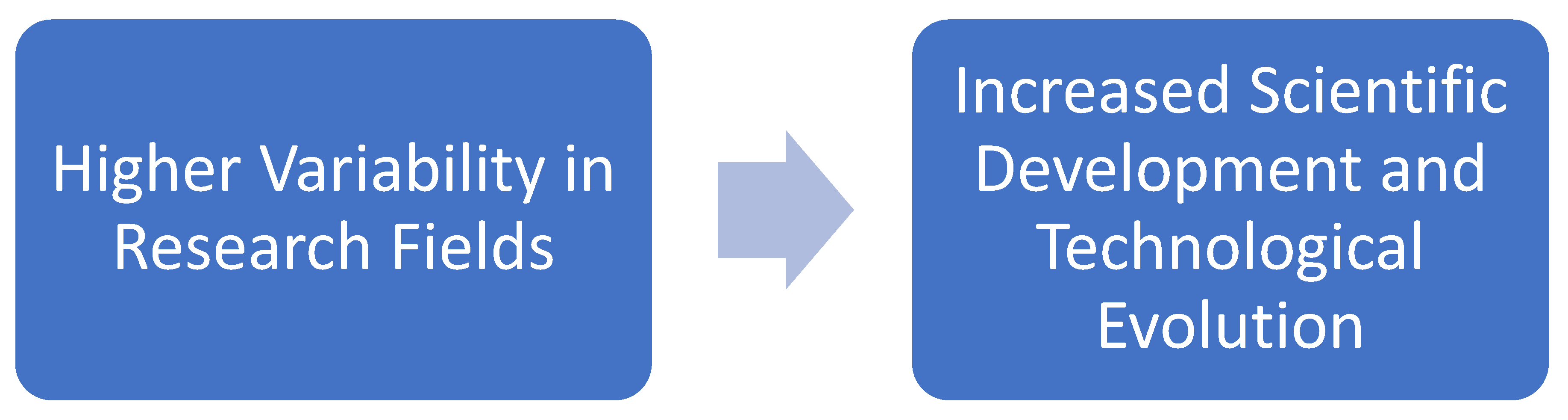
Figure 3.
Synthesis of relative entropy index and rate of growth in research fields of quantum technologies using results of Table 1 and Table 2.
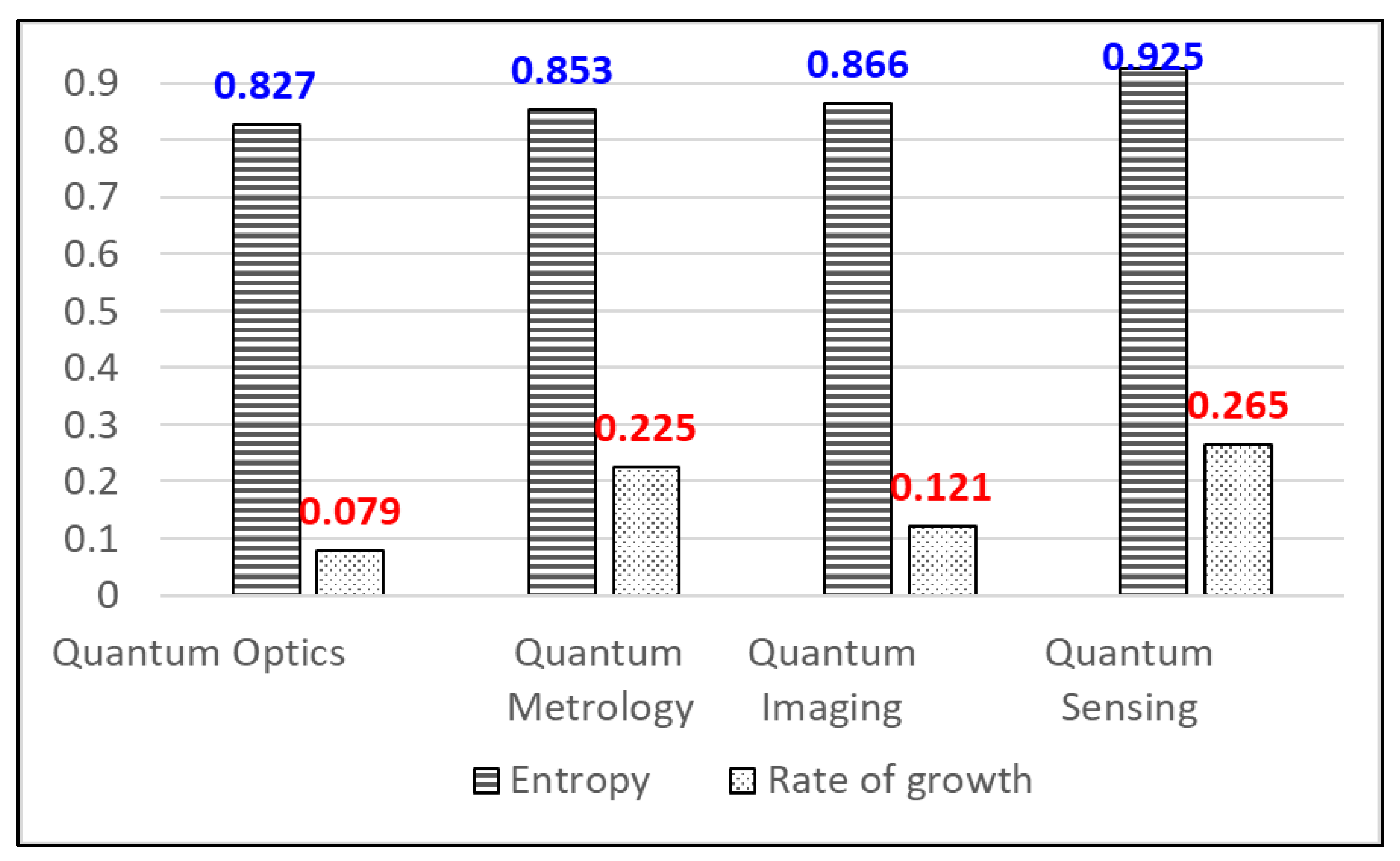
Figure 4.
Preliminary estimated relationship of rate of growth on entropy index (proxy of variability) in research fields of quantum technologies.
Figure 4.
Preliminary estimated relationship of rate of growth on entropy index (proxy of variability) in research fields of quantum technologies.
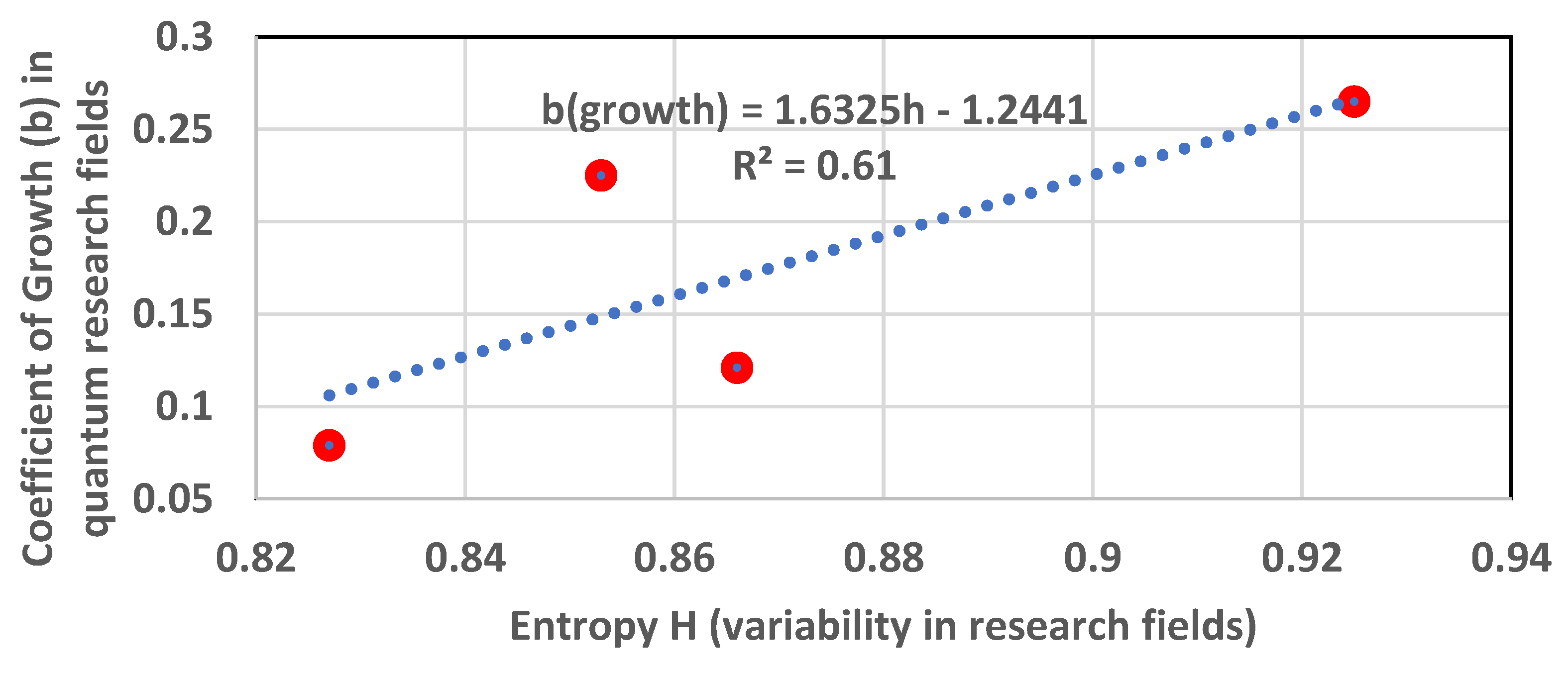

Table 1.
Relative entropy in research fields of quantum technologies.
| Research fields | Cases | Arithmetic mean | Std.Deviation | Relative Entropy, H |
|---|---|---|---|---|
| Quantum Optics | 154 | 1480.48 | 4235.48 | 0.827 |
| Quantum Metrology | 154 | 54.04 | 113.00 | 0.853 |
| Quantum Imaging | 152 | 21.29 | 42.10 | 0.866 |
| Quantum Sensing | 153 | 41.36 | 46.59 | 0.925 |
Table 2.
Estimated relationships of scientific production (publications) as a function of time.
| Dependent variable: scientific products | ||||
|---|---|---|---|---|
| Coefficient b grow | Constant a | F | R2 | |
| Quantum imaging, Log y pubs i,t | 0.121*** | −240.43*** | 39.89*** | 0.66 |
| Quantum Metrology, Log y pubs i,t | 0.225*** | −449.95*** | 247.90*** | 0.92 |
| Quantum Optics, Log y pubs i,t | 0.079*** | −151.26*** | 150.47*** | 0.88 |
| Quantum Sensing, Log y pubs i,t | 0.265*** | −530.63*** | 238.76*** | 0.92 |
Note: Explanatory variable is time in years. *** significant at 1‰; F is the ratio of the variance explained by the model to the unexplained variance. R2 is the coefficient of determination.
Table 3.
Nonparametric Correlation between relative entropy index and rate of growth in four research fields of quantum technologies.
Table 3.
Nonparametric Correlation between relative entropy index and rate of growth in four research fields of quantum technologies.
| Relative Entropy, H | Rate of Growth | ||
|---|---|---|---|
| Spearman’s Correlation, rho | Relative Entropy, H | 1 | 0.800 |
| Sig. (2-tailed) | 0.17 | ||
| N | 4 | 4 |
Table 4.
Estimated relationship of the rate of growth (b= coefficient of regression) on entropy index h (proxy of variability) in research fields of quantum technologies, OLS method.
Table 4.
Estimated relationship of the rate of growth (b= coefficient of regression) on entropy index h (proxy of variability) in research fields of quantum technologies, OLS method.
| Dependent variable: scientific products | ||||
|---|---|---|---|---|
| Coefficient z | Constant k | F | R2 | |
| Quantum technologies, b(rate of growth)ii=1,2,3,4 | 1.63 | −1.244 | 3.07 | 0.61 |
Note: Explanatory variable is relative entropy index H in quantum research fields. F is the ratio of the variance explained by the model to the unexplained variance. R2 is the coefficient of determination.
Disclaimer/Publisher’s Note: The statements, opinions and data contained in all publications are solely those of the individual author(s) and contributor(s) and not of MDPI and/or the editor(s). MDPI and/or the editor(s) disclaim responsibility for any injury to people or property resulting from any ideas, methods, instructions or products referred to in the content. |
© 2024 by the authors. Licensee MDPI, Basel, Switzerland. This article is an open access article distributed under the terms and conditions of the Creative Commons Attribution (CC BY) license (http://creativecommons.org/licenses/by/4.0/).
Copyright: This open access article is published under a Creative Commons CC BY 4.0 license, which permit the free download, distribution, and reuse, provided that the author and preprint are cited in any reuse.


