

Submitted:
12 April 2024
Posted:
15 April 2024
You are already at the latest version
Abstract
Biochar is a carbonaceous material derived from the thermochemical conversion of biomass under oxygen-lean conditions. Its properties render it many applications in agriculture, environmental remediation, and catalysis. Commonly produced by pyrolysis under a nitrogen atmosphere, the biochar composition is influenced mainly by residence time, heating rate, and process temperature. The existing literature primarily assesses biochar properties, such as ultimate, proximate, calorific, porosity, and combustibility, generated under various thermo-conversion conditions. However, there is a notable lack of sufficient investigation and attention given to the practical application of biochar. This article seeks to bridge that gap by enhancing the comprehension of the necessary experimental assessment for specific biochar applications and proposing process optimization methods using Multi-Criteria Decision Analysis (MCDA). By delving into these aspects, the study offers a concise overview of biochar production and presents a comprehensive panorama based on articles and patents. Additionally, the research explores the physicochemical characterization techniques associated with biochar and its various applications in conjunction with MCDA. This comprehensive approach aims to uncover valuable insights that could further advance the practical and sustainable utilization of biochar in a wide range of fields.
Keywords:
biochar
; pyrolisis
; thermochemical process
; characterization
; biomass
1. Introduction
Carbonaceous materials have played a significant role in human activities extensively. These materials, defined by their high carbon content (> 60% wt.), are produced through the thermal treatment of organic substances. The origins of these materials can be traced back to vegetal sources (primarily), as well as animal sources (such as agricultural residues), and even urban waste (including sludge and common domestic waste) [1,2].
Widely recognized as coal, carbonaceous materials have undergone extensive research and have attained a pivotal stage of development, serving as precursors to other commonly employed materials like activated carbon. Their remarkable adsorptive properties in both aqueous and gaseous mediums highlight the adaptability of carbonaceous materials, making it possible to modify and tailor their properties for specific purposes, similar to typical coal [3,4].
Biochar, a distinctive carbonaceous biomaterial, has garnered substantial attention in recent research. The escalating technology readiness level (TRL) of thermochemical conversion routes has significantly contributed to the increasing interest in biochar, primarily for its remarkable versatility across various applications [5]. The multifaceted potential of biochar in different domains underscores its significance in contemporary studies, and ongoing research continues to unveil more opportunities for its sustainable and effective utilization in various applications (soil amendment [6,7,8], biofuel [9,10,11], adsorbent material [12,13,14] and wastewater treatment [15,16,17]) and as a support for functionalized materials applicable in chemical synthesis.
Biochar can be produced by different thermochemical processes with controlled atmospheres (inert or oxygen-lean conditions) and a diversity of operational conditions (temperatures, heating rate and treatment time). Each process has a specific final product target, for example, torrefaction (200–300 °C, focused on biochar product [18,19,20,21]), pyrolysis (300–800 °C, whose process will also generate a gaseous and a liquid phase [22,23,24]) and gasification (600–1200 °C, where the main objective is producing synthesis gas [25,26,27,28]).
In addition, a crucial aspect of biochar production and related applications is its feedstock source, where its constituents will significantly influence the efficiency of the thermochemical process (given different degradation rates from each constituent) [29]. Therefore, different processes and related operation conditions will result in biochars with a large variety of physical-chemical characteristics, which must be assessed and assigned to a specific application.
The ongoing industrial focus has been integrating sustainable production processes, whether in conventional industrial environments (readapting parts of already established production lines) or in raw materials production, such as the agricultural sector (where the relationship with the food, materials and energy is intrinsic).
In this context, searching for new biomaterials designed around environmental impact mitigation issues attracts the most research development attention. Biochar is a clear example since it can be produced from renewable raw materials (biomass) and residues, for example, agricultural (straw, rusk, bark, bagasse, among others), and urban solids (municipal solid waste, pruning tree, sludge). Moreover, the obtained products are solid materials and other derivatives that can be used as liquid biofuels or syngas for energy and chemical synthesis [30].
In the agro-industrial context, integrating its residues into a new conversion route that can become economically viable is desirable. It aligns with biorefinery and circular thinking, pursuing minimizing the disposal of non-productive renewable residue and maximizing conversion process efficiency and product possibilities. An entire production chain can benefit from the ‘relocation’ of its residues. Figure 1 exemplifies such a concept, depicting possibilities and interactions between the correct application of recovered agro-industrial residues into new routes.
Figure 1 presents the coffee processing case. Its leading destination is the production of soluble coffee (food industry). Therefore, the spent coffee grounds are a by-product of this process (here, exemplifying the various other agricultural processes that generate residues). As lignocellulosic biomass has numerous possibilities, the pyrolysis process is highlighted as one of the possible conversion routes. Pyrolysis under suitable conditions will produce three fractions: gas (biogas), liquid (bio-oil) and solid (biochar). For the fractions, there is also a variety of possibilities. Gas and bio-oil can be used to produce direct energy as biofuels.
On the other hand, biochar can reintegrate sugarcane production as a soil enricher, or it can be functionalized and integrated into biofuel production through its acid functionalization and application as a catalyst, as described by Chin et al. [32]. Niju et al. [33] also addressed the production of biochar derived from sugarcane bagasse and its application in the transesterification of waste cooking oil to produce biodiesel. Thus, two integrated biofuel production chains can be contemplated, corroborating the feasibility of integrated biorefinery building and connecting different and more sustainable technologies.
Therefore, it is essential to acknowledge that biochar finds utility in various contexts and applications, making it crucial to assess production process conditions and the viability of specific biomass for this purpose. In light of this, specific questions arise concerning understanding the biochar formation process and its application. A fundamental aspect revolves around identifying the necessary criteria to evaluate the essential biochar properties. Additionally, one may wonder if standardized parameters apply to all biochar types. Another significant aspect to consider is the impact of biomass constituents on biochar formation and whether the properties of biochar undergo significant changes depending on the biomass origin. These questions raise a critical discussion intricately linked to investigating biochar properties, especially concerning its stability in the face of different processes to which it may be applied. Addressing these queries can significantly optimize biochar production and utilization while ensuring its efficacy and environmental benefits.
This work introduces the critical parameters for evaluating biochar production and explores how its destination/application can significantly influence these aspects. The study also discusses the evolution of biochar research over the past years through a prospective approach. Moreover, the study’s originality relies on discussing the linkage between experimental assessments and MCDA to optimize the pyrolysis process and/or set the desirable application based on process conditions and biochar properties.
2. Prospective Study on Biochar Research
The prospective study of a subject related to a specific technology helps understand the maturity and development level of a particular product or research segment [34,35]. Technological prospecting is usually carried out in three segments: a search for scientific articles/publications, patents, and/or products (focused on the technology already consolidated in the market). Therefore, the present study’s focus was to evaluate the tendency of the research related to biochar in the last 20 years. By analyzing the wealth of information gathered from scientific literature, patents, and existing biochar products, a comprehensive understanding of the advancements and potential future directions in this field was aimed. This investigation not only sheds light on the current state of biochar research but also provides valuable insights for future innovation and development in this promising area.
Web of Science, a platform with more than 20,000 indexed journals, was used for searches on the topic and associated with some related terms. The search period was defined between 2000 and 2019 with the terms shown in Table 1, searched in the title, abstract and keywords of these documents. The terms were associated with biochar, given its relation to the primary conversion processes (pyrolysis and gasification) and two possible applications (soils and catalysis) chosen as examples to be addressed herein.
Conte et al. [36] and Novotny et al. [37] have significantly contributed to the understanding and interest in studying biochar (also referred to as pyrogenic carbon) by providing valuable theoretical support. They conducted comprehensive searches based on the number of publications in recent years, covering the periods of 2000–2013 and 2007–2014, respectively. Both studies revealed a consistent and remarkable increase in the number of publications over the years, underscoring the growing interest of the scientific community in this subject. Our data update until 2022 demonstrates a substantial surge in published articles, reaching 27,138.
Figure 2 illustrates the number of publications per year to visualize this trend, clearly depicting the escalating interest and research activities surrounding biochar. These contributions have significantly enriched the knowledge landscape in this field and emphasize its importance for further scientific exploration.
In addition to the findings depicted in Figure 2, further refinement of the results can be accomplished through the Web of Science platform, enabling classification based on research fields and the countries with the highest publication rates, alongside various other classifications. The research field most closely associated with biochar is Environmental Sciences/Ecology, boasting 4,430 articles. It is closely followed by Agriculture, with 2,982 publications, and Engineering, which has contributed 2,746 articles to the corpus. Among the countries at the forefront of biochar research, China leads the way with a remarkable 4,470 articles, firmly establishing itself as a prominent contributor in this domain.
The United States secures the second position with 2,264 publications, demonstrating its significant engagement in biochar-related studies. Australia also makes a substantial impact, with 807 articles showcasing its dedication to this area of research. Biochar is associated with research in environmental sciences, ecology, and agriculture precisely because of its widespread application and greater impact in current discussions on soil sustainability. China is emerging as one of the top publishing countries in the area, mainly due to its excellent agricultural capabilities (especially for rice, corn and wheat) and new technologies associated with reducing industrial environmental impacts [38].
The Chinese Biochar Network (CNB), created in 2010, strengthened the discussion of biochar in the country within the scientific academy and industries [38]. The CNB, as well as other organizations, were also crucial in consolidating parameters for the classification of its raw material and of the product as viable for agricultural applications, highlighting the International Biochar Initiative (IBI) and European Biochar Foundation (EBC) [39].
Similarly to the Chinese publications, the United States boasts substantial agricultural production and actively seeks innovative technologies to enhance productivity while mitigating the environmental impact, especially concerning greenhouse gas emissions. The US Biochar Initiative (USBI) has played a pivotal role in this regard by expanding its activities and effectively coordinating the efforts of the country’s biochar producers. Additionally, the US has attracted investments in pilot plants specialized in biochar production, encapsulating its objectives into three pillars: soil amendment, carbon sequestration, and greenhouse gas reduction. These concerted efforts mark a significant step towards sustainable agriculture and environmental conservation practices [40].
An analysis of the results presented in Table 1 reveals that when biochar is linked to the term “soil,” it yields a total of 6.319 articles, with nearly 56% of all articles solely focusing on biochar. This number reiterates the significance of academic production in the field of soil amendment while also shedding light on research opportunities and gaps for carbon materials of higher value when applied to fine chemistry. The utilization of these materials as supports and platforms for catalyst production is particularly noteworthy in this context [41].
When comparing the number of articles, it becomes evident that technology development remains under constant research owing to its extensive applications. This is primarily because ground applications are well-established and adhere to highly advanced European standards. At the national level in Brazil, there seems to be no promising outlook for innovation projects, as they generally exhibit low success rates, with biobased innovations showing no significant improvement. As for product development, the literature consistently indicates a broad spectrum of failure rates, ranging from 30% to 80% [42].
3. Lignocellulosic Biomass in Thermochemical Conversion
Biomasses, typically of vegetable origin, are materials formed essentially from cellulose (40–50 wt%), hemicellulose (25–35 wt%), lignin (15–25 wt%) [43], extractable components (organic acids and lipids; maximum 15–20 wt%) [44] and inorganic compounds (known as ash). Due to the wide variety of vegetable products, whether residues from agribusiness (bark, straw, shavings and stems), tree pruning, wood and grasses, their compositions may be decisive in the chosen conversion route [45]. This consideration becomes particularly crucial in thermochemical processes, especially in the most common production process of biochar, which is pyrolysis.
The complex plant structure means that the three main components of lignocellulosic biomass are not necessarily well distributed and well separated from each other, as well as depending on the part of the plant that gave rise to this biomass, the proportion between them will change. Analyzing this aspect may seem an indirect factor in evaluating and performing the conversion processes. The fact can be exemplified in a scenario in which biomasses have higher fractions of thermo-resistant compounds, as in lignin. With the increase in temperature, the probability of generating a greater quantity of solid product is more significant due to its greater amount of fixed carbon, which becomes aromatic compounds of greater molecular weight (without considering a comparison of the adjustments of the process parameters) [46].
Several authors have been working on biomass constituents’ degradation process within the thermochemical processes by comparing theoretical and experimental kinetic models [43,44,47]. The experimental conditions will determine the quantitative profile of the fractions derived from the conversion (greater or lesser quantity of a certain fraction). However, the qualitative profile of these derivatives will also be necessary, resulting from the characteristics of cellulose, hemicellulose and lignin in this matter -cousin. Knowing that the degradation process occurs first by hemicellulose (200–300 ºC), followed by cellulose (300–400 ºC) and finally lignin (600 ºC) [48,49], even if overlapping in some temperature ranges, monitoring its derivatives for each degradation zone helps to understand the composition of the final product. Understanding the behavior of each of its components in the conversion process allows us to make significant advances in optimizing these processes and the scale-up of these technologies [44].
EBC makes available a document referring to a set of biomasses classified in categories, primarily by their origin, appropriate for producing biochar [50]. Various raw materials can be observed, ranging from biomass from agricultural waste to waste from the food industry. The agro-industrial activities of each country will be decisive for the type of raw material available for biochar production. Thus, it is worth noting that the regional context will be an essential factor in the assessment for implementing the use of this material, in addition to the technology available for its production (essentially the reactors necessary for its production and the scale available).
4. Biochar Production
Biochar, also called pyrogenic carbon [37], black carbon [51] or charcoal, sometimes associated only as the carbonaceous material with specific application to the soil, is generally defined as the solid carbon-rich material obtained from the biomass thermoconversion into an environment with little or no oxygen [49,52]. Atmospheric conditions allow the formation of a material with unique characteristics due to incomplete combustion caused by the lack of an oxidizing agent that triggers the condensation of the biomass components.
The biochar is produced essentially by the pyrolysis process between temperatures that vary on average from 300–700 ºC (it may even be more depending on the type of reactor) [37]. In pyrolysis, three fractions are formed: a gas (non-condensable compounds), a liquid (bio-oil) and a solid (biochar). The proportion between these three fractions will depend on experimental conditions such as temperature, heating rate, residence time and type of pyrolysis. There are three main types of pyrolysis:
- Flash pyrolysis: operates at high temperatures (above 800 ºC) with an even shorter residence time than fast pyrolysis (< 0.5 s) and heating ramp > 1000 ºC min–1[39].
Understanding the different types of pyrolysis systems affects the proportion of the products in the process, the general mechanisms of forming these components can be explored. Figure 3 shows the three possible fractions of biomass pyrolysis, a gas phase consisting of non-condensable gases (H2, CO, CO2, CH4, in addition to other lighter hydrocarbons), the liquid phase comprising organic acids, water and the tar of lower molecular weight and the solid phase (biochar) [39]. During the evolution of the process and the thermal exchange carried out with biomass, understanding the mechanisms of formation of these fractions makes it possible to investigate the stability and viability of each one [46]. With an emphasis on biochar formation, this translates into the desire to form a stable carbonaceous material of known composition at the end of the process, established physicochemical properties and thus suitable for its application.
Figure 3 shows the mechanisms that guide the formation of each fraction and how they relate to the intrinsic composition of biomass reported by Collard and Blin [29]. During the thermal degradation process, the inter/intramolecular interactions of cellulose, hemicellulose and lignin begin to rearrange and break up, forming volatile compounds and changing the arrangement of their solid structure. This step concerns the primary mechanisms. Then, some volatile compounds and the primary products can recombine with each other, thus called a secondary mechanism.
In the primary mechanism, three main segments are highlighted during pyrolysis: char formation, depolymerization and fragmentation. It is worth pointing out and highlighting that, just as monomers of the polymeric structure can break (depolymerization), that chain fragmentation can occur, forming non-condensable gases (fragmentation). The resulting solid structure will be rearranged, favoring the formation of a more aromatic polycyclic structure stable with the concomitant release of low molecular weight compounds and water [29,46]. The reaction temperature will have a significant effect in this sense. Some authors suggest that the optimum temperature of the process is around 450 ºC, being flexible in an area that goes from 300–500 ºC to reach good biochar yields [39].
Steiner [55] points out that temperature plays a central role in the final characteristics of biochar. Although the residence time and the heating rate complement the aspects related to the process, several examples in the literature compare biochar’s stability and physical-chemical properties from different temperatures and standardize the same conditions as the other variables [56,57]. Keiluweit et al. [51] propose a diagram of how the transformation of biomass and its constituents occurs in the four types of char evidenced by the increase in temperature, illustrated in Figure 4. In addition, a gravimetric comparison of the fractions of char categorized in five different regions, which may summarize distinct characterization properties and possible applications.
The physicochemical properties relevant for the Region I (unaltered plant materials) include moisture content and functional groups, information relevant only for torrefaction products. Region II is associated with transition char and may include data similar to those obtained from Region I, applicable for material with desirable functional properties, such as adsorption unactivated char. The Regions III and IV char materials present properties relevant for surface and pore sizes, as well as fixed carbon contents, and may be relevant for applications related to physical or chemical adsorption. Region V char present material with unstable resistance and does not present interesting properties for char application [51].
5. Physicochemical Characterization of Biochar
The physicochemical characterization of a material is directly associated with investigating its fundamental properties related to its application or target destination. There are not always standard protocols for all types of materials; hence, there is a need to standardize them in some way to compare results and prove their effectiveness, whatever their application; this is the case of lignocellulosic biomasses. Although their primary constituents are known (cellulose, hemicellulose and lignin), their chemical composition is very variable since the proportion between these will change from species to species and depending on the part of the plant (leaves, branches, trunk, bark, bagasse, etc.) [58]. Groups like the National Renewable Energy Laboratory (NREL) [59] have established standard biomass analysis procedures that are a reference for several research groups, in addition to complementing some existing adapted procedures described by ASTM-certified institutions.
The same is valid with biochar; there are not necessarily uniform procedures in all countries for the analysis and application of the material. However, some organizations stand out and promote the centralization of these procedures. The International Biochar Initiative (IBI) [60] proposed the primary physicochemical analysis to be evaluated for producing biochar with application in soils. Several similar organizations are partners with IBI and share several analysis procedures [61]. Meanwhile, IBI is a signatory to the procedures described by organizations such as the International Standards Organization (ISO), ASTM International (ASTM) and the Institute of Electrical and Electronics Engineers (IEEE). Not all the characteristics of biochars are exploited by these procedures since they determine a specific application. Thus, to cover other studies that contemplate biochars destined to different areas, as in wastewater treatment, other characterization techniques will be described.
It is essential to highlight that the varied composition of biomasses, which depends on their type and origin, influence the composition of the derived biochar (logically if there is a comparison based on experimental conditions). It is, therefore, vital that the characterization process is conducted for any type of biochar due to the diversity of possible biomasses that have not yet been exploited for this purpose [58].
An adequate biochar characterization raises important considerations concerning essential characteristics when applying a thermochemical process to biomass. Among these considerations, the following questions stand out: Did the process conditions (including temperature, heating ramp, and residence time) adequately facilitate the degradation of biomass constituents and the formation of a stable solid? How can stability be measured? When utilized in soil applications, a pivotal characteristic becomes moisture retention and the material’s porosity and hydrophilicity. These and other questions will be necessary to establish the properties that will be investigated for the applications already known and to explore new possibilities with these materials, showing again that the application will significantly affect the type of characteristics that will be analyzed.
5.1. Main Standard Biochar Characterization
The EBC described the leading techniques and requirements for biochar characterization in a document comparing its procedures with the points required by the IBI [61]. Both have a vision for application directed to use on the ground, as they define it in their design, while concisely discussed in Table 2.
The characterizations for biochar are also commonly required for their original raw materials. As with the immediate analyzes where moisture, volatiles, ash and fixed carbon are evaluated [62], these will be essential parameters in the processing of pyrolysis (also associated with the issue of forecasts regarding yield and process efficiency) and are also present among the analyzes performed with the biochar.
Biochar parameters include pH, organic carbon (OC) content, volatile compound content, ash content, elemental composition, nutrient content, plant-available nutrients, bulk density, pore volume, porosity, specific surface area, water holding capacity, cation exchange capacity (CEC), iodine number, surface functional groups, sorption properties, nutrient release dynamics, and stability. Some of these parameters are challenging to assess.
Some characteristics, such as surface area, are mainly influenced by production conditions. The density and initial pore-size distribution of feedstock are also critical. Huge surface areas characterize activated carbon, and the pore-size distribution depends on the lignin or cellulose content of the feedstock. A superior lignin content is generally responsible for a macroporous structure, whereas a higher cellulose content yields a microporous structure [55].
5.2. Atomic H/C and O/C Ratios
According to the IBI and EBF, H/C and O/C can classify biochar samples. The classification based on H/C is preferable due to the H direct experimental determination, whereas O is indirectly determined. IBI classifies biochar samples based on organic carbon contents, being Class 1 OC ≥ 60%, Class 2 30% ≤ OC < 60%, Class 3 10% ≤ OC < 30%, and non-biochars OC < 10%. [63] The atomic H/C ratios might be used to predict pyrolytic temperatures, aromatic cluster sizes and sorption properties. [64] However, O/C can be used to estimate carbon stability in biochar samples. Spokas [65] stated that the half-life of an O/C < 0.2 biochar would be >1000 years, for an O/C 0.2–0.6 biochar sample, the half-life would be 100-1000 years and for O/C > 0.6 the half-life would be < 100 years. Table 3 shows the % C, H and O, the H/C and O/C.
Figure 5 presents the Van Krevelen diagram illustrating the standard regions of biomass and derived biochars based in Table 3. This diagram proves valuable in assessing the coalification and reaction pathways of the modified products [68]. It offers valuable insights into the reduction of polarity (O/C) and aromaticity (H/C), as well as the extent of reactivity (degradation of carboxyl and hydroxyl groups) [69,70].
The conversion of hemicelluloses (at temperatures ranging from 200 to 350 °C) involves a process of dehydration combined with the cleavage of weak linkages between small substituents and the leading polymer chains [71]. In the case of cellulose, dehydration reactions start at approximately 200 °C, releasing water as the primary product. As the temperature increases to around 280 °C, the reactions release CO, CO2, and small organic compounds [72]. On the other hand, lignin undergoes a gradual and partial degradation during torrefaction, commencing from around 200 °C. Its dehydration reactions involving the hydroxyl substituents of the phenolic rings take place at lower temperatures [73]. Understanding these thermal conversion processes and their corresponding temperature ranges is crucial for optimizing pyrolysis and tailoring the properties of the resulting biochar.
5.3. Calorific Value
The increase in temperature in biochar production decreases the H/C ratio due to the condensation of carbonaceous structures and increases the calorific value of this material. The High Heating Value (HHV) indicates an upper limit for the available thermal energy produced on a given combustion and stands as the main comparison parameter for the combustion of biochar samples [4]. Padilla et al. [48] characterized the biochar produced from eucalyptus bark at temperatures of 300–500 ºC. Their study reported increased calorific value from 20.88–22.94 MJ kg–1, respectively. The use of coal as a source of increasing the energy density of a product is a resource that has also been explored for biochar. Since the material has a calorific value greater than its original biomass, its use for energy will be much more profitable with the concomitant possibility of generating other derivatives that may also integrate the fuel chain, as is the case of bio-oil production. Miranda et al. [74] used Brazilian residual biomass studying its pyrolysis process and consecutively applying biochar in gasification since the increase in carbon content would significantly influence the syngas profile using biochar instead of crude biomass.
5.4. Spectroscopic Analysis
Spectroscopic analyses are commonly used to analyze the profile of the molecular bonding/interaction types in each compound. For the biochar, this analysis is combined with the comparison with its original biomass since, in the degradation process, some functional groups are disrupted, and chemical bonds of the C-C type associated with the formation of the carbonaceous material are formed more intensely. Such a principle will also be essential to corroborate a process temperature gradient (if addressed) since there is an increasingly intense degradation of the original compounds with increasing temperature.
5.4.1. Fourier Transform Infrared (FTIR) Spectroscopy
FTIR is an absorption and vibrational technique in which biochar surface functional groups absorb the energy of a beam and emit the energy at a different frequency. After data processing (Fourier transformation) is possible to identify characteristic bands for different functional groups, such as hydroxyl, carbonyl, esters, aromatic rings and others, allowing the direct study of the biochar decomposition degree [75,76]. Table 4 shows the leading characteristic of stretching.
The most classical biochar FTIR method consists of preparing KBr pastilles and analysis on standard FTIR equipment. Biochar samples may also be prepared in KBr pellets for Diffuse Reflectance Infrared Fourier Transform Spectroscopy (DRIFTS), placed over a crystal for Attenuated Total Reflectance Fourier Transform Infrared (ATR-FTIR), disposed on photoacoustic cells with the Fourier Transform Infrared Photoacoustic Spectroscopy (FTIR-PAS), or even treated with synchrotron radiation for Synchrotron-based Fourier Transform Infrared (SR-FTIR) [77,78,79,80,81].
5.4.2. Raman Spectroscopy
Raman Spectroscopy is a scattering and vibrational technique on which a beam is applied over a sample and dispersed in frequencies related to the photon’s vibrational states post-exposition. The scattering is elastic (input and output frequencies are the same – Rayleigh scattering) and inelastic (output frequencies are higher or lower than input – Stokes and Anti-Stokes Lines). The Stokes and Anti-Stokes lines (given in cm–1) compose a quantifiable fingerprint pattern for the molecule, or in the case of biochar materials, the fingerprint of a specific point on the surface [81,82].
Therefore, Raman Spectroscopy (Figure 7) might be used to identify functional groups and carbonaceous structure aspects, such as amorphous and crystalline, as described by Wu et al. [83]. Although FTIR and Raman’s analysis are complementary techniques for biochar study, Raman has higher sensitivity, suffers less interference from water, and requires minimal sample preparation, although at a higher cost, limiting its adoption [81,82,84].
The Raman spectroscopy as a characterization technique for crystalline and amorphous carbon materials is directly dependent on two modes, band D and band G, as represented in Figure 7. The D band over 1350 cm-1 is commonly assigned to K-point phonons with A1g symmetry. At the same time, the G band between 1580 and 1600 cm-1 is usually attributed to E2g symmetry zone center phonons. Amorphous carbon material comparisons using fix values of λ and integrated D (Id) and G (Ig) bands allow ordering identification. Consequently, for amorphous carbonaceous samples, Id/Ig increases with increasing ordering or crystallinity [84,85].
5.5. Thermogravimetric Analysis (TGA)
TGA is a technique where a sample is heated from room temperature until 1000 °C at a steady flow of nitrogen, helium or air, and a weight loss pattern is registered. The interpretation of the final TGA pattern allows the assessment of structural stability, moisture content, inorganic content (ashes content), and loss of characteristic functional groups and may also be used for kinetic studies and feedstock pyrolytic temperature assessment. Biochar materials prepared below 400 °C are less stable than those prepared above 400 °C due to the greater stability of cyclic carbon chains formed at higher temperatures. Degradation temperatures vary based on the material stability, but commonly, degradations between 100 and 200 °C are assigned to loss of water, between 200–600 °C to volatile matter, and the residue past 600 °C to inorganic materials, if under air flow, or inorganic materials and graphite, if under He or N2 flow [81,86]. Figure 8 presents the weight loss patterns for residual brewer spent grains biomass and biochar samples [31].
5.6. Scanning Electron Microscopy (SEM)
SEM is a morphological technique for the characterization of surfaces. When applied to biochar, it is possible to identify pore arrangement and distribution. In direct contrast, SEM coupled with Energy Dispersive X-Ray spectroscopy (EDX) allows the localized estimation of surface elemental composition and, therefore, can be used for elemental mapping post-adsorption, as shown in Figure 9 [87,88,89].
5.7. Böehm Titration—Functional Group Identification and Acidity Analysis
The Böehm titration technique, first proposed by Böehm in 1994 [90], is a characterization method for the quantification and identification of oxygenated groups on the surface of carbonaceous materials, such as biochar. The method is based on the acidity difference between oxygenated groups. Carboxylic acids, phenols and lactic groups are neutralized by sodium hydroxide, carboxylic acids and lactic groups are neutralized by sodium carbonate and carboxylic acid groups are neutralized by sodium bicarbonate. The biochar samples undergo a pre-treatment by washing to remove superficial inorganic compounds to avoid interferences, while the system itself is degassed with Ar or N2, reducing the effect of dissolved CO2 [91].
5.8. Solid-State Nuclear Magnetic Resonance (ssNMR)
The ssNMR of 13C is a spectroscopic technique used to study the structural compositions of carbonaceous materials. On biochar, C13 ssNMR allows the determination of carbon-containing compounds and groups, such as aliphatic and aromatic hydrocarbons, phenolic and methoxyl groups and others. Moreover, ssNMR and FTIR are commonly and simultaneously used to identity structure and functional biochar groups [92,93].
5.9. X-ray Photoelectron Spectroscopy (XPS)
XPS analysis allows the identification of compounds and bonds on a particular point of the biochar surface at a depth of up to 10 nm. It is an essential technique for determining heavy metals and may also be used to determinate elements on the surface of biochar, such as Fe, Mn, Si, Al, Na, N, O and others [94,95,96].
Acho que poderiamso pensar em acrescentar o PH
6. Biochar Application
6.1. Soil Amendment
Soil amendments must possess properties such as high binding capacity and environmental safety and should have no adverse effect on the soil structure, soil fertility, or the ecosystem on the whole [36]. By definition, biochar consists of relatively labile aliphatic carbon, stable aromatic carbon, and mineral ash. Because of that, the use has been accepted as a sustainable approach and a promising way to improve soil quality and remove heavy-metal pollutants from the soil. Moreover, it has been used to promote improvements in soil properties, which is particularly important. It may be argued that it is necessary for regions where naturally poor soils predominate, whose fertility and structure maintenance depend almost exclusively on the conservation of soil organic matter [97].
A high surface area and abundant functional groups are favorable if high sorption potential (e.g., nutrient retention and adsorption of pesticides or toxic compounds) is needed. If used as a bulking agent during organic waste composting, larger particle size is advantageous, whereas powdery biochar might be better for other applications, such as the remediation of contaminated soils. Additionally, ash-rich biochars may increase soil pH and EC and provide nutrients, whereas biochars rich in volatile matter may reduce nitrogen availability. Biochars with a high OC content and relatively low ash and volatile matter content (clean biochars) are versatile, ranging from potting media to bulking agents and soil amendment [37].
6.2. Catalysis
Applying biochar as catalysts (catalyst support or heterogenic catalyst) is directly dependent on the mass transport phenomena. Functional sites must be accessible for subtracts while successfully diffusing the products out of the catalytic interface. The control of access and diffusion is accomplished by the pore size/volume control, surface activation/functionalization and distribution of active sites. Thus, information about pore structure, pore volume, superficial area and distribution of active sites are the most important properties related to biochar as a catalyst [41,98].
Biochar supports heterogeneous catalysts based on noble, non-noble, and bimetallic metals. In addition, it applies to biorefinery processes: esterification, transesterification, hydrogenation, catalytic reform, catalytic pyrolysis, hydrolysis, Fisher-Tropsch reactions, isomerization, electrocatalysis and others [98,99]. Yan and coworkers [100] showed the effectivity of iron nanoparticles, supported over biochar, for converting syngas into liquid hydrocarbons by Fisher-Tropsch synthesis. Biochar was demonstrated to be effective as a solid acid catalyst for the transesterification of oils and esterification of oleic acid due to its density of sulfonic acid groups, hydrophobicity and site strength [101,102].
Biochar was also demonstrated to be an efficient and low-cost catalyst for removing tar in the catalytic reform process of pyrolytic biomass volatiles [103]. Biochar catalysts presented great catalytic activity in producing phenols and hydrogen-rich gas from catalytic pyrolysis of Sargassum brown macroalgae [104]. Biochar was studied by Zhao and coworkers [105] as an activator for peroxymonosulfate and applied to the degradation of organic contaminants in water. Therefore, biochar-based catalysts represent a cost-effective and catalytic active possibility for a broad range of applications [98].
The characterization techniques of biochar as catalysts and their application are directly related. The results of the direct comparison are often limited due to non-standard methodologies. For instance, in biodiesel production using sulfonated biochar, Cao and collaborators demonstrated the application of sulfonated corncob biochar to the esterification of oleic acid [106]. The biochar catalyst was characterized by elemental composition, BET, XRD, FT-IR, XPS, TGA and SEM+EDS, while the –SO3H content was determined by Boehm tritation. Corrêa et al. demonstrated the activity of murumuru kernel shell sulfonated biochar catalyst on the esterification of oleic acid [107]. The catalyst was characterized by SEM, EDS, CHN, FT-IR, Raman, TGA and XPS. The –SO3H content was determined by NaOH tritation.
Azman and collaborators showed the application of activated woodchip biochar on waste oil esterification/transesterification [108]. The biochar catalyst was characterized by XRD, TGA and FESEM (Field Emission Scanning Electron Microscopy). Daimary and co-workers presented the application of potato peel alkaline biochar on the cooking waste oil esterification/transesterification [109]. The catalyst characterization methods included XRD, FTIR, TEM, EDX and FESEM, while the catalyst basicity was determined by Hammet indicator test.
6.3. Biofuel
The biomass pyrolytic process, fast or slow, produces tree main portions with the energetic application. The gas phase might be used as a hydrogen source, the liquid phase as a fossil fuel substitute, and the solid phase (biochar) can be used as a substitute for coal [110,111]. Therefore, solid fuel sources for bioenergetics applications must be energetically dense, with proper fuel ratio, combustibility index and high heating values (HHV) [4,18,112,113].
Thermo-chemical processes might enhance the quality of biochar as an energetic source. The main objective of such is to increase density while decreasing O/C and H/C ratios [110,122,123]. Some applications for biochar as solid fuel are shown in Table 5, where it is possible to identify the correlation between biochar preparation conditions and HHV. In other fuels-related applications, biochar as an electrode has been studied in the composition of solid oxide fuel cells with exciting results [124,125]. One such is using the composition of anodes for lithium-ion batteries, where extensive surface area, porosity and ion storage capabilities are desired [126].
6.4. Wastewater Treatment
Wastewater treatment solutions based on biochar adsorption depend on the material’s adsorption capabilities. On the other hand, the biochar adsorption capabilities depend on parameters such as superficial area, pore volume, activation and functionalization processes, among others [127,128]. Therefore, a functionalized high surface area is desirable for higher adsorption values, while the pore volume can be tuned to assign selectivity to the process [128,129].
Different contaminants require different biochar parameters for efficient adsorption and possible desorption for biochar recycling/reuse [130,131]. The publications on wastewater treatment with biochar present adsorptions with synthetic solutions of contaminants, varying between antibiotics, dyes and toxic metals [132,133,134]. Some studies with possible water contaminants, such as tetracycline (antibiotic), methylene blue (dye) and Cr (III)/Cr(IV) (toxic metals), are compiled in Table 6, which identifies the direct relation between adsorption capabilities, superficial area, pore volume and temperature/activation conditions.
5. Multi-Criteria Decision Analysis
Different technologies characterize the thermochemical conversion route, which refers to various biomass feedstock and operational conditions, reflecting different applications that often conflict with each other, thus requiring multidisciplinary decision support. Therefore, for an optimized and comprehensive decision-making process, it is critical to include multiple criteria, allowing the selection of feedstocks, technologies, and operational conditions for a specific biochar application. Multi-Criteria Decision Analysis (MCDA) is a tool that can effectively contribute to answering that challenge.
Previous literature reviewed the way, the scope, and the multi-criteria techniques that have been applied up-to-now to waste to energy management, considering anaerobic digestion, incineration, gasification, landfill to gas and pyrolysis routes [146]. The study reported the application of different MCDM techniques, mainly focusing on selecting WtE generation technologies based on environmental, economic, technical, and socio-political [147]. The reviewed literature evaluates the technologies that could efficiently convert biomass by applying technologies WTE to produce different energy carriers [147,148,149,150,151]. However, few studies in the literature applied MCDM, focusing on evaluating and optimizing specific WTE technologies based on the produced biochar properties and their applications.
The previous study has applied MCDM (Dominance analysis and metric distance based on the approach of compromise programming) to select optimum operational parameters for pyrolysis grape pomace [152]. The MCDM evaluated the pyrolysis operational parameters (temperature and heating rate) considering the criteria that most favor biochar for biofuel application (solid yield, carbon content, HHV, and Activation energies from pyrolysis kinetics) [152]. In addition, soil amendment application was assessed considering the criteria: solid yield, carbon content, H/C, O/C N, P, Mg and K biochar contents. The results demonstrated that multi-criteria decision methods could help determine the biochar’s advantages for each application, depending on the associated production process characteristics [152].
Regarding wastes from food industries, the valuation route of pequi seed and its extractives was investigated using MCDM and considering pyrolysis, gasification and transesterification WTE routes [26]. The obtained biochar at different temperatures was investigated for biofuel and soil amendment applications. Results provided insights into the energetic supply and demand in local/rural communities, showing that the decision support method helped identify and compare the optimal conversion parameters.
Past work assessed spent coffee grounds and brewers’ spent grains considering biochar production via pyrolysis for biofuel (biochar criteria: H/C, O/C, HHV, EF and EY) application [31]. The MCDM results recommended optimum operational conditions to valorize low-cost feedstock more economically through pyrolysis and gasification.
MCDM was applied to investigate and define optimum biomass blends from urban forest wastes (pruning waste) for biochar production as biofuel via mild pyrolysis (torrefaction) [68,153]. As indicated, the MCDM allowed identifying the optimum conditions for each application and the definition of an optimized blend.
In a recent and complete study, Petrova et al. [154] performed a multi-objective decision analysis of produced biochars (grape pomace, cherry, peach, colza, sunflower husks, and softwood). Utilizing the experimentally obtained physical and chemical characteristics of the produced biochar (500 °C), a decision-support tool was employed, concentrating on its potential functions as a biofuel, catalyst, CO2 sequestration method, soil enhancement, and even as a supercapacitor [154]. The evaluation aimed at aiding decision-making revealed that biochar derived from peach stones, cherry stones, and grape pomace exhibited the most advantageous results for various applications, encompassing biofuel. Furthermore, the CO2 adsorption potential of biochar suggests its utility could go beyond just energy conversion techniques.
In this context, the scientific challenge of the topic under consideration can be categorized into three main categories: (i) knowing which MCDM provides a multifaceted analysis with less effort for a specific application, (ii) knowing which properties (criteria) must be assessed for each specific application, (iii) the applied analytical technique evolved to characterize the obtained biochar and obtain those properties, and (iv) conducting the process optimization for a specific thermochemical route.
7.1. MCDM Criteria Selection, Analytical Technique, and Optimization
Due to its versatile physicochemical properties, biochar is indicated to have various potential applications [152]. For example, biochar can be used as biofuel, fertilizer, catalyst and absorbent depending on its different properties derived from the process operational conditions. In addition, specific biochar properties are benefic for some applications. Therefore, the step of criteria selection is essential and depends mainly on biochar criteria that have the most influence for a determined application and less complex/expensive analytical technique. Table 8 summarizes the MCDM studies indicating the investigated lignocellulosic biomass, evolved criteria, required analytical techniques and decision methodology for each biochar application. In addition, studies related to wastewater treatment were selected to allow insight for future research.
Table 8 identifies the criteria for each application. Biofuel: Biochar may be suitable as an alternative solid biofuel compared to raw biomass and has a lower CO2 emission than coal. Even though the concerns with yield capacity may not yet be settled for large-scale (industrial) applications, advantageous biochar characteristics show promise in management and energy recovery. As can be seen in Table 8, previous studies focussed on proximate, ultimate and calorific analysis and TG/DTG for assessing combustion behavior. Therefore, MCDM criteria selection must focus on lower moisture content, higher fixed carbon, lower volatile matter and ash content, lower H/C and O/C and higher HHV for biofuel applications. The activation energy (mainly in the devolatilization stage) should be evaluated considering combustion behavior.
Catalyst: Catalyst processes are known to use carbon-based materials, where biochar can have its role. As depicted by Table 8, only one study applied MCDM to evaluate six biochar produced at 500 °C for catalysis application. For instance, a higher specific surface area (SSA) and K, Ca, P and C contents indicate a better biochar for this application.
Soil amendment: Biochar possesses considerable benefits for soil enhancement. Considering the three studies that assessed biochar for soil amendment application, the explored criteria contemplated a higher biochar yield with more excellent carbon content and lower O/C and H/C. Moreover, a biochar with superior SSA and K, N, P, Ca and Mg (%) is beneficial. In addition, higher bulk density, electric conductivity, and pH are also aimed. As stated by [154], the comparable characteristics of biochar have potential applications in other processes, such as carbon dioxide (CO2) capture and the advancement of supercapacitors, owing to its significant specific surface area, porous framework, surface functional groups, and substantial mineral content.
Wastewater treatment: Biochar as an adsorbent for water treatment is considerably more efficient than non-treated biomass. The adsorption capabilities, and therefore application, of such materials are directly linked to the pyrolytic conditions, activation and superficial characteristics. From the literature review (Table 8), no study has applied MCDM to evaluate produced biochar aim to apply to wastewater treatment. Based on the assessed properties of the previous research [81,135,136,137,138,140,141,142,143,144,145], MCDM criteria selection must include higher SSA, higher pore volume, higher Raman ID/IG and higher adsorption capability.
7. Conclusions and Perspectives
Biochar production is one of the most efficient possibilities for using agro-forests-industrial residues. Therefore, it is directly linked to the circular economy concepts, mainly on the WtE, while also aligning with the 17 goals for sustainable development established by the United Nations [155].
Biochar, at its most simple definition, is a carbon-based material used in soil remediation processes. This review gives a broader contextualization for its different definitions, source lignocellulosic biomass, production techniques, characterization methods, applications and multi-criteria analysis.
The versatile physicochemical properties of biochar highlight its potential for diverse applications, ranging from biofuel production and catalysis to soil enhancement and wastewater treatment. The selection of criteria is a crucial step in determining the suitability of biochar for specific applications, and this choice is influenced by the dominant factors governing each use case. While primary studies have provided insights into biochar’s potential as biofuel, there remains a need for comprehensive multi-criteria decision-making (MCDM) assessments in several areas, including catalysis and wastewater treatment. Moreover, due to its unique physical attributes, biochar’s exceptional properties also extend to emerging fields like carbon capture and supercapacitor development.
To further the knolowdge, future investigations could ally economic and environmetal aspects such as energy expenditures for biochar production and impact categories (such as Global Warming Potential) from life cycle assessment. These assessments would guide the selection of biochar properties that hold significance for each application, ultimately contributing to informed decision-making in the sustainable utilization of biochar’s capabilities.
The amount of studies related to biochar preparation, characterization and usage is expected to increase in the following years, along with implementing more efficient processes and green energy plants. This prospect indicates a bright future for countries with abundant biomass and that more studies must be conducted to implement biochar materials in more complex applications, effectively promoting sustainable development.
Acknowledgments
The authors would like to thank the support of the National Council for Scientific and Technological Development (CNPq) for the PhD scholarship granted to Rafael Evaristo, the Coordination of Superior Level Staff Improvement – Brasil (CAPES) for the PhD scholarship granted to Romulo Dutra, the Federal District Research Support Foundation (FAPDF) and the Institute of Chemistry of the University of Brasília (IQ-UnB). We would also like to thank prof. Dr. Mario Costa (IDMEC/IST/ULisboa) and prof. Dr. Julio Lemos de Macedo (IQ-UnB).
References
- Sieradzka M, Kirczuk C, Kalemba-Rec I, Mlonka-Mędrala A, Magdziarz A. Pyrolysis of Biomass Wastes into Carbon Materials. Energies 2022;15:1941. [CrossRef]
- Menezes LNB, Silveira EA, Mazzoni JVS, Evaristo RBW, Rodrigues JS, Lamas GC, et al. Alternative valuation pathways for primary, secondary, and tertiary sewage sludge: biochar and bio-oil production for sustainable energy. Biomass Convers Biorefinery 2022. [CrossRef]
- Glushkov D, Nyashina G, Shvets A, Pereira A, Ramanathan A. Current Status of the Pyrolysis and Gasification Mechanism of Biomass. Energies 2021;14:7541. [CrossRef]
- Xie Y, Wang L, Li H, Westholm LJ, Carvalho L, Thorin E, et al. A critical review on production, modification and utilization of biochar. J Anal Appl Pyrolysis 2022;161:105405. [CrossRef]
- Al-Rumaihi A, Shahbaz M, Mckay G, Mackey H, Al-Ansari T. A review of pyrolysis technologies and feedstock: A blending approach for plastic and biomass towards optimum biochar yield. Renew Sustain Energy Rev 2022;167:112715. [CrossRef]
- Tran H-T, Bolan NS, Lin C, Binh QA, Nguyen M-K, Luu TA, et al. Succession of biochar addition for soil amendment and contaminants remediation during co-composting: A state of art review. J Environ Manage 2023;342:118191. [CrossRef]
- Mosa A, Mansour MM, Soliman E, El-Ghamry A, El Alfy M, El Kenawy AM. Biochar as a Soil Amendment for Restraining Greenhouse Gases Emission and Improving Soil Carbon Sink: Current Situation and Ways Forward. Sustainability 2023;15:1206. [CrossRef]
- Zhou S, Jiang Z, Shen J, Yao Q, Yang X, Li X, et al. Biochar-amended compost as a promising soil amendment for enhancing plant productivity: A meta-analysis study. Sci Total Environ 2023;879:163067. [CrossRef]
- Mbugua Nyambura S, Li C, Li H, Xu J, Wang J, Zhu X, et al. Microwave co-pyrolysis of kitchen food waste and rice straw: Effects of susceptor on thermal, surface, and fuel properties of biochar. Fuel 2023;352:129093. [CrossRef]
- Zhang C, Wang M, Chen W-HH, Zhang Y, Pétrissans A, Pétrissans M, et al. Superhydrophobic and superlipophilic biochar produced from microalga torrefaction and modification for upgrading fuel properties. Biochar 2023;5:18. [CrossRef]
- Cueva Zepeda L, Griffin G, Shah K, Al-Waili I, Parthasarathy R. Energy potential, flow characteristics and stability of water and alcohol-based rice-straw biochar slurry fuel. Renew Energy 2023;207:60–72. [CrossRef]
- Liu W, Zhang X, Ren H, Hu X, Yang X, Liu H. Co-production of spirosiloxane and biochar adsorbent from wheat straw by a low-cost and environment-friendly method. J Environ Manage 2023;338:117851. [CrossRef]
- Liang H, Wang W, Liu H, Deng X, Zhang D, Zou Y, et al. Porous MgO-modified biochar adsorbents fabricated by the activation of Mg(NO3)2 for phosphate removal: Synergistic enhancement of porosity and active sites. Chemosphere 2023;324:138320. [CrossRef]
- Li H, Tang M, Huang X, Wang L, Liu Q, Lu S. An efficient biochar adsorbent for CO2 capture: Combined experimental and theoretical study on the promotion mechanism of N-doping. Chem Eng J 2023;466:143095. [CrossRef]
- Qin X, Cheng S, Xing B, Qu X, Shi C, Meng W, et al. Preparation of pyrolysis products by catalytic pyrolysis of poplar: Application of biochar in antibiotic wastewater treatment. Chemosphere 2023;338:139519. [CrossRef]
- Fseha YH, Shaheen J, Sizirici B. Phenol contaminated municipal wastewater treatment using date palm frond biochar: Optimization using response surface methodology. Emerg Contam 2023;9:100202. [CrossRef]
- Ajibade FO, Yin W-X, Guadie A, Ajibade TF, Liu Y, Kumwimba MN, et al. Impact of biochar amendment on antibiotic removal and ARGs accumulation in constructed wetlands for low C/N wastewater treatment. Chem Eng J 2023;459:141541. [CrossRef]
- Silveira EA, Macedo LA, Candelier K, Rousset P, Commandré J-M. Assessment of catalytic torrefaction promoted by biomass potassium impregnation through performance indexes. Fuel 2021;304:121353. [CrossRef]
- Silveira EA, Luz S, Candelier K, Macedo LA, Rousset P. An assessment of biomass torrefaction severity indexes. Fuel 2021;288:119631. [CrossRef]
- Thengane SK, Kung KS, Gomez-Barea A, Ghoniem AF. Advances in biomass torrefaction: Parameters, models, reactors, applications, deployment, and market. Prog Energy Combust Sci 2022;93:101040. [CrossRef]
- Chen WH, Lin BJ, Lin YY, Chu YS, Ubando AT, Show PL, et al. Progress in biomass torrefaction: Principles, applications and challenges. Prog Energy Combust Sci 2021;82. [CrossRef]
- Muzyka R, Misztal E, Hrabak J, Banks SW, Sajdak M. Various biomass pyrolysis conditions influence the porosity and pore size distribution of biochar. Energy 2023;263:126128. [CrossRef]
- Premchand P, Demichelis F, Chiaramonti D, Bensaid S, Fino D. Biochar production from slow pyrolysis of biomass under CO2 atmosphere: A review on the effect of CO2 medium on biochar production, characterisation, and environmental applications. J Environ Chem Eng 2023;11:110009. [CrossRef]
- Brown TR, Wright MM, Brown RC. Estimating profitability of two biochar production scenarios: slow pyrolysis vs fast pyrolysis. Biofuels, Bioprod Biorefining 2011;5:54–68. [CrossRef]
- Lamas GC, S. Chaves B, Oliveira PP, Barbosa T, Gonzales T da S, Ghesti GF, et al. Effect of torrefaction on steam-enhanced co-gasification of an urban forest and landfill waste blend: H2 production and CO2 emissions mitigation. Int J Hydrogen Energy 2023. [CrossRef]
- Ghesti GF, Silveira EA, Guimarães MG, Evaristo RBWW, Costa M. Towards a sustainable waste-to-energy pathway to pequi biomass residues: Biochar, syngas, and biodiesel analysis. Waste Manag 2022;143:144–56. [CrossRef]
- Rodrigues MI, Silveira EA. Visualização da dinâmica de liberação de voláteis durante o tratamento térmico de materiais lignocelulósicos. 27o Congr. Iniciação Científica da UnB e 18o Congr. Iniciação Científica do DF, 2021.
- Rodrigues JP, Ghesti GF, Silveira EA, Lamas GC, Ferreira R, Costa M. Waste-to-hydrogen via CO2/Steam-enhanced gasification of spent coffee ground. Clean Chem Eng 2022;4:100082. [CrossRef]
- Collard F-XX, Blin J. A review on pyrolysis of biomass constituents: Mechanisms and composition of the products obtained from the conversion of cellulose, hemicelluloses and lignin. Renew Sustain Energy Rev 2014;38:594–608. [CrossRef]
- Lehmann, J. Bio-energy in the black. Front Ecol Environ 2007;5:381–7. [CrossRef]
- Evaristo RBW, Ferreira R, Petrocchi Rodrigues J, Sabino Rodrigues J, Ghesti GF, Silveira EA, et al. Multiparameter-analysis of CO2/Steam-enhanced gasification and pyrolysis for syngas and biochar production from low-cost feedstock. Energy Convers Manag X 2021;12:100138. [CrossRef]
- Chin LH, Abdullah AZ, Hameed BH. Sugar cane bagasse as solid catalyst for synthesis of methyl esters from palm fatty acid distillate. Chem Eng J 2012;183:104–7. [CrossRef]
- Niju S, Ajieth Kanna SK, Ramalingam V, Satheesh Kumar M, Balajii M. Sugarcane bagasse derived biochar – a potential heterogeneous catalyst for transesterification process. Energy Sources, Part A Recover Util Environ Eff 2019:1–12. [CrossRef]
- Quintella, CM. A REVISTA CADERNOS DE PROSPECÇÃO E OS NÍVEIS DE MATURIDADE DE TECNOLOGIAS (TRL). Cad Prospecção 2017;10:1. [CrossRef]
- NASA. Technology Readiness Level. NASA 2012.
- Conte P, Schmidt H-P, Cimò G. Research and Application of Biochar in Europe. Agric. Envioronmental Appl. Biochar Adv. Barrirers, 2016, p. 409–22. [CrossRef]
- Novotny EH, Maia CMB de F, Carvalho MT de M, Madari BE. BIOCHAR: PYROGENIC CARBON FOR AGRICULTURAL USE - A CRITICAL REVIEW. Rev Bras Ciência Do Solo 2015;39:321–44. [CrossRef]
- Zhang X, Luo Y, Müller K, Chen J, Lin Q, Xu J, et al. Research and Application of Biochar in China. Agric. Envioronmental Appl. Biochar Adv. Barrirers, 2016, p. 377–407. [CrossRef]
- He Z, Uchimiya SM, Guo M. Production and Characterization of Biochar from Agricultural By-Products: Overview and Use of Cotton Biomass Residues. Agric. Envioronmental Appl. Biochar Adv. Barrirers, 2016, p. 63–86. [CrossRef]
- Zheng W, Holm N, Spokas KA. Research and Application of Biochar in North America. Agric. Envioronmental Appl. Biochar Adv. Barrirers, 2016, p. 475–94. [CrossRef]
- Lee J, Kim K-H, Kwon EE. Biochar as a Catalyst. Renew Sustain Energy Rev 2017;77:70–9. [CrossRef]
- Karakaya F, Kobu B. New product development process: An investigation of success and failure in high-technology and non-high-technology firms. J Bus Ventur 1994;9:49–66. [CrossRef]
- Ranzi E, Corbetta M, Manenti F, Pierucci S. Kinetic modeling of the thermal degradation and combustion of biomass. Chem Eng Sci 2014;110:2–12. [CrossRef]
- Ranzi E, Debiagi PEA, Frassoldati A. Mathematical Modeling of Fast Biomass Pyrolysis and Bio-Oil Formation. Note I: Kinetic Mechanism of Biomass Pyrolysis. ACS Sustain Chem Eng 2017;5:2867–81. [CrossRef]
- Braga RM, Costa TR, Freitas JCO, Barros JMF, Melo DMA, Melo MAF. Pyrolysis kinetics of elephant grass pretreated biomasses. J Therm Anal Calorim 2014. [CrossRef]
- Van de Velden M, Baeyens J, Brems A, Janssens B, Dewil R. Fundamentals, kinetics and endothermicity of the biomass pyrolysis reaction. Renew Energy 2010;35:232–42. [CrossRef]
- Corbetta M, Frassoldati A, Bennadji H, Smith K, Serapiglia MJ, Gauthier G, et al. Pyrolysis of Centimeter-Scale Woody Biomass Particles: Kinetic Modeling and Experimental Validation. Energy & Fuels 2014;28:3884–98. [CrossRef]
- Padilla ERD, Santos LRO, Silva DA da, Barros JL de, Belini GB, Yamaji FM, et al. Eucalyptus Bark Charcoal: the Influence of Carbonization Temperature in Thermal Behavior. Mater Res 2019;22. [CrossRef]
- Kambo HS, Dutta A. A comparative review of biochar and hydrochar in terms of production, physico-chemical properties and applications. Renew Sustain Energy Rev 2015;45:359–78. [CrossRef]
- EBC. European Biochar Certificate - Guidelines for a Sustainable Production of Biochar. 2012.
- Keiluweit M, Nico PS, Johnson MG, Kleber M. Dynamic Molecular Structure of Plant Biomass-Derived Black Carbon (Biochar). Environ Sci Technol 2010;44:1247–53. [CrossRef]
- Srinivasan P, Sarmah AK, Smernik R, Das O, Farid M, Gao W. A feasibility study of agricultural and sewage biomass as biochar, bioenergy and biocomposite feedstock: Production, characterization and potential applications. Sci Total Environ 2015;512–513:495–505. [CrossRef]
- Rawat J, Saxena J, Sanwal P. Biochar: A Sustainable Approach for Improving Plant Growth and Soil Properties. Biochar - An Imp. Amend. Soil Environ., IntechOpen; 2019. [CrossRef]
- Ghesti GF, Rodrigues JP, Brasil AC de M, Guimarães MG, Evaristo RBW. Caracterização e Aplicação de Biomassa em Tecnologias de Conversão Termoquímica . Brasília, DF: Editora UnB; 2021.
- Steiner, C. Considerations in Biochar Characterization. Agric. Envioronmental Appl. Biochar Adv. Barrirers, 2016, p. 87–100. [CrossRef]
- Ronsse F, van Hecke S, Dickinson D, Prins W. Production and characterization of slow pyrolysis biochar: influence of feedstock type and pyrolysis conditions. GCB Bioenergy 2013;5:104–15. [CrossRef]
- Zhang X, Zhang P, Yuan X, Li Y, Han L. Effect of pyrolysis temperature and correlation analysis on the yield and physicochemical properties of crop residue biochar. Bioresour Technol 2020;296:122318. [CrossRef]
- Maia CMBF, Madari BE, Novotny EH. Advances in Biochar Research in Brazil. Dyn Soil, Dyn Plant 2011;5:53–8.
- NREL. National Renewable Energy Laboratory - Biomass Compositional Analysis Laboratory Procedures. 2020.
- IBI. International Biochar Initiative - Standarized Product Definition and Product Testing Guidelines for Biochar That Is Used in Soil. 2015.
- EBC. European Biochar Certificate - Comparison of European Biochar Certificate Verson 4.8 and IBI Biochar Standards Version 2.0. 2014.
- ASTM International. ASTM D1762-84 Standard Test Mehod for Chemical Analysis of Wood Charcoal. 2013.
- Klasson, KT. Biochar characterization and a method for estimating biochar quality from proximate analysis results. Biomass and Bioenergy 2017;96:50–8. [CrossRef]
- Xiao X, Chen Z, Chen B. H/C atomic ratio as a smart linkage between pyrolytic temperatures, aromatic clusters and sorption properties of biochars derived from diverse precursory materials. Sci Rep 2016;6:22644. [CrossRef]
- Spokas, KA. Review of the stability of biochar in soils: predictability of O:C molar ratios. Carbon Manag 2010;1:289–303. [CrossRef]
- Nanda S, Mohanty P, Pant KK, Naik S, Kozinski JA, Dalai AK. Characterization of North American Lignocellulosic Biomass and Biochars in Terms of their Candidacy for Alternate Renewable Fuels. BioEnergy Res 2013;6:663–77. [CrossRef]
- Kim P, Johnson A, Edmunds CW, Radosevich M, Vogt F, Rials TG, et al. Surface Functionality and Carbon Structures in Lignocellulosic-Derived Biochars Produced by Fast Pyrolysis. Energy & Fuels 2011;25:4693–703. [CrossRef]
- Silveira EA, Santanna Chaves B, Macedo L, Ghesti GF, Evaristo RBW, Cruz Lamas G, et al. A hybrid optimization approach towards energy recovery from torrefied waste blends. Renew Energy 2023. [CrossRef]
- Ivanovski M, Goricanec D, Krope J, Urbancl D. Torrefaction pretreatment of lignocellulosic biomass for sustainable solid biofuel production. Energy 2022;240:122483. [CrossRef]
- McKendry, P. Energy production from biomass (part 1): overview of biomass. Bioresour Technol 2002;83:37–46. [CrossRef]
- González Martínez M, Couce AA, Dupont C, Da D, Perez S, Thiéry S, et al. Torrefaction of cellulose, hemicelluloses and lignin extracted from woody and agricultural biomass in TGA-GC/MS: Linking production profiles of volatile species to biomass type and macromolecular composition The production of volatile species in torrefact 2021. [CrossRef]
- Worasuwannarak N, Sonobe T, Tanthapanichakoon W. Pyrolysis behaviors of rice straw, rice husk, and corncob by TG-MS technique. J Anal Appl Pyrolysis 2007;78:265–71. [CrossRef]
- Biagini E, Barontini F, Tognotti L. Devolatilization of Biomass Fuels and Biomass Components Studied by TG/FTIR Technique. Ind Eng Chem Res 2006;45:4486–93. [CrossRef]
- Miranda MR da S, Veras CAG, Ghesti GF. Charcoal production from waste pequi seeds for heat and power generation. Waste Manag 2020;103:177–86. [CrossRef]
- Berthomieu C, Hienerwadel R. Fourier transform infrared (FTIR) spectroscopy. Photosynth Res 2009;101:157–70. [CrossRef]
- Singh B, Fang Y, Johnston CT. A Fourier-Transform Infrared Study of Biochar Aging in Soils. Soil Sci Soc Am J 2016;80:613–22. [CrossRef]
- Ray, A. Characterization of Biochars from Various Agricultural By-Products Using FTIR Spectroscopy, SEM focused with image Processing. Int J Agric Environ Biotechnol 2020;13:423–30. [CrossRef]
- Janu R, Mrlik V, Ribitsch D, Hofman J, Sedláček P, Bielská L, et al. Biochar surface functional groups as affected by biomass feedstock, biochar composition and pyrolysis temperature. Carbon Resour Convers 2021;4:36–46. [CrossRef]
- Huang J, Glæsner N, Triolo JM, Bekiaris G, Bruun S, Liu F. Application of Fourier transform mid-infrared photoacoustic spectroscopy for rapid assessment of phosphorus availability in digestates and digestate-amended soils. Sci Total Environ 2022;832:155040. [CrossRef]
- Mukome FND, Kilcoyne ALD, Parikh SJ. Alteration of Biochar Carbon Chemistry during Soil Incubations: SR-FTIR and NEXAFS Investigation. Soil Sci Soc Am J 2014;78:1632–40. [CrossRef]
- Igalavithana AD, Mandal S, Niazi NK, Vithanage M, Parikh SJ, Mukome FND, et al. Advances and future directions of biochar characterization methods and applications. Crit Rev Environ Sci Technol 2017;47:2275–330. [CrossRef]
- Orlando A, Franceschini F, Muscas C, Pidkova S, Bartoli M, Rovere M, et al. A Comprehensive Review on Raman Spectroscopy Applications. Chemosensors 2021;9:262. [CrossRef]
- Wu H, Yip K, Tian F, Xie Z, Li C-Z. Evolution of Char Structure during the Steam Gasification of Biochars Produced from the Pyrolysis of Various Mallee Biomass Components. Ind Eng Chem Res 2009;48:10431–8. [CrossRef]
- Bokobza L, Bruneel J-L, Couzi M. Raman Spectra of Carbon-Based Materials (from Graphite to Carbon Black) and of Some Silicone Composites. C 2015;1:77–94. [CrossRef]
- Ferrari AC, Robertson J. Interpretation of Raman spectra of disordered and amorphous carbon. Phys Rev B 2000;61:14095–107. [CrossRef]
- Elkhalifa S, Parthasarathy P, Mackey HR, Al-Ansari T, Elhassan O, Mansour S, et al. Biochar development from thermal TGA studies of individual food waste vegetables and their blended systems. Biomass Convers Biorefinery 2022:1–18. [CrossRef]
- Zaefferer, S. A critical review of orientation microscopy in SEM and TEM. Cryst Res Technol 2011;46:607–28. [CrossRef]
- Dinh V-P, Nguyen D-K, Luu T-T, Nguyen Q-H, Tuyen LA, Phong DD, et al. Adsorption of Pb(II) from aqueous solution by pomelo fruit peel-derived biochar. Mater Chem Phys 2022;285:126105. [CrossRef]
- Anas AK, Mutiara R, Musawwa MM, Taftazani A. Influence of Mixing Time and Mass Ratio of Precursor on Preparation of Magnetic Biochar Derived from Cassava Peel (Manihot utilissima). EKSAKTA J Sci Data Anal 2022:10–6. [CrossRef]
- Boehm, HP. Some aspects of the surface chemistry of carbon blacks and other carbons. Carbon N Y 1994;32:759–69. [CrossRef]
- Goertzen SL, Thériault KD, Oickle AM, Tarasuk AC, Andreas HA. Standardization of the Boehm titration. Part I. CO2 expulsion and endpoint determination. Carbon N Y 2010;48:1252–61. [CrossRef]
- Zhao W, Fernando LD, Kirui A, Deligey F, Wang T. Solid-state NMR of plant and fungal cell walls: A critical review. Solid State Nucl Magn Reson 2020;107:101660. [CrossRef]
- Yang M, Liu Z, Zhang J, Zhu X, Xie W, Lan H, et al. Simultaneous quantification of cellulose and pectin in tobacco using a robust solid-state NMR method. Carbohydr Res 2022;521:108676. [CrossRef]
- Morgan, DJ. Comments on the XPS Analysis of Carbon Materials. C 2021;7:51. [CrossRef]
- Bagus PS, Ilton ES, Nelin CJ. The interpretation of XPS spectra: Insights into materials properties. Surf Sci Rep 2013;68:273–304. [CrossRef]
- Chen J, Wang P, Ding L, Yu T, Leng S, Chen J, et al. The comparison study of multiple biochar stability assessment methods. J Anal Appl Pyrolysis 2021;156:105070. [CrossRef]
- Sato MK, de Lima HV, Costa AN, Rodrigues S, Pedroso AJS, de Freitas Maia CMB. Biochar from Acai agroindustry waste: Study of pyrolysis conditions. Waste Manag 2019;96:158–67. [CrossRef]
- Ramos R, Abdelkader-Fernández VK, Matos R, Peixoto AF, Fernandes DM. Metal-Supported Biochar Catalysts for Sustainable Biorefinery, Electrocatalysis, and Energy Storage Applications: A Review. Catalysts 2022;12:207. [CrossRef]
- Wang S, Li H, Wu M. Advances in metal/ biochar catalysts for biomass hydro-upgrading: A review. J Clean Prod 2021;303:126825. [CrossRef]
- Yan Q, Wan C, Liu J, Gao J, Yu F, Zhang J, et al. Iron nanoparticles in situ encapsulated in biochar-based carbon as an effective catalyst for the conversion of biomass-derived syngas to liquid hydrocarbons. Green Chem 2013;15:1631. [CrossRef]
- Dehkhoda AM, West AH, Ellis N. Biochar based solid acid catalyst for biodiesel production. Appl Catal A Gen 2010;382:197–204. [CrossRef]
- Yusuff AS, Thompson-Yusuff KA, Porwal J. Sulfonated biochar catalyst derived from eucalyptus tree shed bark: synthesis, characterization and its evaluation in oleic acid esterification. RSC Adv 2022;12:10237–48. [CrossRef]
- Zhang L, Yao Z, Zhao L, Li Z, Yi W, Kang K, et al. Synthesis and characterization of different activated biochar catalysts for removal of biomass pyrolysis tar. Energy 2021;232:120927. [CrossRef]
- Taghavi S, Norouzi O, Tavasoli A, Di Maria F, Signoretto M, Menegazzo F, et al. Catalytic conversion of Venice lagoon brown marine algae for producing hydrogen-rich gas and valuable biochemical using algal biochar and Ni/SBA-15 catalyst. Int J Hydrogen Energy 2018;43:19918–29. [CrossRef]
- Zhao C, Shao B, Yan M, Liu Z, Liang Q, He Q, et al. Activation of peroxymonosulfate by biochar-based catalysts and applications in the degradation of organic contaminants: A review. Chem Eng J 2021;416:128829. [CrossRef]
- Cao M, Lu M, Yin H, Zhu Q, Xing K, Ji J. Effect of hemicellulose extraction pretreatment on sulfonated corncob biochar for catalytic biodiesel production. J Environ Chem Eng 2023;11:109058. [CrossRef]
- da Luz Corrêa AP, da Silva PMM, Gonçalves MA, Bastos RRC, da Rocha Filho GN, da Conceição LRV. Study of the activity and stability of sulfonated carbon catalyst from agroindustrial waste in biodiesel production: Influence of pyrolysis temperature on functionalization. Arab J Chem 2023;16:104964. [CrossRef]
- Azman NS, Khairuddin N, Tengku Azmi TSM, Seenivasagam S, Hassan MA. Application of Biochar from Woodchip as Catalyst Support for Biodiesel Production. Catalysts 2023;13:489. [CrossRef]
- Daimary N, Eldiehy KSH, Boruah P, Deka D, Bora U, Kakati BK. Potato peels as a sustainable source for biochar, bio-oil and a green heterogeneous catalyst for biodiesel production. J Environ Chem Eng 2022;10:107108. [CrossRef]
- Su G, Ong HC, Mohd Zulkifli NW, Ibrahim S, Chen WH, Chong CT, et al. Valorization of animal manure via pyrolysis for bioenergy: A review. J Clean Prod 2022;343:130965. [CrossRef]
- Li Y, Gupta R, Zhang Q, You S. Review of biochar production via crop residue pyrolysis: Development and perspectives. Bioresour Technol 2023;369:128423. [CrossRef]
- Macedo LA, Silveira EA, Rousset P, Valette J, Commandré J-M. Synergistic effect of biomass potassium content and oxidative atmosphere: Impact on torrefaction severity and released condensables. Energy 2022;254:124472. [CrossRef]
- Silveira EA, Macedo LA, Rousset P, Candelier K, Galvão LGO, Chaves BS, et al. A potassium responsive numerical path to model catalytic torrefaction kinetics. Energy 2022;239:122208. [CrossRef]
- Selvarajoo A, Wong YL, Khoo KS, Chen W-H, Show PL. Biochar production via pyrolysis of citrus peel fruit waste as a potential usage as solid biofuel. Chemosphere 2022;294:133671. [CrossRef]
- de Almeida SGC, Tarelho LAC, Hauschild T, Costa MAM, Dussán KJ. Biochar production from sugarcane biomass using slow pyrolysis: Characterization of the solid fraction. Chem Eng Process - Process Intensif 2022;179:109054. [CrossRef]
- Selvarajoo A, Oochit D. Effect of pyrolysis temperature on product yields of palm fibre and its biochar characteristics. Mater Sci Energy Technol 2020;3:575–83. [CrossRef]
- Lee K-T, Cheng C-L, Lee D-S, Chen W-H, Vo D-VN, Ding L, et al. Spent coffee grounds biochar from torrefaction as a potential adsorbent for spilled diesel oil recovery and as an alternative fuel. Energy 2022;239:122467. [CrossRef]
- Ning X, Liang W, Wang G, Xu R, Wang P, Zhang J, et al. Effect of pyrolysis temperature on blast furnace injection performance of biochar. Fuel 2022;313:122648. [CrossRef]
- Khairy M, Amer M, Ibrahim M, Ookawara S, Sekiguchi H, Elwardany A. The influence of torrefaction on the biochar characteristics produced from sesame stalks and bean husk. Biomass Convers Biorefinery 2023:1–22. [CrossRef]
- Sharma AK, Ghodke P, Sharma PK, Manna S, Pugazhendhi A, Matsakas L, et al. Holistic utilization of Chlorella pyrenoidosa microalgae for extraction of renewable fuels and value-added biochar through in situ transesterification and pyrolysis reaction process. Biomass Convers Biorefinery 2022:1–14. [CrossRef]
- Tu R, Sun Y, Wu Y, Fan X, Cheng S, Jiang E, et al. The fuel properties and adsorption capacities of torrefied camellia shell obtained via different steam-torrefaction reactors. Energy 2022;238:121969. [CrossRef]
- Su G, Mohd Zulkifli NW, Ong HC, Ibrahim S, Bu Q, Zhu R. Pyrolysis of oil palm wastes for bioenergy in Malaysia: A review. Renew Sustain Energy Rev 2022;164:112554. [CrossRef]
- Sun J, Norouzi O, Mašek O. A state-of-the-art review on algae pyrolysis for bioenergy and biochar production. Bioresour Technol 2022;346:126258. [CrossRef]
- Bataillou G, Lee C, Monnier V, Gerges T, Sabac A, Vollaire C, et al. Cedar Wood-Based Biochar: Properties, Characterization, and Applications as Anodes in Microbial Fuel Cell. Appl Biochem Biotechnol 2022;194:4169–86. [CrossRef]
- Cai W, Tong X, Yan X, Li H, Li Y, Gao X, et al. Direct carbon solid oxide fuel cells powered by rice husk biochar. Int J Energy Res 2022;46:4965–74. [CrossRef]
- Osman AI, Fawzy S, Farghali M, El-Azazy M, Elgarahy AM, Fahim RA, et al. Biochar for agronomy, animal farming, anaerobic digestion, composting, water treatment, soil remediation, construction, energy storage, and carbon sequestration: a review. Environ Chem Lett 2022;20:2385–485. [CrossRef]
- Qiu B, Shao Q, Shi J, Yang C, Chu H. Application of biochar for the adsorption of organic pollutants from wastewater: Modification strategies, mechanisms and challenges. Sep Purif Technol 2022;300:121925. [CrossRef]
- AJALA OA, AKINNAWO SO, BAMISAYE A, ADEDIPE DT, ADESINA MO, OKON-AKAN OA, et al. Adsorptive removal of antibiotic pollutants from wastewater using biomass/biochar-based adsorbents. RSC Adv 2023;13:4678–712. [CrossRef]
- Rangabhashiyam S, Lins PV dos S, Oliveira LMT de M, Sepulveda P, Ighalo JO, Rajapaksha AU, et al. Sewage sludge-derived biochar for the adsorptive removal of wastewater pollutants: A critical review. Environ Pollut 2022;293:118581. [CrossRef]
- Foong SY, Chan YH, Chin BLF, Lock SSM, Yee CY, Yiin CL, et al. Production of biochar from rice straw and its application for wastewater remediation − An overview. Bioresour Technol 2022;360:127588. [CrossRef]
- Alsawy T, Rashad E, El-Qelish M, Mohammed RH. A comprehensive review on the chemical regeneration of biochar adsorbent for sustainable wastewater treatment. Npj Clean Water 2022;5:29. [CrossRef]
- Sutar S, Patil P, Jadhav J. Recent advances in biochar technology for textile dyes wastewater remediation: A review. Environ Res 2022;209:112841. [CrossRef]
- Zeghioud H, Fryda L, Djelal H, Assadi A, Kane A. A comprehensive review of biochar in removal of organic pollutants from wastewater: Characterization, toxicity, activation/functionalization and influencing treatment factors. J Water Process Eng 2022;47:102801. [CrossRef]
- Kasera N, Kolar P, Hall SG. Nitrogen-doped biochars as adsorbents for mitigation of heavy metals and organics from water: a review. Biochar 2022;4:17. [CrossRef]
- Choi Y-K, Choi T-R, Gurav R, Bhatia SK, Park Y-L, Kim HJ, et al. Adsorption behavior of tetracycline onto Spirulina sp. (microalgae)-derived biochars produced at different temperatures. Sci Total Environ 2020;710:136282. [CrossRef]
- Xu J, Zhang Y, Li B, Fan S, Xu H, Guan D-X. Improved adsorption properties of tetracycline on KOH/KMnO4 modified biochar derived from wheat straw. Chemosphere 2022;296:133981. [CrossRef]
- Nguyen T-B, Nguyen T-K-T, Chen W-H, Chen C-W, Bui X-T, Patel AK, et al. Hydrothermal and pyrolytic conversion of sunflower seed husk into novel porous biochar for efficient adsorption of tetracycline. Bioresour Technol 2023;373:128711. [CrossRef]
- Yu KL, Lee XJ, Ong HC, Chen W-H, Chang J-S, Lin C-S, et al. Adsorptive removal of cationic methylene blue and anionic Congo red dyes using wet-torrefied microalgal biochar: Equilibrium, kinetic and mechanism modeling. Environ Pollut 2021;272:115986. [CrossRef]
- Yu KL, Chen W-H, Sheen H-K, Chang J-S, Lin C-S, Ong HC, et al. Production of microalgal biochar and reducing sugar using wet torrefaction with microwave-assisted heating and acid hydrolysis pretreatment. Renew Energy 2020;156:349–60. [CrossRef]
- Wei X, Huang S, Yang J, Liu P, Li X, Xue R, et al. Adsorption of methylene blue on activated carbons prepared from penicillin mycelial residues via torrefaction and hydrothermal pretreatment. Biomass Convers Biorefinery 2023:1–13. [CrossRef]
- Li Z, Xing B, Ding Y, Li Y, Wang S. A high-performance biochar produced from bamboo pyrolysis with in-situ nitrogen doping and activation for adsorption of phenol and methylene blue. Chinese J Chem Eng 2020;28:2872–80. [CrossRef]
- Zhengfeng S, Ming C, Geming W, Quanrong D, Shenggao W, Yuan G. Synthesis, characterization and removal performance of Cr (Ⅵ) by orange peel-based activated porous biochar from water. Chem Eng Res Des 2023;193:1–12. [CrossRef]
- Chen W-H, Hoang AT, Nižetić S, Pandey A, Cheng CK, Luque R, et al. Biomass-derived biochar: From production to application in removing heavy metal-contaminated water. Process Saf Environ Prot 2022;160:704–33. [CrossRef]
- Xu D, Sun T, Jia H, Sun Y, Zhu X. The performance and mechanism of Cr(VI) adsorption by biochar derived from Potamogeton crispus at different pyrolysis temperatures. J Anal Appl Pyrolysis 2022;167:105662. [CrossRef]
- Zhu Q, Gao H, Sun Y, Xiang Y, Liang X, Ivanets A, et al. Highly efficient adsorption of chromium on N, S-codoped porous carbon materials derived from paper sludge. Sci Total Environ 2022;834:155312. [CrossRef]
- Vlachokostas C, Michailidou A V., Achillas C. Multi-Criteria Decision Analysis towards promoting Waste-to-Energy Management Strategies: A critical review. Renew Sustain Energy Rev 2021;138:110563. [CrossRef]
- Khan I, Kabir Z. Waste-to-energy generation technologies and the developing economies: A multi-criteria analysis for sustainability assessment. Renew Energy 2020;150:320–33. [CrossRef]
- Cutz L, Haro P, Santana D, Johnsson F. Assessment of biomass energy sources and technologies: The case of Central America. Renew Sustain Energy Rev 2016;58:1411–31. [CrossRef]
- Almanaseer N, Dunlop C, Friesen K, Nestico-Semianiw E, Abbassi B. Multi-criteria analysis of waste-to-energy technologies in developed and developing countries. Environ Res Eng Manag 2020;76:32–43. [CrossRef]
- Mpanang’ombe W, Tilley E, Zabaleta I, Zurbrügg C. A biowaste treatment technology assessment in Malawi. Recycling 2018;3:1–14. [CrossRef]
- Thengane, SK. Assessment of Different Technologies for Managing Yard Waste Using Analytic Hierarchy Process. Process Integr Optim Sustain 2019;3:255–72. [CrossRef]
- Ferreira AF, Ribau JP, Costa M. A decision support method for biochars characterization from carbonization of grape pomace. Biomass and Bioenergy 2021;145. [CrossRef]
- Silveira EA, Santanna MS, Barbosa Souto NP, Lamas GC, Galvão LGO, Luz SM, et al. Urban lignocellulosic waste as biofuel: thermal improvement and torrefaction kinetics. J Therm Anal Calorim 2023;148:197–212. [CrossRef]
- Petrova T, Naydenova I, Ribau J, Ferreira AF. Biochar from Agro-Forest Residue: Application Perspective Based on Decision Support Analysis. Appl Sci 2023;13. [CrossRef]
- Carlsen L, Bruggemann R. The 17 United Nations’ sustainable development goals: a status by 2020. Int J Sustain Dev World Ecol 2022;29:219–29. [CrossRef]
Figure 1.
Schematic example of biomass residue recovery and application in producing biochar and new materials [26,28,31].
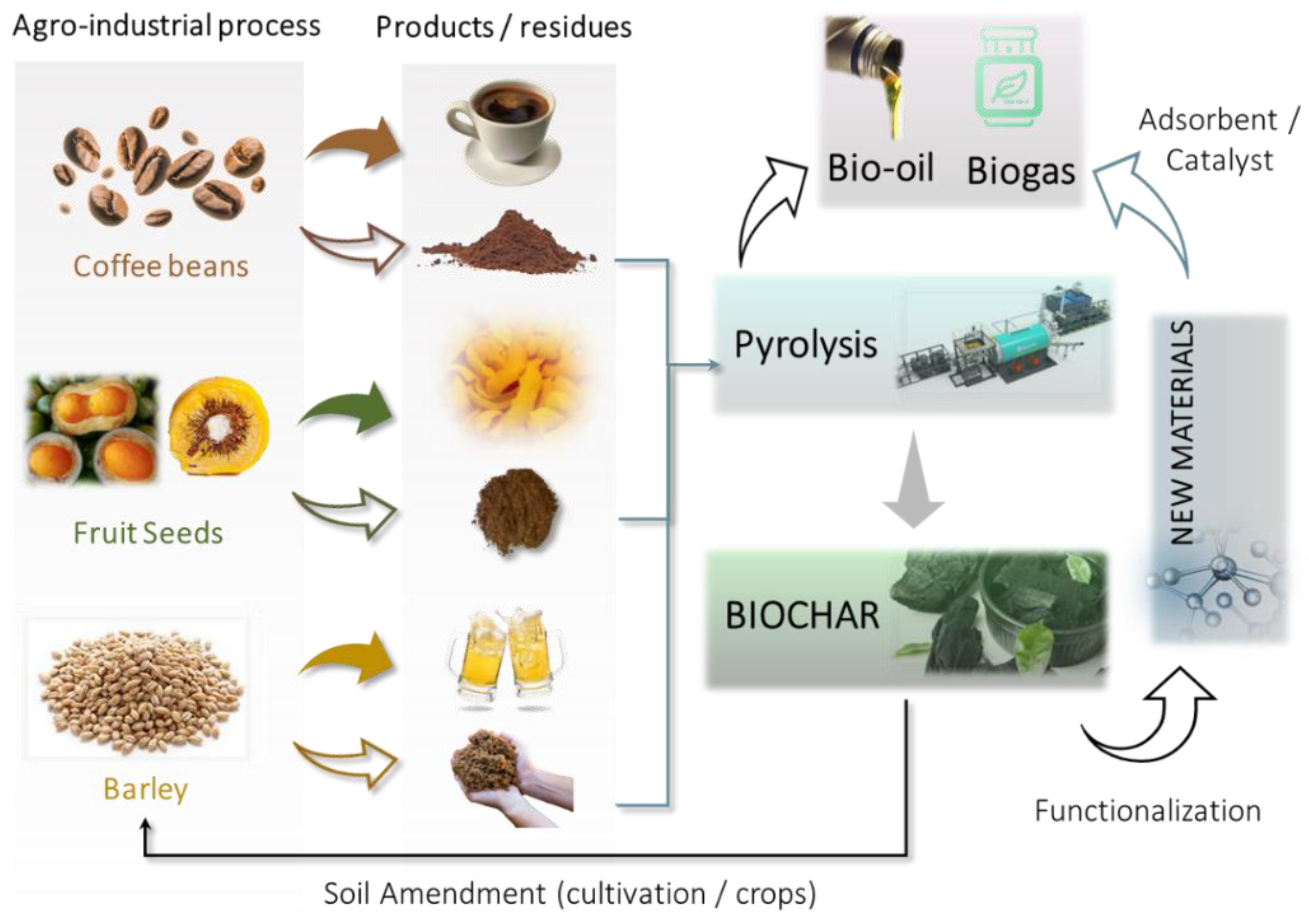
Figure 2.
Number of articles published in the last 11 years for biochar research (data obtained from Web of Science based on keywords from Table 1).
Figure 2.
Number of articles published in the last 11 years for biochar research (data obtained from Web of Science based on keywords from Table 1).

Figure 3.
Pyrolysis process and production of its derivatives (adapted from [54]).
Figure 3.
Pyrolysis process and production of its derivatives (adapted from [54]).

Figure 4.
Schematic picture of the main phases of biochar along the thermochemical degradation of eucalyptus biomass, as well as the average yield of ash, volatile materials and fixed carbon throughout the process (adapted) [51].
Figure 4.
Schematic picture of the main phases of biochar along the thermochemical degradation of eucalyptus biomass, as well as the average yield of ash, volatile materials and fixed carbon throughout the process (adapted) [51].
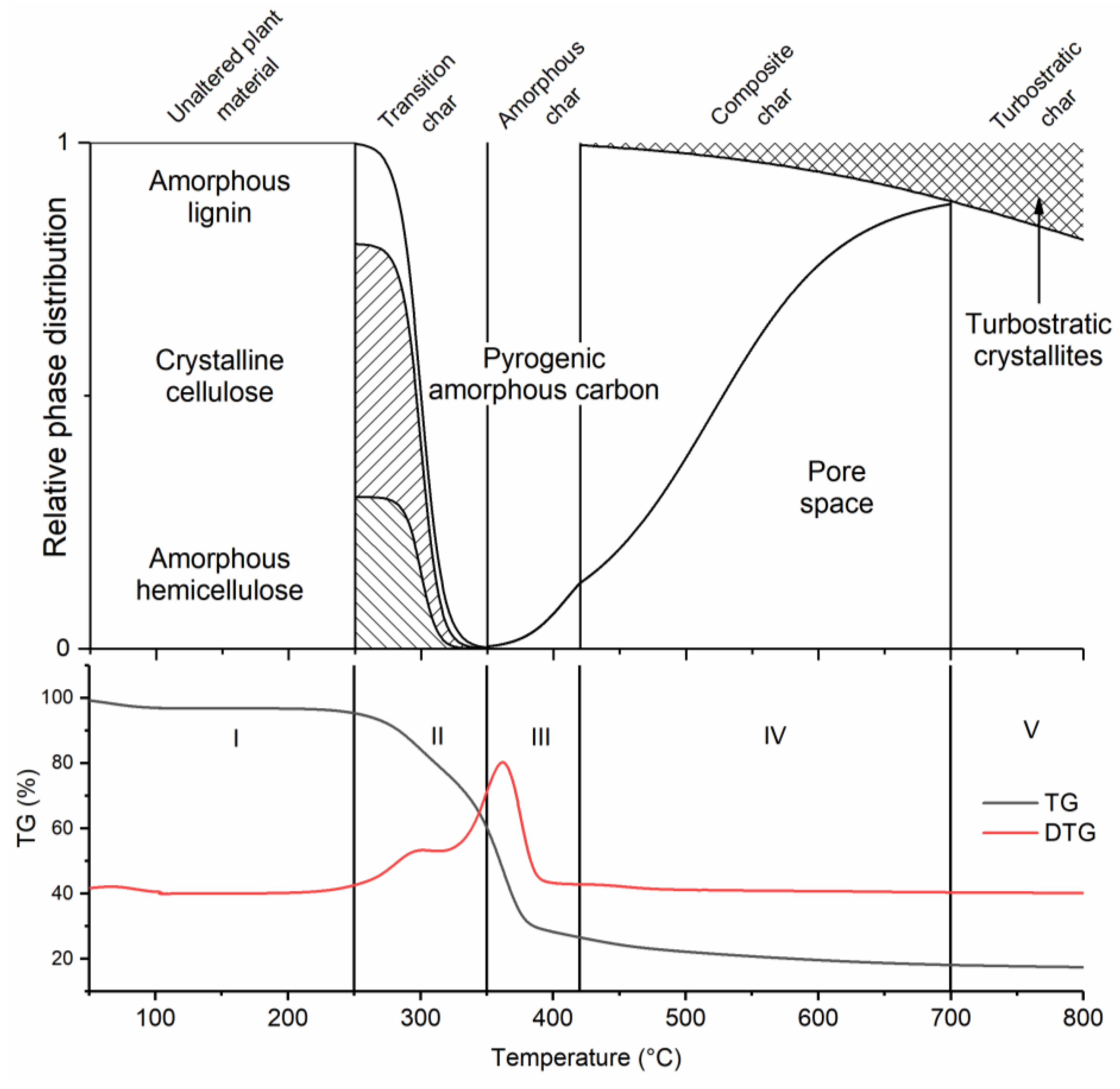
Figure 5.
Van Krevelen’s diagram of the H/C to O/C ratio (Table 3). The gray area represents the EBC standards.
Figure 5.
Van Krevelen’s diagram of the H/C to O/C ratio (Table 3). The gray area represents the EBC standards.
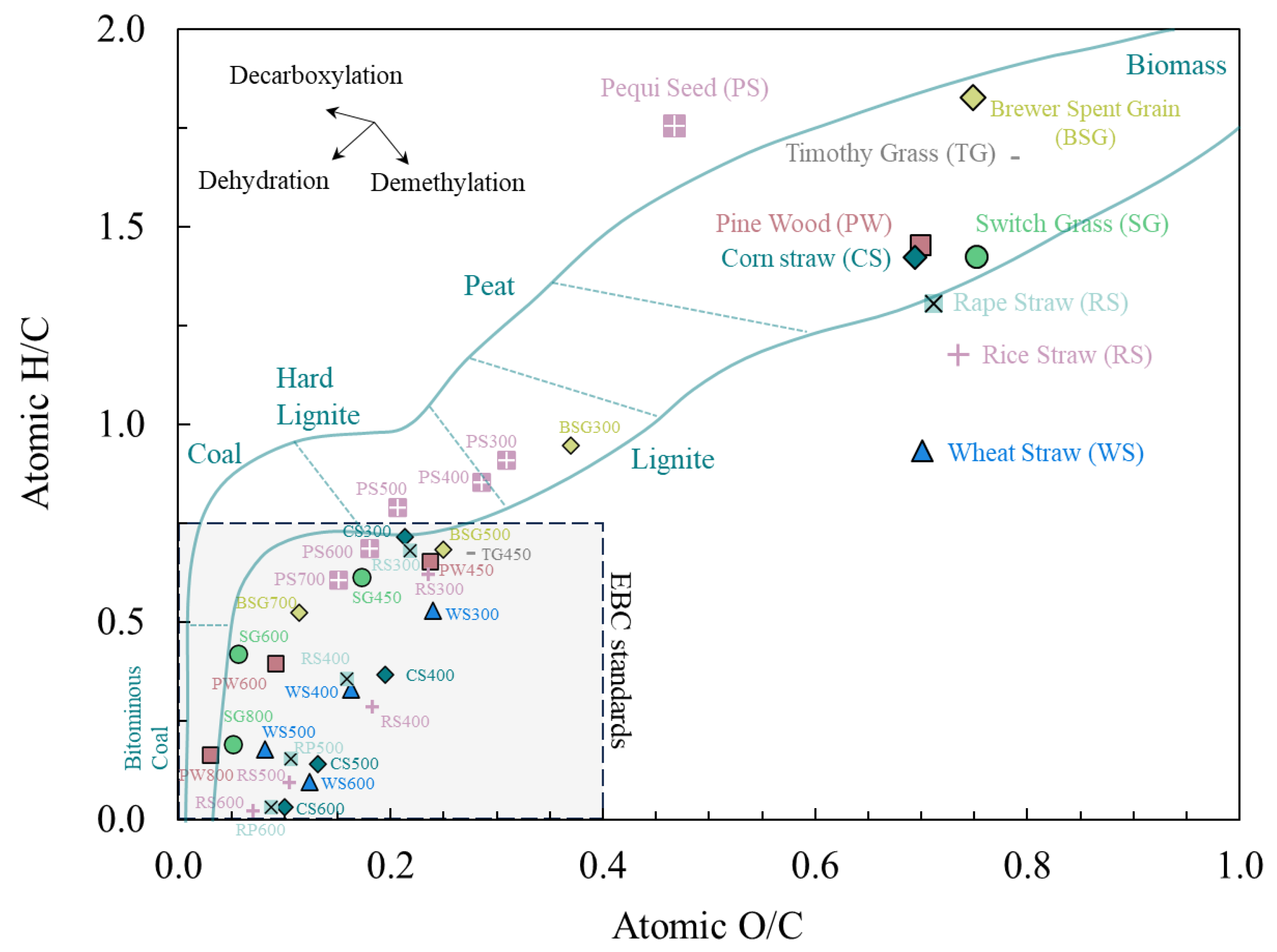
Figure 7.
Raman spectra of barley biochar, at 633 nm, prepared by pyrolysis over 600 °C. Source: The authors.
Figure 7.
Raman spectra of barley biochar, at 633 nm, prepared by pyrolysis over 600 °C. Source: The authors.
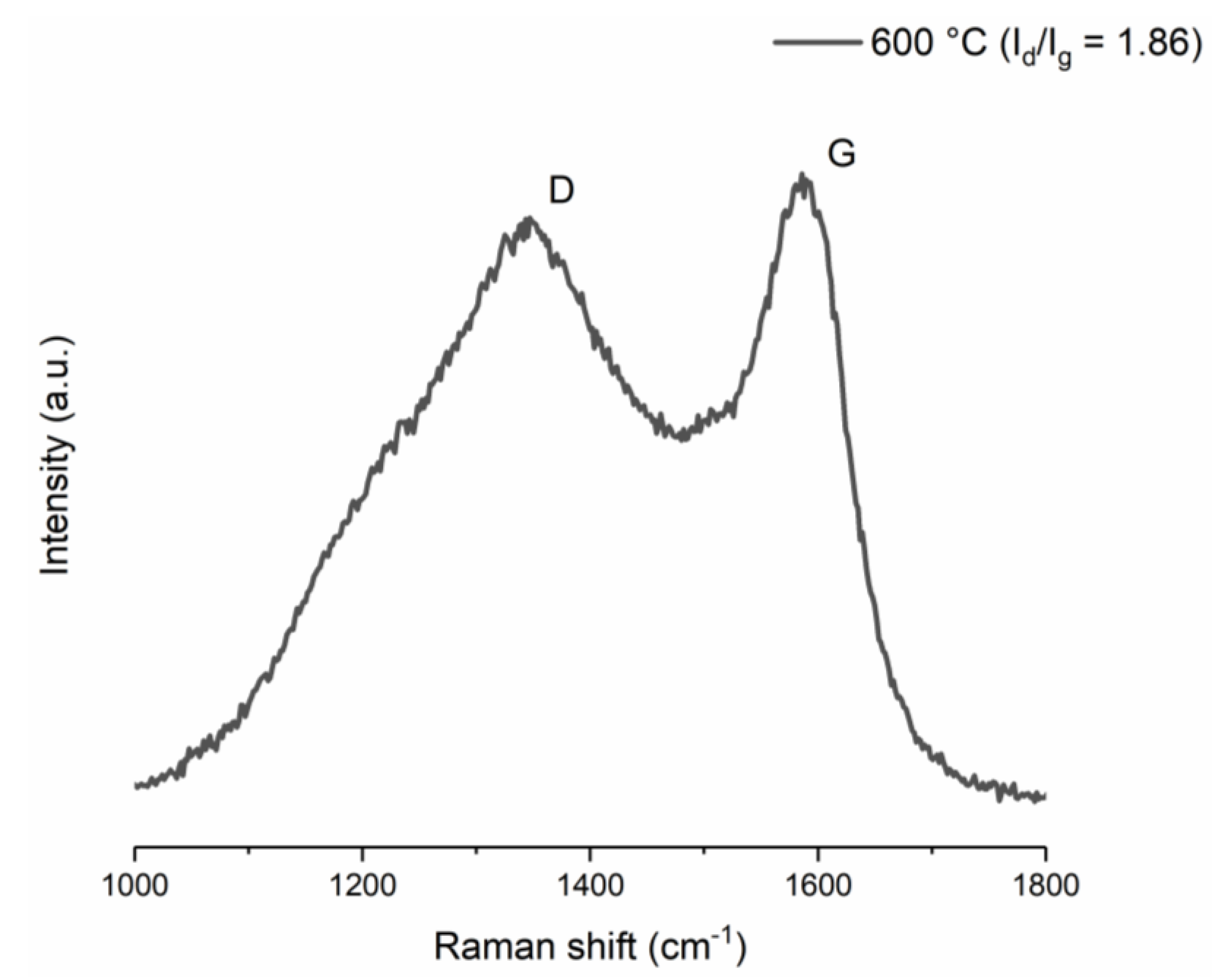
Figure 8.
TGA analysis of residual biomass: a) Brewer spent grains thermogravimetry and b) Brewer spent grains derivative thermogravimetry. Adapted from Evaristo et al. [31].
Figure 8.
TGA analysis of residual biomass: a) Brewer spent grains thermogravimetry and b) Brewer spent grains derivative thermogravimetry. Adapted from Evaristo et al. [31].
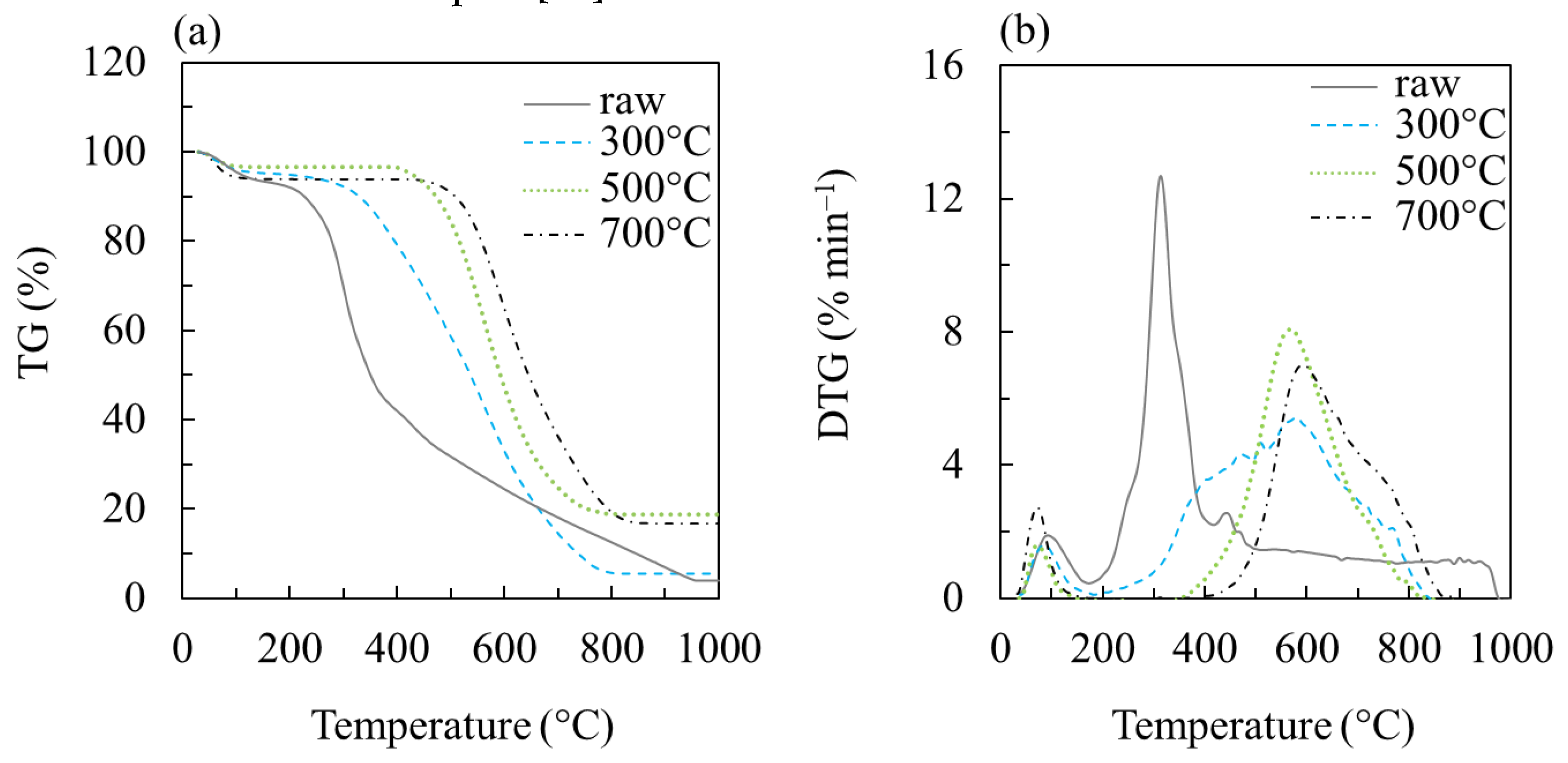
Figure 9.
SEM-EDS analysis from biochar sulfonated catalyst. Source: The authors.
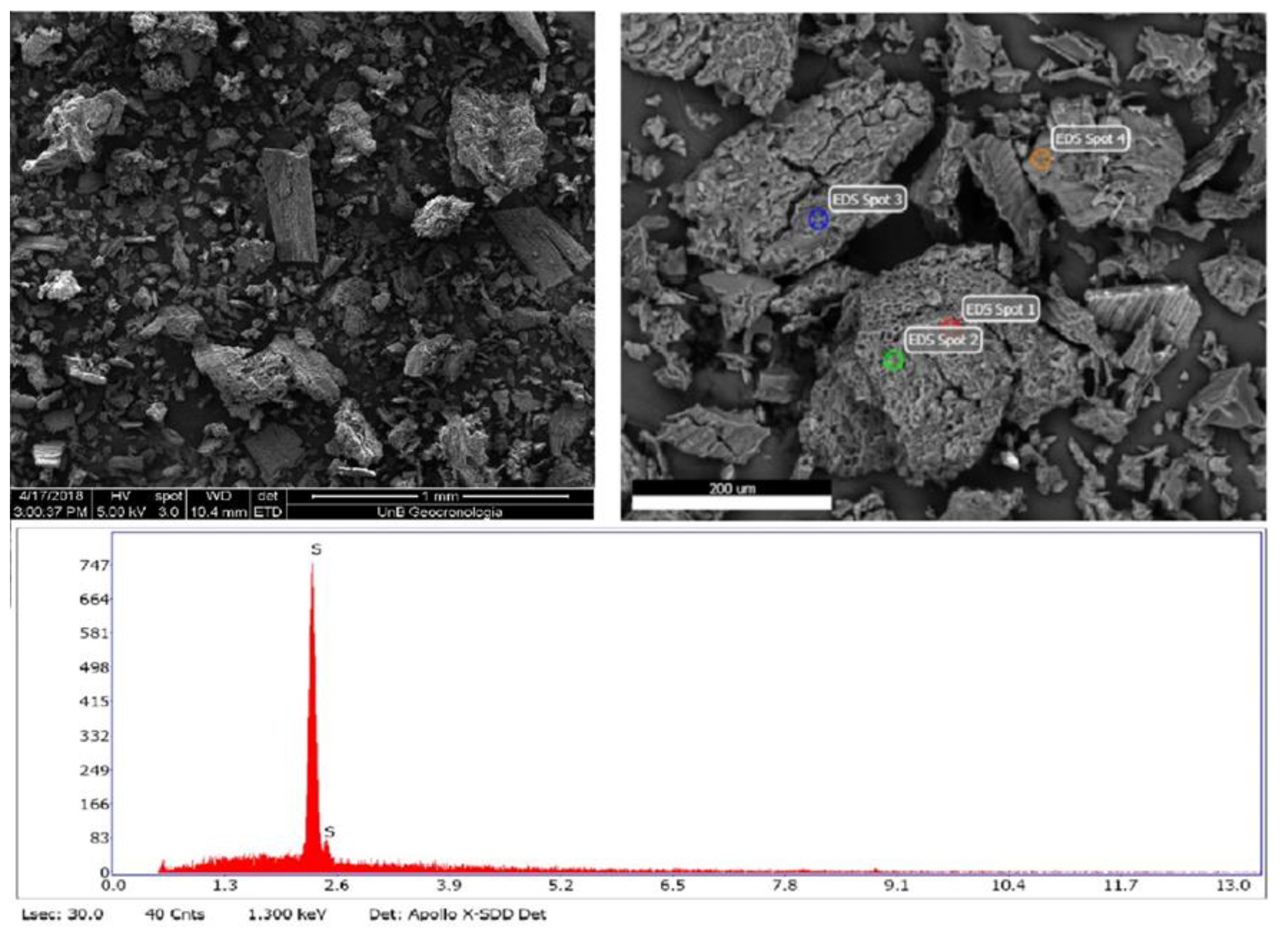

Table 1.
Keywords used for prospective study based on publications.
| Search | Keywords | Boolean Operator | Keywords | Boolean Operator | Keywords | Results |
|---|---|---|---|---|---|---|
| 1 | biochar | AND | - | - | - | 29.645 |
| 2 | biochar | AND | pyrolys* | - | - | 11.417 |
| 3 | biochar | AND | gasificat* | - | - | 1.570 |
| 4 | biochar | AND | Soil | - | - | 13.954 |
| 5 | biochar | AND | catalys* | - | - | 2.504 |
| 6 | biochar | AND | Water | - | - | 12.264 |
| 7* | biochar | AND | Water | AND | treatment | 4.783 |
| 8 | biochar | AND | wastewater | - | - | 3.486 |
| 9 | #7 | OR | #8 | - | - | 6.901 |
a Boolean operator: AND – restricts the searches to documents that necessarily have both terms; OR - searches for terms, but without the need to appear together (in this case, it was used to join searches 7 and 8, removing the repetitions). *biochar AND (water AND treatment).
Table 2.
Main properties for biochar (modified from Xie et al. [4]).
Table 2.
Main properties for biochar (modified from Xie et al. [4]).
| Properties | |
|---|---|
| Specific surface area (SSA) | High values of SSA are indicators of adsorption capabilities |
| Porosity | High values of porosity are indicators of adsorption capabilities |
| Pore volume/distribution | Pore volume and distribution are significant criteria for the adsorption/desorption capability and selectivity |
| Surface functional Group | The superficial composition of biochar delimitates the application and adsorption capabilities |
| Water holding capability | High water holding capability values indicate water retention and delimitate the applications on plant stress remediation |
| Ion exchange capability | Indicative of efficiency on remediation of soil nutrient leaching |
| Elemental composition | The elemental composition is an indicator of stability and possible remediation applications |
| High heating value (HHV) | Indication of combustion energy production. The greater the value, the better |
Table 3.
Pyrolytic CHN elementary data for different biomass sources from 300 °C to 800°C.
| Feedstock / Biochar | %C | %H | %O | H/C* | O/C* | |
| Pinewood | [66] | |||||
| PW | 48.90 | 6.20 | 42.50 | 1.51 | 0.65 | |
| PW450 | 75.50 | 3.70 | 17.00 | 0.58 | 0.17 | |
| Timothy grass | ||||||
| TG | 43.40 | 6.10 | 45.40 | 1.68 | 0.79 | |
| TG450 | 63.70 | 3.60 | 23.10 | 0.67 | 0.27 | |
| Wheat straw | ||||||
| WS | 44.10 | 6.00 | 45.00 | 1.62 | 0.77 | |
| WS450 | 64.80 | 3.10 | 23.00 | 0.57 | 0.27 | |
| Pinewood-2 | [67] | |||||
| PW-2 | 48.50 | 5.92 | 45.16 | 1.45 | 0.70 | |
| PW450-2 | 71.80 | 3.94 | 22.66 | 0.65 | 0.24 | |
| PW600-2 | 84.66 | 2.81 | 10.25 | 0.40 | 0.09 | |
| PW800-2 | 89.7 | 1.24 | 3.61 | 0.16 | 0.03 | |
| Switchgrass | ||||||
| SW | 45.58 | 5.45 | 45.65 | 1.43 | 0.75 | |
| SW450 | 66.54 | 3.43 | 15.31 | 0.61 | 0.17 | |
| SW600 | 71.52 | 2.53 | 5.39 | 0.42 | 0.06 | |
| SW800 | 71.62 | 1.16 | 4.85 | 0.19 | 0.05 | |
| Wheat straw-2 | [57] | |||||
| WS-2 | 45.53 | 3.56 | 42.53 | 0.93 | 0.70 | |
| WS300-2 | 61.48 | 2.73 | 19.61 | 0.53 | 0.24 | |
| WS400-2 | 64.18 | 1.78 | 13.93 | 0.33 | 0.16 | |
| WS500-2 | 67.39 | 1.01 | 7.35 | 0.18 | 0.08 | |
| WS600-2 | 65.34 | 0.52 | 10.77 | 0.09 | 0.12 | |
| Corn straw | ||||||
| CS | 44.53 | 5.31 | 41.18 | 1.42 | 0.69 | |
| CS300 | 61.2 | 3.68 | 17.39 | 0.72 | 0.21 | |
| CS400 | 63.36 | 1.96 | 16.46 | 0.37 | 0.20 | |
| CS500 | 65.08 | 0.77 | 11.36 | 0.14 | 0.13 | |
| CS600 | 67.48 | 0.18 | 8.98 | 0.03 | 0.10 | |
| Rape straw | 44.63 | 4.89 | 42.34 | 1.31 | 0.71 | |
| RP | ||||||
| RP300 | 61.80 | 3.54 | 17.95 | 0.68 | 0.22 | |
| RP400 | 63.74 | 1.91 | 13.48 | 0.36 | 0.16 | |
| RP500 | 66.96 | 0.87 | 9.46 | 0.15 | 0.11 | |
| RP600 | 67.85 | 0.18 | 7.89 | 0.03 | 0.09 | |
| Rice straw | ||||||
| RS | 42.12 | 4.16 | 41.22 | 1.18 | 0.73 | |
| RS300 | 56.49 | 2.95 | 17.73 | 0.62 | 0.24 | |
| RS400 | 56.42 | 1.35 | 13.71 | 0.29 | 0.18 | |
| RS500 | 59.59 | 0.47 | 8.27 | 0.09 | 0.10 | |
| RS600 | 61.30 | 0.12 | 5.71 | 0.02 | 0.07 | |
| Brewers’ spent grain | [31] | |||||
| BSG | 44.72 | 6.86 | 44.66 | 1.83 | 0.75 | |
| BSG300 | 63.28 | 5.03 | 31.20 | 0.95 | 0.37 | |
| BSG500 | 71.67 | 4.11 | 23.84 | 0.68 | 0.25 | |
| BSG700 | 83.17 | 3.66 | 12.62 | 0.52 | 0.11 |
* The ratios were recalculated from the CHN values of the references using the following molar mass values: C - 12.0107 g mol–1; H - 1.0078 g mol–1; O – 15.999 g mol–1.
Table 4.
Main stretches for biochar FTIR.
| Band position (cm–1) | Component | Ref. |
| 480, 592, 652 | Aromatic deforming rings, C-C stretching | [66] |
| 782, 840, 885 | C-H, aromatic hydrogen | |
| 1097 | C-O-C symmetric stretching | |
| 1618 | Aromatic C-C ring stretching | |
| 1709 | Phenyl ring substitution overtones | |
| 2950 | Alkyl/aliphatic C-H stretching | |
| 3544 | -OH stretching | |
| 3642 | -OH stretching, alcohols, phenols |
Table 5.
Biochar applications as fuel along source biomass and preparation conditions.
| Source Biomass | Biochar Preparation Conditions | Optimum Biochar Characteristics and Combustibility Properties | Ref. |
|---|---|---|---|
| Orange peel | Pyrolysis Atmosphere: N2 Temp.: 500 °C HR: 5 °C min–1 Time: 60 min |
Biochar O/C – 0.12; Biochar H/C – 0.66; HHV–25.73 MJ kg–1; Energy yield – 47.52%; Fuel Ratio – 5.87; Thermal stability – 0.85. | [114] |
| Sugarcane bagasse | Pyrolysis Atmosphere: N2 Temp.: 600 °C HR: 10 °C min–1 Time: 30 min |
Biochar O/C – 0.3; H/C – 0.2; HHV–29.99 MJ kg–1; Biochar yield – 21.75%; Fuel Ratio – 3.21; Energy yield – 36.32%. | [115] |
| Palm fiber | Pyrolysis Atmosphere: N2 Temp.: 700 °C HR: 5 °C min–1 Time: 120 min |
Biochar O/C – 0.23; Biochar SSA – 0.272 m2 g–1; HHV – 26.77 MJ kg–1; Biochar yield – 28.37%; Energy yield – 45.72%. | [116] |
| Spent coffee grounds | Torrefaction Atmosphere: N2 Temp.: 300 °C Time: 30min |
Biochar O/C – 0.39; Biochar H/C – 0.10; Biochar SSA – 0.524 m2 g–1; HHV- 30.32 MJ kg–1; Biochar yield – 62%. | [117] |
| Poplar wood | Pyrolysis Atmosphere: N2 Temp.: 600 °C HR: 5–20 °C min–1 |
Biochar O/C – 0.06; Biochar H/C – 0.025; HHV- 32.73 MJ kg–1; Biochar yield – 24.3 %; Fuel Ratio – 6.86; Combustibility Index – 1.9 s–1 °C–2; Comprehensive combustion characteristic index – 3.3 s–2 °C–3. | [118] |
| Sewage sludge | Pyrolysis Atmosphere: N2 Temp.: 450 °C HR: 10 °C min–1 Time: 30min |
Biochar O/C – 0.19; Biochar H/C – 0.74; HHV–13.58 MJ kg-1; Biochar yield – 57.90%; Fuel Ratio – 0.86; Energy yield – 42.04%; Combustion index – 0.59 106 %–2 s–2 °C–3. | [2] |
| Sesame stalks | Torrefaction Atmosphere: N2 Temp.: 275 °C Time: 30min |
Biochar O/C – 0.64; Biochar H/C – 1.25; HHV–20.5 MJ kg–1; Biochar yield – 76.25%; Fuel Ratio – 0.52; Energy yield – 86.16%; Bulk density – 290.01 kg m–3. | [119] |
| Microalgae - Chlorella pyrenoidosa | Pyrolysis Atmosphere: N2 Temp.: 400–600 °C HR: 10 °C min–1 Time: 30min |
Biochar O/C – 0.23; Biochar H/C – 0.055; HHV–17.15 MJ kg–1; Biochar yield – 51.23%; Fuel Ratio – 1.72. | [120] |
| Camellia shell | Steam-torrefaction Atmosphere: N2 Temp.: 280 °C Time: 30min |
Biochar O/C – 0.36; Biochar H/C – 0.07; Biochar SSA – 28.66 m2 g–1; HHV–24.76 MJ kg–1; Biochar yield – 50.45%; Fuel Ratio – 1.04. | [121] |
Table 6.
Biochar applications as adsorbent along source biomass and preparation conditions.
| Biomass | Process | Contam. | Biochar Properties and Adsorption Data | Ref. |
|---|---|---|---|---|
| Microalgae (Spirulina sp.) | Pyrolysis Atmosphere: N2 Temp.: 750 °C Time: 120min |
Tetracycline (TC) | O/C–0.138; H/C–1.38; SSA–2.63 m2 g-1; Desorption efficiency–61 %; Highest TG adsorption at 147.9 mg g–1 (TC 100 mg L–1; dosage 0,1 g L–1; pH 6). |
[135] |
| Wheat Straw | Pyrolysis Atmosphere: N2Temp.: 500 °C Time: 120 min Activation: KMnO4/KOH |
O/C–0.225; H/C–0.007; SSA–1524.6 m2 g–1; Pore volume–0.85 cm3 g-1; Raman ID/IG before adsorption–2.58; Desorption efficiency (NaOH solution)–7%; Highest TG adsorption at 584.19 mg g–1 at 318 K (TC 10–200 mg L–1; pH 3–10); No co-existing ions effect | [136] | |
| Sunflower Seed Husk | Pyrolysis Atmosphere: N2 Temp.: 700 °C Time: 120 min Activation: KMnO4/KOH/ZnCl2 |
O/C–0.1; H/C–0.014; SSA–1578.3 m2 g–1; Pore volume–1.138 cm3 g–1; Raman ID/IG before adsorption–0.585; Desorption efficiency–97.61%; Highest TG adsorption at 673.0 mg g–1 at 298 K for 24h (TC 1–20 mg L–1; pH 3.0–11.0); Highest TG adsorption with ions at 583.1 (K+), 539.8 (Mg2+) and 555.9 (Ca2+). | [137] | |
| Microalgae - Chlorella sp. GD | Wet Torrefaction (Water vapor) and Microwave Torref. (2450MHz, 800W) Temp.: 160–170 °C Time: 5–10min |
Methylene Blue (MB) | O/C between (0.462–0.506); SSA–2.66 m2 g–1; Pore volume 0.00043 cm3 g–1; Maximum removal of 85.47% MB; Highest MB adsorption at 113 mg g–1 (optimum pH 2–8). | [138,139] |
| Penicillin mycelial residues | Torrefaction Atmosphere: N2 Temp.: 260 °C HR.: 5 °C min–1 Time: 45 min Impregnation: KOH |
O/C–0.08; H/C–0.021; SSA – 1809.74 m2 g-1; Pore volume 1.02 cm3 g–1; Raman ID/IG before adsorption – 1.21; Highest MB adsorption at 620 mg g–1. | [140] | |
| Bamboo particles | Pyrolysis Atmosphere: N2 Temp.: 700 °C HR.: 10 °C min–1 Time: 120 min Impregnation: KHCO3/ Urea |
O/C–0.081; SSA–1693 m2 g–1; Biochar total pore volume 0.90 cm3 g–1; Raman ID/IG before adsorption – 1.10; Highest MB adsorption at 499 mg g–1. | [141] | |
| Orange peel | Pyrolysis Atmosphere: N2 Temp.: 400 °C HR.: 5 °C min–1 Time: 180 min Activation: KOH |
Cr(III)/Cr(IV) | Cr(IV) synthetic solution; O/C–0.100; SSA–998 m2 g–1; Biochar total pore volume–1.24 cm3 g–1; Raman ID/IG before adsorption–1.03; Highest Cr(IV) adsorption at 285.5 mg g–1 (pH – 2, Dosage 0,2 g L–1, C0 100 mg L–1, T = 25 °C, contact time = 40 h). | [142] |
| Vegetal waste – Rice Husk/ Polyethylene | Co-pyrolysis Atmosphere: N2 Temp.: 390 °C Time: 35 min |
Cr(III) synthetic solution; O/C 0.089; Biochar SSA <5.0 m2 g–1; Adsorption capacity–9.23 mg g–1 (final pH 4–5). |
[143] | |
| Algae - Potamogeton crispus | Pyrolysis Atmosphere: N2 Temp.: 300 °C HR.: 5 °C min–1 Time: 120 min |
Cr(IV) synthetic solution; O/– 0.53; H/C–0.09; SSA–0.42 m2 g–1; Pore volume–0.002 cm3 g–1; Raman ID/IG before adsorption–1.83; Highest Cr(IV) adsorption at 34.37 mg g–1 (pH–2, Dosage 2 g L–1, C0 100 mg L–1 and T = 25 °C.). | [144] | |
| Paper sludge waste | Pyrolysis Atmosphere: N2 Temp.: 350–550 °C HR.: 5 °C min–1 Time: 120 min Activation (KOH) Temp.: 105 °C Time: 150 min / Pyrolysis Atmosphere: N2 Temp.: 800 °C Time: 120 min Impregnation: NH4Cl |
Cr(IV) synthetic solution; O/C–0.383; H/C–0.059; SSA–3336.7 m2 g–1; Pore volume–2.10 cm3 g–1; Raman ID/IG before adsorption–0.95; Highest Cr(IV) adsorption at 356.25 mg g–1 (99% removal under 30 min.). | [145] |
Table 8.
Summary of biochar studies indicating the assessed feedstock (lignocellulosic biomass), biochar properties for each application, required analytical techniques and the MCDM (if applied).
Table 8.
Summary of biochar studies indicating the assessed feedstock (lignocellulosic biomass), biochar properties for each application, required analytical techniques and the MCDM (if applied).
| App. | Biomass | Properties/Criteria | Analytical Technique | MCDM | Ref. |
|---|---|---|---|---|---|
| Biofuel | Grape pomace | Biochar yield, Carbon (%), HHV, Kinetics Combustion parameters (Ea) |
Proximate analysis Calorific analysis Ultimate analysis TG/DTG |
Pareto Dominance Analysis / Metric distance based on compromise programming |
[152] |
| Grape pomace, cherry stones, peach stones, colza, sunflower husks, and softwood |
Moisture%, Ash, HHV, Kinetics Combustion parameters (Ea) |
Proximate analysis Calorific analysis TG/DTG |
Pareto Dominance Analysis / Metric distance based on compromise programming |
[154] | |
| Fruit seeds | Carbon enhancement index (CEI), HHV and its enhancement factor (EF) and energy-mass coefficient index (EMCI) | Calorific analysis Ultimate analysis |
Pareto Dominance Analysis / Metric distance based on compromise programming |
[26] | |
| Spent coffee ground Brew spent grains |
O/C and H/C, HHV and its enhancement factor (EF), energy yield (EY) |
Calorific analysis Ultimate analysis |
Pareto Dominance Analysis / Metric distance based on compromise programming |
[31] | |
| Pruning trees | FC, ash, HHV, O/C and H/C | Proximate analysis Calorific analysis Ultimate analysis |
Pareto Dominance Analysis / Metric distance based on compromise programming |
[68] | |
| Catalyst | Grape pomace, cherry stones, peach stones, colza, sunflower husks, and softwood |
K, Ca, P (%), Carbon (%), Specific surface area (m2 g–1) |
EDS Ultimate analysis Brunauer– Emmett–Teller (BET) method |
Pareto Dominance Analysis / Metric distance based on compromise programming |
[154] |
| Soil Amendment | Fruit seeds | O/C and H/C, Carbon enhancement index (CEI), K, N, P(%) |
EDS Ultimate analysis |
Pareto Dominance Analysis / Metric distance based on compromise programming |
[26] |
| Grape pomace | Biochar yield, Carbon content, O/C and H/C, N, P, Mg, K |
EDS Ultimate analysis |
Pareto Dominance Analysis / Metric distance based on compromise programming |
[152] | |
| Soil Amendment / CO2 sequestration / Supercapacitor development |
Grape pomace, cherry stones, peach stones, colza, sunflower husks, and softwood |
K, Ca, P (%) / Carbon (%) / Specific surface area, Bulk density, electric conductivity, pH |
EDS Ultimate analysis Brunauer– Emmett–Teller (BET) method Biochar pH, Electrical Conductivity and Liming Potential |
Pareto Dominance Analysis / Metric distance based on compromise programming |
[154] |
| Wastewater treatment |
Spirulina sp. Wheat straw Sunflower seed husk Chlorella sp. Penicillin mycelia Bamboo particles Orange peel Rice husk Paper sludge |
O/C SSA Pore volume Raman ID/IG Surface composition Adsorption capability |
Ultimate analysis Physicochemical analysis Surface analysis Molecular/structural analysis |
- | [81,135,136,137,138,140,141,142,143,144,145] |
Disclaimer/Publisher’s Note: The statements, opinions and data contained in all publications are solely those of the individual author(s) and contributor(s) and not of MDPI and/or the editor(s). MDPI and/or the editor(s) disclaim responsibility for any injury to people or property resulting from any ideas, methods, instructions or products referred to in the content. |
© 2024 by the authors. Licensee MDPI, Basel, Switzerland. This article is an open access article distributed under the terms and conditions of the Creative Commons Attribution (CC BY) license (http://creativecommons.org/licenses/by/4.0/).
Copyright: This open access article is published under a Creative Commons CC BY 4.0 license, which permit the free download, distribution, and reuse, provided that the author and preprint are cited in any reuse.


