

Submitted:
11 April 2024
Posted:
12 April 2024
You are already at the latest version
Abstract
Proteins have the ability to adsorb on the surface of materials, such as soft contact lenses (SCLs), and can affect the hydrophobicity, roughness and surface properties of the contact lenses (CLs), which, in turn, can influence the friction between the lenses and the ocular surface. Excessive friction between contact lenses and the ocular surface can lead to discomfort for the wearer and may cause irritation or inflammation of the cornea, better known as corneal ulcers (keratitis). Bovine serum albumin (BSA) is often used as a standard protein in biocompatibility testing of materials, including contact lenses. One standard commercial contact lenses was tested under lubricated conditions to access the coefficient of friction (CoF), being the contact lubricated with a tear like fluid (TLF) solution containing six different concentrations of BSA. In all cases, a good linearity of the results of the friction force was verified, so the first friction law can be applied to determine the value of the coefficient of friction. It was found that friction increases with increasing protein concentration.
Keywords:
biotribology
; friction
; soft contact lenses
; protein content
1. Introduction
The eye is a lubricated movement system in the human body, in which the tear film, among other functions, provides protection to the cornea and maintains optical smoothness of vision. The process of blinking, in which the upper eyelid slides over the eyeball until it meets the lower eyelid and then returns upwards, with a total duration of 1 to 3 seconds, allows the tear film to be renewed and occurs, on average, 12 times per minute [1,2]. From a lubrication point of view, these eye movements are considered to occur under a mainly hydrodynamic lubrication regime. Thus, during the majority of an intermittent cycle, slip resistance is governed by the viscous shear of the lubricant [3].
The correlation between comfort and friction, and the possibility of predicting the in vivo performance of CLs, based on in vitro experiments, motivated the carrying out of some studies on the tribological characterization of CLs, using commercially available or adapted tribometers. Zhou et al. (2011) tested senofilcon A-based CL submerged in saline solution against a stainless steel sphere. For loads between 0.5 and 100 mN and sliding speeds between 0.01 and 0.5 cm/s, 𝜇 values were obtained between 0.0001 and 0.11. Under these conditions, the first law of friction was verified, that is, there was a proportionality between the friction force and the applied load [4]. Additionally, they investigated the dependence of friction on sliding speed and, after adjusting the power law, concluded that the friction coefficient is proportional to V0.23. The result suggested that there is a strong attraction between senofilcon A and stainless steel, which is attributed to the low water content of CL and the larger areas resulting from solid – solid contact [4]. Rennie et al. (2005) assumed that the CL can be reasonably modeled as a modified Winkler surface. Therefore, they carried out CL tests based on etafilcon A, using a borosylate glass sphere as a pin, normal loads of 3 to 20 mN and speeds of 63 to 6280 μm/s. The obtained values of 𝜇 varied between 0.025 and 0.075 and the friction forces between 0.5 and 2.0 mN, depending on the normal load and sliding speed. Finally, they suggested that the majority of frictional forces were a consequence of viscoelastic dissipation of the contact lens material and interfacial shear within the contact [5]. Dunn et al. (2013) carried out microtribological tests on a delefilcon A-based contact lens with a spherical borosilicate glass probe. At low contact pressures (6 - 30 kPa) and low sliding speeds (5 - 200 μm/s) they generated average friction coefficients lower than 0.02. For loads of 1000 μN and speeds of 2 μm/s, values of 𝜇 were equal to 0.5 and 0.021 for loads of 500 μN [6]. To study the tribological differences between CL of different materials and brands, Roba et al. (2011) carried out tests on several commercially available CLs, including somofilcon A and nelfilcon A. To represent the surface of the eyelid, glass discs with different functionalizations were evaluated and the surface of the CLs was covered with a lubricating solution during friction tests. [7]. The comparative tests involved normal forces between 0.25 and 5 mN and velocities of 0.1 mm/s. They reported values of 𝜇 from 0.011 to 0.562, depending on the type of contact lens, and, in general, HSCL (hydrogel silicone contact lenses) presented less friction than hydrogel lenses [7]. Nann and Tighe (2016) tested the 𝜇 value of 18 commercially available lenses using a modified nanotribometer. The aim of the study was to compare a range of conventional hydrogel materials with silicone ones. To achieve this, the CLs were lubricated with HypotearsTM lubricant on a polyethylene terephthalate (PET) substrate. The test conditions were 30 mN of normal load, sliding speed of 30 mm/min and a sliding distance of 20 mm. They concluded that, in general, hydrogel lenses have higher 𝜇 values than HSCL [8]. Regarding the lubricating solutions and artificial tears available on the market for the contact lens to remain moist and thus reduce the symptoms of eye irritation and dryness [9], Nairn and Jiang (1995) measured the coefficient of friction of polymacon-based CL with various ophthalmic solutions. They used a polycarbonate disc as an antagonist material, under contact pressures of 3.5 kPa and obtained a 𝜇 value of 0.640 without lubricant [10]. With the aim of studying the influence of lubricants, Nairn and Jiang (1995) concluded that the higher the viscosity of the lubricant, the lower the friction coefficient, that is, the greater the lubrication. This lubrication of the CL was observed in the mixed lubrication regime, that is, when there is contact between the sliding surfaces and, therefore, the friction coefficient is influenced by both the lubricating properties and the surface properties of the CL [10]. With the aim of understanding whether CL processing leads to differences in the properties between the posterior and anterior surfaces, Nairn and Jiang (1995) also studied the value of 𝜇 of the anterior and posterior surface of the SeeQuence® and SeeQuence®2 lenses while sliding over a PMMA (Poly(methyl methacrylate)) disc and a pHEMA (Poly(2-hydroxyethyl methacrylate)) disc, lubricated by a saline solution [10]. They found that the friction coefficient for the anterior surface is always greater than that for the posterior surface, a consequence of the greater sliding movement on the anterior surface than on the posterior surface. Therefore, the coefficient of friction for the anterior surface is probably the most important in determining the comfort of the CL. From the results obtained, Nairn and Jiang (1995) suggest that there is potential to reduce friction on the anterior surface of the CL through, for example, variation in processing methods [10]. Sterner et al. (2016) investigated how the 𝜇 value of HSCL materials, acquired at low sliding speeds, is affected by the buffer component and organic composition of the lubricant, and by prolonged exposure to teardrop fluid (FTL). The 𝜇 value of several commercially available CLs (etafilcon A, nelficon A and senofilcon A) was characterized using microtribometry against a mucin-coated glass disk, tested under different lubricating solutions, including an FTL containing proteins and lipids [3] To determine friction, normal loads between 0.25 and 4 mN were chosen, corresponding to a contact pressure range of 1 to 7 kPa, and a sliding speed of 0.1 mm/s. They obtained values of 𝜇 between 0.01 and 0.1 [3].
Silva et al. (2015) investigated the effect of the presence of albumin and cholesterol in the lubricating medium on the friction response of two hydrogels used in CL, a hydrogel based on hydroxyethyl methacrylate (HEMA) (HEMA/PVP) and another based on silicone (TRIS/NVP/HEMA). Tribological tests were carried out using a PMMA sphere as a counterbody and water as a lubricant, in addition to solutions with the biomolecules under study. Reciprocal movement tests were carried out with normal forces of 20 mN and sliding speeds of 7 mm/s. In the absence of biomolecules, the friction coefficient was quite similar for both hydrogels, with values between 0.25 and 0.3. They observed a significant increase in friction for HEMA/PVP when the lubricant included cholesterol and for TRIS/NVP/HEMA when it contained albumin [11]. Urueña et al. (2011) studied the influence of hyaluronic acid as a lubricant in CL systems. Two types of commercially available CL were tested (senofilcon A and balafilcon A), different lubricant concentrations, loads and speeds. Using a borosilicate glass pin, normal loads between 2 and 20 mN, sliding speeds of 20 to 3600 μm/s, they verified values of 𝜇 of the order of magnitude of 0.6 in saline solution and a significant reduction of this value in hyaluronic acid [12]. Samson et al. (2015) used ocular tissues from human cadavers as a counterbody and sliding speeds between 0.3 and 30 mm/s to evaluate the friction properties of commercially available CL. CLs based on senofilcon A and narafilcon A were mentioned as having higher 𝜇 values than those on delefilcon A [13]. Furthermore, they also studied the ability of proteoglycan 4 (PRG4) to lubricate and adhere to CLs, and demonstrated that PRG4 significantly reduces friction against corneal and eyelid tissues. As PRG4 in solution was able to effectively lubricate CL based on senofilcon A and narafilcon A, they suggested that this protein, used as a lubricant or in the constitution of CL, may have the clinical capacity to reduce friction and improve comfort in alive [13]. With the aim of investigating and associating the deposition of lysozyme, the most abundant tear protein, and friction between the contact lens and the eye with discomfort and ocular changes, Su et al. (2018) developed a preservative-free CL care solution to investigate whether it could effectively remove lysozyme and provide lubrication. Two CL materials were studied, etafilcon A and polymacon, using a rotational tribometer based on the measurement of friction force. A polyethylene (PE) support was used for the CL, a quartz glass as a counterbody, normal loads of 60 mN, rotation speeds of 1 rpm and rotation times of 900 s [14]. The results suggested that the deposition of lysozyme on the surface of the material increases the friction between the contact lens and the glass, and when adding the lubricating solution, the friction coefficient decreases significantly for non-ionic CL. In other words, they showed that the preservative-free solution can effectively reduce the friction caused by lysozyme for non-ionic CL under certain test conditions. However, the effect of the solution on CL behaviour will be different when all tear components are present [14].
The main objective of this work is to study the influence of BSA (Bovine Serum Albumin) protein content on the friction of soft contact lenses. For this purpose, a new methodology was used, which consists of using a tribometer with the operating principle of a pendulum with horizontal movement and the study of friction is based on the evaluation of the dissipated energy along free vibration response of the system after the application of a mechanical impulse.
2. Materials and Methods
2.1. Methodology
The present methodology consists of studying the feasibility of using a vibration technique to simulate the tribological behaviour of CLs in the eye. This technique was developed by Den Hartog [15] and was used by Rigaud et al. (2010) where they developed a device called “oscillating dynamic tribometer”, schematized in Figure 1 [16]. In previous papers this technique was used to characterize the friction of contact lenses and to discriminate the effect of aging [17,18].
In addition, this work will evaluate the effect of protein concentration on the friction of soft contact lenses.
This tribometer is based on a horizontally moving pendulum and aims to identify the different contributions of friction in lubricated systems, based on the analysis of the response free of a damped oscillator of one degree of freedom [17].
Basically, this device consists of a spherical-plan contact geometry tribometer of reciprocating movement. Includes a pair of flexible blades that allow the pin to swing in a horizontal direction. Initially, a displacement is applied to the pin and fixed in the extreme position, verifying a deviation parallel to the sliding direction. When the pin is released, the elastic energy accumulated in the blades is released, producing oscillations in the system. The laser vibrometer allows identifying the dynamic response of the system, namely the simultaneous measurement of speed and vibrational displacement [16]. The capacity of this device was verified by carrying out tests on a tribological system corresponding to steel surfaces lubricated with glycerol, for various contact pressures. They found that, unlike non-contact systems which are characterized by purely viscous damping, contact friction is characterized by velocity-dependent and -independent contributions. Furthermore, additional tests using glycerol and water solutions confirmed that the speed-dependent part of contact friction is related to the viscosity of the lubricant [16]. The methodology used by Rigaud et al. (2010) thus allowed to clearly characterize the different friction contributions, dependent and independent of speed, in contact friction, and showed high accuracy and precision in measuring low friction coefficients [16]. These results suggest that vibration friction tribology has vast, but still insufficiently explored, potential. The present research work therefore intended to use and validate the method, based on the evaluation of the free damping vibration response, for the tribological study of CLs against glass for different BSA concentrations.
In an attempt to simulate the assembly made up of the eye and contact lens, the tribometer developed and used by our research team, as illustrated in Figure 2, has a glass counterbody (2) and a silicone semi-sphere (3) where the contact lens is placed. Above the glass plane is a mass (1) that imparts a force to the contact lens, its normal force (value of 100 mN). A blade (4) is attached to the holder where the contact lens is placed, which, when an initial force is applied, deforms until it reaches equilibrium.
In order to ensure that the same conditions were observed in all friction tests carried out and there were no variations in the procedure, an experimental protocol was defined which consisted of: 1) Place the contact lens, directly from its different BSA solution concentrations, on the silicone support and then lubricated with a drop of prepared solution; 2) Placement of the weight, on its support, corresponding to the desired normal force of 100 mN; 3) Manually move the contact lens holder to a fixed position to apply the same initial mechanical energy to the system; 4) Release of the system and acquire the displacement signal as a function of time by a piezoelectric sensor connected to a PicoScope® oscilloscope, corresponding to the signal of free vibration movement with energy dissipation; 5) Analysis of the graph of the variation of the system's displacement over time, such as that in Figure 3, using the MATLAB® program. Several steps are carried out on the acquired signal: application of a moving average filter with the aim of eliminating the effect of very high frequency parasitic noise, conversion of the displacement in volts to meters using the system calibration factor obtained previously, and temporal adjustment so that time zero corresponds to a point of maximum initial displacement, that is, of zero speed.
Reverse Analysis
The friction coefficient is deduced by inverse analysis, that is, by comparing the experimental curve of free vibration with energy dissipation, with the curve obtained by integrating the theoretical equation of motion, using the RMSE, Root Mean Square Error,value as the optimization criterion. The integration of the differential equations is carried out numerically, in the MATLAB® program, where the 4th order Runge-Kutta numerical integration method was used, through the ode45() function, with an integration step equal to the acquisition rate. When optimizing the experimental method, it was found that the friction model, adjusted based on the experimental results represented by Eq. 1.
2.2. Specimens
During friction tests, sterile hydrophilic Alcon® contact lens were used (67 % lotrafilcon B, 33 % water), immersed in phosphate-saline buffer solution 0.2% VP/DMAEMA and 0.04% polyoxyethylene-polyoxybutylene as humectants.
Different solutions containing sodium hyaluronate eye drops (sterile and isotonic solution containing sodium hyaluronate BP (0.2 % w/v), polyhexanide, sodium chloride phosphate buffer solution) and six different concentrations of BSA were produced (0, 0.13, 0.25, 0.50, 1, and 2 mg/ml). The BSA physical properties can be seen in Table 1.
The procedure followed was as follows: The lenses were removed from their respective packaging and placed in the six different solutions for 12 h. They were then removed from the intermediate packaging and placed in the respective tribometer and their friction was determined.
3. Results
3.1. Physical Constants of the System
Firstly, it was necessary to carry out a numerical study to verify the sensitivity of the energy controlling parameters, namely the stiffness constant and the mass of the system. To this end, tests were carried out without any contact, in order to investigate the damping and dynamic characteristics of the system. Thus, to calculate the system's physical constants, the system's energy dissipation was characterized by acquiring the system's response in free vibration, visible in Figure 3.
There was a response characterized by an oscillatory movement of constant frequency and an exponential decrease in the amplitude of the maximum peaks over time. This means that energy dissipation occurs fundamentally in viscous form and can be modelled by an under-damped system in free vibration. Thus, the law of motion of this system is given by Eq. 3.
Considering the law of motion only for the values of the maximum peaks, where cos (𝑤𝑎𝑡) = 1 occurs, Eq. 3 was obtained.
The damped natural frequency of the system 𝑤𝑎 can be calculated by Eq. 5.
Where 𝑇𝑎 is the average period, measured manually from the curve in Figure 3. Resulting in a damped frequency value of system 𝑤𝑎 of 123.10 rad/s2, considered equal to the vibration frequency of system 𝑤𝑛. Taking into account the value of the vibration frequency 𝑤𝑛 and that the exponential adjustment of the maximum peaks of the curve in Figure 3 is represented by an equation like Eq. 4, it is possible to obtain the value of the damping factor 𝜉. In this case, the value of 7.14×10⁻³ was obtained. Now knowing the value of the vibration frequency of system 𝑤𝑛 and the spring stiffness constant 𝑘, it is possible to obtain the value of the mass of system 𝑚 using Eq. 6.
The value of the spring stiffness constant 𝑘 was experimentally obtained in previous studies, corresponding to 265 N/m. Thus, the extracted value of the mass of system 𝑚 is 17.49 g. Finally, it is possible to calculate the damping constant 𝑐 using Eq. 7, where a value of 0.031 N.s/m was obtained.
Based on the above, the physical constants characteristic of the experimental method are presented in Table 2.
It should be noted that three tests were carried out, with the values considered the average of those obtained in the different tests. The constants obtained present a ratio between the standard deviation and the mean of the order of magnitude of 10-3, as it is much lower than 10-1, the results are considered a good experimental approximation. By substituting the physical constants of the system in Eq. 3, the theoretically expected response curve is obtained. By comparing this curve with those obtained experimentally for the different tests, as visible in Figure 4, very low RMSE values were identified, in the order of 10-2, meaning a high similarity between the results.
The physiological operating conditions of contact lenses allow us to conclude that contact occurs under lubricated conditions. The main relative movement is alternative of the eyelid over the lens, although the conditions are a function of the physiological response and vary from person to person, contact pressure values are in the order of 5 to 10 kPa and the speed can reach values in the order of 200 mm/s in conditioned response conditions.
Taking these conditions into account, the test system to be used must:
- use a soft support with a radius of approx 10 mm to support the contact lenses;
- alternative movement;
- ability to apply low normal forces, from 0.015 to 0.12 N;
- speed up to approximately 200 mm/s;
- ability to measure tangential forces of the order of 75x10-6 N.
Considering the mechanical constants of the tribometer summarized in Table 2, a numerical study was done to verify if the sensitivity is enough to discriminate the influence of the several variables.
Figure 5a,b display the results of the several studied cases to apprize the sensitivity concerning the coefficient of friction (CoF) and the normal force. The results allow us to conclude that with the used configuration of the tribometer sensitivity is at least 0.0005 concerning the friction coefficient (which corresponds to a friction force sentivity of 0.1 mN) and of 5 mN concerning the normal load.
3.2. Effect of BSA Concentration
In Figure 6, a typical experimental curve of the response of the system in free vibration with energy dissipation by friction in lubricated contact between a contact lens and glass for a BSA concentration of 2 mg/ml is presented. Additionally, the theoretical curve is represented, obtained by numerical integration of the second order differential equation (Eq. 1). In all cases studied, an almost perfect comparison of results was verified by comparing the two curves, with RMSE values lower than 10-4. The value obtained for the coefficient of friction (COF) for an applied load of 100 mN was 0.09.
Figure 7, shows a comparison of the response of the system in free vibration with energy dissipation by friction in lubricated contact between a contact lens and glass for a BSA concentration of 1 and 2 mg/ml. It is possible to observe that the system's response to a concentration of 2 mg/ml presents a much greater loss of amplitude, that is, the energy dissipation due to friction is faster, meaning greater friction (COF2mg/ml = 0.09 and COF1mg/ml = 0.023). This allows to conclude that the increase of BSA content from 1 to 2 mg of BSA/ml induced a rise of the coefficient of friction of around 4 times.
In Figure 8, the final results for the coefficient of friction were plotted as a function of the different BSA concentrations. The experimental obtained values present a good correlation with a 2nd order polynomial type adjustment. For small concentration, up to 0,25 mg/ml, the effect of BSA was positive, but for concentrations of BSA over 0,5 mg/ml the protein induced a significant increase of the coefficient of friction.
As presented in the introduction, different authors already studied the effect of the concentration of different proteins on the friction of soft contact lenses [3,11,14]. Silva et al. [3], studied the effect of albumin and cholesterol (two of the main components of the lacrimal fluid) on the frictional response of distinct types of hydrogels suitable for CLs. As a general conclusion it was observed a significant increase of the friction coefficient when the lubricant contains cholesterol, and when it contains albumin. According to the same authors [3], the increase in friction is associated with the characteristics of the protein film formed, having a more viscoelastic or rigid characteristic.
Su et al. [14], who studied the effect of contact lens care solution on lysozyme adsorption, concluded that the use of the solution can greatly reduce the friction caused by the accumulation of lysozyme on the surface of the soft contact lenses.
In general, these studies corroborate the results presented by us, in which a significant increase in friction is visible for concentrations of the order of 2 mg/ml. However, the nature of the hydrodynamic film formed on the surface of the lenses depends on the materials used and their interaction with both the tere-like fluid and the proteins used.
5. Conclusions
Currently, CLs are widely used and accepted as vision correction devices. However, discomfort is still the main reason for discontinuing its use. A better understanding of the factors that correlate with the comfort experienced in vivo, namely the coefficient of friction between the surface of the contact lens and the eyelid during the blinking process, and its evolution with the aging/accumulation of proteins, can provide relevant information on predicting the in vivo behaviour of CL and thus stimulating the development and screening of new materials and/or improvements to existing ones. The work developed and presented in this research work incorporates a friction evaluation method, based on the evaluation of the energy dissipated by friction during free vibration, with the potential to be included in the routine objective evaluation and characterization of biomaterials such as CL. The results demonstrate the credibility of the data obtained by the experimental method in characterizing the friction of materials such as CL. With this work, we obtained a more complete knowledge of the behaviour of the materials studied, as well as the changes in properties as a result of protein accumulation. From the above, the main conclusions drawn from this dissertation are:
- This technique has sufficient sensitivity for biologically relevant conditions, namely low pressures and sliding speed;
- Changes in the properties of CLs caused by factors such as protein accumulation can be correlated with in vivo comfort and are mainly reflected in the friction coefficient values obtained between the contact lens and the eyelid;
- An increase in BSA content results in an increase in friction values.
Author Contributions
Conceptualization, L.V. and A.R.; methodology, L.V. and A.R.; software, L.V. and A.R.; validation, L.V. and A.R.; formal analysis, L.V. and A.R.; investigation, L.V. and A.R.; resources, L.V. and A.R.; data curation, L.V. and A.R.; writing—original draft preparation, L.V. and A.R.; writing—review and editing, L.V. and A.R.; visualization, L.V. and A.R.; supervision, L.V. and A.R.; project administration, L.V. and A.R.; funding acquisition, L.V. and A.R. All authors have read and agreed to the published version of the manuscript.
Funding
This research received no external funding.
Data Availability Statement
The data presented in this study are available on request from the corresponding author.
Acknowledgments
This research is sponsored by national funds through FCT—Fundação para a Ciência e a Tecnologia, under the project UIDB/00285/2020.
Conflicts of Interest
The authors declare no conflicts of interest.
References
- Dunn, A.C.; Tichy, J.A.; Urueña, J.M.; Sawyer, W.G. Lubrification Regimes in Contact Lens Wear During a Blink. Tribology International 2013, 63, 45–50. [Google Scholar] [CrossRef]
- Kwon, K.-A.; Shipley, R.J.; Edirisinghe, M.; Ezra, D.G.; Rose, G.; Best, S.M.; Cameron, R.E. High-speed Camera Characterization of Voluntary Eye Blinking Kinematics. Journal of The Royal Society Interface 2013, 10, 20130227. [Google Scholar] [CrossRef] [PubMed]
- Sterner, O.; Aeschlimann, R.; Zurcher, S.; Scales, C.; Riederer, D.; Spencer, N.D.; Tosatti, S.G.P. Tribological Classification of Contact Lenses: From Coefficient of Friction to Sliding Work. Tribol Lett 2016, 63, 9. [Google Scholar] [CrossRef]
- Zhou, B.; Li, Y.; Randall, N.X.; Li, L. A study of the Frictional Properties of Senofilcon-A Contact Lenses. Journal of the Mechanical Behavior of Biomedical Materials 2011, 4, 1336–1342. [Google Scholar] [CrossRef] [PubMed]
- Rennie, A.C.; Dickrell, P.L.; Sawyer, W.G. Friction Coefficient of Soft Contact Lenses: Measurements and Modeling. Tribology Letters 2005, 18, 4. [Google Scholar] [CrossRef]
- Dunn, A.C.; Urueña, J.M.; Huo, Y.; Perry, S.S.; Angelini, T.E.; Sawyer, W.G. Lubricity of Surface Hydrogel Layers. Tribol Lett 2013, 49, 371–378. [Google Scholar] [CrossRef]
- Roba, M.; Duncan, E.G.; Hill, G.A.; Spencer, N.D.; Tosatti, S.G.P. Friction Measurements on Contact Lenses in their Operating Environment. Tribol Lett 2011, 44, 387–397. [Google Scholar] [CrossRef]
- Mann, A.; Tighe, B. Ocular Biotribology and the Contact Lens: Surface Interactions and Ocular Response. In Biomaterials and Regenerative Medicine in Ophthalmology; Woodhead Publishing: London, UK, 2016; pp. 45–74. [Google Scholar]
- “Lentes de contacto 365,” [Online]. Available online: https://www.lentesdecontacto365.pt/bausch-lomb-lubrificante (accessed on 30 October 2018).
- Nairn, J.A.; Jiang, T.-B. Measurement of the Friction and Lubricity Properties of Contact Lenses. Proceedings of ANTEC'95, Boston, 1995.
- Silva, D.; Fernandes, A.C.; Nunes, T.G.; Colaço, R.; Serro, A.P. The Effect of Albumin and Cholesterol on the Biotribological Behavior of Hydrogels for Contact Lenses. Acta Biomaterialia 2015, 26, 184–194. [Google Scholar] [CrossRef] [PubMed]
- Urueña, J.M.; Dunn, A.C.; Sawyer, W.G. Contact Lens Boundary Lubrification and Friction Reduction with Hyaluronic Acid. Tribology Lubrification Technology 2011, 67, 2. [Google Scholar]
- Samson, M.; Chan, A.; Iwabuchi, Y.; Subbaraman, L.; Jones, L.; Schmidt, T. In Vitro Friction Testing of Contact Lenses and Human Ocular Tissues: Effect of Proteoglycan 4 (PRG4). Tribology International 2015, 89, 27–33. [Google Scholar] [CrossRef]
- Su, C.-Y.; Lai, C.-C.; Yeh, L.-K.; Li, K.-Y.; Shih, B.-W.; Tseng, C.-L.; Fang, H.-W. The Characteristics of a Preservative-free Contact Lens Care Solution on Lysozyme Adsorption and Interfacial Friction Behavior. Colloids and Surfaces B: Biointerfaces 2018, 171, 538–543. [Google Scholar] [CrossRef] [PubMed]
- Den Hartog, J.P. Forced Vibrations with Combined Coulomb and Viscous Friction. Trans ASME 1931, 53, 107–115. [Google Scholar] [CrossRef]
- Rigaud, E.; Perret-Liaudet, J.; Belin, M.; Joly-Pottuz, L.; Martin, J.-M. An Original Dynamic Tribotest to Discriminate Friction and Viscous Damping. Tribology International 2010, 43, 320–329. [Google Scholar] [CrossRef]
- Carvalho, A.L.; Vilhena, L.M.; Ramalho, A. , Study of the frictional behaviour of soft contact lenses by an innovative method. Tribology International 2021, 153, 106633. [Google Scholar] [CrossRef]
- Vilhena, L.; Ramalho, A. , Assessment of friction in aged soft contact lenses by an innovative method. Journal of the Mechanical Behaviour of Biomedical Materials 2023, 145, 106036. [Google Scholar] [CrossRef] [PubMed]
- https://www.sigmaaldrich.com/PT/en/technical-documents/technical-article/cell-culture-and-cell-culture-analysis/cell-culture-media-preparation/albumin-from-bovine-serum.
Figure 1.
Schematic of the mechanical device used by Rigaud et al. (2010).
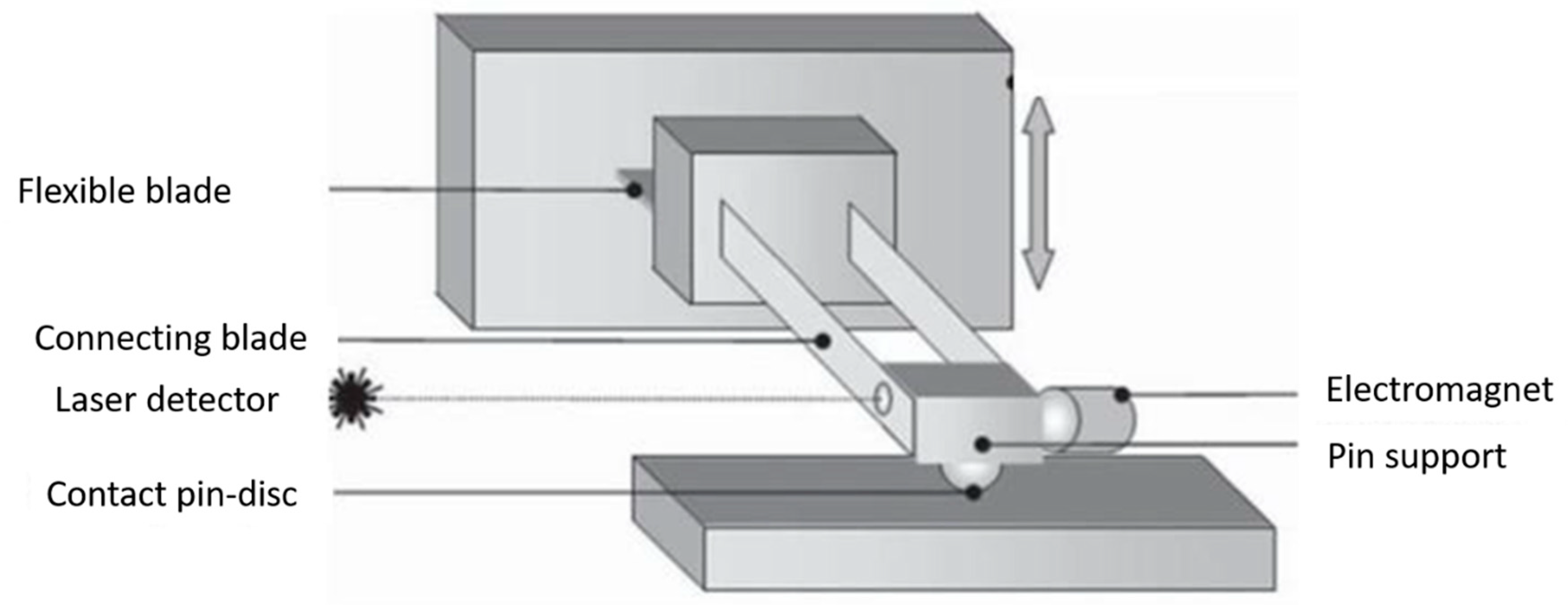
Figure 2.
Vibration tribometer developed at our research lab constituted by: pivoted loading arm (1); glass counterbody (2); silicone semi-sphere (3); flexible blade (4).
Figure 2.
Vibration tribometer developed at our research lab constituted by: pivoted loading arm (1); glass counterbody (2); silicone semi-sphere (3); flexible blade (4).
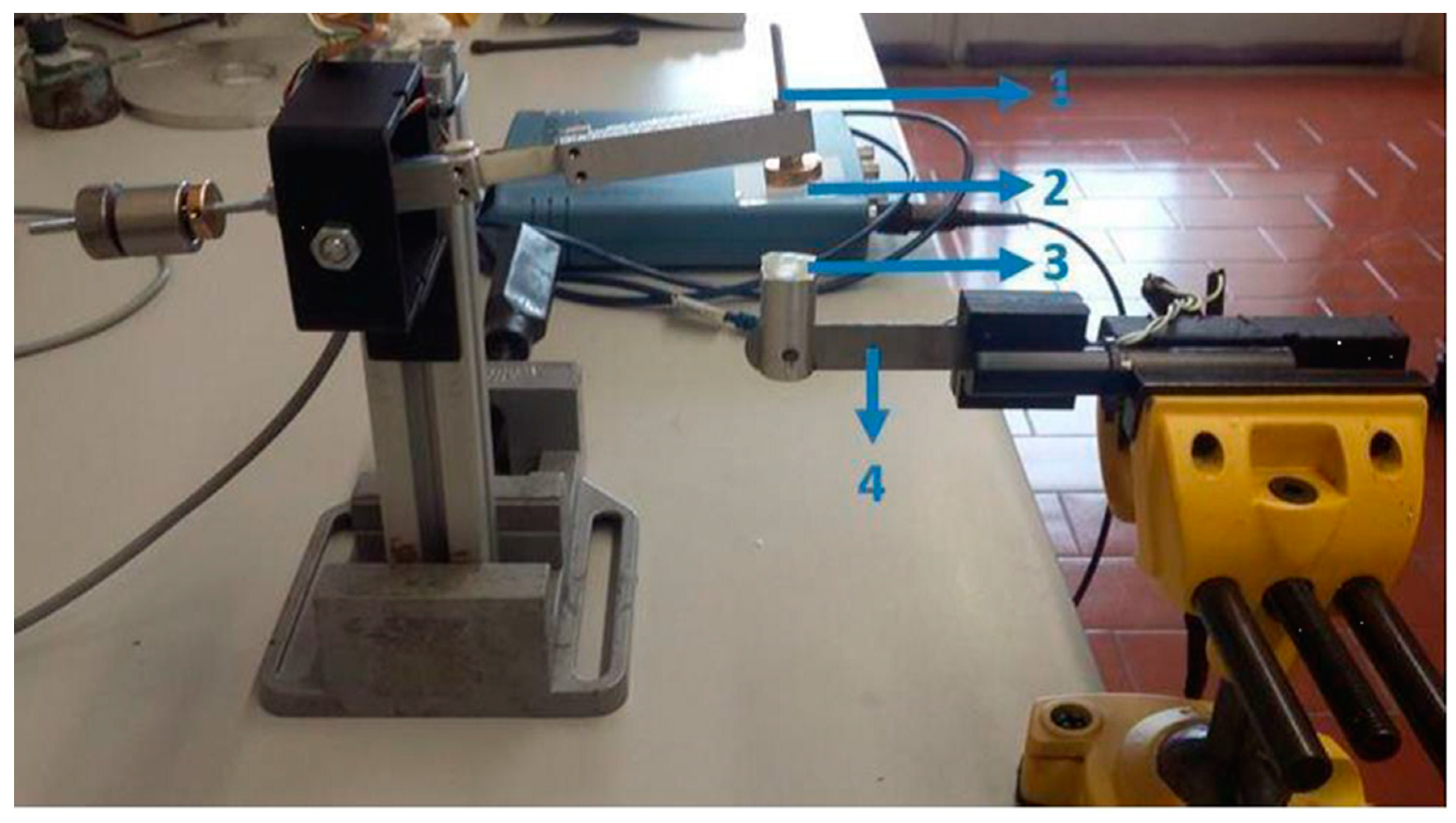
Figure 3.
System response in free vibration and respective exponential adjustment of maximum peaks.
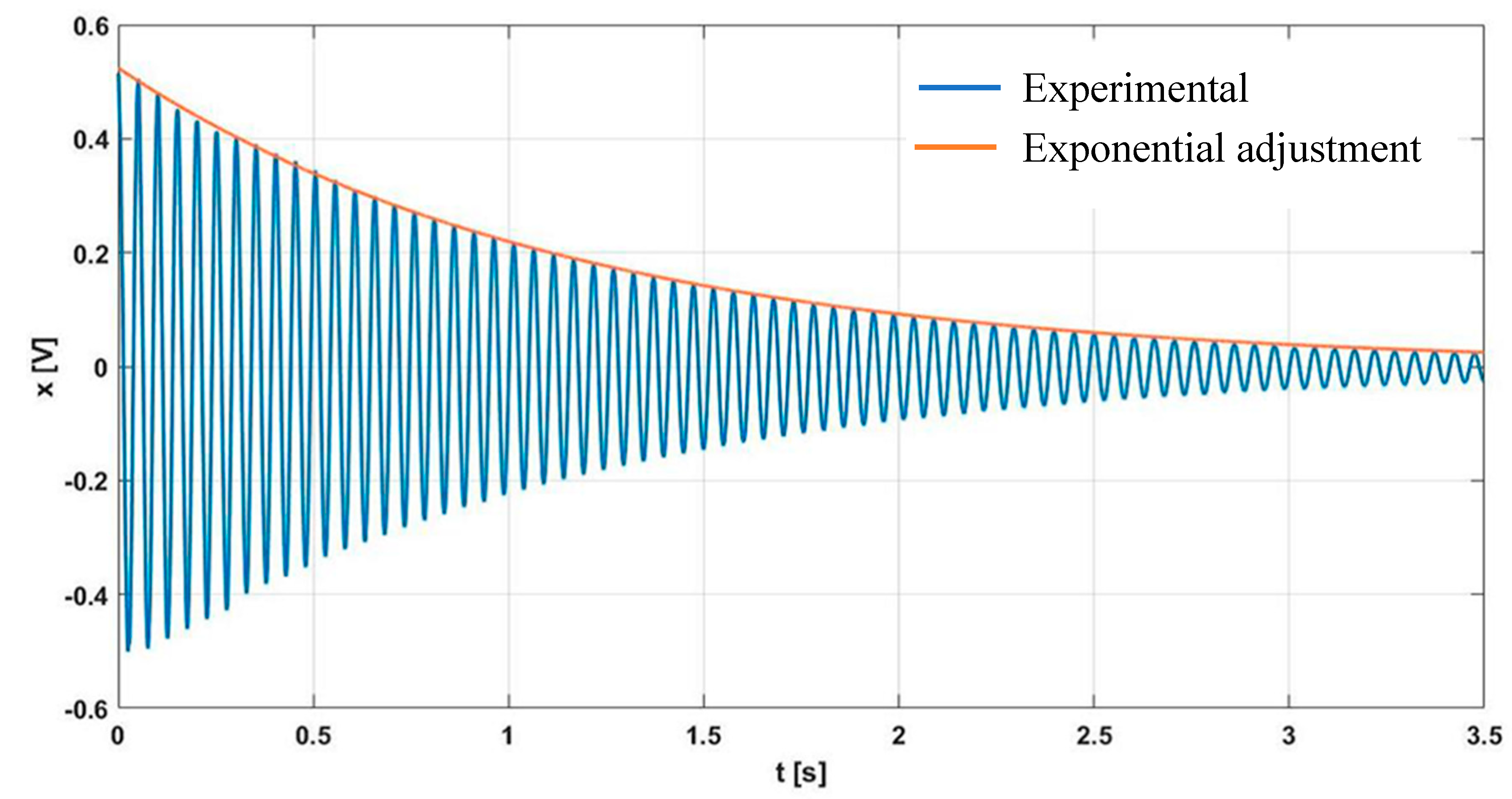
Figure 4.
Comparison of the system response obtained in free vibration experimentally and theoretical curve.
Figure 4.
Comparison of the system response obtained in free vibration experimentally and theoretical curve.
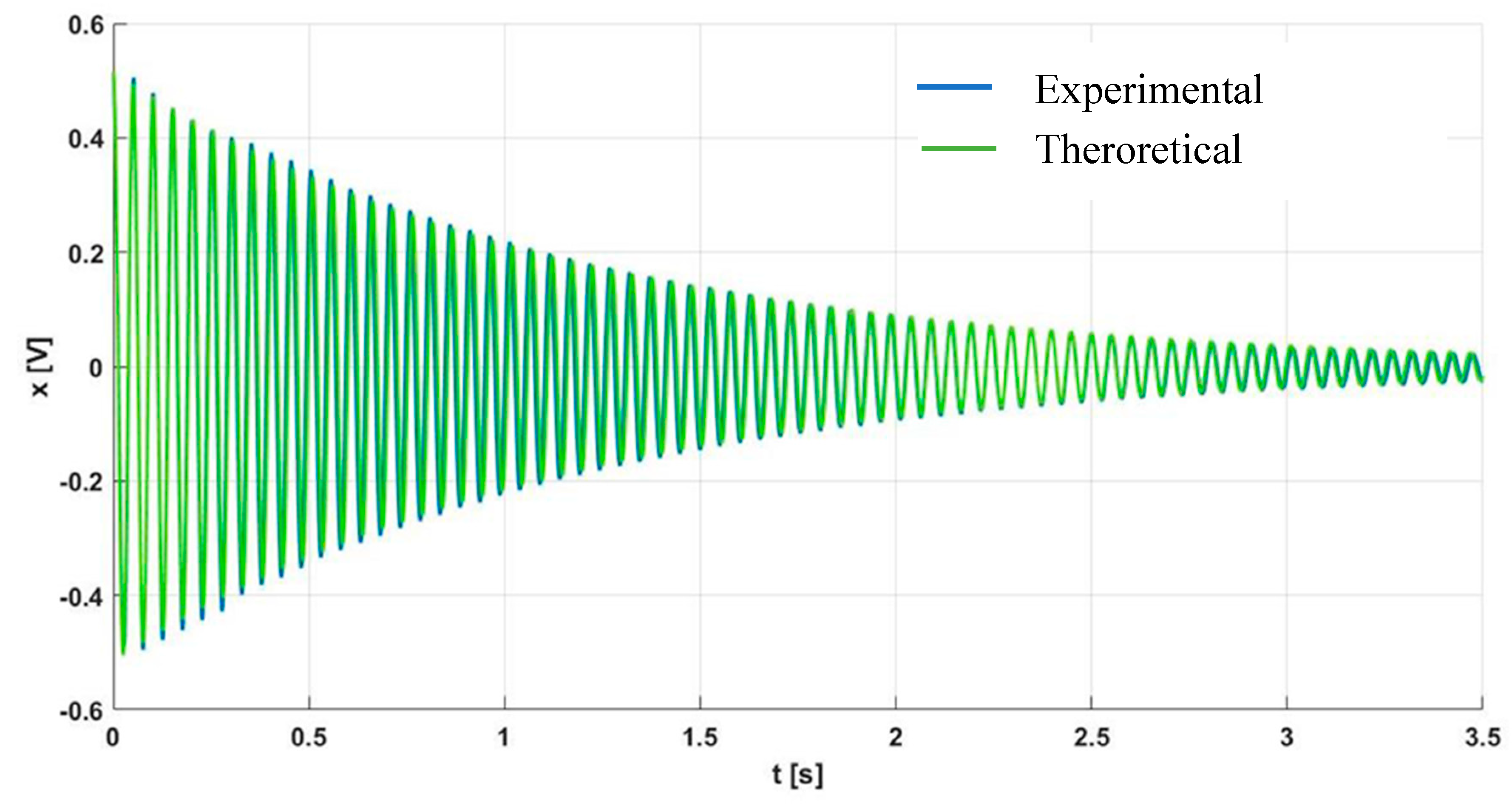
Figure 5.
Sensitivity estimation of the: (a) Coefficient of Friction; (b) Normal force.
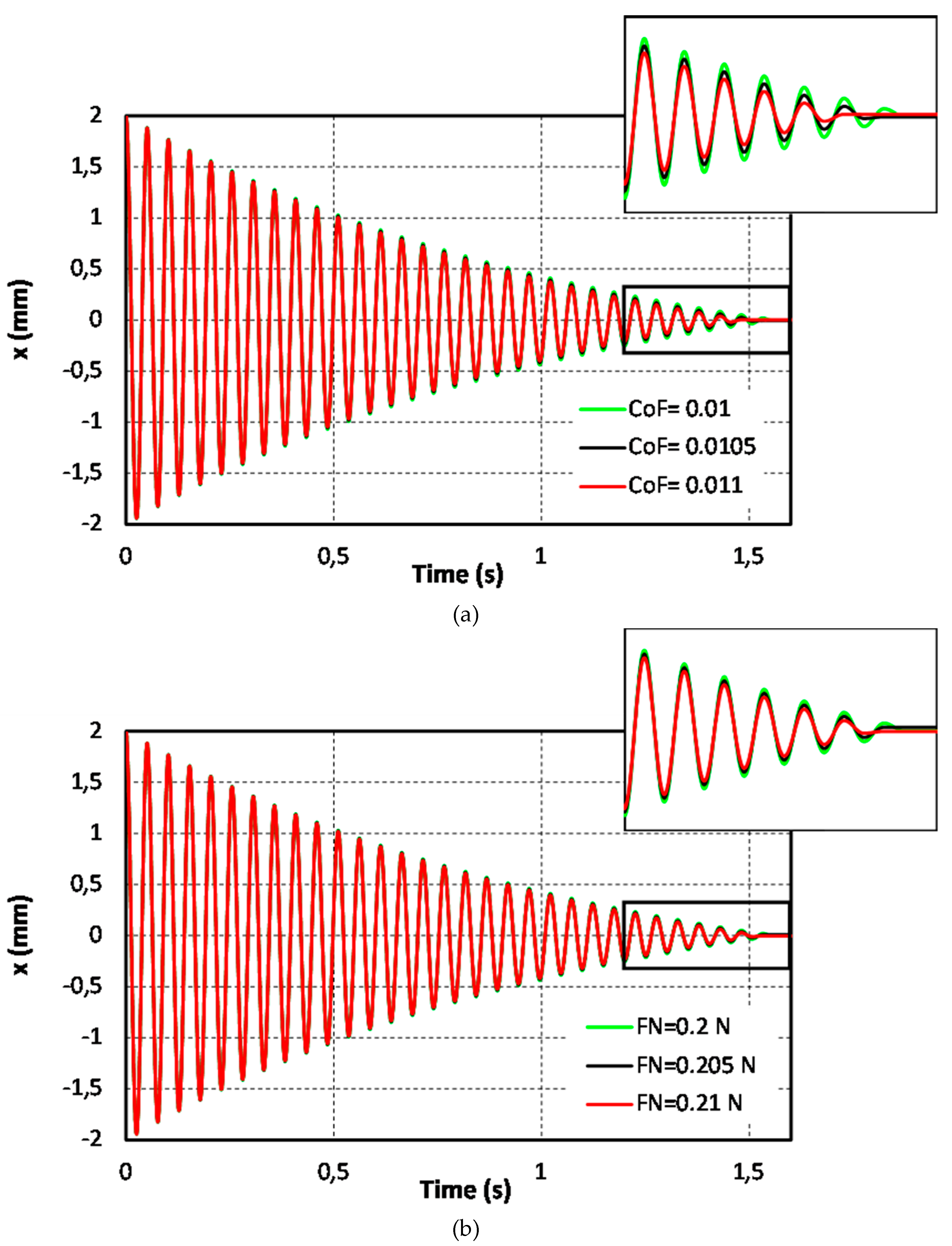
Figure 6.
Evolution of the displacement with time for experimental (orange line) and theoretical curves (blue line) for 2 mg/ml BSA concentration and 100 mN applied Normal load (test 2 of 3, COF = 0.09).
Figure 6.
Evolution of the displacement with time for experimental (orange line) and theoretical curves (blue line) for 2 mg/ml BSA concentration and 100 mN applied Normal load (test 2 of 3, COF = 0.09).
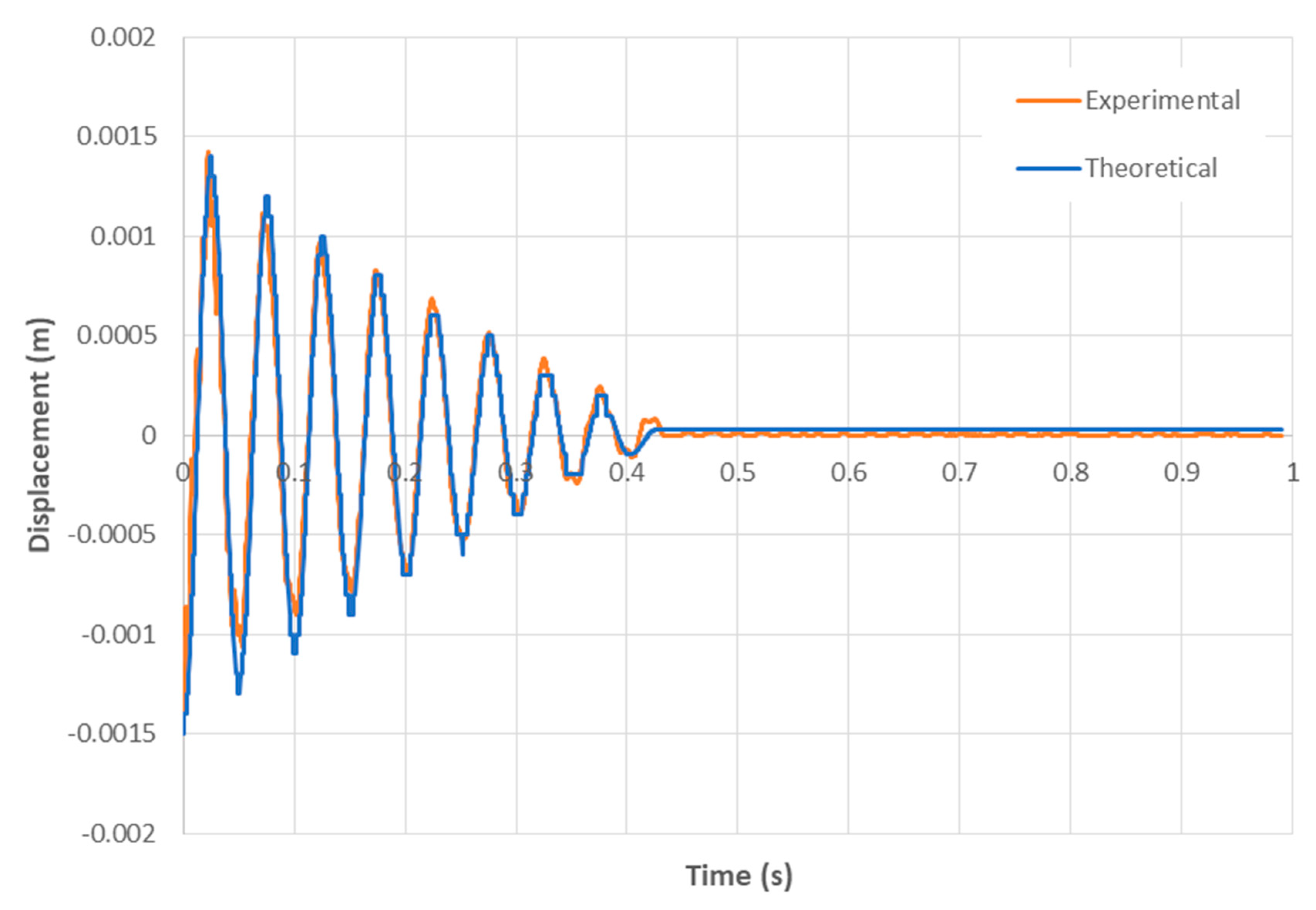
Figure 7.
Comparison of the evolution of the displacement with time for experimental curves with different BSA concentrations (1 and 2 mg/ml) and 100 mN applied Normal load (COF2mg/ml = 0.09 and COF1mg/ml = 0.023).
Figure 7.
Comparison of the evolution of the displacement with time for experimental curves with different BSA concentrations (1 and 2 mg/ml) and 100 mN applied Normal load (COF2mg/ml = 0.09 and COF1mg/ml = 0.023).
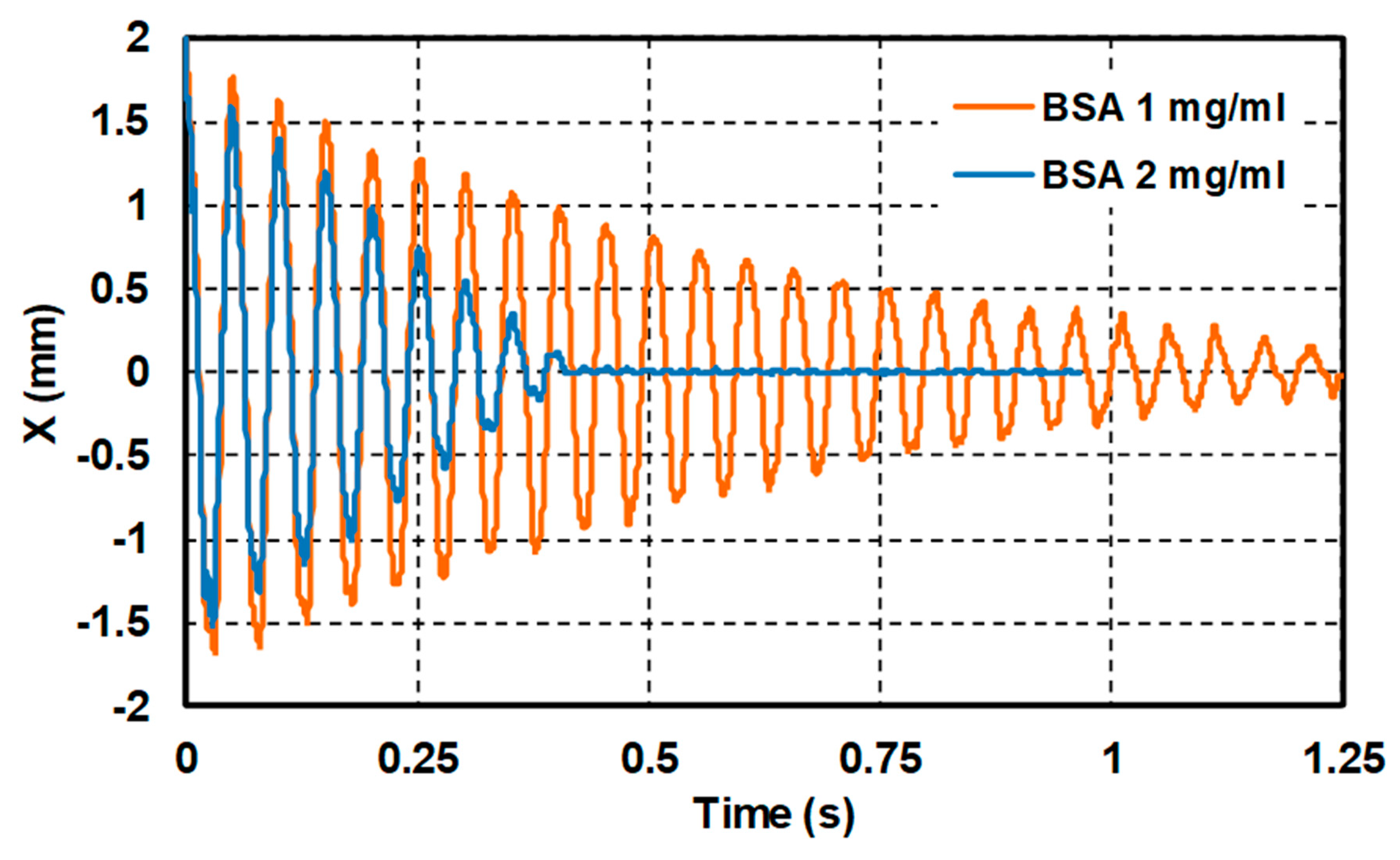
Figure 8.
Evolution of the coefficient of friction with the Bovine Serum Albumin concentration (applied normal force of 100 mN).
Figure 8.
Evolution of the coefficient of friction with the Bovine Serum Albumin concentration (applied normal force of 100 mN).
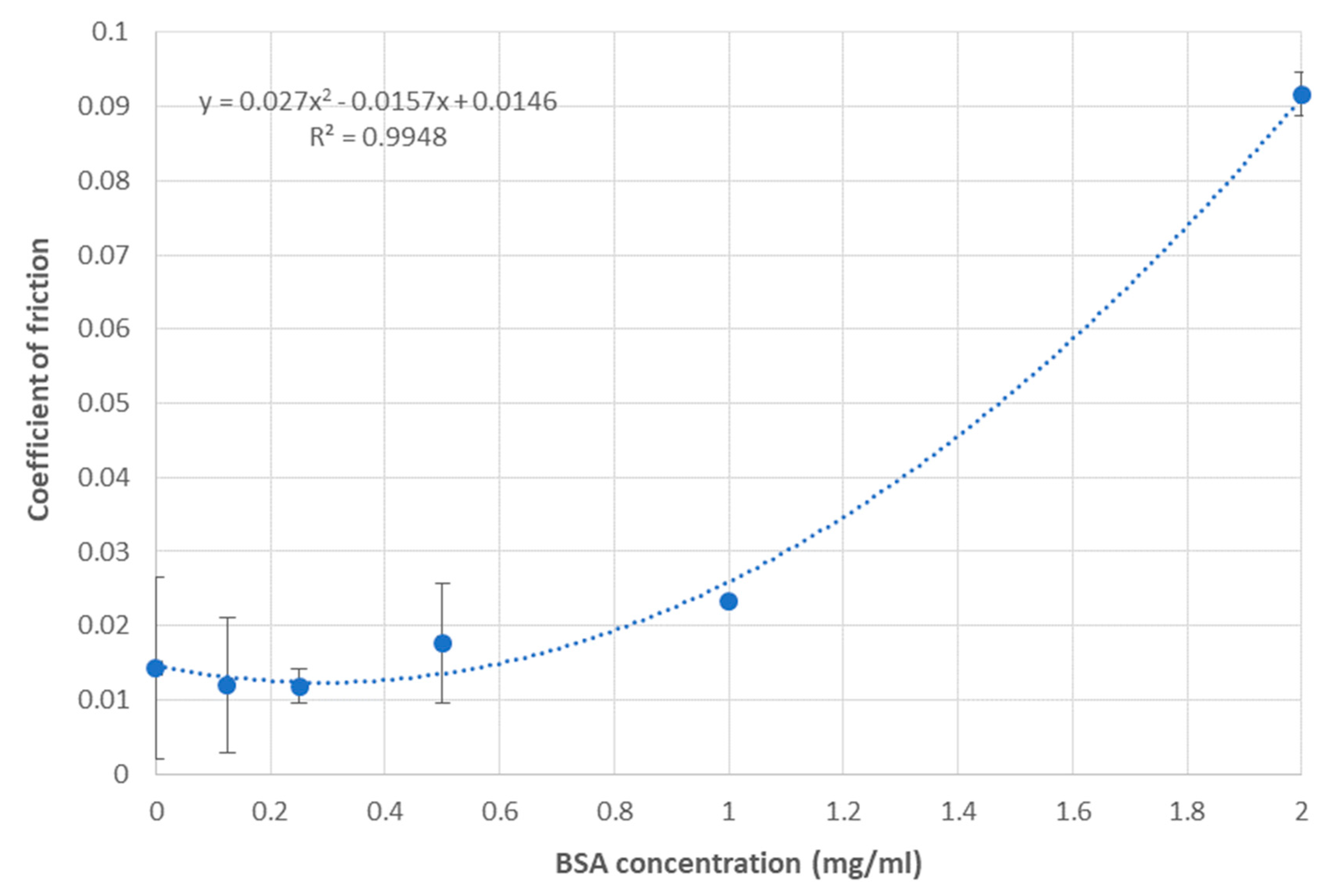

Table 1.
Bovine Serum Albumin physical properties [19].
Table 1.
Bovine Serum Albumin physical properties [19].
| pI in Water at 25 °C | Fatty Acid Depleted - 5.3, Endogenous Material - 4.7; 4.9 |
|---|---|
| pH of 1% Solution | 5.2-7 |
| Optical Rotation | [α] 259 : -61°; [α] 264 : -63° |
| Stokes Radius (r s ) | 3.48 nm |
| Sedimentation constant, S 20,W X 10 13 | 4.5 (monomer), 6.7 (dimer) |
| Diffusion constant, D 20,W X 10 7 | 5.9 |
| Partial specific volume, V 20 | 0.733 |
| Intrinsic viscosity, η | 0.0413 |
| Frictional ratio, f/f 0 | 1.30 |
| Overall dimensions, Å | 40 X 140 |
| Refractive index increment (578 nm) X 10 -3 | 1.90 |
| Optical absorbance, A279 nm (1 gram/liter) | 0.667 |
| Mean residue rotation [ m' ] 233 | 8443 |
| Mean residue ellipticity | 21.1 [θ] 209 nm ; 20.1 [θ] 222 nm |
| Estimated α-helix, % | 54 |
| Estimated β-form % | 18 |
Table 2.
Physical constants of the system.
| 𝒌[𝑵/𝒎] | 𝒘𝒏 [𝒓𝒂𝒅/𝒔𝟐] | 𝝃 | 𝒎 [𝒈] | 𝒄 [𝑵.𝒔/𝒎] |
|---|---|---|---|---|
| 265 | 123.10 | 7.14x10⁻³ | 17.49 | 0.031 |
Disclaimer/Publisher’s Note: The statements, opinions and data contained in all publications are solely those of the individual author(s) and contributor(s) and not of MDPI and/or the editor(s). MDPI and/or the editor(s) disclaim responsibility for any injury to people or property resulting from any ideas, methods, instructions or products referred to in the content. |
© 2024 by the authors. Licensee MDPI, Basel, Switzerland. This article is an open access article distributed under the terms and conditions of the Creative Commons Attribution (CC BY) license (http://creativecommons.org/licenses/by/4.0/).
Copyright: This open access article is published under a Creative Commons CC BY 4.0 license, which permit the free download, distribution, and reuse, provided that the author and preprint are cited in any reuse.


