

Submitted:
04 April 2024
Posted:
05 April 2024
You are already at the latest version
Abstract
The physical roots, interpretation, controversies and precise meaning of the Landauer Principle are surveyed. Landauer's principle is a physical principle pertaining to the lower theoretical limit of energy consumption of computation. It states that an irreversible change in information stored in a computer, such as merging two computational paths, dissipates a minimum amount of heat kBTln2 per a bit of information to its surrounding. The Landauer Principle is discussed in the context of fundamental physical limiting principles, such as the Abbe diffraction limit, the Margolus-Levitin limit and the Bekenstein limit. Synthesis of the Landauer bound with the Abbe, Margolus-Levitin limit and Bekenstein limits yields the minimal time of computation, which scales as τmin~hkBT. Decrease in a temperature of a thermal bath will decrease the energy consumption of a single computation, but, in parallel, it will slow the computation. The Landauer principle bridges between John Archibald Wheeler “it from bit” paradigm and thermodynamics. Experimental verifications of the Landauer Principle are surveyed. Interrelation between thermodynamic and logical irreversibility is addressed. Generalization of the Landauer principle to the quantum and non-equilibrium systems is addressed. Landauer Principle represents the powerful heuristic principle bridging the physics, information theory and computer engineering.
Keywords:
Landauer Principle
; entropy
; Abbe Limit
; Margolus-Levitin limit
; Bekenstein limit
; Planck-Boltzmann time
; Szcilard Engine
1. Introduction
Landauer principle is one of the limiting physical principles, which constraint behavior of physical systems. There exist fundamental laws and principles setting the limits of physical systems. These laws do not predict or describe behavior of physical/engineering systems, but limit, restrict their functioning. A realistic natural/engineering system can only provide limited functionalities because its performance is physically constrained by some basic principles [1]. Some of these limits are engineering ones. For example, a key engineering bottleneck for the development of new generations of computers today is integrated circuits manufacture, which packs billions of transistors and wires in several of silicon with astronomically low defect rates [2]. Another engineering constraint is imposed by limits on individual interconnects [2]. Despite the doubling of transistor density with Moore’s law, semiconductor integrated circuits (ICs) would not work without fast and dense interconnects. Metallic wires can be either fast or dense, but not both at the same time - smaller cross-section increases electrical resistance, while greater height or width increase parasitic capacitance with neighboring wires (wire delay grows with RC) [2]. Other constraints limiting the operation of physical (natural or engineering) systems are fundamental ones, and they emerge from the deepest foundations of physics. Limiting physical principles appeared in physics relatively late. It seems, that the first limiting principle historically was the Abbe diffraction limit, discovered in 1873, which states that light with wavelength , traveling in a medium with refractive index n and converging to a spot with half-angle will have a minimum resolvable distance of d, supplied by Eq. 1:
The Abbe diffraction limit is the maximum resolution possible for a theoretically perfect, or ideal, optical system [3,4]. Thus, it is not the engineering, but the fundamental physical principle. The Abbe diffraction limit arises from the idea that the image arises from a double diffraction process [3,4]. In spite of the fact that the Abbe diffraction limit is rooted in the classical physics, the role of the limiting principles in the realm of the classical physics is more than modest. The situation changed dramatically within the modern physics. In the relativity the speed of light in vacuum, labeled c, is a universal physical constant that is ca. 300,000 kilometers per second, and according to the special theory of relativity, c is the upper limit for the speed at which conventional matter or energy (and, consequently, any signal carrying information) can travel through space [6,7]. It is impossible for signals or energy to travel faster than c. The speed at which light waves propagate in vacuum is independent both of the motion of the wave source and of the inertial frame of reference of the observer; thus, enabling Einstein synchronization procedure for the clocks [6,7]. The limiting status of the speed of light in vacuum was intensively disputed in last decades and theories assuming a varying speed of light have been proposed as an alternative way of solving several standard cosmological problems [8,9]. Recent observational hints that the fine structure constant may have varied over cosmological scales have given impetus to these theories [8,9]. Theories in which a light of speed of vacuum appeared as an emerging physical value were suggested [9]. We adopt unequivocally the limiting status of a speed of light in vacuum c and demonstrate that this status generates other limiting physical principles, and just this status gives rise to consequences emerging from the Landauer principle.
The main limiting principle of the quantum mechanics is the Heisenberg uncertainty principle. It states that there is a limit to the precision with which certain pairs of physical properties, such as position x and momentum p (or time t and energy E), can be simultaneously measured. In other words, the more accurately speaking one property is measured, the less accurately the other property can be established (see Eq. 2 and Eq. 3):
where and are standard deviations of the position, momentum, time and energy correspondingly and is the reduced Planck constant [10,11]. The time-energy uncertainty principle, supplied with Eq. 3 needs more detailed discussion to be supplied below in the context of Mandelstam-Tamm and Margolus-Levitin bounding principles.
The limiting value of the light propagating in vacuum c combined with the Heisenberg uncertainty principle yield together the Bremermann’s limit, which supplies a limit on the maximum rate of computation that can be achieved in a self-contained system [12]. Bremermann’s limit is derived from Einstein’s mass-energy equivalency and the Heisenberg uncertainty principle, and is bits per second per kilogram of the computational system [12]. Consider that the Bremermann limit is built of the fundamental physical constants only.
Quantum mechanics gives rise also to the Mandelstam-Tamm and Margolus-Levitin limiting principles [13,14]. The Mandelstam-Tamm quantum speed limit states that the time it takes for an isolated quantum system to evolve between two fully distinguishable states is given by Eq. 4:
where is the energy uncertainty. The Margolus-Levitin limiting principle supplies a surprising result, predicting the maximum speed of dynamical evolution of the system [15]. The Margolus-Levitin limiting principle supplies the minimal time it takes for the physical system to evolve into orthogonal state (labeled . It should be emphasized that this minimal time depends only on the system average energy minus its ground state (denoted , and not on the energy uncertainty as it follows from Eq. 4 [15]. To simplify the formulae we choose zero of energy in such a way that so that the Margolus-Levitin limiting principle yields for the minimal time bound denoted Eq. 5:
Another important fundamental limiting principle is supplied by the Bekenstein bound [16]. Bekenstein bound defines an upper limit on the entropy S, which can be confined within a given finite region of space which has a finite amount of energy—or conversely, the maximal amount of information required to perfectly describe a given physical system down to the quantum level [16]. The bound value of entropy S is given by Eq. 6:
where R is the radius of a sphere that can enclose the given system, E is the total mass–energy including any rest masses [16]. We will discuss below the Margolus-Levitin and the Bekenstein bounds in their relation to the Landauer principle.
2. Results
2.1. What Is Information? The Meaning of the Landauer Principle?
What is information? Ambiguity of the notion of information hinders physical interpretation of this notion. Numerous definitions of information were suggested [17,18]. I am quoting from ref. [17]: “Information can be data, in the sense of a bank statement, a computer file, or a telephone number. Data in the narrowest sense can be just a string of binary symbols. Information can also be meaning” [17]. Informational theory is usually supplied in a pure abstract form that is independent of any physical embodiment. Intellectual breakthrough in the mathematization of information is related to the pioneering works by Claude Shannon, who introduced the information entropy of a random variable understood as the average level of “information” or “uncertainty” inherent to the variable’s possible outcomes [19,20]. Given a discrete random variable, which takes values in the alphabet X and is distributed according to , the Shannon Measure of Information/ Shannon entropy, denoted is given by Eq. 7:
The Shannon Measure of Information is a very general mathematical concept, and regrettably, it was often mixed in literature with the thermodynamic entropy [21,22,23,24,25]. The distinction between the Shannon Measure of Information was made in refs. [21,22,23,24,25]. And again, the Shannon measure of information is a very useful mathematical concept completely disconnected from the process of recording of information, information carrier material, reading and in erasing of information
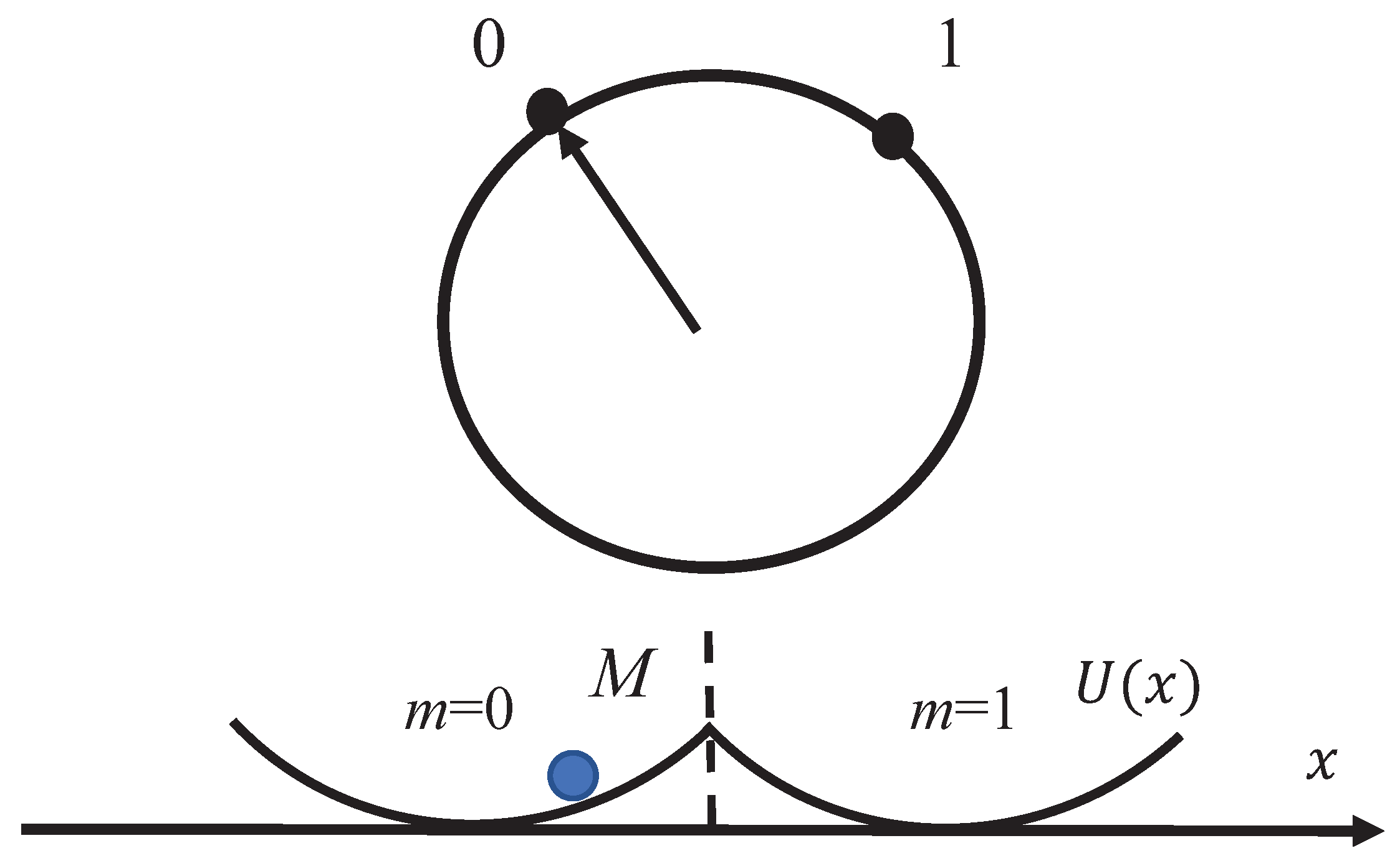
In contrast, Rolf Landauer in his pioneering and fundamental papers, published in 1961-1996, argued that information is physical and it has an energy equivalent [25,26,27,28,29]. It may be stored in physical systems such as books and memory chips and it is transmitted by physical devices exploiting electrical or optical signals [26,27,28,29]. Indeed, (I am quoting from ref. [29]) “computation, whether it is performed by electronic machinery, on an abacus or in a biological system such as the brain, is a physical process. It is subject to the same questions that apply to other physical processes: How much energy must be expended to perform a particular computation? How long must it take? How large must the computing device be? In other words, what are the physical limits of the process of computation?” If we adopt that computation is a physical process, it must obey the laws of physics, and first and foremost the laws of thermodynamics [26,27,28,29].This thinking leads to the new limiting physical principle, establishing minimal energy cost for erasure of a single memory bit for the system operating at the equilibrium temperature T. And this is exactly the Landauer principle. The Landauer principle may be derived in different ways; we start from the one-bit system depicted schematically in Figure 1. The picture depicts the Brownian particle M confined within a double-well potential, shown in Figure 1 and addressed in detail in Refs. [27,28,29,30]. When the barrier is much higher than the thermal energy, the Brownian particle will remain in either well (left or right) for a long time. Thus, the particle being in the left or right well can serve as the stable informational states, “0” and “1” of a single information bit. A Brownian particle trapped in either left or right well represents the informational states m = 0 and m = 1, as shown in Figure 1, where m is the parameter, characterizing the statistical state of the double-well system. The average work W to change with the isothermal process the statistical state of a memory from the state Ψ with the distribution to with distribution is given by Eq. 8:
where is the Helmholtz free energy of the system supplied by Eq. 9:
where is the Helmholtz free energy of the conditional states, in the Shannon entropy of the informational states, which equals to their entropies [21,22,23,24,25,30]. For a symmetrical well and a random bit we immediately obtain the Landauer bound, supplied by Eq. 10:
The exact meaning of Eq. 10 supplies the energy necessary for reset/erase of one random bit stored in a symmetric memory unit [30]. For asymmetric memory units is not necessarily equal to and the limiting Landauer principle is given by inequality:
The exact equality is attained if the reset is thermodynamically reversible [30]. This does not contradict the logical irreversibility of the reset, which implies that the entropy of the informational states decreases [30,31]. The relation between logic and thermodynamic reversibility will be discussed below. And again, the energetic cost on one random bit is supplied by the limiting physical principle, expressed by Eq. 11. The detailed discussion of Eqs. 10-11 is supplied in ref. [30]. An accurate and rigorous derivation of Eqs. 10-11 emerging from microscopic reasoning is supplied in ref. [32]. We again consider the particle in the twin-well potential U(x), shown in Figure 1. We assume, that before the erasure we want half of the bits to be in the ‘‘one’’ state and the other half to be in the ‘‘zero’’ state. We also adopt that the ensemble of bits is in contact with a thermal reservoir where the temperature of the reservoir T is low enough not to change the state of the bits, in other words takes place [32]. The system will instead reach a ‘‘local’’ thermal equilibrium in one of the half-wells. We therefore assume that the initial statistical state is described by the following for the bits before erasure (see Figure 1):
whereas after the erasure the distribution function is given by Eq. 13:
where x is the position, p is the momentum of the particle M, and is the partition function [33,34]. After the routine transformations it is demonstrated that to erase one bit of information, on average, the work performed on the system has to be equal to or greater than , or, equivalently, that the heat dissipation by the system into the heat reservoir has to be greater than or equal to the Landauer bound [32]. Generalization of the Landauer Principle for computing devices based on many-valued logic (N-based logic), exploiting N identical potential wells, was reported [30,35]. The energy necessary for erasure of one bit of information (the Landauer limiting bound) remains untouched for the computing devices exploiting a many-valued logic [30,35].
2.2. The Landauer Limit and the Margolus-Levitin Limiting Principle
Now we are ready to combine the Landauer bound with the Margolus-Levitin limiting principle, given by Eq. 5. Consider the computing unit, based on the physical device for which the Landauer limiting principle is true (the device exploiting identical potential wells confining the particle may be taken as an example) {30, 32, 35]. This device operates being in a thermal equilibrium with surrounding (thermal bath), which is kept at the constant temperature T. Let us pose the following question: what is the minimal time which will take for this device to make a single computing operation? Assuming in Eq. 5 we obtain for the minimal “Margolus-Levitin-Landauer” time necessary for a single computation denoted the following estimation:
where is the Planck-Boltzmann thermalization time, which is conjectured to be the fastest relaxation timescale for thermalization of the given system [36]. It is noteworthy, that the Margolus-Levitin-Landauer time, given by Eq. 14 is independent of the geometrical dimensions of the computing unit. Formula (14) may be called the Margolus-Levitin-Landauer bound. Planck-Boltzmann thermalization time should not be mixed with the Planck time, which is the time span at which no smaller meaningful length can be validly measured due to the indeterminacy expressed in Werner Heisenberg’s uncertainty principle.
Let us estimate now the Landauer time for the ambient conditions; assuming e calculate Thus, a single computing unit may perform not more than erasures per second at ambient conditions.
Another approaches for the bounds of the finite time computation were suggested [37,38,39,40,41]. For a slowly driven (quantum) two-level system weakly coupled to a thermal bath, the finite-time Landauer bound takes the simple form, supplied by Eq: 15
where τ is the total time of the computation process and Γ is the thermalization rate. It should be emphasized that all of the approaches suggest the emergence of the Planckian thermalization time scale (we denote it as the Planck-Boltzmann time), as the shortest timescale for information erasure, as it also immediately follows from the Margolus-Levitin-Landauer bound, supplied by Eq. 14 (see Ref. [41]). Finite-size corrections to the Landauer bound are reported in ref. [42]. Eqs. 14-15 supply the trade-off important for development of the computing devices. Engineers want the computing devices to as energy efficient, as possible; thus, they try to diminish the energy necessary for a single computation [43]. However, this decrease in the energy cost of computation inevitably results in the increase of a single computation time as follows from the Margolus-Levitin-Landauer bound, supplied by Eq. 14.
2.3. The Landauer Limit and the Bekenstein Bound
Now we found ourselves in the realm of relativity. We will demonstrate that the Bekenstein bound [16] also restricts the computation time. Consider computational unit with a characteristic dimension of R. Cum grano salis we assume that the minimal time of the single computation (we call it the Bekenstein time and denote is given by Now we address Eq. 6. Entropy change necessary for erasing 1 bit of information is estimated as . According to the Landauer principle . Substitution , and yields Eq. 16:
It is immediately recognized, the Planck-Boltzmann thermalization time appears as a single time scale in the eventual bound, supplied by Eq. 16. This time scale is independent on the dimensions of the computing unit. Comparing Eq. (16) to Eq. (14) yields: however, the values of these time scales are close one to another. It is seen, that the Landauer limiting principle allows unifying of fundamental ideas emerging from relativity and quantum mechanics. The minimal times of computation arising from the Margolus-Levitin and Bekenstein bounds are close one to another. Thus, the Landauer Principle in a certain sense bridges relativity and quantum mechanics. This idea will be discussed below. It should be emphasized the Landauer Principle holds for a diversity of quantum systems [39,44,45,46,47,48,49].
2.4. The Abbe Diffraction Limit and the Landauer Principle
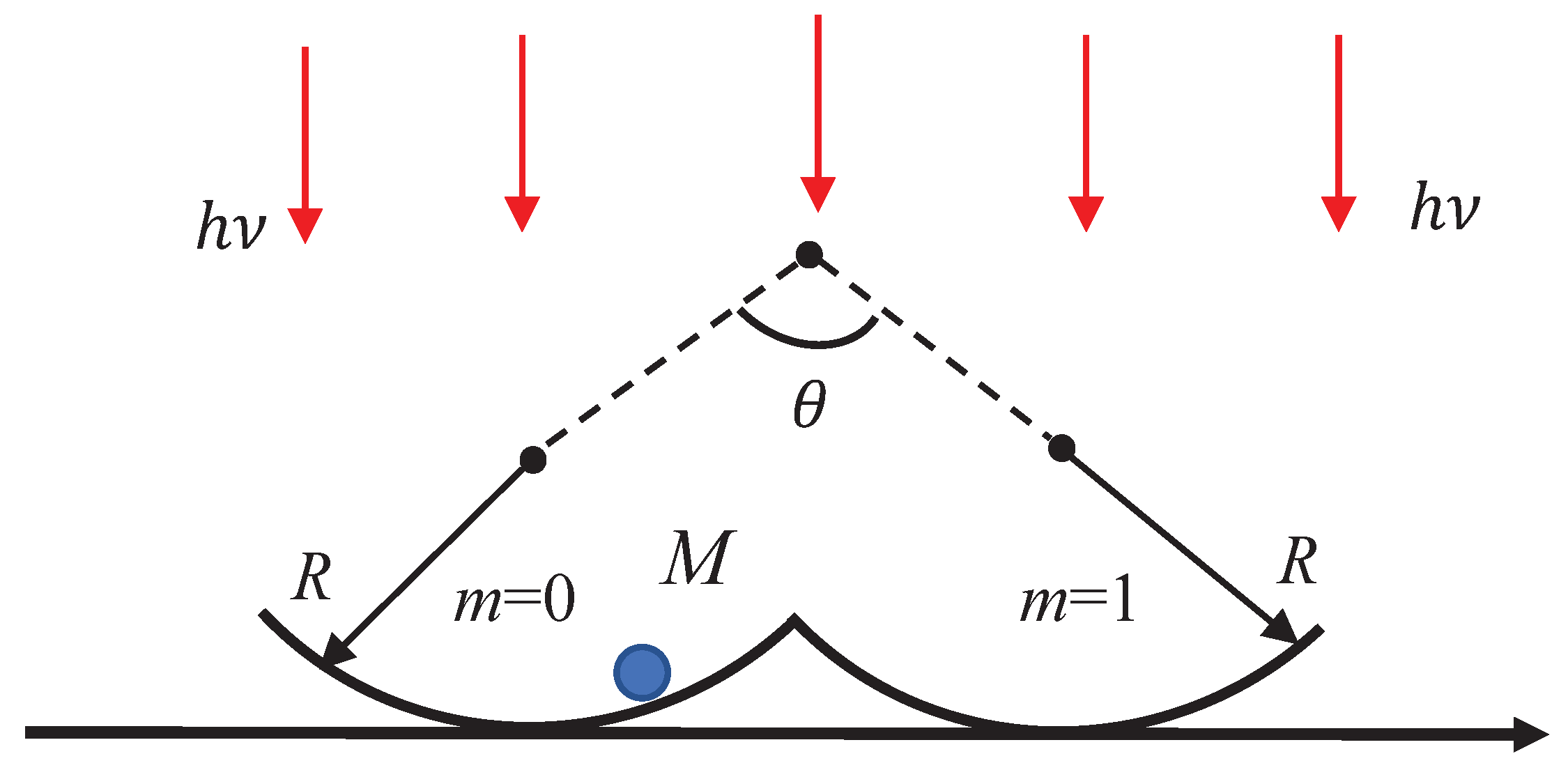
Now we address the Abbe diffraction limit (see Eq. 1) discussed in Section 1 and addressed in detail in the classical textbooks devoted to optics [3,4]. Consider twin-well computational system, depicted in Figure 3, and representing particle M confined within the twin-well potential. We use the monochromatic light ( is a frequency, is a wavelength) for identification of the particle location. According to Eq. 1 the identification of the particle location is still possible, when takes place, where n is the refractive index and angle is shown in Figure 3. If the same monochromatic light beam is used for the erasure of information, i.e., for the transfer of the particle from one half-well to another and the Landauer principle is adopted we estimate , where c is the light speed, thus we obtain . The minimal time necessary for a single computation is roughly estimated as: . Combining these estimation yields for the minimal time of a computation:
Figure 2.
Scheme of the Leo Szilárd minimal engine is depicted.
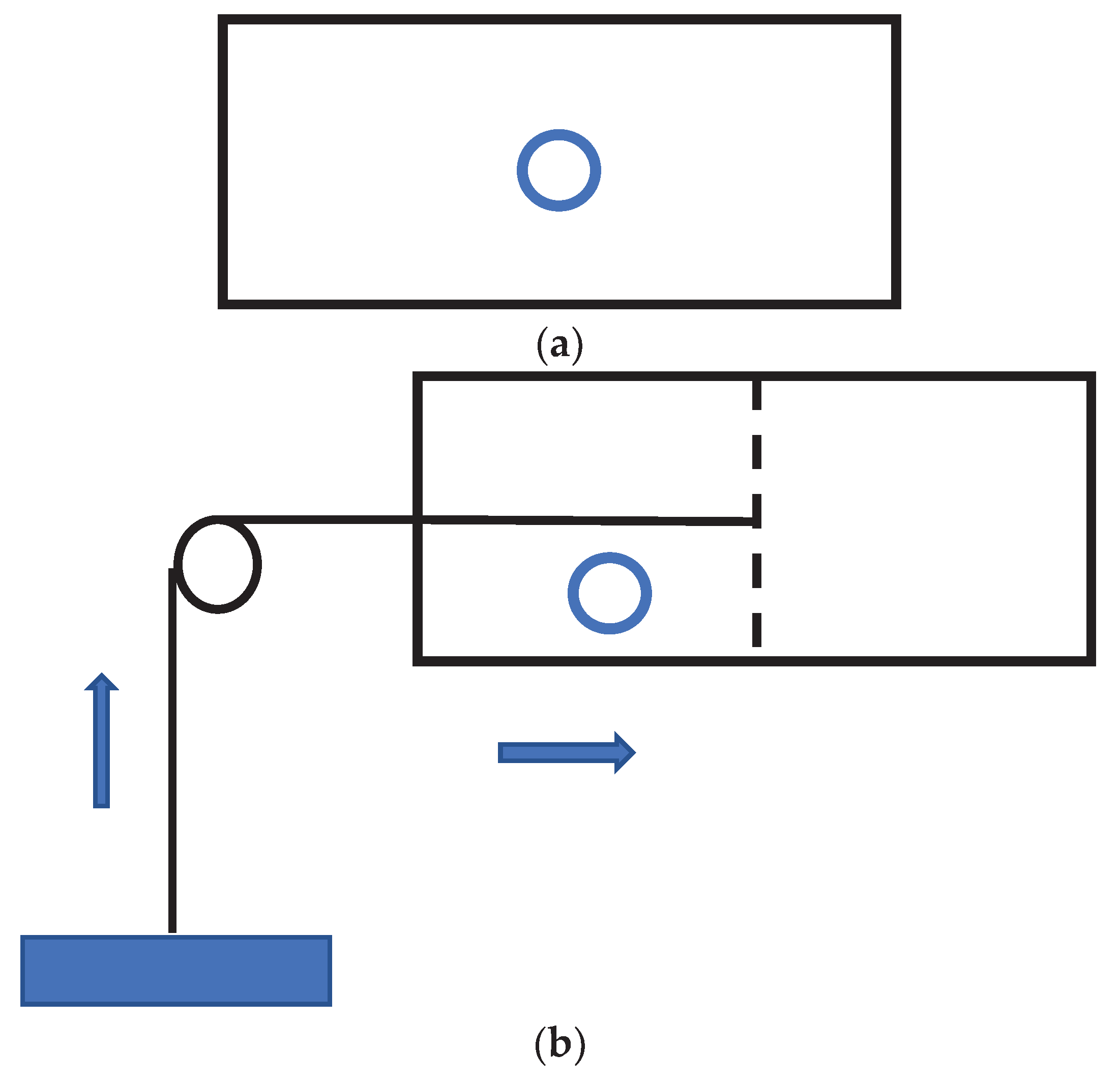
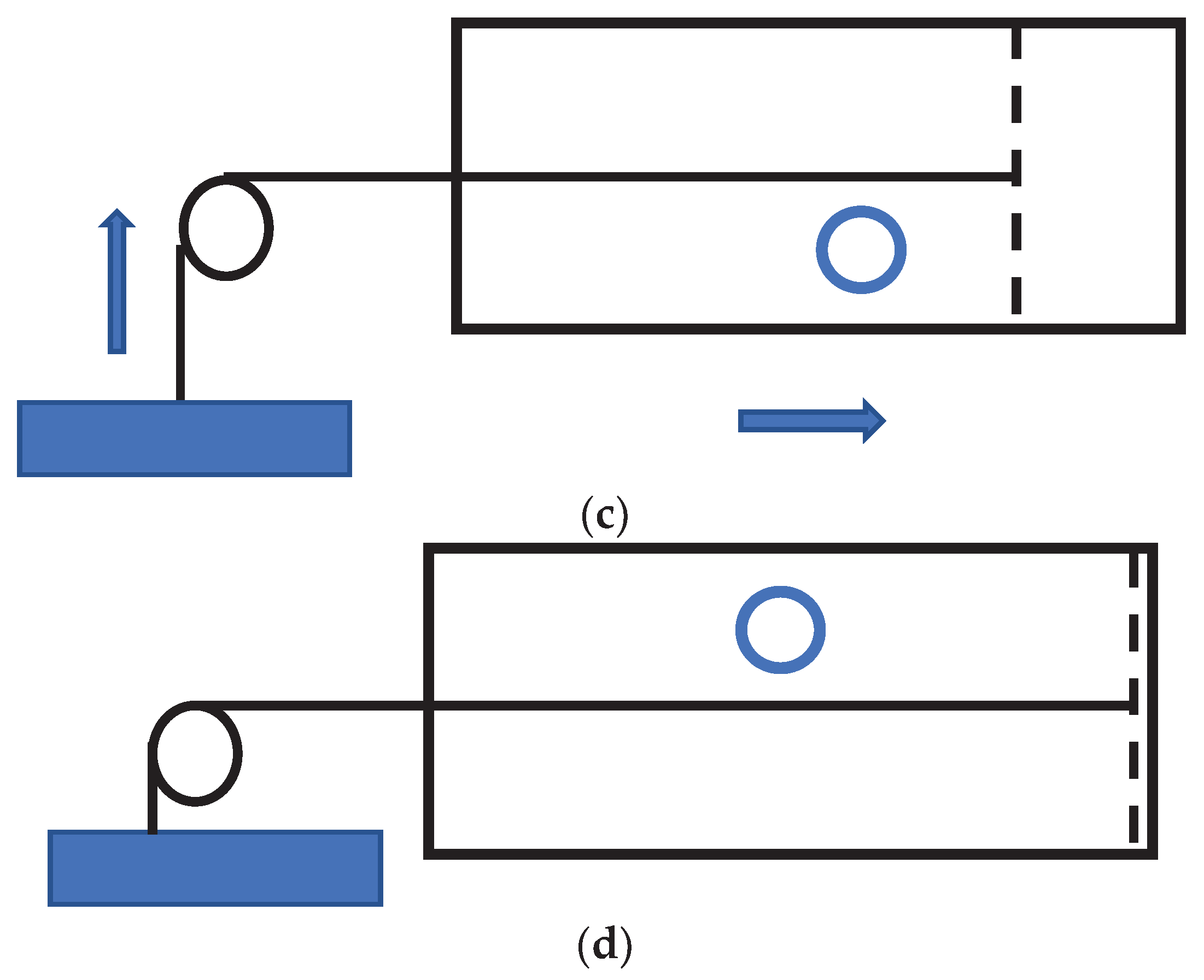
Figure 3.
Twin-well system, containing particle M, illuminated with monochromatic light is depicted. The system is in a thermal equilibrium with surrounding T.
Figure 3.
Twin-well system, containing particle M, illuminated with monochromatic light is depicted. The system is in a thermal equilibrium with surrounding T.
The minimal computation time corresponding to , is estimated as follows:
And again the minimal time span of computation scales as the Planck-Boltzmann thermalization time, independent on the geometrical parameters of the system, given by .
2.5. Breaking the Landauer Limit
It should be emphasized that derivation of the Landauer bound emerging from the analysis of the behavior of the particle placed into the twin-well potential, shown in Figure 1 and Figure 3, implies the symmetrical configuration of the potential [30,32]. In the asymmetrical twin-well potential the Landauer bound may be broken [31,50,51]. Landauer’s principle for information erasure is valid for a symmetric double-well potential, but not for an asymmetric one. Physically, the reduced work arises when the starting state is not in equilibrium, and other degrees of freedom do work that compensates the work required to erase. More simply, erasing from a small well to a large well transfers a particle from a small box to a larger one, but never the reverse [51].
2.6. The Landauer Principle and Thermodynamics of Small Systems
The Landauer principle may be understood in the context of the minimal thermal engine suggested by Leo Szilárd in 1929 [52]. Leo Szilárd is famous for his the letter for Albert Einstein’s signature that resulted in the Manhattan Project. In Leo Szilárd’s original formulation, the engine exploits single-molecule gas confined in a box of volume contacting a thermal bath at temperature T as depicted in Figure 2. As in any other thermal engine, the molecule pushes the piston and the engine performs a work (say lifting a load, as shown in Figure 2b,c). Thus, Szilárd energy transforms heat collected from the bath in the work, being the minimal thermal engine [52]. We are interested in the informational interpretation of the Szilárd engine, which is closely related to the Landauer principle.
Consider the location of the particle within a box. Divide the box into two equal parts. Actually the information concerning which side the molecule is in after dividing the box, the information can be utilized to extract work, e.g., via an isothermal expansion, under . Let us explain this idea: isothermal expansion of the single-molecule-gas from volume to volume followed by the motion of the piston yields the work . In the particular case, when the box is divided into two equal halves and However, this result may be interpreted in the terms of the information theory. Indeed, after the expansion we loosed the information about the precise location of the particle. Thus, we performed erasure of one bit of information. In other words, we converted one bit of information into the work . And, this is exactly the Landauer bound [26,27,28,29]. Instead of displacement of the piston, we may imagine the Maxwell demon which introduces or pulls out the impermeable partition which fixes/erases the location of the particle. Thus, it turns out that the Landauer principle is closely related to the famous Maxwell demon paradox [53].
It seems that the action of the Szilárd engine contradicts to the Second Law of Thermodynamics. Indeed, let us make the Szilárd engine cyclic. To return the initial state, the partition/piston can be removed without any work consumption and the whole process can be repeated in a cyclic manner. All thermodynamic processes are defined as isothermal and reversible [53]. This engine apparently violates the Kelvin-Planck statement of the second law (and it well known that is actually equivalent to the Clausius and Carnot formulations) by converting heat directly into equivalent amount of work through a cyclic process [53]. Now it is generally accepted that the measurement process including erasure or reset of the Maxwell Demon memory requires the minimum energy cost of at least , associated with the entropy decrease of the engine, and that it saves the second law. Quantum Szilárd engine was addressed [53,54]. A demonless quantum Szilard engine was studied [53]. It was demonstrated that the localization holds the key along with Landauer’s principle to save the second law and presents a complementary resolution of the quantum version of Szilard’s paradox [53]. Quantum mechanics rooted arguments are necessary for the justification of the third law of thermodynamics. Quantum mechanics also saves the second law, suggesting that quantum mechanics has strong ties in the foundations of thermodynamics and information theory [53].
Numerous questions related to the information interpretation of the Szilárd engine remain open. However, it is clear that the Szilárd engine links the Landauer principle to the thermodynamics of small systems, which was rapidly developed in the past decade [54,55,56,57].For example, it will be instructive to address the minimal (single-particle) Carnot engine, exploited for erasure of information in heat baths [58]. It is noteworthy, that the efficiency of the minimal Carnot is given by the traditional Carnot expression when the motion of the gas particles is temporally averaged (instead of the usual spatial averaging) [58]. Only few experimental realizations of the Szilárd engine were reported [59,60,61,62]. A single-electron box operated as a Szilárd engine, enabled extraction of heat rom the reservoir at temperature T per one bit of created information [59]. The information was encoded in the position of an extra electron in the box [59].
2.7. The Landauer Principle and the “It from Bit” Archibald Wheeler Paradigm
It 1989 John Archibald Wheeler, suggested the global concept aphoristically called “It from bit”. “It from bit symbolizes the idea that every item of the physical world has at bottom — at a very deep bottom, in most instances — an immaterial source and explanation; that what we call reality arises in the last analysis from the posing of yes-no questions and the registering of equipment-evoked responses; in short, that all things physical are information-theoretic in origin and this is a participatory universe. Three examples may illustrate the theme of it from bit. First, the photon. With polarizer over the distant source and analyzer of polarization over the photodetector under watch, we ask the yes or no question, “Did the counter register a click during the specified second?” If yes, we often say, “A photon did it.” We know perfectly well that the photon existed neither before the emission nor after the detection. However, we also have to recognize that any talk of the photon “existing” during the intermediate period is only a blown-up version of the raw fact, a count. The yes or no that is recorded constitutes an unsplitable bit of information. A photon, Wootters and Zurek demonstrate cannot be cloned [63]”. Actually, the Landauer Principle fills the “It from Bit” idea with a physical content, when supplying the link between “information” and physically measurable properties of real systems. This bridge was built in a series of recent papers [64,65,66,67,68,69,70,71,72,73,74,75]. The principle of mass-energy-information equivalence proposing that a bit of information is not just physical, as already demonstrated, but it has a finite and quantifiable mass while it stores information was suggested [64,65,66,67,68,69,73]. According to Vopson, the equivalent mass of the excess energy is created in the process of lowering the information entropy when a bit of information is erased [64]. Using the mass-energy equivalence principle, the mass of a bit of information is [64]:
The mass of a bit of information at room temperature (T=300K) is as estimated in ref. [64]. Now consider the particle with energy E in contact (not necessarily in thermal equilibrium) with the thermal bath T. The energy of the particle may be used for erasing information within the thermal bath. The maximal information (as measured in bits) denoted which may be erased by the particle in contact with the bath, according to the Landauer principle equals to: [73]:
where m is the relativistic mass of the particle. The value may be seen within the Landauer context as the maximal informational content of a relativistic particle. If the potential energy of the particle is negligible, and , is adopted (v is the velocity of the particle), Eq. 20 is re-written as follows [73]:
The value supplied by Eq. 21 may be understood as the maximal informational content of a particle at rest [73]. The particle may exchange information with the medium, if at least one bit of information will be erased in medium by the particle; thus, inequality should hold. This inequality yields:
The particle with a rest mass smaller than will not erase information in the medium at the temperature of T. Assuming (which is the temperature of the cosmic microwave background [76]), we obtain the estimation . It should be emphasized that all of known for today elementary particles (including neutrino ) are heavier than. Particles lighter than will not transform the information to the Universe and are well expected to be undetectable.
The Landauer Principle enabled estimation of the computational capacity of the entire Universe, which is large but finite [64,73,77,78]. We denote the total informational capacity of the Universe which may be estimated as follows:
Where is the mass of the observable Universe [79]. Substituting and we obtain , in the satisfactory vicinity to the estimation reported in ref. [78], which was based on quite different considerations.
The Landauer minimal principle enables a fresh glance on the famous “dark matter” problem [80,81,82]. Dark matter is the mysterious substance that dominates the mass budget of the universe from sub-galactic to cosmological scales, which is arguably one of the greatest challenges of modern physics and cosmology [80,81,82]. We still do not know to explain how stars orbit in galaxies and how galaxies orbit in clusters. A wide array of candidates for particle dark matter was suggested, including thermal relics (WIMPs), neutralinos and sterile neutrinos [81,82,83,84]. However, numerous experiments have failed to find evidence for the suggested dark matter particles, and it was hypothesized that gravity theory should be modified [85]. Eq. 22 emerging from the Landauer minimal principle, enables revisiting of the “dark matter” problem [64,73]. Indeed, if the dark matter is built from the particles for which takes place, they could not be registered due the fact, that they do not transform information to the surrounding media and experimental devices [64,73].
Let us continue thinking within the Wheeler “It from bit” paradigm. The Landauer minimal principle supplies a new glance of the problem of great unification of physics. Eq.20 may be easily extended to fields. Consider a field (for example an electromagnetic field) in a thermal contact (not necessarily in thermal equilibrium, as it takes place in a black body radiation problem) with surrounding/thermal bath T. The energy of the field may be used for isothermal erasing information in the surrounding. The maximal information to be erased by the field (seen as the informational content of the field) according to the Landauer principle will be given by:
where Ef is the energy of the field. It is noteworthy, that the physical nature of the field does not matter. If the information and the temperature are taken as a basic physical quantities, Eq. 24 will be universal for all kinds of physical fields. The field is capable to erase isothermally the information if the bounding inequality is true. The Landauer principle changes the status of temperature, usually seen as the derivative of basic physical quantities, such as energy and entropy [33,34]. Contrastingly, the Landauer principle tells us that the it is just the temperature which determines the possibility to erase/record the information, seen as a basic physical value [86].
2.8. Experimental Verification of the Landauer Principle
Landauer bound was tested in a series of experimental investigations [46,59,87,88,89]. Koski et al. tested the Landauer Principle with the minimal Szilard Engine (see Section 2.6 and Figure 2) [52,59]. The main element the Szilard Engine was the single-electron box (abbreviated SEB) 59], which consisted of two small metallic islands connected by a tunnel junction [59]. The SEB was maintained at the dilution-refrigerator temperatures in the 0.1-K range. The authors provided the experimental demonstration of extracting nearly of work for one bit of information, in accordance with the Landauer principle [59]. Use of the trapped ultra-cold ion enabled demonstration of a quantum version of the Landauer principle in the experimental study by Yan et. al. [46]. Ref. [87] reported experimental testing of the Landauer bound al low values of . The authors demonstrated that for the logically reversible operations energy dissipations much less than were registered, while irreversible operations dissipate much more than . Measurements of a logically reversible operation on a bit with energy 30 yielded an energy dissipation of 0.01 [87]. Experiments performed with a single colloidal particle trapped in a modulated double-well potential, demonstrated that the mean dissipated heat saturates at the Landauer bound in the limit of long erasure cycles [88]. Experiment performed with a colloidal particle in a time-dependent, virtual potential created by a feedback trap also confirmed the Landauer limit [89].
2.9. Landauer Limit, in the Context of Logical and Thermodynamic Irreversibility
Discussion around the Landauer principle leads to the extremely important distinction between the logic and thermodynamic irreversibility. In order to understand this distinction we have to start from the separation of the degrees of freedom of the computing device. Some of a computer’s degrees of freedom are used to encode the logical state of the computation, and these information bearing degrees of freedom (abbreviated IBDF) are by design sufficiently robust that, within limits, the computer’s logical state evolves deterministically as a function of its initial value, regardless of small fluctuations or variations in the environment/temperature or in the computer’s other non-information bearing degrees of freedom (NIBDF) [90]. While a computer as a whole (including its power supply and other parts of its environment), may be viewed as a closed system obeying reversible laws of motion, Landauer noted that the logical state often evolves irreversibly, with two or more distinct logical states having a single logical successor. Therefore, because Hamiltonian dynamics conserves the fine-grained entropy, the entropy decrease of the IBDF during a logically irreversible operation must be compensated by an equal or greater entropy increase in the NIBDF and environment. This is Landauer principle seen in the context of the informational/non informational degrees of freedom of the computing device [90].
Thus, the clear distinction between thermodynamic and logic reversibility becomes necessary. Following Sagawa, we adopt following definitions of the thermodynamic and logical reversibility: a physical process is thermodynamically reversible if and only if the time evolution of the probability distribution in the process can be time-reversed, where the change of the external parameters is also time-reversed, and the signs of the amounts of the work and the heat are changed [31]. In turn, a computational process is logically reversible if and only if it is an injection. In other words, is logically reversible if and only if, for any output logical state, there is a unique input logical state. Otherwise, is logically irreversible [31]. The logically irreversible erasure can be performed in a thermodynamically reversible manner in the quasi-static limit. This does not contradict the conventional Landauer principle. The logical reversibility is defined only by the reversibility of the logical states, which is related only to the logical entropy. In contrast, the thermodynamic reversibility is related to the reversibility of the relevant total system (i.e., the whole universe) including the heat bath, and to the total entropy production as discussed in Sec. 2. Therefore, these logical and thermodynamic reversibility are not equivalent in general [31,91]. If the erasure is not quasi-static but is performed with a finite velocity (the Margolus-Levitin limit determines only the minimal time of computation, however, in principle it may be infinite, see Section 2.2), the erasure becomes thermodynamically irreversible. In this specific case we recover the Landauer bound, a as work necessary for erasure of one bit of information. For the limit of heat generation per bit to be reached, the thermodynamic process must be reversible. In practice, logical operations are implemented by sub-optimal physical processes and so are thermodynamically irreversible [91]. However, this irreversibility is not caused by the nature of the logical operation, it is by way of the operation being implemented by a thermodynamically sub-optimal physical process [91]. This is as true for logically irreversible operations as it is for logically reversible operations [91].
2.10. Generalization of the Landauer Principle
Generalization of the Landauer Principle for logically in-deterministic operations was reported by Maroney [92]. Non-equilibrium quantum Landauer Principle was reported [45,93]. Landauer’s Principle at zero absolute temperatures was introduced recently; a bound tighter than Landauer which remains nontrivial even in the was reported [94]. Herrera discussed the Landauer principle in its relation to general relativity [95]. The Landauer principle was applied to the problem of gravitational radiation [95]. It was demonstrated that the fact that gravitational radiation is an irreversible process entailing dissipation, is a straightforward consequence of the Landauer principle and of the fact that gravitational radiation conveys information [95].It should be emphasized that understanding the relativistic extension of the Landauer bound remains an open problem, due to the fact that the construction of a relativistic thermodynamics theory is still controversial after more than 110 years of its development. In particular, the problem of the relativistic transformation for temperature remains unsolved [96,97,98,99,100].
2.11. Criticism and Objections to the Landauer Principle
The Landauer principle was intensively criticized by J. D. Norton who argued that since it is not independent of the Second Law of thermodynamics, it is either unnecessary or insufficient as an exorcism of Maxwell’s Demon [101,102,103,104,105,106]. Lairez suggested a counterexample of physical implementation (that uses a two-to-one relation between logic and thermodynamic states) that allows one bit to be erased in a thermodynamic quasi-static manner (i.e., one that may tend to be reversible if slowed down enough) [107]. The Landauer principle was defended in a series of recent papers [108,109,110,111,112]. Witkowski et al. demonstrated an original proof of Landauer’s principle that is completely independent from the Second Law of thermodynamics [110]. Buffoni et al. demonstrated that the Landauer principle, in contrast to a widespread opinion, is not the second law of thermodynamics nor is it equivalent to it, in fact it is a stricter bound [113]; however, the discussion is far from to be exhausted.
2.12. The Landauer Principle: Open Questions, Perspectives and Challenges
In spite of the enormous theoretical and experimental effort spent for the understanding and experimental validation of the Landauer principle a number of challenging problems remain open.
- i)
- The exact place of the Landauer Principle in the structure of thermodynamics should be clarified. Thermodynamic in contrast to other fields of physics enables completely axiomatic approach suggested by Carathéodory [114,115,116]. Second Law of Thermodynamics was formulated by Carathéodory as follows: “In the neighborhood of any equilibrium state of a system (of any number of thermodynamic coordinates), there exist states that are inaccessible by reversible adiabatic processes”. It seems to be instructive to re-shape the axiomatic thermodynamics with use of the Landauer Principle.
- ii)
- Relativistic extension of the Landauer Principle remains one of the unsolved problems (the problem of the accurate derivation of the relativistic transformation of the temperature remains also open [95,96,97,98,99,100]). This problem is closely related to the general cosmology. Calculation the cosmological constant Λ emerging from Landauer’s principle was reported [117].
- iii)
- It is important to implement the Landauer principle in the development of optimal computational protocols, providing minimal dissipation [37,43,118]. Limitations imposed by the Margolus-Levitin limiting principle should be considered (see Section 2.2).
- iv)
- Philisophical meaning of the Landauer Principle should be clarified [118].
3. Conclusions
The physical roots, justification, interpretation, controversies and precise meaning of the Landauer principle remain obscure, in spite of the fact that they were exposed to the turbulent and spirited discussion in the last decades. Landauer’s principle (or Landauer bound), suggested by Rolf Landauer in 1961, is a physical principle pertaining to the lower theoretical limit of energy consumption of computation [26,27,28,29]. It states that an irreversible change in information stored in a computer, such as merging two computational paths, dissipates a minimum amount of heat per a bit information to its surrounding. The Landauer Principle is discussed in the context of other fundamental physical limiting principles, such as the Abbe diffraction limit, the Margolus-Levitin limit and the Bekenstein limit [15,16]. We demonstrate the synthesis of the Landauer bound with the Abbe, Margolus-Levitin limit and the Bekenstein limit quite surprisingly yields the minimal time of computation, which scales as (where h and are the Planck and Boltzmann constants correspondingly), which is exactly the Planck-Boltzmann thermalization time [36,41]. This result leads to a very important conclusion: decrease in a temperature of a thermal bath will decrease the energy consumption of a single computation, but in parallel, it will slow the computation. The relation between the Landauer bound and the Szilard minimal engine is discussed.
The Landauer principle bridges between John Archibald Wheeler “it from bit” paradigm and thermodynamics [63,73,74]. This bridge yields the mass energy-information principle, enables calculation of the informational capacity of the Universe and provides a fresh glance on the dark matter problem [64,65,66,67,68,69]. The Landauer Principle may serve as a basis for unification of physical theories, enabling the united approach to the informational content of fields and particles. Generalization of the Landauer principle to the quantum and non-equilibrium systems is addressed [44,45]. The relativistic aspects of the Landauer principle are discussed. Engineering applications of the Landauer principle in the development of optimal computational protocols are considered [37,43,118]. Experimental verifications of the Landauer Principle are surveyed [46,59]. Interrelation between thermodynamic and logical irreversibility is addressed. Non-trivial relationship between the Landauer Principle and the Second Law of thermodynamic is considered [113]. Objections and criticism of the Landauer Principle are discussed [101,102,107]. We conclude that the Landauer Principle represents the powerful heuristic principle bridging the fundamental physics, information theory and computer engineering. It is suggested. that the Landauer Principle may serve as a cornerstone of the axiomatic thermodynamic.
Author Contributions
For research articles with several authors, a short paragraph specifying their individual contributions must be provided. The following statements should be used “Conceptualization, E. B.; methodology, E. B.; investigation, E. B.; writing—original draft preparation, E. B.; writing—review and editing, E. B.
Funding
This research received no external funding.
Data Availability Statement
The data are contained within the article.
Acknowledgments
The Author is thankful to Dr. Oleg Gendelman, Dr. M. Frenkel and A. Gilevich for extremely fruitful discussions.
Conflicts of Interest
The author declares no conflicts of interest.
References
- Liu, Y.C.; Huang, K.; Xiao, Y.-F.; Yang, L.; Qiu, C.W. What limits limits? Nat. Sci. Rev. 2021, 8, nwaa210. [Google Scholar] [CrossRef] [PubMed]
- Markov, I. Limits on fundamental limits to computation. Nature 2014, 512, 147–154. [Google Scholar] [CrossRef] [PubMed]
- Hecht, E. Optics. 4th ed., Chapter 13, Modern Optics, pp. 609–611, Addison-Wesley: Reading, MA, USA, 2002.
- Born, M.; Wolf, E. Principles of Optics. 6th Ed., Chapter 8, pp, 419-424 Elements of the theory of diffraction, Pergamon Press, Oxford, UK, 1986.
- Zuo, R.; Liu, W.; Cheng, H.; Chen, S.; Tian, J. Breaking the Diffraction Limit with Radially Polarized Light Based on Dielectric Metalenses. Adv. Optical Mat. 2018, 6, 1800795. [Google Scholar] [CrossRef]
- Einstein, A. Relativity: The Special and General Theory; Chapter XXII; Methuen & Co.: London, UK, 1920; pp. 86–97. [Google Scholar]
- Fayngold, M. Special Relativity and How it Works; Chapter 2; John Wiley & Sons – VCH Verlag: Weinheim, Germeny, 2008; pp. 17–41. [Google Scholar]
- Ellis, G.F.R.; Uzan, J.-P. c is the speed of light, isn’t it? Am. J. Phys. 2005, 73, 240–247. [Google Scholar] [CrossRef]
- Anber, M.M.; Donoghue, J.F. Emergence of a universal limiting speed, Phys. Rev. D 2011, 83, 105027. [Google Scholar] [CrossRef]
- Landau, L.D.; Lifshitz, E.M. Quantum Mechanics: Non-Relativistic Theory, Chapter 2, 3rd ed.; Pergamon Press: Oxford, UK, 1977; Volume 3. [Google Scholar]
- Cohen-Tannoudji, C.; Diu, B.; Laloë, F. Quantum mechanics; Wiley-Interscience: Wiley, 1996; pp. 231–233. [Google Scholar]
- Bremermann, H.J. Optimization through evolution and recombination In: Self-Organizing systems 1962, edited M.C. Yovits et al., Spartan Books, Washington, D.C. pp. 93–106, 1962.
- Mandelstam, L.; Tamm, I. The uncertainty relation between energy and time in non-relativistic quantum mechanics, in Selected Papers, edited by B. M. Bolotovskii, V.Y. Frenkel, and R. Peierls (Springer, Berlin, Heidelberg, 1991).
- Hörnedal, N.; Sönnerborn, O. Margolus-Levitin quantum speed limit for an arbitrary fidelity. Phys. Rev. Research 2023, 5, 043234. [Google Scholar] [CrossRef]
- Margolus, M.; Levitin, L.B. The maximum speed of dynamical evolution. Physica D 1998, 120, 188–195. [Google Scholar] [CrossRef]
- Bekenstein, J.D. Universal upper bound on the entropy-to-energy ratio for bounded systems. Physical Review D 1981, 23, 287–298. [Google Scholar] [CrossRef]
- Anderson, J.B.; Johnnesson, R. Understanding Information Transmission. Chapter 1, pp. 2–29, IEEE Press. John Wiley & Sons, Inc., Hoboken, NJ, USA, 2005.
- Ash, R.B. Information Theory, Chapter 1, pp. 2–24, Dover Publications, NY., USA, 1990.
- Shannon, C.E. A Mathematical Theory of Communication. Bell Syst. Tech. J. 1948, 27, 379–423. [Google Scholar] [CrossRef]
- Shannon, C.E. A Mathematical Theory of Communication. Bell Syst. Tech. J. 1948, 27, 623–656. [Google Scholar] [CrossRef]
- Ben Naim, A. Shannon’s Measure of information and Boltzmann’s H-Theorem. Entropy 2017, 19, 48. [Google Scholar] [CrossRef]
- Ben-Naim, A. Information Theory; World Scientific: Singapore, 2017. [Google Scholar]
- Ben-Naim, A. A Farewell to Entropy: Statistical Thermodynamics Based on Information; World Scientific: Singapore, 2008. [Google Scholar]
- Ben Naim, A. An Informational Theoretical Approach to the Entropy of Liquids and Solutions. Entropy 2018, 20, 514. [Google Scholar] [CrossRef] [PubMed]
- Ben-Naim, A. Entropy, the Truth the Whole Truth and Nothing but the Truth; World Scientific: Singapore, 2016. [Google Scholar]
- Landauer, R. Dissipation and heat generation in the computing process. IBM Journal of Research and Development, 1961, 5, 183. [Google Scholar] [CrossRef]
- Landauer, R. Information is physical. Physics Today 1991, 44, 5–23. [Google Scholar] [CrossRef]
- Landauer, R. Minimal energy requirements in communication. Science 1996, 272, 1914–1918. [Google Scholar] [CrossRef]
- Bennett, C.H.; Landauer, R. The fundamental physical limits of computation. Scientific American 2015, 253, 30, Parrondo, J.M.R.; Horowitz, J.M.; Sagawa, T. Thermodynamics of information. Nature Phys. 2015, 11, 131–139. [Google Scholar] [CrossRef]
- Sagawa, T. Thermodynamic and logical reversibilities revisited. J. Stat. Mech. 2014, 2014, P03025. [Google Scholar] [CrossRef]
- Piechocinska, B. Information erasure, Phys. Rev. A 2000, 61, 062314. [Google Scholar] [CrossRef]
- Landau, L.D.; Lifshitz, E.M. Statistical Physics, 3rd ed.; Course of Theoretical Physics; Elsevier: Oxford, UK, 2011; Volume 5, p. 87. [Google Scholar]
- Kittel, C.; Kroemer, H. Thermal Physics, 2nd ed.; W. H. Freeman and Co.: NY, New York, USA, 1980; Chapter 3; pp. 61–62. [Google Scholar]
- Bormashenko, E. Generalization of the Landauer Principle for Computing Devices Based on Many-Valued Logic. Entropy 2019, 21, 1150. [Google Scholar] [CrossRef]
- Hartnoll, S.A.; Mackenzie, A.P. Rev. Colloquium: Planckian dissipation in metals. Rev. Mod. Phys. 2022, 94, 041002. [Google Scholar] [CrossRef]
- Proesmans, K.; Ehrich, J.; Bechhoefer, J. Optimal finite-time bit erasure under full control. Phys. Rev. E 2020, 102, 032105. [Google Scholar] [CrossRef] [PubMed]
- Lee, J.S.; Lee, S.; Kwon, H.; Park, H. Speed Limit for a Highly Irreversible Process and Tight Finite-Time Landauer’s Bound. Phys. Rev. Lett. 2022, 129, 120603. [Google Scholar] [CrossRef]
- Van Vu, T.; Saito, K. Finite-Time Quantum Landauer Principle and Quantum Coherence. Phys. Rev. Lett. 2022, 128, 010602. [Google Scholar] [CrossRef] [PubMed]
- Ma, Y.-H.; Chen, J. _F.; Sun, C.P.; Dong, H. Minimal energy cost to initialize a bit with tolerable error. Phys. Rev. E 2022, 106, 034112. [Google Scholar] [CrossRef] [PubMed]
- Rolandi, A.; Llobet, M.P. Finite time Landauer Principle beyond weak coupling. Quantum 2023, 7, 1161. [Google Scholar] [CrossRef]
- Reeb, D.; Wolf, M.N. An improved Landauer principle with finite-size corrections. New J. Phys. 2014, 16, 103011. [Google Scholar] [CrossRef]
- Deshpande, A.; Gopalkrishnanm, M.; Ouldridge, T.E.; Jones, N.S. Designing the optimal bit: balancing energetic cost, speed and reliability. Proc. R. Soc. A. 2017, 473, 0117. [Google Scholar] [CrossRef]
- Lorenzo, S.; McCloskey, R.; Ciccarello, F.; Paternostro, M.; Palma, G.M. Landauer’s Principle in Multipartite Open Quantum System Dynamics. Phys. Rev. Lett. 2015, 115, 120403. [Google Scholar] [CrossRef]
- Goold, J.; Paternostro, M.; Modi, K. Nonequilibrium Quantum Landauer Principle. Phys. Rev. Lett. 2015, 114, 060602. [Google Scholar] [CrossRef]
- Yan, L.L.; Xiong, T.P.; Rehan, K.; Zhou, F.; Liang, D.F.; Chen, L.; Zhang, J.Q.; Yang, W.L.; Ma, Z.H.; Feng, M. Single-Atom Demonstration of the Quantum Landauer Principle. Phys. Rev. Lett. 2018, 120, 210601. [Google Scholar] [CrossRef]
- Peterson, J.P.S.; Sarthour, R.S.; Souza, A.M.; Oliveira, I.S.; Goold, J.; Modi, K.; Soares-Pinto, D.O.; Céleri, L.C. Experimental demonstration of information to energy conversion in a quantum system at the Landauer limit. Proc. R. Soc. A 2016, 472, 20150813. [Google Scholar] [CrossRef] [PubMed]
- Strasberg, P.; Schaller, G.; Brandes, T.; Esposito, M. Quantum and Information Thermodynamics: A Unifying Framework Based on Repeated Interactions. Phys. Rev. X 2017, 7, 021003. [Google Scholar] [CrossRef]
- Diana, G.; Bagci, G.B.; Esposito, M. Finite-time erasing of information stored in fermionic bits. Phys. Rev. E 2013, 87, 012111. [Google Scholar] [CrossRef] [PubMed]
- Sagawa, T.; Ueda, M. Minimal Energy Cost for Thermodynamic Information Processing: Measurement and Information Erasure. Phys. Rev. Lett. 2009, 102, 250602. [Google Scholar] [CrossRef] [PubMed]
- Gavrilov, M. Erasure Without Work in an Asymmetric, Double-Well Potential. In Experiments on the Thermodynamics of Information Processing; Springer Theses; Springer: Cham, 2017. [Google Scholar]
- Szilard, L. Über die Entropieverminderung in einem thermodynamischen System bei Eingriffen intelligenter Wesen. Z Phys 1929, 53, 840–856. [Google Scholar] [CrossRef]
- Aydin, A.; Sisman, A.; Kosloff, R. Landauer’s Principle in a Quantum Szilard Engine without Maxwell’s Demon. Entropy 2020, 22, 294. [Google Scholar] [CrossRef]
- Kim, S.W.; Sagawa, T.; De Liberato, S.; Ueda, M. Quantum Szilard Engine. Phys. Rev. Lett. 2011, 106, 070401. [Google Scholar] [CrossRef]
- Chamberlin, R.V. Small and Simple Systems That Favor the Arrow of Time. Entropy 2024, 26, 190. [Google Scholar] [CrossRef]
- Chamberlin, R.V. The Big World of Nanothermodynamics. Entropy 2015, 17, 52–73. [Google Scholar] [CrossRef]
- Hill, T.L. Thermodynamics of Small Systems, Parts I & II; Dover Publications: Mineola, NY, USA, 2013. [Google Scholar]
- Bormashenko, E.; Shkorbatov, A.; Gendelman, O. The Carnot engine based on the small thermodynamic system: Its efficiency and the ergodic hypothesis. Am. J. Phys. 2007, 75, 911–915. [Google Scholar] [CrossRef]
- Koski, E.V.; Maisi, V.F.; Pekola, J.P.; Averin, D. Experimental realization of a Szilard engine with a single electron. PNAS 2014, 111, 13786–1378. [Google Scholar] [CrossRef] [PubMed]
- Koski, J.V.; Kutvonen, A.; Khaymovich, I.M.; Ala-Nissila, T.; Pekola, J.P. On-Chip Maxwell’s Demon as an Information-Powered Refrigerator. Phys. Rev. Lett. 2015, 115, 260602. [Google Scholar] [CrossRef] [PubMed]
- Bannerman, T.; Price, G.N.; Viering, K.; Raizen, M. Single-photon cooling at the limit of trap dynamics: Maxwell’s demon near maximum efficiency. New J. Physics, 2009, 11, 063044. [Google Scholar] [CrossRef]
- Maruyama, K.; Morikoshi, F.; Vedral, V. Thermodynamical detection of entanglement by Maxwell’s demons. Phys. Rev. A 2005, 71, 012108. [Google Scholar] [CrossRef]
- Wheeler, J.A. Information, physics, quantum: The search for links. In Proceedings of the 3rd International Symposium on Foundations of Quantum Mechanics in the Light of New Technology, Tokyo, Japan, 28–31 August 1989; pp. 354–368. [Google Scholar]
- Vopson, M. The mass-energy-information equivalence principle. AIP Advances 2019, 9, 095206. [Google Scholar] [CrossRef]
- Vopson, M. The information catastrophe. AIP Advances 2020, 10, 085014. [Google Scholar] [CrossRef]
- Vopson, M. Estimation of the information contained in the visible matter of the universe. AIP Advances 2021, 11, 105317. [Google Scholar] [CrossRef]
- Vopson, M. Experimental protocol for testing the mass–energy–information equivalence principle. AIP Advances 2022, 12, 035311. [Google Scholar] [CrossRef]
- Vopson, M.; Lepadatu, S. Second law of information dynamics. AIP Advances 2022, 12, 075310. [Google Scholar] [CrossRef]
- Vopson, M. The second law of infodynamics and its implications for the simulated universe hypothesis. AIP Advances 2023, 13, 105308. [Google Scholar] [CrossRef]
- Müller, J.G. Events as Elements of Physical Observation: Experimental Evidence. Entropy 2024, 26, 255. [Google Scholar] [CrossRef] [PubMed]
- Müller, J.G. Photon detection as a process of information gain. Entropy 2020, 22, 392. [Google Scholar] [CrossRef] [PubMed]
- Müller, J.G. Information contained in molecular motion. Entropy 2019, 21, 1052. [Google Scholar] [CrossRef]
- Bormashenko, E. The Landauer Principle: Re-Formulation of the Second Thermodynamics Law or a Step to Great Unification? Entropy 2019, 21, 918. [Google Scholar] [CrossRef]
- Bormashenko, E. Informational Reinterpretation of the Mechanics Notions and Laws. Entropy 2020, 22, 631. [Google Scholar] [CrossRef] [PubMed]
- Bormashenko, E. Rotating Minimal Thermodynamic Systems. Entropy 2022, 24, 168. [Google Scholar] [CrossRef] [PubMed]
- Fixsen, D.J. The Temperature of the cosmic microwave background. Astrophysical J. 2009, 707, 916–920. [Google Scholar] [CrossRef]
- Mikhailovsky, G.T.; Levich, A.P. Entropy, information and complexity or which aims the arrow of time? Entropy 2015, 17, 4863–4890. [Google Scholar] [CrossRef]
- Lloyd, S. Computational capacity of the Universe. Phys. Rev. Lett. 2002, 88, 237901. [Google Scholar] [CrossRef]
- Tatum, E.T.; Seshavatharam, U.V.S.; Lakshminarayan, S. Flat space cosmology as a mathematical model of quantum gravity or quantum cosmology. Intern. J. Astronomy & Astrophysics 2015, 5, 133–140. [Google Scholar]
- Rubin, V.C.; Burstein, D.; Ford, W.K., Jr.; Thonnard, N. Rotation velocities of 16 Sa galaxies and a comparison of Sa Sb and Sc rotation properties. Astrophys. J. 1985, 289, 81–104. [Google Scholar] [CrossRef]
- Arkani-Hamed, N.; Finkbeiner, D.P.; Slatyer, T.R.; Weiner, N. A theory of dark matter. Phys. Rev. D 2009, 79, 015014. [Google Scholar] [CrossRef]
- de Swart, J.; Bertone, G.; van Dongen, J. How dark matter came to matter. Nat. Astron. 2017, 1, 0059. [Google Scholar] [CrossRef]
- Bertone, G.; Hooper, D.; Silk, J. Particle dark matter: evidence, candidates and constraints. Physics Reports 2005, 405, 279–390. [Google Scholar] [CrossRef]
- Dodelson, S.; Widrow, L.M. Sterile neutrinos as dark matter. Phys. Rev. Lett. 1994, 72, 17. [Google Scholar] [CrossRef] [PubMed]
- Milgrom, M.; Sanders, R.H. Modified Newtonian dynamics and the dearth of dark matter in ordinary elliptical galaxies. Astrophys. J. 2003, 599, L25–L28. [Google Scholar] [CrossRef]
- Bormashenko, E. What Is Temperature? Modern Outlook on the Concept of Temperature. Entropy 2020, 22, 1366. [Google Scholar] [CrossRef]
- Orlov, A.O.; Lent, C.S.; Thorpe, C.C.; Boechler, G.P.; Snider, G.L. Experimental Test of Landauer’s Principle at the Sub-KBY Level. Jpn. J. Appl. Phys. 2012, 51, 06FE10. [Google Scholar] [CrossRef]
- Bérut, A.; Arakelyan, A.; Petrosyan, A.; Ciliberto, S.; Dillenschneider, R.; Lutz, E. Experimental verification of Landauer’s principle linking information and thermodynamics. Nature 2012, 483, 187–189. [Google Scholar] [CrossRef]
- Jun, Y.; Gavrilov, M.; Bechhoefer, J. High-precision test of Landauer’s principle in a feedback trap. Phys. Rev. Lett. 2014, 113, 190601. [Google Scholar] [CrossRef]
- Bennet, C.H. Notes on Landauer’s principle, reversible computation, and Maxwell’s Demon. Studies History & Philosophy Modern Physics 2003, 34, 501–510, Maroney, O.J.E. The (absence of a) relationship between thermodynamic and logical reversibility. Studies History & Philosophy Science B 2005, 36, 355-374. [Google Scholar]
- Maroney, O.J.E. Generalizing Landauer’s principle. Phys. Rev. E 2009, 79, 031105. [Google Scholar] [CrossRef] [PubMed]
- Esposito, M.; Van den Broeck, C. Second law and Landauer principle far from equilibrium. Europhys. Lett. 2011, 95, 40004. [Google Scholar] [CrossRef]
- Timpanaro, A.M.; Santos, J.P.; Landi, G.T. Landauer’s Principle at Zero Temperature. Phys. Rev. Lett. 2020, 124, 240601. [Google Scholar] [CrossRef] [PubMed]
- Herrera, L. Landauer Principle and General Relativity. Entropy 2020, 22, 340. [Google Scholar] [CrossRef] [PubMed]
- Farías, C.; Pinto, V.A.; Moya, P.S. What is the temperature of a moving body? Sci Rep 2017, 7, 17657. [Google Scholar] [CrossRef]
- Landsberg, P.; Matsas, G.E.A. The impossibility of a universal relativistic temperature transformation. Phys. A Stat. Mech. Appl. 2004, 340, 92–94. [Google Scholar] [CrossRef]
- Papadatos, N.; Anastopoulos, C. Relativistic quantum thermodynamics of moving systems. Phys. Rev. D 2020, 102, 085005. [Google Scholar] [CrossRef]
- Papadatos, N. The Quantum Otto Heat Engine with a Relativistically Moving Thermal Bath. Int. J. Theor. Phys. 2021, 60, 4210–4223. [Google Scholar] [CrossRef]
- Güémez, J.; Mier, J.A. Relativistic thermodynamics on conveyor belt. Physica Scripta 2023, 98, 025001. [Google Scholar] [CrossRef]
- Norton, J.D. Eaters of the lotus: Landauer’s principle and the return of Maxwell’s demon. Studies in History & Philosophy Sci. B 2005, 36, 375–411. [Google Scholar]
- Norton, J.D. Waiting for Landauer. Studies in History & Philosophy Sci. B 2011, 42, 184–198. [Google Scholar]
- Lu, Z.; Jarzynski, C. A Programmable Mechanical Maxwell’s Demon. Entropy 2019, 21, 65. [Google Scholar] [CrossRef] [PubMed]
- Maxwell’s Demon 2 Entropy, Classical and Quantum Information, Computing, Ed. By H. Leff, A.F. Rex, 2002, CRC Press, Boca Raton.
- Rex, A. Maxwell’s Demon—A Historical Review. Entropy 2017, 19, 240. [Google Scholar] [CrossRef]
- Bub, J. Maxwell’s Demon and the thermodynamics of computation. Maxwell’s Demon and the thermodynamics of computation. Studies in History & Philosophy of Science B 2000, 32, 569–579. [Google Scholar]
- Lairez, D. Thermodynamical versus Logical Irreversibility: A Concrete Objection to Landauer’s Principle. Entropy 2023, 25, 1155. [Google Scholar] [CrossRef] [PubMed]
- Ladyman, J.; Presnell, S.; Short, A.J.; Groisman, B. The connection between logical and thermodynamic irreversibility. Studies in History & Philosophy Sci. B 2007, 38, 58–79. [Google Scholar]
- Ladyman, J.; Robertson, K. Landauer defended: Reply to Norton. Studies in History and Philosophy of Science B 2013, 44, 263–271. [Google Scholar] [CrossRef]
- Witkowski, C.; Brown, S.; Truong, K. On the Precise Link between Energy and Information. Entropy 2024, 26, 203. [Google Scholar] [CrossRef] [PubMed]
- Barnett, S.M.; Vaccaro, J.A. Beyond Landauer erasure. Entropy 2013, 15, 4956–4968. [Google Scholar] [CrossRef]
- Lostaglio, M.; Jennings, D.; Rudolph, T. Thermodynamic resource theories, non-commutativity and maximum entropy principles. New J. Physics 2017, 19, 043008. [Google Scholar] [CrossRef]
- Buffoni, L.; Campisi, M. Spontaneous Fluctuation-Symmetry Breaking and the Landauer Principle. J. Stat. Phys. 2022, 186, 31. [Google Scholar] [CrossRef]
- Carathéodory, C. Untersuchungen über die Grundlagen der Thermodynamik. Math. Ann. 1909, 67, 355–386. [Google Scholar] [CrossRef]
- Pogliani, L.; Berberan-Santos, M.N. Constantin Carathéodory and the axiomatic Thermodynamics. J. Mathematical Chemistry 2000, 28, 313–324. [Google Scholar] [CrossRef]
- Bubuianu, I.; Vacaru, S.I. Constantin Carathéodory axiomatic approach and Grigory Perelman thermodynamics for geometric flows and cosmological solitonic solutions. Eur. Phys. J. Plus 2021, 136, 588. [Google Scholar] [CrossRef]
- Gkigkitzis, I.; Haranas, I.; Kirk, S. Number of information and its relation to the cosmological constant resulting from Landauer’s principle. Astrophys. Space Sci. 2013, 348, 553–557. [Google Scholar] [CrossRef]
- Gingrich, T.R.; Rotskoff, G.M.; Crooks, G.E.; Geissler, P.L. Near-optimal protocols in complex nonequilibrium transformations. PNAS 2016, 113, 10263–10268. [Google Scholar] [CrossRef]
- Hemmo, M.; Shenker, O. The physics of implementing logic: Landauer’s principle and the multiple-computations theorem. Studies History & Philosophy Sci. B 2019, 68, 90–105. [Google Scholar]
Figure 1.
Particle M placed into the twin-well potential is depicted. The position of the particle in the double-well potential will determine the state of the single bit. If the particle is found on the left-hand side of the potential, then we will say that the bit is in the state ‘‘zero.’’ If it is found on the right-hand side of the well, then we define that the bit is in the state ‘‘one.’.
Figure 1.
Particle M placed into the twin-well potential is depicted. The position of the particle in the double-well potential will determine the state of the single bit. If the particle is found on the left-hand side of the potential, then we will say that the bit is in the state ‘‘zero.’’ If it is found on the right-hand side of the well, then we define that the bit is in the state ‘‘one.’.
Disclaimer/Publisher’s Note: The statements, opinions and data contained in all publications are solely those of the individual author(s) and contributor(s) and not of MDPI and/or the editor(s). MDPI and/or the editor(s) disclaim responsibility for any injury to people or property resulting from any ideas, methods, instructions or products referred to in the content. |
© 2024 by the authors. Licensee MDPI, Basel, Switzerland. This article is an open access article distributed under the terms and conditions of the Creative Commons Attribution (CC BY) license (http://creativecommons.org/licenses/by/4.0/).
Copyright: This open access article is published under a Creative Commons CC BY 4.0 license, which permit the free download, distribution, and reuse, provided that the author and preprint are cited in any reuse.


