

Submitted:
29 March 2024
Posted:
05 April 2024
You are already at the latest version
Abstract
Children are inherently curious about everything they encounter, making the early years a perfect time for STEAM (science, technology, engineering, arts, and math) investigations. An outdoor learning environment can influence STEAM concept formation of preschoolers with intentional design that offer STEAM learning affordances. Despite the rising interest in early STEAM education, there is still limited literature on how the outdoor environment may influence STEAM learning behaviors of preschoolers (3-5 years old). This scoping review intends to evaluate the existing knowledge regarding the physical factors that contribute to STEAM learning affordances in an outdoor environment for children aged 3 to 5. The review included studies from the last twenty years. This scoping review was conducted in accordance with the criteria outlined in the Preferred Reporting Items for Systematic Reviews and Meta-Analyses Extension for Scoping Reviews (PRISMA-ScR). For this scoping review, 843 citations were discovered across four databases (JSTOR, Scopus, EBSCOhost, and Web of Science), ProQuest, and Google Scholar, and 31 articles were considered eligible for inclusion. Through the synthesis of information from those 31 studies, a list of STEAM learning behaviors of children and STEAM activity-supportive settings were identified that may positively influence preschoolers' STEAM concept development.
Keywords:
Preschooler
; STEAM Concept
; Landscape Elements
; Informal Learning
; Affordances
1. Introduction
From birth, children actively engage in verbal, intellectual, social, emotional, and motor skill development by exploring their surroundings, mastering communication skills, and quickly beginning to form ideas and theories about the world. The rate of this learning is influenced by the extent to which the child's natural learning tendencies are nurtured by their environment. It is undeniable that a child's development environment plays a crucial role in shaping their growth and learning [1]. Studies in cognitive development highlight the importance of supportive contexts in enhancing learning in specific areas. In children's direct interaction with their surroundings, items like play equipment, [2]trees, plants, various landscape features, and water can impact their behavior. Also, the topography and the paths that link these elements to the children's homes emphasize the importance of these small-scale environmental aspects in a child's interaction with their environment [3].
Very young children, including infants, toddlers, and preschoolers, are inherently dissimilar to older children and must be taught differently. Preschoolers learn best from concrete examples, things they can experience firsthand. Abstract topics confuse children and frustrate their efforts to learn [4]. The educational quality is determined not only by the educators (who) and the curriculum (what) but also by the physical setting (where) of the educational service. This aspect of the environment is now acknowledged as a key factor in delivering high-quality early childhood education and care [5]. The importance of the physical environment in early childhood education has been emphasized since Loris Malaguzzi, the founder of the Reggio Emilia approach, described it as the "third teacher." He suggested that, in addition to family and educators, the design and organization of educational spaces are crucial in shaping early childhood developmental trajectories [6]. While constraints refer to what may be lacking in a child’s environment, affordances refer to the possibilities that the environment offers or affords in the way of a learning opportunity. It does not mean what the child is learning or doing, but only whether the possibility exists [7]. An environment abundant in resources for exploration and learning is essential for maximizing children's learning capacity, behavior, and attitudes [8]. Research indicates that outdoor environments significantly enhance children's symbolic play more than indoor environments due to their natural materials, open-endedness, and spaciousness. The complexity and richness of natural environments offer a level of stimulation that cannot be replicated indoors [9]. Although outdoor play may have been neglected in the latter decades of the twentieth century, many studies [10] emphasize the critical role of outdoor play spaces and provide insights into spatial organization, showing how spatial design can be a powerful tool in education and enhance the overall quality of children's daily experiences.
According to the author of the book ”Spaces for Children” [8], children typically interact with their physical surroundings in a straightforward and observable manner. For infants, who find joy in exploring and moving, and for preschoolers, who are focused on mastering physical skills, their immediate environment serves as the main medium through which they learn. However, the impact of the physical context, particularly the built environment, has often been overlooked. Recent studies aim to challenge this perspective, arguing that while the built environment may not be the primary influence on child development, it can significantly affect the developmental process, especially for young children who have little control over their surroundings and may be more engaged with the physical than the social environment [8]. Before formal education shapes their learning, very young children naturally seek to understand the world through observation, investigation, and social interaction, particularly in informal environments like childcare playgrounds, museums, and parks. While this self-driven learning is valuable, it is not sufficient on its own. Structured educational settings (physical environment) and deliberate teaching are crucial in children's learning. To effectively shape these environments, it is important to combine an understanding of children's learning processes with clear objectives and content for science education [11]. Children's initial understanding develops from limited experiences, necessitating exposure to formal and informal learning environments. While traditional educational tools like demonstrations and textbooks are valuable, they cannot replace the hands-on experiences crucial for deep learning. Without these, children might grasp facts and excel in tests but risk viewing science as a rigid, disconnected set of instructions, undermining their confidence in experimentation and fostering a belief that science is an elusive realm, understood only through external authority rather than personal exploration and understanding [11].
Young children actively engage with their environment to develop a fundamental understanding of the phenomena they are observing and experiencing [12]. Children form their own theories to make sense of everyday experiences, which assists them in embracing a more scientific perspective of their world. Cognitive research reveals that children’s explorations are rooted in tangible contexts, utilizing their senses to observe, investigate, and draw conclusions from the world around them. This natural curiosity leads them to constantly ask questions and seek understanding, not in an idealized or laboratory setting but within the complexities of their everyday lives [11]. The saying "I hear, and I forget. I see, and I remember. I do, and I understand" suggests that children learn most effectively through hands-on experiences. This approach aligns with children's natural curiosity and capacity for self-discovery, marking their initial engagement with science [13]. Engaging in scientific activities helps young children appreciate and understand their environment and develop key scientific skills. These skills include curiosity, questioning, exploration, investigation, discussion, reflection, and forming ideas and theories [13,14]. Every child deserves STEM learning environments that are wondrous, stimulating, and innovative, and that value their astonishments, curiosities, questions, and observations [15]. Exploring the natural world is a core element of childhood, making science a natural fit in early education. The increasing awareness of children's early cognitive abilities and their eagerness to understand the natural world makes a compelling case for early childhood environments that offer rich and challenging opportunities for science learning. As Worth [16] noted, children's inquiry into natural phenomena lays the groundwork for science learning and appreciation of nature and serves as a valuable context for developing learning approaches, practicing basic literacy and math skills, and learning collaboration [17].
How can we provide children with the best possible learning environment during their preschool years? To answer this question, recent research in early childhood science education and outdoor learning environments is attracting renewed attention to improve outdoor environment quality through design. However, very few studies have discussed how the nature-based outdoor learning landscape influences the STEAM concept formation of children and which physical factors of an outdoor landscape impact childhood learning. The review articles in this paper concentrate on children's interaction with natural landscape elements and their impact on informal STEAM learning rather than planned education programs. According to a plethora of research, the way in which children informally learn, especially through play, is highly influenced by nature, architecture, and policies that govern how school grounds are used [17]. Thus, physical factors of a natural outdoor learning landscape can prompt early childhood STEAM learning. The reported outcomes of this scoping review could be a pivotal resource to integrate more outdoor, nature-based learning experiences into preschool informal education.
Figure 1.
Study Domains of reviewed studies.
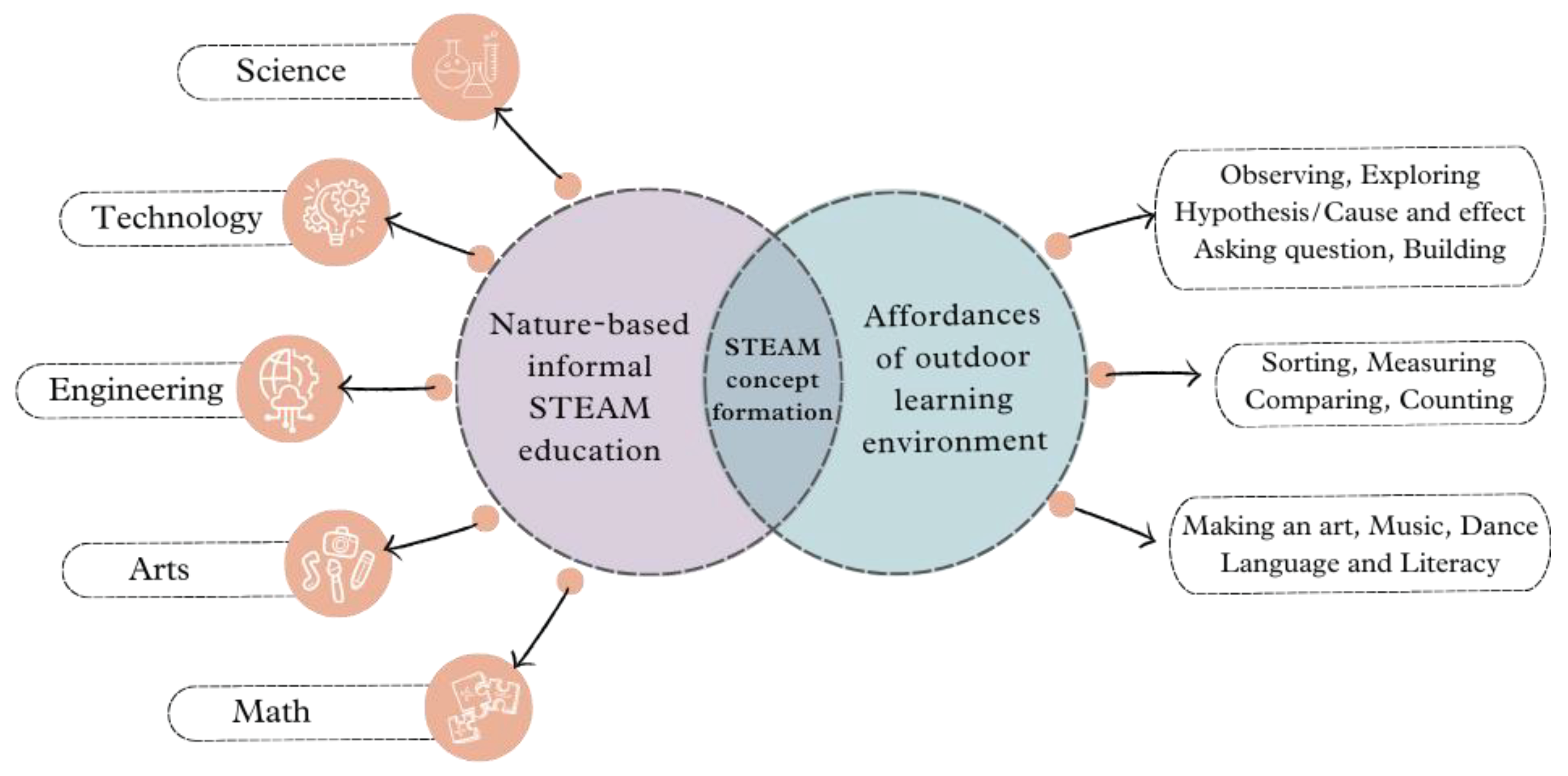
The Domains of this scoping review encompass “affordances of outdoor learning environment for early childhood” and “outdoor learning landscape design elements” in relation to “STEAM/STEM/Science learning activities and behavior of children.”
A significant characteristic of outdoor play and learning is the relative independence of the child to explore and experiment. Compared to indoor formal learning and even indoor play, there is typically less supervision and more freedom outdoors - and hence, greater opportunity to explore, experiment, solve problems of interest to the child, and venture into activities that children enjoy when adults are not overseeing (messy, risk-taking, etc.). So, there is an interesting tension between the benefits of playing freely outdoors, which leads to discoveries and the role of adults in curating children's STEAM concept formation. This scoping review is an approach to set a bridge between these domains.
2. Research Method
This scoping review was conducted in accordance with the criteria outlined in the Preferred Reporting Items for Systematic Reviews and Meta-Analyses Extension for Scoping Reviews (PRISMA-ScR), using Arksey and O’Malley’s (2005) methodological framework [18], as seen in Figure 2. The methodology encompassed the subsequent stages: (1) identification of research questions, (2) identification of relevant studies, (3) selection of relevant studies, (4) data charting, and (5) collating, summarizing, and reporting the results.
Figure 2.
Methodological framework (Arksey & O’Malley, 2005).

2.1. Identification of the Research Questions
Due to its intricate characteristics, the concept of nature-based STEAM education for preschoolers has not yet been extensively investigated. Therefore, the research question that guided the investigation in this scoping review was: What empirical knowledge is available from the existing literature regarding the impact of nature-based outdoor learning landscape on preschoolers' STEAM concept formation? The foundational research questions derived from the research objectives established within the PCC (population, concept, and context) framework are presented in Table 1.
2.2. Identification of Relevant Studies
Database Search. Three sets of search terms were used in four selected databases: JSTOR, Scopus, EBSCOhost, and Web of Science. The title of this research was used to search for relevant studies on ProQuest Central. The search terms were carefully crafted by looking at the titles, abstracts, and keywords of papers already selected as relevant. The Boolean operator "OR" was used to segregate the search phrases inside each set, and the operator "AND" was used to join the different sets. The search terms are shown in Table 2 below.
Grey Literature Search. Recent advancements in the field of preschool science and mathematics education have attracted renewed interest from researchers who are invested in pre-kindergarten education and the enhancement of STEAM literacy and academic performance. Consequently, numerous independent research groups and educational institutions are engaged in outdoor STEAM learning and teaching activities and have already disseminated their findings. Incorporating non-commercially published material, also known as "grey literature," in evidence reviews reduces publication bias and offers a more comprehensive and unbiased representation of the evidence [19]. This scoping review applied three approaches to locate grey literature that is relevant to this review: 1. A Google Scholar search using the title of this research to identify relevant studies; 2. Searching known databases (e.g., www.childrenandnature.org, www.childhoodbynature.com, www.greenschoolyards.org, and www.texaschildreninnature.org); and 3. Searching websites explicitly focused on outdoor learning initiatives (e.g., Natural Learning Initiative: NLI website), and early childhood learning (e.g., Science Preschool: ECLKC-Head Start website). The inclusion process prioritized peer-reviewed papers over grey literature if both sources provided identical information.
2.3. Study Selection
The search looked for journal articles published between 2004 and 2023 (20 years). Study inclusion criteria are provided in Table 3. Each title and abstract were read to screen the 843 citation records, based on the following inclusion and exclusion criteria, to decide to finalize related studies:
2.4. Charting of Data
The final Microsoft Excel-based data charting form was developed to extract the following study attributes: Data Source, Reference Type, Publication Outlet, Study Topic, Publication Year, Research Type, Data Collection Methods, Study Location/Region, Facilitator, Children Age Range, Landscape Elements, STEM/STEAM/Science Learning Behavior, and STEAM activity supportive setting.

Table 4.
Selected initial coding categories.
| Code | Description of the Code | Example |
|---|---|---|
| Data Source | Source of the selected reviewed Journal Articles/Books/Book Chapters | JSTOR, Scopus, EBSCOhost, ProQuest Central etc. |
| Reference Type | Type of review material recorded | Journal Articles/ Books/Book Chapters |
| Publication Outlet | Journal/Book in which the study was published | Redleaf Press/ Science and Children |
| Study Topic | The main focus areas discussed in each selected record | Nature-based Outdoor/STEAM Learning |
| Publication Year | Year in which the study was published | 2017, 2015 |
| Research Type | Type of research conducted based on method and data | Qualitative Research, Case-Study Research |
| Data Collection Methods | Type of methods used for collecting data from the study site | Behavior Mapping, Interview |
| Study Location/ Region |
Name of the country where the study was conducted | USA/Australia |
| Facilitator | Description of who led the Study | Teacher/Children |
| Children Age Range | Description of the age of the children | 3-5 years |
| Landscape Elements | Available landscape elements present during research | Trails, Garden, Wooden deck |
| STEM/STEAM/ Science Learning Behavior |
Behavior of children, identified during outdoor play, which is relevant to STEAM learning | Art Building Exploring |
| STEAM activity supportive setting. |
Outdoor settings that support and enhance STEAM-related activity |
Sand Play Area, Garden |
3. Reporting the Results
After searching, a total of 843 (n = 843) resources (JSTOR: 286, Scopus: 197, EBSCOhost: 235, Web of Science: 96, ProQuest Central and Google Scholar) were identified. The total number of books and articles resulted in 814 from all databases except ProQuest Central and Google Scholar. The total records screened were 198 by reading the heading and abstract, and after a relevancy check, 87 journal articles were excluded. The majority were excluded due to the focus on early childhood STEAM education within classroom environments; it was not nature-based outdoor environments and was not for preschoolers/3- to 5-year-old children. An additional 29 records were obtained through a combination of manual reference list searching, ProQuest Central and Google Scholar searches for grey literature, using the research's initial title. After a full body review of all 140 papers, 109 papers were removed according to eligibility criteria, and 31 were finally included in the scoping review.
Figure 3.
PRISMA 2020 flow diagram showing literature and study selection.

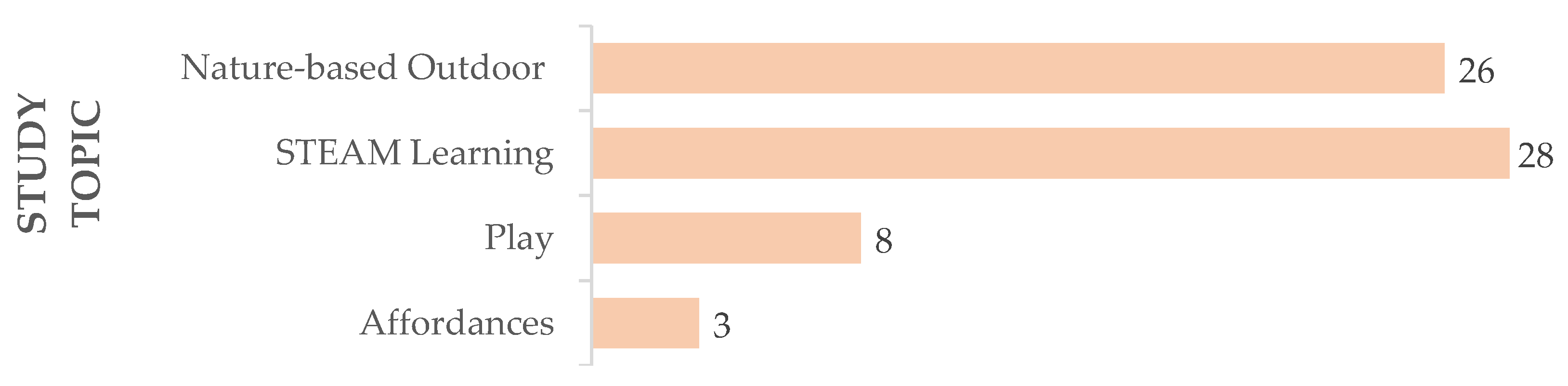
In the final scoping review, 19 journal articles, 8 book chapters and 4 books were included. Most of the study was focused on STEAM learning and nature-based outdoor environments. Few discussed the affordances of the outdoor learning environment. Although outdoor play and learning are a common part of all studies, in this review, play-focused studies were limited.
Figure 4.
Study topic of reviewed studies.
3.1. Study Characteristics of the Reviewed Studies
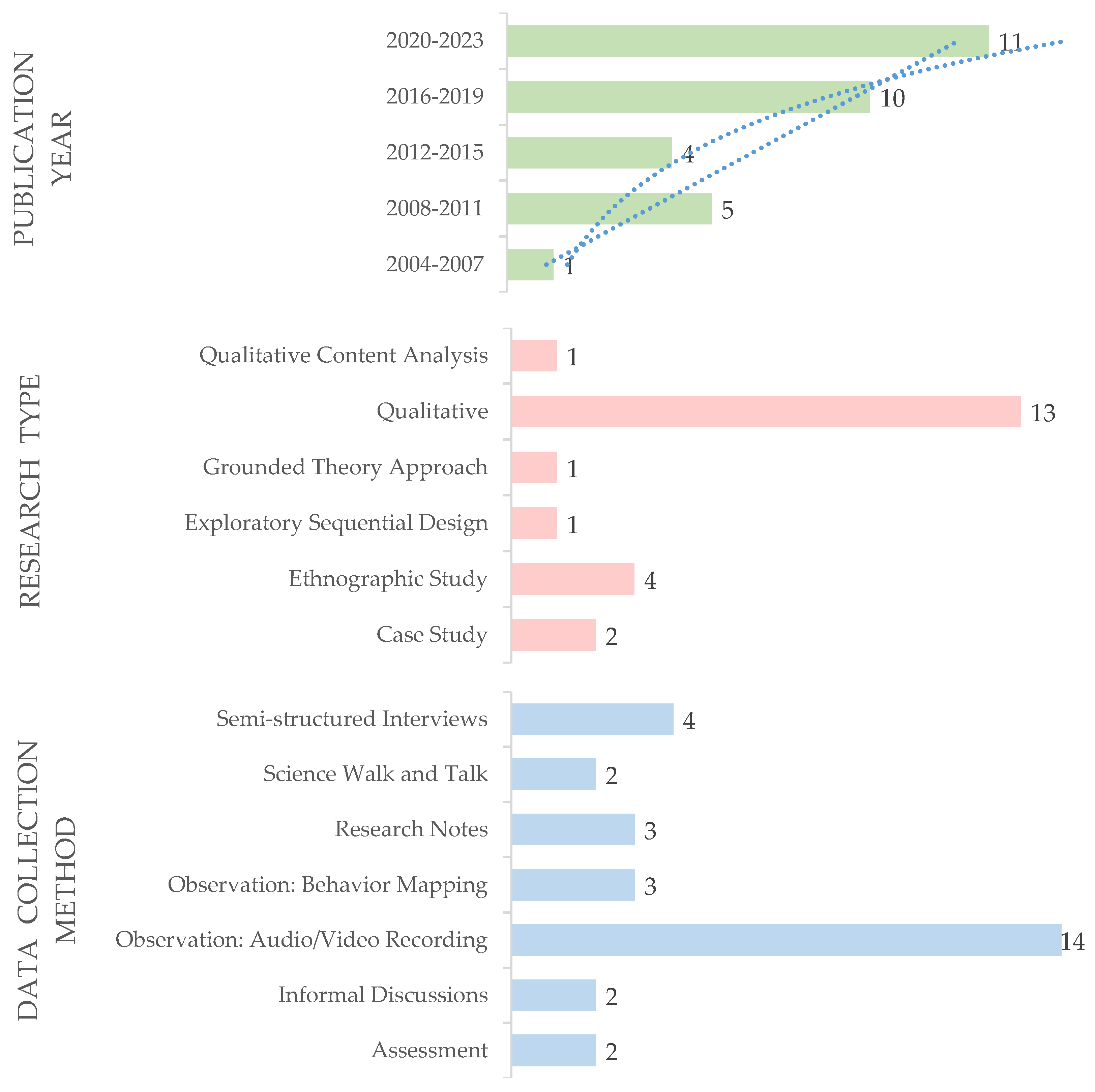
Although search criteria show the timespan from 2004 to 2023, relevant documents included in the records were published from 2006. A growth trend is evident in the graph starting from 2016, whereas the quantity of published documents has multiplied from the preceding twelve years. Among the published papers after 2004, ten papers (32%) were published between 2006 and 2015 (10 years), ten papers (32%) were published in the time span of 2016 to 2019 (4 years), where eleven papers (36%) published in the most recent four years of 2020-2023, which is quite consistent. The time distribution indicates that the convergence of STEM/STEAM education and outdoor learning has only recently occurred, and there is a surge in attention towards this intersection of those two fields. (Figure 5 represents the study characteristics summary.)
The research method mostly followed a qualitative approach (13 studies). Campbell and Speldewinde [2,20-22] conducted their four studies using a comparable methodology. These authors participated in ethnographies over the course of one to five years of recurrent visits to Bush Kinder (preschool outdoor learning programs in Australia). In accordance with the diverse array of data collection methods typically employed by ethnographies, they also utilized field notes, semi-structured interviews, and image recording. Miller, A. R., & Saenz, L. P. [23] published one of the three mixed-method research studies using exploratory sequential design and Kiewra, C., & Veselack, E. [24] published a case study research using observational data and teachers’ nature notes documentation as a data collection method.
Figure 5.
Study characteristics of the reviewed studies.
In terms of geographical distribution, as presented in Figure 6, the reviewed studies were conducted in Italy: 1, Germany:1, New Zealand: 1, Norway:1, Sweden: 1, Australia:5, and USA:12. In addition to these research, another 10 studies, comprising books and book chapters, examined the topic of STEAM and outdoor learning environment in a broad manner that is relevant to children worldwide. The studies documented in this scoping review were mainly carried out in the United States and Australia. In general, all the studies are conducted in developed countries.
Figure 6.
Study location/region.
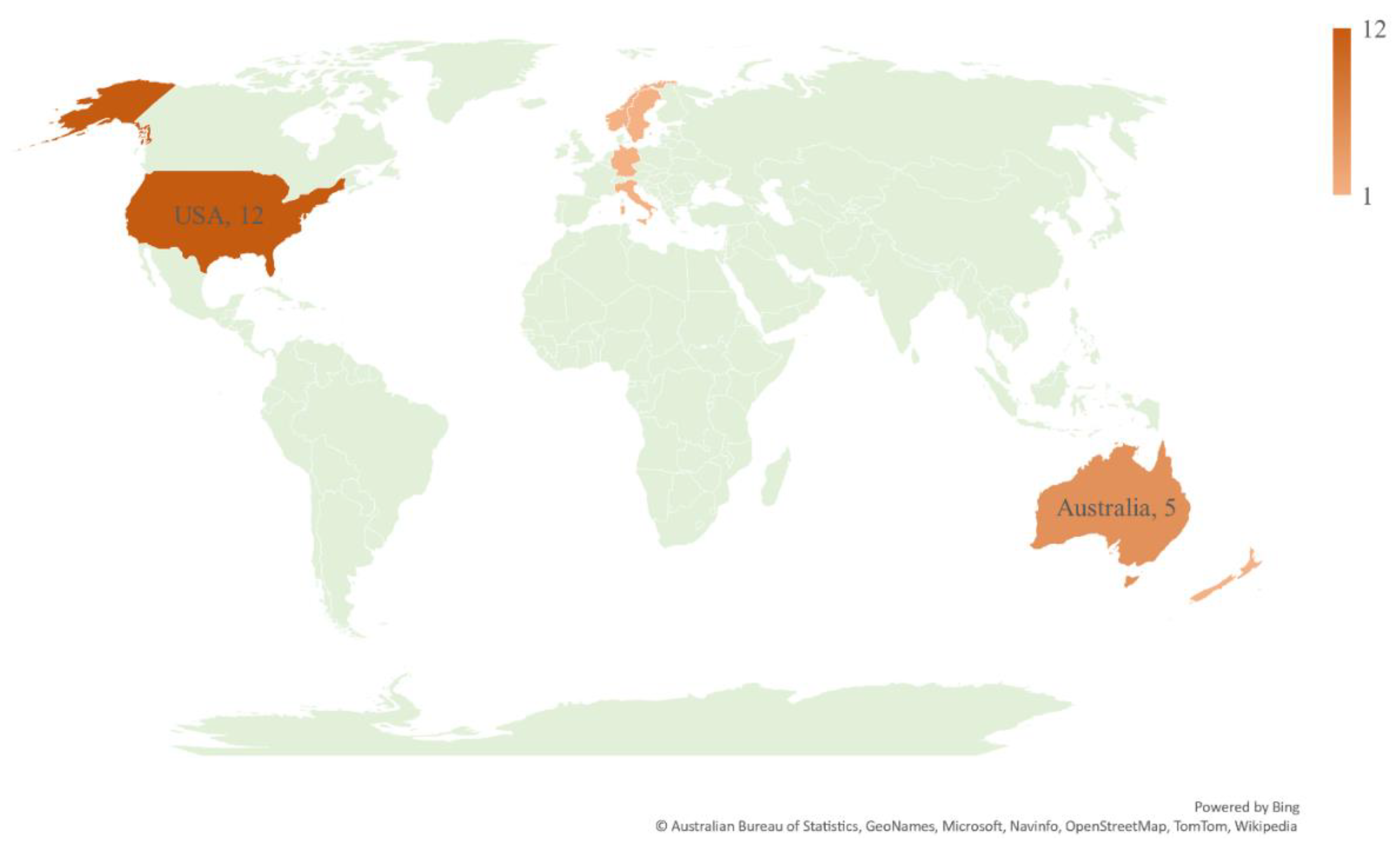
Table 5.
Publication characteristics of the reviewed studies.
| ID | Data Source | Author, Year | Reference Type | Publication Outlet |
|---|---|---|---|---|
| [2] | Web of Science | Speldewinde, C., & Campbell, C. (2023). |
Journal Article | International Journal of Technology and Design Education |
| [20] | Web of Science | Speldewinde, C., & Campbell, C. (2023). |
Journal Article | Journal of Adventure Education and Outdoor Learning |
| [21] | Google Scholar | Campbell, C., & Speldewinde, C. (2022) |
Book Chapter | Children’s creative inquiry in STEM |
| [25] | Scopus | Weiser, L. E. (2022) | Book Chapter | Play and STEM Education in the Early Years: International Policies and Practices |
| [26] | Scopus | Worch, E., Odell, M., & Magdich, M. (2022) | Book Chapter | Play and STEM Education in the Early Years: International Policies and Practices |
| [15] | EBSCOhost | Bartolini, V. C. (2021) | Book | Redleaf Press |
| [27] | EBSCOhost | Skalstad, I., & Munkebye, E. (2021). |
Journal Article | International Journal of Science Education |
| [23] | Scopus | Miller, A. R., & Saenz, L. P. (2021). |
Journal Article | Journal of Childhood, Education & Society |
| [22] | Scopus | Campbell, C., & Speldewinde, C. (2020) |
Journal Article | International Journal of Innovation in Science and Mathematics Education |
| [28] | Pro-Quest | Tunnicliffe, S. D. (2020) | Book | Routledge |
| [29] | Pro-Quest | Krogh, S. L., & Morehouse, P. (2020). |
Book | Taylor & Francis |
| [30] | EBSCOhost | Lee, C. K., & Ensel Bailie, P. (2019) | Journal Article | Science Activities |
| [31] | Web of Science | Ernst, J., & Burcak, F. (2019) | Journal Article | Sustainability |
| [32] | Google Scholar | Earle, S., & Coakley, R. (2019) | Book Chapter | Teaching science and technology in the early years (3–7) |
| [17] | Google Scholar | Worth, K. (2019) | Book Chapter | STEM in Early Childhood Education: How Science, Technology, Engineering, and Mathematics Strengthen Learning |
| [33] | Google Scholar | Wiedel-Lubinski, M. (2019) | Book Chapter | STEM in Early Childhood Education: How Science, Technology, Engineering, and Mathematics Strengthen Learning |
| [34] | JSTOR | Ashbrook, P. (2019) | Journal Article | Science and Children |
| [35] | JSTOR | Anders, Y. (2018) | Book Chapter | Early Science Education – Goals and Process-Related Quality Criteria for Science Teaching |
| [36] | JSTOR | Carr, V., Brown, R. D., Schlembach, S., & Kochanowski, L. (2017) | Journal Article | Children, Youth and Environments |
| [37] | EBSCOhost | Wight, R. A., Kloos, H., Maltbie, C. V., & Carr, V. W. (2016) | Journal Article | Environmental Education Research |
| [24] | EBSCOhost | Kiewra, C., & Veselack, E. (2016) | Journal Article | The International Journal of Early Childhood Environmental Education |
| [38] | Google Scholar | Tippins, D. J., Neuharth-Pritchett, S., & Mitchell, D. (2015) | Book Chapter | Research in early childhood science education |
| [39] | Web of Science | Fleer, M., Gomes, J., & March, S. (2014) |
Journal Article | Australasian Journal of Early Childhood |
| [40] | EBSCOhost | Klaar, S., & Öhman, J. (2014) | Journal Article | European Early Childhood Education Research Journal |
| [41] | Google Scholar | Carr, V., & Luken, E. (2014) | Journal Article | International Journal of Play |
| [42] | JSTOR | Worch, E. A., & Haney, J. J. (2011) | Journal Article | Children, Youth and Environments |
| [43] | Google Scholar | Lynne, & Bianchi, F. (2011) | Book | Open University Press |
| [44] | JSTOR | Luken, E., Carr, V., & Brown, R. D. (2011). |
Journal Article | Children, Youth and Environments |
| [45] | JSTOR | Hoisington, C., Sableski, N., & DeCosta, I. (2010) | Journal Article | Science and Children |
| [46] | EBSCOhost | Waters, J., & Maynard, T. (2010) | Journal Article | European Early Childhood Education Research Journal |
| [13] | EBSCOhost | Tu, T. (2006) | Journal Article | Early Childhood Education Journal |
3.2. Program Characteristics of the Reviewed Studies
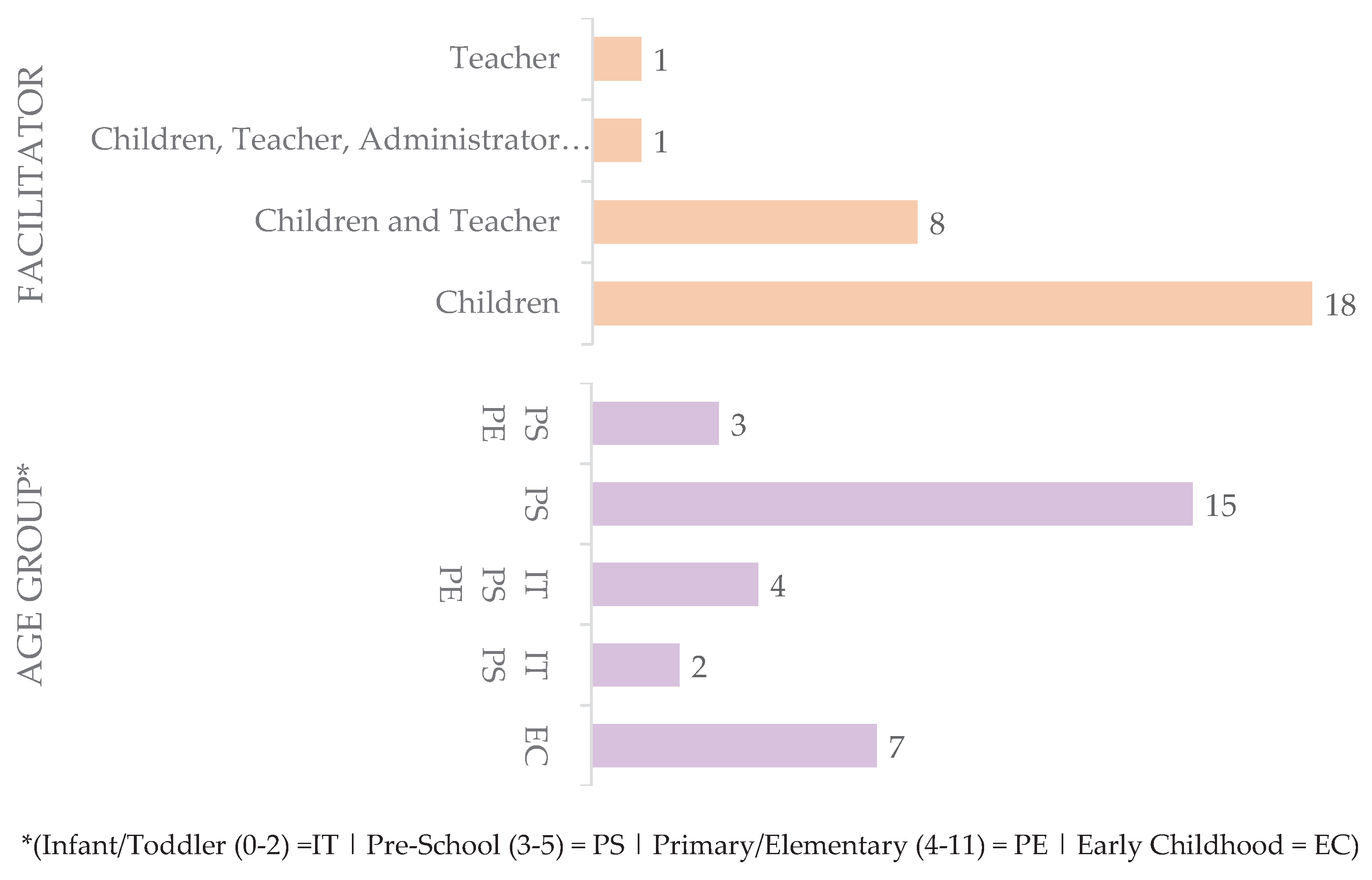
Considering exclusively the reviewed articles that focus on preschoolers (3-5), this review also included a few studies with the age group of Infant/Toddler (0-2) and Primary/Elementary (4-11). Whenever research encompassed “children” as a general term, they were counted as Early Childhood (EC). 28 studies of this review group included information about the facilitators. Although many programs show multiple types of facilitators, children were the major participants in overall studies. The largest proportion of studies (18 studies, 64%) were children led. Eight studies (29%) present both children and teachers as the facilitators, while only one research addressed other related groups, such as administrators and parents.
Figure 7.
Program characteristics of the reviewed studies.
4. Discussion
This review aims to identify the physical factors that contribute to STEAM learning affordances in an outdoor environment for children aged 3 to 5. Review articles of this scoping review showed a multi-faceted approach, including empirical evaluation of landscape elements, pre- and post-intervention assessments through observational studies, longitudinal studies to observe sustained impacts, and comparative studies, etc. to explore the influence of outdoor environment on children STEAM/STEM/Science learning. Studies also represented educators' perceptions through surveys and interviews to understand their role during outdoor STEAM activities. Through the synthesis of information from those studies, a list of STEM/STEAM/Science Learning Behaviors of children and STEAM activity-supportive settings was identified.
Table 6.
Outcome reported in reviewed papers.
| Outcome Major Categories | % of the overall sample | Paper ID |
|---|---|---|
| Discussion related to the STEAM learning behavior and activities of children in an outdoor learning environment | 39% | [24,26-28,31,34,35,37,40,42,43,45] |
| Discussion related to the STEAM activity supportive settings and STEAM concept development | 42% | [17,21,23,25,29,30,32,36,38,39,41,44,46] |
| Discussion related to the role of Teacher and/or Caregiver in nature-based STEAM learning of children | 19% | [2,13,15,20,22,33] |
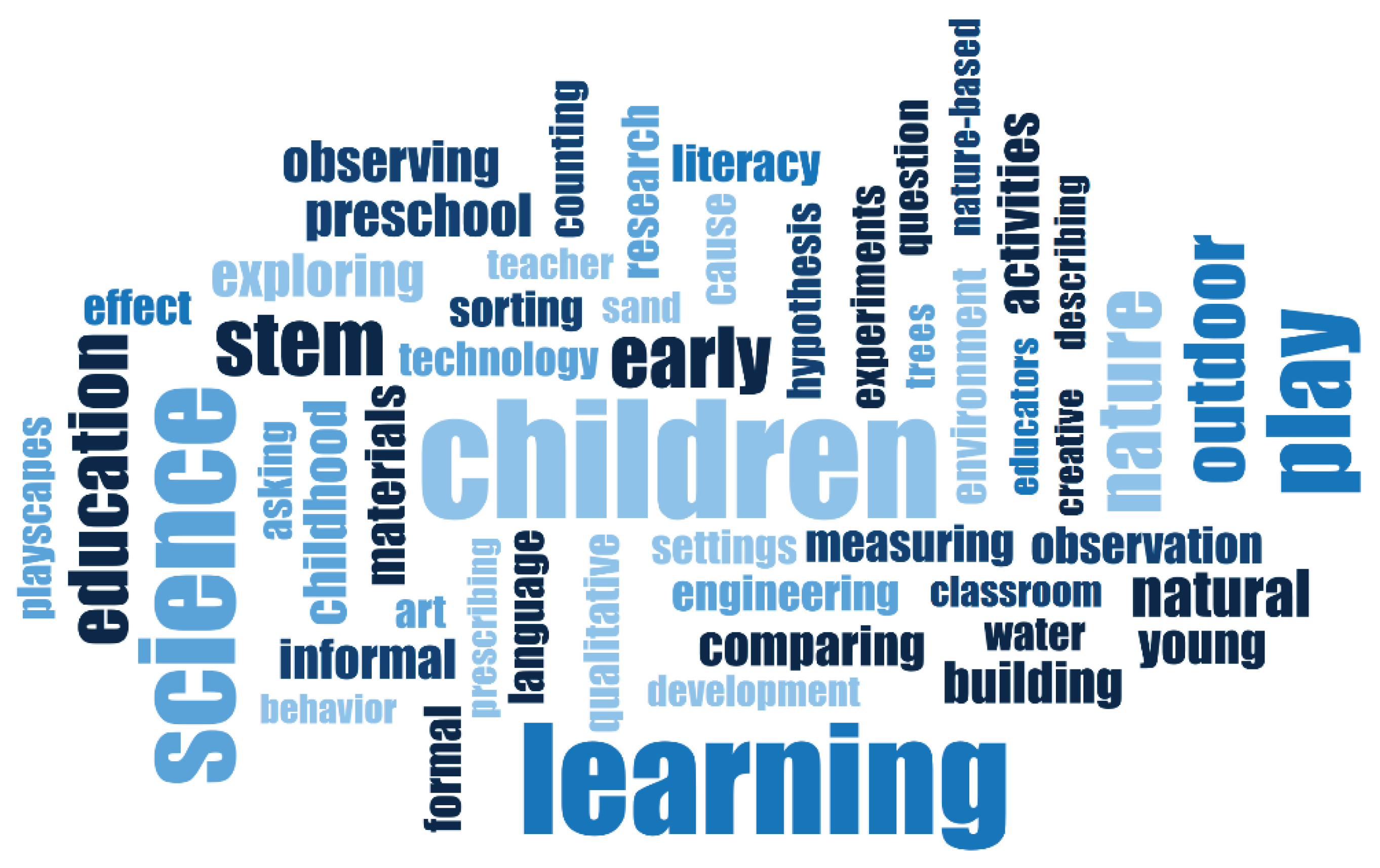
Figure 8.
Word cloud from the reviewed studies.
4.1. STEAM Learning Behavior and Activities of Children in Outdoor Learning Environment
According to Earle, S., & Coakley, R. [32], the foundations of science, technology, engineering, and math (STEM) are deeply connected to the natural world. Through outdoor learning that children lead, they naturally engage in key STEM processes like experimentation, inquiry, observation, problem-solving, and comparison, thereby enhancing their understanding and knowledge in these areas [17]. Tu (2006) developed tools to examine science material availability and use in 20 mid-western childcare centers, finding common materials like vinyl animals and plants but limited engagement with them [13]. Young children actively engage with their environment to develop a fundamental understanding of the phenomena they are observing and experiencing [40]. Children form their own theories to make sense of everyday experiences, which assists them in embracing a more scientific perspective of the world. Cognitive research reveals that children’s explorations are rooted in tangible contexts, utilizing their senses to observe, investigate, and draw conclusions from the world around them. This natural curiosity leads them to constantly ask questions and seek understanding, not in an idealized or laboratory setting but within the complexities of their everyday lives [11]. Engaging in scientific activities helps young children appreciate and understand their environment and develop critical scientific skills. These skills include curiosity, questioning, exploration, investigation, discussion, reflection, and the formation of ideas and theories [13].
Reviewing existing literature, this research identified different STEAM learning behaviors of children covering specific scientific domains that offer the most impactful experiences for children aged three to five. For future research, these behavior codes could help to outline fundamental concepts in Science, Technology, Engineering, Art, and Math that young children can investigate.
Overall, the identified behaviors that support STEAM learning were Observing, Exploring, Describing/Prescribing, Hypothesis/Cause and Effect/Experiments, Asking Questions, Building, Manipulating, Sorting, Measuring, Comparing, Counting, Balancing, Making Art, Music, Dance, Language and Literacy, and Signs.
Table 7.
STEAM (Science + Technology + Engineering + Art + Math) Behavior Coding (derived from Scoping Review).
Table 7.
STEAM (Science + Technology + Engineering + Art + Math) Behavior Coding (derived from Scoping Review).
| Behavior Coding | Brief Description | Reviewed Study ID | |
|---|---|---|---|
| Science+ Technology + Engineering | Observing | A child watches closely, hands-off (e.g., focused visual and/or aural attention on an object or another individual) | [13,15,21-27,30-34,36-40,42,45] |
| Exploring | The play focuses on exploring a play material's physical properties: hands-on /touching/ lifting/dropping, etc. |
[2,13,15,17,20-26,30-34,36-40,42,45] | |
| Describing/ Prescribing/ Predicting/ Concluding | Children observe, explore, plan to act, and share their ideas with other children or teachers. | [2,13,15,23,30,32,37,39,45] | |
| Hypothesis/Cause and Effect/ Experiments | The child makes a deliberate action and expects a certain outcome involving gravity, force, weight, distance, and height with those materials. | [2,13,15,20-27,30,32-34,37-40,42] | |
| Asking question | Ask other kids or adults about certain properties of play material. | [2,13,15,23,24,27,30,31,37-39,45] | |
| Building | Building blocks, making a teepee with sticks, making a bridge, laying rocks on the ground, etc. | [2,15,17,20-26,31-33,36,37,39,40] | |
| Manipulating | Any object or materials that can be manipulated or moved and provide children with endless opportunities to build, modify, change etc. | [17,22,37] | |
| Math | Sorting/Classifying | Any sort of sorting of materials based on their types, colors, textures, sizes, etc. | [2,13,15,20,22,24,25,30-34,36-39] |
| Measuring | Any measuring idea includes concepts of small/big, thick/thin etc. | [13,15,20-23,25,30-34,37,38,40,45] | |
| Comparing | Comparison of two or multiple objects or situations based on sorting, counting, measuring | [2,13,15,20-23,25,30-34,36-38,45] | |
| Counting | Any play that involves counting items/objects. | [15,20,22,23,25,30-34,36-38] | |
| Balancing | Any activity to create balance with objects. | [15,21,25,34,37] | |
| Art | Art | Making an art – painting, sand art, loose-part art, etc. | [2,13,15,17,21,32,33,40] |
| Music | Making music, or singing, or making sounds. | [15,32] | |
| Dance | Dancing | - | |
| Language and Literacy, Signs | Reading, reciting, learning new words, learning new symbols or signage, etc. | [13,15,20,23,25,30,32,33,36-39,45] |
4.2. STEAM Activity Supportive Settings and STEAM Concept Development
The natural environment is a living school, dynamic and full of wonders for young children. It is an excellent educational setting for young children, fostering science learning through exploration and discovery. It encourages critical thinking and problem-solving as they investigate elements like leaves, puddles, or insects, turning the outdoors into a practical scientific laboratory for development [30]. The outdoor environment offers a broader and more comprehensive range of experiences than the indoor classroom. With their ever-changing elements and seasonal variations, outdoor learning environments offer a less predictable setting than a traditional classroom, fueling curiosity and interest in STEM concepts [45]. This constantly evolving natural backdrop encourages deeper inquiry and exploration, with nature readily presenting surprises to those who engage with the outdoors [33].
The scoping review reveals that young children engaged more frequently and deeply in STEAM-related activities in natural settings. They actively explored and manipulated objects, closely examining their characteristics like texture, size, or material. These properties influenced how the children used these items; for instance, they used large, sturdy branches for constructing hut walls and softer materials for making a spider's cushion [42]. Analyzing the existing literature, this review associates the identified STEAM learning behaviors and activities with specified outdoor STEAM activity-supportive settings.
Table 8.
STEAM learning behaviors and activities are associated with the outdoor STEAM activity-supportive settings.
Table 8.
STEAM learning behaviors and activities are associated with the outdoor STEAM activity-supportive settings.
| ID | STEAM Activity Supportive Setting | STEAM Learning Behaviors |
STEAM Concept Formation |
|---|---|---|---|
| [17,20,23-26,33,36,37,39-41,44] | Sand Play/ Earth Play/ Mud/ Digging | Cause/Effect, Construction, Manipulative, Observation, Exploration. | Sand engages children because it is so easy to move, mold, dig, shift, sculpt, and pour. Also, they learn about forces, mixing, and properties. |
| [2,17,23,25,26,33,34,36,39-41,44] | Water Play | Cause/Effect, Construction, Manipulative, Observation, Exploration. | Children can solve problems while predicting or guessing which items will float or sink in a container filled with water. |
| [23,36,37,39,41,44] | Primary Pathways | Exploration | Properties of materials |
| [20,23,36,37,39,41] | Sensory Pathway | Observation, Exploration | Properties of materials: Senses: Soft, smooth, slippery, shiny etc. |
| [2,13,17,20-27,33,36-39,41,44-46] | Plants: Trees, Shrubs, Edible Garden | Observation, Exploration, Experiments, Natural Art, Counting, Sorting, Measuring, Comparing | Gardens provide a workspace for children to raise questions about the natural world, take hands-on action, and seek answers through observation, exploration, and data collection. |
| [20,24,26,36,39,46] | Sensory Garden/ Grass Mazes and Tall Grass Areas | Observation, Exploration, Experiments, Natural Art, Counting, Sorting, Measuring, Comparing | Sensory exploration outdoors can include touching the bark of a tree or the grass, seeing the birds’ building nests or leaves blowing, hearing the sounds carried by the wind or the honking of a car horn nearby, smelling freshly cut grass or the fragrance of flowers. |
| [17,32,33,39] | Compost Pile | Observation, Exploration, Experiments, Construction, Teamwork | Children can place leaves, plant cuttings, and food scraps in a compost bin or pile, along with worms, to help “mix up” the compost. |
| [22,26,27,30,36] | Dry Creek Beds | Observation, Exploration, Experiments, Construction, Teamwork | Varied textures and materials in the creek bed aid sensory development, observing the flow and effects of water on the landscape. |
| [17,22-24,37,44] | Large Blocks and Natural Construction (Construction/ Engineering) | Experiment, Exploration, Observation, Construction, Teamwork | Making towers, bridges, recognizing shapes in buildings, fences, triangles, squares, diagonals, rectangles, and circles. |
| [2,17,20,21,23-26,30,33,34,36,37,39,41,44-46] | Loose Parts Play | Experiment, Exploration, Observation, Counting, Sorting, Measuring, Comparing | The properties of items can be investigated using a magnifying glass to examine shells, rocks, feathers, or objects discovered in nature. |
| [13,17,21,22,26,27,32,36,37,46] | Wildlife/ Bird, Butterfly, and Pollinator Habitat | Observation, Exploration, Language, Signs | Using their naturalist intelligence, children can discriminate among living things (plants and animals) and develop sensitivity to the features of the natural world (clouds, rock configurations). |
| [24] | Acoustic Play Settings | Music, Language, Exploration, Observation, Teamwork, Signs | Preschoolers can engage in experiments with cause and effect, such as discovering how different materials and actions produce varied sounds. |
| [17,23,24,41,44] | Art Area | Art, Language, Exploration, Observation, Teamwork, Signs | Children can manipulate different materials—paints, clays, papers, and natural objects—and they learn about textures, colors, shapes, and spatial relationships. |
| [13,17,23] | Outdoor Reading and Language Play | Language, Literacy, Reading, Signs | Outdoor stories, identify, match, speak, make symbols, and write. Knowing the naming: Bird names include spider, ladybird, beetle, ant, worm, caterpillar, butterfly, and centipede. |
| [13,24] | Signage: Directional, Informational, Identification, Regulatory, and Inspirational signs. | Language, Literacy, Reading, Signs | Provide a comprehensive communication system of information that children of all ages, cultural backgrounds, and abilities can easily read and understand. Signed description to explain observed phenomenon. |
| [17,23,24] | Outdoor Classroom | Cause/Effect, Construction, Manipulative, Observation, Exploration | High-quality play spaces incorporate a variety of natural elements for children to play and learn with, such as trees, stumps, boulders, tall grass, water, pebbles, mounds, and slopes. Learning takes place outdoors and differs from learning indoors. |
| [17,23,42] | Pretend and Performance/ Decks, Platforms, and Stages | Performance, Signs, Language, Observation | Role-play props, e.g., tea-set, dolls, soft animals. Children learn to question, predict, and experiment with different roles and observe outcomes. |
| [17,22,24-26,34,36,37,40,41,44,46] | Topography and Landforms / Mounds and Slopes | Cause/Effect, Exploration | Forces, push-pull, twists, taut, friction, construction, gravity, speed acceleration, deceleration. |
| [24,32,36,41,44] | Multipurpose Lawn | Diverse Affordances | Open, grassy spaces support various types of play and exploration that are foundational for early science learning. |
| [21,23-25,36,37,39,40,42] | Fixed Play Structures | Diverse Affordances | Using slides decreases their friction by sitting on, running up, and running down, using different sizes and loads, and rolling down. (Gravity, Force, Motion) |
| [13,37,39,41,44,46] | Moveable Play Structures/ Portable Toys and Equipment | Diverse Affordances | Crawling through tunnels, running, chasing, sitting, dancing, hopping, and jumping. Rolling, Balancing, throwing, catching. |
| [23,24,36,37,41,44] | Natural Healing and Relaxation Area | Observation, Exploration, Experiments, Natural Art | Light, shadows, weather. Scenic and rich in natural elements like plants, water features, and soft, natural textures provide an ideal setting for young children to engage in mindful observation and exploration. |
4.3. The Role of Teacher and/or Caregiver in Nature-Based STEAM Learning of Children
Loris Malaguzzi, a key figure in the development of Reggio Emilia's approach to early childhood education, emphasizes the importance of children's active engagement in learning. Malaguzzi believed that learning is a dynamic process, significantly shaped by children's experiences, interactions, and the environment provided to them. His perspective underlines that education is not just about transmitting knowledge from teacher to student but involves a more complex interplay where children construct knowledge through their activities, exploration, and the resources available to them. This research followed the concept of “environment as a third teacher,” introduced by the Reggio Emilia approach in Italy [15]. Nature encompasses everything around us - the ground, sky, wind, rocks, and rain, including all elements of the ecosystem and people. It is everywhere in cities, suburbs, and rural areas, making it accessible for educational purposes. This understanding is crucial for teachers looking to integrate nature into outdoor learning. Nature is not distant; it is a vital part of every community and an aspect of daily life. Recognizing and embracing this concept is key for educators to effectively utilize nature in its various forms within their school environments [35].
Both indoor and outdoor learning require teachers to effectively organize and support children’s educational journey. Teachers must be aware of the children's experiences, the play they create, and what captivates or fails to engage them. It is also important for educators to interpret the potential significance of the children's inquiries, the concepts they are formulating, and their methods of expressing their thoughts. To achieve this, teachers should take on the roles of observers, closely monitoring the children's explorations [17]. Teachers can actively engage children in nature-based education by guiding them to use their senses to observe, listen, smell, and touch, similar to the methods used by scientists [30]. The perception of a lack of nature often stems from teachers' understanding of it and their capacity or inclination to utilize the resources available at their current location. This mindset contributes to the misconception that nature is a distant entity, furthering a sense of detachment from the natural world.
4.4. Limitations, Delimitations, and Future Research
Firstly, the specification of the outcomes in search terms remained broad, as it was done deliberately since the research aim was to get a broad overview of how the nature-based outdoor learning landscape influences the STEAM concept formation of preschoolers. However, this scoping review showed that STEAM-based outdoor learning is quite a new topic, and there are no assessment guidelines that can give us an idea of which opportunities in the outdoor learning landscape can afford the best STEAM learning and how we can measure the STEAM learning behaviors of preschool children. Future research can benefit by using the meta-analysis technique to identify appropriate approaches for evaluating children’s learning progress during STEAM-based outdoor activities and the STEAM learning affordances of a preschool outdoor learning landscape.
There was also the fact that the domain of this review hardly coincides with each other altogether in the reviewed studies, and only two studies discussed the affordances for science learning (articles 9 and 25). However, the target of this study was to find the relationship between STEAM learning of preschoolers and the outdoor learning landscape. The reviewed studies covered a range of learners, including infant/toddler and primary/elementary children. There were a lot of papers about outdoor learning environments and play affordance. To keep focused on STEAM learning, this scoping review eliminated those articles that did not mention anything about STEAM/STEM/Science learning, although those affordances were closely related to cognitive development. The lack of inclusion of those studies could be identified as a significant limitation.
This research is interdisciplinary. A scoping review is an appropriate methodology in the interdisciplinary field of outdoor learning environment research, incorporating articles from diverse disciplines that have enriched the conclusions drawn.
5. Conclusions
Outdoor learning environments are highly beneficial for young children's scientific and technological education [2]. They provide a setting where children can interact with natural elements like leaves and sticks, engage with tactile experiences such as soil, and foster a connection with the natural world, fostering a sense of appreciation. Such environments allow children to enhance their creative abilities and critical thinking skills, which are crucial for scientific and technological exploration [28]. Observations suggest that naturalistic play settings can enhance behaviors like creativity, social interaction, and detailed observation, which are advantageous for early STEM (Science, Technology, Engineering, and Mathematics) education [28].
The outdoor learning environment design can influence STEAM education with intentional design elements. That can offer STEAM learning affordances and create informal environments crucial to STEAM education children with a diverse range of natural resources that they can use in their play, fostering creativity, social interaction, and complex activities like construction projects. On the other hand, playgrounds are not as effective in encouraging STEM-related play because the fixed nature of playground equipment restricts children's freedom to explore and implement their ideas [25]. This review identified the STEAM learning affordances of an outdoor learning environment that enhances preschool-aged children's engagement in Science, Technology, Engineering, Arts, and Mathematics (STEAM) learning through their interactions with nature. This could encompass cognitive development by fostering curiosity, creativity, and problem-solving skills in early childhood.
The design of an outdoor learning environment significantly influences the richness and duration of children's play and learning activities. Play and learning occur more readily in spaces that offer various possibilities, known as affordances, which are the potential activities a space allows [47]. The design, size, landscape, and elements within an outdoor play and learning area, both natural and built, shape these affordances. For instance, children might see a concrete area as perfect for bouncing a ball, while a grassy hill might invite rolling down. A child’s perspective on these affordances, such as viewing a climbable tree as an exciting challenge rather than a hazard, often differs from an adult's more cautious viewpoint. It is crucial for those who provide play opportunities to recognize and consider the different ways children might engage with these affordances beyond current or adult use [48]. The more varied and intricate an affordance is, the more action possibilities it presents to children to explore scientific concepts and develop skills essential for scientific inquiry.
This scoping review identified several STEAM learning behaviors of children and STEAM activity-supportive settings, which can be used to modify the outdoor learning landscape of childcare to stimulate young children's curiosity and engage them in informal STEAM learning. These identified settings and affordances that foster a conducive learning atmosphere could significantly enhance the quality of early childhood STEAM education. The outcomes of this scoping review could potentially inform policy and curriculum development in early childhood education by integrating more outdoor, nature-based STEAM learning experiences into preschool informal education. Adapting these identified STEAM learning supportive settings to develop existing childcare outdoor environments could be a significant and pivotal step in moving towards more experiential and environment-based learning approaches in early childhood education.
Funding
This research received no external funding.
Conflicts of Interest
The authors declare no conflicts of interest.
References
- Council, N.R. Eager to learn: Educating our preschoolers; National Academies Press: 2001.
- Speldewinde, C.; Campbell, C. ‘Bush kinders’: developing early years learners technology and engineering understandings. International Journal of Technology and Design Education 2023, 33, 775–792. [Google Scholar] [CrossRef]
- Moore, R.C.; Marcus, C.C. Healthy planet, healthy children: Designing nature into the daily spaces of childhood. Biophilic design: The theory, science, and practice of bringing buildings to life 2008, 385. [Google Scholar]
- Oltman, M. Natural Wonders: A Guide to Early Childhood for Environmental Educators; Minnesota Early Childhood Environmental Education Consortium: 2002.
- Melhuish, E.C. Provision of quality early childcare services: synthesis report; BIROn - Birkbeck Institutional Research Online: 2016.
- Edwards, C.P.; Gandini, L. The Reggio Emilia approach to early childhood education. In Handbook of international perspectives on early childhood education, Routledge: 2018; pp. 365-378.
- Cameron, C.E. Hands on, minds on: How executive function, motor, and spatial skills foster school readiness; Teachers College Press: 2018.
- David, T.G.; Weinstein, C.S. Spaces for Children: The Built Environment and Child Development; Springer US: 2013.
- Ernst, J. Early Childhood Educators' Preferences and Perceptions Regarding Outdoor Settings as Learning Environments. International Journal of Early Childhood Environmental Education 2014, 2, 97–125. [Google Scholar]
- Striniste, N.A.; Moore, R.C. Early childhood outdoors: A literature review related to the design of childcare environments. Children's Environments Quarterly.
- Worth, K. The power of children’s thinking. In National Science Foundation. Foundations, 1999; Vol. 2.
- Trundle, K.C. Teaching science during the early childhood years. Best practices and research base 2010. [Google Scholar] [CrossRef]
- Tu, T. Preschool science environment: What is available in a preschool classroom? Early Childhood Education Journal 2006, 33, 245–251. [Google Scholar] [CrossRef]
- Chalufour, I.; Worth, K. Discovering Nature with Young Children: Part of the Young Scientist Series; Redleaf Press: 2003.
- Bartolini, V.C. Creating a Reggio-inspired STEM Environment for Young Children; Redleaf Press: 2021.
- Worth, K. Science in early childhood classrooms: Content and process. 2010.
- Worth, K. Science in early learning environments. In STEM in Early Childhood Education: How Science, Technology, Engineering, and Mathematics Strengthen Learning, 2019; pp. 3-21.
- Arksey, H.; O'malley, L. Scoping studies: towards a methodological framework. International journal of social research methodology 2005, 8, 19–32. [Google Scholar] [CrossRef]
- Paez, A. Gray literature: An important resource in systematic reviews. Journal of Evidence-Based Medicine 2017, 10, 233–240. [Google Scholar] [CrossRef] [PubMed]
- Speldewinde, C.; Campbell, C. Bush kinders: enabling girls’ STEM identities in early childhood. Journal of Adventure Education and Outdoor Learning 2023, 23, 270–285. [Google Scholar] [CrossRef]
- Campbell, C.; Speldewinde, C. Bush Kinders in Australia: A creative place for outdoor STEM learning. Children’s creative inquiry in STEM, 2022; pp. 185-204. [Google Scholar] [CrossRef]
- Campbell, C.; Speldewinde, C. Affordances for Science learning in “Bush kinders”. International Journal of Innovation in Science and Mathematics Education 2020, 28. [Google Scholar] [CrossRef]
- Miller, A.R.; Saenz, L.P. Exploring relationships between playspaces, pedagogy, and preschoolers’ play-based science and engineering practices. Journal of Childhood, Education & Society 2021, 2, 314–337. [Google Scholar]
- Kiewra, C.; Veselack, E. Playing with Nature: Supporting Preschoolers' Creativity in Natural Outdoor Classrooms. International Journal of Early Childhood Environmental Education 2016, 4, 70–95. [Google Scholar]
- Weiser, L.E. Young Children’s Free Play in Nature: An Essential Foundation for STEM Learning in Germany. Play and STEM Education in the Early Years: International Policies and Practices, 2022; pp. 85-103. [Google Scholar] [CrossRef]
- Worch, E.; Odell, M.; Magdich, M. Engaging Children in Science Learning Through Outdoor Play. Play and STEM Education in the Early Years: International Policies and Practices, 2022; pp. 105-122. [Google Scholar] [CrossRef]
- Skalstad, I.; Munkebye, E. Young children’s questions about science topics when situated in a natural outdoor environment: a qualitative study from kindergarten and primary school. International Journal of Science Education 2021, 43, 1017–1035. [Google Scholar] [CrossRef]
- Tunnicliffe, S.D. Emerging Biology in the Early Years: How young children learn about the living world; Routledge: 2020.
- Krogh, S.L.; Morehouse, P. The Early Childhood Curriculum: Inquiry Learning Through Integration; Taylor & Francis: 2020.
- Lee, C.K.; Ensel Bailie, P. Nature-based education: using nature trails as a tool to promote inquiry-based science and math learning in young children. Science Activities 2019, 56, 147–158. [Google Scholar] [CrossRef]
- Ernst, J.; Burcak, F. Young children’s contributions to sustainability: The influence of nature play on curiosity, executive function skills, creative thinking, and resilience. Sustainability 2019, 11, 4212. [Google Scholar] [CrossRef]
- Earle, S.; Coakley, R. Outdoor learning in science and technology. In Teaching science and technology in the early years (3–7), Routledge: 2019; pp. 57-75.
- Wiedel-Lubinski, M. STEM in outdoor learning: Rooted in nature. In STEM in Early Childhood Education, Routledge: 2019; pp. 182-205.
- Ashbrook, P. The Early Years: Teaching the M in STEM. Science and Children 2019, 56, 16–17. [Google Scholar] [CrossRef]
- Anders, Y.; Hardy, I.; Pauen, S.; Steffensky, M.; Ramseger, J.; Sodian, B.; Tytler, R. Goals at the Level of the Children. In Early Science Education – Goals and Process-Related Quality Criteria for Science Teaching, 1 ed.; “Haus der kleinen Forscher”, F., Ed. Verlag Barbara Budrich: 2018; Vol. 5, pp. 41-74.
- Carr, V.; Brown, R.D.; Schlembach, S.; Kochanowski, L. Nature by design: Playscape affordances support the use of executive function in preschoolers. Children, Youth and Environments 2017, 27, 25–46. [Google Scholar] [CrossRef]
- Wight, R.A.; Kloos, H.; Maltbie, C.V.; Carr, V.W. Can playscapes promote early childhood inquiry towards environmentally responsible behaviors? An exploratory study. Environmental Education Research 2016, 22, 518–537. [Google Scholar] [CrossRef]
- Tippins, D.J.; Neuharth-Pritchett, S.; Mitchell, D. Connecting young children with the natural world: Past, present and future landscapes. Research in early childhood science education 2015. 279-297. [Google Scholar] [CrossRef]
- Fleer, M.; Gomes, J.; March, S. Science learning affordances in preschool environments. Australasian Journal of Early Childhood 2014, 39, 38–48. [Google Scholar] [CrossRef]
- Klaar, S.; Öhman, J. Children's meaning-making of nature in an outdoor-oriented and democratic Swedish preschool practice. European Early Childhood Education Research Journal 2014, 22, 229–253. [Google Scholar] [CrossRef]
- Carr, V.; Luken, E. Playscapes: a pedagogical paradigm for play and learning. International Journal of Play 2014, 3, 69–83. [Google Scholar] [CrossRef]
- Worch, E.A.; Haney, J.J. Assessing a Children's Zoo Designed to Promote Science Learning Behavior through Active Play: How Does It Measure Up? Children, Youth and Environments 2011, 21, 383–407. [Google Scholar] [CrossRef]
- Lynne, *!!! REPLACE !!!*; Bianchi, F. 43. Lynne; Bianchi, F. Science Beyond the Classroom Boundaries for 3-7 Year Olds [book], 2: Press, 2011. [Google Scholar]
- Luken, E.; Carr, V.; Brown, R.D. Playscapes: Designs for Play, exploration and science inquiry. Children, Youth and Environments 2011, 21, 325–337. [Google Scholar] [CrossRef]
- Hoisington, C.; Sableski, N.; DeCosta, I. A walk in the woods. Science and Children 2010, 48, 27, https://www.nsta.org/publications/browse_journals.aspx?action=issue&thetype=all&id=10.2505/3/sc10_048_02. [Google Scholar]
- Waters, J.; Maynard, T. What's so interesting outside? A study of child-initiated interaction with teachers in the natural outdoor environment. European Early Childhood Education Research Journal 2010, 18, 473–483. [Google Scholar] [CrossRef]
- Gibson, J.J. The theory of affordances. In The Ecological Approach to Visual Perception, Hilldale, USA, 1977; Vol. 1, pp. 67-82.
- Tunnicliffe, S.D.; Kennedy, T.J. 2: and STEM Education in the Early Years: International Policies and Practices; Springer Nature, 2022. [CrossRef]
Table 1.
Research questions based on PCC (Population/Concept/Context).
| Research Question | Specific Objective |
|---|---|
| From the discussion of existing literature, which types of interaction with natural elements and materials (C) in outdoor environments enhance STEAM learning and curiosity among preschool children (P)? | Exploring different types of STEAM-related behaviors exhibited by children while interacting with the outdoor environment, such as questioning, exploring, building, or using STEAM-related language. |
| From the existing research, which characteristics of a nature-based outdoor learning landscape (C) were identified that support STEAM learning opportunities for preschool children (P)? | Documenting the specific areas within the natural outdoor environment where STEAM learning behaviors occur and the context of these interactions. Also, the frequency of children's engagement with different landscape elements in the natural outdoor environment (e.g., plants, water, wildlife) could lead to STEAM learning opportunities. |
| In the existing literature, what were teachers'/caregivers' (P) perceptions regarding the benefits and challenges (C) of integrating nature-based outdoor STEAM learning into the preschool (P) curriculum across diverse environmental settings (C)? | Gathering insights from educators on the perceived affordances of the natural outdoor environment for informal STEAM learning and on children's STEAM learning behaviors. |
Table 2.
Search Keywords.
|
Population: Preschoolers |
Search terms: Early child* OR preschool* OR kid OR kindergarten OR pre-K OR 3-5 years OR young child* |
| Concept: STEAM/STEM/Science Learning | Search terms: STEM OR STEAM OR Science OR Education OR Learn* |
|
Context: Nature-based Outdoor Learning Landscape |
Search terms: Outdoor OR Natur* OR Landscape OR Playscap* OR Childcare OR Daycare OR Playground OR Playspac* |
1 Note. The asterisk “*" is a truncation symbol that directs the search engine to find all forms of a given word.
Table 3.
Inclusion and Exclusion Criterion.
| Inclusion Criterion | Exclusion Criterion |
|---|---|
| 1. Articles published from 2004-2023 | 1. Full text not attained |
| 2. English language | 2. Not related to learning/education |
| 3. Focus on Preschoolers / 3 to 5 years old |
3. Study with toddlers/school-going children |
| 4. Focus on STEAM/STEM/ Science Learning |
4. STEAM/STEM/Science learning inside the classroom |
| 5. Focus on outdoor play and learning environment | 5. Studies about outdoor play and health/ physical activity/ restoration/ social interaction/ differently able children. |
Disclaimer/Publisher’s Note: The statements, opinions and data contained in all publications are solely those of the individual author(s) and contributor(s) and not of MDPI and/or the editor(s). MDPI and/or the editor(s) disclaim responsibility for any injury to people or property resulting from any ideas, methods, instructions or products referred to in the content. |
© 2024 by the authors. Licensee MDPI, Basel, Switzerland. This article is an open access article distributed under the terms and conditions of the Creative Commons Attribution (CC BY) license (https://creativecommons.org/licenses/by/4.0/).
Copyright: This open access article is published under a Creative Commons CC BY 4.0 license, which permit the free download, distribution, and reuse, provided that the author and preprint are cited in any reuse.


