

Submitted:
01 April 2024
Posted:
03 April 2024
You are already at the latest version
Abstract
The traditional societies evolved locally with the realms of time in their calendars while modern Gregorian based on the solar movement and some others use lunar or the combination with solar. Unveiling some information from the old manuscripts to gain the realm of traditional Batak people since the ancient times in settlements surrounding the tropical Lake Toba, North Sumatera, Indonesia, revival of cosmos is delivered. Uniquely the ancient Batak count days in a month by observing lunar phase and the period of year is by looking the observable Constellation of Orion & Scorpius within the new phase of the moon. Thus there are years with 12 months and some leap years with 13 months, and we propose to categorize the calendar to be lunar-star, relative to other widely analyzed calendars. In the realization of the use of the cosmogram, we cross the period of the leap year to the examination of contemporary data on agriculture event, i.e.: crop failure, as well as some profiles on weather. The revival of the Batak Calendar opens further interesting conjectures based on the rich cultural and astronomical knowledge embedded in tradition with deep connection between celestial observations and timekeeping.
Keywords:
ethnoastronomy
; calendar
; cosmogram
; tradition
; batak
; agriculture
; climate
; weather.
1. Introduction
- When I look at Your heavens, the work of Your fingers,
- The moon and the stars, which You have set in place,
- What is man that you are mindful of him,
- And the son of man that You care for him
(King David of Israel)
Two theories explain celestial movement: the geocentric and the heliocentric. Ptolemy's geocentric theory placed Earth at the universe's heart, a notion evident as the sun seems to ascend in the east and descend in the west, a belief widely accepted until the 16th century. In contrast, the heliocentric theory, introduced by Nikolas Copernicus in 1543, positions the sun at the universe's core, with other celestial bodies orbiting it. This new perspective eventually replaced the long-standing geocentric model. Despite their differences, both theories acknowledge the motion of heavenly bodies.
The sky serves multiple purposes in our daily lives, acting as a natural calendar, compass, and weather predictor. Our ancestors heavily relied on astronomical observations for scheduling crucial activities like agriculture, hunting, fishing, and even warfare. They meticulously tracked the movements of celestial bodies and translated these patterns into units of time—days, hours, months, and years. This knowledge, documented and refined over generations by traditional sages often referred to as shamans, improved its precision, aiding in the collective planning of human activities. These observations and corrections were chronicled in cosmograms.
The word 'cosmogram' is rooted in the Greek language, blending 'κόσμος' (kosmos), translating to 'world' or 'universe', and 'γράμμα' (gramma), meaning a written symbol or illustration. Stemming from 'γράφω' (grapho), which means to carve or to write, a cosmogram fundamentally captures the universe's expanse in a visual format. To elaborate, it's a meticulous portrayal of the recurrent sequences and rhythms of celestial entities, including the sun, moon, planets, meteors, stars, and constellations.
Various instruments and diagrams such as ephemeris tables, calendars, and wall clocks serve as cosmograms, helping us track astronomical cycles. Of these, the calendar is the most ubiquitous, integrating astronomical positions into daily life (Chapman, 2002). Some notable types are:
- Solar Calendars: These align dates with the seasons or the sun's position against the celestial sphere. The Gregorian calendar is the most prevalent solar calendar globally.
- Lunar Calendars: Based on the phases of the moon, these calendars are exemplified by the Hijri calendar, which Muslims use for marking religious events.
- Lunar-solar Calendars: Integrating both solar and lunar observations, these usually consist of twelve months, with an intercalary month added occasionally to align the lunar and solar cycles. The Chinese and Hebrew Calendars are prominent examples of lunar-solar systems.
Throughout the paper, we revisit some inquiries on ethnoastronomical realms of ancient Batak people of North Sumatera, Indonesia. The paper revives the long time previous works on Batak calendar, do the simulations with astronomical aspects within it, and outline some algorithmic approach to have the good approximation of equivalence on modern times understanding of time and calendar as well as other traditional calendar from other ethnic groups in Indonesia (Bali and Java) and the Hebrew and Chinese one.
2. Realms of Time in Ancient Batak Tradition
The Batak represent one of the numerous ethnic groups in Indonesia, renowned for their tradition of migration, 'mangaranto', in search of a better life. According to the 2010 Central Agency of Statistics report, the Batak ethnic group ranks as the third largest population in Indonesia. They are widely dispersed across the country but predominantly reside in North Sumatra Province, especially in the vicinity of Lake Toba. The Batak comprise six sub-ethnic groups: Toba, Mandheling, Angkola, Simalungun, Karo, and Dairi, each with its distinctive cultural traits, both in oral and written forms.
Figure 1.
Map of residence of Batak People. (Lumbantobing, 1956).

The history of the Batak as migrants isn't ancient. The use of surname of individual is very strong among Batak people reminding them to their places (village) surrounding Lake Toba, North Sumatera (Situngkir, 2008). Parlindungan (2007) describes the Batak as one of the Proto-Malayan tribes, which for millennia settled in the mountainous regions along the borders of Burma and Thailand. This secluded area was once a haven of contentment for them. However, the southward expansion of Mongolian tribes forced the Proto-Malayans to move further south, where they encountered the Palae-Mongoloid Tribes and were pushed towards the coast, ending up in the Martaban Gulf—a place less idyllic than their former homeland. In pursuit of their lost solitude and mountainous terrain, they ventured to find a new home that mirrored their past isolation. This quest led them to the slopes of Pusuk Buhit, on the western shore of Lake Toba, opposite Pangururan. Remaining true to their mountainous heritage, the majority took up farming. They were definitely not nomadic people, because they must maintain their fields which needs the right weather. Usually, they consult the shaman to plan when they plant, or what will they plant.
In the traditional practices of the Batak people, the shaman, or 'datu' as they are locally known, holds a significant role beyond healing. The community often consults the datu for auspicious timings and seasons to plan important activities. The datu records various phenomena in the 'pustaha', a Batak tome considered to possess magical properties, using cryptic symbols to represent the complex elements of a cosmogram. This condensation often involves the use of folklore, mythology, and turiturian or torsatorsa narratives, as the breadth of observable variables is vast and express the unique forms of arts (cf. Situngkir, 2015), philosophy, and literatures and notes. These cryptic notes aid the datu in advising on favorable or unfavorable days for certain undertakings.
To determine the propitiousness of a day, the datu employs two main techniques: the observation of 'Pane na Bolon' (Great Pane) and the interpretation of 'porhalaan'. 'Pane na Bolon', as described by Lumbantobing (1956), is believed to be a celestial phenomenon akin to lightning observable from various compass points on the island of Sumatra, shifting its position every three months and completing its cycle annually. It is symbolically represented as a serpent navigating through the four cardinal directions.
Figure 2.
Ancient Batak symbol of cosmos: Pane Na Bolon.
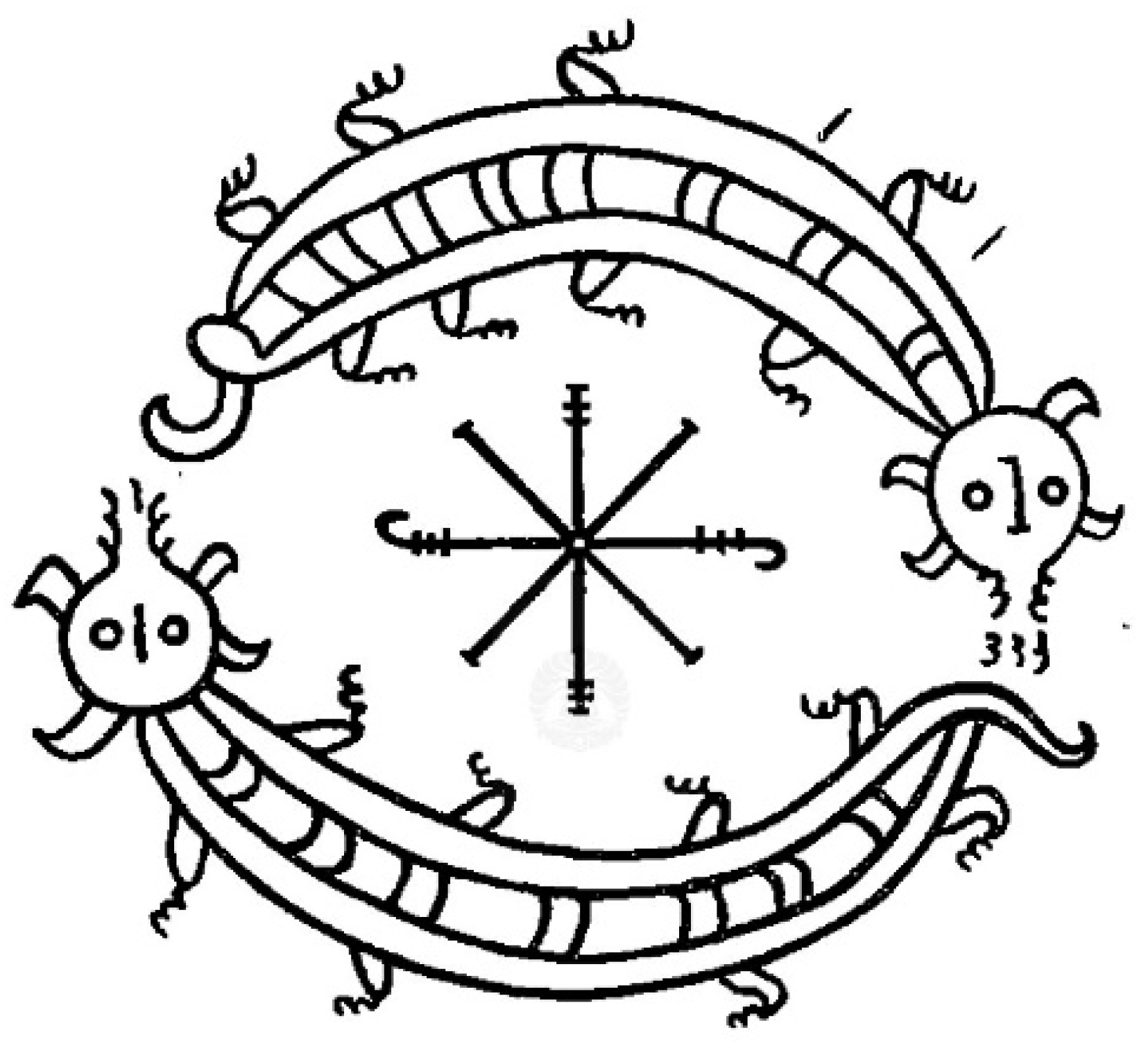
In a study, Winkler (1956) documents the cycle of 'Pane na Bolon', noting that in the initial three months, it positions its head towards the east and its tail towards the west. Over the following quarter, it shifts, placing its head southward and tail northward. In the subsequent three months, its head turns west and its tail east. Finally, in the closing trimester of the year, its head points north while its tail lies in the south. This celestial serpent’s movements provide the datu with the framework to advise on critical times for warfare, construction, and other activities, to avert misfortune.
The alternative method involves the consultation of 'porhalaan', the traditional Batak Calendar. Filled with various symbols, the porhalaan guides its readers in distinguishing between auspicious and inauspicious days. The term 'porhalaan' originates from 'hala', meaning scorpion—a creature feared for its deadly sting. Symbolically, the calendar earmarks three to four days as cautionary periods to be particularly vigilant. The word 'kâlá' from Sanskrit, translates to 'time', and the porhalaan is acknowledged as a lunar-solar calendar, integrating both lunar and solar cycles (Napitupulu, 2021).
Figure 3.
Depiction of Porhalaan diagram, (a) Winkler (1913) and (b) Lumbantobing (1956).
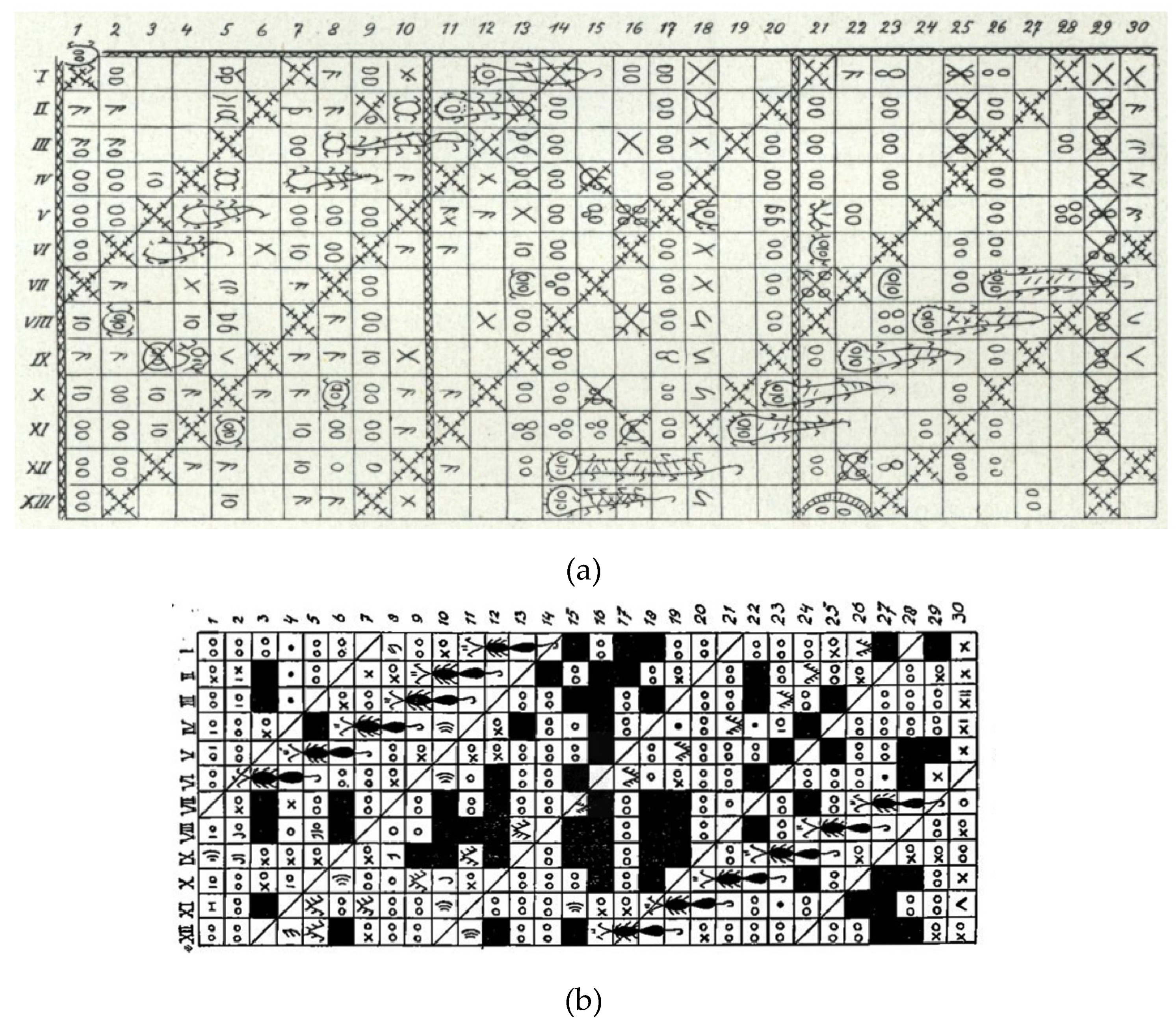
Batak calendar recognizes 30 days in one month and 12 months in one year. The names are shown in Table 1 and Table 2, days and months respectfully (cf. Lubis, et. al., 1985).
Similar to a commonly known calendar, the Batak Cosmogram outlines a pattern that is derived from the datu's meticulous study of celestial objects. It provides insights into the positioning of these bodies within the observational field. From a mathematical standpoint, this relationship is expressed as follows,
where:
- = astronomic periodical observation,
- = geolocation information,

Table 1.
The names of days in Batak tribes of Toba and Karo.
| No. | Toba-Batak | Karo-Batak | Sanskrit |
| 1. | Artia (auch aritia) | Aditia | Aditya = Sun |
| 2. | Suma (ni poltak) | Suma pultak | Soma = Moon |
| 3. | Anggara (ni poltak) | Nggara telu uari | Anggara = Mars |
| 4. | Muda (ni poltak) | Budaha | Budha = Mercury |
| 5. | Boraspati (ni poltak) | Beraspati pultak | Brihaspati = Jupiter |
| 6. | Singkora (ni poltak) | Tjukera enem berngi | Sjukra = Venus |
| 7. | Samisara (ni poltak) | Belah naik | Sjanaisjtjara = Saturn |
| 8. | Antian ni aek | Aditia naik | |
| 9. | Suma ni mangadop | Suma ni siwah | |
| 10. | Anggara sampulu | Nggara sepuluh | |
| 11. | Muda ni mangadop | Budaha ngadep | |
| 12. | Boraspati ni tangkop | Beraspati tangkep | |
| 13. | Singkora purnama | Tjukera lau | |
| 14. | Samisara purnama | Belah purnama | |
| 15. | Tula (Full Moon) | Tula; belah purnama raja | Purnama = Full Moon |
| 16. | Suma ni holom | Suma tjepik | |
| 17. | Anggara ni holom | Nggara enggo tula | |
| 18. | Muda ni holom | Budaha gok | |
| 19. | Boraspati ni holom | Beraspati sepuluh siwah | |
| 20. | Singkora mora turun | Tjukera dua puluh | |
| 21. | Samisara mora turun | Belah turun | |
| 22. | Antian ni angga | Aditia turun | |
| 23. | Suma ni mate | Suma | |
| 24. | Anggara na begu | Nggara si mbelin | |
| 25. | Muda ni mate | Budaha medem | |
| 26. | Boraspati ni gok | Beraspati medem | |
| 27. | Singkora duduk | Tjukera mate | |
| 28. | Samisara bulan mate | Mate bulan | |
| 29. | Hurung | Dalin bulan | |
| 30. | Ringkar (new moon) | Samisari |
Table 2.
The names of months in Batak.
| English | Batak |
| First month | Sipaha Sada |
| Second month | Sipaha Duwa |
| Third month | Sipaha Tolu |
| Fourth month | Sipaha Opat |
| Fifth month | Sipaha Lima |
| Sixth month | Sipaha Onom |
| Seventh month | Sipaha Pitu |
| Eighth month | Sipaha Walu |
| Ninth month | Sipaha Siya |
| Tenth month | Sipaha Sampulu |
| Eleventh month | Sipaha Li |
| Twelfth month | Sipaha Hurung |
| Thirteenth month (conditional in leap year) | Bulan Lamadu |
Unlike the Gregorian Calendar, which serves as a universal framework, traditional calendars are crafted with an acute awareness of local ecological cycles and seasons. These calendars are invaluable tools for agricultural planning, animal husbandry, fishing, transportation, and maritime activities, all of which demand an in-depth understanding of the regional geology, ecology, and climate.
This implies how traditional/ancient Bataknese traditional calendar requires considering observation on variables of:
- Lunar Month: The Bataknese calendar is lunar, with months beginning at the sighting of the new moon. A lunar month averages about 29.53 days. By tracking the phases of the moon, we can estimate the beginning of each month with the appearance of the new moon.
- Constellations' Position: The new year begins when Scorpius is rising in the east, and Orion is setting in the west at sunset. This specific alignment happens once a year, marking the start of the new year in the Bataknese calendar. This is the key event marking the new year in Bataknese Calendar/Cosmogram. This event typically occurs around late April or early May, as constellations' visibility shifts with the Earth's orbit around the Sun.
- Location: Astronomical events are sensitive to the location where the observation is delivered. The location's latitude and longitude affect the visibility and timing of constellations and the moon. The initiative demonstrated here emulates mathematically the experiental observation (rukyatulhilal) from the Lake Toba, North Sumatera, Indonesia. It's the Sianjur Mula-mula village, widely accepted as the origin place of the Batak people.
3. Batak Cosmogram is Lunar-Star Calendar
Each calendar is specifically tailored to the environment in which it's used, addressing the unique requirements of the local populace. The recognition that the moving year is determined by the observation of star constellations on every incoming new moon phase has given its unique signature of "lunar-star" realms of time.
The Batak people, predominantly engaged in agriculture, have a calendar oriented towards farming activities. Similar to the Hijri calendar, the Batak Calendar is based on the lunar cycle, with each new month commencing with the sighting of the hilal (crescent moon) shortly after sunset. However, it also incorporates solar elements, taking into account the seasons and climatic changes affected by the sun's movements. Occasionally, a thirteenth month, known as lamadu, is inserted to align the lunar and solar years, making the Batak Calendar a lunar-solar system. This is particularly significant because the Batak community times the celebration of the new year, or 'mangase taon', to follow the harvest and precede the planting season, as noted by Sinaga (1981).
Winkler (1913) notes that the Batak year starts when the Orion constellation (Sialasungsang) sets in the western horizon, while the Scorpius constellation (Sialaporiama) rises in the east. This astronomical event coincides with the sighting of a new moon in the west shortly after sunset. Fourteen days later, the full moon marks the middle of the first month. This cycle continues, marking each successive month, such as from 'sipaha sada' to 'sipaha duwa', and so on. After twelve lunar months, the datu evaluate whether a thirteenth month is necessary. If Orion is still high in the west and Scorpius is not visible in the east at the time of the new moon, a leap month is added to the calendar. This observation is typically made just after sunset.
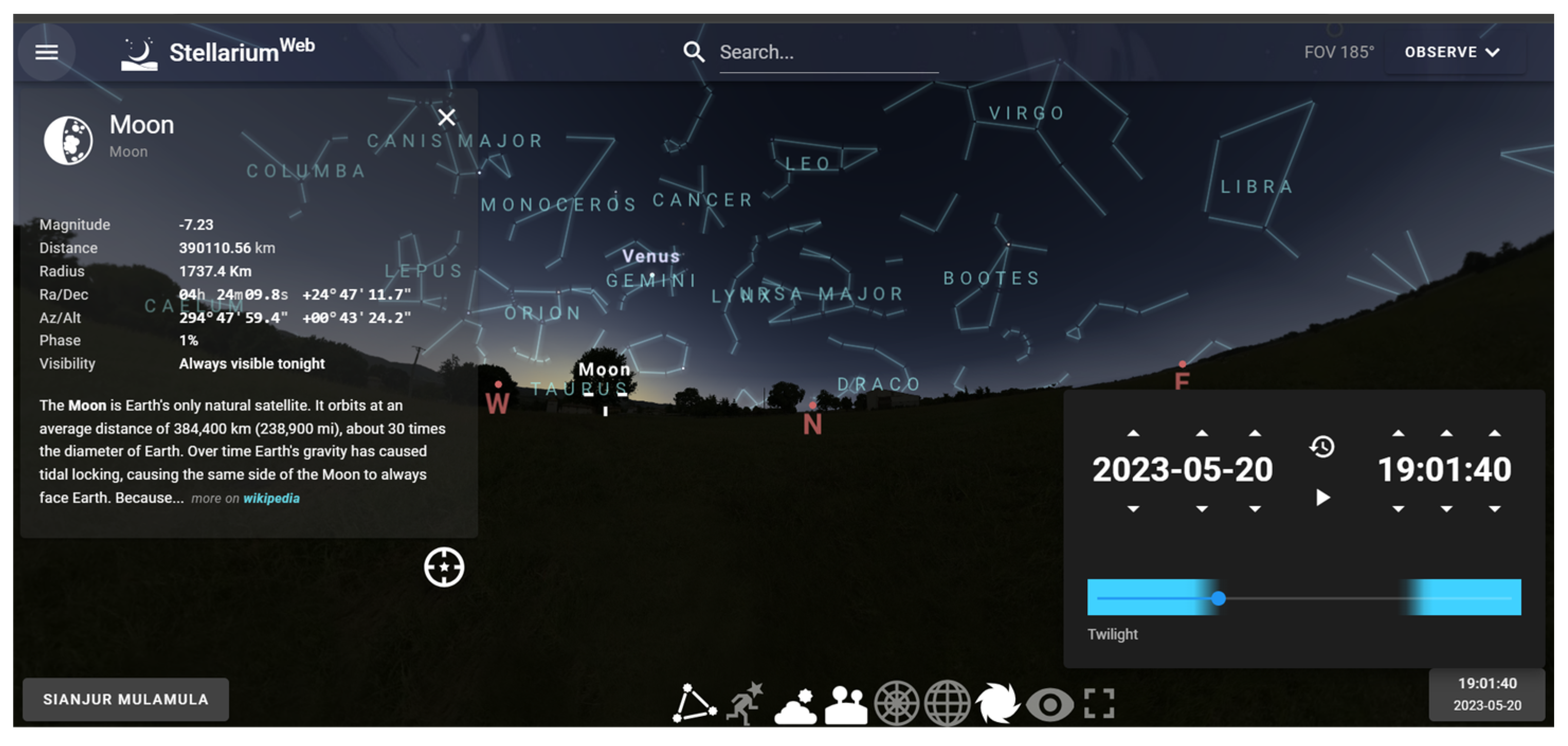
We confirm this by utilizing Stellarium (2024) for celestial simulation. The Batak Calendar for the year 2023-2024 AD is projected to begin on April 21st, 2023 AD. On May 8th, 2024 AD, after sunset, the positioning of Orion above the horizon and the absence of Scorpius indicates the addition of the lamadu month. Thus, the Batak Calendar for this interval becomes a leap year, concluding on June 7th, 2024 AD, with the following year ending on May 27th, 2025 AD.
Figure 4.
Simulated sky observation of Winkler (1913).
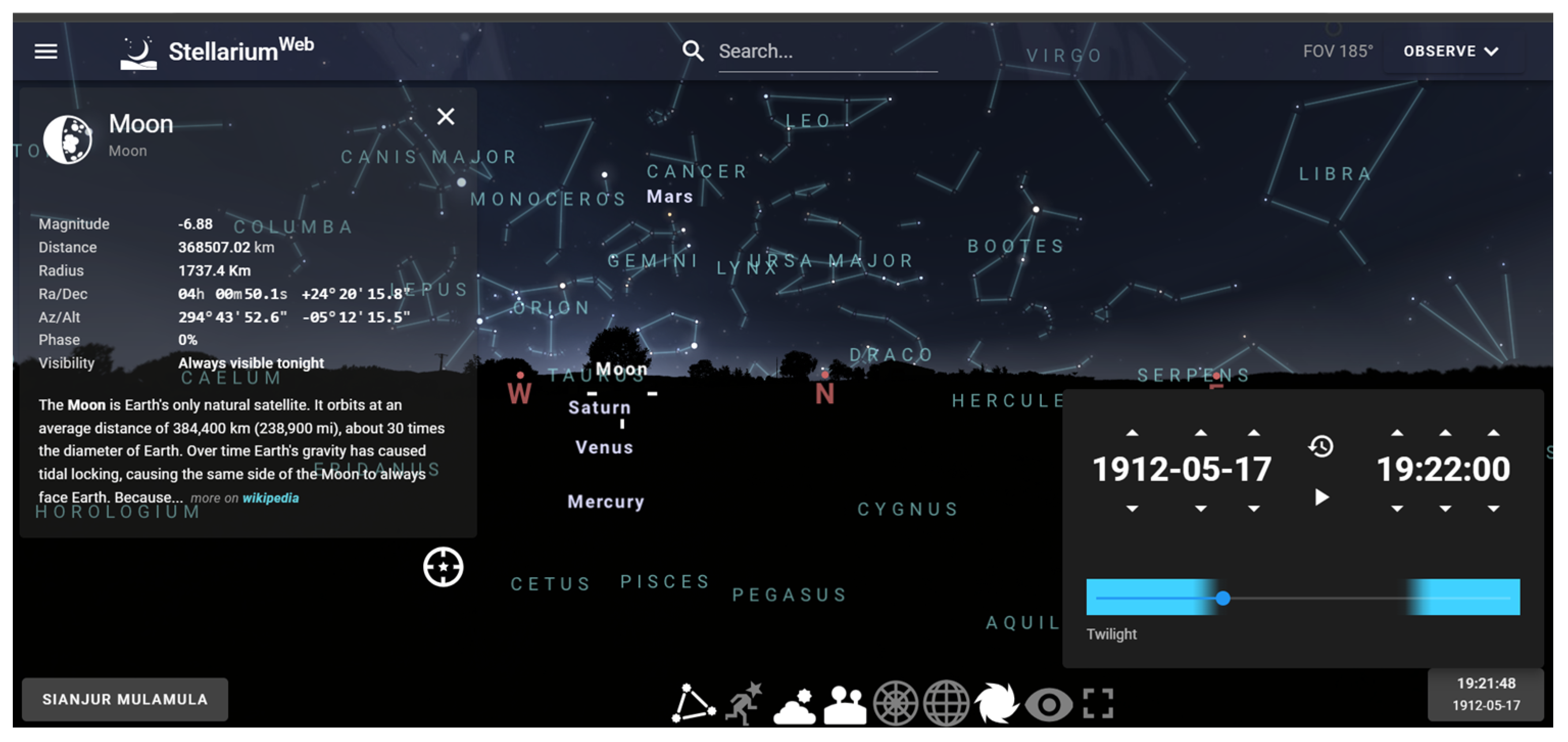
Figure 5.
Simulated sky observation of Batak New Year of 2023 AD.
To date, manuscripts detailing the system of year numbering in the ancient Batak calendar remain elusive. It's speculated that this knowledge was closely guarded as a strategic element of economic and military strength in historical times.
The Batak calendar aligns with the Metonic cycle, a period of 19 years after which the phases of the moon recur on the same days of the solar year. The moon takes approximately 29.53 days to orbit the Earth, defining a month, while the Earth's orbit around the sun takes about 365.25 days, marking a year. Over a 19-year span, the Earth revolves around the sun 6939.75 days, and there are 235 lunar months. Typically, a year comprises 12 lunar months; hence, across 19 years, the moon completes 228 lunar cycles. An initiative of conversion from Gregorian calendar to the names of day and month by simulating the observation of the sky is delivered by Situngkir (2024).
This results in a discrepancy of seven months between the solar and lunar counts over this time. To rectify this, seven intercalary months are interspersed throughout the 19-year cycle, occurring roughly every 2.7 years, akin to adjustments made in the Chinese calendar. These intercalary months are inserted according to a sequence observed every 2 or 3 years, following a pattern of years: 3, 6, 8, 11, 14, 17, and 19, similar to the system used in the Hebrew calendar (cf. Longstaff, 2005).
Table 3.
Batak year starting and the length of time as compared to Hijri and Gregorian Years.
| Hijri Year | Gregorian Year | Start of Batak year | Length (Month) | |
| 1407 | 1987 | 1988 | 30/05/1987 | 12 |
| 1408 | 1988 | 1989 | 18/05/1988 | 13 |
| 1409 | 1989 | 1990 | 05/06/1989 | 12 |
| 1410 | 1990 | 1991 | 26/05/1990 | 13 |
| 1411 | 1991 | 1992 | 14/06/1991 | 12 |
| 1412 | 1992 | 1993 | 02/06/1992 | 12 |
| 1413 | 1993 | 1994 | 23/05/1993 | 13 |
| 1414 | 1994 | 1995 | 10/06/1994 | 12 |
| 1416 | 1995 | 1996 | 31/05/1995 | 12 |
| 1417 | 1996 | 1997 | 19/05/1996 | 13 |
| 1418 | 1997 | 1998 | 07/06/1997 | 12 |
| 1419 | 1998 | 1999 | 27/05/1998 | 13 |
| 1420 | 1999 | 2000 | 15/06/1999 | 12 |
| 1421 | 2000 | 2001 | 04/06/2000 | 12 |
| 1422 | 2001 | 2002 | 24/05/2001 | 13 |
| 1423 | 2002 | 2003 | 11/06/2002 | 12 |
| 1424 | 2003 | 2004 | 01/06/2003 | 12 |
| 1425 | 2004 | 2005 | 20/05/2004 | 13 |
| 1426 | 2005 | 2006 | 07/06/2005 | 12 |
| 1427 | 2006 | 2007 | 28/05/2006 | 12 |
| 1428 | 2007 | 2008 | 18/05/2007 | 13 |
| 1429 | 2008 | 2009 | 06/06/2008 | 12 |
| 1430 | 2009 | 2010 | 26/05/2009 | 13 |
| 1431 | 2010 | 2011 | 13/06/2010 | 12 |
| 1432 | 2011 | 2012 | 03/06/2011 | 12 |
| 1433 | 2012 | 2013 | 22/05/2012 | 13 |
| 1434 | 2013 | 2014 | 09/06/2013 | 12 |
| 1435 | 2014 | 2015 | 31/05/2014 | 12 |
| 1436 | 2015 | 2016 | 20/05/2015 | 13 |
| 1437 | 2016 | 2017 | 07/06/2016 | 12 |
| 1438 | 2017 | 2018 | 27/05/2017 | 13 |
| 1439 | 2018 | 2019 | 15/06/2018 | 12 |
| 1440 | 2019 | 2020 | 04/06/2019 | 12 |
| 1441 | 2020 | 2021 | 24/05/2020 | 13 |
| 1442 | 2021 | 2022 | 11/06/2021 | 12 |
| 1443 | 2022 | 2023 | 01/06/2022 | 12 |
| 1444 | 2023 | 2024 | 21/05/2023 | 13 |
| 1445 | 2024 | 2025 | 07/06/2024 | 12 |
| 1446 | 2025 | 2026 | 28/05/2025 | 12 |
| 1447 | 2026 | 2027 | 18/05/2026 | 13 |
| 1448 | 2027 | 2028 | 06/06/2027 | 12 |
| 1449 | 2028 | 2029 | 25/05/2028 | 13 |
| 1450 | 2029 | 2030 | 13/06/2029 | 12 |
| 1452 | 2030 | 2031 | 02/06/2030 | 12 |
| 1453 | 2031 | 2032 | 22/05/2031 | 13 |
| 1454 | 2032 | 2033 | 09/06/2032 | 12 |
| 1455 | 2033 | 2034 | 30/05/2033 | 12 |
| 1456 | 2034 | 2035 | 19/05/2034 | 13 |
| 1457 | 2035 | 2036 | 07/06/2035 | 12 |
| 1458 | 2036 | 2037 | 27/05/2036 | 13 |
| 1459 | 2037 | 2038 | 15/06/2037 | 12 |
A terrestrial year is measured by the Earth's orbit around the sun, and a lunar month by the moon's orbit around Earth. However, due to discrepancies that arise in these cycles, periodic adjustments are necessary. These adjustments, or corrections, are typically made by adding an extra day, week, or month to the calendar.
Figure 6.
The length of yearly calendars after the intercalary day/month on each.
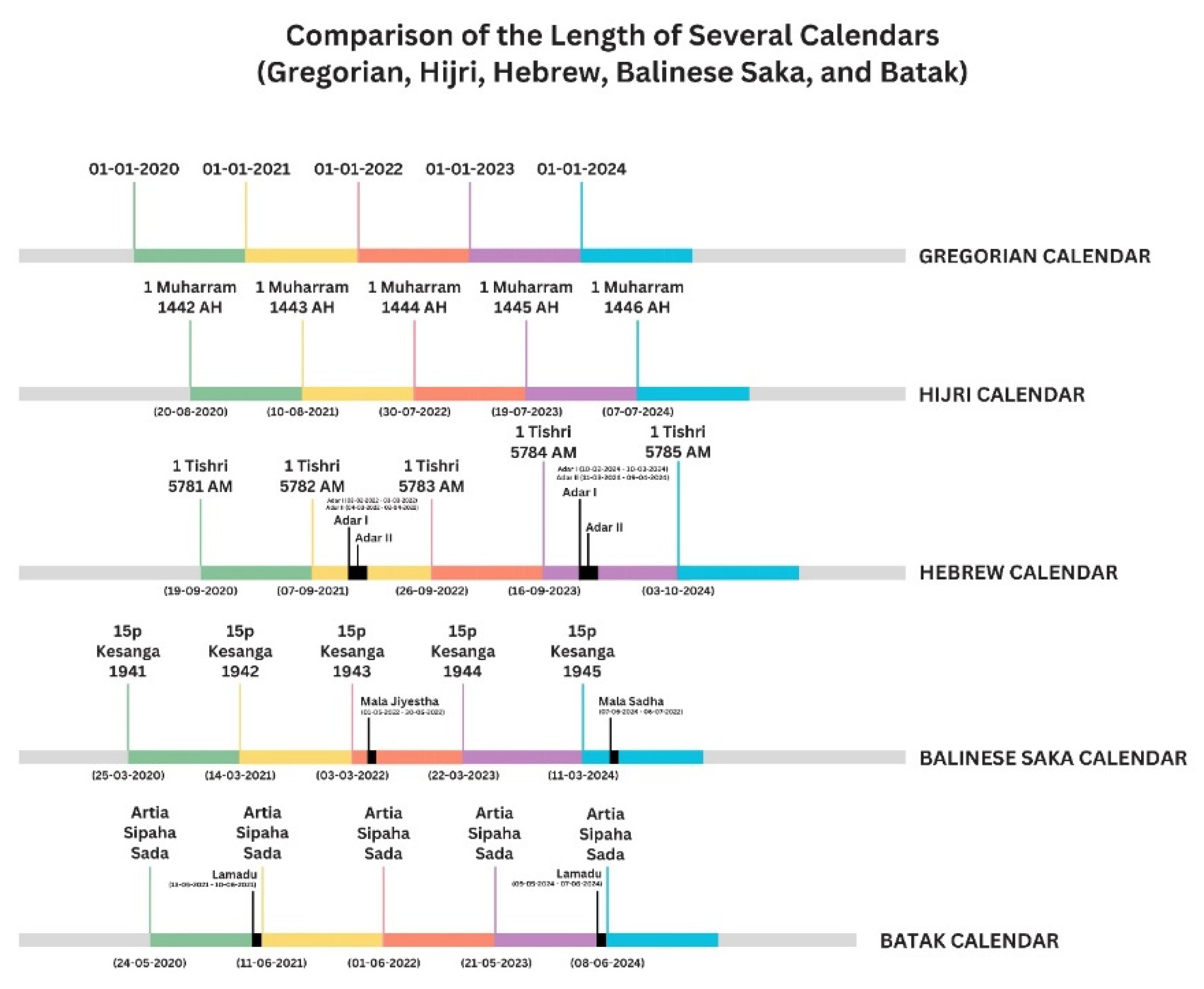
The Julian calendar introduces a leap day in February; normally a 28-day month, February extends to 29 days in a leap year, which occurs every four years, with a further refinement every 400 years. The Gregorian calendar, instituted by Pope Gregory XIII in 1582, made a one-time correction by removing 11 days in October to better align with the astronomical year (Packer, 1893)
Several traditional calendars make use of an intercalary month to maintain alignment between the lunar and solar cycles, thus falling into the category of lunar-solar calendars (cf. Syam, 2021). Examples include the Hebrew, Chinese, Balinese, and Batak calendars. The differences and specifics of these traditional calendars can be seen outlined in Table 4.
Table 4.
Comparison between Batak and other more commonly known calendars.
| Criteria | Gregorian Calendar | Hebrew Calendar | Hijri Calendar | Chinese Calendar | Balinese Calendar | Batak Calendar |
|---|---|---|---|---|---|---|
| Days | 365/366 | 353-355 / 383-385 | 354-355 | 353-355/383-385 | 353-355 / 383-384 | 354-355/384-385 |
| Months | 12 | 12/13 | 12 | 12/13 | 12/13 | 12/13 |
| Calculation orientation | Solar | Lunar-solar | Lunar | Lunar-solar | Lunar-solar | Lunar-solar or Lunar-Star(?) |
| First month | January | Nisan, first of spring (Aviv) season | Muharram | 正月: zhēngyuè | Kasa | Sipaha Sada |
| Correction of leap years | Intercalary day in February every 4 years | Pregnant year (Shanah Me’uberet) by Metonic cycle, 7 times in 19 years cycle. | - | Intercalary month (Adar Sheni) | Intercalary month | Intercalary month (lamadu) 7 times in 19 years cycle. |
Not all calendars mark the New Year with the start of the first month. In the Balinese system, the New Year is celebrated in the tenth month, triggered by the new moon's appearance following sunset at the end of the ninth month, known as 'Tilem Kasanga' (Pendit, 2001). Similarly, the Hebrew calendar marks its New Year, Rosh Hashanah, during the seventh month. Additionally, the intercalary month in these calendars is typically inserted in the middle or towards the end of the year to maintain the correct seasonal alignment.
4. Efforts to Revive the Batak Calendar System and Its Conjectures
Indonesian Batak Calendar has been long not being revived for modern life practicality of Gregorian one. There have been not many literatures and texts approach it while some traditional practices of small religious groups of Batak people often mention the existence regarding to myths surrounding it. Batak Calendar has been reconstructed based on the ancient Batak realms of time, folklores, some other traditional calendars in Indonesia and other part of the world, documented observations from missionaries in the area of Lake Toba decades ago, and simulations of celestial movements using astronomy software and even some contributions from the line of work of machine learning and AI (artificial intelligence) from data crunch about socio-climate and agriculture in areas surrounding Lake Toba and the extractions of old and ancient texts. The work of reviving the traditional Batak calendar today, however, can be delivered with lots of supporting technologies including some efforts from which many possible conjectures can also be outlined.
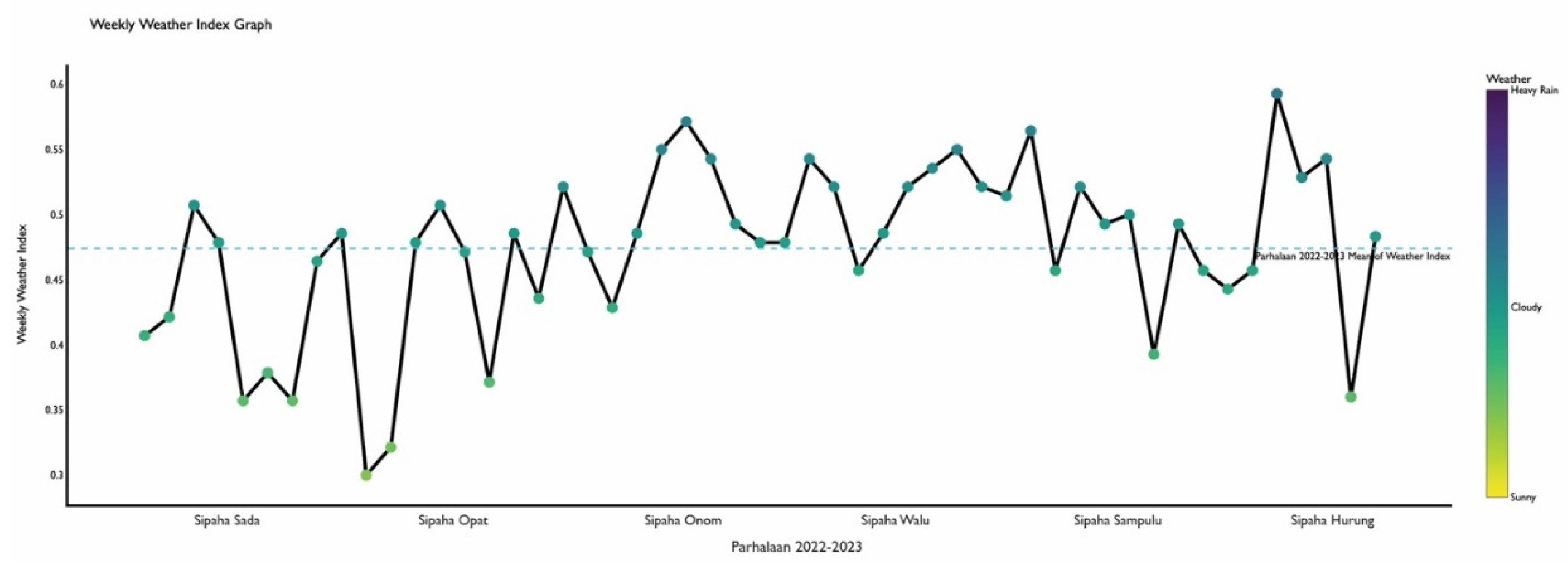
One of interesting conjectures is relating the climate seasons due to the numerical applications of the Batak Calendar for since the beginning, the ancient Batak people relied upon farming and agriculture upon the fertile soil of Toba. As tropical regions in Indonesia, Batak witness only two seasons, i.e., dry season and rainy season. This has been shown by the weather profile as summarized in Figure 8 from the data source of Indonesian authority for Geophysical and Meteorological Agency (BMKG, 2024). It is believed that all socio-economic activities consider the weather profiles in the living since ancient times.
The graph indicates that during the first half of the Batak calendar year, the climate is generally clear with minimal rainfall, although there are occasional foggy conditions. Conversely, the latter half of the year is more prone to rain. With a 13-month calendar year, there can be a postponement in the time of harvest due to the extended duration of a year. Our models present the 13-month Batak calendar as follows.
As a consequence of the lengthier cycle, the Mangase Taon festivities tend to occur later than usual. The additional intercalary month aligns with weather patterns that can lead to unsuccessful crops and a consequent postponement in harvest, although this is not a consistent outcome. Some instances of harvest delays have been attributed to natural events by various media outlets.
Figure 7.
Workflows reviving the ancient Batak Cosmogram.
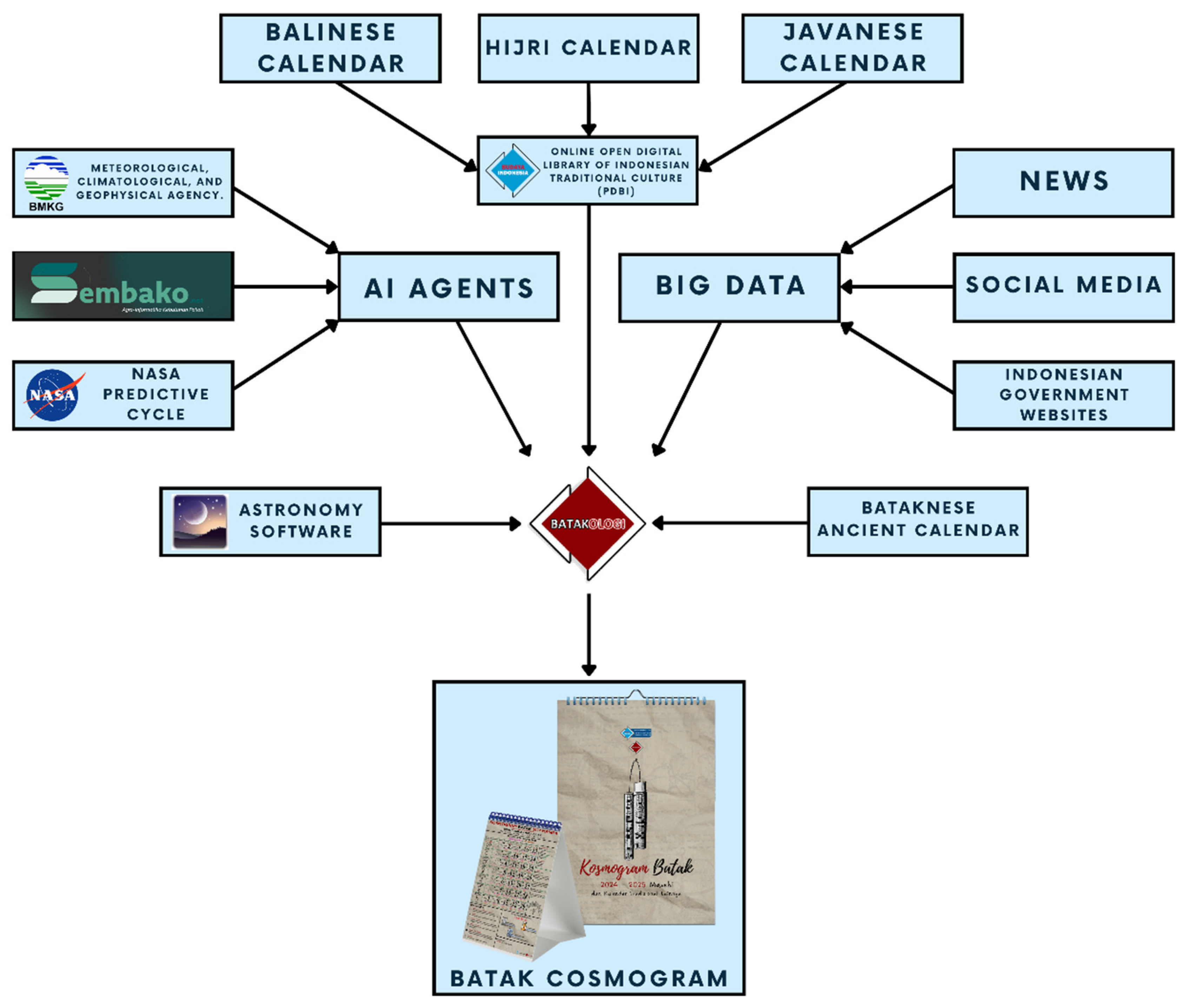
Figure 8.
Weather profile in the area of Batak origin in Lake Toba 2022-2023.
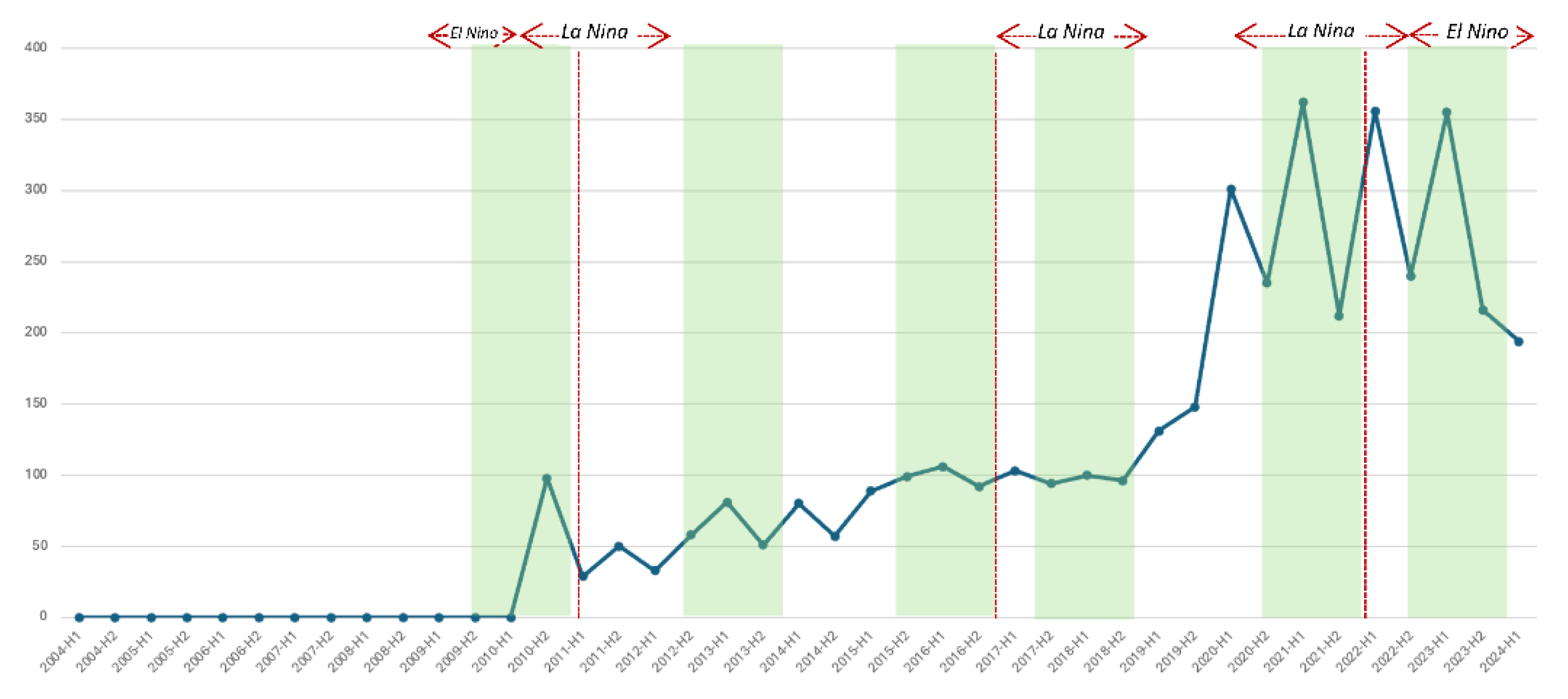
It is also interesting if we look into the search trend obtained from Google (2024) that can reflect the interest of people due to crop failure over time. Although there are some changes in data collection in the backend of Google that may affect the real interest recorded in the data. In Figure 9, we mark the length of the Bataknese leap year and roughly show the relations of the online interest over the topic of crop failure getting higher in it.
Figure 9.
The search term crop failure in Indonesia as recorded by Google (2024): red dashed-lines regarding to some changes of data collection in Google, and interval of leap-year of Batak Calendar (green area).
Figure 9.
The search term crop failure in Indonesia as recorded by Google (2024): red dashed-lines regarding to some changes of data collection in Google, and interval of leap-year of Batak Calendar (green area).
5. Concluding Remarks
Since ancient time, inter-generations of human community regard the observation on heaven with the noticeable regularities of nature, which in turn help them to survive in their communality and construct their realm of time. This happens in the evolving secluded societies like Batak people. The mountainous isolation in the volcanic Lake Toba of more than 900 meters above the sea level, has given them the opportunity to relate the nature's periodical events directly formed of the cycles of the moon and the sun with the observation on some star constellations. There are no notes on numbering the years passing by, and the counting of days are not directly numbered, but instead named with particular signs of nature perhaps related to mythical aspects reflected within their observation. All of this become the tracks of cosmos of Batak social life, thus Batak cosmogram.
The periodic of the revolution of lunar and solar are counted by observing periodical sightings of Scorpius and Orion constellation, the emerging cosmogram can be seen as the lunar-star calendar. It is interesting that the occurrence of intercalary month to have good correction on the counting days and nights are based upon the star sightings. Endeavors to revive the Batak Calendar leave wide conjectures, from the cycles of tropical weather and climate of regions surrounding the origin of Batak people to the pattern of the agricultural farm production that tends to connect to the socio-economics life.
The rich cultural and astronomical knowledge embedded in traditional calendars like the Batak's showcases the deep connection between celestial observations and timekeeping practices in various cultures around the world. This signifies that Indonesian Batak traditional cosmogram as a Lunar Star calendrical system based on ethno-astronomy.
Acknowledgments
We thank Fausto Axel Evan Keiluhu for climate/weather data insights, Bernad Lumbantobing for interesting discussion about year cycle and friends in Institut Batakologi on discussions and endeavors for reviving the Batak Calendar and as well as other elements of Batak culture in general.
References
- Chapman, D. M. F. (2002). "The Astronomical Basis of Our Calendar: Lunar, Solar, Lunar-Solar Calendars". Journal of the Royal Astronomical Society of Canada June 2002.
- Google. (n.d.). Google Trends: Search Volume of "Gagal Panen" in Indonesia. URL: https://www.google.com.trends.
- Hutagalung, W. (1926). Poestaha taringot toe tarombo ni Bangso Batak. Laguboti: Zendings-Drukkerij.
- Longstaff, A. (2005). Calendars from Around the World. National Maritime Museum. URL: https://www.rmg.co.uk/sites/default/files/Calendars-from-around-the-world.pdf.
- Lubis, A. M., Jusuf, S., Butar-butar, T.M., Malau, M. (1985). Kalender Peramalan Batak. Proyek Pengembangan Permuseuaman Departemen Pendidikan & Kebudayaan Sumatera Utara.
- Lumbantobing, P. O. (1956). The Structure of the Toba-Batak Belief in the High God. Makassar: South and South-East Celebes Institute for Culture.
- Napitupulu, J. F. (2021). An Overview the Astronomical Aspects of the Batak Calendar (Porhalaan). Bandung: Master's Thesis, Institute Teknologi Bandung.
- Packer, G. N. (1893). Our Calendar: The Julian Calendar and Its Errors, How Corrected by the Gregorian. F. R. Miller Book & Co.
- Parlindungan, M. (2007). Tuanku Rao. LKiS.
- Pendit, N. S. (2001). Nyepi: Kebangkitan, Toleransi, dan Kerukunan. Gramedia Pustaka Utama.
- Syam, H. A. (2021). "The Essentiality of the Nusantara Traditional Calendar". Al-Hilal Journal of Islamic Astronomy 3 (1). [CrossRef]
- Sinaga, A. B., (1981). The Toba-Batak High God: Transcendence and Immanence. West Germany: Anthropos Institute.
- Situngkir, H. (2008). How Close a Bataknese One Another?: Study of Indonesian Batak's Family Tree. BFI Working Paper Series WP-II-2008. Bandung Fe Institute. URL: https://papers.ssrn.com/sol3/papers.cfm?abstract_id=1086490.
- Situngkir, H. (2015). Deconstructing Bataknese Gorga Computationally. BFI Working Paper Series WP72012. Bandung Fe Institute. URL: https://arxiv.org/abs/1510.01140. [CrossRef]
- Situngkir, H. (2024). Batak Calendar URL: https://github.com/quicchote/Batak-Calendar.
- Stellarium contributors (2024). Stellarium v23.4 Astronomy Software. URL https://stellarium.org/.
- Winkler, J., (1913). Der Kalender der Toba-Batak auf Sumatra. Zeitschrift für Ethnologie, Volume 45, pp. 436-447.
- Winkler, J., (1956). Pane Na Bolon: Ein Kriegsorakel der Toba-Batak auf Sumatra. Bijdragen Tot de Taal-, Land- en Volkenkunde, 112(1), pp. 25-40.
Disclaimer/Publisher’s Note: The statements, opinions and data contained in all publications are solely those of the individual author(s) and contributor(s) and not of MDPI and/or the editor(s). MDPI and/or the editor(s) disclaim responsibility for any injury to people or property resulting from any ideas, methods, instructions or products referred to in the content. |
© 2024 by the authors. Licensee MDPI, Basel, Switzerland. This article is an open access article distributed under the terms and conditions of the Creative Commons Attribution (CC BY) license (http://creativecommons.org/licenses/by/4.0/).
Copyright: This open access article is published under a Creative Commons CC BY 4.0 license, which permit the free download, distribution, and reuse, provided that the author and preprint are cited in any reuse.


