

Submitted:
29 March 2024
Posted:
01 April 2024
You are already at the latest version
Abstract
Honey is a sweet substance extensively consumed in the world for its nutritional and healthy properties. However, residues of pesticides and environmental contaminants can compromise its quality. For this reason, the physicochemical parameters, and the organic contamination of monofloral and multifloral honeys from three regions of Algeria (Tiaret, Laghouat and Tindouf) were monitored to evaluate the quality of honey and the safety for consumers. In general, the results obtained from the physicochemical analyses were in line with the EU standards. In terms of contamination, pesticides authorised and used in Algerian agriculture (matalaxyl-M and cyromazine), as well as banned pesticide (carbaryl), were found in almost all the samples. However, only the concentration of cyromazine was higher than the relative EU maximum residue levels. PCB 180, PCB 189, anthracene, fluorene and phenanthrene were mainly detected. All the honeys show traces of DiBP, DBP, DEHP and DEHT, but no traces of bisphenols were found. Moreover, the dietary exposure assessment shows that a small amount of Algerian honey can be safely consumed. Overall, data from this study should motivate the Algerian government to enhance their monitoring activities in beekeeping and to find solutions for implementing more sustainable agricultural practices harmonizing with the international legislation.
Keywords:
Algerian honey
; beekeeping
; physicochemical parameters
; organic contamination
; pesticides
; PAHs
; PCBs
; plasticizers
; persistent organic pollutants
1. Introduction
Honey is a natural, complex, and plant-based sweet substance produced by honeybees (Apis mellifera) and extensively consumed in the world not just as a direct food, but also as a natural flavouring and sweetener agent [1]. Honey is composed primarily of fructose and glucose but also contains fructo-oligosaccharides and many enzymes, vitamins, minerals, phenolic acids and flavonoids that provide it healthy and therapeutic properties [2,3]. The quality of honey depends both on the botanical source of pollen, nectar and honeydew and on the production context that includes quality of soil, water and air and the presence of chemical pollutants as well [4]. Environmental contaminants from agricultural, industrial, and urban areas are ingested by bees when they collect nectar, pollen and honeydew from flowers and drink water or are accumulated in their bodies by contact with contaminated surfaces. As a result, environmental pollutants are transferred within hive and accumulated in the honey, which can be considered potential indicator for environmental contamination [5]. However, to have the most benefit, honey must be free of any contaminating agents.
Residues of pesticides from environmental source or used for plant treatment in agriculture practice and of apicultural origin such has such as organochlorine (OC), organophosphorus (OP) and carbamates, have been detected in honey, compromising food safety [6]. The Regulation (EC) No 396/2005 as amended established the maximum allowable residue levels (MRLs) of pesticides in foods, honey included [7].
The presence of many persistent organic pollutants (POPs) in honey samples is well-recognised. POPs are considered a serious problem because they accumulate in the environment and human body due to their ubiquity, lipophilicity, propensity of bioaccumulation, biomagnification, and persistence in the environment [8].
Among POPs, OC pesticides, polychlorinated biphenyls (PCBs) and polycyclic aromatic hydrocarbons (PAHs) are the most notorious pollutants involved in emergence of several health problems [9].
Due to the persistence and adverse effects on human health using OCPs and PCBs, some of these chemicals were banned or limited in many countries by the Stockholm Convention on Persistent Organic Pollutants, adopted in 2001 and entered into force in 2004 [10]. In 2005, the European Union identified 16 PAHs that possess both genotoxic and carcinogenic properties, 12 of which are also identifies to be definitely carcinogens for humans by the International Agency of Cancer (IARC) [11]. Nevertheless, due to uncontrolled and indiscriminate anthropogenic activities, residues of OCPs from agricultural practices, and trace of PCBs and PAHs are still persisted in the environment, accumulate in plants from polluted soil and pass into food, honey included [12,13].
In addition to environmental pollution, other sources of honey contamination are represented by beekeeping activities, honey production and packaging processes. Plastic additives, such as bisphenols (BPs), phthalates (PAEs) and non-phthalate plasticizers (NPPs), have been found in honey [14]. The cause of this contamination type is mainly related to the direct contact between honey and unsuitable plastic during production and storage. In addition, recently, plastic honeycombs are used to reduce the risk of melting the wax itself, resulting in reduced yield [15]. The United States Environmental Protection Agency (USEPA) and the European Union (UE) have listed six phthalates as priority toxic pollutants [16]. In 2023, the EFSA has published the scientific opinion of public health risks related to the presence of BPA in food, thus regulating its Tolerable Daily Intake (TDI)[17].
Many of these organic pollutants (i.e. DDT, atrazine, chlorpyrifos, PCBs, some PAEs and BPA) are also classified as Endocrine Disrupting Chemicals (EDCs) because of the capacity to interfere with the synthesis, secretion, transport, binding, or elimination of natural hormones in the human body, resulting in carcinogenic, mutagenic, and teratogenic effects [18,19]
It is fundamental to monitor contaminant residues present in foodstuff, such as honey, to prevent health risks in humans.
Algeria is considered a traditional consumer of honey, but national production does not achieve self-sufficiency because of the lack of national legislation and the rural organization of this ancient practice [20]. The northern region of Algeria, characterised by Mediterranean climate and great diversity of flora, lends itself for beekeeping, while the high steppe plateau and the large Saharan plateau in the south of Algeria are less suitable for beekeeping [21]. In 2021, the national honey production was estimated to be 5165 t, with a yield of 4 to 8 kg per hive, very low considered the potential offered by Algeria and the 150,000 tons of honey per year imported from other countries [22,23]. In the absence of national legislation, there are no criteria to check the safety and the quality of Algerian honey.
Considering this scenario, the aim of the present study was to investigate the physicochemical parameters of honey (i.e., moisture, total soluble solids, pH, electrical conductivity, and acidity) and the presence of organic chemicals residues in samples from different areas of Algeria. The aim was to monitor the quality and the safety of honey from different geographical areas and to assess the dietary exposure to the contaminants by exploiting the Algerian guidelines.
2. Materials and Methods
2.1. Honey Sample Collection
A total of 54 honey samples were collected during 2022 and 2023 by beekeepers located in three different provinces of Algeria (i.e., Tiaret, Laghouat and Tindouf), as detailed in Table 1. Samples with the same botanical and geographical origin were grouped together.
Laghouat and Tiaret are two of the most famous Algerian regions for the production of honey [23]. Laghouat is in an ancient oasis in the southern foothills of the Saharan Atlas, characterized by the presence of flora very similar to that present in Mediterranean regions [24]. Tiaret is situated in the western steppe region of Algeria, and, in the north, there are dense forest areas that contain many different species of plants [25]. Tindouof, located in the natural region of the Sahara Desert, is characterized by low diversity and abundance of plant species due to the extreme environmental conditions [26]. The Figure 1 shows the geographical map of the sampling sites considered for the study.
The honey samples obtained from these regions of Algeria were collected in glass jars of ~150 g and stored at room temperature in a dark place until analysis.
2.2. Chemicals and Reagents
All solvents and reagents were of analytical grade. Acetonitrile (ACN) (purity ≥ 99.9%), ultrapure water HPLC-grade, and n-hexane were purchased from Merck (Darmstadt, Germany).
Pesticides (n = 109), PCBs (n = 18) and PAHs (n = 13) standards were provided from Fluka Analytical (Milan, Italy), Sigma-Aldrich (Chicago, Il, USA) and Dr. Ehrenstorfer (Augsburg, Germany). The deuterated analogues used as internal standards (ISs) for pesticides analysis (atrazine-d5, carbofuran-d3, cyprodinil-d5, dimethoate-d6, imazalil-d5, malathion-d6, methiocarb-d3, and trifloxystrobin-d6) were all purchased from Toronto Research Chemicals (Toronto, CA, USA) while the deuterated analogues for PCBs analysis (acenaphtene-d10, naphtalene-d8 and phenanthrene-d10) from Cambridge Isotope Laboratories Inc. (Andover, MA, USA). PAEs (n = 10) and NPPs (n = 8) analytical standards (certified purity ≥96%) were provided by Supelco (Bellefonte, PA, USA). Dibutyl phthalate-d4 (DBP-d4) and bis(2-ethylhexyl)phthalate-d4 (DEHP-d4) in nonane were used as ISs and purchased from Cambridge Isotope Laboratories Inc.
Stock solution of each pesticide, PCB, PAE and NPP were prepared at 1000 mg/L in n-hexane and then stored at 4 °C.
BPs (n = 9) analytical standards (certified purity ≥ 99%) were provided from Sigma-Aldrich (Steinheim, Germany), while the ISs 13C12-BPA and 13C12-BPS (purity ≥ 99%) was obtained from Cambridge Isotope Laboratories. Stock solutions of BPs were prepared at 100 mg/L in acetonitrile and then stored at 4 °C.
The Quick, Easy, Cheap, Effective, Rugged, and Safe (QuEChERS) Q-sep extraction kits (4 g MgSO4 + 1 g NaCl and 6 g MgSO4 + 1.5 g of CH3COONa), d-SPE (750 mg MgSO4 + 250 mg of primary and secondary amines PSA + 125 mg of octadecyl sorbent C18) and clean-up kit (25 mg C18) for were purchased from Agilent Technologies Italia S.p.A. (Milan, Italy).
To significantly limit the contamination caused by laboratory materials and solvents, the time taken to prepare samples, the contact of laboratory equipment and solvents with samples and the volumes of solvent used were minimized as much as possible. Stainless-steel instruments and glassware were washed first with acetone then with hexane, dried at 400 °C for 4 h, and finally wrapped with aluminium foil until analysis.
2.3. Physicochemical Parameters
Physiochemical parameters of each honey samples were calculated according to the official methods [27].
The moisture (expressed as a percentage) and the total soluble solids (TSS), that are the concentration of soluble sugars (expressed as °Brix), were determined by means of an Abbe refractometer. The values derived from conversion tables correlating water content/°Brix with the refractive index, calculated for each sample at a temperature of 20 °C. In cases where the refractive index was determined at a temperature other than 20 °C, adjustments were made to standardize the results to this temperature.
Free, combined, and total acidity were determined using the titrimetric method. Briefly, 10 g of each honey samples diluted in 75 mL of distilled water were titrated with 0.05 N NaOH until reaching pH 8.5 (indicating free acidity). Subsequently, 10 mL of NaOH was added, and titration was continued with 0.05 N HCl until reaching pH 8.3 (indicating combined acidity). Total acidity was calculated by summing the values obtained for free and combined acidities.
The pH and electrical conductivity of each honey sample were measured using a Oakton PC 2700 Benchtop pH/conductivity meter (Cole-Palmer, USA). Approximately 10 g of honey was dissolved in 75 mL of distilled water, and the pH and electrical conductivity were recorded. To determine the amount of honey needed for electrical conductivity measurement, the following equation (1) was used:
where M is th mass of honey (g); 20 is the theoretical nominal mass of honey; A is the water content in %.
2.4. Pesticide, PCB, and PAH Residues
The method adopted for the extraction of pesticides, PCBs, and PAHs from honey samples, previously validated from Massous et al. [28], is described below. Briefly, 10 g of each honey samples were weighed into a tube, dissolved with 10 mL of water and 10 mL of acetonitrile, and vortexed for 5 min. Then, Q-sep QuEChERS extraction kit (4 g MgSO4 + 1 g NaCl) and d-SPE (750 mg MgSO4 + 250 mg of PSA + 125 mg of C18), described in Section 2.2, were added and, after shaking manually for about 1min, each sample was centrifuged for 5 min at 4°C at 5000 rpm. At the end, 5 mL of the organic phase was reduced to 1 mL in a rotary evaporator at 30 °C and, finally, to 0.5 mL under a stream of nitrogen. Before instrumental analysis, a known amount of bromophos-methyl as IS was added to each sample.
The multiresidues analysis were carried out by a Shimadzu GCMS-TQ8030 triple quadrupole mass spectrometer (Shimadzu, Kyoto, Japan). The GC-MS conditions are reported in Table 2.
The identification of pesticides, PAHs and PCBs was carried out by comparing their retention times and mass spectra with those of corresponding commercial standards. The Multiple Reaction Monitoring (MRM) mode was used for the quantification of analytes, exploiting the IS normalization, according to an our previous study [28]. The MRM transitions, as well as the analytical method validation are reported in Table S1. The LabSolutions software (Shimadzu) was used for data acquisition and quantification. Each honey sample was analysed three times, along with analytical blanks, to ensure accuracy and reliability of the measurements.
2.5. PAEs and NPPs Residues
The extraction method of plasticizers residues from honey samples reported in Massous et al. [28] was adopted in the present work. Briefly, 5 g of each honey were weighed into a tube, dissolved with 10 mL of acetonitrile, added with Q-sep QuEChERS (4 g MgSO4 + 1 g NaCl), described in Section 2.2, and centrifuged for 5 min at 5000 rpm. Then, about 2 mL of the organic phase was reduced to 1 mL in a rotary evaporator at 30 °C and, finally, to 0.5 mL under a stream of nitrogen. Before instrumental analysis, a known amount of DBP-d4 and DEHP-d4 was added to each sample. The multiresidue screening was carried out by Shimadzu GCMS-TQ8030 triple quadrupole mass spectrometer (Shimadzu, Kyoto, Japan). Table 2 reports the operative conditions. PAEs and NPPs were identified by comparing their retention times and mass spectra to those of commercially available standards. Quantitative analysis was carried out in Single-Ion Monitoring (SIM) mode, considering the base peak ion among three characteristic mass fragments for each target analyte, reported in Table S2, and employing Internal Standard (IS) normalization, as suggested by Liotta et al. [29]. The method validation is detailed in Table S2. The LabSolutions software (Shimadzu) was used for data acquisition and quantification. Each sample was analysed in triplicate with analytical blanks, to ensure accuracy and reliability of the measurements. Glass equipment was used to avoid plasticizers contamination.
2.6. BPs Residues
Bisphenol analogues in honey samples were extracted and detected according to the Micro-QuEChERS procedure developed from a previous study [30]. Briefly, 1.5 g of honey was mixed in a glass tube with 3 mL of ultrapure water, 100 μL of 13C12BPA, shaken vigorously and left in the dark for 24 h prior to the extraction procedure. Then, the QuEChERS Q-sep extraction Kit (MgSO4 and CH3COONa) and clean-up kit (C18) were used with 3 mL of ACN as the extraction solvent. Subsequently, 1 mL of ACN extract was filtered through a PVDF syringe filter (0.22 μm) and injected into the UHPLC (Shimadzu, Kyoto, Japan) coupled to a triple quadrupole mass spectrometer MS-8040 (Shimadzu, Tokyo, Japan). The UHPLC MS/MS system was equipped with a binary pump (LC-20ADXR), an autosampler (SIL-20AXR), a temperature-controlled column drive and a DGU-20A5R degasser. The instrumental operating conditions were indicated in Table 3. The data were obtained using MRM mode and the ion transitions were used for the identification of analyte. The quantification was carried out using the IS method. MRM transitions and analytical validation metrics for each target analyte are detailed in Table S3. The LabSolutions software (Shimadzu) was used for data acquisition and quantification. Each honey sample was monitored in triplicate, along with analytical blanks, to ensure accuracy and reliability of the measurements. Glass equipment was used to avoid bisphenol contamination.
2.7. Statistical Analysis
Experimental data were expressed as mean ± standard deviation of three replicate measurements for each sample.
Statistical analysis was performed using the SPSS 13.0 software package for Windows (SPSS Inc., Chicago, IL, USA). One-way analysis of variance (ANOVA) was used for each independent variable to show statistically significant differences. When a significant F was determined (Fcalculated > Fcritical), Tukey honestly significant difference (HSD) test were performed for all pairwise comparisons of means. For every investigated variable, statistical significance was accepted at p < 0.01.
2.8. Assessment of the Dietary Exposure to Contaminants
To assess the health risks associated with organic contaminants present in Algerian honey, the relative Estimated Daily Intakes (EDI) were first determined. EDIs were calculated multiplying the mean concentration of contaminants found in each sample (expressed in mg/kg or μg/kg) by the daily consumption of honey (in grams) and dividing the resulting value by the consumer's body weight (in kg). Additionally, the chronic non-carcinogenic risk derived from the dietary exposure to the chemical was calculated in terms of Hazard Quotient (HQ). HQ is obtained by dividing a specific EDI by the corresponding Accetable Daily Itake (ADI) or Tollerable Daily Intake (TDI). When HQ < 1, there are no health risk to the exposed population.
3. Results and Discussions
3.1. Physicochemical Parameters
Table 3 show the values of moisture, TSS, conductivity, pH, free, combined, and total acidity of honey from different region of Algeria.
Moisture is a crucial parameter in control quality of honey because high moisture content can cause its undesirable fermentation [31]. This parameter depends on environmental conditions (i.e., pedoclimatic conditions and soil characteristics), harvest time, practices performed by beekeepers and level of honey maturity. The moisture influences honey taste, colour, flavour, viscosity, density, crystallization, and fermentation during storage [32]. In the honeys investigated, moisture values were in the range of 12.32 - 16.55 % (p < 0.01), lower than the maximum limit set by the Codex Alimentarius and EU regulation (20%) [33,34]. This indicates that all honey samples analyzed in the present study have reached a good level of maturity.
The TSS of honey indicates the sugar compounds present in honey and it is inversely related to the moisture [35]. In the honey analyzed, the maximum value was 84.91°Brix in E. globulus honey form Laghouat while the minimum was 81.28°Brix in multifloral honey samples from Tiaret (p < 0.01). High values of TSS contributes to osmotic stress for selected microorganisms [35].
The electrical conductivity of honey depends mainly on mineral content but also on organic acids in honey and it is influenced by the geographic location and botanical source. This parameter is useful in discerning between nectar and honeydew honeys because it is generally higher in honeydew honeys [36]. In Algerian honey, the conductivity varied from 241.48 μS/cm to 565.43 μS/cm (p < 0.01), respectively in E. sativa honey from Tindouf and Tamarix and E. orientalis honey from Laghouat. The Codex Alimentarius and EU regulation [33,34] fixed the electrical conductivity lower than 800 µS/cm for nectar honey, so this parameter demonstrates that all the samples analyzed were honey obtained from nectar.
An acidic character was observed in all analyzed samples. A normal pH value for honey is between 3.2 and 4.5 [37]. pH values of Algerian honey ranged between 3.61 in E. sativa honey from Tindouf and 4.86 in Z. lotus honey from Laghouat (p < 0.01). Both Z. lotus honeys analyzed are characterized by a pH value out of the suggested range.
Honey acidity is correlated to pH, and vice versa. Good honey is characterized by high acidity and low pH, parameters that inhibits microorganism growth [38]. Acidity depends on the content of organic acids (mainly gluconic acid, derived from the enzymatic reaction of glucose oxidase with glucose in the presence of water) and therefore on the enzymatic activity, and it is related to the freshness of honey [39]. The acids are in a fluctuating equilibrium between their free and combined forms represented by lactones. For this reason, the value of total acidity of honey is given by the sum of free and combined acidity. The maximum level of free acidity is set at 50 meq/Kg from UE and Codex Alimentarius [33,34]. Most of the samples analyzed in this study showed a level of free acidity below the limit fixed, specifically in the range between 20.10-46.67 meq/Kg (p < 0.01) in Z. lotus from Laghouat and multifloral honey from Tiaret, respectively. The same samples showed the lowest and the highest values of total acidity, respectively (22.95 meq/Kg in ZL and 47.54 meq/Kg in MT). The maximum level of combined acidity is found in E. globulus honey from Laghouat. Only E. orientalis honey from Tindouf showed a level of free acidity higher than UE limits (52.96 meq/Kg). The two Z. lotus honeys analyzed, with the higher pH value, also have lower levels of free and total acidity than all the samples.
For all parameters studied, statistically significant differences were found due to the great variability of the botanical and geographical origin of the honeys analysed. Only for TTS, the Tukey’s HSD test showed that there is no significant difference between the means of any pair despite a p-value lower than 0.01.
In general, moisture, TTS, conductivity and pH of honey samples evaluated in this study were in line with the results reported in recent studies concerning Algerian honey from different regions [20,23,40]. However, the values of acidity were higher than data reported in literature [41,42]. These data show that Algerian honeys display medium quality parameters.

Table 3.
Physicochemical parameters (moisture, TSS, conductivity, pH, and acidity) of Algerian honeys. Values are expressed as mean ± standard deviation of three replicates for each sample with the same botanical and geographical origin.
Table 3.
Physicochemical parameters (moisture, TSS, conductivity, pH, and acidity) of Algerian honeys. Values are expressed as mean ± standard deviation of three replicates for each sample with the same botanical and geographical origin.
| Moisture (%) |
TTS (°Brix) |
Conductivity (µS/cm) | pH | Free acidity (meq/Kg) | Combined acidity (meq/Kg) | Total acidity (meq/Kg) | |
|---|---|---|---|---|---|---|---|
| MT | 14.51 ± 1.59a,b,c,d | 81.25 ± 1.30 | 490.65 ± 24.47a,b | 4.26 ± 0.07a,b | 46.67 ± 0.99a,e,f | 0.86 ± 0.03a | 47.54 ± 0.97a,d |
| ET | 14.39 ± 0.13a,b,c,d | 84.65 ± 1.32 | 468.55 ± 7.56a,b | 4.37 ± 0.09a,b | 29.54 ± 0.64b,c | 0.87 ± 0.02a | 30.31 ± 0.64b,e,c |
| EST | 14.15 ± 0.16a,b,c,d | 82.36 ± 1.58 | 326.94 ± 6.77a,c | 4.30 ± 0.02a,b | 41.84 ± 0.97a,d,e | 0.86 ± 0.02a | 42.71 ± 0.96a,c,d |
| ZLT | 13.66 ± 0.20a,b,c | 84.09 ± 1.30 | 525.79 ±7 .74a,b | 4.65 ± 0.07b,d | 26.37 ± 0.73b,c | 0.88 ± 0.03a | 27.25 ± 0.74b,e |
| BMT | 16.55 ± 0.13d | 82.22 ± 1.36 | 439.15 ± 5.55a,b,c | 4.40 ± 0.06a,b | 34.12 ± 0.75b,d | 4.18 ± 0.04b | 38.30 ± 0.71a,b |
| TEL | 16.15 ± 0.08a,b,d | 81.89 ± 1.43 | 565.43 ± 8.10b,e | 4.41 ± 0.04a,b | 38.09 ± 0.64a,b,d | 0.84 ± 0.02a | 38.93 ± 0.63a,b |
| EOL | 14.12 ± 0.76a,b,c | 83.65 ± 1.29 | 544.96 ± 187.42b | 4.50 ± 0.09b,f | 29.80 ± 7.23d | 2.12 ± 0.07c | 31.92 ± 7.16b,g |
| EGL | 12.51 ± 0.20c | 84.91 ± 1.61 | 471.05 ± 6.33a,b | 4.39 ± 0.10a,b,c | 42.11 ± 0.46a,d,e | 5.23 ± 0.03d | 47.34 ± 0.43a,d,f |
| ML | 14.03 ± 0.17b,c,d | 83.07 ± 1.47 | 428.21 ± 5.79a,b,c | 4.50 ± 0.11a,b | 31.27 ± 0.50b,d | 4.89 ± 0.03d | 36.16 ± 0.47b,c,f,g |
| ZL | 13.16 ± 0.54c | 84.53 ± 1.24 | 471.75 ± 44.76a,b | 4.86 ± 0.07b | 20.10 ± 2.26c | 2.85 ± 0.33e | 22.95 ± 2.57e |
| ED | 13.93 ± 0.12a,c | 83.19 ± 1.16 | 330.28 ± 5.03a,c | 3.97 ± 0.05a,c,e | 42.33 ± 0.60d,e | 2.57 ± 0.04e | 44.90 ± 0.60a,d,f |
| ESD | 15.34 ± 0.98a,b,d | 82.08 ± 1.91 | 241.48 ± 7.04c | 3.61 ± 0.43e | 30.73 ± 5.99b | 0.86 ± 0.02a | 31.58 ± 5.98b,g |
| EOD | 13.79 ±0.20a,c | 82.57 ± 1.02 | 337.07 ± 6.78a,c,e | 3.93 ± 0.04a,e | 52.96 ± 0.58e | 0.86 ± 0.01a | 53.82 ± 0.57d |
| PHD | 12.32 ± 0.09c | 81.97 ± 1.34 | 376.50 ± 9.07a,b,c | 4.08 ± 0.07a,d,e,f | 37.34 ± 0.52b,d,f | 1.74 ± 0.04f | 39.08 ± 0.55a,g |
| p-Value | <0.01 | <0.01 | <0.01 | <0.01 | <0.01 | <0.01 | <0.01 |
a-g different superscript letters in the same column indicate significantly different values for a given parameter (p < 0.01 by post hoc Tukey’s HSD test); same superscript letters indicate not significantly different values for a given parameter (p > 0.01 by post hoc Tukey’s HSD test). Bold p-values showed significantly different results at p < 0.01 between different honeys.
3.2. Pesticide, PCB, and PAH Residues
Pesticide, PCB and PHA residues revealed in the several honeys from Algeria are shown in Table 4.
Pesticide residues were detected in all honey samples. Among the pesticides investigated, 16 pesticides were detected, exactly 4 herbicides, 3 carbamates, 2 fungicides, 2 insects growth regulators, 2 OPPs, 2 pyrethroid insecticides and 1 OCPs. E. orientalis honey from Laghouat (EOL) shows the highest number of quantifiable pesticides (n=9) while the lowest number of pesticides (n=2) was detected in E. sativa honey from Tiaret (EST). Cyromazine and metalaxyl-M were detected in all samples, followed by carbaryl detected in 13 samples. Cyromazine was the pesticides detected in the highest concentration in all samples (in the range from 163.58 µg/Kg in B. mauritanicum honey from Tiaret to 6.48 µg/Kg in E. orinetalis honey from Tinfouf) except for Echinops honey from Tinfouf which has the highest concentration of carbaryl (0.30 vs. 15.81 µg/Kg). Omethoate and propazine and showed concentrations above the LOQ in 50% of the samples analyzed. The highest concentration of omethoate was detected in P. harmala honey from Tindouf (27.54 µg/Kg) while the highest concentration of propazine in B. mauritanicum honey from Tiaret (1.93 µg/Kg). Alachlor was detected in two samples from Tiaret and four sample from Laghouat at concentration lower than 1 ppb. Bendiocarb, propyzamide, pyriproxyfen and methidathion were found in only one sample at different concentration from 0.12 to 3.82 µg/Kg. Most of the pesticides found in Algerian honey are not authorized for use in the European Union, except for metalaxyl-M, propyzamide and pyriproxyfen, according to Regulation (EU) No 540/2011 [43].
According to the Regulation (EC) No. 396/2005 and subsequent amendments [7], the concentration of pesticides was below the maximum residual limits (MRLs) except for cyromazine that greatly exceeds its MRL of 50 µg/Kg in 43% of investigated samples (MT, ZLT, BMT, TEL, EOL and ML).
Among the 13 PAHs analyzed, 6 compounds were detected. Anthracene, fluorene e phenanthrene were found in most of samples. The highest concentration of these compounds was found in E. globulus honey from Laghouat (1.55, 5.73 and 2.33 µg/Kg of anthracene, fluorene and phenantrene, replectively). Similar to pesticides, E. orientalis honey from Laghouat was the most contaminated product, with n=9 PAHs detected at a level >LOQ. E. sativa honey from Tiaret is the only sample with the concentration of all PAHs under analysis lower than the corresponding LOQ.
Among the 18 PCBs analyzed, 6 compounds were detected. PCB 180 and PCB 189 were found in most of samples at very low concentration (0.12 – 0.43 µg/Kg, p < 0.01). Similar to PAHs, E. globulus honey from Laghouat was the most contaminated product, with n = 4 PCBs detected at a level >LOQ. Among these, PCB 153 (4.67 μg/kg) and PCB 138 (1.59 μg/kg) were the most abundant. In two types of honey from Tindouf (ED and PHD), there are no PCB residues. The Regulation (EU) No 915/2023 established the limit for benzo[a]pyrene, the sum of benzo[a]pyrene, benz(a)anthracene, benzo(b)fluoranthene and chrysene and the sum of dioxins and dioxin-like PCBs in various foodstuffs, excluding honey [44]. Therefore, it is not possible to make toxicological considerations and evaluate the safety of honey samples in relation to these substances.
In literature there are no study concerning the organic contamination of Algerian honey. Moreover, the organic contamination of Algerian foods different from honey is little investigated. This was the first study to assess organic contamination in honey samples from Algeria.
The pesticide profile observed in honey samples from Algeria reflects the diversity of agricultural practices. The cyromazine is an insect growth regulator still used in Algeria and, despite no literature data on cyromazine in food are available, the high concentration found in the honeys from this study may imply its large use in agriculture. The presence of this insecticide in the environment could be unhealthy for bees, resulting in poor honey production. Also, the metalaxyl-M, a fungicide found in all samples, is the active ingredient used in several plant protection products on the Algerian market [45]. However, although the carbaryl is one of the 23 the substances banned from the Algerian market, residues of this pesticide were found in almost all samples. Referring to literature data, trace of metalaxyl were found in apple, grape, nectarine, plum, pear, peach and tomato from Algeria [46,47]. The widespread adoption and extensive use of pesticides in Algeria is considered essential for controlling pests, diseases, weeds and minimize or prevent yield losses and uphold a high level of productivity [48]. The extended persistence of pesticides on plants and soil can indeed lead to issues across the entire food chain. In fact, bees may inadvertently carry these contaminants from plant pollen and nectar back to the hive. As a result, these substances have the potential to be assimilated into various hive products [49].
Concerning PCBs and PAHs, there is no studies on Algerian foods. The studies available concern only the contamination of soil and water. Among these, Halfadji et al. indicated that in north-west Algeria, the main sources of PAHs derive from pyrogenic activities and petrogenic contributions, such as coal and wood combustion, fossil fuel and waste incineration, and industrial processes. Additionally, the main origins of PCBs are attributed to commercial PCB mixtures used for industrial applications, including oil-filled insulators and dielectric fluids in transformers and capacitors [50]. In fact, the same study found the presence of PCBs and PAHs in agricultural areas because of proximity to industrial sites and urban areas.
Recent studies on the monitoring of pesticides, PCBs and PAHs in honey produced in Mediterranean area have generally shown differences in type of contamination respect to honey from Algeria. No traces of cyromazine were identified in honeys from European countries in contrast to honeys from Morocco [28]. On the contrary, the presence of OCPs and their toxic metabolites was detected in honey from industrialized areas and intensive apple orchards from Italy [51]. The presence of different pesticides in honeys therefore depends mainly on the agricultural practices used in different countries, hence the importance of honey as an indicator of environmental pollution. PCB and PAH residues were found in honeys from Italy and Turkey, confirming that these contaminants are ubiquitous [12,52,53].
Table 4.
Residues of pesticides, PCBs, and PAHs detected in several honeys from Algeria. Data are expressed as mean ± standard deviation of three replicates for each sample with the same botanical and geographical origin.
Table 4.
Residues of pesticides, PCBs, and PAHs detected in several honeys from Algeria. Data are expressed as mean ± standard deviation of three replicates for each sample with the same botanical and geographical origin.
| Analyte (µg/Kg) |
Tiaret | Laghouat | Tindouf | p-Value | |||||||||||||
|---|---|---|---|---|---|---|---|---|---|---|---|---|---|---|---|---|---|
| MT | ET | EST | ZLT | BMT | TEL | EOL | EGL | ML | ZL | ED | ESD | EOD | PHD | ||||
| Bendiocarb | <LOQ | <LOQ | <LOQ | <LOQ | <LOQ | <LOQ | <LOQ | 0.20 ±0 .02 | <LOQ | <LOQ | <LOQ | <LOQ | <LOQ | <LOQ | - | ||
| Carbaryl | 0.94 ± 0.42a | 7.61 ± 0.61b,e | <LOQ | 1.39 ± 0.17a,d | 1.18 ± 0.13a,d | 0.62 ± 0.06a,d | 1.08 ± 1.14a | 9.46 ± 0.87b | 0.67 ±0.06a,d | 1.49 ± 0.92a,d | 15.81 ± 1.48c | 3.91 ± 4.25a,e | 6.20 ± 0.68b,d,e | 4.51 ± 0.47a,b | <0.01 | ||
| Furathiocarb | <LOQ | <LOQ | <LOQ | 2.15 ± 0.27 | <LOQ | <LOQ | 2.35 ± 2.57 | <LOQ | <LOQ | <LOQ | <LOQ | <LOQ | <LOQ | <LOQ | 0.89 | ||
| Metalaxyl-M | 0.42 ± 0.10a,b,e | 0.31 ± 0.04b | 0.32 ± 0.02a,b | 0.63 ± 0.07c,e | 1.10 ± 0.09d,f | 0.78 ± 0.08c | 1.26 ± 0.13d | 0.84 ± 0.05c,f | 0.75 ± 0.08c | 0.46 ± 0.08a,b,e | 0.30 ± 0.03a,b | 0.34 ± 0.03a,b | 0.79 ± 0.08c | 0.27 ± 0.02a,b | <0.01 | ||
| Quintozen | <LOQ | 0.35 ± 0.04a | <LOQ | <LOQ | <LOQ | <LOQ | <LOQ | 4.86 ± 0.57b | 0.37 ±0.03a | <LOQ | <LOQ | <LOQ | <LOQ | <LOQ | <0.01 | ||
| Methabenzthiazuron | <LOQ | <LOQ | <LOQ | 0.27 ± 0.02 | <LOQ | <LOQ | 0.35 ± 0.36 | 0.82 ±0.08 | <LOQ | <LOQ | <LOQ | <LOQ | <LOQ | <LOQ | 0.06 | ||
| Propazine | 1.18 ± 1.28 | <LOQ | <LOQ | 0.46 ± 0.06 | 1.93 ± 0.13 | 0.47 ± 0.04 | 1.28 ± 0.15 | <LOQ | 0.42 ± 0.04 | <LOQ | <LOQ | 0.30 ±0.29 | <LOQ | <LOQ | <0.01 | ||
| Propyzamide | <LOQ | 0.12 ± 0.02 | <LOQ | <LOQ | <LOQ | <LOQ | <LOQ | <LOQ | <LOQ | <LOQ | <LOQ | <LOQ | <LOQ | <LOQ | - | ||
| Simazide | <LOQ | <LOQ | <LOQ | <LOQ | <LOQ | <LOQ | <LOQ | <LOQ | 0.69 ±0.05 | <LOQ | <LOQ | 0.31 ± 0.21 | <LOQ | <LOQ | 0.07 | ||
| Cyromazine | 103.60 ± 94.12a,d,c | 40.28 ± 4.37a,b,d | 16.16 ± 1.54a,b | 50.63 ± 4.48a,b,c | 163.58 ± 16.20c | 55.90 ± 5.48a,b,c | 123.08 ± 9.66c,d,f | 10.32 ± 1.33a,b | 58.38 ± 4.39a,b,c | 12.77 ± 14.02b,e | 0.30 ± 0.04b,e | 43.21 ± 16.24a,b,e,f | 6.48 ± 0.68a,e | 9.94 ± 0.92a,e | <0.01 | ||
| Pyriproxyfen | <LOQ | <LOQ | <LOQ | 3.82 ±0.36 | <LOQ | <LOQ | <LOQ | <LOQ | <LOQ | <LOQ | <LOQ | <LOQ | <LOQ | <LOQ | - | ||
| Alachlor | <LOQ | <LOQ | <LOQ | 0.15 ±0.03a,c | 0.54 ±0.05a,b,c | 0.14 ± 0.02a | 0.58 ± 0.25c | 0.36 ± 0.03a,b,c | 0.76 ± 0.06b | <LOQ | <LOQ | <LOQ | <LOQ | <LOQ | <0.01 | ||
| Methidathion | <LOQ | 0.22 ± 0.03 | <LOQ | <LOQ | <LOQ | <LOQ | <LOQ | <LOQ | <LOQ | <LOQ | <LOQ | <LOQ | <LOQ | <LOQ | - | ||
| Omethoate | <LOQ | <LOQ | <LOQ | <LOQ | 4.82 ± 0.44a | <LOQ | 11.55 ± 12.64a,b | 13.52 ± 1.12a,b | <LOQ | <LOQ | 14.56 ± 1.34a,b | 2.87 ± 3.10a | 4.24 ± 0.38a | 27.54 ± 2.44b | <0.01 | ||
| Carbophenothion | <LOQ | <LOQ | <LOQ | <LOQ | <LOQ | <LOQ | <LOQ | <LOQ | <LOQ | 0.43 ± 0.48 | 0.95 ± 0.09 | <LOQ | <LOQ | <LOQ | 0.11 | ||
| cis-Permethrin | <LOQ | <LOQ | <LOQ | <LOQ | <LOQ | 0.48 ±0.03 | 0.29 ±0.29 | <LOQ | <LOQ | <LOQ | <LOQ | <LOQ | 0.44 ± 0.04 | <LOQ | 0.44 | ||
| Acenaphthylene | 0.25 ± 0.25a | <LOQ | <LOQ | <LOQ | <LOQ | 0.20 ± 0.05a | 0.36 ± 0.36a,b | <LOQ | <LOQ | <LOQ | <LOQ | 0.82 ± 0.08b | 0.22 ± 0.02a,b | <LOQ | <0.01 | ||
| Anthracene | <LOQ | 1.23 ± 0.19a,c | <LOQ | 0.38 ± 0.02b,d | 0.36 ± 0.03b,d | <LOQ | 0.23 ± 0.22b | 1.55 ± 0.17c | 0.53 ± 0.07b | <LOQ | 0.91 ± 0.09a,b | 0.28 ± 0.28b | 0.46 ± 0.04b,d | 0.48 ± 0.07b,d | <0.01 | ||
| Benzo[a]ntracene | <LOQ | <LOQ | <LOQ | <LOQ | <LOQ | <LOQ | 0.24 ± 0.23 | <LOQ | <LOQ | 1.60 ± 1.40 | <LOQ | <LOQ | <LOQ | <LOQ | 0.04 | ||
| Chrysene | <LOQ | <LOQ | <LOQ | <LOQ | <LOQ | <LOQ | 0.11 ± 0.09 | <LOQ | <LOQ | 7.39 ± 8.02 | <LOQ | <LOQ | <LOQ | <LOQ | 0.04 | ||
| Fluorene | 1.33 ± 1.45a | <LOQ | <LOQ | 0.20 ± 0.01a | 1.44 ± 0.09a | 1.81 ± 0.14a | 0.35 ± 0.37a | 5.73 ± 0.93b | 1.56 ± 0.10a | <LOQ | 0.28 ± 0.04a | 0.17 ±0.16a | 0.30 ± 0.03a | 0.26 ± 0.03a | <0.01 | ||
| Phenantrene | <LOQ | 1.16 ± 0.14a | <LOQ | 0.22 ± 0.02b | 0.25 ± 0.03b | <LOQ | 0.30 ± 0.28b | 2.33 ± 0.39c | 0.40 ± 0.07b | <LOQ | 0.43 ±0.04b | 0.24 ± 0.24b | 0.29 ± 0.03b | 0.19 ± 0.02b | <0.01 | ||
| PCB 77 | <LOQ | 0.48 ± 0.04 | <LOQ | <LOQ | <LOQ | <LOQ | <LOQ | <LOQ | <LOQ | <LOQ | <LOQ | <LOQ | <LOQ | <LOQ | - | ||
| PCB 126 | <LOQ | <LOQ | <LOQ | <LOQ | <LOQ | <LOQ | <LOQ | <LOQ | <LOQ | <LOQ | <LOQ | 0.11 ± 0.06 | 0.18 ± 0.02 | <LOQ | 0.09 | ||
| PCB 138 | <LOQ | <LOQ | <LOQ | <LOQ | <LOQ | <LOQ | <LOQ | 1.59 ± 0.16 | <LOQ | <LOQ | <LOQ | <LOQ | <LOQ | <LOQ | - | ||
| PCB 153 | <LOQ | <LOQ | <LOQ | <LOQ | <LOQ | <LOQ | 0.28 ± 0.05a | 4.67 ± 0.41b | 0.23 ± 0.03a | <LOQ | <LOQ | <LOQ | <LOQ | <LOQ | <0.01 | ||
| PCB 180 | 0.28 ± 0.05a,b | 0.37 ± 0.03a | 0.17 ± 0.02a,b | <LOQ | 0.25 ± 0.03a,b | 0.14 ± 0.01a,b | 0.36 ± 0.04a | 0.27 ± 0.02a,b | 0.22 ± 0.03a,b | 0.17 ± 0.04b | <LOQ | 0.13 ± 0.13b | <LOQ | <LOQ | <0.01 | ||
| PCB 189 | 0.29 ± 0.06a,b | 0.43 ± 0.04b | 0.17 ± 0.02a,c | <LOQ | 0.16 ± 0.01a,c | 0.12 ± 0.02c | 0.18 ± 0.02a,c | 0.16 ± 0.02a,c | 0.14 ± 0.01a,c | 0.14 ± 0.11c | <LOQ | <LOQ | <LOQ | <LOQ | <0.01 | ||
a-f different superscript letters in the same row indicate significantly different values for a given parameter (p < 0.01 by post hoc Tukey’s HSD test); same superscript letters indicate not significantly different values for a given parameter (p > 0.01 by post hoc Tukey’s HSD test). Bold p-values showed significantly different results at p< 0.01 between different honeys.
3.3. Plasticizers and BPs
Seven PAEs (i.e., DEP, DPrp, DBP, DiBP, BBP, DPhP and DEHP) and two NPPs (i.e., DEA and DEHT) were detected in honey samples as shown in Table 4.. DiBP, DBP, DEHP and DEHT were determined at a concentration >LOQ in 100% samples. The honeys from Tindouf were caracterized by the higher concentration of DiBP (in the range 0.175-0.266 mg/Kg) than the honeys from the other two regions (in the range 0.039-0.070 mg/Kg) with statistically significative differences (p < 0.01). DEP was the plasticizer found at the highest concentrations in Z. lotus honey from Laghouat (1.656 mg/Kg) but the concentrations of this plasticizer were not statitically different (p = 0.02). Z. lotus honey from Laghouat was also the sample with the highest number of quantifiable plasticizers (n=7).
To the best of our knowledge, there is no literature regarding plasticizers in Algerian honey. Since plasticizers can leach from plastic components used in honey production equipment (such as honey extractors and uncorkers), it is possible that honey could become contaminated by these compounds during production steps. However, contamination during honey storage can be excluded because the honey was stored in glass jars. Nevertheless, it can be considered that plasticizers are ubiquitous in the environment, so contamination of the nectar cannot be excluded [54]. In this regard, DEHP is the most frequently identified plasticisers in honey samples [15].
Regarding bisphenols, the concentration of BPA and all its analogues was below the LOQ in all the samples analysed. The only study in the literature on bisphenols in honey from Algeria and Tunisia showed the presence of BPS, BPF, BPA, BPAP and BPZ residues in Algerian honey at very low concentrations [30].
Table 5.
Residues of plasticizers (PAEs and NPPs) detected in several honeys from Algeria. Data are expressed as mean ± standard deviation of three replicates for each sample with the same botanical and geographical origin.
Table 5.
Residues of plasticizers (PAEs and NPPs) detected in several honeys from Algeria. Data are expressed as mean ± standard deviation of three replicates for each sample with the same botanical and geographical origin.
| Analyte (mg/Kg) |
Tiaret | Laghouat | Tindouf | p-Value | |||||||||||||
|---|---|---|---|---|---|---|---|---|---|---|---|---|---|---|---|---|---|
| MT | ET | EST | ZLT | BMT | TEL | EOL | EGL | ML | ZL | ED | ESD | EOD | PHD | ||||
| DEP | 0.014 ± 0.014 | <LOQ | 0.038 ± 0.012 | 0.023 ± 0.006 | 0.034 ± 0.013 | 0.026 ± 0.009 | 0.013 ± 0.013 | 0.021 ± 0.002 | <LOQ | 1.656 ± 1.808 | <LOQ | <LOQ | <LOQ | <LOQ | 0.02 | ||
| DPrp | <LOQ | <LOQ | <LOQ | <LOQ | <LOQ | <LOQ | <LOQ | <LOQ | <LOQ | <LOQ | <LOQ | 0.016 ± 0.016 | <LOQ | <LOQ | - | ||
| DBP | 0.048 ± 0.006a | 0.073 ± 0.005b,c | 0.097 ± 0.007b | 0.038 ± 0.007a,c | 0.042 ± 0.006a,c | 0.037 ± 0.006a,c | 0.037 ± 0.005a | 0.041 ± 0.006a,c | <LOQ | 0.041 ± 0.006a | 0.048 ± 0.005a,c | 0.055 ± 0.014b,c | 0.037 ± 0.003a,c | 0.044 ± 0.004a,c | <0.01 | ||
| DiBP | 0.036 ± 0.005a | 0.070 ± 0.009a,c | 0.042 ± 0.006a,d | 0.040 ± 0.006a,d | 0.050 ± 0.007a,d | 0.039 ± 0.006a,d | 0.052 ± 0.010a,d | 0.063 ± 0.006c,d | 0.040 ± 0.008a,d | 0.058 ± 0.023a,d | 0.266 ± 0.032b | 0.175 ± 0.141b,c,d | 0.194 ± 0.021b,c,d | 0.232 ± 0.027b,c | <0.01 | ||
| BBP | <LOQ | 0.041 ± 0.006 | <LOQ | <LOQ | <LOQ | <LOQ | <LOQ | <LOQ | 0.115 ±0.019 | 0.020 ± 0.020 | <LOQ | <LOQ | <LOQ | <LOQ | <0.01 | ||
| DPhP | <LOQ | <LOQ | <LOQ | <LOQ | <LOQ | <LOQ | <LOQ | <LOQ | 0.070 ± 0.012 | <LOQ | <LOQ | <LOQ | <LOQ | <LOQ | - | ||
| DEHP | 0.050 ± 0.009a | 0.118 ± 0.012b | 0.045 ± 0.007a | 0.051 ± 0.004a | 0.053 ± 0.007a | 0.058 ± 0.004a | 0.048 ± 0.008a | 0.073 ± 0.007a | 0.049 ± 0.009a | 0.065 ± 0.024a | 0.070 ± 0.005a | 0.058 ± 0.013a | 0.068 ± 0.004a | 0.073 ± 0.008a | <0.01 | ||
| DEA | 0.100 ± 0.108a,b | 0.175 ± 0.025b | <LOQ | 0.027 ± 0.005a,b | 0.047 ± 0.009a,b | <LOQ | 0.068 ± 0.037a,b | 0.033 ± 0.006a,b | 0.046 ± 0.008a,b | 0.013 ± 0.013a | <LOQ | 0.020 ± 0.021a | <LOQ | <LOQ | <0.01 | ||
| DEHT | 0.042 ± 0.012a | 0.128 ± 0.019a,b | 0.038 ± 0.009a,b | 0.048 ± 0.009a,b | 0.139 ± 0.015b | 0.103 ± 0.021a,b | 0.053 ± 0.018a,b | 0.144 ± 0.017a,b | 0.055 ± 0.012a,b | 0.102 ± 0.077a,b | 0.108 ± 0.008a,b | 0.076 ± 0.033a,b | 0.094 ± 0.013a,b | 0.089 ± 0.014a,b | <0.01 | ||
a-d different superscript letters in the same row indicate significantly different values for a given parameter (p < 0.01 by post hoc Tukey’s HSD test); same superscript letters indicate not significantly different values for a given parameter (p > 0.01 by post hoc Tukey’s HSD test). Bold p-values showed significantly different results at p< 0.01 between different honeys.
3.4. Dietary Exposure to Contaminants
In order to assess the quality of Algerian honey and the potential health risks to consumers, the estimated daily intake (EDI) and non-carcinogenic risk (HQ) of pesticides and plasticizers were calculated, as shown in Table 6. Based on the results obtained, EDIs was calculated by considering the amount of honey daily consumed by a normal-size adult (70 Kg) from Algeria (0.33 g/day) and Europe (1.59 g/day), according to FAO [22]. For the health risk assessment, the HQ for each contaminat detected was less than 1, indicating that honeys are safe for the consumers when ingested at the Algerian and European dietary levels. In fact, the calculated EDIs were well below the ADI for pesticides [55,56,57,58,59,60,61] and the TDI for plasticizers [62] set by international regulatory bodies. This indicates that no adverse health effects result from the consumption of Algerian honeys.
5. Conclusions
The characterization of Algerian honeys which includes not only physico-chemical parameters but also organic contaminants was performed for the first time, adding to the limited existing literature on Algerian honey.
In terms of physico-chemical parameters, the honeys analyzed were in line with the EU standards established to guarantee the authenticity of these bee products, with the exception of one sample (Euphorbia orientalis honey from Tinfouf) with slightly high acidity levels.
In addition, the level of contamination did not appear to be critical because the concentration of contaminants was very low and under the EU regulatory limits available for honey. The only exception was represented by cyromazine, whose concentration exceeded the UE limit in most samples from Tiaret and Laghouat. In terms of the number of toxicants detected, the Euphorbia orientalis honey from Laghouat was the most contaminated samples while the Eruca sativa honey from Tiaret was the least contaminated.
The dietary exposure assessment also showed that a small amount of Algerian honey can be safely consumed on a daily basis in both European and Algerian diets.
In conclusion, it is hoped that the Algerian authorities will monitor beekeeping activities, find appropriate measures to reduce organic pollution, harmonise and apply the international regulatory framework on the chemical safety of honey, in order to obtain honey of ever higher quality.
Supplementary Materials
The following supporting information can be downloaded at the website of this paper posted on Preprints.org. Table S1. Analytical method validation and optimized MRM transitions of n=108 pesticides, n=18 PCBs and n=13 PAHs under analysis; Table S2. Analytical method validation and monitored ions of n=10 PAEs and n=8 NPPs under analysis; Table S3. Analytical method validation and MS/MS condition of n=9 BPs under analysis.
Author Contributions
Conceptualization, S.D.; methodology, V.L.T.; validation, A.G.P; formal analysis, F.L. and R.R.; investigation, M.A.A. M.S.S. and H.A.; data curation, B.S.; writing—original draft preparation, B.S..; writing—review and editing, A.A; supervision, G.D.B. All authors have read and agreed to the published version of the manuscript.
Funding
This research received no external funding.
Institutional Review Board Statement
Not applicable.
Data Availability Statement
The original contributions presented in the study are included in the article/supplementary material, further inquiries can be directed to the corresponding authors.
Acknowledgments
Not applicable.
Conflicts of Interest
The authors declare no conflicts of interest.
References
- Brar, D.S.; Pant, K.; Krishnan, R.; Kaur, S.; Rasane, P.; Nanda, V.; Saxena, S.; Gautam, S. A Comprehensive Review on Unethical Honey: Validation by Emerging Techniques. Food Control 2023, 145, 109482. [Google Scholar] [CrossRef]
- Terzo, S.; Mulè, F.; Amato, A. Honey and Obesity-Related Dysfunctions: A Summary on Health Benefits. J. Nutr. Biochem. 2020, 82, 108401. [Google Scholar] [CrossRef] [PubMed]
- Di Bella, G.; Potortì, A.G.; Beltifa, A.; Ben Mansour, H.; Nava, V.; Lo Turco, V. Discrimination of Tunisian Honey by Mineral and Trace Element Chemometrics Profiling. Foods 2021, 10, 724. [Google Scholar] [CrossRef] [PubMed]
- Kędzierska-Matysek, M.; Teter, A.; Skałecki, P.; Topyła, B.; Domaradzki, P.; Poleszak, E.; Florek, M. Residues of Pesticides and Heavy Metals in Polish Varietal Honey. Foods 2022, 11, 2362. [Google Scholar] [CrossRef] [PubMed]
- Cunningham, M.M.; Tran, L.; McKee, C.G.; Ortega Polo, R.; Newman, T.; Lansing, L.; Griffiths, J.S.; Bilodeau, G.J.; Rott, M.; Marta Guarna, M. Honey Bees as Biomonitors of Environmental Contaminants, Pathogens, and Climate Change. Ecol. Indic. 2022, 134, 108457. [Google Scholar] [CrossRef]
- Panseri, S.; Bonerba, E.; Nobile, M.; Di Cesare, F.; Mosconi, G.; Cecati, F.; Arioli, F.; Tantillo, G.; Chiesa, L. Pesticides and Environmental Contaminants in Organic Honeys According to Their Different Productive Areas toward Food Safety Protection. Foods 2020, 9, 1863. [Google Scholar] [CrossRef] [PubMed]
- Regulation (EC) No 396/2005 of the European Parliament and of the Council of 23 February 2005 on Maximum Residue Levels of Pesticides in or on Food and Feed of Plant and Animal Origin and Amending Council Directive 91/414/EEC Text with EEA Relevance.; 2005; Vol. 070.
- Nagar, N.; Saxena, H.; Pathak, A.; Mishra, A.; Poluri, K.M. A Review on Structural Mechanisms of Protein-Persistent Organic Pollutant (POP) Interactions. Chemosphere 2023, 332, 138877. [Google Scholar] [CrossRef] [PubMed]
- Alharbi, O.M.L.; Basheer, A.A.; Khattab, R.A.; Ali, I. Health and Environmental Effects of Persistent Organic Pollutants. J. Mol. Liq. 2018, 263, 442–453. [Google Scholar] [CrossRef]
- Stockholm Convention on Peristent Organic Pollutants (POPs). Available online: https://chm.pops.int/theconvention/overview/textoftheconvention/tabid/2232/default.aspx (accessed on 21 March 2024).
- Sampaio, G.R.; Guizellini, G.M.; da Silva, S.A.; de Almeida, A.P.; Pinaffi-Langley, A.C.C.; Rogero, M.M.; de Camargo, A.C.; Torres, E.A.F.S. Polycyclic Aromatic Hydrocarbons in Foods: Biological Effects, Legislation, Occurrence, Analytical Methods, and Strategies to Reduce Their Formation. Int. J. Mol. Sci. 2021, 22, 6010. [Google Scholar] [CrossRef]
- Chiesa, L.M.; Labella, G.F.; Giorgi, A.; Panseri, S.; Pavlovic, R.; Bonacci, S.; Arioli, F. The Occurrence of Pesticides and Persistent Organic Pollutants in Italian Organic Honeys from Different Productive Areas in Relation to Potential Environmental Pollution. Chemosphere 2016, 154, 482–490. [Google Scholar] [CrossRef]
- Saitta, M.; Di Bella, G.; Fede, M.R.; Lo Turco, V.; Potortì, A.G.; Rando, R.; Russo, M.T.; Dugo, G. Gas Chromatography-Tandem Mass Spectrometry Multi-Residual Analysis of Contaminants in Italian Honey Samples. Food Addit. Contam. Part A 2017, 34, 800–808. [Google Scholar] [CrossRef] [PubMed]
- Lo Turco, V.; Di Bella, G.; Potortì, A.G.; Tropea, A.; Casale, E.K.; Fede, M.R.; Dugo, G. Determination of Plasticisers and BPA in Sicilian and Calabrian Nectar Honeys by Selected Ion Monitoring GC/MS. Food Addit. Contam. Part A 2016, 33, 1693–1699. [Google Scholar] [CrossRef] [PubMed]
- Notardonato, I.; Passarella, S.; Ianiri, G.; Di Fiore, C.; Russo, M.V.; Avino, P. Analytical Method Development and Chemometric Approach for Evidencing Presence of Plasticizer Residues in Nectar Honey Samples. Int. J. Environ. Res. Public. Health 2020, 17, 1692. [Google Scholar] [CrossRef]
- Chaudhary, G.; Jasrotia, A.; Raj, P.; Kaur, R.; Kumari, A.; Rajput, V.D.; Minkina, T.; Mandzhieva, S.; Kaur, R. Contamination of Water and Sediments of Harike Wetland with Phthalate Esters and Associated Risk Assessment. Water 2023, 15, 1009. [Google Scholar] [CrossRef]
- Re-evaluation of the Risks to Public Health Related to the Presence of Bisphenol A (BPA) in Foodstuffs | EFSA. Available online: https://www.efsa.europa.eu/en/efsajournal/pub/6857 (accessed on 26 March 2024).
- Common EDCs and Where They Are Found. Available online: https://www.endocrine.org/topics/edc/what-edcs-are/common-edcs (accessed on 21 March 2024).
- Metcalfe, C.D.; Bayen, S.; Desrosiers, M.; Muñoz, G.; Sauvé, S.; Yargeau, V. An Introduction to the Sources, Fate, Occurrence and Effects of Endocrine Disrupting Chemicals Released into the Environment. Environ. Res. 2022, 207, 112658. [Google Scholar] [CrossRef] [PubMed]
- Homrani, M.; Escuredo, O.; Rodríguez-Flores, M.S.; Fatiha, D.; Mohammed, B.; Homrani, A.; Seijo, M.C. Botanical Origin, Pollen Profile, and Physicochemical Properties of Algerian Honey from Different Bioclimatic Areas. Foods 2020, 9, 938. [Google Scholar] [CrossRef] [PubMed]
- Tamali̇, H.S.; Özkirim, A. Beekeeping Activities in Turkey and Algeria. Mellifera 2019, 19, 30–40. [Google Scholar]
- FAOSTAT. Available online: https://www.fao.org/faostat/en/#data (accessed on 21 March 2024).
- Guerzou, M.; Aouissi, H.A.; Guerzou, A.; Burlakovs, J.; Doumandji, S.; Krauklis, A.E. From the Beehives: Identification and Comparison of Physicochemical Properties of Algerian Honey. Resources 2021, 10, 94. [Google Scholar] [CrossRef]
- Guelmani, N.; Meddour, R. Phytoecology of the Atlas Pistachio (Pistacia Atlantica Sub Sp. Atlantica) in the Area of Laghouat (Algeria). Indian J. Ecol. 2023, 50, 281–288. [Google Scholar]
- Belkacem, N.; Maamar, B.; Berrabah, H.; Souddi, M.; Okkacha, H.; Nouar, A. Diversity and Floristic Composition of Djebel Nessara Region (Tiaret -Algeria). Biodivers. J. 2021, 12, 729–732. [Google Scholar] [CrossRef]
- Laallam, H.; Boughediri, L.; Bissati, S.; Menasria, T.; Mouzaoui, M.S.; Hadjadj, S.; Hammoudi, R.; Chenchouni, H. Modeling the Synergistic Antibacterial Effects of Honey Characteristics of Different Botanical Origins from the Sahara Desert of Algeria. Front. Microbiol. 2015, 6. [Google Scholar] [CrossRef]
- Bogdanov, S.; Martin, P.; Lullmann, C. Harmonised Methods of the International Honey Commission. Swiss Bee Res. Cent. FAM Liebefeld 2002, 5. [Google Scholar]
- Massous, A.; Ouchbani, T.; Lo Turco, V.; Litrenta, F.; Nava, V.; Albergamo, A.; Potortì, A.G.; Di Bella, G. Monitoring Moroccan Honeys: Physicochemical Properties and Contamination Pattern. Foods 2023, 12, 969. [Google Scholar] [CrossRef]
- Liotta, L.; Litrenta, F.; Lo Turco, V.; Potortì, A.G.; Lopreiato, V.; Nava, V.; Bionda, A.; Di Bella, G. Evaluation of Chemical Contaminants in Conventional and Unconventional Ragusana Provola Cheese. Foods 2022, 11, 3817. [Google Scholar] [CrossRef] [PubMed]
- Potortì, A.G.; Litrenta, F.; Sgrò, B.; Di Bella, G.; Albergamo, A.; Ben Mansour, H.; Beltifa, A.; Benameur, Q.; Lo Turco, V. A Green Sample Preparation Method for the Determination of Bisphenols in Honeys. Green Anal. Chem. 2023, 5, 100059. [Google Scholar] [CrossRef]
- Anguebes, F.; Pat, L.; Ali, B.; Guerrero, A.; Córdova, A.V.; Abatal, M.; Garduza, J.P. Application of Multivariable Analysis and FTIR-ATR Spectroscopy to the Prediction of Properties in Campeche Honey. J. Anal. Methods Chem. 2016, 2016, e5427526. [Google Scholar] [CrossRef]
- Crăciun, M.E.; Pârvulescu, O.C.; Donise, A.C.; Dobre, T.; Stanciu, D.R. Characterization and Classification of Romanian Acacia Honey Based on Its Physicochemical Parameters and Chemometrics. Sci. Rep. 2020, 10, 20690. [Google Scholar] [CrossRef] [PubMed]
- Council Directive 2001/110/EC of 20 December 2001 Relating to Honey; 2001; Vol. 010.
- Commission, C.A. Revised Codex Standard for Honey. Codex Stan 2001, 12, 1981. [Google Scholar]
- Hunter, M.; Ghildyal, R.; D’Cunha, N.M.; Gouws, C.; Georgousopoulou, E.N.; Naumovski, N. The Bioactive, Antioxidant, Antibacterial, and Physicochemical Properties of a Range of Commercially Available Australian Honeys. Curr. Res. Food Sci. 2021, 4, 532–542. [Google Scholar] [CrossRef]
- Majewska, E.; Drużyńska, B.; Wołosiak, R. Determination of the Botanical Origin of Honeybee Honeys Based on the Analysis of Their Selected Physicochemical Parameters Coupled with Chemometric Assays. Food Sci. Biotechnol. 2019, 28, 1307–1314. [Google Scholar] [CrossRef]
- Pauliuc, D.; Dranca, F.; Ropciuc, S.; Oroian, M. Advanced Characterization of Monofloral Honeys from Romania. Agriculture 2022, 12, 526. [Google Scholar] [CrossRef]
- Almasaudi, S. The Antibacterial Activities of Honey. Saudi J. Biol. Sci. 2021, 28, 2188–2196. [Google Scholar] [CrossRef]
- Pauliuc, D.; Oroian, M. Organic Acids and Physo-Chemical Parameters of Romanian Sunflower Honey. Food Environ. Saf. J. 2020, 19. [Google Scholar]
- Ghorab, A.; Rodríguez-Flores, M.S.; Nakib, R.; Escuredo, O.; Haderbache, L.; Bekdouche, F.; Seijo, M.C. Sensorial, Melissopalynological and Physico-Chemical Characteristics of Honey from Babors Kabylia’s Region (Algeria). Foods 2021, 10, 225. [Google Scholar] [CrossRef] [PubMed]
- Makhloufi, C.; Ait Abderrahim, L.; Taibi, K. Characterization of Some Algerian Honeys Belonging to Different Botanical Origins Based on Their Physicochemical Properties. Iran. J. Sci. Technol. Trans. Sci. 2021, 45, 189–199. [Google Scholar] [CrossRef]
- Bella, G.D.; Licata, P.; Potortì, A.G.; Crupi, R.; Nava, V.; Qada, B.; Rando, R.; Bartolomeo, G.; Dugo, G.; Turco, V.L. Mineral Content and Physico-Chemical Parameters of Honey from North Regions of Algeria. Nat. Prod. Res. 2020, 36, 636–643. [Google Scholar] [CrossRef]
- Commission Implementing Regulation (EU) No 540/2011 of 25 May 2011 Implementing Regulation (EC) No 1107/2009 of the European Parliament and of the Council as Regards the List of Approved Active Substances Text with EEA Relevance; 2011; Vol. 153.
- Commission Regulation (EU) 2023/915 of 25 April 2023 on Maximum Levels for Certain Contaminants in Food and Repealing Regulation (EC) No 1881/2006 (Text with EEA Relevance). J Eur Union 2023, 119, 103–157.
- Bettiche, F.; Chaib, W.; Halfadji, A.; Mancer, H.; Bengouga, K.; Grunberger, O. The Human Health Problems of Authorized Agricultural Pesticides: The Algerian Case. Microb. Biosyst. 2021, 5, 69–82. [Google Scholar] [CrossRef]
- Mebdoua, S.; Lazali, M.; Ounane, S.M.; Tellah, S.; Nabi, F.; Ounane, G. Evaluation of Pesticide Residues in Fruits and Vegetables from Algeria. Food Addit. Contam. Part B 2017, 10, 91–98. [Google Scholar] [CrossRef]
- Gaouar, Z.L.; Chefirat, B.; Saadi, R.; Djelad, S.; Rezk-Kallah, H. Pesticide Residues in Tomato Crops in Western Algeria. Food Addit. Contam. Part B 2021, 14, 281–286. [Google Scholar] [CrossRef]
- Soudani, N.; Belhamra, M.; Toumi, K. Pesticide Use and Risk Perceptions for Human Health and the Environment: A Case Study of Algerian Farmers. PONTE Int. Sci. Res. J. 2020, 76. [Google Scholar]
- Murcia-Morales, M.; Heinzen, H.; Parrilla-Vázquez, P.; Gómez-Ramos, M. del M.; Fernández-Alba, A.R. Presence and Distribution of Pesticides in Apicultural Products: A Critical Appraisal. TrAC Trends Anal. Chem. 2022, 146, 116506. [Google Scholar] [CrossRef]
- Halfadji, A.; Touabet, A.; Portet-Koltalo, F.; Le Derf, F.; Merlet-Machour, N. Concentrations and Source Identification of Polycyclic Aromatic Hydrocarbons (PAHs) and Polychlorinated Biphenyls (PCBs) in Agricultural, Urban/Residential, and Industrial Soils, East of Oran (Northwest Algeria). Polycycl. Aromat. Compd. 2019, 39, 299–310. [Google Scholar] [CrossRef]
- Panseri, S.; Catalano, A.; Giorgi, A.; Arioli, F.; Procopio, A.; Britti, D.; Chiesa, L.M. Occurrence of Pesticide Residues in Italian Honey from Different Areas in Relation to Its Potential Contamination Sources. Food Control 2014, 38, 150–156. [Google Scholar] [CrossRef]
- Passarella, S.; Guerriero, E.; Quici, L.; Ianiri, G.; Cerasa, M.; Notardonato, I.; Protano, C.; Vitali, M.; Russo, M.V.; De Cristofaro, A.; et al. PAHs Presence and Source Apportionment in Honey Samples: Fingerprint Identification of Rural and Urban Contamination by Means of Chemometric Approach. Food Chem. 2022, 382, 132361. [Google Scholar] [CrossRef] [PubMed]
- Sari, M.F.; Esen, F. Concentration Levels and an Assessment of Human Health Risk of Polycyclic Aromatic Hydrocarbons (PAHs) and Polychlorinated Biphenyls (PCBs) in Honey and Pollen. Environ. Sci. Pollut. Res. 2022, 29, 66913–66921. [Google Scholar] [CrossRef]
- Di Fiore, C.; De Cristofaro, A.; Nuzzo, A.; Notardonato, I.; Ganassi, S.; Iafigliola, L.; Sardella, G.; Ciccone, M.; Nugnes, D.; Passarella, S.; et al. Biomonitoring of Polycyclic Aromatic Hydrocarbons, Heavy Metals, and Plasticizers Residues: Role of Bees and Honey as Bioindicators of Environmental Contamination. Environ. Sci. Pollut. Res. 2023, 30, 44234–44250. [Google Scholar] [CrossRef]
- Commission Implementing Regulation (EU) 2020/968 of 3 July 2020 Renewing the Approval of the Active Substance Pyriproxyfen in Accordance with Regulation (EC) No 1107/2009 of the European Parliament and of the Council Concerning the Placing of Plant Protection Products on the Market, and Amending the Annex to Commission Implementing Regulation (EU) No 540/2011 (Text with EEA Relevance); 2020; Vol. 213.
- Commission Implementing Regulation (EU) 2020/617 of 5 May 2020 Renewing the Approval of the Active Substance Metalaxyl-M, and Restricting the Use of Seeds Treated with Plant Protection Products Containing It, in Accordance with Regulation (EC) No 1107/2009 of the European Parliament and of the Council Concerning the Placing of Plant Protection Products on the Market, and Amending the Annex to Commission Implementing Regulation (EU) No 540/2011 (Text with EEA Relevance); 2020; Vol. 143.
- Commission Implementing Regulation (EU) 2018/755 of 23 May 2018 Renewing the Approval of the Active Substance Propyzamide, as a Candidate for Substitution, in Accordance with Regulation (EC) No 1107/2009 of the European Parliament and of the Council Concerning the Placing of Plant Protection Products on the Market, and Amending the Annex to Commission Implementing Regulation (EU) No 540/2011 (Text with EEA Relevance. ); 2018; Vol. 128.
- Conclusion regarding the peer review of the pesticide risk assessment of the active substance carbaryl | EFSA. Available online: https://www.efsa.europa.eu/en/efsajournal/pub/rn-80 (accessed on 23 March 2024).
- Report 2023: Pesticide Residues in Food: Joint FAO/WHO Meeting on Pesticide Residues. Available online: https://www.who.int/publications-detail-redirect/9789240090187 (accessed on 23 March 2024).
- Commission Directive 2009/77/EC of 1 July 2009 Amending Council Directive 91/414/EEC to Include Chlorsulfuron, Cyromazine, Dimethachlor, Etofenprox, Lufenuron, Penconazole, Tri-Allate and Triflusulfuron as Active Substances (Text with EEA Relevance); 2009.
- Review of the existing MRLs for N-methyl-carbamate insecticides | EFSA. Available online: https://www.efsa.europa.eu/en/efsajournal/pub/3559 (accessed on 23 March 2024).
- Update of the Risk Assessment of Di-butylphthalate (DBP), Butyl-benzyl-phthalate (BBP), Bis(2-ethylhexyl)Phthalate (DEHP), Di-isononylphthalate (DINP) and Di-isodecylphthalate (DIDP) for Use in Food Contact Materials | EFSA. Available online: https://www.efsa.europa.eu/en/efsajournal/pub/5838 (accessed on 23 March 2024).
Figure 1.
Geographical origin of honey samples considered for the study.
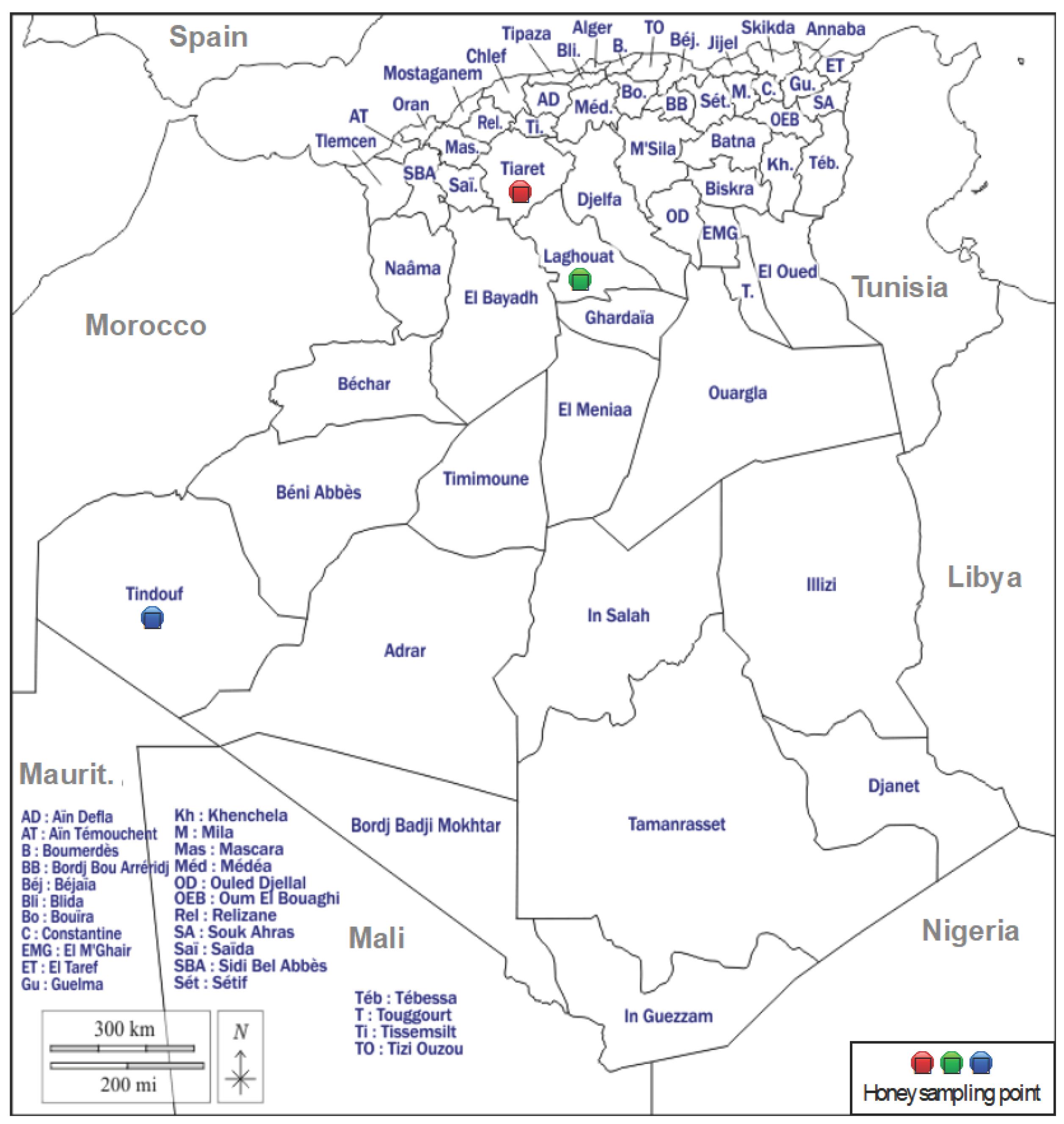
Table 1.
Honey samples and their botanical and geographical origin.
| Code | N. of samples | Botanical origin | Geographical origin |
|---|---|---|---|
| MT | 6 | Multifloral | Tiaret |
| ET | 3 | Echinops | Tiaret |
| EST | 3 | Eruca sativa | Tiaret |
| ZLT | 3 | Ziziphus lotus | Tiaret |
| BMT | 3 | Bunium mauritanicum | Tiaret |
| TEL | 3 | Tamarix and Euphorbia orientalis | Laghouat |
| EOL | 6 | Euphorbia orientalis | Laghouat |
| EGL | 3 | Eucaliptus globulus | Laghouat |
| ML | 3 | Multifloral | Laghouat |
| ZL | 6 | Ziziphus lotus | Laghouat |
| ED | 3 | Echinops | Tindouf |
| ESD | 6 | Eruca sativa | Tindouf |
| EOD | 3 | Euphorbia orientalis | Tindouf |
| PHD | 3 | Peganum harmala | Tindouf |
| Total | 54 |
Table 2.
GC-MS instrument operating conditions.
| Shimadzu GCMS-TQ8030 | Pesticides, PCBs and PAHs analysis | PAEs and NPPs analysis |
|---|---|---|
| Column | Supelco SLB-5ms (30 m x 0.25 mm i.d., 0.25 μm film thickness of stationary phase) | |
| Carrier gas flow rate (He) | 0.50 mL/min | 0.65 mL/min |
| Program temperature | 60 °C for 1 min, 15 °C/min until 150 °C, 10 °C/min until 270 °C, 2°C/min until 300°C | 8°C/min until 190°C (5 min hold), 8°C/min until 240°C (5 min hold), 8°C/min until 315°C |
| Injector temperature | 250°C | |
| Injection volume | 1 µL | 1 µL |
| Injection mode | Splitless with 1:10 split ratio | Splitless with 1:15 split ratio |
| Ion source temperature | 230°C | 200 °C |
| Transferline temperature | 290°C | 250°C |
| Ionization mode | Electronic ionization (EI), 70 eV | |
Table 3.
Instrument operating conditions for bisphenols analysis.
| UHPLC-MS/MS | Shimadzu UHPLC–MS/MS 8040 |
|---|---|
| Column | Phenomenex C18 column (100 mm × 2.1 mm i.d., 1.7 𝜇m particle size) |
| Mobile phase | Water (A) and acetonitrile (B) |
| Elution gradient | 0 min, 20% B; 2 min, 40% B; 6 min, 90% B; 8 min, 20% B |
| Flow rate | 0.4 mL/min |
| Injection volume | 2 µL |
| Ionization mode | ESI negative, 10-40 eV |
| DL temperature | 250°C |
| CID gas | 230 KPa |
| Gas nebuliser | Nitrogen |
| Nitrogen flow | 3 L/min |
| Nitrogen pressure | 770 KPa |
| Collision gas | Argon |
Table 6.
Maximum and minimum value of EDIs (µg/Kgbw/day or mg/ Kgbw/day) and HQs calculated for Algerian honeys daily consumed by normal-sized (70 Kg) adult consumers both from Algeria and Europe.
Table 6.
Maximum and minimum value of EDIs (µg/Kgbw/day or mg/ Kgbw/day) and HQs calculated for Algerian honeys daily consumed by normal-sized (70 Kg) adult consumers both from Algeria and Europe.
| Algeria | Europe | ||||||||
|---|---|---|---|---|---|---|---|---|---|
| EDImin | HQ | EDImax | HQ | EDImin | HQ | EDImax | HQ | ||
| Pesticides | |||||||||
| Bendiocarb* | 9.43 x 10⁻⁷ | <1 | 9.43 x 10⁻⁷ | <1 | 4.54 x 10⁻⁶ | <1 | 4.54 x 10⁻⁶ | <1 | |
| Carbaryl* | 2.92 x 10⁻⁶ | <1 | 7.45 x 10⁻⁵ | <1 | 1.41 x 10⁻⁵ | <1 | 3.59 x 10⁻⁴ | <1 | |
| Furathiocarb* | 1.01 x 10⁻⁵ | <1 | 1.10 x 10⁻⁵ | <1 | 4.88 x 10⁻⁵ | <1 | 5.32 x 10⁻⁵ | <1 | |
| Metalaxyl-M* | 1.27 x 10⁻⁶ | <1 | 5.94 x 10⁻⁶ | <1 | 6.13 x 10⁻⁶ | <1 | 2.86 x 10⁻⁵ | <1 | |
| Quintozen* | 1.65 x 10⁻⁶ | <1 | 2.29 x 10⁻⁵ | <1 | 7.95 x 10⁻⁶ | <1 | 1.10 x 10⁻⁴ | <1 | |
| Methabenzthiazuron* | 1.60 x 10⁻⁶ | <1 | 3.87 x 10⁻⁶ | <1 | 6.13 x 10⁻⁶ | <1 | 1.86 x 10⁻⁵ | <1 | |
| Propazine* | 1.32 x 10⁻⁶ | <1 | 9.10 x 10⁻⁶ | <1 | 6.36 x 10⁻⁶ | <1 | 4.38 x 10⁻⁵ | <1 | |
| Propyzamide* | 5.66 x 10⁻⁷ | <1 | 5.66 x 10⁻⁷ | <1 | 2.73 x 10⁻⁶ | <1 | 2.73 x 10⁻⁶ | <1 | |
| Simazide* | 1.37 x 10⁻⁶ | <1 | 3.25 x 10⁻⁶ | <1 | 6.59 x 10⁻⁶ | <1 | 1.57 x 10⁻⁵ | <1 | |
| Cyromazine* | 1.41 x 10⁻⁶ | <1 | 7.71 x 10⁻⁴ | <1 | 6.81 x 10⁻⁶ | <1 | 3.72 x 10⁻³ | <1 | |
| Pyriproxyfen* | 1.80 x 10⁻⁵ | <1 | 1.80 x 10⁻⁵ | <1 | 8.68 x 10⁻⁵ | <1 | 8.68 x 10⁻⁵ | <1 | |
| Alachlor* | 6.60 x 10⁻⁷ | <1 | 3.58 x 10⁻⁶ | <1 | 3.18 x 10⁻⁶ | <1 | 1.73 x 10⁻⁵ | <1 | |
| Methidathion* | 1.04 x 10⁻⁶ | <1 | 1.04 x 10⁻⁶ | <1 | 5.00 x 10⁻⁶ | <1 | 5.00 x 10⁻⁶ | <1 | |
| Omethoate* | 1.34 x 10⁻⁵ | <1 | 1.30 x 10⁻⁴ | <1 | 6.45 x 10⁻⁵ | <1 | 6.26 x 10⁻⁴ | <1 | |
| Carbophenothion* | 2.03 x 10⁻⁶ | <1 | 4.48 x 10⁻⁶ | <1 | 9.77 x 10⁻⁶ | <1 | 2.16 x 10⁻⁵ | <1 | |
| cis-Permethrin* | 1.27 x 10⁻⁶ | <1 | 2.26 x 10⁻⁶ | <1 | 6.13 x 10⁻⁶ | <1 | 1.09 x 10⁻⁵ | <1 | |
| Plasticizers | |||||||||
| DEA** | 5.66 x 10⁻⁸ | - | 8.25 x 10⁻⁷ | - | 2.73 x 10⁻⁷ | - | 3.98 x 10⁻⁶ | - | |
| DEP** | 5.66 x 10⁻⁸ | <1 | 7.81 x 10⁻³ | <1 | 2.73 x 10⁻⁷ | <1 | 3.76 x 10⁻² | <1 | |
| DPrp** | 7.07 x 10⁻⁸ | - | 7.07 x 10⁻⁸ | - | 3.41 x 10⁻⁷ | - | 3.41 x 10⁻⁷ | - | |
| DiBP** | 1.70 x 10⁻⁷ | - | 1.25 x 10⁻⁶ | - | 8.18 x 10⁻⁷ | - | 6.04 x 10⁻⁶ | - | |
| DBP** | 1.74 x 10⁻⁷ | <1 | 4.57 x 10⁻⁷ | <1 | 8.40 x 10⁻⁷ | <1 | 2.20 x 10⁻⁶ | <1 | |
| BBP** | 8.96 x 10⁻⁸ | - | 5.42 x 10⁻⁷ | - | 4.32 x 10⁻⁷ | - | 2.61 x 10⁻⁶ | - | |
| DEHP** | 2.12 x 10⁻⁷ | <1 | 5.56 x 10⁻⁷ | <1 | 1.02 x 10⁻⁶ | <1 | 2.68 x 10⁻⁶ | <1 | |
| DPhP** | 3.30 x 10⁻⁷ | - | 3.30 x 10⁻⁷ | - | 1.59 x 10⁻⁶ | - | 1.59 x 10⁻⁶ | - | |
| DEHT** | 1.79 x 10⁻⁷ | - | 6.79 x 10⁻⁷ | - | 8.63 x 10⁻⁷ | - | 3.27 x 10⁻⁶ | - | |
* µg/Kgbw/day.; ** mg/ Kgbw/day.
Disclaimer/Publisher’s Note: The statements, opinions and data contained in all publications are solely those of the individual author(s) and contributor(s) and not of MDPI and/or the editor(s). MDPI and/or the editor(s) disclaim responsibility for any injury to people or property resulting from any ideas, methods, instructions or products referred to in the content. |
© 2024 by the authors. Licensee MDPI, Basel, Switzerland. This article is an open access article distributed under the terms and conditions of the Creative Commons Attribution (CC BY) license (http://creativecommons.org/licenses/by/4.0/).
Copyright: This open access article is published under a Creative Commons CC BY 4.0 license, which permit the free download, distribution, and reuse, provided that the author and preprint are cited in any reuse.


