

Submitted:
12 March 2024
Posted:
13 March 2024
You are already at the latest version
Abstract
Synanthropic flora (weeds, spontaneously developed plants) are plants that accompany humans, appearing as a result of anthropopressure as well as after its cessation. The potential of synanthropic flora in shaping green areas usually brings many measurable benefits that depend on land management in cities. The study aimed to determine the preferences and attitudes of adults towards synanthropic flora in settlement units. The article presents survey results from 447 city residents. The obtained results were statistically analyzed using the k-means clustering method to identify segments of respondents with similar attitudes and preferences toward synanthropic flora. Mann-Whitney U tests were employed to determine statistical differences in the demographic variables among the analyzed clusters of respondents. Additionally, multiple regression analysis was performed to identify the opinions and attitudes towards synanthropic flora, that may influence their greater acceptance in the vicinity of residential areas. The results obtained in multiple regression allow for the statement that the respondent’s evaluation of the level of support for the introduction of more synanthropic vegetation into urban greenery (Yw) grows with the increase of acceptance of synanthropic plants occurrence in surroundings. Respondents’ opinions on the subject of the presence of synanthropic plants were studied using such variables concerning: synanthropic vegetation found in turfgrasses has a positive impact on the visual attractiveness of a site (X1), synanthropic plant communities present themselves better than others (X2), presence of synanthropic vegetation in an estate improves the quality of life in that location (X3), introduction of synanthropic flora into estate arrangements is a positive (X4), support for the use of synanthropic flora for educational purposes - as elements of playgrounds or in the form of environmental workshops (X5). Residents’ acceptance of synanthropic flora in green areas is at a relatively high level.
Keywords:
synanthropic plant species
; spontaneous vegetation
; residents’ opinions
; green and sustainable design
; settlement areas
1. Introduction
One of the solutions to meet environmental challenges, that cities face nowadays, is the enrichment of green infrastructure. There is a need to create more greenery in both urbanized areas and those in the process of urbanization [1]. In urban areas, not only large areas covered with vegetation are important, but also a network of small patches that allow vegetation to establish [2,3]. Critical to the effective functioning and succeeding of a design is the proper selection of plant species. Not only are the characteristics of each species important in this but so is the diversity aspect [4]. Alternatively, it is possible to omit vegetation-destroying or maintenance practices. This allows for the expansion of spontaneous vegetation, although conscious choice and intentional introductions to increase diversity are useful in this way as well [3].
By intentionally introducing or accepting the presence of synanthropic flora (spontaneous plants) by the people in charge, the resilience of plantings is increased [5,6], and so does the biodiversity [7,8]. This kind of vegetation reduces ecological and financial costs, it increases the resilience of urban vegetation communities [9]. Accordingly, synanthropic species and spontaneous greenery, in general, can be beneficial in the design process of green infrastructure projects prepared on various scales. Spontaneous plant species are used in the design of larger-scale public green areas [10,11], but not exclusively. For example, smaller patches are provided by spontaneous greenery along roads, creating diverse landscapes [8], also colonizing trackways [12]. Synanthropic flora appears on green roofs as a result of cessation of maintenance, causing wilderness by default [7,13], or it is accepted during the maintenance process [5]. It could be also intentionally introduced [6,9]. Spontaneous plant species are also implemented in more sustainable farming systems [14] and even in show gardens [15,16]. They effectively colonize vertical elements as well, such as vegetation columns [17]. Synanthropic flora can also form the basis for more diverse novel urban meadows [18].
However, social acceptance of spontaneous vegetation and residents’ preferences may be limiting factors for its use. Preferences are influenced by plant trait effects: sustenance effects, ecosystem services effects and conservation effects [19], but maybe most of all ornamental features. In the context of cultural considerations pointed out by Chang et al. [19], it may be questionable to take the results of residents’ preference surveys conducted regionally as fitting for the whole world. An example of significant differences, that may be due to cultural backgrounds, might be the preference of Berlin residents for wild grasslands [20] compared to Singapore resident's preference for lawns [21]. The presence of spontaneous plant species (and ruderal, also wilder areas than standardly tended urban greenery) itself is often met with acceptance [20,22,23,24], sometimes under some conditions [21,25,26], or a lack of acceptance, prevailing for example in Latin American societies [27] or in legacy cities [28].
The study aimed to recognize adults’ preferences and attitudes towards synanthropic flora in settlement units.
The following scientific questions were formulated:
- What aspects of the synanthropic plant species perception increase the overall residents’ acceptance of these plants in urban spaces?
- How do perceptions of synanthropic plants differ in terms of the demographic profile of respondents?
2. Materials and Methods
2.1. Study Design, Participants and Questionnaire
The paper is grounded in the findings of a questionnaire research study conducted in the year 2023 using the CAWI method. The survey adhered to national and international regulations following the Declaration of Helsinki (2000). Participants' personal information and data were anonymized, complying with the General Data Protection Regulation of the European Parliament (GDPR 679/2016). Ethical considerations throughout the study ensured the ongoing safety of participants and the integrity of the collected data.
Before commencing the questionnaire, participants were provided with a brief description of the study, its objectives, and a declaration of anonymity and confidentiality. To initiate participation in the study, respondents had to express voluntary consent and they retained the option to terminate their involvement at any point.
Respondents refrained from disclosing their names and contact information, including IP addresses, and had the liberty to conclude the survey at any stage. Responses were recorded only upon participants clicking the "submit" button after completing the questionnaire.
The questionnaire comprised two sections. The first section focused on gathering socio-demographic data, encompassing characteristics such as gender, age, education, place of residence and income. The second part of the questionnaire included inquiries related to synanthropic plants, incorporating questions about respondents' attitudes towards these plants on a 5-point Likert scale.
2.2. Statistical Analysis
To investigate a relationship between the level of acceptance of synanthropic vegetation in urban greenery (Yw) and opinions (attitudes) on the subject of synanthropic vegetation, the multiple regression model was applied. In this model, 5 independent variables were used:
- -
- X1 - The use of synanthropic vegetation found in turfgrasses has a positive impact on the visual attractiveness of a site.
- -
- X2 - Synanthropic plant communities present themselves better than others.
- -
- X3 - The presence of synanthropic vegetation in Your estate improves the quality of life in that location.
- -
- X4 - The introduction of synanthropic plants into estate arrangements is a positive.
- -
- X5 - I support the use of synanthropic plants for educational purposes - as elements of playgrounds or in the form of environmental workshops.
Both the dependent variable and the independent variables were measured on a 5-point Likert scale. The R^2 value of the model is 0.656, which means that approximately 65.6% of the variability of the dependent variable Yw was explained by the independent variables included in the model. The value of the F statistic is 168.39 and the corresponding value of p = 0.0000 < 0.05, which indicates that all independent variables significantly influence the dependent variable Yw, because p is smaller than the level of statistical significance assumed in the study, equal to 0.05.
The next step of the analysis was to develop descriptive statistics and perform difference tests for the dependent variable and independent variables. To determine whether demographic variables significantly differentiate the opinions expressed by the scales on which the studied variables were measured, additional analyses were performed in the form of the Mann-Whitney U-test and the Kruskal-Wallis test.
2.3. Characteristics of Respondents
A total of 447 respondents participated in the survey, with over 70% being women. Regarding age distribution, the largest group consisted of respondents aged 18-25 (63.8%), followed by the second-largest group aged 36-55, accounting for nearly a quarter of the respondents (22.4%). Respondents aged 26-35 and over 55 were less represented, comprising 7.2% and 6.7%, respectively.
Education-wise, more than half of the surveyed population held secondary education qualifications (54.8%), while a third possessed tertiary education credentials (33.8%). The majority of respondents resided in cities with populations exceeding 500,000 inhabitants (45.9%). One-fifth of respondents lived in cities with up to 100,000 inhabitants (24.2%), and 20.1% resided in villages.
Income distribution demonstrated a relatively even division among respondents. The majority (38%) reported incomes ranging from EUR 576.16 to EUR 1037.06, while lower incomes were declared by 25% of respondents, and higher incomes by 27.5% (Table 1).
3. Results
The analysis of the relationship between the level of residents ’acceptance of synanthropic vegetation in urban greenery and opinions on synanthropic plants was conducted using the multiple regression method. The results indicate that the respondents' assessment of the level of acceptance of synanthropic vegetation in urban greenery (Yw) increases with an increase in acceptance of opinions on the subject: the use of synanthropic vegetation found in turfgrasses has a positive impact on the visual attractiveness of a site (X1), synanthropic plant communities present themselves better than others (X2), the presence of synanthropic vegetation in Your estate improves the quality of life in that location (X3), the introduction of synanthropic plants into estate arrangements is a positive (X4), I support the use of synanthropic plants for educational purposes - as elements of playgrounds or in the form of environmental workshops (X5) (Table 2).
The resulting model can be described by the equation:
Yw = 0.3160+ 0.1604x X1 – 0.0771x X2 + 0.1403x X3 – 0.3085x X4 + 0.2840x X5 + e
In the above model, all structural parameters standing by the explanatory variables Xi are statistically significant (p < 0.05).
The analysis of results highlights a remarkable 31% increase in the acceptance level of synanthropic plants in urban spaces as respondents increasingly support the introduction of these plants into estate arrangements (X4). An intriguing 28% surge is observed in the acceptance of synanthropic plants, correlating with growing support for their use in educational contexts—both as elements of playgrounds and in environmental workshops (X5). A dynamic increase of 16% in the acceptance level of synanthropic plants in urban spaces is noted when respondents express a higher opinion about the positive impact of using these plants in turfgrasses on the visual attractiveness of the area (X1). Another noteworthy rise of 14% is observed when respondents positively assess the influence of the presence of such vegetation on the quality of life in a given location (X3). Additionally, a 7% increase is noted when there is a higher acceptance for the statement that synanthropic plant communities present themselves better than others (X2) (Table 2).
Diversity in response levels for the component variables of the multiple regression model was examined, including all demographic variables. No statistically significant differences were observed in the majority of opinions regarding synanthropic plants based on their place of residence. Only for the variable "The use of synanthropic vegetation found in turfgrasses has a positive impact on the visual attractiveness of a site" (X1), it was demonstrated that responses to this statement depend on the place of residence. There were also no statistically significant differences in responses from residents based on their incomes.
Respondents' answers to the analyzed statements varied statistically based on gender, age, and education, and these data have been presented in Table 3 and Table 4 and Figure 1 and Figure 2. For all statements, except for "Synanthropic plant communities present themselves better than others" (X2), women evaluated the impact and presence of synanthropic plants more positively than men. Statistically significant differences were observed in opinions regarding: "The presence of synanthropic vegetation on your estate improves the quality of life in that location" (X3); "The introduction of synanthropic plants into estate arrangements is positive" (X4); and "I support the use of synanthropic plants for educational purposes - as elements of playgrounds or in the form of environmental workshops" (X5) (Table 3).
Individuals in the age range of 36-55 most strongly agreed with all statements regarding synanthropic plants, while the highest scores were observed among individuals aged 18-25. Responses to all analyzed statements were dependent on the age of the respondents and these dependencies were statistically significant in the Kruskal-Wallis test with a p-value < 0.05, indicating statistically significant differences based on age.
In pairwise comparisons using the Mann-Whitney test, statistically significant differences were found between the youngest respondents and those aged 36-55. These differences encompassed all statements, except for "Level of acceptance of synanthropic vegetation in urban greenery" (Yw) (Figure 1 and Table 4).
Individuals with higher education were most in agreement with opinions regarding synanthropic plants for 4 out of 6 statements. For the remaining two statements concerning "Level of acceptance of synanthropic vegetation in urban greenery" (Yw) and "The introduction of synanthropic plants into estate arrangements is a positive" (X4), individuals with vocational education obtained the highest average responses. The Kruskal-Wallis test indicated that education significantly differentiated responses to all analyzed statements except of "Synanthropic plant communities present themselves better than others" (X2). In the Mann-Whitney test, it was shown that for statements related to "The presence of synanthropic vegetation in Your estate improves the quality of life in that location" (X3) and "The introduction of synanthropic plants into estate arrangements is a positive" (X4), individuals with higher education more strongly agreed with these issues compared to those with basic education (Figure 2 and Table 5).
4. Discussion
Synanthropic species are sometimes noticed in surveys that do not focus on spontaneous greenery, where respondents refer negatively to their presence [29]. In general, cultivated species are valued higher than spontaneous species [22,24], even if they are native [24]. They are more often planted and tolerated in home gardens [30]. Some design interventions (adding ornamental plants or recreational elements, clearly demarcating composition elements) seem to have a positive effect on residents' perception of them [21,22,26,31].
According to our study, the more the respondents consider synanthropic plants as visually attractive, the more they accept them in urban spaces. Also, the more they appreciate the presence of synanthropic plants (in the context of life quality and education, the second group of factors), the more they accept that type of vegetation in the city. It is also worth noting, that the acceptance of these plants in urban spaces increases if the respondents' opinions (about the beneficial impact of synanthropic plants on the visual attractiveness of the place) increase by one unit.
Meanwhile, negative residents’ reactions could be evoked by unintentional vegetation overgrowth of infrastructure elements [28], although sometimes reactions are more positive [31]. In contrast, positive reactions could be evoked by the intentional introduction of synanthropic plants into areas strongly dominated by infrastructure, such as the creation of floral strips along roads [32]. Waterfronts, forests, and road edges are most often indicated as habitats where spontaneous plants should be preserved according to people [26]. Our study shows, that people look favorably at synanthropic plants used also for educational purposes, not only the visual ones.
The perception of spontaneous vegetation may be influenced by people's aversion to obstructed views (where vegetation is an obstacle). Better rated among spontaneous vegetation are those of intermediate stages of succession, resembling low grasslands [21,25,26,33], which may be precisely due to the obscuring effect. In our study, synanthropic species associated with turfgrasses met a fairly high level of acceptance too. Lower ratings for denser and higher vegetation is motivated by the negative impact on the sense of security, despite the simultaneous positive impact on privacy [34,35]. What is especially important here, is the legibility of the composition, so that even spaces perceived as wild can be accepted [36]. However, even that effect is sometimes desirable, for example in the forts landscape, adding an aura of mystery [37].
Perception of synanthropic vegetation may also depend on both professional knowledge and personal experience. Spontaneous vegetation and its habitats are perceived as natural [23,25,27,33,38], wild [33,38], nostalgic [23], interesting [33], complex [27], but also repulsive, abandoned [33], unkempt [27], and rubbish-strewn [25]. In counterpoint is cultivated vegetation, which evokes mostly positive associations as better maintained, tidier [27,38], natural, and safe [27]. According to our study, people who think that synanthropic vegetation has an impact on their well-being, are more likely to accept this type of flora in green areas. In our study, we compared the responses of the respondents who live in urban areas and countryside in Poland. Their preferences for spontaneous vegetation were the same, surprisingly. People from the countryside perceive spontaneous vegetation differently, but simply as unnecessary plants. This results probably from their agricultural work - the perception of these plants as negatively affecting the crop quality. On the other hand, urban residents do not have good knowledge about spontaneous plants [39].
Educational attempts [27,40,41,42,43] and age may influence changes in the perception of synanthropic species. Our survey shows, that these species are more likely to be accepted if they are to be used for such purposes (e.g. in the educational process). In our opinion, in the educational process, the necessity of synanthropic vegetation presence in green areas should be integrated with the need for adaptation to climate change. This study shows, that both research and educational activities should be done in various countries as the years go by.
5. Conclusions
Synanthropic flora is generally accepted in green areas in Poland by people ages 36-55, but the level of acceptance is still not satisfying. The level of acceptance is also correlated with their educational stage and knowledge about vegetation. Relations between the perception of synanthropic species and their function (for example role of synanthropic plants in education) have been observed in the study. Further attempts at education are required, which is very helpful for people from all age groups to understand the benefits of synanthropic flora in green spaces. The social acceptance of spontaneous vegetation and preferences are strictly connected with places where people live (city or countryside). The results could be useful for landscape architects, ecologists, and public authorities to formulate directions for shaping green areas and maintaining them, including sustainable development rules in cities.
Author Contributions
Conceptualization, B.F-P., D.S-M., F.K., P.L.; methodology, B. F-P., D.S-M., K.W.; software B.F-P., D.S-M., K.W.; validation, B.F-P., D.S-M., K.W.; formal analysis, B.F-P., D.S-M., K.W.; investigation, B.F-P., D.S-M.; F.K.; resources, B.F-P., D.S-M., F.K.,; data curation B. F-P, D.S-M.; writing—original draft preparation, B.F-P., D.S-M., F.K., K.W.; writing—review and editing, B.F-P., D.S-M., B.Ż., P.L.; visualization, D.S-M., K.W.,.; supervision, B.F-P., D.S-M., P.L.
Funding
No funding.
Institutional Review Board Statement
Ethical review and approval were waived for this study due to the full anonymity and voluntariness of participation in the survey.
Informed Consent Statement
Not applicable.
Data Availability Statement
Data sharing is not applicable; no new data were created or analyzed in this study.
Conflicts of Interest
The authors declare no conflict of interest.
References
- Pochodyła, E.; Jaszczak, A.; Illes, J.; Kristianova, K.; Joklova, V. Analysis of green infrastructure and nature-based solutions in Warsaw– selected aspects for planning urban space. Acta Horticulturae et Regiotecturae 2022, 25(1), 44–50. [CrossRef]
- Wittig, R.; Becker, U. The spontaneous flora around street trees in cities—A striking example for the worldwide homogenization of the flora of urban habitats. Flora-Morphol. Distrib. Funct. Ecol. Plants 2010, 205, 704–709. [CrossRef]
- Vega, K.A.; Küffer, C. Promoting wildflower biodiversity in dense and green cities: The important role of small vegetation patches. Urban Forestry & Urban Greening 2021, 62, 127165. [CrossRef]
- Farrell, C.; Livesley, S.J.; Arndt, S.K.; Beaumont, L.; Burley, H.; Ellsworth, D.; Esperon-Rodriguez, M.; Fletcher, T.D.; Gallagher, R.; Ossola, A.; Power, S.A. Can we integrate ecological approaches to improve plant selection for green infrastructure? Urban Forestry & Urban Greening 2022, 76, 127732. [CrossRef]
- Catalano, C.; Marcenò, C.; Laudicina, V.A.; Guarino, R. Thirty years unmanaged green roofs: Ecological research and design implications. Landscape and Urban Planning 2016, 149, 11-19. [CrossRef]
- Zhang, H.; Lu, S.; Fan, X.; Wu, J.; Jiang, Y.; Ren, L.; Wu, J.; Zhao, H. Is sustainable extensive green roof realizable without irrigation in a temperate monsoonal climate? A case study in Beijing. Science of The Total Environment 2021, 753, 142067. [CrossRef]
- Lundholm, J.T. Spontaneous dynamics and wild design in green roofs. Israel Journal of Ecology and Evolution 2016, 62(1-2), 23-31. [CrossRef]
- Heikkinen, M.K.; Iwachido, Y.; Sun, X.; Maehara, K.; Kawata, M.; Yamamoto, S.; Tsuchihashi, Y.; Sasaki, T. Overlooked plant diversity in urban streetscapes in Oulu and Yokohama. Global Ecology and Conservation 2023, 46, e02621. [CrossRef]
- Schrieke, D.; Lönnqvist, J.; Blecken, G. T.; Williams, N. S.; Farrell, C. Socio-Ecological Dimensions of Spontaneous Plants on Green Roofs. Frontiers in Sustainable Cities 2021, 3, 777128. [CrossRef]
- Greene, B.; Walls, W. Wood for the trees: Design and policymaking of urban forests in Berlin and Melbourne. Journal of Landscape Architecture 2023, 18(1), 94-103. [CrossRef]
- Kamionowski, F.; Fornal-Pienak, B.; Bihuňová, M. Application of synanthropic plants in the design of green spaces in Warsaw (Poland). Acta Horticulturae et Regiotecturae 2023, 26(2), 168-172. [CrossRef]
- Winkler, J.; Koda, E.; Červenová, J.; Napieraj, K.; Żółtowski, M.; Jakimiuk, A.; Podlasek, A.; Vaverková, M.D. Fragmentation and biodiversity change in urban vegetation: A case study of tram lines. Land Degradation & Development 2024, 1-14. [CrossRef]
- Jim, C.Y. Green roof evolution through exemplars: Germinal prototypes to modern variants. Sustainable cities and society 2017, 35, 69-82. [CrossRef]
- Rafflegeau, S.; Gosme, M.; Barkaoui, K.; Garcia, L.; Allinne, C.; Deheuvels, O.; Grimaldi, J.; Jagoret, P.; Lauri, P.; Merot, A.; Metay, A.; Reyes, F.; Saj, S.; Curry, G.N.; Justes, E. The ESSU concept for designing, modeling and auditing ecosystem service provision in intercropping and agroforestry systems. A review. Agronomy for Sustainable Development 2023, 43(4), 43. [CrossRef]
- RHS. Available online: https://www.rhs.org.uk/shows-events/rhs-hampton-court-palace-garden-festival/gardens/2022/what-does-not-burn (accessed on 31.01.2024).
- RHS. Available online: https://www.rhs.org.uk/shows-events/rhs-chelsea-flower-show/news/2023/trends-themes-chelsea-2023 (accessed on 31.01.2024).
- Stakelienė, V.; Pašakinskienė, I.; Ložienė, K.; Ryliškis, D.; & Skridaila, A. Vertical columns with sustainable green cover: meadow plants in urban design. Plants 2023, 12(3), 636. [CrossRef]
- Fischer, L.K.; von der Lippe, M.; Rillig, M.C.; Kowarik, I. Creating novel urban grasslands by reintroducing native species in wasteland vegetation. Biological Conservation 2013, 159, 119-126. [CrossRef]
- Chang, C.R.; Su, M.H.; Li, Y.H.; Chen, M.C. A proposed framework for a social-ecological traits database for studying and managing urban plants and assessing the potential of database development using Floras. Urban Forestry & Urban Greening 2024, 91, 128167. [CrossRef]
- Straka, T.M.; Mischo, M.; Petrick, K.J.S.; Kowarik, I. Urban Cemeteries as Shared Habitats for People and Nature: Reasons for Visit, Comforting Experiences of Nature, and Preferences for Cultural and Natural Features. Land 2022, 11, 1237. [CrossRef]
- Hwang, Y.H.; Yue, Z.E.J.; Ling, S.K.; Tan, H.H.V. It’s ok to be wilder: Preference for natural growth in urban green spaces in a tropical city. Urban Forestry & Urban Greening 2019, 38, 165-176. [CrossRef]
- Weber, F.; Kowarik, I.; Säumel, I. A walk on the wild side: Perceptions of roadside vegetation beyond trees. Urban Forestry & Urban Greening 2014, 13(2), 205-212. [CrossRef]
- Chen, C.; Lu, Y.; Jia, J.; Chen, Y.; Xue, J.; Liang, H. Urban spontaneous vegetation helps create unique landsenses. International Journal of Sustainable Development & World Ecology 2021, 28(7), 593-601. [CrossRef]
- Teixeira, C.P.; Fernandes, C.O.; Ryan, R.; Ahern, J. Attitudes and preferences towards plants in urban green spaces: Implications for the design and management of Novel Urban Ecosystems. Journal of Environmental Management 2022, 314, 115103. [CrossRef]
- Mathey, J.; Arndt, T.; Banse, J.; Rink, D. Public perception of spontaneous vegetation on brownfields in urban areas—Results from surveys in Dresden and Leipzig (Germany). Urban Forestry & Urban Greening 2018, 29, 384-392. [CrossRef]
- Li, X.P.; Fan, S.X.; Kühn, N.; Dong, L.; Hao, P.Y. Residents’ ecological and aesthetical perceptions toward spontaneous vegetation in urban parks in China. Urban Forestry & Urban Greening 2019, 44, 126397. [CrossRef]
- de Val, G.D.L.F. The effect of spontaneous wild vegetation on landscape preferences in urban green spaces. Urban Forestry & Urban Greening 2023, 81, 127863. [CrossRef]
- Phillips, D.; Lindquist, M. Just weeds? Comparing assessed and perceived biodiversity of urban spontaneous vegetation in informal greenspaces in the context of two American legacy cities. Urban Forestry & Urban Greening 2021, 62, 127151. [CrossRef]
- Sikorski, P.; Wińska-Krysiak, M.; Chormański, J.; Krauze, K.; Kubacka, K.; Sikorska, D. Low-maintenance green tram tracks as a socially acceptable solution to greening a city. Urban Forestry & Urban Greening 2018, 35, 148–164. [CrossRef]
- Cavender-Bares, J.; Padullés Cubino, J.; Pearse, W.D.; Hobbie, S.E.; Lange, A.J.; Knapp, S.; Nelson, K.C. Horticultural availability and homeowner preferences drive plant diversity and composition in urban yards. Ecological Applications 2020, 30(4), e02082. [CrossRef]
- Bonthoux, S.; Chollet, S.; Balat, I.; Legay, N.; Voisin, L. Improving nature experience in cities: What are people's preferences for vegetated streets?. Journal of environmental management 2019, 230, 335-344. [CrossRef]
- de Snoo, G.R.; van Dijk, J.; Vletter, W.; Musters, C.J.M. People’s appreciation of colorful field margins in intensively used arable landscapes and the conservation of plants and invertebrates. Agronomy for Sustainable Development 2023, 43(6), 80. [CrossRef]
- Brun, M.; Di Pietro, F.; Bonthoux, S. Residents’ perceptions and valuations of urban wastelands are influenced by vegetation structure. Urban Forestry & Urban Greening 2018, 29, 393-403. [CrossRef]
- Lis, A.; Iwankowski, P. Where do we want to see other people while relaxing in a city park? Visual relationships with park users and their impact on preferences, safety and privacy. Journal of Environmental Psychology 2021, 73, 101532. [CrossRef]
- Lis, A.; Iwankowski, P. Why is dense vegetation in city parks unpopular? The mediative role of sense of privacy and safety. Urban Forestry & Urban Greening 2021, 59, 126988. [CrossRef]
- Lis, A.; Zalewska, K.; Pardela, Ł.; Adamczak, E.; Cenarska, A.; Bławicka, K.; Brzegowa, B.; Matiiuk, A. How the amount of greenery in city parks impacts visitor preferences in the context of naturalness, legibility and perceived danger. Landscape and Urban Planning 2022, 228, 104556. [CrossRef]
- Pardela, Ł.; Lis, A.; Zalewska, K.; Iwankowski, P. How vegetation impacts preference, mystery and danger in fortifications and parks in urban areas. Landscape and Urban Planning 2022, 228, 104558. [CrossRef]
- Liang, H.; Li, C.; Xue, D.; Liu, J.; Jin, K.; Wang, Y.; Gao, D.; Chen, Y.; Li, Y.; Qiu, L.; Gao, T. Lawn or spontaneous groundcover? Residents’ perceptions of and preferences for alternative lawns in Xianyang, China. Frontiers in Psychology 2023, 14, 1259920. [CrossRef]
- Vissoh, P.V.; Mongbo, R.; Gbèhounou, G.; Hounkonnou, D.; Ahanchédé, A.; Röling, N.; Kuyper, T.W. The social construction of weeds: different reactions to an emergent problem by farmers, officials and researchers. International Journal of Agricultural Sustainability 2007, 5(2-3), 161-175. [CrossRef]
- Kong, J.; He, W.; Zheng, Y.; Li, X. Awareness of Spontaneous Urban Vegetation: Significance of Social Media-Based Public Psychogeography in Promoting Community Climate-Resilient Construction: A Technical Note. Atmosphere 2023, 14(11), 1691. [CrossRef]
- Łąka. Available online: https://laka.org.pl/laki/badania/ (accessed on 31.01.2024). [In Polish].
- Fundacja Krajobrazy. Available online: http://fundacjakrajobrazy.pl/szkolenie-zachwyt-nad-chaszczami-czyli-o-bioroznorodnosci-i-nie-tylko/ (accessed on 31.01.2024). [In Polish].
- A&B. Available online: https://www.architekturaibiznes.pl/rabaty-pelne-chwastow,23684.html (accessed on 31.01.2024). [In Polish].
Figure 1.
Opinions on synanthropic plants by age (n = 447, data as means of answers).
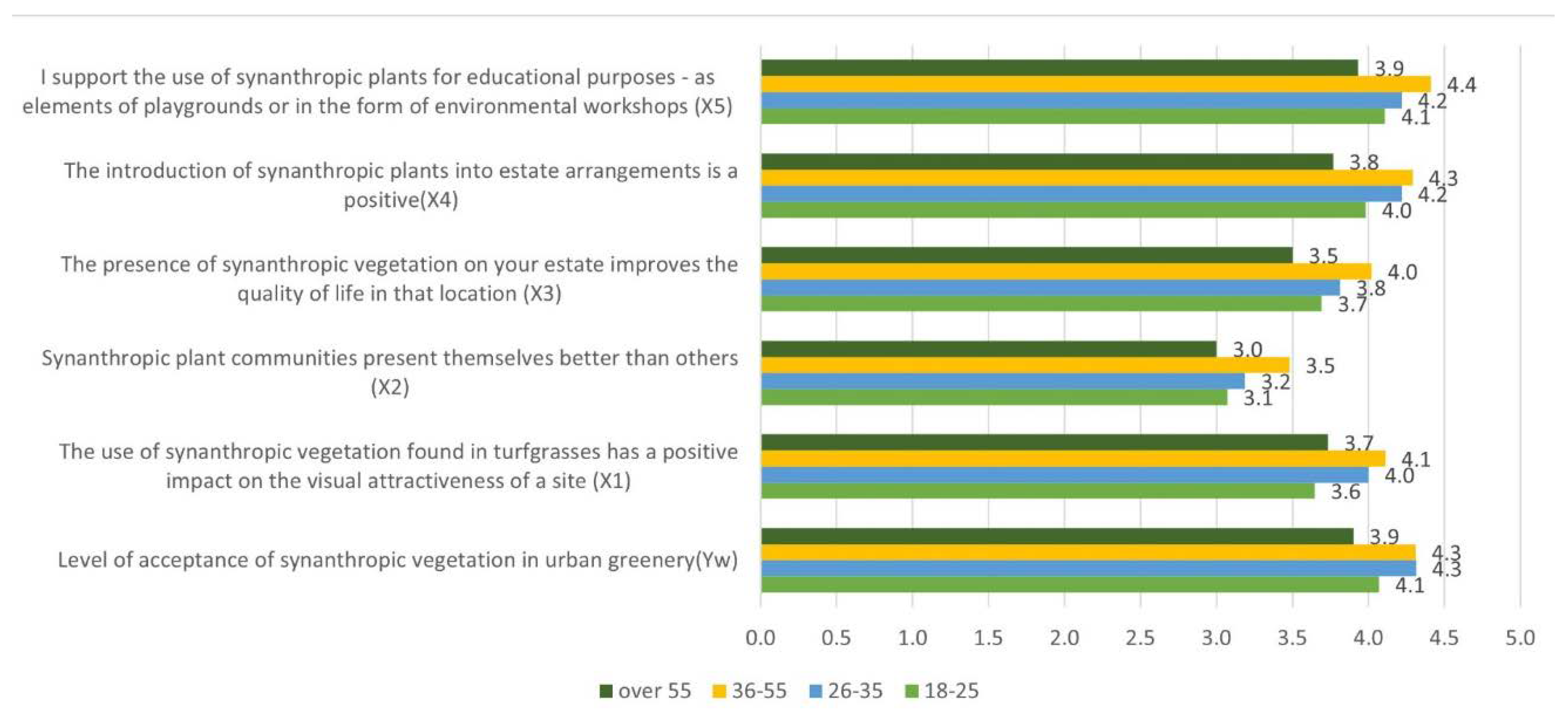
Figure 2.
Opinions on synanthropic plants by education (n = 447, data as means of answers).
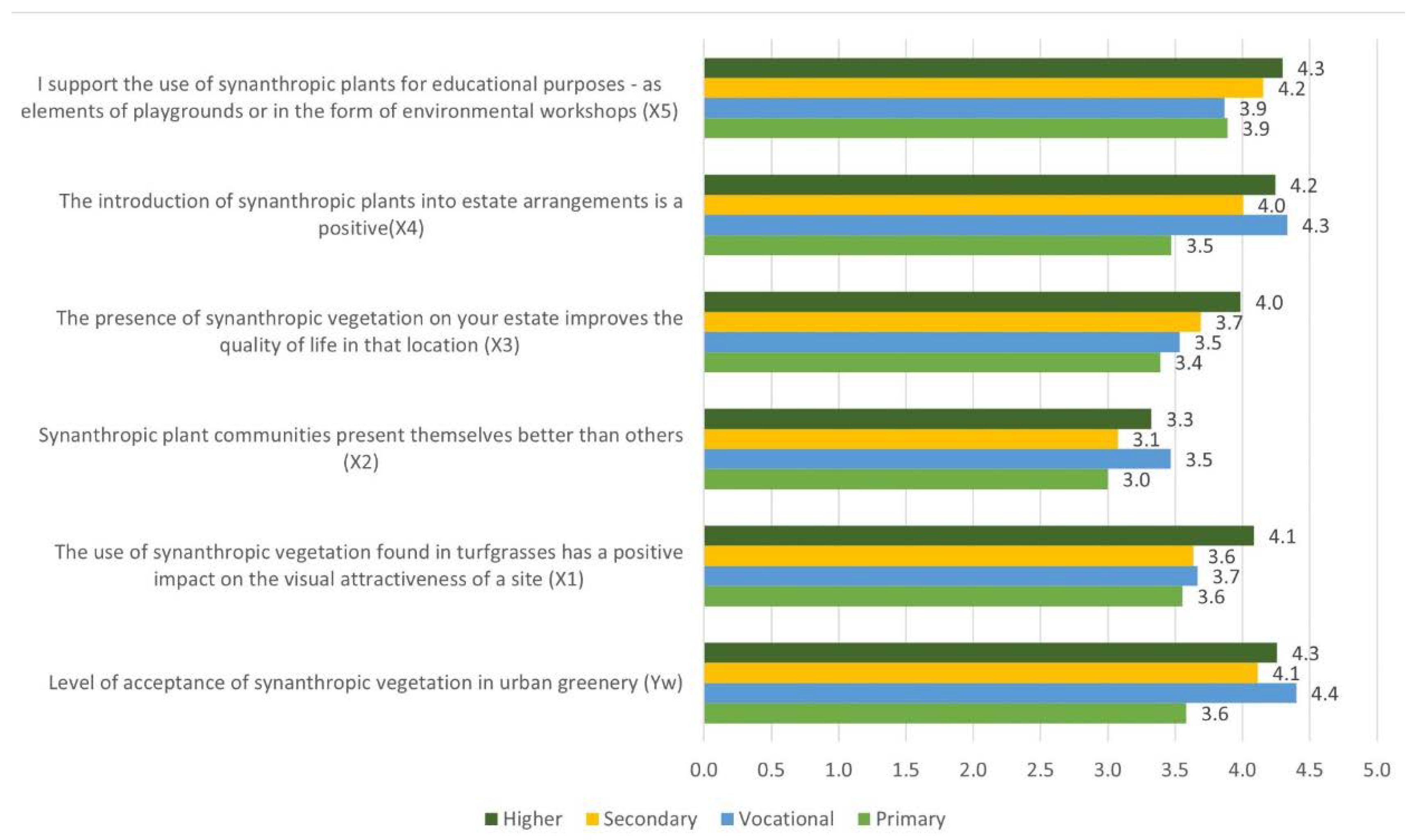

Table 1.
Sample characteristics (n = 447, data in %).
| Gender | |||
| Female | Male | ||
| 71.36 | 28.64 | ||
| Age | |||
| 18-25 | 26-35 | 36-55 | Over 55 |
| 63.76 | 7.16 | 22.37 | 6.71 |
| Education | |||
| Primary | Vocational | Secondary | Higher |
| 8.05 | 3.36 | 54.81 | 33.78 |
| Place of residence | |||
| Countrysides | Towns up to 100 thous. Inhabitants | Towns between 100 and 500 thous. inhabitants | Towns over 500 thous. inhabitants |
| 20.13 | 24.16 | 9.84 | 45.86 |
| Per Capita Income PLN (EUR)1 | |||
| No answer | Under 2500 PLN (576.15EUR) |
2501-4500 PLN (576.16 -1037.06EUR) |
Over 4500 PLN (1037.06EUR) |
| 9.40 | 25.06 | 38.03 | 27.52 |
1 Exchange rate as of 05.02.2024.
Table 2.
Parameter values of the multiple regression model.
| Variables | assessment b | p-value | |
|---|---|---|---|
| The use of synanthropic vegetation found in turfgrasses has a positive impact on the visual attractiveness of a site | X1 | 0.1604 | 0.0000 |
| Synanthropic plant communities present themselves better than others | X2 | 0.0771 | 0.0272 |
| The presence of synanthropic vegetation in Your estate improves the quality of life in that location | X3 | 0.1403 | 0.0003 |
| The introduction of synanthropic plants into estate arrangements is a positive | X4 | 0.3085 | 0.0000 |
| I support the use of synanthropic plants for educational purposes - as elements of playgrounds or in the form of environmental workshops | X5 | 0.2840 | 0.0000 |
| constant | 0.3160 |
Table 3.
Opinions about synanthropic plants by gender (n = 447, means, Mann–Whitney test).
| Variables | Men | Women | Z-value U Mann–Whitney test men vs woman | p-value |
|---|---|---|---|---|
| Level of acceptance of synanthropic vegetation in urban greenery (Yw) | 3.98 | 4.19 | -1.9 | 0.060 |
| The use of synanthropic vegetation found in turfgrasses has a positive impact on the visual attractiveness of a site (X1) | 3.66 | 3.83 | -1.27 | 0.203 |
| Synanthropic plant communities present themselves better than others (X2) | 3.20 | 3.15 | 0.39 | 0.695 |
| The presence of synanthropic vegetation in Your estate improves the quality of life in that location (X3) | 3.53 | 3.85 | -2.74 | 0.006 |
| The introduction of synanthropic plants into estate arrangements is a positive (X4) | 3.82 | 4.15 | -3.16 | 0.002 |
| I support the use of synanthropic plants for educational purposes - as elements of playgrounds or in the form of environmental workshops (X5) | 3.96 | 4.26 | -2.64 | 0.008 |
Table 4.
Opinions on synanthropic plants by age groups (n = 447, Kruskal-Wallis and Mann–Whitney test).
Table 4.
Opinions on synanthropic plants by age groups (n = 447, Kruskal-Wallis and Mann–Whitney test).
| Statements | Age | ||||
|---|---|---|---|---|---|
| Z-value U Mann–Whitney test for pairs age groups | H-value Kruskal-Wallis test for age | ||||
| 26-35 | 36-55 | Over 55 | |||
| Level of acceptance of synanthropic vegetation in urban greenery (Yw) | 18-25 | 1.51 | 2.20 | 0.72 | 8.77* |
| 26-35 | 0.13 | 1.65 | |||
| 36-55 | 1.89 | ||||
| The use of synanthropic vegetation found in turfgrasses has a positive impact on the visual attractiveness of a site (X1) | 18-25 | 1.95 | 3.70* | 0.52 | 16.92* |
| 26-35 | 0.33 | 1.04 | |||
| 36-55 | 0.33 | 1.59 | |||
| Synanthropic plant communities present themselves better than others (X2) | 18-25 | 0.37 | 3.24* | 0.39 | 12.50* |
| 26-35 | 1.51 | 0.57 | |||
| 36-55 | 2.17 | ||||
| The presence of synanthropic vegetation in Your estate improves the quality of life in that location (X3) | 18-25 | 0.88 | 2.82* | 0.67 | 10.27* |
| 26-35 | 0.81 | 1.15 | |||
| 36-55 | 2.20 | ||||
| The introduction of synanthropic plants into estate arrangements is a positive (X4) | 18-25 | 1.58 | 2.72* | 0.97 | 12.43* |
| 26-35 | 0.10 | 1.89 | |||
| 36-55 | 2.42 | ||||
| I support the use of synanthropic plants for educational purposes - as elements of playgrounds or in the form of environmental workshops (X5) | 18-25 | 1.26 | 3.21* | 0.23 | 13.70* |
| 26-35 | 0.68 | 1.10 | |||
| 36-55 | 2.01 | ||||
Table 5.
Opinions on synanthropic plants by education groups (n = 447, Kruskal-Wallis and Mann–Whitney test).
Table 5.
Opinions on synanthropic plants by education groups (n = 447, Kruskal-Wallis and Mann–Whitney test).
| Statements | Education | ||||
|---|---|---|---|---|---|
| U Mann–Whitney test for pairs education groups | Kruskal-Wallis for education | ||||
| Vocational | Secondary | Higher | |||
| Level of acceptance of synanthropic vegetation in urban greenery (Yw) | Primary | 1.51 | 2.20 | 0.72 | 8.77* |
| Vocational | 0.13 | 1.65 | |||
| Secondary | 1.89 | ||||
| The use of synanthropic vegetation found in turfgrasses has a positive impact on the visual attractiveness of a site (X1) | Primary | 2.29 | 2.12 | 2.99 | 12.40* |
| Vocational | 1.23 | 0.56 | |||
| Secondary | 1.70 | ||||
| Synanthropic plant communities present themselves better than others (X2) | Primary | 1.46 | 0.46 | 1.54 | 6.65 |
| Vocational | 1.37 | 0.60 | |||
| Secondary | 1.96 | ||||
| The presence of synanthropic vegetation in Your estate improves the quality of life in that location (X3) | Primary | 0.49 | 1.32 | 2.81* | 12.84* |
| Vocational | 0.32 | 1.36 | |||
| Secondary | 2.75* | ||||
| The introduction of synanthropic plants into estate arrangements is a positive (X4) | Primary | 2.68* | 2.55 | 3.84* | 19.95* |
| Vocational | 1.38 | 0.41 | |||
| Secondary | 2.48 | ||||
| I support the use of synanthropic plants for educational purposes - as elements of playgrounds or in the form of environmental workshops (X5) | Primary | 0.25 | 1.11 | 2.32 | 9.77* |
| Vocational | 0.45 | 1.30 | |||
| Secondary | 2.24 | ||||
Disclaimer/Publisher’s Note: The statements, opinions and data contained in all publications are solely those of the individual author(s) and contributor(s) and not of MDPI and/or the editor(s). MDPI and/or the editor(s) disclaim responsibility for any injury to people or property resulting from any ideas, methods, instructions or products referred to in the content. |
© 2024 by the authors. Licensee MDPI, Basel, Switzerland. This article is an open access article distributed under the terms and conditions of the Creative Commons Attribution (CC BY) license (http://creativecommons.org/licenses/by/4.0/).
Copyright: This open access article is published under a Creative Commons CC BY 4.0 license, which permit the free download, distribution, and reuse, provided that the author and preprint are cited in any reuse.


