

Submitted:
11 March 2024
Posted:
14 March 2024
You are already at the latest version
Abstract
In Australia, traditional methods of cat management by local government (councils) animal management officers (AMO) have been ineffective, with cat-related calls and cat impoundments continuing to increase, resulting in many healthy cats being euthanized. This has detrimental effects on the mental health of AMOs, pound and shelter staff and veterinarians. The City of Banyule, Victoria implemented a free cat sterilization, microchipping and registration (licensing) program in 2013-14. Initially targeted to three low socioeconomic suburbs with the highest cat-related calls and intake, where enforcement action had little effect. An average of 4.1 cats/1000 residents per year were sterilized over eight years. The program was available to all cats in the area, including stray cats being fed by caregivers, provided they took ownership of the cats. There were no limitations on the number of cats enrolled per household and free transport was provided if required. The program was later expanded city-wide. Over eight years, city-wide cat intake decreased by 66%, euthanasia by 82%, with an increase in proportion of cats reclaimed by owners from a baseline of 6% of intake (2012-13) to 16% (2020-21). Cat-related calls decreased in the target area by 51% and city-wide by 36%. The council’s financial outlay was $84,000, which resulted in decreased costs as-sociated with cat-related calls of $266,225.00. Instead of traditional trap-adopt- kill, proactive management of urban cats based on targeted sterilization should be utilized by government and animal welfare agencies in Australia and internationally. These types of programs are effective at reducing intake and euthanasia and are cost-effective.
Keywords:
sterilization program
; cats
; animal management Australia
; one welfare
; local government
; animal welfare
1. Introduction
Outcomes for cats in municipal animal management facilities (council pounds) and animal welfare shelters are considerably worse than for dogs in most countries where straying and nuisance cats are impounded by authorities [1]. Return-to-owner rates are usually much lower than for dogs because few impounded cats are identified with a microchip or tag [1]. Because of overcrowding in pounds and shelters, timid or fearful cats and young kittens are often euthanized on admission [2]. Across Australia, approximately 33% of cats entering shelters and pounds are euthanized, with the worst-performing quartile of local governments euthanizing 67% to 100% of cats [2]. Euthanasia of animals, particularly healthy and treatable animals, has adverse effects on the psychological health of the staff involved [3,4,5,6].
Many stray cats in urban areas are semi-owned and are provided regular food by people who do not perceive the cat as their property [7]. In Australia, 3-9% of adults feed daily one or more cats they do not perceive they own, and they feed an average of 1.5 cats [8,9]. Most are not sterilized and are a substantial source of unwanted kittens. Many of these cats are poorly socialized and are timid or fearful, and therefore are at higher risk of euthanasia in a shelter or pound [10].
In Victoria, local governments (councils) are responsible for domestic cat management and enforcement of state government legislation. Under the Victorian Domestic Animal Act 1994 [11], cats over three months of age must be microchipped and annually registered with the council they reside in. The Domestic Animals Act 1994 requires councils to pay the State Government Treasurer $4.16 for every cat registration collected, which is $108.40 or $39.00 (2023-24) respectively for an entire or sterilized cat residing in the City of Banyule [12]. The council is still obligated to pay this mandatory State Government levy to the Treasurer, even if they provide free or discounted registration for residents’ cats. Under the Local Government Act 2020, councils have the power to make local laws to respond to issues and needs in the broader community. In all councils in Victoria, under local law, there are conditions limiting the number of domestic animals to be kept on property without a permit. Typically, an annual permit is required to keep more than two cats. However, this can vary greatly between councils depending on minimum requirements that need to be met, including housing size and type. For example, the City of Banyule requires a permit to be obtained for more than two cats on a property under 4,000 meters, with an annual cost of $52.50 for two or more cats [13].
Animal Management Officers (AMOs) are employed by each council to enforce legislation pertaining to the Domestic Animal Act 1994 [11]. The standard response by AMOs in Victoria following receipt of a call related to a found cat or nuisance complaint comprises a reactive response, typically lending a cat-trap to the complainant or attending the property and trapping the cat. Following trapping, the cat is held at the pound (animal management facility for council) for the legally required timeframe (eight days for a healthy unidentified cat in Victoria) or transferred to a service provider such as an animal welfare organization. If the cat is not reclaimed by an owner within the legal timeframe, it is rehomed or euthanized. This method of cat control (combined with education) has not been effective in addressing cat-related issues, with many local governments recording steady increases in cat-related calls and impoundments over time [2,14]. Frequently AMOs can document attending the same properties numerous times over several years, impounding unwanted cats and/or kittens, providing further evidence that current strategies are not working.
Many Victorian councils already provide low-cost or subsidized sterilization programs for cats. There are concerns that these schemes primarily provide a cheaper option for owners who were already going to sterilize their cats [15]. Sterilization programs need clear goals, targeting the locations that have the highest cat-related complaints and/or shelter and pound intake [16,17].
Cat-related calls and impoundments are highest in lower socioeconomic areas [9,18,19]. In these areas, residents who own a cat or are feeding a stray cat they did not actively seek to own, simply cannot afford the costs of sterilizing, microchipping, and registering these cats, particularly if multiple cats are being cared for. In all states in Australia, trap-neuter and return (TNR) is illegal under various legislation relating to abandonment, biosecurity, and containment to property (referred to as leash laws in the USA [20,21]. A property owner does have the legal right to humanely trap or catch any nuisance cats on their property. However, cats found to be “at large” on private property must be handed to an authorized officer (AMO) to be impounded at an animal management facility.
AMOs can find enforcement of domestic cat legislation challenging, mainly due to lack of resources and funding to set up effective preventative programs. The lack of effective programs to prevent kitten births, and the resulting high euthanasia rates, has a negative impact on job satisfaction and psychological well-being of AMOs [3].
The City of Banyule is 19 kilometers from the central business district (CBD) of Greater Melbourne, Victoria and had a population of 134,047 people in 2021 [22]. Of the 20 suburbs in the city, three are classified as disadvantaged suburbs with Socio-Economic Indexes for Areas [23] below 1000, and have more social housing than other areas of the city [24]. These suburbs also had the highest number of cat-related calls to council per 1000 residents. The remaining suburbs have SEIFA indices that range from 1,011 to 1,145 with average of 1,055 (average SEIFA across Australia is 1000) [23]. Avenues for subsidized sterilization for community pets in Banyule prior to 2013 were limited to the Australian Veterinary Association (AVA) Desexing (sterilization) Voucher Scheme [25]. This scheme provided residents with a 25% reduction in any advertised sterilization price, which varied between veterinary clinics. Anecdotally, many residents still could not afford to pay for the sterilization of their cat/s.
Historically, the standard practice for cat management in the City of Banyule involved AMOs attending the property and providing trap cages to complainants to trap or AMOs trapped nuisance cats A free surrender service was also provided for domestic animals, which if necessary, incorporated free pick-up of the animal. In 2012-13, the City of Banyule had two full-time AMOs. Trapped cats were transported to the council-contracted animal management facility, the Cat Protection Society (CPS). CPS was located within the City of Banyule, and residents were also able to deliver stray and surrendered cats or kittens directly to the facility. This was at no cost to the residents, but $80 per cat was charged to council and this increased to $150 in 2018. The CPS had numerous councils contracted to their facility, none of which had effective programs in place to manage their stray cat populations. This frequently saw the facility at, or over, capacity. Intake was always extreme throughout kitten season, resulting in most kittens under eight weeks of age being euthanized. Due to the number of councils contracting to CPS, the facility was at capacity all year with 90% of the 12,000 cats or kittens impounded in 2011 euthanized [26].
A catalyst for change to cat management methods in the City of Banyule occurred in 2012. Specifically, considerable negative psychological impacts were experienced by two AMOs who in 2012, were forced to deliver a stray socialized kitten to the contracted animal management facility (CPS), only to have the kitten euthanized on admission because it was under eight weeks of age. That day in 2012, the two AMOs decided there had to be a better way to manage cats and were no longer willing to continue using the standard practice of trapping and euthanizing kittens under eight weeks of age, or cats which appeared unsocial at the time of impound, and cats not reclaimed or rehomed but were otherwise healthy. This method of cat management was clearly not working; many surrendered or stray cats and kittens continued to be collected from the same properties each year, and numerous nuisance cat complaints within the municipality also continued.
A new program for cat management was initiated in response to both the negative psychological impacts on AMOs and shelter staff, and the non-effectiveness of the pre-2013 cat management strategy. The program proposed and approved by the City of Banyule was that sterilization, microchipping and the first year of registration would be funded by the council. The purpose of this program was to increase ownership responsibilities for owned and stray cats being fed by residents (semi-owned cats), and to reduce the breeding of cats, and therefore, the number of cats and kittens killed in the council-contracted facility (CPS). This was provided at no cost for all owned cats and semi-owned cats in the target areas. For the cat to be included in the program, semi-owners were required to take ownership of the cat at the time of sterilization and their contact details were entered into microchip and municipal databases. Free transport was provided if needed for residents’ cats to and from the veterinary clinic. The trial program was implemented in October 2013 and initially targeted three suburbs where council received the highest number of cat-related calls. In addition, any resident of Banyule City adopting a cat through the CPS were eligible for free registration of their cat/s for the first year of ownership (subsidized by the council) to encourage adoptions.
The aim of this report is to document the methods and results of this free sterilization and identification program for owned and semi-owned cats, predominantly targeted to suburbs with high cat-related calls in the City of Banyule, Victoria, and microtargeted within those suburbs to locations of cat-related calls.
2. Materials and Methods
2.1. Overview of the Program
Two free sterilization, microchipping, and registration (licensing) programs for owned and semi-owned cats were operated in the City of Banyule (population 124,314 in 2013). The first program started in 2013 and was medium-intensity (sterilized 3.0 cats/1000 residents in first year), and targeted to three disadvantaged suburbs. The program continued until the time of reporting (June 2021), except for two years (2015-2016 and 2016-2017) when it was suspended, and the second city-wide program was initiated (Table A1). The second program began in 2015-2016, was city-wide, low-intensity (sterilized 1.1 cat/1000 residents in first year city-wide), and initially run twice per year. It was the sole program conducted in that financial year and the following year (2016-2017). From 2019-2021, both programs operated concurrently and continuously throughout the year. with demand decreasing over this period. Both programs incorporated free drop-off and pick up services between one of the sterilization facilities for any resident across the city who did not have the means to transport their cats themselves. Although more intense due to the higher cat-related call rate, in both the three target suburbs and city-wide, microtargeting (also know as the “red flag” model) was used [27]. If AMOs received a cat-related call to a stray or nuisance cat, they assumed there would be more than one cat and focused efforts around that specific area to enroll cats for sterilization.
The medium-intensity sterilization program targeted three suburbs (population 13,445 (2011) which generated the highest calls to council relating to found and nuisance cats/1000 residents (in 2011-12 calendar years an average of 10.8 calls vs 3.5 calls per year for other suburbs). These suburbs had the lowest socioeconomic status for the city and highest proportion of government (social) housing. Within these three suburbs, further microtargeting focused on specific locations of cat-related calls for found cats and nuisance complaints to council. When the medium-intensity program was recommenced in 2017-18, more intensive microtargeting was conducted by one AMO (JC), and involved revisiting properties with remaining unsterilized cats, that were not enrolled in any previous years.
The low-intensity targeted program began in 2015-2016, continuing to December 2021 and was made available to all residents in the City of Banyule who owned cats. Initially, it was offered twice a year in March/April and again in August, prior to the start of kitten season in spring (around September in Victoria). The aim was to facilitate sterilization of cats before the breeding season to prevent kittens being born. The timing aimed to target kittens born or obtained during the preceding kitten season (September to March). Additionally, this city-wide program involved some microtargeting to locations where cat-related calls emanated from.
2.2. Advertising and Recruitment
In the three suburbs where the medium-intensity targeted program operated, it was promoted and advertised to residents primarily via the AMOs. Areas of concentration included advertising in large government housing estates, local community centers, shopping strips and community noticeboards. Microtargeting was also undertaken by the AMOs using door knocking and flyer drops to locations where stray and surrendered cats and kittens repeatedly originated, and to locations from which cat-related calls to council emanated. Prior local knowledge of the AMOs and their relationships with the community played a large part in public engagement with the program, particularly communities in the microtargeted areas. The AMOs responded to residents’ requests for assistance for cat-related issues by attending addresses and enrolling owned and semi-owned cats into the free desexing program. Further advertising of the targeted program in the three suburbs in 2013 was undertaken by AMO (author JC) preparing the flyers, media articles and material for door knocks, the council newsletter and social media, in conjunction with council’s communication officer and was conducted in the same manner through to 2020- 2021.
Advertisements for the medium-intensity, microtargeted program, encouraged residents who were feeding stray cats or kittens or who had acquired a new cat or kitten that was not sterilized, to call the council office to enroll their cat/s in the program. In addition, to maximize recruitment, the AMOs capitalized on existing relationships with employees of external organizations who were active in the community; they were contacted to assist by referring residents to the program. These organizations’ employees included social workers from the local community centers and other organizations, the Victorian police, and inspectors from the Royal Society for Prevention of Cruelty to Animals (RSPCA).
In contrast, the low-intensity city-wide program was advertised to all residents via the council newsletter that was distributed to every household twice a year, and the council’s Facebook page. As the program only operated twice yearly between 2015-16 and 2016-17 (Table A1), a waitlist was developed for the months in between programs, to ensure that cats/kittens requiring sterilization were identified and not missed. In the city-wide program, at locations where complaints related to nuisance cats were received, AMOs engaged in some microtargeted advertising of the free sterilization program by door knocking and flyer drops.
2.3. Complaint Handling
Prior to 2017-18, any resident who lodged a cat-related complaint with the council elicited a reactive response; a trap was delivered by an AMO to the complainant’s property, and trapping would generally commence that night. This single-pronged approach changed in 2017-18, whereby if a complaint was received by council, the trapping process was not commenced until eight days later. The immediate response changed to that of a proactive approach, and an AMO would contact the complainant, gathering further information regarding the issue, including the location of the offending cat. If an address was known, the AMO would attend the property and speak with the cat owner/ carer, assessing the cat situation and enrolling any cat/s into the program if they were entire and/or not microchipped and/or not registered. Owners and semi-owners were encouraged to enroll their cats into the program before action to trap any offending cat/s was undertaken. Educating owners and semi-owners, and enrolling their cats in the desexing program was the highest priority, rather than trapping and impounding the offending cat.
If the complainant could not identify the offending cat owner, a letterbox drop of a “notification of cat trapping” was conducted around the vicinity of the complainant’s address. This letter provided notice of seven days to rectify any issues with cats and included information relating to the legislative requirements pertaining to cats, especially the requirement that pet cats be contained to the owners’ property. Residents were also provided information on the free sterilization, microchipping and registration program provided by council. The complainant was notified of this impending trapping action. If the problem persisted after seven days, the AMO would return with a trap, assess the best trapping location, provide guidelines and instruction to the complainant on setting the trap at night (trapping instruction was this only took place at night), and processes to check the trap and contact council first thing in the morning if a cat had been trapped, so that collection was expedient. In cases where there were several cats, resulting in numerous complaints from one area, in these cases the AMO would attend the property in the morning and check the traps, transporting multiple cats if required. The trapping notification letter stated if any trapped cat was wearing visible identification, it would be returned to the owner, bypassing the pound [28].
2.4. Bookings
Residents responding by phone to the public flyer or council newsletter would reach the council’s customer service center and provide their contact details. This information would be emailed to the AMO (author JC), who would call the resident to obtain additional information about the cat/cats to be enrolled. This not only provided an opportunity to enroll cats in the program, but importantly, gave an opportunity to build rapport and ask questions relating to the cat/cats, for example, were they owned or semi-owned, how many did they have and any other pertinent information. Direct enrolments were also made in the field by the AMO’s when interacting with residents as part of their positional duties.
Sterilization surgeries in 2013 and 2014 were performed by the RSPCA in their mobile clinic, from 2015 by two participating veterinary clinics, and then from 2018-2021 one private veterinary clinic and the veterinary clinic associated with the contracted animal welfare facility Cat Protection Society (CPS). According to location of the resident, the cat and carer/owner information was emailed to the veterinary clinic by the AMOs. Each clinic would call the resident directly to schedule the cat/s for surgery. This procedure and booking system remained in place throughout the entire program until final data collection in December 2021.
No limitations were placed on how many cats could be sterilized per resident or household, nor any specific limiting criteria set for residents to enroll cat/cats. Whilst the program was advertised city-wide as being available during a two-week period twice yearly, in practicality it took longer for the veterinary clinics to complete all scheduled sterilizations. On occasion when a resident failed to present their cat/s for scheduled sterilization, a follow-up property visit by the AMO was undertaken, along with the veterinary clinic attempting to contact the resident by phone to reschedule the sterilization.
2.5. Sterilization Surgeries
From October 2013 to August 2014, surgeries were undertaken by an RSPCA mobile veterinary clinic located centrally within the targeted suburbs. It was staffed with a team of veterinary nurses and two veterinarians. A free cat transportation service was provided by AMOs for any resident who had limited or no transport, to minimize the barriers for cats to be sterilized.
Learnings from the 2013 program resulted in a change to scheduling of services in 2014. Firstly, female cats required longer anesthetic recovery time than the males, and as all cats were being discharged the same day to recover at home, the females were scheduled for sterilization in the morning and males in the afternoon. Females who were heavily pregnant on arrival at the mobile clinic were not sterilized at that time, but were sterilized along with the kittens, when eligible.
In 2013, non-dissolvable external skin sutures were used for female cat sterilizations, and AMOs would attend home properties to remove the sutures 10 days after surgery. This proved to be a challenge with poorly socialized semi-owned and owned cats, as even with good cat-handling skills, it was difficult to achieve effective restraint for suture removal. In 2014, dissolvable external skin sutures were utilized, and Elizabethan collars sent home with cats to minimize potential suture/wound issues.
Complications associated with the surgeries arising after-hours, typically issues with sutures, were referred to local veterinary clinics for management. As a result, it was agreed to be more appropriate to utilize local veterinarians to undertake the sterilizations, who could then respond to any issues that arose after-hours. Two local veterinary clinics located in the south of the municipality in the vicinity of the three target suburbs agreed to participate in the sterilization program from 2015. Both clinics had existing relationships with council for emergency treatment of stray animals. Thus, they had an existing rapport with AMOs and cat rescue groups within the area and were eager to support the program.
Between 2018-2021, sterilization surgeries were undertaken by a single original veterinary clinic in the south of the municipality, and the veterinary clinic associated with CPS located in the north of the municipality. Having northern and southern clinics made transport easier for residents across the municipality, but transportation remained available to any resident who had limited or no transportation.
Cat traps were sometimes needed to capture poorly socialized semi-owned cats which were unable to be handled. This required flexibility of both the veterinary clinic when scheduling the sterilization procedure, and the AMO to provide transportation. The clinics on occasion needed to reschedule surgeries to fit in with the trapping process, to prioritize the cat’s welfare, and limit time in a trap to reduce stress on the cat.
In late 2018, the council service agreement with the animal management facility (CPS) was renewed for a three-year period. The new agreement included a price increase for the mandated eight-day minimal hold for a cat or kitten from $80 to $150. The increase in price negatively impacted council, because it applied to all stray cats and kittens impounded directly by an AMO or directly by a resident, as well as any cat or kitten surrendered by a resident. To compensate for the increased service costs that occurred without warning or future budget planning for council, 200 free sterilization surgeries at CPS were negotiated by one AMO (JC) for residents’ cats enrolled in the free cat desexing program.
2.6. Resources
From 2013 to 2017, two full-time AMOs were available to liaise with residents and staff to schedule surgeries and transport cats to and from the mobile RSPCA Veterinary Clinic (2013-14) or the two veterinary clinics (2015-2018) using council vehicles equipped for animal transport. The AMOs also conducted door knocking, letterbox flyer drops and liaised with all external organizations. The AMOs operated this program whilst maintaining all other usual day-to-day cat- and dog-related calls and impounds. From 2018 to 2021, one full-time AMO (JC) was available for liaising with residents and veterinary clinics, scheduling surgeries, and if needed, there was a second AMO to assist with transporting cat/s for surgery. From 2015 to 2021, most residents were able and willing to transport the cat/s to the veterinary clinics.
2.7. Costs
The average cost of sterilizations to the City of Banyule was $105 per cat/kitten (80 cats @ $175 charged by RSPCA, 648 cats @ $108 charged by local vets, and 103 free sterilizations were utilized out of the 200 free sterilizations agreed to by CPS) A total of 831 cats were sterilized over the eight years of the program (Table A1).
The calculated cost of a cat-related complaint was based on estimated costs to Animal Management Services of $290 per cat-related call that was acted on by attending the property, trapping the offending cat and delivering the cat to CPS. This was based on 1 hour per call for a customer service officer to take the call (Band 4A wage of $32.80 per hour), 1h (@ $38.89/h) for local laws administration to process the call, 3.67 hours of AMO time (Band 5A wage of $35.89 per hour; Banyule Enterprise Bargaining Agreement 2017-2021) to attend the property on average three times (total labor costs $203.33). Vehicle costs at 40 kms round trip (three trips totaling 120km at $0.72/km; Table A2) [29]. Calculations took into consideration when the call was first logged at council with a customer service officer, then transferred to the local laws team, and included time from initial AMO contact to all actions associated with the complaint, including but not limited to, initial phone contact with the resident, travel time and fuel, site visits, trapping and impounding a cat. In addition, there were costs charged to the City of Banyule under their agreement with CPS, and were associated with care in the animal management facility for the eight-day mandated hold period (initially $80 per cat increasing to $150). The same costs applied to the council for any cat/ kitten directly surrendered by the owner, or a stray brought by a resident. The Cat Protection Society also incurred costs associated with either euthanasia or veterinary care, sterilization, microchipping and rehoming the cat after the eight-day hold, and these were not charged to the council.
2.8. Data Management and Analysis
Data for cat-related calls was routinely recorded by the council and obtained directly from council records within the customer request management system between 2011-21. Impound data for cats from 2011 to 2021 was obtained from the council impound register, maintained by administration officers directly within the animal management department. Data for owner-surrendered cats and stray cats brought directly to the shelter was routinely collected by CPS. However, they were only available from CPS from 2017-2021 and were based on electronic records, because paper records prior to 2017 were destroyed at the time of transferring to electronic records. Data for cats being sterilized in the program was collected by customer service officers, initially, then further data collected by the AMOs. For values shown per 1000 residents, Australian Census data from 2011, 2016 and 2021 were used for the population year in which they were collected, and the following three years until the next census data were available (Table A1) [22].
Ancillary statistical analyses were conducted for two time periods. Firstly, to explore changes over the entire program, 2012-2013 values for the number of cats impounded, reclaimed, rehomed and euthanized and percentage of impounded cats that were rehomed were used as a baseline for analyses by financial year through to 2020-2021, and the average of 2011 and 2012 values for cat-related calls and costs were used as a baseline for analyses by calendar year through to 2021 [22]. Secondly, to explore changes over time after the city-wide and targeted-area programs were run concurrently, 2016-2017 was used as a baseline for analyses by financial year through to 2020-2021 and 2016 as a baseline for analyses by calendar year through to 2021. Kendall’s tau was used to measure the strength of the relationship between year and the same set of variables. Where data was available at both city-wide and targeted-area levels, analyses were conducted separately for each level. Statistical analyses were performed using Stata 18.0 [30]. Results are shown in Table A3.
3. Results
3.1. Cats Desexed Per 1000 Residents and Cat Impoundments
In the first year of the medium-intensity program (2013-2014), 3.0 cats/1000 residents were sterilized across the three target suburbs (Table A1), equating to 0.3 cats/1000 residents across the city of 125,107 residents. In the target suburbs (13,445 residents), the sterilization rate peaked at 5.5 cats/1000 residents in 2014-2015 and averaged 4.1 cats/1000 residents over the eight years of the program. When the low-intensity targeted city-wide program was introduced in 2015-16, 1.1 cats/1000 residents were sterilized across the city. Over the eight years of the program, a cumulative total of 33 cats/1000 residents were sterilized in the three target suburbs compared to 6.5 cats/1000 residents city-wide, which included those cats sterilized in the three target suburbs (Table A1).
City-wide, over the eight years of the program ending in July 2021, the number of cats impounded by AMOs decreased by 66% from 396 (3.2 cats/1000 residents) to 134 (1.1 cat/1000 residents) (tau-b -0.72; p=0.009; Table A1). When the medium-intensity targeted program resumed in 2017-2018, cats impounded city-wide decreased by 51% over four years from 284 in 2016-17 to 134 in 2020-21 (tau-b -1, p=0.028), which represented a per capita decrease in impounded cats from 2.1 to 1.1 cat/1000 residents. Importantly, city-wide over the eight years, the number of impounded kittens under 12 weeks of age (legal age for registration) decreased by 75% (85 to 21 kittens; tau-b -0.76; p=0.006; Table A1).
City-wide the number of cats and kittens surrendered by owners directly to CPS decreased by 50% (204 to 102) over the final four years of the program when data were available (Table 1). The number of stray cats found trespassing on private property and handed directly into CPS by residents also decreased by 28% (315 to 228) citywide over the same period. During this time from 2017-2018 to 2020-2021, 5.4, 3.6, 5.1, and 3.2 cats/1000 residents were sterilized in the target suburbs compared to 1.4, 0.7, 0.7, and 0.6 cats sterilized/1000 residents city-wide (including target suburbs).
3.2. Outcomes – Return to Owner, Rehomed and Euthanized
City-wide, the proportion of impounded cats that were reclaimed by owners more than doubled from 6% in 2012-13 to 16% in 2020-21. Although the proportion of impounded cats that were rehomed did not change markedly from 59% at baseline in 2012-13 to 66% in 2020-21 (tau-b 0.00; p>0.999; Table A3), the number rehomed decreased by 63% because substantially fewer cats were impounded and therefore fewer cats needed to be rehomed (tau-b -0.61; p=0.029; Table A3).
The number of impounded cats euthanized decreased by 82% over the eight years of the program, from 138 cats or 1.1 cats/1000 residents at baseline to 25 cats (0.2/1000 residents) in the final year (Table 2; Figure 1). The greatest decrease occurred in the last three years of the program when a cumulative total of cats sterilized reached 33.0 cats/1000 residents in the three suburbs and 6.5 cats/1000 residents city-wide. (Table A1).
3.3. Complaints/Found Cat Calls to Council
Calls to the council relating to found cats and nuisance cats decreased citywide by 39 from 436 at baseline (3.5 calls/1000 residents averaged over 2011-12) to 281 (2.2 calls/1000 residents) in the final year of the program (Table 3, Figure 3). Importantly, in the three target suburbs, cat-related calls decreased by 51% from 10.8 calls/1000 residents (average over 2011-12) to 5.1 calls/1000 residents (tau-b -0.67, p=0.009)(Table A3).
3.4. City-Wide Savings in Costs for Impoundments and for Cat Related Call Versus Costs Incurred for the Sterilization Program
The total cost from 2013 to 2021 for sterilizations and microchipping was $84,000. Total savings over the eight years of the program resulting from a progressive decrease in calls to council regarding nuisance cats and found cats was estimated at $155,875.00 based on $290 for each cat-related call to be processed by council staff and AMOs to act on a call (total staff time 5 h 40 min, Table A2) plus costs for fuel (average of 120 kms travelled for 3 site visits). Whilst there was a saving of $110,350.00 charged by CPS for impoundments by AMOs, a total reduction of $266,225.00 was realized over the program entirety, from a combination of reduced impoundments and reduced AMO time attending to cat-related calls from the community. These savings did not include the additional savings to council for a reduction in stray cats brought directly to CPS by the public or owner surrenders to CPS because these data were not available for prior to 2016. Owner surrenders and stray cats handed directly into the CPC by the community, would add to the cost savings, as these sources were reduced by 50% and 28% respectively from 2018-19 to 2020-21. (Table 1).

Table 4.
Cost analysis for estimated savings between July 2013-July 2021 associated with implementation of a free cat desexing program in the city of Banyule in 2013-14. Costs relate to charges by service provider (CPS) per cat impounded (stray or surrendered) from the city and costs for AMO and customer service staff time associated with responding to cat-related calls to council. This does not include costs to Council associated with residents directly surrendering or handing in stray cats to CPS.
Table 4.
Cost analysis for estimated savings between July 2013-July 2021 associated with implementation of a free cat desexing program in the city of Banyule in 2013-14. Costs relate to charges by service provider (CPS) per cat impounded (stray or surrendered) from the city and costs for AMO and customer service staff time associated with responding to cat-related calls to council. This does not include costs to Council associated with residents directly surrendering or handing in stray cats to CPS.
| Year | Total impounded from baseline year in 2012-13 of 396 cats | Total No. of Cat impounded from 2011-21 | Reduction in Cats impounded from 2013-21 | Cost savings charged by service provider (CPS) for AMO impoundedcats1. |
Calendar Year Cat-related calls3 | Total No. Cat-related Calls 2011-12 baseline average = 436 Cat-related calls | Reduction in Cat-related Calls | Cost savings for Banyule staff time2 | Costs for sterilization surgeries |
| 2012-2013 (Baseline) | 396 | 396 | 0 | $31,680 | 2013 | 371 | 65 | $18,832.00 | 0 |
| 2013-2014 | 359 | 359 | 37 | $2,960.00 | 2014 | 383 | 53 | $15,356.00 | $7,000.00 |
| 2014-2015 | 481 | 481 | -85 | -$6,800.00 | 2015 | 367 | 69 | $19,991.00 | $14,000.00 |
| 2015-2016 | 487 | 487 | -91 | -$7,280.00 | 2016 | 468 | -32 | -$9,271.00 | $14,000.00 |
| 2016-2017 | 284 | 284 | 112 | $8,960.00 | 2017 | 369 | 67 | $19,412.00 | $14,000.00 |
| 2017-2018 | 274 | 274 | 122 | $9,760.00 | 2018 | 456 | -20 | -$5,795.00 | $21,000.00 |
| 2018-2019 | 217 | 217 | 179 | $26,850.00 | 2019 | 250 | 186 | $53,890.00 | $7,000.00 |
| 2019-2020 | 152 | 152 | 244 | $36,600.00 | 2020 | 441 | -5 | -$1,449.00 | $3,500.00 |
| 2020-2021 | 134 | 134 | 262 | $39,300.00 | 2021 | 281 | 155 | $44,908.00 | $3,500.00 |
| Total cost savings 2013-14 and 2020-21 | $110,350 | $155,875.00 | $84,000 |
1. Costs per cat charged by CPS to the City of Banyule were calculated @ $80/cat from 2012/13 – 2017/18 and $150/cat from 2018/2019 calculated from baseline of $31,680 (396 cats @$80/cat). 2. Estimated cost to the City of Banyule for staff time (AMO and customer service officer) for taking call @ $290.00 and responding with site visit to all complaints. 3. Calendar years for cat-related calls to City of Banyule.
4. Discussion
The City of Banyule (population 123,384) implemented a free sterilization, microchipping and registration program in October 2013 for cats that were owned or stray cats cared for by residents (semi-owners). The aim was to trial a new way to manage cat-related issues instead of continuing solely with a traditional trap-adopt-or-kill policy. Whilst the cat trapping continued, the focus shifted from immediately providing a cat trap and trapping the nuisance cat to attending the property of the cat owner and discussing the complaint lodged, and if possible, enrolling the offending cat and any other entire cats into the sterilization program. Initially, a medium-intensity program (3.0 cats sterilized/1000 residents) was implemented in three suburbs with the highest numbers of impounded cats and cat-related calls to council and was microtargeted to the location of calls related to nuisance cats and found cats. Transportation was offered for residents unable to transport the cats they were caring for. In 2014-15, a low-intensity city-wide program (1.1 cat sterilized/1000 residents) was implemented, and the targeted program suspended until 2017-18, when both programs operated concurrently. Over the eight years, a cumulative total of 33 cats/1000 residents were sterilized in the three target suburbs and 6.5 cats/1000 residents city-wide. Key findings were that city-wide, there were decreases in impoundments by 66%, euthanasia by 82%, cat-related calls by 36% and total cost savings to council were estimated at $266,225.00.
4.1. Cats Sterilized and Impoundments
Over the eight-year sterilization program, cat sterilizations averaged 4.1 cats/1000 residents in the three target suburbs, resulting in a 66% decrease in impounded cats. In the three years following the reinstitution of the medium-intensity program targeted to the three suburbs, impoundments decreased by 51% and total intake into the shelter from the city of Banyule, including owner-relinquished cats and stray cats brought in by members of the public, decreased by 42% from 6.2 to 3.6 cats/1000 residents, compared to the average for Victoria of 7.2 cats/1000 residents [2]. Owner-relinquished cats also decreased by 50%, and the number of stray cats brought by the public to the receiving shelter (CPS) decreased by 28% in the same period.
This three-year reduction in intake of 42% is consistent with reports from six cities in the USA ranging in population from 200,000 to 1.8 million where an average of 5.4 cats/1000 residents were sterilized each year over three years, and shelter intake decreased by a median of 32% [31]. The greatest decrease in intake occurred in Columbus which implemented the ‘red flag” model where animal control officers utilized prior knowledge of “hot-spot” areas to target sterilizations, reducing intake by 45% [27] This was similar to the method used in Banyule where AMOs microtargeted locations known to be a source of impounded cats and kittens and cat-related complaints.
A higher intensity program in Florida that did not focus on microtargeting, sterilized 60 cats/1000 residents per year for two years and achieved a 30% decrease in shelter intake in the first year and 66% over the two years [32]. This compares favorably to our 51% reduction over three years for all cats entering the CPS facility from the target area after sterilizing an average of 4.1 cats/1000 residents using a microtargeted approach. In Florida, a total of 2366 cats were sterilized over the two years, and 52% were returned to the original location or relocated to other sites after sterilization (TNR), whereas 47% were sterilized and adopted or transferred to a rescue group, and were not included in the shelter intake in the target area [32].
Based on data from our study, resolving complaints by providing the owner or semi-owner whose cats were a source of complaints an opportunity to sterilize the cats they were caring for at no cost, rather than immediately deploying traps as traditionally done, is an effective way to reduce shelter intake of cats. It is consistent with an assistive approach rather than traditional punishment-orientated animal control, and is aligned with the One Welfare philosophy which aims to balance and optimize the well-being of humans, animals, and the environment [33].
Key differences between the Banyule program and the programs described in the 6 US cities [31] and in Florida [32] were that cats in USA were sterilized and returned to their outside homes without the carer being required to take ownership of the cats, commonly called trap, neuter, and return (TNR). Although proven successful, trap neuter return (TNR) is illegal in all states in Australia, except for the ACT [34,35,36]. In the Banyule program, where there were multiple cats on private property and there was an identified caregiver, cats were sterilized and returned, but were microchipped and registered to the caregiver who became the legal owner. Thus, semi-owned cats became fully owned, with permanent identification. In the Banyule program, most of the cats sterilized were owned, with fewer semi-owned cats sterilized, including a minority from multi-cats (>3.0 cats) sites on private property. The decrease in cat intake associated with sterilizing owned cats is consistent with recent modeling showing that sterilizing owned cats in the UK will have the greatest impact on decreasing the free-roaming cat population [37].
Initial shelter intake in the Florida study was 14 cats/1000 residents [32]. Although Banyule data was not available prior to 2017-2018 for owner-relinquished cats and strays admitted directly by the public to the shelter, based on known impoundments from the target area at baseline and intake of impoundments, strays from general public and owner-surrendered cats over the last four years of the program, total shelter intake from the three target suburbs was likely around 13 cats/1000 residents at baseline in 2012-13 and approximately 9 cats/1000 residents in 2013-2014.
Our results demonstrate that marked decreases in shelter cat intake can be achieved over three years and eight years of providing a free sterilization, microchipping and registration program for owned cats or semi-owned cats fed by residents. By microtargeting the program to cats most at risk of impoundment or surrender, the decrease in intake was comparable to that achieved in Florida, but at achieved at much lower levels of desexing (5 cats/1000 residents/year for three years versus 60 cats/1000 residents/year for two years) and hence lower cost. The reduction in cat intake freed up resources of the contracted shelter (CPS) and enabled them to assist other animal welfare shelters by taking their excess cats and kittens for rehoming.
4.2. Outcomes - Reclaimed by Owner Rates, Rehomed and Euthanized
4.2.1. Reclaimed
Over the eight years of the program, the proportion of cats reclaimed by owners more than doubled from 6%, which was below the reported average (10-13%) for Victoria in 2018 [1], to 20% in 2019-2020 and 16% in 2021-22.
Microchipping is mandatory for registration (licensing) in Victoria and all 831 cats sterilized in the Banyule program were implanted with a microchip for permanent identification. It was considered best practice that all stray cats collected by AMOs were scanned in the field (when safe or possible to do so) for a microchip to facilitate cats being returned directly to their owner. In cases where the owner could be quickly contacted, it avoided impoundment of a wandering owned cat. Increasing the proportion of cats returned to owners decreases the proportion that require to be rehomed. Hence, returning cats to owners decreases shelter intake, costs and improves cat welfare, including reducing risk of shelter-acquired infectious disease [38].
In TNR and return-to-field programs, cats are not traditionally implanted with a microchip, and these cats are sterilized and returned to where found. Because TNR and return to field is illegal in Australia, where multiple cats were sterilized for a semi-owner (cat caregiver), their name was lodged on the microchip and registration databases. Along with sterilization, TNR programs in the USA focus on vaccination for rabies, rather than identification by microchipping. In contrast to USA, Australia is rabies-free and identification by microchipping is mandatory in all states and territories except Northern Territory.
4.2.2. Rehomed
The total number of cats rehomed decreased by 66%, although the percentage of impounded cats that were rehomed did not change significantly from baseline (66% versus baseline of 59%). This was because the number of cats impounded was greatly reduced. Decreasing the number of cats requiring rehoming represents a significant reduction in costs for the shelter, which are reported as AUD $1,540 ($385 per week) [39] for a 30-day length of stay, including the veterinary care required before rehoming. It also frees up shelter resources which could be invested in sterilization programs, pet retention programs, or extending services to other areas.
For shelters with contracts with local government animal management services, cats brought in by AMOs, that are typically trapped in response to nuisance complaints, were reported to place a greater burden on the shelter because of lower adoption rates and longer length of stay, than cats surrendered directly to these facilities by finders, owners or semi-owners [40]. In Illinois, stray cats impounded by AMOs at a shelter took on average 20 days longer to rehome than a stray cat brought in by a finder (total of 33 days versus 13 days, including the seven-day holding period). Owner-surrendered cats spent the least amount of time in the shelter before rehoming, associated with their greater sociability [40].
4.2.3. Euthanasia
The number of impounded cats that were euthanized decreased by 82% over the eight years of the program. This reflected both a decrease in the total number of cats impounded, and a decrease in proportion euthanized from 35% (138/396) to 19% (25/134). The number of cats euthanized citywide was reduced from 1.1 cats/1000 residents in 2012-13, to 0.2 cats/1000 residents in 2020-21. Subjectively, AMOs observed that the sociability of impounded cats and kittens improved over the eight years of the program. There was a noticeable reduction in the proportion of trapped cats and kittens that were living under houses or born in sheds, and an increase in the proportion raised in home environments and handled.
This decrease in euthanasia is consistent with results from the study of six US cities where a median reduction of 83% in the numbers of cats euthanized occurred after sterilizing an average of 5.4 cats/1000 residents per year for three years [27]. However, in contrast to the Banyule program which sterilized mostly owned cats in low socioeconomic suburbs, the US programs employed TNR [41] and return to field (shelter-neuter-return) [42].
Return to field (RTF) programs involve unidentified cats that are trapped by AMOs or brought in as strays from the public and are healthy, but may not be readily adopted because they are fearful of people [40]. These cats are sterilized, vaccinated, ear tipped and returned to their outdoor home location. This is based on the premise that someone is feeding them, and that in the shelter these cats have lower adoption rates and higher euthanasia than cats from other sources [40]. Following implementation of a RTF program, cat and kitten impounds were reported to decrease by 29% and dead cat pick up off the streets declined by 20% [38,40]. Return to field is increasingly being embraced in the USA, and in 2023, 6.6 % of cats were returned to field, representing 12.6% of stray cat intake [43].
By reducing intake of poorly socialized cats, TNR also reduces the number of cats euthanized for behavior reasons [32]. TNR was introduced in the USA because the traditional methods of cat management based on trapping, impounding, rehoming, or euthanizing was not effective in stopping complaints or impoundments and was increasingly unacceptable to the community and shelter staff because of the high numbers of healthy cats and kittens being killed [44]. In contrast to Australia, where TNR is illegal in all states and territories except ACT, TNR is legal in most states of USA [36].
In 2018-19 in Australia, the average euthanasia rate for shelters and municipalities operating their own facility (excluding rescue groups) was 33% and a quarter of municipalities operating their own facilities in Victoria euthanized 73-98% of cats [2]. The impact of high euthanasia rates significantly contributes to poor mental health of AMOs, greatly reducing job satisfaction and psychological wellbeing. The potential for psychological injury is not limited to AMOs, but effects all animal carers and advocates who are exposed to euthanizing healthy and treatable cats, including the veterinarians and shelter workers who provide care, form attachments and are bonded to the cats [1,3,6,45,46].
AMOs in the city of Banyule observed an increase in job satisfaction associated with offering the free sterilization, microchipping, and registration program to those in the community who had cats they owned or cats they were caring for (per comm JC). This resulted in a feeling of being empowered to provide proactive solutions to the community for cat-related issues, rather than engaging in reactive measures which resulted in feeling helpless and unable to effectively assist residents, or their cats. The program appeared to increase rapport with the community and contributed to improved job satisfaction for the AMOs.
The benefits to council in making their cat management programs more proactive and assistive, and less enforcement-centered and reactive, is that they lower the risk of psychological injury to their AMOs, community veterinarians and shelter/pound staff. This may not only increase staff retention and provide greater job satisfaction, but also positively impact council expenditure relating to absenteeism, workers compensation, and recruitment [1,47]. A US study on the impacts of euthanasia on employee turnover in animal shelters, found that staff who made decisions on the euthanasia of animals that were not based on behavioral or health reasons, had higher staff turnover compared to staff making decisions on euthanasia for health and behavioral issues [6].
Animal and human welfare are connected, and by improving animal welfare, human welfare is improved, and vice versa [48,49]. Engaging in an assistive-centered approach to cat management aligns with the One Welfare framework and is characterized by a collaborative approach that focuses on amplifying the benefits of human-animal connectedness and their connection to environment. Thus, shelters and municipalities that embrace free sterilization programs for owned and semi-owned cats, microtargeted to locations of high cat impoundments or cat-related calls, can contribute to greater animal and human welfare. Aligning cat management to One Welfare is likely to provide more successful long-term outcomes for owned and semi-owned cats and for those who care for them [45,48].
It is recommended that legislation in Australia be amended to allow RTF and TNR to reduce the number of healthy and treatable cats killed in shelters and municipal facilities and negatively impacting staff. When applied with sufficient intensity, TNR will also reduce the environmental footprint of free-roaming cats, because it effectively decreases the number of cats over time [34,35]. Given that animal welfare, human well-being and environmental conservation are inextricably linked [48] these recommended changes to legislation and cat management practices would contribute to addressing the adverse impacts on the psychological well-being of veterinarians, shelter staff and AMOs as well as benefiting the environment. In the city of Banyule, stray cats fed by caregivers (semi-owners) could not be sterilized if the caregiver was unwilling or unable to take ownership of the cats. To sterilize these cats, which are often in public places with multiple cats, it will require legislative changes to be legal.
Additionally, community stakeholders and the general public have an expectation that animal welfare legislation meet their community expectations, and in the past these expectations have been a major driver for legislation changes relating to animal welfare [14,50]. This is aligned with the concept of Social License to Operate (SLO) which refers to the implicit process by which a community gives approval to conduct activities [51].
4.3. Complaints/Found Cat Calls to Council
Calls related to found cats and nuisance cats decreased city-wide by 36% over the eight years of the program, and by 51% in the target areas, which at baseline, had substantially higher calls to council relating to cats. However, there was a transient increase in complaints in 2020, potentially attributable to COVID-19 when residents were in lockdown and working from home [52]. In the city of Banyule, cats are required to be kept on the owner’s property (known as leash laws in USA). Because residents were working from home during the pandemic, it is possible they were more aware of free-roaming cats and had more time to make complaints to council during 2020 [53], with complaints decreasing again in 2021. This reduction in complaints is consistent with observed in USA associated with sterilization programs [16,54].
Current cat management strategies for AMOs in Australia and many other countries are focused on enforcement action, rather than having a One Welfare approach [33]. This limits the ability to resolve issues relating to cat management in the long-term, because it does not consider the triad relationship between people, their animals, and the environment. For example, it is assumed easier to serve an enforcement notice on a resident directing them to keep a cat confined to a property, have it sterilized and registered (a reactive approach), rather than to provide an avenue for education, and proactively assist a resident to achieve suitable and appropriate cat management objectives. The enforcement focus is on non-compliance rather than garnering an understanding of community or individual needs. Cat intake into shelters and pounds are highest from low socioeconomic areas [55] where residents are less able to comply with enforcement orders because of barriers of cost and accessibility. Proactively working with the community to overcome barriers to providing good animal health and welfare will ensure not only better outcomes for people and animals, but achieve greater levels of compliance [56].
Implementing a targeted sterilization program proved a more effective strategy for the City of Banyule than introducing further restrictions or by-laws, for example, mandated sterilization of cats, particularly in low socioeconomic areas where compliance would be minimal for many cat owners or semi-owners because of the cost barrier [56]. With a substantial proportion of free-roaming cats in urban areas being semi-owned, it is impossible for further mandates to be complied with in the community where there is no owner, or an owner cannot be identified. Like the City of Banyule, many councils in Victoria have mandated containment, but because most trapped cats have no identification, and hence no identifiable owner, mandatory confinement is in most cases not enforceable [57,58,59] and results in many healthy cats being trapped and euthanized. Cat mandates implemented by councils, should be implemented with the view of how the mandate aligns to council objectives, how success will be measured if implemented, having effective consultation process with stakeholders, and most importantly consider alternatives to imposing a more restrictive local law on residents who may not be able to comply. These are part of the guidelines councils are encouraged to consider when preparing to make a local law, along with ensuring the least burden with the greatest advantage to community members [60]. In USA, in many areas where cat confinement laws were introduced, they have since been retracted, because compliance is impossible to enforce or achieve when there is no identified owner [61,62].
In Victorian councils and many others across Australia, traditional trap, impound, reclaim, rehouse or euthanize methods are currently utilized. However, there are many stakeholders with differing opinions relating to cat management strategies. The traditional method of cat management is becoming increasingly unacceptable in the community because of the continuing euthanasia of healthy cats and kittens. Councils would be wise to evolve by shifting strategies to more proactive engagement with community and stakeholders, ensuring the interrelationship between animal welfare, human wellbeing and the physical and social environment are strengthened.
Employing the One Welfare framework to cat management strategies assumes an assistive-centered approach rather than an enforcement-centered approach. One Welfare concept recognizes that while animal welfare and human well-being are interlinked, there is a need for both to be considered in a social context, considering the mental health benefits of owning an animal and negative impacts on staff, including veterinarians, of euthanizing healthy animals [49].
4.4. City-Wide Impoundments and Cat Nuisance Calls Costs Versus Costs of the Sterilization Program
While the savings related to reduced impound costs charged by CPS to council over eight years of the program were $110,350, the greatest savings ($155,875.00) were realized associated with reduced cat-related calls to council and the reduction in time spent by AMOs addressing complaints, estimated at $290.00 per call. The total estimated savings over eight years was $266,245.00. In comparison, the total cost to sterilize 831 cats was $84,000. A study from Salt Lake City US, reported an average of $400 per animal to implement an enforcement approach, which included officer response to attend, veterinary care, shelter housing and rehoming costs [56]. It recommended that councils and animal welfare organizations invest in a more sustainable model of support, aimed at keeping animals in their homes [56].
The cost to the city of Banyule per impounded cat of $80 to $150 was at the lower end of pricing from service providers in Victoria, with some councils paying up to $500 per impounded cat for housing for the mandated eight-day hold. However, many council service agreements only require payment for impounded cats brought in by AMOs, and not for owner-surrendered cats or stray cats coming directly to the shelter from the public. This was in contrast to the service agreement between CPS and the city of Banyule, which required all cats emanating from the local government area to be paid for.
In a study in the USA, a computer simulation model was utilized to estimate and compare costs for management options for free roaming cats to reduce the population size by 45% over 10 years [63]. Costs were calculated assuming 75% of cats would be trapped and managed in one of five ways - trapped and euthanized; trapped, sterilized and all cats returned to location (TNR), TNR with 10% of trapped cats adopted (mainly kittens); trapped and after a mandatory hold of 7.5 days in shelter, all adopted, or half adopted, and half euthanized. The greatest cost was seen with trapping and adopting all cats (average cost $US 342 per cat. Trap, hold in shelter for eight days and adopt or euthanize if not reclaimed is the method commonly used across councils in Victoria, Australia. This study also reported that TNR had the lowest costs ($90 per cat), because of minimal costs for housing and associated care [63]. Although TNR is illegal in most parts of Australia, the Banyule model was able to sterilize stray cats legally provided the carer became the legal owner. The program did not have any community members enrolling, where the carer was unable or unwilling to take ownership.
Given financial incentive for councils to implement management of free-roaming cats by sterilization, it is recommended that legislative changes be implemented to allow TNR in Australia, particularly where multiple cats are being cared for at a site. Provision in the legislation should be made for the cats to be microchipped as community cats, with contact details provided for a welfare agency, rescue group or the caregiver. This model is being successfully trialed under a research permit provided by the Queensland Department of Agriculture and Fisheries to the University of Queensland and operated by the Australian Pet Welfare Foundation in collaboration with RSPCA Qld and Animal Welfare League Qld. Cat intake and euthanasia in the trial suburbs has rapidly decreased over one to three years following implementation depending on numbers desexed per 1000 residents and degree of microtargeting [64].
5. Conclusions
The traditional response to cat-related calls to local governments in Victoria is for animal management officers to trap the offending cat, and if it is not reclaimed within the minimal holding period for an unidentified cat (eight days), it is rehomed or euthanized. Animal management officers in the City of Banyule perceived this method of urban cat management was not effective in reducing cat-related calls and was resulting in euthanasia of many healthy cats and kittens in the contracted shelter, which negatively impacted AMOs job satisfaction. In 2013-14, a free sterilization program for owned and semi-owned cats was implemented and was predominantly targeted to locations of complaint or found-cat calls in the three suburbs with approximately three times higher cat-related calls than the average for the city of Banyule (population 124,314 in 2012-13) These suburbs were the lowest socioeconomic in the city, and were characterized by a high proportion of social housing. Over the eight years of the program, an average of 4.1 cats/1000 residents per year were sterilized in the three target suburbs, with a cumulative total of 33 cats/1000 residents in the target suburbs and 6.5 cats/1000 residents city-wide. Key findings were that city-wide, there were decreases in impoundments by 66%, euthanasia by 82%, cat-related calls by 36% city-wide and 51% in the target area, and total cost savings to council were estimated at $266,225.00. In conclusion, traditional methods of trapping wandering, and nuisance cats has not resulted in long-term reductions in cat-related calls to councils. However, following implementation of a microtargeted, free desexing program for owned and semi-owned cats, marked reductions in cat-related calls, impoundments, euthanasia and costs were realized, similar to that reported in US programs. It is recommended that urban cat management policies and programs are revised and instead of being focused on a traditional compliance-based approach are assistive, helping owners and semi-owners have their cats desexed and identified with a microchip. Legislative changes need to be implemented to facilitate this approach to assist people caring for multiple stray cats, instead of the current approach to trap and euthanize most of these cats which are poorly socialized, which is documented to damage cat caregiver’s mental health [3]. An assistive method is aligned with a One Welfare approach which balances and optimizes the wellbeing of animals, people and their environments [33].
Author Contributions
JC and JR conceived and drafted the manuscript, with editing by RS and TB; TB performed data analysis. All authors have read and agreed to the published version of the manuscript.
Funding
Resource support was provided by the Australian Pet Welfare Foundation and their donors. Funding for data analysis was provided by the University of Queensland, School of Veterinary Science. The authors thank the Australian Institute of Animal Management for funding the publication fees.
Institutional Review Board Statement
Not applicable because this study did not involve humans or animals.
Informed Consent Statement
Not applicable.
Data Availability Statement
Relevant data is reproduced in the text.
Acknowledgments
Kathryn Harris for assisting with evaluation of costs.
Conflicts of Interest
The authors declare no conflict of interest.
Appendix A
Table A1.
Number of cats and kittens impounded by AMOs from the whole city of Banyule (124,314 residents) and from three target suburbs (13,445 (2011)), and number of owned and semi-owned cats sterilized in a two free sterilization program citywide and in the three target suburbs. One program was medium-intensity and targeted to three suburbs, and the other was city-wide and low-intensity. Both included microtargeting locations of complaint and nuisance cat calls to council and known “hot spots” but was at higher intensity in the target three suburbs.
Table A1.
Number of cats and kittens impounded by AMOs from the whole city of Banyule (124,314 residents) and from three target suburbs (13,445 (2011)), and number of owned and semi-owned cats sterilized in a two free sterilization program citywide and in the three target suburbs. One program was medium-intensity and targeted to three suburbs, and the other was city-wide and low-intensity. Both included microtargeting locations of complaint and nuisance cat calls to council and known “hot spots” but was at higher intensity in the target three suburbs.
| Year | Human Population | City-wide (including 3 targets suburbs) for numbers of impounded cats, kittens, total cats and number per 1000 residents and numbers of cats sterilized and cumulative number per 1000 residents sterilized | Target suburbs – number of cats impounded per 1000 residents, number sterilized per 1000 residents and cumulative number sterilized) | Type of sterilization program (medium-intensity = average of 67 cats/year; low-intensity = average of 106 cats/year | |||||||
| No. of Cats | No. of Kittens | Total No. and per 1000 residents | Percent change from baseline | No. Sterilized (per 1000 resident) | Cumulative no. sterilized per 1000 residents | Total no. impounded (per 1000 residents) | No. Sterilized per 1000 residents) | Cumulative no. sterilized/1000 residents | |||
| 2012-2013 | 124,314 | 311 | 85 | 396 (3.2) | Baseline | 0.0 | 0.0 | 107 (8.0) | 0.0 | 0.0 | |
| 2013-2014 | 125,107 | 298 | 61 | 359 (2.9) | 9% | 40 (0.3) | 0.3 | 101 (7.5) | 40 (3.0) | 3.0 |
Oct-13 Medium-intensity targeted |
| 2014-2015 | 126,088 | 319 | 162 | 481 (3.8) | -21% | 93 (0.7) | 1.0 | 98 (7.3) | 74 (5.5) | 8.5 |
Aug-2014 Medium-intensity targeted Apr-15 Low-intensity city-wide |
| 2015-2016 | 127,447 | 393 | 94 | 487 (3.8) | -23% | 138 (1.1) | 2.1 | 115 (8.6) | 53 (3.9) | 12.4 |
Aug-15 Low-intensity city-wide Apr-16 Low-intensity city-wide |
| 2016-2017 | 128,601 | 224 | 60 | 284 (2.2) | 28% | 130 (1.0) | 3.1 | 73 (5.4) | 45 (3.4) | 15.8 |
Aug-16 Low-intensity city-wide Apr-17 Low-intensity city-wide |
| Year | Human Population | City-wide (including 3 targets suburbs) for numbers of impounded cats, kittens, total cats and number per 1000 residents and numbers of cats sterilized and cumulative number per 1000 residents sterilized | Target suburbs – number of cats impounded per 1000 residents, number sterilized per 1000 residents and cumulative number sterilized) | Type of sterilization program (medium-intensity = average of 67 cats/year; low-intensity = average of 106 cats/year | |||||||
| No. of Cats Impounded | No. of Kittens Impounded | Total No. Impounded for City (per 1000 residents) | % decrease in numbers impounded from baseline | No. Sterilized for City including target area (per 1000 resident) | Cumulative number sterilized for city per 1000 residents | Total no. impounded target area only (per 1000 residents) | No. Sterilized Target Area Only (per 1000 residents) | Cumulative number sterilized for target suburbs per 1000 residents | Program | ||
| 2017-2018 | 129,548 | 233 | 41 | 274 (2.1) | 31% | 177 (1.4) | 4.5 | 93 (6.9) | 72 (5.4) | 21.2 |
Aug-2017 Low-intensity city-wide April-2018 Medium-intensity targeted/Low-intensity city-wide |
| 2018-2019 | 130,478 | 176 | 41 | 217 (1.7) | 45% | 90 (0.7) | 5.2 | 68 (5.1) | 48 (3.6) | 24.7 |
Aug-18 Medium-intensity targeted/Low-intensity city-wide Jun-19 Medium-intensity targeted/Low-intensity city-wide Operated throughout year |
| 2019-2020 | 130,121 | 119 | 33 | 152 (1.2) | 62% | 90 (0.7) | 5.9 | 43 (3.2) | 68 (5.1) | 29.8 |
May 2019-June 2020 Medium-intensity targeted/Low-intensity city-wide Operated throughout year |
| 2020-2021 | 127,376 | 113 | 21 | 134 (1.1) | 66% | 73 (0.6) | 6.5 | 29 (2.1) | 45 (3.2) | 33.0 |
Jul 2020-Dec 2021 Medium-intensity targeted/Low-intensity city-wide Operated throughout year |
| Total | 2186 | 598 | 2784 | 831 | 727 | 445 | |||||
Table A2.
Estimated cost for one cat-related call to council and follow-up actions including trapping one cat. At a total estimated cost of $290.00 per call to council.
Table A2.
Estimated cost for one cat-related call to council and follow-up actions including trapping one cat. At a total estimated cost of $290.00 per call to council.
| Tasks related to one cat-related complaint call to council | Time (hours) required for task or km travelled | Cost Per Hour or Per Km | Costs associated with one cat-related call |
| Customer Service Officer* Tasks – Total = 1 h per call @ $32.80 | |||
| Customer service staff to process a request for cat-related complaint @ 30 min- | 0.50 | $32.80 | $16.40 |
| Customer service takes call notifying local laws administration that job created or resident has a cat trapped @ 30 mins | 0.50 | $32.80 | $16.40 |
| Local Laws Administration# Tasks Total = 1 h 5 mins per call = $38.89 | |||
| Local Laws Administration time to allocate cat-related complaint to AMO @ 20 mins | 0.33 | $35.90 | $11.97 |
| Local Laws Administration takes call from customer service -notifying of a cat trap pick up call to AMO @ 25 min | 0.42 | $35.90 | $14.96 |
| Local Laws Administration to input data of cat for impound register @ 20 mins | 0.33 | $35.90 | $11.97 |
| AMO Tasks^ Total: 3 h 40 mins = $131.63 | |||
| AMO to receive Complaint and call Complainant and assess the situation @ 45 mins | 0.75 | $35.90 | $26.93 |
| AMO to attend property for letterbox drop /property inspection @ 90 mins | 1.50 | $35.90 | $53.85 |
| AMO time to reattend with cat trap- 7 days later @ 25 mins | 0.42 | $35.90 | $14.96 |
| AMO to call complainant re trap and ETA to pick cat up -@ 15 mins | 0.25 | $35.90 | $8.98 |
| AMO attending to pick up cat trapped and deliver to pound and complete details -@ 45 mins | 0.75 | $35.90 | $26.93 |
| Associated Travel Costs+ Total: 120 km = $86.40 | |||
| 20 km each way for 3 return trips for 120 km/cat-related call @ ATO mileage allowance in 2020-22 at $0.72 per kilometre = $86.40 | 120 | $0.72 | $86.40 |
| TOTAL COST ASSOCIATED WITH ONE TYPICAL CAT-RELATED CALL TO COUNCIL | $290.00 |
*Customer Service Officer Base Wage Band 4A- $32.80 per/h; #Local Laws Admin Base Wage Band 5 A- $35.90 per/h; ^AMO Wage Band 5A- $35.90 per/h; Based on Wages Banyule City Council EBA 2017-2021- Fair Work Commission website. +Travel cost ATO mileage allowance in 2020-22 at $0.72 per kilometer. This is the estimate for only one cat trapped not multiple cats. Every scenario may have variances with how many site visits are required. Does not include the traps purchased by the council.
Table A3.
Key statistical comparisons using Kendall’s tau. The change in number of cats impounded, reclaimed, rehomed or euthanized 2013-21.
Table A3.
Key statistical comparisons using Kendall’s tau. The change in number of cats impounded, reclaimed, rehomed or euthanized 2013-21.
| Area/Cats | 2012-2013 to 2020-2021 (9 years) | 2016-2017 to 2020-2021 (5 years) | |||
| Kendall’s tau-b | p value | Kendall’s tau-b | p value | ||
| City-wide | |||||
| Impounded | |||||
| Adults | -0.67 | 0.0165 | -0.80 | 0.086 | |
| Kittens | -0.76 | 0.006 | -0.95 | 0.043 | |
| All | -0.72 | 0.009 | -1.00 | 0.028 | |
| Reclaimed | -0.08 | 0.834 | -0.80 | 0.086 | |
| Rehomed | -0.61 | 0.029 | -0.60 | 0.221 | |
| Euthanized | -0.72 | 0.009 | -0.80 | 0.086 | |
| Target area | |||||
| Impounded | -0.78 | 0.005 | -0.80 | 0.086 | |
| Change in cat-related calls over time | |||||
| 2011/2 to 2021 (10 years) | 2016 to 2021 (6 years) | ||||
| Kendall’s tau-b | p value | Kendall’s tau-b | p value | ||
| City-wide | -0.20 | 0.474 | -0.47 | 0.260 | |
| Target area | -0.67 | 0.009 | -0.73 | 0.060 | |
| Change in cat numbers to CPS | |||||
| 2017-2018 to 2020-2021 (4 years) | |||||
| Directly into CPS by public citywide | -0.33 | 0.734 | |||
| Surrendered by owner directly to CPS citywide | -0.50 | 0.471 | |||
References
- Rand, J.; Lancaster, E.; Inwood, G.; Cluderay, C.; Marston, L. Strategies to Reduce the Euthanasia of Impounded Dogs and Cats Used by Councils in Victoria, Australia. Animals 2018, 8, 100. [Google Scholar] [CrossRef]
- Chua, D.; Rand, J.; Morton, J. Stray and Owner-Relinquished Cats in Australia—Estimation of Numbers Entering Municipal Pounds, Shelters and Rescue Groups and Their Outcomes. Animals 2023, 13, 1771. [Google Scholar] [CrossRef]
- Scotney, R. Occupational Stress & Compassion Fatigue: The effects on workers in animal-related occupations. The University of Queensland, School of Veterinary Science, 2017. [Google Scholar]
- Jacobs, J.; Reese, L.A. Compassion Fatigue Among Animal Shelter Volunteers: Examining Personal and Organizational Risk Factors. Anthrozoös 2021, 34, 803–821. [Google Scholar] [CrossRef]
- Nguyen-Finn, K.L. Cost of Caring: The Effects of Euthanasia on Animal Shelter Workers. 2018. [Google Scholar]
- Rogelberg, S.G.; Reeve, C.L.; Spitzmüller, C.; DiGiacomo, N.; Clark, O.L.; Teeter, L.; Walker, A.G.; Starling, P.G.; Carter, N.T. Impact of euthanasia rates, euthanasia practices, and human resource practices on employee turnover in animal shelters. J Am Vet Med Assoc 2007, 230, 713–719. [Google Scholar] [CrossRef]
- Zito, S.; Vankan, D.; Bennett, P.; Paterson, M.; Phillips, C.J.C. Cat ownership perception and caretaking explored in an internet survey of people associated with cats. PLoS One 2015, 10, e0133293. [Google Scholar] [CrossRef]
- Rand, J.; Fisher, G.; Lamb, K.; Hayward, A. Public opinions on strategies for managing stray cats and predictors of opposition to trap-neuter and return in Brisbane, Australia. Front Vet Sci 2019, 5, 290–290. [Google Scholar] [CrossRef]
- Zito, S.; Morton, J.; Vankan, D.; Paterson, M.; Bennett, P.C.; Rand, J.; Phillips, C.J.C. Reasons People Surrender Unowned and Owned Cats to Australian Animal Shelters and Barriers to Assuming Ownership of Unowned Cats. J Appl Anim Welf Sci 2016, 19, 303–319. [Google Scholar] [CrossRef]
- Kerr, C.A.; Rand, J.; Morton, J.M.; Reid, R.; Paterson, M. Changes associated with improved outcomes for cats entering RSPCA Queensland shelters from 2011 to 2016. Animals 2018, 8, 95. [Google Scholar] [CrossRef]
- Victorian State Government. Domestic Animal Act 1994. Available online: https://content.legislation.vic.gov.au/sites/default/files/2023-05/94-81aa086-authorised.pdf (accessed on 20 July 2022).
- Banyule City Council. Pets and Animals-Registering changes-Fees. Available online: https://www.banyule.vic.gov.au/Community-services/Pets-and-animals/Registering-changes (accessed on 22 February 2024).
- Banyule City Council. General Local Law No.1 (2015) Number of animals you can keep. Available online: https://www.banyule.vic.gov.au/Community-services/Pets-and-animals/Types-and-numbers (accessed on 22 February 2024).
- Wolf, P.J.; Rand, J.; Swarbrick, H.; Spehar, D.D.; Norris, J. Reply to crawford et al.: Why trap-neuter-return (TNR) is an ethical solution for stray cat management. Animals 2019, 9, 689. [Google Scholar] [CrossRef] [PubMed]
- Robbins, H.J.; Casey, R.A.; Clements, J.; Gruffydd-Jones, T.; Murray, J.K. Assessing the impact of a regional UK feline neutering campaign. Vet Rec 2018, 182, 291–291. [Google Scholar] [CrossRef] [PubMed]
- Scarlett, J.; Johnston, N. Impact of a Subsidized Spay Neuter Clinic on Impoundments and Euthanasia in a Community Shelter and on Service and Complaint Calls to Animal Control. J Appl Anim Welf Sci 2012, 15, 53–69. [Google Scholar] [CrossRef]
- Frank, J.M.; Carlisle-Frank, P.L. Analysis of programs to reduce overpopulation of companion animals: Do adoption and low-cost spay/neuter programs merely cause substitution of sources? Ecological economics 2007, 62, 740–746. [Google Scholar] [CrossRef]
- Rand, J.; Ahmadabadi, Z.; Norris, J.; Franklin, M. Attitudes and Beliefs of a Sample of Australian Dog and Cat Owners towards Pet Confinement. Animals 2023, 13, 1067. [Google Scholar] [CrossRef]
- Bennett, K.F.P.; Evans, B.S.; Clark, J.A.; Marra, P.P. Domestic Cat Abundance and Activity Across a Residential Land Use Gradient. Frontiers in Ecology and Evolution 2021, 9. [Google Scholar] [CrossRef]
- Alley Cats Allies. Cats and the Law—Local Laws and Ordinances. Available online: https://www.alleycat.org/our-work/cats-and-the-law/local-laws/ (accessed on 31 August 2023).
- Neighbourhood Cats. TNR Ordinances. Available online: https://www.neighborhoodcats.org/resources/tnr-ordinances (accessed on 10 January).
- .ID. City of Banyule-population estimates. Available online: https://profile.id.com.au/banyule/population-estimate (accessed on 6 April 2022).
- .ID. City of Banyule-SEIFA by profile area. Available online: https://profile.id.com.au/banyule/seifa-disadvantage-small-area (accessed on 6 April 2022).
- ABC News. Doing it tough together: Melbourne’s Olympic village community. Available online: https://www.abc.net.au/news/2015-11-09/melbourne-olympic-village-west-heidelberg-doing-it-tough/6916224 (accessed on 22 February 2024).
- Australian Veterinary Association. Cat and Dog reduced desexing voucher scheme. (accessed on 10 February 2023).
- Cheryl Hall. ABC News-Animal shelters under attack by no kill movement. Available online: https://www.abc.net.au/news/2011-08-12/animal-shelters-under-attack/2836460?utm_campaign=newsweb-article-new-share-null&utm_content=link&utm_medium=content_shared&utm_source=abc_news_web (accessed on 6 April 2023).
- Spehar, D.D.; Wolf, P.J. The impact of an integrated program of return-to-field and targeted trap-neuter-return on feline intake and euthanasia at a municipal animal shelter. Animals 2018, 8, 55. [Google Scholar] [CrossRef]
- Banyule City Council. Animal Procedure Cat Tresspass. 2018.
- The Fair Work Commission. Banyule City Council Enterprise Agreement No. 7 2017–2021. Available online: https://www.fwc.gov.au/document-search/view/3/aHR0cHM6Ly9zYXNyY2RhdGFwcmRhdWVhYS5ibG9iLmNvcmUud2luZG93cy5uZXQvZW50ZXJwcmlzZWFncmVlbWVudHMvMjAyMC8xMS9hZTQyODgyMi0yLnBkZg2?sid=&q=Banyule%24%24city%24%24council (accessed on 10 June 2023).
- StataCorp. Stata Statistical Software; Release 18; StataCorp, 2021. [Google Scholar]
- Spehar, D.D.; Wolf, P.J. Integrated return-to-field and targeted trap-neuter-vaccinate-return programs result in reductions of feline intake and euthanasia at six municipal animal shelters. Front Vet Sci 2019, 6, 77–77. [Google Scholar] [CrossRef] [PubMed]
- Levy, J.K.; Isaza, N.M.; Scott, K.C. Effect of high-impact targeted trap-neuter-return and adoption of community cats on cat intake to a shelter. Vet J 2014, 201, 269–274. [Google Scholar] [CrossRef] [PubMed]
- Pinillos, R.G.; Appleby, M.C.; Manteca, X.; Scott-Park, F.; Smith, C.; Velarde, A. One Welfare—A platform for improving human and animal welfare. Vet Rec 2016, 179, 412–413. [Google Scholar] [CrossRef] [PubMed]
- Tan, K.; Rand, J.; Morton, J. Trap-neuter-return activities in urban stray cat colonies in Australia. Animals 2017, 7, 46. [Google Scholar] [CrossRef]
- Swarbrick, H.; Rand, J. Application of a protocol based on trap-neuter-return (TNR) to manage unowned urban cats on an Australian university campus. Animals 2018, 8, 77. [Google Scholar] [CrossRef]
- Radford, A. ABC News-ACT the only Australian jurisdiction where cat management program trap neuter return is legal. Available online: https://www.abc.net.au/news/2022-01-21/cats-released-in-canberra-at-odds-with-cat-containment/100754100 (accessed on 12 February 2024).
- Mcdonald, J.; Finka, L.; Foreman-Worsley, R.; Skillings, E.; Hodgson, D. Cat: Empirical modelling of Felis catus population dynamics in the UK. PLOS ONE 2023, 18, e0287841. [Google Scholar] [CrossRef]
- The Guidelines for Standards of Care in Animal Shelters. Second Edition. Journal of Shelter Medicine and Community Animal Health 2022. [CrossRef]
- Kerr, C.; Rand, J.; Morton, J.; Reid, R.; Paterson, M. Changes Associated with Improved Outcomes for Cats Entering RSPCA Queensland Shelters from 2011 to 2016. Animals 2018, 8, 95. [Google Scholar] [CrossRef] [PubMed]
- Notaro, S.J. Disposition of shelter companion animals from nonhuman animal control officers, citizen finders, and relinquished by caregivers. Journal of applied animal welfare science 2004, 7, 181–188. [Google Scholar] [CrossRef] [PubMed]
- Spehar, D.D.; Wolf, P.J. An examination of an iconic trap-neuter-return program: The newburyport, massachusetts case study. Animals 2017, 7, 81. [Google Scholar] [CrossRef]
- The Humane Society of the United States. The Return to Field Handbook. Available online: https://humanepro.org/sites/default/files/documents/return-to-field-handbook.pdf (accessed on 21 Februaury 2024).
- Shelter Animal Count. Shelter Animal Count—The National Database. Available online: https://www.shelteranimalscount.org/ (accessed on 10 September 2023).
- Alley Cats Allies. Trap-Neuter-Return. Available online: https://www.alleycat.org/our-work/trap-neuter-return/ (accessed on 10 March 2023).
- Crawford, C.; Rand, J.; Rohlf, V.; Scotney, R.; Bennett, P. Solutions-Based Approach to Urban Cat Management—Case Studies of a One Welfare Approach to Urban Cat Management. Animals 2023, 13, 3423. [Google Scholar] [CrossRef] [PubMed]
- Rohlf, V.I. Interventions for Occupational Stress and Compassion Fatigue in Animal Care Professionals—A Systematic Review. Traumatology 2018, 24, 186–192. [Google Scholar] [CrossRef]
- WorkSafe Victoria. Mental Health. Available online: https://www.worksafe.vic.gov.au/mental-health (accessed on 23 November 2023).
- Pinillos, R.G. One welfare: a framework to improve animal welfare and human well-being; CAB International: Oxford, 2018. [Google Scholar] [CrossRef]
- Australian Veterinary Association. Animal welfare and human wellbeing-vulnerability of clients and veterinary staff. Available online: https://www.ava.com.au/policy-advocacy/policies/professional-practices-for-veterinarians/animal-welfare-and-human-wellbeing--vulnerability-of-clients-and-veterinary-staff/ (accessed on 21 February 2024).
- Morton, R.; Hebart, M.L.; Ankeny, R.A.; Whittaker, A.L. An investigation into ‘community expectations’ surrounding animal welfare law enforcement in Australia. Frontiers in animal science 2022, 3. [Google Scholar] [CrossRef]
- Hampton, J.O.; Jones, B.; McGreevy, P.D. Social license and animal welfare: Developments from the past decade in Australia. Animals 2020, 10, 2237. [Google Scholar] [CrossRef] [PubMed]
- Pinillos, R.G. One welfare impacts of COVID-19—A summary of key highlights within the one welfare framework. Appl Anim Behav Sci 2021, 236, 105262–105262. [Google Scholar] [CrossRef]
- Victorian Ombudsman Office. Annual Report 2021; 2020. [Google Scholar]
- The Humane Society of the United States. Managing Community Cats—A Guide for Municipal Leaders. Available online: https://humanepro.org/sites/default/files/documents/CA_Community_Cats_Guide_SinglePgs_LRez.pdf (accessed on 13 February 2024).
- Alberthsen, C.; Rand, J.; Morton, J.; Bennett, P.; Paterson, M.; Vankan, D. Numbers and characteristics of cats admitted to royal society for the prevention of cruelty to animals (RSPCA) shelters in australia and reasons for surrender. Animals 2016, 6, 23. [Google Scholar] [CrossRef]
- Hawes, S.M.; Hupe, T.; Morris, K.N. Punishment to Support: The Need to Align Animal Control Enforcement with the Human Social Justice Movement. Animals 2020, 10, 1902. [Google Scholar] [CrossRef] [PubMed]
- Hobsons Bay Council. Ordinary Council Meeting 16 December 2014—Appendix Cat Curfew Discussion Paper A2036668. Available online:. (accessed on 10 April 2022).
- Australian Pet Welfare Foundatiuon. Key Issues to Consider Related to Mandated 24/7 Cat Containment. Available online: https://petwelfare.org.au/2022/09/02/key-issues-to-consider-related-to-mandated-24-7-cat-containment/ (accessed on 23 December 2022).
- Hume City Council. Ordinary Meeting 16 April 2018-Investigation into the viability of implementing a cat curfew. Available online: https://www.hume.vic.gov.au/Your-Council/Governance/Previous-Council-Term-%E2%80%93-Agenda-and-Minutes/2018-Council-Agenda-and-Minutes/16-April-2018 (accessed on 20 September 2022).
- Victorian State Government. Local Laws—Better Practice Local Laws Guides. Available online: https://www.localgovernment.vic.gov.au/council-innovation-and-performance/local-laws (accessed on 20 February 2024).
- Farnworth, M. What’s up with that? Laws regarding cats less strict than dog regulations in Smithfield Virginia 2003. Available online: https://www.hjnews.com/allaccess/whats-up-with-that-laws-regardingcats-less-strict-that-dog-regulations/article_083cab81-a63a-592f-a6c6-36bb8148bb9a.html (accessed on 2 June).
- My Edmond News. Cats stay unleashed in Edmonds as City Council agrees to retain change made two weeks ago. Available online: https://myedmondsnews.com/2012/06/kristiana-johnson-appointed-newest-member-of-edmonds-city-council-cat-leash-law-repealed/ (accessed on 10 June 2022).
- Benka, V.A.; Boone, J.D.; Miller, P.S.; Briggs, J.R.; Anderson, A.M.; Slootmaker, C.; Slater, M.; Levy, J.K.; Nutter, F.B.; Zawistowski, S. Guidance for management of free-roaming community cats: a bioeconomic analysis. J Feline Med Surg 2022, 24, 975–985. [Google Scholar] [CrossRef] [PubMed]
- Australian Pet Welfare Foundation. Community Cat Program News. Available online: https://petwelfare.org.au/community-cat-program-news-2/ (accessed on 12 February 2024).
Figure 1.
Cumulative numbers of cats sterilized city-wide, and number of cats impounded and euthanized per year following implemented of a free sterilization, microchipping and registration program for owned and semi-owned cats in 2013-14.
Figure 1.
Cumulative numbers of cats sterilized city-wide, and number of cats impounded and euthanized per year following implemented of a free sterilization, microchipping and registration program for owned and semi-owned cats in 2013-14.
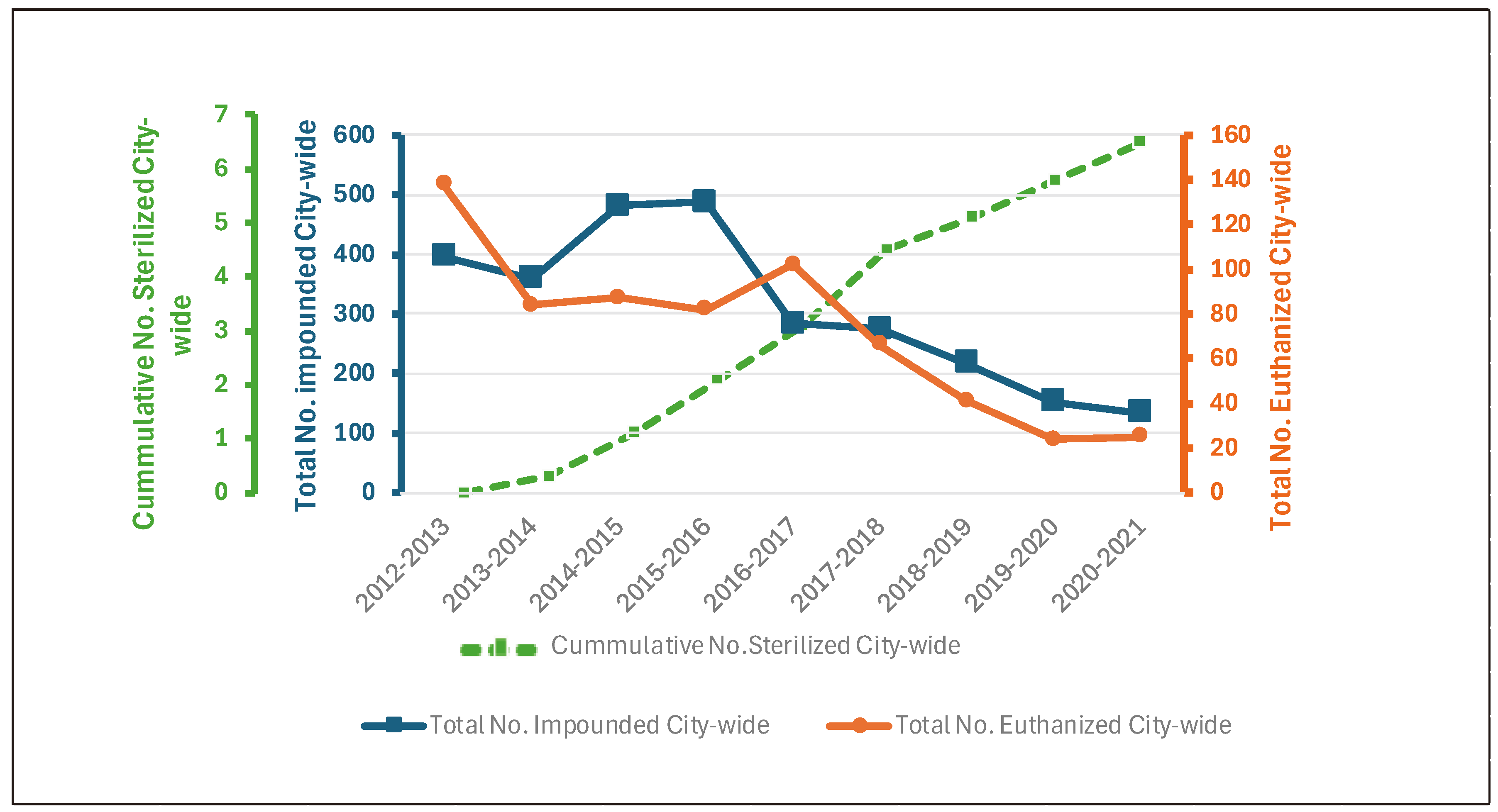
Figure 3.
Cat-related calls for found cats and nuisance cats per 1000 residents in 3 target suburbs (lowest socioeconomic indices for City of Banyule) and city-wide from 2011-2021 following implementing a free sterilization program for cats in 2013 (baseline years 2011 and 2012).
Figure 3.
Cat-related calls for found cats and nuisance cats per 1000 residents in 3 target suburbs (lowest socioeconomic indices for City of Banyule) and city-wide from 2011-2021 following implementing a free sterilization program for cats in 2013 (baseline years 2011 and 2012).
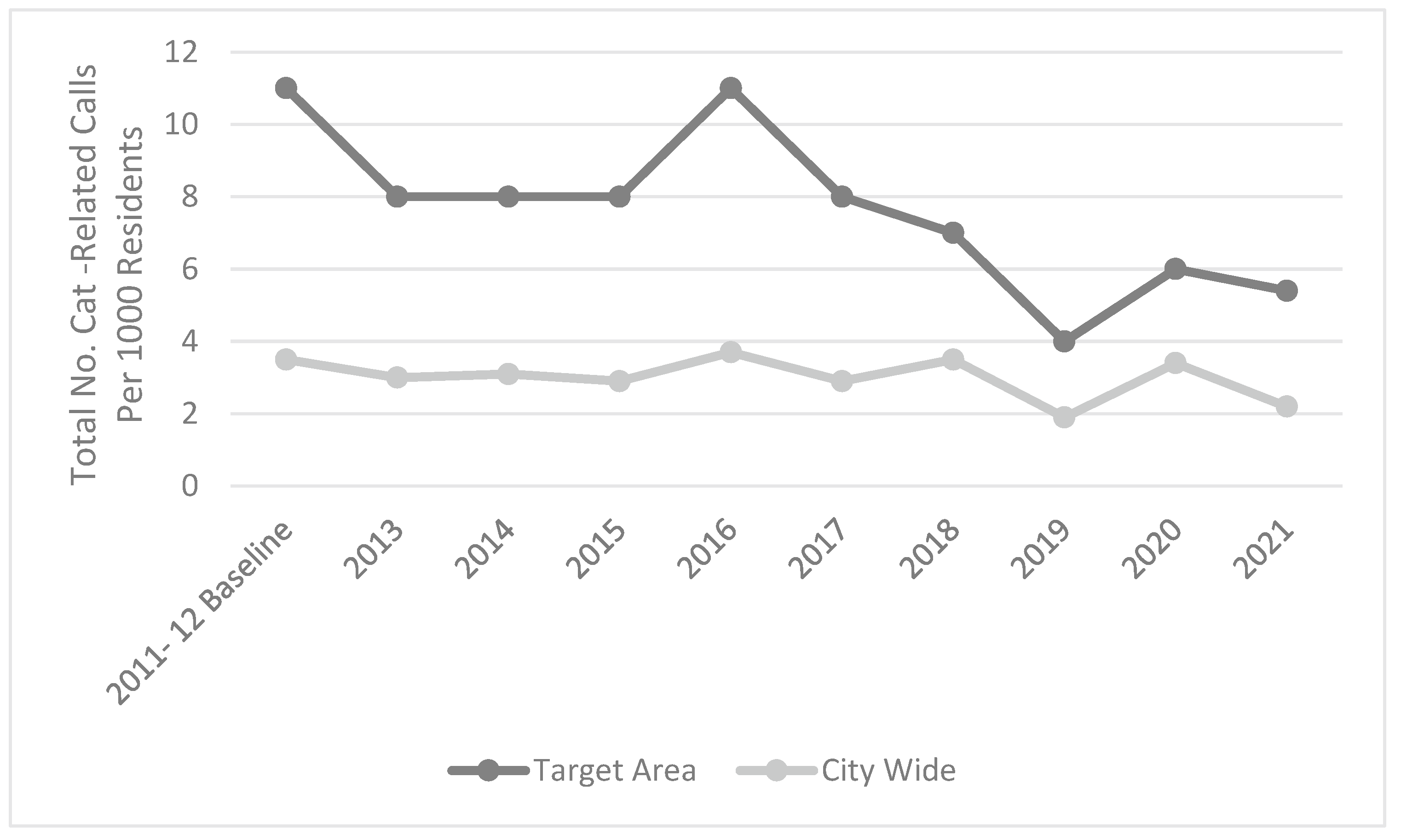
Table 1.
Number (and number per 1000 residents) of cats and kittens city-wide (including target suburbs) impounded by AMOs, stray cats found on private property and handed directly into the Cat Protection Society (CPS) and cats surrendered by owners to CPS between July 2017-18 to July 2020-21.
Table 1.
Number (and number per 1000 residents) of cats and kittens city-wide (including target suburbs) impounded by AMOs, stray cats found on private property and handed directly into the Cat Protection Society (CPS) and cats surrendered by owners to CPS between July 2017-18 to July 2020-21.
| Year | Cats impounded city-wide by AMOs (per 1000 residents) |
Stray cats from public directly into CPS (per 1000 residents) |
Cats surrendered by owners directly to CPS (per 1000 residents) | Total cat intake into CPS from City of Banyule (includes cats impounded by AMOs and strays directly from public and owner surrendered cats) including target area (per 1000 residents) |
| 2017-18 | 274 (2.1) | 315 (2.4) | 204 (1.6) | 793 (6.1) |
| 2018-19 | 217 (1.7) | 211 (1.6) | 102 (0.8) | 530 (4.1) |
| 2019-20 | 152 (1.2) | 244 (1.9) | 86 (0.7) | 482 (3.7) |
| 2020-21 | 134 (1.1) | 228 (1.8) | 102 (0.8) | 464 (3.6) |
*Data prior to 2017 financial year were not available for strays and owner-surrendered cats and kittens taken directly to CPS because the paper records were destroyed by the facility at the time of transfer to an electronic recording system in 2017. From 2017-18 to 2020-21, there were decreases in city wide impoundments by 51%, stray cats from the public to CPS by 28% and owner-surrendered cats to CPS by 50%.
Table 2.
Number and percentage of cats and kittens impounded city-wide (including three target suburbs) by AMOs and their outcomes (reclaimed, rehomed, and euthanized cats) at baseline (2012-13) and for eight years following implementation of a free sterilization program for cats in October 2013.
Table 2.
Number and percentage of cats and kittens impounded city-wide (including three target suburbs) by AMOs and their outcomes (reclaimed, rehomed, and euthanized cats) at baseline (2012-13) and for eight years following implementation of a free sterilization program for cats in October 2013.
| Year | Total No. cats/kittens impounded by AMOs* | % Decrease in the number euthanized from baseline | ||||
|---|---|---|---|---|---|---|
| Total No. Reclaimed by owner (% reclaimed) |
Total No. Rehomed* (% rehomed) |
Total No. Euthanized* (% euthanized) |
Total No. euthanized per 1000 residents | |||
| 2012-2013 | 396 | 23 (6%) | 235 (59%) | 138 (35%) | 1.1 | Baseline |
| 2013-2014 | 359 | 24 (7%) | 251 (70%) | 84 (23%) | 0.7 | 39% |
| 2014-2015 | 481 | 37 (8%) | 357 (74%) | 87 (18%) | 0.7 | 37% |
| 2015-2016 | 487 | 65 (13%) | 340 (70%) | 82 (17%) | 0.6 | 41% |
| 2016-2017 | 284 | 51 (18%) | 131 (46%) | 102 (36%) | 0.8 | 26% |
| 2017-2018 | 274 | 38 (14%) | 170 (62%) | 66 (24%) | 0.5 | 52% |
| 2018-2019 | 217 | 24 (11%) | 152 (70%) | 41 (19%) | 0.3 | 70% |
| 2019-2020 | 152 | 30 (20%) | 98 (64%) | 24 (16%) | 0.2 | 83% |
| 2020-2021 | 134 | 21 (16%) | 88 (66%) | 25 (19%) | 0.2 | 82% |
1. *There was an overall reduction in the number of cats impounded, rehomed and euthanized per year between 2012-13 and 2020-21 (Table C3).
Table 3.
Cat-related calls/1000 residents and costs to council from 2011 to 2021 based on estimated cost to Animal Management Services of $290.00 per call calculated from wage rate of $32.80/h for customer service officer (1 h) to process the call, $35.90/h for local laws adminstraion to allocate job to AMO (1 h 5 mins), and $35.89/h for AMO time (3h 40 min) (Table A2).
Table 3.
Cat-related calls/1000 residents and costs to council from 2011 to 2021 based on estimated cost to Animal Management Services of $290.00 per call calculated from wage rate of $32.80/h for customer service officer (1 h) to process the call, $35.90/h for local laws adminstraion to allocate job to AMO (1 h 5 mins), and $35.89/h for AMO time (3h 40 min) (Table A2).
| Year* | Human Population | Cat-related calls city-wide (including target area) (baseline average 436 calls*) | Cat-related calls in 3 target suburbs (baseline average 145 calls*) |
Baseline costs and savings for cat-related calls for whole city calculated at $290 per call and average baseline cost @ $126,440.00* | |||||
| Total calls | No./1000 residents | % Decrease | Total calls | No./1000 residents | % Decrease | Annual cost | Annual saving from baseline | ||
| 2011 | 122,780 | 462* | 3.8 | Baseline | 170* | 12.6 | Baseline | $133,980.00* | Baseline |
| 2012 | 122,983 | 410* | 3.3 | Baseline | 120* | 8.9 | Baseline | $118,900.00* | Baseline |
| 2013 | 123,384 | 371 | 3 | 15% | 105 | 7.8 | 28% | $107,490.00 | $18,832.00 |
| 2014 | 124,314 | 383 | 3.1 | 12% | 111 | 8.3 | 23% | $110,967.00 | $15,356.00 |
| 2015 | 125,107 | 367 | 2.9 | 16% | 105 | 7.8 | 28% | $106,331.00 | $19,991.00 |
| 2016 | 126,088 | 468 | 3.7 | -7% | 152 | 11.3 | -5% | $135,594.00 | -$9,271.00 |
| 2017 | 127,447 | 369 | 2.9 | 15% | 103 | 7.7 | 29% | $106,910.00 | $19,412.00 |
| 2018 | 128,609 | 456 | 3.5 | -5% | 94 | 7 | 35% | $183,836.00 | -$5,795.00 |
| 2019 | 130,478 | 250 | 1.9 | 43% | 49 | 3.7 | 66% | $72,433.00 | $53,890.00 |
| 2020 | 130,121 | 441 | 3.4 | -1% | 81 | 6 | 44% | $127,771.00 | -$1,449.00 |
| 2021 | 127,306 | 281 | 2.2 | 36% | 72 | 5.1 | 50% | $81,414.00 | $44,908.00 |
| TOTAL | 4258 | 1162 | $1,285,625.00 | $155,875.00 | |||||
Disclaimer/Publisher’s Note: The statements, opinions and data contained in all publications are solely those of the individual author(s) and contributor(s) and not of MDPI and/or the editor(s). MDPI and/or the editor(s) disclaim responsibility for any injury to people or property resulting from any ideas, methods, instructions or products referred to in the content. |
© 2024 by the authors. Licensee MDPI, Basel, Switzerland. This article is an open access article distributed under the terms and conditions of the Creative Commons Attribution (CC BY) license (http://creativecommons.org/licenses/by/4.0/).
Copyright: This open access article is published under a Creative Commons CC BY 4.0 license, which permit the free download, distribution, and reuse, provided that the author and preprint are cited in any reuse.


