
Submitted:
06 March 2024
Posted:
06 March 2024
You are already at the latest version
Abstract
The study addresses the urgent environmental issue of climate change, focusing specifically on the role of local food, which is produced and consumed locally, helps reduce carbon emissions by eliminating the need for long-distance transportation. Through quantitative analysis, this study elucidates the potential benefits in environmental impact achieved through the consumption of local food: the significant reduction in carbon emissions. Specifically, the consumption of local food is found to yield an annual decrease of 2,421,296 tCO2 emissions, representing 2.5% of South Korea’s total greenhouse gas emissions from the transportation sector. This reduction further translates into an estimated economic value of USD 54.23 million (KRW 70.5 billion). This study underscores the potential of local food consumption as a tangible strategy to overcome environmental problems. Moreover, its academic contribution lies in its comprehensive analysis of the economic and empirical impacts of local food consumption on environment. Moving forward, we propose policies such as supporting local food distribution networks, providing public education on local food, fostering the local food industry, and providing incentives to revitalize local food consumption.
Keywords:
local food
; food miles
; carbon emissions
; environment
; carbon footprint
1. Introduction
Climate change and global warming are currently the foremost international environmental issues. Their impacts manifest in diverse ways, including glacier reduction, desertification, rising sea levels, and ecological transformations worldwide. Notably, the frequency and intensity of extreme weather events and natural disasters have been on the rise in recent times.
The primary cause of these phenomena is greenhouse gas emissions. These gases can enter the Earth’s atmosphere, but some of them trap heat, intensifying the greenhouse effect and causing a rise in global temperatures. This effect, wherein the Earth’s surface and troposphere warm due to gas particles, accelerates global warming and prompts climate change.
The Kyoto Protocol, an international treaty on climate change, regulates six major greenhouse gases. Their respective contributions are as follows: carbon dioxide () accounts for 88.6%, methane () for 4.8%, nitrous oxide () for 2.8%, and other gases such as hydrofluorocarbons (perfluorocarbons (, and sulfur hexafluoride () contribute 3.8%.
Globalization and large-scale industrialization in the food industry have led to an increase in food trade among nations and regions. Consequently, food products travel through the different countries and regions from the origin to reach end consumers. The problem lies in the increased energy consumption due to the transportation distance of food distribution. Vehicles such as airplanes, ships, trains and trucks mainly rely on fossil fuels such as coal, oil, and gas. Consequently, carbon dioxide and other greenhouse gas emissions occur as a result of fuel consumption [1].
Food miles is a widely used concept in the environmental aspect, emphasizing the need to reduce greenhouse gas emissions, a major contributor to environmental issues. Food miles refer to the distance that food products (agricultural products, livestock, seafood, etc.) travel from their origin to the final consumers. Food miles are measured by multiplying the quantity of food transported (in tons) by the distance travelled (in kilometers). A higher value of food miles indicates increased environmental pollution resulting from the pollutants such as carbon dioxide by the long-distance transportation of food. As a result, food miles is utilized as a global environmental indicator in countries: the United States, the European Union, Australia, Canada, and others, as they allow for the tracking and calculation of the entire process of food distribution [2].
Local food consumption is a prominent social effort to reduce food miles. Local food refers to food that is consumed within a region without long-distance transportation or multi-stage distribution processes [3,4]. Since local food has limited travel distances within the region, the greenhouse gas emissions associated with transportation are relatively low or even non-existent. Therefore, consuming local food directly contributes to reducing greenhouse gas emissions and protecting the environment.
There have been studies on food miles in Korea, such as [5,6], and [5,7] calculated the food miles and carbon dioxide emissions of imported food products in Korea, Japan, the United Kingdom, and France. [6] focused on beef and wine, determining and comparing their food miles and carbon dioxide emissions, and mentioned that carbon dioxide emissions’ problems can be solved through local food consumption. [7] analyzed methods for measuring the food miles and carbon dioxide emissions of agricultural products.
There are few studies that specifically analyze the changes in food miles using local food. Calculating and comparing the food miles and carbon dioxide emissions of local food is an important research topic in the context of sustainable environmental practices. Therefore, this study aims to calculate the food miles and carbon dioxide emissions associated with local food consumption and quantitatively evaluate their environmental impact.
2. Methodological Framework
2.1. Framework
In this study, local food is defined as ‘agricultural products that are produced, distributed, and consumed within a certain geographic area without multi-stage distribution processes”. It is specifically limited to agricultural products sold in local food direct markets. Local food direct markets are a representative local food business in Korea. The environmental effects of local food consumption are assessed by comparing the period before and after consumption at Korean local food direct markets.
Before the local food business, agricultural products consumed in a specific region are classified into domestic and imported commodities. Furthermore, after the consumption of local food, agricultural products can be categorized as local food, domestic but non-local food, and imported but non-local food. In other words, a certain proportion of the consumption of domestically produced and imported agricultural products is replaced by local food. Since the exact extent to which local food replaces domestica and imported commodities cannot be known, the proportion of domestically produced and imported agricultural products before the local food business is assumed as the replacement ratios respectively. The calculation formula for food miles is ‘consumption quantity () distance ()’, so as the consumption of local food increases, the food miles decreases (Figure 1).
The equation for calculating the food miles of domestic agricultural products is as follows: ‘Consumption volume of domestic agricultural products () distance ()’. It is evaluated by calculating the consumption volume in the evaluation region and the distance from the major origin of the target agricultural products to the consumption area (Figure 2). The consumption volume in the evaluation region is calculated by multiplying the total domestic supply of the target agricultural products and the proportion of the evaluation region population to the total population of the country. The distance is calculated by dividing into the distance from the origin to the wholesale market, and the distance from the wholesale market to the consumption area. In this case, the major origin and the major wholesale market are based on the origin (production area) and wholesale market that account for up to 80% of the cumulative ratio of the Concentration Ratio (CR3).1
The equation for calculating the food miles of imported agricultural products is as follows: ‘Consumption volume of imported agricultural products () distance ()’. It is evaluated by calculating the consumption volume in the evaluation region and the distance from the exporting country of the target agricultural products to the consumption area (Figure 3). The consumption volume is calculated by multiplying the total domestic supply of imported agricultural products and the proportion of the evaluation region population to the total population of the country. The distance is divided into three steps: the distance from the export country to the domestic port, the distance from the port to the wholesale market, and the distance from the wholesale market to the consumption area. In this case, the export country and the domestic port are based on the CR3 criteria, considering the cumulative weight of up to 80% of exporting countries and domestic ports respectively. Additionally, the wholesale market encompasses all markets where imported agricultural products are imported.
2.2. Rate of Change in Carbon Emission: CER
Equation (1) is used to measure the rate of change in carbon emissions of domestically produced and imported foods before and after the local food business in region . A higher rate of change in carbon emissions in the evaluation region is considered as a decrease in food miles.
: Rate of carbon emissions change in region r
: Carbon emissions from distribution of domestic agricultural products before local food business in region r (t)
: Carbon emissions from distribution of domestic agricultural products after local food business in region r (t)
: Carbon emissions from distribution of imported agricultural products before local food business in region r (t)
: Carbon emissions from distribution of imported agricultural products after local food business in region r (t)
is composed of the sum of carbon emissions () from the origin to the wholesale market for commodity before the local food business, and the carbon emissions () from the wholesale market to region (Equation (1-1)).
: Carbon emissions from distribution of domestic agricultural products before local food business in region r (t)
: Carbon emissions from the origin p to the wholesale market l for the domestically produced commodity k before the local food business (t)
: Carbon emissions from the wholesale market l to the region r for the domestically produced commodity k before the local food business (t)
: Food miles from the origin p to the wholesale market l for the domestically produced commodity k before the local food business (t·km)
: Food miles from the wholesale market l to the region r for the domestically produced commodity k before local food business (t·km)
:emission factor for trucks (t/t·km)
The food miles of domestically produced commodity before the local food business can be calculated based on the distance from the origin to the region and the supply (Equation (1-2)).
: Supply of the domestically produced commodity k from the origin p to the wholesale market l (ton)
: Distance from the origin p to the wholesale market l for the domestically produced commodity k (km)
: Proportion of wholesale market imports from major origins in the total supply of domestically produced commodity k
: Supply of the domestically produced commodity k from the wholesale market l to the region r (ton)
: Distance from the wholesale market l to the region r for the domestically produced commodity k (km)
: Proportion of major wholesale market imports in the total supply of domestically produced commodity k
: Supply of the domestically produced commodity k from the region r (ton)
: Total supply of the domestically produced commodity k (ton)
: Total population of South Korea,: Total population of region r
is composed of the sum of carbon emissions () from the origin to the wholesale market for commodity after the local food business, and the carbon emissions () from the wholesale market to region (Equation (1-3)).
: Carbon emissions from distribution of domestic agricultural products after the local food business in region r (t)
: Carbon emissions from the origin p to the wholesale market l for the domestically produced commodity k after the local food business (t)
: Carbon emissions from the wholesale market l to region r for the domestically produced commodity k after the local food business (t)
: Food miles from the origin p to the wholesale market l for the domestically produced commodity k after the local food business (t·km)
: Food miles from the wholesale market l to region r for the domestically produced commodity k after the local food business (t·km)
:emission factor for trucks (t/t·km)
The food miles of domestically produced commodity after the local food business can be calculated based on the distance from the origin to the region and the supply (Equation (1-4)).
: Supply of the domestically produced commodity k from the origin p to the wholesale market l (ton)
: Distance from the origin p to the wholesale market l for the domestically produced commodity k (km)
: Proportion of wholesale market imports from major origins in the total supply of domestically produced commodity k
: Supply of the domestically produced commodity k from the wholesale market l to the region r (ton)
: Distance from the wholesale market l to the region r for the domestically produced commodity k (km)
: Proportion of major wholesale market imports in the total supply of domestically produced commodity k
: Supply of the domestically produced commodity k from the region r (ton)
: Total supply of the domestically produced commodity k (ton)
: The local food sales volume of the commodity k in the region r (ton)
: Domestically produced commodities’ market share of commodity k
: Total population of South Korea,: Total population of region r
is composed of carbon emissions () from the export country to domestic port for commodity , carbon emissions () from the port to the wholesale market , and the carbon emissions () from the wholesale market to the region (Equation (1-5)).
: Carbon emissions from imported products before the local food business in region r (t)
: Carbon emissions from the export country ex to domestic port h for the imported commodity k before the local food business (t)
: Carbon emissions from domestic port h to the wholesale market l for the imported commodity k before the local food business (t)
: Carbon emissions from the wholesale market l to the region r for the imported commodity k before the local food business (t)
: Food miles from the export country ex to domestic port h for the imported commodity k before the local food business (t·km)
: Food miles from domestic port h to the wholesale market l for the imported commodity k before the local food business (t·km)
: Food miles from the wholesale market l to the region r for the imported commodity k before the local food business (t·km)
:emission factor for trucks (t/t·km),:emission factor for ships (t/t·km)
The food miles of imported commodity before the local food business can be calculated based on the distance from the export country to the region and the supply (Equations (1-6)).
: Import volume of the imported commodity k from the export country ex to domestic port h (ton)
: Distance from the export country ex to domestic port h for the imported commodity k (km)
: Proportion of import volume from major export countries in the total import volume of imported commodity k
: Import volume of the imported commodity k from domestic port h to the wholesale market l (ton)
: Distance from domestic port h to the wholesale market l for the imported commodity k (km)
: Proportion of import volume from major domestic ports in the total import volume of imported commodity k
: Import volume of the imported commodity k from the wholesale market l to the region r (ton)
: Distance from the wholesale market l to the region r for the imported commodity k (km)
: Proportion of major wholesale market imports in the total volume of imported commodity k
: Import volume of the imported commodity k from the region r (ton)
: Total import volume of the imported commodity k (ton),: Total population of South Korea,: Total population of region r
is composed of carbon emissions () from the export country to domestic port for commodity , carbon emissions () from the port to the wholesale market , and the carbon emissions () from the wholesale market to the region (Equation (1-7)).
: Carbon emissions from imported products after the local food business in region r (t)
: Carbon emissions from the export country ex to domestic port h for the imported commodity k after the local food business (t)
: Carbon emissions from domestic port h to the wholesale market l for the imported commodity k after the local food business (t)
: Carbon emissions from the wholesale market l to the region r for the imported commodity k after the local food business (t)
: Food miles from the export country ex to domestic port h for the imported commodity k after the local food business (t·km)
: Food miles from domestic port h to the wholesale market l for the imported commodity k after the local food business (t·km)
: Food miles from the wholesale market l to the region r for the imported commodity k after the local food business (t·km)
:emission factor for trucks (t/t·km),:emission factor for ships (t/t·km)
The food miles of imported commodity after the local food business can be calculated based on the distance from the export country to the region and the supply (Equation (1-8)).
: Import volume of the imported commodity k from the export country ex to domestic port h (ton)
: Distance from the export country ex to domestic port h for the imported commodity k (km)
: Proportion of import volume from major export countries in the total import volume of imported commodity k
: Import volume of the imported commodity k from domestic port h to the wholesale market l (ton)
: Distance from domestic port h to the wholesale market l for the imported commodity k (km)
: Proportion of import volume from major domestic ports in the total import volume of imported commodity k
: Import volume of the imported commodity k from the wholesale market l to the region r (ton)
: Distance from the wholesale market l to the region r for the imported commodity k (km)
: Proportion of major wholesale market imports in the total volume of imported commodity k
: Import volume of the imported commodity k from the region r (ton)
: Total import volume of the imported commodity k (ton)
: The local food sales volume of the commodity k in the region r (ton)
: Imported commodities’ market share of commodity k,: Total population of South,: Total population of region r
3. Results
3.1. Targets and Materials
This study analyze the top 16 agricultural products2in South Korea across five regions3 based on production volume (Table 1). Furthermore, the research period was focused on the year of 2020.
Local food is defined as agricultural products purchased from locally direct market within the residential area, whereas non-local food is defined as agricultural products purchased from other regions within the country or imported agricultural products.
The first step in the analysis is to calculate food miles, which is obtained by multiplying the distance from the place of production (origin) to the place of consumption by the quantity of food. In the second step, carbon emissions were calculated by multiplying the food miles by the carbon emission factor based of the transportation vehicle. In the final step of the analysis, the carbon emissions calculated before and after the local food business were compared to evaluate the reduction in carbon emissions resulting from the local food consumption. It is practically impossible to determine the exact locations of production and consumption sites, as well as the distribution routes, during the process of calculating food miles. Therefore, based on the disclosed data, consistent criteria were applied to calculate the food miles as shown in Table 2.4
Table 3 represents the proportion of domestically sourced products in supply () and import quantities in supply () by products, when they are substituting with local food.
.
The major origin is determined as the origin where the cumulative proportion of the shipping volume reaches 80%.

Table 4.
The example of major origin selection (the case of potato).
| Rank | Region | Shipping Volume | Rank | Region | Shipping Volume | ||||
|---|---|---|---|---|---|---|---|---|---|
| Volume (ton) | Proportion | Cumulative Proportion |
Volume (ton) | Proportion | Cumulative Proportion |
||||
| 1 | Gangwon-do Pyeongchang-gun |
44,989 | 0.218 | 0.218 | 16 | Jeollabuk-do Buan-gun |
3,020 | 0.015 | 0.663 |
| 2 | Gyeongsangnam-do Miryang-si |
12,998 | 0.063 | 0.280 | 17 | Gyeongsangbuk-do Gimcheon-si |
2,961 | 0.014 | 0.677 |
| 3 | Jeollabuk-do Gimje-si |
11,099 | 0.054 | 0.334 | 18 | Jeju-do Jeju-si |
2,835 | 0.014 | 0.691 |
| 4 | Jeollanam-do Bpseong-gun |
10,387 | 0.050 | 0.384 | 19 | Gangwon-do Chuncheon-si |
2,767 | 0.013 | 0.704 |
| 5 | Chungcheongnam-do Dangjin-si |
9,643 | 0.047 | 0.431 | 20 | Gangwon-do Jeongseon-gun |
2,566 | 0.012 | 0.717 |
| 6 | Chungcheongnam-do Seosan-si |
8,046 | 0.039 | 0.470 | 21 | Gangwon-do Inje-gun |
2,303 | 0.011 | 0.728 |
| 7 | Gangwon-do Hongcheon-gun |
5,018 | 0.024 | 0.494 | 22 | Jeju-do Seogwipo-si |
2,269 | 0.011 | 0.739 |
| 8 | Gyeongsangnam-do Changnyeong-gun |
4,878 | 0.024 | 0.518 | 23 | Gyeongsangbuk-do Andong-si |
2,228 | 0.011 | 0.750 |
| 9 | Gangwon-do Hoengseong-gun |
4,699 | 0.023 | 0.540 | 24 | Gangwon-do Wonju-si |
2,111 | 0.010 | 0.760 |
| 10 | Gyeongsangbuk-do Goryeong-gun |
4,468 | 0.022 | 0.562 | 25 | Gyeongsangnam-do Changwon-si |
1,891 | 0.009 | 0.769 |
| 11 | Gyeonggi-do Guri-si |
3,938 | 0.019 | 0.581 | 26 | Gyeongsangbuk-do Uiseong-gun |
1,738 | 0.008 | 0.777 |
| 12 | Gyeongsangbuk-do Gumi-si |
3,675 | 0.018 | 0.599 | 27 | Gyeongsangbuk-do Yeongju-si |
1,735 | 0.008 | 0.786 |
| 13 | Gyeongsangbuk-do Bonghwa-gun |
3,479 | 0.017 | 0.616 | 28 | Gyeongsanbuk-do Sangju-si |
1,669 | 0.008 | 0.794 |
| 14 | Jeollabuk-do Namwon-si |
3,430 | 0.017 | 0.632 | 29 | Jeollanam-do Yeongam-gun |
1,625 | 0.008 | 0.802 |
| 15 | Gangwon-do Gangneung-si |
3,320 | 0.016 | 0.648 | |||||
1 Source: Modified from Korea Agro-Fisheries & Food Trade Corporation Wholesale Distribution Information System (aT agromarket) (2020) [20]. 2 The shipping volume with missing origin information had been excluded.
The major wholesale market is the same way that the major origin was determined, is that the wholesale market where the cumulative proportion of the market imports reaches 80%.
Table 5.
The example of major wholesale market selection (the case of potato).
| Rank | Wholesale Market |
Shipping Volume | ||
|---|---|---|---|---|
| Volume (ton) | Proportion | Cumulative Proportion |
||
| 1 | Seoul Garak | 82,935 | 0.401 | 0.401 |
| 2 | Daegu Bukbu | 19,998 | 0.097 | 0.498 |
| 3 | Guri | 12,084 | 0.058 | 0.556 |
| 4 | Busan Eomgung | 10,879 | 0.053 | 0.609 |
| 5 | Busan Banyeo | 10,234 | 0.049 | 0.658 |
| 6 | Gwangju Seobu | 10,013 | 0.048 | 0.707 |
| 7 | Gwangju Gakhwa | 9,267 | 0.045 | 0.752 |
| 8 | Seoul Gangseo | 7,950 | 0.038 | 0.790 |
| 9 | Daejeon Ojeong | 6,272 | 0.030 | 0.820 |
1 Source: Modified from Korea Agro-Fisheries & Food Trade Corporation Wholesale Distribution Information System (aT agromarket) (2020) [20].
The data for calculating imported products’ food miles is provided in Table 6, Table 7 and Table 8. The major export countries were selected based on their cumulative share of domestic import volume up to 80%.
The major domestic port is determined as the port that the cumulative proportion of import values reaches 80%.
All wholesale market that handle the imported agricultural products were included in this study.
3.2. Evaluation Results
The results of comparing the supply of local food before and after the consumption of local food are as follows. Agricultural products previously classified solely as domestic (non-local) and imported were subsequently categorized as domestic, imported, and local food following the consumption of local food. The weight of local food was determined by calculating the proportion of domestic and imported agricultural products in relation to the total agricultural product supply, and then summing these values (Table 9).
The table below compares the changes in food miles before and after the consumption of local food. Region A experienced a decrease of approximately 1.92 million t·km, followed by a reduction of 130,000 t·km in Region B, 97,000 t·km in Region C, 880,000 t·km in Region D, and 570,000 t·km in Region E (Table 10).
Table 11 illustrates the levels of greenhouse gas (GHG) emissions before and after the consumption of local food, alongside the corresponding economic values (environmental benefits), calculated through the value of carbon. In Region A, there was a reduction of approximately 70,000 emissions following the consumption of local food. Similarly, in Region B, the decrease amounted to 5,000 , while in Region C it was 40,000 , in Region D it was 20,000 , and in Region E it was also 20,000 . The extent of emission reduction and the amount of GHG emissions varied across regions, correlating with the local food consumption.
We utilized a weighted average value of USD 22.60 (KRW 29,386)8 per ton of carbon credits for the carbon valuation. The environmental benefits associated with consuming local food are as follows: approximately USD 1,494,323 (KRW 1,943 million) for Region A, USD 122,381 (KRW 159 million) for Region B, USD 928,914 (KRW 1,208 million) for Region C, USD 380,978 (KRW 495 million) for Region D, and USD 410,771 (KRW 534 million) for Region E. This demonstrates that the greater the consumption of local food, the more pronounced the environmental benefits.
While this study focused on five specific regions, the environmental benefits are expected to be even greater if scaled up to the entire country.
The results of the carbon emission evaluations are as follows. The rate of change in carbon emissions was the highest in region A, followed by region C, region D, region E, and region B (Table 12).
The correlation analysis was conducted to find out the relationship between the results and the characteristics of the region (Table 13). There was a positive correlation between carbon emission changes and the total agricultural area, agricultural area of small farmer, total number of farmers, number of elderly farmers, number of female farmers, and number of full-time workers. However, the number of population showed a negative correlation.
The total agricultural area and the area of small farmers can be proportional to shipments to their local food direct markets, which means that carbon emissions from the consumption of agricultural products in the region can be reduced. The region with a large population, there is a high probability that wholesale and retail businesses, such as large discount stores, corporate supermarkets (e.g. super supermarket), will be distributed due to urbanization. As a result, the number of and use of local food direct markets are relatively smaller than in areas with a small population, so the level of change in carbon emissions is judged to be low.
4. Discussion
Carbon emissions represent a significant contributor to environmental pollution, including climate change, with food transportation being a notable source. As environmental concerns like climate change and global warming are becoming more serious, this study aims to assess the role of local food as a way to reduce carbon emissions. We analyze food miles and carbon emission measurement methodologies for agricultural products, applying them to Korean agricultural goods to compare the environmental impacts of agricultural transportation.
In this study, local food is defined as agricultural products that produced, distributed, and consumed within a specific geographical area, bypassing multi-step distribution processes. 'Local food direct market’ is a representative local food business in Korea. We evaluate the environmental impact of local food by comparing it before and after the consumption at the 'local food direct market'. The assessment encompasses the top 16 agricultural products production in Korea. The consumption of local food led to an average reduction of 893,245 tons·km per region in food miles, consistent with previous studies indicating reduced food miles with local food consumption [21,22,23]. Given South Korea's 82 cities, the nationwide reduction in food miles is likely even greater.
Calculation of carbon emissions before and after the consumption of local food revealed an average reduction of 29,528 tonCO2 per region. Extrapolating to the national scale, this reduction amounts to approximately 2,421,296 tonCO2, constituting 2.5% of Korea's transportation sector GHG emissions in 2022 (98 million tons). In particular, we found that the main factor affecting carbon emissions from agricultural distribution is the distance traveled by agricultural products. This is because agricultural products have a much higher food miles by land and sea transportation. While this study focused on the top 16 agricultural goods, broader analysis suggests even greater carbon emission reductions across the entire agricultural sector. These reductions translate to total of USD 3,337,345 (KRW 4.3 billion) for five regions or USD 54.23 million (KRW 70.5 billion) nationwide in terms of carbon credit value. Therefore, it can be concluded that expanding local food consumption yields positive environmental and economic impacts by reducing carbon emissions.
There is an ongoing national focus and effort to reduce carbon emissions. Increasing the demand for local food can be a solution to reduce food miles, thus reducing carbon emissions and overcoming environmental problems. Empirical analysis demonstrates a direct correlation between increased local food consumption and reduced emissions across all regions, underscoring the urgency of prioritizing policies that promote local food demand. If the government fails to prioritize policies to expand local food demand, it may cause various problems such as social problems and environmental costs.
The above findings underscore several implications for policies to promote local food consumption. First, the current distribution structure of Korean agricultural products revolves around a system where goods are centralized in large wholesale markets within metropolitan areas and then disseminated to local regions via intermediate distributors. It is necessary to support an distribution environment by strengthening the local food distribution network facilitating the distribution of agricultural products closer to the place of consumption. Second, it is important to promote and educate consumers to realize that local food consumption contributes to environmental protection and local economies. Third, to encourage increased local food consumption, it is essential to explore strategies that enhance consumer satisfaction and promote positive perceptions of local food stores. For example, in the case of product quantity management, despite the need to replenish defects or collect inventory, producers may not be able to display or sell their products smoothly because they are focused on farming. Therefore, it is necessary to find a way to systematically manage defective products and prepare a complementary system for claims due to defective products. Furthermore, to expand local food consumption, it is important to rationalize location selection and operation methods to increase accessibility from a consumer perspective, rather than focusing on mandatory government acceptance of local food policies or expanding the number of local food stores. Additionally, various other policies can be considered, such as fostering the food industry using local food and providing benefits for local food consumption.
5. Conclusion
This study aimed to analyze the potential benefits of local food for environmental protection by evaluating the carbon emission impacts of locally produced and consumed local food. Based on the results, this study estimates and evaluates the food miles and carbon emission reductions resulting from local food consumption, offering insights into policy implications. The academic significance of this research lies in its pioneering approach to economically and empirically analyzing the environmental impact of local food consumption. While the findings provide valuable insights, further analysis encompassing a broader range of agricultural products and regions could yield more nuanced conclusions. This study encourages future research to explore these aspects for a comprehensive understanding of the environmental implications of local food consumption.
Author Contributions
Conceptualization, D.-E.J. and S.-R.Y; methodology, D.-E.J and S.-B.Y.; validation, D.-E.J.; investigation (data and evidence collection), D.-E.J.; writing—original draft preparation, D.-E.J., S.-B.Y., and S.-R.Y.; writing—review and editing, D.-E.J; supervision, S.-R.Y. All authors have read and agreed to the published version of the manuscript.
Funding
This research received no external funding.
Data Availability Statement
Data sharing not applicable.
Conflicts of Interest
The authors declare no conflict of interest.
References
- Watkiss, P.; Schmith, A.; Tweddle, G.; McKinnon, A. The validity of food miles as an indicator of sustainable development. Final report prepared by AEA Technology Environment for DEFRA, London, 2005.
- Wynen, E.; Vanzetti, D. No through road: The limitations of food miles. ADBI Working Paper 2008, 118. [Google Scholar]
- Ministry of Agriculture, Food and Rural Affairs. In A three-year promotion plan for the spread of local food; 2019.
- National Agricultural Cooperative Federation Local Food Direct Market Council. What is local food. Available online: https://nhlocalfood.com/about/local-food.html (accessed on 13 March 2021).
- Ju, O. J.; Lee, J. B.; Seong, M.; Kim, S. Y.; Ryu, J. Y.; Kim, D. G.; Hong, Y. D. Estimation of Food Miles and CO 2 Emissions of Imported Food. J. of Korean Soc. for Atmos. Envir. 2010, 26, 57–68. [Google Scholar] [CrossRef]
- Seong, M. A.; Kim, D. G.; Lee, J. B.; Ryu, J. Y.; Hong, Y. D. Estimation of CO2 mitigation potentials using food miles of domestic and imported food about beef and wine. J. Climate Change Res. 2011, 2, 15–32. [Google Scholar]
- Suh, K. W. An analysis of food miles and CO2 emission of major agricultural products. J. Korea Soc. Atmos. Envir. 2012, 28, 706–713. [Google Scholar] [CrossRef]
- Korean Statistical Information Service. Crop production survey. 2020.
- National Institute of Environmental Research. The study on food mileage relating to nations’ dietary life. 2010.
- Gaballa, S.; Abraham, A.B. Food miles in Australia: A preliminary study of Melbourne. Victoria 2008. [Google Scholar]
- Bernatz, G. Apples, bananas, and oranges: Using GIS to determine distance travelled, energy use, and emissions from imported fruit. Res. Anal. 2009, 11, 1–15. [Google Scholar]
- Hill, H. Food miles: Background and marketing. Attra 2008. [Google Scholar]
- Pirog, R. Food miles: A simple metaphor to contrast local and global food systems. Newsletter of the Hunger and Environmental Nutrition (HEN) Dietetic Practice Group of the American Dietetic Association, 2004.
- Pirog, R.; Van Pelt, T.; Enshayan, K.; Cook, E. An Iowa perspective on how far food travels, fuel usage, and greenhouse gas emissions. Iowa City (IA): Iowa State University, 2001; 9. [Google Scholar]
- Natural Resources Defense Council(NRCD). Food miles: How far your food travels has serious consequences for your health and the climate. 2007.
- Xuereb, M. Food miles: Environmental implications of food imports to Waterloo region. Region of Waterloo Publ. Health 2005.
- Ministry of Agriculture, Food and Rural Affairs. Agriculture, Forestry and Fisheries Export & Import Statistics. 2020.
- Korea Customs Service. Trade Statistics. 2020. Available online: https://unipass.customs.go.kr/ets/.
- Korea Agro-Fisheries & Food Trade Corporation. KaTi. 2020. Available online: https://www.kati.net/index.do.
- Korea Agro-Fisheries & Food Trade Corporation. Wholesale Distribution Information System (aT agromarket). 2020. Available online: https://at.agromarket.kr/index.do;jsessionid=98872B5F9824280D35A5C673D7E1AB94.
- Jeong, E.; Kim, Y.; Heo, J. Local food promotion strategies and policy tasks for local economic activation. Korea Rural Economic Institute. 2016; R805. [Google Scholar]
- Kim, Y. J.; Lee, S. H.; Park, J. J. Study on how to revitalize the local food business in gyeonggi-do. GRI Policy Brief. 2020, 24. [Google Scholar]
- Schnell, S. M. Food Miles, Local eating, and community supported agriculture: putting local food in its place. Agri Hum Values. 2013, 30, 615–628. [Google Scholar] [CrossRef]
Figure 1.
The change (decrease) in food miles before and after the consumption of local food business.
Figure 1.
The change (decrease) in food miles before and after the consumption of local food business.
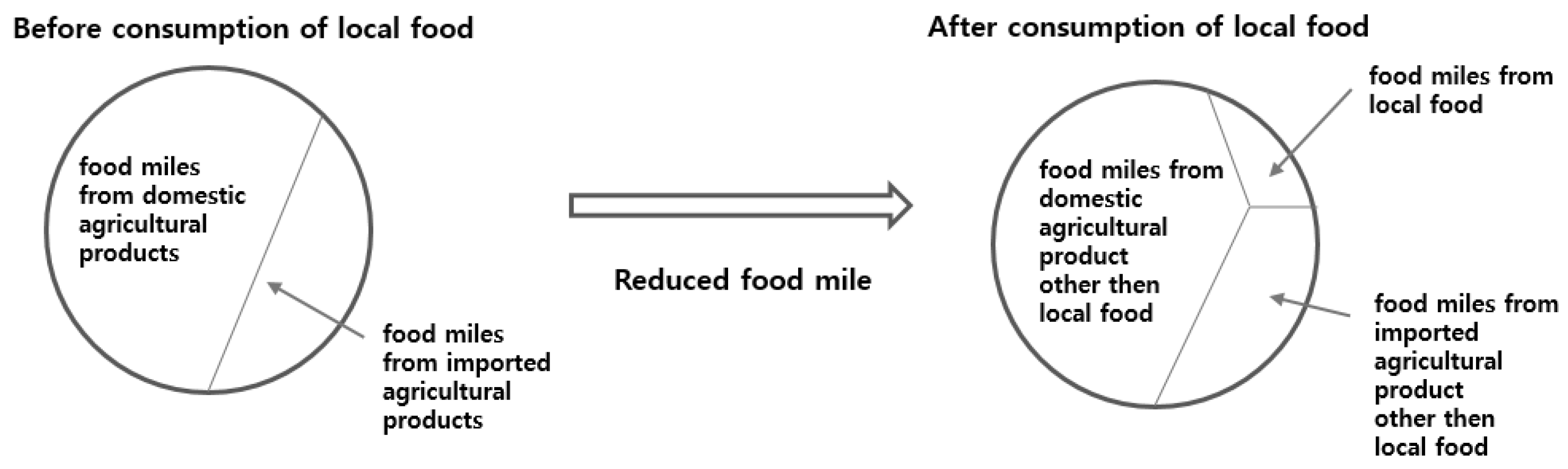
Figure 2.
Overview of food miles calculation of domestic agricultural products.
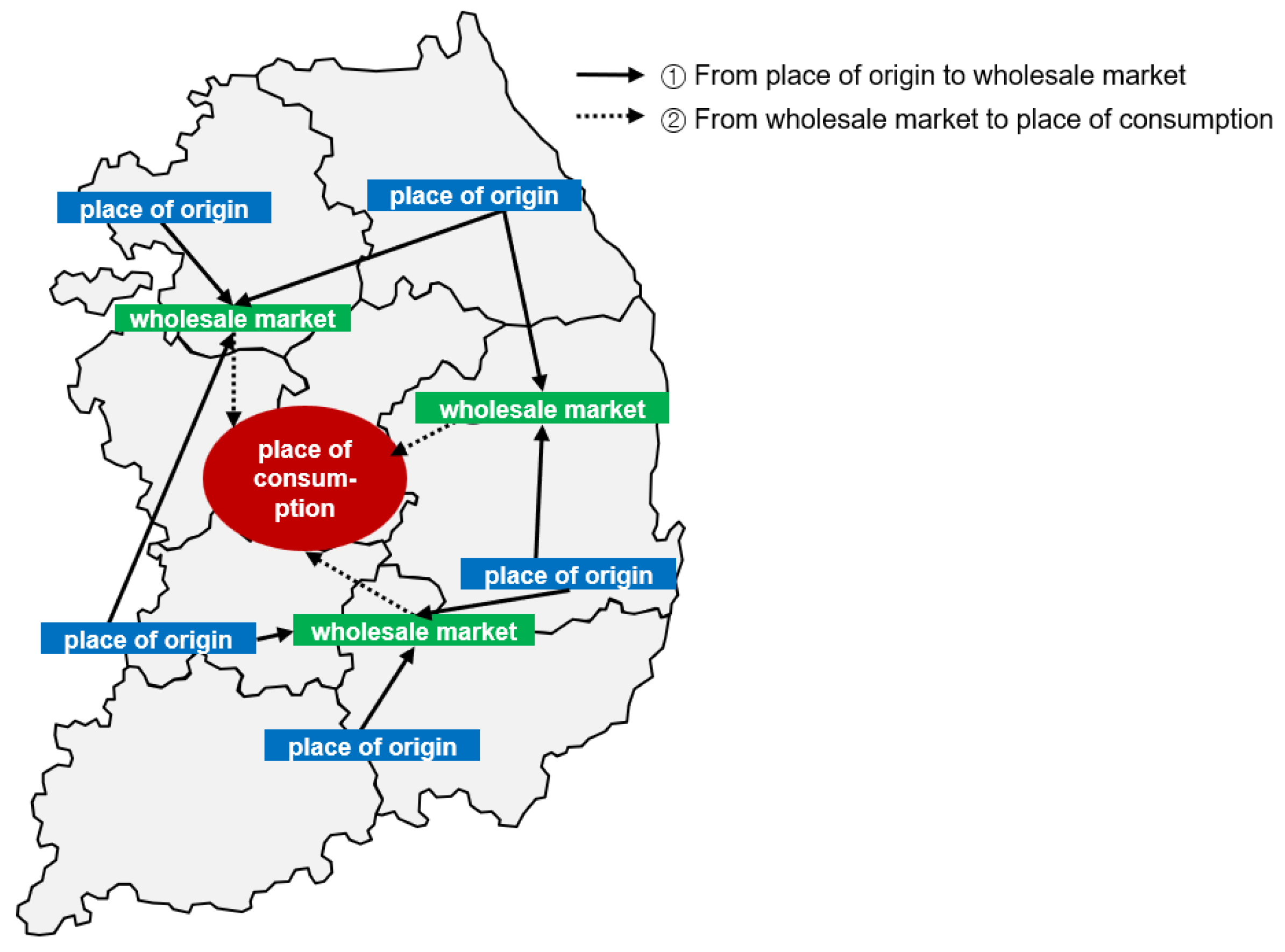
Figure 3.
Overview of food miles calculation of imported agricultural products.
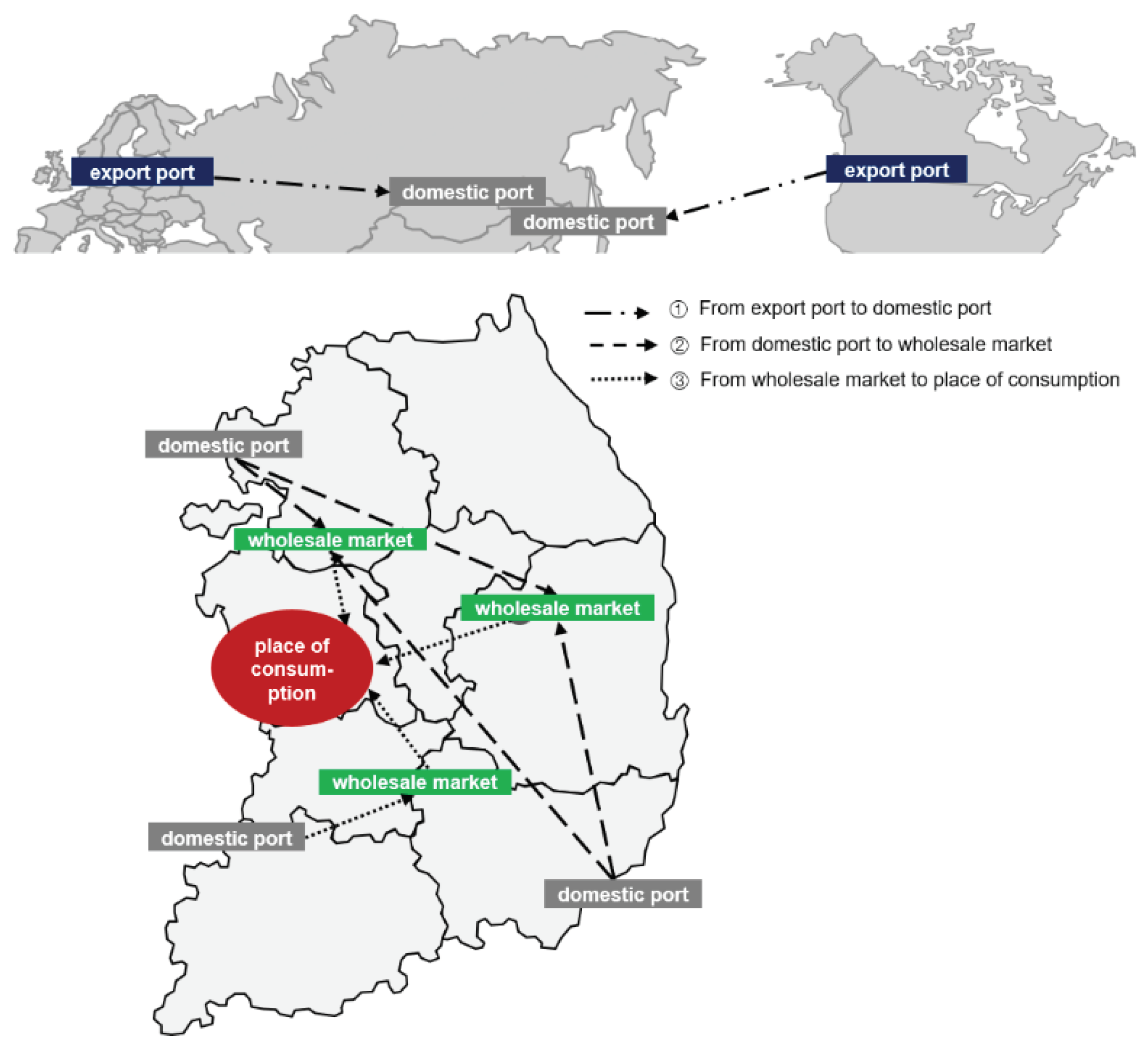
Table 1.
Top 3 agricultural products category by production volume.
| Classification | 1st Place | 2nd Place | 3rd Place | ||||
|---|---|---|---|---|---|---|---|
| Category | Production (ton) |
Category | Production (ton) |
Category | Production (ton) |
||
| Food crops | Rice | 3,506,578 | Potato | 553,194 | Sweet potato | 329,927 | |
| Vege -tables |
Fruit vegetables |
Watermelon | 466,529 | Cucumber | 335,596 | Tomato | 344,048 |
| Green vegetables |
Chinese cabbage | 2,242,640 | Cabbage | 313,236 | Lettuce | 96,774 | |
| Root vegetables |
Radish | 1,178,631 | Carrot | 100,875 | - | - | |
| Condiment vegetables | Onion | 1,168,227 | Garlic | 363,432 | Korean leek | 314,685 | |
| Fruits | Citrus fruit | 658,859 | Apple | 422,115 | Peach | 189,058 | |
1 Source: Korean Statistical Information Service 「Crop Production Survey」 (2020) [8]. 2 Food crops are consisted of rice, wheat and barley, pulse crops (bean, small red bean, green gram, etc.), minor cereals (corn, buck wheat, etc.), root and tuber crops (potato, sweet potato, etc.). Vegetables are consisted of fruit vegetables (watermelon, oriental melon, cucumber, pumpkin, tomato, strawberry, eggplant, etc.), green vegetables (Chinese cabbage, cabbage, spinach, lettuce, java water-dropwort, etc.), root vegetables (radish, carrot, burdock, taro, etc.), condiment vegetables (red pepper, garlic, Korean scallion, onion, ginger, etc.). Fruits are consisted of apple, Korean pear, peach, grape, citrus fruit, persimmon, etc.
Table 2.
Top 3 agricultural products category by production volume.
| Theoretical Criterion | Applied Criteria on Study |
|---|---|
| Supply of domestic agricultural products |
· Production – Import volume · Consumption of region = (consumption of domestic agricultural products / total population of South Korea) Ⅹ total population of region |
| Transportation distance of domestic agricultural products |
· Distance from major origin (city, county, district office5) to the point of sale (wholesale market)6 + distance from the point of sale (wholesale market) to the place of consumption |
| Import volume | · Import volume · Consumption of region = (import volume / total population of South Korea) Ⅹ total population of region |
| Transportation distance of imported agricultural products |
· Distance from the export country to the domestic port7 + distance from the domestic port to the point of sale (wholesale market) + distance from the point of sale (wholesale market) to the place of consumption |
| Sales volume of local food | · Sales volume of local food |
| Transportation distance of local food |
· 0 |
Table 3.
Data for evaluating the decrease in food miles (
| Product | Production Volume (ton) A |
Export Volume (ton) B |
Supply of Domestic Product (ton) C=A-B |
Import Volume (ton) D |
Total Supply (ton) E=C+D |
|
|
|---|---|---|---|---|---|---|---|
| Chinese cabbage |
2,242,640 | 24,413 | 2,218,227 | 643 | 2,218,870 | 1.000 | 0.000 |
| Citrus fruit | 658,859 | 5,996 | 652,863 | 0 | 652,863 | 1.000 | 0.000 |
| Watermelon | 466,529 | 350 | 466,179 | 30 | 466,209 | 1.000 | 0.000 |
| Cucumber | 335,596 | 211 | 335,385 | 0 | 335,385 | 1.000 | 0.000 |
| Sweet potato | 329,927 | 357 | 329,570 | 42 | 329,612 | 1.000 | 0.000 |
| Peach | 189,058 | 508 | 188,550 | 0 | 188,550 | 1.000 | 0.000 |
| Korean leek | 314,685 | 0 | 314,685 | 1,500 | 316,185 | 0.995 | 0.005 |
| Radish | 1,178,631 | 6,943 | 1,171,688 | 7,300 | 1,178,988 | 0.994 | 0.006 |
| Apple | 422,115 | 1,952 | 420,163 | 2,903 | 423,066 | 0.993 | 0.007 |
| Onion | 1,168,227 | 5,622 | 1,162,605 | 40,100 | 1,202,705 | 0.967 | 0.033 |
| Lettuce | 96,774 | 715 | 96,059 | 8,618 | 104,677 | 0.918 | 0.082 |
| Garlic | 363,432 | 3,130 | 360,302 | 37,500 | 397,802 | 0.906 | 0.094 |
| Cabbage | 313,236 | 5,996 | 307,240 | 38,424 | 345,664 | 0.889 | 0.111 |
| Tomato | 344,048 | 6,709 | 337,339 | 43,367 | 380,706 | 0.886 | 0.114 |
| Potato | 553,194 | 1,414 | 551,780 | 162,033 | 713,813 | 0.773 | 0.227 |
| Carrot | 100,875 | 197 | 100,678 | 96,400 | 197,078 | 0.511 | 0.489 |
1 Source: Korean Statistical Information Service 「Crop Production Survey」 (2020) [8], Ministry of Agriculture, Food and Rural Affairs 「Agriculture, Forestry and Fisheries Export & Import Statistics」 (2020) [17], Korea Customs Service Trade Statistics (2020) [18], Korea Agro-Fisheries & Food Trade Corporation KaTi (2020) [19].
Table 6.
The example of major export country selection (the case of potato).
| Rank | Export Country |
Shipping Volume | ||
|---|---|---|---|---|
| Volume (ton) | Proportion | Cumulative Proportion |
||
| 1 | Unites States of America | 109,208 | 0.674 | 0.674 |
| 2 | Australia | 13,055 | 0.081 | 0.755 |
| 3 | Belgium | 11,122 | 0.069 | 0.823 |
| 4 | Netherlands | 10,569 | 0.065 | 0.888 |
| 5 | Canada | 10,091 | 0.062 | 0.951 |
| 6 | China | 7,169 | 0.044 | 0.995 |
| 7 | Viet Nam | 819 | 0.005 | 1.000 |
1 Source: Korea Customs Service Trade Statistics (2020) [18].
Table 7.
The example of major domestic port selection (the case of potato).
| Rank | Wholesale Market |
Shipping Volume | ||
|---|---|---|---|---|
| Volume (ton) | Proportion | Cumulative Proportion |
||
| 1 | Seoul Garak | 5 | 0.833 | 0.833 |
| 2 | Changwon Palyong | 1 | 0.167 | 1.000 |
1 Source: Korea Customs Service Trade Statistics (2020) [18].
Table 8.
The example of wholesale market selection (the case of potato).
| Name of Port | Import Value (USD thousands) |
Proportion | Cumulative Proportion |
|---|---|---|---|
| Busan Port | 116,505,748 | 0.365 | 0.365 |
| Incheon Port | 63,313,031 | 0.198 | 0.563 |
| Pyeongtaek Port | 30,800,933 | 0.096 | 0.659 |
| Ulsan Port | 24,779,162 | 0.078 | 0.737 |
| Yeosu Port | 19,875,344 | 0.062 | 0.799 |
| Daesan Port | 14,399,038 | 0.045 | 0.844 |
1 Source: Modified from Korea Agro-Fisheries & Food Trade Corporation Wholesale Distribution Information System (aT agromarket) (2020) [20].
Table 9.
Agricultural products supply: comparison of before and after the consumption of local food.
Table 9.
Agricultural products supply: comparison of before and after the consumption of local food.
| Classification of Region |
Before the Consumption of Local Food | After the Consumption of Local Food | |||||
|---|---|---|---|---|---|---|---|
| Domestic (non-local) |
Imported | Total | Domestic (non-local) |
Imported | Local Food | Total | |
| Region A | 45,525 | 2,217 | 47,742 | 43,321 | 2,058 | 2,363 | 47,742 |
| Region B | 121,043 | 5,895 | 126,938 | 120,839 | 5,880 | 219 | 126,938 |
| Region C | 47,380 | 2,307 | 49,687 | 46,398 | 2,251 | 1,038 | 49,687 |
| Region D | 59,215 | 2,882 | 62,097 | 57,760 | 2,814 | 1,531 | 62,097 |
| Region E | 115,910 | 5,643 | 121,554 | 114,900 | 5,608 | 1,046 | 121,554 |
| Total | 389,073 | 18,944 | 408,018 | 383,218 | 18,611 | 6,197 | 408,018 |
Table 10.
Food miles: comparison of before and after the consumption of local food.
| Classification of Region |
Before the Consumption of Local Food (t·km) | After the Consumption of Local Food (t·km) | Difference (B-A) |
|||||
|---|---|---|---|---|---|---|---|---|
| Domestic (non-local) |
Imported | Total (A) |
Domestic (non-local) |
Imported | Local Food | Total (B) |
||
| Region A | 22,745,100 | 14,088,523 | 36,833,623 | 21,697,636 | 13,214,731 | 0 | 34,912,367 | ▼1,921,256 |
| Region B | 38,905,366 | 36,613,676 | 75,519,042 | 38,844,608 | 36,547,103 | 0 | 75,391,711 | ▼127,331 |
| Region C | 23,756,112 | 14,639,774 | 38,395,886 | 23,152,667 | 14,272,441 | 0 | 37,425,108 | ▼970,778 |
| Region D | 21,372,528 | 17,907,899 | 39,280,427 | 20,911,181 | 17,493,464 | 0 | 38,404,645 | ▼875,782 |
| Region E | 48,503,336 | 35,324,143 | 83,827,479 | 48,093,077 | 35,163,326 | 0 | 83,256,403 | ▼571,076 |
| Total | 155,282,442 | 118,574,015 | 273,856,457 | 152,699,169 | 116,691,065 | 0 | 269,390,234 | ▼4,466,223 |
1 ▼ denotes a reduction in carbon emissions following the consumption of local food compared to before the consumption.
Table 11.
Changes in carbon emissions and the economic benefits resulting from local food consumption.
Table 11.
Changes in carbon emissions and the economic benefits resulting from local food consumption.
| Classification of Region |
) | Difference (B-A) |
Benefits (Value of Carbon) (USD 1,000) |
||||||
|---|---|---|---|---|---|---|---|---|---|
| Domestic (non -local) |
Imported | Total (A) |
Domestic (non -local) |
Imported | Local Food | Total (B) |
|||
| Region A | 5,664 | 2,007,155 | 2,012,819 | 5,403 | 1,941,309 | 0 | 1,946,712 | ▼66,107 | 1,494 |
| Region B | 10,164 | 3,363,600 | 3,373,764 | 10,149 | 3,358,201 | 0 | 3,368,350 | ▼5,414 | 122 |
| Region C | 5,915 | 2,132,458 | 2,138,374 | 5,765 | 2,091,515 | 0 | 2,097,280 | ▼41,094 | 929 |
| Region D | 5,322 | 1,881,385 | 1,886,707 | 5,207 | 1,864,646 | 0 | 1,869,853 | ▼16,854 | 381 |
| Region E | 12,077 | 4,373,680 | 4,385,758 | 11,975 | 4,355,611 | 0 | 4,367,586 | ▼18,172 | 411 |
| Total | 39,142 | 13,758,279 | 13,797,421 | 38,499 | 13,611,282 | 0 | 13,649,781 | ▼147,640 | 3,337 |
1 ▼ denotes a reduction in carbon emissions following the consumption of local food compared to before the consumption. 2 The exchange rate of 1,300 KRW/USD was applied.
Table 12.
The results of evaluation.
| Classification | Region A | Region B | Region C | Region D | Region E |
|---|---|---|---|---|---|
| Rate of Change in Carbon Emissions(%) |
7.9 | 0.3 | 4.5 | 3.0 | 1.3 |
Table 13.
The results of correlation analysis between the changes of carbon emission and the characteristics of the region.
Table 13.
The results of correlation analysis between the changes of carbon emission and the characteristics of the region.
| Characteristics | Correlation Coefficients with Rate of Change in Carbon Emissions |
|---|---|
| Total Agricultural Area | 0.898 ** |
| Area of Small Farmer | 0.979 *** |
| Total Number of Farmers | 0.948 ** |
| Number of Elderly Farmers | 0.994 *** |
| Number of Young Farmers | 0.220 |
| Number of Female Farmers | 0.923 ** |
| Number of Full-time Farmers | 0.982 *** |
| Number of Part Time Farmers | 0.321 |
| Total Population | -0.843 * |
| Number of Wholesale and Retail Businesses | -0.616 |
1 *** (**, *) denotes coefficients are significant at 1% (5%, 10%) level.
| 1 | Concentration Ratio (CR) refers to the proportaion of transaction value held by a few large companies within the total transaction value of a specific industry. Generally, ‘CR3’ indicates an oligopoloy when the combined marekt share of the top three companies is 75% or more. In this study, the major origin and the major wholesale market are determined based on origins and wholesale markets that reach 80% of the Concentration Ratio, considering them as the major production areas and hubs. |
| 2 | This study analyzed 16 agricultural products excluding rice. In South Korea, rice is produced in every region. This means that there is no major origin for rice. Rice is collectively processed at Rice Processing Complex (RPC) located in each region and consumed locally, which is similar to the concept of local food. |
| 3 | South Korea is divided into 82 country-level regions. Of these, we analyzed five regions for which we had data available. |
| 4 | To accurately easure the food miles, data about the entire distribution process from the origin of agricultural products to the final place of consumption is required. However, the currently available data is limited to Korea Agro-Fisheries & Food Trade Corporation 「Summary of Distribution Status」 based on a sample survey of 3 to 5 major origins. Therefore, it cannot be used as data to track the movement of all agricultural products’ quantities nationwide [9]. |
| 5 | Generally, the reference point for determining the place of production or sale is measured based on a location that combines administrative functions (e.g. county or city hall, township or village office, etc.) and commercial activities [7,10]. |
| 6 | In the case of agricultural products, ‘food miles’ commonly uses the distance from the place of production to the point of sale, due to the limitations in obtaining data volmue of products’ movement at each stage of distribution process [11–14]. |
| 7 | If it is possible to indentify the exact place of production (origin) within the export country, the transportation distance within the export country can be calculated from the origin to the export port. However, if it is not possible to identify the origin, the distance can be calculated from the capital city to the port. In the case of import country, the distance is calculated from the domestic port which is the nearest from the capital city and then to the capital city [10,15,16]. |
| 8 | In this study, all monetary values in KRW were converted into USD using the average exchange rate of 1,300 KRW/USD. |
Disclaimer/Publisher’s Note: The statements, opinions and data contained in all publications are solely those of the individual author(s) and contributor(s) and not of MDPI and/or the editor(s). MDPI and/or the editor(s) disclaim responsibility for any injury to people or property resulting from any ideas, methods, instructions or products referred to in the content. |
© 2024 by the authors. Licensee MDPI, Basel, Switzerland. This article is an open access article distributed under the terms and conditions of the Creative Commons Attribution (CC BY) license (http://creativecommons.org/licenses/by/4.0/).
Copyright: This open access article is published under a Creative Commons CC BY 4.0 license, which permit the free download, distribution, and reuse, provided that the author and preprint are cited in any reuse.


