

Submitted:
27 February 2024
Posted:
29 February 2024
You are already at the latest version
Abstract
The silos built in the 1930s for Italy’s ammasso (obligatory grain stockpile) stood as powerful symbols of the country’s fascist era. Many of them were destroyed in World War II; only a few remain today, and recent demolitions underscore the urgency of their preservation. This study adapts a methodology developed for inventorying Spanish silos based on their general features, construction, technological facilities, and socioeconomic aspects and applies it to the 30 remaining ammasso silos. These silos are located in grain-producing areas near communication routes and are mostly owned by agricultural consortia. Over half of them are disused and in disrepair. All of them have machinery for receiving, storing, and dispatching grain, and most have equipment for cleaning, sorting, weighing, and packaging if needed. These structures are part of Italy’s agro-industrial heritage and should be protected. Some have been made over into commercial spaces, leisure areas, museums, and even homes. Vertical-cell silos are challenging to convert, unlike horizontally-oriented silos and other open-plan agro-industrial buildings. Examples of silo reuse in other countries, such as Spain and Portugal, can offer useful insights for the ammasso silos. However, socio-economic indicators suggest that such projects are most viable in large population centres.
Keywords:
Wheat
; grain store
; silo: ammasso
; ammassi granari obbligatori
; Italy
; industrial heritage
1. Introduction
Grain storage has been a constant concern to humanity as a means to ensure survival, and wheat is historically the principal grain for the Mediterranean region [1]. As early as the 2nd century BCE, Rome had its Porticus Aemilia, a covered building measuring 487 m x 60 m, designed for storing wheat for later distribution at low prices to low-income citizens [2]. Grain storage underwent a radical change with the invention of the grain elevator in 1843, transitioning from horizontal granaries to vertically structured constructions called ‘silos’ [3,4,5]. After World War I, Italy was a country in economic crisis. Hard times spurred a rise in nationalism and gave rise to strikes and occupations of factories and lands. From this breeding ground sprang Benito Mussolini, who rose to power in 1922, establishing the authoritarian regime known as fascism. One of the regime’s aims was to stimulate agricultural production. In 1925, a campaign called ‘the battle for grain’ (battaglia del grano) was launched with the dual objective of reducing wheat imports (which had swollen to 2.3 million tons in 1924) and boosting domestic production. This meant expanding cultivated areas and modernizing farming techniques through the use of fertilizers, tractors, seeds, silos, and other resources [6] (Figure 1). As a result, imports declined and Italian wheat production rose (from 5.39 million tons per year in 1921-1925 to 7.27 million tons per year in 1931-1935). However, success came at the cost of triggering a crisis and stagnation in most of the areas of fruit and vegetable production where Italy held significant competitive advantages [7,8,9,10,11]. Large swampy areas in Tuscany and near Rome were drained for colonization and farming, although less land was eventually reclaimed than initially planned [12].
After the global crisis of 1929, the fascist regime intervened in the grain market, starting in Naples. Intervention began in 1930, when farmers belonging to the Federazione Italiana dei Consorzi Agrari (Ferderconsorzi) and the Confederazione Nazionale Fascista degli Agricoltori were encouraged to sell their wheat voluntarily to flour mill owners. Trade volume skyrocketed from just over 6,000 tons in 1930 to 800,000 tons in 1935 [13,14,15]. Later, Royal Decree No. 821 of May 21, 1934 [16], compelled millers to use a percentage of domestically produced wheat sourced from voluntary collective storage facilities. In 1935 the League of Nations sanctioned Italy for fascist aggression in Ethiopia, upsetting market expectations regarding the future security of Italy’s wheat supply [11]. Therefore, the following year, Royal Decree No. 1049 of June 24, 1935 [17], set up Ministry of Agriculture commissions in each Italian province to manage collective grain storage activities. Collective wheat sales were regulated by Royal Decree Law No. 392 of March 16, 1936 [18], leading to the promulgation of a law on mandatory wheat storage that same year, Royal Decree Law No. 1273 of June 15, 1936 [19], which made it compulsory to deliver crops to agricultural consortia [14]. This was the ammasso or ammassi granari obbligatori (obligatory grain stockpiles). Under the compulsory delivery scheme, the amount of grain turned in to the ammasso soared from 8,000 to 39,000 tons in 1937 [15]. It was against this background that the first ammasso silos were raised in Italy. The earliest specimens, dating as far back as 1932, were low-capacity buildings (2,000-3,000 tons). By 1935, however, silos had to be built much larger and equipped with mechanized facilities. By 1940 there were nearly 800 silos in operation and the construction of another 300 units was planned [15]. The network’s construction led to the rise of companies specializing in building silos. There was also increased research and experimentation and an upsurge in the publication of studies and technical manuals on how to build the various silo types (vertical cells, horizontal floors, multiple cells). At the same time, Mussolini’s autarchic policy called for sparing use of materials, especially iron [15].
Under the tenets of fascism, the goal was to construct efficient, rational silos. This translated into spacious, bright, clean buildings with frontal towers and simple geometric shapes, devoid of any unnecessary ornamentation. Notably, architect Cesare Scoccimarro, a follower of rationalism, designed silos characterized by straight lines, rounded corners, windows, and glass structures. These silos also featured extensive outdoor yards for vehicle manoeuvres, etc. The point was to imbue silos with great symbolic value, as a metaphor and expression of political power bearing Italian fascism’s message of order and organizational efficiency [15]. Similar developments took place in other European countries under authoritarian regimes. In Spain the Servicio Nacional del Trigo (SNT, National Wheat Service) was created [20], establishing a monopsonistic grain market. Construction on Spain’s National Network of Silos and Granaries began in 1951 and continued until 1990 [13,21,22]. In Portugal, a plan was designed in the 1930s for a network of silos near railways and major ports, to be built through the Federação Nacional de Produtores do Trigo (FNPT, National Wheat Growers Federation) and later the Empresa Pública do Abastecimento dos Cereais (EPAC, which gave its name to the silo network). Most the network was built and used in the 1970s, however [23]. Spanish and Portuguese silos have since largely transitioned to private ownership or been abandoned, but some have been repurposed [14,15,24].
Intervention in Nazi Germany was less heavily totalitarian, and the market was organized in favour of the common good through a public law corporation called ‘Reichsstelle’, created in 1933 to regulate the domestic market through purchases and sales in the international market. Germany did not build a network of state silos, but instead encouraged the construction of private silos through subsidies [25,26]. Many of Italy’s silos were destroyed during World War II, mainly by Allied bombing. Those that remained standing were used by agricultural consortia until they became obsolete and were gradually abandoned. Giuliani et al. (2018) compiled a list of silos built in the 1930s based on various sources, including historical pictures, postcards, and newspapers [27]. Landi (2015, 2016) [28,29] has studied silos from an architectural perspective, identifying three different types based on the duration of wheat storage. Landi has also proposed a methodology for understanding, interpreting, preserving, and reclaiming wheat-growing landscapes and silos in the Tuscany region [30].
Silos, alongside churches, castles, and other agro-industrial structures, contribute to the skyline of Italian towns and cities [23,31,32,33]. These silos are a valuable part of Italy’s industrial heritage, so it is crucial for them to be inventoried so they can be properly understood and used to their best advantage [34,35,36]. Similar initiatives are underway in other countries [21,37,38,39]. In some cases, silos are finding salvation through renovation. There is a moral obligation to try and give these structures as second life; it took significant resources to build them, and avoiding their demolition can contribute to greater environmental sustainability by helping reduce the carbon footprint [21]. A crucial role in this regard is being performed by organizations such as the International Council on Monuments and Sites (ICOMOS), which supports the conservation, protection, and reclamation of cultural heritage worldwide [40]), and the International Committee for the Conservation of the Industrial Heritage (TICCIH) which, as its name indicates, focuses on the industrial heritage [41]. Drawing up a comprehensive inventory is, then, the first step toward making informed decisions about the real current conditions of silos and their surrounding environment.
The main objective of the work reported in this paper is to inventory the remaining ammasso silos built in the 1930s, analyse their construction and technological characteristics, and propose ideas for their reuse within their modern socioeconomic context.
2. Materials and Methods
For lack of a detailed inventory to draw on, the materials were, first of all, data collected from the archives of various provincial consortia, the cities and towns where the silos were built, and other sources of information, such as Federconsorzi’s internal reports. Secondly, the most suitable variables for the ammasso silos were selected from among those proposed by Fernández-Fernández et al. (2023). Thirdly, fieldwork was carried out. All 79 locations throughout Italy where evidence of the construction of ammasso silos in the 1930s had been found and cited by Landi (2019) were visited. Thirty-four silos were located, although four of them had been recently demolished, leaving a total of 30 extant silos. Each silo was photographed, and its main characteristics in four major categories (general features, construction features, technological facilities, and socioeconomic aspects) were recorded. In the fourth step, the data were subjected to basic statistical analysis. Last of all, lines of action were proposed (Figure 2).
The variables selected for a proper inventory of the ammasso silos, grouped by categories, are as follows (Table 1):
- 1.
- General features:
- ○
- Location (region, province, and town);
- ○
- Geolocation (coordinates ETRS 89 Use 32-33);
- ○
- Year when built;
- ○
- Ownership (agricultural consortium, private company, municipality, or foundation);
- ○
- Use (grain store, disused, or reused);
- ○
- State of conservation. (1) Good condition: The silo is in good condition, i.e., it has no significant construction defects. (2) Fair condition: The silo is leaky, it has water in the basement, its electric wiring has been burgled, its perimeter fencing is broken, etc. (3) Unusable: The silo is badly damaged or in ruins. (4) Under refurbishment: the silo is in the process of being refurbished. (5) Refurbished building.
- 2.
- Construction features:
- ○
- Type (vertical-cell silo, silo with ground floor and sloping first floor, or silo with floors);
- ○
- Storage capacity (t);
- ○
- Height (m);
- ○
- Ground plan (square or rectangular);
- ○
- Roof shape (flat roof, gable roof, flat tower roof and gable roof over the rest, or sawtooth roof);
- ○
- Tower position (central tower flush with the silo, eccentric tower flush with the silo, frontal tower, or frontal tower sandwiched between two cells or offices) (Figure 3);
- ○
- Number of storage cells;
- ○
- Number of rows of cells;
- ○
- Number of cells per row;
- ○
- Cell shape (circular or square);
- ○
- Cell height (m);
- ○
- Cell row position (cells raised off ground floor, cells resting directly on flooring of each storage floor).
- 3.
- Technological facilities:
- ○
- Number of elevators;
- ○
- Number of upper-storey horizontal conveyors;
- ○
- Number of lower-storey horizontal conveyors;
- ○
- Existence of dust vacuum system (yes or no);
- ○
- Existence of grain-cleaning machinery (yes or no);
- ○
- Existence of lift (yes or no);
- ○
- Existence of railway (yes or no).
- 4.
- Socioeconomic aspects:
- ○
- Population;
- ○
- Demographic patterns;
- ○
- Yearly municipal budget (€);
- ○
- Economic activity;
- ○
- Land communications;
- ○
- Distances to larger urban centres (km).

Table 1.
Fieldwork variables used to inventory the silos in the ammasso silo network. Adapted from Fernández-Fernández et al, (2023).
Table 1.
Fieldwork variables used to inventory the silos in the ammasso silo network. Adapted from Fernández-Fernández et al, (2023).
| Categories | Variables of interest |
|---|---|
| General features | Region |
| District | |
| Town | |
| Geolocation Year when built Ownership Use State of conservation | |
| Construction features | Type |
| Storage capacity (t) | |
| Height (m) Ground plan | |
| Roof shape | |
| Tower position | |
| No. storage cells | |
| No. rows of cells | |
| No. cells per row | |
| Cell shape Cell height (m) Cell row position | |
| Technological facilities | No. elevators |
| No. upper-storey horizontal conveyors | |
| No. lower-storey horizontal conveyors Existence of dust vacuum system Existence of grain-cleaning machinery Existence of grain-cleaning machinery Existence of lift Existence of railway | |
| Socioeconomic aspects | Population Demographic patterns |
| Yearly municipal budget (€) | |
| Economic activity | |
| Land communications | |
| Distances to larger urban centres (km) | |
All information collected is available in Supplementary Materials Tables S1 and S2. All data were subjected to basic statistical analyses.
Figure 3.
Tower position: 1) central tower flush with the building envelope; 2) eccentric tower flush with the building envelope; 3) frontal tower; 4) frontal tower sandwiched between two cells or offices.
Figure 3.
Tower position: 1) central tower flush with the building envelope; 2) eccentric tower flush with the building envelope; 3) frontal tower; 4) frontal tower sandwiched between two cells or offices.

3. Results and Discussion
3.1. The ammasso silos
Today the ammasso silos are on the verge of extinction, with only 30 units still standing. Four of them have been demolished in the last three years: the one in Poirino, in the province of Turin, in 2020; the silo at the port of Cagliari, on the island of Sardinia, and the silo in Lodi, in the Lombardy region, in 2021; and the silo in San Angelo Lodigiano, also in Lombardy, in 2022. It is therefore a matter of urgency to protect these structures, as most of them could well disappear within a few years.
3.2. General Features
Previous studies [42,43,44] report that around 900 storage units were constructed (including silos and horizontal granaries). However, Italy’s participation in World War II led to the destruction of a significant number of them. Figure 4 illustrates the locations of the ammasso silos identified by Landi (2019) and the 30 still existing today. Table 2 presents the results based on the data in Table S1.
There are currently 30 silos scattered across 10 of Italy’s 20 regions. Lombardy has the most (seven silos, 23.3% of the total), followed by Emilia Romagna, with six silos (20.0% of the total), and Tuscany, with five. The remaining silos are in Lazio, Marche, Piedmont, Puglia, and Sardinia, with two apiece, and Campania and Friuli Venezia, with one apiece. Fifteen silos are in central Italy, 10 are in northern Italy, three are in southern Italy, and two are in the islands (Sardinia). In terms of provincial distribution, the Metropolitan City of Bologna leads with 13.3% of the surviving silos, followed by the Metropolitan City of Milan with 10.0%, and Grosseto with 6.7%. The remaining 21 provinces each have one silo. No town or village has more than one silo in its territory. Figure 4 shows that the silos were built in Italy’s major grain-producing areas, close to transportation routes by both road and rail. The oldest of the surviving silos was built in 1923 and belongs to a flour factory in Pordenone, in the province of the same name. This silo was constructed alongside the flour mill and next to the railway for smooth grain intake. The rest of the silos were built within a relatively short time frame, all in the 1930s, with a peak in 1938, the year when eight of the 30 surviving silos were constructed. The ammasso silos predate the silo networks built in other countries under authoritarian regimes, such as Spain and Portugal, which both began construction in the 1950s [6,21].
Although it has been nearly 100 years since the ammasso silos were built, their ownership still remains primarily in the hands of agricultural consortia (70.0%). Private companies own 22.2%, and the rest belong to cities (three silos) and foundations (two silos). More than half of the silos are currently unused, closed, and slowly falling apart. On the other hand, 26.7% have been repurposed or are in the process of transformation. They have been given a second life, some as commercial or cultural venues, such as the silos in Budrio, Castel San Pietro Terme, San Lazzaro di Savena, and Solaro, and one, the silo in Pieve di Cento, as a private museum. Additionally, refurbishment work is now going on at four other silos, in Rome, in Gravina in Puglia (soon to be housing), in Arborea on Sardinia (to become a cultural space for reading, study, and research), and in Porto San Giorgio in the Fermo region. The remaining 20.0% of silos continue to be used for grain storage by agricultural consortia. Silo conservation status varies. Just 17.6% are in good condition and are still being used to store grain. Another 18.8% are in fair condition (showing signs of wear such as leaks, water in the basement, stolen electric wiring, broken perimeter fencing, loose roof tiles); these silos have been unused for years. Meanwhile, 32.4% are severely damaged or even in ruins. This last group includes silos like the one in Foggia, which was once the largest silo in Italy and is now a dilapidated squat. A quarter of the silos have been or are being repurposed for a second life, and four silos (11.8%) have been demolished in recent years.
Italy put an end to grain market regulation in 1964, much earlier than Spain or Portugal, both of which reduced their silo use significantly only after they joined the European Economic Community (EEC) in 1986 [37], at which point some Spanish and Portuguese silos fell into disuse. Since Italian silos were in the hands of provincial agricultural consortia, those that were not eaten up by urban development were kept in service until they became obsolete, usually due to their low storage capacity [6].
Table 2.
Ammasso silo data statistics.
| Category | Total | Min. | Max. | Mean | Silo distribution in percentages |
|---|---|---|---|---|---|
| Region | 10 | 23.3% Lombardy; 20.0% Emilia Romagna; 16.7% Tuscany; 6.7% Lazio; 6.7% Marche; 6.7% Piedmont; 6.7% Puglia; 6.7% Sardinia; 3.3% Campania; 3.3% Friuli Venezia Giulia. | |||
| Province | 24 | 13.3% Bologna; 10.0% Milan; 6.7% Grosseto; 3.3% each in all remaining provinces with silos. | |||
| Town | 30 | ||||
| Year when built | 1923 | 1939 | 1936 | ||
| Ownership | 70.0% agricultural consortium; 22.2% private company; 16.7% municipality; 11.1% foundation. | ||||
| Use | 53.3% disused; 26.7% reused; 20.0% grain store. | ||||
| State of conservation | 17.6 % good condition; 11.8 % fair condition; 32.4 % unusable; 11.8 % in process of refurbishment; 14.7% refurbished; 11.8% demolished | ||||
| Type | 3 | 53.3% basement, ground floor, and two to five additional storeys; 30.0% vertical cells; 16.7% ground floor and first floor with sloping floor. | |||
| Capacity (t ) | 200,000 | 1,900 | 40,000 | 6,670 | |
| Height (m) | 16 | 40 | 22.7 | ||
| Ground plan | 100.0% rectangular | ||||
| Roof shape | 43.3% flat roof; 23.3% flat tower roof and gable roof over the rest; 20.0% gable roof; 13.3% sawtooth roof. | ||||
| Tower position | 46.7% frontal tower between two cells or offices; 33.3% frontal tower; 16.7% central tower flush with the building; 3.3% eccentric tower flush with the building. | ||||
| No. storage cells | 15 | 640 | 91 | ||
| No. rows of cells | 2 | 24 | 4 | ||
| No. cells per row | 4 | 36 | 7 | ||
| Cell shape | 80.8 % square; 20.0% rectangular. | ||||
| Cell height | 4 | 20 | 5.8 | ||
| Cell row position | 73.3% cells resting directly on flooring of each storage floor; 26.7% cells raised off flooring of ground floor. | ||||
| No. elevators | 1 | 6 | 2.6 | ||
| No. upper-storey horizontal conveyors | 1 | 6 | 1.5 | ||
| No. lower-storey horizontal conveyors | 1 | 6 | 1.8 | ||
| Dust vacuum system | 86.7% yes; 13.3% no. | ||||
| Grain-cleaning machinery | 80.0% yes; 20.0% no. | ||||
| Lift | 93.3% no; 6.7% yes. | ||||
| Railway | 73.3% no; 26.7% yes. |
3.3. Layout and construction characteristics
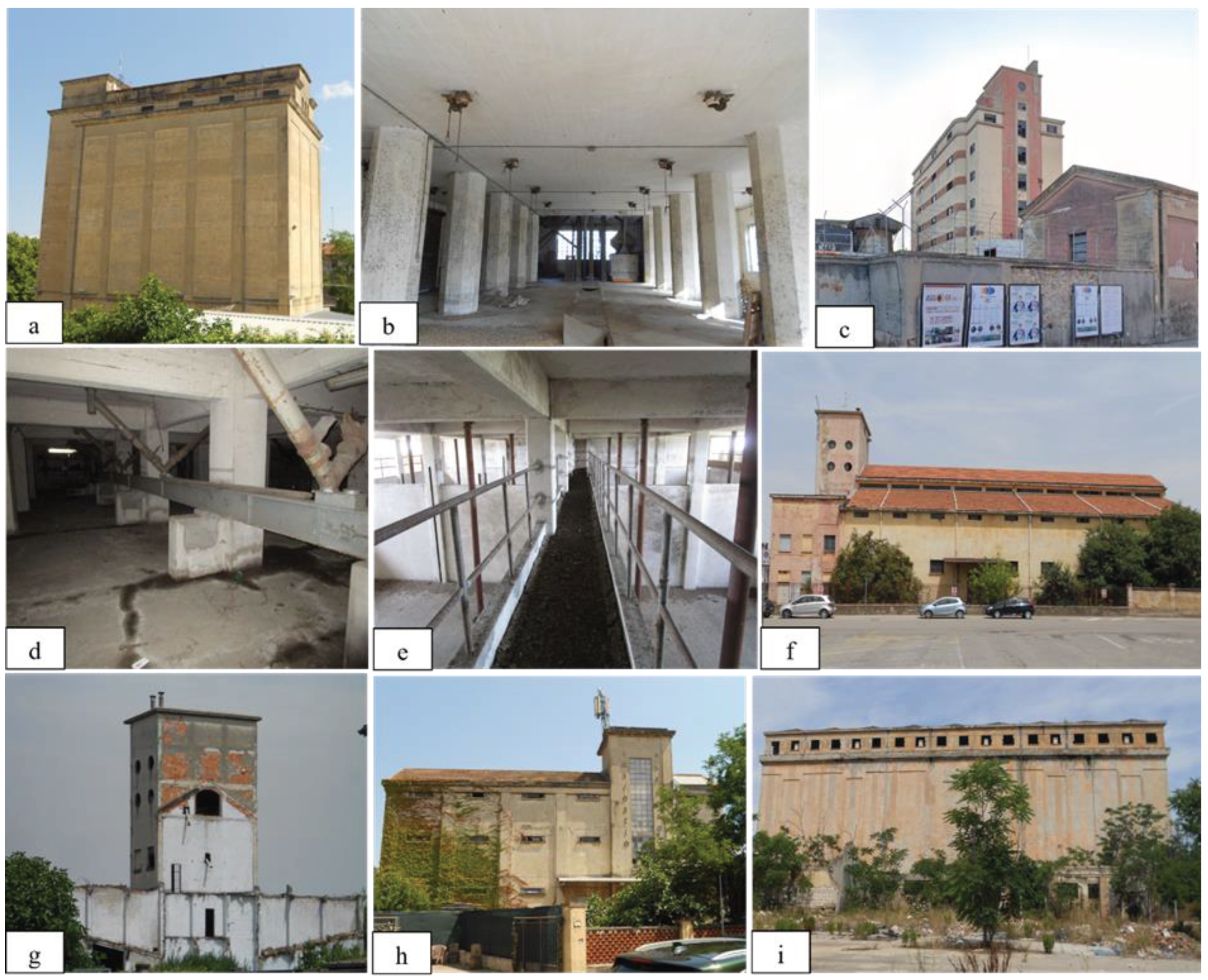
The silos may be divided into three very distinct types (Figures 5.a, b, & c). (i) First, there are the vertical-cell silos, which account for 30.0% of the surviving silos. They characteristically have square or rectangular storage cells several dozen metres tall (Figure 6.a). Grain is loaded into cells through the storey above the cells and is generally emptied through apertures on the ground floor, which is usually 4.5-5.0 m tall (Figure 6.b). These silos greatly resemble silos in Spain [39,45], which have square cells measuring 4 or 5 m per side. However, they differ from Spanish silos in that Italian silos are made entirely of reinforced concrete, while Spanish silos, although built 20 to 30 years later, are made primarily of reinforced brickwork, with concrete pillars only at the cell corners [37]. Storage capacity ranges from 2,900 tons at the silo in Asciano di Sena to a massive 40,000 tons at the silo in Foggia, which earned the nickname ‘il granaio d’Italia’. Cells are square and are elevated above the first floor, except in the Arezzo silo, which has square and rectangular cells resting directly on the flooring of the ground floor.
(ii) Secondly, there are silos with horizontal floors (Figure 6.c). These characteristically have a basement, a ground floor, and two to five upper storeys, depending on the scale of the silo. Silos with horizontal floors account for 53.3% of the surviving silos. Grain is loaded into cells from above, through the storey above the last grain storage floor, in the silo’s central area. Grain is offloaded in the basement, into which the cells’ discharges open (Figure 6.d). These silos’ structure is very similar to that of an office or residential building and consists of reinforced concrete beams, horizontal slabs, and vertical pillars. Capacity ranges from 1,900 tons at the silo in Saline di Volterra to 16,000 tons at the Piacenza silo, which has six storage floors (ground floor and five upper storeys). The cells in this type of silo are all 4x4 m square, and in almost all cases the separations between cells are wooden dividers that can be moved to combine or separate adjacent cells (Figure 6.e). On some floors, a smaller number of 8x8-m cells is commonly found. Each storey is 5 m tall in all silos of this type. When in service, the storage floors are not filled right up to the top: enough space is left for inspecting the grain.
(iii) Thirdly, there are silos that have only three rows of cells (Figure 6.f). The first and third rows are positioned laterally and are symmetrical with respect to the longitudinal axis of the silo, while the second row is centrally located. The central row rests directly on the floor of the silo’s ground floor, below which is a gallery for grain extraction. On both sides of the silo, the first floor slopes downward towards the centre of the silo; this sloping floor forms the bottoms of the cells belonging to the two lateral rows (Figure 6.g). Grain slides down the slope to the underground gallery beneath the central row of cells, where the lower horizontal grain transport system is situated. Only five silos of this type have been found (16.7% of those studied). All of them have a frontal tower sandwiched between cells and/or offices. Four of these silos are practically identical, each having a capacity of 3,500 t. The silo in San Lazzaro di Savena, however, has a much shorter tower than the others. The silo near the Gagliano railway station is almost gone; only its elevator tower and offices remain standing (Figure 6.g). Silos of this type have rectangular cells in their two outer rows and square cells in their central row. It is evident that the storage capacity of ammasso silos varies widely and depends on silo type. Much the same occurs in Spain, where there are multiple silo types and capacity varies significantly from type to type [5]. Landi (2015) mentions a silo type with multiple cells and hoppers, which matches a type cited in Chapperon’s book [46]. We did not find any silos of these characteristics; perhaps it was a type of which, unfortunately, no specimens remain.
The different silo types are designed so that grain can be stored for shorter periods in the silos with vertical cells and longer periods in the silos with horizontal or sloping cells. The latter two types make it easier to access the grain, measure its temperature, and disinfect it, all of which means better long-term preservation. Also, silos with vertical cells have a higher grain-receiving and -dispatching capacity, which is why they are also referred to as transit silos [28]. All silos are designed with a rectangular layout and a variable number of cell rows. Most silos have four rows, although there are some exceptions, such as the Gravina in Puglia silo, with eight rows, or the Foggia silo, with 24. Similarly, the number of cells per row increases depending on the silo’s storage capacity. Cell height follows a similar pattern. The tallest cells belong to the vertical-cell silos, several of which have cells 20 m tall. Overall silo height varies widely from 16 to 40 m, with silos with horizontal floors at both ends of the scale. These heights are in line with those of Spanish silos from the 1950s and 60s, which rarely exceed 30 m [37], while the silos in Portugal’s EPAC network are much loftier, up to 70 m tall [23]. Cell position also depends on silo type. In all vertical-cell silos except one (the Arezzo silo), the cells are raised above the floor, leaving the ground floor clear for unloading and handling grain. Meanwhile, in silos with floors and silos with a ground floor and a sloping first floor, the cells rest directly on the flooring of each upper floor or on the ground floor. All silos feature one or more receiving hoppers where the wheat is offloaded from transport vehicles (truck and/or train) and falls into a pit, to be lifted to the top of the silo later. Each silo also has an elevator tower that resembles those found in Spanish and Portuguese silos, naturally enough, as it performs the same function [31,39]. The tower houses the elevator or elevators that lift the grain high enough that it can be dropped into the tops of the cells. Therefore, the tower is always the highest part of the silo by several metres. The machinery used for cleaning and selecting seeds and for weighing is also located in the tower. All towers have a staircase from the ground to the top level above the cells and the various levels in between. In only two of the studied silos (Pordenone and Piacenza) is there a retrofitted lift to the various floors of the tower. The position of the tower in the silo varies. In 33.3% of the silos, it is in a frontal position; in 46.7% it is in a frontal position but sandwiched between storage cells or floors where offices or silo machinery are located; in another 16.7% it is centrally located and flush with the structure of the silo, and only in one silo (Saline di Volterra) is it in an eccentric position, but there too it lies flush with the silo itself (Figure 3). All silos are roofed. When the top floor containing the upper horizontal transport machinery runs the entire width of the silo, a single roof covers the entire silo. In other cases, where a narrow top floor runs like a central crest along the length of the silo, the top floor has its own roof, and two separate roofs cover the shoulders of the building below. In 43.3% of the extant silos, there is a flat roof. In 23.3%, there is a flat roof over the tower and a symmetrical gable roof over the rest of the silo. Twenty percent of silos have a symmetrical gable roof. Four silos have a sawtooth roof, either because they are so large (Foggia, Bergamo, and Rovato) (Figure 6.i) or because the initial roof was modified during the silo’s renovation (Solaro).
Figure 5.
Cross-section and plan view of three ammasso silo types. a) Vertical-cell silo; b) Silo with horizontal floors; c) Silo with ground floor and sloping first floor.
Figure 5.
Cross-section and plan view of three ammasso silo types. a) Vertical-cell silo; b) Silo with horizontal floors; c) Silo with ground floor and sloping first floor.
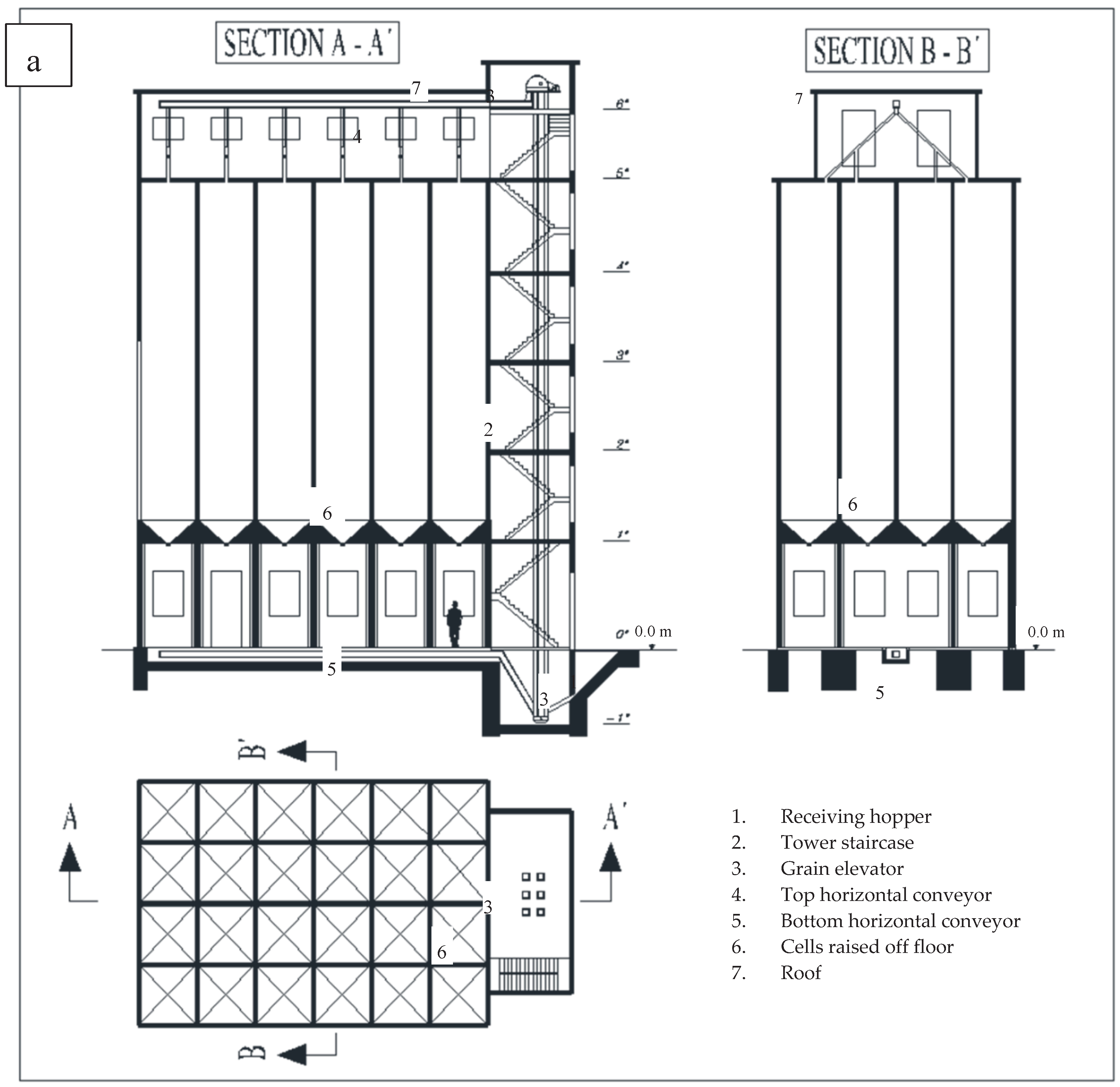
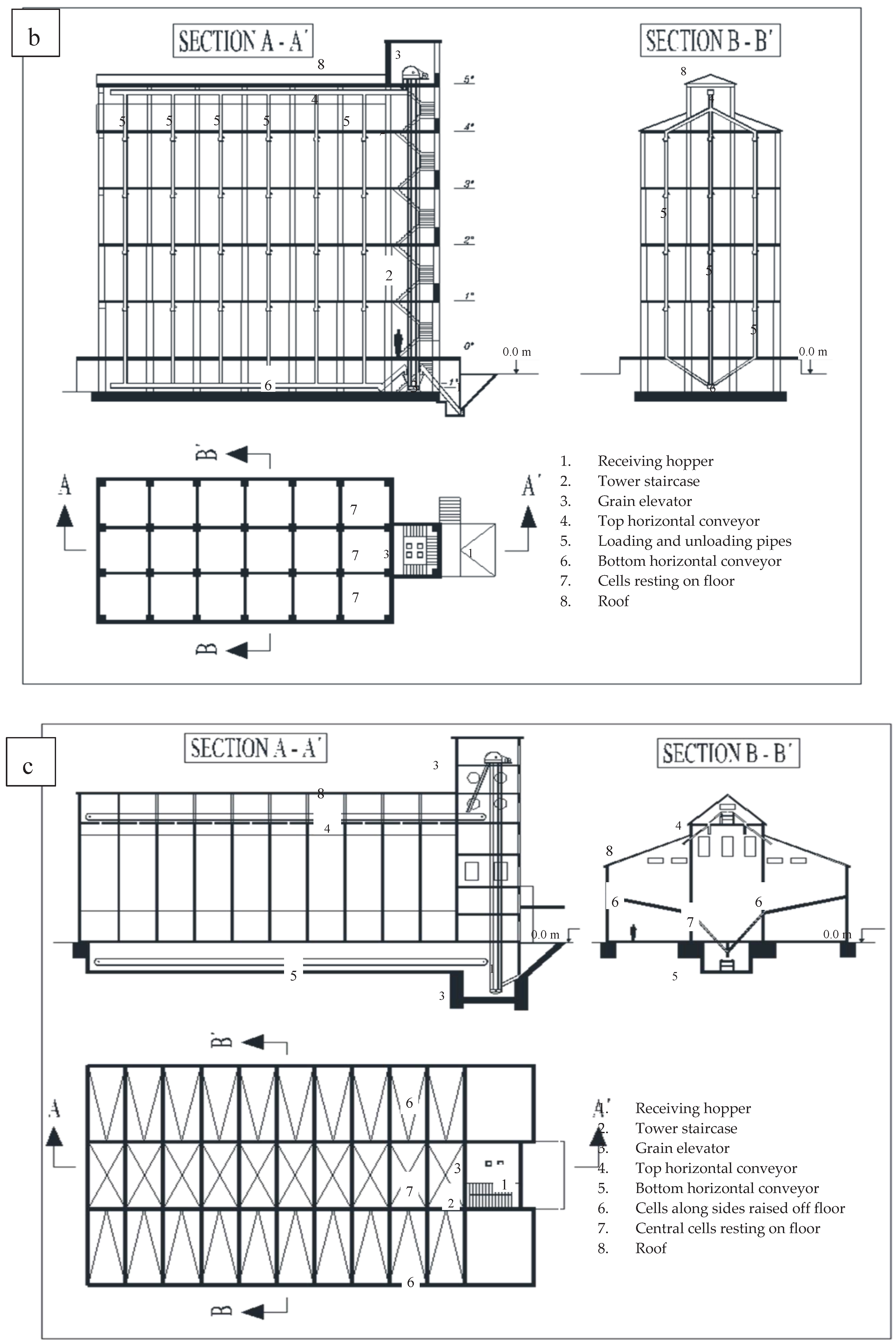
Figure 6.
Construction details of ammasso silos: a) vertical-cell silo at Asciano di Siena, Siena; b) ground floor of vertical-cell silo at Albinia, Grosseto; c) silo with floors at Cagliari, Metropolitan City of Cagliari; d) basement in silo with floors at Bondeno, Ferrara; e) detail of cells and inspection corridor in silo with floors at Bondeno, Ferrara; f) silo with ground floor and sloping first floor at Corbetta, Milan; g) detail of the sloping cells in silo at Gaggiano, Milan; h) eccentric tower flush with the wall of the silo at Saline di Volterra, Pisa; i) sawtooth roof on silo at Foggia, Foggia.
Figure 6.
Construction details of ammasso silos: a) vertical-cell silo at Asciano di Siena, Siena; b) ground floor of vertical-cell silo at Albinia, Grosseto; c) silo with floors at Cagliari, Metropolitan City of Cagliari; d) basement in silo with floors at Bondeno, Ferrara; e) detail of cells and inspection corridor in silo with floors at Bondeno, Ferrara; f) silo with ground floor and sloping first floor at Corbetta, Milan; g) detail of the sloping cells in silo at Gaggiano, Milan; h) eccentric tower flush with the wall of the silo at Saline di Volterra, Pisa; i) sawtooth roof on silo at Foggia, Foggia.
3.4. Technological facilities
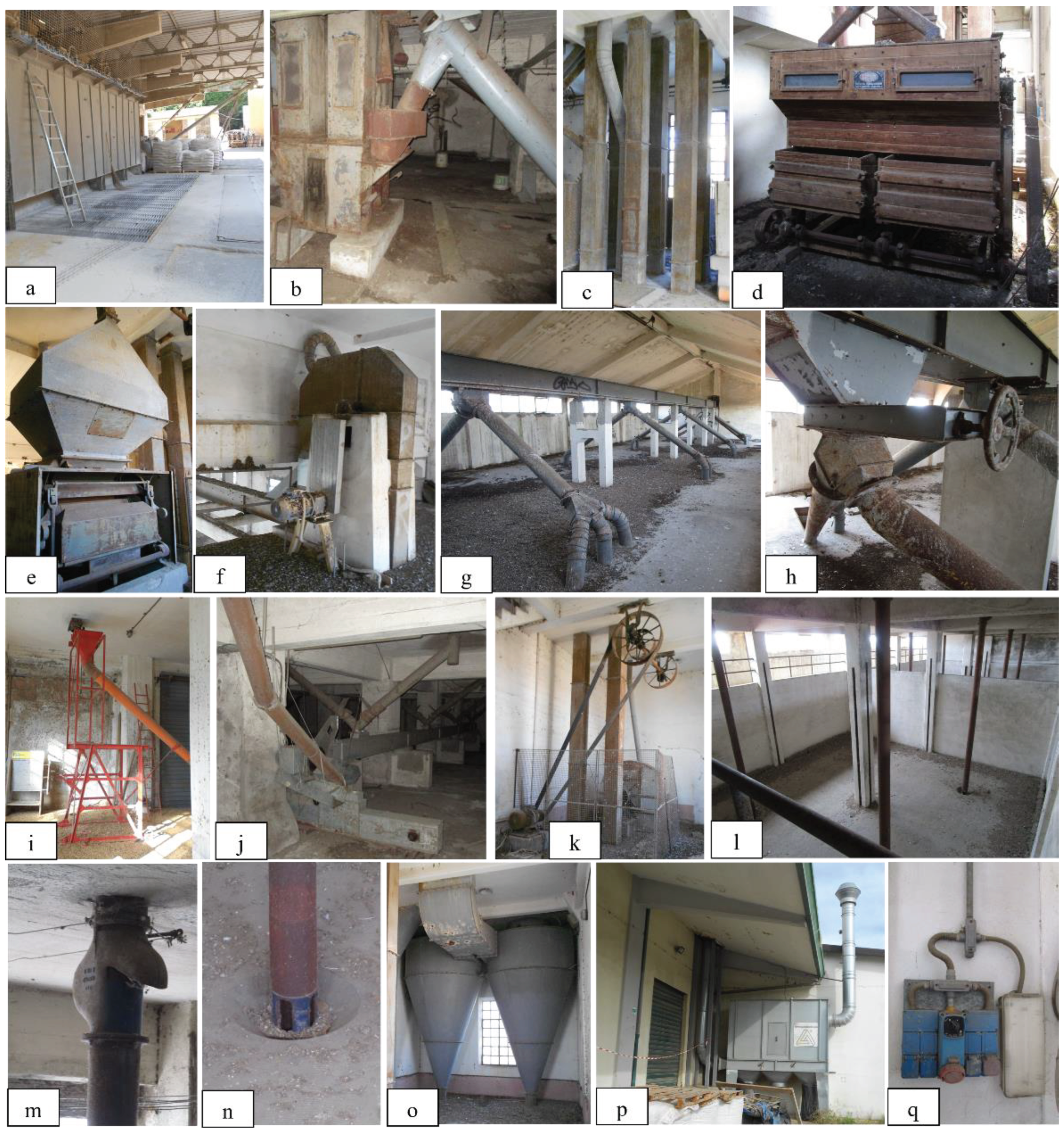
Wheat reception in a silo begins with weighing the transport vehicle on a scale. Next, the wheat is unloaded into an external reception hopper located at ground level. This hopper typically has a protective cover to keep out rainwater (Figure 7.a). The grain falls to the bottom of the hopper and is carried from there by a bucket elevator to the top of the silo, where it is tipped into the cells. It is common for there to be some distance between the reception hopper and the elevator, so screw conveyors are often used to carry the wheat closer to the elevator (Figure 7.b). In silos of the type with a ground floor and a sloping first floor, there is a single vertical elevator located in the tower. Therefore, only one operation can be carried out at a time, either storing wheat or extracting wheat; two or more can never be carried out simultaneously. This type of silo can be considered the most rudimentary in the network. In the vertical-cell silos and silos with floors, there are at least two elevators, maybe more; the giant silo at Foggia has six. One of the elevators commonly goes all the way to the top of the silo, and the other one or two go to intermediate floors of the tower (Figure 7.c), where wheat-cleaning and -weighing machinery is housed; wheat is fed into these machines only when they are necessary (Figures 7.d & e). So, several operations can be carried out simultaneously (filling cells, extracting wheat, and cleaning, weighing, bagging, and dispatching wheat). All elevators have a rectangular shaft through which a belt ascends on one side and descends on the other, with metal buckets that lift the wheat to the top. The ammasso elevators are similar in features to the elevators in Spanish and Portuguese silos [39]. The elevators that run to the top of the silo tip their load onto an upper horizontal conveyor that drops the grain through pipes into the cells (Figures 7.f & g). If the silo is large and one conveyor is not enough, multiple units are installed, as seen in the Rome and Gravina in Puglia silos (four elevators) and the Foggia silo (six elevators). The conveyors consist of a square- or rectangular-section casing through which a chain with crossbars moves, dragging the grain. The grain is shunted to the different cells through gates in the bottom of the conveyor casing, which are manually operated (Figure 7.h). The cells are emptied by opening the hatch covering the discharge opening at the bottom of each cell. This hatch is manually operated, usually by pulling a chain. The grain is directed onto the lower horizontal conveyor through a discharge chute, which may be portable or permanently installed. The lower horizontal conveyor in turn carries the wheat to the end of the conveyor, where it is offloaded onto another elevator (Figure 7.i). From this point, the wheat can be dispensed in bulk or put through cleaning and/or sorting, weighing, or bagging, as needed. The lower conveyor, like its upper counterpart, may be a single unit or may have multiple units that unload onto another transverse conveyor, which feeds one or more elevators in its turn (Figure 7.j). Silos with a ground floor and a sloping first floor have no horizontal conveyors as such. That function is performed by two rubber conveyor belts equipped with a tripper car that moves along two rails. Depending on its position, it diverts the flow of grain to one cell or another. In some other silos, such as those in Arezzo and Piacenza, similar systems were initially used but were later replaced by the chain conveyors described above [27]. A system using belts and pulleys to drive the various machines was found in several silos. This system was later replaced by direct-drive electric gear motors (Figure 7.k). The system used in silos with floors to fill the different levels is ingenious. Wheat is dropped in from the upper horizontal conveyor through a system of vertical pipes running down through all levels of the silo, with at least one pipe per cell (Figure 7.l). Near the ceiling of each storey, there is a manually operated valve remotely controlled by cables and counterweights. Depending on this valve’s position, the wheat falling through the vertical pipe either fills the cell at that level or continues its downward path to the cell of whichever level below has its valve in the open position (Figure 7.m). There are slots all around the pipe’s perimeter where the pipe meets the cell floor. The wheat stored in the cell slips through these slots into the pipe; that is how the cell is emptied. Since the cells are flat bottomed, manual assistance is required to empty them completely (Figure 7.n). Except for the silo type with a ground floor and a sloping first floor, which has no vacuum system (13.3% of the silos), in the rest of the silos (86.7%) there is a pneumatic dust collection system at all dust emissions points. The system is equipped with a venting fan, a cyclone separator, and a mesh filter, which together force the coarser particles to settle for collection (Figures 7.o & p). Although built in the 1930s, these silos have the technological advantage over Spanish silos from the 1950s and 1960s, which were rarely outfitted with dust collection systems [39]. In all the silos, the wiring runs inside protective conduits, because dust particles in suspension in the atmosphere inside the silos pose a high risk of explosion (Figure 7.q). In the type with a ground floor and a sloping first floor, and in the silo belonging to the flour factory in Pordenone, there is no wheat-cleaning machinery. Cleaning is done at the flour mill just before milling. In the rest of the silos, wheat-cleaning machines are located in the elevator tower at different heights, much as in Portuguese and Spanish silos. This machinery removes impurities from the grain and may even select seeds for future crops [37]. Information on machinery performance proved a challenge to find. Grain elevators constrained silo operations more than any other item of equipment, since elevators installed in the 1930s could lift only around 15 t/h. Larger silos (mainly Foggia, Rome, Gravina in Puglia, and Piacenza) achieved daily throughputs of 500 t in 8-9 hours [14], and their higher degree of mechanization made it possible to run receiving, dispatching, cleaning, weighing, and even seed selection operations simultaneously. In their time, each of these silos was truly a building/machine complex, as Azcárate (2009) termed modern Spanish silos. In our study, only 26.7% of the silos had railway reception and dispatch facilities. It was not until later decades (the 70s and 80s) that the railway became consolidated as a crucial advancement and one of the most important means of transport in European grain distribution, according to Barciela (1997) [47]. The ammasso silos sited along railway lines performed the same functions as the ‘transition and reserve’ silos built by Spain’s national network of silos and granaries, which collected wheat from smaller silos and stored it, at strategic locations selected for their good road and railway connections, until the wheat could be marketed [5,48].
3.5. Socioeconomic aspects and reuse possibilities
At present, just over half of the surviving ammasso silos are unused. Only 20.0% are still being used for grain storage, but that figure is shrinking. Repurposing projects do not abound, especially for silos of the vertical cell type, which are extremely expensive to remodel. Vertical cell silos are quite tall and consist of small cells, so they are challenging to adapt to new uses [37]. Silos with floors, on the other hand, are much easier to refurbish and repurpose. Their open ground floor design makes them good candidates for transformation into cultural centres, museums, etc., a trait these silos share with certain other agro-industrial constructions, like slaughterhouses and flour mills [49,50].
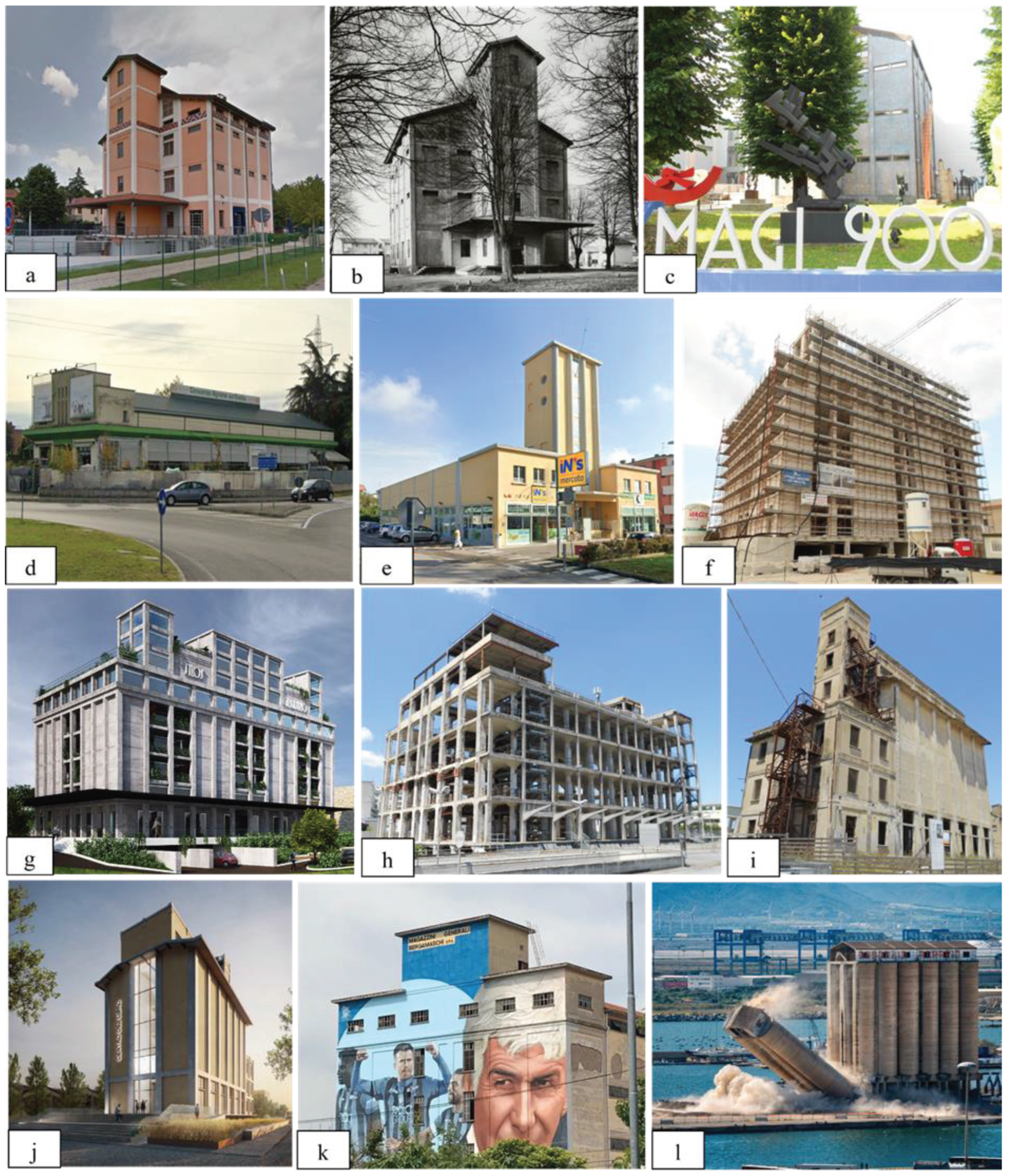
A number of innovative ammasso silo-repurposing projects have been completed or are now in progress. For example, following municipal intervention, the silo in Budrio is now a multi-purpose culture and leisure space for the town. The silo in Castel San Pietro Terme has been renovated and now houses several clothing stores (Figure 8.a). The silo in Pieve di Cento, which has a basement, a ground floor, and two additional storeys, has been transformed into the MAGI 900 private museum, home to the painting and sculpture collection of its patron, Giulio Bargellini. After renovation in 2000 by the renowned architect Giuseppe Davanzo, the museum was enlarged and gained new spaces in 2006 and 2015 [51] (Figures 8.b & c). The silo in San Lazzaro di Savena was remade into a warehouse and shop for the agricultural consortium Consorzio Agrario dell’Emilia, and the silo in Solaro now houses a supermarket and the town pharmacy (Figures 8.d & e). Four other silos are being rehabilitated for a second life right now as well. The silo in Gravina in Puglia, in the province of Bari, is being transformed into the Habitat Granario residential building, with 24 apartments and two penthouses [52] (Figures 8.f & g). Meanwhile, the silo in Rome, the Granario dell’Urbe, built in 1935 by the architect Tullio Pasarelli, started undergoing remodelling to house Città del Gusto di Roma, a leisure and dining space. During construction the plan was modified to envision 400 luxury apartments, setting off loud protests and complaints. The judicial authorities have stepped in, and the project is currently on hold [44,53] (Figure 8.h). Something similar happened to the silo in Porto San Giorgio in the province of Fermo. Meanwhile, on the island of Sardinia, in the locality of Arborea, former Mussolinia, a vertical-cell silo with a capacity of 2,500 tons is being transformed into a culture venue called ‘Il Centro del Libro di Arborea’, with a joint municipal and regional government investment of almost two million seven hundred thousand euros (Figures 8.i & j). Some silos have been used as canvases for urban art. This is the case of the silo in Bergamo, where several football players and their coach were painted in 2018 after the Atalanta de Bergamo football team’s big wins (Figure 8.k). There are other, non-ammasso silo projects as well. For instance a 1950s silo with hexagonal vertical cells was converted into a permanent exhibition space by designer Giorgio Armani in 2015 to mark the 40th anniversary of his career [27]. The silo in the port of Livorno, built in 1924 to store various incoming and outgoing granular bulk products, ceased operating as a silo in the 1980s and has since been transformed into an events venue. The port silo in Genoa, dubbed the ‘Silo Hennebique’ after its builder, François Hennebique, who patented a reinforced-concrete silo construction system around 1892, has also found a second life. This 210x40-m, five-storey rectangular silo was inaugurated in 1903 and enlarged in 1924, eventually reaching a capacity of 44,000 tons. It was used for storing and transferring grain between ships and trains and remained active until the 1980s [54]. Located strategically next to the marine station, it is being made over into a cruise terminal, hotel, student residence, and multicultural space with an investment of 130 million euros paid for jointly by the port authority, the city, and the regional government [55].
Several silo projects in other countries have met with varying degrees of success. In southern Spain, in Pozoblanco, province of Córdoba, builders raised a new theatre building that seats almost 1,000 people next to a silo that was incorporated into the new structure [56]. Also in the southern province of Córdoba, the silo in Alcaracejos has been transformed into a spa resort and economic engine for the region. In northern Spain, in Belorado, in the province of Burgos, a silo from 1958 with a capacity of 1,900 tons was transformed into the Inocencio Bocanegra International Radiocommunication Museum [57]. In northern Portugal, the Braganza silo is being remodelled to house the Museum of the Portuguese Language, after a public investment of almost 11 million euros, some of which is financed with European funds. Meanwhile, in southern Portugal near Tavira, in the Algarve region, in 2020 a silo began to be transformed into Museo Zer0, the first digital art museum in Portugal and Europe [58].
Figure 7.
Examples of reused silos. a) silo at Castel San Pietro, Metropolitan City of Bologna, today; b) 1950s silo at Pieve di Centro, Metropolitan City of Bologna (photo: MAGI 900 museum archive); c) silo at Pieve di Centro, Metropolitan City of Bologna, today; d) silo at San Lazzaro di Savena, Metropolitan City of Bologna, today; e) silo at Solaro, Metropolitan City of Milan, today; f) Silo at Gravina in Puglia, Bari, today; g) 3D view of the future Habitat Granario building at Gravina in Puglia, Bari; h) Silo at Rome today; i) silo at Arborea, Oristano, today; j) 3D view of the future Centro del Libro di Arborea in Arborea, Oristano, k) Painting on the silo tower in Bergamo, Bergamo; l) demolition of the Cagliari port silo, Sardinia (photo: Corrieri della Sera).
Figure 7.
Examples of reused silos. a) silo at Castel San Pietro, Metropolitan City of Bologna, today; b) 1950s silo at Pieve di Centro, Metropolitan City of Bologna (photo: MAGI 900 museum archive); c) silo at Pieve di Centro, Metropolitan City of Bologna, today; d) silo at San Lazzaro di Savena, Metropolitan City of Bologna, today; e) silo at Solaro, Metropolitan City of Milan, today; f) Silo at Gravina in Puglia, Bari, today; g) 3D view of the future Habitat Granario building at Gravina in Puglia, Bari; h) Silo at Rome today; i) silo at Arborea, Oristano, today; j) 3D view of the future Centro del Libro di Arborea in Arborea, Oristano, k) Painting on the silo tower in Bergamo, Bergamo; l) demolition of the Cagliari port silo, Sardinia (photo: Corrieri della Sera).
In Norway, in Oslo, a silo has been made over into the Grünerløkka student quarters [59]; in Copenhagen, twin 42-metre-tall reinforced concrete silos, built in 1963 and unused since 1990, were transformed into the Gemini Residence buildings in 2005 [28]. Moscow’s Tank 41 silo has been turned into a theatre [60]. These are some of the successful cases of grain silo repurposing.
Italy’s ammasso silos are trending toward destruction. Only 30 units still stand today. In some cases, the disappearances are very recent. For example, the port of Cagliari on the island of Sardinia used to be home to a vertical-cell silo with a capacity of 23,000 tons. This silo was used by the agricultural consortium until 2011 but was demolished in 2021 to make more room for the ferry terminal car park (Figure 8.l). The silo in Lodi, in the Lombardy region, was demolished in 2021 and is now an empty lot next to the bus station.
Fortunately, citizens are becoming increasingly aware of the need to utilize existing buildings and avoid unnecessary new construction that makes the carbon footprint bigger [59,61,62,63,64]. There is also a growing trend of tourism based on ethnographic and industrial assets (old mills, wineries, mining structures, etc.), transforming these once-abandoned and useless ruins into recognized elements of the country’s cultural heritage that have great potential for highlighting the virtues of the surrounding territory [21,65]. All of this places increasing citizen pressure on the authorities to take action and protect the silos that remain by transforming them into buildings with potential for alternative uses. The examples found in other countries can be extrapolated to the ammasso silos in Italy. Based on the socioeconomic data in Table S2, a sizeable 40% of the surviving silos are located in cities with over 40,000 inhabitants (nine of them in provincial capitals), where repurposing into a cultural resource is feasible and silos could be converted into local economic engines. The population centres that still have silos can be classified into two groups on the basis of the features analysed in this study. The first is the group of cities with over 40,000 inhabitants, good connections by road and (in almost all cities in the group) by rail, with a stable or growing population, an adequate municipal budget, and a thriving service sector. In these cities, it would be feasible to invest public funds in silo refurbishment. The second group contains towns and villages with fewer than 40,000 inhabitants (five of them have under 10,000), with a stable or declining population, and a much more modest municipal budget. Many of them have poor connections, and most have an economy based on the primary sector. Here only small investments to enhance rural development can be recommended, as long as maintenance costs are low, according to Mateo (2011).
4. Conclusions
The 20th-century ammasso grain storage silos have been inventoried using an adaptation of the methodology of Fernández-Fernández et al. (2023) for Spanish silos, and a detailed overview of their current situation has been procured. Out of approximately 900 silos originally built, only 30 remain standing, and the recent demolition of four specimens underscores the urgency of their preservation. Constructed in the 1930s, these silos, strategically located in wheat-growing areas near communication routes, have endured for almost a century, and many are still owned by agricultural consortia. The majority of the silos (53.3%) are closed and in disrepair. Only 20.0% are still used to store grain. Their condition varies widely from good to in ruins. The processes of grain reception, storage, and dispatch in these silos have been explained in detail from a technological perspective. The processes primarily involve bucket elevators and horizontal conveyors. Some silos have multiple elevators and therefore the capacity for simultaneous operations. Common features include vacuum-based dust collection systems and machinery for cleaning, sorting, and weighing wheat, typically in the silo tower.
The possibility of repurposing ammasso silos for different uses than originally intended is now being explored, given that over half of the network is unused. Tangible projects, however, do not abound, especially for vertical-cell silos, which are expensive to adapt. Horizontal plant silos are much easier to reuse. Successful examples of silo reuse in Italy and other countries for commercial, leisure, and even residential purposes have been pointed out.
The importance of preserving these silos as part of Italy’s cultural heritage has been emphasized. Growing societal awareness of sustainability and the importance of reusing existing buildings instead of constructing new ones has been noted as well. Reused silos could be converted into cultural and economic assets for towns that have the right socioeconomic conditions, such as infrastructure and municipal resources. In short, this paper represents the first step in inventorying and reclaiming these Italian silos. Subsequent studies may design refurbishment proposals for specific ammasso silos.
Supplementary Materials
The following supporting information can be downloaded at the website of this paper posted on Preprints.org. Table S1: Information on 34 ammasso silos; Table S2: Indicators for 30 municipalities in Italy, the sites of 30 silos.
Author Contributions
V.M., S.F., P.P., F.J.L., and J.B.V. contributed to the concept and design, acquisition, analysis, interpretation of data and drafting of the manuscript. All authors have read and agreed to the published version of the manuscript.
Funding
This research received no external funding.
Data Availability Statement
Not applicable.
Acknowledgments
The authors would like to express their gratitude for the hearty collaboration of agricultural consortia, private companies, and other entities that own the silos, and the invaluable cooperation of the cities, towns, and villages in whose territory the silos are located.
Conflicts of Interest
The authors declare no conflict of interest.
References
- Teague, W.D. Flour for Man’s Bread: A History of Milling; Minnesota Archive Editions: New York, NY, USA, 2007. [Google Scholar]
- Tucci, P.L. La controversa storia della Porticus Aemilia. Archeologia Classica 2012, 63, 575–591. https://www.academia.edu/2209356/La_controversa_storia_della_Porticus_Aemilia.
- Banham, R. A Concrete Atlantis. US Building and European Modern Architecture; MIT Press: Massachusetts, U.S, 1989. [Google Scholar]
- Salido, J. El almacenamiento de cereal en los establecimientos rurales hispanorromanos. In Horrea d'Hispanie et de la méditerranée romaine; Arce., J., Goffaux, B., Eds.; Casa Velazquez: Madrid, Spain, 2011; pp. 127–142. [Google Scholar]
- Fernández-Fernández, M.V. Catalogación de las unidades de almacenamiento vertical de cereales de la red básica de Castilla y León, propuesta de una nueva clasificación y posibilidades de reutilización. Level of Thesis, Universidad de león, León, Spain, 29 January 2016. [Google Scholar]
- Ferreira-Lopes, P.; Mateo, C.; Landi, S. La historia y fundamentos de la construcción de la Red Nacional de Silos mediante un análisis comparativo entre España, Italia y Portugal. In Proceedings of the XII congreso nacional y IV congreso internacional hispanoamericano de Historia de la construcción, Mieres, Spain, 4 - 8 october 2022; pp. 381–393. [Google Scholar]
- Profumieri, P. L. La Battaglia del grano: costi e ricavi. Rivista di Storia dell’Agricoltura, 1971, 2. [Google Scholar]
- Preti, D. La política agraria del fascismo: note introduttive. Studi Storici, núm. 4. In Le Campagne Emiliane in periodo fascista. Materiali e Ricerche sulla Battaglia del Grano. Annale n.º 2, 1981-1982; Legnani, M., Preti, D., Rochat, G., Eds.; CLUEB: Istituto Regionale per la Storia della Resistenza e della Guerra de Liberazione in Emilia Romagna: Bologna, Italy, 1973. [Google Scholar]
- Preti, D. Per una storia agraria e del malessere agrario nell’Italia fascista: la battaglia del grano. In Le Campagne Emiliane in periodo fascista. Materiali e Ricerche sulla Battaglia del Grano. Annale n.º 2, 1981-1982; Legnani, M., Preti, D., Rochat, G., Eds.; CLUEB: Istituto Regionale per la Storia della Resistenza e della Guerra de Liberazione in Emilia Romagna: Bologna, Italy, 1982. [Google Scholar]
- D’Attorre, P. P. Non di solo pane. Gli agrari bolognesi e la battaglia del grano. In Le Campagne Emiliane in periodo fascista. Materiali e Ricerche sulla Battaglia del Grano. Annale n.º 2, 1981-1982; Legnani, M., Preti, D., Rochat, G., Eds.; CLUEB: Istituto Regionale per la Storia della Resistenza e della Guerra de Liberazione in Emilia Romagna, Bologna, Italy, 1982. [Google Scholar]
- Segre, L. La battaglia del grano. Depressione economica e política cerealicola fascista; CUEM: Milano, Italy, 1984; pp. 20–37. [Google Scholar]
- Prats, J.; Castelló, J.E.; Forcadell, C.; Izuzquiza, I.; García, Mª.C.; Loste, Mª.A. Historia del Mundo Contemporáneo; Anaya: Madrid, Spain, 1996; p. 85. [Google Scholar]
- Barciela, Carlos. Ni un español sin pan. La red nacional de silos y graneros, Universidad de Zaragoza, Zaragoza, Spain. 2007.
- Vaquero, M. I silos granari in Italia negli anni Trenta: fra architettura e autarchia económica. Pratimonio Industriale 2011a, 7, 62–68. [Google Scholar]
- Vaquero, M. Innovation in times of autarky: the construction of the wheat silos in Fascist Italy. Fabrikart 2011b, 10, 264–277. [Google Scholar]
- GU, 1934. Regio Decreto de 21 maggio 1934, n. 821, disposizioni complementari al Regio Decreto Legge 10 giugno 1931, n. 723, concernente l'obbligatorieta' dell'impiego di una determinata percentuale di grano. Gazzetta Ufficiale n. 87 del 6 giugno 1924.
- GU, 1935 Regio Decreto Legge 4 luglio 1925, n. 1181, Istituzione di un Comitato permanente per il grano. Gazzetta Ufficiale n.165 del 18 luglio 1925.
- GU, 1936a Regio Decreto Legge 16 marzo 1936, n. 392, disciplina del mercato granario. Gazzetta Ufficiale n. 65 del 18 marzo 1936.
- GU, 1936b. Regio Decreto Legge 15 giugno 1936, n. 1273, disciplina del mercato granario. Gazzetta Ufficiale n.155 del 7 luglio 1936.
- BOE. Decreto Ley de 23 de agosto de 1937, de ordenación triguera. Boletín Oficial del Estado 25/08/1937: 3025-3028. Available online: https://www.boe.es/datos/pdfs/BOE//1937/309/A03025-03028.pdf (accessed on 30 January 2024).
- Fernández-Fernández, MV, Marcelo, V, Valenciano, JB, and González-Fernández, AB. Characterisation of the National Network of Silos and Granaries in Castilla y León, Spain: A Case Study. Sustainability 2023, 15, 3755. [Google Scholar] [CrossRef]
- Azcárate, C.A. Catedrales Olvidadas. La Red Nacional de Silos en España 1949-1990; Ministerio de Medio Ambiente y Medio Rural y Marino, Madrid, Spain, 2009.
- Alves, J.A. Arquiteturas do Trigo: Espaços de Silagem no Alentejo, do século XIX à atualidade. Degree in architecture, University Évora, Portugal. 22/12/2016. Available online: http://hdl.handle.net/10174/19745 (accessed on 30 January 2024).
- Amaral, L. Política e economia: O Estado Novo, os latifundiários alentejanos e os antecedentes da EPAC. Analise Social 1996, 31, 465–486. [Google Scholar]
- Bornás, G. El hombre, la explotación, el mercado: organización de la economía agrícola dirigida en Alemania; Gráficas Afrodisio Aguado: Madrid, Spain, 1941. [Google Scholar]
- Corni, G. La politica agraria del nazionalsocialismo (1930-1939); Franco Angeli: Milano, Italy, 1989. [Google Scholar]
- Giuliani, F.; De Falco, A.; Landi, S.; Bevilacqua, M.G.; Santini, L.; Pecori, S. Reusing grain silos from the 1930s in Italy. A multi-criteria decision analysis for the case of Arezzo. J. Cult. Herit. 2018, 29, 145–159. [Google Scholar] [CrossRef]
- Landi, S. Italian grain silos in the 1930s. Which reuse? In Proceedings of REUSO 2015. III Congreso Internacional sobre Documentación Conservación y Reutilización del Patrimonio Arquitectónico y Paisajístico, Valencia, Spain, 22-24 October 2015; Universidad Politécnica de Valencia, Eds. 1057-1064. Available online: http://refhub.elsevier.com/S1296-2074(16)30232-1/sbref0610 (accessed on 30 January 2024).
- Landi, S. The Italian Grain Silos in the 1930S. Analysis, Conservation and Adaptive Reuse. UNISCAPE En-Route 2016, a.I-4. [Google Scholar]
- Landi, S. Rural landscapes of the 20th century: from knowledge to preservation. Architecture, Civil Engineering, Environment 2019, 12, 47–56. [Google Scholar] [CrossRef]
- Verde, P. 2010. Representaçao tipológica através da fotografía silos no Alentejo, partindo da obra de Bernd e Hila Becher. Degree in architecture, University Évora, Portugal. 2010. Available online: https://dspace.uevora.pt/rdpc/handle/10174/12180 (accessed on 30 January 2024).
- Ribeiro, I. , Diniz, A. Celeiro Epac. A Paisagem Industrial de Évora. Sciencia Antiquitatis 2019, 2, 153–176. [Google Scholar]
- Maurílio, F. As arquiteturas do cereal em Évora. In Património industrial Ibero-americano: recentes abordagens; Palomares, S., Quintas, A., de Lima, F., Viscomi, P., Eds.; Biblioteca Estudos & Colóquios, Universidad de Evora: Evora, Portugal, 2020; Serie e-books nº 22; Available online: https://books.openedition.org/cidehus/13907.
- Benito, P. Patrimonio industrial y cultura del territorio. Boletín de la AGE 2002, 34, 213–227. [Google Scholar]
- Mateo, C. Red Nacional de Silos y Graneros de España. In Proceedings of the 3rd Int Venue of the Agriculture and Food Productivion Section of TICCIH, Nogent-sur-Seine, France, 20-22 October 2011. Available online: http://www.patrimoineindustriel-apic.com/silo/5reseau%20national.pdf. (accessed on 30 January 2024).
- Palmeiro, A. Postais Ilustradros: UM Olhar sobre os silos do distrito de Portalegre. In Proceedings of the III Seminário de I&DT, Portoalegre, Portugal, 6-7 December 2012. [Google Scholar]
- Fernández-Fernández, M.V.; Marcelo, V.; Valenciano, J.B.; López-Díez, F.J. History, construction characteristics and possible reuse of Spain’s network of silos and granaries. Land Use Policy 2017a, 63, 298–311. [Google Scholar] [CrossRef]
- Fernández-Fernández, Manuel V.; Marcelo, V.; Valenciano, J.B.; Boto, J. Catalogación de los silos pertenecientes a la red española de silos y graneros en Castilla y León. In Proceedings of the IX Congreso Ibérico de Agroengenharia, Braganza, Portugal, 4-6 september 2017b. [Google Scholar]
- Fernández-Fernández, M.V.; Marcelo, V.; Valenciano, J.B.; López, F.J.; Pastrana, P. Spain’s national network of silos and granaries: architectural and technological change over time. SJAR 2020, 18, e0205. [Google Scholar] [CrossRef]
- ICOMOS. International council on monuments and sites. Available online: https://www.icomos.org/en (accessed on 30 January 2024).
- Han, S.; Zhang, H. Progress and Prospects in Industrial Heritage Reconstruction and Reuse Research during the Past Five Years: Review and Outlook. Land 2022, 11, 2119. [Google Scholar] [CrossRef]
- Federconsorzi. 1953. Federazione italiana dei consorzi agrari 1892-1952, Centro Studi e Pubblicazioni: Roma, Italy, 1953. pp. 91–102.
- Vaquero, M. Wheat-Storage in Facist Italy: Evolution and policies. In Property rights and their violations. Expropriations and confiscations, 16th-20th century; Lorenzetti, L., Barbot, M., Mocarelli, L., Eds.; Peter Lang: Bern, Switzerland, 2012a; pp. 263–280. [Google Scholar]
- Vaquero, M. Il “granario dell`Urbe” del Consorzio agrario cooperativo di Roma. Roma moderna e contemporánea 2012b, 1, Año XX, 127-136. [Google Scholar]
- Marcelo, V.; Valenciano, J.B.; López, J.; Pastrana, P. The D5 Silo of Manganeses of the Lampreana (Zamora): History, construction characteristics and technology. AART 2021, 2, 1028. [Google Scholar] [CrossRef]
- Chapperon, R. Silos e magazzini per ammassi granari. Progettazione, costruzione, gestione; Istituto delle Edizioni Accademiche: Udine, Italy, 1936. [Google Scholar]
- Barciela, C.F. 1997. La modernización de la agricultura y la política agraria. Papeles de Economía Española 1997, 73, 112–133. [Google Scholar]
- Moreno, A. Un análisis tecnológico sobre la red nacional de silos y graneros desde la ingeniería industrial en el ámbito agrario: ¿con qué maquinaria y cómo funcionaban? In Proceedings of the I Jornadas de patrimonio industrial agrario: silos a debate, Villanueva del Fresno (Badajoz), Spain, 26-28 September 2014. [Google Scholar]
- Pardo, C.J. El patrimonio industrial en España: Análisis turístico y significado territorial de algunos proyectos de recuperación. Boletín de la Asociación de Geógrafos Españoles 2010, 53, 239–264. [Google Scholar]
- Fuentes, J.M. , López-Sánchez, M., García, A.I.; Ayuga, F. 2015. Public abattoirs in Spain: History, construction characteristics and the possibility of their reuse. J. Cult. Herit. 2015, 16, 632–639. [Google Scholar] [CrossRef]
- MAGI 900. 2024. Museo MAGI 900. Available online: https://www.magi900.com/ (accessed on 30 January 2024).
- Habitat granario. 2024. Available online: https://habitatgranario.it/ 2023 (accessed on 30 January 2024).
- Mazzocchi, G.; Spadazzi, D. Parametric tools for BIM design: case study of "ex-Granaio dell'Urbe" of Rome. Level of Thesis, Politecnico di Torino, Italy, 2022. Available online: http://webthesis.biblio.polito.it/id/eprint/23248 (accessed on 30 January 2024).
- Bertocchini, F. La valorizzazione del territorio attraverso il recupero del patrimonio storico architettonico. Il caso del silo agrario di Albinia (GR). Level of Thesis, University of Pisa, Pisa, Italy, 11/05/2016. Available online: https://etd.adm.unipi.it/t/etd-04192016-112026/ (accessed on 30 January 2024).
- Comune di Genova. Bando pubblico per la ristrutturazione e la gestione del silos Hennebique. Available online: https://www.portsofgenoa.com/it/archivio-notizie/item/1357-hennebique.html (accessed on 30 January 2024).
- JA. Informe final del expediente POZ/2004/SIL sobre la actuación en el silo de Pozoblanco iniciado en 2004; Junta de Andalucía, Consejería de Agricultura, Pesca y Desarrollo Rural, Sevilla, Spain, 2006.
- MIRIB. Museo Internacional de Radiotransmisión Inocencio Bocanegra. Available online: http://www.belorado.es/node/329 (accessed on 30 January 2024).
- MZ. Museo Zer0. Available online: https://www.museu0.pt/ (accessed on 30 January 2024).
- Salazar, A. Del trigo al hombre. Rehabilitar el silo. Level of Thesis, Universidad politécnica de Cataluña, Barcelona, Spain, 15/09/2015. Available online: http://hdl.handle.net/2117/84444 (accessed on 30 January 2024).
- Río, A.S.; Blanco, S. La tempestad en el silo: reutilización de un almacén de grano para representaciones teatrales. In Espacios industriales abandonados. Gestión del patrimonio y medio ambiente, 15th ed.; Colección: Los ojos de la memoria; INCUNA; CICEES, Miguel A. Álvarez Areces: Gijón, Spain, 2015; pp. 433–440. [Google Scholar]
- García, A.I.; Ayuga, F. Reuse of abandoned buildings and the rural landscape: The situation in Spain. ASABE 2007, 50, 1383–1394. [Google Scholar] [CrossRef]
- Fuentes, J.M. Methodological bases for documenting and reusing vernacular farm architecture. J. Cult. Herit. 2010, 11, 119–129. [Google Scholar] [CrossRef]
- Fuentes, J.M.; Gallego, E.; García, A.I.; Ayuga, F. New uses for old traditional farm buildings: The case of the underground wine cellars in Spain. Land Use Policy 2010, 27, 738–748. [Google Scholar] [CrossRef]
- Cano, M.; Garzón, E.; Sanchez-Soto, P.J. Historic preservation, GIS, & rural development: The case of Almería province, Spain. Appl. Geogr. 2013, 42, 34–47. [Google Scholar] [CrossRef]
- Laumain, X.; López, A.; Moreno, J.; Sanchez, D. Turismo como desencadenante de la recuperación de patrimonio industrial. In Proceedings of the III Jornadas de Patrimonio Industrial Activo, Murcia, Spain, 15-16 November 2013. [Google Scholar]
Figure 1.
a) Poster from the Concorso Nazionale per la Vittoria del Grano. b) Mussolini at a meeting on a threshing floor. c) Mussolini driving a tractor on the drained marshes of Agro Pontino (approx. 1930) (Photo: Archivo de la Cámara de los Diputados).
Figure 1.
a) Poster from the Concorso Nazionale per la Vittoria del Grano. b) Mussolini at a meeting on a threshing floor. c) Mussolini driving a tractor on the drained marshes of Agro Pontino (approx. 1930) (Photo: Archivo de la Cámara de los Diputados).
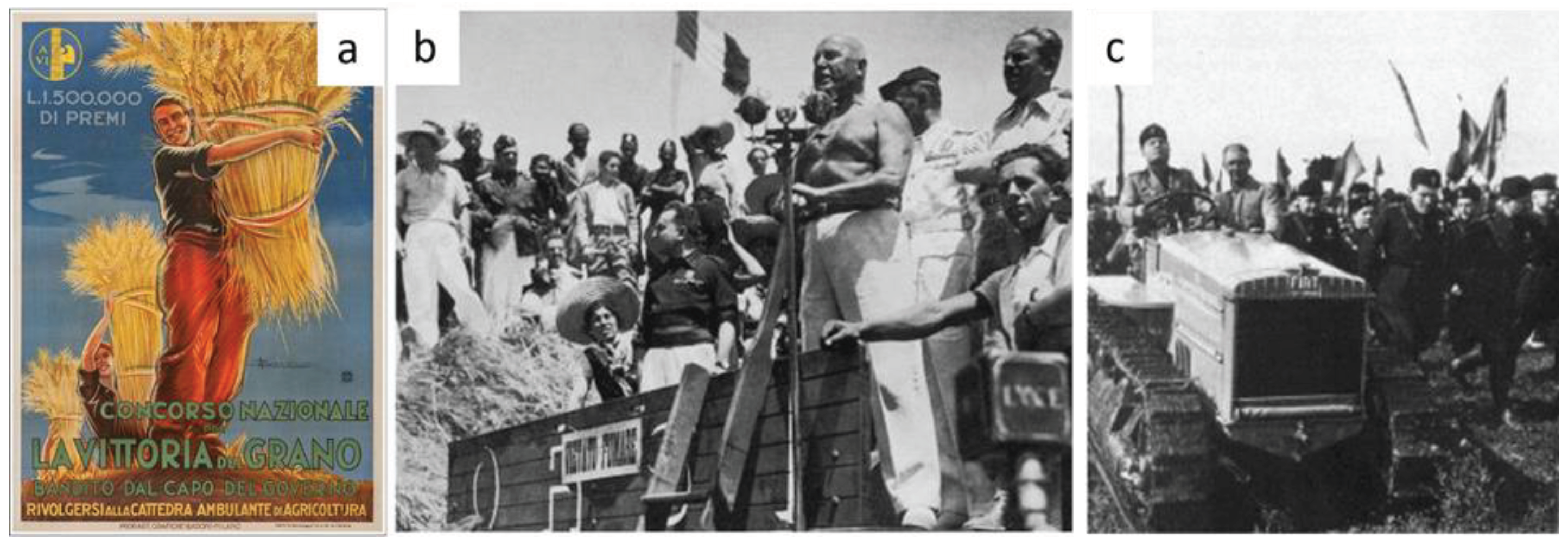
Figure 2.
Methodology workflow.
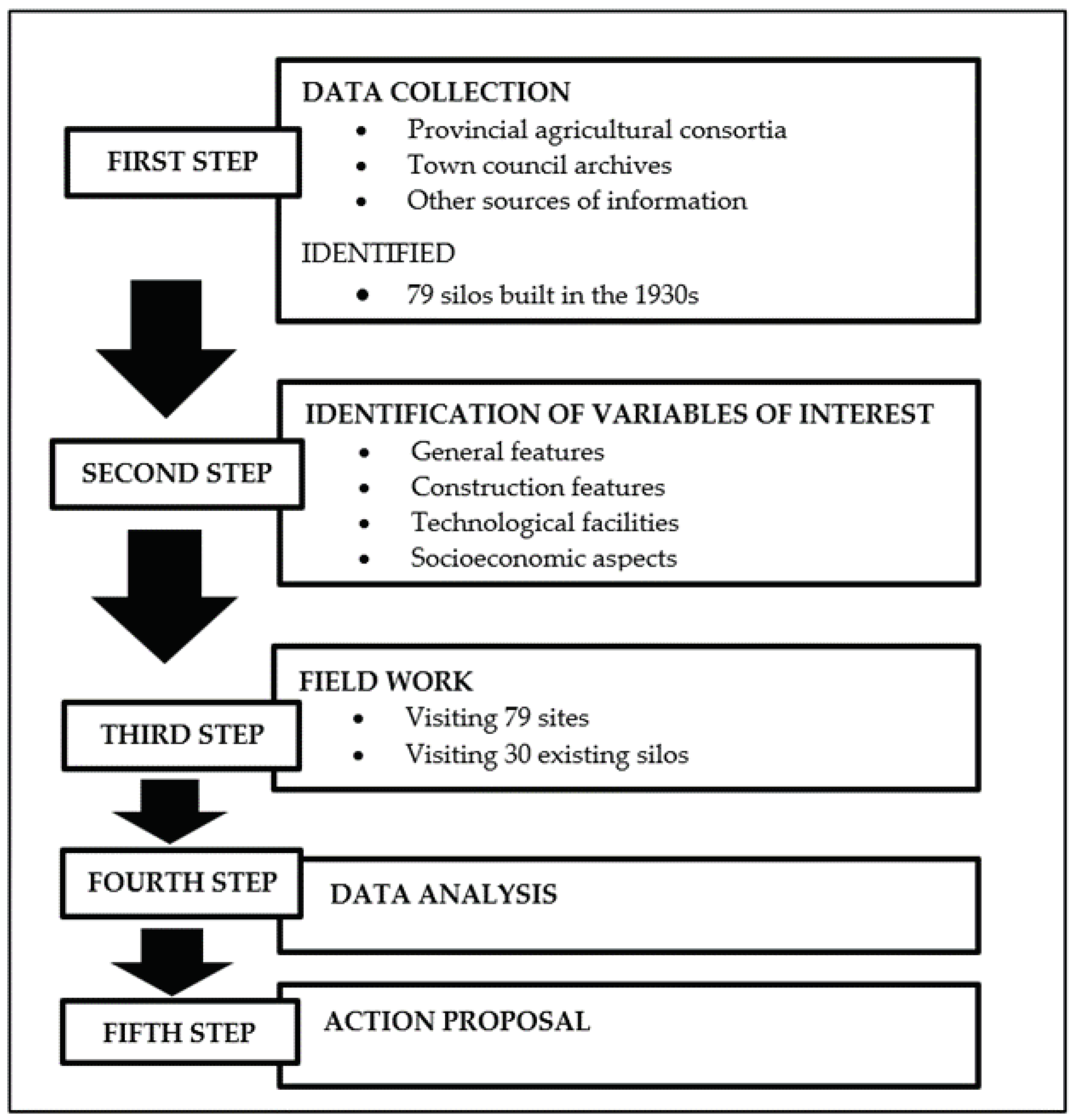
Figure 4.
Left: sites of 79 silos cited by Landi (2019) in Italy; right: sites of 30 ammasso silos still standing.
Figure 4.
Left: sites of 79 silos cited by Landi (2019) in Italy; right: sites of 30 ammasso silos still standing.
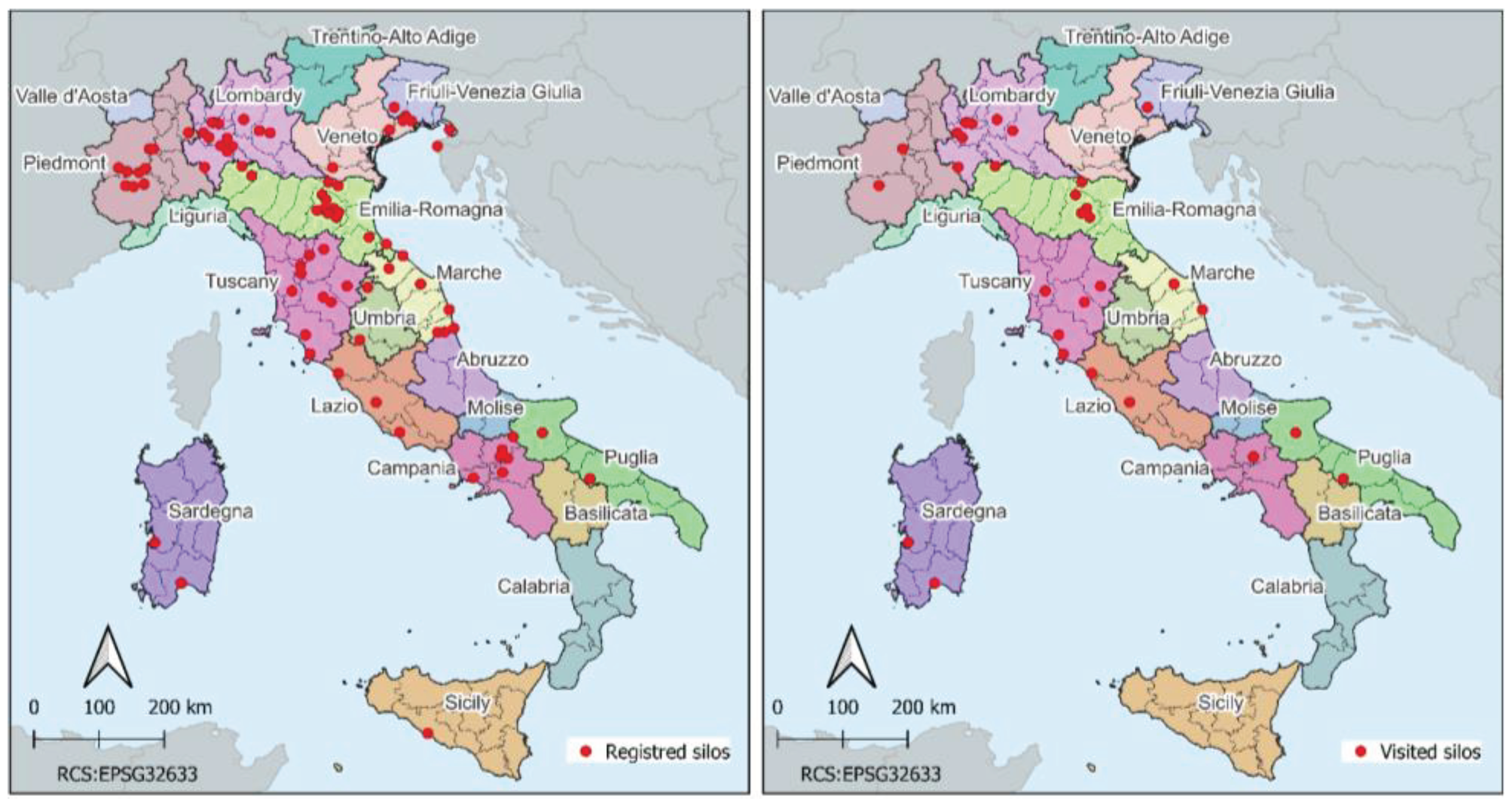
Figure 7.
a) Reception hopper in silo at Asciano di Siena, Siena; b) screw conveyor unloading onto the elevator in silo at Rovato, Brescia; c) grain elevators in silo at Chivasso, Turin; d) wheat-cleaning machine in silo at Piacenza, Piacenza; e) weighing machine in silo at Arborea, Oristano; f) detail of the elevator-unloading area in silo at Tarquinia, Viterbo; g) upper horizontal belt conveyor and loading pipes in silo at Voghera, Pavia; h) detail of the manual discharge valve in silo at Saluzzo, Cuneo; i) mobile discharge chute in silo at Albinia, Grosseto; j) offloading pipes and lower horizontal belt conveyors in silo at Bondeno, Ferrara; k) pulley-and-belt drive in the silo at Albinia, Grosseto; l) cell detail and filling and emptying pipes in silo at Jesi, Ancona; m) detail of filling valve in silo at Jesi, Ancona; n) detail of emptying point in silo at Jesi, Ancona; o) dust collectors in silo at Grosseto, Grosseto; p) mesh filter and exhaust chimney in silo at Benevento, Benevento; q) detail of wiring in silo at Saline di Volterra.
Figure 7.
a) Reception hopper in silo at Asciano di Siena, Siena; b) screw conveyor unloading onto the elevator in silo at Rovato, Brescia; c) grain elevators in silo at Chivasso, Turin; d) wheat-cleaning machine in silo at Piacenza, Piacenza; e) weighing machine in silo at Arborea, Oristano; f) detail of the elevator-unloading area in silo at Tarquinia, Viterbo; g) upper horizontal belt conveyor and loading pipes in silo at Voghera, Pavia; h) detail of the manual discharge valve in silo at Saluzzo, Cuneo; i) mobile discharge chute in silo at Albinia, Grosseto; j) offloading pipes and lower horizontal belt conveyors in silo at Bondeno, Ferrara; k) pulley-and-belt drive in the silo at Albinia, Grosseto; l) cell detail and filling and emptying pipes in silo at Jesi, Ancona; m) detail of filling valve in silo at Jesi, Ancona; n) detail of emptying point in silo at Jesi, Ancona; o) dust collectors in silo at Grosseto, Grosseto; p) mesh filter and exhaust chimney in silo at Benevento, Benevento; q) detail of wiring in silo at Saline di Volterra.
Disclaimer/Publisher’s Note: The statements, opinions and data contained in all publications are solely those of the individual author(s) and contributor(s) and not of MDPI and/or the editor(s). MDPI and/or the editor(s) disclaim responsibility for any injury to people or property resulting from any ideas, methods, instructions or products referred to in the content. |
© 2024 by the authors. Licensee MDPI, Basel, Switzerland. This article is an open access article distributed under the terms and conditions of the Creative Commons Attribution (CC BY) license (http://creativecommons.org/licenses/by/4.0/).
Copyright: This open access article is published under a Creative Commons CC BY 4.0 license, which permit the free download, distribution, and reuse, provided that the author and preprint are cited in any reuse.


