

Submitted:
19 February 2024
Posted:
28 February 2024
You are already at the latest version
Preprints on COVID-19 and SARS-CoV-2
Abstract
The purpose of this study is to examine the match-related performance (scores and penalties) of the athletes in the Junior EJC (European Judo Championship) and U23 EJC categories before and immediately after the Covid-19 quarantine, according to gender and weight category groups. Our sample was based on the junior and U23, male and females, 2019-2020 Junior European Judo Championships and 2019-2020 U23 European Judo Championships. A total of 1431 matches in these tournaments were analyzed: male (n=812) and female (n=619). The main findings of this study showed that most matches in both the male and female categories resulted in ippon (2019-2020 average: 64,35% for Junior male, 70,55% for U23 male and 69,3% for Junior female, 64,4% for U23 female). No significant differences (p > 0.05) were observed between gender and age groups concerning the match scores. In the formation phase of the technique, considerations of high- and low-intensity actions, and analysis of the speed of athletes during matches in official competitions can help to better understand the dynamics of the variability of movements in judo matches. In addition, suggestions are presented to be applied to athletes in different age categories who are on the way to become Olympic athletes.
Keywords:
score analysis
; competitive performance
; performance analysis
; covid-19
1. Introduction
Judo is a high-intensity, intermittent combat sport in which many physical characteristics are required to achieve optimal technical-tactical development and competitive success [1,2]. In official judo competitions, athletes are classified according to gender (male and female), age (U13, U15, U18, U21 and senior) and weight categories. During competitive combats, athletes seek to establish an advantage based on different valid scores (e.g. ippon or wazari) or to induce penalties in opponents (e.g. shido), for this judo athletes use different approaches related to technical-tactical strategies in official competition, involving technical variability [3,4], groundwork transition strategies [5,6] and attack side and direction [7] as an example.
The proportion and variety of techniques used in a judo competition may vary depending on gender, weight categories and competition outcome [8]. However, it is important to highlight the successive rule changes that occurred in judo [9,10] specially in the 2015 and 2018 Judo World Championships [11,12]. In the perceptions of athletes and coaches, these successive rule changes have been negatively identified in the motivation parameters (e.g. participants perceived this change event more negatively with little time to adapt for the official competitions) [10]. Considering the investigations related to the effect of this changes in the match-related variables performance, it was verify that while male judo athletes scored slightly increased female judo athletes scored higher [13]. Between the rule changes in 2012 and 2013 European Judo Championships, while the scoring of male and female judokas increased at a similar rate, only male’s hansoku-make and ippon scores increased significantly [9].
Senior judo athletes win matches with different scores in different stages in senior judo competitions [14]. According to a study examining the 2018-2019-2021 World Judo Championships in terms of scores and penalties; In the preliminary matches such as elimination and repechage, the majority of the competitions resulted in ippon, while the quarterfinals and subsequent rounds resulted in more waza-ari [6]. This; It is also supported by a study investigating the gender and standings of the 2011, 2016 and 2017 Grand Slam Paris competitions. Katcips et al. [15] stated that for the years 2011 and 2017, the match-winning status of especially male medalists was ippon, and for the year 2016, male athletes had a higher shido index. Again, ippon is seen as the key factor determining the winning in the 2016 Rio Olympic and Paralympic judo games [16]. In contrast, it was investigated that 6 out of 10 competitions concluded with a shido score [17].
Examining more than one competition in judo according to scores, gender or weight category variables is mostly due to the rule change made by the International Judo Federation [11,12,13,15,18,19,20,21]. In addition, in the event of an epidemic crisis, the deficiencies of the study in which Judo competitions were examined according to various variables attracted attention. Therefore, the main hypotheses of this study are that the match scores of the athletes who experience a decrease in training due to the quarantine will change and will also change in gender and weight categories. Due to the Covid-19 quarantine seen in all countries of the world, it is thought that the cancellation of important competitions in the 2020 match calendar and carrying points to the Olympics, and the return of the athletes to the matches, changes in the scores and technical-tactical components in the competition.
Research aim. To examine match-related performances (e.g. scores and penalties) of athletes in the Junior EJC (European Judo Championships) and U23 EJC categories by gender and weight category groups before and immediately after Covid-19 quarantine.
2. Materials and Methods
2.1. Design
This research is a descriptive study and the relational survey model, which is one of the general survey models, was used in the research [22]. The method of the research is observation-based notational data collection. All the matches were observed, and the results were recorded in a notational form, then transferred to the computer environment and necessary statistical processes were applied.
2.2. Samples and variables
Within the scope of this study: After the postponement of the competitions due to the Covid-19 epidemic in March 2020, the Junior and U23 category matches held in November, as well as the Junior European Judo Championship and U23 European Judo Championship held in 2019, male and female in total, constitute the universe of our 1944 official competition research been taken under. However, in 513 of these matches, the athletes did not compete by passing bye. For this reason, the universe of our research consists of 1431 competitions in 14 weight categories (7 female, 7 male). In order to increase the validity and reliability of our research, sampling was not done, and the entire universe (n=1431) was reached.
2.3. Procedures
The best competitions held in the European region in 2019 were the Junior European Judo Championships (n = 389 competitions) and the U23 European Judo Championships (n = 277 competitions). A total of 1431 matches in these tournaments were analysed: 812 for male and 619 for female. The analyses were documented by a judo expert coach of the International Judo Federation. Information related to the match-variables performance, such as the number, type of scores (wazari and ippon) and penalties during matches are taken from the Official Results Books of the International Judo Federation for further analysis [23]. The reliability between results book date and video analysis conducted by us was considered excellent (ICC = 0.99). Then a judo expert (a judo coach, more than 30 years of judo experience and black belt) tabulated the data, and another judo coach (more than 15 years of judo experience and black belt) performed the statistical analysis. Considering that the analyzed data were obtained from an open access website in secondary form and were not produced experimentally, there is no ethical problem in examining or interpreting them [6,8].
This research waives ethics committee approval as it does not directly involve human participants. Institutional Review Board Statement: Considering that the analysed data were obtained from an open access website in secondary form and were not produced experimentally, there is no ethical problem in examining or interpreting them. This research waives ethics committee approval as it does not directly involve human participants.
2.4. Statistical Analysis
By using the SPSS 25 program in the comparison of the variables of the research data; Frequency (f), percentage (%), mean (x ̅), standard deviation (Ss.) results from descriptive statistics were used. Average results: It was interpreted by calculating “category number row spacing ÷ category number”. Independent Chi-square tests were used to test the association between different match scores and gender groups, weight categories and probability coefficient to confirm the degree of relationship for all variables. The correlation strength of the tests with a significant difference was calculated with the “Contingency Coefficient”. The effect size used was Cramér’s V effect size’s (ES ≤ 0.2 weak, 0.2 < ES ≤ 0.6 moderate, ES > 0.6 strong effect) [24].
3. Results
The ratios of the pre-post Covid match scores of the athletes in the Junior and U23 category according to the gender variable are given in Table 1. There is an increase of 12,5% in the average score of Junior males Ippon after Covid. There is a 7,7% decrease in Wazari scores.
There is an increase of 5,2% average score of U23 females Wazari score after Covid alone. There is no significant change in other score types.
The changes by gender of the Junior and U23 competitions held before and after the Covid-19 quarantine are shown in Figure 1. Pre-Covid competitions are competitions held in 2019. The competitions held after Covid are the competitions held in 2020.
According to Figure 1, when the score rates for the years 2019-2020 are compared, Junior female’s match winning rates with Ippon, Wazari and Shido scores are similar, while Junior male’s match winning rate with Ippon has increased by 6,9%, with Wazari by 4,38% and Shido by 4,38%. there is a decrease of 2,64%.
When the score rates for the years 2019-2020 are compared, there was a 11,92% decrease in the U23 female’s match winning rate with Ippon, while there was no significant change in the Wazari and Shido scores.
When the U23 male’s score rates for the years 2019-2020 are compared, the rate of winning matches with Ippon decreased by 3,28%, while the rate of Wazari decreased by 10,42% and the rate of Shido by 4,86%.
The comparisons of the match score of the Junior and U23 athletes before and after Covid-19, considering the Gender variable, are shown in Table 2.
It was conducted to determine whether there is a relationship between the covid time (before and after) and competition scores of junior judo athletes group; According to the results of the two-way chi-square test for two variables, there is a statistically significant association between the covid time (before and after) and the competition scores, only in the male category. The correlation strength calculated with the Contingency Coefficient was found to be 0.132; It has been determined that there is a low but positive relationship between covid time (before and after) and competition scores.
It was carried out to determine whether there is a relationship between the covid time (before and after) and the competition scores of the judo athletes in the U23 category; According to the results of the two-way chi-square test for two variables, there is a statistically significant relationship between the covid time (before and after) and the competition scores, as in the junior group, only in the male category. The correlation strength calculated with the Contingency Coefficient was found to be 0.132; It has been determined that there is a low level of positive relationship between covid time (before and after) and competition scores.
The comparisons of the match-related scores of the Junior judo athletes category, considering the weight variable, are shown in Table 3.
When calculating the averages of match points, a statistical scoring range was determined. To determine which category the average belongs to, the category range was divided by the number of categories (2/3 = 0.66). The averages were categorized as Ippon: 1-1.66; Wazari: 1.67-2.33; Shido: 2.34-3.
Considering the weight variable of the athletes in the Junior and U23 category, as a result of the comparisons of the match score; There was no statistical significance of the weight variable affecting the match score before and after covid-19.
According to the results of the two-way chi-square test for two variables, which was conducted to examine the effect of the weight variable on the match score before and after the covid time of the judo athletes in the U23 category; In all three categories of the score variable, there is a significant difference between before and after covid-19 according to the weight variable İppon; [x2(18)=67,930, p<0,05], Wazari,; [x2(18)=42,603, p<0,05], Shido; [x2(18)=25,303, p<0,05]. The calculated relationship strengths were low for Ippon (0.372) and moderate for Wazari (0.459) and Shido (0.538).
4. Discussion
The main findings of this study indicated partially confirmed our initial hypothesis. Specifically, it was observed that the Ippon score ratio increased in almost all pre-post quarantine data. In addition, it was observed that the Ippon score was significantly higher than the other score types. According to the prominent data, the majority of the matches in both male’s and female’s categories ended with ippon (2019-2020 average: 64,35% in Junior male, 70,55% in U23 male and 69,3% in Junior female, 64,4% in U23 female). However, the hypothesis that the quarantine period will differ in the match scores of judo athletes by gender and weight category has not been confirmed, as no difference has been found.
A situation similar to our study is the studies in which the frequency of winning matches with ippon is high [14,16,25] Ceylan at al. [14] compared to the others scores, such as penalties and match time variables of the athletes competing in the 2018 and 2019 World Championships and Grand Prix competitions. Athletes’ match-winning status with ippon is higher than other types of points. When Kons et al. [16] evaluated the judo Olympic and Paralympic games Rio 2016 in terms of scores, Ippon was the score that determined the match win in both the Olympic and Paralympic games. In addition, the frequency of using ippon in Paralympic athletes was higher than in Olympic athletes. In the same direction, Segedi et al. [25] evaluated the 2013 Rijeka Grand Prix competition in terms of scores and match times and examined that the matches ending with ippon were more than the matches ending with wazari and penalty.
In our study, while the rate of winning matches with Ippon for Junior male increased by 6,9%, no change was found for Junior female. However, a decrease of 11,92% in U23 female’s match-winning rate with Ippon was examined. According to Katicips et al. [15] We can support it with the work of. When the effects of the judo rule changes proposed by the International Judo Federation in the Grand Slam Paris competitions between 2011, 2016 and 2017 are examined, taking into account the scores and penalties, ippon was the score that determines winning the match, especially for male judo athletes between 2011 and 2017. A contrasting result was seen by Doppelhammer and Stöckl [13] when they analyzed the 2015 and 2018 World Judo Championships according to match duration, scores, penalties, and attempts. They found that the frequency of scoring according to gender was higher than that of female, and that the number of females receiving ippon increased significantly, while no significant increase was observed in male.
In the literature, the frequency of winning matches with Ippon varies according to gender. Rule change or an epidemic crisis has significant impact on scores, especially for male or especially for female, and cannot be said to be ongoing. Only in this study, a statistically significant relationship is observed between the time of Covid (before and after) and all competition scores, only in the male category in the U23 and Junior groups. We can support this result with studies where competition scores other than Ippon are important. When the frequency of penalties of the athletes by randomly selecting the participants in the finals and semi-finals of the 12 tournaments valid for the IJF 2013 World Ranking List is examined, it is seen that on average, 6 out of 10 competitions result in penalty points [17]. When the athletes competing in the 2012 London and 2016 Rio Olympics are compared by years, it is seen that there is no change in the number of ippon and wazari, but an increase in the number of penalties [11].
Another result we reached in our study is that Junior and U23 female and male weight variables did not detect a statistical significance for the match score before and after covid-19 (p>0.05). Contrary to this, in the literature, it is found that the rate of winning matches with ippon is high in different weight categories, especially for male. In male’s matches, the frequency of taking ippon increases as the weight category increases; It is seen at the rates of 52,34% in light categories, 57,15% in medium categories, 59,98% in heavy categories, and the lowest frequency of ippon use is in the light female category with a rate of 48,90% [26]. A conclusion supporting Segedi et al. [25] can be seen in their study. In the male’s super heavyweight category (+ 100 kg), the match ended in only two ways; either with ippon before time runs out or penalty. Similarly, 5 out of 6 matches in the female’s super heavyweight category (+78 kg) finished in ippon before the time limit expired. In contrast, Escobar-Molina et al. [17] reveal that taking a shido increases the probability of defeat (OR = 3.18) and is associated with match outcome, especially in heavier weight categories (OR = 1.22).
Due to the different results, we cannot say that the weight category is seen as a decisive factor for judo athletes to affect the score and win the match. Judo sport is based on different weight categories for male and female. These categories are important for the different technical and tactical developments required by the physical characteristics among the athletes. However, we cannot say that matches are won with certain points, especially at certain weights. Because Judo is a sport that constantly renews itself, changes and develops.
Finally, some limitations should be considered, such as the absence of time-motion analysis and the lack of tracking of actions that do not result in scores. In the formation phase of the technique, considerations of high- and low-intensity actions, and analysis of the speed of athletes during matches in official competitions can help to better understand the dynamics of the variability of movements in judo matches. In addition, new studies can be carried out to be applied to athletes in different age categories who are on the way to become Olympic athletes.
5. Conclusions
The current results provide coaches with concrete information on the formation and impact of scores in high-level judo competitions. The reported data can be a useful guide in the development of competition-specific training tasks to improve athletes’ adaptation and response during competition, resulting in better performance. In this sense, as a result of an unexpected change such as quarantine, the level of readiness of the athletes for the competition will also affect their match efficiency, special training may be required to be ready for these situations in advance.
A heavier or lighter judo athlete may face advantages/disadvantages in the face of point gains during the competition. It is worth noting that the frequency of buying Ippon for male and female has increased in post-quarantine competitions; The reason for this situation may be not to prolong the match, to finish the match by taking Ippon early, or to preserve the energy as if he will compete at any moment. Therefore, judo athletes must be tactically prepared to face these situations.
Author Contributions
Co-Author; Ş.D.; Conceptualization, Ş.D.; methodology, Ş.D. and M.N; software, C.T.; validation, N.O.; formal analysis, C.T. and N.O.; investigation, Ş.D. and M.N.; resources, Ş.D. and M.N; data curation, Ş.D. and M.N; writing—original draft preparation, M.N; writing—review and editing, Ş.D., M.N. and N.O.
Funding
This research received no external funding.
Institutional Review Board Statement
Considering that the analysed data were obtained from an open access website in secondary form and were not produced experimentally, there is no ethical problem in examining or interpreting them. This research waives ethics committee approval as it does not directly involve human participants.
Data Availability Statement
No new data were created or analyzed in this study. Data sharing is not applicable to this article.
Conflicts of Interest
The authors declare no conflicts of interest.
References
- Bohannon, J. The science of judo. Available online: https://www.science.org/content/article/science-judo (accessed on 20 October 2023).
- Franchini, E.; Artioli, G.G.; Brito, C.J. Judo combat: time-motion analysis and physiology. International journal of Performance Analysis in sport 2013, 13, 624–641. [Google Scholar] [CrossRef]
- Kons, R. L., Agostinho, M. F., Santos, D. F. C., Lopes-Silva, J., Detanico, D., & Franchini, E. Match-related performance during the Olympic Games 2020: a technical variability analysis of high-level judo athletes. International Journal of Performance Analysis in Sport 2022, 22(4), 516-525. [CrossRef]
- Franchini, E.; Sterkowicz, S.; Meira Jr, C.M.; Gomes, F.R.F.; Tani, G. Technical variation in a sample of highlevel judo players. Perceptual and Motor Skills 2008, 106, 859–869. [Google Scholar] [CrossRef] [PubMed]
- Nagai, S.; Takito, M.Y.; Calmet, M.; Pierantozzi, E.; Franchini, E. Successful transition to groundwork combat during Junior and Senior Judo World Championships. International Journal of Performance Analysis in Sport 2019, 19, 206–215. [Google Scholar] [CrossRef]
- Dopico-Calvo, X.; Mayo, X.; Santos, L.; Carballeira, E.; Šimenko, J.; Ceylan, B.; Clavel, I.; Iglesias-Soler, E. When and How a Judo Contest Ends: Analysis of Scores, Penalties, Rounds and Temporal Units in 2018, 2019 and 2021 World Championships. Applied Sciences 2023, 13, 2395. [Google Scholar] [CrossRef]
- Camargo, R.G.; Guerra, G.M.; Rosa, R.L.; Calmet, M.; Takito, M.Y.; Franchini, E. Attack side and direction during the 2017 Judo World Championship. Sport Sciences for Health 2019, 15, 477–480. [Google Scholar] [CrossRef]
- Kons, R. L., Agostinho, M. F., Lopes-Silva, J. P., Santos, D. F. C., Detanico, D., & Franchini, E. More time for judo matches? Analysis of type of techniques, time, scores, and penalties in the Tokyo 2020 Olympic Games. Frontiers in Sports and Active Living 2022, 347. [CrossRef]
- Franchini, E., Takito, M. Y., & Calmet, M. European Judo Championships: impact of the new rule changes on points and penalties. International Journal of Performance Analysis in Sport 2013, 13(2), 474-479. [CrossRef]
- Samuel, R.D.; Basevitch, I.; Wildikan, L.; Prosoli, R.; McDonald, K. Please stop changing the rules! The modifications of judo regulations as a change-event in judokas’ and coaches’ careers. Sport in Society 2020, 23, 774–794. [Google Scholar] [CrossRef]
- Calmet, M.; Pierantozzi, E.; Sterkowicz, S.; Challis, B.; Franchini, E. Rule change and Olympic judo scores, penalties and match duration. International Journal of Performance Analysis in Sport 17, 458–465. [CrossRef]
- Calmet, M.; Pierantozzi, E.; Sterkowicz, S.; Takito, M. Y.; Franchini, E. Judo rules: Searching for a wind of changes. International Journal of Performance Analysis in Sport 17, 863–871. [CrossRef]
- Doppelhammer, F.; Stöckl, M. Effects of the 2017/18 rule changes in fight duration, fight decisions, scores, penalties, and attempts in judo, based on systematic competition analysis of the World Championships 2015 and 2018. International Journal of Performance Analysis in Sport 2020, 20, 1061–1071. [Google Scholar] [CrossRef]
- Ceylan, B.; Öztürk, F.; Balci, S. S. Effect of different stages on match outcomes during high level judo competitions. Revista de Artes Marciales Asiáticas 2020, 15(1), 14-21. [CrossRef]
- Katicips, L.F.G.; Júnior, J.N.S.; Kons, R.L.; Detanico, D. Impact of different judo rules: analysis of scores and penalties in Paris Grand Slam Championships. Revista Internacional de Ciencias del Deporte 2018, 16, 334–343. [Google Scholar] [CrossRef]
- Kons, R.L.; Júnior, J.N.D.S.; Fischer, G.; Detanico, D. Olympic and Paralympic Games Rio 2016: A technical-tactical analysis of judo matches. Kinesiology 2018, 50, 204–210. [Google Scholar] [CrossRef]
- Escobar-Molina, R.; Courel, J.; Franchini, E.; Femia, P.; Stankovic, N. The impact of penalties on subsequent attack effectiveness and combat outcome among high elite judo competitors. International Journal of Performance Analysis in Sport 2014, 14, 946–954. [Google Scholar] [CrossRef]
- Barreto, L.B.M.; Aedo-Muñoz, E.A.; Sorbazo Soto, D.A.; Miarka, B.; Brito, C.J. Has there been a change between combat time in male judo? Analysis of the top 20 athletes by weight division between the 2016-20 Olympic cycles. International Journal of Performance Analysis in Sport 22, 541–557. [CrossRef]
- Barreto, L. B. M.; Aedo-Muñoz, E. A.; Sorbazo Sotto, D. A.; Miarka, B.; Brito, C. J. Judo combat time, scores, and penalties: Review of competition rules changes between 2010 and 2020. Revista de Artes Marciales Asiáticas 2022b, 17(1). [CrossRef]
- Ceylan, B.; Balcı, Ş.S. The impact of new rule changes in Judo: A comparison of points and penalties during Grand Slam Paris between 2016 and 2017. Int. J. Adv. Sport Manag. 2017, 2, 91–94. [Google Scholar]
- Franchini, E.; Moura, C.F.D.; Shiroma, S.A.; Humberstone, C.; Julio, U.F. Pacing in judo: analysis of international-level competitions with different durations. International Journal of Performance Analysis in Sport 2019, 19, 121–130. [Google Scholar] [CrossRef]
- Karasar, N. Scientific method of research, Publisher; Nobel Publishing, Turkey, 2018.
- International Judo Federation. Browse Results. Available online: https://www.ijf.org/results (accessed on 10 August 2022).
- Cramér’s, V. Available online: https://www.ibm.com/docs/en/cognos-analytics/11.1.0?topic=terms-cramrs-v (accessed on 4 March 2023).
- Segedi, I., Sertic, H., Franjic, D., Kustro, N., & Rozac, D. (2014). Analysis of judo match for seniors. Journal of Combat Sports and Martial Arts, 2(5), 57-61.
- Rosu, D. The Pattern of Ippon Appearance in Major Judo Competıtıons In The Perıod 2008–2009. J. Phys. Educ. Sport 2010, 28, 39–44. [Google Scholar] [CrossRef]
Figure 1.
Junior and U23 Match Score Change Chart by Gender.
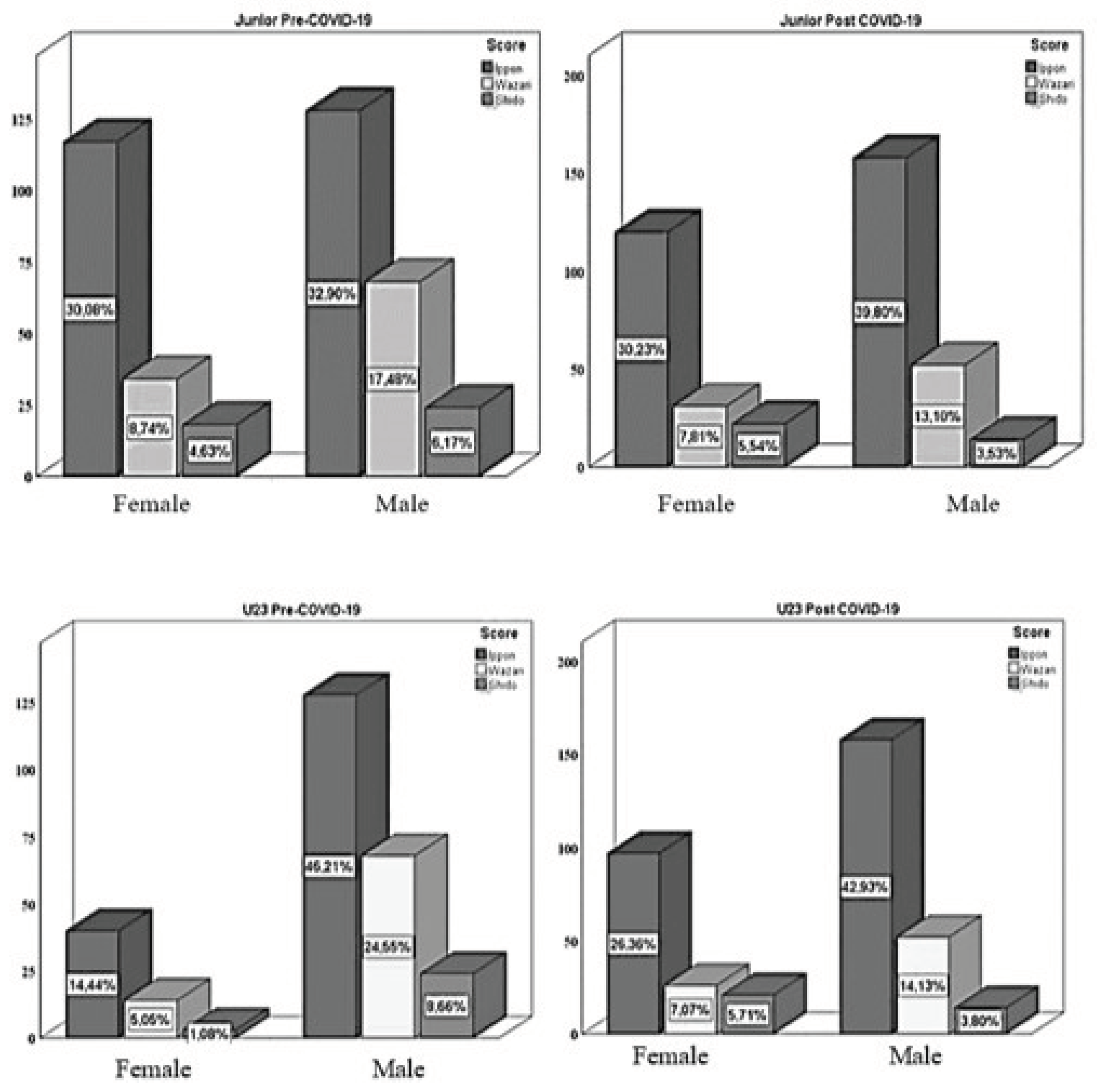

Table 1.
Match-related variables statistics of junior and u23 athletes by gender.
| Category | Score | Weight | |||||
|---|---|---|---|---|---|---|---|
| Female | Male | ||||||
| n | % |
 ± Ss. ± Ss. |
n | % |
± Ss. |
||
| EJC Junior 2019 | İppon | 117 | 69,2 | 1,41 (± 0,67) |
128 | 58,2 | 1,53 (± 0,68) |
| Wazari | 34 | 20,1 | 68 | 30,9 | |||
| Shido | 18 | 10,7 | 24 | 10,9 | |||
| EJC Junior 2020 | İppon | 120 | 69,4 | 1,43 (± 0,70) |
158 | 70,5 | 1,36 (± 0,59) |
| Wazari | 31 | 17,9 | 52 | 23,2 | |||
| Shido | 22 | 12,7 | 14 | 6,3 | |||
| EJC U23 2019 | İppon | 79 | 65,3 | 1,50 (± 0,74) |
109 | 69,9 | 1,37 (± 0,61) |
| Wazari | 24 | 19,8 | 36 | 23,1 | |||
| Shido | 18 | 14,9 | 11 | 7,1 | |||
| EJC U23 2020 | İppon | 99 | 63,5 | 1,48 (± 0,69) |
151 | 71,2 | 1,34 (± 0,58) |
| Wazari | 39 | 25 | 49 | 23,1 | |||
| Shido | 18 | 11,5 | 12 | 5,7 | |||
*EJC: European Judo Championship; 2019: Pre-Covid, 2020: Post-Covid.
Table 2.
Change of match related by gender in junior judo athletes before and after Covid.
| Variables | Scores | ||||||
| Covid Before-After | n | İppon | Wazari | Shido | x2 | p | Effect size |
| EJC Junior Female 2019 | 169 | 117 | 34 | 18 | 0,530 | 0,76 | - |
| EJC Junior Female 2020 | 173 | 120 | 31 | 22 | |||
| EJC Junior Male 2019 | 128 | 128 | 68 | 24 | 7,876 | 0,019 | 0,132 |
| EJC Junior Male 2020 |
158 | 158 | 52 | 14 | |||
| EJC U23 Female 2019 | 57 | 40 | 14 | 3 | 3,887 | 0,143 | - |
| EJC U23 Female 2020 | 144 | 97 | 26 | 21 | |||
| EJC U23 Male 2019 |
220 | 128 | 68 | 24 | 7,876 | 0,019 | 0,312 |
| EJC U23 Male 2020 |
224 | 158 | 52 | 14 | |||
EJC: European Judo Championship.
Table 3.
Match related score statistics of junior and u23 athletes by weight.
| Category | Weight | |||||||||||||||||||||||||||
|---|---|---|---|---|---|---|---|---|---|---|---|---|---|---|---|---|---|---|---|---|---|---|---|---|---|---|---|---|
| 48 | 52 | 57 | 60 | 63 | 66 | 70 | 73 | 78 | 81 | 90 | 100 | 100+ | ||||||||||||||||
| EJC Junior 2019 | Score | n |  |
n | |
n | |
n | |
n | |
n | |
n | |
n | |
n | |
n | |
n | |
n | |
n | |
|
| İppon | 19 | 1,2 | 8 | 1,7 | 20 | 1,4 | 12 | 1,7 | 22 | 1,3 | 18 | 1,6 | 14 | 1,6 | 21 | 1,4 | 16 | 1,2 | 27 | 1,3 | 21 | 1,4 | 11 | 1,6 | 18 | 1,4 | ||
| Wazari | 4 | 10 | 5 | 15 | 5 | 10 | 5 | 11 | 3 | 9 | 7 | 6 | 10 | |||||||||||||||
| Shido | 1 | 2 | 4 | 3 | 2 | 6 | 6 | 3 | 1 | 3 | 4 | 3 | 2 | |||||||||||||||
| EJC Junior 2020 | İppon | 16 | 1,6 | 16 | 1,5 | 22 | 1,5 | 20 | 1,4 | 19 | 1,3 | 35 | 1,1 | 21 | 1,2 | 29 | 1,4 | 14 | 1,3 | 31 | 1,2 | 18 | 1,5 | 10 | 1,5 | 15 | 1,1 | |
| Wazari | 6 | 5 | 4 | 10 | 7 | 2 | 5 | 14 | 2 | 9 | 9 | 6 | 2 | |||||||||||||||
| Shido | 6 | 4 | 6 | 3 | 1 | 2 | 1 | 3 | 2 | 1 | 3 | 2 | 0 |
|||||||||||||||
| EJC U23 2019 |
İppon | 14 | 1,2 | 11 | 1,5 | 16 | 1,3 | 14 | 1,3 | 13 | 1,2 | 22 | 1,2 | 8 | 1,8 | 14 | 1,5 | 8 | 1,5 | 19 | 1,3 | 17 | 1,2 | 13 | 1,4 | 10 | 1,5 | |
| Wazari | 2 | 4 | 5 | 3 | 2 | 5 | 4 | 8 | 6 | 8 | 5 | 6 | 1 | |||||||||||||||
| Shido | 1 | 3 | 1 | 2 | 1 | 1 | 6 | 3 | 1 | 1 | 0 | 1 | 3 | |||||||||||||||
| EJC U23 2020 |
İppon | 13 | 1,5 | 10 | 1,7 | 11 | 1,5 | 20 | 1,3 | 23 | 1,4 | 26 | 1,4 | 17 | 1,3 | 27 | 1,3 | 14 | 1,4 | 24 | 1,4 | 25 | 1,3 | 15 | 1,0 | 14 | 1,1 | |
| Wazari | 4 | 8 | 8 | 10 | 8 | 7 | 5 | 10 | 5 | 11 | 9 | 1 | 1 | |||||||||||||||
| Shido | 3 | 4 | 2 | 1 | 3 | 4 | 1 | 2 | 2 | 3 | 1 | 0 | 1 | |||||||||||||||
EJC: European Judo Championship.
Disclaimer/Publisher’s Note: The statements, opinions and data contained in all publications are solely those of the individual author(s) and contributor(s) and not of MDPI and/or the editor(s). MDPI and/or the editor(s) disclaim responsibility for any injury to people or property resulting from any ideas, methods, instructions or products referred to in the content. |
© 2024 by the authors. Licensee MDPI, Basel, Switzerland. This article is an open access article distributed under the terms and conditions of the Creative Commons Attribution (CC BY) license (http://creativecommons.org/licenses/by/4.0/).
Copyright: This open access article is published under a Creative Commons CC BY 4.0 license, which permit the free download, distribution, and reuse, provided that the author and preprint are cited in any reuse.


