

Submitted:
27 February 2024
Posted:
28 February 2024
You are already at the latest version
Abstract
The increasing demand for transporting people and goods, rail system is needed for enhancement. An architectural design of train station can significantly impact investment from any government. However, a proper guideline for designing the train station in tropical climate is not publicized. This review examine railway station design through an analysis of student design theses in Thailand, from 1983 to 2022. Furthermore, the building analyses on architectural design theory were done in terms of service area, form, entrance structure, roof structure, style, and design development. The analysis reveals curved and gable roofs are most frequent, followed by 3D curved roofs. HSR stations' main entrances are designed to represent local culture and save walking distance. Curved and gabled porticos provide the most extravagant main entryway, a feeling of grandeur and beauty. A public building's overlapping portico or curving gabled portico lends majesty and refinement to its façade. Architects and designers strive to make buildings more attractive and practical. Besides, university-designed stations prioritize conceptual design and functional space over cost. Finally, railway station design should prioritize transparency, connectivity, movement, and cost- and time-efficiency. Research gaps are identified, such as designing user-friendly for thermal comfort and design-for-all the railway station in tropical climate, are critical for future evaluation.
Keywords:
railway station
; architecture
; design
; tropical climate
; structure
1. Introduction
In the present, a good infrastructure system is increasingly necessary. In most countries, especially developing countries, their railway system, which is currently low in efficiency, needs improvement to meet the growing demand for transportation of goods and people. Most of Thailand’s railway system still consists of single tracks, which slow down the movement of trains due to the need to wait for other trains to pass. In addition, long-distance (LD) train tickets are expensive, and the speed of the trains is not worth the cost when compared to airplanes or tour buses. Governments in any nation invest a large budget in public transportation infrastructure. For example, the federal infrastructure bill in the United States plans to budget $44 billion for rail transportation (approximately $140 per person in the United States) (Hampton 2021). The International Energy Agency (IEA), published in 2021, global investment in electric railways was estimated to be around $450 billion (about $1,400 per person in the US) per year (International Energy Agency 2021). Moreover, it is reported that over 1600 buildings have been used for over 200 years (RHT). The maintenance and renovation are tremendously invested in this area. Third, many countries such as those in Europe have focused on developing universal design or “design-for-all” guidelines for safe and sustainable mobility since 1997 (Goldsmith 2007). The Italian Railway, for example, planned to build additional conveniences for accessibility at 2150 medium- and small-sized Italian railway stations, with a budget of 15 million euros per year (RFI 2002).
1.1. Literature review
Currently, developing countries are now focusing on improving and investing in both new and existing rail infrastructures including in Thailand. Several studies on the architectural design of modern railway stations can offer several benefits (Cozens and Van der Linde 2015). The studied benefits include sustainable design (Yoo et al. 2016; Kaewunruen and Xu 2018), smarter system design (Alawad and Kaewunruen 2018; Patel et al. 2020; Fan et al. 2022; Kazanskiy and Popov 2015), acoustic design (Hellström 2005; Wu et al. 2018), reduced crime and accident design (Kaakai et al. 2007; Cozens et al. 2003; N. Wang et al. 2020; Jones 2011; Hassannayebi et al. 2020), reduced mobility design (Hermant 2011; Kandee 2004; Swift et al. 2021; Yeung and Marinov 2019), reduced waiting-time design (Hoogendoorn et al. 2004), universal design or design for all design (Sekiguchi 2006), aesthetic design (Kido 2005) and reduced PM2.5 pollution (Thaithatkul et al. 2023). Several design aspects can deliver important integrated facets through eventually bringing down the overall investment and life cycle cost.
While the construction of railway stations is underway, The transportation network emerged as a representation of authority (Ali and Qi 2020). The railway station serve as political and diplomatic instruments for China, Europe, and Japan to demonstrate their technology and maintain a balance of power with other nations. Pavlićević and Kratz (2018) discovered that overseas diplomatic endeavors have frequently been portrayed within the framework of the China Threat narrative. This narrative suggests that Beijing aims to change the power dynamics in Thailand, Indonesia, Myanmar, Vietnam, Laos, Thailand, Malaysia, and Singapore, thereby negatively impacting the economic, political, and security interests of the countries in the region. This study disputes these interpretations and indicates that these programs lack both the aim and capability to promote such a hostile and extensive agenda towards the area. Hong (2014) also stated that there is a connection between China’s ambitious foreign policy towards the ASEAN, its national pride, and its financial interests in building modern rail in the area. This analysis examined the underlying reasons behind China’s intentions to expand modern rail in the ASEAN region, taking into account China’s growing influence and the competition between China and Japan. However, China was likely encountering significant obstacles in achieving its goals. Furthermore, Kitkuakul (2022) advocated that the establishment of a railway station might be facilitated by the implementation of a sister city relationship strategy, whereby the funding, which can be limited, was likely to be sourced from economically stronger nations. Akin to Shrivastva (2021), the provision of financial grants and technology transfer can achieve success by means of collaborations between public and private entities. Nevertheless, various studies have also argued that implementing such policies across adjacent borders, such as India-China, Pakistan-China, China-Vietnam, might generate geo-psychological pressures on both nations, therefore impacting their diverse geopolitical relationship (Shrivastva et al. 2023; Lal 2006). Besides, Lim et al. (2021) pointed out that the progress made in this regard was diminished by the sluggish implementation of modern railway project, which was further hindered by the fragmented institutional structure in Indonesia and Malaysia.
Because the building performance can be greatly impacted by climate, the guideline for designing the railway station architecture in tropical climate condition is needed (Mirrahimi et al. 2016). About 25% of the world’s energy is consumed in buildings. To reduce society’s dependence on fossil fuels, we need to design a building environment with energy balance. Every year, millions of new buildings need to accommodate the world’s growing population, which will require a lot of raw materials and energy. Climate adaptation is a way for the sustainable development of buildings (Guo 2021). For example, Khan (2021) conducted a comprehensive analysis of the energy efficiency of Pakistan’s railway station from 1980–2018. The data indicated that rail transit achieved a mere 36% efficiency in 1980, in contrast to its optimal efficiency of 100% in 2018. However, little literature for designing it in a tropical climate is revealed. Whereas, Theerathitichaipa et al. (2024) studied on railway service accessibility unveiled a disparity, indicating that regions with higher population density had better access to railway stations in comparison to districts with lower population density. Designing a railway station’s architecture in a tropical climate condition requires careful consideration of several factors to ensure the station provides comfortable and functional spaces for passengers and staff. The tropical climate is characterized by elevated temperatures, humidity, and rainfall throughout the year, making it challenging to maintain thermal comfort and protect the station from moisture and fungal growth. Several factors are taken into consideration in tropical contexts such as climate-responsive design (Manandhar et al. 2019), material selection (Latha et al. 2015), indoor air quality (Sekhar and Willem 2004), and landscape design (Yang et al. 2018). Incorporating passive design strategies, selecting appropriate materials, improving indoor air quality, and incorporating landscape design can help create a comfortable and sustainable railway station for passengers and staffs. Riza et al. (2021) reported that the small railway station architecture in Indonesia has distinguished architectural design such as simple rectangular layout, a pyramid roof structure, and a closed frame building structure. Sulistyani (2022) also advocated for rail station architecture in Java, Indonesia, that incorporated local architectural knowledge and colonial context, striking a balance between neoclassical and eclectic architectural styles to address the island’s unique conditions. However, no work has been evaluated on large-scale public buildings.
This work determined four diverse types of railway stations including:
- -High-speed railway (HSR) stations are places where high-speed trains can travel long distances, often with a long distance between stations, and they transport passengers between provinces or regions.
- -LD railway stations where trains can travel long distances often have a shorter distance between stations than high-speed trains, and they transport passengers between provinces or regions.
- -Commuter rail transit (CRT) station where the station may connect with a light rail transit station and link further regional areas to local transit (Chen and Hsu 2020).
- -Light Rail Transit (LRT) station where the station is generally located in urban and suburban areas. The LRT train typically entails 2 or 3 coaches that typically operate at an average speed of 55 to 60 km/h on lines with extensive stops/stations and around 65 to 70 km/h on lines with fewer stops/stations (Nag et al. 2019; Teodorović and Janić 2017).
Our literature survey has not found any earlier studies on the categorization and analysis of architectural design for railway stations in tropical regions. This work aims to review 48 railway station design literature from 1983–2022, based on public drafts and student theses, with a focus on LD and HSR stations. The classification and analysis of the reviewed railway station architecture entails area, form, entrance structure, roof structure, architectural style and design development. This review provides a systematic guideline for designers, architects, and students to comprehend the basic architectural design concepts of railway stations in tropical climates, enabling them to provide proper designs that minimize costs and enable effective usage.
1.2. Significance of the review
As previously indicated, each nation has allocated a substantial budget for the construction of infrastructure such as railway stations. Gaining a more comprehensive comprehension of its design at the first phase might yield significant advantages in terms of aesthetics, symbolism, cost, construction duration, mobility, and sustainability. The study offers a helpful synopsis of the architectural factors involved in railway station design. The goal is to review design visions for railway stations in Thailand, as reflected in student theses and government proposals. Our findings indicate a range of factors that need to be taken into consideration, such as structural complexity, cost, aesthetic, and local contexts. However, it would be advantageous to look more into specifically the issues and solutions that are unique to tropical climates. The evaluation establishes a basis for further investigation and advancement in the realm of tropical railway station architecture.
2. Review methodology
The research was conducted by collecting research papers and theses in the Faculty of Architecture from five university databases and train station proposal blueprints from library databases and electronic media, “Basic Structure of Thailand.” The search was conducted from January to November 2022. The first architecturally designed and constructed railroad station buildings in Thailand was found in 1983. 60 designs were found, but four of them focused mainly on transit-oriented development or landscape study, rather than the building part, and were excluded from this work. After excluding the irrelevant designs, there were 48 items left relating to railway structure design. It should be noted that the limitation of some information from the universities outside Bangkok was excluded.
The 48 items left relating to railway structure design were analyzed and summarized according to several criteria: the type of station by year, the number of stations by service line, the relationship between area usage, number of floors, and number of platforms, the form, type of roof, entrance characteristics, architectural style, and design development, respectively. The PICO (population, intervention, comparison, and outcome) process was adapted and depicted in Table 1. Some qualitative analyses were performed to determine the forms and architectural styles of the structures and designs, based on group discussions of five academic and practitioner experts. This may be the limitation of the qualitative research in this work since the analysis is based on the background and experience of each individual. It should be noted that some literature did not provide exact length or area values, so the researchers used AutoCAD software to measure them. Hence, there may be a risk of bias from the five experts, which should be acknowledged as a limitation of this analysis work. The research flow diagram is illustrated in Figure 1. The direct in this study and indirect factors influencing the architectural design for railway station in tropical climate are given in this figure.
The guidelines of the designing modern railways stations exist in the developed countries such as UK, USA, Europe, and China, leaving behind the railway station in the developing countries globally. However, many design guideline suggestions cannot be adopted in many nations such as the designing for tropical climate. With the growing construction of railway station around the world, especially in the developing countries, the novelty of this work presents, for the first time, reviewed design principles of railway stations in tropical climate. The benefits of this review work can offer the designers, educators, and students to in-dept comprehend the general design concept for designing the rail stations. This review is the part for establishing the design guideline of railway station in tropical climate.
The main focus of the summary can provide guideline for designing the important components of the station and the differentiation between the thesis works and the practical building designs.
3. Results and discussion
3.1. Size of station and service area
From data analysis, it is clear from the bar chart that there has been a significant increase in the number of railway station blueprints and theses since 2014–2016, as shown in Figure 2. A substantial portion of the literature focuses on HSR and LD stations (greater than 90%). This is because the primary factors that determine the economic viability of HSR stations are construction costs, the value of time savings per commuter, traffic volume, and the level of congestion in global current transport networks (Nash 2015).
In Thailand, four main routes connect Bangkok with the northern, southern, eastern, and northeastern regions. Thonburi, BTS, and node lines are the routes located in Bangkok. The railway station was built significantly on the Northeastern line, which has a large and populated area. When considering only the train stations on the Northeastern line, as shown in Figure 3, there are 14 stations. It was found that HSR stations have a larger functional area (ranging from 31,450 to 91,000 sq. m.) than LD stations, up to 31–91 times larger. The HSR stations were designed for other usable areas such as waiting rooms, commercial sections, intersections, and more platforms. In addition, HSR stations have more floors (ranging from 3 to 5 floors) than LD stations (2 floors). The LD stations are designed for rural and distant areas, so many trains pass and do not stop in the station. The number of platforms in HSR is the highest at 14 platforms. This is because this station is the main intersection station and a hub for international lines like those from Laos and China. Therefore, when designing a train station, the location should be considered to ensure it can accommodate commuters’ needs appropriately. It should be noted here that the service area in each station is not related to the number of passengers. As discussed, the station types are generally classified as national, hub, international, and general station. Therefore, the benefits of designing the service area is dependent on the commute type.
3.2. Form of Station
The form of the station is analyzed through three considerations: 1) symmetry, 2) ratio between height and area of the first floor, and 3) ratio between area of the first floor and the total floor area.
The symmetrical design is defined herein as the building structure of the main entrance views where both sides have area ratios of not greater than 10% differences. In general, most government buildings have symmetrical designs to create a sense of trust, reliability, and stability. The symmetry projects a positive image while also enhancing the building’s ornamentation perception for users. Figure 4 shows the analysis of the ratio between symmetry and asymmetry of 29 HSR stations. The results reveal that 26 or 90% of the HSR stations have symmetrical designs, in both architectural design proposals and student theses. The remaining three non-symmetrical designs appear in the theses only. All the HSR design proposals are in symmetrical form. It is also worth noting that symmetrical forms facilitate easier design and construction due to their unified structure, leading to enhanced stability against external forces like seismic and wind loads. As a result, this form is commonly employed in public buildings. The predominant preference for symmetric design strongly highlights symmetry as a key formal-aesthetic consideration for public buildings in Thailand.
Figure 5 shows the ratio between height and first-floor area of HSR and LD stations. The height was measured from the ground to the top of the roof structure using AutoCAD software. When determining the height-to-first floor area ratio of the LD stations, results indicate that the LD stations have an average ratio value of 2175, with a range of ratio values from 1760 to 2840. Meanwhile, the HSR stations have a lower average ratio of 1360, with a range of ratios from 640 to 3350. The average ratio value of the height-to-first floor area of the HSR station is approximately 36% lower than the average ratio value of the LD station. The findings indicate that the HSR station design has a flatter exterior proportion than the LD stations, as the HSR stations are mostly interconnected to adjacent LD stations. As far as station functions are concerned, this consideration led to a horizontal, rather vertical layout. Other reasons for the flatter exterior of HSR stations include designing for more passengers, more facility requirements, a design concept as the main regional hub, and universal design for loading, train service information, seat booking, wheelchairs, and escorts from and to the station entrances and exits to the train (Steinfeld 2001). These considerations reflect the designer’s acute understanding of the role of a rail station not only as a transport conduit, but also a place in itself.
The values calculated from the area ratios between the first floor and total floor are shown in Figure 6. Results reveal that when considering the area ratio of the first floor and total area of the LD station, the average value is 55.0%, with a range of 28% to 65%. Meanwhile, the HSR has a lower value of 52.3%, with a wider range of 39% to 93%. This means that HSR has a higher proportion of level 1 area because it must be a transfer station with the LD station or other transportation, which is located on the 1st floor. As a result, the LD station has a higher proportion of non-first floor area than the HSR station.
3.3. Roof Characteristics
Given the variety of roof designs, the authors created a classification of roof characteristics based on the architectural design concept. Figure 7 illustrates eight different roof typologies, including geometric, gabled, lean-to, overlapping gable, curved, sawtooth, curved gabled, and 3D curved roofs.
When designing roofs for railway stations in hot and humid climates, it is essential to consider the slope of the roof to reduce solar energy entering the building and prevent rainwater from accumulating (De Waal 1993; Zaid et al. 2022). According to De wall (1993), roof systems with small slopes do not effectively reduce solar energy as they can receive equal solar heat. Therefore, railway station roofs require a sufficient slope to achieve optimal design.
The analysis of the HSR station roof design from 2014 to 2022 is presented in Figure 8, based on draft proposals. The analysis indicates that all of the proposals feature sloping roofs, and no flat roofs have been proposed. This is because a sloping roof can reduce the amount of solar energy entering the building and prevent rainwater ponding.
In terms of roof form, the station’s design aims to reflect local identity and does not feature complex, costly roof structures. The most common roof types are curved and gable roofs, followed by 3D curved roofs. A few designs feature lean-to, geometric, and sawtooth structures. In addition, it is found that the 3D curved roof has been introduced in the railway station design after 2017. Recently, only two roof design types were conducted which were 3D curved roof design and curved design. The curved roof design can add interest to the entrance without significantly increasing the complexity of the structure and construction process. The gabled roof design is popular in construction due to its simplicity, which can still highlight the identity of the region in the station’s design.
It is worth noting that roof designs are often deliberately designed to reflect regional identity and Thai traditional architecture. Specifically, HSR stations, being nationally prominent projects, tend to showcase roof designs that blend regional and national identities. For example, the Kamakhya Station in India emphasizes the importance of maintaining the city’s identity in the station’s visual and experience design, which can be an investment in tourism and benefit the local economy (Hemani and Punekar 2015). These showcases can be government investment in tourism activity and benefit local economies from tourists as well (Tripathi and Ali 2021).
In this study, many of the roof characteristics are designed to represent local identity. Located in the Northeast, the Udon Thani HSR station, for instance, is a multi-story HSR station with design motifs inspired by ancient pottery of Ban Chiang, the province’s prehistoric archaeological site. The historical elements are reinterpreted and recreated in modern decorations, patterns, forms, and color schemes, as illustrated in Figure 9.
Our analysis also notes that the designs derived from the student theses tend to feature complex roof characteristics. Figure 10 shows student design theses from 2016 to 2022. The findings point to an increasing trend in roof design with greater complexity since around 2016. From around 2017 onwards, there has been a development from roofs with geometric shapes to 3D curved roofs. We speculate that complex roof structures were achieved in the later years because of the availability of parametric modeling commercial software and were thus adopted for educational purposes (Romaniak and Filipowski 2018). Many parametric design concepts can be created using CAD packages such as Autodesk Revit, Nemetschek, Soft Plan, ArchiCAD or Chief Architect (Stavric and Marina 2011). The roof characteristics from the student design theses are, as a result, complex parametric-shaped (sawtooth or 3D curved) roofs.
However, the complex roof designs are not always tenable. Upon performing numerical structural safety analysis like finite element analysis, some of the designs, for example, may not be secure. As a result, the complex roof designs have been simplified. Other practical challenges include construction difficulties that lead to high construction costs. For example, joints of complex roofs are prone to leakage over time. Barrelas et al. (2016), studying 15 pavilion schools in Portugal, found that most severe defects primarily affect the building’s exterior envelope like roof. In our research, for example, popular 3D curved roofs have been proposed in the student theses since 2017, as shown in Figure 11. In the design proposals for constructing the roof, reducing the structure’s complexity and curvature to align with the local identity is a valid consideration. However, it is crucial to take into account not only the design’s aesthetics and complexity but also practical factors such as structural safety, construction feasibility, and maintenance costs.
In sum, it is crucial to consider the local context and identity of the site in which the building is located. Despite the prevailing preference for complex and parametric-shaped roofs in university design theses, it is important to balance that with practical factors and the local context. Thus, while contemporary design trends often lean towards parametric shapes, designers must carefully weigh various constraints, including structural safety, cost, maintenance, feasibility, and material availability. Consequently, designers may reduce the complexity of the structure and prioritize the incorporation of the site’s local context and identity.
When considering the draft for actual construction of the HSR stations shown in Figure 11, it is evident that the roof design exhibits large patchwork characteristics, creating significant surface areas under the roof with different qualities such as gabled, gabled on the top, and curved roof. So, it can be seen that roofs have different features depending on the location’s region. The Ayutthaya HSR station in 2019 has a gabled roof to emphasize the province’s identity, which has historical significance as the old capital of Thailand. The Nakhon Ratchasima HSR station in 2020 also features a gabled roof with a flat top, highlighting its gabled-like appearance from the side view, while the interior space is unique, creating a difference between the interior and exterior areas. Lastly, the Don Mueang HSR Station in 2021, located next to the international airport, features a curved roof design reflecting the wind-lifting shape of an airplane wing. The roof design is modern in shape, avoiding complex and expensive structures to maintain cost-effectiveness, as well as increasing structural efficiency from horizontal loading like wind.
3.4. Main Entrance Characteristics
The main entrance is a prominent feature of a public building, and, therefore, is often designed to accommodate key functions and reflect the beauty of its architectural identity, such as the high and popular styles (Devlin and Nasar 1989). In terms of functionality, the main entrance offers practical advantages by reducing the distance one must walk from their starting point or destination during a trip. The main entrance serves as an important junction that allows pedestrians to move between the street network and the facilities for boarding or alighting. This accessibility can contribute to increased ridership and success for passenger railway systems by exposing more people to the existing network (Lahoorpoor and Levinson 2020). The types of main entrances to HSR stations are shown in Figure 12. It can be classified into nine types, including lean-to, curved portico, curved gable portico, gabled portico, underground entrance, 3D curved portico, double overlapping gable portico, overlapping portico, and side entrance.
Regarding the characteristics of main entrances to HSR stations from the student theses submitted between 2014–2022, they can be classified as depicted in Figure 13. The main entrance designs can reflect the cultural, political, and religious context of the area (Moore 1996). The most elaborately designed main entrances feature curved porticos and gabled porticos, followed by lean-to porticos, side entrances, overlapping porticos, curved gabled porticos, basement entrances, 3D curved porticos, and double overlapping gable porticos, respectively. A curved portico is an architectural feature that creates a sense of grandeur and elegance to the building’s façade. A portico is a covered entranceway typically supported by columns or pillars and can be an integral part of a building’s overall design. A curved portico is a type of entranceway that features a curved or arched roofline. This design evokes a sense of movement and flow and can be particularly effective in buildings with curved or rounded façades. The curved roofline also provides a visual contrast to the straight lines of the building’s walls, creating a more dynamic and interesting appearance. A gabled portico is a type of entranceway that features a triangular or peaked roofline, known as a gable. This design accentuates a sense of height and grandeur and can be particularly effective in buildings with tall or imposing façades. The gable can also provide a visual focal point for the entranceway, drawing the eye upward and creating a sense of verticality.
A lean-to portico is an architectural feature of a slanted roof attached to the side of a building, supported by columns or pillars. This type of portico serves both functional and stylistic purposes, providing protection from the elements and adding visual interest to the façade. The lean-to portico is often used in residential architecture, where it can shelter outdoor space and create a welcoming entranceway. It can also be used in commercial and public buildings, such as schools or government offices, where it can provide covered outdoor spaces for waiting or congregating. One advantage of lean-to porticos is that they provide a simple, cost-effective way to add outdoor space to a building. They can be built using a variety of materials, including wood, brick, or stone, and are designed to blend seamlessly with the building’s existing architecture. Another criterion for designing a sustainable railway station is to incorporate buffer zones or outdoor space, which may significantly improve the living circumstances of the residents in terms of both thermal comfort and indoor air quality. This redesign is very common for buildings in tropical climate to save energy from air conditioning system. Tantasavasdi and Inprom (2023) reported that using the buffer spaces and open area can provide thermal comfort of 24 hours compared 0 hours in the comfort zone per day and indoor air quality from 24 hours compared to 8–17 hours, passing the minimum ventilation requirement per day. Additionally, in order to examine the impact of atrium components on the indoor natural environmental conditions, Atthakorn et al. (2022) evaluated four specific case studies in Bangkok. His objective was to identify the relationship between atrium elements and the characteristics of the indoor environment. Based on the findings, the researcher proposed guidelines for designing semi-open atriums and proportion of roof opening (skylight) and the level of openness of the atrium on the ground floor might significantly influence the design in order to improve sustainability.
An overlapping portico in a public building refers to a type of architectural design in which a building has a series of covered walkways or porches arranged to create a layered effect. This design can be seen in various public buildings, such as government offices, museums, libraries, and other public institutions. This design is often used to create a sense of grandeur and importance, as the layered effect gives the building a more imposing and impressive appearance. Additionally, overlapping porticos serve functional purposes. They provide shelter from the elements, allowing people to move around the building without getting wet or exposed to the sun; furthermore, the shaded areas created by overlapping porticos can be used as outdoor seating areas and walkways.
A curved gabled portico is an architectural feature characterized by a curved or rounded roof covering a porch or entranceway. These types of porticos appear in various architectural styles, including Gothic, Renaissance, and Baroque. Curved and gabled porticos are architectural features that can add a sense of grandeur and elegance to a building’s façade. A portico is a covered entranceway that is typically supported by columns or pillars and can be an integral part of a building’s overall design. A curved portico is a type of entranceway that features a curved or arched roofline. This design can create a sense of movement and flow and can be particularly effective in buildings with curved or rounded façades. The curved roofline can also provide a visual contrast to the straight lines of the building’s walls, creating a more dynamic and interesting overall design. A gabled portico is a type of entranceway that features a triangular or peaked roofline, known as a gable. This design can create a sense of height and grandeur and can be particularly effective in buildings with tall or imposing façades. The gable can also provide a visual focal point for the entranceway, drawing the eye upward and creating a sense of verticality.
The least popular main entrance features include basement entrances, 3D curved roof entrances, and double overlapping gable portico main entrances. Railway stations with basement entrances may be less popular because they are larger stations that can accommodate multiple types of trains, such as Don Mueang Station (2021) and Ayutthaya Station (2019), and therefore have fewer stations with this feature. Besides, the construction and material used for basement entrances, 3D curved roof entrances, and double overlapping gable portico main entrances generally require larger amounts of budgets which can lead to cost constraints. Basement entrance architecture refers to the design concept in which the main entrance of a building is located at the basement level rather than at the ground level. This approach can provide several territorial advantages. Firstly, it allows for greater privacy and security by restricting access of unauthorized individuals. Additionally, the basement entrance can be designed with security features such as cameras or access control systems to further enhance security. Furthermore, this design approach can provide a solution for sites with limited space by freeing up valuable above-ground space for other uses, such as landscaping or parking. In urban environments where space is at a premium, this design concept can be especially beneficial.
A 3D curved roof entrance features a roof with a 3D curve that covers an entranceway. These entrances are often designed to create a dramatic effect and can be found in a variety of building types, including commercial buildings, public buildings, and private residences. The use of 3D curved roof entrances to create impressive entrances dates back centuries. However, these entrances are less common in railway stations due to the complexity of their shape, which makes construction difficult and often not cost-effective. In contemporary urban architecture, various considerations, including accessibility for disabled individuals (Yılmaz 2018) and wheelchair users, evacuation plans (Hostikka et al. 2007), and smoking areas (Navas-Acien et al. 2016; Sureda et al. 2012), are considered alongside architectural styles.
3.5. Architectural Style
After classifying railway station designs’ architectural style since 2014, the classification of HSR station designs based on architectural design concepts is shown in Figure 14. The results reveal a significant increase in the number of HSR station designs since 2014. The highest proportion of HSR station designs is the Thai contemporary style (32%), followed by parametric (30%), post-modern (27%), modern (7%), and colonial (4%) styles.
The Thai contemporary architecture style is a modern interpretation of traditional Thai architecture, blending past elements with modern design and construction techniques suitable for tropical climate. One of the key features of Thai contemporary architecture is the use of natural materials such as wood, bamboo, and stone, which are often combined with modern materials like concrete and steel. This creates a unique blend of traditional and modern elements that are both functional and visually appealing. Another important aspect of this style is the incorporation of traditional Thai design motifs such as intricate carvings, patterns, and colors. These motifs are often used in a subtle way to a sense of continuity with the past while allowing for contemporary interpretations. Therefore, this style is a preferred choice adopted to reflect local identity aligning with the building adoption of tropical climate conditions (Sthapitanond and Mertens 2012).
The postmodern style of train station design can be adapted to a tropical climate in several ways. One of the key design considerations for a train station in a tropical environment is how to provide shade and ventilation while also maintaining a sense of visual interest. This style can be incorporated with domain features such as open-air atriums, greenery, and sustainable materials to create a visually stunning and environmentally friendly space that is well-suited to the local climate and culture. (Knox 1991; Sini and Sini 2020). The demand for modern architecture is decreasing over time, while the demand for contemporary Thai and colonial styles remains the same. In addition, there is an increasing demand for parametric colonial architecture.
The declining interest in modern architecture may be attributed to the rising popularity of design innovations such as parametric and non-orthogonal architecture. Designers are seeking alternatives to traditional station designs, aiming to craft dynamic spaces, which are crucial considerations in the context of railway station design.(Yaneva 2017; Schumacher 2016). There are various options available for designing stylistically unique buildings, particularly through the use of parametric and non-orthogonal architecture. These approaches allow for the creation of free-form designs that can differ significantly from traditional, symmetrical forms. The design software such as Rhino with Grasshopper and Solidworks can be adopted using parametric design.
However, the situation presents Thai designers with a tension between the desire for unique, innovative architecture and the goal of creating grand and elegant infrastructure that adheres to symmetrical form. Often, the government may prioritize the latter, which limits the extent to which designers can explore experimental approaches to building design. In practice, this tension between innovation and tradition can be seen in many modern building designs in Thailand and elsewhere. Architects and designers seek to push the boundaries of what is possible with unconventional forms, while more pragmatic decis prefer the creation of buildings that fit into existing architectural frameworks and cultural expectations. Ultimately, the choice between these approaches depends on a variety of factors, including the purpose of the building, its intended audience, and the broader social and cultural context in which it will be situated (Vollers 2001). A critical balance between these two concepts is required, one that balances the benefits and limitations of both innovation and tradition.
3.6. Development of railway station design
This section discussed the development of railway station designs for the same buildings based on four sections entailing 1) thesis to thesis over time, 2) thesis to draft proposal, 3) draft proposal to draft proposal over time, and design evolution of the railway station existing. The development of eight railway station designs at the same stations is exhibited in Figure 15.
The design of buildings and structures has evolved over the years, with architects and designers striving to create more visually appealing and functional structures. In this context, the structural differences between two versions of a station that starts and ends with a thesis of Phitsanulok and Pattaya railway stations. Specifically, the Phitsanulok station designed in 2014 was compared with the station designed in 2020, and the Pattaya station designed in 2019 was compared with the station designed in 2021. The railway stations designed in 2014 have a simpler design, and a smaller footprint compared to the 2019 version. Their architecture appears straightforward, with minimal embellishments and a focus on practicality. The stations are designed to serve their primary purpose of transporting passengers efficiently. However, the stations designed recently have a much more complex structure, as seen in the use of a 3D curved roof to create a nature-inspired dynamic perception. This design element gives the station a unique and striking appearance, making it a landmark in the area.
The 3D curved roof of the Phitsanulok railway station, designed in 2020, draws inspiration from nature, particularly the organic curves observed in natural elements like seashells and flower petals. This design feature creates a dynamic perception, with the roof appearing to be in motion, even when the structure is stationary. The curved roof also allows natural light to enter the station, creating a warm and inviting atmosphere for passengers. In addition to the curved roof, the 2020 design has other structural design elements that are not present in the 2014 version. For example, the station’s interior layout is reconfigured to provide better flow and functionality. The station now has separate areas for ticketing, waiting, and boarding, making it easier for passengers to navigate the station. The station also has a more extensive platform and improved lighting, enhancing passenger safety and comfort. The Phitsanulok railway station designed in 2020 is a significant improvement over the 2014 version, both in terms of its structural design and functionality. The use of a 3D curved roof, inspired by nature, gives the station a unique and striking appearance, making it a landmark in the area. The reconfigured interior layout and improved lighting also enhance passenger safety and comfort. Overall, the railway stations designed in the latest version demonstrate how structural design can improve functionality while creating visually appealing structures.
The process of designing the railway station involves several stages, starting with the development of a thesis and culminating in the creation of a draft for actual construction. This process typically involves the incorporation of various elements, such as site constraints, user needs, and aesthetic considerations. As such, the resulting station design can depart from the original vision, depending on the specific requirements of the project. In comparing two different railway station designs at the same place, specifically one designed previously, and another designed later, it can be observed that there are differences in their structural design. The former design is characterized by a simpler and smaller footprint, whereas the latter design incorporates a more complex structure. The latter can be seen in the increased use of 3D curved roofs, which serve to create a dynamic perception and draw inspiration from nature. The use of 3D curved roofs is a common design element in modern architecture, and it is often employed to create a sense of fluidity and movement. This approach is particularly effective in station design, where the goal is to provide a seamless transition for commuters moving through the space. The incorporation of curved roofs can also serve as a way to integrate the station with its surrounding environment, as it can create a visual link between the built environment and the natural landscape. Furthermore, the latter design of a railway station appears to prioritize the creation of a unique visual identity. The use of dynamic curves and organic forms creates formal uniqueness, which can help to differentiate the station from other similar structures. This approach is in contrast to the former station design, which appears to prioritize functional considerations over aesthetic ones. In summary, the process of station design involves several stages, and the resulting structure can vary significantly depending on the specific requirements of the project. In comparing the two different station designs for similar projects, it is evident that the former design of railway station incorporates a more complex and visually distinct structure, as evidenced by its increased use of 3D curved roofs. With the development of parametric design, this design approach serves to create a sense of fluidity and movement, as well as to integrate the station with its surrounding environment. It should be noted that although this design type can provide complex and distinct structure, the maintenance of this structure can be its limitation practically because in tropical climates, sunlight and water can severely deteriorate the structure and jointing between each roof panel. Once the jointing was degraded, the water can leak into the structure. Hence, either inspection and maintenance more often or designing the complex system of using hindered joints where the sunlight does not reach can be promising solutions.
The design process for stations involves several stages, including the development of a thesis and culminating in the creation of a draft for actual construction. In the case of the university design theses, where the focus is on conceptual design and functional space rather than cost, the resulting structures are typically more complex. One notable example of this complexity is the use of geometric or 3D curved roofs to create dynamic space or attract users with new shapes. While these design features can create a unique and visually striking station, they are also costly to implement. Materials must often be ordered directly from the manufacturer, increasing both the time and expense of the construction process. However, when designing stations with an emphasis on cost-efficiency and economic considerations, designers are advised to prioritize designing structures that resonate with the local identity, mirroring the building’s context. This approach can help reduce costs by utilizing locally sourced materials and pre-existing elements from the surrounding environment. Furthermore, incorporating local materials and design elements can also serve to create a sense of place and community identity. By reflecting the surrounding area, the station can become an integral part of the local community and a source of pride for residents. In conclusion, the design process for stations can vary significantly depending on the project’s specific requirements, with university-designed stations often prioritizing conceptual design and functional space over cost. However, if the focus is on the economy and economics, designers may prioritize creating stations with a local identity that reflects the building’s composition. This approach can help lower total construction costs, create a sense of place, and foster a connection to the surrounding community.
In Figure 16, two stations emerge as a proper prospect for studying train design evolution, as each station consists of three consecutive stations ranging from a thesis to a draft proposal in 2020. In consideration of the Nakhon Ratchasima station, several key changes can be acknowledged. In terms of the building area, an overall rise in building area could be seen from 42,483 to 64,000 square meters. Sources for the station range from a thesis in 2017 to a draft proposal in 2020. Moreover, architecture style starts with a newer approach, such as parametric with a lean-to main entrance and sawtooth roof in 2017, followed by postmodern style with a similar approach, and ends in 2020 with combining gabled portico main entrance with a lean-to roof to embody Thai elements with a contemporary approach.
In consideration of the Ayutthaya station. In terms of architectural style, the thesis, unlike the other counterparts, starts with Thai contemporary design, followed by a modern style station as a draft proposal in 2019, and finally results in Thai contemporary style as a way to reflect Ayutthaya’s old temple. In terms of architectural elements, the roofs undergo no significant changes, as all prospects feature a type of gabled roof. It is interesting to note that the final proposal in 2020 had significantly more building area and platforms than the first draft proposal in 2019 to facilitate more logistical demands. Finally, both station platforms were added to 9 platforms in order to facilitate more traffic demands.
The absence of a thesis before the design process of a station may be attributed to its unexpected location, particularly if it is not a provincial or major city station. In such cases, the design process may focus more on the unique site constraints and promoting design opportunities, rather than on pre-existing concepts. One important aspect of station design is the development of the entrance, which serves as a gateway for commuters and visitors. In some cases, the design of the entrance may be informed by specific architectural elements, patterns, and shapes that emphasize transparency and connection. For example, the use of light and white colors can create a sense of openness and spaciousness, which can help to reduce feelings of congestion or claustrophobia. Additionally, the incorporation of transparent materials such as glass can help to create a visual connection between the inside and outside of the station, as well as between different parts of the station itself. Physical connection is also an important consideration in station design, as it can impact the flow of commuters and visitors. By incorporating design elements that facilitate movement and navigation, such as clear signage and well-lit pathways, designers can help to improve the overall user experience.
Additionally, thanks to advances in current design approaches and construction techniques, these practical innovations can offer increased cost efficiency, structural efficiency, and time efficiency. Digital design and construction have made it possible to design, visualize, and simulate a project before construction, minimizing the need for costly on-site changes. Robotic manufacturing techniques can also reduce the cost of construction by automating some of the labor-intensive tasks. Digital design and construction tools allow for faster and more accurate design processes, reducing the time taken to complete a project. Robotic manufacturing techniques have also led to faster construction processes by automating labor-intensive tasks, reducing the time required to complete a project. This allows for complex designs to be easily attained, reducing the total construction cost in the process. Future works, including the integration of digital design and construction, the robotic for manufacturing, as well as the sustainable construction like BIM (Khosakitchalert et al. 2019; Alizadehsalehi et al. 2021), 3D printing (Prasittisopin et al. 2020; Prasittisopin et al. 2021), prefabrication (Mostafa et al. 2020; Navaratnam et al. 2019), digital fabrication (Willis et al. 2010; Sass and Botha 2006), innovative material (Perry and Zakariasen 2004; Hughes et al. 2020), design for manufacturing and assembly (DfMA) (Lu et al. 2021; Tuvayanond and Prasittisopin 2023), AI (Alawad and Kaewunruen 2018; He et al. 2021), sustainable design and materials (Placino and Rugkhapan 2023; Win et al. 2022; 2023), and machine learning (Alawad et al. 2019; Z. Wang et al. 2022; Kittinaraporn et al. 2022) are valuable tools to predict the design and construction activities accurately and offers sustain solution and outcome. The integration of these tools in the design and construction process of railway stations is essential to enhance the efficiency and productivity of construction projects while reducing costs and improving the overall quality of construction projects.
Conclusions
The review was conducted by collecting research papers and theses in the Faculty of Architecture from five leading university databases and railway station proposal blueprints in tropical climates from library databases and electronic media. 48 railway station designs were collected and analyzed. Results revealed that:
- An increase in high-speed railway station blueprints and theses since 2014–2016 due to the long-term development plan of the nation.
- The primary factors that determine the economic viability of HSR stations are construction costs, time savings per commuter, traffic volume, and the level of congestion in global current transport networks.
- HSR stations have a flatter exterior proportion than LD stations due to more passengers, facility requirements, design concept as main regional hub, and a universal design for loading, and train service information.
- The most common roof types are curved and gable roofs, followed by 3D curved roofs.
- The main entrance of HSR stations can reflect the local identity of the area and provide practical advantages by reducing the distance one must walk from their starting point or destination.
- The most elaborately designed main entrances feature curved porticos and gabled porticos, which can add a sense of grandeur and elegance to a building’s façade. An overlapping portico in a public building creates a sense of grandeur and importance, while a curved gabled portico is an architectural feature that adds grandeur and elegance to a building’s façade.
- The design of buildings and structures has evolved over time, with architects and designers striving to create more visually appealing and functional structures.
- Station design involves several stages, with university-designed stations prioritizing conceptual design and functional space over cost.
- Station design should emphasize transparency and connection, facilitate movement and navigation, and offer increased cost-efficiency and time-efficiency.
This review is an initial part of designing user-friendly for thermal comfort and design-for-all the railway station in tropical climate. The field study and sentimental analysis for the railway station design guideline are under investigation.
Author Contributions
Conceptualization, L.P. methodology, S.T. and W.S.; software, S.T.; validation, L.P., N.T.R. and S.T.; formal analysis, S.T. and N.T.R..; investigation, S.T. and W.S.; resources, L.P.; data curation, S.T. and W.S.; writing—original draft preparation, S.T.; writing—review and editing, L.P. and N.T.R; visualization, S.T.; supervision, L.P.; project administration, L.P.; funding acquisition, L.P. All authors have read and agreed to the published version of the manuscript.
Funding
This project was funded by National Research Council of Thailand (NRCT) and Chulalongkorn University (N42A660629), and by Thailand Science Research and Innovation Fund Chulalongkorn University (SOCF67250015). The study was (partially) supported by the Ratchadapisek Sompoch Endowment Fund (2023), Chulalongkorn University (Review_66_012_2500_001).
Data Availability Statement
Some or all data, models, or code generated or used during the study are available in a repository online in accordance with funder data retention policies. (https://drive.google.com/file/d/1OrVZ6POCc1GqCfp_LJe5F1n-TvxgY7Ci/view?usp=sharing)
Conflicts of Interest
Authors declare no conflicts of interest.
Appendix A. Compilation of railway stations from a thesis and design plans.
| Station’s name (year) |
Construction typology | Number of platforms | Number of floors | Floor area (sq.m.) | Connections | Reference |
| North Line | ||||||
| High-speed railway (HSR) station | ||||||
| Phitsanulok (2014) | New construction | 3 | 2 | 49,632 | LSR + car park, bus | Thesis |
| Chiang mai (2020) |
New construction | 4 | 3 | 59,548 | Taxi, minibus | Thesis |
| Phitsanulok (2020) | Renovation | 8 | 3 | 67,491 | LD + Taxi, minibus, motorbike, bike, bus, | Thesis |
| Phichit (2022) | Renovation+Addition | 6 | 2 | 80,105 | node (private car)+LD+CRT | Draft proposal |
| Lopburi (2022) | Renovation+Addition | 5 | 1 | 80,105 | node (private car)+LD+CRT | Draft proposal |
| Nakhon Sawan (2022) | Renovation+Addition | 8 | 3 | 80,105 | node (private car)+LD+CRT | Draft proposal |
| Long-distance railway (LD) station | ||||||
| Phrae (2013) |
Renovation | 2 | 4 | 35,800 | node (bus, private car) | Thesis |
| Station’s name (year) |
Construction typology | Number of platforms | Number of floors | Floor area (sq.m.) | Connections | Reference |
| North-eastern Line | ||||||
| High-speed railway (HSR) station | ||||||
| Nong Khai (2015) |
Addition | 6 | 3 | 40,518 | node (bus, private car)+LD | Thesis |
| Khon Kaen (2016) |
Renovation | 4 | 4 | 83,800 | node (bus, private car, taxi)+LD | Thesis |
| Nakhon Ratchasima (2017) | Renovation+Addition | 2 | 5 | 42,483 | node (car+bus+ taxi+motorcycle)+HSR |
Thesis |
| Nakhon Ratchasima (2019) | Renovation | 10 | 4 | 38,795 | node (bus, private car, taxi)+LD+CRT | Thesis |
| Saraburi (2019) |
New construction | 4 | 4 | 31,448 | node (private car, bus, taxi, rental car)+LD | Draft proposal |
| Pak Chong (2019) | New construction | 2 | 4 | 47,452 | node (private car) | Draft proposal |
| Ban phai (2020) | Renovation+Addition | 6 | 3 | 34,257 | node (private car, van)+LD | Draft proposal |
| Nong Khai (2020) |
Addition | 14 | 3 | 44,100 | node (private car)+LD | Draft proposal |
| Udon (2020) |
Renovation+Addition | 4 | 3 | 59,323 | node (private car)+LD | Draft proposal |
| Bua yai (2020) |
Addition | 6 | 3 | 61,000 | node (private car)+LD | Draft proposal |
| Nakhon Ratchasima (2020) | Addition | 8 | 3 | 64,000 | node (private car) | Draft proposal |
| Bua yai (2020) |
Addition | 6 | 3 | 87,600 | node (private car)+LD+ | Draft proposal |
| Khon Kaen (2020) | Addition | 6 | 3 | 91,000 | node (private car)+LD | Draft proposal |
| Long-distance railway (LD) station | ||||||
| Nam Phong (2017) | Renovation | 2 | 2 | 1,040 | node (private car) | Draft proposal |
| Station’s name (year) |
Construction typology | Number of platforms | Number of floors | Floor area (sq.m.) | Connections | Reference |
| Eastern Line | ||||||
| High-speed railway (HSR) station | ||||||
| Rayong (2017) |
New construction | 3 | 3 | 52,083 | node (private car) | Thesis |
| Klang (2019) |
New construction | 2 | 2 | 12,400 | node (private car, motorbike, bus) | Draft proposal |
| Trat (2019) |
New construction | 4 | 2 | 24,600 | node (private car, motorcycle, bus) | Draft proposal |
| Rayong (2019) |
New construction | 4 | 2 | 28,200 | node (private car, motorcycle, bus) | Draft proposal |
| Chanthaburi (2019) | New construction | 4 | 2 | 45,800 | node (private car, motorbike, bus) | Draft proposal |
| Pattaya (2019) |
New construction | 7 | 4 | 61,412 | node(car)+LRT | Thesis |
| Pattaya (2021) |
New construction | 8 | 4 | 39,447 | node (bus, taxi,van)+ LD+LRT |
Thesis |
| Long-distance railway (LD) station | ||||||
| Lat krabang (2002) |
Renovation+Addition | 4 | 2 | 23,000 | node (private car) | Thesis |
| U-Tapao (2019) |
New construction | 1 | 2 | 1,830 | node (private car) | Thesis |
| Chantha-buri (2021) |
New construction | 3 | 2 | 20,045 | node (private car) | Draft proposal |
References
- Alawad, H., and S. Kaewunruen. 2018. “Wireless sensor networks: Toward smarter railway stations.” Infrastructures 3 (3): 24. [CrossRef]
- Alawad, H., S. Kaewunruen, and M. An. 2019. “Learning from accidents: Machine learning for safety at railway stations.” IEEE Access 8: 633-648. [CrossRef]
- Ali, N., and Z. Qi. 2020. “Defensible citadel: History and architectural character of the Lahore Railway Station.” Frontiers of Architectural Research 9 (4): 805-819. [CrossRef]
- Alizadehsalehi, S., A. Hadavi, and J. C. Huang. 2021. “Assessment of AEC students’ performance using BIM-into-VR.” Applied Sciences 11 (7): 3225. [CrossRef]
- Atthakorn, S. 2022. “Passive and biophilic design: assessment of the semi-open educational atrium buildings in the tropics.” Nakhara: Journal of Environmental Design and Planning, 21(1): 203. [CrossRef]
- Barrelas, J., J. De Brito, and J. R. Correia. 2016. “Analysis of the degradation condition of secondary schools. Case study: Pavilions and prefabricated buildings.” Journal of Civil Engineering and Management 22 (6): 768-779. [CrossRef]
- Chen, Y.-J., and C.-K. Hsu. 2020. “Comparison of Housing Price Elasticities Resulting from Different Types of Multimodal Rail Stations in Kaohsiung, Taiwan.” International Real Estate Review 23 (3): 1043-1058.
- Cozens, P., R. Neale, J. Whitaker, and D. Hillier. 2003. “Investigating personal safety at railway stations using “virtual reality” technology.” Facilities. [CrossRef]
- Cozens, P., and T. Van der Linde. 2015. “Perceptions of crime prevention through environmental design (CPTED) at Australian railway stations.” Journal of Public Transportation 18 (4): 73-92. [CrossRef]
- De Waal, H. 1993. “New recommendations for building in tropical climates.” Building and environment 28 (3): 271-285. [CrossRef]
- Fan, Z., Z. Xiao, and J. Liu. 2022. “Energy performance assessment of semi-transparent photovoltaic integrated large-scale railway stations among various climates of China.” Energy Conversion and Management 269: 115984. [CrossRef]
- Goldsmith, S. 2007. Universal design. Routledge.
- Guo, A. 2021. “Research on train station architecture design method based on climate response.” University of Hawai’i at Manoa.
- Hampton, D. J. 2021. Amtrak CEO outlines plans for spending $66 billion from infrastructure funding. U.S. news.
- Hassannayebi, E., M. Memarpour, S. Mardani, M. Shakibayifar, I. Bakhshayeshi, and S. Espahbod. 2020. “A hybrid simulation model of passenger emergency evacuation under disruption scenarios: A case study of a large transfer railway station.” Journal of Simulation 14 (3): 204-228. [CrossRef]
- He, Y., H. Yuan, Q. Yao, and Z. Wang. 2021. “Research and Exploration of Land Use in Core Area of Urban Central Rail Transit Station Based on AI Technology.” 2021 4th International Conference on Artificial Intelligence and Big Data (ICAIBD). [CrossRef]
- Hellström, B. 2005. “Theories and methods adaptable to acoustic and architectural design of railway stations.” Twelfth International Congress on Sound and Vibration.
- Hemani, S., and R. M. Punekar. 2015. “Design education for sustainability: a case study for an inclusive approach to design in India.” World Review of Science, Technology and Sustainable Development 12 (1): 29-48. [CrossRef]
- Hermant, L. 2011. “Human movement behaviour in South African railway stations: Implications for design.” SATC 2011.
- Hong, Y. 2014. “China’s eagerness to export its high-speed rail expertise to ASEAN members.” The Copenhagen Journal of Asian Studies 32 (2): 13-36. [CrossRef]
- Hoogendoorn, S. P., M. Hauser, and N. Rodrigues. 2004. “Applying microscopic pedestrian flow simulation to railway station design evaluation in Lisbon, Portugal.” Transportation research record 1878 (1): 83-94. [CrossRef]
- Hostikka, S., T. Paloposki, T. Rinne, J.-M. Saari, T. Korhonen, and S. Heliövaara. 2007. “Evacuation experiments in offices and public buildings.” VTT Technical Research Center of Finland.
- Hughes, N., B. Ryan, M. Hallewell, N. Coad, A. Grant, N. Parrott, S. Roberts, and K. Thompson. 2020. “Identifying new concepts for innovative lighting-based interventions to influence movement and behaviours in train stations.” Lighting Research & Technology 52 (8): 976-990. [CrossRef]
- International Energy Agency. 2021. Global EV Outlook 2021. 2021.
- Jones, M. 2011. “Can railway station design reduce the risk of a terrorist attack or the impact of an incident?” Proceedings of the Institution of Mechanical Engineers, Part F: Journal of Rail and Rapid Transit 225 (4): 351-357. [CrossRef]
- Kaakai, F., S. Hayat, and A. El Moudni. 2007. “A hybrid petri nets-based simulation model for evaluating the design of railway transit stations.” Simulation Modelling Practice and Theory 15 (8): 935-969. [CrossRef]
- Kaewunruen, S., and N. Xu. 2018. “Digital twin for sustainability evaluation of railway station buildings.” Frontiers in Built Environment 4: 77.
- Kandee, S. 2004. “Intermodal concept in railway station design.” Transportation facilities and the design railway station. [CrossRef]
- Kazanskiy, N., and S. Popov. 2015. “Integrated design technology for computer vision systems in railway transportation.” Pattern Recognition and Image Analysis 25: 215-219. [CrossRef]
- Khan, M. Z. 2021. “Analysing Energy Efficiency of Rail and Road Transport in Pakistan Through Data Envelopment Analysis.” Railway Transportation in South Asia: Infrastructure Planning, Regional Development and Economic Impacts: 85-102. [CrossRef]
- Khosakitchalert, C., N. Yabuki, and T. Fukuda. 2019. “Improving the accuracy of BIM-based quantity takeoff for compound elements.” Automation in Construction 106: 102891. [CrossRef]
- Kido, E. M. 2005. “Aesthetic aspects of railway stations in Japan and Europe, as a part of “context sensitive design for railways”.” Journal of the Eastern Asia Society for Transportation Studies 6: 4381-4396.
- Kitkuakul, P. 2022. “Exploring the Implementation of Sister City Relationship Policy by Thai Provincial Governments.” International Journal of Development Administration Research 5 (1): 1-14.
- Kittinaraporn, W., S. Tuprakay, and L. Prasittisopin. 2022. “Effective Modeling for Construction Activities of Recycled Aggregate Concrete Using Artificial Neural Network.” Journal of Construction Engineering and Management 148 (3): 04021206. [CrossRef]
- Knox, P. L. 1991. “The restless urban landscape: Economic and sociocultural change and the transformation of metropolitan Washington, DC.” Annals of the Association of American Geographers 81 (2): 181-209. [CrossRef]
- Lahoorpoor, B., and D. M. Levinson. 2020. “Catchment if you can: The effect of station entrance and exit locations on accessibility.” Journal of transport geography 82: 102556. [CrossRef]
- Lal, R. 2006. Understanding China and India: Security implications for the United States and the world. Bloomsbury Publishing USA.
- Latha, P., Y. Darshana, and V. Venugopal. 2015. “Role of building material in thermal comfort in tropical climates–A review.” Journal of Building Engineering 3: 104-113. [CrossRef]
- Lim, G., C. Li, and E. A. Syailendra. 2021. “Why is it so hard to push Chinese railway projects in Southeast Asia? The role of domestic politics in Malaysia and Indonesia.” World Development 138: 105272. [CrossRef]
- Lu, W., T. Tan, J. Xu, J. Wang, K. Chen, S. Gao, and F. Xue. 2021. “Design for manufacture and assembly (DfMA) in construction: The old and the new.” Architectural Engineering and Design Management 17 (1-2): 77-91. [CrossRef]
- Manandhar, R., J.-H. Kim, and J.-T. Kim. 2019. “Environmental, social and economic sustainability of bamboo and bamboo-based construction materials in buildings.” Journal of Asian Architecture and Building Engineering 18 (2): 49-59. [CrossRef]
- Mirrahimi, S., M. F. Mohamed, L. C. Haw, N. L. N. Ibrahim, W. F. M. Yusoff, and A. Aflaki. 2016. “The effect of building envelope on the thermal comfort and energy saving for high-rise buildings in hot–humid climate.” Renewable and Sustainable Energy Reviews 53: 1508-1519. [CrossRef]
- Moore, J. D. 1996. Architecture and power in the ancient Andes: The archaeology of public buildings. Cambridge University Press. [CrossRef]
- Mostafa, S., K. P. Kim, V. W. Tam, and P. Rahnamayiezekavat. 2020. “Exploring the status, benefits, barriers and opportunities of using BIM for advancing prefabrication practice.” International Journal of Construction Management 20 (2): 146-156. [CrossRef]
- Nag, D., M. BS, A. Goswami, and S. Bharule. 2019. “Framework for public transport integration at railway stations and its implications for quality of life.”.
- Nash, C. 2015. “When to invest in high speed rail.” Journal of Rail Transport Planning & Management 5 (1): 12-22. [CrossRef]
- Navaratnam, S., T. Ngo, T. Gunawardena, and D. Henderson. 2019. “Performance review of prefabricated building systems and future research in Australia.” Buildings 9 (2): 38. [CrossRef]
- Navas-Acien, A., A. Çarkoğlu, G. Ergör, M. Hayran, T. Ergüder, B. Kaplan, J. Susan, H. Magid, J. Pollak, and J. E. Cohen. 2016. “Compliance with smoke-free legislation within public buildings: a cross-sectional study in Turkey.” Bulletin of the World Health Organization 94 (2): 92. [CrossRef]
- Patel, M. R., N. A. Rathod, and B. Mehta. 2020. “Electrical Power Distribution Design & Voltage Profile Improvement for Metro Railway Station.” 2020 Fourth World Conference on Smart Trends in Systems, Security and Sustainability (WorldS4). [CrossRef]
- Pavlićević, D., and A. Kratz. 2018. “Testing the China Threat paradigm: China’s high-speed railway diplomacy in Southeast Asia.” The Pacific Review 31 (2): 151-168. [CrossRef]
- Perry, V., and D. Zakariasen. 2004. “First use of ultra-high performance concrete for an innovative train station canopy.” Concrete Technology Today 25 (2): 1-2.
- Placino, P., and Rugkhapan, N. T. 2023. M”aking visible concrete’s shadow places: mixing environmental concerns and social inequalities into building materials.” Environment and Urbanization, 0(0). [CrossRef]
- Prasittisopin, L., K. Pongpaisanseree, P. Jiramarootapong, and C. Snguanyat. 2020. “Thermal and sound insulation of large-scale 3D extrusion printing wall panel.” Second RILEM International Conference on Concrete and Digital Fabrication: Digital Concrete 2020 2. [CrossRef]
- Prasittisopin, L., T. Sakdanaraseth, and V. Horayangkura. 2021. “Design and construction method of a 3D concrete printing self-supporting curvilinear pavilion.” Journal of Architectural Engineering 27 (3): 05021006. [CrossRef]
- RFI. 2002. Territorial structures.
- Riza, M. A. A., E. Darmawan, I. Ikaputra, and D. Wihardyanto. 2021. “Architecture of Small Type Train Station in Yogyakarta, Indonesia.” Journal of Architectural Design and Urbanism 4 (1): 27-38. [CrossRef]
- Romaniak, K., and S. Filipowski. 2018. “Parametric design in the education of architecture students.” World Transactions on Engineering and Technology Education 16 (4): 386-291.
- Sass, L., and M. Botha. 2006. “The instant house: a model of design production with digital fabrication.” International Journal of Architectural Computing 4 (4): 109-123. [CrossRef]
- Schumacher, P. 2016. Parametricism 2.0: Rethinking architecture’s agenda for the 21st century. John Wiley & Sons.
- Sekhar, S., and H. Willem. 2004. “Impact of airflow profile on indoor air quality—a tropical study.” Building and Environment 39 (3): 255-266. [CrossRef]
- Sekiguchi, M. 2006. “JR East’s approach to universal design of railway stations.” Japan Railway and Transport Review 45: 9-11.
- Shrivastva, C. 2021. “Railway Modernisation in India: A South Asian Case Study.” In Railway Transportation in South Asia: Infrastructure Planning, Regional Development and Economic Impacts, edited by S. Mitra, S. Bandyopadhyay, S. Roy and T. Ponce Dentinho, 255-268. Cham: Springer International Publishing. [CrossRef]
- Shrivastva, C., S. Roy, and D. Ashok. 2023. “Border Region Railway Development in Sino- Indian Geopolitical Competition.” India Quarterly 79 (2): 209-222. [CrossRef]
- Sini, R., and R. Sini. 2020. “The Singapore Playground: System of Themed Public Parks that Addresses Environmental, Social and Cultural Sustainability.” Singapore’s Park System Master Planning: A Nation Building Tool to Construct Narratives in Post-Colonial Countries: 253-328. [CrossRef]
- Stavric, M., and O. Marina. 2011. “Parametric modeling for advanced architecture.” International journal of applied mathematics and informatics 5 (1): 9-16.
- Sthapitanond, N., and B. Mertens. 2012. Architecture of Thailand: A guide to tradition and contemporary forms. Editions Didier Millet.
- Sulistyani, H. 2022. “The Evolution of Railway Station Architecture in Java.” Journal of Asian Architecture and Building Engineering (just-accepted). [CrossRef]
- Sureda, X., J. M. Martínez-Sánchez, M. J. López, M. Fu, F. Agüero, E. Saltó, M. Nebot, and E. Fernández. 2012. “Secondhand smoke levels in public building main entrances: outdoor and indoor PM2. 5 assessment.” Tobacco Control 21 (6): 543-548. [CrossRef]
- Swift, A., L. Cheng, B. P. Loo, M. Cao, and F. Witlox. 2021. “Step-free railway station access in the UK: the value of inclusive design.” European Transport Research Review 13 (1): 1-12. [CrossRef]
- Tantasavasdi, C., and N. Inprom. 2023. Residential unit design for natural ventilation in tropical multi-family high-rises with a double-loaded corridor. Nakhara: Journal of Environmental Design and Planning, 22(3): 315. [CrossRef]
- Teodorović, D., and M. Janić. 2017. “Chapter 11—Transportation, Environment, and Society.” In Transportation Engineering, edited by D. Teodorović and M. Janić, 719-858. Butterworth-Heinemann. [CrossRef]
- Thaithatkul, P., P. Sanghatawatana, O. Anuchitchanchai, and S. Chalermpong. 2023. “Effectiveness of Travel Demand Management Policies in Promoting Rail Transit Use and Reducing Private Vehicle Emissions: A Stated Preference Study of Bangkok, Thailand.” Nakhara: Journal of Environmental Design and Planning 22 (1): Article 303. [CrossRef]
- Theerathitichaipa, K., P. Wisutwattanasak, C. Se, M. Seefong, S. Jomnonkwao, T. Champahom, V. Ratanavaraha, and R. Kasemsri. 2024. “Assessment of Disparity in Accessing Railway Stations in Thailand: an Application Geographic Information System Network Analysis.” Journal of Geovisualization and Spatial Analysis 8 (1): 6. [CrossRef]
- Tripathi, M. K., and M. Ali. 2021. “Government Initiatives for Development of Rural Tourism in India: A Study.” International journal of economic perspectives 15 (1): 650-653.
- Tuvayanond, W., and L. Prasittisopin. 2023. “Design for Manufacture and Assembly of Digital Fabrication and Additive Manufacturing in Construction: A Review.” Buildings 13 (2): 429. [CrossRef]
- Vollers, K. 2001. Twist & Build: creating non-orthogonal architecture. 010 Publishers.
- Wang, N., D. Satola, A. Houlihan Wiberg, C. Liu, and A. Gustavsen. 2020. “Reduction strategies for greenhouse gas emissions from high-speed railway station buildings in a cold climate zone of China.” Sustainability 12 (5): 1704. [CrossRef]
- Wang, Z., Q. Liang, F. Duarte, F. Zhang, L. Charron, L. Johnsen, B. Cai, and C. Ratti. 2022. “Navigating Indoor Spaces Using Machine Learning: Train Stations in Paris.” Machine Learning and the City: Applications in Architecture and Urban Design: 293-296. [CrossRef]
- Willis, K. D., C. Xu, K.-J. Wu, G. Levin, and M. D. Gross. 2010. “Interactive fabrication: new interfaces for digital fabrication.” Proceedings of the fifth international conference on Tangible, embedded, and embodied interaction. [CrossRef]
- Win, T. T., R. Wattanapornprom, L. Prasittisopin, W. Pansuk, and P. Pheinsusom. 2022. “Investigation of fineness and calcium-oxide content in fly ash from ASEAN region on properties and durability of cement–fly ash system.” Engineering Journal, 26 (5): 77-90. [CrossRef]
- Win, T. T., P. Jongvivatsakul, T. Jirawattanasomkul, L. Prasittisopin, and S. Likitlersuang. 2023. “Use of polypropylene fibers extracted from recycled surgical face masks in cement mortar.” Construction and Building Materials, 391: 131845. [CrossRef]
- Wu, Y., J. Kang, and W. Zheng. 2018. “Acoustic environment research of railway station in China.” Energy Procedia 153: 353-358. [CrossRef]
- Yaneva, A. 2017. Five ways to make architecture political: An introduction to the politics of design practice. Bloomsbury Publishing. [CrossRef]
- Yang, W., Y. Lin, and C.-Q. Li. 2018. “Effects of landscape design on urban microclimate and thermal comfort in tropical climate.” Advances in Meteorology 2018. [CrossRef]
- Yeung, H. K., and M. Marinov. 2019. “A systems design study introducing a collection point for baggage transfer services at a railway station in the UK.” Urban Rail Transit 5 (2): 80-103. [CrossRef]
- Yılmaz, M. 2018. “Public space and accessibility.” ICONARP International Journal of Architecture and Planning. [CrossRef]
- Yoo, B.-J., C.-B. Park, and J. Lee. 2016. “A study on design of photovoltaic system using electrical railway stations.” 2016 19th International Conference on Electrical Machines and Systems (ICEMS).
- Zaid, S., L. M. Zaid, M. Esfandiari, and Z. F. Abu Hasan. 2022. “Green roof maintenance for non-residential buildings in tropical climate: case study of Kuala Lumpur.” Environment, Development and Sustainability: 1-26. [CrossRef]
Figure 1.
Research flow diagram.
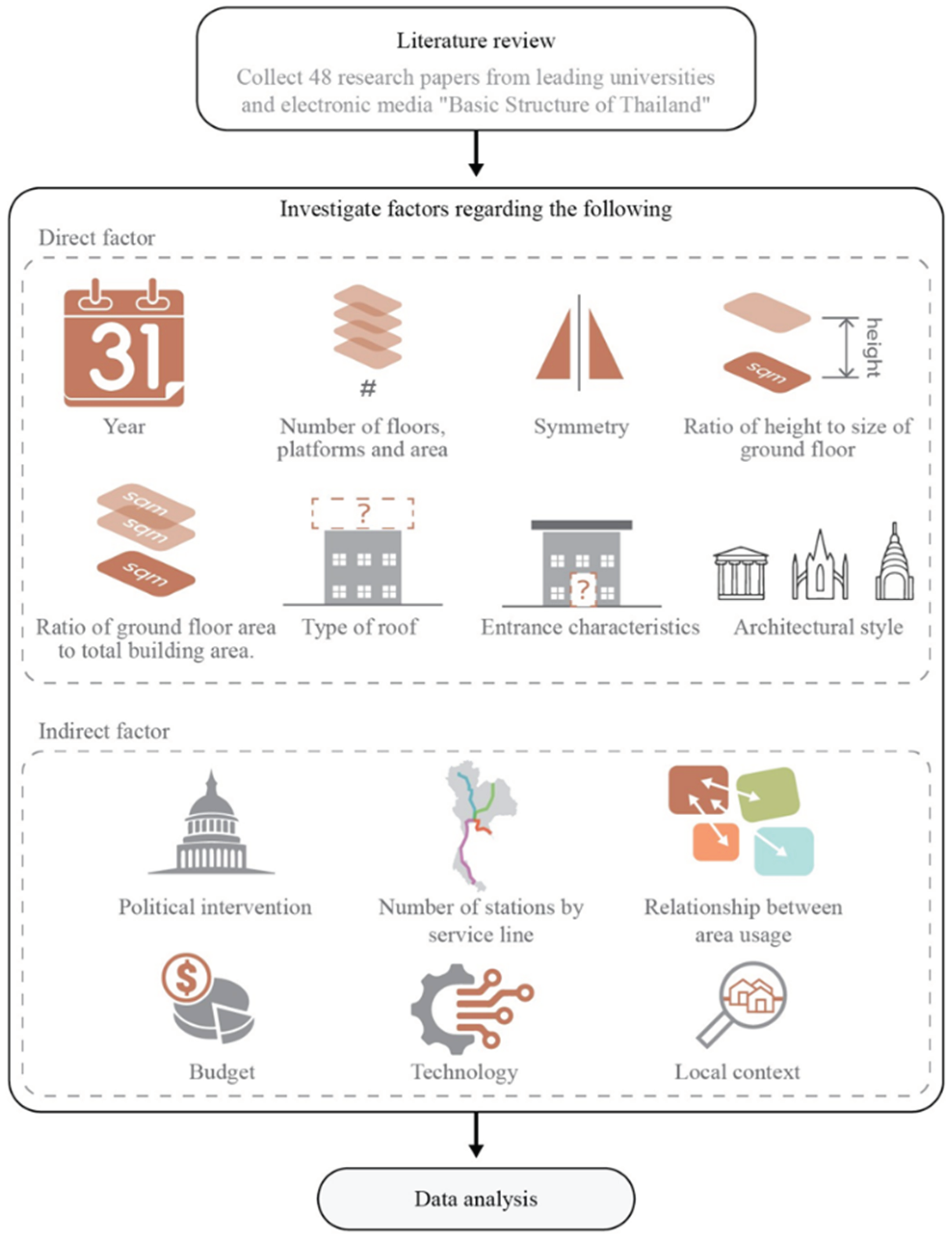
Figure 2.
Classification of railway station categories by year range.
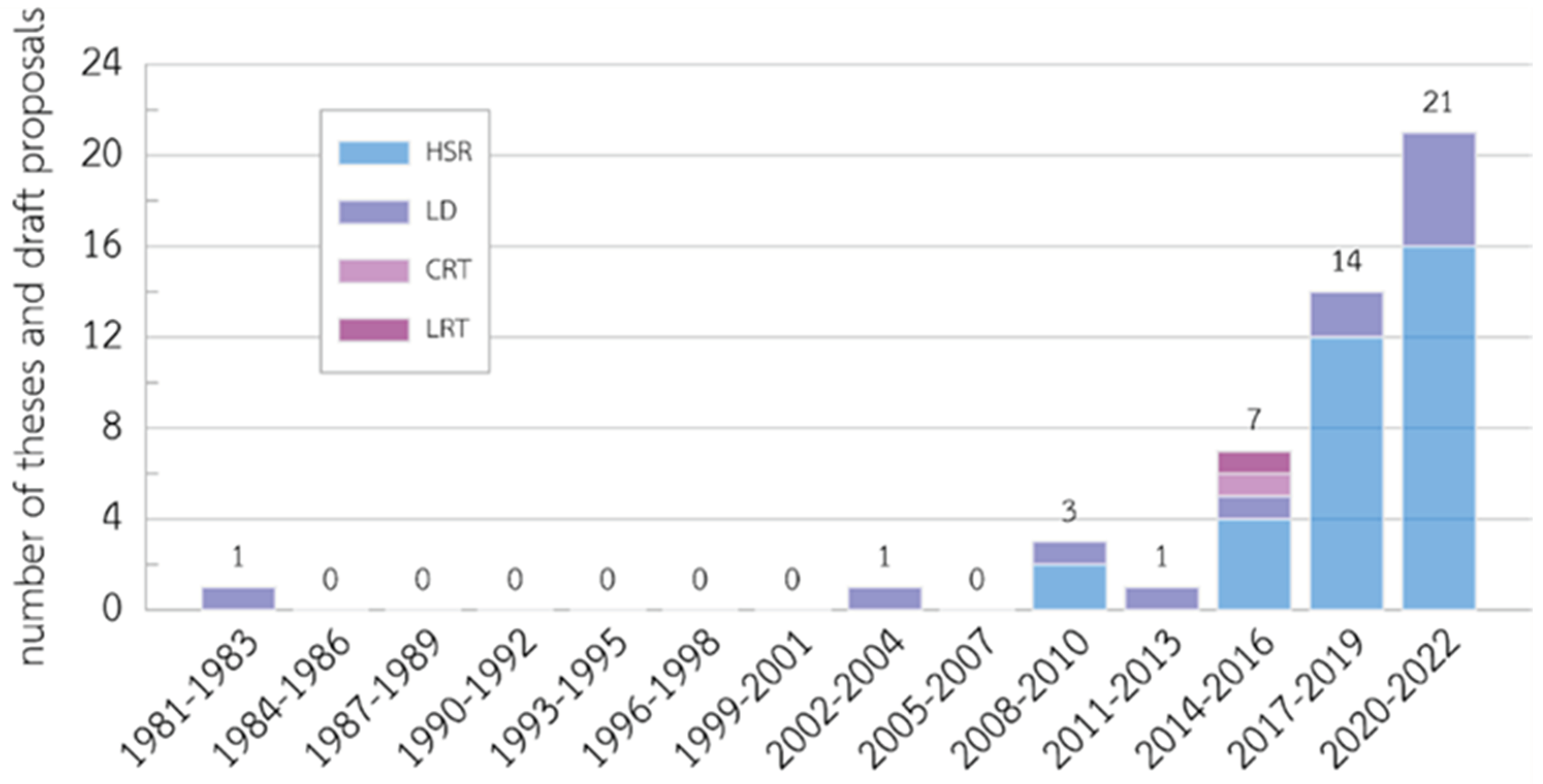
Figure 3.
The functional area used, the number of platforms, and the number of floors of all railway stations.
Figure 3.
The functional area used, the number of platforms, and the number of floors of all railway stations.
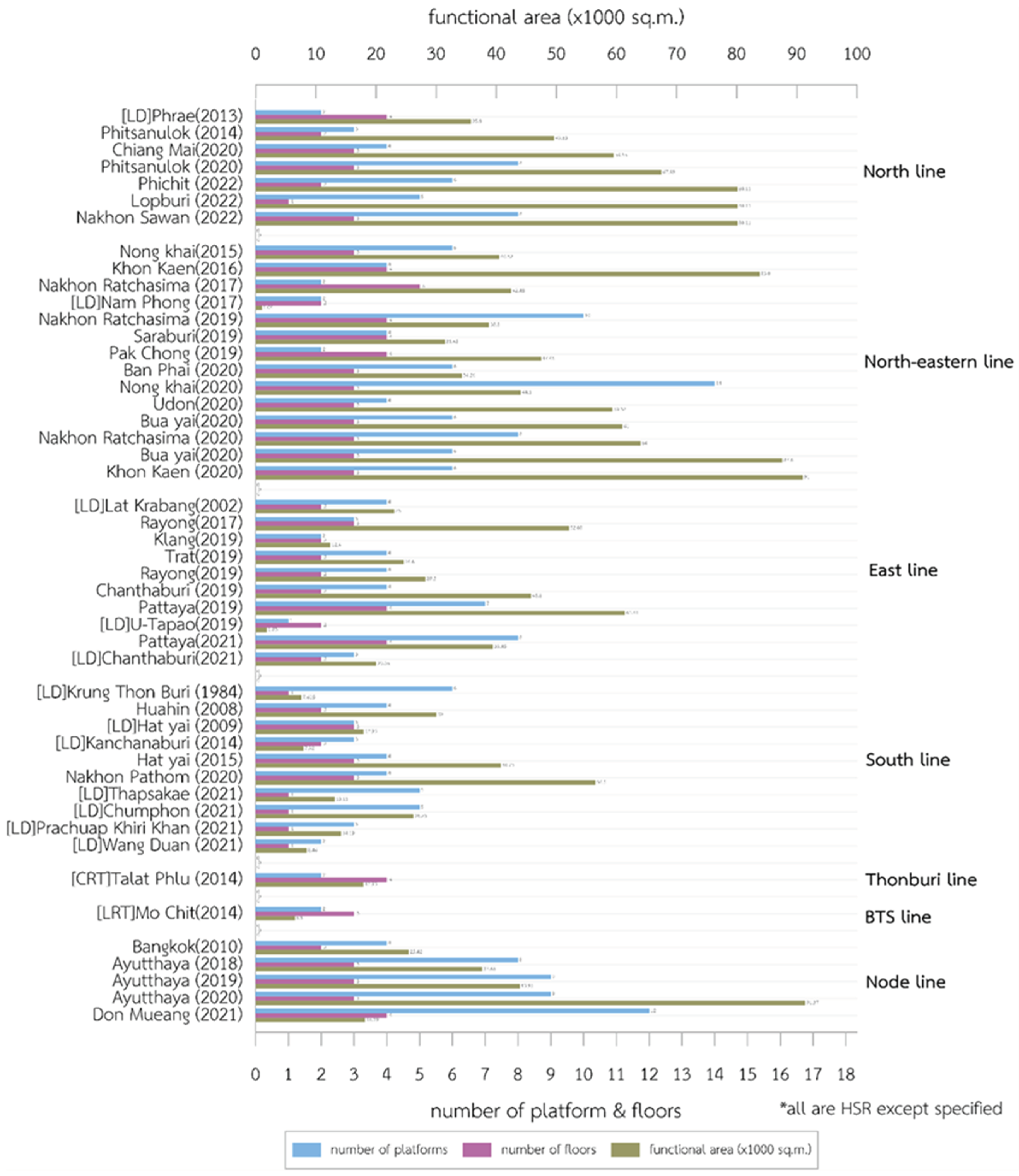
Figure 4.
Ratio between symmetry and asymmetry form of HSR stations.
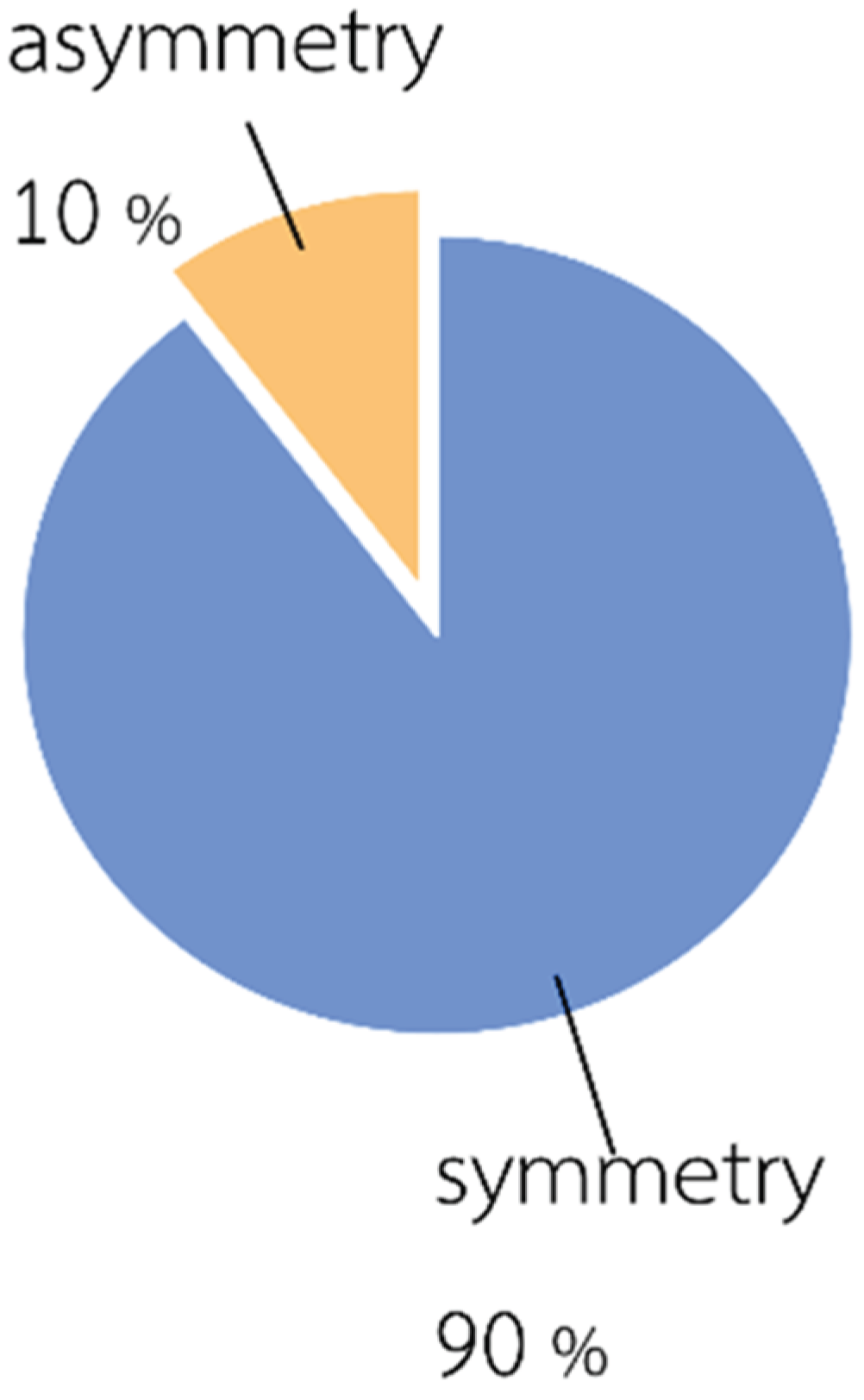
Figure 5.
Ratio between height and 1st floor area.
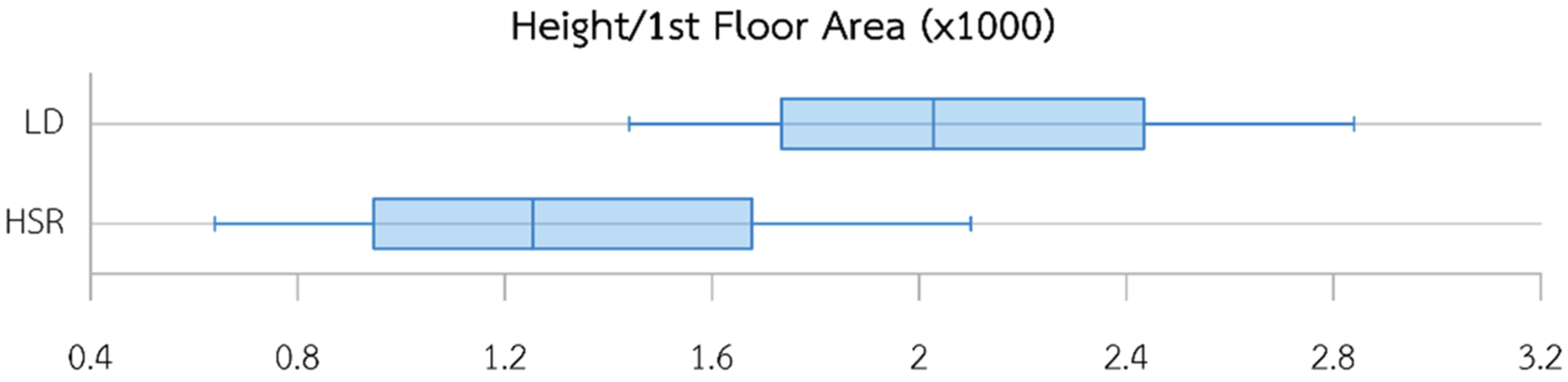
Figure 6.
Ratio between first floor area and total floor area.
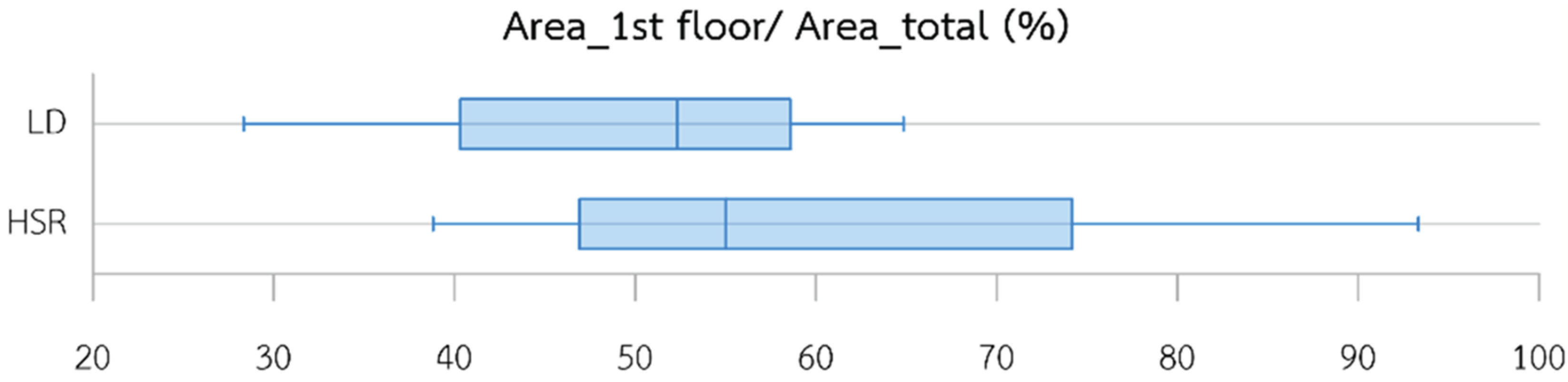
Figure 7.
Roof typology.
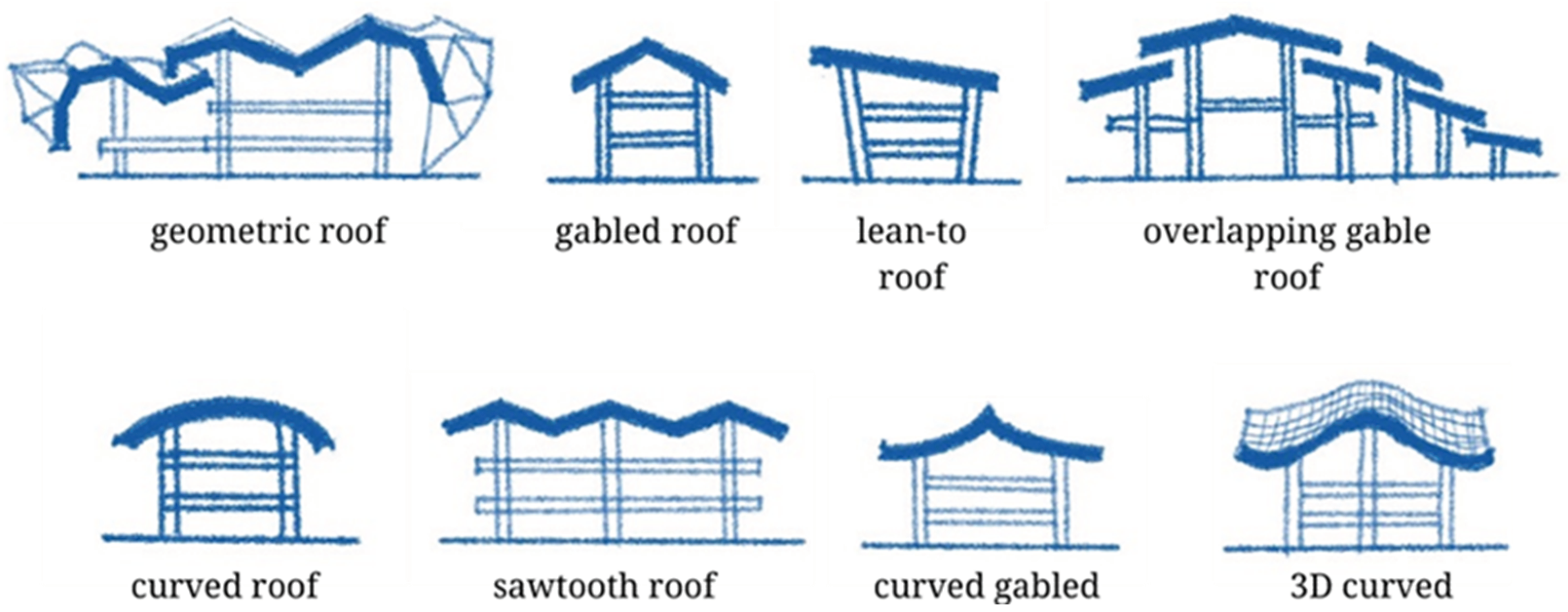
Figure 8.
Compilation of characteristics of the high-speed railway station’s roof since 2014.
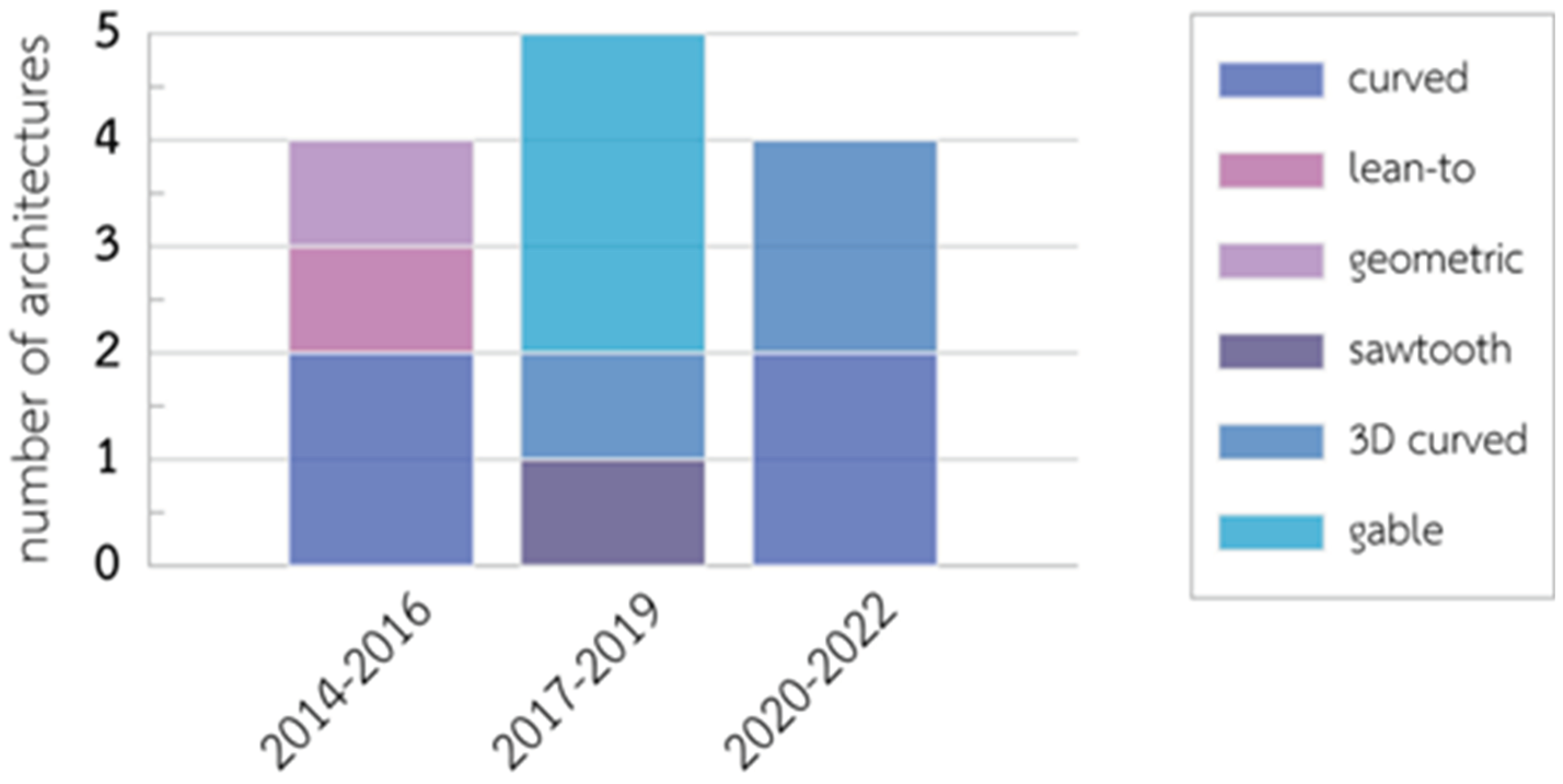
Figure 9.
Draft proposal of Udon Thani railway station and ancient Ban Chiang pottery.
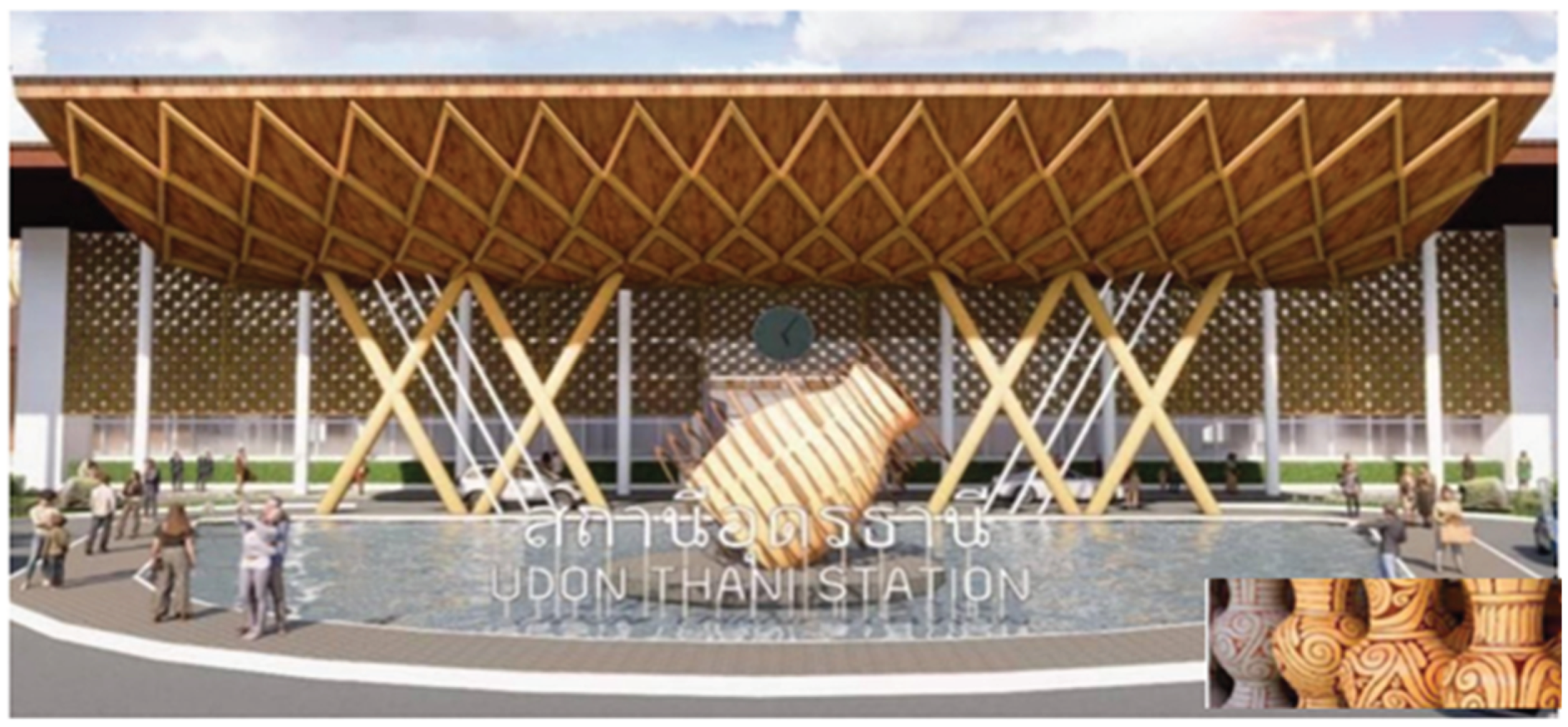
Figure 10.
Development of HSR stations from theses.

Figure 11.
Development of HSR stations from draft proposals.
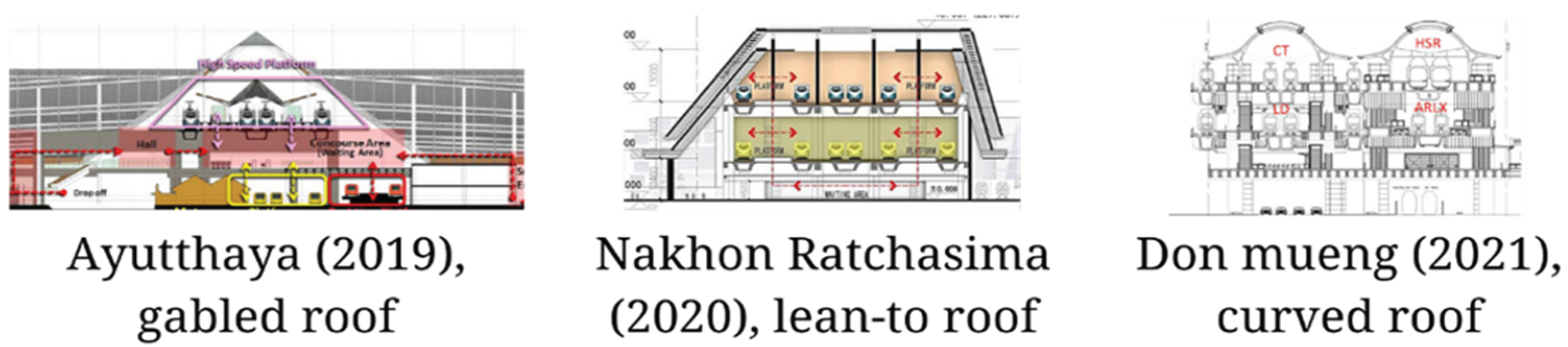
Figure 12.
Main entrance characteristics.
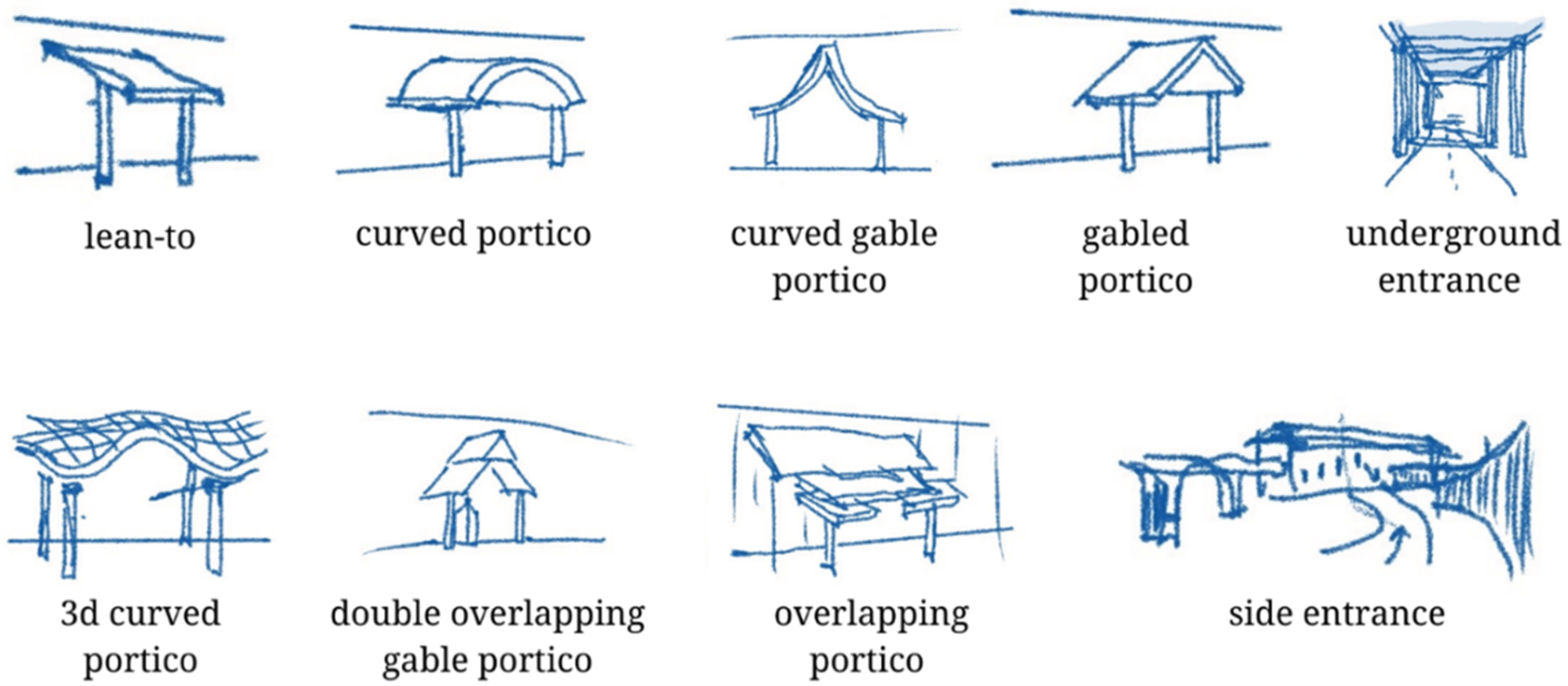
Figure 13.
Main entrance characteristics to HSR stations after 2014.
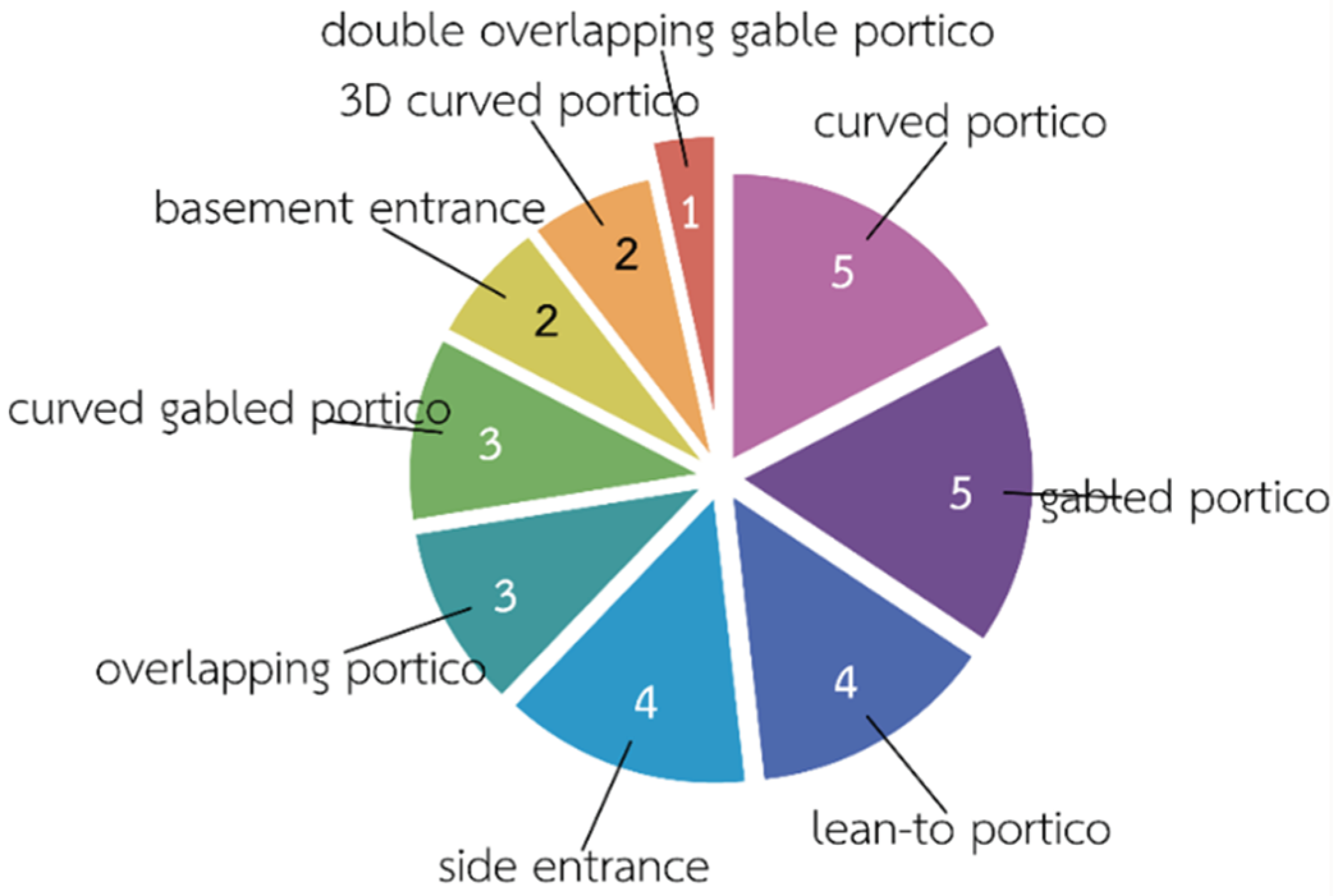
Figure 14.
Classification of HSR stations since 2014 based on architectural styles.
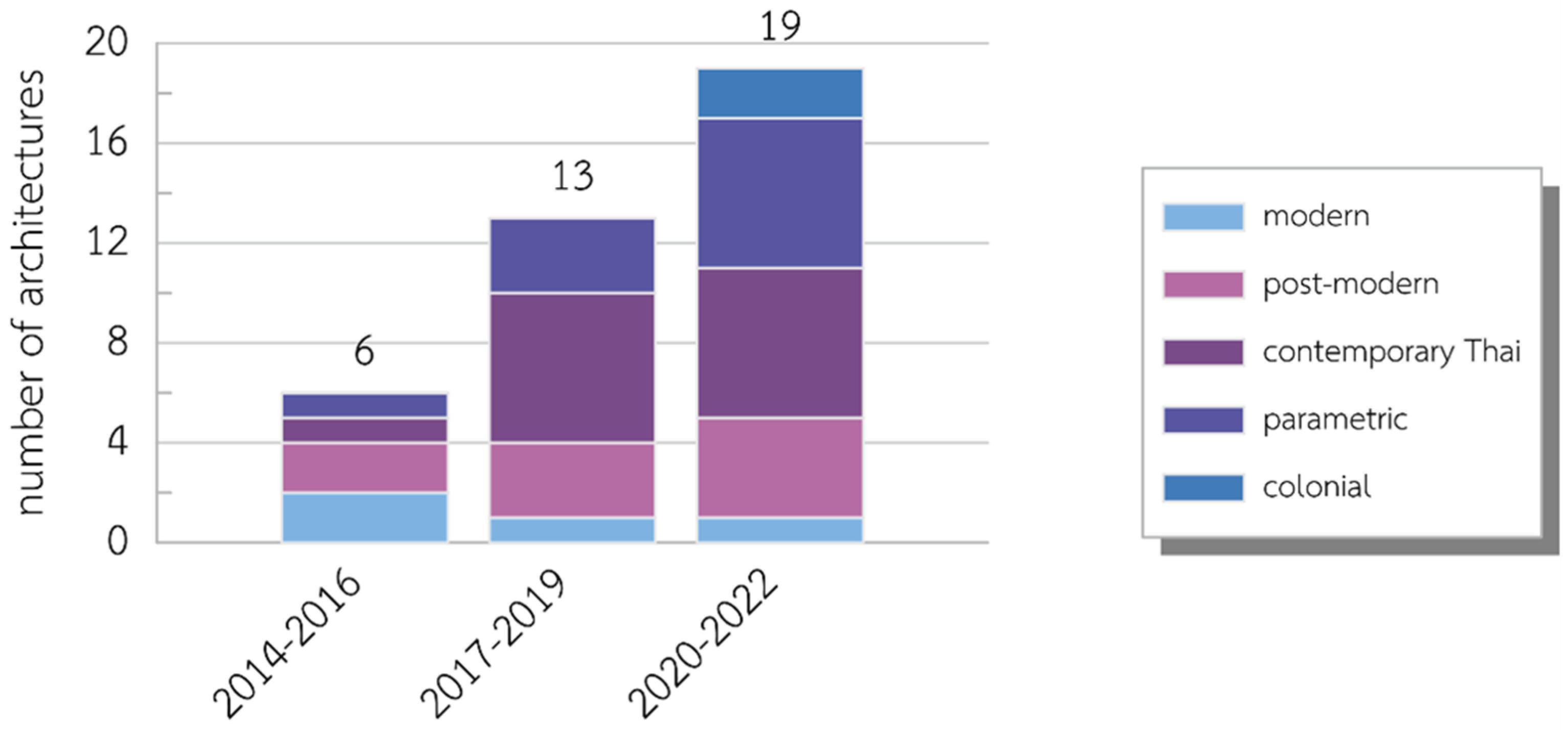
Figure 15.
Development of railway station designs at the same locations.
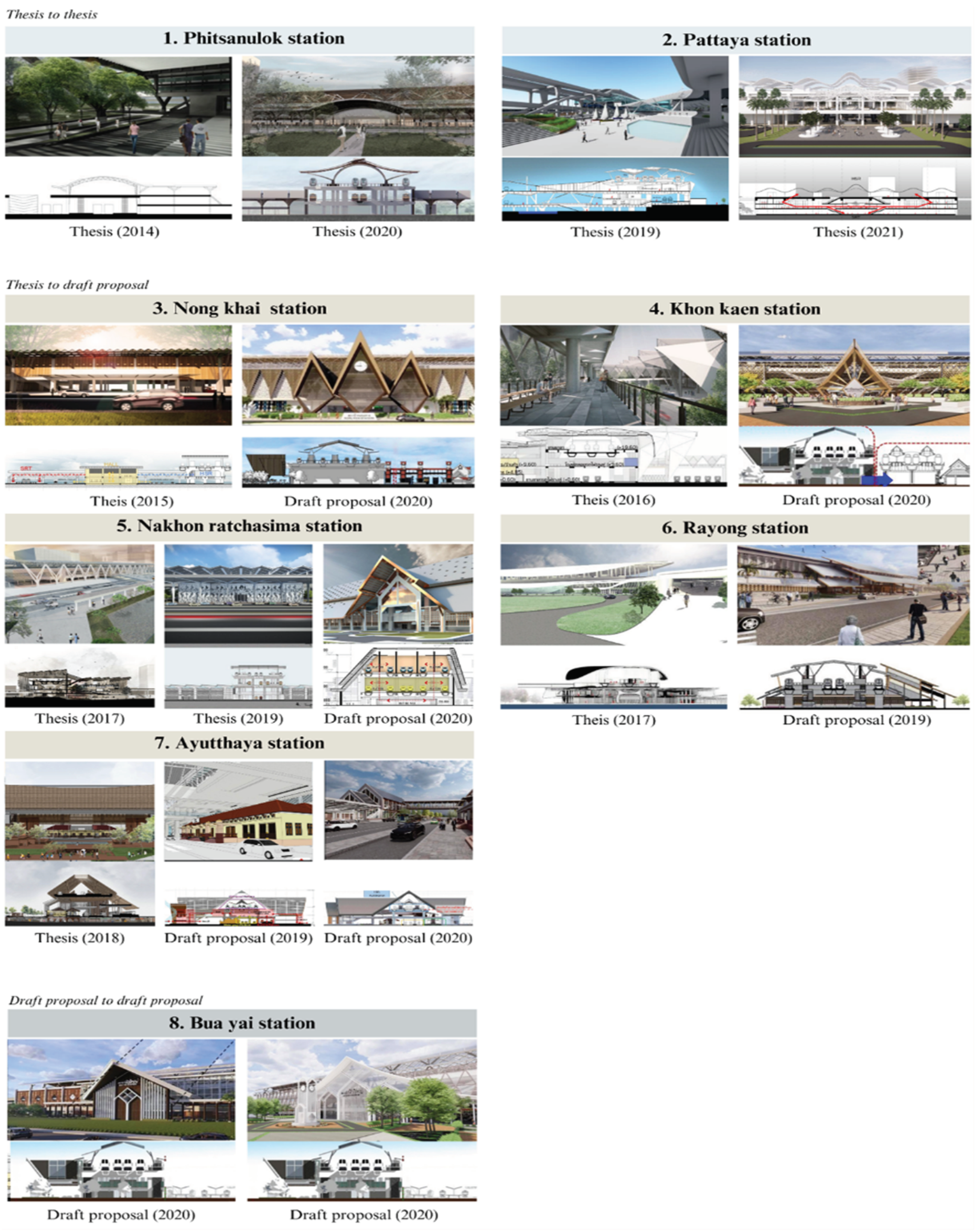
Figure 16.
Evolution of railway station design.
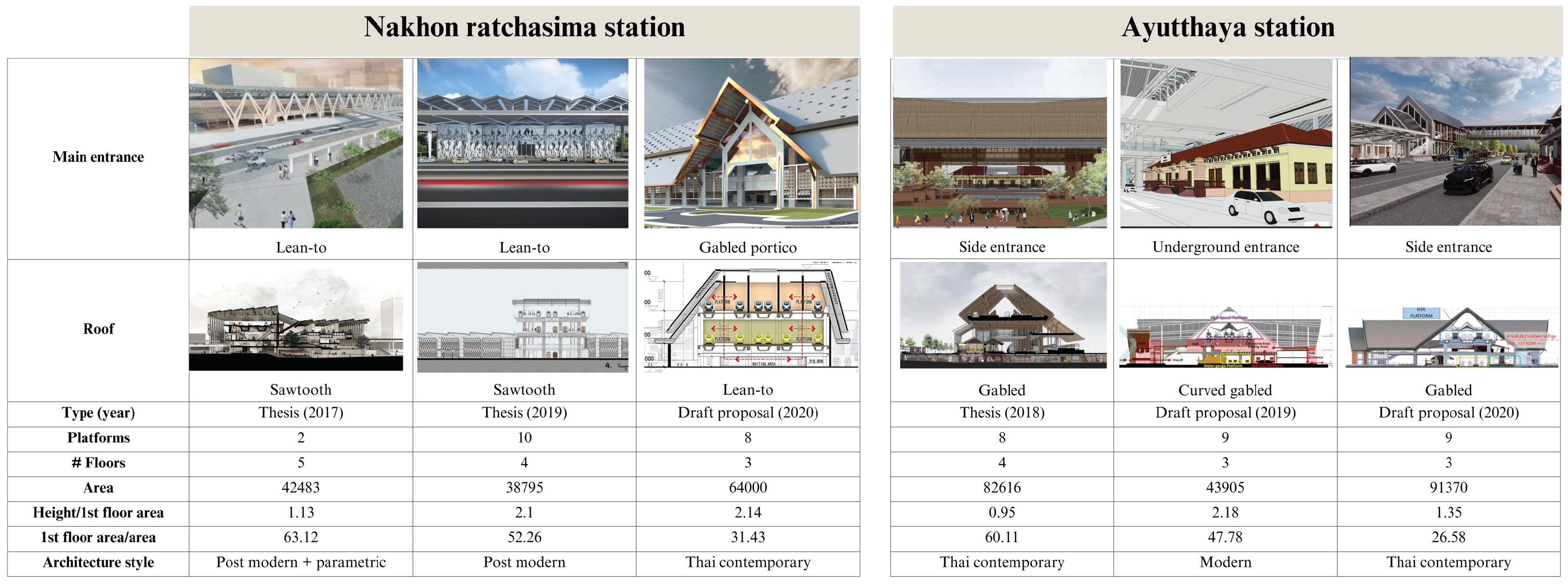

Table 1.
PICO method of study.
| PICO component | Explanation |
| Problem—P | The architectural design of railway stations in tropical design is lacking. |
| Intervention—I | Examine railway station designs of theses in Thai universities and draft proposal to Thai government |
| Comparison—C | Compare railway station design in tropical climate (Thai context) with the general design |
| Outcome—O | Architects and designers make structures more appealing and functional. thesis-designed stations emphasis concept and function over cost. |
| Railway station design should prioritize transparency, connectivity, movement, cost- and time-efficiency |
Disclaimer/Publisher’s Note: The statements, opinions and data contained in all publications are solely those of the individual author(s) and contributor(s) and not of MDPI and/or the editor(s). MDPI and/or the editor(s) disclaim responsibility for any injury to people or property resulting from any ideas, methods, instructions or products referred to in the content. |
© 2024 by the authors. Licensee MDPI, Basel, Switzerland. This article is an open access article distributed under the terms and conditions of the Creative Commons Attribution (CC BY) license (http://creativecommons.org/licenses/by/4.0/).
Copyright: This open access article is published under a Creative Commons CC BY 4.0 license, which permit the free download, distribution, and reuse, provided that the author and preprint are cited in any reuse.


