

Submitted:
26 February 2024
Posted:
27 February 2024
You are already at the latest version
Abstract
To handle the challenges and uncertainties of the actual labor market, the concept of employability becomes increasingly relevant, especially for graduates facing the transition from university to work. Graduate employability is a complex concept comprising different dimensions that may trigger effective job search and career management. This study introduces a new multifaceted tool, labeled the Orientamentis Questionnaire, to assess graduate employability from an agentic perspective, testing its psychometric properties. The Orientamentis questionnaire measures 14 dimensions merged into four 4 areas, namely graduate psychological capital, graduate agentic capabilities, graduate career perspective, and graduate proactive strategies. The tool was administered to a sample of 1238 graduate students (66% females) examining its factorial structure and reliability. To test its criterion validity, associations with three occupational outcomes collected one year later were explored on a subsample of 273 participants (66% females). Results attested the factorial structure of the Orientamentis questionnaire and the reliability of all dimensions. Moreover, the four areas and most of the dimensions were differently related to at least one subsequent occupational outcome. The Orientamentis Questionnaire represents a sound and reliable tool providing a multifaceted profile of graduate employability strengths and weaknesses, that could be used in academic placement programs to foster graduates’ self-awareness and proactive job search.
Keywords:
graduate employability
; Orientamentis questionnaire
; validation
; psychological capital
; agentic capabilities
; proactive strategies
; pre-professional career identity
; occupational outcomes
; academic placement programs
1. Introduction
Graduates face a significant challenge in charting their life beyond their degree, when transitioning from the student role to potential professional roles, aiming to strengthen their employability.
While graduates’ occupational status is an important asset in a knowledge-driven economy and they are acknowledged as potential key resources for organizations, the increasing labor market competitiveness and dynamism makes the job search process more difficult even for graduates. For instance, the rising trend in the number of graduates all over Europe [1] makes the possession of qualifications less elitist, a requirement that alone is no longer sufficient to guarantee finding a job [2,3]. Moreover, some countries, such as Italy, have alarming unemployment and underemployment rates also among graduates [4,5]. The long-term consequences COVID-19 pandemic have even exacerbated the precarity of employment and the level of competitiveness of the labor market, increasing the risk of social exclusion and disadvantage [6].
Furthermore, the growing labor demand unpredictability easily makes the existing educational profiles obsolete and requires graduates to complement the qualifications and knowledge provided by the academic courses with ongoing skills updates [7,8]. The difficulty in making predictions about which skills will actually be useful in the short term implies that higher education employability policies have to move beyond traditional knowledge and skills provision (see for instance, the so-called “skills agenda”[9]; or competency-based models [10]), and curricular and extra-curricular opportunities (e.g. building links with potential employers, encouraging mobility), also fostering graduates in crafting their career paths [9,11].
Finally, there is a heightened expectation among graduates, not only to secure employment, but also to find a job that aligns with their professional goals, skills, and aptitudes. Consequently, entering the labor market is no longer a singular transition from university to a specific organization or job type, but involves an ongoing quest for increasingly satisfying jobs and healthy and sustainable workplaces.
Accordingly, employability is an enduring process that accompanies the entry into the world of work, but also the frequent shifts in career paths and shorter-term and discontinuous contracts [12]. In the face of changes, discontinuity, and transitions, employability fosters graduates to continually build up their career path, for instance by strengthening their repositories of knowledge and skills, nurturing their own unique personal characteristics, reflecting on the fit between them and their desired job, foreshadowing longer-term sustainable professional goals, and thus enhancing their job satisfaction and wellbeing.
In this scenario, it becomes crucial for graduates to reflect on their perceived personal resources and professional goals, and to question the link between the desired job and the contextual opportunities and constraints, through their ability to understand and enact it such as searching for information, enabling networks, acquiring new competencies over time. Hence, the career management process shifted under graduates’ responsibility leading to an agentic perspective, that conceives employability as the capability of being the author of one’s career development, being proactive in searching for work, and crafting personal and contextual resources and opportunities [13,14]. Thus, employability encompasses all those individual characteristics, personal resources, and attitudes that may facilitate effective career management [15].
Scholars acknowledge that this perspective reflects the above-mentioned labor market changes, providing a consistent employability conceptualization, however, it has some blind spots related to the overlooked interplay between individuals and the context they are embedded in [16,17]. Specifically, little has been said about how graduates can effectively enhance their personal resources not simply as a general investment in upskilling but as a tailored path that, by linking their personal assets with specific potential employment relationships, allows the definition of job search objectives and consistent proactive strategies. Furthermore, this person-centered approach, tending to conceive individuals as free agents, gives limited attention to policy agenda suggestions and asks for a redefined role of services and higher education systems.
Drawn on this agentic perspective, this study aims to address these shortages by proposing a conceptual model and a related measure of graduate employability. Specifically, we posit that, together with psychological capital, a crucial component of graduates’ employability lies in their agentic capability to intentionally take charge of their career path through forethought, self-regulation, self-reactive, and vicarious capabilities [18]. This ongoing proactive process involves making sense of and engaging with professional social settings and enables graduates to align their current performance and potential with envisioned professional objectives and emerging employment opportunities [9,19,35]. In turn, strengthening their professional identity helps graduates to progressively move from the periphery of the organization’s workforce to higher, more legitimized professional roles [7,19]. In line with this, our model conceives employability as a process where the graduates’ agentic capabilities link their psychological capital to career expectations and in turn proactive strategies.
This model, therefore, identifies two sets of psychological resources (agentic capabilities and psychological capital) that are relevant for graduates’ employability, linking them to the definition of the foreshadowed pre-professional identity and to different strategies for managing the relationship with potential employers and the labor market. This, in turn, paves the way for a greater likelihood of securing employment but also finding a sustainable and satisfying job that aligns with their academic trajectory. Overall, the proposed model contributes to the agentic perspective by extending the person-centered approach with a reflexive self-assessment process on how graduates perceive their personal resources and the way they cope with the broader conditions of the labor market [16,17].
To our knowledge, there is a dearth of comprehensive graduate employability measures, since only a limited number of questionnaires have specifically targeted this highly qualified group, and even fewer have been tested on graduates. Furthermore, most of the existent questionnaires reflect a possessional conceptualization of graduate employability [20], whereas only a few [21,22] have adopted a comprehensive agentic framework, seeking to assess the core set of personal resources that underlie graduates’ employability.
To address this need for multifaceted instruments, the first aim of the paper is to introduce a new questionnaire, labeled Orientamentis, to assess graduate employability from an agentic perspective. Consistent with our employability conceptualization, encompassing four core areas, namely graduate agentic capabilities, graduate psychological capital, graduate career perspective, and graduate proactive strategies, this questionnaire accounts for a total of 14 dimensions. The second aim is to present an initial validation of this tool by testing its factorial structure, reliability, and longitudinal associations with occupational outcomes.
The Orientamentis questionnaire, providing a multifaceted employability profile, could be useful to promote self-reflection and self-awareness of their personal resources, career expectations, goals, and behavioral strategies Indeed, it allows graduates a granular understanding of the agentic resources that enable them to actively craft their employability and to consciously handle the challenging transition from university to the world of work.
The paper unfolds as follows. Firstly, we delve into the employability literature focusing on core features that specifically underpin graduates’ employability and related measurements. Following, drawing on the agentic framework, we outline the proposed conceptual model, comprising the four areas, and their specific dimensions, to account for graduate employability as measured by the Orientamentis Questionnaire. Then, a first validation study is presented and discussed, together with the practical relevance and utility of the tool.
1.1. Graduate Employability: Conceptual Framework and Measures Review
Although multiple working definitions and conceptual frameworks have been proposed, employability can be generally defined as an individual process of work creation [10], encompassing the maintenance or modification of one's current job or acquisition of a new one according to personal preferences and qualifications [23]. To this end, employability engages a set of psycho-social factors inherent in the interaction between individuals and how they perceive and act upon environmental supplies/demands to facilitate movements in the labor market (e.g., [24]). In 2016, the review by Lo Presti and Pluviano [21] represented a significant effort to clarify and integrate the multiple perspectives on employability into a more comprehensive framework. In this framework, employability is configured as a multidimensional construct aimed at capturing the dynamic process that underlies career success. Specifically, the model emphasizes the set of resources that enable individuals to actively build their perception of being employable in the labor market and shape their career narratives and pathways. Indeed, on the one hand, highly employable individuals extract meaning from their past work and personal experiences (“Where do I come from?”) and envision a clear path for their professional future (“Where am I headed?”) fueled by self-awareness (“Who am I and who do I aspire to become?”). This valuable internal dialogue, known as career identity work, allows individuals to recognize and strategically navigate the common thread that links their past and future selves—namely, the goals, skills, interests, values, and internal needs they embody. On the other hand, employable individuals cultivate both their current and future career prospects by assessing the resources at their disposal to pursue their professional objectives and by committing to behavioral activities that allow them to acquire additional resources. Thus, key dimensions of employability are the proactive behavioral strategies that individuals deploy to learn valuable knowledge, competencies, and abilities (i.e., professional development), enhance formal and informal career-related relationships with significant stakeholders (i.e., networking), and explore one's environment to identify opportunities and constraints to career pathways (i.e., environmental monitoring).
Lo Presti and Pluviano linked employability to the theme of developing one's capital of resources, since “besides the actual possession of certain attributes, the individual interest, capacity, and effort in developing and enriching them are fundamental to its understanding” [21] (p. 197). With a more targeted focus on graduates, this concept has been expanded within Tomlinson's framework on employability [11]. Tomlinson defined graduate employability as a diverse array of dynamic, interactive forms of capital (i.e., identity, human, social, cultural, and psychological resources) that are acquired and deployed through graduates' lived experiences, conferring advantages onto their achievement of a sustainable employment and career success [11]. Identity capital involves graduates' abilities to draw upon experiences and craft a personal narrative that aligns with the specific employment domains they aspire to enter. In this regard, Tomlinson [11] and Lo Presti and Pluviano [21] converge in identifying career identity as a crucial component of employability. However, in the case of graduates, it pertains to the formation of the so-called pre-professional identity [25], as their experiences are mostly rooted in university practices (e.g., participating in the disciplinary community, career services, and forms of experiential learning). In fact, graduates who invest more in their careers are those who feel a stronger commitment to find jobs and organizations aligning with their education, thereby recognizing its centrality to their personal identity [26]. Along with career identity, graduates' identity capital begins to take shape in terms of perceived employability, namely the perceptions regarding the employment value they possess in the early stages of labor market exploration (e.g., preparing CVs, sending applications, experiencing the recruitment process, [9,20,27]). Furthermore, the construction of graduates' identity capital relies on goal clarity, that is, the clear and cohesive visualization of career goals, which aids them in projecting their self-image toward the working life in the early management of their employability [11]. In addition, to identity capital, the acquisition and mobilization of human capital (i.e., the knowledge and skills graduates acquire), social capital (i.e., the sum of social connections that help graduates understand and access the labor market), and cultural capital (i.e., the development of culturally valued knowledge, attitudes, and behaviors aligned with the working contexts graduates seek to enter) — as proposed by Tomlinson [11] — align with the employability orientation and activities identified by Lo Presti and Pluviano [21]. In fact, both frameworks emphasize the importance of working out (i.e., identifying, becoming more aware of, and developing) which knowledge, skills, networks, and context-specific information matter, and how these align with targeted professional fields to maximize one’s placement chances. Beyond the points of convergence with the Lo Presti and Pluviano model [21], Tomlinson has been the first to integrate psychological capital into the framework of graduate employability, thus successfully addressing a significant gap in the literature and previous models [11]. Psychological capital refers to the set of developable psychological resources that enable graduates to proactively manage and adapt to career challenges. Indeed, the author recognizes the paramount importance of these resources for graduates exiting higher education to promptly realign their goals and make proactive choices when confronted with the unpredictable challenges arising from the labor market [15,28]. The well-known psychological resources of self-efficacy beliefs, hope, resilience, and optimism, as defined by Luthans and colleagues [29], fall under the umbrella term of psychological capital as they support the graduate to orchestrate the actions and strategies necessary to achieve one’s own professional goals, looking confidently at and overcoming the future challenges that may arise. However, in Tomlinson's model [11], the cognitive resources that enable and direct individual proactivity, enabling individuals to learn from experiences and capitalize from both successes and failures, are not explicitly addressed. Grounded in Social-Cognitive Theory, these resources can be attributed to the agentic capabilities defined by Bandura [18], which are cognitive resources that help individuals to anticipate and build potential paths to employment and career advancement, self-regulating emotions and actions in alignment with professional goals, and using one’s and other’s experiences as sources of reflection and learning to channel personal choices optimally [30,31].
Through the synthesis of Lo Presti and Pluviano [21] and Tomlinson's [11] conceptual frameworks, we contend that a comprehensive assessment of graduates' employability involves the psychological and identity-related resources as well as the proactive behaviors that graduates use to increase their employment chances and career prospects. However, in this regard, it should be noted that most measures in the literature have been validated only on employees, displaying notable issues in defining and operationalizing employability. Indeed, across both monodimensional and multidimensional measures, scales generally focus on specific core areas and/or dimensions of employability (e.g., perceived employability in [23]; proactive behaviors in [32]) and neglect others (e.g., psychological resources are not assessed in [33]). Moreover, multidimensional tools often measure employability within dispositional [34], or competence-centered theoretical approaches [10]. However, in contemporary perspectives on employability, it is acknowledged that personality traits can be regarded as precursors to employability rather than core to its definition [21,35]. Moreover, measures anchored on competencies can be plagued by rapid obsolescence [11,21]. Finally, a common critique of all tools is that the labels used to name the measurable dimensions may not necessarily reflect the actual, measured contents of their scales [36].
Building upon this, we review tools for narrowly measuring employability in graduate populations. Specifically, Rothwell and Arnold introduced the Self-Perceived Employability scale [23], later tailored to university students [37]. This scale evaluates the extent to which an individual believes that their education—comprising a blend of knowledge, skills, and abilities acquired at university, coupled with the reputation of their university and the social standing of their field of study—is sought after and in demand in the labor market. More recently, Gunawan and colleagues [38] extended this scale to measure the future projections that university students have regarding the set of elements (i.e., skills, experiences, knowledge of the labor market, personal characteristics, university reputation, networks) that will enhance their value in the eyes of potential employers. Although these scales capture a crucial dimension related to the formation of pre-professional identity in university students (e.g., [9,20,25]), they diverge from the multidimensional perspective of employability advanced in the literature. The more recent EmployABILITY scale [39] aligns with the above-mentioned shortcomings. Indeed, although it has been validated on samples of university students, not all of its fourteen dimensions are indicative or core to the employability construct, as the scale includes variables such as soft skills (e.g., interactive skills and ethical behavior) and personality attributes (e.g., self-esteem). A radical advancement in the measurement of graduate employability has been provided by Tomlinson and colleagues [22]. Indeed, the Graduate Capital Scale [22] assesses the five forms of capital at one’s disposal when transitioning to the graduate labor market, namely the human, social, cultural, identity, and cultural capitals. This instrument certainly has the merit of providing a practical assessment of all the resources that graduates perceive to have at their disposal for identifying and capitalizing on employment and career opportunities. Furthermore, although through a single scale, it is the first measurement tool to explicitly assess psychological capital as a core area of employability. However, the tool does not operationalize the specific resources that are constitutive of psychological capital and, thus, may differentially come into play in the search for and attainment of employment [40]. Finally, none of the existing employability assessment tools have accounted for agentic capabilities, which are indeed pivotal in guiding individual proactivity [31].
By integrating the more advanced conceptual perspectives of Lo Presti and Pluviano [21] and Tomlinson [11] from an agentic perspective, we developed the Orientamentis model and questionnaire (that will be described in the next paragraphs) to address the current shortcomings of graduate employability measures.
1.2. The Orientamentis Questionnaire. Theoretical Model
The Orientamentis questionnaire operationalizes graduate employability as a combination of psychological, pre-professional identity-related, and behavioral resources, tapped into four areas (see Figure 1). The first and innovative area, called "graduate agentic capabilities" refers to the basic cognitive abilities allowing graduates to enact an intentional, self-reflective, and learning-oriented conduct towards employment and career development. Agentic capabilities make graduates able to anticipate their career path (i.e., forethought), regulate their functioning in line with their goals (i.e., self-regulation), reflect and capitalize on their own experiences of success and failure (i.e., self-reflection), as well as those of others (i.e., vicarious learning). The second area, named "graduate psychological capital," refers to psychological resources enabling graduates to positively adapt, react and persist in the face of employment and career challenges. Psychological capital makes individuals confident in presenting themselves and showcasing their value in job searching (i.e., job search self-efficacy beliefs), persist in their goals by defining alternative paths in the face of obstacles and difficulties (i.e., hope), bounce back energetically and emotionally in such instances (i.e., resilience), and look to the future with confidence and enthusiasm (i.e., optimism). The third area, named “graduate career perspective” represents the graduate’s awareness of their emerging identity and commitment to manage the transition from university to the labor market by evaluating one’s perceived value for the labor market (i.e., perceived employability), by committing to a career path that aligns with one's previous personal, formative, and professional experiences (i.e., pre-professional identity) and, accordingly, visualizing and defining clear professional goals (i.e., goal clarity). The fourth area, named “graduate proactive strategies”, refers to the proactive behaviors that university students use to maximize their chances of a first sustainable employment, by leveraging one’s social connections (i.e., social networking), acquiring or further developing knowledge and skills relevant for one’s career (i.e., continuous learning), and monitoring external opportunities and constraints in the environment (i.e., information seeking). Hence, the following paragraphs delve into the four conceptual areas and underpinning dimensions measured by the Orientamentis questionnaire.
1.2.1. Graduate Agentic Capabilities
According to social-cognitive theory [41], the human agency represents the individuals’ capacity to influence one’s functioning and life circumstances through distinct "agentic capabilities" [18,42]. Through forethought, self-regulation, self-reflection, and vicarious capability, people can act proactively on the environment, capitalizing on past experiences, engaging in self-monitoring behaviors, and strategically planning for future objectives aligning them with personal aspirations [43]. Within the current literature, various psychometric scales have been developed to assess individual capacities linked to agentic capabilities. For instance, the Self-Reflection and Insight Scale evaluates self-reflective capacities in undergraduates [44], while the Emotion Regulation Questionnaire focuses on self-regulation in a work context [45]. Moreover, models like Bindl and colleagues’ [46] proactive goal-regulation model and Code's Agency for Learning Questionnaire [47] measure multiple capabilities simultaneously, respectively in the professional and academic contexts. Nevertheless, a comprehensive reference to the four main agentic capabilities is lacking. To the best of our knowledge, the sole exception is represented by the Work Agentic Capabilities Questionnaire [31]. However, since it is tailored to the organizational context, it has no applicability to graduates, particularly in understanding the role of each agentic capability in facilitating early career job search behaviors and employability. Indeed, agentic capabilities play a pivotal role during the university-to-work transition, a period demanding active facilitation by educational institutions [48]. Specifically, forethought capability, as outlined by Bandura [49] and further explored by following studies (e.g., [50,51]), is crucial in this phase. It involves setting personal goals and developing strategies to achieve them, thereby influencing one's motivation and future planning. Accordingly, Van Hooft and colleagues [52] highlight this in the context of job searching, emphasizing the importance of constant reflection and adaptation of job search behaviors to make it more effective, such as optimizing one’s goals to meet the challenges of today’s job market. Furthermore, the ability to self-regulate, as noted by Kanfer and colleagues [53], is essential in maintaining effort and motivation toward achieving job-related goals. This is corroborated by Turban and colleagues [54,55], who found that positive affectivity during job searching is associated with better job search outcomes in a sample of graduating students, including higher intensity and more job offers. This emphasizes the interplay between affectivity and cognitive processes like motivation, reflection, and planning [56], which are involved in effective job searching and, by extension, enhancing graduates’ employability and career satisfaction [57]. Moreover, self-reflection and vicarious capability also contribute to personal growth and adaptability within professional contexts [18,58]. Accordingly, previous studies [59–61] demonstrate that fostering self-reflection in students, particularly regarding career fit, significantly improves their job search strategies and their ability to overcome career obstacles. Likewise, learning through observing others (i.e. vicarious capability) can enhance job search skills, although research in this area predominantly focuses on individuals already in the workforce [62–64], leaving a gap in understanding its impact on early career stages and job search strategies. Taken together, each of the agentic capabilities collectively contributes to long-term job performance, commitment [65], and satisfaction [31,66]. Thus, identifying and nurturing these capabilities in young graduates, even before they start searching for a job [67], is crucial for preparing them for the world of work while raising their awareness of the job market and laying the foundation for a persevering approach towards building one's success [29].
1.2.2. Graduate Psychological Capital
Psychological capital, as conceptualized by Luthans and colleagues [29], represents a multifaceted psychological state essential for both personal and professional growth. The synergic combination of its four core components (i.e. self-efficacy, hope, resilience, and optimism) fosters a proactive and positive mindset crucial for individual’s development and achievement in various domains [68,69]. To date, the literature has widely demonstrated the association between psychological capital and a variety of organizational outcomes, namely greater satisfaction, commitment, engagement, and in turn higher job performance (e.g., [29,70]). However, it is also related to multiple life domain outcomes (e.g. health, education, and life in general) [71,72]. Specifically, psychological capital is particularly beneficial in the early stages of one's career. Indeed, in light of current economic and social trends, future workers are required to be more autonomous, creative, and flexible to address the challenges of the modern labor market, such as increased job insecurity, individualization, and flexibility [73–75]. Therefore, graduates need to develop confidence in their competencies, be resilient while facing employment difficulties and maintain an optimistic outlook on future job prospects [76,77]. Accordingly, the previously mentioned Graduate Capital Scale [11], identifies psychological capital as a key aspect of employability, integrating it with other forms of capital like human, cultural, identity, and social capitals. Indeed, previous empirical evidence [78,79] pointed out the positive impact of high psychological capital on job search effectiveness (e.g. higher job offers and employment opportunities), while reducing anxiety about post-graduation employment expectancies. However, this scale doesn't fully measure the specific psychological resources involved in finding and securing employment [40]. Conversely, another attempt to measure psychological capital beyond the organizational context is the Academic Psychological Capital Scale [80], which adapts the four main constructs proposed by Luthans and colleagues [29] to the academic sphere. However, it does not consider the specific personal resources necessary for graduates in the immediate post-university phase, namely when they are searching for an occupation. Indeed, a relevant concept within the context of graduate job placement is job search self-efficacy [81,82], operationalized as the belief of being able to perform the behaviors to achieve a desired employment outcome. According to Bandura guidelines [42], since self-efficacy is a domain-specific construct rather than a global trait, there is a need to measure it through tailored scales. In line with this, research has consistently shown that job search self-efficacy is positively associated with proactive job search behaviors, leading to better job offers [83,84]. Stajkovic and Luthans [85] found that students with higher job search self-efficacy are more proactive in their job search and make more accurate employment predictions post-graduation. Furthermore, it is a strong driver of search efforts [86,87], adaptive career behaviors [88], and successful career outcomes [89]. All in all, psychological capital emerges as a particularly crucial area to address. Moreover, given its malleable nature [29], it offers a valuable resource for enhancing graduates' confidence, encouraging risk-taking for successful career transitions [90], and serving as a buffer against underemployment [91].
1.2.3. Graduate Career Perspective
The area of graduate career perspective emphasizes three main dimensions highlighting the psychological process bridging graduates from their university path to the early stage of their professional career plan. Specifically, pre-professional identity concerns the extent to which the academic career and knowledge are an integral part of an individual’s emerging professional identity [25]; perceived employability represents the general perception of having the chance to secure and retain the desired job position [92], while goal clarity entails the extent to which job seekers acknowledge realistic and clear job-search objectives (e.g. knowing the kind of job they want to apply for) [93]. Regarding pre-professional identity, it extends beyond the mere acquisition of academic knowledge and skills. It encompasses the integration of one’s academic background into the individual's evolving professional persona. Hence, it is not solely about possessing requisite competencies for job performance, rather it is about connecting educational experiences with career aspirations [94,95]. Consequently, it can be considered as a step of identity exploration [96], where aligning one’s career with personal attributes is pivotal. Furthermore, Anakwe and colleagues [97] demonstrate that aiding students in reflecting on their career motivations and interests facilitates more effective decision-making and goal-setting, leading to both the identification of career opportunities and greater awareness of their professional self [98]. Conversely, experiential learning opportunities, such as internships, enhance work readiness and resilience [25,99], further shaping the developing professional narrative. Hence, the university context plays a major role in fostering students’ future professional identity, since it can encourage them to explore their field of interest, enabling a gradual transition from students to professionals [100–103]. This will help lay the foundation for a future, more structured, professional identity, which has been documented to have a positive relationship with different organizational outcomes (e.g. job satisfaction, [104]; commitment, [105]; job performance, [106]). Perceived employability pertains to the individual's perception of their ability to secure and maintain desirable employment [67,92,107]. It involves recognizing and valuing one's competencies and envisioning their application in desired job contexts. This sense-making process supports career transitions and provides a sense of career control [108], leading to active job searching, re-employment success, and career satisfaction [15,37,109–112]. Previous studies [113,114] further affirm that higher levels of perceived employability contribute to reduced job insecurity and enhance employment prospects, particularly among the young and unemployed. Moreover, recognizing one's professional identity and employment opportunities fosters clarity in setting specific goals aligned with interests and experience, guiding research and career decisions effectively [115,116]. Coté and colleagues [117] found a positive correlation between goal clarity and job search intensity, which relates to employment success, while Greenhaus and colleagues [118] noted that clear career goals enable the focusing of cognitive and motivational resources towards development and, if necessary, revision of career strategies. Further empirical evidence [52,119] demonstrates the link between goal clarity and job search outcomes like interview frequency, employment status, and job search quality. At the same time, Tymon [120] and Schoon and Ashby [121] found that commitment to clear goals leads to proactive career behaviors and influences long-term career success [122,123]. Overall, these dimensions collectively enhance the effectiveness of the job search process, influencing behaviors that make job-seeking more successful [52].
1.2.4. Graduate Employability Behaviors
The area of graduate employability behaviors encompasses a range of interrelated employability activities enacted by graduates for an effective job search. These strategies include the search for information related to job positions and opportunities (i.e. information seeking, [23]), the expansion of one's network to enhance job prospects (i.e. social networking, [124]), and the set of actions aimed at acquiring and updating skills and knowledge that are relevant to one's career [15]. In line with Lo Presti and Pluviano’s model [21], the set of skills required to navigate the labor market, encompassing the ability to discern and capitalize on relevant opportunities but also to cultivate meaningful relationships with key stakeholders, constitutes indispensable career competencies for enhancing employability. Specifically, information seeking involves a proactive investigation into various career options. This includes gathering information about potential job roles, organizations, and emerging professions [125,126], as well as identifying opportunities and constraints to one's career path [23]. Moreover, it is a key dimension of career exploration [127], and serves as a foundational step in the job search process [128]. Notably, a recent review [129] linked career exploration to enhanced decision-making capabilities and increased self-efficacy, particularly among undergraduates [130,131]. Furthermore, information seeking has been associated with obtaining more job interviews [132], job offers, and favorable recruiter ratings [133]. It enables the development of realistic career expectations, guiding a more focused job search aligned with personal objectives. Consequently, supporting graduates in effectively seeking information aligned with their chosen career would help them face the complexity and uncertainty of the labor market and to build a more effective way to find an occupation [134]. Parallel to this, social networking serves as the primary method for acquiring valuable information related to job opportunities and possibilities [124,135]. It involves deliberate efforts to establish and nurture relationships that can aid in career development. Research has shown that networking behavior is closely linked to objective employability measures, such as the number of job offers, employment status, and reduced unemployment duration [136–138]. Moreover, given its association with proactive behaviors and high levels of conscientiousness and self-efficacy [138–140], networking strategies can be enhanced to optimize job search [141]. All this goes hand in hand with a final employability behavior characterized by the continuous updating of one's competencies and skills, aimed at increasing knowledge of the world of work and of oneself: career development learning [142]. In this scenario, cultivating and advancing one's skills serves a dual purpose. Firstly, it enhances employability particularly in the early stages of a career, fostering adaptability to the changing work environment [143]. This implies that individuals actively participate in managing their careers and engaging in learning activities to bolster their career objectives [144]. This not only instills confidence in career decision-making but also helps in identifying necessary resources and skills [145]. Hence, each employability behavior aligns with an individual's professional development career. Indeed, they not only enhance visibility in the labor market [146], but also increase the likelihood of securing fulfilling employment that aligns with one's education, interests, and goals [147,148]. In other words, the accuracy of aligning behaviors with particular job goals and the necessary steps to reach them significantly affects the quality of future employment opportunities [149]. Therefore, cultivating effective job search behavior is crucial at the onset of one's professional career, as it significantly enhances employability chances [11].
1.3. The Orientamentis Questionnaire: Tool Development
Starting from our conceptual model encompassing the above-described 4 areas and relative dimensions, we referred to already validated scales to measure the constructs of interest, adapting item formulation for the specific target of graduates facing the transition from university to work. To check the practical relevance of these factors, we conducted 65 interviews with recent graduates in different academic areas, in which participants were asked to identify success and critical factors in terms of personal resources and self-initiated behavioral strategies, based on their job search personal experiences. The interviews were also used to operationalize and adapt the item formulation, especially that of proactive strategies.
The questionnaire comprised 54 items articulated as follows:
- -
- Agentic Capabilities: 13 items taken from the WAC questionnaire [31] adapted to graduates. Specifically, self-regulation was assessed with 3 items (e.g. I manage my moods in order to limit their negative influence on my goals), forethought with 4 items (e.g. I envision in advance the actions I will put in place to find work), vicarious learning with 3 items (e.g. In the job search I find very useful to see how others act and what results they get) and self-reflection with 3 items (e.g. I reflect on the feedback I receive, even those that are particularly critical, to better understand my performance).
- -
- Psychological Capital: 18 items were adapted from Luthans PsyCap questionnaire [29]. Specifically, 5 items were used to assess resilience (e.g. After a setback in study/work I immediately regain my good mood); 5 items to assess hope (e.g. “If I had trouble finding a job, I could think of different strategies to get it” and 3 items to assess optimism (e.g. I look to the future with hope and enthusiasm). Job search self-efficacy was measured using 5 items referred to the personal beliefs to successfully engage in job search behaviors and to receive favorable job search outcomes [150] (e.g. I am confident of my ability to be appreciated in a job interview).
- -
- Career perspective: 11 items were employed to assess this area distributed as follows: 4 items to assess perceived employability [114,151] (e.g. My skills are sought-after in the labor market); 3 items to measure goal clarity [116] (e.g. My professional goals are clear and well defined); 4 items for the pre-professional identity adapting an existing work identity scale [34] (e.g. I am highly committed to working in the field I studied for).
- -
- Proactive Strategies: 12 items were used to assess this area, derived comparing existing scales [37,124,143] with qualitative data collected in the preliminary interviews on effective self-initiated job search strategies and were distributed as follows: 4 items to assess social networking (e.g. I reach out to my contacts and friendships to increase my job opportunities); 4 items to measure continuous learning (e.g. I seek out learning opportunities (webinars, courses, events) related to my professional interests); 4 items to assess information seeking (e.g. I keep myself updated on professional opportunities in my local area related to my field).
2. Materials and Methods
2.1. Sample and Procedure
Participants were contacted by the Career Service of the authors’ university, using a mailing list that included all graduates of the last year (N=5000). An email explaining the aims of the research was sent to graduates, together with an anonymous link to the questionnaire. Participation in the study was completely voluntary, and, at the beginning of the questionnaire, participants had to agree to an informed consent form. Each participant was asked to generate a personal code, known only to the person, to match with the second wave of data, preserving complete anonymity. All procedures followed the ethical standards of the 1964 Helsinki Declaration and data storage met current Data Protection regulations.
Our total sample consisted of 1238 recent graduates (25% of response set) out of which 65.67% were women. The average age was 27.29 (SD = 3.42), and most of them reported having recently obtained a master's degree (989 participants, 79.89%), while the others reported having a five-year degree (210 participants, about 16.96%) or a bachelor’s degree (23 participants, about 1.86%). The remaining reported having other types of degrees (16 participants, 1.29%). The subsample used for the correlations at W2 consisted of 273 participants who were contacted one year later using the same procedure. We opted for a time lag of one year because this represents a reasonable time frame in which a good percentage of graduates find a job. This subsample has similar characteristics to the previous one, being these participants mostly women (65.6%) and having an average age of 27.25 (SD = 3.07). In addition, most of the participants reported having a master's degree (226 participants, about 82.79%), while the others reported having a five-year degree (37 participants, about 13.55%), a bachelor’s degree (5 participants, about 1.83%), or other types of degrees (5 participants, 1.83%). In this subsample, 58 participants reported to be unemployed (21.20%), while 215 reported to be employed (78.80%).
2.2. Measures
Orientamentis questionnaire. All scales pertaining to the already described questionnaire (see paragraph 1.6) were administered at W1 using for all scales a Likert-type scale (response scale: 1 = “strongly disagree”; 7 = “strongly agree”), except for the Proactive Strategies scale that was assessed with frequency scale (response scale: 1= “never”; 7= “always”) since referred to behaviors. Cronbach’s alphas and omegas were all adequate (see Table 1 for Graduate Agentic Capabilities, Table 2 for Graduate Psychological Capital, Table 3 for Graduate Career Perspective, and Table 4 for Graduate Proactive Strategies).
Rotwell’s Perceived Employability Scale. Participants at W2 reported their levels of perceived employability by responding to an adapted 4-item version of the scale proposed by Rothwell and colleagues [37] with a Likert-type scale (response scale: 1 = “strongly disagree”; 7 = “strongly agree”). Examples of items from this scale are: “My university has an outstanding reputation in my field(s) of study” and “People in the career I am aiming for are in high demand in the external labor market”. Cronbach’s alphas and omegas were adequate (α = .78; ω = .80)
Occupational outcomes. Participants at W2 provided information on three occupational outcomes: 1) occupational status, by indicating their current occupational status (unemployed = 0, employed = 1); 2) their level of job satisfaction by responding to the single-item scale “How satisfied are you with your actual job in general”; 3) the coherence between their current job and their academic path by responding to the item “My job is fitting with my academic title”. These two items were assessed on a 7-point Likert response scale ranging from 1 = “strongly disagree” to 7 = “strongly agree”.
2.3. Analytical Strategy
For testing the structural validity of the graduate agentic capital, graduate psychological capital, graduate career perspective, and graduate proactive strategies scales we used confirmatory factor analyses (CFA) within the general framework of structural equation modeling. To confirm the expected higher-order factor of our scales, we conducted a series of CFA on the data. Specifically, we fitted CFA models entailing the first-order facets each loaded by the respective items, representing the latent factors of the main constructs; each of these first-order dimensions was then posited as loading on a higher-order factor, representing the second-order construct. Together with the factor structure, we also inspected the reliability of each scale by calculating Cronbach’s alpha, multidimensional omega coefficients (see [152,153]), and item-total scale-score-corrected correlations.
As a second step, we tested the criterion validity of the scales by inspecting the correlations with the three occupational outcomes considered one year after the first assessment.
2.4. Statistical Analyses
Analyses were conducted using Mplus 8.30 [154], and R 4.1.1 [155] statistical programs. CFAs were implemented using maximum likelihood estimator robust to non-normality (Mplus estimator = MLR). Model fit was evaluated by using the Satorra-Bentler χ2 scaled statistic (SBχ2, [156]), the Comparative Fit Index (CFI), the Tucker-Lewis Index (TLI), and the Root-Mean-Square Error of Approximation (RMSEA). For our purposes, we accepted CFI and TLI values > .90 and RMSEA values < .08 as indicators of acceptable fit [157]. Zero-order correlation coefficients were computed using individuals’ mean scale scores. Finally, we considered significant results with p < .05.
3. Results
3.1. Factorial Structure of the Questionnaire Areas
- Graduate Agentic Capabilities Factor Structure.
Results from the CFA ran on the Agentic Capabilities scale data, through which we specified a higher-order model, showed a good fit to the data [SBχ2(61, N = 1238) = 196.153, p < .05; SCF = 1.273; CFI = .936; TLI = .918; RMSEA = .042, 90% CI [.036, .049], p = .971] suggesting the tenability of the hypothesized higher-order factor structure of the scale. Furthermore, all factor loadings resulted adequate in size (Table 1). For the first-order factors, they ranged from .42 for item 3 to .76 for item 7, with a mean of Mfactorloadings = .60 (SDfactorloadings = .09). Similar results were found for the loadings regarding the second, higher-order factor, with factor loadings ranging from .42 for vicarious learning to .94 for self-reflection Mfactorloadings = .65 (SDfactorloadings = .26).
- Graduate Psychological Capital Factor Structure
Results from the CFA analyses on the Psychological Capital scale showed a good fit to the data [SBχ2(115, N = 1238) = 450.713, p < .05; SCF = 1.202; CFI = .945; TLI = .935; RMSEA = .049, 90% CI [.044, .053], p < .05]. Again, after specifying a higher-order model, results suggested the tenability of the hypothesized higher-order factor structure of the scale. Thus, all factor loadings resulted adequate in size (Table 2). For the first-order factors, loadings ranged from .45 for item 14 to .91 for item 15, with a mean of Mfactorloadings = .66 (SDfactorloadings = .11). Similar results were found for the loadings regarding the second, higher-order factor, with factor loadings ranging from .74 for optimism to .94 for hope Mfactorloadings = .82 (SDfactorloadings = .09).
- Graduate Career Perspective Factor Structure
Results from the CFA of the Career Perspective scale showed a good fit to the data [SBχ2(41, N = 1238) = 226.289, p < .05; SCF = 1.189; CFI = .952; TLI = .936; RMSEA = .048, 90% CI [.063, .068], p < .05]. Also in this case, we specified a higher-order model. Then, the results suggested the tenability of the hypothesized higher-order factor structure of the scale. In addition, all factor loadings resulted adequate in size (Table 3). For the first-order factors, loadings ranged from .41 for item 4 to .94 for item 2, with a mean of Mfactorloadings = .70 (SDfactorloadings = .17). Similar results were found for the loadings regarding the second, higher-order factor, with factor loadings ranging from .54 for perceived employability to .71 for goal clarity Mfactorloadings = .63 (SDfactorloadings = .08).
- Graduate Proactive Strategies Factor Structure
As well as the previous scales, the Proactive Strategies scale showed an adequate fit to the data [SBχ2(51, N = 1238) = 369.045, p < .05; SCF = 1.175; CFI = .922; TLI = .898; RMSEA = .071, 90% CI [.064, .078], p < .05]. Again, the tenability of the hypothesized higher-order model was confirmed by the results. In addition, all factor loadings resulted adequate in size (Table 4). For the first-order factors, loadings ranged from .51 for item 4 to .81 for item 7, with a mean of Mfactorloadings = .69 (SDfactorloadings = .09). Similar results were found for the loadings regarding the second, higher-order factor, with factor loadings ranging from .68 for career development learning to .75 for social networking Mfactorloadings = .71 (SDfactorloadings = .04).
3.2. Cross-Sectional Correlations
Results from the analyses of correlations among all variables at W1 (Table 5), showed different patterns of associations between the various domains. First, graduate agentic capabilities constructs are in general moderately and positively correlated with graduate psychological capital with a mean r of Mr = .29 (SDr = .15). The only non-significant correlation was that between vicarious learning and resiliency (r = .01, p = .90). Furthermore, graduate agentic capabilities constructs are in general moderately and positively correlated with career perspective dimensions, with a mean r of Mr = .20 (SDr = .10). The only non-significant correlation was that between vicarious learning and goal clarity (r = .01, p = .90). With regards to graduate agentic capabilities and graduate proactive strategies, results revealed a series of positive correlations, moderate in size (Mr = .38, SDr = .21). The only non-significant correlation was that between social networking and self-regulation (r = .04, p = .76). Turning to the psychological capital dimensions, they are in general moderately and positively correlated with career perspective dimensions, with a mean r of Mr = .30 (SDr = .11). In this case, all the correlations result significant. In addition, the correlations between psychological capital dimensions and graduate proactive strategies are significant and low- moderate in size (Mr = .22, SDr = .09). Moreover, results found for the associations between graduate career perspective and proactive strategies revealed that all correlations are positive and moderate in size (Mr = .36, SDr = .21). Likewise, correlations among higher-order factors of these scales were positive and similar in magnitude: r = .54 between agentic capabilities and psychological capital, r = .39 between agentic capabilities and career perspective, r = .39 between agentic capabilities and proactive strategies, r = .55 between psychological capital and career perspective, r = .33 between psychological capital and proactive strategies, and r = .35 between career perspective and proactive strategies.
Finally, age was negatively correlated with vicarious learning (r = -.09) and forethought (r = -.06), and positively with goal clarity (r = .07), although these correlations were small in size. On the other hand, sex (0 = women; 1 = men) was significantly and positively correlated with self-regulation (r = .13) and perceived employability (r = .06), and negatively with self-reflection (r = -.06) and continuous learning (r = -.06), so that men reported slightly higher levels of self-regulation and perceived employability, while women reported slightly higher levels of self-reflection and continuous learning.
3.3. Longitudinal Correlations
Overall, most of the correlations analyzed to test the convergent and criterion validity of our scale, namely those among the Orientamentis areas and dimensions with the perceived employability scale, proposed by Rothwell and colleagues [37], and with the considered outcomes (i.e., employment status, education-job coherence, and job satisfaction), were significant and in the expected direction and magnitude (see Table 6). First, correlations with the perceived employability scale proposed by Rothwell and colleagues [37], provided support for the convergent validity of our scales. Specifically, Rothwell and colleagues’ scale [37] correlated with (a) self-regulation (r = .21) and forethought (r =.12) subscales of graduate agentic capabilities, (b) with all the graduate psychological capital variables (with correlations ranging from r = .32 of resilience to r = .48 of optimism), (c) with all the three subscales of graduate career perspective (r = .16, r = .63, and r = .20 with goal clarity, perceived employability, pre-professional identity respectively), and (d) with information seeking (r = .13) among proactive strategies.
Turning to the outcomes, employment status at W2 was positively correlated with forethought (r = .13) from agentic capabilities, with job search self-efficacy (r = .17), hope (r = .17), optimism (r = .21) from psychological capital and with goal clarity (r = .20), perceived employability (r = .12), and pre-professional identity (r = .13) from career perspective. Similarly, considering the areas, psychological capital and career perspective were positively related to subsequent employment status. For the education-job coherence, results revealed significant correlations with vicarious learning (r = .18), with job search self-efficacy (r = .22) and optimism (r = .14) from the psychological capital, with all the three career perspective subscales (r = .22, r = .24, and r = .42 with goal clarity, perceived employability, pre-professional identity respectively), and with all the three proactive strategies subscales (r = .19, r = .15, and r = -.18 with social networking, continuous learning, information seeking respectively). Similarly, considering the areas, career perspective and psychological capital were related to subsequent professional coherence. Job satisfaction correlated with all four areas and with almost all variables included in our questionnaire, except for self-regulation, resilience, social networking, and information seeking (with correlations ranging from .13 for forethought to .25 for job search self-efficacy).
4. Discussion
The proposed Orientamentis questionnaire represents a new tool to assess in a multifaceted and comprehensive way Graduate Employability from an agentic perspective. The questionnaire measures psychological resources (psychological capital and agentic capabilities), career identity-related constructs, and job search behavioral strategies that in the literature have been demonstrated to be crucial for sustainable employment and proactive career building of graduates.
The inclusion of agentic capabilities [18] as an employability-related area is innovative in this field: even if forethought, self-reflection, self-regulation, and vicarious learning are often recalled as critical abilities for graduates in managing the transition to work (e.g., [11]) no previous employability tools have explicitly measured them. A second innovative aspect, compared to comprehensive graduate employability tools, is that the four areas are articulated in different dimensions measured with specific scales, to provide a more detailed picture of graduate employability components at first and second-order levels. A third point of novelty is that all items were operationalized specifically referring to challenges and experiences with which graduates are confronted.
Based on our results on a large and heterogeneous sample of recent graduates, the four areas demonstrated their factorial validity, confirming the first and second-order factorial structure and acceptable reliabilities of all scales. Correlations among the areas showed that the four higher-order factors are significantly and positively associated but refer to different and not overlapping areas.
Considering the associations with variables over time, as hypothesized, perceived employability was the dimension more strongly associated with Rothwell’s scale, followed by the Graduate Psychological Capital area. This result corroborated the convergent validity of the Orientamentis questionnaire with a standard measure of perceived employability; however, two areas of our tool (Graduate Agentic Capabilities and Proactive Strategies) were not associated with this scale, probably because the proposed questionnaire covers a wider range of employability-related dimensions.
Regarding the associations with outcomes over time, all areas were associated with at least one of the outcomes considered. Graduate Career Perspective and Graduate Psychological Capital are significantly and equally associated with future employment status. Therefore, these two areas and relative dimensions (except for resilience) seem crucial in affecting real employment opportunities, in line with previous literature (e.g., [78,114]. Regarding the coherence between future job and academic title, the Graduate Career Perspective (and especially pre-professional identity) plays a key role. The interest and aspirations to work in a specific field, together with clear professional goals and the ability to see oneself projected into future work, guide more directed behaviors and choices toward one's own aspirations [97]. Also, job search self-efficacy beliefs together with vicarious learning capability are likely involved in more focused vocational choices. Among proactive strategies, both social networking and continuous learning behaviors seem conducive to ferrying the person towards a consistent job, while information seeking has a negative association with job coherence. This result could suggest that monitoring job opportunities may suggest that those who constantly monitor job opportunities may have more awareness of the labor market and be less choosy may suggest that those who constantly monitor job opportunities may have more awareness of the labor market and be less choosy in future in their selection of employment [158].
Regarding the dimensions associated with job satisfaction, all areas and almost all specific dimensions showed significant and positive associations, suggesting that the majority of Orientamentis assesses dimensions able to tap aspects that could be relevant for future employee satisfaction and wellbeing. Indeed, the goal of this tool is to measure psychological resources and strategies that may have a role, not only in maximizing future graduate employment opportunities but especially in improving the quality of their future employment. These subjective employment outcomes are particularly important for graduates. In fact, as first-time labor market entrants, graduates tend to have higher expectations and believe that their academic investment in developing knowledge and skills should be rewarded with a consistent and meaningful job. Furthermore, their professionality represents an important component of their personal identity [15,25].
Overall, the Orientamentis questionnaire provides a composite assessment of employability that yields a 14-dimension profile that can be highly informative and helpful for graduates at this stage. Being aware of their personal resources and capabilities that could be deployed and developed, reflecting on their own goals and future career perspectives as well as on job-search behaviors already put in place is beneficial to graduates because it allows them to manage the transition in a more focused, effective, and sustainable way. The emphasis on self-reflection and on the proactive role of graduates in managing the transition from university to work is of particular importance, given the challenges and uncertainties of the labor market.
4.1. Limitations and Future Research
The present study presents some limitations that need to be mentioned. First of all, our sample, although it is large and heterogeneous in terms of sociodemographic characteristics and disciplinary area, may lead to a sampling bias, since participants came all from a single Italian University. Therefore, future studies should replicate and cross-validate our tool in different academic contexts, in order to compare results among universities and to hopefully create a nationally representative normative sample of Italian graduates. Second, all measures were self-reported. However, considering that all variables measured by the Orientamentis questionnaire refer to perceived individual characteristics and that the tool intends to stimulate self-reflection and self-awareness, it must be the graduate to evaluate those aspects. Moreover, one of our outcomes, namely “employment status”, can be considered an objective indicator, even if self-reported. Future research could include a wider range of objective job search and occupational outcomes (such as the number of applications, number of interviews, length of contract, and salary ranges). Third, we validated our tool via a cross-sectional design, even if we tested the longitudinal associations with three outcomes on a small subsample after one year. Therefore, future studies should investigate the stability and change of the Orientamentis dimensions and areas, exploring how Graduate employability develops and what are the (reciprocal) influences among Agentic Capabilities, Psychological Capital, Career Perspective, and Proactive Strategies. Finally, intervention studies are needed to assess how psychological resources, behaviors, and identity-related dimensions can be strengthened through an employability enhancement program.
4.2. Practical Implications
The Orientamentis questionnaire has already been implemented within the author's institution in an academic placement program labeled Employability Lab (https://www.uniroma1.it/it/pagina/employability-lab). This program aims to convey to graduates the relevance and applicability of the employability concept in the transition from university to work. Employability Lab is a 4-step program comprising two preliminary informative webinars, a group discussion, and two individual career coaching meetings with a vocational psychologist. In the first meeting, the standardized Orientamentis graduate’s profile is discussed. The questionnaire serves two main functions. The first is systematic self-assessment. Indeed, it allows graduates a granular understanding of the agentic resources that enable them to actively craft their employability. It also highlights the interplay between individual resources and goals and the contextual labor market opportunities that they may implement through different job-seeking strategies. The second function is to serve as a reflexive basis for enhancing agency in the graduates’ employment process. Indeed, the questionnaire, within a career guidance program, is designed to solicit graduates’ awareness of their personal resources and career perspectives, aiding them in proactively shaping their pre-professional identity [25], foreshadowing potential jobs that meet their expectations, and devising coherent job search and career strategies [19,22].
Future applications could include extending its use to other universities to facilitate comparisons among different contextual settings and generalize the results.
Additional targeted interventions could be implemented for graduates’ groups exhibiting lower levels of specific employability dimensions. For example, training programs to enhance job search self-efficacy belief (for example through the simulation of a selection interview or assessment and subsequent feedback), or interventions focused on promoting resilience, hope, or optimism, following Luthans guidelines [69], or group coaching programs to promote agentic capabilities [31,66] through goal setting, feedback and peer comparison to promote forethought, self-reflection, and vicarious learning. From a sustainability and sustainable development perspective [35], these interventions assume special importance considering less advantaged students (e.g., students with learning disabilities, or lower socio-economic status) who are at higher risk of social exclusion. These groups may further benefit from additional support to develop their personal resources and abilities to handle the challenges, complexity, and uncertainties of the labor market to gradually build up their employability beliefs and develop a personalized career path.
From an institutional level, faculties, and departments could also reflect on the employability profiles of their group of graduates in order to design specific initiatives tailored to fulfill the needs and gaps of their students, as well as actions to encourage reflection on evolving professional profiles and opportunities within the specific field, involving students in disciplinary community as to promote networking and realistic career previews. Moreover, a reduced version of the tool could be developed for current students to prompt early awareness of employability resources and career perspectives, to maximize future job opportunities and satisfaction.
5. Conclusions
Undergraduate employment literature highlights the importance of adopting an agentic perspective to help undergraduates navigate the current challenges of the labor market, become more aware of their personal resources and be capable of crafting a tailored career plan. However, our understanding of the key resources that affect the sense of being employable and the interplay that unfolds, remains limited.
The mismatch between graduates' expectations and the standard labor market requirements increases the risk of unemployment and underemployment after graduation. For instance, a lack of awareness of one's personal resources or failure to identify and proactively implement effective strategies can lead to disengagement. Additionally, excessively high or unrealistic expectations can result in a choosy attitude that paradoxically diminishes graduates’ employability (e.g., because viewed unfavorably by potential employers) [158].
Therefore, services and higher education systems are called to provide reflexive interventions aimed at aligning undergraduates' perceived personal resources and expectations with the opportunities and constraints present in the labor market, thus strengthening the development of their pre-professional identity during their academic career [9,15,19]. In line with the proposed model, the Orientamentis questionnaire helps unravel the multifaceted nature of graduate employability by stimulating a reflexive self-assessment process.
Author Contributions
Conceptualization, C.C., L.B. and M.L.F.; methodology, L.F.; software, F.P.S..; validation, L.F. and F.P.S..; formal analysis, L.F..; writing—original draft preparation, F.P.S., M.L.F., C.C., L.F., and N.M; writing—review and editing C.C.; L.B.; visualization, L.F. and N.M.; supervision, L.B..; funding acquisition, C.C. All authors have read and agreed to the published version of the manuscript.
Funding
This research received no external funding.
Institutional Review Board Statement
The study was conducted in accordance with the Declaration of Helsinki, Ethical review as well as with the European data protection treatment defined by the General Data Protection 657 Regulation (GDPR) and Italian privacy law (Law Decree DL-196/2003.
Informed Consent Statement
Informed consent was obtained from all subjects involved in the study before starting to fill in the online questionnaire. Participation was completely facultative and anonymous.
Data Availability Statement
The data that support the findings of this study are available from the corresponding author upon reasonable request.
Acknowledgments
We acknowledge the Career Service of Sapienza University to support the data collection and the Employability Lab project.
Conflicts of Interest
The authors declare no conflict of interest.
References
- European Statistical Office. EUROSTAT. Population by educational attainment level, sex and age. Available online: https://ec.europa.eu/eurostat/databrowser/view/edat_lfse_03$DV_598/default/table?lang=en (accessed on 25 January 23).
- Tomlinson, M. Graduate employability: A review of conceptual and empirical themes. High. Educ. Policy 2012, 25, 407–431. [Google Scholar] [CrossRef]
- Holmes, L. Competing perspectives on graduate employability: Possession, position or process? Stud. High. Educ. 2013, 38, 538–554. [Google Scholar] [CrossRef]
- European Statistical Office. EUROSTAT. Employment rates of young people not in education and training by sex, educational attainment level and years since completion of highest level of education. Available online: https://ec.europa.eu/eurostat/databrowser/view/EDAT_LFSE_24__custom_9932846/default/table?lang=en (accessed on 25 January 2023).
- European Centre for the Development of Vocational Training. CEDEFOP. Over-qualification rate (of tertiary graduates). Available online: https://www.cedefop.europa.eu/en/tools/skills-intelligence/over-qualification-rate-tertiary-graduates?country=EU&year=2021#1 (accessed on 25 January 2023).
- Santos, G.G. Career Boundaries and Employability Perceptions: An Exploratory Study with Graduates. Stud. High. Educ. 2020, 45, 538–556. [Google Scholar] [CrossRef]
- Gibson, D.E. Role models in career development: New directions for theory and research. J. Vocat. Behav 2004, 65, 134–156. [Google Scholar] [CrossRef]
- Sverke, M.; Hellgren, J.; Naswall, K. No security: A meta-analysis and review of job insecurity and its consequences. J. Occup. Health Psychol. 2002, 7, 242–264. [Google Scholar] [CrossRef] [PubMed]
- Holmes, L.M. Becoming a graduate: The warranting of an emergent identity. Educ. Train. 2015, 57, 219–238. [Google Scholar] [CrossRef]
- Van der Heijde, C.M.; van der Heijden, B.I.J.M. A competence-based and multidimensional operationalization and measurement of employability. Hum. Resour. Manage. 2006, 45, 449–476. [Google Scholar] [CrossRef]
- Tomlinson, M. Forms of graduate capital and their relationship to graduate employability. Educ. Train. 2017, 59, 338–352. [Google Scholar] [CrossRef]
- Baruch, Y.; Rousseau, D.M. Integrating psychological contracts and ecosystems in career studies and management. Acad. Manag. Ann. 2016, 13, 84–111. [Google Scholar] [CrossRef]
- Brown, S.D.; Lent, R.W. Vocational psychology: Agency, equity, and well-being, Annu. Rev. Psychol. 2016, 67, 541–565. [Google Scholar] [CrossRef] [PubMed]
- Forrier, A.; De cuyper, N.; Akkermans, J. The winner takes it all, the loser has to fall: Provoking the agency perspective in employability research. Hum. Resour. Manage. 2018, 28, 511–523. [Google Scholar] [CrossRef]
- Fugate, M.; Kinicki, A.J.; Ashforth, B.E. Employability: A psycho-social construct, its dimensions, and applications. J. Vocat. Behav 2004, 65, 14–38. [Google Scholar] [CrossRef]
- Forrier, A.; Verbruggen, M.; De Cuyper, N. Integrating different notions of employability in a dynamic chain: The relationship between job transitions, movement capital and perceived employability. J. Vocat. Behav. 2015, 89, 56–64. [Google Scholar] [CrossRef]
- Tholen, G. What can research into graduate employability tell us about agency and structure? Br. J. Sociol. Educ. 2015, 36, 766–784. [Google Scholar] [CrossRef]
- Bandura, A. Social cognitive theory: An agentic perspective. Annu. Rev. Psychol. 2001, 52, 1–26. [Google Scholar] [CrossRef]
- Hinchliffe, G.W.; Jolly, A. Graduate identity and employability. Br. Educ. Res. J. 2011, 37, 563–584. [Google Scholar] [CrossRef]
- Holmes, L. Competing perspectives on graduate employability: possession, position or process? Stud. High. Educ. 2013, 38, 538–554. [Google Scholar] [CrossRef]
- Lo Presti, A.; Pluviano, S. Looking for a route in turbulent waters: Employability as a compass for career success. Organ. Psychol. Rev. 2016, 6, 192–211. [Google Scholar] [CrossRef]
- Tomlinson, M.; McCafferty, H.; Port, A.; Maguire, N.; Zabelski, A.E.; Burnaru, A.; Charles, M.; Kirby, S. Developing graduate employability for a challenging labour market: the validation of the graduate capital scale. J. Appl. Res. High. Educ. 2022, 14, 1193–1209. [Google Scholar] [CrossRef]
- Rothwell, A.; Arnold, J. Self-perceived employability: Development and validation of a scale. Pers. Rev. 2007, 36, 23–41. [Google Scholar] [CrossRef]
- Forrier, A.; Sels, L.; Stynen, D. Career mobility at the intersection between agent and structure: A conceptual model. J. Occup. Organ. Psychol. 2009, 82, 739–759. [Google Scholar] [CrossRef]
- Jackson, D. Re-conceptualising graduate employability: the importance of pre-professional identity, High. Educ. Res. Dev. 2016, 35, 925–939. [Google Scholar] [CrossRef]
- Tomlinson, M. Graduate employability and student attitudes and orientations to the labour market, J. Educ. Work. 2007, 20, 285–304. [Google Scholar] [CrossRef]
- Morgan, N.; Miller, D. Called to account: the CV as an autobiographical practice. Sociology 1993, 27, 133–143. [Google Scholar]
- Brown, A.; Bimrose, J.; Barnes, S.A.; Hughes, D. The role of career adaptabilities for mid-career changers, J. Vocat. Behav. 2012, 80, 754–761. [Google Scholar] [CrossRef]
- Luthans, F.; Youssef, C.M; Avolio, B.J. Psychological Capital: Developing the human competitive edge, 1st ed.; Oxford University Press: New York, NY, 2007. [Google Scholar]
- Cenciotti, R.; Borgogni, L.; Callea, A.; Colombo, L.; Cortese, C.G.; Ingusci, E.; Miraglia, M.; Zito, M. The Italian version of the Job Crafting Scale (JCS). App. Psychol. Bull. 2016, 277, 28–36. [Google Scholar]
- Cenciotti, R.; Borgogni, L.; Consiglio, C.; Fedeli, E.; Alessandri, G. The work agentic capabilities (WAC) questionnaire: Validation of a new measure. Rev. Psicol. Trab y de las Organ. 2020, 36, 195–204. [Google Scholar] [CrossRef]
- Van Dam, K. Antecedents and consequences of employability orientation. Eur. J. Work. Organ. Psychol. 2004, 13, 29–51. [Google Scholar] [CrossRef]
- Lo Presti, A.; Ingusci, E.; Magrin, M.E.; Manuti, A.; Scrima, F. Employability as a compass for career success: Development and initial validation of a new multidimensional measure. Int. J. Train. Dev. 2019, 23, 253–275. [Google Scholar] [CrossRef]
- Fugate, M.; Kinicki, A.J. A dispositional approach to employability: Development of a measure and test of implications for employee reactions to organizational change. J. Occup. Organ. Psychol. 2008, 81, 503–527. [Google Scholar] [CrossRef]
- Di Fabio, A. A review of empirical studies on employability and measures of employability. In Psychology of career adaptability, employability and resilience, 1st ed.; Maree, K., Ed.; Springer International Publishing: Gewerbestrasse, Switzerland, 2017; pp. 107–123. [Google Scholar]
- Peeters, E.; Nelissen, J.; De Cuyper, N.; Forrier, A.; Verbruggen, M.; De Witte, H. Employability capital: A conceptual framework tested through expert analysis. J. Career Dev. 2019, 46, 79–93. [Google Scholar] [CrossRef]
- Rothwell, A.; Herbert, I.; Rothwell, F. Self-perceived employability: Construction and initial validation of a scale for university students. J. Vocat. Behav. 2008, 73, 1–12. [Google Scholar] [CrossRef]
- Gunawan, W.; Creed, P.A.; Glendon, A.I. Development and initial validation of a perceived future employability scale for young adults. J. Career Assess. 2019, 27, 610–627. [Google Scholar] [CrossRef]
- Bennett, D.; Ananthram, S. Development, validation and deployment of the EmployABILITY scale. Stud. High. Educ. 2022, 47, 1311–1325. [Google Scholar] [CrossRef]
- Ayala Calvo, J.C.; Manzano García, G. The influence of psychological capital on graduates’ perception of employability: The mediating role of employability skills. High. Educ. Res. Dev. 2021, 40, 293–308. [Google Scholar] [CrossRef]
- Bandura, A. Social cognitive theory of personality. In Handbook of personality, 2nd ed.; Pervin, L., John, O.P., Eds.; Guilford Publications: New York, USA, 1999; Volume 2, pp. 154–196. [Google Scholar]
- Bandura, A. Guide for constructing self-efficacy scales. In Self-efficacy beliefs of adolescents, 1st ed.; Pajares, F., Urdan, T., Eds.; Information Age Publishing: Greenwich, Connecticut, 2006; Volume 5, pp. 307–337. [Google Scholar]
- Bandura, A. Toward an agentic theory of the self. Adv. Study Behav. 2008, 3, 15–49. [Google Scholar]
- Roberts, C.; Stark, P. Readiness for self-directed change in professional behaviours: Factorial validation of the Self-reflection and Insight Scale. Med. Educ. 2008, 42, 1054–1063. [Google Scholar] [CrossRef]
- Gross, J.J.; John, O.P. Individual differences in two emotion regulation processes: Implications for affect, relationships, and wellbeing. J. Pers. Soc. Psychol. 2003, 85, 348–362. [Google Scholar] [CrossRef] [PubMed]
- Bindl, U.K.; Parker, S.K.; Totterdell, P.; Hagger-Johnson, G. Fuel of the self-starter: How mood relates to proactive goal regulation. J. Appl. Psychol. 2012, 97, 134–150. [Google Scholar] [CrossRef]
- Code, J. Agency for learning: Intention, motivation, self-efficacy and self-regulation. Front. Genet. 2020, 5, 19. [Google Scholar] [CrossRef]
- Henscheid, J.M. Institutional efforts to move seniors through and beyond college. New Dir. Teach. Learn. 2008, 144, 79–87. [Google Scholar] [CrossRef]
- Bandura, A. Social foundations of thoughts and actions: a social cognitive theory. In The Health Psychology Reader, 1st ed.; Marks, D., Ed.; SAGE Publications Inc.: Thousand Oaks, California, 1986; pp. 23–28. [Google Scholar]
- Gagné, M.; Deci, E.L. Self-determination theory and work motivation. J. Organ. Behav. 2005, 26, 331–362. [Google Scholar] [CrossRef]
- Stajkovic, A.D.; Luthans, F. Behavioral management and task performance in organizations: conceptual background, meta-analysis, and test of alternative models. Pers. Psychol. 2003, 56, 155–194. [Google Scholar] [CrossRef]
- Van Hooft, E.A.; Wanberg, C.R.; Van Hoye, G. Moving beyond job search quantity: Towards a conceptualization and self-regulatory framework of job search quality. Organ. Psychol. Rev. 2013, 3, 3–40. [Google Scholar] [CrossRef]
- Kanfer, R.; Wanberg, C.R.; Kantrowitz, T.M. Job search and employment: A personality motivational analysis and meta-analytic review. J. Appl. Psychol. 2001, 86, 837–855. [Google Scholar] [CrossRef]
- Turban, D.B.; Stevens, C.K.; Lee, F.K. Effects of conscientiousness and extraversion on new labor market entrants’ job search: The mediating role of metacognitive activities and positive emotions. Pers. Psychol. 2009, 62, 553–573. [Google Scholar] [CrossRef]
- Turban, D.B.; Lee, F.K.; Veiga, S.P. D. M.; Haggard, D.L.; Wu, S.Y. Be happy, don't wait: The role of trait affect in job search. Pers. Psychol. 2013, 66, 483–514. [Google Scholar] [CrossRef]
- Elfenbein, H.A. Emotion in organizations. Acad. Manag. Ann. 2007, 1, 315–386. [Google Scholar] [CrossRef]
- Dacre Pool, L.; Qualter, P. Emotional self-efficacy, graduate employability, and career satisfaction: Testing the associations. Aust. J. Psychol. 2013, 65, 214–223. [Google Scholar] [CrossRef]
- Sumpter, D.M.; Gibson, C.B.; Porath, C. Act expediently, with autonomy: Vicarious learning, empowered behaviors, and performance. J. Bus. Psychol. 2017, 32, 131–145. [Google Scholar] [CrossRef]
- Kim, J.H.; Shin, H.S. Effects of self-reflection-focused career course on career search efficacy, career maturity, and career adaptability in nursing students: A mixed methods study. J. Prof. Nurs. 2020, 36, 395–403. [Google Scholar] [CrossRef] [PubMed]
- Park, S. Effects of discipline-based career course on nursing students’ career search self-efficacy, career preparation behavior, and perceptions of career barriers. Asian Nurs. Res. 2015, 9, 259–264. [Google Scholar] [CrossRef]
- Walker, L. A bridge to success: A nursing student success strategies improvement course. J. Nurs. Educ. 2016, 55, 450–453. [Google Scholar] [CrossRef] [PubMed]
- Manz, C.C.; Sims Jr, H.P. Vicarious learning: The influence of modeling on organizational behavior. Acad. Manage. Rev. 1981, 6, 105–113. [Google Scholar] [CrossRef]
- Myers, C.G. Coactive vicarious learning: Toward a relational theory of vicarious learning in organizations. Acade. Manage. Rev. 2018, 43, 610–634. [Google Scholar] [CrossRef]
- Eraut, M. Learning from other people in the workplace. Oxf. Rev. Educ. 2007, 33, 403–422. [Google Scholar] [CrossRef]
- De Simone, S.; Planta, A.; Bianco, P. The role of agentic capacities in turnover intentions among nurses. G. Ital. Med. Lav. Ergon. 2018, 40, 208–216. [Google Scholar] [PubMed]
- Cenciotti, R.; Alessandri, G.; Borgogni, L.; Consiglio, C. Agentic capabilities as predictors of psychological capital, job performance, and social capital over time. Int. J. Sel. Assess. 2022, 30, 249–264. [Google Scholar] [CrossRef]
- Monteiro, S.; Almeida, L.; Garcia-Aracil, A. It's a very different world: work transition and employability of higher education graduates. High. Edu. Ski. Work-based Learn. 2021, 11, 164–181. [Google Scholar] [CrossRef]
- Avey, J.B.; Luthans, F.; Youssef, C.M. The additive value of positive psychological capital in predicting work attitudes and behaviors. J. Manage. 2010, 36, 430–452. [Google Scholar] [CrossRef]
- Luthans, F.; Youssef, C.M. Human, Social, and Now Positive Psychological Capital Management: Investing in People for Competitive Advantage. Organ. Dyn. 2004, 33, 143–160. [Google Scholar] [CrossRef]
- Avey, J.B.; Reichard, R.J.; Luthans, F.; Mhatre, K.H. Meta-analysis of the impact of positive psychological capital on employee attitudes, behaviors, and performance. Hum. Resour. Dev. Q. 2011, 22, 127–152. [Google Scholar] [CrossRef]
- Luthans, F.; Youssef, C.M.; Avolio, B.J. Psychological capital and beyond, 1st ed.; Oxford University Press: New York, USA, 2015. [Google Scholar]
- Liao, R.; Liu, Y. The impact of structural empowerment and psychological capital on competence among Chinese baccalaureate nursing students: A questionnaire survey. Nurse Educ. Today 2016, 36, 31–36. [Google Scholar] [CrossRef]
- Allvin, M. The individualization of labour. In Learning to be Employable: New agendas on work, responsibility and learning in a globalized world, 1st ed.; Garsten, A., Jacobsson, K., Eds.; Palgrave Macmillan London: New York, USA, 2004; pp. 23–41. [Google Scholar]
- De Witte, H. Job insecurity: Review of the international literature on definitions, prevalence, antecedents and consequences. SA J. Ind. Psychol. 2005, 31, 1–6. [Google Scholar] [CrossRef]
- Pham, T.; Jackson, D. The need to develop graduate employability for a globalised world. In Developing and utilizing employability capitals: Graduates’ strategies across labour markets, 1st ed.; Nghia, T.L.H., Pham, T., Tomlinson, M., Medica, K., Thompson, C.D., Eds.; Routledge: Abingdon, UK, 2020; Volume 1, pp. 21–40. [Google Scholar]
- Yorke, M.; Knight, P. Learning, Curriculum and Employability in Higher Education, 1st ed.; Routledge Falmer: New York, USA, 2004; pp. 85–154. [Google Scholar]
- Vuolo, M.; Mortimer, J.T.; Staff, J. Adolescent precursors of pathways from school to work. J. Res. Adolesc. 2014, 24, 145–162. [Google Scholar] [CrossRef] [PubMed]
- Georgiou, K.; Nikolaou, I. The influence and development of psychological capital in the job search context. Int. J. Educ. Vocat. Guid. 2019, 19, 391–409. [Google Scholar] [CrossRef]
- Belle, M.A.; Antwi, C.O.; Ntim, S.Y.; Affum-Osei, E.; Ren, J. Am I gonna get a job? Graduating students’ psychological capital, coping styles, and employment anxiety. J Career Dev. 2022, 49, 1122–1136. [Google Scholar] [CrossRef]
- Martínez, I.M.; Meneghel, I.; Carmona-Halty, M.; Youssef-Morgan, C.M. Adaptation and validation to Spanish of the Psychological Capital Questionnaire–12 (PCQ–12) in academic contexts. Curr. Psychol. 2021, 40, 3409–3416. [Google Scholar] [CrossRef]
- Kanfer, R.; Hulin, C.L. Individual differences in successful job searches following lay-off. Pers. Psychol. 1985, 38, 835–847. [Google Scholar] [CrossRef]
- Nesdale, D.; Pinter, K. Self-efficacy and job-seeking activities in unemployed ethnic youth. J. Soc. Psychol. 2000, 140, 608–614. [Google Scholar] [CrossRef]
- Moynihan, L.M.; Roehling, M.V.; LePine, M.A.; Boswell, W.R. A longitudinal study of the relationships among job search self-efficacy, job interviews, and employment outcomes. J. Bus. Psychol. 2003, 18, 207–233. [Google Scholar] [CrossRef]
- Liu, S.; Wang, M.; Liao, H.; Shi, J. Self-regulation during job search: The opposing effects of employment self-efficacy and job search behavior self-efficacy. J. Appl. Psychol. 2014, 99, 1159–1172. [Google Scholar] [CrossRef] [PubMed]
- Stajkovic, A.D.; Luthans, F. Self-efficacy and work-related performance: a meta-analysis. Psychol Bul. 1998, 124, 240–261. [Google Scholar] [CrossRef]
- Kanfer, R.; Wanberg, C.R.; Kantrowitz, T.M. Job search and employment: A personality motivational analysis and meta-analytic review. J. Appl. Psychol. 2001, 86, 837–855. [Google Scholar] [CrossRef] [PubMed]
- Saks, A.M. Multiple predictors and criteria of job search success. J. Vocat. Behav., 2006, 68, 400–415. [Google Scholar] [CrossRef]
- Fort, I.; Jacquet, F.; Leroy, N. Self-efficacy, goals, and job search behaviors. Carrer Dev. Int., 2011, 16, 469–481. [Google Scholar] [CrossRef]
- Urquijo, I.; Extremera, N.; Solabarrieta, J. Connecting Emotion Regulation to Career Outcomes: Do Proactivity and Job Search Self-Efficacy Mediate This Link? Psychol. Res. Behav. Manag. 2019, 12, 1109–112. [Google Scholar] [CrossRef] [PubMed]
- London, M. Relationships between career motivation, empowerment and support for career development, J. Occup. Organ. Psychol. 1993, 66, 55–69. [Google Scholar] [CrossRef]
- Koen, J.; Klehe, U.C.; Van Vianen, A. Training career adaptability to facilitate a successful school-to-work transition, J. Vocat. Behav. 2012, 81, 395–408. [Google Scholar] [CrossRef]
- Vanhercke, D.; De Cuyper, N.; Peeters, E.; De Witte, H. Defining perceived employability: a psychological approach. Pers. Rev. 2014, 43, 592–605. [Google Scholar] [CrossRef]
- Wanberg, C.R.; Hough, L.M.; Song, Z. Predictive validity of a multidisciplinary model of reemployment success. J. Appl. Psychol. 2002, 87, 1100–1120. [Google Scholar] [CrossRef] [PubMed]
- Torres, V.; Hernandez, E. The influence of ethnic identity on self-authorship: a longitudinal study of Latino/a college students. J. Coll. Stud. Dev. 2007, 48, 558–573. [Google Scholar] [CrossRef]
- Peel, D. Peer observation as a transformatory tool? Teach. High. Edu. 2005, 10, 489–504. [Google Scholar] [CrossRef]
- Arnett, J.J. Emerging adulthood: The winding road from the late teens through the twenties, 1st ed.; Oxford University Press: New York, USA, 2004; pp. 9–11. [Google Scholar]
- Anakwe, U.P.; Hall, J.C.; Schor, S.M. Knowledge-related skills and effective career management. Int. J. Manpow., 2000, 21, 566–579. [Google Scholar] [CrossRef]
- Fellenz, M. Forming the professional self: Building and the ontological perspective on professional education and development. Educ. Philos. Theory 2016, 48, 267–283. [Google Scholar] [CrossRef]
- Simons, L.; Fehr, L.; Blank, N.; Connell, H.; Georganas, D.; Fernandez, D.; Peterson, V. Lessons learned from experiential learning: What do students learn from a practicum/internship? Int. J. Learn. High. Educ. 2012, 24, 325–334. [Google Scholar]
- Billett, S.; Somerville, M. Transformations at work: identity and learning. Stud. Contin. Educ. 2004, 26, 309–326. [Google Scholar] [CrossRef]
- Nystrom, S. The dynamics of professional identity formation: graduates’ transitions from higher education to working life. Vocat. Learn. 2009, 2, 1–18. [Google Scholar] [CrossRef]
- Jackson, D. Developing pre-professional identity in undergraduates through work-integrated learning. High. Educ. 2017, 74, 833–853. [Google Scholar] [CrossRef]
- McArdle, S.; Waters, L.; Briscoe, J.P.; Hall, D.T. T. Employability during unemployment: Adaptability, career identity and human and social capital. J. Vocat. Behav. 2007, 71, 247–264. [Google Scholar] [CrossRef]
- Wang, C.; Xu, J.; Zhang, T.C.; Li, Q.M. Effects of professional identity on turnover intention in China's hotel employees: The mediating role of employee engagement and job satisfaction. J. Hosp. Tour. Manag. 2020, 45, 10–22. [Google Scholar] [CrossRef]
- Khapova, S.; Arthur, M.; Wilderom, C.; Svensson, J. Professional identity as the key to career change intention. Career Dev. Int. 2007, 12, 584–595. [Google Scholar] [CrossRef]
- Levin, L.; Roziner, I.; Savaya, R. Professional identity, perceived job performance and sense of personal accomplishment among social workers in Israel: The overriding significance of the working alliance. Health Soc. Care Community 2022, 30, 538–547. [Google Scholar] [CrossRef] [PubMed]
- Clarke, M. Rethinking graduate employability: The role of capital, individual attributes and context. Stud. High. Educ. 2018, 43, 1923–1937. [Google Scholar] [CrossRef]
- Cron, W.L.; Slocum Jr, J.W. The influence of career stages on salespeople’s job attitudes, work perceptions, and performance. J. Mark. Res. 1986, 23, 119–129. [Google Scholar] [CrossRef]
- Chen, D.J.; Lim, V.K. Strength in adversity: The influence of psychological capital on job search. J. Organ. Behav. 2012, 33, 811–839. [Google Scholar] [CrossRef]
- De Battisti, F.; Gilardi, S.; Guglielmetti, C.; Siletti, E. Perceived employability and reemployment: Do job search strategies and psychological distress matter? J. Occup. Organ. Psychol. 2016, 89, 813–833. [Google Scholar] [CrossRef]
- Brouwer, S.; Bakker, R.H.; Schellekens, J.M.H. Predictors for re-employment success in newly unemployed: A prospective cohort study. J. Vocat. Behav. 2015, 89, 32–38. [Google Scholar] [CrossRef]
- Pool, L.D.; Qualter, P. Emotional self-efficacy, graduate employability, and career satisfaction: Testing the associations. Aust. J. Psychol. 2013, 65, 214–223. [Google Scholar] [CrossRef]
- Chiesa, R.; Fazi, L.; Guglielmi, D.; Mariani, M.G. Enhancing sustainability: Psychological capital, perceived employability, and job insecurity in different work contract conditions. Sustainability 2018, 10, 2475. [Google Scholar] [CrossRef]
- Consiglio, C.; Menatta, P.; Borgogni, L.; Alessandri, G.; Valente, L.; Caprara, G.V. How youth may find jobs: the role of positivity, perceived employability, and support from employment agencies. Sustainability 2021, 13, 9468. [Google Scholar] [CrossRef]
- London, M. Toward a theory of career motivation. Acad. Manage. Rev. 1983, 8, 620–630. [Google Scholar] [CrossRef]
- Ladany, N.; Melincoff, D.S.; Constantine, M.G.; Love, R. At-risk urban high school students’ commitment to career choices. J. Couns. Dev. 1997, 76, 45–52. [Google Scholar] [CrossRef]
- Coté, S.; Saks, A.A.; Zizic, J. Trait affect and job search outcomes. J. Vocat. Behav. 2006, 68, 233–252. [Google Scholar] [CrossRef]
- Greenhaus, J.H.; Callanan, G.A.; Kaplan, E. The role of goal setting in career management. Int. J. Career Manag. 1995, 7, 3–12. [Google Scholar] [CrossRef]
- Zikic, J.; Saks A., M. Job search and social cognitive theory: The role of career-relevant activities. J. Vocat. Behav. 2009, 74, 117–127. [Google Scholar] [CrossRef]
- Tymon, A. The Student Perspective on Employability. Stud. High. Educ. 2013, 38, 841–56. [Google Scholar] [CrossRef]
- Ashby, J.S.; Schoon, I. Career success: The role of teenage career aspirations, ambition value and gender in predicting adult social status and earnings. J. Vocat. Behav. 2010, 77, 350–360. [Google Scholar] [CrossRef]
- Hirschi, A.; Niles, S.G.; Akos, P. Engagement in adolescent career preparation: Social support, personality and the development of choice decidedness and congruence. J. Adolesc. 2011, 34, 173–182. [Google Scholar] [CrossRef] [PubMed]
- Chan, M. The importance of career clarity and proactive career behaviours in predicting positive student outcomes: Evidence across two cohorts of secondary students in Singapore. Asia Pacific J. Educ. 2017, 37, 601–614. [Google Scholar] [CrossRef]
- De Janasz S., C.; Forret, M.L. Learning the art of Networking: A Critical Skill for Enhancing Social Capital and Career Success. J. Manage. 2008, 32, 629–650. [Google Scholar] [CrossRef]
- Saks, A.M.; Koen, J.; Zizic, J. Job search and social cognitive theory: The role of career-relevant activities. J. Vocat. Behav. 2009, 74, 117–127. [Google Scholar]
- Stumpf S., A.; Colarelli S., M.; Hartman, K. Development of the Career Exploration Survey (CES). J. Vocat. Behav. 1983, 22, 191–226. [Google Scholar] [CrossRef]
- Zikic, J.; Klehe, U.C. Job loss as a blessing in disguise: The role of career exploration and career planning in predicting reemployment quality J. Vocat. Behav. 2006, 69, 391–409. [Google Scholar] [CrossRef]
- Blau, G. Testing a two-dimension measure of job search behavior. Organ. Behav. Hum. Decis. Process 1994, 59, 288–312. [Google Scholar] [CrossRef]
- Jiang, Z.; Newman, A.; Le, H.; Presbitero, A.; Zheng, C. Career exploration: A review and future research agenda. J. Vocat. Behav. 2019, 110, 338–356. [Google Scholar] [CrossRef]
- Cheung, R.; Arnold, J. The impact of career exploration on career development among Hong Kong Chinese university students. J. Coll. Stud. Dev. 2014, 55, 732–748. [Google Scholar] [CrossRef]
- Lent, R.W.; Ireland, G.W.; Penn, L.T.; Morris, T.R.; Sappington, R. Sources of self-efficacy and outcome expectations for career exploration and decision-making: A test of the social cognitive model of career self-management. J. Vocat. Behav. 2017, 99, 107–117. [Google Scholar] [CrossRef]
- Steffy, B.D.; Shaw, K.L.; Noe, A.W. Antecedants and consequences of job search behaviors. J. Vocat. Behav. 1989, 35, 254–269. [Google Scholar] [CrossRef]
- Stumpf, S.A.; Austin, E.J.; Hartman, K. The impact of career exploration and interview readiness on interview performance and outcomes. J. Vocat. Behav. 1984, 24, 221–235. [Google Scholar] [CrossRef]
- Callanan, G.A.; Greenhaus, J.H. The career indecision of managers and professionals: An examination of multiple subtypes. J. Vocat. Behav. 1992, 41, 212–231. [Google Scholar] [CrossRef]
- Ophir, L.; Tziner, A.; Vered, E. Predictors of job search intensity among college graduates. J. Career Assess. 2004, 12, 322–344. [Google Scholar]
- Okay-Somerville, B.; D. Scholarios. Position, Possession or Process? Understanding Objective and Subjective Employability During University-to-Work Transitions. Stud. High. Educ. 2015, 19, 1–17. [Google Scholar]
- Seidel, M.D.L.; Polzer, J.T.; Stewart, K.J. Friends in high places: the effects of social networks on in salary discrimination negotiations, Adm. Sci. Q. 2000, 45, 1–24. [Google Scholar] [CrossRef]
- Wanberg, C.R.; Kanfer, R.; Banas, J.T. Predictors and outcomes of networking intensity among unemployed job seekers. J. Appl. Psychol. 2000, 85, 491–503. [Google Scholar] [CrossRef] [PubMed]
- Lambert, T.A.; Eby, L.T.; Reeves, M.P. Predictors of networking intensity and network quality among white-collar job seekers. J. Career Dev. 2006, 32, 351–365. [Google Scholar] [CrossRef]
- Van Hoye, G.; Van Hooft, E.A.; Lievens, F. Networking as a job search behaviour: A social network perspective. J. Occup. Psychol. 2009, 82, 661–682. [Google Scholar] [CrossRef]
- Wanberg, C.R.; van Hooft, E.A.; Liu, S.; Csillag, B. Can job seekers achieve more through networking? The role of networking intensity, self-efficacy, and proximal benefits. Pers. Psychol. 2020, 73, 559–585. [Google Scholar] [CrossRef]
- Watts, A.G. Career guidance and public policy. In Rethinking careers education and guidance: Theory, policy and practice, 1st ed.; Hawthorn, R., Kidd, J.M., Killeen, J., Law, B., Watts, G., Eds.; Routledge: London, UK, 1999; pp. 380–391. [Google Scholar]
- Bridgstock, R. The graduate attributes we’ve overlooked: Enhancing graduate employability through career management skills. High. Educ. Res. Dev. 2009, 28, 31–44. [Google Scholar] [CrossRef]
- McIlveen, P.; Brooks, S.; Lichtenberg, A.; Smith, M.; Torjul, P.; Tyler, J. Career development learning frameworks for work-integrated learning. In Developing Learning Professionals, 1st ed.; Billett, S., Henderson, A., Eds.; Springer: Dordrecht, NL, 2011; pp. 149–165. [Google Scholar]
- Hughes, D.; Bosley, S.; Bowes, L.; Bysshe, S. The economic benefits of guidance; Centre for Guidance Studies: University of Derby: Derby, UK, 2002; pp. 1–50. [Google Scholar]
- Gujarathi, R.; Kulkarni, S. Understanding personal branding perceptions through intentions. BVIMSR’s J. Manag. Rese. 2018, 10, 207–217. [Google Scholar]
- Saks, A.M.; Ashforth, B.B. Change in job search behaviors and employment outcomes. J. Vocat. Behav. 2000, 56, 277–287. [Google Scholar] [CrossRef]
- Crossley, C.D.; Highhouse, S. Relation of job search and choice process with subsequent satisfaction. J. Econ. Psychol. 2005, 26, 255–268. [Google Scholar] [CrossRef]
- Koen, J.; Klehe, U.C.; Van Vianen, A.E.; Zikic, J.; Nauta, A. Job-search strategies and reemployment quality: The impact of career adaptability. J. Vocat. Behav. 2010, 77, 126–139. [Google Scholar] [CrossRef]
- Saks, A.M.; Zikic, J.; Koen, J. Job search self-efficacy: Reconceptualizing the construct and its measurement. J. Vocat. Behav. 2015, 86, 104–114. [Google Scholar] [CrossRef]
- Bernston, E.; Marklund, S. The relationship between employability and subsequent health. Work Stress 2008, 21, 279–292. [Google Scholar]
- McNeish, D. Thanks coefficient alpha, we’ll take it from here. Psychol. Methods 2018, 23, 412–433. [Google Scholar] [CrossRef] [PubMed]
- Flora, D.B. Your coefficient alpha is probably wrong, but which coefficient omega is right? A tutorial on using R to obtain better reliability estimates. Adv. Methods Pract. Psychol. Sci. 2020, 3, 484–501. [Google Scholar] [CrossRef]
- Muthén, L.K.; Muthén, B.O. Mplus User’s Guide, 8th ed.; Muthen & Muthen: Los Angeles, CA, USA, 1998-2018. [Google Scholar]
- R Core Team. R: A Language and Environment for Statistical Computing; R Foundation for Statistical Computing: Vienna, Austria, 2016. [Google Scholar]
- Satorra, A.; Bentler, P.M. A scaled difference chi-square test statistic for moment structure analysis. Psychometrika 2001, 66, 507–514. [Google Scholar] [CrossRef]
- Kline, R.B. Principles and practice of Structural Equation Modeling, 4th ed.; The Guilford Press: New York, USA, 2016. [Google Scholar]
- Jayasingam, S.; Fujiwara, Y.; Thurasamy, R. ‘I am competent so I can be choosy’: choosiness and its implication on graduate employability. Stud. High. Educ. 2018, 43, 1119–1134. [Google Scholar] [CrossRef]
Figure 1.
The overall conceptual model underlying the Orientamentis questionnaire.
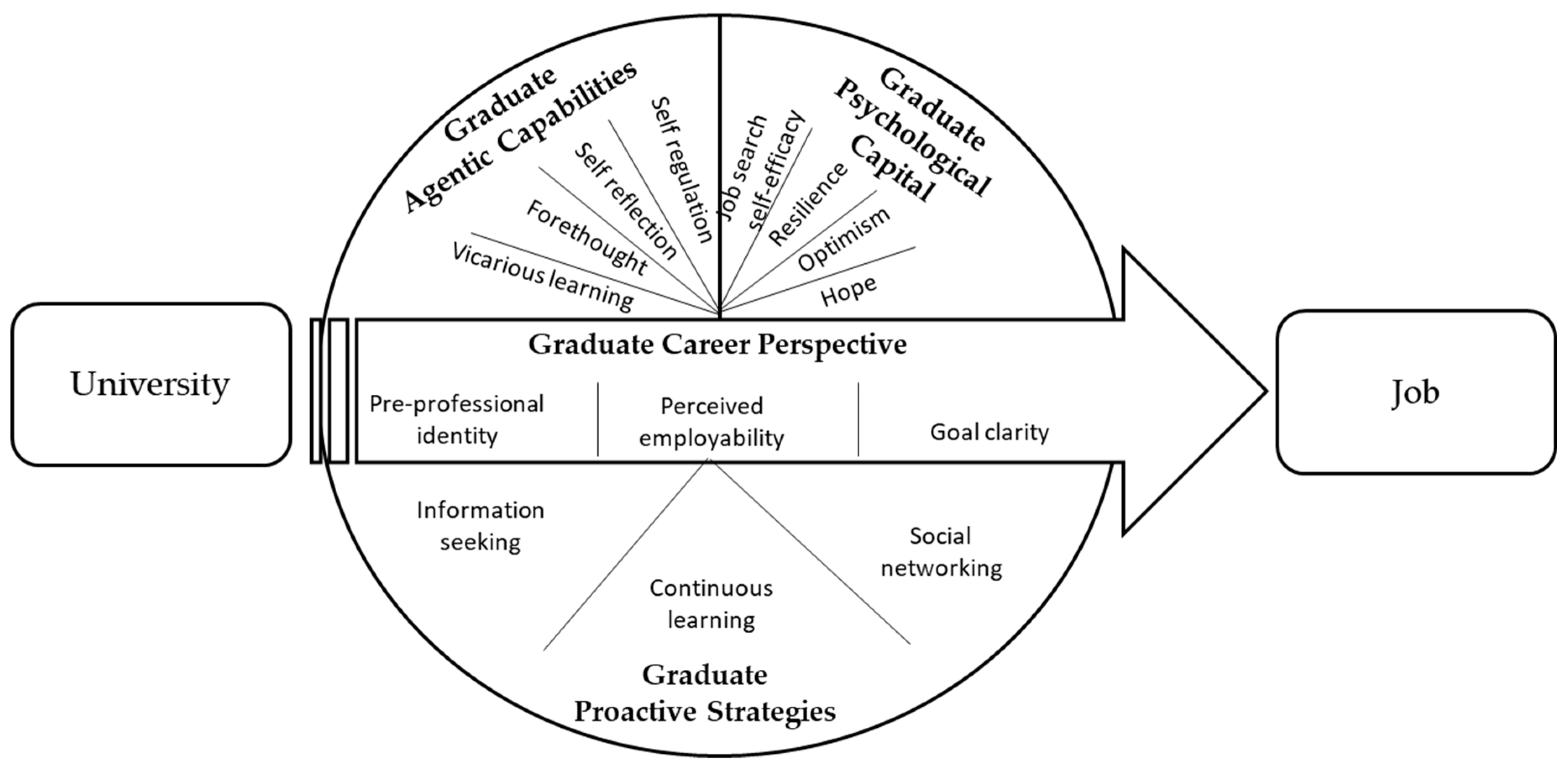

Table 1.
Descriptive statistics, factor loadings, and item-total scale-score-corrected correlation for each item of the Graduate Agentic Capabilities scale.
Table 1.
Descriptive statistics, factor loadings, and item-total scale-score-corrected correlation for each item of the Graduate Agentic Capabilities scale.
| First Order Dimensions and Items | First Order Factors | |||
| Mean | SD | λ | rtt | |
| Self-regulation (α = .51; ω = .52) | ||||
| Item 1 | 4.84 | 1.44 | 0.508 | 0.359 |
| Item 2 | 4.82 | 1.36 | 0.609 | 0.335 |
| Item 3 | 4.19 | 1.52 | 0.417 | 0.293 |
| Self-reflection (α = .63; ω = .64) | ||||
| Item 4 | 5.85 | 0.97 | 0.598 | 0.419 |
| Item 5 | 5.41 | 1.14 | 0.581 | 0.404 |
| Item 6 | 5.91 | 0.93 | 0.642 | 0.493 |
| Vicarious learning (α = .70; ω = .71) | ||||
| Item 7 | 4.90 | 1.30 | 0.764 | 0.590 |
| Item 8 | 4.93 | 1.27 | 0.698 | 0.534 |
| Item 9 | 5.48 | 1.24 | 0.545 | 0.432 |
| Forethought (α = .70; ω = .70) | ||||
| Item 10 | 4.86 | 1.26 | 0.592 | 0.496 |
| Item 11 | 5.30 | 1.16 | 0.571 | 0.472 |
| Item 12 | 5.06 | 1.17 | 0.579 | 0.442 |
| Item 13 | 5.44 | 1.29 | 0.657 | 0.497 |
| Second Order Dimension | Second Order Factors (ω = .71) | |||
| Self-regulation | 4.62 | 1.03 | 0.441 | - |
| Self-reflection | 5.72 | 0.77 | 0.947 | - |
| Vicarious learning | 5.10 | 1.00 | 0.420 | - |
| Forethought | 5.17 | 0.88 | 0.773 | - |
Note: λ = factor loadings; rtt = item-total scale-score-corrected correlation coefficient; α = Cronbach’s alpha; ω = Omega coefficient.
Table 2.
Descriptive statistics, factor loadings, and item-total scale-score-corrected correlation for each item Graduate Psychological Capital scale.
Table 2.
Descriptive statistics, factor loadings, and item-total scale-score-corrected correlation for each item Graduate Psychological Capital scale.
| First Order Dimensions and Items | First Order Factors | |||
| Mean | SD | λ | rtt | |
| Job Search Self-Efficacy (α = .80; ω = .80) | ||||
| Item 1 | 4.82 | 1.33 | 0.665 | 0.592 |
| Item 2 | 5.04 | 1.21 | 0.663 | 0.579 |
| Item 3 | 5.02 | 1.38 | 0.653 | 0.576 |
| Item 4 | 5.03 | 1.35 | 0.695 | 0.592 |
| Item 5 | 5.28 | 1.24 | 0.637 | 0.547 |
| Resilience (α = .77; ω = .77) | ||||
| Item 6 | 4.77 | 1.35 | 0.524 | 0.442 |
| Item 7 | 4.24 | 1.37 | 0.714 | 0.619 |
| Item 8 | 3.86 | 1.47 | 0.605 | 0.518 |
| Item 9 | 5.03 | 1.33 | 0.645 | 0.557 |
| Item 10 | 4.18 | 1.38 | 0.697 | 0.582 |
| Hope (α = .68; ω = .68) | ||||
| Item 11 | 5.03 | 1.28 | 0.534 | 0.488 |
| Item 12 | 5.57 | 1.17 | 0.665 | 0.450 |
| Item 13 | 4.46 | 1.39 | 0.621 | 0.492 |
| Item 14 | 5.43 | 1.11 | 0.506 | 0.421 |
| Optimism (α = .86; ω = .87) | ||||
| Item 15 | 4.23 | 1.56 | 0.910 | 0.790 |
| Item 16 | 4.67 | 1.56 | 0.881 | 0.768 |
| Item 17 | 4.46 | 1.75 | 0.677 | 0.638 |
| Second Order Dimensions | Second Order Factors (ω = .85) | |||
| Job Search Self-Efficacy | 5.04 | 0.97 | 0.778 | - |
| Resilience | 4.47 | 1.00 | 0.824 | - |
| Hope | 5.12 | 0.8 | 0.937 | - |
| Optimism | 4.15 | 1.43 | 0.738 | - |
Note: λ = factor loadings; rtt = item-total scale-score-corrected correlation coefficient; α = Cronbach’s alpha; ω = Omega coefficient.
Table 3.
Descriptive statistics, factor loadings, and item-total scale-score-corrected correlation for each item Graduate Career Perspective scale.
Table 3.
Descriptive statistics, factor loadings, and item-total scale-score-corrected correlation for each item Graduate Career Perspective scale.
| First Order Dimensions and Items | First Order Factors | |||
| Mean | SD | λ | rtt | |
| Goal clarity (α = .83; ω = .84) | ||||
| Item 1 | 4.51 | 1.93 | 0.774 | 0.679 |
| Item 2 | 4.59 | 1.71 | 0.944 | 0.783 |
| Item 3 | 4.54 | 1.83 | 0.657 | 0.596 |
| Perceived employability (α = .58; ω = .60) | ||||
| Item 4 | 3.42 | 1.55 | 0.417 | 0.308 |
| Item 5 | 5.11 | 1.34 | 0.582 | 0.394 |
| Item 6 | 4.69 | 1.25 | 0.599 | 0.430 |
| Item 7 | 4.16 | 1.75 | 0.469 | 0.339 |
| Pre-professional identity (α= .88;ω= .89) | ||||
| Item 8 | 5.92 | 1.26 | 0.904 | 0.820 |
| Item 9 | 5.46 | 1.36 | 0.731 | 0.675 |
| Item 10 | 5.75 | 1.24 | 0.790 | 0.743 |
| Item 11 | 6.06 | 1.23 | 0.816 | 0.743 |
| Second Order Dimensions | Second Order Factors (ω = .78) | |||
| Goal clarity | 4.55 | 1.57 | 0.705 | - |
| Perceived employability | 4.34 | 0.99 | 0.547 | - |
| Pre-professional identity | 5.80 | 1.09 | 0.646 | - |
Note: λ = factor loadings; rtt = item-total scale-score-corrected correlation coefficient; α = Cronbach’s alpha; ω = Omega coefficient.
Table 4.
Descriptive statistics, factor loadings, and item-total scale-score-corrected correlation for each item Graduate Proactive Strategies scale.
Table 4.
Descriptive statistics, factor loadings, and item-total scale-score-corrected correlation for each item Graduate Proactive Strategies scale.
| First Order Dimensions and Items | First Order Factors | |||
| Mean | SD | λ | rtt | |
| Social networking (α = .75; ω = .75) | ||||
| Item 1 | 3.30 | 1.79 | 0.646 | 0.556 |
| Item 2 | 4.44 | 1.64 | 0.774 | 0.615 |
| Item 3 | 3.93 | 1.68 | 0.697 | 0.572 |
| Item 4 | 2.41 | 1.68 | 0.508 | 0.419 |
| Continuous learning (α = .82; ω = .83) | ||||
| Item 5 | 4.75 | 1.58 | 0.794 | 0.710 |
| Item 6 | 5.33 | 1.33 | 0.642 | 0.557 |
| Item 7 | 4.38 | 1.73 | 0.809 | 0.716 |
| Item 8 | 3.65 | 1.77 | 0.702 | 0.607 |
| Information seeking (α = .75; ω = .76) | ||||
| Item 9 | 4.96 | 1.53 | 0.672 | 0.550 |
| Item 10 | 4.28 | 1.65 | 0.685 | 0.535 |
| Item 11 | 4.37 | 1.67 | 0.765 | 0.656 |
| Item 12 | 3.30 | 1.94 | 0.540 | 0.468 |
| Second Order Dimensions | Second Order Factors (ω = .81) | |||
| Social networking | 3.52 | 1.28 | 0.748 | - |
| Continuous learning | 4.53 | 1.30 | 0.678 | - |
| Information seeking | 4.23 | 1.29 | 0.699 | - |
Note: λ = factor loadings; rtt = item-total scale-score-corrected correlation coefficient; α = Cronbach’s alpha; ω = Omega coefficient.
Table 5.
Zero-order correlations between study variables at W1.
| Variable | 1 | 2 | 3 | 4 | 5 | 6 | 7 | 8 | 9 | 10 | 11 | 12 | 13 | 14 | 15 | 16 | 17 | 18 | 19 |
| Graduate Agentic Capabilities | |||||||||||||||||||
| 1. Self-regulation | |||||||||||||||||||
| 2. Self-reflection | .24** | ||||||||||||||||||
| 3. Vicarious learning | -.01 | .32** | |||||||||||||||||
| 4. Forethought | .22** | .48** | .26** | ||||||||||||||||
| Graduate PsyCap | |||||||||||||||||||
| 5. Job search self-eff | .36** | .30** | .09** | .44** | |||||||||||||||
| 6. Resilience | .56** | .30** | .01 | .30** | .52** | ||||||||||||||
| 7. Hope | .37** | .40** | .18** | .49** | .55** | .52** | |||||||||||||
| 8. Optimism | .31** | .18** | .08** | .28** | .45** | .53** | .51** | ||||||||||||
| Graduate Career Perspective | |||||||||||||||||||
| 9. Goal clarity | .19** | .18** | .01 | .41** | .39** | .27** | .31** | .30** | |||||||||||
| 10. Perceived empl. | .19** | .20** | .17** | .31** | .47** | .30** | .47** | .44** | .27** | ||||||||||
| 11. Pre-prof. identity | .12** | .19** | .12** | .27** | .36** | .19** | .27** | .20** | .41** | .27** | |||||||||
| Graduate Proactive strategies | |||||||||||||||||||
| 12. Social networking | .04 | .15** | .22** | .31** | .33** | .14** | .29** | .12** | .21** | .36** | .16** | ||||||||
| 13. Continuous learning | .17** | .26** | .17** | .38** | .30** | .20** | .33** | .18** | .27** | .25** | .23** | .45** | |||||||
| 14. Information seeking | .13** | .21** | .15** | .28** | .29** | .17** | .26** | .05 | .12** | .13** | .12** | .42** | .39** | ||||||
| Second Order Factors | |||||||||||||||||||
| 15. Graduate Agentic Cap | .58** | .73** | .61** | .72** | .29** | .33** | .26** | .27** | .36** | .29** | .45** | .45** | .54** | .33** | |||||
| 16. Graduate PsyCap | .49** | .35** | .11** | .46** | .40** | .53** | .31** | .26** | .31** | .22** | .76** | .80** | .78** | .83** | .54** | ||||
| 17. Graduate Career Perspective | .23** | .25** | .11** | .45** | .84** | .62** | .73** | .31** | .34** | .16** | .54** | .34** | .46** | .42** | .39** | .55** | |||
| 18. Graduate Proactive strategies | .14** | .27** | .23** | .41** | .26** | .32** | .21** | .79** | .79** | .77** | .39** | .22** | .37** | .15** | .39** | .35** | .33** | ||
| Covariates | |||||||||||||||||||
| 19. Age | .04 | .03 | -.09** | -.06* | .09** | .05 | .05 | .04 | .07* | -.04 | -.05 | .02 | .00 | .01 | -.03 | .02 | .01 | .02 | |
| 20. Sex | .13** | -.07** | -.00 | -.05 | .11** | .12** | .04 | .09** | .02 | .09** | -.02 | -.02 | -.13** | -.11** | .01 | -.13** | .03 | -.11** | .05 |
Note: *p < .05, **p < .01.
Table 6.
Zero-order correlations between study variables at W1 and W2.
| Variable | Perceived Employability (Rothwell et al., 2008) | Employment status | Professional coherence | Job Satisfaction |
| Graduate Agentic Capabilities | ||||
| Self-regulation | .21*** | .01 | -.05 | .03 |
| Self-reflection | -.01 | .08 | .08 | .15* |
| Vicarious learning | -.02 | .08 | .18** | .22** |
| Forethought | .13* | .13* | .10 | .13* |
| Graduate Psychological Capital | ||||
| Job search self-efficacy | .45*** | .17** | .22** | .25** |
| Resilience | .32*** | .06 | .04 | .12 |
| Hope | .43*** | .17** | .09 | .15* |
| Optimism | .48*** | .21** | .14* | .21** |
| Graduate Career perspective | ||||
| Goal clarity | .16** | .13* | .22** | .21** |
| Perceived employability | .63*** | .20** | .24*** | .18** |
| Pre-professional identity | .20** | .12* | .42*** | .15* |
| Graduate Proactive strategies | ||||
| Social networking | .04 | .05 | .19** | .13 |
| Continuous learning | .08 | .06 | .15* | .20** |
| Information seeking | .13* | .00 | -.18* | -.01 |
| Second Order Factors | ||||
| Graduate Agentic capabilities | .08 | .11 | .13 | .21** |
| Graduate Psychological Capital | .51*** | .20** | .15* | .23** |
| Graduate Career Perspective | .47*** | .20** | .38*** | .25** |
| Graduate Proactive strategies | .10 | .05 | .07 | .14* |
Disclaimer/Publisher’s Note: The statements, opinions and data contained in all publications are solely those of the individual author(s) and contributor(s) and not of MDPI and/or the editor(s). MDPI and/or the editor(s) disclaim responsibility for any injury to people or property resulting from any ideas, methods, instructions or products referred to in the content. |
© 2024 by the authors. Licensee MDPI, Basel, Switzerland. This article is an open access article distributed under the terms and conditions of the Creative Commons Attribution (CC BY) license (http://creativecommons.org/licenses/by/4.0/).
Copyright: This open access article is published under a Creative Commons CC BY 4.0 license, which permit the free download, distribution, and reuse, provided that the author and preprint are cited in any reuse.