

Submitted:
09 July 2024
Posted:
09 July 2024
You are already at the latest version
Abstract
The study analyzes how graduate students in economics, administration and accounting perceive their managerial skills for employability. It focuses on the importance of developing transferable skills that meet current and future job demands. To measure the perception of skills, a structured and duly validated questionnaire (Employability Skills 2000+) was used, answered by 225 graduate students in Economics, Administrative and Accounting Sciences in Tegucigalpa, Honduras. The data obtained from the application were analyzed using the Confirmatory Factor Analysis (CFA) method with the FACTOR software. The CFA generated an adaptation of the original scale with 21 variables. The resulting scale determined three predominant factors: Personal Management Skills, Fundamental Skills and Teamwork Skills, which presented good consistency and validity, allowing us to conclude regarding employability skills in the context studied. The findings show the existence of a correlation between fundamental skills and variables such as work experience, employment status and gender, as well as a high correlation between teamwork skills and work experience and employability conditions.
Keywords:
Higher Education
; Employability
; Management Training
; Skills
; Skills Measurement
; Human Talent
1. Introduction
Assessing management skills facilitates planning strategies and programs to develop employability management competencies, benefiting professionals, universities and companies. This is essential in preparing students for citizenship, the world of work, and their academic and personal success [1]. It is necessary to implement an accurate assessment tool to measure managerial skills in potential leaders, benefiting the academic and business environment, and fostering the development of managerial competencies for sustainable socioeconomic progress [2].
1.1. Employability Skills
Employability skills are key attributes that employers value when hiring and developing managers. These competencies, essential for organizational success, are adaptable, transferable, and can be acquired and enhanced [3]. Learned skills are divided into cognitive and non-cognitive skills. Cognitive skills include specific knowledge and critical thinking skills, while non-cognitive skills encompass the ability to relate, manage emotions, and make autonomous decisions [4]. Both are essential for personal and social development, which can also be developed and improved [5].
Employability skills, known as soft, fundamental or essential skills, help talented individuals to adapt and be resilient in changing environments, especially in managerial roles [3,6]. They are further classified into hard skills, related to acquired knowledge, and soft skills, linked to personality characteristics and more difficult to develop [7].
The Conference Board of Canada's Employability Skills Forum and the Business and Education Forum on Science, Technology and Mathematics created the Profile of Employability Skills (PES) to identify the competencies that organizations seek in new employees and develop in current employees [1]. This profile includes three main categories: foundational, personal management and collaborative skills, each with their respective sub-dimensions [8,9,10]. (See Table 1).
1.2. Current Labor Market
The current work environments, based on knowledge and technology, require a change in hiring processes, prioritizing the evaluation of personal capabilities in addition to technical skills [13,14]. The labor market seeks to integrate hard and soft skills to ensure adaptability, competence and stability, in an increasingly fast-paced and digital environment [15,16].
Labor productivity and business success can be improved through human capital with employability skills [17]. The demand for employees in the labor market will depend on the acquisition of these skills during their training and professional experience [18].
Among the trends in the labor market, the changes brought about by the Fourth Industrial Revolution should be considered, which implies technological changes, trans-formation of occupations and job profiles, changes in the forms of employment [19] and in the organizational culture; therefore, a suitable environment should be created for managers and employees to adhere to these changes at the organizational level [20].
1.3. Employability
Research on employability and its relationship with skills, higher education and professional development has grown exponentially [21,22,23,24]). This theme is directly linked to Sustainable Development Goals 4 and 8, which address quality education and decent work respectively [25,26].
Employability can be understood from two perspectives: as the variables that determine a person's employment situation, and as the set of individual skills that make it possible to obtain and maintain employment [21,27,28]. These skills facilitate the satisfaction of professional and personal needs [29,30]. Employability is also closely related to the economic conditions of the environment [10]. In this context, three main actors are identified: employers, employees (human talent) and trainers, which are fundamental to the concept of employability [31,32].
1.4. Education
According to Idkhan et al. [33], higher education is crucial for developing employability knowledge and skills, balancing soft and hard skills that meet the demands of employers and facilitate the employability of graduates. Thus, changes in the labor market and the fourth industrial revolution, higher education must focus on equipping students with the skills and knowledge necessary to maximize their development and employability [34]. These changes towards a knowledge economy demand new skills among employees to innovate the work environment and work methods [35].
Therefore, universities seek to improve the employability of their graduates by focusing on transferable skills beyond specific disciplines [36]. However, the lack of professional experience and the mismatch between education and job requirements lead many graduates to face unemployment, underemployment or job instability [12,37]. Consequently, to strengthen human capital, continuous learning is necessary; for this reason, education systems must focus on new knowledge and skills beyond current needs and thus be able to prepare for the technologies brought by Industry 4.0, which in the long term will lead to an increase in the level of education and the quality of the human talent required [38].
Although there is a significant discrepancy between existing skills and those needed for Industry 4.0 [39,40], the higher education system must adapt by integrating skills such as analytical thinking, decision making, organizational skills, social intelligence, logical reasoning, and technical expertise, all crucial for advanced industry [41]. According to Sunardi et al. [1], the main global challenge of higher education is to train professionals with a balance of academic, technical, and employability skills.
Consequently, correlational hypotheses to theoretically and statistically evaluate aspects of this problem are proposed [42,43,44]:
Ho: Latent variables (factors, Fi) are independent, or there is no association with demographic variables (dvi).
Ha: Latent variables (factors, Fi) are not independent, or there is an association with demographic variables (dvi).
2. Materials and Methods
This study identified a population of 245 graduate students in Economics, Administrative and Accounting Sciences at the National Autonomous University of Honduras (UNAH), located in the city of Tegucigalpa, Capital of Honduras; the data were collected through a self-administered survey with 92% response rate from the population exceeding the expected acceptable rate of 60% to 80%, which determined a sample of 225 students [45,46,47].
The Conference Board of Canada's Employability Skills 2000+ structured questionnaire was used as a consultation instrument, which identifies skills with 56 items divided into Fundamental skills (skills needed as a base for further development), Personal management skills (personal skills, attitudes and behaviors that drive one's potential for growth), and Teamwork skills (skills and attributes needed to contribute productively), measured on a 5-level Likert scale [8,33,36,48]. In addition to questions on demographic variables (dvi), which in this case were: gender, work experience and employment status. The prior validity of the questionnaire was considered on the basis of the study conducted by Idkhan et al, [33], whose confirmatory factor analysis (CFA) managed to support the three types of skills (fundamental skills, personal management skills, and teamwork skills), reporting the following statistical indices: Chi-square/relation of degrees of freedom (χ2/df), root mean square error of approximation (RMSEA), comparative fit index (CFI), non-normed fit index (NNFI) and an acceptable goodness of fit index (GFI) fit (See Table 2).
Adjustments were made to the questionnaire with a translation from English to Spanish, semantically validating the content through expert judgment, with the participation of four judges, specialists in the subject of study who evaluated the content according to categories that measure sufficiency or representativeness, clarity, coherence and relevance [52]; it was considered a criterion that 100% of the judges approved the categories for each of the indicators. To analyze the validity of the extracted data, all items whose internal correlations were greater than 0.8 were eliminated to achieve an adequate result of the Measure of Sampling Adequacy (MSA). Confirmatory factor analysis (CFA) was performed with FACTOR software [53]. And to measure confidence levels, the Kaiser-Meyer-Olkin measure of sampling adequacy (KMO) [54,55] was applied. In addition, Bartlett's test of sphericity was used to identify items belonging to the three (3) factors (Fi) within the scale, and Hull's method was used to determine the number of common factors [56], considering a dispersion matrix with polychoric correlations [57], a factor extraction by the robust unweighted least squares (RULS) method and a rotation to achieve the normalized direct Oblimin simplicity factor [58,59].
The results were weighted in the Total Factor (FT) by the set of eigenvalues, considering the skills of the group of students analyzed [60] (p. 44), making a comparison of each factor and the total factor according to the established demographic variables (dvi): gender, work experience and employment status.
The research produced a data set through the survey (see Table 3), and was then analyzed with cross-tabulations, given the high presence of ordinal or categorical variables. A descriptive and non-parametric statis-tical analysis using SPSS software, the non-parametric Chi-Square correlation coefficient (χ2), whose correlation is significant for a p-value at the 0.05 level (ideally 0.01), statistically demonstrating an effect, was used for the analysis [61,62].
3. Results
The elimination of highly correlated variables (items) limited the study to 21 variables out of 56 (V5, V7, V10, V13, V16, V21, V23, V25, V26, V29, V30, V32, V33, V34, V37, V38, V41, V44, V45, V46, V49), from which the FACTOR software did not identify items to be removed by MSA.
FACTOR was used to obtain a KMO of 0.949 (very good) and Bartlett’s statistic 2488.7 with 210 degrees of freedom and a significance level of 0.00001 for the three-factor Employability Skills 2000+ instrument. The authors achieved a total proportion of variance explained of 71.151%. The results of robust goodness of fit statistics after LOSEFER correction [63] are presented in Table 4.
The Employability Skills 2000+ questionnaire [64] was adjusted according to its latent variables in three factors. Those factors weighed by the set of eigenvalues account for the employability skills of the group of students analyzed (see Table 5), with a Root Mean Square of Residuals (RMSR) = 0.0509.
The factor names were assigned according to the highest concentration of items compared to the original instrument. Each of these three factors (F1: Personal management skills, F2: Fundamental Skills, F3: Teamwork Skills) and the resulting weighted factor (FT: Employability Skills) were then compared by gender, work experience, and employment status (see Table 6).
As can be seen, the Personal management skills factor (F1) is not correlated with the demographic variables, and at the same time its high weighting on the resulting factor (FT) of 81.53% means that Employability skills is not correlated with the demographic variables either. At the level of the Fundamental skills factor (F2), a high correlation is identified with work experience, and moderate correlations with employment status and gender. There is also a high correlation between Teamwork skills (F3), work experience and employment status (see Figure 1).
Figure 1(a) shows the gender differences, to the detriment of the female gender, in the perception of achievement of the fundamental skills. Figure 1(b) shows that the greater the work experience, the greater the perception of achievement of the fundamental skills; likewise, Figure 1(c) shows how the perception of achievement of teamwork skills is greater as work experience increases. In relation to the achievement of employability, this increases the perception of achievement of the fundamental skills (Figure 1(d)) and of teamwork (Figure 1(e)).
4. Discussion
Our study determines that there is a correlation in gender and (fundamental) skills, which accentuates the findings of Ogbonna et al. [65], in terms of teaching through synchronous and asynchronous e-learning, where the results indicate that the gender of students has a slight influence on the acquisition of their (practical) skills. And the findings of Xu et al. [66], who studied gender differences and their influence on skills, did not find a significant impact. In addition, the analyses conducted by Parra-González et al. [67], who determined that the gender variable does not predict association with fundamental skills (critical thinking), are confronted. And the findings of Irwan et al. [68], who show that there is no significant difference in employability skills between men and women. Thus, our results show a discordant counterpoint to this previous knowledge by presenting evidence that Employability skills are correlated with the demographic variable of gender.
Regarding work experience and fundamental skills, our results determine that they have a high correlation, which coincides with the findings of Idkhan et al [33] and Qostal et al [69]. In this order of ideas, the results of Parra-González et al. [66] determine that work experience influences the development of these fundamental critical thinking skills; as well as the research of Shiraly et al., [70] and Dyki et al., [71] which indicate that work experience influences communication skills; both studies also point out the importance of these fundamental skills having to be developed through academic training. Regarding fundamental skills related to decision making and creative thinking, López-Arias and Rodríguez-Esteban [72] find a positive correlation with work experience, unlike our study that does not find a correlation with personal management skills (F1); their results reach statistical significance with social skills that demonstrate positive attitudes and behaviors, as well as with adaptability skills, as does the study by Soares and Mosquera [73].
In reference to work experience and teamwork skills, on the contrary, the findings of Macanović et al. [74], which have shown that professionals in caring professions with less work experience have higher levels of psychosocial work competence (communication skills, mediation skills, teamwork skills and empathy). Our work indicates that the more work experience, the higher the teamwork skills in graduate students. Supporting the findings of Basir et al. [75] regarding the work experience of internships and entrepreneurship courses of students to improve employability at graduation.
Also, this research has determined a moderate correlation between employment status and fundamental skills, as well as a high correlation with teamwork skills, the same occurs with the analysis conducted by Idkhan et al. [33] and Qostal et al. [69] where they show that having skills such as fundamental and teamwork skills have a positive and significant effect on the employability index. But, unlike our study, they show that there is significance in the relationship between employability and personal management skills.
Another coincidence, regarding the high correlation between employability status and teamwork skills evidenced by our results, coincides with the study by Abdullah et al. [76] whose findings indicate that the development of teamwork skills is among the most desired by employers and help to achieve better employment conditions. Similarly, the results of Soares and Mosquera [73], who consider the international exchange experience as a strategy for the development of interpersonal and teamwork skills that can generate better employability prospects, agree. Our results are also supported by Dyki et al. [71] who indicate that the development of teamwork skills complements disciplinary knowledge and skills to improve their chances of achieving employability conditions. The same occurs with González-Cespón et al. [77] whose study evidences the development of transferable skills, which are directly related to employability; therefore, both investigations are consistent with the results of our study regarding the relationship between fundamental and teamwork skills and employability.
Finally, there are coincidences in the studies of Basir et al. [75], Abrantes et al. [78] and Mainga et al. [3] that show the incidence of the development of fundamental skills, personal management and teamwork, as well as their importance in preparing graduates for the labor market, which increases their employability or ability to be self-employed. In addition, it should be noted that research by Mainga et al. [3] reveals that employability is partially affected by labor market demand and external factors that are not related to the knowledge, skills, abilities and attributes of professionals.
5. Conclusions
This article provides a proposal of the construct of managerial skills suitable for employability that corresponds to a practical interest for human talents who assume a managerial role, in a properly validated scale that has measured the perception of managerial skills through a Confirmatory Factor Analysis (CFA), considering the Employability Skills 2000+ research model, which provides a broad focus on management skills, leadership, decision making, problem solving, adaptability, communication and teamwork.
The CFA eliminated 35 items from the original scale, which did not capture enough variability, which generated changes by rearranging the other 21 items into three factors, with good internal consistency and having as a central axis the management skills for employability among them: Personal Management Skills, Fundamental Skills and Teamwork Skills.
Regarding the hypothesis proposed, the findings show the existence of a high correlation between the fundamental skills and the work experience variable, as well as a moderate correlation with the employment status and gender variables. On the other hand, there is a high correlation between teamwork skills and work experience and employability conditions. However, no significant relationship was found between personal management skills and demographic variables.
Finally, this research has important implications for organizations and educational institutions, and raises new lines of research for other researchers, since the general scale of this study can be applied in new studies with different social and organizational contexts as a tool for the selection and evaluation of human talent in the public and private sector, as well as for the identification of training needs or training processes at the managerial level, including the analysis of the most appropriate educational methods for the development of employability skills.
Supplementary Materials
The following supporting information can be downloaded at the website of this paper posted on Preprints.org, Table S1: MSkillsv01.csv.
Author Contributions
Conceptualization, P.A.-G., and A.V.-M.; methodology, A.V.-M.; software, A.V.-M.; validation, G.S.-S., formal analysis, P.A.-G., G.S.-S., and A.V.-M.; data curation, A.V.-M., and G.S.-S.; writing—original draft preparation, P.A.-G., G.S.-S., and A.V.-M.; writing—review and editing, P.A.-G., G.S.-S., and A.V.-M.; visualization, G.S.-S.; supervision, A.V.-M.; project administration, P.A-G.; funding acquisition, A.V.-M., and G.S.-S. All authors have read and agreed to the published version of the manuscript.
Funding
The author(s) disclosed receipt of the following financial support for the research, authorship, and/or publication of this article: The Article Processing Charge (APC) was partially funded by Universidad Católica de la Santísima Concepción (Code: APC2024). Additionally, the publication fee (APC) was partially financed through the Publication Incentive Fund, 2024, by the Universidad Arturo Prat, (Code: APC2024), and Universidad de Las Americas (Code: APC2024).
Institutional Review Board Statement
The study was conducted in accordance with the Declaration of Helsinki, and all respondents have signed an informed consent form and the data presented are completely anonymized.
Informed Consent Statement
Informed consent was obtained from all subjects involved in the study.
Data Availability Statement
Data available as supplementary material.
Acknowledgments
We would like to thank the Graduate Unit of the Facultad de Ciencias Económicas, Administrativas y Contables (POSFACE), Universidad Nacional Autónoma de Honduras (UNAH).
Conflicts of Interest
The authors declare no conflicts of interest.
Appendix A
The appendix contains the questionnaire applied.
| Respondent Items (English) | Respondent Items (Spanish) |
| Fundamental Skills | Habilidades Fundamentales |
| Communicate | Comunicación |
| 1. Read and understand information presented in a variety of forms (e.g., words, graphs, charts, diagrams) | 1. Leer y comprender información presentada en una variedad de formas (p. ej., palabras, gráficos, cuadros, diagramas) |
| 2. Write and speak so others pay attention and understand | 2. Al escribir y hablar, logro que los demás presten atención y comprendan |
| 3. Listen and ask questions to understand and appreciate the points of view of others | 3. Escucho y hago preguntas para comprender y apreciar los puntos de vista de los demás |
| 4. Share information using a range of information and communications technologies (e.g., voice, e-mail, computers) | 4. Comparto información utilizando una variedad de tecnologías de la información y las comunicaciones (p. ej., mensajes de voz, correo electrónico, computadoras) |
| 5. Use relevant scientific, technological and mathematical knowledge and skills to explain or clarify ideas | 5. Utilizo conocimientos, destrezas, información científica, habilidades tecnológicas y matemáticas pertinentes para explicar o aclarar ideas |
| Manage Information | Gestión de Información |
| 6. Locate, gather and organize information using appropriate technology and information systems | 6. Localizo, recopilo y organizo información utilizando la tecnología adecuada y sistemas de información |
| 7. Access, analyze and apply knowledge and skills from various disciplines (e.g., the arts, languages, science, technology, mathematics, social sciences, and the humanities) | 7. Accedo, analizo y aplico conocimientos y habilidades de diversas disciplinas (p. ej., las artes, los idiomas, la ciencia, la tecnología, las matemáticas, las 4 y las humanidades) |
| Use Numbers | Uso de Números |
| 8. Decide what needs to be measured or calculated | 8. Al usar números, decido qué debe medirse o calcularse |
| 9. Observe and record data using appropriate methods, tools and technology | 9. Observo y registro datos usando métodos, herramientas y tecnología apropiados |
| 10. Make estimates and verify calculations | 10. Hago estimaciones, pronósticos y verifico los cálculos |
| Think & Solve Problems | Pensar y Resolver Problemas |
| 11. Assess situations and identify problems | 11. Evalúo situaciones e identifico problemas |
| 12. Seek different points of view and evaluate them based on facts | 12. Busco diferentes puntos de vista y evalúo con base en hechos |
| 13. Recognize the human, interpersonal, technical, scientific and mathematical dimensions of a problem | 13. Reconozco las dimensiones humanas, interpersonales, técnicas, científicas y matemáticas de un problema |
| 14. Identify the root cause of a problem | 14. Identifico la causa raíz de un problema |
| 15. Be creative and innovative in exploring possible solutions | 15. Soy creativo e innovador al explorar posibles soluciones |
| 16. Readily use science, technology and mathematics as ways to think, gain and share knowledge, solve problems and make decisions | 16. Utilizo fácilmente la ciencia, la tecnología y las matemáticas como formas de pensar, obtener y compartir conocimientos, resolver problemas y tomar decisiones |
| 17. Evaluate solutions to make recommendations or decisions | 17. Evalúo soluciones para hacer recomendaciones que mejoren la toma de decisiones respecto a problemas y situaciones |
| 18. Implement solutions | 18. Soy capaz de implementar soluciones |
| 19. Check to see if a solution works, and act on opportunities for improvement | 19. Compruebo si una solución funciona y actúo sobre las oportunidades de mejora |
| Personal Management Skills | Habilidades de Gestión Personal |
| Demonstrate Positive Attitudes & Behaviors | Demuestra Actitud y Comportamientos Positivos |
| 20. Feel good about yourself and be confident | 20. Me siento bien conmigo mismo y tengo confianza |
| 21. Deal with people, problems and situations with honesty, integrity and personal ethics | 21. Soy capaz de tratar con personas, problemas y situaciones con honestidad, integridad y ética personal |
| 22. Recognize your own and other people’s good efforts | 22. Reconozco los buenos esfuerzos propios y de otras personas |
| 23. Take care of your personal health | 23. Cuido la salud personal |
| 24. Show interest, initiative and effort | 24. Muestro interés, iniciativa y esfuerzo por el trabajo y los resultados |
| Be Responsible | Responsabilidad |
| 25. Set goals and priorities balancing work and personal life | 25. Puedo establecer metas y prioridades equilibrando el trabajo y la vida personal |
| 26. Plan and manage time, money and other resources to achieve goals | 26. Puedo planificar y administrar el tiempo, el dinero y otros recursos para alcanzar las metas |
| 27. Assess, weigh and manage risk | 27. Puedo evaluar, sopesar y gestionar el riesgo |
| 28. Be accountable for your actions and the actions of your group | 28. Puedo ser responsable de mis acciones y las acciones de mi grupo |
| 29. Be socially responsible and contribute to your community | 29. Soy socialmente responsable y contribuyo a mi comunidad |
| Be Adaptable | Adaptabilidad |
| 30. Work independently or as a part of a team | 30. Soy capaz de trabajar de forma independiente y como parte de un equipo |
| 31. Carry out multiple tasks or projects | 31. Puedo llevar a cabo múltiples tareas o proyectos |
| 32. Be innovative and resourceful: identify and suggest alternative ways to achieve goals and get the job done | 32. Soy innovador e ingenioso: identifico y sugiero formas alternativas para alcanzar las metas y hacer el trabajo |
| 33. Be open and respond constructively to change | 33. Estoy abierto y respondo constructivamente al cambio |
| 34. Learn from your mistakes and accept feedback | 34. Aprendo de mis errores y acepto comentarios |
| 35. Cope with uncertainty | 35. Soy capaz de afrontar condiciones de incertidumbre |
| Learn Continuously | Aprendizaje Continuo |
| 36. Be willing to continuously learn and grow | 36. Estoy dispuesto a aprender y crecer continuamente |
| 37. Assess personal strengths and areas for development | 37. Soy capaz de evaluar las fortalezas personales y mis áreas de desarrollo |
| 38. Set your own learning goals | 38. Puedo establecer mis propios objetivos de aprendizaje |
| 39. Identify and access learning sources and opportunities | 39. Soy capaz de identificar y de acceder a fuentes y oportunidades de aprendizaje |
| 40. Plan for and achieve your learning goals | 40. Puedo planificar y lograr mis objetivos de aprendizaje |
| Work Safely | Trabajar de Manera Segura |
| 41. Be aware of personal and group health and safety practices and procedures, and act in accordance with these | 41. Puedo trabajar de forma segura, estoy al tanto de las prácticas, procedimientos de salud y seguridad personal, grupal, y actúo en conformidad a estos |
| Teamwork Skills | Habilidades de Trabajo en Equipo |
| Work with Others | Trabajar con otros |
| 42. Understand and work within the dynamics of a group | 42. Entiendo las necesidades de los miembros del equipo y se me facilita el trabajo dentro de la dinámica de un grupo |
| 43. Ensure that a team’s purpose and objectives are clear | 43. Me aseguro de que el propósito y los objetivos de mi equipo sean claros |
| 44. Be flexible: respect, be open to and supportive of the thoughts, opinions and contributions of others in a group | 44. Soy flexible: soy respetuoso, abierto y también apoyo los pensamientos, opiniones y contribuciones de los demás en un grupo |
| 45. Recognize and respect people’s diversity, individual differences and perspectives | 45. Reconozco y respeto la diversidad de las personas, las diferencias individuales y las perspectivas |
| 46. Accept and provide feedback in a constructive and considerate manner | 46. Acepto y proporciono comentarios de manera constructiva y considerada |
| 47. Contribute to a team by sharing information and expertise | 47. Puedo contribuir a un equipo compartiendo información y experiencia |
| 48. Lead or support when appropriate, motivating a group for high performance | 48. Soy capaz de liderar o apoyar cuando sea apropiado, motivando a un grupo para un alto desempeño |
| 49. Understand the role of conflict in a group to reach solutions | 49. Comprendo cómo gestionar el conflicto en un grupo para lograr soluciones |
| 50. Manage and resolve conflict when appropriate | 50. Soy capaz de manejar y resolver conflictos cuando sea apropiado |
| Participate in Projects & Tasks | Participar en Proyectos y Tareas |
| 51. Plan, design or carry out a project or task from start to finish with well-defined objectives and outcomes | 51. Puedo planificar, diseñar o llevar a cabo un proyecto o tarea de principio a fin con objetivos y resultados bien definidos |
| 52. Develop a plan, seek feedback, test, revise and implement | 52. Puedo desarrollar un plan, buscar retroalimentación, probar, revisar e implementar |
| 53. Work to agreed quality standards and specifications | 53. Puedo trabajar según los estándares y especificaciones de calidad acordados |
| 54. Select and use appropriate tools and technology for a task or project | 54. Soy capaz de seleccionar y utilizar las herramientas y la tecnología apropiadas para una tarea o proyecto |
| 55. Adapt to changing requirements and information | 55. Puedo adaptarme a los requisitos y a información cambiante |
| 56. Continuously monitor the success of a project or task and identify ways to improve | 56. Puedo monitorear continuamente el éxito de un proyecto o tarea e identificar formas de mejorar |
References
- Sunardi, P.; Sutadji, E. Employability skills measurement model’s of vocational student. AIP Conference Proceedings 2016, 1778, 1–4. [Google Scholar] [CrossRef]
- Callohuanca, J.; Tantalean, L. Adaptación y validación de una escala para medir las habilidades gerenciales. Anales Científicos 2020, 81, 33–57. [Google Scholar] [CrossRef]
- Mainga, W. , Murphy-Braynen, M.B., Moxey, R., & Quddus, S.A. Graduate Employability of Business Students. Administrative Sciences 2022, 12, 72. [Google Scholar] [CrossRef]
- Ortega, T. Desenredando la conversación sobre habilidades blandas. The Dialogue 2016, 974, 28. [Google Scholar]
- Vázquez-González, L. , Clara-Zafra, M. , Céspedes-Gallegos, S., Ceja-Romay, S., & Pacheco-López, E. Estudio sobre habilidades blandas en estudiantes universitarios: el caso del TECNM Coatzacoalcos. IPSA Scientia, Revista Científica Multidisciplinaria 2022, 7, 10–25. [Google Scholar] [CrossRef]
- Macpherson, E., & Rizk, J. Essential Skills for Learning and Working. The Conference Board of Canada 2022, 1–18. https://fsc-ccf.ca/wp-content/uploads/2022/03/FSC_VRST_essential-skills-for-learning-and-working.
- Tito, M.D.; Serrano, B. Development of soft skills an alternative to the shortage of human talent. Innova Research Journal 2016, 1, 59–76. [Google Scholar] [CrossRef]
- Marín Marín, J.A. Los Entornos Virtuales de Aprendizaje. In Innnovación educativa para una educación transformadora (pp. 155–187). DYKINSON, S.L. 2022. [CrossRef]
- Suarta, I.M. , & Suwintana, I.K. The new framework of employability skills for digital business. Journal of Physics: Conference Series 2021, 1833, 1–9. [Google Scholar] [CrossRef]
- Juárez Martínez, A., & González Fernández, M. La construcción de las competencias genéricas en el nivel superior. Cuadernos de Educación y Desarrollo 2018, 91.https://www.eumed.net/rev/atlante/2018/01/competencias-genericas.zip.
- Blair, P. , & Deming, D. Structural increases in demand for skill after the great recession. AEA Papers and Proceedings 2020, 110, 362–365. [Google Scholar] [CrossRef]
- García-Álvarez, J. , Vázquez-Rodríguez, A., Quiroga-Carrillo, A., & Priegue Caamaño, D. Transversal Competencies for Employability in University Graduates: A Systematic Review from the Employers’ Perspective. Education Sciences 2022, 12, 1–37. [Google Scholar] [CrossRef]
- Contreras-Barraza, N. , Espinosa-Cristia, J.F., Salazar-Sepulveda, G., Vega-Muñoz, A., & Ariza-Montes, A. A Scientometric Systematic Review of Entrepreneurial Wellbeing Knowledge Production. Frontiers in Psychology 2021, 12, 1–20. [Google Scholar] [CrossRef]
- Rego, M.A.S.; Sáez-Gambín, D.; González-Geraldo, J.L.; García-Romero, D. Transversal Competences and Employability of University Students: Converging towards Service-Learning. Education Sciences 2022, 12, 265. [Google Scholar] [CrossRef]
- Andino-González, P. Habilidades del administrador de empresas desde una perspectiva del mercado laboral actual. Journal Managment & Business Studies 2022, 4, 1–22. [Google Scholar] [CrossRef]
- Moreno, L.M., Silva, M.B., Hidrobo, C.C., Rincón, D.C., Fuentes, G.Y., & Quintero, Y.A. Formación en habilidades blandas en instituciones de educación superior: reflexiones educativas, sociales y políticas (Comisión Económica para América Latina y el Caribe CEPAL (ed.); 1 Ed., Vol. 1). Naciones Unidas. 2021. https://biblioteca-cum.hosted.exlibrisgroup.com/F/?func=direct&doc_number=102284&local_base=UNM01.
- Rodchenko, V. , Rekun, G., Fedoryshyna, L., Roshchin, I., & Gazarian, S. The effectiveness of human capital in the context of the digital transformation of the economy: The case of ukraine. Journal of Eastern European and Central Asian Research 2021, 8, 202–213. [Google Scholar] [CrossRef]
- Ivanova, I.A. , Odinaev, A.M., Pulyaeva, V.N., Gibadullin, A.A., & Vlasov, A.V. The transformation of human capital during the transition to a digital environment. Journal of Physics: Conference Series 2020, 1515, 0–5. [Google Scholar] [CrossRef]
- Sima, V. , Gheorghe, I.G., Subić, J., & Nancu, D. Influences of the industry 4.0 revolution on the human capital development and consumer behavior: A systematic review. Sustainability 2020, 12, 1–28. [Google Scholar] [CrossRef]
- Borowiecki, R., Olesinski, Z., Rzepka, A., & Hys, K. Development of Teal Organisations in Economy 4.0: An Empirical Research. European Research Studies Journal 2021, XXIV, 117–129. [CrossRef]
- Andino-González, P. Estudio Bibliométrico sobre empleabilidad. Ad-Gnosis 2023, 12, 1–25. [Google Scholar] [CrossRef]
- De Vos, A.; Jacobs, S.; Verbruggen, M. Career transitions and employability. Journal of Vocational Behavior 2021, 126. [Google Scholar] [CrossRef]
- Forrier, A. , De Cuyper, N., & Akkermans, J. The winner takes it all, the loser has to fall: Provoking the agency perspective in employability research. Human Resource Management Journal 2018, 28, 511–523. [Google Scholar] [CrossRef]
- Tomlinson, M. Forms of Graduate Capital and their Relationship to Graduate Employability. Education and Training 2017, 59, 338–352. [Google Scholar] [CrossRef]
- Organización de las Naciones Unidas [ONU]. Objetivos de Desarrollo Sostenible (ODS). Revista de La Universidad de La Salle 2016, 70, 141, https://www.fuhem.es/media/cdv/file/biblioteca/revista_papeles/140/ODS-revision-critica-C.Gomez.pdf. [Google Scholar]
- UNESCO. Education for Sustainable Development Goals (SDGs). In European Conference on Educational Research 2017. https://unesdoc.unesco.org/ark:/48223/pf0000252423.
- Suárez-Lantarón, B. Empleabilidad: Análisis del concepto. Revista de Investigación En Educación 2016, 14, 67–84, https://reined.webs.uvigo.es/index.php/reined/article/view/225/247. [Google Scholar]
- Guilbert, L. , Bernaud, J.L., Gouvernet, B., & Rossier, J. Employability: review and research prospects. International Journal for Educational and Vocational Guidance 2015, 16, 69–89. [Google Scholar] [CrossRef]
- Yorke, M. Employability: aligning the message, the medium and academic values. Journal of Teaching and Learning for Graduate Employability 2010, 1, 2–12. [Google Scholar] [CrossRef]
- Thijssen, J.G.L. , Van Der Heijden, B.I.J.M., & Rocco, T.S. Toward the employability-link model: Current employment transition to future employment perspectives. Human Resource Development Review 2008, 7, 165–183. [Google Scholar] [CrossRef]
- Peeters, E. , Nelissen, J., De Cuyper, N., Forrier, A., Verbruggen, M., & De Witte, H. Employability Capital: A Conceptual Framework Tested Through Expert Analysis. Journal of Career Development 2019, 46, 79–93. [Google Scholar] [CrossRef]
- Botero Sarassa, J. , & Rentería Pérez, E. Empleabilidad y trabajo del profesorado universitario. Una revisión del Campo. Revista de Pensamiento e Investigación Social 2019, 19, 1–27. [Google Scholar] [CrossRef]
- Idkhan, A.M.; Syam, H.; Sunardi. ; Hasim, A.H. The employability skills of engineering students’: Assessment at the university. International Journal of Instruction 2021, 14, 119–134. [Google Scholar] [CrossRef]
- Fuentes, G.Y. , Moreno-Murcia, L.M., Rincón-Tellez, D.C., & Silva-Garcia, M.B. Evaluation of soft skills in higher education. Formacion Universitaria 2021, 14, 49–60. [Google Scholar] [CrossRef]
- Ustundag, A. , & Cevikcan, E. Lean Production Systems for Industry 4.0. In Springer Series in Advanced Manufacturing. 2018. [CrossRef]
- Crawford, P. , & Dalton, R. Providing Built Environment Students with the Necessary Skills for Employment: Finding the Required Soft Skills. Current Urban Studies 2016, 04, 97–123. [Google Scholar] [CrossRef]
- Souto-Otero, M. , & Białowolski, P. Graduate employability in Europe: the role of human capital, institutional reputation and network ties in European graduate labour markets. Journal of Education and Work 2021, 34, 611–631. [Google Scholar] [CrossRef]
- Kucharčíková, A. , Mičiak, M., Bartošová, A., Budzeľová, M., Bugajová, S., Maslíková, A., & Pisoňová, S. Human Capital Management and Industry 4.0. SHS Web of Conferences 2021, 90, 1–10. [Google Scholar] [CrossRef]
- Coşkun, S. , Kayıkcı, Y., & Gençay, E. Adapting Engineering Education to Industry 4.0 Vision. Technologies 2019, 7, 1–13. [Google Scholar] [CrossRef]
- Scott, F.J. , Connell, P., Thomson, L.A., & Willison, D. Empowering students by enhancing their employability skills. Journal of Further and Higher Education 2019, 43, 692–707. [Google Scholar] [CrossRef]
- Assante, D. , Caforio, A., Flamini, M., & Romano, E. Smart Education in the context of Industry 4.0. IEEE Global Engineering Education Conference (EDUCON) 2019, 1140–1145. [Google Scholar] [CrossRef]
- Hernández Sampieri, R., Fernández Collado, C., & Baptista Lucio, M. del P. Metodología de la Investigación (6 ed.) McGRAW-HILL. 2014.
- Palella Stracuzzi, S. , & Martins Pestana, F. Metodología de la investigación cuantitativa - Santa Palella, Feliberto Martins.pdf (3 ed.) FEDUPEL. 2012.
- Mayorga-Ponce, R. , Ita-León, R., Martínez-Alamilla, A., & Salazar-Valdez, D. Cuadro comparativo Hipótesis de investigación / Hipótesis Nula. Educación y Salud - Boletín Científico Instituto de Ciencias de La Salud Universidad Autónoma Del Estado de Hidalgo 2020, 9, 76–77. [Google Scholar] [CrossRef]
- Yunus, M.M. , Ang, W.S., & Hashim, H. Factors affecting teaching english as a second language (TESL) postgraduate students’ behavioural intention for online learning during the COVID-19 pandemic. Sustainability 2021, 13, 1–14. [Google Scholar] [CrossRef]
- Aerny Perreten, N. , Domínguez-Berjón, M. a. F., Astray Mochales, J., Esteban-Vasallo, M.D., Blanco Ancos, L.M., & Lópaz Pérez, M. a. ángele. Tasas de respuesta a tres estudios de opinión realizados mediante cuestionarios en línea en el ámbito sanitario. Gaceta Sanitaria 2012, 26, 477–479. [Google Scholar] [CrossRef]
- Fincham, J.E. Response rates and responsiveness for surveys, standards, and the Journal. American Journal of Pharmaceutical Education 2008, 72, 43. [Google Scholar] [CrossRef]
- Seniuk Ciceka, J., Peto, L., & Ingram, S. Linking The CEAB Graduate Attribute Competencies To Employability Skills 2000+: Equipping Students With The Language And Tools For Career/Employment Success. Actas de La Asociación Canadiense de Educación En Ingeniería (CEEA) 2016, 1–7. [CrossRef]
- Andino-González, P.; Vega-Muñoz, A.; Salazar-Sepúlveda, G. How to Measure Management Skills: Systematic Review. Preprints 2024, 1–7. [Google Scholar] [CrossRef]
- Schermelleh-Engel, K. , Moosbrugger, H., & Müller, H. Evaluating the fit of structural equation models: Tests of significance and descriptive goodness-of-fit measures. MPR-Online 2003, 8, 23–74, https://www.stats.ox.ac.uk/~snijders/mpr_Schermelleh.pdf. [Google Scholar]
- Kalkan, Ö.K. , & Kelecioğlu, H. The effect of sample size on parametric and nonparametric factor analytical methods. Kuram ve Uygulamada Egitim Bilimleri 2016, 16, 153–171. [Google Scholar] [CrossRef]
- Ventura-León, J. , & Mamani-Benito, O. Diseño y validación de una rúbrica analítica para evaluar manuscritos científicos. Revista Habanera de Ciencias Médicas 2022, 21, 1–8. [Google Scholar]
- Ferrando, P.J. , & Lorenzo-Seva, U. Program FACTOR at 10: Origins, development and future directions. Psicothema 2017, 29, 236–240. [Google Scholar] [CrossRef] [PubMed]
- Harman, H. Modern factor analysis (3ed ed.). University of Chicago press. 1976.
- Kelley, T.L. Essential traits of mental life. 1935.
- Lorenzo-Seva, U. , Timmerman, M.E., & Kiers, H.A.L. The hull method for selecting the number of common factors. Multivariate Behavioral Research 2011, 46, 340–364. [Google Scholar] [CrossRef]
- Freiberg Hoffmann, A. , Stover, J.B., De la Iglesia, G., & Fernández Liporace, M. Correlaciones Policóricas Y Tetracóricas En Estudios Factoriales Exploratorios Y Confirmatorios. Ciencias Psicológicas 2013, 21, 151–164. [Google Scholar] [CrossRef]
- Bentler, P.M. Factor simplicity index and transformations. Psychometrika 1977, 42, 277–295. [Google Scholar] [CrossRef]
- Lorenzo-Seva, U. A factor simplicity index. Psychometrika 2003, 68, 49–60. [Google Scholar] [CrossRef]
- Véliz Capuñay, C. Análisis multivariante (C. L. B. Aires (ed.)). 2016. https://biblioteca.uazuay.edu.ec/buscar/item/83075.
- Romero Suárez, N. Estadística en la Toma de Decisiones: el p-valor. Telos 2012, 14, 439–446, https://www.redalyc.org/pdf/993/99324907004.pdf. [Google Scholar]
- Molina-Arias, M. Lectura crítica en pequeñas dosis. Pediatría Atención Primaria 2017, 19, 377–381, https://scielo.isciii.es/scielo.php?pid=S1139-76322017000500014&script=sci_arttext&tlng=pt. [Google Scholar]
- Lorenzo-Seva, U. , & Ferrando, P.J. Supplementary materials to: A simulation-based scaled test statistic for assessing model-data fit in least-squares unrestricted factor-analysis solutions. Methodology 2023, 19, 96–115. [Google Scholar] [CrossRef]
- Bloom, M.R., & Kitagawa, K.G. Understanding Employability Skills. Conference Board of Canada 1999, 1–29. https://www.uwinnipeg.ca/edpd/docs/Conference%20Board%20of%20Canada%20Understanding%20Employability%20Skills.pdf.
- Ogbonna, C.G. Synchronous versus asynchronous e-learning in teaching word processing: An experimental approach. South African Journal of Education 2019, 39, 1–15. [Google Scholar] [CrossRef]
- Xu, F. , & Paula, A. Adopting distributed pair Programming as an effective team learning activity: a systematic review. Journal of Computing in Higher Education 2024, 36, 320–349. [Google Scholar] [CrossRef]
- Parra-González, M.E. , Rodríguez-Sabiote, C., Aguaded-Ramírez, E.M., & Cuevas-Rincón, J.M. Analysis of the variables that promote professional insertion based on critical thinking. Front. Educ. 2023, 8, 1–9. [Google Scholar] [CrossRef]
- Irwan, M. , Ahmad, N., Amiruddin, M., Ismail, M., & Harun, H. Identifying the Employment Skills Among Malaysian Vocational Students: An Analysis of Gender Differences. Journal of Technical Education and Training 2019, 11, 115–120. [Google Scholar] [CrossRef]
- Qostal, A. , Sellamy, K., Sabri, Z., Nouib, H., Lakhrissi, Y., & Moumen, A. Perceived Employability of Moroccan Engineering Students: a PLS-SEM Approach. International Journal of Instruction 2024, 17, 259–282. [Google Scholar] [CrossRef]
- Shiraly, R. , Mahdaviazad, H., & Pakdin, A. Doctor patient communication skills: a survey on knowledge and practice of Iranian family physicians. BMC Family Practice 2021, 22, 1–7. [Google Scholar] [CrossRef]
- Dyki, M. , Singorahardjo, M., & Cotronei-Baird, V.S. Preparing graduates with the employability skills for the unknown future: reflection on assessment practice during COVID-19. Accounting Research Journal 2021, 34, 229–245. [Google Scholar] [CrossRef]
- López-Arias, J.M. , & Rodríguez-Esteban, A. Competencias socioemocionales de los educadores sociales: la influencia del contexto laboral. EDUCAR 2022, 58, 535–550. [Google Scholar] [CrossRef]
- Soares, M.E. , & Mosquera, P. Linking development of skills and perceptions of employability: the case of Erasmus students. Economic Research-Ekonomska Istraživanja 2020, 33, 2769–2786. [Google Scholar] [CrossRef]
- Macanović, N. , Petrović, J., & Dragojević, A. Professional Competence of Experts In Psychosocial Work. International Review 2022, 3, 47–54. [Google Scholar] [CrossRef]
- Basir, N.M. , Zubairi, Y.Z., Jani, R., & Wahab, D.A. Soft Skills and Graduate Employability: Evidence from Malaysian Tracer Study. Pertanika Journal of Social Science and Humanities 2022, 30, 1975–1989. [Google Scholar] [CrossRef]
- Abdullah, W.F.W. , Salleh, K.M., Sulaiman, N.L., & Kamarrudin, M. Employability Skills in the TVET Trainer Training Program: The perception Between Experienced Trainers and Novices Trainers. Journal of Technical Education and Training 2022, 14, 150–157. [Google Scholar] [CrossRef]
- González-Cespón, J. , Alonso-Rodríguez, J.A., Rodríguez-Barcia, S., Gallego, P.P., & Pino-Juste, M.R. Employability Skills of Biology Graduates through an Interdisciplinary Project-Based Service-Learning Experience with Engineering and Translation Undergraduate Students. Education Sciences 2024, 14, 1–15. [Google Scholar] [CrossRef]
- Abrantes, P. , Silva, A.P., Backstrom, B., Neves, C., Falé, I., Jacquinet, M., Ramos, M. d. R., Magano, O., & Henriques, S. Transversal Competences and Employability: The Impacts of Distance Learning University According to Graduates’ Follow-Up. Education Sciences 2022, 12, 1–14. [Google Scholar] [CrossRef]
Figure 1.
Relation between demographic variables and latent variables: (a) Gender and Fundamental skills, (b) Work experience and Fundamental skills, (c) Work experience and Teamwork skills, (d) Employment status and Fundamental skills, and (e) Employment status and Teamwork skills.
Figure 1.
Relation between demographic variables and latent variables: (a) Gender and Fundamental skills, (b) Work experience and Fundamental skills, (c) Work experience and Teamwork skills, (d) Employment status and Fundamental skills, and (e) Employment status and Teamwork skills.
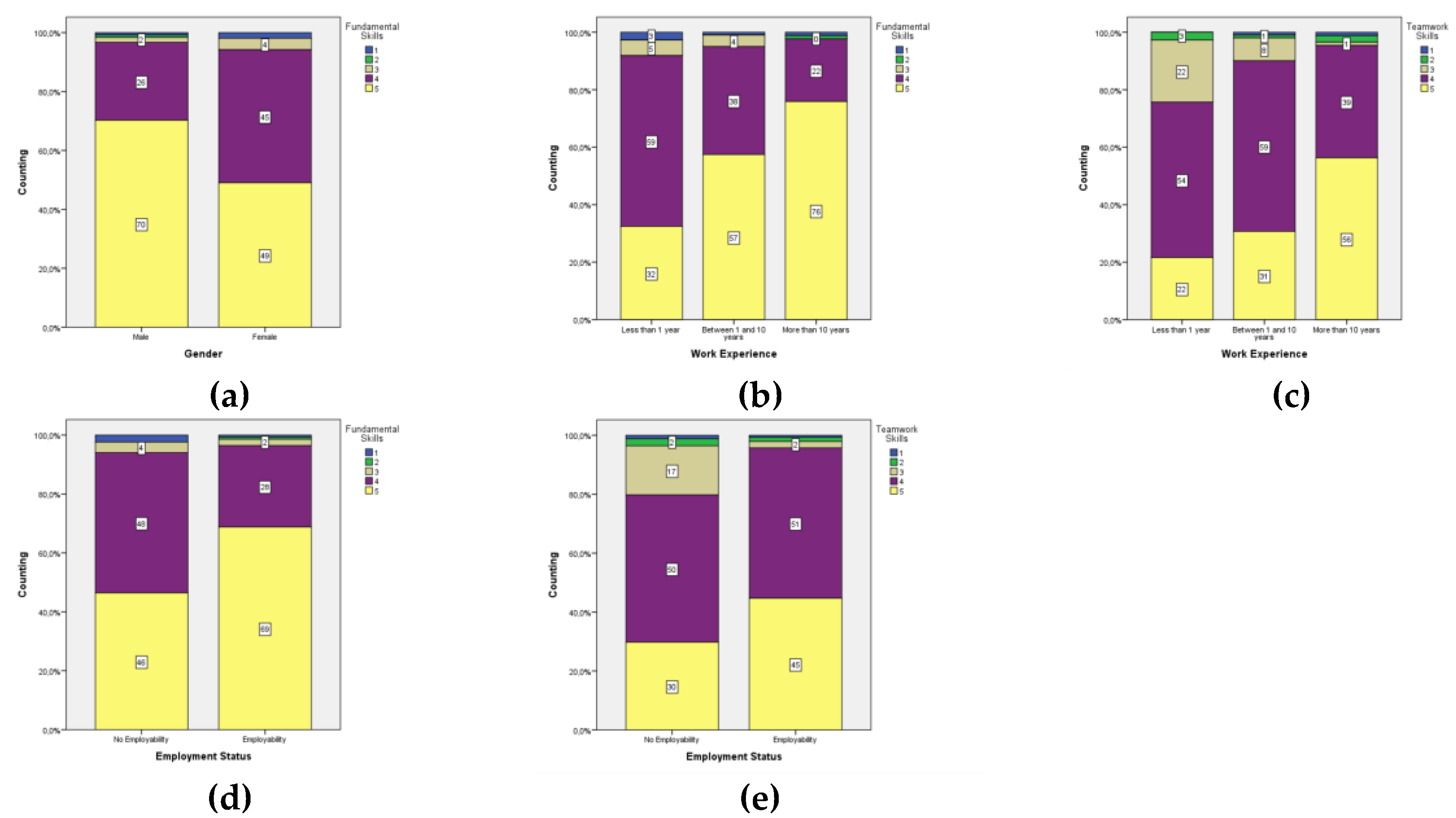

Table 1.
Types of management skills for employability.
| Fundamental Skills | Personal Management Skills | Teamwork Skills |
|---|---|---|
|
|
|
Table 2.
Properties of the Employability Skills 2000+ scale.
| Authors | Country | Sample | χ2/df | RMSEA | GFI | CFI | NNFI |
| Idkhan et al. [33] | Indonesia | 528 | 0.943** | 0.006** | 0.912* | 0.974** | 0.972** |
Table 3.
Characterization of sample.
| Variable | Category | Frecuency | % |
|---|---|---|---|
| Gender | Male | 121 | 53.8 |
| Female | 104 | 46.2 | |
| Total | 225 | 100 | |
| Work Experience | Less than 1 year | 37 | 16.4 |
| Between 1 and 10 years | 101 | 44.9 | |
| More than 10 years | 87 | 38.7 | |
| Total | 225 | 100 | |
| Employment Status | No Employability | 84 | 37.3 |
| Employability | 141 | 62.7 | |
| Total | 225 | 100 |
Table 4.
Results of proposed model.
| Models | Country | Sample | χ2/df | RMSEA | GFI | CFI | NNFI |
|---|---|---|---|---|---|---|---|
| Idkhan et al. [33] | Indonesia | 528 | 0.943 | 0.006 | 0.912 | 0.974 | 0.972 |
| Proposed Model | Honduras | 225 | 1.2261 | 0.032 | 0.993 | 0.986 | 0.997 |
1 LOSEFER empirical correction [63].
Table 5.
Rotated loading matrix and Explained variance based on eigenvalues.
| Variable | F1 | F2 | F3 |
| V30 | 0.661 | ||
| V32 | 0.593 | ||
| V33 | 0.567 | ||
| V34 | 0.869 | ||
| V37 | 0.798 | ||
| V38 | 0.438 | ||
| V5 | 0.854 | ||
| V7 | 0.714 | ||
| V10 | 0.871 | ||
| V13 | 0.681 | ||
| V16 | 0.533 | ||
| V21 | 0.481 | ||
| V29 | 0.637 | ||
| V41 | 0.778 | ||
| V23 | 0.466 | ||
| V25 | 0.860 | ||
| V26 | 0.571 | ||
| V44 | 0.581 | ||
| V45 | 0.687 | ||
| V46 | 0.616 | ||
| V49 | 0.568 | ||
| Eigenvalue | 12.182 | 1.533 | 1.226 |
| Proportion of variance |
58.01% | 7.30% | 5.84% |
| Fraction of 71.15%. | 81.53% | 10.26% | 8.21% |
Table 6.
Chi-square tests.
| Demographic variables (dvi) | Parameters |
F1: Personal Management Skills |
F2: Fundamental Skills |
F3: Teamwork Skills |
FT: Employability Skills |
| Gender | Value | 5.307 | 12.133 | 8.224 | 5.307 |
| Asymptotic significance (bilateral) |
0.257 | 0.016* | 0.084 | 0.257 | |
| Work Experience |
Value | 5.050 | 25.383 | 30.727 | 5.050 |
| Asymptotic significance (bilateral) |
0.752 | 0.001** | 0.000** | 0.752 | |
| Employment Status | Value | 0.902 | 12.440 | 18.146 | 0.902 |
| Asymptotic significance (bilateral) |
0.924 | 0.014* | 0.001** | 0.924 |
Disclaimer/Publisher’s Note: The statements, opinions and data contained in all publications are solely those of the individual author(s) and contributor(s) and not of MDPI and/or the editor(s). MDPI and/or the editor(s) disclaim responsibility for any injury to people or property resulting from any ideas, methods, instructions or products referred to in the content. |
© 2024 by the authors. Licensee MDPI, Basel, Switzerland. This article is an open access article distributed under the terms and conditions of the Creative Commons Attribution (CC BY) license (http://creativecommons.org/licenses/by/4.0/).
Copyright: This open access article is published under a Creative Commons CC BY 4.0 license, which permit the free download, distribution, and reuse, provided that the author and preprint are cited in any reuse.


