
Submitted:
15 August 2024
Posted:
16 August 2024
You are already at the latest version
Abstract
This article investigates the fundamental principles that establish universal limits in physical phenomena, such as the uniformity of physical laws and Energy conservation, leading to the concepts of maximum speed, locality, and maximum density. These principles guide me to explore Quantum Black Holes—relativistically rotating, miniature charged black holes with a singular core at the highest possible density. Uniquely, these Quantum Black Holes maintain all quantized charges, including gravitational ones. The study further demonstrates that quarks and leptons are composed of these Quantum Black Holes, redefining them as the actual elementary particles.Exploring these particles reveals that they emit Energy outward, modifying the curvature of nearby space-time. This discovery provides new insights into local space-time dynamics, characterized by a single equation that includes the influence of all charges and hidden Energy. By the conclusion of this article, I show that Quantum Black Holes offer explanations for several Standard Model deficiencies: the nature of luminous, dark, and anti-Matter; the mass, size, and quantized charges of all elementary particles (including gravitational); the nature of neutrino oscillations; and the mechanism by which electric charges remain bound even though the same type of electric charge components must repeal each other.
Keywords:
elementary particles
; space-time
; spacetime curvature
; relativity
; charges
; TOE
1. Preliminaries
Problem: In many current space-time models and descriptions, physical phenomena are often described by their outcomes, with little emphasis on their underlying origins. This approach introduces "non-physical" assumptions to reconcile theoretical predictions with observed reality. For instance, the Standard Model (SM) requires normalization and accepts singularities that defy known physical laws. Moreover, the SM does not account for several crucial phenomena, including the quantization of gravitational charges, neutrino oscillations, dark matter, and more.
I adhere strictly to well-established physical principles in this article and demonstrate that they produce extraordinary results. I aim to address and resolve many of the Standard Model's deficiencies by revisiting the limits resulting from these fundamental principles. This approach offers a more cohesive understanding of physical phenomena, bridging the gap between theory and reality in a manner that aligns more closely with physical intuition.
Throughout this article, when referring to Matter, Energy also applies. For clarity and conciseness, I will employ the term "particles" to denote housing for charges. I will not distinguish between left-handed and right-handed particles; when I must choose a process, I will choose the one that happens.
The Universe often follows an unwritten rule: the "Occam Razor Rule," which shows a preference for the simpler route. (It does not always work; in which case I use a more elaborate solution.)
2. Limits
Space-time has built-in limits.
To understand the source of the limits, I examined the following two fundamental physics laws (stated as principles):
Uniformity of Physics Laws in the Universe Principle:
- Each physics law is the same throughout the Cosmos.
The “Uniformity of Physics Laws in the Universe Principle” is a fundamental tenet in physics and forms the foundation of our understanding of the Cosmos. All experiments and observations conducted on Earth thus far have consistently upheld this principle. Moreover, additional evidence gathered from distant galaxies further supports the validity of this principle across the vast reaches of the Universe, leading us to accept its validity throughout the Cosmos. [1]
Based on many observations, we conclude that Energy is conserved in closed systems.
Energy Conservation Principle:
- Energy is conserved in a closed system.
No known physical phenomenon or process has ever contradicted the "Energy Conservation Principle."
Applying the "Uniformity of Physics Laws in the Universe Principle" to the "Energy Conservation Principle" leads us to deduce that Energy conservation is a universal characteristic of closed systems, including the Universe as a whole.
Consequently, we can infer that the total amount of Energy in the Cosmos is constant.
Since our Universe has a fixed amount of Energy, it cannot contain infinite Energy in any given region. This conclusion is a very fundamental quality of our Cosmos and leads to limits in our Universe.
Remark: The only way to guarantee that no region in the Cosmos has infinite Energy under any circumstances is to ensure that even a point in space-time cannot have infinite Energy density.
If there is no infinite Energy anywhere in the Universe, then no Universe part can travel at infinite speeds because infinite speeds require infinite Energy. Thus, all Universe parts must have a speed limit of influence propagation, movement, or change.
We never observed any Universe part that moves at speeds higher than the speed of light. Therefore, we deduce that the highest possible influence propagation speed, a Universe part's speed, or a Universe part's speed of change, is the speed of light, marked as "c" .
Maximal Speed Principle:
- Nothing in our Cosmos propagates, changes, or moves faster than the speed of light.
Note: If there were an infinite speed of influence propagation or movement in our Universe, we would get instant reactions to all processes all over the Universe. We would get a completely Uniform Universe. Our Universe is not completely uniform, corroborating the "Maximal Speed Principle."
This result leads to another important principle:A Universe part cannot influence "almost instantly" any part of the Universe that is not its immediate neighbor. Otherwise, there was a possibility of influencing a very far Universe part in a way that violates the "Maximal Speed Principle."
Therefore, a Universe part can only "almost instantly" influence the Universe parts in its immediate neighborhood. Note: combining physics and mathematics converts "almost instantly" into infinitesimally close.
The Locality Principle:
- Universe parts can only influence Universe parts that are immediately in their neighborhood.
There is a third consequence - a new and fundamental limit:
The Universe cannot compress Energy indefinitely because I have shown that there is no infinite Energy anywhere in the Universe (not even the possibility of infinite Energy density at a point). This restriction leads us to conclude that a state of Matter with a maximum density MUST exist.
I name this state of maximum Matter density "Dachus" (derived from the Hebrew word for compressed.) I use the term "Dachus density" to denote this maximal density.
Maximal Density Principle:
- Nothing in our Cosmos has a density greater than Dachus’ density.
I denote Dachus density by . (I will calculate its value later.)
Question: Where can we find Dachus density in the Universe?
We should look at extreme places where attraction forces are mighty.In this context, I investigated what happens Inside a black hole.
Continual compression of Matter within a black hole ultimately compresses its Matter until it reaches Dachus density within a non-zero volume in the center of the black hole. As the Matter inside the black hole compresses to its maximum degree, it reaches a state where any further compression only contributes to the expansion of the black hole's core size, which maintains its Dachus state.
Remark: The concept of a black hole without a singularity challenges the calculations of esteemed physicists who predict singularities at the core of black holes. However, it is essential to note that these calculations, which suggest the existence of singularities as a mathematical necessity, did not account for the possibility of an upper limit to matter density. Consequently, the conclusion that geodesics inside a black hole inevitably converge at a singularity is invalid.
3. Quantum Black Holes
Dachus state occurs in the core of any black hole composed of one body.
I will continue by examining the smallest black holes that have a profound physical meaning:
Quantum Black Hole Definition:
- A
- "Quantum black hole" is a relativistically fast revolving, charged, miniature black hole whose core composes the entire black hole.
Going forward, I will use "QBH" as an abbreviation for a Quantum black hole.
By miniature, I refer to sizes in the order of and less.
QBH (quantum black hole) is slightly oblated as it revolves relativistically fast, but this minor deformity does not affect my calculations in this article.
I will use "Naked core" to refer to a black hole composed of a single core (without two horizons.) QBH is a naked core, as I will prove through calculations.
Question: Is there a single value to Dachus density?
Energy represents both the substance of the Cosmos and embodies the ability to cause changes in the Cosmos.
- Energy composes everything in our Universe
- As a principle:
The Completeness Principle:
- Energy and nothing but Energy exists in the Cosmos.
In the Dachus state, there is absolutely no room for additional contraction of Energy. Thus, as Energy composes everything, the Dachus state is the single, maximum density limit for all Energies density.
The Kerr-Newman solution describes a revolving, electrically charged black hole. [2] Following the Kerr-Newman metric, I present an adaptation to include all charges, using the “Uniformity of Physics Laws in the Universe” with emulation of the behavior of the electric charge:
Equation 1 Quadratic QBH radius
Where is the radius, is the force coefficient of the non-gravitational charge , “i” = E – electric, W-weak, and Q -quarkic (also known as color or strong.)For a solid sphere revolving relativistically 3 under the limit . .
When using the actual charge quantities, the root for the QBH radius equation is always imaginary (as I will show through calculations later), and we get a naked core as in the QBH definition. Note: I get the same result (an imaginary root) when using the non-adapted Kerr-Newman metric (with only gravitational and electric charges.) Solving yields:
Equation 2 QBH Dachus core radius (first version)
Equation 3 QBH Mass, density, and radius
Interestingly, since there is only one Dachus density, when comparing the radius in these two different equations, we get a restriction on the QBH Mass: , which is the quantization of the gravitational charge!
4. Elementary Particles Must be QBHs
We know that elementary particles have quantized charges, and very small dimensions. [4]Therefore, we must look for physical structures that keep the quantization of charges and are small enough to house elementary particles.
Let us look at what happens to Energy added to a QBH:
Suppose an uncertainty-related Energy emerges within the QBH, including its border - which are always at Dachus state.
We must remember that the Universal physical limits we listed, the speed of light, and the maximal Matter density cannot be circumnavigated – they hold at every possible physical phenomenon. Therefore, no amount of Energy will make Matter move at the speed of light or higher, and no amount of Energy will squeeze Matter and Energy further than the Dachus density.
Thus, when uncertainty-related Energy emerges within a QBH up to and including its border, the Matter density there cannot increase. Therefore, the uncertainty-related Energy exits the QBH swiftly.
Outside the QBH, when Energy is close to the QBH, the QBH’s strong and very relativistic centrifugal force deflects Energy from joining the QBH.
Remark: By the end of the article, it becomes clear that the quantization of charges in QBHs aligns perfectly and fits all observations. Therefore, QBHs do not lose or gain Energy after their creation.
If no additional (to existing) Energy can become a permanent part of the QBH and being a black hole at Dachus state, the QBH cannot lose charges - I found what I sought: a tiny structure that always keeps its existing quantized angular momentum and charges.
Conclusion: As there are no other candidates besides QBHs for elementary particles, I conclude that QBHs are the only structures in space-time that are elementary particles.
5. Quarks and Leptons as QBHs?
It is common practice that quarks and leptons are elementary particles. Therefore, as elementary particles, quarks and leptons should be QBHs.
Using the QBH radius and density equations, I calculated the radii and density of all quarks and leptons: [5]

Table 1.
Calculated radii and density of quarks and leptons as QBHs.
| Particle | |||
|---|---|---|---|
| Up | 1.8301 | ||
| Down | 3.9567 | ||
| Charm | 1.0760 | ||
| Strange | 7.9133 | ||
| Top | 1.4631 | ||
| Bottom | 3.5415 | ||
| Electron | 4.3295 | ||
| Muon | 8.9519 | ||
| Tau | 1.5055 | ||
| Electron neutrino [6] | 2.5511 | ||
| Muon neutrino | 2.6528 | ||
| Tau neutrino | 4.9632 |
*Neutrinos Mass values are not certain (I used and some results I discovered later in the chapter “RishonisL” about neutrinos composition. The results yield the appropriate NH.) [7]
We know that the maximal radius of an up (quark) is . [8]We also know the upper limit for the electron radius is [9]
Discussion: Empirical observations of quarks and leptons’ radii vastly exceed the magnitude observed if they were indeed elementary particles. The apparent discrepancy in size is too significant to ignore. Moreover, quarks and leptons calculated Dachus density varies with their type - in contrast to the uniqueness of the Dachus density value.
Conclusion: Because the only miniature structure that keeps quantization of Energy and charges for elementary particles is a QBH, I MUST conclude that quarks and leptons are NOT elementary particles.
Note: Quarks and leptons still exist and compose particles like protons and neutrons. (But they are not elementary particles.) The SM that describes them is very successful but imperfect: It has infinities corrected by mathematical procedures; it does not include gravity. It cannot explain the Mass, quantization, and size of elementary particles, dark Matter, neutrino oscillations, and more. This article explains and solves many of these problems (see summary in “Validity check” chapter.)
6. Rishonis
I name the real (new) elementary particles (QBHs) that compose quarks and leptons: “Rishonis.” The singular is “Rishoni” (from the Hebrew word “Rishoni,” which means “first one.”)
Naming:
- Rishonis who build quarks: “RishonisQ.”
- RishoniQ with a negative electric charge “NegativiumQ.” Plural form: “NegativiumsQ.”
- RishoniQ with a positive electric charge: “PositiviumQ.” Plural form: “PositiviumsQ.”
- Rishonis who build leptons: “RishonisL.”
- RishoniL with a negative electric charge: “NegativiumL.” Plural form: “NegativiumsL.”
- RishoniL with a positive electric charge: “PositiviumL.” Plural form: “PositiviumsL.”
All RishonisQ and RishonisL share the same Dachus density but have different compositions of charges.
To determine Rishonis’ charges, I must explore Energy types, and charges.
7. Luminous and Hidden Energy
From experience, the only structures we can observe in space-time are the QBHs and their products. (The products are photons connected to QBHs, expanding Energy from QBHs' charges, and the particles they build.)
Luminous Energy Definition:
- Luminous Energy aggregates all the QBHs Energy and QBHs’ products Energy.
Our current observational devices cannot directly observe Energy that does not emanate from a QBH source (an explanation follows later.)
Hidden Energy Definition:
- Hidden Energy aggregates all charges and their Energies that are not part of luminous Energy.
Remark: kinetic Energy that does not emanate from charges is not part of luminous and hidden Energy.
Hidden Energy is also known as “Dark Matter” (but as Energy composes everything in our Universe, and the term “Dark Energy’ is taken, I prefer the term hidden Energy.)
We can deduce hidden Energy existence by its influence on substantial structures in our Universe. (For example, the rotation speed of galaxies.) [10]
Scientists estimate the volume of the known Universe as . [11]We estimate the Mass of the hidden Energy in the Universe as . Energy in space-time (without Dark Energy) comprises close to 16.8% of luminous Energy and 83.2% of hidden Energy. [12] Therefore, the average density of hidden Energy in the observable Universe:
Remark: The data above assumes an inflationary stage in the Universe expansion, which may be wrong. Without an inflationary era .
Hidden Energy is an extremely thin soup-like aggregate of gravitational, electric, weak, and quarkic (color) charges and the Energy that emanates from them.
The low density of hidden Energy charges (many orders of magnitude less than QBHs' Dachus density) emits very faint Energy and is, therefore, too faint to observe with current instruments. (See calculations in the chapter “Discovering hidden Energy.”)
Hidden Energy surrounds luminous Energy; It is denser near concentrations of luminous Energy (for example, the center of the Milky Way galaxy). As gravitational charges have the most extensive range, they influence hidden Energy throughout space-time at varying degrees of density, creating the “Cosmic web.” Scientists still need more observation to detect the exact distribution of hidden Energy. [13]
Remark: Dark Energy influences the Universe's expansion. It is probably pure kinetic Energy without charges. (It is not part of this article.)
8. Charges and Their Influence on Space-Time Curvature
Charge Definition:
A charge is a Universe part that constantly emits Energy that changes the space-time curvature it encounters in a specific way attributed to the charge type.
Historically, we are accustomed to using forces. Force Definition: A force is the influence of a Universe part’s charge on its surroundings with the same charge type. A force always causes a change in the influenced Universe part.
Aside: The force definition is an excellent example of how a misunderstanding of physics lingers for centuries and directs thinking in an erroneous direction (as I will show shortly.)
Discussion: Charges continuously affect their neighborhoods by changing space-time curvature. Charges do that by their Energy and momentum. (For brevity, from now on, whenever I refer to charge Energy that changes space-time curvature, it will always also include the momentum associated with this change.)
- Every charge changes space-time curvature in an amount specific to the charge type.
- Charges invest Energy in any change they affect.
- The influence of charges propagates from the charge outward at the speed of light.
Therefore, charge Energy continues to propagate away from the charge, spending Energy on modifying the space-time curvature it encounters - as long as some charge's Energy (and momentum) remains.
I name the point where the charge's Energy is completely spent: "Charge diminishing point." (Equivalently, where a force stops its effect: "Force diminishing point."):
- Gravitational charges: The gravitational charge diminishing point is the largest, maybe even up to the size of the Universe. Its value: ~ substantial part of the Universe’s size?
- Electric charges: Magnetars can affect space-time up to several astronomical units away. (Other sources provide a much shorter range for Magnetars.) Therefore, the electric charge diminishing point is ~
. (We require additional data.)
- 3.
- Quarkic charges: The charge diminishing point of the quarkic charge is about the radius of the last stable nucleus – the 208 lead nucleus. Its value: ~
[14]
- 4.
- Weak charges: The weak charge diminishing point is the smallest. Its value:
. [15]
The weak and quarkic charges have short charge diminishing points and stop affecting the space-time curvature beyond these distances.
- The electric charge has a significant diminishing point. However, usually beyond the size of large molecules, it has (on average) an even electric charge distribution, and therefore, its space-time curvature effects over large distances cancel out.
- Only the gravitational charges affect space-time curvature on large scales.
Question: Can a Universe part possess several charge types on any scale (no matter how small)?
As long as the combination of charge Energies does not exceed the Dachus density, several types of charges can coexist in the same volume (no matter how small.)
According to the "Locality Principle" and "Charge Definition," a charge Energy continuously propagates from the charge outward, changing the space-time curvature it encounters. Now imagine a particle that moves to a new neighborhood and has to change the new neighborhood – it requires new Energy to do it. This occurrence seems to contradict the "Energy Conservation Principle" since it implies a ceaseless Energy production at the charge location, which then ceaselessly expands from the charge outwards.
Surprisingly, from observations, this continuous influence does occur up to the charges' diminishing points.
Recalling the explanation of how the QBH guards' quantization, we know of just such a renewable Energy source: "Thus, when uncertainty-related Energy emerges within a QBH up to and including its border, the Matter density there cannot increase. Therefore, the uncertainty-related Energy exits the QBH swiftly."
This conclusion reveals exciting knowledge of space-time curvature behavior.
Every QBH's charge repeatedly emits Energy, altering space-time curvature around it. A state of equilibrium forms: the continuously emitted charge's Energy from the QBH continuously tries to change space-time curvature. Space-time curvature resists and counters by trying to return to its initial flat state (The source of Newton's third law?). Thus, this space-time curvature remains "constant" - fluctuating around an equilibrium value.
Note: Inside and at the boundary of the QBH, uncertainty-related Energy helps maintain the substantial space-time curvature. The rest of this Energy propagates outside the QBH.
When a new QBH comes into play, it modifies the existing space-time curvature caused by other QBHs. The new QBH's charges Energy alters space-time curvature by simultaneously superpositioning its charges' Energy influences on existing space-tine curvature.
All charges have the same form of behavior. They emit Energy that propagates and changes space-time curvature. They emit radiation when accelerated. [2,16] This behavior embodies the "Uniformity of Physics Laws in the Universe Principle" applied to charges' Energy.
Constructing the equations for QBH influence on space-time curvature:
“Uniformity of Physics Laws in the Universe Principle” requires a tensorial form.
Premise: Space-time curvature exists at every point of space-time. According to the “Completeness Principle,” Energy also exists at every point in space-time. Whenever space-time curvature encounters charges’ Energy or kinetic Energy without charges, it changes. This same changed space-time curvature strives to mitigate this change and responds in an opposing manner to the charges Energy that influences it → a state of equilibrium forms.
So, at a point in space-time that never encountered charge Energy or kinetic Energy (today it is a hypothetical case - “flat space-time curvature”), I can write an equation: .
The equations that describe changes in space-time curvature need tensors of the curvature from one side and tensors of the Energy and its momentum on the other side. These equations cover the entire space-time.
Specifically, the resulting equations describe the equilibrium point between the space-time curvature resisting change and the Energy enforcing change on the space-time curvature.
We can form an Energy-momentum tensor in space-time as a (0,2) tensor. We know that the Energy-momentum tensor must follow the “Energy conservation Principle”; consequently, the Curvature tensors on the opposite side of the equation must do the same and be (0,2) tensors.
Therefore, , and correspondingly , where is a conversion factor between the Energy-momentum tensor and the curvature Tensors, and “i” associates with charge .
The result is four sets of equations, one for each charge (The first is EFE.)
Equation 4 Rishonis charges influence on space-time curvature
is the Ricci curvature tensor of the charge .
is Ricci scalar of the charge .
is the metric.
is the Energy-momentum (stress-Energy) tensor of the charge .
is a conversion constant corresponding to the Energy expenditure of the charge while changing space-time curvature. Einstein calculated [17]. In another article, I demonstrate a possible new calculation for the electric charge conversion constant using the technique A.E. used to develop the . The result: . [18]
is the charge diminishing point.
These equations describe luminous Energy sources. Each Rishoni type will have specific stress-Energy tensors according to its specific charges’ quantities.
What about hidden Energy?
Outside the QBH, other charges exist in very small densities as hidden Energy. There, the uncertainty-related Energy that acts on them induces changes in space-time curvature:
Equation 5 Hidden Energy charges influence on space-time curvature
is a tensor similar to for the charge of hidden Energy and the uncertainty-related Energy acting on it. As explained before, only the hidden Energy of gravitational charges influences space-time curvature on cosmic scales.
Remark: I separated hidden Energy from luminous Energy for clarity, as their charges' Energy sources exist in separate locations. I did not write equations for dark Energy; they will appear in an article that discusses the Cosmos expansion.
Note: When solving the equations of Rishonis' influence on space-time curvature, it is best to do so simultaneously for all influencing charges, considering the sequence in which the influences of charges' Energy and momentum reach the space-time curvature under consideration (taking into account the maximal speed of influence propagation, and the locations of the charges.)
Aside: A known path to produce equations of motion: Form an action as an integral of Lagrange density up to the charge diminishing point. Then, perform an extremization procedure on the action. [19]
Examining photons and space-time curvature produces very important results.
"Photons" are particles without "rest Energy" (the Energy that corresponds to rest Mass). They only have kinetic Energy and are chargeless. I can express photon stress-energy tensors with components of pure kinetic Energy and momentum (without rest Energy).
Very important: From current observations, although chargeless, photons respond to gravitation and electric charges!
Using the “Uniformity of Physics Laws in the Universe Principle,” I deduced that the only way space-time curvature influences a chargeless particle can happen is if and only if all charges’ Energy or chargeless kinetic Energy change the same space-time curvature and all particles (with or without charges) follow the same space-time curvature. Thus, when a photon moves along space-time curvature, it follows it even though it is chargeless.
See another proof in the chapter “RishonisQ.”
As all charges influence the same space-time curvature, then I can combine all charges located at the same location, write their influence in a single equation, and add the influence of hidden Energy if consequential:
Equation 6 Local unified influence of charges at the same location and hidden Energy on space-time curvature
Remark: An example of the "same location" is a single particle's charges' location.
The refers to the pure kinetic Energy (of photons.)
The hidden Energy component may be relevant only if the space-time curvature in question is relatively far from the effective influence of the “stronger” non-gravitational charges. This calculation measures the influence of hidden Energy in the entire Universe on a single point in space-time.
Note: This unified influence equation does not include dark Energy, which causes the Universe to expand. When examining local events, the influence of dark Energy is usually immaterial.
9. Matter and Anti-Matter
From observation, we know that, for every charge type in space-time, a mirror “image” exists with the opposite charge type. We call the “stuff” that composes us “Matter” and its mirror “anti-Matter.”
From observation, when Matter encounters anti-Matter, a surge of kinetic Energy appears, and the influence of the Matter and anti-Matter charges stops being noticeable.
Therefore, I conclude that when Matter encounters anti-Matter, the space-time curvature disappears (becomes flat – zero curvature), and the Energy that was invested in keeping the space-time curvature appears as a surge of kinetic Energy.
Question: What happens to the charges? As charges cannot disappear following the “Energy Conservation Principle,” they disperse (because the QBH disintegrates) and become part of hidden Energy - and therefore, we can no longer observe them.
Anti-Matter Definition:
- Anti-Matter is a Universe part with charges that cause the exact opposite space-time curvature to those caused by the Universe part with corresponding Matter charges.
Table 2.
Matter and anti-Matter charges schematic comparison.
| Charge type | Matter to anti-Matter charge reversal |
|---|---|
| Gravitational | |
| Quarkic | |
| Electric | |
| Weak |
Note: attracts . The same “rule” applies to all other anti-Matter charges.
10. RishonisQ
Discussion:
- There are equal amounts of opposing electric charges in the Universe.
- Both electric charges have the same intensity.
- Only Rishonis (QBHs) possess measurable, net quantized electric charges.
Electric charges of hidden Energy (outside the Rishonis) are extremely small and have an equal number of opposing electric charges. Therefore, the net electric charge of hidden Energy is zero. So, when determining the electric charge of quarks and leptons, I do not need to consider the “space” between the Rishonis that construct them.
Therefore, the electric charge of any Rishoni will directly correspond to the charge of the quarks and leptons they construct. In the case of RishonisQ:
Table 3.
Electric charge for RishonisQ.
| Elementary particles | * | |
|---|---|---|
| PositiviumQ | +2e/3 | |
| NegativiumQ | -1e/3 |
* Calculated proof appears later.
Before continuing, I want to check the possible influence of hidden Energy on the structure of quarks and leptons: If we take an up quark, for example, its volume is , and the hidden Energy (presented as Matter) within this volume is , which is of the total Mass of the up – quite insignificant.
Composite QBH definition:
- Composite QBH is a compound particle composed of several QBHs.
To identify Rishonis' other charges, I propose a structure consisting of Rishonis forming quarks and leptons. Using the "Occam Razor Rule," I will look for the least number of RishonisQ constituting the different quarks and the least number of RishonisL composing the different leptons. Rationale: From observations, we know that systems prefer minimal Energy states. Holding a composite particle requires more attraction than repulsion. Increasing the number of composing particles (considering that the main attraction forces come from the relatively weak gravitational charges) will increase the possibility of repulsion and, therefore, require more attraction. Therefore, a composite particle system will prefer fewer composing components.
To avoid a state of a quark composed of one elementary particle (that would return us to the original state of a quark as an elementary particle,) I need an electric neutral Composite QBH in addition to the charged RishoniQ. The simplest additional particle would be a composite particle with 2 NegativiumsQ and 1 PositiviumQ – which do not change the electric charge of the entire ensemble.
I name this neutral compound particle: "ImpartialQ."
To get the values of PositiviumQ and NegativiumQ charges, I use the data known for quarks:
Therefore, an up quark has 1 PositiviumQ and 1 ImpartialQ = 2 PositiviumQ + 2 NegativiumQ; a down quark has 1 NegativiumQ + 1 ImpartialQ = 1 PositiviumQ + 3 NegativiumQ.Example for calculating charges: Equation for : , yields: - Q.E.D.
Note: RishoniQ contains gravitational, electric, weak, and quarkic charges. To maintain their existence, the RishoniQ inner attraction forces must overcome the repulsion forces of the electric and weak charges so that the RishonisQ do not disintegrate.
When discussing QBHs, I have shown that all Rishonis have a single quantized Mass.
In the table below, I use with a corresponding to place all charges on the same footing. As there is only one , there is only one for all Rishonis.
Very interesting Aside – proof that all charges influence and are influenced by the same space-time curvature: Electric charges (of the same type) repel each other. How come all the components of the electric charge stay together inside the QBH? The only way to accomplish this is if the gravitational charges are strong enough to keep the QBH from exploding. This state can only happen if all charges influence space-time curvature, which in turn influences all other charges that pass through the resultant curved space-time. In this way, the gravitational charges influence the electric charges.
Discussion: When looking for the combinations of RishonisQ that create quarks, some have Matter and anti-Matter components. Therefore, all quarks will have the charges we observe, but some (when composed of Matter and anti-Matter components) will have different Energies for the same apparent total charges. We observe this difference in the different quark types' Masses. This difference occurs because they have different internal structures.The same will hold for RishonisL and leptons.
Table 4.
RishonisQ charges.
| PositiviumQ | +2e/3 | 7e/12 | 1e/4 | |
| NegativiumQ | -1e/3 | -5e/12 | 1e/4 | |
| Anti-PositiviumQ | -2e/3 | -7e/12 | -1e/4 | |
| Anti-NegativiumQ | +1e/3 | +5e/12 | -1e/4 | |
| ImpartialQ: 1 PositiviumQ + 2 NegativiumsQ | 3e | 0e | -1e/4 | 3e/4 |
| Up: 1 PositiviumQ + 1 ImpartialQ = 2 PositiviumQ + 2 NegativiumsQ | 4e | +2e/3 | 1e/3 | 1e |
| Down: 1 NegativiumQ + 1 ImpartialQ = 1 PositiviumQ + 3 NegativiumsQ | 4e | -1e/3 | -2e/3 | 1e |
| Charm: 1 PositiviumQ + 2 ImpartialsQ + 1 antiImpartialQ = 3 PositiviumsQ + 4 NegativiumsQ + 1 anti PositiviumsQ + 2 antiNegativiumsQ | 4e | +2e/3 | 1e/3 | 1e |
| Strange: 1 NegativiumQ + 2 ImpartialsQ + 1 antiImpartialQ = 2 PositiviumsQ + 5 NegativiumsQ + 1 anti PositiviumsQ + 2 antiNegativiumsQ | 4e | -1e/3 | -2e/3 | 1e |
| Top: 1 PositiviumQ + 3 ImpartialsQ + 2 antiImpartialsQ = 4 PositiviumsQ + 6 NegativiumsQ + 2 anti PositiviumsQ + 4 antiNegativiumsQ | 4e | +2e/3 | 1e/3 | 1e |
| Bottom: 1 NegativiumQ + 3 ImpartialsQ + 2 antiImpartialsQ = 3 PositiviumsQ + 7 NegativiumsQ + 2 anti PositiviumsQ + 4 antiNegativiumsQ | 4e | -1e/3 | -2e/3 | 1e |
Aside: Again, from some distance from the quarks, we seem to have two types of quarks, but looking closer reveals an inner structure creating six types of quarks (as expected.)
11. RishonisL
Following the “Occam Razoe Principle,” I chose an electric neutral composite QBH particle for RishonisL with 1 NegativiumL and 1 PositiviumL. I call this neutral compound particle: “ImpartialL.”
Table 5.
RishonisL charges.
| PositiviumL | 1e | 2e | |
| NegativiumL | e | -1e | -1e |
| Anti-PositiviumL | -1e | -2e | |
| Anti-NegativiumL | e | +1e | +1e |
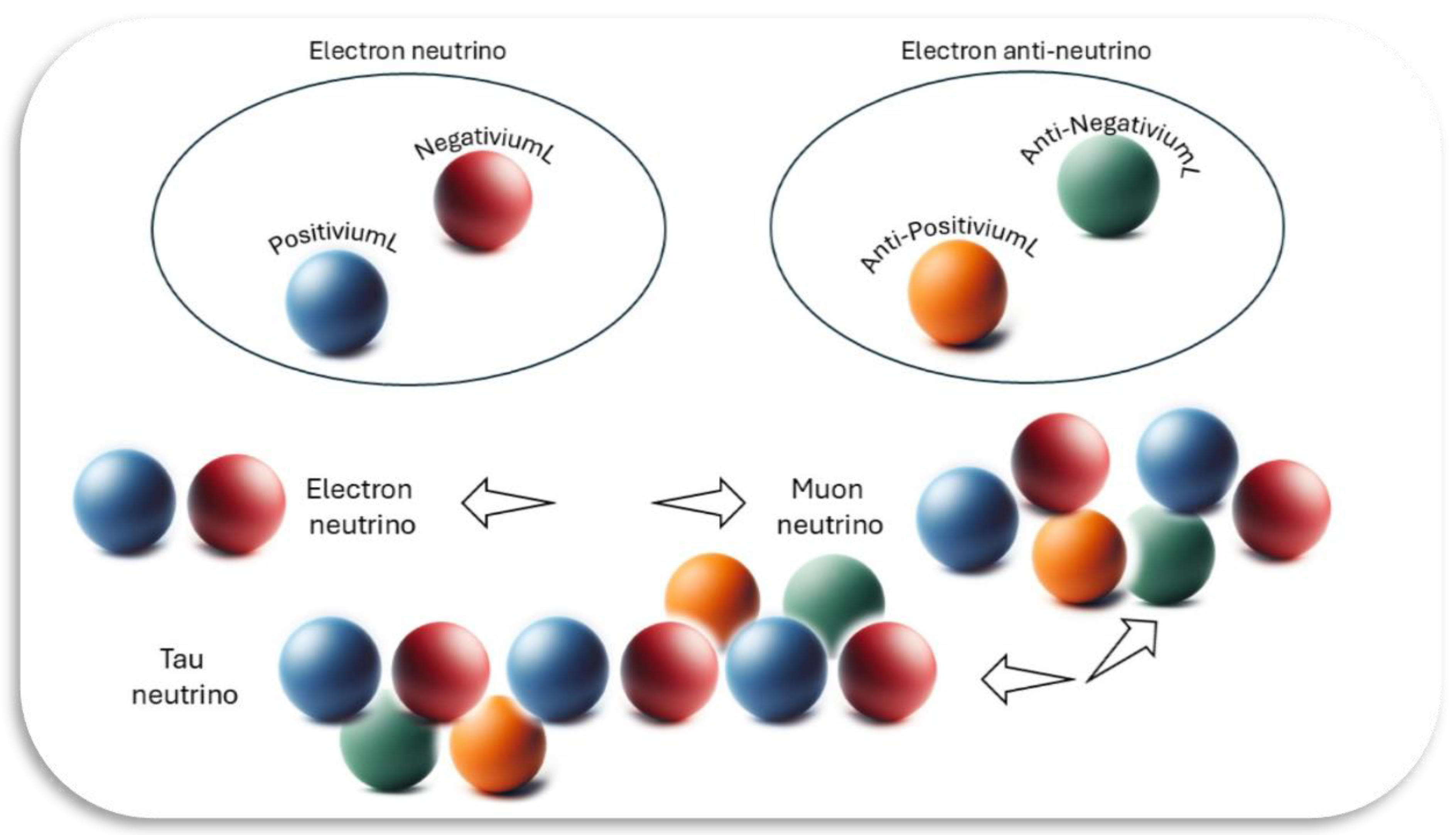
| Electron neutrino = 1 PositiviumL + 1 NegativiumL123456 | 0 | 1e | |
| Electron lepton = 1 NegativiumL + 1 Electron neutrino | 3e | -1e | 0 |
| Muon neutrino = 2 electron neutrinos + 1 electron antineutrino123456 | 0 | 1e | |
| Muon lepton = 1 NegativiumL + 1 Muon neutrino | -1e | 0 | |
| Tau neutrino = 3 electron neutrinos + 2 electron antineutrinos | 0 | 1e | |
| 123456Tau lepton= 1 NegativiumL + 1 Tau neutrino | -1e | 0 |
Note: From some distance from the leptons, we seem to have two types of leptons, but looking closer reveals an inner structure creating six types of leptons (as expected.)
Note again: The of RishonisL is identical to the of RishonisQ – as there is a single gravitational charge value for all Rishonis.
12. Rishonis Mass Radius and Density
I chose the electron neutrino as the test case for the calculation because it has the smallest Mass of quarks and leptons. I chose a binding Energy of 99%, as with protons and their quark constituents. Note: A somewhat different electron neutrino Mass value and a lower binding Energy (even 1%) do not change the article results: QBH are elementary particles that exert their charge Energies outward and influence space-time curvature (see the chapter “Sensitivity analysis - subchapter “Binding Energy.”)
One PositiviumL and one NegativiumL compose an electron neutrino.
For the gravitational charge calculations, both have the same amount of quantized gravitational charge .
I know from QBH equations that only single values exist for each , , and ; therefore:
Note: The radius calculation result yields only one value (the root is imaginary, as appropriate for a naked core.)
To verify Rishonis using known observational results, I calculated the Rishonis gestalt into an electron, and an up.
13. Validation: Rishonis Gestalt - Composing Quarks and Leptons from Rishonis
An electron composition: 1 NegativiumL + 1 Electron neutrino = 2 NegativiumsL + 1 PositiviumL.
- An up composition: 1 PositiviumQ + 1 ImpartialQ = 2 PositiviumQ + 2 NegativiumsQ.
Each RishoniL with its gravitational charge Energy contributes a third to the electron Mass.
- Each RishoniQ with its gravitational charge Energy contributes a fourth to the up Mass.
As all Rishonis have the same gravitational charge that changes their space-time curvature in the same way. According to superposition, I can treat each separately as part of the whole. Therefore, the gravitational Energy associated with a RishoniL within an electron is .
The Energy emanating from the gravitational charges has almost the same value over all the spherical surfaces encompassing the charge - outside the charge and within the range of quarks and leptons diameter. This result happens because the gravitational Energy value over the spherical surface encompassing the gravitational charge changes very slowly - because the gravitational charge has an extremely large diminishing point. Therefore, only a very small amount of the total gravitational Energy is spent on changing the space-time curvature at any point in the gravitational charge’s Energy reach.
I will define the gravitational charge Energy per a spherical surface outside a single RishoniL and within the electron by .
For the electron, I can assume that because must be smaller than half the (very small) electron neutrino Mass.
Therefore: For an electron with a radius of , the Mass gestalt of forming an electron from 3 RishonisL: , which agrees with the observations for the electron Mass.
Now, I will use this data to check the composition of 4 RishonisQ with the same gravitational charge as the RishonisL for an “up” with a radius of :
, which agrees with observations for the “up” Mass.
Q.E.D.
14. Neutrinos Oscillations
Now, neutrino oscillations are easy to explain by adding or removing electron neutrinos and electron anti-neutrinos as required – see Table 5 RishonisL charges.
Figure 1.
Neutrinos oscillations (schematics).
15. QBH Spin-Like Quality Origin
Now that I have shown that Rishonis gravitational charges are quantized, have a non-zero volume, and revolve relativistically fast at a fixed (or close to fixed) velocity, it is plausible to talk about the origin of Rishonis quantized spin-like quality as an intrinsic angular momentum.
16. Compound Particles Half Lives
Protons, neutrons, electrons, and electron neutrinos are composed exclusively of Rishonis without their corresponding anti-Rishonis. This unique composition is a crucial factor contributing to their exceptionally long half-lives (perhaps even stable.) In contrast, other particles, characterized by a composition that includes both Rishonis and anti-Rishonis, exhibit significantly shorter half-lives. This instability is primarily due to the potential for annihilation events between Rishonis and anti-Rishonis within these particles, resulting in their more transient nature.
17. Discovering Hidden Energy
As hidden Energy (dark Matter) is a very thin soup-like mixture of all charges, we can discover it by looking for very lethargic photons.
For example, a quark size hidden Energy Universe part, moving at , has a de Broglie wavelength of . (Even if it moves close to the speed of light where , we get )
18. Validity Check
Direct observations of Rishonis are beyond the ability of current particle accelerators. However, the resultant neutrino oscillations are not!
I verified that combining Rishonis into the compound particles of electrons and ups yields Mass comparable to observational results.
I have successfully explained the following (which the SM cannot):
- The nature of elementary particles as QBH.
- Quantization of gravitational charges.
- Neutrinos oscillations source.
- The nature of luminous Matter.
- The nature of dark Matter.
- The nature of anti-Matter.
- Sizes and quantization of all charges of all elementary particles.
- Spatial size ([m]) of elementary particles.
- The Dachus density existence and value.
- The origin of a quantized spin-like quality in QBHs.
- The source of protons, neutrons, electrons, and electron neutrinos stability versus other compound particles instability.
- The influence of charges on space-time curvature.
- The equations that govern all luminous and hidden Energy local movements in space-time.
19. Sensitivity Analysis
Binding Energy
The exact value of is not certain because we do not have precise values for electron neutrino Mass and its components’ binding Energy. What will happen if they change?
In this article, I assumed 99% as the guide for the value of binding Energy, yielding .
- Let me test what occurs when the binding Energy is 1% instead of 99%.
. The result is roughly two magnitude orders larger than the article's value. Changing the value of the binding Energy percent to 1% only affects the radius , Mass, and Dachus density of Rishonis. The new binding Energy does not change the non-gravitational charges' values of any Rishoni. All Rishonis are still QBHs that affect space-time curvature. Therefore, the characteristics and essential conclusions of the article will remain the same.
Number of Constituents Rishonis
What will happen if the number of Rishonis composing quarks and leptons is much higher than the proposed model?
The Mass, radii, and charge values will change in this case. However, the conclusions will not change; elementary particles are still QBHS that change space-time curvature.
Additional Options for Rishonis Charges
There is another alternative to RishonisQ compositions, one that does not require quarks to possess anti-RishonisQ at the cost of many more RishonisQ types - 24 instead of 4 (including anti-Matter):
Table 6.
Alternative RishonisQ charges (without anti-Matter).
| PositiviumQ-up | +2e/3 | 1e/3 | 1e/4 | |
| NegativiumQ-up | -1e/3 | -1e/6 | 1e/4 | |
| PositiviumQ-charm | +2e/3 | 1e/3 | 1e/7 | |
| NegativiumQ-charm | -1e/3 | -1e/6 | 1e/7 | |
| PositiviumQ-top | +2e/3 | 1e/3 | 1e/10 | |
| NegativiumQ-top | -1e/3 | -1e/6 | 1e/10 | |
| PositiviumQ-down | 1e | +2e/3 | -2e/3 | 1e/4 |
| NegativiumQ-down | 1e | -1e/3 | 1e/3 | 1e/4 |
| PositiviumQ-strange | 1e | +2e/3 | -2e/3 | 1e/7 |
| NegativiumQ-strange | 1e | -1e/3 | 1e/3 | 1e/7 |
| PositiviumQ-bottom | 1e | +2e/3 | -2e/3 | 1e/10 |
| NegativiumQ-bottom | 1e | -1e/3 | 1e/3 | 1e/10 |
Example: Charm quark = 1 PositiviumQ-charm + 2 ImpartialQ-charm = 3 PositiviumsQ-charm + 4 NegativiumsQ-charm:
The same for Leptons without anti-RishonisL - at the cost of 8 RishonisL types instead of 4 (including ani-Matter):
Table 7.
Alternative RishonisL charges (without anti-Matter).
| PositiviumL-electron | 1e/2 | 1e | |
| PositiviumL-muon | e | 1e/2 | 3e/4 |
| PositiviumL-tau | e | 1e/2 | 2e/3 |
| NegativiumL-electron-muon-tau | e | -1e | -1e |
Example: Muon lepton = 1 NegativiumL-electron-muon-tau + 2 ImpartialsL-muon = 4 PositiviumsL-muon + 3 NegativiumsL-electron-muon-tau:
These alternative versions require many more types of Risonis and do not explain neutrino oscillations or the shorter half-life of some particles. Only experimental data will decide which occurs.
Both choices of the Rishonis types (with or without anti-Matter) provide a Cosmos where QBHs are the elementary particles that influence space-time curvature.
20. Summary
Rishonis – the elementary particles in space-time are Quantum black holes: miniature, relativistically fast revolving spheres at Dachus state (slightly oblated) that are naked cores. They keep quantization of all charges (including the gravitational charge) and spin.
All Rishonis and chargeless Energy influence the same space-time curvature, which in turn influences all Rishonis, their composite particles, and chargeless Energy that pass through the resultant curved space-time.
Rishonis Energy is replenished by the uncertainty-related Energy that appears in them. The uncertainty-related Energy within Rishonis (including their border) maintains the highly curved space-time curvature inside the QBH. Some of this Energy exits the QBH, expands outward, and changes space-time curvature as far as the QBH's charges diminishing points.
Rishonis, in different combinations, compose all quarks and leptons.
The Dachus density (according to available data) is .
The space-time curvature value oscillates around an equilibrium value between the influence of the QBH charge’s Energy, which changes the space-time curvature, and the reaction of the space-time curvature counteracting the charge’s Energy influence.
References
- <i>Evidence for large-scale uniformity of physical laws. </i><b>Tubbs, A. D.
- C.W. Misner, K. S. Thorne, J. A. Wheeler. Gravitation. s.l. : W. H. Freeman.
- On the Dependence of the Relativistic Angular Momentum of a Uniform Ball on the Radius and Angular Velocity of Rotation.F., Sergey G. s.l. : International Frontier Science Letters, Vol. 15.
- Goldberg, Dave. The Standard Model in a Nutshell. s.l. : Princeton University Press, 2017.
- Group, Particle Data. https://pdg.lbl.gov/2022/booklet/2022dev/2022/summary-tables.html. [Online] 2022.
- Updated results on neutrino mass and mass hierarchy from cosmology with Planck 2018 likelihoods.Choudhury, Shouvik Roy. s.l. : https://arxiv.org/pdf/1907.12598.pdf.
- Direct neutrino-mass measurement with sub-electronvolt sensitivity.Collaboration, The KATRIN. 18, s.l. : nature physics, 2022.
- Limits on the effective quark radius from inclusive ep scattering at HERA.Collaboration, ZEUS. s.l. : Physics Letters B, 2016.
- Dehmelt, Hans. A Single Atomic Particle Forever Floating at Rest in Free Space: New Value for Electron Radius. Physica Scripta. 1988, Vol. 102.
- Corbelli, Edvige. The extended rotation curve and the dark matter halo of M33. Astronomical society. 2000.
- https://www.wolframalpha.com/input/?i=size+of+universe. Size of the Universe.
- Weakly Interacting Stable Pions.Bai, Yang. 2010.
- On the dark matter distribution in the Milky Way.Iocco, Fabio. 718, s.l. : J. Phys.: Conf. Ser. .
- Constraints on neutron skin thickness in 208Pb and density-dependent symmetry energy.Dong, Jianmin. s.l. : Phys. Rev. C, 2015, Vol. 91.
- ON The Bosons’ Range of The Weak Interaction.PUCCINI, Antonio. 3, s.l. : Journal of Advances in Physics, Vol. 14.
- Griffiths, David 1. Introduction to Electrodynamics. s.l. : Prentice Hall, 1999.
- Janssen, Michel and Renn, Jürgen. How Einstein Found His Field Equations: Sources and Interpretation. s.l. : Springer Nature, 2022.
- Electric charge influence on space-time curvature.Lavi, E. M. s.l. : Zenodo, 2024. DOI 10.5281/zenodo.10397641.
- Sean, Carroll. Spacetime and geometry an introduction to general relativity. s.l. : Pearson, 2014.
Disclaimer/Publisher’s Note: The statements, opinions and data contained in all publications are solely those of the individual author(s) and contributor(s) and not of MDPI and/or the editor(s). MDPI and/or the editor(s) disclaim responsibility for any injury to people or property resulting from any ideas, methods, instructions or products referred to in the content. |
© 2024 by the authors. Licensee MDPI, Basel, Switzerland. This article is an open access article distributed under the terms and conditions of the Creative Commons Attribution (CC BY) license (http://creativecommons.org/licenses/by/4.0/).
Copyright: This open access article is published under a Creative Commons CC BY 4.0 license, which permit the free download, distribution, and reuse, provided that the author and preprint are cited in any reuse.


