

Submitted:
09 February 2024
Posted:
12 February 2024
You are already at the latest version
Abstract
The field of fluorescence sensing, leveraging various supramolecular self-assembled architectures constructed from macrocyclic pillar[n]arenes, has seen significant advancement in recent decades. This review comprehensively discusses, for the first time, the recent innovations in the synthesis and self-assembly of pillar[n]arene-based supramolecular architectures (PSAs) containing metal coordination sites, along with their practical applications and prospects in fluorescence sensing. Integrating hydrophobic and electron-rich cavities of pillar[n]arenes into these supramolecular structures endow the entire system with self-assembly behavior and stimulus responsiveness. Employing the host–guest interaction strategy coupled with complementary coordination forces, PSAs exhibiting both intelligent and controllable properties are successfully constructed. This provides a broad horizon for advancing fluorescence sensors capable of detecting environmental pollutants. This review aims to establish a solid foundation for the future development of fluorescence sensing applications utilizing PSAs. Additionally, current challenges and future perspectives in this field are discussed.
Keywords:
fluorescence sensing
; environmental pollutants
; pillar[n]arene
; supramolecular architecture
; metal coordination complex
1. Introduction
Supramolecular chemistry synergizes elements with diverse structures and functions via non-covalent interactions [1,2,3,4,5,6,7,8], enabling the construction of dynamically reversible smart composites [9,10,11,12]. Increasing attention has been given to intelligent supramolecular structures formed by host–guest interactions, particularly for their stimuli-responsive properties and expansive application potential. As a vital segment of supramolecular chemistry, macrocyclic hosts have found extensive use across various domains. Presently, there are five prominent macrocyclic hosts, including crown ethers, cyclodextrins, calix[n]arenes, cucurbit[n]urils, and pillar[n]arenes. Each host can specifically accommodate different guest molecules by offering suitable cavities. Pillar[n]arenes, in particular, stand out due to their rigid and electron-rich cavities, symmetrical frame structure, and exceptional host–guest properties [13,14,15,16,17,18,19,20,21]. The positional modification of pillar[n]arenes endows them with distinct characteristics [22,23,24,25,26,27,28]. This review focuses on pillar[n]arene-based supramolecular architectures (PSAs) that are functionalized with chelating metal ions [29,30].
The coordination metal ions discussed in this review include Ag+, Hg+, Cu2+, Zn2+, Pt2+, Fe3+, Al3+, Eu3+, and Tb3+. Host–guest complexes with metal coordination sites offer considerable scientific value, featuring a pillar-like framework and various self-assembly driving forces such as hydrophobic/hydrophilic, π−π, C−H−π, and cation−π interactions, among others. We categorize two types of supramolecular architectures with metal ion coordination sites: (i) functional pillar[n]arenes with metal coordination sites (e.g., N, O, S atoms) are initially designed and synthesized. These pillar[n]arenes can form supramolecular structures through intermolecular π−π stacking and cation−π interactions after coordinating with metal ions; (ii) guest molecules with metal coordination sites can undergo host–guest interactions with specific pillar[n]arenes to form complexes. These complexes then coordinate with metal ions to create supramolecular structures.
Environmental pollutants, such as hydrazine hydrate, nitrobenzene, nitroaromatics, cyanide perchlorate, halides, and various metal ions, has been recognized as a critical global issue, posing significant threats to public health and natural ecosystems. Consequently, there is an urgent demand for the development of analytical methods to detect these toxic substances. However, challenges persist across multiple fronts. Analytical methods that offer low limit of detection (LOD), excellent sensitivity, outstanding selectivity, and satisfactory removal efficiency are essential, requiring appropriate strategies. Among the methods reported, fluorescence sensing based on supramolecular systems stands out for its accuracy, convenience, and stability, offering superior temporal and spatial resolution and enabling real-time analysis [31,32,33,34,35]. Aggregation-induced emission (AIE) has emerged as a promising sensing mechanism in recent years. This approach involves materials that exhibit negligible emission in dilute solutions and significantly enhanced fluorescence in aggregated states [36,37]. The unique host–guest interactions of pillar[n]arenes can be harnessed to manipulate AIEgens (aggregation-induced emission generators, indicating smart molecules with AIE properties), leading to supramolecular assembly-induced enhanced emission (SAIEE). This offers the potential to develop new materials with photoluminescent properties. Furthermore, materials based on pillar[n]arene-based supramolecular architectures (PSAs) containing metal coordination sites have shown promising results in detecting and absorbing heavy metal ion contamination and other pollutants.
Above all, to our knowledge, the recent advancements in fluorescence sensing using PSAs containing metal coordination sites have not been systematically reviewed. This review discusses recent research results, from molecular structure design and luminescence studies to practical application demonstrations in fluorescence sensing. This discussion should inspire further research into self-assembly systems based on PSAs in fluorescence sensing.
2. Fluorescence Sensors
Stimulation-responsive fluorescence materials represent a significant category of smart materials. In recent years, these materials have garnered attention due to their tunable luminescence, which can be influenced by external stimuli such as light, temperature, pressure, guest compounds, etc. In this section, PSAs are systematically categorized and described based on the range of external stimulus conditions they can response.
2.1. Single-stimulus responsive sensors
Typically, most materials respond to a single stimulus with high sensitivity (Table 1). The molecular structures of pillar[n]arenes and guest molecules mentioned in this section are listed in Scheme 1.
A prime example is the widespread concern over environmental pollution caused by heavy metal ions. Silver(I) (Ag+) ions are known for their excellent electrical and thermal conductivity, ductility, and stability. However, excessive silver can disrupt active enzymes by binding to sulfhydryl groups in proteins, leading to their accumulation in the food chain. Therefore, developing economical, simple, environmentally friendly, and efficient materials for detecting and removing Ag+ ions is crucial.
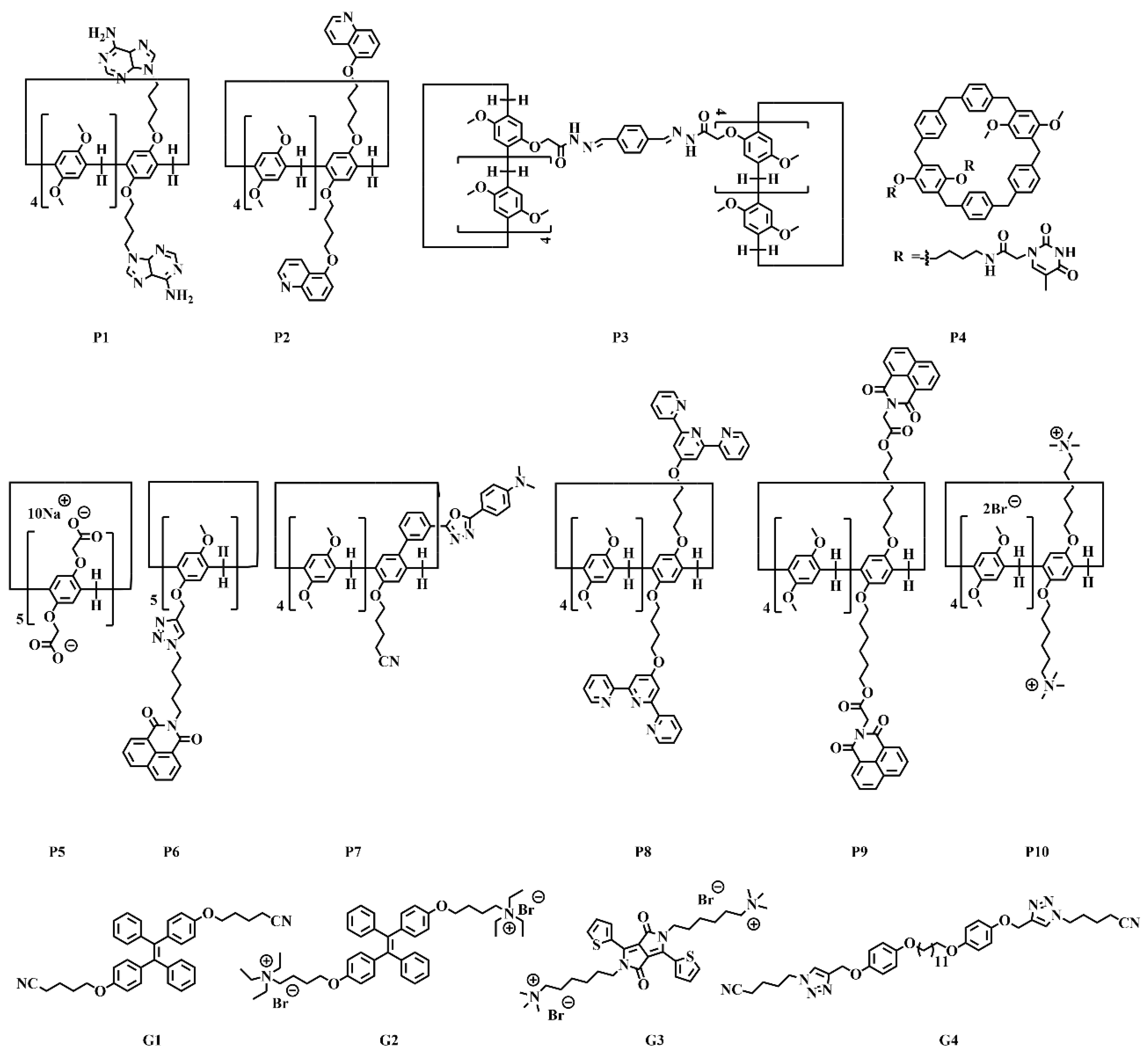
Scheme 1.
Molecular structures of pillar[n]arenes and guest molecules in the section of single-stimulus responsive fluorescence sensors.
Scheme 1.
Molecular structures of pillar[n]arenes and guest molecules in the section of single-stimulus responsive fluorescence sensors.

Table 1.
Summary of fluorescence sensors described in the section of single-stimulus responsiveness.
Table 1.
Summary of fluorescence sensors described in the section of single-stimulus responsiveness.
| Pillar[n]arenes | Guests | Coordinated metal ions |
Sensing properties | Ref. |
|---|---|---|---|---|
| P1 | G1 | Ag+ | Analyte: Ag+. Detection type: turn−on. λex/λem: 310/470 nm. LOD: 1.50 × 10⁻⁷ mol/L. Liner range: 0−8.00 × 10⁻⁶ mol/L. Solvent: DMSO/H2O = 1/99. |
[38] |
| P2 | − | Ag+ | Analyte: hydrazine hydrate. Detection type: turn−off. λex/λem: 310/450 nm. LOD: 2.68 × 10⁻⁸ mol/L. Solvent: DMSO/H2O = 4/1. |
[39] |
| P3 | − | Hg2+ | Analyte: Hg2+. Detection type: turn−off. λex/λem: 332/486 nm. LOD: 4.30 × 10⁻⁸ mol/L. Solvent: DMSO/H2O = 1/1. |
[40] |
| P4 | G2 | Hg2+ | Analyte: Hg2+. Detection type: turn−on. λex/λem: 312/388 nm. LOD: 3.00 × 10⁻⁷ mol/L. Liner range: 0−1.50 × 10⁻⁵ mol/L. Solvent: CHCl3/acetone/H2O = 1/4/495. |
[41] |
| P5 | G3 | Hg2+ | Analyte: Hg2+. Detection type: turn−off. λex/λem: 510/565 nm. LOD: 7.17 × 10⁻⁷ mol/L. Solvent: H2O. |
[42] |
| P6 | − | Cu2+ | Analyte: Cu2+. Detection type: ratiometric. λex/λem: 333/384 nm. LOD: 1.85 × 10⁻⁷ mol/L. Solvent: CH2Cl2/CH3CN = 1/1. |
[43] |
| P7 | − | Cu2+ | Analyte: Cu2+. Detection type: turn−off. λex/λem = 310/411 nm. Solvent: chloroform |
[44] |
| P8 | G4 | Zn2+ | Analyte: nitrobenzene. Detection type: turn−off. λex/λem: 295/460 nm. LOD: 1.66 × 10⁻⁴ mol/L. Liner range: 1.00−5.00 × 10⁻⁵ mol/L. Solvent: CH3CN/CHCl3 = 1/1. |
[45] |
| P9 | − | Fe3+ | Analyte: Fe3+, L-Cys. Detection type: turn−off/on. λex/λem: 375/535 nm. LOD: 6.06 × 10⁻⁸ mol/L (Fe3+); 1.00 × 10⁻⁸ mol/L (L-Cys). Solvent: cyclohexanol. |
[46] |
| P9, P10 | P10 | Fe3+ | Analyte: Fe3+, H2PO4−. Detection type: turn−off/on. λex/λem: 375/530 nm. LOD: 7.54 × 10⁻⁹ mol/L. Solvent: cyclohexanol/H2O = 1/20. |
[47] |
In 2022, Wang W.M. and Yang Y.W. designed a stable supramolecular system utilizing host–guest interactions and coordination effects [38]. They employed pillar [5]arene with two adenine binding sites (P1) and tetraphenylvinyl (TPE, G1) functionalized with cyano groups, which possess AIE properties (Figure 1). Spherical supramolecular aggregates formed via 1:1 coordination between P1’s adenines and Ag+ ions. The synergistic effect of coordination between P1 and Ag+, coupled with the host–guest interaction between P1 and G1, resulted in a crosslinked P1⊂G1@Ag+ assembly. This assembly triggered restriction of intramolecular rotation (RIR) and SAIEE mechanisms. The fluorescence lifetime and fluorescence quantum yield of P1⊂G1@Ag+ were 4.60 ns and 58.38%, respectively, with the non-radiative decay rate constant being half that of P1⊂G1. Under 365 nm UV lamp irradiation, the assembly displayed bright blue-green fluorescence upon Ag+ ion addition, allowing for selective detection and efficient adsorption of Ag+ ions. Moreover, the supramolecular assembly could be easily processed without activity loss, offering a valuable tool for practical applications.
The need for effective devices for sensitive toxic gas detection is also paramount. For instance, hydrazine hydrate (DH) is extensively used in synthesizing pesticides and medicines, fuels for satellites and rockets, and as a preservative in nuclear and power plants. However, DH is highly toxic, causing severe damage to the skin and central organs upon human absorption. Consequently, developing flexible, fast, and sensitive materials and methods for DH detection is critically important.
A year latter, Lin Q.’s group developed a metallic gel by coordinating the nitrogen atom of 5-hydroxyquinoline functionalized pillar[5]arene (P2) with Ag+ ions [39]. P2 formed a one-dimensional coordination polymer through interaction with Ag+ ions via the N atoms on the quinoline groups (Figure 2). Adjacent coordination polymers were interconnected through π–π interactions between the P2 groups, facilitating the metallogel’s formation. The mean squared displacement of the gel P2 was lower than that of the P2-Ag gel, indicating that the addition of Ag+ enhanced the elasticity of the P2-Ag gel. The supramolecular assembly was further analyzed from a microscopic morphology perspective. P2 alone exhibited a lamellar structure. After adding Ag+ ions, the resultant metallogel P2-Ag transformed into a folded membrane structure, which is attributable to the coordination bond between Ag+ ions and P2. When exposed to DH vapor, the folded membrane structure of P2-Ag altered into a microspherical structure, suggesting the disruption of Ag+ ion coordination and the formation of a microspherical structure by P2 based on the hydrophobic effect. This gel enabled multi-channel sensitive detection of DH through visual, fluorescence, and electrochemical means. DH disrupted the coordination by reducing Ag+ ions under DMSO/H2O conditions (fw = 20%), leading to the collapse and fluorescence quenching of the metallogel. The lowest critical gelation concentration (CGC) was 8% (w/v, 10 mg/mL = 1%). The gel−sol transition temperature was 62–63 °C. Multi-channel detection of DH could be conveniently and efficiently realized in both water and air through sound and light alarms. The LOD reached 0.10 mg/m3 in air and 2.68 × 10⁻⁸ mol/L in water, below the US Environmental Protection Agency’s standard for drinking water.
Mercury (Hg2+), one of the most toxic heavy metals, poses significant health and environmental risks. Exposure to Hg2+ ions, even in minute concentrations, presents a potential hazard to humans. For instance, in 2018, the group led by Lin Q. designed and synthesized another sensor based on artificial intelligence, which utilized bi-pillar[5]arene-based assemblies incorporating advanced AIEgens (P3) [40]. The assembly was driven by intermolecular hydrogen bonding (such as −N−H···C=O− and −C−H···N=C−), π–π stacking interactions, and hydrophobic effects. The Tyndall effect was observed in a 30% aqueous solution, with the critical aggregation fraction of water being 24% for P3, which exhibited a fluorescence quantum yield of 21%. P3 formed a sharp rod-shaped structure in DMSO/H2O (fw = 50%). The aggregated P3 was disassembled at low concentrations or high temperatures. A 1:2 complex was formed by binding P3 with Hg2+ ions (binding constant: 2.50 × 10³ L2/mol2). The sensing mechanism was based on the coordination between the acylhydrazone group of P3 and Hg2+ ions. To explore practical applications, a film was created by immersing a glass sheet in a high concentration of P3. This film enabled the convenient detection of Hg2+ ions in water, effectively separating and sensitively detecting them with a LOD of 4.30 × 10⁻⁸ mol/L. This innovative bi-pillar[5]arene AIEgen could pave the way for new designs and developments in pillar[n]arene AIEgens.
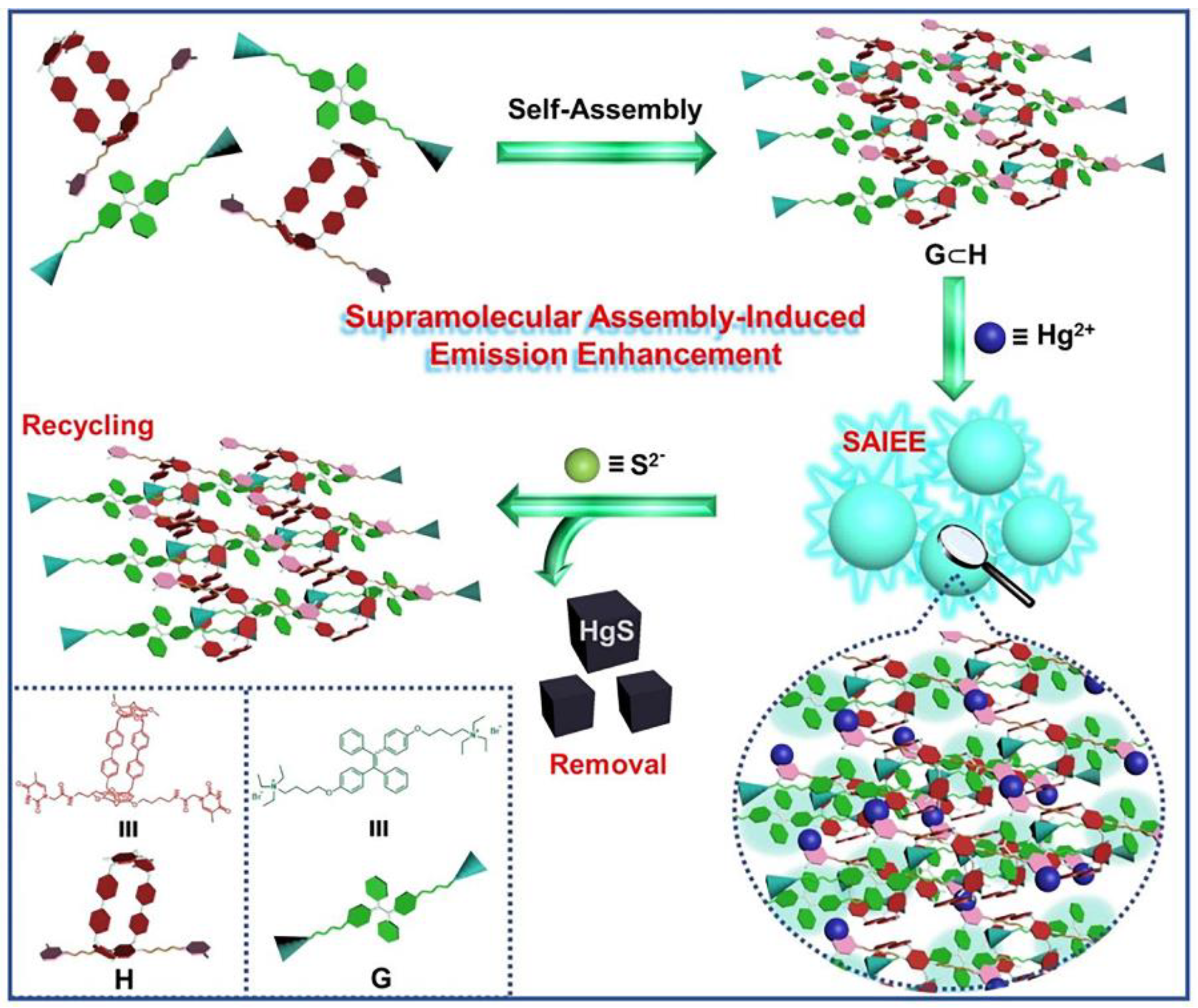
The pillar[n]arenes discussed in this paper include two types: pillar[5]arene and pillar[6]arene [41]. The latter was developed by Yang Y.W.’s group. They utilized the strong covalent bonds between thymine (T) and Hg2+ ions. Building on this, Dai D.H. and Yang Y.W. constructed a crosslinked supramolecular polymer through host–guest interactions, using a newly designed [2]biphenyl-extended pillar[6]arene with two thymine sites as arms (P4) and a TPE-bridged bis(quaternary ammonium) guest (G2) with AIE properties (Figure 3). The tight T-Hg2+-T pairing between the thymine groups and Hg2+ ions led to the formation of spherical assemblies with an average diameter of 164 nm. Fluorescent emission occurred immediately upon the addition of Hg2+ ions. The introduction of Hg2+ ions into the supramolecular system initiated supramolecular SAIEE. With its integrated mode of operation, this supramolecular polymer successfully achieved real-time detection and removal of Hg2+ ions from water with high selectivity and a rapid adsorption rate (removal efficiency: 90%). The assembly of P4 and G2 demonstrated excellent recyclability, maintaining effectiveness over more than five cycles of the removal process.
The Hg2+ ions, as one of the most toxic heavy metal ions in the environment and water food sources, represent a significant pollution problem worldwide. Numerous research groups are dedicated to designing and synthesizing novel materials for efficient detection and removal of Hg2+ ions. Beyond the contributions of the previously mentioned research groups, Jiang X.M. and Cao D.R. reported a self-assembly composed of carboxylatopillar[5]arene sodium salts (P5) and a diketopyrrole-bridged bis-quaternary ammonium guest (G3) via host–guest interaction [42]. Adding P5 to a G3 aqueous solution resulted in the morphological transformation of multilayer nanostructures (Figure 4). This host–guest complex exhibited multiple forces, including electrostatic and hydrophobic interactions and π–π stacking interactions in aqueous solutions. The developed supramolecular system effectively detected and removed Hg2+ in real environmental water samples. The Hg2+ ions demonstrated synergistic interactions, including coordination with G3 and P5 and the Hg2+-cavity, forming a crosslinked network of P5⊂G3@Hg2+. The method exhibited good selectivity with a low LOD of 7.17 × 10⁻⁷ mol/L. Furthermore, the quenched fluorescence could be recovered post-treatment with Na2S, exhibiting a reversible process.
Copper ions (Cu2+) are also critical in various industries and can lead to bioaccumulation, soil pollution, and reduced agricultural productivity. Therefore, developing a selective and sensitive Cu2+ ions fluorescent chemical sensor, preferably a proportional chemical sensor, remains crucial in ion sensing research.
Pillar[5]arene was modified by Chang R. and Chang K.C. with five neighboring naphthalimide groups to form a new ligand, P6, for metal ion coordination, effectively serving as a ratiometric fluorescence sensor for Cu2+ ions in a CH2Cl2/CH3CN = 1/1 system [43]. This sensitivity was also observed in 10% aqueous methanol solutions. The introduction of naphthalimide groups enhanced intramolecular π–π stacking. P6 exhibited dual emission, comprising both the monomer and excimer emissions of the naphthalimide moieties. A synergistic interaction occurred between Cu2+ ions and the triazole groups on P6. P6 rapidly bound with Cu2+, maintaining stable fluorescence intensity. Upon complexing with Cu2+ ions, the excimer emission of ligand P6 was weakened, while the monomer emission intensified. The binding complexation ratio of P6 with Cu2+ ions was 1:1, with a binding constant of (3.39 ± 0.40) × 105 L2/mol2 and a LOD of 1.85 × 10⁻⁶ mol/L. Particles with diameters ranging from (192 ± 65) to (206 ± 67) nm were produced. The relative fluorescence quantum yields of P1 and P1-Cu2+ were 0.13 and 0.11, respectively. Future research may further functionalize the pillar[5]arene framework to enhance its selectivity for specific metal ions or adapt it for various sensing platforms.
Liu S.Y. and Han J. developed another sensor for Cu2+ ions [44]. They designed a pillar[5]arene framework by functionalizing it with a 1,3,4-oxadiazole subunit and a cyanobutoxy moiety (P7). This structure facilitated host–guest interactions between the electron-rich pillar[5]arene cavities and appropriately-sized neutral cyanobutoxy moieties, resulting in brush supramolecular polymers. Notably, the larger electron-deficient 1,3,4-oxadiazole groups remained outside the pillar[n]arene (P7) cavity after the formation of the host–guest inclusions, acting as a “brush” and enhancing the ability of the self-assembled supramolecular materials to interact with metal ions, such as Cu2+ ions. The critical aggregation concentration of P7 was 6.00 × 10⁻² mol/L. These supramolecular brush-polymer architectures displayed distinct structural changes in response to fluorescence quenching after adding Cu2+ ions, suggesting a potential transformation into a crosslinked supramolecular network. The specific recognition of Cu2+ might be explained by the Irving-Williams order of stability. Therefore, this supramolecular brush polymer holds potential for application in metal cationic fluorescent chemical sensors.
In 2021, Chong H. et al. prepared a “three-component” supramolecular assembly by combining terpyridine attached pillar[5]arene (P8), cyano and triazole bearing alkyl chain (G4), and Zn2+ ions in a CHCl3 and CH3CN solvent system [45]. Terpyridine is a versatile building block due to its high binding affinity for a wide range of transition metal ions. The resulting composition exhibited a closely crosslinked porous morphology with nanoscale pore size. The P8 segment was incorporated into the cyano and triazole segment upon encapsulation. An organogel formed at a concentration of 1.00 mol/L. The polymerization was driven by host–guest interaction and metal-chelate cooperative forces. The P8 and Zn2+ assembly had a flake-like morphology. Nitrobenzene (picric acid, o-nitrobenzene, and phenol) was used as a sample. The assembly was most sensitive to picric acid among the three analytes, with a LOD of 1.66 × 10⁻⁴ mol/L. The quenching mechanism was believed to involve mixed processes of photo-induced electron transfer (PET) and fluorescence resonance energy transfer (FRET). This study represents a useful example of creating functional “multi-component” supramolecular systems with capabilities for explosive sensing.
The role of Fe3+ ions as essential metal elements in human physiology is well-recognized. However, both deficiency and excess of Fe3+ ions beyond permissible limits can lead to severe health issues, such as anemia, tumorigenesis, organ dysfunction, and neurodegenerative diseases like Alzheimer’s and Parkinson’s. Consequently, sensitive detection of Fe3+ ions is a critical concern in environmental and health monitoring.
In 2018, Zhang Y.M. and Qi L. discovered that the pillar[5]arene structure (P9) could self-assemble into high-molecular-weight supramolecular π-gels with AIE properties [46]. Notably, the simplicity of the supramolecular system components enhanced its practical application value. P9 was self-assembled into one-dimensional linear supramolecular π-gel chains through π–π stacking interactions. These π–gel chains formed a two-dimensional supramolecular network via π–π interactions between the naphthalimide and pillar[5]arene. Subsequently, hydrophobic interactions compressed the two-dimensional network into microspheres. The CGC was 5% (w/v, 10 mg/mL = 1%). The gel−sol transition temperature was 43–45 ℃. The LOD was 6.06 × 10⁻⁸ mol/L for Fe3+ ions. The gel demonstrated excellent recyclability and a 99.80% removal rate for Fe3+ ions in aqueous solutions. Additionally, the Fe3+ ion-coordinated supramolecular gel selectively sensed L-Cys with a LOD of 1.00 × 10⁻⁸ mol/L. This gel could be utilized in logic gates, offering significant advantages over previous logic devices in terms of reversibility, sensitivity, and potential applications for continuous detection of transition metals and amino acids.
In recent years, the development of ultrasensitive materials and responses has garnered extensive attention due to their critical roles in chemical, biological, and environmental applications. In light of this, the above-mentioned group continued to enhance the sensitivity and stability of sensor materials based on their prior findings. They achieved a LOD for Fe3+ ions detection reduced from 10−8 to 10−9 magnitude [47]. Specifically, they developed a novel supramolecular organic framework (SOF) based on a bis-naphthalimide functionalized pillar[5]arene host (P9) and a bis-ammonium functionalized pillar[5]arene guest (P10). This SOF formed a stable supramolecular gel in cyclohexanol, capable of ultra-sensitive response to Fe3+ ions through the competition of cation–π and π–π interactions. Upon adding 0.50 equivalent of Fe3+ ions, the yellow fluorescence of the gel was quenched with a LOD of 7.54 × 10⁻⁹ mol/L. The Fe3+ ion-coordinated gel could sense H2PO4− ions with a fluorescence “turn−on” response and a LOD of 4.21 × 10⁻⁹ mol/L. Response films were prepared using these soft gels, which could also serve as ultra-sensitive ion sensors, fluorescent display materials, and sensitive logic gates.
2.2. Dual-stimuli responsive sensors
The development of dual-response materials (Table 2) for complex systems is of great significance and challenge. The molecular structures of pillar[n]arenes and guest molecules associated with these smart materials are listed in Scheme 2.
In 2018, the group of Zhang Y.M. and Wei T.B. constructed an advanced bifunctional supramolecular pseudorotaxane chemosensor using host pillar[5]arene P11 and guest G5 [48]. Adding Ag+ and Hg2+ ions to this system resulted in fluorescence quenching and significant changes of fluorescence color, respectively. This method demonstrated high sensitivity and selectivity, with LODs of 1.20 × 10⁻⁸ and 5.00 × 10⁻⁷ mol/L for Ag+ and Hg2+ ions, respectively.
The group led by Wei T.B. [49] developed a novel metallosupramolecular polypseudorotaxane by integrating thioacetylhydrazine functionalized pillar[5]arene (P12) and bis-butyltrimethyl ammonium functionalized pillar[5]arene (P13) with Zn2+ ions (Figure 5). The hydrazyl groups served as coordination and hydrogen bond sites for self-assembly with Zn2+ ions. This gel acted as an ultrasensitive fluorescence sensor for detecting Fe3+ and Cu2+ ions, with LODs of 8.93 × 10⁻¹⁰ and 4.57 × 10⁻⁸ mol/L, respectively. Thin films based on this gel could be used as convenient test kits. Furthermore, this study presented a simple and effective strategy for achieving multiple stimulus responses by introducing multiple non-covalent interactions in metal supramolecular gels.
In the context of escalating environmental pollution and its threats to human health and safety, nitroaromatic compounds (NACs) have been identified as major pollutants. NACs are extensively used in industries such as dyes, explosives, pesticides, and pharmaceuticals. For instance, p-nitrophenol can cause serious health issues, including fever, liver, kidney damage, and methemoglobinemia. In 2023, Yu D.Y., Deng W.T., and Wei X.Q. synthesized a blue-green fluorescent supramolecular aggregate capable of self-assembling from pillar[5]arene-based Cu2+ ions coordination complexes [50]. The Cu2+ ions were octahedrally coordinated with two carboxyl O atoms from one P14 molecule and four O atoms from four water molecules (Figure 6). These coordination complexes were self-assembled into spherical aggregates through multiple non-covalent forces, including hydrophobic effects, van der Waals forces, and CH−π interactions.The aggregate exhibited high sensitivity and selectivity to nitroaromatic compounds and metal ions. The fluorescence emission of the aggregate was specifically and significantly quenched by p-nitrophenol and Fe3+ ions, with low LOD values of 3.90 × 10⁻⁷ and 4.90 × 10⁻⁶ mol/L, respectively. Additionally, due to their exceptional performances, these coordinated supramolecular aggregates based on pillar[n]arenes hold promise for various applications in adsorption, sensing, cargo transport, and catalysis.
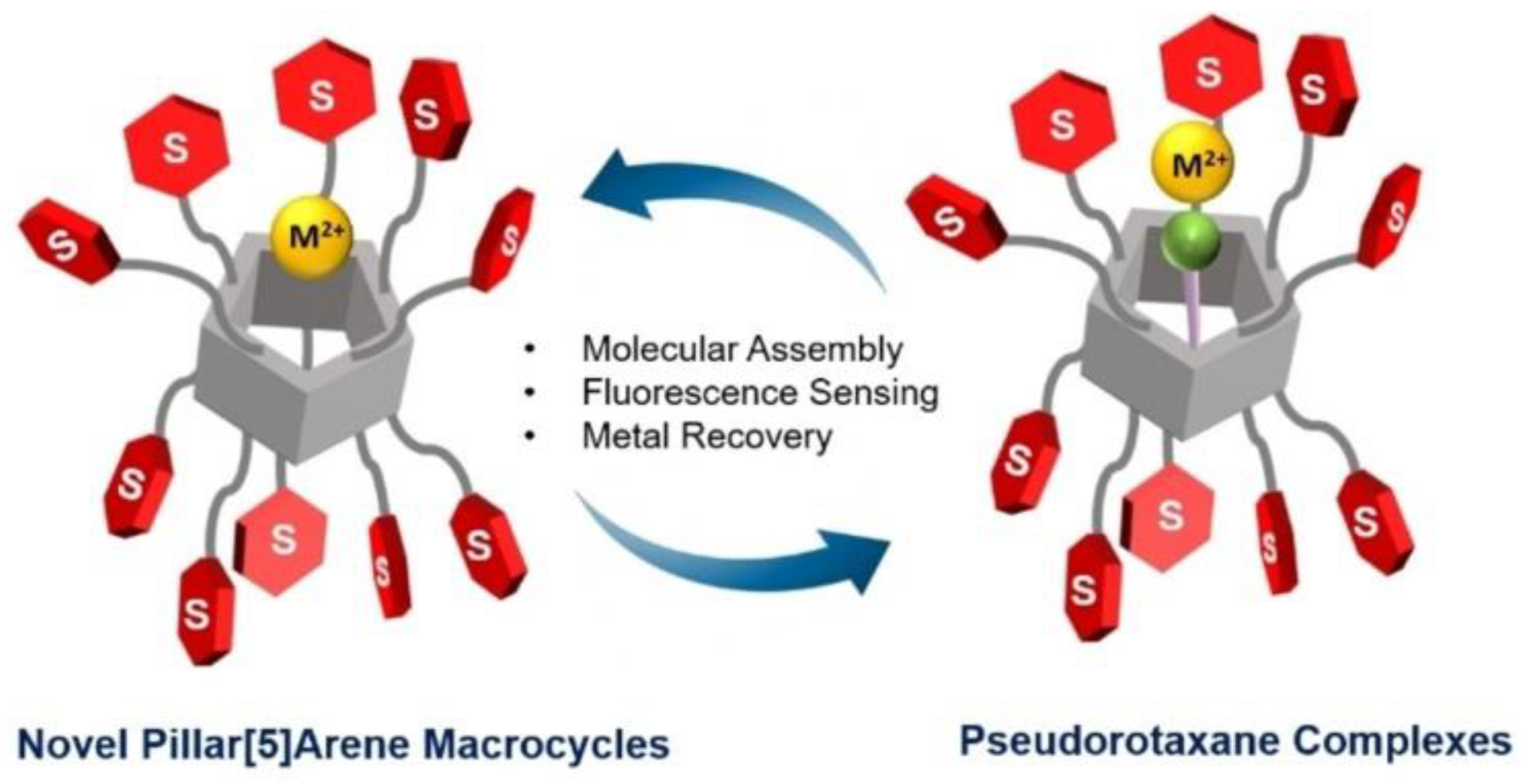
Pillar[5]arene, decorated with sulfur substituents (P15), demonstrated control over binding affinities towards organic guest encapsulations within its cavity [51]. The exterior cavity of P15 tended to form metal-ion coordination bonds (Figure 7). Adding a dinitrile guest (G6) containing a bis-triazole benzene spacer led to the formation of pseudorotaxane host–guest complexes. The fluorescence emission signals were significantly reduced in the presence of Hg2+ and Cu2+ ions. These macrocycles facilitated the transfer of Cu2+ ions from the aqueous to the organic phase, enhancing efficiency compared to extraction processes without pillar[5]arene.
Zhang Y.M. and Lin Q. created a unique SOF gel using pillar[5]arene host (P2) and a bilateral bromohexyl functionalized pillar[5]arene guest (P16) [52]. The SOF gel was constructed through CH−π, CH−O, and “exo−wall π–π” interactions between P2 and P16. The introduction of Fe3+ ions into the gel resulted in quenched fluorescence. The gel exhibited a LOD of 1.02 × 10⁻¹⁰ mol/L for Fe3+ ions. With the competitive coordination of F− ions, a fluorescent “turn−on” response of the Fe3+ ions coordinated metallogel was achieved, having a LOD of 9.79 × 10⁻⁹ mol/L. The xerogel of this SOF gel demonstrated an adsorption rate of 99.90% for removing Fe3+ ions. This SOF gel and the Fe3+ coordinated metallogel served as an ultrasensitive and reversible fluorescence sensor and test kit for Fe3+ ions and F− anions.
The detection of toxic pollutant ions is always a significant problem. Many anions are harmful to human health. Perchlorates (ClO4− anions) interfere with the synthesis and secretion of thyroxine and, therefore, affect the normal metabolism and metabolism of the human body. Cyanide (CN− anion) is a highly toxic compound. The CN− anions were widely used in industry and occur in nature. Therefore, detecting and removing these toxic ions is an important task. Zhang Q. and Lin Q. have been actively working to address these challenges [53]. The powder of P17 displayed a rod-like structure, while G7 formed a blocky structure. P17 and G7 assembled via π–π interactions to create a xerogel structure with a crosslinked network. This xerogel exhibited strong yellow AIE properties. It showed a coordination ability for rare earth metal ions Eu3+ and Tb3+, enabling it to detect ClO4− and CN− anions through a fluorescence “turn−on” mode. Additionally, the xerogel demonstrated efficient removal capabilities for these two anions.
2.3. Multi-stimuli responsive sensors
To accomplish multi-stimuli-responsive detection in complex environments, it is crucial to continuously explore various units to construct novel multi-stimuli-responsive fluorescence materials. The sensing capacities of these materials are presented in Table 3. And the molecular structures of pillar[n]arenes and guest molecules newly mentioned in this section are listed in Scheme 3.
Yang H.B.’s group synthesized a dipyridyl donor (P18) containing a TPE scaffold and two pillar[5]arene units [54]. P18 exhibited broad absorption bands at a wavelength of 336 nm with molar absorption coefficients of 2.10 × 10⁴ L1∙mol−1∙cm−1. Utilizing P18, they constructed a rhomboidal metallacycle with four pillar[5]arene units and a hexagonal metallacycle with six pillar[5]arene units (Figure 8). These structures led to a new family of crosslinked AIE supramolecular polymer gels, driven by hierarchical self-assembly involving coordination between the nitrogen and platinum atoms and host–guest interactions. These supramolecular polymer gels demonstrated gel−sol transitions responsive to various stimuli, including temperature, competing guest molecules, halides, and reversible “on−off” fluorescence. With their multifaceted response characteristics, these crosslinked AIE supramolecular polymer gels are expected to significantly contribute to diverse fields, such as molecular sensors, biological imaging, and drug delivery.
The pillar[5]arene (P2) was able to coordinate with Al3+ ions, forming a supramolecular polymer metallogel that exhibited light blue AIE in the DMSO/H2O binary solution [55]. This gel showed responsiveness to multiple external stimuli, including temperature, guest compounds, ions (Fe3+ ions, F− anions), acids (trifluoroacetic acid, TFA), and bases (triethylamine, TEA). The LODs ranged from 4.39 × 10⁻⁹ to 1.82 × 10⁻⁷ mol/L for Fe3+ ions, F− anions, TFA, and TEA. The gel could detect Fe3+ ions, and Fe3+ ions coordinated metallogel could detect F− anions through cation–π interactions and competitive coordination. The LOD for Fe3+ ions in the gel was 4.39 × 10⁻⁹ mol/L, while the LOD for F− anions in the Fe3+ ion-coordinated metallogel was approximately 2.75 × 10⁻⁸ mol/L. Furthermore, the gel could detect TFA and TEA sequentially through protonation and deprotonation processes. Protonation enhanced the π–π stacking interaction between P2 molecules. This material could be employed for multiple “write−erase−write” cycles, showcasing its versatility in detecting various stimuli.
Functional supramolecular polymer networks (SPNs) exhibit tunable luminescence properties [56]. These characteristics enhance the repertoire of functional building blocks for macrocyclic arene-based supramolecular gels, differentiating them from traditional pillar[n]arenes. Developing soft materials based on pillar[n]arenes has captured the interest of many researchers. In 2019, Liu Z.J. and Yang Y.W. synthesized a monofunctionalized pillar[6]arene (P19) bearing a single terpyridine arm. They constructed a fluorescent SPN from P19, a TPE aggregation-induced emission generator G8, and Zn2+ ions as a coordinating linkage. The disruption of metal coordination and/or host–guest interactions by competitive binders like TFA or pillar[5]arene, as well as heating, could weaken non-covalent interactions in the supramolecular polymer gels, inducing a gel−to−sol transition. These novel architectures offer promising avenues for the development of fluorescent SPN materials.
Another SPN was developed through the hierarchical self-assembly of a double-armed pillar[5]arene host (P20), a ditopic guest (G9), and Zn2+ ions [57]. This assembly exhibited sol–gel transition properties responsive to various external stimuli, including temperature, redox, pH changes, and competitive guests (Figure 9). Additionally, this assembly served as a convenient and feasible test kit for sensing OH− anions. Given the advantageous properties of host–guest molecular recognition and the induction of metal-ligand coordination interactions, this work laid the groundwork for creating multi-stimuli responsive metal supramolecular gels based on pillar[n]arene. These developments are significant for advancing intelligent supramolecular materials with novel structures and diverse functionalities.
3. Conclusions and Outlooks
This review summarizes the recent advancements in PSAs for developing fluorescence sensors capable of detecting environmental pollutants. Over the past five years, significant progress has been made in delineating the molecular structures, self-assembly mechanisms, photophysical properties, and sensing applications of these compounds. Recent PSAs-based sensors demonstrate enhanced capabilities in detecting various pollutants, offering superior solvent compatibility, porosity, versatility, and diverse detection capacities compared to traditional fluorescence sensors.
As highlighted above, fluorescence sensors have achieved notable success in designing and synthesizing innovative molecular structures and applying stimulus-responsive smart materials. However, the field faces new challenges and opportunities for future exploration and innovation. Firstly, the low concentration of analytes in real samples necessitates improvements in sensitivity and selectivity. Secondly, the fluorescence modulation mechanism under supramolecular regulation remains unclear, warranting further investigation into the luminescence mechanism, particularly concerning charge distribution and molecular architecture accumulation. Thirdly, the complexity of the constructed supramolecular systems often results in poor stability, posing challenges in practical applications. Simplifying these assemblies while maintaining or enhancing detection performance is critical for future research. Fourthly, developing supramolecular architectures that combine detection and adsorption functions requires further study, particularly in creating stable, reusable materials. Fifthly, there is a need for more research into PSAs capable of detecting multiple analytes simultaneously. Finally, while significant research has been conducted in developing supramolecular fluorescence sensors, their reliance on organic solvents hinders their applicability in biological and environmental systems.
In summary, fluorescence sensors based on PSAs containing metal coordination sites have been rapidly and continuously developed. We hope this review can help to promote design strategies for these sensors to better detect and adsorb environmental pollutants.
Author Contributions
Conceptualization, L.Y.J., N.Z., and Y.J.; writing—original draft, X.L.; writing—review and editing, N.Z., J.Y., X.L., and Y.J.; supervision, N.Z., J.Y., and L.Y.J.; project administration, N.Z., J.Y., and L.Y.J.; funding acquisition, N.Z. and L.Y.J. All authors have read and agreed to the published version of the manuscript.
Funding
This work was supported by the Education Department of Jilin Province (grant number JJKH20230612KJ), the National Natural Science Foundation of China (grant number 21961041), the PhD Research Startup Foundation of Yanbian University (grant number ydbq202304), and the Higher Education Discipline Innovation Project (D18012).
Conflicts of Interest
The authors declare no conflict of interest.
Abbreviations
| Aggregation-induced emission | AIE |
| Critical gelation concentration | CGC |
| Fluorescence resonance energy transfer | FRET |
| Hydrazine hydrate | DH |
| Restriction of intramolecular rotation | RIR |
| Limit of detection | LOD |
| Nitro aromatic compound | NAC |
| Photo-induced electron transfer | PET |
| Supramolecular assembly induced emission enhancement | SAIEE |
| Supramolecular organic framework | SOF |
| Supramolecules polymer network | SPN |
| Tetraphenylvinyl | TPE |
| Trifluoroacetic acid | TFA |
| Triethylamine | TEA |
References
- Belmont-Sánchez, J.C.; Choquesillo-Lazarte, D.; García-Rubiño, M.E.; Matilla-Hernández, A.; Niclós-Gutiérrez, J.; Castiñeiras, A.; Frontera, A. Supramolecular nature of multicomponent crystals formed from 2,2′-thiodiacetic acid with 2,6-diaminopurine or N9-(2-Hydroxyethyl)adenine. Int. J. Mol. Sci. 2023, 24, 17381. [Google Scholar] [CrossRef] [PubMed]
- Groschel, A.H.; Mueller, A.H.E. Self-assembly concepts for multicompartment nanostructures. Nanoscale 2015, 7, 11841–11876. [Google Scholar] [CrossRef] [PubMed]
- Mujahid, A.; Afzal, A.; Dickert, F.L. . Transitioning from Supramolecular Chemistry to Molecularly Imprinted Polymers in Chemical Sensing. Sensors 2023, 23, 7457. [Google Scholar] [CrossRef] [PubMed]
- Liu, Q.; Sun, Z.; Dou, Y.; Kim, J.; Dou, X. Two-step self-assembly of hierarchically-ordered nanostructures. J. Mater. Chem. A 2015, 3, 11688–11699. [Google Scholar] [CrossRef]
- Xu, L.; Wang, Z.; Wang, R.; Wang, L.; He, X.; Jiang, H.; Tang, H.; Cao, D.; Tang, B. A conjugated polymeric supramolecular network with aggregation-induced emission enhancement: an efficient light-harvesting system with an ultrahigh antenna effect. Angew. Chem. Int. Ed. 2020, 59, 9908–9913. [Google Scholar] [CrossRef] [PubMed]
- An, D.; Shi, L.; Li, T.; Zhang, H.Y.; Chen, Y.; Hao, X.Q.; Song, M.P. Tailored supramolecular cage for efficient bio-labeling. Int. J. Mol. Sci. 2023, 24, 2147. [Google Scholar] [CrossRef] [PubMed]
- Zhang, W.; Gao, C. Morphology transformation of self-assembled organic nanomaterials in aqueous solution induced by stimuli-triggered chemical structure changes. J. Mater. Chem. A 2017, 5, 16059–16104. [Google Scholar] [CrossRef]
- Li, Z.; Hu, Y.; Wang, L.; Liu, H.F.; Ren, T.L.; Wang, C.; Li, D.L. Selective and accurate detection of nitrate in aquaculture water with surface-enhanced raman scattering (SERS) using gold nanoparticles decorated with β-cyclodextrins. Sensors 2024, 24, 1093. [Google Scholar] [CrossRef]
- Jin, L.Y.; Bae, J.; Ryu, J.H.; Lee, M. Ordered nanostructures from the self-assembly of reactive coil-rod-coil molecules. Angew. Chem. Int. Ed. 2006, 45, 650–553. [Google Scholar] [CrossRef]
- Pugliese, R. Structural and biomechanical properties of supramolecular nanofiber-based hydrogels in biomedicine. Biomedicines 2024, 12, 205. [Google Scholar] [CrossRef]
- Roche, T.P.; Nedumpurath, P.J.; Karunakaran, S.C.; Schuster, G.B.; Hud, N.V. One-pot formation of pairing proto-RNA nucleotides and their supramolecular assemblies. Life 2023, 13, 2200. [Google Scholar] [CrossRef]
- Croitoriu, A.; Chiriac, A.P.; Rusu, A.G.; Ghilan, A.; Ciolacu, D.E.; Stoica, I.; Nita, L.E. Morphological evaluation of supramolecular soft materials obtained through co-assembly processes. Gels 2023, 9, 886. [Google Scholar] [CrossRef]
- Li, X.; Jin, Y.; Zhu, N.S.; Jin, L.Y. Applications of supramolecular polymers generated from pillar[n]arene-based molecules. Polymers 2023, 15, 4543. [Google Scholar] [CrossRef] [PubMed]
- Lu, J.; Liu, P.; Deng, Y.; Zhu, N.; Jin, L.Y. Supramolecular nanoassemblies of rim-differentiated pillar[5]arene-rod-coil macromolecules via host-guest interactions for the sensing of cis-trans isomers of 1,4-diol-2-butene. J. Mol. Struct. 2023, 1291, 136054. [Google Scholar] [CrossRef]
- Lu, P.; Cheng, J.; Li, Y.; Li, L.; Wang, Q. , He, C. Novel porous beta-cyclodextrin/pillar[5]arene copolymer for rapid removal of organic pollutants from water. Carbohyd. Polym. 2019, 216, 149–156. [Google Scholar] [CrossRef] [PubMed]
- Li, Z.Y.; Zhang, Y.; Zhang, C.W.; Chen, L.J.; Wang, C.; Tan, H.W.; Yu, Y.H.; Li, X.P.; Yang, H.B. Cross-linked supramolecular polymer gels constructed from discrete multi-pillar[5]arene metallacycles and their multiple stimuli-responsive behavior. J. Am. Chem. Soc. 2014, 136, 8577–8589. [Google Scholar] [CrossRef] [PubMed]
- Lou, X.Y.; Yang, Y.W. Pyridine-conjugated pillar[5]arene: from molecular crystals of blue luminescence to red-emissive coordination nanocrystals. J. Am. Chem. Soc. 2021, 143, 11976–11981. [Google Scholar] [CrossRef]
- Zhu, H.; Li, Q.; Shi, B.; Xing, H.; Sun, Y.; Lu, S.; Shangguan, L.; Li, X.; Huang, F.; Stang, P. J. Formation of planar chiral platinum triangles via pillar[5]arene for circularly polarized luminescence. J. Am. Chem. Soc. 2020, 142, 17340–17345. [Google Scholar] [CrossRef] [PubMed]
- Yan, H.; Yin, X.; Wang, D.; Han, T.; Tang, B.Z. Synergistically boosting the circularly polarized luminescence of functionalized pillar[5]arenes by polymerization and aggregation. Adv. Sci. 2023, 10, 2305149. [Google Scholar] [CrossRef]
- Mei, Y.; Zhang, Q.W.; Gu, Q.; Liu, Z.; He, X.; Tian, Y. Pillar[5]arene-based fluorescent sensor array for biosensing of intracellular multi-neurotransmitters through host–guest recognitions. J. Am. Chem. Soc. 2022, 144, 2351–2359. [Google Scholar] [CrossRef]
- Tuo, W.; Sun, Y.; Lu, S.; Li, X.; Sun, Y.; Stang, P.J. Pillar[5]arene-containing metallacycles and host-guest interaction caused aggregation-induced emission enhancement platforms. J. Am. Chem. Soc. 2020, 142, 16930–16934. [Google Scholar] [CrossRef] [PubMed]
- Ogoshi, T.; Yamagishi, T.; Nakamoto, Y. Pillar-shaped macrocyclic hosts pillar[n]arenes: new key players for supramolecular chemistry. Chem. Rev. 2016, 116, 7937–8002. [Google Scholar] [CrossRef] [PubMed]
- Lescop, C. Coordination-driven syntheses of compact supramolecular metallacycles toward extended metallo-organic stacked supramolecular assemblies. Acc. Chem. Res. 2017, 50, 885–894. [Google Scholar] [CrossRef] [PubMed]
- St Onge, P.B.J.; Chen, T.C.; Langlois, A. Iron-coordinating π-conjugated semiconducting polymer: morphology and charge transport in organic field-effect transistors. J. Mater. Chem. C 2020, 8, 8213–8223. [Google Scholar] [CrossRef]
- Ni, X.L.; Xiao, X.; Cong, H. Cucurbit[n]uril-based coordination chemistry: from simple coordination complexes to novel poly-dimensional coordination polymers. Chem. Soc. Rev. 2013, 42, 9480–9508. [Google Scholar] [CrossRef]
- Datta, S.; Saha, M.L.; Stang, P.J. Hierarchical assemblies of supramolecular coordination complexes. Acc. Chem. Res. 2018, 51, 2047–2063. [Google Scholar] [CrossRef]
- Xia, D.; Wang, L.; Lv, X.; Chao, J.; Wei, X.; Wang, P. Dual-responsive [2]Pseudorotaxane on the basis of a pH-Sensitive pillar[5]arene and its application in the fabrication of metallosupramolecular polypseudorotaxane. Macromolecules 2018, 51, 2716–2722. [Google Scholar] [CrossRef]
- Liu, Y.; Shangguan, L.; Shi, B. A multi-responsive cross-linked supramolecular polymer network constructed by mussel yield coordination interaction and pillar[5]arene-based host–guest complexation. Chem. Commun. 2018, 54, 12230–12233. [Google Scholar] [CrossRef]
- Wu, Y.; Zhong, W.; Wang, X.; Wu, W.; Muddassir, M.; Daniel, O.; Raj Jayswal, M.; Prakash, O.; Dai, Z.; Ma, A. New transition metal coordination polymers derived from 2-(3,5-Dicarboxyphenyl)-6-carboxybenzimidazole as photocatalysts for dye and antibiotic decomposition. Molecules 2023, 28, 7318. [Google Scholar] [CrossRef]
- Castriciano, M.A.; Zagami, R.; Mazzaglia, A.; Romeo, A.; Monsù Scolaro, L. A kinetic investigation of the supramolecular chiral self-assembling process of cationic organometallic (2,2′:6′,2″-terpyridine)methylplatinum(II) complexes with poly(L-glutamic acid). Int. J. Mol. Sci. 2024, 25, 1176. [Google Scholar] [CrossRef]
- Zhu, N.; Guo, X.; Chang, Y.; Shi, Z.; Jin, L.Y.; Feng, S. A mitochondria-tracing fluorescent probe for real-time detection of mitochondrial dynamics and hypochlorous acid in live cells. Dyes Pigment. 2022, 201, 110227. [Google Scholar] [CrossRef]
- Guo, C.; Sedgwick, A.C.; Hirao, T.; Sessler, J.L. Supramolecular fluorescent sensors: an historical overview and update. Coordin. Chem. Rev. 2021, 427, 213560. [Google Scholar] [CrossRef] [PubMed]
- Song, N.; Chen, D.X.; Qiu, Y.C.; Yang, X.Y.; Xu, B; Tian, W. J.; Yang, Y.X. Stimuli-responsive blue fluorescent supramolecular polymers based on a pillar[5]arene tetramer. Chem Commun. 2014, 50, 8231–8234. [Google Scholar] [CrossRef] [PubMed]
- Zhao, L.; Chen, Y.; Yuan, J.; Chen, M.H.; Zhang, H.; Li, X.H. Electrospun fibrous mats with conjugated tetraphenylethylene and mannose for sensitive turn−on fluorescent sensing of escherichia coli. Acs Appl. Mater. Interfaces 2015, 7, 5177–5186. [Google Scholar] [CrossRef] [PubMed]
- Sun, S.; Hu, X.Y.; Chen, D.; Shi, J.B.; Dong, Y.P.; Lin, C.; Pan, Y.; Wang, L.Y. Pillar[5]arene-based side-chain polypseudorotaxanes as an anion-responsive fluorescent sensor. Polym. Chem. 2013, 4, 2224–2229. [Google Scholar] [CrossRef]
- Gao, M.; Tang, B.Z. Fluorescent sensors based on aggregation-induced emission: recent advances and perspectives, ACS Sens. 2017, 2, 1382–1399. 2.
- Shi, H.P.; Wang, S.J.; Qin, L.Y.; Gui, C.; Zhang, X.L.; Fang, L.; Chen, S.M.; Tang, B.Z. Construction of two AIE luminogens comprised of a tetra-/tri-phenylethene core and carbazole units for non-doped organic light-emitting diodes, Dyes Pigment. 2018, 149, 323–330. 149.
- Wang, W.M.; Dai, D.; Wu, J.R.; Wang, C.; Wang, Y.; Yang, Y.W. Renewable supramolecular assembly-induced emission enhancement system for efficient detection and removal of silver(I). Dyes Pigment. 2022, 207, 110712. [Google Scholar] [CrossRef]
- Jia, Y.; Guan, W.L.; Liu, J.; Hu, J.P.; Shi, B.; Yao, H.; Zhang, Y.M.; Wei, T.B.; Lin, Q. Novel conductive metallo-supramolecular polymer AIE gel for multi-channel highly sensitive detection of hydrazine hydrate. Chin. Chem. Lett. 2023, 34, 108082. [Google Scholar] [CrossRef]
- Lin, Q.; Jiang, X.M.; Ma, X.Q.; Liu, J.; Yao, H.; Zhang, Y.M.; Wei, T.B. Novel bispillar[5]arene-based AIEgen and its’ application in mercury(II) detection. Sens. Actuat. B Chem. 2018, 272, 139–145. [Google Scholar] [CrossRef]
- Dai, D.H.; Li, Z.; Yang, J.; Wang, C.Y.; Wu, J.R.; Wang, Y.; Zhang, D.M.; Yang, Y.W. Supramolecular assembly-induced emission enhancement for efficient mercury(II) detection and removal. J. Am. Chem. Soc. 2019, 141, 4756–4763. [Google Scholar] [CrossRef]
- Jiang, X.; Wang, L.; Ran, X.; Tang, H.; Cao, D. Green, efficient detection and removal of Hg2+ by water-soluble fluorescent pillar[5]arene supramolecular self-assembly. Biosens. 2022, 12, 571. [Google Scholar] [CrossRef]
- Chang, R.; Chen, C.Y.; Gao, L.; Li, Y.; Lee, Z.H.; Zhao, H.; Sue, A.C.; Chang, K.C. Highly selective Cu2+ detection with a naphthalimide-functionalised pillar[5]arene fluorescent chemosensor. Org. Biomol. Chem. 2024, 22, 745–752. [Google Scholar] [CrossRef] [PubMed]
- Liu, S.; Wu, Q.; Zhang, T.; Zhang, H.; Han, J. Supramolecular brush polymers prepared from 1,3,4-oxadiazole and cyanobutoxy functionalised pillar[5]arene for detecting Cu2+. Org. Biomol. Chem. 2021, 19, 1287–1291. [Google Scholar] [CrossRef] [PubMed]
- Chong, H.; Xu, Y.H.; Han, Y.; Yan, C.G.; Su, D.W.; Wang, C.Y. Pillar[5]arene-based “three-components” supramolecular assembly and the performance of nitrobenzene-based explosive fluorescence sensing. ChemistrySelect 2021, 6, 9363–9367. [Google Scholar] [CrossRef]
- Zhang, Y.M.; Li, Y.F.; Zhong, K.P.; Qu, W.J.; Yao, H.; Wei, T.B.; Lin, Q. A bis-naphthalimide functionalized pillar[5]arene-based supramolecular π-gel acts as a multi-stimuli-responsive material. New J. Chem. 2018, 42, 16167–16173. [Google Scholar] [CrossRef]
- Zhang, Y.M.; Li, Y.F.; Zhong, K.P.; Qu, W.J.; Chen, X.P.; Yao, H.; Wei, T.B.; Lin, Q. A novel pillar[5]arene-based supramolecular organic framework gel to achieve an ultrasensitive response by introducing the competition of cation⋯π and π⋯π interactions. Soft Matter 2018, 14, 3624–3631. [Google Scholar] [CrossRef]
- Zhang, Y.M.; Chen, X.P.; Liang, G.Y.; Zhong, K.P.; Lin, Q.; Yao, H.; Wei, T.B. A novel water soluble pillar[5]arene and phenazine derivative self-assembled pseudorotaxane sensor for the selective detection of Hg2+ and Ag+ with high selectivity and sensitivity. New J. Chem. 2018, 42, 10148–10152. [Google Scholar] [CrossRef]
- Ding, J.D.; Chen, J.F.; Lin, Q.; Yao, H.; Zhang, Y.M.; Wei, T.B. A multi-stimuli responsive metallosupramolecular polypseudorotaxane gel constructed by self-assembly of a pillar[5]arene-based pseudo[3]rotaxane via zinc ion coordination and its application for highly sensitive fluorescence recognition of metal ions. Polym. Chem. 2018, 9, 5370–5376. [Google Scholar] [CrossRef]
- Yu, D.; Deng, W.; Wei, X. Supramolecular aggregate of pillar[5]arene-based Cu(II) coordination complexes as a highly selective fluorescence sensor for nitroaromatics and metal ions. Dyes Pigment. 2023, 210, 110968. [Google Scholar] [CrossRef]
- Todee, B.; Sanae, P.; Ruengsuk, A.; Janthakit, P.; Promarak, V.; Tantirungrotechai, J.; Sukwattanasinitt, M.; Limpanuparb, T.; Harding, D.J.; Bunchuay, T. Switchable metal-ion selectivity in sulfur-functionalised pillar[5]arenes and their host-guest complexes. Chem. Asian J. 2023, e202300913. [Google Scholar] [CrossRef]
- Zhang, Y.M.; He, J.X.; Zhu, W.; Li, Y.F.; Fang, H.; Yao, H.; Wei, T.B.; Lin, Q. Novel pillar[5]arene-based supramolecular organic framework gel for ultrasensitive response Fe3+ and F− in water. Mat. Sci. Eng. C 2019, 100, 62–69. [Google Scholar] [CrossRef]
- Zhang, Q.; Zhang, Y.M.; Yao, H.; Wei, T.B.; Shi, B.; Lin, Q. Supramolecular AIE polymer-based rare earth metallogels for the selective detection and high efficiency removal of cyanide and perchlorate. Polym. Chem. 2021, 12, 2001–2008. [Google Scholar] [CrossRef]
- Zhang, C.W.; Ou, B.; Jiang, S.T.; Yin, G.Q.; Chen, L.J.; Xu, L.; Li, X.; Yang, H.B. Cross-linked AIE supramolecular polymer gels with multiple stimuli-responsive behaviours constructed by hierarchical self-assembly. Polym. Chem. 2018, 9, 2021–2030. [Google Scholar] [CrossRef]
- He, J.X.; Zhang, Y.M.; Hu, J.P.; Li, Y.J.; Zhang, Q.; Qu, W.J.; Yao, H.; Wei, T.B.; Lin, Q. Novel fluorescent supramolecular polymer metallogel based on Al3+ coordinated cross-linking of quinoline functionalized-pillar[5]arene act as multi-stimuli-responsive materials. Appl. Organomet. Chem. 2020, 34, e5519. [Google Scholar] [CrossRef]
- Liu, Z.; Wu, J.; Wang, C.; Yang, J.; Wang, Y.; Yang, Y.W. Stimuli-responsive fluorescent supramolecular polymer network based on a monofunctionalized leaning tower[6]arene. Chin. Chem. Lett. 2019, 30, 2299–2303. [Google Scholar] [CrossRef]
- Li, Y.F.; Guan, W.L.; Wang, C.Y.; Wang, Y.; Lin, Q.; Yang, Y.W. A multi-stimuli-responsive metallosupramolecular gel based on pillararene hierarchical assembly. Polym. Chem. 2023, 14, 633–643. [Google Scholar] [CrossRef]
Figure 1.
Schematic diagram for the detection and removal of Ag+ ions from water based on the supramolecular assembly and the regeneration process of the assembly [38]. Copyright 2022, Elsevier.
Figure 1.
Schematic diagram for the detection and removal of Ag+ ions from water based on the supramolecular assembly and the regeneration process of the assembly [38]. Copyright 2022, Elsevier.
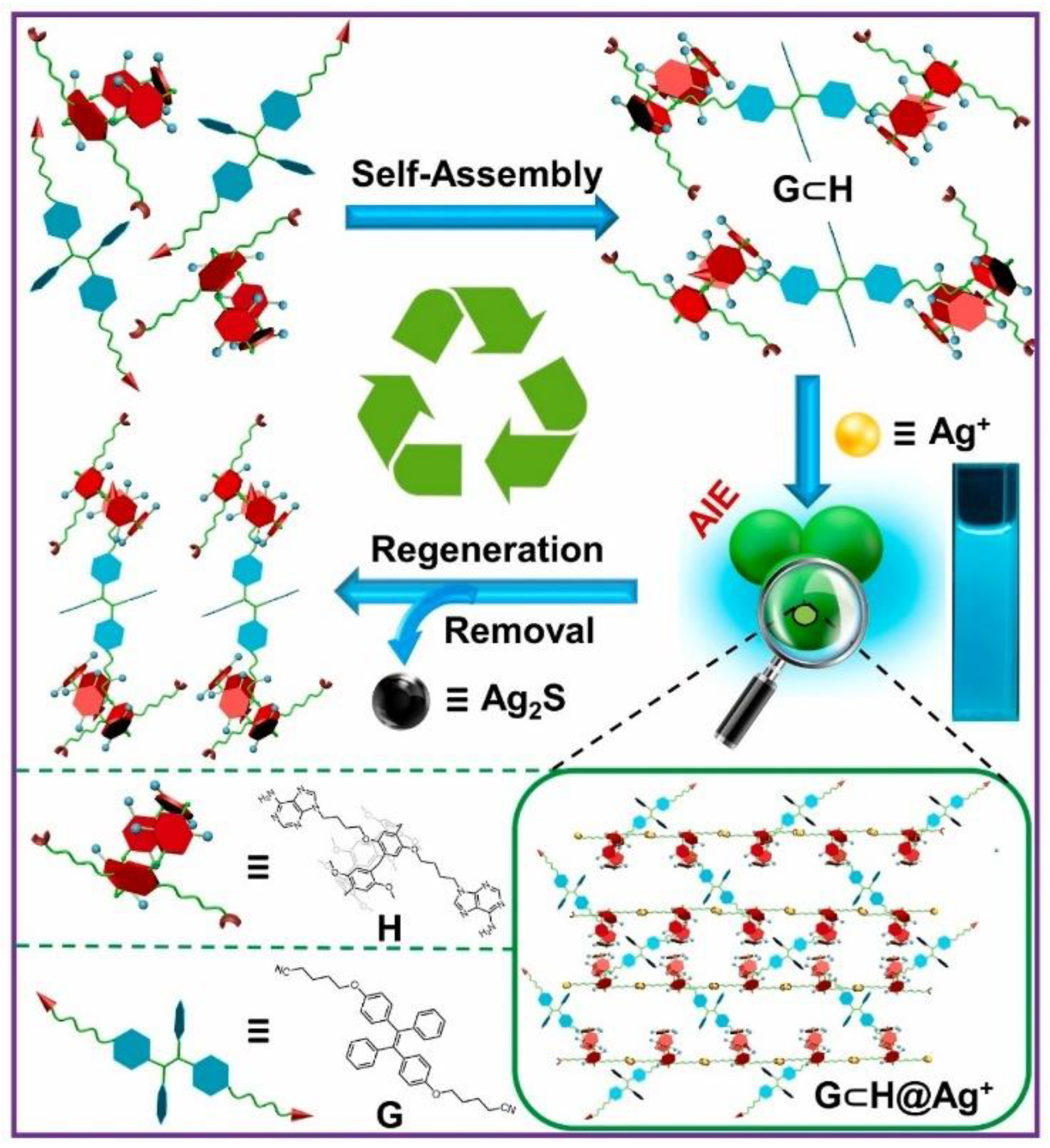
Figure 2.
(a) Cartoon illustration of the assembly mechanism on the metallo-supramolecular polymer gel. (b) The multi-channel DH detection of the PQ-Ag, and (c) schematic diagram of DH alarm circuit (1: electric source; 2: switch; 3: resistance; 4: electric capacity; 5: NPN triode; 6: resistance; 7: bulb; 8: PNP triode; 9: buzzer; 10: gel probe) [39]. Copyright 2023, Elsevier.
Figure 2.
(a) Cartoon illustration of the assembly mechanism on the metallo-supramolecular polymer gel. (b) The multi-channel DH detection of the PQ-Ag, and (c) schematic diagram of DH alarm circuit (1: electric source; 2: switch; 3: resistance; 4: electric capacity; 5: NPN triode; 6: resistance; 7: bulb; 8: PNP triode; 9: buzzer; 10: gel probe) [39]. Copyright 2023, Elsevier.
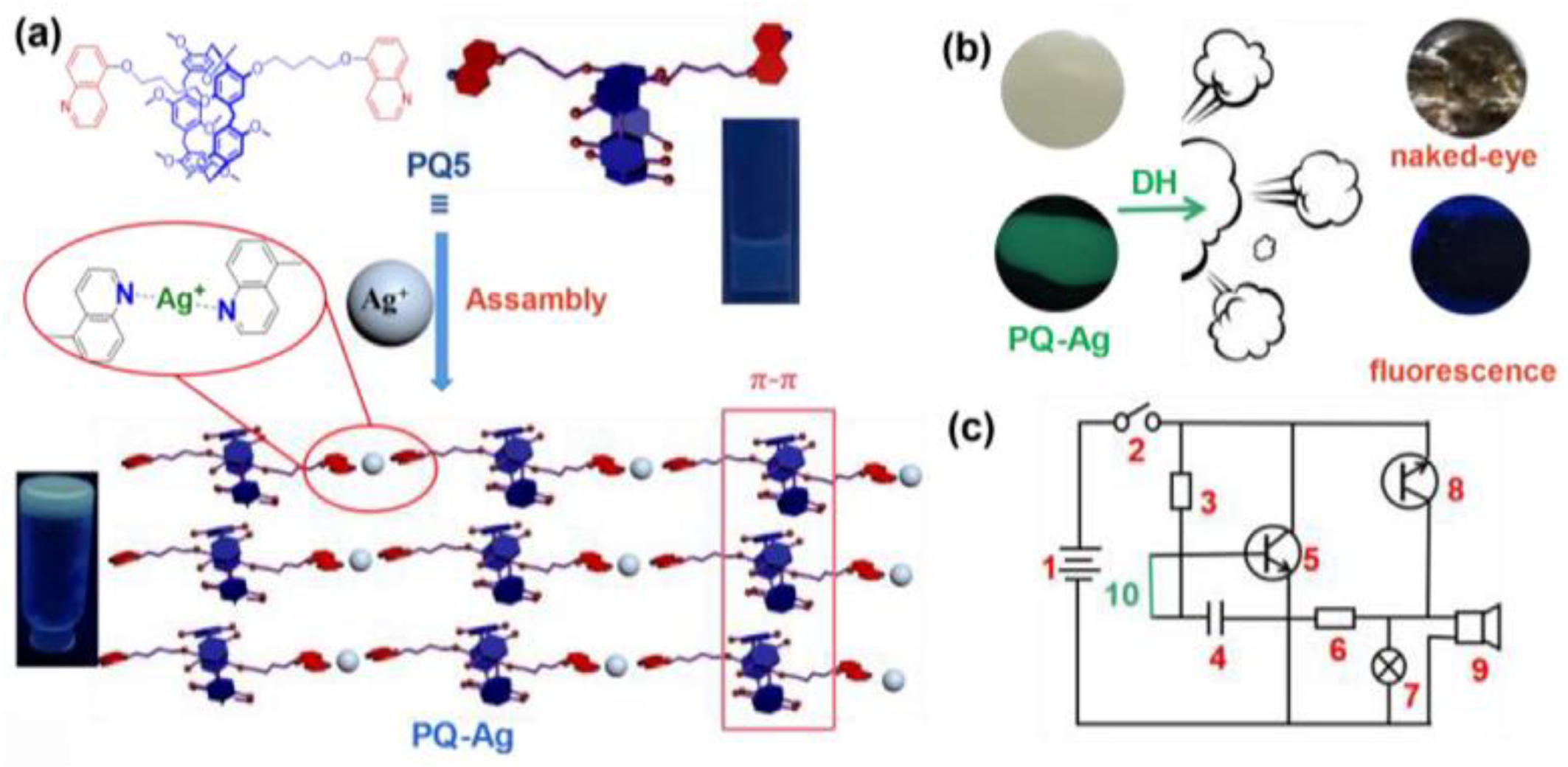
Figure 3.
Schematic illustration of the sensing and removal of Hg2+ ions from water based on the “switch-on” fluorescence of the supramolecular polymers and the regeneration-recycling process [41]. Copyright 2019, American Chemical Society.
Figure 3.
Schematic illustration of the sensing and removal of Hg2+ ions from water based on the “switch-on” fluorescence of the supramolecular polymers and the regeneration-recycling process [41]. Copyright 2019, American Chemical Society.
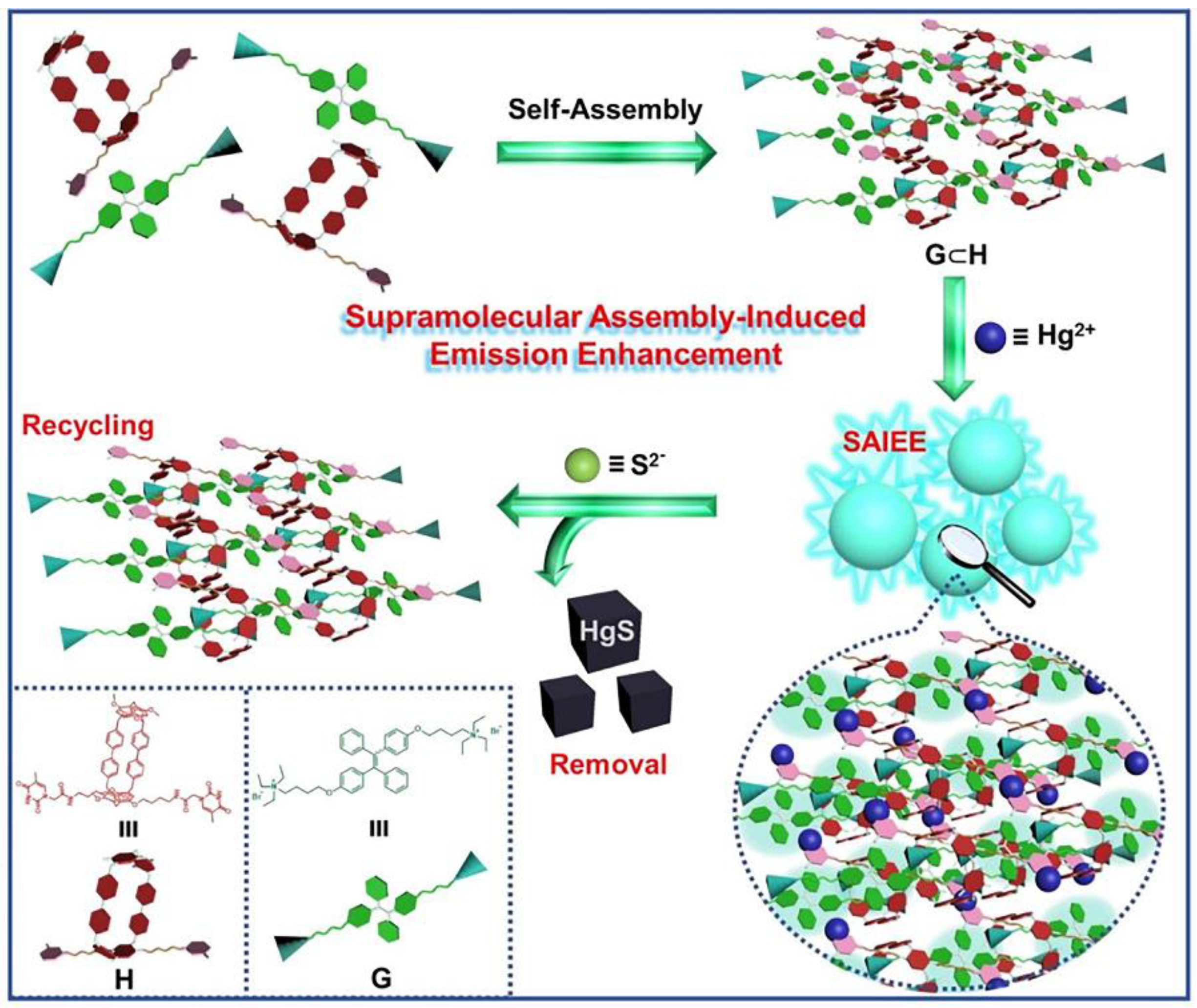
Figure 4.
Chemical structures and cartoon representations of carboxylatopillar[5]arene sodium salts, diketopyrrolopyrrole-bridged bis(quaternary ammonium) guest, and the schematic representations of their self-assembly in absence and presence of Hg2+ ions in water [42].
Scheme 2.
Molecular structures of pillar[n]arenes and guest molecules in the section of dual-stimuli responsive fluorescence sensors.
Scheme 2.
Molecular structures of pillar[n]arenes and guest molecules in the section of dual-stimuli responsive fluorescence sensors.
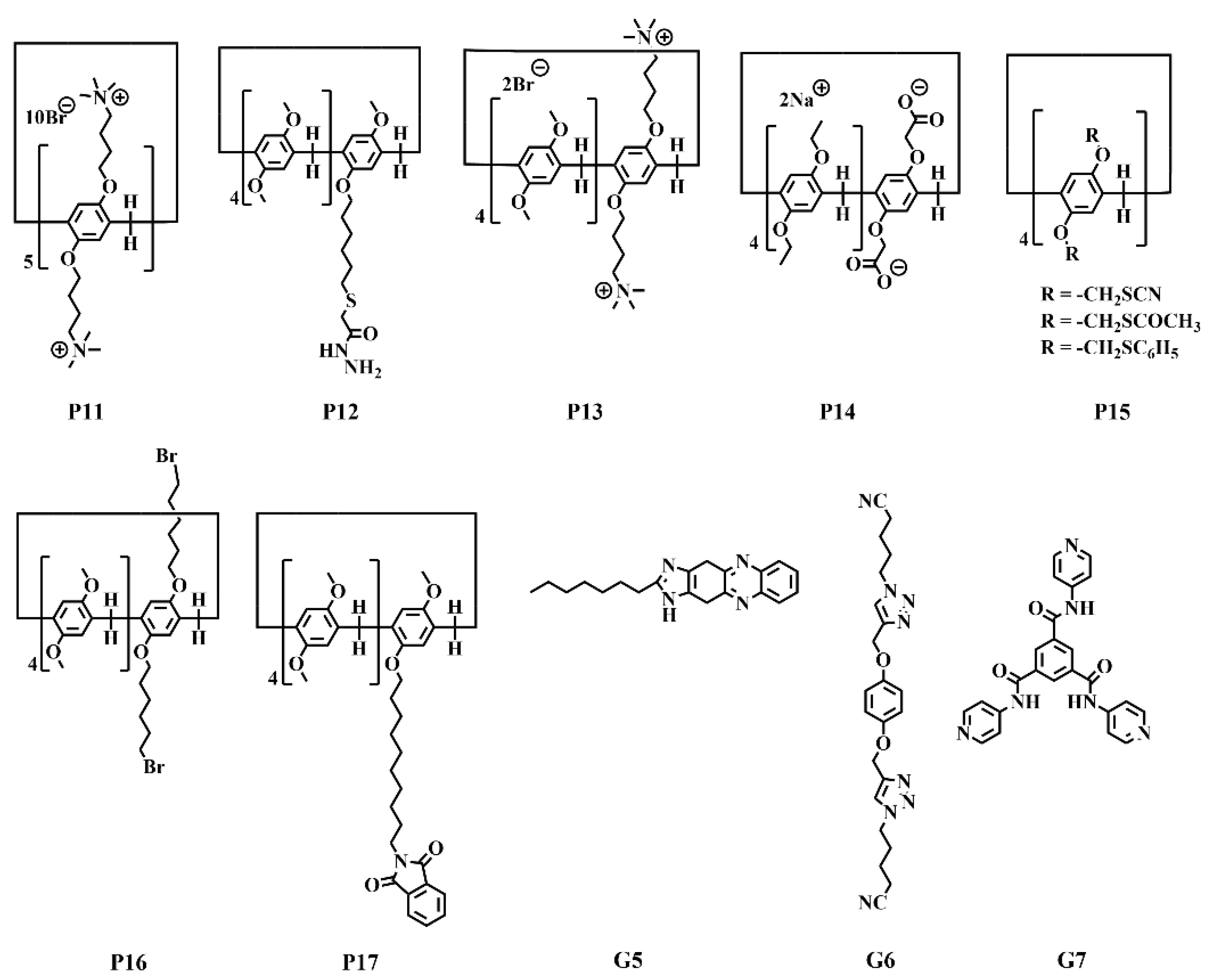
Figure 5.
Chemical structures and proton designations of HP5 and G, and the cartoon representation of the formation of the linear metallo-supramolecular polypseudorotaxane [49]. Copyright 2018, The Royal Society of Chemistry.
Figure 5.
Chemical structures and proton designations of HP5 and G, and the cartoon representation of the formation of the linear metallo-supramolecular polypseudorotaxane [49]. Copyright 2018, The Royal Society of Chemistry.
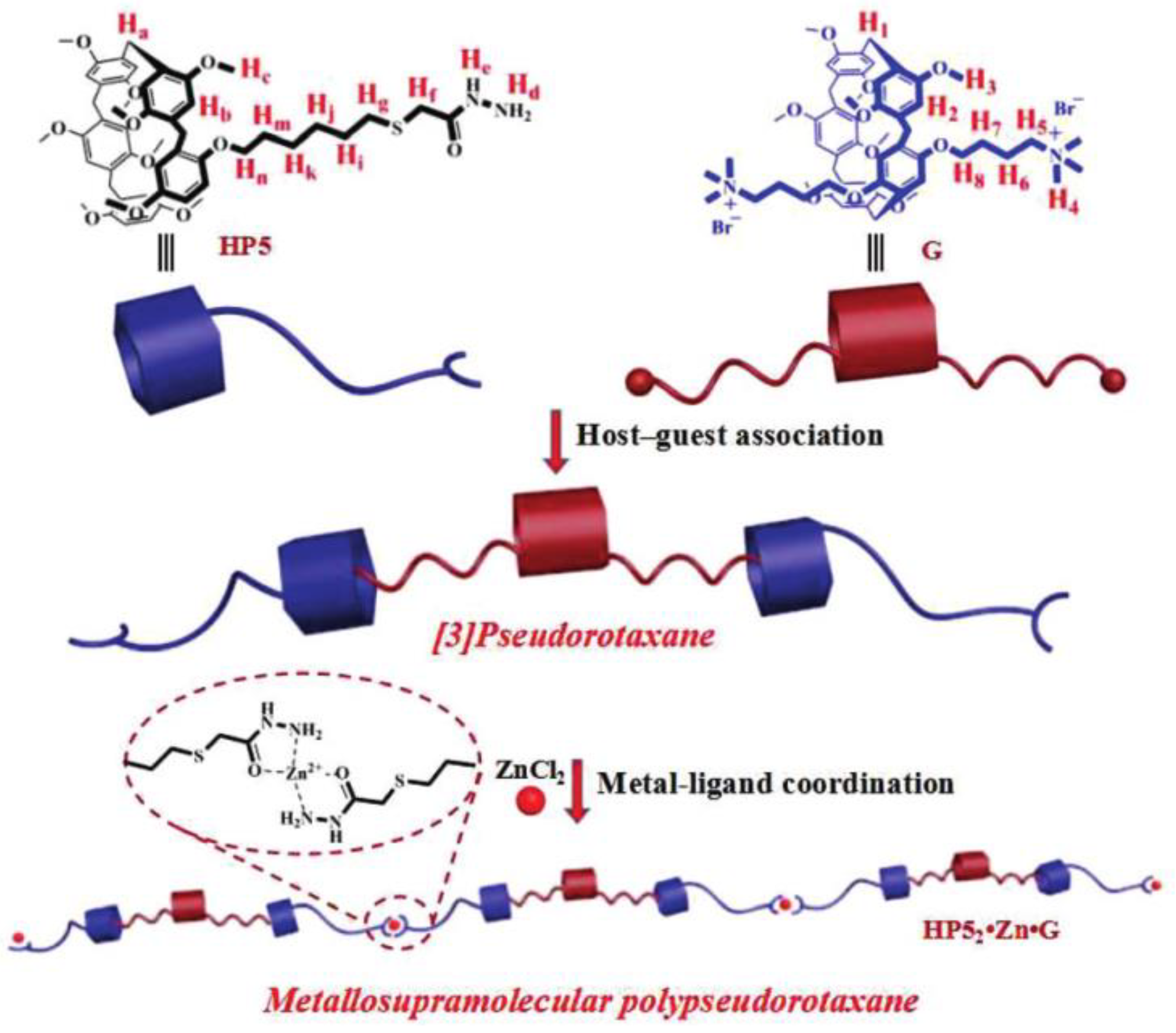
Figure 6.
(a) Schematic diagram of the structure of pillar[5]arene-based Cu(II) coordination supramolecular aggregate and its detection performance for PNP and Fe3+ ions [50]. Copyright 2022, Elsevier.
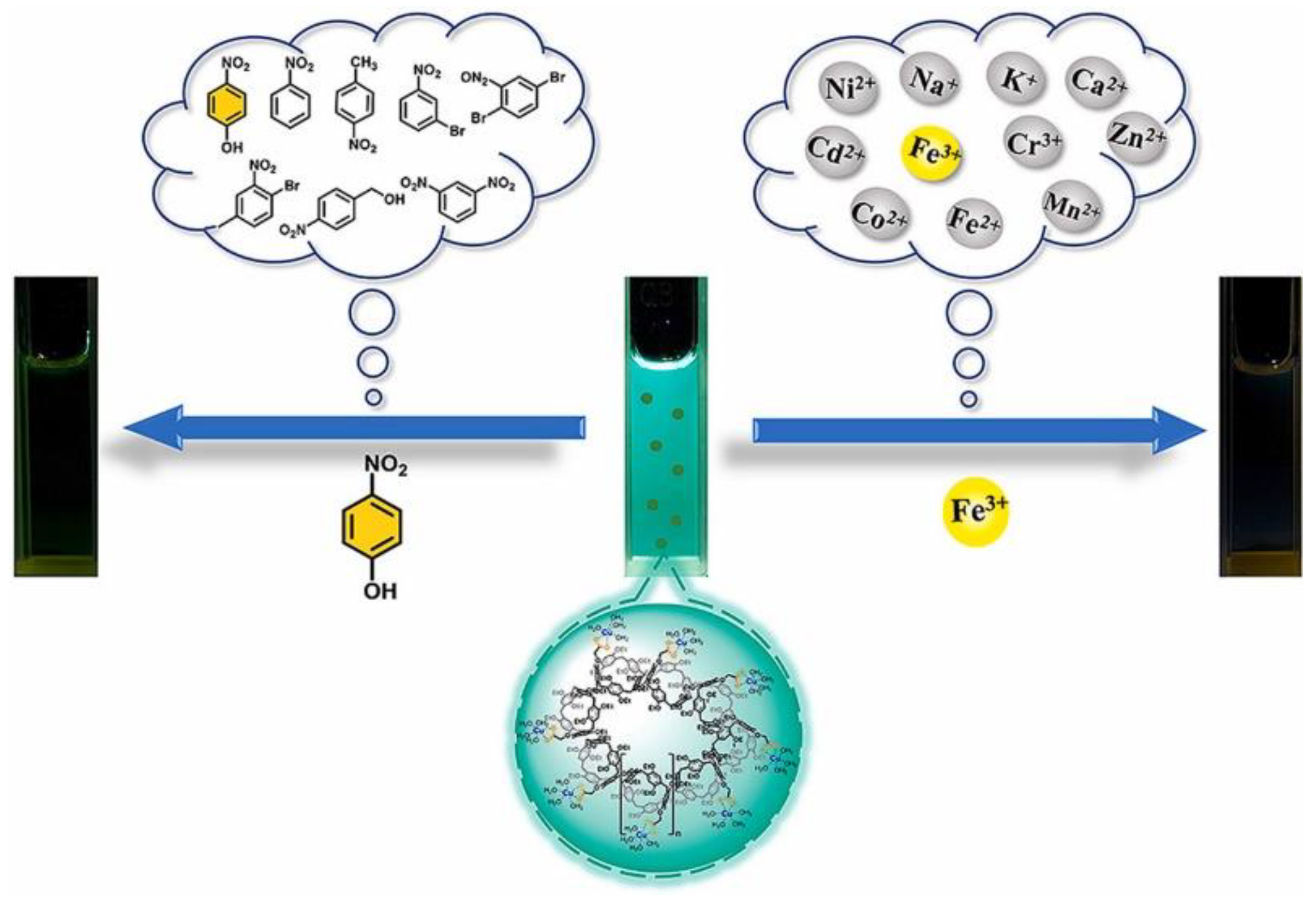
Figure 7.
Cartoon representing sulfur substituent functionalized pillar[5]arenes and their pseudorotaxane complexes [51].
Scheme 3.
Molecular structures of pillar[n]arenes and guest molecules in the section of multi-stimuli responsive fluorescence sensors.
Scheme 3.
Molecular structures of pillar[n]arenes and guest molecules in the section of multi-stimuli responsive fluorescence sensors.
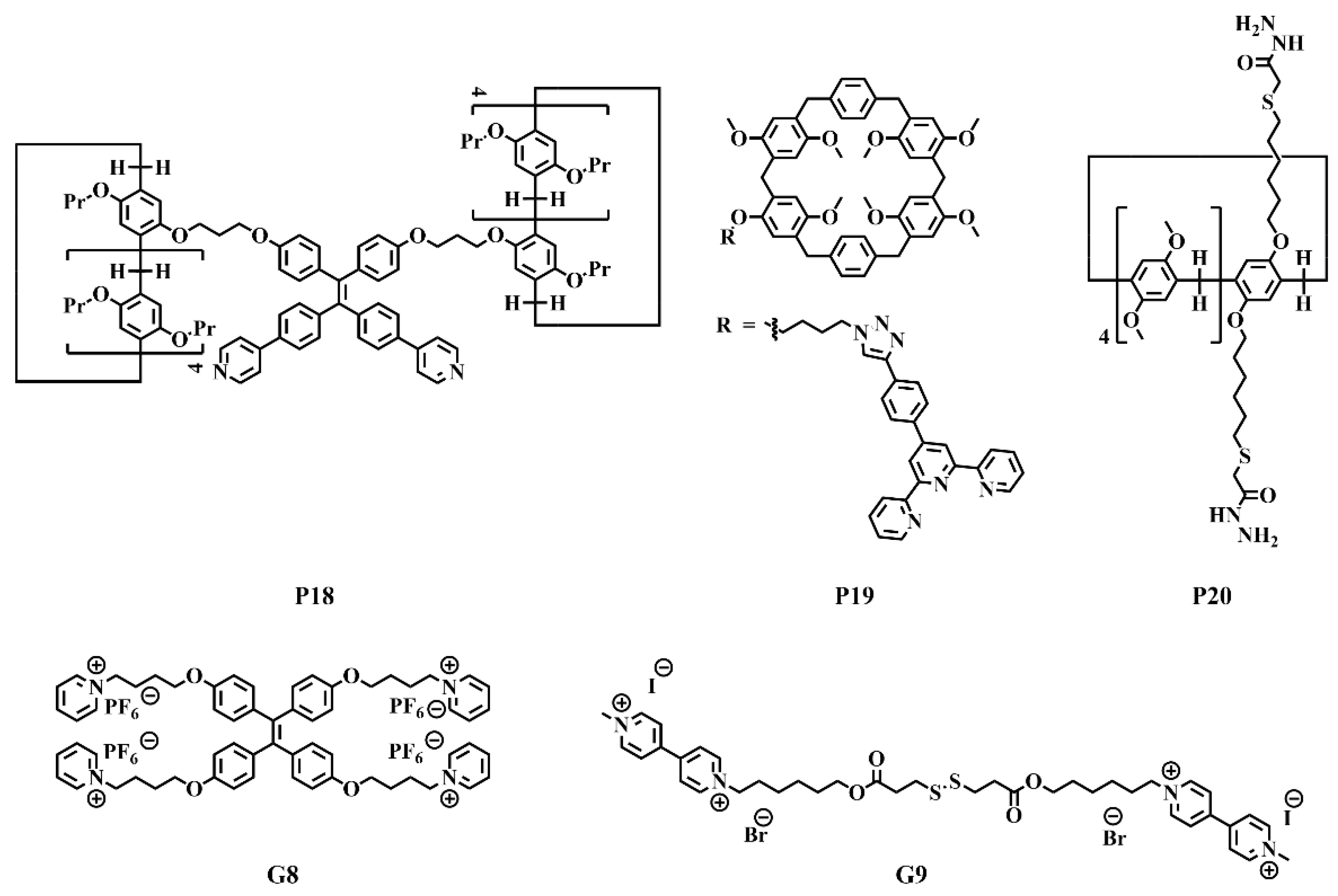
Figure 8.
Schematic representation of the disassembly of supramolecular polymer gels induced by the stimuli of a competitive guest and bromide anion [54]. Copyright 2018, The Royal Society of Chemistry.
Figure 8.
Schematic representation of the disassembly of supramolecular polymer gels induced by the stimuli of a competitive guest and bromide anion [54]. Copyright 2018, The Royal Society of Chemistry.
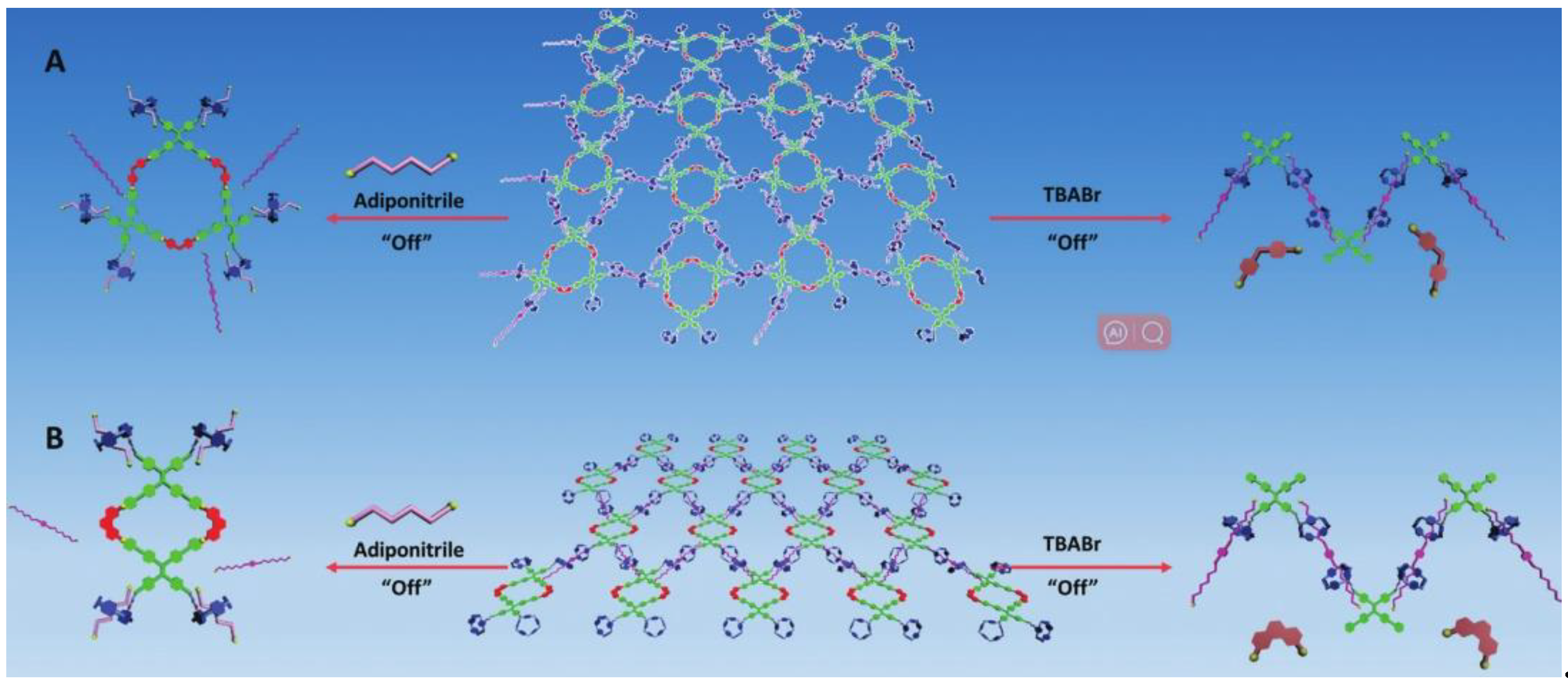
Figure 9.
Chemical structures of host SHP5 and guest DSPy and the schematic representations of the formation of the metallosupra-molecular gel DSPy⊂SHP5@Zn-G based on hierarchical host–guest recognition and metal ion coordination [57]. Copyright 2023, The Royal Society of Chemistry.
Figure 9.
Chemical structures of host SHP5 and guest DSPy and the schematic representations of the formation of the metallosupra-molecular gel DSPy⊂SHP5@Zn-G based on hierarchical host–guest recognition and metal ion coordination [57]. Copyright 2023, The Royal Society of Chemistry.
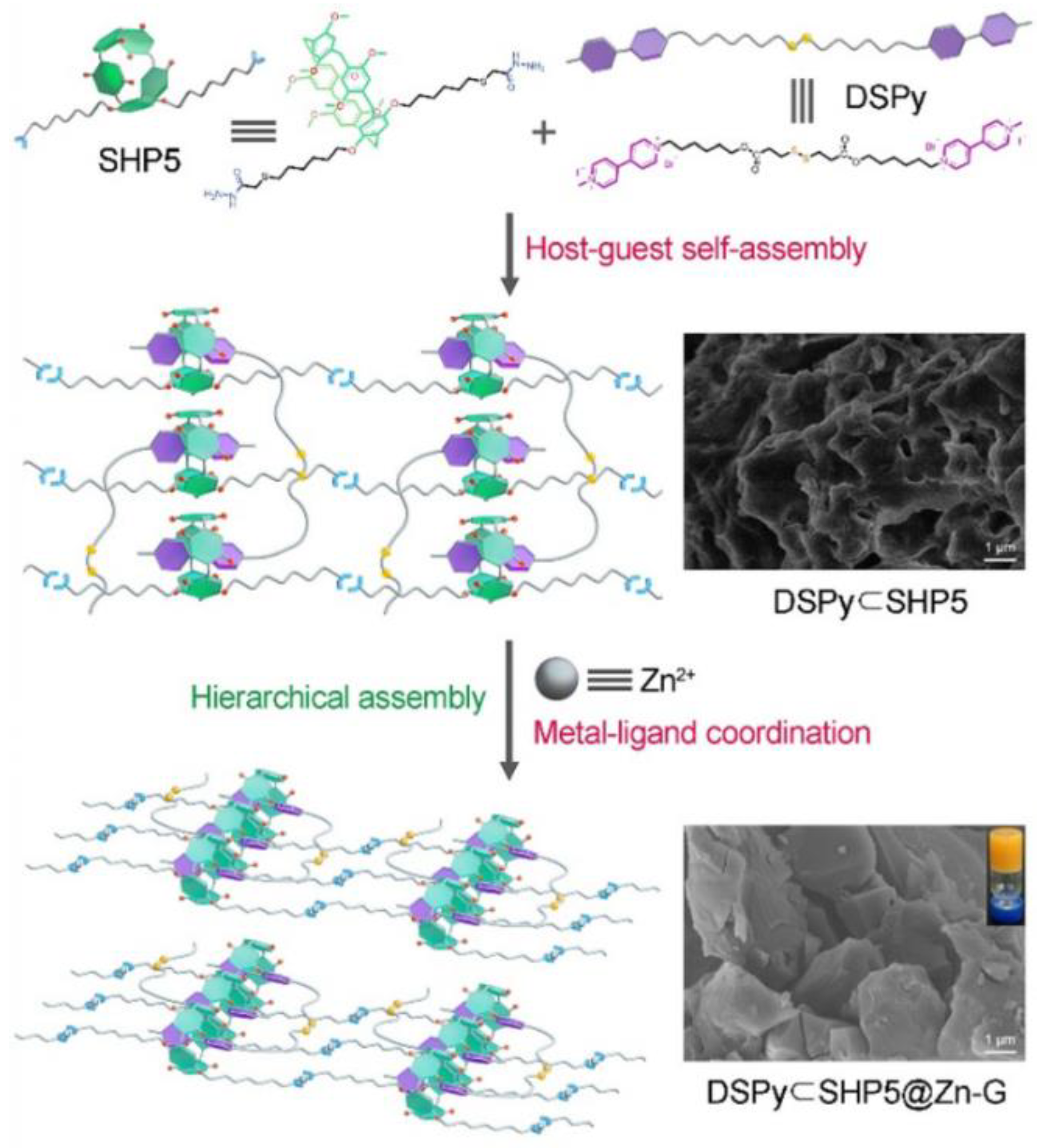
Table 2.
Summary of fluorescence sensors described in the section of dual-stimuli responsiveness.
| Pillar[n]arenes | Guests | Coordinated metal ions |
Sensing properties | Ref. |
|---|---|---|---|---|
| P11 | G5 | Ag+, Hg2+ | Analyte: Ag+, Hg2+. Detection type: ratiometric/turn−on. λex/λem: 385/545 nm. LOD: 1.20 × 10⁻⁸ mol/L (Ag+); 5.00 × 10⁻⁷ mol/L (Hg+). Solvent: DMSO/H2O = 1/1. |
[48] |
| P12, P13 | P13 | Fe3+, Cu2+ | Analyte: Fe3+, Cu2+. Detection type: turn−off. λex/λem: 330/460−560 nm. LOD: 8.53 × 10⁻¹⁰ mol/L (Fe3+); 4.57 × 10⁻⁸ mol/L (Cu2+). |
[49] |
| P14 | − | Cu2+ | Analyte: nitroaromatics, Fe3+. Detection type: turn−off. λex/λem: 380/487 nm. LOD: 3.90 × 10⁻⁷ mol/L (Fe3+); 4.90 × 10⁻⁶ mol/L (nitroaromatics). Liner range: 0−1.20 × 10⁻³ mol/L (Fe3+); 0−1.80 × 10⁻⁴ mol/L (nitroaromatics). Solvent: DMF/H2O = 1/4. |
[50] |
| P15 | G6 | Cu2+, Hg2+ | Analyte: Cu2+, Hg2+. Detection type: turn−off. λex/λem: 293/324 nm. Solvent: CH3CN/water = 1/1. |
[51] |
| P2, P16 | P16 | Fe3+ | Analyte: Fe3+, F−. λex/λem: 290/470 nm. LOD: 1.02 × 10⁻¹⁰ mol/L (Fe3+); 9.79 × 10⁻⁹ mol/L (F−). Liner range: 0−1.18 eq. (Fe3+); 0−0.86 eq. (F−). Solvent: cyclohexanol/H2O = 3/17. |
[52] |
| P17 | G7 | Eu3+, Tb3+ | Analyte: cyanide, perchlorate. Detection type: turn−on. λex/λem: 290/470 nm. LOD: 5.96 × 10⁻⁸ mol/L (cyanide); 3.36 × 10⁻⁶ mol/L (perchlorate). Solvent: DMSO/H2O = 2/1. |
[53] |
Table 3.
Summary of fluorescence sensors described in the section of multi-stimuli responsiveness.
| Pillar[n]arenes | Guests | Coordinated metal ions |
Sensing properties | Ref. |
|---|---|---|---|---|
| P18 | − | Pt2+ | Analyte: temperature, competitive guest molecules, halides. λex/λem: 336/500 nm. Solvent: acetone/water = 1/19. |
[54] |
| P2 | − | Al3+ | Analyte: Fe3+, F−, trifluoroacetic acid, triethylamine. Detection type: turn−off/on. λex/λem: 380/ 470 nm. LOD: 4.39 × 10⁻⁹ mol/L (Fe3+); 2.75 × 10⁻⁸ mol/L (F−); 1.80 × 10⁻⁵ mol/L (trifluoroacetic acid); 1.80 × 10⁻⁵ mol/L (triethylamine). Solvent: DMSO/H2O = 4/1. |
[55] |
| P19 | G8 | Zn2+ | Analyte: competitive binding agents, trifluoroacetic acid, pillar[5]arene. λex/λem: 349/385 nm. Solvent: CHCl3/CH3CN = 4:1. |
[56] |
| P20 | G9 | Zn2+ | Analyte: thermal, redox, pH, competitive guests. λex/λem: 375/385 nm. Solvent: DMSO:H2O = 7/3. |
[57] |
Disclaimer/Publisher’s Note: The statements, opinions and data contained in all publications are solely those of the individual author(s) and contributor(s) and not of MDPI and/or the editor(s). MDPI and/or the editor(s) disclaim responsibility for any injury to people or property resulting from any ideas, methods, instructions or products referred to in the content. |
© 2024 by the authors. Licensee MDPI, Basel, Switzerland. This article is an open access article distributed under the terms and conditions of the Creative Commons Attribution (CC BY) license (http://creativecommons.org/licenses/by/4.0/).
Copyright: This open access article is published under a Creative Commons CC BY 4.0 license, which permit the free download, distribution, and reuse, provided that the author and preprint are cited in any reuse.