

Submitted:
08 February 2024
Posted:
08 February 2024
You are already at the latest version
Abstract
Pineapple weed (Matricaria discoidea DC.) is a widely spread plant in Europe and North America. In ethnomedicine, it is well known for its anti-inflammatory and spasmolytic activity. The aim of the research was to develop novel methods of M. discoidea herb complex processing for creating the essential oil and the dry extracts and to investigate their phytochemical composition. Moreo-ver, the molecular docking of main substances and in vivo their soporific and analgesic activity were studied. The essential oil and two dry extracts from M. discoidea were prepared. Total 16 phenolic compounds (7 flavonoids, 7 hydroxycinnamic, 2 phenolic acids) in the dry extracts were identified by means of UPLC-MS/MS. In the essential oil 9 main terpenoids were identified by gas chromatography (GC). We showed that the phenolics extraction from the present herb was successful by using 70% ethanol in a triple extraction and in the range of 1:14-1:16. The in-vivo studies with rodents showed analgesic activity of M. discoidea extracts and the improvements in the sleep of animals. The dry extracts of M. discoidea herb did not show any toxicity. The molecular docking showed the high probability of COX-1,2 inhibition and NMDA receptor antagonism induced by the extracts.
Keywords:
pineapple weed
; herb
; extraction
; terpenoids
; polyphenols
; cytotoxicity
; analgesic activity
; soporific effect
1. Introduction
Pineapple weed (Matricaria discoidea DC., syn. Chamomilla suaveolens (Pursh) Rydb., syn. M. suaveolens (Pursh) Buch., syn. M. matricarioides (Less.) Porter) is a species from genus Chamomilla, family Asteraceae. The plant is widely spread in the Europe and North America, but it is not cultivable. M. discoidea has an ethnomedical background dating back to the 19th century showing that the plant has been mainly used in the forms of tea or tincture for its anti-inflammatory and spasmolytic properties [1]. The U.S.S.R. Pharmacopoeia [2] gave approval for the external use of M. discoidea as a substitute for the inflorescences of German chamomile (M. chamomilla L.).
In our previous study, we found total 44 compounds (essential oils) in M. discoidea, and biologically the most relevant compounds were (Z)-en-yne-dicycloether, (E)-β-farnesene, geranyl isovaleriate, palmitic acid and myrcene (REFERENCE). In addition, we showed that the quantitative content of essential oil in the different aerial parts of M. discoidea does not vary significantly. Therefore, the use of herbs instead of inflorescences is more beneficial in terms of biomass [3,4]. Our finding on the total content of polyphenols, flavonoids and coumarins supported this approach. We also found that dicaffeoylquinic acids, chlorogenic acids and ferulic acid glycoside, quercetin galactoside, malonylapigenin glucoside, apigenin acetylglucoside, quercetin, luteolin, and apigenin glycosides are the main polyphenols in M. discoidea [5]. The composition of M. discoidea and M. chamomilla has been reported in several publications [6,7,8].
Since M. discoidea and M. chamomilla have a phytochemical composition rich in bioactive substances, we strongly believe that it is important to continue the studies in depth with the purpose of improving the medicinal use of both these plants. The development of new zero-waste technologies for isolating essential oils from the present medicinal plants would be a sustainable and relevant approach at a global level, since the resources of plant-origin materials are limited. Furthermore, such novel isolation technologies make the production of plant-origin medicines more profitable, enable the consumption of plant raw materials more rationally, and reduce the negative impact of pharmaceutical production on the environment [9,10,11]. To date, M. discoidea herb is widely used in folk medicines as a tincture or decoction, but the application of such preparations limits a low compliance among people. In addition, the waste in the production of such tinctures and essential oils contains a significant amount of biological active substances (BAS). Therefore, it is relevant to find novel methods and/or to optimize the established methods for preparing medicines and food supplements of plant origin.
The aim of the present study was to develop novel methods for isolating/preparing essential oils and dry extracts from a M. discoidea herb, and to study their phytochemical composition. In addition, the affinity of the corresponding BAS to active sites of biotargets responsible for inducing analgesic and soporific activity, was predicted by molecular docking. We also investigated the cytotoxicity of BAS in vitro and the analgesic and soporific activity of BAS in vivo.
2. Materials and Methods
2.1. Plant Material
The whole aerial parts of wild growing M. discoidea (2.0 kg) were collected in July 2020 during the flowering period of the plant by the lake Veskijärv, located at Nõo township, Nõo municipality, Tartu, Estonia [58°16’30”N, 26°31’32”E]. The plant material was immediately cleaned from impurities and the herb was dried (for one week) at an ambient room temperature 22 ± 2°C in a well-ventilated room. The dried herb was stored in paper packages at room temperature and protected from light (in a locker) for further studies. The raw material was identified by Professor Ain Raal, Institute of Pharmacy, University of Tartu, Tartu, Estonia. The voucher specimen #Ast/Mat/D13 of the plant is available in the Institute of Pharmacy, University of Tartu, Tartu Estonia. The loss on drying (LOD) was determined by using Moisture Analyzer MB23/MB25 for the measurements. Three parallel measurements showed 6.5% loss of drying for a M. discoidea herb.
The inflorescences of M. chamomilla were supplied by an Estonian herb farm MK Loodusravi OÜ. The company operates according to the manufacturing activity license given by the Estonian State Agency of Medicines, which guarantees a proper manufacturing process and quality. The inflorescences of the cultivated plant were harvested in summer 2020 in the Southern part of Estonia, Viljandi county, North Sakala municipality. The farm produces ecologically clean herbs.
2.2. Isolation of Essential Oil
2.2.1. Isolation of Essential Oil for Phytochemical and Pharmacological Analysis
The M. discoidea herb essential oil was obtained by means of distillation (4 hours) according to the Monograph “Matricaria flower (“Matricariae flos”) of European Pharmacopoeia [12]. For distillation, 300 ml of distilled water and 30 g of dried and cut plant material in a 1000-ml round-bottom flask, were used. For dissolving the obtained essential oil, 0.5 ml of cyclohexane was used [3]. SHOULD THERE BE INFORMATION ABOUT STORAGE OF THE SAMPLES and when the samples were tested further
2.2.2. Isolation of Essential Oil for Cytotoxicity Studies
The essential oils of M. chamomilla and M. discoidea were isolated from dried herbal samples. It was not possible to use a distillation method described in the European Pharmacopoeia 10.8 Monograph “Matricaria flower (Matricariae flos)”, since the essential oils were planned to be used in further eukaryotic cell cytotoxicity experiments. There were two reasons for that: firstly, the solvent (cyclohexane) is toxic for cells itself, and thus limits the analysis of cytotoxicity of pure essential oils. Secondly, the amount of plant material used in this method is too small to obtain a measurable volume of essential oil. Nevertheless, we followed the Ph.Eur. standards as much as possible: the dried herbs were used, the time period for distillation was 4 h, and distilled water was used. Our preliminary experiments showed that without using an organic solvent, it is not possible to isolate a measurable amount of essential oil from the herbs. Therefore, we decided to use a distillation system that enables to use only distilled water and larger amounts of herbs resulting in a measurable amount of pure essential oil. We used a distillation extractor with a capacity of 12 L For the distillation, 1 kg of dried herb and 5 L of distilled water was used. An induction stove was used for heating. The distillation time was 4 h and the distillation rate was regulated (by an induction stove), thus avoiding too fast or too slow dropping. To separate the pure essential oil from aromatic water, a separation funnel was used (Cider Mill, n.d.). As the result of the distillation, the total of 1 ml of M. discoidea essential oil and M. chamomilla essential oil each was obtained. The essential oils were stored in Eppendorf Tubes® at -18 °C.
2.3. Preparation of Extracts
For isolating essential oils, the dried M. discoidea herb (100.0 g) was distilled with water R (1250.0 ml) for 3 h in an essential oil extractor [Albrigi Luigi SRL, Stallavena, Italy). The assay of the essential oil in the dry herb was 3 ml/kg. The cooled aqueous distilled liquid was filtered from the chamomile herb. Total 862 ml of the extract was obtained, and the dry residue was 3.0 ± 0.3%. This extract was evaporated, and a dry extract (extract P1) was obtained by lyophilic drying in a SCANVAC COOLSAFE 55-4 Pro (LaboGene ApS, Denmark) apparatus. The yield of extract P1 was 25.9%.
The dried M. discoidea herb (500.0 g) was macerated with 2500 ml of 70% ethanol solution at an ambient room temperature (22 ± 2 °C) for overnight. The same procedure was repeated five times with new portions of the extractant (1000.0 ml each) to assess a rational extraction multiplicity. For preparing the final product, only three first liquid extracts were used, which were combined, the mixture was allowed to sediment for two days, and subsequently it was filtrated. The combined liquid extract was evaporated to a thick extract with a rotary vacuum evaporator (type, manufacturer, country?). Finally, the extract was reduced to a dry extract (extract P2) by lyophilic drying. The yield of extract P2 was 20.1%.
The remaining dry herb powder? was extracted with water R (1000.0 ml) by boiling the mixture for 30 min and infusing for 12 h. The liquid phase was separated from the herb by filtration. Then, the liquid was evaporated in a lyophilic dryer apparatus to form a dry extract (extract P3). The extract P3′s yield was 8.4%.
For cytotoxicity studies, the ethanol extracts were prepared as follows: Both M. chamomilla and M. discoidea herbs (5 g) were extracted with 125 ml 96% (w/v) ethanol for 30 min at an ambient room temperature (22 ± 1 °C) using a magnetic stirrer MSO1 (ELMI, country?). With both herbs, the total amount of extract prepared was 125 ml The extract was subsequently filtered and stored in dark glass bottles at 4 °C.
2.4. Phytochemical Analysis
2.4.1. Gas-Chromatographic Analysis of Essential Oil
Agilent’s GC 7890a (Santa Clara, CA, USA) gas chromatograph (GC) with a flame ionization detector and Agilent Open Lab CDS Chem Station software was used for the qualitative and quantitative analyses of principal compounds (> 1%) of M. discoidea essential oil. The two fused silica capillary columns with the phases DB-5 and HP-Innowax (30 m × 0.25 mm, Agilent), were simultaneously used. Hydrogen was used as a carrier gas at a 30 ml/min flow rate and a split ratio 1:150. The temperature program ranged at 2.92 °C/min from 50 to 250 °C, and the injector temperature was 250 °C.
The mean retention time and peak area of total four parallel chromatograms were used for identifying M. discoidea essential oil principal compounds, for comparing their retention indices, and for determining their quantitative content (%). The components were identified by comparing their non-polar DB-5 column retention indices to the corresponding values obtained from the databases and literature data [3,4] [6,7,8].
2.4.2. Assay of Main Phenolics by Spectrophotometry
The quantification of hydroxycinnamic acids, flavonoids and total phenols in the M. discoidea extracts was carried out with a Shimadzu UV-1800 [Shimadzu Corporation, Japan) spectrophotometer. Hydroxycinnamic acids were established regarding chlorogenic acid at 525 nm after adding sodium molybdate, hydrochloric acid and sodium nitrite [12,13,14]. Flavonoids were determined in terms of rutin at 417 nm after forming the complex with aluminum chloride [10,12,15]. The assay of total phenolics was assayed in terms of gallic acid at 270 nm [10]. For statistical validity, the experiments were performed in triplicate.
2.4.3. Analysis of Phenolic Compounds by UPLC-MS/MS
Quantitative and qualitative analysis of phenolic compounds in plant samples was carried out using a UPLC-MS/MS system. Chromatographic separation was performed with Acquity H-class UPLC chromatograph [Waters, USA) equipped with YMC Triart C18 [100 × 2.0 mm 1.9 µm) column. The temperature of the column was maintained at 40 °C constantly. The mobile phase was supplied at the flow rate of 0.5 ml/min. Formic acid aqueous solution (0.1%) and pure acetonitrile were used as solvent A and solvent B, respectively. In brief, gradient elution was performed as follows: Solvent A from 0 to 1 min at 95%, 1 to 5 min to 70% of solvent A, 5 to 7 min linear decrease to 50%, 7.5 to 8 min column wash with solvent B, and 8.1 to 10 min equilibrate column to initial conditions of 95% of solvent A. A triple quadrupole tandem mass spectrometer [Xevo, Waters, USA) was used for the chemical structure analysis of phenolic compounds. Negative electrospray ionization [ESI] was applied to generate ions for MS/MS data. The settings for MS/MS analysis were as follows: a capillary voltage was set at negative 2 kV, nitrogen gas for desolvation was heated to 400 °C, a flow rate was set at 700 L/h, curtain gas flow was kept at 20 L/h, and the temperature of ion source was maintained at 150 °C. The qualitative determination of phenolic compounds was performed by comparing their retention times and MS/MS spectral data with those of analytical grade standards. Standard dilution method and linear regression fit models were used for the quantitative analysis of phenolics [13,16].
2.5. Molecular Docking of M. discoidea BAS
Molecular docking was performed using AutoDock Vina and AutoDockTools 1.5.6 [17]. A macromolecule from the Protein Data Bank [PDB] was used as a biotarget: •PDB ID 6NCF, 3N8Y, 3LN1, 7EU7, 6X3W. Construction of a virtual database of candidate structures was carried out using the BIOVIADraw 2021 program and saved in mol format. The structures were optimized by Chem3D with the MM2 molecular mechanics algorithm, saved in the format .pdb, and converted to .pdbqt with AutoDockTools-1.5.6. Discovery Studio Visualizer 2021 was embraced to remove native protein ligands and solvents. The macromolecule was saved in the format .pdb. In AutoDockTools-1.5.6, polar hydrogen atoms went on to the protein structure and converted in the format .pdbqt. The size of the Grid box and its center were determined by the native ligands:
LOX-5 (PDB ID 6NCF)): x = 11.6, y = -23.38, z = -18.01; size x = 30, y = 28, z = 26;
(COX-1) (PDB ID - 3N8Y): x = 33.14, y = -44.49, z = -3.76; size x = 24, y = 22, z = 20;
СОХ-2 (PDB ID 3LN1): x = 18.84, y = -52.89, z = -53.81; size x = 22, y = 24, z = 24;
NMDAR (PDB ID 7EU7): x = 124.19, y = 125.67, z = 78.60; size x = 12, y = 14, z = 14;
GABAA(PDB ID 6X3W): x = 109.83, y = 93.68, z = 105.43; size x = 22, y = 18, z = 16;
AutoDock Vina was used for docking. Analysis and visualization of the docking results were carried out by Discovery Studio Visualizer 2021 Client.
Macromolecules from the Protein Data Bank [18] were used as target proteins:
- lipoxygenase-5 (LOX-5) (PDB ID 6NCF) enzyme with a natural non-competitive inhibitor – pentacyclic triterpenoid acid (3α,8α,17α,18α-3-acetyloxy-11-oxours-12-en-23-oic acid – AKBA) in the active site [19];
- ionotropic glutamate NMDA receptors in conformation with a non-competitive antagonist of direct action - ketamine (7EU7) [22];
- the GABA receptor in conformation with the agonist phenobarbital (6X3W) [23].
2.6. Pharmacological Study
Adult (age) random-bred albino mice were used for investigating the analgesic activity. Adult (age) out-bred albino rats were used in a soporific activity study. The rodents (mice and rats) were kept in standard polypropylene boxes at 20-26 °C in a well-ventilated room with 50% relative humidity (RH), a 12-hour light/dark cycle and free access to food and water in the vivarium of the National University of Pharmacy (Kharkiv, Ukraine).
All pharmacological studies were carried out in compliance with the rules of the “European Convention for the Protection of Vertebrate Animals Used for Experimental and Other Scientific Purposes” (Strasbourg, 1986), Directive 2010/63/EU of the European Parliament, and the Council of the European Union (2010) on the protection of animals used for scientific purposes. The Order of the Ministry of Health of Ukraine No. 944 “On Approval of the Procedure for Preclinical Study of Medicinal Products and Examination of Materials for Preclinical Study of Medicinal Products” (2009) and the Law of Ukraine No. 3447-IV “On the protection of animals from cruel treatment” (2006) were also strictly followed. The present study was approved by the Bioethics Commission of the National University of Pharmacy (protocol №4 from 03.10.2023) [24,25,26,27,28]
2.6.1. Cytotoxicity Studies
The cytotoxicity studies were performed on two cell lines, baby hamster kidney fibroblast (BHK-21) and human bone osteosarcoma epithelial (U2OS Line) cells. U2OS cells were grown in DMEM (Dulbecco’s Modified Eagle Medium, Gibco) supplemented with 10% FBS (Fetal Bovine Serum, Gibco) and 100 μg/ml penicillin and 100 μg/ml streptomycin. BHK-21 were grown on GMEM (Glasgow Minimum Essential Medium, Gibco) supplemented with 10% FBS, 2% TPB (Tryptose Phosphate Broth, Gibco), 10 ml of 1M (238.3 mg/ml) HEPES Buffer (Mediatech, Inc.) solution, 100 μg/ml penicillin and 100 μg/ml streptomycin. Cells were maintained at 37 °C in a 5% CO2 incubator.
CountessTM automated cell counter (InvitrogenTM) was used for counting cells using a Trypan Blue stain 0.4% (InvitrogenTM). The U2OS cells were counted and documented. The number of BHK-21 cells per well (10,000 cells per well) was fixed at the beginning of the experiment.
The following four samples were investigated in the cytotoxicity studies: M. chamomilla essential oil, M. discoidea essential oil, M. chamomilla ethanol extract, and M. discoidea ethanol extract. For extracts, 96% ethanol and pure growth medium were used as controls. A series of 2-fold dilutions were prepared for all samples and ethanol into 1.5 ml microtubes. For each dilution, three parallels were used. The experiments were repeated at least in triplicate.
We used a 100-µl sample size per well on a 96-well plate incubated for 48 h at 37 °C in a 5% CO2 incubator. The maximal non-cytotoxic concentrations (dilutions) of the extracts were determined using a tetrazolium dye MTS cell viability assay (10 µl/per well). ADD HERE HOW YOU DID THIS (MTS Cell proliferation reagent (NAME, country) was added to the cell growth medium at ….??, and incubated for …WHERE. WHAT was used as a control, and where did you measure absorbance (machine). The analysis was conducted at a biosafety level 2 (BSL-2) laboratory proceeding with aseptic technique principles. All solvents used were of pharmaceutical grade.
2.6.2. Analgesic Activity
The analgesic activity of M. discoidea herb extracts (P1, P2, P3) and the reference drug acetaminophen (Paracetamol-Zdorovye, capsules 500 mg, Pharmaceutical company «Zdorovye», Kharkiv, Ukraine) was studied with mice by using an established hot plate test [29].
The method of randomization was used for forming the groups of animals. Test was performed one time and no washing period was used. The period of quarantine and acclimatization lasted for 14 days. The rodents weighing 22–40 g were divided into 11 groups (6 mice in a group):
Group 1 – the intact mice, who received a 0.9% solution of NaCl in a dose of 1 ml per
100 g of body weight;
Group 2 – the mice received 25 mg/kg of the extract P1;
Group 3 – the mice received 50 mg/kg of the extract P1;
Group 4 – the mice received 100 mg/kg of the extract P1;
Group 5 – the mice received 25 mg/kg of the extract P2;
Group 6 – the mice received 50 mg/kg of the extract P2;
Group 7 – the mice received 100 mg/kg of the extract P2;
Group 8 – the mice received 25 mg/kg of the extract P3;
Group 9 – the mice received 50 mg/kg of the extract P3;
Group 10 – the mice received 100 mg/kg of the extract P3;
Group 11 – a control group (CG); the mice received 50 mg/kg of acetaminophen.
The rodents were kept without food for 2 h before the test. The M. discoidea extracts studied were administered intragastrically in the form of an aqueous suspension 30 min before placing the animals on the hot-plate equipment. Aqueous suspensions of ethanol extracts were prepared ex tempore as follows:
After the administration of extract or drug substance, the mouse was carefully placed on a thermostatic hot plate (55°C) for 30 min. The reaction latency period was fixed as the time needed for the mice’s response to the heat stimulation by licking the paw, flinching or jump [30,31]. The mice were observed for 0.5, 1, 2, 3 and 4 h after the extract or control drug substance administration. The analgesic effect criterion was a significant increase in the response latent period after administering the extracts compared to the control. In order to avoid the thermal damage to the tissues of paw, the hot-plate exposure time for the mice did not exceed 60 s. The analgesic activity of the extracts was calculated according to the equation:
AA = (Te-Tc) / Tc × 100%; where,
АА = the analgesic activity, %;
Тe = the difference in the corresponding response latent period in the group of animals after administering the extracts;
Тc = the difference in the corresponding response latent period in the group of control animals after administering the solvent.
Statistical data analysis was performed using the parametric methods of a Student t-test. The level of statistical significance of differences was p < 0.05.
2.6.3. Soporific Activity
The soporific activity of the three extracts (P1, P2, P3), sodium thiopental lyophilisate (for injection solution, PLC “Kiivmedpreparat”, Kyiv, Ukraine), and “Valerian syrup AN NATUREL” syrup (LLC Beauty and Health, Kharkiv, Ukraine) was investigated in a thiopental-sodium-induced sleeping-time test [32,33].
The white rats weighing 190-280 g were divided into 11 groups (6 animals in each group):
Group 1 – intact rats; WHAT DID THEY GET/did not get?
Group 2 – the rats received 25 mg/kg of the extract P1;
Group 3 – the rats received 50 mg/kg of the extract P1;
Group 4 – the rats received 100 mg/kg of the extract P1;
Group 5 – the rats received 25 mg/kg of the extract P2;
Group 6 – the rats received 50 mg/kg of the extract P2;
Group 7 – the rats received 100 mg/kg of the extract P2;
Group 8 – the rats received 25 mg/kg of the extract P3;
Group 9 – the rats received 50 mg/kg of the extract P3;
Group 10 – the rats received 100 mg/kg of the extract P3;
Group 11 (Valerian) – control group (CG), the rats received 2.14 mg/kg of Valerian syrup.
The duration of sleep was determined by the time period while the rats were in a lateral position. The results are presented as the average of six (6) measurements ± standard deviation (SD). Statistical data analysis was performed using the parametric methods of a Student t-test. The level of statistical significance of differences was p < 0.05.
2.7. Statistical Analysis
The Monograph “Statistical Analysis of the Results of a Chemical Experiment” of the Ukrainean State Pharmacopoeia was used for calculating mean and standard deviation (SD) [12]. For the phytochemical content analysis, a minimum of three (3) measurements were conducted. For the pharmacological study, a minimum of six (6) measurement values were used to calculate the average value. For confidence interval calculations, the Student’s criterion limit was used. The mean values ± SD are used to present the data [12]. For analyzing cytotoxicity results, the confidence interval with a z-test was used.
3. Results
The three dry extracts (P1, P2 and P3) prepared from M. discoidea herb were hygroscopic brown powders with a characteristic smell. The extract P2 had a greenish tint, and it became a viscous, thick mass during storage. The loss of dryingvalues for the extracts ranged from 4.1% to 4.8% [12].
3.1. Phytochemical Composition of Dry Extracts and Essential Oil
Total nine (9) main terpenoids were identified and quantified, that were composed approximately 96% of the M. discoidea essential oil composition (Table 1).
The main phenolic compounds of M. discoidea dry extracts were identified and quantified by UPLC-MS/MS, and the results are summarized in Table 2. The content of phenolic compounds, hydrocinnamic acids and flavonoids were also determined with established pharmacopeia spectrophotometric methods (Table 2).
Total 16 phenolic compounds (7 flavonoids, 7 hydroxycinnamic and 2 phenolic acids) were determined in M. discoidea herb dry extracts.
3.2. Optimization of a Dry Extract P2 Preparation
For determining the effective ratio of extractant (70 % aqueous ethanol solution) to M. discoidea herb, the yield of extractive substances and the content of BAS (phenolic compounds, hydroxycinnamic acids and flavonoids), were studied based on DIR (the ratio of extractant to raw materials) and the multiplicity of extraction. For such experiments, total 500.0 g of M. discoidea herb was used and six sequential stages of extraction were conducted at an ambient room temperature (22 ± 2 °C) under a normal air pressure using a laboratory percolator. The coefficient of M. discoidea herb for the absorption of a 70% aqueous ethanol solution was 1.96. For the liquid extracts, the assay of phenolic compounds, hydroxycinnamic acids and flavonoids were performed by using established pharmacopeia methods, and the results are summarized in Table 3.
Based on the results presented in Table 3, the optimization of the extraction was carried out using the mass yield coefficient of each stage (m i BAS /V i extractant) for each of the indicators calculated with a “Statistika” software [35,36,37]. The diagram of these indicators’ dependence on the extraction rate is shown in Figure 1.
We investigated the effects of DIR and extraction multiplicity on the yield of extractive substances. Figure 1 shows the effects of DIR ratio on the yield of extractive substances, phenolic compounds, hydroxycinnamic acids and flavonoids in the extraction of M. discoidea herb with a 70% ethanol solution. The polynomial equations describing the dependence between the yield of the BAS and the ratio of extractant to raw material, were used for the optimization of an extraction process.
3.3. In-Silico Prediction of the Pharmacological Activity of M. discoidea BAS
The docking of native reference ligands into the corresponding active sites (i.e., a re-docking procedure) was used for evaluating the efficiency of methodologies and docking parameters in reproducing our conformational placement experimental data.
The reproducibility of all connections during fixation in active sites (established in our experiments and described in the literature), was successfully achieved. The value of root-mean-square deviation (RMSD) between native and reference conformations was calculated using a ProFit Results online resource, which was 2.023 Å (AKBA) [38], 1.001 Å (diclofenac), 1.952 Å (celecoxib), 1.998 Å (TK-40), 2.043 Å (ketamine), and 2.123 Å (phenobarbital). The present results confirmed the reproducibility of the experimental data and the validity of method.
The degree of affinity to the corresponding active site of the biotarget was assessed based on the binding energy parameter (kcal/mol) relative to the reference ligands (Table 4).
The types of interactions with the amino acids of the active site were analysed, and the conformational arrangement relative to the reference ligand was determined for the substances having the highest binding energy (Table 5).
3.4. Pharmacological Study
3.4.1. Cytotoxicity Study
The cytotoxicity study enabled to determine the dilutions for both chamomile alcohol extracts and pure essential oils that are considered non-toxic to eukaryotic cells. Non-toxic concentration is defined as the concentration of a sample in the presence 80% of the cells remain alive in MTS assay. Figure 2 shows that the cytotoxicity of essential oils occurs in much lower concentrations (dilutions 1:800 to 1:1000) than of alcohol extracts (dilutions 1:20 to 1:40) in chamomiles. There were no significant differences observed in the cytotoxic concentration values between the two different cell lines (U2OS, BHK-21) used. In addition, both chamomiles (M. discoidea and M. chamomilla) had similar toxicity concentration profiles.
3.4.2. Analgesic Activity
The hot-plate test was used in this study to investigate the effect of M. discoidea dry extracts on the nociceptive system in mice. Table 6 summarizes the results of the analgesic effect of the extracts in a hot-plate test.
The administration of dry extracts increased the reaction time of mice to the thermal stimulus. However, the higher analgesic effect was observed with the mice administered with a dry extract P2 (at all three doses studied) in comparison to a reference mice group (the mice in control group received acetaminophen).
3.4.3. Soporific Activity
Herbal extracts have been a valuable source for new therapeutics intended for the treatment of various diseases or disorders, such as insomnia. Chamomile tea and chamomile essential oils are widely used for their sedative-hypnotic effects [39,40]. In this study, the soporific effect of the M. discoidea dry extracts was assessed by a sleeping-time test induced by thiopental sodium. The duration of sleep was determined, and the results are summarized in Table 7.
The administration of M. discoidea extracts (20 min prior to the administration of thiopental sodium) induced a prolonged sleep effect in rats. The animal group treated with the extract P2 (100 mg/kg) presented the higher sedative effect, thus prolonging sleeping time in rodents by 2.8 times compared to that found with the mice group administered thiopental sodium (40 mg/kg).
4. Discussion
Today European Pharmacopoeia (Ph.Eur.) [2] has the specific Monograph for M. chamomilla flowers and chamomile essential oil, but Ph.Eur. does not present any Monograph for the herbal drug or oil of M. discoidea. This is obviously due to that fact that such plant-origin materials have been relatively little studied to date. Unlike M. chamomilla essential oil, the composition of M. discoidea oil has been investigated only in few publications. Several studies on M. discoidea oil and its active substance composition have been conducted in Estonia [1,4,7,41,42,43], and a number of studies have been performed also in other countries [44,45,46,47,48]. Typically, (E)-β-farnesene, (Z)-enyne-dicycloether and geranyl isovalerate are reported as the main compounds of M. discoidea herb essential oil in the abovementioned studies. Thus, the essential oil of M. discoidea studied showed typical content of terpenoids corresponding to previous results.
In our current study, total nine main compounds were found in the essential oil (which was hydrodistilled from M. discoidea herb), and these compounds are listed in Table 1. The high concentrations of the same terpenoids were also found in the oil of M. discoidea flowers [4]. The main components of the essential oil isolated from M. discoidea are (E)-farnesene (42.5%), geranyl isovalerate (29.5%), (Z)-enyne-bicycloether (8.9%), and myrcene (8.0%) (Table 1). The content of these compounds in the flowers and different aerial parts of M. discoidea was between 19.5-30.2%, 8.4-15.1% and 17-40.7%, respectively [4].
The essential oil of M. discoidea herb can be used as an additional source to the oil of flowers of the same chamomile species but the content is different, if compared to the oil content of M. chamomilla. Both Estonian [1,3,4] and former Soviet Union scientists [46] have made the same conclusion: since the chemical composition of essential oils is similar, the herb of M. discoidea can be a substitute for M. chamomilla flowers. On the other hand, it is worth to mention that such conclusion should not be made based on the chemical composition only, since the most important factor is the effect of the two chamomile species on the human body. In this work, we found that the biological activity of the two chamomile extracts studied is not equivalent. Moreover, the chemical composition of the present two plant species is not similar, since the main compounds in the essential oil of M. chamomilla flower are bisabolol and its oxides. The essential oil of M. discoidea does not contain chamazulene [4], and the oil is poor in bisabolol and bisabolol oxides.
The phenolic composition of M. discoidea and M. chamomilla extracts is quite similar [5,13]. The dry extract of M. discoidea obtained with 70% ethanol contained less luteolin-4-O-glucoside and isorhamnetin-3-glucoside but more 3,4-dihydroxyphenylacetatic acid and luteolin-7-O-glucoside than M. chamomilla extract. The potential influence of phenolic compounds on the pharmacological activity of the chamomile is discussed based on the molecular docking results of M. discoidea BAS presented below.
According to the results shown in Figure 1, it can be concluded that the effective extractant-to-raw-material ratio is DER 1:16 - 1:18. With this ratio, the yield of extractive substances reaches a “plateau” and will not significantly increase with an increase in the amount of extractant used. When extracting hydroxycinnamic acids and flavonoids, it is beneficial to use the extractant-to-raw-material ratio at DER 1:12-1:14. Increasing the amount of the extractant will not significantly increase the output of these active molecules, but it may increase the output of ballast substances. At the same time, it is more appropriate to extract phenolic compounds at DER 1:14-1:16. The application of the present ratios in an extraction process enables to achieve the highest yield of phenolic compounds.
HERE ALSO one or two SENTENCES what can be said about cytoxicity evaluations…
Based on the results obtained in the prediction of the pharmacological activity of BAS in M. discoidea extracts, the following conclusions are drawn described as follows. The highest degree of affinity to LOX-5 inhibitor site was calculated for all types of luteolin glycosides (binding energy > -9 kcal/mol), and also for 3,5-dicaffeoylquinic acid (-9.0 kcal/mol) and rutin (-8.9 kcal/mol). These values were obtained even though the value of the scoring function was somewhat inferior to the reference ligand (-10.0 kcal/mol). The details of the interaction with peptide residues and conformational arrangement relative to native AKBA, are shown in Table 5 (as the example of luteolin-3,7-diglucoside and rutin).
For luteolin-3,7-diglucoside, it is possible to firmly fix all fragments of the molecule both by hydrophobic and hydrogen bonds (Figure 3). The compatible conformation with AKBA demonstrates the similarity of their fixation with the possibility of sufficiently deep immersion in a hydrophobic cavity. On the other hand, rutin is unable to completely immerse itself in the binding pocket (in particular, in a chromene cycle), thus making the stable and strong fixation of rutin impossible. According to the results of molecular docking, the highest probability for inhibiting LOX-5 is associated with luteolin and its glycosides, three dicaffeoylquinic acids and hyperoside.
Based on the value of affinity to the active site of COX-1, the most of the ligands studied were inferior to the reference diclofenac ligand (Table 4). It should be noted that there is a significant difference in the affinity of isorhamnetin (-7.8 kcal/mol) and its glycoside (-1.8 kcal/mol) to COX-1, which could be explained by the nature of the location in the active site and the inability of the glycoside to penetrate the hydrophobic pocket (Figure 4a). Instead, all fragments of isorhamnetin are fixed by the network of hydrophobic bonds. In particular, a benzopyranone ring forms a bidentate bond with glycine (Gly526) and a tetrahedral bond with alanine (Ala527) (Figure 4b). These amino acids are involved in the fixation of diclofenac as well [20]. A similar conformational arrangement in space is also observed with luteolin (Table 5). The analysis of the molecular docking results shows the possibility of COX-1 inhibition for luteolin, isorhamnetin, neo- and chlorogenic acids.
Molecular docking in COX-2 reveals that all the ligands studied were inferior in terms of the degree of affinity for the reference drug, celecoxib (Table 4). However, we found rather low indicators and successful placement in the active site with the participation of backbones for the inhibitory ability of amino acids [21] for luteolin, isorhamnetin and 4,5-dicaffeoylquinic acid. The compatible arrangement detailing with celecoxib in the active site suggests the absolute identity of the spatial position of the substances having benzopyranone fragment in their structure (Figure 5a). The nature of interactions with amino acid residues indicates the conformation stability (Figure 5a) and the overlapping of all parts of both molecules, thus proving the high probability of the inhibitory activity of isorhamnetin and luteolin on COX-2 enzyme. A high probability for inhibiting COX-2 is also predicted for 4,5-dicaffeoylquinic acid, since the molecule completely and deeply immerses in the active site, thus occupying a spatial position almost identical to the native ligand (Figure 5b).
With the most of the ligands studied here, the calculated values for the scoring functions to the active site of the NMDA receptor were lower than that for the reference ketamine ligand (excluding vanillic acid, caffeic acid and 3,4-dihydroxyphenylacetic acid). The inhibition of NMDA receptor by ketamine occurs by fixing it in the channel pore with the participation of three (3) hydrophobic bonds with valine (Val644) and leucine (Leu642). Therefore, amino acid interactions with the ligands were investigated, and the results showed that only dicaffeoylquinic acids and luteolin have ability to fix in a channel pore through interaction with valine (Val644) and leucine (Leu642) (Table 5, Figure 6a). As shown in Figure 6a, a hydrophobic fixation is possible only by the benzopyranone ring and only by the interaction of Val644 (as the example of luteolin-7-O-glucoside). The other fragments of the molecule form only hydrogen bonds with amino acids that are not essential for the manifestation of activity. However, this does not ensure conformational stability and the inhibition of the receptor.
The agonistic effect on the GABA receptor through the active site of barbiturates is unlikely, since the binding energy of the ligands studied was higher than that of the reference phenobarbital ligand (-7.6 kcal/mol). Moreover, the analysis of amino acid interactions showed the absence of hydrophobic bonds with fixation of all fragments of the molecule with amino acids of the active site (Ala291, Pro228, Leu231, Tyr294) [23]
The verification of the safety profile of chamomiles provides an added value for confirming the therapeutic properties of these plants. Such verification gains also knowledge of the non-toxic concentration gap of the main compounds for the further studies on the therapeutic properties of M. discoidea and M. chamomilla ethanol extracts and essential oils.
The results of pharmacological study show that the administration of M. discoidea extracts increases the analgesic effect in mice by prolonging the latent time of discomfort occurrence in a hot-plate test. The maximum time period spent on the test plate was found with the mice having the extract P1 at the dose of 50 mg/kg (two hours after administration the time spent on a hot plate increased by 72%) and at the dose of 100 mg/kg (at one hour after administration by 72%) in relation to the control group of intact animals (p < 0.05). The extract P3 increased the latent time-period (at one hour after administration) by 47% (p > 0.05) and 57% (p < 0.05) at the dose of 50 and 100 mg/kg, respectively.
The administration of extract P2 at all three doses showed a significant (p < 0.05) analgesic effect in the rodents compared to the control group and the group that received acetaminophen at different time points. The maximum time spent on a hot plate was found with the mice who received the extract at the dose of 50 mg/kg (the maximum time at 120 minutes after administration) and at the dose of 100 mg/kg (the maximum time at 60 minutes after administration). The time of discomfort occurrence in the present mice groups was 81% and 82% higher as compared to the corresponding time observed with a control group. The analgesic activity of these extracts (at all doses studied) did not demonstrate any significant difference in comparison with the analgesic activity found with the mice group treated with acetaminophen (p > 0.05).
The results obtained with an established hot-plate test suggest the central analgesic activity of the chamomile extracts studied here. To date, no research works on the analgesic activity of M. discoidea extracts have been published in the scientific literature. Recently, Chaves and co-authors investigated the nociceptive effect of dry M. chamomilla flowers in the formalin test [50]. The administration of dry M. chamomilla flowers at the dose of 30 mg/kg reduced nociception by 81% in Phase I and 96% in Phase II compared to a control group (10 ml/kg of saline solution). It is well-known that luteolin (the flavonoid obtained from the flavones of e.g., chamomile origin) has an anti-inflammatory activity and it can be used for the treatment of diseases accompanied by inflammation. Fan et al. (2018) studied the antinociceptive properties of luteolinin mice, and found that luteolin has a significant and dose-dependent antinociceptive activity [51]. Luteolin increased the latency period in the hot-plate test and inhibited nociceptive responses in both phases of a formalin test in mice.
Chamomile tea and essential oils have been widely used for calming effects [39,40]. In the present study, we used a thiopental-sodium-induced sleeping time test to investigate the sedative–hypnotic effects in rats. The sedative effect of M. discoidea extracts (P1-P3) was confirmed by lengthening the sleeping time by 78.8-184.7% in rats. The average duration of sleep in the group treated with P1 extract at the dose of 25 mg/kg was 180.2 ± 11.4 min. The average sleeping time-period with the rats treated with P1 extract at the higher doses of 50 mg/kg and 100 mg/kg, was 171.7 ± 2.9 min and 170.0 ± 9.3 min, respectively. The present sleeping time-periods obtained with P1 extracts in rats were significantly higher than the sleeping time-period obtained with a control group (by 106.3%, 96.6%, and 95.8%, respectively; p < 0.05). The duration of sleep was prolonged in all animal groups treated with P3 extract at the abovementioned three doses by 89.7%, 78.8%, and 91.3%, respectively.
The administration of P2 extract showed the greatest sedative effect at a dose of 100 mg/kg in rats, and this treatment increased a sleep duration by 2.8 times compared to the control animal group. In addition, the sleeping time-period was longer than the average sleeping time-period observed with the animal group treated with Valerian syrup (2.15 mg/kg). The sedative activity in the animal groups that administered the extract at 25 mg/kg and 50 mg/kg doses was 178.2% and 146.8% higher than that observed in the control group (p < 0.05). Therefore, we conclude that the M. discoidea extracts show a synergistic sedative and soporific effect with thiopental sodium.
Traditionally, chamomile is used as a sleep-inducer and mild tranquillizer. According to the literature, the present plant sedative effect could be related to apigenin, which in turn binds to GABA and benzodiazepine receptors in the brain [39,52]. Apigenin decreases also cortisol plasma concentrations [53]. Shinomiya et al. investigated the hypnotic activity of chamomile extract using sleep-disturbed model rats, and the authors reported that a significant shortening of sleep latency turned out to be with 300 mg/kg of chamomile extract [54]. Amsterdam et al. (2009) reported that standardized M. recutita (220-1100 mg of titrated depending on the response) showed a significant reduction in anxiety scores of the Hamilton Anxiety Rating compared to placebo at the end of eight weeks of treatment [55]. The authors suggested that chamomile extract may have anxiolytic activity in patients with mild to moderate generalized anxiety disorder [55].
5. Conclusions
In the present study, novel methods for the isolation of essential oils and preparation of dry extracts from the aqueous extracts of M. discoidea herb, were developed. Total 16 phenolic compounds were isolated and identified from the present M. discoidea herb dry extracts. Total 9 terpenoids were identified and quantified in the M. discoidea herb essential oil. The assay of the main phenolic compounds was performed successfully by means of spectrophotometry. The results of the molecular docking of the identified BAS of M. discoidea herb demonstrated a high probability of COX-1,2 inhibition and NMDA receptor antagonism. The dry extracts of M. discoidea herb show non-toxicity, and analgesic activity in a mouse model and improved sleep in a rat model. It is evident that these two effects are associated with each other. The M. discoidea herb dry extract prepared from a 70% aqueous ethanol solution shows the highest analgesic and soporific efficiency in rodents.
Author Contributions
Conceptualization, O.K., V.J., I.K., K.K., J.H. and A.R.; methodology, O.K, V.J., I.K., O.Ku,K.K., J.H. and A.R.; software, V.Z., O.Ku., H.S., I.B. and J.S.; validation, O.K., A.R.; formal analysis, J.S., H.S., I.B., V.Z. and O.K.; investigation, J.S., I.B., O.K., V.Z. and O.Ku.; resources, O.K., I.K., J.H. and A.R.; data curation, I.K, O.K., H.S., O.Ku. and A.R.; writing original draft preparation, O.K., J.S., I.B., V.J., I.K., O.Ku., J.H. and A.R.; writing-review and editing, V.J., O.K., K.K., J.H. and A.R.; visualization, J.S., I.B., H.S. and O.Ku.; supervision, O.K., I.K., V.J., J.H. and A.R.; project administration, O.K., J.H. and A.R.; funding acquisition, O.K., J.H. and A.R. All authors have read and agreed to the published version of the manuscript.
Funding
This work was supported by the Estonian Research Council grant (PRG1903), CurifyLabs project (VMVFA22189), and the European Union in the MSCA4Ukraine project “Design and development of 3D-printed medicines for bioactive materials of Ukrainian and Estonian medicinal plants origin” [ID number 1232466].
Acknowledgments
The authors sincerely thank all the defenders of Ukraine who made the performance of this study possible. The authors sincerely appreciate the support of the Partners who stand with Ukraine.
Conflicts of Interest
The authors declare no conflict of interest.
References
- Arak, E.; Raal, A.; Tammeorg, J. Aerial Parts of Matricaria Matricarioides: A Substitute for Matricaria Recutita Flowers. Farmatsiya 1986, 35, 19–22. [Google Scholar]
- U.S.S.R. Pharmacopoeia, 10th ed.; Meditsina: Moscow, 1968.
- Orav, A.; Sepp, J.; Kailas, T.; Müürisepp, M.; Arak, E.; Raal, A. Composition of Essential Oil of Aerial Parts of Chamomilla Suaveolens from Estonia. Natural Product Communications 2010, 5, 133–136. [Google Scholar] [CrossRef] [PubMed]
- Raal, A.; Püssa, T.; Sepp, J.; Malmiste, B.; Arak, E. Content of Phenolic Compounds in Aerial Parts of Chamomilla Suaveolens from Estonia. Nat Prod Commun 2011, 6, 1107–1110. [Google Scholar] [PubMed]
- Raal, A.; Püssa, T.; Sepp, J.; Malmiste, B.; Arak, E. Content of Phenolic Compounds in Aerial Parts of Chamomilla Suaveolens from Estonia. Natural Product Communications 2011, 6, 1107–1110. [Google Scholar] [CrossRef]
- Raal, A.; Orav, A.; Püssa, T.; Valner, C.; Malmiste, B.; Arak, E. Content of Essential Oil, Terpenoids and Polyphenols in Commercial Chamomile (Chamomilla Recutita L. Rauschert) Teas from Different Countries. Food Chemistry 2012, 131, 632–638. [Google Scholar] [CrossRef]
- Orav, A.; Raal, A.; Arak, E. Content and Composition of the Essential Oil of Chamomilla Recutita (L.) Rauschert from Some European Countries. Natural Product Research 2010, 24, 48–55. [Google Scholar] [CrossRef]
- Raal, A.; Kaur, H.; Orav, A.; Arak, E.; Kailas, T.; Müürisepp, M. Content and Composition of Essential Oils in Some Asteraceae Species. Proceedings of the Estonian Academy of Sciences 2011, 60, 55–63. [Google Scholar] [CrossRef]
- Martin, N.; Madrid-López, C.; Villalba-Méndez, G.; Talens-Peiró, L. New Techniques for Assessing Critical Raw Material Aspects in Energy and Other Technologies. Environ. Sci. Technol. 2022, 56, 17236–17245. [Google Scholar] [CrossRef]
- Koshovyi, O.; Vovk, G.; Akhmedov, Ey.; Komissarenko, AN. The Study of the Chemical Composition and Pharmacological Activity of Salvia Officinalis Leaves Extracts Getting by Complex Processing. Azerbaijan Pharmaceutical and Pharmacotherapy Journal 2015, 15, 30–34. [Google Scholar]
- Shanaida, M.; Hudz, N.; Jasicka-Misiak, I.; Wieczorek, P.P. Polyphenols and Pharmacological Screening of a Monarda Fistulosa L. Dry Extract Based on a Hydrodistilled Residue By-Product. Front. Pharmacol. 2021, 12, 563436. [Google Scholar] [CrossRef]
- European Pharmacopoeia, 11th ed. Council of Europe: Strasbourg, 2022.
- Huzio, N.; Grytsyk, A.; Raal, A.; Grytsyk, L.; Koshovyi, O. Phytochemical and Pharmacological Research in Agrimonia Eupatoria L. Herb Extract with Anti-Inflammatory and Hepatoprotective Properties. Plants 2022, 11, 2371. [Google Scholar] [CrossRef] [PubMed]
- Raal, A.; Jaama, M.; Utt, M.; Püssa, T.; Žvikas, V.; Jakštas, V.; Koshovyi, O.; Nguyen, K.V.; Thi Nguyen, H. The Phytochemical Profile and Anticancer Activity of Anthemis Tinctoria and Angelica Sylvestris Used in Estonian Ethnomedicine. Plants 2022, 11, 994. [Google Scholar] [CrossRef]
- Shinkovenko, I.L.; Kashpur, N.V.; Ilyina, T.V.; et al. The Immunomodulatory Activity of the Extracts and Complexes of Biologically Active Compounds of Galium Verum L. Herb. Ceska a Slovenska Farmacie, 67, 25–29.
- Vilkickyte, G.; Raudone, L.; Petrikaite, V. Phenolic Fractions from Vaccinium Vitis-Idaea L. and Their Antioxidant and Anticancer Activities Assessment. Antioxidants 2020, 9, 1261. [Google Scholar] [CrossRef] [PubMed]
- Forli, S.; Huey, R.; Pique, M.E.; Sanner, M.F.; Goodsell, D.S.; Olson, A.J. Computational Protein–Ligand Docking and Virtual Drug Screening with the AutoDock Suite. Nat Protoc 2016, 11, 905–919. [Google Scholar] [CrossRef] [PubMed]
- Protein Data Bank.
- Gilbert, N.C.; Gerstmeier, J.; Schexnaydre, E.E.; Börner, F.; Garscha, U.; Neau, D.B.; Werz, O.; Newcomer, M.E. Structural and Mechanistic Insights into 5-Lipoxygenase Inhibition by Natural Products. Nat Chem Biol 2020, 16, 783–790. [Google Scholar] [CrossRef] [PubMed]
- Sidhu, R.S.; Lee, J.Y.; Yuan, C.; Smith, W.L. Comparison of Cyclooxygenase-1 Crystal Structures: Cross-Talk between Monomers Comprising Cyclooxygenase-1 Homodimers, Biochemistry 2010, 49, 7069–7079. [Google Scholar] [CrossRef]
- Wang, J.L.; Limburg, D.; Graneto, M.J.; Springer, J.; Hamper, J.R.B.; Liao, S.; Pawlitz, J.L.; Kurumbail, R.G.; Maziasz, T.; Talley, J.J.; et al. The Novel Benzopyran Class of Selective Cyclooxygenase-2 Inhibitors. Part 2: The Second Clinical Candidate Having a Shorter and Favorable Human Half-Life. Bioorganic & Medicinal Chemistry Letters 2010, 20, 7159–7163. [Google Scholar] [CrossRef]
- Zhang, Y.; Ye, F.; Zhang, T.; Lv, S.; Zhou, L.; Du, D.; Lin, H.; Guo, F.; Luo, C.; Zhu, S. Structural Basis of Ketamine Action on Human NMDA Receptors. Nature 2021, 596, 301–305. [Google Scholar] [CrossRef] [PubMed]
- Kim, J.J.; Gharpure, A.; Teng, J.; Zhuang, Y.; Howard, R.J.; Zhu, S.; Noviello, C.M.; Walsh, R.M.; Lindahl, E.; Hibbs, R.E. Shared Structural Mechanisms of General Anaesthetics and Benzodiazepines. Nature 2020, 585, 303–308. [Google Scholar] [CrossRef]
- European Convention for the Protection of Vertebrate Animals Used for Experimental and Other Scientific Purposes; 1986; Vol. Official Journal L 222, p. P 0031-0037.
- Council Directive 2010/63/EU of 22 September 2010 on the Protection of Animals Used for Scientific Purposes; 2010; pp. 33–79.
- On the Protection of Animals from Cruel Treatment, 2009.
- On Approval of the Procedure for Preclinical Study of Medicinal Products and Examination of Materials of Preclinical Study of Medicinal Products; 2009.
- Regulating the Application of Principles of Good Laboratory Practice and the Verification of Their Applications for Tests on Chemical Substances; 1986; Vol. 1, pp. 145–146.
- Stefanov, O.V. Preclinical Studies of Drugs; Avicenna: Kyiv, Ukraine, 2001. [Google Scholar]
- Masocha, W.; Kombian, S.B.; Edafiogho, I.O. Evaluation of the Antinociceptive Activities of Enaminone Compounds on the Formalin and Hot Plate Tests in Mice. Sci Rep 2016, 6, 21582. [Google Scholar] [CrossRef]
- Inaltekin, A.; Kivrak, Y. Evaluation of the Effect of Vortioxetine on Pain Threshold by Hot-Plate Test in Mice. Archives of Neuropsychiatry 2021. [Google Scholar] [CrossRef] [PubMed]
- Hossain, Md.F.; Talukder, B.; Rana, M.N.; Tasnim, R.; Nipun, T.S.; Uddin, S.M.N.; Hossen, S.M.M. In Vivo Sedative Activity of Methanolic Extract of Stericulia Villosa Roxb. Leaves. BMC Complement Altern Med 2016, 16, 398. [Google Scholar] [CrossRef] [PubMed]
- Forouzanfar, F.; Ghorbani, A.; Hosseini, M.; Rakhshandeh, H. Hydroalcoholic Extract of Needles of Pinus Eldarica Enhances Pentobarbital-Induced Sleep: Possible Involvement of GABAergic System. Avicenna J Phytomed 2016, 6, 449–457. [Google Scholar] [PubMed]
- Sepp, J.; Koshovyi, O.; Jakstas, V.; Žvikas, V.; Botsula, I.; Kireyev, I.; Tsemenko, K.; Kukhtenko, O.; Kogermann, K.; Heinämäki, J.; et al. Phytochemical, Technological and Pharmacological Study on the Galenic Dry Extracts Prepared from German Chamomile (Matricaria Chamomilla L.) Flowers; Medicine and Pharmacology. 2023. [Google Scholar]
- Kafarov, V.V. Methods of Cybernetics in Chemistry and Chemical Technology; Chemistry.; M., 1976.
- Marzullo, L.; Ochkur, O.; Orlandini, S.; Renai, L.; Gotti, R.; Koshovyi, O.; Furlanetto, S.; Del Bubba, M. Quality by Design in Optimizing the Extraction of (Poly)Phenolic Compounds from Vaccinium Myrtillus Berries. Journal of Chromatography A 2022, 1677, 463329. [Google Scholar] [CrossRef] [PubMed]
- Koshovyi, O.M.; Kukhtenko, O.S.; Kovalova, A.M.; Komissarenko, A.M.; Vinnyk, O.V.; Sholom, Yu.G. Optimization of the Biologically Active Substances Extraction Process from Eucalypt Leaves: Multiplicity of Extraction. Current issues of pharma-ceutical and medical science and practice, 2010; XIII, 47–49. [Google Scholar]
- Vyshnevska, L.; Severina, H.I.; Prokopenko, Y.; Shmalko, A. Molecular Docking Investigation of Anti-Inflammatory Herbal Compounds as Potential LOX-5 and COX-2 Inhibitors. PHAR 2022, 69, 733–744. [Google Scholar] [CrossRef]
- Gupta Chamomile: A Herbal Medicine of the Past with a Bright Future (Review). Mol Med Rep 2010, 3. [CrossRef] [PubMed]
- Chang, S.; Chen, C. Effects of an Intervention with Drinking Chamomile Tea on Sleep Quality and Depression in Sleep Disturbed Postnatal Women: A Randomized Controlled Trial. Journal of Advanced Nursing 2016, 72, 306–315. [Google Scholar] [CrossRef]
- Arak, E.H. Results of Essential Oil Analysis of Pineapple Weed and Wild Chamomile by Gas Chromatographic Method.; Tallinn, 1981; p. 79.
- Orav, A.; Kailas, T.; Kann, J. Volatile Constituents of Matricaria Matricariodes (Less.) Port. Journal of Essential Oil Research, 1999; 243–245. [Google Scholar]
- Raal, A.; Kaur, H.; Orav, A.; Arak, E.; Kailas, T.; Müürisepp, M. Content and Composition of Essential Oils in Some Asteraceae Species. PROCEEDINGS OF THE ESTONIAN ACADEMY OF SCIENCES 2011, 60, 55–63. [Google Scholar] [CrossRef]
- Jain, T.C.; Karchesy, J.J. Concerning the Chemical Constituents of Matricaria Marticarioides. Phytochemistry 1971, 10, 2825–2826. [Google Scholar] [CrossRef]
- Lawrence, B.M.; Terhune, S.J.; Hogg, J.W. Volatile Constituents of Matricaria Matricarioides. Phytochemistry 1971, 10, 2827–2827. [Google Scholar] [CrossRef]
- Oleshko, G.I.; Prosovskyi, M.A. Dynamics of the Contents of Essential Oil and Its Main Components in Matricaria Discoidea DC. Rastitel’nye Resursy 1986, 22, 377–382. [Google Scholar]
- Lopes, D.; Kolodziejczyk, P.P. Essential Oil Composition of Pineapple-Weed (Matricaria Discoidea DC.) Grown in Canada. Journal of Essential Oil Bearing Plants 2005, 8, 178–182. [Google Scholar] [CrossRef]
- Ma, C.; Winsor, L.; Daneshtalab, M. Quantification of Spiroether Isomers and Herniarin of Different Parts of Matricaria Matricarioides and Flowers of Chamaemelum Nobile. Phytochemical Analysis 2007, 18, 42–49. [Google Scholar] [CrossRef]
- Orav, A.; Sepp, J.; Kailas, T.; Müürisepp, M.; Arak, E.; Raal, A. Composition of Essential Oil of Aerial Parts of Chamomilla Suaveolens from Estonia. Nat Prod Commun 2010, 5, 133–136. [Google Scholar] [CrossRef] [PubMed]
- Chaves, P.F.P.; Hocayen, P.D.A.S.; Dallazen, J.L.; De Paula Werner, M.F.; Iacomini, M.; Andreatini, R.; Cordeiro, L.M.C. Chamomile Tea: Source of a Glucuronoxylan with Antinociceptive, Sedative and Anxiolytic-like Effects. International Journal of Biological Macromolecules 2020, 164, 1675–1682. [Google Scholar] [CrossRef] [PubMed]
- Fan, X.; Du, K.; Li, N.; Zheng, Z.; Qin, Y.; Liu, J.; Sun, R.; Su, Y. Evaluation of Anti-Nociceptive and Anti-Inflammatory Effect of Luteolin in Mice. J Environ Pathol Toxicol Oncol 2018, 37, 351–364. [Google Scholar] [CrossRef] [PubMed]
- Sarris, J.; Panossian, A.; Schweitzer, I.; Stough, C.; Scholey, A. Herbal Medicine for Depression, Anxiety and Insomnia: A Review of Psychopharmacology and Clinical Evidence. European Neuropsychopharmacology 2011, 21, 841–860. [Google Scholar] [CrossRef] [PubMed]
- Reis, L.S.L.D.S.; Pardo, P.E.; Oba, E.; Kronka, S.D.N.; Frazatti-Gallina, N.M. Matricaria Chamomilla CH 12 Decreases Handling Stress in Nelore Calves. J Vet Sci 2006, 7, 189. [Google Scholar] [CrossRef] [PubMed]
- Shinomiya, K.; Inoue, T.; Utsu, Y.; Tokunaga, S.; Masuoka, T.; Ohmori, A.; Kamei, C. Hypnotic Activities of Chamomile and Passiflora Extracts in Sleep-Disturbed Rats. Biological & Pharmaceutical Bulletin 2005, 28, 808–810. [Google Scholar] [CrossRef]
- Amsterdam, J.D.; Li, Y.; Soeller, I.; Rockwell, K.; Mao, J.J.; Shults, J. A Randomized, Double-Blind, Placebo-Controlled Trial of Oral Matricaria Recutita (Chamomile) Extract Therapy for Generalized Anxiety Disorder. Journal of Clinical Psychopharmacology 2009, 29, 378–382. [Google Scholar] [CrossRef]
Figure 1.
The effect of a DIR ratio on the yield of extractive substances (A) and BASs (B) in the extraction of German chamomile flowers.
Figure 1.
The effect of a DIR ratio on the yield of extractive substances (A) and BASs (B) in the extraction of German chamomile flowers.
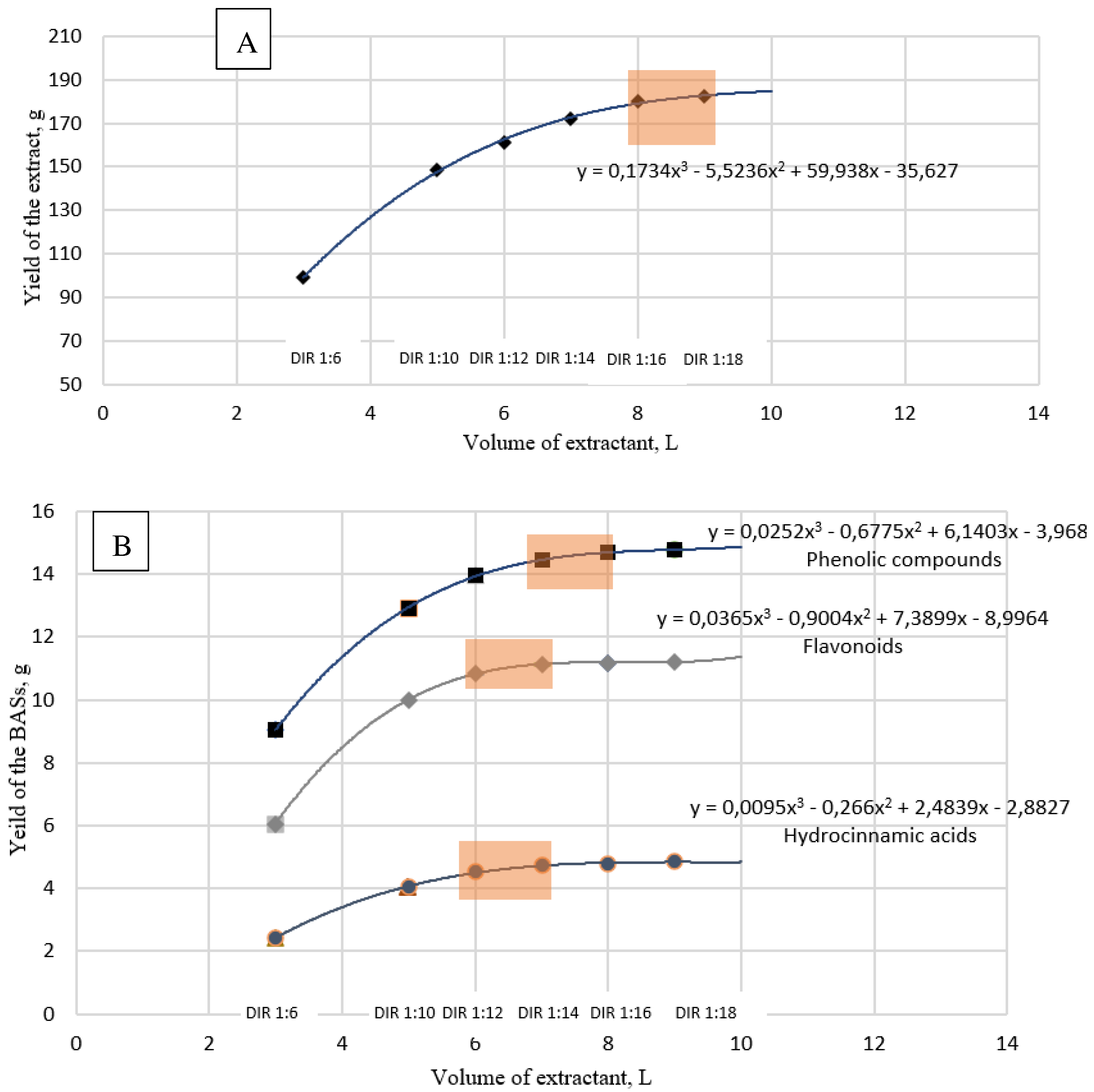
Figure 2.
The cytotoxic effects of the essential oils and the extract sof M. discoidea and M. chamomilla in different concentrations on U2OS (a, b) and BHK-21 (c, d) cells during 48 h of incubation.
Figure 2.
The cytotoxic effects of the essential oils and the extract sof M. discoidea and M. chamomilla in different concentrations on U2OS (a, b) and BHK-21 (c, d) cells during 48 h of incubation.
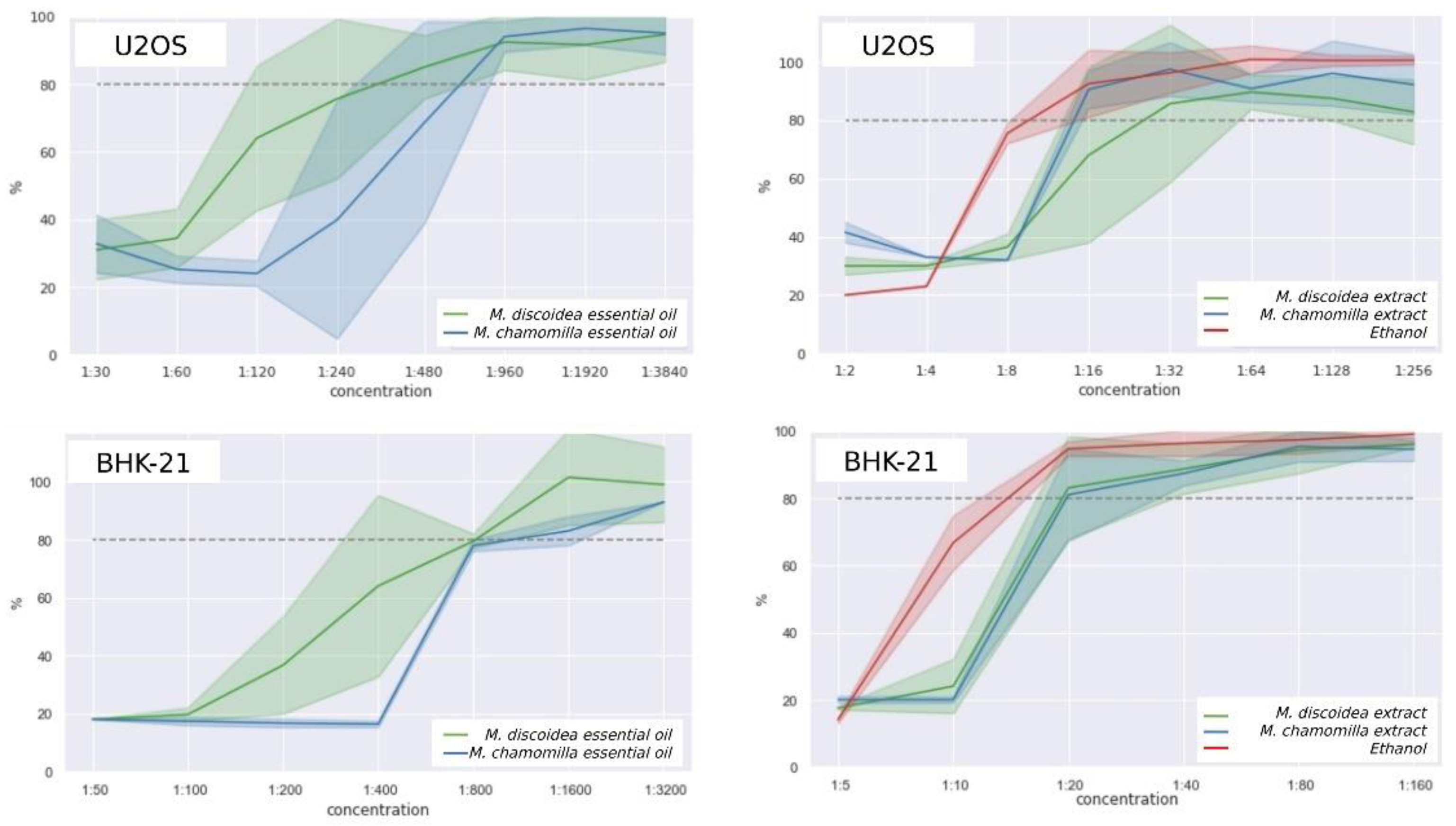
Figure 3.
Joint conformational placement of luteolin-3,7-diglucoside (a) (yellow molecule), rutin (b) (green molecule) and the native inhibitor AKBA (blue molecule) in the active site of LOX-5.
Figure 3.
Joint conformational placement of luteolin-3,7-diglucoside (a) (yellow molecule), rutin (b) (green molecule) and the native inhibitor AKBA (blue molecule) in the active site of LOX-5.
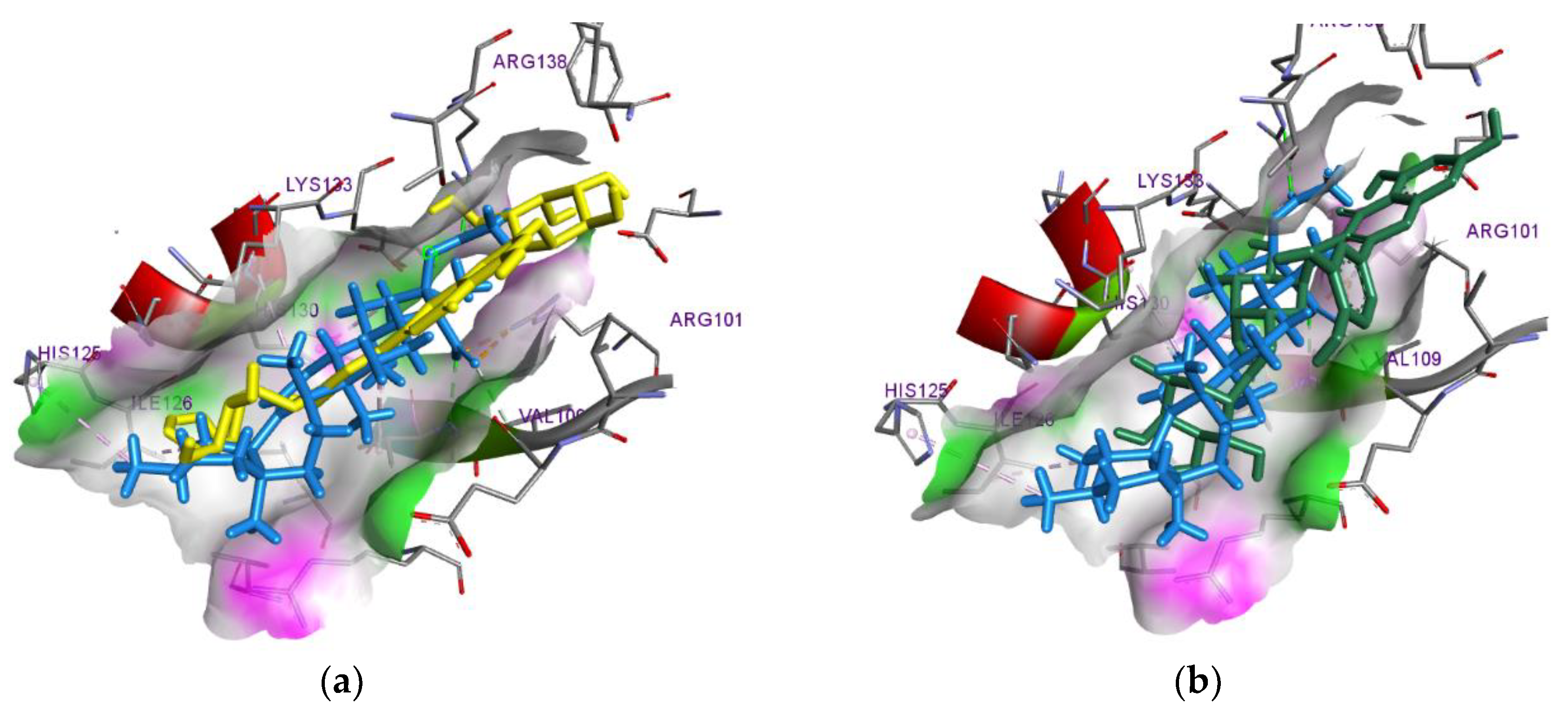
Figure 4.
Joint conformational placement of isorhamnetin (blue), isorhamnetin-3-glucoside (purple), and diclofenac (yellow) in the active site of COX-1; b) interaction of isorhamnetin with amino acid residues of COX-1.
Figure 4.
Joint conformational placement of isorhamnetin (blue), isorhamnetin-3-glucoside (purple), and diclofenac (yellow) in the active site of COX-1; b) interaction of isorhamnetin with amino acid residues of COX-1.
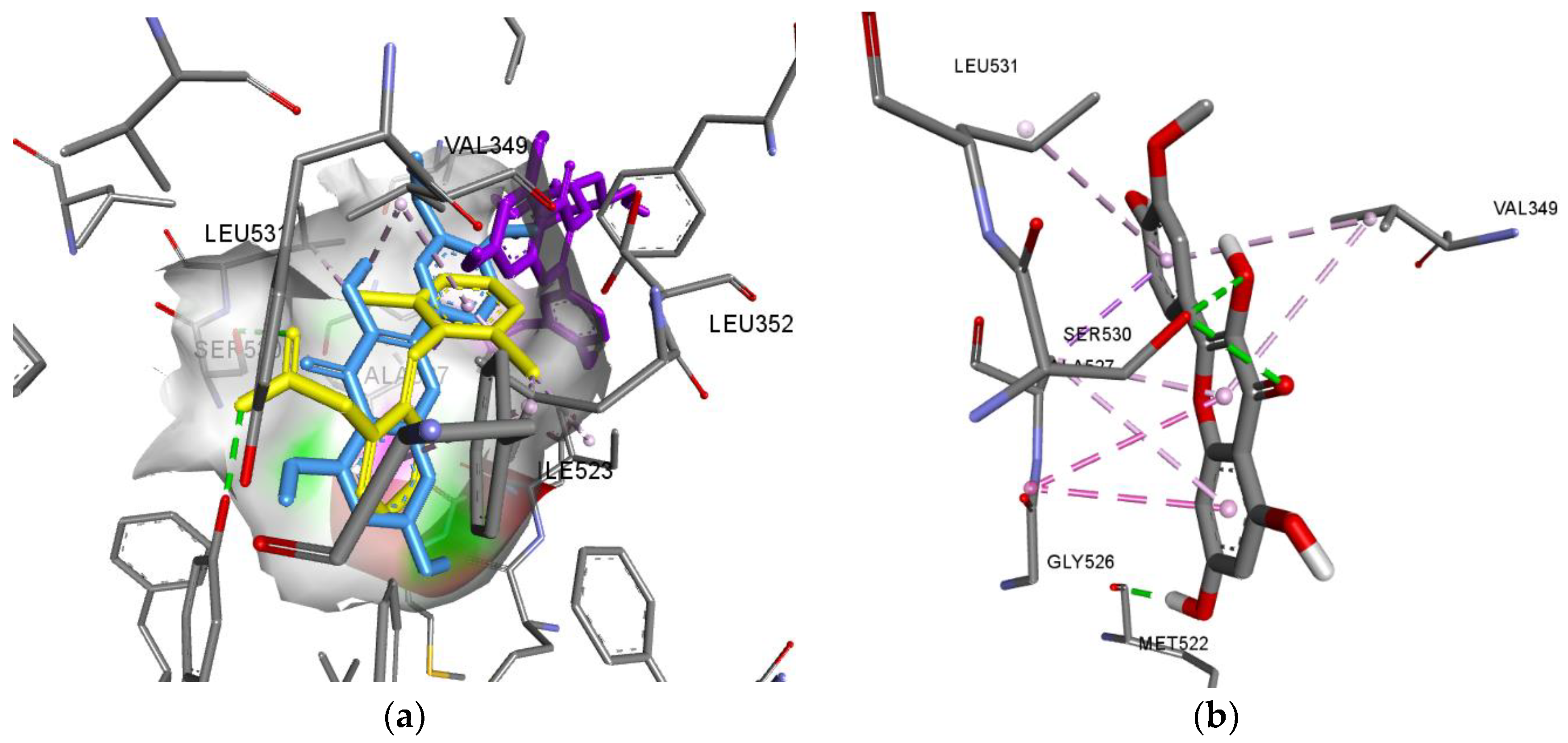
Figure 5.
Joint conformational placement of isorhamnetin (green), luteolin (blue) and celecoxib (yellow) in the active site of COX-2; b) interaction of 4,5-dicaffeoylquinic acid with amino acid residues of COX-2.
Figure 5.
Joint conformational placement of isorhamnetin (green), luteolin (blue) and celecoxib (yellow) in the active site of COX-2; b) interaction of 4,5-dicaffeoylquinic acid with amino acid residues of COX-2.
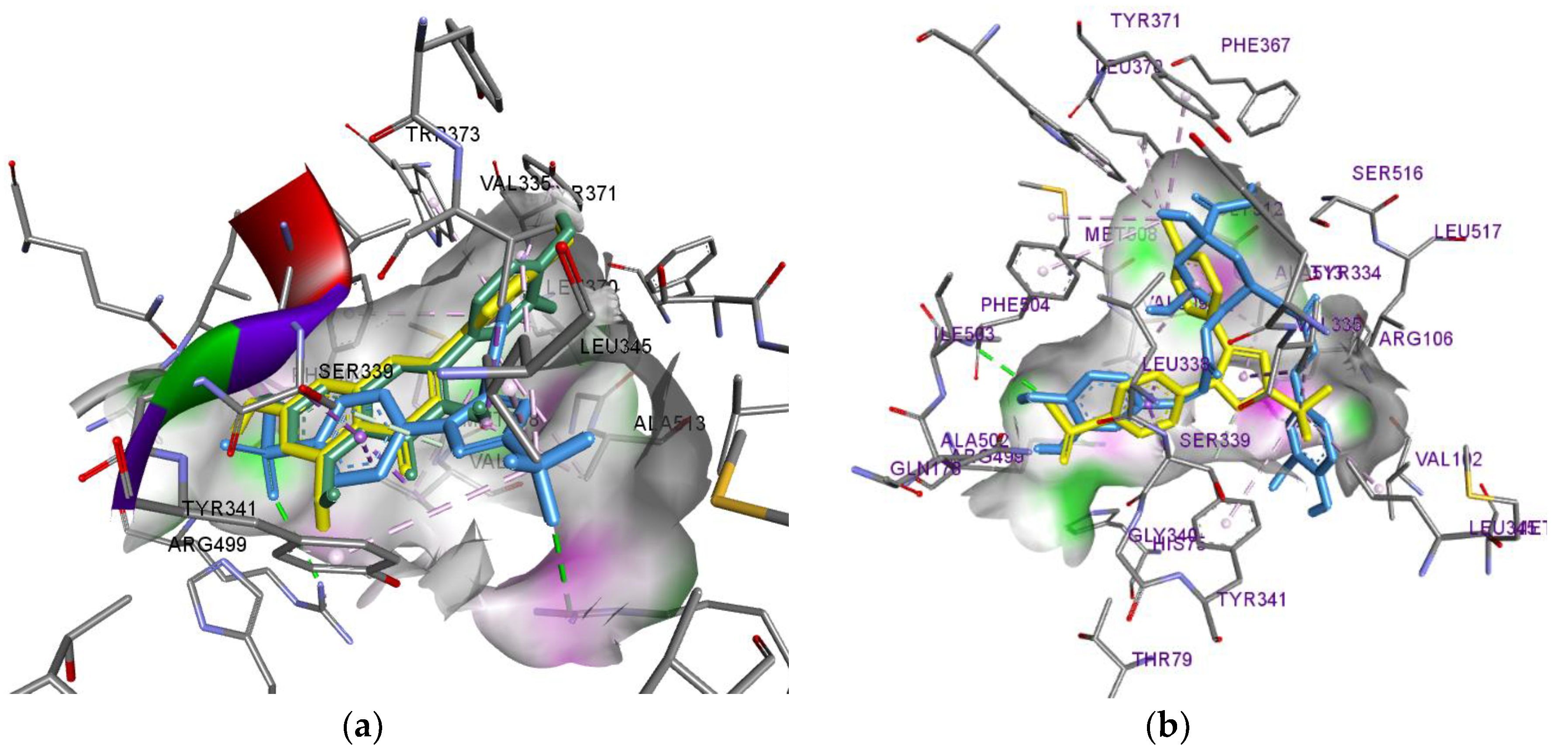
Figure 6.
Visualization of the interaction of 4,5-dicaffeoylquinic acid (a) and luteolin-7-O-glucoside (b) with amino acid residues of the active site of the NMDA receptor antagonist.
Figure 6.
Visualization of the interaction of 4,5-dicaffeoylquinic acid (a) and luteolin-7-O-glucoside (b) with amino acid residues of the active site of the NMDA receptor antagonist.
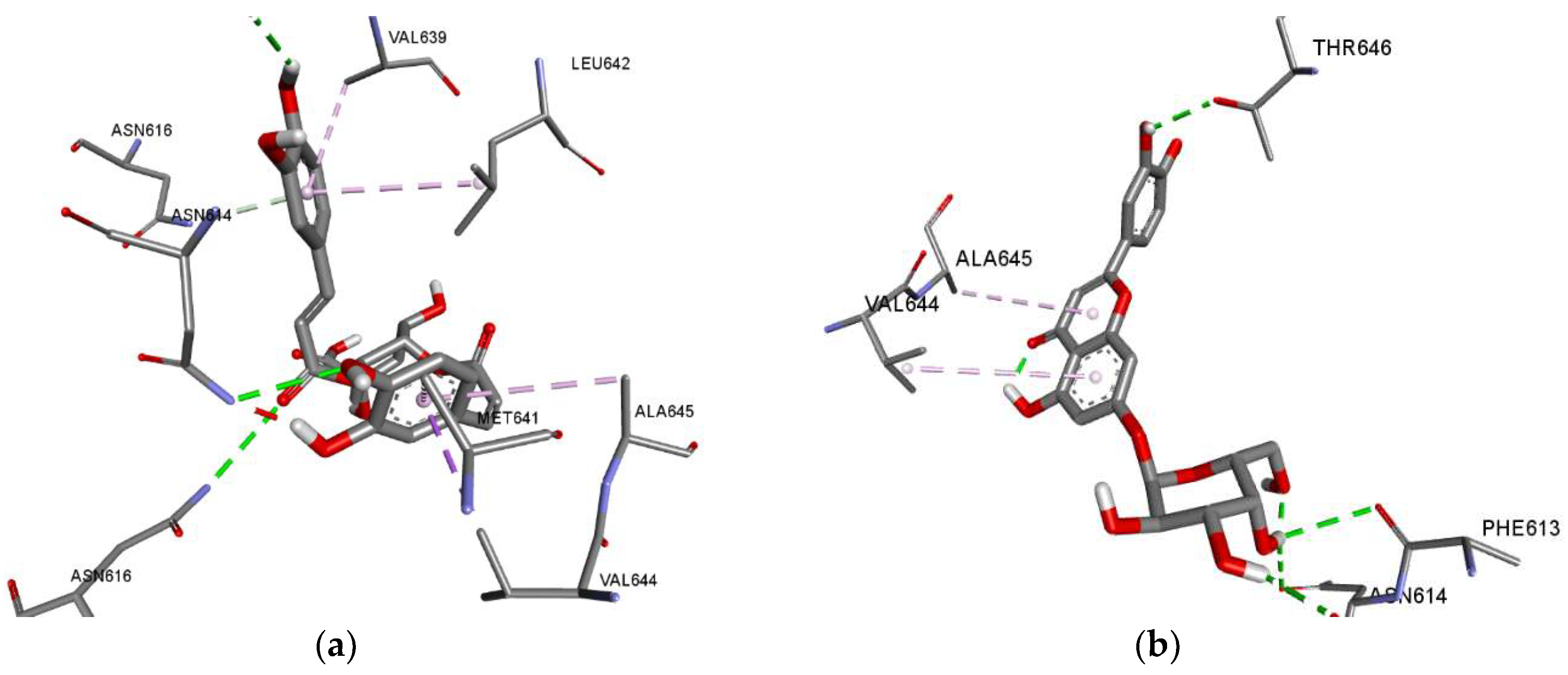

Table 1.
The content of main terpenoids in the M. discoidea herb essential oil.
| RI (DB-5) | Compound | Content in the oil, % | |
|---|---|---|---|
| M. chamomilla* | M. discoidea | ||
| 987 | Myrcene | <0.01 | 7.99 |
| 1455 | (E)-ß-Farnesene | 24.72 | 42.51 |
| 1472 | Germacrene D | 1.01 | 1.23 |
| 1570 | Spathulenol | 2.39 | 1.12 |
| 1609 | Geranyl isovalerate | <0.01 | 29.50 |
| 1649 | α-Bisabolol oxide B | 22.27 | 1.06 |
| 1673 | α-Bisabolone oxide A | 10.40 | 2.11 |
| 1715 | Chamazulene | 7.89 | - |
| 1740 | α-Bisabolol oxide A | 21.78 | 1.48 |
| 1874 | (Z)-Enyne-bicycloether | 8.26 | 8.86 |
| In total | 98.72 | 95.86 | |
*The results are published in [34].
Table 2.
Content of main phenolics in M. discoidea herb extracts.
| Substance | Content in the extract | ||
|---|---|---|---|
| P1 | P2 | P3 | |
| UPLC-MS/MS, µg/g of dry extract | |||
| Neochlorogenic acid | 2109.57 ± 70.12 | 474.21 ± 4.02 | 805.71± 32.49 |
| Luteolin | 271.53 ± 24.12 | 1927.41 ± 70.51 | 114.13 ± 25.62 |
| Cryptochlorogenic acid | 19.81 ± 2.66 | 228.8 ± 17.58 | 23.44 ± 3.11 |
| Luteolin-4-O-glucoside | 6.93 ± 1.07 | 9.27 ± 1.98 | 0 |
| Chlorogenic acid | 3148.29 ± 143.312 | 10836.74 ± 203.23 | 2202.01 ± 20.64 |
| Isorhamnetin-3-glucoside | 49.65 ± 3.11 | 40.52 ± 7.19 | 18.79 ± 1.86 |
| Luteolin-3,7-diglucoside | 117.36 ± 5.927 | 157.59 ± 2.80 | 21.69 ± 2.3 |
| Vanillic acid | 23.87 ± 2.87 | 22.45 ± 1.19 | 14.25 ± 1.18 |
| Caffeic acid | 37.32 ± 3.81 | 32.33± 3.26 | 51.82 ± 5.66 |
| 3,4-Dihydroxyphenylacetic acid | 335.69 ± 9.49 | 117.88 ± 7.33 | 146.11 ± 7.11 |
| Isorhamnetin | 6.6 ± 0.39 | 26.96 ± 2.32 | 8. 4 ± 1.29 |
| Hyperoside | 139.61 ± 1.91 | 194.14 ± 17.13 | 51.95 ± 0.93 |
| Luteolin-7-O-glucoside | 2844.8± 212.97 | 8101.17 ± 1237.03 | 766.53 ± 188.39 |
| 4,5-Dicaffeoylquinic acid | 3339.61 ± 52.33 | 3049.98 ± 143.4 | 925.79 ± 48.57 |
| 3,5-Dicaffeoylquinic acid | 1708.29 ± 26.77 | 1578.86 ± 99.56 | 471.56 ± 26.17 |
| 3,4-Dicaffeoylquinic acid | 3502.78 ± 54.88 | 3233.96 ± 208.24 | 967.68 ± 54.97 |
| Spectrophotometry, % | |||
| Phenolic compounds | 5.62 ± 0.06 | 10.74 ± 0.39 | 3.17 ± 0.08 |
| Hydrocinnamic acids | 1.55 ± 0.28 | 3.31 ± 0.25 | 0.98 ± 0.31 |
| Flavonoids | 2.37 ± 0.13 | 8.09 ± 0.54 | 0.28 ± 0.06 |
Notes: P1 – the dry extract after distillation of essential oil; P2 – the dry extract obtained with 70% of ethanol solution; P3 – the dry xtract after obtaining tincture.
Table 3.
Dynamics of phenolic compounds extraction with 70% aqueous ethanol solution from M. discoidea herb.
Table 3.
Dynamics of phenolic compounds extraction with 70% aqueous ethanol solution from M. discoidea herb.
| Extraction stage | Dry residue, % | Content (%) in the dry residue | ||
|---|---|---|---|---|
| Phenolic compounds |
Hydrocinnamic acids |
Flavonoids | ||
| 1 | 3.57 ± 0.88 | 12.11 ± 0.22 | 2.73 ± 0.07 | 8.75 ± 0.38 |
| 2 | 1.77 ± 0.52 | 10.74 ± 0.16 | 3.91 ± 0.13 | 9.47 ± 0.11 |
| 3 | 1.13 ± 0.09 | 8.96 ± 0.25 | 3.73 ± 0.26 | 5.13 ± 0.15 |
| 4 | 0,.67 ± 0.25 | 7.53 ± 0.53 | 2.59 ± 0.39 | 2.88 ± 0.04 |
| 5 | 0.3 | 7.00 ± 0.15 | 1.55 ± 0.19 | 2.25 ± 0.16 |
| 6 | 0.2 | 4.84 ± 0.18 | 1.01 ± 0.12 | 1.29 ± 0.03 |
Table 4.
Results of predicting the affinity of BAS identified in M. discoidea to the active sites of biotargets.
Table 4.
Results of predicting the affinity of BAS identified in M. discoidea to the active sites of biotargets.
| Ligand | Biotargets | ||||
|---|---|---|---|---|---|
| LOX-5 (6NCF) |
COX-1 (3N8Y) |
СОХ-2 (3LN1) |
NMDA (7EU7) |
ГАМКА (6X3W) |
|
| AKBA | -10,0 | – | – | – | – |
| Diclofenac | – | -8.5 | -8.4 | – | – |
| Celecoxib | – | – | -12.2 | – | – |
| Ketamine | – | – | – | -5.6 | – |
| Phenobarbital | – | – | – | – | -7.3 |
| Neochlorogenic acid | -7.9 | -7.1 | -7.5 | -7.1 | -6.8 |
| Chlorogenic acid | -7.8 | -7.1 | -7.5 | -6.9 | -6.8 |
| Cryptochlorogenic acid | -7.8 | -6.6 | -7.9 | -7.0 | -6.4 |
| Luteolin | -8.1 | -8.1 | -9.8 | -7.4 | -6.6 |
| Luteolin-4-O-glucoside | -9.0 | -5.6 | -8.6 | -8.1 | -6.0 |
| Luteolin-7-O-glucoside | -9.6 | -5.4 | -6.2 | -8.4 | -6.5 |
| Luteolin-3,7-diglucoside | -9.7 | -5.3 | -6.8 | -7.9 | -6.5 |
| Isorhamnetin-3-glucoside | -7.8 | -1.8 | -8.8 | -7.9 | -6.5 |
| Vanillic acid | -6.7 | -6.2 | -6.4 | -4.9 | -5.1 |
| Caffeic acid | -6.0 | -6.5 | -7.4 | -5.1 | -5.0 |
| 3,4-Dihydroxyphenylacetic acid | -6.7 | -6.1 | -6.6 | -5.2 | -4.9 |
| Isorhamnetin | -7.9 | -7.8 | -9.6 | -7.3 | -6.4 |
| Rutin | -8.9 | -0.6 | -3.7 | -9.1 | -6.2 |
| Hyperoside | -8.6 | -2.1 | -8.2 | -7.7 | -6.6 |
| 4,5-Dicaffeoylquinic acid | -8.8 | -6.1 | -9.1 | -8.1 | -7.0 |
| 3,5-Dicaffeoylquinic acid | -9.0 | -6.8 | -8.5 | -7.9 | -7.5 |
| 3,4-Dicaffeoylquinic acid | -8.8 | -6.0 | -8.8 | -7.9 | -7.3 |
Table 5.
The interactions of ligands with the best values of scoring functions with amino acid residues of biotargets.
Table 5.
The interactions of ligands with the best values of scoring functions with amino acid residues of biotargets.
| LOX-5 (6NCF) |
Luteolin- 3,7-diglucoside |
a: Thr104, His130, Leu163, Glu134, Pro164; b: Thr137, Val107(3); c: Arg101(Pi-Cation) |
|---|---|---|
| Rutin | a: Arg68, Arg101, Glu134, His130, Thr137; b: Lys133, Val107(3) |
|
| 3,5-Dicaffeoylquinic acid | a: Arg68, Arg101, Val110, His130, Asp166, Glu108; b: His130, Leu66, Val107 |
|
| СОХ-1 | Luteolin | a: Ser530(2), TYR385; b: Ala527(4), Gly526(2), Val349(2), Leu531 |
| Isorhamnetin | a: Ser530(2), Met522, Ala527; b: Gly526(2), Ala527(4),Val349(2), Leu531 |
|
| Chlorogenic acid | a: Tyr385, Ser530, Tyr385, Met522; b: Val349,Leu359, Ala527, Leu531 |
|
| СОХ-2 | Isorhamnetin | a: Tyr341, Ser516, Ser339, Tyr371; Leu338(2); b:Val509, Val335 |
| Luteolin | a: Tyr341, Ser516, Ile503, Phe504, Tyr371; b: Leu338, Val509(2), Leu338, Val335 |
|
| 4,5-Dicaffeoylquinic acid | a: Arg106, Tyr371, Gly512 b: Val509(3), Tyr341, Val102, Leu345, Ala502 |
|
| NMDA | 4,5-Dicaffeoylquinic acid | a: Asn616(2), Asn614, Leu611, Asn616; b: Val644, Val639, Leu642, Met641, Ala645 |
| Luteolin | a: Phe613, Leu611(2), Asn615(2), b: Val644(2), Val639, Leu642 |
Table 6.
Analgesic activity of the M. discoidea herb extracts in mice (n= 6).
| Agent | Group | Dose, mg/kg | The time of discomfort occurrence (seconds) / Analgesic activity (%) in relation to [control] and (reference drug) | |||||
|---|---|---|---|---|---|---|---|---|
| after administration in | ||||||||
| 30 min | 60 min | 120 min | 180 min | 240 min | ||||
| Intact animals | 1 | 7.10±0.32 | 7.00±0.50 | 7.05±0.28 | 6.98±0,52 | 6.40±0.63 | ||
| Extract P1 | 2 | 25 | 8.85±0.69 / [25%] (-15%) |
9.13±0.77 / [30%] * (-12%) |
10.67±0.49/ [51%] * (1%) |
10.40±0.55/ [49%] * (9%) |
9.12±0.51/ [42%] * (9%) |
|
| 3 | 50 | 10.15±1.49/ [43] (-3%) |
10.30±1.01 / [47%] * (-1%) |
12.15±0.39/ [72%] * (15%) |
11.07±0,54/ [58%] * (16%) |
9.65±0.28/ [51%] * (15%) # |
||
| 4 | 100 | 10.67±2.79 / [50%] (2%) |
12.07±2.40/ [72%] (16%) |
11.12±1.27/ [58%] * (5%) |
10.57±1.19/ [50%] * (11%) |
8.87±1.27/ [39%] (6%) |
||
| Extract P2 | 5 | 25 | 10.63±1.01 / [50%] * (2%) |
10.42±0.88 / [49%] * (0%) |
10.72±0.62/ [52%] * (1%) |
10.47±0.67/ [50%] * (10%) |
9.48±0.92 / [48%] * (13%) |
|
| 6 | 50 | 10.98±0.58 / [55%] * (5%) |
11.67±0.53 / [67%] * (12%) |
12.78±1.87/ [81%] * (21%) |
11.72±1.76/ [68%] * (23%) |
10.10±1.20/ [58%] * (20%) |
||
| 7 | 100 | 11.65±1.46 / [64%] (12%) |
12.72±1.58 / [82%] * (22%) |
12.55±1.53/ [78%] * (19%) |
10.30±0.94/ [47%] * (8%) |
9.93±1.01/ [55%] * (18%) |
||
| Extract P3 | 8 | 25 | 8.97±0.83 / [26%] (-14%) |
9.42±1.31 / [35%] (-10%) |
9.93±1.11 / [41%] * (-6%) |
9.57±0.74 / [37%] * (1%) |
9.00±0.79 / [41%] * (7%) |
|
| 9 | 50 | 7.98±0.47 / [12%] (-24%) # |
9.85±1.17 / [41%] (-6%) |
10.37±1.21/ [47%] (-2%) |
10.08±0.99/ [44%] (6%) |
8.12±1.02 / [27%] (-3%) |
||
| 10 | 100 | 9.07±0.77 / [28%] (-13%) |
10.33±0.65 / [48%] * (-1%) |
11.03±0.75/ [57%] * (4%) |
10.25±1.10/ [47%] * (8%) |
8.75±0.60 / [37%] * (4%) |
||
| Acetaminophen | 11 | 50 | 10.45±0.73 [45%] * |
10.43±0.59 [49%] * |
10.57±0.71 [50%] * |
9.50±0.57 [36%] * |
8.38±0.33 [31%] * |
|
* - Statistical significant (p < 0.05) in comparison to the control group using the Student’s criterion. # - Statistical significant (p < 0.05) in comparison to the group received acetaminophen 50 mg/kg using the Student’s criterion.
Table 7.
Impact of the extracts of M. discoidea herb on the duration of a thiopental induced sleep, t±Δt (n = 6).
Table 7.
Impact of the extracts of M. discoidea herb on the duration of a thiopental induced sleep, t±Δt (n = 6).
| Agent | Group | Dose, mg/kg | Average duration of a sleep, min | Soporific effect, % |
|---|---|---|---|---|
| Control group | 1 | 40 | 87.33±11.56 | 100.0% |
| Extract P1 | 2 | 25 | 180.17±11.37* | 206.3% |
| 3 | 50 | 171.67±2.87* | 196.6% | |
| 4 | 100 | 170.00±9.27* | 195.8% | |
| Extract P2 | 5 | 25 | 243.00±8.07*# | 278.2% |
| 6 | 50 | 215.50±10.57*# | 246.8% | |
| 7 | 100 | 248.67±6.10*# | 284.7% | |
| Extract P3 | 8 | 25 | 165.67±12.26* | 189.7% |
| 9 | 50 | 156.17±10.81*# | 178.8% | |
| 10 | 100 | 167.67±10.11* | 192.0% | |
| Valerian extract | 11 | 2.15 | 185.33±5.42* | 212.2% |
*Statistical significant (p < 0.05) in comparison to the group received thiopental sodium (Student’s test). #Statistical significant (p < 0.05) in comparison to the group received “Valerian syrup AN NATUREL” (Student’s test).
Disclaimer/Publisher’s Note: The statements, opinions and data contained in all publications are solely those of the individual author(s) and contributor(s) and not of MDPI and/or the editor(s). MDPI and/or the editor(s) disclaim responsibility for any injury to people or property resulting from any ideas, methods, instructions or products referred to in the content. |
© 2024 by the authors. Licensee MDPI, Basel, Switzerland. This article is an open access article distributed under the terms and conditions of the Creative Commons Attribution (CC BY) license (http://creativecommons.org/licenses/by/4.0/).
Copyright: This open access article is published under a Creative Commons CC BY 4.0 license, which permit the free download, distribution, and reuse, provided that the author and preprint are cited in any reuse.


