

Submitted:
05 February 2024
Posted:
07 February 2024
You are already at the latest version
Abstract
The objective of this research was to create a Spanish-adapted version of the 30-item Multidimensional Ethics Scale (MES-30), analyze its structural validity, and create a short, valid, and culturally-adapted version. A total of 594 employees from organizations operating in different industries, primarily located in Ecuador, participated in this study. The comparison of different models using Confirmatory Factor Analysis (CFA) showed that the bifactor model proved better fit in all scenarios. The high common variance explained by the general factor (> 80%) and the high values of ωh (> .90) led to the conclusion that the explanatory model of the adapted MES-30 is essentially one-dimensional. In order to obtain a more valid and reliable measurement of the substantive common factor, a short version (Spanish MES-15) has been proposed, which contains items from all philosophical approaches and three non-redundant scenarios. The one-dimensional model for the Spanish MES-15 showed excellent goodness of fit in all scenarios. Regarding the metric equivalence between the original instrument (adapted MES-30) and the short one, the correlation between both measurements was greater than .90, the correlation of the short version with the social desirability scale was lower, and both instruments similarly predicted the intention of executing the actions described in the scenarios, the probability of executing the actions attributed to peers and supervisors, and the general ethical evaluation of those actions.
Keywords:
Multidimensional Ethics Scale
; MES
; Spanish short version of MES
; construct validity
; ethical judgment/evaluation
1. Introduction
Ethical propositions adopted by organizations guide policy development and implementation, as well as the implementation of decision-making and control processes [1]. Therefore, given the negative consequences of ethically questionable behaviors of an organization's members, for it and its stakeholders [2,3,4], organizations progressively acknowledge the need to pay more attention to these matters [5,6]. In a parallel manner, business schools proceeded to integrate ethics into their academic programs, and research on ethical behavior at work increased exponentially [4,7]. The scientific knowledge on this matter has gone from theoretical propositions, the classification of ethical approaches, and the description of workers' moral development [4,8], to the empirical testing of assumptions supporting such developments and improving the ethical dimension in management practice [8,9,10].
A key component of historically relevant ethical decision-making models, such as Rest's [11] four-component model and Jones' [12] issue-contingent model, is ethical judgment or ethical evaluation. This component consists of a cognitive process whereby a person determines the extent to which a matter, situation, or action is ethically correct [3,4,13,14,15,16]: a cognitive contrast between what is right and what is wrong [4]. Following the theory of reasoned action [17], ethical judgment corresponds to a person's attitude towards an ethically questionable behavior.
Despite the simplicity and clarity of the ethical judgement construct, there is great disparity and controversy regarding empirical findings, to such an extent that some authors doubt there has been significant progress in it's understanding [14,18,19]. On the one hand, some researchers question the validity and reliability of measurements of ethical judgement traditionally used [14]. On the other hand, the variety of findings reveal the need for newer research efforts, particularly in countries others than those producing most of the studies [13,20,21,22]. Members of each society and culture share a system of values, beliefs, moral standards, and customs learned and transmitted during the socialization process, and manifested in particular legal, socioeconomic, and governmental conditions. Consequently, people with different cultural backgrounds can perceive and evaluate ethical situations differently [1,20,23], which affects their decisions in all fields of action [12,24].
Different findings show that ethical evaluations of specific actions —and, therefore, ethical decisions— vary by region and culture [20,24,25,26,27]. Even differences in factor structures of instruments designed to evaluate ethical judgements appear when comparing professionals and students from different cultures and subcultures [13,23,28]. Moreover, relationships between ethical judgements and certain individual and organizational variables vary among employees from different countries [1]. Therefore, it is necessary to develop valid, reliable, and culturally-adapted instruments to measuring ethical judgements.
1.1. Measuring ethical judgements: MES
The Multidimensional Ethics Scale (MES) developed by Reidenbach and Robin [29] is one of the most widely used in behavioral ethics to measure the ethical judgements of students and employees in a broad range of areas [3,7,8,14,30,31,32].
The development of the MES began by acknowledging that: (a) when people express ethical judgements, they use different reasonings, thus the common measurement with a single evaluation item is inadequate, because it does not provide information on the ethical perspective wherefrom the judgement derives; (b) ethical judgements are influenced by different philosophical theories, besides deontology and utilitarianism; and (c) it is not advisable to skip the socialization process occurring in an ethically pluralist culture [4,29].
The first MES version [29] intended to study how people from the United States of America ethically evaluate certain practices and activities within a retailing/marketing context, according to five perspectives, approaches, or moral philosophies: (a) deontology, (b) justice/moral equity, (c) relativism, (d) egoism, and (e) utilitarianism [29,33,34,35]. Deontology states that people must satisfy the legitimate demands or needs of the others, by applying logic to laws or universal ethical propositions about right and wrong [3,8,13,20]. The duties of one person towards another create rights for the other [36]. According to this approach, whether an action is ethical or not is determined by the action itself, which is inherently good or bad, right or wrong [13,24,37,38], and the reasons or character of the actor [8], not by the consequences or results of such action [7,13,24,37].
Justice/moral equity is a subcategory of deontology [37], based upon Aristotle's "formal justice" principle: those who are equal shall be treated equally, and those who are unequal shall be treated unequally [3,7,8,32,39]. This justice concept relates to that of distributive justice [8,13,36]: people treated with justice receive what is due or what they deserve or can legally claim, regardless of whether it is a benefit or a burden [5,6,8,40]. Besides, this concept relates to procedural justice, which implies equal and fair treatment [37], and equal rules and procedures [8,36].
The pivot point of relativism is that normative beliefs depend on individual, situational, and cultural aspects. Given the fact that the behavioral rules of a culture are not necessarily applicable to other cultures, there are no universal ethical rules nor objectively justifiable principles applicable to everyone [5,6,8,13,20,24,32,36,37,39,40,41]. Therefore, people must be flexible when deciding whether a behavior is ethically right or wrong [7].
Egoism belongs to the category of teleological ethical theories [8,13,27,37,38]. It relates to the ideas of prudence, self-promotion, what is best for personal interests, what produces more personal pleasure or satisfaction as a means of pursuing the "good" [3,7,8,24,27,29,32,36]. This concept implies a moral idea derived from the consequences of the action for the person who does it [5,6,13,24,36,37,39,40]. Thus, a person can regard an action as ethical if it benefits the interests of the one who does the action [20,23,25,39,41,42].
Utilitarianism is another subcategory of teleological ethical theories [8,13,27,37,38], that focuses too on the consequences of judged actions [7,8,37,39,41]. According to this approach, the action must produce the best possible balance between good and bad, compared to all alternative actions, for the largest number of people [3,5,6,8,13,23,24,25,27,32,42,43]. This reasoning applies a cost-benefit comparison: the most ethical action is the one that leads to the greater good, advantage, pleasure, or happiness, which brings more benefits while minimize costs or undesirable consequences [3,8,13,24,25,36,37,39].
The MES' original version consisted of 30 items (three for justice/moral equity, five for relativism, seven for egoism, nine for utilitarianism, and six for deontology) that collect individuals' ethical judgements, through seven-interval semantic differential scales, about the actions done by the protagonists of three scenarios or vignettes describing situations with ethical implications [36], developed by Dornoff and Tankersley [44].
After a refinement process of the MES-30, Reidenbach and Robin [36] created a short eight-item version (MES-8). According to criteria such as consistency of factor loadings across all scale/scenario data sets, size of factor loadings, and correlations between items of different dimensions, all utilitarianism and egoism items were excluded from the MES-8; i.e., the items regarding cost-benefit comparisons. The MES-8 consisted of three factors: moral equity, relativism, and contractualism or social-contract [36].
Besides the MES-30 and MES-8, there are different versions adapted by other researchers to overcome criticisms of the original scales. For instance, Hyman [45] used a 31-item version that included three items about religion and the Golden Rule. López-Paláu [28] created a 21-item version to evaluate the five philosophical approaches and two additional ones: religion and care. Tsalikis and LaTour [25], and Tsalikis and Nwachukwu [26] used a 20-item version. Kujala [31] used a 17-item version wherein he added four items created by him. Cohen et al. worked with a 15-item version [30] and another 12-item version [34,39]; the latter has also been used by Centurión-Rodríguez et al. [46], Cruz et al. [41], López-Paláu [13], and Shawver and Sennetti [47]. Razzaque and Hwee [1] used an 11-item version made up of 10 items taken from Reidenbach and Robin [29], and another item created by them. Buchan (37 2014) used a 10-item version: eight from Reidenbach and Robin [36] and two utilitarianism items adapted from the version proposed by Cruz et al. [41]. Lin and Ho [20] also used a 10-item version, taken from Cohen et al. [30], to measure justice, relativism, egoism, and deontology.
Other researchers either used the items of some moral philosophies (e.g., Tansey et al. [48] used six moral equity and relativism items) or analyzed as different elements some constructs originally regarded as dimensions of the same construct (e.g., Valentine & Rittenburg [27] measured teleological evaluation using three utilitarianism items, and ethical judgement using four moral equity items, and they worked with utilitarianism and moral equity as different constructs). Some researchers used Likert scales, which implies creating propositions, so people can choose their degree of agreement [31,45]. Reidenbach & Robin [36] reported no difference between Likert and semantic-differential scales.
1.2. MES strengths and weaknesses
The MES offers an ethical evaluation perspective that goes beyond deontology and utilitarianism [15]. It includes specific moral reasoning modes [34]. It allows a more precise description of the ethical judgement than that provided by single-item measurements [15]. And it also allows identifying specific errors within the moral reasonings made by professionals or people working in specific fields [34].
Despite these strengths and the popularity of the MES, its different versions do not escape criticism. For instance, some semantic differential scales are ambiguous, and some others contain contradictory rather than opposite poles, as expected in these types of scales [49]. There are dimensions in the MES-8 and MES-12 [34,39] evaluated by few items: two items for each relativism and contractualism in the MES-8; the same goes for egoism, utilitarianism, and contractualism in the MES-12. A scarce number of items evaluating each theoretical dimension compromises the stability of the factor solution [50].
The MES-8 lacks utilitarianism and egoism [8,24,30,49], generally considered relevant dimensions of ethical judgement [8,30]. The criteria used to choose the MES-8 items were arbitrary, and the screening process, depending on just factor analysis, neglected other important criteria [49]. Besides, though response distributions were remarkably asymmetric, the data were not normalized [49,51], nor were polychoric correlation matrices analyzed according to the data ordinal level of measurement [50,52].
A particularly problematic aspect of the MES is the instability of its factor structure. The number and composition of factors do not correspond to the a priori dimensions of moral philosophy [1,5,7,8,13,28,29,30,36,42,43,48,53,54]. We reviewed 30 research reports evaluating the psychometric properties of different MES versions for the present study. None of the studies with the MES-30 confirmed the five-dimension theoretical structure [5,8,29,32,42]. Only 20% of the studies confirmed the three-factor structure of the MES-8 [4,18,38,40,55,56], whereas only 13% of them confirmed the factors expected in other MES versions [20,34,39,41]. Moreover, some of the factors found were not interpretable [8], and some studies found different factor structures, based on gender [42], race [23], or country of origin of participants [28], as well as the particular samples used, even if they came from the same country [31].
Reidenbach and Robin [29] initially assumed that factors were orthogonal. However, significant, positive, and high correlations between factors emerged in some studies with different MES versions [4,7,27,32,40,42]. Reidenbach and Robin [36] acknowledged that, although each philosophical approach has its own base concept, high correlations between factors or items referring to a construct (ethical judgement) that embodies overlaying ethical philosophies should not surprise. Even with the MES-30, the one-dimensional model showed fit levels as good as those of the five-correlated factor model [32], and a second-order model (a general factor and various specific factors) has better fit than multidimensional models [37].
The analysis of the MES structural validity requires considering the methodological weaknesses of many studies. The factor structure has been predominantly evaluated using exploratory factor analysis (EFA) —83% of the 30 studies herein analyzed applied this statistical method—, with principal components extraction, orthogonal rotation, and Kaiser's eigenvalues rule > 1.0 to determine the number of factors, despite the criticism against these extraction and rotation methods [50,52] and the recommendation of not using the Kaiser's rule [32,50,52].
Since early studies by Reidenbach and Robin [29] findings systematically show that the MES factor structure changes depending on the scenarios used [5,7,8,28,29,30,31], and that structural models including scenario-specific factors provide much stronger fit than substantive-factor models [3,32]. This makes sense considering that ethical judgements closely relate to details of the judged situation. Therefore, the measurement of this construct demands special attention not only to the combination of items included in the questionnaires, but also to the "content" of the judgements; i.e., what people are asked to judge [14,19].
The scenarios used by many authors are brief descriptions of situations referred to a single problem. Such simplicity can inadequately represent real-life ethical problems, which tend to be more complex [18]. Besides, many studies use scenarios with ambiguous themes [14,19] or lacking enough details about the reasons for the questionable behavior, leading participants to suppose those reasons, to "fill in the blanks". Consequently, some could regard an action as unethical, while others consider it acceptable, or vice versa [49].
Despite the relevance of the content presented in scenarios used to elicit responses, researchers paid little attention to this matter when using the MES. Some use different scenarios either created by them or adapted from other studies, but few of them explain why they use such specific scenarios [14]. Besides, even when using scenarios from other studies, they often introduce differences in certain details that can bring about unexpected or ambiguous results.
Research experience highlights the need —mentioned by Reidenbach and Robin (1990) and pointed up by Flory et al. [18] and McMahon and Harvey [32]— for evaluating the validity of the MES across a wide variety of business ethics applications and with different groups, not just to know the dimensions truly evaluated by this instrument, but also to determine the extent to which the measurement is independent from the context.
Therefore, this research has two purposes: on the one hand, to evaluate the psychometric properties of the adapted 30-item Multidimensional Ethics Scale (MES-30) of Reidenbach and Robin [29,36], which is considered the standard measurement tool to evaluate ethical judgements in business research [49], and to analyze its structural validity in a Latin-American context. On the other hand, this research aims at developing a valid, reliable, easy-to-use, and culturally-adapted short version of the MES for using it in both academic and business contexts.
2. Materials and Methods
2.1. Participants
This study involved 594 employees (65.3% women) from different organizations (69.7% private), mostly in service (65.7%), industry (14.0%), and commerce sectors (13.6%). Ages ranged from 22 to 71 years (M = 35.26; SD = 8.20). Participants have lived most of their lives in Ecuador (94.4%) and other Latin-American countries (5.3%). Most of them had college-level education (66.8% obtained an undergraduate university degree and 33% completed postgraduate studies).
Most of the participants worked as professionals (60.4%) or as area directors/managers/coordinators (22.9%), full-time (88.9%), under fixed-term and indefinite contracts (69.2%), in customer service (21.7%), administration (18.4%), production/operations/logistics/process (18.0%), finance (16.3%), and marketing/sales (8.9%) departments. Regarding work experience, 46.1% of the participants had more than 10 years, 26.3% had between 1 and 5 years, while 23.2% had between 5 and 10 years. Participants have worked for the same organization between 1 and 5 years (36.5%), between 5 and 10 years (25.1%), and more than 10 years (22.7%).
This research was reviewed and approved in March 2022 by the committee appointed by the Research Center of Espíritu Santo University, which certified that this research conforms to ethical research norms. Following the ethical principles of psychologists and the code of conduct of the American Psychological Association [57], participation in this study was voluntary, and all subjects provided a digital informed consent after receiving information about: (a) the purpose of the research and expected duration; (b) their right to decline to participate and to withdraw from the research once participation has begun, without consequences; and (c) the person to contact for questions about the research. Given the characteristics of this research, participating in it imply neither any kind of physical or psychological risk for the participants, nor subjecting participants to conditions that could cause them discomfort or adverse effects. All data treatment was confidential, and data access restricted only to the study authors. Participants in this study received no specific incentive.
2.2. Materials and instruments
2.2.1. Scenarios: Adaptation and selection
The scenarios' selection followed guidelines from the research by Mudrack and Mason [14,19], who identified six generic themes within the scenarios frequently used in ethical judgement research. Considering the realities of different Latin-American countries and, consequently, the extent to which each scenario could turn out evocative, realistic, and comprehensible, the 29 scenarios selected and reviewed for this study were those listed by Mudrack and Mason [14] as examples of classic, conspiracy, and runaway trolley themes (Appendix A). Mudrack and Mason [14] point out the following characteristics of these scenario categories.
- Classic: (a) the protagonist willingly chooses the action, without any rule or control of others; (b) the protagonist obtains a personal benefit from the action; (c) the scenario clearly identifies a victim of the action; and (d) the protagonist's action is the most questionable one described in the scenario.
- Conspiracy: (a) the protagonist willingly chooses the action, without any rule or control of others; (b) the protagonist obtains a personal benefit from the action; (c) the scenario does not clearly identify a victim of the action; and (d) the protagonist's action is not the most questionable one described in the scenario.
- Runaway trolley: (a) the protagonist willingly chooses the action, without any rule or control of others; (b) the protagonist does not obtain a personal benefit from the action; (c) the scenario clearly identifies a victim of the action; and (d) the protagonist's action is the most questionable one described in the scenario.
Two independent translators rendered the scenarios into Spanish. Subsequently, for controlling potential extraneous variables, assessments and adaptations of such translations aimed at maintaining the meaning of the original texts, while sticking to the following criteria: all scenarios clearly identify the protagonist's action, a single person (a male protagonist) execute the action, the action description appears in present tense, the scenarios do not contain information that could alter their moral intensity level, and no mention is made of celebrations or contexts alien to the population answering the instrument.
The initial number of scenarios lowered to 25. However, such number was still extremely large. A second analysis aimed at selecting five scenarios from each theme, by considering the following aspects: (a) context of the action; (b) clear identification of protagonists, victims, and/or beneficiaries; (c) content similarities among scenarios; and (d) realism of the situations.
All five initial scenarios of the "classic" theme satisfy the criteria. Eight scenarios of the "conspiracy" theme were deleted for different reasons: (a) the alleged conspiracy was not explicit, so the reader should deduce it (scenarios 4 and 8 from Dornoff & Tankersley [44]); (b) the protagonist was not a moral agent, but an abstract being, such as a company (scenario 1 from Valentine & Rittenburg [27]); (c) the sales situation was unrealistic for some Latin-American countries (scenario 6 from Reidenbach et al. [56]); and (d) the situations therein described were very similar (“New Market” scenario from McMahon [58], scenarios 1A-F2 and 3A-F2 from Tsalikis & Nwachukwu [26], scenario 7 from Valentine & Rittenburg [27, p. 10]). We discarded two scenarios from Marques and Azevedo-Pereira [59] and five from Radtke [60] of the "runaway trolley" theme, because the described situations were unrealistic for some Latin-American countries. To have five scenarios of such a theme, we modified the wording of scenarios 6 and 7 from Radtke [60]. Thus, without modifying its essence, in scenario 6 the action does not occur in the stock market, whereas in scenario 7 the action occurs in an organizational context with characters identified by surnames.
Ten experts (6 Venezuelan and 4 Ecuadorian), in the fields of business, ethics, and research methodology, evaluated the selected 15 scenarios. The judges indicated their degree of agreement with a series of propositions referring to the four criteria that, according to Mudrack and Mason [14], allow classifying the scenarios in different theme categories. Moreover, the judges evaluated the extent to which each scenario: (a) described a situation that could occur in the organizational context of their countries (realism); (b) provided adequate information to evaluate the morality of the described action; (c) referred to an ethically relevant matter, which is an essential aspect for different authors [16,54]; and (d) the writing was easily understandable. Finally, the judges evaluated whether the action described was ethically right. In all cases, the judges gave their opinions using five-interval Likert scales (1 = strongly disagree; 5 = strongly agree).
Regarding the criteria used to list the scenarios in the different themes, 70% or more of the judges agreed or strongly agreed that the criteria were met (freedom of choice, personal benefit, victim identification, and most questionable action) in only two scenarios of the “classic” theme. Besides, all evaluators agreed that those scenarios described situations that could occur in organizations of their countries; and 90% agreed or strongly agreed that such scenarios provided adequate information to evaluate the morality of the action, 70% or more agreed or strongly agreed that the scenarios referred to ethically relevant matters and the writing was easily understandable. Finally, 70% disagreed or strongly disagreed that the actions described were ethically right.
With respect to the “conspiracy” theme, 70% or more of the evaluators agreed or strongly agreed that the protagonist had freedom to choose and obtained personal benefits in just two scenarios. There were doubts about the identification of the victims and whether the action was the most questionable one. Therefore, those were adequate "conspiracy" examples. Furthermore, all evaluators agreed that these scenarios described situations that could occur in organizations of their countries, referred to ethically relevant matters, and were not ethically right. Likewise, 80% or more agreed or strongly agreed that the scenarios provided adequate information to evaluate the morality of the action, whereas 90% agreed or strongly agreed that the writing of such scenarios was easily understandable.
Concerning the "runaway trolley" theme, 90% of the judges considered that the protagonists had freedom to choose their action in two scenarios. There were doubts as to whether the protagonists obtained personal benefits. More than half of the evaluators agreed or strongly agreed that the scenarios allowed to clearly identify the victim(s) of the action. There was no clear agreement among the judges regarding whether the action was the most questionable one: 40% either agreed or strongly agreed, whereas 30%–40% chose neither agree nor disagree. Regarding realism, 70% or more considered that these scenarios described situations that could occur in organizations of their countries, and provided adequate information to evaluate the morality of the action. Whereas 80% stated that the described actions referred to ethically relevant matters and were not ethically right. Lastly, more than 70% agreed or strongly agreed that the scenarios' writing was easily understandable. Thus, the final study used the six scenarios shown in Table 1.
2.2.2. Spanish adaptation of the MES-30
Considering the criticism of different MES versions, the MES-30 was adapted to the Spanish language, according to the following reasons: (a) although some research have reported translations of different MES versions [e.g., 13, 28, 46, 63], none of them aimed at actually adapting the instrument; (b) the MES-8 does not contain items from the utilitarianism and egoism philosophical approaches, which provide relevant criteria for ethical judgment; and (c) both MES-8 and MES-12 contain philosophical approaches evaluated by a very little number of items. Only the MES-30 follows the recommendation that there should be at least three items per factor [50].
Following Kujala [31] and Hyman [45], the items of this adaptation appear as propositions followed by degree-of-agreement Likert scales, instead of semantic differential scales. The reasons therefor were: (a) in many items, it was impossible to establish scales with clearly opposite (not contradictory) poles and with a clear meaning in Spanish; (b) Likert scales are easier to understand for participants and easier to use for researchers [45]; and (c) the factor structure of the instrument does not differ depending on the scale type [36].
The drafting of the items follows the English version by Hyman [45], and it included only the items of the philosophical approaches considered in the original instrument [29,36]. The researchers compared and analyzed the translations made by two independent translators and solved the discrepancies, according to the theoretical considerations of each philosophical approach, thus ensuring the conceptual and semantic equivalence between the adapted, the original [29,36], and Hyman's [45] versions. To reduce ambiguity, we specify the perspective intended in the “culturally acceptable”, “traditionally acceptable”, and “personally satisfying” items, thus making clear the reference to the culture and traditions of the respondent's home country, and to whether the action turned out to be satisfactory for the person who, according to the text, did the action. Finally, the writing of items in present tense and without reverse items aimed at avoiding systematic errors capable of affecting the scale's validity [64]. Table 2 shows the items of adapted MES-30.
Finally, as commonly observed in studies evaluating the MES' predictive potential, we added four items conceptually derived from the theory of reasoned action [17], and widely used in behavioral ethics [65]. These four items evaluate (a) behavioral intention ("The probability that I do the same action is..."); (b) subjective norm ("The probability that my peers do the same action is..." and "The probability that my supervisors do the same action is..."); and (c) general ethical evaluation ("The described action is ethically..."). The instrument uses 5-point Likert scales; from 1 (low) to 5 (high) for the first three items, and from 1 (wrong) to 5 (right) for the last item.
2.2.3. Social desirability measurement
A relevant bias when measuring ethical judgement is social desirability [66–70]. This construct was measured using the Form A of the 11-item Marlowe-Crowne Social Desirability Scale (MC-SDS-Form A) [69]. The Spanish translation follows the 33-item translated version of Ferrando and Chico [71].
The MC-SDS is one of the most widely used instruments to measure social desirability [67,69,70,72,73,74,75,76,77], which refers to the person's need to conform to socially acceptable values, avoid criticism, or obtain social approval [70,74,78], to create a favorable or socially desirable impression in front of others [70,73,74,75,77,78,79,80,81]. In the MC-SDS participants answer true or false to a set of items about socially desirable, but infrequent behaviors, and to another set about frequent, but socially deviant behaviors [66,67,72,74,77,78].
2.3. Data analysis
Considering findings that indicate that the MES structure varies depending on the scenarios presented [5,7,8,28,29,30,31] and the approach adopted in most of the studies about this instrument, the evaluation of the adapted MES-30's structural validity followed a within-scenario approach.
This study consisted in applying three models using CFA for each scenario: (a) the five-factor model (one per each philosophical approach) initially proposed by Reidenbach and Robin [29]; (b) the one-dimensional model found with best fit by McMahon and Harvey [32]; and (c) the bifactor model (five specific factors and one general factor), which, according to Buchan [37], shows better fit than that of the several-correlated-factor model.
The software used for the CFA was the Lavaan package [82] for the R program (version 4.1.0). We used the estimator weighted least squares robust (WLSMV), using a polychoric correlation matrix. This estimator is recommended for analyzing samples with a small-moderate number of observations with ordinal data [83,84]. The following indices provided information for the CFA model fit evaluation: χ2 test, root mean square error of approximation (RMSEA), standardized root mean square residual (SRMR), comparative fit index (CFI), and Tucker-Lewis index (TLI). And the following criteria allowed evaluating model fit: RMSEA < 0.08, SRMR ≤ 0.08, CFI and TLI ≥ 0.95 [85].
The Lavaan package for the R program also allowed evaluating the fit to the one-dimensional model of the short version developed (Spanish MES-15), using the WLSMV with a polychoric correlation matrix. A Multiple-Group Confirmatory Factor Analysis (MG-CFA) aided in determining whether the Spanish MES-15 was invariant in all scenarios. The weak or metric invariance property was taken as a minimum criterion for scenario selection. The SPSS 25.0 software was used for the correlation and regression analysis aimed at evaluating the predictive validity of the adapted MES-30 and the Spanish MES-15.
3. Results
Regarding the structural validity of the adapted MES-30, the bifactor model showed better goodness of fit (Table 3), and the analysis showed a statistically significant difference (p < .001) between the three models tested in all scenarios.
Besides, the common variance explained by the general factor (ECV-G) was greater than 80% and the ωh was greater than .90, which allows assuming essential one-dimensionality (Table 4).
Given the finding that the adapted MES-30's structure adjusted to a bifactor model, with verified essential one-dimensionality, and the purpose of producing a short version without loosing information about the ethical perspective used by the individuals to make their judgements, the analysis of items' loadings in the general and specific factors (Appendix B) led to select the three items of each philosophical approach with higher loadings in the general factor and lower loadings in the corresponding specific factor.
Additionally, to ensure that these items were good indicators of the respective philosophical approach, we evaluated the contents of all items that met these criteria. Thus, the short version (Spanish MES-15) consisted of the following items: 1, 2, 3, 5, 6, 8, 11, 12, 13, 17, 18, 19, 26, 28, and 30. This scale showed excellent fit to the one-dimensional model (Table 5) and high discrimination, as revealed by the loadings (Table 6), in all scenarios.
The Spanish MES-15 showed significant (p = .01) and very high correlations with the adapted MES-30 (S1: r = .956. S2: r = .905. S3: r = .932. S4: r = .923. S5: r = .969. S6: r = .929), thus confirming very little information loss with the Spanish MES-15. Besides, the correlations between the Spanish MES-15 and the MC-SDS-Form A were lower than the correlations between this social desirability scale and the adapted MES-30 (Table 7) in all scenarios.
The Spanish MES-15 showed excellent predictive validity. Its scores significantly predicted (p < .001) the intention of the individuals to execute the indicated actions, the probability that their peers and supervisors execute such actions, and the actions' general ethical evaluation in all scenarios. In fact, the Spanish MES-15 predicted both the intention and the general ethical evaluation better than the adapted MES-30 (Table 7).
Regarding reliability, the Spanish MES-15 showed high internal consistency in all scenarios (S1: α = .953; S2: α = .960; S3: α = .965; S4: α = .970; S5: α = .978; S6: α = .973).
Most of the reviewed studies, which analyze the MES' psychometric properties, used between two and four scenarios. Thus, to reduce the number of scenarios for the Spanish MES-15 and to facilitate its use in academic and real-life work environments, we evaluated the metric invariance of this short version in the six scenarios. The purpose was to develop an instrument with a variety of scenarios theoretically different from an ethical point of view [14,19], to elicit individual’s ethical judgements. Thus, we selected the three scenarios —S2, S3, and S5— that showed the greatest-magnitude significant differences in the metric invariance, which is considered the main criterion, because it allows to determine whether the magnitude of the factor loadings significantly differs depending on the scenarios [86]: (a) S2 differed from all others with p = .001; (b) S3 differed from S1, S4, and S5 with p = .05, and from S2 and S6 with p = .001; and (c) S5 differed from S3 and S4 with p = .05, from S6 with p = .01 and from S1 and S2 with p = .001 (Table 8). Besides, all scenarios referred to one of the three themes used in this study: classic (S2), conspiracy (S3), and runaway trolley (S5).
4. Discussion
Developing culturally-adapted, valid, and reliable instruments is crucial to broaden the knowledge about ethical judgement or ethical evaluation, which is a key component of important ethical decision-making models, such as those of Jones' [12] and Rest's [11]. This research contributes thereto through the Spanish adaptation of the MES-30, the evaluation of its structural validity in the Latin-American cultural milieu, and the development of a short one-dimensional, valid, and highly-reliable Spanish version —the Spanish MES-15— that is also easy to use both in the academic and work fields, and that overcomes many of the criticisms made against other short versions [8,24,30,34,39,49].
This study began by acknowledging that the specific situation evaluated by the individuals influence their ethical judgements and that the MES' factor structure varies depending on the scenarios. Therefore, the structural models that include scenario-specific factors show better fit [3,7,28,32]. That is why we adopted a within-scenario approach.
The scenarios selected from the classic, conspiracy, and runaway trolley categories, due to their potential to convey more realism, intelligibility, and cultural fit, were able to discriminate responses of individuals to the adapted MES-30. In fact, regarding the structural validity of the adapted MES-30, there were significant differences between the three models tested in all scenarios: compared to the five-factor model and the one-dimensional model, the bifactor model with one general factor showed the best fit, since it explained more than 80% of the common variance in all scenarios.
These findings are consistent with the idea that “individuals do not use either a purely deontological or utilitarian or any other philosophically-based set of criteria in evaluating the ethical content of marketing activities” [29, p. 876]. Therefore, the MES' factor structure does not correspond to a priori judgment of moral philosophy [1,5,7,8,13,28,29,30,36,42,43,48,53,54]. On the other hand, the observation of a significantly higher fit of the bifactor model matches the findings of Buchan [37] after a pioneering application of the structural modeling to the analysis of data obtained through the MES with American accounting professionals.
Moreover, ωh was greater than .90 in all scenarios, which allows assuming the essential one-dimensionality of the adapted MES-30. This is consistent with the findings of McMahon & Harvey [32], that the one-dimensional structure showed the best fit in the case of the MES-30. This essential one-dimensionality supported the development of the Spanish MES-15, with the five original philosophical approaches equally represented (three items per approach), thus overcoming the weaknesses of the MES-8 and the MES-12. The Spanish MES-15's items are adequate indicators of each approach and have high factor loadings in the general factor, and lower loadings in the corresponding specific factors. Moreover, the fit indices to the one-dimensional model were excellent in all scenarios, and the factor loadings were higher than .80.
We accompanied the Spanish MES-15 with three scenarios —S2, S3, and S5— that showed significant differences of great magnitude in the metric invariance, thus indicating significant differences between them in their factor loadings. Each scenario belongs to one of the three themes used in this study: classic (S2), conspiracy (S3), and runaway trolley (S5). Thus, the Spanish MES-15 includes a variety of scenarios that are theoretically [14,19] and empirically different from an ethical point of view. In fact, although ethical evaluations of the described actions in the three scenarios were unfavorable, (S2: M = 20.64; SD = 10.51. S3: M = 22,09; SD = 11.54. S5: M = 26,02; SD = 15.80), thus indicating that they all are ethically questionable, there were significant differences between them: the ethical evaluation of the S2 action was significantly more unfavorable than that of S3 (t(593) = -3.877; p < .001) and that of S5 (t(593) = -8.998; p < .001), whereas the ethical evaluation of the S3 action was significantly more unfavorable than that of S5 (t(593) = -6.785; p < .001). Thus, the Spanish MES-15 allows determining the ethical evaluations that individuals make about different situations, and obtaining a wider picture of the ethical judgements made by them.
The Spanish MES-15 ensures minimum information loss, because it showed high, positive, and significant correlations with the adapted MES-30 in all scenarios. Plus, as an advantage, it is also less susceptible to social desirability: the correlations between the Spanish MES-15 and the MC-SDS-Form A were lower than those observed between the adapted MES-30 and the MC-SDS-Form A in all scenarios.
The Spanish MES-15 showed adequate predictive validity. Their scores significantly predicted behavioral intentions, subjective norms (regarding peers and supervisors), and general ethical evaluations in all scenarios. The magnitudes of the correlations found between the Spanish MES-15 and these items were higher than those reported for other test versions [3,4,18,20,29,30,34,36,41,56]. Additionally, the predictive potential of the Spanish MES-15 was higher than that of the adapted MES-30 in all intention and evaluation items.
As a contribution of this study, it is worth highlighting the use of the CFA with polychoric correlation matrices and an adequate estimator for ordinal data. This clearly is a step forward with respect to most of the previous studies using EFA principal-component extraction following Kaiser's rule, varimax rotation, and Pearson correlation matrices, regardless of the type of data.
This study contributes a conscientious effort to adapt the MES, including its items and scenarios, to the Latin-American cultural context, pointed out as necessary by many researchers over many years [e.g., 13, 63]. Furthermore, the scenarios' selection followed the specific and rigorous approach offered by Mudrack and Mason [14,19]. A relevant finding was the low correlation of the scores of the proposed Spanish MES-15 with the measurement of social desirability, although efforts to control this type of influences will never be enough, particularly in fields like business ethics. Another distinctive aspect of this study is that, unlike the usual samples made up of young students, this time the participants were company employees with an average age of 35 years, more than 10 years of work experience, and college-level education.
As a conclusion, this research offers a short, valid, reliable, easy-to-use, and parsimonious Spanish scale of the MES that keeps an equal representation of the five philosophical approaches, useful for academic —research on behavioral ethics— and real-life work environments —staff selection and training, as part of the ethical infrastructure of organizations.
The main limitation of this study was the high homogeneity of the sample in terms of the country where participants have lived most of their lives. Therefore, it is advisable to reevaluate the psychometric properties of the Spanish MES-15 herein proposed in other Latin-American countries, to ensure generalizability of findings. Likewise, it is also advisable to carry out further research using the Spanish MES-15 and testing representative scenarios of the other themes identified by Mudrack and Mason [14,19], not included in this study, because they were considered less culturally adjusted and less likely in the countries wherein data were collected, but could be relevant in other countries. Finally, the authors hereof agree with Loo [5] regarding the need for developing and testing new scenarios that represent other situations that are commonly experienced in the management of organizations.
Author Contributions
Conceptualization: Zuleima Santalla-Banderali, José Malavé, Jesús M. Alvarado. Methodology: Zuleima Santalla-Banderali, José Malavé, Jesús M. Alvarado. Validation: Zuleima Santalla-Banderali, José Malavé, Jesús M. Alvarado. Investigation: Zuleima Santalla-Banderali, José Malavé. Formal analysis: Jesús M. Alvarado. Writing—original draft preparation: Zuleima Santalla-Banderali. Writing—review and editing: Zuleima Santalla-Banderali, José Malavé, Jesús M. Alvarado. Supervision: Zuleima Santalla-Banderali. Project administration: Zuleima Santalla-Banderali.
Funding
This research received no external funding.
Institutional Review Board Statement
This research was reviewed and approved in March 2022 by the committee appointed by the Research Center of Espíritu Santo University, which certified that this research was conducted in accordance with the Declaration of Helsinki and conforms to ethical research norms. Following the ethical principles of psychologists and the code of conduct of the American Psychological Association (2017), participation in this study was voluntary, and all subjects provided a digital informed consent after receiving information about: (a) the purpose of the research and expected duration; (b) their right to decline to participate and to withdraw from the research once participation has begun, without consequences; and (c) the person to contact for questions about the research. Given the characteristics of this research, participating in it imply neither any kind of physical or psychological risk for the participants, nor subjecting participants to conditions that could cause them discomfort or adverse effects. All data treatment was confidential, and data access restricted only to the study authors. Participants in this study received no specific incentive.
Informed Consent Statement
Informed consent was obtained from all subjects involved in the study.
Data Availability Statement
All relevant data are within the manuscript and the data files that support the results can be requested from the corresponding author.
Acknowledgments
The authors appreciate the invaluable support provided by Alexandra Portalanza-Chavarría, Ph.D., General Director of the Online Division of the Espíritu Santo University, in the data collection phase.
Conflicts of Interest
The authors declare no conflicts of interest.
Appendix A.

Table A1.
Initially selected scenarios.
| Classic | Conspiracy | Runaway trolley |
|---|---|---|
|
|
|
Appendix B.
Table A2.
Factor loadings in general (GF) and specific factors (SF) in each scenario (S1, S2, S3, S4, S5, S6).
Table A2.
Factor loadings in general (GF) and specific factors (SF) in each scenario (S1, S2, S3, S4, S5, S6).
| Items | GFS1 | SF S1 | GFS2 | SF S2 | GFS3 | SF S3 | GFS4 | SF S4 | GFS5 | SF S5 | GFS6 | SF S6 |
|---|---|---|---|---|---|---|---|---|---|---|---|---|
| Justice | ||||||||||||
| 1 | .87 | .30 | .94 | .27 | .95 | .16 | .94 | .24 | .94 | .18 | .95 | .30 |
| 2 | .91 | .37 | .93 | .29 | .93 | .41 | .92 | .33 | .93 | .40 | .96 | .29 |
| 3 | .80 | .26 | .89 | .21 | .89 | .11 | .88 | .26 | .93 | .23 | .89 | .15 |
| Relativism | ||||||||||||
| 4 | .57 | .68 | .53 | .77 | .59 | .71 | .55 | .81 | .64 | .74 | .54 | .76 |
| 5 | .97 | .12 | .98 | .09 | .96 | .06 | .98 | -.18 | .98 | .05 | .95 | .16 |
| 6 | .92 | .16 | .92 | .22 | .91 | .20 | .92 | -.16 | .94 | .13 | .90 | .25 |
| 7 | .57 | .75 | .59 | .74 | .61 | .76 | .55 | .73 | .65 | .68 | .54 | .82 |
| 8 | .94 | .16 | .94 | .20 | .94 | .17 | .94 | -.19 | .96 | .11 | .91 | .26 |
| Egoism | ||||||||||||
| 9 | .37 | .81 | .44 | .73 | .50 | .74 | .51 | .68 | .64 | .63 | .57 | .72 |
| 10 | -.20 | .25 | .01 | .60 | .12 | .44 | .20 | .44 | .11 | .51 | .28 | .49 |
| 11 | .54 | .02 | .69 | -.19 | .60 | .09 | .68 | .07 | .60 | .20 | .72 | .14 |
| 12 | .87 | -.14 | .92 | -.23 | .91 | -.25 | .97 | -.20 | .94 | -.05 | .94 | -.16 |
| 13 | .89 | -.06 | .86 | -.09 | .86 | -.06 | .91 | -.06 | .92 | .00 | .91 | -.06 |
| 14 | .34 | .66 | .49 | .78 | .56 | .65 | .56 | .77 | .70 | .62 | .64 | .56 |
| 15 | .90 | -.12 | .53 | .50 | .79 | .30 | .76 | .31 | .78 | .28 | .74 | .42 |
| Utilitarianism | ||||||||||||
| 16 | .86 | .10 | .81 | .17 | .86 | .25 | .86 | .15 | .93 | .14 | .91 | .18 |
| 17 | .92 | .05 | .90 | .06 | .89 | .10 | .93 | .05 | .95 | .02 | .92 | .15 |
| 18 | .87 | -.12 | .88 | -.08 | .91 | -.16 | .94 | -.03 | .96 | -.04 | .92 | .00 |
| 19 | .95 | .07 | .94 | -.00 | .94 | .02 | .96 | .06 | .95 | .11 | .95 | .06 |
| 20 | .85 | .27 | .62 | .25 | .79 | .33 | .81 | .32 | .87 | .29 | .82 | .12 |
| 21 | .87 | .19 | .82 | .38 | .86 | .29 | .87 | .35 | .91 | .28 | .86 | .27 |
| 22 | .94 | .15 | .90 | .08 | .83 | .35 | .90 | .25 | .92 | .27 | .92 | .19 |
| 23 | .89 | .25 | .83 | .36 | .85 | .39 | .87 | .37 | .91 | .28 | .88 | .36 |
| 24 | .73 | .39 | .79 | .34 | .81 | .29 | .79 | .31 | .87 | .27 | .83 | .35 |
| Deontology | ||||||||||||
| 25 | .83 | .26 | .76 | .41 | .86 | .36 | .90 | .18 | .92 | .17 | .92 | .16 |
| 26 | .86 | .37 | .90 | .03 | .89 | .13 | .93 | .19 | .95 | .07 | .96 | .08 |
| 27 | .90 | .14 | .91 | .08 | .94 | .10 | .94 | .16 | .93 | .29 | .94 | .09 |
| 28 | .96 | .05 | .92 | .12 | .94 | .09 | .94 | .21 | .96 | .11 | .98 | .02 |
| 29 | .90 | .11 | .91 | .09 | .91 | .12 | .90 | .22 | .93 | .29 | .93 | .11 |
| 30 | .88 | .06 | .81 | .60 | .86 | .41 | .88 | .22 | .94 | .18 | .93 | .28 |
References
- Razzaque, M. A.; Hwee, T. P. Ethics and purchasing dilemma: A Singaporean view. Journal of Business Ethics, 2002, 35, 307–326. [Google Scholar] [CrossRef]
- McMahon, J. M.; Harvey, R. J. The effect of moral intensity on ethical judgment. Journal of Business Ethics, 2007, 72, 335–357. [Google Scholar] [CrossRef]
- Nguyen, N. T.; Biderman, M. D. Studying ethical judgments and behavioral intentions using structural equations: evidence from the multidimensional ethics scale. Journal of Business Ethics, 2008, 83, 627–640. [Google Scholar] [CrossRef]
- Robin, D. P.; Reidenbach, R. E.; Babin, B. J. The nature, measurement, and stability of ethical judgments in the workplace. Psychologicul Reports, 1997, 80, 563–580. [Google Scholar] [CrossRef]
- Loo, R. Encouraging classroom discussion of ethical dilemmas in research management: Three vignettes. Teaching Business Ethics, 2001, 5, 195–212. [Google Scholar] [CrossRef]
- Loo, R. Tackling ethical dilemmas in project management using vignettes. International Journal of Project Management, 2002, 20, 489–495. [Google Scholar] [CrossRef]
- Malloy, D. C.; Sevigny, P. R.; Hadjistavropoulos, T.; Paholpak, S. Validity of the Multidimensional Ethics Scale for a sample of Thai physicians. South East Asian Journal of Medical Education, 2012, 6, 25–32. [Google Scholar] [CrossRef]
- Hansen, R. S. A multidimensional scale for measuring business ethics: A purification and refinement. Journal of Business Ethics, 1992, 11, 523–534. [Google Scholar] [CrossRef]
- Maesschalck, J. Making behavioral ethics research more useful for ethics management practice: Embracing complexity using a design science approach. Journal of Business Ethics. [CrossRef]
- Treviño, L. K.; Weaver, G. R.; Reynolds, S. J. Behavioral ethics in organizations: A review. Journal of Management, 2006, 32, 951–990. [Google Scholar] [CrossRef]
- Rest, J. Moral development: Advances in research and theory. Praeger 1986.
- Jones, T. M. Ethical decision making by individuals in organizations: An issue-contingent model. Academy of Management Review, 1991, 16, 366–395. [Google Scholar] [CrossRef]
- López-Paláu, S. Ethical evaluations, intentions, and orientations of accountants: Evidence from a cross-cultural examination. International Advances in Economic Research, 2001, 7, 351–364. [Google Scholar] [CrossRef]
- Mudrack, P. E.; Mason, E. S. Dilemmas, conspiracies, and Sophie’s choice: vignette themes and ethical judgments. Journal of Business Ethics. [CrossRef]
- Robin, D.P.; Babin, L. Making sense of the research on gender and ethics in business: A critical analysis and extension. Business Ethics Quarterly, 1997, 7, 61–90. [Google Scholar] [CrossRef]
- Robin, D. P.; Reidenbach, R. E.; Forrest, P. J. The perceived importance of an ethical issue as an influence on the ethical decision-making of ad managers. Journal of Business Research, 1996, 35, 17–28. [Google Scholar] [CrossRef]
- Fishbein, M.; Ajzen, I. Belief, attitude, intention, and behavior. Addison-Wesley. 1975.
- Flory, S. M.; Phillips, T. J.; Reidenbach, R. E.; Robin, D. P. A multidimensional analysis of selected ethical issues in accounting. The Accounting Review, 1992, 67, 284–302. [Google Scholar]
- Mudrack, P. E.; Mason, E. S. Ethical judgments: What do we know, where do we go? Journal of Business Ethics, 2013, 115, 575–597. [Google Scholar] [CrossRef]
- Lin, C. Y.; Ho, Y. H. An examination of cultural differences in ethical decision making using the Multidimensional Ethics Scale. Social Behavior and Personality, 2008, 36, 1213–1222. [Google Scholar] [CrossRef]
- Nill, A.; Schibrowsky, J. A. The impact of corporate culture, the reward system, and perceived moral intensity on marketing students' ethical decision making. Journal of Marketing Education, 2005, 27, 68–80. [Google Scholar] [CrossRef]
- Wilhelm, W. J. , & Gunawong, P. Cultural dimensions and moral reasoning: A comparative study. International Journal of Sociology and Social Policy, 2016, 36, 335–357. [Google Scholar] [CrossRef]
- Tsalikis, J.; Nwachukwu, O. Cross-cultural business ethics: Ethical beliefs difference between blacks and whites. Journal of Business Ethics, 1988, 7, 745–754. [Google Scholar] [CrossRef]
- Rittenburg, T. L.; Valentine, S. R. Spanish and American executives’ ethical judgments and intentions. Journal of Business Ethics, 2002, 38, 291–306. [Google Scholar] [CrossRef]
- Tsalikis, J.; LaTour, M. S. Bribery and extortion in international business: Ethical perceptions of Greeks compared to Americans. Journal of Business Ethics, 1995, 14, 249–264. [Google Scholar] [CrossRef]
- Tsalikis, J.; Nwachukwu, O. A comparison of Nigerian to American views of bribery and extortion in international commerce. Journal of Business Ethics, 1991, 10, 85–98. [Google Scholar] [CrossRef]
- Valentine, S. R.; Ritternburg, T. L. Spanish and American business professionals’ ethical evaluations in global situations. Journal of Business Ethics, 2004, 51, 1–14. [Google Scholar] [CrossRef]
- López-Paláu, S. Fundamentos morales de las evaluaciones éticas de los contadores: Estudio empírico de Latinoamérica y Estados Unidos. Forum Empresarial, 2008, 13, 3–33. [Google Scholar] [CrossRef]
- Reidenbach, R. E.; Robin, D. P. Some initial steps toward improving the measurement of ethical evaluations of marketing activities. Journal of Business Ethics, 1988, 7, 871–879. [Google Scholar] [CrossRef]
- Cohen, J.; Pant, L.; Sharp, D. A validation and extension of a Multidimensional Ethics Scale. Journal of Business Ethics, 1993, 12, 13–26. [Google Scholar] [CrossRef]
- Kujala, J. A multidimensional approach to Finnish managers’ moral decision-making. Journal of Business Ethics, 2001, 34, 231–254. [Google Scholar] [CrossRef]
- McMahon, J. M.; Harvey, R. J. Psychometric properties of the Reidenbach–Robin Multidimensional Ethics Scale. Journal of Business Ethics, 2007, 72, 27–39. [Google Scholar] [CrossRef]
- Casali, G. L. Developing a multidimensional scale for ethical decision making. Journal of Business Ethics, 2011, 104, 485–497. [Google Scholar] [CrossRef]
- Cohen, J. R.; Pant, L. W.; Sharp, D. J. An examination of differences in ethical decision-making between Canadian business students and accounting professionals. Journal of Business Ethics, 2001, 30, 319–336. [Google Scholar] [CrossRef]
- Gupta, S. A multidimensional ethics scale for Indian managers' moral decision making. Electronic Journal of Business Ethics and Organization Studies, 2010, 15, 5–14. [Google Scholar]
- Reidenbach, R. E.; Robin, D. P. Toward the development of a multidimensional scale for improving evaluations of business ethics. Journal of Business Ethics, 1990, 9, 639–653. [Google Scholar] [CrossRef]
- Buchan, H. Reidenbach and Robin’s Multidimensional Ethics Scale: Testing a second-order factor model. Psychology Research, 2014, 4, 823–834. [Google Scholar] [CrossRef]
- Clark, J. W.; Dawson, L. E. Personal religiousness and ethical judgements: An empirical analysis. Journal of Business Ethics, 1996, 15, 359–372. [Google Scholar] [CrossRef]
- Cohen, J. R.; Pant, L. W.; Sharp, D. J. The effect of gender and academic discipline diversity on the ethical evaluations, ethical intentions and ethical orientations of potential public accounting recruits. Accounting Horizons, 1998, 12, 250–270. [Google Scholar]
- Loo, R. Support for Reidenbach and Robin’s (1990) eight-item Multidimensional Ethics Scale. The Social Science Journal, 2004, 41, 289–294. [Google Scholar] [CrossRef]
- Cruz, C. A.; Shafer, W. E.; Strawser, J. R. A multidimensional analysis of tax practitioners’ ethical judgments. Journal of Business Ethics, 2000, 24, 223–244. [Google Scholar] [CrossRef]
- Tsalikis, J.; Ortiz-Buonafina, M. Ethical beliefs' differences of males and females. Journal of Business Ethics, 1990, 9, 509–517. [Google Scholar] [CrossRef]
- LaTour, M. S.; Henthorne, T. L. Ethical judgments of sexual appeals in print advertising. Journal of Advertising, 1994, 23, 81–90. [Google Scholar] [CrossRef]
- Dornoff, R. J.; Tankersley, C. B. Perceptual differences in market transactions: A source of consumer frustration. Journal of Consumer Affairs, 1975, 97, 97–103. [Google Scholar] [CrossRef]
- Hyman, M. R. A critique and revision of the Multidimensional Ethics Scale. Journal of Empirical Generalisations in Marketing Science, 1996, 1, 1–35. [Google Scholar]
- Centurión-Rodríguez, C.; Aburto-Moreno, M.; Castillo-Minaya, E.; Huamán-Saavedra, J. Juicio ético académico de estudiantes de medicina de preclínicas y clínicas: Aplicación de una Escala Multidimensional Ética. Ciencia e Investigación Médica Estudiantil Latinoamericana, 2014, 19, 57–62. [Google Scholar]
- Shawver, T. J.; Sennetti, J. T. Measuring ethical sensitivity and evaluation. Journal of Business Ethics, 2009, 88, 663–678. [Google Scholar] [CrossRef]
- Tansey, R.; Hyman, M. R.; Brown, G. Ethical judgments about wartime ads depicting combat. Journal of Advertising, 1992, 21, 57–74. [Google Scholar] [CrossRef]
- Skipper, R.; Hyman, M. R. On measuring ethical judgments. Journal of Business Ethics, 1993, 12, 535–545. [Google Scholar] [CrossRef]
- Lloret-Segura, S.; Ferreres-Traver, A.; Hernández-Baeza, A.; Tomás-Marco, I. El análisis factorial exploratorio de los ítems: Una guía práctica, revisada y actualizada. Anales de Psicología, 2014, 30, 1151–1169. [Google Scholar] [CrossRef]
- Hyman, M. R.; Steiner, S. D. The vignette method in business ethics research: Current uses, limitations, and recommendations. Society for Marketing Advances Conference Proceedings, 1996; https://www.academia.edu/6643244/The_vignette_method_in_business_ethics_research_Current_uses_a nd_recommendations. [Google Scholar]
- Ledesma, R. D.; Ferrando, P, J. ; Tosi, J. D. Uso del análisis factorial exploratorio en RIDEP: Recomendaciones para autores y revisores. Revista Iberoamericana de Diagnóstico y Evaluación – e Avaliação Psicológica, 2019, 52, 173–180. [Google Scholar] [CrossRef]
- Simpson, P. M.; Brown, G.; Widing, R. E. The association of ethical judgment of advertising and selected advertising effectiveness response variables. Journal of Business Ethics, 1998, 17, 125–136. [Google Scholar] [CrossRef]
- Tansey, R.; Brown, G.; Hyman, M. R.; Dawson, L. E. Personal moral philosophies and the moral judgments of salespersons. Journal of Personal Selling & Sales Management, 1994, XIV, 59–75. [Google Scholar]
- Ellis, T. S.; Griffith, D. The evaluation of IT ethical scenarios using a multidimensional scale. Advances in Information Systems, 2001, 32, 75–85. [Google Scholar] [CrossRef]
- Reidenbach, R. E.; Robin, D. P.; Dawson, L. An application and extension of a Multidimensional Ethics Scale to selected marketing practices and marketing groups. Journal of the Academy of Marketing Science, 1991, 19, 83–92. [Google Scholar] [CrossRef]
- American Psychological Association. Ethical principles of psychologists and code of conduct, 2017. https://www.apa.org/ethics/code.
- McMahon, J. M. An analysis of the factor structure of the multidimensional ethics scale and a perceived moral intensity scale, and the effects of moral intensity on ethical judgment [Unpublished Doctoral dissertation]. Virginia Polytechnic Institute and State University. Blacksburg, Virginia. 2002. https://vtechworks.lib.vt.edu/handle/10919/27855.
- Marques, P. A.; Azevedo-Pereira, J. Ethical ideology and ethical judgments in the Portuguese accounting profession. Journal of Business Ethics, 2009, 86, 227–242. [Google Scholar] [CrossRef]
- Radtke, R. R. The effects of gender and setting on accountants’ ethically sensitive decisions. Journal of Business Ethics, 2000, 24, 299–312. [Google Scholar] [CrossRef]
- Hudson, S.; Miller, G. Ethical orientation and awareness of tourism students. Journal of Business Ethics, 2005, 62, 383–396. [Google Scholar] [CrossRef]
- Landeros, R.; Plank, R. E. How ethical are purchasing management professionals? Journal of Business Ethics, 1996, 15, 789–803. [Google Scholar] [CrossRef]
- Sierra-Molina, G.; Orta-Pérez, M. La experiencia y el comportamiento ético de los auditores: Un estudio empírico. Revista Española de Financiación y Contabilidad, 2005, 34, 731–754. [Google Scholar] [CrossRef]
- Hinkin, T. R. A review of scale development practices in the study of organizations. Journal of Management, 1995, 21, 967–988. [Google Scholar] [CrossRef]
- Santalla-Banderali, Z.; Malavé, J. Individual and situational influences on the propensity for unethical behavior in response to organizational scenarios. Journal of Pacific Rim Psychology, 2022, 16, 1–16. [Google Scholar] [CrossRef]
- Fisher, D. G.; Fick, C. Measuring social desirability: Short forms of the Marlowe-Crowne Social Desirability Scale. Educational and Psychological Measurement, 1993, 53, 417–424. [Google Scholar] [CrossRef]
- Gutiérrez, S.; Sanz, J.; Espinosa, R.; Gesteira, C.; García-Vera, M. P. La Escala de Deseabilidad Social de Marlowe-Crowne: Baremos para la población general española y desarrollo de una versión breve. Anales de Psicología, 2016, 32, 206–217. [Google Scholar] [CrossRef]
- Loo, R.; Thorpe, K. Confirmatory factor analyses of the full and short versions of the Marlowe-Crowne Social Desirability Scale. The Journal of Social Psychology, 2000, 140, 628–635. [Google Scholar] [CrossRef]
- Reynolds, W. M. Development of reliable and valid short forms of the Marlowe-Crowne Social Desirability Scale. Journal of Clinical Psychology, 1982, 38, 119–125. [Google Scholar] [CrossRef]
- Stöber, J. The Social Desirability Scale-17 (SDS-17): Convergent validity, discriminant validity, and relationship with age. European Journal of Psychological Assessment, 2001, 17, 222–232. [Google Scholar] [CrossRef]
- Ferrando, P. J.; Chico, E. Adaptación y análisis psicométrico de la escala de deseabilidad social de Marlowe y Crowne. Psicothema, 2000, 12, 383–389. [Google Scholar]
- Beretvas, S. N.; Meyers, J. L.; Leite, W. L. A reliability generalization study of the Marlowe-Crowne Social Desirability Scale. Educational and Psychological Measurement, 2002, 62, 570–589. [Google Scholar] [CrossRef]
- Hart, C. M.; Ritchie, T. D.; Hepper, E. G.; Gebauer, J. E. The Balanced Inventory of Desirable Responding Short Form (BIDR-16). SAGE Open 2015, 5, 1–9. [Google Scholar] [CrossRef]
- Nederhof, A. J. Methods of coping with social desirability bias: A review. European Journal of Social Psychology, 1985, 15, 263–280. [Google Scholar] [CrossRef]
- Paulhus, D. L.; Reid, D. B. Enhancement and denial in socially desirable responding. Journal of Personality and Social Psychology, 1991, 60, 307–517. [Google Scholar] [CrossRef]
- Tatman, A. W.; Kreamer, S. Psychometric properties of the Social Desirability Scale-17 with Individuals on probation and parole in the United States. International Journal of Criminal Justice Sciences, 2014, 9, 122–130. [Google Scholar]
- Von de Mortel, T. F. Faking it: Social desirability response bias in self-report research. Australian Journal of Advanced Nursing, 2008, 25, 40–48. [Google Scholar]
- Randall, D. M.; Fernandes, M. F. The social desirability response bias in ethics research. Journal of Business Ethics, 1991, 10, 805–817. [Google Scholar] [CrossRef]
- Blake, B. F.; Valdiserri, J.; Neuendorf, K. A.; Nemeth, J. Validity of the SDS-17 measure of social desirability in the American context. Personality and Individual Differences, 2006, 40, 1625–1636. [Google Scholar] [CrossRef]
- Bobbio, A.; Manganelli, A. M. Measuring social desirability responding. A short version of Paulhus’ BIDR 6. TPM-Testing, Psychometrics, Methodology in Applied Psychology 2011, 18, 117–135. [Google Scholar]
- Kroner, D. G.; Weekes, J. R. Balanced Inventory of Desirable Responding: factor structure, reliability, and validity with an offender sample. Personality and Individual Differences, 1996, 21, 323–333. [Google Scholar] [CrossRef]
- Rosseel, Y. The Lavaan tutorial. Department of Data Analysis: Ghent University. 2014.
- Asún, R. A.; Rdz-Navarro, K.; Alvarado, J. M. Developing multidimensional Likert scales using item factor analysis: The case of four-point items. Sociological Methods & Research, 2016, 45, 109–133. [Google Scholar]
- Jöreskog, K.G.; Sörbom, D. LISREL 7: A guide to the program and applications. Scientific Software International 1989.
- Brown, T.A. (2015). Confirmatory factor analysis for applied research, 2nd ed., Guilford Publications. 2015. [Google Scholar]
- Hirschfeld, G.; Brachel, R. Multiple-Group confirmatory factor analysis in R – A tutorial in measurement invariance with continuous and ordinal indicators. Practical Assessment, Research & Evaluation, 2014, 19, 1–12. [Google Scholar] [CrossRef]
- Dabholkar, P.A.; Kellaris, J. J. Toward understanding marketing students' ethical judgment of controversial personal selling practices. Journal of Business Research, 1992, 24, 313–329. [Google Scholar] [CrossRef]
- Barnett, T.; Valentine, S. Issue contingencies and marketers’ recognition of ethical issues, ethical judgments and behavioral intentions. Journal of Business Research, 2004, 57, 338–346. [Google Scholar] [CrossRef]
- Buchan, H. F. Ethical decision making in the public accounting profession: An extension of Ajzen’s Theory of Planned Behavior. Journal of Business Ethics, 2005, 61, 165–181. [Google Scholar] [CrossRef]
- McMahon, J. M.; Harvey, R. J. An analysis of the factor structure of Jones' moral intensity construct. Journal of Business Ethics, 2006, 64, 381–404. [Google Scholar] [CrossRef]
- Vitell, S. J.; Patwardhan, A. The role of moral intensity and moral philosophy in ethical decision making: A crosscultural comparison of China and the European Union. Business Ethics: A European Review, 2008, 17, 196–209. [Google Scholar] [CrossRef]
Table 1.
Scenarios used in the final study.
| CLASSIC | ||
|---|---|---|
| Authors | English versions | Spanish versions |
| Hudson & Miller [61, p. 394]: Scenario 6. |
Scenario 1A travel agent is responsible for selling excursions to customers who have purchased package tours once they arrive at their destinations. Excursions are an important part of the travel agency's income, which depends on the high-pressure sales techniques the agents use to sell them. The agent feels that, despite working hard and for long hours, the remuneration received is not enough for a decent life. Then, the agent thinks that, since most customers pay in cash, it could be possible to keep some of the money they pay for the excursions without reporting it to the company. Action: the travel agent decides to keep the money payed in cash by two customers per excursion, thus obtaining $50 per week. |
Un agente de viajes se encarga de vender excursiones a los clientes que han adquirido paquetes turísticos, cuando llegan al destino. Las excursiones forman parte importante del ingreso de la agencia de viajes, el cual depende de las tácticas de alta presión de los agentes para venderlas. El agente siente que, a pesar de trabajar duro y durante largas horas, no gana suficiente para vivir dignamente. Entonces piensa que, como la mayoría de los clientes paga en efectivo, podría quedarse con el dinero que pagan algunas personas por las excursiones, sin reportarlo a la compañía. Acción: El agente de viajes decide quedarse con el efectivo de dos clientes por excursión y obtener, así, 50 dólares por semana. |
| Reidenbach & Robin [29,36]: Scenario C |
Scenario 2A supermarket chain operates several stores in a city, including one in a poor neighborhood. Different independent studies have shown that such store has higher prices and less products available than the stores from other areas. Action: when this area of the city receives the financial aid offered by the government, the store manager increases the prices of all goods. |
Una cadena de supermercados opera varias tiendas en una ciudad, incluyendo una en un barrio marginal. Varios estudios independientes han mostrado que, en la tienda del barrio, los precios tienden a ser mayores y la variedad de productos menor, que en las tiendas de otras zonas. Acción: El día en que llegan las ayudas monetarias del gobierno a esta área de la ciudad, el gerente de la tienda aumenta los precios de todas las mercancías. |
| CONSPIRACY | ||
| Kujala [31, p. 233]: Scenario “Hiding Money in Deals” |
Scenario 3A company will receive a large order from a foreign customer, if the manager accepts overpricing it and wiring such amount through a middleman to a customer's Swiss bank account. Upon analyzing the matter, the manager concludes there is no risk of being caught. The order would guarantee the company 18 months of work. Action: the manager takes the deal. |
Una compañía recibirá un gran pedido del extranjero, si el gerente acepta cobrar un exceso sobre el precio y transferir, a través de un intermediario, ese monto a una cuenta del cliente en un banco suizo. Al examinar el asunto, el gerente concluye que no corre riesgo de ser capturado. El pedido garantizaría año y medio de trabajo para la compañía. Acción: El gerente decide aceptar el arreglo. |
| Tsalikis & LaTour [25] and Tsalikis & Nwachukwu [26]: Scenario 1A-F1 |
Scenario 4A businessman contacts a government official of his country. The businessman offers the government official a large amount of money for "helping" him get a contract with the government. Action: the businessman convinces the government official to take the money and "help" him getting the contract. |
Un empresario contacta a un funcionario del gobierno de su país. El empresario ofrece al funcionario pagarle una gran suma de dinero por su "ayuda" para obtener un contrato con el gobierno. Acción: El empresario convence al funcionario de aceptar el dinero y "ayudarlo" a obtener el contrato. |
| RUNAWAY TROLLEY | ||
| Landeros & Plank [62, p. 793]: Scenario “Purchasing Morality” |
Scenario 5 Different matters are discussed during a meeting of the Procurement Department (PD). A professional from the PD tells the scenario of a salesman who called him and suggested him that he would donate 100 USD to his favorite charity organization, as long as the professional provided him with insider information about a recently closed tender. The buyer consulted this with his supervisor, who told him to do it, since this would not cause any damage. Action: the buyer provides the salesman with the information requested and took a check for 100 USD to donate to UNICEF. |
En una reunión del Departamento de Compras (DC) se discuten diversos asuntos. Un profesional del DC relata el escenario de un vendedor que lo llamó y le sugirió que, si le proporcionaba información privilegiada sobre una licitación recién concluida, donaría 100 dólares a su organización benéfica favorita. El comprador consultó a su supervisor, quien le dijo que lo hiciera, pues no ocasionaría daño alguno. Acción: El comprador le proporcionó al vendedor la información requerida y aceptó un cheque por 100 dólares para donarlo a UNICEF. |
| Radtke [60]: Scenario 7 |
Scenario 6Andrade and Salazar, two of Martinez's best friends, are engaged in an argument over the contract of sale of a used vehicle displayed at the dealership where Martinez and Andrade work as salesmen. Some years ago, this vehicle was involved in an accident that Martinez witnessed, but Salazar does not know about it. The vehicle suffered substantial damage, but it was repaired. Now, Andrade is showing the vehicle as if it had never been involved in an accident. It is difficult to determine the price difference of the vehicle. Action: Martinez decides not to tell Salazar that the vehicle was involved in an accident. |
Andrade y Salazar, dos de los mejores amigos de Martínez, están enfrascados en una discusión por la compra-venta de un vehículo usado, expuesto en el concesionario donde trabajan Martínez y Andrade como vendedores. Hace varios años el vehículo estuvo involucrado en un accidente del cual Martínez fue testigo, pero Salazar no lo sabe. El vehículo sufrió daños sustanciales, pero fue reparado. Ahora Andrade está presentando el vehículo como si nunca hubiera sufrido un accidente. Es difícil determinar la diferencia en el precio del vehículo. Acción: Martínez decide no contarle a Salazar que el vehículo sufrió un accidente. |
Table 2.
Adapted MES-30 items of this study.
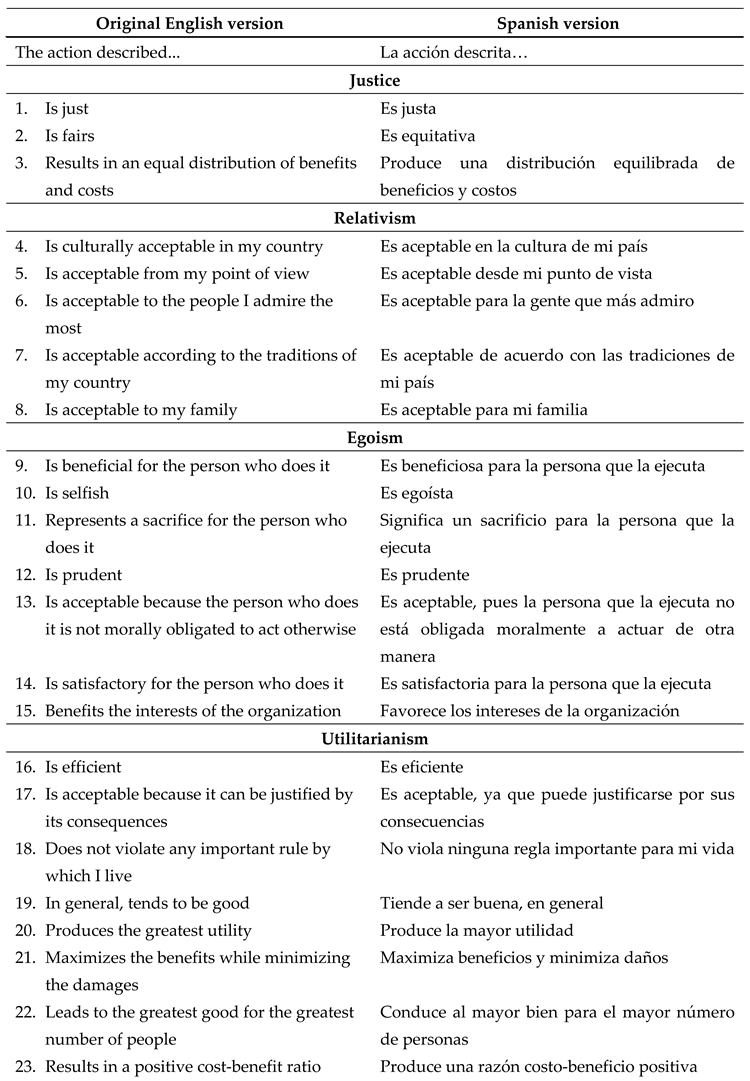
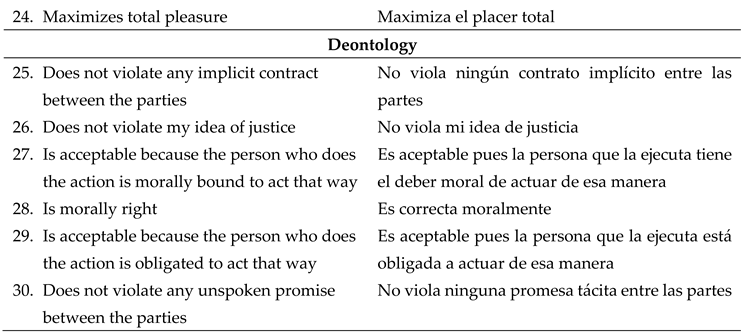
Table 3.
Fit of the bifactor model in each scenario and chi-square difference test of the bifactor model versus the five-correlated factor (5F) and the one-factor (1F) models.
Table 3.
Fit of the bifactor model in each scenario and chi-square difference test of the bifactor model versus the five-correlated factor (5F) and the one-factor (1F) models.
| Scenario | χ2 (375) | CFI | TLI | RMSEA | SRMR | 5F χ2 diff (20) |
1F χ2 diff (10) |
|---|---|---|---|---|---|---|---|
| S1 | 309.201 | 0.991 | 0.990 | 0.035 [0.031-0.040] | 0.036 | 960.80* | 218.04* |
| S2 | 1.328.925* | 0.965 | 0.959 | 0.071 [0.067-0.075] | 0.086 | 1415.02* | 326.37* |
| S3 | 1.076.105* | 0.977 | 0.973 | 0.070 [0.067-0.074] | 0.064 | 1063.45* | 469.93* |
| S4 | 1.072.723* | 0.978 | 0.975 | 0.070 [0.066-0.074] | 0.070 | 1127.11* | 379.68* |
| S5 | 747.813* | 0.990 | 0.989 | 0.073 [0.069-0.076] | 0.037 | 1197.41* | 491.91* |
| S6 | 1.320.642* | 0.980 | 0.977 | 0.077 [0.074-0.081] | 0.071 | 855.92* | 363.22* |
* p< .001.
Table 4.
Values of ECV-G and ωh obtained through the bifactor model in each scenario.
| S1 | S2 | S3 | S4 | S5 | S6 | |
|---|---|---|---|---|---|---|
| ECV-G (%) | 86.253 | 81.808 | 84.792 | 85.178 | 88.004 | 86.322 |
| ωh | .926 | .914 | .935 | .931 | .961 | .934 |
Table 5.
Fit to the one-dimensional model of the Spanish MES-15 in each scenario.
| Scenario | χ2 (90) | CFI | TLI | RMSEA | SRMR |
|---|---|---|---|---|---|
| S1 | 96.339 | 0.988 | 0.986 | 0.064 [0.057-0.072] | 0.024 |
| S2 | 149.568* | 0.987 | 0.985 | 0.073 [0.065-0.080] | 0.030 |
| S3 | 172.666* | 0.987 | 0.985 | 0.085 [0.077-0.092] | 0.026 |
| S4 | 145.175* | 0.991 | 0.989 | 0.076 [0.069-0.084] | 0.023 |
| S5 | 247.867* | 0.993 | 0.992 | 0.106 [0.099-0.113] | 0.019 |
| S6 | 222.754* | 0.993 | 0.992 | 0.080 [0.073-0.088] | 0.025 |
* p< .001.
Table 6.
Factor loadings of the Spanish MES-15 items.
| Items | S1 | S2 | S3 | S4 | S5 | S6 |
|---|---|---|---|---|---|---|
| Justice | ||||||
| 1 | .894 | .959 | .965 | .957 | .959 | .987 |
| 2 | .936 | .953 | .951 | .946 | .961 | .990 |
| 3 | .814 | .908 | .876 | .883 | .948 | .891 |
| Relativism | ||||||
| 5 | .975 | .983 | .962 | .979 | .978 | .959 |
| 6 | .929 | .941 | .928 | .935 | .943 | .926 |
| 8 | .948 | .953 | .950 | .948 | .968 | .928 |
| Egoism | ||||||
| 11 | .528 | .712 | .603 | .677 | .585 | .702 |
| 12 | .872 | .916 | .919 | .961 | .937 | .936 |
| 13 | .889 | .855 | .860 | .905 | .909 | .896 |
| Utilitarianism | ||||||
| 17 | .918 | .892 | .884 | .926 | .943 | .913 |
| 18 | .864 | .874 | .912 | .940 | .956 | .921 |
| 19 | .943 | .931 | .938 | .952 | .945 | .950 |
| Deontology | ||||||
| 26 | .868 | .895 | .905 | .939 | .954 | .961 |
| 28 | .946 | .915 | .944 | .953 | .965 | .974 |
| 30 | .868 | .793 | .864 | .875 | .933 | .928 |
Table 7.
Correlations between the adapted MES-30, the Spanish MES-15, and the behavioral intention (BI), peer intention (PI), supervisor intention (SI), ethical evaluation (EE), and social desirability (SD) for each scenario.
Table 7.
Correlations between the adapted MES-30, the Spanish MES-15, and the behavioral intention (BI), peer intention (PI), supervisor intention (SI), ethical evaluation (EE), and social desirability (SD) for each scenario.
| Adapted MES-30 | Spanish MES-15 | |||||||||
|---|---|---|---|---|---|---|---|---|---|---|
| Scenario | BI | PI | SI | EE | SD | BI | PI | SI | EE | SD |
| S1 | .707 | .465 | .468 | .755 | .084* | .746 | .432 | .416 | .793 | .019 |
| S2 | .749 | .552 | .533 | .737 | .137** | .844 | .521 | .482 | .839 | .044 |
| S3 | .748 | .590 | .608 | .724 | .218** | .851 | .565 | .573 | .826 | .152** |
| S4 | .750 | .571 | .526 | .696 | .218** | .836 | .536 | .491 | .805 | .094* |
| S5 | .866 | .726 | .723 | .868 | .104* | .906 | .714 | .702 | .910 | .065 |
| S6 | .801 | .578 | .577 | .769 | .204** | .890 | .554 | .550 | .851 | .144** |
Note. * p = .05. ** p = .01.
Table 8.
χ2(14) Values in metric invariance of the Spanish MES-15.
| Scenario | S1 | S2 | S3 | S4 | S5 |
|---|---|---|---|---|---|
| S2 | 282.78*** | ||||
| S3 | 278.26* | 348.88*** | |||
| S4 | 250.35* | 310.87*** | 326.32* | ||
| S5 | 355.73*** | 409.70*** | 427.76* | 399.63* | |
| S6 | 328.20* | 392.01*** | 406.61*** | 406.61 | 406.61** |
Note. *** p = .001; ** p = .01; * p = .05.
Disclaimer/Publisher’s Note: The statements, opinions and data contained in all publications are solely those of the individual author(s) and contributor(s) and not of MDPI and/or the editor(s). MDPI and/or the editor(s) disclaim responsibility for any injury to people or property resulting from any ideas, methods, instructions or products referred to in the content. |
© 2024 by the authors. Licensee MDPI, Basel, Switzerland. This article is an open access article distributed under the terms and conditions of the Creative Commons Attribution (CC BY) license (http://creativecommons.org/licenses/by/4.0/).
Copyright: This open access article is published under a Creative Commons CC BY 4.0 license, which permit the free download, distribution, and reuse, provided that the author and preprint are cited in any reuse.


