

Submitted:
25 January 2024
Posted:
25 January 2024
You are already at the latest version
Abstract
In the face of pressing global challenges, coupling the synergy of dance arts, sustainability, and marketing communications emerges as a potent catalyst for advancing sustainable behavior within society. Although prior research has examined the emotional stimulations raised by dance performance, it has not systematically demonstrated the role of traditional dance as a vehicle for sustainability marketing communications. This study fills this gap by using the AIDA model (Attention, Interest, Desire, Action) as a foundation, conceptualizing dance performance elements into seven dimensions, and incorporating emotional engagement and environmental consciousness to foster sustainable behavior. Collaborating with Taiwanese dance troupe, the research produced a performance titled, ‘The New Dragon Palace Chronicle’, which focuses on the themes of destruction and preservation of underwater life, enriched with cultural and sustainability symbolism. The hypothesis were tested on a sample of 315 Taiwanese audience who watching the performance. The results confirmed that the seven dimensions of the dance elements have substantial validity and reliability, significantly drawing the attention of the audience as preliminary stage of awareness. This attention fosters emotional engagement and amplified environmental consciousness and significantly influences interest, desire, and ultimately, sustainable behavior action. The findings underscore the vital role of dance art performance in nurturing actions that contribute to social sustainability.
Keywords:
AIDA model
; emotional engagement
; environmental awareness
; performing arts
; sustainable behavior
; traditional dance
1. Introduction
1.1. Background
The intersection of performing arts and sustainability is an emerging scholarly domain where the potential of traditional dance as a communication tool remains underutilized. Traditional dance, immersed in cultural heritage and aesthetic value [1], offers a powerful channel for promoting sustainable practices and ecological awareness [2]. In Taiwan, dance is more than an art form; it is an important part of the cultural tapestry, preserving historical and societal narratives [3]. This symbiotic relationship provides a valuable perspective for exploring how dance can cultivate sustainable behaviors [4]. Traditional Taiwanese dances, often echoing communal rituals and environmental appreciation [5,6], inherently advocate for nature connection and, by extension, the principles of sustainability [7]. For example, dances representing agricultural cycles or water conservation practices serve a dual purpose: They reinforce cultural identity and simultaneously foreground the imperative of environmental conservation.
In the face of increasing global ecological challenges, the need for effective sustainability practices has intensified. Diverse strategies have been used to foster sustainable lifestyles; however, the incorporation of cultural and artistic mediums, notably traditional dance, remains a nascent yet promising approach [7]. Traditional dance, with its capacity to evoke emotions and forge cultural connections, offers a largely untapped avenue for catalyzing socio-environmental transformation. For example, dance narratives depicting environmental degradation or celebrating natural beauty can significantly heighten environmental awareness and enhance commitment to sustainability [8]. This approach underscores the potential of artistic expression to amplify the impact of sustainability initiatives.
The effectiveness of traditional dance in the context of sustainability is rooted in its ability to articulate complex messages through an emotionally charged and culturally relevant form [9]. For example, traditional dances used in environmental campaigns, such as those that emphasize the challenges faced by endangered species or the effects of climate change, can establish an intense emotional connection with audiences. This often leads to a deeper understanding and stronger commitment to sustainability practices [10]. This method has the potential to convert abstract sustainability concepts into concrete, emotionally impactful experiences that not only inspire action, but also foster a deeper engagement with environmental matters. Furthermore, the integration of cultural symbolism and historical narratives within traditional dance can seamlessly connect cultural heritage with current sustainability challenges. This fusion improves audience understanding and participation in these issues. The combination of dance and sustainability preserves cultural heritage while simultaneously acting as a dynamic vehicle for environmental advocacy, effectively complementing existing strategies aimed at fostering significant ecological change.
1.2. The Gaps
Exploring creative mediums to creatively communicate the sustainability message, particularly in the context of sustainability, uncovers significant theoretical gaps. Although the intersection of artistic expression and marketing models has been examined, their application in promoting sustainable behaviors remains unexplored. Wu & Lai [11] and Mosko [12] have investigated the emotional impact of digital content and the role of dance in sustainable development, respectively. However, their studies do not specifically address the integration of marketing models with artistic mediums to foster sustainable behavior. Additionally, O’Rourke et al. [13] and Bojner Horwitz et al. [7] have contributed insights into sustainability practices and the social benefits of music and dance, but these studies lack a direct connection to marketing frameworks. In contrast, Song et al. [14] demonstrated the integration of the AIDA model with the Technology Acceptance Model (TAM) in understanding consumer acceptance of a food delivery app. Their research highlighted how marketing communication influences consumer behavior through the lenses of the AIDA model and TAM, demonstrating the potential of combining marketing models for specific applications. However, their focus was not on sustainability, but on consumer acceptance of technological innovations.
The current study aims to fill these gaps by pioneering the integration of the AIDA model with dance performance to specifically promote sustainable behavior. This approach builds on the groundwork laid by Wu & Lai [11], Mosko [12], and Song et al. [14], but navigates the application toward sustainability marketing communication. By empirically validating this integration and its impact on fostering sustainable behaviors, the study seeks to contribute a novel perspective to the field, combining the persuasive power of marketing models with the emotive and cultural resonance of dance. This research aims not only to advance academic understanding but also to offer practical strategies to leverage artistic expression in sustainability-focused marketing communication initiatives.
1.3. Research Questions and Objectives
This study embarks on a creative and innovative exploration of how traditional dance arts can be used within the AIDA marketing communication model to effectively convey sustainable actions. Therefore, Research Question 1 (RQ.1) is posed: How can traditional dance be effectively integrated into marketing communications to enhance the promotion of sustainable behavior among audiences? The objective of this investigation is to evaluate the impact of integrating traditional dance as a medium for sustainability marketing communication, using the emotive elements of dance with the structured approach of the AIDA model. This objective aims to empirically assess the cultural and emotional resonance of dance in attracting audience attention and interest, thus deepening their commitment to sustainability practices [15].
In addition, the study investigates the role of the AIDA model in the psychological progression of audiences towards sustainability, leading to the second research question (RQ.2): What role does the AIDA model play in the audience’s psychological journey of the audience from initial awareness to active participation in sustainability? The objective here is to delineate this psychological journey, mapping each stage of the AIDA model—Attention, Interest, Desire, Action—using traditional dance as a catalyst. This exploration seeks to enhance the impact of each phase on audience behavior, ending with their active participation in sustainability efforts [16]. The main aim is to offer a novel combination of artistic expression and marketing strategy to effectively communicate sustainability actions, thereby enriching both academic research and practical applications in sustainability marketing.
Within the dynamic of sustainability marketing, the pivotal roles of emotional engagement and environmental consciousness are at the front of innovative strategies [17]. Emotional engagement, characterized by the depth of an individual’s emotional response to a subject [18], plays a crucial role in securing and retaining audience attention and interest [19], a vital aspect of the AIDA framework. Meanwhile, environmental consciousness, denoting an individual’s awareness and concern for environmental issues [20], drives the interest, desire, and action phases, critical to adopting sustainable behaviors. Integrating these two elements into the AIDA model addresses a critical theoretical gap in the existing body of knowledge, as previous studies did not pay attention to this relationship [14]. However, this could improve the potential of marketing communications to foster deeper and more meaningful audience participation in environmental issues. The emotive potency of traditional dance, as an artistic medium, can significantly amplify this integration [8,12,21], forging a stronger connection between the audience and sustainability messages. Thus, the study presents the third research question (RQ.3): How can the integration of emotional engagement and environmental awareness within the AIDA model effectively enhance the promotion of sustainable behavior? The aim is to investigate how these two crucial elements, when embedded in the AIDA model and articulated through the expressive medium of dance, can enrich marketing communications, transcending traditional culture informational strategies. This approach is expected to foster not only amplified awareness, but also a profound commitment to sustainability practices. The objective is to provide new academic insights into the effectiveness of this integrative approach and to provide practical frameworks for practitioners, ensuring that sustainability communications resonate at both the emotional and cognitive levels.
2. Review of the Literature
2.1. Gaps Revelation and the Significance of the Study
The investigation into digital marketing has progressively highlighted the significance of creative mediums in engaging consumers, with Wu & Lai [11] pioneering this field through their empirical analysis of the emotive impact of short videos. Their methodical scrutiny of audience responses via systematic sampling has introduced a comprehensive framework for discerning consumer engagement, though their concentration on Internet celebrities somewhat narrows the scope of application. Meanwhile, Mosko [12] has expanded the narrative by illustrating the symbiotic relationship between dance and sustainable development. The qualitative exploration within dance organizations elucidates the capacity of the arts for ecological advocacy; however, the specificity of the cases studied potentially constrains the extrapolation of these findings to a broader context. Bridging these gaps, the present study merges dance with the AIDA model to increase digital marketing engagement, thereby proposing an enriched application of this model to a wider audience cohort. Concurrently, it extends Mosko’s [12] discourse, integrating sustainable practices into comprehensive marketing strategies, and underpins the need for artistic integration to advance the sustainability agenda within the scope of digital marketing.
O’Rourke et al. [13] highlight the role of music festivals in promoting environmental responsibility and social unity, offering a qualitative lens into sustainability practices among festival attendees. Despite the insightful findings, the scope of the study to New Zealand potentially restricts its universal applicability. However, its alignment with the drive of this study for community events as platforms for sustainable marketing initiatives reflects a shared commitment to the principles of sustainable festival management. Bojner Horwitz et al. [7] further this discourse by examining the psychological and social benefits of music and dance, advocating for their role in fostering connectedness and pro-social behavior. While their analysis provides a compelling theoretical base, there exists a gap in empirical evidence, which this study seeks to fill. By empirically validating the theoretical propositions of Bojner-Horwitz et al. [7], the current research extends the utility of artistic practices as communicative tools in social sustainability marketing. This approach not only augments the theoretical framework but also provides actionable insights into the integration of artistic modalities into sustainable marketing communication strategies.
Grindheim and Grindheim [21] have significantly advanced our understanding of the role of dance in fostering cultural sustainability, demonstrating through a phenomenological study that personal experiences in dance are essential in developing a sense of belonging to the community. Despite the richness of their findings across a spectrum of dance genres, their focus predominantly on adult experiences overlooks the wider perspectives of nonverbal children, thus presenting a notable gap in the inclusivity of their research. Additionally, Foster and Turkki [8] interrogate the role of dance education within an EcoJustice framework, positing its transformative influence on value systems aligned with sustainable practices. However, their discourse, bounded by the educational setting, demands an extrapolation to broader societal contexts.
This study is of considerable significance within the domain of marketing communication, particularly in advocating for sustainable behavior among audiences. By integrating the AIDA model into the marketing communication framework and juxtaposing it with dance performance, the research innovates a novel approach to influence audience behavior towards sustainability. This integration is not merely theoretical, but extends to the development and empirical validation of questionnaire items that capture the essence of dance elements used within the study [11,12]. Such methodological rigor, including both expert opinions and statistical analysis, ensures that the measured constructs are reliable and valid, thereby contributing substantively to the domain of marketing communication research. Furthermore, the study presents a holistic perspective on the strategy of using dance performance to achieve sustainable behavior in society [7,13]. It transcends just artistic expression, positioning dance as a dynamic catalyst for social change, which could potentially engage a wider community in sustainability initiatives. The ultimate goal of this research is to inspire the entire dance community, including government bodies and other performers, to participate in similar activities that are beneficial to society [8,21]. By doing so, the study not only contributes to academic discourse, but also aims to have a far-reaching impact on societal practices, encouraging a collective movement towards sustainable living. The related studies and the identification of gaps are presented in Table 1.
2.2. AIDA Model
Originally proposed by Strong [22], the AIDA model has gone through significant progression within the marketing field. Its core stages, Attention, Interest, Desire, and Action, have been crucial in shaping consumer behavior, as detailed by Schiffman et al. [23]. Over time, the model has been refined to meet the evolving needs of marketing, highlighting its enduring relevance. Kotler and Armstrong [24] emphasized its effectiveness in capturing audience attention and fostering initial interest. Further expanding its scope, Song et al. [14] demonstrated its integration with the TAM, illustrating its effectiveness in decision-making processes, especially in areas such as food delivery services. Today’s marketing challenges include environmental degradation and reduced societal awareness of environmental conservation. These issues have led to the application of the AIDA model in fostering behaviors that are supportive of a sustainable society. Mandilya et al. [25] exemplified this by attempting to link the AIDA model with the promotion of sustainable products through advertising. This effort highlights the applicability of the model in sustainable marketing communication, where its structured approach is essential to promote environmental awareness and interest in sustainable practices.
The incorporation of traditional arts, such as dance, in the AIDA model marks a creative approach to conveying messages of sustainability. This progression from a marketing tool to a comprehensive framework allows the model to capture the subtleties of human emotion, making it effective for artistic expressions such as dance [26]. Dance, with its emotional resonance [27], aligns with the AIDA stages, particularly in attracting attention and maintaining interest, thus reinforcing the impact of sustainability messages [15,28]. The application of the AIDA model in dance and other forms of art underscores its versatility and effectiveness on various communication platforms. This innovative approach addresses current marketing challenges, especially those related to sustainability and environmental advocacy. By integrating traditional arts, the AIDA model opens new research and practice avenues in sustainability communication, presenting a comprehensive strategy to induce behavioral change [29].
In the application of the AIDA model to research dance elements in promoting sustainability, the initial stage of Attention is predominant. This phase exploits the visual and kinetic appeal of dance to capture the attention of the audience [30,31]. Ingenious use of dance at this stage is designed to establish a platform for deeper emotional and cognitive engagement. Dance’s ability to evoke strong emotional responses is essential to foster emotional engagement [7] and environmental awareness [32]. This emotional connection, when combined with themes of environmental sustainability, can significantly amplify awareness and concern about ecological issues [33], thus nurturing increased interest in the subject [8]. The transition from Interest to Desire in the AIDA model is crucial in converting initial curiosity into a deeper inclination towards sustainability. Emotional engagement and increased environmental consciousness, facilitated through dance, are intended to spark a genuine desire for sustainable action [8]. This phase is crucial as it paves the way for the final stage, Action [14]. The aim here is to translate increased awareness and desire into tangible sustainable behaviors [32,33]. This method, in which dance serves as a medium to enhance attention and emotional involvement, ultimately promotes a commitment to sustainable behavior. The stepwise progression from Attention to Action in the AIDA model offers a structured approach, utilizing the emotive and communicative power of dance to influence consumer behavior toward environmental sustainability.
2.3. Role of Arts in Communication
The use of the arts, particularly traditional dance, in conveying messages of sustainability marks a transformative approach to environmental advocacy and education. Recognized as a powerful vehicle for articulating complex concepts, the arts transcend the limitations of language and culture in communication. Belfiore and Bennett [34] have highlighted the critical role arts play in molding public discourse, emphasizing their effectiveness in disseminating sustainability narratives. Eisner [35] further supports this argument, illustrating how the arts stimulate emotional engagement and critical thinking, pivotal for deepening understanding and commitment towards sustainable practices. In this context, the role of traditional dance in sustainability communication is notably profound. Dance, immersed in cultural richness and narrative power, emotionally captivates audiences, making involved sustainability issues more tangible and comprehensible. Leavy [36] argues that artistic mediums such as dance can craft messages that resonate more profoundly with audiences, thus catalyzing introspection and prompting proactive responses. Echoing this sentiment, Pattinson et al. [37] highlight the unique ability of dance to present complex environmental stories. This method facilitates an emotional connection with sustainability themes, fostering a more interactive and impactful engagement with environmental issues. The strategic use of traditional dance in sustainability campaigns reflects an evolving trend in communication strategies, which recognizes art as an indispensable tool in promoting social and environmental change.
2.4. Theoretical Framework
Dance elements, within the context of this study, are theoretically articulated as a composite construct that exceeds the conventional boundaries of marketing stimuli. Each element—dance movements, music and sound, gestures and expression, narrative and storytelling, technology and visual effects, and sustainability symbolism—is carefully curated based on its proven communicative power and the expertise of dance professionals. Theoretical foundations in the anthropology and psychology of dance suggest that dance movements can serve as nonverbal cues that communicate complex cultural stories and emotions [38], engaging viewers beyond the surface level [39]. Music and sound, not just mere background elements, are crucial in setting the emotional tone and rhythm of the message, as noted in the work of scholars examining the impact of auditory stimuli on attention [40]. Gestures and expressions in dance translate internal states and intentions into a visible form, enhancing message clarity and emotional resonance [41,42]. The aspects of narrative and storytelling in dance weave these elements into a coherent whole, providing a storyline that can foster a deeper cognitive and emotional connection with the audience [43].
The integration of Dance Elements into the AIDA model’s Attention phase is based on their synergistic effect in capturing and maintaining consumer focus. Theoretical perspectives on attention within consumer research have emphasized the importance of novelty and emotional arousal in breaking through the clutter of marketing communications [44]. Dance, by virtue of its multidimensional nature, offers a rich array of stimuli that can create a distinct sensory experience, thus capturing attention in a competitive environment [30,45]. This sensory richness, coupled with the narrative and emotional depth of dance, has the potential to create a memorable engagement experience that primes the consumer for the subsequent stages of Interest, Desire, and Action, as postulated by the AIDA model [46]. By incorporating Dance Elements, the study proposes an enriched model where Attention is not just a passive reception of stimuli, but an active and enriched experience that sets the foundation for a deeper engagement with the sustainable marketing message.
The adaptation of the AIDA model to include emotional involvement and environmental awareness, with a focus on dance as a key marketing tool, represents a revolutionary change in marketing approaches. This approach, which aligns with modern consumer values and the increasing focus on sustainability [47], enhances the significance of dance in creating deep connections with consumers [48]. The intense emotional reactions of consumers to marketing elements like dance are vital for strengthening the bond between consumers and the environment and for boosting the efficiency of marketing messages [49,50]. Currently, environmental awareness, reflecting consumer knowledge and concerns about ecological issues, is becoming crucial in shaping consumer choices toward sustainable options [50,51]. This strategic fusion in the AIDA model, especially through dance, transcends traditional marketing methods, signifying a strong commitment to ethical marketing and social responsibility. Based on empirical evidence, this enhanced model demonstrates the interplay of focused attention through dance, emotional connection, and heightened environmental awareness, proposing a refined and comprehensive strategy to encourage sustainable consumer behavior [52,53]. By merging these essential elements into the AIDA framework, marketing experts and practitioners gain access to a powerful tool that strikes a deep emotional and moral chord, effectively bridging the divide between consumer engagement and responsible consumption in dance-centric marketing initiatives.
In the AIDA framework, the Attention phase is the initial step that triggers emotional processing, a concept backed by both theoretical and empirical findings. Research shows that focused attention, particularly when driven by emotionally charged incentives, is closely linked to intensified Emotional Engagement. Such stimuli have a higher likelihood of evoking emotional reactions [52], a crucial aspect considering the significant impact of emotional arousal on attitudes toward environmental preservation [54]. Marketing theory suggests that emotionally infused marketing communications are more effective in engaging consumers with sustainability efforts [55]. Additionally, empirical findings underscore the importance of attention in promoting environmental awareness. When attention leads to an emotional reaction, it markedly increases consumer awareness and concern about environmental issues [56]. For example, studies have found that emotionally compelling environmental narratives can heighten a sense of responsibility and urgency for environmental activism [57]. In the context of this study, it is proposed that emotional involvement acts as a catalyst in enhancing environmental consciousness. The emotional state generated by interacting with emotionally powerful content is believed to intensify consumer concern for environmental issues. This idea is supported by evidence showing that emotional affinity with the environment can lead to pro-environmental attitudes and behaviors [55].
In the context of dance and sustainability within the AIDA model, the transition from emotional engagement to intention is key in guiding eco-friendly consumer behavior. This process, rooted in the theory of planned behavior, suggests that emotional and cognitive investment, especially through engaging, sustainability-themed dance performances, cultivates Environmental Consciousness and leads to the formation of Intention [58,59]. For example, a dance performance vividly depicting the effects of environmental degradation can elicit strong emotional reactions and improve environmental awareness, influencing consumer intentions towards sustainable actions. The impact is enhanced when dance, as a dynamic and emotionally potent medium, deeply connects with the audience, boosting their emotional engagement and awareness of environmental issues. The development of intention in this scenario acts as a crucial link, reflecting the consumer's willingness to adopt sustainable practices, a dynamic shaped by both emotional and cognitive factors.
In the AIDA model, especially in the context of dance-centered sustainability marketing, the transition from intention to desire, and ultimately to action on sustainable behavior represents the critical phase of realization. Here, Desire, serving as the motivational force, transforms the intentions formed by dance-induced emotional engagement into a readiness for specific sustainable actions [60]. This stage transforms the consumer’s intention into a concrete desire to participate in certain sustainable practices, such as purchasing eco-friendly products or adopting sustainable lifestyles. The journey ends with Sustainable Behavior Action, where these intentions and desires materialize into actual eco-friendly consumer behaviors. According to the theory of planned behavior, while intention is a key predictor of behavior, the final behavioral outcome is also influenced by external factors such as perceived behavioral control and situational opportunities [61,62]. This progression from emotional engagement, urged by dance, to action of sustainable behavior within the AIDA framework provides valuable insight into the psychological path consumers take toward sustainability, highlighting the critical roles of emotion and cognition in the promotion of sustainable consumer behavior. The conceptual framework presented in Figure 1.
2.5. Hypothesis
2.5.1. Sustainability Message through Traditional Dance Performance Elements and Attention
Traditional dance exceeds its role as mere entertainment, exemplifying a rich material of cultural and emotional expression. Integrating choreography, music, narrative, and visual aesthetics, it creates an immersive multisensory experience deeply resonant with audiences [39,43]. In environmental sustainability, traditional dance becomes a medium to convey crucial conservation messages, positioning it as a potent tool for environmental advocacy [53]. Thus, this study defines Traditional Dance Performance Elements as a synergy of culturally rich, expressive components that engage audiences visually, acoustically, emotionally, and cognitively, particularly when themed around sustainability issues. This approach recognizes the influence of traditional dance on attract and educate, promoting environmental awareness and sustainable behaviors [55,61].
The theoretical basis for this definition lies in the unique communicative capacity of art, particularly traditional dance. Csikszentmihalyi [63] theory of aesthetic engagement suggests that artistic performances with strong thematic narratives, such as sustainability, engage audiences more effectively than conventional methods. Lindstrom’s [64] theory of multisensory engagement further supports this, stating that stimuli that engage multiple senses, as seen in traditional dance, effectively capture audience attention. Recent studies reinforce this, highlighting the effectiveness of multisensory stimuli in audience engagement and message retention [65,66]. Through this, current research will provide contributions to the discourse on traditional dance as an environmental communication medium, particularly for the conservation of underwater life (the study research context). Merging artistic and cultural expressions, this approach enhances audience engagement and ecological awareness, supported by recent studies emphasizing the integration of artistic elements in communication for environmental consciousness [53,57,67]. This aligns with contemporary research advocating for culturally resonant and emotionally engaging content to enhance understanding and responsiveness to environmental challenges [55,61]. Therefore, this research proposed the following hypothesis.
Hypothesis 1:
Traditional dance performance elements, when strategically designed to communicate sustainability messages, significantly enhance audience attention.
2.5.2. Attention to Emotional Engagement and Environmental Consciousness
The nexus between audience attention and emotional engagement in traditional dance performances, notably those incorporating sustainability themes, is sophisticatedly grounded in the Affective Events Theory [68]. This theory elucidates the process by which emotionally charged events, exemplified by traditional dances, evoke distinct emotional responses from audiences. The efficacy of traditional dance as a medium for emotional resonance, particularly when entangled with environmental narratives, is considerably enhanced, drawing on Fredrickson's [69] broaden-and-build theory of positive emotions. Empirical evidence supporting this notion is provided by Leow & Ch’ng [70], who demonstrates the substantial impact of culturally rich narratives on audience emotional engagement, especially within sustainability-related contexts.
Further complementing this perspective, the research of Bower and Forgas [71] on the influence of emotional states on information processing underlines the effectiveness of traditional dance in eliciting emotional responses, especially concerning environmental and cultural themes. This aspect is expanded in the work of Taylor and Wei [72] and Newman et al. [73], who stress the capacity of cultural mediums to deepen audience engagement with environmental issues. Their research offers empirical support for the proposition that attention to the aesthetic and narrative components of traditional dance significantly enhances emotional engagement with sustainability themes, thus enriching the emotional connection and experience of the audience with the subject matter. Therefore, the following hypothesis is posited:
Hypothesis 2a:
Attention to traditional dance performances that convey sustainability messages will significantly influence emotional engagement.
Empirical research in environmental communication highlights traditional dance as an effective tool to increase audience awareness and engagement in sustainability. Bower and Forgas [71] underscore the significant role of emotional states in information processing, and further applied into environmental and cultural contexts. Traditional dance, with its rich narratives and aesthetic appeal, is shown to evoke strong emotional responses. This is supported by the work of Nisbet et al. [67], which confirms the ability of cultural mediums such as traditional dance to intensify the audience's connection with environmental topics, emphasizing the importance of aesthetic and narrative elements in creating emotional bonds with sustainability themes.
Further supporting this, Kals et al. [54] demonstrated that environmental themes in artistic performances, notably in traditional dance, substantially increase environmental consciousness. This aligns with Magowan’s [74] research that culturally and emotionally resonant performances significantly increase environmental awareness. These studies collectively suggest that traditional dance, by drawing the attention of the audience, promotes a deeper understanding and concern for the sustainability of the environment. Nisbet et al. [67] also recognize the vital role of cultural mediums in environmental advocacy, asserting that traditional dance is an essential tool for deepening audience engagement in environmental matters. Based on these insights, the following hypothesis is proposed.
Hypothesis 2b:
Attention to traditional dance performances that convey sustainability messages will significantly influence environmental consciousness.
Integrating themes of environmental sustainability into dance performances emerges as an effective substance for emotional engagement, significantly influencing audience awareness of environmental issues. This approach effectively harnesses the ability of dance to deeply resonate with audiences emotionally, particularly through the integration of narratives on environmental stewardship, exemplified by marine conservation. The success of this method in eliciting strong emotional responses aligns with affective engagement theories [69] and is further supported by research showing that performances with environmental narratives can pivotally shift audience perspectives and attitudes toward such issues [74]. This emotional connection, originating from the profound affective experience of the audience rather than mere aesthetic appeal, is underpinned by Fredrickson’s [69] broaden-and-build theory, which argues that positive emotions enhance openness to new experiences and ideas, including environmental stewardship. Therefore, dance's ability to invoke these emotions is integral in shaping environmental consciousness and fostering sustainable behaviors [75,76].
The convergence of performative dance and its impact on environmental consciousness is underscored in research that identifies the aesthetic richness and cultural narratives of dance as crucial in molding audience perceptions and attitudes toward sustainability [77]. These findings highlight the crucial role of emotional participation in the processing of sustainability-related information. Dance-induced emotional arousal is suggested to aid in deeper internalization of environmental messages [78], a concept that supports the strategic use of dance in environmental campaigns. Leveraging dance as an emotionally engaging medium can amplify environmental messages and drive social change, contributing to environmental psychology and the arts as instruments for social transformation [75].
Hypothesis 3:
Cultivated emotional engagement significantly influences environmental consciousness
2.5.3. Emotional Engagement and Environmental Consciousness on Intention
The integration of the AIDA model with environmental psychology offers a valuable framework to examine how emotional engagement, influenced by sustainability messages in dance, affects behavioral intentions. This model, originally devised for marketing analysis, is instrumental in evaluating how dance performances impact audience responses toward sustainability. We then reconceptualize with Ajzen’s [79] theory of planned behavior, which improves this framework, highlighting the critical role of emotional involvement, particularly in the interest and desire stages, in driving actions such as adopting environmentally responsible behaviors. Dance, as an expressive medium, not only gains attention but also fosters deep emotional connections with sustainability, crucial for initiating proactive environmental actions [79,80]. Kaiser and Wilson [81] research further support the importance of emotions in environmental decision-making; further, it will validate the utility of the AIDA model in mapping the progression from audience attention to action-oriented intentions.
Despite acknowledging this relationship, there is a gap in the specific exploration of how emotional engagement through dance influences intentions of sustainable behavior. The broad correlation between emotions and behaviors is established [82], but a comprehensive understanding of how distinct emotional experiences in sustainability-themed dance led to concrete sustainable actions is lacking. Addressing this gap, this study aims to illustrate the profound impact of amplified emotional engagement, especially from dance performances with sustainability themes, on the intention to act sustainably. It focuses on establishing a direct connection between emotional engagement and behavioral intentions, underscoring the efficacy of dance-induced emotional responses in promoting pro-environmental behaviors [83]. The findings will be vital for crafting strategies and campaigns that leverage emotional experiences to advance sustainable practices, thus deepening our understanding of the drivers of environmental actions and contributing to the discourse on environmental behavior change. Therefore, this study posits a hypothesis:
Hypothesis 4a:
Emotional engagement from dance performance will significantly influence the intention of the sustainability message
This study investigates the transition from environmental awareness to intentional sustainable action within the framework of the AIDA model. It proposes that this transition, particularly through traditional dance performances that convey sustainability messages, involves a progression from attention to interest and emotional investment. This process highlights the vital role of both cognitive understanding and emotional engagement in shaping sustainable decision making. Research supports this interaction between cognitive and emotional factors in environmental decision making [61,84]. The current literature often does not have a detailed analysis of how environmental consciousness progresses through these psychological stages to influence specific sustainable behaviors. While the connection between general environmental awareness and behavior is acknowledged [53], the pathway from this awareness, through emotional engagement, to concrete sustainable intentions remains underexplored. This study aims to clarify how environmental consciousness, following the AIDA model, shapes intentions for sustainable practices. It examines how the evolution from awareness to emotional connection and then to intention influences environmentally responsible decisions. This nuanced approach enriches environmental psychology [59], underlining the importance of a holistic view of the psychological journey towards sustainable actions. The findings are anticipated to significantly inform the creation of effective environmental strategies and educational programs, enhancing understanding of the motivators for pro-environmental actions [79,85]. Therefore, this study posits a hypothesis:
Hypothesis 4b:
The environmental consciousness cultivated from dance performance will significantly influence intention to the sustainability message
2.5.4. Interest in Desire and Sustainable Behavior Action
In the context of dance as a vehicle for sustainability messaging, the interaction between interest and desire offers a unique take on the AIDA model. This perspective posits that an individual's preexisting intention to act sustainably can intensify their desire to connect with sustainability themes in dance performances. This concept, rooted in theories of environmental psychology and behavior change [61,79], addresses a gap in the current research landscape. Existing studies typically explore how awareness and emotional engagement lead to intentions [53,81], without fully examining the reciprocal effect of these intentions on emotional engagement. This research aims to illuminate how a commitment to sustainability enhances the emotional connection with environmental themes in dance, offering new insights into the effectiveness of environmental messaging. It underscores the role of intention in increasing desire and engagement with sustainability issues, contributing to a deeper understanding of environmental communication strategies [59,85]. Therefore, this study posits a hypothesis:
Hypothesis 5:
Intention towards the sustainability message through dance performance will significantly influence desire.
This study focuses on how desire, particularly evoked by dance performances that encapsulate sustainability themes, influences sustainable behaviors. It asserts that the intensity of desire generated through participation in these themes is a decisive factor in the realization of sustainable actions. This investigation addresses a notable research gap, as the direct impact of desire on behavior has often been underemphasized in existing literature [53,79]. Emphasizing the crucial role of emotional engagement in bridging awareness and action, this study aligns with findings that highlight the importance of emotional factors in sustainability decision making [81,84]. It posits that the profound emotional connections developed through dance are key in driving sustainable practices, offering significant insights into environmental psychology and the effectiveness of artistic mediums in promoting sustainability [59,85]. Therefore, this study posits a hypothesis:
Hypothesis 6:
The desire for the message of sustainability through dance performance will significantly influence the action of sustainable behavior
3. Results
3.1. Pragmatic Paradigm and Research Process
Adopting a pragmatic approach, this study investigates the role of dance arts performances in the domain of sustainability communication. Initiated through a collaborative pre-survey with sustainability communication experts, professional dancers, and researchers, the study aimed to assess the efficacy of dance arts in transmitting messages of sustainability. The survey revealed the diverse and active dance scene in Taiwan, ranging from formal troupes to street dance artists. Despite the universal appeal of dance, the study revealed a significant under-use of this art form in the context of sustainability communication. This observation led to an extensive literature review using databases such as Google Scholar, Scopus and Web of Science with a specific focus on keywords like “dance”, “sustainability”, “communication”, “art performance” and “sustainability message”. The review exposed a dearth of academic discourse at this nexus, indicating a research opportunity in this domain.
To address the identified theoretical gap, this research strategically integrated the AIDA model into its theoretical framework, as delineated in Table 1. This incorporation not only enriched the scope of the investigation, but also highlighted key investigation areas, as evidenced in the framework presented in Figure 1. From a methodological point of view, the study firmly designed questionnaire items that align with the thematic focus of the research, incorporating elements of the AIDA model, aspects of dance, environmental awareness, and emotional engagement. This tailored approach facilitated the creation of new research variables, which are elaborately discussed in the operationalization and measures section of the study. The entire research methodology, from the initial pre-survey phase to the formulation of the research framework, is clearly defined in Figure 2, providing a clear and structured overview of the methodological sequence of the study.
3.2. Research Context
This study exemplifies a pioneering collaboration that bridges academic research and the performing arts, combining the expertise of the Miao Hsuan Dance Group with that of professional dancers. 'The New Dragon Palace Chronicle', a thoughtfully choreographed dance narrative, has been created to reveal the pressing issue of underwater life conservation. The performance unfolds a compelling story set in an aquatic kingdom where the splendor of oceanic life is imperiled by human-induced threats. Through a sophisticated interplay of choreography and scenography, the activity portrays the valiant struggle of marine fauna against the degradation of their habitat. Ornaments and set pieces are deliberately chosen for their symbolic resonance: coral bleaching, plastic pollution, and overfishing, each element echoing the distress calls of the ocean.
This artistic representation is grounded in environmental science with the intention of imparting both knowledge and emotional resonance regarding the challenges faced by marine ecosystems. The dramatization of the oceanic struggle for survival, depicted by the embattled fish and other sea life within the dance, is a metaphorical call to action, mirroring the urgent need for conservation efforts in reality. Using the narrative and aesthetic strengths of traditional dance, the study aims not only to captivate the scholarly community but also to galvanize public participation in the critical issue of marine preservation. Through 'The New Dragon Palace Chronicle', the study contributes a unique and impactful approach to environmental advocacy, blending the emotive force of the arts with the imperative of ecological sustainability. The detailed information on dance performance (e.g., pictures) can be found in the supplementary materials (Figure a to p).
3.3. Operationalization and Measures
This research operationalizes variables based on prior studies and expert validation (e.g., professional dancers, language, researcher), addressing the gap where some variables have not been operationalized and lack measurement constructs from previous research. Initially, dance elements are referred to as an ensemble of various expressive components that collectively form the essence of a dance performance. This study conceptualizes dance elements as second-order constructs composed of seven first-order constructs, including dance movements, music & sound, gestures & expressions, narrative & storytelling, technology & visual effects, sustainability symbolism, and cultural adaptation. These constructs, dimensions of dance elements, have been developed into 21 items contextualized within dance and sustainability, drawing from several previous studies [86,87]. Furthermore, this research integrates emotional engagement and environmental awareness into the AIDA model, developing six items modified and contextualized within dance and sustainability communication from prior research [88,89]. Finally, using items from Song et al. [14], and Tapia-Fonllem et al. [90], this study has developed 12 items, modified to align with the research context. In total, 39 measurement elements have been developed in collaboration with professional dancers, language experts, and researchers, ensuring a comprehensive and contextually relevant set of metrics for this study.
In this scholarly inquiry, the 39 measurement items developed were subjected to a pilot study involving 50 randomly selected respondents from diverse backgrounds, including dancers, students, military personnel, professors, and the general public. The essence of this pilot test was to ascertain the suitability and validity of the measurement elements developed, considering that some elements were uniquely crafted for this study and others were modified from previous research. The results of the pilot study showed that the outer loads (OL) ranged from a minimum of 0.713 to a maximum of 0.924, and the Cronbach alpha (α) values ranged from 0.748 to 0.847. On the basis of this evaluation, it was concluded that the measurement items were suitable for use in data collection. Details of each questionnaire item developed are presented in the Appendix A table.
3.4. The Sample and Data Collection Procedure
Following the satisfactory statistical threshold evaluation of the pilot study, the research proceeded to the data collection phase. Data were gathered from respondents who participated in viewing the dance performance of "The New Dragon Palace Chronicle," collaboratively developed with the Miao Hsuan Dance Group and performed in Taichung, Taiwan. The questionnaire items were converted to a Google form (https://forms.gle/wjqy7tH56cTMgHje6) and incorporated into a QR code displayed at the end of the dance performance. Consequently, the audience could scan the QR code presented at the front of the stage and complete the designed questionnaire. To acknowledge the participation of the audience, a token of appreciation in the form of a souvenir was offered outside the auditorium, given upon demonstration of completion of the questionnaire on a mobile device. At the end of the data collection period, a total of 335 responses were received. However, 20 responses were eliminated due to incompleteness, resulting in 315 valid responses that were utilized to test research hypotheses.
The data collection process provided detailed demographics of the respondents. Age-wise, the largest group was dominated by individuals between 41 to 50 years, accounting for 66 participants (26%), followed closely by those aged 51 to 60 years and under 20 years, each comprising 21% of the sample with 66 and 65 individuals respectively. The remaining 32% were distributed among those aged 21 to 40 years and over 61 years. In terms of gender distribution, females constituted the majority with 240 respondents (76%), while males accounted for 75 participants (24%). Looking at occupations, public officers represented the largest segment with 118 individuals (37%), university students made up 72 (23%), and the sample included 40 (12%) individuals from military and police services. Housewives and other categories totaled 55 respondents (17%).
3.5. Analysis Technique
The analytical methodology of this investigation was based on structural equation modeling (SEM), operationalized through Smart-PLS 4.0 software, and augmented by SPSS version 25 for preliminary item assessment. The process started with a pilot study to review the measurement items using SPSS 25. This was followed by a rigorous evaluation of Common Method Variance, using the Harman single factor test as described by Baumgartner et al. [91]. Subsequent data analysis entailed a rigorous examination of the validity and reliability of the measurement model, focusing on outer loadings, Cronbach’s Alpha, Composite reliability, and average variance extracted [92]. Further scrutiny was applied to discriminant validity, guided by established criteria, including the Fornell-Larcker criterion and the heterotrait-monotrait ratio [92-95]. The structural model was then evaluated for its explanatory capacity, considering R-square [96] and Goodness of Fit. With all statistical parameters satisfactorily met, the investigation proceeded to hypothesis testing, analyzing the t-values and the p-values, and implementing bootstrapping for robust hypothesis corroboration.
4. Results
4.1. Common Method Variance
In this investigation, the instrument validation was rigorously examined for common method variance using Harman's single factor test. Baumgartner et al. [91] suggest that the validity of the instrument remains intact if the CMV eigenvalues are below the 50% threshold. The analysis, performed with SPSS version 25, identified nine components within the CMV matrix, ranging between 2.8% and 27.2% for eigenvalues, which adheres to Baumgartner et al. [91] criteria, confirming that CMV is not a concern in terms of instrument validity. Gleichzeitig, the VIF was assessed, with values between 1.145 and 3.793. These results fall within the threshold recommended by Hair et al. [92], indicating that there are no CMV issues with respect to VIF and strengthening the robustness of the instrument validity.
4.2. Validity and Reliability Assessment
Validation of both validity and reliability is outlined in Table 2, which involves a comparative analysis against all statistical thresholds for convergent validity and reliability with regard to the first and second order constructs within the model. Initially, the validity and reliability tests indicated that certain items, such as environmental consciousness EC.3, desire DSR.3, and sustainable behavior action SBA.3, did not meet the requisite criteria for outer loadings, with values falling below the 0.70 benchmark, which required their removal. Subsequent analysis revealed that all remaining elements met the necessary thresholds with outer loads (OL) greater than 0.70, Cronbach’s Alpha (α) exceeding 0.70, Composite reliability (CR) greater than 0.70, and average variance extracted (AVE) greater than 0.50, consistent with the standards recommended by Hair et al. [92]. Second-order constructs, representing dance elements, also appear to meet established threshold standards. Consequently, there are no concerns about the convergence validity and reliability in this study.
This study rigorously examined the discriminant validity using the Fornell-Larcker criterion and the HTMT method. The assessment involved comparing the square root of AVE with the correlations between the constructs presented in Table 3, revealing that the square roots of AVE consistently exceeded the correlation values, affirming the robustness of discriminant validity [94]. Additionally, the HTMT values were scrutinized, with thresholds below 0.85 indicating robust discriminant validity and values below 0.95 deemed acceptable. The analysis confirmed that the HTMT values fell within these parameters, substantiating the discriminant validity as robust and acceptable [95], thus reinforcing the methodological integrity of this study.

Table 2.
Convergent Validity and Reliability.
| Construct | Items | OL | CA | CR | AVE |
|---|---|---|---|---|---|
| First-Order Construct | |||||
| Dance Movements | DM.1 | 0.931 | 0.912 | 0.943 | 0.846 |
| DM.2 | 0.921 | ||||
| DM.3 | 0.908 | ||||
| Music & Sound | MS.1 | 0.826 | 0.818 | 0.892 | 0.734 |
| MS.2 | 0.893 | ||||
| MS.3 | 0.849 | ||||
| Gestures & Expression | GE.1 | 0.809 | 0.717 | 0.841 | 0.639 |
| GE.2 | 0.853 | ||||
| GE.3 | 0.732 | ||||
| Narrative & Storytelling | NS.1 | 0.823 | 0.800 | 0.883 | 0.715 |
| NS.2 | 0.895 | ||||
| NS.3 | 0.817 | ||||
| Technology & Visual Effect | TE.1 | 0.757 | 0.776 | 0.869 | 0.689 |
| TE.2 | 0.880 | ||||
| TE.3 | 0.885 | ||||
| Sustainability Symbolism | SS.1 | 0.825 | 0.822 | 0.894 | 0.737 |
| SS.2 | 0.871 | ||||
| SS.3 | 0.879 | ||||
| Cultural Adaptation | CA.1 | 0.790 | 0.738 | 0.740 | 0.852 |
| CA.2 | 0.872 | ||||
| CA.3 | 0.766 | ||||
| Attention | AT.1 | 0.832 | 0.738 | 0.740 | 0.852 |
| AT.2 | 0.899 | ||||
| AT.3 | 0.786 | ||||
| Emotional Engagement | EE.1 | 0.761 | 0.704 | 0.835 | 0.630 |
| EE.2 | 0.883 | ||||
| EE.3 | 0.728 | ||||
| Environmental Consciousness | EC.1 | 0.902 | 0.625 | 0.800 | 0.669 |
| EC.2 | 0.859 | ||||
| EC.3 | 0.802 | ||||
| Interest | INT.1 | 0.802 | 0.758 | 0.861 | 0.675 |
| INT.2 | 0.859 | ||||
| INT.3 | 0.801 | ||||
| Desire | DSR.1 | 0.941 | 0.702 | 0.861 | 0.758 |
| DSR.2 | 0.828 | ||||
| DSR.3 | 0.883 | ||||
| Sustainable Behavior Action | SBA.1 | 0.793 | 0.657 | 0.845 | 0.732 |
| SBA.2 | 0.828 | ||||
| SBA.3 | 0.883 | ||||
| Second-Order Construct | |||||
| Dance Elements | DM | 0.920 | 0.771 | 0.811 | 0.718 |
| MS | 0.856 | ||||
| GE | 0.798 | ||||
| NS | 0.845 | ||||
| TE | 0.840 | ||||
| SS | 0.858 | ||||
| CA | 0.809 | ||||
Notes: The threshold for OL, Outer Loadings > 0.70; CR, Composite Reliability > 0.70; CA, Cronbach’s Alpha > 0.70; and AVE, Average Variance Extracted > 0.50.
4.3. Model Evaluation
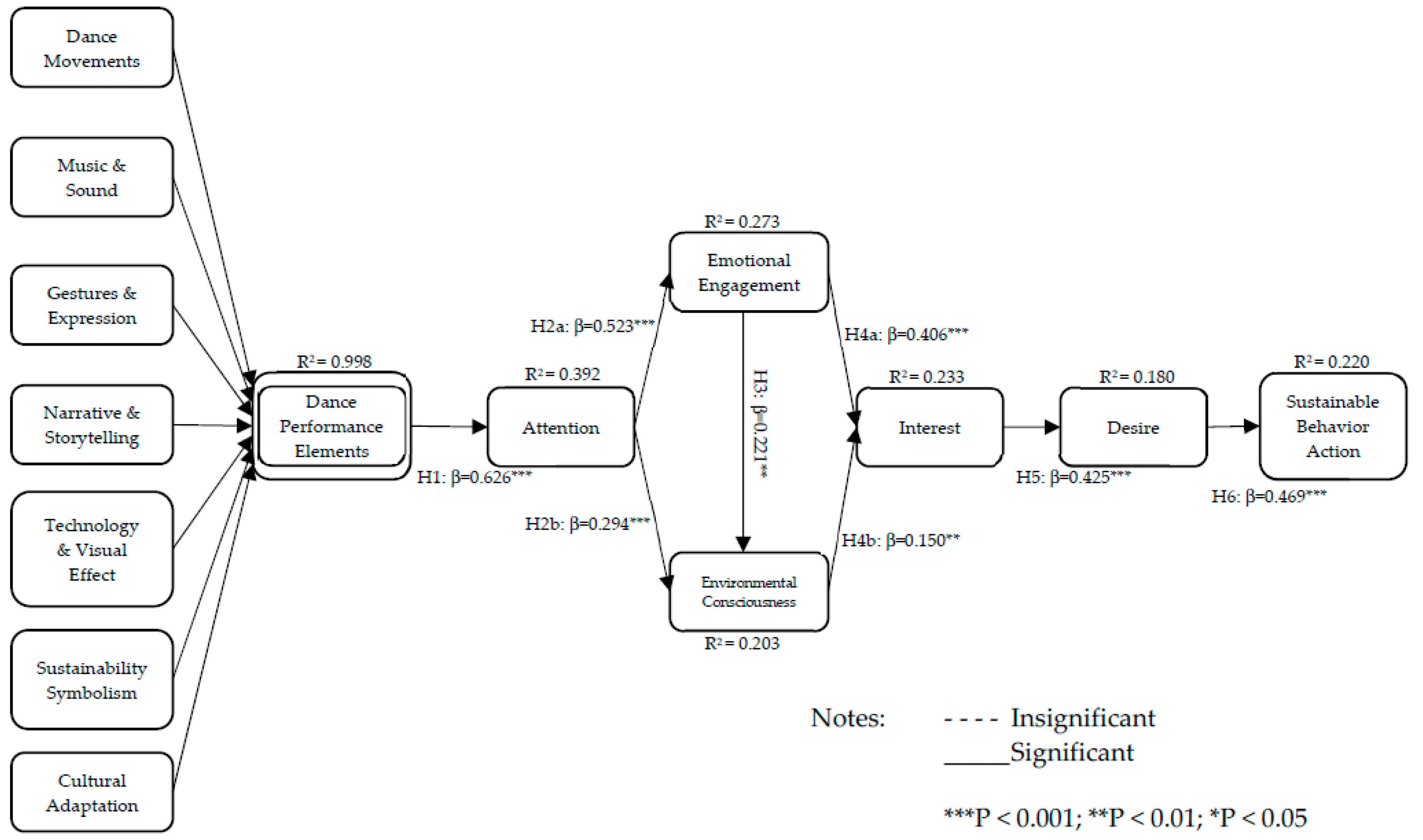
Before hypothesis testing, this study evaluated the model's adequacy by examining R-square and goodness of fit (GOF). The R-square values represent the explanatory power of the model derived from its independent factors. Falk & Miller [96] suggested that a dependent variable is considered to have substantial explanatory power when its value exceeds 0.10. The square value of R for dance elements, conceptualized as a second-order construct, reached 0.998, indicating that the seven dimensions of dance elements robustly constitute the construct, accounting for 99.8% of its variance. Further analysis showed that intention, as influenced by dance elements, had an R-square value of 0.392. Emotional engagement, formed by attention, had a value of 0.273, while environmental consciousness, influenced by attention and emotional engagement, reached 0.203. Intention, affected by both emotional engagement and environmental consciousness, was registered at 0.233. Desire, derived from intention, was recorded at 0.180, and sustainable behavior action, resulting from desire, was 0.220. All obtained R-square values surpassed the recommended threshold of 0.10, leading to the conclusion that the model possesses robust explanatory power for hypothesis testing [96]. All R-square values can be referenced in Figure 3.
This study also computed the Goodness of Fit (GOF) to assess the reliability of the developed model. The GOF was evaluated using a formula that incorporates the square root of both the R square and the average variance extracted (AVE), as shown in Equation 1 (Eq.1). According to Tenenhaus et al. [97] and Wetzels et al. [98], a model is deemed to have a satisfactory GOF when the obtained value aligns with the set criteria, indicating a high fit for values of 0.36, a moderate fit for the range of 0.25 to 0.36, and a low fit for 0.10 to 0.25. The resulting GOF of 0.713 suggests that this study's model meets the high-fit criteria, thereby confirming that the GOF is robust and indicative of a highly fitting model.
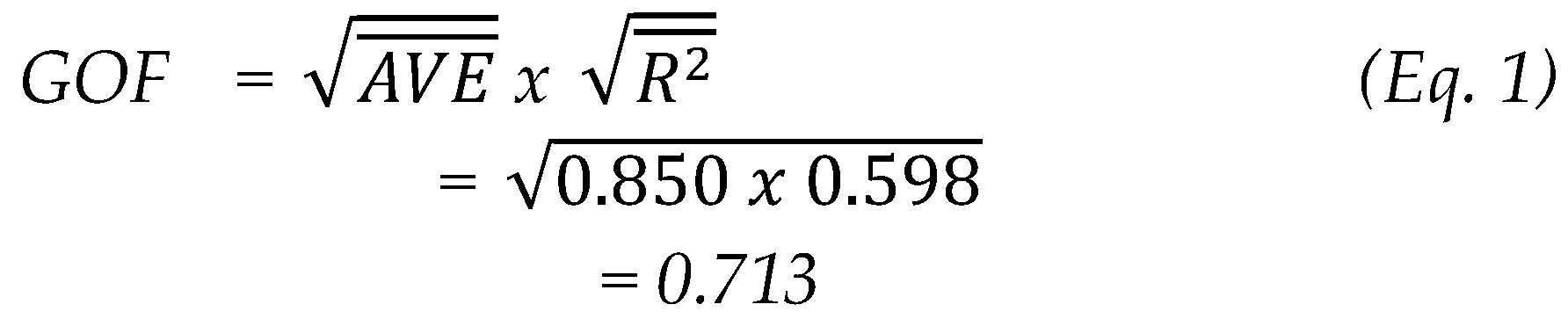
Table 3.
Fornell-Larcker Criterion and HTMT.
| Construct | 1 | 2 | 3 | 4 | 5 | 6 | 7 |
| Attention (1) | 0.840 | ||||||
| Desire Elements (2) | 0.658 (0.708) |
0.847 | |||||
| Desire (3) | 0.520 (0.653) |
0.479 (0.809) |
0.870 | ||||
| Emotional Engagement (4) | 0.523 (0.696) |
0.579 (0.685) |
0.492 (0.659) |
0.794 | |||
| Environmental Consciousness (5) | 0.410 (0.599) |
0.571 (0.899) |
0.608 (0.559) |
0.375 (0.598) |
0.818 | ||
| Interest (6) | 0.540 (0.701) |
0.555 (0.610) |
0.425 (0.542) |
0.462 (0.628) |
0.302 (0.458) |
0.821 | |
| Sustainable Behavior Action (7) | 0.240 (0.336) |
0.378 (0.500) |
0.468 (0.654) |
0.263 (0.378) |
0.278 (0.483 |
0.181 (0.254) |
0.856 |
Notes:
| |||||||
4.4. Hypothesis Testing
Figure 3 and Table 4 present a summarized view of the hypothesis testing results. First, dance elements exhibited a highly significant influence on attention, with T values of 18.082 and a path coefficient (β) of 0.626, leading to acceptance of H1. Within the framework of the AIDA model, both emotional involvement (T = 10.822 and β = 0.523) and environmental consciousness (T = 4.814 and β = 0.2946) were significantly influenced by attention, supporting the hypotheses H2a and H2b. The research model also showed that cultivating emotional involvement in dance performance significantly improves environmental awareness (T = 3.442 and β = 0.221), validating H3. Furthermore, it was established that both emotional engagement (T = 6.520 and β = 0.406) and environmental consciousness (T = 2.463 and β = 0.150) significantly shape interest, leading to acceptance of hypotheses H4a and H4b. Interest was found to exert a significant effect on desire (T = 9.092 and β = 0.425), confirming H5. Finally, the research indicated that well-cultivated desire significantly escalates sustainable behavior action (T = 11.390 and β = 0.469), resulting in acceptance of H6.
5. Discussion
To our knowledge, this study is a pioneer in exploring how dance performance can serve as a medium for communicating sustainability messages within the framework of marketing theory. Based on the AIDA model as its theoretical basis, this research elaborates on sustainable behavior action fostered through traditional dance performance. The aim is to investigate and test whether traditional dance performance, conveying sustainability messages via dance elements (conceptualized as a second-order construct), can enhance the sustainable behavior action of its audience. Furthermore, this study incorporates emotional engagement and environmental awareness as integral components of the process that escalates interest in the message, sequentially influencing desire and behavior. Therefore, a detailed discussion is presented here, sequentially aligned with the research questions posed, to evaluate the achievement of the study's objectives.
The first research question (RQ.1) addresses how traditional dance can be effectively integrated into marketing communication to promote sustainable behavior among its audience. To respond to RQ.1, we reference findings that successfully demonstrate, test, and validate the concept of dance performance elements as a second-order construct within this study, identifying seven constructs that represent it. The validity and reliability of these seven dance elements were rigorously tested, confirming that they collectively contribute 99.8% of the variance towards the dance element construct. This substantiates the effectiveness of these constructs in representing traditional dance performance within our research and provides a reference for future studies that dance can significantly shape audience attention, as evidenced in this study. It is confirmed that traditional dance performance elements can significantly cultivate audience attention, sequentially influencing the behavioral outcome of action for those watching the dance performance. Therefore, the answer to RQ.1 affirms that dance performance is an effective medium to communicate sustainable marketing communication to its audience.
The second research question (RQ.2) probes the role of the AIDA model in guiding the psychological journey of the audience from initial awareness to active participation in sustainability. This study has substantiated that dance elements significantly influence audience attention, which indicates that dance can increase initial audience awareness of sustainability messages by captivating their attention. This finding aligns with research developed by Harrington [99], which observed that dance can capture audience attention on various platforms, including social media and television shows, thus underscoring the effectiveness of dance performances in attracting viewer attention. Additionally, the integration of the AIDA model facilitates the combination of emotional engagement and environmental consciousness in the model, mapping the psychological journey of the audience towards the sustainability message conveyed. The study confirms that attention can significantly foster emotional involvement and environmental awareness. This is in line with the findings of Savenije et al. [100], who reported that attention cultivated on emotional engagement can develop genuine curiosity and understanding. Therefore, it is crucial when sustainability messages evoke curiosity and genuine understanding toward the conservation of underwater life, as arranged in the dance performance within this research. Moreover, attention is also deemed vital for improving consciousness [101], and this study demonstrates that attention derived from dance performance can indeed stimulate environmental consciousness.
Further in the psychological journey of the AIDA model, emotional engagement has been found to exert a significant influence on environmental consciousness. This is in harmony with Steg & Vlek’s [83] assertion that individuals who are emotionally engaged with a sustainability message are likely to adopt pro-environmental attitudes. This affirms the efficacy of dance performances in improving audience engagement and awareness of environmental issues. Furthermore, this study has also established that both emotional involvement and environmental awareness significantly nurture interest in the sustainability message conveyed through dance performance. This aligns with Whitmarsh & O’Neill [85] and Steg & Vleg [83], who confirmed that emotional factors and consciousness are determinants in the decision-making journey, including the cultivation of interest. This simultaneously addresses RQ.3, confirming the significant role of emotional engagement and environmental consciousness within the AIDA model and in the promotion of sustainability messages.
Lastly, this study has sequentially demonstrated a significant influence from interest to desire, and from desire to sustainable behavior action. Within the AIDA model, this represents a sequential process that encourages action, which is initiated by cultivating interest and desire. This is consistent with Song et al. [14], who have shown the significance of the psychological journey within the AIDA model. Furthermore, Ajzen [79] noted that behavior is cultivated through intention. However, the originality of this research lies in its demonstration that a significant influence is exerted by the sustainability message crafted within the dance performance, which generates interest towards both the dance and its message, successfully cultivating desire, and ultimately leading to sustainable behavior action. Therefore, the response to RQ.2 is that the AIDA model is proven to be an effective framework for communicating sustainability messages through dance performance in this study.
6. Conclusion
6.1. Implication for Research
This research offers a significant contribution to future research applications, particularly in terms of the integration of arts performance with sustainability messages within the realm of marketing communication research and interdisciplinary collaborations between professionals in the arts, sustainability, marketing, and communication. Firstly, this study has succeeded in developing, testing and validating dance performance elements comprising seven dimensions. These dimensions have been operationalized within the context of this research to bridge dance and sustainability messaging. The results affirm that the items and constructs developed through this study meet the validity and reliability standards due to the application of a scientifically rigorous methodology. Therefore, future research can use these findings to investigate how the dance community develops performances and transmits messages related to sustainability. For instance, governments, dance troupes, and communities may collaborate to communicate SDG messages such as zero poverty or the twelfth goal, responsible consumption and production, leveraging dance arts performance as the medium of delivery. This research will provide a methodological blueprint, a framework, and insight into the psychological journey of audiences engaged with messages within dance performances. Therefore, it constitutes a significant contribution that can inspire a holistic perspective to communicate the goals of sustainable development. Theoretically, this research extends previous studies on the implications of dance for conveying sustainability messages [7,8,12,13,21].
Second, this study weaves together dance performance elements, environmental awareness, and emotional engagement within the AIDA model to chart the psychological journey of the audience from raising awareness to converting it into behavior. Beginning with the establishment of dance performance elements as second-order constructs, it was proven that dance can significantly captivate the audience’s attention. This attention was then shown to transform into emotional engagement and to cultivate environmental consciousness, indicating that dance performance has once again succeeded in raising the audience's awareness of environmental degradation and the message of environmental preservation. Subsequently, this awareness influences the growth of intention towards the message more deeply, ultimately converting into desire and sustainable behavior action. This has been summarized within the framework and tested in this research. Moreover, these results offer insights into formulating holistic strategies for arts performance and sustainability research, outlining how the audience's psychological journey can be cultivated. Theoretically, this research expands on previous studies on the implications of integrating the AIDA model with dance to convey sustainability messages to the audience [11,14].
Third, this study has established that emotional engagement significantly fosters environmental awareness, a relationship not previously tested within the combined context of dance arts performance, sustainability and marketing communication. This serves as a continuation of prior studies which confirmed that dance and arts performances can be mediums to enhance pro-environmental behaviors, but did not demonstrate the cultivation of emotional engagement and environmental consciousness [99]. Finally, the AIDA framework developed in this study can be used as a model for holistic research that contributes to the promotion and achievement of Sustainable Development Goals (SDGs), beginning with the integration of dance arts performance and marketing communication.
6.2. Implication for Practice
The dance community is established as a pivotal advocate for sustainable initiatives, utilizing the intrinsic emotive and expressive capacities of dance to impart and accentuate environmental awareness. Empirical support validates the integration of sustainability themes within dance performances as a powerful mechanism to engage and incentivize audiences towards sustainable practices [12,13]. The methodological foundation of this research offers a robust framework, facilitating the creation of performances that meld traditional dance with pressing environmental narratives. Such creative ventures do not only expand the cultural repertoire; they also act as catalysts for sustainability movements. Consequently, dance organizations and cultural platforms are recognized as crucial to propagating environmental stewardship and promoting a unified path towards ecologically sustainable living.
In addition, the contribution of the dance community surpasses mere artistic expression, actively participating in the realization of Sustainable Development Goals. This research confirms the significant influence of dance on directing audience behavior in accordance with these global mandates. Dance practitioners, therefore, are equipped to devise thematic performances that vivify and render tangible objectives such as clean water, climate action, or responsible consumption, transmuting abstract concepts into relatable experiences through choreography and storytelling. This strategy not only raises awareness, but also stimulates community-led initiatives. These efforts position the dance community as a cultural harbinger of sustainability, fostering engagement, and precipitating change on both local and global stages.
Adopting the AIDA model within dance underscores the potential of the arts as a participatory mechanism for communicating sustainability. This model delineates a strategic pathway for audience engagement, progressing from awareness to action - an efficacy empirically validated within the realm of performance arts [14]. When dance is choreographed according to this model, it commands audience attention, cultivates emotional engagement, and raises environmental awareness. This shift from passive observation to active involvement enlists the audience as collaborators in the sustainability narrative. Choreographers and dance professionals are thus presented with a structured methodology to forge immersive experiences that not only entertain but also instill a sense of responsibility and inspire action toward environmental imperatives.
This research extends to strategic performance planning, introducing a methodical approach to leveraging dance's sensory appeal for the articulation of complex sustainability messages. The infusion of emotional resonance into dance narratives creates poignant and enduring experiences, deepening the audience's understanding of sustainability and the dedication to it. This method surpasses traditional marketing strategies, charting an innovative trajectory for environmental messages to profoundly impact the public. Thus, dance emerges as a dynamic intermediary between sustainability discourses and social engagement, enhancing the exchange of ideas and encouraging a proactive and informed ecological position.
In the domain of sustainability education, dance is revealed as a versatile instrument, forging novel pathways for engagement and intellectual resonance. The elicitation of emotional reactions, coupled with the reinforcement of environmental cognizance through dance, has the ability to significantly increase the efficacy of sustainability education [83,99]. This symbiosis of dance and educational theory aligns with the principles of experiential learning, advocating the inclusion of dance in educational contexts to enrich both cognitive and emotional engagement with sustainability issues. Therefore, educators are implored to apply this validated framework to construct educational experiences that transcend traditional pedagogic practices, employing the transformative potential of the arts to reorient perceptions and attitudes toward sustainability.
The practicality of this research is further exemplified by the seamless incorporation of its framework into educational curricula and public awareness campaigns, bolstering the impact of sustainability education. The incorporation of dance into these spheres provides a compelling medium to extend beyond the constraints of conventional teaching methods, engaging participants in a dialogic and enlightening exploration of sustainability. The implications are clear: Dance surpasses its artistic confines to become an essential pedagogical tool, invigorating sustainability principles and nurturing an informed, engaged, and proactive global citizenry. Accordingly, the arts are affirmed as an integral component of holistic educational strategies, ensuring that sustainability messages are not only conveyed but also deeply internalized.
6.3. Limitation and Future Research Avenues
The current study has contributed significantly to understanding how traditional Taiwanese dance can communicate sustainability messages. However, it is vital to recognize its limitations and potential directions for future research. A notable limitation is the specific focus on the traditional Taiwanese dance context without an explicit definition of the elements of dance performance. This limitation presents an opportunity for subsequent research to precisely define these elements within a wider scope of performance arts, potentially deepening the understanding of how particular aspects of dance contribute to sustainability messaging. Furthermore, the research was limited by its cross-sectional data collection approach. Future research could be enhanced by using longitudinal methods to evaluate the persistent impacts of dance on sustainable behaviors. Such longitudinal studies would be instrumental in tracking behavioral changes over time, offering a richer perspective on the role of dance in promoting sustainability education. Furthermore, the role of social media in distributing dance performances with sustainability themes was not addressed. Given social networks' broad reach and significant impact, future research should investigate how dance performances can be effectively presented on these platforms to maximize their influence. Although this study has not explored this domain, it provides a foundational understanding that can guide future explorations of the intersections between dance, sustainability, and digital media.
Supplementary Materials
The following supporting information can be downloaded at the website of this paper posted on Preprints.org, Figure a – p.
Author Contributions
Conceptualization, C.J.F., A.D.K.S. and C.N.H.; methodology, A.D.K.S.; software, A.D.K.S.; validation, C.J.F., A.D.K.S. and C.N.H.; formal analysis, A.D.K.S. and C.N.H.; investigation, C.N.H. and A.D.K.S.; resources, C.N.H. and C.J.F.; data curation, C.N.H. and A.D.K.S.; writing—original draft preparation, A.D.K.S. and C.J.F.; writing—review and editing, C.N.H. and A.D.K.S.; visualization, C.N.H.; supervision, C.J.F.; project administration, A.D.K.S.; funding acquisition, C.N.H. All authors have read and agreed to the published version of the manuscript.
Funding
This research received no external funding.
Data Availability Statement
The data presented in this study are available on request from the corresponding author. The data are not publicly available due to copyright for the video recording of the dance performance.
Conflicts of Interest
The authors declare no conflicts of interest.
Appendix A
| Constructs | Measures |
| Dance Movements (Developed from Bräuninger [86]) |
The choreography’s creative impact endured post-performance. |
| Graceful dance movements aligned with sustainability for impactful messaging. | |
| Expressive dance vividly communicated the message’s emotions. | |
| Music & Sound (Developed from Bernardi et al. [87]) |
Music and movement synced for a powerful performance impact. |
| Rhythmic music deepened my engagement with the sustainability theme. | |
| Strategic sound effects made the performance more immersive. | |
| Gesture & Expression (This study) |
Dancers’ gestures and props vividly expressed sustainability emotions. |
| Elusive dance gestures intrigued and drew me into the message. | |
| Dancers’ faces showed strong commitment to sustainability. | |
| Narrative & Storytelling (This study) |
Dance’s narrative structure effectively conveyed sustainability. |
| Coherent dance narrative deepened sustainability understanding. | |
| Storytelling in the performance emotionally connected me to sustainability. | |
| Technology & Visual Effect (This study) |
Technology integration boosted the performance's visual storytelling and impact |
| Technology amplified the sustainability message for modern audiences | |
| Techology strategically used for a more immersive dance experience | |
| Sustainability Symbolism (This study) |
Symbols and metaphors in dance strengthened the sustainability link. |
| Sustainability symbols clearly conveyed the environmental message in the performance | |
| Symbolic dance elements deepened my understanding of sustainability | |
| Cultural Adaptation (This study) |
Respectful cultural elements in dance fostered cross-cultural understanding. |
| Adapting dance to different cultures showed commitment to global sustainability | |
| Cultural adaptation in dance effectively reached diverse audiences | |
| Emotional Engagement (Modified from Esmail & Mathews-Roper [88]) |
The dance performance evoked strong emotional connection in me. |
| I was emotionally moved by the sustainability message conveyed through the dance. | |
| I felt a deep connection between the dance performance and the sustainability cause. | |
| Environmental Consciousness | From the dance, I realize that natural resources are scarce, thus must be used wisely. |
| (Modified from Alsmadi [89]) | From the dance, I believe that man and nature have to be in harmony for survival. |
| From the dance performance, I understand that the environment is for us and future generations, thus must be well maintained and preserved. (*) | |
| Attention (Modified from Song et al. [14] and Tapia-Fonllem et al. [90]) |
Dynamic opening dance movements instantly grabbed my attention. |
| The use of captivating visuals at the start of the performance drew me in. | |
| Unique, attention-grabbing cultural elements in the dance performance intrigued me. | |
| Interest (Modified from Song et al. [14] and Tapia-Fonllem et al. [90]) |
Engaging choreography with a sustainability message held my interest in the dance. |
| The music and dance blend piqued my interest in the sustainability message. | |
| The thematic alignment of the performance elements with the message captured my interest. | |
| Desire (Modified from Song et al. [14] and Tapia-Fonllem et al. [90]) |
The emotional impact of the performance enhanced my desire to contribute to sustainability. |
| The passionate delivery of the message through dance increased my willingness to adopt sustainable behaviors. | |
| The performance evoked a sense of responsibility, igniting my desire to support sustainable causes. (*) | |
| Sustainable Behavior Action (Modified from Tapia-Fonllem et al. [90]) |
After watching the dance performance, I felt motivated to take concrete steps towards sustainability. |
| The performance encouraged me to consider making changes aligned with the sustainability message. | |
| The dancers' expressions and actions inspired me to become more involved in sustainability efforts. (*) | |
| Note: ‘(*)’ represents omitted items due to low statistical threshold unfulfillment. | |
References
- Impey, A. Culture, conservation and community reconstruction: Explorations in advocacy ethnomusicology and participatory action research in Northern Kwazulu Natal. Yearbook for Traditional Music, 2002. 34. pp. 9-24. [CrossRef]
- Weber, R. Somatic movement dance education: A feminist, cognitive, phenomenological perspective on creativity in dance. Dance and the quality of life, 2019. pp. 307-324.
- Lin, Sean. Arts festival to encourage viewers to deep dive into social issues. Retrieved from: https://focustaiwan.tw/culture/202308110014, accessed at: December 18th 2023.
- Ministry of Foreign Affairs. 2011. The Many Splendors of Taiwan. Retrieved from: https://culture.teldap.tw/culture/index.php?option=com_content&view=article&id=318, Accessed at: December 18th 2023.
- Wu, X.; Lai, I. K. W. How the creativity and authenticity of destination short videos influence audiences’ attitudes toward videos and destinations: the mediating role of emotions and the moderating role of parasocial interaction with Internet celebrities. Current Issues in Tourism, 2023. pp. 1-20. [CrossRef]
- Chao, Y. L. Dance, culture and nationalism: the socio-cultural significance of Cloud Gate Dance Theatre in Taiwanese society (Doctoral dissertation, City University London). 2000.
- Bojner Horwitz, E.; Korošec, K.; Theorell, T. Can dance and music make the transition to a sustainable society more feasible?. Behavioral Sciences, 2022. 12 (1). [CrossRef]
- Foster, R.; Turkki, N. EcoJustice approach to dance education. Journal of Dance Education, 23(2), 91-101. [CrossRef]
- Alterowitz, G. (2014). Toward a feminist ballet pedagogy: Teaching strategies for ballet technique classes in the twenty-first century. Journal of Dance Education, 2023. 14(1), pp. 8-17. [CrossRef]
- Martusewicz, R. A.; Edmundson, J.; Lupinacci, J. EcoJustice education. MacMillan interdisciplinary handbooks: Gender, v2: Nature, 2016. 57-71.
- Wu, X.; Lai, I. K. W.; How the creativity and authenticity of destination short videos influence audiences’ attitudes toward videos and destinations: the mediating role of emotions and the moderating role of parasocial interaction with Internet celebrities. Current Issues in Tourism, 2023. pp. 1-20. [CrossRef]
- Mosko, S. Stepping Sustainably: The Potential Partnership Between Dance and Sustainable Development, Consilience: The Journal of Sustainable Development, 2018. 20 (1), pp. 62-87.
- O’Rourke, S.; Irwin, D.; Straker, J. Dancing to sustainable tunes: an exploration of music festivals and sustainable practices in Aotearoa. Annals of Leisure Research, 2011. 14(4), 341-354. [CrossRef]
- Song, H.; Ruan, W. J.; Jeon, Y. J. J. An integrated approach to the purchase decision making process of food-delivery apps: Focusing on the TAM and AIDA models. International Journal of Hospitality Management, 2021. 95, 102943. [CrossRef]
- Foster, R.; Mäkelä, J.; Martusewicz, R. A. (Eds.). Art, ecojustice, and education: Intersecting theories and practices. Taylor & Francis. 2018.
- Galpin, T.; Whitttington, J. L.; Bell, G. Is your sustainability strategy sustainable? Creating a culture of sustainability. Corporate Governance, 2015. 15 (1), pp. 1-17. [CrossRef]
- Nazir, J.; Pedretti, E. Educators’ perceptions of bringing students to environmental consciousness through engaging outdoor experiences. Environmental Education Research, 2016. 22 (2), pp. 288-304. [CrossRef]
- O’Brien, H. L.; Toms, E. G. What is user engagement? A conceptual framework for defining user engagement with technology. Journal of the American society for Information Science and Technology, 2008. 59(6), pp. 938-955. [CrossRef]
- Lin, H. S.; Hong, Z. R.; Huang, T. C. The role of emotional factors in building public scientific literacy and engagement with science. International Journal of Science Education, 2012. 34(1), pp. 25-42. [CrossRef]
- Leonidou, L. C.; Leonidou, C. N.; Kvasova, O. Antecedents and outcomes of consumer environmentally friendly attitudes and behaviour. Journal of Marketing Management, 2010. 26(13-14), pp. 1319-1344. [CrossRef]
- Grindheim, M.; Grindheim, L. T. Dancing as Moments of Belonging: A Phenomenological Study Exploring Dancing as a Relevant Activity for Social and Cultural Sustainability in Early Childhood Education. Sustainability, 2021. 13(14). [CrossRef]
- Strong, E. K. The psychology of selling and advertising. McGraw-Hill book Company, Incorporated. 1925.
- Schiffman, L.; O'Cass, A.; Paladino, A.; Carlson, J. Consumer behaviour. Pearson Higher Education AU. 2013.
- Kotler, P.; Armstrong, G. M. Principles of marketing. Pearson Education India. 2010.
- Mandliya, A.; Varyani, V.; Hassan, Y.; Akhouri, A.; Pandey, J. What influences intention to purchase sustainable products? impact of advertising and materialism. International Journal of Productivity and Performance Management, 2020. 69(8), pp. 1647-1669. [CrossRef]
- Gang, Y.; Zhang, B. A Study on the Impact of Dance Flow on Individual Creative Expression. Art and Society, 2023. 2(5), 34-38. [CrossRef]
- McGarry, L. M.; Russo, F. A. Mirroring in dance/movement therapy: Potential mechanisms behind empathy enhancement. The Arts in Psychotherapy, 2011. 38(3), pp. 178-184. [CrossRef]
- Hanna, J. L. Dance under the censorship watch. The Journal of Arts Management, Law, and Society, 2002. 31(4), pp. 305-317. [CrossRef]
- Hutchings, D. Communicating with metaphor: a dance with many veils. American Journal of Hospice and Palliative Medicine®, 1998. 15(5), 282-284. [CrossRef]
- Bradley, M. Setting the Stage: The Expression of the Self and the Artistic Voice in the Community College Dance Classroom (Doctoral dissertation, California State University, Stanislaus). 2022.
- Carroll, N.; Seeley, W. P. Kinesthetic understanding and appreciation in dance. The Journal of Aesthetics and Art Criticism, 2013. 71(2), 177-186. [CrossRef]
- Stewart, N. Dancing the Face of Place: Environmental dance and eco-phenomenology. Performance Research, 2010. 15(4), 32-39. [CrossRef]
- Jones, D. R. ‘The Biophilic University’: a de-familiarizing organizational metaphor for ecological sustainability?. Journal of Cleaner Production, 2013. 48, pp. 148-165. [CrossRef]
- Belfiore, E.; Bennett, O. The social impact of the arts. Hampshire: Palgrave Macmillan. 2008.
- Eisner, E. W. What Can Education Learn from the Arts About the Practice of Education?. Journal of curriculum and supervision, 2002. 18(1), pp. 4-16.
- Leavy, P. Method meets art: Arts-based research practice. Guilford publications. 2020.
- Pattinson, S.; Ciesielska, M.; Preece, D.; Nicholson, J. D.; Alexandersson, A. The “Tango Argentino”: a metaphor for understanding effectuation processes. Journal of Management Inquiry, 2020. 29(3), pp. 317-329.
- Van Dyck, E.; Maes, P. J.; Hargreaves, J.; Lesaffre, M.; Leman, M. Expressing induced emotions through free dance movement. Journal of Nonverbal Behavior, 2013. 37, pp. 175-190. [CrossRef]
- Hanna, J. L. The representation and reality of religion in dance. Journal of the American Academy of Religion, 1988. 56(2), pp. 281-306. [CrossRef]
- Kellaris, J. J.; Kent, R. J. The influence of music on consumers' temporal perceptions: Does time fly when you're having fun?. Journal of consumer psychology, 1992. 1(4), pp. 365-376. [CrossRef]
- McNeill, D. Hand and mind: What gestures reveal about thought. University of Chicago press. 1992.
- Levy, E. T.; McNeill, D. Speech, gesture, and discourse. Discourse processes, 1992. 15(3), pp. 277-301.
- Bläsing, B.; Puttke, M.; Schack, T. Introduction: Towards a neurocognitive science of dance–two worlds approaching or two approaches to the same world of movement?. In The Neurocognition of Dance (pp. 11-18). Psychology Press. 2010.
- Pieters, R.; Wedel, M. Attention capture and transfer in advertising: Brand, pictorial, and text-size effects. Journal of marketing, 2004. 68(2), 36-50. [CrossRef]
- Deinzer, V.; Clancy, L.; Wittmann, M. The sense of time while watching a dance performance. SAGE Open, 2017. 7(4). [CrossRef]
- Maclnnis, D. J.; Moorman, C.; Jaworski, B. J. Enhancing and measuring consumers’ motivation, opportunity, and ability to process brand information from ads. Journal of marketing, 1991. 55(4), pp. 32-53.
- Park, J.; Hong, E.; Ahn, J.; Hyun, H. Role of multidimensional customer brand engagement on customer behavior for online grocery shopping. Journal of Retailing and Consumer Services, 2023. 73. [CrossRef]
- Sreekumar, A.; Arias, R. A.; Otnes, C. C.; Zayer, L. T. Shining the spotlight on marketplace rituals: a review and research agenda. Journal of Marketing Management, 2023. pp. 1-31. [CrossRef]
- Bagozzi, R. P.; Gopinath, M.; & Nyer, P. U. The role of emotions in marketing. Journal of the academy of marketing science, 1999. 27(2), pp. 184-206.
- Organ, K.; Koenig-Lewis, N.; Palmer, A.; Probert, J. Festivals as agents for behaviour change: A study of food festival engagement and subsequent food choices. Tourism management, 2015. 48, pp. 84-99. [CrossRef]
- Stern, P. C. New environmental theories: toward a coherent theory of environmentally significant behavior. Journal of social issues, 2000. 56(3), pp. 407-424. [CrossRef]
- Pham, M. T. Representativeness, relevance, and the use of feelings in decision making. Journal of consumer research, 1998. 25(2), pp. 144-159. [CrossRef]
- Kollmuss, A.; Agyeman, J. Mind the gap: why do people act environmentally and what are the barriers to pro-environmental behavior?. Environmental education research, 2002. 8(3), pp. 239-260. [CrossRef]
- Kals, E.; Schumacher, D.; Montada, L. Emotional affinity toward nature as a motivational basis to protect nature. Environment and behavior, 1999. 31(2), pp. 178-202. [CrossRef]
- Zelezny, L. C.; Schultz, P. W. Psychology of promoting environmentalism: Promoting environmentalism. Journal of social issues, 2000. 56(3), pp. 365-37. [CrossRef]
- Chawla, L. Significant life experiences revisited: A review of research on sources of environmental sensitivity. The Journal of environmental education, 1998. 29(3), pp. 11-21. [CrossRef]
- Haidt, J. The moral emotions. Handbook of affective sciences, 2003. 11(2003), pp. 852-870.
- Ajzen, I., & Fishbein, M. Understanding attitudes and predicting social behavior. Englewood Cliffs, NJ: Prentice-Hall. 1980.
- Bamberg, S.; Möser, G. Twenty years after Hines, Hungerford, and Tomera: A new meta-analysis of psycho-social determinants of pro-environmental behaviour. Journal of environmental psychology, 2007. 27(1), pp. 14-25. [CrossRef]
- Bagozzi, R. P.; Gopinath, M.; Nyer, P. U. The role of emotions in marketing. Journal of the academy of marketing science, 1999. 27(2), pp. 184-206.
- Stern, P. C. New environmental theories: toward a coherent theory of environmentally significant behavior. Journal of social issues, 2000. 56(3), pp. 407-424. [CrossRef]
- Vermeir, I.; Verbeke, W. Sustainable food consumption: Exploring the consumer “attitude–behavioral intention” gap. Journal of Agricultural and Environmental ethics, 2006. 19, pp. 169-194.
- Csikszentmihalyi, M. Flow: The psychology of optimal experience (Nachdr.). 2009.
- Lindstrom, M. Broad sensory branding. Journal of Product & Brand Management, 2005. 14(2), pp. 84-87.
- Hagtvedt, H.; Patrick, V. M. Art and the brand: The role of visual art in enhancing brand extendibility. Journal of consumer psychology, 2008. 18(3), pp. 212-222. [CrossRef]
- Krishna, A. An integrative review of sensory marketing: Engaging the senses to affect perception, judgment and behavior. Journal of consumer psychology, 2012. 22(3), pp. 332-351. [CrossRef]
- Nisbet, M. C.; Markowitz, E. M.; Kotcher, J. E. Winning the conversation: Framing and moral messaging in environmental campaigns. Talking green: Exploring contemporary issues in environmental communications, 2012. 9-36.
- Weiss, H. M.; Cropanzano, R. Affective events theory. Research in organizational behavior, 1996. 18(1), pp. 1-74.
- Fredrickson, B. L. The role of positive emotions in positive psychology: The broaden-and-build theory of positive emotions. American psychologist, 2001. 56(3).
- Leow, F. T.; Ch’ng, E. Analysing narrative engagement with immersive environments: designing audience-centric experiences for cultural heritage learning. Museum Management and Curatorship, 2021. 36(4), pp. 342-361. [CrossRef]
- Bower, G. H.; Forgas, J. P. Mood and social memory. 2001.
- Taylor, C.; Wei, Q. Storytelling and arts to facilitate community capacity building for urban planning and social work. Societies, 2020. 10(3). [CrossRef]
- Newman, T. P.; Nisbet, E. C.; Nisbet, M. C. Climate change, cultural cognition, and media effects: Worldviews drive news selectivity, biased processing, and polarized attitudes. Public Understanding of Science, 2018. 27(8), pp. 985-1002. [CrossRef]
- Magowan, F. Dancing with a Difference: Reconfiguring the Poetic Politics of Aboriginal Ritual as National Spectacle 1. The Australian Journal of Anthropology, 2000. 11(2), pp. 308-321.
- Markowitz, E. M.; Shariff, A. F. Climate change and moral judgement. Nature climate change, 2012. 2(4), pp. 243-247. [CrossRef]
- Feinberg, M.; Willer, R. The moral roots of environmental attitudes. Psychological science, 2013. 24(1), pp. 56-62. [CrossRef]
- Sherlock, J. Dance and the culture of the body. Body matters: Essays on the sociology of the body, 1993. pp. 35-48.
- Tam, K. P. Dispositional empathy with nature. Journal of environmental psychology, 2013. 35, pp. 92-104.
- Ajzen, I. The theory of planned behavior. Organizational behavior and human decision processes, 1991. 50(2), pp. 179-211.
- Strong, C. Features contributing to the growth of ethical consumerism-a preliminary investigation. Marketing Intelligence & Planning, 1996. 14(5), pp. 5-13. [CrossRef]
- Kaiser, F. G.; Wilson, M. Goal-directed conservation behavior: The specific composition of a general performance. Personality and individual differences, 2004. 36(7), pp. 1531-1544. [CrossRef]
- Gifford, R.; Nilsson, A. Personal and social factors that influence pro-environmental concern and behaviour: A review. International journal of psychology, 2014. 49(3), pp. 141-157. [CrossRef]
- Steg, L.; Vlek, C. Encouraging pro-environmental behaviour: An integrative review and research agenda. Journal of environmental psychology, 2009. 29(3), pp. 309-317. [CrossRef]
- Klöckner, C. A. A comprehensive model of the psychology of environmental behaviour—A meta-analysis. Global environmental change, 2013. 23(5), pp. 1028-1038. [CrossRef]
- Whitmarsh, L.; O'Neill, S. Green identity, green living? The role of pro-environmental self-identity in determining consistency across diverse pro-environmental behaviours. Journal of environmental psychology, 2010. 30(3), pp. 305-314. [CrossRef]
- Bräuninger, I. Specific dance movement therapy interventions—Which are successful? An intervention and correlation study. The Arts in Psychotherapy, 2014. 41(5), pp. 445-457. [CrossRef]
- Bernardi, N. F.; Bellemare-Pepin, A.; Peretz, I. Dancing to “groovy” music enhances the experience of flow. Annals of the New York Academy of Sciences, 2018. 1423(1), pp. 415-426.
- Esmail, S.; Matthews-Roper, M. Lights, camera, reaction: Evaluating extent of transformative learning and emotional engagement through viewer-responses to environmental films. In Frontiers in Education (Vol. 7, p. 836988). Frontiers. 2022, March. [CrossRef]
- Alsmadi, S. Green marketing and the concern over the environment: measuring environmental consciousness of Jordanian consumers. Journal of Promotion Management, 2007. 13(3-4), pp. 339-361. [CrossRef]
- Tapia-Fonllem, C.; Corral-Verdugo, V.; Fraijo-Sing, B.; Durón-Ramos, M. F. Assessing sustainable behavior and its correlates: A measure of pro-ecological, frugal, altruistic and equitable actions. Sustainability, 2013. 5(2), pp. 711-723. [CrossRef]
- Baumgartner, H.; Weijters, B.; Pieters, R. The biasing effect of common method variance: Some clarifications. Journal of the Academy of Marketing Science, 2021. 49, pp. 221-235. [CrossRef]
- Hair, J.; Hollingsworth, C. L.; Randolph, A. B.; Chong, A. Y. L. An updated and expanded assessment of PLS-SEM in information systems research. Industrial management & data systems, 2017. 117(3), pp. 442-458. [CrossRef]
- Hu, L. T.; Bentler, P. M. Cutoff criteria for fit indexes in covariance structure analysis: Conventional criteria versus new alternatives. Structural equation modeling: a multidisciplinary journal, 1999. 6(1), pp. 1-55. [CrossRef]
- Fornell, C.; Larcker, D. F. Evaluating structural equation models with unobservable variables and measurement error. Journal of marketing research, 1981. 18(1), pp. 39-50.
- Henseler, J.; Ringle, C. M.; Sarstedt, M. A new criterion for assessing discriminant validity in variance-based structural equation modeling. Journal of the academy of marketing science, 2015. 43, pp. 115-135. [CrossRef]
- Falk, R. F.; Miller, N. B. A primer for soft modeling. University of Akron Press. 1992.
- Tenenhaus, M.; Vinzi, V. E.; Chatelin, Y. M.; Lauro, C. PLS path modeling. Computational statistics & data analysis, 2005. 48(1), pp. 159-205.
- Wetzels, M.; Odekerken-Schröder, G.; Van Oppen, C. Using PLS path modeling for assessing hierarchical construct models: Guidelines and empirical illustration. MIS quarterly, 2009. pp. 177-195. [CrossRef]
- Harrington, H. Consumer dance identity: the intersection between competition dance, televised dance shows and social media. Research in Dance Education, 2020. 21(2), pp. 169-187. [CrossRef]
- Savenije, G. M.; Van Boxtel, C.; Grever, M. Learning about sensitive history:“Heritage” of slavery as a resource. Theory & Research in Social Education, 2014. 42(4), pp. 516-547.
- Lavie, N. Attention and consciousness. The Blackwell companion to consciousness, 2007. pp. 485-503.
Figure 1.
Conceptual Framework Integrating Dance Performance Elements with AIDA Model
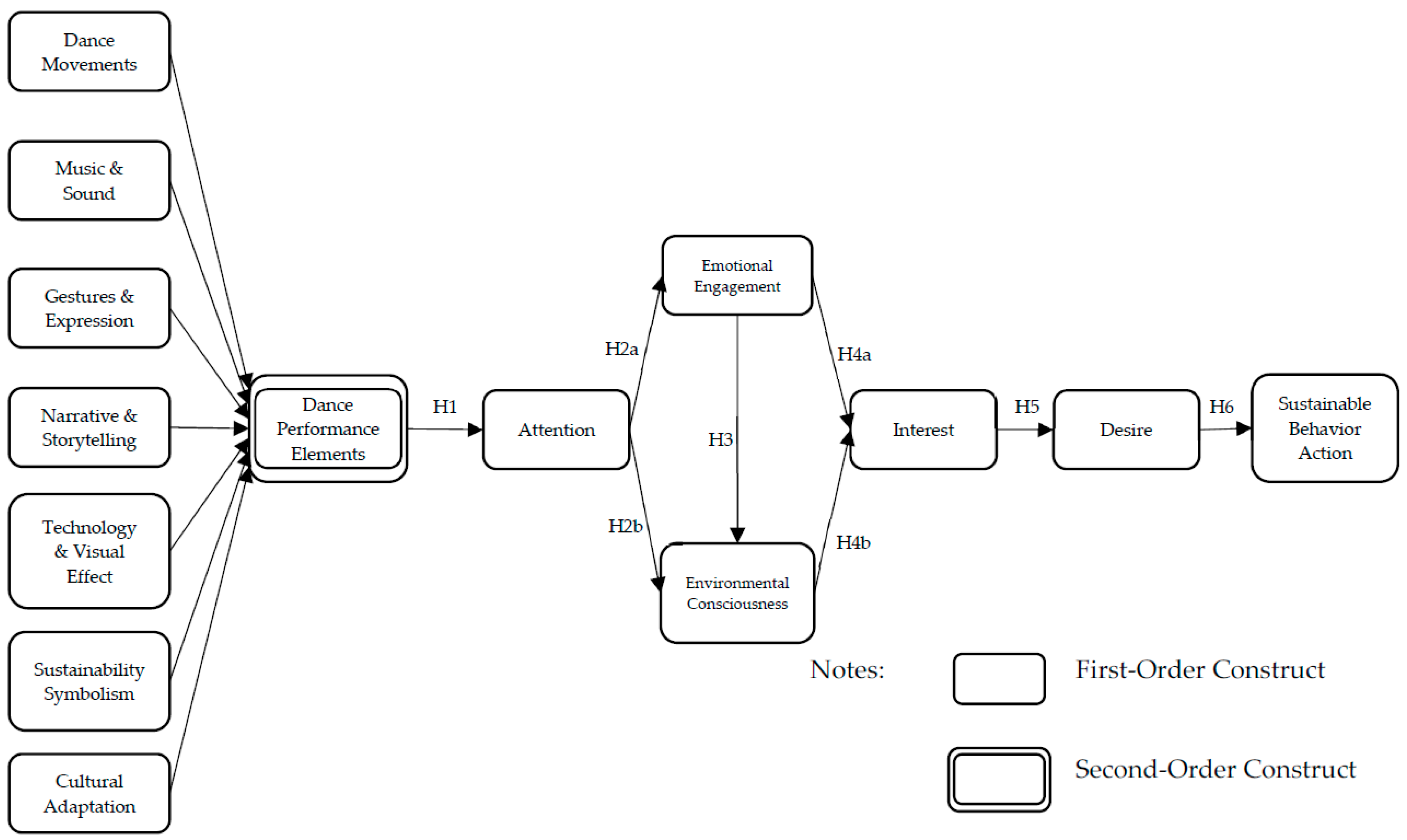
Figure 2.
The Pragmatic Paradigm and the Study’s Research Process.
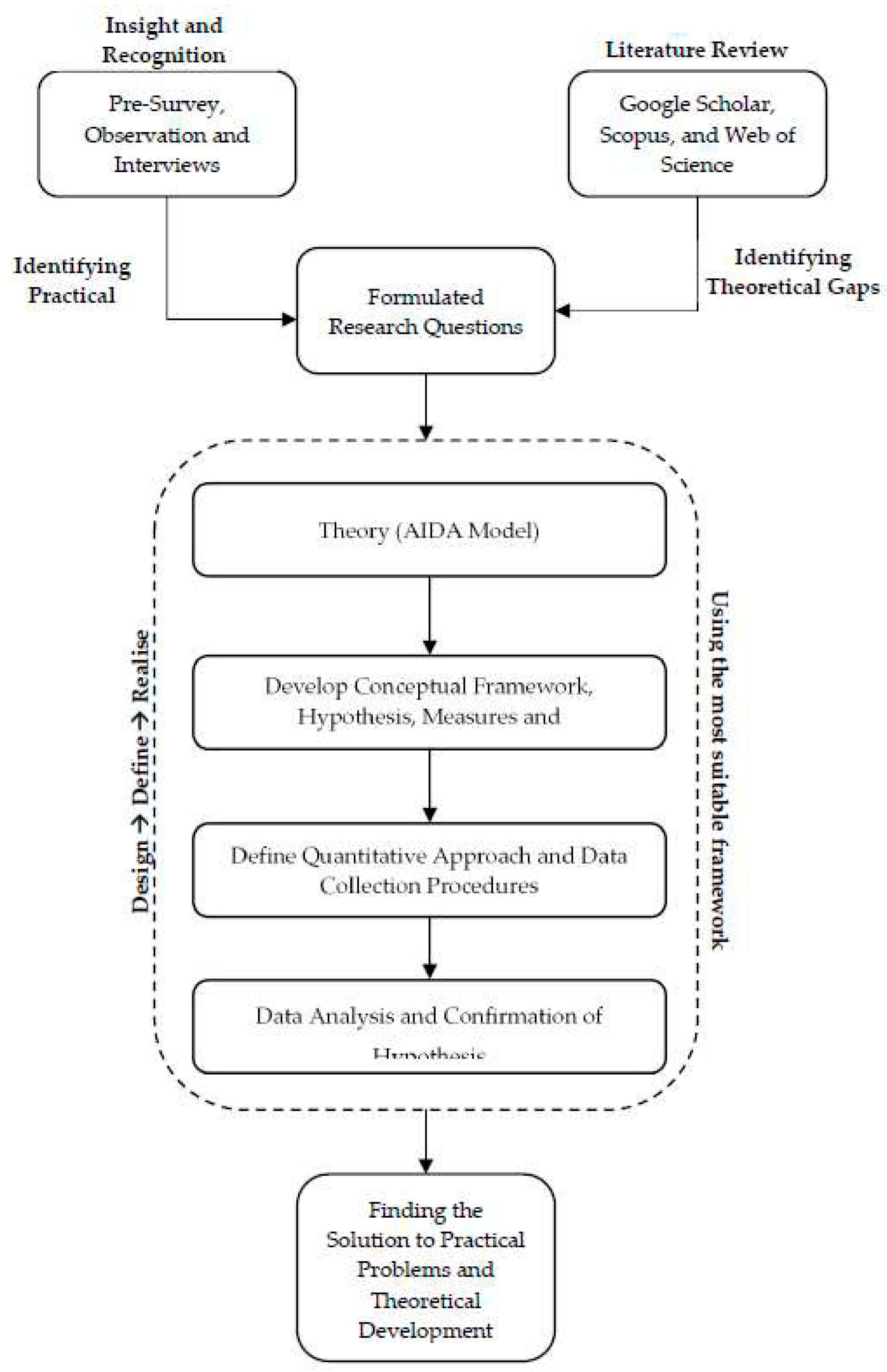
Table 1.
Tables should be placed in the main text near to the first time they are cited.
| Reference | Key Findings | Methodology | Limitations and Gaps | Theoretical Framework | Current Study’s Contribution |
|---|---|---|---|---|---|
| Wu & Lai [11] | Short videos influence audience emotions; impacts digital marketing engagement. | Systematic audience response analysis. | Limited to YouTube celebrities’ videos. | AIDA Model; Parasocial interaction. | Integrates dance into the AIDA model for enhanced digital marketing management. |
| Mosko [12] | Dance supports sustainable development operationally and artistically. | Qualitative analysis of dance organizations. | Case-specific focus. | Sustainability; Art Integration. | Shows dance’s role in sustainable marketing, informing our communication strategies. |
| O’Rourke et al. [13] | Music festivals promote environmental responsibility and community. | Interviews exploring festival environmental practices. | Limited to New Zealand festivals. | Sustainable Festival Management. | Align with our approach to communal events and sustainability in marketing. |
| Bojner Horwitz et al. [7] | Music and dance improve social behaviors and connectedness | Review of the impact of artistic activities on well-being. | Theoretical focus without empirical data. | Inner Sustainability; Artistic Practices. | Supports using dance for social sustainability in marketing communications. |
| Grindheim & Grindheim [21] | Dance experiences enhance cultural sustainability and belonging. | Phenomenological study of dance genres. | Adult-focused, less on nonverbal children. | Cultural Sustainability in ECE | Validates dance’s role in fostering community, applied to sustainable marketing. |
| Foster & Turkki [8] | Dance education via EcoJustice transforms values towards sustainability. | Theoretical reflection based on teaching experience. | Limited to educational settings. | EcoJustice Education | Reflects on dance’s transformative power, influencing our sustainability narrative. |
| Song et al. [14] | Found a strong relationship between AIDA’s attention/interest and TAM's perceived usefulness/ease of use. Marketing communication is crucial in the acceptance of new technology; attitude towards technology mediates the desire for the app. | Developed a conceptual model and hypotheses integrating TAM and AIDA to predict app acceptance behavior. | Did not specifically investigate how the AIDA model is integrated into marketing communications to promote sustainable behavior. | TAM and AIDA model. | The aim is to integrate the AIDA model and dance performance into marketing communication to promote environmental messages for sustainable behavior. |
| This study | Merges dance and the AIDA model to boost engagement and eco-awareness. | Mixed methods with panelists and audience surveys. | Overcomes previous cultural-artistic gaps in marketing. | Dance Integration; AIDA Model | Innovates a marketing model combining AIDA and dance to drive sustainable behavior, underpinned by validated research tools for broad societal impact. |
Table 4.
Summarize of Hypothesis Testing.
| Hypothesis |
Path Coefficient |
T-Value | Bootstrapping CI 97.5% | Decision | |
| Min | Max | ||||
| H1. Dance Elements → Attention | 0.626*** | 18.082 | 0.558 | 0.691 | Accept |
| H2a. Attention → Emotional Engagement | 0.523*** | 10.822 | 0.427 | 0.617 | Accept |
| H2b. Attention → Environmental Consciousness | 0.294*** | 4.814 | 0.179 | 0.415 | Accept |
| H3. Emotional Engagement → Environmental Consciousness | 0.221** | 3.442 | 0.096 | 0.346 | Accept |
| H4a. Emotional Engagement → Interest | 0.406*** | 6.520 | 0.280 | 0.526 | Accept |
| H4b. Environmental Consciousness → Interest | 0.150** | 2.463 | 0.036 | 0.217 | Accept |
| H5. Interest → Desire | 0.425*** | 9.092 | 0.331 | 0.516 | Accept |
| H6. Desire → Sustainable Behavior Action | 0.469*** | 11.390 | 0.388 | 0.547 | Accept |
| Notes: Significance level at ***P < 0.001; **P < 0.01; *P < 0.05 | |||||
Disclaimer/Publisher’s Note: The statements, opinions and data contained in all publications are solely those of the individual author(s) and contributor(s) and not of MDPI and/or the editor(s). MDPI and/or the editor(s) disclaim responsibility for any injury to people or property resulting from any ideas, methods, instructions or products referred to in the content. |
© 2024 by the authors. Licensee MDPI, Basel, Switzerland. This article is an open access article distributed under the terms and conditions of the Creative Commons Attribution (CC BY) license (http://creativecommons.org/licenses/by/4.0/).
Copyright: This open access article is published under a Creative Commons CC BY 4.0 license, which permit the free download, distribution, and reuse, provided that the author and preprint are cited in any reuse.