

Submitted:
24 January 2024
Posted:
25 January 2024
You are already at the latest version
Abstract
Structural health monitoring (SHM) is critical for ensuring the safety of infrastructures like bridges. This article presents a digital twin solution for SHM of railway bridges using low-cost wireless accelerometers and Machine Learning (ML). The system architecture combines edge on-premises computing and cloud analytics to enable efficient real-time monitoring and complete storage of relevant time-history datasets. After train crossings, accelerometers stream raw vibration data, which is processed in the frequency domain and analyzed via machine learning to detect anomalies indicating potential structural issues. The digital twin approach is demonstrated on an in-service railway bridge, where vibration data was collected over two years under normal operating conditions. By learning allowable ranges for vibration patterns, the digital twin model identifies abnormal spectral peaks, suggesting changes in structural integrity. The long-term pilot proves that this affordable SHM system can provide automated and real-time warning of bridge damage and also supports the use of in-house designed sensors of lower-cost and edge computing capabilities than those used in the demonstration. The successful on-premises-cloud hybrid implementation provides a cost effective and scalable model for expanding monitoring to thousands of railway bridges, democratizing SHM to improve safety by avoiding catastrophic failures.
Keywords:
Structural Health Monitoring (SHM)
; Railway bridges
; Digital Twin (DT)
; Machine Learning (ML)
; MLOps
; AutoML
; Low-cost sensors
; Anomaly detection
; Cloud analytics
; MQTT
; MEMS accelerometers
; Vibration-based monitoring
; Wireless Sensor Networks (WSN)
; On-premises computing
; Cloud computing
; Hybrid computing
; Building Information Modelling (BIM)
1. Introduction
1.1. Brief background on railway bridges and importance of structural health monitoring
The transport system, in particular the railway system, is essential in our daily lives and plays a fundamental role in the social and economic development of a region and a country [1]. The transport networks of the Basque Country (Spain) and Europe are highly developed, but face a growing problem of aging, with, for example, 35% of European railroad bridges being more than 100 years old [2]. Also, many of these bridges, especially the relatively old ones, are being pushed to their physical design limits due to the increased speed, axle load, length, and travel frequency of the new trains and transportation needs [3,4,5,6].
Uncertainties due to the Climate Change process exist, since previously unseen climatic conditions and phenomena tend to occur more frequently and unexpectedly, making these structures particularly vulnerable [7]. In addition, bridges, given their relatively low level of structural redundancy, are generally at risk of collapse in the event of significant damage caused by deterioration, resulting in serious economic losses, interruptions in the normal course of people’s lives and, in the worst case, irreparable tragedies.
Recently, there have been several major bridge collapses around the world, including the Morandi Bridge failure in Genova in 2018 [8] and the Nanfang’ao Bridge collapse in Yilan County in Taiwan in 2019, among others [9]. These incidents show the potential dangers when critical structural damage goes undetected. As a result, frequent and proactive monitoring of bridge structural health is essential to avoid such catastrophic failures. Minor issues like cracking or loose connections can gradually worsen over time if not spotted early.
Taking a broad definition, Structural Health Monitoring (SHM) is the process of assessing the state of health of a structure based on data from instrumentation installed in the structure [10,11]. It is a process that can be divided into different phases depending on the criterion, some do it in three, such as in [12], although we distinguish four, since the management or decision-making, facilitated by the contextualized access to the data, is considered within the process in the present work:
- Instrumentation: Set of sensors and data acquisition systems that collect the physical structural parameters to be monitored and analyzed.
- Monitoring: Remote data transmission and web publication.
- Analysis: Set of techniques to convert the data into characteristic variables or parameters to understand the structural behavior and implement systems to evaluate and detect structural damage.
- Management: Decision-making aid for action and maintenance that involves making this real time information available to the right people at the right time and within a realistic geometrical contextualization.
Due to its high costs, the installation of sophisticated structural monitoring systems in bridges is uncommon, being its application restricted to singular bridges or of special relevance. However, due to the obvious improvements that its implementation leads to, its use for bridges in general would be justified by developing an optimized solution of alert and diagnostic support at a relatively reduced cost, as the integrated system presented in this work, which employs advanced analysis techniques and IoT technology.
On the other hand, traditional on-site inspection methods are costly, since they require the travel of one or more technicians to each bridge, to carry out the survey, to evaluate the condition of the structure and finally to report it, and it may be necessary, particularly in the case of railway bridges, to interrupt or reduce the service to carry out some inspections. In this regard, if an automated alert system were commonly implemented to control the state of health of the structure, inspections could be optimized in number and form, and an improvement in safety could be achieved in real time instead of periodically, although the main inspections and load tests required by the regulations in force in each case will always have to be carried out according to the scheduled preventive maintenance plans of the bridge structures.
1.2. Related research summary
This article builds upon and extends previous research and has independently explored components like low-cost sensing, energy harvesting, digital twins and machine learning for vibration-based structural health monitoring (SHM) of bridges.
Vibration-based monitoring is a widely extended practice that tracks the dynamic response of the structure [13,14]. Continuous vibration monitoring provides a data-driven method to detect subtle changes in bridge integrity. The implementation of a SHM system combining structural monitoring and machine learning [15,16,17,18] through an interactive digital twin (DT) that allows contextualization of bridge geometry and sensor position can be a key tool for making decisions to avoid infrastructure disasters. As defined in [19], and [20] a DT is a technology that enables the virtual representation of a physical system, and its associated environment and processes. The system is continuously updated by exchanging information between the virtual and physical worlds. The DT integrates sensor data through a network of sensors from the physical asset to mirror its status, condition, and behavior in real time. Recently, the DT concept has gained popularity and broad acceptance across industries and is being consolidated as a cornerstone of the Industry 4.0 paradigm. While manufacturing or naval sectors have developed many DT use cases, the adoption in civil and structural engineering domain has lagged behind. Since 2018, the approach has been receiving more research attention in this domain, driven by the proliferation of Industrial Internet of Things (IIoT) and market pull factors, such as the need for monitoring aging structures under changing of use patterns and uncertain climatic conditions [20]. However, the integration of real-time sensor data with advanced simulation and AI algorithms remains an open challenge to realize the full benefits of digital twins for smarter and safer infrastructure management.
The article [21] proposes Minimal Information Data-modeling (MID) using low-cost (equipment costs around €400) and easy-to-install sensors, which is also one of the key aspects of our proposal. In this sense, the novel technique presented in the referred article offers high accuracy with low range sensors and damage detection sensitivity down to 0.01 Hz frequency shifts, whereas in our approach we rely on a clustering that addresses the variability in identification due to multiple factors. This technique could also be suitable to be implemented in the digital twin platform presented in this research through cloud processing of the obtained records.
The article [22] proposes an automated framework to classify anomalies (i.e. drift, distortion, outlier, anomaly, bias, etc.) in the time domain and assess the current state of the structure, while in our approach we work in the frequency domain, proposing a clustering for anomaly detection after the identification of frequencies in free vibration, which also allows us to discard faulty measurements. If a permanent discard were to occur, a no-data alert would also be issued, and we would have the corresponding signals in the time domain to perform a more detailed study or even accommodate algorithms such as the one proposed in the aforementioned paper, since our digital twin system or architecture is flexible to include other algorithms and is capable of receiving and storing data in the time domain with high sampling frequencies.
The work in [23] offers a new approach to damage identification based on the extraction of continuous time series of autoregressive (AR) coefficients from deformation measurements on a railway bridge, but it is based on fiber optic technology, i.e. expensive instrumentation, while the application of the present work is based on low-cost accelerometry after the passage of the train. In any case, the core of our work is a digital twin system, whose middleware can be easily adapted to other types of sensors for any physical magnitude, provided that a communication can be implemented at least from a PC connected in situ, while high-level algorithms, such as the one proposed in the above cited work, could be included in our processing layer.
The article [24] offers a bibliographic review on how energy harvesting technologies can provide sustainable power sources for Wireless Sensor Networks (WSN) deployed on bridges. The SHM systems implemented in bridges are mostly based on WSN. Solar, thermal, wind, and vibration energy harvesting are all examined as ways to overcome the limitations of battery-operated sensor platforms. However, [24] was confined to an energy perspective and did not investigate how the data from such sensors could be utilized for automated SHM powered by simulations and analytics.
The work in [25] discusses that MEMS sensors are miniature in size and have lower cost and weight than conventional wired alternatives. These advantages make MEMS sensors better suited for permanent installation over many years of continuous infrastructure monitoring. The article also provides a bibliographic review regarding the commonly used machine learning techniques, both classical and deep learning methods, for bridge structural health analysis using sensor data. But it identified high computational costs and model performance as limitations to practical cloud-based implementations for large-scale infrastructure monitoring. Edge computing is suggested as a potential solution but not implemented.
The article [26] provides a review of machine learning algorithms that have been successfully applied in SHM, specifically in the domains of vision-based and vibration-based SHM. In this regard, this paper leverages a vibration-based approach. However, other more advanced AI powered Deep Learning algorithms could be implemented using our demonstrated workflow.
1.3. A digital twin for SHM in railway bridges
The present work advances the state-of-the-art by combining the vital concepts from prior work, such as low-cost sensing, energy harvesting and machine learning into an integrated on-premises-cloud digital twin architecture with a successful real-world implementation. It makes several key contributions beyond these preceding studies. Firstly, it demonstrates how minimal low-cost sensing can be integrated into a complete digital twin architecture, advancing from pure data science [21] to a production SHM system. In addition, our approach offers the plus of Building Information Modeling (BIM) [27] contextualization of sensors and measurements within an architecture adaptable to other algorithms and sensors. Indeed, the authors of the present work designed and developed our own edge computing enabled low-cost devices compatible with the digital twin system. However, we prefer to present this digital twin as a system compliant with any sensor and any machine learning algorithm, as well as adaptable to all types of structural configurations, thanks to the geometric BIM contextualization of the bridge geometry and the instrumentation. Secondly, it implements sustainable solar energy harvesting in the full SHM solution, building on the potential shown in [24]. And thirdly, it delivers a hybrid edge-cloud machine learning pipeline to make large-scale analytics financially feasible, addressing the barriers called out in [25] and [26].
Specifically, our digital twin integrates inexpensive IoT acceleration sensors (equipment costs around €400) with MQTT [28] connectivity, on-premises fog computing, cloud big data and machine learning services, and a visualization application. Compared to [21], the sensor data is augmented by its contextual placement within a digital twin model of the bridge for enhanced structural insights, with particular potential for monitoring local variables (such as strains) through the use of other types of sensors beyond accelerometers. This article applies the digital twin concept conforming to the definition given in [20] and comprises the next features:
- Simulation: SHM + IoT + BIM
- Learning: AI
- Management: DS (Provides decision support)
The article [29] presents a pre-trained network with synthetic data, i.e., supervised with finite element models, which, based on deep learning techniques, could provide a fast response for damage identification if integrated in a real-time monitoring, and which would be computationally suitable to be included in the digital twin system we present, thus extending its simulation performance for model inclusion (adding the MOD and DIAG function in the simulation capabilities according to the structural digital twin conceptualization presented in [20]).
Moreover, powering the wireless sensors using solar energy harvesting realizes a self-contained system, enabling the sustainable sensor networks envisioned by [24]. And by leveraging both real-time edge processing and cloud machine learning, our solution overcomes the prior constraints around computational costs described in [25] and [26], demonstrating affordable analytics scaling.
To handle the high-throughput vibration data generated by the accelerometers, the digital components of the structural health monitoring system were deployed in a hybrid on-premises and cloud architecture [30]. For real-time data ingestion and analysis, an on-premises middleware was implemented. This on-premises system ingests the 500Hz. sampled data streamed from the accelerometers on the bridges via MQTT, and runs real-time machine learning algorithms to detect anomalies in the vibration patterns. To supplement this real-time analysis, the historical vibration data is also regularly forwarded to a cloud platform for longer-term storage and batch analysis. Storing and processing the entire high-frequency vibration dataset solely in the cloud would be prohibitively expensive due to large data volumes. By leveraging an on-premises system for time-critical analytics combined with cloud storage and batch processing, the railway operator can cost-effectively monitor the health of its bridges in real-time while also building up a knowledge base of historical structural dynamics data.
The objective of the present article is the analysis through a showcase of a fast, reliable, and cost-effective remote damage detection system for bridge structures, integrating the measured data and the alerts generated for the bridge into the Internet of Things (IoT). The system aims to move from a reactive to a proactive approach in bridge maintenance, replacing basic inspections with an automated process, to take a first step in the smartization of these infrastructures and their management as Industry 4.0 [31] assets in a generalized way.
A pilot case of the system was carried out in a real environment for a railway bridge in the Basque Country. For this purpose, following a vibration signal data type approach and the application of a Wireless Sensor Network (WSN) platform [24], an optimized sensor plan was developed in the structure and the measurement information was remotely processed, enhancing its usability through its synthesized visualization in dashboards accessible from a geometric model in the cloud.
The contribution of our present work is the deployment and evaluation of the digital twin capabilities in an operational context on a real railway bridge, also proving the viability of AI-powered digital twins using low-cost wireless IoT sensors. For structural health monitoring of infrastructures like this bridge, the digital twin is powered by machine learning algorithms instead of traditional physics-based simulations. Data-driven approaches, e.g. [32], are widely used in SHM in both the time and frequency domain, but are not usually based on low-cost IoT sensors leveraging the clustering-based approach of this work. This approach is particularly well aligned to work in real-time using eigenfrequencies with uncertainty in their identification (not only environmental and operational but also due to sensor and measurement limitations). We first train the digital twin, as it is the common practice in unsupervised data-based approaches, on vibration data collected from the bridge under known normal conditions. This allows the machine learning model to learn the patterns of vibration that correspond to normal structural dynamics. The trained digital twin model is then connected to real-time vibration data streamed from accelerometers on the actual bridge. By analyzing these vibrations using its trained machine learning algorithms, the digital twin can detect anomalies that deviate from the learned ”normal” patterns. These anomalies may indicate potential structural problems not discoverable through visual inspection.
Most of the traditional methods of operational modal analysis, or modal identification without input measurement, work with high sensitivity and high price accelerometers, such as force-balance type, but in this case we work with low-cost MEMS sensors, being the only valid measurable output the one produced by the passage of the train, so that the free vibration after the exit of the train from the structure is a signal in which only the natural frequencies of the bridge are contained.
The digital twin model can be re-trained over time as more sensor data is collected to improve its accuracy. The machine learning approach provides a data-driven way to monitor bridge health without relying on complex physics simulations. By detecting vibration anomalies, the digital twin can provide early warning of damage so repairs can be made before catastrophic failure.
This work establishes a replicable and cost-effective methodology for real-time railway bridge monitoring that can be extended to large infrastructure networks. The approach demonstrates reliable high-frequency data collection using MQTT communication between low-cost sensors and cloud platforms. Compatibility with commercial off-the-shelf acquisition modules enables flexible adoption with existing monitoring hardware.
A hybrid on-premise and cloud architecture processes the high volume sensor streams using open source tools for edge analytics and cloud machine learning. Mosquitto, Node-RED, and time-series databases handle real-time needs while cloud services provide scalable data storage, batch processing, and model management. The architecture is sensor-agnostic and adaptable to new data sources.
Additionally, a realistic digital twin integrates the real-time sensor data with bridge geometry models and AI-generated health insights for enhanced situational awareness. Interactive dashboards connect physical infrastructure state with digital monitoring outputs.
Overall, this pilot study proves the real-world viability of transitioning from costly manual inspections to continuously automated AI-powered infrastructure health monitoring. By demonstrating a pragmatic digital twin system architecture using affordable off-the-shelf components, this work enables scalable structural monitoring to improve railway operations, maintenance planning, and passenger safety.
2. System Architecture and Implementation
2.1. High-level overview
2.1.1. Physical components: accelerometers installed on bridge and local gateway
The monitoring of structures is generally carried out only on bridges of special importance or in known poor condition, with extensive sensor networks of high unit cost. In this use case, although the developed system is compatible with any type of sensor (with or without a data acquisition module, with or without PC, etc.), low-cost wireless IoT sensors have been integrated, allowing high data acquisition rates and easy installation and communication through a 4G Gateway located on site, being the whole system self-sufficient in energy by means of the use of solar panels.
For the sensor and communications layer, as observed in the Figure 1, the communication of the sensors with the Gateway has been integrated through a local WiFi network generated by the Gateway. With fewer cables than a conventional non-IoT system, the installation is faster, cleaner and safer [33,34]. The MQTT protocol has been used for sending data with a 3G network or higher, which allows high sampling transmission (500Hz. during most of the measurements taken). This allows the communication of the amount of data needed for a remote evaluation of this type of structures. Classical IoT protocols, such as LoRa or SigFox (0G) are insufficient in civil engineering if they are not preprocessed by hardware before sending, through edge computing [35,36,37], which is complex and generates a dependency on the referred hardware, which may not be available or valid in any situation. Finally, triggers have been configured for data capture activation at train crossing initial pulse signal, which is the event of interest, thus saving data and energy consumption.
Among other aspects, transport infrastructures are particular cases in terms of:
- The typology and materials used, as well as the constructive uncertainties.
- The failure modes to be considered, ELS (Serviceability Limit States) or ELU (Ultimate Limit States).
- The locations or construction elements to be monitored (critical sections, deck, piles, bearings, abutments, etc.) and the stresses to which they are exposed.
- The environment and other variables affecting durability and integrity, as well as aging.
Consequently, this pilot has been designed as a flexible, adaptable and scalable solution for remote BIM contextualization [38] of measurements with IoT systems, which is considered the most suitable and feasible technological approach for general or wide use bridge monitoring in practice.
2.1.2. Digital components: on-premises and cloud system
On the on-premises side, the in-house middleware ingests the raw sensor streams via MQTT and applies real-time processing to detect vibration events caused by passing trains. When a threshold is exceeded, indicating a train event, the middleware extracts the free vibration portion of the signal and runs Fast Fourier Transform (FFT) [39] analysis to identify the prominent vibration frequencies. For this response (free vibration), the structure can be considered in linear regime, being its natural frequencies only dependent on the stiffness and mass matrix, but there is a transient character in the signal, which also has a short duration, which requires a high sampling (covered by the selected network and the transmission system) to be processed and then deal with a higher uncertainty in the modal identification (covered by the proposed machine learning strategy). At the end of each day, the historical on-premises data is forwarded to the cloud data lake to augment the training dataset and continually improve the machine learning model’s accuracy. On the cloud side, the daily batch of FFT peak data from the bridge is stored in a data lake. Using Spark clusters, this data is transformed into consolidated, cleansed datasets suitable for machine learning. The key steps are:
- Filtering outliers in the vibration frequencies that fall outside expected ranges
- Extracting the top 3 principal vibration peaks for each bridge crossing event
- Clustering the data using k-means [25] to group similar vibration patterns
- Labelling the clusters to create a supervised training dataset
This curated dataset is used to train and re-train machine learning models to classify vibration patterns using Automated Machine Learning and MLOps [40] techniques. The best performing model is eventually deployed to an inference endpoint that can be called by the on-premises middleware. When the middleware sends new vibration peaks to the cloud endpoint, the model classifies the peaks into one of the learned clusters. This cluster assignment is returned to the middleware and stored. Any anomalies or changes in the typical cluster distribution can indicate a potential structural issue requiring further inspection. The on-premises database, in addition to the real-time inference results, registers sensor context data such as temperature.
2.2. Technical details on key components
The structural health monitoring system follows a hybrid edge-cloud architecture to enable real-time monitoring and analytics. The key components include sensors and gateways as the edge layer, on-premises middleware for preprocessing, cloud services for storage and machine learning and a digital twin application for data visualization and alerts. The Figure 2 depictures the main components of the architecture. The components as shown in the figure are:
- Sensors: Wireless accelerometers installed on the bridge to measure vibrations. They stream data via WiFi to an on-site gateway.
- 4G Gateway: Collects and transmits sensor data from the bridge location to the central system. Provides local WiFi connectivity.
- MQTT Broker: Message queuing protocol used for efficient sensor data transmission.
- On-Premises Network (A): Middleware hosted on-site for real-time data ingestion and processing. Stores data in time series database and runs analytics like FFT.
- Cloud Network (B): Cloud services for scalable storage, batch processing, and machine learning. Batch data is ingested to the cloud storage data lake and processed in Databricks for ML model training. It includes MLflow, which enables machine learning model management workflows. MLflow is used to track, version, and deploy machine learning models into production in a serverless scalable way.
- Digital Twin Application (C): Consumes real-time sensor data along with bridge geometry model for visualization and alerts. Includes dashboards, notifications, and a digital twin BIM viewer.
The edge layer acquires high-frequency sensor data, the on-premises middleware (A) handles real-time processing needs, while the cloud (B) provides big data and machine learning capabilities. The digital twin application (C) fuses sensor data with the bridge information model to bring monitoring insights to users.
2.2.1. MEMS Accelerometers
Low-cost SHM monitoring systems offer a good behaviour in terms of resolution, noise level and sensitivity [41]. The MEMS [25] accelerometers used in the bridge monitoring system are the cost-effective BeanDevice Willow AX-3D [42] wireless vibration sensors. These triaxial accelerometers can measure vibration along three perpendicular axes, capturing the full motion of the sensor. The selected measurement range was ±2 g, meaning they can detect accelerations up to 2 times the force of gravity in any direction. The frequency response reaches 800Hz., suitable for capturing bridge structural vibrations which typically fall in the range of a few Hertz to 50 Hz. The Willow sensor was configured to sample acceleration values at 500Hz. (a short signal of a few seconds needs a high sampling rate to have enough points to process by FFT) and streams the data over WiFi using a local network set up specifically for the bridge deployment. A 4G cellular modem, acting as the gateway, provides the WiFi network access the wide area network (WAN). The accelerometer data is published to an MQTT message broker hosted on the 4G modem itself, minimizing external dependencies. Using MQTT allows the low-power wireless sensors to easily integrate with the rest of the monitoring system architecture.
2.2.2. On-premises system
The middleware was designed to handle the real-time processing and storage of sensor data. We chose the MQTT protocol for communication between the sensors and the middleware due to its lightweight nature, low bandwidth usage, and suitability for IoT and SHM applications [28].
For the MQTT message brokering, the open-source Mosquitto [43] broker was utilized. Mosquitto is an scalable implementation of an MQTT server. The sensors were configured to publish their acceleration data streams to topics on the Mosquitto broker. The on-premises middleware was built using Node-RED [44], a visual programming tool for wiring together IoT devices, APIs, and services.
The use of Node-RED as a middleware provides a cost-effective and flexible solution for industrial applications [45]. Custom Node-RED nodes were developed to decode the hexadecimal payload of the sensor messages into numerical acceleration values. Additional nodes enabled storing the real-time data into an InfluxDB [46] time-series database. For real-time analysis, Node-RED nodes implemented the following features:
- Signal Processing Algorithms: Signal processing is a crucial aspect of our study, as it allows us to extract valuable insights from the raw sensor data collected from the railway bridge. In this study, we used a combination of filtering, and noise reduction to process the high-frequency sensor data in real-time.
- Fast Fourier Transform (FFT) Analysis: Following the filtering and noise reduction, the sensor data was then subjected to FFT analysis. The FFT is a signal processing algorithm that transforms a signal from its original time domain to a representation in the frequency domain. This transformation makes it easier to analyze the frequency components of the signal, which is particularly useful for identifying the resonant frequencies of the railway bridge.
In our study, the FFT analysis was performed on-premises using a custom-built Node-RED node. This tool was designed to handle the high data rates of the sensor data and performs the FFT analysis in real-time, thereby enabling us to detect any changes in the bridge’s eigenfrequencies after a train has passed. The Node-RED environment provided an agile way to stream and process the high-frequency sensor data on the middleware.
2.2.3. Cloud system
The cloud infrastructure provider used was Microsoft Azure [47]. Within Azure, a Gen2 storage account was leveraged as a scalable data lake [48] for storing the historical vibration data forwarded from the on-premises system. Built on top of this data lake, a lake house [49] architecture was implemented using Databricks [50] for Azure. Databricks provided both data engineering capabilities for batch data processing, as well as machine learning workflows in two workspaces.
In the data engineering workspace, Databricks was used to process the raw FFT data from the accelerometers. Spark clusters running on Databricks consolidated and cleaned this data, ultimately clustering the FFT spectra into 3 labeled groups representing different vibration patterns. For the data transformation, the medallion architecture [51] was used. This transformed the raw data into curated silver and gold datasets to make them suitable for training machine learning models.
The machine learning component of Databricks leveraged the AutoML [52] feature to automatically train and evaluate different algorithms on the labeled FFT data. The best performing algorithm was selected and registered into the MLflow [40] tracking server. MLflow enabled MLOps on Databricks by managing the model lifecycle including model versioning, staging, and production deployment. Trained models were first tested in a staged environment and then promoted to production deployment on a serverless and scalable Azure Kubernetes Service. The production models were exposed as real-time inference endpoints that could be called by the on-premises middleware system.
2.3. Implementation challenges and solutions
Thanks to the interest of ETS, Euskal Trenbide Sarea/ Basque Railway Network, through the company DAIR Ingenieros, the bridge corresponding to PK11/520 of the Txorierri line and located in the industrial area of Torrelarragoiti (Zamudio, Basque Country, Spain) was obtained as a pilot or demonstrator structure, as shown in the Figure 3 below. The characteristics of the structure under study are as follows:
- Railway bridge
- A single isostatic span of approximately 15 meters
- Two non-standard steel main girders with reinforced concrete top slab
The 15 meter single-span bridge chosen as the pilot for this structural health monitoring system represents a typical medium-length span used for urban bridges. In this kind of single-span bridges, deterioration issues eventually emerge from accumulated traffic, material aging and exposure to climatic conditions.
In order to record as clearly and accurately as possible the first three vibration frequencies , an accelerometer was placed at the span center (to contrast the first longitudinal bending mode and, as a local variable, the acceleration of the point of maximum displacement, since this acceleration can also be controlled by direct threshold), an accelerometer at of the span, between span center and support (where approximately the maximum amplitude of the third modal form of vibration is located, corresponding to a second longitudinal bending, to which the accelerometer at span center is theoretically blind), and an accelerometer on the other beam, to characterize the torsion (second theoretical mode, which might not be always excited from passing the centered load). However, this last added sensor ended up being removed before the end of the installation, as the concrete slab shielded the coverage provided by the WiFi antenna on the other side of the beam. That is, only one of the main girders was instrumented, being sufficient for the demonstration or functionality test of the system parts once assembled, which is the objective of the pilot test. The installation was completed in about 3 hours, but may be faster on more accessible bridges, as it was necessary to make a cut in the road under the bridge and use a flatbed truck to access the flange of the main girders. It was decided to place the Gateway and the accumulators on the flange, since it has enough width (it is a non-commercial profile), placing the sensors next to the web (according to the usual practice in instrumentation of structures, this is a suitable position for the measurement of accelerations and main vibration frequencies).
It is important to emphasize that it is necessary to record measurements for further analysis in bridges (a complete dynamic and/or more detailed study can be done by an expert after downloading data from the platform) and to have a power outlet available. Failing that, it is necessary the installation of solar panels and their respective accumulators, since the measurement equipment in general cannot withstand many hours without power supply when high measurement and transmission rates are required. IoT equipment that have autonomy for long periods of time only with batteries, usually measure and transmit data every several minutes, while in the pilot experience, up to 500 data per second are being recorded for train passages (achieved by implementing the communication through MQTT protocol and 4G network).
Regarding data quality, the span of the bridge resulted to be a bit short, and the free vibration of the bridge was restricted to less than 8 seconds. This meant that the part of the signal (after the train exit) corresponding to the free vibration had to be precisely captured. To solve this, and since the train units cross always at the same speed, a manual time adjustment of the capture was configured in the middleware to ensure that a significant free vibration signal was captured in each crossing.
Another issue came from the difference of temperatures between a day and another. The sensors were sensitive to the temperature and summed an offset in the signal, generating false triggering due to detection of signals that overpassed the RMS thresholds, activating the capture of invalid signals. In addition, under certain climate circumstances, some noise was induced due to interferences that occasioned the same triggering issue. The solution comprised the regular remote calibration of the MQTT sensors when notable temperature changes were forecasted.
Concerning the selection of the on-premises and cloud infrastructures a key challenge was finding the right balance in leveraging both platforms cost-effectively. While cloud services excel at data storage, batch processing, and machine learning, they can become prohibitively expensive. For this bridge monitoring use case, the raw sensor data rates were too high to process solely in the cloud. By handling real-time ingestion, parsing, and FFT analysis on-premises, the data forwarded to the cloud was reduced by orders of magnitude. This avoided excessive cloud data ingress charges. However, the cloud was still leveraged for its strengths, such as cheap storage, distributed batch data processing and on-demand machine learning model training and deployment. These tasks are challenging to implement on-premises due to the maintenance costs and configuration efforts of these components. To scale the solution to many bridges, the on-premises components allow cheap real-time analytics and the cloud then enables aggregated analytics by consolidating data from all bridge deployments. Careful testing was conducted to find the optimal split between real-time processing and batch cloud analytics. This balance minimized costs while still providing a robust, low-latency structural health monitoring system.
3. Results and Analysis
3.1. Overview of field deployment on an actual railway bridge
The structural health monitoring system was deployed on an in-service railway bridge for an extended real-world validation. The instrumentation was installed rapidly, as the equipment consists mainly of wireless devices. Despite exposure to weather and vibrations, the ruggedized equipment required no maintenance over 2 years of continuous operation. Over this period, the system captured a rich dataset of bridge vibrations under daily rail traffic with a mean frequency of 2 crossing trains every 18 minutes. The machine learning models were successfully trained on this data to classify normal vibration patterns and the model deployments demonstrated the effectiveness and robustness of the monitoring system concept. The sensors provided reliable high-frequency data even in noisy environments near active rail lines.
The digital twin concept demonstrated here proved to be robust and could be extended to other railway bridges of similar characteristics and potentially to other types of infrastructures.
3.2. Sample acceleration data collected from sensors
There is some variability in the natural frequencies extracted at each train pass because different trains pass in both directions with slightly varying loads and speeds, which do not excite the structure in the same way, and also an inherent variability due to working with short free vibration signals rather than long environmental vibration recordings. To cope with this fact, a clustering algorithm was used to sepparate the measurements in a reduced number of groups or cases. Basically, depending on the passage of the train, some frequencies are not identifiable after the departure of the vehicle, because they have not been sufficiently excited, or signals with higher noise and/or insufficient duration of free vibration are generated for a correct processing. These latter signals are discarded, since the identification of frequencies with accelerations of free vibration is more unstable with these more limited sensitivity sensors, lower than class A ones. That is, a series of clusters can be separated, generating 3 different clusters, so that, for example, in one of them there can be signals with f1=5.62Hz, f2=7.57Hz, f3=20.02Hz, etc., and in another one with f1=5.64Hz, f2=20.05Hz, etc. With clustering, different regions of normality can be easily defined for the training of anomaly detection, so that, once the algorithm has been trained, at the passage of each new train, the membership of each of the clusters can be evaluated (being very high for one group and very low for the other two that are generated, as the differences between frequency vectors are due to the appearance or not and to the order of the identified frequencies).
Figure 4 shows a time series plot of free vibration after a passing train. The signal is further processed with an FFT algorithm for frequency domain transformation and classification.
Figure 5 shows a plot of the free vibration FFT of the previous figure. Clustering is performed based on the patterns of these modal frequencies for the characterization of the normal situation of the bridge.
To validate this characterization, the free vibrations were processed after the passing of a train to obtain a vector with the natural frequencies of the structure of the pilot research case. These frequencies are approximately in agreement with the frequencies of the Ansys Mechanical APDL [53] finite element model, knowing that this is only indicative because there are no drawings of the structure and no access permission to carry out exhaustive measurements. Thus, it was verified, about the frequency domain, that the measurement provided by the equipment is valid and that the bridge does not differ appreciably from its theoretical behavior, i.e., as it is physically.
The values obtained by the finite element model, after manual calibration of the model within acceptable parameters, for the first three vibration modes are as follows:
• Between 4-5Hz the first mode (bending)
• Between 15-16Hz the second mode (torsion)
• Between 18.5-19.5Hz the third mode (second order bending)
The corresponding modal shapes are shown in the Figure 6 (Ansys Mechanical APDL).
Figure 7 shows a detail of an analysis of the frequencies obtained from a remotely received signal for the pilot bridge. The first frequency is 4.69Hz (first bending) and the second frequency is 20.31Hz (probably the second bending, as the global torsion was not sufficiently excited). The differences with the model are acceptable, since the model is made without drawings of the structure.
3.3. How digital twin detects structural changes from sensor data
Over the 2 years of testing, the system collected around 4000 valid samples of bridge vibration spectra during train crossing events. Table 1 shows a characterization of the collected FFT data.
Using k-means clustering on this FFT data, the digital twin consistently identified 3 distinct clusters representing normal vibration patterns. Figure 8 shows the three-cluster distribution in the 3D space and a descriptive analysis of the data.
Table 2 and Table 3 show the distribution of the cases into clusters, the description of the cluster center positions and the statistical characterization of the three clusters.
Figure 9 summarizes the distribution of the total samples across these three clusters identified under normal operating conditions, providing insight into the prevalence of different vibration signatures in the raw acceleration data.
According to the provided data, the 4323 cases were distributed as follows:
- Cluster 1 contained the fewest cases at 190 cases.
- Cluster 2 had 659 cases.
- Cluster 3 was the largest group with 3474 cases.
The dominance of Cluster 3 indicates that nearly 80% of the observed vibration patterns fell into this category. Cluster 2 had the next highest portion at 15% of the cases, while Cluster 1 represented about a 5% of the measured spectra. This distribution shows that most of the vibration data (95%) was classified into Clusters 2 and 3, which likely represent the fundamental natural frequency of the bridge and low-order resonances. The fewer members of Cluster 1 suggest it corresponds to less common transient or higher-order vibration phenomena.
The clusters represent distinct vibration frequency patterns observed during train crossing events. Cluster 3 and 2, with a peak frequency around 5Hz, likely correspond to the fundamental bending mode of the bridge span and the peak frequency of 14Hz corresponds to the torsion mode. Cluster 1 probably captures higher order resonances such as high order bending modes, including transient vibrations without clear modal patterns. By separating the raw acceleration signals into these characteristic clusters, the digital twin model establishes baseline behavior profiles for the bridge.
The relative size of the clusters quantifies the prevalence of different vibration signatures identified by the machine learning model under normal operating conditions. Tracking changes in the cluster distributions over time then enables assessing shifts in structural response that may require further inspection. This cluster analysis demonstrates the digital twin can characterize the normal response in terms of eigenfrequencies from the raw acceleration signals.
The cloud machine learning model was trained using AutoML to classify any new vibration data into one of these 3 clusters. Databricks AutoML was leveraged to automatically evaluate different machine learning algorithms and hyperparameters. The classification models tested included Decision Trees, Random Forests, Logistic Regression, XGBoost, and LightGBM.
An AutoML experiment was launched that ran various combinations of these algorithms with tuned hyperparameters. At the conclusion of the experiment, the best performing model was selected based on accuracy metrics. The optimal model proven to be a LightGBM classifier automatically trained using the scikit-learn python library. LightGBM can rapidly train classification models. With its blend of performance, accuracy and scalability, LightGBM has become a popular machine learning package suitable for a wide range of predictive modeling applications from analytics competitions to production systems [54]. The structural health monitoring system utilizes LightGBM for its high performance in training models on large vibration data sets to accurately classify normal versus abnormal bridge conditions. The evaluation metrics for the chosen LightGBM model were:
- Best iteration: 551
- Stopped iteration: 551
- Test log loss: 0.0006075081432147722
- Test ROC AUC score: 1
- Training log loss: 0.0007183862059302976
- Training ROC AUC score: 1
- Validation log loss: 0.0008920399455838305
- Validation ROC AUC score: 1
By leveraging AutoML to automatically find the best classification algorithm, we were able to build an accurate machine learning model for detecting anomalies in the vibration data using the labeled training clusters. The model serves as the predictive engine behind the digital twin’s structural health analysis capabilities.
By continuously analyzing the stream of new accelerometer data, the model could detect when the vibration patterns deviated from the normal clusters. To quantify the extent of the deviation, we defined a ”damage index” as the probability that a vibration data sample did not belong to any of the 3 known normal clusters. The higher this index, the more dissimilar the vibrations were from patterns seen during normal operation.
Figure 10 shows a dashboard implementation with ”damage index” or probability of failure after train passing. The reliability of this result increases with the number of data collected and the number of variables included.
These clusters established a profile of expected normal structural dynamics. By continuously analyzing new data, any vibrations that deviated from the learned clusters could indicate a change in the bridge’s condition.
For example, increased vibration magnitudes detected in certain frequency bands could suggest a loss of structural stiffness, as the reduction of the value of the corresponding eigenfrequency. Also, new vibration peaks appearing could imply damage in the structure, like the prolongation of the vibration after a train crossing (due to changes in structural damping).
While controlled damage testing was not possible on the active railway bridge, the long-term monitoring data itself revealed seasonal shifts in vibration patterns due to factors like temperature. The digital twin was able to adapt and maintain high accuracy despite these operational variations.
Regarding user interaction and visualization, a BIM model of the bridge, generated by RDT Ingenieros, and the sensors was built. The model enables a common data environment, where the geometric, structural and sensor data are accessible and linked together as a digital twin. Among the features of the visualization system comprises the train crossing visualization, as shown in the Figure 11 and Figure 12 where the free vibration of a crossing is shown in real time.
Another set of functionalities include a system for sending alerts by thresholds configurable by the expert user and a dashboard with probability of failure after train passing. In essence, the digital twin learned an allowable range of normal vibrations over long-term monitoring through machine learning. This enables it to detect abnormal patterns potentially linked to structural changes. The system provides a data-driven method for continuously assessing bridge health without requiring baseline physics models.
Statistics from data shows consistent classification. No data about damages but a gradual outperformance can be detected in the form of creation of new clusters reflecting possible structure degradation. However, more data is needed for this purpose.
4. Conclusions
4.1. Summary of digital twin approach for SHM in railway bridges
This pilot demonstrated a digital twin solution for real-time monitoring of railway bridge structural integrity using only low-cost accelerometers. The digital twin model was driven by vibration data streamed from the sensors to detect anomalies through machine learning algorithms indicating potential damage. The hybrid edge-cloud architecture enabled an efficient and scalable implementation. The edge middleware handled high-speed data ingestion, preprocessing, and real-time FFT analysis, while the cloud provided storage, batch processing, and machine learning capabilities.
The digital twin’s machine learning algorithms were able to potentially detect and localize damage from changes in structural vibration patterns before visual inspection. This structural health monitoring approach based on a digitally twinned machine learning model provides an automated way to continuously assess bridge safety. It generates actionable insights on maintenance needs to prevent infrastructure failures and avoid disasters.
4.2. Benefits demonstrated: low-cost and rapid damage detection
The most important achievements of the pilot application can be summarized as follows:
1. Establishment of a replicable methodology, with slight adaptations to each case study, for the generalization of railway bridge monitoring and its integration into the Internet of Things (IoT). The approach shown can be extended to the numerous similar bridges found in any metropolitan area network. As a result, the ability to monitor such common bridges is key for managing urban infrastructure health.
2. Identification and enabling of a reliable MQTT communication with sufficient time density of measurements that allows the subsequent structural analysis of bridges (sending by 4G network through MQTT broker). This is also applicable to different sensing equipment: it has been possible to integrate with this communication protocol both low-cost and solar-powered commercial wireless systems (selecting the most competitive in price for the pilot), and standard universal acquisition modules for wired sensors. That is, the sensors to be used in the system could be selected according to the technical needs and the budget available for the monitoring of each bridge. With this combination of industrial-grade sensors, localized connectivity, and a standardized MQTT data interface, the solution can reliably collect high-frequency vibration data on the structural dynamics of the railway bridges. The cellular modem connectivity enables remote data access from anywhere with Internet access.
3. Development of a hybrid on-premises processing system using open-source tools, which allows the communication of hardware or physical devices with the cloud, allowing a high sampling frequency for each installed sensor. This system or data platform is extensible and scalable to any bridge, with the corresponding slight adaptations to accommodate new sensor technology. The combination of Mosquitto, Node-RED, and InfluxDB 2.0 enables real-time collection, analysis, and storage of the acceleration data on-premises. Mosquitto handled collecting and distributing the massive amount of sensor messages. Node-RED processed and analyzed the data streams and InfluxDB 2.0 acted as the time-series database for operational monitoring and data historians. On the cloud side, Azure Databricks provided a cloud platform for scalable data engineering, machine learning model training with AutoML, and robust MLOps for managing and deploying the models using MLflow. The cloud services provided the bandwidth needed for big data workflows on the historical vibration datasets. While this implementation used a LightGBM classifier selected by the Databricks AutoML functionality for vibration pattern analysis, the flexible architecture could adapt a wide range of machine learning and deep learning algorithms as reviewed in the literature, including CNNs, RNNs, autoencoders, and other neural network architectures, into the SHM data pipeline as needed based on modifying the model requirement.
4. Visualization centered on a realistic digital twin, with location and access to the information of each sensor, which appears represented as physical reality and with its assigned ID. That is, IoT integrated as a digital twin connecting streaming data, AI generated alerts and physical geometry of the bridge.
The hybrid architecture allows real-time edge analytics combined with cloud machine learning over historical data for an efficient, scalable structural health monitoring system. The middleware handles real-time needs while the cloud provides flexible big data and machine learning capabilities. This architecture proved highly scalable, as additional bridges can be onboarded by deploying standalone on-premises systems for each. The centralized cloud platform aggregates and analyzes data from all bridges as needed.
The hybrid on-premises-cloud architecture was key to overcoming the implementation challenge of applying cost effective and replicable machine learning-based monitoring to high-frequency sensor data from the infrastructure.
The successful pilot proven the field viability and has paved the way for expanded production deployments. The railway operators obtained a reliable, low-cost solution to continuously monitor their bridges and detect issues early to avoid disruptions.
This pilot demonstrates two significant benefits of the digital twin approach for structural health monitoring. First, it enables automated, continuous assessment of bridge integrity using only affordable wireless sensors. Second, the on-premises-cloud architecture provides a scalable implementation model that can be expanded to monitor thousands of bridges.
4.3. Future work to improve digital twin model fidelity and damage quantification
For future work, we aim to extend this successful railway bridge demonstration to broader production deployments. The low cost and ease of implementation make the digital twin concept scalable to enable monitoring of all critical bridges across a transportation network. By detecting issues early, this system has potential to dramatically improve infrastructure safety and prevent catastrophic failures through affordable, large-scale structural health evaluation.
While the digital twin and machine learning approach shows promising for monitoring other types of infrastructure as well, we plan to first improve the fidelity of the digital twin model using advanced physics simulations and expanded sensor data for the railway bridge use case. We will also research ways to better quantify the extent, localization and progression of any damage detected.
One promising infrastructure application is in wind towers. These massive structures undergo important stresses and lack extensive instrumentation in the structure itself. A digital twin could simulate wind tower structural dynamics to pinpoint damage using limited sensor data. In this regard, the authors are exploring partnerships to develop digital twin monitoring systems for wind towers, both onshore and offshore. By detecting issues early, costly shutdowns and repairs could be avoided while ensuring these renewable energy assets operate safely.
While the current system architecture utilizes middleware for preprocessing and cloud machine learning, future work will shift more of the analytics onto intelligent sensors providing energy harvesting and edge computing characteristics. We are developing sensors that can process FFT and vibration analysis directly on the sensor hardware using embedded machine learning chips. This edge processing will reduce the data throughput burden on the middleware and cloud components. With smart sensors performing feature extraction on-chip, only the key vibration metrics would need to be transmitted instead of raw sensor streams. Such intelligent sensors would enable highly distributed analytics, with the cloud focus shifted to centralized data aggregation, model management, and training, and decision making. The overall architecture would become more distributed but still retain cloud scale for global model building across bridges. Embedding intelligence directly into the sensors will eventually allow real-time embedded inference at the true edge while cloud and on-premises resources will handle system-level coordination and big data analytics.
The core technologies proven here, low cost IoT sensors, middleware processing, digital twin and machine learning, provide a framework to enable low-cost, data-driven structural health monitoring across infrastructure domains.
5. Funding
This research was funded by the Basque Government within the HAZITEK programme (ZUBIoT project (ZL-2020/00902)) co-financed by the European Regional Development Fund (FEDER), and the Horizon Europe (HE) programme within FUTURAL project (GA 101083958) and MULTICLIMACT project (GA 101123538).
6. Acknowledgements
The authors would like to thank Euskal Trenbide Sarea/Basque Railway Network (ETS) and the company DAIR Ingenieros for facilitating access to the railway bridge pilot case, and the company RDT Ingenieros for providing the BIM model of the bridge. The authors would also like to acknowledge Ana Fernández-Navamuel1 for her valuable contributions in reviewing this article and providing key inputs and advice during the conceptual development process.
Author Contributions
Conceptualization, D.Z. and A.A.; experimentation, A.A. and D.Z.; investigation, D.Z. and A.A., original draft preparation, A.A., D.Z.; writing review, D.Z.; editing, D.Z. and A.A.; project administration, D.Z., A.A. The authors have read and agreed to the published version of the manuscript.
Institutional Review Board Statement
Not applicable.
Informed Consent Statement
Not applicable.
Data Availability Statement
Not applicable.
Conflicts of Interest
The authors declare there is no conflicts of interest.
References
- Wang, Y.W.; Ni, Y.Q.; Wang, S.M. Structural health monitoring of railway bridges using innovative sensing technologies and machine learning algorithms: a concise review. Intelligent Transportation Infrastructure 2022, 1, liac009. [Google Scholar] [CrossRef]
- Vagnoli, M.; Remenyte-Prescott, R.; Andrews, J. Railway Bridge Structural Health Monitoring and Fault Detection: State-of-the-Art Methods and Future Challenges, Structural Health Monitoring. An International Journal 2017. [Google Scholar] [CrossRef]
- Elfgren, L.; Olofsson, J.; Bell, B.; Paulsson, B.; Niederleithinger, E.; Jensen, J.S.; Feltrin, G.; Täljsten, B.; Cremona, C.; Kiviluoma, R.; Bien, J. Sustainable Bridges - Assessment for Future Traffic Demands and Longer Lives”, Priority Sixth Sustainable Development Global Change & Ecosystems Integrated Project. Publishable Final Activity Report 2008. [Google Scholar]
- Reyer, M.; Hurlebaus, S.; Mander, J.; Ozbulut, O.E. Design of a Wireless Sensor Network for Structural Health Monitoring of Bridges. Proceedings of the International Conference on Sensing Technology, 2011; 515–520. [Google Scholar] [CrossRef]
- Le, B.; Andrews, J. Modelling Railway Bridge Asset Management. Proceedings of the Institution of Mechanical Engineers 2013, 227, 644–656. [Google Scholar] [CrossRef]
- Pipinato, A.; Patton, R. Chapter 19 - Railway Bridges. Innovative Bridge Design Handbook. Butterworth Heinemann, 2016, pp. 509–527. [CrossRef]
- Nasr, A.; Kjellström, E.; Björnsson, I.; Honfi, D.; Ivanov, O.L.; Johansson, J. Bridges in a Changing Climate: a Study of the Potential Impacts of Climate Change on Bridges and their Possible Adaptations. Structure and Infrastructure Engineering 2019. [Google Scholar] [CrossRef]
- Rymsza, J. Causes of the Collapse of the Polcevera Viaduct in Genoa, Italy. Applied Sciences 2021, 11. [Google Scholar] [CrossRef]
- Wang, E.; Liu, Z.; Li, M.; Zhao, D. Implication of bridge resilience design and lessons from negative examples. Advances in Bridge Engineering 2022, 3, 23. [Google Scholar] [CrossRef]
- Sun, L.; Shang, Z.; Xia, Y.; Bhowmick, S.; Nagarajaiah, S. Review of Bridge Structural Health Monitoring Aided by Big Data and Artificial Intelligence: From Condition Assessment to Damage Detection. Journal of Structural Engineering 2020, 146, 04020073. [Google Scholar] [CrossRef]
- Brownjohn, J. Structural health monitoring of civil infrastructure. Philosophical Transactions of the Royal Society A: Mathematical, Physical and Engineering Sciences 2007, 365, 589–622. [Google Scholar] [CrossRef] [PubMed]
- He, Z.; Li, W.; Salehi, H.; Zhang, H.; Zhou, H.; Jiao, P. Integrated structural health monitoring in bridge engineering. Automation in Construction 2022, 136, 104168. [Google Scholar] [CrossRef]
- Carden, E.P.; Fanning, P. Vibration Based Condition Monitoring: A Review. Structural Health Monitoring 2004, 3, 355–377. [Google Scholar] [CrossRef]
- Alves, V.; Cury, A. A fast and efficient feature extraction methodology for structural damage localization based on raw acceleration measurements. Struct Control Health Monit 2021, 28. [Google Scholar] [CrossRef]
- Malekloo, A.; Ozer, E.; AlHamaydeh, M.; Girolami, M. Machine learning and structural health monitoring overview with emerging technology and high-dimensional data source highlights. Structural Health Monitoring 2022, 21, 1906–1955. [Google Scholar] [CrossRef]
- Zinno, R.; Haghshenas, S.; Guido, G.; Rashvand, K.; Vitale, A.; Sarhadi, A. The State of the Art of Artificial Intelligence Approaches and New Technologies in Structural Health Monitoring of Bridges. Applied Sciences 2023, 13. [Google Scholar] [CrossRef]
- Zinno, R.; Haghshenas, S.S.; Guido, G.; VItale, A. Artificial Intelligence and Structural Health Monitoring of Bridges: A Review of the State-of-the-Art. IEEE Access 2022, 10, 88058–88078. [Google Scholar] [CrossRef]
- Jeong, J.P.L.H.S.S.; Law, K.H. A scalable cloud-based cyberinfrastructure platform for bridge monitoring. Structure and Infrastructure Engineering 2019, 15, 82–102. [Google Scholar] [CrossRef]
- Eric Vanderhorn and Sankaran Mahadevan. Digital Twin: Generalization, characterization and implementation. Digital Twin: Generalization, characterization and implementation, Decision Support Systems 2021, 145. [Google Scholar] [CrossRef]
- Chiachío, M.; Megía, M.; Chiachío, J.; Fernandez, J.; Jalón, M.L. Structural digital twin framework: Formulation and technology integration. Automation in Construction 2022, 140, 104333. [Google Scholar] [CrossRef]
- O’higgins, C.; Hester, D.; Mcgetrick, P.; Cross, E.J.; Ao, W.K.; Brownjohn, J. Minimal Information Data-Modelling (MID) and an Easily Implementable Low-Cost SHM System for Use on a Short-Span Bridge. Sensors 2023, 23, 6328–6328. [Google Scholar] [CrossRef]
- Samudra, S.; Barbosh, M.; Sadhu, A. Machine Learning-Assisted Improved Anomaly Detection for Structural Health Monitoring. Sensors 2023, 3365–3365. [Google Scholar] [CrossRef] [PubMed]
- Anastasia, S.; García-Macías, E.; Ubertini, F.; Gattulli, V.; Ivorra, S. Damage Identification of Railway Bridges through Temporal Autoregressive Modeling. Sensors 2023, 23. [Google Scholar] [CrossRef] [PubMed]
- Sonbul, O.; Rashid, M. Towards the Structural Health Monitoring of Bridges Using Wireless Sensor Networks: A Systematic Study. Sensors 2023, 23. [Google Scholar] [CrossRef] [PubMed]
- Preethichandra, D.; Suntharavadivel, T.; Kalutara, P.; Piyathilaka, L.; Izhar, U. Influence of Smart Sensors on Structural Health Monitoring Systems and Future Asset Management Practices. Sensors 2023, 23. [Google Scholar] [CrossRef] [PubMed]
- Indhu, R.; Sundar, G.R.; Parveen, H.S. A Review of Machine Learning Algorithms for vibration-based SHM and vision-based SHM. 2022 Second International Conference on Artificial Intelligence and Smart Energy (ICAIS), 2022, pp. 418–422. [CrossRef]
- Sadhu, A.; Peplinski, J.E.; Mohammadkhorasani, A.; Moreu, F. A Review of Data Management and Visualization Techniques for Structural Health Monitoring Using BIM and Virtual or Augmented Reality. Journal of Structural Engineering 2023, 149, 03122006. [Google Scholar] [CrossRef]
- Pierleoni, P. IoT Solution based on MQTT Protocol for Real-Time Building Monitoring. 2019 IEEE 23rd International Symposium on Consumer Technologies (ISCT), 2019, pp. 57–62. [CrossRef]
- Fernandez-Navamuel, A.; Zamora-Sánchez, D.; Ángel J Omella. ; Pardo, D.; Garcia-Sanchez, D.; Magalhães, F. Supervised Deep Learning with Finite Element simulations for damage identification in bridges. Engineering Structures 2022, 257. [Google Scholar] [CrossRef]
- Gao, Y.; Li, H.; Xiong, G.; Song, H. AIoT-informed digital twin communication for bridge maintenance. Automation in Construction 2023, 150, 104835. [Google Scholar] [CrossRef]
- Hu, W and Lim, K. ; Cai, Y. Digital Twin and Industry 4.0 Enablers in Building and Construction: A Survey. Buildings 2022, 12. [Google Scholar] [CrossRef]
- Fernandez-Navamuel, A.; Magalhães, F.; Zamora-Sánchez, D.; Omella, A.J.; Garcia-Sanchez, D.; Pardo, D. Deep learning enhanced principal component analysis for structural health monitoring. Structural Health Monitoring 2022, 21, 1710–1722. [Google Scholar] [CrossRef]
- Saidin, S.S.; Jamadin, A.; Kudus, S.A.; Amin, N.A.M.; Anuar, M.A. An Overview: The Application of Vibration-Based Techniques in Bridge Structural Health Monitoring. International Journal of Concrete Structures and Materials 2022, 16, 1–17. [Google Scholar] [CrossRef]
- Mishra, M.; Lourenço, P.B.; Ramana, G.V. Structural health monitoring of civil engineering structures by using the internet of things: A review. Journal of Building Engineering 2022, 48, 103954. [Google Scholar] [CrossRef]
- Enhancing Vibration-Based Structural Health Monitoring via Edge Computing: A Tiny Machine Learning Perspective, Vol. 2021 48th Annual Review of Progress in Quantitative Nondestructive Evaluation, Quantitative Nondestructive Evaluation, 2021. [CrossRef]
- Abner, M.; Wong, P.K.Y.; Cheng, J.C. Battery lifespan enhancement strategies for edge computing-enabled wireless Bluetooth mesh sensor network for structural health monitoring. Automation in Construction 2022, 140, 104355. [Google Scholar] [CrossRef]
- Martín, C.; Garrido, D.; Llopis, L.; Rubio, B.; Díaz, M. Facilitating the monitoring and management of structural health in civil infrastructures with an Edge/Fog/Cloud architecture. Computer Standards & Interfaces 2022, 81, 103600–. [Google Scholar] [CrossRef]
- Sakr, M.; Sadhu, A. Visualization of structural health monitoring information using Internet-of-Things integrated with building information modeling. Journal of Infrastructure Intelligence and Resilience 2023, 2, 100053. [Google Scholar] [CrossRef]
- Batchu, R.; Raisi, K.; Yu, T. Structural health monitoring of a train model under traffic loading. Nondestructive Characterization and Monitoring of Advanced Materials, Aerospace, Civil Infrastructure, and Transportation XVII; Shull, P.J.; Gyekenyesi, A.L.; Wu, H.F.; Yu, T., Eds. International Society for Optics and Photonics, SPIE, 2023, Vol. 12487, p. 124870T. [CrossRef]
- MLflow, open source platform to manage the ML lifecycle. https://mlflow.org/, accessed on 2023-11-07.
- Ribeiro, R.R.; Lameiras, R.d.M. Evaluation of low-cost MEMS accelerometers for SHM: frequency and damping identification of civil structures. Latin American Journal of Solids and Structures 2019, 16, e203. [Google Scholar] [CrossRef]
- BeanDevice Willow AX-3D accelerometers. https://www.beanair.com/wifi-wireless-iot-accelerometer-sensors.html, accessed on 2024-01-16.
- Eclipse Mosquitto, an open source MQTT broker. https://mosquitto.org/, accessed on 2023-11-07.
- Node-Red, low-code programming for event-driven applications. https://nodered.org/, accessed on 2023-11-07.
- Nitulescu, I.V.; Korodi, A. Supervisory Control and Data Acquisition Approach in Node-RED: Application and Discussions. IoT 2020, 76–91. [Google Scholar] [CrossRef]
- InfluxDB Times Series Data Platform. https://www.influxdata.com/, accessed on 2023-11-07.
- Microsoft Azure, cloud computing platform. https://azure.microsoft.com/en-us/, accessed on 2023-11-07.
- Introduction to Azure Data Lake Storage Gen2. https://learn.microsoft.com/en-us/azure/storage/blobs/data-lake-storage-introduction, accessed on 2023-11-07.
- What is the Databricks Lakehouse? https://learn.microsoft.com/en-us/azure/databricks/lakehouse/, accessed on 2023-11-07.
- Databricks, Cloud data platform. https://www.databricks.com/, accessed on 2023-11-07.
- Databricks Medallion Architecture. https://www.databricks.com/glossary/medallion-architecture, accessed on 2023-11-07.
- AutoML, automatically apply machine learning to a dataset. https://www.databricks.com/product/automl, accessed on 2023-11-07.
- Ansys Parametric Design Language. https://www.ansys.com/blog/what-is-apdl, accessed on 2023-11-07.
- Ke, G.; Meng, Q.; Finley, T.; Wang, T.; Chen, W.; Ma, W.; Ye, Q.; Liu, T.Y. LightGBM: A Highly Efficient Gradient Boosting Decision Tree. Advances in Neural Information Processing Systems; Guyon, I.; Luxburg, U.V.; Bengio, S.; Wallach, H.; Fergus, R.; Vishwanathan, S.; Garnett, R., Eds. Curran Associates, Inc., 2017, Vol. 30.
Figure 1.
Sensor and communication layer, including a WiFi local network generated by the gateway and an MQTT publishing broker.
Figure 1.
Sensor and communication layer, including a WiFi local network generated by the gateway and an MQTT publishing broker.
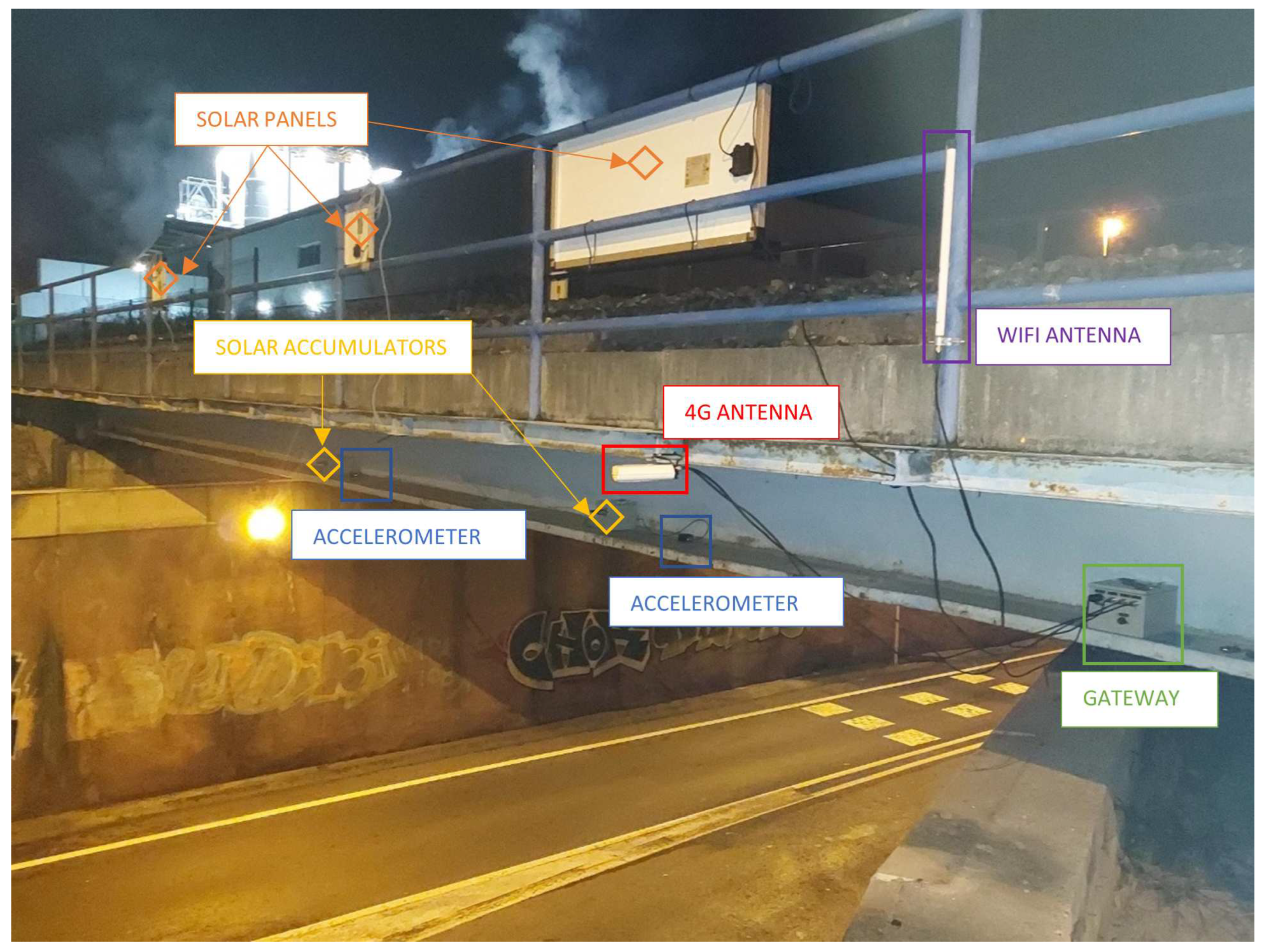
Figure 2.
Components of the hybrid on-premises and cloud network architecture.
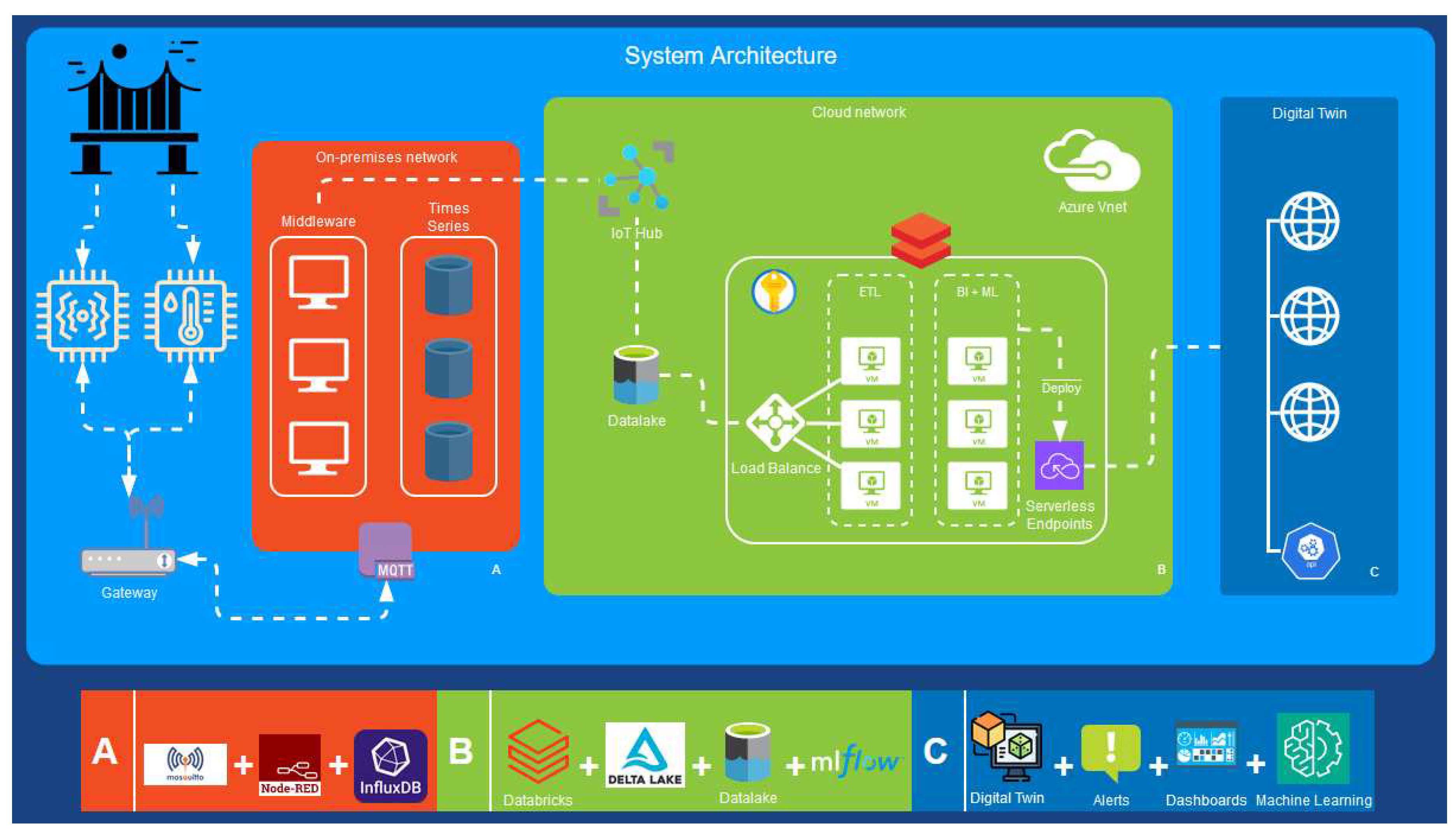
Figure 3.
Railway bridge used as pilot at Torrelarragoiti industrial area, exploited by ETS Euskal Trenbide Sarea / Basque Railway Network (Zamudio, Basque Country, Spain).
Figure 3.
Railway bridge used as pilot at Torrelarragoiti industrial area, exploited by ETS Euskal Trenbide Sarea / Basque Railway Network (Zamudio, Basque Country, Spain).
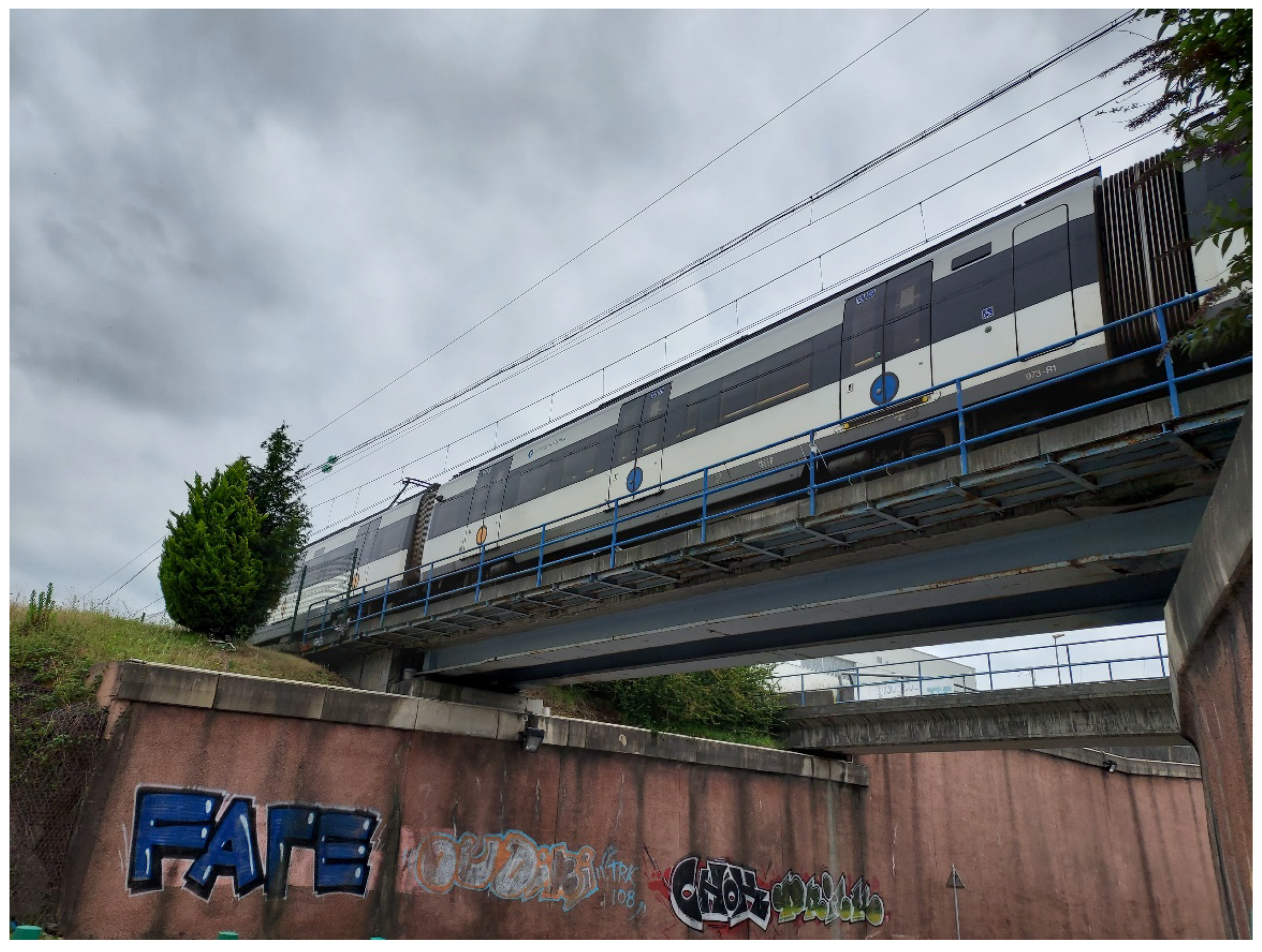
Figure 4.
Time series plot of the free vibration after the crossing of a train.
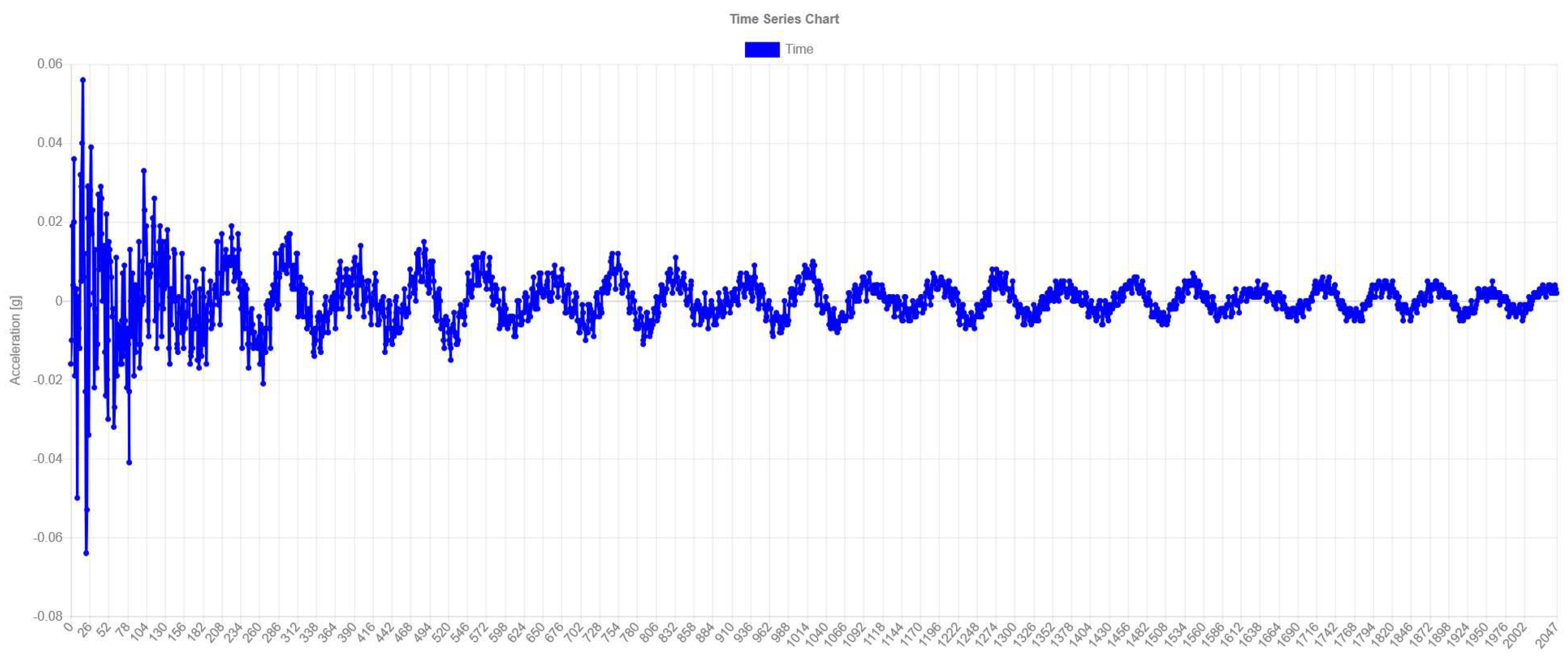
Figure 5.
Frequency plot of the free vibration after the crossing of a train.
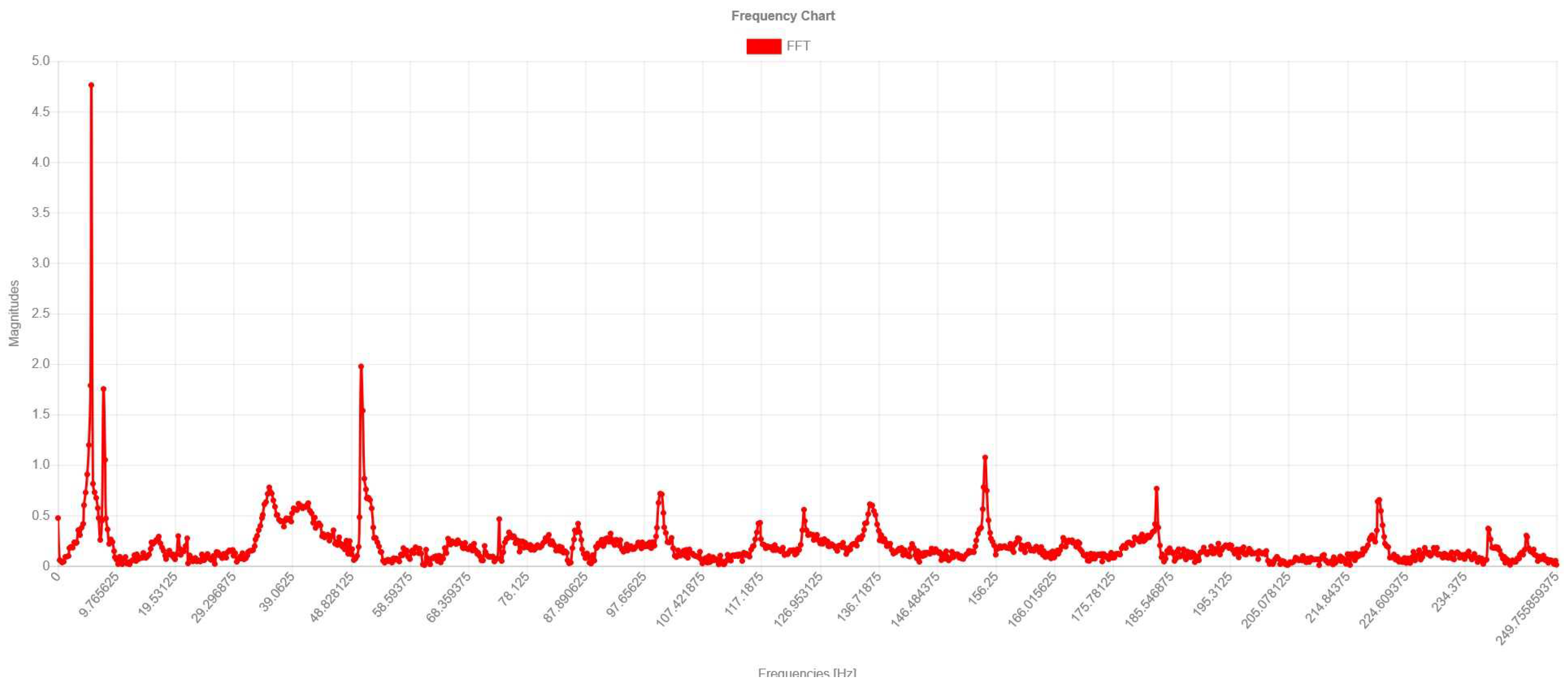
Figure 6.
Modal shapes of the Ansys Mechanical APDL for the pilot bridge.
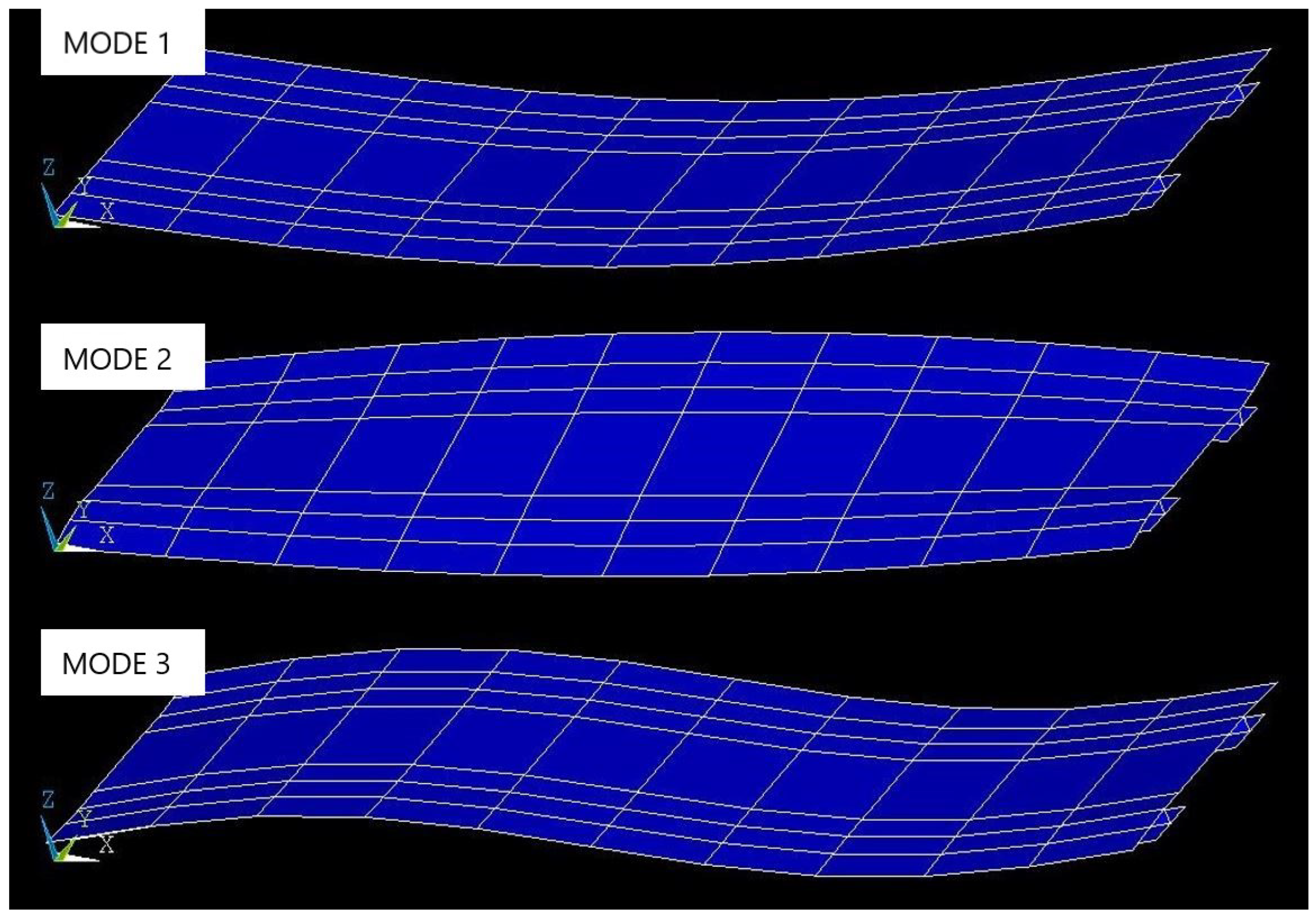
Figure 7.
Sample frequencies obtained from a captured signal.
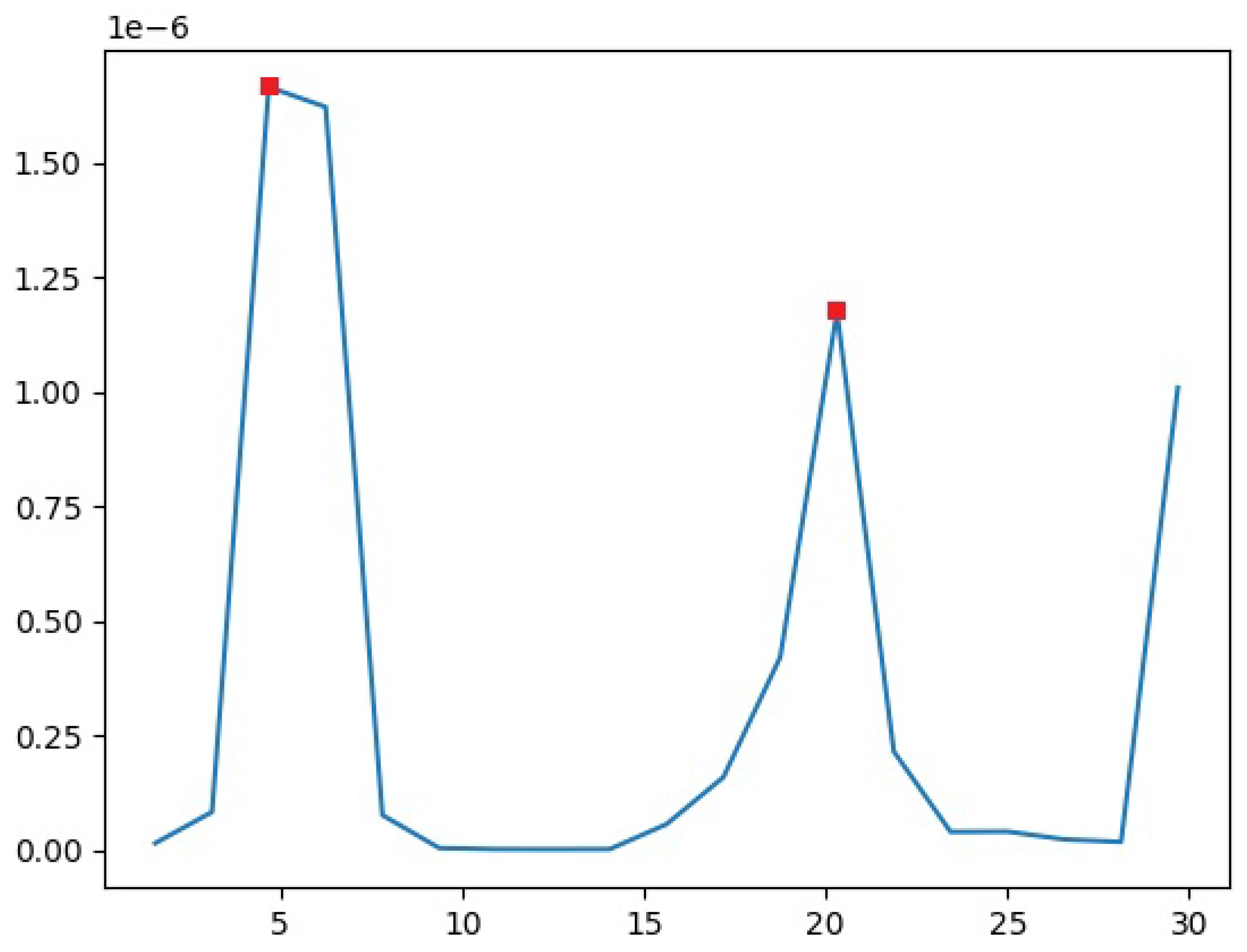
Figure 8.
Distribution of the three clusters in the 3D space.
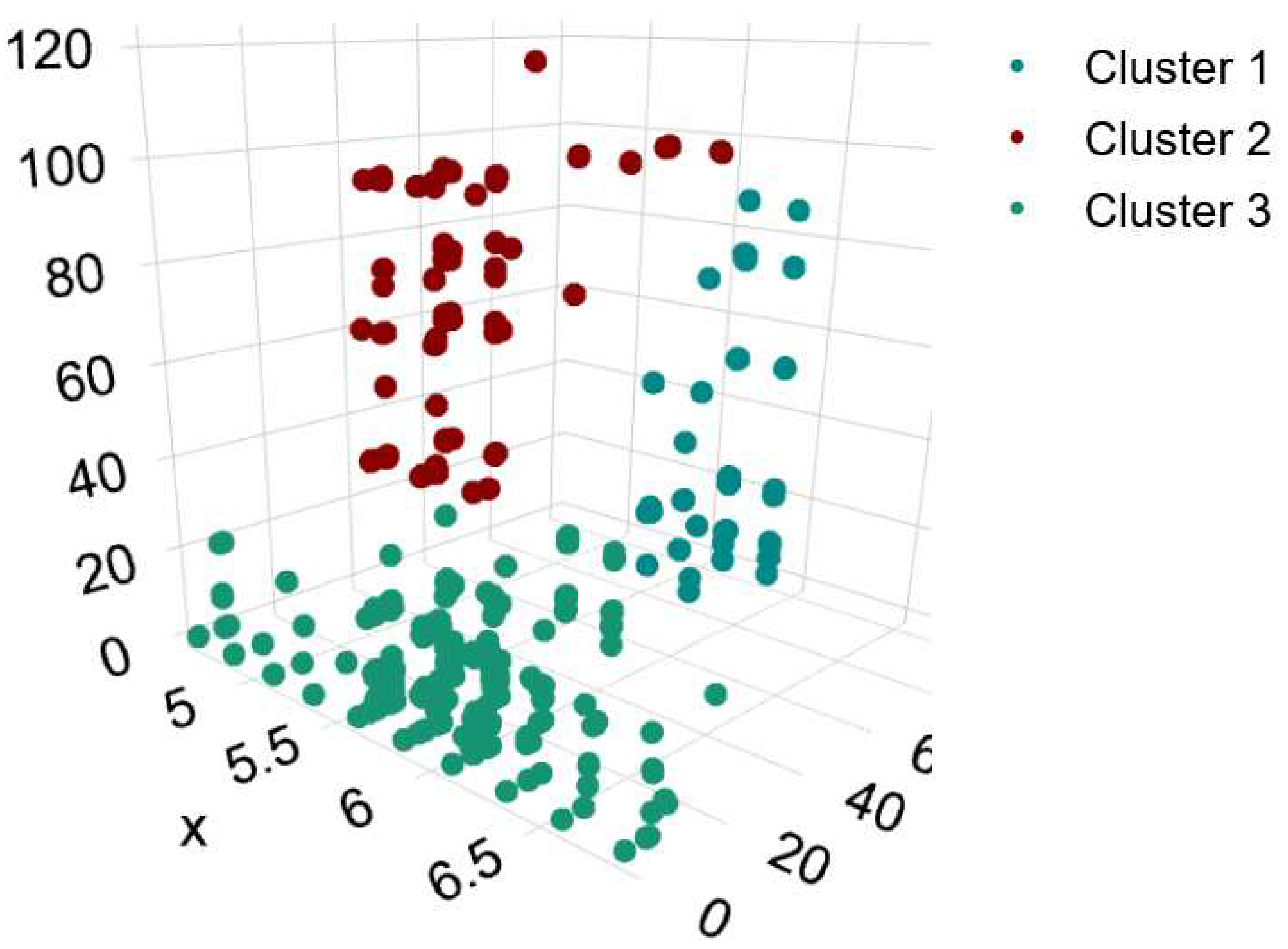
Figure 9.
Cluster mean values and standard deviation.
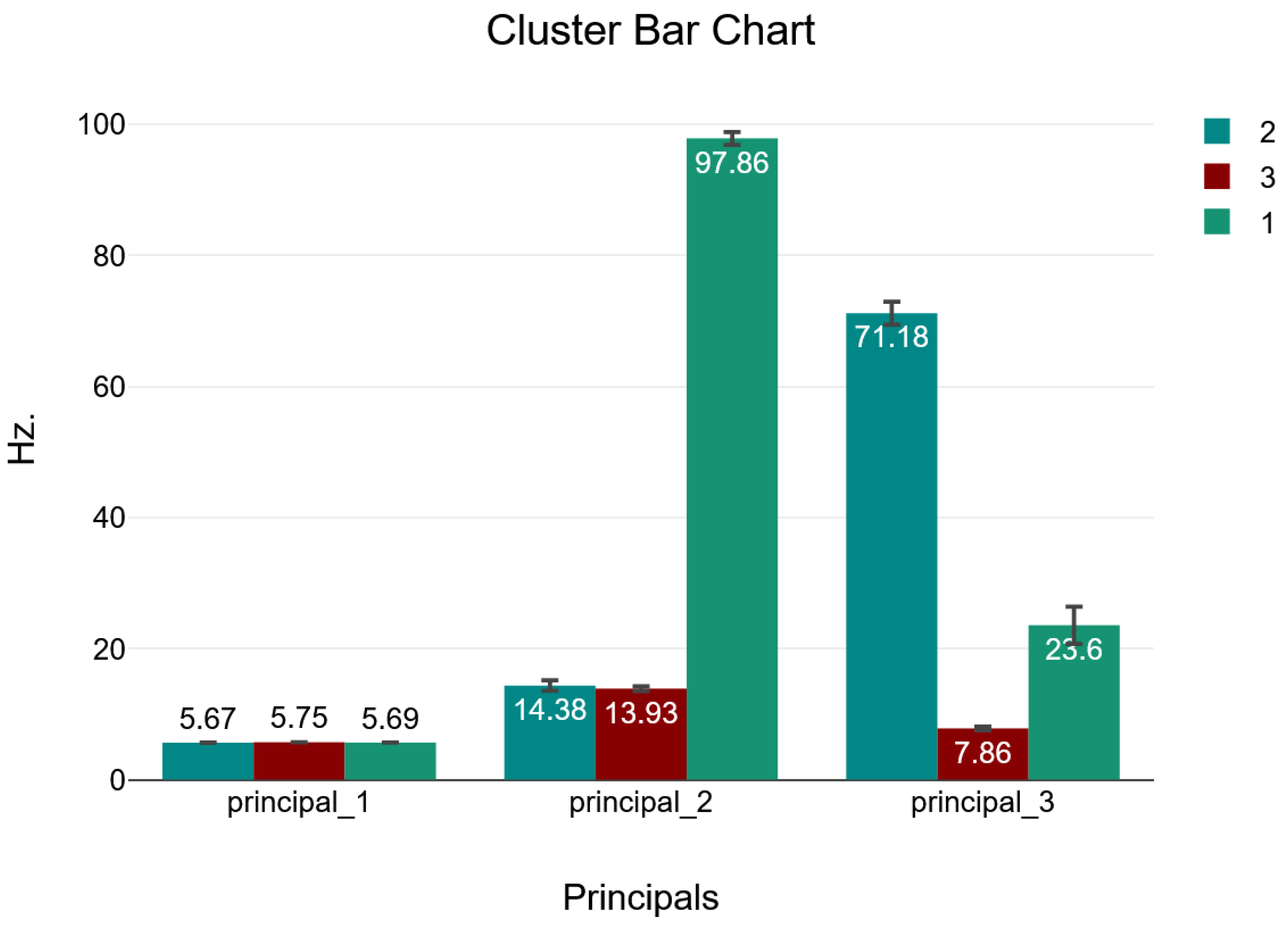
Figure 10.
Dashboard implementation with ”damage index” or probability of failure.
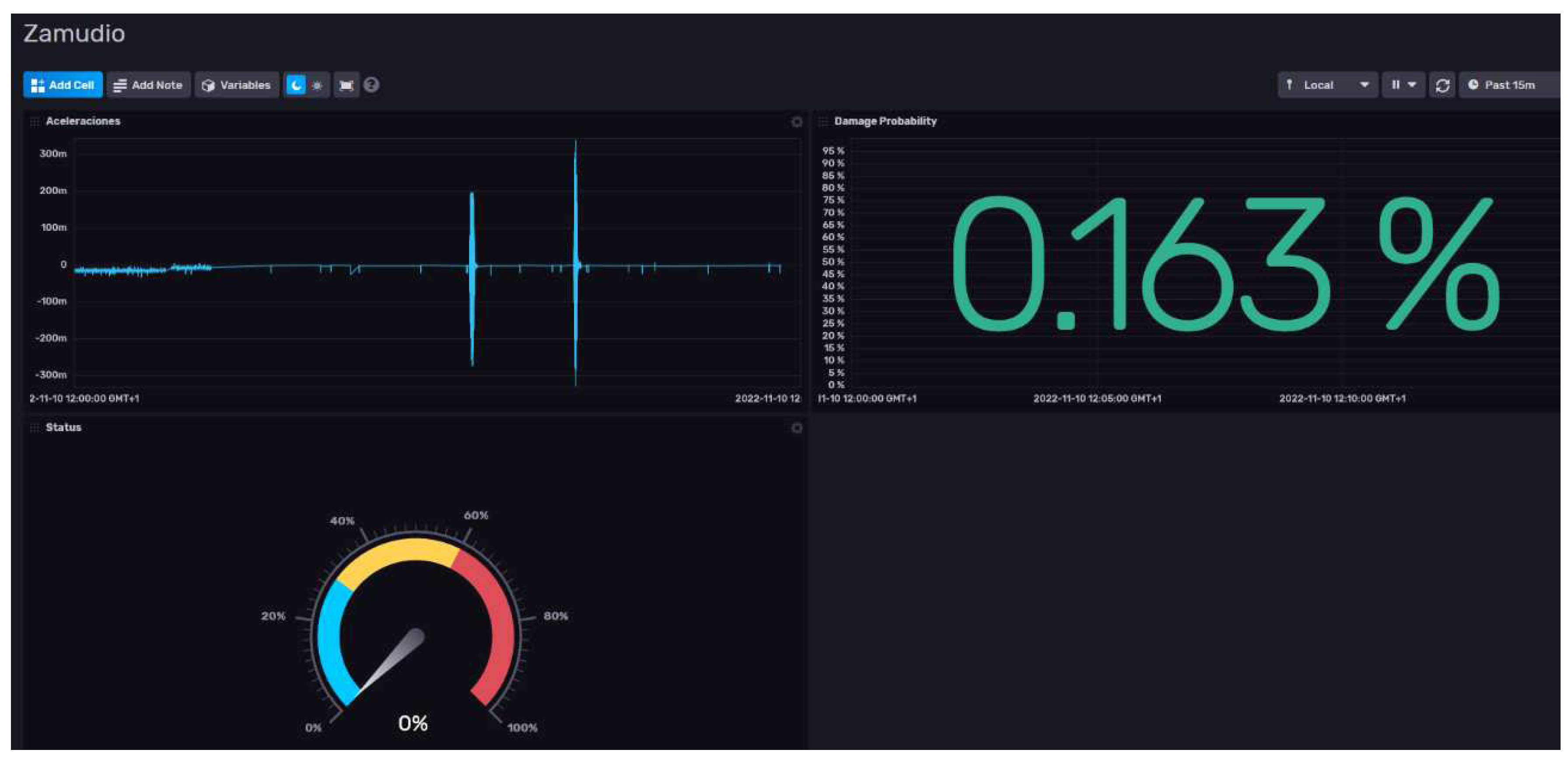
Figure 11.
Interactive digital twin of the bridge from a BIM model (via IFC file) including sensor real and historical data on top of user selected elements.
Figure 11.
Interactive digital twin of the bridge from a BIM model (via IFC file) including sensor real and historical data on top of user selected elements.
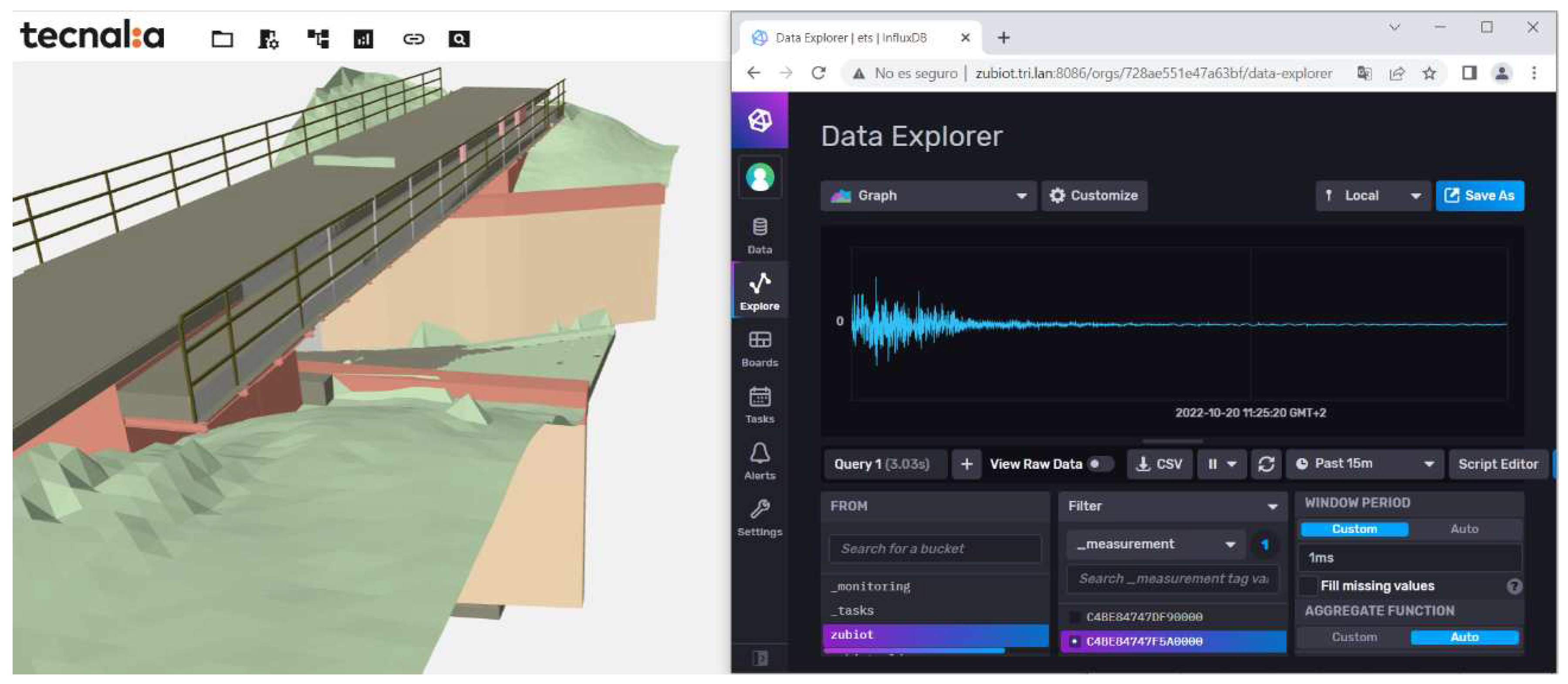
Figure 12.
Interactive digital twin of the bridge from a BIM model (via IFC file) including an index to access properties of user selected elements.
Figure 12.
Interactive digital twin of the bridge from a BIM model (via IFC file) including an index to access properties of user selected elements.
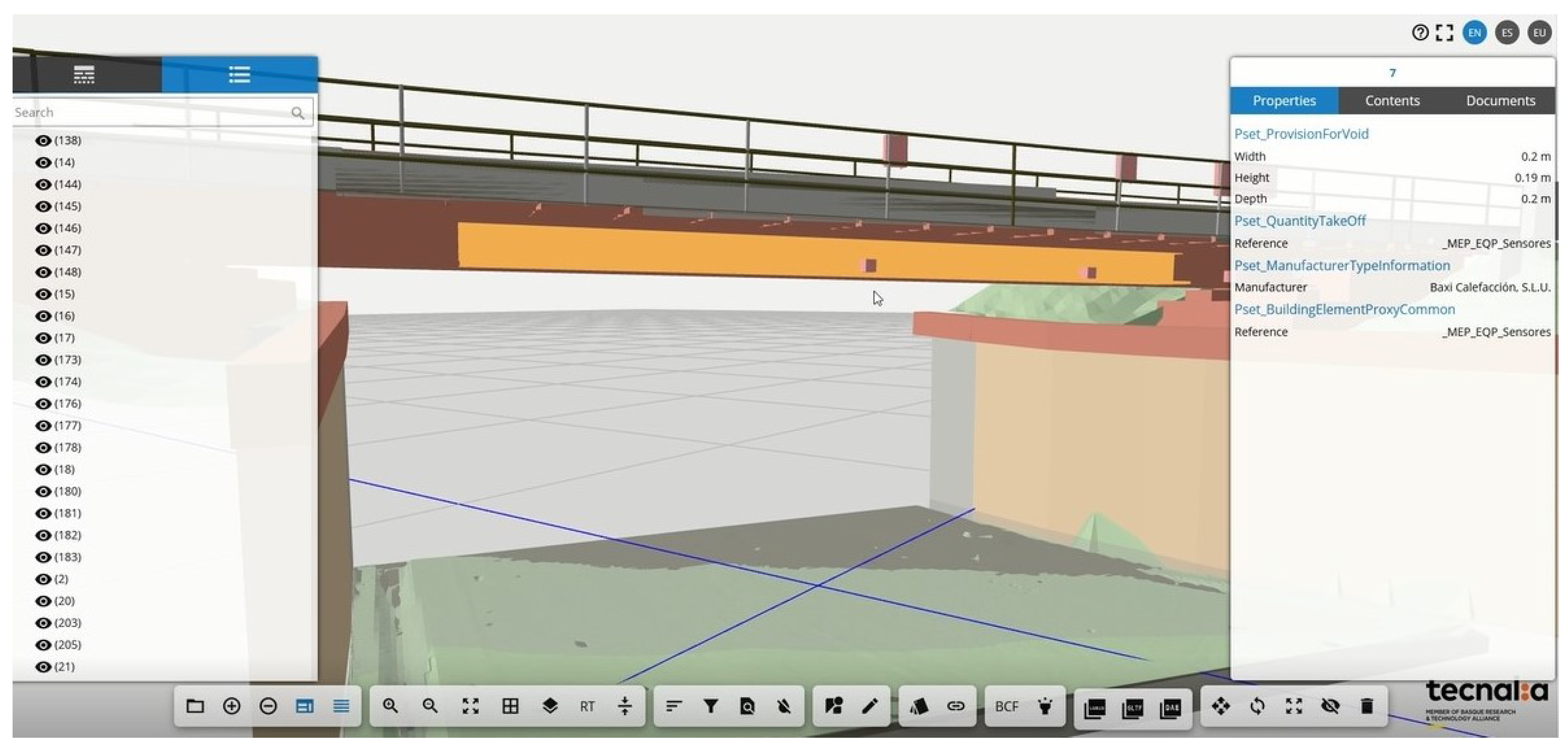

Table 1.
Descriptive data of the FFT registries.
| principal_1 | principal_2 | principal_3 | |
|---|---|---|---|
| Mean | 5.73 | 17.62 | 18.2 |
| Median | 5.62 | 20.02 | 7.57 |
| Std. Deviation | 0.17 | 20.26 | 25.84 |
| Minimum | 4.64 | 0 | 0 |
| Maximum | 6.84 | 100.83 | 119.87 |
| Range | 2.20 | 100.83 | 119.87 |
Table 2.
Cluster centers and cases.
| Cluster | principal_1 | principal_2 | principal_3 | Cases |
|---|---|---|---|---|
| 1 | 5.69 | 97.86 | 23.6 | 190 |
| 2 | 5.68 | 14.39 | 71.21 | 659 |
| 3 | 5.75 | 13.84 | 7.85 | 3474 |
Table 3.
Descriptive cluster data.
| Cluster | Mean | Std. Deviation | Minimum | Maximum | |
|---|---|---|---|---|---|
| principal_1 | 3 | 5.75 | 0.18 | 4.64 | 6.84 |
| 2 | 5.67 | 0.11 | 5.62 | 6.35 | |
| 1 | 5.69 | 0.11 | 5.62 | 5.86 | |
| principal_2 | 3 | 13.93 | 11.17 | 0 | 102.83 |
| 2 | 14.38 | 10.64 | 3.17 | 74.95 | |
| 1 | 97.86 | 6.86 | 73.49 | 100.83 | |
| principal_3 | 3 | 7.86 | 8.11 | 0 | 35.4 |
| 2 | 71.18 | 23.11 | 50.29 | 119.87 | |
| 1 | 23.6 | 19.99 | 0 | 86.67 |
Disclaimer/Publisher’s Note: The statements, opinions and data contained in all publications are solely those of the individual author(s) and contributor(s) and not of MDPI and/or the editor(s). MDPI and/or the editor(s) disclaim responsibility for any injury to people or property resulting from any ideas, methods, instructions or products referred to in the content. |
© 2024 by the authors. Licensee MDPI, Basel, Switzerland. This article is an open access article distributed under the terms and conditions of the Creative Commons Attribution (CC BY) license (http://creativecommons.org/licenses/by/4.0/).
Copyright: This open access article is published under a Creative Commons CC BY 4.0 license, which permit the free download, distribution, and reuse, provided that the author and preprint are cited in any reuse.


