

Submitted:
22 January 2024
Posted:
23 January 2024
You are already at the latest version
Abstract
Escape room’s games are educational gamification technologies that consist of introducing a team of players into a physical or digital space to solve a mystery or a problem in search of clues to solve puzzles, riddles, or enigmas. This study aims to determine the effectiveness of escape room’s games on the training of nurses and nursing students. A systematic review was carried out in MEDLINE, WOS, SCOPUS, CINAHL and LILACS databases using the MeSH terms: "Education, Nursing" and "Educational Technology", and the free term "Escape room", combining with Boolean operators AND/OR. Intervention studies in Spanish, English and Portuguese were included, without limitation for the year of publication. Selection and critical appraisal were conducted by two independent reviewers. A total of n=15 interventional studies were included (n=2 Randomized Clinical Trials and n=12 quasi-experimental). Escape rooms are a recent and booming educational methodology, which is increasingly used in academia and training of nurses and nursing students; however, it is necessary to expand their use to more countries, as well as the number and quality of interventional studies, being necessary to homogenize and standardize criteria and to use validated instruments to evaluate the effectiveness of escape rooms in the field of nursing.
Keywords:
Education
; Nursing
; Educational Technology
; Gamification
; Systematic Review
1. Introduction
The use of educational technologies aims to facilitate and improve learning through the creation, use and management of appropriate technological processes and resources [1]. These educational technologies should facilitate collaboration among students, stimulate student problem solving and seek an "authentic approach", improving their motivation and engagement [1,2]. This is why the search for more effective educational technologies has aroused great interest in the educational community [3,4]. This is especially applicable in the case of the education of health sciences students in general and nursing students in particular [1,4].
One of the educational technologies that has aroused the most interest in recent years has been gamification [4,5]. Although there is no uniform definition regarding this term [5], we can say that gamification includes the use of various game elements in the academic setting with the aim of being used to improve the academic learning performance and motivation of students [5,6]. These game elements should be interpreted widely, as they can include different techniques and methods [1,5,6], but always with the main purpose of using them to achieve a didactic and educational objective that should be clear and well defined [5]. Therefore, the main purpose should never be entertainment, but to improve students' learning of a specific subject or area, as well as to help in the acquisition of certain clinical-practical skills or competencies [5,7].
One of the educational techniques that have been included in gamification are the so-called "escape rooms" (ER) [4,8]. ER games consist of introducing a team of players in a physical or digital space with the aim of solving a mystery or a problem in one or several rooms in search of clues and solving puzzles, riddles or enigmas for the acquisition of professional skills in a complementary way to other teaching methods [8,9]. ERs have been used in recent years in the field of health sciences education, including nursing studies, whether undergraduate or graduate [4,8,10].
Recently, Reinkemeyer et al have examined the most commonly used ER games in nursing, concluding that they are effective in improving nurses' knowledge on different topics [10]. According to these authors, the ER were organized around four main themes: Group dynamics, training, theoretical aspects and identified barriers. One of the limitations of this systematic review was that it included only studies published in English and did not undertake a joint analysis of the results. Therefore, a new systematic review of this topic in other international contexts was proposed with the aim of evaluate the effectiveness of ER games in the specific training of both nurses and nursing students based on the following review question: What is the effectiveness of the use of ER games as an educational technology for training nurses and nursing students at international context? Therefore, the aim of this review was to determine the effectiveness of ER games on the education of nurses and nursing students.
2. Materials and Methods
Design: A systematic review was carried out according to the methodology of the Joanna Briggs Institute (JBI) [11]. The report of results followed the Preferread Reporting Items for Systematic Review and Meta-Analysis (PRISMA) Statement criteria [12]. The review protocol has been registered in PROSPERO under number CRD4202222374207.
Sources of information: The first step was to identify previous publications on the topic of interest through various searches in PROSPERO and Google Scholar® databases that could answer the search question. After this initial check, searches were conducted in December 2022 in the following Health Sciences databases: MEDLINE (PubMed), MEDLINE (OVID), SCI Expanded (Web of Science), SCOPUS (SCOPUS-Elsevier) and CINAHL (EbscoHOST). In December 2023 the searches were replicated and updated to retrieve new records adjusted to inclusion criteria and published in that last time interval.
Search strategies: The DeCS/MeSH descriptors "Education, Nursing" and "Educational Technology" were used, as well as the free term "Escape room" using Boolean operators AND/OR. Where appropriate, methodological filters were applied. The searches were piloted in PubMed using as example the following strategy: ("education, nursing"[MeSH Terms] OR "Nursing Education"[All Fields] OR ("education"[All Fields] AND "nursing"[All Fields]) OR "Nursing Education"[All Fields] OR ("educations"[All Fields] AND "nursing"[All Fields])) OR "Nursing Educations"[All Fields]) AND ((("scape"[All Fields] OR "scapes"[All Fields]) AND "room"[All Fields]) OR "escape room"[All Fields]). The search process was developed by one of the researchers (C.-A.R.-S.) and verified by a second researcher (H.G.-d.l.T) using the PRISMA-S for searching extension [13]. All references were exported to Mendeley Reference Manager Online® for screening. Table 1 shows the search strategies performed in each of the databases.
Inclusion criteria: Studies published up to December 2023 in Spanish, English or Portuguese that have addressed the use of ER games in the context of undergraduate education in nursing students and postgraduate education in nurses have been included. Only experimental intervention studies were included: Randomized clinical trials (RCTs) and quasi-experimental studies (pre-post designs with or without a control group). No time limit was set for the year of publication.
Exclusion criteria: Other review studies (systematic, exploratory or narrative), studies with quantitative observational, analytical and descriptive designs, case studies and qualitative designs with any methodology were excluded. Publications that did not correspond to research studies (such as editorials and letters to the editor) were also excluded. Gray literature has not been included.
Selection and classification of studies: After performing the searches, duplicate records were eliminated and screened by title and abstract. The full-text documents of the selected records were then retrieved to assess their eligibility according to inclusion and exclusion criteria. Screening was performed by peer review (H.G.-d.l.T. and S.M.-P.) and in case of discrepancies a third researcher decided (C.-A.R.-S.).
Definition of the study variables: Bibliometric variables on the affiliation of studies, as well as variables on the statistical results of the studies have been extracted. The main research results were the improvement of knowledge in the different areas, the evaluation of satisfaction with the educational activity and the improvement of attitudes or competences of the individuals in the population studied.
Evaluation and data extraction: Studies identified as potentially eligible for inclusion were distributed for peer review by two investigators (J.V.-S. and R.C.-B.) and discrepancies were resolved by a third researcher (M.-N.H.-D.L.). To assess the quality of the studies, the JBI critical appraisal tools appropriate to each research design were used, establishing as a criterion of good quality a score of more than 50% with respect to the items included in each tool (for RCT-13 items, a score ≥ 7 was considered good quality and for quasi-experimental studies-9 items, a score ≥ 5). Finally, information was extracted from the studies: Country and year, design, instrument used to measure the effectiveness of ER, characteristics of the ER (duration of the ER, size and composition of the groups) and the population in which it was performed. For continuous quantitative variables, statistical data on mean scores and standard deviations were extracted, and for qualitative variables, percentages and frequencies were extracted. The p-values were also extracted to test the hypothesis contrasts and the effect sizes when they were calculated. Data extraction was carried out independently by two researchers (H.G.-d.l.T. and S.M.-P.) and discrepancies were resolved by a third researcher (C.-A.R.-S.).
3. Results
The number of records retrieved was n=439; after eliminating duplicates (n=160) and gray literature (n=28), n=251 records were screened by title and abstract. Of these, n=215 records were excluded because they did not meet the inclusion criteria, while n=36 records met the criteria for full-text evaluation. After the critical appraisal process, n=15 studies were included in the review, as shown in the flow diagram in Figure 1.
Regarding the studies excluded, n=8 was for not meeting the minimum methodological quality and n=13 for not meeting the inclusion criteria (Supplementary Table 1).
Regarding the methodological design of the studies, RCTs (n=2) and quasi-experimental studies (n=13) were included. The quasi-experimental studies contemplated different designs such as: pre- and post-experimental with control group (n=4), pre- and post-experimental (n=8) and quasi-experimental with control group (n=1). Table 2 shows the country and year of publication, design, objective and conclusions for each study.
The clinical results of the studies are shown in Table 3.
4. Discussion
As a result of the quick development and diffusion of gamification, an increasing number of studies and reviews are being published each year examining this educational methodology in healthcare workers [29,30]. Gamification is associated with positive perceptual, cognitive, behavioral, affective, and motivational effects and outcomes [29,30], as well as having the potential to offer learners the opportunity to engage in active learning, solve clinical problems, and acquire experience in a risk-free environment without the need to involve patients [31].
Within gamification, ER has been rapidly growing in recent years [8,10,32,33]. In addition to the effects previously pointed out, this learning system constitutes a method able to decrease the generation gap that sometimes exists between students and teachers [28], being an example of educational technology that can help to overcome the dissonance between traditional methodologies and the needs of more innovative educational methodologies demanded by the new generations of students [34], all with a very acceptable economic cost [35,36].
This implies that systems capable of collecting the perceptions and experiences of the participants should always be included in the design of the ER, since in this way key information can be obtained to identify aspects that can be improved [8]. Therefore, debriefing is a necessary element to be included in ER [8,37], with some authors going so far as to state that in healthcare simulation, “debriefing is just as or even more important than the simulation” [38]. Some of the studies included in this review included various debriefing systems for this purpose [20,23,26], although without uniformity regarding the method used for this purpose. Some authors such as Eukel H and Morrell B recommend using a survey of their design [8,35].
Similarly, it is also desirable to assess participant satisfaction with the activity [8,37]. However, many of the studies included in this review did not evaluate it or did so only superficially [15,21]. Only Gutiérrez-Puertas et al. used a validated tool, the Gameful Experience Scale (GAMEX), although the aim of their work was directly to understand the gameful experience and satisfaction of nursing students in the evaluation of their clinical skills [27]. The GAMEX is an instrument developed by Eppman et al [39] that measures the gameful experience and is composed of 27 items divided into 6 dimensions: Enjoyment, Absorption, Creative thinking, Activation, Absence of negative affect, and Dominance.
The responses are answered on a Likert-type scale, with values from 1 (never) to 5 (always), and a total score can be calculated or by dimensions. A higher score indicates a more positive experience regarding the gaming experience. The results reported by the study of Gutiérrez-Puertas et al indicate acceptable satisfaction for the ER experience in their case [27], like other studies included in this review that reported high degrees of satisfaction [15,21]. Although GAMEX is not a specific instrument for ER, we consider it advisable to use this tool to evaluate the students' experience with respect to ER, since in addition to being able to measure the participants' satisfaction with the activity in an objective way, it allows us to compare this educational technology against other types of gamifications [40]. One dimension of this scale even allows detecting the presence of eventual negative effects in the gamification activity. Elevated anxiety levels have been reported in nursing students related to clinical laboratory practicums and simulations [41,42]. Although more research addressing how ER affect students' anxiety levels is needed [43], in the design of ER it is always imperative to guarantee a sense of safety among participants [37].
The present study was designed to answer the guiding question of this review and was initially aimed at conducting a meta-analysis to evaluate the effectiveness of ER as an educational technology specifically in nursing. As such, only studies of experimental design were exclusively included, unlike the recent review by Quek LH et al, which included studies of all types of designs [4]. However, the high clinical heterogeneity found did not allow a meta-analysis to be performed, being one of the main limitations of this review, although this aspect is not new and has already been pointed out. The Cochrane review on the effectiveness of gamification educational activities in health sciences personnel conducted by Akl et al cannot perform this meta-analysis either due to the lack of methodologically robust studies [31]. Quek et al. were also unable to perform a meta-analysis, despite including studies with all types of healthcare students in their review [4]. Therefore, the most important aspect to highlight as a result of this review is the lack of uniformity and the enormous heterogeneity that exists between the various studies that have been carried out with ER in nursing. This situation affects all the elements, from the study designs to the thematic areas, to the tools or instruments used in the evaluation of their effectiveness. This aspect should be considered in future studies carried out with ER; as far as possible, researchers should try to standardize the interventions to be able to carry out more global evaluations of this educational technology.
A particularly relevant aspect concerns the study designs. All the studies included in our review are quasi-experimental, except for two RCTs by Rodriguez-Ferrer et al [22] and Fusco et al [24]. Regarding the quasi-experimental studies, only five studies had a control group [14,18,21,25,27]. Therefore, a priority aspect that emerges from our results is the need to conduct RCTs that provide more solid evidence on the effectiveness of ER as an educational technology. This is extensible both to ER aimed exclusively at nurses and to the rest of students and professionals in the health sciences [4,32].
In contrast to some of the previously mentioned reviews [4,31,32], this review focused exclusively on nurses and nursing students. However, few studies of ER in already graduated nurses were found [15,16], so the usefulness of ER in the continuing education of already graduated nurses still needs to be further explored in future studies. In addition, in some cases, nursing students were integrated into groups where there were students from other disciplines or areas [17,19,19,23,24,25,26].
Interprofessional collaboration and education is precisely one of the thematic areas where the use of ER has been most explored [4,17,44,45]. Four studies (Hursman et al [19], Wettergreen et al [23], Fusco et al [24], Foltz-Ramos et al [25]) focused on this topic. Gamification is often used to encourage team building in businesses [3,7,46], so it is logical to also use this new tool for interdisciplinary team building in healthcare professionals, especially in areas that require close professional cooperation [46,47]. ER can provide work teams with several benefits; in addition to the inherent effect of clinical simulation itself, as communication skills among the professionals that make up the teams are especially improved [23,47,48,49].
Although these aspects are undoubtedly important and are sufficient reason to implement ER in educational programs, we should not forget that the central objective of any educational technology or methodology is the transmission of knowledge. Most of the studies included in the review were primarily motivated by the need to improve participants' knowledge of a specific subject area, either in a single group (with a before and after measurement) or by comparing two groups. All studies found statistically significant differences with respect to these improvements, which seems to indicate ER is useful for increasing participants' level of knowledge, something that has been previously pointed out in the literature [4,7,32,50]. However, we would like to call attention to several aspects that we consider important. On the one hand, none of the included studies used a validated instrument for the measurement and evaluation of knowledge; they always used ad hoc questionnaires, which provided little information on the psychometric properties or reliability of the instrument. This is one reason that has contributed to impeding the performance of a meta-analysis. Future studies should try to improve the choice of measurement instruments used to assess knowledge of the specific area, prioritizing the use, as far as possible, of validated instruments. On the other hand, in the academic context, it is known that after a certain period of time, knowledge can be decreased in students. Except for the study by Fusco et al [24], no study performed several measurements in a post-intervention time interval to ensure or, at least, provide information on the permanence and integration of the acquired knowledge. More post-intervention measurements should be introduced in new studies to mitigate this problem.
In most of the studies, we have found similarities with respect to the number of team members, as well as the duration of the ER, with groups composed of 4 to 7 participants predominating, similar to what is reported in the literature on ER [4,10,50]. Eukel and Morrell recommend team size at a maximum of 4 to 5 students to encourage active participation from all members [8]. Regarding the duration of ER, most studies conducted ER that did not exceed 60 minutes, with a minimum duration of 30 minutes (except in the case of the study by Molina et al [21], whose duration was 15 minutes), similar to studies of ER conducted in other health professionals [4,50].
Finally, it should be noted that studies have only been identified from 5 countries (USA, Australia, Spain, China, Taiwan), which suggests that this educational technology is not yet well implemented in many countries.
This review has some limitations. The most important is the one mentioned above, referring to the impossibility of being able to perform a meta-analysis, which is the appropriate methodological design to test the effectiveness of an intervention, in this case, the use of ER games in the training of nurses and nursing students. In addition to this aspect, we must recognize that an undetermined number of studies may have been left out of the review due to inadequate indexing, as there is sometimes confusion with the term’s gamification, serious games and the like [5,7]. In fact, the lack of standardization and of a clear and unambiguous definition for ER may influence the exclusion of studies where according to the authors an ER was used, either virtually or physically. Finally, some studies evaluated ER in a set of participants that included nursing students, but not exclusively, which cannot ensure the effectiveness of the educational methodology in this particular population.
5. Conclusions
The ER is a recent and growing educational methodology, which is increasingly used in the academic field and in the training of nurses and nursing students; however, it is necessary to expand the use of ER to more countries, as well as to increase the number and quality of the intervention studies that are developed, being necessary to unify and standardize the criteria and use validated instruments to homogeneously evaluate the effectiveness of ER in the nursing education area.
Supplementary Materials
The following supporting information can be downloaded at the website of this paper posted on Preprints.org. Table S1: Excluded studies from the review.
Author Contributions
Conceptualization, H.G.-d.l.T. and C.-A.R.-S.; methodology, H.G.-d.l.T., M.-N.H.-D.L., S.M.-P., R.C.-B., J.V.-S. and C.-A.R.-S.; validation, H.G.-d.l.T., M.-N.H.-D.L., S.M.-P., R.C.-B., J.V.-S. and C.-A.R.-S.; resources, H.G.-d.l.T. and C.-A.R.-S.; writing—original draft preparation, H.G.-d.l.T. and C.-A.R.-S.; writing—review and editing, M.-N.H.-D.L., S.M.-P., R.C.-B. and J.V.-S.; project administration, H.G.-d.l.T. and C.-A.R.-S.; funding acquisition, H.G.-d.l.T., M.-N.H.-D.L. and C.-A.R.-S.
Funding
This research received no external funding.
Institutional Review Board Statement
Not applicable.
Informed Consent Statement
Not applicable.
Data Availability Statement
No new data were created.
Conflicts of Interest
The authors declare no conflicts of interest.
References
- Kowitlawakul, Y.; Tan, JJM.; Suebnukarn, S.; Nguyen, HD.; Poo, DCC.; Chai, J.; Wang, W.; Devi, K. Utilizing educational technology in enhancing undergraduate nursing students' engagement and motivation: A scoping review. J Prof Nurs. 2022, 42, 262-275. [CrossRef]
- Jose, MM.; Dufrene, C. Educational competencies and technologies for disaster preparedness in undergraduate nursing education: an integrative review. Nurse Educ Today. 2014,34,543-51. [CrossRef]
- Dahalan, F.; Alias, N.; Shaharom, MSN. Gamification and Game Based Learning for Vocational Education and Training: A Systematic Literature Review. Educ Inf Technol (Dordr). 2023,1-39. [CrossRef]
- Quek, LH.; Tan, AJQ.; Sim, MJJ.; Ignacio, J.; Harder, N.; Lamb, A.; Chua, WL.; Lau, ST.; Liaw, SY. Educational escape rooms for healthcare students: A systematic review. Nurse Educ Today. 2024, 132,106004. [CrossRef]
- van Gaalen, AEJ.; Brouwer, J.; Schönrock-Adema, J.; Bouwkamp-Timmer, T.; Jaarsma, ADC.; Georgiadis, JR. Gamification of health professions education: a systematic review. Adv Health Sci Educ Theory Pract. 2021,26,683-711. [CrossRef]
- Li, Q.; Yin, X.; Yin, W.; Dong, X.; Li, Q. Evaluation of gamification techniques in learning abilities for higher school students using FAHP and EDAS methods. Soft comput. 2023,1-19. [CrossRef]
- Gorbanev, I.; Agudelo-Londoño, S.; González, RA.; Cortes, A.; Pomares, A.; Delgadillo, V.; Yepes, FJ.; Muñoz, Ó. A systematic review of serious games in medical education: quality of evidence and pedagogical strategy. Med Educ Online. 2018,23,1438718. [CrossRef]
- Eukel, H.; Morrell, B. Ensuring Educational Escape-Room Success: The Process of Designing, Piloting, Evaluating, Redesigning, and Re-Evaluating Educational Escape Rooms. Simul. Gaming, 2021, 52, 18-23. [CrossRef]
- Antón-Solanas, I.; Rodríguez-Roca, B.; Urcola-Pardo, F.; Anguas-Gracia, A.; Satústegui-Dordá, PJ.; Echániz-Serrano, E.; Subirón-Valera, AB. An evaluation of undergraduate student nurses' gameful experience whilst playing a digital escape room as part of a FIRST year module: A cross-sectional study. Nurse Educ Today. 2022,118,105527. [CrossRef]
- Reinkemeyer, EA.; Chrisman, M.; Patel, SE. Escape rooms in nursing education: An integrative review of their use, outcomes, and barriers to implementation. Nurse Educ Today. 2022,119,105571. [CrossRef]
- Aromataris, E, Munn Z (Editors). JBI, 2020. Available from JBI Manual for Evidence Synthesis. https://synthesismanual.jbi.global.
- Page, MJ.; McKenzie, JE.; Bossuyt, PM.; Boutron, I.; Hoffmann, TC.; Mulrow, CD.; Shamseer, L.; Tetzlaff, JM.; Akl, EA.; Brennan, SE.; Chou, R.; Glanville, J.; Grimshaw, JM.; Hróbjartsson, A.: Lalu, MM.; Li, T.; Loder, EW.; Mayo-Wilson, E.; McDonald, S.; Moher, D. The PRISMA 2020 statement: an updated guideline for reporting systematic reviews. BMJ. 2021. 372,71. [CrossRef]
- Rethlefsen, ML.; Kirtley, S.; Waffenschmidt, S.; Ayala, AP.; Moher, D.; Page MJ.; Koffel, JB. PRISMA-S Group. PRISMA-S: an extension to the PRISMA Statement for Reporting Literature Searches in Systematic Reviews. Syst Rev. 2021,10,39.
- Chen, D.; Liu, F.; Zhu, C.; Tai, C.; Zhang, Y.; Wang, X. The effect of an escape room game on college nursing students' learning attitude and game flow experiences in teaching safe medication care for the elderly: an intervention educational study. BMC Med Educ. 2023, 23, 945. [CrossRef]
- Hsu, HJ.; Chou, YT.; Wu, HC.; Jen, HJ.; Shen, CH.; Lin, CJ.; Chou, KR.; Ruey-Chen. An online escape room-based lesson plan to teach new nurses violence de-escalation skills. Nurse Educ Today. 2023,123, 105752.
- Sara, A.; Hunker, DF. An Initiative to Increase Nurse Knowledge and Decrease Postpartum Readmissions for Preeclampsia. Nurs Womens Health. 2023,27,337-343. [CrossRef]
- Schmuhl, KK.; Nagel, S.; Tamburro, R.; Jewell, TM.; Gilbert, E.; Gonzalez, A.; Sullivan, DL.; Sprague, JE. Better together: utilizing an interprofessional course and escape room to educate healthcare students about opioid use disorder. BMC Med Educ. 2023, 23, 917. [CrossRef]
- Yang, CL.; Chang, CY.; Jen, HJ. Facilitating undergraduate students' problem-solving and critical thinking competence via online escape room learning. Nurse Educ Pract. 2023, 73, 103828. [CrossRef]
- Hursman, A.; Richter, LM.; Frenzel, J.; Viets Nice, J.; Monson, E. An online escape room used to support the growth of teamwork in health professions students. J Interprof Educ Pract. 2022,29,100545. [CrossRef]
- Millsaps, ER.; Swihart, AK.; Lemar, HB. Time is brain: Utilizing escape rooms as an alternative educational assignment in undergraduate nursing education. Teaching and Learning in Nursing. 2022, 17, 323-327. [CrossRef]
- Molina-Torres, G.; Cardona, D.; Requena, M.; Rodriguez-Arrastia, M.; Roman, P.; Ropero-Padilla, C. The impact of using an "anatomy escape room" on nursing students: A comparative study. Nurse Educ Today. 2022, 109,105205. [CrossRef]
- Rodriguez-Ferrer, JM.; Manzano-León, A.; Cangas, AJ.; Aguilar-Parra, JM. A Web-Based Escape Room to Raise Awareness About Severe Mental Illness Among University Students: Randomized Controlled Trial. JMIR Serious Games. 2022, 10, e34222. [CrossRef]
- Wettergreen, SA.; Stewart, MP.; Huntsberry, AM. Evaluation of an escape room approach to interprofessional education and the opioid crisis. Curr Pharm Teach Learn. 2022,14, 387-392. [CrossRef]
- Fusco, NM.; Foltz-Ramos, K.; Ohtake, PJ. An Interprofessional Escape Room Experience to Improve Knowledge and Collaboration Among Health Professions Students. Am J Pharm Educ. 2022, 86, ajpe8823. [CrossRef]
- Foltz-Ramos, K.; Fusco, NM.; Paige, JB. Saving patient x: A quasi-experimental study of teamwork and performance in simulation following an interprofessional escape room. J Interprof Care. 2021,1-8. [CrossRef]
- Moore, L.; Campbell, N. Effectiveness of an escape room for undergraduate interprofessional learning: a mixed methods single group pre-post evaluation. BMC Med Educ. 2021, 21, 220. [CrossRef]
- Gutiérrez-Puertas, L.; Márquez-Hernández, VV.; Román-López, P.; Rodríguez-Arrastia, MJ.; Ropero-Padilla, C.; Molina-Torres, G. Escape Rooms as a Clinical Evaluation Method for Nursing Students. Clin Simul Nurs.2020,49, 73-80. [CrossRef]
- Morrell, BLM.; Eukel, HN. Escape the Generational Gap: A Cardiovascular Escape Room for Nursing Education. J Nurs Educ. 2020, 59, 111-115. [CrossRef]
- Katonai, Z.; Gupta, R.; Heuss, S.; Fehr, T.; Ebneter, M.; Maier, T.; Meier, T.; Bux, D.; Thackaberry, J.; Schneeberger AR. Serious Games and Gamification: Health Care Workers' Experience, Attitudes, and Knowledge. Acad Psychiatry. 2023,47,169-173. [CrossRef]
- Gentry, SV.; Gauthier, A.; L'Estrade Ehrstrom, B.; Wortley, D.; Lilienthal, A.; Tudor Car, L.; Dauwels-Okutsu, S.; Nikolaou, CK.; Zary, N.; Campbell, J.; Car J. Serious Gaming and Gamification Education in Health Professions: Systematic Review. J Med Internet Res. 2019;21(3):e12994. [CrossRef]
- Akl, EA.; Kairouz, VF.; Sackett, KM.; Erdley, WS.; Mustafa, RA.; Fiander, M.; Gabriel, C.; Schünemann, H. Educational games for health professionals. Cochrane Database Syst Rev. 2013, CD006411. [CrossRef]
- Hintze, TD.; Samuel, N.; Braaten, B. A Systematic Review of Escape Room Gaming in Pharmacy Education. Am J Pharm Educ. 2023, 87,100048. [CrossRef]
- Eukel, H.; Morrell, B. Ensuring Educational Escape-Room Success: The Process of Designing, Piloting, Evaluating, Redesigning, and Re-Evaluating Educational Escape Rooms. Simul. Gaming. 2021, 52, 18-23. [CrossRef]
- Chicca, J.; Shellenbarger, T. Connecting with Generation Z: Approaches in nursing education. Teaching and Learning in Nursing.2018, 13, 180-184. [CrossRef]
- Eukel, H.; Frenzel, J.; Frazier, K.; Miller, M. Unlocking Student Engagement: Creation, Adaptation, and Application of an Educational Escape Room Across Three Pharmacy Campuses. Simul. Gaming. 2020, 51, 167-179. [CrossRef]
- Gómez-Urquiza, JL.; Gómez-Salgado, J.; Albendín-García, L.; Correa-Rodríguez, M.; González-Jiménez, E.; Cañadas-De la Fuente, GA. The impact on nursing students’ opinions and motivation of using a “nursing escape room” as a teaching game: A descriptive study. Nurse Educ Today. 2019, 72, 73-76. [CrossRef]
- Shah, AS.; Pitt, M.; Norton, L. ESCAPE the Boring Lecture: Tips and Tricks on Building Puzzles for Medical Education Escape Rooms. J Med Educ Curric Dev.2023, 10, 23821205231211200. [CrossRef]
- Fanning, RM.; Gaba, DM. The role of debriefing in simulation-based learning. Simul Healthc. 2007,2, 115-25. [CrossRef]
- Eppmann, R.; Bekk, M.; Klein, K. Gameful Experience in Gamification: Construction and Validation of a Gameful Experience Scale [GAMEX]. Journal of Interactive Marketing.2018, 43, 98-115. [CrossRef]
- Gutiérrez-Puertas, L.; García-Viola, A.; Márquez-Hernández, VV.; Garrido-Molina, JM.; Granados-Gámez, G.; Aguilera-Manrique, G. Guess it (SVUAL): An app designed to help nursing students acquire and retain knowledge about basic and advanced life support techniques. Nurse Educ Pract. 2021,50, 102961. [CrossRef]
- Kachaturoff, M.; Caboral-Stevens, M.; Gee, M.; Lan, VM. Effects of peer-mentoring on stress and anxiety levels of undergraduate nursing students: An integrative review. J Prof Nurs. 2020,36,223-228. [CrossRef]
- Najjar, RH.; Lyman, B.; Miehl, N. Nursing students’ experiences with high-fidelity simulation. Int J Nurs Educ Scholarsh.2015,12, 1–9. [CrossRef]
- Reed, JM.; Ferdig, RE. Gaming and anxiety in the nursing simulation lab: A pilot study of an escape room. J Prof Nurs. 2021, 37, 298-305. [CrossRef]
- Hudson, A.; Franklin, K.; Edwards, TR.; Slivinski, A. Escaping the Silos: Utilization of a Pediatric Trauma Escape Room to Promote Interprofessional Education and Collaboration. J Trauma Nurs. 2023, 30,364-370. [CrossRef]
- Fusco, NM.; Foltz-Ramos, K.; Zhao, Y.; Ohtake, PJ. Virtual escape room paired with simulation improves health professions students' readiness to function in interprofessional teams. Curr Pharm Teach Learn. 2023,15,311-318. [CrossRef]
- Abensur Vuillaume, L.; Laudren, G.; Bosio, A.; Thévenot, P.; Pelaccia, T.; Chauvin, A. A Didactic Escape Game for Emergency Medicine Aimed at Learning to Work as a Team and Making Diagnoses: Methodology for Game Development. JMIR Serious Games. 2021, 9, e27291. [CrossRef]
- Guckian, J.; Eveson, L.; May, H. The great escape? The rise of the escape room in medical education. Future Healthc J. 2020, 7, 112–115. [CrossRef]
- Dams, V.; Burger, S.; Crawford, K.; Setter, R. Can You Escape? Creating an Escape Room to Facilitate Active Learning. J Nurses Prof Dev. 2018, 34, E1–E5. [CrossRef]
- Friedrich, C.; Teaford, H.; Taubenheim, A.; Boland, P.; Sick B. Escaping the professional silo: an escape room implemented in an interprofessional education curriculum. J Interprof Care. 2019, 33, 573-575. [CrossRef]
- Veldkamp, A.; van de Grint, L.; Knippels, M.-C. P. J.; van Joolingen, W. R. Escape Education: A Systematic Review on Escape Rooms in Education. Educ Res Rev. 2020, 31, 100364. [CrossRef]
Figure 1.
Flow diagram.
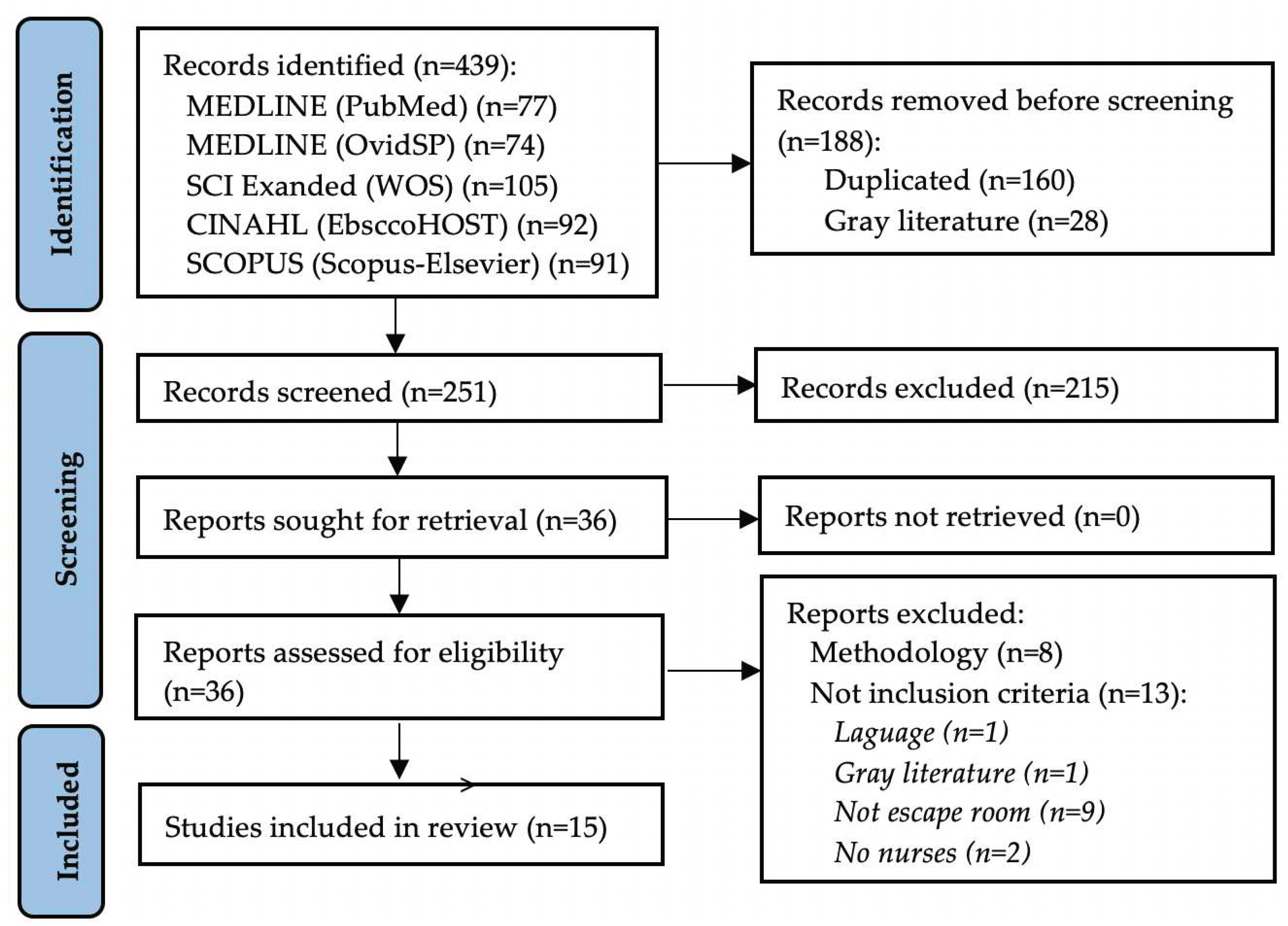

Table 1.
Search strategies in each of the databases.
| Database | Date | Search Strategies |
|---|---|---|
| Medline (PubMed) |
2022/12/29 |
("education, nursing"[MeSH Terms] OR "Nursing Education"[All Fields] OR ("education"[All Fields] AND "nursing"[All Fields]) OR "Nursing Education"[All Fields] OR ("educations"[All Fields] AND "nursing"[All Fields])) OR "Nursing Educations"[All Fields]) AND ("Gamification"[MeSH Terms] OR "escape room"[All Fields]) |
| 2023/12/29 | ("education, nursing"[MeSH Terms] OR "Nursing Education"[All Fields] OR ("education"[All Fields] AND "nursing"[All Fields]) OR "Nursing Education"[All Fields] OR ("educations"[All Fields] AND "nursing"[All Fields])) OR "Nursing Educations"[All Fields]) AND ("Gamification"[MeSH Terms] OR "escape room"[All Fields]) Filters: from 2022/12/29 - 2024/1/1 | |
| Medline (Ovid) |
2022/12/29 | Gamification.mp. |
| "escape room".m_titl. | ||
| 1 or 2 | ||
| Education, Nursing.mp. | ||
| 3 and 4 | ||
| 2023/12/29 | limit 3 to yr="2023 - 2024" | |
| CINHAL (EbsccoHOST) |
2022/12/29 | S1 TX gamification |
| S2 TX "escape room" OR TX "scape room" OR TX "escape rooms | ||
| S3 TX "escape room" OR TX "scape room" OR TX "escape rooms") AND (S1 OR S2) | ||
| S4 TX "nursing education" OR TX "education, nursing" | ||
| S5(TX "nursing education" OR TX "education, nursing") AND (S3 AND S4) | ||
| 2023/12/29 | S5(TX "nursing education" OR TX "education, nursing") AND (S3 AND S4) Publication date: 20230101-20231231 | |
| Scopus (Scopus-Elsevier) |
2022/12/29 | ( ALL ( "escape room" OR "escape rooms" OR "scape room" ) OR INDEXTERMS ( gamification ) ) AND ( INDEXTERMS ( "education, nursing" OR "nursing education" ) ) |
| 2023/12/29 | ( ALL ( "escape room" OR "escape rooms" OR "scape room" ) OR INDEXTERMS ( gamification ) ) AND ( INDEXTERMS ( "education, nursing" OR "nursing education" ) ) AND PUBYEAR > 2022 AND PUBYEAR < 2025 | |
| SCI Expanded (Web of Science) | 2022/12/29 | ((TS=("gamification")) OR TS=("escape room" OR "scape room" OR "escape rooms")) AND TS=("education, nursing" OR "nursing education") |
| 2023/12/29 | ((TS=("gamification")) OR TS=("escape room" OR "scape room" OR "escape rooms")) AND TS=("education, nursing" OR "nursing education") 2022-12-29 to 2024-01-01 (Index Date) |
Table 2.
Characteristics of the included studies.
| Author (Year) Country |
Design | Themes and Learning topics | Aim | Conclusions |
|---|---|---|---|---|
| Chen et al. (2023) China [14] |
Quasi experimental pre-post with CG1 | Gerontological Nursing (Safe Medication Care for the Elderly people) | To determine the effects of an intervention educational activity based on an ER2 game on nursing students’ learning attitude and the game flow experience after they had received nursing classroom teaching on safe medication use in older adults | During the teaching process of the Gerontological Nursing course, an ER game added at the end of classroom teaching can improve nursing students’ learning attitude and also help them to have a good game |
| Hsu et al. (2023) Taiwan [15] |
Quasi experimental pre-post | Workplace violence | To examine the effects of an online ER simulation on newly qualified nurses' violence de-escalation skills, their knowledge of violence characteristics collective efficacy, and learnin satisfaction | The proposed ER-based course format can be used in clinical education and applied in other nursing training courses, Newly qualified nurses who participated in this study reported tha the proposed course was innovative, interesting, and practical; helped them retain and apply their knowledge; and promoted teamwork |
| Sara & Hunker (2023) USA [16] |
Quasi experimental pre-post (Quality improvement Project) |
Maternity care (Preeclampsia) | To increase nurses’ knowledge on the care and management of women with preeclampsia in the postpartum period and to improve maternal outcomes by reducing postpartum readmission rates of women with preeclampsia | Using innovative education, such as an ER–style game to increase nurse knowledge, provides the opportunity to engage nurses and potentially improve maternal outcomes |
| Schmuhl et al. (2023) USA [17] |
Quasi experimental pre-post | Interprofessional Colaboration and Opioid Use Disorder |
To determine the impact of an innovative interprofessional educational activity on healthcare professional students’ learning. The educational activity targeted student knowledge of opioid use disorder and perceptions of working with an interprofessional team while caring for patients with opioid use disorder | An interprofessional educational experience including both an asynchronous course and virtual synchronous ER can increase participant knowledge around opioid use disorder and may improve student perceptions of working with an interprofessional team and caring for patients with opioid use disorder |
| Yang et al. (2023) Taiwan [18] |
Quasi experimental with CG | Maternity care | To identify the efficiency of ER activities in terms of enhancing nursing students’ retention of maternity-related knowledge and their overall learning performance | Maternity ER emerged as an online game-based approach that effectively stimulated nursing students and can serve as a practical resource for engaging in maternity care learning |
| Hursman et al. (2022) USA [19] |
Quasi experimental pre-post | Interprofessional Colaboration | To enhance interprofessional students’ perceptions of their ability to communicate effectively and respectfully, work together to complete a task, and to develop knowledge of the unique roles of members of the healthcare team | This activity lays the groundwork for collaborative telehealth students will be exposed to in their futures and the results infer that the activity can help to build collaboration among team members, even those not in the same physical space. It also shows that virtual ER can be an effective activity to increase interprofessional teamwork perceptions in the online classroom environment and could prove to be useful in other online interprofessional settings |
| Millsaps et al. (2022) USA [20] |
Quasi experimental pre-post | Neurological disorders with a focus on stroke | To promote engagement in undergraduate nursing coursework |
ER experiences can be utilized in the preparation of associate degree nursing education to engage students while also ensuring that students meet key learning objectives |
| Molina-Torres et al. (2022) Spain [21] |
Quasi experimental pre-post with CG | Anatomy | To evaluate the effectiveness of the ER for anatomy-related knowledge retention in nursing and the perceived value of the game | According to the findings, the “Anatomy ER” is a game-based approach that motivates students and constitutes a down-to-earth resource for anatomy learning in healthcare students |
| Rodríguez-Ferrer et al. (2022) Spain [22] |
RCT3 | Stigma again Severe Mental Illness |
To examine the effect of the Without Memories ER on nursing students’stigma against Several Mental Illness | The Without Memories ER can be used as an effective tool to educate and raise awareness about stigmatizing attitudes toward Several Mental Illness in university students studying health care |
| Wettergreen et al. (2022) USA [23] |
Quasi experimental pre-post | Interprofessional education and the opioid crisis |
To evaluate the use of an interprofessional ER activity to increase clinical knowledge related to the opioid crisis. The secondary objective was to evaluate change I attitudes toward interprofessional collaboration | The use of an interprofessional ER as an educational method was effective in increasing some aspects of opioid crisis related knowledge and enhancing attitudes toward interprofessional collaboration. The educational model is applicable to various topics and inter-professional groups |
| Foltz-Ramos et al. (2021) USA [25] |
Quasi experimental pre-post with CG | Interprofessional Colaboration | To create and test the use of an interprofessional ER, as a method improve teamwork, prior to interprofessional simulation | ER can, in a brief period of time, improve teamwork and consequently performance during simulation. Findings support the use of ER in interprofessional education curriculum as a method to promote teamwork |
| Fusco et al. (2022) USA [24] |
RCT | Interprofessional Colaboration Sepsis management and post-operative precautions (hip arthroplasty) |
To extend our understanding of ER pedagogical design by investigating the impact of escape room puzzle content on changes in student immediate recall knowledge and demonstration of interprofessional skills during a subsequent interprofessional simulation | ER can be an innovative pedagogical tool that can positively impact immediate recall knowledge and interprofessional collaborative skills of health professions students |
| Moore & Campbell (2021) Australia [26] |
Quasi experimental pre-post | Interprofessional practice knowledge and competencies |
To investigate the utility of an ER coupled with a debriefing workshop as an effective andengaging interprofessional learnin activity. To evaluate the impact of the ER on participant knowledge about interprofesional practice and teamwork. To evaluate the impact of the ER through participant reflection on their personal contributions to the team | The ER intervention added value to the placement curriculum and proved flexible for a heterogeneous student cohort |
| Gutiérrez-Puertas et al. (2020) Spain [27] |
Quasi experimental with CG | Gameful experience Clinical skills |
To understand the gameful experience and satisfaction of nursing students in the evaluation of their clinical skills using an ER | ER are a useful tool for the evaluation of nursing students compared with usingthe objective structured clinical evaluation |
| Morrel & Eukel (2020) USA [28] |
Quasi experimental pre-post | Cardiovascular critical care |
To evaluate the impact of a cardiovascular ER on student knowledge, as well as to understand student perceptions of the educational innovation | The cardiovascular ER increased student knowledge and was positively received by students. The educational innovation encouraged student engagement in learning, content application, peer communication, and nursing practice skills |
1 CG: Control group; 2 ER: Escape rooms; 3 RCT: Randomized Controlled Trial.
Table 3.
Clinical results of the included studies.
| Author (year) |
Instruments | Session (time minutes) |
Size Team (nursing for team) |
Study population/ sample (IG1/CG2) |
Lost case (CG/IG) |
Pre Mean (SD3) (IG/CG) |
Post Mean (SD) (IG/CG) |
p-value | Size effect | Other |
|---|---|---|---|---|---|---|---|---|---|---|
| Chen et al. (2023) [14] | - LAS4: 23 items, four subscales: learning interest, learning experience, learning habit, and professional recognition. Total range 23-92. Higher scores indicate better learning attitude. - GFEQ5: 19 items, five subscales: sense of control, telepresence, distorted sense of time, enjoyable feelings, and being unconscious of irrelevant surroundings. Total range 19-95. Higher scores indicate better game flow experience. |
ER6 (40) | 6-8 (6-8) | 84 Nursing students IG= 41 (6 group) CG= 33 |
None | - LAS: IG= 60.93 (2.33) CG= 61.51(2.32) - CFEQ: IG= 63.27 (2.48) |
- LAS: IG= 73.17 (1.67) CG= 61.63 (2.66) - CFEQ: IG= 81.29 (2.49) |
- LAS: P<0.001 t-test - GFEQ: p<0.001 t-test |
- LAS: Cohen’s d 5.196 (post test score) - GFEQ: Cohen’s d 5.253 |
- LAS (total score 45) for the ER 43.83 (4.49) |
| Hsu et al. (2023) [15] |
- A 10 multiple-choice questionnaire (10 to 100 points total) for assessment of Violence de-escalation skills and knowledge. - CEQ8 (total score 40). |
Pretest (5). Virtual ER (60). Post Online Lecture for explain each puzle (25). |
6-8 (6-8) | 106 Newly qualified nurses. No CG |
None | - Violence de-escalation: 84.53 (11.56). - CEQ: 37.34 (4.88) |
- Violence de-escalation: 93.58 (10.07) - CEQ: 38.69 (3.84) |
- Violence de-escalation: p<0.001 (One-Way ANOVA) - CEQ: p<0.001 paired t- test |
NC7 | |
| Sara & Hunker (2023) [16] | - Knowledge survey of preeclampsia: 10-item multiple-choice. - Maternal outcomes represented by the measurement of postpartum readmission rates of women with preeclampsia. |
Nine educational sessions (7-9 nurses per session) ER (30). Debriefing session |
3-5 (3-5) | 71 nurses in a postpartum care unit (9 sessions) No CG |
None | Knowledge survey 7.44 (8.49) |
Knowledge survey 8.49 (1.33) |
Knowledge survey p<0.001 paired t test |
NC | Post implementation readmission rate for postpartum women with preeclampsia 1.49% (Benchmark-National average 3.55%). |
| Schmuhl et al. (2023) [17] | - ATHCT9 (14 item). Likert (1= strongly disagree, 2=disagree, 3=agree, 4=strongly agree). - Survey to assess perceptions towards caring for patients with Opioid Use Disorder (11 item) Likert scale (1=strongly disagree, 2=disagree, 3=agree, 4=strongly agree). |
Synchronous virtual ER Zoom breakout romos (30) ER (90) |
Not reported (Team inter professional) | 402 health professional students (216 Nursing students) No CG |
None | - ATHCT: performed for 14 items but NP for total score. - Opioid Use Disorder: Performed for 11 items (NP for a total score). |
- ATHCT: Performed for 14 items but NP for total score. - Opioid Use Disorder: performed for 11 items (NP for a total score). |
- ATHCT: p<0.05 t-test - Opioid Use Disorder: p<0.05 (7 ítems) t-test |
NC | Following ER, students strongly agreed that their intentions were to change and work collaboratively on interprofessional teams |
| Yang et al. (2023) [18] |
- Knowledge test of maternity care: 10 items (maximum score 100 points). - Problem-solving scale: 5 items 5-points Likert scale. - Critical thinking questionnaire: 6 items to assess students’ critical thinking abilities, knowledge and confidence. |
Online game-based ER (50) | 6-7 (6-7) | 42 Nursing students IG=21 (Online game-based ER). CG=21 (online learning without ER). |
None | NP10 | - Knowledge: IG= 30.36 CG= 12.64 - Problem-solving: IG= 28.33 CG= 14.67 - Critical thinking: IG= 31.76 CG= 11.24 |
- Knowledge: p<0.001 Mann-Whitney U. - Problem-solving: p<0.001 Mann-Whitney U. - Critical thinking: p<0.001 Mann-Whitney U. |
NC | |
| Hursman et al. (2022) [19] |
Questionnaire Pre-Post: - Pre-survey 8-item of Core Competencies for Interprofessional Collaborative Practice. - Post-survey 26-item same items more 17 items to evaluate the effectiveness, usefulness of the activity and attitudes toward gaming. |
ER (60) |
5-7 (1-2) | 176 heath science students (95 Nursing students) No CG |
None | NP for 6 items pre | NP for 6 items post | 6 ítems (p˂0.001) |
NC | |
| Millsaps et al. (2022) [20] |
- 5 questions of knowledge about Stroke. |
Prequiz (10) Pre briefing (25) ER (30) Debriefing (25) |
4 (4) | Under- graduate ASN11 students 24 students (12 morning session, and 12 afternoon session). No CG. |
None | Knowledge: 2.9 (1.06) Median: 3 |
Knowledge: 3.8 (0.66) Median: 4 |
p=0.001 for median (Wilconxon) |
NC | Not indicated puntuation system. |
| Molina-Torres et al. (2022) [21] |
-10 questions of Knowledge about Anatomy (0-10 points) | ER (15) |
4 (4) | 248 nursing students IG= 128 CG= 120 |
None | NP | Knowledge: IG= 8.94 (0.96) CG= 7.70 (1.25) |
Post p= 0.001 (Student's t) |
NC | Also measured IG satisfaction by means of Satisfaction Questionnaire12 (26 questions 1 to 5 (higher score higher satisfaction). |
| Rodríguez-Ferrer et al. (2022) [22] |
- Attributional Questionnaire (14-point Likert 1 to 9; higher score greater number of stigmatizing attitudes toward people with severe mental illness). - Motivation Questionnaire for Cooperative Playful Learning Strategies (Likert scale, ranging 1 to 7). |
ER (60) | 4 (4) | 316 nursing students randomized IG= 204 (ER without memories) CG=112 (ER Locked In) |
IG= 7 CG= 3 Final sample n= 306 IG= 197 CG= 109 |
Higher scores greater stigma expressed: IG= 47.57 (16.7) CG= 49.56 (16.03) |
Higher scores greater stigma expressed: IG= 30.83 (14.79) CG= 49.55 (16.02) |
Post p˂0.001 (ANOVA) |
0.258 | |
| Wettergreen et al. (2022) [23] |
- SPICE-R13 Instrument (multiple response and true/false). Likert scale from 1 to 5 points (higher score greater agreement with the statement) | Pre-brief (10) ER (60) Debrief (20) |
5 (not reported) |
80 Heath science students (7 nursing students). No CG |
10 lost | SPICE-R Higher score greater agreement. Mean: 4.48 |
SPICE-R Higher score greater agreement. Mean: 4.64 |
Knowledge: post (p˂0.05) McNemar’s Exact Test. |
NC | Pre Knowledge:14 62.92% Post Knowledge: 74.30% |
| Foltz-Ramos et al. (2021) [25] |
- Knowledge Test (10 items multiple choice test). - ISVS-2115: 21 items 7-point Likert scale. Items scores are added together and divided by 21 to calculate overall score. |
ER (30) | 5(2) | Senior nursing, third-year pharmacy, and second-year physical therapy students. IG= 133 (Nursing: 54) ER acute management of sepsis CG= 129 (Nursing: 55) ER general acute care. |
None | - Knowledge#1: IG= 6.8 (1.9) CG= 6.7 (1.6) - ISVS-21: IG= 5.1 (0.92) CG= 5.2 (0.97) |
- Knowledge#2: IG= 7.7 (1.6) CG= 7.3 (1.7) - ISVS-21: IG= 6.0 (0.77) CG= 6.0 (0.82) |
- Knowledge#3: (post) p= 0.06 - ISVS-21: (post) p= 0.70 |
NC | Three knowlegde measures #1, #2, #3 |
| Fusco et al. (2022) [24] |
- ISVS-21. - OIPC16 tool: First 10 items: Adequacy of team to a common vision of the situation. Ramaining 10 items: Team’s ability to develop a common action plan. For each item, rated a 3-point likert (1= inadequate, 2= more-less adequate, 3= adequate) |
ER (30) | 4(2) | 233 Nursing and pharmacy students (118 Nursing students IG= 120 (Simulation) CG= 113 (ER + simulation) |
None | - ISVS-21: IG= 5.3 (0.92) CG= 5.2 (1.0). - OIPC: pre NP |
- ISVS-21: IG= 6.0 (0.72) CG= 5.9 (0.8) - OIPC: Median (IQR17) IG Items 1-10: 27 (26-28) Items 11-20: 27 (26-28) Total 55 (53-56). CG Items 1-10: 26 (24-28) Item 11-20: CG= 27 (25-28) Total 53 (49-56) |
- ISVS-21: Mean (SD)* IG= 0.72 (0.81) CG= 0.64 (1.0) - OIPC: Items 1-10 p<0.001 Item 11-20 p<0.001 Total p<0.001 |
Cohen’s d: IG=0.89 CG= 0.61 |
|
| Moore & Campbell (2021) [26] |
- Sharif and Nahas’ Questionnaire Adaptation. - Knowledge questionnaire: 6 items about knowledge (1= low – 5= excellent). |
Welcome and formal consent (5) ER (55) Comfort break and health care plan development, educational session and evaluation (90) |
6 (at least one nursing student) | 50 health science students (8 nursing students) No CG |
None | NP | NP | Knowledge difference of pre-post means for 6 questions values. p ˂ 0.001 |
NC | |
| Gutiérrez-Puertas et al. (2020) [27] |
- GAMEX18: 7 questions Likert scale (1= never – 5= always). - Scale for level of satisfaction: scores between 13-52, higher scores indicate higher satisfaction. - Practical examination of clinical skill: 10 questions (0, 0.25, 0.5, or 1 point) |
ER (30) | 5 (5) | 237 nursing students IG= 117 (ER) CG= 120 (OSCE19) |
None | NP | Examination of clinical skills IG= 9.59 (0.36) CG= 7.46 (1.36) |
Post p˂0.05 Mann-Whitney U |
NC | Results of GAMEX 6 dimentions Mean (SD): - Enjoyment 27.60 (3.02) (range 6-30) - Absorption 22.74 (4.88) (range 6-30) - Creative thinking 15.55 (3.23) (range 4-20) - Activation 16.09 (2.98) (range 4-20) - Absence of negative effects 4.66 (2.32) (range 3-15) - Dominance 13.52 (3.12) (range 4-20) |
| Morrel & Eukel (2020) [28] |
Knowledge questionarie: - Pre: 10 questions - Post: Same question + perception scale (11 item) |
ER (60) | 4 (4) | 31 nursing students No CG |
2 lost |
NP | NP | p˂0.05 | NC |
1 IC: Intervention Group; 2 CG: Control Group; 3 SD: Standard Deviation; 4 LAS: Learning Attitude Scale; 5 GFEQ: Game Flow Experience Questionnaire; 6 ER: Escape Rooms; 7 NC: Not calculated; 8 CEQ: Collective efficacy questionnaire; 9 ATCHT: Attitudes Toward Health Care Teams; 10 NP: Not Performed; 11 ASN: Associate of science in nursing; 12 Gomez-Urquiza, J.L., Gomez-Salgado, J., Albendín-García, L., Correa-Rodríguez, M., Gonzalez-Jimenez, E., Cañadas-De la Fuente, G.A., 2019. The impact on nursing students’ opinions and motivation of using a “Nursing escape room” as a teaching game: a descriptive study. Nurse Educ. Today 72, 73–76; 13 SPICE-R: Student Perceptions of Interprofessional Clinical Education-Revised (SPICE-R 10 questions. The authors did not analyze an overall score but performed a question-by-question analysis. The scores for the 10 questions were summed and divided by 10; 14 The average percentage of knowledge has been calculated for the 5 areas (epidemiology, alternatives to opioids, prescription drug monitoring program. Signs of overdose, opioid overdose reversal); 15 ISVS-21: Interprofessional Socialization and Valuing Scale; 16 OIPC: Observed Interprofessional Collaboration; 17 IQR: Interquartil Range; 18 GAMEX: Gameful Experience Scale; 19 OSCE: objective structured clinical examination; * Mean difference with statistically significant results.
Disclaimer/Publisher’s Note: The statements, opinions and data contained in all publications are solely those of the individual author(s) and contributor(s) and not of MDPI and/or the editor(s). MDPI and/or the editor(s) disclaim responsibility for any injury to people or property resulting from any ideas, methods, instructions or products referred to in the content. |
© 2024 by the authors. Licensee MDPI, Basel, Switzerland. This article is an open access article distributed under the terms and conditions of the Creative Commons Attribution (CC BY) license (http://creativecommons.org/licenses/by/4.0/).
Copyright: This open access article is published under a Creative Commons CC BY 4.0 license, which permit the free download, distribution, and reuse, provided that the author and preprint are cited in any reuse.


