
Submitted:
20 January 2024
Posted:
22 January 2024
You are already at the latest version
Abstract
Abstract: In the Western of Mekong Delta belong to Vietnam a amount of alluvium sediments flows from upstream China to Vietnam, they are going from the river branches to in the Mekong Delta, then get out the Western Sea of Vietnam. This sediments accumulated gradually elevation the new land. The increase elevation of the land creates a fertile coastal plain where mangrove forests with a rich ecosystem of plants and animals. Over time, these forests change, with different plant species succeeding each other. This aims of this study to finding plant species in the forest, classification of forest types based on ecological regions, assessement the biodiversity of tree species, and compare the abundance communities, measuring the growth of the forest in these regions. In 2023, a comprehensive survey was conducted by using a systematic approach. The number of survey plots have done depend on the density of the forest, Base on the width of the forest range, the number of survey plots from 500m to 1,000m set up 1-2 plots, sub region set up from 10 to 15 plots. In total, 68 plots have done established in the erea, the area of plot is 100 square meters (10m x 10m). Using the statistical software in forestry to survey and analysis data. The result provided a complete picture of the tree species composition, distribution, and community structure characteristics in each ecological sub-region. The result of survey showed in the sub-region 1 have seven species as Sonneracia ovate, Rhzophora apiculata, Excoecaria agallochha, Avicennia officinalis, Avicennia alba, Agricerasvcoculatum, Bruguiera gymnorhiza. In the sub region 2 have eleven species as Sonneracia caseolaris, Annona reticulata, Lumnitzera littorea, Lumnizera racemosa, Rhizophora apiculata, Excoecaria agallocha, Avicennia officinalis, Avicennia alba, Hibiscus tillacerus, Bruguiera gymorhiza, Aericeras comiculatum. In the sub region 3 have eight as Sonratia caseolaris, Rhizophora mucronata, Rhizophora apiculata, Excoecaria agallocha, Avicennia marine, Avicennia alba, Bruguiera gymorhiza. In the region 4 have ten species as Sonneracia caseolaris, Sonneracia ovate, Lumnizera racemosa, Rhizophoa apiculata, Excoecaria agallocha, Avicennia marina, Avicennia officinalis, Aviecnnia alba, Bruguiera gymorhiza, Bruguiera cylindrica The total species of the mangrove forest in the Western Mekong Delta have 16 species from 11 plant families have been identified. Among these species have 6 dominant species include Avicennia oficinali),Avicennia alba, Rhizophora apiculata, Excoecaria agallocha, Someratia caseolaris, and Bruguiera yipamoriza. Two species easy grow on the new land are Avicennia officinalis Avicennia alba this findings show they can develope on the original new land for the shore of the Western Mekong Delta. The surveyed results also calculated the average of the height, diameter (D1.3), canopy, health of the nature mangrove tree for each sub region and total region. From these results showed the division of foresty structure, the structure of height, diameter (D1.3), canopy, vitality of the sub region and total region in the Western Mekong Delta.
Keywords:
Structure of plant community
; western Mekong Delta
; mangrove forest species
; sustainably development
; Mekong Delta
; Vietnam
1. Introduction
Along the Western Mekong Delta of Vietnam is the mangrove forest have 3500 hectares [2,5,9,10]. In the world the mangroves forest are distributed along the coastlines in tropical and subtropical regions [16,24,25]. Their species muber is determined nearly 70 species ranging from at 1.5 meters to up to 50 meters height [2,6]. Mangroves are found in most tropical and subtropical countries, and they have the cover area about 11 to 18 million hectares in the world [21]. In Vietnam there are 37 species of mangrove forest [23,24]. The Western Mekong Delta is region high biodiversity [31,32], so also have many species that devloped in the mangrove forest [23]. The western coastal region of Mekong Delta is affected by two water sources: One of them is the saltwater from the Gulf of Thailand and second of them is the freshwater from Mekong rivers flowing from up stream to the western sea. These water resources mixed made in different environment with salt and brackish water along the coast of Mekong Delta. Besides, this coastal region also is polluted by other factors like the shrimp farming, residential areas, and seafood processing facilities. The coastal estuaries have given the alluvial from floodwaters carrying sediment and dissolved substances from upstream to the Western Mekong Delta. These substances accumulate at bottom mud and minerals, which can be useful for plants to grow so that the planted trees grow into forests and after from this forest will be into the new lands for agriculture and other lands.
To clearly understand for distribution and compossition of mangrove spescies in this region and also establish scientific baisis with choosing suittable plant species for new alluvial soil land to sustainable development the mangrove forest in the Western Mekong Delta of Vietnam is necessary and urgent. This scientific information is also help for the local governments make appropriate regulations and policies to protect and develop forests quikly by mearsures are implemented on the basis of appling the rules of species structure and growth structure. Besides, the results showed the rules of plant community structure also show that it is posible to build amixed forest model that combines many species for each diferent ecological region. Furthermore, the results of this research can be allows to see the law of the community development of mangrove forest that through natural development can build an artifical on the new forest land and from new lands by Avicennia officinalis and other Avicennia sp. Species [17].
There are 3 species in this region are very important with foods and medicines Avicennia officinalis, Avicennia alba, Sonneratia caseolaris can exploit for food with human and animals, the species Rhizophora apiculata can exploit for wood and midicines, so they are very important in this article.
2. Material and Methods
2.1. Ecological Zoning Method
Based on the ecological zoning method [34], ecological zoning is based on soil distribution, topography, water regime and plant community distribution, and divides the ecologycal areas that variety characteristics into different ecological sub-regions. Under the conditions of coastal western sea in Mekong Delta, it is divided into 4 ecological sub-regions.
2.2. Methods of Investigating Species Distribution and Composition
Determine the number of sample plots needed for investigation:
In any resource survey project, a certain accuracy must be maintained [19,20]. Depending on the purpose of the survey, accuracy is controlled differently. In agricultural and forestry research, the specified reliability is usually 95% and the specified error is 10%. The number of sample plots to be studied to ensure reliability is calculated according to the formula [19]:
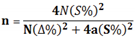
In there:
n: Number of cells to be investigated
N: Overall capacity (N=f/a)
a: Area of sample plot
F: Area of investigation area
ΔΔ%: Given error (10%)
S%: Coefficient of variation (an indicator that represents the relative average volatility of the observed value range) is calculated according to the formula:
S%= S/x*100 (In which: S: sample standard deviation; x: sample average)
Utilizing the provided formula to determine the quantity of sample plots for examination, the initial step is to compute the number of plots based on statistical criteria. The survey lines extend consistently from the mainland towards the sea, and their positions are predetermined by coordinates on digital maps, serving as the foundation for identifying field locations.
Measurement Criteria: Identify tree species, measure the diameter of the tree trunk at chest height (D1,3) [20], measure height to the top (Ht), assess the average diameter of the tree canopy in both east-west and north-south directions (Dc). Classify the quality of standing trees using a 5-point scale (1 represents a dead tree, 2 signifies a dying tree, 3 is a normally growing tree, 4 represents a well-growing tree with a uniform bronze tree shape and healthy growth, while 5 indicates trees with strong growth, remarkable height, straight trunk, and high branching), main Heathy (He).
Calculate tree canopy area and number tree per plot:
Tree canopy area (Gp) calculate by using the formula
Gp =
Gp: Tree canopy area per plot (100 m2)
Dc: Diameter of tree crown
: 3.1416
Number of tree per plot:
N/p = Ns1 + Ns2 ….. Nsn
Np: Number of tree per plot
Ns1: Number of tree with total tree of species number one of plot
Nsn: Number of tree with total tree of species nmuber n of plot
Species identification method: Use statistical survey methods to determine the number of species distributed, classify, collect samples, conduct collection and classification of families, genera, species, compare with the mangrove statistical manual and format corresponding species in the measurement plot [11].
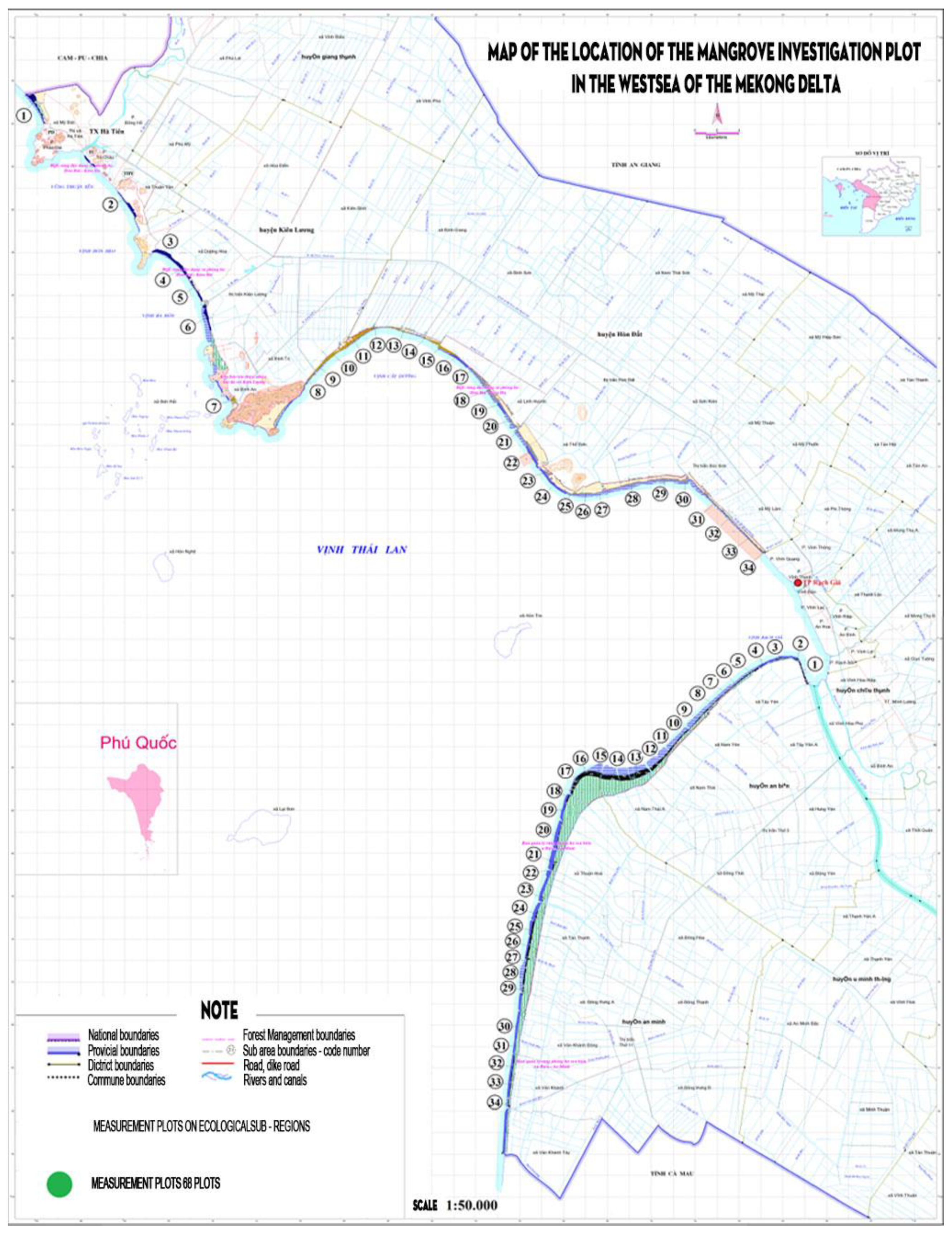
Figure 1.
Map of mangrove measurement plot (GIZ Kien Giang, 2011, 2012).
2.3. Data Processing Methods
Using Microsoft Excel software 16 to synthesize data.
Using of PRIMER 6 software to analyze similarities between species [33]: Variables are standardized using the Square root method, creating a similarity matrix according to the Bray-Curtis method and then drawing a branch diagram. Group average to consider similar levels.
Use SPSS statistical software to process data, use Anova analysis of variance method and Duncan test at 5% significance level to compare differences between study areas.
3. Results and Discussion
3.1. Results of Dividing Sub Region on Mangroves in the Western Mekong Delta
Figure 2.
Map of study area divided into 4 sub-regions. Comments: Base on (Figure 1, Figure 2, Table 1) the soil properties, topography, and distribution of mangrove forest vegetation in the western sea of Mekong Delta, the mangrove forests in thí region are divided into 4 sub-regions (Figure 2). Sub-region 1: Mangrove forests on the litle mudflats and lot of sand depositted on the mountain teraces. Sub-region 2: Mangrove forest on the average mudflats and average sand depositted on the mountain teracces Sub-region 3: Mangrove forest on the lot of mudflats and alittle sand with clay. Sub-region 4: Mangrove forest on the mudflats and loam soil.
Figure 2.
Map of study area divided into 4 sub-regions. Comments: Base on (Figure 1, Figure 2, Table 1) the soil properties, topography, and distribution of mangrove forest vegetation in the western sea of Mekong Delta, the mangrove forests in thí region are divided into 4 sub-regions (Figure 2). Sub-region 1: Mangrove forests on the litle mudflats and lot of sand depositted on the mountain teraces. Sub-region 2: Mangrove forest on the average mudflats and average sand depositted on the mountain teracces Sub-region 3: Mangrove forest on the lot of mudflats and alittle sand with clay. Sub-region 4: Mangrove forest on the mudflats and loam soil.
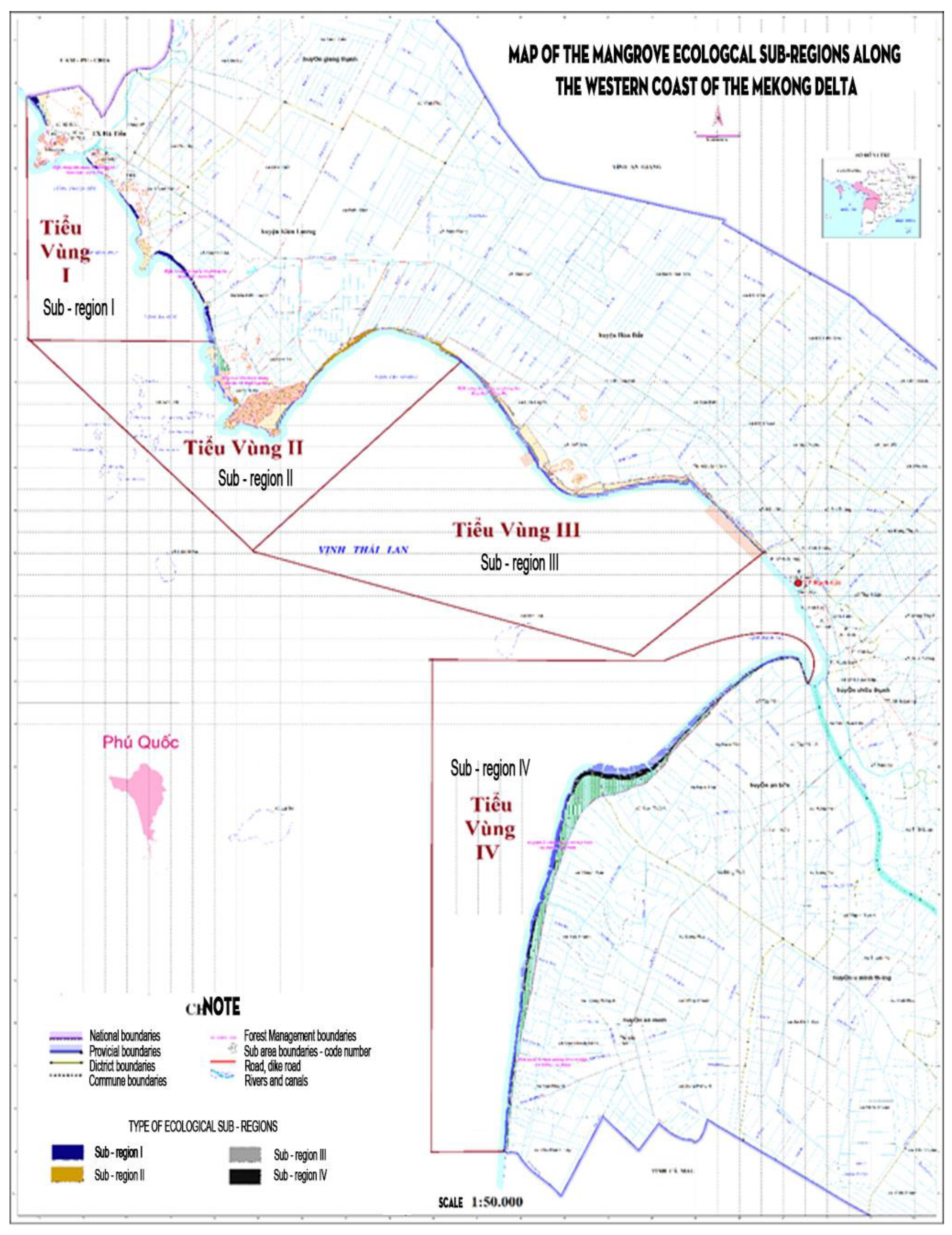

Table 1.
Scientific names of species in the mangrove forest.
| TT | Families | Species | Local Name |
|---|---|---|---|
| 1 | Sonneratiaceae | Sonneratia caseolaris | Ban chua |
| 2 | Sonneratiaceae | Sonneratia ovate | Ban oi |
| 3 | Annonaceae | Annona reticulate | Binh bat |
| 4 | Combretaceae | Lumnitzera littorea | Coc do |
| 5 | Combretaceae | Lumnitzera racemosa | Coc trang |
| 6 | Rhizophoraceae | Rhizophora mucronata | Dung |
| 7 | Areecaceae | Nipa fruticans | Dua nuoc |
| 8 | Rhizophoraceae | Rhizophora apiculata | Duoc |
| 9 | Euphorbiaceae | Excoecaria agallocha | Gia |
| 10 | Avicenniaceae | Avicennia marina | Mam bien |
| 11 | Avicenniaceae | Avicennia officinalis | Mam den |
| 12 | Avicenniaceae | Avicennia alba | Mam trang |
| 13 | Rhizophoraceae | Bruguiera gymnorhiza | Vet du |
| 14 | Rhizophoraceae | Bruguiera cylindrical | Vet tru |
| 15 | Myrsinaceae | Aegiceras corniculatum | Su |
| 16 | Malvaceae | Hibiscus tiliaceus | Tra |
3.2. Species Structure of Mangroves in Sub-Regions of the Western Mekong Delta
- a.
- Species structure of Mangroves in sub-region 1
Figure 3.
Density structure of species in mangrover forest in sub region one. Comments: Propotion of species in sub-region 1 (Table 2 and Figure 3): There are 7 species, with the density is 6100 trees per hectare. The species with the highest number of trees is Avicennia officinalis reach to 2750 trees per hectarer, the second species 1983 trees per hectare is Rhizophora apiculata, the third species 717 tree per hectare is Sonneratia ovate. The species 300 trees per hectare is Avicennia alba, The other ones Bruguiera gymnorhiza reach only 183 trees per hectare, Excoecaria agallocha 117 trees per hectare and Aegiceras corniculatum 50 trees per hectare.
Figure 3.
Density structure of species in mangrover forest in sub region one. Comments: Propotion of species in sub-region 1 (Table 2 and Figure 3): There are 7 species, with the density is 6100 trees per hectare. The species with the highest number of trees is Avicennia officinalis reach to 2750 trees per hectarer, the second species 1983 trees per hectare is Rhizophora apiculata, the third species 717 tree per hectare is Sonneratia ovate. The species 300 trees per hectare is Avicennia alba, The other ones Bruguiera gymnorhiza reach only 183 trees per hectare, Excoecaria agallocha 117 trees per hectare and Aegiceras corniculatum 50 trees per hectare.
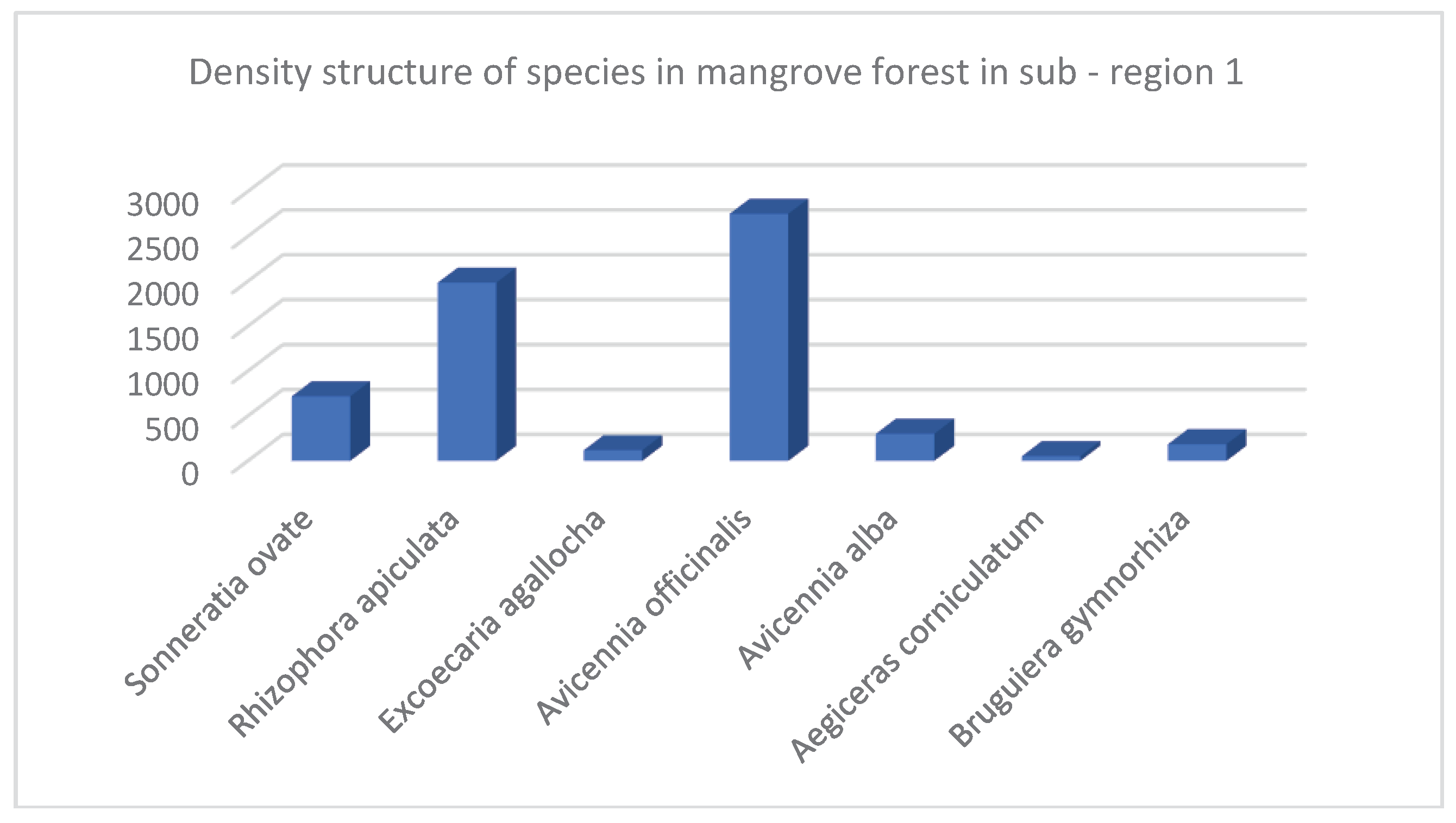
Table 2.
Structure indicators of species in sub-region one.
| No. | Species | Density Structure (Tree) | Species Ratio (%) | Average Height (Meter) | Average Diameter (Centimeter) | Canopy Structure (Square Meter m2) | Heathy Structure (1 …5) 1: Bad 5: Best |
|---|---|---|---|---|---|---|---|
| 1 | Sonneratia ovate | 717 | 11.75 | 7.65 | 11.19 | 1347 | 3.67 |
| 2 | Rhizophora apiculata | 1983 | 32.51 | 5.17 | 4.87 | 3667 | 3.9 |
| 3 | Excoecaria agallocha | 117 | 1.92 | 4.86 | 6.43 | 100 | 3.29 |
| 4 | Avicennia officinalis | 2750 | 45.08 | 5.8 | 6.63 | 4013 | 2.63 |
| 5 | Avicennia alba | 300 | 4.92 | 5.54 | 6.32 | 438 | 2.15 |
| 6 | Aegiceras corniculatum | 50 | 0.82 | 3.38 | 3.69 | 25 | 3.5 |
| 7 | Bruguiera gymnorhiza | 183 | 3 | 5.43 | 4.38 | 410 | 4 |
| Total* / Average** | 6100* | 100* | 5.40** | 6.27** | 10000* | 3.31** |
Figure 4.
Ratio structure of species in mangrove forest in sub region 1. Comments: Ratio structure of species in sub-region 1 (Table 2 and Figure 3): The species with the highest number of trees is Avicennia officinalis reach to 45% the total plot, the second species 32.5% is Rhizophora apiculata, the third species 11.75% is Sonneratia ovate. The species 4.9% is Avicennia alba, The otherwhile Vet du Bruguiera gymnorhiza reach only 3% and Gia Excoecaria agallocha 1.9%.
Figure 4.
Ratio structure of species in mangrove forest in sub region 1. Comments: Ratio structure of species in sub-region 1 (Table 2 and Figure 3): The species with the highest number of trees is Avicennia officinalis reach to 45% the total plot, the second species 32.5% is Rhizophora apiculata, the third species 11.75% is Sonneratia ovate. The species 4.9% is Avicennia alba, The otherwhile Vet du Bruguiera gymnorhiza reach only 3% and Gia Excoecaria agallocha 1.9%.
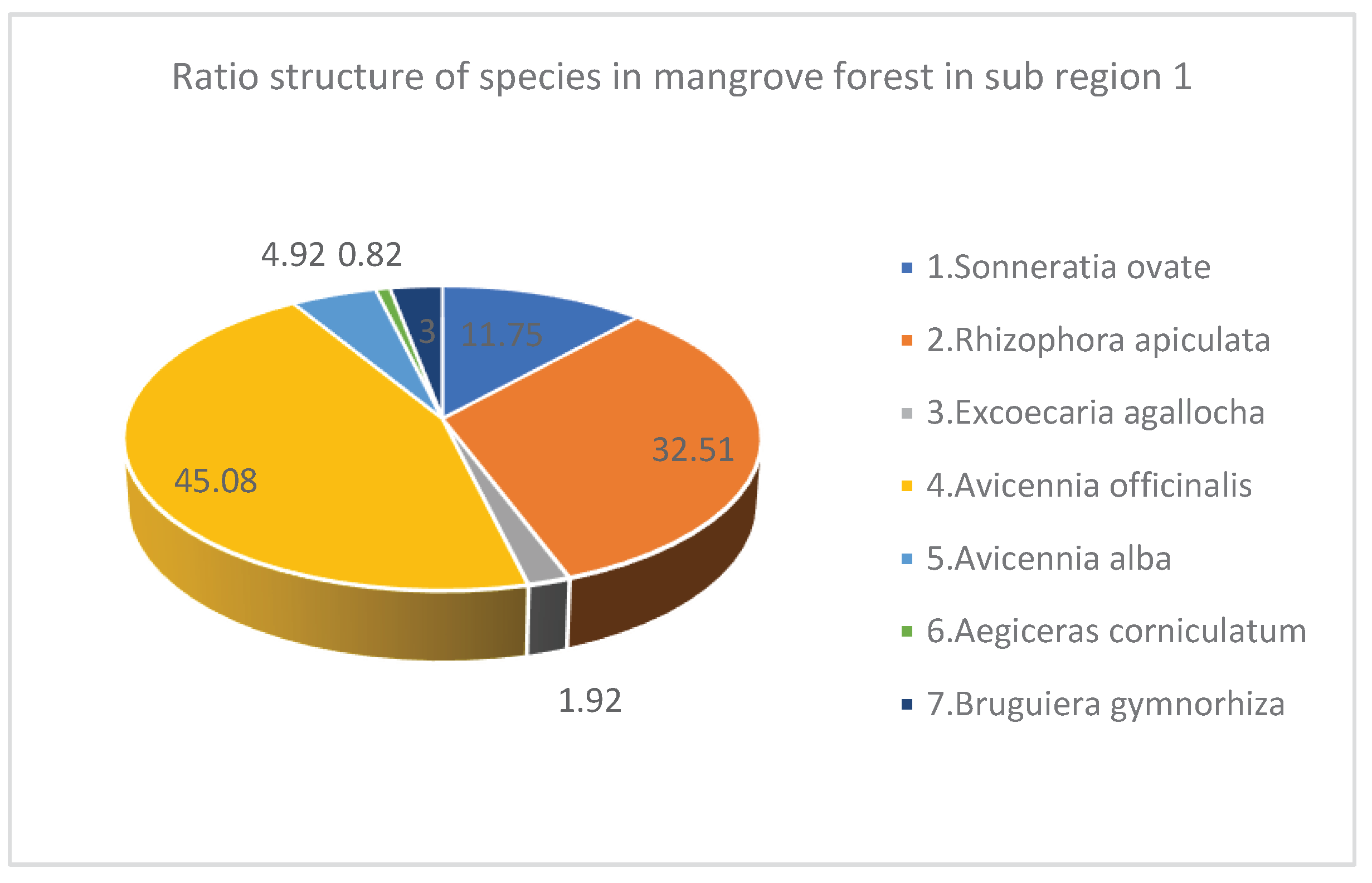
Figure 5.
Average height growth of species in sub region one. Comments: The height of species in sub region 1 (Table 3 and Figure 5). The species Sonneratia ovate highest 7.65 meters in estuaries where river and sea water, salinity is low. The species Avicennia officinalis the height is 5.80 meters and Avicennia alba is 5.54 meters are species are piooneer plants that live on mud; the species Bruguiera gymnorhiza height is 5.43 meters this species grows naturally on stable and hard soil. The other species with the height as Excoecaria agallocha. 4.86 meter Aegiceras corniculatum 3.38 meter and are the species grows naturally on stable hard ground.
Figure 5.
Average height growth of species in sub region one. Comments: The height of species in sub region 1 (Table 3 and Figure 5). The species Sonneratia ovate highest 7.65 meters in estuaries where river and sea water, salinity is low. The species Avicennia officinalis the height is 5.80 meters and Avicennia alba is 5.54 meters are species are piooneer plants that live on mud; the species Bruguiera gymnorhiza height is 5.43 meters this species grows naturally on stable and hard soil. The other species with the height as Excoecaria agallocha. 4.86 meter Aegiceras corniculatum 3.38 meter and are the species grows naturally on stable hard ground.
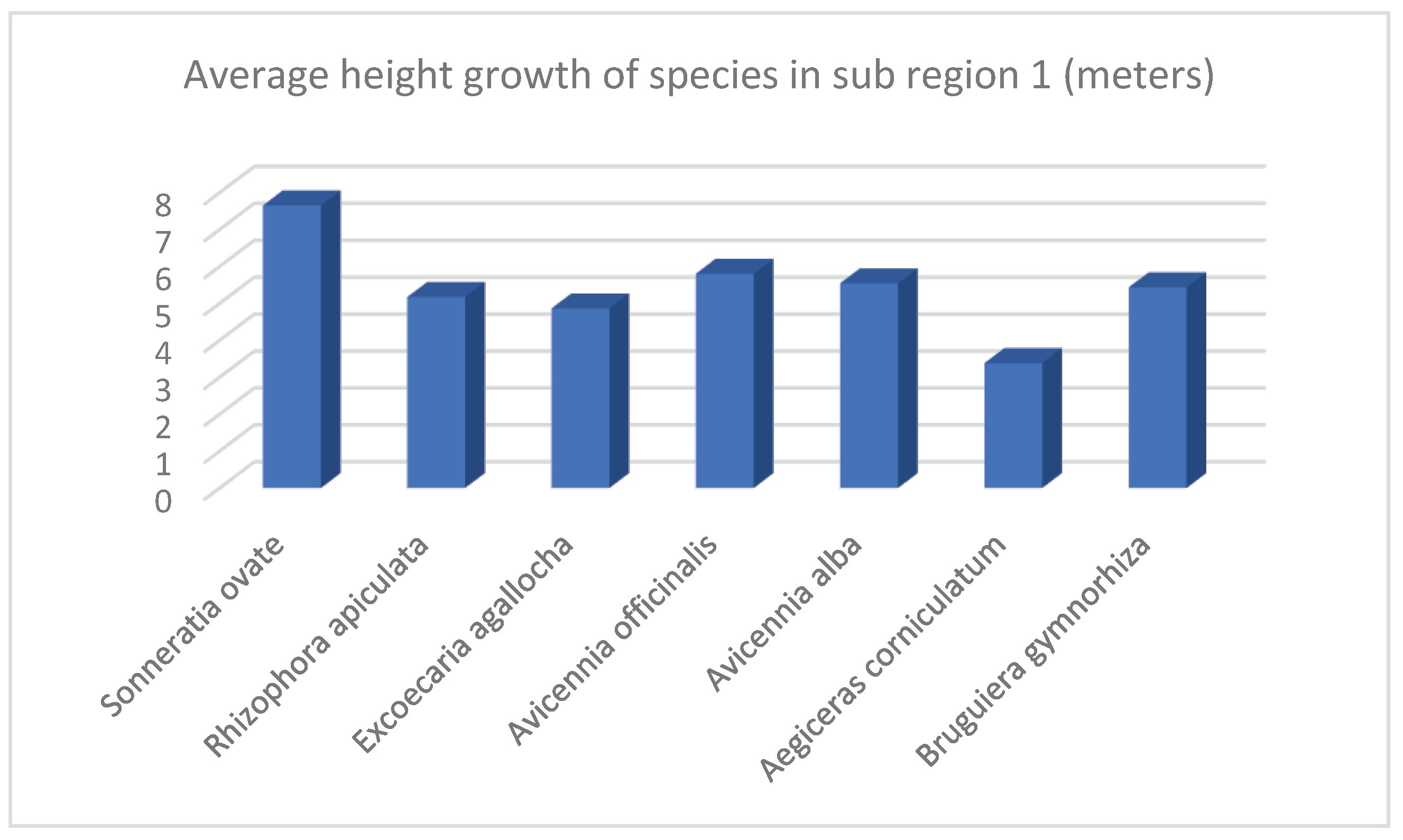
Table 3.
Density structure and ratio (%) of species in sub-region 2.
| No. | Species | Density Structure (Tree) | Species Ratio (%) | Average Height (Meter) | Average Diameter (Centimeter) | Canopy Structure (Square Meter m2) | Heathy Structure (1 …5) 1: Bad 5: Best |
|---|---|---|---|---|---|---|---|
| 1 | Sonneratia caseolaris | 20 | 0.51 | 10.5 | 25.54 | 155 | 4 |
| 2 | Annona reticulate | 10 | 0.26 | 3.5 | 11.78 | 24 | 2 |
| 3 | Lumnitzera littorea | 50 | 1.28 | 3.17 | 5.22 | 16 | 2.33 |
| 4 | Lumnitzera racemosa | 110 | 2.81 | 4.55 | 5.64 | 70 | 3.02 |
| 5 | Rhizophora apiculata | 540 | 13.81 | 5.72 | 8.17 | 581 | 4.04 |
| 6 | Excoecaria agallocha | 740 | 18.93 | 5.37 | 6.42 | 943 | 3.51 |
| 7 | Avicennia officinalis | 1190 | 30.43 | 5.99 | 13.91 | 4773 | 3.92 |
| 8 | Avicennia alba | 820 | 20.97 | 7.85 | 12.35 | 2759 | 2.98 |
| 9 | Hibiscus tiliaceus | 90 | 2.30 | 5.99 | 10.75 | 202 | 2.78 |
| 10 | Bruguiera gymnorhiza | 260 | 6.65 | 5.47 | 8.08 | 322 | 3.78 |
| 11 | Aegiceras corniculatum | 80 | 2.05 | 3.72 | 5.45 | 155 | 4.31 |
| Total* / Average** | 3910* | 100* | 5.62** | 10.30** | 10000* | 3.33** |
Figure 6.
Average diameter structure of species in sub region one. Comments: The diameter structure of species in sub region 1 (Table 3 and Figure 6). The species Sonneratia ovate diameter 1.3 meter 11.90 centimeters in estuaries where river and sea water, salinity is low is highest diameter at 1.3 meters. The species Avicennia officinalis the diameter at 1.3 meters are 6.63 centimeters and Avicennia alba is 6.32 centimeters are species are piooneer plants that live on mudflats. The species Excoecaria agallocha diameters is 6.34 centimeters this species grows naturally on stable and hard soil. The other species with the diameters as Rhizophora apiculata. 4.87 centimeters, Bruguiera gymnorhiza 4.83 centimeters and Aegiceras corniculatum 3.69 centimeters and are the species grows naturally on stable hard ground.
Figure 6.
Average diameter structure of species in sub region one. Comments: The diameter structure of species in sub region 1 (Table 3 and Figure 6). The species Sonneratia ovate diameter 1.3 meter 11.90 centimeters in estuaries where river and sea water, salinity is low is highest diameter at 1.3 meters. The species Avicennia officinalis the diameter at 1.3 meters are 6.63 centimeters and Avicennia alba is 6.32 centimeters are species are piooneer plants that live on mudflats. The species Excoecaria agallocha diameters is 6.34 centimeters this species grows naturally on stable and hard soil. The other species with the diameters as Rhizophora apiculata. 4.87 centimeters, Bruguiera gymnorhiza 4.83 centimeters and Aegiceras corniculatum 3.69 centimeters and are the species grows naturally on stable hard ground.
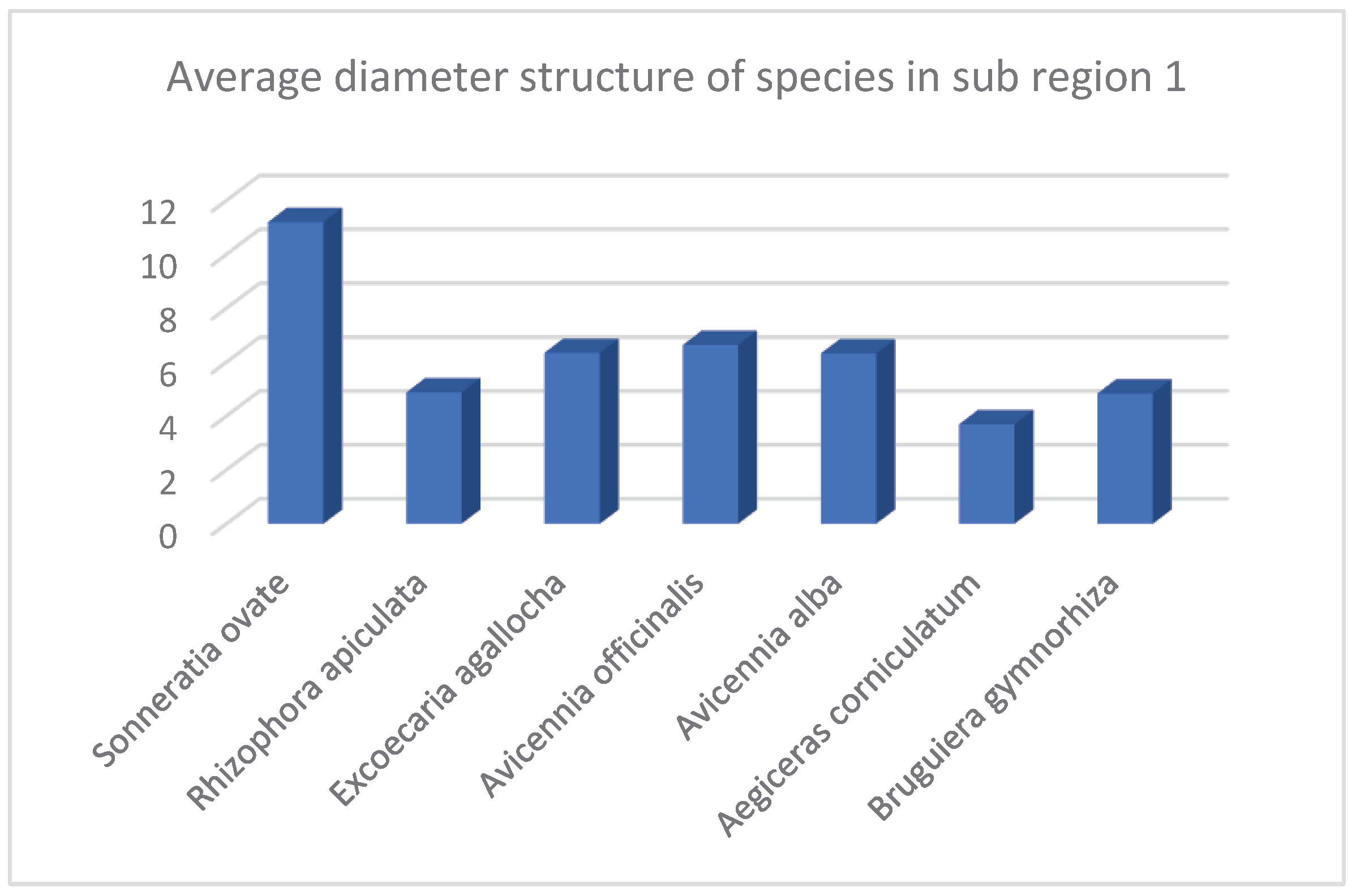
Figure 7.
Canopy structure of species in sub region one. Comments: The canopy structure of species in sub region 1 (Table 4 and Figure 7). The species Avicennia officinalis with canopy 4013 square metters is the species one have the highest canopy, the species Rhizophora apiculata 3667 square meters is second canopy species. The species Sonneratia ovate is 1347 square meters and Avicennia alba is 438 square metters; the species Bruguiera gymnorhiza is 410 square meters. The other species with the canopy as Excoecaria agallocha 100 square meters and Aegiceras corniculatum 25 square meters.
Figure 7.
Canopy structure of species in sub region one. Comments: The canopy structure of species in sub region 1 (Table 4 and Figure 7). The species Avicennia officinalis with canopy 4013 square metters is the species one have the highest canopy, the species Rhizophora apiculata 3667 square meters is second canopy species. The species Sonneratia ovate is 1347 square meters and Avicennia alba is 438 square metters; the species Bruguiera gymnorhiza is 410 square meters. The other species with the canopy as Excoecaria agallocha 100 square meters and Aegiceras corniculatum 25 square meters.
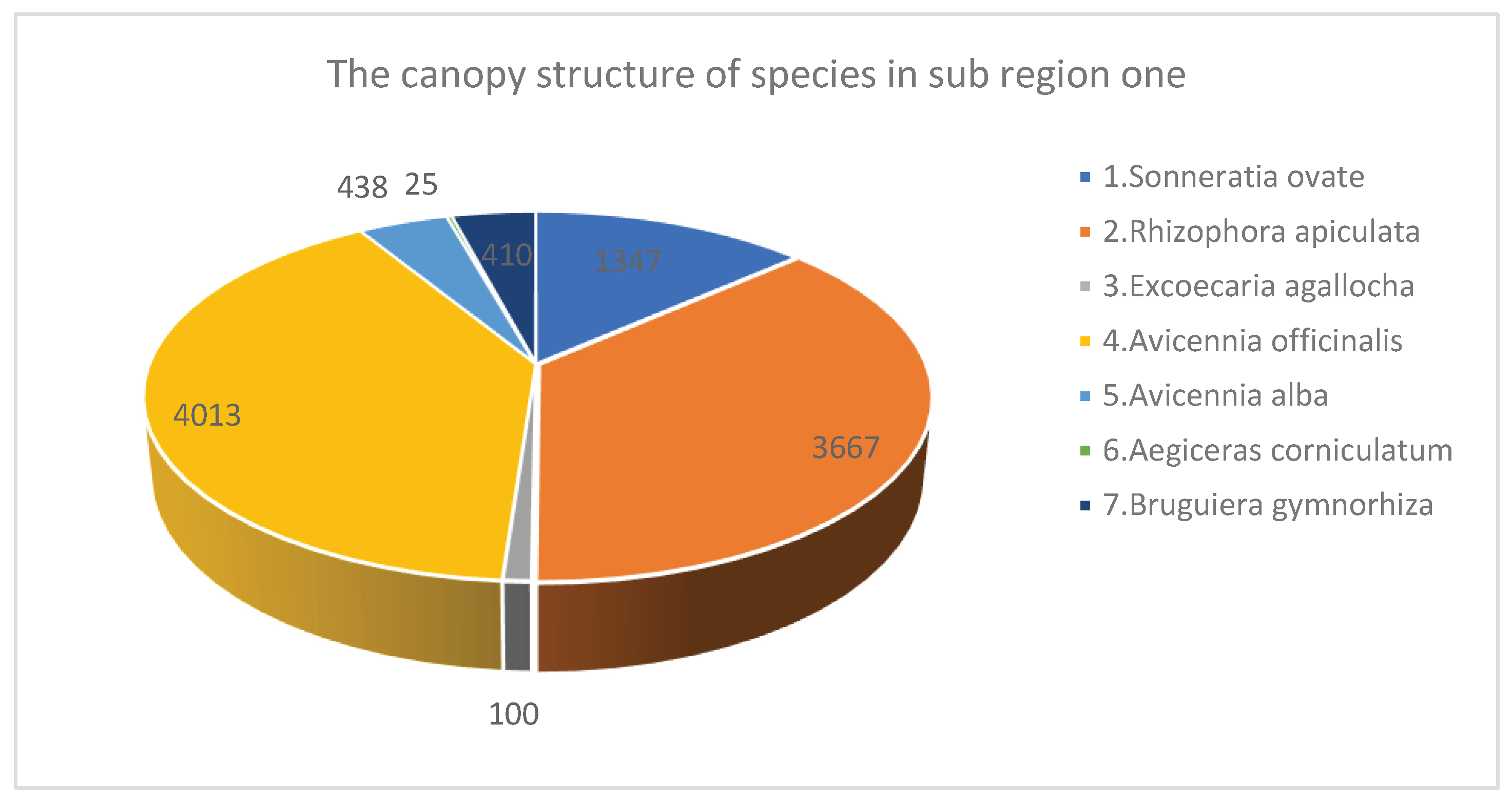
Table 4.
The indicators structure of species in sub-region 3.
| No. | Species | Density Structure (Tree) | Species Ratio (%) | Average Height (meter) | Average Diameter (Centimeter) | Canopy Structure (Square Meter m2) | Heathy Structure (1 …5) 1: Bad 5: Best |
|---|---|---|---|---|---|---|---|
| 1 | Sonneratia caseolaris | 244 | 6.15 | 12.1 | 25.22 | 1292 | 3.34 |
| 2 | Nipa fruticans | 800 | 20.17 | 4.58 | Monocot | 2456 | 3.28 |
| 3 | Rhizophora mucronata | 6 | 0.15 | 8 | 6.68 | 6 | 3 |
| 4 | Rhizophora apiculata | 522 | 13.16 | 7.26 | 7.68 | 687 | 4.29 |
| 5 | Excoecaria agallocha | 183 | 4.61 | 6.83 | 8.6 | 190 | 3.33 |
| 6 | Avicennia marina | 628 | 15.83 | 8.18 | 11.52 | 1876 | 3.15 |
| 7 | Avicennia alba | 1244 | 31.37 | 7.6 | 10.92 | 2971 | 3.15 |
| 8 | Bruguiera gymnorhiza | 339 | 8.55 | 4.63 | 6.42 | 522 | 3.78 |
| Total* / Average** | 3966* | 100* | 7.40** | 10.16** | 10000* | 3.41** |
Figure 8.
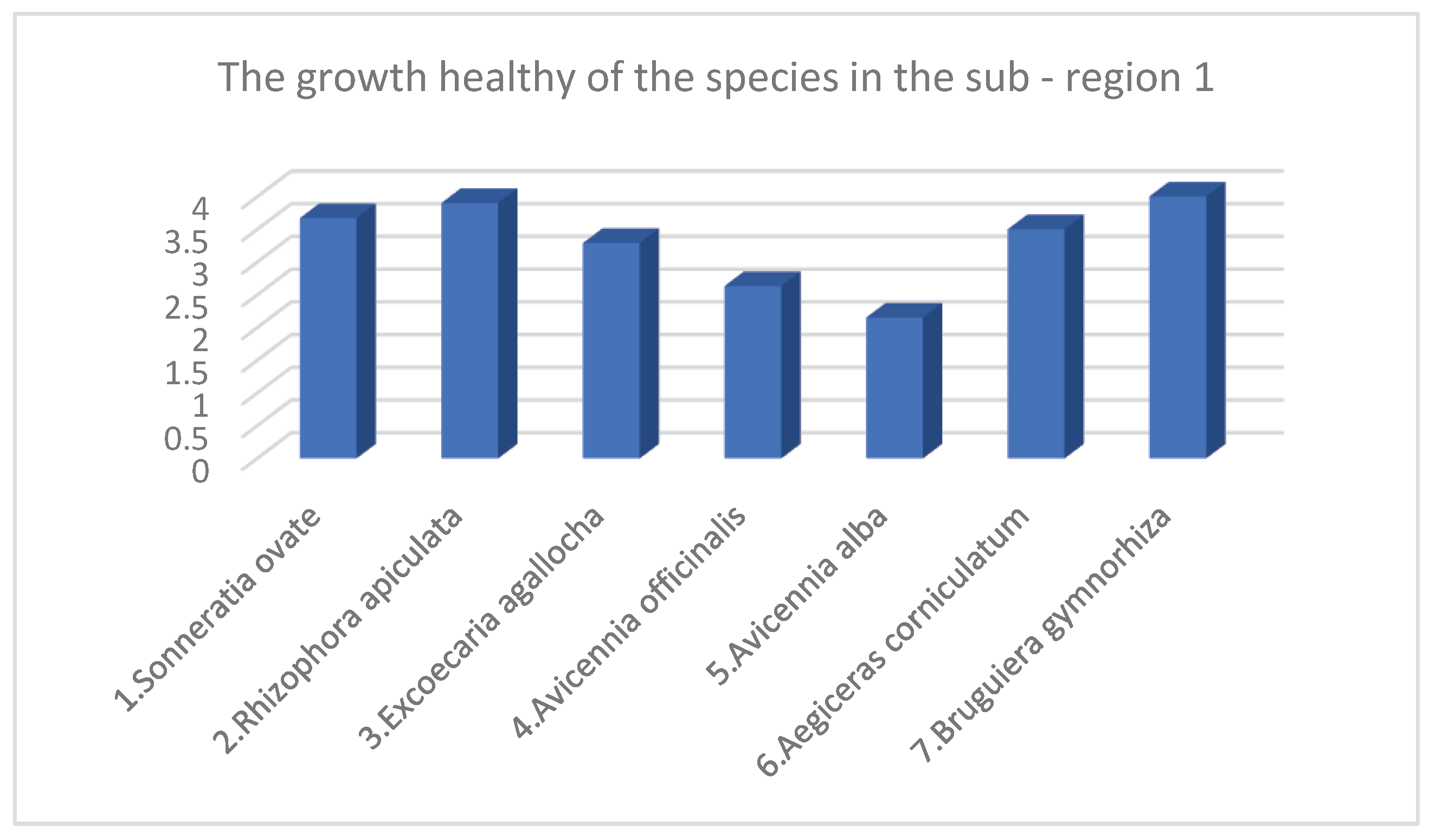
Heathy structure of species in sub region one. Comments: The Heathy structure of species in the sub region 1 (Table 4 and Figure 8). The species have heathy with high heathy are Bruguiera gymnorhiza, Rhizophora apiculata, Sonneratia ovate, Aegiceras corniculatum, Avicennia officinalis form 3.5 to 4 per 5. The species have heathy with indicator under 3 per 5 are Avicennia officinalis, Avicennia alba, these species grows quickly but develops many branches.
Figure 8.
Heathy structure of species in sub region one. Comments: The Heathy structure of species in the sub region 1 (Table 4 and Figure 8). The species have heathy with high heathy are Bruguiera gymnorhiza, Rhizophora apiculata, Sonneratia ovate, Aegiceras corniculatum, Avicennia officinalis form 3.5 to 4 per 5. The species have heathy with indicator under 3 per 5 are Avicennia officinalis, Avicennia alba, these species grows quickly but develops many branches.
- b.
- Species structure of Mangroves in Sub region 2
Figure 9.
Density structure of species in sub region 2. Comments: Density structure of species in sub region 2 (Table 5 and Figure 9). The species of this sub region have 11 species and divided follow. The species with the highest density is Avicennia officinalis that 1190 tree per hectare, Avicennia alba is 820 tree per hectare, Excoecaria agallocha is 740 tree per hectare, Rhizophora apiculata is 540 tree per hectare. The species Bruguiera gymnorhiza the density is 260 tree per hectare, Lumnitzera racemosa 110 tree per hectare. The species lower 100 tree per hectare are Hibiscus tiliaceus, Aegiceras corniculatum, Lumnitzera littorea, Sonneratia caseolaris, Annona reticulate.
Figure 9.
Density structure of species in sub region 2. Comments: Density structure of species in sub region 2 (Table 5 and Figure 9). The species of this sub region have 11 species and divided follow. The species with the highest density is Avicennia officinalis that 1190 tree per hectare, Avicennia alba is 820 tree per hectare, Excoecaria agallocha is 740 tree per hectare, Rhizophora apiculata is 540 tree per hectare. The species Bruguiera gymnorhiza the density is 260 tree per hectare, Lumnitzera racemosa 110 tree per hectare. The species lower 100 tree per hectare are Hibiscus tiliaceus, Aegiceras corniculatum, Lumnitzera littorea, Sonneratia caseolaris, Annona reticulate.
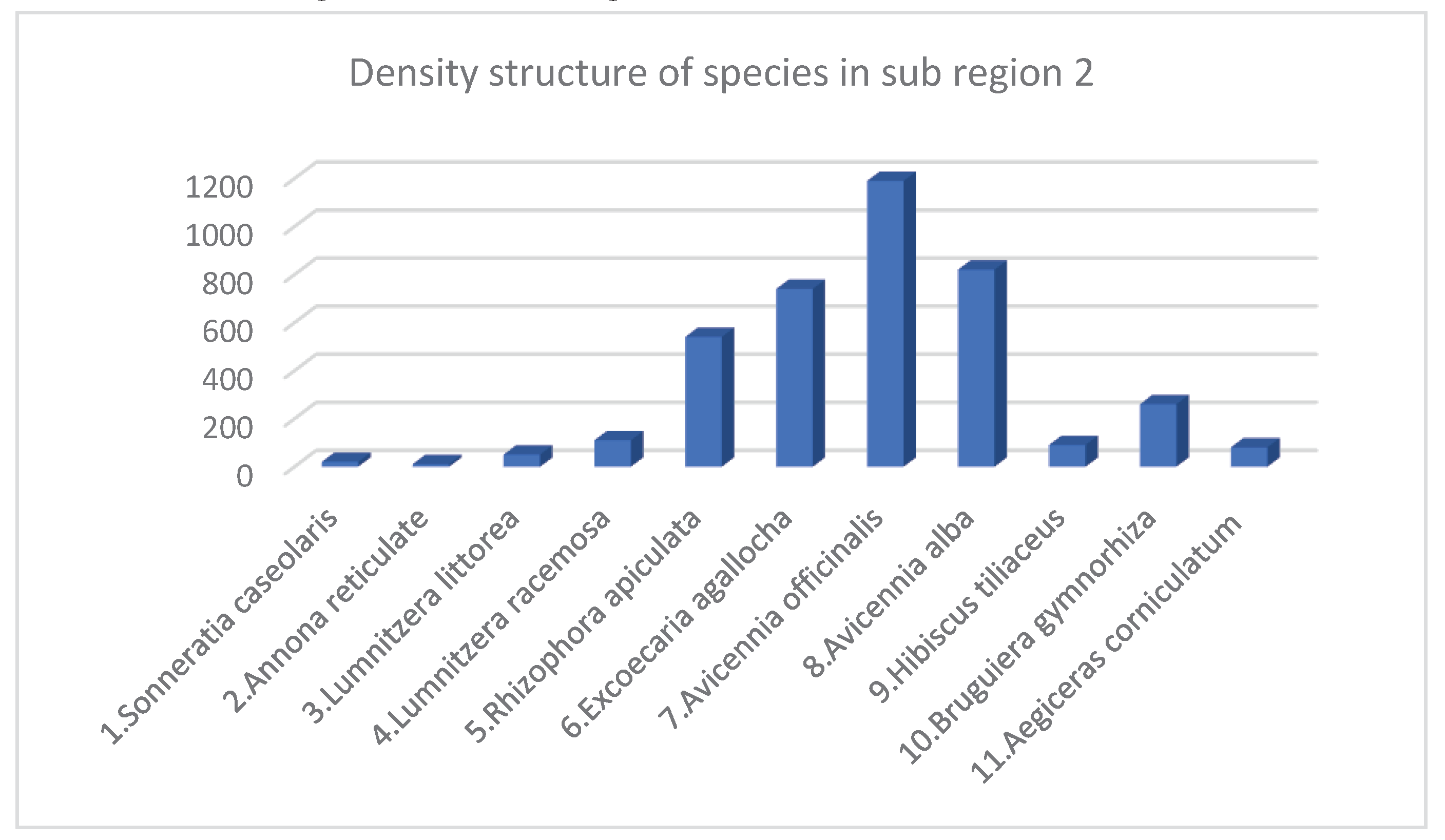
Table 5.
The indicators of species in sub region 4.
| No. | Species | Density Structure (Tree) | Species Ratio (%) | Average Height (meter) | Average Diameter (Centimeter) | Canopy Structure (Square Meter m2) | Heathy Structure (1 …5) 1: Bad 5: Best |
|---|---|---|---|---|---|---|---|
| 1 | Sonneratia caseolaris | 3 | 0.12 | 7.5 | 7 | 10 | 4 |
| 2 | Sonneratia ovate | 17 | 0.69 | 10.72 | 14.08 | 104 | 4 |
| 3 | Lumnitzera racemosa | 15 | 0.61 | 10.45 | 11.04 | 84 | 4 |
| 4 | Rhizophora apiculata | 376 | 15.35 | 9.07 | 9.52 | 1518 | 3.82 |
| 5 | Excoecaria agallocha | 141 | 5.75 | 6.9 | 8.72 | 363 | 3.76 |
| 6 | Avicennia marina | 6 | 0.24 | 10.85 | 13.77 | 22 | 3.5 |
| 7 | Avicennia officinalis | 1200 | 48.98 | 8.05 | 9.57 | 5054 | 3.47 |
| 8 | Avicennia alba | 665 | 27.14 | 7.6 | 9.43 | 2727 | 3.52 |
| 9 | Bruguiera gymnorhiza | 21 | 0.86 | 8.93 | 8.56 | 109 | 3.75 |
| 10 | Bruguiera cylindrica | 6 | 0.24 | 6.8 | 4.93 | 9 | 3.5 |
| Total* / Average** | 2450* | 100* | 8.69* | 9.66** | 10000* | 3.73** |
Figure 10.
Ratio structure of species in sub region 2. Comment: Ratio structure of species in sub region 2 (Table 5 and Figure 10). The species have ratio of species the highest is Avicennia officinalis 30.43% and Avicennia alba 20.97% . The species with high ratio are Excoecaria agallocha 18.93%, Rhizophora apiculata 13.81%. The species with low ratio are Bruguiera gymnorhiza 6.65%, Lumnitzera racemosa 2.81%, Hibiscus tiliaceus 2.3%, Aegiceras corniculatum 2.05%, Lumnitzera littorea 1.28%, Sonneratia caseolaris 0.51%, Annona reticulate 0.26%.
Figure 10.
Ratio structure of species in sub region 2. Comment: Ratio structure of species in sub region 2 (Table 5 and Figure 10). The species have ratio of species the highest is Avicennia officinalis 30.43% and Avicennia alba 20.97% . The species with high ratio are Excoecaria agallocha 18.93%, Rhizophora apiculata 13.81%. The species with low ratio are Bruguiera gymnorhiza 6.65%, Lumnitzera racemosa 2.81%, Hibiscus tiliaceus 2.3%, Aegiceras corniculatum 2.05%, Lumnitzera littorea 1.28%, Sonneratia caseolaris 0.51%, Annona reticulate 0.26%.
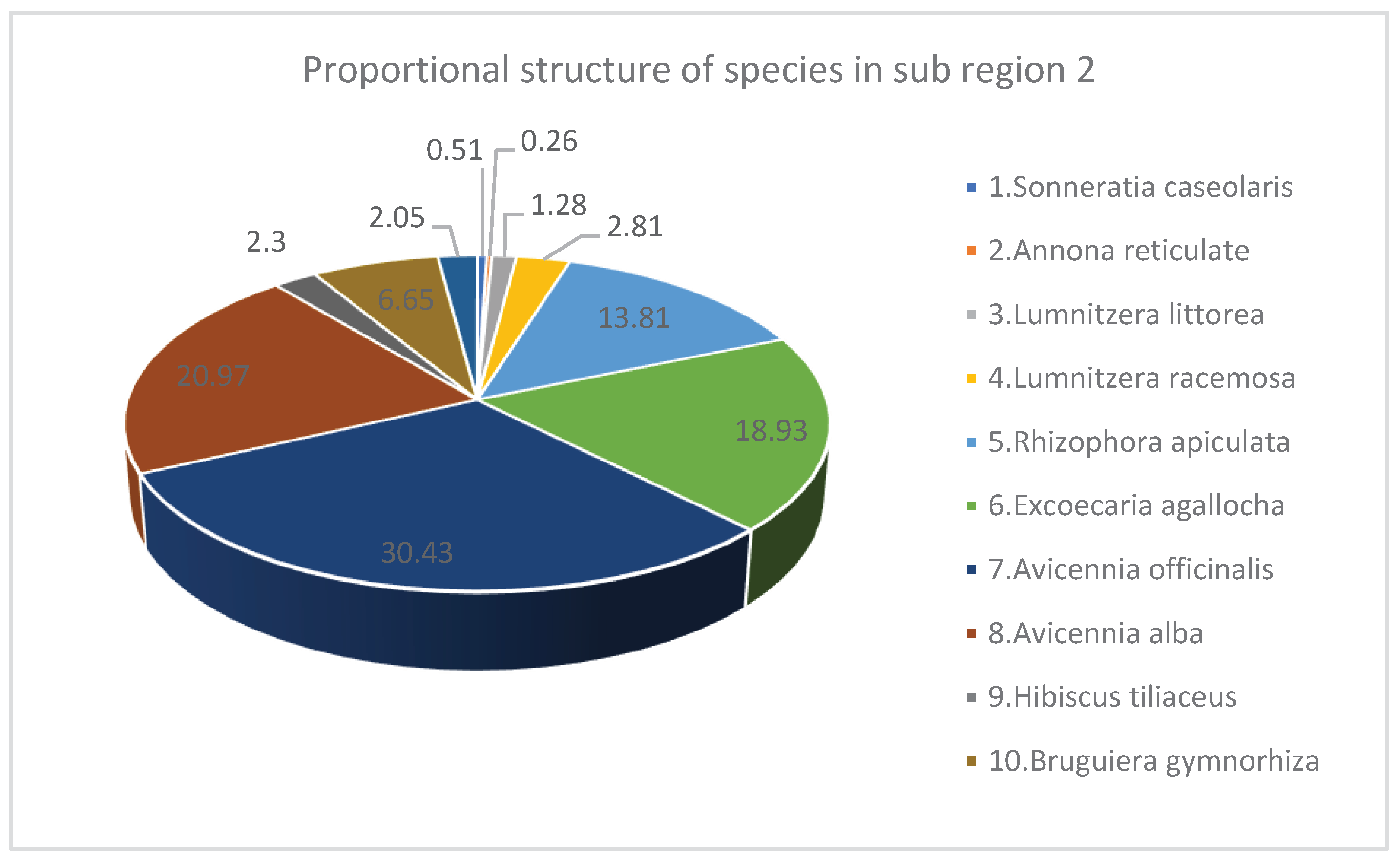
Figure 11.
The height structure of species in sub region 2. Comments: The height structure of species in sub region 2 (Table 6 and Figure 11). The species have the highest height in this sub region is Sonneratia caseolaris, It is in the first height by its high. The species have the average height are Avicennia alba, Avicennia officinalis, Hibiscus tiliaceus, Rhizophora apiculata, Bruguiera gymnorhiza. The species have the low floor Lumnitzera racemosa, Aegiceras corniculatum, Annona reticulate, Annona reticulate.
Figure 11.
The height structure of species in sub region 2. Comments: The height structure of species in sub region 2 (Table 6 and Figure 11). The species have the highest height in this sub region is Sonneratia caseolaris, It is in the first height by its high. The species have the average height are Avicennia alba, Avicennia officinalis, Hibiscus tiliaceus, Rhizophora apiculata, Bruguiera gymnorhiza. The species have the low floor Lumnitzera racemosa, Aegiceras corniculatum, Annona reticulate, Annona reticulate.
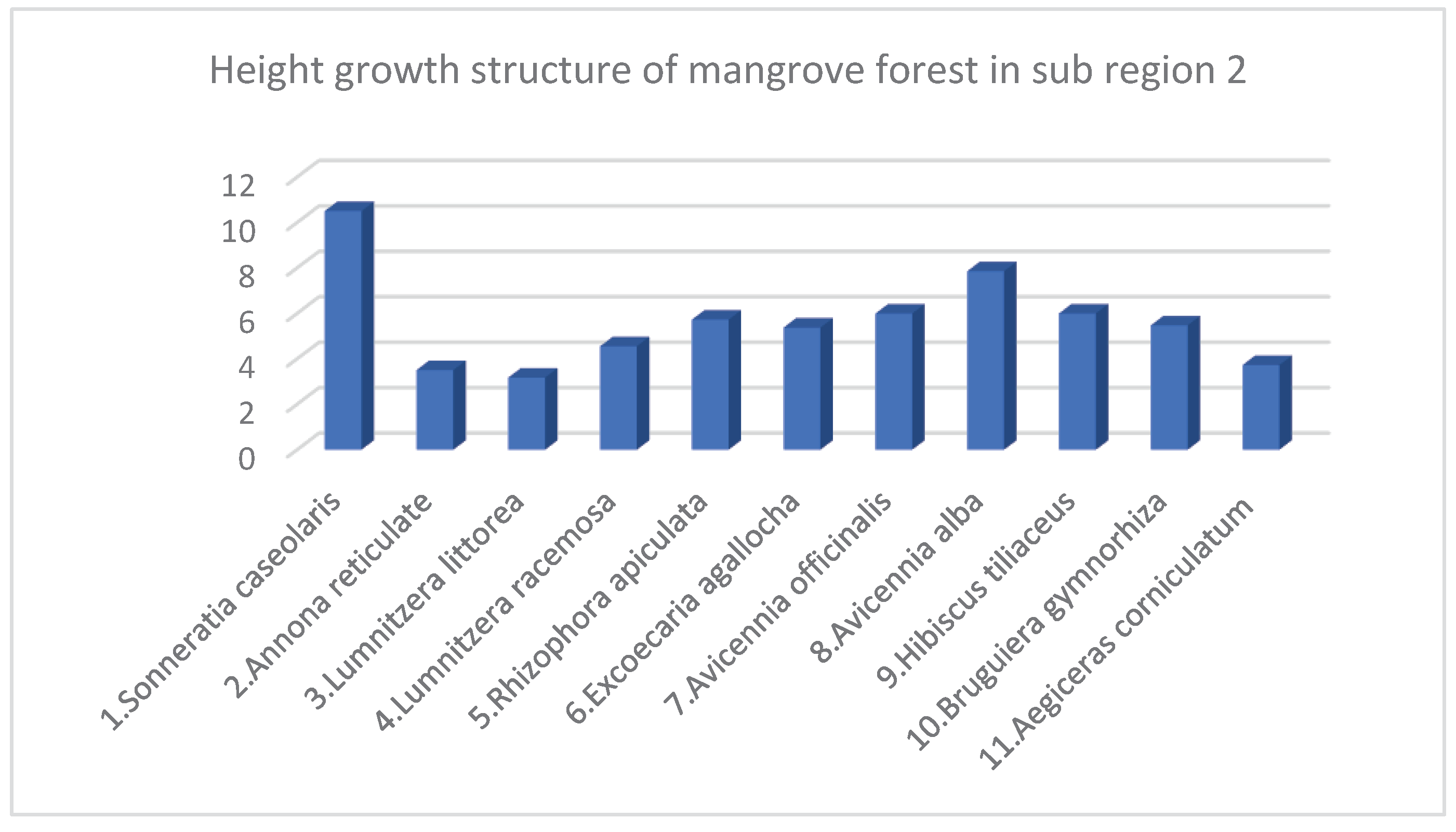
Table 6.
The indicators of species in total region Western Mekong Delta.
| No. | Species | Density Structure (Tree) | Species Ratio (%) | Average Height (Meter) | Average Diameter (Centimeter) | Canopy Structure (Square Meter m2) | Heathy Structure (1 …5) 1: Bad 5: Best |
|---|---|---|---|---|---|---|---|
| 1 | Sonneratia caseolaris | 91 | 2.07 | 9.44 | 17.24 | 541 | 3.78 |
| 2 | Sonneratia ovate | 110 | 2.50 | 10.72 | 14.08 | 304 | 3.65 |
| 3 | Annona reticulate | 2 | 0.05 | 3.5 | 11.78 | 6 | 2 |
| 4 | Lumnitzera littorea | 10 | 0.23 | 3.17 | 5.22 | 4 | 2.33 |
| 5 | Lumnitzera racemosa | 32 | 0.73 | 7.5 | 8.34 | 51 | 3.51 |
| 6 | Nipa fruticans | 128 | 2.91 | 4.58 | 4.21 | 526 | 3.28 |
| 7 | Rhizophora mucronata | 2 | 0.05 | 8.00 | 6.68 | 3 | 3 |
| 8 | Rhizophora apiculata | 1165 | 26.47 | 6.81 | 7.56 | 1809 | 4.01 |
| 9 | Excoecaria agallocha | 325 | 7.38 | 5.99 | 7.52 | 384 | 3.47 |
| 10 | Avicennia marina | 195 | 4.43 | 9.52 | 12.64 | 546 | 3.32 |
| 11 | Avicennia officinalis | 1006 | 22.86 | 6.61 | 10.04 | 2626 | 3.34 |
| 12 | Avicennia alba | 1116 | 25.36 | 7.15 | 9.75 | 2955 | 2.95 |
| 13 | Bruguiera gymnorhiza | 39 | 0.87 | 6.33 | 6.60 | 70 | 3.83 |
| 14 | Bruguiera cylindrical | 140 | 3.18 | 6.8 | 4.93 | 76 | 3.5 |
| 15 | Aegiceras corniculatum | 22 | 0.50 | 3.55 | 4.57 | 51 | 4.31 |
| 16 | Hibiscus tiliaceus | 18 | 0.41 | 5.99 | 10.75 | 48 | 2.78 |
| Total* / Average** | 4401 | 100 | 6.87 | 9.04 | 10000* | 3.28 |
Figure 12.
Diameter structure of species in sub region 2. Comments: The first level of the diameter structure on species in sub region 2 as Sonneratia caseolaris is highest diemeter. The second level of the diemeter structure on species in sub region 2 as Avicennia officinalis, Avicennia alba, Annona reticulate, Hibiscus tiliaceus. The third level of the diameter structure on species in sub region 2 as, Rhizophora apiculata, , Bruguiera gymnorhiza, Excoecaria agallocha, Aegiceras corniculatum, Lumnitzera racemosa, Lumnitzera littorea.
Figure 12.
Diameter structure of species in sub region 2. Comments: The first level of the diameter structure on species in sub region 2 as Sonneratia caseolaris is highest diemeter. The second level of the diemeter structure on species in sub region 2 as Avicennia officinalis, Avicennia alba, Annona reticulate, Hibiscus tiliaceus. The third level of the diameter structure on species in sub region 2 as, Rhizophora apiculata, , Bruguiera gymnorhiza, Excoecaria agallocha, Aegiceras corniculatum, Lumnitzera racemosa, Lumnitzera littorea.
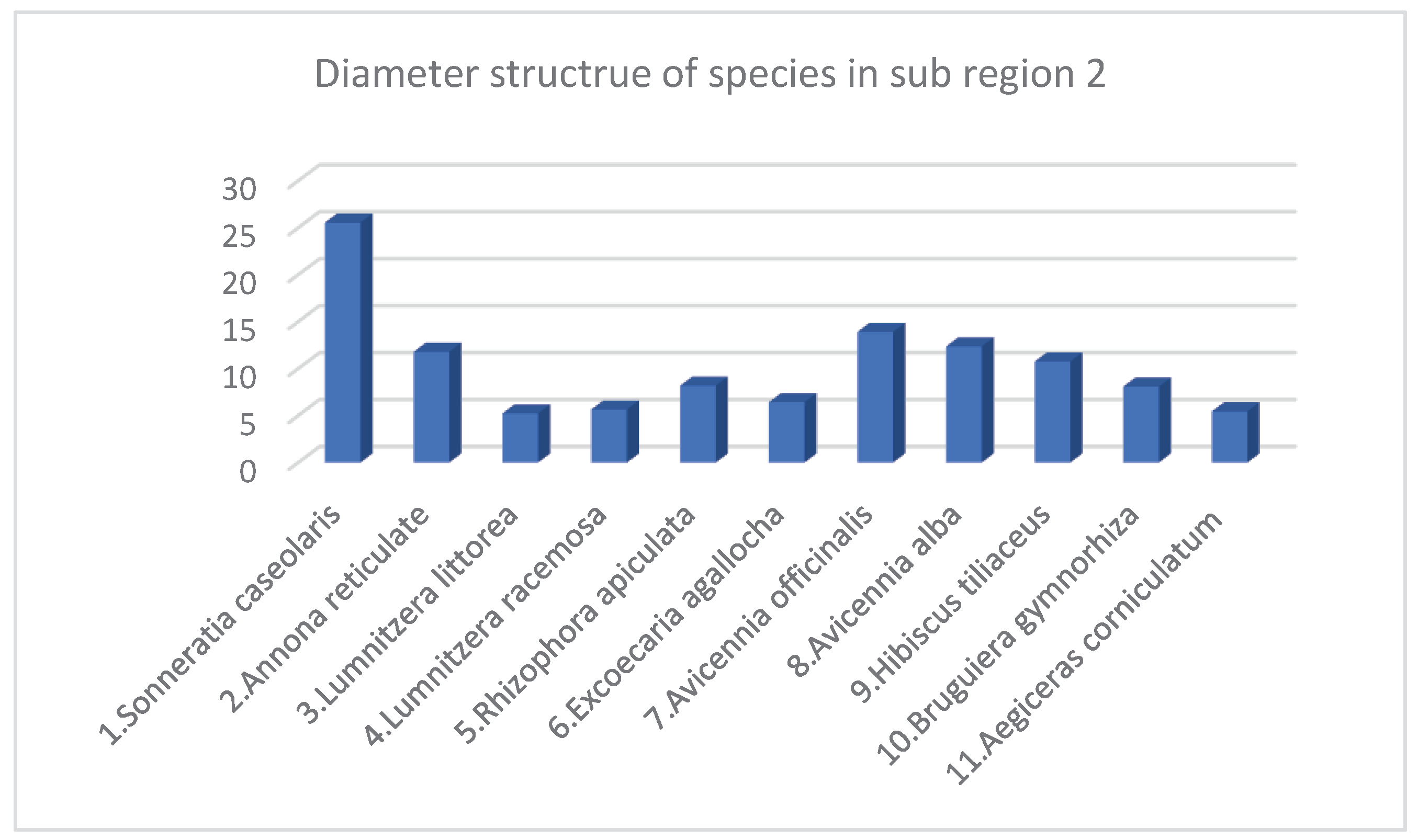
Figure 13.
Canopy structure of species in sub region 2. Comments: The canopy structure of species in sub region 2 showed (Table 7 Figure 13). The canopy structure have the highest is Avicennia officinalis 4773 m2 per hectare, the second canopy structure Avicennia alba with 2759 m2 per hectare. The canopy structure other species have canopy from 500 m2 to 1000 m2 by 5% to 10% of hectare are Excoecaria agallocha, Rhizophora apiculata, Bruguiera gymnorhiza. The canopy structure lower 5% of hectare are Bruguiera gymnorhiza, Hibiscus tiliaceus, Aegiceras corniculatum, Sonneratia caseolaris, Lumnitzera racemosa, Annona reticulate and Lumnitzera littorea.
Figure 13.
Canopy structure of species in sub region 2. Comments: The canopy structure of species in sub region 2 showed (Table 7 Figure 13). The canopy structure have the highest is Avicennia officinalis 4773 m2 per hectare, the second canopy structure Avicennia alba with 2759 m2 per hectare. The canopy structure other species have canopy from 500 m2 to 1000 m2 by 5% to 10% of hectare are Excoecaria agallocha, Rhizophora apiculata, Bruguiera gymnorhiza. The canopy structure lower 5% of hectare are Bruguiera gymnorhiza, Hibiscus tiliaceus, Aegiceras corniculatum, Sonneratia caseolaris, Lumnitzera racemosa, Annona reticulate and Lumnitzera littorea.
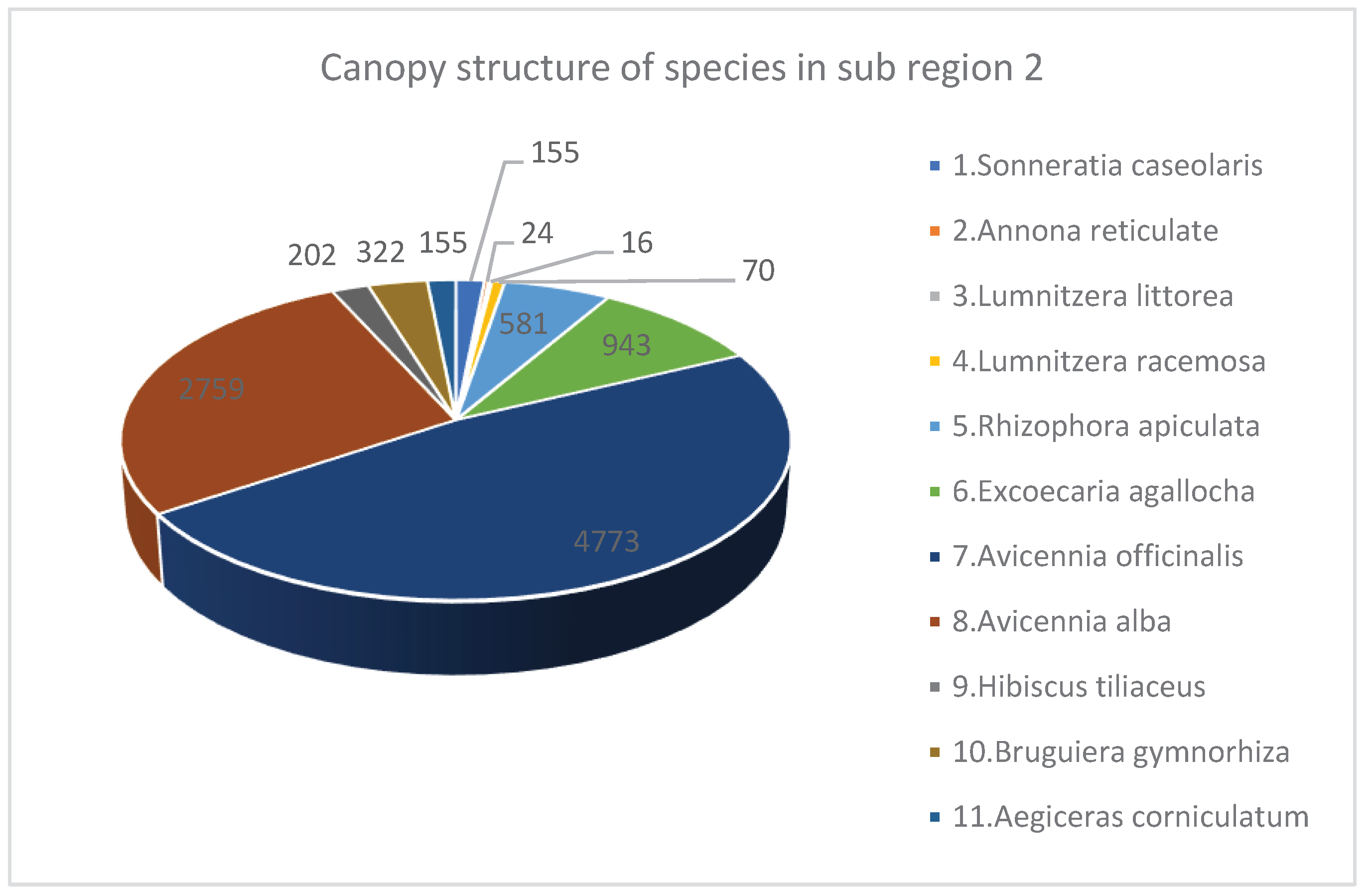
Figure 14.
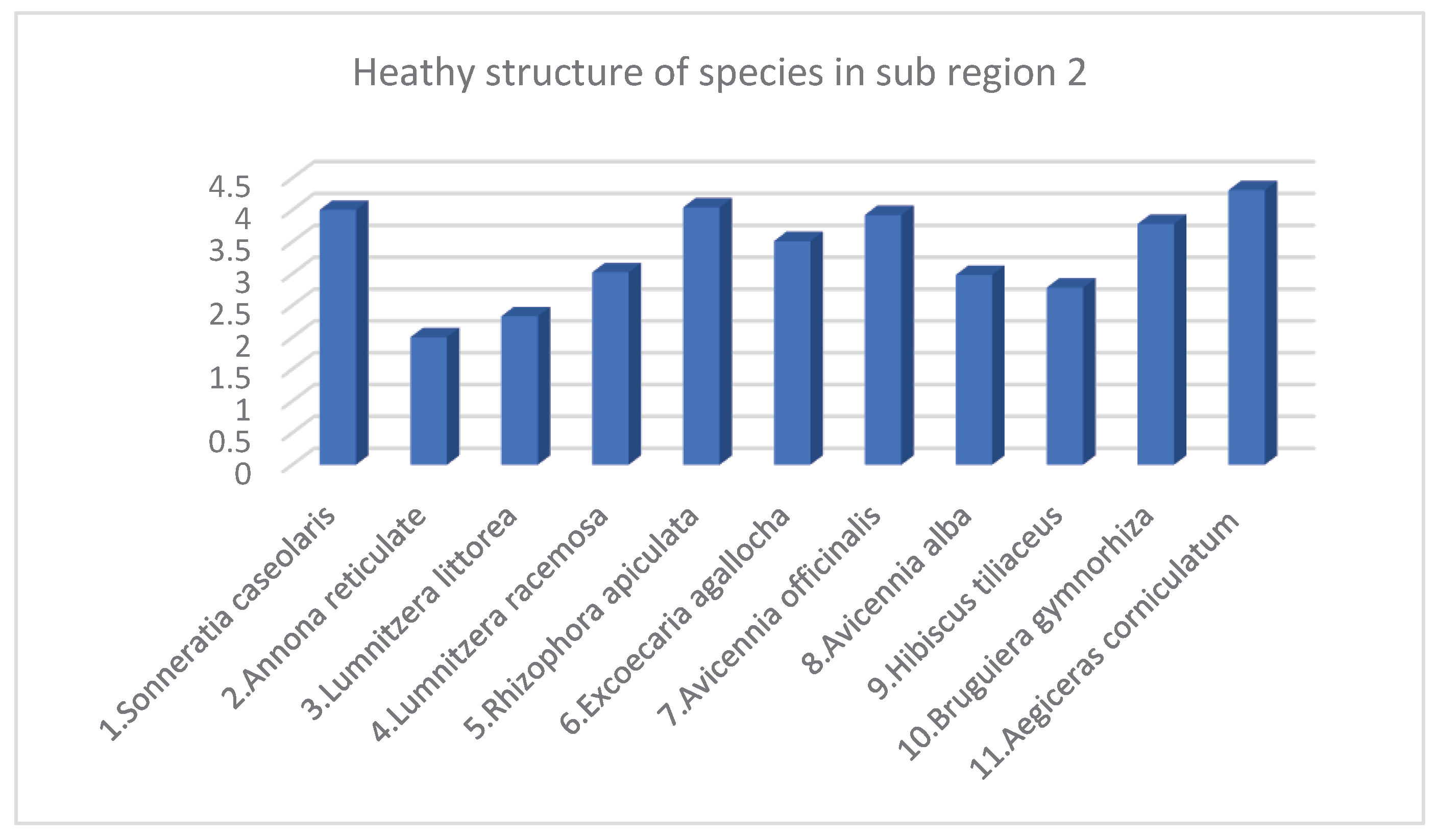
Heathy structure of species in sub region 2. Comments: The Heathy structure of species in sub region 2 showed (Table 7, Figure 2, Figure 14). The good heathy structure of species in sub region 2 are Aegiceras corniculatum, Rhizophora apiculata, Sonneratia caseolaris, Avicennia officinalis, Bruguiera gymnorhiza, Lumnitzera racemosa indictors form 3.0 to 4.3 per 5. The average vitality structure of species in sub region 2 are Avicennia alba. The bad vitality structure of species in sub region 2 are Hibiscus tiliaceus, Lumnitzera littorea, Annona reticulate.
Figure 14.
Heathy structure of species in sub region 2. Comments: The Heathy structure of species in sub region 2 showed (Table 7, Figure 2, Figure 14). The good heathy structure of species in sub region 2 are Aegiceras corniculatum, Rhizophora apiculata, Sonneratia caseolaris, Avicennia officinalis, Bruguiera gymnorhiza, Lumnitzera racemosa indictors form 3.0 to 4.3 per 5. The average vitality structure of species in sub region 2 are Avicennia alba. The bad vitality structure of species in sub region 2 are Hibiscus tiliaceus, Lumnitzera littorea, Annona reticulate.
- c.
- Species structure of Mangroves in Sub region 3
Figure 15.
Density structure of species in sub region 3. Comments: The density structure of species in sub region 3 showed (Table 8, Figrue 15). The sub region 3 there are Avicennia alba with density the highest 1224 trees per hectare; the Nipa fruticans is monocot species has density high to 800 tree per hectare. In this region therea are 2 species is good density Avicennia marina, Rhizophora apiculata with 628 tree and 522 tree per hectare. The low density Bruguiera gymnorhiza 339 tree, Sonneratia caseolaris 224 tree and Rhizophora mucronata 6 tree per hectare.
Figure 15.
Density structure of species in sub region 3. Comments: The density structure of species in sub region 3 showed (Table 8, Figrue 15). The sub region 3 there are Avicennia alba with density the highest 1224 trees per hectare; the Nipa fruticans is monocot species has density high to 800 tree per hectare. In this region therea are 2 species is good density Avicennia marina, Rhizophora apiculata with 628 tree and 522 tree per hectare. The low density Bruguiera gymnorhiza 339 tree, Sonneratia caseolaris 224 tree and Rhizophora mucronata 6 tree per hectare.
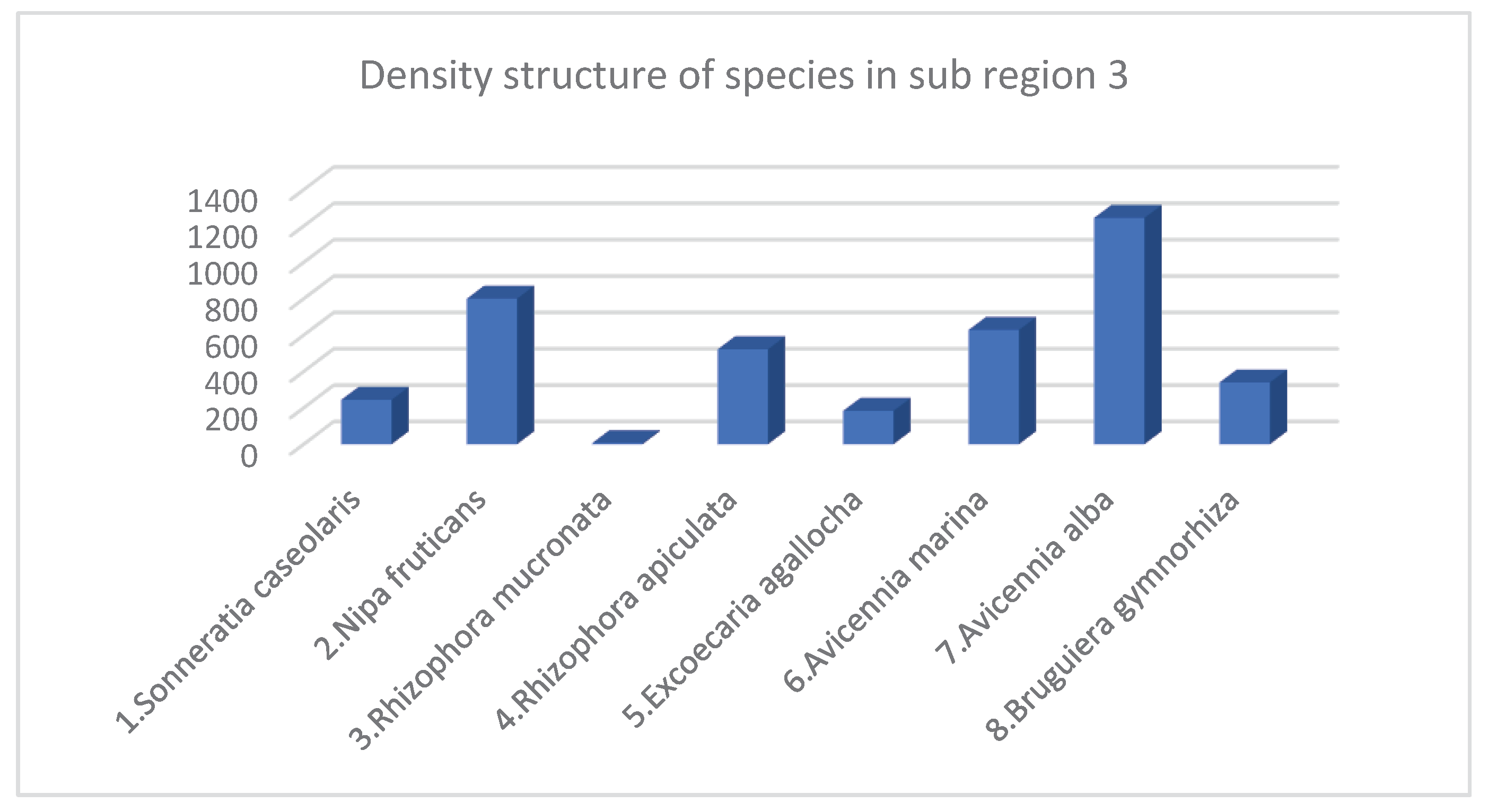
Figure 16.
Ratio strucutre of species in sub region 3. Comments: The ratio structure of species in sub region 3 showed (Table 8, Figure 16). The species Avicennia alba is percent ratio highest with 31.37 %, the second one is Nipa fruticans, the third Avicennia marina is 15.83 %, the four Rhizophora apiculata is 13.16 %. The species have the percent ratio low under 10% are Bruguiera gymnorhiza, Sonneratia caseolaris, Excoecaria agallocha, Rhizophora mucronata.
Figure 16.
Ratio strucutre of species in sub region 3. Comments: The ratio structure of species in sub region 3 showed (Table 8, Figure 16). The species Avicennia alba is percent ratio highest with 31.37 %, the second one is Nipa fruticans, the third Avicennia marina is 15.83 %, the four Rhizophora apiculata is 13.16 %. The species have the percent ratio low under 10% are Bruguiera gymnorhiza, Sonneratia caseolaris, Excoecaria agallocha, Rhizophora mucronata.
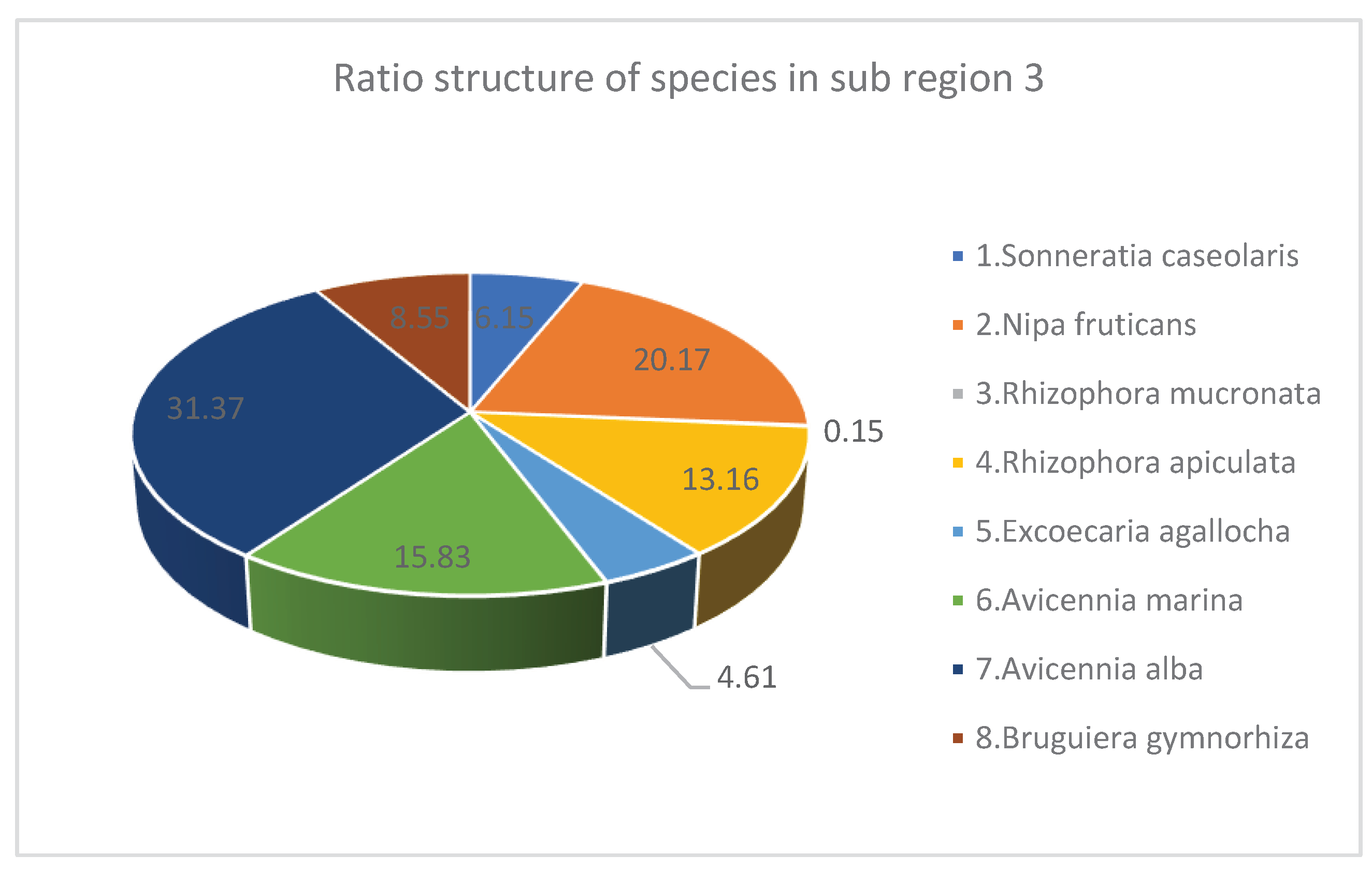
Figure 17.
Height structure of species in sub region 3. Comments: The species have highest the height is Sonneratia caseolaris to 12.1 meters. The species have average height of species Avicennia marina is 8.18 meters, Rhizophora mucronata is 8.0 meters, Avicennia alba is 7.6 meters, Rhizophora apiculata 7.26 meters, Excoecaria agallocha. The species lowest the height is Bruguiera gymnorhiza 4.63 meters and Nipa fruticans 4.58.
Figure 17.
Height structure of species in sub region 3. Comments: The species have highest the height is Sonneratia caseolaris to 12.1 meters. The species have average height of species Avicennia marina is 8.18 meters, Rhizophora mucronata is 8.0 meters, Avicennia alba is 7.6 meters, Rhizophora apiculata 7.26 meters, Excoecaria agallocha. The species lowest the height is Bruguiera gymnorhiza 4.63 meters and Nipa fruticans 4.58.
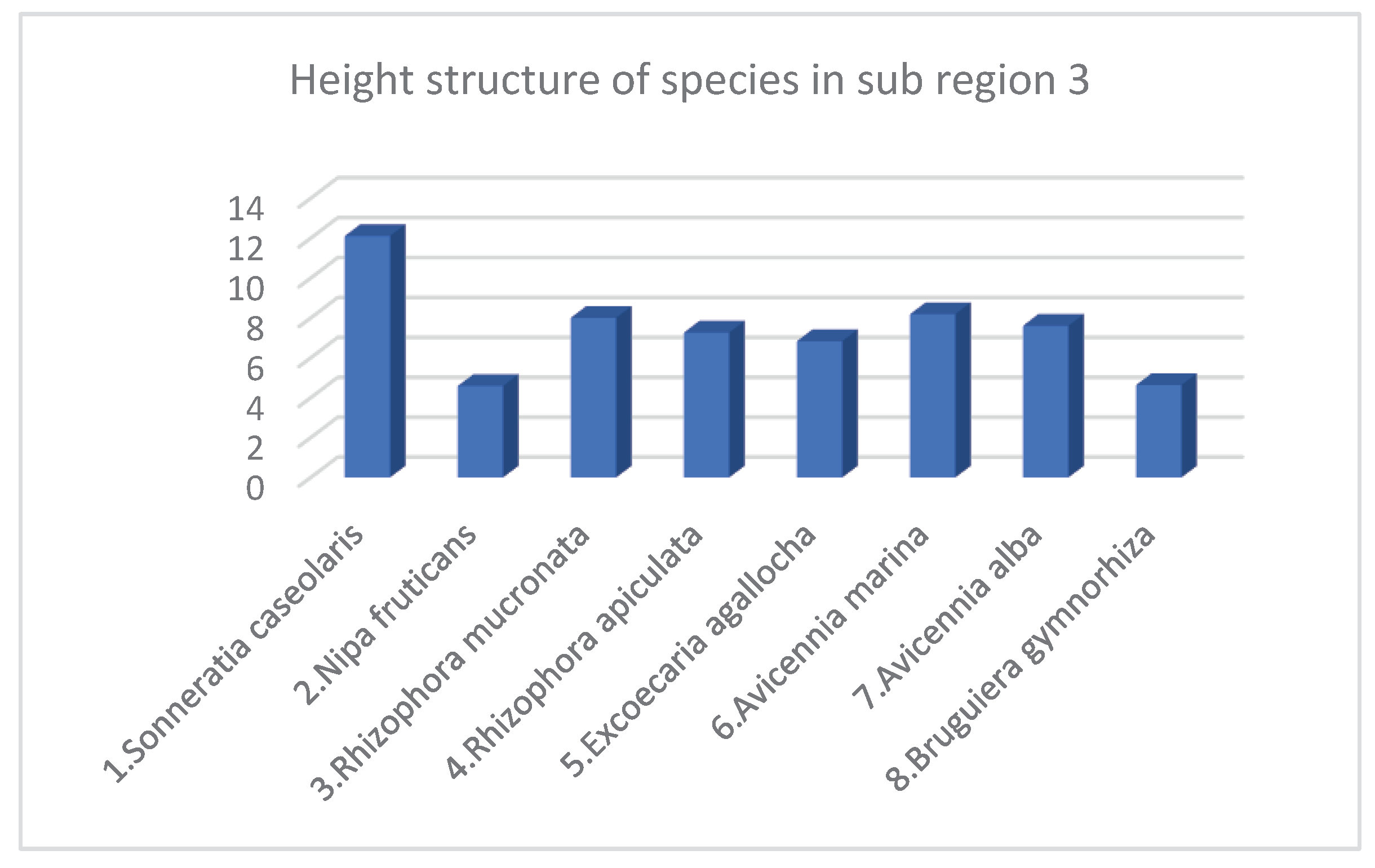
Figure 18.
Diameter structure of species in sub region 3. Comments: The diameter structure of species in sub region 3 showed (Table 9, Figure 18). The diameter of species have biggest is Sonneratia caseolaris 25.22 centimeters. The species bigger 10 centimeters have Avicennia alba 10.92 centimeters, Avicennia marina 11.52 centimeters. The species bigger 5 to 10 centimeters have Excoecaria agallocha 8.6 centimeters, Rhizophora apiculata 7.68 centimeters.
Figure 18.
Diameter structure of species in sub region 3. Comments: The diameter structure of species in sub region 3 showed (Table 9, Figure 18). The diameter of species have biggest is Sonneratia caseolaris 25.22 centimeters. The species bigger 10 centimeters have Avicennia alba 10.92 centimeters, Avicennia marina 11.52 centimeters. The species bigger 5 to 10 centimeters have Excoecaria agallocha 8.6 centimeters, Rhizophora apiculata 7.68 centimeters.
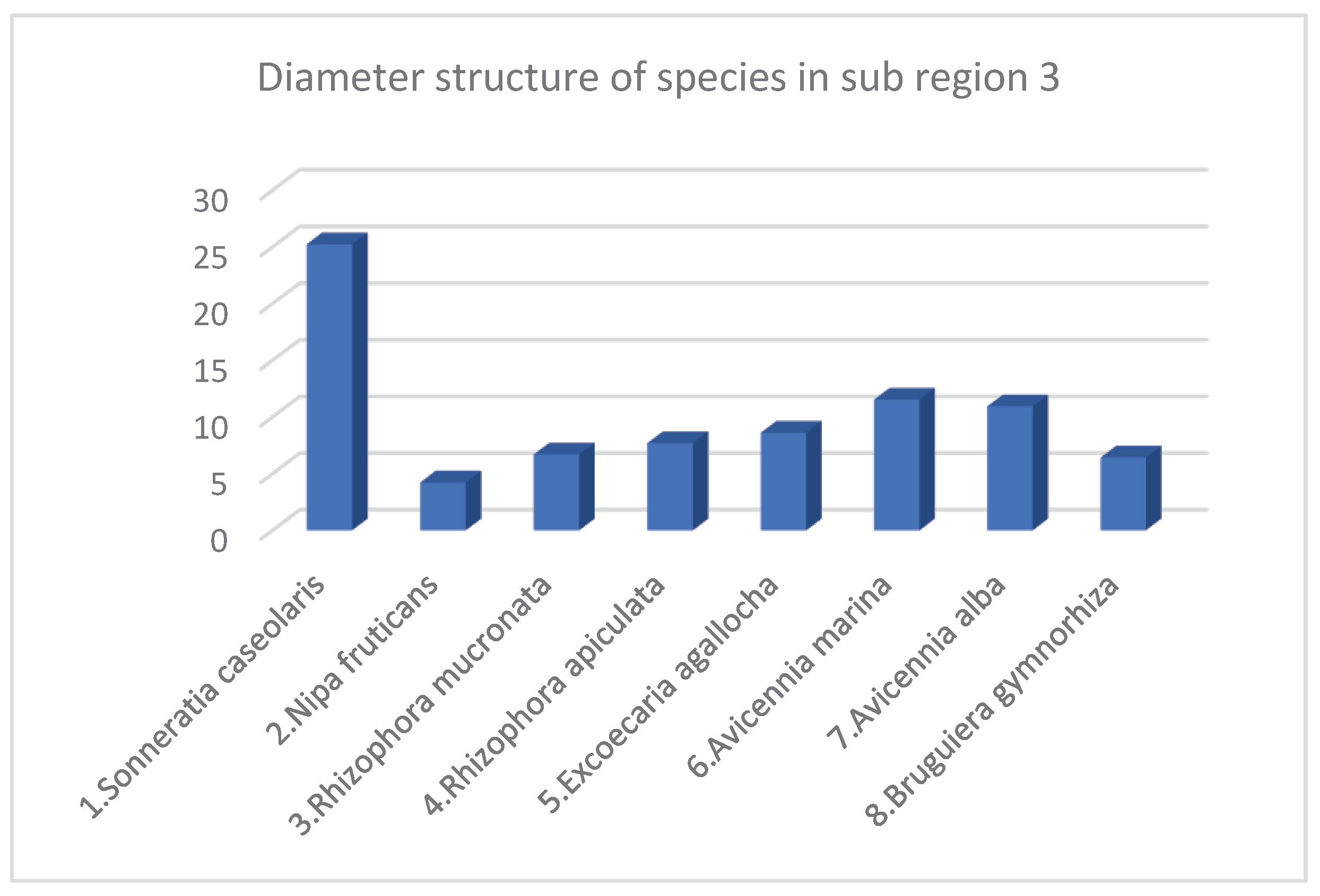
Figure 19.
Canopy structure of species in sub region 3. Comments: The canopy structure of species in sub region 3 showed (Table 10, Figure 19). The canopy structure of species the highest is Avicennia alba 2971 square meters, the second species is Nipa fruticans 2456 square meters, the third species is Avicennia marina 1876 square meters, the four species is Sonneratia caseolaris. The canopy species under 1000 square meters are Rhizophora apiculat, Bruguie.
Figure 19.
Canopy structure of species in sub region 3. Comments: The canopy structure of species in sub region 3 showed (Table 10, Figure 19). The canopy structure of species the highest is Avicennia alba 2971 square meters, the second species is Nipa fruticans 2456 square meters, the third species is Avicennia marina 1876 square meters, the four species is Sonneratia caseolaris. The canopy species under 1000 square meters are Rhizophora apiculat, Bruguie.
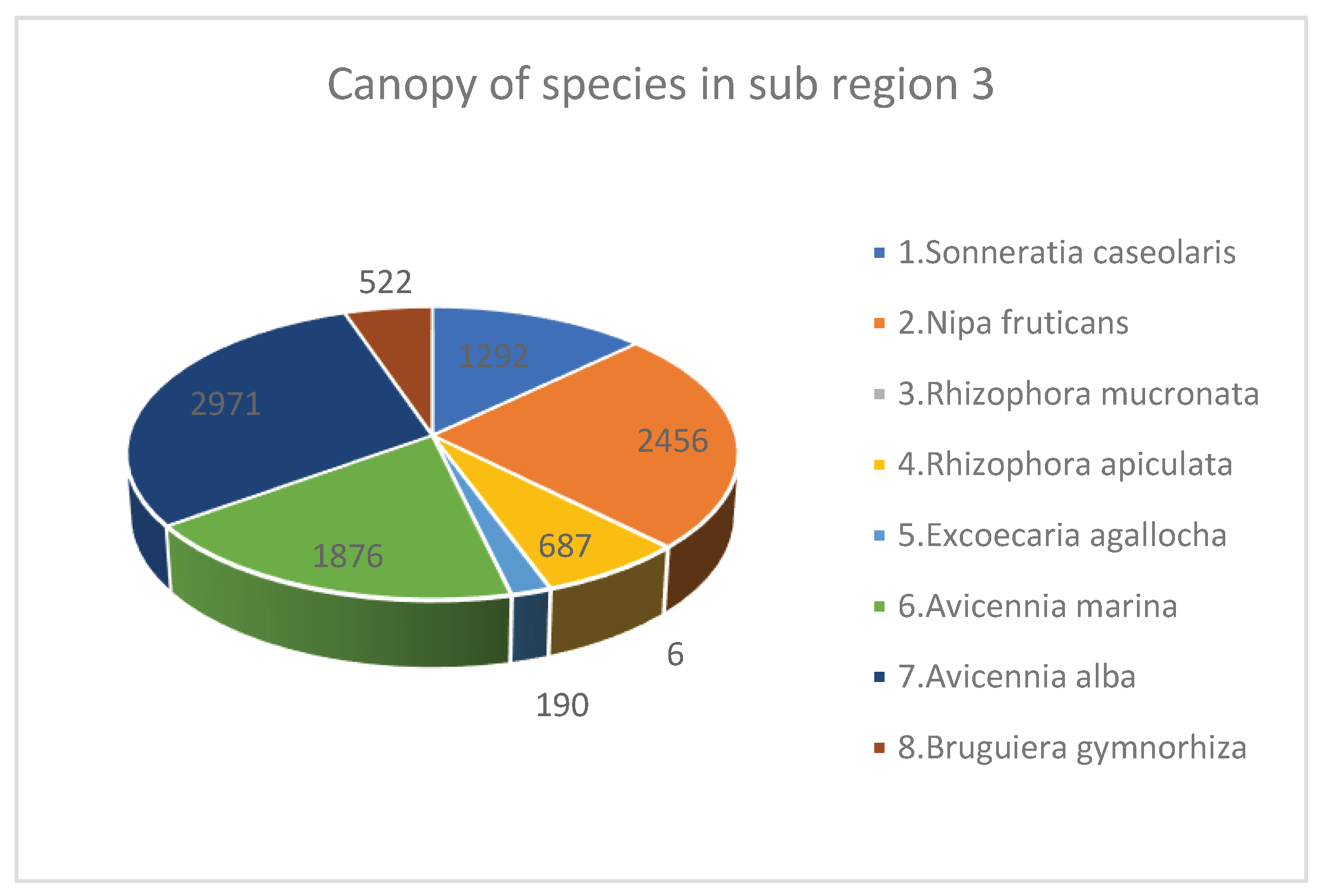
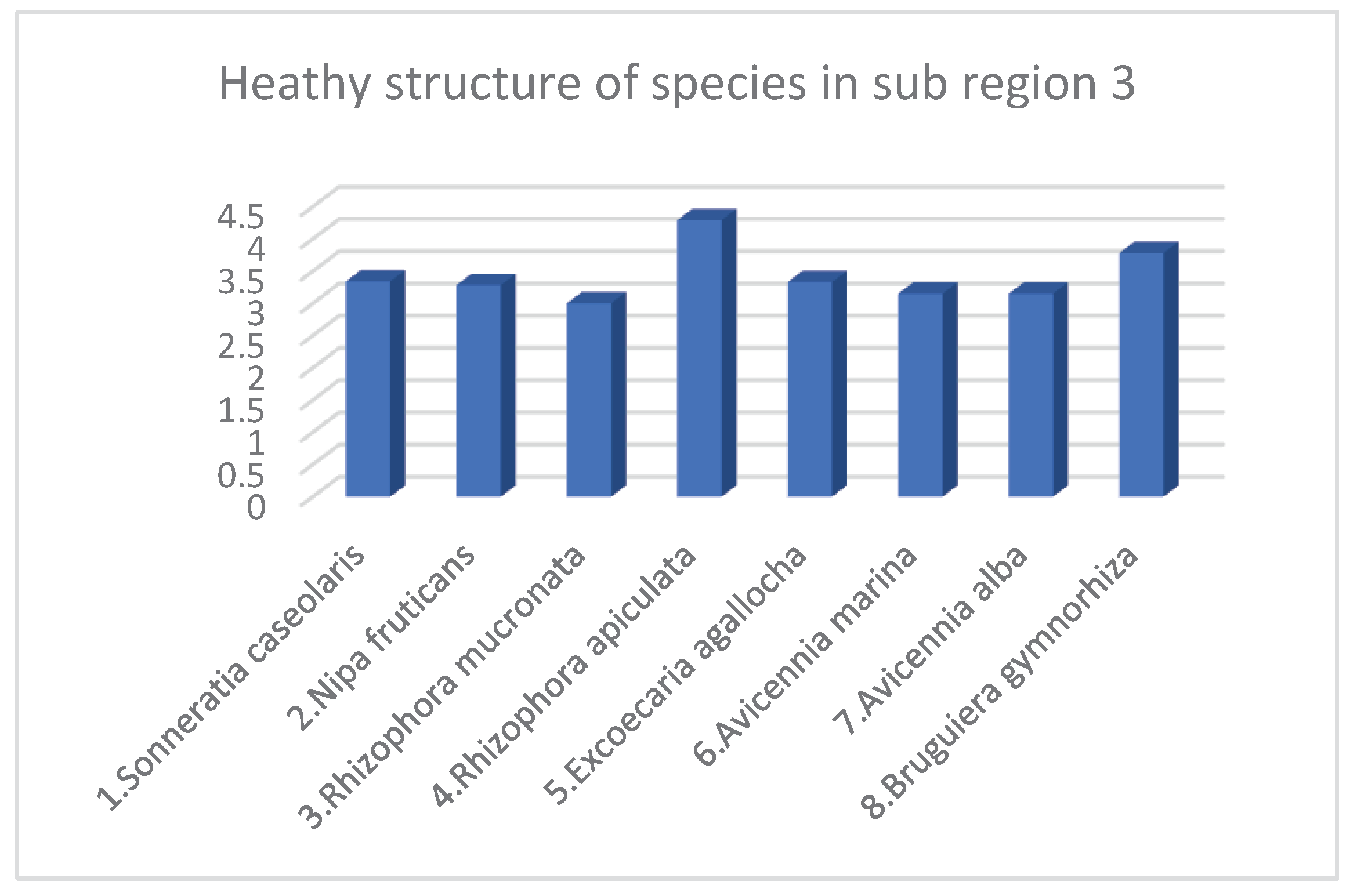
Figure 20.
Heathy of species in sub region 3. Comments: The heathy level of species has the highest are Rhizophora apiculata 4.29 per 5, Bruguiera gymnorhiza 3.78 per 5; these species have quite good stem shapes. All of species has heathy level from 3 to 3.3 per 5.
Figure 20.
Heathy of species in sub region 3. Comments: The heathy level of species has the highest are Rhizophora apiculata 4.29 per 5, Bruguiera gymnorhiza 3.78 per 5; these species have quite good stem shapes. All of species has heathy level from 3 to 3.3 per 5.
- d.
- Species struscture of Mangroves in Sub region 4
Figure 21.
Density structure of species insub region 4. Comments: The density structure of species in sub region 4 showed (Table 11, Figure 21). The density structure of species the highest is Avicennia officinalis 1200 trees per hectare, second species is Avicennia alba 665 trees per hectare, the third species is Rhizophora apiculata 376 trees per hectare. The other species in the following order Excoecaria agallocha 141 trees per hectare, Bruguiera gymnorhiza 21 trees per hectare, Sonneratia ovate 17 trees per hectare, Lumnitzera racemosa 15 tree per hectare, Avicennia marina and Bruguiera cylindrica 6 tree per hectare and Sonneratia caseolaris 3 tree per hectare.
Figure 21.
Density structure of species insub region 4. Comments: The density structure of species in sub region 4 showed (Table 11, Figure 21). The density structure of species the highest is Avicennia officinalis 1200 trees per hectare, second species is Avicennia alba 665 trees per hectare, the third species is Rhizophora apiculata 376 trees per hectare. The other species in the following order Excoecaria agallocha 141 trees per hectare, Bruguiera gymnorhiza 21 trees per hectare, Sonneratia ovate 17 trees per hectare, Lumnitzera racemosa 15 tree per hectare, Avicennia marina and Bruguiera cylindrica 6 tree per hectare and Sonneratia caseolaris 3 tree per hectare.
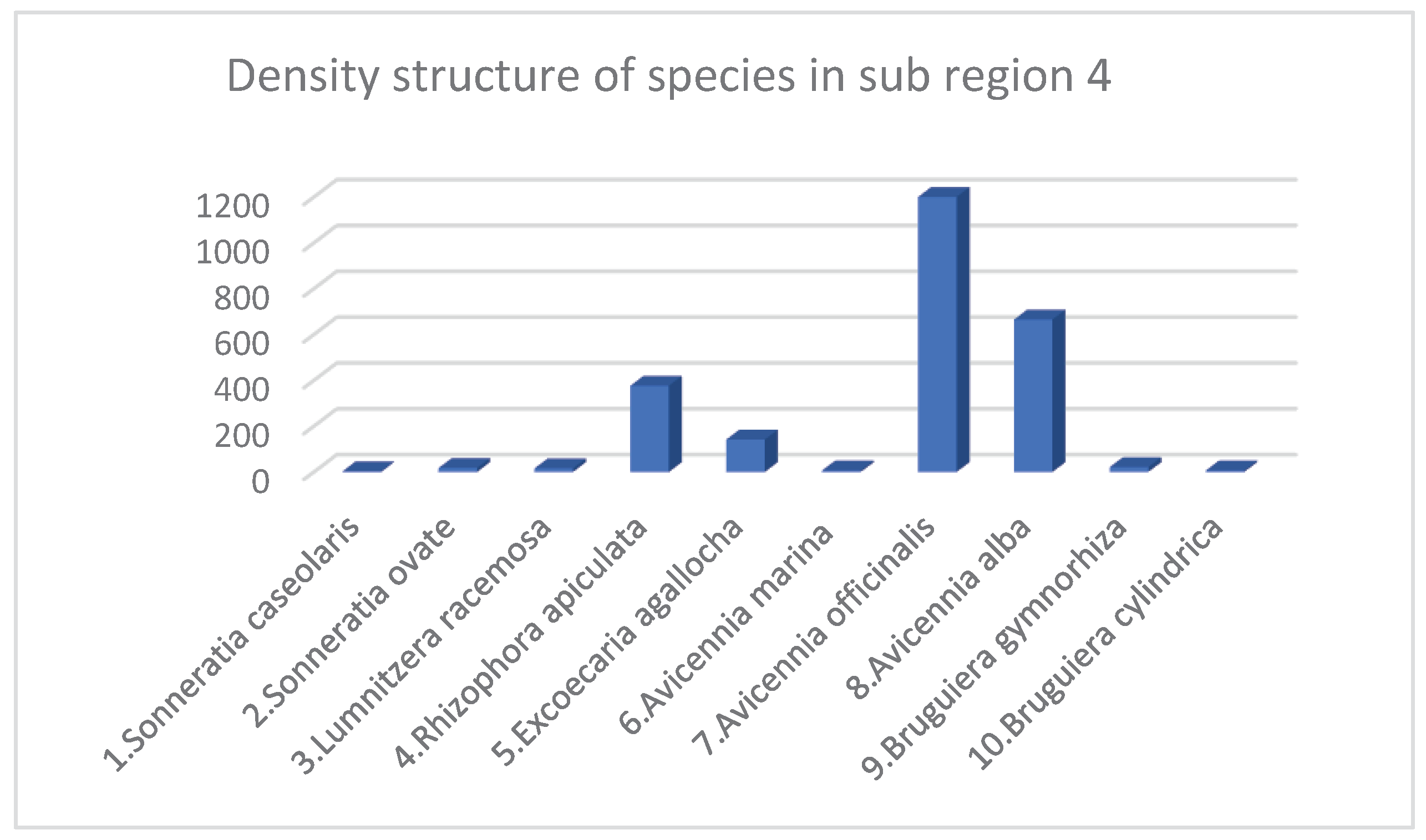
Figure 22.
Ratio structure of species in sub region 4. Comments: The ratio structure of species in the region 4 showed (Table 11, Figure 22). In the sub region 4 the species have the highest ratio is Avicennia officinalis to 48.98%, Avicennia alba 27.14 %, Rhizophora apiculata 15.35 %. The species have small ratio of species such as Excoecaria agallocha 5.75 %, the species have ratio under 1% such as Bruguiera gymnorhiza 0.86 %, Sonneratia ovate 0.69 %, Lumnitzera racemosa 0.61%, Avicennia marina 0.24 %, Avicennia marina 0.24, Sonneratia caseolaris 0.12 %.
Figure 22.
Ratio structure of species in sub region 4. Comments: The ratio structure of species in the region 4 showed (Table 11, Figure 22). In the sub region 4 the species have the highest ratio is Avicennia officinalis to 48.98%, Avicennia alba 27.14 %, Rhizophora apiculata 15.35 %. The species have small ratio of species such as Excoecaria agallocha 5.75 %, the species have ratio under 1% such as Bruguiera gymnorhiza 0.86 %, Sonneratia ovate 0.69 %, Lumnitzera racemosa 0.61%, Avicennia marina 0.24 %, Avicennia marina 0.24, Sonneratia caseolaris 0.12 %.
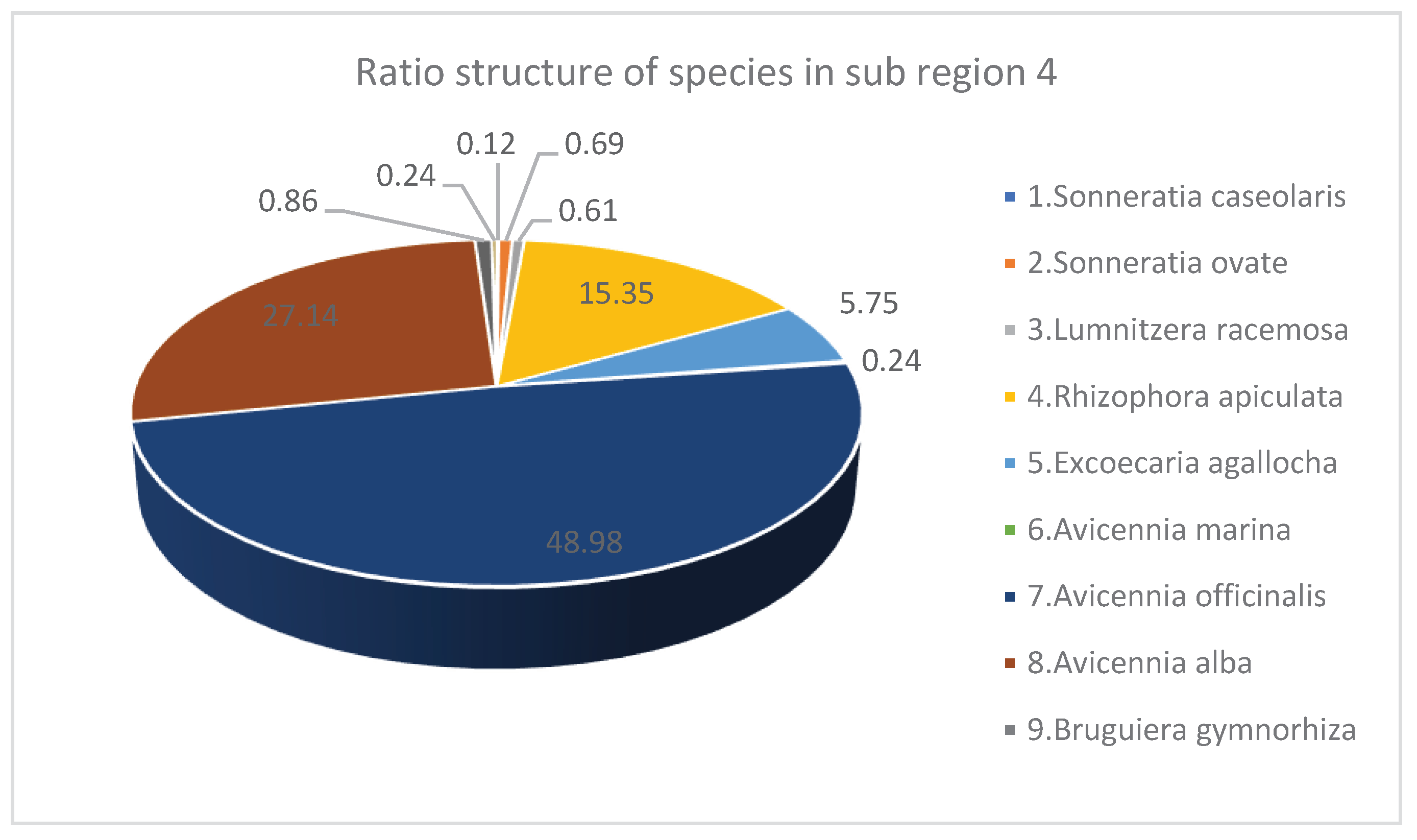
Figure 23.
Height structure of species in sub region 4. Comments: The height of species in sub region 4 showed (Table 12, Figure 23). The highest hieght of species in sub region 4 is is Avicennia marina this species is adapts on the alluvial mudflats, the second height species is Sonneratia ovate this species is grows fast in this region, the third height is Lumnitzera racemosa this species live on the land stabilized. On the mixed alluvial soft and hard have the height follow numberic Rhizophora apiculata, Avicennia officinalis, Bruguiera gymnorhiza, Excoecaria agallocha, Avicennia alba, Sonneratia caseolaris, Excoecaria agallocha, Bruguiera cylindrica,.
Figure 23.
Height structure of species in sub region 4. Comments: The height of species in sub region 4 showed (Table 12, Figure 23). The highest hieght of species in sub region 4 is is Avicennia marina this species is adapts on the alluvial mudflats, the second height species is Sonneratia ovate this species is grows fast in this region, the third height is Lumnitzera racemosa this species live on the land stabilized. On the mixed alluvial soft and hard have the height follow numberic Rhizophora apiculata, Avicennia officinalis, Bruguiera gymnorhiza, Excoecaria agallocha, Avicennia alba, Sonneratia caseolaris, Excoecaria agallocha, Bruguiera cylindrica,.
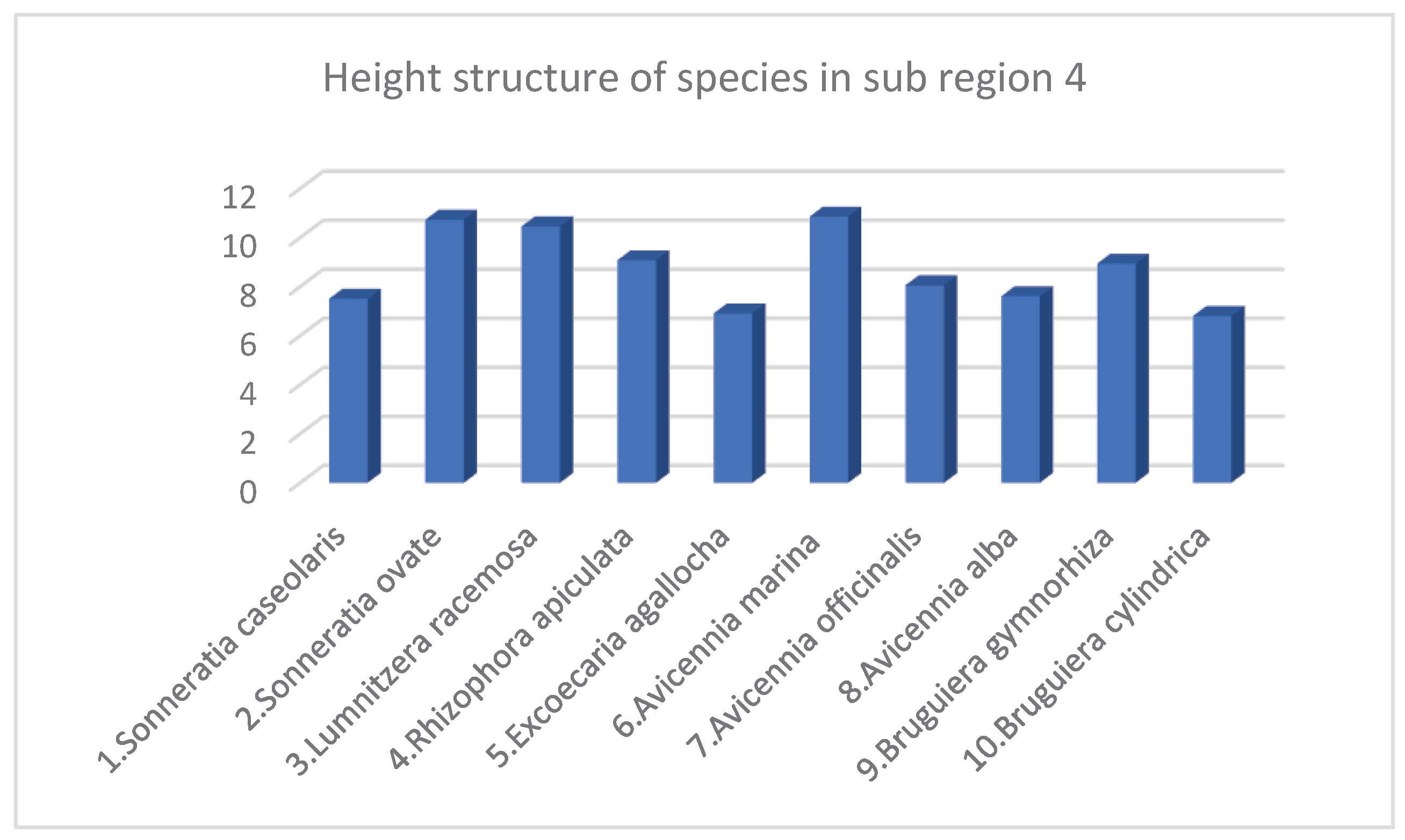
Figure 24.
The diemeter structure of species in sub region 4. Comments: The diameter structure of species in sub region 4 showed (Table 12, Figure 24). The diameter biggest of species Sonneratia ovate is 14.08 centimeters, the second Avicennia marina is 13.77 centimeters, the third species Lumnitzera racemosa is 11.04 centimeters, the oher species higher 9 centimeters are Avicennia officinalis 9.57 centimeters, Rhizophora apiculata 9.52 centimeters, Avicennia alba 9.43 centimeters, the species higher 8 centimeters are species Excoecaria agallocha 8.72 centimeters, Bruguiera gymnorhiza 8.56 centimetrs, Sonneratia caseolaris 7 centimeters, Bruguiera cylindrica 4.93 centimeters.
Figure 24.
The diemeter structure of species in sub region 4. Comments: The diameter structure of species in sub region 4 showed (Table 12, Figure 24). The diameter biggest of species Sonneratia ovate is 14.08 centimeters, the second Avicennia marina is 13.77 centimeters, the third species Lumnitzera racemosa is 11.04 centimeters, the oher species higher 9 centimeters are Avicennia officinalis 9.57 centimeters, Rhizophora apiculata 9.52 centimeters, Avicennia alba 9.43 centimeters, the species higher 8 centimeters are species Excoecaria agallocha 8.72 centimeters, Bruguiera gymnorhiza 8.56 centimetrs, Sonneratia caseolaris 7 centimeters, Bruguiera cylindrica 4.93 centimeters.
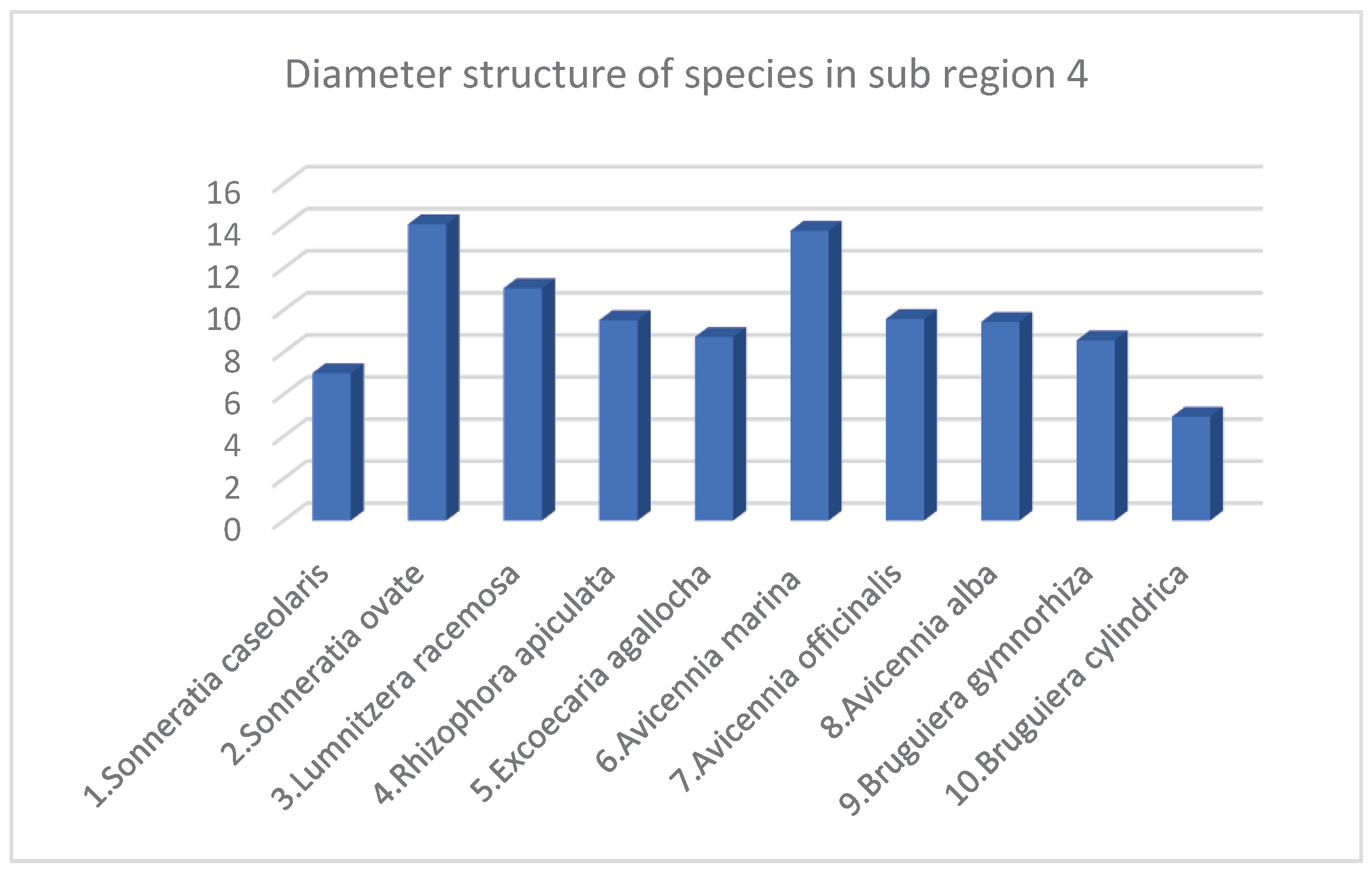
Figure 25.
Canopy structure of species in sub region 4. Comments: The canopy structure of sepcies in sub region 4 showed (Table 13, Figure 25). The biggest canopy of species in sub region 4 is Avicennia officinalis 5054 square meters, the second canopy of species Avicennia alba 2727 square meters, the third canopy of species Rhizophora apiculata 1518 square meters. The canopy structure of species have from 100 to 300 square meters are Excoecaria agallocha 363 meters, Bruguiera gymnorhiza 109 square meters, Sonneratia ovate 104 square meters. The species under 100 meters are Lumnitzera racemosa 84 square meters, Avicennia marina 22 square meters, Sonneratia caseolaris 10 square meters, Bruguiera cylindrica 9 square meters.
Figure 25.
Canopy structure of species in sub region 4. Comments: The canopy structure of sepcies in sub region 4 showed (Table 13, Figure 25). The biggest canopy of species in sub region 4 is Avicennia officinalis 5054 square meters, the second canopy of species Avicennia alba 2727 square meters, the third canopy of species Rhizophora apiculata 1518 square meters. The canopy structure of species have from 100 to 300 square meters are Excoecaria agallocha 363 meters, Bruguiera gymnorhiza 109 square meters, Sonneratia ovate 104 square meters. The species under 100 meters are Lumnitzera racemosa 84 square meters, Avicennia marina 22 square meters, Sonneratia caseolaris 10 square meters, Bruguiera cylindrica 9 square meters.
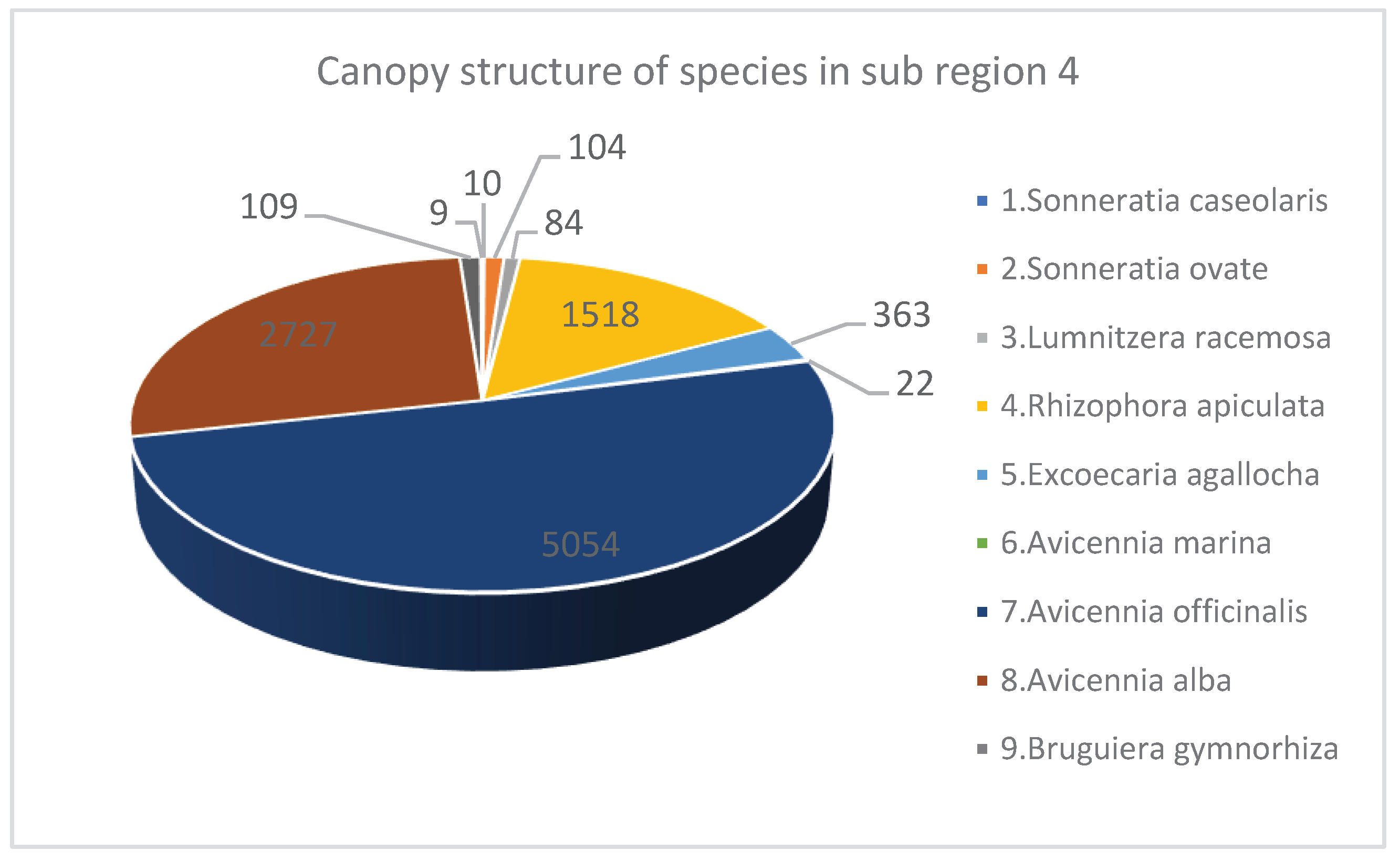
Figure 26.
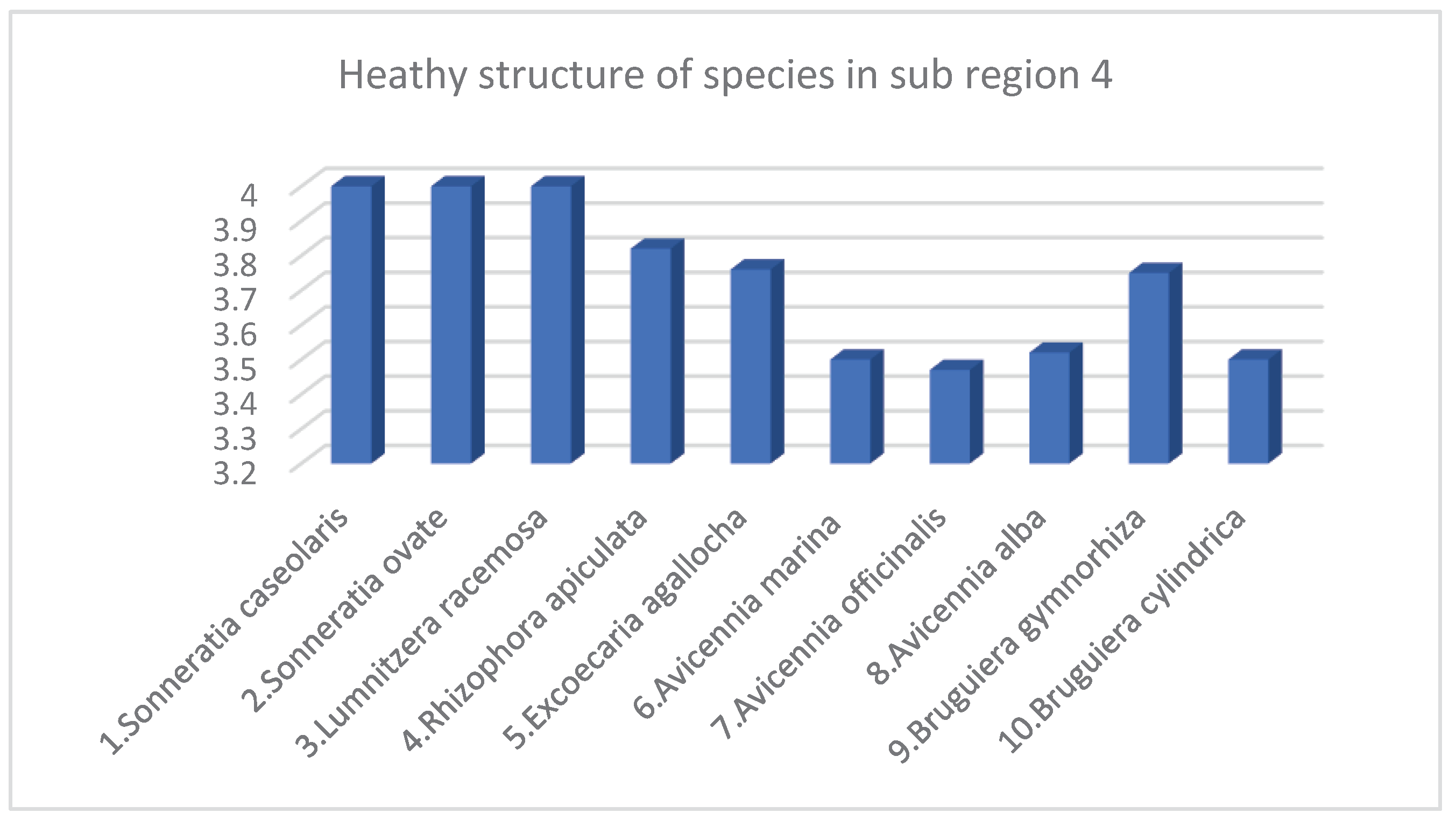
Healthy structure of species in sub region 4. Comments: The heathy structure of species in sub region 4 showed (Table 13, Figure 26). The first heathy of species are Sonneratia caseolari, Sonneratia ovate, Lumnitzera racemosa are three species have the heathy level 4 per 5, the species have heathy level higher 3.5 are Rhizophora apiculata 3.82, Excoecaria agallocha 3.76, Bruguiera gymnorhiza 3.75, the species have 3.5 are Avicennia alba 3.52, Avicennia marina 3.5, Bruguiera cylindrica 3.5 per 5.
Figure 26.
Healthy structure of species in sub region 4. Comments: The heathy structure of species in sub region 4 showed (Table 13, Figure 26). The first heathy of species are Sonneratia caseolari, Sonneratia ovate, Lumnitzera racemosa are three species have the heathy level 4 per 5, the species have heathy level higher 3.5 are Rhizophora apiculata 3.82, Excoecaria agallocha 3.76, Bruguiera gymnorhiza 3.75, the species have 3.5 are Avicennia alba 3.52, Avicennia marina 3.5, Bruguiera cylindrica 3.5 per 5.
3.3. Species Structure of Mangroves in Eegion Western Mekong Delta
Figure 27.
Density structure of species in total in the Western Mekong Delta. Comments: The density structure of species in total in the Western Mekong Delta showed (Table 14, Figure 27). The Western Mekong Delta after survey and anlysis showed have 16 species in 11 families, there are Sonneratia caseolaris 91/4401(trees per hectare), Sonneratia ovate 110/4401, Annona reticulate 2/4401, Lumnitzera littorea 10/4401, Lumnitzera racemosa 32/4401, Nipa fruticans 128/4401, Rhizophora mucronata 2/4401, Rhizophora apiculata 1165/4401, Excoecaria agallocha 325/4401, Avicennia marina 195/4401, Avicennia officinalis 1006/4401, Avicennia alba 1116/4401, Bruguiera gymnorhiza 39/4401, Bruguiera cylindrical 140/4401, Aegiceras corniculatum 22/4401, Hibiscus tiliaceus 18/4401.
Figure 27.
Density structure of species in total in the Western Mekong Delta. Comments: The density structure of species in total in the Western Mekong Delta showed (Table 14, Figure 27). The Western Mekong Delta after survey and anlysis showed have 16 species in 11 families, there are Sonneratia caseolaris 91/4401(trees per hectare), Sonneratia ovate 110/4401, Annona reticulate 2/4401, Lumnitzera littorea 10/4401, Lumnitzera racemosa 32/4401, Nipa fruticans 128/4401, Rhizophora mucronata 2/4401, Rhizophora apiculata 1165/4401, Excoecaria agallocha 325/4401, Avicennia marina 195/4401, Avicennia officinalis 1006/4401, Avicennia alba 1116/4401, Bruguiera gymnorhiza 39/4401, Bruguiera cylindrical 140/4401, Aegiceras corniculatum 22/4401, Hibiscus tiliaceus 18/4401.
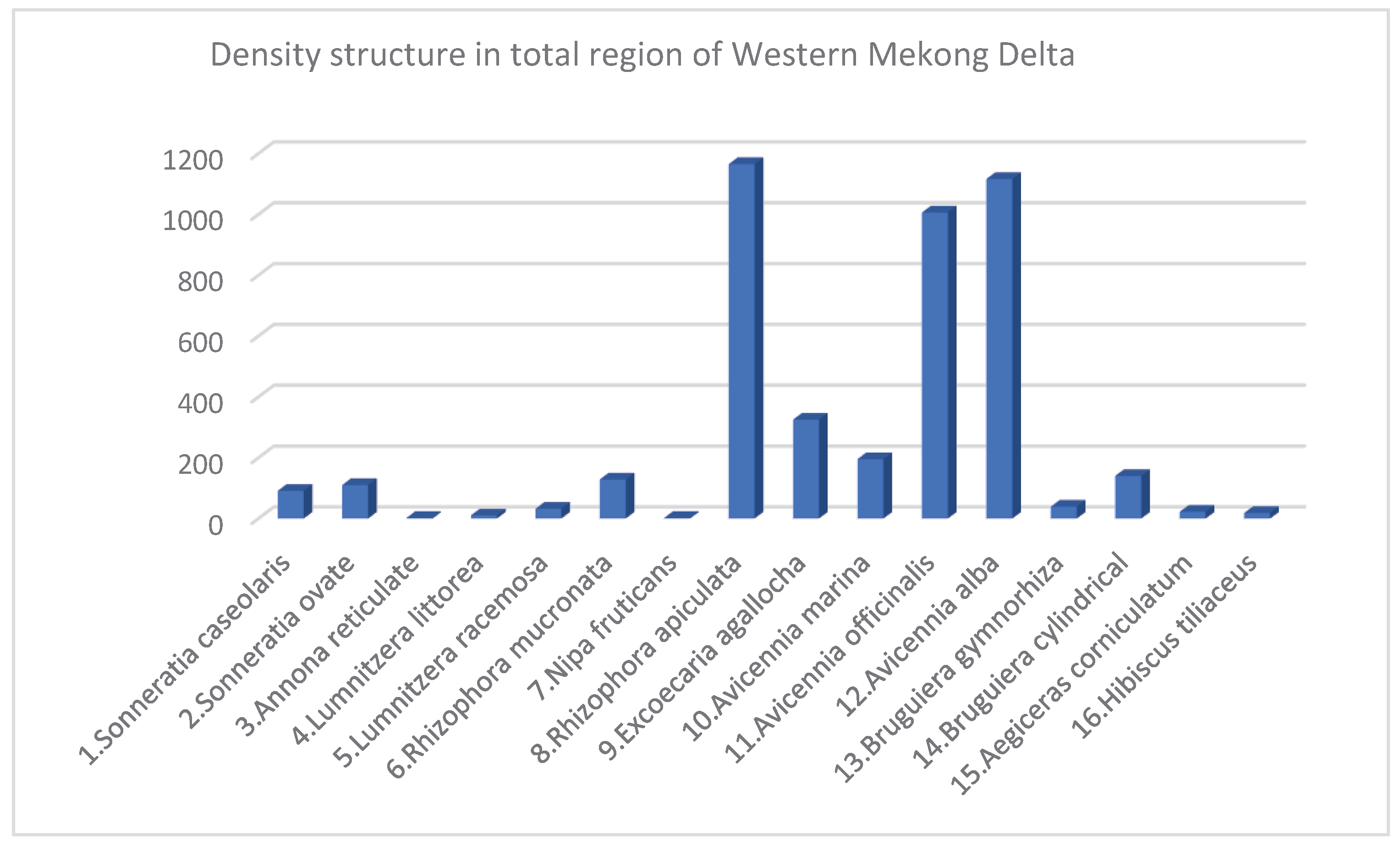
Figure 28.
Ratio structure of species in total the Western Mekong Delta. Comments: The ratio structure of species in total the Western Mekong Delta showed (Table 14, Figure 28). The highest ratio of species is Rhizophora apiculata is 26.47 %, the second high is Avicennia alba 26.36 %, the third is Avicennia officinalis 22.86 %, the group have from 4 to 7 % are Avicennia marina 4.43 %, Excoecaria agallocha 7.38 %. The group from 2 % to 3% have Bruguiera cylindrical 3.18 %, Bruguiera cylindrical 2.91%, Sonneratia ovate 2.50%, Sonneratia caseolaris 2.07 %. The group have ratio under 1% as Bruguiera gymnorhiza 0.87 %, Lumnitzera racemosa 0.73 %, Aegiceras corniculatum 0.5 %, Hibiscus tiliaceus 0.41%, Rhizophora mucronata 0.05 %, Annona reticulate 0.05 %. The results showed three species with ratio high are Annona reticulate, Avicennia alba, and Avicennia officinalis.
Figure 28.
Ratio structure of species in total the Western Mekong Delta. Comments: The ratio structure of species in total the Western Mekong Delta showed (Table 14, Figure 28). The highest ratio of species is Rhizophora apiculata is 26.47 %, the second high is Avicennia alba 26.36 %, the third is Avicennia officinalis 22.86 %, the group have from 4 to 7 % are Avicennia marina 4.43 %, Excoecaria agallocha 7.38 %. The group from 2 % to 3% have Bruguiera cylindrical 3.18 %, Bruguiera cylindrical 2.91%, Sonneratia ovate 2.50%, Sonneratia caseolaris 2.07 %. The group have ratio under 1% as Bruguiera gymnorhiza 0.87 %, Lumnitzera racemosa 0.73 %, Aegiceras corniculatum 0.5 %, Hibiscus tiliaceus 0.41%, Rhizophora mucronata 0.05 %, Annona reticulate 0.05 %. The results showed three species with ratio high are Annona reticulate, Avicennia alba, and Avicennia officinalis.
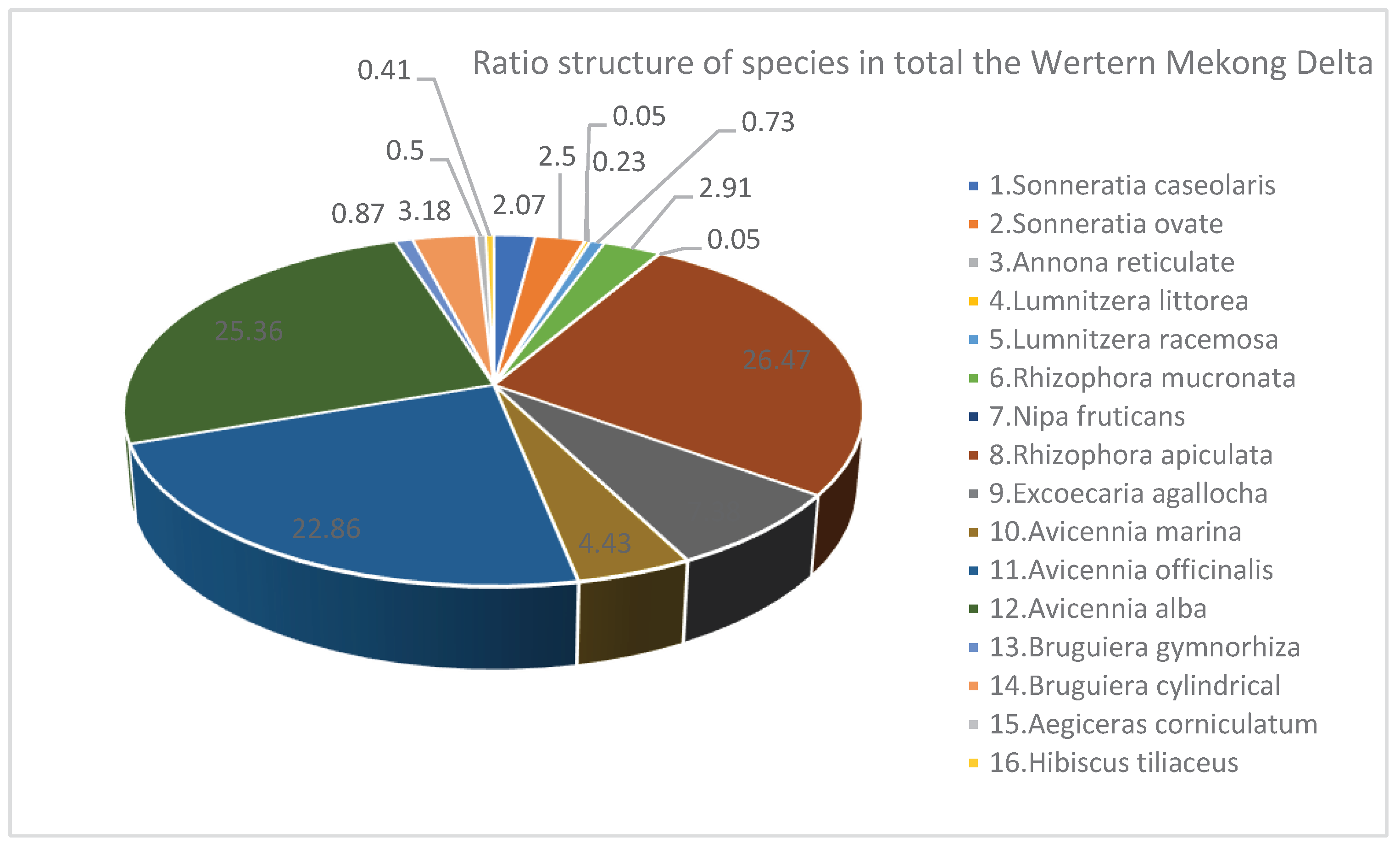
Figure 29.
Average height growth of species in Western Mekong Delta. Comments: Average height of species in Western Mekong Delta (Table 14, Figure 29). Average height of sepcies in Western Mekong Delta showed the first is the highest Sonneratia ovate 10.72 meters, The second species have height is height Avicennia marina 9.52 meters, the third species have Sonneratia caseolaris is 9.44 meters. The height have 7 meters to 8 meters are Rhizophora mucronata is 8 meter, Lumnitzera racemosa 7.5 meters, Avicennia alba í 7.15 meters. The species have 6 meter to 7 meters are Rhizophora apiculata 6.81 meters, Bruguiera gymnorhiza is 6.33 meter, Bruguiera gymnorhiza is 6.61 meters. The species have 5 meters to 6 metesr have Hibiscus tiliaceus is 5.99 meters, Excoecaria agallocha is 5.99 meters. The species have height 3 meters to 5 meters are Nipa fruticans is 4.55 meters, Aegiceras corniculatum is 3.5 meters, Annona reticulate 3.5 meters, Lumnitzera littorea is 3.17 meters.
Figure 29.
Average height growth of species in Western Mekong Delta. Comments: Average height of species in Western Mekong Delta (Table 14, Figure 29). Average height of sepcies in Western Mekong Delta showed the first is the highest Sonneratia ovate 10.72 meters, The second species have height is height Avicennia marina 9.52 meters, the third species have Sonneratia caseolaris is 9.44 meters. The height have 7 meters to 8 meters are Rhizophora mucronata is 8 meter, Lumnitzera racemosa 7.5 meters, Avicennia alba í 7.15 meters. The species have 6 meter to 7 meters are Rhizophora apiculata 6.81 meters, Bruguiera gymnorhiza is 6.33 meter, Bruguiera gymnorhiza is 6.61 meters. The species have 5 meters to 6 metesr have Hibiscus tiliaceus is 5.99 meters, Excoecaria agallocha is 5.99 meters. The species have height 3 meters to 5 meters are Nipa fruticans is 4.55 meters, Aegiceras corniculatum is 3.5 meters, Annona reticulate 3.5 meters, Lumnitzera littorea is 3.17 meters.
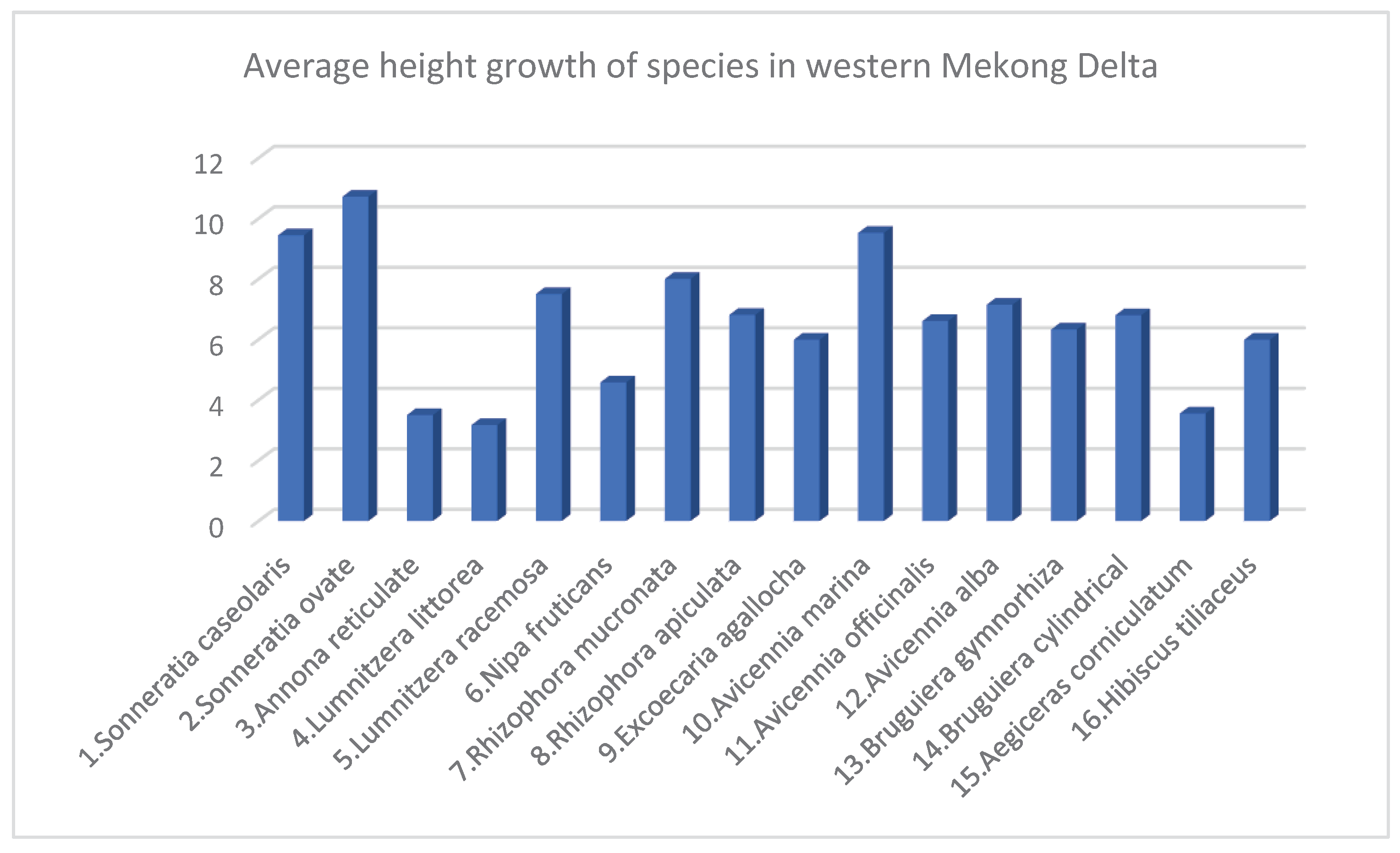
Figure 30.
Average diameter of species in Western Mekong Delta. Comments: The diameter of species Western Mekong Delta showed (Table 14, Figure 30). The diameter have biggesh is Sonneratia caseolaris 17.24 centimeters, the second diameter is Sonneratia ovate 14.08 centimeters. The species have the diameter from 11 to 12 centimeters are Avicennia marina is 12.64 centimeters, Annona reticulate is 11.78 centimeters. The species have diameter form 10 to 11 centimeters are Hibiscus tiliaceus 10.75 centimeters, Avicennia officinalis is 10.04 centimeters. The species have diameter 9 to 10 centimeters Avicennia alba 9.75 centimeters. The species have 8 to 9 centimeters are Lumnitzera racemosa 8.34 centimeters. The species have diameter from 7 to 8 centimeters are Rhizophora mucronata 7.56 centimeters, Excoecaria agallocha 7.52 centimeters. The species have diameter from 6 to 7 centimeters are Rhizophora mucronata 6.68 centimeters, Bruguiera gymnorhiza 6.60 centimeters. The species have diameter from 4 to 6 centimeter are Lumnitzera littorea 5.22 centimeters, Bruguiera cylindrical 4.93 centimeters, Aegiceras corniculatum 4.57 centimeters, Nipa fruticans 4.21 centimeters.
Figure 30.
Average diameter of species in Western Mekong Delta. Comments: The diameter of species Western Mekong Delta showed (Table 14, Figure 30). The diameter have biggesh is Sonneratia caseolaris 17.24 centimeters, the second diameter is Sonneratia ovate 14.08 centimeters. The species have the diameter from 11 to 12 centimeters are Avicennia marina is 12.64 centimeters, Annona reticulate is 11.78 centimeters. The species have diameter form 10 to 11 centimeters are Hibiscus tiliaceus 10.75 centimeters, Avicennia officinalis is 10.04 centimeters. The species have diameter 9 to 10 centimeters Avicennia alba 9.75 centimeters. The species have 8 to 9 centimeters are Lumnitzera racemosa 8.34 centimeters. The species have diameter from 7 to 8 centimeters are Rhizophora mucronata 7.56 centimeters, Excoecaria agallocha 7.52 centimeters. The species have diameter from 6 to 7 centimeters are Rhizophora mucronata 6.68 centimeters, Bruguiera gymnorhiza 6.60 centimeters. The species have diameter from 4 to 6 centimeter are Lumnitzera littorea 5.22 centimeters, Bruguiera cylindrical 4.93 centimeters, Aegiceras corniculatum 4.57 centimeters, Nipa fruticans 4.21 centimeters.
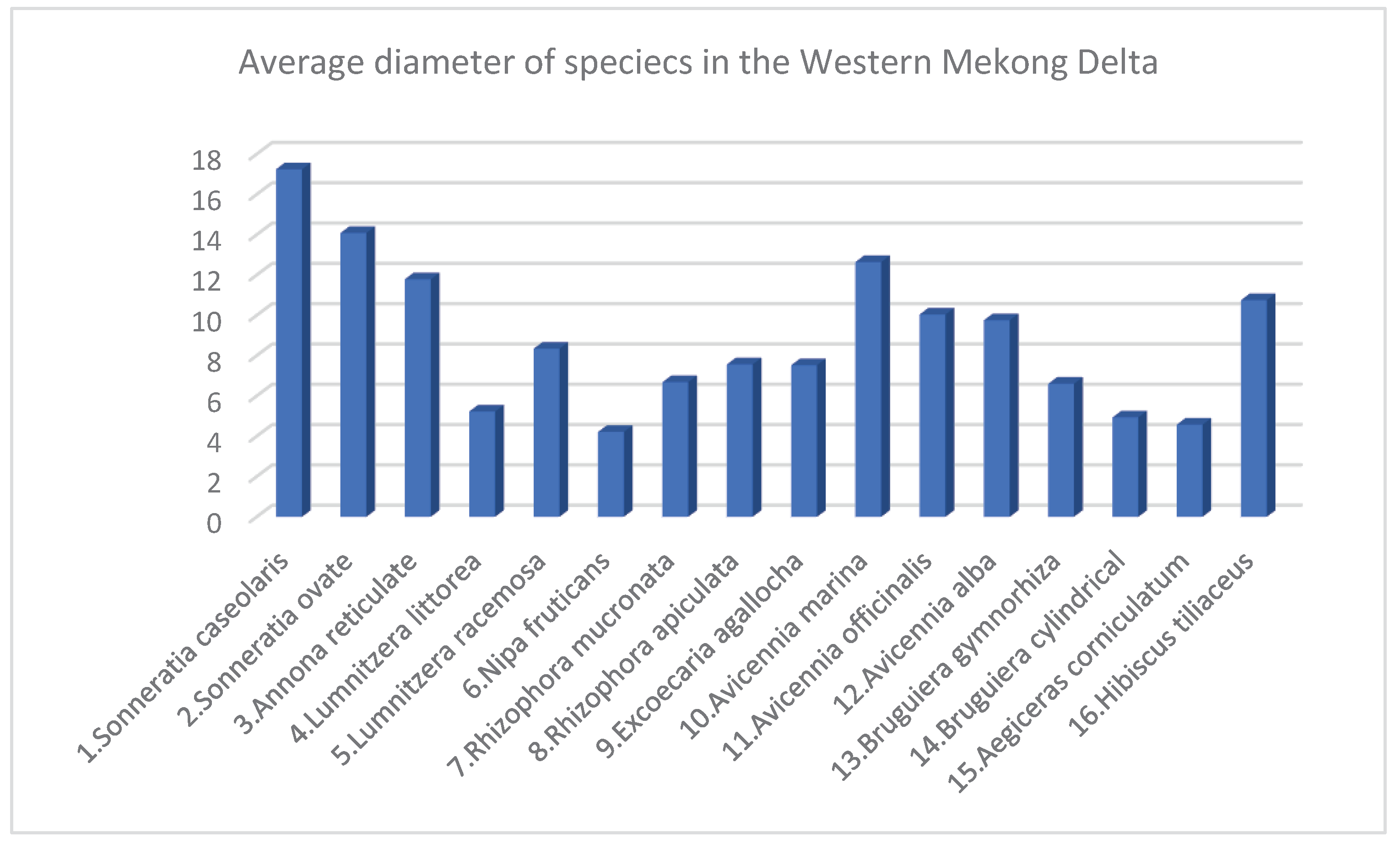
Figure 31.
Canopy structure of species in Western Mekong Delta. Comments: The canopy of species in Western mekong Delta showed (Table 14, Figure 31). The canopy of species have biggesh is Avicennia alba is 2955 square meters, Rhizophora apiculata is 1809 square meters. The species have canopy from 300 to 600 square meters are Avicennia marina is 546 square meters, Sonneratia caseolaris is 541 square meters, Nipa fruitica is 526 suare meters, Excoecaria agallocha is 348 square meters, Sonneratia ovate is 304 square meters. The species have canopy under 100 square meters are Bruguiera cylindrical is 76 square meters, Bruguiera gymnorhiza is 70 square meters, Aegiceras corniculatum is 51 square meters, Hibiscus tiliaceus is 48 square meters. The species under 10 square meters are Annona reticulate is 6 square meters, Lumnitzera littorea is 4 square meters, Rhizophora mucronata is 3 aquare meters.
Figure 31.
Canopy structure of species in Western Mekong Delta. Comments: The canopy of species in Western mekong Delta showed (Table 14, Figure 31). The canopy of species have biggesh is Avicennia alba is 2955 square meters, Rhizophora apiculata is 1809 square meters. The species have canopy from 300 to 600 square meters are Avicennia marina is 546 square meters, Sonneratia caseolaris is 541 square meters, Nipa fruitica is 526 suare meters, Excoecaria agallocha is 348 square meters, Sonneratia ovate is 304 square meters. The species have canopy under 100 square meters are Bruguiera cylindrical is 76 square meters, Bruguiera gymnorhiza is 70 square meters, Aegiceras corniculatum is 51 square meters, Hibiscus tiliaceus is 48 square meters. The species under 10 square meters are Annona reticulate is 6 square meters, Lumnitzera littorea is 4 square meters, Rhizophora mucronata is 3 aquare meters.
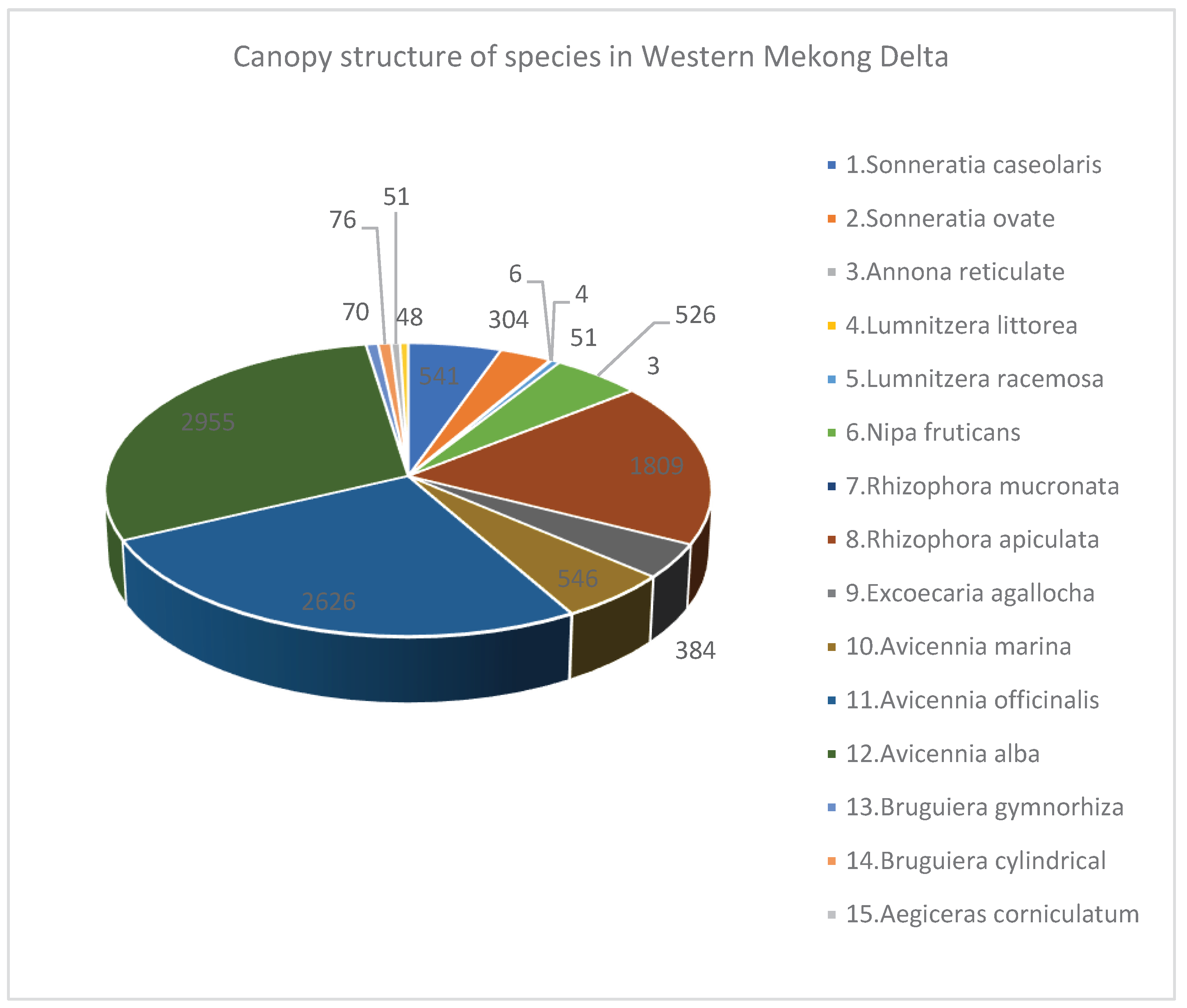
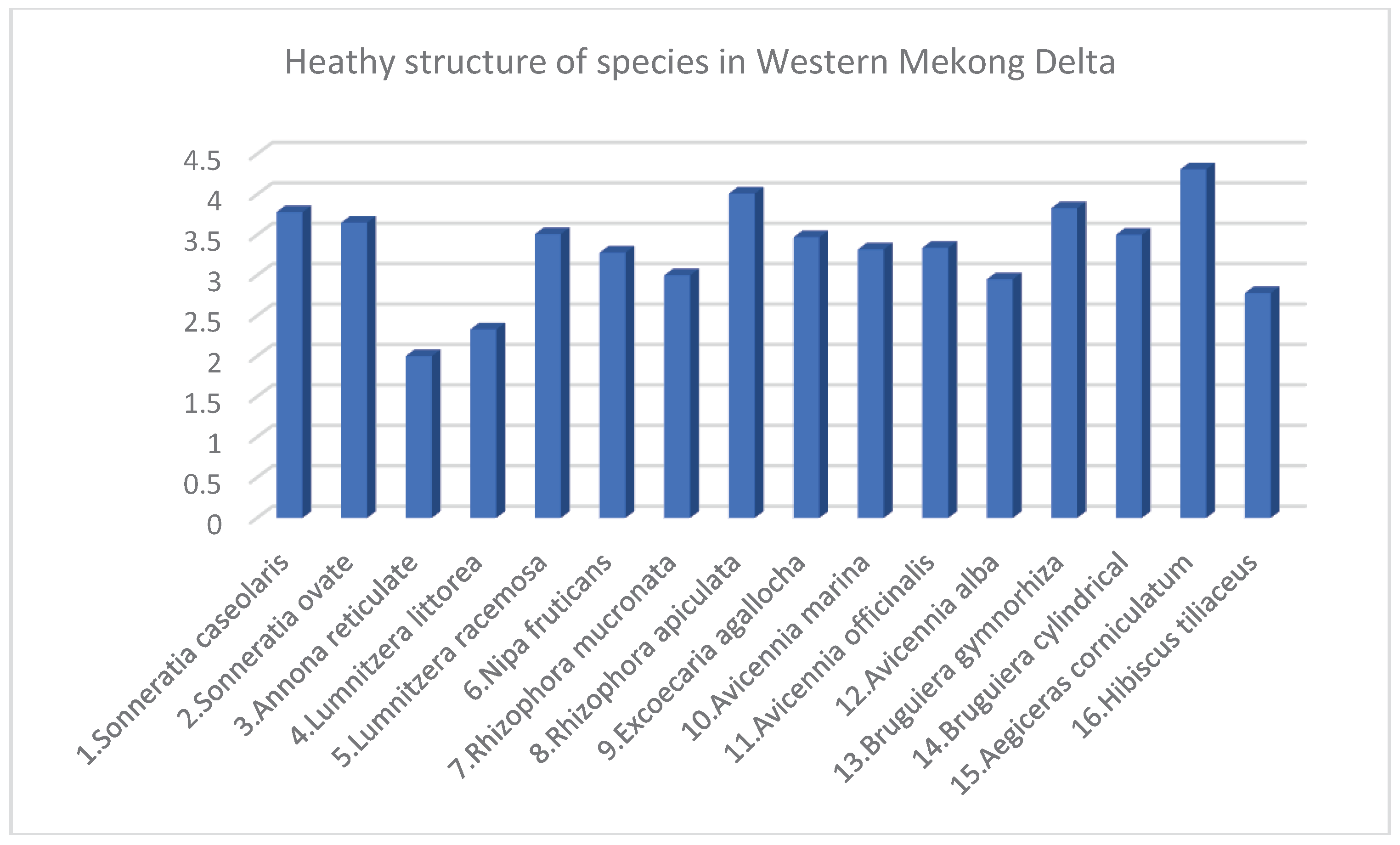
Figure 32.
Healthy structure of species in Western Mekong Delta. Comments: The healthy structure of species in Western Mekong Delta showed (Table 14, Figure 32). The species have heathy structure with the the good trunk shape group 1 are Aegiceras corniculatum 4.31/5, Rhizophora apiculata 4.01/5, Bruguiera cylindrical is 3.83/5, group 2 Sonneratia caseolaris is 3.78/5, Sonneratia ovate is 3.65/5, group 3 Lumnitzera racemosa is 3.51/5, Bruguiera cylindrical is 3.5/5. Avicennia officinalis is 3.34/5, Avicennia marina is 3.32/5, Nipa fruiticans is 3.28/5. Group 4 Avicennia alba is 2.95/5, Hibiscus tiliaceus is 2.78/5, Anona reticulate 2/5.
Figure 32.
Healthy structure of species in Western Mekong Delta. Comments: The healthy structure of species in Western Mekong Delta showed (Table 14, Figure 32). The species have heathy structure with the the good trunk shape group 1 are Aegiceras corniculatum 4.31/5, Rhizophora apiculata 4.01/5, Bruguiera cylindrical is 3.83/5, group 2 Sonneratia caseolaris is 3.78/5, Sonneratia ovate is 3.65/5, group 3 Lumnitzera racemosa is 3.51/5, Bruguiera cylindrical is 3.5/5. Avicennia officinalis is 3.34/5, Avicennia marina is 3.32/5, Nipa fruiticans is 3.28/5. Group 4 Avicennia alba is 2.95/5, Hibiscus tiliaceus is 2.78/5, Anona reticulate 2/5.
3.4. Discussions
a. Discussion for expansion of delta land due to alluvial deposition and pland invasion
+ Discussions in sub region one:
The density of species species with hight density are Avicennia officinalis , Rhizophora apiculata and Excoecaria agallocha, with Avicennia officinalis is pioneer tree in newly formed land used for natural sea reclamation, Rhizophora apiculata it is an economic tree species used for wood and charcoal, Sonneratia ovate is a pecies that grows in estuaries with alluvium, the other species in small proportion but contributes to biodiversity and genetic diversit. The Ratio of species with high ratio are Avicennia officinalis grows naturally at very high density in places far from river end, Rhizophora apiculata cared for by humans, Sonneratia ovate grows naturally in high ratio at the river end. The height according to the law of alluvial deposition, the river end is place where species Sonneratia ovate will appear first, when the alluvial deposits are far away the pioneer plants will appear such as Avicennia officinalis and Avicennia alba, when the soil has stabilized the other species live as Bruguiera gymnorhiza, Excoecaria agallocha, Aegiceras corniculatum. The species obove them creat a high structure with many tree species levels. The diameter of species tree also according to the law of alluvial deposition, the river end is place where species Sonneratia ovate will appear first, when the alluvial deposits are far away the pioneer plants will appear such as Avicennia officinalis and Avicennia alba, when the soil has stabilized the other species live as Bruguiera gymnorhiza, Excoecaria agallocha, Aegiceras corniculatum. The species above them creat a diameter structure with many tree species levels. The canopy of species in region one the highest forest cover is two species as Avicennia officinalis and Rhizophora apiculata and Avicennia alba ocupies the height of the midle floor. The canopy of Sonneratia ovate species occpies the height of the upper floor but the cover is low. The canopy of species as Bruguiera gymnorhiza, Excoecaria agallocha, Aegiceras corniculatum are 3 species have the cover very low. The species obove made a canopy structure with cover very high by them made many floors, thus they creat a dense canopy within the the height of forest. The healthy of species in the sub region one showed the species have the trunk wood is good wood will have indicator very high, the species have grows fast with many branches when evaluate healthy the indicator will low.
+ Discussion in Sub region 2:
In the sub region 2 (Table 5 and Figure 9) showed the density in here have higher land Hibiscus tiliaceus is species natural live in high land and another species that live in the acid sulfate soil and alitlle salty species Annona reticulate. There are two species the density of tree very high Avicennia officinalis and Avicennia alba, these species very adapt to muddy soil. In fact, this area has many mudflats created by alluvium. So have occur two species. In the sub region 2 is coastal mountain areas have very little alluvium, in here has very high biodiversity with 11 species appear on all types terrain. The species on high terrain is Hibiscus tiliaceus, Annona reticulate. The species on average terrain is Lumnitzera littorea, Lumnitzera racemosa, Rhizophora apiculata, Bruguiera gymnorhiza, Aegiceras corniculatum. The species on low terrain with mud is the tree species that grows fast as Avicennia officinalis, Avicennia alba. If consider high floors the highest is Sonneratia caseolaris the estuary accretion land comes first and form of the Sonneratia caseolaris population is first, then four species with the land soft soil as Avicennia alba, Avicennia officinalis, Hibiscus tiliaceus, Rhizophora apiculata, Bruguiera gymnorhiza, final the third floor is hard soil have the species as Lumnitzera racemosa, Aegiceras corniculatum, Annona reticulate, Annona reticulate. If consider on a large area will have the terrain of the land form high to low: The low land on river end is Sonneratia caseolaris, the wetland on the low soil are Avicennia alba, Avicennia officinalis, Hibiscus tiliaceus, Rhizophora apiculata, Bruguiera gymnorhiza, the higher land with the hard soil are Lumnitzera racemosa, Aegiceras corniculatum, Annona reticulate, Annona reticulate. The diameter of tree trunk size shows that the truk diameter structure is historical diemetered and competes for living space to grow in volume. The species have diemeter grows that is the highest diemeter Sonneratia caseolaris live in the river end occurred the first, then orther species occurred the soft soil as Avicennia officinalis, Avicennia alba, when the soil harder form the đả soil will occurred mixe species as Rhizophora apiculata, Bruguiera gymnorhiza, Excoecaria agallocha, Aegiceras corniculatum, Lumnitzera racemosa, Lumnitzera littorea, final the soil very hard will occurred, Annona reticulate, Hibiscus tiliaceus. The canopy of species is the highest Avicennia officinalis showed the soil very soft , so this species grows very stronge with the leaf canopy by 2 times of the ground area and divided many floors and Avicennia alba also species adapted on the soft soil and the new land that have the canopy the same the ground area. The canopy of some species on the average soft soil form some species as Excoecaria agallocha, Rhizophora apiculata, Bruguiera gymnorhiza. The canopy of many species on the hard soil and the older high land that the soil adapted many species as Hibiscus tiliaceus, Aegiceras corniculatum, Sonneratia caseolaris, Lumnitzera racemosa, Annona reticulate and Lumnitzera littorea they mixed together.Tree heathy is expressed through stem shape and actual, indicators the best is 5, evaluated in 11 spescies. There are 2 species the best, 4 species the good one, average species is one species and the bad species is 3 species. This sub region has high biodiversity, but the land is not uniform and genetics also differ between species.
+ Discussion in Sub region 3
There are mudflats in this area so Avicennia marina adapted grows with density the highest and there are alluvial grounds along the river occurred Nipa fruticans; Sonneratia caseolaris. In addition, there are hard soil areas that occurred species as Rhizophora apiculata, Rhizophora mucronata. The percent ratio of Avicennia alba showed this soil is a new and salty alluvial land that they developed with percent ratio very high to 31%, besides Nipa fruticans, Sonneratia caseolaris show the soil riverside mudflats, the soil with stabilized riverbank mudflats will appear Avicennia marina and Rhizophora apiculata. The low ratio occurred the species Bruguiera gymnorhiza, Excoecaria agallocha, Rhizophora mucronata on soil stabilized cotributes to increasing high biodiversity. The species Sonneratia caseolaris, Nipa fruticans showed this soil is the river end mudflats. The species Avicennia marina, Avicennia alba on newly deposited alluvial soil that is nearly stable. The soil on stable alluvial soil showed the species Rhizophora mucronata, Rhizophora apiculata, Bruguiera gymnorhiza, Excoecaria agallocha. The diameter of species in the sub region 3 the species occurred first on the alluvial mudfats of the river end is Sonneratia caseolar is the diemeter biggest on this soil. On the alluvial mudflats soil nearly stable have the species grows fast diameters as Avicennia alba, Avicennia marina. On the alluvial has stabliized appear the species grows average diemeters as Excoecaria agallocha, Rhizophora apiculata, Rhizophora mucronata, Bruguiera gymnorhiza. The canopy of species Avicennia alba, Avicennia marina have high canopy in this soil showed this soil is the new land adapt for these species grows from seed by mother trees around bring them by water stream. The species Sonneratia caseolaris, Nipa fruticans have canopy quite high, it shows that this are has many canals. The species grows on the land has stabilized there are Rhizophora apiculata, Excoecaria agallocha, Rhizophora mucronata. The heathy of species, each species have different genetic characteristics, with the species that live on land of stable hard substrates will have good wood straight stems such as Rhizophora apiculata, Rhizophora mucronata. The species living in dificult conditions of mudflats and swampy soil, tree often grow fast, have a lot of branches and leaves lot of biomass, and have a different caonopy, so their stem are often crooked and ugly, leading to bad stem shapes and lơ coeficients lower 3.5 per 5 all of them in this area.
+ Discusssion in Sub region 4
In sub region 4 have the density is 2450 trees per hectare, the species Avicennia officinalis 1200 trees per hectare and Avicennia officinalis 1200 trees per hectare showed in this area many mudflats soil that adapt for two species. In this area also have a small area is alluvial land has stabilized. It is adapts to Rhizophora apiculata and Excoecaria agallocha. On the tighter ground of the land have many species mixed together such as Excoecaria agallocha, Bruguiera gymnorhiza, Lumnitzera racemosa, Avicennia marina and Bruguiera cylindrica. The ratio of species in the case the area is the gate of river have Sonneratia caseolari, Sonneratia ovate. Two species Avicennia officinalis to 48.98%, Avicennia alba 27.14 %, are ratio highest in the communities, this is tree species very adapts with the soft and mushy alluvial soils with 76 % of total. The other species wih 8 species but only 24% ratio of total . In terms of biodiversity in a region with high biologycal and genetic diversity. The species adapts on the alluvial mudflats Avicennia marina, Avicennia officinalis, the species adapts on alluvial mudflats live along he river end, the other species adapts on the mixed soil such as Lumnitzera racemosa, Rhizophora apiculata, Bruguiera gymnorhiza, Excoecaria agallocha, Sonneratia caseolaris, Excoecaria agallocha, Bruguiera cylindrica. The diameter of species biggest of species is Sonneratia ovate, Sonneratia caseolaris, it is adpts on the alluvial along the river end where a lots of higher land and also low salinity, in the population have lots of highest tree. On the alluvial mudflats Avicennia marina, Avicennia officinalis, Avicennia alba adapted to this type of soil they grows fast for the diemeters. On the stable alluvial soil the species Lumnitzera racemosa, Rhizophora apiculata, Excoecaria agallocha, Bruguiera gymnorhiza, Bruguiera cylindrica. On the alluvial mudflats have Bruguiera cylindrica is cover highest and the species Avicennia alba, this is the soft soil and inudation follow tide but theygrows very fast. The canopy of species on the alluvial has stabilized the species such as Rhizophora apiculata developed very strong, then Excoecaria agallocha have the low cover and Lumnitzera racemosa, Avicennia marina, Bruguiera cylindrica. On the alluvial along river end have Sonneratia caseolaris but the cover very small in this area. The heathy of species with good quality, with strong vitality, straight stern shape are Sonneratia caseolari, Sonneratia ovate, Lumnitzera racemosa, among these, two species are adapted to riverside conditions. Other species adapts on allvial soil has stabilized adapts such as Lumnitzera racemosa, Rhizophora apiculata, Excoecaria agallocha, Bruguiera gymnorhiza, Bruguiera gymnorhiza. The species grows on the alluvial mudflats very soft are Avicennia marina, Avicennia marina due to grows fast so has a bad shape with many branches and leaves.
+ Discusssion in the total region
The Mangrove forest of Western Mekong Delta there are 16 species distributed from high to low density such as Rhizophora apiculata is have density the highest in total, but this species on ly live on stable alluvial soil, on this soil also Rhizophora mucronata perhaps this is a newly migratory species, the second density species Avicennia alba, the third density species Avicennia officinalis and the fourth density species Avicennia marina in these species can live on many different terain soils, but they adapts on the the low terrain soil with alluvial mudflats that wet and soft soil the most adapted. On the soil by river go out there are Sonneratia ovate, Sonneratia caseolaris, Nipa fruticans, are species like live by the water sources from river water, so this water is alittle salinity. On the hard alluvial soil there are many species mixed togeter such as Excoecaria agallocha, Bruguiera cylindrical, Bruguiera gymnorhiza, Aegiceras corniculatum, Lumnitzera racemosa, Lumnitzera littorea. On the land have high terrain there are Annona reticulate, Hibiscus tiliaceus.
The ratio structure of species that have the high ratio are Rhizophora apiculata, Avicennia alba, Avicennia officinalis, Avicennia marina, these species can live on many the types of the different soil but Rhizophora apiculata adapts on the hard soil, the Avicennia alba, Avicennia officinalis, Avicennia marina can live on the hard soil and more adapts with the alluvial mudflats soil.
The height of species in the total region showed the species have the highest are Sonneratia ovate is 10.72 meters, and Sonneratia caseolaris is 9.44 meters these species saw occurred next to beside and the end of river. The second height Avicennia marina, Avicennia officinalis, Avicennia alba, Lunizera racemosa these species occurred on the alluvial mudflats very soft soil the height from 6 – 9 meters. The third group grows on alluvial soil has stabililized have species Rhizophora mucronata, Rhizophora apiculata, Excoecaria agallocha, Bruguiera gymorhiza, Bruguiera cylidrical there are the height from 6 – 8 meters and Lunitzera littorea, Aegiceras corniculatum, Nipa fruiticans the height from 3 – 5 meters. The four group on the high land soil have species from 3 – 7 meters as Annona reticulate, Hibiscus tiliaceus.
The diameter of species in the total region with the group beside river as Sonneratia caseolaris highest is 17.24 centimeters and Sonneratia ovate is 14.08 centimeters. The group with alluvial mudflat soft soil are Avicennia marina, Avicennia officinalis, Avicennia alba the height 6 to 8 mcentimeters as Lumnitzera racemosa, Rhizophora apiculata, Excoecaria agallocha, Rhizophora mucronata, Bruguiera gymnorhiza and the height from 4 to 5 centimeters as Lumnitzera littorea, Bruguiera gymnorhiza, Aegiceras corniculatum, Nipa fruiticns. The diameter on the group with alluvial soil on high land there are Annona reticulate, Hibiscus tiliacerus have the diameter from 10 – 12 centimeters.
The canopy of species in the total region there are the group with alluvial mudflats soil from 2600 to 3000 square meters per hectare are Avicennia alba, Avicennia officinalis and Avicennia marina 546 square meters per hectare. The alluvial soil has stabilitized the species have Rhzophora apiculata, Nipa fruiticans from 500 to 1809 square meters and other species from 3 to 76 centimeters as Bruguiera cylindrical, Bruguiera corniculm, Lunitzera racemosa, Aegiceras corniculum and other species form 3 to 6 square meters as Lumnitzera littorea, Rhizophora mucronata.
b. Dicussion for foods and medicines
+ Discussions For food
The Physico-chemical characteristic of four species of Indonesian mangroves fruits, namely Avicennia sp., Bruguiera sp., Rhizophora sp., and Sonneratia sp, and its respective starches. Mangrove fruits of Avicennia sp., and Sonneratia sp., are safe for direct consumption or further processing. Meanwhile, Rhizophora sp. and Bruguiera sp. are not recommended for direct consumption because they contain cyanide [13]. The biscuits product were measured of the proximate, crude fiber, glycemic index and glycemic load on wistar rats. The best treatment was 20% of pedada flour with 80% of taro starch which produced biscuit with 76.24% of yield, 2.58% of protein, 15.55% of fat, 2.72% of crude fiber, 48.83 of glycemic index and 7.39 of glycemic load. [14]. Knowledge of the biological activities and chemical constituents of mangrove is desirable, not only for the discovery of new therapeutic agents, but also in disclosing new sources of already known biologically active compounds. For the said reason Mangrove leaves are used as base in feed formulation. Other ingredients used are of high nutritive value. The feed is well accepted and easily consumed by herbivorous fishes [15]. According to lactose 20%,pregelatinized starch 20%,mannitol 20%,xylitol 23%,citric acid 1%,vitamin C 1%,eucalyptus phthalate extract 15% soft material, mixed evenly,24 mesh sieve, drying at 70℃for 2 h, adding 0.5% magnesium stearate and 0.5% [28]. The results showed that the best results were brownies made from pedada fruit flour because they had higher fiber and lowered calories with test scores for calorie content, crude fiber, air content, fat content, protein content, ash content, carbohydrate content respectively. 401. 87 kcal each; 16.49%; 18.32%; 21.7%; 4.03%; 1.44%; and 54.64%. [29]. he parameters measured were the content of protein, vitamin C, fat, water, ash, and carbohydrates. The chemical characteristics of mangrove chocolate for 100g with 40% Sonneratia alba fruit composition contains 7.65% protein, 12.30% vitamin C, 14.6% fat, 12.5% water, 0.7% ash content, and 52.25% carbohydrat [35]
+ Discussions for medicine:
As a result [1], the starch obtained from R. mucronata propagule can be used as a carbohydrate source after removing the tannin content. In the health sector, various parts of this plant organ are traditionally used to remedy diarrhea, hepatitis, ulcers, etc. Further research shows that extraction with multiple solvents across multiple plant organs can be an antioxidant, anticancer, anti-inflammatory, anti-diabetic, antimicrobial (antiviral, antifungal, antibacterial). Suggest that ethanol leaf and bark extracts of Avicennia officinalis were efective in inhibiting α-amylase and α-glucosidase and also have antioxidant, antimicrobial potentials [3]. Within the mangrove fruit, the levels of primary metabolites such as carbohydrates, protein, and fat are acceptable for daily intake. The mangrove fruits, seeds, and endophytic fungi are rich in phenolic compounds, limonoids, and their derivatives as the compounds present a multitude of bioactivities such as antimicrobial, anticancer, and antioxidant [7]. Phytochemical studies have revealed that Rhizophora apiculata leaf and root extract contains saponins, tannins, flavonoids, steroids, and terpenoids. The extract stopped the pathogenic bacteria from growing larger [12]. The structures of all phytosterol compounds are clearly elucidated by the spectroscopic data. All phytosterols were examined for their cytotoxicity against three cancer cell lines: HeLa, MCF-7, and A549. Among these isolates, phytosterols with alkene units (C-22 and C-23) and 24-ethylsterol showed increased cytotoxicity in cancer cells, demonstrating the importance of the aliphatic sterol moiety [26] The elevated total cholesterol, triglyceride, liver toxicity makers (SGOT and SGPT) and urea level were found to be ameliorated. The in vitro bioactivity-guided assay of AOEB led to isolation of a bioactive compound that inhibits the carbohydrate metabolizing enzymes (α-amylase and α-glucosidase) and also scavenging the DPPH, ABTS and superoxide radicals [27]. The results suggest that ethanol leaf and bark extracts of A.officinalis were effective in inhibiting α-amylase and α-glucosidase and also have antioxidant, antimicrobial potentials which justify the ethnobotanical use of this plant [30].
4. Conclusion
In the Sub region one next to the mountain high land with 7 species determined and 6 indicators (density, ratio, height, diameter, canopy, heathy of species) are Avicennia officinalis, Rhizophora apiculata, Sonnertia ovate have been adapted with Mangrove soil Western Mekong Dleta Vietnam.
In the region two with 11 species determined and 6 indicators are Avicennia officinalis and Avicennia alba are adapted with Mangrove soil on the area haft mountain and delta along the coast.
In the sub region three with 8 species determined and 6 indicators are Avicenia alba, monocot plant Nipa fruiticans and Avicennia marina adapt in the haft mountain and delta..
In the Sub region four with 10 species and 6 indicators are Avicennia officinalis and Avicennia alba very adapts on the alluvial delta open biggest of Mekong Delta Vietnam.
In the total region of mangroves in Western Mekong Delta determined have 16 species of Mangroves, investigate system showed Avicennia officinalis and Avicennia alba are natural forest grows on the mudflats with alluvial. Rhizophora apiculata adapts on the alluvial has stabbilitized normally plantation. The area next to of end river occurred Sonneratia caseolaris and Sonneratia ovate. The high land alittel salinity occurred Hibiscus tiliaceus, Annona reliculate.
The referwence of Avicennia officinalis, Avicennia alba, Sonneratia caceolaris, Sonneratia ovate, Rhizophora apiculata and other sepcies from leaves and fruits can use partly replacing starch for food processing livestock and poulty feed nad raising aquatic species from renweable bioenergy on mangroves is huge.
Author Contributions
L.T.T. conceptulization, methodology, validation, formal anlysis, investigation, data curation, writing – origional, draft preparation, writing review and edting, visaalization, suppervision, project administration, funding asquisition, B.M.N.N. Investigation, software, data curation, formal analysis. All authors have read and agreed to the published version of the manuscript.
Funding
This research received no external funding.
Institutional Review Board Statement
This study does not invol human and animals.
Informed Consent Statement
All studies only study plant and soil. It is not related to human only help community and government to develop economic.
Data Availability Statement
These database are by ourseft. Thus we using to study and for our article, Published in MDPI can share by authors group, MDPI Journal.
Conflicts of Interest
The authors declare no conflict of interest.
References
- AHMAD Dwi Setyawan. Rhizophora mucronata as source of foods and medicines. Journal of Bonorowo Wetland 2022. [CrossRef]
- Ball, 1998. Ecophysiology of mangroves. Trees, 2(3): 129-142.(1998). [CrossRef]
- Bhavya Mehta, et al,. A review on a lesser known indian mangrove: Avicennia officinalis L. (Family: Ancanthaceae). International Journal of Green Pharmacy* January-Mar 2021*15(1)1 (2021). [CrossRef]
- DARD (Department of Agriculture and Rural Development of Kien Giang province). Kien Giang province mangrove belt restoration project for the period 2012 - 2016.(2012).
- DARD (Department of Agriculture and Rural Development of Kien Giang province). Report on Agriculture and Rural Development Planning in Kien Giang province for the period 2010 - 2020. (2010).
- Duke, N.C., 1992.1992. 42: 63-100.
- Fitri Budiyanto, et al. Exploring the Mangrove Fruit: From the Phytochemicals to Funtional Food Development and the Curent Progress in the Middle East. MDPI mdpi.com/1660 – 3397/20/5/303. 2022. Volume 20/ Isue 5. [CrossRef]
- GIZ Kien Giang. Conservation and development of Biosphere Reserve in Kien Giang province. 2012.
- GIZ. Remote sensing and mapping of mangrove forests. Research report in Kien Giang province. 2011.
- GIZ Mangrove forests in Kien Giang province biosphere reserve. Agricultural publisher. 2013.
- Ha Quoc Hung, Dang Trung Tan. Handbook of plants and trees of Ca Mau mangrove forest. Tran Ngoc Hy printing factory - Ca Mau. 1999.
- Henni Syawal, et al. Phytochemical analysis of Rhizophora apiculata leaf extract and its inhibitory action against Staphylococus aureus, Aeronomus hydrophyla and Pseudomonas aeruginosa. AACL Bioflux, 2020, Volume 13, Issue 4. http://www.bioflux.com.ro/aacl.
- Indah Rosulva, et al.,. Physico – chemical chracterization of Indonesian mangroves fruits species. Future of Food: Journal on Food, Agriculture and Society. 10(5) August 2022. [CrossRef]
- Jaryyal, et al. Glycemic Index Biscuirs Formulation of Pedada Flour (Sonneratia caseolaris) with Tubers Starch. The2nd International Joint Conference on Science and Technology (IJCST) 2017. IOP Publishing. [CrossRef]
- Madhav Bhilave, et al. Formulation of Fish Feed Using Mangrove Leaves (Avicennia officinalis). Shivaji University, Kolhapur. 2016. Vol 9 (1) January – June 2016.BIONANO FRONTIER.
- Ngo Dinh Que, Pham Trong Thinh, Chu Van Cuong, Huynh Huu To, Nhu Van Ky, Ly Tho, Nguyen Van Thang, Vo Van Duc, Phan Tien Lam, Karyl Michael. Restore mangrove forests in coastal areas of Vietnam. Report on survey results in January 2012 of GIZ Kien Giang.
- Ngo Tran Vu. Improving methods and studying the genetic diversity of Avicennia (A. officialis L.) in Can Gio mangrove biosphere reserve using RAPD technique. Graduation thesis report at Ho Chi Minh City University of Agriculture and Forestry. Ho Chi Minh, 2007.
- Nguyen Hai Tuat. Mathematical statistics in forestry. Agricultural Publishing House, (1982).
- Nguyen Hai Tuat, Ngo Kim Khoi. Statistical processing of experimental research results in agriculture and forestry Nguyen Hai Tuat, Nguyen Ngoc Binh, 2005. (1996).
- Nguyen Hai Tuat, Nguyen Ngoc Binh. Exploiting and using SPSS to process data in forestry.(2005).
- Nguyen Xuan Niem, Le Thanh Viet, Huynh Huu To, Ly Minh Tai, Nguyen Thanh Hai, Pham Van Giau. Restoring mangrove forests in Kien Giang biosphere reserve in the context of climate change adaptation, (2017).
- Norm Duke. Australia’s Mangroves. Published by University of Queensland & Norman C. Duke Designed by Diana Kleine, 200 pages.(2006).
- Norm Duke. Mangrove forests in the Biosphere Reserve of Kien Giang province, Vietnam. Agricultural publisher. (2013).
- Phan Nguyen Hong et al. Vietnam's mangrove forests. Agriculture Publishing House. Hanoi. (1999).
- Quach Van Toan Em, Pham Van Ngot. Research on the growth of Red Toad (Lumnitzera Rittorea Voigt) with different salt regimes at the nursery stage (2007). Pages 297 - 304 in the bookRestore mangrove forests to cope with climate change towards sustainable development.
- Rahmat Kurniawan, et al. The cytotoxicity studies of phytosterrol discovered from Rhizophor apiculata against three human cancer cell lines. Journal of Applied Pharmaceutical Science Vol. 13(01), pp 156-162, January, 2023. Exploiting non-timber forest producs for food. [CrossRef]
- S.K. Das, et al. Bioactivity guided isolation and structural characterization of the antidiabetic and antioxidant compound form bark extract of Avicennia oficinalis L. South African Journal of Botany, Volume 125, September, 2019. [CrossRef]
- SHEN Guan – yuan, et al. Optimization of Formula and Technology of Tabletting Candy of Avicennia marina Fruit. Vol. 40, No. 18, 2019. Scien and Technology of Food Industry. 2019. [CrossRef]
- Sumartini, et al. Brownies from Mangrove Fruit Flour: The Use of Variation of Flours As an Alternative to High Food Nutrition. Indonesian Food and Nutrition Progress, 2019. [CrossRef]
- Swagat Kumar Das, et, al. Pharmacological activities of leaf and bark extracts a medicinal mangrove plant Avicennia oficinalis L. Clinical Phytoscience, Volume 4, article number 13, (2018). [CrossRef]
- Thai Thanh Luom. Recovering and managing mangrove forests in the context of climate change in Kien Giang province, Proceedings of the National Conference, Can Gio, City. Ho Chi Minh, November 23 - 25, 2010.
- Truong Thi Nga, Phung Thi Bich Lam. Distribution of mangrove communities in Hon Dat district, Kien Giang province according to environmental factors.2007. Pages 279 - 284 in the book Restore mangrove forests to cope with climate change towards sustainable development.
- Vien Ngoc Nam. Using Primer software in calculating forest biodiversity indices. City University of Agriculture and Forestry. Ho Chi Minh 2011.
- Vu Tan Phuong, Nguyen Ngoc Lung, Do Dinh Sam, Nguyen Xuan Quat, Tran Viet Lien, Ngo Dinh Que, Tran Van Con, Nguyen Dinh Ky, Lai Vinh Cam, Do Huu Thu, Ngo Tien Giang, Hoang Viet Anh, Dinh Thanh Giang, Pham Ngoc Thanh. Forestry ecological zoning in Vietnam. Report of the Center for Forest Ecology and Environment of the Vietnam Academy of Forest Sciences. 2011.
- Wintah, et al. Mangrove Chocolate Food be Observed from the Nutrititional Values Found in the Coast of South West Aceh. E3S Web of Conferences 448, 03050 (2023). [CrossRef]
Disclaimer/Publisher’s Note: The statements, opinions and data contained in all publications are solely those of the individual author(s) and contributor(s) and not of MDPI and/or the editor(s). MDPI and/or the editor(s) disclaim responsibility for any injury to people or property resulting from any ideas, methods, instructions or products referred to in the content. |
© 2024 by the authors. Licensee MDPI, Basel, Switzerland. This article is an open access article distributed under the terms and conditions of the Creative Commons Attribution (CC BY) license (http://creativecommons.org/licenses/by/4.0/).
Copyright: This open access article is published under a Creative Commons CC BY 4.0 license, which permit the free download, distribution, and reuse, provided that the author and preprint are cited in any reuse.


