

Submitted:
10 January 2024
Posted:
10 January 2024
You are already at the latest version
Abstract
The feeling of emotional self-efficacy helps people understand how to handle positive and negative emotions. Emotion regulation indicates the process that helps modulate emotions, to adapt suitably to the demands of the environment. This study has a two-fold aim. Firstly, it analyses the relationships among emotion regulation; the personality traits of extraversion and emotional stability; and the feeling of efficacy of positive and negative emotions in an adolescent population. Secondly, it analyses the mediating role of personality traits (extraversion and emotional stability) in the relationship between emotion regulation and self-efficacy for positive and negative emotions. There were 703 adolescents who took part (49.9% male and 50.1% female) aged between 15 and 18 years (M=15.86, TD=0.30). The results observe the significant relationships among emotion regulation; the personality traits of extraversion and emotional stability; and self-efficacy for positive and negative emotions. The structural equation model confirms that the link between emotion regulation and self-efficacy is direct and is also mediated by the personality traits of extraversion and emotional stability. The study confirms that emotional self-efficacy beliefs are connected to the emotional regulation strategies used. Effective emotional regulation favours self-perception and emotional coping. There is a discussion about the results, which are connected to previous research.
Keywords:
Emotional self-efficacy
; Emotion regulation
; Extraversion
; Emotional stability
; Adolescence.
1. Introduction
The feeling of emotional self-efficacy helps people understand how to handle positive and negative emotions [1]. Together with this, emotion regulation indicates the process that helps modulate emotions, whether consciously or not, to adapt suitably to the demands of the environment [2]. It involves increases or decreases in the emotional experience [3,4,5]. Also, positive and negative emotional states are related to the personality traits of extraversion and neuroticism [6]. Effective emotional regulation can enhance emotional self-efficacy, which functions as a central characteristic of human agency. [7]. The feeling of emotional self-efficacy can have an influence on the type of goals people set for themselves and even on the professions they may end up working in when they are adults [8]. Hence, it is worth taking a closer look at the phenomena that promote self-efficacy for positive and negative emotions.
This study aims to analyse the role of emotion regulation (with the dimensions of cognitive reappraisal and expressive suppression) as a predictor of self-efficacy for positive and negative emotions, as well as the mediating role of the personality traits of emotional stability and extraversion in that prediction.
1.1. Personality and emotional self-efficacy
Personality traits are defined as relatively stable patterns of thought, feelings and behaviour that an individual experience [9]. However, with the entry of early adolescence, the personality becomes unstable [10]. With the onset of adolescence, personality traits change in the opposite way, becoming less mature until the arrival of adulthood when they mature again [11,12,13,14]. Adolescence is a stage characterized by changes in personality traits [15,16]. As a result, behavioural patterns and forms of temperament themselves gradually become established in connection with the environment [17].
Social cognitive theory considers that personality traits are shaped via multiple processes, including the generalisation of skills and self-awareness, which become formed in the interactions between the person and the environment, and in life’s transitions, and end up becoming behavioural patterns [18]. The five-factor model refers to five big traits: extraversion, agreeableness, conscientiousness, neuroticism (v. emotional stability) and openness to experience.
Furthermore, there are more superficial traits or expressions of personality referring to people’s beliefs, abilities, values and attitudes. These values depend on the core structures, but they are more flexible and can be shaped by environmental influences [19]. This more superficial group includes self-evaluations of efficacy, which help create awareness of how to manage positive and negative emotions [1].
Among the big five personality traits, extraversion and neuroticism (v. emotional stability) are seen as predictors of positive and negative emotional states [6], with neuroticism being the opposite of emotional stability. The two traits of extraversion and emotional stability are aspects of oneself that enable adaptation to the demands of one’s environment [20]. Extroverts tend to have positive emotional states and are satisfied with life, whereas neurotic people tend to be in a negative emotional state, among other reasons because they focus on negativity, which makes them more prone to stimuli that cause negative emotions [21]. Also, people with high levels of emotional stability have more resources to tackle negative emotional states [22,23].
Emotional stability and extraversion tend to encourage people to seek a greater connection to their environment. People with high levels of emotional stability have resources to relate to others via assertive attitudes that help them to argue for their needs. Extroverts seek social interactions and others to whom to relate [18,24]; they take an interest in their company and tend to be assertive [25]. Thus, both of these personality traits can play a crucial role in social relations and the search for solutions in day-to-day events that lead to tension, which are very much present in adolescent academic and occupational environments [20].
Emotional self-efficacy is defined as a person’s belief in their capacity to achieve proposed goals efficiently and reach the desired result [26]. The Social Cognitive Theory concentrates research on the agentic perspective, in which agency works through a process of causality, which involves personal, behavioural and environmental factors [27]. In this process, people actively assume the course of their life. This means they can anticipate the consequences of their actions in order to guide them towards plans of action, supported by a process of reflection and self-regulation [26]. Achievement of the proposed goals largely depends on beliefs in one’s own efficacy, which will mark the course of action in a process of self-management of psychosocial functioning [28]. These beliefs in self-efficacy also have an influence on motivation and perseverance in the face of difficulties, as well as on the expectations of results [29]. Beliefs and the process of self-regulation also have an impact on the sense of achievement or failure [27]. While experiencing achievement, one’s feeling of self-efficacy grows, while motivation, capacity and interest in the task all improve, too. All of this occurs via cognitive, motivational, affective and decision-taking mechanisms [26]. On the other hand, experience of failure may have a negative impact on the feeling of self-efficacy and reduce interest and motivation to achieve the proposed goals [29].
The feeling of efficacy that accompanies achievement or failure is marked by positive and negative emotions. Self-efficacy for positive emotions (POS) refers to one’s perceived ability to express emotions such as happiness, enthusiasm, and pride as a result of success and pleasurable events. Self-efficacy for negative emotions, on the other hand, refers to their perceived capacity to handle and improve emotions such as anger, anguish, irritation or dejection, expecting negative results [1]. The authors themselves point to the suitability of looking deeper into the research on connections between personality traits, emotional self-efficacy and emotion regulation [1].
Furthermore, the different strategies for handling emotions are related to personality traits [30] and also to emotional self-efficacy [31]. Some studies have shown that the feeling of self-efficacy and emotion regulation link some personality traits (such as extroversion or neuroticism vs. emotional stability) to a better quality of life, since they are associated with positive emotionality and the implementation of more active, dynamic procedures [32].
1.2. Emotion regulation
Emotion regulation is a process that helps people to modulate their emotions in order to adapt to the demands of their environment [2]. It implies handling positive and negative emotions [33]. The Process Model of Emotion Regulation [3,34] divides the strategies of emotion regulation into two groups: one focusing on the antecedent to the emotional experience and another on the response [3,33,34]. Strategies focusing on the antecedent are those that are activated before the emotional experience occurs, such as cognitive reappraisal, whereas strategies focusing on the response refers to those that are activated once the emotional process has begun, such as expressive suppression [35].
Cognitive reappraisal is considered to be an adaptive strategy linked to better social relations [36], better interpersonal functioning [35,37] and higher levels of positive affect [38]. On the other hand, expressive suppression is considered to be a desadaptive strategy related to greater difficulties in establishing social relations, and less well-being [39,40]. Some studies focusing on adolescence have related expressive suppression to emotional dysregulation, and cognitive reappraisal to adaptive emotional coping [41] Other studies have related high scores in expressive suppression and low ones in cognitive reappraisal to problematic types of behaviour in an academic environment [42]. Despite these results, expressive suppression can become adaptive in infancy in a pre-school environment [43] though in the long-term it becomes desadaptative [44].
1.3. Emotion regulation, emotional self-efficacy and personality
Empirical evidence has confirmed the connections between emotional self-efficacy and emotion regulation. It has been observed that emotional self-efficacy is positively related to cognitive reappraisal, but negatively with expressive suppression [45]. Moreover, the importance of the ways of evaluating self-efficacy has been underlined in understanding the process of emotion regulation [46,47,48] found that in addition to reducing the intensity of negative emotions, cognitive reappraisal also boosted positive emotions, whereas expressive suppression could be an efficient tool to regulate the expression of emotions, but not the experience of them. High scores in expressive suppression are associated with greater negative affect and lower positive affect [39,49,50]. Emotional self-efficacy refers to an individual's perception of their emotional management, while emotional regulation refers to how that individual manages their emotions [1,35]. Although they are variables related to emotions, self-efficacy is a belief about emotional management while regulation is the way individuals act when faced with their emotions. Emotional self-efficacy distinguishes between positive and negative emotions while emotional regulation focuses on the strategies used to manage those emotions. Emotion regulation focuses on cognitive reappraisal and expressive suppression strategies while emotional self-efficacy focuses on emotional management beliefs of positive and negative emotions. Therefore, it is vitally important to know the relationship between emotional self-efficacy and emotional regulation [1].
Furthermore, research into relationships between personality traits and emotional self-efficacy have confirmed that high scores in self-efficacy are related to high scores in extraversion and low ones in neuroticism [31]. People with higher scores in neuroticism (vs. low scores in emotional stability) are easily irritable and respond unsuitably to stressful factors of negative affect [51]. Furthermore, they have difficulties in regulating negative emotions [52]. Neuroticism is strongly and negatively correlated to self-efficacy in coping with negative emotions of anger, irritation, despair and anguish, though it has not been related so strongly to self-efficacy for positive emotions [47].
In addition, high levels of emotional stability are related to self-efficacy for negative emotions as well as positive ones [53]. People with high emotional stability tend to experience negative emotions of anger, sadness and emotional anguish in lower levels than those with low emotional stability [48]. Furthermore, emotional stability is positively correlated to self-efficacy for negative emotions of despair and anguish [54]. As for extraversion, high scores in this are associated with experiences of positive affect [55]. In this sense, [54] found a significant positive correlation between extraversion and self-efficacy for positive emotions.
2. Aims and hypotheses
This study has a two-fold aim: i) to analyse the relationships among the feeling of positive and negative emotions, emotion regulation and the personality traits of extraversion and emotional stability in an adolescent population; and ii) to verify the mediating role of the two aforementioned personality traits in relation to emotion regulation and self-efficacy for positive and negative emotions, following one of the suggestions indicated by [1]. By doing so, the intention is to verify if extraversion and emotional stability mediate between emotion regulation and self-efficacy.
Based on the previous findings and a review of the literature, we have hypothesised that:
H1.
Positive relationships are expected among cognitive reappraisal, the personality traits of emotional stability and extraversion, and self-efficacy. Cognitive reappraisal is related to self-efficacy for both positive and negative emotions [45,48].
H2.
Expressive suppression is negatively related to positive emotional self-efficacy, but also positively related to self-efficacy for negative emotions [45].
H3.
Emotion regulation has a direct effect on self-efficacy for positive emotions (POS) and negative ones (DES and ANG), following the recent study by [39].
H4.
The personality factors of extraversion and emotional stability act as mediating variables between emotion regulation and self-efficacy for positive emotions (POS) and negative ones (DES & ANG) [6].
3. Methods
3.1. Participants
There were 703 adolescents who took part (49.9% male and 50.1% female) aged between 15 and 18 years (M=15.86, TD=0.30), with the sample distributed by age as follows: 35.7% were 15 years old, 46.2% were 16, 13.9% were 17, and 4.1% were 18. They are studying in the last year of compulsory secondary education (49.6%) and baccalaureate (post-16 year-olds) (50.4%) in the Spanish province of Valencia. Also, 49.5% study in state schools and 50.5% in private or subsidised schools.
3.2. Instruments
This evaluates the two strategies of emotion regulation: cognitive reappraisal and expressive suppression. A Likert scale was used with seven possible answers (1 = completely disagree; 7 = completely agree). Cognitive reappraisal obtained a Cronbach’s alpha of α =.80 and expressive suppression of α =.74, similar to the values obtained in the Spanish validation, which resulted in α =.79 for cognitive reappraisal and α =.75 for expressive suppression [37].
Ten-Item Personality Inventory, TIPI [56]:
This is a very brief measuring instrument for the Big Five domains of personality [56]. It evaluates the personality traits of: extraversion (enthusiastic), agreeableness (affectionate), responsibility (reliable, self-disciplined), emotional stability (not easily irritated) and openness to experiences (inquisitive). A Likert scale was used with seven possible answers (1 = completely disagree; 7 = completely agree).
This questionnaire has been widely accepted for scientific research and has had results comparable to other more extensive personality questionnaires [57]. It is conceptualised in terms of the domains of behaviour from the Behaviour Domain Theory (BDT), estimating the constructs by means of inference based on generalisation in the population. The items that shape each trait are understood to correspond to behaviour, and their responses do not need to be interrelated [58]. Currently, short personality questionnaires, which follow the FFM model, have shown adequate psychometric criteria and tend to be used for reasons of economy of effort [59]. Cronbach’s alphas are 0.7 for the extraversion factor and 0.67 for the neuroticism vs. emotional stability factor. Alphas greater than 0.60 can be considered adequate [60,61,62]. In this study, due to the variable nature of personality traits during adolescence, following the indications of [63], we used the variables of emotional stability and extraversion as mediating variables.
We used extraversion and neuroticism as mediating variables for two reasons.
- A)
- Extraversion and neuroticism have direct effects on positive affect and negative affect, while openness, conscientiousness and agreeableness may have an instrumental (indirect) effect on positive affect and negative affect [64]. This justifies the use of these two variables as mediating variables [64]. Additionally, previous investigations have already used extraversion and neuroticism as mediating variables [65,66].
- B)
Consequent variables: Emotional self-efficacy (POS, ANG and DES), Regulatory Emotional Self-Efficacy RESE [1]:
This examines the belief in emotional competence geared towards showing or experiencing the affects that occur in the affective sphere, whether positive or negative. The scale is made up of 12 items with a reply option of the Likert kind (1-5, where: 1= incapable; 5 = completely capable). This scale is made up of two sub-dimensions: 1) emotional self-efficacy perceived to express positive affect (POS) (alpha = .74), and 2) emotional self-efficacy perceived to express negative affect. Furthermore, negative affect has two sub-factors: 1) emotional self-efficacy perceived in handling anger and irritation (ANG) (alpha = .72), and 2) self-efficacy perceived in handling despair and anguish (DES) (alpha = .74).
3.3. Procedure
This is a cross-sectional study. The sample was selected taking into account the categorisation of secondary schools in the Spanish province of Valencia. The project had permission from the schools and support from the teaching staff and the evaluation was carried out during class time in the classrooms themselves and as a group. The students were informed by two expert professionals and the school’s teaching staff, who accompanied them throughout the process. Participation was preceded by authorisation from the schools, families and the students themselves, who gave their consent. Parents and students filled out and signed the informed consent. The management team of the schools approved the intervention. The ethical guidelines of the Helsinki Declaration for this type of research were observed. Participation was voluntary, anonymous and confidential. At any moment in the process, the students could withdraw if they wished, but no student left the evaluation. It was carried out in sessions of approximately 45 minutes.
3.4. Data analysis
Firstly, in order to lay down the foundations regarding the variables used, descriptive statistics and the Pearson correlations for all the variables were explored. Secondly, a predictive model of structural equation was estimated by using confirmatory techniques. The dimensions of emotion regulation (cognitive reappraisal and expressive suppression) acted as antecedent variables, and the emotional self-efficacy dimensions (POS, ANG and DES) as consequent variables. The personality variables of emotional stability and extraversion acted as mediator variables. The statistical analyses were carried out with backup from SPSS 24.0 (IBM, 2016) and Mplus 8 [67].
4. Results
4.1. Descriptive results and correlational analyses
Table 1 shows a platykurtic distribution in all of the variables analysed (negative kurtosis). The variables of expressive suppression, DES and ANG show a positive asymmetry, with a longer right tail. The other variables have a negative asymmetry, shown by longer left tails.
As regards the correlational analyses, Table 2 shows the correlations between the variables. The strategies of cognitive reappraisal are positively related to extraversion, emotional stability, self-efficacy for positive emotions and self-efficacy for the negative emotions of DES and ANG. The correlational indices are quite high with DES and with ANG (r = .408**, p < .01; r = .422**, p < .01, respectively). Expressive suppression is negatively related to extraversion and to POS. However, the relationships are positive with emotional stability and with self-efficacy for the negative emotions DES and ANG. The correlational indices are low.
Extraversion and emotional stability are negatively related (r = -.130**, p < .01). In addition, extraversion is positively related to POS and DES, whereas emotional stability is positively related to DES and ANG. The correlational indices are low, except between extraversion and POS (r = .347**, p < .01) and between emotional stability and ANG (r = .359**, p < .01), whose values are close to the mean.
4.2. Structural equation model
In this study, a measuring model has been tested by analysing models of full structural equations with the full information maximum likelihood method. For this method, an estimator was used for robust quantitative variables (MLR) [68].
The model for fit was evaluated using the chi-square index, CFI (Comparative Fit Index), TLI (Tucker–Lewis Index) and RMSEA (Standardised Root Mean Square Residual). The fit was considered satisfactory as of CFI and TLI above .90 and RMSEA or SRMR below .08, depending on the complexity of the model [69], based on the criteria of [70,71]. It is a model with two antecedent variables, three consequent ones, and two mediator variables (Figure 1). This model obtained a satisfactory fit (χ2(232) = 647.282, p<.01, CFI=.905, TLI= .900, RMSEA= .050 [90% IC. .046-.055], SRMR= .055). The factor loadings of the latent variables appear in Figure 2.
In the model, one can see a direct, positive and significant effect of cognitive reappraisal on the three variables of emotional self-efficacy (POS, DES and ANG). Expressive suppression has a negative effect on self-efficacy for positive emotions (POS) and a positive effect on self-efficacy for both negative emotions DES and ANG.
Furthermore, emotional stability is a mediator in the relationship between cognitive reappraisal and self-efficacy for negative emotions (DES and ANG), but not with self-efficacy for positive emotions (POS). However, extraversion is established as a mediator variable with both positive and negative (DES and ANG) self-efficacy. In the case of cognitive reappraisal’s direct relationships with the three variables of self-efficacy, the direct relationships obtain higher indices than those obtained via mediation.
As for expressive suppression, we can see direct, positive relationships with self-efficacy for positive and negative (DES & ANG) emotions and with emotional stability, but negative relationships with extraversion. In this case, the variables of personality are also mediators between the antecedent and consequent variables, and slightly raise the beta values. The model predicts 28.9% of the variance in self-efficacy for positive emotions (POS), 30.1% of the variance in negative emotions of DES and 40.6% of the variance in negative emotions of ANG.
5. Discussion and conclusion
This study had a two-fold aim: i) to analyse the relationships among emotion regulation; the personality traits of extraversion and emotional stability; and the feeling of efficacy for positive and negative emotions in an adolescent population; and ii) to verify the mediating role of the two personality traits (extraversion and emotional stability) as regards emotion regulation and self-efficacy for positive and negative emotions. The model proposed offers a new line to be explored and is based on a wide empirical study. Moreover, this study attempts to overcome the limitations pointed out by [1] by including the variables of emotion regulation and personality along with emotional self-efficacy.
On viewing the results, the following conclusions should be noted. Firstly, the analyses show on the one hand the positive relationships between cognitive reappraisal and self-efficacy for positive and negative emotions (Hypothesis 1). On the other, they demonstrate that expressive suppression has positive relationships with self-efficacy for negative emotions, but negative relationships with self-efficacy for positive emotions (Hypothesis 2). It is thus confirmed that cognitive reappraisal increases the perception of self-efficacy for coping with adolescents’ positive and negative emotions. In other words, in complex situations of everyday life, adolescents who are able to apply emotion regulation strategies focusing on the antecedent of the emotional experience are more efficient in coping with positive and negative (ANG and DES) emotions. On the other hand, the use of tools focusing on the emotional response, such as expressive suppression, negatively affects the self-efficacy for positive emotions and increase the feeling of self-efficacy in the use of negative emotions. These results are in line with those obtained by [48], who observed cognitive reappraisal as an adaptive strategy that has an impact on coping with negative emotions (disappointment or fear), reducing their intensity. Similar results were obtained by [45] in a German population and are coherent with the results from [35] in confirming that expressive suppression strategies are dysfunctional in regulating emotional expression. However, at first sight it may seem contradictory that expressive suppression should be positively related to negative emotional self-efficacy (DES and ANG). It should be noted that expressive suppression is a strategy of emotion regulation, whereas emotional self-efficacy is an individual’s belief about their own perception when addressing negative emotions and coping with them suitably. Hence, although expressive suppression may be a more desadaptive strategy [44], in school contexts it can be adaptive because it can attenuate the immediate behavioural response and can help cope with overwhelming negative emotions [43].
The second conclusion is that for Hypothesis 3, aimed at analysing the effects of emotion regulation on self-efficacy for positive and negative emotions, the results show direct and positives relationships between cognitive reappraisal and positive and negative (DES and ANG) emotional self-efficacy. The correlation indices are quite high in the two dimensions of self-efficacy for negative emotions (DES and ANG). A similar situation appears with expressive suppression, which also establishes direct relationships with self-efficacy for positive and negative (DES and ANG) emotions, though in this case the strength of the relationship is much weaker. The relationships are direct and positive in all cases, except between expressive suppression and self-efficacy for positive emotions, which are negative. Hence, we can say that emotion regulation strategies focusing on the antecedent of emotional experience channel the management of positive and negative emotions by regulating behaviour in order to achieve more efficient emotional coping [48]. Likewise, expressive suppression reduces self-efficacy for positive emotions [39,50]. To sum up, the results back the idea that cognitive reappraisal reduces the intensity of negative emotions and strengthens positive emotions. This may also lead to positive emotional feelings [38] and an improvement in interpersonal relationships [24,36,37]. In addition, expressive suppression negatively affects the establishment of smooth, efficient social relations [39,40] and is associated with a greater negative affect [39,49].
The third conclusion is that the view of extraversion and emotional stability as mediating variables is reinforced [6,64] (Hypothesis 3). Extraversion mediates between the two types of emotional regulation (cognitive reappraisal and expressive suppression) and positive and negative emotions (DES and ANG). Regarding emotional stability, it has mediated between the two types of emotional regulation (cognitive reappraisal and expressive suppression) and self-efficacy for negative emotions (DES and ANG), but it has not mediated self-efficacy for positive emotions (Hypothesis 4). People that make use of emotion regulation strategies focusing on the antecedent to the emotional experience and who are also seen to be emotionally stable will tend to feel more self-efficient in coping with the negative emotions of despair and anger. In summary, emotional stability provides resources to confront negative emotions more suitably [18]. Even so, it does not seem to have an effect on positive emotions. It seems that positive emotions are more linked to resources that concentrate on the antecedent to the emotional experience. One possible explanation may be that people with high indices of emotional stability feel that negative emotional coping is an achievement and pay less attention to positive emotional coping [47,48].
The results partly confirm Hypothesis 4 and agree with the preceding research, though some studies have focused on neuroticism as the variable as opposed to emotional stability [47]. Such authors observe clear connections between neuroticism and negative emotions of anger and anguish, but connections that are not so clear between neuroticism and self-efficacy for positive emotions [47]. People that tend to manifest high indices of emotional stability are usually more capable of handling negative emotional states of despair and anguish [54] or of anger, sadness and anguish [48]. These results show that motionally stable people tend to experience negative emotions of anger and emotional anguish at lower levels than those with low emotional stability [48], and they have more resources to deal with such negative emotional states [22].
As regards extraversion, our results corroborate extraversion’s relationships with positive and negative emotional self-efficacy, as well as confirming its mediating role between emotion regulation and positive and negative (DES and ANG) emotional coping. People with a tendency towards extraversion tend to perceive themselves as more effective in coping with positive and negative emotions [54]. This may be partly due to the fact that extroverts are susceptible to establishing social relationships, such that they have more opportunities to handle the emotional state and therefore to channel it efficiently. They also tend to exhibit more positive emotional states and to have experiences of positive affect [55]. Moreover, extraversion connects positively with negative emotional self-efficacy (DES); that is to say, with handling emotions of despair and anguish. Faced with highly emotionally charged situations, extroverts are more capable of tackling negative emotional states that cause despair and anguish. This finding adds to the evidence of a possible relationship among emotion regulation, extraversion and emotional self-efficacy. Along these lines, a recent study [21] found connections between extraversion and a decrease in physical symptoms and in negative emotions. Our study follows the trend of other previous studies that already used neuroticism and extraversion variables as mediating variables [64,65,66].
The results provide empirical evidence for connections between emotion regulation and emotional self-efficacy, which may be direct or mediated by extraversion and emotional stability. The study confirms that emotional self-efficacy beliefs are connected to the emotional regulation strategies used. Effective emotional regulation favours self-perception and emotional coping. It should be noted that these results are a step forward in research in this sphere for different reasons: they provide reliable data about the relationship between variables that have been studied little until now; they extend previous results; and they put forward a predictive model that may act as a basis for future research.
5. Limitations and future research
This study is not free of limitations, however. Firstly, the results should be taken with some caution, given that it is a cross study. The gathering and evaluation of data was carried out in a single exercise, so this may be subject to the participants’ willingness. Indeed, the study establishes direct relationships but does not enable causal relationships to be established. A longitudinal study would strengthen the results. Secondly, the variables analysed are part of a more extensive study, so bias may appear due to participants’ tiredness. Even so, possible tiredness was taken into account and the sessions were of a limited duration. Thirdly, the study focuses on a mostly Spanish average adolescent population (15 to 18 years of age). It would be interesting to see future studies with younger adolescents and if possible from different sociocultural backgrounds. As pointed out by [23], extraversion and emotional stability can be moderated by culture. Finally, it is important to note that some authors have doubts about the use of short personality questionnaires [72]. However, the TIPI shows great acceptance by the research community [56,57,58,59,61].
Author Contributions
Conceptualization and methodology, AMTP, MVM & PD; Formal analysis PD & AMTP; Resources AMTP & PD; Writing PD & AMTP; Review and supervision AMTP, MVM & PD. The authors have read and agreed to the published version of the manuscript.
Funding
This research did not receive any specific grant from funding agencies in the public, commercial, or not-for-profit sectors.
Informed Consent Statement
The authors of the research obtained informed consent before data collection, from both families and adolescents.
Data Availability Statement
The database can be handed over to the publisher. They cannot be published because for ethical reasons they are guarded by the authors of the manuscript.
Conflicts of Interest
We have no known conflicts of interest to declare.
References
- Caprara GV, Di Giunta L, Eisenberg N, Gerbino M, Pastorelli C, Tramontano C. Assessing regulatory emotional self-efficacy in three countries. Psychol Assess 2008, 20, 227–237. [CrossRef]
- Thompson RA. Doing it with feeling: The emotion in early socioemotional development. Emot Rev 2015, 7, 121–125. [CrossRef]
- Gross JJ. Emotion regulation: Conceptual and empirical foundations. In: Gross JJ., editor. Handbook of Emotion Regulation. London, England: Guilford Press; 2014, p. 3–20.
- John OP Eng J. Three Conceptualizations approaches to individual differences in affect regulation: measures, and findings. In: Gross JJ, editor. Handbook of Emotion Regulation. London, England: Guilford Press; 2014, p. 321–345.
- Preece D, Becerra R, Allan A, Robinson K, Dandy J. Establishing the theoretical components of alexithymia via factor analysis: Introduction and validation of the attention-appraisal model of alexithymia. Pers Individ Dif 2017, 119: 341-352. [CrossRef]
- Verduyn P, Brans K. The relationship between extraversion, neuroticism and aspects of trait affect. Pers Individ Dif 2012, 52(6): 664–669. [CrossRef]
- Bandura A. Growing primacy of human agency in adaptation and change in the electronic era. Eur Psychol 2002, 7: 2-16. [CrossRef]
- Bandura, A. On deconstructing commentaries regarding alternative theories of self-regulation. J. Manage 2015, 41, 1025–1044. [Google Scholar] [CrossRef]
- DeYoung, CG. Cybernetic Big Five Theory. J Res Pers 2015, 56, 33–58. [CrossRef]
- Canals J, Vigil-Colet A, Chico E, Martí-Henneberg C. Personality changes during adolescence: The role of gender and pubertal development. Pers Individ Dif 2005, 39(1): 179–188. [CrossRef]
- Göllner R, Roberts BW, Damian, RI, Lüdtke O, Jonkmann K, Trautwein U. Whose "storm and stress" is it? Parent and child reports of personality development in the transition to early adolescence. J Pers 2017, 85(3): 376–387. [CrossRef]
- Luan Z, Hutteman R, Denissen JJA, Asendorpf JB, van Aken, MAG. Do you see my growth? Two longitudinal studies on personality development from childhood to young adulthood from multiple perspectives. J Res Pers 2017, 67: 44–60. [CrossRef]
- Soto CJ, John OP, Gosling SD, Potter J. Age differences in personality traits from 10 to 65: Big Five domains and facets in a large cross-sectional sample. J Pers Soc Psychol 2011, 100(2): 330–348. [CrossRef]
- Van den Akker AL, Briley DA, Grotzinger AD, Tackett JL, Tucker-Drob EM, Harden KP. Adolescent Big Five personality and pubertal development: Pubertal hormone concentrations and self-reported pubertal status. Dev Psychol 2021, (1): 60–72. [CrossRef]
- Kawamoto T, Endo T. Personality change in adolescence: Results from a Japanese sample. J Res Pers 2015, 57: 32–42. [CrossRef]
- Kawamoto T, Endo T. Sources of variances in personality change during adolescence. Pers Individ Dif 2019, 141: 182–187. [CrossRef]
- McCrae RR, Sutin AR. A five-factor theory perspective on causal analysis. Eur J Pers 2018, 32, 151–166. [CrossRef]
- Matthews, G. Cognitive-adaptive trait theory: A shift in perspective on personality. J Pers 2018, 86, 69–82. [Google Scholar] [CrossRef] [PubMed]
- Marsh HW, Trautwein U, Luedtke O, Koeller O, Baumert J. Integration of multidimensional self-concept and core personality construct: Construct validation and relations to wellbeing and achievement. J Pers 2006, 74: 403–456. [CrossRef]
- Rogers AP, Barber LK. Workplace intrusions and employee strain: the interactive effects of extraversion and emotional stability. Anxiety Stress Coping 2019, 32, 312–328. [CrossRef]
- Zhang J, Zheng Y. Neuroticism and extraversion are differentially related to between-and within-person variation of daily negative emotion and physical symptoms. Pers Individ Dif 2019, 141: 138-142. [CrossRef]
- Soto CJ. Is happiness good for your personality? Concurrent and prospective relations of the big five with subjective well-being. J Pers 2015, 83, 45–55. [CrossRef]
- Kim H, Schimmack U, Oishi S, Tsutsui Y. Extraversion and life satisfaction: A cross-ultural examination of student and nationally representative samples. J Pers 2018, 86, 604–618. [CrossRef]
- Lianos PG. Parenting and social competence in school: The role of preadolescents' personality traits. J Adolesc 2015, 41, 109–120. [CrossRef]
- Bunnett ER. Gender Differences in Perceived Traits of Men and Women. In: Di Fabio A Saklofske DH Stough C CBNC, editor. The Wiley Encyclopedia of Personality and Individual Differences: Personality Processes and Individual Differences. Milton, QLD, Australia: John Wiley & Sons; 2020, pp. 179–84.
- Bandura, A. Social cognitive theory: An agentic perspective. Annu Rev Psychol 2001, 52, 1–26. [Google Scholar] [CrossRef] [PubMed]
- Bandura, A. Toward a psychology of human agency: Pathways and reflections. Perspect Psychol Sci 2018, 13, 130–136. [Google Scholar] [CrossRef] [PubMed]
- Bandura A, Caprara GV, Barbaranelli C, Gerbino M, Pastorelli, C. Role of affective self-regulatory efficacy in diverse spheres of psychosocial functioning. Child Dev 2003, 74, 769–782. [CrossRef]
- Bandura, A. On the functional properties of perceived self-efficacy revisited. J. Manage 2012, 38, 9–44. [Google Scholar] [CrossRef]
- Barańczuk U. The five factor model of personality and emotion regulation: A meta-analysis. Pers Individ Dif 2019, 139: 217-227. [CrossRef]
- Hoyle RH GP. The interplay of personality and self-regulation. In: Mikulincer ME, Shaver PR, Cooper M, Larsen RJ., editor. APA Handbooks in Psychology APA Handbook of Personality and Social Psychology, Vol 4 Personality Processes and Individual Differences [Internet]. Washington, D.C., DC: American Psychological Association, 2015, pp. 189–207. Available from: http://dx.doi.org/10.1037/14343-009. [CrossRef]
- Pocnet C, Dupuis M, Congard A, & Jopp D. Personality and its links to quality of life: Mediating effects of emotion regulation and self-efficacy beliefs. Motiv Emot 2017, 41, 196–208. [CrossRef]
- McRae K, Gross JJ. Emotion regulation. Emotion 2020, 20, 1–9. [CrossRef]
- Gross JJ. The extended process model of emotion regulation: Elaborations, applications, and future directions. Psychol Inq 2015, 26, 130–137. [CrossRef]
- Gross JJ, John OP. Individual differences in two emotion regulation processes: Implications for affect, relationships, and well-being. J Pers Soc Psychol 2003, 85, 348–362. [CrossRef]
- English T, John OP, Srivastava S, Gross JJ. Emotion regulation and peer-rated social functioning: A 4-year longitudinal study. J Res Pers 2012, 46, 780–784. [CrossRef]
- Cabello R, Salguero JM, Fernández-Berrocal P, Gross JJ. A Spanish adaptation of the Emotion Regulation Questionnaire. Eur J Psychol Assess 2013, 29, 234–240. [CrossRef]
- Preece DA, Becerra R, Robinson K, Gross JJ. The Emotion Regulation Questionnaire: Psychometric properties in general community samples. J Pers Assess 2020, 102, 348–356. [CrossRef]
- Cameron LD, Overall NC. Suppression and expression as distinct emotion-regulation processes in daily interactions: Longitudinal and meta-analyses. Emotion 2018, 18, 465–480. [CrossRef]
- English T, Eldesouky L. We're not alone: Understanding the social consequences of intrinsic emotion regulation. Emotion 2020, 20, 43–47. [CrossRef]
- Košutić Z, Voncina MM, Dukanac V, Lazarevic M, Dobroslavic IR, Soljaga M, Peulic A, Djuric M, Pesic D, Bradic Z, ve Toševski DL. Attachment and emotional regulation in adolescents with depression. Vojnosanit Pregl 2019, 76, 129–135. [CrossRef]
- Zhang T, Wang Z, Liu G, Shao J. Teachers' caring behavior and problem behaviors in adolescents: The mediating roles of cognitive reappraisal and expressive suppression. Pers Individ Dif 2019, 142, 270. [CrossRef]
- Harrington EM, Trevino SD, López S, Giuliani NR. Emotion regulation in early childhood: Implications for socioemotional and academic components of school readiness. Emotion 2020, 20, 48–53. [CrossRef]
- Brenning K, Soenens B, Van Petegem S, Vansteenkiste M. Perceived maternal autonomy support and early adolescent emotion regulation: A longitudinal study. Soc Dev 2015, 24, 561–578. [CrossRef]
- Gunzenhauser C, Heikamp T, Gerbino M, Alessandri G, von Suchodoletz A, Di Giunta L, Caprara GV, Trommsdorff G. Self-efficacy in regulating positive and negative emotions: A validation study in Germany. Eur J Psychol Assess 2013, 29, 197–204. [CrossRef]
- Mesurado B, Malonda-Vidal EM, Llorca-Mestre A. Negative emotions and behaviour: The role of regulatory emotional self-efficacy. J Adolesc 2018, 64: 62-71. [CrossRef]
- Zou C, Plaks JE, Peterson JB. Don't get too excited: Assessing individual differences in the down-regulation of positive emotions. J Pers Assess 2019, 101, 73–83. [CrossRef]
- Bujor L, Turliuc MN. The personality structure in the emotion regulation of sadness and anger. Pers Individ Dif 2020, 162: 10. [CrossRef]
- Brans K, Koval P, Verduyn P, Lim YL, Kuppens P. The regulation of negative and positive affect in daily life. Emotion 2013, 13, 926–939. [CrossRef]
- Heiy JE, Cheavens JS. Back to basics: A naturalistic assessment of the experience and regulation of emotion. Emotion 2014, 14: 878–891. [CrossRef]
- Abbasi IS. The role of neuroticism in the maintenance of chronic baseline stress perception and negative affect. Span J Psychol 2016, 19, 1–9. [CrossRef]
- Harenski CL, Kim SH, Hamann S. Neuroticism and psychopathy predict brain activation during moral and nonmoral emotion regulation. Cogn Affect Behav Neurosci 2009, 9, 1–15. [CrossRef]
- Caprara GV, Vecchione M, Barbaranelli C, Alessandri G. Emotional stability and affective self-regulatory efficacy beliefs: Proofs of integration between trait theory and social cognitive theory. Eur J Pers 2013, 27, 145–154. [CrossRef]
- Shi M, Li X, Zhu T, Shi K. The relationship between regulatory emotional self-efficacy, big-five personality and internet events attitude. 2010 IEEE 2nd Symposium on Web Society 2010. IEEE, pp. 61-65. [CrossRef]
- Dauvier B, Pavani JB, Le Vigouroux S, Kop JL, Congard A. The interactive effect of neuroticism and extraversion on the daily variability of affective states. J Res Pers 2019, 78: 1–15. [CrossRef]
- Gosling SD, Rentfrow PJ, Swann WB. A very brief measure of the Big-Five personality domains. J Res Pers 2003, 37(6): 504-528. [CrossRef]
- Laajaj R, Macours K, Hernandez DAP, Arias O, Gosling SD, Potter J, ... Vakis R. Challenges to Capture the Big Five Personality Traits in non-WEIRD Populations. Sci Adv 2019, 5, eaaw5226.
- Myszkowski N, Storme M, Tavani JL. Are reflective models appropriate for very short scales? Proofs of concept of formative models using the Ten-Item Personality Inventory. J Pers 2019, 87, 363–372. [CrossRef]
- Robles-Haydar, C. A., Amar-Amar, J., & Martínez-González, M. B. Validation of the Big Five Questionnaire (BFQ-C), short version, in Colombian adolescents. Salud ment 2022, 45, 29–34. [CrossRef]
- Hair JFJ, Black WC, Babin BJ, Anderson RE. Multivariate data analysis. Edinburgh: Pearson Education; 2014.
- Nunes A, Limpo T, Lima CF, Castro SL. Short scales for the assessment of personality traits: development and validation of the portuguese Ten-Item Personality Inventory (TIPI). Front Psychol 2018, 9: 461. [CrossRef]
- Romero E, Villar P, Gómez-Fraguela JA, López-Romero L. Measuring personality traits with ultra-short scales: A study of the Ten Item Personality Inventory (TIPI) in a Spanish sample. Pers Individ Dif, 2012, 53, 289–293. [CrossRef]
- Wu AD, Zumbo BD. Understanding and using mediators and moderators. Soc Indic Res 2008, 87(3): 367-392. [CrossRef]
- Zhang, R.-P., & Tsingan, L. Extraversion and neuroticism mediate associations between openness, conscientiousness, and agreeableness and affective well-being. J Happiness Stud 2014, 15, 1377–1388. [CrossRef]
- Murray, L. E., & O'Neill, L. Neuroticism and extraversion mediate the relationship between having a sibling with developmental disabilities and anxiety and depression symptoms. J Affect Disord 2019, 243, 232–240. [CrossRef]
- Yang, Q., Kanjanarat, P., Wongpakaran, T., Ruengorn, C., Awiphan, R., Nochaiwong, S., ... & Wedding, D. Fear of COVID-19 and Perceived Stress: The Mediating Roles of Neuroticism and Perceived Social Support. Healthcare 2022, 10(5). [CrossRef]
- Muthén LK, Muthén BO. Mplus User's Guide (Sixth Edition). Los Angeles, CA 1998.
- Finney SJ, DiStefano C. Non-normal and categorical data in structural equation modeling. Structural equation modeling: A second course 2006; 10(6): 269-314.
- Marsh HW, Hau KT, Wen Z. In Search of Golden Rules: Comment on Hypothesis-Testing Approaches to Setting Cutoff Values for Fit Indexes and Dangers in Overgeneralizing Hu and Bentler's (1999) Findings. Structural Equation Modeling 2004, 11, 320–341. [CrossRef]
- Kline RB. Principles and practice of structural equation modeling. New York, NY: Guilford Publications, 2015.
- Kenny DA, Kaniskan B, McCoach DB. The performance of RMSEA in models with small degrees of freedom. Sociol Methods Res 2015, 44, 486–507. [CrossRef]
- Credé, M., Harms, P., Niehorster, S., & Gaye-Valentine, A. An evaluation of the consequences of using short measures of the Big Five personality traits. Pers Soc Psychol Rev 2012, 102, 874.
Figure 1.
Model with antecedent, consequent and mediator variables.
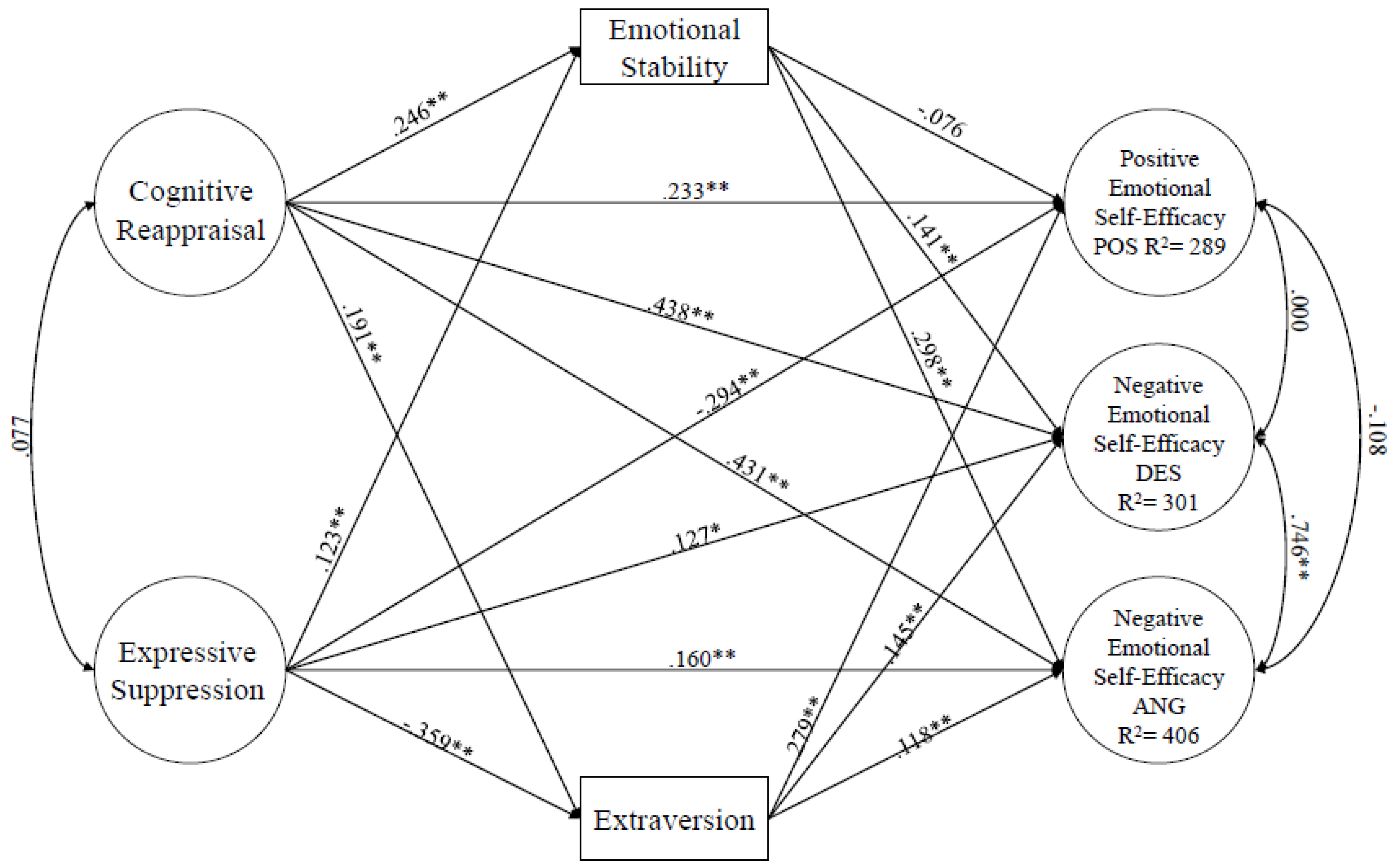
Figure 2.
The factor loadings of the latent variables.
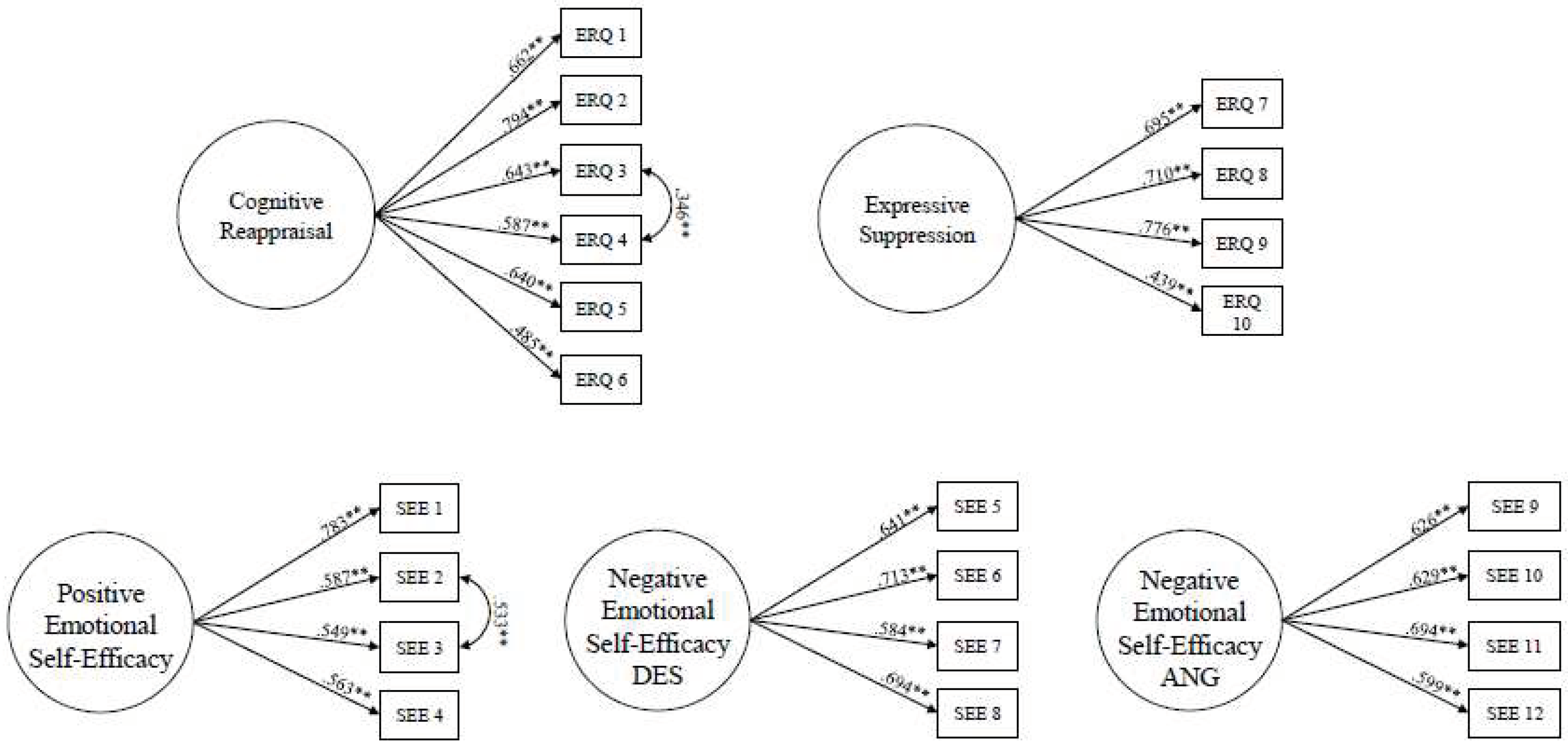

Table 1.
Descriptive analyses of the variables analysed in the study.
| Mean |
Standard deviation |
Asymmetry | Kurtosis | Minimum | Maximum | |
| Cognitive reappraisal | 4.40 | .986 | -.023 | -.512 | 2.50 | 6.33 |
| Expressive suppression | 3.72 | 1.26 | .020 | -.957 | 1.50 | 6.00 |
| Extraversion | 4.89 | 1.28 | -.129 | -.917 | 2.50 | 7.00 |
| Emotional stability | 4.29 | 1.20 | -.114 | -.743 | 2.00 | 6.50 |
| Positive emotional self-efficacy (POS) | 4.49 | .490 | -.653 | -.821 | 3.50 | 5.00 |
| Negative emotional self-efficacy (DES) * | 3.17 | .716 | .073 | -.901 | 2.00 | 4.50 |
| Negative emotional self-efficacy (ANG) * | 2.85 | .772 | .054 | -.883 | 1.50 | 4.25 |
*DES: Self-efficacy for coping with despair and anguish; ANG: Self-efficacy for coping with anger and irritation.
Table 2.
Correlations among the variables.
| 1 | 2 | 3 | 4 | 5 | 6 | |
| 1. Cognitive reappraisal | - | |||||
| 2. Expressive suppression | .070 | - | ||||
| 3. Extraversion | .141** | -.299** | - | |||
| 4. Emotional stability | .242** | .107** | -.130** | - | ||
| 5. Positive emotional self-efficacy (POS) | .196** | -.297** | .347** | -.061 | - | |
| 6. Negative emotional self-efficacy (DES) | .408** | .103** | .128** | .236** | .109** | - |
| 7. Negative emotional self-efficacy (ANG) | .422** | .145** | .075 | .359** | -.002 | .595** |
**p < .01; * p <. 05.
Disclaimer/Publisher’s Note: The statements, opinions and data contained in all publications are solely those of the individual author(s) and contributor(s) and not of MDPI and/or the editor(s). MDPI and/or the editor(s) disclaim responsibility for any injury to people or property resulting from any ideas, methods, instructions or products referred to in the content. |
© 2024 by the authors. Licensee MDPI, Basel, Switzerland. This article is an open access article distributed under the terms and conditions of the Creative Commons Attribution (CC BY) license (http://creativecommons.org/licenses/by/4.0/).
Copyright: This open access article is published under a Creative Commons CC BY 4.0 license, which permit the free download, distribution, and reuse, provided that the author and preprint are cited in any reuse.


