
Submitted:
09 January 2024
Posted:
10 January 2024
You are already at the latest version
Abstract
Einstein’s publication of the Special Theory of Relativity in 1905 gave birth to the space-time model as a fundamental arena of the universe. Time has become 4th dimension of space and theoretically one could move backward and forward in time. Hypothetical time travel has been a hot topic of scientific discussion since Kurt Gödel published his article about closed time-like curves (CTC) in 1949. He was aware that his CTC model confirms that there is no physical time. Physicists understood his model as a theoretical frame for time travel. Recent research confirmed that universal space is time-invariant. Motion happens only in space and time is the duration of motion. Nobody can travel in time because time has no physical existence. Time as duration is an emergent physical quantity entering existence in the process of measurement of the duration of material change with clocks. The universal space is utterly timeless. There is no physical time in the universe.
Keywords:
time
; space
; time travel
1. Introduction
Gödel publication of the CTC model [1] has opened the discussion on time travel. One could travel into the past, kill his grandfather, and could not be born. Gödel was aware that this »grandfather paradox” confirms that time has no physical existence. He expressed his view in a famous quotation in 1949: »In any universe described by the theory of relativity, time cannot exist« [2]. He was not well understood and the discussion about time travel is actual to these days. We will show in this article that there is no scientific basis for time travel not only in physical reality but also in theoretical models motion in time is excluded.
2. Universal Space Is Time-Invariant
In Special Relativity Theory the 4th coordinate is denoted as , which clearly confirms that the 4th coordinate is not time, it is a spatial distance which confirms that . Time is the duration of motion in time-invariant space and enters existence when measured by the observer [3]. Travel in the past and future is categorically excluded because none of them has physical existence. Motion can only happen in physical reality and time is not a physical reality. We observe in the universe a constant flow of changes. The numerical order of changes is a fundamental time where its basic unit is expressed by Planck time.
The emergent time of an event is the sum of Planck times. Emergent time is thusly possible to express as the duration of changes of motion in time-invariant space which enters existence when measured by the observer. No measurement means no duration [4].
3. Discussion
The idea that CTC has physical existence is still actual. In a recent article, physicists are discussing that time travel is possible through wormholes [5]. The idea that time travel will be possible once in the future was also published in 1988: “It is argued that, if the laws of physics permit an advanced civilization to create and maintain a wormhole in space for interstellar travel, then that wormhole can be converted into a time machine with which causality might be violated. [6].
We advocate in this article that CTC has no physical existence; it is only a mathematical model. One cannot travel with a spaceship in a mathematical model. Stephen Hawking was clear that CTC should not exist: “It seems the back reaction would prevent closed timelike curves from appearing. These results strongly support the chronology protection conjecture: The laws of physics do not allow the appearance of closed timelike curves« [7]. A recent article by Andrew Knight also categorically excludes the possibility of traveling in time: “When we assume that zero change to the past implies zero change to the present, we impose the information structure of the present universe onto its past structure – that is, we assume that everything will turn out the same, except for those events (and their chaotic interactions) that were changed in the past. Unfortunately for aspiring time travelers, this notion is false. Traveling into the past logically requires changing the present, no matter how careful one is to avoid a temporal paradox. Hopes to travel into the past without changing the present, such as by avoiding any physical interaction within the past, are unfounded” [8]. Based on elementary perception one can conclude that one can travel in universal space and the only time that exists is the duration of its motion. There is no past in the universe and there is no future. Linear time “past-present-future” is psychological time that has its origin in the neuronal activity of the brain. One is experiencing motion in the frame of psychological time and so one thinks that motion happens in time which is wrong. Motion does not require time; motion requires only space and time is the duration of motion. The universe is utterly timeless, linear time runs only in the human brain [9]. In 1999 Julian Barbour predicted that the next revolution of physics would be in understanding that there is no physical time: “A review of some basic facts of classical dynamics shows that time, or precisely duration, is redundant as a fundamental concept. Duration and the behaviour of clocks emerge from a timeless law that governs change« [10]. In our view, this timeless law is a time-invariant universal space where time as duration is an emergent physical quantity when measured. No measurement means no duration. In this perspective time can be seen only a useful illusion [11]. This means that the only universe that has physical existence is the universe we observe. There is no universe in the past or in the future. Nothing ever happened in some physical past because the physical past has no existence. Universal changes are running in a time-invariant space. These insights allow temporal cognition will be developed into timeless cognition [12].
Temporal cognition: motion → perception (eyes) → elaboration in psychological linear time (brain) → experience (observer)
Timeless cognition: motion → perception (eyes) → experience (observer)
Timeless cognition is the next revolution of physics and cosmology that Julian Barbour announced in 1999 [10]. In order to progress in physics and cosmology, we need to acknowledge that linear time “past-present-future” runs only in the brain. Besides Barbour also Rovelli denies the existence of physical time [13]. Both physicist’s mistake is that they would like to abolish time from physics which is not needed. Time is a useful tool, to progress we have to understand its nature and use it properly. The steps of the paradigm shift are as follows:
- -
- Material change (motion) run in time-invariant space
- -
- Motion does not require time, it requires only space
- -
- Time is the duration of motion when measured by the observer
- -
- We experience motion in the frame of inner linear psychological time
- -
- We are projecting inner psychological time into physical reality and we see the motion happen in physical time which is not there
- -
- Observer has the ability to stop out of inner psychological time and experience motion as it appears in the sight. Eyes see motion happens in space only, not in time.
- -
-
Perception of motion happens in NOW. We experience time-invariant space as NOW. This NOW is the only physical reality that exists.Universal changes run in NOW. When change X+1 enters existence, the change X is not in existence anymore. When change X+2 enters existence, the change X+1 is not in existence anymore.
- -
- Experiencing universal changes in some linear physical time is an illusion created by the neuronal activity of the brain.
- -
- The observer is beyond the neuronal activity of the brain that generates psychological time. Observer is the function of consciousness itself which has a higher ontological reality as psychological time [14]. The observer has the ability to become aware of the constant flow of inner psychological time. This insight also solves hypothetical time travel. CTC is only a mathematical model and one can travel in a mathematical model only in his mind. Observer/consciousness can observe and develop experiential distance from the scientific mind. An observer can use his scientific mind as a tool and the mind should not influence the creation of the scientific model. A conscious observer is aware that CTC is only a mathematical model and has no corresponding counterpart in physical reality.
4. From Space-Time to Time-Invariant Space
Space-time where time is the 4th dimension of space is the most respected mathematical model of 20th-century physics. Top physicists of the 20th century believed it had a physical existence. Feynman predicted that a positron is an electron moving backward in time [15]. His idea was wrong. An electron cannot move forward or backward in time because time has no physical existence. An electron moves only in time-invariant space. To make progress in physics, we must also be open to the possibility that even great minds can make great mistakes. The time symmetry model was a misunderstanding. Time has no physical existence and physical symmetry can only exist in space which has physical existence. The equation of symmetry in time has no counterpart in physical reality:
Elapsed time t is not positive and is not negative, it has an absolute value:
Since 1905 physics was deceived by mathematics. Yes, in geometry -1 is equally distant from 0 than +1, but this mathematical rule is not valid for time. The space-time model where time is understood as a 4th dimension of space has no counterpart in physical reality. This understanding is the paradigm shift of physics and the standpoint of physics progress. Universal space is time-invariant and timeless. We experience the timelessness of space as NOW. Einstein was aware that there is no physical past and there is no physical future. Famous Einstein quotes are clearly expressing that Einstein developed timeless cognition:
- -
- The distinction between the past, present, and future is only a stubbornly persistent illusion.
- -
- The only reason for time is so that everything doesn’t happen at once.
- -
- Time and space are modes by which we think and not conditions in which we live.
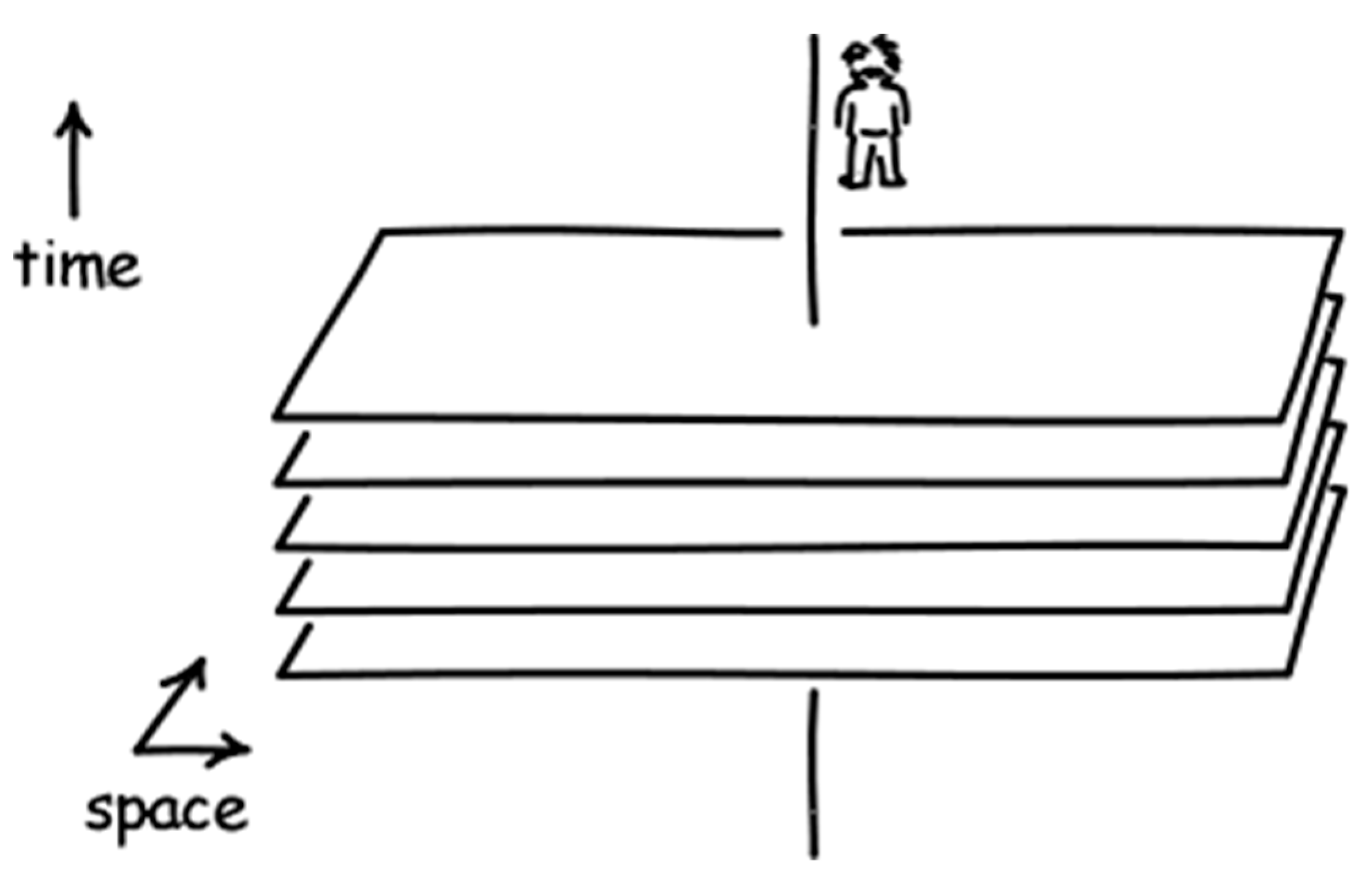
It is necessary that we fully grasp Einstein’s insight into the real nature of time. Indeed, linear time “past-present-future” time is a useful cognitive reality being created by the evolutionary capacity of the human brain for the linear elaboration of numerically ordered material changes and motion in time-invariant space but itself has no physical origin in our universe. This insight will build physics that will be an exact picture of the physical world where irreversible material changes run in time-invariant space. In today’s physics, we imagine that space-time has “slices” of NOWs that are following each other, see Figure 1 below:
NOW 1 is followed by NOW 2, NOW 2 is followed by NOW 3, and so on. This imagination is false. NOWs are not following each other. There is only one NOW. We experience timeless space where there is only and always NOW in the frame of psychological time and so we experience that NOWs are following each other.
Einstein was worried about NOW, for him NOW was outside the realm of science: "Einstein said the problem of the Now worried him seriously. He explained that the experience of the Now means something special for man, something essentially different from the past and the future, but that this important difference does not and cannot occur within physics. That this experience cannot be grasped by science seemed to him a matter of painful but inevitable resignation. So, he concluded ’that there is something essential about the Now which is just outside the realm of science’" [17]. Within the model of time-invariant space, the NOW is fully integrated into physics. We have to admit that there is no “cosmological time” and there is no “arrow of time” [18] because there is no physical time that would run in the universe and would have a given direction. The only time that exists is the numerical order of events that run in the time-invariant space. In the universe, time has only a mathematical existence. When we measure it, it emerges as duration.
5. Conclusions
There is no evidence of some physical time running in the universe, and we have to adjust our scientific models of the universe to this fact. The model of time-invariant space presented in this article is in accord with all experimental data of physics and cosmology. It unequivocally solves the paradox of hypothetical time travel. Julian Barbour’s next revolution in physics is the paradigm shift from the space-time model into the time-invariant space model.
References
- Kurt Gödel (1949). "An Example of a New Type of Cosmological Solution of Einstein’s Field Equations of Gravitation". Rev. Mod. Phys. 21 (3): 447–450. Bibcode:1949RvMP...21..447G. [CrossRef]
- Amrit Sorli, Fiscaletti Davide, Tadej Gregl, New insights into Gödel’s universe without time, Physics essays, Volume 26, Number 1, March 2013, pp. 113-115(3). [CrossRef]
- Šorli, A.S. & Čelan Š., Time-Invariant Superfluid Quantum Space as the Unified Field Theory, RAPS, Vol. 4, No. 3 (2020) 2050007. [CrossRef]
- Fiscaletti, D.; Sorli, A. Perspectives of the Numerical Order of Material Changes in Timeless Approaches in Physics. Found Phys, 2015; 45, 105–133. [Google Scholar] [CrossRef]
- Nguyen, H.K.; Lobo, F.S.N. Closed Timelike Curves Induced by a Buchdahl-Inspired Vacuum Spacetime in 2 Gravity. Universe 2023, 9, 467. [Google Scholar] [CrossRef]
- Michael S. Morris, Kip S. Thorne, and Ulvi Yurtsever Phys. Rev. Lett. 61, 1446 – Published 26 September 1988, Wormholes, Time Machines, and the Weak Energy Condition. [CrossRef]
- S. W. Hawking, Phys. Rev. D 46, 603 – Published 15 July 1992, Chronology protection conjecture. [CrossRef]
- Andrew Knight, The Pseudoscience of Time Travel. 2022. [CrossRef]
- Sorli A., Jafari. S., Fiscaletti D., Gorjup N., Gorjup R. Makovec T., Evidence-Based Cosmology – Black holes are rejuvenating systems of the universe, RAPS, Vol.07, 2350012, (2023). Available online: https://www.worldscientific.com/doi/epdf/10.1142/S2424942423500123.
- Julian Barbour, The Nature of Time. 2009. Available online: https://arxiv.org/pdf/0903.3489.pdf.
- Ronald Gruber, Time, a useful Illusion, Houndstooth Press, ASIN: B0C9P4MQL4 (2023).
- Amrit Sorli, Stefan Celan, Temporal and timeless cognition in physics, Physics Essays 35, 3 (2022). [CrossRef]
- Carlo Rovelli, “Forget time,” e-print. 2009. Available online: https://arxiv.org/abs/0903.3832.
- Amrit Šorli, Štefan Čelan, Time, observer, and consciousness, Physics Essays, 35, 2 (2022). [CrossRef]
- R. P. Feynman, The Theory of positrons, Phys. Rev. 76, 749 – Published 15 September 1949. Available online: https://journals.aps.org/pr/abstract/10.1103/PhysRev.76.749.
- Amrit Šorli, Štefan Čelan, Inconsistency of time-symmetry model, Physics Essays, 34, 4 (2021). Available online: https://doi.org/10.4006/0836-1398-34.4.470. [CrossRef]
- Richard A. Muller, Now — And The Physics Of Time, Cosmos&Culture (2016). 2016. Available online: https://www.npr.org/sections/13.7/2016/09/27/495608371/now-and-the-physics-of-time.
- George Francis Rayner Ellis, The arrow of time and the nature of spacetime, Studies in History and Philosophy of Science Part B: Studies in History and Philosophy of Modern Physics, Volume 44, Issue 3, August 2013, Pages 242-262. Available online: https://www.sciencedirect.com/science/article/abs/pii/S1355219813000464.
Figure 1.
Slices of space-time.
Disclaimer/Publisher’s Note: The statements, opinions and data contained in all publications are solely those of the individual author(s) and contributor(s) and not of MDPI and/or the editor(s). MDPI and/or the editor(s) disclaim responsibility for any injury to people or property resulting from any ideas, methods, instructions or products referred to in the content. |
© 2024 by the authors. Licensee MDPI, Basel, Switzerland. This article is an open access article distributed under the terms and conditions of the Creative Commons Attribution (CC BY) license (http://creativecommons.org/licenses/by/4.0/).
Copyright: This open access article is published under a Creative Commons CC BY 4.0 license, which permit the free download, distribution, and reuse, provided that the author and preprint are cited in any reuse.


