
Submitted:
09 January 2024
Posted:
09 January 2024
You are already at the latest version
Abstract
This paper aims to provide a comprehensive review of the historical trajectory of deforestation in Ethiopia, spanning an extensive timeframe and exploring its major driving factors. Over the span of three millennia, Ethiopia has experienced persistent deforestation, resulting in a significant reduction of its once-large forest and woodland resources. Currently, small, degraded forests and woodlands exist in isolated patches, located in remote areas such as the southwest and southeast. Major deforestation in Ethiopia unfolded progressively, first along a north-south axis and more recently shifting from the highlands to the lowlands. The northern and central highlands lost most of their natural forests before the turn of the 20th century, while significant loss in the southern highlands occurred over the past 150 years, and in the lowlands over the past 50 years. This deforestation is primarily attributed to the expansion of ox-plow agriculture and population pressure resulting from natural birth and internal migration. Despite efforts to counter deforestation and promote restoration, mostly since the 1970s, successes remain limited. A noteworthy exception in this regard is the introduction of Eucalyptus during the turn of the 20th century and the subsequent expansion of it, mainly in the form of small-scale farmer-led farm forestry. Today, Eucalyptus become the most preferred, well-adapted, widely planted, and the major supplier of wood materials in Ethiopia. The limited success in restoration is attributed to the reliance on campaign-based strategy, lack of private sector involvement, the intertwining of restoration with political agenda, and poorly defined property rights on land, forests, and trees. The consequences of deforestation and resultant environmental degradation have profoundly influenced the socio-economic dynamics of Ethiopia, giving rise to issues such as food insecurity, poverty, migration, and political instability.
Keywords:
Agriculture
; Eucalyptus
; population growth
; policy
; restoration
1. Introduction
The discourse surrounding deforestation and forest cover extent in Ethiopia has been a subject of ongoing debate, largely due to the lack of a comprehensive historical review, often constrained by scarcity of accurate and reliable sources of information. Although earlier efforts exist (e.g., [1,2,3]), they are limited either in terms of time or geography. There is a clear need for a more comprehensive assessment of the historic trajectory of deforestation, its driving forces, and socio-economic repercussions, spanning across modern-day Ethiopia.
Such an assessment is crucial for several reasons. Firstly, it facilitates an understanding of how socio-ecological systems have interacted over an extended period, influencing the country's forest resources on a national scale. Secondly, it illuminates the role of forestry in shaping Ethiopia's overarching political, social, ecological, and economic history. Lastly, it serves as a call to action for decision-makers to formulate effective forest sector development policies and strategies that would help in fostering restoration and preserving the remnants of Ethiopia's invaluable forests. This imperative is particularly heightened by Ethiopia's growing demand for wood products and the escalating wood product import bills as well as its international commitments, as evidenced by initiatives such as the Nationally Determined Contribution (NDC). As outlined in the NDC, Ethiopia has committed to achieve a 68.8% (277.2 Mt Co2e) reduction of greenhouse gas emissions by 2030. This is to be achieved through the safeguarding of its existing natural forests, establishing over 3 million ha new forests, restoring 5 million ha forest landscape, and other associated measures [4]. Moreover, Ethiopia is part of the Afr100, the African Forest Landscape Restoration Initiative, committing to the ambitious goal of restoring 15 million hectares of forest landscape [5].
Deforestation in Ethiopia has been an ongoing process spanning millennia. Its progression and movement occurred initially along a north-south axis, and more recently shifting from highlands to lowlands. Forest clearance from the rugged landscapes prevalent in the Ethiopian highlands and subsequent farming has left vast areas bare and degraded. This environmental transformation has led not only big empires like the Aksumite Kingdom to collapse [6,7] but also the current generation to suffer from food insecurity, poverty, and ecological disasters [8,9,10].
Despite its pivotal contribution in shaping the country's 3000-year history, there has been limited effective actions taken so far to manage and restore forests in Ethiopia. Perhaps, the most conspicuous and impactful intervention at the state level occurred with the introduction and planting of eucalyptus towards the close of the 20th century. This initiative has proven influential in the forest sector, offering alternative sources of wood for energy and construction, thereby reducing, to some extent, the pressure on natural forests [11]. Today, Eucalyptus is the most preferred, adapted, widely planted and the major supplier of wood materials in Ethiopia [11,12]. Moreover, the strategic planting of eucalyptus played a pivotal role in stabilizing the movement of the state capital, contributing to the modernization of the nation [2].
Nonetheless, neither planting of eucalyptus nor introduction of modern forestry education and research, the latter since half of the last century, have stopped deforestation from expanding its horizon in Ethiopia. Beginning from the end of the 20-century, deforestation has shifted towards the southern half, and most recently to the lowland woodlands, ever shrinking the forest resources of the country to a mere fraction of its original cover. Forests persistently face loss and degradation to the extent that Ethiopia now heavily relies on imported industrial woods and wood products to meet its growing demands [13].
Recognizing the pivotal role of forests in the country's history is essential, not only for understanding its historical significance and intrinsic values but also for acknowledging the necessity of restoration to foster a sustainable, stable, and greener Ethiopia. The primary objective of this review is to offer a thorough analysis of the history of deforestation and its socio-economic impacts at large. Striving for comprehensiveness, this review spans both geographic and temporal dimensions, encompassing the entirety of Ethiopia—north and south, highland and lowland—over the course of the past three millennia. By delving into this extensive historical context, the aim is to contribute to a deeper understanding of the complex interplay between deforestation and socio-economic dynamics.
The paper is based on a thorough review of large literature resources, encompassing historical accounts from travellers, their published versions, scientific articles, books, official documents, and relevant online resources. The paper is divided into five main sections: the first section delves into the historical process of deforestation in the northern part of Ethiopia, exploring the factors and dynamics that had driven it. The second section examines its historical expansion into the southern part, shedding light on the distinctive characteristics and drivers involved in this geographical shift. The third section investigates deforestation in contemporary Ethiopia, covering both the northern and southern regions and its extension into the lowland woodlands. The fourth section offers a brief account of the primary drivers of deforestation in today’s Ethiopia. It analyses the modern forces and factors that contribute to the ongoing depletion of forest resources in the country. The final section provides an overview of the efforts made and challenges encountered in forest restoration in the country.
2. Historic Forests of Northern Ethiopia and its Deforestation
The extensive chains of hills and mountains that characterize the Ethiopian northern highlands, coupled with favourable climatic conditions in the past, suggest that a significant portion of the region was likely covered by dense forests. This assumption is supported by the fact that this currently arid and barren highlands were once wetter and cooler [14,15], fertile, and well-watered [16] to expect the development of Afromontane high forests of Juniperus and Podocarpus species [7,15,17], much similar to the relict dry Afromontane forests found today in few sites in this region (e.g., Desa’a, Wof-Washa, Donkoro forests) and those around old churches and in monasteries [18,19].
Both [7,17] reported thick vegetation cover of likely Podocarpus - Juniperus mixed montane forest to have existed on the plateau of northern Ethiopia in the early Holocene (> 500 BC). During the last millennium BC, the climax vegetation in Tigray and Wollo highlands were dry evergreen montane forest, much the same as the few forest relicts seen today in this and central Ethiopia [17,18], and were hosting diverse wildlife species including elephants [20]. Today, very small relict forests exist in this part of Ethiopia, clustering around old churches, in monasteries and in few inaccessible sites [2,17,19], and anthropogenic deforestation being the main reason for their decline [2,8,17].
Forests began to decline in northern Ethiopia around 400 BC, aligning with the emergence of the Aksumite Empire and associated civilization marked by urbanization, and an economy increasingly reliant on ox-plow agriculture [2,7,17,21,22]. The Aksumite Empire that ruled over the Tigray plateau and its environs from 100 BC to 800 AD was one of the early great empires [6,23], with high level of urbanization, international trade and intensive agricultural practices [7,16,23,24]. Although scattered urban centres were already in existence during pre-Aksumite period, urbanization has reached a new stage of development in northern highlands of Ethiopia following the rise of the kingdom of Aksum [23,25,26]. Adoption of the ox-plow cultivation, an advanced agricultural production system of its time, coupled with a wetter and cooler climate, the availability of water, its geographic location along a known trade route at the time, and favourable land resources led to the emergence of complex societies from the second millennium BC [18,27,28,29], contributed to enhanced agricultural productivity, rapid population growth and development of urban population at Aksum [6,22,25]. At the time, the area was a known centre of plant domestication [16,21], and the principal crops grown were tef, finger millet, wheat and barley, same as what are still grown today [6,7].
Unfortunately, forests were victims of this process of civilization as they were cleared to provide fertile farmland, including in later stages on hill tops and hill sides, to feed the growing population and urban centres. Forests were also cut down to provide important products such as timber for construction, biomass for household energy and for the flourishing blacksmithing [6,7,25]. Forest clearance became notably intensive in the mid-first millennium AD, leading to the virtual disappearance of Podocarpus-Juniperus forests over a substantial part of the region by 1200 AD [6,17].
Moreover, fire was the principal method of land clearance in use during the time [17,18], causing widespread deforestation. The continual expansion of agriculture, even in erosion-prone mountainous areas, have resulted in the extensive destruction of large forest areas, fundamentally altering the landscape of the northern Ethiopia region [6,8,30,31]. As noted by [32], the significant deforestation and soil-water erosion following agricultural expansion in the area were evident during the fourth and third millennium BC but intensified toward the latter half of the first millennium AD. Environmental degradation reached a critical scale around 800 AD leading to severe impacts on agricultural productivity, acute shortages of timber and fuelwood. These factors in couple with other factors of climate, war, disease, and other plagues ultimately caused the collapse of the Aksumite empire [6,25].
The consequences of deforestation also caused significant destruction of wildlife and the loss of trade articles such as ivory [6,22,33,34]. [6] specifically argued that the collapse of Axum was closely tied to the decline in agricultural productivity resulting from anthropogenic landscape degradation through the cycle of deforestation, soil erosion, poor soil moisture, and water availability. At the time of Aksum's abandonment, environmental productivity in terms of crop yields, grazing, timber and fuel, as well as wildlife, had been catastrophically reduced in the Tigray plateau.
As Aksumite kingdom began to decline, agriculture and deforestation, however, were taking their journey further south [6,18,25], along with a shift in the centre of political power. Southward shift of ox-plow agriculture and deforestation began following royally sponsored large-scale missionary activity sent to central Ethiopia as early as the mid-ninth century [6]. Around Lake Hayq (in present day Wollo), a new royal residence and a major monastery, established probably before A.D. 870, coincide with the reported extensive deforestation in this region during the same period [17]. According to [17], there was intensive deforestation approximately 350 km south of Aksum in the vicinity of Hardibo and the Lake Hayq region around 900 AD. This expansion of the ox-plow agricultural production system led to the significant reduction of Podocarpus-Juniperus forest by 1200 AD in the Wollo area.
The rise of the Zagwe Dynasty in the mountain region of Lasta, in the humid and fertile part of the plateau, south of Aksum and not far from it, attracted the ox-plow agricultural expansion further southward along the densely forested spine of Ethiopia all the way to Shewa1, and westward to areas around Lake Tana (Gojjam and Gondar), where a radiocarbon-dating records significant colonization by 1100 AD [6]. Emanuel de Almeida, a Portuguese Jesuit, who was in Ethiopia from 1624 to 1633, reported the situation around Dancez in Gojjam having few trees, which he attributed the problem “not to the environmental limitation, but to the inhabitants, who cut down trees for all their needs but plant none for replacement” [35].
Over time, the power centre continued to shift west to the region of Gondar and south to the region of Shewa. Along these lines of power shift were also the continued migration of urban centre establishments, ox-plow agriculture, and deforestation to cover almost the entire northern highlands of Ethiopia [2,6]. Consequently, by the 17th century much of the northern Ethiopia has been agricultural landscapes with little forest cover left [2].
In the 18th century, James Bruce described his observation of the wood supply situation in the vicinity of Gondar as very acute, noting that ‘people had everywhere extirpated the wood and in consequence laboured to under a great scarcity to fetch it’ [36]. Similarly, during the 19th century, the Napier expedition described the Eritrea, Tigray, Wadla plain and areas around Gondar as having no forests to provide firewood. Inhabitants of these areas resorted to selling their roof beams and door posts to the British soldiers [2]. Wood scarcity was also evident in most parts of the Shewa highlands during the 18th and early 19th centuries. As early as the 19th century, the surroundings of the then-capital Ankober were referred to as a "timberless realm," any available wood exclusively belong to the despot [37], trees and even bushes are so lacking that cow dung became the only available fuel [2]. British visitor, Charles Johnston, during the same period, described the "high tableland of Abyssinia" as "poorly wooded."
The scarcity of firewood and land degradation played roles in the shifting of state capitals in Ethiopia from the 16th -19th centuries [2,38], until stability was achieved at Addis Ababa through the introduction and reforestation with Eucalyptus [1,2]. For instance, around the second half of the 19th century State capital had to move from Ankober to Entoto (Addis Ababa), due to wood scarcity at the former site and high forest cover surrounding the latter [39].
However, soon after its establishment as the capital, Entoto also lost its forest cover quickly. The French Scientific Mission of the 1840s described Entoto and it’s surrounding as being "covered" with junipers and wild olives, but a little over half a century later [39] saw only a few trunks, and declared, "all the trees have been destroyed...only one splendid group was spared." The depletion of wood resources in and around Entoto became so critical that the State capital had to be abandoned, relocating to another site, 55 km west of Entoto to a place called Addis Alem by 1900 [402 41]. At the time, Addis Alem and its surroundings hold dense forest, characterized by a traveller Hugues Le Roux as “Bois de Boulogne” (i.e., “the wood of Boulogne”) when he arrived at the site in 1901 [40]. Another account [41] commented on Addis Ababa, stating, "this immense struggling settlement has seen its best days, and some new place will be chosen as headquarters, as it is now nearly impossible to procure firewood for the wants of its inhabitants." [42] further described the situation as “a new spot must be chosen for gradually all the wood is being cut down and consumed, and when the distance from the forest becomes inconveniently great, the capital must be removed elsewhere.". Although the State capital was stabilized at Addis Ababa, with the planting of Eucalyptus, a promising wood supply, yet, as a result of road construction connecting Addis Ababa and Addis Alem, the forests around the new candidate capital were logged to supply wood demands for construction and furniture for the growing city of Addis Ababa [40].
The deforestation in northern highlands of Ethiopia, depicted above, unfolded as a continuous process at a broader spatial (regional) and temporal scale, advancing from north to south. The main factors behind this environmental phenomenon were direct drivers such as agricultural land expansion, unsustainable biomass harvest for biomass energy and construction, forest fire and conflicts. The wide adoption of ox-plow subsistence agriculture throughout the northern highlands stands out as the primary cause of deforestation [31]. Lack of advancement in the agricultural technology, coupled with poor land husbandry, led the agriculture system to follow an extensification model rather than intensification [2,17,31]. Each time a farmland lost its productivity, a new and fresh land needed to be cleared out of forest and put under cultivation. Land degradation was rampant due to the topography and associated soil-water erosion, resulting in rapid abandonment and replacement. This is how the agriculture dominated landscape of northern and central highlands of Ethiopia were generally created over the ages.
Fire was the key instrument of land clearance and preparation, both for farming and grazing, and is widely used carelessly in Ethiopia [2,17,18,41]. In addition, fire was and still today used in traditional forest-based apiary, which due to lack of careful use, has been a common and one major causes of forest fire. For instance, in 1984, a major forest fire broke and burnt down ca. 308,200 ha of forests, and in 2000 about 151,500 ha forest was burned down [43].
Another drive of historic deforestation in northern highland was war and conflicts. Ethiopia had been in a non-stop war, whether civil or with foreign forces. The Aksumit Empire was at war with many foreign and domestic forces such as the Muslim Arabs, with people form the lowlands as well as people from southern lands including the Walkites [22]. The Zagwe Dynasty was at fierce war with the Somali lowlanders led by the Mahamed Gragn in the 16th century, followed by the Oromo that were expanding territory across the highlands of Ethiopia all the way to present day Wollo [44]. Forests were victims of all these wars by providing wild meat as well as biomass energy required for cooking and heating for the army along its movement routes. Forests were also deliberately set on fire to chase out hiding enemies and rebellions. For instance, Yodit Gudit (849-897 A.C.) ordered her army and the local people to set fire to forests stretching from Tigray to Gonder and Wollo in suspected hiding grounds for the soldiers of Emperor Dilnaad [45]. Similarly, Gragn Mohamed (1527-1542 A.C.) ordered his troops to clear and burn all the forests stretching from the eastern lowlands to the central highlands to make battlefields accessible and to destroy strategic hiding grounds of the soldiers of the Emperor Libne Dingil and clergies [45]. The numerous wars fought during the medieval Ethiopia and before were therefore devastating ecologically playing a major role in aggravating deforestation in Ethiopia.
Wasteful (uneconomical) use of wood for fuel, blacksmithing, charcoaling and construction were also among the contributors to the continued deforestation in this part of the country [2]. By reviewing available evidence, including from travellers account, [2] summarized the situation as “trees were cut down as required, with little apparent thought for the morrow - and there was indeed no records of any traditional policy of rural afforestation or reforestation. Forests were destroyed due to reckless and extravagant uses, deliberate burning to produce pasture, farmlands, to chase wildlife and mosquito, drive out rebels (enemy’s army) and accidental burnings such as for traditional honey production or in campfires.”
3. Forests in Southern Ethiopia and its Deforestation
The historical account of deforestation in northern Ethiopia, described above, unveils a gradual southward expansion of this environmental phenomenon. Forest covers in the northern landscapes were depleted long ago, reaching near Addis Ababa by the close of the 19th century. In stark contrast, the situation in the southern half of Ethiopia differed significantly, as most parts of southern Ethiopia were forested until the onset of the 20th century, and still today host the few remnant blocks of natural forest of the country (see Figure 2 page 9).
Accounts from late 19th and early 20th-century travellers, along with evidence from paleobotanical studies and oral history, collectively indicate that deforestation in this part of Ethiopia is a relatively recent phenomenon. Areas such as Hararghe in the east, west and south Shewa, Wollega in the west, Sidamo in the south, Aris, and Bale in the southeast, and Kaffa, Sheka, Jimma, and Gambella in the southwest as well as most lowland areas were reported to have been covered with substantial natural forests and woodlands around the beginning of the 20th century. This historical context hints to support the commonly cited narrative of Ethiopia having approximately 40% forest cover around the early 20th century [45,46].
The political, economic, and demographic shifts south and eastward, following the (re)- establishment of Ethiopia under the rule of Menelik II, brought with it the expansion of the ox-plow culture to the southern half of the country. This marked the initiation of significant deforestation in this part [47]. During this period, the predominant culture in southern Ethiopia was largely pastoralism [48], and in cases where agriculture existed, it primarily involved root crops cultivated in integration with forest [24].
The British explorer, Maud [48] documented the forest cover and land uses of southern Ethiopia during the late 19th century, covering the geographic region from the Somali port to Lake Turkana, including areas around Addis Ababa. Maud provided a detailed account of the economic, social, and environmental conditions prevalent at that time in this part of the country. Describing the areas between Addis Ababa and Mt Ziquala, he stated, "...for its greater part was covered with excellent tall ungrazed grass and thorny bushes, dotted over with few villages and cultivation, whereas from Ziquala all the way to Lake Ziway was an immense park of mimosa cedars and other smaller thorn trees, with thick patches of high grass, inhabited by few cattle-herders who do not cultivate" [48]. The same source indicates the region further south, around Mt Abaro (near the present-day town of Shashemane), was covered with "virgin forest, difficult to penetrate through because of a thick matted undergrowth, making it difficult to find the summit of the mountain, and no indication of human disturbance." Near the summit, Maud described encountering buffalo, and despite not seeing them, he noted fresh tracks of greater kudu, with no signs that humans had ever disturbed this retreat before. From the summit of Mt Abaro, Maud observed "a vast green forest towards the east as far as the eye could see." In his travels further south to Borana and up to Lake Rudolf, he traversed through dense and thick forest cover with little human habitation. He witnessed large herds of elephants in the forest-clad plain of Adola and rhinos in the woodlands of Borana. The Arsi-Bale plateaus, known for their fertility, were minimally cultivated but supported large herds of fine cattle [48].
In parts of Sidama, Maud described the landscape, stating, "further down in the fertile plateau of Sidamo, the country is sparsely inhabited3, though it is very fertile and well-watered by many perennial streams flowing west into Lake Abaya. South of the Giddabo river, and, after visiting Sisha, we struck across some fine hill country, in places covered with magnificent forest, to Gurbicho." He further detailed the landscape, mentioning dense forests covering hilltops, bamboo jungles, and open grassy valleys with perennial water. The Sidamo escarpment was covered with dense forest, and the path through the forest had been improved by the locals into a route for the benefit of travellers. Maud described the uninhabited eastern part of Jumm Jumm, and the challenges of navigating through thick thorn bushes, often encountering elephant and rhino tracks. The region called Liban, the lowland part of the then Sidamo, varied in character, with highlands to the north, a well-marked ridge covered with "tid" Juniper trees extending south to the Dawa river, undulating terrain west of Kurre Liban, and a vast waterless plain known as Dida Liban to the east [48].
Neumann [49] and Hodson [50] provided additional accounts of the conditions in southern Ethiopia, offering valuable insights into the state of the region during their travels. [50] shared his impressions of areas around Kambatta, Walaita, and Gamo Gofa, describing them as very hilly, extremely fertile, but featuring vast uncultivated lands. He attributed this lack of cultivation to the taxation system imposed on inhabitants, wherein they were taxed based on the amount of area they cultivated. Consequently, there was a tendency for them to produce only what was necessary for their own needs. [50] further detailed his observations of areas around Jimma, Kaffa, and beyond, stating, "As we passed through Jimma, we came to the Gojeb River. This is a wild part of the country. There are fine forests in this part of the world, which remind one of parts of the New Forest in England, and numbers of the beautiful Colobus monkeys are found in these forests." This description highlights the richness of the natural environment and wildlife in the southern regions of Ethiopia during that period.
Neumann's narrative begins with the highlands of Hararghe. He witnessed excellent forest cover in the highlands of eastern Ethiopia, such as on the mountains of Gara Mulata, where the western slopes were covered with thick forest. The fauna and flora in this region contrasted sharply with those found in the dry Somali desert between Zeila and Jildesa.
Pollen analysis has provided further verification that deforestation in southern Ethiopia is a recent phenomenon. Pollen records from Rift Valley Lakes and other widespread sites in the south indicate a late appearance of pollens associated with human impacts [51,52,53,54]. A pollen analysis study conducted in the Arsi plateau revealed that major disturbances, including mountain forest destruction, commenced around 850 BP [55]. The percentage of forest pollen reached its highest values in the last decades in the Arsi Mountains, and the pollen record lacks evidence of direct anthropogenic indicators until very recently [56]. Another study by [50] on Abiyata Lake showed human impact on the vegetation in the area to be as recent as 30 years ago. These findings support the notion that significant deforestation in southern Ethiopia occurred relatively recently and is consistent with historical accounts and other forms of evidence provided by travellers and researchers.
Until the late 19th century and the early 20th century, the predominant land use in the highlands of southern Ethiopia was animal herding, while in most parts of the lowlands of western Ethiopia, it involved shifting cultivation, hunting, and gathering [47,48,49,57]. The introduction of ox-plow agriculture marked a significant shift in land use, leading to cereal cultivation and, subsequently deforestation [22]. The interplay between the ox-plow system and population growth, including from resettlement programs and self-sponsored local migrations, significantly impacted Ethiopia's southern and southwestern forests (see below). For example, the study by [58] revealed an 80% reduction in forests occurred between 1957 and 2007 in parts of southwestern Ethiopia, attributing the cause to demographic and socioeconomic factors resulting from resettlement. Similarly, a study by [59] reported over 36% forest loss between 1973 and 2010 in southwest Ethiopia, attributed to changes in land-tenure arrangements, population growth, including resettlement and agricultural development policies.
4. Deforestation in Contemporary Ethiopia and its Migration to the Lowlands
Deforestation remains a pressing issue in contemporary Ethiopia, with the country’s forests and woodlands continue dwindling each year. According to Forest Reference Emission Level [60], an official document of the Ethiopian Government, Ethiopia is experiencing an annual net loss of 73,000 hectares of forest, indicating a 92,000-hectare decrease compared to a 19,000-hectare gain per year from 2000 to 2013 [60]. An earlier study by [61] indicated a substantial annual forest loss of 163,000 hectares. Analysing 30,600 km2 high forest area in the southwestern Ethiopia between 1971-1997, [61] reported 18.4% to have remained after 27 years, and undisturbed high forest can only be found in remote areas like on isolated mountain ridges or on unfertile soil substrates. At a national scale, in the 1970s, natural high forest was estimated to cover 6.08% (ca. 6.960 million ha), but by early 1990s this was already reduced to 3.93% (ca. 4.506 million ha), and late 1990s it was around 4.07 m ha, closed and open high forests together [62].
Similarly, Ethiopia’s report for the Global Forest Resources Assessment proves a continuous decline in natural forest (high forests and woodlands) since the 1990 ([63,64], Table 1). According to this report, Ethiopia has lost over 3 million ha of forests and woodlands in 30 years, ca. one million ha every 10 years or 100,000 ha per year. While there have been marginal and localized forest gains, primarily from farm forestry expansion through the planting of exotics species like Eucalyptus [11], such gains occur at a much slower rate compared to the overall loss experienced, resulting in a considerable net annual forest loss across Ethiopia [60,63].
The apparently high forest cover data shown in table 1 for both the revised and earlier estimates, in contrast to assessments from previous official and scholarly sources, such as [43,45,62], is attributed to differences in the applied forest definition. The FAO's forest definition used in the global forest resources assessment incorporates significant portions of areas that were previously classified as woodlands in Ethiopia. This shift is clearly explained and is evident in the country’s report submitted to FAO (e.g. [63]). Furthermore, Ethiopia has recently adopted a new forest definition [60] that includes the relatively extensive woodlands and designates them as forests. Unfortunately, Ethiopian politicians have erroneously claimed this as a gain in forest cover through restoration, and praised their policies, while the reality is that the country is experiencing a substantial loss not only in high forests but also in woodlands, as indicated by the overall trend presented in this table and supported by the FREL document and numerous other localized studies.
Additionally, data from the Global Forest Watch, an open-source global forest change database (https://gfw.global/3TCG4FO), corroborates the forest loss trends described above (see also Figure 5). According to the Global Forest Watch (GFW), Ethiopia witnessed the loss of 86,100 ha humid primary forest from 2001 to 2022, aligning with the information presented in [60] and that of the FAO Global Forest Resources Assessment. With respect to tree cover, the GFW data shows a net loss of 648,000 hectares of tree cover against the gain of 404,000 hectares in tree cover during the same time. The expansion in tree cover is mainly attributed to small-scale tree planting initiatives by farmers, as the map clearly indicates an overlap of these gains with areas where such practices are rapidly advancing, such as the Awi zone in the Amhara Regional State. The study of [65] Kassa et al. (2022) provides additional evidence of the declining trend of forests since the 1990s in areas other than where farm forestry is actively taking place such as the Awi zone in Amhara Region.
Localized studies confirm the continued alarming rate of deforestation across several locations in Ethiopia. In Yeki and Decha districts in the southwest of Ethiopia, known for their dense tropical high forest in recent past, have lost 50% of their forest during the period 1973 - 2010 [66]. Forest loss was accompanied by expansion of agricultural land and settlements, which increased by 238% and coffee farm that was increased by 280% during the same period. [58] showed 19% decline in forest cover between 1957 - 2010 in a district in Jimma zone, southwest Ethiopia, which was attributed to natural population growth and farmland expansion. In another district, the same authors [58] identified 80% forest cover loss between 1957 - 2007. A similar study by [67] in four districts in southwest Ethiopia, namely Bench, Sheko, Yeki, Guraferda, and Godere, reported decline of forest from 71% in 1973 to 48% in 2005. In Anderacha, Gesha and Masha woredas, which still today represent major forested districts in the southwest of Ethiopia, experienced annual deforestation rate of 1.5% during the period 1987 - 2005 [68].
The Bale eco-region, situated in southeastern highlands, hosts the second-largest block of remaining high forest in Ethiopia. Encompassing about half a million hectares of dry and moist Afromontane forests, this area is also a deforestation hotspot in recent decades. Between 1986 and 2009, the annual deforestation rate in the Bale Mountains eco-region varied from 1% to 7%, with an average rate of 3.7%. A study commissioned by Farm Africa for the Bale REDD+ project indicated an average weighted deforestation rate of 6.6% for the dry Afromontane forest, 1.1% for the humid Afromontane forest, and a combined average of 2.5% for both forest strata [69]. A similar study [70] showed forest loss of the magnitude 123,751 ha, while farmland gained 292,294 ha in Bale, attributed to farmland and urban settlement expansions. Deforestation in Bale is proceeding despite the implementation of a participatory forest management scheme across the entire eco-region since the mid-1990s (69, 70).
Deforestation in modern Ethiopia is characterized by a geographic expansion towards lowland woodlands. The lowlands of Ethiopia have historically shielded themselves against significant human occupation due to prevalent tropical human and livestock diseases such as malaria [68,71]. In particular, the native populations in the western lowlands, where Tse-Tse fly prevalence was high, adopted a non-animal mode of living [71]. Their lifestyle involved sporadic shifting cultivation using simple hand tools, supplemented by hunting, and gathering practices. In contrast, the lowlands in the southeastern, eastern, and northeastern regions have historically engaged in nomadic pastoralism, regulated by robust traditional institutions and rangeland management practices such as the Gada system of the Borana community—a system recognized for its sustainability [72]. These traditional practices were characterized by minimal environmental impact and remained largely undisturbed until the 1950s.
However, improvements in medication, coupled with increasing land pressure in the highlands have inevitably led to human encroachment in recent decades, turning these lowlands into deforestation hotspots. Agricultural investments, the influx of people through government resettlement programs, and self-initiated migration have collectively contributed to huge deforestation of lowland woodlands in recent decades [73]. The combination of extensive fertile land and low population density made lowlands a center of gravity for agricultural investors and human resettlement [73,74]. A study by [74] revealed that between 2001-2004 and 2010-2013, the average annual growth in crop area was 2.6% in the lowlands and 1.6% in the highlands, underscoring the recent shift in deforestation towards the lowlands. Similarly, woodlands in the central Rift Valley declined dramatically by 80% during the period between 1972 – 2000 [75], a major shift being towards farmland. Another study [76] in Hawassa watershed, southern Ethiopia, reported a continues decline of forest cover from 40% at the turn of the 19th century to just 3% in 2000.
Several studies in the western lowlands reported significant deforestation taking place in the area [72,77] (Figure 3). [77] studied deforestation across a long span of Combertum-Terminnallia woodland in western Ethiopia: from Humera in Tigray to Sherkole in Benishangul. The study found a decline in woodland cover at the average rate of 2,834 ha/year over the period of 1985-2010. This was driven by expanding agricultural land use due to agri-business investment and smallholder’s farmland expansion following influx of large human population since the first resettlement program of the Derg that began in the 1980s [72]. The [60] specifically shows the Combretum-Terminalia woodlands of western lowlands experiencing a deforestation rate threefold higher than the deforestation of moist aformontane forests, showing the current intense pressure on these forest types.
Deforestation in contemporary Ethiopia is not limited to areas with relatively good forest cover. Central and northern Ethiopia, with fragmented patches of forest and shrublands, are also experiencing significant deforestation [31,78]. In this part of the country, where major forests vanished long ago, the ongoing deforestation continues to impact the remnant forest and shrublands. For example, in southern Wollo, [79] reported a 3% decline in forest cover and a 14% decline in shrubland cover between 1958 and 1986. Similarly, [80], reported a decrease from 27% in 1957 to 2% in 1982 and further to 0.3% in 1995 in parts of Gojjam. These authors reported the total natural forest cleared between 1957 and 1995 amounted to 7259 hectares, representing a staggering 99% forest cover clearance. Notably, most deforestation occurred between 1957 and 1982 (approximately 78%), slowing down between 1982 and 1995 (only 10%)—not due to any measures taken to reduce deforestation, but rather because there was little forest left to be further cleared. The study of [78], in the catchment of Derekolli, south Wollo, reported a decline in shrubland, which apparently represent the climax vegetation of the study area, at the rate of 1.6 and 0.31% per year from 1957 to 1986, and from 1986 to 2000, respectively. Notably, the study indicated that there was little change in cropland area since 1986, which was attributed to the fact that most of the land suitable for cultivation was already in use, and the limit for expansion had nearly been reached.
5. Drivers of Deforestation in Contemporary Ethiopia
Unlike the historical deforestation, which could be attributed to a few identifiable direct drivers, contemporary deforestation in Ethiopia is shaped by an intricate interplay of numerous direct and underlying factors. Indeed, in present-day Ethiopia, deforestation is predominantly instigated by institutional factors such as land tenure, poverty reduction, rural development policies and programs, and associated elements. The subsequent section offers an overview of some of the principal underlying drivers.
5.1. Agriculture and Rural Development Policies
Ethiopia remained an agrarian nation, predominantly relying on small-scale farm production systems for thousands of years. Technological and agronomic practices have seen minimal advancements, necessitating the horizontal expansion of agricultural areas to accommodate the food need of the growing population. Consequently, agriculture has been the major and persistent direct driver of deforestation in the country. The economic significance of agriculture has led successive governments to disproportionately prioritize policies towards it. Policies, programs, and plans implemented in Ethiopia since the 1950s have predominantly favoured agriculture, with all its associated environmental costs.
The Derg regime (1975-1991) operated as an agrarian socialist regime. Following the overthrow of Haile Selassie's imperial regime, the Derg announced an agrarian reform program declaring all rural land as state property, distributing it to those interested in cultivation. Moreover, the Derg established state farms (e.g. the Didesa_Anger_Gutin state farm in Wollega) by clearing hundreds of thousands of woodlands in western lowlands, which were abandoned during the fall of the regime and taken over by small scale farmers. The coffee and tea development programs implemented in the 1980s such as the Tepi and Bebeka coffee development, and Wushwush and Gumero tea estates were established by bulldozing thousands of hectares of tropical forests in the southwest [64,66,67].
The EPRDF government, in power since 1991, formulated its long-term development strategy, known as Agriculture Development Led Industrialization (ADLI), with a focus on agriculture. EPRDF implemented successive agriculture and rural development policies and economic development plans namely the Sustainable Development and Poverty Reduction Program (SDPRP), the Plan for Accelerated and Sustained Development to End Poverty (PASDEP), GTP I and GTP II. Starkly these policies and plans targeted forest and woodlands as opportunities for extending agriculture development. For instance, the following excerpt was taken from the agricultural development policy:
Box 1.
“ …there are large-unsettled tracts of semi-arid land stretching from the north to the south of the country, which can be developed as rain-fed agriculture, or through irrigation. While it is true that much of the cultivable land is held by peasant farmers, this is mostly in the highlands. Large tracts of unsettled land are also available for large-scale commercial farmers on long-term lease basis although this is in the lowlands. The criticism that the current land ownership policy impedes the expansion of commercial farms is levelled without taking into account the status of land utilization in the country as a whole and is based only on the situation observed in the highlands”.
PASDEP (2005-2010) planned to increase total crop area from 12.28 million ha in 2004/05 to 12.65 million ha by 2009/10, and coffee farm from 0.5 million to 0.734 million ha [81]. Notably, PASDEP implemented an extensive resettlement initiative in Ethiopia under its Food Security Program (FSP), resettling 440,000 households or 2.2 million people. Each household received a support package, including access to 2 hectares of farmland. However, the settlement of 440,000 households, each allocated 2.0 hectares of land, resulted at least in the sacrifice of an area equivalent to 880,000 hectares of woodlands and forestlands.
Following PASDEP, the Growth and Transformation Plan (GTP) became the economic development plan for the period 2010-2015. The GTP aimed for an annual agricultural growth rate of 14.9% and set a target to double farm output by 2015. The strategy for rapid agricultural growth under the plan involved promoting private investment in large-scale farms, with the government committing to provide support and encouragement, including access to land at very low lease rates. The GTP anticipated transferring land to large-scale investors, projecting an increase from 0.5 million hectares in 2011 to 2.8 million in 2013 and 3.3 million in 2015 [82]. Additionally, the GTP sought to expand small-scale agriculture and coffee production area, with coffee cultivation projected to increase from 0.462 million hectares in 2010 to 0.815 million hectares in 2015 [83]. These policies underscore the government's support for the horizontal expansion of agriculture as a key strategy to boost production, mostly at the expense of natural ecosystems such as forests and woodlands.

Table 2.
Planned cropland expansion during PASDEP periods [Source: [81]).
Table 2.
Planned cropland expansion during PASDEP periods [Source: [81]).
| Crop type | Planned expansion (x1000) | |||||
|---|---|---|---|---|---|---|
| PASDEP | ||||||
| 2004/05 Baseline | 2005/06 | 2006/07 | 2007/08 | 2008/ 09 | 2009/10 | |
| Crops (cereals, pulses, cotton) | 12,281 | 12,404 | 12,465 | 12,527 | 12,587 | 12,649 |
| Coffee | 500,000 | 560,000 | 629,000 | 659,000 | 694,000 | 734,000 |
| Tea | 5,598 | 5,900 | 6,000 | 6,220 | 6,450 | 6,900 |
Despite possible justifications for the agriculture-centred development policies of the successive governments in recent history, the policies have remained a fundamental instigator of deforestation. In the lights of these policies and practices, the prevailing perception among the public and governments has been that forestlands present an opportunity for expanding agricultural frontiers to ensure food production, create employment, and develop the national economy. In essence, the political emphasis on agriculture has fostered an attitude of tolerance towards deforestation. This is manifested in the allowance for agricultural expansion to occur horizontally rather than vertically, leading to intense competition for land between agriculture and forestry [84].
5.2. Resettlement and Spontaneous Local Migration
Government sponsored resettlement was widely implemented in Ethiopia since the 1950s (Figure 4, [85,86,87], and it is one of the underlying policy factors driving deforestation [58,64,66,72]. The Imperial, Derg and EPRDF governments have implemented resettlement in large numbers. An estimated 20,000 families were resettled from the drought afflicted and overpopulated north to the south of the country during the imperial regime [88].
Major resettlement episodes, however, were those implemented by the Derg regime during 1975 - 1986, and by the EPRDF during 2003 – 2004 (Table 3). The settlements concentrated, primarily to the western and southwestern parts (Figure 4), where land was perceived “plentiful”, i.e., where land was forest covered and inhabitants were few and scattered [85,86,88]. The devastation that such policy measures have caused on the forests and woodlands of the country is undoubted [56,72,89]. Official statistics show that the total resettled population since the 1970s is well over 1.4 million households (Table 3). Nearly all of these were settled in major forested regions, mostly in and near forest lands of the respective recipient areas. The main centres of the Derg’s resettlement were Kaffa, Wollega, Ilubabor, Gambella, Gojam and Gonder, which at the time host large high forest and woodland covers. The recent resettlement has taken place mostly in the dryland woodland areas. By simply considering the official promised package of 2.0 ha per household, resettlement of 1.4 million household would have caused about 2.8 million ha clearance of forests and other natural ecosystem. However, as no authority controls the size of holdings, settlers have always cleared more land than formally allowed [72,90]. For instance, in Metema district, one of the key resettlement districts in the Amhara regional state, the average land holding in resettled areas was found to be as high as 5.14 ha, and ranges between 2- 33 ha [72], which led to the near extinction of an economically and ecologically important species of Boswellia papyrifera [89].
The impact of resettlement on forests goes beyond the mere allocation of forest land for agricultural purposes. There are indirect processes through which resettlement contributes to deforestation. Firstly, it leads to a spontaneous increase in the population dependent on land in a given area. Secondly, it introduces foreign cultures and production systems that differ from those of the host community. In the case of Ethiopia, this often involves the introduction of destructive ox-plow agriculture to areas historically practicing either hoe and stick-based shifting cultivation or a pastoral way of life [24,72,94].
Besides government resettlement program, there has been a substantial self-initiated (spontaneous) local migration of people in Ethiopia, primarily from highlands to lowlands and from north to southwest (Figure 5), a phenomenon recognized as early as the 1950s [95]. This migration increased significantly during the 1960s and 1970s [96], and continued to escalate in recent decades [97,98,99]. An estimated one million people spontaneously migrated within Ethiopia from the 1950s to the 1970s alone [85,96,100]. Initially, short-distance settler movements of up to 150 km prevailed until the mid-1970s [85,101], after which long-distance movements, further south, southwest and west, became more common [102]. Prior to the mid-1970s, rural-to-rural migration dominated, with the flow directed toward the east and southeast where commercial farms (cotton and sugar) had been introduced, as well as toward the coffee-growing areas in the south and southwest [101]. Most of these settlers established themselves by obtaining land from nearby forests and woodlands [72,94].
5.3. Investment Policy
A major economic policy reform in Ethiopia after the fall of the Derg regime involves the implementation of a market-oriented economic development policy. The primary objective of this policy is to foster investment within the country and propel economic growth by attracting both domestic and foreign private investments. Under this economic reform, all sectors of the economy, including agriculture, were open for investment. Several incentive packages were promised to encourage investment, and this included free or low-lease rent land access.
As a result, the government of Ethiopia has set aside large tracts of land in what it called ‘land bank’ to be given to investors in commercial agriculture. Total land transfer since the late 1990s to both domestic and foreign capital reached around 3.5 million hectares [103]. Regional distribution of the land was Oromia 1.075 m ha, Gambella 0.83 m ha, Benishangul 0.692 m ha, Afar 0.4097 m ha, Amhara 0.42 m ha and southern nation 0.180 m ha. Significant area of land was handed over to investors, a few of which were developed, but most of it cleared, misused, charcoaled, and abandoned [104,105]. There is no question that these investment lands are partly covered by forests and partly by woodlands, and these are designated to be cleared when transferred to investors. Some investors have salvaged the forest resources on the land allotted to them and abandoned them.
5.4. Population Growth
Ethiopian population has surged dramatically, expanding by 1000% since the beginning of the 20th century and more than doubled between 1960 and 2016. Data from population census reports conducted in 1984, 1994, and 2007 reveal a steady increase, rising from 39.9 to 53.48 and 73.3 million, respectively [106]. Currently, the population is estimated at 120 million. The alarming nature of such population growth stems from its predominantly rural and agriculture-based character. With over 80% of the population residing in rural areas and farming serving as the backbone of the economy, more people imply more demand for land for living through the common practice of subsistence agriculture (Figure 6a & b). This confluence of high population growth, rural concentration, and heavy reliance on agriculture inevitably translates into the expansion of croplands and settlements, leading to proportional deforestation as available forest land is cleared.
Agriculture inherently is a land-dependent enterprise, with subsistence agriculture even more so, as its sustained production hinges on horizontal expansion into fertile natural ecosystems rather than the intensification of production. the demand for cultivable land is not solely driven by a burgeoning rural population; it is further exacerbated by rapid soil fertility loss resulting from poor land management and inadequate external inputs. In such circumstances, the strategy to sustain production involves encroaching on new fertile land cleared from forests [84]. Intensification, in the sense of increasing productivity per unit area, has not gained ground in Ethiopia. Therefore, the demand for land persists not only among younger generations establishing new homes but also among established parents seeking to expand their farmlands to maintain productivity and meet the food requirements of their families, as long as forestland is available [78]. When opportunities to acquire new fertile lands from forests are exhausted, as observed in northern Ethiopia, the menaces of food insecurity and famine looms.
Population growth, particularly in a traditional economy like Ethiopia, contributes to deforestation not only by expanding farmland but also through the felling of trees to meet various needs such as construction wood, settlement space, biomass fuel, and additional income. In Ethiopia, biomass, including wood, solid, and agricultural wastes, constitutes the primary source of energy, accounting for over 90% of the total primary energy used at the household level. A substantial majority, approximately 84% of urban households and 99% of rural households, rely on biomass as their primary fuel for cooking [107]. In contrast, electricity comprises a minimal 3% of the total energy supply, with only 44% of households having access to basic electricity [108].
Ethiopia ranks among the top 10 countries in Africa with the highest shares of biomass fuels in their total energy consumption [109]. In 2019, biomass fuels constituted approximately 86% of the country's total energy consumption, compared to the African average of 51% [110]. The annual consumption of biomass fuel averages around 106 million tons [109]. Estimates of the total annual biomass harvested for fuel range from 95 to 125 million tons [109]. The continuous harvesting of such significant amounts of biomass fuel over time transforms forests from degradation to complete devastation or deforestation.
Forest disappearance and scarcity of fuelwood compelled households, particularly those in northern Ethiopia, to switch to crop residues and cattle dung as fuel alternative. The demand for wood energy is a driving force behind the expansion of eucalyptus woodlots, as this species has proven to be the most viable option in meeting these energy needs.
5.5. Land and Forest Property Rights
Land and forest property rights have never been stable and suitably defined in Ethiopia to allow proper land and forest managements. These rights are not only ambiguous, instable, and centrally monopolized in most cases but also insecure to discourage users from investing in the sustainable management of natural resources. The main causes for this are political instability, divergent political ideology and property right regimes adopted by successive governments, all driven by a desire to use forests and land as political instruments to serve specific political interests [101,112]. Land tenure is one of the central policies and political issues in Ethiopia [113,114].
The nationalization of forests, coupled with a weak forestry institutional framework since the 1970s, has created an environment reminiscent of the 'tragedy of the commons.' In this scenario, illegal logging and the conversion of forests to farmland present more appealing incentives than maintaining the forest [113,115]. Despite the de jure claim of forest ownership by the state, there is a notable absence of proper institutional frameworks and capacity to support the protection and management of forest resources, resulting in a de facto open-access situation. Moreover, as long as the land remains forested, it is regarded as state property, with the state commonly perceived as the governing authority within the political system. However, when the forests are cleared and transformed into agricultural land, individuals or households acquire a usufruct right, including the ability to pass it down to future generations. Consequently, deforestation and conversion are viewed as a mechanism for asserting ownership over land previously considered under the jurisdiction of the state. In other words, deforestation is an incentive for households to transfer ownership or at least the usufruct right over land from the state to themselves.
While the relationship between land tenure arrangements and production efficiency has been a topic of extensively debate [114], in the context of Ethiopia, land tenure systems have had adverse effects on forest management in several ways. One fundamental issue is the imposition of rural confinement, inhibiting the long-term migration of people from rural to urban areas, as the policy prohibits the sale or leaving of land uncultivated. Consequently, this policy contributes to rural overcrowding, low urbanization rates, land fragmentation, and a reduction in land holdings per capita due to intra-family redistribution. This situation compels many individuals to seek new lands as well by clearing forests, woodlands, and bushlands [112]. The diminishing land size also discourages fallowing and promotes continuous cultivation, leading to rapid land degradation [84].
6. Restoration Efforts and its Impacts
Historically, there were few instances of state-initiated measures aimed at mitigating deforestation and restore degraded forest landscapes. One noteworthy success story revolves around the introduction of Eucalyptus in the 1890s, a species that now predominates the country’s tree resources [11,12,116] (Figure 7). The introduction of Eucalypt provided numerous benefits for Ethiopia. It helped reduce the pressure on rapidly diminishing natural forests by providing alternative wood sources, contributed to the greening of both rural and urban landscapes, offered a source of additional income, and helped in poverty reduction for small-scale tree planters across rural Ethiopia, and generated significant employment and livelihood opportunities throughout its wood products value chains [11,116].
Prominent responses to environmental degradation, including deforestation, emerged in the aftermath of the significant famine that struck Ethiopia in the 1970s, directly linked to environmental degradation. Subsequently, extensive efforts have been made, and millions of hectares of degraded land have been dotted with soil-water conservation structures like terraces, tens of thousands of watersheds have undergone treatment, and billions of seedlings have been planted. Additionally, millions of hectares of land have been enclosed (set aside), and hundreds of thousands of hectares of natural forests designated as conservation or protected areas, and most of it brought under Participatory Forest Management (PFM) scheme. Recent reports indicate that in the past five years alone, over 30 billion seedlings have been planted [117]. The State has predominantly employed a campaign-based rehabilitation approach, while apparently community-based approaches such as Participatory Forest Management (PFM) and area exclosures have been promoted primarily by non-state actors.
Unfortunately, despite substantial efforts and endeavours, the sustainability and success of these initiatives have been low [65,117,118,119,120]. Notable exceptions to this include the establishment of exotic tree plantations during the Derg regime, resulting in approximately 200,000 hectares of industrial forest plantation—currently the only one in the country. Additionally, the spontaneously expanding small-scale farm forestry led by farmers stands out as a success story, bringing about transformative changes in the rural landscape and economy across various parts of Ethiopia [14] (Figure 7). Particularly, the exotic tree species introduced during the Derg era serve as the primary sources of tree planting materials for all ongoing reforestation and afforestation activities in the country since their introduction.
The lack of significant success in restoration and conservation efforts in Ethiopia, even those seemingly community-centered, such as Participatory Forest Management (PFM) and area exclosures, can be attributed to several key factors. Some of the main factors include:
- Campaign-Based Approach: Campaign-based scheme is the main restoration approach used in Ethiopia for decades. One key drawback of this practice is that it compromises quality, resulting in a lack of success. The emphasis often lies on achieving quantity to be reported by the end of the day, neglecting the importance of quality of the work, which is an essential aspect to ensure success. Restoration campaigns during the Derg era were marked by a coercive top-down approach and reliance on Food-for-Work program, resulting in substantial but ultimately unsustainable efforts [118]. Their failures were attributed to the lack of creating awareness on the long-term environmental and economic benefits, and poor scientific and technical rigors [118,121]. Post-Derg campaign-based restoration initiatives, despite claims of being participatory, were entangled with systematic political pressures. Most of the restoration efforts target communal lands, also claimed as public lands, exacerbating issues of land scarcity, and adversely affecting farmers' livelihoods. Restoration site selections are often top-down decisions made primarily by government entities, without proper community involvement or consent. The lack of clarity regarding ownership and uncertainty about the nature and magnitude of future benefits from restoration initiatives on these communal lands, makes it challenging for farmers to engage in follow-up maintenance. The government's limited institutional capacity, human resources, and budget for regular monitoring and tending, combined with farmers' reluctance, contribute to the lack of success of these initiatives. Furthermore, recent campaigns are typically manifested as annual planting or conservation events, lacking sufficient follow-up and oversight to ensure proper tending and maintenance operations. Specifically, they prioritize political popularity and exaggerated numbers in reporting that lack accuracy and transparency [117,122], making them to be perceived more as political tools rather than genuine environmental agendas.
- Ineffective Institutional Integration: Restoration practices, especially those in recent years like the Green Legacy Initiative, suffer from ineffective institutional integration. Multiple institutions with overlapping mandates coordinate their operations, which leads to lack of accountability and responsibility in providing follow-up operations. For instance, in the Green Legacy Initiative, the tree planting activities are coordinated by a national technical committee composed of senior experts from the Ethiopian Forestry Development of MoA; Ministry of Water, and Irrigation (MoWI); and Ministry of Urban Development (MOUD). Frequent institutional restructuring, which is a typical characteristic of the forest sector institutional arrangement in Ethiopia, further compromises continuity and accountability of efforts. Given that restoration processes are long term engagement, their actions need to be implemented by a dedicated, resourced, and stable institutional arrangement put in place at all levels of the government structure [65]. This will guarantee not only effective monitoring and follow-up but also accountability and responsibility. Involving the private sector is also lacking, which could have enhanced the effectiveness of these initiatives through improved quality and investment on follow up activities.
- Ownership Issue: The mass planting of trees on public lands suffers from a lack ownership, hindering the achievement of a real impact. Government is campaigning to plant trees, but planted seedlings don’t obtain follow up care, for they are not associated with either private or public entities to do so. The reason small-scale tree planting is successfully flourishing, and mass tree planting is not, can be good evidence to regard how much ownership matters in this regard.
- Undermining forestry as an economic enterprise: Forestry's potential as a significant economic sector is overlooked in Ethiopia, despite the recognition of its ecological services. Distinguishing between forestry for environmental services and forestry as a business endeavour is crucial for effective restoration. Doing so will help to segregate restoration initiatives into those that government or public sectors will lead and those that other actors such the private sector will take care. The success of farm forestry stands as a compelling example of how private entities can drive forest development. Recognizing and promoting the economic potential of forestry is vital for fostering restoration, sustainable management and improving the national economy and livelihoods of local communities. The problem of the on-going restoration efforts is the focus on increasing the number of seedlings planted with the anticipation of increasing the national forest cover [65], not on balancing and enhancing the economic benefits gained from it as well. Such environmental focused restoration initiatives do not align with the needs of impoverished rural households seeking additional income or alternative livelihoods to agriculture, for their immediate needs override the long-term environmental benefits. Hence, balancing environment and economic benefits and segregating restoration accordingly is critical to ensure success. Lack of tangible economic benefit is one key constraint for many restoration efforts failing to attract the support of local community.
7. Conclusions
Ethiopia’s natural forest have been experiencing a reckless deforestation. Deforestation in Ethiopia is as old as its recorded agricultural history. Deforestation that began in the northern highlands spread to all corners of the country. Today, a few million hectares of degraded high forests remain in the country. Even these are mostly coffee agroforest for coffee is predominantly cultivated under their canopy with varying degree of intensity. Agriculture has been the primary and direct driver of deforestation and land degradation in Ethiopia, and this issue has been exacerbated by persistent cultural and policy preferences for agriculture at the expense of other land uses and land cover. Unfortunately, the disproportionate focus on agriculture has effectively failed in enhancing agricultural productivity and ensured food security and/or in safeguarding the environment. The country continues to grapple with food insecurity, and the depletion of forest exacerbating it by destroying fallback options for income as well as wild nutrition. Restoration efforts in recent decades also bear no significant positive impacts in protecting and/or reversing forest cover of the country.
Addressing the longstanding issue of deforestation in Ethiopia may requires three complementary measures. Firstly, a breakthrough in agricultural intensification is crucial to generate sufficient yields from less land. The historical lack of progress in techniques and technologies within Ethiopian agriculture has been a significant factor contributing to its environmental impact. Consequently, there is a pressing need for the implementation of assertive and genuine policy measures that focus on revolutionizing agricultural intensification. These measures may include reforms in land property rights, aiming to facilitate private investments and enable land consolidation conducive to mechanization.
Secondly, there is a need for a comprehensive reform of economic development policies and strategies to embrace diversification, including forestry. Relying solely on an agriculture-centred policy does not appear as the optimal path for rapid rural development. The success observed in the thriving farm forestry provides compelling evidence that forestry can serve as a robust complement, playing a pivotal role in economic empowerment and as a source of considerable cash income for farm households in the country. Moreover, recognizing the intricate relationship between landscape components, specifically agriculture and forestry, is crucial for the long-term viability and sustainability of agriculture. Forestry is a natural treatment to maintain landscape health and sustainability. Such understanding can pave the way for the adoption of integrated landscape development approaches, ensuring the co-existence and complementarity of agriculture and forestry. This approach aims for a win-win outcome, promoting a sustainable and balanced ecosystem.
Thirdly, in conjunction with agricultural intensification, it is imperative to implement an effective population policy. This review underscores that rapid population growth leads to heightened demand for land, consequently driving deforestation to fulfil immediate needs. One significant challenge associated with population control in Ethiopia is its utilization as a political tool. Since the establishment of ethnic-based federalism in the early 1990s, population has been wielded as a political instrument to secure power and budget allocations. Governments, de facto, promote reproduction while, de jure, attributing degradation to it. Despite the existence of a population policy since 1993, limited progress has been made due to political considerations. A uniform and effective implementation of population policy across diverse ethnic groups is imperative to reverse deforestation.
Acknowledgments
I would like to thank Taye Gidyelew (Dr) for supporting in the production of the various maps used in this paper.
Conflicts of Interest
The authors declare no conflict of interest.
References
- McCann, J. C. The Plow and the Forest: Narratives of Deforestation in Ethiopia, 1840-1992. Environ Hist, 1997; 2(2), 138–159. [Google Scholar]
- Pankhurst, R. The History of Deforestation and Afforestation in Ethiopia Prior to World War I. Northeast Afr. Studies, 1995; 2(1), 119–133. [Google Scholar]
- Bekele, M. The Ethiopian forest from ancient time to 1900: A brief account (The case of northern Ethiopia). Walia, 1998, 19, 3–9. [Google Scholar]
- Federal Democratic Republic of Ethiopia (FDRE). Updated Nationally Determined Contribution. Addis Ababa, Ethiopia. 2021; pp.1-22.
- Afr100.org. https://afr100.org/country/ethiopia (accessed on 01/12/2022).
- Butzer, W.K. Archaeology as human ecology: Method and theory for a contextual approach. The University of Chicago, USA. 1982; pp. 171 - 190.
- Bard, K. A.; Coltorti, M.; DiBlasi, M. C.; Dramis, F.; Fattovich, R. The Environmental History of Tigray (Northern Ethiopia) in the Middle and Late Holocene: A Preliminary Outline. Afri. Archaeological Rev, 2000; 17(2), 65–86. [Google Scholar]
- Hurni, H. Land degradation, famine, and land resource scenarios in Ethiopia. In World Soil Erosion and Conservation; D. Pimentel, Eds.; Cambridge University Press. USA, 2010; pp. 27 – 62.
- Kebede, G. M.; Jacob, J. Drought, Famine and the Political Economy of Environmental Degradation in Ethiopia. Geo, 1988; 73, 65–70. [Google Scholar]
- Berry, L. Land degradation in Ethiopia: its impact and extent. In Assessing the extent, cost and impact of land degradation at the national level: findings and lessons learned from seven pilot case studies; Berry L.; Olson J.; Campbell D.; Eds. Technical Report Commissioned by global mechanism with support from the World Bank, USA, 2003; pp 25-50.
- Lemenih, M.; Kassa, H. Re-greening Ethiopia: history, challenges and lessons. Forests, 2014, 5(8), 1896-1909.
- Lemenih, M. Growing Eucalyptus by smallholder farmers in Ethiopia. In Proceedings of the conference on Eucalyptus species management, history, status and trends in Ethiopia; Gil, L.; Tadesse, W.; Tolosana, E.; Lopez, R., Eds, 15-17 September, Ethiopian Institute of Agricultural Research, Addis Ababa, Ethiopia, 2010; pp. 91–103.
- NFSDP (National Forest Sector Development Program). National Forest Sector Development Program, Ethiopia. Volume I. Situation Analysis, Addis Ababa, Ethiopia 2017, pp. 131.
- Gebru, T.; Eshetu, Z.; Huang, Y.; Woldemariam, T.; Strong, N.; Umer, M.; DiBlasi, M.; Terwilliger, V.J. Holocene palaeovegetation of the Tigray Plateau in northern Ethiopia from charcoal and stable organic carbon isotopic analyses of gully sediments. Palaeogeogr. Palaeoclimatol. Palaeoecol., 2009; 282 (1–4), 67–80. [Google Scholar]
- Terwilliger, J. V. , Eshetu, Z., Huang, Y., Alexandre, M., Umer, M. and Gebru, T. Local variation in climate and land use during the time of the major kingdoms of the Tigray Plateau in Ethiopia and Eritrea. CATENA, 2011; 85, 2, 130–143. [Google Scholar]
- Sulas, F. Aksum: Water and Urbanization in Northern Ethiopia. In A History of Water, Series 3, Vol. 1. From Jericho to Cities in the Seas: A History of Urbanization and Water Systems, Tvedt, T. and T. Ostigard, Eds. London, 2014, pp. 173-197.
- Darbyshire, I.; Lamb, H.; Umer, M. Forest clearance and regrowth in Northern Ethiopia during the last 3000 years. Holocene, 2003; 13, 4, 537–546. [Google Scholar]
- Terwilliger, J.V.; Eshetu, Z.; Disnar, J-R.; Jacob, J.; Adderley, W. P.; Huang, Y.; Alexandre, M.; Fogel M.L. Environmental changes and the rise and fall of civilizations in the northern Horn of Africa: An approach combining δD analyses of land-plant derived fatty acids with multiple proxies in soil. Geochim. Cosmochim. Acta. 2013, 111(15), 140–161.
- Kindu, M.; Schneider, T.; Wassie, A.; Knoke, T. State of the Art in Ethiopian Church Forests and Restoration Options. Springer International Publishing, 2020, pp. 1-10.
- Butzer, W.K. Rise and Fall of Axum, Ethiopia: A Geo-Archaeological Interpretation. Am. Antiq. 1981, 46(3), 471–495. [Google Scholar] [CrossRef]
- Harlan, R. J. Agricultural Origins: Centers and Noncenters. Science, New Series, 1971, 174(4008), 468-474.
- McCann, J. C. People of the Plow. An Agricultural History of Ethiopia, 1800–1990. The University of Wisconsin press, Madison, USA, 1995.
- Fattovich, R. The development of urbanism in the northern Horn of Africa in ancient and medieval times. In The Development of Urbanism in Africa from a Global Perspective, Sinclair, P. J.J. Eds, Uppsala University, Uppsala, Sweden, 1999, Online publication http://www.arkeologi.uu.se.
- De Blois, F. The Four great kingdoms in the Manichaean Kephalia, Bibliotheca Nubica. In Orbis Aethiopicus I, Eds P. Scholz, 1992, pp. 221-230.
- Godet, E. Répertoire de sites pre-Axoumites et Axoumites du Tigre (Ethiopie). Abbay, 1977, 8, 19–58. [Google Scholar]
- Michels, W.J. Changing Settlement Patterns in the Aksum-Yeha Region of Ethiopia: 700BC - AD 850. British Archaeological Reports. Cambridge Monographs in African Archaeology 64. Oxford, Archaeo press, 2005, pp. 1–256.
- Phillipson, D. W. The first millennium BC in the highlands of northern Ethiopia and south-central Eritrea: a reassessment of cultural and political development, Afri. Arch. Review, 2009, 26, 257–74. [Google Scholar] [CrossRef]
- Phillipson, D. W. Foundations of an African Civilisation: Aksum and the Northern Horn 1000 BC–AD 1200, Suffolk, UK and Rochester, NY: James Currey, 2012, 1-293.
- Fattovich, R. The development of ancient states in the northern Horn of Africa, c.3000 BC–AD 1000: an archaeological outline. J. World Prehist., 2010, 23, 145–75. [Google Scholar] [CrossRef]
- Virgo, K.J.; Munro, R.N. Soil and Erosion Features of the Central Plateau Region of Tigray, Ethiopia. Geoderma, 1978; 20, 131–157. [Google Scholar]
- Nyssen, J.; Poesen, J.; Moeyersons, J.; Deckers, J.; Haile, M.; Lang, A. Human impact on the environment of the Ethiopian and Eritrean highlands: A state of the art. Earth Sci Rev., 2004, 4, 273–320. [Google Scholar] [CrossRef]
- Phillipson, D. W. African archaeology. Cambridge University Press, 1985, pp 52-164.
- Phillips, J. S. Aksum and the ivory trade: new evidence. Orbis Aethiopicus, 1998, 3, 75–84. [Google Scholar]
- Boardman, S. The Agricultural Foundation of the Aksumite Empire, Ethiopia. In The Exploitation of Plant Resources in Ancient Africa, van der Veen, M. Eds, Springer, Boston, USA, 1999, pp 137-147.
- Beckingham, C.F.; Huntingford, G.W.B. Some records of Ethiopia, 1593–1646: being extracts from The History of High Ethiopia or Abassia by Manoel de Almeida, together with Bahrey's History of the Galla. London, Hakluyt Society, 1954.
- Bruce, J. Travels to Discover the Source of the Nile in the years 1768, 1769, 1770, 1771, 1772 and 1773. Edinburgh, Robinson, 1790, pp….
- Harris, W. C. The Highlands of Ethiopia. Vol 3. Longman, Brown, Green, and Longmans, London, 1844, pp.1 - 427.
- Johnston, C. Travels in Southern Abyssinia, through the country of Adal to the kingdom of Shoa. J. Madden & Co., London, 1844, pp. 1 - 474.
- Borelli, J. . Ethiopie Meridionale: Journal de Mon Voyage aux Pays Amhara, Oromo et Sidama Septembre 1885 a Novembre 1888. Ancienne Maison Quantin, Librairies-Imprimeries Reunies, Paris, 1890, pp….
- Local History of Ethiopia, The Nordic Africa Institute, available online https://nai.uu.se/, accessed March 20, 2020.
- Wylde, A.B. Modern Abyssinia, Methuen & co., London, 1901, pp. 1 - 499.
- Gleichen, C. With the Mission to Menelik 1897. Edward Arnold, London, 1898, pp. 1 - 357.
- George, C. W.; Mutch, R. W. Ethiopia: Strengthening Forest Fire Management, FAO Project Document (TCP/ETH/0065), April, Rome, 2001, pp. 1-97.
- Hassen, M.M. The Oromo and the Christian Kingdom of Ethiopia: 1300-1700 (Eastern Africa Series, 27). James Currey, 2015, pp. 400.
- Woldeselassie G., M. The Forest Resources of Ethiopia; Past and Present. Walia, 1998, 19, 10–28. [Google Scholar]
- Von Breitenbach, F.V. National Forestry Development planning: A feasibility and priority study on the examples of Ethiopia. Ethiop. For. Rev 1962, 3(4), 41–68. [Google Scholar]
- Berisso, T. Agricultural and rural development policies in Ethiopia: a case study of villagization policy among the Guji-Oromo of Jam Jam Awraja. PhD dissertation, Michigan State University, 1996, pp. 1-345.
- Maud, P. Exploration in the southern borderland of Abyssinia. Geo. Journal 1904, 23(5), 552–579. [Google Scholar] [CrossRef]
- Neumann, O. From the Somali Coast through Southern Ethiopia to the Sudan. Geo. Journal 1902, 20(4), 373–398. [Google Scholar] [CrossRef]
- Hodson, A. Southern Abyssinia. Geo. Journal, 1919; 53, 2, 65–79. [Google Scholar]
- Legesse, D.; Gasse, F.; Radakovitch, O. C; Bonnefille, R.; Verschuren, D.; Gibert, E.; Barker, P. Environmental changes in a tropical lake (Lake Abiyata, Ethiopia) during recent centuries. Palaeogeography, Palaeoclimatology, Palaeoecology, 2002; 187, 3-4, 233–258. [Google Scholar]
- Mohammed, M.U.; Bonnefille, R. The recent history of vegetation and climate around Lake Langeno (Ethiopia). Paleoecology of Africa, 1991, 22, 275–286. [Google Scholar]
- Bonnefille, R.; Mohammed, U. Pollen-inferred climatic fluctuations in Ethiopia during the last 3000 years. Palaeogeogr. Palaeoclimatol. Palaeoecol. 1994; 109, 331–343. [Google Scholar]
- Mohammed M. U.; Bonnefille R. Late Holocene Climatic Fluctuations and Historical Records of Famine in Ethiopia. In Droughts, Food and Culture, Ecological Change and Food security in Africa’s Later Prehistory, Fekri A. Hassan, Eds, 1998, pp 83–94.
- Bonnefille, R.; Hamilton, A. Quaternary and Late Tertiary history of Ethiopian vegetation. Symb. Bot. Ups., 1986, 26, 48–63. [Google Scholar]
- Behre, K.E. Anthropogenic Indicators in Pollen Diagrams. Balkema, Rotterdam, 1986, pp. 232.
- Mekonnen, M. B. (2009). The Gumuz: Are They Shifting Cultivators? Proceedings of the 16th International Conference of Ethiopian Studies, Vo. Svein Ege, Harald Aspen, Birhanu Teferra and Shiferaw Bekele, Eds. Department of Social Anthropology, Norwegian University of Science and Technology, Trondheim, Norway, pp. 349-356.
- Getahun, K. , Poesen, J, Van Rompaey, J. Impacts of Resettlement Programs on Deforestation of Moist Evergreen Afromontane Forests in Southwest Ethiopia. Mt. Res. Dev, 2017; 37, 4, 474–486. [Google Scholar]
- Tadesse G., E.; Zavaleta, E. , Shennan, C., FitzSimmons M. Policy and demographic factors shape deforestation patterns and socio-ecological processes in southwest Ethiopian coffee agroecosystems. App. Geo., 2014, 54, 149–159. [Google Scholar] [CrossRef]
- FREL. Ethiopia’s forest reference level submission to the UNFCCC. Addis Ababa, Ethiopia (ethiopia_frel_3.2_final_modified_submission.pdf (unfccc.int)) accessed June 2022.
- Reusing, M. Change detection of natural high forests in Ethiopia using Remote Sensing and GIS techniques. Int. arch. photogramm., 2000, 33, 1253–1258. [Google Scholar]
- WBISPP (Woody Biomass Inventory and Strategic Planning Project). A national strategic plan for the biomass energy sector. Federal Democratic Republic of Ethiopia, Ministry of Agriculture, Addis Ababa, 2004, pp. 879.
- https://www.fao.org/forest-resources-assessment/fra-2020/country-reports/en/ accessed Dec 2022.
- https://www.fao.org/3/al501E/al501E.pdf accessed on September 2023.
- Kassa, H.; Abiyu, A.; Hagazi,A.; Mokria, M.; Kassawmar, T.; Gitz, V. Forest landscape restoration in Ethiopia: Progress and challenges. Front. For. Glob. Change, 2022, 5, 01–14.
- Tadesse, G. E. Biodiversity and Livelihoods. In Southwestern Ethiopia: Forest Loss And Prospects For Conservation In Shade Coffee Agroecosystems. PhD Thesis, . University of California, Santa Cruz, USA, 2013. pp. 137.
- Tadesse, D. Forest Cover Change and Socioeconomic Drivers in Southwest Ethiopia: deforestation for plantation agriculture. LAP LAMBERT Academic Publishing, 2010, pp. 76.
- Sutcliffe, J.P. The Extent and Economic Costs Of Deforestation In South-West Ethiopia: A Preliminary Analysis. Forested Landscapes and Livelihoods, NTFP-PFM, Addis Ababa Ethiopia, 2009, pp. 56.
- Lemenih, M.; Biot, Y. Reducing deforestation and emissions in Bale What’s the incentive for local communities? Farm Africa, London, United Kingdom, 2018, pp. 15.
- 70. Nune S, Teshome Soromessa and Demel Teketay. Land Use and Land Cover Change in the Bale Mountain Eco-Region of Ethiopia during 1985 to 2015. Land, 2016, 5(4).
- Abbute, W.S. Gumuz and Highland Settlers: Differing Strategies of Livelihood and Ethnic Relations in Metekel, Northwestern Ethiopia. PhD dissertation. Goettingen, Germany: University of Goettingen, 2002, pp 345.
- Legesse, A. Oromo Democracy. An Indigenous African Political System. Lawrenceville, NJ The Red Sea Press, 2000, pp 282.
- Lemenih, M.; Kassa, H.; Kassie, T.G.; Abebaw, D. , Teka, W. Resettlement and woodland management problems and options: a case study from North-western Ethiopia. Land Deg. & Dev. 2014; 25, 4, 305–318. [Google Scholar]
- Schmidt, E.; Thomas, T. S. Cropland expansion in Ethiopia Economic and Climatic Considerations for Highland Agriculture (Working Paper No. 127). IFPRI and Ethiopian Development Research Institute (EDRI). https://www.ifpri.org/publication/cropland-expansion-ethiopia-economic-and-climatic-considerations-highlandagriculture accessed in Oct 2022.
- Dessie, G.; Christiansson, C. Forest Decline and Its Causes in the South-Central Rift Valley of Ethiopia: Human Impact over a One Hundred Year Perspective. Ambio, 2008; 37, 4, 263–27. [Google Scholar]
- Dessie, G.; Kleman, J. Pattern and Magnitude of Deforestation in the South-Central Rift Valley Region of Ethiopia. Mountain Res. Dev. 2007, 27(2), 162–168. [Google Scholar] [CrossRef]
- Alemu, B.; Garedew, E.; Eshetu, Z. ; Kassa,H. Land Use and Land Cover Changes and Associated Driving Forces in North Western Lowlands of Ethiopia. International Research Journal of Agr. Sci. and Soil Sci., 2015, 5(1), 28-44.
- Tegene, B. Land-cover/land-use changes in the Derekolli Catchment of the south Welo Zone of Amhare Region, Ethiopia. East. Afr. Soc. Sci. Res. Rev; 2002; 18, pp. 1–20. [Google Scholar]
- Kebrom, T.; Hedlund, L. Land cover changes between 1958 and 1986 in Kalu district, southern Wello, Ethiopia. Mountain Res. Dev. 2000; 20, 42–51. [Google Scholar]
- Zeleke, G.; Hurni, H. Implications of land use and land cover dynamics for mountain resource degradation in the northwestern Ethiopian highlands. Mountain Res. Dev. 2001, 21(2), 184–191. [Google Scholar] [CrossRef]
- Ministry of Finance and Economic Development (MoFED). Ethiopia: Building on Progress A Plan for Accelerated and Sustained Development to End Poverty (PASDEP) (2005/06-2009/10) Volume I: Main Text. Addis Ababa, Ethiopia, 2006.
- Rahmato, D. Land to Investors. Large-Scale Land Transfers in Ethiopia. Forum for Social Studies. Addis Ababa, Ethiopia, 2011, pp.
- Federal Democratic Republic of Ethiopia (FDRP), Growth and Transformation Plan 2010/11-2014/15. Volumne1: Main Text. Ministry of Finance and Economic Development, Addis Ababa, Ethiopia, 2010, pp….
- Lemenih, M.; Tolera, M.; Karltun, E. Deforestation: Impact On Soil Quality, Biodiversity and Livelihoods in the Highlands of Ethiopia, In Deforestation Research Progress, B. Sanchez and Carl L. Alonso Eds, Nova Science Publishers, Inc., 2008, PP. 21-39.
- Wood, A. P. Population redistribution and agricultural settlement schemes in Ethiopia. In Population and Development Projects in Africa, Clarke J I, Khogali M M, Kosinski L A, Eds. Cambridge University Press, Unted Kingdom, 1985, pp84–111.
- Kloos, H. Health and Resettlement in Ethiopia, with an Emphasis on the 1984/85 Resettlement Programme. Social Science and Medicine, 1989, pp….
- Wubne, M. Resettlement and villagization. In A Country Study: Ethiopia, Thomas P. Of cansky; LaVerle Berry Eds, Library of Congress Federal Research Division, 1991, pp.
- Clarke, J.I. Resettlement and rehabilitation: Ethiopia's campaign against famine. Harney & Jones Ltd.: London, 1988, pp….
- Bongers, F.; Groenendijk, P.; Bekele, T.; Birhane, E.; Damtew, A.; Decuyper , M.; Eshete, A.; Gezahgne, A.; Girma , A.; Khamis, M.A.; Lemenih, M.; Mengistu, T.; Ogbazghi, W.; Sass-Klaassen, U.; Tadesse, W.; Teshome , M.; Tolera, M.; Sterck, J.F.; Zuidema , A.P. Frankincense in peril. Nature Sustainability, 2019. [CrossRef]
- Dejene, T., Lemenih, M.; Bongers, F. Manage or convert Boswellia woodlands? Can frankincense production payoff? J. Arid Environ 2013, 89, 77–83. [CrossRef]
- Tereke, G. The Ethiopian Revolution: War in the Horn of Africa. New Haven: Yale University, 2009, pp.
- Kassa, B. Resettlement of peasants in Ethiopia. J. Rural Dev., 2004, 27, 223–253. [Google Scholar]
- Abbute, W. Resettlement as a Response to Food Insecurity The case of Southern Nations, Nationalities, and Peoples’ Region (SNNPR). UN-OCHA-Emergencies Unit for Ethiopia, 2003, pp….
- Lemenih, M. , Feleke, S.; Tadesse, W. Constraints to smallholders production of frankincense in Metema district, North-western Ethiopia. J. Arid Environ. 2007; 71, 4, 393–403. [Google Scholar]
- Smeds H. The Population Capacity of the Ethiopian Highlands. Proceedings of the 18th International Congress of Geography II. Riode Janeiro, Brazil. International Geographical Union, 1956, 465–473.
- Woldemariam, M. 1986. Rural Vulnerability to Famine in Ethiopia:1958–1977. London, United Kingdom: Intermediate Technology.
- Casacchia, O.; Crisci, M.; Reynaud, C. Internal migration in Ethiopia. In: Golini A, Said M, Casacchia O, Reynaud C, Basso S, Cassata L, Crisci M, editors. Migration and Urbanization in Ethiopia, With Special Reference to Addis Ababa. Addis Ababa, Ethiopia, and Rome, Italy: Central Statistical Agency and Institute for Population Research–National Research, 2001, pp 53–90.
- Mberu, B. U. Internal migration and household living conditions in Ethiopia. Demographic Research 2016, 14(21), 509–540. [Google Scholar] [CrossRef]
- Fransen, S.; Kuschminder, K. Migration in Ethiopia: History, Current Trends and Future Prospects. Migration and Development Country Profiles. Maastricht, the Netherlands: Maastricht University, 2009, pp….
- Wood, A. P. Spontaneous agricultural resettlement in Ethiopia, 1950-74. In Redistribution of Population in Africa (1st ed. J. I. Clark, & L. A. Kosinski, Eds. Heinemann International Literature & Textbooks, 1982,, pp. 157-164.
- Ezra, M. Demographic responses to environmental stress in the drought and famine-prone areas of northern Ethiopia. Population, Space and Place, 2001, 7(4), 259–279.
- Rahmato, D. Settlement and resettlement in Metekel, western Ethiopia. Africa (Rome), 1988, 43, 14–43. [Google Scholar]
- MOARD. The Ethiopian Agricultural Investment Areas. Ministry of Agriculture and Rural Development. Agricultural Investment Support Directorate. Public Relation Bureau. Addi Ababa, Ethiopia, 2009, pp….
- MOA. A performance assessment report on agricultural investors. Ministry of Agriculture website. Available at: http://www.moa.gov.et/node/212 acessed in September 2022.
- Keeley, J.; Seide, M.W.; Eid, A.; Lokeley, A. Large-scale land investment in Ethiopia: How much land is being allocated, and features and outcomes of investments to date Report for the Bill and Melinda Gates Foundation and the International Institute for Environment and Development (IIED), 2013, pp….
- FDRE. Summary and statistical report of the 2007 population and housing census. Population size by age and sex. Population Census commission, Addis Ababa, Ethiopia, 2008, pp….
- Zereay, T.; Marion, D.; Patricia, V. T.; Fiona, L. Mainstreaming sustainable energy access into national development planning: The case of Ethiopia, 2013, pp….
- World Bank (2018) Ethiopia: beyond connections-energy access diagnostic report based on the multi-tier framework. World Bank, Washington, DC¶.
- Yalew, A. W. Environmental and economic accounting for biomass energy in Ethiopia. Energy Sustain. Soc, 2022; 12, 30. [Google Scholar] [CrossRef]
- International Energy Agency (IEA). https:// www.iea.org/data-and-statistics/data-tables?country=WEOAFRICA& energy=Balances&year=2019. Accessed 11 June 2022.
- Deininger.K., Songqing Jin, Mulat Demeke, Berhanu Adenew andSamuel Gebre-Selassie (2003). Market and Non-Market Transfers of Land in Ethiopia: Implications for Efficiency, Equity, and Non-Farm Development (file:///C:/Users/Mulug/Downloads/SSRN-id636354.pdf.
- Rahmato, D. (2008). Agriculture Policy Review.In: Tesfaye, T. (eds) Digest of Ethiopia’s National Polices, Strategies and Programs, p. 129-151. FSS, Addis Ababa.
- Alemu, T. (1999). Land Tenure and Soil Conservation: Evidence from Ethiopia.
- Kebret, H. Land Reform: Revisiting the Public versus Private Ownership Controversy. Ethiopian Journal of Economics, 1998, 7(2), 45–64. [Google Scholar]
- Lemenih, M., Wood A. Collective forest land certification: A milestone to ensure tenure security and sustainable PFM in Ethiopia. Briefing Note 2, Huddersfield University, 2013. https://research.hud.ac.uk/media/assets/document/research/sustainableandresilientcommunitiescsrc/BN2-Collective-Forest-Land-Certification.pdf.
- Molla, G., Meseret, B. A.; Gebiaw T. A. Expansion of Eucalyptus Plantation on Fertile Cultivated Lands in the North-Western Highlands of Ethiopia. Remote Sens. 2023, 15(3), 661. [CrossRef]
- Fikreyesus, D.; Gizaw, S.; Mayers, J.; Barrett, S. Mass tree planting: Prospects for a green legacy in Ethiopia. IIED, London, 2022, pp 1-32.
- Admassie, Y. Twenty Years to Nowhere: Property Rights, Land Management and Conservation in Ethiopia, PhD dissertation. Uppsala University, Uppsala, Sweden, 1995, pp. 1-347.
- Meseret, D. Land Degradation in Amhara Region of Ethiopia: Review on Extent, Impacts and Rehabilitation Practices. JEES. 2016, 6(1), 2225-0948.
- Gebregergs, T.; Teka, K.; Taye, G.; Gidey, E.; Dikinya,O. Impacts of phased–out land restoration programs on vegetation cover change in Eastern Tigray, Ethiopia. Environ Syst Res, 2021, 10, 27. [Google Scholar] [CrossRef]
- Matthew F. Anderson (1998). Ethiopian Work-for-Food Reclamation Program: 1985-1990. Restoration and Reclamation Review, 3(1): 1-8. https://conservancy.umn.edu/bitstream/handle/11299/58974/3.4.Anderson.pdf?sequence=1.
- Source: Yale Environment 360]. https://e360.yale.edu/features/are-huge-tree-planting-projects-more-hype-than-solution. Accessed October 2023.
| 1 | The name Shewa, part of central Ethiopia, is spelt variously as Shoa, Shua, Showa, and Shuwa. |
| 2 | Same document can be found here (https://nai.uu.se/download/18.39fca04516faedec8b248c0b/1580827182585/ORTAC05.pdf) |
| 3 | This part of the country is now the highest in population density, in the range of 700-1000 people per sq km depending on location. |
Figure 2.
Forest and tree cover dynamics (2000/2001-2022) in Ethiopia based on Global Forest Watch (Pink colour indicates tree cover loss, blue indicate tree cover gain, green indicates high forest cover; Check the map here: https://gfw.global/3TCG4FO).
Figure 2.
Forest and tree cover dynamics (2000/2001-2022) in Ethiopia based on Global Forest Watch (Pink colour indicates tree cover loss, blue indicate tree cover gain, green indicates high forest cover; Check the map here: https://gfw.global/3TCG4FO).
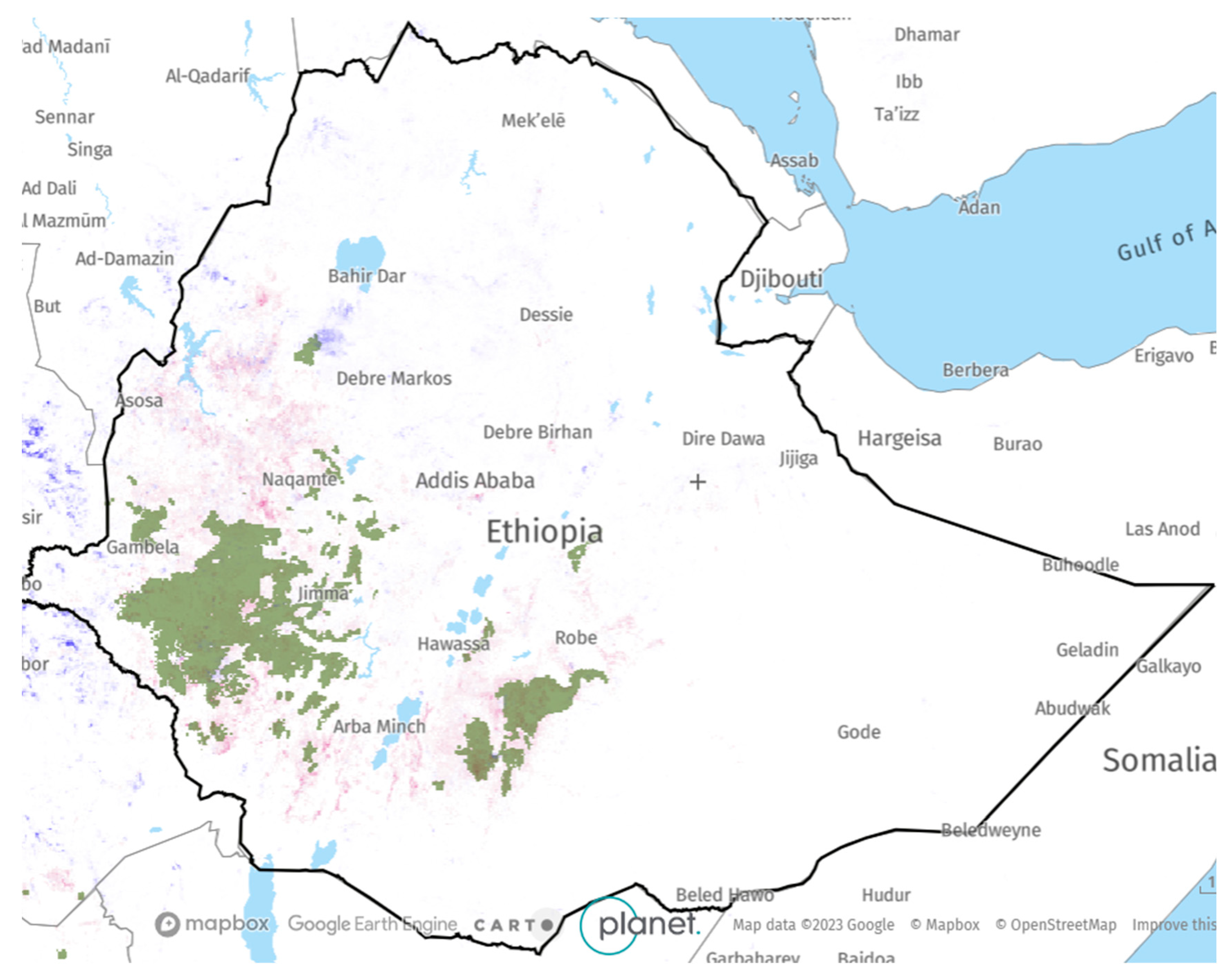
Figure 3.
Agriculture and settlement encroachment into the Combetrum-Terminallia woodlands of western Ethiopia, Metama area (The top and left photo show freshly cleared and ploughed areas of dry forest for crop cultivation and the right photo shows resettlement village established in the middle of dry forest during the 1980s resettlement program in the district. Photos: Mulugeta Lemenih).
Figure 3.
Agriculture and settlement encroachment into the Combetrum-Terminallia woodlands of western Ethiopia, Metama area (The top and left photo show freshly cleared and ploughed areas of dry forest for crop cultivation and the right photo shows resettlement village established in the middle of dry forest during the 1980s resettlement program in the district. Photos: Mulugeta Lemenih).
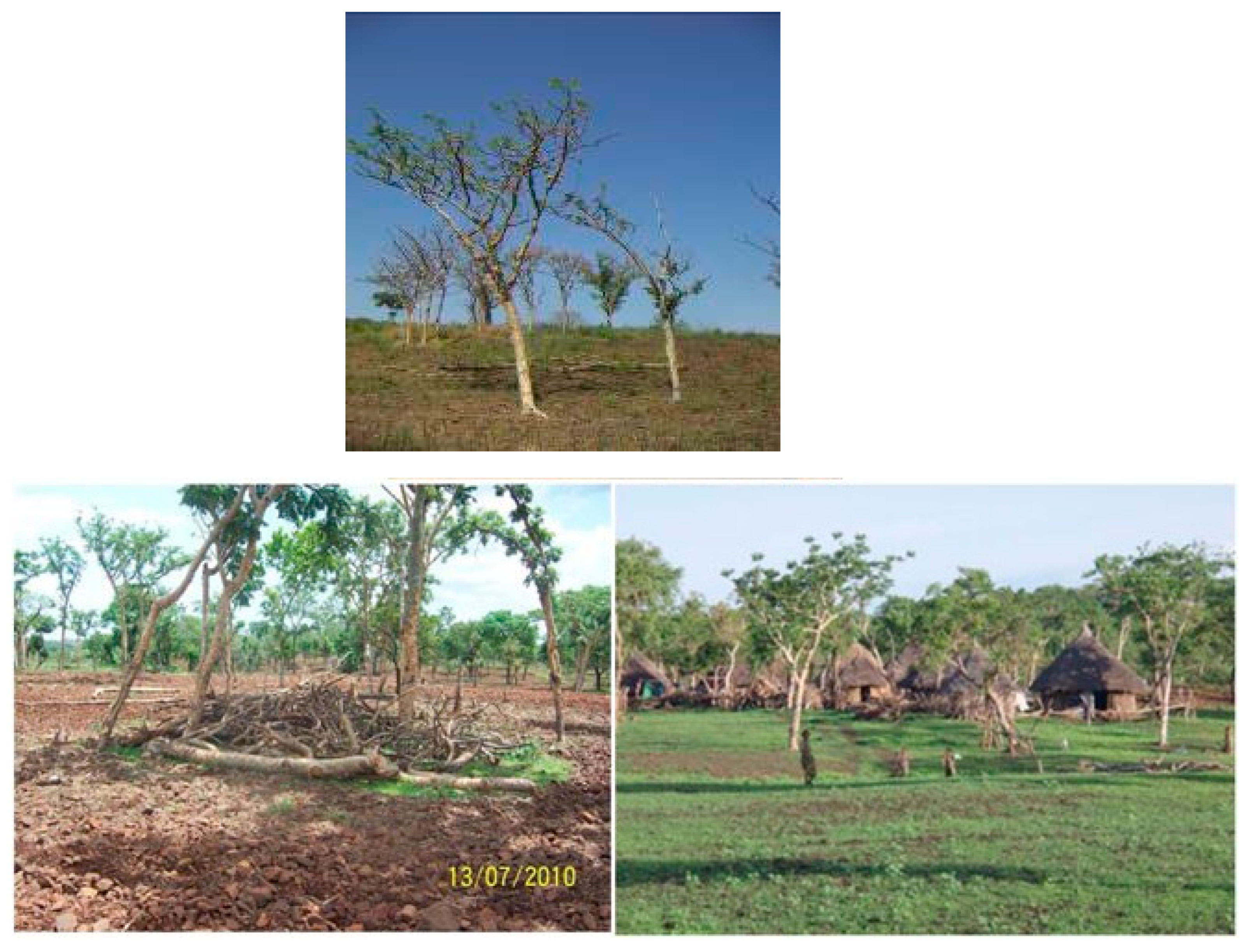
Figure 4.
Major local migration (resettlement plus self-initiated spontaneous movement) routes in Ethiopia since half of the last century (Main recipients: western lowlands, southwestern region, and Arsi - Bale highlands; Main sources: Tigray, Wollo and Shewa).
Figure 4.
Major local migration (resettlement plus self-initiated spontaneous movement) routes in Ethiopia since half of the last century (Main recipients: western lowlands, southwestern region, and Arsi - Bale highlands; Main sources: Tigray, Wollo and Shewa).
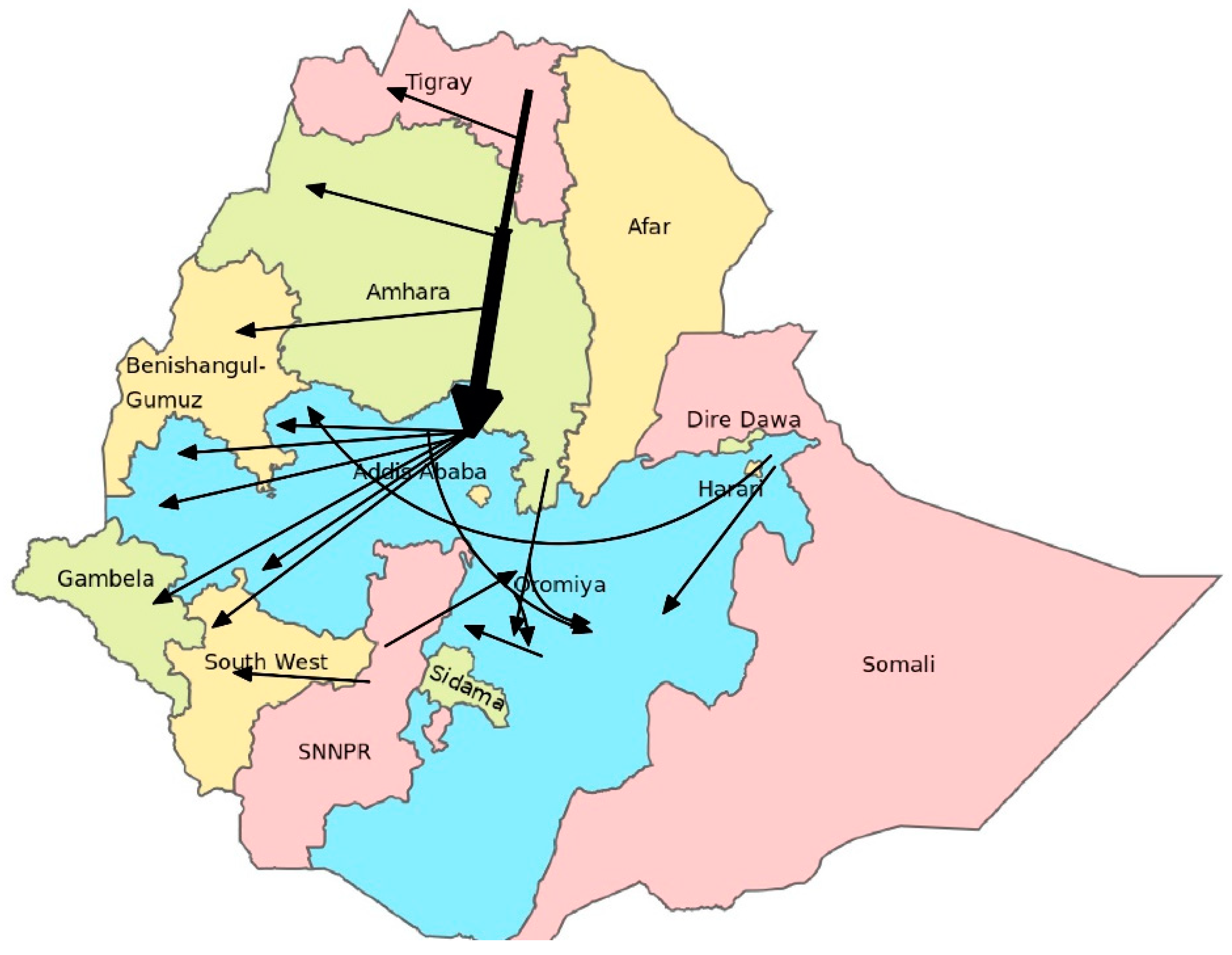
Figure 5.
Dry forest conversions to croplands in resettlement villages in Metema (Left photo shows a freshly cleared dry forest land for crop cultivation and the right photo shows resettlement village established in the middle of dry forest in the district. Photos: Mulugeta Lemenih).
Figure 5.
Dry forest conversions to croplands in resettlement villages in Metema (Left photo shows a freshly cleared dry forest land for crop cultivation and the right photo shows resettlement village established in the middle of dry forest in the district. Photos: Mulugeta Lemenih).
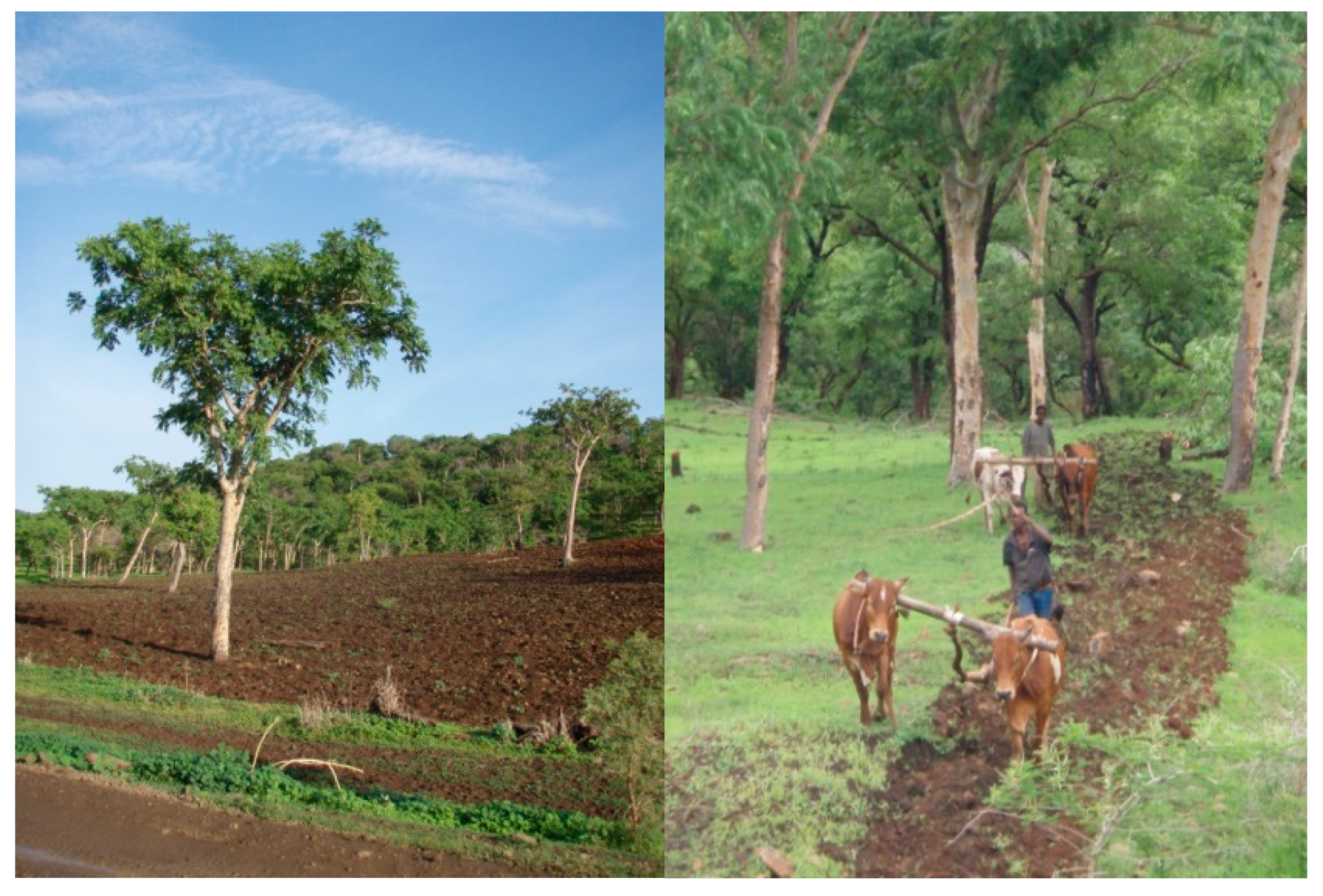
Figure 6.
Population growth (left) and arable land expansion (right) in Ethiopia over the past half a century compiled from different sources (https://www.macrotrends.net/countries/ETH/ethiopia/population; https://www.indexmundi.com/facts/ethiopia/indicator/AG.LND.ARBL.HA).
Figure 6.
Population growth (left) and arable land expansion (right) in Ethiopia over the past half a century compiled from different sources (https://www.macrotrends.net/countries/ETH/ethiopia/population; https://www.indexmundi.com/facts/ethiopia/indicator/AG.LND.ARBL.HA).
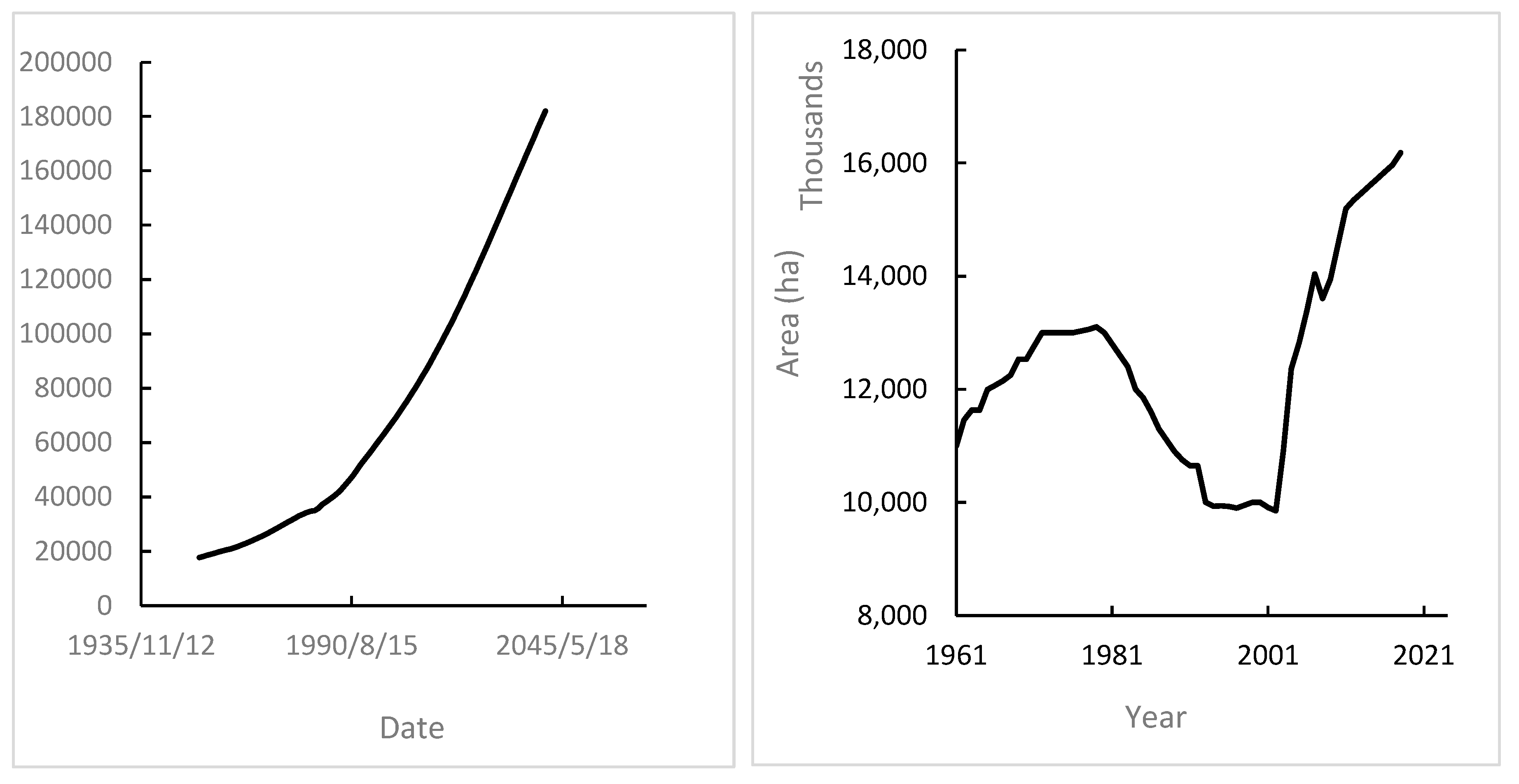
Figure 7.
Trends of Eucalyptus expansion mainly from farmers driven small-scale plantation in Mecha district in Amhara Regional State (Left), and throughout Ethiopia (right) (Source: [14,43,116]).
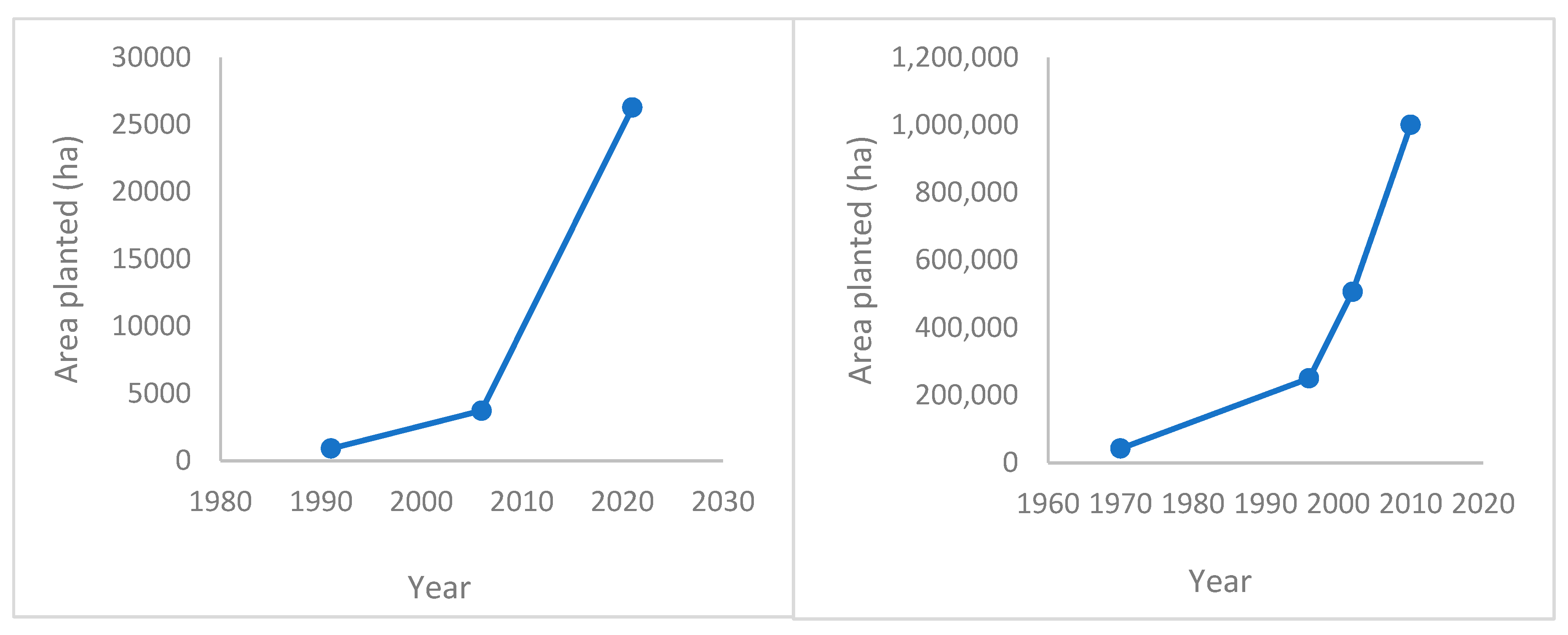
Table 1.
Forest resources and their trends in Ethiopia as reported in Global Forest Resources Assessment (Source: [63,64]).
| Forest Resource Assessment Categories | Forest area (1000 ha) | |||||
|---|---|---|---|---|---|---|
| 1990 | 2000 | 2010 | 2015 | 2020 | Changes | |
| Naturally regenerated forests: | ||||||
| *Revised estimate | 18,918.89 | 18,188.89 | 17,067.79 | 16,461.50 | 15,865.20 | -3,053.69 |
| **Earlier estimate | 15,114.00 | 13,705.00 | 12,296.00 | |||
| Planted forests | 339.61 | 339.61 | 740.71 | 972 | 1203.3 | 863.69 |
| Other planted forest | 67.92 | 67.92 | 148.14 | 194.4 | 240.65 | |
| Total forest area | 19,258.50 | 18,528.50 | 17,798.50 | 17,433.50 | 17,068.50 | -2,190.00 |
* Taken from FAO GFRA (2020). Country report: www.fao.org/3/ca9991en/ca9991en.pdf; ** Taken from FAO GFRA (2010). This estimate includes plantation forest as well. See the country report here (https://www.fao.org/3/al501E/al501E.pdf).
Table 3.
Estimated number of households resettled in Ethiopia since the 1950s (Sources: [88,91,92,93]).
| Year | Resettled household | Main region |
|---|---|---|
| Imperial tike (1950s) | 20,000 | Southern Ethiopia and Rift Valley area |
| 1975/1976 | 38,818 | 88 settlement village Kaffa, Wollega and Sidamo |
| 1982 | 120,000 | 112 Kaffa, Wollega and Sidamo |
| 1984-86 | 594,190 | Illubabor, Gameblla, Wollega, Gojam Pawe, Kaffa, Shewa and Gondar |
| 1988 | 50,000 | Illubabor, Gameblla, Wollega and Gojam Pawe, Kaffa, Shewa and Gondar |
| 2003-2005 | 440,000 | Intra-region (Oromia, Amhara, South and Tigray) |
| 2009–2014 | 173,835 | Amhara, Oromiya and SNNPR. |
| Total | 1,436,843 households or ca. 5,747,372 people | |
Disclaimer/Publisher’s Note: The statements, opinions and data contained in all publications are solely those of the individual author(s) and contributor(s) and not of MDPI and/or the editor(s). MDPI and/or the editor(s) disclaim responsibility for any injury to people or property resulting from any ideas, methods, instructions or products referred to in the content. |
© 2024 by the authors. Licensee MDPI, Basel, Switzerland. This article is an open access article distributed under the terms and conditions of the Creative Commons Attribution (CC BY) license (http://creativecommons.org/licenses/by/4.0/).
Copyright: This open access article is published under a Creative Commons CC BY 4.0 license, which permit the free download, distribution, and reuse, provided that the author and preprint are cited in any reuse.


