

Submitted:
03 January 2024
Posted:
04 January 2024
You are already at the latest version
Abstract
The genus Lirianthe in the family Magnoliaceae includes approximately 25 species, each with exceptional landscaping and horticultural or medical worth. Many of these plants are considered rare and protected due to their endangered status. The limited knowledge of species within this genus and the absence of research on its chloroplast genome have greatly impeded studies on the relationship between its evolution and systematics. In this study, the chloroplast genomes of 8 species from the genus Lirianthe were sequenced and analyzed, their phylogenetic relationships with other genera of the family Magnoliaceae are also elucidated. The results showed that the chloroplast genome sizes of the 8 Lirianthe species ranged from 159,548 to 159,833 bp. The genomes consisted of a large single copy region, a small single copy region, and a pair of inverted repeat sequences. The GC content was very similar across species. Gene annotation revealed that the chloroplast genomes contained 85 protein-coding genes, 37 tRNA genes, and 8 rRNA genes, totaling 130 genes. Codon usage analysis indicated that codon usage was highly conserved among the 8 Lirianthe species. Repeat sequence analysis identified 42-49 microsatellite sequences, 16-18 tandem repeats, and 50 dispersed repeats, with microsatellite sequences being predominantly single nucleotide repeats. DNA polymorphism analysis revealed 10 highly variable regions located in the large single copy and small single copy regions, among which rpl32-trnL, petA-psbJ and trnH-psbA are recommended candidate DNA barcodes for the genus Lirianthe species. The inverted repeat boundary regions show little variation between species and are generally conserved. Phylogenetic tree analysis confirmed the monophyly of the genus Lirianthe and its closest relationship with the genera, Talauma and Dugandiodendron. Morphological studies found noticeable differences between Lirianthe species in aspects including leaf indumentum, stipule scars, floral orientation, tepal number, tepal texture, and fruit dehiscence. In summary, this study elucidated the chloroplast genome evolution within Lirianthe and laid a foundation for further systematic and taxonomic research of this genus.
Keywords:
Magnoliaceae
; Lirianthe
; chloroplast genome
; Phylogeny
1. Introduction
The family Magnoliaceae encompass a group of plants that are highly valued for their ornamental qualities. The family involves about 300 species and ranges across tropical and temperate areas, mainly in Southeast Asia, North South America Central America, Southeast North America, including Mexico and Antilles[1,2]. In terms of classification, dividing Magnoliaceae into 2 subfamilies or 2 tribes, Liriodendroideae (or Liriodendreae) and Magnolioideae (or Magnolieae), has been widely accepted[3,4,5]. Within the subfamily Liriodendroideae, there is no dispute that it contains only the single genus, Liriodendron Linnaeus. Currently, all research indicates that the classification controversies within the family Magnoliaceae are mainly focused on the delimitation and classification of genera within the subfamily Magnolioideae. The number of genera within the family Magnolioideae has been divided into 16 by Xia[6], 15 by Law[4], 14 by Sima and Lu[7], 11 by Dandy[3], 16 by Wu et al. [10], or even just one by Figlar and Nooteboom[8]. Many scholars[9] prefer the treatment of segregated or smaller genera in the family Magnoliaceae. As they said, the main reason is that the treatment of the bigger genera cannot represent the later evolution process and levels in this family, and that the bigger genera are too inclusive to reflect the evolutional trends and the migratory routes mainly on the basis of morpho-geographical studies. The Sima & Lu’s Magnoliaceae system[7,10], established in 2012 based on DNA data and morphological characteristics, especially observations on living plants, consists of 14 monophyletic genera in their delimitation of the subfamily Magnolioideae, which has been strongly supported by an increasing number of DNA data analysis results and gradually accepted by many scholars[11,12,13,14].
The genus Lirianthe Spach s. l. in the Sima and Lu’s system is placed in Magnolia subgenus Magnolia section Gwillimia Candolle s. l. in the Figlar and Nooteboom’s system[15], it is a monophyletic group[7,10] and includes about 25 species mainly distributed from East Himalaya through South China to Southeast Asia[16]. There are about 12 species of this genus in China, of which 5 are endemic to China[16,17]. But this genus Lirianthe Spach s. s. in the Xia’s system excludes those species with the circumscissile mature carpels such as L. hodgsonii (J. D. Hooker & Thomson) Sima & S. G. Lu and so on. Plants of the genus Lirianthe have very important practical value and are world-renowned ornamental plants, industrial timber sources, medicinal materials and fragrance source species[18,19]. L. henryi (Dunn) N. H. Xia & C. Y. Wu, L. coco (Loureiro) N. H. Xia & C. Y. Wu, L. delavayi (Franchet) N. H. Xia & C. Y. Wu and L. odoratissima (Y. W. Law & R. Z. Zhou) N. H. Xia & C. Y. Wu have large and fragrant flowers, making them popular choices for garden ornamentals. Additionally, their lush green foliage makes them ideal for greening up outdoor space. L. phanerophlebia (B. L. Chen) Sima is only known from Hekou, Jinping and Maguan in the south-east of Yunnan province. Based on the results of the Global Trees Campaign field surveys in December 2005, it is estimated that the total wild population is less than 200 individuals. The biggest threat to the species is a decrease in habitat, with many suitable areas now replaced by banana plantation. Local awareness-raising is vital for this species, as well as research into nursery techniques for its cultivation. L. henryi is a national second-level key protected wild plant from Yunnan province. It has been listed as an endangered plant by the international union for conservation of nature (IUCN). L. confusa Sima & W. N. Sima and L. brevisericea Sima & Hong Yu are two newly described species.
Earlier phylogenetics of Magnoliaceae plants based on DNA analysis employed one to several nuclear or chloroplast DNA regions[20,21,22], but a recent systematic and phylogenetic study based on complete chloroplast genome (CPG) sequences of 9 species of Lirianthe demonstrated that these 9 species of Lirianthe form a monophyletic branch[23]. This study shows the value of chloroplast genomic data for systematics or species classification research, but did not include L. henryi, L. phanerophlebia, L. confusa and L. brevisericea. Here, complete chloroplast genomes were sequenced and assembled for them. Our goal was to 1) elucidate genomic structure, gene content and genetic variability encoded in Lirianthe chloroplast DNA; 2) conduct an initial chloroplast phylogenomic analysis in the family Magnoliaceae, with an emphasis of the genus Lirianthe. Chloroplast sequence datasets established herein facilitate improved phylogenetic resolution and evolutionary inferences for these under-surveyed Asian endemics and their underexplored Lirianthe relatives.
2. Results
2.1. General characteristics of eight chloroplast genome of Lirianthe Species
The sizes of the CPGs of eight Lirianthe species ranged from 159,548 bp to 159,833 bp, with significant variations between individual species (Table 1). The nucleotide compositions of the genomes were remarkably similar to each other, with 30.0% Adenine (A), 30.7% Thymine (T), 20.0% Cytosine (C), and 19.3% Guanine (G). This suggests a close evolutionary relationship among them. The CPGs were divided into a canonical quadripartite structure with a large single-copy region (LSC, 87,671~87,965 bp), a small single-copy region (SSC, 18,745~18,772 bp) and a pair of inverted repeats regions (IRa/IRb, 26,538~26,560 bp). Figure 1 shows the chloroplast genome structure of the genus Lirianthe, taking L. confusa as an example. The GC content of the CPG, LSC, SSC and IR regions were 39.27%~39.29%, 37.97%~37.98%, 34.32%~34.46% and 43.16%~43.18%, respectively (Table 1). The number of annotated genes in the eight chloroplast genomes is the same, with a total of 130, including 85 protein-coding genes, 37 transfer RNA genes, and 8 ribosomal RNA genes. The gene names and classifications of the 85 protein-coding130 genes were showed in Table S1, which were classified into fourfive categories for their different roles. The annotated CPG data have been submitted to the NCBI databankdatabas. The specific accession numbers are shown in Table 1.
2.2. Codon usage of protein coding genes
Among the 85 protein-coding genes (PCGs), after removing one of the 7 genes with 2 copies (ndhB, rpl2, rpl23, rps7, rps12, ycf2, ycf15), the remaining 78 PCGs were used for codon usage analysis.
The relative synonymous codon usage (RSCU) value of eight Lirianthe CPGs were displayed in Table S2.
Perhaps due to the high genetic similarity, the RSCU values of the eight species are very close, and the RSCU analysis results of L. confusa (MT654129) are shown in Figure 2. Its protein-coding gene region contained 22,659 codons (including 78 terminal codons). Among these codons, Leu (Leucme, L) was the most aboudant amino acid, with 2314 (10.21%), while Cys (Cysteine, C) was the least, with 262 (1.16%). In all the termination codons, AUU is the most frequently used amino acid.
Except for the stop codon, there are 30 codons with RSCU values greater than 1, in which codon ended with A/U was 94.80% and codon ended with C/G was 5.20%, indicating that these codons tended to end in A/U. The codon usage of these Lirianthe species is notably conserved, and is consistent with earlier reports on the chloroplast genomes of many land plants[24].
2.3. Repeat identification
A total of 42~49 microsatelite sequence repeats (SSR) loci, 16~18 tandem repeats and 50 dispersed repeats were detected in the eight Lirianthe CPGs (Table 2). The SSRs of 8 species are all single nucleotides and dinucleotides, and single nucleotides are dominant, accounting for more than 90%; more than three nucleotide repeating units were not detected. Among the dispersed repeat sequences, palindromic repeats and forward repeats are the main ones, accounting for 50% and 30% respectively.
2.4. DNA polymorphism
The polymorphism of the CPG nucleotide sequence is displayed graphically using the nucleotide diversity values (Pi) obtained by sliding window analysis, as shown in Figure 3. This allowed for a comprehensive visualization of the genetic variations among CPGs. The Pi value ranges from 0 to 0.012, with an average of 0.0014. The 10 intervals with the highest Pi values are shown in Figure 3, and which are petA-psbJ, trnH-psbA, psbM- trnY, rpl32-trnL, ccsA-ndhD, accD-ycf4, ndhF, ycf1, matK-rps16 and trnN-ndhF, respectively. Moreover, these highly variable regions are both in the LSC and SSC regions. The petA-psbJ has the highest Pi value (0.012). Furthermore, only the LSC and SSC regions include these highly variable regions, which is also supported by the graphical results of sequence alignments (Figure 1S).
2.5. Contraction and expansion of IR region
The length of the IR region of the eight Lirianthe species varies between 26538 and 26560 bp (Table 1). To better understand the boundary and detect changes in genes, we employed IRscope software to visualize the chloroplast into four regions: LSC-IRb (JLB), IRb-SSC (JSB), SSC-IRa (JSA), and IRa-LSC (JLA). Although the differences among them are small, the IR boundary region does show some differences in Figure 4.
2.6. Phylogenetic analysis
To determine the phylogenetic positions of the eight Lirianthe species, we combined the cp genome data of 37 other Magnoliaceous species to construct a phylogenetic tree (Figure 5). The phylogenetic tree comprising 45 species of Magnoliaceae confirms the monophyly of each genus and exhibits strong evidence for the interrelationships among the genera, well supporting the Sima and Lu’s system[7]. The phylogenetic relationship between the genus Lirianthe and the 2 genera, Talauma and Dugandiodendron, is closer, and the bootstrap value support rate with the remaining genera is higher than 76%. Of the 15 Lirianthe species, L. hodgsonii exhibits the closest phylogenetic relationship with L. pterocarpa (Roxburgh) Sima & S. G. Lu and the farthest phylogenetic relationship with L. delavayi.
The natural distribution range of L. delavayi is China (Sichuan, Yunnan) and that of L. hodgsonii is Nepal to China (SE. Yunnan). They both grow primarily in subtropical biomes. The distribution range of L. pterocarpa is Uttarakhand to Bangladesh. It is a tree and grows primarily in the wet tropical biome.
2.7. Plant Morphology
The main morphological characteristics of leaves, flowers, and fruits of the eight Lirianthe species are described in Table 3. Except for the midveins of the leaf blade of L. henryi and L. hodgsonii, which are adaxially prominent, the other six species are all impressed. Regarding the presence and texture of trichomes, L. brevisericea, L. confusa, L. delavayi and L. odoratissima have various types of indumenta on the abaxial leaf surface, including sericeous and tomentose hairs; L. henryi has scattered appressed trichomes on the abaxial surface; whereas L. coco, L. hodgsonii and L. phanerophlebia have glabrous leaves. Except for L. phanerophlebia, whose stipule scars only extend to 1/3-1/2 of the petiole length, all other species have stipule scars that reach the top of the petiole. In terms of floral orientation, except for L. brevisericea, L. delavayi and L. hodgsonii which are erect, the flowers of the remaining species are pendulous. The tepals are mostly 9 in number, ranging from 8 to 12; they are usually white, with only L. delavayi sometimes pink or red. The presence, texture, sparseness and color of indumentum on the gynoecia are key distinguishing characteristics. Except for the mature carpel of L. hodgsonii, which dehisces along a circumference, all other species dehisce along the dorsal suture.
3. Discussion
The chloroplast genome is a superior option to the nuclear genome for studying nucleotide diversity and reconstructing the phylogeny of related species due to its complexity, smaller genome size, lower nucleotide substitution rate, uniparental inheritance, and haploid characteristics[25]. The development of next-generation sequencing technology and bioinformatics analysis methods has significantly reduced the cost of obtaining genome sequences. Therefore, chloroplast genome-scale data are increasingly used to conduct. As a result, inferring evolutionary relationships at higher taxonomic levels[26], even at the interspecific or intraspecific level in some species, such as ginseng authentication by 18 species-specific markers [27], authentication of ginseng cultivars by 17 polymorphic sites [28], differentiation of hazelnut cultivars by a combination markers of 2 InDels and 1 SNP[29], markers were mostly developed from whole chloroplast genomes in these studies. The chloroplast genome assembly and annotation, as well as comparative analysis, are the basis and prerequisite for the above work.
We had previously completed the assembly and annotation of chloroplasts of L. hodgsonii [23] and L. coco [30]. Here, we newly assembled the chloroplast genomes of six other Lirianthe species. The CPGs of these plants were found to possess a similar size and structure, all demonstrating a typical quadripartite pattern. There is a known connection between the phylogenetic position and the total GC content. Early differentiated lineages, like those found in the Magnoliaceae, have a greater GC content [31]. Compared to the median GC content of 35% in most angiosperms, Houpoea plants have a higher GC content of around 39.2%[32], which is almost identical to the GC content of 39.3% in the Lirianthe species in this study. The GC content in the IR region of all Lirianthe species is notably high (43.2%), aligning increasingly conducted using chloroplast genome-scale data, with similar findings in other plants like Carthamus (43.2%)[33] and Cypripedium (42.7%)[34], potentially due to the inclusion of four highly conserved rRNA genes with high GC content (Figure 1).
SSR markers have been widely used in population genetics research due to their reliability and high variability. In this study, a small amount of SSR markers were detected, with about 170 in Houpoea species[32] and 246 in Bougainvillea spectabilis[35], while our findings indicated only 42~49 SSRs. The primary explanation is the use of different search parameters, as Carthamus species can only recognize 36-40 SSRs [33] when same parameters (1-10 2-6 3-5 4-5 5-5 6-5) are applied. The expansion and contraction of IR regions at the junctions of LSC and SSC have significant impacts, including the creation of pseudogenes and alterations in genome size and evolutionary rate[36]. The absence of substantial progress made even at lower taxonomic levels. Species identification, detection of structural changes in IR boundaries in this study suggests that Magnoliaceae may have remained relatively primitive and conservative nature.
The analysis of CPG DNA polymorphism is a proven approach to detect mutation hotspots, which can function as distinct DNA barcodes. Two of the 10 genes or DNA segments with the highest, assessment of nucleotide diversity detected in this study, rpl32-trnL and petA-psbJ, are also present in the genus Houpoea [32], which also belongs to the Magnoliaceae family. The trnH-psbA is one of the early recommended plant DNA barcodes [37] and was also the second most polymorphic fragment in this study. The rpl32-trnL, petA-psbJ and trnH-psbA are good candidate barcodes for Lirianthe species based on the results of comparative analysis of DNA polymorphisms. These potentially highly variable chloroplast barcodes will greatly enhance our ability to identify and protect rare and endangered species within the genus Lirianthe, resolution of phylogenetic relationships, and reconstruction of evolutionary history have become feasible through comparison of chloroplast genomes and phylogenetic analysis.
The genus Lirianthe Spach s. s. is one of the genera re-instated by Xia and Wu for Magnolia section Gwillimia Candolle s. s. when several genera were recognized in the family Magnoliaceae. It has been accepted in many recent publications from China and Vietnam [38]. CPG has proved to be a powerful tool in unraveling the evolutionary associations among land plants[26,39,40]. Based on the Sima and Lu’s system[7], 15 species of the genus Lirianthe s. l. and 29 species of other genera of Magnoliaceae were selected, and a phylogenetic tree was drawn using ML method with chloroplast whole genome sequences (Figure 5). Among them, plants of the genus Lirianthe gather together, to form an independent branch. All 15 species of the genus Lirianthe had been classified in the genus Lirianthe in Sima and Lu’ system, also simultaneously in the section Gwillimia of the genus Magnolia in the Figlar and Nooteboom’s system [8] and formed into a monophyletic taxon, but which had been classified in the two different genera, Talauma and Lirianthe, in the Xia’s system[6] and this implied that Xia’s Talauma is a polyphyletic taxon. Furthermore, the 15 Lirianthe species show a crossover mixed pattern in Xia's system, the four species marked with green shading demonstrate the results of this cross-mixing classification in Figure 5. The processing results of Lirianthe plants indicate that the plant range of Lirianthe defined by the Sima & Lu’s system or Magnolia section Gwillimia by Figlar & Nooteboom’s system is reasonable and scientific, and chloroplast genome evidence supports these taxonomic treatments.
However, as these mentioned in the introduction, there are too many generic delimitation problems within the tribe Magnolieae or the subfamily Magnolioideae. In 2004, Figlar & Nooteboom, based on the latest available data on DNA and morphology, degraded the tribe Magnolieae or the subfamily Magnolioideae into the genus Magnolia Linnaeus, reduced all of its former segregated genera to Magnolia and reconstructed a complex infrageneric system of this biggest genus Magnolia s.l. in the family Magnoliaceae, including 3 subgenera, 12 sections and 13 subsections. It sounds that this treatment had solved the generic delimitation problems within the tribe Magnolieae or the subfamily Magnolioideae. In essence, this just changed the problems from generic delimitation to infrageneric delimitation and the delimitation problems are still unsolved. In order to unravel the generic delimitation problems above better, Xia [6] and Sima & Lu [7] published a new system for the family Magnoliaceae respectively in 2012. A total of 17 genera are recognized in Xia’s system [6] and a total of 15 genera are recognized in Sima and Lu’s system[7]. The system by Sima and Lu, based on the data on DNA and the observations of morphological characters especially in living plants, was strongly supported by recent DNA work later [21,23,30,32,41] and was accepted by many scholars[11,12,13,14]. In order to better reflect the evolutionary steps and levels of Magnoliaceous plants, as well as the evolutionary trends and migration routes based primarily on morphological-geographical studies, it is a more feasible and useful approach to define smaller independent genera. Overall, the results of this study can provide valuable sequence information for the molecular systematics of Lirianthe in Magnoliaceae and offer a theoretical basis for the utilization and conservation of Lirianthe germplasm resources.
4. Materials and Methods
4.1. Sample, DNA extraction and sequencing
We dried and preserved the collected fresh leaves of 8 species (L. brevisericea, L. coco, L. confuse, L. delavayi, L. henryi, L. hodgsonii, L. odoratissima, L. phanerophlebia) with silica gel in 2019 and 2020. The voucher specimens were deposited at the herbaria of YAF, Kunming City, China (Sima & Chen, 99313 for L. brevisericea; Sima & Chen, 99279 for L. coco; Sima, 99261 for L. confus; Sima & Chen, 99277 for L. delavayi; Sima & Chen, 99315 for L. henryi; Jianghong, 7337 for L. hodgsonii; Sima, 99263 for L. odoratissima; Sima & Shui, 99321 for L. phanerophlebia). We extracted the total genomic DNA from the samples using DNA Plantzol Reagent (Invitrogen, Carlsbad, CA), and sent the DNAs to the BGI Group (Shenzhen, China) for library construction and sequencing on an Illumina HiSeq 2500 platform. The 2 × 150 bp paired-end reads with an insert size of 400 bp were created and the resulting DNA sequences were obtained after removing reads with low quality and adapter contamination.
4.2. Chloroplast genome assembly and annotation
4.3. The analysis of structures and characteristics of CPGs
The general informations of the CPGs, including genome size, number of genes, gene size, nucleotide composition, and so on, were conducted statistics using the Geneious software[42]. The structure map was also drawn using Geneious[42]. The identification of three types of repeats, namely microsatelite sequence repeats (SSRs), tandem repeats and dispersed repeats, was calculated using CPGAVAS2 [43]. The parameters were set as follows: 1-10 2-6 3-5 4-5 5-5 6-5 for SSRs, 2 7 7 80 10 50 500 -f -d -m for tandem repeats, -f -p -h 3 -l 30 for dispersed repeats. The DNA sequences of protein-coding genes (PCGs) were extracted using PhyloSuite[45], then the frequency of relative synonymous codon usage (RSCU) was calculated using MEGA-X[46].
4.4. Comparitive analysis of chloroplast genomes
To check the polymorphism of DNA, the CPGs sequences of 8 Lirianthe species were aligned using MAFFT[47], then sliding window analysis was performed on the alignment result using DnaSP[48] with window length and step size both set to 500bp. The regions with high Pi values were considered as mutational hotspots or candidate DNA barcodes. The contraction and expansion of IR region, namely LSC/IRb/SSC/IRa junctions, can be visualized in the online program IRscope[49].
4.5. Phylogenetic analysis
To compare the phylogenetic positions of genus Lirianthe in family Magnoliaceae, 37 chloroplast genome sequences of other Lirianthe species and other genera in Magnoliaceae were downloaded from the NCBI database. All 45 species of family Magnoliaceae plants covered in this study and their accession number of chloroplast genome are listed in Table S3.The whole chloroplast genome was aligned using MAFFT[47] in Geneious[44] with default settings. Maximum-likelihood (ML) analysis was run by RAxML program[50] under the GTRGAMMA model with 1000 bootstrap replicates. The phylogenetic tree was visualized by Figtree.
5. Conclusions
By studying the chloroplast genome of 8 Lirianthe species , we were able to clearly outline their characteristics and provide valuable insights into the divergence and phylogenetic evolution of Lirianthe species. It was evident from our analysis that the Lirianthe species exhibited a strong level of conservation in its genome structure, gene content, IR boundaries, repetitive elements, and codon usage. This implies that these species have maintained a steady genetic structure throughout their evolutionary history. The chloroplast genome is a robust tool for unraveling the phylogenetic connections among species within the genus Lirianthe , as shown by the high resolution of the ML tree. Our investigation of phylogenetic relationships has provided valuable insights into the connections between Lirianthe and other genera within family Magnoliaceae. The knowledge presented here enhances our understanding of how these species are related. By enriching the knowledge of the chloroplast genome of Lirianthe species, our study paves the way for future investigations into their classification and evolution .
Supplementary Materials
The following supporting information can be downloaded at the website of this paper posted on Preprints.org. Figure S1: The visualization of sequence alignment results in eight Lirianthe species; Table S1: The composition of protein-coding genes in the chloroplast genome of genus Lirianthe; Table S2: Relative synonymous codon usage (RSCU) of chloroplast genomes of eight Lirianthe species; Table S3: The names of 45 species used in this study and their accession numbers of chloroplast genome sequence in GenBank.
Author Contributions
“Conceptualization and methodology, T.W. and Y-K.S.; software, T.W.; validation, Y-K.S. and S-Y.C.; formal analysis, T.W. and S-Y.C; investigation, resources and data curation, Y-K.S., S-Y.C., Y-P. Fu., H-F. M., J-B. H., Y-F. Z.; writing—original draft preparation and visualization, T.W.; writing—review and editing, Y-K.S. and S-Y.C.; supervision, project administration and funding acquisition, Y-K. S. All authors have read and agreed to the published version of the manuscript.
Funding
This research was funded by the China National Natural Science Foundation (grant No. 31760180) , the Identification of international science and technology commissioners (Yong-Kang Sima) of Yunnan Province (grant No. 202203AK140005), and the Yunnan Fundamental Research Projects (grant No. 202201BC070001).
Institutional Review Board Statement
Not applicable.
Informed Consent Statement
Not applicable.
Data Availability Statement
The data provided in this study are deposited in the NCBI GenBank database (https://www.ncbi.nlm.nih.gov/ (accessed on 6 December 2023)); the GenBank accession numbers are listed in Table S3.
Conflicts of Interest
The authors declare no conflict of interest.
References
- Azuma, H.; ,Garcia-Franco, J.G.; Rico-Gray, V.; Thien, L.B. Molecular phylogeny of the Magnoliaceae: the biogeography of tropical and temperate disjunctions. Am. J. Bot. 2001, 88, 2275-85. [CrossRef]
- Wang, Y.; Liu, B.; Nie, Z.; Chen, H.; Chen, F.; Figlar, R.B.; Wen.J. Major clades and a revised classification of Magnolia and Magnoliaceae based on whole plastid genome sequences via genome skimming. J. Syst. Evol. 2020, 58, 673-695. [CrossRef]
- Dandy, J. E. The genera of Magnolieae. Bulletin of Miscellaneous Information (Royal Botanic Gardens, Kew). 1927, 7, 257-264. [CrossRef]
- Law, Y.W. A preliminary study on the taxonomy of the family Magnoliaceae." J. Syst. Evol. 1984, 22, 89-109.
- Nooteboom, H.P. Notes on Magnoliaceae with a revision of Pachylarnax and Elmerrillia and the Malesian species of Manglietia and Michelia. Blumea: Biodiversity, Evolution and Biogeography of Plants. 1985, 31, 65-121.
- Xia, N.H. A new classification system of family Magnoliaceae. Paper presented at the Proceedings of the Second International Symposium on the Family Magnoliaceae. Wuhan, 2012.
- Sima, Y.K and Lu. S.G. A new system for the family Magnoliaceae. Paper presented at the Proceedings of the Second International Symposium on the Family Magnoliaceae. Wuhan, 2012.
- Figlar, R. B. and Nooteboom, H.P. Notes on Magnoliaceae IV. Blumea: Biodiversity, Evolution and Biogeography of Plants. 2004, 49 , 87-100. [CrossRef]
- Li, J. A cladistic analysis of Magnoliaceae. Acta Botanica Yunnanica (Renamed as Plant Diversity). 1997, 19, 342-56.
- Sima, Y.; Yu, H.; Ma, H.; Hao, J.; Chen, S.; Li, S.; Fu, Y. New combinations in Magnoliaceae (in Chinese). Journal of West China Forestry Science, 2020, 49, 29-40.
- Yang, C.; Deng, J. Zhou, H.; Li, H.; Zheng, Z. The new records of Magnoliaceae in Guizhou province (in Chinese). Guizhou Forestry Science and Technology. 2016, 44, 21-23.
- Yang, C.; Deng, J. Zhou, H. Study on the resources and ornamental characteristics of the native Magnoliaceaes in Guizhou province (in Chinese). Guizhou Forestry Science and Technology, 2017, 45, 19-23.
- Yuan, C.; Yang,Y.; Dai, X.; Li, H.; Yang, C.; Wu, Y.; Wang J. Magnoliaceae plants and its distribution pattern in Guizhou province (in Chinese). Journal of West China Forestry Science, 2017, 46, 68-75.
- Wang, Y.; Wang, D. The complete chloroplast genome and phylogenetic analysis of Manglietia ventii (Magnoliaceae). Mitochondrial DNA Part B-Resour. 2022, 7, 196-198. [CrossRef]
- Figlar, R.B.; and Nooteboom, H.P. Magnolia classification. https://www.magnoliasociety.org/Classification (accessed 2023.11.20).
- Xia, N.; Liu, Y.; Nooteboom, H.P. Magnoliaceae. In Flora of China. Vol. 7, edited by Wu Z.Y. and Raven P.H., 48-91. Beijing: Science Press &: St. Louis: Missouri Botanical Garden Press, 2008. [CrossRef]
- Shui, Y.; Sima, Y.; Wen, J.; Chen, W. Vouchered flora of southeast Yunnan (Vol. 1). Kunming: Yunnan Technology and Sciences Housing, 2009.
- Li, Y.; Li, D. Conservation value and exploitation foreground of the Magnoliaceae plants in Yunnan. Jouranl of Beijing Forestry University, 1999, 21, 29-35.
- Sima, Y.; Ma, H.; Xu, T.; Yang, J.; Zhang, D. The chemical composition of volatile oils from leaves of three species of Lirianthe Spach in Magnoliaceae and its systematic signifcance (in Chinese). Journal of West China Forestry Science, 2018, 47, 7-14,+29.
- Azuma, H., García-Franco, J.G., Rico-Gray, V., Thien, L.B. Molecular phylogeny of the Magnoliaceae: the biogeography of tropical and temperate disjunctions. Am. J. Bot. 2001, 88, 2275-2285. [CrossRef]
- Kim, S.; Suh, Y. Phylogeny of Magnoliaceae based on ten chloroplast dna regions. J. Plant Biol. 2013, 56, 290-305. [CrossRef]
- Wollaeger, H.M. Genetic variability in Magnolia Acuminata (L.) populations in the Eastern United States. Bachelor thesis, Wittenberg University, 2011.
- Chen, S.; Wu, T.; Ma, H.; Fu, Y.; Zhu, Y.; Hao, J.; Jiang, H.; Sima, Y. The complete chloroplast genome sequence of Lirianthe Hodgsonii, a tree species of Magnoliaceae as least concern. Mitochondrial DNA Part B-Resour. 2020, 5, 3064-3066. [CrossRef]
- Redwan, R. M.; Saidin, A.; and Kumar, S.V. Complete chloroplast genome sequence of Md-2 pineapple and its comparative analysis among nine other plants from the Subclass commelinidae. BMC Plant Biol. 2015, 15, 196. [CrossRef]
- Li, X.; Yang, Y.; Henry, R.J.; Rossetto, M.; Wang, Y.; Chen, S. Plant DNA barcoding: from gene to genome. Biol. Rev. Camb. Philos. Soc. 2015, 90, 157-166. [CrossRef]
- Li, H.T.; Luo, Y.; Gan, L.; Ma, P.F.; Gao, L.M.; Yang, J.B.; Cai, J.; Gitzendanner, M.A.; Fritsch, P.W.; Zhang, T.; Jin, J.J.; Zeng, C.X.; Wang, H.; Yu, W.B.; Zhang, R.; van der Bank, M.; Olmstead, R.G.; Hollingsworth, P.M.' Chase, M.W.; Soltis, D.E.; Soltis, P.S.; Yi, T.; Li, D.Z. Plastid phylogenomic insights into relationships of all flowering plant families. BMC Biol. 2021, 19, 232. [CrossRef]
- Nguyen, V.B.; Linh Giang, V.N.; Waminal, N.E.; Park, H.S.; Kim, N.H.; Jang, W.; Lee, J.; Yang, T.J. Comprehensive comparative analysis of chloroplast genomes from seven Panax species and development of an authentication system based on species-unique single nucleotide polymorphism markers. J. Ginseng Res. 2020, 44, 135-44. [CrossRef]
- Kim, K.; Lee, S.C.; Lee, J.; Lee, H.O.; Joh, H.J.; Kim, N.H.; Park, H.S.; Yang, T.J. Comprehensive survey of genetic diversity in chloroplast genomes and 45s nrDNAs within Panax ginseng species. PLoS One, 2015, 10, e0117159. [CrossRef]
- Lang, C.; Weber, N.; Moeller, M.; Schramm, L.; Schelm, S.; Kohlbacher, O.; Fischer, M. Genetic authentication: differentiation of hazelnut cultivars using polymorphic sites of the chloroplast genome. Food Control. 2021, 130, 108344. [CrossRef]
- Sima, Y.; Wu, T.; Fu, Y.; Hao, J.; Chen, S. Complete chloroplast genome sequence of Lirianthe coco (Loureiro) N. H. Xia & C. Y. Wu (Magnoliaceae), a popular ornamental species. Mitochondrial DNA B Resour. 2020. 5, 2410-2412. [CrossRef]
- Cai, Z.; Penaflor, C.; Kuehl, J.V.; Leebens-Mack, J.; Carlson, J.E.; dePamphilis, C.W.; Boore, J.L.; Jansen, R.K. Complete plastid genome sequences of Drimys, Liriodendron, and Piper: implications for the phylogenetic relationships of magnoliids. BMC Evol. Biol. 2006, 6, 77. [CrossRef]
- Xu, Q.; Li, Z; Wu, N.; Yang, J.; Yuan, L.; Zhao, T.; Sima, Y.; & Xu, T. Comparitive analysis of the chloroplast genomes of three Houpoea plants. Genes. 2023, 14, 1262. [CrossRef]
- Yang, T.; Aishan, S.; Zhu, J.; Qin, Y.; Liu, J.; Liu, H.; Tie, J.; Wang, J.; Qin, R. Chloroplast genomes and phylogenetic analysis of three Carthamus (Asteraceae) species. Int. J. Mol. Sci. 2023, 24, 15634. [CrossRef]
- Guo, Y.Y.; Yang, J.X.; Li, H.K.; Zhao, H.S. Chloroplast genomes of two species of Cypripedium: expanded genome size and proliferation of at-biased repeat sequences. Front Plant Sci. 2021, 12, 609729. [CrossRef]
- Lin, X.; Lee, S.Y.; Ni, J.; Zhang, X.; Hu, X; Zou, P.; Wang, W.; Liu, G. Comparative analyses of chloroplast genome provide effective molecular markers for species and cultivar identification in Bougainvillea. Int. J. Mol. Sci. 2023, 24, 15138. [CrossRef]
- Zhang, H.; Li, C.; Miao, H.;Xiong, S. Insights from the complete chloroplast genome into the evolution of Sesamum indicum L. PLoS One. 2013, 11, e80508. [CrossRef]
- China Plant BOL Group, Li, D.Z.; Gao, L.M.; Li, H.T.; Wang, H.; Ge, X.J.; Liu, J.Q.; Chen, Z.D.; Zhou, S.L.; Chen, S.L.; Yang, J.B.; Fu, C.X.; Zeng, C.X.; Yan, H F.; Zhu, Y.J.; Sun, Y.S.; Chen, S.Y.; Zhao, L.; Wang, K.; Yang, T.; Duan, G.W. Comparative analysis of a large dataset indicates that internal transcribed spacer (ITS) should be incorporated into the core barcode for seed plants. Proc. Natl. Acad. Sci. USA. 2011, 108, 19641-19646. [CrossRef]
- Deng, Y.F. (2679) Proposal to Conserve the Name Talauma Fistulosa (Lirianthe Fistulosa, Magnolia Fistulosa) (Magnoliaceae) with a conserved type. Taxon, 2019, 68, 405-406. [CrossRef]
- Daniell, H.; Lin, C.S.; Yu, M.; & Chang, W.J. Chloroplast genomes: diversity, evolution, and applications in genetic engineering. Genome Biol. 2016, 17, 134. [CrossRef]
- Wolf, P.G.; Roper, J.M.; & Duffy, A.M. The evolution of chloroplast genome structure in ferns. Genome, 2010, 53, 731-738. [CrossRef]
- Liang, A.; Luo, W.; Li, Z.; Sima, Y.; Xu, T. The complete chloroplast genome sequence of Magnolia delavayi (Magnoliaceae), a rare ornamental and medical tree endemic to China. Mitochondrial DNA B Resour. 2020, 5, 883-884. [CrossRef]
- Jin, J.J.; Yu, W.B.; Yang, J.B.; Song, Y.; dePamphilis, C.W.; Yi, T.S.; Li, D.Z. Getorganelle: a fast and versatile toolkit for accurate de novo assembly of organelle genomes. Genome Biol. 2020, 21, 241. [CrossRef]
- Shi, L.; Chen, H.; Jiang, M.; Wang, L.; Wu, X.; Huang, L.; Liu, C. Cpgavas2, an integrated plastome sequence annotator and analyzer. Nucleic Acids Res. 2019, 47, W65-W73. [CrossRef]
- Kearse, M.; Moir, R.; Wilson, A.; Stones-Havas, S.; Cheung, M.; Sturrock, S.; Buxton, S.; Cooper, A.; Markowitz, S.; Duran, C.; Thierer, T.; Ashton, B.; Meintjes, P.; Drummond, A. Geneious Basic: an integrated and extendable desktop software platform for the organization and analysis of sequence data. Bioinformatics, 2012, 28, 1647-1649. [CrossRef]
- Zhang, D.; Gao, F.; Jakovlić, I.; Zou, H.; Zhang, J.; Li, W. X.; Wang, G.T. Phylosuite: an integrated and scalable desktop platform for streamlined molecular sequence data management and evolutionary phylogenetics studies. Mol. Ecol. Resour.2020, 20, 348-355. [CrossRef]
- Tamura, K; Stecher, G.; Kumar, S. MEGA11: molecular evolutionary genetics analysis version 11. Mol. Biol. Evol. 2021, 38, 3022-3027. [CrossRef]
- Katoh, K.; Misawa, K.; Kuma, K.; & Miyata, T. MAFFT a novel method for rapid multiple sequence alignment based on fast fourier transform. Nucleic Acids Res. 2002, 30, 3059-3066. [CrossRef]
- Rozas, J.; Rozas, R. DnaSP, DNA sequence polymorphism: an interactive program for estimating population genetics parameters from dna sequence data. Comput Appl. Biosci. 1995, 11, 621-625. [CrossRef]
- Amiryousefi, A.; Hyvönen, J.; & Poczai, P. IRscope: an online program to visualize the junction sites of chloroplast genomes. Bioinformatics. 2018, 34, 3030-3031. [CrossRef]
- Stamatakis, A. RAxML version 8: a tool for phylogenetic analysis and post-analysis of large phylogenies. Bioinformatics. 2014, 30, 1312-1313. [CrossRef]
Figure 1.
The gene and structure diagram of the Lirianthe species chloroplast genomes, taking L. confusa (MT654129) as an example.
Figure 1.
The gene and structure diagram of the Lirianthe species chloroplast genomes, taking L. confusa (MT654129) as an example.

Figure 2.
Relative synonymous codon usage (RSCU) analysis , taking L. confusa (MT654129) as an example.
Figure 2.
Relative synonymous codon usage (RSCU) analysis , taking L. confusa (MT654129) as an example.
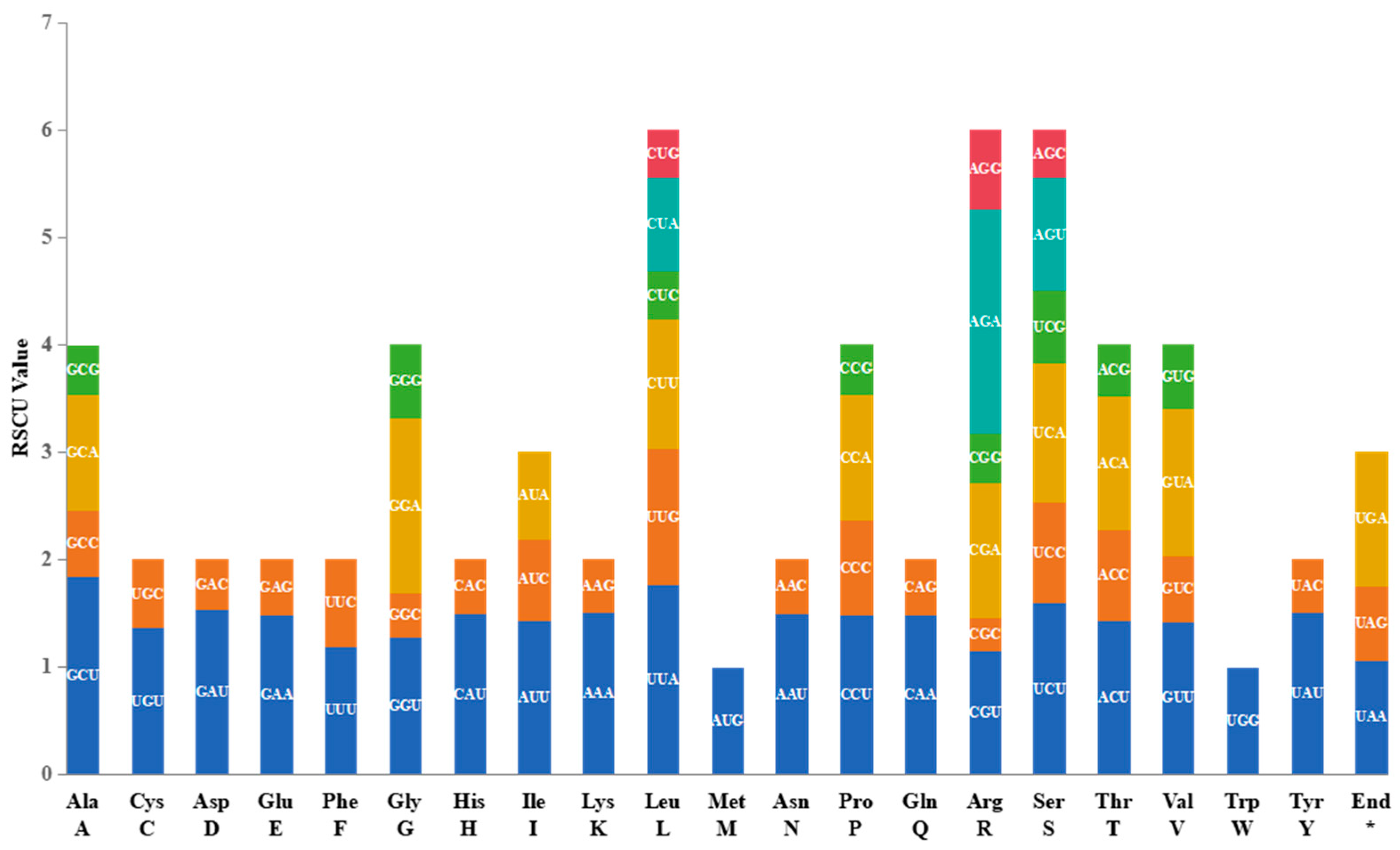
Figure 3.
The DNA polymorphism analysis of eight Lirianthe chloroplast genomes by sliding window method. Window length: 500 bp; step size: 500 bp.
Figure 3.
The DNA polymorphism analysis of eight Lirianthe chloroplast genomes by sliding window method. Window length: 500 bp; step size: 500 bp.
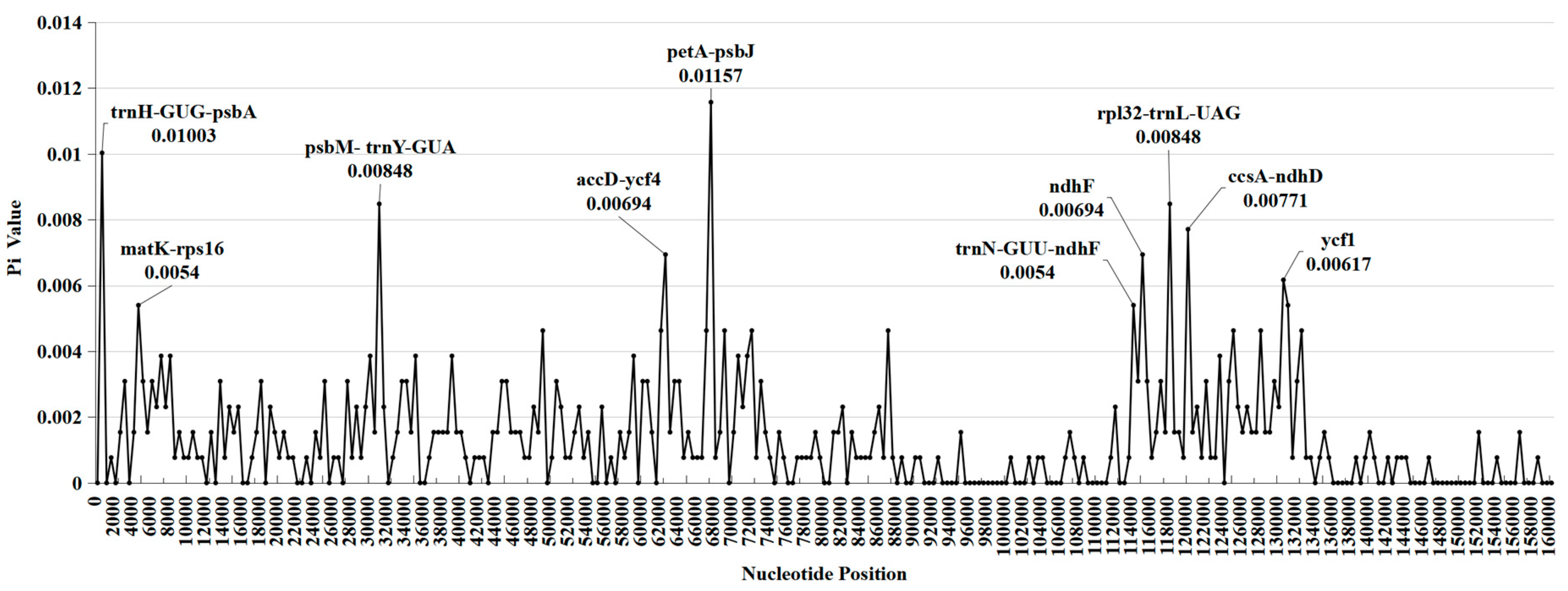
Figure 4.
Comparison of IR boundary in eight Lirianthe CPGs. The arrow indicated the number of base pairs that represented genes moving away from a particular region of the chloroplast genomes.
Figure 4.
Comparison of IR boundary in eight Lirianthe CPGs. The arrow indicated the number of base pairs that represented genes moving away from a particular region of the chloroplast genomes.
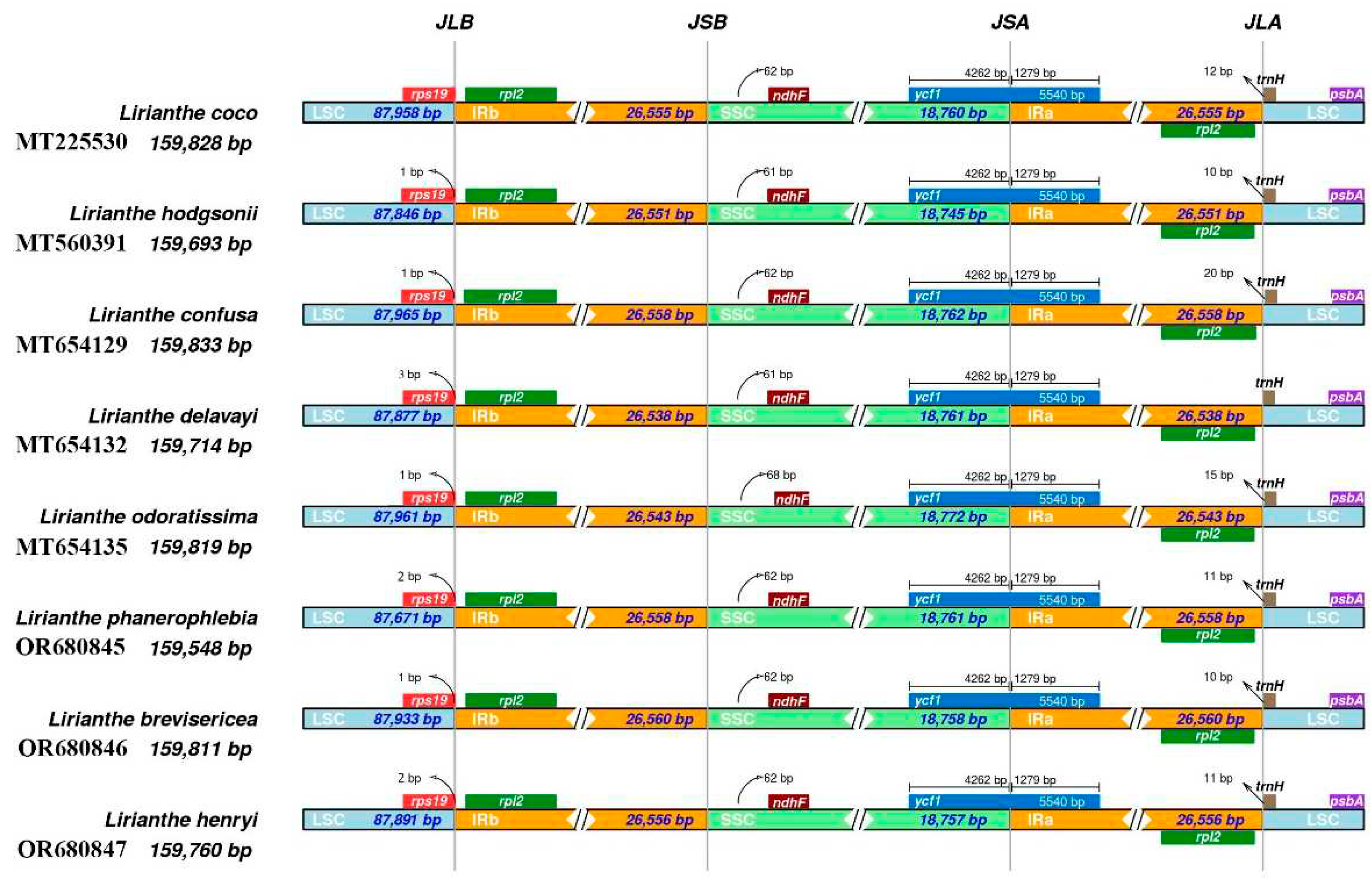
Figure 5.
Phylogenetic trees of the genus Lirianthe and other Magnoliaceous species using Maximum likelihood (ML) methods.Note: Gray, blue and orange bars indicate the results or belonging positions of the corresponding plants in the Sima & Lu’s, Xia’s and Figlar & Nooteboom’s systems, respectively.
Figure 5.
Phylogenetic trees of the genus Lirianthe and other Magnoliaceous species using Maximum likelihood (ML) methods.Note: Gray, blue and orange bars indicate the results or belonging positions of the corresponding plants in the Sima & Lu’s, Xia’s and Figlar & Nooteboom’s systems, respectively.
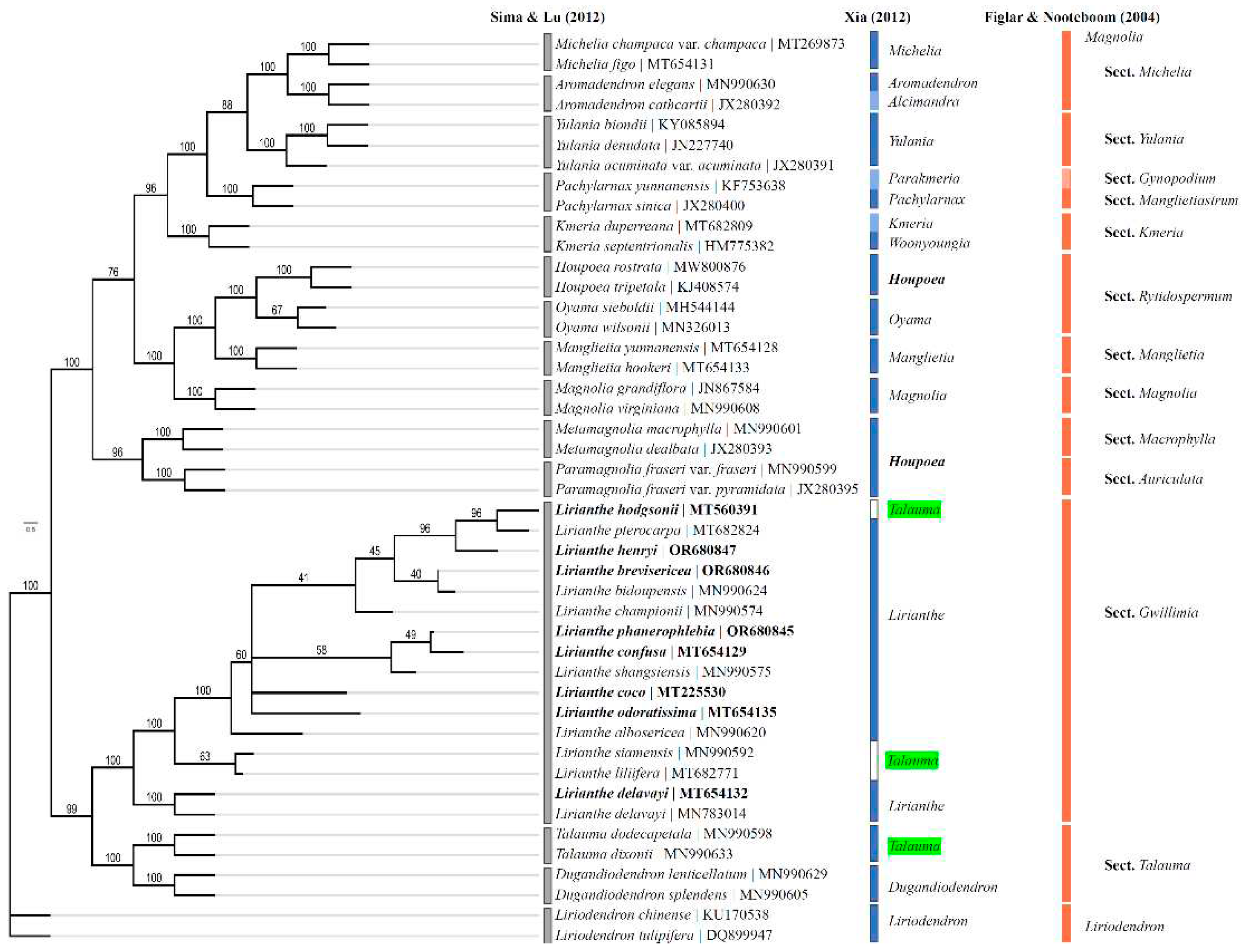

Table 1.
Features of eight Lirianthe chloroplast genomes.
| Species | L. brevisericea | L. coco | L. confusa | L. delavayi | L. henryi | L. hodgsonii | L. odoratissima | L. phanerophlebia |
|---|---|---|---|---|---|---|---|---|
| Name Abbr. | Lbre | Lcoc | Lcon | Ldel | Lhen | Lhod | Lodo | Lpha |
| Accession No. | OR680846 | MT225530 | MT654129 | MT654132 | OR680847 | MT560391 | MT654135 | OR680845 |
| Total Length (bp) | 159,811 | 159,828 | 159,833 | 159,714 | 159,760 | 159,693 | 159,819 | 159,548 |
| LSC (bp) | 87,933 | 87,958 | 87,965 | 87,877 | 87,891 | 87,846 | 87,961 | 87,671 |
| SSC (bp) | 18,758 | 18,760 | 18,752 | 18,761 | 18,757 | 18,745 | 18,772 | 18,761 |
| IR (bp) | 26,560 | 26,555 | 26,558 | 26,538 | 26,556 | 26,551 | 26,543 | 26,558 |
| Total Genes | 130 | |||||||
| CDS | 85 | |||||||
| tRNA | 37 | |||||||
| rRNA | 8 | |||||||
| Total GC% | 39.28 | 39.28 | 39.27 | 39.29 | 39.28 | 39.28 | 39.27 | 39.29 |
| LSC (GC%) | 37.98 | 37.97 | 37.97 | 37.97 | 37.97 | 37.97 | 37.97 | 37.98 |
| SSC (GC%) | 34.36 | 34.37 | 34.39 | 34.46 | 34.38 | 34.37 | 34.32 | 34.41 |
| IR (GC%) | 43.17 | 43.18 | 43.16 | 43.18 | 43.18 | 43.18 | 43.18 | 43.17 |
| A (%) | 47908 (29.98) | 47915 (29.98) | 47913 (29.98) | 47862 (29.97) | 47868 (29.96) | 47,851 (29.96) | 47908 (29.98) | 47799 (29.96) |
| C (%) | 31980 (20.01) | 31983 (20.01) | 31979 (20.01) | 31972 (20.02) | 31980 (20.02) | 31,958 (20.01) | 31977 (20.01) | 31940 (20.02) |
| G (%) | 30790 (19.27) | 30795 (19.27) | 30790 (19.26) | 30779 (19.27) | 30777 (19.26) | 30,774 (19.27) | 30782 (19.26) | 30741 (19.27) |
| T (%) | 49133 (30.74) | 49135 (30.74) | 49151 (30.75) | 49101 (30.74) | 49135 (30.76) | 49,110 (30.75) | 49152 (30.75) | 49068 (30.75) |
Table 2.
The type and number of repeat sequences in the chloroplast genomes of 8 Lirianthe species.
| Species | Lbre | Lcoc | Lcon | Ldel | Lhen | Lhod | Lodo | Lpha | |
| SSR | A | 17 | 13 | 13 | 17 | 15 | 16 | 16 | 17 |
| C | 2 | 2 | 3 | 3 | 3 | 3 | 2 | 3 | |
| G | 1 | 0 | 1 | 0 | 0 | 1 | 0 | 0 | |
| T | 21 | 23 | 22 | 25 | 24 | 24 | 21 | 24 | |
| TA | 1 | 2 | 2 | 2 | 2 | 2 | 1 | 2 | |
| TC | 2 | 2 | 2 | 2 | 2 | 2 | 2 | 2 | |
| Total No. | 44 | 42 | 43 | 49 | 46 | 48 | 42 | 48 | |
| Tandem Repeats | 16 | 18 | 17 | 17 | 16 | 16 | 17 | 17 | |
| Dispersed Repeats | Complement | 0 | 0 | 0 | 0 | 1 | 0 | 0 | 0 |
| Forward | 16 | 16 | 15 | 18 | 15 | 16 | 17 | 17 | |
| Palindromic | 27 | 25 | 26 | 25 | 26 | 26 | 25 | 25 | |
| Reverse | 7 | 9 | 9 | 7 | 8 | 8 | 8 | 8 | |
| Total No. | 50 | 50 | 50 | 50 | 50 | 50 | 50 | 50 | |
Table 3.
Morphological comparisons among eight species of the genus Lirianthe Spach.
| Species | Leaves | Flowers | Fruits |
|---|---|---|---|
| L. brevisericea | Abaxially yellowish-gray sericeous; leaf blade midveins adaxially impressed, lateral veins 12–19 pairs; stipular scars reaching apex of petioles. | Erect; tepals 9, white; gynoecia densely yellowish-gray sericeous. | Mature carpels dehiscent along dorsal sutures |
| L. coco | Glabrous, leaf blade midveins adaxially impressed, lateral veins 8–16 pairs;; stipular scars reaching apex of petioles. | Pendulous; tepals 9, white; gynoecia glabrous. | Mature carpels dehiscent along dorsal sutures. |
| L. confusa | Abaxially yellowish-white curved trichomes; leaf blade midveins adaxially impressed, lateral veins 10–15 pairs;; stipular scars reaching apex of petioles. | Pendulous; tepals 9, white; gynoecia very densely yellowish-white villose. | Mature carpels dehiscent along dorsal sutures |
| L. delavayi | Abaxially densely interwoven tomentose and white powdery but later only with residual trichomes on veins; leaf blade midveins adaxially impressed, lateral veins 11–16 pairs; stipular scars reaching apex of petioles. | Erect; tepals 9 to 12, white, yellowish-white, pink or red; gynoecia fine yellow villose. | Mature carpels dehiscent along dorsal sutures. |
| L. henryi | Abaxially sparsely appressed pubescent; leaf blade midveins adaxially prominent, lateral veins 14–20 pairs; stipular scars reaching apex of petioles. | Pendulous; tepals 9, white; gynoecia glabrous. | Mature carpels dehiscent along dorsal sutures |
| L. hodgsonii | Glabrous; leaf blade midveins adaxially prominent, lateral veins 10–20 pairs; stipular scars reaching apex of petioles. | Erect; tepals 9, white; gynoecia glabrous. | Mature carpels circumscissile |
| L. odoratissima | Abaxially yellowish-white or grayish-brown curved trichomes; leaf blade midvein adaxially impressed, lateral veins 9–14 pairs; stipular scars reaching apex of petioles. | Pendulous; tepals 9 to 10, white; gynoecia densely grayish-brown pubescent. | Mature carpels dehiscent along dorsal sutures |
| L. phanerophlebia | Glabrous; leaf blade midveins adaxially impressed, lateral veins 11–17 pairs; stipular scars 1/3–1/2 as long as petioles. | Pendulous; tepals 8 to 9, white; gynoecia glabrous or glaucous. | Mature carpels dehiscent along dorsal sutures |
Disclaimer/Publisher’s Note: The statements, opinions and data contained in all publications are solely those of the individual author(s) and contributor(s) and not of MDPI and/or the editor(s). MDPI and/or the editor(s) disclaim responsibility for any injury to people or property resulting from any ideas, methods, instructions or products referred to in the content. |
© 2024 by the authors. Licensee MDPI, Basel, Switzerland. This article is an open access article distributed under the terms and conditions of the Creative Commons Attribution (CC BY) license (http://creativecommons.org/licenses/by/4.0/).
Copyright: This open access article is published under a Creative Commons CC BY 4.0 license, which permit the free download, distribution, and reuse, provided that the author and preprint are cited in any reuse.


